Article

Path Planning for an Unmanned Wing-in-Ground-Effect Craft Using a Hybrid ISSA-GWO Algorithm

1
Taihu Laboratory of Deepsea Technological Science, Wuxi 214000, China
2
UAV Research Institute, Nanjing University of Aeronautics and Astronautics, Nanjing 210000, China
*
Author to whom correspondence should be addressed.
Drones 2026, 10(6), 464; https://doi.org/10.3390/drones10060464 (registering DOI)
Submission received: 9 April 2026 / Revised: 2 June 2026 / Accepted: 3 June 2026 / Published: 15 June 2026
(This article belongs to the Special Issue Swarm Intelligence-Inspired Planning and Control for Drones)

Highlights

What are the main findings?
  • A path planning method based on an improved hybrid Sparrow Search Algorithm and Grey Wolf Optimizer is proposed, which significantly enhances the low-altitude path planning performance of Unmanned Wing-in-Ground-Effect Craft in complex island reef waters.
  • The proposed algorithm outperforms the standard Sparrow Search Algorithm, Grey Wolf Optimizer, and Particle Swarm Optimization in terms of convergence speed, optimization accuracy, and obstacle avoidance success rate.
What is the implication of the main finding?
  • The method incorporates ground-effect altitude maintenance and a reef threat model, enabling the generation of feasible, safe, and smooth flight paths for Wing-in-Ground-Effect Craft in complex island environments.
  • The findings support more efficient and reliable autonomous navigation for Wing-in-Ground-Effect Craft in maritime missions such as island patrol and rapid replenishment.

Abstract

A novel hybrid ISSA-GWO (Improved Sparrow Search Algorithm–Grey Wolf Optimizer) is proposed for the path planning of Unmanned Wing-in-Ground-Effect Craft (UWIGC), integrating ground-effect constraints and island-reef environments into a unified optimization framework. Leveraging its exceptional ultra-low-altitude flight capability and high economic efficiency, the UWIGC offers unique advantages in maritime missions such as island patrol and rapid replenishment. However, its path planning faces the dual challenge of precise obstacle avoidance and ultra-low-altitude maintenance, due to the obstacle distribution in island regions and the altitude window constraints inherent to ground-effect flight. To address this, the proposed method integrates the swarm intelligence of the Sparrow Search Algorithm and employs a self-destruction mechanism to escape local optima. Furthermore, it combines the hierarchical guidance of the Grey Wolf Optimizer to enhance convergence accuracy. The algorithm incorporates ground-effect maintenance constraints and an island-reef threat model, and it smooths the final path using cubic B-spline curves. Simulation results demonstrate that the proposed algorithm outperforms the standard Sparrow Search Algorithm, Grey Wolf Optimizer, and Particle Swarm Optimization in terms of convergence speed, optimization accuracy, and obstacle avoidance success rate. It is capable of generating a feasible, safe, and smooth path, thereby supporting the autonomous navigation of UWIGC in island reef waters.

1. Introduction

Path planning for unmanned aerial vehicles is the process of determining an optimal flight path in continuous space while satisfying multiple operational constraints. Existing mainstream path-planning approaches can generally be classified into two categories: roadmap- and grid-based methods [1]. Representative algorithms include conventional optimization methods, such as the A* algorithm, Dijkstra’s algorithm, and artificial potential field method, as well as intelligent optimization methods, such as genetic algorithms, Particle Swarm Optimization, grey wolf optimization, and ant colony optimization. Benefiting from their strong adaptability and low dependence on initial conditions, intelligent optimization algorithms have been widely applied to complex path-planning problems [2].
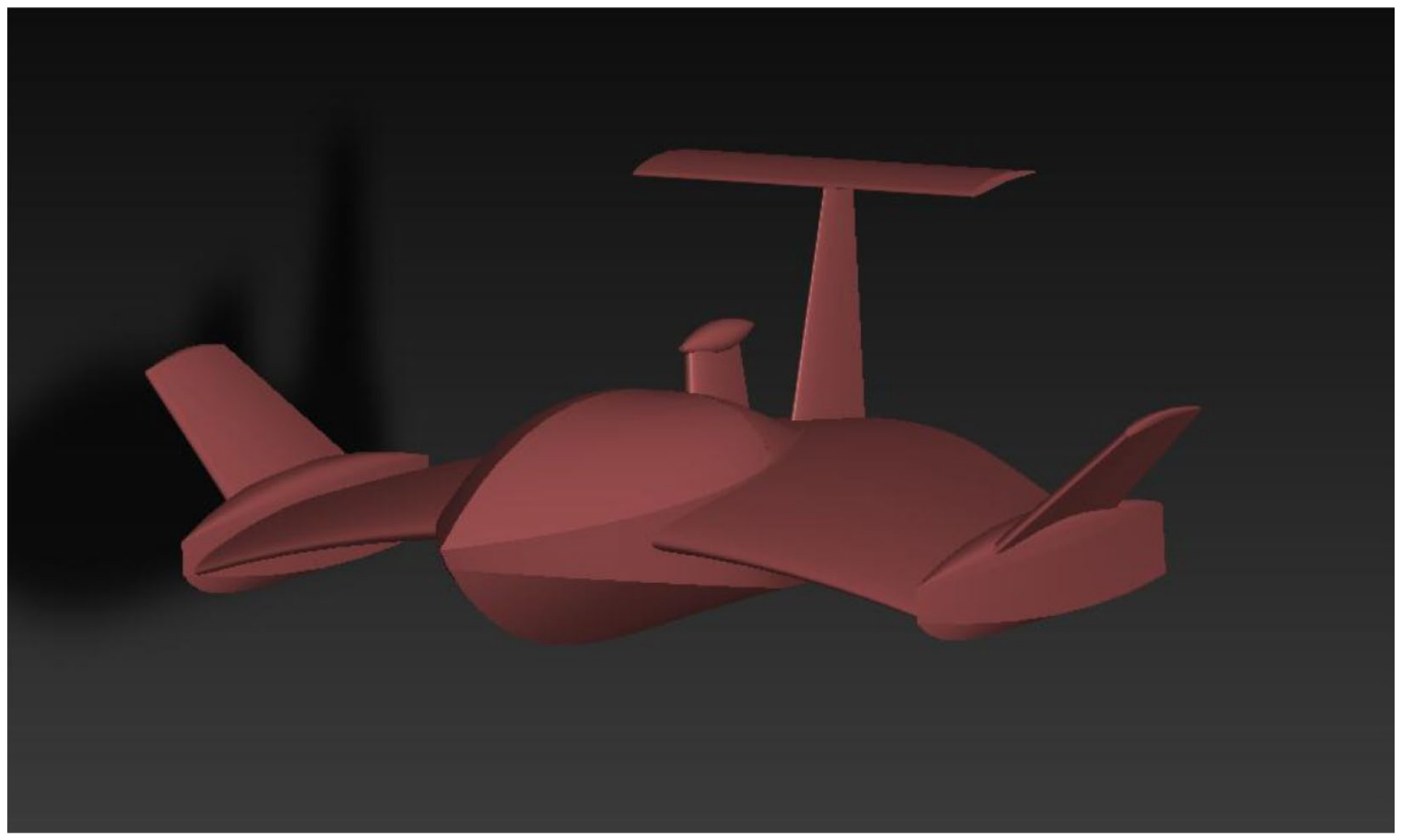
However, the specific application of these general methods to Unmanned Wing-in-Ground-Effect Craft (UWIGC) involves unique challenges. As a distinct flight platform that operates by utilizing the ground effect at ultra-low altitude, UWIGC offers unique advantages in maritime missions such as island-reef patrol and rapid resupply, owing to its high cost-effectiveness and ultra-low-altitude flight capability [3]. In recent years, the European AIRSHIP project has systematically evaluated the feasibility of ground-effect vehicles for inter-island routes, showing that their operating costs on certain routes are approximately 30% lower than those of conventional vessels [4]. However, the cluttered obstacle environment in island and reef areas, together with the narrow altitude window inherent in ground-effect flight, poses significant challenges to UWIGC route planning, particularly with respect to precise obstacle avoidance and the maintenance of stable ultra-low-altitude flight [5]. Therefore, a key issue that must be addressed for the engineering application of UWIGC is how to generate safe, obstacle-avoiding, and range-optimized flyable paths while satisfying narrow altitude constraints. Reference [6] systematically reviewed trajectory planning techniques for unmanned aerial vehicles in complex environments and pointed out that ultra-low-altitude flight scenarios impose more stringent requirements on the real-time performance and safety of planning algorithms. The 3D model of the UWIGC is show in Figure 1.
To address the specific challenges of the island-reef environment, we focus on the following coupled constraints in this study: (1) Ultra-Low-Altitude Maintenance: The need to stay within the narrow-altitude window for efficient ground-effect flight. (2) Precise Obstacle Avoidance: The requirement to navigate safely through dense, cluttered island-reef regions. Most existing studies either address general low-altitude planning or focus on algorithmic improvements in isolation. They fail to provide a cohesive solution that simultaneously and rigorously models the tight coupling between the narrow, stable altitude window required for ground-effect flight and the need for precise navigation in dense, cluttered obstacle fields like island-reef areas.
Proposed by Xue et al. in 2020, the Sparrow Search Algorithm (SSA) is a novel swarm intelligence optimization algorithm that models the foraging, scrounging, and anti-predation behaviours of sparrows [7]. Although the algorithm exhibits fast convergence, strong stability, and high optimization accuracy, it still suffers from several drawbacks, such as a tendency to fall into and a weak ability to escape from local optima, and rapid loss of population diversity [8]. Various improvement strategies have been proposed to address these limitations. Zhang et al. combined the Sparrow Search Algorithm (SSA) with the Dynamic Window Approach (DWA) and optimized the velocity search space through adaptive adjustment of window parameters, thereby enhancing the safety and efficiency of path planning in dense dynamic-obstacle environments [9]. Reference [10] employed an improved Tent chaotic map and opposition-based learning for population initialization, while incorporating a Lévy flight strategy to enhance the global search capability of the algorithm. Reference [11] employed cyclic mapping for population initialization and incorporated a Lévy flight strategy together with a t-distribution-based random perturbation term into the follower position update mechanism, thereby enhancing the convergence rate and stability of the algorithm. Reference [12] proposed a multi-strategy improved Sparrow Search Algorithm (MISSA), which integrates iterative chaotic mapping, the golden sine algorithm, and elite opposition-based learning, and demonstrated significantly better performance than the compared algorithms on the CEC2014 benchmark functions.
The Grey Wolf Optimizer (GWO), inspired by the social hierarchy and hunting behaviour of grey wolves, has shown remarkable performance in terms of convergence accuracy [13]. Hybrid optimization strategies have attracted increasing attention in recent years. Zhang et al. proposed a Chaotic Grey Wolf Optimizer (CGWO), in which chaotic initialization is employed to enhance population diversity, while a dynamic balancing mechanism is introduced to better coordinate global exploration and local exploitation, thereby significantly improving convergence accuracy and convergence speed [14]. Reference [15] proposed a locally optimized hybrid Grey Wolf Optimizer that incorporates a multi-population parallel strategy and a nonlinear convergence factor, achieving an approximately 12.9% improvement in solution accuracy and a nearly 50% increase in convergence speed. Reference [16] proposed a Hybrid Grey Wolf Optimizer with a Discrete Prism Dispersion Strategy (HGWO-DPDS), inspired by the multidirectional refraction of light through a prism. By employing multiple reference centres to guide the population toward different regions of the solution space, the method effectively enhances global search capability and population diversity. The GWO-CS hybrid algorithm combines the social hierarchy mechanism of GWO with the Lévy flight characteristic of Cuckoo Search and employs Tent chaotic mapping for population initialization, thereby effectively alleviating premature convergence [17]. In addition, Reference [18] presents a systematic review of the variants and applications of GWO, indicating that hybrid strategies have become a mainstream approach for enhancing algorithm performance.
Despite these advances, research on path planning for UWIGC in complex island-reef environments remains limited. Recent related research on path planning for UWIGC in complex environments remains relatively limited, and recent research has made several advances in related areas: in the field of ultra-low-altitude and complex environment path planning for UAVs [19,20]; for long-distance low-altitude path planning using improved RRT [21]; and the application of various meta-heuristic algorithms like improved PSO [22], equilibrium optimization [23], and lion swarm algorithms [24] to constrained path planning. Particularly noteworthy is that energy-efficient path planning for WIG crafts has also been explored [25]. Knyazhskiy et al. [26] conducted a study on 3D trajectory optimization for WIG crafts over rough sea surfaces but did not consider densely cluttered obstacle environments such as those found in island-reef regions.
However, a critical research gap persists. Thus, existing studies still exhibit the following weaknesses: (1) the ground-effect altitude window constraint is often treated merely as a boundary condition, lacking deep integration with optimization objectives; (2) there is a lack of targeted algorithmic design for the coupled constraints of “ultra-low-altitude maintenance” and “precise obstacle avoidance.” Most studies either focus on general low-altitude environments or emphasize improvements in the algorithms themselves, failing to achieve integrated modelling and cooperative optimization of the unique physical constraints of ground-effect flight (such as the narrow flight altitude window that must be maintained) and the dense, complex obstacle environments typical of island-reef areas. Most existing studies either address general low-altitude planning or focus on algorithmic improvements in isolation. They fail to provide a cohesive solution that simultaneously and rigorously models the tight coupling between the narrow, stable altitude window required for ground-effect flight and the need for precise navigation in dense, cluttered obstacle fields like island-reef areas. Therefore, in this study, we aim to address this research gap by proposing a hybrid intelligent planning algorithm capable of simultaneously handling strict altitude constraints and dense obstacles.
To address the aforementioned challenges and advance the state of the art in path planning for unmanned vehicles in complex environments, we propose in this paper a novel route-planning method based on an Improved Sparrow Search Algorithm–Grey Wolf Optimizer hybrid algorithm (ISSA-GWO). While existing metaheuristic approaches, including recent SSA/GWO hybrids, often employ sequential, weighted, or simple parallel structures that may not fully exploit the complementary strengths of each algorithm in highly constrained scenarios, our work introduces a dynamic role-based cooperative hybrid mechanism with three key innovations designed to overcome these limitations. This core mechanism strategically allocates exploratory and exploitative tasks to SSA and GWO agents, respectively, guided by a fitness-based rule, moving beyond generic hybrid frameworks. First, a self-destruction mechanism is integrated to help individuals escape local optima, significantly enhancing population diversity and preventing premature convergence under strict altitude constraints—a common pitfall in conventional algorithms. Second, the hierarchical guidance strategy of the Grey Wolf Optimizer is incorporated, leveraging the cooperative roles of α ,   β , and δ wolves to more effectively steer the population’s evolutionary trajectory, which improves convergence accuracy and accelerates the identification of feasible paths in complex obstacle fields. Crucially, unlike general-purpose multi-strategy algorithms, our third innovation is the problem-specific formulation of a dedicated ground-effect maintenance constraint function and a realistic obstacle threat model. This tight integration of domain knowledge ensures the solution directly addresses the unique challenges of UWIGC. The resulting waypoints are subsequently smoothed via cubic B-spline curves, ensuring the path is both flyable and safe. Through comprehensive simulation experiments, the proposed ISSA-GWO demonstrates significant superiority over standard and recent hybrid algorithms in convergence speed, optimization accuracy, and obstacle-avoidance success rate. This work thus provides a robust and practical planning framework, offering meaningful technical support for the autonomous navigation of UWIGC in challenging island-reef regions.

2. Problem Formulation and Environment Modelling

2.1. Island-Reef Environment Modelling

Referencing the data structure and principles of the Digital Elevation Model (DEM), spatial positional data are represented in a discrete manner to construct a three-dimensional environment. For simulation purposes, the data information required for the digital elevation map is generated via a designed random function to simulate island-reef terrain. The synthetic terrain function is defined as follows:
z ( x , y ) = sin ( y + a ) + b · sin ( x ) + c · cos ( d · x 2 + y 2 ) +   e · cos ( y ) + f sin ( f · x 2 + y 2 ) + g · cos ( y )
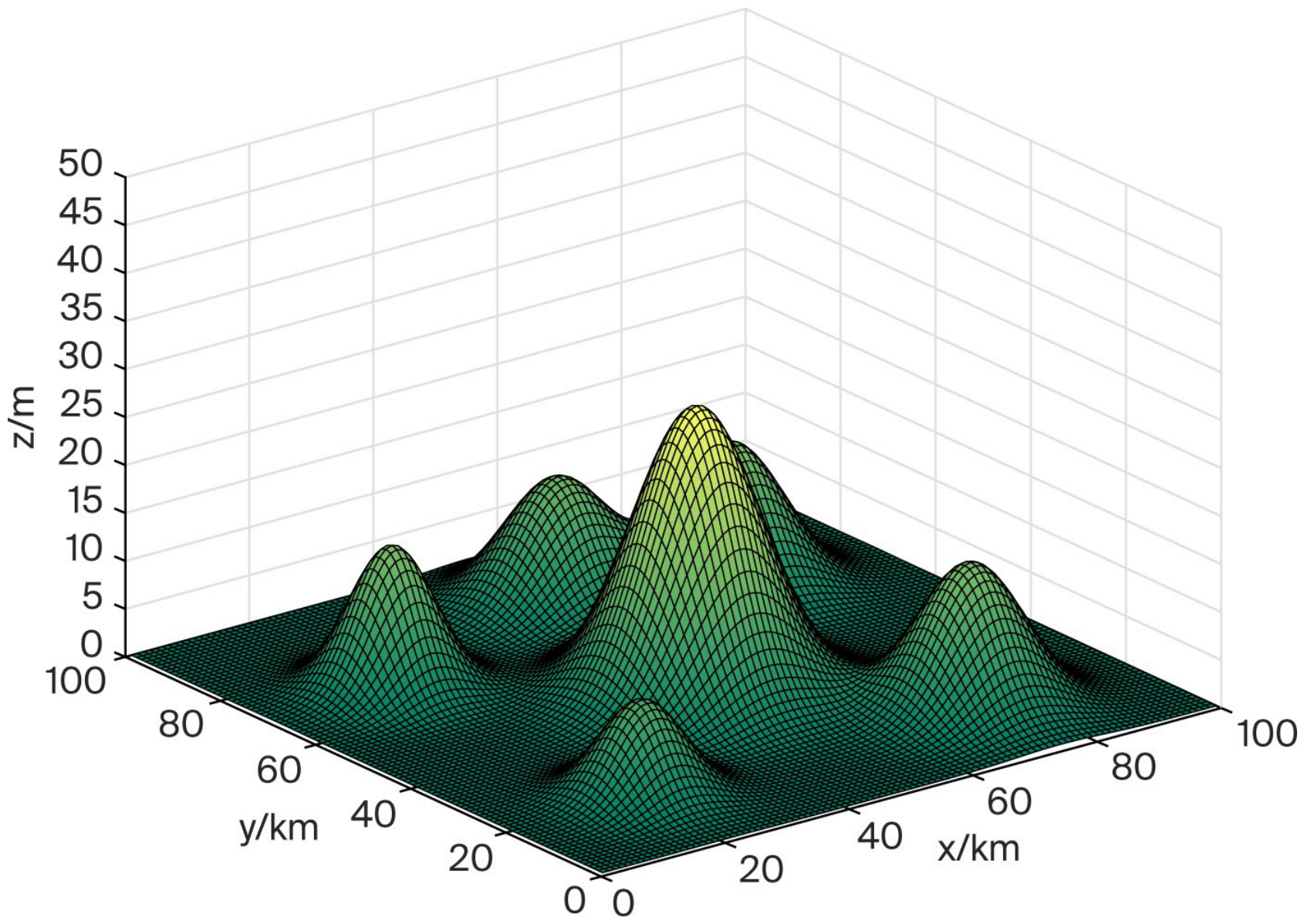
where z ( x , y ) represents the three-dimensional terrain surface, where ( x , y ) denotes the coordinates of a point in the two-dimensional plane and z denotes the corresponding elevation. The parameters a ,   b ,   c ,   d ,   e ,   f , and g are adjustable coefficients used to generate different island-reef terrains. The resulting island-reef terrain is shown in Figure 2.

2.2. Route-Planning Model of the Wing-in-Ground Craft

To solve the route-planning problem for the Unmanned Wing-in-Ground-Effect craft, relevant constraints should be established based on its dynamic characteristics and path-quality requirements, and an appropriate fitness function should be constructed.

2.2.1. Flight-Range Cost

Due to the constraints imposed by the ground-effect flight envelope and payload capacity, the onboard energy available to the UWIGC, such as fuel or battery power, is limited. Consequently, flight energy consumption is positively correlated with route length. Let L i denote the length of the i -th path segment, and let N represent the number of trajectory points. The flight-range cost J p a t h is therefore defined as
J p a t h = i = 1 N + 1 L i

2.2.2. Angular Cost

The flight safety of the UWIGC is closely related to route smoothness, which is largely determined by the deflection angle at each waypoint. Specifically, larger deflection angles generally lead to a less smooth route and reduced flight stability. The angular cost J a n g l e can be defined as
J a n g l e = i = 2 N δ i δ i 1
where δ i denotes the deflection angle at the i -th waypoint, and J a n g l e is the angle between two consecutive trajectory segments at a waypoint.

2.2.3. Island-Reef Threat Cost

In this study, island-reef terrain is generated based on Digital Elevation Map data, and terrain threats are modelled using an island-reef threat function. Based on the planned route nodes, each route segment is uniformly sampled, and threat evaluation is performed at the sampled points. The resulting threat value is taken as the threat cost of the corresponding route segment. Therefore, the island-reef threat cost of the entire route can be expressed as
J t h r e a t = i = 1 n j = 1 m k = 1 K t h r e a t i j ( k )
where n denotes the number of route nodes, K represents the number of island reefs, and t h r e a t i j ( k ) denotes the threat imposed by the k -th island reef on the j -th sampled point of the i -th route segment. The specific expression is given as follows:
t h r e a t i j ( k ) = 0 h > H ( k )   o r   d F > R F + d F m i n R F + d F m i n d F h < H ( k )   and   d F < R F + d F m i n
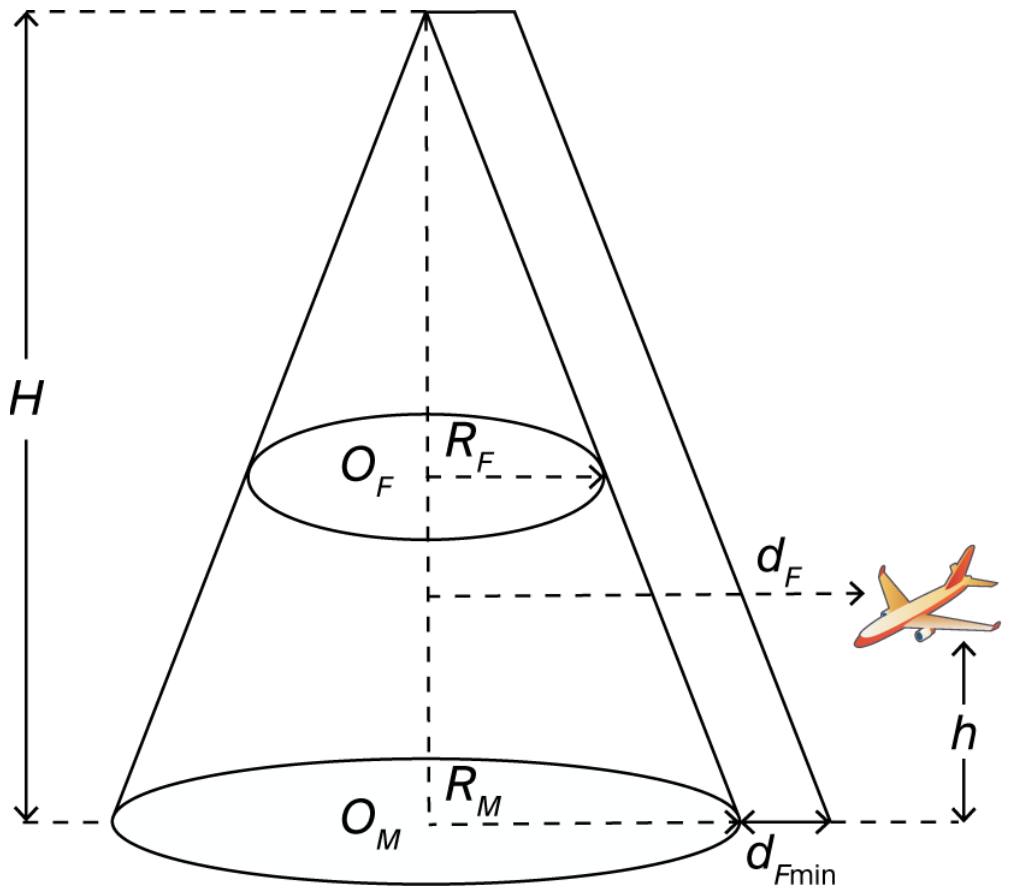
where h denotes the current flight altitude of the UWIGC, H ( k ) is the height of the k -th island reef, d F represents the distance from the UWIGC to the symmetry axis of the k -th island reef, R F is the maximum collision radius of the UWIGC, and d F m i n denotes the safety distance between the UWIGC and the planned airspace boundary. The expression for R F is given by
R F = ( H ( k ) h ) / tan θ s θ s = arcsin ( H / R m 2 + H 2
where θ s is the slope angle of the island reef, reflecting its degree of steepness. The geometric relationship of the island-reef threat model is illustrated in Figure 3.
In Figure 3, O m represents the centre of the reef bottom, and O f represents the centre of the reef at the height where the UWIGC is located.

2.2.4. Route Range Constraint

Due to the onboard energy limitation of UWIGC, the total length of the planned route should not exceed its maximum range L max , i.e., in this study, the parameter L max is set to 200 km.
i = 1 N + 1 L i L max
In addition, to accommodate attitude changes during flight, the length of each planned route segment should be no less than the minimum route length L min required for attitude adjustment, i.e., L min is calculated from vehicle maneuverability and does not consider wave dynamics. In this study, L min is set to 10 km.
L min L i
Accordingly, the maximum and minimum range constraint functions are given as follows:
C 1 = max ( i = 1 N + 1 L i L max , 0 )
C 2 = i = 1 N + 1 max ( L min L i , 0 )

2.2.5. Ground-Effect Maintenance Constraint

A UWIGC is required to fly within the thin air layer close to the sea surface, i.e.,
h min h i h max
where h i denotes the flight altitude at each waypoint, and h min is the lower bound of the flight altitude, which is usually determined by the wave height h w a v e , the flight safety altitude h s a f e , and the control margin altitude h c o n t r o l , i.e.,
h min = h w a v e + h s a f e + h c o n t r o l
where h max is the upper bound of the flight altitude, determined by the attenuation boundary of the ground effect, i.e.,
h max = k b
where k is a coefficient and b is the wingspan.
Accordingly, the ground-effect altitude constraint function is defined as
C 3 = max ( i = 1 N h i h max , 0 ) + i = 1 N max ( h min h i , 0 )

2.2.6. Maximum Climb/Descent Angle Constraint

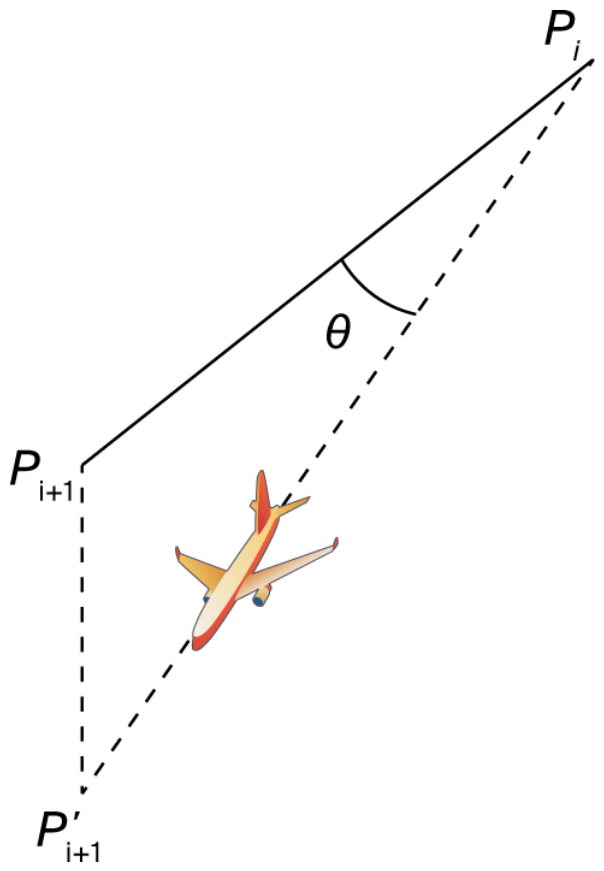
The variation in the vertical attitude of the UWIGC is determined by the climb/descent angle θ . Due to the flight performance limitations of the vehicle, the climb/descent angle θ should be bounded by the maximum allowable value θ max . If the climb or descent angle exceeds this threshold, the vehicle may become prone to stall. The corresponding constraint is expressed as follows:
θ = arctan ( P i + 1 P i + 1 P i P i + 1 ) θ i θ max
where θ i denotes the climb/descent angle at the i -th waypoint, and θ max represents the maximum allowable climb/descent angle of the Unmanned Wing-in-Ground-Effect craft.   P i ,   P i + 1 are two consecutive waypoints on the route and P i + 1 is the horizontal projection of node P i + 1 onto the body frame.
Accordingly, the maximum climb/descent angle constraint function is given by
C 4 = i = 1 N max ( θ i θ max , 0 )
The geometric relationship of the climb/descent angle constraint is illustrated in Figure 4.

2.2.7. Objective Function for Route Planning

The objective function for route planning of the UWIGC can be expressed as
f = w 1 J p a t h + w 2 J a n g l e + w 3 J t h r e a t + η i = 1 4 C i
where w 1 , w 2 , and w 3 denote the weighting coefficients, which can be tuned according to the route planning requirements, and η is the penalty coefficient. The selection of weight coefficients and penalty parameters reflects the priority of different cost terms. For instance, a larger w 1 prioritizes shorter routes, while a higher η 4 places greater emphasis on path smoothness.

3. Route Planning Method Based on the ISSA-GWO Hybrid Algorithm

3.1. Sparrow Search Algorithm

The Sparrow Search Algorithm simulates the foraging behaviour of sparrows and classifies the population into discoverers, joiners, and vigilantes. Among them, the discoverers are responsible for guiding the population to search for food or move toward safe areas. Let P denote the population size. The corresponding update equations are
X i t + 1 = X i t · exp i α ·   i t e r max i f   R 2 < S T X i t + Q · L i f   R 2 S T
where t denotes the current iteration number, i t e r max is the maximum number of iterations, and X i t represents the position of the i -th sparrow at the t -th iteration (the i-th waypoint to be optimized). α is a random number in the interval ( 0 , 1 ] . R 2 ( 0 , 1 ] and S T ( 0.5 , 1 ] represent the warning value and the safety threshold, respectively. Q controls the step size and follows a standard normal distribution. L is a 1 × d matrix whose elements are all 1, and d denotes the dimension.
The joiners follow the discoverers in search of food, and their position update equation is
X i t + 1 = Q · exp X worst X i t i 2 if   i > n / 2 X B t + 1 + X i t X B t + 1 · A + · L otherwise
where X B denotes the current optimal position of the discoverer, and X w o r s t represents the global worst position. A is a 1 × d matrix whose elements are randomly assigned as 1 or 1 , and A + = A T ( A A T ) 1 . When i > n / 2 , the i -th joiner is considered not to have found food and therefore needs to move to another location for foraging.
A portion of the population is selected as vigilantes. When danger is perceived, these individuals engage in anti-predation behaviour. The corresponding position update equation is given as follows:
X i t + 1 = X t b e s t + β · X i t X t b e s t if   f i > f g X i t + K · X i t X t w o r s t f i f w + ε if   f i = f g
where X b e s t denotes the current best position of the population, K [ 1 , 1 ] is a random number, and β is a normally distributed random number used to control the step size. f i , f g , and f w denote the fitness values of the i -th individual, the current best position, and the worst position, respectively.

3.2. Self-Destruction Algorithm

To prevent the algorithm from becoming trapped in a local optimum, a self-destruction operation is performed on sparrows that have not been updated for a long time, while new sparrow individuals are introduced in the vicinity of their original positions. Let T d denote the iteration threshold, and let t i denote the number of consecutive iterations during which the i -th individual remains unchanged. The self-destruction mechanism is formulated as follows:
X i t + 1 = X i t + X i t r a n d ( n ) i f   t i T d X i t otherwise
where r a n d ( n ) denotes a random number following a normal distribution. This function is used to introduce stochastic perturbation centred around the current best position, which allows the algorithm to perform localized fine-tuning while maintaining the potential for larger exploratory jumps. This balances the trade-off between exploitation and escaping local optima.
The introduction of the self-destruction mechanism makes the algorithmic process more consistent with the anti-predation behaviour of sparrows. When an individual is detected as stagnant, the self-destruction mechanism triggers a reset: its position is discarded and regenerated using a Gaussian perturbation around the global best. This mimics a ‘fresh start’ that helps the population escape local traps while preserving the search experience near promising regions. If the position of an individual remains unchanged for a long time, it is considered unlikely to represent the optimal solution. Therefore, eliminating it and introducing a new individual help prevent the algorithm from becoming trapped in a local optimum. Furthermore, if the eliminated individual happens to be the theoretical optimum, this process helps verify the reliability of the obtained result.

3.3. Grey Wolf Hierarchical Guidance Algorithm

To improve the convergence accuracy of the algorithm, the hierarchical guidance strategy of the Grey Wolf Optimizer is incorporated into the discoverer update phase of the sparrow population. According to the fitness values of the discoverers, the top three individuals are designated as the α ,   β , and δ leaders. Accordingly, the positions of the discoverers are updated according to the following steps:
D α = | C 1 · X α ( t ) X ( t ) | D β = | C 2 · X β ( t ) X ( t ) | D ξ = | C 3 · X ξ ( t ) X ( t ) | X 1 = X α A 1 · D α , X 2 = X β A 2 · D β , X 3 = X ξ A 3 · D ξ X i t + 1 = ( X 1 + X 2 + X 3 ) / 3
where A and C denote vector coefficients, which are defined as
A = 2 · a · r 1 a C = 2 · r 2 a = 2 ( 1 t / i t e r max )
where r 1 and r 2 are random vectors uniformly distributed in the interval [ 0 , 1 ] , and a is a linearly decreasing coefficient that varies with the iteration number.
In summary, the pseudocode of Algorithm 1 is given as follows:
Algorithm 1. The ISSA-GWO hybrid algorithm.
Initialization: Set P ,   S T ,   i t e r max ,   T d , and   a ; Randomly initialize the population positions;
While ( t T ) do
        Evaluate the fitness of each individual according to Equation (17);
        Select the α ,   β , and δ leaders from the discoverers, and update the discoverers’ positions according to Equation (22);
        Further update the discoverers’ positions according to Equation (18);
        Update the joiners’ positions according to Equation (19);
        Update the vigilantes’ positions according to Equation (20);
If t i T d then
        Perform the self-destruction mechanism according to Equation (21);
end if
        Update best _ fitness ,   best _ position ;
         t   =   t + 1
end while
return best _ fitness ,   best _ position .

3.4. Route Planning Method

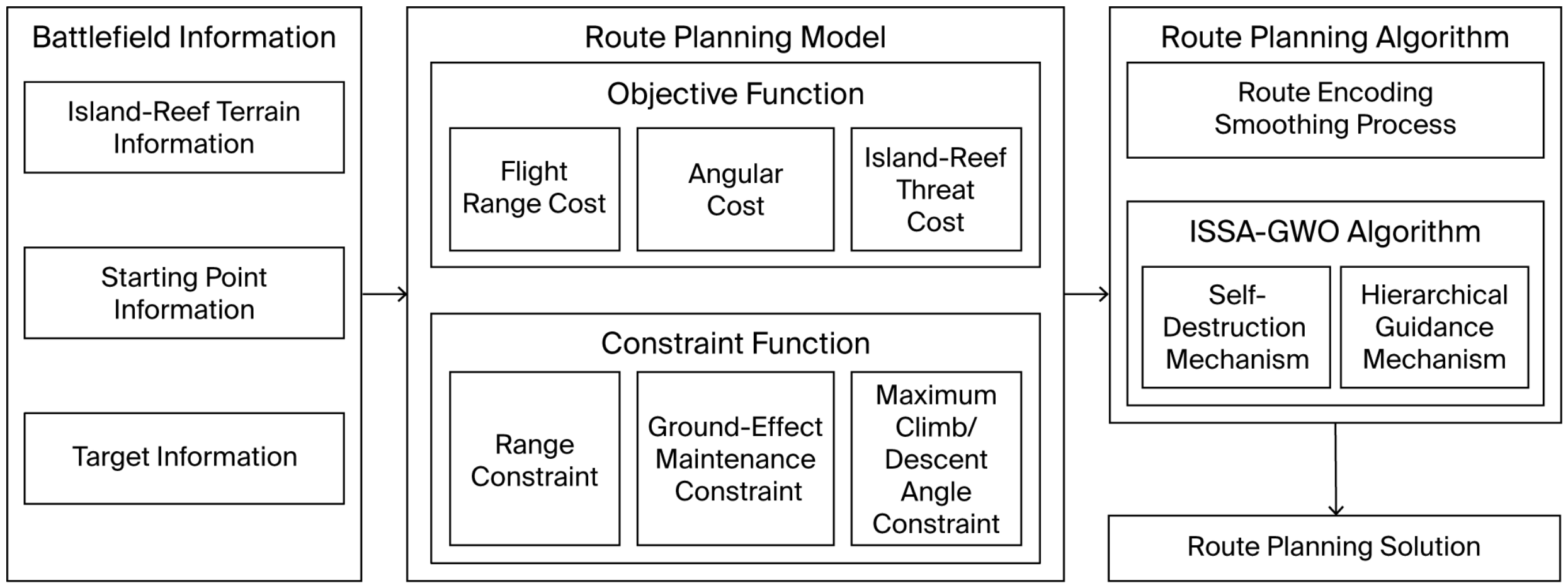
The overall framework of the route planning method for the UWIGC is described as follows. First, the terrain information, starting point, and destination are obtained. Then, the route planning objective function is constructed based on the cost and constraint functions. Subsequently, the ISSA-GWO hybrid algorithm is adopted for route encoding and optimization of the objective function, followed by a smoothing procedure. Finally, the planned route is generated.
The route encoding scheme is defined as follows. Assume that an individual S i in the population represents a route composed of multiple waypoints, which can be written as S i = [ s x 1 , s y 1 , s z 1 , s x 2 , s x N , s y N , s z N ] , where every three consecutive elements constitute the three-dimensional coordinates of one waypoint, and N denotes the total number of waypoints. Therefore, the dimension of each individual is 3 N . Let the coordinates of the starting point and destination point be ( x s , y s , z s ) and ( x e , y e , z e ) , respectively. Then, the three-dimensional coordinates of the i -th waypoint d i , denoted by ( x d i , y d i , z d i ) , can be expressed as
x d i = x s + s x i . ( x s x e ) y d i = y s + s y i . ( y s y e ) z d i = z min + s z i . ( z max z min )
where z max and z min denote the upper and lower bounds of the map, respectively.
Subsequently, a cubic B-spline curve is used to smooth the flight trajectory, and the corresponding function is expressed as
p ( u ) = i = 0 n d i N i , k ( u )
N i , 0 ( u ) = 1 , u i u u i + 1 0 ,           other N i , k ( u ) = u u i u i + k u i N i , k 1 ( u ) + u i + k + 1 u u i + k + 1 u i + 1 N i , k 1 ( u )
where d i denotes the i -th waypoint, and N i , k ( u ) denotes the basis function of the k -th order B-spline.
The overall framework of the route planning method is shown in Figure 5.

4. Simulation Experiments and Analysis

4.1. Simulation Conditions and Parameter Settings

The experimental platform used in this study consists of an Intel 13th Core i5 processor, 16 GB of RAM, and an NVIDIA GeForce RTX 2050 GPU. MATLAB 2021a is employed to validate the proposed algorithm. The island-reef terrain parameters are set to a = 0.1 ,   b = 0.01 ,   c = 1 ,   d = 0.1 ,   e = 0.2 ,   f = 0.4 , and g = 0.02 . The relevant parameters in the objective function are specified as follows: L max = 200   km ,   L min = 10   km ,   h max = 0.01   km ,   h min = 0.003   km ,   φ max = 55 ° ,   η = 10 7 ,   w 1 = 0.4 ,   w 2 = 0.3 , and w 3 = 0.2 . The starting point and destination of the UWIGC are set to (8, 5, 0.006) and (90, 30, 0.007), respectively, where the unit is km. PSO, SSA, GWO, and the ISSA-GWO hybrid algorithm are employed for comparative analysis, and the corresponding parameter settings are presented in Table 1.

4.2. Route Planning Simulation Experiments

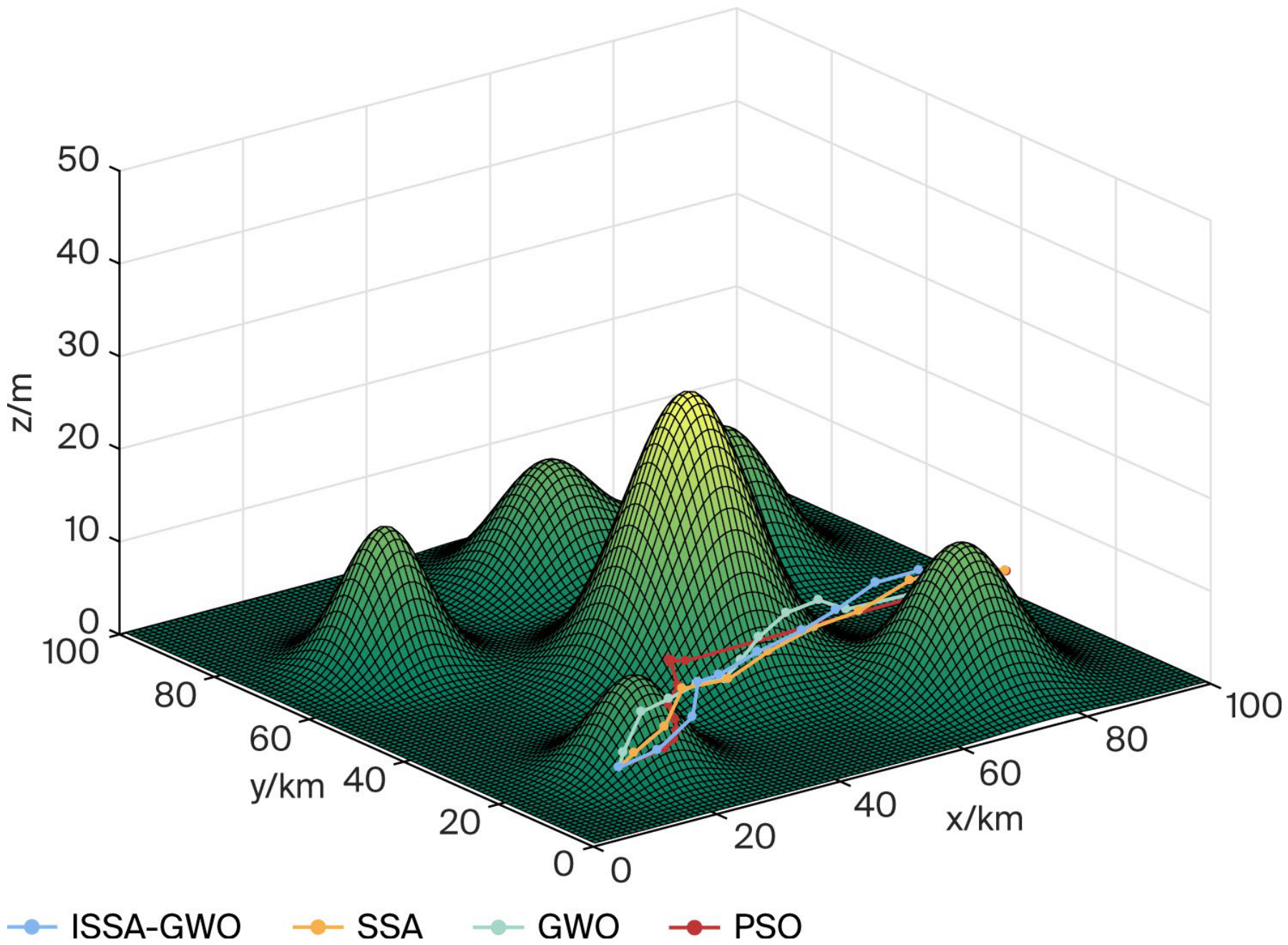
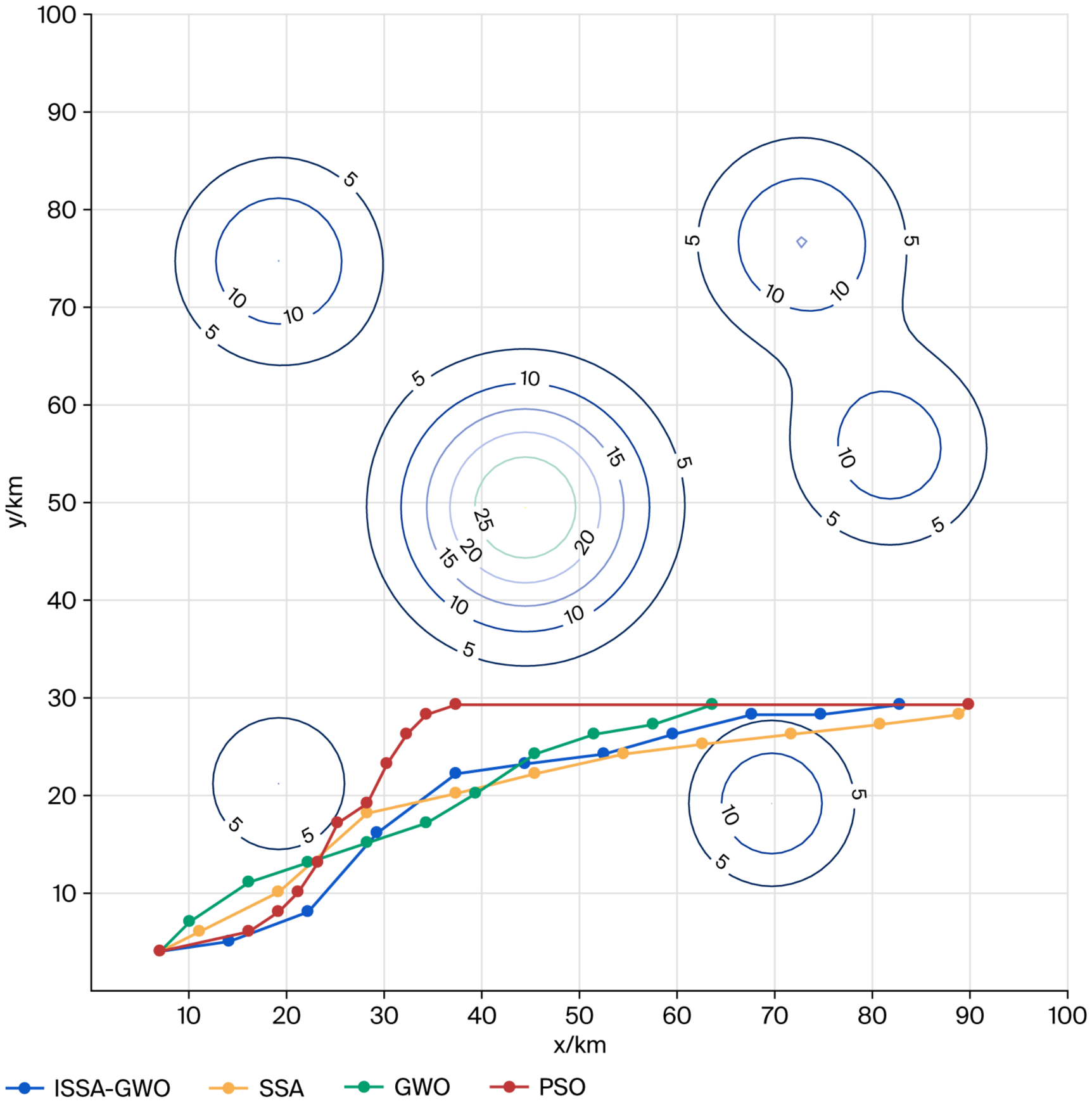
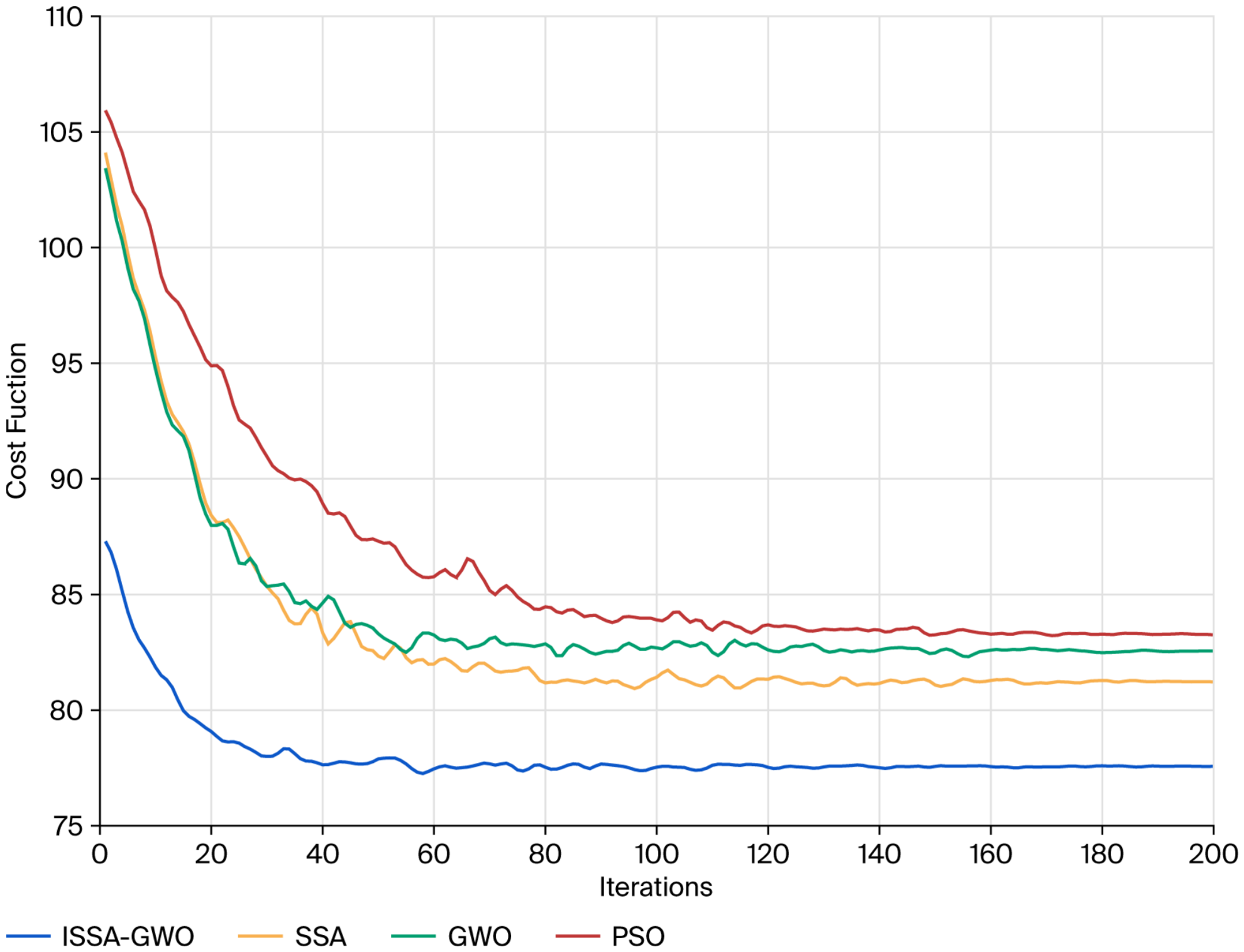
Based on the parameter settings described in the previous subsection, route planning simulation experiments are conducted. In the experiments, the maximum number of iterations i t e r max is set to 300, the population size is set to 400, the number of waypoints is 10, and the problem dimension is 30. Each algorithm is independently run 20 times, and the corresponding objective function results are listed in Table 2. The optimal three-dimensional route planning results obtained by different algorithms are shown in Figure 6, the contour-view results are shown in Figure 7, and the convergence curves of the objective function are shown in Figure 8.
As shown in Figure 6, Figure 7 and Figure 8, the start and end points correspond to the first and last points of the trajectory shown in Figure 6 and Figure 7. The route generated by the ISSA-GWO algorithm successfully avoids all island-reef terrain threats and satisfies all relevant constraints. By contrast, both SSA and PSO are prone to becoming trapped in local optima: SSA fails to completely avoid the island-reef terrain threats, whereas PSO produces a route with poor smoothness. Although GWO exhibits a certain capability to escape local optima, its performance remains inferior to that of ISSA-GWO in terms of constraint satisfaction and overall optimization quality.
Table 2 presents the objective function results obtained from 20 independent route planning runs of the UWIGC using the four aforementioned algorithms. As can be seen from Table 2, ISSA-GWO achieves better performance than PSO, GWO, and SSA in all four evaluation metrics, demonstrating its strong optimization capability and stability, together with a substantial improvement over SSA. Although PSO has the shortest average computation time, ISSA-GWO requires the longest computational time. However, this increase in time cost brings a significant improvement in overall algorithm performance. In summary, ISSA-GWO is capable of rapidly avoiding island-reef threats and satisfying multiple ground-effect-related constraints within relatively few iterations. In addition, the planned route is shorter than those obtained by the other comparison algorithms, and its convergence speed, optimization accuracy, and robustness are also superior.
To further demonstrate the superiority of the proposed algorithm, it is compared with MISSA from Ref. [12], HGWO-DPDS from Ref. [18], and the traditional RRT algorithm. The results of 20 independent runs are presented in Table 3.
As shown in Table 3, although the ISSA-GWO algorithm does not achieve the fastest optimization speed, it yields the best optimization performance.

5. Conclusions

5.1. Work Summary

To address the challenges of complex obstacle distribution and strict altitude-window constraints faced by the UWIGC during ultra-low-altitude flight in island-reef environments, we propose in this paper a route planning method based on the ISSA-GWO hybrid algorithm. The main contributions and conclusions of this study are summarized as follows:
(1)
Problem formulation
A multi-constraint route planning model was established by comprehensively considering the unique flight characteristics of the UWGC, including the ground-effect maintenance constraint and the island-reef threat model.
(2)
Algorithmic innovation
An ISSA-GWO hybrid optimization algorithm was developed by integrating the swarm intelligence and self-destruction mechanism of SSA with the hierarchical guidance strategy of GWO, thereby improving global search capability, convergence accuracy, and solution quality.
(3)
Path smoothing
A cubic B-spline curve was adopted to smooth the discrete route points, enabling the generated route to satisfy the dynamic requirements of the craft and obtain a continuous, smooth, and flyable ultra-low-altitude trajectory.
(4)
Simulation validation
Simulation results demonstrated that, compared with PSO, GWO, and SSA, the proposed algorithm achieved better optimization accuracy and stability, and was able to generate a feasible route with higher safety and smoother performance, thus providing effective support for the autonomous navigation of UWIGC in island-reef environments.

5.2. Limitations and Future Work

Although the proposed ISSA-GWO algorithm has demonstrated promising performance in the simulated island-reef environment, several limitations remain, which also point to directions for future research.
First, the environmental model utilized synthetic terrain data generated by a mathematical function rather than real-world Digital Elevation Model (DEM) data. Consequently, the current validation does not fully reflect the complexities of real geographic features.
Second, the wave height h w a v e was assumed to be constant. This simplification neglects the dynamic nature of real ocean waves, which introduces time-varying ground effect disturbances that could affect flight stability.
To address these gaps, future work will focus on (1) validating the algorithm using real DEM data from complex island-reef regions, and (2) incorporating a dynamic wave model to replace the constant- h w a v e assumption, thereby enhancing the robustness of the algorithm for real-sea-state navigation.

Author Contributions

Conceptualization, Y.C. and Y.W.; methodology, Y.C.; software, Y.C.; validation, Y.C., Y.Z. and Y.W.; formal analysis, Y.C.; investigation, Y.C.; resources, Y.Z. and Y.W.; data curation, Y.C.; writing—original draft preparation, Y.C.; writing—review and editing, Y.Z. and Y.W.; visualization, Y.C.; supervision, Y.W.; project administration, Y.W. All authors have read and agreed to the published version of the manuscript.

Funding

This research received no external funding.

Data Availability Statement

The data supporting the findings of this study are available from the authors upon reasonable request.

Conflicts of Interest

The authors declare no conflicts of interest.

References

  1. LaValle, S.M. Planning Algorithms; Cambridge University Press: Cambridge, UK, 2006. [Google Scholar]
  2. Puente-Castro, A.; Rivero, D.; Pazos, A.; Fernandez-Blanco, E. A review of artificial intelligence applied to path planning in UAV swarms. Neural Comput. Appl. 2022, 34, 153–170. [Google Scholar] [CrossRef]
  3. ST Engineering. Singapore’s AirFish Wing-in-Ground Aircraft to Fly with BatamFast in 2026; Aerospace Global News: Farnborough, UK, 2026. [Google Scholar]
  4. Otsason, R.; Hilmola, O.P.; Tapaninen, U.; Tovar, B. Business Opportunities for a Ground Effect Vehicle—Case of Canary Islands. Transp. Telecommun. J. 2024, 2, 473–482. [Google Scholar] [CrossRef]
  5. Zhang, C.; Wei, C.; Li, Y.; Cao, J.; Wang, P. Ship-aircraft cooperative path planning for island and reef patrol. Acta Armamentarii 2025, 46, 240505. (In Chinese) [Google Scholar]
  6. Cheng, Z.; Yang, J.; Sun, J.; Zhao, L. Trajectory planning of unmanned aerial vehicles in complex environments based on intelligent algorithm. Drones 2025, 9, 468. [Google Scholar] [CrossRef]
  7. Xue, J.; Shen, B. A novel swarm intelligence optimization approach: Sparrow search algorithm. Syst. Sci. Control Eng. 2020, 8, 22–34. [Google Scholar] [CrossRef]
  8. Liu, Y.; As’arry, A.; Hassan, M.K.; Hairuddin, A.A.; Mohamad, H. Review of the grey wolf optimization algorithm: Variants and applications. Neural Comput. Appl. 2024, 36, 2713–2735. [Google Scholar] [CrossRef]
  9. Zhang, L.; Li, Y.; Yu, Y.; Zhao, Y.; Song, W.; Retscher, G. Improved dynamic window approach for UAV local path planning in multi-dynamic obstacles environments using sparrow search algorithm. Trans. Emerg. Telecommun. Technol. 2025, 36, e70284. [Google Scholar] [CrossRef]
  10. Jia, L.; Xu, H. Research on robot path planning based on improved sparrow search algorithm. Inf. Control 2025, 54, 536–544. (In Chinese) [Google Scholar] [CrossRef]
  11. Li, W.; Zhang, M.; Zhang, J.; Qin, T.; Wei, W.; Yang, J. A multimixed strategy improved sparrow search algorithm and its application in TSP. Math. Probl. Eng. 2022, 2022, 8171164. [Google Scholar] [CrossRef]
  12. Wang, S.; Ji, Y.; Xu, X.; Zhang, S.; Li, Y.; Fan, J. Multi-UAV cooperative trajectory planning based on hybrid grey wolf optimizer with local optimization. Aeronaut. Weapon. 2025, 32, 70–77. (In Chinese) [Google Scholar] [CrossRef]
  13. Mirjalili, S.; Mirjalili, S.M.; Lewis, A. Grey wolf optimizer. Adv. Eng. Softw. 2014, 69, 46–61. [Google Scholar] [CrossRef]
  14. Zhang, S.; Wang, L. Multi-UAV cooperative path planning based on chaotic grey wolf optimiser. Aeronaut. J. 2025. Epub ahead of printing. [Google Scholar] [CrossRef]
  15. Wang, H.; Alidaee, B. A new hybrid-heuristic for large-scale combinatorial optimization: A case of quadratic assignment problem. Comput. Ind. Eng. 2023, 179, 109220. [Google Scholar] [CrossRef]
  16. Duan, Y.; Shi, L.; Li, M.; Hua, K.; Liu, T.; He, L. Hybrid Grey Wolf Optimizer with discrete prism dispersion strategy for solving flexible job-shop scheduling problem. Sci. Rep. 2026, 16, 4544. [Google Scholar] [CrossRef] [PubMed]
  17. Wang, W.; Gao, X.; Zhang, P.; Tao, F.; Wang, N. Multi-UAV path planning based on grey wolf-cuckoo composite optimization algorithm in mountainous environments. In Proceedings of the 2025 40th Youth Academic Annual Conference of Chinese Association of Automation, Zhengzhou, China, 17–19 May 2025. [Google Scholar]
  18. Makhadmeh, S.N.; Al-Betar, M.A.; Doush, I.A.; Awadallah, M.A.; Kassaymeh, S.; Mirjalili, S.; Abu Zitar, R. Recent advances in grey wolf optimizer, its versions and applications. IEEE Access 2024, 12, 22991–23028. [Google Scholar] [CrossRef]
  19. Cheng, J.; Zheng, Y.; Li, C.L.; Jiang, B.; Liu, D. Minimum-risk path planning algorithm for urban ultra-low altitude logistics scenarios. Sci. Technol. Eng. 2023, 23, 690–698. [Google Scholar]
  20. Cheng, J.; Zheng, Y.; Li, C.L.; Jiang, B. Multi-UAV cooperative trajectory planning algorithm for ultra-low-altitude logistics scenarios. J. Syst. Simul. 2024, 36, 50–66. [Google Scholar]
  21. Li, Y.; Chen, J. Research on urban low-altitude path planning method based on improved RRT* algorithm. J. Geo-Inf. Sci. 2022, 24, 448–457. [Google Scholar]
  22. Jia, L.; Li, J.; Ni, H.; Zhang, D. Autonomous mobile robot global path planning: A prior information-based particle swarm optimization approach. Control Theory Technol. 2023, 21, 173–189. [Google Scholar] [CrossRef]
  23. Zhang, B.; Min, H.S.; Zhang, X.M. Differential mutation and territory search-based equilibrium optimization algorithm and its application in robot path planning. Comput. Eng. Sci. 2023, 45, 2078–2090. [Google Scholar]
  24. Huang, Z.F.; Liu, Y.H. Urban UAV low-altitude path planning based on improved lion swarm algorithm. Inf. Control. 2023, 52, 747–757+772. [Google Scholar] [CrossRef]
  25. Park, J.; Park, M.; Park, J.; Park, J.H.; Song, C.; Nam, B.W.; Kim, D.K. A fuel-efficient pathfinding algorithm for next-generation WIG crafts. Ships Offshore Struct. 2025, 20, 638–646. [Google Scholar] [CrossRef]
  26. Knyazhskiy, A.; Nebylov, A.; Nebylov, V. Optimization of WIG-craft 3D-trajectory near the rough sea surface. In Proceedings of the European Conference on Aerospace Sciences, Milan, Italy, 29 June–3 July 2017. [Google Scholar]
Figure 1. 3D model of the UWIGC.
Drones 10 00464 g001
Figure 2. 3D visualization of the simulated terrain environment.
Drones 10 00464 g002
Figure 3. Schematic of island-reef threats.
Drones 10 00464 g003
Figure 4. Schematic of the climb/descent angle.
Drones 10 00464 g004
Figure 5. Route planning of Wing-in-Ground Craft.
Drones 10 00464 g005
Figure 6. Optimal three-dimensional route planning results.
Drones 10 00464 g006
Figure 7. Contour view of the planned routes.
Drones 10 00464 g007
Figure 8. Convergence curves of the objective function.
Drones 10 00464 g008
Table 1. Parameter settings for the compared algorithms.
AlgorithmParameters
PSO w max = 0.8 ,   w min = 0.2 ,   c 1 = c 2 = 2
GWO a = ( 2 0 )
SSA S T = 0.8 , P = 0.2
ISSA-GWO S T = 0.8 ,   P = 0.2 ,   T d = i t e r max / 20 ,   a = ( 2 0 )
Table 2. The corresponding objective function results.
AlgorithmAverage Time/sBest ValueWorst ValueMean ValueStandard Deviation
PSO36.784283.2257106.259387.56989.8789
GWO37.788582.5633104.289788.45898.5462
SSA38.569381.2254105.254689.85499.3547
ISSA-GWO40.266777.568987.652882.56983.2589
Table 3. The corresponding objective function results of four algorithm.
AlgorithmAverage Time/sBest ValueWorst ValueMean ValueStandard Deviation
MISSA40.288779.523190.443784.62144.1227
HGWO-DPDS41.384581.225493.467285.64284.5491
RRT37.645280.4769103.541689.51348.4725
ISSA-GWO40.324276.987688.419282.36413.3427
Disclaimer/Publisher’s Note: The statements, opinions and data contained in all publications are solely those of the individual author(s) and contributor(s) and not of MDPI and/or the editor(s). MDPI and/or the editor(s) disclaim responsibility for any injury to people or property resulting from any ideas, methods, instructions or products referred to in the content.