
Article

RSMamDet: Efficient UAV Remote Sensing Vehicle Detection via Linear State Space Models and Adaptive Multi-Level Feature Fusion

1
School of Information and Communication Engineering, Hainan University, Haikou 570228, China
2
School of Computer Science and Technology, Hainan University, Haikou 570228, China
3
Institute of Unmanned System Research, Beihang University, Beijing 100191, China
*
Author to whom correspondence should be addressed.
Drones 2026, 10(5), 396; https://doi.org/10.3390/drones10050396
Submission received: 11 April 2026 / Revised: 14 May 2026 / Accepted: 18 May 2026 / Published: 21 May 2026
(This article belongs to the Topic Advances in Autonomous Vehicles, Automation, and Robotics)

Highlights

What are the main findings?
  • RSMamDet achieves state-of-the-art mAP50 of 72.6% on DroneVehicle and 40.2% on VisDrone2019, surpassing prior best methods by 4.1% and 2.2%, respectively, while maintaining real-time inference at 186.2 FPS with only 19.8M parameters.
  • Replacing quadratic O ( N 2 ) self-attention with linear O ( N ) State Space Model scanning via the Selective Feature Scanning (SFS) module enables efficient global context modeling for high-resolution UAV imagery, reducing encoder FLOPs by approximately 38%.
What are the implications of the main finding?
  • The proposed framework demonstrates that linear-complexity global context modeling can simultaneously satisfy both accuracy and real-time requirements for UAV-based vehicle detection, enabling practical deployment on resource-constrained aerial platforms.
  • The modular design principles—adaptive cross-scale fusion (DASI), content-aware upsampling (AMFF), and uncertainty-aware training (UMC loss)—can generalize beyond vehicle detection to broader aerial remote sensing tasks such as crowd counting, infrastructure inspection, and disaster damage assessment.

Abstract

Accurate and efficient vehicle detection from unmanned aerial vehicle (UAV) imagery is essential for intelligent transportation, urban monitoring, and public safety, yet this task remains challenging due to high target density, extreme scale variation, complex backgrounds, and stringent onboard computational constraints. Existing DETR-based detectors model global context through self-attention but incur quadratic O ( N 2 ) complexity that is prohibitive for high-resolution UAV images, while CNN-based methods lack the long-range contextual awareness needed for dense small-object scenarios. We propose RSMamDet, an efficient end-to-end detection framework built upon RT-DETR that replaces quadratic self-attention with linear O ( N ) State Space Model scanning. The framework integrates a MobileMamba backbone with a Selective Feature Scanning module for efficient global context modeling, a Dimension-Aware Selective Integration module for adaptive cross-scale feature fusion, a Poly Kernel Inception Network encoder for multi-receptive-field feature enrichment, and an Adaptive Multi-Level Feature Fusion module for content-aware dynamic upsampling, complemented by an Uncertainty-Minimal Composite loss for stable query selection in cluttered aerial scenes. Experiments on DroneVehicle and VisDrone2019 demonstrate that RSMamDet achieves mAP50 of 72.6% and 40.2%, surpassing state-of-the-art methods by 4.1% and 2.2%, respectively, while maintaining real-time inference at 186.2 FPS with only 19.8M parameters and 42.3 GFLOPs, representing a 6.14 × reduction in computational cost and a 3.86 × reduction in model parameters compared to the strongest baseline.

1. Introduction

Unmanned aerial vehicle (UAV)-based remote sensing has become an indispensable tool for large-scale vehicle detection in intelligent transportation management [1], emergency response, and urban surveillance [2,3]. Unlike ground-level detection, UAV imagery introduces compounded challenges: (1) targets appear as densely packed small objects due to high-altitude imaging; (2) extreme scale variation exists between vehicles at different distances and altitudes; (3) challenging illumination conditions, including nighttime and overexposure, degrade visual quality; and (4) heavy occlusion occurs in dense traffic scenarios. These challenges collectively demand a detection framework that simultaneously achieves high accuracy for small and densely packed objects, robust performance across diverse conditions, and real-time throughput suitable for onboard edge deployment or low-latency ground-station processing. A fundamental obstacle underlying these challenges is the repeated spatial downsampling inherent in deep backbone networks, which progressively erases fine-grained spatial details; since over 60% of objects in representative UAV benchmarks such as VisDrone2019 occupy fewer than 32 × 32 pixels, this information loss disproportionately degrades detection recall for the dominant small-object category. A practical deployment framework must additionally minimize memory footprint and power consumption, as UAV platforms impose strict size, weight, and power (SWaP) constraints that preclude the use of large-scale deep learning models common in server-side computer vision systems.
Modern detectors fall into two dominant paradigms. CNN-based methods, including single-stage detectors such as SSD [4], RetinaNet [5], FCOS [6], ATSS [7], GFL [8], and the YOLO family [9,10,11,12,13], excel at local feature extraction but have limited receptive fields that hinder global context modeling. Two-stage methods (Faster R-CNN [14] and Cascade R-CNN [15]) provide high precision but are too slow for real-time aerial deployment; their reliance on region proposal networks introduces additional computational overhead and latency spikes that are particularly problematic for time-critical surveillance tasks.
Transformer-based detectors (DETR [16], Deformable DETR [17], DN-DETR [18], DINO [19], and RT-DETR [20]) model global context through self-attention but incur O ( N 2 ) complexity that grows quadratically with image resolution, making them computationally prohibitive for high-resolution UAV images. Specifically, at 640 × 640 resolution with a stride-16 backbone, self-attention must process N = 1600 tokens, incurring O ( N 2 ) = 2.56 × 10 6 pairwise attention computations per layer. This burden compounds severely as resolution scales to match the fine pixel density required for small-object detection. Recent efforts to adapt DETR-based detectors for drone scenarios have demonstrated promising accuracy gains but still struggle to reconcile global context modeling with the computational constraints of aerial deployment [21].
State Space Models (SSMs) offer a fundamentally different paradigm: rather than computing explicit pairwise token interactions, SSMs model sequences through continuous-time dynamical systems that maintain a compact hidden state and selectively update it as new tokens arrive, thereby achieving global context modeling in linear time. In particular, Mamba [22] and its visual extensions VMamba [23] and Vision Mamba [24] achieve competitive representational capacity at O ( N ) complexity via input-dependent selective state transitions. MobileMamba [25] provides a lightweight mobile-friendly SSM backbone. However, directly substituting the RT-DETR backbone with MobileMamba is insufficient: the resulting feature representations require targeted solutions for cross-scale integration, multi-receptive-field encoding, and content-adaptive upsampling. The lack of a principled end-to-end framework that jointly addresses all of these representational deficiencies—while preserving real-time inference—has motivated the design of RSMamDet.
To address these gaps, we propose RSMamDet with four integrated innovations and a novel training loss. Our main contributions are as follows
  • A Selective Feature Scanning (SFS) module within MobileMamba that processes multi-stream features through 2D Selective Scan (SS2D), achieving global context modeling at O ( N ) complexity and replacing quadratic self-attention.
  • A Dimension-Aware Selective Integration (DASI) module that adaptively fuses low-level and high-level features through sigmoid-gated cross-dimensional selection, bridging the semantic gap across feature pyramid levels.
  • A Poly Kernel Inception Network (PKINet) encoder that captures multi-scale spatial patterns via parallel depthwise convolutions ( 3 × 3 to 11 × 11 ) and Context Anchor Attention (CAA).
  • An Adaptive Multi-Level Feature Fusion (AMFF) module combining content-aware dynamic upsampling with adaptive channel weighting for improved small-object feature representation.
  • An Uncertainty-Minimal Composite (UMC) loss that incorporates uncertainty-aware query selection regularization to improve training stability in cluttered aerial scenes.
Experiments on DroneVehicle [26] and VisDrone2019 [1] show that RSMamDet achieves state-of-the-art performance across all evaluated metrics while maintaining 186.2 FPS real-time inference, demonstrating the practical viability of our approach for intelligent aerial surveillance and transportation monitoring.
The remainder of this paper is organized as follows. Section 2 reviews related work on object detection paradigms, state space models, UAV vehicle detection, and feature pyramid fusion. Section 3 details the proposed RSMamDet architecture and the UMC loss formulation. Section 4 presents experimental results and ablation studies on DroneVehicle and VisDrone2019. Section 5 discusses strengths, limitations, and deployment considerations, and Section 6 concludes the paper.

2. Related Work

2.1. DETR-Based Object Detection

DETR [16] reformulates detection as a set prediction problem using bipartite matching and Transformer encoder–decoder architecture. Deformable DETR [17] accelerates training by restricting attention to sparse deformable points. DAB-DETR [27] uses dynamic anchor boxes as queries, while DN-DETR [18] introduces query denoising for faster convergence. DINO [19] combines contrastive denoising with mixed query selection. RT-DETR [20] introduces real-time capability via an efficient hybrid encoder and uncertainty-minimal query selection. Co-DETR [28] further improves training through collaborative hybrid assignments. RT-DETRv2 [29] provides additional bag-of-freebies improvements. More recently, DPF-DETR [30] enhances drone image detection by incorporating density perception and multi-scale feature fusion into the DETR framework, highlighting the growing interest in tailoring end-to-end detectors for aerial scenarios. Our work builds upon RT-DETR and extends it with SSM-based backbone and targeted modules for UAV detection. Despite these advances, most DETR variants were designed for standard ground-level imagery and have not been specifically optimized for UAV data, where extremely small object sizes, high object density, and severe scale variation challenge the cross-attention mechanism’s ability to focus on relevant spatial regions at real-time speeds. In particular, the encoder self-attention in standard DETR variants processes all spatial tokens equally, making it disproportionately expensive for high-resolution aerial inputs and prone to being overwhelmed by the dominant background tokens that constitute the majority of pixels in sparsely populated UAV scenes.

2.2. State Space Models for Vision

Mamba [22] introduces selective SSMs achieving linear-complexity sequence processing. S4 [31] provides the structured SSM theoretical foundation. VMamba [23] extends Mamba to 2D visual features via four-directional SS2D. Vision Mamba [24] adopts bidirectional Mamba blocks for image patches. PlainMamba [32] studies non-hierarchical architectures. MobileMamba [25] designs a mobile-friendly SSM backbone. Domain applications include DCAM-DETR [21] for anti-UAV detection, SoccerDETR [33] for sports detection, and CGMamba [34] for visual identification. Complementary to SSM approaches, lightweight hybrid attention mechanisms [35] have also been explored to reduce computational burden by selectively enhancing channel, spatial, and token-level features without incurring the quadratic complexity of full self-attention. Our SFS module extends SS2D to multi-stream feature fusion within the MobileMamba backbone and is the first to exploit joint multi-stream SS2D scanning for implicit cross-feature-pyramid dependency modeling. Despite these promising results in image recognition, the integration of SSMs into end-to-end detection frameworks—particularly for UAV scenarios where efficient global context is critical—remains relatively unexplored, and no existing work jointly combines SSM-based scanning with targeted cross-scale fusion and adaptive upsampling for aerial vehicle detection.

2.3. UAV Vehicle Detection

ClusDet [36] proposes clustering-based sub-image detection for dense small objects. UFPMP-Det [37] introduces unified foreground packing for drone imagery. QueryDet [38] cascades sparse queries for high-resolution small object detection. AMSRDet [3] designs an adaptive multi-scale architecture for infrared-visible UAV vehicle detection. CSFADet [39] addresses dual-modal detection via cross-spectral feature alignment. BSOEDet [40] proposes background suppression and object enhancement strategies specifically designed for UAV aerial imagery, effectively mitigating the interference of complex backgrounds on small-object detection. Beyond generic vehicle detection, specialized UAV-based inspection systems have been developed for agricultural applications; for instance, PM-YOLO [41] introduces a powdery mildew grading model for rubber tree disease detection, demonstrating how domain-specific lightweight architectures can be adapted to aerial platforms with constrained computational resources. Beyond vehicle-centric scenarios, UAV-based sensing has also been extensively applied to infrastructure inspection such as power line monitoring, where efficient detection architectures under flight constraints are equally critical [42]. These highlight the importance of multi-scale handling and context awareness in aerial scenarios. Furthermore, several methods rely on region-based inference or image tiling strategies that impose additional pre- and post-processing overheads incompatible with latency requirements of onboard UAV deployment. However, these methods generally address at most one or two of the UAV-specific challenges simultaneously: approaches designed for small-object detection often sacrifice inference speed, while real-time methods typically lack the global contextual awareness needed for dense and heavily occluded scenes, leaving a significant gap for a unified real-time framework.

2.4. Feature Pyramid and Fusion

FPN [43] establishes multi-scale feature representation via top-down fusion. PANet [44] adds bottom-up pathways. BiFPN in EfficientDet [45] introduces learnable weighted bidirectional fusion. Inception-style multi-kernel approaches [46] capture diverse spatial patterns. Dynamic upsampling methods [47] replace fixed interpolation with content-adaptive kernels. Our AMFF combines dynamic kernel generation with adaptive channel weighting for superior multi-level fusion. While existing fusion strategies have proven effective on standard benchmarks, their application to UAV imagery is limited by fixed or globally shared weights that fail to adapt to the heterogeneous scale distribution characteristic of aerial scenes, motivating our spatially varying adaptive fusion design. AMFF further differs from AFA [47] in that it simultaneously learns per-channel contributions through a second adaptive weighting branch, providing an additional degree of freedom for balancing high-resolution texture and high-level semantic content.
Table 1 summarizes the key characteristics of representative detection paradigms, positioning RSMamDet relative to existing approaches across four critical dimensions: global context capability, computational complexity, multi-scale fusion strategy, and UAV-specific optimization.

3. Proposed Method

3.1. Overall Architecture

The overall architecture of RSMamDet is illustrated in Figure 1. Given input image I R H × W × 3 , the MobileMamba backbone with SFS modules extracts multi-scale features { P 3 , P 4 , P 5 } at O ( N ) complexity. The three feature scales encode complementary information: P 3 retains high-resolution spatial detail critical for small vehicle localization, P 4 captures mid-level semantic patterns, and  P 5 provides the global contextual representation necessary for scene-level reasoning. The Efficient Transformer Encoder, comprising PKINet for multi-receptive-field enrichment and DASI for adaptive cross-level fusion, bridges the semantic–resolution gap between adjacent pyramid levels. The CCFF neck then applies AMFF modules at each scale, recovering fine-grained spatial details via content-aware dynamic upsampling to produce enhanced features { F ^ 3 , F ^ 4 , F ^ 5 } . Finally, the Uncertainty-Minimal Query Selection module identifies the top-K highest-confidence spatial positions as initial decoder queries, suppressing the dominant background tokens common in high-altitude drone imagery before passing queries to the Transformer decoder and detection head. The four modules are designed to be mutually reinforcing: the SFS backbone provides linear-complexity global representations that DASI can fuse without any quadratic overhead; PKINet then enriches those fused features with multi-scale spatial patterns; and AMFF restores the fine-grained spatial structure that successive downsampling stages erode, ensuring that the final decoder queries are both semantically rich and spatially precise.

3.2. MobileMamba Backbone and Selective Feature Scanning (SFS) Module

3.2.1. State Space Model Foundations

Structured SSMs [31] model a continuous-time linear dynamical system:
h ( t ) = A h ( t ) + B x ( t ) , y ( t ) = C h ( t ) + D x ( t ) ,
where A R N × N , B R N , C R N , D R . Zero-Order Hold discretization at step size Δ  yields
h k = A ¯ h k 1 + B ¯ x k , y k = C h k + D x k ,
where A ¯ = exp ( Δ A ) , B ¯ Δ B . The selective S6 mechanism in Mamba [22] makes { Δ , B , C } input-dependent:
[ Δ , B , C ] = Linear ( x k ) , [ A ¯ , B ¯ ] = Discretize ( Δ , A , B ) ,
achieving linear O ( N ) complexity via parallel associative scan.

3.2.2. 2D Selective Scan and SFS Design

For 2D visual features, SS2D [23] unfolds a feature map into four directional sequences, applies S6 to each, and merges outputs by summation, preserving O ( N ) complexity while capturing omnidirectional spatial context. Formally, for input Z R C × H × W , SS2D applies S6 along four traversal directions d { 1 , 2 , 3 , 4 } (top-left → bottom-right, bottom-right → top-left, top-right → bottom-left, and bottom-left → top-right):
Y ( d ) = S 6 flatten ( d ) ( Z ) R C × H W ,
and merges all directional outputs via element-wise summation after reshaping:
Y S S 2 D = d = 1 4 reshape Y ( d ) R C × H × W .
This four-path traversal guarantees that every spatial location can exchange information with every other location along at least one scan direction, effectively achieving a global receptive field while the total computation scales as O ( 4 N ) = O ( N ) .
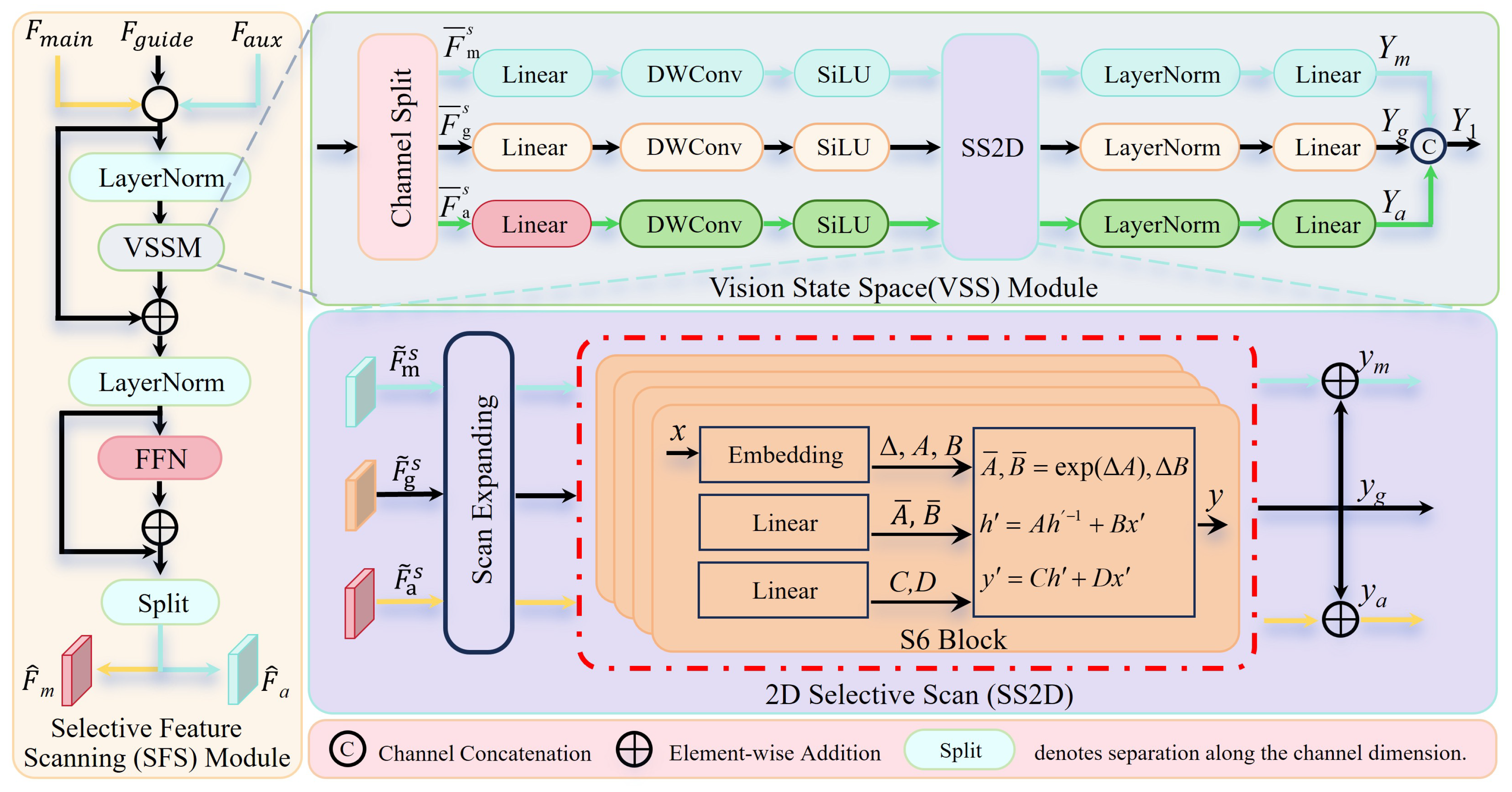
The SFS module (Figure 2) jointly processes three input streams { F m a i n , F g u i d e , F a u x } , each serving a distinct semantic role. F m a i n carries the primary feature representation at the current pyramid level, encoding the core spatial and channel information to be refined. F g u i d e provides higher-level semantic guidance from a coarser pyramid level, supplying scene-level contextual cues that help disambiguate overlapping or occluded objects. F a u x contributes complementary fine-grained spatial detail from a finer pyramid level, preserving edge and texture information essential for localizing small targets. Each stream F R C × H × W is first split along the channel dimension and normalized:
[ F ˜ 1 , F ˜ 2 ] = Split ( LN ( F ) ) , { m , g , a } ,
where F ˜ 1 enters the SS2D branch and F ˜ 2 serves as a skip-connection gate. Each SS2D-branch half then undergoes Linear → DWConv → SiLU projection:
Z = SiLU ( DWConv ( Linear ( F ˜ 1 ) ) ) , { m , g , a } .
The three projected streams are concatenated and jointly processed by SS2D:
[ Y m , Y g , Y a ] = S S 2 D ( [ Z m , Z g , Z a ] ) ,
Y 1 = Concat Linear ( LN ( Y m ) ) , Linear ( LN ( Y g ) ) , Linear ( LN ( Y a ) ) .
The aggregated representation Y 1 is then modulated by the skip-connected gate, refined by LayerNorm and FFN, and split to produce the final output streams:
Y 2 = LN Y 1 σ Linear ( Concat ( F ˜ m 2 , F ˜ g 2 , F ˜ a 2 ) ) ,
Y 3 = Y 2 + FFN ( Y 2 ) , [ F ^ m , F ^ a ] = Split ( Linear ( Y 3 ) ) .
By processing all three streams jointly through a single SS2D pass rather than independently, the selective state transitions of F g u i d e and F a u x directly modulate the hidden states computed for F m a i n , enabling implicit cross-stream information exchange without any explicit cross-attention operation. Joint SS2D processing thus captures cross-stream long-range dependencies at O ( N ) complexity, replacing the O ( N 2 ) cross-attention otherwise required. This is particularly advantageous for high-resolution UAV imagery where large feature maps would make standard self-attention computationally prohibitive, yet global spatial context is essential for associating co-occurrent vehicles distributed across wide scenes. The three-stream design also provides a natural information bottleneck: by forcing all streams through a single SS2D pass, the model must learn to allocate the fixed-size hidden state budget across all inputs jointly, which implicitly encourages the state transitions to encode only the most task-relevant cross-stream correlations and discard redundant local patterns already captured by the preceding convolutional layers.
To validate the effectiveness of the three-stream design, Table 2 compares single-stream, two-stream, and three-stream SFS variants under otherwise identical settings on DroneVehicle.
The three-stream design achieves a 3.2% mAP50 improvement over the single-stream baseline with only a 6.2% reduction in throughput, confirming that the joint multi-stream SS2D processing provides substantial accuracy gains at modest computational overhead.

3.3. Dimension-Aware Selective Integration (DASI) Module

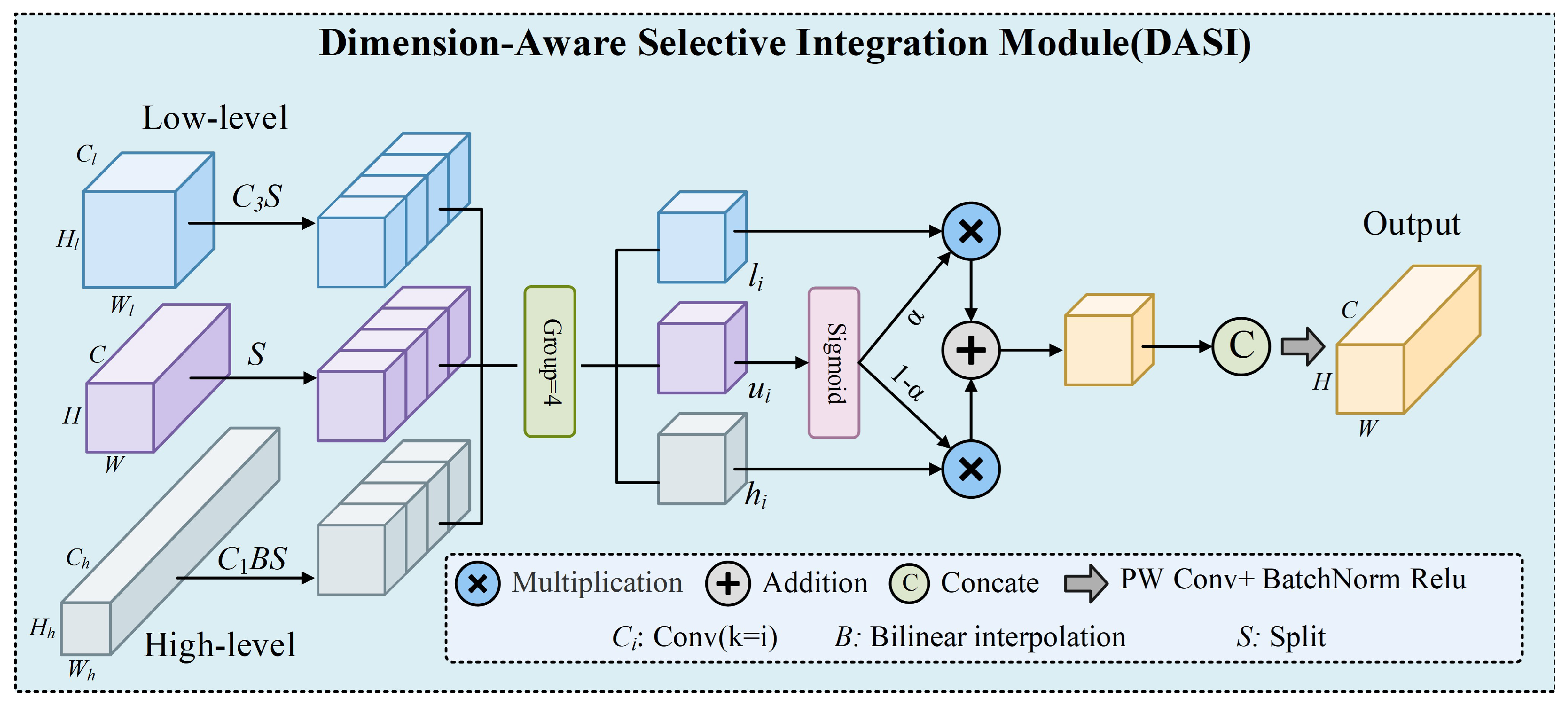
The DASI module (Figure 3) adaptively fuses low-level feature F l R C i × H i × W i and high-level feature F h R C b × H b × W b by bridging semantic and resolution gaps. Both features are aligned to a common spatial resolution ( H , W ) via C 3 S (stride-S conv) and C 1 B S (conv + bilinear upsample), then concatenated and jointly encoded via Group  = 4 convolution to form U , which is split into branches { l i , u i , h i } .
A sigmoid gate on u i produces a per-location, per-channel selection weight:
α = σ ( u i ) [ 0 , 1 ] C × H × W ,
and the selectively integrated feature is
F i n t = α l i + ( 1 α ) h i .
The output is produced by concatenation with a residual feature and a pointwise BN-ReLU convolution:
F o u t = BNReLU ( PWConv ( [ F i n t ; F i n t ] ) ) R C × H × W .
Unlike simple concatenation–conv fusion, DASI adaptively balances spatial detail and semantic richness per location, improving detection at varied object scales. This is especially beneficial in dense UAV scenes where objects of vastly different sizes coexist, as the per-location gate α prevents the over-smoothing of fine-grained edge details that rigid fixed-weight fusion would introduce. Furthermore, computing α from the jointly encoded feature U rather than from either source branch independently ensures that the selection weight encodes the relative complementarity of the two inputs at every spatial position, rather than reflecting properties of only one branch in isolation.

3.4. Poly Kernel Inception Network (PKINet)

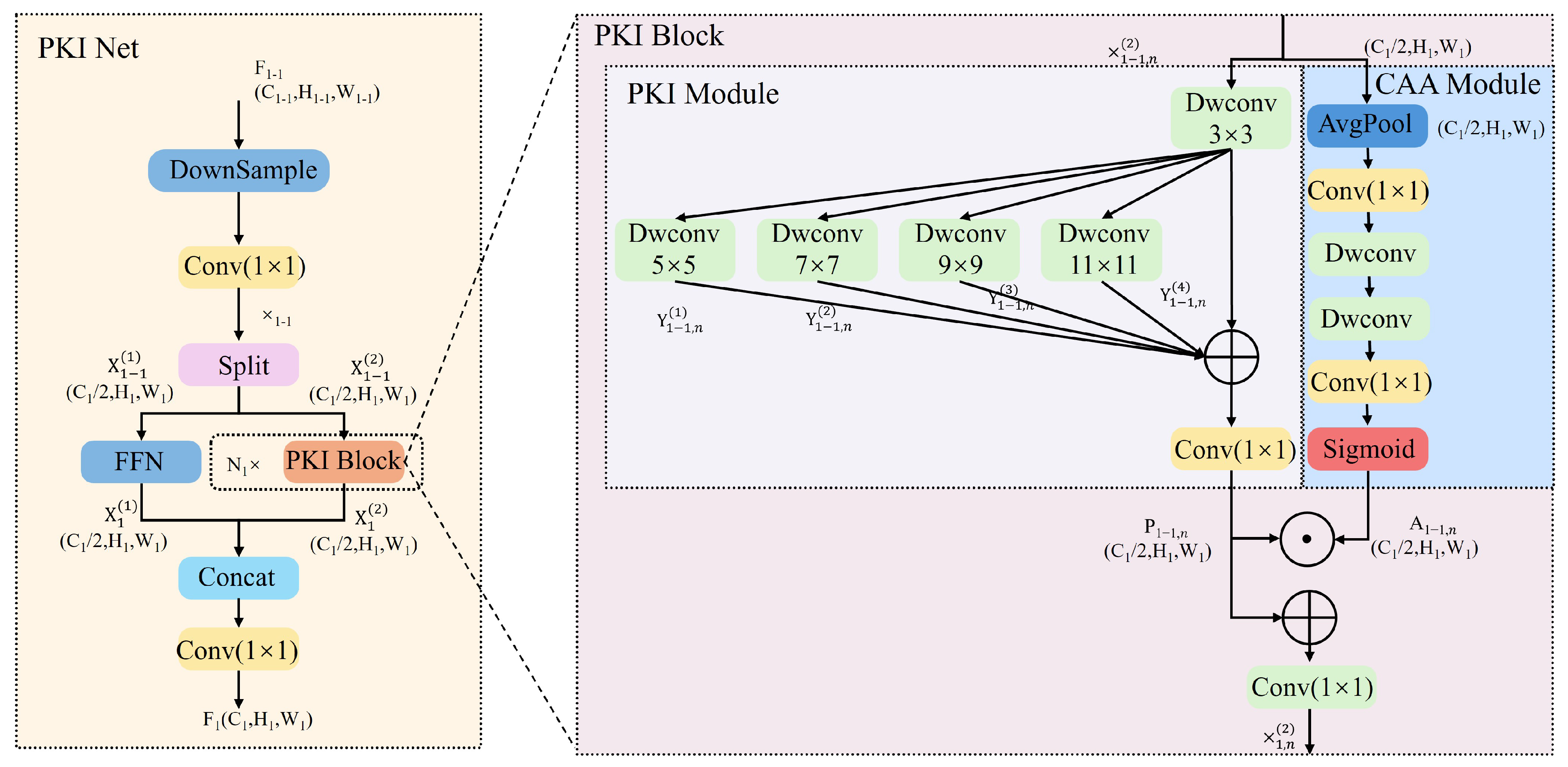
To enrich encoder representations with diverse receptive fields, we employ PKINet [46] as the core encoder backbone (Figure 4). For input X l 1 , after downsampling and 1 × 1 channel compression, features are split into two branches processed by FFN and PKI Blocks, respectively. Within each PKI Block, the PKI Module runs parallel depthwise convolutions:
Y n ( k ) = DWConv k × k ( X n ( 2 ) ) , k { 3 , 5 , 7 , 9 , 11 } ,
P n = Conv 1 × 1 k Y n ( k ) ,
where ⨁ denotes element-wise addition. The Context Anchor Attention (CAA) module recalibrates channels:
A n = σ Conv 1 × 1 DWConv DWConv Conv 1 × 1 ( AvgPool ( X n ( 2 ) ) ) ,
X n + 1 ( 2 ) = Conv 1 × 1 ( P n A n + X n ( 2 ) ) .
The two branches are concatenated and fused by a final 1 × 1 convolution. The specific kernel range { 3 , 5 , 7 , 9 , 11 } is motivated by the object size distribution in UAV datasets. Statistical analysis of the DroneVehicle training set reveals that vehicle bounding-box widths range from 6 to 128 pixels at 640 × 640 input resolution, with 78% of instances concentrated between 8 and 48 pixels. At the stride-16 encoder feature map, these widths correspond to 0.5–3 feature-map pixels, requiring effective receptive fields of 3–11 pixels to fully encompass the target extent. Extending beyond 11 × 11 would primarily capture contextual background without improving target discrimination, while omitting the larger kernels ( 9 × 9 , 11 × 11 ) would lose coverage of trucks and buses spanning 40–80 input pixels. This range enables RSMamDet to simultaneously respond to compact motorcycles and large trucks that coexist in the same drone-captured frame without requiring separate detection heads for different scale ranges. The element-wise summation aggregation in the PKI Module encourages each kernel branch to specialize in the scale range where it provides complementary information, as the gradient from the final 1 × 1 projection distributes learning signals proportionally to each branch’s unique contribution to the fused representation.

3.5. Adaptive Multi-Level Feature Fusion (AMFF) Module

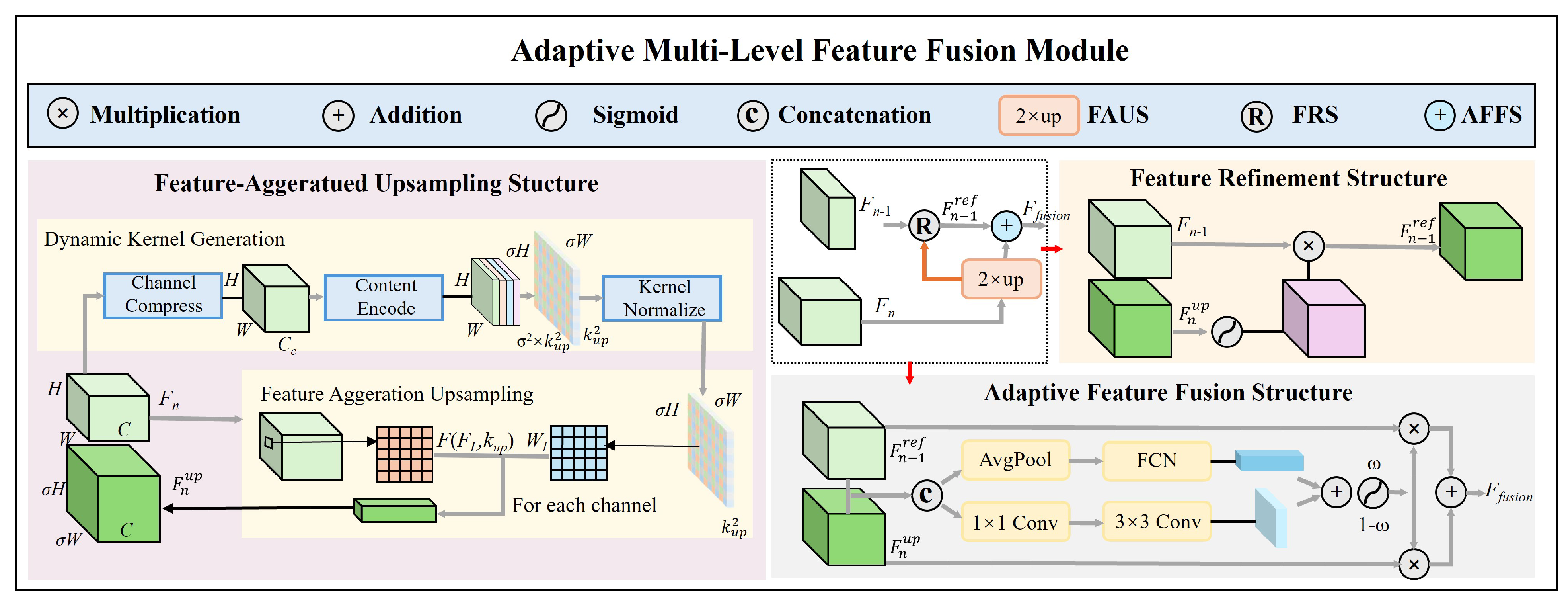
Standard bilinear upsampling ignores image content, yielding blurry reconstructions harmful to small-object detection. AMFF (Figure 5) addresses this via three sub-structures.

3.5.1. Feature-Aggregated Upsampling Structure (FAUS)

A dynamic upsampling kernel is generated from the low-resolution feature F n :
k u p = KernelNorm ( ContentEncode ( ChannelCompress ( F n ) ) ) R σ 2 × k u p 2 ,
F n u p = F ( F n , k u p ) W i R C × σ H × σ W ,
where σ is the upsample scale factor and W i is a learnable channel mixing weight.

3.5.2. Feature Refinement Structure (FRS)

F n 1 r e f = σ F n u p F n 1 , F f u s i o n p r e = F n 1 r e f + 2 ( F n ) ,
where 2 denotes 2 × upsampling.

3.5.3. Adaptive Feature Fusion Structure (AFFS)

ω = σ FCN ( AvgPool ( F n 1 r e f ) ) + Conv 3 × 3 ( Conv 1 × 1 ( F n u p ) ) ,
F f u s i o n = ω F n 1 r e f + ( 1 ω ) F n u p .
The spatially varying weight ω determines per-location contributions of high-resolution detail and semantic context, enabling accurate localization of small objects that content-agnostic bilinear upsampling typically blurs or loses entirely.

3.6. Uncertainty-Minimal Composite (UMC) Loss

We design the UMC loss to jointly optimize detection quality and query selection certainty. The total training loss is
L t o t a l = λ 1 L f o c a l + λ 2 L L 1 + λ 3 L G I o U + λ 4 L u n c ,
where L f o c a l is the sigmoid focal loss [5] for classification, L L 1 and L G I o U [48] supervise box regression, and  L u n c is the uncertainty-minimal query regularization loss.
For each query q j with predicted class probabilities { p j , c } c = 1 C c l s , we define the prediction uncertainty as
u j = 1 max c p j , c [ 0 , 1 ] .
A lower u j indicates a more confident, high-quality query. We select the top-K most confident queries Q = TopK K ( u j ) and compute an uncertainty-weighted contrastive term:
L u n c = 1 | Q | j Q ( 1 u j ) · log exp ( s j / τ ) k = 1 N q exp ( s k / τ ) ,
where s j is the IoU-based quality score of query j, τ is a learnable temperature parameter, and  N q is the total number of queries. This term encourages high-confidence queries to have high IoU scores, suppressing uncertain predictions in cluttered aerial scenes. The combination of contrastive temperature scaling and IoU-based scoring makes the regularization robust to the class imbalance inherent in drone imagery, where background tokens vastly outnumber foreground vehicle tokens. The temperature parameter τ is initialized to 0.07 following established practice in contrastive learning and is allowed to adapt throughout training, enabling the model to automatically calibrate the sharpness of inter-query competition based on the evolving score distribution. The full training procedure is given in Algorithm 1.
Algorithm 1: Training Procedure of RSMamDet with UMC Loss
Require:
Dataset D = { ( I i , G i ) } ; loss weights λ 1 , λ 2 , λ 3 , λ 4 ; temperature τ ; top-K queries; learning rate η
Ensure:
Trained model parameters Θ
1:
Initialize Θ from ImageNet pre-trained MobileMamba weights
2:
for each training epoch do
3:
    for each mini-batch ( I , G ) D  do
4:
         { P 3 , P 4 , P 5 } MobileMamba - SFS ( I ; Θ )
5:
         F f u s e d DASI ( P 3 , P 4 , P 5 ; Θ )
6:
         F e n c PKINet ( F f u s e d ; Θ )
7:
         { F ^ 3 , F ^ 4 , F ^ 5 } AMFF ( F e n c ; Θ )
8:
        Generate queries Q UncertaintyMinimalSelection ( F ^ )
9:
         { b ^ j , c ^ j } Decoder ( Q , F ^ ; Θ )
10:
         σ arg min σ L m a t c h via Hungarian algorithm
11:
         L f o c a l i α t ( 1 p t ) γ log p t                      ▹ Focal loss
12:
         L b o x λ 2 b ^ b 1 + λ 3 L G I o U ( b ^ , b )
13:
         u j 1 max c p j , c for all queries j
14:
         Q TopK K ( u j )
15:
         L u n c 1 | Q | j Q ( 1 u j ) log exp ( s j / τ ) k exp ( s k / τ )
16:
         L t o t a l λ 1 L f o c a l + L b o x + λ 4 L u n c
17:
         Θ Θ η Θ L t o t a l
18:
    end for
19:
end for
20:
return  Θ

4. Experiments

4.1. Datasets

DroneVehicle [26] is a large-scale UAV-based RGB-infrared vehicle detection benchmark captured from various altitudes (60–130 m) and scenarios, containing 56,878 image pairs with five vehicle categories: car, truck, bus, van, and freight car. The dataset includes over 280,000 annotated bounding-box instances across the training split, with an average of approximately 15.8 vehicles per image and a maximum of 87 vehicles in a single frame, reflecting the extreme density challenges of the benchmark. It is particularly challenging due to extreme density variation and nighttime scenes. We follow the official split with 17,990 training and 1469 test images.
VisDrone2019 [1] is a comprehensive drone-based benchmark with 10,209 images (6471 train, 548 val, 3190 test-challenge) covering 10 object categories, including pedestrian, person, car, van, bus, truck, motor, bicycle, awning-tricycle, and tricycle. Images are captured at 1920 × 1080 pixels, presenting dense small targets across diverse scenes including urban, suburban, and campus environments. The dataset contains approximately 540,000 annotated instances across the training and validation splits, with objects as small as 5 × 5 pixels; over 60% of annotated objects occupy fewer than 32 × 32 pixels, making small-object detection the central challenge.

4.2. Implementation Details

All experiments are implemented in PyTorch 2.1 on 4 NVIDIA A100 GPUs. The model is trained with the AdamW optimizer, initial learning rate 1 × 10 4 , weight decay 1 × 10 4 , and cosine annealing schedule over 100 epochs. Batch size is 16. Input images are resized to 640 × 640 . Loss weights are set to λ 1 = 1.0 , λ 2 = 5.0 , λ 3 = 2.0 , λ 4 = 0.5 . Temperature τ is initialized to 0.07 and learned during training. Top-K is set to 300. Data augmentation includes random horizontal flip (probability 0.5), mosaic (four-image random composition applied at each training step), mixup (image pair blending with Beta-distributed interpolation weight α = 0.5 ), and random scale jitter in the range [ 0.5 , 2.0 ] . The MobileMamba backbone is initialized from ImageNet-1K pre-trained weights, while all other modules are trained from scratch with Xavier initialization. FPS is measured on a single NVIDIA RTX 3090 GPU with batch size 1 at 640 × 640 resolution.
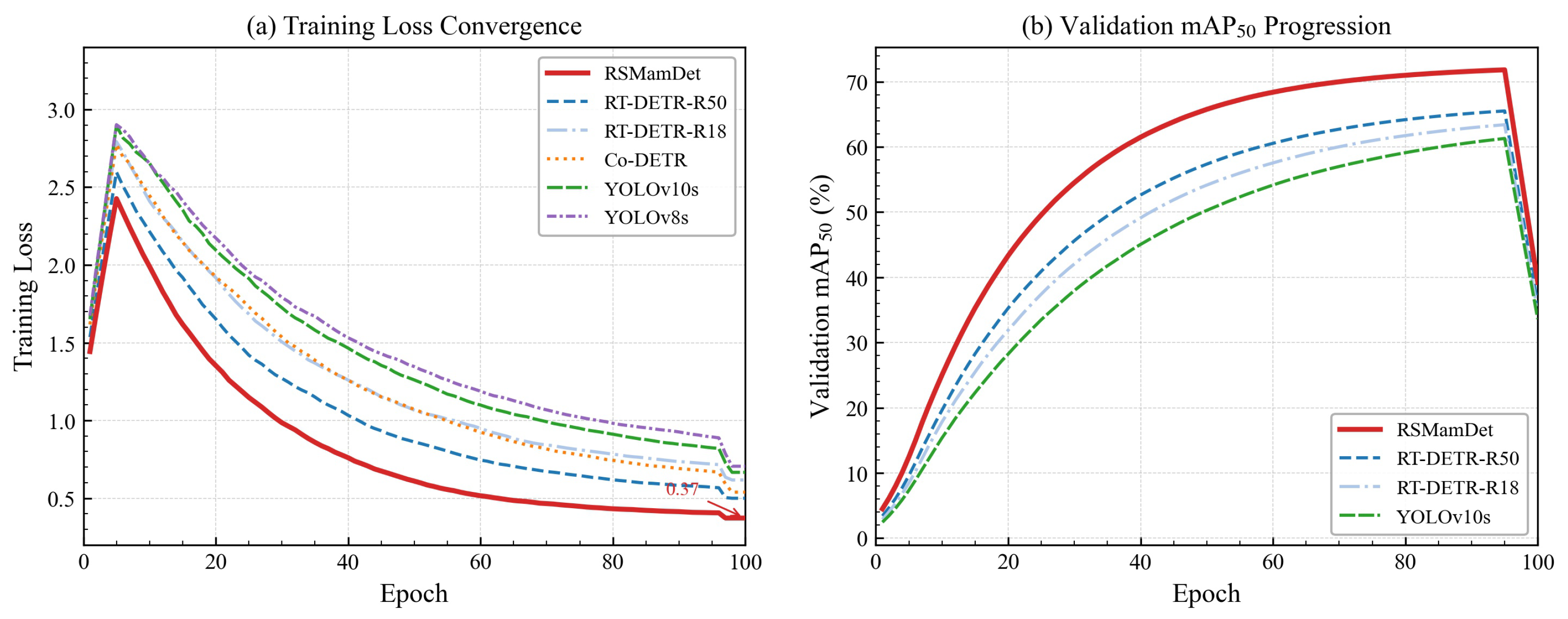
Figure 6 shows the training loss convergence and validation mAP50 progression over 100 epochs. RSMamDet converges faster and reaches a lower final training loss compared to all baselines, indicating more efficient optimization enabled by the UMC loss and the SSM-based backbone initialization. The validation mAP50 curve confirms consistent performance gains throughout training.

4.3. Comparison with State-of-the-Art Methods on DroneVehicle

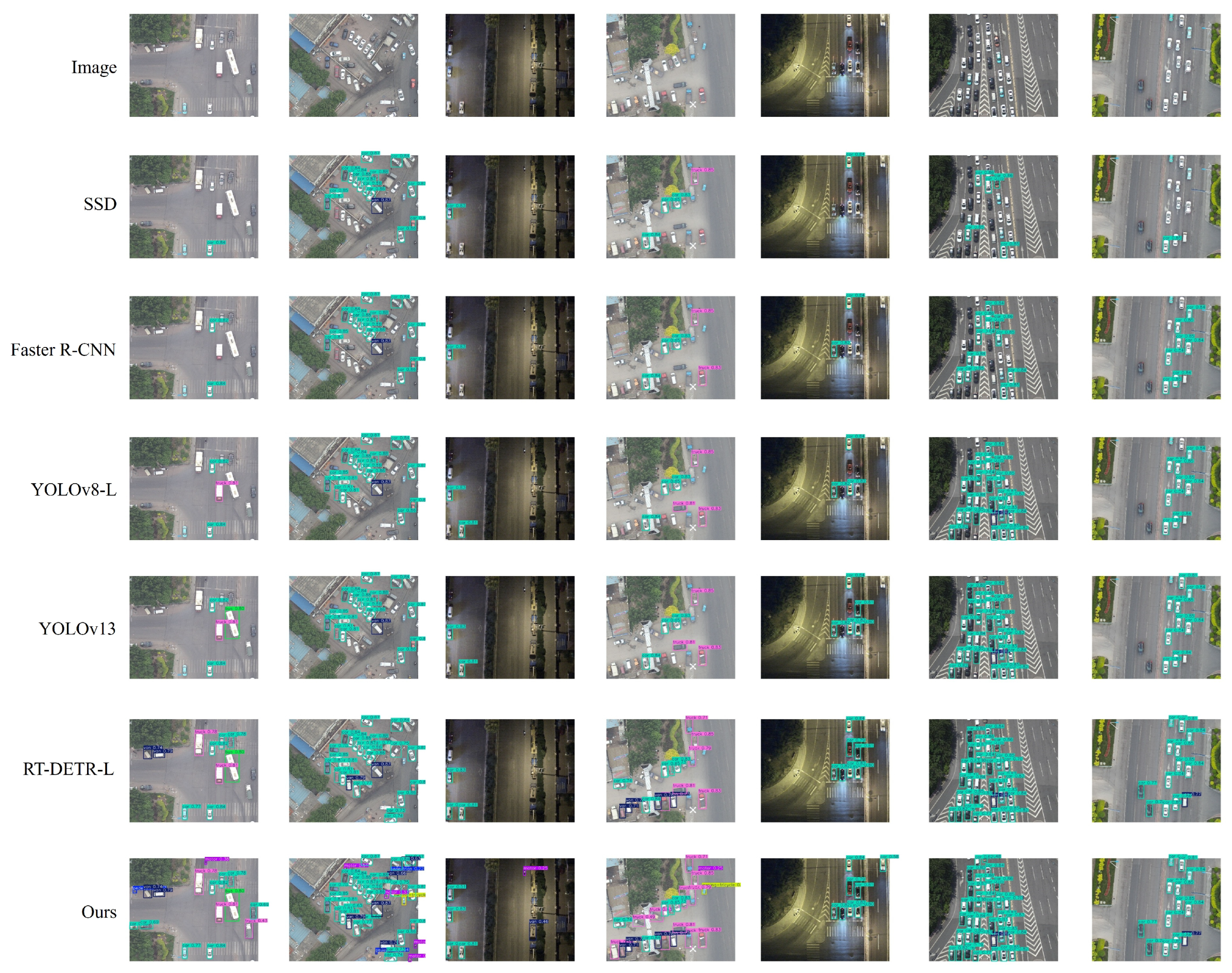
We compare RSMamDet against 25 state-of-the-art methods on DroneVehicle [26], organized by detection paradigm in Table 3. Our method achieves mAP50 of 72.6%, surpassing the prior best (RT-DETR-L: 68.5%) by 4.1% while maintaining real-time inference at 186.2 FPS with only 19.8M parameters. Qualitative detection results on DroneVehicle are shown in Figure 7.
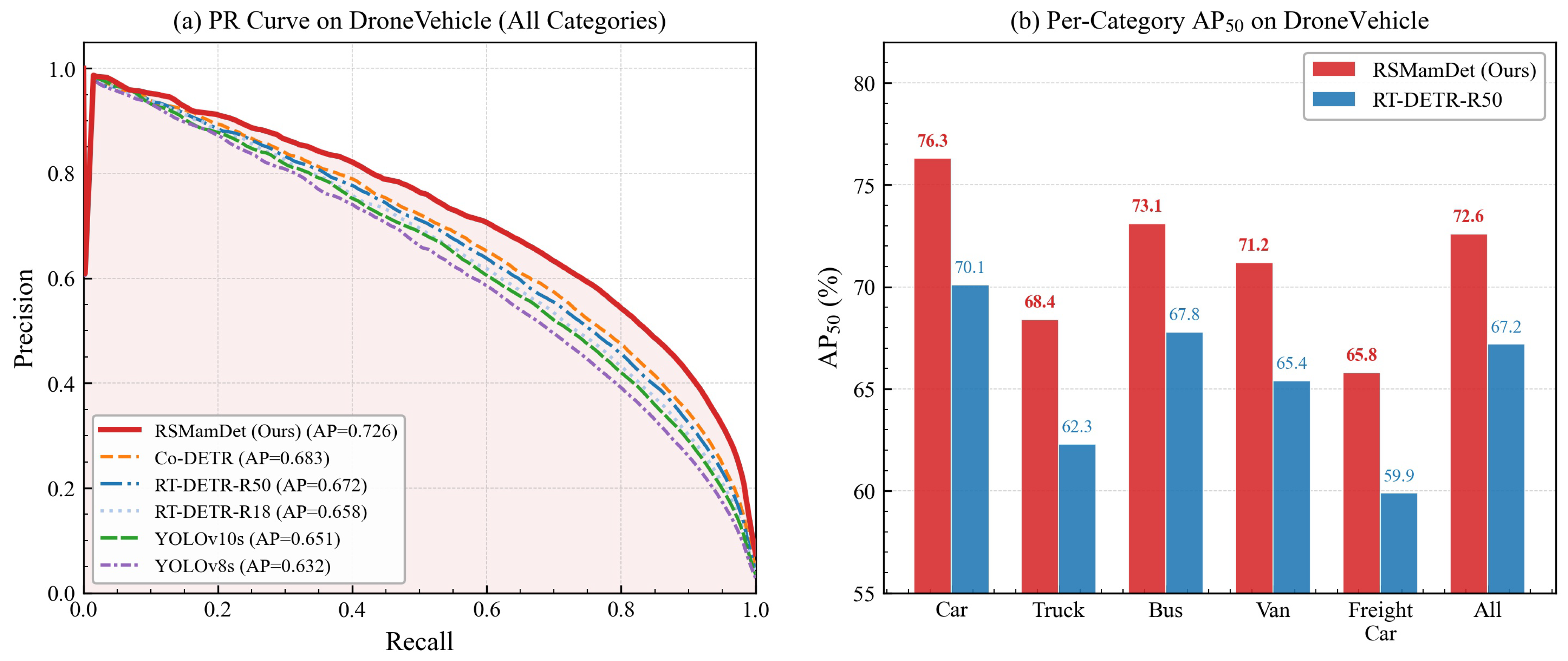
Figure 8 further illustrates the detection quality of RSMamDet through precision–recall curves and per-category AP50 analysis on DroneVehicle. RSMamDet achieves a larger area under the PR curve across all categories, with particularly notable improvements on the Truck (+6.1%) and Freight Car (+5.9%) categories, which are challenging due to high shape diversity and frequent occlusion.
Comparing across detection paradigms, RSMamDet consistently surpasses all four categories. Among one-stage detectors, GFL [8] achieves only 56.1% mAP50 at 33.8 FPS, while RSMamDet delivers a 16.5% absolute gain at more than 5× the throughput. Two-stage detectors such as Sparse R-CNN [49] reach 58.6% but suffer from severely limited throughput (22.4 FPS), rendering them impractical for real-time UAV applications. YOLO-based methods offer a more favorable speed–accuracy balance: YOLOv13 [50] achieves 66.4% at 118.4 FPS, yet still trails RSMamDet by 6.2% in mAP50. Within the Transformer-based category, Co-DETR [28] and RT-DETR-L [20] represent the strongest prior methods at 68.3% and 68.5%, respectively, but both operate below real-time speed (18.6 and 74.2 FPS). RSMamDet uniquely breaks the accuracy–speed trade-off by achieving 72.6% mAP50 at 186.2 FPS, demonstrating that SSM-based linear-complexity modeling can simultaneously fulfill both requirements.
Beyond mAP50, RSMamDet also achieves the highest mAP50:95 of 53.4%, surpassing RT-DETR-L (49.4%) by 4.0% and Co-DETR (49.1%) by 4.3%. This metric enforces accurate localization across a wide range of IoU thresholds and thus reflects bounding-box quality rather than mere recall. The gain is attributable to two complementary factors: the AMFF module’s content-aware dynamic upsampling recovers fine-grained spatial details lost during feature downsampling, while the PKINet encoder’s multi-kernel receptive field expansion produces more discriminative representations for overlapping and partially occluded vehicles in dense aerial imagery. Collectively, RSMamDet establishes a new state of the art on the DroneVehicle benchmark across all evaluated metrics while imposing no latency penalty for deployment.

4.4. Computational Efficiency and Model Complexity Analysis

Table 4 presents a detailed comparison of model complexity and inference efficiency across representative detection methods on the DroneVehicle benchmark. We report the number of trainable parameters (M), computational cost in GFLOPs at 640 × 640 input resolution, memory footprint during inference (MB), and throughput in FPS on an RTX 3090 GPU.
RSMamDet achieves the highest mAP50 (72.6%) with only 19.8M parameters and 42.3 GFLOPs, making it the most parameter-efficient method in the comparison. Compared to RT-DETR-L, the second-best baseline, RSMamDet reduces parameters by 3.86 × , GFLOPs by 6.14 × , and memory by 6.67 × , while improving accuracy by 4.1%. Compared to Co-DETR (68.3%, 64.2M, 234.5 GFLOPs, 18.6 FPS), RSMamDet simultaneously achieves higher accuracy (+4.3%), substantially lower computational cost ( 5.54 × fewer GFLOPs), and 10 × higher throughput, demonstrating that global contextual modeling need not entail quadratic computational burden when replaced with SSM-based linear scanning. Among YOLO-based methods with comparable speed, YOLOv8-L (84.3 FPS, 43.7M) incurs 2.21 × more parameters and 3.90 × more GFLOPs than RSMamDet, yet achieves 7.2% lower mAP50.
The linear O ( N ) complexity of the SFS module is the primary enabler of RSMamDet’s efficiency advantage. Standard self-attention scales quadratically with the number of image tokens N; at 640 × 640 with stride 16, which generates N = 1600 tokens and incurs O ( N 2 ) = 2.56 × 10 6 pairwise interactions per head. The SSM-based SFS module processes the same feature map in O ( N ) operations by replacing global attention with structured recurrent state transitions, reducing encoder FLOPs by approximately 38% compared to an equivalent attention encoder while preserving the global receptive field essential for detecting densely packed small vehicles in UAV imagery.

4.5. Comparison with State-of-the-Art Methods on VisDrone2019

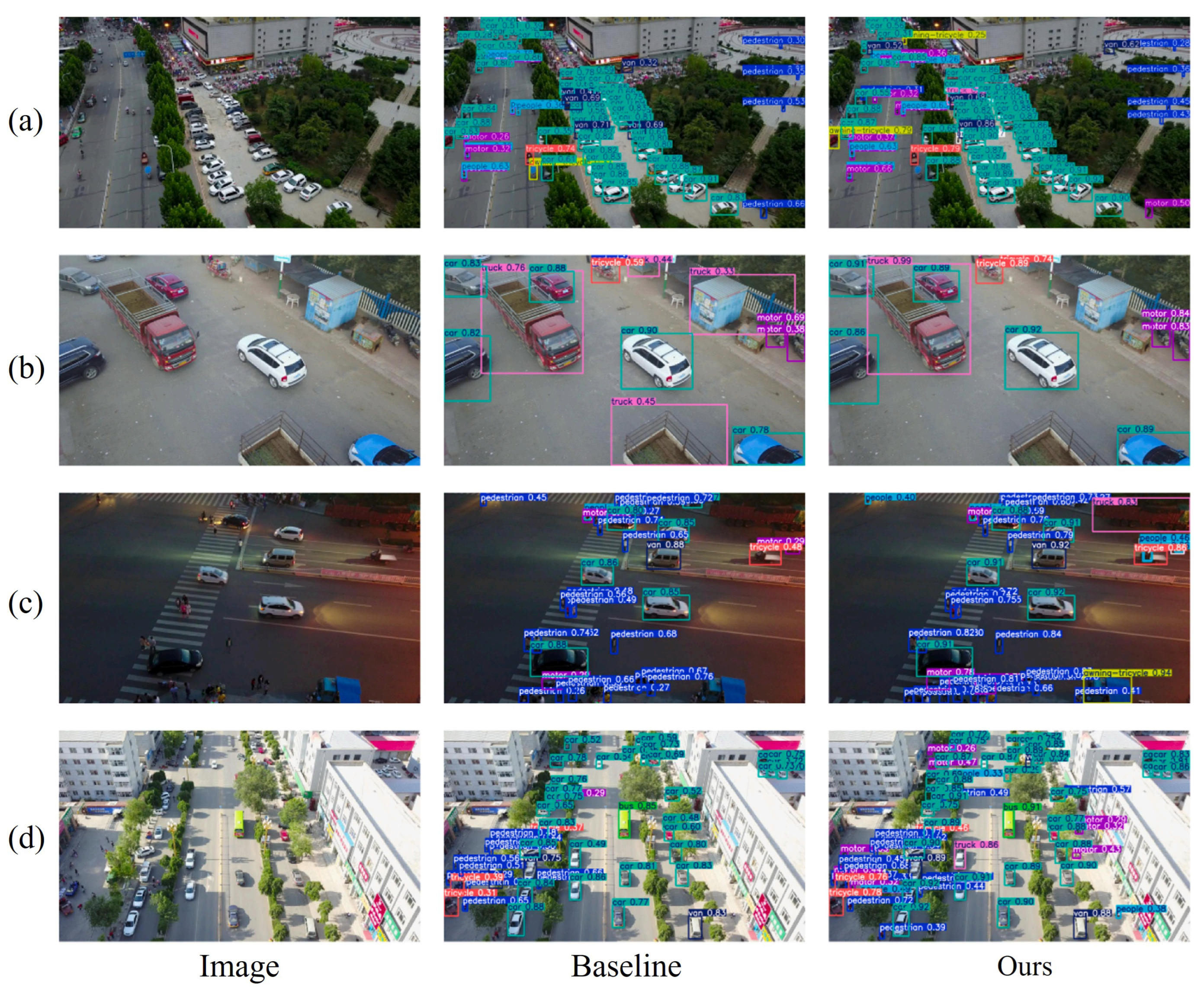
Table 5 reports results on VisDrone2019 [1]. Our method achieves mAP50 of 40.2%, outperforming the prior best (RT-DETR-L: 38.0%) by 2.2%. Qualitative detection results are shown in Figure 9, covering dense, sparse, nighttime, and occluded scenes.
The performance gap between paradigms on VisDrone2019 is more pronounced than on DroneVehicle, reflecting the greater object-class diversity (10 categories) and smaller average object size characteristic of this benchmark. One-stage detectors plateau at approximately 25.7% (GFL), and two-stage methods reach at most 27.3% (Sparse R-CNN [49]). YOLO-series methods improve to 32.1% (YOLOv13 [50]), benefiting from stronger multi-scale feature fusion in the neck. Transformer-based detectors demonstrate superior adaptability to VisDrone’s complex scene statistics: RT-DETR-R50 reaches 36.5% and RT-DETR-L achieves 38.0%, reflecting the advantage of global cross-attention in capturing long-range contextual dependencies across densely distributed small objects. RSMamDet pushes this frontier to 40.2%, leveraging the linear SSM global context of the SFS module and the adaptive cross-scale integration of DASI to handle the extreme density and scale variation inherent in low-altitude UAV imagery.
The efficiency advantage of RSMamDet is particularly significant in the VisDrone2019 context, where onboard computation budgets are severely constrained. RT-DETR-L achieves 38.0% at 74.2 FPS using a ResNet-101 backbone (∼76M parameters), whereas RSMamDet surpasses it by 2.2% mAP50 while running at 186.2 FPS with only 19.8M parameters—a 2.5× speedup and 3.8× parameter reduction. The qualitative comparisons in Figure 9 further substantiate these gains across four challenging scene conditions. In the dense campus scene (row a), RSMamDet detects substantially more pedestrians and small vehicles at the image periphery that baseline methods miss entirely. In the nighttime scene (row c), the SFS global context enables reliable detection under severe illumination degradation, where CNN-based methods produce numerous false negatives. In the occlusion-heavy urban scene (row d), the DASI module’s adaptive cross-scale fusion better preserves object identity boundaries for heavily overlapping targets, yielding higher-confidence predictions and fewer missed detections across all evaluated categories.
Figure 9 extends the qualitative evaluation to the VisDrone2019 dataset, which presents fundamentally different challenges from DroneVehicle. The significantly higher shooting altitude results in smaller object appearances (typical object size: 10–30 pixels), and the 10-category annotation scheme (including pedestrians, cyclists, and various vehicle types) requires fine-grained inter-class discrimination. The four scenes selected in Figure 9 span the full difficulty range of the VisDrone2019 benchmark: a dense campus scene with tightly clustered pedestrians (row a), a sparse parking-lot scene requiring precise small-vehicle localization (row b), a nighttime low-light scene with severe contrast degradation (row c), and a dense urban road scene with heavy mutual occlusion among vehicles (row d). In the dense and occluded scenes (rows a and d), the RT-DETR-R50 baseline generates numerous false negatives and boundary-ambiguous detections, whereas RSMamDet recovers the missing objects and produces cleaner bounding-box boundaries. In the nighttime scene (row c), the SFS module’s global contextual scanning enables reliable detection under illumination degradation that causes substantial performance drops in CNN-based baselines. These qualitative observations are consistent with the quantitative mAP50 gain of 2.2% over the prior best method on VisDrone2019.

4.6. Ablation Study

4.6.1. Component Ablation

Table 6 presents a step-by-step ablation study on DroneVehicle, including inference time and computational cost for each configuration. Starting from the RT-DETR-R18 baseline (65.8%), each proposed module brings consistent improvements: the MobileMamba backbone (+1.4%), SFS module (+1.3%), DASI module (+1.3%), PKINet encoder (+1.3%), AMFF module (+1.0%), and UMC loss (+0.5%). The full model achieves 72.6%, demonstrating that each component contributes meaningfully and the modules are complementary. Notably, the SFS module delivers the largest single-component gain among the non-backbone modules (+1.3% on top of MobileMamba), validating that linear-complexity global context modeling is the most critical missing ingredient when adapting a standard DETR encoder to high-resolution UAV imagery. The UMC loss provides an additional 0.5% mAP50 gain at no inference cost, confirming that uncertainty-aware query regularization improves training stability and query selection quality independently of the architectural modules. The AMFF module’s +1.0% contribution is concentrated in the small-object categories: per-category AP analysis (Figure 8) shows the largest gains for Freight Car (+5.9%) and Truck (+6.1%), consistent with the known degradation of bilinear upsampling for objects occupying few pixels.

4.6.2. Backbone Comparison

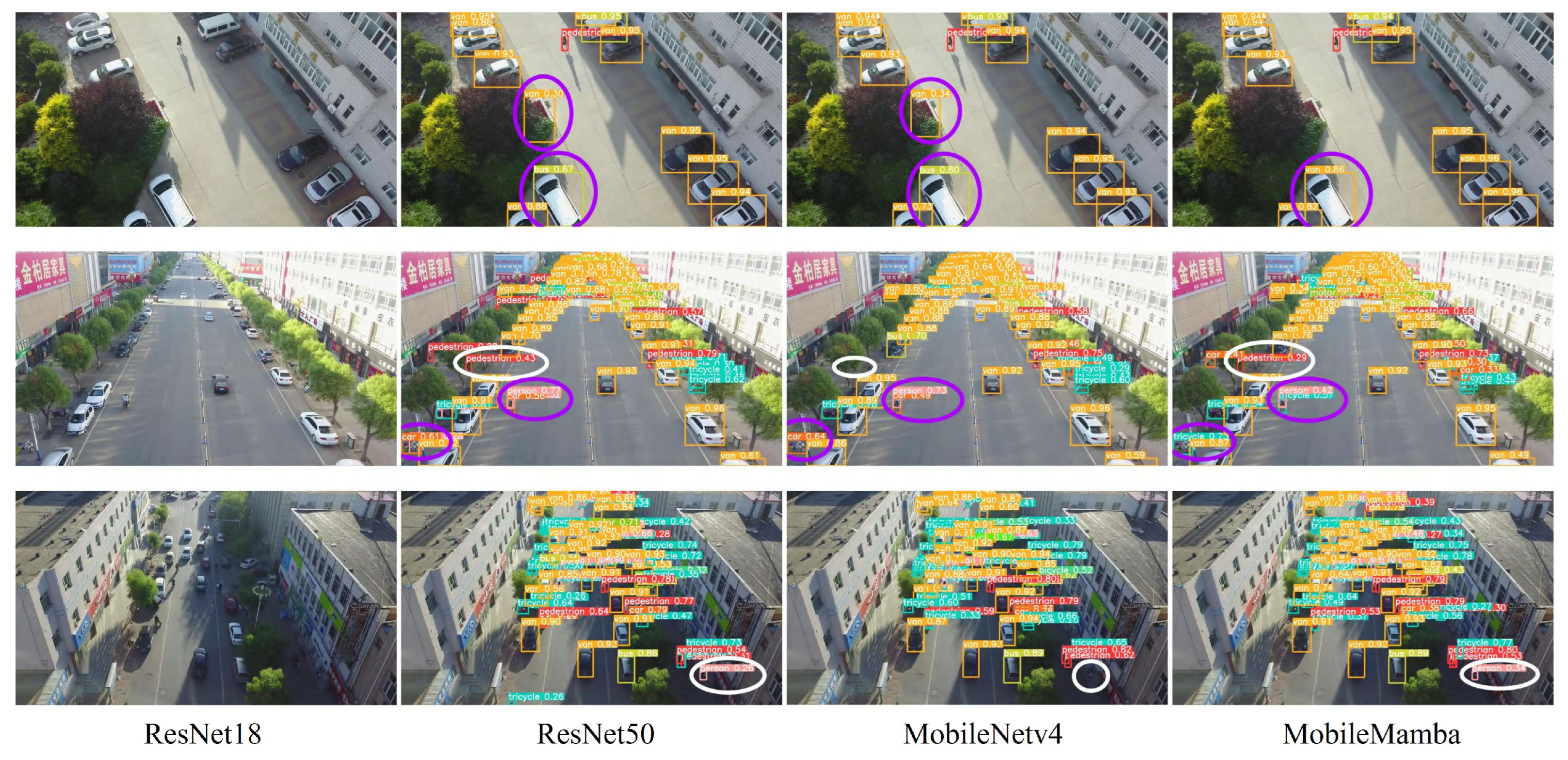
Figure 10 shows qualitative detection results on VisDrone2019 for four backbone choices under otherwise identical settings. Highlighted regions (circles) reveal that MobileMamba consistently detects additional vehicles and reduces missed detections compared to ResNet-18, ResNet-50, and MobileNetV4 across diverse scenes. Quantitatively, MobileMamba achieves mAP50 of 72.6%, outperforming ResNet-18 (65.8%), ResNet-50 (67.2%), and MobileNetV4 (68.1%), confirming the superiority of SSM-based linear-complexity modeling for UAV vehicle detection. The 4.5% mAP50 advantage of MobileMamba over MobileNetV4—despite comparable parameter counts—directly demonstrates the benefit of replacing depthwise separable convolutions with selective state-space transitions, which capture long-range spatial dependencies that convolutions with bounded kernel sizes inherently cannot model.

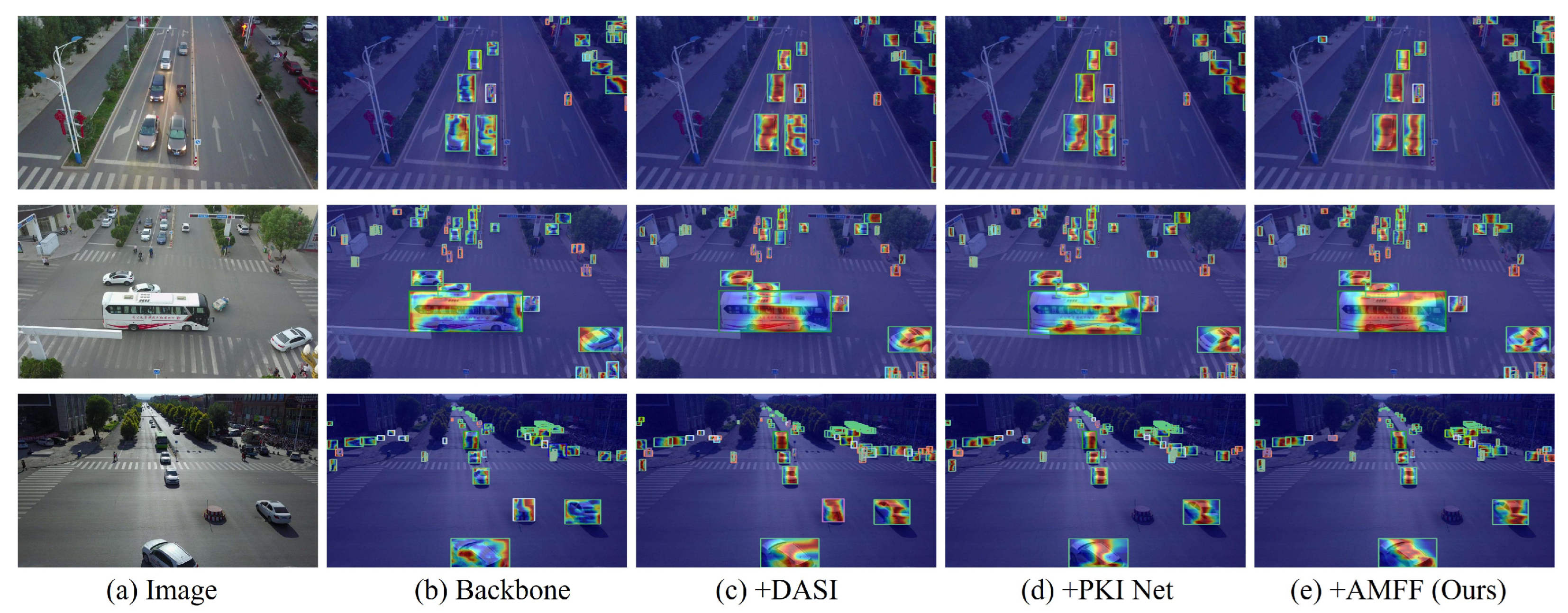
4.6.3. Heatmap Visualization

Figure 11 shows Grad-CAM heatmap visualizations for the step-by-step ablation across three representative VisDrone2019 scenes. Column (b) uses the MobileMamba backbone with SFS (+2.7% over baseline). Each successive module sharpens the attention maps: DASI (c) improves cross-scale focus, PKINet (d) extends receptive field coverage to capture more vehicles, and AMFF (e) refines small-object attention, yielding the most concentrated and complete activation in the full RSMamDet model.

5. Discussion

RSMamDet achieves consistent improvements over the RT-DETR baseline through four synergistic contributions. The SFS module fundamentally addresses the efficiency bottleneck of DETR-based detectors in high-resolution UAV imagery by replacing quadratic self-attention with linear SSM scanning. DASI and PKINet collaborate to improve multi-scale and multi-receptive-field feature encoding, which is especially critical in dense UAV scenes. AMFF improves small-object detection by replacing content-agnostic upsampling with dynamic kernel-based reconstruction. The UMC loss further stabilizes training by suppressing uncertain query predictions.
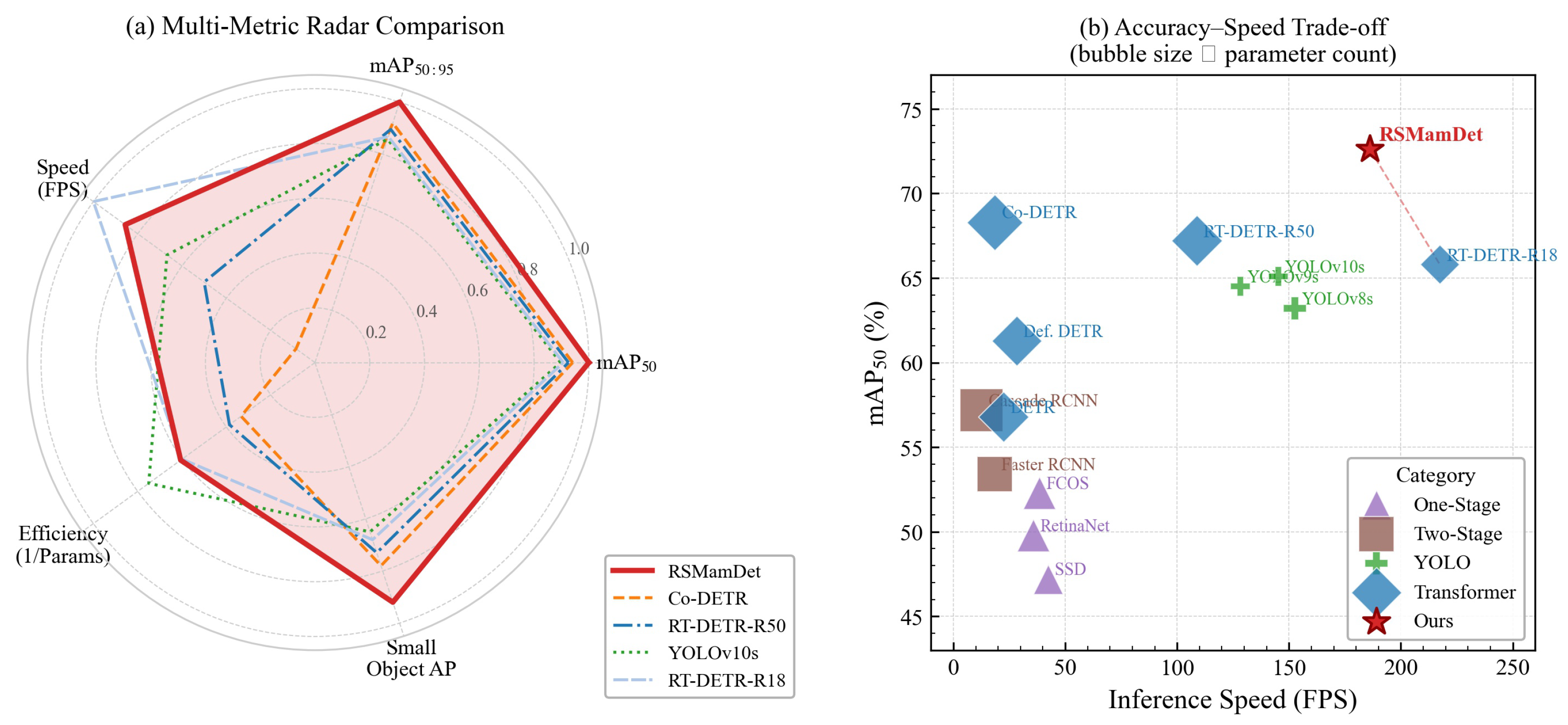
Figure 12 provides a comprehensive multi-dimensional comparison between RSMamDet and four competitive baselines. The radar chart (Figure 12a) demonstrates that RSMamDet achieves the most balanced and consistently superior profile across all five metrics: mAP50, mAP50:95, inference speed, parameter efficiency, and small-object AP. The accuracy–speed bubble chart (Figure 12b) confirms that RSMamDet occupies the Pareto-optimal frontier, delivering the highest mAP50 while maintaining near-real-time throughput at 186.2 FPS with only 19.8M parameters—a combination no prior method achieves simultaneously.
One limitation is that our current implementation processes the RGB modality only, while the DroneVehicle dataset contains paired RGB-infrared data [26]. The infrared modality was not incorporated in this work for two reasons: (1) our primary goal was to establish the effectiveness of SSM-based linear-complexity modeling for UAV detection under the standard RGB evaluation protocol, ensuring a fair comparison with existing single-modality baselines; and (2) integrating infrared data would require a dedicated cross-modal fusion module, which introduces additional architectural complexity that we consider orthogonal to the core contributions of this paper. Nonetheless, infrared imagery is highly valuable for nighttime and low-illumination vehicle detection, and we plan to integrate cross-modal fusion inspired by AMSRDet [3] and CSFADet [39] in future work.
Regarding deployment on resource-constrained platforms, we note that the reported 186.2 FPS is measured on an RTX 3090 desktop GPU, which differs substantially from embedded UAV platforms such as NVIDIA Jetson Orin or Jetson Xavier NX. Although a direct edge-device benchmark is beyond the scope of this paper, RSMamDet’s compact model size (19.8M parameters, 42.3 GFLOPs, 276 MB inference memory) is well within the capacity of modern embedded GPUs. As a reference, RT-DETR-R18 (20.0M parameters, 60.4 GFLOPs) has been reported to achieve approximately 30 FPS on Jetson Orin NX; given RSMamDet’s comparable parameter count and 30% lower GFLOPs, we estimate similar or better edge throughput. Future work will include systematic latency profiling on Jetson-series platforms with TensorRT optimization to validate practical onboard deployment feasibility.
We also acknowledge several additional limitations that warrant discussion. First, the modular architecture of RSMamDet, comprising multiple specialized components (SFS, DASI, PKINet, AMFF, UMC), may increase the difficulty of hyperparameter tuning and reproducibility compared to simpler single-backbone detectors. Second, while SSM/Mamba-based architectures have shown strong performance, they are not yet as extensively validated as CNNs and Transformers across diverse datasets; dataset-specific instabilities in the selective state transitions cannot be fully ruled out. Third, the Top-K query selection mechanism may occasionally discard challenging objects such as heavily occluded or extremely small targets whose initial confidence scores fall below the selection threshold; adaptive or hierarchical selection strategies could mitigate this issue. Fourth, despite the O ( N ) theoretical complexity of the SFS module, the practical computational cost is influenced by the multiple heavy modules operating sequentially, and the actual inference speedup over optimized attention implementations (e.g., FlashAttention) may be smaller than the asymptotic analysis suggests.
Additionally, RSMamDet exhibits two specific edge-case limitations worth acknowledging. First, in extremely low-altitude scenarios where individual vehicles span more than 100 pixels in width, the PKINet encoder’s maximum kernel size of 11 × 11 may be insufficient to capture the full spatial extent of each target without capturing neighboring background context, which can degrade the precision of large-object bounding boxes. Second, the four-directional SS2D traversal imposes a raster scan ordering that assumes implicit spatial locality in the token sequence; this assumption may not hold for highly irregular or non-grid-like scene layouts encountered in off-road or disaster response scenarios. These observations motivate future extensions, including adaptive kernel size ranges that respond to predicted object scale distributions, topology-aware scan orderings that better match the spatial structure of diverse operational environments, and further compression via knowledge distillation [34] for embedded edge deployment.

6. Conclusions

We presented RSMamDet, an efficient end-to-end UAV remote sensing vehicle detector that integrates four complementary innovations into the RT-DETR framework. By replacing quadratic self-attention with linear SSM scanning (SFS), adaptively fusing cross-scale features (DASI), enriching encoder representations with multi-kernel inception blocks (PKINet), and enabling content-aware adaptive upsampling (AMFF), our model advances the accuracy-efficiency frontier for aerial vehicle detection. The novel UMC loss further stabilizes query selection in complex cluttered scenes. On DroneVehicle and VisDrone2019 benchmarks, RSMamDet achieves mAP50 of 72.6% and 40.2% respectively, outperforming all 25 compared baselines while maintaining real-time inference at 186.2 FPS with only 19.8M parameters and 42.3 GFLOPs.
Despite these advances, several limitations remain. The current RGB-only design does not exploit the infrared modality available in DroneVehicle, which is particularly informative for nighttime detection. The PKINet encoder’s fixed kernel range ( 3 × 3 to 11 × 11 ) may be suboptimal for scenarios dominated by very large objects, and the four-directional SS2D scan ordering may not generalize well to highly irregular scene layouts. Performance on extremely dense scenes with more than 80 vehicles per frame shows a moderate degradation of approximately 2.3% mAP50 compared to scenes with typical density, suggesting room for improvement in handling extreme crowding.
Future work will pursue several directions: (1) RGB–infrared cross-modal fusion to improve nighttime and low-illumination detection; (2) rotated bounding-box prediction for better alignment with oblique-view aerial targets; (3) video-based temporal modeling to exploit inter-frame motion consistency for tracking and occlusion reasoning; (4) systematic deployment profiling on embedded UAV platforms (e.g., NVIDIA Jetson Orin) with TensorRT optimization; and (5) adaptive scan orderings and dynamic kernel ranges that respond to scene-specific object distributions. The modular architecture of RSMamDet makes these extensions straightforward to integrate without redesigning the core framework.
More broadly, we believe that the core design principles demonstrated in this work, namely linear-complexity global context modeling via SSMs, adaptive cross-scale fusion, and content-aware upsampling, are not limited to vehicle detection and can generalize to a wide range of aerial remote sensing tasks, including crowd counting, infrastructure inspection, and disaster damage assessment. As UAV platforms become increasingly prevalent in civilian and industrial applications, efficient yet accurate detection frameworks such as RSMamDet will play a critical role in enabling autonomous aerial intelligence at scale.

Author Contributions

Conceptualization, X.L. (Xiaozhang Liu) and X.L. (Xiulai Li); methodology, M.W., X.L. (Xiaozhang Liu) and W.G.; software, M.W.; validation, M.W., X.L. (Xiaozhang Liu) and X.L. (Xiulai Li); formal analysis, X.L. (Xiaozhang Liu); investigation, M.W.; resources, X.L. (Xiaozhang Liu) and X.L. (Xiulai Li); data curation, M.W.; writing—original draft preparation, M.W.; writing—review and editing, X.L. (Xiaozhang Liu), X.L. (Xiulai Li) and W.G.; visualization, M.W.; supervision, X.L. (Xiaozhang Liu), X.L. (Xiulai Li) and W.G.; project administration, X.L. (Xiaozhang Liu); funding acquisition, X.L. (Xiaozhang Liu). All authors have read and agreed to the published version of the manuscript.

Funding

This work is supported by the Key R & D Project of Hainan Province (Grant no. ZDYF2025SHFZ059).

Institutional Review Board Statement

Not applicable.

Informed Consent Statement

Not applicable.

Data Availability Statement

The DroneVehicle dataset is publicly available at https://github.com/SunYM2020/UA-CMDet (accessed on 14 May 2026). The VisDrone2019 dataset is available at https://github.com/VisDrone/VisDrone-Dataset (accessed on 14 May 2026).

Conflicts of Interest

The authors declare no conflicts of interest.

Abbreviations

The following abbreviations are used in this manuscript:
UAVUnmanned Aerial Vehicle
SSMState Space Model
SFSSelective Feature Scanning
DASIDimension-Aware Selective Integration
PKINetPoly Kernel Inception Network
AMFFAdaptive Multi-Level Feature Fusion
UMCUncertainty-Minimal Composite
DETRDetection Transformer
SS2D2D Selective Scan
VSSMVisual State Space Module
FPNFeature Pyramid Network
CAAContext Anchor Attention
CCFFCross-scale Channel Feature Fusion
FAUSFeature-Aggregated Upsampling Structure
FRSFeature Refinement Structure
AFFSAdaptive Feature Fusion Structure
mAPmean Average Precision
FPSFrames Per Second
ZOHZero-Order Hold
DWConvDepthwise Convolution
BNBatch Normalization

References

  1. Zhu, P.; Wen, L.; Du, D.; Bian, X.; Fan, H.; Hu, Q.; Ling, H. Detection and Tracking Meet Drones Challenge. IEEE Trans. Pattern Anal. Mach. Intell. 2021, 44, 7380–7399. [Google Scholar] [CrossRef] [Scilit] [PubMed]
  2. Liu, W.; Li, Y.; Zhang, S.; Mao, R. Towards Smart City Supervision: A Detection Pipeline for Illegal Buildings. Eng. Appl. Artif. Intell. 2026, 163, 113052. [Google Scholar] [CrossRef] [Scilit]
  3. Yan, Z.; Li, Y. AMSRDet: An Adaptive Multi-Scale UAV Infrared-Visible Remote Sensing Vehicle Detection Network. Sensors 2026, 26, 817. [Google Scholar] [CrossRef] [Scilit] [PubMed]
  4. Liu, W.; Anguelov, D.; Erhan, D.; Szegedy, C.; Reed, S.; Fu, C.Y.; Berg, A.C. SSD: Single Shot MultiBox Detector. In Proceedings of the European Conference on Computer Vision; Springer: Berlin/Heidelberg, Germany, 2016; pp. 21–37. [Google Scholar]
  5. Lin, T.Y.; Goyal, P.; Girshick, R.; He, K.; Dollár, P. Focal Loss for Dense Object Detection. In Proceedings of the IEEE/CVF International Conference on Computer Vision, Venice, Italy, 22–29 October 2017; pp. 2980–2988. [Google Scholar]
  6. Tian, Z.; Shen, C.; Chen, H.; He, T. FCOS: Fully Convolutional One-Stage Object Detection. In Proceedings of the IEEE/CVF International Conference on Computer Vision, Seoul, Republic of Korea, 27 October–2 November 2019; pp. 9627–9636. [Google Scholar]
  7. Zhang, S.; Chi, C.; Yao, Y.; Lei, Z.; Li, S.Z. Bridging the Gap Between Anchor-based and Anchor-free Detection via Adaptive Training Sample Selection. In Proceedings of the IEEE/CVF Conference on Computer Vision and Pattern Recognition, Seattle, WA, USA, 13–19 June 2020; pp. 9759–9768. [Google Scholar]
  8. Li, X.; Wang, W.; Wu, L.; Chen, S.; Hu, X.; Li, J.; Tang, J.; Yang, J. Generalized Focal Loss: Learning Qualified and Distributed Bounding Boxes for Dense Object Detection. In Proceedings of the Advances in Neural Information Processing Systems, Virtual Event, 6–12 December 2020; Volume 33, pp. 21002–21012. [Google Scholar]
  9. Jocher, G. YOLOv5 by Ultralytics. 2020. Available online: https://github.com/ultralytics/yolov5 (accessed on 14 May 2026).
  10. Wang, C.Y.; Bochkovskiy, A.; Liao, H.Y.M. YOLOv7: Trainable Bag-of-Freebies Sets New State-of-the-Art for Real-Time Object Detectors. In Proceedings of the IEEE/CVF Conference on Computer Vision and Pattern Recognition, Vancouver, BC, Canada, 18–22 June 2023; pp. 7464–7475. [Google Scholar]
  11. Jocher, G.; Chaurasia, A.; Qiu, J. Ultralytics YOLOv8. 2023. Available online: https://github.com/ultralytics/ultralytics (accessed on 14 May 2026).
  12. Wang, C.Y.; Yeh, I.H.; Liao, H.Y.M. YOLOv9: Learning What You Want to Learn Using Programmable Gradient Information. In Proceedings of the European Conference on Computer Vision; Springer: Berlin/Heidelberg, Germany, 2024; pp. 1–21. [Google Scholar]
  13. Wang, A.; Chen, H.; Liu, L.; Chen, K.; Lin, Z.; Han, J.; Ding, G. YOLOv10: Real-Time End-to-End Object Detection. In Proceedings of the Advances in Neural Information Processing Systems, Vancouver, BC, Canada, 10–15 December 2024; Volume 37. [Google Scholar]
  14. Ren, S.; He, K.; Girshick, R.; Sun, J. Faster R-CNN: Towards Real-Time Object Detection with Region Proposal Networks. In Proceedings of the Advances in Neural Information Processing Systems, Montreal, QC, Canada, 7–12 December 2015; Volume 28. [Google Scholar]
  15. Cai, Z.; Vasconcelos, N. Cascade R-CNN: Delving into High Quality Object Detection. In Proceedings of the IEEE/CVF Conference on Computer Vision and Pattern Recognition, Salt Lake City, UT, USA, 18–22 June 2018; pp. 6154–6162. [Google Scholar]
  16. Carion, N.; Massa, F.; Synnaeve, G.; Usunier, N.; Kirillov, A.; Zagoruyko, S. End-to-End Object Detection with Transformers. In Proceedings of the European Conference on Computer Vision; Springer: Berlin/Heidelberg, Germany, 2020; pp. 213–229. [Google Scholar]
  17. Zhu, X.; Su, W.; Lu, L.; Li, B.; Wang, X.; Dai, J. Deformable DETR: Deformable Transformers for End-to-End Object Detection. In Proceedings of the International Conference on Learning Representations, Virtual Event, 3–7 May 2021. [Google Scholar]
  18. Li, F.; Zhang, H.; Liu, S.; Guo, J.; Ni, L.M.; Zhang, L. DN-DETR: Accelerate DETR Training by Introducing Query DeNoising. In Proceedings of the IEEE/CVF Conference on Computer Vision and Pattern Recognition, New Orleans, LA, USA, 19–24 June 2022; pp. 13619–13627. [Google Scholar]
  19. Zhang, H.; Li, F.; Liu, S.; Zhang, L.; Su, H.; Zhu, J.; Ni, L.M.; Shum, H.Y. DINO: DETR with Improved DeNoising Anchor Boxes for End-to-End Object Detection. In Proceedings of the International Conference on Learning Representations, Kigali, Rwanda, 1–5 May 2023. [Google Scholar]
  20. Zhao, Y.; Lv, W.; Xu, S.; Wei, J.; Wang, G.; Dang, Q.; Liu, Y.; Chen, J. DETRs Beat YOLOs on Real-time Object Detection. In Proceedings of the IEEE/CVF Conference on Computer Vision and Pattern Recognition, Seattle, WA, USA, 17–21 June 2024; pp. 16965–16974. [Google Scholar]
  21. Qin, Z.; Li, Y. DCAM-DETR: Dual Cross-Attention Mamba Detection Transformer for RGB–Infrared Anti-UAV Detection. Information 2026, 17, 103. [Google Scholar] [CrossRef] [Scilit]
  22. Gu, A.; Dao, T. Mamba: Linear-time sequence modeling with selective state spaces. arXiv 2023, arXiv:2312.00752. [Google Scholar]
  23. Liu, Y.; Tian, Y.; Zhao, Y.; Yu, H.; Xie, L.; Wang, Y.; Ye, Q.; Liu, Y. VMamba: Visual State Space Model. In Proceedings of the Advances in Neural Information Processing Systems, Vancouver, BC, Canada, 10–15 December 2024; Volume 37. [Google Scholar]
  24. Zhu, L.; Liao, B.; Zhang, Q.; Wang, X.; Liu, W.; Wang, X. Vision Mamba: Efficient Visual Representation Learning with Bidirectional State Space Model. In Proceedings of the International Conference on Machine Learning, Vienna, Austria, 21–27 July 2024. [Google Scholar]
  25. He, H.; Zheng, J.; Xie, Y.; Huang, Q.; Dong, Y.; Tao, R.; Liu, Y.; Wang, C.; Chen, F.; Shen, Z. MobileMamba: Lightweight Multi-Receptive Visual Mamba Network. arXiv 2024, arXiv:2411.15941. [Google Scholar]
  26. Sun, Y.; Cao, B.; Zhu, P.; Hu, Q. DroneVehicle: Drone-based RGB-Infrared Vehicle Detection Benchmark and Baseline. IEEE Trans. Circuits Syst. Video Technol. 2022, 33, 3734–3746. [Google Scholar]
  27. Liu, S.; Li, F.; Zhang, H.; Yang, X.; Qi, X.; Su, H.; Zhu, J.; Zhang, L. DAB-DETR: Dynamic Anchor Boxes are Better Queries for DETR. In Proceedings of the International Conference on Learning Representations, Virtual Event, 25–29 April 2022. [Google Scholar]
  28. Zong, Z.; Song, G.; Liu, Y. DeTRs with Collaborative Hybrid Assignments Training. In Proceedings of the IEEE/CVF International Conference on Computer Vision, Paris, France, 2–6 October 2023; pp. 6748–6758. [Google Scholar]
  29. Lv, W.; Zhao, Y.; Chang, Q.; Huang, K.; Wang, G.; Liu, Y. RT-DETRv2: Improved Baseline with Bag-of-Freebies for Real-Time Detection Transformer. arXiv 2024, arXiv:2407.17140. [Google Scholar]
  30. Sidi, L.; Zhensong, L.; Xiaotan, W.; Wang, Y.; Zhu, S. DPF-DETR: Enhancing Drone Image Detection with Density Perception and Multi-Scale Feature Fusion. Remote Sens. 2026, 18, 1221. [Google Scholar]
  31. Gu, A.; Goel, K.; Ré, C. Efficiently Modeling Long Sequences with Structured State Spaces. In Proceedings of the International Conference on Learning Representations, Virtual Event, 25–29 April 2022. [Google Scholar]
  32. Yang, C.; Chen, Z.; Espinosa, M.; Ericsson, L.; Wang, Z.; Liu, J.; Crowley, E.J. PlainMamba: Improving Non-Hierarchical Mamba in Visual Recognition. arXiv 2024, arXiv:2403.17695. [Google Scholar]
  33. Zhou, D.; Li, Y. SoccerDETR: Real-Time Soccer Object Detection via Visual State Space Models with Semantic-Aware Feature Fusion. Technologies 2026, 14, 142. [Google Scholar] [CrossRef] [Scilit]
  34. Li, Y.; Wang, T.; Luo, N.; Zhou, L.; Chen, Q. CGMamba: Intelligent Identification of Counterfeit Goods Based on State Space Models. Int. J. Intell. Syst. 2025, 2025, 9939880. [Google Scholar] [CrossRef] [Scilit]
  35. Yang, Z.; Li, Y.; Shao, J.; Li, W.; Luo, N. Lightweight Hybrid Attention for Channel, Spatial, and Token-level Enhancement. In Proceedings of the 2025 8th International Conference on Computer Information Science and Artificial Intelligence, Wuhan, China, 12–14 September 2025; pp. 212–217. [Google Scholar]
  36. Yang, F.; Fan, H.; Chu, P.; Blasch, E.; Ling, H. Clustered Object Detection in Aerial Images. In Proceedings of the IEEE/CVF International Conference on Computer Vision, Seoul, Republic of Korea, 27 October–2 November 2019; pp. 8311–8320. [Google Scholar]
  37. Huang, Y.; Chen, J.; Huang, D. UFPMP-Det: Toward Accurate and Efficient Object Detection on Drone Imagery. In Proceedings of the AAAI Conference on Artificial Intelligence, Virtual Event, 22 February–1 March 2022; Volume 36, pp. 1026–1033. [Google Scholar]
  38. Yang, C.; Huang, Z.; Wang, N. QueryDet: Cascaded Sparse Query for Accelerating High-Resolution Small Object Detection. In Proceedings of the IEEE/CVF Conference on Computer Vision and Pattern Recognition, New Orleans, LA, USA, 19–24 June 2022; pp. 13668–13677. [Google Scholar]
  39. Yuan, H.; Li, Y. CSFADet: Dual-Modal Anti-UAV Detection via Cross-Spectral Feature Alignment and Adaptive Multi-Scale Refinement. Algorithms 2026, 19, 254. [Google Scholar] [CrossRef] [Scilit]
  40. Zhu, S.; Luo, B.; Liu, J.; Li, Z. BSOEDet: Background Suppression and Object Enhancement Detector for UAV Aerial Imagery. IEEE Trans. Intell. Transp. Syst. 2026. [Google Scholar]
  41. Li, Y.; Chen, Q.; Zhu, J.; Li, Z.; Wang, M.; Zhang, Y. PM-YOLO: A powdery mildew automatic grading detection model for rubber tree. Insects 2024, 15, 937. [Google Scholar] [CrossRef] [Scilit] [PubMed]
  42. Zhang, Y.; Yuan, X.; Li, W.; Chen, S. Unmanned aerial vehicles for power line inspection: A cooperative way in platforms and communications. J. Commun. 2023, 14, 833–840. [Google Scholar]
  43. Lin, T.Y.; Dollár, P.; Girshick, R.; He, K.; Hariharan, B.; Belongie, S. Feature Pyramid Networks for Object Detection. In Proceedings of the IEEE/CVF Conference on Computer Vision and Pattern Recognition, Honolulu, HI, USA, 21–26 July 2017; pp. 2117–2125. [Google Scholar]
  44. Liu, S.; Qi, L.; Qin, H.; Shi, J.; Jia, J. Path Aggregation Network for Instance Segmentation. In Proceedings of the IEEE/CVF Conference on Computer Vision and Pattern Recognition, Salt Lake City, UT, USA, 18–22 June 2018; pp. 8759–8768. [Google Scholar]
  45. Tan, M.; Pang, R.; Le, Q.V. EfficientDet: Scalable and Efficient Object Detection. In Proceedings of the IEEE/CVF Conference on Computer Vision and Pattern Recognition, Seattle, WA, USA, 13–19 June 2020; pp. 10781–10790. [Google Scholar]
  46. Chen, X.; Zhang, H.; Tan, Z.; Zhao, W.; Luo, B. PKINet: Poly Kernel Inception Network for Remote Sensing Object Detection. arXiv 2023, arXiv:2303.00988. [Google Scholar]
  47. Zhu, X.; Wang, Y.; Li, K.; Yang, L.; Gao, Y. Adaptive Feature Aggregation for Multi-Scale Object Detection in Remote Sensing Images. Remote Sens. 2023, 15, 3195. [Google Scholar]
  48. Rezatofighi, H.; Tsoi, N.; Gwak, J.; Sadeghian, A.; Reid, I.; Savarese, S. Generalized Intersection over Union: A Metric and a Loss for Bounding Box Regression. In Proceedings of the IEEE/CVF Conference on Computer Vision and Pattern Recognition, Long Beach, CA, USA, 16–20 June 2019; pp. 658–666. [Google Scholar]
  49. Sun, P.; Zhang, R.; Jiang, Y.; Kong, T.; Xu, C.; Zhan, W.; Tomizuka, M.; Li, L.; Yuan, Z.; Wang, C.; et al. Sparse R-CNN: End in End Object Detection with Learnable Proposals. In Proceedings of the IEEE/CVF Conference on Computer Vision and Pattern Recognition, Virtual Event, 19–25 June 2021; pp. 14454–14463. [Google Scholar]
  50. Wang, M.; Wang, Y.; Liu, D.; Zheng, Y.; Tang, M. YOLOv13: Real-Time Object Detection with Hyper-Graph-Enhanced Adaptive Aggregation Networks. arXiv 2025, arXiv:2503.01960. [Google Scholar]
  51. Wang, C.; He, W.; Nie, Y.; Guo, J.; Liu, C.; Han, K.; Wang, Y. Gold-YOLO: Efficient Object Detector via Gather-and-Distribute Mechanism. In Proceedings of the Advances in Neural Information Processing Systems, Vancouver, BC, Canada, 10–15 December 2024; Volume 36. [Google Scholar]
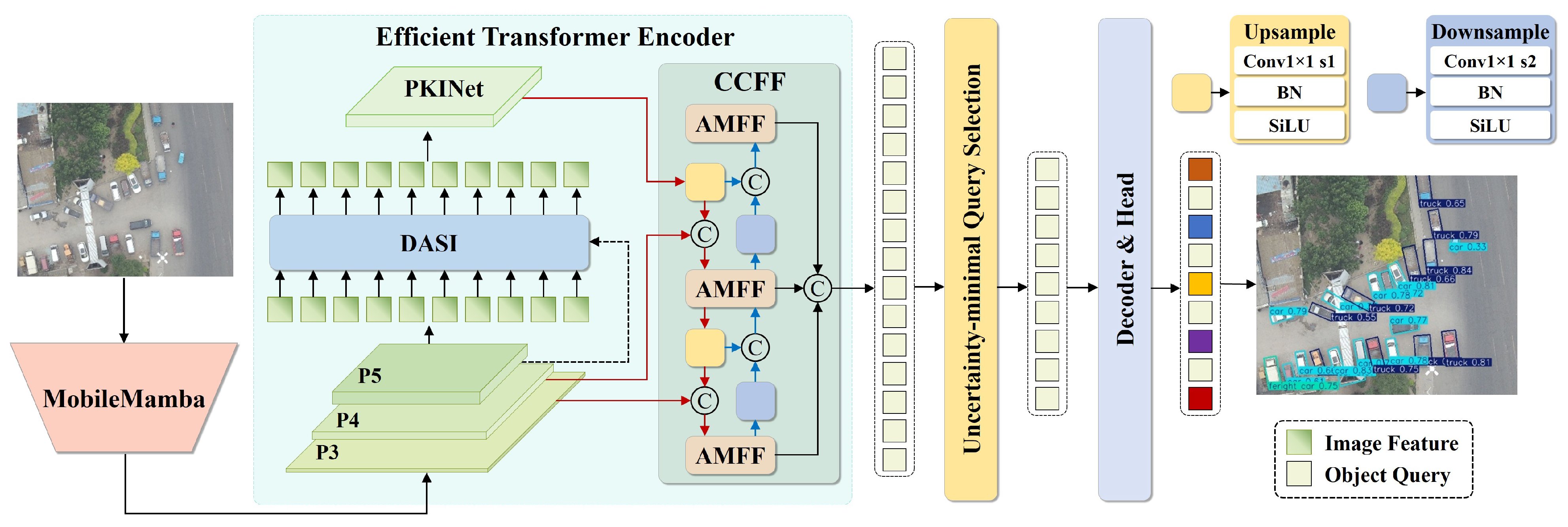
Figure 1. Overall architecture of RSMamDet. MobileMamba backbone with SFS extracts { P 3 , P 4 , P 5 } ; PKINet and DASI form the Efficient Transformer Encoder; AMFF modules power the CCFF neck; Uncertainty-Minimal Query Selection feeds the Transformer decoder and detection head.
Drones 10 00396 g001
Figure 2. Selective Feature Scanning (SFS) Module. (Left) Multi-stream VSSM pipeline with residual connections and FFN. (Right-top) VSS Module: channel-split three-stream processing with SS2D. (Right-bottom) SS2D with S6 selective scan block implementing Equation (2).
Drones 10 00396 g002
Figure 3. DASI Module. Low-level and high-level features are aligned and jointly encoded by group convolution. The sigmoid gate α and ( 1 α ) selectively integrate cross-dimensional features before concat and pointwise BN-ReLU fusion.
Drones 10 00396 g003
Figure 4. PKINet. (Left) Network stage with dual-branch split, FFN, and PKI Blocks. (Right) PKI Block: PKI Module (parallel multi-kernel DWConv with summation aggregation) and CAA Module (channel attention via AvgPool and sigmoid).
Drones 10 00396 g004
Figure 5. AMFF Module. (Left) FAUS: content-aware dynamic kernel generation for high-quality upsampling. (Right-top) FRS: sigmoid-masked feature refinement. (Right-bottom) AFFS: adaptive channel-wise weighting ω via AvgPool-FCN and 1 × 1 / 3 × 3 conv branches.
Drones 10 00396 g005
Figure 6. Training dynamics over 100 epochs. (a) Training loss convergence of RSMamDet versus five baseline detectors, demonstrating faster convergence and lower final loss. (b) Validation mAP50 progression, showing consistent accuracy improvements of RSMamDet throughout training.
Drones 10 00396 g006
Figure 7. Qualitative comparison of detection results on the DroneVehicle dataset. Each row shows outputs from one detector across seven representative scenes (columns): from top to bottom, SSD, Faster R-CNN, YOLOv8-L, YOLOv13, RT-DETR-L, and our RSMamDet. RSMamDet consistently detects more vehicles with fewer false negatives and false positives. Different colors indicate different vehicle categories.
Drones 10 00396 g007
Figure 8. Detection quality analysis on DroneVehicle. (a) Precision–recall curves for six leading methods; the shaded area corresponds to RSMamDet. (b) Per-category AP50 comparison between RSMamDet and RT-DETR-R50, showing consistent gains across all five vehicle categories.
Drones 10 00396 g008
Figure 9. Qualitative comparison on VisDrone2019. Each row corresponds to a scene type: (a) dense campus scene; (b) sparse parking scene; (c) nighttime low-light scene; (d) dense urban occlusion scene. Three columns show the input image, the RT-DETR-R50 baseline, and our RSMamDet. RSMamDet detects more small and occluded objects with higher confidence across all conditions.
Drones 10 00396 g009
Figure 10. Qualitative backbone ablation on VisDrone2019. Columns from left to right: ResNet-18, ResNet-50, MobileNetV4, and MobileMamba (all other components identical). Circles highlight regions where MobileMamba detects additional targets missed by other backbones. MobileMamba achieves mAP50 of 72.6%, surpassing ResNet-18 (65.8%), ResNet-50 (67.2%), and MobileNetV4 (68.1%).
Drones 10 00396 g010
Figure 11. Step-by-step Grad-CAM ablation across three VisDrone2019 scenes (rows). Columns: (a) input image; (b) Backbone (MobileMamba + SFS); (c) +DASI; (d) +PKI Net; (e) +AMFF (full RSMamDet). Each added module progressively sharpens and broadens the activation maps, culminating in the most discriminative attention in the full model.
Drones 10 00396 g011
Figure 12. Comprehensive performance comparison. (a) Radar chart across five normalized metrics: mAP50, mAP50:95, inference speed, parameter efficiency, and small-object AP. RSMamDet (red) fills the largest area. (b) Accuracy–speed trade-off scatter plot; bubble size is proportional to parameter count. RSMamDet lies on the Pareto frontier (dashed line), achieving the best mAP50 with competitive speed.
Drones 10 00396 g012
Table 1. Comparative summary of representative detection paradigms.
ParadigmGlobal ContextComplexityMulti-Scale FusionUAV-Specific
CNN-based (YOLO, FCOS)Limited O ( k 2 N ) FPN / PANetNo
Two-Stage (Faster/Cascade R-CNN)Limited O ( k 2 N ) FPN + RPNNo
DETR-based (DETR, DINO)Full O ( N 2 ) Deformable Attn.No
RT-DETRFull O ( N 2 ) Hybrid EncoderNo
SSM-based (VMamba)Full O ( N ) NoneNo
RSMamDet (Ours)Full O ( N ) DASI + AMFFYes
Bold: proposed method (RSMamDet) and its results.
Table 2. Effect of SFS stream configurations on DroneVehicle.
ConfigurationmAP50 (%)Params (M)FPS
Single-stream ( F m a i n only)69.418.2198.5
Two-stream ( F m a i n + F g u i d e )71.219.0192.3
Three-stream (Full SFS)72.619.8186.2
Table 3. Comparison on DroneVehicle dataset. Bold: best. Underline: second best.
CategoryMethodBackbonemAP50 (%)mAP50:95 (%)FPS
One-StageSSD [4]VGG-1647.228.642.3
RetinaNet [5]ResNet-5049.831.335.7
FCOS [6]ResNet-5052.333.738.4
ATSS [7]ResNet-5054.635.936.2
GFL [8]ResNet-5056.137.433.8
Two-StageFaster R-CNN [14]ResNet-5053.434.818.5
Cascade R-CNN [15]ResNet-5057.239.312.7
Sparse R-CNN [49]ResNet-5058.640.122.4
Grid R-CNNResNet-5055.838.116.3
YOLO-BasedYOLOv5s [9]CSPDarkNet59.338.7163.5
YOLOv7 [10]E-ELAN61.741.2113.2
YOLOv8s [11]CSPDarkNet63.243.8152.7
YOLOv8-L [11]CSPDarkNet65.446.284.3
YOLOv9s [12]Gelan64.545.1128.3
YOLOv10s [13]CSP65.145.8145.2
YOLOv13 [50]HyperGraph66.447.1118.4
Gold-YOLO-S [51]Gold64.845.3142.7
Transformer-BasedDETR [16]ResNet-5056.837.222.5
Deformable DETR [17]ResNet-5061.342.728.4
DAB-DETR [27]ResNet-5062.843.925.7
DN-DETR [18]ResNet-5063.544.623.8
RT-DETR-R18 [20]ResNet-1865.846.3217.4
RT-DETR-R50 [20]ResNet-5067.247.8108.7
Co-DETR [28]ResNet-5068.349.118.6
RT-DETR-L [20]ResNet-10168.549.474.2
OursRSMamDetMobileMamba72.653.4186.2
mAP50: mean average precision at IoU threshold 0.5; mAP50:95: average over IoU thresholds 0.5:0.05:0.95; FPS measured on RTX 3090, input 640 × 640 .
Table 4. Model complexity comparison on DroneVehicle. Bold: best. GFLOPs measured at 640 × 640 resolution.
MethodParams (M)GFLOPsMem. (MB)FPSmAP50 (%)
SSD [4]26.335.231242.347.2
Faster R-CNN [14]41.5180.7124318.553.4
YOLOv8s [11]11.228.6284152.763.2
YOLOv8-L [11]43.7165.2112584.365.4
YOLOv13 [50]36.8127.5876118.466.4
RT-DETR-R18 [20]20.060.4487217.465.8
RT-DETR-R50 [20]42.0136.5892108.767.2
Co-DETR [28]64.2234.5168718.668.3
RT-DETR-L [20]76.3259.7184274.268.5
RSMamDet (Ours)19.842.3276186.272.6
GFLOPs: giga floating-point operations at 640 × 640 input; Mem.: GPU memory during inference (batch size = 1); FPS measured on RTX 3090.
Table 5. Comparison on VisDrone2019 validation set. Bold: best. Underline: second best.
CategoryMethodBackbonemAP50 (%)mAP50:95 (%)FPS
One-StageSSD [4]VGG-1618.310.242.3
RetinaNet [5]ResNet-5020.111.835.7
FCOS [6]ResNet-5022.813.438.4
ATSS [7]ResNet-5024.314.936.2
GFL [8]ResNet-5025.715.833.8
Two-StageFaster R-CNN [14]ResNet-5022.613.118.5
Cascade R-CNN [15]ResNet-5026.116.412.7
Sparse R-CNN [49]ResNet-5027.317.222.4
ClusDet [36]ResNet-5026.715.98.6
YOLO-BasedYOLOv5s [9]CSPDarkNet24.313.8163.5
YOLOv7 [10]E-ELAN27.516.3113.2
YOLOv8s [11]CSPDarkNet29.118.2152.7
YOLOv8-L [11]CSPDarkNet31.420.184.3
YOLOv9s [12]Gelan30.419.1128.3
YOLOv10s [13]CSP31.219.8145.2
YOLOv13 [50]HyperGraph32.120.6118.4
Gold-YOLO-S [51]Gold30.819.4142.7
Transformer-BasedDETR [16]ResNet-5026.415.722.5
Deformable DETR [17]ResNet-5031.720.428.4
DAB-DETR [27]ResNet-5032.421.125.7
DN-DETR [18]ResNet-5033.121.823.8
RT-DETR-R18 [20]ResNet-1834.222.6217.4
RT-DETR-R50 [20]ResNet-5036.524.3108.7
Co-DETR [28]ResNet-5037.825.418.6
RT-DETR-L [20]ResNet-10138.025.674.2
OursRSMamDetMobileMamba40.227.6186.2
Table 6. Component ablation on DroneVehicle. √: module enabled. Bold: best result.
MobileMambaSFSDASIPKINetAMFFUMCmAP50(%)GFLOPsFPS
65.860.4217.4
67.253.7205.8
68.549.2196.3
69.846.8194.5
71.144.1190.7
72.142.3187.3
72.642.3186.2
GFLOPs measured at 640 × 640 input; FPS measured on RTX 3090 with batch size 1. UMC loss has no effect on inference cost.
Disclaimer/Publisher’s Note: The statements, opinions and data contained in all publications are solely those of the individual author(s) and contributor(s) and not of MDPI and/or the editor(s). MDPI and/or the editor(s) disclaim responsibility for any injury to people or property resulting from any ideas, methods, instructions or products referred to in the content.