1. Introduction
Unmanned aerial vehicles (UAVs), particularly quadcopters, have become widely used in industrial, research, and consumer applications. The reliability and operational safety of these systems are strongly influenced by the condition of the propulsion system, whose critical components are the motor–propeller units. Gradual rotor wear, increased bearing friction, or degradation of the aerodynamic properties of the propellers may not initially cause noticeable performance loss; however, over time, such effects may lead to instability or even system failure.
Early detection of rotor faults during flight presents a particular challenge. During hover operation, quadcopters actively compensate for external disturbances and rotor asymmetries through closed-loop control. As a result, conventional passive diagnostic methods, such as monitoring average motor current or rotational speed, often fail to provide unambiguous information about rotor health, particularly in the presence of minor or incipient faults.
It is important to note that assessing rotor condition during ground tests provides only limited insight into actual in-flight behavior. Under static conditions, the propellers do not experience the same aerodynamic loading as during hovering, and the dynamics of the motor–propeller system differ significantly from those encountered in flight. Several degradation mechanisms, such as increased viscous friction or reduced thrust coefficient, can primarily be observed under load within the nominal operating range.
Consequently, ground-based diagnostic tests are not always capable of reliably predicting in-flight performance degradation or stability issues. The present work therefore focuses on diagnostics performed during hover operation under normal operating conditions. In this scenario, the rotors are subjected to realistic aerodynamic and mechanical loads, while stability is maintained through closed-loop control.
However, in-hover diagnostics remain challenging because the control system actively suppresses rotor asymmetries, thereby masking fault observability. This motivates the use of active excitation-based diagnostic methods capable of extracting diagnostic information during closed-loop operation without compromising flight stability.
The present work addresses this challenge by combining a null-space-based active excitation framework with time-domain lock-in detection.
In recent years, rotor fault detection and diagnosis in multirotor UAVs has become a major research area, driven by increasing demands for reliability, redundancy, and flight safety. Existing methods can generally be classified into three main categories: passive monitoring approaches, model- and observer-based methods, and active excitation-based techniques.
Passive monitoring methods typically rely on naturally occurring vibration, current, acoustic, or telemetry signals during normal flight operation. Although these approaches are relatively straightforward to implement, their diagnostic sensitivity may be significantly reduced under closed-loop operation, where the feedback controller suppresses fault-related perturbations and masks weak fault signatures.
Model- and observer-based approaches provide more accurate fault estimation by comparing measured and estimated system behavior. However, their performance strongly depends on the accuracy of the system model and parameter identification. In practical UAV applications, aerodynamic uncertainties, actuator nonlinearities, and environmental disturbances may substantially degrade observer performance. In addition, high-order observers and estimation schemes often impose considerable computational demands on embedded flight-control hardware.
Data-driven and machine-learning-based diagnostic approaches have also gained increasing attention due to their ability to identify complex nonlinear fault patterns. Nevertheless, these methods typically require extensive training datasets and significant computational resources, and they may exhibit limited generalisation capability under previously unseen operating conditions.
Active excitation-based methods address some of these limitations by intentionally injecting diagnostic perturbations into the system and evaluating the resulting response. Such approaches can improve diagnostic observability under closed-loop conditions; however, inappropriate excitation design may interfere with flight stability or degrade control performance.
These limitations motivate the development of a low-complexity proactive diagnostic framework capable of operating under closed-loop hover conditions while preserving flight stability and diagnostic observability.
2. Related Work
Over the past decade, the widespread use of unmanned aerial vehicles (UAVs) for civil, industrial, and research applications, particularly multirotor and quadcopter platforms, has led to a significant increase in the demand for reliable and safe operation. Autonomous operation, missions in urban environments, and human-proximate flight strongly motivate the development of real-time fault detection and diagnostic systems. Based on the existing literature, three main fault categories can be identified: actuator faults (e.g., motor, propeller, Electronic Speed Controller (ESC)), sensor faults (e.g., Inertial Measurement Unit (IMU), Global Positioning System (GPS), barometer), and structural or power-supply failures. Among these, rotor and propeller faults are of particular importance, as they directly affect thrust distribution and, consequently, flight stability [
1,
2].
Model-based fault detection is grounded in classical flight-control and diagnostic theory. The core idea is to compare measured signals with state estimates obtained from a dynamic model of the vehicle and infer faults from the resulting residuals. Due to the nonlinear and strongly coupled nature of quadcopter dynamics, Kalman-filter-based approaches are frequently employed for state and parameter estimation. These methods enable the early detection of phenomena such as motor-efficiency degradation or thrust loss [
3,
4]. Hybrid approaches have also been proposed, in which an Extended Kalman Filter (EKF) is combined with neuro-fuzzy methods, with the EKF providing state estimates to a learning-based fault detection and isolation (FDI) module [
5].
Observer-based methods are also widely used for actuator and sensor fault isolation. Their main advantage lies in providing fault estimates linked to physical parameters, which can be directly incorporated into fault-tolerant control (FTC) algorithms. However, their performance strongly depends on model accuracy and may be sensitive to parameter uncertainties [
3].
Advanced nonlinear and robust control approaches, including backstepping, sliding-mode control, super-twisting observers, and active disturbance rejection control, have also demonstrated strong robustness against actuator degradation, model uncertainty, and external disturbances in quadrotor systems. These methods are particularly relevant in the broader context of fault-tolerant UAV operation; however, their primary focus is typically on fault compensation and stabilization rather than proactive fault excitation and diagnostic observability.
Signal-based approaches rely on processing raw onboard sensor data. Rotor and propeller faults often generate characteristic vibration patterns observable in accelerometer or gyroscope signals. Frequency-domain analysis is particularly suitable for detecting phenomena such as blade damage or bearing wear [
6,
7].
The main advantage of these methods is that they directly capture the mechanical effects of faults and do not require explicit aerodynamic models. However, vibration signals are typically noisy and may be significantly distorted by flight maneuvers and external disturbances.
Motor-current- and ESC-telemetry-based diagnostic approaches can also be employed. The current consumption of brushless motors is directly related to rotor loading; therefore, propeller faults result in characteristic current and frequency patterns [
8]. The advantage of such methods is that they do not require additional sensors, as ESC data are available in most modern UAV platforms. Their primary limitation is that current signals strongly depend on flight conditions and closed-loop control dynamics.
Another line of research focuses on acoustic diagnostics, which detect propeller faults through spectral analysis of rotor noise. Damaged blades produce aerodynamic noise patterns that differ from those generated by intact rotors. Using microphone arrays or acoustic cameras, the fault location can even be estimated from the ground [
9,
10].
An important emerging direction is data-driven diagnostics. These approaches learn fault patterns directly from sensor data. Traditional machine-learning algorithms have been successfully applied to rotor-fault classification. Deep-learning approaches, particularly convolutional neural networks (CNNs) and recurrent neural networks such as long short-term memory (LSTM) architectures, are capable of automatically extracting time- and frequency-domain features. Using vibration spectrograms or acoustic features as input, high diagnostic accuracy can be achieved even in the presence of complex fault combinations. The main limitations of these methods include the requirement for large training datasets and the computational cost of real-time onboard implementation [
11,
12,
13].
A common limitation of the above approaches is that they are fundamentally based on passive observation; consequently, their performance strongly depends on flight conditions, external disturbances, and noise levels. Active diagnostic methods provide a potential solution to these challenges by enhancing fault observability through targeted excitation [
14]. Lock-in detection based on null-space excitation [
15,
16,
17] also belongs to this category. This approach exploits actuator redundancy in multirotor vehicles by injecting small-amplitude periodic excitation along control directions that do not affect the primary flight objectives, thereby enabling diagnostic analysis without compromising stability.
It should be emphasized that the approach presented in this paper is not based on classical frequency-domain spectral analysis. Instead, it employs time-domain lock-in detection, which is particularly suitable for closed-loop in-hover diagnostics. The main advantage of this method is that excitation components suppressed by the controller can still be reliably recovered, while noise and irrelevant dynamic effects are significantly attenuated. Moreover, in contrast to data-driven approaches, the proposed method does not require training data or additional sensing hardware and can be implemented with low computational overhead.
A further distinguishing feature of the proposed approach is that it does not rely solely on relative comparison. While pairwise rotor comparison is effective for localizing individual rotor faults, the detection of common-mode parameter variations requires the incorporation of absolute indicators. The present work integrates these two perspectives into a unified framework, enabling the separation of individual and global rotor faults during flight.
Therefore, despite the substantial progress achieved in UAV fault diagnosis, a gap still exists for low-complexity proactive diagnostic methods capable of operating under closed-loop hover conditions without requiring additional sensing hardware, extensive training datasets, or computationally intensive observer structures.
The novelty of the proposed approach lies in the combination of:
null-space-based active excitation;
time-domain lock-in signal extraction under closed-loop operation;
adaptive channel selection among electrical diagnostic indicators;
the simultaneous treatment of differential and common-mode rotor degradations.
Unlike many existing excitation-based diagnostic approaches evaluated under open-loop or weakly coupled conditions, the proposed framework is specifically designed for closed-loop hover operation, where the controller actively suppresses perturbations and fault observability becomes significantly more challenging.
Contributions of the Paper
This paper presents an active rotor diagnostic method specifically designed for in-hover condition monitoring of multirotor unmanned aerial vehicles. The proposed approach is based on low-frequency sinusoidal excitation injected into the rotor-speed reference in such a way that vehicle stability is preserved while measurable responses are generated in the motor-current and electrical-power signals.
The primary contribution of this work is the development of a lock-in-based signal-processing framework capable of extracting excitation-related amplitude and phase information in the time domain under closed-loop conditions. The method enables quantitative characterization of rotor sensitivity without significantly affecting flight performance.
A further important contribution is the definition of a pairwise signed diagnostic score based on logarithmic ratios, enabling robust detection and localization of individual rotor faults. During score computation, the method automatically selects the measurement channel (current or power) carrying the highest information content at a given time instant, thereby improving classification reliability.
The third key contribution is the explicit treatment of common-mode effects. In addition to pairwise comparison-based indicators, an absolute amplitude-based metric is introduced, enabling the detection of scenarios in which all rotor parameters change in the same direction and magnitude. This combined approach ensures that the method remains informative not only for differential faults but also for global degradations.
An additional practical contribution of the proposed framework is its low computational complexity. The diagnostic processing relies primarily on narrowband lock-in operations involving simple multiplication and integration, avoiding computationally intensive spectral analysis, large observer structures, or machine-learning-based inference. Consequently, the proposed method is suitable for real-time onboard implementation on resource-constrained embedded UAV platforms.
Finally, the robustness of the proposed method is evaluated through comprehensive Monte Carlo simulations incorporating measurement noise and common-mode drift. The results demonstrate that the diagnostic framework reliably distinguishes different fault types even in the presence of small parameter variations and is suitable for real-time in-flight applications.
3. Methodology
This section presents the applied active excitation strategy, the mathematical foundations of the lock-in-based signal processing approach, and the relative and absolute diagnostic indicators that enable rotor fault detection and isolation. The objective is to establish a clear connection between the physical excitation mechanism, the measured signals, and the classification results presented later in the paper.
3.1. Definition and Application of Sinusoidal Excitation
In order to realize the diagnostic excitation, the control structure is designed such that the outputs critical for vehicle stability remain under active control, while the actuator allocation problem provides an additional exploitable degree of freedom.
Accordingly, roll and pitch attitude control, as well as altitude control determining the total thrust, remain active, whereas yaw control is temporarily disabled during the diagnostic procedure.
It is important to emphasize that this modification is not merely an implementation simplification, but rather a structural requirement of the proposed null-space-based excitation framework. Under full attitude control, the four actuator inputs of a conventional quadcopter are assigned to four controlled outputs—namely the total thrust and the roll, pitch, and yaw torques—resulting in a fully determined actuator allocation problem. In this case, the mixing matrix becomes full rank, leaving no nontrivial null-space direction available for injecting diagnostic excitation. Consequently, any additional periodic input would necessarily appear on at least one controlled axis, thereby perturbing the flight dynamics of the closed-loop control system.
By omitting yaw control, the number of actively controlled outputs is reduced to three, while the number of actuators remains four. This results in a one-dimensional null space in the mixing matrix, enabling the application of periodic excitation signals that do not affect the roll, pitch, or altitude dynamics.
Although this constitutes a practical limitation for fully constrained attitude-control tasks, the proposed method remains relevant for hovering and position-holding operating modes, where temporary relaxation of yaw control is generally acceptable and does not compromise stable flight.
Furthermore, this limitation is primarily characteristic of conventional quadcopter configurations and should not be regarded as fundamental for overactuated multirotor systems. Platforms with actuator redundancy, such as hexacopters or octocopters, may retain a higher-dimensional null space even under full attitude control, potentially enabling the application of the proposed diagnostic excitation strategy without releasing yaw control.
Let denote the thrust generated by the i-th rotor, and let represent the thrust vector.
With yaw control omitted, the controlled outputs are described by the following quantities:
where
denotes the roll torque,
the pitch torque, and
T the total thrust.
For a quadcopter in X-configuration, the linear mixing model can be written as:
where
The null space consists of all vectors
that satisfy:
One possible null-space vector is:
for which it holds that
and
.
Accordingly, if the following excitation is injected into the control loop, it does not modify either the roll/pitch torques or the total thrust in the ideal model:
where
is the baseline thrust vector corresponding to hover,
a is the excitation amplitude,
, and
is the excitation frequency.
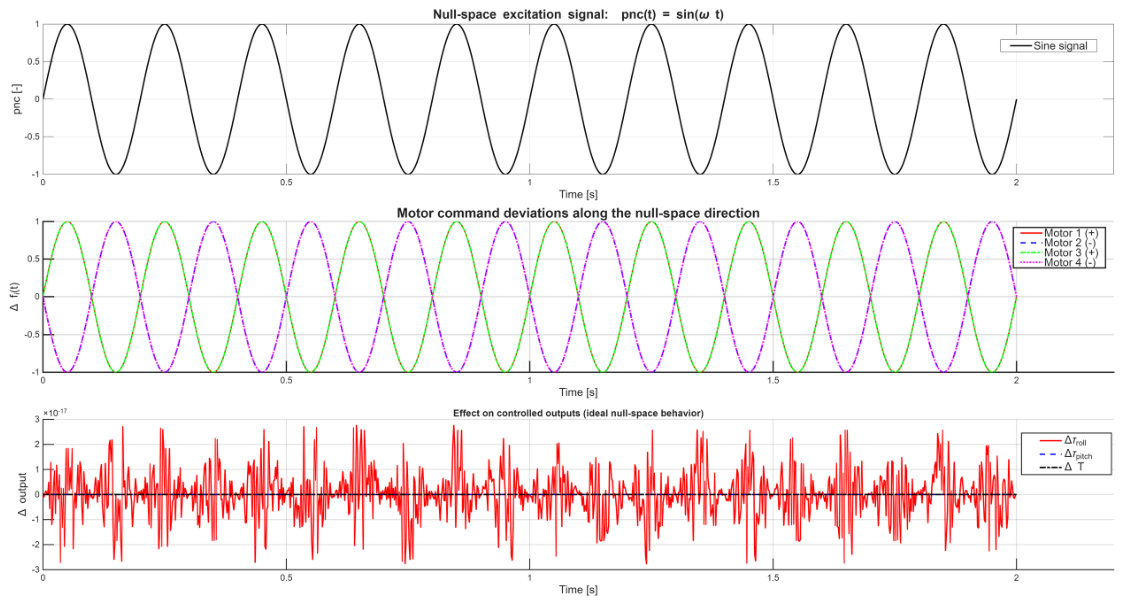
Figure 1 illustrates that the periodic excitation injected along the null space modulates the individual motor commands according to the sign pattern of the null-space vector, while the controlled outputs—namely the roll and pitch torques, as well as the total thrust—remain practically invariant under an ideal mixing model. Consequently, the excitation is capable of extracting diagnostic information without significantly affecting vehicle stability or hovering conditions.
When selecting the diagnostic excitation frequency, both the dynamic bandwidth of the closed-loop control system and the frequency-domain characteristics of the actuators and diagnostic processing must be considered. The appropriate choice of excitation frequency can be expressed as
where
denotes the dominant motion dynamics of the vehicle, while
represents the effective dynamic bandwidth of the actuators and motor-drive system.
Excitations with excessively low frequencies are difficult to separate from the slow dynamic variations associated with hover operation and environmental perturbations, whereas excessively high excitation frequencies may lead to significant amplitude attenuation and phase lag due to the dynamic limitations of the motors and ESC systems.
For the investigated quadcopter system, the dominant hover and position-control dynamics are located below a few Hz, while the motor and actuator dynamics are substantially faster. Accordingly, the selected excitation frequency of Hz provides an appropriate compromise:
it is sufficiently separated from the slow motion dynamics;
it is not completely suppressed by the closed-loop controller;
the actuators remain capable of accurately tracking the excitation with sufficient amplitude;
and it provides favorable conditions for Lock-In-based narrowband diagnostic detection.
In addition, the excitation period corresponding to 5 Hz ( s) enables averaging over multiple excitation periods within a relatively short time window, thereby improving the diagnostic signal-to-noise ratio during Lock-In processing.
It should be noted that, although the ideal linear model does not generate yaw torque, small yaw deviations are observed during null-space circulation in simulations. This effect can primarily be attributed to nonlinearities, discrete-time mixing, and aerodynamic or numerical asymmetries. Nevertheless, the lock-in processing framework is capable of extracting diagnostically relevant response components (current, rotational speed, and power) at the excitation frequency with a high signal-to-noise ratio.
The excitation defined in (
6) is hereafter referred to as
null-space circulation.
3.2. Lock-In Detection in Closed-Loop Control
Prior to applying lock-in detection, signal components significantly slower than the excitation frequency are removed from the measured signals. This is achieved using a moving-average filter with a large time constant, whose window length is selected as a multiple of the excitation period. The removed components primarily represent trends originating from the closed-loop control system, as well as slow aerodynamic and thermal effects.
To eliminate slow trends, a moving-average filter with a time window of
is applied, where
, typically corresponding to several tens of excitation periods.
Following this preprocessing step, only the high-frequency signal components relevant for diagnostic purposes are analyzed.
As a result of the sinusoidal diagnostic excitation, periodic components coherent with the excitation frequency appear in the measured signals. Under closed-loop control, the amplitude of these components is typically small, while incoherent noise components originating from feedback action and environmental disturbances may dominate the measured response. To reliably extract these coherent response components, lock-in detection is applied.
During lock-in detection, the measured signal
is multiplied by reference signals synchronized with the diagnostic excitation [
18,
19,
20]:
Assume that the measured signal contains a component coherent with the excitation:
where
denotes incoherent noise. Using trigonometric identities, demodulation with the sinusoidal reference signal yields:
while demodulation with the cosine reference signal yields:
In the above expressions, the first terms contain low-frequency (DC) components, while the second terms appear at twice the excitation frequency (); the noise terms remain incoherent after multiplication with the reference signals.
Following demodulation, a low-pass filtering step is applied to remove the components at twice the excitation frequency. In the present work, low-pass filtering is implemented in the time domain through integration:
If the integration interval
spans an integer number of excitation periods, the average value of the components at frequency
tends to zero, while incoherent noise is suppressed through averaging. Thus, to a good approximation:
The resulting
X and
Y components contain the amplitude and phase information of the coherent response signal. Taking into account the
scaling factor arising from sine–cosine demodulation, the response amplitude is given by:
while the phase is given by
The integration time window
corresponds to a low-pass filter whose effective cutoff frequency can be approximated as:
For effective lock-in detection, the integration time must span multiple excitation periods:
The parameter N determines the tradeoff between noise suppression and diagnostic responsiveness. In the present work, the excitation frequency was selected as Hz, corresponding to an excitation period of s. Consequently, the condition results in a minimum integration window of approximately s.
This value was selected as a practical compromise between estimation robustness and diagnostic latency under noisy closed-loop hover conditions. Preliminary investigations indicated that shorter integration windows produced significantly increased variance in the estimated lock-in amplitudes, whereas larger values of N provided only marginal improvement in robustness relative to the increased response delay.
Such an integration interval ensures that the average value of the double-frequency components converges to zero while incoherent noise is suppressed through statistical averaging. In closed-loop operation, this also enables separation of slow dynamics and low-frequency drift.
In the results presented below, the coherent response amplitude is used as the primary metric for rotor condition diagnostics.
3.3. Relative Sensitivities and Pairwise Diagnostic Score
As a result of lock-in processing, the amplitudes of the periodic response components in rotational speed, motor current, and electrical power are obtained for each rotor. From these quantities, relative sensitivities can be defined to highlight the effects of mechanical and electrical state variations:
where
,
, and
denote the lock-in amplitudes of motor current, electrical power consumption, and rotational speed, respectively.
To localize individual rotor faults, a pairwise-comparison approach is adopted instead of relying on absolute values alone. For a rotor pair
, the sensitivity ratios are defined as:
The diagnostic scores are expressed in logarithmic form:
This transformation yields symmetric deviations and enables a clear signed interpretation of increases and decreases. In particular, proportional changes of equal magnitude produce logarithmic scores with identical absolute values and opposite signs. For example, a twofold increase and a twofold decrease yield diagnostic scores of equal magnitude but opposite polarity.
Furthermore, the logarithmic representation converts multiplicative sensitivity variations into additive quantities:
which simplifies relative comparison between rotor responses and improves robustness against common-mode scaling effects.
An additional advantage of the logarithmic transformation is the compression of the dynamic range of the diagnostic indicators, reducing the influence of large absolute amplitude variations and improving statistical stability under noisy operating conditions.
The final diagnostic score is selected adaptively within each lock-in integration window. In a given window, the channel (current or power) that exhibits the larger absolute deviation is selected while preserving its sign:
This adaptive selection increases the sensitivity of the method to different fault types while reducing the likelihood of noise or non-informative channels dominating the diagnostic decision. The score is obtained as a time-dependent signal, whose statistical characteristics (primarily the median and standard deviation) serve as the basis for further evaluation.
3.4. Common-Mode Effects and Absolute Indicator
Pairwise comparison-based diagnostic scores are effective in detecting and localizing individual rotor faults. However, by definition, they are inherently insensitive to cases in which the parameters of all rotors change in the same direction and by a similar magnitude. Such common-mode phenomena may include simultaneous aerodynamic degradation affecting all propellers, global increases in friction, or variations in power-supply conditions.
This behavior should not be considered a limitation of the method; rather, it is a direct consequence and, at the same time, an advantage, as it prevents false positive alarms in the presence of purely common-mode disturbances. However, to achieve complete diagnostic coverage, an additional indicator that is sensitive to global changes in absolute response levels is required.
To address this, an absolute amplitude-based common-mode indicator is introduced. The indicator is based on the statistical aggregation of the amplitudes obtained from the lock-in processing. It is defined as the median of the lock-in amplitudes of the rotor speeds:
where
m denotes the rotor index.
In the ideal, noise-free case, the mean and the median would be equivalent; however, the investigated signals are obtained in a noisy environment. For this reason, the median provides a more stable diagnostic indicator, reducing the influence of transients and outliers.
The lock-in amplitude of the rotational speed is selected as the basis of the common-mode indicator, as it represents the most direct mechanical response variable. Rotational speed is affected only indirectly through control and electrical dynamics, whereas current and power signals directly reflect nonlinearities of the inverter, supply voltage, and current control.
Consequently, in the presence of global mechanical or aerodynamic degradation affecting all rotors, the rotational-speed lock-in amplitudes exhibit a coherent shift while remaining less sensitive to disturbances of purely electrical or control origin.
The common-mode indicator is an absolute quantity that can be interpreted as a deviation relative to a baseline condition. This indicator is sensitive to state variations affecting all rotors while remaining independent of the pairwise ratio-based scores.
The common-mode indicator is presented separately, thereby preserving the two-dimensional interpretability of the relative classification plane while also enabling clear detection of global degradations. The combined use of pairwise scores and the absolute indicator provides a comprehensive diagnostic picture: the former are suitable for fault localization, whereas the latter reliably indicate changes in the overall system condition.
However, the introduction of the common-mode indicator raises the question of how changes in environmental parameters can be distinguished from genuine mechanical degradations affecting all rotors. This issue is discussed in detail in the following subsection.
3.5. Separation of Environmental Effects and Global Rotor Degradation
The introduction of the common-mode indicator enables the detection of state variations affecting all rotors in the same manner. However, it is important to emphasize that, at a single time instant, changes in environmental parameters and mechanical degradation affecting all rotors equally cannot be unambiguously distinguished at the level of the measured signals. Both effects appear as coherent shifts in the absolute lock-in amplitudes, while the pairwise ratio-based scores remain close to zero.
This limitation does not arise from a deficiency of the method, but rather from the inherent physical symmetry of the system. Therefore, the distinction is not based on instantaneous decision-making, but on the temporal behavior of the common-mode indicator relative to a reference condition. In the case of environmental effects, the common-mode indicator typically exhibits slow, often reversible variations that correlate with other operational parameters, such as temperature or supply voltage. In contrast, global degradation affecting all rotors manifests as a persistent, often monotonic change that accumulates over longer time scales.
Thus, the diagnostic decision is based on the combined temporal interpretation of the pairwise scores and the common-mode indicator. While the pairwise scores serve to identify asymmetric, localized rotor faults, the common-mode indicator tracks global changes in system condition. The combination of these two perspectives enables clear separation of environmental effects, global degradations, and individual rotor faults without introducing false-positive detections.
3.6. Applicability and Limitations
The proposed diagnostic method is specifically designed for in-flight operation under closed-loop control and is primarily applicable in hover and position-hold flight modes. Under these conditions, the global motion state of the vehicle remains approximately constant, while rotor loads and dynamic behavior can be analyzed around a well-defined operating point.
During null-space-based diagnostic excitation, the control signals of the individual rotors are periodically modulated in such a way that the combined effect of the rotor commands ideally does not alter the net thrust or the controlled torques of the vehicle. As a result, the excitation can be applied under closed-loop operation without significantly perturbing the global motion state of the quadcopter.
A key element of the method’s robustness is the combination of frequency-selective lock-in detection and pairwise normalization. Lock-in detection extracts only those response components that are coherent with the diagnostic excitation, thereby effectively suppressing incoherent disturbances such as measurement noise, slow load variations caused by wind, or corrections from position and attitude controllers. Pairwise normalization further reduces the influence of common-mode effects, such as variations in battery voltage or global control actions.
However, the applicability of the method is subject to certain limitations. A fundamental requirement of the diagnostic excitation and lock-in processing is that the system dynamics remain approximately time-invariant within the analyzed time window. During aggressive maneuvers, rapid accelerations, or strongly time-varying flight tasks, non-coherent dynamics may enter the diagnostic frequency band, potentially distorting the lock-in output and reducing the reliability of the diagnostic indicators.
Another limitation may arise if the closed-loop control bandwidth or control logic modifies the rotor commands to such an extent that the diagnostic excitation is significantly attenuated. In such cases, the absolute values of the lock-in amplitudes may decrease; however, the pairwise ratios and diagnostic scores may remain interpretable, provided that the excitation is not completely suppressed.
It is important to emphasize that the proposed method is not intended for explicit estimation of rotor or motor parameters. The diagnostic score serves as a decision variable that quantifies relative deviations between rotors. Accordingly, the primary advantage of the method lies not in precise parameter identification, but in the reliable detection and isolation of small, incipient faults in an in-flight environment.
Overall, the method provides a practical balance between diagnostic sensitivity, robustness, and implementability, making it suitable for online monitoring of quadcopter rotor faults during typical hover and position-hold flight operations.
4. Simulation Setup
This section presents the simulation and measurement environment used to validate the diagnostic method described in the previous section. The objective is to establish a reproducible framework that closely approximates real flight conditions while enabling systematic investigation of different rotor faults, as well as noise and drift effects.
4.1. Overview of the Simulation Model
To validate the proposed diagnostic method, a detailed nonlinear quadcopter simulation environment is implemented using the MATLAB R2025b Simscape platform. The baseline model is the publicly available quadcopter reference implementation provided by MathWorks, which includes the rigid-body dynamics of the vehicle, the motor–propeller units, and the basic control architecture [
21].
The simulation environment used in this work is a modified version of this reference implementation. The modifications are not intended to alter the global dynamic behavior of the quadcopter, but rather to extend and parameterize those aspects of the propulsion system and control structure that are diagnostically relevant. Accordingly, the motor–propeller models are augmented with rotor-specific adjustable parameters, enabling the simulation of various loss mechanisms and aerodynamic degradations.
The electrical and mechanical dynamics of the motors are implemented in dedicated submodels that explicitly compute motor current, rotational speed, and electrical power. The aerodynamic effects of the propellers are described by thrust and torque characteristics, whose parameters can be modified individually for each rotor. This structure allows the sensitivity metrics and diagnostic scores defined in
Section 3 to be computed directly without requiring additional parameter estimation or model fitting.
The rigid-body dynamics of the quadcopter and the overall control architecture remain structurally identical to the reference implementation. This ensures that the diagnostic method is evaluated in a realistic in-flight environment and that the results are not artifacts of an artificially simplified model. The purpose of the simulation model is not to provide a detailed aerodynamic description, but to analyze the interaction between the propulsion system, control loops, and diagnostic excitation.
During the simulations, motor rotational speed (RPM), motor currents, and DC bus voltage () are recorded at a sampling frequency of . This sampling rate provides a sufficient margin relative to the excitation frequency of while remaining consistent with typical telemetry and data acquisition constraints of embedded flight controller systems.
Overall, the applied simulation environment represents a practical compromise between model complexity and reproducibility, thereby making it suitable for systematic investigation of the sensitivity, robustness, and fault discrimination capability of the proposed diagnostic method.
4.2. Control Architecture
In the simulation environment, the closed-loop control architecture of the quadcopter consists of multiple cascaded control loops. The inner control loops stabilize the angular rates and attitude of the vehicle, while the outer loops perform position holding. Although the controller execution frequency is in the range of several hundred hertz, the effective dynamic bandwidth of the closed-loop system is substantially lower.
The diagnostic excitation is injected at the control-allocation level along one direction of the null space, in accordance with the principles described in
Section 3. The existence of the null space is a fundamental prerequisite for modifying the rotor commands in a manner that does not alter the net thrust and torques of the vehicle.
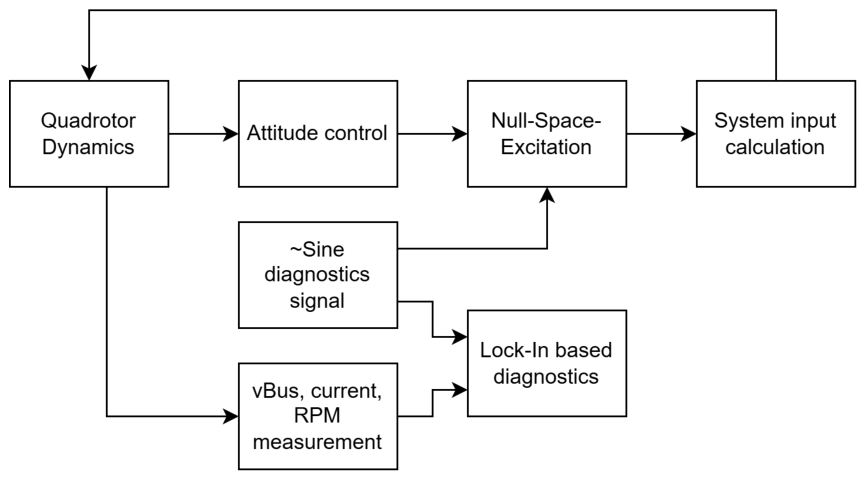
The high-level operating principle of the diagnostic system is illustrated in
Figure 2. The control chain is based on the quadrotor dynamic model and the attitude controller responsible for vehicle stabilization. The control signals generated by the controller are forwarded to the
Null-Space Excitation block, where the sinusoidal diagnostic excitation is applied. The excitation frequency and amplitude are selected such that a clearly detectable periodic component appears in the measurable rotor response signals, while the global motion state of the vehicle is only minimally affected.
The input-generation block produces the actuator commands corresponding to the individual rotors, which are executed by the quadrotor dynamic model. The measurable signals originating from rotor operation—including the supply voltage (), motor current, and rotational speed—are forwarded to a dedicated diagnostic processing unit. The diagnostic processing is performed using a lock-in-based method capable of extracting the amplitude and phase of the response components appearing at the excitation frequency with high sensitivity even under significant noise conditions.
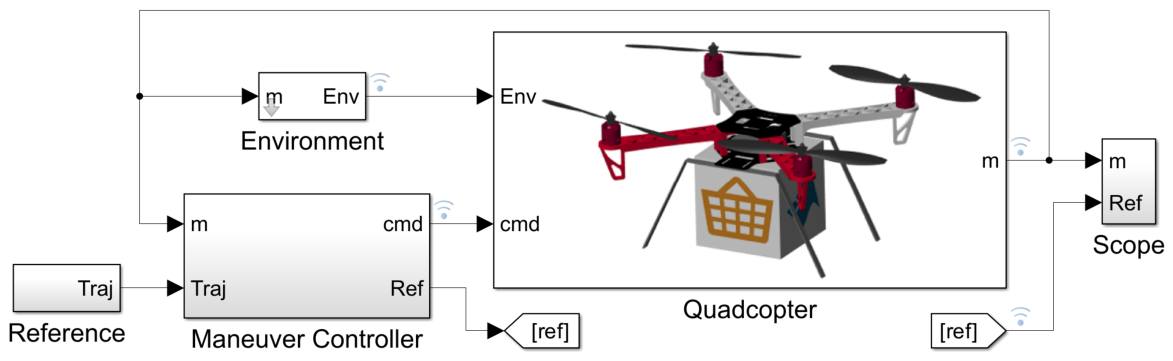
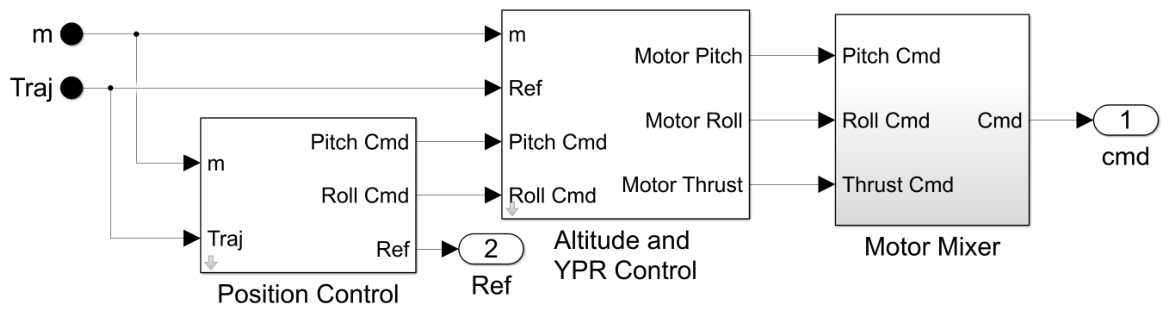
The Simulink-based system architecture of the simulation environment is presented in
Figure 3, which is based on the model described in [
21]. The main components of the model include the original trajectory generator, the nonlinear quadcopter dynamic model, and the modified maneuver controller.
The Position Control block remains identical to that of the original model and computes the required position and attitude reference signals based on the reference trajectory, while the Altitude and YPR Control block performs the altitude and attitude control tasks. The modification is introduced exclusively at the actuator-allocation level within the Motor Mixer block; therefore, the higher-level control loops remain unchanged.
During implementation of the diagnostic method, the original structure of the maneuver controller is modified. The conventional Motor Mixer block used in the original control architecture is replaced by a null-space circulation mixer, and the YAW controller is removed.
With active yaw control, the quadcopter control system becomes fully utilized, leaving no nontrivial null-space direction in which diagnostic excitation could be injected without affecting the global motion state of the vehicle. Consequently, disabling yaw control is not merely an implementation simplification, but rather a structural necessity for realizing the proposed null-space-based excitation method. Nevertheless, the absence of yaw control does not constitute a limitation under the investigated operating conditions, since yaw stabilization is not a strict requirement for maintaining dynamic equilibrium during hover and position-hold flight modes. Roll and pitch control, as well as the position-holding loops, remain active; therefore, the diagnostic method is evaluated entirely under closed-loop in-hover operating conditions. The structure of the modified controller is illustrated in
Figure 4.
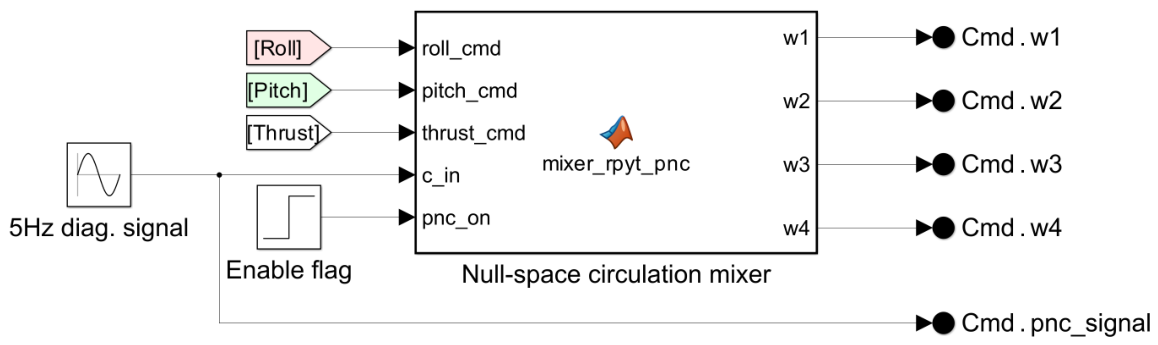
The Motor Mixer block contains the null-space circulation mixer shown in
Figure 5. The inputs of the block are the roll, pitch, and thrust commands, together with the diagnostic excitation signal and its enabling logic signal. In the present implementation, the diagnostic excitation is generated as a sinusoidal signal with a frequency of 5 Hz, which modulates the individual rotor commands along the previously defined null-space vector.
The mixer block adds the null-space component to the control commands and subsequently generates the modified motor commands corresponding to the individual rotors (). The block also provides a dedicated output for monitoring the diagnostic excitation signal, which is used during subsequent evaluation and validation.
4.3. Investigated Fault Types and Test Cases
To validate the proposed method, several well-separated fault types are defined. The objective is to cover the most common rotor degradation phenomena encountered in practice, as well as their combinations. The investigated cases can be grouped into the following main categories:
Aerodynamic degradation: reduction of the thrust coefficient of a given rotor propeller, representing, for example, blade damage.
Increased mechanical friction: increase in the viscous friction coefficient of a given motor, corresponding to bearing wear or other mechanical faults.
Combined faults: simultaneous presence of aerodynamic and mechanical degradation affecting the same rotor.
Multi-rotor cases: simultaneous faults affecting two or more rotors, including full-system degradation extending to all four rotors.
Uniform parameter variations affecting the entire rotor set play a particularly important role in the investigation, as these represent typical common-mode cases that are difficult to detect using methods based solely on relative comparison.
4.4. Fault Scenarios and Parameter Variations
To validate the diagnostic method, various controlled rotor faults were injected into the quadrotor simulation model. The investigated fault scenarios represent mechanical and aerodynamic degradation of the rotor–motor units.
Mechanical degradation was modeled as an increase in viscous friction, appearing as an additional torque acting on the motor shaft [
22,
23]. The friction torque was defined as proportional to the rotational speed:
where
denotes the rotor angular velocity and
is the viscous friction coefficient.
In the simulations, a value of was applied to the affected rotors. This value corresponds to a small, incipient level of bearing wear or lubrication degradation that does not cause significant performance loss by itself, but is suitable for evaluating the sensitivity of the diagnostic method.
Aerodynamic degradation was modeled by reducing the propeller thrust coefficient (). In the investigated cases, the thrust coefficient was reduced by and for individual and multiple rotors, respectively, thereby simulating blade surface damage or deterioration of aerodynamic efficiency.
4.5. Excitation and Measurement Setup
During the simulations, the sinusoidal excitation described in
Section 2 was applied. The excitation frequency was set to
, while the relative amplitude
was selected sufficiently small so as not to perceptibly affect vehicle stability. The excitation was injected into the rotor reference signals according to the predefined null-space direction.
For diagnostic processing, the following signals were recorded:
the excitation sinusoid;
rotor rotational speeds [RPM];
motor currents [A];
supply voltage () [V];
the electrical power [W] computed from these quantities.
All signals were sampled at a fixed frequency sufficiently high to ensure accurate reconstruction of the excitation frequency.
4.6. Noise and Drift Models
To evaluate the robustness of the proposed diagnostic method, additive noise and slow drift components were introduced into the simulated measurement signals. The objective was to represent realistic measurement uncertainty and environmental effects expected during hover operation.
Measurement noise was modeled as additive white noise, whose standard deviation was defined as a percentage of the standard deviation of the respective signal. In the investigations, a single medium (MED) noise level was applied, corresponding to a relative standard deviation of 2%.
The slow drift components represent low-frequency, time-correlated variations that may arise from temperature changes, battery voltage decay, or operating-point-dependent load variations. The drift was modeled as a low-frequency correlated random process generated by first-order low-pass filtering of white noise:
where
is unit-variance white noise,
,
is the drift cutoff frequency, and
denotes the sampling frequency.
In the investigations, the cutoff frequency was selected as , resulting in slow, quasi-stationary variations relative to the diagnostic time window.
The drift component was applied multiplicatively to the measured signals, thereby ensuring a common-mode shift affecting all rotors in the same manner:
where
is the original measurement signal,
is the drifted signal, and
is a scaling factor determining the relative amplitude of the drift.
The drift amplitude was selected to be approximately 2% of the nominal value for the supply voltage and in the range of 1–1.5% for rotational-speed and current measurements. This configuration ensures that common-mode effects are noticeable but not dominant in the measured signals, allowing joint robustness evaluation of the pairwise relative scores and the absolute common-mode indicator.
It is important to note that the presented noise and drift models are not intended to provide a detailed physical description of environmental effects; rather, they serve to evaluate the stability and interpretability of the diagnostic indicators in the presence of common-mode disturbances.
4.7. Monte Carlo Test
To evaluate the robustness and statistical separability of the diagnostic indicators, a Monte Carlo (MC) simulation framework is employed. The objective of the Monte Carlo analysis is to assess the sensitivity of the method to measurement noise and slow common-mode disturbances.
For each investigated fault scenario,
realizations are generated. Across the realizations, the physical parameters of the system remain unchanged, while the measurement noise and drift components are randomly varied according to the models defined in
Section 4.6.
In all cases, a medium (MED) noise level is applied, corresponding to a 2% relative noise standard deviation in the analyzed signals. The cutoff frequency of the slow common-mode drift is set to , resulting in quasi-stationary variations relative to the diagnostic time window. The drift amplitude is selected in the range of 1–2% for rotational-speed, current, and supply-voltage measurements.
For each Monte Carlo realization, the complete sliding-window-based lock-in processing is executed, followed by computation of the relative sensitivities and the pairwise diagnostic scores. From each realization, time-domain median values are calculated, which appear as single points in the classification planes and Monte Carlo clouds. Across all Monte Carlo realizations, statistical measures such as the mean, median, and standard deviation are determined. The obtained score shifts are compared with the corresponding dispersion levels in order to assess statistical separability between the investigated fault cases.
5. Results
This section presents the results obtained using the methodology described in
Section 2 and
Section 3. The focus is on demonstrating how sinusoidal excitation combined with lock-in processing enables reliable detection and localization of rotor faults in a noisy closed-loop control environment.
5.1. Test Cases and Evaluation Protocol
The proposed lock-in-based rotor diagnostic method is evaluated in 17 different simulation scenarios. The dataset includes a fault-free (baseline) condition, as well as fault cases individually injected into each motor (M1, M2, M3, and M4).
The investigated deviations include: (i) increased viscous friction (friction-only), (ii) a 5–10% reduction in the propeller thrust coefficient (-only), and (iii) a combination of both faults (friction+).
In each simulation run, the diagnostic algorithm is activated after from startup, once the quadcopter reaches a near-hover condition. In all cases, lock-in integration, feature extraction, and score computation are performed over the same time interval, thereby ensuring direct comparability of the results.
The diagnostic decision variables are mapped onto two rotor pairs: (1/4) and (2/3). The objective of the method is not only fault detection, but also pairwise localization of the affected rotor.
5.2. Behavior of the Complete Signal Processing Chain in the Baseline Case
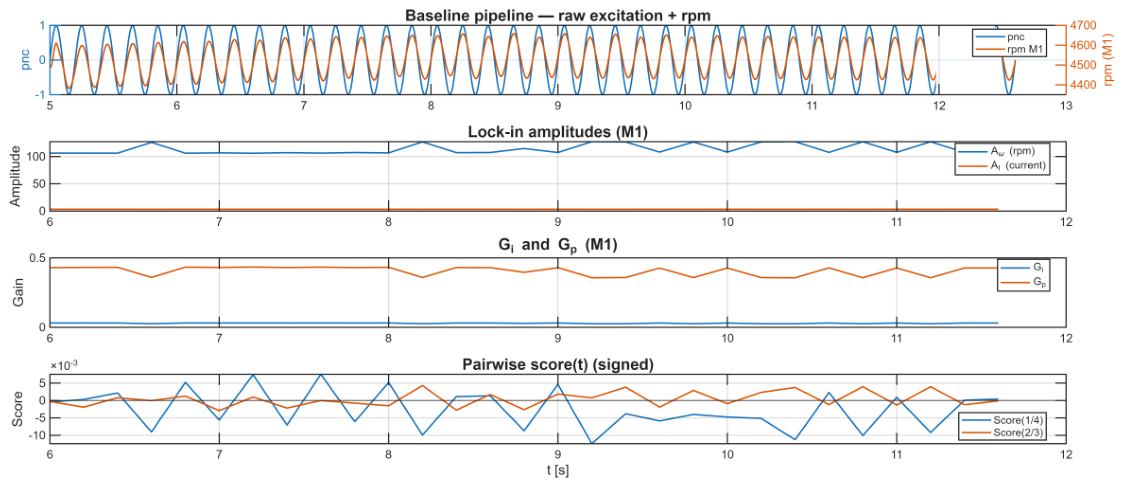
Figure 6 presents the complete diagnostic signal processing chain for the baseline case. Based on the raw signals, the effect of the sinusoidal excitation cannot be directly separated, as closed-loop control action and measurement noise mask the small-amplitude modulation.
The lock-in processing selectively extracts the response component at the excitation frequency, thereby providing stable amplitude and phase information. The temporal evolution of the pairwise diagnostic score remains concentrated around zero, confirming the symmetric behavior of the method under fault-free conditions.
5.3. Classification Plane: Geometric Interpretation
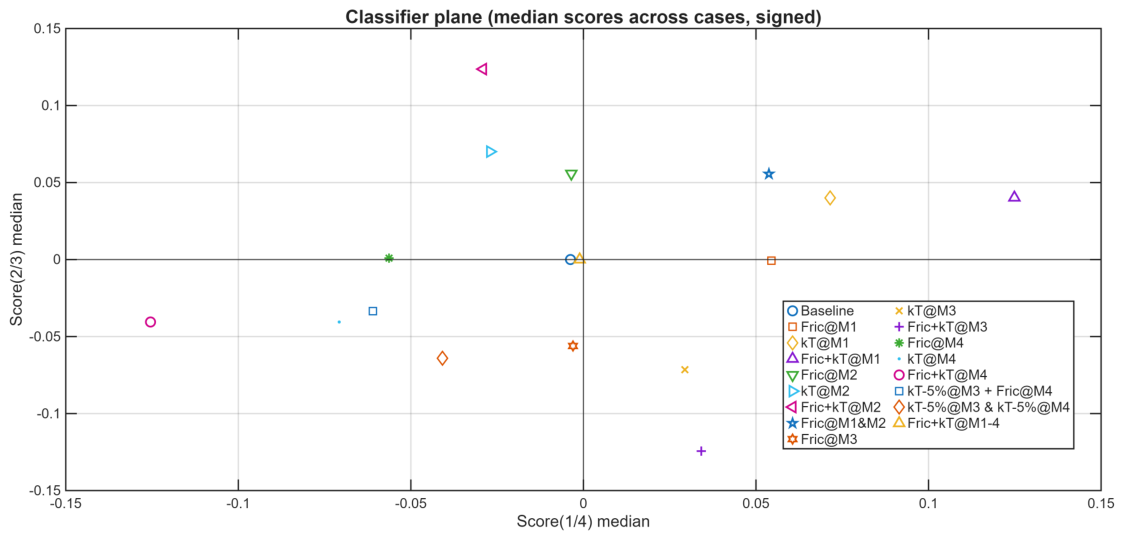
Figure 7 shows the classification plane, where the axes represent the pairwise scores corresponding to the two rotor pairs. Individual motor faults primarily cause displacement along the axis associated with the affected rotor pair, whereas faults involving multiple motors result in diagonal shifts.
Degradations affecting all motors uniformly remain close to the baseline region, reflecting the common-mode invariance of the pairwise scores. This observation motivates the introduction of a complementary indicator sensitive to such cases based on absolute amplitude levels.
5.4. Robustness in the Presence of Noise and Common-Mode Drift
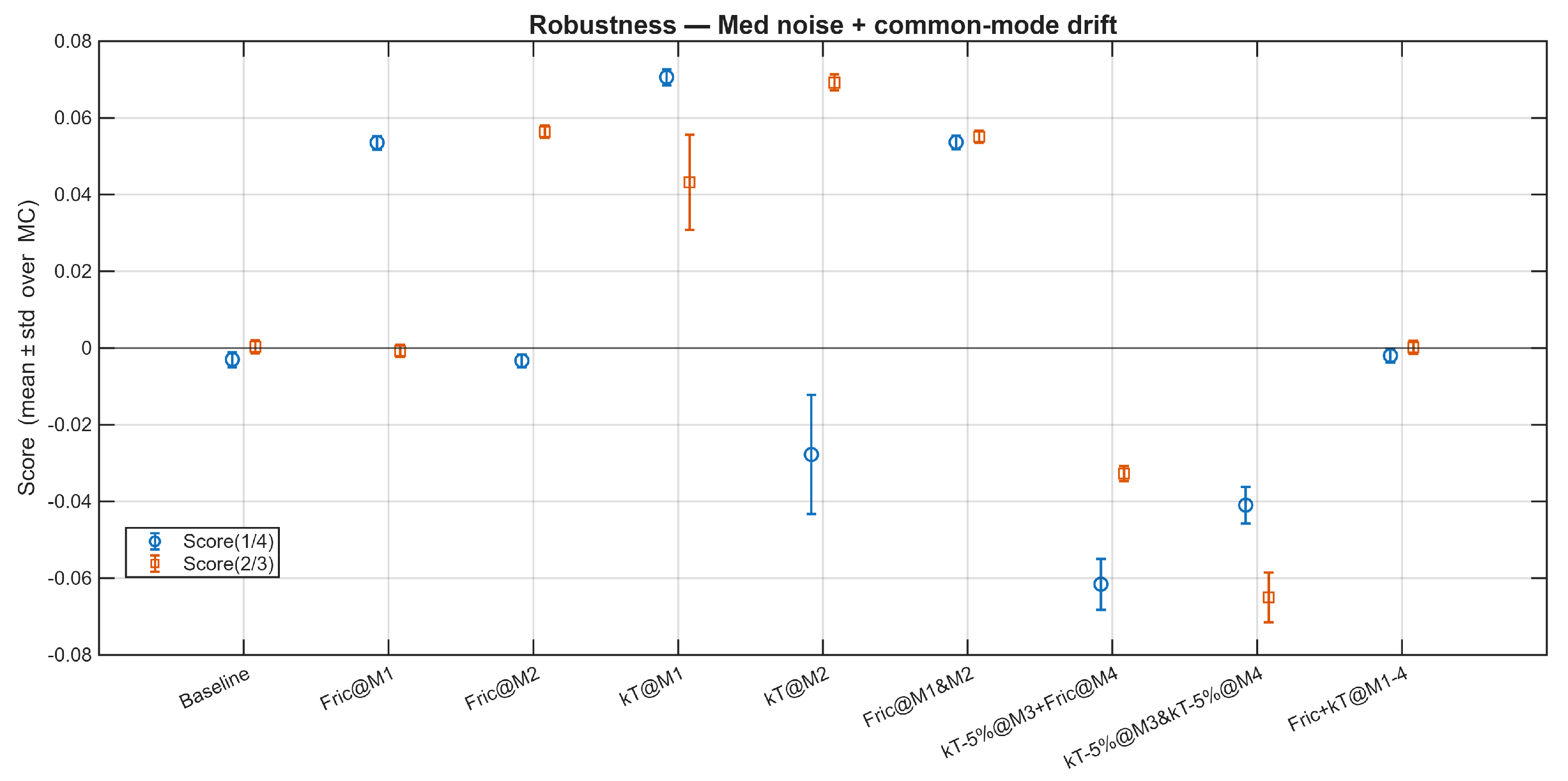
Figure 8 illustrates the robustness of the method based on Monte Carlo simulations. Although noise and drift increase the dispersion of the scores, the displacement of the fault-related score distributions remains significantly larger than the corresponding standard deviations in all investigated cases. This indicates that the different fault scenarios remain statistically separable under realistic disturbance conditions, which is a fundamental requirement for practical diagnostic applications.
5.5. Monte Carlo Score Clouds: Pairwise Interpretation
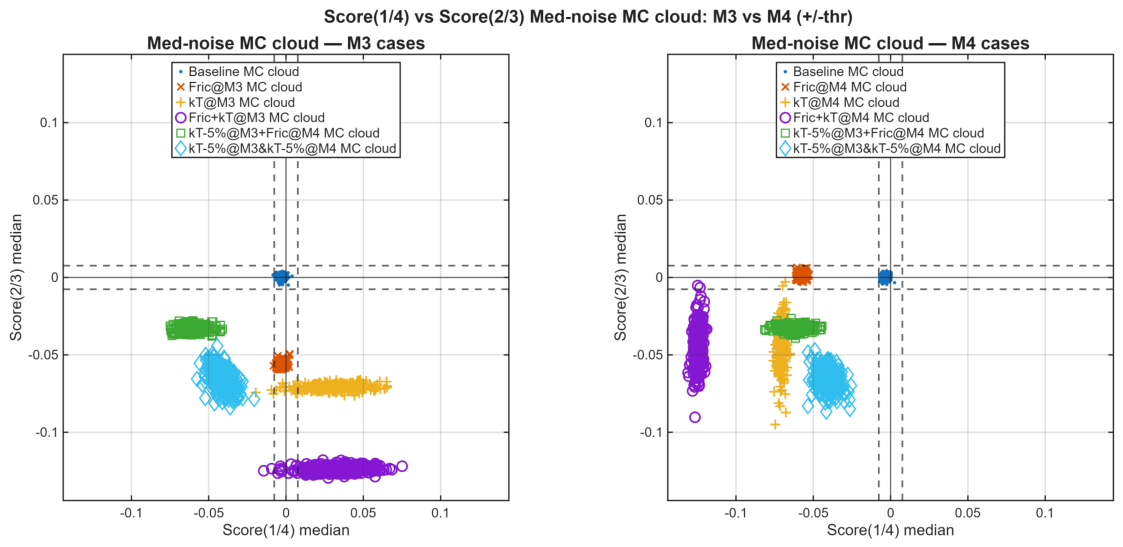
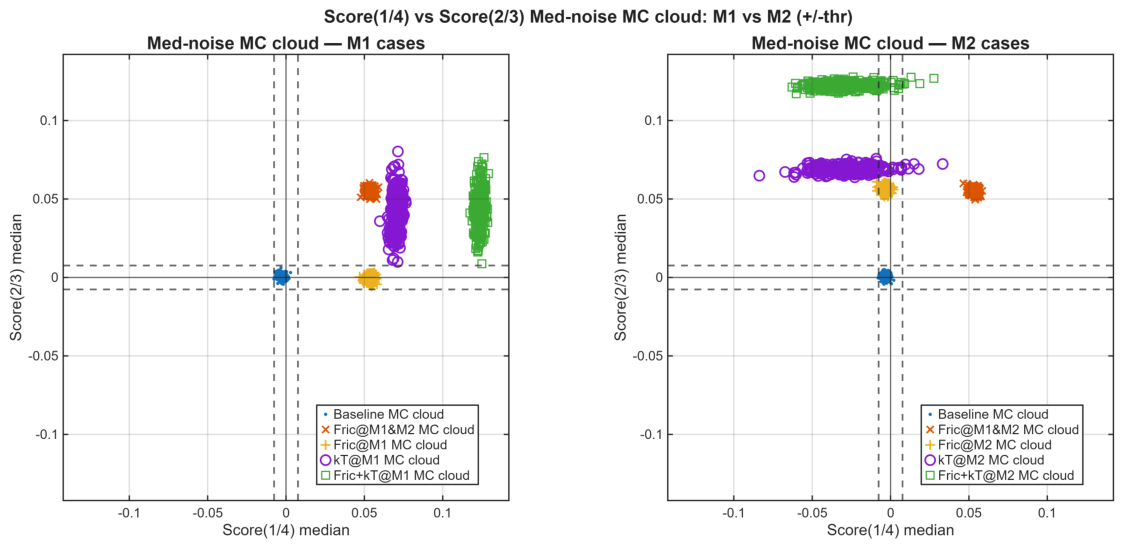
Figure 9 and
Figure 10 show the Monte Carlo-based statistical distributions of the pairwise scores for two different rotor pairs. Each point represents the median score value obtained from a single realization affected by noise and drift.
The geometric placement of the clouds carries direct diagnostic meaning. Individual rotor faults result primarily in displacements along the corresponding axis, whereas combined faults lead to diagonal shifts of the score clouds. For smaller parameter variations (5%), the displacement is more moderate; however, it remains statistically distinguishable from the baseline condition.
Partial overlap between the clouds does not indicate a deficiency of the method, but rather reflects a natural consequence of realistic noise modeling. The diagnostic decision is not based on a single realization, but on the overall statistical distribution.
5.6. Summary Comparison and Diagnostic Interpretation of the Pairwise Scores
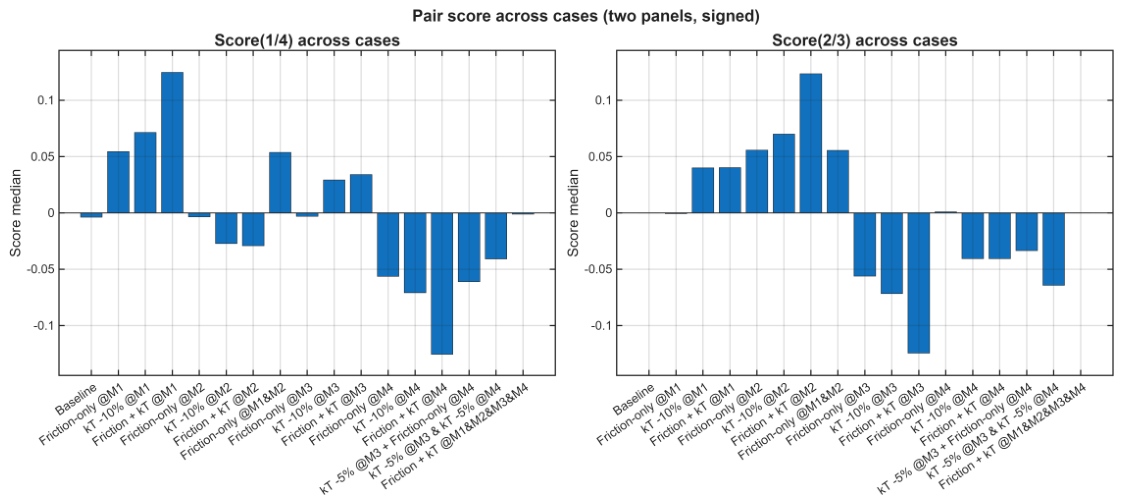
Figure 11 provides a comprehensive overview of the behavior of the pairwise-score-based diagnostic method across all investigated fault scenarios. The figure presents the median score values for the
and
rotor pairs in two separate panels, enabling direct comparison between the pairs.
In the baseline condition, as well as in symmetric and purely common-mode cases, the median score values remain close to zero in both panels. This result is crucial, as it confirms that the method does not produce false-positive deviations when the rotor states are pairwise identical or when all motors are affected uniformly.
In contrast, for individual rotor faults, only the score corresponding to the affected rotor pair exhibits a significant deviation from zero, while the score of the other pair remains nearly unchanged. This behavior enables direct diagnostic interpretation, as the sign and magnitude of the score clearly identify the affected rotor(s).
For asymmetric multi-rotor faults, both scores deviate from zero, albeit to different extents. This difference in amplitude is consistent with the diagonal displacements observed in the classification plane and in the Monte Carlo-based score clouds. The consistent behavior across different visualizations supports the internal coherence and reliability of the method.
It is important to emphasize that, by definition, the pairwise scores are ratio-based quantities. Consequently, they are invariant to effects that influence all motors in the same direction and with the same magnitude. If the dynamic parameters of all four rotors change simultaneously—due to general wear, temperature increase, or global aerodynamic conditions—the inter-rotor ratios remain essentially unchanged, and the pairwise scores do not deviate from the baseline condition.
This property should not be interpreted as a limitation, but rather as a fundamental advantage of the method, since it prevents purely common-mode disturbances from being falsely detected as faults. At the same time, it implies that the pairwise scores alone are not sufficient to identify scenarios in which all rotors degrade simultaneously.
To ensure complete diagnostic coverage, an additional indicator is therefore required that is sensitive to changes in absolute response levels and capable of detecting global common-mode state variations. This role is fulfilled by the common-mode indicator presented in the following subsection.
5.7. Complementary Role of the Common-Mode Indicator
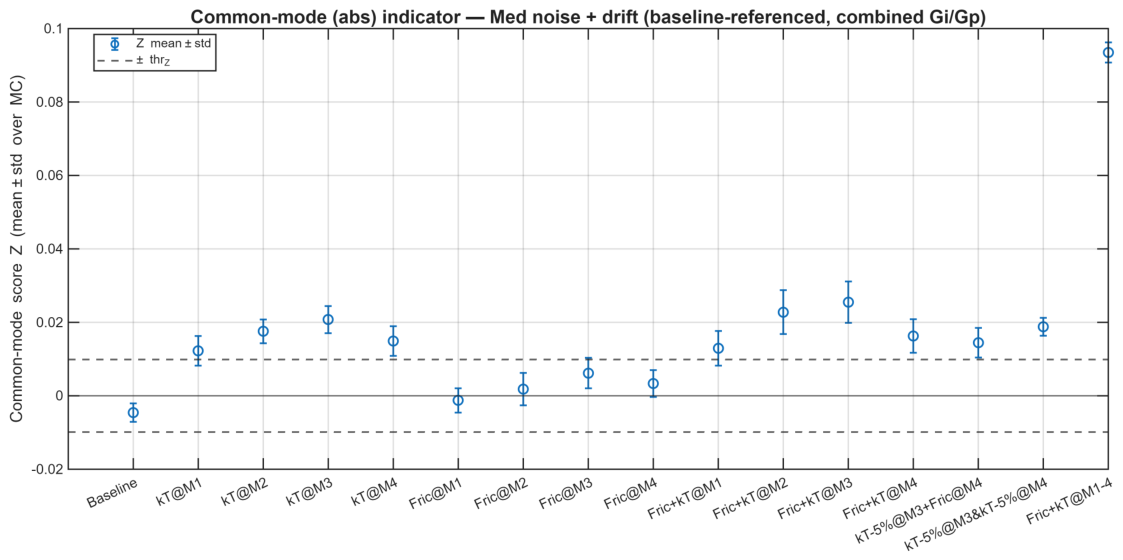
Figure 12 presents a complementary indicator that is sensitive to degradations affecting all motors uniformly, based on absolute lock-in amplitudes. The purpose of this indicator is not to replace the pairwise scores, but rather to complement them in cases where relative comparison alone is insufficient.
As shown in the figure, in the presence of individual rotor faults, the value of the common-mode indicator remains close to the baseline condition. This is consistent with the expectation that a globally aggregated response metric should not react significantly to localized deviations affecting only a single motor. In contrast, in scenarios where the parameters of all four rotors change simultaneously—for example, due to uniform friction increase or thrust coefficient reduction—the indicator exhibits a clear shift.
This behavior demonstrates that the common-mode indicator is suitable for detecting global degradation processes that are intentionally not captured by the pairwise scores. The differing sensitivities of the two indicators are not contradictory, but rather the result of a deliberate design choice aimed at ensuring robustness and diagnostic reliability.
The combined use of the pairwise scores and the common-mode indicator thus provides a comprehensive diagnostic picture: while the pairwise scores enable fault localization and discrimination, the common-mode indicator reliably indicates situations in which the overall system condition deteriorates. This complementary approach is particularly advantageous in real flight environments, where both localized rotor faults and global system effects may occur.
5.8. Summary
The presented results clearly demonstrate that sinusoidal excitation combined with lock-in processing is capable of reliably detecting and meaningfully localizing quadcopter rotor faults, even in a noisy closed-loop control environment. The stable behavior of the complete signal processing chain in the baseline case, together with the consistent responses observed for different fault types, indicates that the method is not sensitive to random disturbances or common-mode drift.
The analysis of the classification plane and the Monte Carlo-based score clouds reveals that individual and combined rotor faults produce well-separated patterns in the pairwise score space. The statistically observable shifts, even for small parameter variations, indicate that the method is suitable not only for detecting severe faults, but also for identifying early-stage degradation processes.
The ratio-based definition of the pairwise scores ensures invariance to common-mode effects, thereby preventing false-positive diagnostic decisions in the presence of global disturbances. At the same time, the results clearly demonstrate that this invariance necessarily implies that purely common-mode degradations cannot be detected using relative comparison alone.
This limitation is effectively addressed by introducing the common-mode indicator, which is sensitive to global state changes affecting all rotors based on absolute lock-in amplitudes. The combined application of the pairwise scores and the common-mode indicator thus provides complete diagnostic coverage, enabling detection of both localized rotor faults and global degradation processes.
Overall, the results presented in
Section 4 support the conclusion that the proposed method provides a robust, interpretable, and practically applicable diagnostic tool for condition monitoring of multirotor unmanned aerial vehicles.
6. Discussion
In this section, the diagnostic implications and practical consequences of the presented simulation results are discussed.
6.1. Separation of the Roles of Relative and Absolute Indicators
Based on
Figure 7,
Figure 8,
Figure 9 and
Figure 10, it is clearly visible that the pairwise scores are primarily sensitive to
relative deviations between rotors. This property enables reliable localization of individual and asymmetric faults while naturally suppressing effects that influence all rotors in the same manner.
This invariance is not an incidental side effect, but rather a direct consequence of the ratio-based definition of the diagnostic scores.
Figure 11 illustrates that in purely common-mode cases—including degradations affecting all rotors equally—the pairwise scores remain close to the baseline condition. This behavior prevents false-positive detections, which is particularly important in real flight environments where environmental parameters may vary over time.
At the same time, the detection of global state variations requires a separate mechanism. This role is fulfilled by the absolute common-mode indicator shown in
Figure 12, which is based on robust aggregation of the lock-in amplitudes. In this sense, the relative scores and the absolute indicator are functionally separated: the former serve for
fault localization, while the latter track the
global system condition.
6.2. Robustness Against Noise and Common-Mode Disturbances
The Monte Carlo results shown in
Figure 8,
Figure 9 and
Figure 10 demonstrate that the method maintains a stable classification geometry even in the presence of medium-level noise and slow common-mode drift. The compact clustering of the score clouds and the separation between different fault cases indicate that the diagnostic scores remain statistically distinguishable, as the median score shifts consistently exceed the corresponding Monte Carlo standard deviations.
A particularly important observation is that noise primarily increases the dispersion of the scores, while the median values preserve their diagnostic meaning. This justifies the use of median-based aggregation both over time windows and across rotors and is consistent with the robustness requirements of practical diagnostic systems.
6.3. Generalization to Multirotor Configurations
The proposed diagnostic approach is not limited to quadcopter configurations. The method is fundamentally based on exploiting the null space of the control-allocation matrix, which is generally present in multirotor systems where the number of rotors exceeds the number of controlled outputs.
In hexacopter and octocopter configurations, the system is overactuated; thus, even with simultaneous control of roll, pitch, yaw, and total thrust, at least one nontrivial null-space dimension remains available. Consequently, sinusoidal diagnostic excitation can be implemented without disabling yaw control while preserving vehicle stability and controllability.
This property makes the proposed method particularly suitable for rotor diagnostics on multirotor platforms with higher levels of redundancy.
6.4. Distinguishing Common-Mode Degradation from Environmental Effects
A key property of the common-mode indicator is its sensitivity to global shifts affecting all rotors. However, by itself, it does not distinguish between environmental parameter variations and genuine mechanical or aerodynamic degradation.
In the proposed approach, this issue is addressed not through a single indicator, but through the combined interpretation of relative and absolute quantities. If the common-mode indicator exhibits a shift—whether reversible or persistent—while the pairwise scores remain close to the baseline region, this suggests a global system-level change. Conversely, if the common-mode indicator remains stable while the pairwise scores show significant deviations, a localized rotor fault is likely.
This dual interpretative framework ensures that the diagnostic system remains informative in realistic operational environments affected by environmental disturbances, without requiring overly complex decision logic.
6.5. Computational Efficiency and Implementation Aspects
The proposed method has the additional practical advantage that it does not require any extra hardware beyond standard onboard sensors and ESC telemetry. Furthermore, the computational complexity of the lock-in-based processing is low, as it relies on simple time-domain operations such as multiplication and averaging.
Compared to data-driven approaches, particularly those based on machine learning or deep neural networks, the proposed method has significantly lower computational requirements and does not require training data. This makes it especially suitable for real-time onboard implementation on resource-constrained embedded flight controllers.
7. Conclusions
In this paper, a diagnostic method based on sinusoidal null-space excitation and lock-in processing is presented for in-hover detection and localization of rotor faults in multirotor vehicles. A fundamental advantage of the proposed approach is that diagnostic information is extracted from periodic response components which, according to the ideal model, do not affect the controlled outputs. As a result, the method can be applied with minimal distortion of the flight dynamics.
The central element of the method is a pairwise signed logarithmic score derived from the ratios of relative sensitivities computed from the lock-in amplitudes. The results demonstrate that these scores enable robust and unambiguous localization of individual rotor faults, even in noisy environments affected by common-mode disturbances. The geometric interpretability of the scores facilitates intuitive classification and direct physical interpretation of diagnostic decisions.
An important observation is that, by definition, the pairwise scores are invariant to effects that influence all rotors uniformly. This property prevents false-positive alarms in the presence of purely common-mode disturbances; however, it also implies that global degradations cannot be detected solely on the basis of relative scores. To address this limitation, an absolute amplitude-based common-mode indicator is introduced, based on robust aggregation of the rotational-speed lock-in amplitudes.
The combined use of the relative scores and the common-mode indicator provides complete diagnostic coverage: the former enable fault localization, while the latter track global changes in the overall system condition.
In addition, the low computational complexity and the lack of additional hardware requirements make the method particularly suitable for real-time onboard implementation.
7.1. Limitations of the Method
The presented approach relies on several assumptions that define the boundaries of its applicability. The ideal operation of the null-space excitation assumes a linear mixing model in which roll, pitch, and total thrust can be perfectly decoupled along the null-space direction. In real systems, however, nonlinearities, aerodynamic asymmetries, and discrete-time control effects may introduce small couplings, which can lead, for example, to minor yaw deviations during excitation.
The performance of the method also depends on the selected excitation frequency and amplitude. An excessively low excitation frequency may reduce the effectiveness of the lock-in separation, while an excessively large amplitude may interfere with the controlled dynamics. In the present work, fixed excitation parameters are selected empirically; although they perform well in the investigated cases, they may not be optimal for all platforms and operating conditions.
Another limitation is that the presented results are obtained in a simulation environment, where noise and common-mode effects can be introduced in a controlled statistical manner. Although the Monte Carlo analysis provides important insight into the robustness of the method, real flight environments may contain more complex and time-varying disturbances.
7.2. Future Work
Future work will focus on experimental validation of the proposed diagnostic method on real multirotor UAV platforms under realistic flight conditions. This includes integration of the excitation and signal-processing framework into embedded flight-control hardware, as well as evaluation of computational requirements and real-time feasibility.
Another important research direction is the adaptive selection of excitation parameters. The optimal excitation frequency and amplitude may depend on the operating conditions, vehicle configuration, and noise characteristics. Therefore, the development of adaptive or self-tuning excitation strategies could further improve diagnostic sensitivity and robustness.
In addition, extending the method to more complex multirotor configurations, such as hexacopters and octocopters, represents a promising direction. In these systems, higher-dimensional null spaces are available, which may enable multi-frequency or multi-directional excitation schemes and richer diagnostic information.
Further research will also address integration of the proposed diagnostic indicators into higher-level decision-making and fault-tolerant control (FTC) frameworks. This includes the use of diagnostic outputs for automated reconfiguration, performance-degradation mitigation, and predictive maintenance.
Finally, future studies will investigate the separation of environmental effects and global degradation in greater detail, potentially by incorporating auxiliary measurements (e.g., temperature and battery state) or data-driven techniques to enhance the interpretability of the common-mode indicator under real-world conditions.