1. Introduction
Unmanned aerial vehicles (UAVs) have established themselves as indispensable assets within the evolving architecture of next-generation wireless networks and intelligent logistics systems. In the context of Sixth Generation (6G) and Beyond 5G (B5G) networks, the deployment of UAV swarms as mobile base stations, communication relays, and aerial couriers offers unprecedented flexibility, rapid deployment capabilities, and the capacity to operate in environments where traditional terrestrial infrastructure is heavily degraded, economically unviable, or entirely non-existent. The inherent agility of multi-rotor UAV platforms allows them to establish high-probability line-of-sight (LoS) links with ground-level package recipients, theoretically yielding significant enhancements in spectral efficiency, coverage probability, and overall system throughput.
Currently, numerous studies are dedicated to researching trajectory optimization for UAV in various scenarios and their corresponding communication systems. A method to jointly optimize the flight trajectory and transmission power of UAVs to minimize the decreasing trend of effective coverage is proposed in [
1]. A hierarchical reinforcement learning-based trajectory planning algorithm for UAV formation is proposed to plan the trajectories of UAV formation in complex and unknown environments in [
2]. An optimal deployment scheme for UAVs as relay stations is studied in [
3,
4]. Moreover, the strategic deployment of multiple UAVs combined with advanced user pairing techniques is proven to significantly enhance overall network capacity and efficiency in complex scenarios [
5]. To maximize the flexibility of UAV and plan its trajectory, a considerable number of studies have focused on the Traveling Salesman Problem (TSP) and its variants [
6]. However, high computational complexity and enormous scale remain persistent limitations of traditional TSP formulations. To address this challenge, many studies apply swarm intelligence (SI) to optimize UAV trajectory [
7,
8]. Recent advancements focus on adapting to dynamic physical environments; for instance, online trajectory optimization based on outage probability knowledge maps is proposed to maintain connectivity and minimize energy consumption [
9]. An evolutionary algorithm is proposed to build an innovative multi-UAV system in [
10]. The application of various SI algorithms for complicated tasks by UAV swarms is discussed in [
11,
12].
Furthermore, recent literature has proposed several advanced variants of Genetic Algorithms (GAs) to address complex multi-objective optimization challenges across diverse domains. These notable advancements include collaborative multi-objective approaches designed for efficient task offloading in Mobile edge computing (MEC)-assisted vehicular networks [
13], hybrid algorithms combining particle swarm optimization and GAs with niching technology for edge server placement [
14], and length-adaptive non-dominated sorting GAs developed for high-dimensional feature selection [
15]. While these studies provide significant improvements to the internal structures of GAs, our work further investigates the integration of the algorithm with real-time 3D physical-layer data from digital twin (DT) to address highly dynamic urban environments.
As the UAV industry continues to evolve, researchers note that idealized environmental assumptions often fail to account for the dynamic factors present in real-world applications. Consequently, various studies incorporate digital twin technology into research on UAV relay systems [
16,
17]. A novel architecture named Heterogeneous UAV Digital Twin Network (HU-DTN) is proposed in [
18]. A digital twin assisted path-planning framework for a UAV swarm with two phases: global path planning and real time trajectory planning is proposed in [
19]. Furthermore, DT technology is increasingly integrated with advanced learning algorithms to jointly optimize UAV trajectories, task offloading, and caching in intelligent transportation systems [
20]. DT technology also proves highly effective in ensuring communication continuity and managing dynamic mobility; for instance, a novel DT-assisted handover authentication scheme is proposed to drastically reduce signaling overhead and connection interruptions in 5G and beyond networks [
21]. Some studies achieve interactive software bridging between two open-source digital twin platforms such that the same scene is evaluated with high fidelity across NVIDIA’s Sionna and Aerial Omniverse Digital Twin [
22]. In addition to these, a digital twin (DT)-based framework for autonomous drone navigation in Global Positioning System(GPS)-denied indoor environments is presented in [
23].
Despite these profound theoretical advantages, the practical deployment of UAV swarms in dense urban operations is severely bottlenecked by legacy trajectory planning paradigms that rely on idealized environmental assumptions. Traditional frameworks universally formulate the UAV routing challenge as a variant of the TSP or Vehicle Routing Problem (VRP), utilizing static optimization methodologies to compute a fixed trajectory prior to deployment. These legacy models operate on two flawed assumptions: perfect a priori knowledge of the package recipients’ coordinates and isotropic, unobstructed electromagnetic signal propagation. In realistic urban environments, these assumptions systematically fail. First, GPS signals are subject to severe multi-path fading, shadowing, and interference within urban canyons, resulting in significant positional uncertainty for ground-level package recipients. When an aerial courier executes a statically optimized trajectory based on erroneous coordinate data, it expends critical battery reserves and mission time executing localized search patterns upon arrival, fundamentally degrading the efficiency of the logistics delivery network. Second, the physical topology of modern metropolitan centers—characterized by dense clusters of high-rise structures—introduces severe building blockages. A communication link intersecting a concrete and steel structure experiences an abrupt channel state transition from an LoS state to a non-line-of-sight (NLoS) state, incurring excess attenuation penalties that drop the signal-to-noise ratio (SNR) below operational thresholds, thereby inducing communication outages and violating quality-of-service mandates.
To bridge the gap between design-time planning and runtime physical execution, this research proposes a comprehensive optimization framework driven by a high-fidelity DT architecture and an explicit 3D stochastic Boolean blockage model. The digital twin serves as the cognitive computational core of the swarm, maintaining a dual-layer representation of positional information that explicitly models the uncertainty gap between the true location of the package recipient and sensor measurements. By continuously feeding updated spatial probabilities into a hybrid Genetic Algorithm (GA), the digital twin enables real-time, continuous trajectory re-optimization. Furthermore, this framework mathematically models the physical urban environment, incorporating an exhaustive 3D building blockage topology. The simulation environment explicitly enforces a severe attenuation penalty for NLoS propagation caused by high-rise intersections, counterbalanced by a minimal 1 dB penalty for LoS links. To achieve precision in logistics delivery, the architecture integrates a strictly defined visual localization boundary, requiring complex quadratic geometric intersection algorithms to trigger a navigation state transition from stochastic uncertainty estimation to deterministic visual tracking.
The ultimate objective is the joint minimization of cumulative outage probability and total flight time, subject to a rigid minimum throughput requirement, ensuring highly reliable communication relaying and efficient physical parcel delivery in profoundly constrained urban airspaces. Based on the above considerations, the principal contributions are summarized as follows:
At the architectural level, we propose a digital twin system that models recipient positional uncertainty using a dual-layer spatial representation. Initially, UAV navigation relies exclusively on an uncertainty layer, which tracks stochastic positions within a decaying error circle. Parallel to this is the ground truth layer, defining the exact physical destination and its visual localization boundary. Crucially, the true coordinates remain strictly unobservable to the system until the UAV physically breaches the visual boundary. This design accurately captures the realistic transition from GPS-degraded stochastic searching to deterministic visual tracking.
At the operational level, we implement a continuous trajectory re-optimization strategy facilitated by the digital twin framework. Rather than relying on a static, pre-computed flight path, the aerial courier’s route is continuously re-optimized every few seconds during the active delivery mission. As the digital twin updates detected target positions, a Genetic Algorithm constantly adapts the trajectory, uncovering more efficient flight corridors and actively mitigating NLoS building blockages.
At the decomposition level, we integrate Density-Based Spatial Clustering of Applications with Noise (DBSCAN) to resolve the combinatorial complexities of large-scale drone logistics. This approach geographically partitions the scattered package recipients into highly cohesive delivery zones, strategically determining the optimal location for one central logistics transfer station and assigning exactly one dedicated UAV courier per cluster, ensuring real-time computational viability.
At the algorithmic level, we design a multi-objective adaptive weighting mechanism for the hybrid Genetic Algorithm. The system autonomously extracts regional characteristics—specifically recipient scale and spatial density—to generate cluster-specific weights. This dynamically balances the dual mandates of minimizing cumulative communication outage probability and reducing total physical delivery time, while strictly enforcing a minimum throughput constraint.
The remainder of this paper is organized as follows.
Section 2 establishes the system model, including the DT framework, positional uncertainty, and 3D blockage.
Section 3 details station deployment and trajectory optimization using the adaptive GA.
Section 4 presents numerical results and discussions, followed by conclusions and future work in
Section 5.
2. System Model
2.1. Digital Twin Framework and Position Uncertainty Modeling
We consider a UAV swarm-aided logistics and communication system. The system comprises K UAVs (numbered from 1 to K) serving P user nodes, with each UAV playing dual roles as both a delivery agent and a communication relay. In this scenario, the UAV must carry the package from the transfer station, traverse all user nodes, and ultimately return to the transfer station. Rather than assuming perfect knowledge of user locations and isotropic free-space channels, we incorporate the inherent location errors of positioning systems and the severe physical obstacles present in urban environments.
To accurately reflect a modern metropolitan core, the simulation bounds define a constrained urban grid. Within this boundary, the environment generates exactly
distinct 3D high-rise building structures. The maximum structural heights for the
m-th building, denoted as
(
), are distributed uniformly within a range spanning from 50 m to 200 m. These buildings are represented as solid rectangular prisms and act as definitive electromagnetic obstacles. We denote the set of user nodes as
. For each user node
, rather than treating its position as a fixed, precisely known coordinate, we model it through a dual-layer digital twin framework that captures positioning uncertainty [
24].
Each user node
p has a true position at coordinates
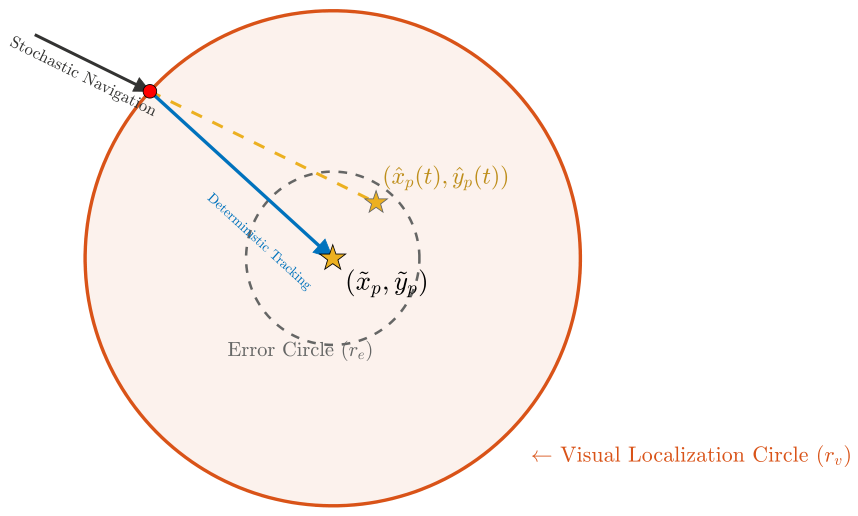
, representing the actual physical location of the package recipient on the ground. This serves as the center of both the error circle and the visual localization circle. Around each true position, we define an error circle with radius
. This represents the GPS-degraded positioning uncertainty range. When we “detect” a user’s position, we observe a coordinate somewhere within this error circle. Mathematically, the detected position
at any detection instant satisfies:
Furthermore, we define a strict visual localization circle, centered at the true position
. This represents the operational boundary within which the UAV’s onboard optical sensors can pinpoint the exact user location. Once a UAV breaches this visual circle, it purges the uncertainty error and engages deterministic visual tracking to navigate directly to
. Before entering this circle, the UAV operates strictly based on the fluctuating detected positions, as illustrated in
Figure 1.
The visual boundary is determined by UAV’s altitude and the camera’s effective field of view (FOV) required for reliable target detection (e.g., m at m). To handle visual detection failures caused by poor lighting or physical obstacles, the system uses the minimum error as a fail-safe boundary. If the camera fails to detect the target, the UAV switches to DT-guided navigation to safely reach the zone. This ensures mission success with a minimal increase in flight time.
To facilitate real-time monitoring and decision-making, we maintain digital twin representations. For user node
p, the digital twin state at time
t is given by:
where
is a boolean flag indicating whether the package has been delivered.
For the analysis of the UAV, we divide the flight process into
N time slots. The horizontal coordinate of the
k-th UAV at the
n-th time slot is
for
. UAV operates at a predefined, constant cruising altitude
H, making the path optimization essentially a 2D routing problem under 3D blockage geometry. To prevent physical collisions, we introduce a strict vertical safety margin
, ensuring
. The UAV’s digital twin modeling is represented as:
where
V is the cruising velocity,
represents the total flight time from departure to return, and
records the time elapsed since the last trajectory optimization.
Considering realistic update frequencies and processing delays, we incorporate a Zero-Order Hold (ZOH) fallback mechanism [
25] to handle NLoS-induced packet loss. During data dropouts, the positional uncertainty decay
temporarily pauses, and conservatively navigates using the last successfully received state.
2.2. UAV Flight and Time Constraints
To focus on the complex coupling of 3D environmental blockages, positional uncertainty, and communication reliability, this study abstracts specific physical logistics constraints such as varying parcel weights and volumes. We assume that UAV possesses sufficient payload capacity for a single cluster deployment. Furthermore, UAV energy and power limitations are implicitly enforced through the strict maximum flight time constraint.
UAVs operate at a constant altitude
H with an average velocity
V. The continuous re-optimization strategy implies that the trajectory of UAV is not predetermined; rather, it emerges from a sequence of optimization decisions made every
seconds. For each cluster
, a dedicated UAV must complete its delivery and data collection mission within a maximum allowed flight time
. The UAV’s flight distance between consecutive optimization instances is:
where
accounts for early arrival at the visual localization circle. The cumulative flight distance for the entire mission is:
Importantly, the continuous re-optimization approach provides natural robustness to time constraints: at each optimization step, the remaining time budget (−) is explicitly considered when evaluating trajectory fitness, ensuring UAV does not commit to paths it cannot complete. This operational mechanism embeds temporal safety directly into the fitness landscape of the algorithm.
2.3. Two-Jump Communication Model and Throughput Analysis
Communication processes within each cluster involve two jumps: the first jump transmits signals from user nodes to the regional UAV, and the second jump transmits signals from the UAV to the transfer station. We stipulate that only one logistics transfer station is planned per clustered region. Let the location of the transfer station within the jth cluster be denoted as , where . Thus, we define the set of transfer stations as .
A critical addition to this model is the strict enforcement of the 3D stochastic Boolean building blockage. When the 3D spatial vector connecting the transmitter and receiver intersects the physical volume of any of the 20 building prisms, the channel transitions from a LoS state to a NLoS state [
26,
27,
28].
To rigorously model the channel, we consider both the large-scale distance-dependent path loss (subject to 3D blockage) and the small-scale Rayleigh fading. The complex channel coefficient for the first jump is modeled as
, where
is the small-scale fading coefficient. This study employs the Rayleigh fading model instead of Rician fading to represent the worst-case scenario of severe signal scattering during building blockages. Optimizing the system under this strict condition guarantees equal or better reliability in actual urban environments. According to [
29], the SNR for the first jump is expressed as:
Here,
represents the transmission power from user node
, and we define
.
The term
denotes the deterministic large-scale attenuation coefficient between the detected user node position
and the UAV at time slot
n, expressed as:
Crucially, the reference channel gain
dynamically shifts based on the 3D blockage intersection testing. Under pure LoS conditions, the channel incurs a negligible excess attenuation penalty. However, if the link is NLoS (obstructed by a building),
is scaled down by a severe excess loss penalty, fundamentally degrading the SNR.
dynamically shifts based on 3D building intersections. The excess penetration loss parameters are set based on the 3GPP TR 38.901 Urban Micro standard, setting a small loss for LoS paths and a severe 35 dB penetration penalty for NLoS blockages.
Similarly, the channel coefficient for the second jump is
, with
. The corresponding SNR is:
where
, and the attenuation coefficient is:
In this logistics scenario, UAVs must parse and process data packets to acquire necessary scheduling information; thus, the Decode-and-Forward (DF) protocol is adopted. Under the half-duplex DF protocol, the equivalent end-to-end SNR is bottlenecked by the weaker link [
30]:
According to [
31], the throughput in the
timeslot within the
cluster region can be expressed as:
Therefore, the total throughput within this area can be calculated as:
where the summation extends over all time slots during which the UAV serves user node
p.
2.4. Outage Probability Analysis
To achieve stable and reliable communication within the heavily obstructed urban logistics system, the system’s outage probability must be rigorously analyzed and minimized.
An outage is defined as the event where the end-to-end falls below a predefined threshold . In a DF relay system, a successful end-to-end transmission mandates both the A-U and U-T links to independently operate above this threshold. Given that the small-scale fading components and follow a standard complex Gaussian distribution, their respective channel power gains and strictly follow an exponential distribution with a unit mean.
Consequently, within the
jth region and the
nth time slot, the system outage probability can be rigorously derived by applying the cumulative distribution function (CDF) of the exponential distribution [
32]:
In our 3D urban model, this formulation explicitly demonstrates how the 3D Boolean building blockage logic governs communication reliability. When a communication ray intersects a high-rise structure, the severe NLoS penalty drastically reduces within the attenuation coefficients ( and ). This reduction mathematically amplifies the negative exponent in the equation above, causing the power outage probability to continuously increase.
The total outage cost accumulated over the entire flight mission is thus computed as
3. Optimization of Transfer Station Locations and Traversal Trajectories
To achieve maximal system utility, we aim to satisfy the rigid minimum throughput requirements and minimize the cumulative outage probability and the total flight time under severe 3D environmental blockage. In recent high-tier studies, balancing the trade-off between communication reliability (e.g., outage probability, signaling delay) and UAV flight efficiency is widely formulated as a critical multi-objective optimization challenge [
33,
34]. The problem requires the joint optimization of transfer station deployment
, real-time uncertainty transition, and continuous trajectory planning
.
While recent studies successfully address similar joint deployment and trajectory planning challenges using bilevel optimization approaches [
35], our framework must further account for continuous spatial uncertainties and dynamic 3D NLoS blockages.
3.1. Blockage-Aware Station Deployment and Clustering
Directly optimizing the routing sequence across
P broadly scattered user nodes incurs an intractable combinatorial complexity of
. To decouple this massive state space, we employ DBSCAN algorithm. Recent study highlights that density-based clustering efficiently groups users based on spatial distribution and network connectivity, significantly improving UAV deployment efficiency in complex environments [
36]. Utilizing an empirically calibrated search radius
and a minimum neighbor threshold
, the algorithm partitions the nodes into highly cohesive delivery zones
.
Unlike K-means, which requires a predefined number of clusters and often places transfer stations in suboptimal empty areas, DBSCAN groups nodes based on actual spatial density. Furthermore, we do not employ hierarchical clustering due to its high computational complexity, which hinders real-time routing. Capacitated clustering is also unsuitable, as it prioritizes capacity constraints over spatial proximity, potentially forcing distant nodes together and degrading communication links. DBSCAN resolves these issues by adapting to irregular user distributions and identifying isolated nodes as noise. This density-based approach significantly reduces the total flight range and outage probability, thereby improving overall communication reliability.
By assigning one UAV to each isolated cluster, the swarm routing is divided into independent tasks. The transfer stations are sparsely distributed to ensure large spatial separation between different clusters. This spatial isolation, combined with safety buffers between operational zones and altitude redundancy in flight paths, naturally prevents inter-UAV collisions. Consequently, the framework effectively eliminates the risk of swarm conflicts and removes the need for complex cooperative scheduling.
For a given cluster
, the preliminary spatial centroid is defined as
. The average intra-cluster spatial distance
is formalized as:
To integrate physical obstacles, let the 3D building matrix be defined as
, where the geometrical constraints of the
m-th building are given by its Axis-Aligned Bounding Box (AABB) coordinates and height:
. To prevent deployment within signal shadows or structural volumes, a 2D spatial safety margin function is formulated as:
We introduce a binary constraint indicator
to signify the spatial viability of the transfer station
:
where
is the symbolic indicator function. If
,
is iteratively repelled toward the topological median of the open spatial grid until the condition is satisfied.
3.2. Digital Twin State and Uncertainty Transition
The Digital Twin state mitigates positional randomness by continuously narrowing the spatial error circle
associated with the detected coordinates
. The decay function of the error radius is explicitly given by:
where
reflects the maximum initial Global Navigation Satellite System (GNSS) multipath drift typical in urban canyons, and
is the irreducible minimum residual error bounded by hardware GPS limits and UAV hovering jitter. The variable
denotes the number of successfully synchronized DT observations, and
controls the information gain rate of the spatial calibration.
The transition from stochastic probability to deterministic visual tracking is triggered strictly by a continuous geometric evaluation. Let UAV flight direction vector over interval
be
, and the relative vector from the estimated node center
to the UAV’s position be
. The geometric intersection with the visual boundary
is solved via the quadratic discriminant:
The visual state transition indicator
is formulated as:
When
, the deterministic tracking mode is triggered, and the uncertainty layer of the corresponding node is cleared in the digital twin, forcing UAV’s heading vector to point directly toward the true target coordinates
.
However, in bad weather with low visibility, visual sensors may fail to trigger the state transition () and the geometric discriminant persists. To handle this, an autonomous fallback is integrated. UAV maintains the stochastic navigation mode, and the digital twin still shrinks the error circle to a minimum of meters. This allows UAV to safely execute a degraded delivery within a -meter range of the target. Therefore, it successfully prevents system deadlock and mission failure without visual input.
3.3. 3D Boolean Blockage and Attenuation Formulation
We denote the 3D spatial ray connecting
and node
as
. For any building
, let
represent the
z-coordinate of the intersection point between the ray and the 2D footprint of the
m-th building. The cumulative blockage state across all
buildings is:
where
represents the 2D projected footprint of the
m-th building on the ground plane. This binary state completely dictates the physical channel attenuation penalty
(in decibels) applied to the system:
Modeling buildings as AABB prisms is a simplified approach that ignores edge diffraction and signal reflections. Although ray-tracing provides accurate channel estimations, it is mainly used for offline modeling. Since our research focuses on real-time trajectory re-planning, our system adds a safety distance (
) to keep UAV away from building edges. Using bounding boxes with safety margins is a common method in UAV routing to ensure collision avoidance and reduce computational complexity [
37,
38]. Furthermore, we include small-scale fading in the channel model to account for random reflection errors.
3.4. Formulation of Throughput Constraints and Penalty Metric
In the proposed optimization framework, maintaining high-capacity data synchronization is an active, strict constraint imposed upon the continuous spatial decision variable
. The instantaneous effective
over the UAV-to-station jump is formulated as a highly non-linear function dependent on the UAV’s position and the blockage indicator:
Because the 3D Boolean blockage indicator introduces extreme discontinuity into the SNR landscape, solving this constrained problem via traditional gradient-based interior-point methods is mathematically intractable. To facilitate resolution via the Genetic Algorithm, we relax this hard constraint into a differentiable throughput penalty metric
:
3.5. Environment-Aware Adaptive Weighting Mechanism
To dynamically adapt the fitness function to the varying topological characteristics of different urban clusters, we design an environment-aware multi-objective weighting mechanism. For any cluster
, utilizing the user scale
and the average intra-cluster spatial distance
defined in (16), the structural density factor is formulated as
. The normalized regional features are extracted as:
To balance the conflicting objectives of outage minimization (prioritized in highly dense areas), throughput maximization, and flight time efficiency (prioritized in sparse, low-user areas), the initial multi-objective weights are mapped linearly:
where
are empirical balancing coefficients, and
is a constant ensuring a baseline throughput weight for small-scale clusters. The ultimate normalized weight vector
governing the optimization trajectory is given by:
3.6. Joint Optimization Problem Formulation
Synthesizing the mathematical components established above, the path planning and station deployment challenge fundamentally relies on bridging the physical 3D environment with the virtual Digital Twin state. We formally cast this as a continuous multi-objective Mixed-Integer Nonlinear Programming (MINLP) problem. The overall joint optimization problem
is formulated as:
The feasibility of is bounded by constraints (C1)–(C6), which mathematically enforce the 2D station safety margin, visual localization triggers, 3D NLoS penalty bounds, and fundamental UAV physical limits (i.e., UAV mobility constraints, safe altitude, and battery endurance), respectively.
Furthermore, to ensure the operational feasibility of these constraints under dynamic conditions, the system incorporates specific handling protocols. In practical scenarios, to mitigate potential violations of the flight time constraint (C6) caused by excessive detours, we implement an emergency return protocol. If the remaining time falls below the estimated return time plus a safety margin, UAV immediately abandons unvisited nodes and returns to the transfer station. These nodes are then rescheduled for the next deployment cycle to guarantee UAV safety.
By constructing in this highly coupled manner, adaptive GA is mathematically compelled to leverage DT’s real-time error reductions while organically shaping the trajectory around the explicitly defined 3D NLoS penalty walls to find the LoS-optimal flight corridors.
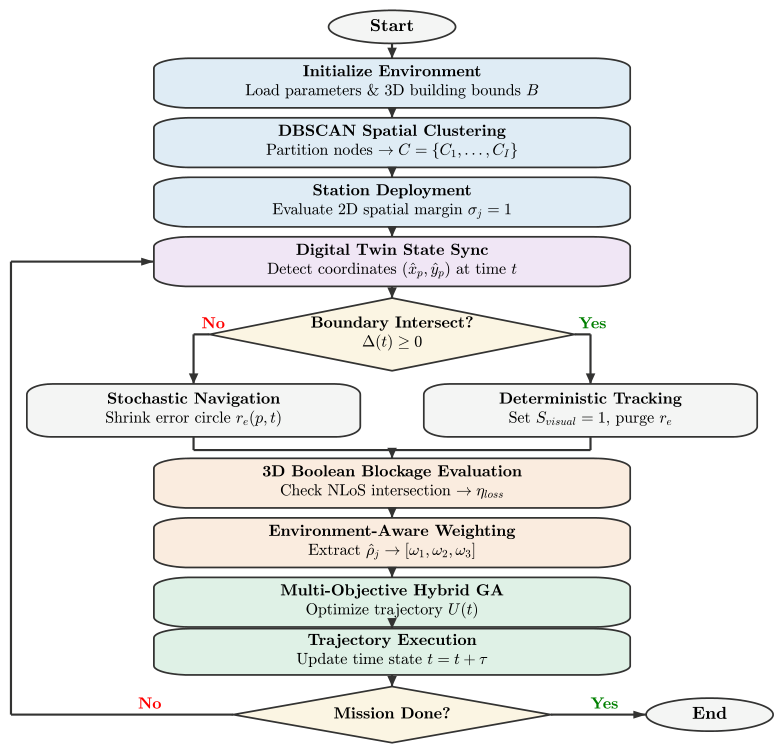
To effectively solve the formulated MINLP problem
, we propose a dynamic, iterative execution architecture, as illustrated in
Figure 2.
Rather than functioning as a static, one-time path planner, the proposed flowchart highlights the receding-horizon execution logic driven by the digital twin. The theoretical parameters derived in
Section 2—specifically the positional uncertainty
and the 3D NLoS penalty
—are not evaluated a priori. Instead, they act as dynamic triggers synchronized within a
-second feedback loop. By embedding the boolean environment evaluation directly into the fitness assessment phase of multi-objective GA, the system effectively decouples the complex constraints of
. This continuous feedback mechanism ensures that UAV can instantaneously adapt its sequence and waypoints to bypass unforeseen building blockages, successfully translating the theoretical MINLP into executable, low-latency flight commands.
To further validate the computational feasibility of these real-time commands, we evaluate the complexity of the proposed optimization framework. The computational complexity per optimization cycle is estimated at , where and denote the maximum iterations and population size of the GA, while and represent the number of nodes and buildings within a cluster, respectively. Through the application of DBSCAN spatial clustering, which partitions the global network into localized zones, the computational overhead is largely kept within a manageable range, effectively mitigating the impact of combinatorial complexity typical of traditional routing. This ensures that the receding-horizon logic maintains real-time performance even as urban complexity increases.
4. Numerical Results and Discussion
We consider a two-dimensional region with an area of where user nodes are randomly distributed. Each user node has a transmission power of , UAV relay power is , the noise power spectral density is , the outage probability threshold is , the minimum throughput requirement is , and the maximum allowable flight time is .
For the digital twin component, we set the initial error circle radius and the minimum error circle radius . The visual positioning circle radius is . The position detection interval and trajectory optimization interval during flight are set to . The position error is assumed to follow a uniform distribution within the error circle.
The DBSCAN clustering parameters are set with a neighborhood radius of and minimum points . The Genetic Algorithm is configured with a population size of 50, a maximum of 500 iterations, a crossover rate of 0.8, and a mutation rate of 0.1.
Regarding the configuration of high-rise obstructions, we define the drone’s flight altitude as , while buildings are randomly generated within this space, with heights uniformly distributed within the range .
To ensure a fair comparison, all baseline methods are evaluated under identical experimental configurations. Specifically, all schemes share the same random seeds for 3D building generation, user node distribution, and initial positional errors. Furthermore, the energy, communication, and kinematic parameters remain strictly consistent across all evaluations.
It is worth noting that the presented numerical results are average values derived from extensive Monte Carlo simulations across random 3D urban topologies, ensuring statistical robustness. Furthermore, given that most existing DT-assisted path planning studies focus on distance minimization, we abstracted this core logic into the evaluated Distance-centric scheme to conduct a fair comparison. This confirms that relying solely on DT state updates is insufficient; the system must couple DT tracking with physical-layer NLoS avoidance.
All numerical simulations were executed on a workstation equipped with an [Intel Core i7-12700H CPU and 16 GB RAM] using MATLAB (R2024a).
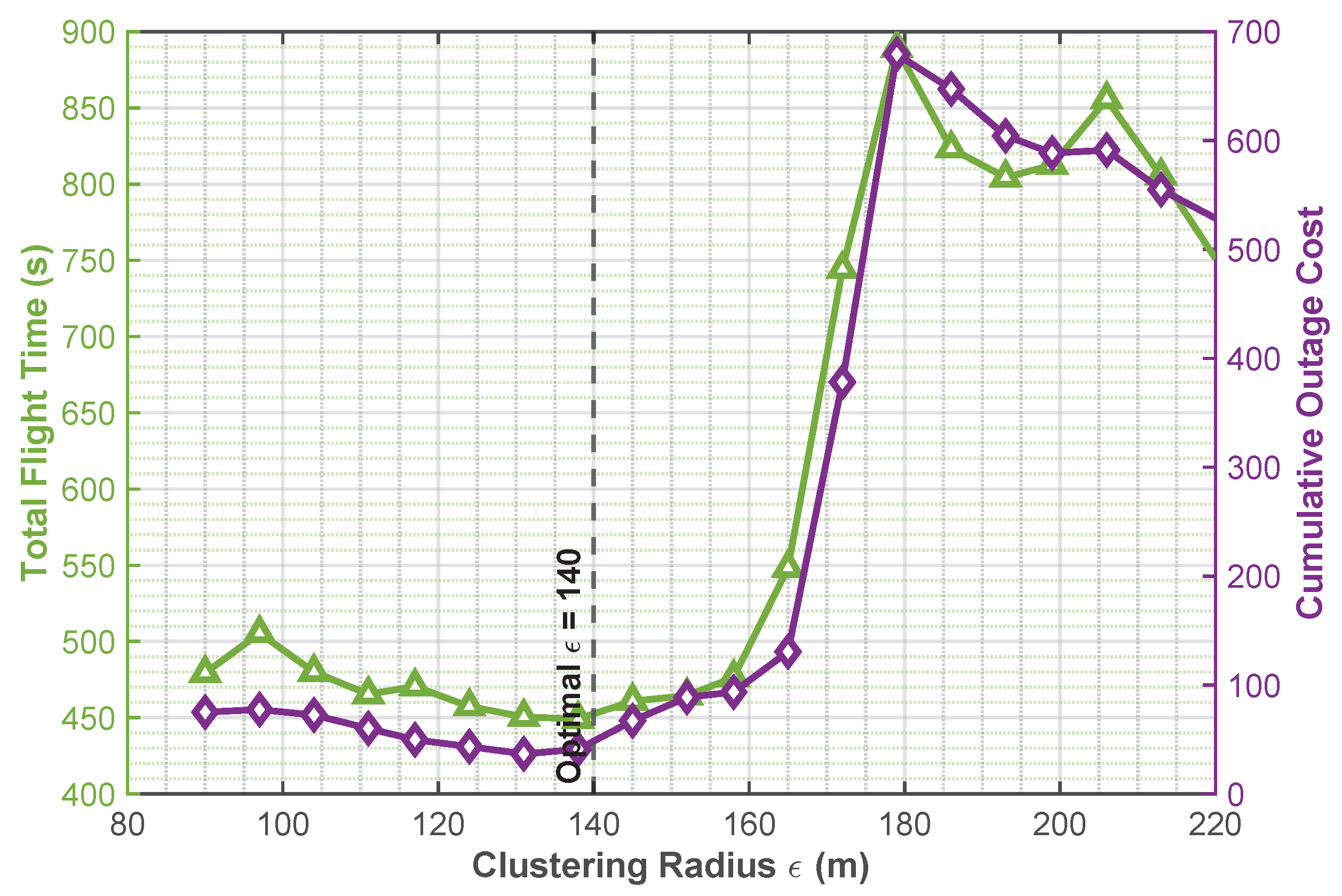
Figure 3 illustrates the system performance under varying DBSCAN clustering radii (
). We select
m as the optimal threshold, because excessively large radii indiscriminately merge geographically isolated nodes, which substantially increases both flight detours and severe NLoS outage risks.
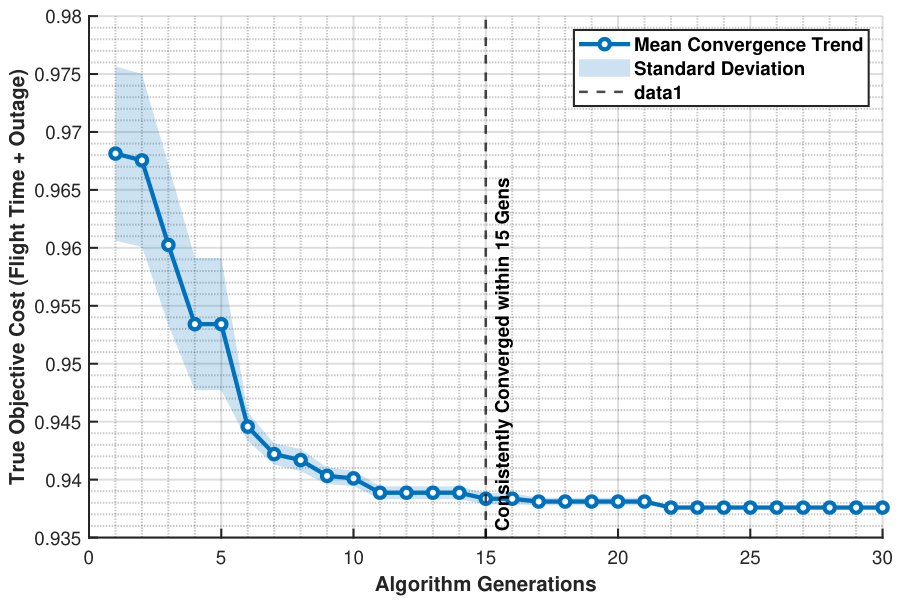
Figure 4 verifies the computational efficiency of the proposed hybrid GA. The total objective cost consistently converges within 15 generations with minimal standard deviation, ensuring extremely low calculation latency for real-time trajectory re-optimization. In addition, empirical measurements were conducted to evaluate the real-time processing capability. Experimental observations suggest that even as the intra-cluster node count
increases from 10 to a stress-test scale of 50, the average processing time per GA iteration increases by approximately 36.48 ms. Therefore, this level of efficiency supports the feasibility of completing the re-optimization within the
s interval.
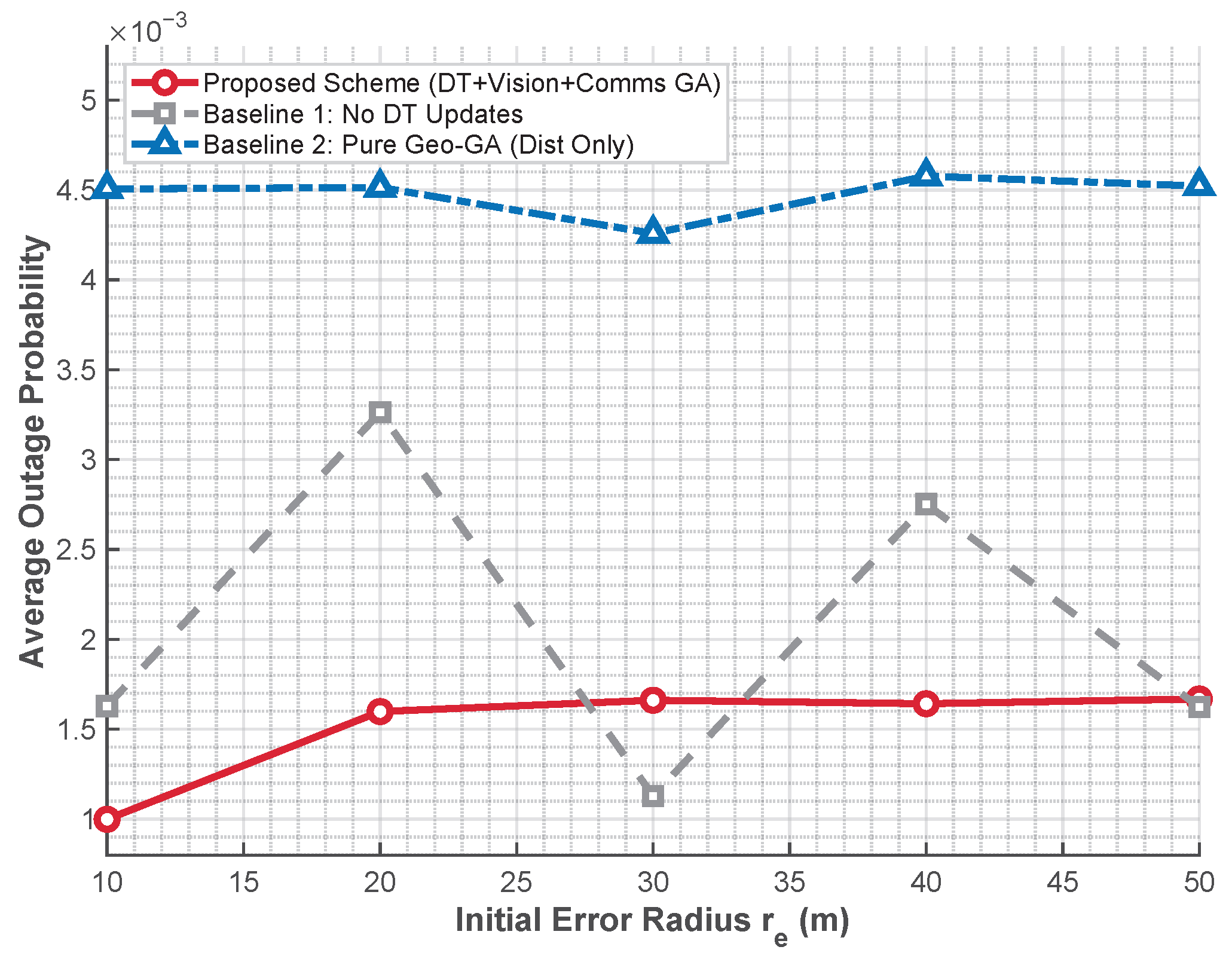
Figure 5 illustrates the average outage probability versus the initial error radius
for three path planning schemes, evaluated over multiple Monte Carlo simulations in 3D urban environments. The Proposed Scheme consistently achieves the lowest and most stable outage probability. By integrating digital twin continuous learning with communication-aware trajectory optimization, UAV dynamically reduces spatial uncertainty and proactively circumvents severe NLoS blockages. In contrast, the baseline schemes suffer from significant performance degradation. Baseline 2 (Pure Geo-GA), which minimizes only geometric distance, exhibits the highest outage probability. It frequently executes direct spatial crossings, forcing the UAV into building shadows with severe penetration losses. Meanwhile, Baseline 1 (No DT Updates) experiences high performance fluctuation; lacking dynamic error reduction, the UAV navigates under persistent positional uncertainty, leading to redundant detours that increase exposure to hazardous NLoS conditions.
These results demonstrate that combining DT-driven uncertainty reduction with physical-layer-aware planning is essential for robust UAV networks.
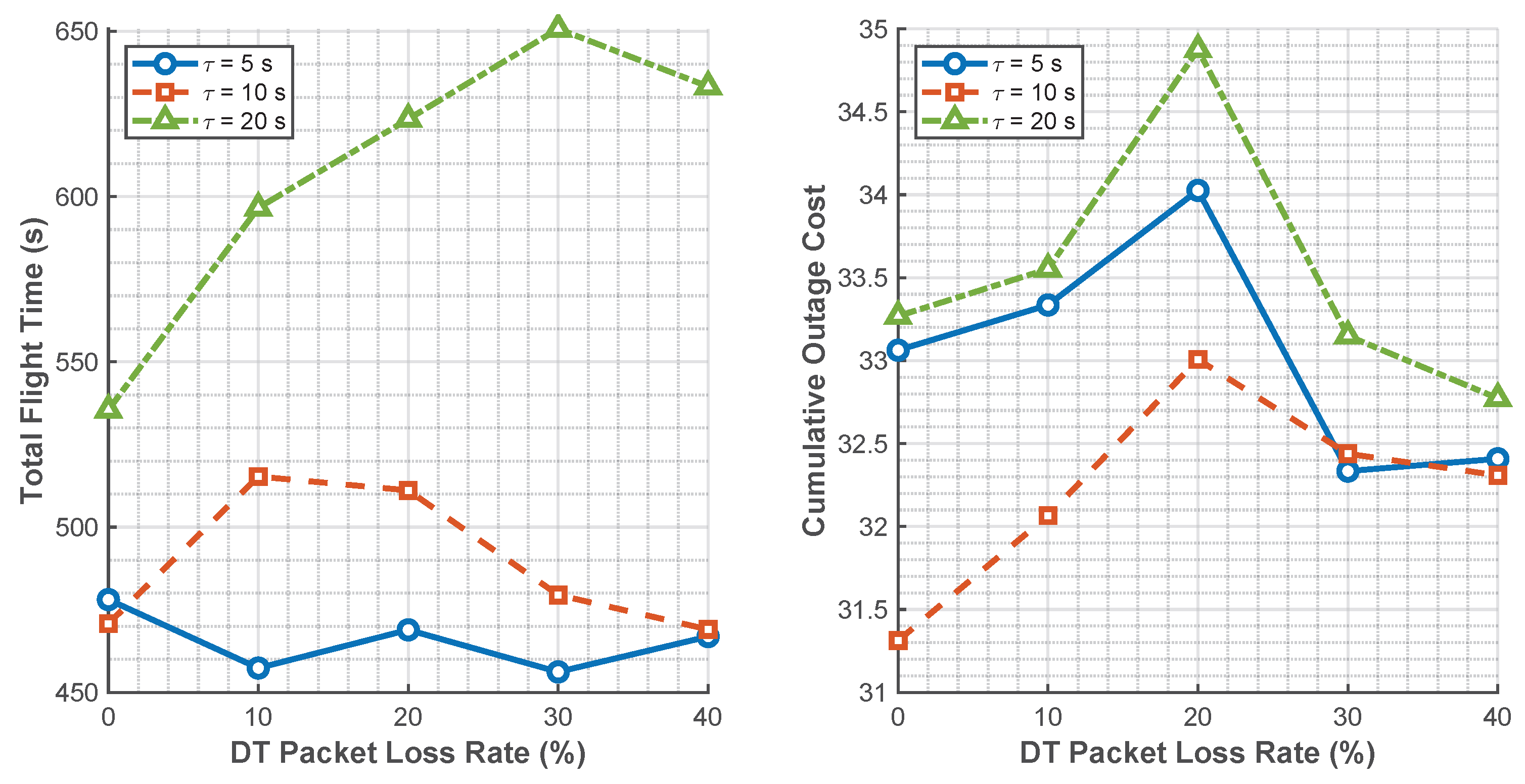
Figure 6 illustrates the system’s robustness against DT packet loss under different update frequencies. As shown, a high-frequency update provides only limited performance gains over the baseline. Moreover, it doubles the signaling overhead and may not provide enough computational time for the GA to fully converge. Conversely, a delayed update leads to severe performance fluctuations. These results indicate that
s serves as a relatively better operational trade-off for the system. Furthermore, even under severe packet loss, the ZOH fallback mechanism prevents system deadlock. Notably, the system exhibits a non-monotonic trend: at high loss rates (30–
), prolonged ZOH state freezing limits dynamic maneuvering, causing a straighter flight. This paradoxically reduces costs compared to the over-correction peak at
, but inherently sacrifices active NLoS avoidance.
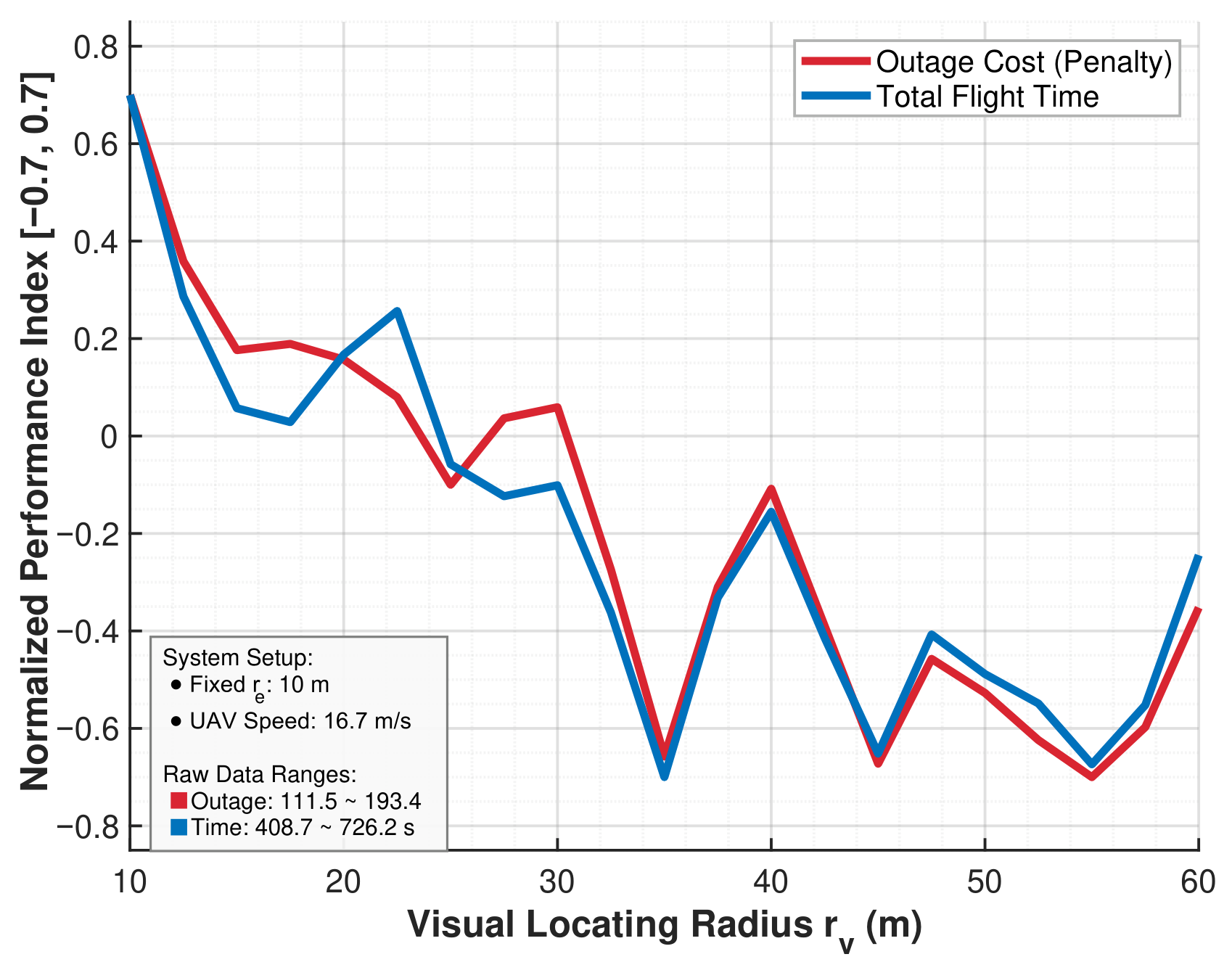
Figure 7 demonstrates the normalized performance impact—specifically regarding total outage cost and total flight time—as the visual locating radius (
) varies. The data is smoothed and scaled using Min-Max normalization. Overall, both the outage cost and the flight time exhibit a downward trend as the visual radius expands. This confirms the early interception effect of the onboard visual sensors. A broader visual range enables the continuous boundary intersection mechanism to capture the true target coordinates earlier, proactively truncating the redundant detours caused by initial location errors.
Locally, the two performance metrics demonstrate a highly synchronized positive correlation, reflecting the non-convex geometric characteristics of 3D dense urban environments. Slight variations in the visual radius alter the equivalent capture boundaries of the target nodes, occasionally triggering the genetic algorithm to converge on a different local optimal topological sequence. Extended detour trajectories inherently carry a higher probabilistic risk of intersecting with building-induced NLoS shadows. Therefore, the flight distance and the communication outage cost are tightly bound.
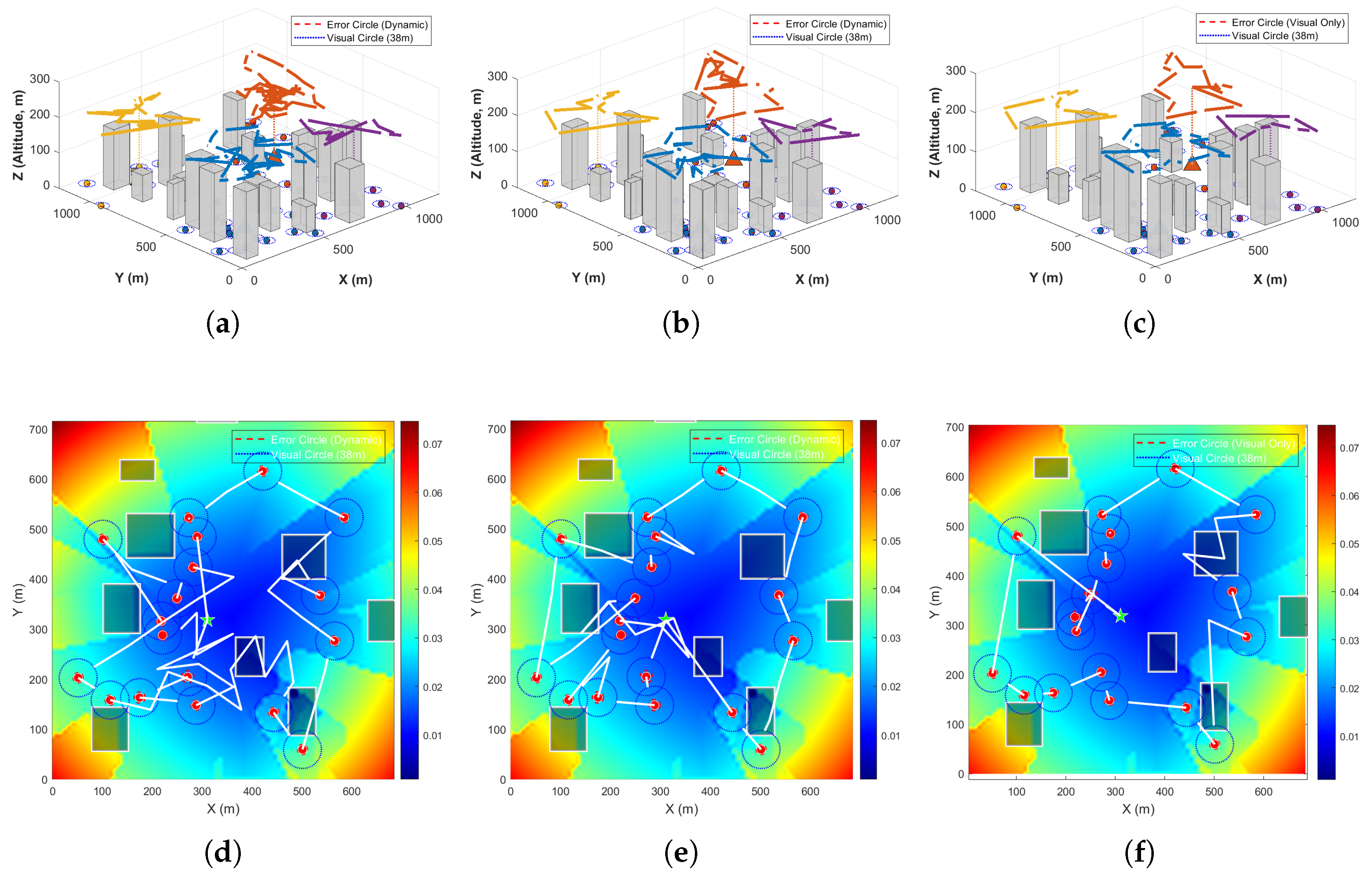
Figure 8 presents a comprehensive evaluation of UAV flight trajectories under three distinct path planning strategies. The top row (a–c) provides 3D spatial visualizations, where grey blocks represent high-rise obstacles and dashed circles indicate the spatial uncertainty regions of ground target nodes. The colored solid lines here trace the actual UAV flight trajectories. The bottom row (d–f) complements this with top-down 2D projections overlaid on instantaneous communication outage probability heatmaps. In these heatmaps, lower-outage areas (dark blue) represent robust LoS communication corridors, whereas higher-outage areas (red and yellow) indicate severe signal degradation. The green stars denote the deployed locations of the logistics transfer stations.
By analyzing the baselines, the contrasting routing behaviors become evident. When applying the Distance-centric scheme, shown in (c) and (f), the UAV strictly prioritizes the shortest geometric path without channel awareness. Consequently, the trajectory forms direct line segments that frequently intersect the physical building footprints, flying directly into the red NLoS shadow zones and suffering from severe link disconnections. Conversely, the Outage-centric strategy, depicted in (a) and (d), strictly prioritizes physical-layer channel quality over flight efficiency. To maintain LoS links, it confines the UAV entirely within the safe blue corridors, resulting in highly meandering, fragmented obstacle-avoidance maneuvers that substantially penalize kinematic efficiency and increase total energy consumption.
The Proposed balanced scheme, illustrated in (b) and (e), effectively resolves this trade-off by combining DT-driven spatial uncertainty reduction with a communication-aware optimization objective. The 3D visualization (b) shows the UAV intelligently navigating through the gaps between buildings with calculated trajectory deviations. Furthermore, the 2D heatmap (e) highlights the algorithmic intelligence of this approach: the DT-assisted trajectory dynamically skims the boundaries of the shadow zones (cyan and light blue regions). It proactively avoids critical red blockages to prevent severe outages, yet accepts minor, tolerable channel fluctuations to maintain a highly efficient and relatively direct overall flight path.
Furthermore, the proposed framework is designed to actively reduce the negative impacts of poor or variable communication qualities. The system model clearly includes small-scale Rayleigh fading and heavy NLoS building blockage penalties. In situations with unstable links, the environment-aware weighting mechanism automatically changes the optimization priorities. Specifically, by increasing the weight of communication reliability () in high-density areas, the UAV actively avoids fading zones. Combined with the re-optimization cycle, this continuous update method ensures that the system can maintain the required performance metrics even in difficult urban communication environments.