1. Introduction
Drones have become a central tool in many modern applications, from precision agriculture [
1] to disaster response. While a single UAV has clear limits—in battery life, payload, and range—groups of UAVs can tackle much bigger and more complex missions. But organizing these groups, known as coalitions, is not straightforward. Deciding which drone joins which team, who leads it, and how to balance competing goals is a hard optimization problem.
Early research focused on assigning drones to fixed tasks and planning their paths, often using genetic algorithms or two-stage planning methods [
2,
3]. Over time, as mission requirements became more dynamic, researchers moved toward multi-objective evolutionary algorithms, which can handle several goals at the same time.
NSGA-II, one of the most widely used algorithms in this family, has been applied to UAV coalition problems in several ways—maximizing task completion while minimizing travel time, for example [
4], or using k-means clustering to improve how coalitions are structured [
5,
6]. The original PICEAg algorithm also used k-means clustering to balance mission time and the number of UAVs used [
7].
Despite this progress, most existing methods have two key weaknesses. First, they tend to focus on only a few objectives, ignoring important real-world factors like
communication reliability, coalition trustworthiness, and long-term
energy sustainability. Second, k-means clustering is sensitive to outliers and does not always pick the best drone as a coalition leader. Recent work has explored learning-based methods—such as multi-agent reinforcement learning for dynamic task assignment [
8], graph neural networks for adaptive coalition structures [
9], and federated learning for secure swarm coordination [
10]—but these approaches often target one or two objectives and rarely combine clustering with many-objective optimization in a co-evolutionary framework [
11]. This work addresses the task execution problem in a multi-drone system operating under limited resources and constrained environments. In addition to resource limitations, several conflicting objectives must be simultaneously considered, including task completion efficiency, execution credibility, and overall system reliability. These objectives are inherently conflicting, as improving one may negatively affect others, which makes the problem particularly challenging. Therefore, the problem is formulated as a multi-objective optimization problem. To address these challenges, an improved optimization approach is proposed to effectively manage the trade-offs between the different objectives and ensure efficient and reliable mission execution.
This paper introduces EPICEAg, which makes three core contributions:
- 1.
A complete problem model: Seven objective functions and nine operational constraints cover task completion, resource use, travel cost, energy efficiency, coalition reliability, communication reliability, and trustworthiness—creating a realistic model of complex missions (
Section 2).
- 2.
Better leader selection: EPICEAg replaces k-means with k-medoids clustering via the PAM algorithm. Because this method selects an actual drone—not a mathematical average—as the cluster center, it is more robust to outliers and produces more sensible coalition leaders.
- 3.
Advanced solution ranking: To manage the difficulty of optimizing seven objectives at once, EPICEAg uses a dual-ranking system combining
shift-based density estimation (SDE) [
12] and
epsilon-dominance ranking [
13], keeping the search both focused and diverse.
The rest of this paper is organized as follows:
Section 2 defines the problem and objective functions;
Section 3 describes EPICEAg;
Section 4 presents the experimental results; and
Section 5 concludes the paper and outlines future work.
2. Problem Formulation
The proposed modeling scenario is designed to capture a realistic operational context in which a network of drones is deployed to perform coordinated tasks under resource and time constraints. This formulation is motivated by practical applications such as surveillance, search-and-rescue missions, and task allocation, where efficient coordination and decision-making are critical. The assumptions adopted in this work—such as limited energy capacity, communication constraints, and task prioritization—are consistent with those commonly reported in the literature [
2,
3,
7]. These elements justify the relevance of the proposed model and ensure its applicability to real-world scenarios.
The UAV coalition formation problem is modeled as a many-objective optimization task. The model accounts for task completion rate, resource consumption, travel cost, energy use, communication quality, coalition reliability, and the trustworthiness of individual drones.
Let be a network of heterogeneous UAVs, where each drone carries a set of resources . Let be the set of tasks to perform, each requiring resources and located at a known 3D position .
UAVs form coalitions , with one coalition assigned to each task (). The drone that first detects a task is designated as the coalition leader and recruits other drones to complete the mission.
2.1. Objective Functions
To address the optimization problem for UAV coalition formation, seven objective functions are defined, each considering a critical performance criterion. A detailed description of each function is provided below:
- 1.
Total Task Completion Level (to be maximized): The objective function
quantifies the degree to which all required resources for active tasks are fulfilled by the UAVs within the formed coalitions. The primary goal is to maximize this coverage, ensuring that as many task resource requirements as possible are satisfied.
where:
: Number of active coalitions.
: Number of tasks assigned to coalition i.
: Number of resources required for task j.
: Number of resources carried by UAV p.
: Number of UAVs in coalition i.
: Resource q of UAV p compatible with required resource k.
: Resource k required for task j.
: Number of active tasks.
: Number of idle (non-detected) tasks.
: Resource j required for task i.
- 2.
Total Level of Remaining Resources (to be maximized): This function evaluates the amount of unused resources after task execution, helping ensure UAVs retain sufficient capability for future missions.
where:
: Resource n of UAV m, not matching task resource k.
: Number of deployed UAVs.
- 3.
Coalition Credibility (to be maximized): This function measures the trustworthiness of UAVs within the coalition, based on their historical behavior and contribution.
where:
- 4.
Coalition Travel Cost (to be minimized): This function minimizes the total travel time required for UAVs to reach task locations.
where
is the Euclidean distance between UAV
k and task
j, and
is the velocity of UAV
k.
- 5.
Coalition Reliability (to be maximized): This function evaluates the likelihood of successful task execution by the coalition, accounting for the failure rates of involved UAV resources.
where:
: Failure rate of resource q on UAV p required for task resource k.
: Execution time required by resource k of task j.
- 6.
Coalition Communication Reliability (to be maximized): This function quantifies the robustness of communication between the coalition leader and its members.
where:
: Aggregated communication failure rate.
: Leader UAV.
: Distance between leader and follower UAV j.
: Speed of light in m/s.
- 7.
Remaining Energy (to be maximized): This function estimates the energy left in UAVs after task execution to ensure readiness for subsequent missions.
where:
: Battery capacity of UAV k.
: Charging/discharging time of UAV k.
: Energy consumed by UAV k.
: Mass of UAV k.
: Discharge rate of UAV k.
2.2. System Constraints
Nine constraints ensure that solutions are feasible and safe:
- 1.
Task Completion Threshold:
The overall task completion level must meet a minimum required value
.
- 2.
Remaining Resources Threshold ():
The fleet must retain a minimum level of remaining resources
after operations.
- 3.
Credibility Threshold:
Coalition credibility must meet a minimum trustworthiness level
.
- 4.
Collision Avoidance:
All drones must maintain a minimum safe distance from each other at all times.
- 5.
Full Coalition Membership ():
Every deployed drone must belong to a coalition, whether active or on standby.
- 6.
Minimum Coalition Size:
Each coalition must have at least two drones.
- 7.
No Duplicate Drones in One Coalition:
No two identical drones may be in the same coalition at the same time.
- 8.
One Task Per Coalition:
Each active coalition handles exactly one task.
- 9.
No Drone in Multiple Coalitions:
A single drone cannot belong to more than one coalition at the same time.
The interplay between seven objectives and nine strict constraints creates a complex optimization problem. The next section describes EPICEAg, which uses PAM-based clustering and dual-ranking to explore this space efficiently.
3. Proposed Evolutionary Strategy: EPICEAg
EPICEAg is an evolutionary algorithm designed to solve the UAV coalition formation problem. The choice of this method is motivated by its ability to efficiently explore large and constrained search spaces while handling multiple conflicting objectives. In this work, the EPICEAG framework is enhanced to better adapt to the considered drone network optimization problem. In the proposed approach, the optimization algorithm is designed to identify the most suitable drone coalitions for task execution. Each candidate solution represents a specific configuration, including the selected drones, their positions, and their assignment to different coalitions. These solutions are evaluated according to the seven objective functions, which capture key performance criteria such as remaining resources, task completion rate, and execution credibility. The algorithm iteratively searches for the best trade-offs by optimizing these objectives simultaneously, aiming to select the coalitions that maximize resource efficiency while ensuring high task accomplishment and reliable execution. In this way, the link between the objective functions and the optimization process is explicitly established through the evaluation and selection of the most effective drone coalitions.
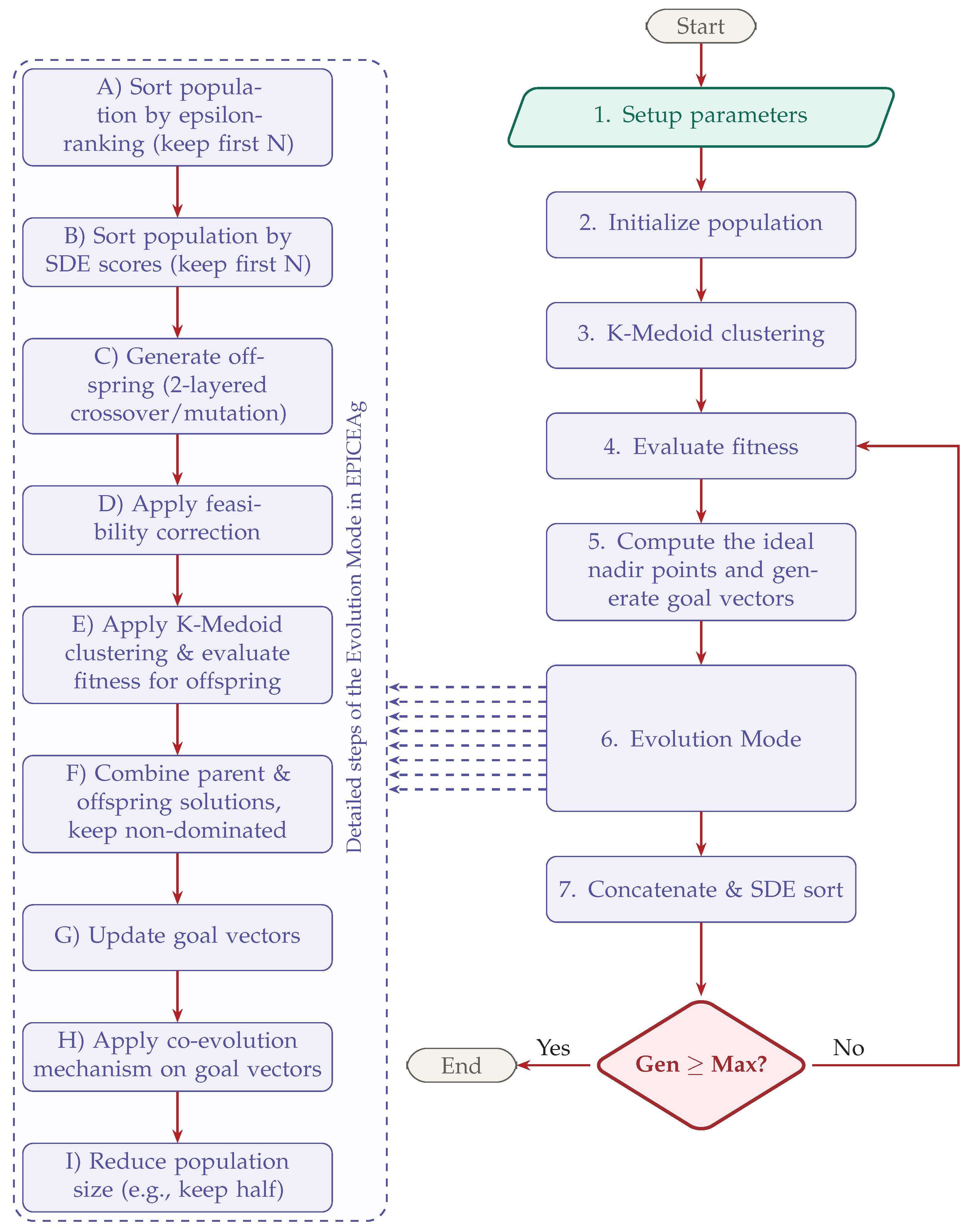
Its main workflow has seven steps, illustrated in
Figure 1:
Step 1: Parameter Setup. Configure the number of UAVs, tasks, objectives, generations, population size, and goal vectors.
Step 2: Population Initialization. Create the starting set of candidate solutions. Each solution is a chromosome with three parts, described in
Section 3.2.1.
Step 3: K-Medoid Clustering. Apply the PAM algorithm to the third part of each chromosome, grouping similar drones and assigning coalition leaders. Because the cluster center is always an actual drone—not a mathematical average—this step is more robust than k-means.
Step 4: Fitness Evaluation. Score each solution against the seven objective functions.
Step 5: Ideal and Nadir Points. Compute the best and worst possible values for each objective, then generate goal vectors to steer the search toward the Pareto front.
Step 6: Evolution Cycle. Run selection, crossover, and mutation (detailed in left dashed box in
Figure 1) to produce new candidate solutions.
Step 7: Sorting and Selection. Combine and rank all solutions using SDE scores to select the best for the next generation.
Figure 1.
Overall workflow of EPICEAg.
Figure 1.
Overall workflow of EPICEAg.
3.1. Clustering Algorithm
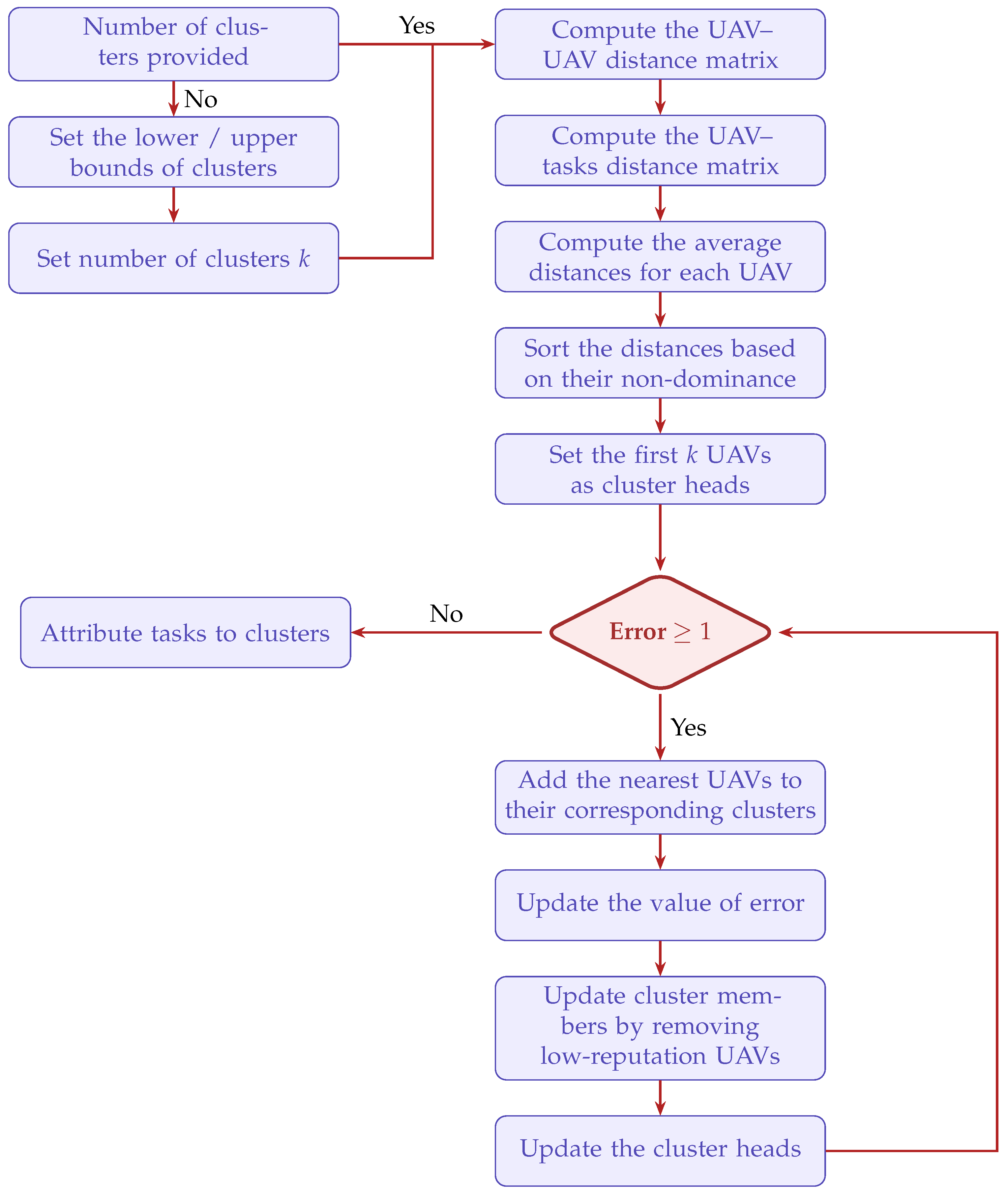
The k-medoids clustering step groups drones into coalitions and selects leaders. The full flowchart is shown in
Figure 2. The steps proceed as follows:
Step 1: If the number of clusters k is provided, go to Step 3; otherwise, set bounds for k.
Step 2: Establish lower and upper limits for k to guide dynamic selection.
Step 3: Set k from user input or within the bounds from Step 2.
Steps 4–5: Compute drone-to-drone and drone-to-task distance matrices.
Step 6: For each drone, calculate its average distance to other drones and to tasks.
Step 7: Sort drones using non-dominance ranking based on these distances.
Step 8: Select the top k drones as initial cluster leaders (medoids).
Step 9: If the clustering error is above threshold, continue to refinement; otherwise, go to task attribution.
Step 10: Assign each drone to its nearest cluster leader.
Step 11: Recalculate the clustering error.
Step 12: Remove drones with low reputation scores from their clusters.
Step 13: Update cluster leaders and repeat from Step 10 until convergence.
Step 14: Assign tasks to clusters using the drone-task distance matrix.
Figure 2.
Flowchart for UAV cluster head selection and task attribution.
Figure 2.
Flowchart for UAV cluster head selection and task attribution.
3.2. Genetic Operators
3.2.1. Population Encoding
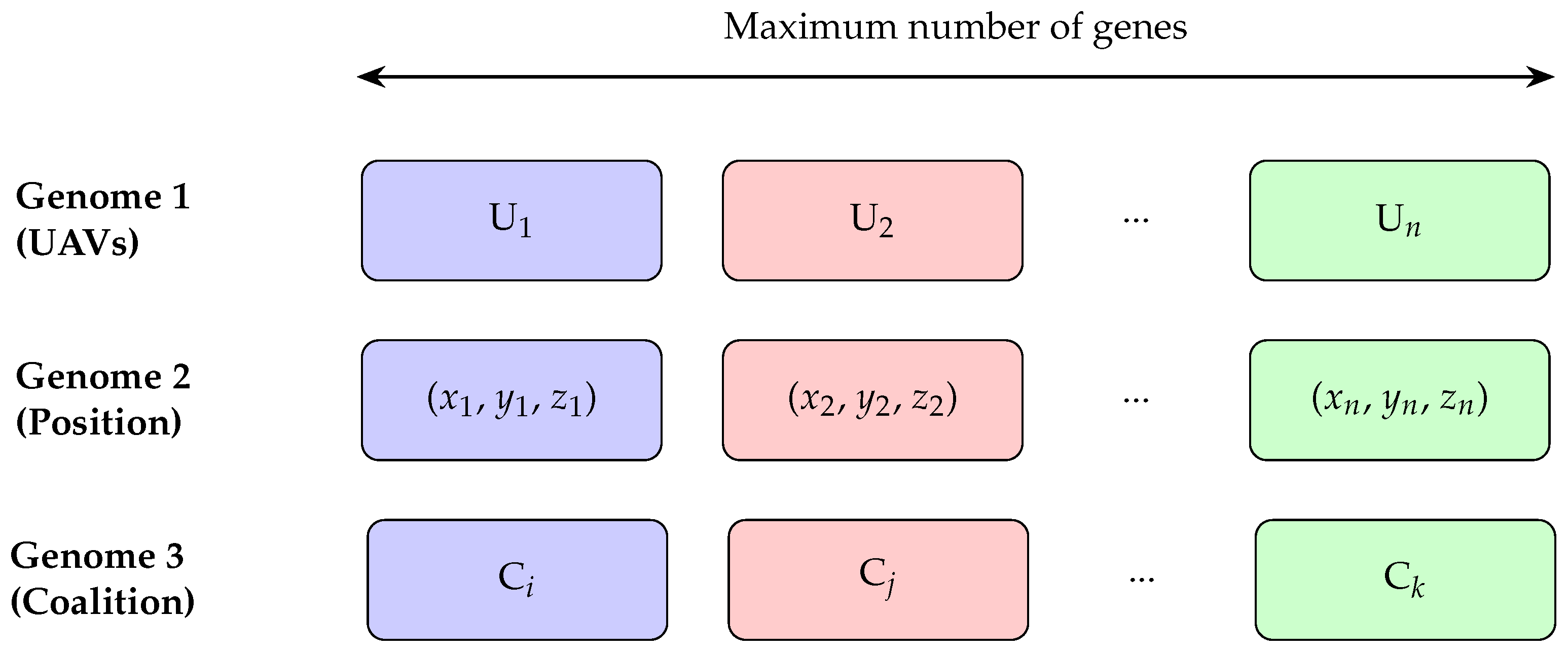
Each chromosome (
Figure 3) has a fixed length
equal to the total number of UAVs. A population contains
such chromosomes. Each chromosome has three parts:
Genome 1 (Drone IDs): The identifiers of selected drones, including their sensor types, payload capacity, trust scores, and reputation values.
Genome 2 (Positions): The 3D coordinates of each drone, stored as continuous variables.
Genome 3 (Coalitions): The coalition assignment for each drone, dynamically updated by the k-medoids algorithm after every genetic operation.
Figure 3.
Chromosome structure: UAV identifiers, positions, and coalition assignments.
Figure 3.
Chromosome structure: UAV identifiers, positions, and coalition assignments.
3.2.2. Crossover
EPICEAg uses a two-level crossover strategy:
-Point Crossover (Genome 1): Randomly cuts Genome 1 at N points and exchanges segments between two parent chromosomes to generate new drone combinations. The number of cut-points is bounded by .
Double Gaussian Crossover (Genome 2): Generates new drone positions by sampling from Gaussian distributions centered around the parents’ positions, allowing smooth exploration of the 3D search space.
A repair step follows crossover to correct any inconsistencies and ensure all offspring are valid.
3.2.3. Mutation
Two mutation methods introduce diversity:
Swap Mutation (Genome 1): Randomly swaps two drones in the chromosome, altering team compositions.
Uniform Mutation (Genome 2): Randomly reassigns a drone’s 3D position by sampling uniformly within the search space.
After every crossover or mutation, the k-medoids algorithm updates Genome 3 to keep coalition assignments consistent with the new drone configurations.
4. Experimental Setup and Performance Evaluation
All experiments were run on a machine with an Intel(R) P6100 2.00 GHz processor, 4 GB of RAM, and Windows 10, using MATLAB R2018a. EPICEAg was compared against four methods: NSGA-II with k-medoids, NSGA-II with random clustering, MOPSO with random clustering, and the original PICEAg with k-medoids. Results for the first, second and third scenarios are averages from 30 independent runs.
The parameters of the UAVs and tasks, optimization parameters and constraint thresholds are listed in
Table 1,
Table 2,
Table 3 and
Table 4. The task completion threshold of 0.80 means a coalition is only considered valid if it can cover at least 80% of the assigned task’s requirements. The trustworthiness threshold of 0.50 was set as a minimum acceptable reliability score, consistent with benchmarks used in earlier coalition trust models.
The selection of optimization parameters and constraint thresholds is based on both the problem structure and common practices in the literature. The number of objective functions is set to seven, as the proposed model simultaneously optimizes seven distinct performance criteria, reflecting the multi-objective nature of the problem. The population size and the maximum number of generations are both fixed at 100, which represents a widely adopted configuration that ensures a good trade-off between convergence quality and computational cost. Regarding the constraints, the remaining resource threshold is set to 50% in order to preserve sufficient resources for potential subsequent missions, thereby enhancing system sustainability. The task completion threshold is fixed at 80% to ensure that the majority of tasks are successfully executed, which contributes to maintaining system efficiency. In addition, the credibility threshold is set to 50% to guarantee a minimum acceptable level of reliability in task execution. Finally, a minimum collision distance of 200 (m) is imposed to ensure safe separation between drones and to avoid potential in-flight conflicts. These parameter settings are chosen to achieve a balanced compromise between performance, robustness, and resource management.
4.1. Scenario 1: Small Homogeneous Fleet
The first test uses six identical drones forming teams to complete two missions. Because all drones are the same, objectives
,
,
, and
produce the same values for all methods:
(all tasks completed),
(50% resources remain),
(credibility at 50% due to uniform reputation scores), and
. The meaningful differences appear in travel cost (
), communication reliability (
), remaining energy (
), and execution time as shown in
Table 5.
As shown in
Table 5, the proposed EPICEAG algorithm achieves superior performance for the objective functions F4–F7 compared to the other approaches. This improvement can be attributed to its enhanced coalition formation strategy, which allows for a more efficient selection of drone groups and better handling of the optimization criteria. While MOPSO-Random runs the fastest, EPICEAg is significantly quicker than both NSGA-II variants and the original PICEAg.
4.2. Scenario 2: Increasing Task Load
The second test examines how each algorithm handles more tasks. Twelve identical drones are used to complete two, three, and four tasks in separate test runs.
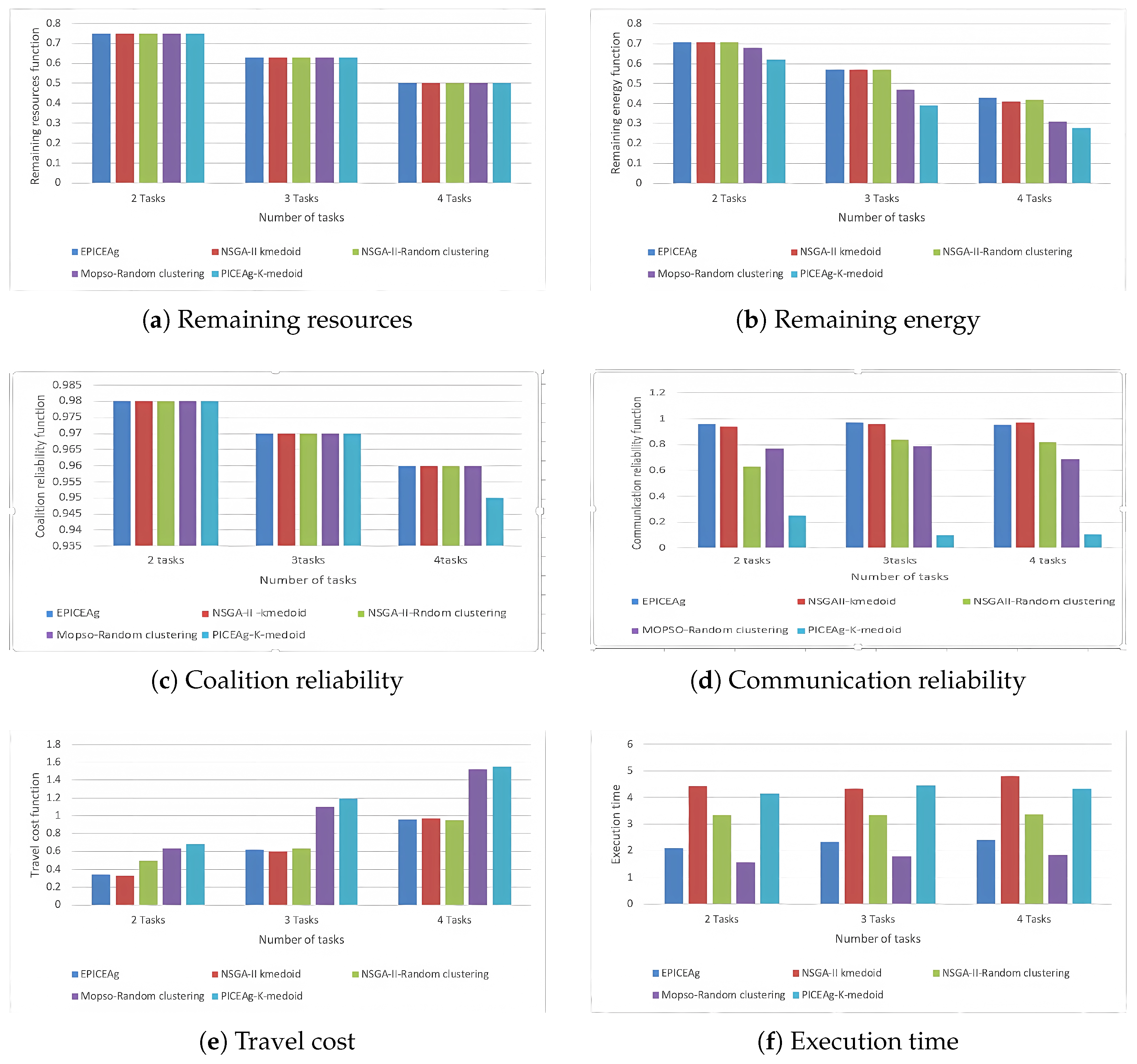
Task completion () equals 1.0 across all methods and all tests, meaning all tasks are always finished. As expected, the remaining resources () and energy () decrease as the task load grows. Coalition credibility () stays at 0.5 for all methods since all drones are identical.
Figure 4 shows the effect of increasing the number of tasks on each metric. EPICEAg and NSGA-II with k-medoids consistently achieve the lowest travel costs. EPICEAg also produces the best communication reliability and remaining energy values. The execution time grows with task count, with MOPSO-Random and EPICEAg delivering the best performance here.
EPICEAg shows consistent adaptability as workload increases. It achieves higher remaining energy and communication reliability and lower travel cost than other methods across all task counts. Although MOPSO with random clustering is slightly faster, EPICEAg delivers a much better balance between solution quality and computation time.
4.3. Scenario 3: Large Heterogeneous Fleet
The third and most demanding test deploys 30 heterogeneous drones to handle 12 simultaneous tasks, testing the algorithm at scale. Results are averages from 30 independent runs, shown in
Table 6.
EPICEAg achieves the best values across all seven objectives. Notably, MOPSO runs the fastest but delivers significantly lower task completion (mean vs. for EPICEAg). EPICEAg strikes the best balance between solution quality and computational cost.
4.4. Test Wilcoxon
To evaluate the performance of EPICEAg, a non-parametric statistical test was conducted. Specifically, the Wilcoxon signed-rank test was applied to compare EPICEAg against the NSGA-II algorithm-Random clustering, MOPSO-Random clustering and PICEA-g across seven benchmark functions (F1–F7).
The Wilcoxon test was selected due to its suitability for comparing paired samples without assuming normal distribution of the data. Each algorithm was executed independently over 30 runs (Scenario 3), and the resulting performance values were used to compute statistical significance.
A significance level of was adopted. The results demonstrate that the proposed algorithm significantly outperforms all competing methods across all benchmark functions.
As shown in
Table 7,
Table 8 and
Table 9, the proposed method achieves statistically significant improvements (
p < 0.05) in all cases, leading to a 100% win rate against NSGA-II, MOPSO, and PICEA-g.
These results confirm the robustness and efficiency of the proposed approach across different optimization landscapes. The consistent superiority across all test functions indicates that the improvements are not problem specific but generalizable.
Overall, the experimental results validate the effectiveness of the proposed algorithm and highlight its superiority over state-of-the-art multi-objective optimization methods.
4.5. Computational Complexity Analysis
The computational complexity of the proposed algorithm is analyzed with respect to the population size N, the number of objectives M, and the decision variable dimension D.
The algorithm consists of several main steps. First, two ranking procedures are applied to the population, each requiring a sorting operation with a complexity of . These steps are used to select high-quality individuals based on different ranking criteria.
Next, crossover and mutation operators are applied to generate offspring, resulting in a computational cost of since each individual is processed across all decision variables.
A clustering mechanism is then employed to enhance population diversity. In the worst case, this step has a complexity of . Additionally, the fitness evaluation process requires , as each solution is evaluated across all objectives.
Afterward, the parent and offspring populations are merged, followed by a non-dominated sorting procedure, which constitutes the most computationally expensive component with a complexity of . The environmental selection step then reduces the population size with a linear cost of .
Therefore, the overall computational complexity of the proposed algorithm is dominated by the non-dominated sorting procedure and can be expressed as
The computational complexity of NSGA-II is mainly dominated by the non-dominated sorting procedure, which has a complexity of
[
14].
Similarly, MOPSO has a lower computational complexity, typically around
depending on the archive management and clustering mechanisms [
15]. Although random clustering is applied in both NSGA-II and MOPSO, it introduces an additional computational cost of
in the worst case. However, this cost is dominated by the main algorithmic components (non-dominated sorting in NSGA-II and particle update mechanisms in MOPSO). Therefore, it does not change the overall asymptotic complexity of the algorithms.
Table 10 presents the computational complexity of PICEAg in comparison with the baseline methods, including NSGA-II and MOPSO with random clustering. It can be observed that PICEAg has a theoretical complexity of
, which is similar to that of NSGA-II due to the use of the non-dominated sorting procedure. However, despite this comparable complexity, EPICEAg achieves significantly better optimization performance as demonstrated by the statistical results.
On the other hand, MOPSO exhibits a lower computational complexity of , mainly due to the absence of an explicit non-dominated sorting step. Nevertheless, this reduced complexity comes at the cost of lower solution quality compared to the proposed approach.
Overall, EPICEAg offers a favorable trade-off between computational complexity and optimization performance, making it an effective solution for multi-objective optimization problems.
5. Conclusions
This paper presented
EPICEAg, a co-evolutionary algorithm for organizing multi-UAV coalitions. Built on the PICEAg framework, EPICEAg adds two key improvements: k-medoids clustering [
16] for more reliable coalition leader selection, and a dual-ranking strategy using shift-based density estimation and epsilon-dominance [
17] for the better handling of the seven competing objectives.
The problem was formulated to reflect real mission conditions, with seven objective functions—covering task completion, resource use, credibility, reliability, communication, travel cost, and energy—and nine operational constraints. Tests across three scenarios consistently showed that EPICEAg outperforms NSGA-II, MOPSO, and the original PICEAg [
18] across most objective metrics. It achieves a strong balance between solution quality and computation time. That said, MOPSO runs faster in all scenarios, so there is still room to improve the EPICEAg speed for time-critical applications.
EPICEAg has direct applications in disaster response, infrastructure inspection, surveillance, and search-and-rescue operations, where drones must make fast, reliable decisions under tight resource constraints.
Looking ahead, several directions are worth pursuing:
Extending experiments to fully heterogeneous fleets for a more demanding benchmark;
Adapting EPICEAg for dynamic environments where tasks appear mid-mission or drones fail unexpectedly—an area where reinforcement learning methods show real promise [
19,
20,
21,
22];
Integrating flower pollination algorithms (MOFPA [
23], AFPICO [
24,
25]) to reduce the risk of getting stuck in local optima;
Evaluating these hybrid approaches in large-scale, dynamic simulations to confirm their scalability.