1. Introduction
Unmanned aerial vehicle (UAV) swarms consist of multiple aerial agents that coordinate their actions through distributed control and information exchange to jointly accomplish sensing, monitoring, inspection, or communication tasks [
1,
2,
3]. The use of coordinated UAV teams has expanded significantly in recent years, supporting applications such as infrastructure inspection, environmental mapping, precision agriculture monitoring, search-and-rescue operations, and aerial communication relaying. In these scenarios, cooperative operation improves sensing coverage, system robustness, and overall mission efficiency. Beyond maintaining geometric formations, swarm deployments frequently require coordinated trajectory planning and task allocation to organize sensing activities and data collection over large spatial areas [
4,
5,
6].
Many emerging UAV applications require real-time coordination among multiple aerial agents. In such scenarios, communication latency directly affects the ability of the swarm to maintain coherent formations and coordinated sensing behaviors [
3,
6]. Recent advances in aerial networking technologies, including 5G and beyond-5G communication architectures, aim to provide ultra-reliable low-latency communication (URLLC) capabilities that enable latency-sensitive UAV operations [
7,
8]. However, even when high-quality wireless links are available, the interaction between stochastic communication delays and distributed swarm control remains insufficiently understood.
In practice, the size of UAV swarms varies depending on the mission and operational constraints. Inspection or mapping missions often employ small teams of three to ten UAVs, while large-scale monitoring or aerial relay scenarios may involve tens of agents operating simultaneously. These limits are typically determined by airspace regulations, safety constraints, and mission complexity [
9,
10]. Most practical deployments rely on homogeneous UAV platforms to simplify coordination and improve scalability, although heterogeneous swarms are increasingly explored when specialized sensing or communication roles are required [
11,
12].
From a networking perspective, extensive research has examined routing strategies, relay selection mechanisms, and latency-aware communication protocols for multi-UAV systems [
9,
13,
14,
15,
16]. In parallel, the control community has investigated how formation controllers behave in the presence of packet losses or communication delays [
11,
12,
17]. Despite these efforts, communication and control aspects are often studied independently. Consequently, the combined influence of empirical communication latency, multi-hop delay accumulation, and controller-specific delay tolerance remains insufficiently understood for realistic multi-UAV deployments.
In real-world aerial networks, communication latency is not simply an implementation detail but a critical factor that influences feasible swarm size and formation density. Wireless aerial links are affected by protocol scheduling, buffering effects, retransmissions, and medium access contention, which produce stochastic latency patterns characterized by jitter and occasional delay bursts [
18,
19,
20]. As a result, even when average link quality is high, random latency variations may degrade formation coherence in distributed controllers, particularly in dense swarms or multi-hop communication topologies.
Among the many distributed control strategies proposed for UAV swarms, attractive–repulsive distance-based potential field (ARD–PF) controllers remain widely used due to their simplicity, decentralized structure, and intuitive geometric interpretation. However, ARD–PF controllers are known to be sensitive to inaccuracies in neighbor-state information, especially when those measurements are delayed or distorted by communication effects [
11,
21]. Many existing studies analyze delay effects using deterministic delay bounds or simplified latency models that fail to capture the bursty and jitter-dominated behavior commonly observed in wireless aerial links [
22,
23].
Although previous works have independently studied UAV communication latency, multi-hop networking, and delay-robust formation control, these elements are rarely integrated within a unified communication–control evaluation framework. Most existing studies either analyze communication latency in isolation or assume simplified deterministic delay bounds when evaluating swarm stability. Consequently, the interaction between empirically observed latency dynamics and controller-specific delay tolerance remains largely unexplored.
Several works have investigated distributed formation control strategies for multi-agent systems, including consensus-based coordination, virtual structure approaches, and potential-field methods, which enable cooperative behavior using local information exchange among agents [
22,
23,
24]. Among these strategies, attractive–repulsive distance-based potential field (ARD–PF) controllers have been widely adopted due to their decentralized structure, geometric interpretability, and scalability properties for swarm coordination tasks [
11,
21]. However, the performance of distributed formation controllers is known to be sensitive to inaccuracies in inter-agent state information, particularly in the presence of communication delays and packet losses, which may degrade formation coherence or compromise stability margins [
25,
26].
From the communication perspective, extensive research has addressed latency-aware networking architectures for UAV systems, including multi-hop relay selection, routing optimization, and ultra-reliable low-latency communication (URLLC) mechanisms for aerial networks [
1,
7,
19]. These works characterize the impact of wireless channel conditions, protocol behavior, and network topology on latency and reliability performance metrics. Nevertheless, communication-oriented studies typically evaluate latency independently from the control layer, without explicitly linking empirical latency statistics with controller-specific stability constraints.
Within the networked control systems literature, several studies have analyzed the effects of time delays, packet drops, and asynchronous communication on distributed control stability [
25,
26]. These works provide theoretical foundations for understanding how communication imperfections affect closed-loop performance, often assuming deterministic or bounded-delay models. However, real wireless aerial links commonly exhibit stochastic latency patterns characterized by jitter and burst events that are not fully captured by simplified deterministic delay assumptions [
1,
7].
Although prior work has investigated UAV communication latency, multi-hop networking, and delay-robust multi-agent coordination, the interaction between empirically observed wireless latency behavior and controller-specific delay tolerance remains insufficiently explored. In particular, few studies provide a systematic methodology for translating experimentally observed communication delay statistics into quantitative limits on swarm scalability under distributed formation control. The present work contributes to this direction by proposing a measurement-informed framework that integrates empirical latency characterization, stochastic delay modeling, and control-level delay tolerance analysis within a unified communication–control evaluation methodology.
To address this gap, this work proposes a measurement-informed framework that links empirical communication latency with controller-level delay tolerance in distributed UAV formations. The approach combines in-flight communication measurements, stochastic delay modeling, analytical delay-feasibility analysis, and Monte Carlo simulations to evaluate how communication latency constrains swarm scalability under realistic operating conditions.
Rather than proposing a new formation controller or communication protocol, the contribution of this work is methodological. The proposed framework provides a systematic procedure to translate empirically observed communication delay statistics into controller-specific operational limits for UAV swarm formations, enabling realistic evaluation of feasible swarm sizes and formation geometries. In contrast to communication–control co-design approaches that jointly optimize networking protocols and control laws, this work adopts a measurement-informed perspective that links experimentally observed communication latency statistics with delay tolerance characteristics of distributed formation controllers. This approach enables realistic estimation of delay-feasible operating regions for UAV swarms while maintaining consistency with realistic wireless communication behavior. Although the experimental validation relies on LoRa communication links, the proposed framework is communication-technology agnostic and can be applied to emerging low-latency UAV networking paradigms, including 5G/6G aerial networks and edge-assisted UAV communication architectures.
This manuscript makes the following contributions:
Measurement-calibrated stochastic delay model: A compact stochastic latency model calibrated using in-flight LoRa measurements, capable of reproducing the dominant latency mode, jitter variance, and burst-driven heavy-tail behavior observed in aerial UAV communication links.
Controller-specific delay-tolerance characterization: A quantitative determination of the maximum admissible end-to-end communication delay for ARD–PF formation control as a function of swarm size and inter-UAV geometry.
Analytical delay-feasibility model for swarm operation: A tractable analytical formulation that predicts swarm reliability, delay-budget utilization, and maximum feasible swarm size under stochastic multi-hop communication latency.
Model validation through Monte Carlo simulations: Comprehensive numerical validation showing that the analytical model accurately predicts reliability degradation, delay-budget utilization, and swarm capacity trends obtained from large-scale Monte Carlo simulations of the stochastic delay process.
Experimental grounding with real flight data: More than 15,000 in-flight delay samples collected from a multi-UAV LoRa communication platform used to calibrate and validate the proposed delay model.
The remainder of this manuscript is organized as follows.
Section 2 evaluates the delay tolerance of ARD–PF formation control.
Section 3 introduces the measurement-based stochastic delay model and the analytical delay-feasibility formulation.
Section 4 presents the validation results and swarm scalability analysis, and
Section 5 concludes the manuscript.
2. Delay Tolerance Limits of ARD–PF Formation Control
This section evaluates how communication latency affects the stability of an attractive–repulsive distance-based potential field (ARD–PF) formation controller. The objective is not to redesign the controller, but to quantitatively determine the maximum end-to-end communication delay that can be tolerated before geometric coherence of the swarm is lost. The resulting delay tolerance serves as a control-level constraint for the communication-aware scalability analysis developed in the subsequent sections, where it is combined with the stochastic delay model to evaluate the reliability and feasibility of multi-hop UAV swarm communication.
The ARD–PF controller is used as a representative distributed formation control strategy due to its decentralized structure and reliance on relative neighbor-state information, which makes it sensitive to communication delays. The proposed framework is not restricted to ARD–PF and can be applied to other distributed formation control approaches once their delay-tolerance characteristics are defined.
2.1. Circular Formation Scenario
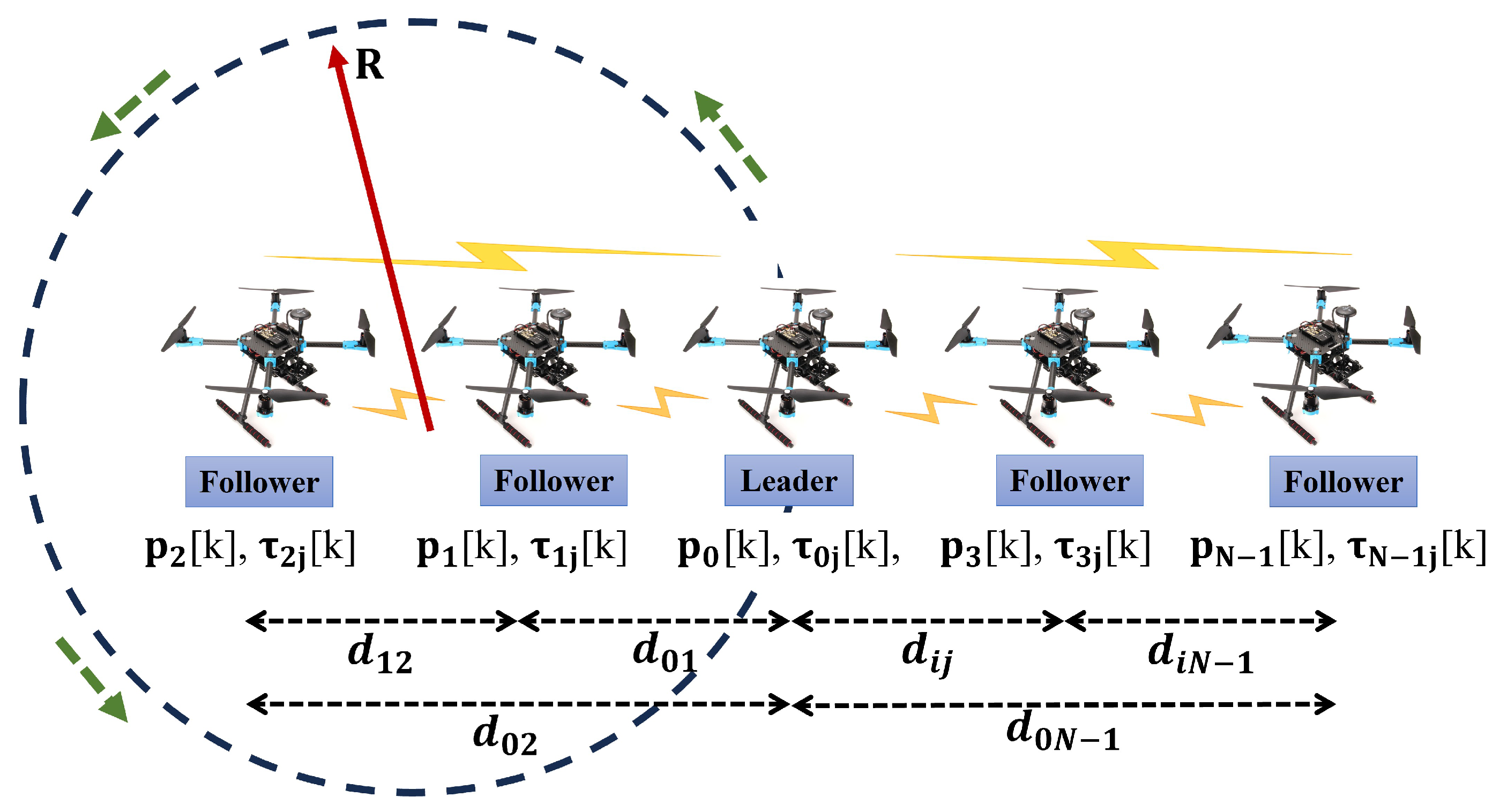
We consider a swarm composed of one leader UAV and follower UAVs operating in the horizontal plane. The leader follows a circular trajectory of radius R at constant speed, while each follower is assigned a fixed lateral offset with respect to the leader, resulting in a set of concentric circular orbits.
Let
and
denote the planar position and velocity of UAV
i, respectively. Each follower is associated with a desired position
, defined as a constant displacement relative to the instantaneous leader position. The nominal inter-UAV separation between agents
i and
j is denoted by
, which determines the density of the formation (
Figure 1).
In the absence of a communication delay, formation keeping is achieved using an ARD–PF controller that computes a virtual acceleration command for each follower,
where
is the attractive gain driving each follower toward its desired position,
is the repulsive gain enforcing collision avoidance, and
is a damping coefficient. The unit vector
defines the repulsion direction, and
is a short-range potential activated when the inter-UAV distance falls below a safety radius. Repulsive interactions are evaluated for both follower–follower and leader–follower pairs, based on locally available and communicated position information.
To improve phase coherence along the circular trajectory, a phase-alignment correction term is included,
where
and
denote the angular positions of follower
i and the leader, respectively;
is a phase-coupling gain; and
is the unit tangent vector along the leader’s trajectory. This formulation follows standard ARD–PF implementations in circular formations [
11,
21].
Unless otherwise stated, the simulations employ a nominal leader velocity of m/s and a circular trajectory radius of m. The ARD–PF controller gains are set to , , and , with a safety distance threshold of m for activation of the repulsive potential. The phase-alignment gain is chosen as . The UAV dynamics are numerically integrated using a fixed timestep of s over a simulation horizon of s. These values were selected to ensure stable convergence and collision-free motion under delay-free conditions and were kept constant across all experiments to isolate the effect of communication latency.
2.2. Injection of Communication Delay
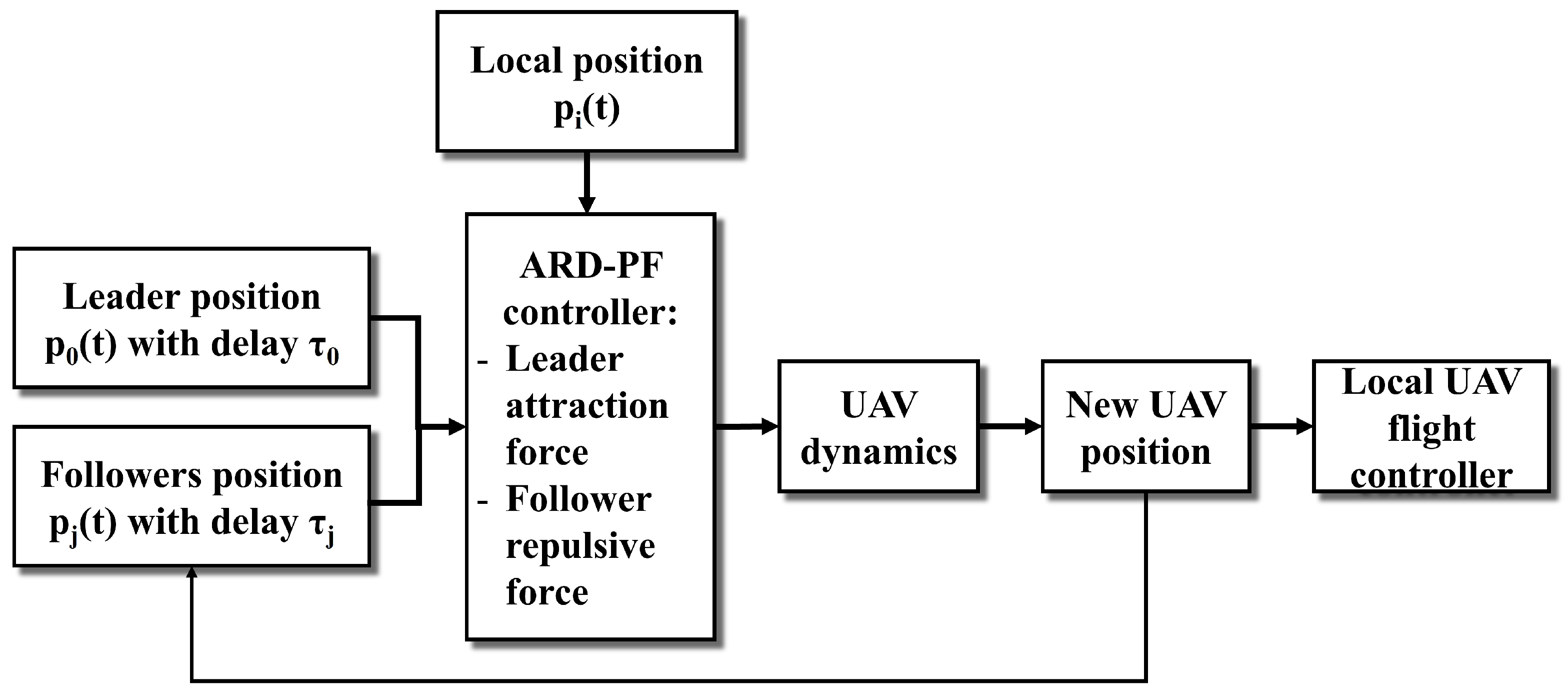
The information flow and control loop under delayed communication are illustrated in
Figure 2. Each follower computes its control input using its locally measured state
together with delayed position information received from the leader and neighboring UAVs over the wireless network.
To evaluate robustness against communication latency, delay is explicitly introduced in the state information available to each follower. Specifically, UAV
i receives the leader position and the positions of its neighboring UAVs with an end-to-end delay modeled as
where
represents the aggregate delay introduced by the communication protocol, buffering mechanisms, and onboard processing, whereas
models the effective growth of latency associated with distance-dependent propagation and multi-hop relaying.
As a consequence, follower i evaluates the ARD–PF control law using delayed state information instead of instantaneous neighbor positions. No form of global synchronization, state prediction, or explicit delay compensation is incorporated. Each UAV operates in a fully distributed fashion and relies exclusively on its own measurements together with delayed inter-agent data. This assumption mirrors practical aerial communication conditions and allows the impact of latency on formation stability to be isolated and directly quantified.
2.3. Formation Error and Delay Tolerance Criterion
Formation performance is evaluated by examining how much each follower departs from its assigned position within the formation. For a given injected delay
, the swarm is simulated over multiple revolutions of the circular trajectory, and the worst-case deviation observed across all agents and time instants is quantified through the maximum formation error
The metric provides a conservative geometric indicator of formation coherence by capturing the worst deviation observed across all UAVs and time instants. Unlike average tracking error, this measure directly reflects the onset of visible deformation and collision risk in dense formations, making it particularly suitable for delay-robust evaluation of distributed potential-field and consensus-based controllers.
Consistent with prior delay-robust formation-control studies [
11,
21], formation coherence is considered preserved when
where
defines an admissible performance degradation margin corresponding to the onset of noticeable geometric distortion, while the swarm remains cohesive. The tolerance parameter
represents the onset of geometrically observable formation distortion while maintaining safe inter-UAV separation. In practical UAV formations, strict asymptotic convergence is rarely achievable due to sensing noise, discretization, and onboard control dynamics. For this reason, geometric deviation thresholds are commonly used as operational indicators of formation degradation in distributed multi-agent control systems.
In this work, stability is interpreted in an operational sense as the preservation of bounded formation geometry under delayed information exchange, rather than strict asymptotic Lyapunov stability. In practical UAV swarms, sensing noise, discretization effects, and onboard control dynamics prevent perfect steady-state tracking even in delay-free conditions. Consequently, geometric deviation thresholds such as the criterion in (
5) provide a practical indicator of when delayed state information causes a loss of formation coherence. Under this interpretation, delay-induced instability manifests when communication-induced state staleness causes the worst-case formation error to exceed the admissible geometric envelope defined by the chosen tolerance margin.
Measurement noise from onboard GNSS sensing introduces a bounded position error in both delayed and delay-free trajectories; however, since stability is evaluated relative to the zero-delay baseline, this noise largely cancels out and does not artificially inflate delay-induced divergence trends.
Additional sensitivity analysis for confirms that although the absolute admissible delay values scale with the selected threshold, the emergence of latency-limited, geometry-limited, and congestion-limited regimes remains unchanged. This indicates that the identified scalability trends are intrinsic to the communication–control interaction rather than artifacts of a particular error tolerance choice.
By gradually increasing the injected delay
, a data-driven estimate of the maximum admissible end-to-end delay
for the ARD–PF controller is obtained. These delay margins define controller-specific stability bounds that are used as input parameters for the delay-feasibility framework introduced in
Section 3. In particular, the admissible delay surface
constrains the reliability, delay-budget utilization, and swarm scalability predictions evaluated in
Section 4.
Although the numerical delay limits derived here are specific to the ARD–PF formation controller, the proposed delay-feasibility framework is not restricted to this particular control strategy. Once the delay tolerance of an alternative formation controller is characterized, the same stochastic delay model and analytical feasibility analysis can be applied to evaluate its scalability under realistic communication latency.
3. Measurement-Based Delay Model
This section presents the experimental methodology and the measurement-informed delay model used to characterize realistic communication latency in multi-UAV swarms. The objective is twofold. First, empirical delay statistics are obtained under real flight conditions. Second, these measurements are used to construct a stochastic delay model whose statistical parameters are grounded in experimental data. This model subsequently enables both Monte Carlo multi-hop simulations and the analytical delay–feasibility analysis introduced later in this section.
The resulting framework establishes the connection between measurement-derived link-level latency behavior and the controller-specific delay tolerance limits derived in
Section 2.
3.1. Experimental Platform and Flight Scenario
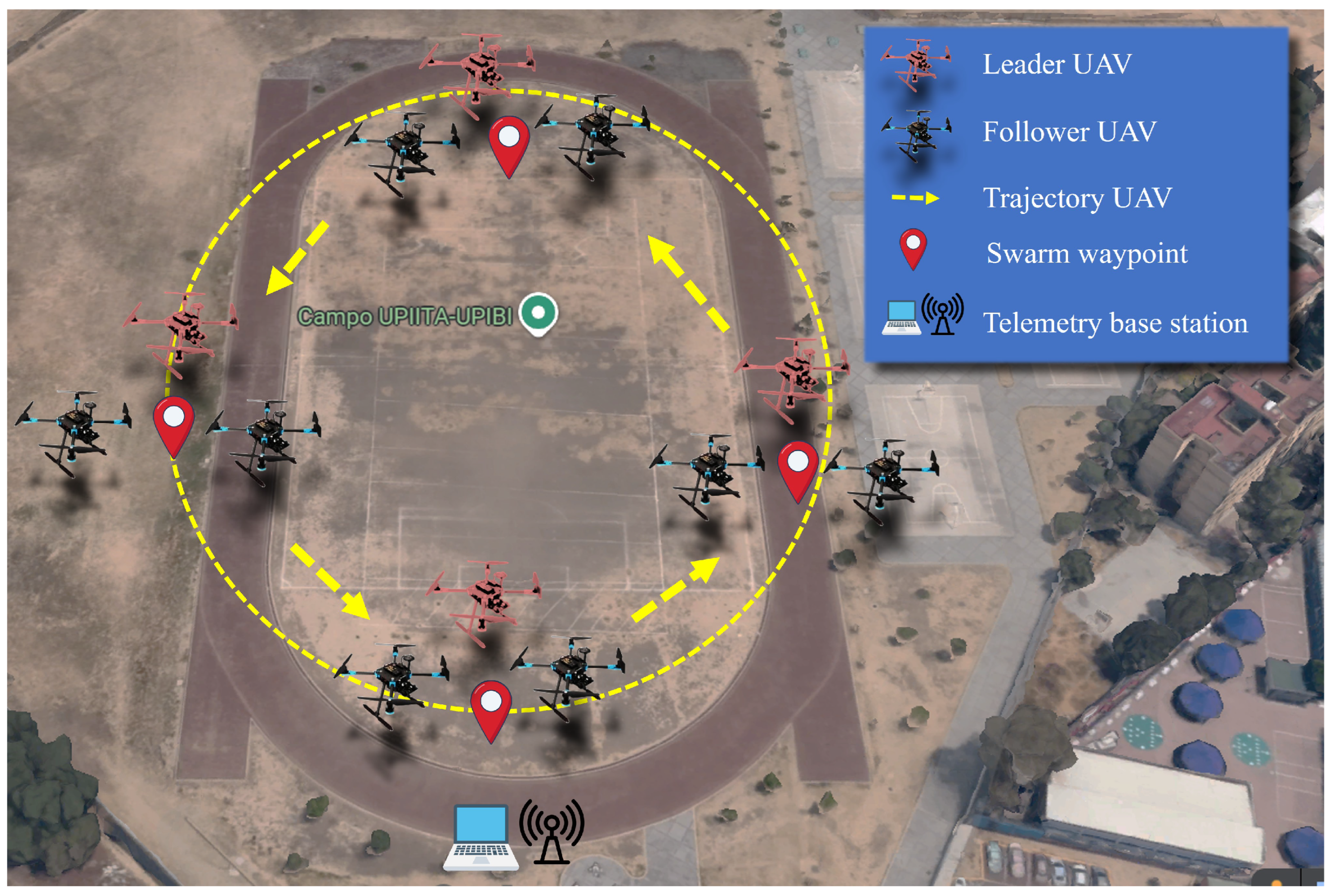
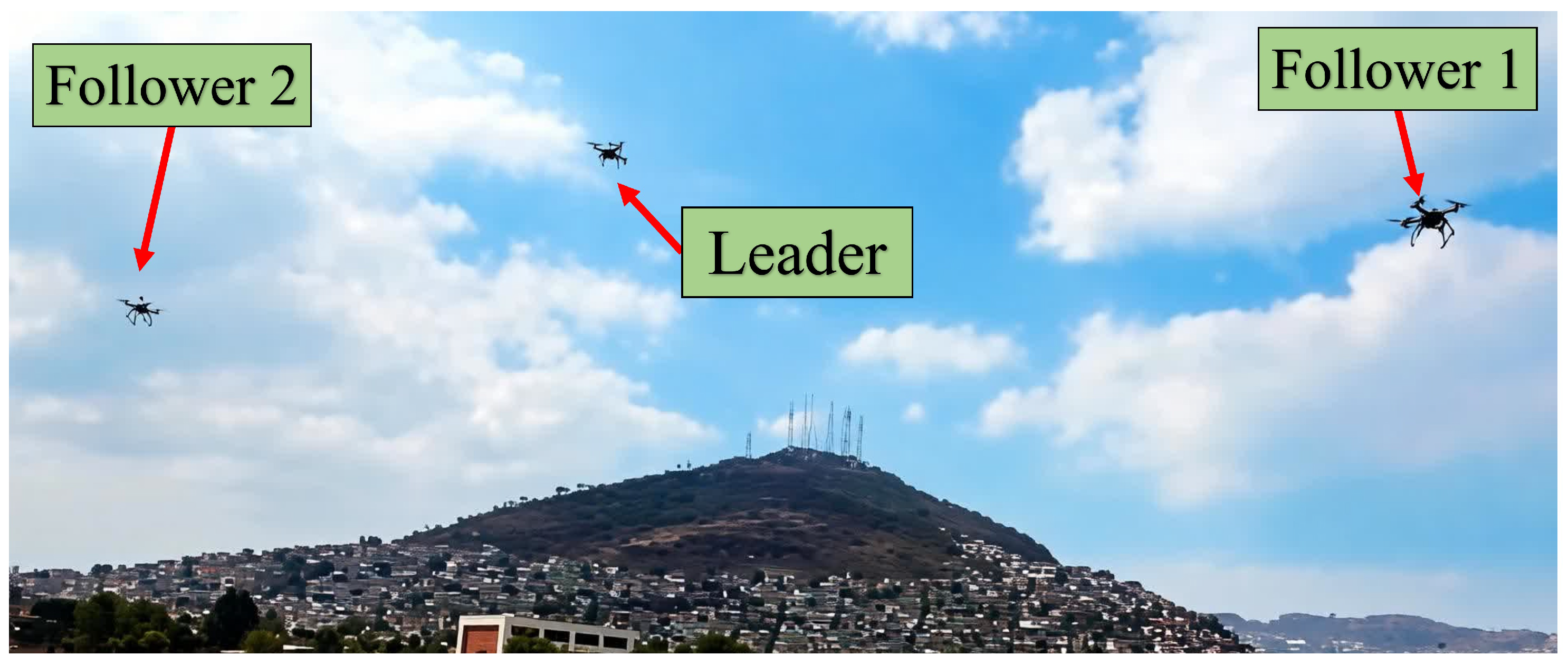
The experimental platform consists of a three-UAV leader–follower swarm deployed in an outdoor open-field environment. The overall swarm architecture and leader–follower roles are illustrated in
Figure 3. One UAV acts as the leader and defines the reference trajectory, while the remaining UAVs operate as followers and maintain prescribed relative positions using distributed formation control.
Each UAV is equipped with a Pixhawk 6C autopilot (Holybro, Shenzhen, China), a Here3+ GNSS receiver (Hex Technology Ltd., Shanghai, China), a LoRa 2.4 GHz transceiver (Ebyte Information Technology Co., Ltd., Chengdu, China), and an onboard Raspberry Pi 5 computer (Raspberry Pi Foundation, Cambridge, United Kingdom) used for packet timestamping and data logging. The communication and flight parameters of the experimental setup are summarized in
Table 1.
Inter-UAV distances were computed from GNSS position estimates provided by the Here3+ receivers, whose nominal horizontal accuracy is on the order of decimeters under open-sky conditions. All UAVs employed omnidirectional 3 dBi LoRa antennas mounted on the airframe, without directional beamforming or antenna tracking. Consequently, the measured delays inherently capture orientation-dependent fading, protocol-level effects, buffering dynamics, and mobility-induced variability, rather than idealized free-space propagation conditions.
Flights were conducted at an altitude of approximately 10 m above ground level and at a nominal forward speed of 5 m/s, which are representative of coordinated sensing and monitoring missions typically performed by small multirotor UAV platforms. The flight scenario used for delay measurements is shown in
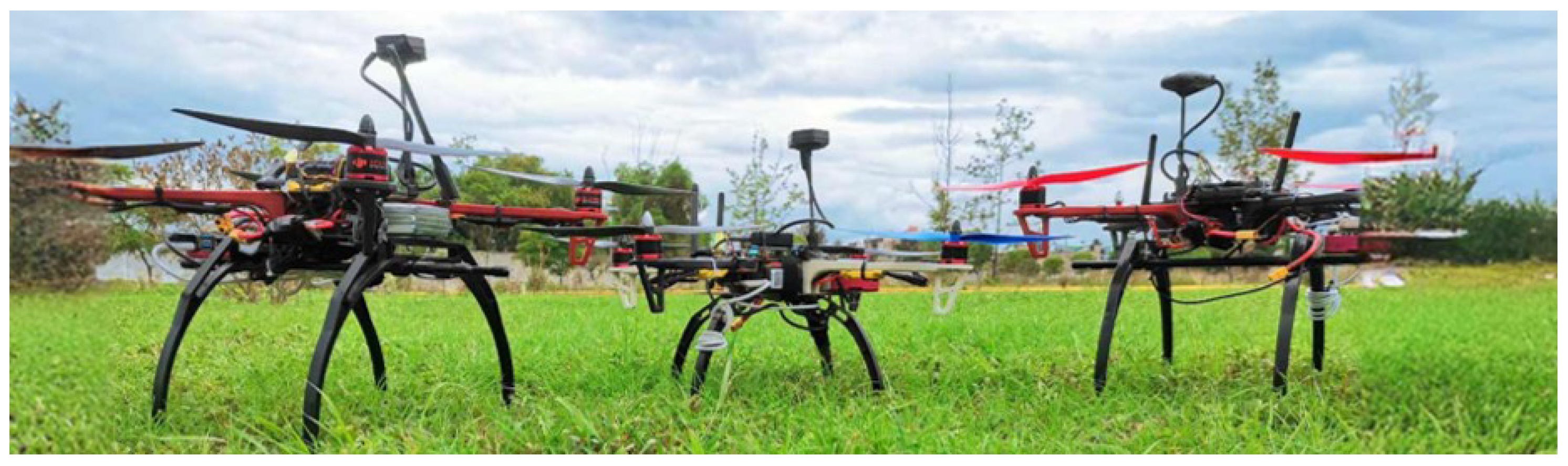
Figure 4, where the leader UAV follows a circular trajectory while the follower UAVs maintain fixed radial offsets, resulting in a circular swarm formation. A photograph of the deployed multi-UAV platform during the flight campaign is provided in
Figure 5.
LoRa technology was selected because it produces realistic packet-level latency variability under aerial operating conditions, including retransmissions, medium access contention, burst delays, and non-negligible jitter. These effects generate latency distributions that are representative of real wireless links used in distributed UAV coordination scenarios. Nevertheless, the proposed framework is communication-technology-agnostic and may be applied to other wireless technologies, including WiFi, LTE, or emerging 5G/6G URLLC systems, once empirical latency statistics are available.
3.2. Delay Measurement Procedure
During flight operations, each UAV periodically transmits timestamped packets containing its local clock value and a unique identifier. One of the UAVs logs both the transmission and reception timestamps, together with GNSS-based estimates of the inter-UAV separation. This approach produces synchronized delay–distance pairs without requiring explicit clock alignment beyond the common GNSS time reference.
The measurement campaign spans multiple flight segments executed under dynamic motion, varying inter-UAV distances, and continuously changing antenna orientations. In total, more than delay samples were collected. As a result, the dataset captures the combined impact of medium access behavior, onboard processing latency, retransmissions, and transient link impairments that naturally arise in realistic aerial communication scenarios.
The objective of the experimental campaign is not to directly reproduce large-scale UAV swarms in real flight, but rather to obtain realistic per-link communication latency statistics under representative aerial operating conditions. The collected delay samples capture protocol scheduling dynamics, buffering effects, retransmissions, and mobility-induced variability that are difficult to accurately reproduce using purely synthetic communication models.
3.3. Empirical Delay Characteristics
Analysis of the measured data reveals a delay distribution dominated by a narrow central mode accompanied by a pronounced right tail associated with sporadic burst events. Across all flight segments, the mean observed delay is 7.78 ms with a standard deviation of 2.94 ms, yielding a coefficient of variation of .
The distribution is characterized by strong positive skewness (4.72) and high kurtosis (43.9), which indicate the presence of infrequent but substantial latency outliers. Delays exceeding 15 ms occur with a probability of approximately 1.8%.
These statistics confirm that aerial communication latency is dominated by protocol-level dynamics and transient link effects rather than by smooth distance-dependent propagation alone. In particular, the heavy-tailed behavior indicates the presence of sporadic high-latency events that cannot be captured by deterministic delay bounds or purely average-based models.
These observations motivate the adoption of a stochastic delay model capable of reproducing both the central latency mode and the rare but operationally significant burst events that affect distributed formation control stability.
The statistical correlation between communication delay and inter-UAV distance is negligible (
), suggesting that protocol-level dynamics, antenna orientation, and mobility effects dominate over pure geometric propagation. Histogram, cumulative distribution function (CDF), and scatter visualizations of the measured delay data are presented in
Section 4.
3.4. Stochastic Delay Model
The objective of the delay model is not to provide a detailed protocol-level description of the communication stack, but rather to reproduce the dominant statistical characteristics observed in the measurements, including baseline latency, jitter variance, and heavy-tailed burst events. Similar statistical abstractions are commonly used in networked control and wireless latency modeling when detailed protocol dynamics are not required for system-level analysis [
14,
18,
25,
26,
27].
To reproduce the latency behavior observed during real flight experiments, a compact stochastic delay model is adopted:
where
denotes the baseline processing latency and protocol overhead, while
J represents a jitter component accounting for scheduling variability and buffering effects. The burst variable
models sporadic protocol-level latency events, including packet retransmissions, medium-access backoff, and temporary buffering delays that may occur under channel contention or short-term link degradation.
These mechanisms produce the heavy-tailed behavior observed in the empirical delay distribution, which cannot be adequately captured by smooth jitter models alone. For each transmitted packet, M represents a discrete realization of burst activity: corresponds to nominal transmission, whereas and represent one or two additional protocol slots associated with retransmission or backoff procedures. In the simulations, M is sampled from a categorical distribution with probability , where is estimated from the observed tail frequency in the measurement data. The probability mass corresponding to burst events is distributed between and so that the resulting synthetic delay distribution reproduces the upper-tail behavior of the empirical measurements.
The jitter component is modeled as a Gaussian random variable, which approximates the aggregate effect of multiple independent protocol and processing fluctuations. The parameter represents the characteristic duration of retransmission or backoff events.
The parameters of the stochastic model are selected to reproduce the first- and second-order statistics observed in the experimental measurements: ms, , ms, and .
The proposed stochastic delay model captures the dominant latency characteristics observed in the empirical dataset, including the central delay mode, jitter variance, and the burst-driven heavy-tail behavior reflected in the measured positive skewness and high kurtosis. The hybrid Gaussian–burst formulation provides a compact representation that reproduces both the main probability mass and the sporadic high-latency events most relevant to formation degradation under realistic operating conditions, maintaining low model complexity while preserving the latency mechanisms that most strongly affect distributed control performance. The independence assumption adopted for per-hop delay samples represents a first-order approximation commonly used in networked control system analysis; although delay correlation may arise in practical wireless environments due to shared medium access, congestion, or interference effects, the objective of the model is not to replicate protocol-level dynamics in full detail but to capture the dominant experimentally observed latency statistics in a tractable form that enables systematic delay-feasibility analysis linking communication behavior with controller performance constraints.
While a distance-dependent component could in principle be incorporated into (
6), the experimental measurements indicate negligible correlation between communication delay and inter-UAV separation. This observation suggests that protocol scheduling, buffering, retransmissions, and medium-access contention dominate over smooth propagation-driven latency effects in the aerial scenario considered here. For this reason, a distance-independent stochastic formulation per hop is adopted without compromising modeling fidelity.
3.5. Analytical Delay–Feasibility Model
While the stochastic delay model enables Monte Carlo evaluation of multi-hop communication latency, it is also useful to obtain closed-form analytical approximations that link communication statistics with the controller delay tolerance surface
. Analytical latency aggregation models of this type are widely used in networked control systems and multi-hop wireless networks to connect link-level delay statistics with system-level performance metrics [
25,
26,
28].
The analytical formulation developed below provides tractable predictions of swarm reliability, delay-budget utilization, and maximum feasible swarm size as functions of swarm geometry and communication load. These expressions are later validated through Monte Carlo simulations using the empirically calibrated stochastic delay model.
3.5.1. Analytical Reliability Model
To complement the measurement-informed Monte Carlo evaluation presented in
Section 4, we derive an analytical approximation that links the statistics of the stochastic delay model in (
6) with the controller delay tolerance
obtained in
Section 2. The objective of this formulation is to obtain a tractable analytical prediction of swarm reliability and scalability under stochastic multi-hop latency. Similar probabilistic reliability approaches have been widely used in the analysis of wireless multi-hop networks and networked control systems, where stochastic communication delays affect system stability [
25,
27].
Let
denote the stochastic delay of a single communication hop, as defined in (
6). The first two statistical moments of the per-hop delay are
where
and
denote the mean and variance of the jitter component and the statistics of the burst variable
M follow the categorical distribution described in
Section 3.
Consider a swarm composed of one leader and followers communicating through multi-hop links. Let denote the number of hops between the leader and follower i, and let denote the load factor used later in the scalability analysis to emulate increased communication contention.
The accumulated communication delay experienced by follower
i can be written as
where
are independent realizations of the stochastic per-hop delay in (
6). This formulation is consistent with standard latency-accumulation models used in multi-hop wireless networks and networked control systems [
25,
27,
28,
29].
Under the independence assumption, the first two moments of the accumulated delay become
For moderate hop counts, the central limit theorem allows the end-to-end delay distribution to be approximated as [
30,
31]
Let
denote the maximum admissible end-to-end delay obtained from the control-level stability analysis in
Section 2. The probability that follower
i satisfies the controller delay constraint can then be approximated as
where
denotes the standard normal cumulative distribution function.
Since formation stability requires that the delay constraint be satisfied for all followers, a conservative approximation of swarm reliability can be obtained by considering the worst communication path with hop count
a common conservative assumption in delay-aware networked control and multi-hop wireless systems [
22,
29]
Substituting
into (
13) yields the analytical prediction of swarm reliability
The Gaussian approximation provides a tractable representation of delay accumulation across multi-hop communication paths. Although heavy-tail delay events may introduce deviations near reliability transition regions, the analytical formulation captures the dominant delay propagation behavior and provides useful insight into delay-feasible operating regions. Monte Carlo simulations are used to validate the accuracy of the approximation under the considered operating conditions.
3.5.2. Analytical Delay-Budget Utilization
Beyond reliability, it is also useful to quantify how efficiently the controller delay budget is utilized by the communication process.
For this purpose, we define the delay-budget utilization metric
where
denotes the worst end-to-end delay among all followers.
Using the worst-case hop approximation
, the expected accumulated delay becomes
Substituting this result into (
16) yields the analytical prediction of delay-budget utilization
The quantity therefore represents the fraction of the controller delay tolerance consumed by the expected multi-hop communication latency. Values indicate feasible operation, while marks the boundary where communication delays begin to saturate the allowable control latency.
3.5.3. Analytical Prediction of Maximum Swarm Size
The analytical reliability model in (
15) can also be used to estimate the maximum swarm size that can be supported while satisfying a minimum reliability requirement.
Specifically, the analytical prediction of the maximum feasible swarm size is defined as
Using the Gaussian approximation in (
15), the feasibility condition can be written as
where
.
Equation (
20) therefore provides an analytical estimate of swarm scalability by linking the admissible controller delay tolerance, the statistics of the communication latency, and the multi-hop swarm topology.
The numerical results presented in
Section 4 validate these analytical predictions through Monte Carlo simulations of the multi-hop delay process using the empirically calibrated stochastic delay model. In particular, the comparison between analytical predictions and Monte Carlo evaluations enables quantifying the accuracy of the proposed delay-feasibility model across different swarm sizes, inter-UAV separations, and network load conditions.
3.6. Discussion on Scalability and Extrapolation to Larger Swarms
The objective of the experimental campaign is not to directly replicate large-scale UAV swarms in real flight, but rather to obtain realistic per-link communication latency statistics under representative aerial operating conditions. The collected delay samples capture key phenomena such as protocol scheduling dynamics, buffering effects, retransmissions, and mobility-induced variability, which are difficult to accurately reproduce using purely synthetic communication models.
Accordingly, the goal of this work is not to claim universal scalability limits for UAV swarms, but to provide a measurement-grounded methodological framework that links empirical communication latency statistics with controller-specific delay tolerance limits. This approach enables realistic estimation of delay-feasible operating regions while preserving consistency with experimentally observed communication behavior.
The experiments were conducted using a leader–follower platform composed of three UAVs due to practical constraints related to flight safety and hardware availability. Consequently, the measurements aim to characterize representative per-hop delay behavior under realistic flight conditions, rather than directly emulating dense swarm deployments.
The proposed framework separates link-level delay characterization from network-level delay accumulation. The stochastic delay model in (
6) captures baseline latency, jitter, and burst events at individual wireless hops, while end-to-end latency in larger swarms emerges from the aggregation of these per-hop delay realizations along multi-hop communication paths.
As swarm size and communication density increase, medium contention, retransmissions, and protocol-level congestion further degrade network performance. These effects are incorporated through the load factor
, which scales the per-hop delay realizations in the multi-hop simulations of
Section 4, where
represents nominal traffic conditions and
emulates heavier network loads.
This measurement-informed modeling approach enables systematic evaluation of delay-limited swarm stability across configurations that are impractical to test experimentally while remaining anchored to realistic communication behavior. The objective of the scalability analysis is therefore not to claim universal capacity limits for UAV swarms, but to provide a measurement-grounded methodology that links empirical communication latency statistics with controller-specific delay tolerance limits. Accordingly, the results should be interpreted as delay-feasible operating regions conditioned on the communication assumptions adopted in the model, rather than absolute scalability bounds applicable to all swarm architectures or wireless technologies.
4. Results and Discussion
This section integrates the control-level delay tolerance obtained in
Section 2 with the measurement-calibrated stochastic delay model introduced in
Section 3 in order to quantify how communication latency constrains the scalability of UAV swarm formations.
The analysis is organized into three complementary stages. First, the formation-level impact of communication delay on ARD–PF stability is illustrated through representative trajectory simulations. Second, the measurement-calibrated stochastic delay model is validated against the experimental dataset collected during the flight campaign. Finally, the analytical delay-feasibility framework derived in
Section 3.5 is validated by comparing its predictions with Monte Carlo simulations of the multi-hop delay process.
Together, these results demonstrate how empirically observed communication latency can be translated into quantitative predictions of swarm reliability, delay-budget utilization, and maximum feasible swarm size under realistic communication conditions.
4.1. Formation Behavior Under Communication Delay
The effect of communication latency on formation stability is first illustrated using a five-UAV circular swarm configuration described in
Section 2. The leader follows a circular trajectory with radius
m while the followers maintain fixed radial offsets.
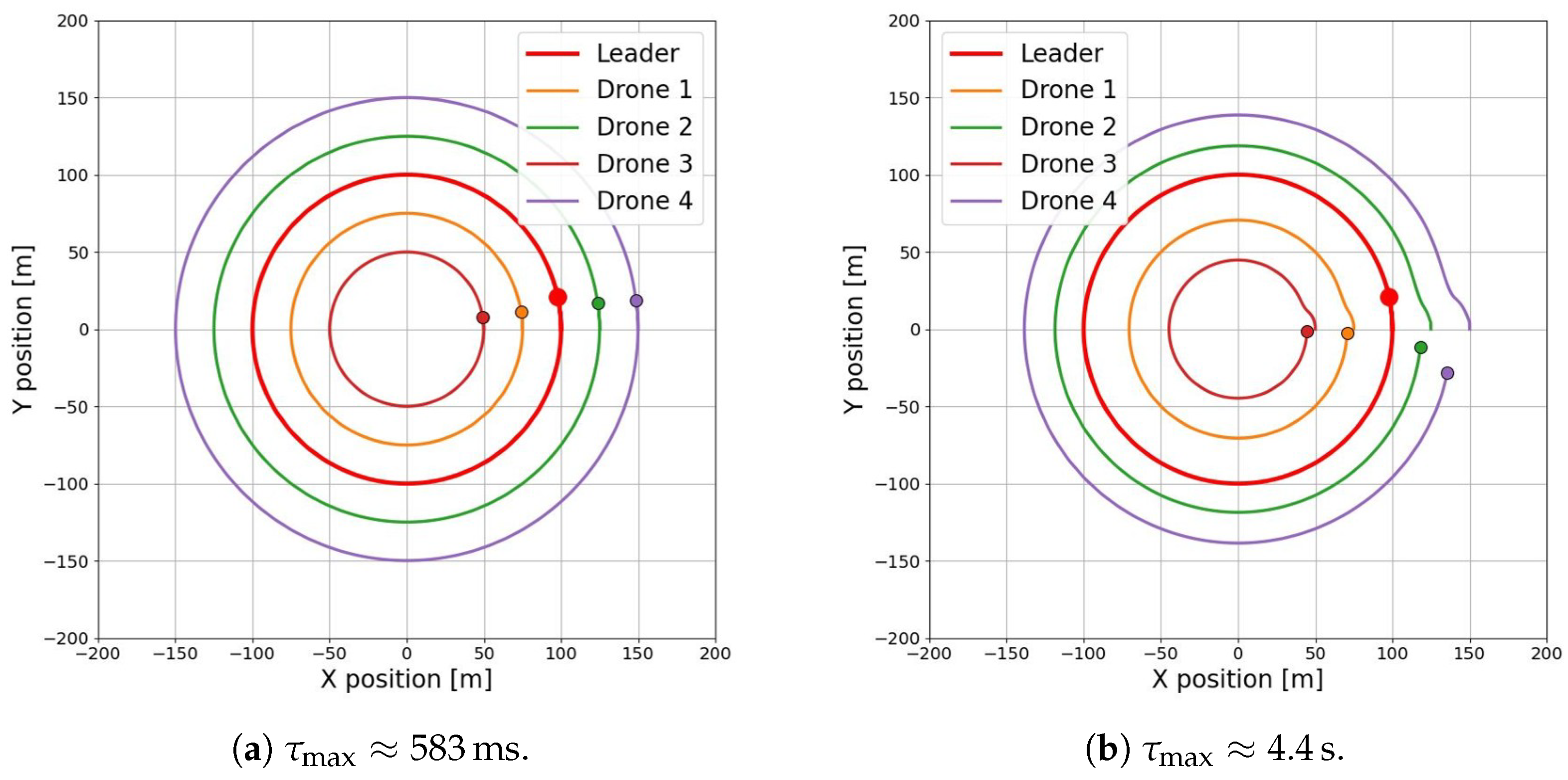
Representative trajectories are shown in
Figure 6. When the communication delay remains below the admissible threshold (
ms), the swarm preserves its geometric structure and followers remain close to their desired positions. In contrast, when the delay significantly exceeds the controller tolerance (
s), the formation gradually loses coherence due to delayed state information, resulting in visible phase lag with respect to the leader trajectory and progressive position drift of the followers.
These results illustrate the mechanism through which communication delay affects formation stability. When delayed state information is used in the feedback loop, the controller reacts to outdated neighbor positions, which introduces phase mismatch in the attractive–repulsive interaction forces. As the delay increases, this mismatch accumulates and eventually prevents the swarm from maintaining coherent geometric alignment with the leader trajectory.
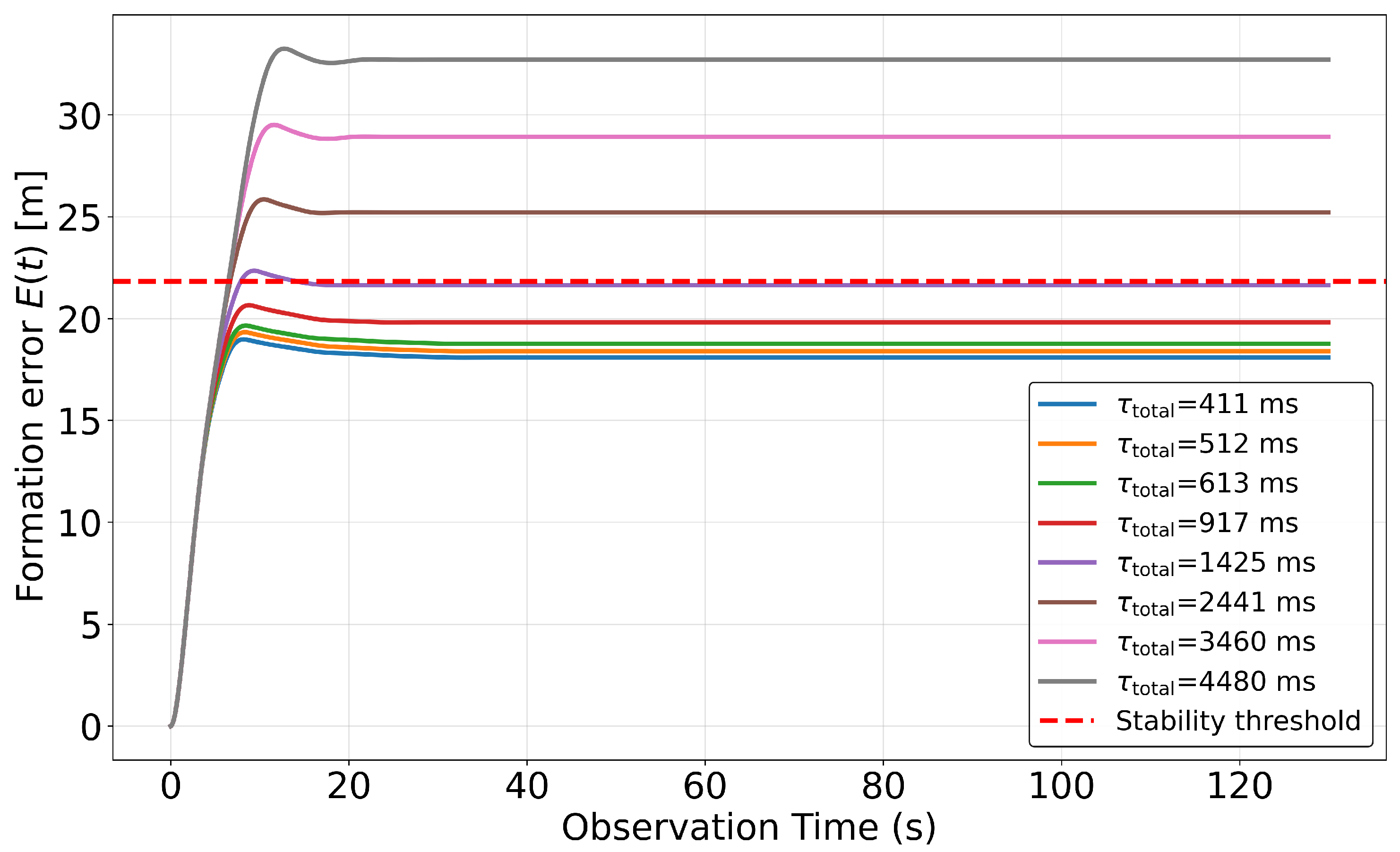
The evolution of the maximum formation error
is shown in
Figure 7. For delays below the admissible bound, the error remains bounded and close to the delay-free baseline. Once the delay exceeds the tolerance limit, the formation error grows rapidly, indicating the onset of instability.
Repeating this delay sweep across different swarm sizes and separations yields the admissible delay surface
reported in
Table 2. These delay bounds represent the controller-specific stability limits that will be used in the subsequent communication feasibility analysis.
4.2. Validation of the Stochastic Delay Model
The stochastic delay model proposed in
Section 3 is validated using more than 15,000 delay samples collected during real multi-UAV flight experiments.
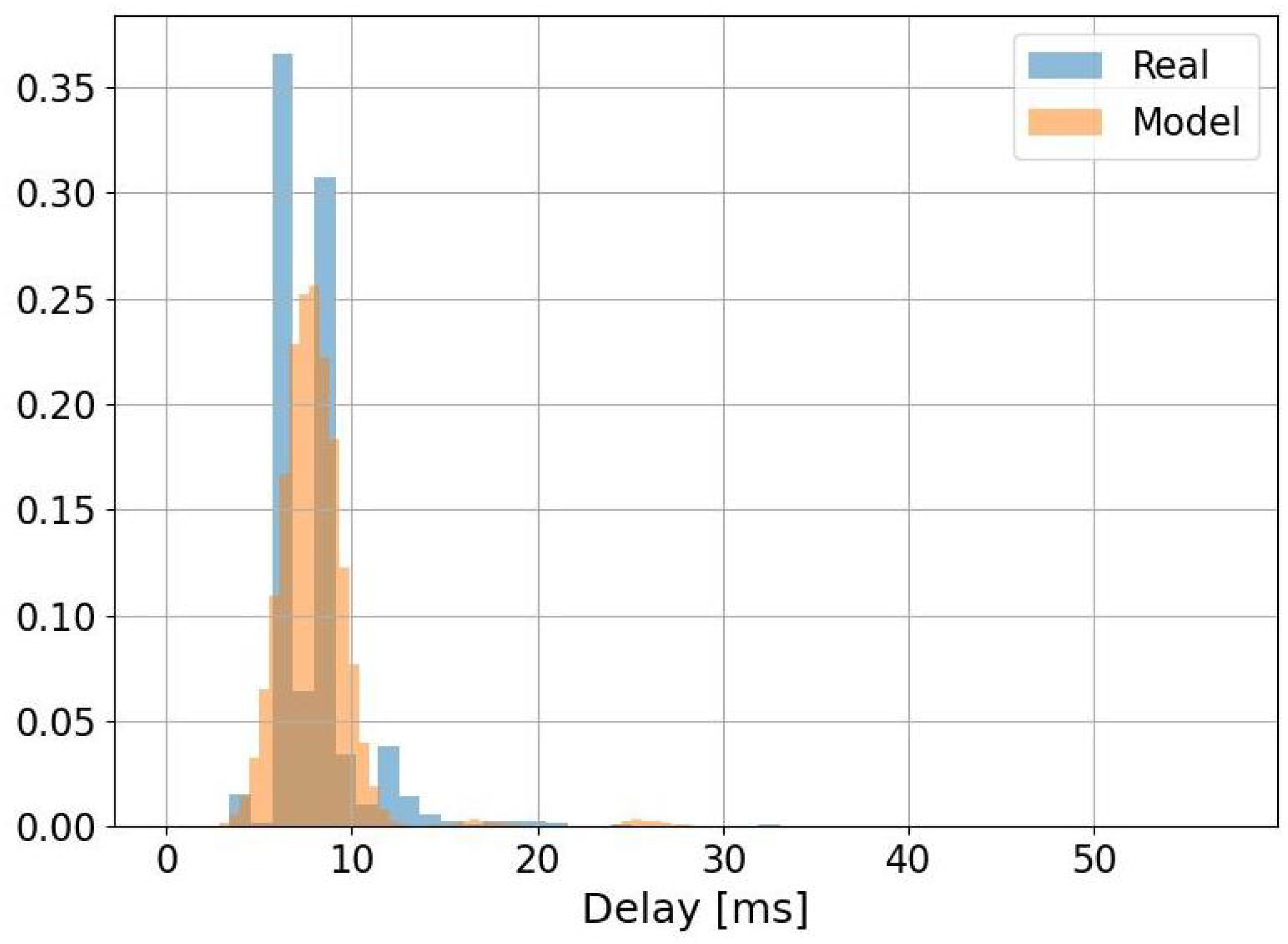
Figure 8 compares the empirical delay distribution with synthetic realizations generated using the stochastic model in (
6). The model successfully reproduces the dominant latency mode as well as the heavy-tailed behavior associated with burst-induced delay events.
Importantly, the synthetic distribution preserves both the dominant central latency mode and the rare high-delay realizations observed in the experimental dataset. These burst events correspond to sporadic protocol-level effects, such as retransmissions or temporary medium access contention, which are explicitly captured by the burst component of the stochastic model in (
6).
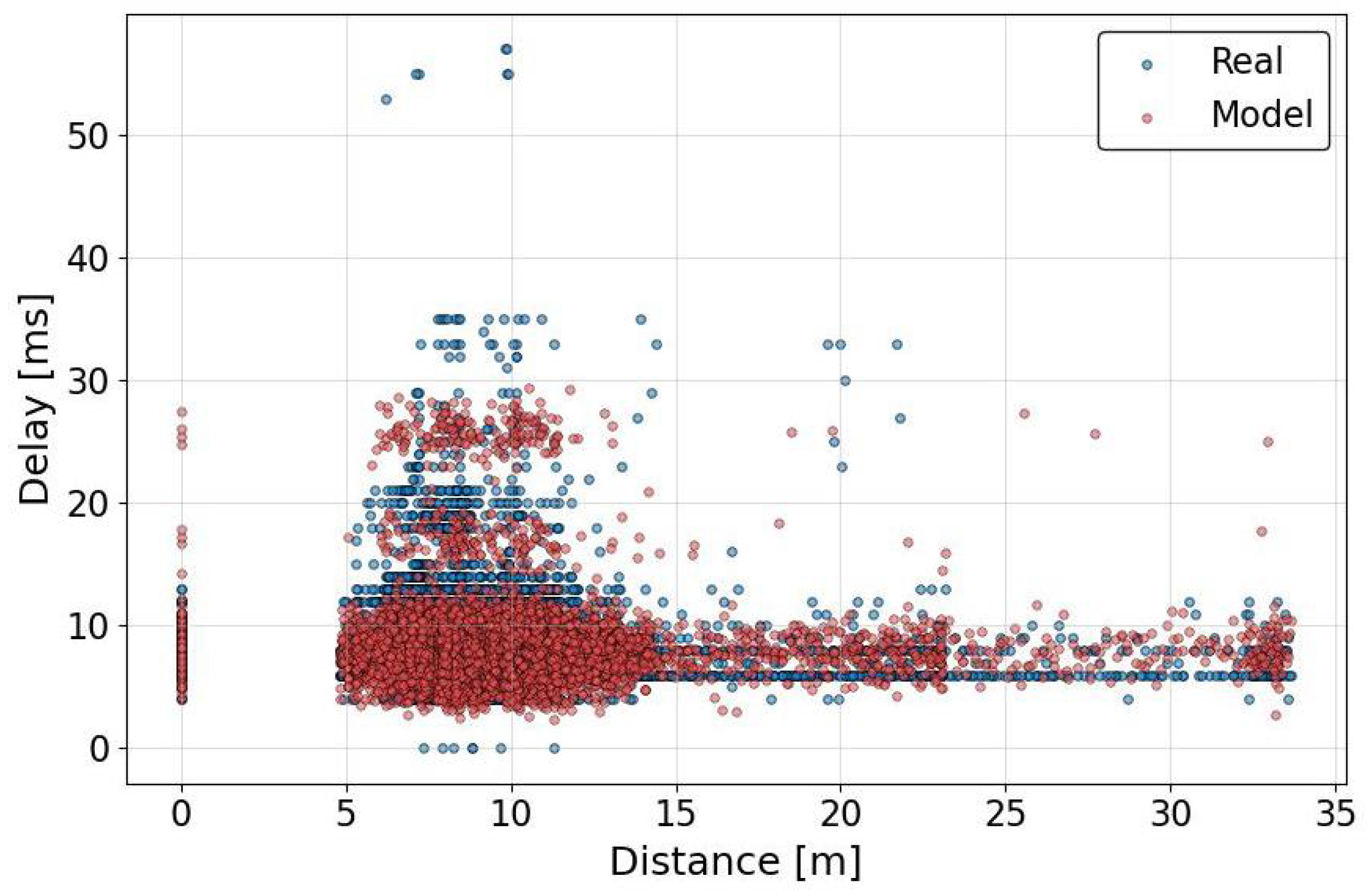
The relationship between delay and inter-UAV distance is illustrated in
Figure 9. Both real and synthetic datasets exhibit negligible correlation with distance, confirming that protocol-level dynamics dominate over propagation delay in the aerial communication scenario considered here.
4.3. Validation of the Analytical Reliability Model
Section 3.5 introduced an analytical approximation of swarm reliability based on the Gaussian aggregation of multi-hop delays. The analytical prediction
in (
15) is validated against the Monte Carlo estimate
.
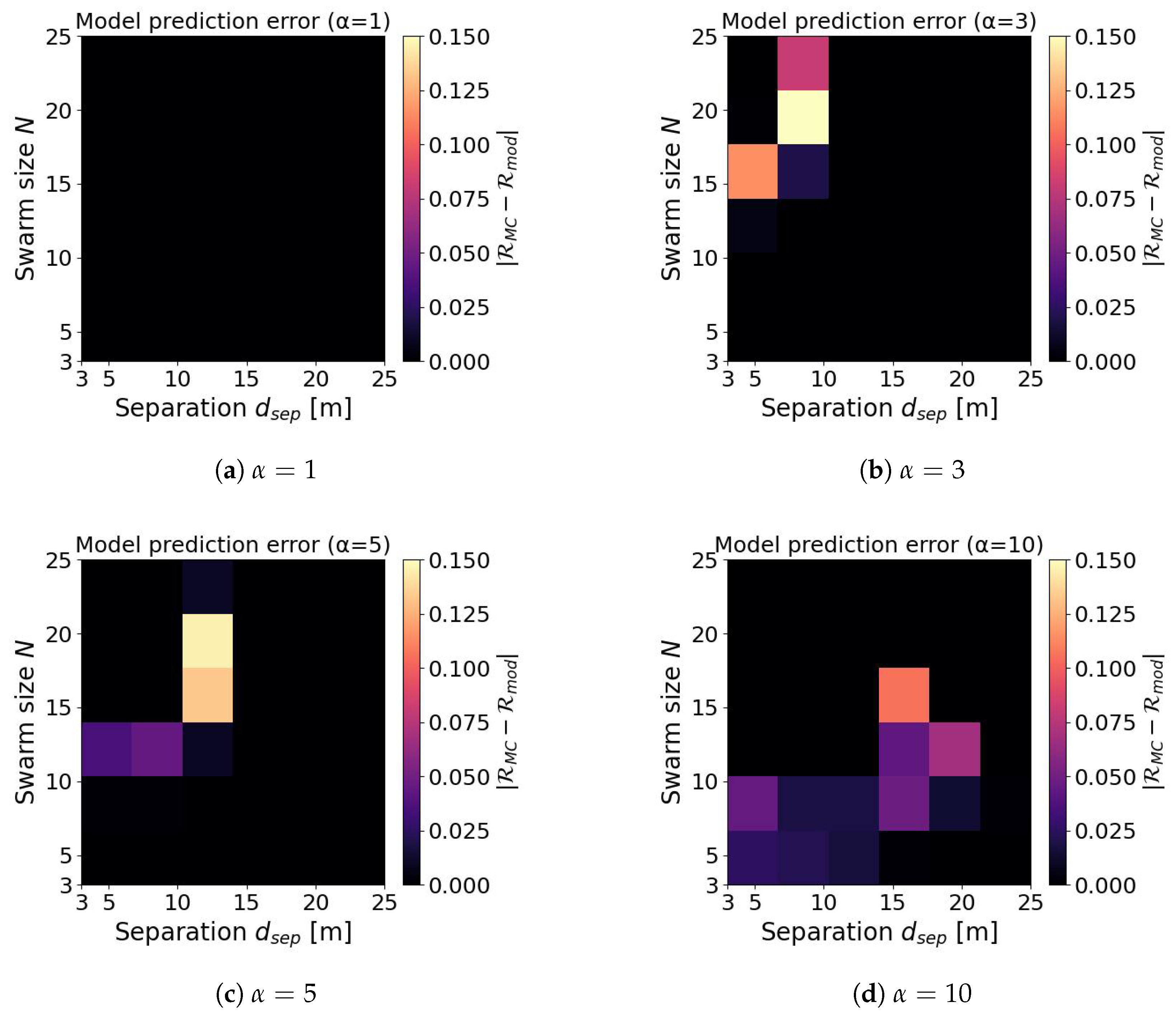
The prediction error across the evaluated parameter space is shown in
Figure 10. In most operating regions, the error remains close to zero, indicating excellent agreement between the analytical approximation and the Monte Carlo simulations. Larger deviations appear near the reliability transition boundary, where burst-induced delay events produce heavy-tailed latency realizations not perfectly captured by the Gaussian approximation.
Across most of the evaluated parameter space, the prediction error remains very small, confirming that the Gaussian aggregation of multi-hop delays provides an accurate approximation of the reliability behavior produced by the stochastic delay process. The largest deviations appear near the reliability transition boundary where , since rare burst-induced delay events introduce heavy-tailed latency realizations that are not fully captured by the Gaussian approximation.
Despite these localized deviations, the analytical model correctly reproduces the overall reliability trends and accurately predicts the regions where the communication delay begins to violate the controller stability constraint.
4.4. Validation of the Delay-Budget Utilization Model
The delay-budget utilization metric defined in (
18) provides a measure of how much of the controller delay tolerance is consumed by communication latency.
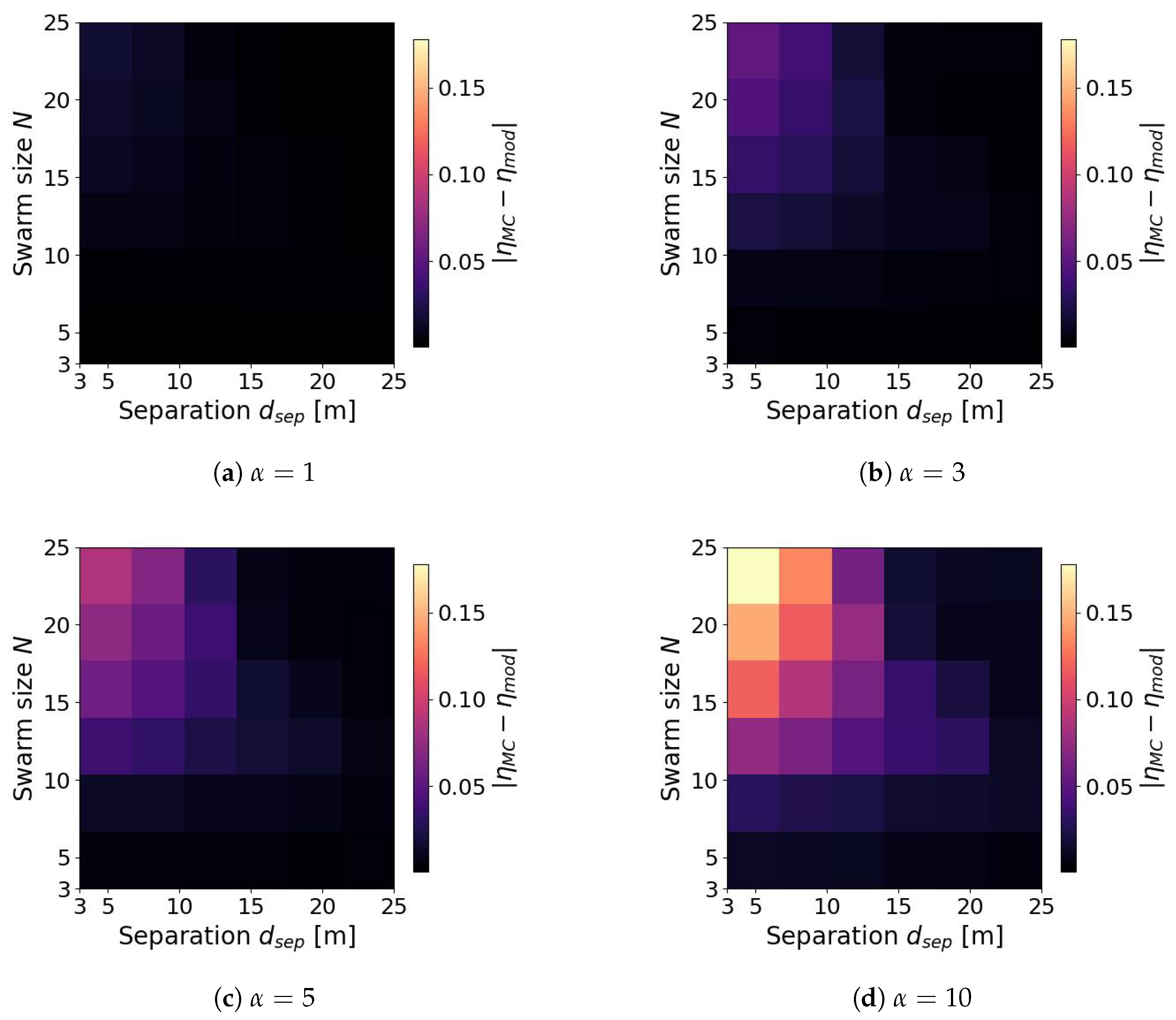
Figure 11 compares the analytical prediction
with the Monte Carlo estimate
. The resulting error remains small across most configurations, confirming that the analytical formulation accurately captures the expected multi-hop delay accumulation.
The largest deviations again occur near the transition region, where stochastic burst events produce occasional extreme delay realizations.
These results indicate that the analytical expression in (
18) accurately captures the average accumulation of communication delay along multi-hop paths. Since the metric
depends primarily on the first-order statistics of the delay process, its analytical prediction is particularly robust across different swarm sizes and communication load conditions.
4.5. Validation of Maximum Swarm Size Prediction
Finally, the analytical prediction of the maximum feasible swarm size
derived in (
19) is compared with the value obtained from Monte Carlo simulations.
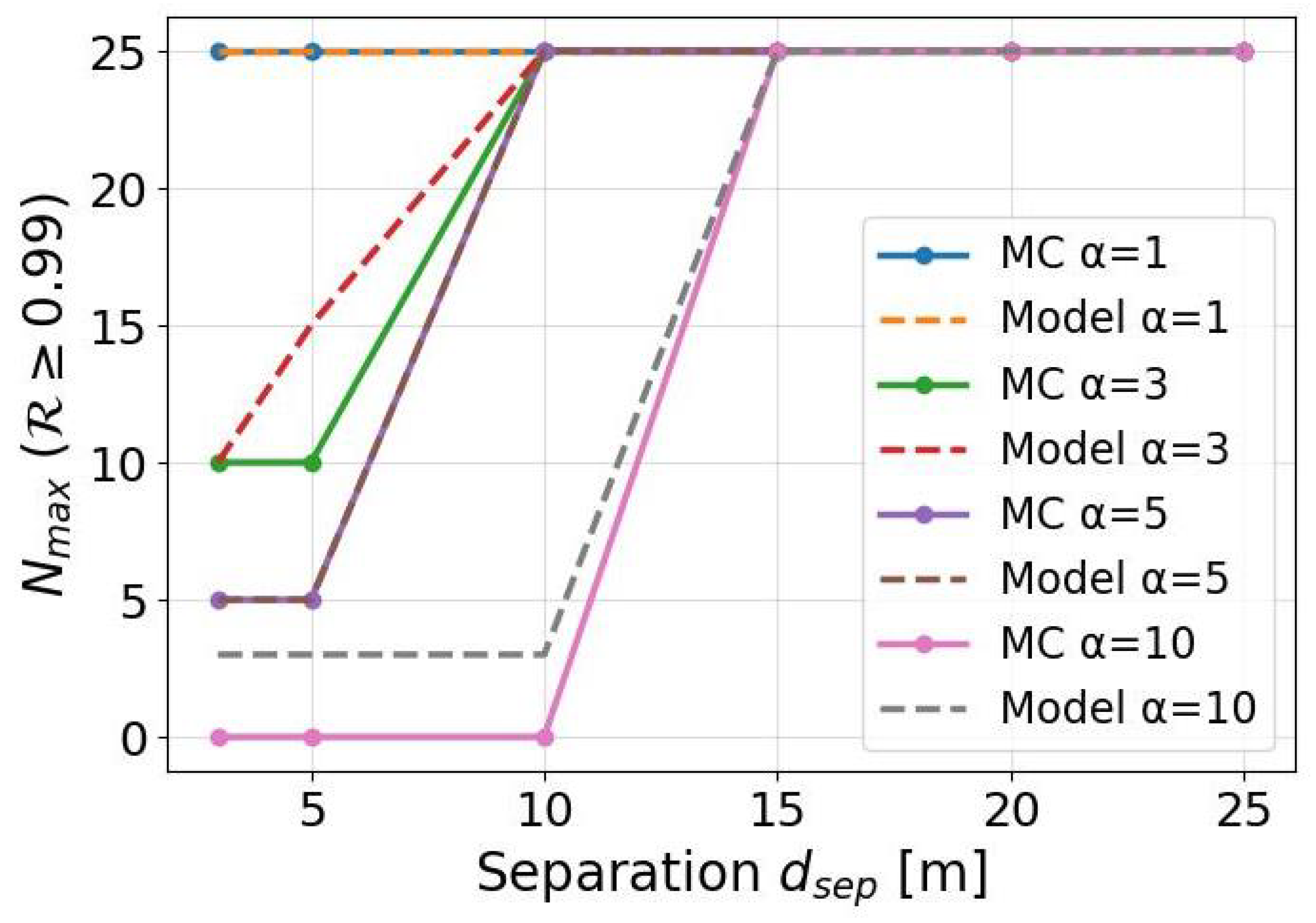
Figure 12 shows the maximum admissible swarm size as a function of inter-UAV separation for different communication load factors. The analytical prediction closely follows the Monte Carlo results, accurately identifying the transition point where accumulated communication delay begins to violate the reliability constraint
.
The close agreement between the analytical prediction and the Monte Carlo results indicates that the proposed delay-feasibility framework can reliably estimate swarm scalability limits using only the controller delay tolerance surface and the statistical parameters of the communication latency model.
These results confirm that the analytical delay-feasibility framework can accurately estimate swarm scalability limits without requiring extensive Monte Carlo simulations.
4.6. Scope and Limitations of the Present Validation
The validation presented in this work supports three main observations. First, the stochastic delay model proposed in
Section 3 successfully reproduces the dominant statistical characteristics of the measured aerial communication latency, including the central delay mode, jitter variability, and heavy-tailed burst events observed in the experimental dataset. Second, the ARD–PF controller exhibits a configuration-dependent operational delay tolerance that can be quantified through the formation-error criterion introduced in
Section 2.3. Third, when these empirically calibrated per-hop delay realizations are aggregated across multi-hop communication paths, stochastic latency can significantly restrict the feasible operating region of UAV swarm formations.
The analytical delay-feasibility framework developed in
Section 3.5 was further validated against Monte Carlo simulations of the stochastic delay process. The results show that the analytical predictions accurately reproduce the observed trends of swarm reliability, delay-budget utilization, and maximum feasible swarm size across the explored parameter space.
Nevertheless, the present study does not claim universal scalability limits across all swarm architectures or wireless technologies. The quantitative thresholds reported here depend on the specific formation controller, communication technology, and modeling assumptions adopted in the analysis. In particular, routing dynamics, correlated delay processes, adaptive medium-access mechanisms, and advanced delay-compensation strategies may modify the resulting operating regions. Although the analysis is presented using the ARD–PF controller as a representative distributed formation strategy, the proposed measurement-informed methodology may be applied to other formation control approaches once their delay tolerance characteristics are determined. Investigating these aspects constitutes an important direction for future research on communication-aware swarm control.
5. Conclusions
This work investigated how realistic communication latency constrains the scalability of UAV swarm formation control by combining control-level stability analysis with in-flight communication measurements from a real multi-UAV platform.
First, the delay tolerance of an ARD–PF formation controller was quantified as a function of swarm size and inter-UAV separation. The results show that admissible end-to-end communication delay strongly depends on the formation geometry, with dense formations exhibiting significantly lower delay tolerance than sparsely spaced swarms.
Second, flight experiments using LoRa communication links revealed that aerial communication latency is dominated by protocol-level jitter and sporadic burst events rather than smooth distance-dependent propagation effects. Based on these observations, a compact stochastic delay model was developed to reproduce the statistical characteristics of the measured latency distribution.
Third, combining the empirically calibrated delay model with the controller-specific delay tolerance limits enabled the evaluation of swarm scalability under realistic communication conditions. The resulting framework characterizes swarm feasibility in terms of three complementary metrics: communication reliability, delay-budget utilization, and the maximum admissible swarm size under multi-hop delay accumulation.
The analytical delay-feasibility model introduced in
Section 3.5 was validated against Monte Carlo simulations of the stochastic delay process. The results show that the analytical formulation accurately predicts the reliability degradation, delay-budget utilization, and swarm capacity limits observed in the numerical experiments, while requiring significantly lower computational effort.
Overall, the results demonstrate that stochastic communication latency can substantially limit the feasible operating region of UAV swarm formations, particularly under increasing communication load. The analysis highlights the importance of incorporating measurement-based latency models and delay-aware control considerations when designing large-scale UAV swarm systems.
The proposed framework should therefore be interpreted as a communication–control analysis tool rather than a universal predictor of swarm capacity. Its primary contribution lies in linking experimentally observed latency statistics with controller-dependent delay-feasibility regions, enabling a realistic evaluation of communication requirements for distributed UAV coordination.
Future work will investigate delay-aware networking strategies, adaptive swarm communication architectures, and experimental validation under heavier traffic conditions and with alternative wireless technologies such as 5G and 6G aerial communication systems.




 ,
,