
A Comprehensive Review of UAV Formation Control from a Mission-Driven Perspective


Highlights
- This review systematically deconstructs the UAV formation mission lifecycle from a mission-driven perspective, synthesizing key research across the three core sub-processes: formation assembly, formation maintenance, and formation reconfiguration.
- It provides a novel, multidimensional analysis framework of UAV formation performance evaluation, summarizing the state of the art in resilience, robustness, reliability, and vulnerability.
- The integrated architecture offers researchers and engineers a structured understanding of formation control, linking specific mission phases to appropriate control strategies and performance metrics.
- The identified research challenges and future directions, particularly in heterogeneous swarms and comprehensive evaluation systems, provide a roadmap for advancing the field toward more resilient and intelligent autonomous systems.
Abstract
1. Introduction
1.1. Background and Significance
1.2. Research Gap and Motivation
1.3. Novelty and Contributions
- (1)
- From a mission-driven perspective, this study takes the full lifecycle of UAV formation mission execution as its main thread to analyze and summarize the key sub-problems and core mission scenarios involved in the three main sub-processes: formation assembly, formation maintenance, and formation reconfiguration.
- (2)
- We summarize and analyze existing research on UAV formation performance evaluation from four dimensions—resilience, robustness, reliability, and vulnerability—and propose a comprehensive analytical framework. As far as we are aware, no previous work has systematically summarized research on UAV performance evaluation from multiple dimensions.
- (3)
- We discuss the current research gaps and future development directions in the field of UAV formation control.
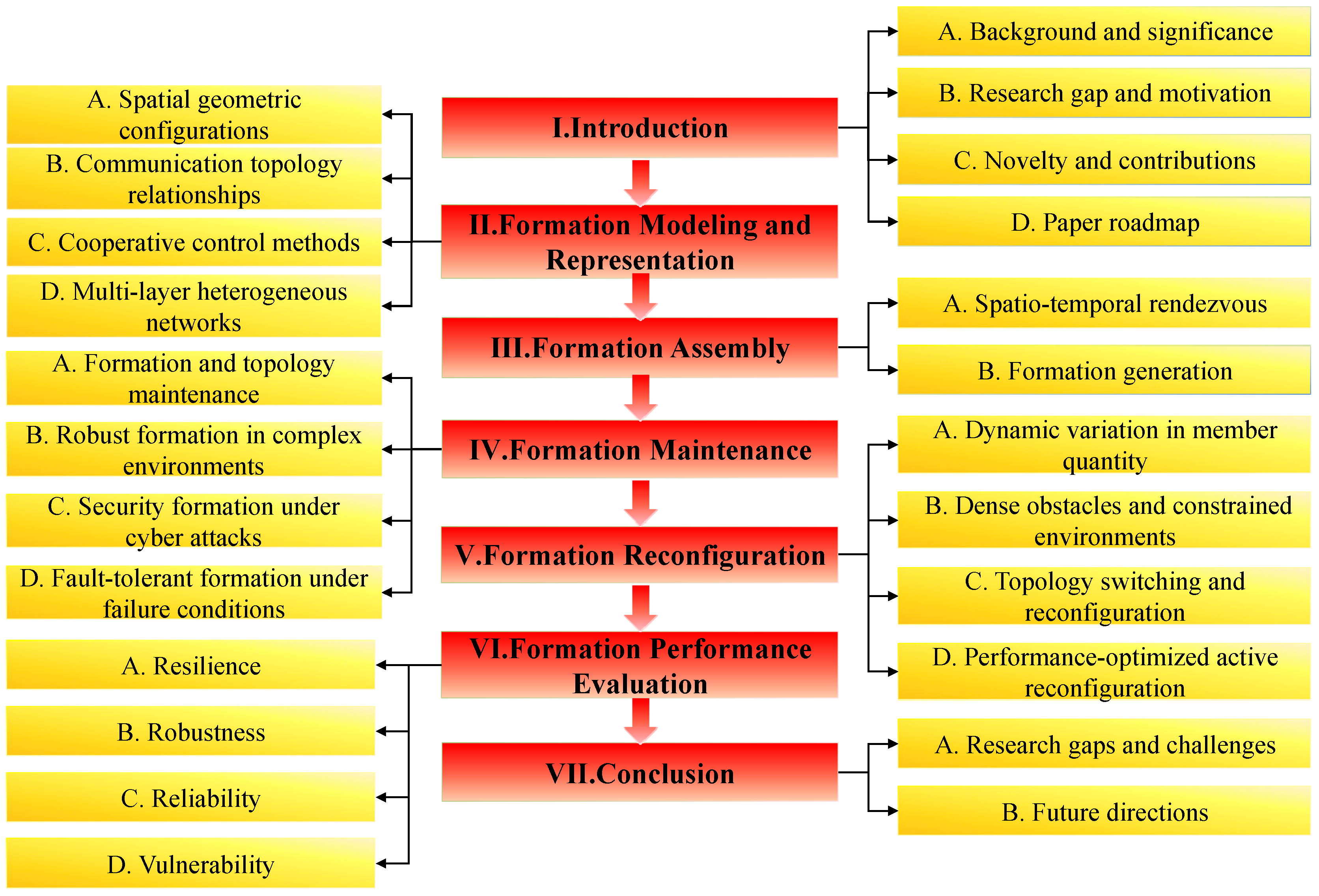
1.4. Paper Roadmap
2. Formation Modeling and Representation
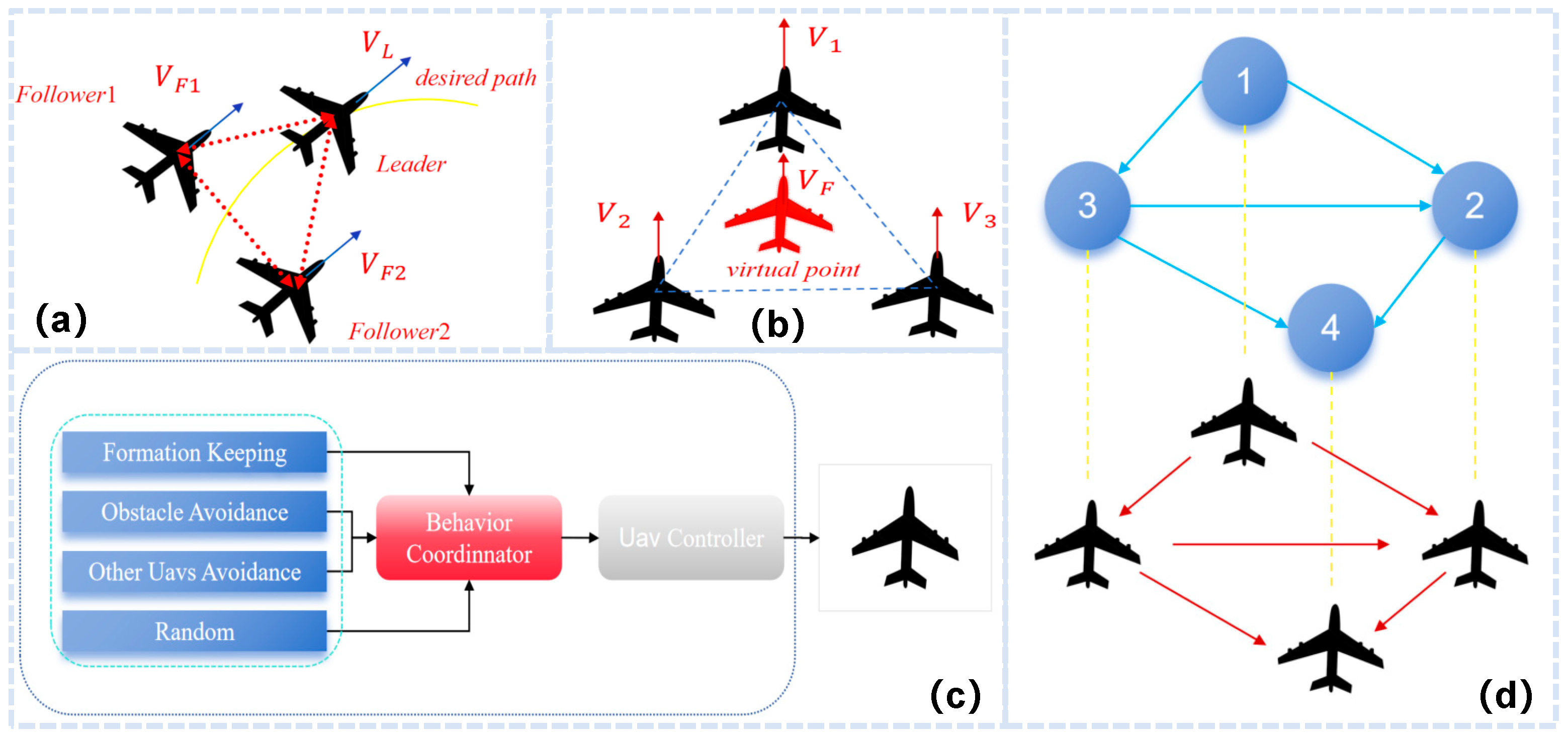
2.1. Spatial Geometric Configurations
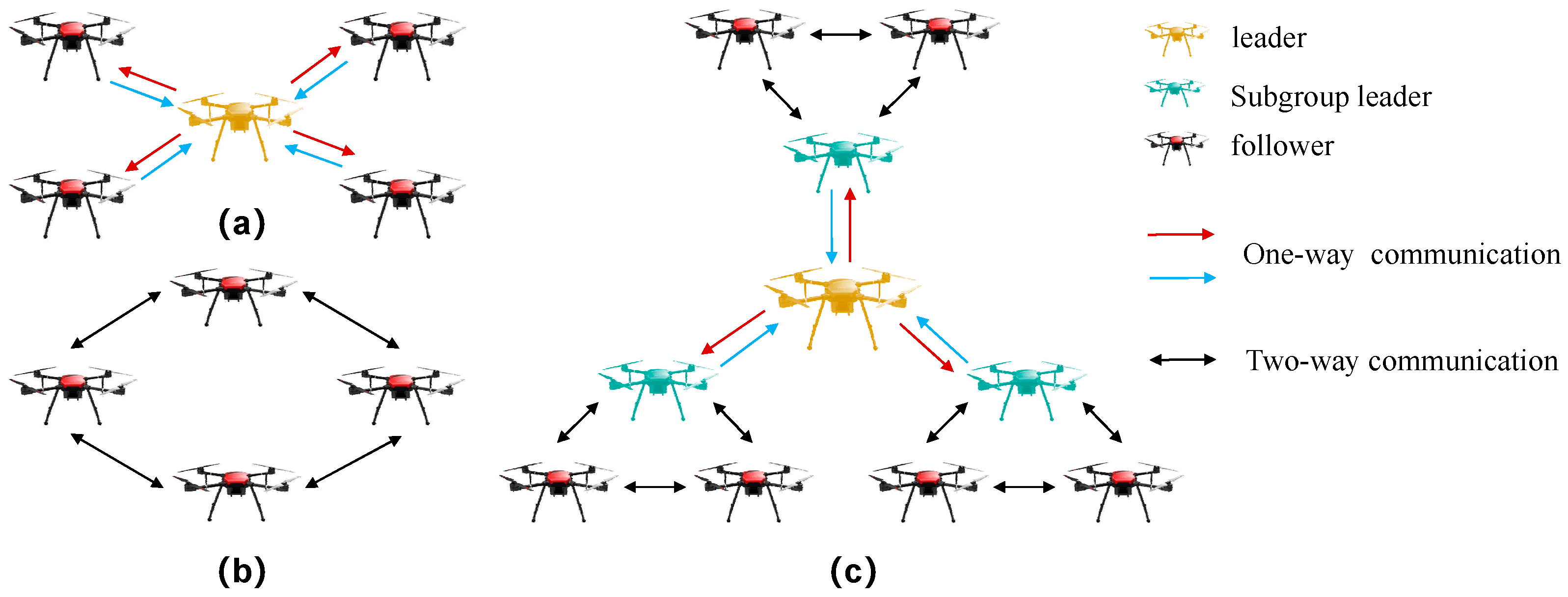
2.2. Communication Topology Relationships
2.3. Cooperative Control Methods
2.4. Multi-Layer Heterogeneous Networks
3. Formation Assembly
3.1. Spatiotemporal Rendezvous
- (1)
- Velocity-based method
- (2)
- Trajectory-based method
- (3)
- Guidance-based method
3.2. Formation Generation
4. Formation Maintenance
4.1. Formation and Topology Maintenance
4.1.1. Formation Maintenance

| Reference | Geometric Constraint Description | Mobility and Flexibility | |
|---|---|---|---|
| Location-based | [109,110,111] | Invariant only under translation | Only capable of translational formation maneuvers |
| Displacement-based | [112,113,114] | ||
| Distance-based | [115,116,117,118] | Invariant under translation and rotation | Achieve translation and rotation formations |
| bearing-based | [89,90,91,92,95,96,97,98,119,120] | Invariant under translation and scaling motions | Implement panning and zooming formations |
4.1.2. Topology Maintenance
4.2. Robust Formation in Complex Environments
4.2.1. Wind Disturbance
- (1)
- method based on disturbance estimation and compensation
- (2)
- method based on robust control theory
- (3)
- method based on deep neural networks
4.2.2. GNSS Denial
4.2.3. Obstacle Environment
- (1)
- Potential field method
- (2)
- Geometry-based method
- (3)
- Optimization-based method
- (4)
- Learning-based method
4.3. Security Formation Under Cyber Attacks
4.3.1. Deception Attack
4.3.2. Replay Attack
4.3.3. Denial-of-Service Attack
4.4. Fault-Tolerant Formation Under Fault Conditions
4.5. Discussion
5. Formation Reconfiguration
5.1. Dynamic Variation in Member Quantity
5.1.1. Changes in the Number of Formation Members
5.1.2. Changes in Formation Leadership and Control
5.2. Dense Obstacles and Constrained Environments
- (1)
- Method based on affine transformations
- (2)
- Environment-Aware Formation Library method
- (3)
- Method based on swarm intelligence
5.3. Topology Switching and Reconfiguration
- (1)
- Methods based on graph theory and combinatorial optimization
- (2)
- Methods based on performance evaluation
- (3)
- Self-healing control method
5.4. Performance-Optimized Active Reconfiguration
- (1)
- Parameterization and Time Discretization
- (2)
- Receding Horizon Control
- (3)
- Heuristic intelligent algorithm
5.5. Discussion
6. Formation Performance Evaluation
6.1. Resilience
- (1)
- Modeling and evaluation method based on complex networks and graph models
- (2)
- Quantitative method based on performance trajectories and metrics
6.2. Robustness
6.3. Reliability
- (1)
- Binary Decision Diagram (BDD)
- (2)
- The k-out-of-n (k/n) system theory
6.4. Vulnerability
6.5. Discussion
- (1)
- Key Differences
- (2)
- Internal Relationships
- ①
- Progressive Relationship Based on the Time Dimension
- ②
- Complementary Relationships Based on Functional Dimensions
- ③
- Closed-loop Relationship Based on the Design Dimension
7. Conclusions
7.1. Research Gaps and Challenges
- (1)
- Insufficient scalability and real-time autonomy in algorithmic computations
- (2)
- The evaluation of effectiveness lacks standardized benchmarks and a systematic framework
- (3)
- Insufficient attention to human–environment methods and system-level integration
- (4)
- Limited real-world validation and deployment
7.2. Future Directions
- (1)
- Algorithmic level: Developing resilient cooperative control for large-scale heterogeneous formation
- (2)
- Evaluation level: Establishing a scientific, universal, and practical formation effectiveness evaluation system
- (3)
- Real-World deployment verification: Achieving hybrid human-in-the-loop intelligence and system-level integration verification
Author Contributions
Funding
Data Availability Statement
Conflicts of Interest
References
- Zhang, Y.; Hu, Y.; Song, Y.; Zou, D.; Lin, W. Learning vision-based agile flight via differentiable physics. Nat. Mach. Intell. 2025, 7, 954–966. [Google Scholar] [CrossRef]
- Kim, M.; Bae, G.; Lee, J.; Shin, W.; Kim, C.; Choi, M.Y.; Shin, H.; Oh, H. RAPID: Robust and agile planner using inverse reinforcement learning for vision-based drone navigation. arXiv 2025, arXiv:2502.02054. [Google Scholar] [CrossRef]
- Wang, M.; Wang, Q.; Wang, Z.; Gao, Y.; Wang, J.; Cui, C.; Li, Y.; Ding, Z.; Wang, K.; Xu, C.; et al. Unlocking aerobatic potential of quadcopters: Autonomous freestyle flight generation and execution. Sci. Robot. 2025, 10, eadp9905. [Google Scholar] [CrossRef]
- Yashinski, M. Safe radiation surveillance using uncrewed vehicles. Sci. Robot. 2024, 9, eadp1760. [Google Scholar] [CrossRef]
- Liu, W.; Ren, Y.; Guo, R.; Kong, V.; Hung, A.; Zhu, F.; Cai, Y.; Wu, H.; Zou, Y.; Zhang, F. Slope inspection under dense vegetation using LiDAR-based quadrotors. Nat. Commun. 2025, 16, 7411. [Google Scholar] [CrossRef]
- Gu, J.; Su, T.; Wang, Q.; Du, X.; Guizani, M. Multiple moving targets surveillance based on a cooperative network for multi-UAV. IEEE Commun. Mag. 2018, 56, 82–89. [Google Scholar] [CrossRef]
- Hui, Y.; Zhang, X.; Shen, H.; Lu, H.; Tian, B. Dppm: Decentralized exploration planning for multi-uav systems using lightweight information structure. IEEE Trans. Intell. Veh. 2023, 9, 613–625. [Google Scholar] [CrossRef]
- Harikumar, K.; Senthilnath, J.; Sundaram, S. Multi-UAV oxyrrhis marina-inspired search and dynamic formation control for forest firefighting. IEEE Trans. Autom. Sci. Eng. 2018, 16, 863–873. [Google Scholar] [CrossRef]
- Liang, X.; Su, Z.; Zhou, W.; Meng, G.; Zhu, L. Fault-tolerant control for the multi-quadrotors cooperative transportation under suspension failures. Aerosp. Sci. Technol. 2021, 119, 107139. [Google Scholar] [CrossRef]
- Oh, K.K.; Park, M.C.; Ahn, H.S. A survey of multi-agent formation control. Automatica 2015, 53, 424–440. [Google Scholar] [CrossRef]
- Zhou, Y.; Rao, B.; Wang, W. UAV swarm intelligence: Recent advances and future trends. IEEE Access 2020, 8, 183856–183878. [Google Scholar] [CrossRef]
- Ouyang, Q.; Wu, Z.; Cong, Y.; Wang, Z. Formation control of unmanned aerial vehicle swarms: A comprehensive review. Asian J. Control 2023, 25, 570–593. [Google Scholar] [CrossRef]
- Bu, Y.; Yan, Y.; Yang, Y. Advancement challenges in UAV swarm formation control: A comprehensive review. Drones 2024, 8, 320. [Google Scholar] [CrossRef]
- Cetinsaya, B.; Reiners, D.; Cruz-Neira, C. From pid to swarms: A decade of advancements in drone control and path planning-a systematic review (2013–2023). Swarm Evol. Comput. 2024, 89, 101626. [Google Scholar] [CrossRef]
- Tang, J.; Duan, H.; Lao, S. Swarm intelligence algorithms for multiple unmanned aerial vehicles collaboration: A comprehensive review. Artif. Intell. Rev. 2023, 56, 4295–4327. [Google Scholar] [CrossRef]
- Javed, S.; Hassan, A.; Ahmad, R.; Ahmed, W.; Ahmed, R.; Saadat, A. State-of-the-art and future research challenges in UAV swarms. IEEE Internet Things J. 2024, 11, 19023–19045. [Google Scholar] [CrossRef]
- Sun, N.; Zhao, J.; Shi, Q.; Liu, C.; Liu, P. Moving target tracking by unmanned aerial vehicle: A survey and taxonomy. IEEE Trans. Ind. Inform. 2024, 20, 7056–7068. [Google Scholar] [CrossRef]
- Shukla, P.; Shukla, S.; Singh, A.K. Trajectory-prediction techniques for unmanned aerial vehicles (UAVs): A comprehensive survey. IEEE Commun. Surv. Tutor. 2024, 27, 1867–1910. [Google Scholar] [CrossRef]
- Huang, S.; Teo, R.S.H.; Tan, K.K. Collision avoidance of multi unmanned aerial vehicles: A review. Annu. Rev. Control 2019, 48, 147–164. [Google Scholar] [CrossRef]
- Wei, Z.; Meng, Z.; Lai, M.; Wu, H.; Han, J.; Feng, Z. Anti-collision technologies for unmanned aerial vehicles: Recent advances and future trends. IEEE Internet Things J. 2021, 9, 7619–7638. [Google Scholar] [CrossRef]
- Wang, X.; Zhao, Z.; Yi, L.; Ning, Z.; Guo, L.; Yu, F.; Guo, S. A survey on security of UAV swarm networks: Attacks and countermeasures. ACM Comput. Surv. 2024, 57, 1–37. [Google Scholar] [CrossRef]
- Wei, X.; Ma, J.; Sun, C. A survey on security of unmanned aerial vehicle systems: Attacks and countermeasures. IEEE Internet Things J. 2024, 11, 34826–34847. [Google Scholar] [CrossRef]
- Colombi, J.; Jacques, D.R.; Lambach, J.L. Integrating UAS swarming with formation drag reduction. In Proceedings of the 2017 Annual IEEE International Systems Conference (SysCon); IEEE: New York, NY, USA, 2017; pp. 1–8. [Google Scholar]
- Fu, X.; Pan, J.; Wang, H.; Gao, X. A formation maintenance and reconstruction method of UAV swarm based on distributed control. Aerosp. Sci. Technol. 2020, 104, 105981. [Google Scholar] [CrossRef]
- Hu, J.; Niu, H.; Carrasco, J.; Lennox, B.; Arvin, F. Fault-tolerant cooperative navigation of networked UAV swarms for forest fire monitoring. Aerosp. Sci. Technol. 2022, 123, 107494. [Google Scholar] [CrossRef]
- Shima, T.; Rasmussen, S. UAV Cooperative Decision and Control: Challenges and Practical Approaches; Society for Industrial and Applied Mathematics: Philadelphia, PA, USA, 2009. [Google Scholar]
- Turpin, M.; Michael, N.; Kumar, V. Trajectory design and control for aggressive formation flight with quadrotors. Auton. Robot. 2012, 33, 143–156. [Google Scholar] [CrossRef]
- Zhou, P.; Fang, X.; Fang, Y.; He, R.; Long, Y.; Huang, G. Beam management and self-healing for mmWave UAV mesh networks. IEEE Trans. Veh. Technol. 2018, 68, 1718–1732. [Google Scholar] [CrossRef]
- Zafar, W.; Khan, B.M. Flying ad-hoc networks: Technological and social implications. IEEE Technol. Soc. Mag. 2016, 35, 67–74. [Google Scholar] [CrossRef]
- Bhandari, S.; Wang, X.; Lee, R. Mobility and location-aware stable clustering scheme for UAV networks. IEEE Access 2020, 8, 106364–106372. [Google Scholar] [CrossRef]
- Chen, W.; Liu, J.; Guo, H.; Kato, N. Toward robust and intelligent drone swarm: Challenges and future directions. IEEE Netw. 2020, 34, 278–283. [Google Scholar] [CrossRef]
- Shakeri, R.; Al-Garadi, M.A.; Badawy, A.; Mohamed, A.; Khattab, T.; Al-Ali, A.K. Design challenges of multi-UAV systems in cyber-physical applications: A comprehensive survey and future directions. IEEE Commun. Surv. Tutor. 2019, 21, 3340–3385. [Google Scholar] [CrossRef]
- Cao, Y.; Cheng, X.; Mu, J. Concentrated coverage path planning algorithm of UAV formation for aerial photography. IEEE Sens. J. 2022, 22, 11098–11111. [Google Scholar] [CrossRef]
- Hua, Y.; Dong, X.; Hu, G.; Li, Q.; Ren, Z. Distributed time-varying output formation tracking for heterogeneous linear multiagent systems with a nonautonomous leader of unknown input. IEEE Trans. Autom. Control 2019, 64, 4292–4299. [Google Scholar] [CrossRef]
- Fan, Y.; Chen, B.; Zhao, Y.; Hu, F.; Liu, C.; Li, Y. Cooperative reconnaissance coverage for heterogeneous unmanned aerial vehicle swarm in unknown communication interference environments. Eng. Appl. Artif. Intell. 2025, 159, 111717. [Google Scholar] [CrossRef]
- No, T.S.; Kim, Y.; Tahk, M.J.; Jeon, G.E. Cascade-type guidance law design for multiple-UAV formation keeping. Aerosp. Sci. Technol. 2011, 15, 431–439. [Google Scholar] [CrossRef]
- Gu, Y.; Seanor, B.; Campa, G.; Napolitano, M.R.; Rowe, L.; Gururajan, S. Design and flight testing evaluation of formation control laws. IEEE Trans. Control Syst. Technol. 2006, 14, 1105–1112. [Google Scholar] [CrossRef]
- Desai, J.P.; Ostrowski, J.P.; Kumar, V. Modeling and control of formations of nonholonomic mobile robots. IEEE Trans. Robot. Autom. 2002, 17, 905–908. [Google Scholar] [CrossRef]
- Tan, K.H.; Lewis, M.A. Virtual structures for high-precision cooperative mobile robotic control. In Proceedings of the IEEE/RSJ International Conference on Intelligent Robots and Systems—IROS’96; IEEE: New York, NY, USA, 1996; Volume 1, pp. 132–139. [Google Scholar]
- Lewis, M.A.; Tan, K.H. High precision formation control of mobile robots using virtual structures. Auton. Robot. 1997, 4, 387–403. [Google Scholar] [CrossRef]
- Han, X.; Miyazaki, R.; Gao, T.; Tomita, K.; Kamimura, A. Controller design and disturbance rejection of multi-quadcopters for cable suspended payload transportation using virtual structure. IEEE Access 2022, 10, 122197–122210. [Google Scholar] [CrossRef]
- Kim, S.; Kim, Y. Three dimensional optimum controller for multiple UAV formation flight using behavior-based decentralized approach. In Proceedings of the 2007 International Conference on Control, Automation and Systems; IEEE: New York, NY, USA, 2007; pp. 1387–1392. [Google Scholar]
- Balch, T.; Arkin, R.C. Behavior-based formation control for multirobot teams. IEEE Trans. Robot. Autom. 2002, 14, 926–939. [Google Scholar] [CrossRef]
- Yuan, Y.; Deng, Y.; Luo, S.; Duan, H.; Wei, C. Hybrid formation control framework for solar-powered quadrotors via adaptive fission pigeon-inspired optimization. Aerosp. Sci. Technol. 2022, 126, 107564. [Google Scholar] [CrossRef]
- Wang, J.; Xin, M. Integrated optimal formation control of multiple unmanned aerial vehicles. IEEE Trans. Control Syst. Technol. 2012, 21, 1731–1744. [Google Scholar] [CrossRef]
- Tang, Y.; Shou, Y.; Xu, B.; Liu, Z. Consensus learning based coordinated formation control of multiple UAVs. Chin. J. Aeronaut. 2025, 39, 103722. [Google Scholar] [CrossRef]
- Nuno, E.; Loria, A.; Hernández, T.; Maghenem, M.; Panteley, E. Distributed consensus-formation of force-controlled nonholonomic robots with time-varying delays. Automatica 2020, 120, 109114. [Google Scholar] [CrossRef]
- Ai, X.; Yu, J. Flatness-based finite-time leader–follower formation control of multiple quadrotors with external disturbances. Aerosp. Sci. Technol. 2019, 92, 20–33. [Google Scholar] [CrossRef]
- Zhou, D.; Wang, Z.; Schwager, M. Agile coordination and assistive collision avoidance for quadrotor swarms using virtual structures. IEEE Trans. Robot. 2018, 34, 916–923. [Google Scholar] [CrossRef]
- Tan, G.; Zhuang, J.; Zou, J.; Wan, L. Coordination control for multiple unmanned surface vehicles using hybrid behavior-based method. Ocean Eng. 2021, 232, 109147. [Google Scholar] [CrossRef]
- Shi, X.; Li, Y.; Yang, Y.; Sun, B.; Li, Y. Rotating consensus for double-integrator multi-agent systems with communication delay. ISA Trans. 2022, 128, 207–216. [Google Scholar] [CrossRef] [PubMed]
- Arani, A.H.; Hu, P.; Zhu, Y. HAPS-UAV-enabled heterogeneous networks: A deep reinforcement learning approach. IEEE Open J. Commun. Soc. 2023, 4, 1745–1760. [Google Scholar] [CrossRef]
- Wang, K.; Ma, H.; Fu, L.; Li, Q.; Zhao, Z. Joint Task Offloading and UAV Deployment for Collaborative HAP-UAV Systems. In Proceedings of the 2025 5th International Conference on Consumer Electronics and Computer Engineering (ICCECE); IEEE: New York, NY, USA, 2025; pp. 717–721. [Google Scholar]
- Kanani, P.; Omidi, M.J.; Modarres-Hashemi, M.; Yanikomeroglu, H. Optimizing Network Performance and Resource Allocation in HAPS-UAV Integrated Sensing and Communication Systems for 6G. IEEE Trans. Wirel. Commun. 2025, 25, 4098–4112. [Google Scholar] [CrossRef]
- Jia, Z.; Cui, C.; Dong, C.; Wu, Q.; Ling, Z.; Niyato, D. Distributionally robust optimization for aerial multi-access edge computing via cooperation of UAVs and HAPs. IEEE Trans. Mob. Comput. 2025, 24, 10853–10867. [Google Scholar] [CrossRef]
- Liu, L.; Shen, C.; Shu, F.; Wang, F.; Li, S.; Quek, T.Q.S. Hap-uav-assisted maritime iot communication network. IEEE Trans. Mob. Comput. 2025, 25, 767–784. [Google Scholar] [CrossRef]
- Manyam, S.G.; Casbeer, D.W.; Weintraub, I.E.; Taylor, C. Trajectory optimization for rendezvous planning using quadratic bézier curves. In Proceedings of the 2021 IEEE/RSJ International Conference on Intelligent Robots and Systems (IROS); IEEE: New York, NY, USA, 2021; pp. 1405–1412. [Google Scholar]
- McDonald, S.; Wang, Z. Real-time optimal trajectory generation for UAV to rendezvous with an aerial orbit. In Proceedings of the AIAA Aviation 2019 Forum, Dallas, TX, USA, 17–21 June 2019; p. 3620. [Google Scholar]
- Wang, Z.; McDonald, S.T. Convex relaxation for optimal rendezvous of unmanned aerial and ground vehicles. Aerosp. Sci. Technol. 2020, 99, 105756. [Google Scholar] [CrossRef]
- McLain, T.; Beard, R. Trajectory planning for coordinated rendezvous of unmanned air vehicles. In Proceedings of the AIAA Guidance, Navigation, and Control Conference and Exhibit, Denver, CO, USA, 14–17 August 2000; p. 4369. [Google Scholar]
- Cheng, Z.; Zhao, L.; Shi, Z. Decentralized multi-UAV path planning based on two-layer coordinative framework for formation rendezvous. IEEE Access 2022, 10, 45695–45708. [Google Scholar] [CrossRef]
- Zhao, F.; Yu, J.; Hua, Y.; Dong, X.; Li, Q.; Ren, Z. Decoupled SCP-based trajectory planning in the complex environment for multiple fixed-wing UAV systems. In Proceedings of the 2022 International Conference on Unmanned Aircraft Systems (ICUAS); IEEE: New York, NY, USA, 2022; pp. 670–675. [Google Scholar]
- Wang, X.; Garcia, E.; Kingston, D.; Casbeer, D. Consensus-based simultaneous arrival of multiple UAVs with constrained velocity. In Proceedings of the 2015 American Control Conference (ACC); IEEE: New York, NY, USA, 2015; pp. 5732–5737. [Google Scholar]
- Yuan, L.; Chen, Z.; Zhou, R.; Kong, F. Decentralized control for simultaneous arrival of multiple UAVs. Acta Aeronaut. Astronaut. Sin. 2010, 31, 797–805. [Google Scholar]
- Manathara, J.G.; Ghose, D. Rendezvous of multiple UAVs with collision avoidance using consensus. J. Aerosp. Eng. 2012, 25, 480–489. [Google Scholar] [CrossRef]
- Shao, Z.; Yan, F.; Zhou, Z.; Zhu, X. Path planning for multi-UAV formation rendezvous based on distributed cooperative particle swarm optimization. Appl. Sci. 2019, 9, 2621. [Google Scholar] [CrossRef]
- Zheng, D.; Zhang, Y.; Li, F.; Cheng, P. UAVs cooperative task assignment and trajectory optimization with safety and time constraints. Def. Technol. 2023, 20, 149–161. [Google Scholar] [CrossRef]
- Sharma, V.; Reina, D.G.; Kumar, R. HMADSO: A novel hill Myna and desert Sparrow optimization algorithm for cooperative rendezvous and task allocation in FANETs. Soft Comput. 2018, 22, 6191–6214. [Google Scholar] [CrossRef]
- Shi, H.; Lu, F.; Wu, L. Cooperative trajectory optimization of UAVs in approaching stage using feedback guidance methods. Def. Technol. 2023, 24, 361–381. [Google Scholar] [CrossRef]
- Zhao, K.; Zhai, X.B.; Zhu, J.; Tan, C.W. Formation Control Optimization via Virtual Leader Exploration with Deep Reinforcement Learning for Unmanned Aerial Vehicles. In Proceedings of the 2023 IEEE 29th International Conference on Parallel and Distributed Systems (ICPADS); IEEE: New York, NY, USA, 2023; pp. 807–812. [Google Scholar]
- Oh, H.; Turchi, D.; Kim, S.; Tsourdos, A.; Pollini, L.; White, B. Coordinated standoff tracking using path shaping for multiple UAVs. IEEE Trans. Aerosp. Electron. Syst. 2014, 50, 348–363. [Google Scholar] [CrossRef]
- Wang, G. Consensus algorithm for multiagent systems with nonuniform communication delays and its application to nonholonomic robot rendezvous. IEEE Trans. Control Netw. Syst. 2022, 10, 1496–1507. [Google Scholar] [CrossRef]
- Jiang, W.; Wang, D.; Wang, Y.; Ali, Z.A. UAV rendezvous based on time-varying vector fields. Electron. Lett. 2017, 53, 653–655. [Google Scholar] [CrossRef]
- Gou, J.; Liang, T.; Tao, C.; Ma, B.; Wang, H.; Wu, Y. Formation control and aggregation method of UAV based on consensus theory. J. Beijing Univ. Aeronaut. Astronaut. 2024, 50, 1646–1654. [Google Scholar]
- Zhang, Z.; Sun, L.; Wang, Y. Multi-Batch Carrier-Based UAV Formation Rendezvous Method Based on Improved Sequential Convex Programming. Drones 2024, 8, 615. [Google Scholar] [CrossRef]
- Yao, W.; Qi, N.; Liu, Y. Online trajectory generation with rendezvous for UAVs using multistage path prediction. J. Aerosp. Eng. 2017, 30, 04016092. [Google Scholar] [CrossRef]
- Li, J.; Peng, S.; An, H.; Xiang, X.; Shen, L. UAVs formation rendezvous method based on differential geometry and lie group. J. Natl. Univ. Def. Technol. 2013, 35, 157–164. [Google Scholar]
- Oh, H.; Kim, S.; Shin, H.S.; White, B.A.; Tsourdos, A.; Rabbath, C.A. Rendezvous and standoff target tracking guidance using differential geometry. J. Intell. Robot. Syst. 2013, 69, 389–405. [Google Scholar] [CrossRef]
- Parayil, A.; Ratnoo, A. Cooperative beam-rider guidance for unmanned aerial vehicle rendezvous. J. Intell. Robot. Syst. 2019, 95, 585–599. [Google Scholar] [CrossRef]
- Li, J.; Wang, H.; Wang, Y.; Zhang, M.; Ren, B.; Zhu, J. Terminal constraint guidance and predefined-time event-triggered consensus control for multi-UAV aerial rendezvous. Nonlinear Dyn. 2025, 113, 16695–16720. [Google Scholar] [CrossRef]
- Li, S.; Zhu, Y.; Guo, G.; Yuan, P.; Bai, J. A separation and rendezvous control method for the UAV-USV system based on distributed NMPC. IEEE Trans. Intell. Veh. 2024, 9, 7251–7263. [Google Scholar] [CrossRef]
- Ding, J.; Zhang, H.T.; Hu, B.B.; Jiang, W.; Liu, X. Mutual-Rendezvous Control and Feature-Compatible Landing Optimization for Heterogeneous UAV–USV Fleets. IEEE Trans. Ind. Inform. 2025, 22, 348–359. [Google Scholar] [CrossRef]
- Rucco, A.; Sujit, P.B.; Aguiar, A.P.; Sousa, J.B.D.; Pereira, F.L. Optimal rendezvous trajectory for unmanned aerial-ground vehicles. IEEE Trans. Aerosp. Electron. Syst. 2017, 54, 834–847. [Google Scholar] [CrossRef]
- Eker, A.H.; Öncü, A.; Bozma, H.I.Ş. Optimal rendezvous scheduling for charging coordination between aerial-ground vehicles. IEEE Trans. Aerosp. Electron. Syst. 2025, 61, 13811–13826. [Google Scholar] [CrossRef]
- Zhu, X.; Zhang, X.; You, J.; Yan, M.; Qu, Y. Swarm control of UAV close formation based on information consensus. Acta Aeronaut. Astronaut. Sin. 2015, 36, 3919–3929. [Google Scholar]
- Zhao, T.; Gong, C.; Zhang, G.; Zhang, S. A Safe and High Efficiency Control Strategy of Unmanned Aerial Vehicles Partition Rendezvous. J. Electron. Inf. Technol. 2021, 43, 2181–2188. [Google Scholar]
- Zhao, C.; Ti, H.; Li, Z.; Feng, S.; Yang, S.; Tang, P. Multi-UAV cooperative formation control and flight test verification. Acta Aeronaut. Astronaut. Sin. 2024, 45, 530249. [Google Scholar]
- Xiao, W.; Gao, J.; Ke, X. Control Strategy for UAV Cluster Formation Rendezvous Based on LDE-MADDPG Algorithm. J. Syst. Simul. 2025, 37, 2335–2351. [Google Scholar]
- Li, J.; Ning, Z.; He, S.; Lee, C.H.; Zhao, S. Three-dimensional bearing-only target following via observability-enhanced helical guidance. IEEE Trans. Robot. 2022, 39, 1509–1526. [Google Scholar] [CrossRef]
- Gabard, B.; Wasik, V.; Rabaste, O.; Deloues, T.; Poullin, D.; Jeuland, H. Airborne targets detection by UAV-embedded passive radar. In Proceedings of the 2020 17th European Radar Conference (EuRAD); IEEE: New York, NY, USA, 2021; pp. 346–349. [Google Scholar]
- Zhong, H.; Wang, Y.; Miao, Z.; Li, L.; Fan, S.; Zhang, H. A homography-based visual servo control approach for an underactuated unmanned aerial vehicle in GPS-denied environments. IEEE Trans. Intell. Veh. 2022, 8, 1119–1129. [Google Scholar] [CrossRef]
- Lin, Q.; Miao, Z.; Chen, Y.; Wang, X.; He, W.; Wang, Y. Bearing-only formation maneuvering for UAV swarm over directed interaction topologies. IEEE Trans. Intell. Veh. 2024, 10, 2653–2664. [Google Scholar] [CrossRef]
- Zhang, Y.; Li, S.; Wang, S.; Wang, X.; Duan, H. Distributed bearing-based formation maneuver control of fixed-wing UAVs by finite-time orientation estimation. Aerosp. Sci. Technol. 2023, 136, 108241. [Google Scholar] [CrossRef]
- Zhao, S.; Zelazo, D. Bearing rigidity and almost global bearing-only formation stabilization. IEEE Trans. Autom. Control 2015, 61, 1255–1268. [Google Scholar] [CrossRef]
- Zhao, S.; Zelazo, D. Translational and scaling formation maneuver control via a bearing-based approach. IEEE Trans. Control Netw. Syst. 2015, 4, 429–438. [Google Scholar] [CrossRef]
- Zhang, Y.; Wang, X.; Wang, S.; Tian, X. Distributed bearing-based formation control of unmanned aerial vehicle swarm via global orientation estimation. Chin. J. Aeronaut. 2022, 35, 44–58. [Google Scholar] [CrossRef]
- Huang, Y.; Meng, Z. Bearing-based distributed formation control of multiple vertical take-off and landing UAVs. IEEE Trans. Control Netw. Syst. 2021, 8, 1281–1292. [Google Scholar] [CrossRef]
- Li, S.; Wang, S.; Zhang, Y.; Wang, X.; Zhang, Y.; Wu, W.; Chen, R.; Mu, R. Distributed bearing-based fault-tolerant formation control of fixed-wing UAV swarm with prescribed performance. Aerosp. Sci. Technol. 2025, 168, 110897. [Google Scholar] [CrossRef]
- Xu, Y.; Zhao, S.; Luo, D.; You, Y. Affine formation maneuver control of high-order multi-agent systems over directed networks. Automatica 2020, 118, 109004. [Google Scholar] [CrossRef]
- Lin, Z.; Wang, L.; Han, Z.; Fu, M. Distributed formation control of multi-agent systems using complex Laplacian. IEEE Trans. Autom. Control 2014, 59, 1765–1777. [Google Scholar] [CrossRef]
- Han, Z.; Wang, L.; Lin, Z.; Zheng, R. Formation control with size scaling via a complex Laplacian-based approach. IEEE Trans. Cybern. 2015, 46, 2348–2359. [Google Scholar] [CrossRef] [PubMed]
- Maaruf, M.; El-Ferik, S. Learning-based safety-guaranteed sliding mode affine formation maneuver control of quadrotors vulnerable to cyber-attacks. ISA Trans. 2025, 159, 66–79. [Google Scholar] [CrossRef] [PubMed]
- Xu, Y.; Qu, Y.; Luo, D.; Duan, H.; Guo, Z. Distributed predefined-time estimator-based affine formation target-enclosing maneuver control for cooperative underactuated quadrotor UAVs with fault-tolerant capabilities. Chin. J. Aeronaut. 2025, 38, 103042. [Google Scholar] [CrossRef]
- Xu, Y.; Zheng, W.; Luo, D.; Duan, H. Dynamic affine formation control of networked under-actuated quad-rotor UAVs with three-dimensional patterns. J. Syst. Eng. Electron. 2022, 33, 1269–1285. [Google Scholar]
- Li, H.; Sun, Z.; Chen, H.; Wang, X.; Shen, L. Bearing-based simultaneous localization and affine formation tracking for fixed-wing unmanned aerial vehicles. Aerosp. Sci. Technol. 2025, 157, 109840. [Google Scholar] [CrossRef]
- Bishop, A.N.; Deghat, M.; Anderson, B.D.O.; Hong, Y. Distributed formation control with relaxed motion requirements. Int. J. Robust Nonlinear Control 2015, 25, 3210–3230. [Google Scholar] [CrossRef]
- Kumar Ranjan, P.; Sinha, A.; Cao, Y.; Tran, D.M.; Casbeer, D.; Weintraub, I.E. Energy-efficient ring formation control with constrained inputs. J. Guid. Control Dyn. 2023, 46, 1397–1407. [Google Scholar] [CrossRef]
- Ranjan, P.K.; Sinha, A.; Cao, Y.; Casbeer, D.; Weintraub, I. Relational maneuvering of leader-follower unmanned aerial vehicles for flexible formation. IEEE Trans. Cybern. 2024, 54, 5598–5609. [Google Scholar] [CrossRef] [PubMed]
- Zhang, D.; Tang, Y.; Zhang, W.; Wu, X. Hierarchical design for position-based formation control of rotorcraft-like aerial vehicles. IEEE Trans. Control Netw. Syst. 2020, 7, 1789–1800. [Google Scholar] [CrossRef]
- Guo, G.; Yang, D.; Zhang, R. Distributed trajectory optimization and platooning of vehicles to guarantee smooth traffic flow. IEEE Trans. Intell. Veh. 2022, 8, 684–695. [Google Scholar] [CrossRef]
- Ren, W.; Atkins, E. Distributed multi-vehicle coordinated control via local information exchange. Int. J. Robust Nonlinear Control IFAC-Affil. J. 2007, 17, 1002–1033. [Google Scholar] [CrossRef]
- Yuan, Q.; Li, X. Distributed model predictive formation control for a group of UAVs with spatial kinematics and unidirectional data transmissions. IEEE Trans. Netw. Sci. Eng. 2023, 10, 3209–3222. [Google Scholar] [CrossRef]
- Wang, X.; Zerr, B.; Thomas, H.; Clement, B.; Xie, Z. Pattern formation of multi-AUV systems with the optical sensor based on displacement-based formation control. Int. J. Syst. Sci. 2020, 51, 348–367. [Google Scholar] [CrossRef]
- Wang, J.; Han, L.; Dong, X.; Li, Q.; Ren, Z. Distributed sliding mode control for time-varying formation tracking of multi-UAV system with a dynamic leader. Aerosp. Sci. Technol. 2021, 111, 106549. [Google Scholar] [CrossRef]
- Shao, X.; Li, S.; Zhang, J.; Zhang, F.; Zhang, Q.; Zhang, Q. GPS-free collaborative elliptical circumnavigation control for multiple non-holonomic vehicles. IEEE Trans. Intell. Veh. 2023, 8, 3750–3761. [Google Scholar] [CrossRef]
- Kang, S.M.; Park, M.C.; Lee, B.H.; Ahn, H.S. Distance-based formation control with a single moving leader. In Proceedings of the 2014 American Control Conference; IEEE: New York, NY, USA, 2014; pp. 305–310. [Google Scholar]
- Chen, H.; Wang, X.; Shen, L.; Cong, Y. Formation flight of fixed-wing UAV swarms: A group-based hierarchical approach. Chin. J. Aeronaut. 2021, 34, 504–515. [Google Scholar] [CrossRef]
- Mehdifar, F.; Bechlioulis, C.P.; Hashemzadeh, F.; Baradarannia, M. Prescribed performance distance-based formation control of multi-agent systems. Automatica 2020, 119, 109086. [Google Scholar] [CrossRef]
- Trinh, M.H.; Ahn, H.S. Finite-time bearing-based maneuver of acyclic leader-follower formations. IEEE Control Syst. Lett. 2021, 6, 1004–1009. [Google Scholar] [CrossRef]
- Wang, Z.; Andersson, S.B.; Tron, R. Bearing-based formation control with optimal motion trajectory. In Proceedings of the 2022 American Control Conference (ACC); IEEE: New York, NY, USA, 2022; pp. 486–493. [Google Scholar]
- Gaydamaka, A.; Samuylov, A.; Moltchanov, D.; Ashraf, M.; Tan, B.; Koucheryavy, Y. Dynamic topology organization and maintenance algorithms for autonomous UAV swarms. IEEE Trans. Mob. Comput. 2023, 23, 4423–4439. [Google Scholar] [CrossRef]
- Bernard, M.; Pacchierotti, C.; Giordano, P.R. Decentralized connectivity maintenance for quadrotor uavs with field of view constraints. In Proceedings of the 2023 IEEE/RSJ International Conference on Intelligent Robots and Systems (IROS); IEEE: New York, NY, USA, 2023; pp. 11111–11118. [Google Scholar]
- Dong, X.; Yu, B.; Shi, Z.; Zhong, Y. Time-varying formation control for unmanned aerial vehicles: Theories and applications. IEEE Trans. Control Syst. Technol. 2014, 23, 340–348. [Google Scholar] [CrossRef]
- Dong, X.; Zhou, Y.; Ren, Z.; Zhong, Y. Time-varying formation control for unmanned aerial vehicles with switching interaction topologies. Control Eng. Pract. 2016, 46, 26–36. [Google Scholar] [CrossRef]
- Chen, Y.; Lü, J.; Han, F.; Yu, X. On the cluster consensus of discrete-time multi-agent systems. Syst. Control Lett. 2011, 60, 517–523. [Google Scholar] [CrossRef]
- Wang, T.; Zhao, S.; Xia, Y.; Pan, Z.; Tian, H. Consensus control of large-scale uav swarm based on multi-layer graph. Drones 2022, 6, 402. [Google Scholar] [CrossRef]
- Han, T.; Guan, Z.; Chi, M.; Hu, B.; Li, T.; Zhang, X. Multi-formation control of nonlinear leader-following multi-agent systems. ISA Trans. 2017, 69, 140–147. [Google Scholar] [CrossRef]
- Liu, J.; Fang, J.; Li, Z.; He, G. Formation control with multiple leaders via event-triggering transmission strategy. Int. J. Control. Autom. Syst. 2019, 17, 1494–1506. [Google Scholar] [CrossRef]
- Xin, B.; Kang, Y.; Liu, W. Tracking-oriented formation control for unmanned aerial vehicle swarm through output feedback under jointly-connected topologies. IEEE Trans. Veh. Technol. 2023, 73, 438–449. [Google Scholar] [CrossRef]
- Zou, Y.; Zhou, Z.; Dong, X.; Meng, Z. Distributed formation control for multiple vertical takeoff and landing UAVs with switching topologies. IEEE/ASME Trans. Mechatron. 2018, 23, 1750–1761. [Google Scholar] [CrossRef]
- Cao, J.; Leong, W.W.L.; Teo, R.S.H.; Huang, S. A general framework for multi-uav communication connectivity maintenance through scalable task allocation. In Proceedings of the 2023 International Conference on Unmanned Aircraft Systems (ICUAS); IEEE: New York, NY, USA, 2023; pp. 549–556. [Google Scholar]
- Yan, T.; Xu, X.; Li, Z.; Li, E. Flocking of multi-agent system with dynamic topology by pinning control. IET Control Theory Appl. 2020, 14, 3374–3381. [Google Scholar] [CrossRef]
- Yu, H.; Xia, X. Adaptive consensus of multi-agents in networks with jointly connected topologies. Automatica 2012, 48, 1783–1790. [Google Scholar] [CrossRef]
- Xi, J.; Wang, C.; Yang, X.; Yang, B. Limited-budget output consensus for descriptor multiagent systems with energy constraints. IEEE Trans. Cybern. 2020, 50, 4585–4598. [Google Scholar] [CrossRef] [PubMed]
- Liu, T.; Huang, J. Discrete-time distributed observers over jointly connected switching networks and an application. IEEE Trans. Autom. Control 2020, 66, 1918–1924. [Google Scholar] [CrossRef]
- Chen, J.; Zhou, R.; Sun, G.; Zhang, J. Collision-free formation control with global network integrity maintenance via preserving induced-subgraph connectivity. IEEE Syst. J. 2023, 17, 4078–4089. [Google Scholar] [CrossRef]
- Fiedler, M. Algebraic connectivity of graphs. Czechoslov. Math. J. 1973, 23, 298–305. [Google Scholar] [CrossRef]
- Fiedler, M. A property of eigenvectors of nonnegative symmetric matrices and its application to graph theory. Czechoslov. Math. J. 1975, 25, 619–633. [Google Scholar] [CrossRef]
- Poonawala, H.A.; Spong, M.W. Decentralized estimation of the algebraic connectivity for strongly connected networks. In Proceedings of the 2015 American Control Conference (ACC); IEEE: New York, NY, USA, 2015; pp. 4068–4073. [Google Scholar]
- Sabattini, L.; Chopra, N.; Secchi, C. On decentralized connectivity maintenance for mobile robotic systems. In Proceedings of the 2011 50th IEEE Conference on Decision and Control and European Control Conference; IEEE: New York, NY, USA, 2011; pp. 988–993. [Google Scholar]
- Robuffo Giordano, P.; Franchi, A.; Secchi, C.; Bülthoff, H.H. A passivity-based decentralized strategy for generalized connectivity maintenance. Int. J. Robot. Res. 2013, 32, 299–323. [Google Scholar] [CrossRef]
- Fang, H.; Wei, Y.; Chen, J.; Xin, B. Flocking of second-order multiagent systems with connectivity preservation based on algebraic connectivity estimation. IEEE Trans. Cybern. 2016, 47, 1067–1077. [Google Scholar] [CrossRef]
- Khateri, K.; Pourgholi, M.; Montazeri, M.; Sabattini, L. A comparison between decentralized local and global methods for connectivity maintenance of multi-robot networks. IEEE Robot. Autom. Lett. 2019, 4, 633–640. [Google Scholar] [CrossRef]
- Yang, P.; Freeman, R.A.; Gordon, G.J.; Lynch, K.M.; Srinivasa, S.S.; Sukthankar, R. Decentralized estimation and control of graph connectivity for mobile sensor networks. Automatica 2010, 46, 390–396. [Google Scholar] [CrossRef]
- Sabattini, L.; Secchi, C.; Chopra, N.; Gasparri, A. Distributed control of multirobot systems with global connectivity maintenance. IEEE Trans. Robot. 2013, 29, 1326–1332. [Google Scholar] [CrossRef]
- Chen, W.H.; Yang, J.; Guo, L.; Li, S. Disturbance-observer-based control and related methods—An overview. IEEE Trans. Ind. Electron. 2015, 63, 1083–1095. [Google Scholar] [CrossRef]
- Wang, H.; Li, N.; Wang, Y.; Su, B. Backstepping sliding mode trajectory tracking via extended state observer for quadrotors with wind disturbance. Int. J. Control Autom. Syst. 2021, 19, 3273–3284. [Google Scholar] [CrossRef]
- Chen, F.; Lei, W.; Zhang, K.; Tao, G.; Jiang, B. A novel nonlinear resilient control for a quadrotor UAV via backstepping control and nonlinear disturbance observer. Nonlinear Dyn. 2016, 85, 1281–1295. [Google Scholar] [CrossRef]
- Yu, Z.; Zhang, Y.; Jiang, B.; Fu, J.; Jin, Y.; Chai, T. Composite adaptive disturbance observer-based decentralized fractional-order fault-tolerant control of networked UAVs. IEEE Trans. Syst. Man Cybern. Syst. 2020, 52, 799–813. [Google Scholar] [CrossRef]
- Li, Y.; Li, A.; Pang, K.; Zhang, Z.; Song, G. Fault-tolerant control of nonlinear quadrotor formation based on linear extended state observer and estimated minimum learning parameter. Aerosp. Sci. Technol. 2025, 158, 109909. [Google Scholar] [CrossRef]
- Ding, T.; Hou, X.; Zhang, Z.; Wang, J.; Du, J.; Jiang, C. Disturbance-resilient UAV formation control for low-altitude economy: Elliptical configuration tracking via a generalized predefined-time approach. IEEE Trans. Veh. Technol. 2025, 75, 1934–1947. [Google Scholar] [CrossRef]
- Shao, X.; Liu, H.; Zhang, W.; Zhao, J.; Zhang, Q. Path driven formation-containment control of multiple UAVs: A path-following framework. Aerosp. Sci. Technol. 2023, 135, 108168. [Google Scholar] [CrossRef]
- Yao, J.; Jiao, Z.; Ma, D. Extended-state-observer-based output feedback nonlinear robust control of hydraulic systems with backstepping. IEEE Trans. Ind. Electron. 2014, 61, 6285–6293. [Google Scholar] [CrossRef]
- Rout, R.; Subudhi, B. Design of line-of-sight guidance law and a constrained optimal controller for an autonomous underwater vehicle. IEEE Trans. Circuits Syst. II Express Briefs 2020, 68, 416–420. [Google Scholar] [CrossRef]
- Guo, K.; Jia, J.; Yu, X.; Guo, L.; Xie, L. Multiple observers based anti-disturbance control for a quadrotor UAV against payload and wind disturbances. Control Eng. Pract. 2020, 102, 104560. [Google Scholar] [CrossRef]
- Yu, X.; Feng, Y.; Man, Z. Terminal sliding mode control–an overview. IEEE Open J. Ind. Electron. Soc. 2020, 2, 36–52. [Google Scholar] [CrossRef]
- Yu, L.; He, G.; Wang, X.; Zhao, S. Robust fixed-time sliding mode attitude control of tilt trirotor UAV in helicopter mode. IEEE Trans. Ind. Electron. 2021, 69, 10322–10332. [Google Scholar] [CrossRef]
- Mofid, O.; Mobayen, S.; Zhang, C.; Esakki, B. Desired tracking of delayed quadrotor UAV under model uncertainty and wind disturbance using adaptive super-twisting terminal sliding mode control. ISA Trans. 2022, 123, 455–471. [Google Scholar] [CrossRef]
- Chen, B.S.; Lee, M.Y.; Lin, T.H. DNN-based H∞ control scheme of nonlinear time-varying dynamic systems with external disturbance and its application to UAV tracking design. IEEE Access 2021, 9, 69635–69653. [Google Scholar] [CrossRef]
- Xu, J.; Shi, P.; Lim, C.C.; Cai, C.; Zou, Y. Reliable tracking control for under-actuated quadrotors with wind disturbances. IEEE Trans. Syst. Man Cybern. Syst. 2018, 49, 2059–2070. [Google Scholar] [CrossRef]
- Dai, B.; He, Y.; Zhang, G.; Gu, F.; Yang, L.; Xu, W. Wind disturbance rejection for unmanned aerial vehicles using acceleration feedback enhanced H∞ method. Auton. Robot. 2020, 44, 1271–1285. [Google Scholar] [CrossRef]
- Liu, Y.; Rajappa, S.; Montenbruck, J.M.; Stegagno, P.; Bülthoff, H.; Allgöwer, F.; Zell, A. Robust nonlinear control approach to nontrivial maneuvers and obstacle avoidance for quadrotor UAV under disturbances. Robot. Auton. Syst. 2017, 98, 317–332. [Google Scholar] [CrossRef]
- Cui, L.; Zhang, R.; Yang, H.; Zuo, Z. Adaptive super-twisting trajectory tracking control for an unmanned aerial vehicle under gust winds. Aerosp. Sci. Technol. 2021, 115, 106833. [Google Scholar] [CrossRef]
- Xing, Z.; Zhang, Y.; Su, C.Y. Active wind rejection control for a quadrotor UAV against unknown winds. IEEE Trans. Aerosp. Electron. Syst. 2023, 59, 8956–8968. [Google Scholar] [CrossRef]
- Izzo, D.; Märtens, M.; Pan, B. A survey on artificial intelligence trends in spacecraft guidance dynamics and control. Astrodynamics 2019, 3, 287–299. [Google Scholar] [CrossRef]
- O’Connell, M.; Shi, G.; Shi, X.; Azizzadenesheli, K.; Anandkumar, A.; Yue, Y.; Chung, S.J. Neural-fly enables rapid learning for agile flight in strong winds. Sci. Robot. 2022, 7, eabm6597. [Google Scholar] [CrossRef]
- Fan, D.D.; Nguyen, J.; Thakker, R.; Alatur, N.; Agha-mohammadi, A.A.; Theodorou, E.A. Bayesian learning-based adaptive control for safety critical systems. In Proceedings of the 2020 IEEE International Conference on Robotics and Automation (ICRA); IEEE: New York, NY, USA, 2020; pp. 4093–4099. [Google Scholar]
- Dhiman, V.; Khojasteh, M.J.; Franceschetti, M.; Atanasov, N. Control barriers in bayesian learning of system dynamics. IEEE Trans. Autom. Control 2021, 68, 214–229. [Google Scholar] [CrossRef]
- Li, B.; Li, Y.; Yang, P.; Zhu, X. Adaptive neural network-based fault-tolerant control for quadrotor-slung-load system under marine scene. IEEE Trans. Intell. Veh. 2023, 9, 681–691. [Google Scholar] [CrossRef]
- Wang, Y.; Wang, H.; Zhu, J.; Liu, Y.; Zhang, M.; Su, Z. Flexible prescribed performance-based approaching control for UAV aerial recovery under multiwind disturbances. Chin. J. Aeronaut. 2025, 38, 103282. [Google Scholar] [CrossRef]
- Xue, J.; Liu, Z.; Liu, G.; Zhou, Z.; Zhang, K.; Tang, Y.; Wang, J. Robust wind-resistant hovering control of quadrotor UAVs using deep reinforcement learning. IEEE Trans. Intell. Veh. 2023, 1–10. [Google Scholar] [CrossRef]
- Ma, B.; Liu, Z.; Zhao, W.; Yuan, J.; Long, H.; Wang, X.; Yuan, Z. Target tracking control of UAV through deep reinforcement learning. IEEE Trans. Intell. Transp. Syst. 2023, 24, 5983–6000. [Google Scholar] [CrossRef]
- Wan, X.; Shao, Y.; Zhang, S.; Li, S. Terrain aided planetary UAV localization based on geo-referencing. IEEE Trans. Geosci. Remote Sens. 2022, 60, 4602018. [Google Scholar] [CrossRef]
- Zhu, F.; Ren, Y.; Yin, L.; Kong, F.; Liu, Q.; Xue, R. Swarm-lio2: Decentralized, efficient lidar-inertial odometry for uav swarms. IEEE Trans. Robot. 2024, 41, 960–981. [Google Scholar] [CrossRef]
- Gageik, N.; Benz, P.; Montenegro, S. Obstacle detection and collision avoidance for a UAV with complementary low-cost sensors. IEEE Access 2015, 3, 599–609. [Google Scholar] [CrossRef]
- Guo, K.; Li, X.; Xie, L. Ultra-wideband and odometry-based cooperative relative localization with application to multi-UAV formation control. IEEE Trans. Cybern. 2019, 50, 2590–2603. [Google Scholar] [CrossRef] [PubMed]
- Kohlbacher, A.; Eliasson, J.; Acres, K.; Chung, H.; Barca, J.C. A low cost omnidirectional relative localization sensor for swarm applications. In Proceedings of the 2018 IEEE 4th World Forum on Internet of Things (WF-IoT); IEEE: New York, NY, USA, 2018; pp. 694–699. [Google Scholar]
- She, F.; Zhang, Y.; Shi, D.; Zhou, H.; Ren, X.; Xu, T. Enhanced relative localization based on persistent excitation for multi-UAVs in GPS-denied environments. IEEE Access 2020, 8, 148136–148148. [Google Scholar] [CrossRef]
- Gao, Y.; Feng, H.; Chen, J.; Li, J.; Wei, Z. A scalable distributed control algorithm for bearing-only passive UAV formation maintenance. Sensors 2023, 23, 3849. [Google Scholar] [CrossRef]
- Yan, C.; Wang, C.; Xiang, X.; Lan, Z.; Jiang, Y. Deep reinforcement learning of collision-free flocking policies for multiple fixed-wing UAVs using local situation maps. IEEE Trans. Ind. Inform. 2021, 18, 1260–1270. [Google Scholar] [CrossRef]
- Ma, B.; Liu, Z.; Jiang, F.; Zhao, W.; Duan, Q.; Wang, X.; Zhang, J.; Wang, L. Reinforcement learning based UAV formation control in GPS-denied environment. Chin. J. Aeronaut. 2023, 36, 281–296. [Google Scholar] [CrossRef]
- Yan, J.; Yu, Y.; Wang, X. Hierarchical ADP-ISMC formation control of fixed-wing UAVs in local frames under bounded disturbances. IEEE Trans. Syst. Man Cybern. Syst. 2024, 54, 6694–6707. [Google Scholar] [CrossRef]
- Chiang, H.T.; Malone, N.; Lesser, K.; Oishi, M.; Tapia, L. Path-guided artificial potential fields with stochastic reachable sets for motion planning in highly dynamic environments. In Proceedings of the 2015 IEEE International Conference on Robotics and Automation (ICRA); IEEE: New York, NY, USA, 2015; pp. 2347–2354. [Google Scholar]
- Lin, Z.; Castano, L.; Mortimer, E.; Xu, H. Fast 3D collision avoidance algorithm for fixed wing UAS. J. Intell. Robot. Syst. 2020, 97, 577–604. [Google Scholar] [CrossRef]
- Yu, Z.; Si, Z.; Li, X.; Wang, D.; Song, H. A novel hybrid particle swarm optimization algorithm for path planning of UAVs. IEEE Internet Things J. 2022, 9, 22547–22558. [Google Scholar] [CrossRef]
- Long, P.; Fan, T.; Liao, X.; Liu, W.; Zhang, H.; Pan, J. Towards optimally decentralized multi-robot collision avoidance via deep reinforcement learning. In Proceedings of the 2018 IEEE International Conference on Robotics and Automation (ICRA); IEEE: New York, NY, USA, 2018; pp. 6252–6259. [Google Scholar]
- Koren, Y.; Borenstein, J. Potential field methods and their inherent limitations for mobile robot navigation. In Proceedings of the 1991 IEEE International Conference on Robotics and Automation, Sacramento, CA, USA, 9–11 April 1991; Volume 2, pp. 1398–1404. [Google Scholar]
- Zhang, J.; Yan, J.; Zhang, P. Fixed-wing UAV formation control design with collision avoidance based on an improved artificial potential field. IEEE Access 2018, 6, 78342–78351. [Google Scholar] [CrossRef]
- Pan, Z.; Zhang, C.; Xia, Y.; Xiong, H.; Shao, X. An improved artificial potential field method for path planning and formation control of the multi-UAV systems. IEEE Trans. Circuits Syst. II Express Briefs 2021, 69, 1129–1133. [Google Scholar] [CrossRef]
- Hartley, J.; Shum, H.P.H.; Ho, E.S.L.; Wang, H.; Ramamoorthy, S. Formation control for UAVs using a Flux Guided approach. Expert Syst. Appl. 2022, 205, 117665. [Google Scholar] [CrossRef]
- Seo, J.; Kim, Y.; Kim, S.; Tsourdos, A. Collision avoidance strategies for unmanned aerial vehicles in formation flight. IEEE Trans. Aerosp. Electron. Syst. 2017, 53, 2718–2734. [Google Scholar] [CrossRef]
- Fiorini, P.; Shiller, Z. Motion planning in dynamic environments using velocity obstacles. Int. J. Robot. Res. 1998, 17, 760–772. [Google Scholar] [CrossRef]
- Xian, B.; Jiang, P.; Hu, J.; Wang, Y.; Li, Q. A three-dimensional collision avoidance strategy for multiple unmanned aerial vehicles using velocity obstacle method. Aerosp. Sci. Technol. 2025, 168, 110793. [Google Scholar] [CrossRef]
- Van den Berg, J.; Lin, M.; Manocha, D. Reciprocal velocity obstacles for real-time multi-agent navigation. In Proceedings of the 2008 IEEE International Conference on Robotics and Automation; IEEE: New York, NY, USA, 2008; pp. 1928–1935. [Google Scholar]
- Snape, J.; Van Den Berg, J.; Guy, S.J.; Manocha, D. Independent navigation of multiple mobile robots with hybrid reciprocal velocity obstacles. In Proceedings of the 2009 IEEE/RSJ International Conference on Intelligent Robots and Systems; IEEE: New York, NY, USA, 2009; pp. 5917–5922. [Google Scholar]
- Van Den Berg, J.; Lin, M.; Manocha, D. Reciprocal n-body collision avoidance. In Proceedings of the Robotics Research: The 14th International Symposium ISRR; Springer: Berlin/Heidelberg, Germany, 2011; pp. 3–19. [Google Scholar]
- Marcucci, T.; Petersen, M.; von Wrangel, D.; Tedrake, R. Motion planning around obstacles with convex optimization. Sci. Robot. 2023, 8, eadf7843. [Google Scholar] [CrossRef] [PubMed]
- Zhu, H.; Guo, Y.; Zhang, Y.; He, Z.; Li, S.; Lu, H. Experimental analysis of multi-robot network resilience strategy using control barrier functions. In Proceedings of the 2023 IEEE International Conference on Unmanned Systems (ICUS); IEEE: New York, NY, USA, 2023; pp. 1569–1574. [Google Scholar]
- Zhu, H.; Alonso-Mora, J. Chance-constrained collision avoidance for mavs in dynamic environments. IEEE Robot. Autom. Lett. 2019, 4, 776–783. [Google Scholar] [CrossRef]
- Chen, J.; Zhou, R.; Sun, G.; Li, Q.; Zhang, N. Distributed formation control of multiple aerial vehicles based on guidance route. Chin. J. Aeronaut. 2023, 36, 368–381. [Google Scholar] [CrossRef]
- Wu, J.; Wu, B.; Deng, H.; Xu, Y.; Ma, X. Time-varying nonholonomic UAV formation control with trajectory prediction and nonlinear model predictive control. J. Aerosp. Eng. 2024, 37, 04024020. [Google Scholar] [CrossRef]
- Yao, P.; Wei, Y.; Zhao, Z. Null-space-based modulated reference trajectory generator for multi-robots formation in obstacle environment. ISA Trans. 2022, 123, 168–178. [Google Scholar] [CrossRef]
- Chen, L.; Wu, P.; Chitta, K.; Jaeger, B.; Geiger, A.; Li, H. End-to-end autonomous driving: Challenges and frontiers. IEEE Trans. Pattern Anal. Mach. Intell. 2024, 46, 10164–10183. [Google Scholar] [CrossRef] [PubMed]
- Song, C.; Zhang, X.; She, Y.; Li, B.; Zhang, Q. Trajectory Planning for UAV Swarm Tracking Moving Target Based on an Improved Model Predictive Control Fusion Algorithm. IEEE Internet Things J. 2025, 12, 19354–19369. [Google Scholar] [CrossRef]
- Wu, K.; Liu, L.; Liang, C.; Li, L. UAV formation control based on ensemble reinforcement learning. Neurocomputing 2025, 651, 131056. [Google Scholar] [CrossRef]
- Wu, J.; Li, D.; Yu, Y.; Gao, L.; Wu, J.; Han, G. An attention mechanism and adaptive accuracy triple-dependent MADDPG formation control method for hybrid UAVs. IEEE Trans. Intell. Transp. Syst. 2024, 25, 11648–11663. [Google Scholar] [CrossRef]
- Liu, Y.; Liu, Z.; Wang, G.; Yan, C.; Wang, X.; Huang, Z. Flexible multi-UAV formation control via integrating deep reinforcement learning and affine transformations. Aerosp. Sci. Technol. 2024, 157, 109812. [Google Scholar] [CrossRef]
- Quan, L.; Yin, L.; Zhang, T.; Wang, M.; Wang, R.; Zhong, S. Robust and efficient trajectory planning for formation flight in dense environments. IEEE Trans. Robot. 2023, 39, 4785–4804. [Google Scholar] [CrossRef]
- Zhu, L.; Wang, Y.; Wu, Z. An adaptive priority allocation for formation UAVs in complex context. IEEE Trans. Aerosp. Electron. Syst. 2020, 57, 1002–1015. [Google Scholar] [CrossRef]
- Zhang, M.; Wang, H.; Li, Z.; Wang, Y.; Zhang, X.; Tang, Q.; Ma, S.; Wu, J. Fluid-based moderate collision avoidance for UAV formation in 3-D low-altitude environments. Chin. J. Aeronaut. 2025, 38, 103222. [Google Scholar] [CrossRef]
- He, X.; Luo, D.X.; Chen, Z.; Yang, G.; Liu, Y. Consensus Based Reinforcement Learning Method for Differentiated Formation Control of UAVs. IEEE Trans. Veh. Technol. 2025, 74, 2429–2442. [Google Scholar] [CrossRef]
- Zhang, W.; Yang, D.; Stipanović, D.M.; Liu, J. Collision-free formation control of UAVs via closed-form event-triggered strategy and generalized p-norm distance. Aerosp. Sci. Technol. 2025, 168, 110808. [Google Scholar] [CrossRef]
- Pu, Q.; Yang, L.; Li, T. Dynamic coverage path planning method for UAV formations in multi-region aerial tasks. Aerosp. Sci. Technol. 2025, 167, 110683. [Google Scholar] [CrossRef]
- Sui, Z.; Pu, Z.; Yi, J.; Wu, S. Formation control with collision avoidance through deep reinforcement learning using model-guided demonstration. IEEE Trans. Neural Netw. Learn. Syst. 2020, 32, 2358–2372. [Google Scholar] [CrossRef]
- Liu, Y.C.; Bianchin, G.; Pasqualetti, F. Secure trajectory planning against undetectable spoofing attacks. Automatica 2020, 112, 108655. [Google Scholar] [CrossRef]
- Trejo, J.A.V.; Guenard, A.; Adam-Medina, M.; Ciarletta, L.; Ponsart, J.C.; Theilliol, D. Resilient leader-following formation control for a fleet of unmanned aerial vehicles under cyber-attacks. In Proceedings of the 2023 International Conference on Unmanned Aircraft Systems (ICUAS); IEEE: New York, NY, USA, 2023; pp. 731–737. [Google Scholar]
- Huang, X.; Dong, J. Reliable leader-to-follower formation control of multiagent systems under communication quantization and attacks. IEEE Trans. Syst. Man Cybern. Syst. 2019, 50, 89–99. [Google Scholar] [CrossRef]
- Li, X.M.; Zhou, Q.; Li, P.; Li, H.; Lu, R. Event-triggered consensus control for multi-agent systems against false data-injection attacks. IEEE Trans. Cybern. 2019, 50, 1856–1866. [Google Scholar] [CrossRef] [PubMed]
- Guo, Y.; Wu, M.; Tang, K.; Tie, J.; Li, X. Covert spoofing algorithm of UAV based on GPS/INS-integrated navigation. IEEE Trans. Veh. Technol. 2019, 68, 6557–6564. [Google Scholar] [CrossRef]
- He, J.; Gong, X. Resilient path planning of unmanned aerial vehicles against covert attacks on ultrawideband sensors. IEEE Trans. Ind. Inform. 2023, 19, 10892–10900. [Google Scholar] [CrossRef]
- Sun, X.; Gu, Z.; Yang, F.; Yan, S. Memory-event-trigger-based secure control of cloud-aided active suspension systems against deception attacks. Inf. Sci. 2021, 543, 1–17. [Google Scholar] [CrossRef]
- Tian, E.; Chen, H.; Wang, C.; Wang, L. Security-ensured state of charge estimation of lithium-ion batteries subject to malicious attacks. IEEE Trans. Smart Grid 2022, 14, 2250–2261. [Google Scholar] [CrossRef]
- Zha, L.; Liao, R.; Liu, J.; Xie, X.; Tian, E.; Cao, J. Dynamic event-triggered output feedback control for networked systems subject to multiple cyber attacks. IEEE Trans. Cybern. 2021, 52, 13800–13808. [Google Scholar] [CrossRef] [PubMed]
- Gu, Z.; Yin, T.; Lu, Q.; Park, J.H. Resilient event-triggered formation control and secure estimation of multi-UAV systems. IEEE Trans. Ind. Inform. 2025, 21, 4915–4923. [Google Scholar] [CrossRef]
- Yin, T.; Gu, Z.; Park, J.H. Event-based intermittent formation control of multi-UAV systems under deception attacks. IEEE Trans. Neural Netw. Learn. Syst. 2022, 35, 8336–8347. [Google Scholar] [CrossRef]
- Bi, S.; Li, K.; Hu, S.; Ni, W.; Wang, C.; Wang, X. Detection and mitigation of position spoofing attacks on cooperative UAV swarm formations. IEEE Trans. Inf. Forensics Secur. 2023, 19, 1883–1895. [Google Scholar] [CrossRef]
- Pan, K.; Yang, F.; Lyu, Y.; Ji, M.; Pan, Q. Neural observer-based formation for multi-UAVs against deception and desired trajectory attacks. Neurocomputing 2025, 622, 129297. [Google Scholar] [CrossRef]
- Liu, J.; Yin, T.; Yue, D.; Karimi, H.R.; Cao, J. Event-based secure leader-following consensus control for multiagent systems with multiple cyber attacks. IEEE Trans. Cybern. 2020, 51, 162–173. [Google Scholar] [CrossRef]
- Yin, T.; Gu, Z.; Xie, X. Observer-based event-triggered sliding mode control for secure formation tracking of multi-UAV systems. IEEE Trans. Netw. Sci. Eng. 2022, 10, 887–898. [Google Scholar] [CrossRef]
- Wang, Y.; Li, Y.; Parisini, T.; Zhao, D. Resilient Distributed Control for Uncertain Nonlinear Interconnected Systems under Replay Cyber-Attacks. IEEE Trans. Autom. Control 2025, 70, 5429–5443. [Google Scholar] [CrossRef]
- Huang, J.; Zhao, L.; Wang, Q.G. Adaptive control of a class of strict feedback nonlinear systems under replay attacks. ISA Trans. 2020, 107, 134–142. [Google Scholar] [CrossRef] [PubMed]
- Huang, J.; Yang, W.; Ho, D.W.C.; Li, F.; Tang, Y. Security analysis of distributed consensus filtering under replay attacks. IEEE Trans. Cybern. 2023, 54, 3526–3539. [Google Scholar] [CrossRef]
- Gope, P.; Lee, J.; Quek, T.Q.S. Resilience of DoS attacks in designing anonymous user authentication protocol for wireless sensor networks. IEEE Sens. J. 2016, 17, 498–503. [Google Scholar] [CrossRef]
- Zhao, L.; Yang, G.H. Adaptive fault-tolerant control for nonlinear multi-agent systems with DoS attacks. Inf. Sci. 2020, 526, 39–53. [Google Scholar] [CrossRef]
- Wan, Y.; Wen, G.; Yu, X.; Huang, T. Distributed consensus tracking of networked agent systems under denial-of-service attacks. IEEE Trans. Syst. Man Cybern. Syst. 2020, 51, 6183–6196. [Google Scholar] [CrossRef]
- Zhang, D.; Liu, L.; Feng, G. Consensus of heterogeneous linear multiagent systems subject to aperiodic sampled-data and DoS attack. IEEE Trans. Cybern. 2018, 49, 1501–1511. [Google Scholar] [CrossRef] [PubMed]
- Zhang, D.; Feng, G. A new switched system approach to leader–follower consensus of heterogeneous linear multiagent systems with DoS attack. IEEE Trans. Syst. Man Cybern. Syst. 2019, 51, 1258–1266. [Google Scholar] [CrossRef]
- Tang, C.; Ji, L.; Yang, S.; Guo, X. Adaptive bipartite time-varying formation tracking control for heterogeneous multi-agent systems with DoS attacks. ISA Trans. 2025, 157, 56–67. [Google Scholar] [CrossRef]
- Mairaj, A.; Javaid, A.Y. Game theoretic solution for an Unmanned Aerial Vehicle network host under DDoS attack. Comput. Netw. 2022, 211, 108962. [Google Scholar] [CrossRef]
- Yang, H.; Yu, Z.; Zhang, Y. Resilient Fault-Tolerant Cooperative Control for Multiple Unmanned Aerial Vehicles under DoS Attacks and Actuator Faults. IEEE Trans. Veh. Technol. 2025, 75, 377–391. [Google Scholar] [CrossRef]
- Zhao, H.; Dai, X.; Ding, L.; Cui, D.; Ding, J.; Chai, T. Resilient cooperative control for high-speed trains under denial-of-service attacks. IEEE Trans. Veh. Technol. 2021, 70, 12427–12436. [Google Scholar] [CrossRef]
- Yue, D.; Tian, E.; Han, Q.L. A delay system method for designing event-triggered controllers of networked control systems. IEEE Trans. Autom. Control 2012, 58, 475–481. [Google Scholar] [CrossRef]
- Luo, B.; Huang, T.; Liu, D. Periodic event-triggered suboptimal control with sampling period and performance analysis. IEEE Trans. Cybern. 2019, 51, 1253–1261. [Google Scholar] [CrossRef]
- Cuenca, A.; Antunes, D.J.; Castillo, A.; Garcia, P.; Khashooei, B.A.; Heemels, W.P.M.H. Periodic event-triggered sampling and dual-rate control for a wireless networked control system with applications to UAVs. IEEE Trans. Ind. Electron. 2018, 66, 3157–3166. [Google Scholar] [CrossRef]
- Cai, W.; She, J.; Wu, M.; Ohyama, Y. Disturbance suppression for quadrotor UAV using sliding-mode-observer-based equivalent-input-disturbance approach. ISA Trans. 2019, 92, 286–297. [Google Scholar] [CrossRef]
- Xie, X.; Zhou, Q.; Yue, D.; Li, H. Relaxed control design of discrete-time Takagi–Sugeno fuzzy systems: An event-triggered real-time scheduling approach. IEEE Trans. Syst. Man Cybern. Syst. 2017, 48, 2251–2262. [Google Scholar] [CrossRef]
- Yang, F.; Liu, J.; Guan, X. Distributed fixed-time optimal energy management for microgrids based on a dynamic event-triggered mechanism. IEEE/CAA J. Autom. Sin. 2024, 11, 2396–2407. [Google Scholar] [CrossRef]
- Li, F.; Li, K.; Peng, C.; Cao, L. Dynamic event-triggered fuzzy non-fragile control of DC microgrids. ISA Trans. 2023, 142, 83–97. [Google Scholar] [CrossRef] [PubMed]
- Gu, Z.; Huang, X.; Sun, X.; Xie, X.; Park, J.H. Memory-event-triggered tracking control for intelligent vehicle transportation systems: A leader-following approach. IEEE Trans. Intell. Transp. Syst. 2023, 25, 4021–4031. [Google Scholar] [CrossRef]
- Liu, J.; Gu, Y.; Xie, X.; Yue, D.; Park, J.H. Hybrid-Driven-Based H∞ Control for Networked Cascade Control Systems with Actuator Saturations and Stochastic Cyber Attacks. IEEE Trans. Syst. Man Cybern. Syst. 2018, 49, 2452–2463. [Google Scholar] [CrossRef]
- Gu, Z.; Shi, P.; Yue, D.; Ding, Z. Decentralized adaptive event-triggered H∞ filtering for a class of networked nonlinear interconnected systems. IEEE Trans. Cybern. 2018, 49, 1570–1579. [Google Scholar] [CrossRef] [PubMed]
- Peng, C.; Sun, H. Switching-like event-triggered control for networked control systems under malicious denial of service attacks. IEEE Trans. Autom. Control 2020, 65, 3943–3949. [Google Scholar] [CrossRef]
- Gu, Z.; Ahn, C.K.; Yan, S.; Xie, X.; Yue, D. Event-triggered filter design based on average measurement output for networked unmanned surface vehicles. IEEE Trans. Circuits Syst. II Express Briefs 2022, 69, 3804–3808. [Google Scholar] [CrossRef]
- Zegers, F.M.; Hale, M.T.; Shea, J.M.; Dixon, W.E. Event-triggered formation control and leader tracking with resilience to byzantine adversaries: A reputation-based approach. IEEE Trans. Control Netw. Syst. 2021, 8, 1417–1429. [Google Scholar] [CrossRef]
- Ghazvini, H.R.B.; Haeri, M. Byzantine agents’ detection in distributed Nash equilibrium seeking algorithms using an adaptive event-triggered scheme. IEEE Syst. J. 2023, 17, 4407–4418. [Google Scholar] [CrossRef]
- Patrizi, N.; Fragkos, G.; Ortiz, K.; Oishi, M.; Tsiropoulou, E.E. A UAV-enabled dynamic multi-target tracking and sensing framework. In Proceedings of the GLOBECOM 2020-2020 IEEE Global Communications Conference; IEEE: New York, NY, USA, 2020; pp. 1–6. [Google Scholar]
- LeBlanc, H.J.; Zhang, H.; Koutsoukos, X.; Sundaram, S. Resilient asymptotic consensus in robust networks. IEEE J. Sel. Areas Commun. 2013, 31, 766–781. [Google Scholar] [CrossRef]
- Yan, J.; Wen, C. Resilient containment control in adversarial environment. IEEE Trans. Control Netw. Syst. 2020, 7, 1951–1959. [Google Scholar] [CrossRef]
- Yan, J.; Wen, C.; Liu, X.K.; Xing, L. Resilient impulsive control for second-order consensus under malicious nodes. IEEE Trans. Circuits Syst. II Express Briefs 2020, 68, 1962–1966. [Google Scholar] [CrossRef]
- Yan, J.; Deng, C.; Wen, C. Resilient output regulation in heterogeneous networked systems under Byzantine agents. Automatica 2021, 133, 109872. [Google Scholar] [CrossRef]
- Gong, X.; Gui, J.; Chen, Y.; Yang, X.; Yu, W.; Huang, T. Resilient human-in-the-loop formation-tracking of multi-UAV systems against Byzantine attacks. IEEE Trans. Autom. Sci. Eng. 2024, 22, 3797–3809. [Google Scholar] [CrossRef]
- Ziquan, Y.U.; Zhang, Y.; Jiang, B.; Fu, J.; Jin, Y. A review on fault-tolerant cooperative control of multiple unmanned aerial vehicles. Chin. J. Aeronaut. 2022, 35, 1–18. [Google Scholar] [CrossRef]
- Zou, Y.; Xia, K. Robust fault-tolerant control for underactuated takeoff and landing UAVs. IEEE Trans. Aerosp. Electron. Syst. 2020, 56, 3545–3555. [Google Scholar] [CrossRef]
- Liu, D.; Liu, H.; Lewis, F.L.; Wan, Y. Robust fault-tolerant formation control for tail-sitters in aggressive flight mode transitions. IEEE Trans. Ind. Inform. 2019, 16, 299–308. [Google Scholar] [CrossRef]
- Slam, S.; Liu, P.X.; El Saddik, A. Robust control of four-rotor unmanned aerial vehicle with disturbance uncertainty. IEEE Trans. Ind. Electron. 2014, 62, 1563–1571. [Google Scholar] [CrossRef]
- Liu, C.; Jiang, B.; Zhang, K. Adaptive fault-tolerant H-Infinity output feedback control for Lead–Wing close formation flight. IEEE Trans. Syst. Man Cybern. Syst. 2018, 50, 2804–2814. [Google Scholar] [CrossRef]
- Zhang, C.; Wang, J.; Zhang, D.; Shao, X. Fault-tolerant adaptive finite-time attitude synchronization and tracking control for multi-spacecraft formation. Aerosp. Sci. Technol. 2018, 73, 197–209. [Google Scholar] [CrossRef]
- Li, J.; Guo, F.; Zhao, J. Fixed-wing UAV formation robust fault-tolerant control with switching topologies. IEEE Access 2024, 12, 40521–40533. [Google Scholar] [CrossRef]
- Rudin, K.; Ducard, G.J.J.; Siegwart, R.Y. Active fault-tolerant control with imperfect fault detection information: Applications to UAVs. IEEE Trans. Aerosp. Electron. Syst. 2019, 56, 2792–2805. [Google Scholar] [CrossRef]
- Zhang, K.; Jiang, B.; Shi, P. Adjustable parameter-based distributed fault estimation observer design for multiagent systems with directed graphs. IEEE Trans. Cybern. 2016, 47, 306–314. [Google Scholar] [CrossRef]
- Su, X.; Liu, X.; Song, Y.D. Fault-tolerant control of multiarea power systems via a sliding-mode observer technique. IEEE/ASME Trans. Mechatron. 2017, 23, 38–47. [Google Scholar] [CrossRef]
- Han, J.; Liu, X.; Xie, X.; Wei, X. Dynamic output feedback fault tolerant control for switched fuzzy systems with fast time varying and unbounded faults. IEEE Trans. Fuzzy Syst. 2023, 31, 3185–3196. [Google Scholar] [CrossRef]
- Chen, M.; Yan, K.; Wu, Q. Multi-approximator-based fault-tolerant tracking control for unmanned autonomous helicopter with input saturation. IEEE Trans. Syst. Man Cybern. Syst. 2021, 52, 5710–5722. [Google Scholar] [CrossRef]
- Zuo, Z.; Zhang, J.; Wang, Y. Adaptive fault-tolerant tracking control for linear and Lipschitz nonlinear multi-agent systems. IEEE Trans. Ind. Electron. 2014, 62, 3923–3931. [Google Scholar] [CrossRef]
- Han, J.; Liu, X.; Wei, X.; Hu, X. Adaptive adjustable dimension observer based fault estimation for switched fuzzy systems with unmeasurable premise variables. Fuzzy Sets Syst. 2023, 452, 149–167. [Google Scholar] [CrossRef]
- Liu, Q.; Zhang, K.; Jiang, B. Fixed-time fault estimation and prescribed performance fault-tolerant control for interconnected systems. IEEE Trans. Cybern. 2022, 54, 1084–1095. [Google Scholar] [CrossRef]
- Cheng, W.; Zhang, K.; Jiang, B. Distributed adaptive fixed-time fault-tolerant formation control for heterogeneous multiagent systems with a leader of unknown input. IEEE Trans. Cybern. 2022, 53, 7285–7294. [Google Scholar] [CrossRef]
- Tian, D.; Xu, R.; Sariyildiz, E.; Gao, H. An adaptive switching-gain sliding-mode-assisted disturbance observer for high-precision servo control. IEEE Trans. Ind. Electron. 2021, 69, 1762–1772. [Google Scholar] [CrossRef]
- Lin, G.; Li, H.; Ma, H.; Yao, D.; Lu, R. Human-in-the-loop consensus control for nonlinear multi-agent systems with actuator faults. IEEE/CAA J. Autom. Sin. 2020, 9, 111–122. [Google Scholar] [CrossRef]
- Mallavalli, S.; Fekih, A. A fault tolerant tracking control for a quadrotor UAV subject to simultaneous actuator faults and exogenous disturbances. Int. J. Control 2020, 93, 655–668. [Google Scholar] [CrossRef]
- Liu, S.; Lyu, P.; Lai, J.; Yuan, C.; Wang, B. A fault-tolerant attitude estimation method for quadrotors based on analytical redundancy. Aerosp. Sci. Technol. 2019, 93, 105290. [Google Scholar] [CrossRef]
- Wang, C.; Li, W.; Liang, M. Event-triggered prescribed performance adaptive fuzzy fault-tolerant control for quadrotor UAV with actuator saturation and failures. IEEE Trans. Aerosp. Electron. Syst. 2024, 61, 813–828. [Google Scholar] [CrossRef]
- Chen, C.; Xie, K.; Lewis, F.L.; Xie, S.; Fierro, R. Adaptive synchronization of multi-agent systems with resilience to communication link faults. Automatica 2020, 111, 108636. [Google Scholar] [CrossRef]
- Yu, L.; Ye, D.; Sun, Z. Finite-time resilient attitude coordination control for multiple rigid spacecraft with communication link faults. Aerosp. Sci. Technol. 2021, 111, 106560. [Google Scholar] [CrossRef]
- Zhao, W.; Xia, Y.; Zhai, D.H.; Cui, B. Adaptive event-triggered coordination control of unknown autonomous underwater vehicles under communication link faults. Automatica 2023, 158, 111277. [Google Scholar] [CrossRef]
- Meng, B.; Shen, L.; Zhang, K.; Xia, J. Fully actuated system approach-based fault-tolerant formation reconstruction control and optimal task assignment for fixed-wing UAVs. Nonlinear Dyn. 2025, 113, 645–659. [Google Scholar] [CrossRef]
- Yuan, G.; Xia, J.; Duan, H. A continuous modeling method via improved pigeon-inspired optimization for wake vortices in UAVs close formation flight. Aerosp. Sci. Technol. 2022, 120, 107259. [Google Scholar] [CrossRef]
- Yu, Z.; Qu, Y.; Zhang, Y. Safe control of trailing UAV in close formation flight against actuator fault and wake vortex effect. Aerosp. Sci. Technol. 2018, 77, 189–205. [Google Scholar] [CrossRef]
- Yu, Z.; Zhang, Y.; Jiang, B.; Su, C.Y.; Fu, J.; Jin, Y.; Chai, T. Decentralized fractional-order backstepping fault-tolerant control of multi-UAVs against actuator faults and wind effects. Aerosp. Sci. Technol. 2020, 104, 105939. [Google Scholar] [CrossRef]
- Wang, L.; Li, A.; Di, F.; Lu, H.; Wang, C. Distributed two-channel dynamic event-triggered adaptive finite-time fault-tolerant containment control for multi-leader UAV formations. Aerosp. Sci. Technol. 2024, 155, 109678. [Google Scholar] [CrossRef]
- Wei, L.; Chen, M.; Shi, S. Dynamic event-triggered consensus cost-based switching control for UAV formation with disturbances. IEEE Trans. Intell. Veh. 2023, 9, 3531–3543. [Google Scholar] [CrossRef]
- Tian, J.; Wei, R.; Jiang, L. Formation construction and reconfiguration control of UAV swarms: A perspective from distributed assignment and optimization. Nonlinear Dyn. 2024, 112, 21171–21191. [Google Scholar] [CrossRef]
- Zhang, H.; Zhang, G.; Yang, R.; Feng, Z.; He, W. Resilient formation reconfiguration for leader–follower multi-UAVs. Appl. Sci. 2023, 13, 7385. [Google Scholar] [CrossRef]
- Ma, T.; Zhou, H.; Qian, B.; Fu, A. A large-scale clustering and 3D trajectory optimization approach for UAV swarms. Sci. China Inf. Sci. 2021, 64, 140306. [Google Scholar] [CrossRef]
- Ganesan, R.; Raajini, X.M.; Nayyar, A.; Sanjeevikumar, P.; Hossain, E.; Ertas, A.H. BOLD: Bio-Inspired Optimized Leader Election for Multiple Drones. Sensors 2020, 20, 3134. [Google Scholar] [CrossRef]
- Jiang, Y.; Bai, T.; Wang, Y. Formation control algorithm of multi-UAVs based on alliance. Drones 2022, 6, 431. [Google Scholar] [CrossRef]
- Zuo, Y.; Yao, W.; Chang, Q.; Zhu, X.; Gui, J.; Qin, J. Voting-based scheme for leader election in lead-follow UAV swarm with constrained communication. Electronics 2022, 11, 2143. [Google Scholar] [CrossRef]
- Tavares, A.H.B.M.; Madruga, S.P.; Brito, A.V.; Nascimento, T.P. Dynamic leader allocation in multi-robot systems based on nonlinear model predictive control. J. Intell. Robot. Syst. 2020, 98, 359–376. [Google Scholar] [CrossRef]
- Li, F.; Ding, Y.; Zhou, M.; Hao, K.; Chen, L. An affection-based dynamic leader selection model for formation control in multirobot systems. IEEE Trans. Syst. Man Cybern. Syst. 2016, 47, 1217–1228. [Google Scholar] [CrossRef]
- Li, Y.; Dong, W. A Coordinated and Resilient Formation Strategy Based on Hierarchical Reorganization. IEEE Robot. Autom. Lett. 2025, 10, 10650–10657. [Google Scholar] [CrossRef]
- Feng, J.; Yin, G.; Liang, J.; Lu, Y.; Xu, L.; Zhou, C. A robust cooperative game theory-based Human–Machine shared steering control framework. IEEE Trans. Transp. Electrif. 2023, 10, 6825–6840. [Google Scholar] [CrossRef]
- Wu, J.; Zhang, J.; Tian, Y.; Li, L. A novel adaptive steering torque control approach for human–machine cooperation autonomous vehicles. IEEE Trans. Transp. Electrif. 2021, 7, 2516–2529. [Google Scholar] [CrossRef]
- Varga, B.; Inga, J.; Hohmann, S. Limited information shared control: A potential game approach. IEEE Trans. Hum. Mach. Syst. 2022, 53, 282–292. [Google Scholar] [CrossRef]
- Huo, M.; Duan, H. Game-Based Human-Swarm Shared Formation Control Authority Transfer of Manned–Unmanned Aerial Team. IEEE Trans. Circuits Syst. I Regul. Pap. 2025, 73, 2872–2881. [Google Scholar] [CrossRef]
- Zhao, S. Affine formation maneuver control of multiagent systems. IEEE Trans. Autom. Control 2018, 63, 4140–4155. [Google Scholar] [CrossRef]
- Lin, Z.; Wang, L.; Chen, Z.; Fu, M.; Han, Z. Necessary and sufficient graphical conditions for affine formation control. IEEE Trans. Autom. Control 2015, 61, 2877–2891. [Google Scholar] [CrossRef]
- Han, Z.; Wang, L.; Lin, Z. Local formation control strategies with undetermined and determined formation scales for co-leader vehicle networks. In Proceedings of the 52nd IEEE Conference on Decision and Control; IEEE: New York, NY, USA, 2013; pp. 7339–7344. [Google Scholar]
- Du, Z.; Zhang, H.; Wang, Z.; Yan, H. Motion Planning and Tracking MPC for Multiagent Systems: A Dynamic Affine Formation Approach. IEEE Trans. Cybern. 2025, 55, 4743–4756. [Google Scholar] [CrossRef]
- Li, J.; Xu, Y.; Shi, X.; Li, L. DEFORM: Adaptive Formation Reconfiguration of Multi-Robot Systems in Confined Environments. IEEE Robot. Autom. Lett. 2025, 10, 4706–4713. [Google Scholar] [CrossRef]
- Bahaidarah, M.; Zahmatkesh, M.; Stefanec, M.; Marjanovic, O.; Arvin, F. Reconfigurable Leader-Follower Swarm Formation in Complex Environments. In Proceedings of the 2025 IEEE International Conference on Industrial Technology (ICIT); IEEE: New York, NY, USA, 2025; pp. 1–6. [Google Scholar]
- Bui, D.N.; Phung, M.D.; Duy, H.P. Self-reconfigurable V-shape formation of multiple UAVs in narrow space environments. In Proceedings of the 2024 IEEE/SICE International Symposium on System Integration (SII); IEEE: New York, NY, USA, 2024; pp. 1006–1011. [Google Scholar]
- DeLellis, P.; Polverino, G.; Ustuner, G.; Abaid, N.; Macrì, S.; Bollt, E.M.; Porfiri, M. Collective behaviour across animal species. Sci. Rep. 2014, 4, 3723. [Google Scholar] [CrossRef]
- Guo, J.; Qi, J.; Wang, M.; Wu, C.; Yang, G. Collision-free distributed control for multiple quadrotors in cluttered environments with static and dynamic obstacles. IEEE Robot. Autom. Lett. 2023, 8, 1501–1508. [Google Scholar] [CrossRef]
- Qiu, H.; Duan, H. Pigeon interaction mode switch-based UAV distributed flocking control under obstacle environments. ISA Trans. 2017, 71, 93–102. [Google Scholar] [CrossRef] [PubMed]
- Li, M.; Huang, Z.; Bi, W.; Hou, T.; Yang, P.; Zhang, A. A fish evasion behavior-based vector field histogram method for obstacle avoidance of multi-UAVs. Aerosp. Sci. Technol. 2025, 159, 109974. [Google Scholar] [CrossRef]
- Zhang, Y.; Oğuz, S.; Wang, S.; Garone, E.; Wang, X.; Dorigo, M. Self-reconfigurable hierarchical frameworks for formation control of robot swarms. IEEE Trans. Cybern. 2023, 54, 87–100. [Google Scholar] [CrossRef] [PubMed]
- Yang, H.; Jiang, B.; Zhang, Y. Fault-tolerant shortest connection topology design for formation control. Int. J. Control. Autom. Syst. 2014, 12, 29–36. [Google Scholar] [CrossRef]
- Lan, X.; Cai, J.; Li, X.M.; Zhao, Z. Optimal Cooperative Fault-Tolerant Control for UAV Formation Based on Topology Reconfiguration Strategy. IEEE Trans. Aerosp. Electron. Syst. 2025, 61, 18743–18755. [Google Scholar] [CrossRef]
- Wang, G.; Luo, H.; Hu, X.; Ma, H.; Yang, S. Fault-tolerant communication topology management based on minimum cost arborescence for leader–follower UAV formation under communication faults. Int. J. Adv. Robot. Syst. 2017, 14, 1729881417693965. [Google Scholar] [CrossRef]
- Xu, J.; Deng, Z.; Ren, X.; Xu, L.; Liu, D. Invulnerability optimization of UAV formation based on super wires adding strategy. Chaos Solitons Fractals 2020, 140, 110185. [Google Scholar] [CrossRef]
- Feng, Q.; Liu, M.; Sun, B.; Dui, H.; Hai, X.; Ren, Y. Resilience measure and formation reconfiguration optimization for multi-UAV systems. IEEE Internet Things J. 2023, 11, 10616–10626. [Google Scholar] [CrossRef]
- Hu, T.; Zong, Y.; Lu, N.; Jiang, B. Dynamic recovery and a resilience metric for UAV swarms under attack. Drones 2025, 9, 589. [Google Scholar] [CrossRef]
- Zhang, F.; Chen, W.; Xi, Y. Motion synchronization in mobile robot networks: Robustness. In 2006 IEEE/RSJ International Conference on Intelligent Robots and Systems; IEEE: New York, NY, USA, 2006; pp. 5570–5575. [Google Scholar]
- Derbakova, A.; Correll, N.; Rus, D. Decentralized self-repair to maintain connectivity and coverage in networked multi-robot systems. In Proceedings of the 2011 IEEE International Conference on Robotics and Automation; IEEE: New York, NY, USA, 2011; pp. 3863–3868. [Google Scholar]
- Liu, Z.; Ju, J.; Chen, W.; Fu, X.; Wang, H. A gradient-based self-healing algorithm for mobile robot formation. In 2015 IEEE/RSJ International Conference on Intelligent Robots and Systems (IROS); IEEE: New York, NY, USA, 2015; pp. 3395–3400. [Google Scholar]
- Corke, P.; Hrabar, S.; Peterson, R.; Rus, D.; Saripalli, S.; Sukhatme, G. Autonomous deployment and repair of a sensor network using an unmanned aerial vehicle. In Proceedings of the IEEE International Conference on Robotics and Automation; IEEE: New York, NY, USA, 2004; Volume 4, pp. 3602–3608. [Google Scholar]
- Cheng, J.; Cheng, W.; Nagpal, R. Robust and self-repairing formation control for swarms of mobile agents. In Proceedings of the AAAI Conference on Artificial Intelligence, Pittsburgh, PA, USA, 9–13 July 2005; Volume 5. [Google Scholar]
- Abbasi, A.A.; Younis, M.F.; Baroudi, U.A. Recovering from a node failure in wireless sensor-actor networks with minimal topology changes. IEEE Trans. Veh. Technol. 2012, 62, 256–271. [Google Scholar] [CrossRef]
- Feng, J.; Pan, Z.; Deng, H.; Xia, Y. A Level-Based Distributed Recursive Self-Healing Algorithm of Unmanned Aerial Vehicle Swarm. IEEE Trans. Aerosp. Electron. Syst. 2025, 61, 14303–14313. [Google Scholar] [CrossRef]
- Wang, P.K.C.; Hadaegh, F.Y. Minimum-fuel formation reconfiguration of multiple free-flying spacecraft. J. Astronaut. Sci. 1999, 47, 77–102. [Google Scholar] [CrossRef]
- Xiang-Yin, Z.; Hai-Bin, D. Differential evolution-based receding horizon control design for multi-UAVs formation reconfiguration. Trans. Inst. Meas. Control 2012, 34, 165–183. [Google Scholar] [CrossRef]
- Kratky, V.; Penicka, R.; Horyna, J.; Stibinger, P.; Baca, T.; Petrlik, M. CAT-ORA: Collision-Aware Time-Optimal Formation Reshaping for Efficient Robot Coordination in 3D Environments. IEEE Trans. Robot. 2025, 41, 2950–2969. [Google Scholar] [CrossRef]
- Bai, C.; Duan, H.; Li, C.; Zhang, Y. Dynamic multi-UAVs formation reconfiguration based on hybrid diversity-PSO and time optimal control. In Proceedings of the 2009 IEEE Intelligent Vehicles Symposium; IEEE: New York, NY, USA, 2009; pp. 775–779. [Google Scholar]
- Zhang, H.; Zhao, G.; Xu, G. Time-optimal control for formation reconfiguration of multiple unmanned aerial vehicles. In Proceedings of the 2016 35th Chinese Control Conference (CCC); IEEE: New York, NY, USA, 2016; pp. 5630–5635. [Google Scholar]
- Ajorlou, A.; Moezzi, K.; Aghdam, A.G.; Tafazoli, S.; Nersesov, S.G. Two-stage energy-optimal formation reconfiguration strategy. Automatica 2012, 48, 2587–2591. [Google Scholar] [CrossRef]
- Mirzaeinia, A.; Hassanalian, M.; Lee, K.; Mirzaeinia, M. Energy conservation of V-shaped swarming fixed-wing drones through position reconfiguration. Aerosp. Sci. Technol. 2019, 94, 105398. [Google Scholar] [CrossRef]
- Feng, Q.; Hai, X.; Sun, B.; Ren, Y.; Wang, Z.; Yang, D.; Hu, Y.; Feng, R. Resilience optimization for multi-UAV formation reconfiguration via enhanced pigeon-inspired optimization. Chin. J. Aeronaut. 2022, 35, 110–123. [Google Scholar] [CrossRef]
- Chu, J.; Zhou, Z.; Guo, J. Optimal reconfiguration of formation flying using a direct sequential method. IFAC-PapersOnLine 2017, 50, 9398–9404. [Google Scholar] [CrossRef]
- Kim, H.; Kim, Y. Trajectory optimization for unmanned aerial vehicle formation reconfiguration. Eng. Optim. 2014, 46, 84–106. [Google Scholar] [CrossRef]
- Liu, C.; Zhong, Y.; Wu, R.; Ren, S.; Du, S.; Guo, B. Deep reinforcement learning based 3D-trajectory design and task offloading in UAV-enabled MEC system. IEEE Trans. Veh. Technol. 2024, 74, 3185–3195. [Google Scholar] [CrossRef]
- Zhang, D.; Duan, H. Multi-UAV Formation Search Using Variable Resolution Cognitive Map and Tree-Type Topologies Under Limited Sensing Environments. IEEE Trans. Aerosp. Electron. Syst. 2024, 61, 2734–2751. [Google Scholar] [CrossRef]
- Gao, C.; Ma, J.; Li, T.; Shen, Y. Hybrid swarm intelligent algorithm for multi-UAV formation reconfiguration. Complex Intell. Syst. 2023, 9, 1929–1962. [Google Scholar] [CrossRef]
- Teo, K.L.; Rehbock, V.; Jennings, L.S. A new computational algorithm for functional inequality constrained optimization problems. Automatica 1993, 29, 789–792. [Google Scholar] [CrossRef]
- Furukawa, T.; Durrant-Whyte, H.F.; Bourgault, F.; Dissanayake, G. Time-optimal coordinated control of the relative formation of multiple vehicles. In Computational Intelligence in Robotics and Automation for the New Millennium (Cat. No. 03EX694), Proceedings 2003 IEEE International Symposium on Computational Intelligence in Robotics and Automation, Kobe, Japan, 16–20 July 2003; IEEE: New York, NY, USA, 2003; Volume 1, pp. 259–264. [Google Scholar]
- Song, Y.; Wang, Z.; Liu, S.; Wei, G. N-step MPC for systems with persistent bounded disturbances under SCP. IEEE Trans. Syst. Man Cybern. Syst. 2018, 50, 4762–4772. [Google Scholar] [CrossRef]
- Hu, W.; Ma, X. Optimization Algorithm of UAVs Task Assignment and Path Planning Based on Dynamic Cluster Particle Swarm Optimization. IEEE Trans. Intell. Transp. Syst. 2025, 26, 18157–18169. [Google Scholar] [CrossRef]
- Lee, K.Y.; Dissanayake, M. Numerical solution for a near-minimum-time trajectory for two coordinated manipulators. Eng. Optim. 1998, 30, 227–247. [Google Scholar] [CrossRef]
- Zhang, X.; Duan, H.; Yang, C. Pigeon-inspired optimization approach to multiple UAVs formation reconfiguration controller design. In Proceedings of the 2014 IEEE Chinese Guidance, Navigation and Control Conference; IEEE: New York, NY, USA, 2014; pp. 2707–2712. [Google Scholar]
- Duan, H.; Luo, Q.; Shi, Y.; Ma, G. ?Hybrid particle swarm optimization and genetic algorithm for multi-UAV formation reconfiguration. IEEE Comput. Intell. Mag. 2013, 8, 16–27. [Google Scholar] [CrossRef]
- Li, G.; Xu, H.; Lin, Y. Application of bat algorithm based time optimal control in multi-robots formation reconfiguration. J. Bionic Eng. 2018, 15, 126–138. [Google Scholar] [CrossRef]
- Song, Y.; Wei, G.; Liu, S. Distributed output feedback MPC with randomly occurring actuator saturation and packet loss. Int. J. Robust Nonlinear Control 2016, 26, 3036–3057. [Google Scholar] [CrossRef]
- Zhou, Z.; Feng, X.; Pan, F.; Geng, H. Receding Horizon Control for UAV Formation Reconfiguration: An Enhanced Marine Predators Strategy. IEEE Trans. Autom. Sci. Eng. 2025, 26, 3036–3057. [Google Scholar] [CrossRef]
- Duan, H.; Ma, G.; Luo, D. Optimal formation reconfiguration control of multiple UCAVs using improved particle swarm optimization. J. Bionic Eng. 2008, 5, 340–347. [Google Scholar] [CrossRef]
- Liao, J.; Cheng, J.; Xin, B.; Luo, D.; Zheng, L.; Kang, Y.; Zhou, S. UAV swarm formation reconfiguration control based on variable-stepsize MPC-APCMPIO algorithm. Sci. China Inf. Sci. 2023, 66, 212207. [Google Scholar] [CrossRef]
- Holling, C.S. Resilience and Stability of Ecological Systems [EB/OL]; Annual Reviews: San Mateo, CA, USA, 1973. [Google Scholar]
- Ungar, M.; Ghazinour, M.; Richter, J. Annual research review: What is resilience within the social ecology of human development? J. Child Psychol. Psychiatry 2013, 54, 348–366. [Google Scholar] [CrossRef]
- Ungar, M.; Theron, L. Resilience and mental health: How multisystemic processes contribute to positive outcomes. Lancet Psychiatry 2020, 7, 441–448. [Google Scholar] [CrossRef] [PubMed]
- Liu, R.P.; Lei, S.; Peng, C.; Sun, W.; Hou, Y. Data-based resilience enhancement strategies for electric-gas systems against sequential extreme weather events. IEEE Trans. Smart Grid 2020, 11, 5383–5395. [Google Scholar] [CrossRef]
- Madni, A.M.; Jackson, S. Towards a conceptual framework for resilience engineering. IEEE Syst. J. 2009, 3, 181–191. [Google Scholar] [CrossRef]
- Chen, Z.; Yin, S.; Li, L.; Cui, W.; Hong, D. Resilience metric and dynamic assessment of unmanned system-of-systems considering cooperative reconfiguration strategies. IEEE Trans. Reliab. 2024, 74, 2942–2954. [Google Scholar] [CrossRef]
- Goerger, S.R.; Madni, A.M.; Eslinger, O.J. Engineered resilient systems: A DoD perspective. Procedia Comput. Sci. 2014, 28, 865–872. [Google Scholar] [CrossRef]
- Woods, D.D. Four concepts for resilience and the implications for the future of resilience engineering. Reliab. Eng. Syst. Saf. 2015, 141, 5–9. [Google Scholar] [CrossRef]
- Cheng, C.; Bai, G.; Zhang, Y.A.; Tao, J. Resilience evaluation for UAV swarm performing joint reconnaissance mission. Chaos Interdiscip. J. Nonlinear Sci. 2019, 29, 053132. [Google Scholar] [CrossRef] [PubMed]
- Pan, X.; Wang, H.; Yang, Y.; Zhang, G. Resilience based importance measure analysis for SoS. J. Syst. Eng. Electron. 2019, 30, 920–930. [Google Scholar] [CrossRef]
- Li, H.; Sun, Q.; Wang, M.; Liu, C.; Xie, Y.; Zhang, Y. A baseline-resilience assessment method for UAV swarms under heterogeneous communication networks. IEEE Syst. J. 2022, 16, 6107–6118. [Google Scholar] [CrossRef]
- Lv, C.; Lei, Y.; Zhang, Y.; Duan, D.; Si, S. Resilience of the interdependent network against cascade failure. Chaos Solitons Fractals 2025, 192, 116064. [Google Scholar] [CrossRef]
- Xu, F.; Si, S.; Duan, D.; Lv, C.; Xie, J. Dynamical resilience of networks against targeted attack. Phys. A Stat. Mech. Its Appl. 2019, 528, 121329. [Google Scholar] [CrossRef]
- Sheng, Z.; Yang, H.; Song, P.; Yang, S.; Wang, J. Towards resilience optimization: Distributed task replanning of multi-UAV system under complex terrain, individual destruction and constrained communication. Aerosp. Sci. Technol. 2025, 168, 110791. [Google Scholar] [CrossRef]
- Bai, G.; Li, Y.; Fang, Y.; Zhang, Y.A.; Tao, J. Network approach for resilience evaluation of a UAV swarm by considering communication limits. Reliab. Eng. Syst. Saf. 2020, 193, 106602. [Google Scholar] [CrossRef]
- Dui, H.; Zhang, H.; Dong, X.; Tang, C.; Chen, Z. A new spatiotemporal resilience optimization strategy for UAV swarm in data-physical-enabled IoT networks. Reliab. Eng. Syst. Saf. 2025, 266, 111762. [Google Scholar] [CrossRef]
- Peng, Y.; Yang, H.; Cheng, Y.; Jiang, B. Largest recoverable component based fault recoverability of UAV swarm with removal of faulty individuals. Aerosp. Sci. Technol. 2021, 118, 107059. [Google Scholar] [CrossRef]
- Sun, Q.; Li, H.; Wang, Y.; Zhang, Y. Multi-swarm-based cooperative reconfiguration model for resilient unmanned weapon system-of-systems. Reliab. Eng. Syst. Saf. 2022, 222, 108426. [Google Scholar] [CrossRef]
- Tran, H.T. A Complex Networks Approach to Designing Resilient System-of-Systems; Georgia Institute of Technology: Atlanta, Georgia, 2015. [Google Scholar]
- Li, J.; Tan, Y.; Yang, K.; Zhang, X.; Ge, B. Structural robustness of combat networks of weapon system-of-systems based on the operation loop. Int. J. Syst. Sci. 2017, 48, 659–674. [Google Scholar] [CrossRef]
- Yang, Y.; Liu, Z.; Wong, K.C.; Lin, Q.; Luo, J.; Li, J. Evolutionary multi-task robust architecture search for network intrusion detection. Expert Syst. Appl. 2026, 296, 128899. [Google Scholar] [CrossRef]
- Almutairi, S.; Barnawi, A. Enhancing Federated Learning Model Adversarial Robustness in Autonomous Vehicles: A Lightweight Framework with Contrastive Learning and Spatial Clustering. Knowl. Based Syst. 2025, 329, 114253. [Google Scholar] [CrossRef]
- Feng, X.; Cui, L.; Ren, D.; Pan, A.; Hong, J. A new adaptive robust multi-objective optimization algorithm for dispatching of microgrids design. Eng. Appl. Artif. Intell. 2025, 159, 111715. [Google Scholar] [CrossRef]
- Wang, X.; Zhang, Y.; Wang, L.; Lu, D.; Zeng, G. Robustness evaluation method for unmanned aerial vehicle swarms based on complex network theory. Chin. J. Aeronaut. 2020, 33, 352–364. [Google Scholar] [CrossRef]
- Wang, L.; Lu, D.; Zhang, Y.; Wang, X. A complex network theory-based modeling framework for unmanned aerial vehicle swarms. Sensors 2018, 18, 3434. [Google Scholar] [CrossRef]
- Manzano, M.; Calle, E.; Torres-Padrosa, V.; Segovia, J.; Harle, D. Endurance: A new robustness measure for complex networks under multiple failure scenarios. Comput. Netw. 2013, 57, 3641–3653. [Google Scholar] [CrossRef]
- Buldyrev, S.V.; Parshani, R.; Paul, G.; Stanley, H.E.; Havlin, S. Catastrophic cascade of failures in interdependent networks. Nature 2010, 464, 1025–1028. [Google Scholar] [CrossRef]
- Schneider, C.M.; Moreira, A.A.; Andrade, J.S.; Havlin, S.; Herrmann, H.J. Mitigation ofmalicious attacks on networks. Proc. Natl. Acad. Sci. USA 2011, 108, 3838–3841. [Google Scholar] [CrossRef] [PubMed]
- Iyer, S.; Killingback, T.; Sundaram, B.; Wang, Z. Attack robustness and centrality of complex networks. PLoS ONE 2013, 8, e59613. [Google Scholar] [CrossRef] [PubMed]
- Albert, R.; Jeong, H.; Barabási, A.L. Error and attack tolerance of complex networks. Nature 2000, 406, 378–382. [Google Scholar] [CrossRef] [PubMed]
- Zeng, A.; Liu, W. Enhancing network robustness against malicious attacks. Phys. Rev. E—Stat. Nonlinear Soft Matter Phys. 2012, 85, 066130. [Google Scholar] [CrossRef] [PubMed]
- Shen, B.; Ma, Q.; Zang, Z.; Yang, G.; Jia, W. Intelligent evaluation of the robustness of unmanned swarms in cooperative sensing scenario. Acta Aeronaut. Astronaut. Sin. 2024, 45, 32118. [Google Scholar]
- Deyin, J.; Zhixuan, G.; Keke, W.; Jiang, S.; Weimin, C.; Sang, B. A reliability analysis method for evaluating performance degradation considering the coupling of multiple progressive damage factors and multiple stochastic factors. Reliab. Eng. Syst. Saf. 2025, 254, 110584. [Google Scholar] [CrossRef]
- Dui, H.; Zhang, C.; Bai, G.; Chen, L. Mission reliability modeling of UAV swarm and its structure optimization based on importance measure. Reliab. Eng. Syst. Saf. 2021, 215, 107879. [Google Scholar] [CrossRef]
- Xing, L.; Levitin, G. BDD-based reliability evaluation of phased-mission systems with internal/external common-cause failures. Reliab. Eng. Syst. Saf. 2013, 112, 145–153. [Google Scholar] [CrossRef]
- Prescott, D.R.; Remenyte-Prescott, R.; Reed, S.; Andrews, J.D.; Downes, C.G. A reliability analysis method using binary decision diagrams in phased mission planning. Proc. Inst. Mech. Eng. Part O J. Risk Reliab. 2009, 223, 133–143. [Google Scholar] [CrossRef]
- Prescott, D.R.; Andrews, J.D.; Downes, C.G. Multiplatform phased mission reliability modelling for mission planning. Proc. Inst. Mech. Eng. Part O J. Risk Reliab. 2009, 223, 27–39. [Google Scholar] [CrossRef]
- Zhai, Q.; Xing, L.; Peng, R.; Yang, J. Aggregated combinatorial reliability model for non-repairable parallel phased-mission systems. Reliab. Eng. Syst. Saf. 2018, 176, 242–250. [Google Scholar] [CrossRef]
- Remenyte-Prescott, R.; Andrews, J.D.; Chung, P.W.H. An efficient phased mission reliability analysis for autonomous vehicles. Reliab. Eng. Syst. Saf. 2010, 95, 226–235. [Google Scholar] [CrossRef]
- Andrews, J.D.; Poole, J.; Chen, W.H. Fast mission reliability prediction for Unmanned Aerial Vehicles. Reliab. Eng. Syst. Saf. 2013, 120, 3–9. [Google Scholar] [CrossRef]
- Wang, G.; Peng, R.; Xing, L. Reliability evaluation of unrepairable k-out-of-n: G systems with phased-mission requirements based on record values. Reliab. Eng. Syst. Saf. 2018, 178, 191–197. [Google Scholar] [CrossRef]
- Lin, C.; Cui, L.; Coit, D.W.; Lv, M. Reliability modeling on consecutive-kr-out-of-nr:F linear zigzag structure and circular polygon structure. IEEE Trans. Reliab. 2016, 65, 1509–1521. [Google Scholar] [CrossRef]
- Guo, J.; Elsayed, E.A. Reliability of balanced multi-level unmanned aerial vehicles. Comput. Oper. Res. 2019, 106, 1–13. [Google Scholar] [CrossRef]
- Zhu, X.; Boushaba, M.; Reghioua, M. Joint Reliability Importance in a Consecutive-k-out-of-n: F System and an m-Consecutive-k-out-of-n: F System for Markov Dependent Components. IEEE Trans. Reliab. 2014, 64, 784–798. [Google Scholar] [CrossRef]
- Xing, L.; Amari, S.V.; Wang, C. Reliability of k-out-of-n systems with phased-mission requirements and imperfect fault coverage. Reliab. Eng. Syst. Saf. 2012, 103, 45–50. [Google Scholar] [CrossRef]
- Feng, Q.; Liu, M.; Dui, H.; Ren, Y.; Sun, B.; Yang, D.; Wang, Z. Importance measure-based phased mission reliability and UAV number optimization for swarm. Reliab. Eng. Syst. Saf. 2022, 223, 108478. [Google Scholar] [CrossRef]
- Agarwal, J.; Blockley, D.I.; Woodman, N.J. Vulnerability of systems. Civ. Eng. Syst. 2001, 18, 141–165. [Google Scholar] [CrossRef]
- Yang, Y.; Guo, X.; Hai, X.; Feng, Q.; Sun, B.; Wang, Z. Modeling and vulnerability analysis of UAV swarm based on two-layer multi-edge complex network. Reliab. Eng. Syst. Saf. 2025, 256, 110779. [Google Scholar] [CrossRef]
- Yang, S.; Hou, Z.; Chen, H. Evaluation of vulnerability of MAV/UAV collaborative combat network based on complex network. Chaos Solitons Fractals 2023, 172, 113500. [Google Scholar] [CrossRef]
- Hou, Y.; Liang, X.; Qi, D.; Zhang, J.; Ren, B.; Li, Y. Invulnerability evaluation of UAV swarms communication network based on node influence. In Proceedings of the Advances in Guidance, Navigation and Control: Proceedings of 2020 International Conference on Guidance, Navigation and Control, ICGNC 2020, Tianjin, China, 23–25 October 2020; Springer: Singapore, 2021; pp. 395–403. [Google Scholar]
- Xie, X.; Li, J.; Huang, Z.; Yang, Q.; Kwak, K.S. Coupled-Map-Lattices-Based Vulnerability Assessment of UAV Network in Interference Scenarios. Wirel. Commun. Mob. Comput. 2022, 2022, 5212560. [Google Scholar] [CrossRef]
- Li, J.; Yue, Q.; Huang, Z.; Xie, X.; Yang, Q. Vulnerability Analysis of UAV SWARM network with emergency tasks. Electronics 2024, 13, 2005. [Google Scholar] [CrossRef]

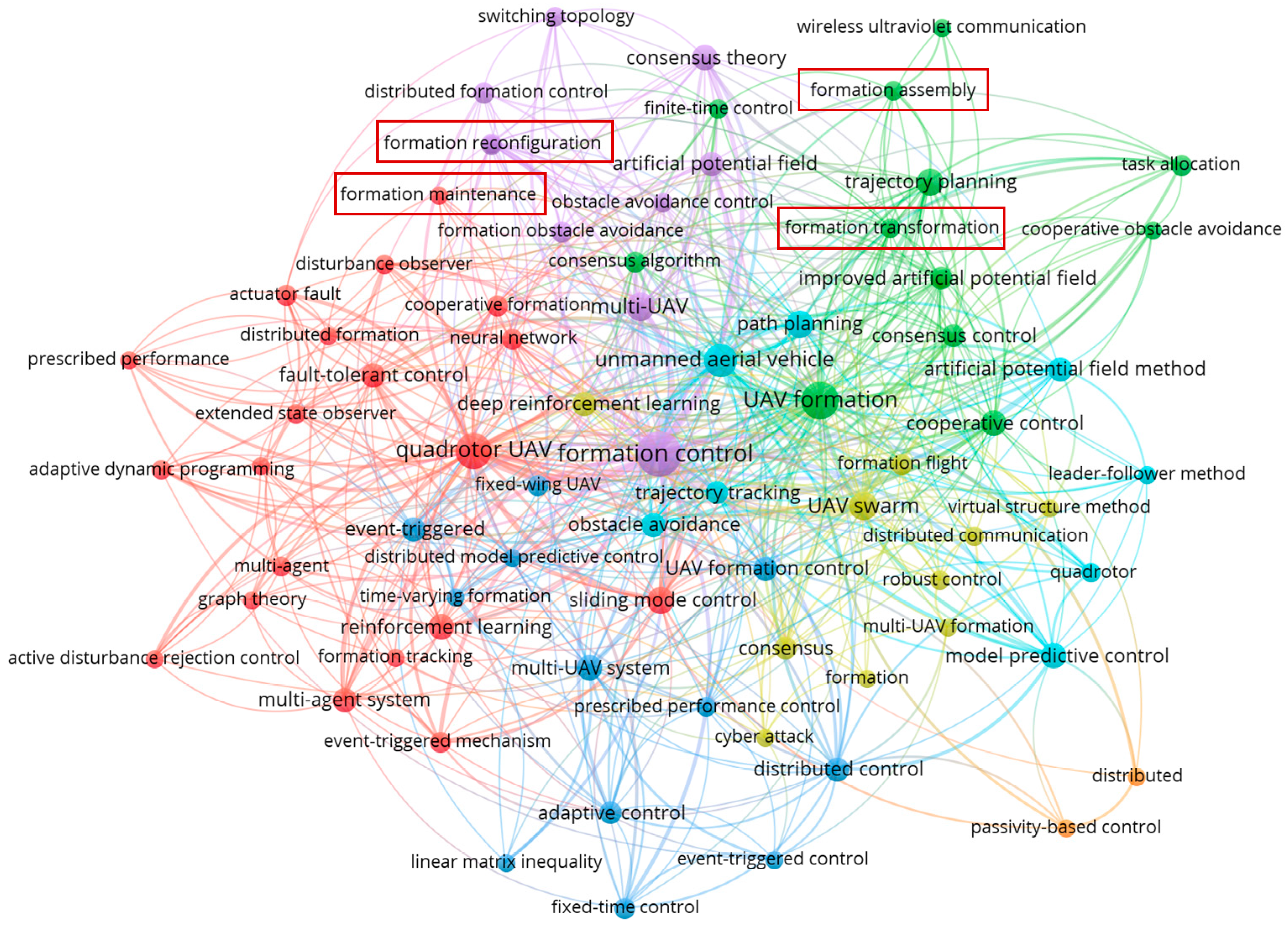


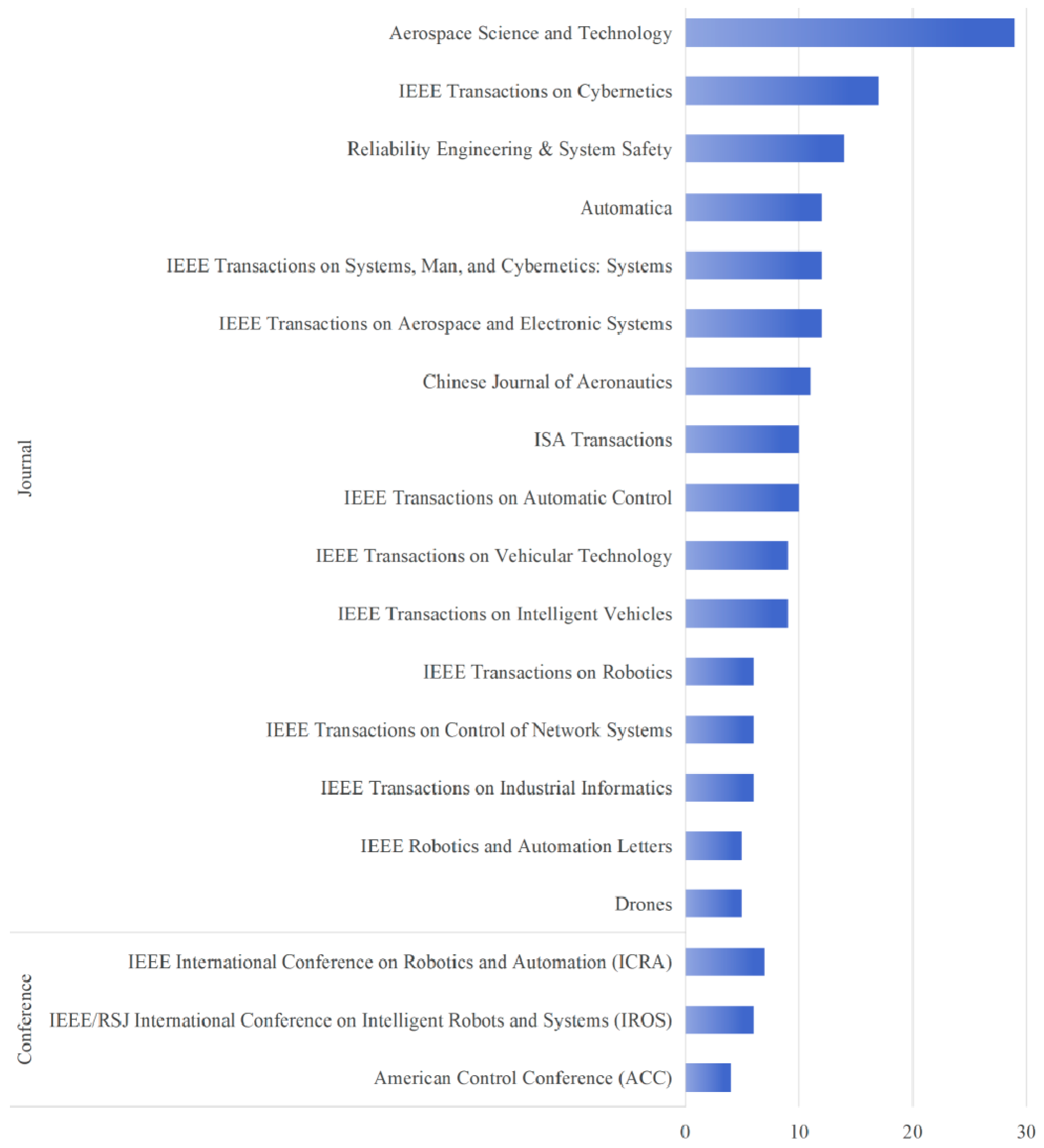


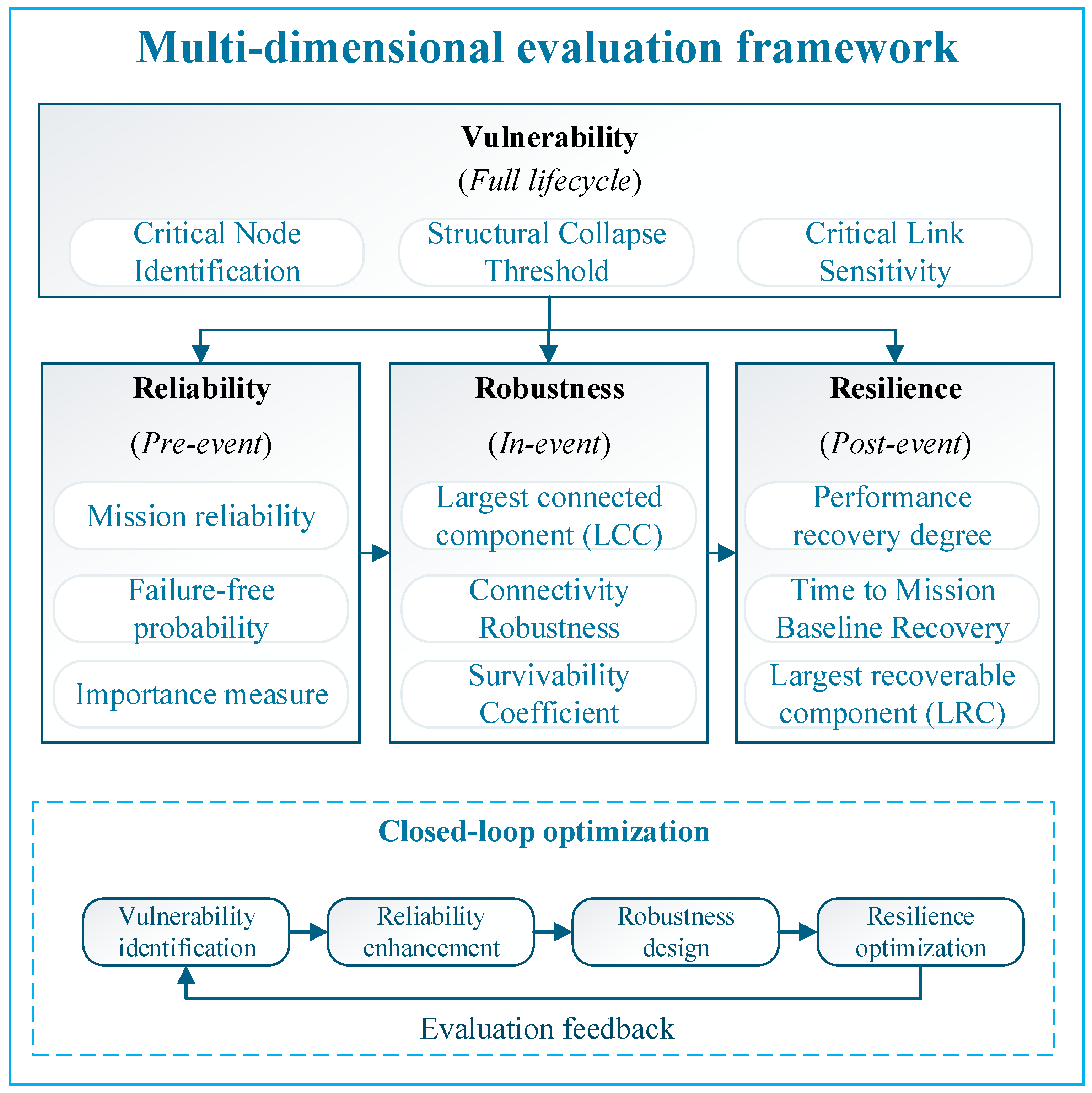
| Reference | Year | Core Focus | Formation Assembly | Formation Maintenance | Formation Reconfiguration | Formation Performance Evaluation | Mission-Driven Perspective |
|---|---|---|---|---|---|---|---|
| Oh [10] | 2015 | multi-agent formation control | ● | ● | ● | ○ | ○ |
| Huang [19] | 2019 | collision avoidance strategies | ○ | ● | ○ | ○ | ○ |
| Zhou [11] | 2020 | UAV swarm intelligence | ○ | ● | ● | ○ | ○ |
| Wei [20] | 2021 | collision avoidance technologies | ○ | ● | ○ | ○ | ○ |
| Tang [15] | 2022 | Swarm intelligence algorithms | ○ | ● | ● | ○ | ○ |
| Ouyang [12] | 2023 | Communication Networks and Formation Control Strategies | ● | ● | ● | ○ | ○ |
| Javed [16] | 2024 | Key technologies for UAV swarms | ○ | ● | ○ | ○ | ○ |
| Cetinsaya [14] | 2024 | UAV formation control and path planning algorithms | ○ | ● | ○ | ○ | ○ |
| Bu [13] | 2024 | traditional and AI-based formation control methods | ○ | ● | ● | ○ | ○ |
| Wang [21] | 2024 | Security of UAV swarm networks | ○ | ● | ○ | ○ | ○ |
| Wei [22] | 2024 | Security of single UAV systems | ○ | ○ | ○ | ○ | ○ |
| Sun [17] | 2024 | Moving target tracking | ○ | ● | ○ | ○ | ○ |
| Shukla [18] | 2024 | Trajectory prediction | ○ | ● | ○ | ○ | ○ |
| This article | - | Mission-driven full lifecycle of UAV formation control | ● | ● | ● | ● | ● |
| Configuration | Safety | Flexibility | Energy Efficiency | Task Effectiveness | Applicable Scenarios |
|---|---|---|---|---|---|
| v-shape | 3 | 2 | 5 | 4 | Long-range cruising |
| single-file column | 4 | 4 | 3 | 3 | Navigate narrow passages, conduct covert infiltration |
| single-file line | 3 | 3 | 4 | 5 | Area scanning, collaborative reconnaissance search |
| double-line horizontal | 3 | 3 | 3 | 5 | Cooperative electronic jamming and radar suppression |
| circular | 4 | 2 | 2 | 5 | Continuous surveillance and persistent observation of fixed targets |
| trapezoid | 3 | 3 | 3 | 4 | Fire coverage strike |
| rhombus | 5 | 2 | 4 | 4 | Critical Asset Protection |
| snake-like | 3 | 5 | 2 | 4 | Tracking Moving Targets |
| Method | Per-Vehicle Computational Complexity | Scalability | Main Bottleneck | Suitable Scale |
|---|---|---|---|---|
| leader–follower | Follower: Leader: | Low | leader bottlenecks; error accumulation | Small |
| virtual structure | Trajectory tracking: pose assignment: | Medium | limited flexibility; limited adaptability | Small to medium |
| behavior-based | High | parameter tuning challenges; limited formation accuracy | Medium to large | |
| consensus-based | Very high | communication dependency; design complexity | Large |
| Scenario | Approach | Communication Dependency | Computational Cost | Heterogeneity Support | Validation Maturity | Supporting References (Physical/Semi-Physical Experiments) |
|---|---|---|---|---|---|---|
| Wind Disturbance | Disturbance estimation and compensation | Medium | Medium | Medium | High | [153,155] |
| Robust control | Low | Low | Low to Medium | High | [157,158,162,163] | |
| Deep neural networks | Medium | Medium to High | High | Medium | [166,167,169,170,172] | |
| GNSS-Denied | Multi-sensor fusion and relative positioning | Medium | Medium | Medium | High | [174,175,176,177,180,181] |
| Obstacle Avoidance | Potential field | Low | Low | Medium | Medium | - |
| Geometric | Low to Medium | Low | Medium | High | [184,193,195] | |
| Optimization-based | Low | High | Medium to High | Medium | [198,199,202,209,210] | |
| Learning-based | Medium | Medium to High | High | Medium | [205,206,214] | |
| Cyber Attacks | Attack modeling-based | High | Low to Medium | Medium | Low | - |
| Attack detection and diagnosis | High | Medium | Medium | Low | - | |
| Active defense and resilient control | High | Medium to High | Medium to High | Low | [261] | |
| Fault Conditions | Passive fault-tolerant control | Low | Low | Medium | Medium | [265] |
| Active fault-tolerant control based on fault estimation | Medium | Medium | High | Medium | [269] | |
| Comprehensive fault-tolerant control for complex scenarios | Medium | Medium to High | High | Low | - |
| Scenario | Approach | Communication Dependency | Computational Cost | Heterogeneity Support | Validation Maturity | Supporting References (Physical/Semi-Physical Experiments) |
|---|---|---|---|---|---|---|
| Dynamic Variation in Member Quantity | Leader Election and Switching Mechanism | Medium-High | Medium to High | Low | Medium | [25,298,300] |
| Human–Machine Shared Control | High | High | High | Low | [301,302] | |
| Dense Obstacles & Confined Environments | Affine transformation-based | Medium to High | Medium to High | Low | Low | [208] |
| Environment-aware formation library matching | High | Low to Medium | Medium | Medium | [309,310] | |
| Swarm intelligence-based | Low | Low | Medium to High | Medium | [313] | |
| Communication Topology Switching & Connectivity Maintenance | Graph theory & combinatorial optimization | High | High | Medium | Low | [318] |
| Performance evaluation-based | Medium | Medium | Medium | Low | - | |
| Self-healing control & distributed repair | Low to Medium | Low to Medium | Medium | Medium | [324,326] | |
| Task Efficiency-Driven Optimization | Control parameterization & time discretization | Low | High | High | Low | [332,350] |
| Receding horizon control | Medium to High | Medium to High | High | Low | - | |
| Heuristic intelligent optimization | Low | Medium to High | High | Low | - |
| Dimension | Core Focus | Temporal Phase |
|---|---|---|
| Reliability | probability of failure-free operation | pre-event |
| Robustness | ability to maintain functionality under disturbances | in-event |
| Resilience | ability to recover from failures | post-event |
| Vulnerability | sensitivity of system structure and functionality | full lifecycle |
Disclaimer/Publisher’s Note: The statements, opinions and data contained in all publications are solely those of the individual author(s) and contributor(s) and not of MDPI and/or the editor(s). MDPI and/or the editor(s) disclaim responsibility for any injury to people or property resulting from any ideas, methods, instructions or products referred to in the content. |
© 2026 by the authors. Licensee MDPI, Basel, Switzerland. This article is an open access article distributed under the terms and conditions of the Creative Commons Attribution (CC BY) license.
Share and Cite
Yu, C.; Liu, J.; Xie, P.; Xie, W. A Comprehensive Review of UAV Formation Control from a Mission-Driven Perspective. Drones 2026, 10, 278. https://doi.org/10.3390/drones10040278
Yu C, Liu J, Xie P, Xie W. A Comprehensive Review of UAV Formation Control from a Mission-Driven Perspective. Drones. 2026; 10(4):278. https://doi.org/10.3390/drones10040278
Chicago/Turabian StyleYu, Chong, Jiaqi Liu, Peng Xie, and Wenjun Xie. 2026. "A Comprehensive Review of UAV Formation Control from a Mission-Driven Perspective" Drones 10, no. 4: 278. https://doi.org/10.3390/drones10040278
APA StyleYu, C., Liu, J., Xie, P., & Xie, W. (2026). A Comprehensive Review of UAV Formation Control from a Mission-Driven Perspective. Drones, 10(4), 278. https://doi.org/10.3390/drones10040278