Article

CFD-Based Coupling Aerodynamic–Dynamic Modeling and Full-Envelope Autonomous Flight Control of Semi-Rigid Airships

by
Shaoxing Hu
,
Chenyang Wang
* and
Jiazan Liu
School of Mechanical Engineering and Automation, Beihang University, Beijing 100191, China
*
Author to whom correspondence should be addressed.
Drones 2026, 10(4), 241; https://doi.org/10.3390/drones10040241
Submission received: 3 February 2026 / Revised: 13 March 2026 / Accepted: 25 March 2026 / Published: 26 March 2026
(This article belongs to the Section Innovative Urban Mobility)

Highlights

What are the main findings?
  • A CFD-based coupling aerodynamic–dynamic is established to accurately characterize full-envelope nonlinear flight dynamics of semi-rigid airships.
  • A gain scheduling LQR controller preserves closed-loop stability across varying flight conditions while coordinating thrust vectoring and aerodynamic control.
What are the implications of the main findings?
  • This approach balances aerodynamic modeling precision with computational efficiency, making it suitable for real-time autonomous airship control.
  • The integrated framework enables robust full-envelope path following with sub-meter accuracy while effectively managing actuator redundancy.

Abstract

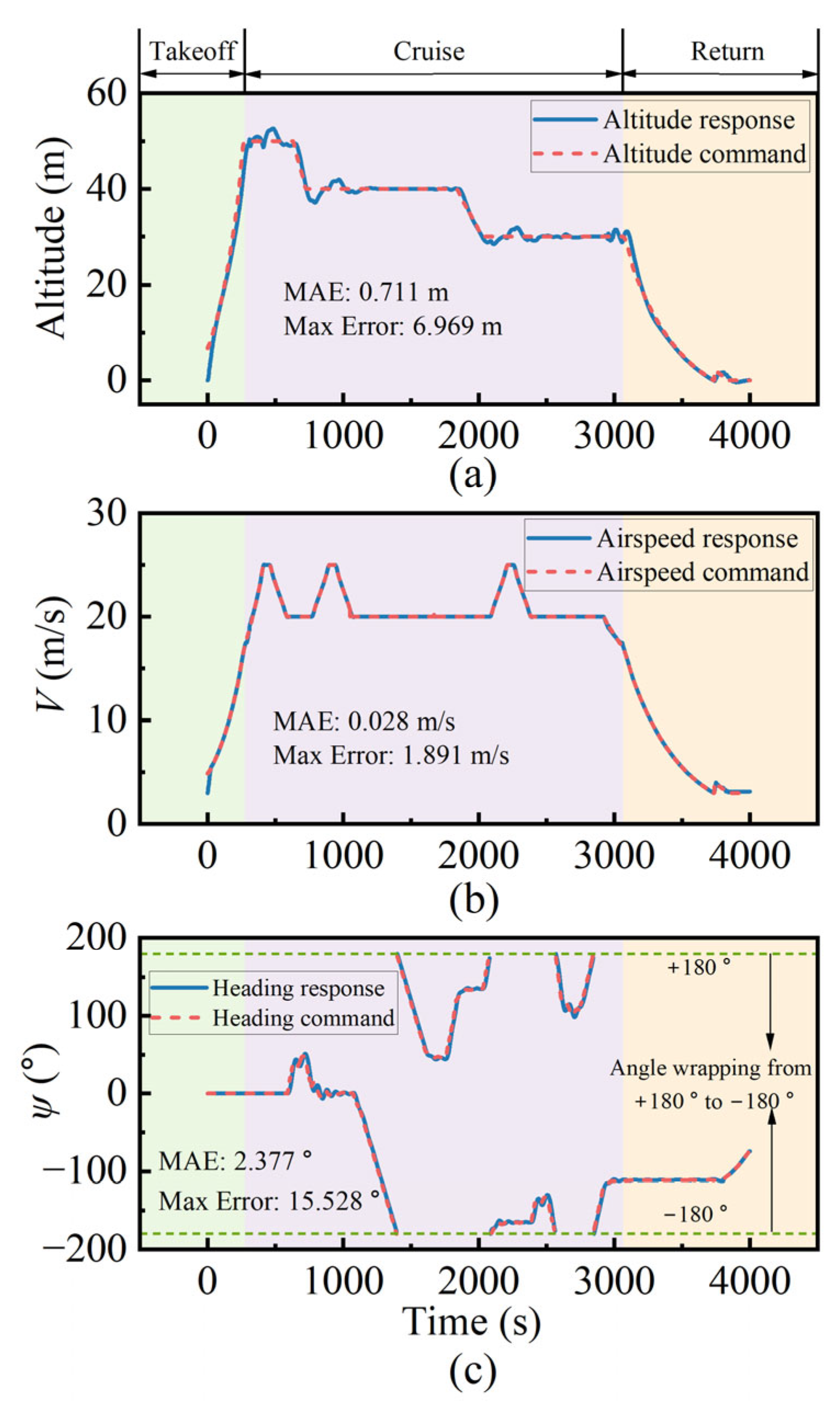
With the increasing demand for earth observation and communication missions, semi-rigid airships have emerged as critical aerial platforms due to their long endurance and high payload capacity. However, high-precision dynamic modeling and robust autonomous flight control remain challenging because of large hull volume and strong aerodynamic nonlinearities. This study proposes an integrated framework combining computational fluid dynamics (CFD) aerodynamic modeling with full-envelope gain scheduling control. First, nonlinear aerodynamic characteristics over wide ranges of angles of attack and sideslip are identified via CFD simulation, and a six-degree-of-freedom (6-DOF) nonlinear dynamic model incorporating added-mass effects is established. Subsequently, a gain scheduling linear quadratic regulator (LQR) controller is then designed using airspeed, climb rate, and yaw rate as scheduling variables, enabling coordinated control allocation between low-speed thrust vectoring and high-speed aerodynamic surfaces. Simulation results demonstrate improved three-dimensional (3D) path following performance and smooth flight mode transitions. The mean absolute errors (MAEs) in altitude, airspeed, and heading are limited to 0.711 m, 0.028 m/s, and 2.377°, respectively. Furthermore, the system’s robustness is validated under composite wind disturbances, confirming effectiveness of the proposed approach across the full flight envelope.

1. Introduction

As aerial platforms combining long-endurance station-keeping capabilities with high payload potential, semi-rigid airships have demonstrated significant application value in missions such as earth observation, regional surveillance, tourism, and route-based flight [1,2]. Compared to non-rigid airships that rely solely on internal pressure for structural integrity, semi-rigid airships incorporate a rigid keel that significantly enhances structural stability under aerodynamic loading. Furthermore, relative to rigid airships, the semi-rigid configuration offers reduced mass and superior payload efficiency, thereby balancing performance advantages with deployment flexibility [3,4].
However, due to their large volume and wide flight envelope, semi-rigid airships exhibit pronounced aerodynamic nonlinearities and strong fluid–structure interaction (FSI) effects [5], with aerodynamic forces being highly dependent on attitude variations and structural deformations. Additionally, the combined effects of non-uniform actuator efficacy and added mass [6] render the control system extremely sensitive to parameter uncertainties and external disturbances. Consequently, developing high-precision dynamic models and robust control strategies applicable across the full flight envelope is critical for overcoming current engineering bottlenecks.
Dynamic modeling is the foundation of flight control system design. Existing modeling methods are primarily categorized into theoretical analysis [7,8], wind tunnel testing [9,10], and numerical simulation [11,12]. Theoretical analysis typically relies on fundamental fluid mechanics principles to derive aerodynamic force and moment equations via simplifying assumptions. For instance, Suvarna et al. [13] corrected normalization errors in classic semi-empirical aerodynamic estimation models, effectively improving the consistency between dynamic simulation results and experimental data. Wasim et al. [14] utilized an analytical aerodynamic model based on hull geometry to establish nonlinear six-degree-of-freedom (6-DOF) dynamic equations for flight simulation. Using this model, they simulated 300 s of flight dynamics under large control surface deflections (up to 22°) at a trimmed speed of 5.5 m/s, demonstrating good agreement with the experimental flight data of the UETT airship. Although computationally efficient (typically requiring only a few milliseconds per iteration), these methods generally rely on empirical models and struggle to accurately capture complex nonlinear aerodynamic effects across the full flight envelope, thereby limiting prediction accuracy. Wind tunnel testing involves conducting experiments on scaled models within controlled environments, measuring aerodynamic characteristics using force/moment sensors, and visualizing flow structures via particle image velocimetry [15]. López et al. [16] accurately identified added mass and inertia parameters through wind tunnel tests, providing critical experimental data for high-precision dynamic modeling. Tabatabaei et al. [17] addressed wind tunnel wall interference by proposing a flow field correction strategy based on reduced-order wall inserts, effectively enhancing the precision of free-flight simulation within the test environment. However, wind tunnel testing is constrained by blockage effects, Reynolds number mismatch, and high costs, making it difficult to obtain comprehensive aerodynamic data covering the entire flight envelope.
In recent years, computational fluid dynamics (CFD) has become a vital tool for refined aerodynamic research due to its ability to provide high-precision solutions for complex flow fields. For example, Sasidharan et al. [18] coupled CFD calculations with stability derivative estimation to accurately identify longitudinal stability derivatives and added mass terms for a tethered aerostat, achieving high-precision dynamic stability prediction, with key stability derivatives matching theoretical benchmarks up to a precision on the order of 10−3~10−4. Xie et al. [19] established an efficient aerodynamic performance database for stratospheric propellers based on CFD simulations using the Spalart–Allmaras turbulence model, achieving deviations of only 0.12% for the power coefficient and 3.33% for efficiency compared with high-fidelity CFD results. Manikandan et al. [20] utilized CFD to perform a detailed analysis of the aerodynamic configuration of a tri-lobed hybrid airship, validating its aerodynamic efficiency advantages in heavy-lift missions. Nevertheless, the requirement of hours to days for a single simulation results in substantial computational cost, which prevents direct application in flight control simulations and online solutions that demand high update frequencies (typically 50 Hz or higher).
Through the comparison of the aforementioned modeling approaches, it can be observed that a fundamental trade-off exists in current airship research between aerodynamic modeling accuracy and computational efficiency. Empirical and analytical models offer sub-millisecond computational speed and readily satisfy real-time control requirements, but their predictive accuracy deteriorates under complex aerodynamic conditions, such as large-envelope maneuvers and strong flow separation. In contrast, CFD-based approaches provide high-fidelity flow field and aerodynamic force predictions in highly nonlinear aerodynamic regimes but suffer from prohibitive computational cost, limiting their direct application in closed-loop flight control. Consequently, a unified modeling framework that simultaneously achieves CFD-level aerodynamic accuracy while meeting the real-time computational requirements of autonomous full-envelope flight control remains lacking.
Regarding flight control law design, existing methods primarily focus on linear control [21], nonlinear control [22,23], and intelligent control [24,25]. Linear control methods, such as proportional-integral-derivative (PID) control, are mature in engineering implementation and offer good performance near single operating points. For instance, Pheh et al. [26] developed a cascaded PID controller for a spherical blimp, achieving precise hovering and trajectory tracking in indoor GPS-denied environments. However, these methods struggle to adapt to dynamic characteristics that vary drastically with airspeed and altitude, often leading to performance degradation or instability during wide-envelope maneuvers. To address this, nonlinear methods such as sliding mode control [27], adaptive control [28], and backstepping control [29,30] have been employed to enhance robustness against parameter perturbations and external disturbances by introducing nonlinear compensation and disturbance observation mechanisms. Wasim et al. [31] proposed a sliding mode control strategy integrated with an extended Kalman filter to estimate model uncertainties and wind disturbances online, significantly improving trajectory tracking robustness in complex environments. Liu et al. [32] designed a backstepping sliding mode controller based on a disturbance observer, constructing a sliding surface from backstepping errors to achieve effective compensation for unknown disturbances and high-precision attitude control. Nonetheless, these methods often rely on accurate models, and their practical application is limited by complex controller structures.
Furthermore, intelligent control methods, which enable self-learning through environmental interaction, demonstrate strong adaptive potential in handling highly nonlinear, uncertain, and high-dimensional coupled systems. Yang et al. [33] developed an adaptive control strategy integrating Q-learning and neural networks, in which control actions are optimized online in response to varying wind conditions, thereby improving the horizontal trajectory tracking accuracy of stratospheric airships under uncertain wind fields. However, existing reinforcement learning-based strategies typically require extensive sample training and substantial computational resources, making it difficult to meet the real-time requirements of flight control systems.
In conclusion, despite substantial progress in aerodynamic modeling and flight control design, a critical research gap remains in the current literature regarding the integration of high-fidelity nonlinear aerodynamics with real-time full-envelope control. Specifically, the main difficulties can be summarized as follows:
  • Existing dynamic models for semi-rigid airship control rely mostly on empirical formulas or wind tunnel data, making it challenging to obtain high-fidelity aerodynamic characteristics over the full flight envelope. Conversely, direct application of CFD methods in real-time control is hindered by computational costs.
  • Control methods are generally constrained by significant model uncertainties and parameter time-variance, making it difficult to balance stability with high performance across the full flight envelope.
To address these challenges, this paper proposes a unified CFD-based aerodynamic–dynamic coupling framework for semi-rigid airships, explicitly positioned to bridge the critical gap between high-fidelity nonlinear aerodynamic modeling and real-time full-envelope autonomous control. The technical novelties of this work are twofold:
  • A high-precision full-envelope CFD aerodynamic database is directly embedded into the 6-DOF dynamic equations, enabling an effective balance between nonlinear aerodynamic accuracy and computational efficiency.
  • A full-envelope flight control law based on multivariable gain scheduling is designed to overcome the over-actuation challenge of semi-rigid airships, enabling seamless coordination between low-speed thrust vectoring and high-speed aerodynamic control while maintaining stability and high performance across the full flight envelope.

2. CFD-Based Coupling Aerodynamic–Dynamic Modeling

2.1. Airship Model

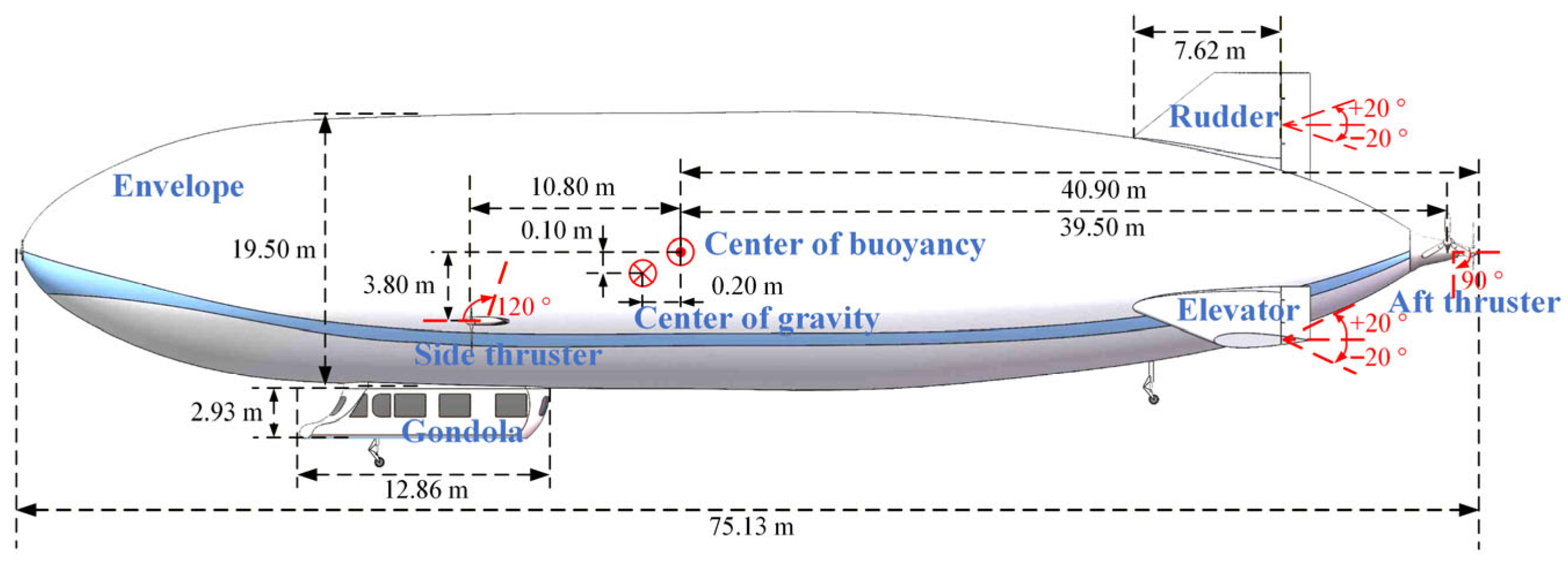
The Zeppelin NT semi-rigid airship [34] was selected as the research platform for this study. As illustrated in Figure 1, the hull features a streamlined ellipsoidal shape with a total length of 75.13 m, a maximum diameter of 19.50 m, and a total envelope volume of 8425 m3. The external surface is covered with a gastight fabric skin to maintain its aerodynamic shape, while a rigid keel structure composed of carbon fiber and aluminum alloy trusses supports the gondola, empennage, and propulsion system. The control configuration employs an inverted-Y tail configuration with three stabilizing surfaces set at 120° intervals, each equipped with rudders capable of ±20° deflection. The propulsion system is provided by two side vectoring thrusters (120° tilt), one aft vectoring thruster (90° tilt), and one aft lateral thruster. This configuration enables synergistic aerodynamic and thrust vectoring control for efficient attitude and speed regulation.

2.2. Dynamic Modeling

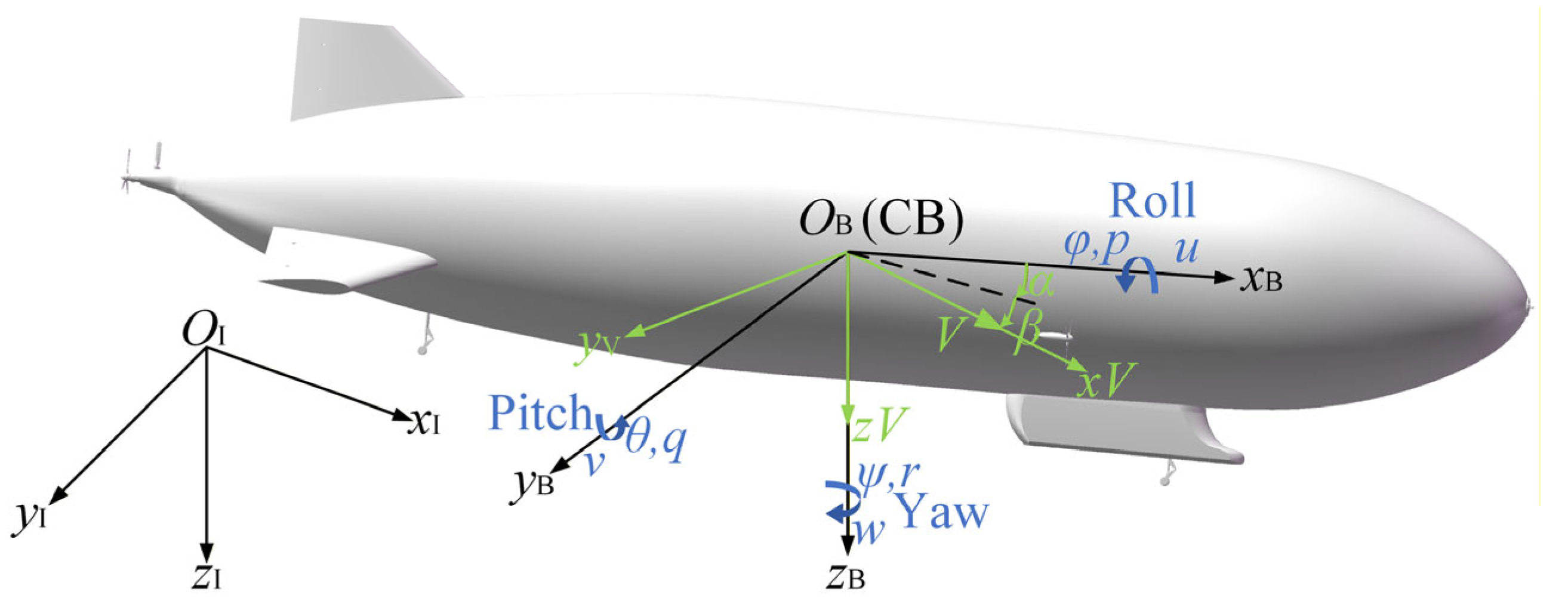
Spatial motion is described using an inertial frame I(OIxIyIzI) fixed to the ground, together with body B(OBxByBzB) and velocity V(OVxVyVzV) frames rooted at the center of buoyancy (CB), as depicted in Figure 2. The positive directions of the attitude angles strictly follow the right-hand rule. Assuming the airship is a rigid body with symmetric mass distribution, the kinematic equations are as follows [35]:
ε ˙ = R IB ( η ) · v B , η ˙ = J ( η ) · ω B ,
where ε = [ x , y , z ] T and η = [ ϕ , θ , ψ ] T denote inertial position and Euler angles, while v B = [ u , v , w ] T and ω B = [ p , q , r ] T denote body-frame linear and angular velocities. R IB ( η ) and J ( η ) represent the kinematic and angular velocity transformation matrices based on the yaw–pitch–roll (3-2-1) rotation sequence, respectively.
6-DOF nonlinear dynamic equations, incorporating added mass effects due to the large hull volume, are established in the body frame B as:
M ς ˙ + F c ( ς ) = F total ,
Here, ς = [ v B , ω B ] is the generalized velocity, and M = M rigid + M add combines rigid body and added mass matrices. The specific structure of M add is as follows:
M add = diag ( m 11 , m 22 , m 33 , m 44 , m 55 , m 66 ) ,
where m 11 = k 1 m a i r , m 22 = m 33 = k 2 m a i r , m 44 = 0 , m 55 = m 66 = k m a i r , m a i r denote the mass of the air displaced by the airship. k1, k2 and k′ are dimensionless added-mass coefficients. Their values can be estimated using empirical formulas based on the airship fineness ratio [36].
Furthermore, F c ( ς ) = Ω M v accounts for nonlinear inertial terms, including Coriolis and centripetal forces, Ω is the cross-product matrix of generalized velocities:
Ω = ω B × 0 3 × 3 v B × ω B × ,
where ω B × and v B × represent the skew-symmetric cross-product matrices of the angular and linear velocity vectors, respectively.
The generalized external force vector F total is defined as:
F total = F aero + F thrust + F grav + F buoy .
  • Aerodynamic force F aero : the aerodynamic force vector is transformed from the velocity frame V to the body frame B, yielding:
F aero = R VB · q S ref C D , C Y , C L T q S ref L ref C l , C m , C n T ,
where R VB is the rotation transformation matrix from the velocity frame to the body frame, q = 1 / 2 ρ V 2 is the dynamic pressure, ρ is the air density, R VB is the resultant airspeed, Sref is the reference area and Lref is the reference length of the airship. CD, CY, and CL represent the aerodynamic drag, side-force, and lift coefficients, respectively, while Cl, Cm, and Cn denote the rolling, pitching, and yawing moment coefficients, which are obtained from the CFD-based aerodynamic database detailed in Section 2.3.
2.
Propulsive force F thrust : Based on the classical momentum theory in rotor aerodynamics, the steady-state thrust generated by a propeller operating in free air under hovering or low-speed conditions can be expressed as [37]:
T i = C T ρ A r r 2 ϖ 2 .
Here, Ar denotes the propeller disk area, r is the propeller radius, ϖ represents the angular velocity of the propeller, and CT is the dimensionless thrust coefficient determined by the propeller geometry and airfoil profile. In practical flight control engineering, the expression can be simplified as [38]:
T i = k T n i 2 ,
where kT is the lumped propeller thrust coefficient, which can be determined through static thrust tests [39]. It is worth noting that during full-envelope airship flight, variations in the advance ratio induced by freestream flow, together with non-zero angles of attack and sideslip, modify the local inflow conditions and consequently lead to thrust degradation. However, such secondary unsteady aerodynamic effects can be effectively compensated for by high-gain closed-loop control [37].
Therefore, based on the simplified thrust model, the resultant propulsion force and moment can be expressed as:
F thrust = k T ( n side           2 σ side + n rea       2 σ rea + n lat       2 σ lat ) r side × k T n side           2 σ side + r rea × n rea       2 σ rea + r lat × n lat         2 σ lat ) ,
where n i , σ i , and r i represent the rotational speed, direction vector, and position vector of the thrusts, respectively. The subscripts “side”, “rea”, and “lat” denote the side vectoring thrusters, aft vectoring thruster, and the aft lateral thruster, respectively.
3.
Gravity F grav and Buoyancy F buoy : gravity and buoyancy forces and moments are given by:
F grav = R IB T [ 0 , 0 , G ] T r G × ( R IB T [ 0 , 0 , G ] T ) ,
F buoy = R IB T [ 0 , 0 , B ] T 0 3 × 1 ,
where G and B are total gravity and buoyancy, and r G is the center of gravity (CG) position.

2.3. CFD-Based Aerodynamic Database

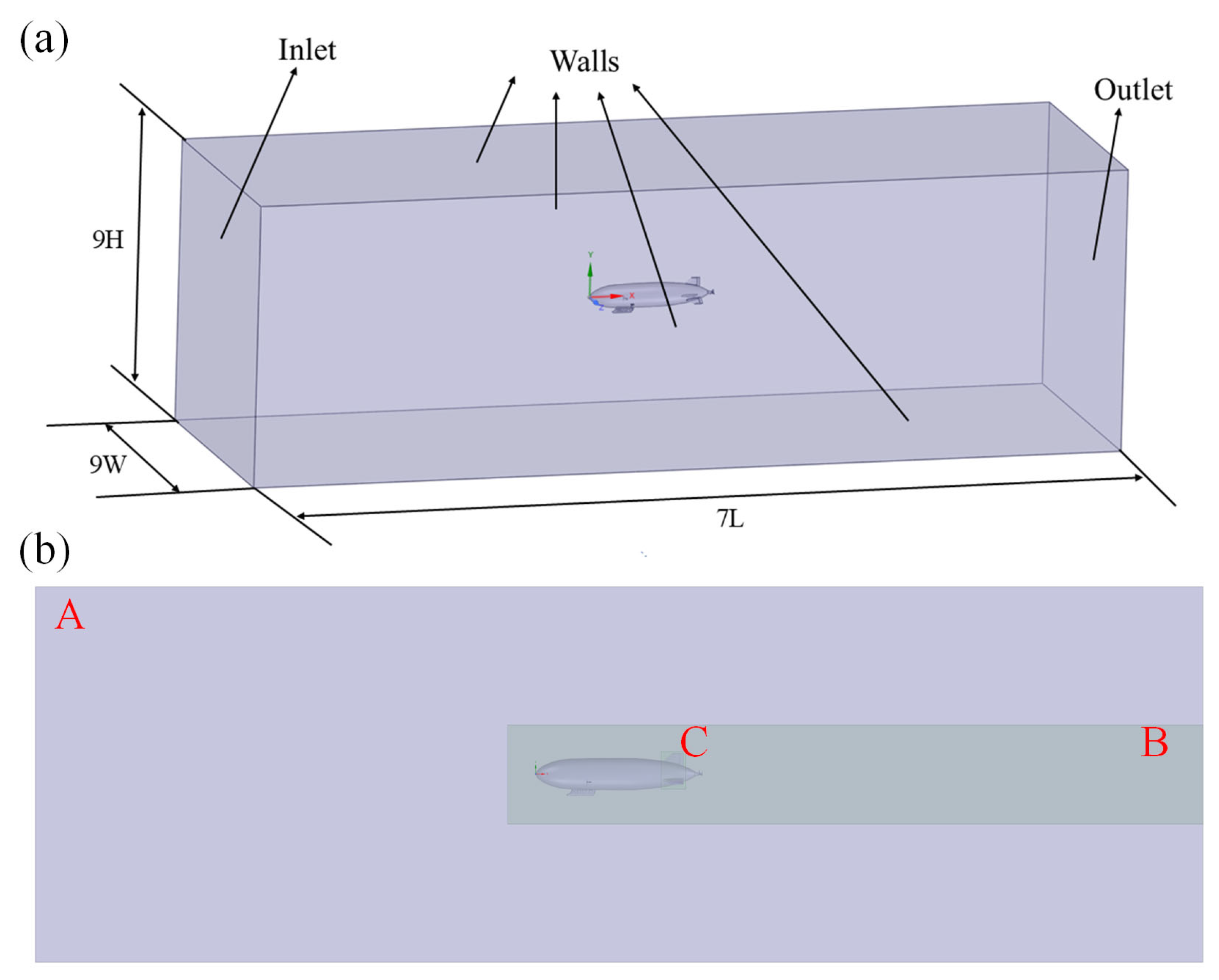
The fidelity of the 6-DOF dynamic model depends on the accurate determination of the aerodynamic coefficients. To obtain these parameters across the full flight envelope, a comprehensive aerodynamic database was established using CFD simulations. Firstly, to balance mesh quality and computational efficiency, the airship model was simplified by removing minor structures (e.g., nose mooring plate, landing gear) and smoothing the surface, while preserving primary aerodynamic contours. Then, the model was scaled by 1:100, justified by the Reynolds-number (Re) insensitivity of bluff-body aerodynamics. For the flight envelope of 3–35 m/s, the corresponding Re for the 0.75 m scaled model range from 1.54 × 10⁵ to 1.80 × 10⁶. Over most of this range, the flow remains within or near the supercritical regime (Re > 3.7 × 10⁵), where dimensionless aerodynamic coefficients exhibit minimal dependence on Re [40]. The computational domain (Figure 3a) was defined as 7, 9, and 9 times the model length, width, and height, respectively, yielding a blockage ratio [41] of 1.2%, as shown in Figure 3a. Local mesh refinement was applied to the hull (Region B) and the empennage (Region C), as depicted in Figure 3b.
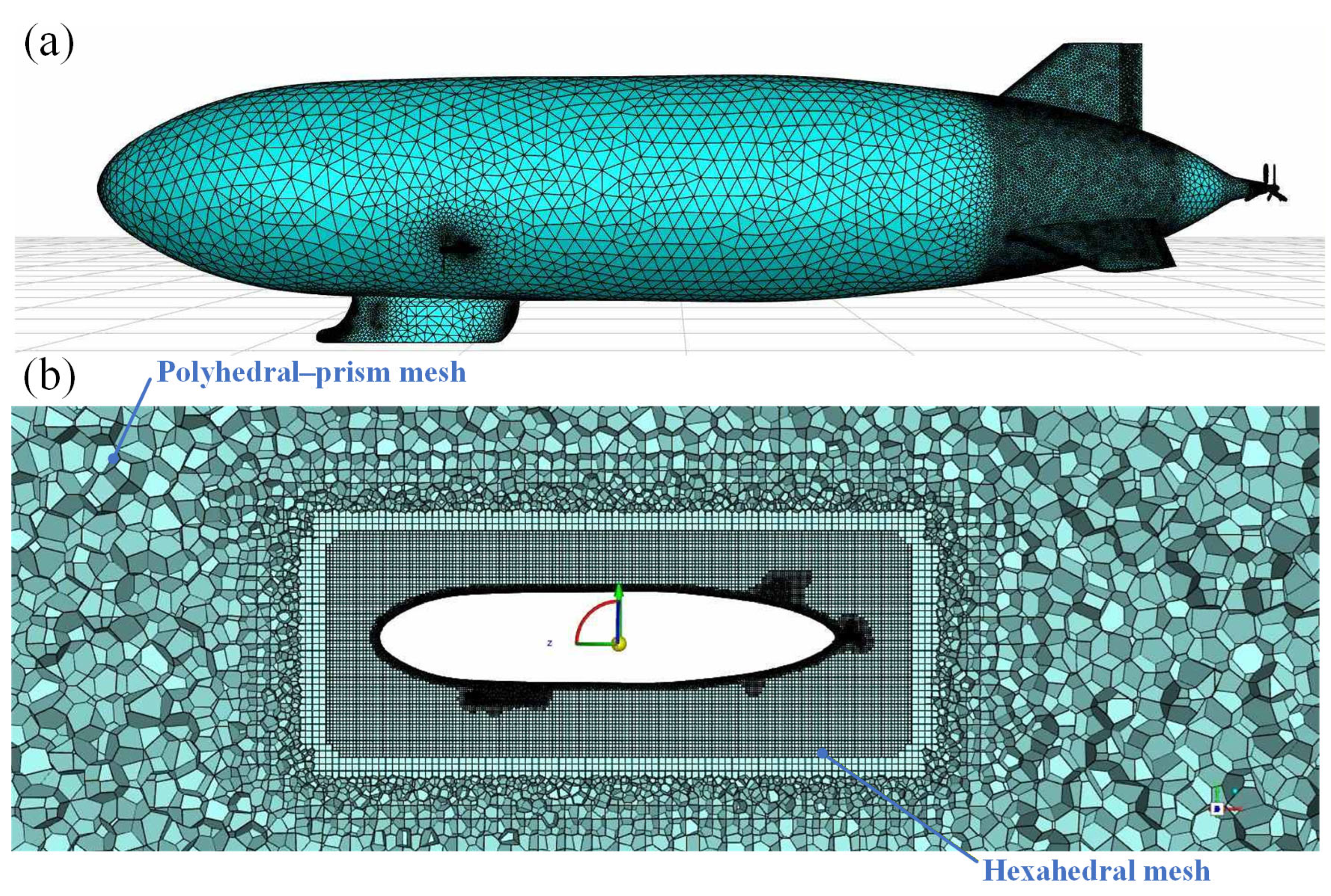
A hybrid meshing strategy was adopted for the computational domain. High-resolution surface meshes were employed to capture boundary layer flows (Figure 4a), while the volume mesh prioritized high-quality hexahedral cells in the core region and isotropic polyhedral-prism cells within the boundary layer (Figure 4b). A mesh independence analysis was conducted using three mesh densities, as summarized in Table 1. The coarse, medium, and fine meshes contained approximately 6.30 million, 11.18 million, and 17.47 million cells, respectively. The aerodynamic coefficients predicted from the three meshes were compared under identical flow conditions. The differences in the predicted drag and lift coefficients between the medium and fine meshes were below 1% and 3%, respectively, indicating that the numerical solution is sufficiently mesh-independent. Consequently, the medium mesh, consisting of 11.18 million cells and 1.95 million nodes, was selected as the final grid to balance computational accuracy and efficiency.
Moreover, to accurately capture the nonlinear aerodynamic characteristics across the full flight envelope, the Reynolds-averaged Navier–Stokes equations were solved using the Shear Stress Transport (SST) k-ω turbulence model. Combining the near-wall accuracy of the k-ω model with the freestream robustness of the k-ε model, the SST k-ω model is well suited for predicting adverse pressure gradients and flow separation around large streamlined bluff bodies. Previous CFD studies on airship aerodynamics and similar configurations have demonstrated that the SST k-ω model provides reliable predictions of aerodynamic coefficients over a wide Re range, showing good agreement with experimental observations [42,43,44]. Coupled with a fully turbulent boundary-layer assumption, this modeling strategy helps reproduce the high-Re flow physics of a full-scale airship while mitigating the effects of the 1:100 geometric scaling. The CFD simulations replicated realistic flight conditions with an inlet freestream velocity of 30 m/s and environmental parameters based on the standard atmosphere model, as detailed in Table 2.
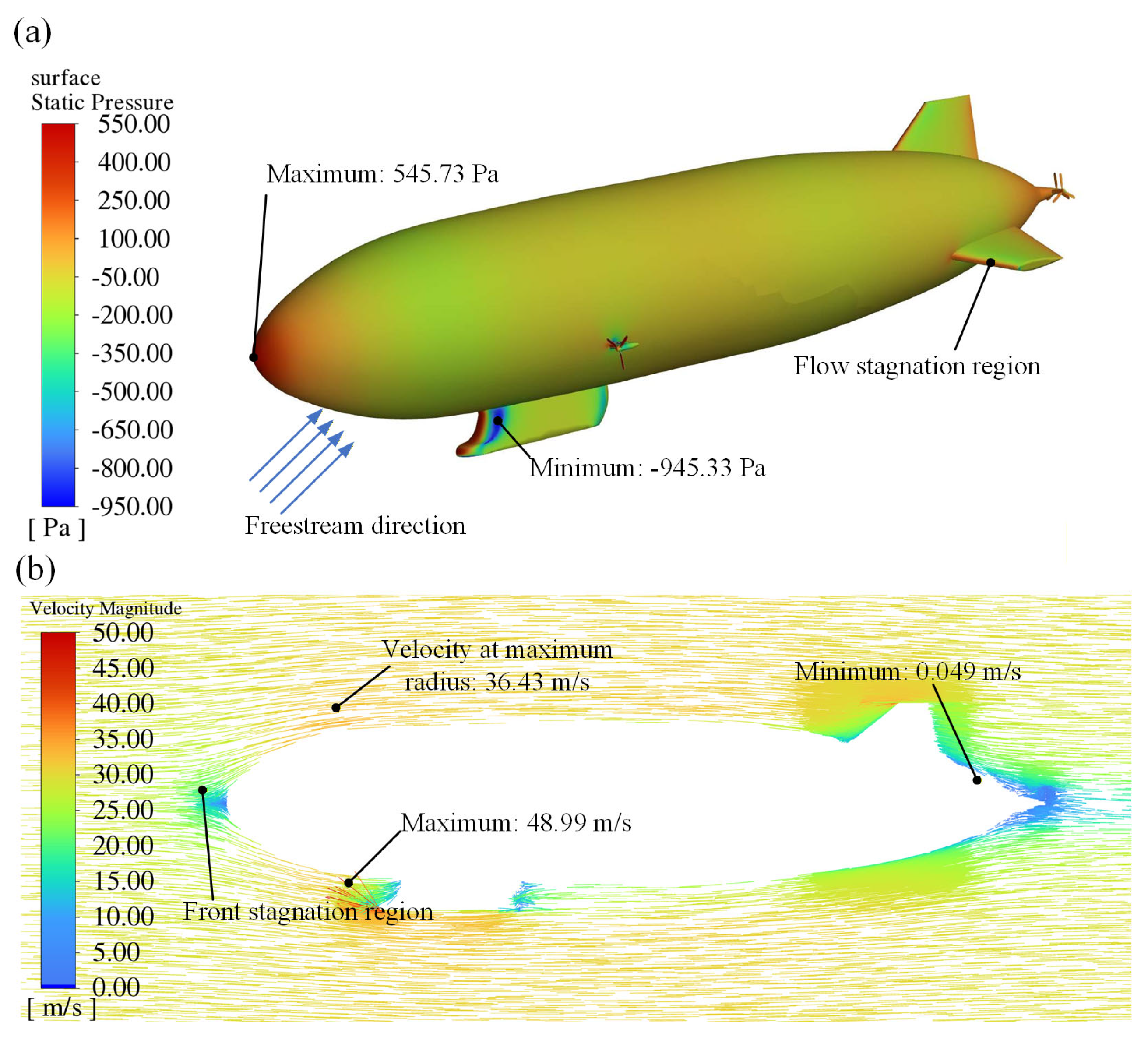
Figure 5 presents the surface pressure and velocity distributions under head-on conditions (30 m/s, α = 0°, β = 0°). As shown in Figure 4a, flow deceleration at the nose forms a front stagnation region with a peak pressure of 545.73 Pa, which constitutes the primary source of aerodynamic drag. The surface pressure then decreases rapidly along the downstream direction of the hull, producing a pronounced pressure gradient that generates significant pressure drag. The gondola exhibits a front-high and rear-low pressure distribution, generating negative lift. Moreover, as indicated in Figure 4b, the flow accelerates to 1.2 times the freestream velocity (36.43 m/s) at the hull’s maximum diameter, corresponding to the low-pressure region. Near the empennage, asymmetric flow around the tail fins creates local stagnation points, resulting in lower velocity on the upper surfaces and weak negative lift.
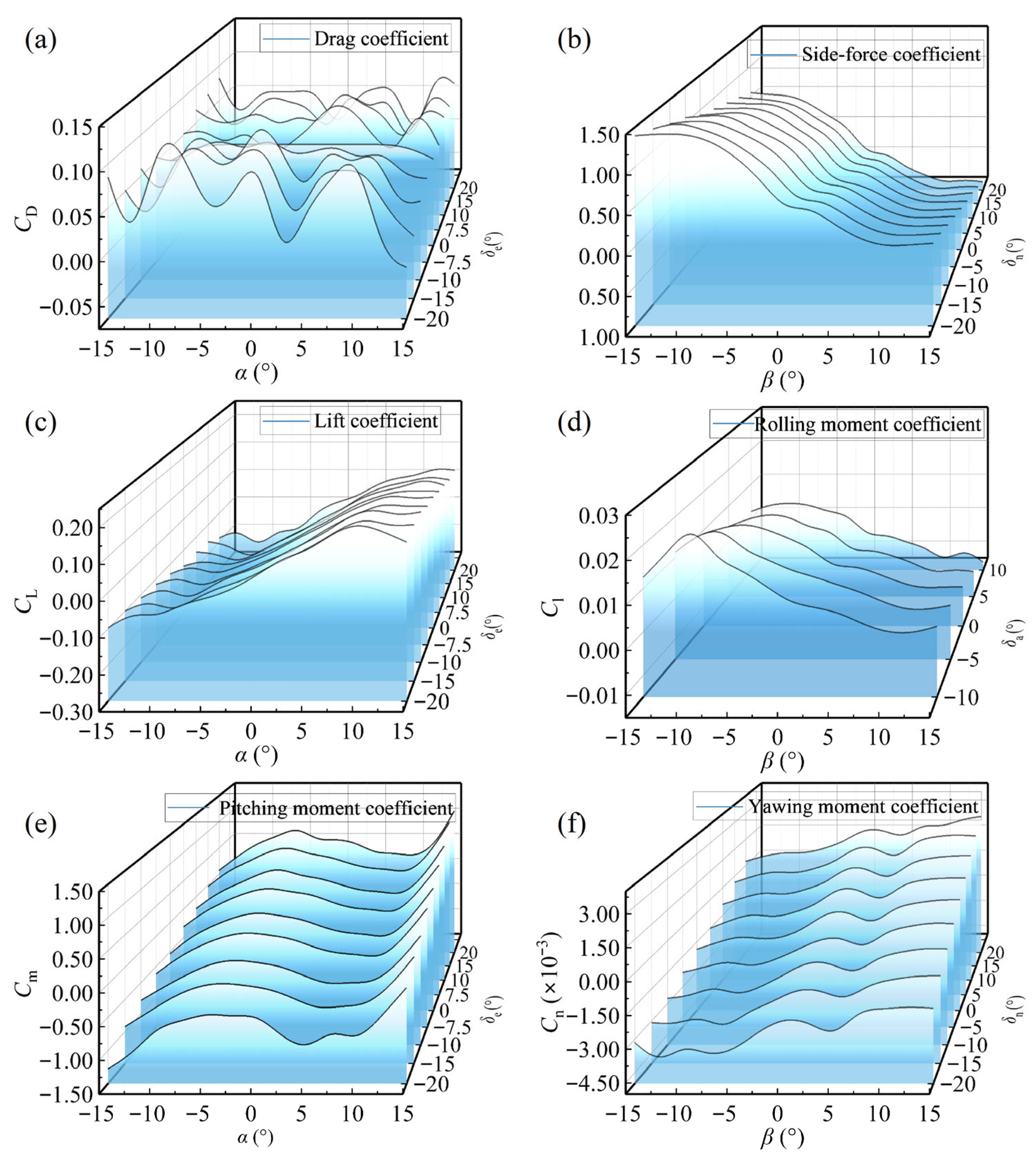
To characterize full-envelope aerodynamics, CFD simulations analyzed force and moment coefficients under varying angles of attack ( α [ 15 ° , 15 ° ] ), sideslip angles ( β [ 15 ° , 15 ° ] ), and control surface deflections, as shown in Figure 6. The control inputs are parameterized as follows: the generalized elevator angle δ e = δ L = δ R (symmetric deflection of the left and right elevators), the generalized aileron angle δ a = δ L δ R (differential deflection of the left and right elevators), and the rudder angle δ r . Sign conventions define positive deflections as upward/rightward; positive forces as upward lift, drag opposing flow, and rightward side force; and positive moments as nose-up, yaw-right, and roll-right.
The results indicate that the aerodynamic characteristics exhibit pronounced nonlinearity. While the lift coefficient increases linearly within α [ 10 ° , 10 ° ] , the slope decreases noticeably beyond this range due to leeward flow separation, indicating stall behavior [45]. Meanwhile, pitching and yawing moment trends oppose those of lift and side force, respectively, suggesting inherent longitudinal and lateral static stability. Control efficacy analysis confirms that downward elevator deflection enhances lift and generates a nose-down moment to aid dives, while upward deflection produces a nose-up moment to aid climbs. Similarly, rudder deflection effectively generates yaw moments, confirming sufficient control authority for full-envelope maneuvering.

3. Full-Envelope Gain Scheduling Control System

3.1. Model Linearization and Decoupling

To address the computational complexity and stability challenges posed by the high-dimensional, nonlinear, and coupling dynamics of semi-rigid airships, a linearization approach is adopted. Based on Equations (1) and (2), the 6-DOF nonlinear equations of motion are unified as:
ξ ˙ = f ( ξ , μ ) ,
where the state vector ξ 12 and control vector μ 8 are defined as:
ξ = x y z u v w ϕ θ ψ p q r T ,
μ = n side n rea n lat θ side θ rea δ e δ r δ a T ,
Applying small perturbation theory [46] around a trim condition ( ξ 0 , μ 0 ) , the state and control variables are decomposed into trim (subscript “0”) and perturbation (prefix Δ) components:
ξ ( t ) = ξ 0 + Δ ξ ( t ) , μ ( t ) = μ 0 + Δ μ ( t ) .
Substituting Equation (15) into Equation (12) and performing a first-order Taylor expansion around the trim point yields:
f ( ξ 0 + Δ ξ , μ 0 + Δ μ ) f ( ξ 0 , μ 0 ) + f ξ ξ 0 , μ 0 Δ x + f μ ξ 0 , μ 0 Δ μ + H . O . T .
Neglecting higher-order terms (H.O.T.) and noting that the trim condition satisfies x ˙ 0 = f ( ξ 0 , μ 0 ) , the linear state-space equation is obtained:
Δ ξ ˙ = A Δ ξ + B Δ μ ,
where the Jacobian matrices are given by:
A = f ξ ξ 0 , μ 0 , B = f u ξ 0 , μ 0 .
Leveraging the weak coupling between longitudinal and lateral modes at trim [14], the system is decoupled into independent subsystems. The longitudinal state-space equation is as follows:
Δ ξ ˙ V = A V Δ ξ V + B V Δ μ V ,
Here, ξ V = u , w , q , θ T is the longitudinal state vector and μ V = n side , θ side , n rea , θ rea , δ e T is the longitudinal control vector. The corresponding system and control matrices are expressed as:
A V = M V - 1 F total V v V F c V v V 0 M V - 1 F total V θ 0 e 3 T 0 , B V = M V - 1 F total V μ V 0 0 1 × 5 ,
where M V is the longitudinal mass submatrix, ν V = [ u , w , q ] T denotes the longitudinal generalized velocity, and F total V , F c V denote longitudinal forces components in the axial, normal, and pitch directions.
Similarly, the lateral state-space equation is as follows:
Δ ξ ˙ L = A L Δ ξ L + B L Δ μ L ,
Here, ξ L = v , p , r , ϕ , ψ T is the lateral state vector and μ L = n lat , δ r , δ a T is the lateral control vector. The corresponding system and control matrices are expressed as:
A L = M L - 1 F total L v L F c L v L 0 M L - 1 F total L η L 0 η ˙ L v L 0 2 × 2 , B L = M L - 1 F total L μ L 0 0 2 × 3 ,
where M L is the lateral mass submatrix, ν L = [ v , p , r ] T denotes the lateral generalized velocity, η L = ϕ , ψ T represents the lateral attitude angles, and F total L , F c L are lateral force components in the lateral, roll, and yaw directions. The transformation relationship between η L and v L is given by Equation (23).
η ˙ L v L = 0 1 0 0 0 cos ϕ .

3.2. Full-Envelope Trim

Due to the pronounced nonlinear dynamics of semi-rigid airships over a wide flight envelope, a full-envelope trim strategy is adopted in this study. The trim variables are selected on a local sensitivity analysis conducted under straight level flight conditions (V = 25 m/s). The sensitivity metric is defined as
S m = A p m F ,
where S m denotes the local sensitivity index, p m represents the trim scheduling variable, and · F is the Frobenius norm of the matrix. The computed local sensitivity results are summarized in Table 3. The airspeed V and the climb rate z ˙ exhibit significant longitudinal sensitivity (0.1461 and 0.5701, respectively). In the lateral channel, V and ψ ˙ also demonstrate non-negligible dynamic sensitivity. Although the sensitivities of the angle of attack α and the sideslip angle β are extremely high (0.8921 and 2.4247, respectively), both variables are strongly coupled with the airspeed and do not serve as independent guidance commands. Therefore, airspeed V, climb rate z ˙ , and yaw rate ψ ˙ are selected as scheduling variables to resolve equilibrium states across the flight envelope.
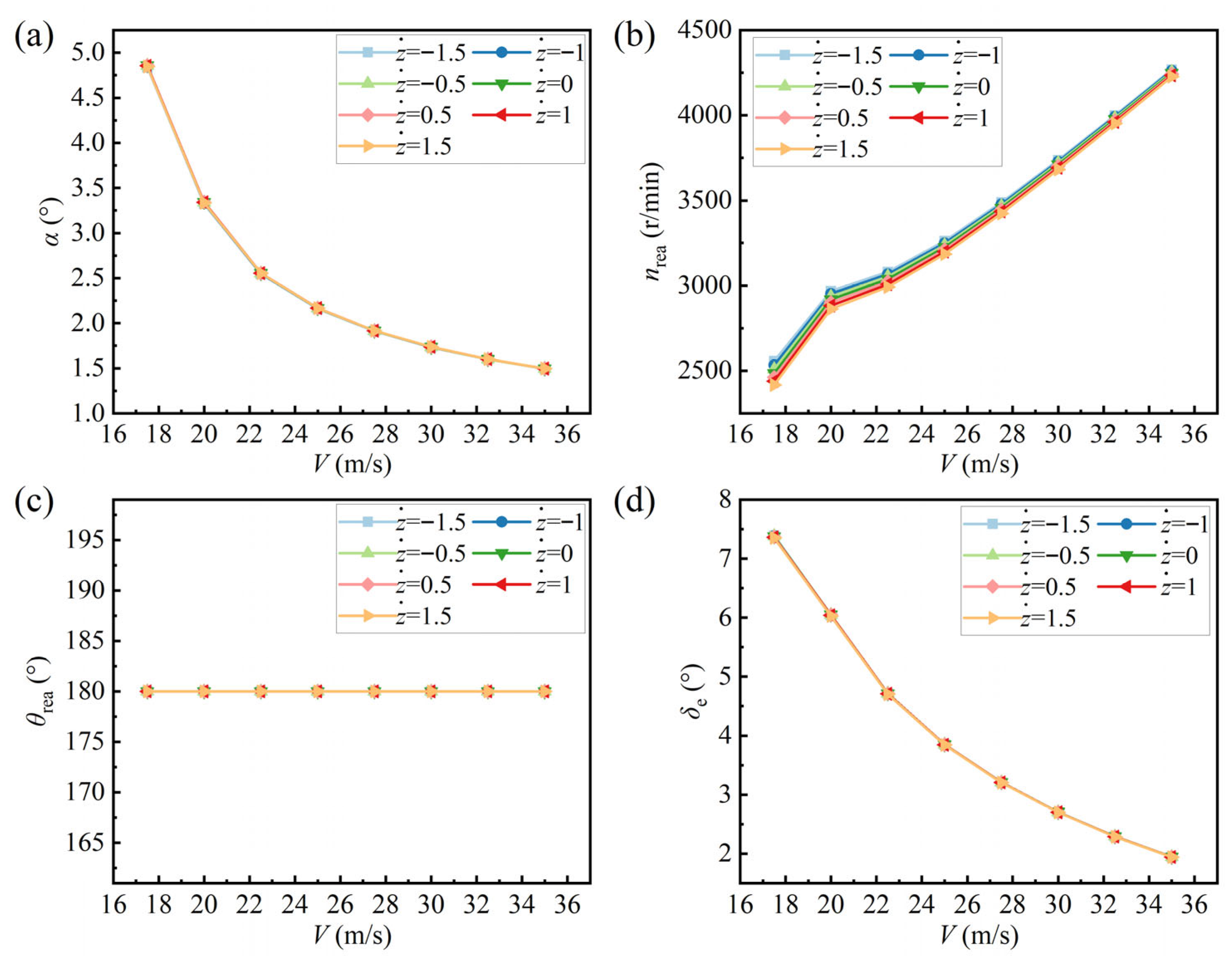
The full-envelope trim strategy approach generates a trim map that covers cruise, maneuvering, and turning flight, providing baseline states and control inputs for gain scheduling. For longitudinal motion, high-speed straight flight is selected as the nominal condition. In this aerodynamic-dominant regime, the side thrusters operate at horizontal idle conditions ( n side = 800 r/min, θ side = 0°), while the aft thruster is oriented horizontally rearward to provide primary propulsion ( θ rea = 180°). Equilibrium is established via elevator deflection and angle of attack α. The trim results for airspeeds V = 17.5~35 m/s and climb rates z ˙ = −1.5~1.5 m/s are shown in Figure 7. As airspeed increases, the aft thruster speed rises to counteract the quadratic growth in drag (Figure 7b), while the increased dynamic pressure reduces the elevator deflection required to balance gravitational pitch moments (Figure 7d).
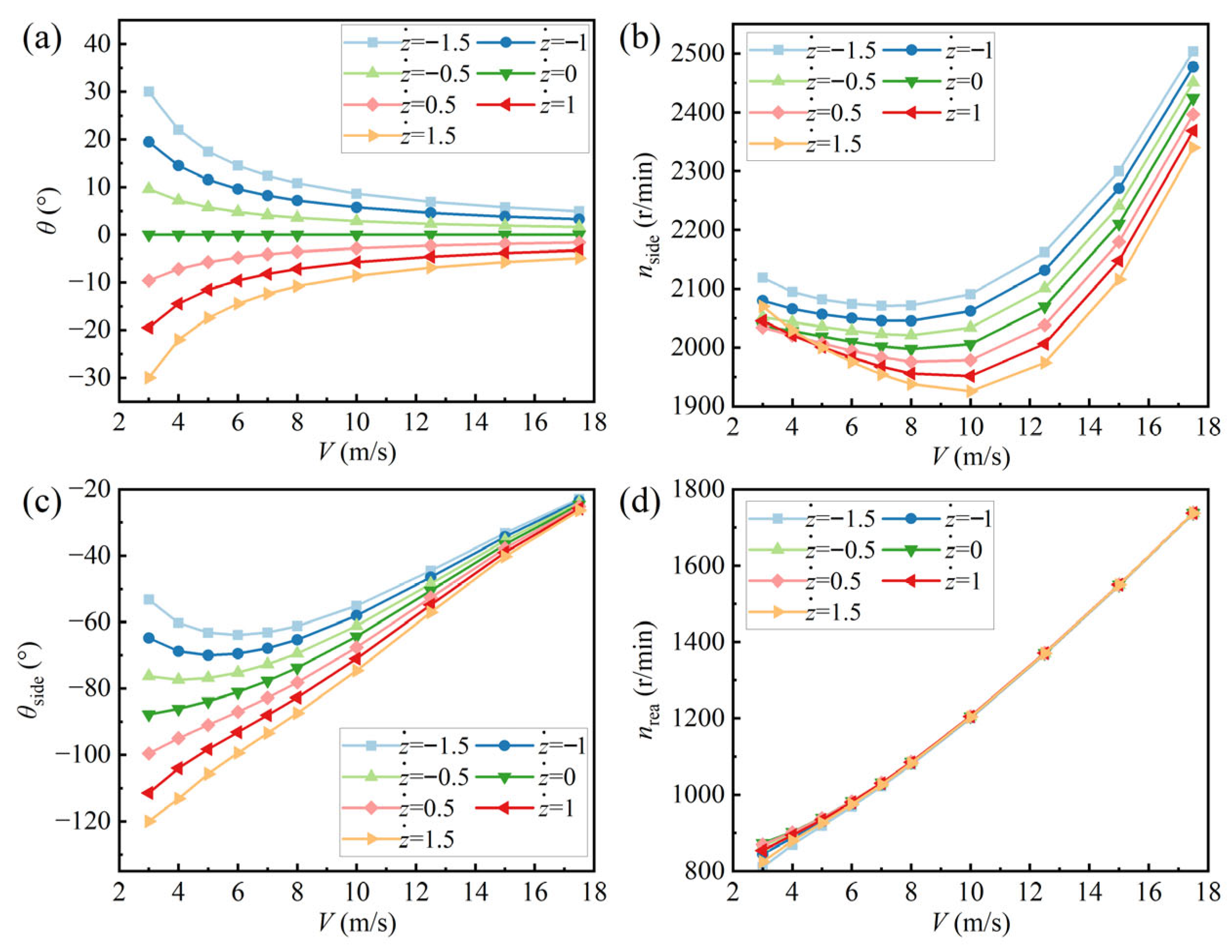
To further cover low-speed maneuvering conditions such as takeoff, landing, and hover transition, low-speed ascent/descent is selected as another nominal flight condition. In this regime, trim is maintained with zero angle of attack (α = 0) and zero elevator deflection ( δ e = 0), relying primarily on thrust vectoring, while the aft thruster remains vertical ( θ rea = 90°) for lift/moment balance. The trim results for airspeeds V = 3~17.5 m/s and climb rates = −1.5~1.5 m/s are shown in Figure 8.
The results indicate that side vectoring thrusters compensate for gravity and aerodynamic forces, while the aft vectoring thruster balances pitch moments. As airspeed increases, the intensifying aerodynamic nose-up moment necessitates higher aft vectoring thruster speeds (Figure 8d). While the required pitch magnitude θ decreases (Figure 8a), the normal component of the net gravitational force correspondingly increases. However, owing to the enhanced vertical lift generated by the aft vectoring thruster, the required tilt angle of the side vectoring thrusters is reduced (Figure 8c). Concurrently, side vectoring thruster speed exhibits a trend of initially decreasing and then increasing as aerodynamic drag rises (Figure 8b). Notably, during high-speed dives ( z ˙ > 0), aerodynamic drag may offset axial gravity, reducing the side vectoring thruster tilt to acute angles.
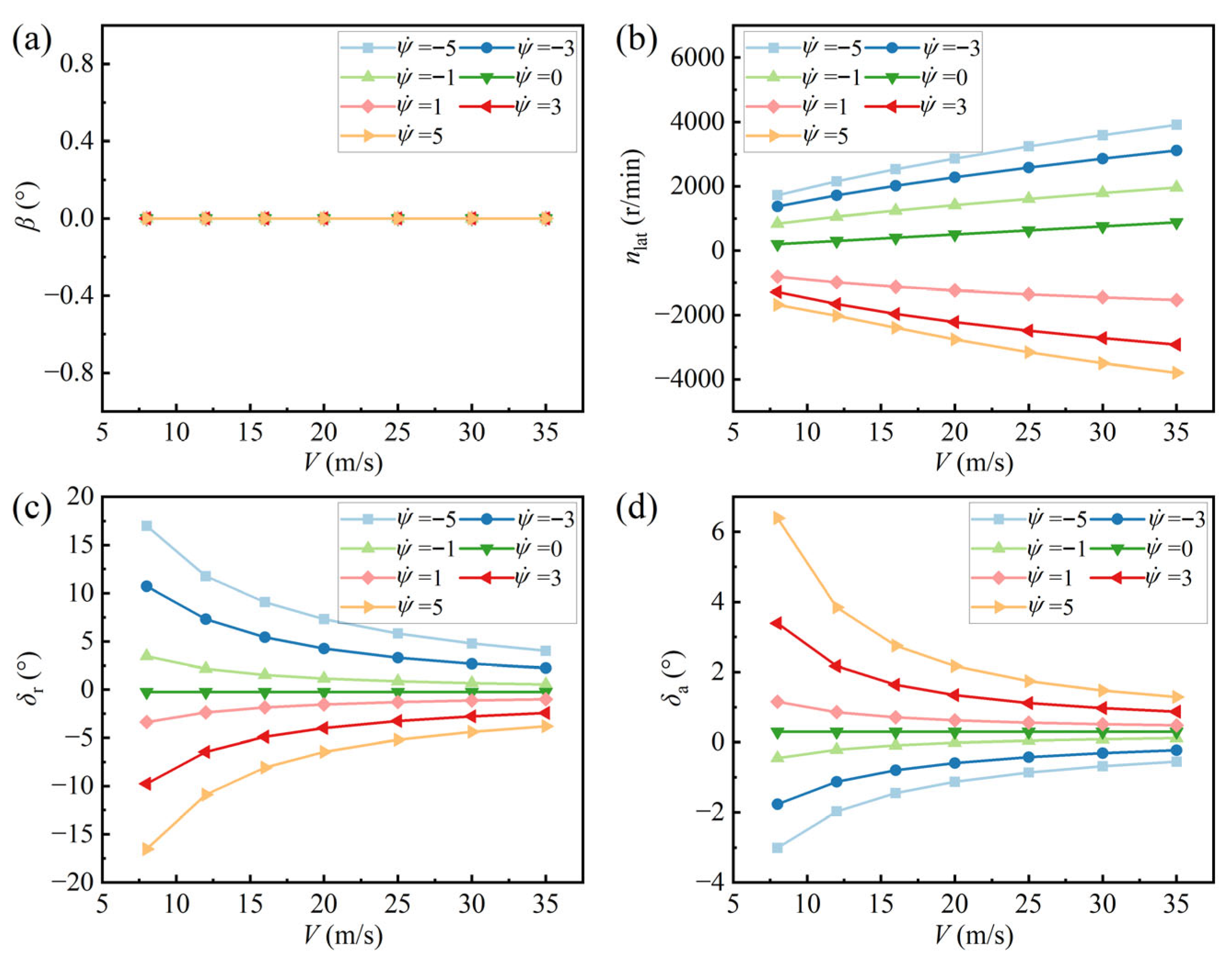
For lateral motion, a zero-sideslip coordinated turn is employed (β = 0, ϕ = 0). Stability is maintained by coordinating the rudder, aileron, and aft lateral thruster. Trim results for V = 8~35 m/s and ψ ˙ = −5~5 m/s (Figure 9) demonstrate that higher airspeeds enhance control surface authority, resulting in reduced rudder deflection for generating the required centripetal force and reduced aileron deflection for balancing roll moments (Figure 9c,d). However, the large aerodynamic moments associated with high-speed turns require the aft lateral thruster to operate at increased rotational speed in order to generate greater counteracting moments to maintain attitude stability (Figure 9b).
To ensure the smoothness of control commands during flight, a bilinear interpolation method is adopted to retrieve the trim reference from the trim map. Furthermore, for the mode transition between high-speed straight flight and low-speed straight ascent/descent, a weighted blending strategy is introduced within the speed transition region ( V [ 17.5 , 20.0 ] ), as expressed by
trim = ( 1 χ ) trim ( 1 ) + χ trim ( 2 ) ,
where trim ( 1 ) and trim ( 2 ) denote the state and control trim vectors derived from the trim results of low-speed straight ascent/descent and high-speed straight flight, respectively. The weighting factor χ is defined as χ = (V − 17.5)/2.5.

3.3. Model Decoupling Validation

In Section 3.1, the 6-DOF nonlinear airship dynamics were decoupled into two independent subsystems, thereby simplifying the controller design. However, during aggressive maneuvers, large deviations in attitude and velocity may induce pronounced nonlinear cross-coupling effects. To assess the decoupling assumption across the full flight envelope, this section quantitatively examines static trim residuals under straight level flight and open-loop dynamic responses under aggressive maneuvers.
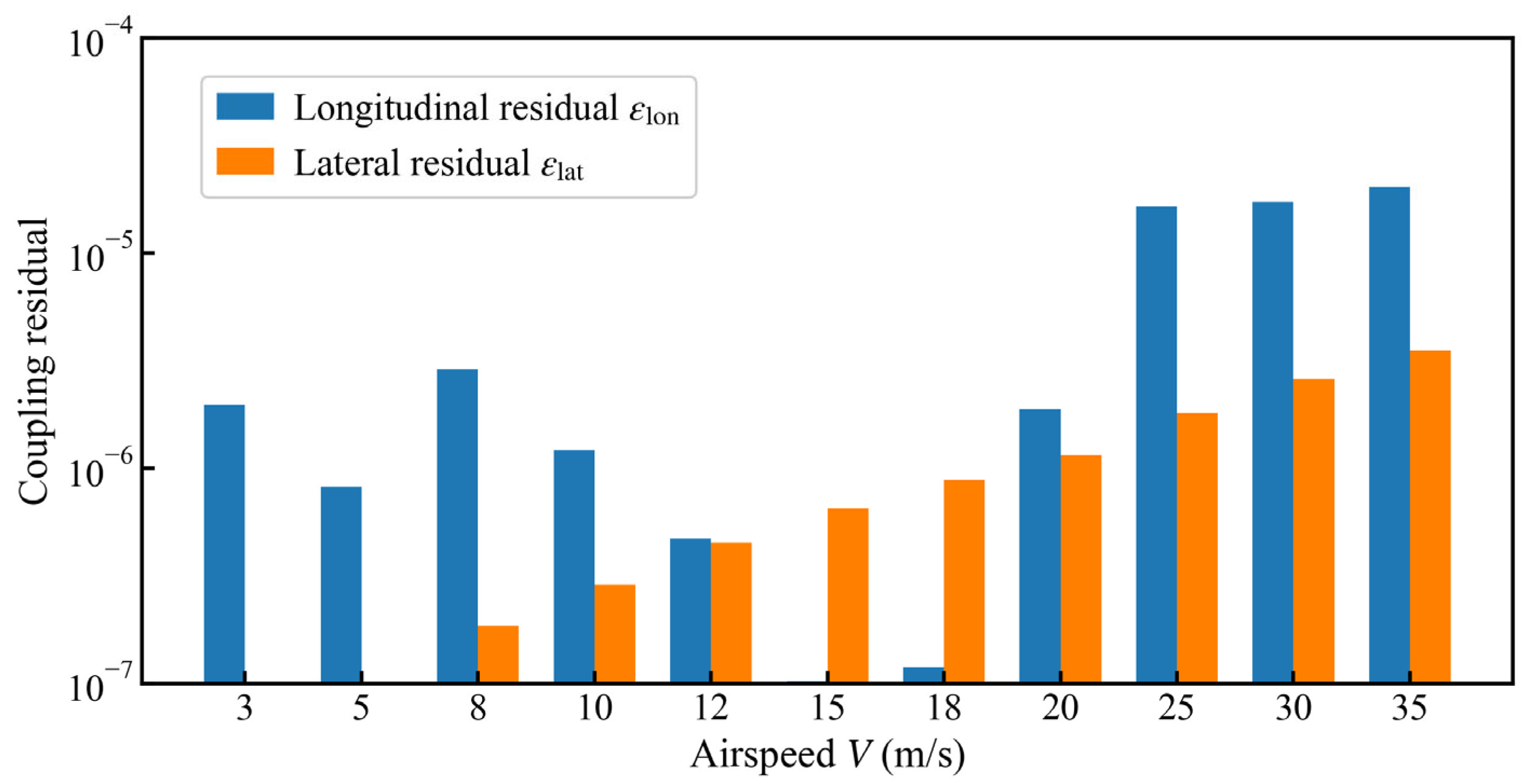
First, the trim states ξ 0 and control inputs μ 0 from Section 3.2 are substituted into the 6-DOF nonlinear model (Equation (2)), and the equilibrium residuals are computed via Equations (26) and (27) to quantify the decoupling error. The resulting static trim residuals (Figure 10) indicate that the longitudinal residual ε lon peaks at 2.0 × 10⁻⁵ at V = 35 m/s, while the lateral residual ε lat is 3.5 × 10⁻⁶. Both remain well below 10−4 level and are negligible compared with typical accelerations of the airship, confirming that static cross-coupling is minimal under full-envelope straight level flight.
ε lon = max ( | u ˙ * | , | w ˙ * | , | q ˙ * | )
ε lat = max ( | v ˙ * | , | p ˙ * | , | r ˙ * | , | ϕ ˙ * | )
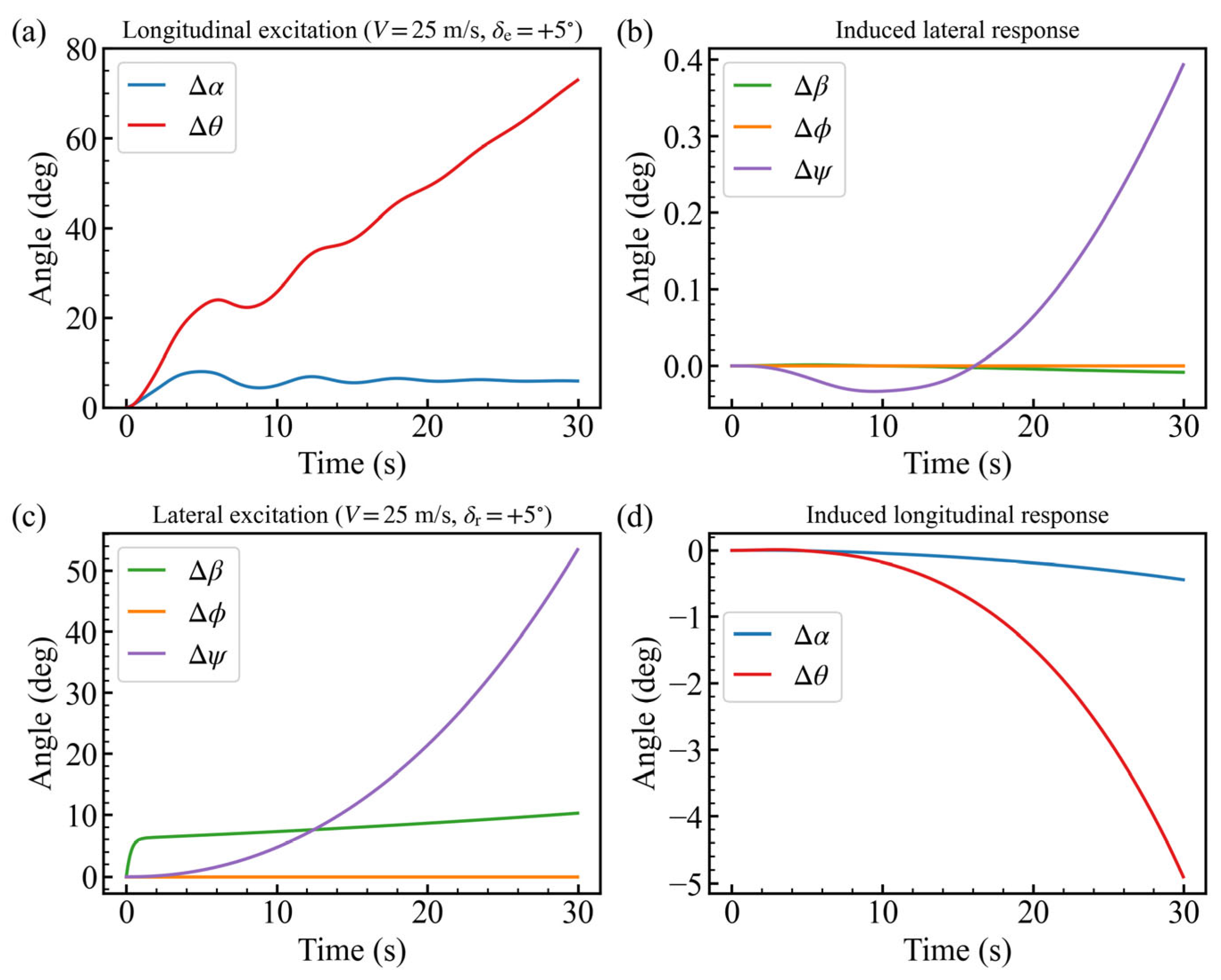
Dynamic nonlinear coupling during aggressive maneuvers is further evaluated through two open-loop simulations at a cruise speed of 25 m/s. The first applies a +5° elevator step input δ e for 30 s to analyze the lateral response under strong longitudinal excitation. The second utilizes a +5° rudder step input δ r to assess longitudinal cross-coupling induced by lateral excitation. The results are depicted in Figure 11.
Under a +5° elevator step input (Figure 11a), the system exhibits significant nonlinearity: the angle of attack increment (Δα) surges to 8.063°, and the pitch angle (Δθ) rapidly diverges to 73.021° within 30 s. This large longitudinal deviation induces minor lateral variations, with the yaw angle increment (Δψ) reaching 0.393° (Figure 11b), indicating slight cross-coupling. Conversely, a +5° rudder step input (Figure 11c) triggers severe lateral instability, causing the sideslip (Δβ) and yaw angles to rapidly diverge to 10.314° and 53.473°, respectively. This lateral divergence inevitably induces longitudinal responses (Figure 11d), where the angle of attack α and pitch angle θ accumulate to 0.440° and −4.899° at 30 s. Consequently, effective closed-loop control is essential to actively suppress dynamic cross-coupling during aggressive maneuvers, ensuring stability across the full flight envelope.

3.4. Gain Scheduling Controller

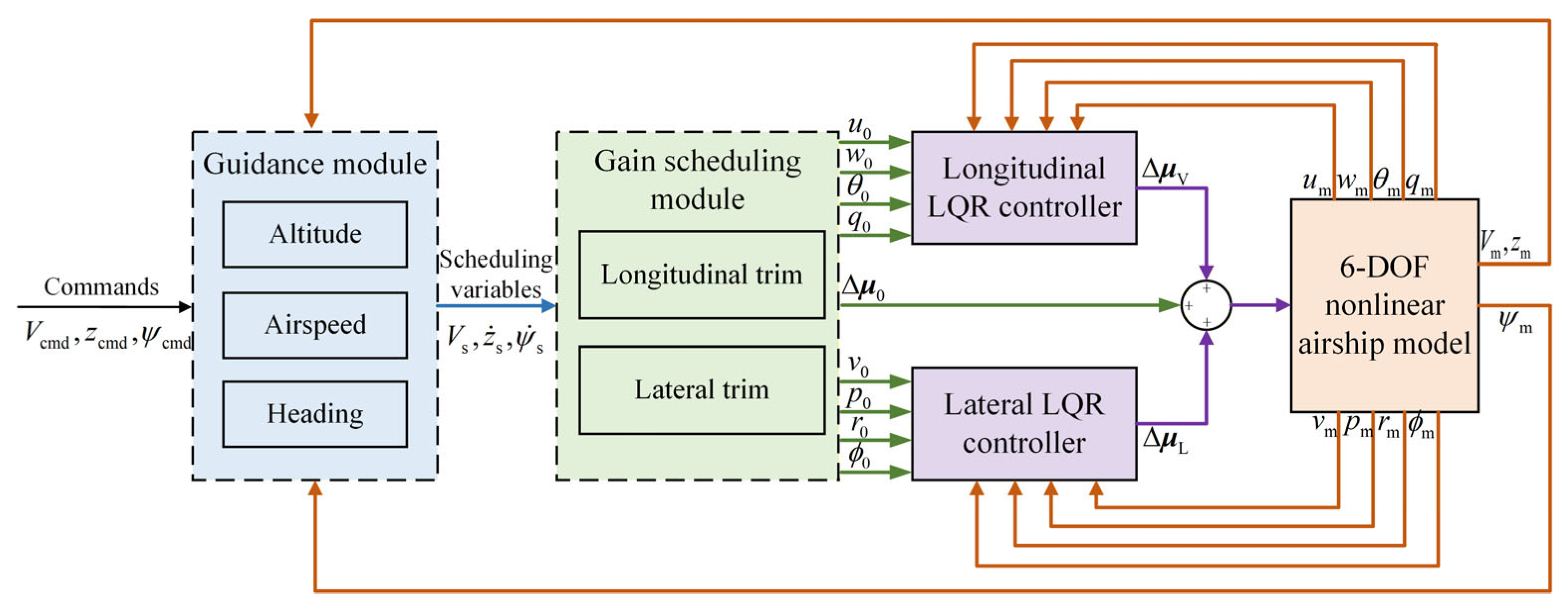
Based on the full-envelope trim database and the linearized models, a hierarchical automatic flight control system is designed, as illustrated in Figure 12. It comprises an outer-loop guidance module, a gain scheduling module, an inner-loop LQR controller, and 6-DOF nonlinear airship dynamics model.
The outer-loop guidance module converts mission commands (altitude z cmd , airspeed V cmd , heading ψ cmd ) into rate-level scheduling variables ( V s , z ˙ s , ψ ˙ s ). PID control laws are employed in the altitude and heading channels to ensure rapid tracking performance, while the airspeed channel adopts an acceleration-limited smoothing strategy. The gain scheduling module interpolates baseline states ξ 0 and feedforward inputs μ 0 from the trim database based on real-time scheduling variables, providing linearized operating points. The inner-loop LQR minimizes state deviations Δ ξ using the cost function:
J = 1 2 0 ( Δ ξ T Q Δ ξ + Δ μ T R Δ μ ) d t ,
Here, Q and R weight state tracking error and control effort. The optimal control law is Δ μ = K Δ ξ , where the feedback gain matrix is defined as K = R 1 B T P . The symmetric positive-definite matrix P is obtained by solving the Algebraic Riccati Equation:
P A T + A T P - P B R - 1 B T P + Q = 0 .
The 6-DOF nonlinear airship dynamics model incorporates kinematic and dynamic models established in Section 2.3. This model fully preserves nonlinear aerodynamics and kinematic constraints, avoiding distortions of linearized models and enabling realistic closed-loop performance verification.

4. Results and Analysis

Flight simulations were conducted to verify the proposed full-envelope gain scheduling control framework using the fourth-order Runge–Kutta method, incorporating designed flight guidance and path following tasks. Computations were carried out on an Intel Core i7-12700H (2.40 GHz) system with 16 GB RAM. Control parameters are detailed in Table 4.

4.1. Flight Guidance

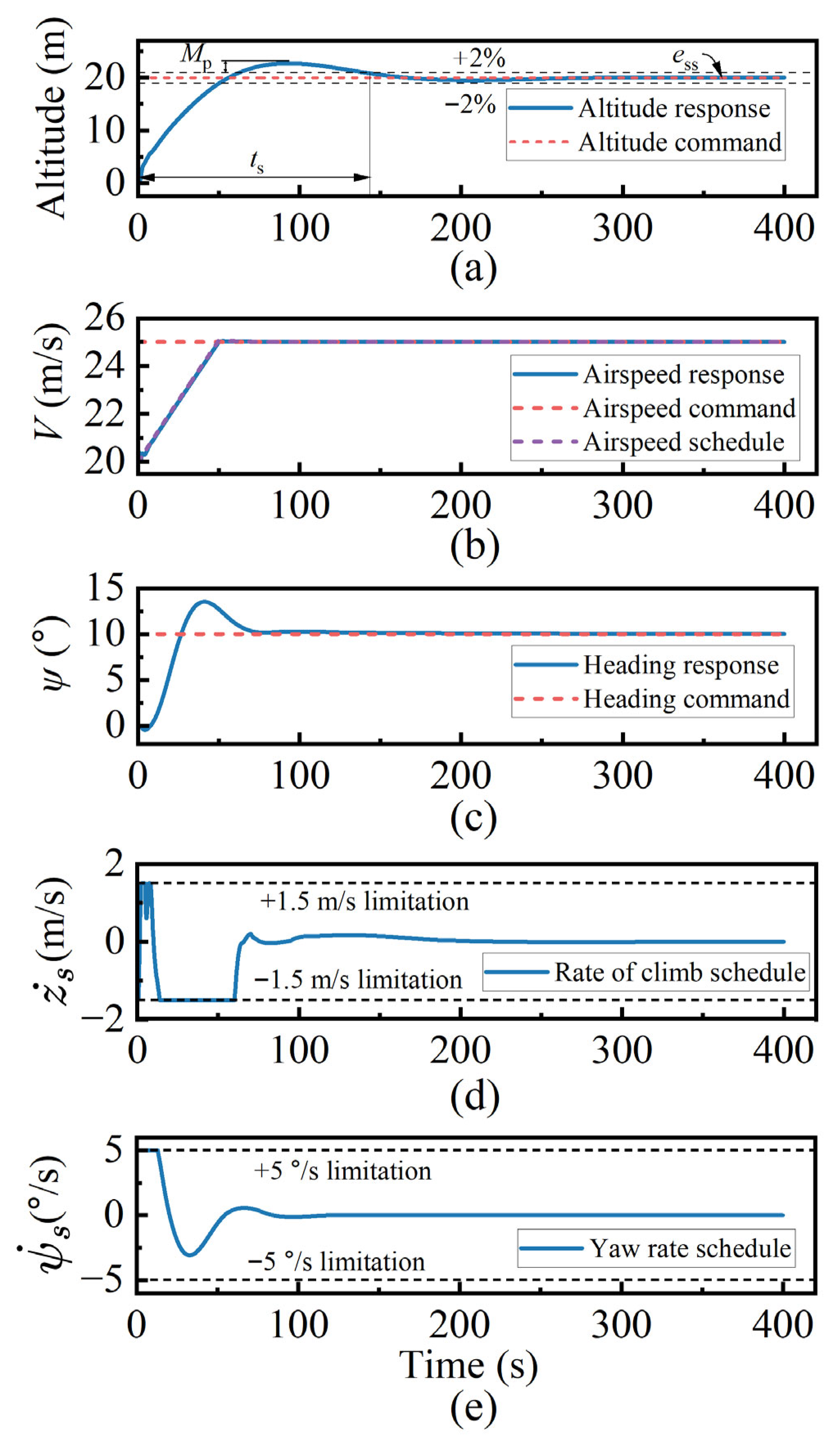
A multi-channel coupled guidance scenario was established to evaluate tracking capability and dynamic stability under simultaneous step commands. Initial conditions were defined as steady level flight with ε 0 = [ 0 , 0 , 0 ] T m, v B = [ 20 , 0 , 0 ] T m/s, η = [ 0 , 0 , 0 ] T °. At t = 0 s, step commands were applied: target altitude z cmd = 20 m, target airspeed V cmd = 25 m/s, and target heading ψ cmd = 10 °. Simulations spanned 400 s with a 0.02 s sampling period. System responses and performance indices are presented in Figure 13 and Table 5. Overshoot M p is the percentage by which the peak response exceeds the step command magnitude. Settling time t s is the minimum time for the response to enter and stay within the ±2% error band. Steady-state error e ss is the mean absolute error (MAE) over the final 100 s.
Simulation results demonstrate robust command tracking across longitudinal and lateral channels. The altitude response (Figure 13a) exhibits a 13.67% overshoot and a 154.2 s settling time, mainly due to vertical velocity saturation constraint of ±1.5 m/s applied to avoid envelope overpressure (Figure 13d). Despite these constraints, the controller achieves a negligible steady-state error of only 0.053 m. Airspeed guidance (Figure 13b) shows superior transient performance with 0.738% overshoot and 49.04 s settling time, attributed to the acceleration-constrained guidance strategy. Heading guidance (Figure 13c) response stabilizes after an overshoot of 35.31% influenced by the airship’s substantial yaw inertia. Meanwhile, the yaw rate is strictly limited to ±1.5°/s (Figure 13e) to constrain lateral overload. Notably, the pronounced heading overshoot arises from the airship’s large inherent inertia and weak damping, which cause significant angular momentum accumulation during large-angle maneuvers. Furthermore, near the end of the turn, limitations in yaw rate and actuator saturation prevent the LQR controller from generating sufficient counter-torque to arrest this rotational inertia, resulting in the observed temporary overshoot.
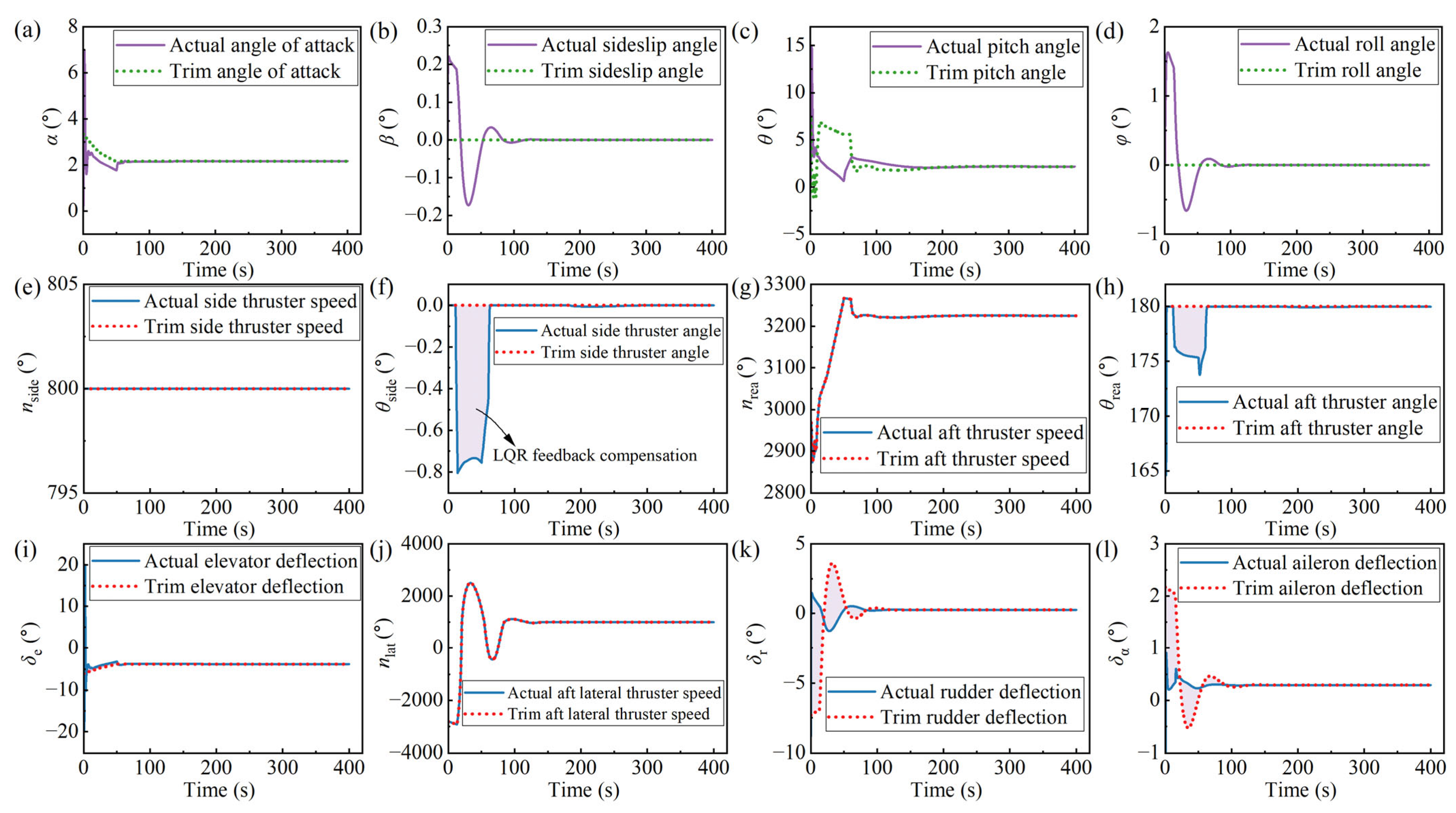
Figure 14 depicts the time histories of dynamic states and actuator inputs. The deviation between actual control inputs and theoretical trim values reflects the feedback compensation of the LQR controller. In the 20~25 m/s high-speed cruise regime, longitudinal control is aerodynamically dominated: side vectoring thrusters idle horizontally ( n side ≈ 800 r/min, θ side ≈ 0 °), while the aft vectoring thruster provides primary propulsion (Figure 14e–h). Pitch control is achieved via elevator deflection, establishing the necessary angle of attack and pitch angle for aerodynamic lift (Figure 14a,c). Lateral control utilizes the synergistic actuation of the aft lateral thruster, rudder, and aileron (Figure 14j–l).

4.2. Path Following

To evaluate the dynamic quality robustness of the autonomous flight control system in complex mission scenarios, a 3D path following simulation was conducted. The control problem is decoupled into horizontal, altitude, and airspeed channels for synergistic design.
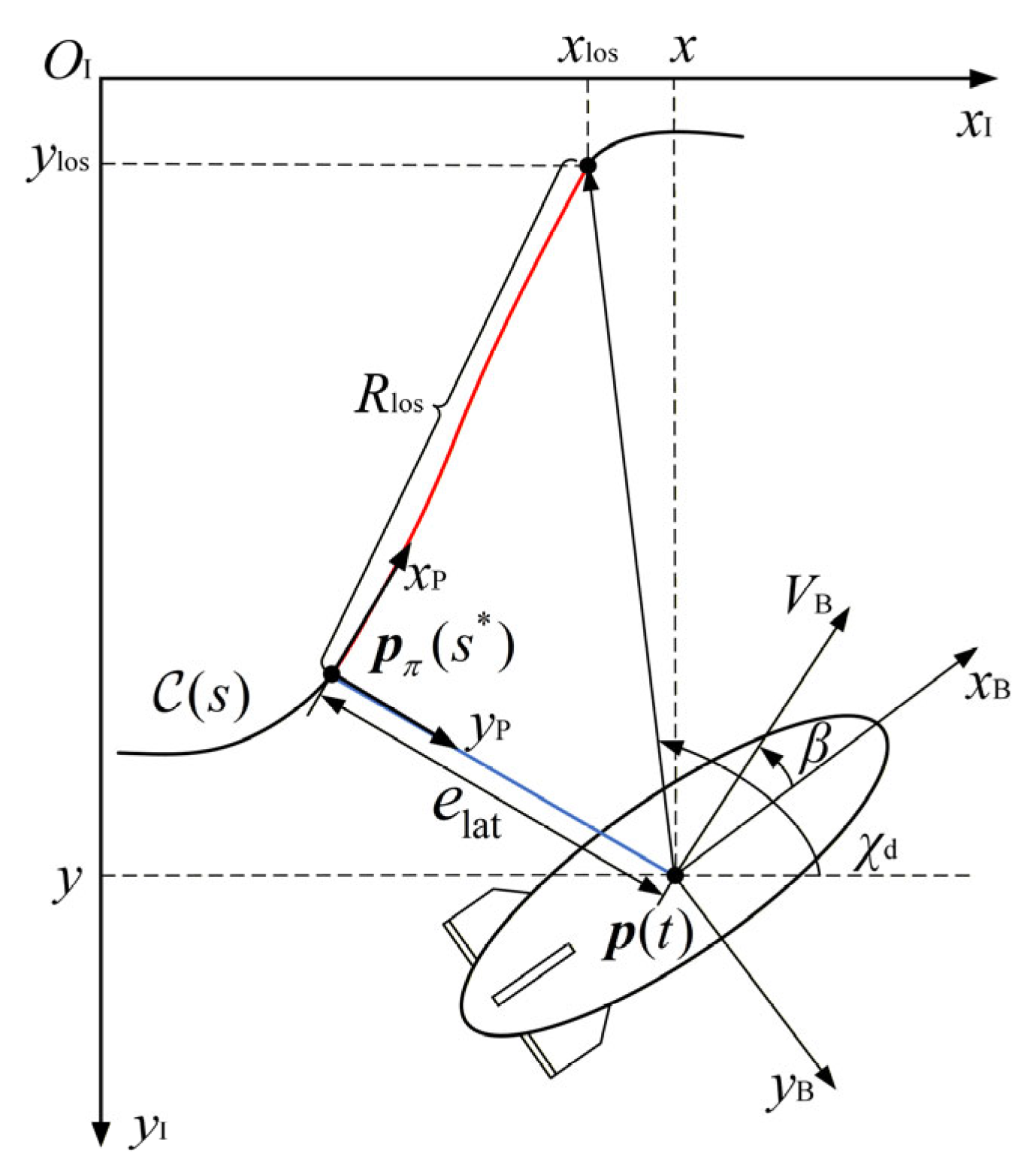
The path following error is defined in the path coordinate system P relative to the inertial frame I, as illustrated in Figure 15. The path frame P is attached to the pre-planned spatial path C ( s ) and parameterized by arc length s. At any instant, the closest path point to the airship’s CG is found, and the error vector in the inertial frame I is transformed into path frame P to obtain the 3D error:
e P = [ e long , e lat , e vert ] T = R I P · e I ,
where e I = p ( t ) p π ( s * ) represents the path following error in the inertial frame I, R I P denotes the rotation transformation matrix from frame I to frame P, and e long , e lat , e vert correspond to the along-track, cross-track, and altitude errors, respectively.
For the horizontal cross-track error e lat , an adaptive line-of-sight (ALOS) strategy is adopted. This strategy generates a desired heading angle command by constructing a virtual line-of-sight vector, driving the flight path to asymptotically converge to the reference path. Furthermore, to balance the following precision and trajectory smoothness, a velocity-dependent adaptive look-ahead mechanism is utilized:
R los ( t ) = max R min , min R max , τ · V ( t ) ,
where R los is the look-ahead distance, bounded by maximum R max and minimum R min . τ is the time constant.
Additionally, sideslip angle β is explicitly compensated in the heading command to correct for airflow and motion coupling during turns:
ψ cmd = χ d β = atan 2 ( y los y , x los x ) β ,
where χ d is the desired heading angle, ( x , y ) and ( x los , y los ) are the coordinates of the current position and the line-of-sight point, respectively.
For altitude error e vert , a height command z cmd = z d ( s * + R los ) is generated to maintain the airship within the prescribed flight layer. For along-track error e long , direct position feedback was avoided, and convergence is instead achieved by tracking the desired speed V cmd = V d ( s * + R los ) . The coordinated operation of the horizontal, altitude, and speed channels forms a complete and robust 3D path following control framework.
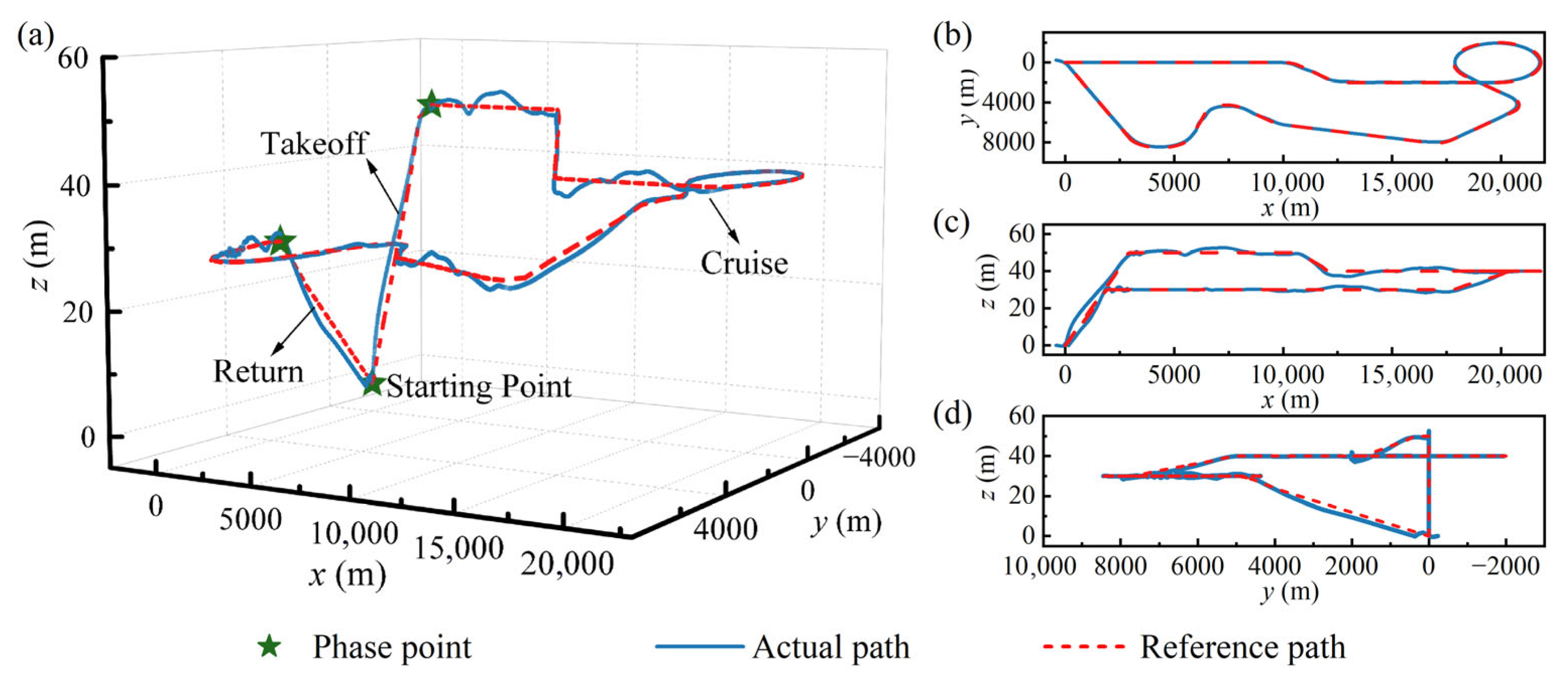
A representative regional patrol mission was designed to validate full-envelope performance. The trajectory was generated using waypoint-based following, expressed as C ( s ) = [ x ( s ) , y ( s ) , z ( s ) , V ( s ) ] , and covers takeoff, cruise, and return phases. The corresponding path segments and maneuvers are summarized in Table 6. The cruise phase includes variable-speed flight, turning and descent, loitering, and continuous turning, while the return phase employs a “heading alignment turn-straight flight” strategy using tangential arcs to eliminate lateral deviations.
Under the predefined flight path, the airship is initialized at ε 0 = [ 0 , 0 , 0 ] T m with a velocity of v B = [ 3 , 0 , 0 ] T m/s and zero attitude angles. Simulations were conducted with a fixed sampling interval of 0.02 s, and the resulting trajectory is shown in Figure 16. The results confirm precise alignment between the actual path and the reference path. During takeoff, smooth accelerated climbing from low speed (3 m/s) is achieved via thrust vectoring, precisely intercepting the 50 m altitude layer. In the cruise phase, the system maintains accurate following during large-angle loitering turns, variable-speed flight, and continuous turning maneuvers, exhibiting no significant altitude loss or sideslip even during coupled turning descents. The return phase demonstrates a stable decelerated descent along the tangential arc to the starting point, maintaining robust tracking performance despite degraded aerodynamic effectiveness at low speeds.
Time-domain responses from different control channels and error statistics are presented in Figure 17. The altitude channel (Figure 17a) suppresses disturbances from non-continuous maneuvers, maintaining a MAE of 0.711 m and restricting maximum dynamic deviation to 7 m. The airspeed channel (Figure 17b) exhibits rapid, overshoot-free response across the 3~25 m/s envelope, with a negligible MAE of 0.028 m/s. The heading channel (Figure 17c), driven by ALOS guidance, maintains a low MAE of 2.377° and a maximum instantaneous error of 15.528° during loitering and continuous turning maneuvers, which is acceptable for large-inertia airships. Notably, the heading angle exhibits 2π periodicity during circling maneuvers. To prevent angle accumulation in the control loop and ensure shortest path following, ψ is mapped to the principal interval (−π, π], as defined in Equation (33). Consequently, the numerical jumps observed in Figure 17c are attributable to angle normalization rather than physical instability.
ψ norm = atan 2 ( sin ψ , cos ψ )
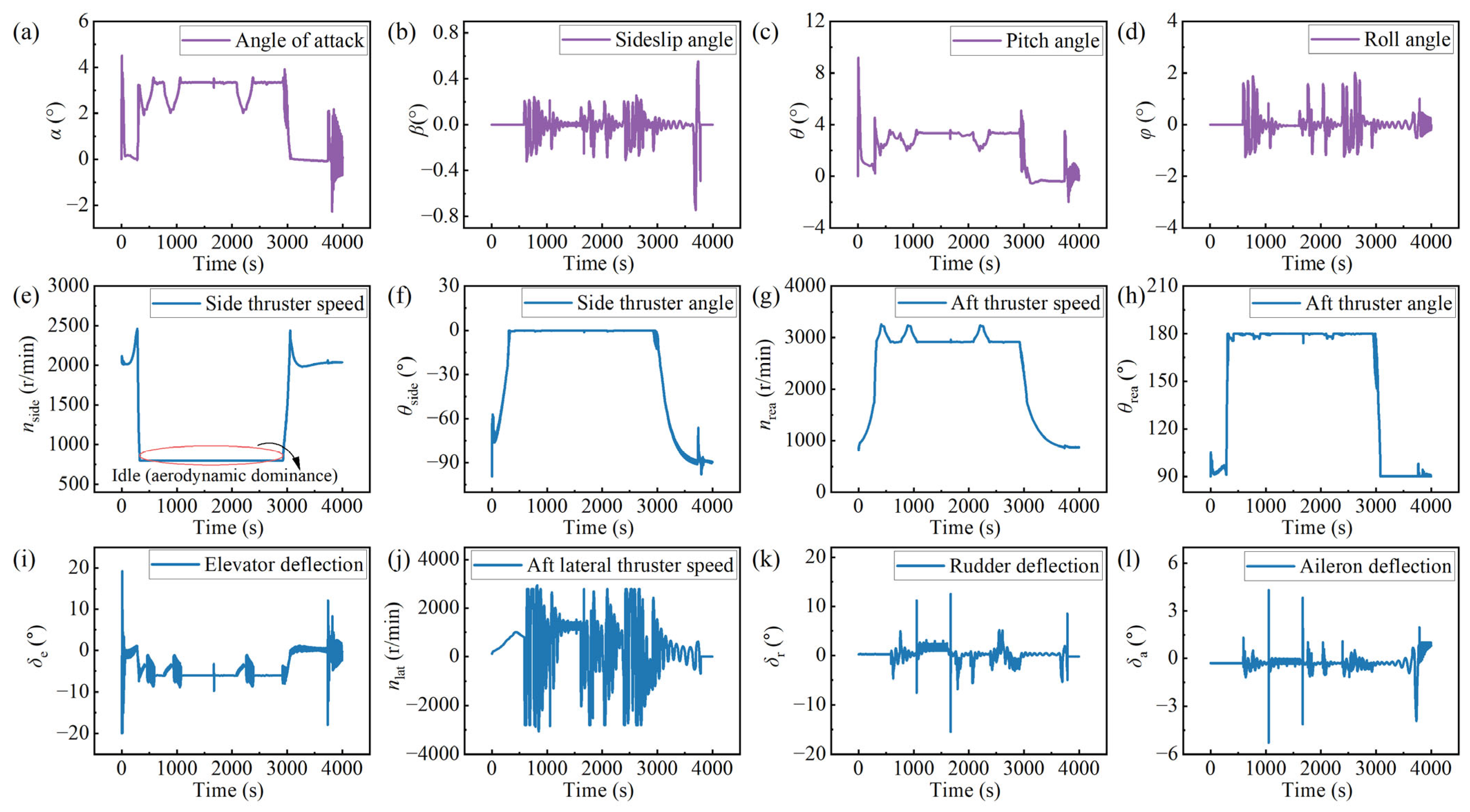
Figure 18 shows the time histories of dynamic states and control inputs during path following, demonstrating the effectiveness of the gain scheduling controller in managing redundant control allocation. During low-speed takeoff and return phases (t < 300 s, t > 3000 s), control is primarily achieved through thrust vectoring. Specifically, during the decelerated return descent, rapidly decreasing dynamic pressure severely degrades aerodynamic effectiveness. Nevertheless, an airspeed-driven gain-scheduling and weighted blending strategy ensures a seamless transition of control authority from the aerodynamic surfaces back to the vectored thrusters. In this process, coordinated adjustments of thruster speeds and tilt angles generate the required lift and propulsive forces (Figure 18e–h). These actions are complemented by variations in the angle of attack and pitch angle to maintain attitude equilibrium (Figure 18a,c). In the cruise phase (300 s < t < 3000 s), aerodynamic control surfaces dominate, with the side vectoring thrusters remaining idle while the aft vectoring thruster provides propulsion. During turns, coordinated rudder and aileron deflection restricts sideslip (Figure 18b) to a minimal range (±0.8 °), achieving high-quality coordinated maneuvering.

4.3. Wind Disturbances

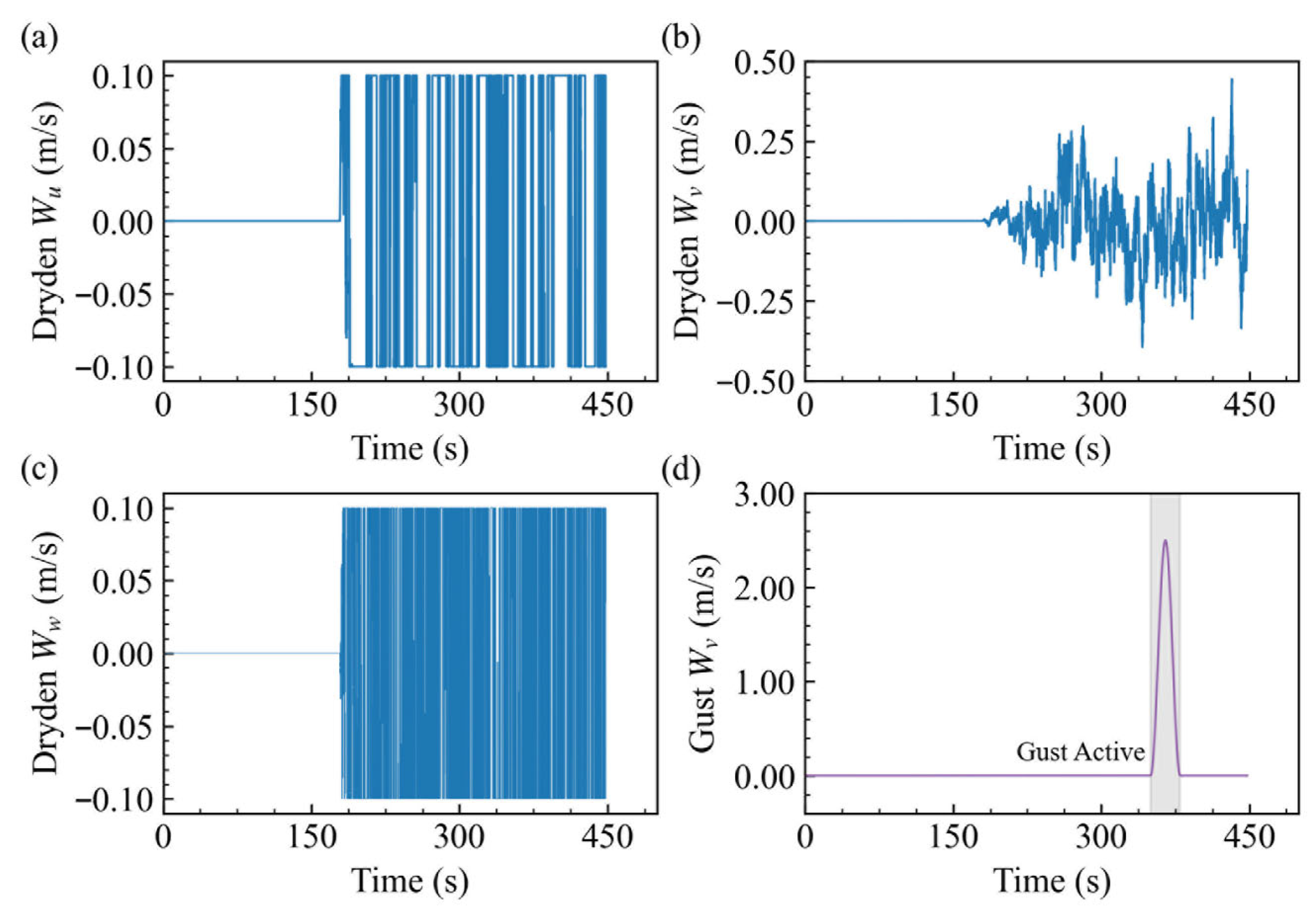
Due to the substantial size and lateral area, semi-rigid airships are highly sensitive to crosswind disturbances. In low-altitude operations, unsteady airflows (such as atmospheric turbulence and sudden gusts) are primary external disturbances that degrade path-tracking accuracy. To systematically evaluate the robustness of the proposed control system, additional path following simulations were conducted under a composite wind disturbance model comprising continuous turbulence and discrete gusts.
Continuous random turbulence is modeled using the Dryden model. By characterizing turbulence statistics via rational spectral density functions, this model accurately reflects low-altitude random airflow structures and is recommended by MIL-HDBK-1797B for aircraft handling and control evaluation [47]. The three-axis turbulence velocity components in the body frame B are generated by passing unit white noise through specific shaping filters, with transfer functions expressed as:
H u ( s ) = σ u 2 L u π V 1 1 + L u V s , H v ( s ) = σ v 2 L v π · 1 + 2 3 L v V s 1 + 2 L v V s 2 , H w ( s ) = σ w 2 L w π · 1 + 2 3 L w V s 1 + 2 L w V s 2 ,
where σu, σv, and σw are the longitudinal, lateral, and vertical turbulence intensities, respectively. Lu, Lv, and Lw are the corresponding turbulence scale lengths, which depend on flight altitude. V is the current flight speed, and s is the Laplace operator. In this study, for a flight altitude h = 50 m and a reference speed V = 25 m/s, the parameters are set based on MIL-HDBK-1797B empirical formulas: Lu = Lv = 178 m, Lw = 50 m, σu = σw = 0.1 m/s, and σv = 0.15 m/s.
Furthermore, to assess the system’s transient lateral impact resistance, a discrete gust model is superimposed onto the lateral wind field. This model employs a symmetric 1-cos profile, expressed in the time domain as:
W v ( t ) = W peak 2 1 cos   2 π ( t t start ) t gust ,   t start t   t start + t gust ,
where W peak is the peak gust velocity, t start is the gust start time, and t gust is the gust duration. The time histories of the composite wind disturbance components are illustrated in Figure 19.
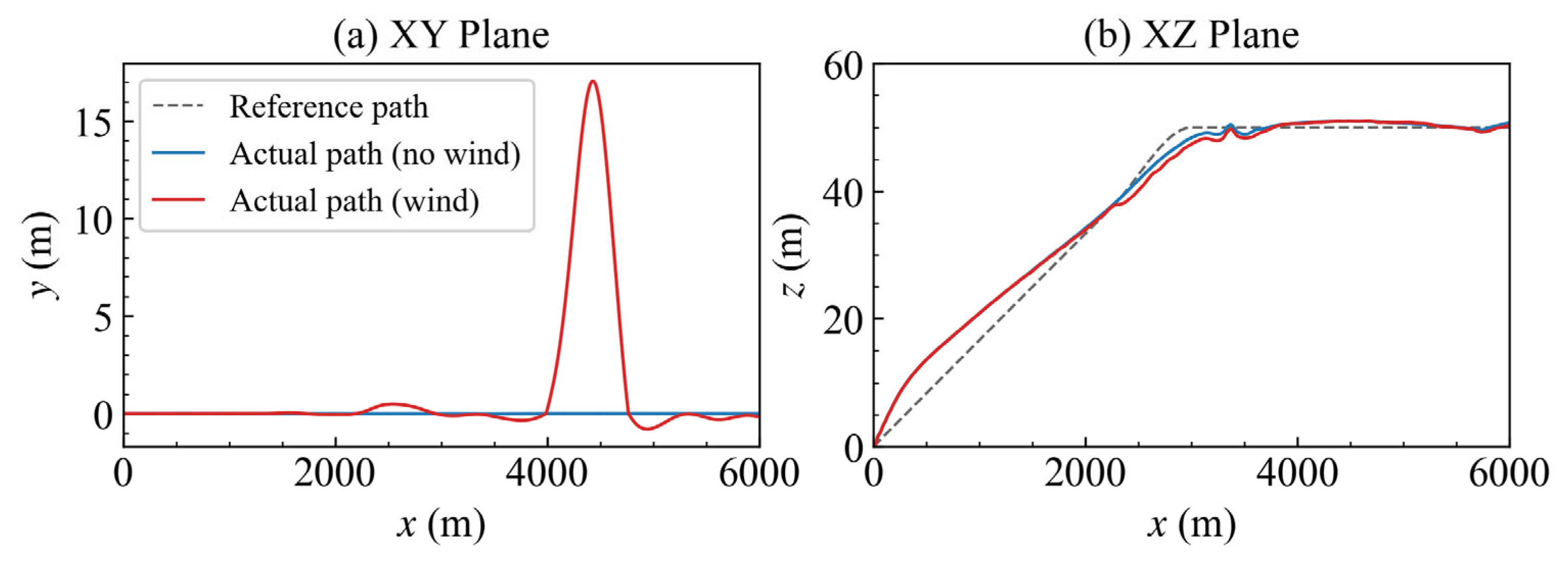
Under this disturbance environment, the path following task is divided into two phases: a linear climb from 0 m to 50 m, and a constant-altitude cruise. The 3D path following performance under a no-wind baseline is compared with that under the composite wind disturbances. The path following responses and error statistics are presented in Figure 20 and Table 7, respectively.
Results indicate that under the no-wind baseline, the system exhibits excellent following performance, achieving an altitude MAE of only 1.790 m and bounding the cross-track error within 0.304 m. However, composite wind disturbances reveal significant channel robustness disparities. The longitudinal channel demonstrates strong disturbance rejection. Despite severe lateral disturbances, the altitude response (Figure 20b) remains smooth. The altitude MAE increases by merely 12.1% (from 1.790 m to 2.041 m) alongside consistently low velocity errors, indicating minimal crosswind coupling into the longitudinal dynamics. Conversely, the lateral channel is highly sensitive to crosswinds. While continuous turbulence causes minor bounded fluctuations, the discrete gust (350–380 s) induces a severe aerodynamic yawing moment, culminating in a peak cross-track error of 17.052 m (Figure 20a). Nevertheless, the rapid post-gust error decay confirms the gain-scheduling LQR controller effectively suppresses divergence, ensuring robust steady-state recovery under complex winds.

5. Discussion

The CFD-based coupling aerodynamic–dynamic model developed in this study significantly outperforms traditional empirical and linearized formulations by accurately capturing aerodynamic nonlinearities across the flight envelope. The “offline computation-online lookup” strategy effectively balances physical precision with real-time computational efficiency.
Regarding control, the gain scheduling framework optimizes actuator allocation. It ensures a smooth, stable transition from low-speed thrust vectoring to high-speed aerodynamic dominance, effectively resolving redundancy in over-actuated regimes. In 3D path following, the control system maintains altitude, speed, and heading errors within sub-meter levels, thereby ensuring high-precision path following. Moreover, the synergistic application of ALOS guidance and active sideslip feedback effectively constrains sideslip during aggressive maneuvers, achieving high-quality coordinated turns.
However, this study employs a 1:100 scaled model with CFD simulations conducted at 30 m/s. Although the resulting Re range (1.54 × 10⁵–1.80 × 10⁶) mostly lies within or near the supercritical regime, perfect Re similarity across the entire flight envelope cannot be ensured. In particular, under low-speed conditions (e.g., near 3 m/s), the Re approaches the lower bound, where scale effects may become more significant. As a result, certain aerodynamic coefficients may retain moderate Re sensitivity, potentially leading to minor discrepancies between the scaled-model results and full-scale airship aerodynamics.
In addition, the aerodynamic database used in this study is derived solely from CFD simulations and has not yet been validated against dedicated experimental measurements. Although the adopted turbulence modeling approach and numerical settings are widely used in aerodynamic simulations of streamlined bluff bodies, the predictive accuracy of the present CFD model still requires further experimental verification. Future work will therefore focus on wind-tunnel testing of a geometrically similar scaled model to provide benchmark aerodynamic data for validating and refining the CFD-based aerodynamic database.
From an engineering standpoint, the hierarchical architecture minimizes real-time load, facilitating FMS integration. However, the current rigid-body assumption neglects real-time aeroelastic deformation and extreme gust disturbances. Future work will focus on incorporating FSI corrections and disturbance observers to enhance environmental adaptability.

6. Conclusions

This study established a systematic framework for high-fidelity modeling and full-envelope autonomous control of semi-rigid airships. Key contributions include:
  • A CFD-based coupling aerodynamic–dynamic method was established, embedding nonlinear aerodynamic data and added mass effects into 6-DOF equations. This significantly improves prediction accuracy in limit states, providing a robust physical basis for control design.
  • A multi-variable gain scheduling controller was developed to coordinate thrust vectoring and aerodynamic surfaces. By scheduling LQR gains against flight states, the system achieves smooth mode transitions and optimal allocation across the velocity spectrum.
  • Simulations verify closed-loop stability and high-precision tracking across complex profiles, including climb, cruise, and maneuvering. The ALOS strategy effectively suppresses sideslip, confirming feasibility.
Future research will address flexible skin FSI effects and robust control under extreme gust conditions to advance autonomous operations.
While the current numerical framework demonstrates strong theoretical reliability, future research will prioritize physical validation to further bridge numerical modeling and real-world flight practice. Planned initiatives include scaled-model wind tunnel tests and hardware-in-the-loop (HIL) simulations. Additionally, future research will address flexible skin FSI effects and robust control under extreme gust conditions to advance autonomous operations.

Author Contributions

Conceptualization, S.H. and C.W.; methodology, S.H. and C.W.; software, S.H. and C.W.; validation, S.H., C.W. and J.L.; formal analysis, C.W.; investigation, J.L.; data curation, C.W.; writing—original draft preparation, S.H. and C.W.; writing—review and editing, S.H. and C.W.; visualization, C.W. All authors have read and agreed to the published version of the manuscript.

Funding

This research received no external funding.

Data Availability Statement

The original contributions presented in this study are included in the article. Further inquiries can be directed to the corresponding author.

Acknowledgments

We would like to express our sincere thanks to all the editors, reviewers and staff who participated in the review of this article.

Conflicts of Interest

The authors declare no conflicts of interest.

Abbreviations

The following abbreviations are used in this manuscript:
CFDComputational fluid dynamics
FSIFluid–structure interaction
LQRLinear quadratic regulator
6-DOFSix-degree-of-freedom
MAEMean absolute error
CGCenter of gravity
CBCenter of buoyancy

References

  1. Manikandan, M.; Pant, R.S. Research and advancements in hybrid airships—A review. Prog. Aerosp. Sci. 2021, 127, 100741. [Google Scholar] [CrossRef]
  2. Zuo, Z.; Song, J.; Zheng, Z.; Han, Q.L. A survey on modelling, control and challenges of stratospheric airships. Control Eng. Pract. 2022, 119, 104979. [Google Scholar] [CrossRef]
  3. Hu, S.; Wang, B.; Zhang, A.; Deng, Y. Genetic algorithm and greedy strategy-based multi-mission-point route planning for heavy-duty semi-rigid airship. Sensors 2022, 22, 4954. [Google Scholar] [CrossRef]
  4. Zhang, Y.; Li, S.; Mi, X.; Zhang, B.; Hu, J.; Chen, W.; Huang, X. Assembly method for large CFRP spokes designed for semi-rigid stratospheric airships. Aerosp. Sci. Technol. 2025, 168, 110673. [Google Scholar] [CrossRef]
  5. Chen, L.; Chen, W.; Li, S.; Zhao, B. Modal characteristics of a scaling stratospheric airship in still air. Aerosp. Sci. Technol. 2023, 141, 108521. [Google Scholar] [CrossRef]
  6. Fruncillo, F.; Sollazzo, A.; Baraniello, V.R.; Genito, N.; Vitale, A. Assessment of added masses effects on airship dynamics and stability. J. Aircr. 2025, 62, 649–659. [Google Scholar] [CrossRef]
  7. Riccio, E.; Giaquinto, C.; Baraniello, V.R.; Persechino, G.; Coiro, D. Aerodynamic and stability analysis of a closed-wing high-altitude pseudo-satellite. Eng. Proc. 2025, 90, 9. [Google Scholar] [CrossRef]
  8. Chaabani, S.; Azouz, N. Modelling and stabilisation of an unconventional airship: A polytopic approach. Aerospace 2022, 9, 252. [Google Scholar] [CrossRef]
  9. Suvarna, S.; Chung, H.; Pant, R.S. Optimization of fins to minimize directional instability in airships. J. Aircr. 2022, 59, 317–328. [Google Scholar] [CrossRef]
  10. Sasidharan, A.; Velamati, R.K.; Janardhanan, S.; Oruganti, V.R.M.; Mohammad, A. Stability derivatives of various lighter-than-air vehicles: A CFD-based comparative study. Drones 2022, 6, 168. [Google Scholar] [CrossRef]
  11. Ge, Y.; Wang, X.; Wang, Q. Equivalent mechanical model utilizing the strip method and fast estimation formulas for airship gas sloshing. Aerosp. Sci. Technol. 2024, 146, 108917. [Google Scholar] [CrossRef]
  12. Lin, X.; Guo, P. Airship motion modeling based on a dynamic aerodynamic model. Guid. Navig. Control 2025, 6, 93. [Google Scholar] [CrossRef]
  13. Suvarna, S.; Chung, H.; Sinha, A.; Pant, R.S. Revised semi-empirical aerodynamic estimation for modelling flight dynamics of an airship. Aerosp. Sci. Technol. 2022, 126, 107642. [Google Scholar] [CrossRef]
  14. Wasim, M.; Ali, A.; Sohail, M.U. Development of nonlinear six-degree-of-freedom dynamic modelling and high-fidelity flight simulation of an autonomous airship. Processes 2025, 13, 2688. [Google Scholar] [CrossRef]
  15. Gary, J.; McDermott, J.; Worden, K.; Hosder, S.; Viganò, D. A combined tomographic particle image velocimetry and numerical simulation approach for supersonic wind tunnel calibration. Aerosp. Sci. Technol. 2025, 168, 111168. [Google Scholar] [CrossRef]
  16. López, D.; Domínguez, D.; Delgado, A.; García-Gutiérrez, A.; Gonzalo, J. Experimental Calculation of added masses for the accurate construction of airship flight models. Aerospace 2024, 11, 872. [Google Scholar] [CrossRef]
  17. Tabatabaei, N.; Örlü, R.; Vinuesa, R.; Schlatter, P. Aerodynamic free-flight conditions in wind tunnel modelling through reduced-order wall inserts. Fluids 2021, 6, 265. [Google Scholar] [CrossRef]
  18. Sasidharan, A.; Velamati, R.K.; Mohammad, A.; Benaissa, S. Mathematical modelling of a single tethered aerostat using longitudinal stability derivatives. Sci. Rep. 2024, 14, 3697. [Google Scholar] [CrossRef]
  19. Xie, C.; Tao, G.; Wu, Z. Performance prediction and design of stratospheric propeller. Appl. Sci. 2021, 11, 4698. [Google Scholar] [CrossRef]
  20. Manikandan, M.; Vaidya, E.; Pant, R.S. Design and analysis of hybrid electric multi-lobed airship for cargo transportation. Sustain. Energy Technol. Assess. 2022, 51, 101892. [Google Scholar] [CrossRef]
  21. Gao, W.; Yang, X.; Wang, J.; Li, X.; Lin, B.; Bi, Y.; Dong, A. Dynamic stability of the hybrid airship influenced by added mass effect. J. Aircr. 2025, 62, 278–287. [Google Scholar] [CrossRef]
  22. Azouz, N.; Khamlia, M.; Lerbet, J.; Abichou, A. Stabilization of an unconventional large airship when hovering. Appl. Sci. 2021, 11, 3551. [Google Scholar] [CrossRef]
  23. Azinheira, J.; Carvalho, R.; Paiva, E.; Cordeiro, R. Hexa-propeller airship for environmental surveillance and monitoring in amazon rainforest. Aerospace 2024, 11, 249. [Google Scholar] [CrossRef]
  24. Yu, Z.; Zhang, Y.; Jiang, B.; Su, C.; Fu, J.; Jin, Y.; Chai, T. Distributed adaptive fault-tolerant time-varying formation control of unmanned airships with limited communication ranges against input saturation for smart city observation. IEEE Trans. Neural Netw. Learn. Syst. 2021, 33, 1891–1904. [Google Scholar] [CrossRef]
  25. Price, E.; Black, M.J.; Ahmad, A. Viewpoint-driven formation control of airships for cooperative target tracking. IEEE Robot. Autom. Lett. 2023, 8, 3653–3660. [Google Scholar] [CrossRef]
  26. Pheh, Y.H.; Kyi, H.W.S.; Foong, S. Spherical Indoor Coandă Effect Drone (SpICED): A spherical blimp suas for safe indoor use. Drones 2022, 6, 260. [Google Scholar] [CrossRef]
  27. Luo, X.; Zhu, M.; Zhang, Y.; Zhang, Z.; Chen, T. Self-triggered fuzzy trajectory tracking control for the stratospheric airship. Adv. Space Res. 2024, 74, 5874–5889. [Google Scholar] [CrossRef]
  28. Chen, T.; Zhu, M.; Zheng, Z. Adaptive path following control of a stratospheric airship with full-state constraint and actuator saturation. Aerosp. Sci. Technol. 2019, 95, 105457. [Google Scholar] [CrossRef]
  29. Zhou, P.; Lin, Q.; Wang, Q. Path-following control of underactuated stratospheric airship with constraints and disturbances using time-delay observer. Optim. Control Appl. Methods 2025, 46, 849–858. [Google Scholar] [CrossRef]
  30. Vieira, H.S.; Paiva, E.C.; Moriguchi, S.K.; Carvalho, J.R.H. Unified backstepping sliding mode framework for airship control design. IEEE Trans. Aerosp. Electron. Syst. 2020, 56, 3246–3258. [Google Scholar] [CrossRef]
  31. Wasim, M.; Ali, A.; Choudhry, M.A.; Shaikh, I.U.H.; Saleem, F. Robust design of sliding mode control for airship trajectory tracking with uncertainty and disturbance estimation. J. Syst. Eng. Electron. 2024, 35, 242–258. [Google Scholar] [CrossRef]
  32. Liu, S.; Whidborne, J.F.; He, L. Backstepping sliding-mode control of stratospheric airships using disturbance-observer. Adv. Space Res. 2021, 67, 1174–1187. [Google Scholar] [CrossRef]
  33. Yang, X.; Yang, X.; Deng, X. Horizontal trajectory control of stratospheric airships in wind field using Q-learning algorithm. Aerosp. Sci. Technol. 2020, 106, 106100. [Google Scholar] [CrossRef]
  34. Liao, L.; Pasternak, I. A review of airship structural research and development. Prog. Aerosp. Sci. 2009, 45, 83–96. [Google Scholar] [CrossRef]
  35. Li, Y.; Nahon, M. Modeling and simulation of airship dynamics. J. Guid. Control Dyn. 2007, 30, 1691–1700. [Google Scholar] [CrossRef]
  36. Mueller, J.; Paluszek, M.; Zhao, Y. Development of an aerodynamic model and control law design for a high altitude airship. In Proceedings of the AIAA 3rd “Unmanned Unlimited” Technical Conference, Workshop and Exhibit, Chicago, IL, USA, 20–23 September 2004; p. 6479. [Google Scholar]
  37. Mahony, R.; Kumar, V.; Corke, P. Multirotor aerial vehicles: Modeling, estimation, and control of quadrotor. IEEE Robot. Autom. Mag. 2012, 19, 20–32. [Google Scholar] [CrossRef]
  38. Beard, R.W.; McLain, T.W. Small Unmanned Aircraft: Theory and Practice; Princeton University Press: Princeton, NJ, USA, 2012; pp. 63–65. [Google Scholar]
  39. Jiao, J.; Song, B.; Li, Y.; Zhang, Y.; Xu, J. Development of a testing methodology for high-altitude propeller. Aircr. Eng. Aerosp. Technol. 2018, 90, 1378–1386. [Google Scholar] [CrossRef]
  40. Achenbach, E. Experiments on the flow past spheres at very high Reynolds numbers. J. Fluid Mech. 1972, 54, 565–575. [Google Scholar] [CrossRef]
  41. Shams, T.A.; Yektaei, S.; Esfahanian, V.; Abdolahipour, S. Experimental study on the effects of sideslip and rudder deflection angles on the aerodynamics of an aircraft vertical tail at low speeds. Fluids 2025, 10, 277. [Google Scholar] [CrossRef]
  42. Shome, B. Numerical study of oscillating boundary layer flow over a flat plate using kkLω turbulence model. Int. J. Heat Fluid Flow 2013, 42, 131–138. [Google Scholar] [CrossRef]
  43. Tian, Y. Locally optimal aerodynamic shape design for stratospheric airships: A GA-driven MDO framework with CAD/CFD validation. Aerosp. Sci. Technol. 2025, 158, 110965. [Google Scholar] [CrossRef]
  44. Pai, A.; Manikandan, M. A comparative study of aerodynamic characteristics of conventional and multi-lobed airships. Aeronaut. J. 2025, 129, 2435–2459. [Google Scholar] [CrossRef]
  45. Lawson, N.J.; Davies, S.G.; Khanal, B.; Hoff, R.I. Wake-tailplane interaction of a slingsby firefly aircraft. Aerospace 2022, 9, 787. [Google Scholar] [CrossRef]
  46. Hang, X.; Su, W.; Fei, Q.; Jiang, D. Analytical sensitivity analysis of flexible aircraft with the unsteady vortex-lattice aerodynamic theory. Aerosp. Sci. Technol. 2020, 99, 105612. [Google Scholar] [CrossRef]
  47. Valle, R.C.; Menegaldo, L.L.; Simões, A.M. Smoothly gain-scheduled control of a tri-turbofan airship. J. Guid. Control Dynam. 2015, 38, 53–61. [Google Scholar] [CrossRef]
Figure 1. Semi-rigid airship and its geometric dimensions.
Drones 10 00241 g001
Figure 2. Airship dynamic coordinate systems.
Drones 10 00241 g002
Figure 3. Computational domain and mesh refinement; (a) Fluid computational domain, where L, W, and H denote the airship length, width, and height, and the domain size is 7L, 9W, and 9H; (b) Local mesh refinement, where Regions B and C represent the hull and empennage, respectively.
Drones 10 00241 g003
Figure 4. Computational domain meshing. (a) Surface mesh; (b) Volume mesh, where arrows indicate the corresponding mesh regions.
Drones 10 00241 g004
Figure 5. CFD results under head-on wind conditions. (a) Surface pressure contour; (b) Velocity vector field.
Drones 10 00241 g005
Figure 6. Aerodynamic coefficients under different freestream directions and control surface deflections. (a) Drag coefficient CD; (b) Side-force coefficient CY; (c) Lift coefficient CL; (d) Rolling moment coefficient Cl; (e) Pitching moment coefficient Cm; (f) Yawing moment coefficient Cn.
Drones 10 00241 g006
Figure 7. Trim results for high-speed straight flight. (a) Angle of attack α; (b) Aft vectoring thruster speed nrea; (c) Aft vectoring thruster angle θrea; (d) Elevator deflection angle δe.
Drones 10 00241 g007
Figure 8. Trim results for low-speed straight ascent/descent. (a) Pitch angle θ; (b) Side vectoring thruster speed nside; (c) Side vectoring thruster angle θside; (d) Aft vectoring thruster speed nlat.
Drones 10 00241 g008
Figure 9. Trim results for zero-sideslip coordinated turn. (a) Sideslip angle β; (b) Aft lateral thruster speed nlat; (c) Rudder deflection angle δr; (d) Aileron deflection angle δa.
Drones 10 00241 g009
Figure 10. Static trim residuals across speed envelope under straight level flight conditions.
Drones 10 00241 g010
Figure 11. Open-loop dynamic coupling responses at V = 25 m/s. (a) Longitudinal excitation; (b) Induced lateral response; (c) Lateral excitation; (d) Induced longitudinal response.
Drones 10 00241 g011
Figure 12. Control system framework.
Drones 10 00241 g012
Figure 13. System response to guidance commands. (a) Altitude guidance; (b) Heading guidance; (c) Airspeed guidance; (d) Climb rate; (e) Yaw rate.
Drones 10 00241 g013
Figure 14. Time histories of dynamic states and actuator control inputs during coupled guidance. (a) Angle of attack α; (b) Sideslip angle β; (c) Pitch angle θ; (d) Roll angle ϕ ; (e) Side vectoring thruster speed n side ; (f) Side vectoring thruster tilt angle θ side ; (g) Aft vectoring thruster speed n rea ; (h) Aft vectoring thruster tilt angle θ rea ; (i) Elevator deflection δ e ; (j) Aft lateral thruster speed n lat ; (k) Rudder deflection δ r ; (l) Aileron deflection δ a .
Drones 10 00241 g014
Figure 15. Schematic illustration of the path following problem.
Drones 10 00241 g015
Figure 16. Path following results. (a) 3D path following; (b) XY plane projection; (c) XZ plane projection; (d) YZ plane projection.
Drones 10 00241 g016
Figure 17. System responses of different control channels. (a) Altitude response; (b) Airspeed response; (c) Heading angle response.
Drones 10 00241 g017
Figure 18. Time histories of dynamic states and actuator control inputs during the following path. (a) Angle of attack α; (b) Sideslip angle β; (c) Pitch angle θ; (d) Roll angle ϕ ; (e) Side vectoring thruster speed n side ; (f) Side vectoring thruster tilt angle θ side ; (g) Aft vectoring thruster speed n rea ; (h) Aft vectoring thruster tilt angle θ rea ; (i) Elevator deflection δ e ; (j) Aft lateral thruster speed n lat ; (k) Rudder deflection δ r ; (l) Aileron deflection δ a .
Drones 10 00241 g018
Figure 19. Time histories of the composite wind disturbances: (a) Dryden longitudinal turbulence; (b) Dryden lateral turbulence; (c) Dryden vertical turbulence; (d) 1-cos discrete lateral gust.
Drones 10 00241 g019
Figure 20. Path following comparison between no-wind baseline and composite wind disturbances. (a) XY horizontal plane; (b) XZ longitudinal plane.
Drones 10 00241 g020
Table 1. Mesh independence analysis for the CFD simulations.
Mesh LevelTotal CellsCDCL
Coarse6.30 × 1060.06430.0165
Medium (used)11.80 × 1060.06250.0158
Fine17.47 × 1060.06190.0154
Table 2. Numerical simulation parameter.
TypeParameterSetting
Basic parametersatmospheric pressure101,325 Pa
air density1.225 kg/m3
viscosity1.789 × 10−5 kg/(m·s)
ambient temperature288.16 K
Boundaryinletvelocity inlet, 30 m/s
outletpressure outlet
wind tunnel wallsShear-free
airship wallsNo-slip
Turbulence——SST k-ω model
Solversolution methodpressure-velocity coupling
discretizationsecond-order upwind
Table 3. Sensitivity analysis of trim scheduling variables under straight level flight (V = 25 m/s).
Dynamic ChannelScheduling VariablesSm
Longitudinal motionV0.146
z ˙ 0.570
α0.892
θ0.004
Lateral motionV0.503
β2.425
ψ ˙ 0.260
Table 4. Control system parameter.
ParameterSymbolDescriptionValue
airship
model
mtotal mass of the airship8050 (kg)
Vhulltotal volume of the airship8425 (m3)
Ixxmoment of inertia about xB axis162,320 (kg·m2)
Iyymoment of inertia about yB axis4,544,960 (kg·m2)
Izzmoment of inertia about zB axis4,382,640 (kg·m2)
Ixzproduct of inertia in xBoBzB plane258,575 (kg·m2)
[xG, yG, zG]CG coordinates[0.1, 0, 0.2] (m)
[xL, yL, zL]left side vectoring thruster propeller center coordinates[10.8, −8.3, 3.6] (m)
[xR, yR, zR]right side vectoring thruster propeller center coordinates[10.8, 8.3, 3.6] (m)
[xrea, yrea, zrea]aft vectoring thruster propeller center coordinates[−40.9, 0, 0.02] (m)
[xlat, ylat, zlat]aft lateral thruster propeller center coordinates[−39.5, 1.9, −0.5] (m)
kTlumped propeller thrust coefficient0.165 (N·s2/rad)
control
parameters
Kp,1altitude guidance PID proportional gain0.35
Ki,1altitude guidance PID integral gain0.01
Kd,1altitude guidance PID derivative gain5.50
Kp,2heading guidance PID proportional gain1.05
Ki,2heading guidance PID integral gain0.01
Kd,2heading guidance PID derivative gain7.95
amaxairspeed acceleration limit0.1 m/s2
QVlongitudinal state weighting matrixdiag([300, 40, 50, 1000])
RVlongitudinal control weighting matrixdiag([200, 200, 100, 150, 300])
QLlateral state weighting matrixdiag([50, 200, 1000, 500])
RLlateral control weighting matrixdiag([1000, 10, 50])
Table 5. Multi-channel coupled guidance performance indices.
Guidance CommandInitial ValueCommand Value M p t s e s s
altitude0 m20 m13.670%154.200 s0.053 m
airspeed20 m/s25 m/s0.738%49.040 s3.57 × 10−6 m/s
heading0 °10 °35.311%125.820 s0.0173 deg
Table 6. Path definitions of path following task.
Path SegmentManeuverHorizontal ChannelAltitude ChannelAirspeed Channel
takeoffaccelerated climbstraight flight 3 km0 → 50 m3 → 17 m/s
cruisevariable-speed flightstraight flight 7 km50 m17 → 25 → 20 m/s
turning and descentleft 45° → straight → right 45°50 → 40 m20 m/s
variable-speed flightstraight 7 km40 m20 → 25 → 20 m/s
steady loitering315° loitering turn40 m20 m/s
turning and descentleft 90° → straight → right 60°40 → 30 m20 m/s
variable-speed flightstraight 7 km30 m20 → 25 → 20 m/s
continuous turningleft 30° → right 120°30 m20 m/s
returndecelerating approachheading alignment turn-straight flight30 → 0 m20 → 3 m/s
Table 7. Path following performance metrics under no-wind baseline and composite wind disturbances.
MetricsNo-Wind BaselineComposite Wind Disturbances
Altitude MAE (m)1.7902.041
Altitude MAX error (m)6.8028.440
Velocity MAE (m/s)0.0700.140
Velocity MAX error (m/s)1.4402.402
Heading MAE (°)0.0110.358
Heading MAX error (°)0.1305.321
Cross-track MAE (m)0.0100.809
Cross-track MAX error (m)0.30417.052
3D Position MAE (m)2.5303.320
3D Position MAX error (m)5.48017.141
Disclaimer/Publisher’s Note: The statements, opinions and data contained in all publications are solely those of the individual author(s) and contributor(s) and not of MDPI and/or the editor(s). MDPI and/or the editor(s) disclaim responsibility for any injury to people or property resulting from any ideas, methods, instructions or products referred to in the content.