


Adaptive Path Planning of UAV Based on A* Algorithm and Artificial Potential Field Method

Highlights
- A dynamic coefficient adaptation mechanism that adjusts attractive, repulsive, and trajectory-guidance terms according to target distance, obstacle distance, obstacle density, and path curvature.
- A complete gradient-based control law enabling the algorithm to directly generate UAV-executable motion commands.
- This enables drones to perform tasks more quickly and efficiently in complex environments.
- Be able to better adapt to the environment and complete search and rescue tasks in various environments.
Abstract
1. Introduction
2. Theoretical Foundations of Algorithms
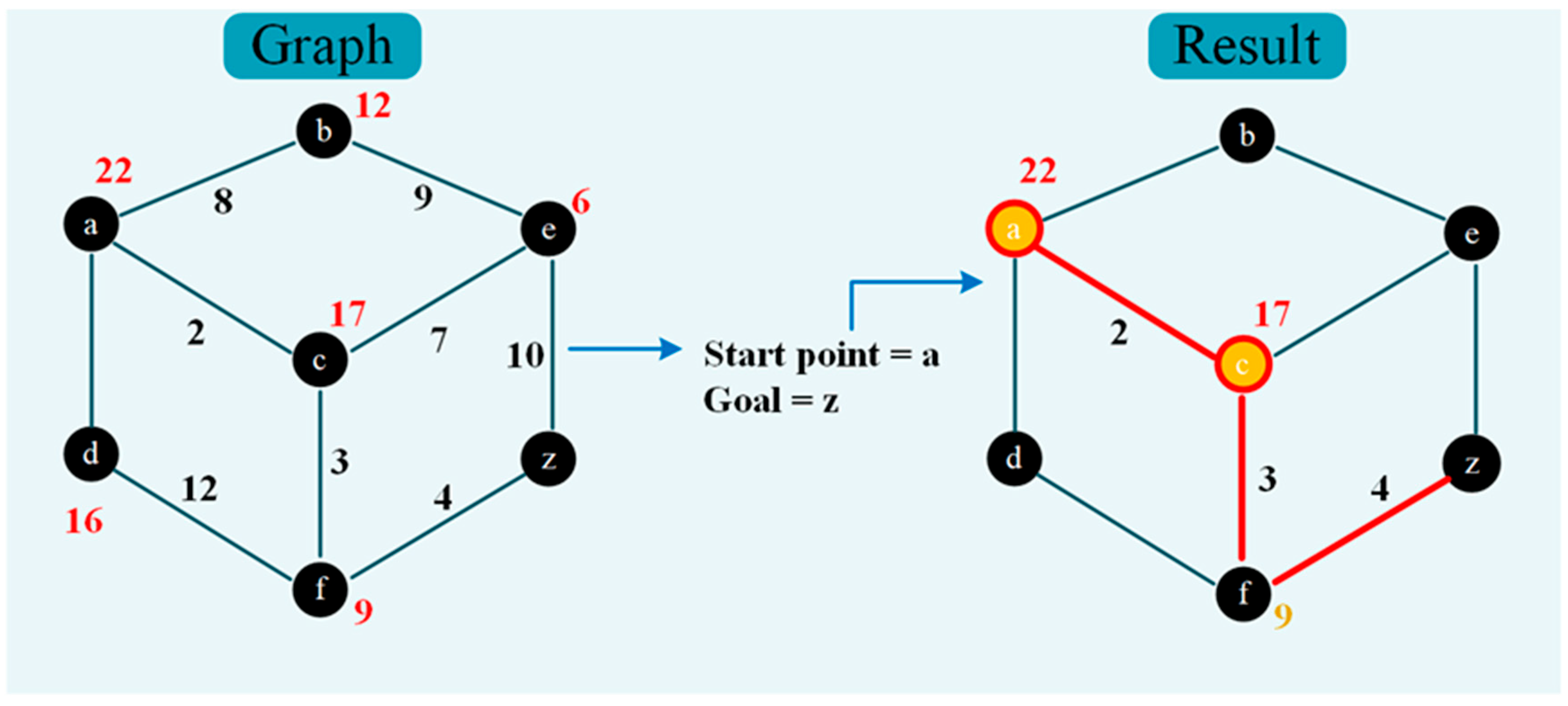
2.1. Global Reference Path Generation Using A*
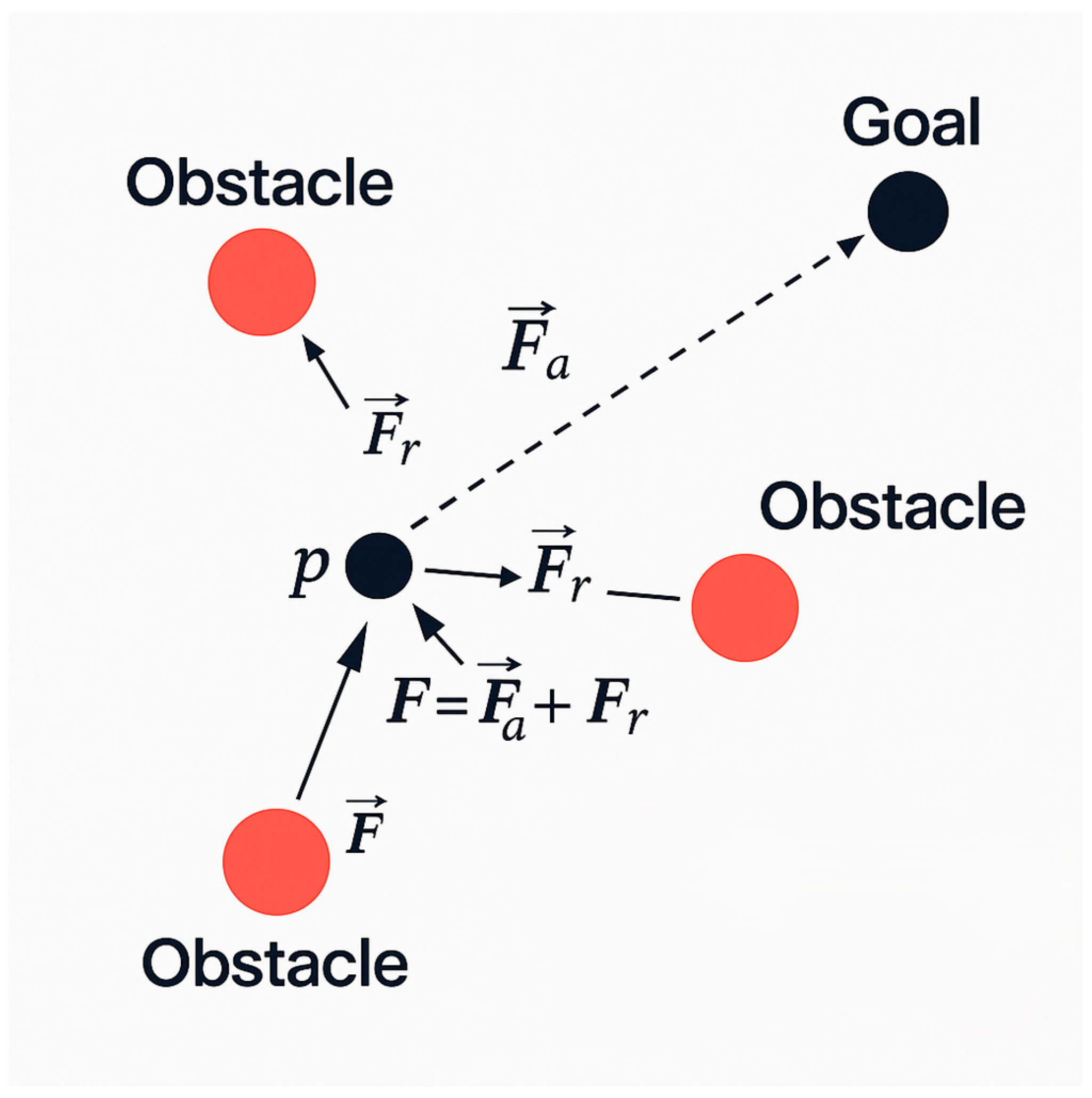
2.2. Artificial Potential Field Framework
2.3. Summary
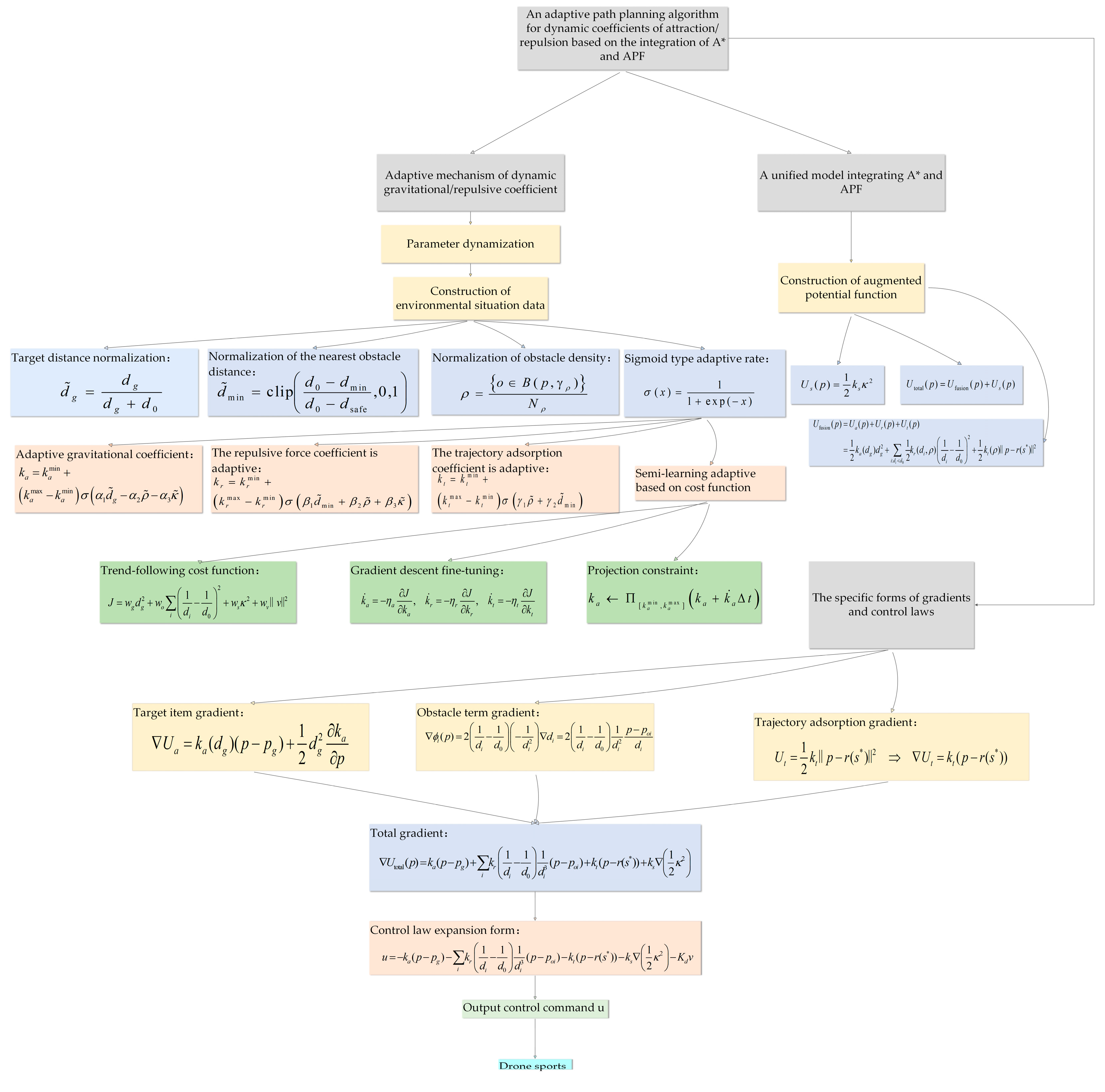
3. Adaptive Path Planning Algorithm Integrating A* and APF with Dynamic Attractive and Repulsive Coefficients
3.1. Adaptive Mechanism for Dynamic Attractive and Repulsive Coefficients
3.1.1. Design Concept
3.1.2. Construction of Environmental State Variables
3.1.3. Sigmoid-Based Adaptive Law
3.1.4. Cost-Function-Based Online Optimization for Parameter Self-Tuning
3.1.5. Online Update Stabilization and Safety Mechanisms
3.2. Unified Model Integrating A* and APF
Construction of the Augmented Potential Function
3.3. The Explicit Forms of the Gradient and the Control Law
3.3.1. Goal Term Gradient
3.3.2. Obstacle Term Gradient
3.3.3. Trajectory Attraction Gradient
| Algorithm 1. A*-APF Planning and Control Pipeline |
| Input: Start position p_s Goal position p_g Obstacle set O UAV initial state x_0 Planning parameters Θ Output: Continuous control commands u(t) /* Global reference generation */ Compute a discrete global path P_A* using the A* algorithm Generate a continuous reference path P_ref by spline interpolation of P_A* /* APF initialization */ Initialize attractive, repulsive, and trajectory-adherence coefficients Initialize adaptive parameter vector θ within predefined bounds /* Online navigation and control loop */ while goal is not reached do Acquire current UAV state x(t) Obtain obstacle distance information d_o(t) /* Adaptive coefficient update */ Update APF coefficients using state-driven mapping Refine parameters via cost-function-based online self-tuning /* Potential-field evaluation */ Compute attractive, repulsive, and reference-guidance potentials Fuse potentials to obtain total potential field /* Control computation */ Compute control command u(t) using gradient-based control law Apply saturation and feasibility constraints /* State propagation */ Update UAV state x(t + 1) via numerical integration end while if reference becomes obstructed or tracking error exceeds threshold then re-run A* to update P_ref (low-frequency replanning) end if |
3.4. UAV Motion Model and Numerical Integration
4. Simulation Validation
4.1. Simulation Settings
4.2. Statistical Analysis and Effect Size Evaluation
4.3. UAV Parameter Analysis
5. Physical Experiment Validation
6. Conclusions
Author Contributions
Funding
Data Availability Statement
Conflicts of Interest
Abbreviations
| UAV | Unmanned Aerial Vehicle |
| PRM | Probabilistic Road Map |
| RRT | Rapidly-exploring Random Tree |
| GWO | Grey Wolf Optimizer |
| APF | Artificial Potential Field |
Appendix A

| Group | Symbol | Meaning | Value/Range | Notes |
|---|---|---|---|---|
| Attractive gain | Minimum attraction gain | 0.4 | Ensures goal convergence | |
| Maximum attraction gain | 1.2 | Prevents aggressive acceleration | ||
| Repulsive gain | Minimum repulsion gain | 0.6 | Weak avoidance far from obstacles | |
| Maximum repulsion gain | 3.0 | Strong repulsion near obstacles | ||
| Trajectory guidance gain | Minimum trajectory adherence | 0.2 | Allows local deviation | |
| Maximum trajectory adherence | 1.0 | Enforces A* reference guidance | ||
| Distance thresholds | Obstacle influence radius | 3.0 m | Sensing/activation distance | |
| Safety distance | 0.8 m | Collision avoidance margin | ||
| Sigmoid mapping weights | 1.0, 0.5, 0.3 | Goal distance, curvature, density | ||
| 1.5, 1.0, 0.5 | Obstacle distance & density | |||
| Cost function weights | Goal-directed term | 1.0 | Equation (13) | |
| Obstacle penalty term | 2.0 | Obstacle-dominant near hazards | ||
| Online update | Learning rate | 0.005 (tested 0.001–0.01) | Conservative step size | |
| Update interval | 5 control cycles | Rate-limited update | ||
| Command limits | Velocity saturation | 1.2 m/s | UAV safety limit | |
| Acceleration saturation | 2.5 m/s2 | Smooth motion constraint |
| Method | Parameter | Value Used | Tested/Allowed Range | Notes |
|---|---|---|---|---|
| A* | Grid resolution | 0.20 m/cell | 0.10–0.25 | Same for all grid planners |
| Connectivity | 8-neighbor | -- | Standard | |
| Heuristic | Euclidean | -- | Admissible | |
| Obstacle inflation | = 0.8 m | -- | Same collision model | |
| Goal tolerance | 0.30 m | 0.2–0.5 | Same for all | |
| Runtime limit | 0.5 s | 0.2–1.0 | Per trial | |
| PRM | Number of samples | 300 | 200–600 | Fixed per map |
| Connection radius | 2.5 m | 2.0–3.5 | Collision-checked | |
| Obstacle inflation | = 0.8 m | -- | Same as A* | |
| Goal tolerance | 0.30 m | 0.2–0.5 | Same | |
| Runtime limit | 0.5 s | 0.2–1.0 | Includes roadmap build | |
| RRT | Step size | 0.40 m | 0.2–0.6 | Typical UAV scale |
| Max iterations | 1000 | 500–2000 | Standard | |
| Goal bias | 0.10 | 0.05–0.20 | Bounded | |
| Obstacle inflation | = 0.8 m | -- | Same | |
| Runtime limit | 0.5 s | 0.2–1.0 | Per run | |
| GWO | Population size | 30 | 20–50 | Common setting |
| Max iterations | 50 | 30–100 | Bounded | |
| Objective weights | distance + collision penalty | -- | Same cost definition | |
| Obstacle inflation | = 0.8 m | -- | Same | |
| Runtime limit | 0.5 s | 0.2–1.0 | Per run | |
| A*-APF | A* grid resolution | 0.20 m/cell | 0.10–0.25 | Same as A* |
| Control frequency | 50 Hz | 20–100 | Real-time | |
| Online update interval | 5 cycles | 5–10 | Rate-limited | |
| Learning rate | 0.005 | 0.001–0.01 | Conservative | |
| Obstacle inflation | = 0.8 m | -- | Same | |
| Runtime limit | 0.5 s | 0.2–1.0 | For global replanning |
References
- Zhao, Z.; Chen, S.; Ru, L.; Hu, G.; Wang, W. A Quality Evaluation Method for Drone Swarm Command and Control Networks Based on Complex Network. Drones 2025, 9, 839. [Google Scholar] [CrossRef]
- Gao, G.; Lu, J.; Guan, W. CE-Bi-RRT*: Enhanced Bidirectional RRT* with Cooperative Expansion Strategy for Autonomous Drone Navigation. Drones 2025, 9, 831. [Google Scholar] [CrossRef]
- Wang, S.; Gao, Z.; Xu, H.; Ru, J. Design and Implementation of the “three-in-one” sea-air Collaborative Robot System. Exp. Technol. Manag. 2025, 42, 28–37. [Google Scholar] [CrossRef]
- Sun, Z.; Zhang, T.; Zhu, H.; Ma, T.; Bao, X.; Zhang, X. Path Planning for Mobile Robot Based on the Fusion Algorithm of Improved A* and APF. In Proceedings of the 2024 6th International Symposium on Robotics & Intelligent Manufacturing Technology (ISRIMT), Changzhou, China, 20–22 September 2024; pp. 113–118. [Google Scholar] [CrossRef]
- Yu, T.H.; Zhou, H.; Jia, X.Y.; Fa, S.Y. 基于改进DQN算法的无人机路径规划算法研究 (Research on UAV Path Planning Algorithm Based on Improved DQN Algorithm). Aeronaut. Comput. Technol. 2025, 55, 59–63+79. [Google Scholar]
- Liu, W.; Shan, L.; Zhang, W.; Liu, C.; Ma, Q. Unmanned Aerial Vehicle Path Planning Algorithm Based on Improved Informed RRT*in Complex Environment. Shanghai Jiaotong Daxue Xuebao/J. Shanghai Jiaotong Univ. 2024, 58, 511–524. [Google Scholar]
- Wang, X.; Sun, M.; Li, X.; Zhou, H.; Zhao, R. Grid A*: A Fast Path Planning Algorithm for Air-Ground Cooperative Response of Emergency Rescue in the Field. J. Remote Sens. 2024, 28, 767–780. [Google Scholar] [CrossRef]
- Hu, J.W.; Zhang, J.Y.; Pei, Q.Y. 种基于改进蚁群算法的无人机路径规划方法 (A UAV Path Planning Method Based on Improved Ant Colony Algorithm). Radio Eng. 2025, 55, 2105–2113. [Google Scholar]
- Xie, H.; Han, S.; Yin, J.; Ji, X.; Yang, Y. Cooperative Deduction and Optimal Allocation Method for Urban Low-Altitude UAV Flight Plan. Acta Aeronaut. Astronaut. Sin. 2024, 45, 269–291. [Google Scholar] [CrossRef]
- Yin, H.; Wu, Y.; Liang, T. Cooperative Path Planning for Patrol Coverage of Fixed Wing UAV. Acta Aeronaut. Astronaut. Sin. 2024, 45, 329–343. [Google Scholar] [CrossRef]
- Haonan, H.; Ming, H.; Wenpeng, L.; Jie, Z. Multi-Unmanned Aerial Vehicles Trajectory Optimization for Age of Information Minimization in Wireless Sensor Networks. J. Electron. Inf. Technol. 2024, 46, 1222–1230. [Google Scholar] [CrossRef]
- Jiang, N.; Xu, J.F. 矢量场路径规划算法及其仿真验证 (Vector Field Path Planning Algorithm and Its Simulation Verification). Adv. Aeronaut. Eng. 2024, 15, 39–49+63. [Google Scholar] [CrossRef]
- Xu, Z.; Hu, T.; Liu, K.; An, L.; Yang, S. 基于多策略改进灰狼算法的多无人机三维路径规划 (Multi-Drone 3D Path Planning Based on Multi-Strategy Improved Grey Wolf Algorithm.). Aero Weapon. 2024, 31, 86–93. Available online: https://link.cnki.net/urlid/41.1228.TJ.20240815.1604.003 (accessed on 2 January 2026).
- Zhao, J.; Zhang, X.; Chi, P.; Wang, Y. Self-adaptive Formation Control and Dynamic Path Planning for Air-Ground Heterogeneous Swarm. Acta Aeronaut. Astronaut. Sin. 2024, 45, 207–226. [Google Scholar] [CrossRef]
- Sihua, G.; Baoyu, L.; Kanghua, H.; Weifeng, X.; Junhui, L.; Bingyang, Z. Energy-Efficient UAV Trajectory Planning Algorithm for AoI-Constrained Data Collection. J. Electron. Inf. Technol. 2024, 46, 4024–4034. [Google Scholar] [CrossRef]
- Wang, W.; You, M.; Sun, L.; Zhang, X.; Zong, Q. Intelligent Cooperative Exploration Path Planning for UAV Swarm in an Unknown Environment. Chin. J. Eng. 2024, 46, 1197–1206. [Google Scholar] [CrossRef]
- Wang, Z.; Zhang, M.; Zhang, Z.; Xu, G. Multi-UAV Cooperative Path Planning Based on Multi-Index Dynamic Priority. Acta Aeronaut. Astronaut. Sin. 2024, 45, 328816. [Google Scholar] [CrossRef]
- Gao, J.; Xu, X.; Pu, Q.; Petrovic, P.B.; Rodić, A.; Wang, Z. A Hybrid Path Planning Method Based on Improved A* and CSA-APF Algorithms. IEEE Access 2024, 12, 39139–39151. [Google Scholar] [CrossRef]
- Yu, B.; Zhao, Y.F.; Han, Y.L.; Chen, X. 基于改进RRT*算法的多无人机协同航迹规划方法 (Multi-UAV Cooperative Trajectory Planning Method Based on Improved RRT* Algorithm). Comput. Meas. Control. 2025, 33, 215–223. [Google Scholar] [CrossRef]
- Ding, Y.M.; How, M.K. 改进蝙蝠算法的无人机路径规划 (Improved Bat Algorithm for Unmanned Aerial Vehicle Path Planning). J. Weapon. Equip. Eng. 2023, 44, 26–33. [Google Scholar]
- Lu, Y.; Yuan, H.; Yu, S.; Liu, D. 改进蜣螂优化算法的无人机路径规划 (UAV Path Planning Based on Improved Antlion Optimization Algorithm ). J. Weapon. Equip. Eng. 2025, 46, 1–10. [Google Scholar]
- Hua, G.; Xiaohe, G. Local path planning algorithm for UAV based on improved velocity obstacle method. Acta Aeronaut. Astronaut. Sin. 2023, 44, 271–281. [Google Scholar] [CrossRef]
- Chen, W.; Huang, S.; Wu, S.; Sang, Z. 基于粒子群优化算法的多无人机多目标航迹路径规划 (Multi-UAV Multi-Target Trajectory Path Planning Based on Particle Swarm Optimization Algorithm). Microelectron. Comput. 2023, 40, 21–28. [Google Scholar] [CrossRef]
- Ding, M.; Xia, X.; Zou, Y. 基于改进蝴蝶优化算法的无人机3-D航迹规划方法 (3-D Trajectory Planning Method for Unmanned Aerial Vehicles Based on Improved Butterfly Optimization Algorithm). J. Nanjing Univ. Aeronaut. Astronaut. 2023, 55, 851–858. [Google Scholar] [CrossRef]
- Li, W.; Yang, B.; Song, G.; Jiang, X. Dynamic Value Iteration Networks for the Planning of Rapidly Changing UAV Swarms. Front. Inf. Technol. Electron. Eng. 2021, 22, 687–696. [Google Scholar] [CrossRef]
- Yan, Z.; Xuejiao, L.; Dongliang, P. UAV Path Planning for AOA-based Source Localization with Distance-Dependent Noises. J. Electron. Inf. Technol. 2021, 43, 1192–1198. [Google Scholar] [CrossRef]
- Liu, C.L.; Zhang, H.L.; Wang, C. 基于覆盖路径弧的无人机桥梁激光扫描路径规划 (UAV Bridge Laser Scanning Path Planning Based on Coverage Path Arcs). Laser Optoelectron. Prog. 2021, 58, 0828003. [Google Scholar]
- Chen, Z.; Yuan; Jie; Galkenbe. 融合RRT*和人工势场的机械臂自适应路径规划 (Adaptive Path Planning for Manipulator Based on Fusion of RRT* and Artificial Potential Field). J. Syst. Simul. 2025, 1–17. [Google Scholar] [CrossRef]
- Li, S.D.; Li, J.; Li, H. Multi-UAV Cooperative Path Planning Based on Improved Artificial Potential Field Method. Comput. Syst. Appl. 2025, 34, 200–212. [Google Scholar] [CrossRef]
- Wang, Y.; Hu, Y.; Chen, Y. Multi-UAV Negotiated Collision Avoidance Based on Adaptive Artificial Potential Field Method. Comput. Eng. 2025, 1–11. [Google Scholar] [CrossRef]
- Radwa, A.; Zhengtao, H.; Takuya, K.; Weiwei, W.; Tatsushi, N.; Kensuke, H. Task and Grasp Constrained 3D Robotic Work-Cell Layout Planning. In Proceedings of the Conference on Automation Science and Engineering, Los Angeles, CA, USA, 17–21 August 2025; pp. 2355–2362. [Google Scholar] [CrossRef]
- Nguyen, V.H.A.; Tuong, V.C.; Nguyen, T.T.; Le, T.M.; Tran, H.M.; Wang, K.; Tran, L.V.; Dao, S.V.T. ITE-RRT*: Intelligent Path Planning for Autonomous Cars with Intermediary Trees, Triangle Inequality, and Equal Distance Optimization. IEEE Access 2025, 13, 1. [Google Scholar] [CrossRef]
- Xiao, D.; Xiao, L.; Tianlun, H.; Weijun, W.; Wei, F. DB-R-RRT*: A Dynamic Bidirectional Refined Path Planning Algorithm for Agricultural Robotics. In Proceedings of the 2025 7th International Conference on Data-driven Optimization of Complex Systems (DOCS), Taiyuan, China, 19–21 August 2025; pp. 412–420. [Google Scholar] [CrossRef]
- ElHalawany, B.M.; Abdel-Kader, H.M.; TagEldeen, A.; Elsayed, A.E.; Nossair, Z.B. Modified A* algorithm for safer mobile robot navigation. In Proceedings of the 2013 5th International Conference on Modelling, Identification and Control (ICMIC), Cairo, Egypt, 31 August–2 September 2013; pp. 74–78. Available online: https://ieeexplore.ieee.org/document/6642217 (accessed on 2 January 2026).
- Chen, C.; Lin, Y.; Zhan, L.; He, Y.; Zhang, Y.; Chi, X.; Chen, M. Dynamic Obstacle Avoidance Approach Based on Integration of A-Star and APF Algorithms for Vehicles in Complex Mountainous Environments. Vehicles 2025, 7, 65. [Google Scholar] [CrossRef]
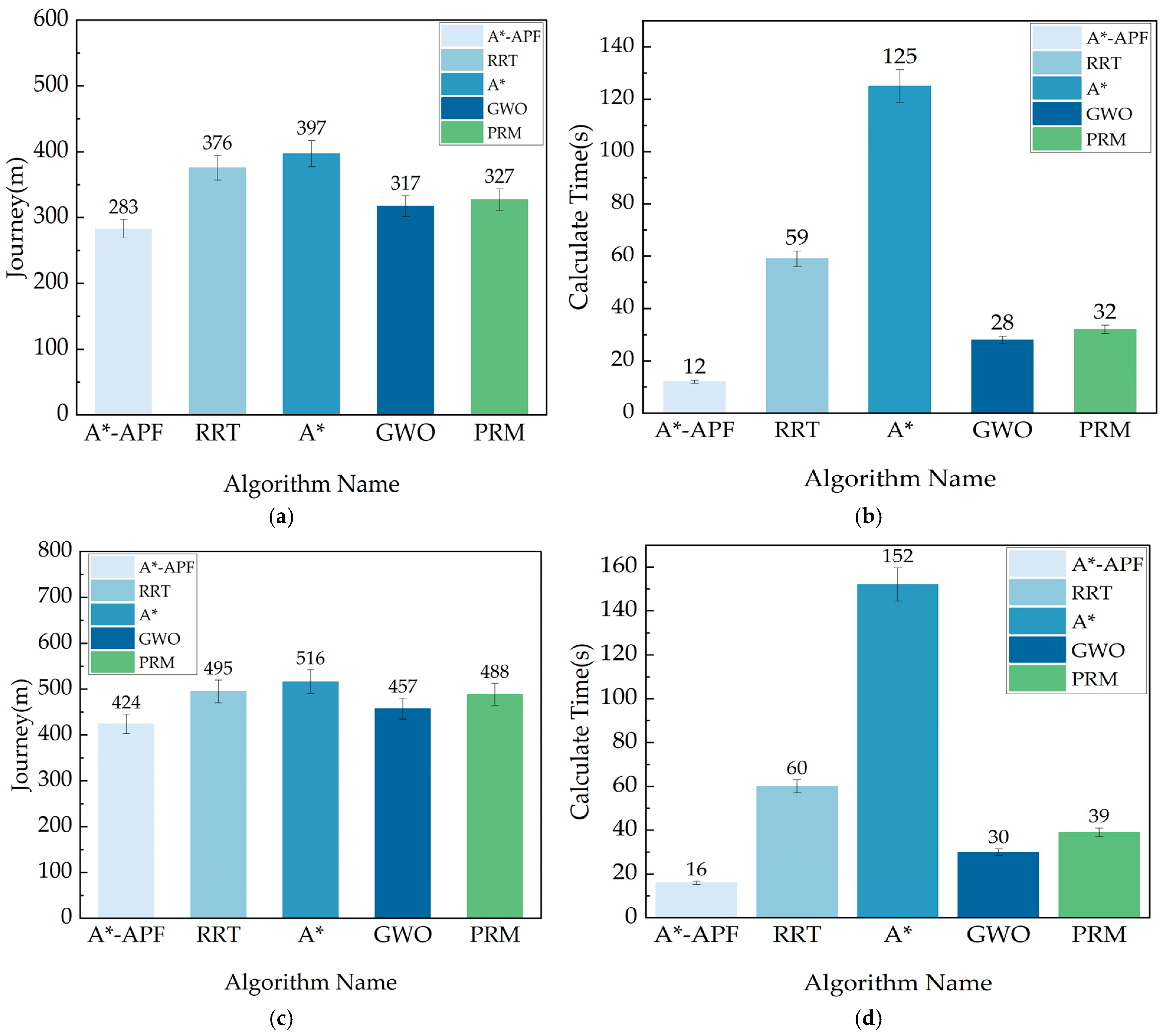
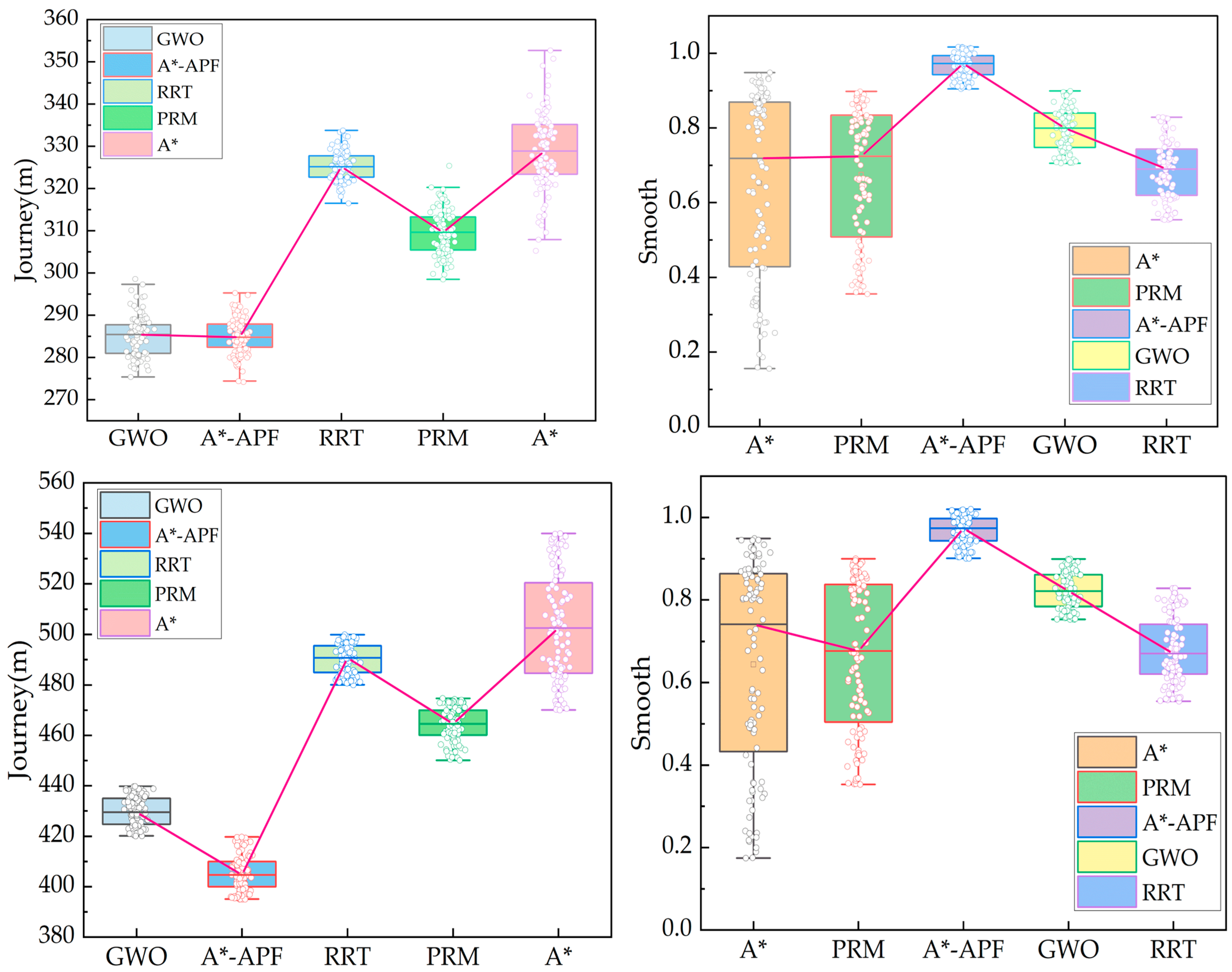
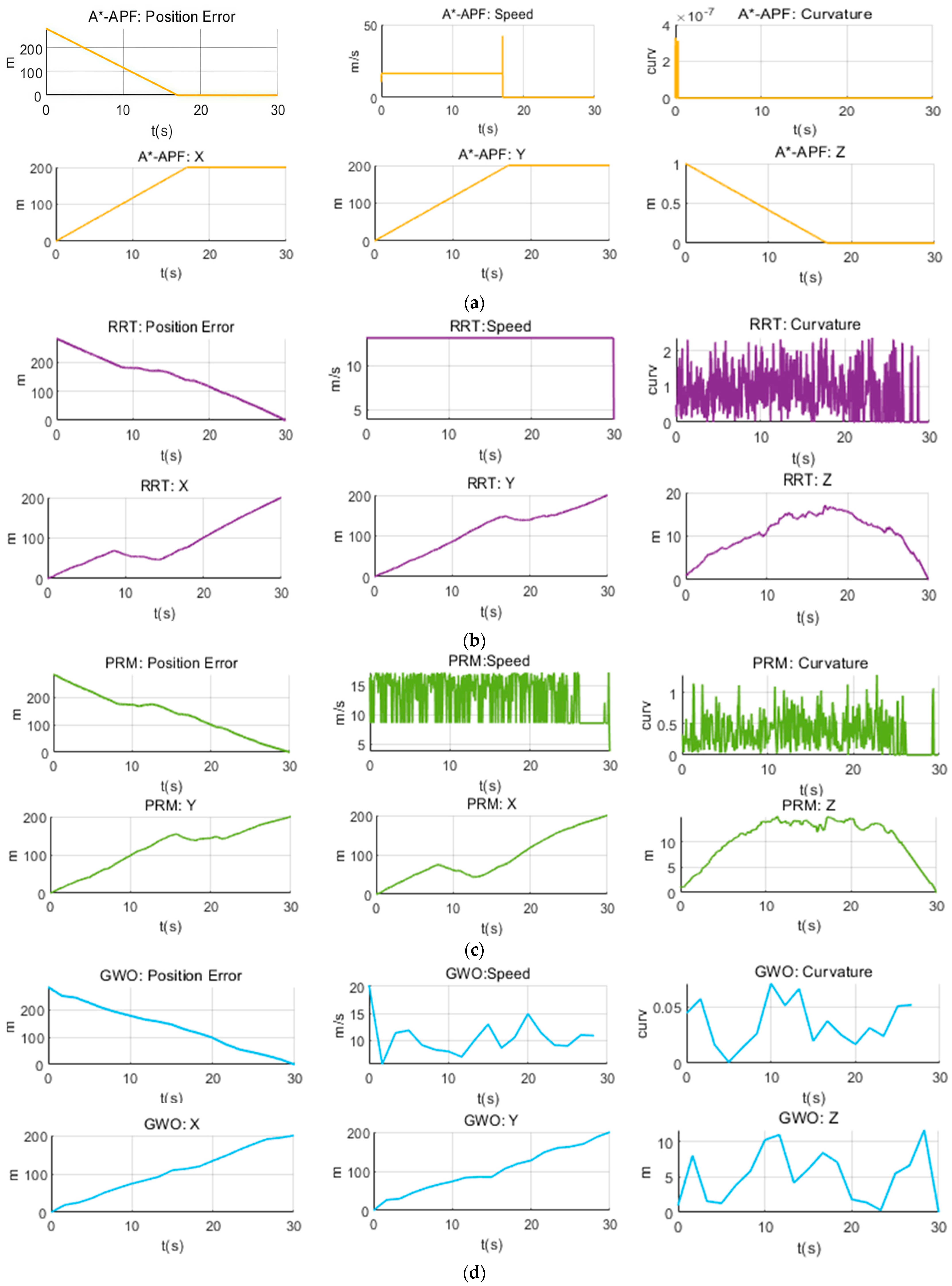
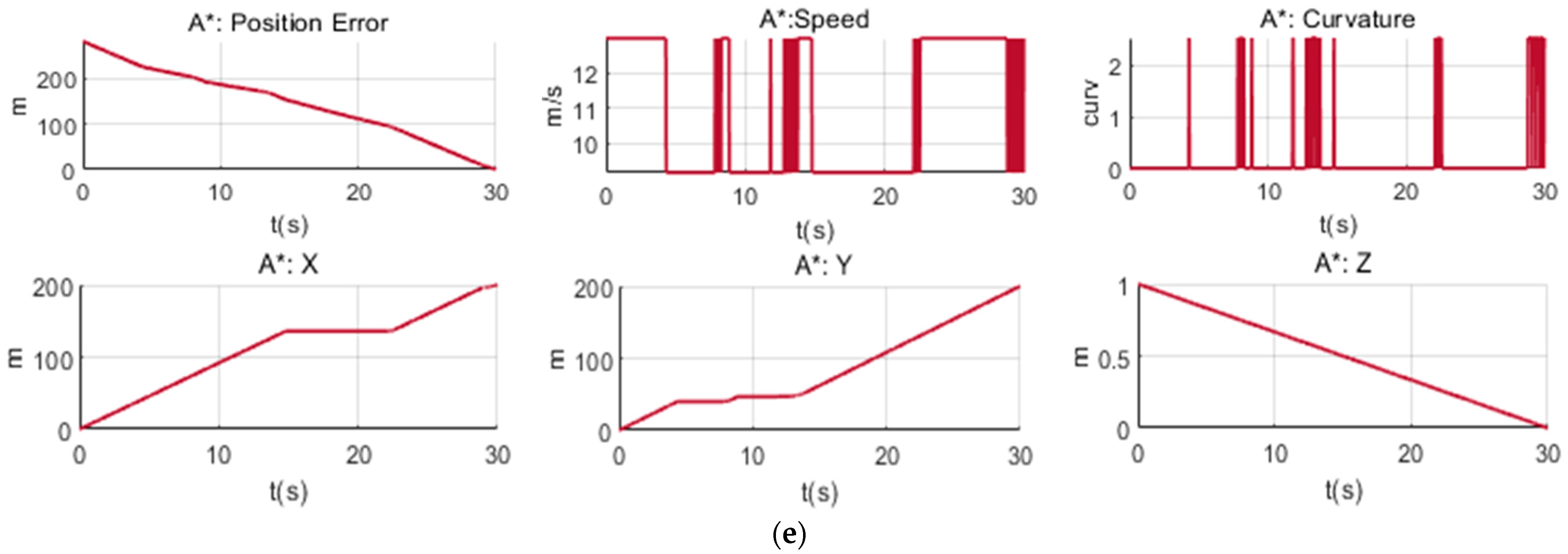
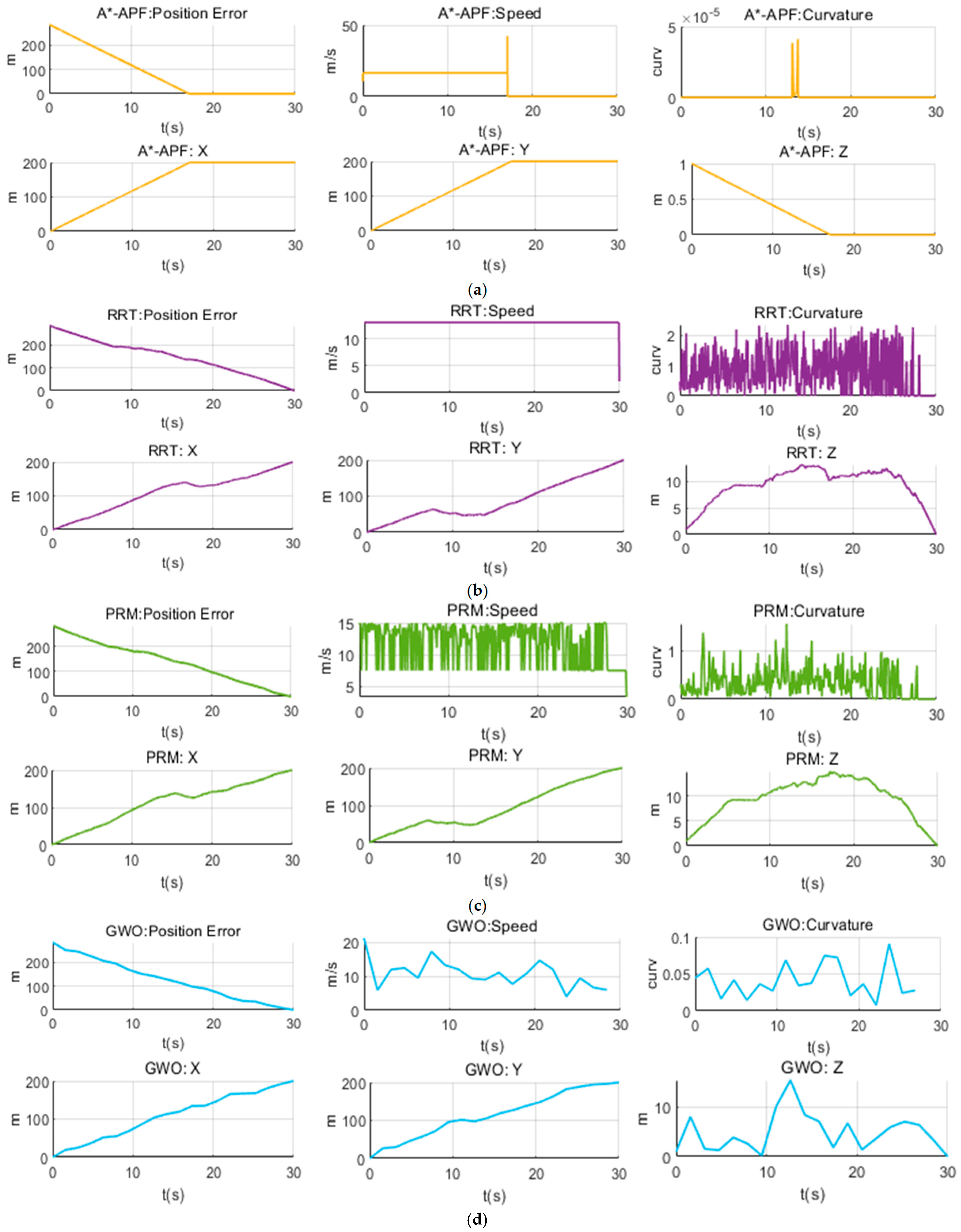
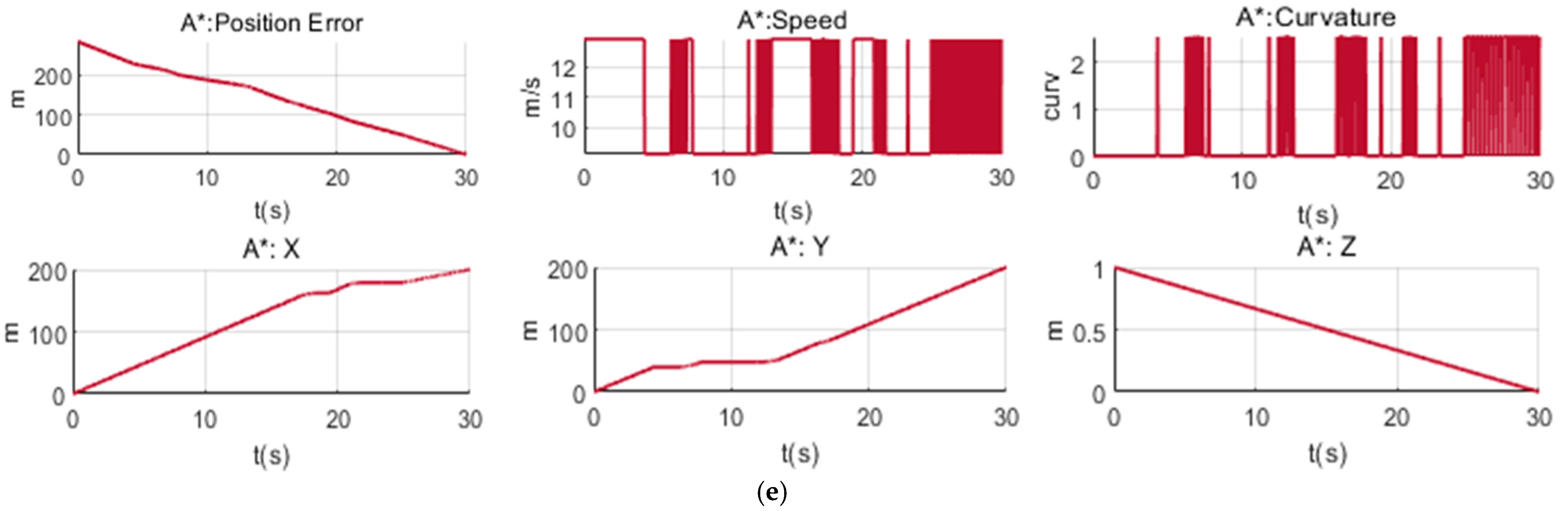
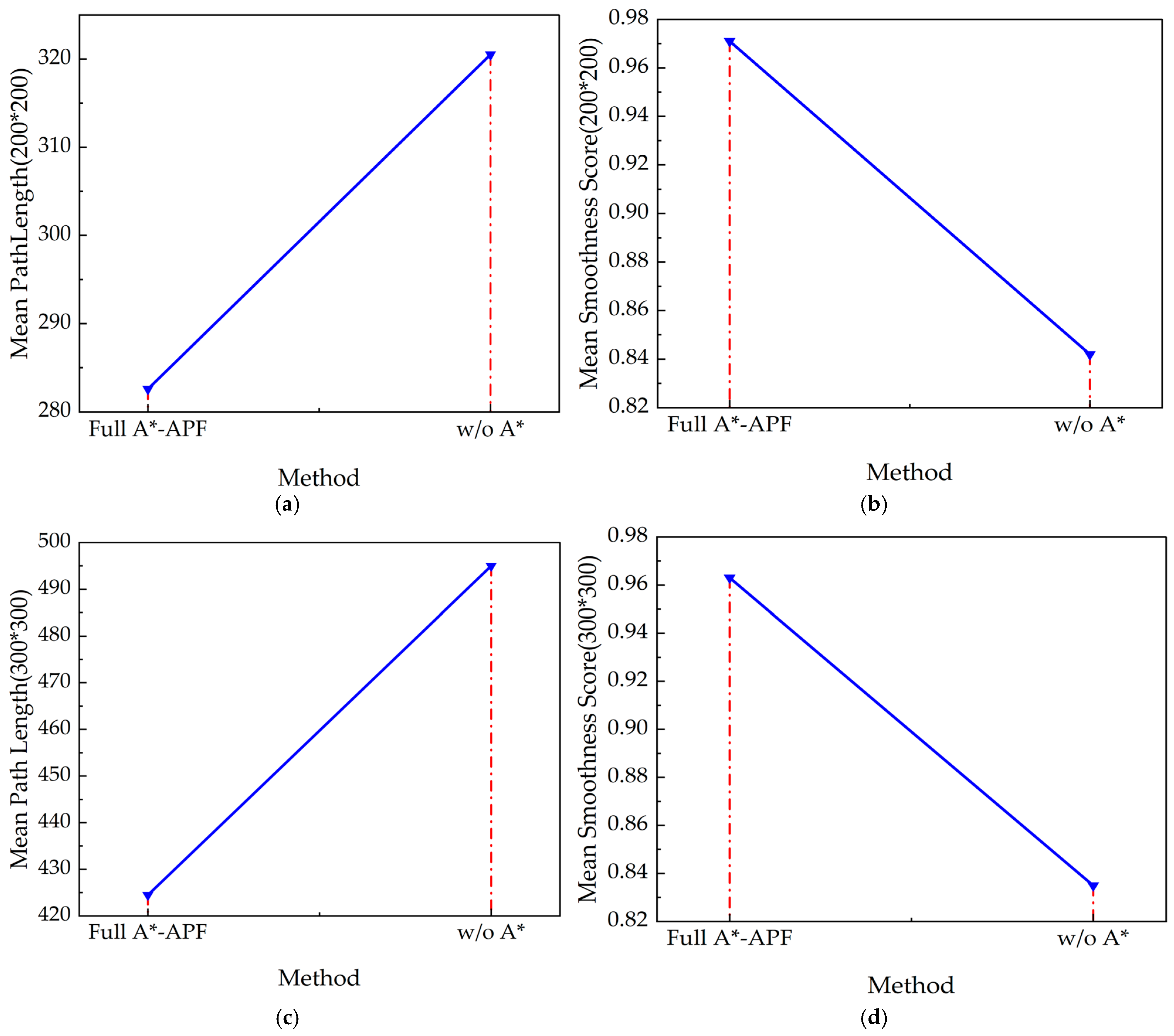
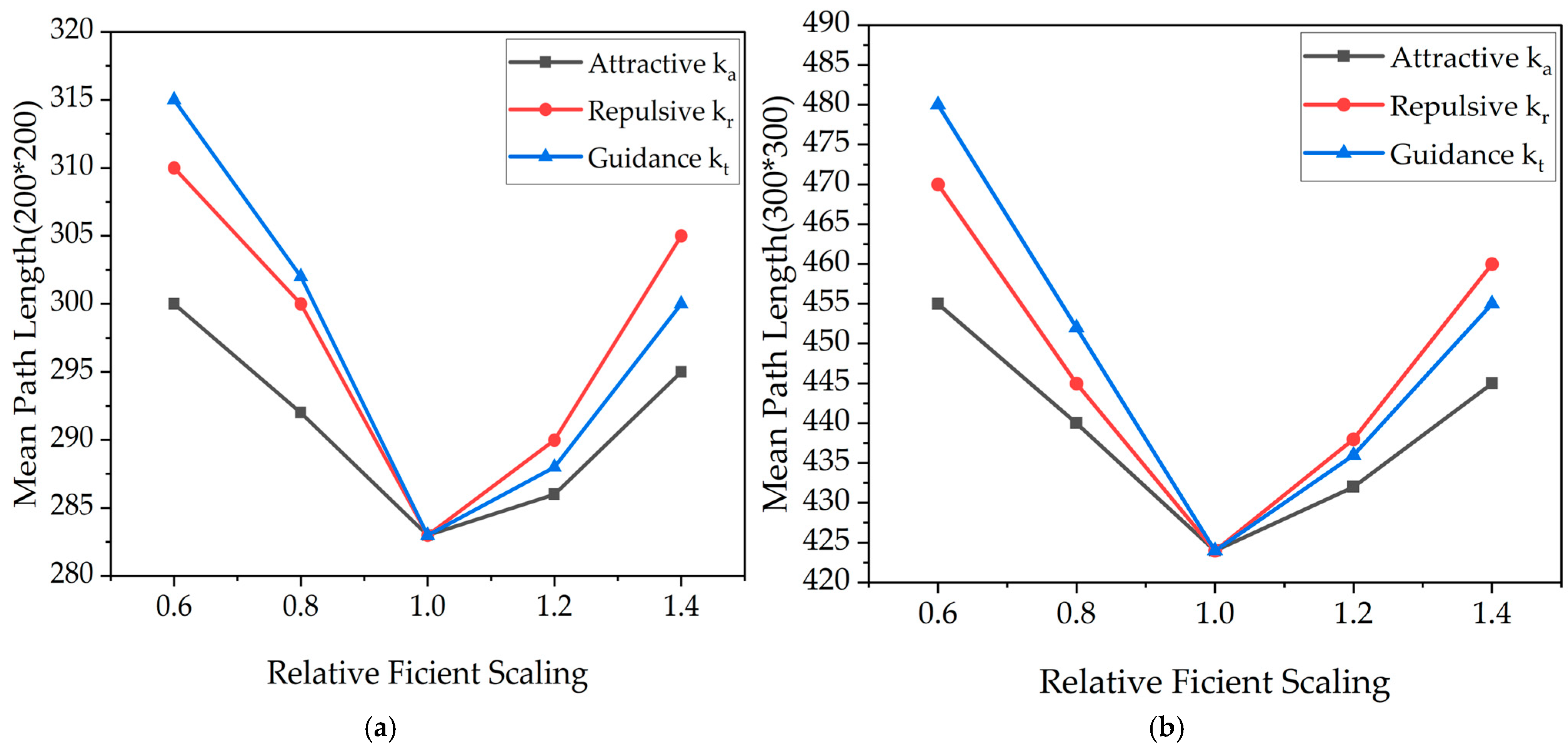
| Method Category | Global Guidance | How Global Info is Used | Parameter Adaptation | Online/Offline | Executable Trajectory |
|---|---|---|---|---|---|
| Classical APF | None | - | Fixed | Online | Yes |
| Adaptive APF | None | - | Partial (local cues) | Online | Yes |
| PRM-APF | PRM | Waypoints | Usually fixed | PRM offline + APF online | Yes |
| RRT*-APF | RRT* | Waypoints | Usually fixed | Online/iterative | Yes |
| Population-intelligence-APF | Indirect | Parameter search | Yes | Mostly offline | Yes |
| Proposed method | A* | Embedded reference potential | Joint + online self-tuning | Low-frequency A + online APF* | Yes (control-level) |
| Symbol | Name | Description |
|---|---|---|
| Directed weighted graph (search space) | Represents the topological structure of the environment; denotes the set of nodes, and denotes the set of directed edges. | |
| Node set | All states or discrete grid coordinates in the graph. | |
| Edge set | The set of feasible connections between nodes. | |
| Edge cost | The actual cost of moving from node to node with | |
| Start node | The initial node for search (initial position of the UAV). | |
| Goal node | The target node for search (desired destination of the UAV). | |
| Current node | The node currently being expanded or evaluated. | |
| Neighbor node | Nodes directly connected to the current node ) | |
| Parent node | The predecessor of the current node, used for path backtracking. | |
| Path | A sequence of nodes representing a route from the start node to the goal node. | |
| Estimated actual cost | The cumulative cost from the start node to the current node based on actual traversal. | |
| Optimal actual cost | The true minimal cost from the start node to the current node (theoretical optimum). | |
| Candidate cost | Temporary cost estimated for moving from the current node to a neighbor node . | |
| Heuristic function | The estimated cost from node to the goal node . | |
| Optimal heuristic cost | The true minimal cost from node to the goal node | |
| Evaluation function | The combined cost reflecting the estimated total cost from the start node through to the goal node. | |
| Optimal total cost | The true total cost from start to goal node (theoretical optimum). | |
| Current best node | The node that minimizes the evaluation function . | |
| Optimal path total cost | The optimal total cost along the path from start node to goal node . | |
| Neighbor set | The collection of all nodes adjacent to a given node. | |
| Open set/nodes to be expanded | Stores candidate nodes that have not yet been expanded. | |
| Closed set/expanded nodes | Stores nodes that have already been expanded to avoid repeated search. | |
| Iteration count/search steps | The current loop or iteration number of the algorithm. | |
| Weighted search result cost | The actual total path cost obtained by the Weighted A* algorithm. | |
| Parent node index | Records the predecessor node for each node to reconstruct the final path. | |
| Minimization operator | Operator that selects the variable which minimizes a given expression. | |
| Set union and difference | Represents operations for updating node sets. | |
| Transient estimate | Used for evaluating the temporary cost of neighboring nodes. | |
| Positive lower-bound constant | Ensures the cost is non-zero, thereby guaranteeing search termination. |
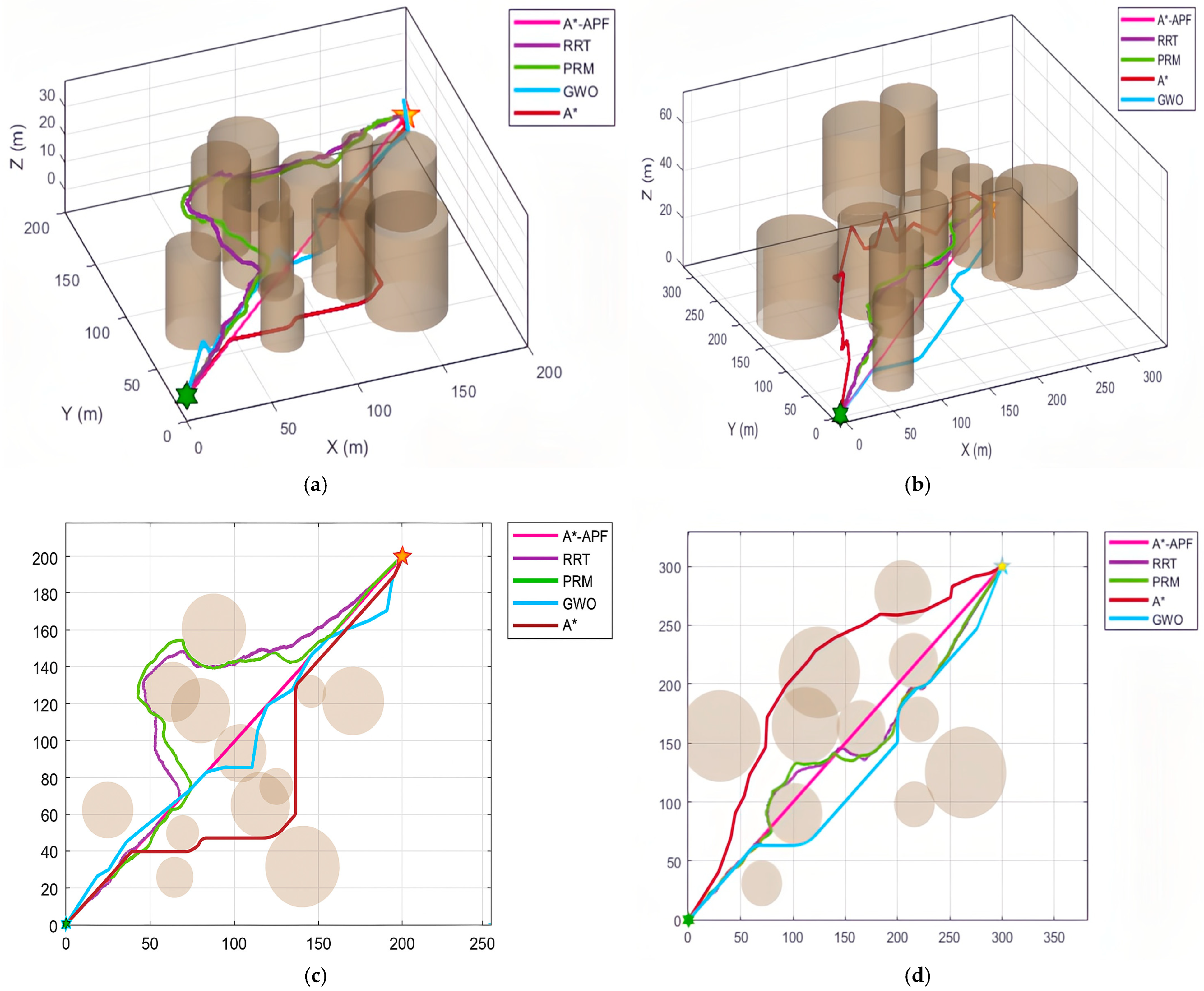
| 200 × 200 | |||
|---|---|---|---|
| Comparison Algorithm | Average Path Length(m) | Relative A*-APF Path Differences (%) | Shortening Rate (Compared to A*-APF) |
| A* | 396.87 | +40.4% | ↓ 28.7% |
| RRT | 375.57 | +32.8% | ↓ 24.7% |
| PRM | 327.07 | +15.6% | ↓ 13.5% |
| GWO | 317.16 | +12.1% | ↓ 10.8% |
| 300 × 300 | |||
| A* | 516 | +21.7% | ↓ 17.8% |
| RRT | 495 | +16.7% | ↓ 14.3% |
| PRM | 488 | +15.1% | ↓ 13.1% |
| GWO | 457 | +7.8% | ↓ 7.2% |
| 200 × 200 | |||
|---|---|---|---|
| Comparison Algorithm | Average Time (s) | Relative A*-APF Difference (%) | Speed-Up Ratio (Compared to A*-APF) |
| A* | 125 | +942% | ↑ 90.4% |
| RRT | 59 | +392% | ↑ 79.7% |
| PRM | 32 | +167% | ↑ 62.5% |
| GWO | 28 | +133% | ↑ 57.1% |
| 300 × 300 | |||
| A* | 152 | +850% | ↓ 89.5% |
| RRT | 60 | +275% | ↓ 73.3% |
| PRM | 39 | +144% | ↓ 59.0% |
| GWO | 30 | +87.5% | ↓ 46.7% |
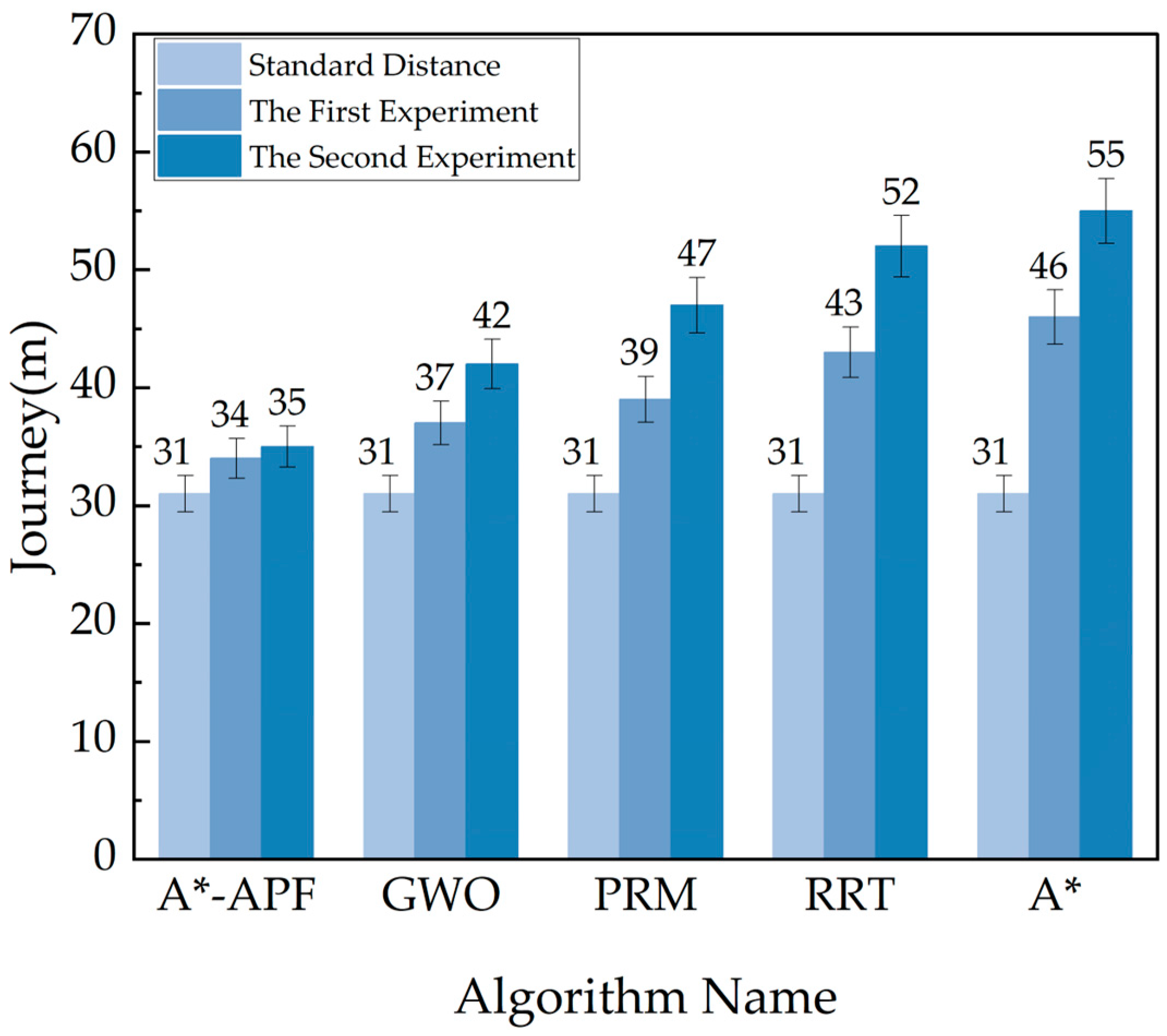
| Algorithm | Standard Distance (m) | The First Experiment (m) | The Second Experiment (m) | The Relative Standard Distance Has Increased (%) | The Relative A*-APF Path Increases (%) |
|---|---|---|---|---|---|
| A*-APF | 31 | 34 | 35 | +12.9%/+16.1% | N/A |
| GWO | 31 | 37 | 42 | +19.4%/+35.5% | +8.8%/+20.0% |
| PRM | 31 | 39 | 47 | +25.8%/+51.6% | +14.7%/+34.3% |
| RRT | 31 | 43 | 52 | +38.7%/+67.7% | +26.5%/+48.6% |
| A* | 31 | 46 | 55 | +48.4%/+77.4% | +35.3%/+57.1% |
Disclaimer/Publisher’s Note: The statements, opinions and data contained in all publications are solely those of the individual author(s) and contributor(s) and not of MDPI and/or the editor(s). MDPI and/or the editor(s) disclaim responsibility for any injury to people or property resulting from any ideas, methods, instructions or products referred to in the content. |
© 2026 by the authors. Licensee MDPI, Basel, Switzerland. This article is an open access article distributed under the terms and conditions of the Creative Commons Attribution (CC BY) license.
Share and Cite
Zhao, J.; Zhang, Y.; Ning, L.; Xiao, X.; Bai, C.; Zhang, J.; Yang, M. Adaptive Path Planning of UAV Based on A* Algorithm and Artificial Potential Field Method. Drones 2026, 10, 93. https://doi.org/10.3390/drones10020093
Zhao J, Zhang Y, Ning L, Xiao X, Bai C, Zhang J, Yang M. Adaptive Path Planning of UAV Based on A* Algorithm and Artificial Potential Field Method. Drones. 2026; 10(2):93. https://doi.org/10.3390/drones10020093
Chicago/Turabian StyleZhao, Jinchao, Ya Zhang, Luoyin Ning, Xuran Xiao, Chenrui Bai, Jianwu Zhang, and Min Yang. 2026. "Adaptive Path Planning of UAV Based on A* Algorithm and Artificial Potential Field Method" Drones 10, no. 2: 93. https://doi.org/10.3390/drones10020093
APA StyleZhao, J., Zhang, Y., Ning, L., Xiao, X., Bai, C., Zhang, J., & Yang, M. (2026). Adaptive Path Planning of UAV Based on A* Algorithm and Artificial Potential Field Method. Drones, 10(2), 93. https://doi.org/10.3390/drones10020093

