Article

Time-Division-Based Cooperative Positioning Method for Multi-UAV Systems

1
Center for Communication and Tracking Telemetry Command, Chongqing University, Chongqing 400044, China
2
School of Microelectronics and Communication Engineering, Chongqing University, Chongqing 400044, China
3
China Academy of Space Technology (CAST), Beijing 100081, China
*
Author to whom correspondence should be addressed.
Drones 2026, 10(2), 94; https://doi.org/10.3390/drones10020094
Submission received: 4 December 2025 / Revised: 23 January 2026 / Accepted: 27 January 2026 / Published: 28 January 2026

Highlights

What are the main findings?
  • The paper proposes a cooperative positioning method that combines time-division multiplexing interferometric angle measurements, pseudorange measurements, and factor graph optimization, achieving high-precision relative positioning for multi-UAV systems.
What are the implications of the main findings?
  • This method significantly reduces hardware complexity and spectrum usage through the time-division update strategy, enabling efficient resource deployment for large-scale UAV swarms and solving scalability issues associated with continuous-link schemes.

Abstract

This paper proposes a cooperative localization method based on time-division processing of interferometric measurements, in which the receiver updates the signals from multiple UAVs in separate time slots, thereby reducing spectrum usage and baseband hardware overhead. A Kalman-enhanced tracking loop is designed to achieve high-precision carrier-phase and Doppler estimation under low-SNR conditions. For angle estimation, a time-division update strategy is employed such that the receiver performs full carrier tracking for only one UAV in each time slot, while the carrier phases of the remaining UAVs are extrapolated from the Doppler states estimated in the previous epoch. This avoids the hardware complexity associated with maintaining multiple parallel tracking loops. By fusing the estimated azimuth, elevation, and pseudorange measurements with the master UAV’s high-precision GNSS observations, a factor-graph-based sliding-window cooperative localization algorithm is constructed. Simulation results show that the proposed method improves the RMSE of carrier-phase and Doppler estimation by nearly an order of magnitude compared with the traditional FLL-assisted PLL. The system maintains angle estimation accuracy better than 0.01° within a four-node configuration and achieves centimeter-level ranging accuracy when SNR ≥ 0 dB. In a cooperative flight scenario with one master and three follower UAVs, the method consistently delivers sub-decimeter 3D localization accuracy.

1. Introduction

With the rapid advancement of unmanned aerial vehicles (UAVs) technology and the expansion of its application domains, UAVs have demonstrated significant potential in military operations, agriculture, logistics, disaster relief, and other fields [1,2,3]. However, missions executed by a single UAV are susceptible to interruption due to mechanical failures or communication loss, and are often inefficient in tasks such as surveillance and patrol. In contrast, multi-UAV systems (MUS) can coordinate multiple platforms to divide tasks and optimize flight paths, thereby expanding operational coverage and improving overall mission efficiency. In the event of a UAV failure, other units within the system can dynamically reallocate tasks, enhancing robustness and avoiding single points of failure [4,5,6,7]. Cooperative navigation is a core component for the efficient operation of MUS. It refers to the process in which multiple independent navigating entities work together by sharing position information, sensor data, and state information to improve the overall navigation accuracy of the system. Existing cooperative navigation techniques for UAVs can be broadly classified into three categories: satellite-augmented, environment-aware, and multi-sensor fusion-based [8,9].
Satellite-augmented cooperative navigation utilizes Global Navigation Satellite System (GNSS) measurements and augmentation techniques to enhance positioning accuracy. For example, one approach extends real-time kinematic (RTK) GNSS by incorporating RTK positioning and multipath error estimation, achieving millimeter-level positioning accuracy even under code multipath effects of up to 50 m [10]. In another study, a multi-antenna GNSS configuration mounted on a UAV is used to provide precise attitude information; by measuring phase differences between antennas, sub-degree attitude alignment was demonstrated within a UAV swarm, with heading errors as low as 0.2° [11]. Although these GNSS-based augmentation methods perform well in open outdoor environments, they are highly dependent on the availability of GNSS signals. Their performance degrades significantly in environments where GNSS is limited or disrupted, such as urban canyons, dense forests, indoor settings, or in the presence of intentional jamming [12,13].
Environment-aware cooperative navigation localizes UAVs by sensing the environment rather than relying solely on radio navigation signals [14,15]. In GNSS-denied environments, UAVs can utilize onboard sensors to detect landmarks, obstacles, and other navigation-relevant environmental features [16]. Each UAV tracks its own motion using inertial sensors while employing a camera or LiDAR to observe environmental elements such as buildings, terrain, or visual landmarks. This information is shared among UAVs to support simultaneous localization and mapping. Munguía et al. [17] demonstrated that in GPS-denied environments, two UAVs equipped with monocular cameras can jointly estimate their poses by comparing and fusing visual observations, achieving accurate position and orientation estimates. In [18], a cooperative LiDAR mapping method merges 3D point clouds from multiple UAVs, enabling high-precision relative positioning and map construction. When three UAVs coordinated their LiDAR scans, the relative positioning root-mean-square error (RMSE) reached 0.13 m in 2D and 0.34 m in 3D. The advantage of environment-aware methods is that they do not depend on external infrastructure and can operate indoors or in obstructed environments where GNSS is unavailable. However, their performance is highly dependent on environmental conditions. In featureless areas (e.g., snowfields or calm water), poor lighting (e.g., nighttime, glare, or fog), or adverse weather (e.g., heavy rain, fog, or dust), navigation accuracy tends to degrade.
The multi-sensor fusion-based cooperative navigation integrates onboard sensors of each UAV (such as IMU, barometer, magnetometer, GNSS receiver, camera, or LiDAR) and relative information from other UAVs (such as distance or bearing measurements) to provide a unified state estimation [19,20]. Many studies have extended Kalman filtering (KF) to multi-UAV scenarios [21]. For example, reference [22] proposed a multi-UAV cooperative navigation method based on adaptive Cubature Kalman Filter (CKF), which, by fusing IMU data and relative measurements, provides accurate attitude and position estimation even in the absence of GPS signals. Reference [23] proposed a multi-IMU fusion method based on Unscented Kalman Filter (UKF), optimizing state estimation and significantly reducing positioning errors, particularly in GPS-denied environments. To enhance system fault tolerance, other studies have proposed federated filtering methods, where each UAV runs a local filter, and the master filter integrates the estimates of the entire fleet, thus reducing the computational load on individual UAVs [24]. In addition to traditional Kalman filtering methods, recent researchers have proposed various innovative technologies to improve cooperative navigation accuracy. For instance, Cai et al. proposed a sliding window graph optimization algorithm based on marginalization theory, which significantly improved positioning accuracy while reducing computation time [25]. Li et al. proposed a multi-UAV relative navigation method that integrates inertial navigation and data link measurements, utilizing a sliding window graph optimization model for real-time state estimation, which significantly improved relative positioning accuracy and mitigated the effects of inertial navigation drift [26]. Shi et al. proposed a kinematic constraint-based asynchronous compensation algorithm, which integrates a kinematic constraint model to reduce the impact of measurement delays on positioning accuracy [27]. Shen et al. proposed a collaborative navigation system (CNS) based on a low-cost inertial sensor array, which optimized MEMS-IMU accuracy using rotation modulation technology and combined it with cooperative navigation to improve positioning performance in GNSS-denied environments [28]. Additionally, Liu et al. (2023) proposed a combined method based on visual data and multi-vector attitude algorithms, aiming to compensate for the attitude errors of low-precision INS, thus improving the accuracy and stability of cooperative navigation [29]. Overall, multi-sensor fusion methods make full use of various data: GNSS provides global reference, onboard sensors are used for autonomous positioning, and mutual measurements provide correction information. This redundancy design brings high accuracy and stability. Modern cooperative filters can now operate in real-time in medium-scale UAV fleets, maintaining positioning and attitude estimation with accuracy ranging from decimeter to meter level.
In summary, although multi-sensor fusion methods can significantly enhance the accuracy and robustness of cooperative navigation, their performance largely depends on the availability of relative measurements among UAVs. Existing approaches typically require establishing and maintaining continuous links between any two UAVs, which, as the swarm size increases, leads to exponential growth in spectrum usage, hardware complexity, and antenna configuration demands—posing challenges for large-scale practical deployment. To overcome this limitation, this paper proposes a time-division multiplexed interferometric angle measurement technique. In the proposed method, UAVs perform angle measurements during their assigned time slots, while in the intervals outside the allocated slots, angle information is continuously updated via a prediction-based extrapolation mechanism. This design ensures both the timeliness and continuity of relative state information, while avoiding the excessive resource consumption associated with full-time links. Compared with conventional continuous-link schemes, the proposed approach substantially simplifies frequency allocation, antenna layout, and baseband system design, thereby reducing hardware and spectrum overhead. Moreover, it achieves navigation accuracy comparable to that of traditional methods without requiring additional resource expenditure.
The overall structure of this paper is divided into seven parts. Section 1 provides the introduction. Section 2 describes the composition of the proposed measurement signal and discusses the receiver architecture. Section 3 presents the framework of the time-division multiplexed interferometric angle-measurement method. Section 4 introduces the factor-graph-based cooperative navigation framework. Section 5 offers simulation analyses of the proposed approach, and Section 6 concludes the paper.

2. Receiver System Design

The receiver downconverts the received RF-band signal to a lower intermediate frequency (IF) via the RF front-end. The relative signal processing discussed in this paper begins with the digital IF signal output from the RF front-end and primarily includes signal acquisition and tracking.

2.1. Acquisition Module

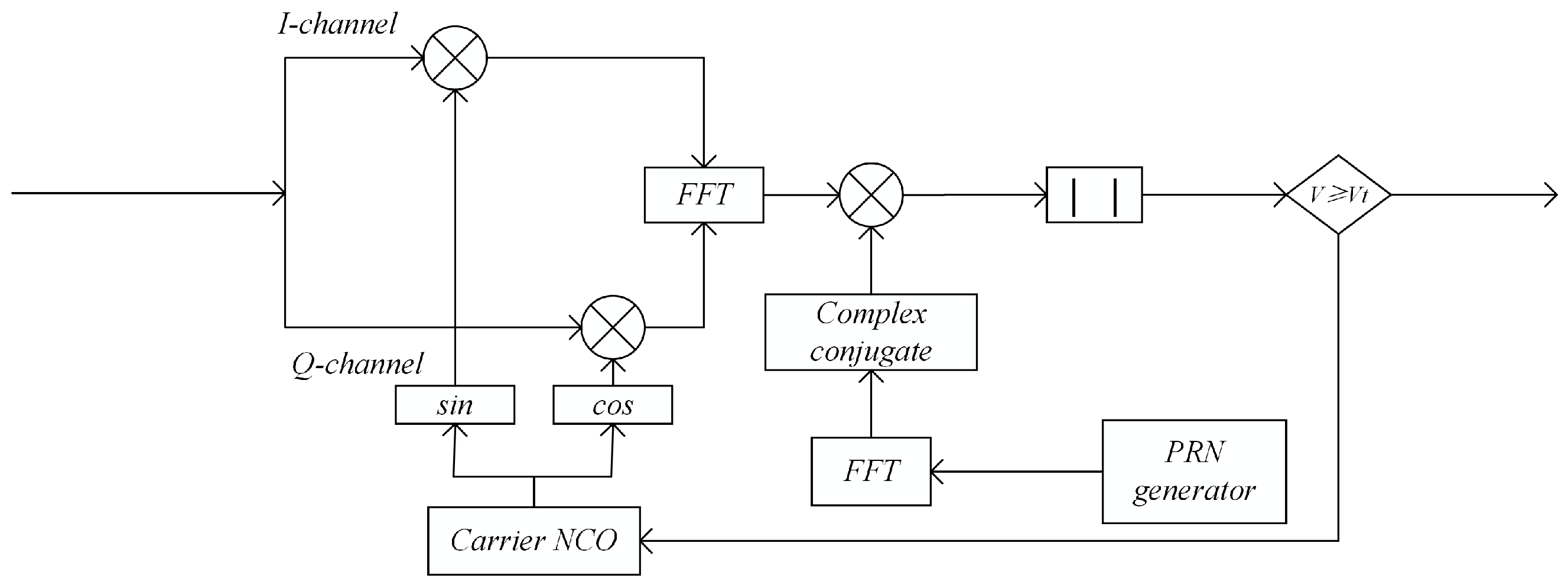
The primary function of the signal acquisition algorithm is to coarsely estimate the code phase and Doppler frequency offset of the received signal. We employ a parallel code phase acquisition algorithm, whose core idea is to transform the time-domain correlation operation of two periodic sequences into multiplication in the frequency domain. The correlation value of two periodic sequences x ( n ) and y ( n ) , each of length N, can be expressed as:
z ( n ) = 1 N m = 0 N 1 x ( m ) y ( m n )
The discrete Fourier transform (DFT) of z ( n ) :
Z ( k ) = 1 N n = 0 N 1 z ( n ) e j 2 π k n / N
= 1 N n = 0 N 1 1 N m = 0 N 1 x ( m ) y ( m n ) e j 2 π k n / N
= 1 N m = 0 N 1 x ( m ) n = 0 N 1 y ( m n ) e j 2 π k n / N
= 1 N X ( k ) Y ( k )
where X ( k ) and Y ( k ) are the discrete Fourier transforms (DFTs) of the sequences x ( n ) and y ( n ) , respectively, and Y ( k ) ¯ denotes the complex conjugate of Y ( k ) . The above expression indicates that the correlation of two sequences x ( n ) and y ( n ) in the time domain is equivalent to the multiplication of X ( k ) and Y ( k ) ¯ in the frequency domain. The algorithm flow is illustrated in Figure 1.
First, the received signal is multiplied by locally generated in-phase (I) and quadrature (Q) carrier signals—sine and cosine waveforms, respectively—to obtain I / Q branch mixed signals. Next, a Fourier transform is applied to the complex signal in the form I + j Q . The resulting spectrum is then multiplied by the complex conjugate of the Fourier transform of the locally generated replica spreading code. An inverse Fourier transform is subsequently performed on the product to obtain correlation values corresponding to all possible code phases. Afterward, the magnitude of the correlation output is computed, and the maximum correlation peak is detected. If this peak exceeds a predefined acquisition threshold, signal acquisition is declared successful. In this case, the current local carrier frequency is taken as the estimated carrier frequency of the received signal, and the index of the maximum correlation peak corresponds to the initial code phase. If the peak does not exceed the threshold, the local carrier frequency is adjusted and the above process is repeated. If all carrier frequency hypotheses have been exhausted without any correlation peak exceeding the threshold, acquisition is considered to have failed.

2.2. Tracking Module

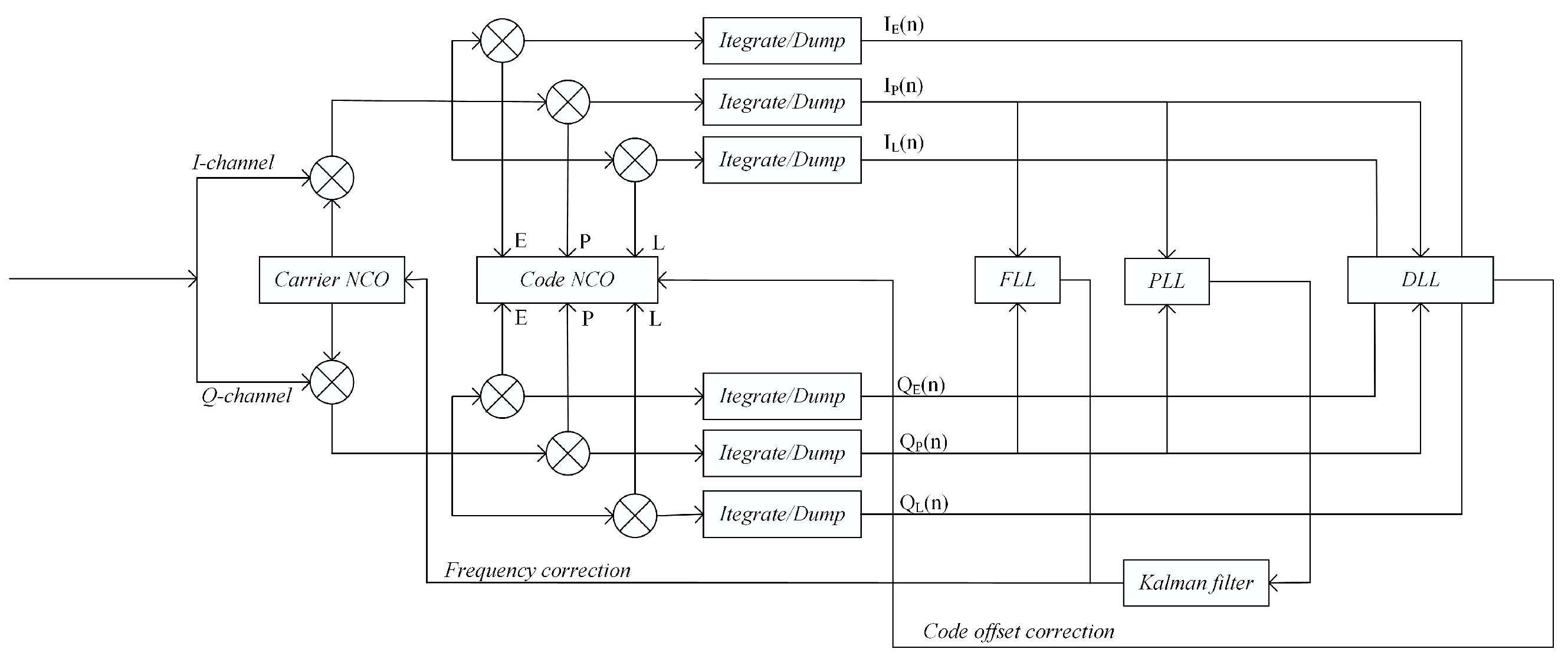
After acquisition, the receiver obtains coarse estimates of the code phase and carrier frequency. To achieve higher ranging accuracy and carrier-phase precision, these parameters must be continuously and finely tracked using tracking loops. The block diagram of the tracking process used in this study is shown in Figure 2.
The tracking loop consists of a carrier tracking loop and a code tracking loop. The former is used to achieve precise carrier synchronization, while the latter is responsible for accurate code synchronization. Working together, they accomplish the overall tracking process.

Carrier Tracking

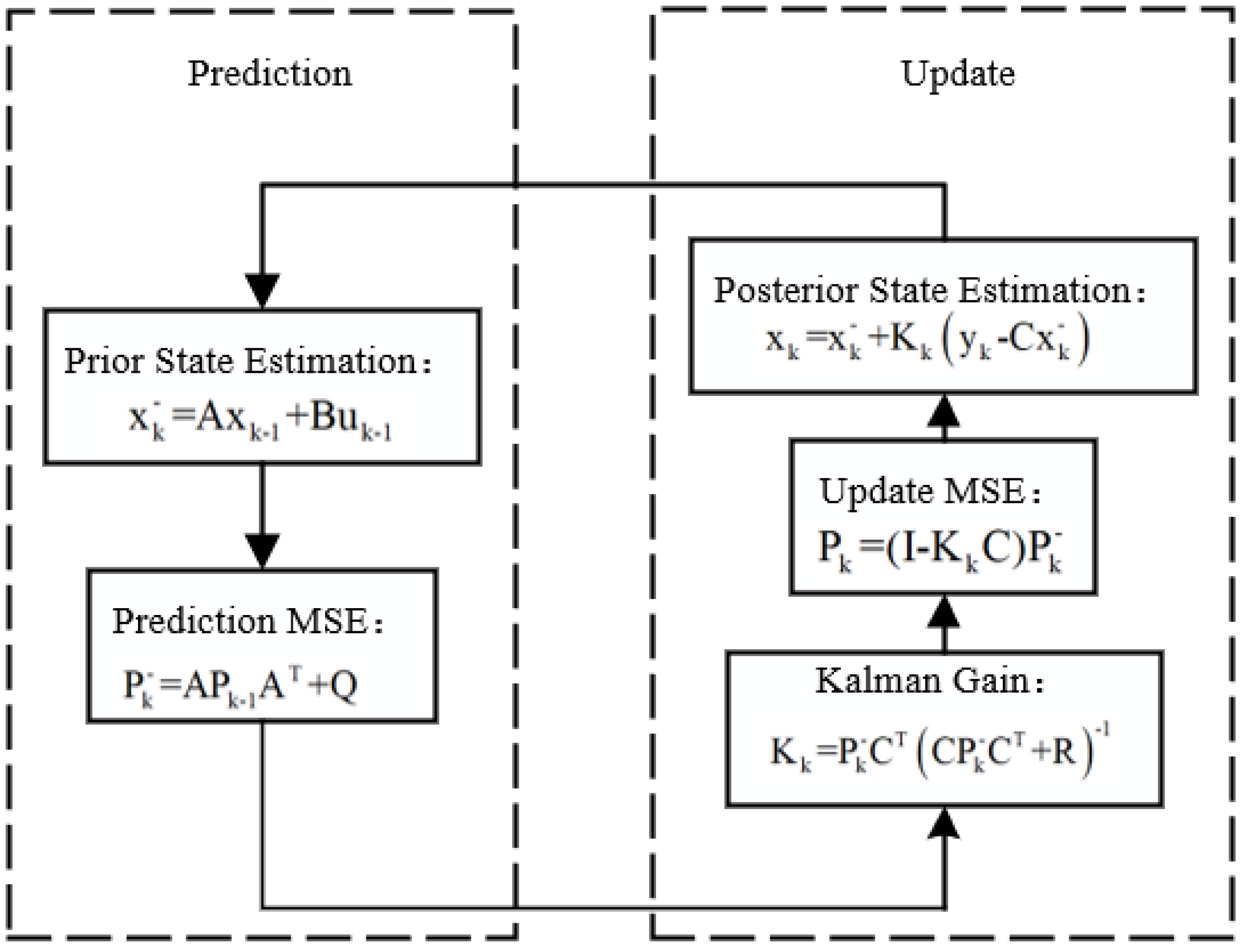
The carrier tracking loop described in this paper combines a second-order Frequency Lock Loop (FLL) and a third-order Phase Lock Loop (PLL). In this loop structure, the second-order FLL assists the third-order PLL, as detailed in reference [30]. To enhance tracking accuracy and improve performance in high-dynamic environments, a Kalman filter is integrated into the existing tracking loop. This integration allows the system to maintain FLL+PLL cooperation during the initial tracking phase. Once the loop stabilizes, the PLL takes over the tracking process exclusively. This approach ensures both acquisition robustness and steady-state accuracy. The introduction of the Kalman filter enables recursive estimation of carrier phase and Doppler frequency offsets in the state space, which improves noise immunity and transient response performance without significantly increasing the storage or computational burden. Consequently, the system achieves near-optimal tracking of the carrier parameters. The specific implementation of the carrier tracking loop, based on the linear Kalman filter, is illustrated in Figure 3.
In the Kalman-filter-based carrier tracking loop model, the state vector X k is defined as follows:
X k = θ ( k ) f d ( k ) f d ( k ) f d ( k ) T
In the above expression, θ ( k ) denotes the carrier phase error between the received signal and the locally generated signal produced by the numerically controlled oscillator (NCO). The term f d ( k ) represents the Doppler frequency shift at epoch k, f d ( k ) denotes the first-order time derivative of the Doppler frequency shift, and f d ( k ) denotes the second-order time derivative of the Doppler frequency shift.
The corresponding state transition equation can be written as follows:
θ ( k + 1 ) f d ( k + 1 ) f d ( k + 1 ) f d ( k + 1 ) = 1 0 T 0 0 1 T T 2 / 2 0 0 1 T 0 0 0 1 θ ( k ) f d ( k ) f d ( k ) f d ( k ) + 0 0 0 1 u k + w k w k w k w k
Here, T denotes the coherent integration time, and θ ( k + 1 ) represents the carrier phase error at the next epoch. The system input u k in the Kalman filtering process corresponds to the Doppler frequency correction applied to the numerically controlled oscillator (NCO) at epoch k. The state transition matrix A of the system is given by:
A = 1 2 π T π T 2 π T 3 / 3 0 1 T T 2 / 2 0 0 1 T 0 0 0 1
The control input matrix B is given by:
B = 2 π T 0 0 0
w k denotes the process noise vector, and its covariance matrix Q l is expressed as [31]:
Q L = q = ( 2 π ) 2 T 7 252 2 π 6 T 5 72 2 π 5 T 4 30 2 π 4 T 3 24 2 π 6 T 5 72 T 6 72 T 5 20 T 4 8 2 π 5 T 4 30 T 5 20 T 4 8 T 3 6 2 π 4 T 3 24 T 4 8 T 3 6 T 2 2 2 π 3 T 2 24 T 3 6 T 2 2 T
Here, q = σ f d 2 represents the power spectral density of the second-order Doppler frequency variation induced by receiver dynamics.
The corresponding measurement equation can be written as follows:
y k = 1 2 π T π T 2 π T 3 / 3 θ ( k ) f d ( k ) f d ( k ) f d ( k ) + v k
The measurement value y k is the output of the PLL phase detector, and the mathematical formula of the phase detector is:
ϕ e ( n ) = arctan 2 ( Q P ( n ) , I P ( n ) )
where I P ( n ) and Q P ( n ) represent the results of the correlation of the Q and I channels, respectively.
The measurement matrix C is defined as follows:
C = 1 2 π T π T 2 / 3
v k is defined as the measurement noise vector, and its covariance matrix R k can be expressed as [32]:
R k = 1 2 γ B w T s 1 + 1 2 γ B w T s
γ = 10 SNR ( dB ) 10
where γ denotes the linear SNR value and B w is the equivalent noise bandwidth.
From the a posteriori state estimate vector X k obtained at the output of the Kalman filter, the Doppler frequency control term can be extracted and fed back to the numerically controlled oscillator (NCO) to achieve carrier tracking of the locally received signal. The detailed feedback procedure is given as follows:
f nco = θ ( k ) 2 π T + f d ( k ) + f d ( k ) T + f d ( k ) T 2 2

2.3. Code Tracking

The code tracking loop employed in this study is a non-coherent digital delay-locked loop (DLL), which consists of an integrate-and-dump unit, a code discriminator, a loop filter, a code NCO, a regenerated code generator, and a shift register.
As shown in Figure 3, the results of the I and Q channels’ mixed-frequency separation are performed before (E) and after (P) the three-path cycle. The simulation mimics the relative correlation calculation and outputs six-channel split-frequency results, namely I E ( n ) , Q E ( n ) , I L ( n ) , and Q L ( n ) . Then, the phase tracking loop uses the accumulated output results to perform phase comparison and loop filtering. It then applies the filtered results to generate the output signal for the next stage, thus providing the necessary corrections based on the pre-adjusted accumulated phase results.
The discriminator used in the code tracking loop is the normalized dot-product discriminator, whose mathematical expression is given by:
δ s ( n ) = I E ( n ) I L ( n ) I P ( n ) + Q E ( n ) Q L ( n ) Q P ( n )
I E ( n ) I L ( n ) I P ( n ) + Q E ( n ) Q L ( n ) Q P ( n )

3. Relative Measurement

3.1. Design of Time Division Angle Measurement Algorithm

3.1.1. Basic Principle of Angle Measurement Using Phase Difference Interferometer

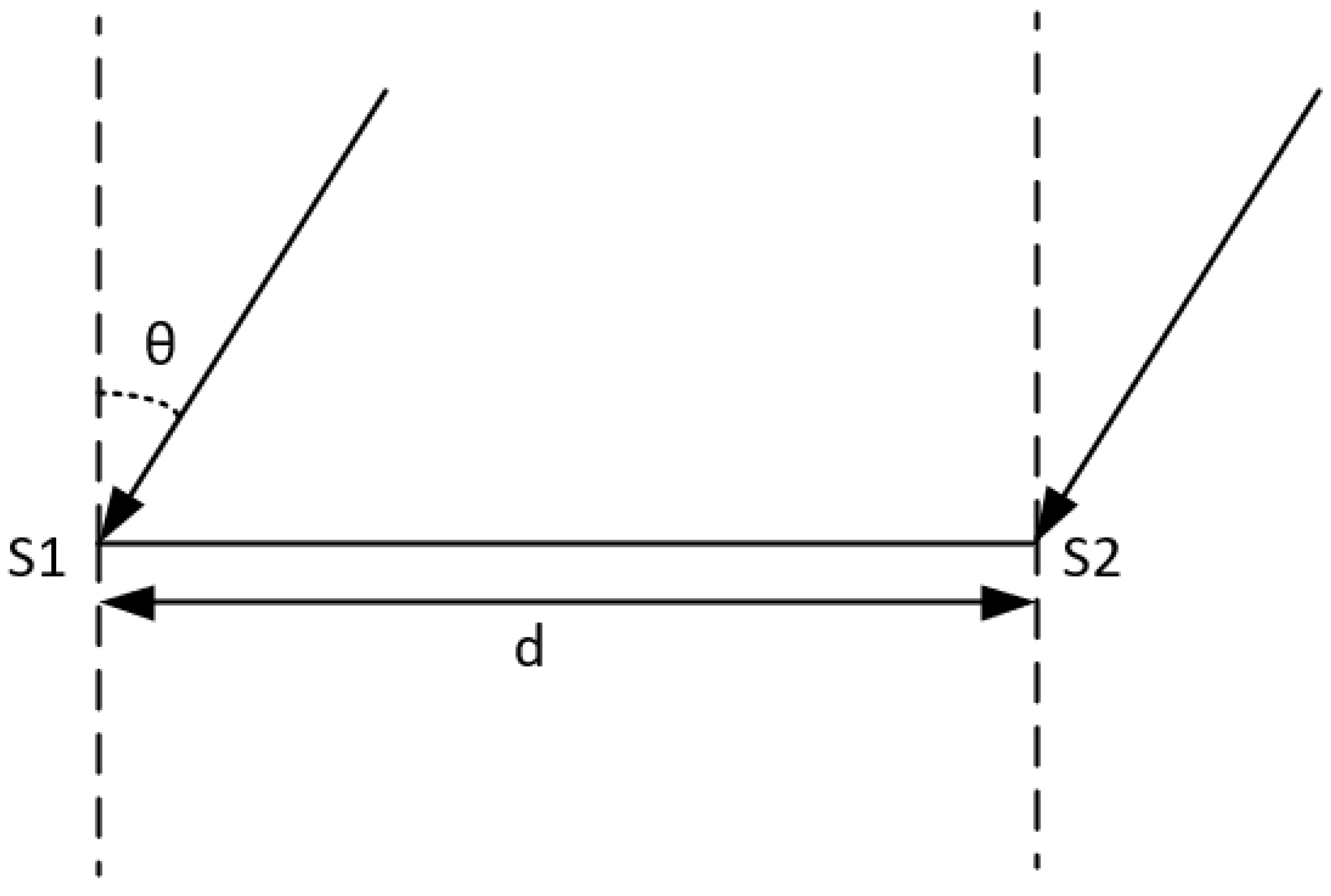
This paper uses an interferometer algorithm for angle measurement. The interferometric direction-finding method determines the direction of the incoming wave by the phase difference received by the antenna when the wave arrives. Figure 4 shows the basic single-baseline interferometer model.
When the distance between the signal source and the receiver is much greater than the baseline length, the two sets of incoming signals can be approximately considered parallel. If an electromagnetic wave arrives at angle θ (relative to the baseline), the signals received by S1 and S2 will have a phase difference:
φ = 2 π d λ sin θ
where λ denotes the electromagnetic wavelength, and d represents the baseline length.
After the receiver stabilizes tracking, the phase difference observation can be obtained by subtracting the two carrier phase outputs from the phase discriminator. However, the output of the phase discriminator is the principal value phase φ [ 0 , 2 π ) , which satisfies the following relationship with the true phase difference:
φ = 2 π N + φ
where N is the integer ambiguity (integer ambiguity). Substituting Equation (14) into Equation (13) gives:
sin θ = λ d N + φ 2 π
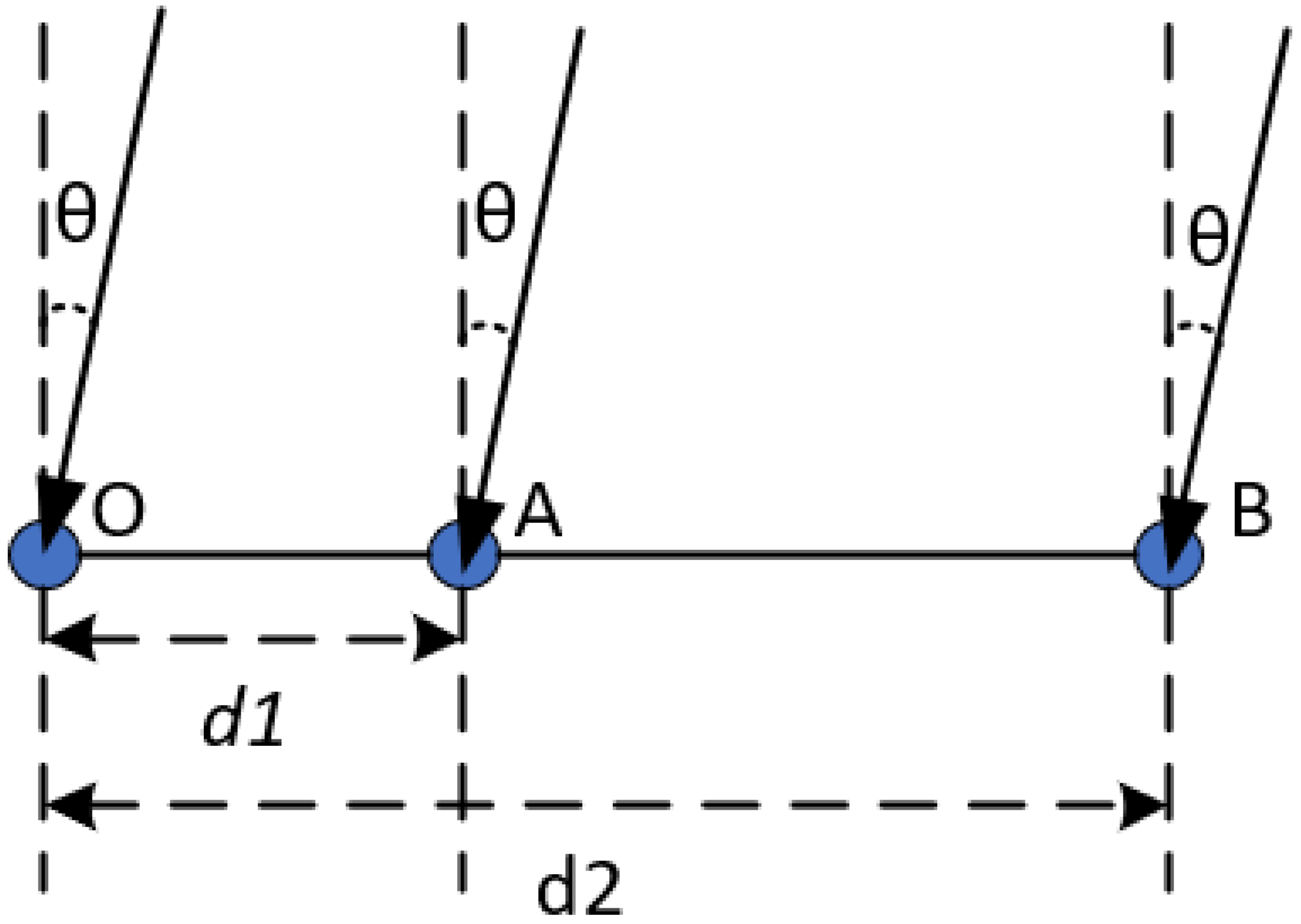
As seen, when d > λ / 2 , a longer baseline is typically required to improve accuracy. However, at this point, the integer ambiguity (N) must be reliably estimated, or else the angle solution will suffer from jumps or multiple solutions. To address the integer ambiguity issue in Equation (14), this paper introduces a staggered baseline structure based on single-baseline angle measurement, and employs a consistency-based ambiguity resolution strategy through joint search of the dual baseline. The dual-baseline interferometer structure is shown in Figure 5.
The lengths of the two baselines are d 1 and d 2 , corresponding to the principal phase difference observations φ 1 and φ 2 , and the integer ambiguities are N 1 and N 2 , respectively. From Equation (15), the angle constraints for the two baselines can be obtained as follows:
sin θ = λ d 1 N 1 + φ 1 2 π , sin θ = λ d 2 N 2 + φ 2 2 π
By dividing both equations by λ and simplifying, they can be written in an equivalent consistency form as follows:
N 1 + φ 1 2 π d 1 = N 2 + φ 2 2 π d 2 = sin θ λ
Since | sin θ | 1 , the integer ambiguity can be limited to a finite range. For the i-th baseline ( i = 1 , 2 ), we have:
1 d i λ N i d i λ
Therefore, it is only necessary to enumerate the candidates ( N 1 , N 2 ) within the above finite integer set. If ( N 1 , N 2 ) is the correct integer pair, the true phase difference corresponding to the two baselines, after normalization, should give the same incident angle. By equivalently transforming Equation (17), we obtain:
d 2 ( 2 π N 1 + φ 1 ) = d 1 ( 2 π N 2 + φ 2 )
Based on this, the consistency residual function is defined as:
e ( N 1 , N 2 ) = d 2 ( 2 π N 1 + φ 1 ) d 1 ( 2 π N 2 + φ 2 )
Among all the candidate integer pairs that satisfy Equation (26), select:
( N 1 , N 2 ) = arg min ( N 1 , N 2 ) e ( N 1 , N 2 )
as the final ambiguity resolution result. After obtaining ( N 1 , N 2 ) , substitute them back into Equation (16) to obtain the incident angle:
θ = arcsin λ d 2 N 2 + φ 2 2 π
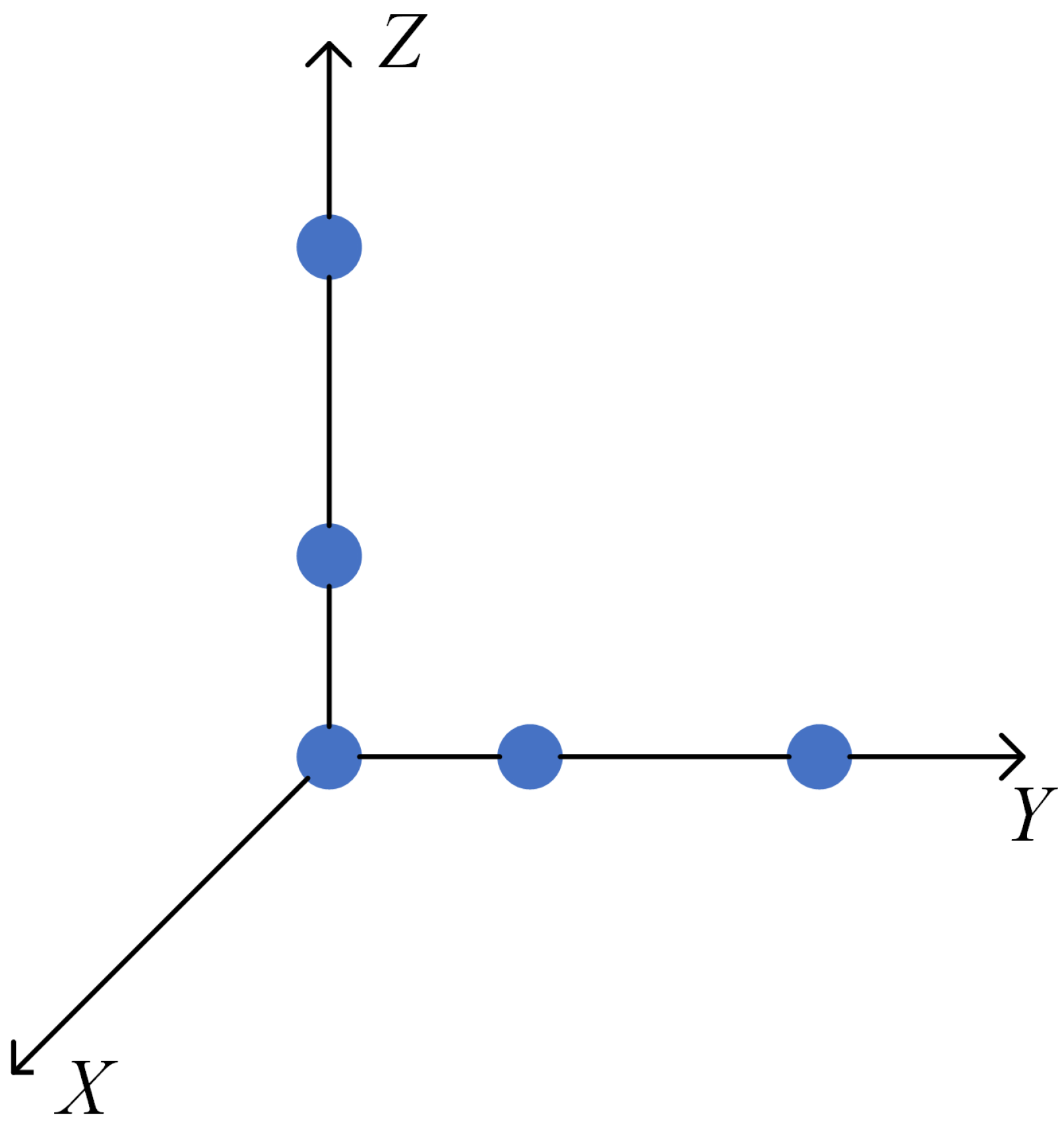
To obtain both elevation and azimuth angles simultaneously, we adopt an L-shaped five-antenna array for interferometric angle measurement. This L-shaped antenna array consists of three coplanar antennas and two vertical antennas, enabling the measurement of azimuth and elevation angles concurrently. In this configuration, the antenna elements in the horizontal plane are used to compute the azimuth angle, while the vertically spaced antenna elements are used to measure the elevation angle. Figure 6 shows the block diagram of the antenna array configuration.
The phase difference between signals received by different antennas is caused by differences in propagation paths and is used for interferometric angle measurement. However, due to manufacturing and installation errors of the antenna array, unnecessary phase deviations may be introduced, which need to be corrected through phase calibration. To ensure that the phase differences of the antenna array are solely caused by the propagation of the target signal and not by errors within the array itself, we employ the rotated unit electric field vector method for phase calibration [33]. This method rotates the antenna units and measures the signal phases in different directions to obtain and compensate for the phase errors of each antenna unit. The specific steps are as follows:
  • Antenna unit rotation: Rotate each antenna unit one by one, keeping the positions of the other antennas unchanged.
  • Phase difference measurement: During the rotation process, measure the signal phase received by each antenna unit and compare it with the theoretical phase.
  • Phase compensation: Adjust the phase of each antenna unit based on the calculated phase differences to ensure that the signal phases of all antenna units are consistent.
By applying the improved REV method for phase calibration, phase errors caused by manufacturing, installation, or environmental changes can be eliminated, ensuring that the measured phase differences reflect only the true propagation path differences of the signal.

3.1.2. System Architecture and Time-Division Processing Strategy

In the proposed system, each UAV continuously transmits a measurement signal modulated with its own pseudorandom code. Distinct PRN codes are assigned to different nodes to ensure mutual interference immunity. All UAVs are equipped with a unified receiving module. By employing a time-division mechanism, the receiver processes only one target node’s signal within each time slot, performing filtering and state updating for that node and outputting its angle and range information. For the remaining nodes that are not selected in the current time slot, no signal observation is carried out. Instead, an extrapolation strategy is applied: based on the stored state variables from the previous update—such as Doppler shift and frequency rate—the current carrier phase is predicted, from which the angle information is further computed.
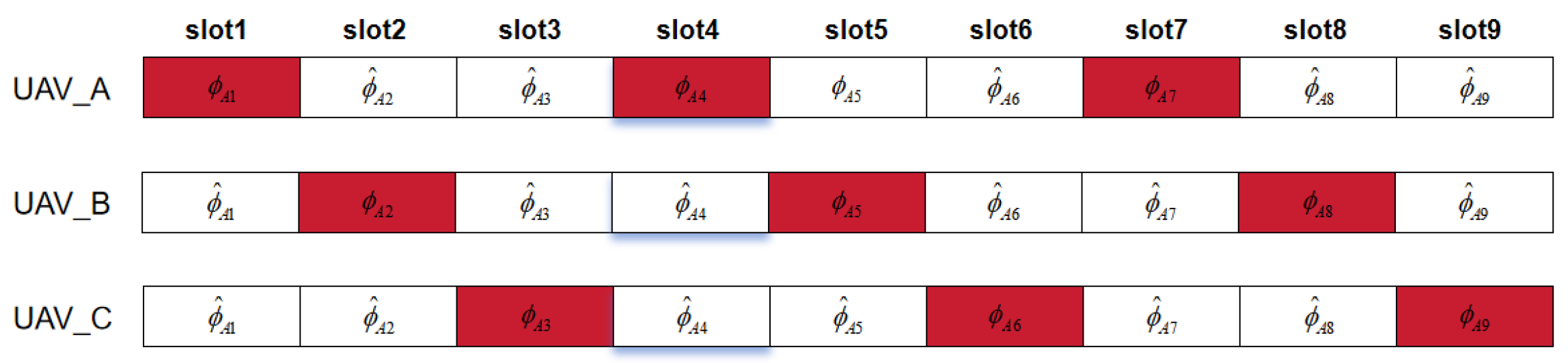
Using a three-UAV system as an example, Figure 7 illustrates the time-division processing scheme adopted for handling multiple target nodes. Each row represents the processing status of a specific node over consecutive time slots. A red block indicates that the node is selected in the corresponding slot, during which the receiver acquires valid observations and performs state updating. A white block indicates that the node is not selected in that slot, and its phase is predicted by extrapolating the state vector obtained from the previous epoch.

3.1.3. Principle of Extrapolation Algorithm

In a given time slot, the receiver performs signal correlation and phase detection only for the selected target node, obtaining the current carrier phase observation for that node, and uses Kalman filtering to update the state vector of that node. For the nodes that are not selected, no new observation data is available in that time slot, and the current carrier phase must be extrapolated based on the state variables saved from the previous time step, thus enabling continuous estimation of angle and distance information. Let the state vector of a node, selected at time slot ( k 0 ) and completed with carrier tracking and Kalman filter update, be denoted as the posterior state estimation vector:
X k 0 = φ e ( k 0 ) f d ( k 0 ) f d ( k 0 ) f d ( k 0 ) T
The corresponding state covariance matrix is P k 0 . In subsequent time slots without new observations, the node’s state is predicted over time using a state transition model consistent with the carrier tracking loop:
X k + 1 = A X k + w k
where w k is a zero-mean Gaussian process noise with covariance matrix Q, which characterizes the impact of Doppler dynamic variations and unmodeled disturbances on the system. The specific form is given by the following equation:
Q = σ φ 2 cov ( φ , f d ) cov ( φ , f d ) cov ( φ , f d ) cov ( φ , f d ) cov ( f d , φ ) σ f d 2 cov ( f d , f d ) cov ( f d , f d ) cov ( f d , f d ) cov ( f d , φ ) cov ( f d , f d ) σ f d 2 cov ( f d , f d ) cov ( f d , f d ) cov ( f d , φ ) cov ( f d , f d ) cov ( f d , f d ) σ f d 2 cov ( f d , f d ) cov ( f d , φ ) cov ( f d , f d ) cov ( f d , f d ) cov ( f d , f d ) σ f d 2
The corresponding state covariance prediction is:
P k + 1 = A P k A T + Q
When a node is not selected for m consecutive time slots starting from k 0 , its state prediction value and covariance can be obtained by repeatedly applying the above prediction model. In the predicted state vector, the carrier phase component can be represented as:
φ ^ k 0 + m = H φ X ^ k 0 + m
where H φ = 1 0 0 0 is the phase extraction matrix. The corresponding predicted uncertainty is:
σ φ , k 0 + m 2 = H φ P k 0 + m H φ T
After the predicted position is updated by 2 π , the phase estimator, which inputs the measured angle of the target node, is used for computing the target node’s angular position. As the number of consecutive unmeasured epochs increases, the predicted phase estimation error increases, leading to the accumulation of uncertainty in the position estimate.
When the node is continuously reselected in later epochs and obtains a new phase observation φ e ( n ) , the Kalman filter updates based on the new observations. The creation of the new state is defined as:
r k = wrap φ e ( n ) φ ^ k
Its statistical characteristics are determined by the prediction covariance and the observation noise covariance. In the case where the innovation grows significantly, it indicates a deviation between the current prediction model and the actual dynamics. In this case, an expansion factor can be applied to the process noise covariance matrix:
Q α Q , α > 1
By weakening the constraints on the assumption of steady Doppler dynamics, the filter assigns higher weight to new observations during subsequent updates, thereby accelerating the adaptation of the state to dynamic changes. On the other hand, the phase uncertainty represented by the prediction covariance can also serve as an important reference for time-division scheduling layers. When the phase uncertainty σ φ , k 2 of a node exceeds the preset threshold σ φ , t h 2 , the node should be prioritized for selection in subsequent time slots to perform a full carrier tracking and state update, thus limiting the accumulation of errors introduced by continuous extrapolation.

3.2. Ranging

After acquiring a coarse code phase through signal acquisition, the code tracking loop (DLL) is used to precisely align the locally generated code. Once the DLL is locked, the local code phase relative to the incoming code yields the time delay Δ t , which serves as the estimated propagation delay. Consequently, the relative code-based distance between two UAVs is obtained as:
ρ = c · Δ t f code
where c is the speed of light and f code is the PRN code rate.

4. Multi-UAV Cooperative Navigation Algorithm

Building upon the interferometric angle-of-arrival estimation and pseudocode-based ranging methods introduced in the previous chapters, this work develops a multi-UAV cooperative navigation algorithm by incorporating the factor-graph-based cooperative positioning framework described in [30]. The proposed approach fuses high-precision GNSS measurements from the master UAV with relative observations between the master and slave UAVs. We first present the system state modeling and the underlying assumptions. Subsequently, the interferometric angle factor, the pseudocode ranging factor, the GNSS absolute positioning factor, and the time-difference constraint factor are formulated. Finally, all observation constraints are unified within the factor graph framework, followed by an introduction to the sliding-window strategy and robust estimation techniques.

4.1. System State Modeling and Basic Assumptions

Consider a multi-UAV system composed of one master UAV, denoted as UAV A, and N slave UAVs, denoted as UAV j. The discrete time index is represented by k = 0 , 1 , 2 , . In the global coordinate frame, the position vector of the i-th UAV at time k is written as:
p i , k = [ x i , k , y i , k , z i , k ] T
In this work, only the three-dimensional positions of all UAVs are treated as the state variables to be estimated. The master UAV A is equipped with a high-precision GNSS receiver, enabling it to obtain absolute position measurements continuously at each epoch. The master–slave UAV pairs additionally acquire relative observations, including bearing, elevation, and range, as introduced in the previous sections. These angle and range measurements are considered known observations in the proposed method.

4.2. Measurement Factor Modeling

Let the positions of the master UAV A and the slave UAV j at time k in the global coordinate frame be:
P A , k = [ x A , k , y A , k , z A , k ] T , P j , k = [ x j , k , y j , k , z j , k ] T
Define the coordinate increment from the master UAV to the slave UAV as:
Δ p A , j , k = P j , k P A , k = [ Δ x A , j , k , Δ y A , j , k , Δ z A , j , k ] T
The horizontal range and Euclidean distance between the two UAVs are given by:
r A , j , k h o r = Δ x A , j , k 2 + Δ y A , j , k 2 , r A , j , k = Δ p A , j , k

4.2.1. Interferometer Angle Measurement Factor Model

The theoretical azimuth θ ^ A , j , k and elevation φ ^ A , j , k of the slave UAV relative to the master UAV are given by:
θ ^ A , j , k = arctan 2 ( Δ y A , j , k , Δ x A , j , k ) , φ ^ A , j , k = arctan Δ z A , j , k r A , j , k h o r
The stacked azimuth–elevation observation vector from the master to the slave UAV is represented as:
z A , j , k a n g = θ ^ A , j , k φ ^ A , j , k T
The corresponding measurement model is written as:
z A , j , k a n g = h a n g ( P A , k , P j , k ) + n A , j , k a n g , n A , j , k a n g N ( 0 , A , j , k a n g )
where
h a n g ( P A , k , P j , k ) = θ ^ A , j , k φ ^ A , j , k T
Here, n A , j , k a n g denotes the angle measurement noise.
In the factor graph, the residual of the interferometric angle factor is defined as:
e A , j , k a n g = z A , j , k a n g h a n g ( P A , k , P j , k ) = θ ^ A , j , k θ ^ A , j , k φ ^ A , j , k φ ^ A , j , k T
The azimuth residual requires 2 π -period wrapping to ensure it lies within the interval ( π , π ) . The cost term of this factor is written as:
e A , j , k a n g e A , j , k a n g 2 A , j , k a n g 1 e A , j , k a n g

4.2.2. Range Measurement Factor Model

Let the measured range between the master UAV and the slave UAV be denoted as r ˜ A , j , k , and let the theoretical range be r A , j , k . Then, the relationship is written as:
r ˜ A , j , k = r A , j , k + n A , j , k
where n A , j , k denotes the range measurement noise.
In the factor graph, the residual of the range factor is defined as:
e A , j , k r = r ˜ A , j , k r A , j , k
The corresponding cost term is:
e A , j , k r r 2 = e A , j , k r 2 1 σ r 2

4.2.3. GNSS Positioning Factor Model

Let the GNSS position measurement of the master UAV be denoted as:
P ˜ A , k = [ x A , k , y A , k , z A , k ] T
The corresponding measurement model is expressed as:
P ˜ A , k = P A , k + n A , k G N S S , n A , k G N S S N ( 0 , A , k G N S S )
where n A , k G N S S denotes the GNSS measurement noise.
The residual of this factor is defined as:
e A , k G N S S = P ˜ A , k P A , k
The corresponding cost term is written as:
e A , k G N S S A , k G N S S 2 = e A , k G N S S T A , k G N S S 1 e A , k G N S S

4.2.4. Temporal Difference Constraint Factor Model

Let the positions of the i-th UAV at epochs k 1 and k be denoted as:
p i , k 1 = [ x i , k 1 , y i , k 1 , z i , k 1 ] T , p i , k = [ x i , k , y i , k , z i , k ] T
A random walk model is adopted, assuming that the position change between consecutive epochs follows a zero-mean perturbation:

4.2.5. Temporal Difference Constraint Factor Model

The position model for the i-th UAV at time k is expressed as:
p i , k = p i , k 1 + w i , k , w i , k N ( 0 , Q i , k )
where w i , k is the process noise.
The residual of the temporal difference constraint factor is written as:
e i , k 1 k t d = p i , k p i , k 1 , e i , k 1 k t d N ( 0 , Q i , k )
The corresponding cost term is given by:
e i , k 1 k t d Q i 2 = e i , k 1 k t d T Q i 1 e i , k 1 k t d

4.3. Factor-Graph-Based Cooperative Navigation and Optimization

Based on the aforementioned state modeling and measurement factors, this chapter employs a factor graph to provide a unified formulation of the multi-UAV cooperative navigation problem, and further incorporates a sliding-window and marginalization strategy to enable online optimization. A factor graph consists of variable nodes and factor nodes: the variable nodes correspond to the three-dimensional position states of all UAVs at each epoch, while the factor nodes represent various types of observation and prior constraints, essentially realizing a factorization of the joint posterior distribution.
To achieve real-time computation, only a fixed window composed of the most recent T discrete epochs is considered at the current time k:
K k = { k T + 1 , , k } ,
The position states of all master and slave UAVs within the sliding window are stacked as:
x k = x k T + 1 T , x k T + 2 T , , x k T T
where x t denotes the state vector of all UAVs at epoch t. It should be noted that the length of the sliding window T directly affects the scale of the optimization problem and the solution accuracy. As T increases, the number of state variables and factors within the window also increases, allowing for the introduction of motion priors and observation constraints over a longer time span. This enhances trajectory smoothness and suppresses noise. However, it also increases the computational cost of each epoch’s linearization and the solution of sparse linear equations. In contrast, a smaller T reduces the computational load but provides fewer constraints, potentially leading to a decrease in accuracy. Let the set of all measurements within the window be denoted as Z k . Assuming conditional independence, the posterior probability of the state can be expressed as:
p ( x k Z k ) p 0 ( x k ) m F ( K ) p m ( z m χ m )
where p 0 ( x ) denotes the prior constraint (including historical marginalized information), z m is the m-th measurement, and χ m represents the subset of the state vector associated with this measurement. Let F ( K ) denote the set of all factors within the sliding window. For the m-th factor, we introduce the residual function:
e m ( χ m ) = z m h m ( χ m )
where h m ( · ) is the corresponding measurement function. Assuming that all measurement noises are zero-mean Gaussian, we have:
e m ( χ m ) N ( 0 , m )
Thus, the maximum a posteriori (MAP) estimation problem within the current sliding window is equivalent to minimizing the weighted sum of squared residuals. Let e 0 ( χ ) and 0 denote the residual and covariance of the prior factor. The overall optimization problem can be written as:
χ ^ = arg min χ k e 0 ( χ k ) 0 2 + i K e ang 4 ang 2 + j K e r 4 r 2 + e GNSS 4 GNSS 2 + i , j e td 4 td 2
where the Mahalanobis norm is defined as:
e 1 2 = e T 1 e
To enhance robustness against outliers and abnormal observations, a robust kernel function ρ ( · ) is introduced into each factor within the weighted least-squares framework. Accordingly, every term e m ( χ m ) m 1 2 in the objective function is replaced by ρ e m ( χ m ) m 1 2 .
In this work, the Huber robust kernel [34] is adopted, which preserves the quadratic loss for small residuals while gradually reducing the weight of large residuals, thereby mitigating the influence of outliers on the estimation results. Nonlinear optimization problems are typically solved using the Gauss–Newton iterative algorithm. The Gauss–Newton method performs well when the initial guess is close to the optimal solution. However, when the initial guess is far from the optimal solution or the residual function is highly nonlinear, convergence issues may arise. To address this problem, when the Gauss–Newton method fails to converge effectively, we employ the Levenberg–Marquardt (LM) method [35]. The LM method adjusts the step size by introducing a damping factor, which prevents divergence caused by overly large steps, thus ensuring the stability and robustness of the optimization process. Additionally, we utilize the sparse structure of the factor graph to construct normal equations and apply a sparse linear solver to achieve real-time joint estimation of all states within the sliding window. As time progresses, if all historical states are retained, the computational burden will continuously grow, which is undesirable for real-time implementation. Therefore, a sliding-window strategy is adopted: the window maintains only the most recent states, while older states outside the window are marginalized into a prior factor, preserving their influence as a single constraint in the factor graph.
At the current linearization point χ k , the residual of the prior factor e 0 ( χ k ) is linearized as:
e 0 ( χ k + δ χ k ) e 0 ( χ k ) + J δ χ k ,
where J is the Jacobian of the residual with respect to the state vector. Minimizing the second-order approximation after linearization leads to the following normal equations:
H δ χ k = b , H = J T W J , b = J T W e 0 ( χ k ) ,
where W is the block-diagonal weighting matrix composed of the covariances of all factors and the weights induced by the robust kernel. When the length of the sliding window reaches its predefined upper bound, the state vector χ k is partitioned into the “old state” x β to be marginalized and the “current state” x α to be retained:
χ k = x α x β , H = H α α H α β H β α H β β , b = b α b β
By applying the Schur complement [36] to the marginalized state x β , the resulting equivalent system with respect to the retained state x α can be written as:
( H α α H α β H β β 1 H β α ) x α = b α H α β H β β 1 b β
where we define:
H ^ α α = H α α H α β H β β 1 H β α , b ^ α = b α H α β H β β 1 b β
Thus, the historical information after marginalization can be represented as a new prior factor e 0 prior , which imposes a constraint on the current state x α . The corresponding quadratic form is written as:
e 0 prior 0 1 2 = x α T b ^ α + 1 2 x α T H ^ α α x α
where the information matrix satisfies: 0 1 H ^ α α . During the next sliding-window optimization, this prior factor will be incorporated together with the newly introduced GNSS factor, the master-slave relative angle and range factors, as well as the temporal difference factors. In this way, the historical information is continuously propagated across sliding windows while effectively controlling the size of the optimization problem.

5. Simulation Results and Analysis

5.1. Channel Model

To validate the effectiveness of the proposed method, a complete simulation environment was constructed based on a typical wireless channel model. For channel modeling, the Jakes fading model was used to describe the flat Rayleigh fading characteristics under multipath conditions [37]. Additionally, considering the complex multipath effects and signal fading characteristics in urban environments, the Ricean fading model was introduced in the simulation to accurately model the fading behavior and random variations of the signal across different propagation paths. Furthermore, to simulate noise at the receiver end, additive white Gaussian noise (AWGN) was added to the channel. In high-dynamic environments, the simulation dynamically adjusts the Doppler shift using a time-varying Doppler model to simulate channel variations during rapid UAV maneuvers. The simulation parameters are summarized in Table 1.

5.2. Tracking Performance

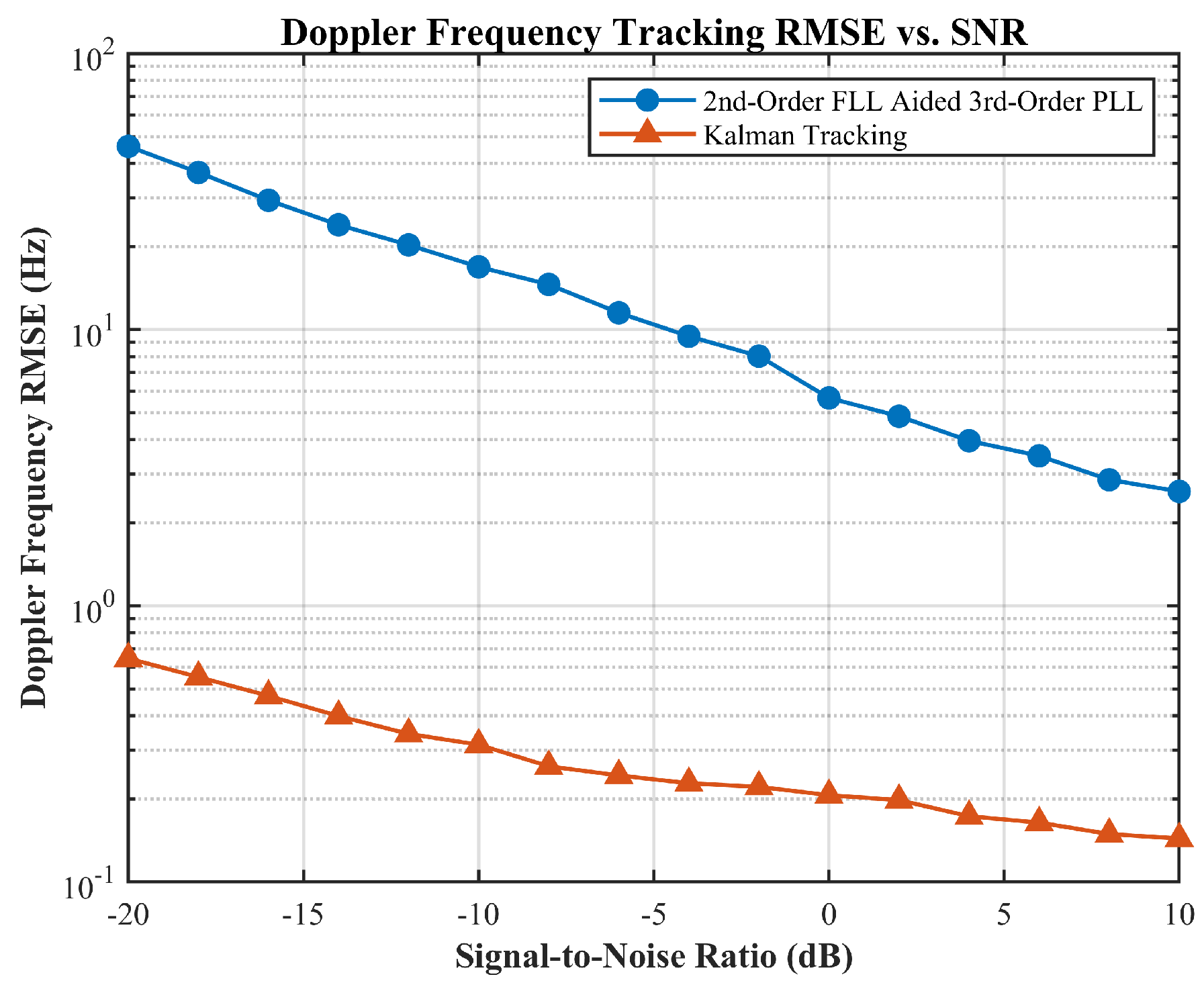
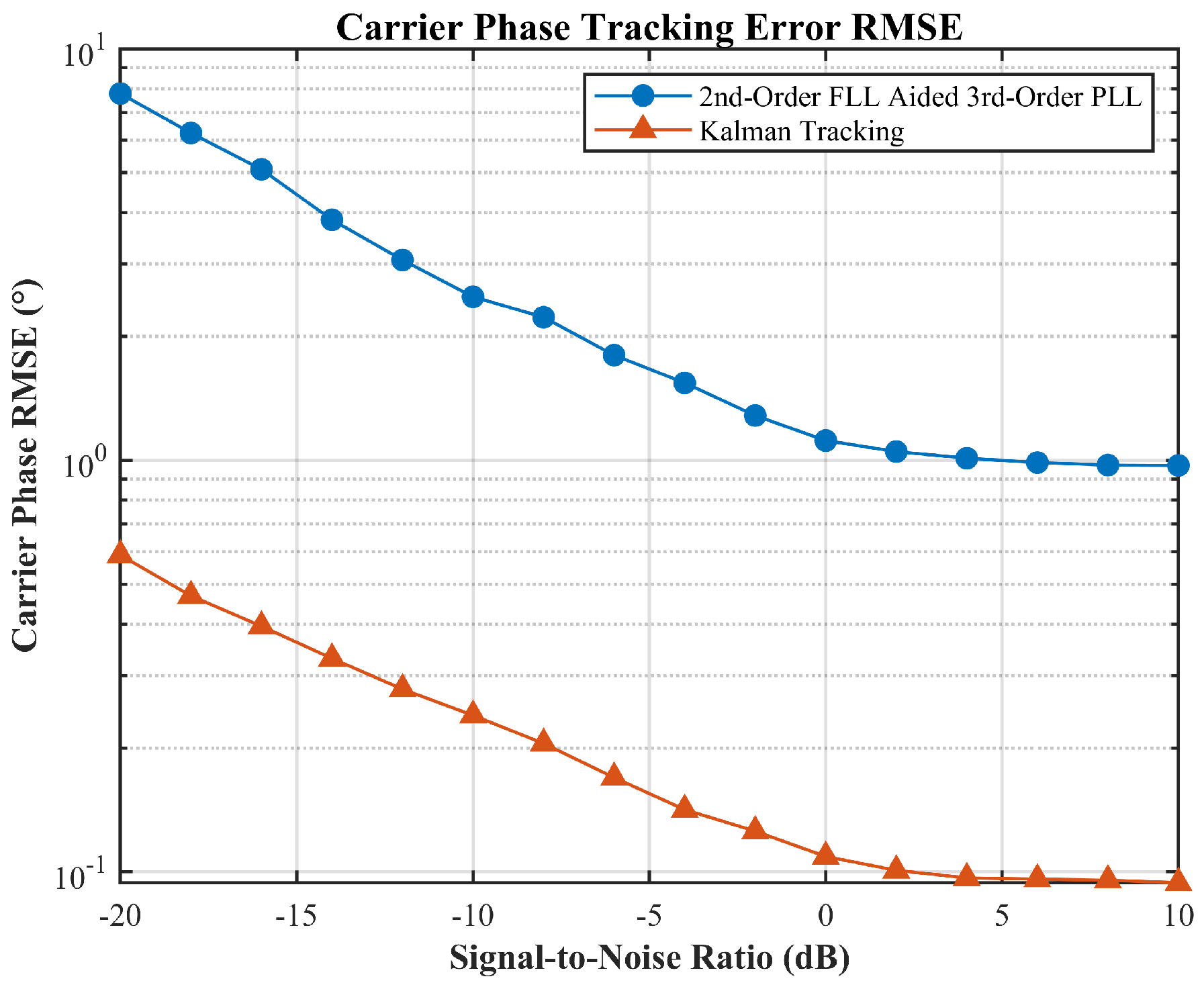
This section presents a comparative analysis of the tracking accuracy of the traditional second-order FLL–assisted third-order PLL structure and the Kalman-based carrier tracking loop under different signal-to-noise ratio (SNR) conditions. Figure 8 and Figure 9 show the variation of the carrier-phase tracking RMSE and Doppler-frequency tracking RMSE with respect to SNR for the two methods. The results indicate that the Kalman-filter-based carrier tracking approach consistently maintains lower errors across the entire SNR range. In particular, it remains stable even under extremely low SNR conditions (−20 dB), achieving an RMSE reduction of approximately one order of magnitude compared with the traditional loop.

5.3. Angular Measurement Performance

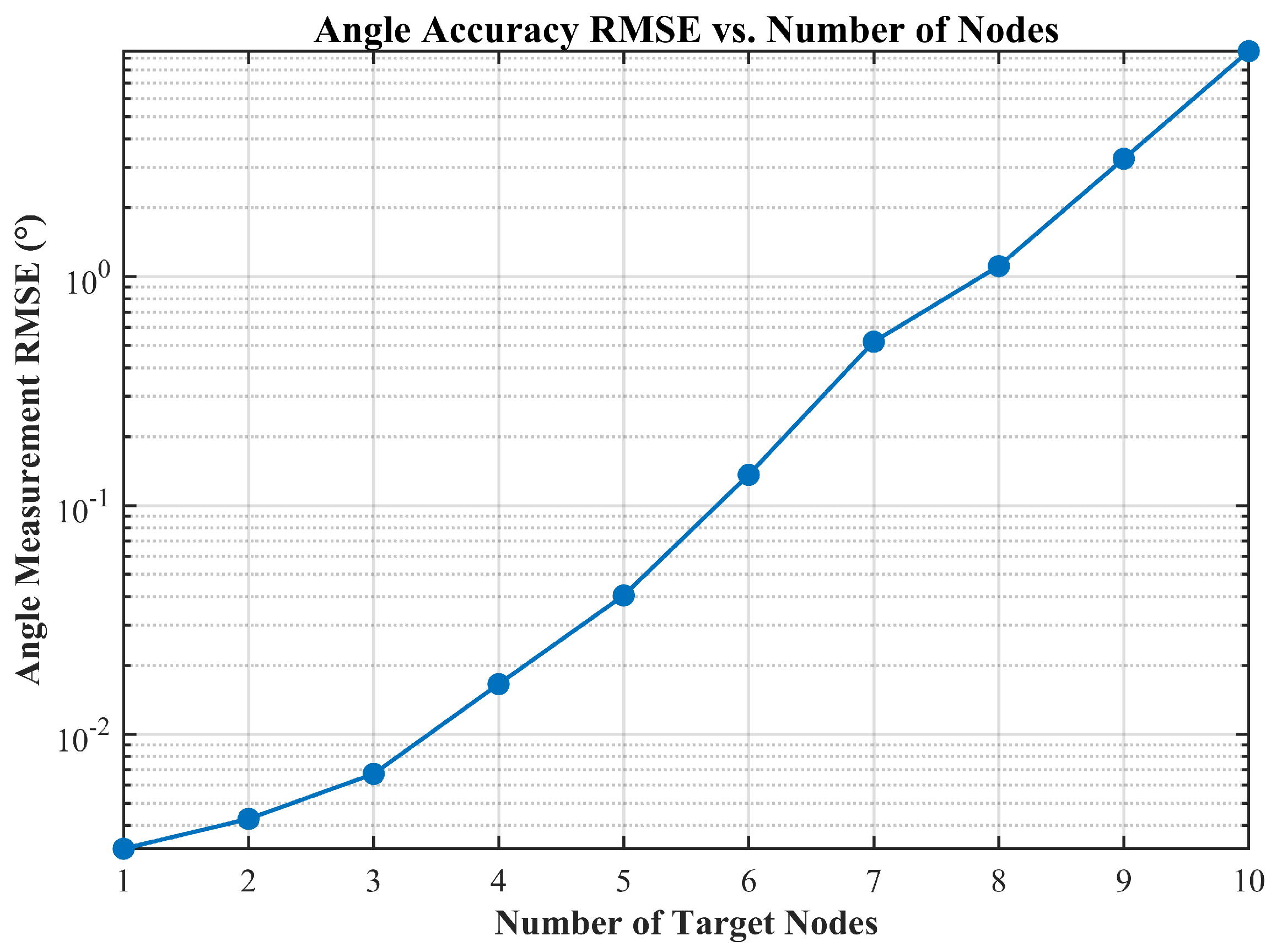
To verify the effectiveness of the time-division interferometric angle-measurement method proposed in Section 4 within a multi-node cooperative environment, the angle estimation accuracy is analyzed under different time-division conditions and geometric configurations, with a fixed SNR of 0 dB. Figure 10 illustrates the influence of the number of unupdated time slots m on the angle estimation accuracy. It should be noted that within each 10 ms time slot, the system selects only one target node for phase updating. Therefore, when the total number of nodes is N, the number of unupdated slots becomes m = N 1 . In other words, as the number of nodes increases, the interval between two updates for a specific node becomes longer, leading to a larger phase extrapolation length.
The results show that when m 3 (corresponding to no more than four nodes), the extrapolation error remains small, and the angle RMSE stays on the order of 10 2 degrees. However, when m increases to 6–8 (approximately 7–9 nodes), the extrapolation error grows exponentially, and the RMSE rapidly exceeds 1 degree. This indicates that the extrapolation mechanism can reliably compensate for short-term observation gaps, but as the time-division scheduling cycle becomes longer, the extrapolation error accumulates more easily. Hence, a trade-off must be made between the number of cooperating nodes and the achievable angle accuracy.
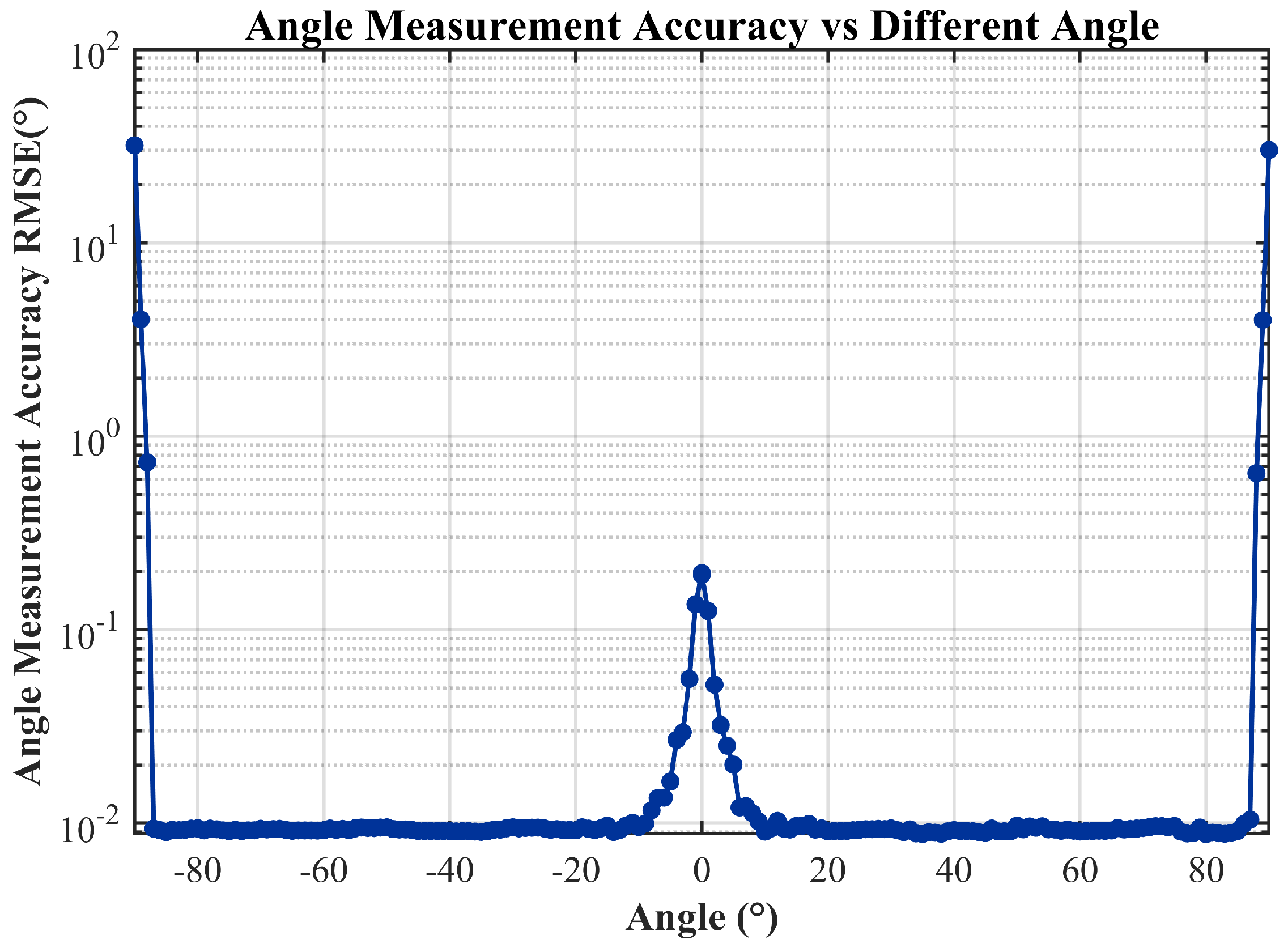
Figure 11 illustrates the variation in angle estimation accuracy under different incident angles in a scenario with four target nodes. It can be observed that within the main lobe region (approximately −85° to 85°), the angle RMSE consistently remains below 10 2 degrees, demonstrating stable and reliable performance. When the incident angle approaches ± 90 , however, the angle-measurement sensitivity drops sharply, and the error exceeds 10 degrees. Overall, the proposed method achieves high accuracy and strong robustness within the usable field of view. The simulation results clearly validate the effectiveness of the time-division mechanism and the phase-extrapolation strategy in multi-node cooperative angle estimation.
It should be noted that the advantages of the time-division interferometric angle estimation combined with phase extrapolation structure primarily lie in the scalability of the capture and tracking loop at the digital baseband side in terms of hardware resources. Under the same interferometer array and receiving front-end configuration, if a straightforward parallel multi-target solution is adopted, it typically requires N parallel capture and tracking loops for a single antenna to simultaneously output phase and pseudocode observations for N targets. In this case, the number of baseband loops grows linearly with the number of targets N.
In contrast, the proposed method runs a full capture and tracking loop for only one selected target in each time slot. The remaining targets rely on phase extrapolation from the previous epoch’s state for updates, which requires only a small number of computation units. This reduces the capture and tracking loops from N groups to just one, with the rest being lightweight prediction logic. For example, in the four-target node scenario in the simulation, the traditional parallel implementation requires 4 complete loops, whereas the proposed time-division + extrapolation structure only requires 1 full loop to achieve 4 angle estimation results.
As demonstrated in the aforementioned simulation results, the combined time-division update and phase extrapolation framework allows phase measurements and angle estimation for multiple target nodes with only one complete capture and tracking loop, and the resulting angle RMSE remains within an acceptable range. For the N-target node operational mode, compared to the traditional parallel approach where a separate loop is configured for each target, the baseband hardware resource demand is reduced by approximately 1 1 N × 100 . In the case of four target nodes, this reduction is about 75%, indicating that the system can maintain stable and reliable angle estimation performance while significantly reducing the resource consumption of the capture and tracking modules.

5.4. Simulation of Pseudocode Relative Ranging Performance

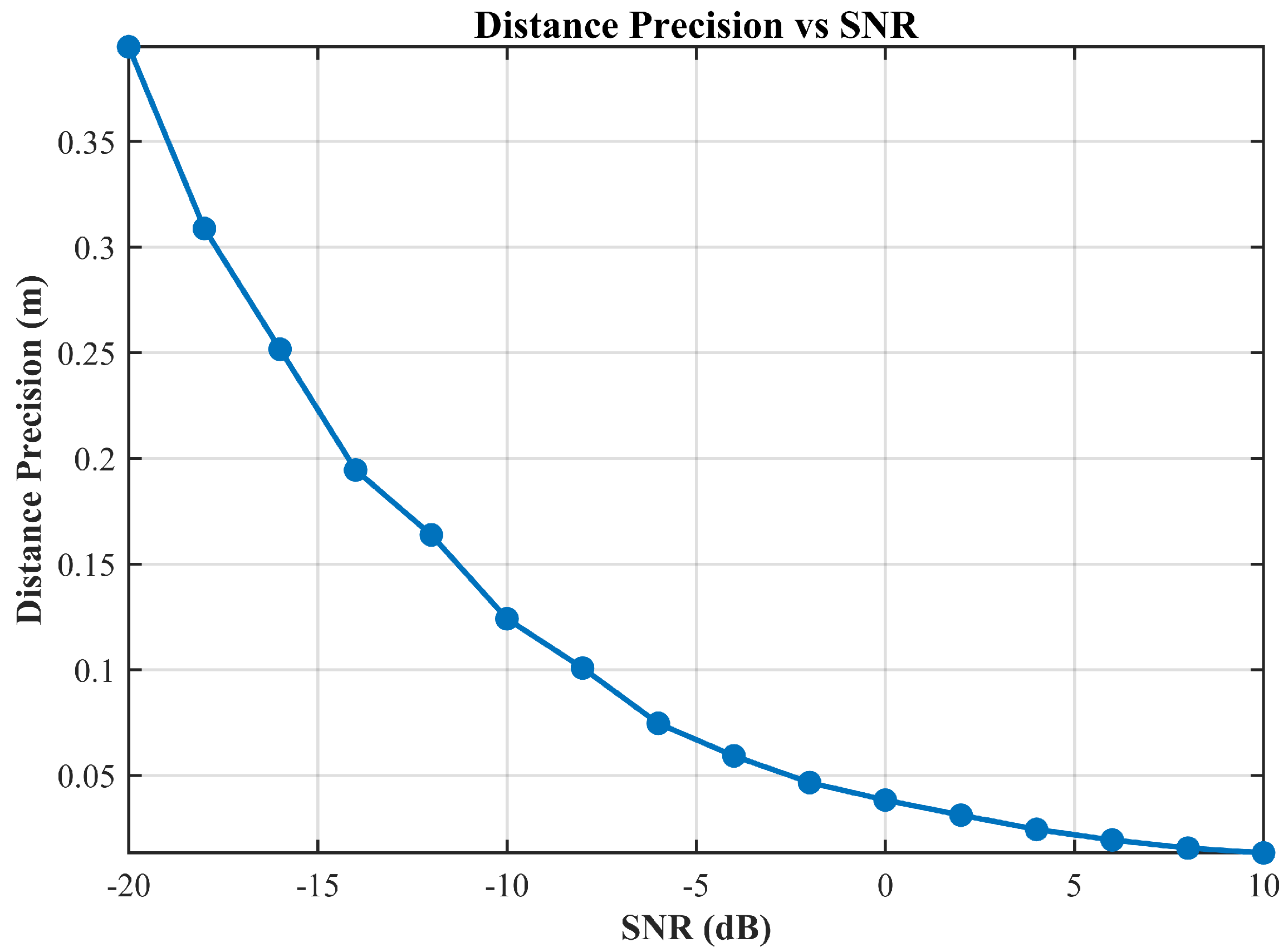
This section presents a simulation evaluation of the pseudocode-based ranging accuracy. In the simulation, the signal-to-noise ratio (SNR) is varied from −20 dB to 10 dB, and each experiment is repeated multiple times to obtain stable root mean square error (RMSE) values as the ranging accuracy metric. Figure 12 shows the variation in ranging accuracy with changes in SNR. It can be observed that the ranging error significantly decreases as the SNR increases. When the SNR is below −15 dB, the ranging error exceeds 0.3 m. As the SNR improves to around −5 dB, the ranging accuracy rapidly improves to 0.06–0.1 m. In the region where the SNR is above 0 dB, the RMSE converges to the centimeter level.

5.5. Multi-UAV Cooperative Navigation Performance Analysis Simulation Scenario Setup

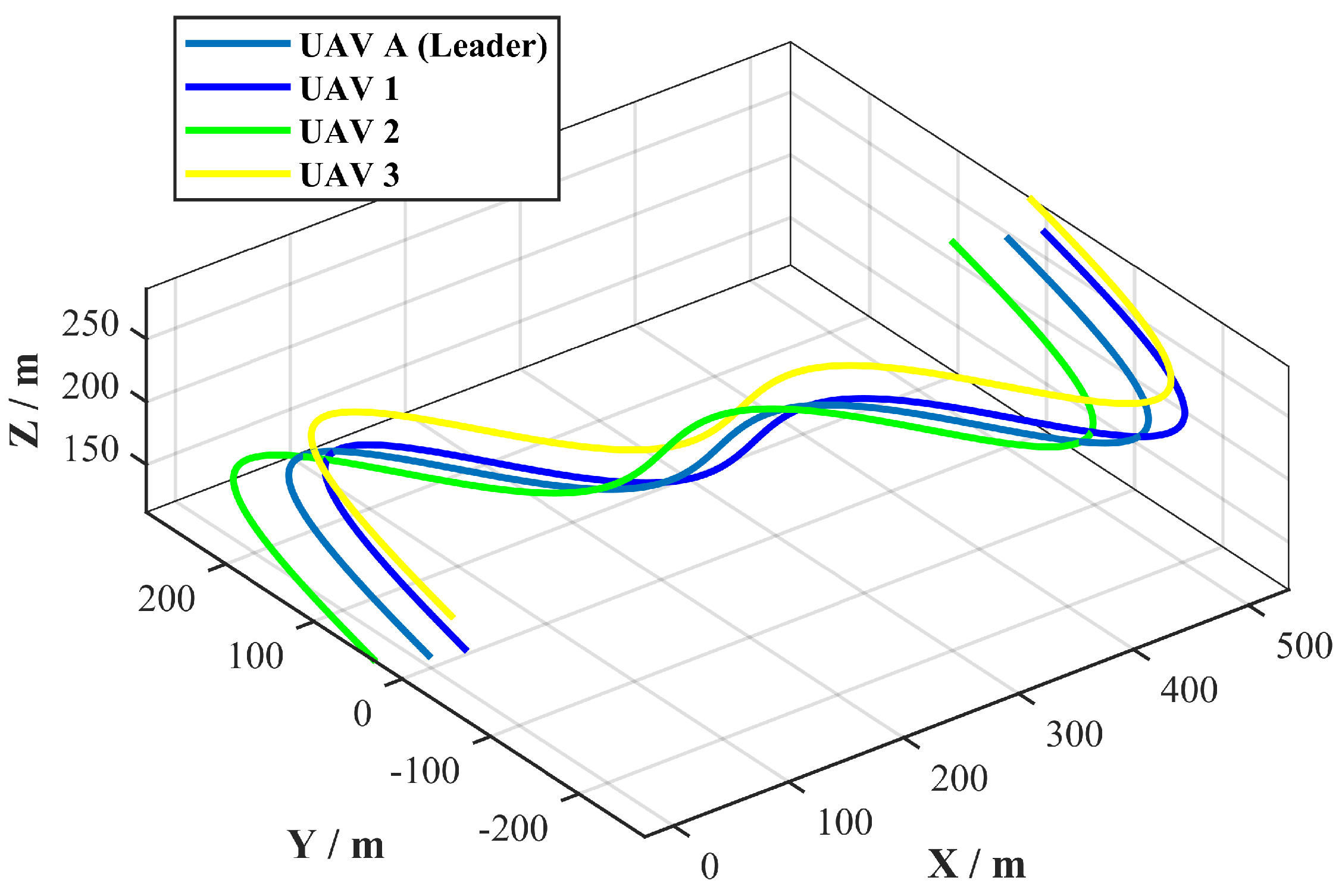
To evaluate the performance of the multi-UAV cooperative navigation algorithm proposed in this paper, a three-dimensional cooperative flight simulation environment is constructed, consisting of one master UAV and three slave UAVs. In the simulation, the master UAV is equipped with a centimeter-level high-precision GNSS receiver, whose positioning error typically does not exceed 5 cm. This enables the master UAV to continuously obtain stable global coordinates throughout the flight, providing an absolute reference for the system. The three slave UAVs acquire relative position information through angle (azimuth and elevation) and range measurements with respect to the master UAV. In the simulation, the UAVs are set to perform maneuvers such as acceleration, climbing, cruising, and turning, while maintaining their formation. All UAVs follow a predefined curved trajectory, with the flight path shown in Figure 13.

5.5.1. Impact of Window Length on Positioning Accuracy

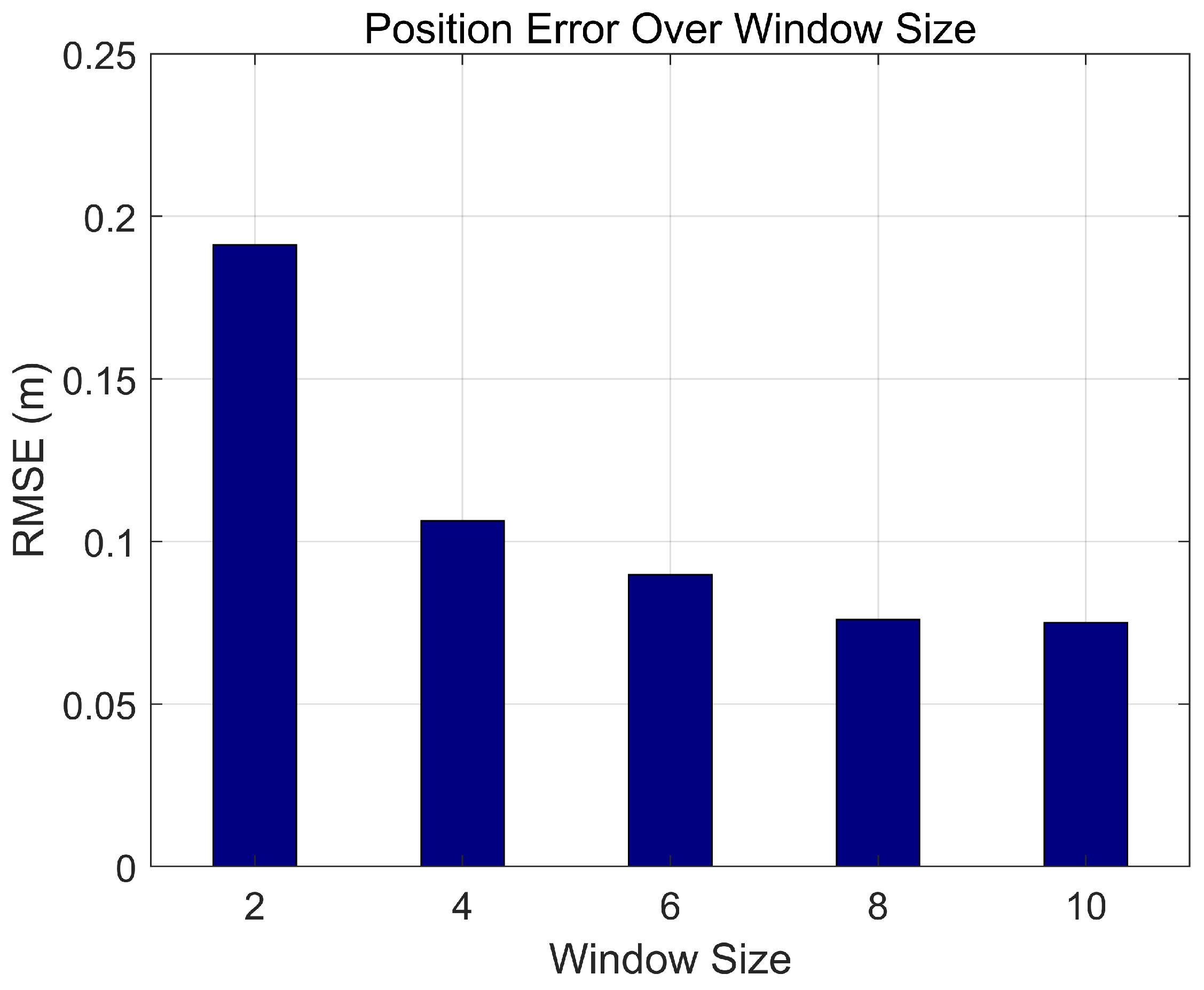
In the cooperative navigation algorithm presented in this paper, the length of the sliding window T directly affects the computational accuracy and real-time performance of the algorithm. Generally, increasing the window size introduces more historical observation information, which helps to improve positioning accuracy. However, it also increases the computational burden. Therefore, selecting an appropriate window length T is a key issue in algorithm optimization. To address this, we conducted simulation experiments with different window lengths. Specifically, five cases with window lengths T = 2 , 4 , 6 , 8 , 10 were selected, and the three-dimensional positioning errors for each case were recorded.The experimental results are shown in Figure 14.
As seen in Figure 14, as the window length T increases, the three-dimensional positioning error (RMSE) gradually decreases. When the window lengths are T = 8 and T = 10 , the errors are 0.076 m and 0.075 m, respectively, with the change becoming more gradual. This indicates that further increasing the window length results in a minimal improvement in accuracy. The experimental results suggest that while increasing the window length improves accuracy, the improvement becomes marginal once T exceeds 8. Therefore, in subsequent simulations, T = 8 was chosen as the window length, as it ensures a good balance between accuracy and computational efficiency.

5.5.2. Positioning Performance of the Time-Division Link-Based Cooperative Navigation Method

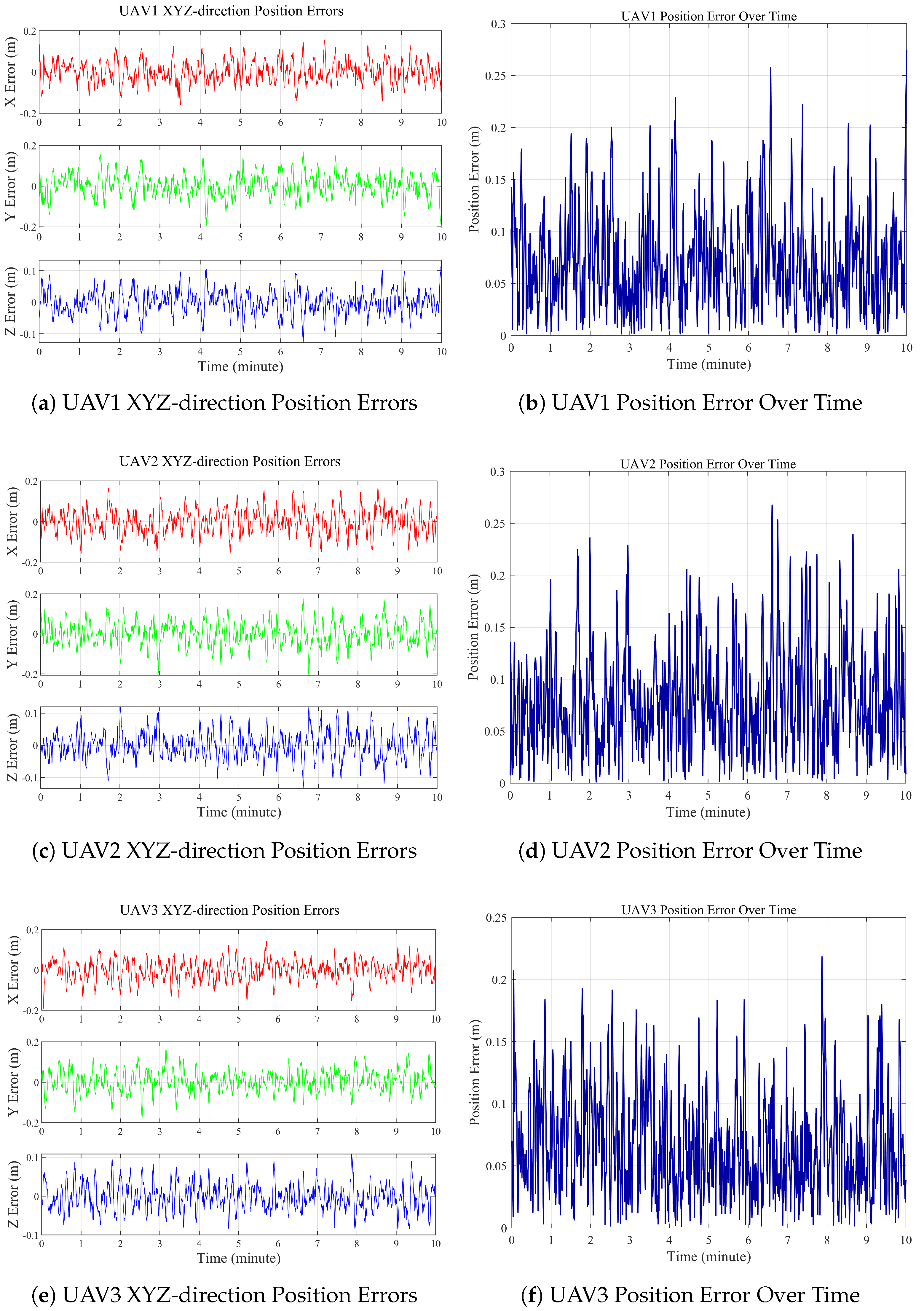
Figure 15 shows the time-varying position errors of UAV1–UAV3 in the X, Y, and Z directions, as well as the three-dimensional position error throughout the entire flight. As illustrated in the figure, the errors in each direction remain within ±0.2 m, and the majority of the 3D position errors fall within the range of 0–0.2 m.
Table 2 summarizes the RMSE statistics of the three-dimensional position errors for the three slave UAVs. The RMSE values for UAV1, UAV2, and UAV3 are 0.084 m, 0.093 m, and 0.0077 m, respectively, all at the level of 7–9 cm. These results indicate that the cooperative navigation algorithm is able to maintain the overall positioning error of each UAV at a stable sub-decimeter level throughout the entire simulation.
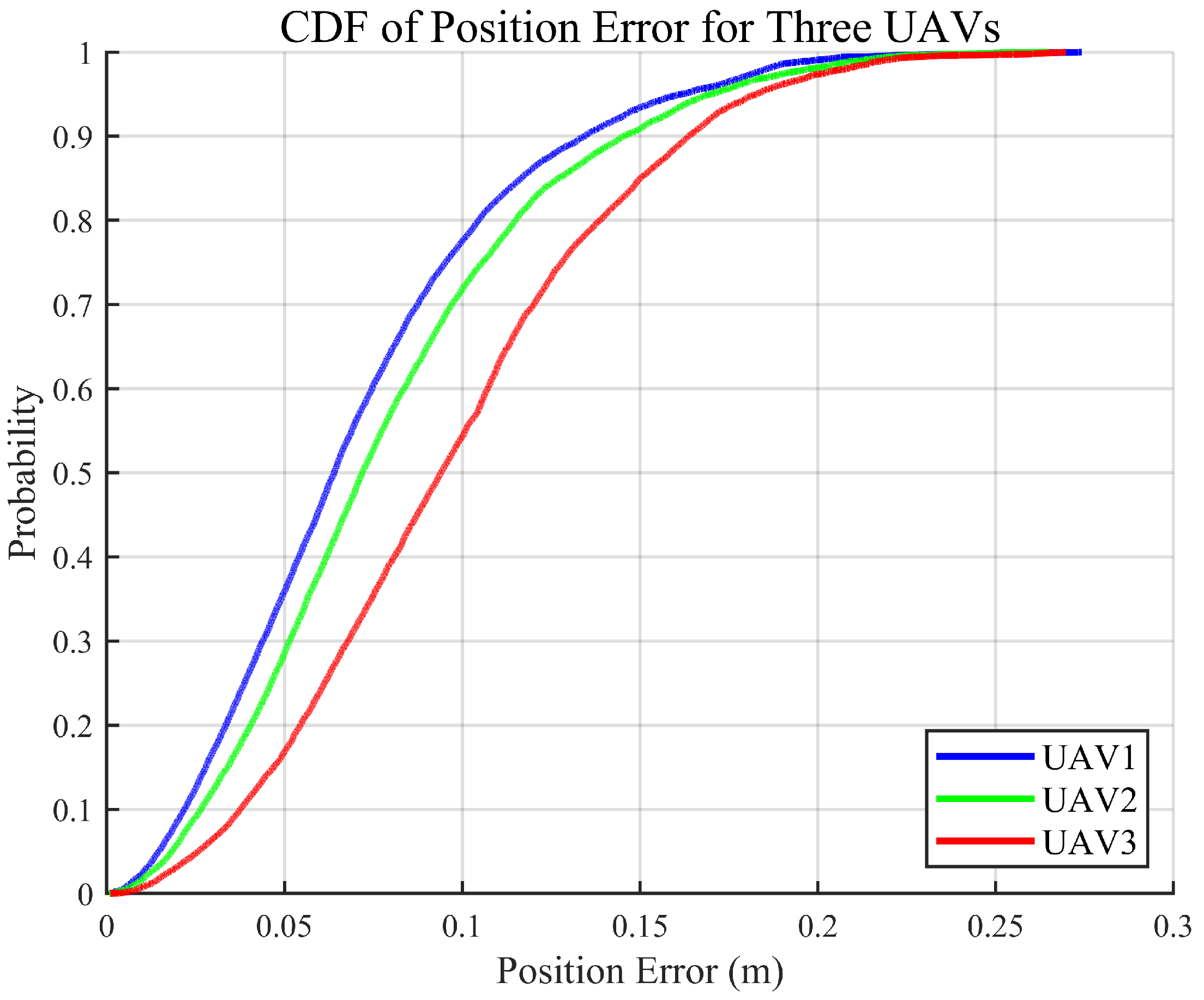
To further analyze the statistical characteristics of the positioning errors, Figure 16 presents the cumulative distribution functions (CDFs) of the three-dimensional position errors for the three slave UAVs. As shown in the figure, all three CDF curves rise rapidly and reach approximately 90% cumulative probability at around 0.15–0.20 m. Overall, the cooperative navigation algorithm is able to maintain the 3D position error within 0.20 m for the vast majority of the time, demonstrating a concentrated error distribution and strong robustness.

5.5.3. Analysis of Positioning Accuracy of the Algorithm Under Different Dynamic Scenarios

To further validate the performance of the algorithm in different dynamic environments, this paper considers three different acceleration variation scenarios to simulate the behavior of the target in sudden maneuvers and high dynamic motion. The three acceleration scenarios are: constant acceleration, linear acceleration change, and sinusoidal acceleration change. Table 3 presents the statistical results of cooperative navigation accuracy under these three acceleration variation conditions.
From the statistical results, it can be seen that although the error increases under varying acceleration conditions, the error is still controlled within a reasonable range. This indicates that the phase extrapolation algorithm exhibits certain robustness when facing different acceleration dynamics.

5.5.4. Comparison of Cooperative Positioning Performance Between Time-Division Link and Continuous Link

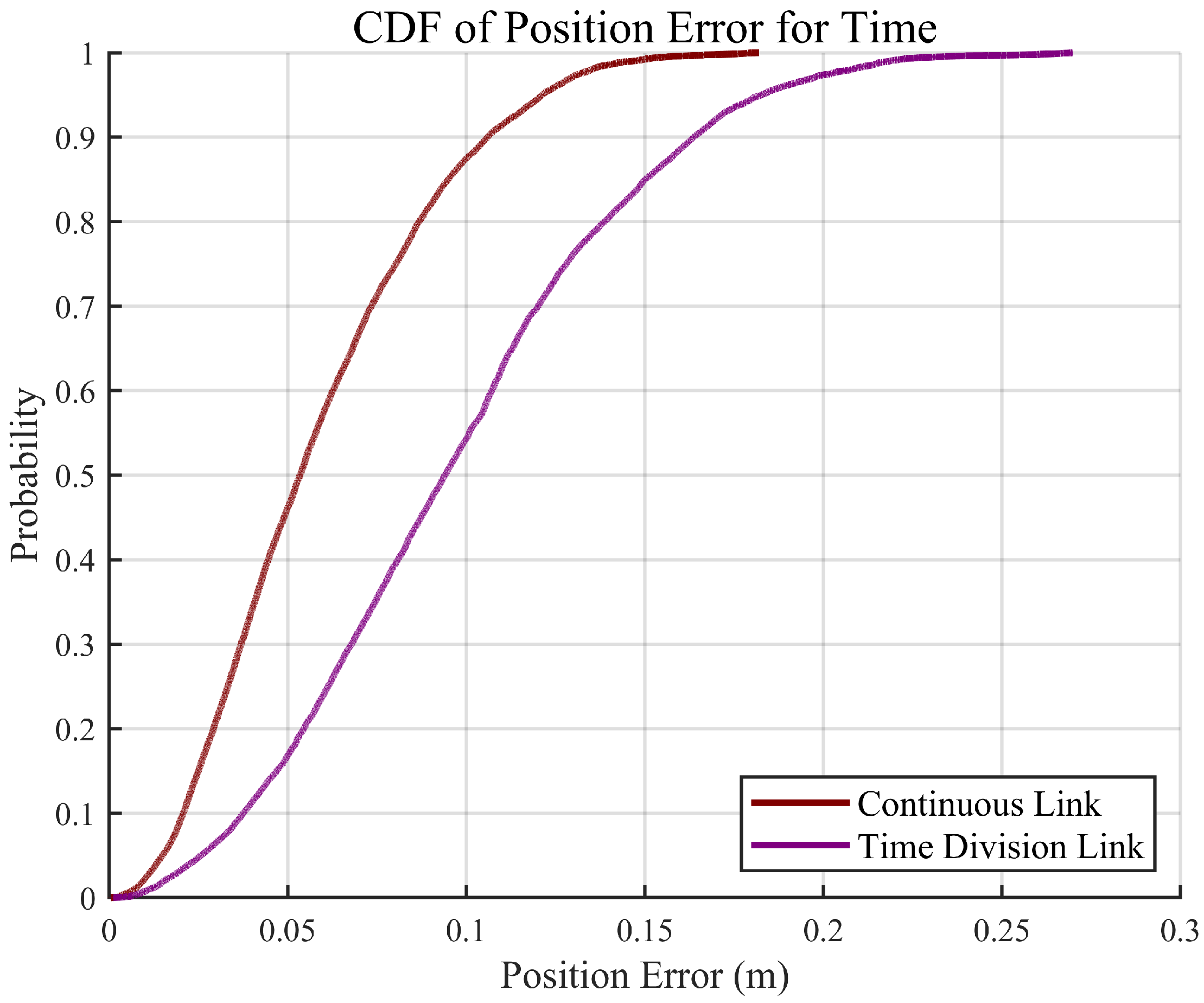
This section compares the time-division link-based cooperative positioning method with the continuous link-based cooperative positioning method through simulation. In the experiment, we used both continuous link and time-division link configurations, running the same multi-UAV cooperative positioning scenario, and compared and analyzed their performance. Figure 17 shows the comparison of the position error cumulative distribution function (CDF) for both the time-division link and continuous link cooperative positioning methods.
As can be seen from the figure, although the continuous link achieves smaller positioning errors in most cases, demonstrating higher positioning accuracy, the difference between the two methods is not significant. The time-division link effectively schedules hardware resources through time division, significantly reducing resource consumption. While the positioning accuracy of the time-division link is slightly lower, this reduction in accuracy is acceptable considering its advantage in hardware resource consumption. This is especially true in large-scale UAV cooperative positioning applications, where the time-division link proves to be more efficient and practical.

6. Conclusions

This paper presents a cooperative positioning method for UAV swarms, integrating time-division multiplexing interferometric angle measurement, pseudo-code-based ranging, and factor graph-based optimization to achieve high-precision relative positioning. The core contribution lies in the innovative time-division update strategy, where the signal of only one UAV is processed at a time, and phase prediction is performed for unselected UAVs. This approach reduces hardware complexity and spectrum usage. The system design adopts a unified signal-processing framework, including signal identification, chip acquisition, and high-precision relative measurement, with particular emphasis on enhancing tracking robustness through a Kalman-enhanced carrier tracking loop. This tracking loop combines a second-order FLL, a third-order PLL, and a linear Kalman filter, outperforming traditional structures in carrier phase and Doppler frequency tracking errors. It demonstrates strong robustness under a wide range of signal-to-noise ratio conditions.
On this basis, a time-division interferometric angle-measurement scheme with phase extrapolation was developed to overcome the scalability limitations of parallel multi-target processing. Within each time slot, only one target node is fully processed by the capture and tracking loop, whereas the others are updated through open-loop phase extrapolation using previously estimated Doppler and its derivatives. Simulation results verified that, for up to three nodes, the phase extrapolation error remains small and the angle RMSE stays at the 10 2 -degree level in the effective field of view, while the baseband hardware demand for capture and tracking loops is reduced by approximately ( 1 1 N ) × 100 % . In the four-node case, this corresponds to about 66.7% resource savings compared with a fully parallel implementation.
Furthermore, by integrating interferometric azimuth and elevation angles, pseudocode ranges, and high-precision GNSS measurements of the master UAV into a factor-graph-based sliding-window optimization framework with robust kernels, the proposed approach achieves accurate and stable 3D cooperative localization for all UAVs in the swarm. In the simulated 3D curved-trajectory scenario, the positional errors of the slave UAVs in each axis remain within ± 0.2 m, and the overall 3D position RMSE is maintained at approximately 7–8 cm, with more than 90% of the errors below 0.15 m. These results demonstrate that the method can provide sub-decimeter-level navigation accuracy while substantially reducing spectrum occupancy and baseband hardware complexity.
Future work will explore the integration of hierarchical clustering techniques, which could divide larger swarms into smaller, semi-independent subgroups. Each subgroup would operate with local updates, reducing the overall computational and communication burden. To maintain global consistency, occasional inter-group measurements could be employed. Additionally, we plan to investigate adaptive time-slot allocation mechanisms, where the scheduling of updates is dynamically adjusted based on the mobility characteristics and uncertainty levels of individual nodes. These advancements would not only preserve the hardware resource efficiency of the current method but also extend its applicability to larger-scale systems. Furthermore, we aim to validate these approaches in real-world experiments, considering practical challenges such as non-line-of-sight propagation, severe multipath effects, and interference. The integration of other onboard sensors, such as inertial measurement units, vision, or LiDAR, could also enhance the robustness and scalability of the localization system, providing greater flexibility and resilience for future UAV swarm operations.

Author Contributions

X.L.: Conceptualization and Methodology; L.S.: Data Curation and Writing—Original Draft Preparation; L.X.: Supervision and Writing—Reviewing. All authors have read and agreed to the published version of the manuscript.

Funding

This research was funded by the Key Laboratory of Intelligent Spatial Perception Technology and Application (Space Engineering University), Ministry of Education, grant number CYK2025-01-13; and the Chongqing Key Project of Technology Innovation and Application Development: Research and Application of Key Technologies for Structural Safety Monitoring of Super High-Rise Buildings in Mountainous Cities, grant number CSTB2024TIAD-KPX0105.

Data Availability Statement

Due to confidentiality restrictions, the datasets used in this study are not publicly available. For access, please contact the corresponding author. Partial datasets or related support information may be provided upon reasonable request.

Conflicts of Interest

The authors declare no conflicts of interest.

Abbreviations

The following abbreviations are used in this manuscript:
UAVUnmanned Aerial Vehicle
MUSMulti-UAV Systems
GNSSGlobal Navigation Satellite System
RTKReal-Time Kinematic
IMUInertial Measurement Unit
SLAMSimultaneous Localization and Mapping
UKFUnscented Kalman Filter
CKFCubature Kalman Filter
CDMACode-Division Multiple Access
PRNPseudorandom Noise
IFIntermediate Frequency
PLLPhase-Locked Loop
FLLFrequency-Locked Loop
DLLDelay-Locked Loop
NCONumerically Controlled Oscillator
DFTDiscrete Fourier Transform
AoAAngle of Arrival
MAPMaximum A Posteriori
SNRSignal-to-Noise Ratio
RMSERoot Mean Square Error
CDFCumulative Distribution Function
AWGNAdditive White Gaussian Noise

References

  1. Rufa, J.R.; Atkins, E.M. Unmanned Aircraft System Navigation in the Urban Environment: A Systems Analysis. J. Aerospace Inf. Syst. 2016, 13, 143–160. [Google Scholar] [CrossRef]
  2. Shakhatreh, H.; Sawalmeh, A.H.; Al-Fuqaha, A.; Dou, Z.; Almaita, E.; Khalil, I.; Othman, N.S.; Khreishah, A.; Guizani, M. Unmanned Aerial Vehicles (UAVs): A Survey on Civil Applications and Key Research Challenges. IEEE Access 2019, 7, 48572–48634. [Google Scholar] [CrossRef]
  3. Safwat, N.E.-D.; Newagy, F.; Hafez, I.M. Air-to-Ground Channel Model for UAVs in Dense Urban Environments. IET Commun. 2020, 14, 1016–1021. [Google Scholar] [CrossRef]
  4. Daniel, K.; Dusza, B.; Lewandowski, A.; Wietfeld, C. AirShield: A System-of-Systems MUAV Remote Sensing Architecture for Disaster Response. In Proceedings of the 3rd Annual IEEE Systems Conference; IEEE: Piscataway, NJ, USA, 2009; pp. 196–200. [Google Scholar]
  5. Hauert, S.; Leven, S.; Zufferey, J.-C.; Floreano, D. Communication-Based Leashing of Real Flying Robots. In Proceedings of the IEEE International Conference on Robotics and Automation (ICRA); IEEE: Piscataway, NJ, USA, 2010; pp. 15–20. [Google Scholar]
  6. Buerkle, A.; Segor, F.; Kollmann, M. Towards Autonomous Micro UAV Swarms. J. Intell. Robot. Syst. 2011, 61, 339–353. [Google Scholar] [CrossRef]
  7. Chung, S.-J.; Paranjape, A.A.; Dames, P.; Shen, S.; Kumar, V. A Survey on Aerial Swarm Robotics. IEEE Trans. Robot. 2018, 34, 837–855. [Google Scholar] [CrossRef]
  8. Song, W. An Integrated GPS/Vision UAV Navigation System Based on Kalman Filter. In Proceedings of the IEEE International Conference on Artificial Intelligence and Information Systems (ICAIIS); IEEE: Piscataway, NJ, USA, 2020; pp. 376–380. [Google Scholar]
  9. Lu, Y.; Xue, Z.; Xia, G.-S.; Zhang, L. A Survey on Vision-Based UAV Navigation. Geo-Spat. Inf. Sci. 2018, 21, 21–32. [Google Scholar] [CrossRef]
  10. Henkel, P.; Sperl, A. Real-Time Kinematic Positioning for Unmanned Air Vehicles. In Proceedings of the IEEE Aerospace Conference; IEEE: Piscataway, NJ, USA, 2016. [Google Scholar]
  11. Vetrella, A.R.; Fasano, G.; Renga, A.; Accardo, D. Cooperative UAV Navigation Based on Distributed Multi-Antenna GNSS, Vision, and MEMS Sensors. In Proceedings of the ICUAS; IEEE: Piscataway, NJ, USA, 2015; pp. 1128–1137. [Google Scholar]
  12. Ko, H.; Kim, B.; Kong, S.-H. GNSS Multipath-Resistant Cooperative Navigation in Urban Vehicular Networks. IEEE Trans. Veh. Technol. 2015, 64, 5450–5463. [Google Scholar] [CrossRef]
  13. Su, X.-L.; Zhan, X.; Niu, M.; Zhang, Y. RAIM Performances of Combined GPS/BeiDou/QZSS in Urban Canyon. IEEJ Trans. Electr. Electron. Eng. 2014, 9, 275–281. [Google Scholar] [CrossRef]
  14. Xu, B.; Bai, J.; Wang, G.; Huang, W. Cooperative Navigation and Localization for Unmanned Surface Vessel with Low-Cost Sensors. In Proceedings of the DGON ISS; IEEE: Piscataway, NJ, USA, 2014; pp. 1–14. [Google Scholar]
  15. Kaiser, M.K.; Gans, N.R.; Dixon, W.E. Vision-Based Estimation for Guidance, Navigation, and Control of an Aerial Vehicle. IEEE Trans. Aerosp. Electron. Syst. 2010, 46, 1064–1077. [Google Scholar] [CrossRef]
  16. Huang, G. Visual-Inertial Navigation: A Concise Review. In Proceedings of the IEEE ICRA; IEEE: Piscataway, NJ, USA, 2019; pp. 9572–9582. [Google Scholar]
  17. Li, C.; Wang, J.; Liu, J.; Shan, J. Cooperative Visual-Range-Inertial Navigation for Multiple Unmanned Aerial Vehicles. IEEE Trans. Aerosp. Electron. Syst. 2023, 59, 7851–7865. [Google Scholar] [CrossRef]
  18. Pritzl, V.; Vrba, M.; Stepan, P.; Saska, M. Cooperative Navigation and Guidance of a Micro-Scale Aerial Vehicle by an Accompanying UAV Using 3D LiDAR Relative Localization. In Proceedings of the ICUAS; IEEE: Piscataway, NJ, USA, 2022; pp. 526–535. [Google Scholar]
  19. Vetrella, A.R.; Fasano, G.; Accardo, D. Satellite and Vision-Aided Sensor Fusion for Cooperative Navigation of Unmanned Aircraft Swarms. J. Aerospace Inf. Syst. 2017, 14, 327–344. [Google Scholar] [CrossRef]
  20. Russell, J.S.; Ye, M.; Anderson, B.D.O.; Hmam, H.; Sarunic, P. Cooperative Localisation of a GPS-Denied UAV Using DOA Measurements. IFAC-PapersOnLine 2017, 50, 8019–8024. [Google Scholar] [CrossRef]
  21. Liu, J.; Cai, B.; Wang, J. Cooperative Localization of Connected Vehicles: Integrating GNSS with DSRC Using a Robust CKF. IEEE Trans. Intell. Transp. Syst. 2017, 18, 2111–2125. [Google Scholar] [CrossRef]
  22. Yu, Y.; Peng, S.; Li, Q.; Dong, X.; Ren, Z. Cooperative Navigation Method Based on Adaptive CKF for UAVs in GPS Denied Areas. In Proceedings of the IEEE CGNCC; IEEE: Piscataway, NJ, USA, 2018. [Google Scholar]
  23. Huang, A.; Li, J.; Zhu, L.; Chen, Y.; Tao, F.; Li, M. Unscented Kalman Filter-Based Multi-IMU Combination for UAV GPS Anomaly Navigation System. In Proceedings of the CVCI; IEEE: Piscataway, NJ, USA, 2024; pp. 1–6. [Google Scholar]
  24. Liu, X.; Xu, S. Multi-UAV Cooperative Navigation Algorithm Based on Federated Filtering Structure. In Proceedings of the IEEE CGNCC; IEEE: Piscataway, NJ, USA, 2018; pp. 1–5. [Google Scholar]
  25. Cai, Q.; Yang, Q.; Tu, Y.; Niu, H. A sliding window graph optimization algorithm based on marginalization theory for cooperative navigation. Meas. Sci. Technol. 2025, 36, 046315. [Google Scholar] [CrossRef]
  26. Li, K.; Bu, S.; Li, J.; Xia, Z.; Wang, J.; Li, X. Distributed relative pose estimation for multi-UAV systems based on inertial navigation and data link fusion. Drones 2025, 9, 405. [Google Scholar] [CrossRef]
  27. Shi, C.; Xiong, Z.; Chen, M.; Xiong, J.; Wang, Z. Cooperative navigation of unmanned aerial vehicle formation with delayed measurement. Meas. Sci. Technol. 2024, 35, 066302. [Google Scholar] [CrossRef]
  28. Shen, K.; Zuo, J.; Li, Y.; Zuo, S.; Guo, W. Observability analysis and optimization of cooperative navigation system with a low-cost inertial sensor array. IEEE Internet Things J. 2023, 10, 9863–9877. [Google Scholar] [CrossRef]
  29. Liu, Y.; Liu, R.; Yu, R.; Xiong, Z.; Guo, Y.; Cai, S.; Jiang, P. Attitude determination for unmanned cooperative navigation swarm based on multivectors in covisibility graph. Drones 2023, 7, 40. [Google Scholar] [CrossRef]
  30. Kaplan, E.; Hegarty, C. Understanding GPS/GNSS: Principles and Applications, 3rd ed.; Artech House: Norwood, MA, USA, 2017. [Google Scholar]
  31. Vilnrotter, V.A.; Hinedi, S.; Kumar, R. Frequency estimation techniques for high dynamic trajectories. IEEE Trans. Aerosp. Electron. Syst. 1989, 25, 559–578. [Google Scholar] [CrossRef]
  32. Vila-Valls, J.; Closas, P.; Navarro, M.; Fernandez-Prades, C. Are PLLs dead? A tutorial on Kalman filter-based techniques for digital carrier synchronization. IEEE Aerosp. Electron. Syst. Mag. 2017, 32, 28–45. [Google Scholar] [CrossRef]
  33. Yoon, H.-J.; Min, B.-W. Improved rotating-element electric-field vector method for fast far-field phased array calibration. IEEE Trans. Antennas Propag. 2021, 69, 8021–8026. [Google Scholar] [CrossRef]
  34. Wang, X.; Cui, N.; Guo, J. Huber-Based Unscented Filtering and Its Application to Vision-Based Relative Navigation. IET Radar Sonar Navig. 2010, 4, 134–141. [Google Scholar] [CrossRef]
  35. Schulman, J.; Levine, S.; Abbeel, P.; Jordan, M.; Moritz, P. Trust Region Policy Optimization. In Proceedings of the 32nd International Conference on Machine Learning; IEEE: Piscataway, NJ, USA, 2015; pp. 1889–1897. [Google Scholar]
  36. Zhang, F. The Schur Complement and Its Applications; Springer: New York, NY, USA, 2005; p. 295. [Google Scholar]
  37. Cho, Y.S.; Kim, J.; Yang, W.Y. MIMO-OFDM Wireless Communications with MATLAB; John Wiley & Sons: Ltd.: Hoboken, NJ, USA, 2010; p. 439. [Google Scholar]
Figure 1. Parallel code phase acquisition algorithm.
Drones 10 00094 g001
Figure 2. Tracking loop architecture.
Drones 10 00094 g002
Figure 3. Linear Kalman filter-based phase prediction and update flowchart.
Drones 10 00094 g003
Figure 4. Single-baseline interferometer model.
Drones 10 00094 g004
Figure 5. Double-baseline interferometer model.
Drones 10 00094 g005
Figure 6. Block diagram of the antenna element configuration.
Drones 10 00094 g006
Figure 7. Single-baseline interferometer model.
Drones 10 00094 g007
Figure 8. Carrier phase tracking RMSE under different SNR levels.
Drones 10 00094 g008
Figure 9. Doppler tracking RMSE under different SNR levels.
Drones 10 00094 g009
Figure 10. Effect of target node count on angle measurement accuracy.
Drones 10 00094 g010
Figure 11. Angle measurement accuracy vs. incident angle.
Drones 10 00094 g011
Figure 12. Ranging accuracy under different SNR levels.
Drones 10 00094 g012
Figure 13. Preset flight trajectory of drones.
Drones 10 00094 g013
Figure 14. Position accuracy under different window size.
Drones 10 00094 g014
Figure 15. Time-varying position errors of UAV1–UAV3 in the X, Y, and Z directions, as well as the three-dimensional position error throughout the entire flight. (a,b) UAV1 position error in XYZ direction and over time; (c,d) UAV2 position error in XYZ direction and over time; (e,f) UAV3 position error in XYZ direction and over time.
Drones 10 00094 g015
Figure 16. Position error distribution comparison for three UAVs.
Drones 10 00094 g016
Figure 17. Position error distribution comparison for three UAVs.
Drones 10 00094 g017
Table 1. Simulation parameters.
ParameterValue
Signal Modulation SchemeBPSK Modulation
Carrier RF Frequency25 GHz
Carrier IF Frequency70 MHz
Sampling Frequency200 MHz
Pseudo-code Rate1.023 MHz
Doppler Frequency Range−10 Hz to 10 kHz
Channel ModelJakes & Ricean & AWGN
FLL Bandwidth20 Hz
PLL Bandwidth10 Hz
DLL Bandwidth2 Hz
Coherent Integration Time1 ms
DLL Correlator Spacing0.5 chip
SNR Range−20 dB to 10 dB
Short Baseline Length0.14 m
Long Baseline Length0.46 m
Time Division Period10 ms
Table 2. RMSE of position error for each UAV.
UAV IDPosition Error RMSE (m)
UAV10.084
UAV20.093
UAV30.077
Table 3. RMSE of position error under different acceleration variation scenarios.
Dynamic ModelConstant AccelerationLinear Acceleration ChangeSinusoidal Acceleration Change
RMSE0.0820.0990.093
Disclaimer/Publisher’s Note: The statements, opinions and data contained in all publications are solely those of the individual author(s) and contributor(s) and not of MDPI and/or the editor(s). MDPI and/or the editor(s) disclaim responsibility for any injury to people or property resulting from any ideas, methods, instructions or products referred to in the content.