Review

Uncrewed Aerial System (UAS) Applications in Bridge Inspection: A Comprehensive Review of Platforms, Sensors, and Operational Effectiveness


1
Department of Civil and Environmental Engineering, University of New Haven, West Haven, CT 06516, USA
2
Structural Assessment Division, Consor Engineers, Rocky Hill, CT 06067, USA
3
Construction Division, Garg Consulting Services, Inc., Rocky Hill, CT 06067, USA
*
Author to whom correspondence should be addressed.
Drones 2026, 10(2), 144; https://doi.org/10.3390/drones10020144

Submission received: 31 December 2025 / Revised: 16 February 2026 / Accepted: 16 February 2026 / Published: 18 February 2026

Highlights

What are the main findings?
  • UAS-based bridge inspections significantly reduce inspection time, labor requirements, and safety risks compared to conventional methods.
  • Commercially available UAS platforms and sensor technologies demonstrate strong capability for high-resolution visual, thermal, and 3D data collection in bridge inspections.
What are the implication of the main findings?
  • Transportation agencies and inspectors can use this review to make informed decisions when selecting UAS platforms and sensors for bridge inspection tasks.
  • The findings support broader adoption of UAS technologies as a practical supplement to traditional bridge inspection practices.

Abstract

The growing number of older bridges has resulted in an increase in structural flaws, demanding frequent inspections and maintenance. Structural degradation accelerates post-damage recovery, emphasizing the necessity of preventive interventions. The use of Uncrewed Aerial Vehicle Systems (UASs) for bridge inspections represents a significant development in structural health monitoring (SHM). Traditional inspection methods are labor-intensive, time-consuming, expensive, and require access to high or difficult-to-reach areas, posing safety risks to inspectors. This study focuses on identifying drones that can efficiently support bridge inspection activities. Key factors influencing UAS selection include flight performance, flying modes, cost, sensor capabilities, payload capacity, and controller communication. The primary objective of this paper is to provide guidance to inspectors and transportation agencies regarding the capabilities and limitations of commercially available drones. It also outlines potential cost considerations associated with drone selection, including pilot skill level, platform cost, and sensor integration. These factors may vary depending on the type and complexity of the bridge being inspected. By addressing these aspects, this paper aims to assist decision-makers in making informed choices regarding the use of UASs for bridge inspection applications.

1. Introduction

Bridges are critical components of transportation infrastructure, necessitating regular inspections to ensure safety and functionality. Currently, bridge assessments primarily rely on visual inspections by trained personnel, ranging from quick checks to detailed evaluations. However, limited accessibility can sometimes lead to incomplete inspections. To address this, drones equipped with cameras and sensors have recently emerged as a valuable supplement to traditional monitoring methods [1]. Different types of Uncrewed Aerial Systems (UASs), including fixed-wing, rotary-wing, and hybrid models, offer unique capabilities for bridge inspection. Despite their potential, the adoption of UASs is hindered by gaps in understanding platform capabilities, sensor payloads, regulatory challenges, and data processing techniques. Addressing these gaps is crucial for leveraging UASs in efficient, safe, and effective bridge inspections.
Traditional bridge inspection methods, which rely solely on visual assessments, have several limitations. These methods are labor-intensive, time-consuming, and often require inspectors to access complex or hazardous areas. Moreover, results can vary between inspectors due to subjective judgment and differing levels of expertise, affecting the reliability of inspections [2]. UASs, also known as drones, have been applied in diverse fields such as military operations, construction, imaging and video mapping, medical services, search and rescue, parcel delivery, exploration of hidden areas, oil rig and power line monitoring, precision farming, wireless communication, and aerial surveillance [3].
UASs have sparked great interest among government and business entities due to their adaptability to a wide range of missions. These include surveys, emergency response, education and outreach, safety inspections, and assessments of various infrastructure components. Consistent monitoring of workers’ activities and work settings is regarded as a proactive approach for addressing safety and health risks and averting potential accidents on construction sites. Furthermore, the integration of sensors into drones has revolutionized current inspection methods.
Thermal imaging has found widespread application in inspecting both human-made and natural environments, ranging from electrical installations and advanced machinery to buildings. However, thermal imagery suffers from lower resolution, typically around 640 × 512, compared to RGB (Red, Green, Blue) imagery. These technologies use large datasets to train algorithms that can accurately detect and analyze fractures on a variety of surfaces, including infrastructure components, industrial machines, and bridges. Inspectors can improve the efficiency and accuracy of crack detection processes by leveraging machine learning capabilities, resulting in improved maintenance plans, enhanced safety measures, and longer-lasting structural integrity across a wide range of applications and industries [4].
Current UAS and sensor technologies demonstrate substantial capacity to facilitate bridge inspections. They enhance accessibility, reduce traffic disruptions and costs, increase efficiency and safety, minimize environmental impact, and provide enriched data for informed decision-making. UASs have been deployed for multiple inspection tasks, including initial/inventory, routine, in-depth, fracture-critical, special, and damage inspections. They enable capturing images of inaccessible areas, gathering data for 3D modeling, and streamlining inspections by efficiently acquiring data. These capabilities improve safety, accuracy, and comprehensiveness, offering actionable insights for bridge maintenance and management.
The objective of this study is to determine which commercial UAS is effective and suitably equipped for bridge inspection. It focuses on enhancing safety and reducing risks by accessing difficult-to-reach areas, minimizing manual intervention in hazardous environments, and improving worker safety. The study examines technical capabilities and limitations of drone technology, including flight stability, payload capacity, sensor accuracy, and data processing. It compares fixed-wing, rotary-wing, and hybrid drones in terms of flight characteristics, maneuverability, and suitability for various bridge types and environments. Furthermore, it evaluates payload and sensor integration, including high-resolution cameras, Light Detection and Ranging (LiDAR) sensors, thermal imaging, and other remote sensing technologies, to assess their effectiveness in capturing detailed inspection data.
Moreover, this study investigates the endurance limitations and range of different UAS platforms, including considerations for battery life, operational range, and the capability of conducting long-distance inspections of bridges over rivers, highways, and other large areas. In addition, it specifically addresses the ability to incorporate autonomous flight strategies, navigation and communication systems, and obstacle-avoidance systems into all drone platforms. Each of these considerations is integral to improving the safety, effectiveness, and reliability of bridge inspections. They ultimately highlight the need for enhanced inspection capacity compared to traditional methods and provide an opportunity to take advantage of the full capabilities of drone technology for effective and safe inspections with long-term sustainability.
Despite significant advancements in UAS-based bridge inspection, practical and autonomous deployment remains constrained by several unresolved technical challenges. Existing studies often focus on individual components such as sensing or defect detection, whereas system-level limitations related to localization, defect quantification, and platform capability are less consistently addressed. Identifying and synthesizing these core challenges is essential for understanding current research gaps and guiding future developments.
Although research on UAS-based structural health monitoring is expanding, most studies primarily list available platforms and sensor specifications without systematically evaluating performance trade-offs in real-world inspection scenarios or providing practical selection guidelines for practitioners.
This paper addresses these gaps by analyzing commercially available UAS platforms based on key operational criteria, including flight performance, autonomy, payload integration, communication systems, and cost. It provides a structured decision-making framework for transportation agencies and inspection teams to select the most suitable UAS for specific bridge inspection tasks. Although LiDAR-based UASs are increasingly used for infrastructure mapping and inspection, this study primarily focuses on UAS photogrammetry platforms and imaging-based data acquisition. LiDAR capability is discussed only at a conceptual level to clarify platform compatibility and operational considerations, rather than focusing on detailed LiDAR data acquisition and processing workflows.

2. Uncrewed Aerial Systems (UASs) and Research Methodology

This study adopts a structured review methodology to ensure transparency, reproducibility, and technical completeness, addressing the requirements of a comprehensive systematic review. A targeted literature search was conducted using established scientific and engineering databases and digital libraries relevant to civil infrastructure, remote sensing, and UASs focusing on a time span from 2014 to 2025 to capture modern advancements in UAS-based bridge inspection. The search strategy was developed using combinations of keywords related to UAS-based bridge inspection, including UASs, bridge defect inspection, infrastructure monitoring, remote sensing, photogrammetry, real-time kinematic technology (RTK), operational effectiveness.
This review included studies that focused on UAS platforms, sensing technologies, inspection procedures, defect detection, and data processing for bridge infrastructure. Studies that were not technically relevant or lacked sufficient methodological detail were excluded. Titles, abstracts, and full texts of relevant studies were screened, and key technical information was collected and organized following the framework presented in the Drone Systems, Research Methodology, Case studies, Results, Discussion and Conclusion sections.
UAS-based bridge inspection has rapidly evolved from early exploration work demonstrating the potential of UASs to improve traditional visual inspection by enhancing safety, accessibility, and data collection efficiency, to increasingly sophisticated studies that integrate advanced sensors and autonomous operational strategies. Initial reviews highlighted the advantages of UASs equipped with visual imaging and basic remote sensing for capturing high-resolution imagery of bridge components, enabling surface defect detection and 3D model reconstruction that surpasses certain limitations of manual inspection [5]. As UAS platforms matured into fully comprising aircraft, control systems, GNSS/Inertial Measurement Units (IMUs) navigation, and payload sensors, research expanded to examine how platform choice and sensor configurations (RGB cameras, LiDAR, thermal infrared, multispectral) affect data quality, operational resilience, and defect detection capabilities [6].
Concurrently, studies began addressing flight planning, path optimization, and operational challenges to improve inspection efficiency under environmental constraints, highlighting that effective UAS inspection is not only about sensor quality but also about mission planning and autonomous control. More recent work has also incorporated computer vision and AI-enabled analysis to automate defect recognition, although research shows that achieving reliable, fully automated inspection remains an ongoing focus [7].
To enhance practical relevance, commercially available UAS platforms commonly used for bridge inspection were also reviewed using official manufacturer product resources. Specifications from established UAS manufacturers, such as DJI, Skydio, Teledyne FLIR SIRAS Systems, EVO Max 4N/4T, EVO II Pro 6K Enterprise Bundle, Leica BLK2FLY were considered to evaluate payload capacity, sensor compatibility, flight endurance, positioning accuracy, collision avoidance, and operational constraints. Incorporating manufacturer-provided information enables direct alignment between research findings and deployable UAS technologies used in current bridge inspection practice.

2.1. Classification of Uncrewed Aerial Systems (UASs)

With the growing demand for efficient and accurate bridge inspection methods, UASs, commonly known as drones, have become useful tools for data collection and structural assessments. UASs can be generally classified as bridge inspection drones based on their flight mechanisms and operational capabilities. The three major categories of drones are fixed-wing, rotary-wing, and hybrid drones.
Fixed-wing drones have a streamlined, aerodynamic design, enabling efficient, long-range flights. They are suitable for large-scale bridge inspections covering vast areas and can capture high-resolution imagery and LiDAR data. Fixed-wing UASs generate lift via wings and may incorporate various wing designs, including multiple wing pairs, depending on mission requirements. Moreover, they can feature different tail configurations in terms of count, placement, and shape, but the flight mechanism is based on the production of lift using lifting surfaces. These differences in the configurations of fixed-wing drones are aimed at increasing their performance, maneuverability, and payload capacity. A typical fixed-wing UAS consists of a wing, horizontal and vertical tail, fuselage, and a motor to produce the required lift [8].
Fixed-wing drones are efficient for long-range, large-area surveys but have operational limitations that reduce spatial resolution. They must maintain a minimum forward speed and often fly at higher altitudes, increasing ground sampling distance (GSD) and reducing fine detail compared with multi-rotor systems [9]. Their inability to hover and continuous motion make high-overlap imaging over specific structural features difficult, requiring faster shutter speeds and careful flight planning to avoid motion blur [10]. These factors make fixed-wing UAS suitable for broad mapping but less optimal for close-range, high-resolution inspections.
Rotary-wing drones are characterized by multiple rotors arranged in a vertical configuration, providing vertical takeoff and landing (VTOL) capability and high maneuverability. They are well suited for close-range inspections of bridge components, such as decks, towers, and cables, in confined spaces. These drones are known as quadcopters, hexacopters, tri-copters, and helicopters, represent the different types of rotary-wing UASs. Moreover, rotary wing drones are designed for monitoring the ground situation from the air, for instance, detecting and tracking border states, detecting and tracking borders, military equipment, or other surveillance tasks. They have limited speed and payload compared to fixed-wing drones [11].
Rotary-wing drones possess inherent stability and hovering capability, allowing them to maintain a steady position in the air, even in windy conditions or turbulent environments. They can perform vertical take-offs and landings, eliminating the need for a runway or open area. This makes them more suitable for operating in confined construction sites or areas with limited space. Rotary-wing drones are relatively easier to operate than fixed-wing drones and can be flown by pilots with less training and experience, making them accessible for small-scale civil engineering projects or businesses with limited resources [12].
Hybrid Drones combine features of both fixed-wing and rotary-wing, offering versatility in flight capabilities. They can transition between vertical and horizontal flight modes, making them suitable for various inspection scenarios, including long range surveys and detailed close- up inspections. Hybrid UASs are combinations of Vertical Takeoff and Landing (VTOL) and Horizontal Takeoff and Landing (HTOL) aerial vehicles. This category of drones offers the benefits of both groups simultaneously with greater efficiency and performance.
In the last few decades, hybrid UASs have attracted the attention of researchers and companies. The development of hybrid UASs is still in its infancy, and there is a considerable space for design philosophy, dynamics modeling, control, guidance, navigation, and robustness of these types of drones. Hybrid drones have more complex flight dynamics than fixed-wing and multi-rotor drones, specifically during their transition phase. Major hybrid designs include tilting mechanisms to switch between HTOL and VTOL configurations, including tilt-body, tilt-wing, and tiltrotor UASs, while another approach uses using non-tilting solutions, such as dual-system and rotary-wing UASs [8].
Despite their operational advantages, hybrid UASs are generally more expensive and complex than conventional fixed-wing or rotary-wing systems. The increased cost arises from the integration of dual propulsion and transition mechanisms, advanced control systems, and additional maintenance requirements. These factors can limit widespread adoption and require specialized training for safe and efficient operation, as noted in recent studies on hybrid UAS design and applications [13].
Commercial UASs frequently adopted for infrastructure inspection range from compact consumer-grade platforms such as the DJI Mavic and DJI Phantom series [14,15] to autonomous navigation systems like Skydio X10D and Skydio 2+ [16,17], and enterprise-grade models including Matrice 350 RTK and Leica BLK2 [18,19]. Advanced inspection scenarios often require extended flight times, multiple payloads, or thermal imaging capabilities, which are offered by platforms such as the EVO Max series, EVO II Pro 6K Enterprise, Teledyne FLIR SIRAS, and DJI Inspire 3 [20,21,22,23,24].
Currently, numerous commercial UASs serve aerial photography, surveying, mapping, inspection, and enterprise applications. Table 1 summarizes key models, including payload capacity, imaging capabilities, durability, and features relevant to engineering, research, or industrial applications. In selecting UAS platforms for bridge inspection, it is important to balance operational cost, maneuverability, ease of deployment, and sensor payload availability. Recent studies show that commercially available UASs are increasingly adopted by transportation agencies and consultants, providing high-resolution imagery, thermal sensing, and RTK-enabled georeferencing at lower costs than conventional inspection methods [14,15,16,17,18,19,20,21,22,23,24].
The drones listed in Table 1 vary in payload capacity, imaging capabilities, durability, and special features designed for different engineering, research, or industrial use.

2.2. UAS Specifications and Selection Criteria

Once UAS types are classified, it is essential to evaluate their technical specifications to determine suitability for bridge inspection tasks. A drone specification outlines the various characteristics and capabilities of the drone, including its physical dimensions, flight performance, payload capacity, control systems, and other relevant features. These specifications provide detailed information that enables users and operators to understand the capabilities and limitations of a drone and to make informed decisions regarding its suitability for specific inspection applications.
Flight time is a critical consideration when inspecting a bridge using a drone, as it determines how long the platform can operate on a single battery charge and directly impacts inspection coverage and operational efficiency. Among major platforms, the DJI Matrice 350 RTK demonstrates the longest endurance at 55 min, whereas the Leica BLK2FLY exhibits the shortest operating time at 13 min, despite its larger battery capacity, highlighting the importance of overall system design efficiency. More compact platforms, such as the DJI Mavic series and Phantom 4, offer endurance ranging from 30 to 46 min. Enterprise-level drones, including the EVO Max 4N/4T and EVO II Pro 6K, achieve approximately 42 min of flight time, while the Skydio X10D and Skydio 2+ provide 40 min and 27 min, respectively, balancing endurance with autonomous performance capabilities. The DJI Inspire 3 exemplifies a high-speed platform that trades endurance (28 min) for speed, whereas systems such as the Teledyne FLIR SIRAS, equipped with high-capacity batteries and high-altitude capability, offer extended operational range rather than maximum speed. Therefore, flight endurance plays a key role in structuring effective inspection missions and maximizing operational efficiency.
However, these manufacturer values are based on ideal indoor conditions. Empirical studies show that real outdoor flight endurance is often lower and more variable due to wind, temperature, and other environmental factors. For instance, DJI Matrice 100 flights in varied outdoor conditions totaled 10 h 45 min across 209 flights, while median flyability for commercial drones under real weather constraints is only 5.7 h/day (2 h/day in daylight) [25,26]. These findings emphasize that field-measured endurance should be considered for mission planning to ensure operational efficiency.
Drone speed during inspection is another important operational parameter. Assuming that camera processing capabilities are sufficient, higher air speed allows inspections to be completed more rapidly; however, increased speed may also accelerate battery depletion. Although comprehensive field testing is required to determine optimal platform performance for specific inspection scenarios, this review evaluates each operational parameter independently for comparative purposes. To assess endurance and efficiency, Table 2 presents a comparison of key operational specifications for selected commercially available drones commonly used in infrastructure inspection, illustrating the variation in performance among compact multirotor systems, autonomous platforms, and advanced UASs [14,15,16,17,18,19,20,21,22,23,24].

2.3. UAS Flight Operations and Data Processing

Beyond hardware characteristics, successful bridge inspections rely on well-planned flight operations and robust data-processing workflows. Efficient bridge inspection using UAS requires systematic workflow encompassing mission planning, flight execution, and post-flight data evaluation. Such a workflow ensures safe and efficient operations while optimizing the quality and completeness of collected data. The following sections address key workflow components, including flight planning software, pre-flight path design, and post-flight 3D modeling and data analysis.

2.3.1. Flight Planning/Guidance Software Compatibility for Drones

Flight planning and guidance software are essential for safe and efficient drone operations, providing functionalities such as waypoint navigation, geofencing, obstacle avoidance, and real-time telemetry. These tools enable operators to predefine flight paths, monitor UAS performance, and mitigate operational risks. Mission Planner offers capabilities for mission planning, vehicle configuration, and real-time flight monitoring. Similarly, UgCS supports multiple drone platforms and integrates with applications such as DroneDeploy, Pix4D Capture, and eMotion X, while providing advanced features including 3D mission planning, block flight planning, orthoimage integration, and digital elevation modeling [27].
Commercial software solutions, including Agisoft Metashape, DJI Terra, Pix4D, and DroneDeploy, are widely used for post-processing and data analysis. Agisoft Metashape facilitates the generation of high-resolution 3D models and orthophotos, while DJI Terra provides intuitive mapping and modeling tools optimized for DJI drones. Pix4D supports multiple platforms with cloud integration and real-time processing, and DroneDeploy automates flight planning and data analysis to enhance operational efficiency. The integration of these software tools with UAS hardware improves data accuracy, operational efficiency, and overall mission effectiveness, making them indispensable in contemporary drone applications [28].

2.3.2. Pre-Flight Path Design for Drones

Before takeoff, the flight path must be designed by considering factors such as mission objectives, airspace regulations, weather conditions, and potential hazards. Drone-specific constraints, including battery life, maximum operational range, and payload capacity, also influence path design. Superstructure mapping paths are designed as straight-line trajectories aligned with the bridge’s longitudinal axis and are executed using both nadir and oblique camera orientations to capture comprehensive surface details. Substructure mapping paths are planned as linear flight routes parallel to the bridge’s lateral elevation, conducted at multiple heights with varying camera tilt and yaw angles, including upward-facing views to facilitate underdeck inspection. When operationally feasible, each vertical pier is additionally surveyed using spiral or Point-of-Interest (POI) flight maneuvers along its full height, ensuring complete three-dimensional surface coverage [29].

2.3.3. Post-Flight 3D Modeling and Analysis for Drones

After the flight, collected data is processed and analyzed to generate useful outputs. Post-flight processing typically includes the generation of 3D models, orthomosaics, digital surface models (DSMs), point clouds, and other visual representations. Data analysis tools can extract valuable insights from data for various applications such as precision agriculture, infrastructure inspection, environmental monitoring, and disaster response. In the context of bridge inspection, detailed three-dimensional models derived from spiral Point-of-Interest (POI) flight paths enable the extraction of critical structural information, including bearing quantity, spacing, typology, the presence of retention devices, restrained degrees of freedom, and allowable longitudinal and transversal displacements. Such information is often difficult to obtain using conventional inspection techniques, demonstrating the effectiveness of UAS-based data processing workflows [29].

2.4. Software

The data captured during flight operations must be processed using specialized software to convert imagery into measurable engineering information. Software tools for photogrammetry, mapping, and modeling transform raw UAS data into three-dimensional reconstructions, and quantitative outputs.
Agisoft Metashape Professional V 1.7.3, PIX4Dmapper V 4.4.12, Drone Deploy, and DJI Terra V 3.7.6 are among the most widely used software packages for UAS modeling. This study compares these four applications, considering data-processing time, output quality, and overall compatibility with the drone platform. Table 3 summarizes the specifications of the four software programs used for photogrammetry and 3D point cloud generation. Among these tools, Pix4D and Drone Deploy are particularly efficient for advanced cloud-based drone mapping, offering user-friendly interfaces and robust functionality. However, Agisoft Metashape provides the best value for offline processing, delivering strong 3D scanning and mapping capabilities through a one-time, low-cost licensing model. For advanced users operating DJI platforms, DJI Terra is highly capable but comparatively expensive.
When working with photogrammetry and UAS-based mapping software, hardware performance plays a crucial role in determining processing speed, efficiency, and the ability to handle large datasets. While desktop software like Agisoft Metashape, Pix4Dmapper, and DJI Terra rely heavily on local CPU, RAM, GPU, and storage resources, cloud-based platforms like DroneDeploy shift most of the computational load to remote servers, reducing local hardware requirements. Table 4 summarizes the recommended hardware specifications for these widely used software packages, providing guidance for researchers, engineers, and professionals in drone surveying, 3D modeling, and mapping applications.
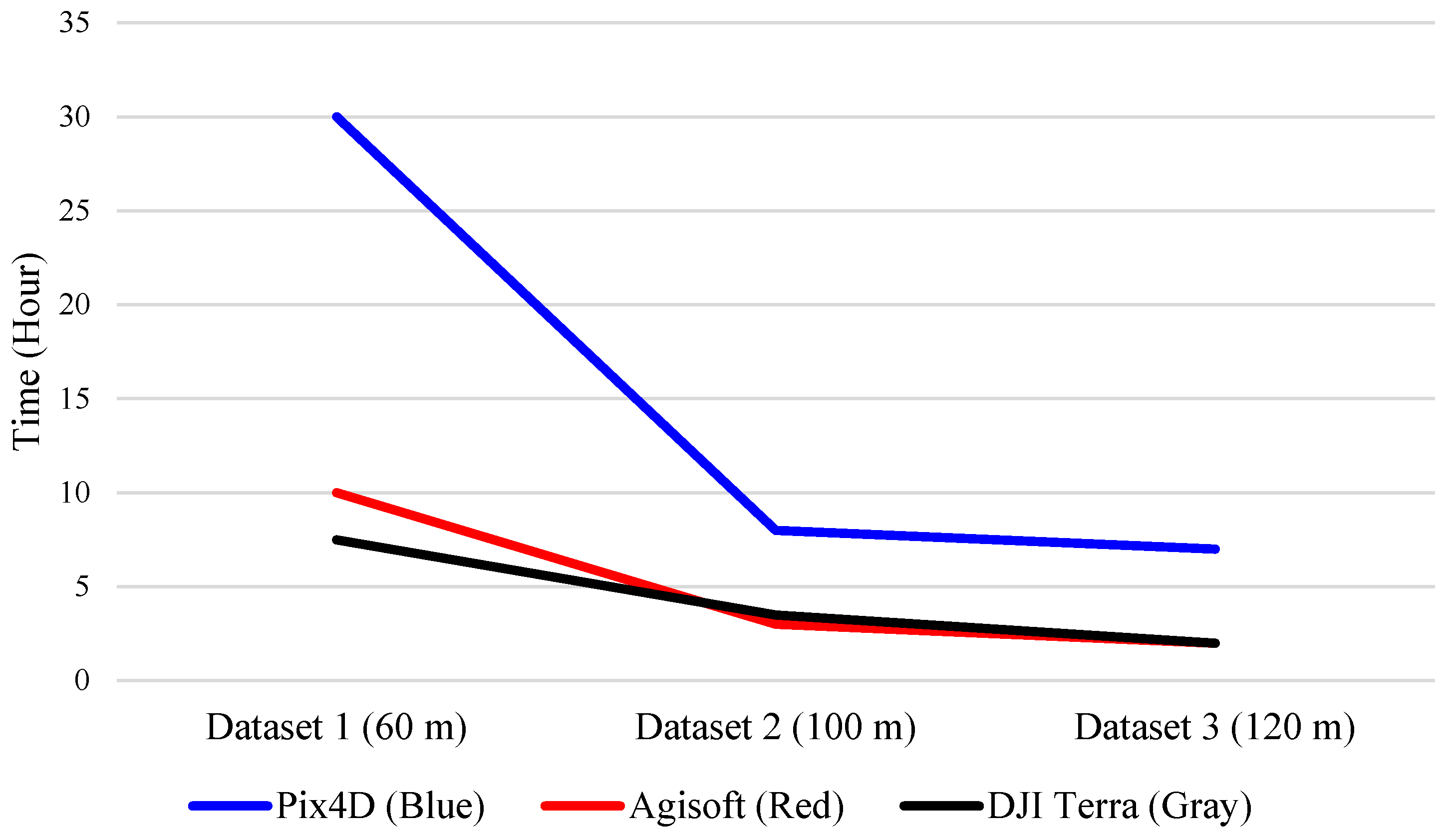
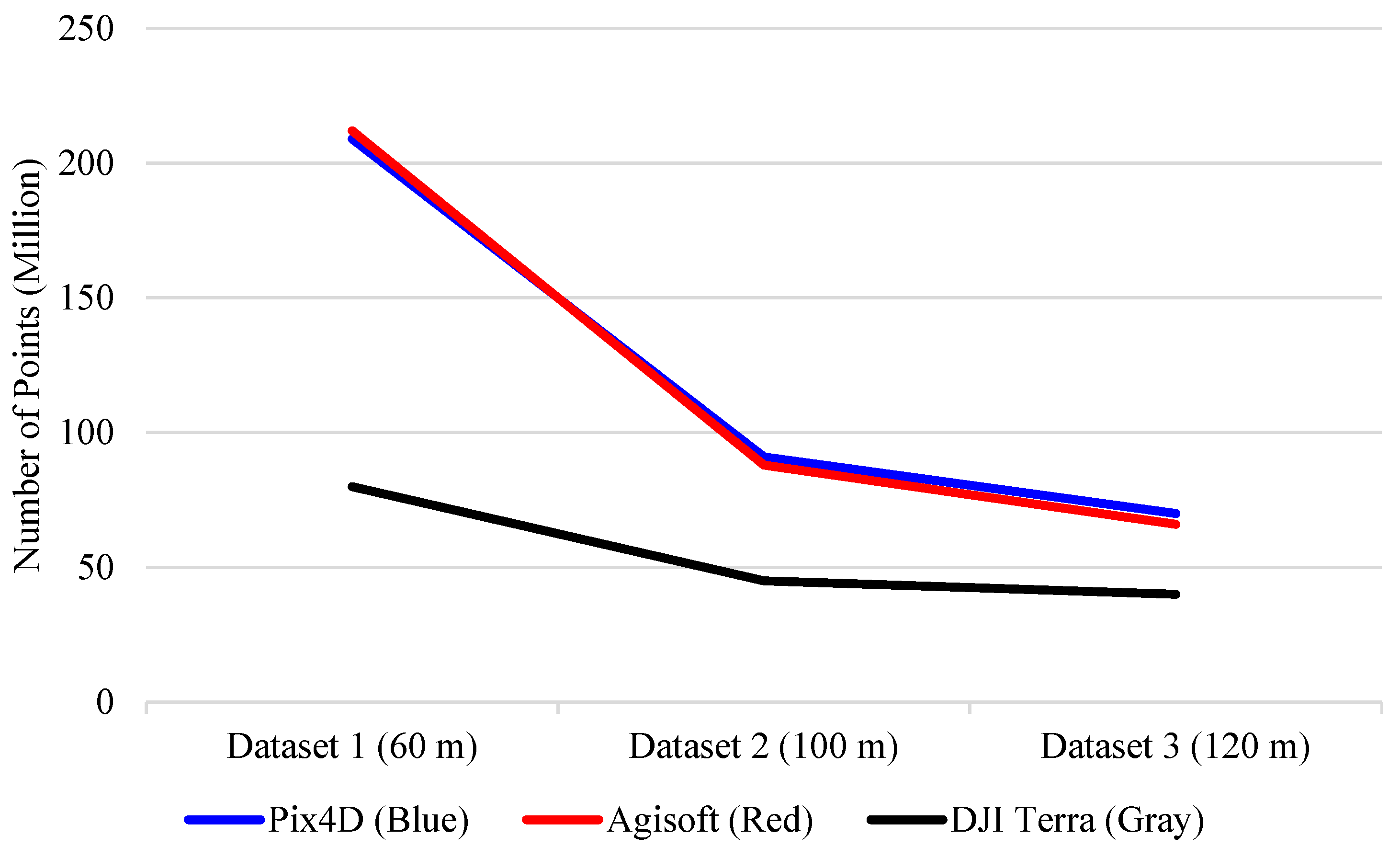
According to the study conducted by Jarahizadeh and Salehi [28], Pix4D required three times longer to process the data, while Agisoft and DJI Terra took significantly less time. In all three datasets, Pix4D and Agisoft produced point clouds roughly 2.5 times denser than those produced by DJI Terra, with Pix4D generating slightly denser point clouds than Agisoft, as shown in Figure 1. Overall, the generated 3D point cloud quality across various land cover types, such as buildings, hills, and trees, showed no significant difference in spatial error among the software programs.
As a result, longer computational times for Pix4D and Agisoft would be expected compared to DJI Terra. However, Pix4D exhibited an unexpected trend showing processing times approximately three times longer than those of both Agisoft and DJI Terra across all datasets in Figure 2. This finding indicates a notable disparity in processing efficiency among the evaluated software platforms [28].

2.5. Range

While software enhances data quality, the operational range determines the mission scope and feasibility. Range refers to the maximum distance a drone can travel from its controller or base station while maintaining communication and control. Factors influencing range include the drone’s communication technology (such as radio frequency or cellular), battery capacity, signal interference, and regulatory restrictions. Extending the range often involves optimizing communication protocols, using higher-capacity batteries, and employing signal-boosting techniques, such as directional antennas.

2.6. Collision Avoidance Systems

Another factor critical to safe UAS operation is collision avoidance. Collision avoidance systems are essential for ensuring the safety of UAS operations, particularly in environments with obstacles or other aircraft. These systems use sensors (such as ultrasonic, LiDAR, radar, infrared, or cameras) to detect obstacles in the drone’s flight path and automatically adjust its trajectory to avoid collisions. Advanced collision avoidance systems may also incorporate artificial intelligence algorithms to predict potential collisions and take proactive avoidance measures.
For infrastructure inspection applications, commercial UAS platforms differ significantly in their collision-avoidance sensing capabilities, depending on sensor type, sensing direction, and platform configuration. Short-range platforms like DJI Phantom 4 Series (0–10 m) and Leica BLK2FLY (1.3–3 m) are ideal for precise inspections in confined areas. Mid-to-long-range platforms such as Mavic 3 Enterprise (forward 0.5–20 m, obstacle 200 m), Matrice 350 RTK (0.7–40 m horizontal, 0.6–30 m vertical), EVO Max 4N/4T (forward 0.5–31 m, vertical 0.2–26 m), DJI Inspire 3 (lateral 1.5–42 m, vertical 0.2–48 m), and Teledyne FLIR SIRAS (forward up to 30 m) enable monitoring of large or hard-to-access structures [15,16,17,18,19,20,21,22,23,24,38].

2.7. Weather

Weather conditions significantly impact drone operations, affecting factors such as flight stability, visibility, and sensor performance. UASs must contend with wind, rain, fog, temperature fluctuations, and other environmental conditions. Weather monitoring and forecasting tools help drone operators make informed decisions about when and where to fly safely. Additionally, UASs may be equipped with weather-resistant features, such as sealed electronics and waterproof casings, to withstand adverse conditions.

2.7.1. Wind

Collecting data is necessary before conducting any inspection. Research findings suggest operating the simulated quadcopter when the wind is not greater than 11 m/s [39], which coincides with the suggestions by DJI for its Inspire models that have a maximum tolerance of 13.85 m/s. The data can be generalized by saying not to fly the UAS if the wind speed is more than 70 percent of, or higher than, the manufacturer’s specification. Bridges have different wind turbulence on different elements according to [40], a case study of a bridge’s top side and underside speed is presented in Table 5.

2.7.2. Ingress Protection Rating

The Ingress Protection (IP) rating classifies the degree of protection provided by enclosures against intrusion of solid objects, dust, accidental contact, and water. The IP rating typically consists of two digits, where the first digit indicates protection against solids, and the second digit indicates protection against liquids. For example, an IP68 rating signifies the highest level of protection against both solids and liquids, making the device fully dust-tight and suitable for continuous immersion in water under specified conditions. This parameter is provided by manufacturers and helps gauge which UASs are susceptible to environmental effects. Since inspections are conducted in various weather conditions, the drone should also be able to adapt to the situation.

2.7.3. Operating Temperature

Operating temperature refers to the range within which a drone can safely and reliably operate. Drones, like most electronic devices, have specified operating temperature ranges that dictate their performance and durability in various environmental conditions. Because drones vary in operating temperature, selecting a platform suited to the site’s extreme conditions is essential. Table 6 presents weather parameters and summarizes the drones used in this review.

2.8. Sensors and Stabilization

In addition to external environmental effects, UAS performance relies heavily on internal sensors and stabilization mechanisms. Sensors play a critical role in drone operation by providing feedback on the drone’s orientation, position, altitude, speed, and environmental conditions. Common sensors include gyroscopes, accelerometers, magnetometers, GPS receivers, barometers, and altimeters. Stabilization systems integrate data from these sensors to maintain flight stability and control, compensating for external forces such as wind gusts or turbulence. Advanced stabilization algorithms enable drones to maintain precise flight paths and capture stable aerial footage, even under challenging conditions.
Beyond these core sensors, drones also incorporate specialized sensing and imaging technologies that support mission-specific objectives. Camera and video systems, along with guidance sensors are three key components which collectively enhance data acquisition accuracy, navigation precision, and visual performance in UAS-based inspection and monitoring applications.

2.8.1. Cameras

UASs commonly use cameras for various applications, including aerial photography, videography, mapping, surveying, inspection, and surveillance tasks. UASs are equipped with various types of cameras suited for different purposes. The most common type is the RGB camera, which captures standard color imagery. Camera capacity is often measured using the equivalent focal length, which adjusts the small sensors in drones to achieve a field of view comparable to a full-frame camera. Thermal cameras detect heat or infrared radiation and are primarily used for search and rescue, building inspections, and wildlife monitoring. LiDAR sensors emit laser pulses to generate accurate 3D maps of terrain and structures, making them particularly valuable for mapping and engineering applications.

2.8.2. Guidance Sensors/Cameras and Real-Time Kinematic (RTK) Capabilities

Global Navigation Satellite System (GNSS) receivers, such as GPS (Global Positioning System) and GLONASS, provide accurate positioning and navigation data for UASs. GNSS is essential for autonomous flight modes, waypoint navigation, and return-to-home functionality.
Real-Time Kinematic (RTK) is a satellite navigation technique used to enhance the accuracy of position data obtained from GNSS, such as GPS or GLONASS. RTK provides centimeter-level positioning accuracy in real time, making it invaluable for applications that require precise positioning. RTK-enabled UASs receive corrections from ground-based reference stations in real time.
The selection of UASs for infrastructure inspection is largely contingent on their technical specifications, namely navigation systems, hovering accuracy, imaging sensors, sensing technologies, and mobility aspects. A summary of several commercially available UASs suited for civil engineering and infrastructure projects is included in Table 7. These UASs are characterized by relevant specifications, including vision systems, GNSS support, image quality/resolution, ranges of sensing technologies, and thermal sensing capabilities, which are important for justifying their use in drone inspection applications such as bridge inspection, construction monitoring, and structural health assessment.
Existing research indicates that contemporary drones, including the DJI Mavic 3T Enterprise, Matrice M350 RTK, and Skydio X10D platforms, are becoming more popular among practitioners because they provide high-resolution images, RTK support, and autonomous navigation, enhancing the efficiency and safety of infrastructure inspection operations.
In practical RTK-enabled UAS surveying applications, operators must access correction data through either local base stations or network-based RTK services. Common hardware options include manufacturer-provided GNSS base stations such as DJI’s D-RTK 2 mobile station (used in direct positioning workflows with DJI RTK platforms) [41], and multi-brand portable GNSS receivers like Emlid Reach RS series, which can be configured to broadcast RTK correction data over NTRIP or radio links to an RTK-capable UAS (Emlid integration documentation) [42]. In addition to physical base hardware, network-based RTK services such as the ROCK RTK Network provide real-time correction streams from dense networks of global reference stations, enabling short baselines and robust centimeter-level corrections without deploying local base equipment in the field (Rock Robotic documentation) [43]. Explicit identification of these hardware and service requirements, along with representative vendors, improves transparency regarding operational considerations, cost implications, and the reproducibility of RTK-based UAS inspection studies.

2.8.3. Multisource Data Fusion in UAS-Based Bridge Inspection

Multisource data fusion has emerged as a major research hotspot in UAS-based bridge inspection, as it integrates heterogeneous sensor measurements such as RGB cameras, thermal imagers, LiDAR, and GNSS/IMU data into unified datasets that provide more reliable and precise structural information than individual sensors alone [6,44]. By combining complementary data modalities, fusion enhances spatial accuracy, defect detection, and 3D reconstruction capabilities, which are critical in complex inspection environments such as under bridges or areas with weak GNSS signals [6]. Fusion approaches also support advanced analytical tasks, including automated defect classification, semantic segmentation, and structural health evaluation, thereby improving situational awareness for bridge maintenance and monitoring [44]. Despite these advances, several key challenges remain, especially in complex scenarios such as UAS-based bridge inspection. Dynamic and unstructured environments, object occlusions, and narrow or elongated corridors can degrade feature-based Simultaneous Localization and Mapping (SLAM) performance, while temporal and spatial alignment of asynchronous sensor streams, sensor noise and drift, and error propagation continue to affect pose estimation and mapping precision [45]. Addressing these challenges is essential for advancing UAS inspection methods toward fully automated, intelligent structural health monitoring.

2.9. Frequencies

Communication between the drone and its controller depends on stable transmission frequencies. UASs are remotely piloted using command-and-control signals, and both telemetry and payload data are transmitted via radio frequency channels. Higher-frequency bands reduce the likelihood of signal interruption. Different RF frequencies are allocated for specific purposes and regulated by government agencies, such as the Federal Communications Commission (FCC) in the United States, Conformité Européenne (CE) in the European Union, and UK Conformity Assessed (UKCA) in the United Kingdom. When transitions occur, drones switch from the current frequency to the next available one.
As shown in Table 8, most frequencies lie between 2.4 and 5.8 GHz, a common band for medium- and short-range transmissions in relatively dense areas. Other frequencies offering advantages include: the 900 MHz band, which provides better penetration through obstacles and foliage compared to higher frequencies such as 2.4 GHz and 5.8 GHz, and is often used for long-range communication where line-of-sight is limited. Lower frequencies, such as 1.2 GHz and 1.3 GHz, enable longer-range communication and improved obstacle penetration and are sometimes used for long-range First Person View (FPV) video transmission and telemetry in specialized drone applications.

2.10. Size and Payload Capacity

UASs vary in size, from small, compact models weighing only a few grams to larger, industrial-grade drones capable of lifting several kilograms of payload. The size and payload capacity of a drone determine its suitability for different applications. Smaller UASs are often used for aerial photography, surveillance, and recreational purposes, while larger drones handle tasks requiring heavier payloads, such as package delivery, infrastructure inspection, or agricultural spraying. The type of inspection largely depends on the drone’s size. Smaller UASs are more susceptible to weather conditions but can access hard-to-reach areas, such as small culverts or inside box girders, protecting the inspector and saving time by reducing manual inspection.
Payload capacity is particularly important for missions that require specialized equipment. Attaching infrared or LiDAR sensors is quite common. As discussed in Section 2.8, the built-in sensors are relatively weak compared to robust units made by other instrumentation companies. Therefore, the drone must have sufficient payload capacity, and the attached system should be operable using the drone’s built-in gimbal system.
Among commercially available UAS platforms in this study, only the Leica BLK2FLY and DJI Matrice 350 RTK Enterprise capable of carrying integrated LiDAR sensors, whereas the DJI Zenmuse L2 provides high-accuracy aerial scanning for topographic mapping, structural inspection, and surveying applications. In contrast, other UAS models including DJI Mavic Series 3 Enterprise, DJI Phantom 4 Series, Skydio 2+, Skydio X10D, DJI Inspire 3, Autel EVO II Pro 6K Enterprise Bundle, Autel EVO Max 4N, Autel EVO Max 4 T, and Teledyne FLIR SIRAS do not natively support integrated LiDAR payloads due to limited payload capacity and lack of modular sensor mounts. These platforms are primarily designed for photogrammetric imaging, RGB/thermal capture, or autonomous inspection tasks rather than survey-grade LiDAR mapping.

2.11. Initial Cost

The initial cost of a drone varies depending on factors such as its size, capabilities, features, and brand. Entry-level consumer UASs can be relatively affordable, starting from a few hundred dollars, while professional-grade UASs with advanced features and capabilities can cost several thousand dollars or more. In addition to the drone itself, other expenses may include spare batteries, additional accessories, maintenance, and insurance.

2.12. Training and Licensing Requirements

Operating a UAS often requires training, permits, or licenses, depending on the country and the intended use of the UAS. Recreational drone users may need to comply with regulations such as registration requirements and adherence to specific operating guidelines. For commercial UAS operations, operators may need to obtain a Remote Pilot Certificate or an equivalent license from the relevant aviation authority. Training courses covering UAS operation, safety procedures, airspace regulations, and emergency protocols are available to help operators acquire the necessary skills and knowledge to fly drones safely and legally.

2.12.1. Qualification and Pilot Certification

Under the Federal Aviation Administration (FAA) Small UAS Rule (14 CFR Part 107), individuals conducting non-recreational UAS operations must hold an FAA Remote Pilot Certificate [46]. Eligibility requirements include a minimum age of 16 years, proficiency in the English language, and physical and mental fitness for safe UAS operation. Certification is obtained by successfully passing the Uncrewed Aircraft General–Small (UAG) aeronautical knowledge examination, which assesses knowledge of UAS regulations, operating procedures, and safety practices.
During UAS operations, the remote pilot must have the certificate readily accessible. To maintain certification validity and operational proficiency, certificate holders must complete FAA-approved recurrent training every 24 calendar months, including the Part 107 Small UAS Recurrent online training courses (ALC-677 or ALC-515, as applicable), which are provided at no cost [46].

2.12.2. FAA Regulations and Airspace Requirements for UAS Operations

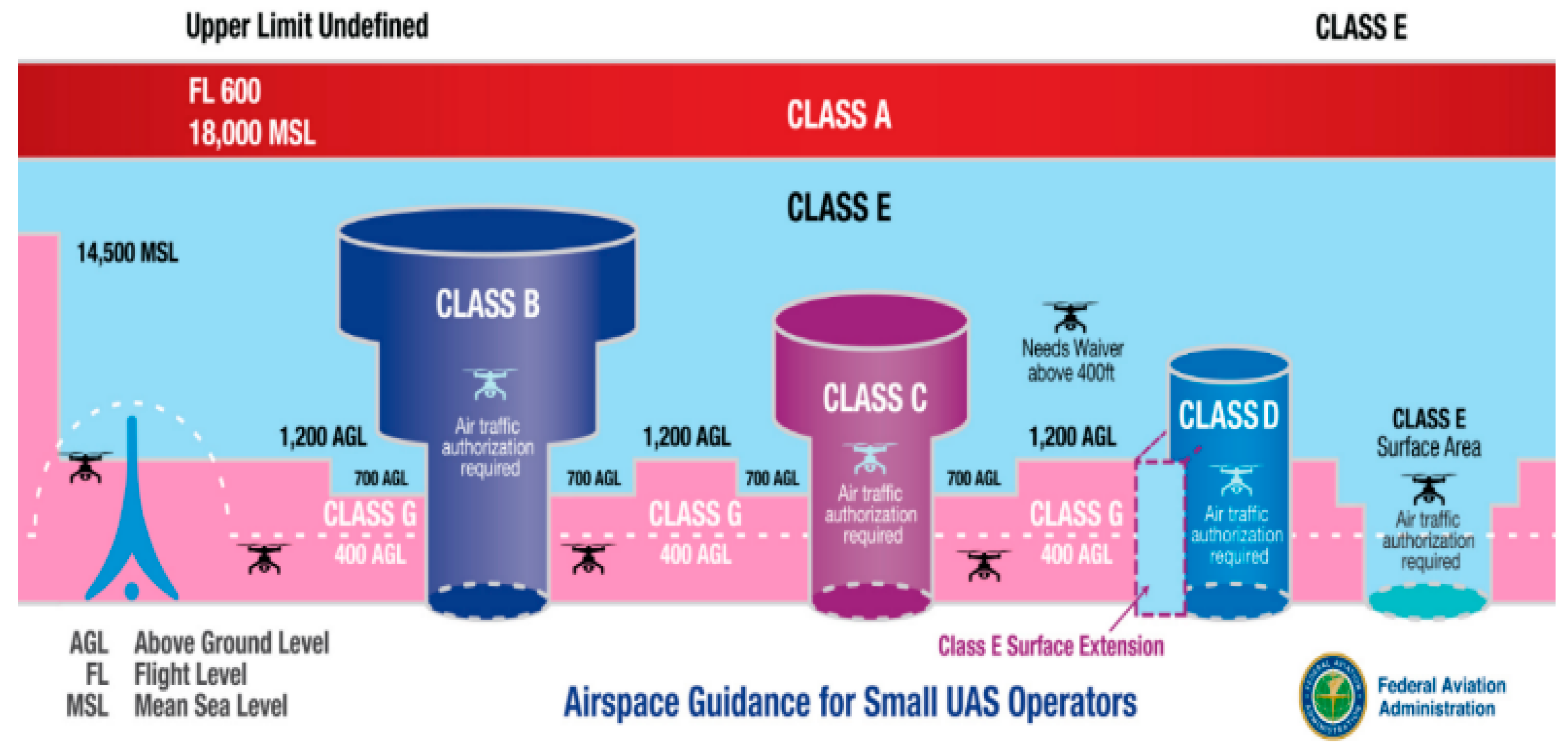
The Federal Aviation Administration (FAA) regulates all aspects of civil aviation, including UASs, under the National Airspace System (NAS). Commercial UAS operations are governed by 14 Code of Federal Regulations (CFR) Part 107, which requires operators to hold a Remote Pilot Certificate and designate a Remote Pilot in Command (RPIC) responsible for compliance and operational safety. Part 107 defines key operational limits, including visual line-of-sight (VLOS) flight, a maximum altitude of 121.92 m above ground level (AGL) or within 121.92 m of a structure, a maximum ground speed of 87 knots (44.70 m/s), and minimum weather conditions of 3 statute miles visibility with prescribed cloud clearances.
FAA rules apply to the entire National Airspace System. There is no such thing as “unregulated” airspace as shown on Figure 3. UAS operators must distinguish between controlled airspace, where air traffic is actively managed by air traffic control and authorization is required, and uncontrolled airspace, where traffic is not actively directed. Compliance with these operational and airspace rules is essential to minimize collision risks, maintain safe separation from manned aircraft, and support the safe integration of UASs into the NAS [47].

2.12.3. UAS Registration

All UASs must be registered unless they weigh 0.250 kg or less and are flown under the Exception for Limited Recreational Operations. Registration requires the operator’s identification, UAS make and model, and a Remote ID, which broadcasts the UAS’s identification and location for tracking and regulatory compliance. All UASs discussed in this review exceed 0.250 kg and therefore require registration [48].

2.12.4. Global Applicability of FAA-Based UAS Findings and International Regulatory Context

The FAA Part 107 framework for UAS operations in the United States is widely regarded as a benchmark for commercial drone regulation, establishing pilot certification requirements, operational limitations, and safety obligations. Although Part 107 applies specifically to U.S. national airspace, its core safety principles such as pilot competency, registration, and risk management are reflected in many international regulatory systems, supporting partial transferability of technical and operational conclusions beyond the United States. Comparative analyses of the United States, the European Union (EU), and Japan show that UAS regulations consistently emphasize technical requirements, certification, registration, and operational categorization, despite differences in legal structures and compliance mechanisms. As a result, operational insights derived under FAA guidance, including training needs and risk-mitigation practices, remain broadly relevant across jurisdictions [49].
However, FAA regulatory provisions cannot be directly applied internationally without adaptation. A comparative review of UAS legislation across 35 Organization for Economic Co-operation and Development (OECD) countries reveals substantial variation in aircraft classification such as size, weight, altitude, operational purpose, operational restrictions, and pilot qualification requirements. These differences limit regulatory transferability at the level of legal compliance, even as overarching safety objectives converge [50].
For example, the European Union Aviation Safety Agency (EASA) employs a risk-based framework that categorizes operations as Open, Specific, or Certified and frequently requires a Specific Operations Risk Assessment (SORA) for higher-risk missions, in contrast to the FAA’s pilot-centered Part 107 model [51]. Similarly, China’s evolving UAS regulatory framework emphasizes airworthiness certification, operator registration, and alignment with international standards, reflecting a distinct yet conceptually aligned approach to aviation safety [52]. Other jurisdictions, including Canada, Australia, Japan, and India, demonstrate further regulatory diversity, with frameworks tailored to national airspace management, licensing, and enforcement priorities while pursuing common safety goals [53,54].
Overall, while FAA Part 107 provides a mature and influential reference, its regulatory requirements are not universally applicable. FAA-based operational conclusions are therefore broadly informative but must be contextualized within local regulatory frameworks to ensure effective compliance and enforcement.

2.13. UAS Platforms and Sensors for Bridge Inspection

UASs have significantly improved the efficiency and safety of bridge inspections by enabling rapid access to critical structural components such as decks, piers, fracture-critical members, and confined spaces, while minimizing the need for scaffolding and traffic disruptions.
Visual inspection using multirotor UASs equipped with high-resolution RGB cameras remains the most widely adopted application. These systems allow detailed documentation of surface defects, including cracks, spalling, and corrosion, and support condition monitoring over time. However, RGB-based inspection is limited to surface-level assessment and cannot directly quantify subsurface deterioration. To address this limitation, infrared (thermal) sensors are increasingly integrated into UAS platforms. Thermal imaging can identify temperature anomalies associated with moisture ingress, delamination, and hidden defects, providing complementary subsurface information. Nevertheless, thermal data accuracy is influenced by environmental conditions such as solar radiation, wind, and ambient temperature, requiring careful interpretation [5].
LiDAR and photogrammetry-based UAS platforms enable the generation of dense three-dimensional point clouds for geometric mapping, deformation analysis, and digital documentation of bridge components. These technologies are particularly beneficial for complex geometries and fracture-critical structures but are constrained by higher payload requirements and computationally intensive post-processing workflows [55].
Inspection in confined or GPS-denied environments, such as the underside of bridge decks or interior truss elements, remains challenging. UASs utilizing SLAM and sensor-fusion navigation can operate effectively without GPS, while collision-tolerant platforms with protective enclosures enhance operational safety during close-proximity inspections [55,56].
Recent research has emphasized automated defect detection using UAS imagery and deep learning (DL) models, including U-shaped Convolutional Neural Network (U-Net), Transformer U-Net (TransUNet), and Mask Region-based Convolutional Neural Network (R-CNN), which enable accurate detection, segmentation, and quantitative measurement of cracks, reducing reliance on manual inspection [57,58].

2.14. Analysis of Photogrammetric Outputs for Bridge Defect Detection and Condition Assessment

Early studies on UAS-based bridge inspection primarily demonstrated the feasibility of acquiring high-resolution imagery and generating photogrammetric reconstructions. Subsequent research increasingly focused on the analysis of these outputs for defect detection and bridge condition assessment, reflecting a gradual transition from manual interpretation to automated and data-driven analysis methods.
Manual analysis of photogrammetric products, including orthophotos and textured three-dimensional models, was widely adopted in foundational studies. Morgenthal and Hallermann [59] demonstrated that UAS-based photogrammetry improves accessibility to bridge components and enhances defect visualization compared to conventional inspection techniques. Musarat et al. [60] similarly emphasized the value of detailed orthophotos and 3D reconstructions as permanent inspection records. However, manual interpretation is time-consuming, subjective, and difficult to scale for large photogrammetric datasets.
To reduce dependence on manual inspection, several studies investigated semi-automated image-processing and computer-vision techniques. These approaches typically employ thresholding, edge detection, and morphological operations to extract cracks and surface damage from UAS imagery. Kao et al. [61] integrated laser ranging with image-processing algorithms to measure crack geometry, achieving improved efficiency. Nevertheless, rule-based methods are highly sensitive to lighting conditions, surface texture, and noise, limiting their robustness in real-world bridge inspection scenarios [62].
Recent literature shows a clear shift toward machine-learning and deep-learning approaches for automated analysis of photogrammetric outputs. Convolutional neural networks and semantic segmentation models have been successfully applied for crack detection, corrosion identification, and damage classification. Pokhrel et al. [63] reported detection accuracies exceeding 95% for concrete bridge deck damage, while Luo et al. [64] highlighted the increasing use of deep learning for analyzing both two-dimensional imagery and three-dimensional photogrammetric data.
Despite these advances, challenges remain related to the large volume of photogrammetric data, environmental effects on data quality, and the need for extensive labeled datasets. Consequently, hybrid workflows combining automated detection with expert validation are commonly recommended to ensure reliable and scalable bridge condition assessment [63,64]. Current research trends emphasize the integration of photogrammetry with machine learning, cloud-based processing, and digital twin frameworks to support scalable and repeatable bridge condition assessment.

2.15. Fundamental Technical Challenges in UAS-Based Bridge Inspection

Despite the rapidly growing body of research in UAS-based bridge inspection, there remain several fundamental technical challenges that continue to limit practical deployment and autonomous performance. These challenges remain major barriers to reliable and safe inspection and represent important research topics that should be addressed in a comprehensive literature review. This section summarizes the key technical challenges and reviews the main solutions that have been explored in recent studies.

2.15.1. UAS Localization Performance in GPS-Denied Environments

One of the foremost challenges for UAS-based bridge inspection is accurate localization and navigation in environments where GPS/GNSS signals are unreliable or unavailable, such as under bridge decks or within constrained structural spaces. Traditional GPS-based positioning often fails in these areas, resulting in unstable flight and degraded data quality. To address this, researchers have explored SLAM techniques integrating onboard sensors such as cameras, IMUs, and LiDAR’s to provide reliable pose estimation without GPS. For instance, hierarchical graph-based SLAM has been applied for UAS bridge inspection to enable mapping and safe navigation under bridges, although feasibility tests are typically constrained to short paths with minimal movement [56].

2.15.2. Recognition of Various Bridge Defects Under Challenging Conditions

Automated detection of bridge defects, including cracks, spalling, and corrosion, is hindered by variable lighting conditions, motion blur, and complex backgrounds encountered during UAS flights. Deep learning-based computer vision techniques have shown promising results, yet their performance remains sensitive to image quality and the availability of large, well-labeled datasets [64]. For example, object detection networks such as YOLOv4 have been successfully applied for crack detection and width estimation from UAS imagery, achieving high classification accuracy under favorable conditions [65].

2.15.3. Detection of Fine-Scale Defects (e.g., Micro-Cracks)

Detecting fine-scale defects, such as micro-cracks remains a fundamental challenge due to the resolution limits of UAS imaging systems, distance from the surface, and flight stability. High-resolution imaging combined with machine learning can identify cracks accurately in controlled conditions, but achieving similar performance in operational bridge inspection is difficult. For instance, close-range photogrammetric methods show high crack detection rates but require precise camera positioning and ideal imaging conditions, which are not always achievable in UAS flights. The need for balanced imaging resolution, flight maneuverability, and real-time processing remains key research focus [66].

2.15.4. Geometric Measurement of Defects

Beyond defect detection, accurate geometric measurement, including estimation of crack width and length, is essential for structural condition assessment and degradation quantification. UAS-based inspection systems that integrate imaging sensors with ranging devices, such as laser distance modules, have demonstrated the potential to measure crack dimensions with millimeter-level accuracy under controlled conditions, reporting measurement errors of less than 0.8% relative to ground truth. UASs with geometric calibration and laser distance modules have demonstrated the ability to measure crack sizes with reasonable accuracy in field tests; however, measurement errors still increase with flight distance and camera inclination and require careful calibration and control of imaging geometry. These limitations emphasize the ongoing need for robust geometric measurement methodologies suitable for autonomous UAS inspection missions [61].

2.15.5. Defect Localization on Bridge Surfaces

Accurately localizing detected defects on physical bridge components, such as specific girders, joints, and piers, is critical for generating actionable inspection reports and supporting integration with bridge management systems. This process typically involves combining photogrammetric reconstructions or point clouds with georeferenced data to locate defects in three dimensions. Although studies have demonstrated crack localization using UAS imagery and point cloud analysis, challenges persist in achieving high localization precision when GNSS data is unreliable or unavailable particularly beneath structures. The combination of sensor fusion and relative object positioning through image stitching has been explored, but a widely accepted framework for robust defect localization in complex bridge environments has yet to be established [67].

2.15.6. Development of Specialized UAS Platforms

Standard multirotor UAS platforms face mechanical and operational limitations in confined spaces or near-contact inspection scenarios. To overcome these challenges, recent research has proposed specialized UAS designs, including collision-tolerant drones with protective cages, UASs equipped with robotic manipulators, and hybrid wall-climbing aerial platforms. While these systems enhance safety and accessibility for close-proximity inspections, they also introduce increased control complexity, payload constraints, and energy demands. Consequently, the integration of advanced sensing, autonomous control, and physical interaction capabilities remains an active research direction, with widespread field adoption still in its early stage [55].

3. Uncrewed Aerial System (UAS) Application Case Studies

In recent years, the application of UASs in civil and structural engineering has rapidly expanded, offering highly valuable benefits for inspections and surveys. According to several studies, the UAS provides advantage over typical conventional methods by reducing inspection time and costs, minimizing risk by limiting human exposure to dangerous environments, and enabling access to difficult or hazardous locations. Advancements in technology, such as LiDAR sensors, thermal cameras, RTK positioning, and 3D imaging, continue to enhance the accuracy and reliability of data collection. As such, the UAS remains a reliable and preferred method for bridge inspections, coastal surveys, and construction projects where advanced monitoring is desired.
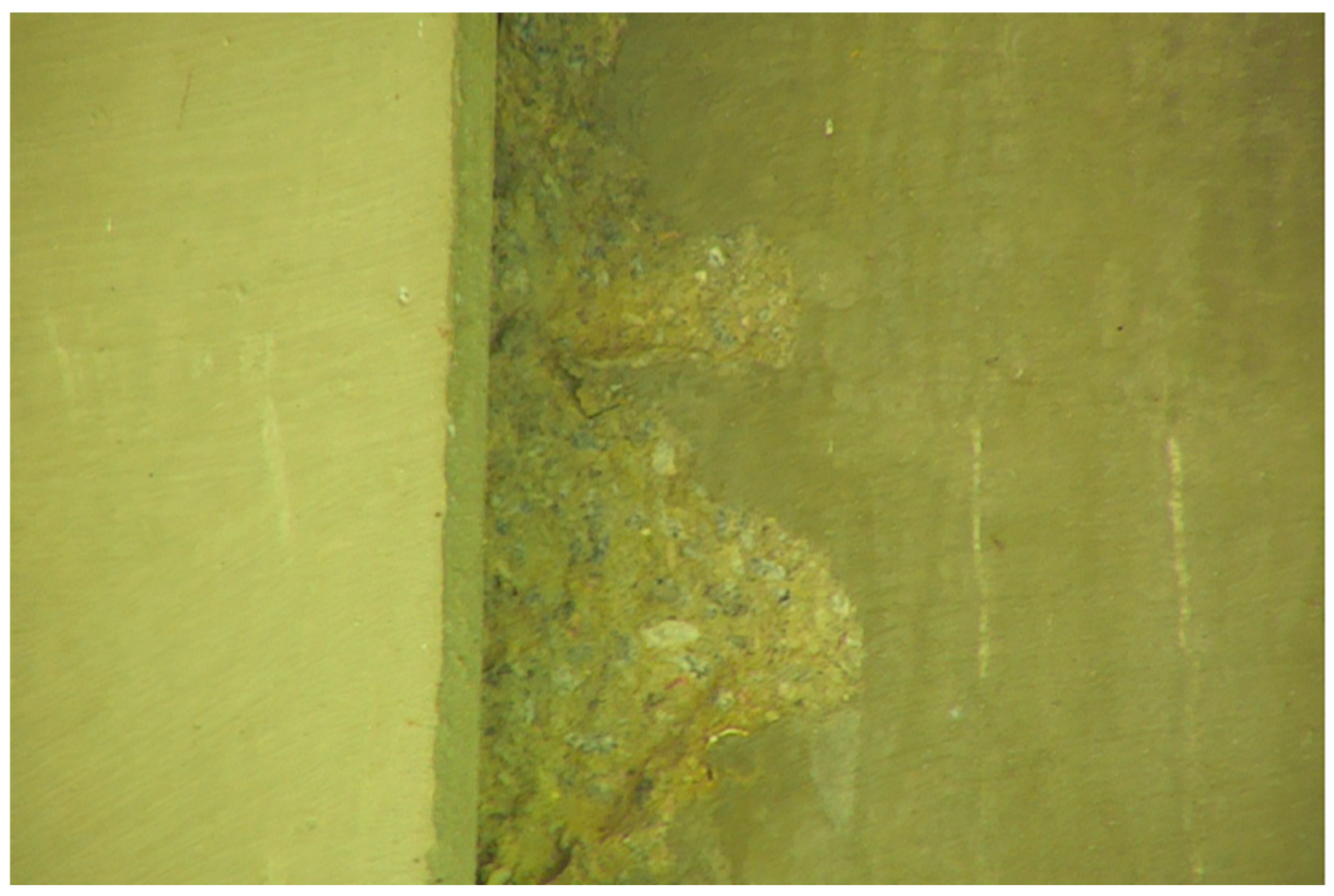
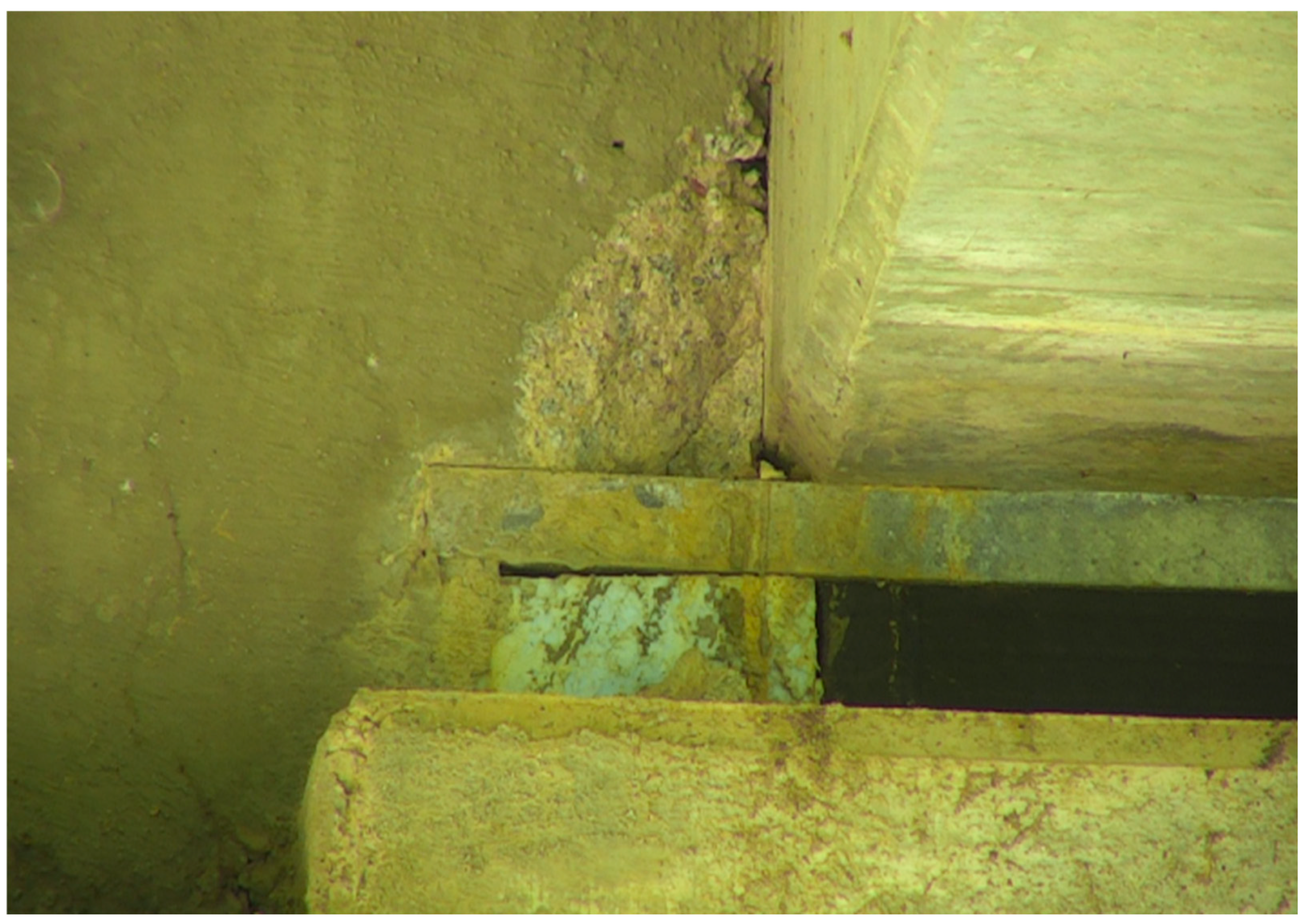
According to the study conducted by [68], the usability of optical zoom sensors for bridge inspection using a Zenmuse Z30 (30× optical zoom) mounted on a DJI M210 RTK drone at the Bates Bridge over the Congaree River. The drone allowed engineers to observe 91% of inspection points, detecting hairline cracks and minor spalling from a safe distance (Figure 4 and Figure 5), though some areas, such as bearing pads, remained difficult to view. Economically, UAS inspections reduced costs from $5242 to $3802 per bridge, saving $1440 while minimizing traffic disruptions. The study highlights that high-resolution zoom cameras enhance safety, data quality, and operational efficiency, especially when combined with ground control.
Table 9 summarizes selected case studies, presenting the applications of each drone and highlighting specific findings derived from their use in engineering-related tasks. These capabilities not only improve inspection efficiency but also support proactive infrastructure management. The ability to access hard-to-reach or hazardous locations further reduces safety risks for personnel while maintaining the accuracy and consistency of inspections. Collectively, these advances establish drones as transformative tools in modern civil engineering and infrastructure monitoring.

4. Results and Discussion

4.1. Performance Evaluation of UAS for Bridge Inspection

Structural health monitoring (SHM) for bridge inspection has been revolutionized since the UAS offers safer, faster, and cheaper methods compared to traditional ones. The aim of this study was to assess the performance of off-the-shelf, commercial-grade UASs used in bridge inspection in terms of flight performance, sensor capabilities, and resistance to environmental conditions, as well as software, regulatory, and compatibility issues.
Notably, rotary-wing UASs (multirotor), such as the Autel EVO Max 4T, DJI Mavic 3 and Skydio 10XD are highly versatile for close-range inspections due to their high-resolution imagery, maneuverability, and the ability to detect and avoid obstacles. Fixed wing and hybrid drones are used less often than in the past for bridge inspections, but are ideal for long-distance flights and large-area mapping. These UASs are also suitable for confined spaces and complex structural assessments, making them effective for bridge deck, girder, and cable inspections. Fixed-wing and hybrid drones are less common but advantageous for long-range surveys and large-area mapping because of their long flight time and coverage.
The study also shows the importance of sensor integration, thermal imaging, LiDAR and high resolution RGB cameras are necessary for detecting structural flaws like cracks, corrosion and moisture damage. Software solutions such as Pix4D and DroneDeploy are highly compatible and efficient for data processing, 3D modeling and structural analysis. Regulatory compliance, including adherence to FAA Part 107 requirements and drone registration, is essential for safe and legal operation in controlled airspace

4.2. TCO and Cost Analysis

A Total Cost of Ownership (TCO) analysis was conducted to assess the economic viability of using UAS for bridge inspection compared to conventional inspection methods. The analysis included both direct and indirect cost items incurred in inspection, including the baseline inspection costs, UAS acquisition, maintenance, and ongoing operational costs. The potential for cost savings is associated with shorter inspection times, reduced labor, minimized lane closures, and elimination of specialized vehicle rentals. The analysis examined the cost-benefits relationships and the overall financial advantages of using UASs by considering data published by the DOT, the American Association of State Highway and Transportation Officials (AASHTO), and other sources in the literature.
Table 10 presents a detailed breakdown of cost components, their descriptions, and the typical value or range identified from prior research. The findings demonstrate that while initial acquisition costs are significant, they are offset by long-term savings in inspection operations. Importantly, UAS integration can save inspection costs up to 40% and reduce fieldwork time to six hours per inspection. The Benefit–Cost Ratio (BCR) for the application of UASs is estimated to be about 9, which demonstrates substantial economic viability at scale.

4.3. Practice Guidelines (Do’s/Don’ts for DOT Inspectors)

To promote safe, effective, and regulatory-compliant UAS inspections of bridges, practice guidelines were developed for DOT inspectors. The guidelines are based on available FAA regulations, the literature, and field practices to provide a common practice for inspections.
The recommended “Dos” represents practices to help indicate operational readiness, compliance with regulations and laws, and the effective use of new technologies such as 3D models and AI. Conversely, the “Don’ts” highlights practices that could negatively impact inspections safety, compromise data accuracy, or violate regulations, such as flying under unsafe conditions or operating the aircraft outside the manufacturer’s specifications.
Table 11 presents the associated Do’s and Don’ts for DOT inspectors using UASs to conduct bridge inspections. The table provides a useful reference to improve safety, consistency, and quality of data during inspections.

4.4. Operational Limitations and Constraints of UAS-Based Bridge Inspection

UASs have significantly enhanced bridge inspection efficiency through rapid visual data acquisition and remote sensing, but they cannot fully replace human inspectors or traditional hands-on methods. Drones are effective at capturing high-resolution imagery and performing photogrammetric surveys of accessible surfaces, yet tasks requiring physical interaction such as tactile assessment, material sampling, hammer sounding, or nondestructive testing (NDT) for internal defects remain beyond their capabilities [88].
UAS performance is also limited in confined, obstacle-rich, or GPS-denied environments, such as beneath bridge decks or within hollow girders [96]. Most platforms rely on GNSS for navigation, restricting reliability in these conditions, while flight endurance, payload limitations, and aerodynamic stability further constrain operations near structural surfaces. Detailed inspections of fracture-critical members, precise measurements, and contact-based evaluations therefore still require trained human inspectors or conventional access methods, including under-bridge platforms, rope access, or scaffolding.
Although UASs improve safety and efficiency in hard-to-reach areas, comprehensive structural evaluation continues to depend on human expertise and traditional inspection techniques [55]. The following subsections provide a detailed overview of these operational constraints.

4.4.1. Under-Bridge-Deck Imagery

A key operational constraint in UAS-based bridge inspection is acquiring detailed imagery from the underside of bridge superstructures. Most UAS platforms employ bottom-mounted gimbals that limit the camera’s upward tilt to approximately 40° above the horizon. This restriction significantly reduces the ability to capture high-quality visual data from the underside of the structure, thereby affecting the effectiveness and completeness of inspection imaging for components such as girders, bearings, and deck soffits. To address this limitation, some users have modified existing airframes to incorporate top-mounted gimbals, while other manufacturers have developed systems equipped with upward-facing sensors that improve access for under-deck inspection [86].

4.4.2. Technical Constraints

UAS operations are limited by flight time, typically 20–30 min per battery, and restricted range, which can hinder inspections of large construction sites. Environmental conditions such as wind, rain, and low visibility further constrain UAS performance. Technical factors including sensor resolution, camera quality, and signal interference can reduce the accuracy and completeness of collected data, affecting decision-making and inspection outcome [13].

4.4.3. GNSS Multipath and Signal Loss Under Bridge Structures

UASs have exhibited significant potential for bridge inspection due to their maneuverability and capability to reach areas that are difficult to access. However, the effectiveness of UASs is reliant on GNSS, which may be unavailable and/or less reliable under bridge components (e.g., pier, abutment, or support). Auxiliary sensors, such as IMUs, optical flow sensors, ultrasonic sensors, or Ultra-Wideband (UWB) devices, can help mitigate lack of GNSS and enable navigation in a GPS-denied environment. However, many of these technologies experience cumulative positioning error restrictions and the full autonomy of the UAS is often constrained, necessitating manual control for some operation. Additionally, relying on high-resolution Digital Elevation Maps (DEMs) to enable measurable precision increases setup time and decreases productivity [97].

4.4.4. Environmental and Sensor Limitations

Environmental factors such as wind, rain, fog, and dust can reduce flight stability and degrade sensor performance. Sensor and imaging constraints, particularly in thermal and optical systems, may reduce navigation and inspection accuracy in low-contrast or uniform environments. Small UASs also have limited onboard computational resources, restricting real-time processing of high-resolution data for mapping, or feature extraction [98].

4.5. Specialized UAS Platforms for Bridge Inspection

Although commercial UAS platforms, such as standard multirotor and quadcopters, have improved efficiency in bridge inspection by enabling rapid visual data collection, their practical functionality remains limited in complex structural environments. These platforms often lack the capability for physical interaction, precise contact-based measurements, and autonomous operation in GPS-denied or confined spaces [55,99]. Consequently, researchers have focused on developing specialized UASs tailored to bridge inspection tasks.
One approach involves integrating aerial manipulators with UASs, allowing for sensor mounting and contact-based inspections on bridge surfaces. Ivanović et al. (2021) [99] demonstrated an aerial manipulator capable of precisely positioning sensors on structural components while regulating interaction forces, effectively extending UAS capabilities to inspection tasks that are challenging or infeasible with conventional platforms. Similarly, Sanchez-Cuevas et al. [100] developed a fully actuated aerial manipulator for infrastructure inspection, incorporating advanced modeling, localization, and control techniques to achieve reliable contact-based measurements near critical structural elements.
In addition to manipulation-enabled platforms, other specialized UASs focus on enhancing sensing and navigation for non-contact inspections. Nasimi et al. [101] presented sensor-equipped UASs capable of high-precision, non-contact sensing coupled with UAS bridge inspection measurements, demonstrating practical field application for structural health monitoring while addressing limitations of standard UAS payload and sensor configurations. Further, Ameli et al. [55] evaluated the impact of UAS hardware options on mission capabilities, highlighting the critical role of UAS design, payload capacity, and endurance for achieving successful bridge inspection missions in operational environments.
Reviews on aerial robotics for infrastructure inspection emphasize the growing trend of mission-specific UAS designs that integrate enhanced autonomy, specialized sensors, and collision-tolerant or hybrid mechanisms for conducting inspection and maintenance operations on infrastructures such as power lines, bridges, viaducts, or walls involving physical interaction operations [102]. Collectively, these studies underscore that, while commercial UASs are useful for routine visual inspections, advanced UAS platforms with manipulation capabilities, enhanced sensing, and autonomous navigation are essential for comprehensive bridge inspections, particularly when structural interaction or high-precision measurements are required.

4.6. Summary of Results

Table 12 summarizes the operational capabilities, primary applications, and compatible software for each model, providing a comprehensive reference for selecting UASs based on project-specific requirements and environmental conditions.

5. Conclusions and Future Research Directions

The evaluation of selected drone models demonstrates the versatility and increasing relevance of UASs in engineering inspections, surveys, and monitoring of complex structures. Each drone offers unique capabilities that make it appropriate for certain operational situations, such as high-level mapping or thermal inspections. High-end drones, such as the Matrice 350 RTK, provide centimeter-level accuracy and support for multiple payloads, making them suitable for precise surveys and inspections of infrastructure.
Drones within the Phantom 4 Series or DJI Mavic Series represent more economical options, designed for general surveying, aerial photography, and videography by providing their ease of setup and flight stability. Advanced systems equipped with thermal and low-light sensors, such as the EVO Max 4N and EVO Max 4T, extend inspections capabilities to low-visibility and nighttime monitoring of critical infrastructure.
More specialized drones, such as the Leica BLK2FLY, enable 3D modeling and real-time point cloud collection in areas that are difficult or unsafe to access in person. Tactical and defense-oriented drones, such as the Skydio X10D and Skydio 2+, can operate fully autonomously, navigate using AI, and avoid obstacles in complex environments like forests, urban areas, or industrial zones. Other models, such as the Teledyne FLIR or DJI Inspire series, also provide specialized inspection capabilities.
Although commercial UAS hardware evolves rapidly and specific models may be replaced over time, the platforms discussed in this review are presented as representative examples of broader UAS categories and capability classes, rather than as endorsements of individual products. The analysis and conclusions are therefore based on persistent functional characteristics, such as flight endurance, payload capacity, sensor integration, autonomy, and operational suitability for inspection tasks, rather than on individual product lifecycles. As new platforms emerge, these core performance attributes and operational considerations are expected to remain relevant, supporting the long-term applicability of the review’s findings.
In summary, this review critically evaluates commercially available UASs for bridge inspection applications by comparing flight performance, sensor payloads, payload capacity, control systems, autonomy features, and cost considerations. The key contribution of this paper lies in moving beyond a simple catalog of UAS platforms toward a structured analysis that highlights strengths, limitations, and practical considerations for choosing suitable drone technologies for different bridge inspection contexts. By assembling performance criteria and discussing how they align with inspection needs, this work provides decision-oriented guidance for practitioners and agencies tasked with implementing UASs in structural health monitoring. This analytical framing, rather than just a listing of specifications, establishes the novelty of this review and offers actionable insights to support informed UAS selection and deployment strategies for safer, more efficient bridge inspections.
This study has systematically identified the fundamental technical challenges and operational constraints that limit the practical deployment of UAS-based bridge inspection systems. Building on these findings, future research should prioritize integrated, system-level solutions that jointly address autonomy, inspection accuracy, and operational feasibility. In practice, commercial off-the-shelf UASs remain inadequate for confined spaces, near-contact inspection, and GNSS-denied environments due to limited flight endurance, susceptibility to wind and downwash effects, restricted payload capacity, motion-induced image degradation, and regulatory constraints. Consequently, the development of specialized UAS platforms optimized for structural inspection, with improved stability, safety near structures, and energy efficiency, remains critical research direction [55].
Future solution to overcome the limitations of current UAS-based bridge inspection systems increasingly emphasize advanced SLAM techniques for autonomous navigation in GNSS-challenged environments. By fusing data from onboard sensors such as cameras, LiDAR, IMUs, and SLAM enables simultaneous localization and environment mapping, reducing reliance on GPS signals that are often unreliable near or beneath bridge structures. Despite these advances, robust localization and navigation in GNSS-denied conditions remain challenging, particularly for long-duration inspections, complex bridge geometries, and degraded sensing environments where cumulative drift can occur [56,103]. In parallel, defect detection, geometric measurement, and fine-scale damage identification methods must be made resilient to real-world conditions, including variable illumination, motion blur, surface contamination, and sensor resolution limitations, to enable reliable assessment of both macro- and micro-scale defects [61,64].
Furthermore, standardized approaches for accurate defect localization and mapping onto physical bridge components, and their integration with three-dimensional models, digital twins, and bridge management systems, remain largely undeveloped and represent an important direction for future research [67]. Finally, large-scale field validation and benchmarking studies under realistic environmental, operational, and regulatory conditions are essential to evaluate the reliability, scalability, and cost-effectiveness of advanced UAS-based inspection systems and to support their transition from research prototypes to routine infrastructure monitoring.

Author Contributions

Conceptualization: B.C. (Byungik Chang); Formal analysis: B.C. (Bhupesh Chand) and F.A.; Investigation: B.C. (Bhupesh Chand) and F.A.; Data curation: B.C. (Bhupesh Chand) and F.A.; Validation: I.P.-D. and R.S.; Review and editing: B.C. (Bhupesh Chand), F.A., I.P.-D., R.S., and B.C. (Byungik Chang). All authors have read and agreed to the published version of the manuscript.

Funding

This research received no external funding.

Data Availability Statement

No datasets were generated for this review. The search strategy, screening log, extraction sheet, and the consolidated specification table used to generate summary tables/figures are available from the corresponding author upon reasonable request. Third-party materials remain under their original licenses.

Acknowledgments

The authors would like to express their sincere appreciation to those who aided throughout the course of this study.

Conflicts of Interest

Author Ian Pineiro-Dakers was employed by the company Garg Consulting Services, Inc. The remaining authors declare that the research was conducted in the absence of any commercial or financial relationships that could be construed as a potential conflict of interest.

References

  1. Panigati, T.; Zini, M.; Striccoli, D.; Giordano, P.F.; Tonelli, D.; Limongelli, M.P.; Zonta, D. Drone-Based Bridge Inspections: Current Practices and Future Directions. Autom. Constr. 2025, 173, 106101. [Google Scholar] [CrossRef]
  2. Chou, J.-S.; Liu, C.-Y.; Guo, P.-J. Deploying UAV-Based Detection of Bridge Structural Deterioration with Pilgrimage Walk Optimization-Lite for Computer Vision. Case Stud. Constr. Mater. 2024, 21, e04048. [Google Scholar] [CrossRef]
  3. Mohsan, S.A.H.; Khan, M.A.; Noor, F.; Ullah, I.; Alsharif, M.H. Towards the Unmanned Aerial Vehicles (UAVs): A Comprehensive Review. Drones 2022, 6, 147. [Google Scholar] [CrossRef]
  4. Lopez, A.; Jurado, J.M.; Garrido, A.; Lopez, R.; López, A.I.; Feito, F.R. 3D Tools for Building and Infrastructures Inspection from Thermal UAS Data: First Steps. Procedia Struct. Integr. 2022, 42, 1121–1127. [Google Scholar] [CrossRef]
  5. Feroz, S.; Abu Dabous, S. UAV-Based Remote Sensing Applications for Bridge Condition Assessment. Remote Sens. 2021, 13, 1809. [Google Scholar] [CrossRef]
  6. Li, H.; Chen, Y.; Liu, J.; Zhang, Z.; Zhu, H. Unmanned Aircraft System Applications in Damage Detection and Service Life Prediction for Bridges: A Review. Remote Sens. 2022, 14, 4210. [Google Scholar] [CrossRef]
  7. Casas, J.R.; Chacón, R.; Catbas, N.; Riveiro, B.; Tonelli, D. Remote Sensing in Bridge Digitalization: A Review. Remote Sens. 2024, 16, 4438. [Google Scholar] [CrossRef]
  8. Darvishpoor, S.; Roshanian, J.; Raissi, A.; Hassanalian, M. Configurations, Flight Mechanisms, and Applications of Unmanned Aerial Systems: A Review. Progress Aerosp. Sci. 2020, 121, 100694. [Google Scholar] [CrossRef]
  9. Yang, G.; Liu, J.; Zhao, C.; Li, Z.; Huang, Y.; Yu, H.; Xu, B.; Yang, X.; Zhu, D.; Zhang, X.; et al. Unmanned Aerial Vehicle Remote Sensing for Field-Based Crop Phenotyping: Current Status and Perspectives. Front. Plant Sci. 2017, 8, 1111. [Google Scholar] [CrossRef]
  10. Barnes, G.; Volkamann, W.; Sherko, R.; Kelm, K. Design and Testing of a UAV-Based Cadastral Surveying and Mapping Methodology in Albania; The World Bank: Washington DC, USA, 2014; p. 28. [Google Scholar]
  11. Laghari, A.A.; Jumani, A.K.; Laghari, R.A.; Nawaz, H. Unmanned Aerial Vehicles: A Review. Cogn. Robot. 2023, 3, 8–22. [Google Scholar] [CrossRef]
  12. Choi, H.-W.; Kim, H.-J.; Kim, S.-K.; Na, W.S. An Overview of Drone Applications in the Construction Industry. Drones 2023, 7, 515. [Google Scholar] [CrossRef]
  13. Liang, H.; Lee, S.-C.; Bae, W.; Kim, J.; Seo, S. Towards UAVs in Construction: Advancements, Challenges, and Future Directions for Monitoring and Inspection. Drones 2023, 7, 202. [Google Scholar] [CrossRef]
  14. DJI. Support for DJI Mavic 3. Available online: https://www.dji.com/support/product/mavic-3 (accessed on 10 January 2026).
  15. DJI. Support for Phantom 4 Pro V2.0. Available online: https://www.dji.com/support/product/phantom-4-pro-v2 (accessed on 12 January 2026).
  16. Skydio X10D Technical Specification. Available online: https://www.skydio.com/x10d/technical-specs (accessed on 12 January 2026).
  17. Skydio 2+. Available online: https://support.skydio.com/hc/en-us/articles/5338292379803-Comparing-Skydio-2-and-Skydio-2 (accessed on 12 January 2026).
  18. DJI. Matrice 350 RTK. Available online: https://enterprise.dji.com/matrice-350-rtk/specs (accessed on 15 January 2026).
  19. Leica. BLK2FLY Technical Specification. Available online: https://shop.leica-geosystems.com/leica-blk/blk2fly/tech-specs (accessed on 13 January 2026).
  20. Robotics, A. EVO Max 4N. Available online: https://shop.autelrobotics.com/collections/autel-evo-max-series-for-theme-2023/products/evo-max-4n-copy (accessed on 12 January 2026).
  21. Robotics, A. EVO Max 4T-XE. Available online: https://shop.autelrobotics.com/collections/autel-evo-max-series-for-theme-2023/products/evo-max-4t-copy (accessed on 12 January 2026).
  22. Robotics, A. EVO II Pro 6K Enterprise Bundle V3. Available online: https://shop.autelrobotics.com/collections/autel-evo-ii-series/products/evo-ii-pro-6k-enterprise-bundle-v3 (accessed on 12 January 2026).
  23. FLIR. Teledyne FLIR SIRAS. Available online: https://www.flir.com/products/siras/?vertical=suas&segment=oem (accessed on 14 January 2026).
  24. DJI. Inspire 3 Technical Specification. Available online: https://www.dji.com/inspire-3/specs (accessed on 13 January 2026).
  25. Rodrigues, T.A.; Patrikar, J.; Choudhry, A.; Feldgoise, J.; Arcot, V.; Gahlaut, A.; Lau, S.; Moon, B.; Wagner, B.; Matthews, H.S.; et al. In-Flight Positional and Energy Use Data Set of a DJI Matrice 100 Quadcopter for Small Package Delivery. Sci. Data 2021, 8, 155. [Google Scholar] [CrossRef] [PubMed]
  26. Gao, M.; Hugenholtz, C.H.; Fox, T.A.; Kucharczyk, M.; Barchyn, T.E.; Nesbit, P.R. Weather Constraints on Global Drone Flyability. Sci. Rep. 2021, 11, 12092. [Google Scholar] [CrossRef] [PubMed]
  27. Gómez-López, J.M.; Pérez-García, J.L.; Mozas-Calvache, A.T.; Delgado-García, J. Mission Flight Planning of RPAS for Photogrammetric Studies in Complex Scenes. ISPRS Int. J. Geo-Inf. 2020, 9, 392. [Google Scholar] [CrossRef]
  28. Jarahizadeh, S.; Salehi, B. A Comparative Analysis of UAV Photogrammetric Software Performance for Forest 3D Modeling: A Case Study Using Agisoft Photoscan, PIX4DMapper, and DJI Terra. Sensors 2024, 24, 286. [Google Scholar] [CrossRef]
  29. Mandirola, M.; Casarotti, C.; Peloso, S.; Lanese, I.; Brunesi, E.; Senaldi, I. Use of UAS for Damage Inspection and Assessment of Bridge Infrastructures. Int. J. Disaster Risk Reduct. 2022, 72, 102824. [Google Scholar] [CrossRef]
  30. Agisoft. Features. Available online: https://www.agisoft.com/features/cloud/ (accessed on 15 December 2025).
  31. Pix4Dcloud. Available online: https://www.pix4d.com/product/pix4dcloud/ (accessed on 15 December 2025).
  32. DroneDeploy. Available online: https://www.dronedeploy.com/ (accessed on 20 December 2025).
  33. DJI. TERRA. Available online: https://enterprise.dji.com/dji-terra (accessed on 14 January 2026).
  34. Agisoft Metashape. Available online: https://www.agisoftmetashape.com/agisoft-metashape-hardware-recommendations-and-memory-requirements/ (accessed on 31 January 2026).
  35. PIX4D Support. Available online: https://support.pix4d.com/hc/en-us/articles/115002439383 (accessed on 31 January 2026).
  36. DroneDeploy Recommended Hardware. Available online: https://dronedeploy.com/product/supported-hardware (accessed on 31 January 2026).
  37. DJI. Help Center. Available online: https://support.dji.com/help/content?customId=01700004964&spaceId=17&re=US&lang=en&documentType&paperDocType=ARTICLE (accessed on 31 January 2026).
  38. DJI. Mavic 3 Enterprise. Available online: https://enterprise.dji.com/mavic-3-enterprise/specs (accessed on 12 January 2026).
  39. Chu, T.; Starek, M.J.; Berryhill, J.; Quiroga, C.; Pashaei, M. Simulation and Characterization of Wind Impacts on sUAS Flight Performance for Crash Scene Reconstruction. Drones 2021, 5, 67. [Google Scholar] [CrossRef]
  40. Karimoddini, A.; Cavalline, T.L.; Smith, B.; Hewlin, R.; Homaifar, A. UAV Selection Methodology and Performance Evaluation to Support UAV-Enabled Bridge Inspection; North Carolina A&T State University: Greensboro, NC, USA, 2022; p. 65. [Google Scholar]
  41. Zeybek, M.; Taşkaya, S.; Elkhrachy, I.; Tarolli, P. Improving the Spatial Accuracy of UAV Platforms Using Direct Georeferencing Methods: An Application for Steep Slopes. Remote Sens. 2023, 15, 2700. [Google Scholar] [CrossRef]
  42. EMLID. Reach RS2/RS2+. Available online: https://docs.emlid.com/reachrs2/integration/dji-rtk/ (accessed on 31 January 2026).
  43. R. ROCK Robotic. Available online: https://www.rockrobotic.com/articles/leveraging-the-rock-rtk-network-a-business-case-for-surveying-drones-and-gis/ (accessed on 31 January 2026).
  44. Shahraki, M.; El-Rabbany, A.; Elamin, A. UAV-Based Multi-Sensor Data Fusion for 3D Building Detection. Proceedings 2024, 110, 12. [Google Scholar] [CrossRef]
  45. Xu, X.; Zhang, L.; Yang, J.; Cao, C.; Wang, W.; Ran, Y.; Tan, Z.; Luo, M. A Review of Multi-Sensor Fusion SLAM Systems Based on 3D LIDAR. Remote Sens. 2022, 14, 2835. [Google Scholar] [CrossRef]
  46. Federal Aviation Administration. Available online: https://www.faa.gov/uas/commercial_operators/become_a_drone_pilot (accessed on 10 January 2026).
  47. Federal Aviation Administration. Available online: https://www.faa.gov/uas/getting_started/where_can_i_fly/airspace_101 (accessed on 14 February 2026).
  48. Federal Aviation Administration. Available online: https://www.faa.gov/uas/getting_started/register_drone (accessed on 31 January 2026).
  49. Lee, D.; Hess, D.J.; Heldeweg, M.A. Safety and Privacy Regulations for Unmanned Aerial Vehicles: A Multiple Comparative Analysis. Technol. Soc. 2022, 71, 102079. [Google Scholar] [CrossRef]
  50. Tsiamis, N.; Efthymiou, L.; Tsagarakis, K. A Comparative Analysis of the Legislation Evolution for Drone Use in OECD Countries. Drones 2019, 3, 75. [Google Scholar] [CrossRef]
  51. Janke, C.; De Haag, M.U. Implementation of European Drone Regulations—Status Quo and Assessment. J. Intell. Robot. Syst. 2022, 106, 33. [Google Scholar] [CrossRef]
  52. Zhang, L. China’s New Pattern of Rule of Law on UAS. J. Intell. Robot. Syst. 2024, 110, 95. [Google Scholar] [CrossRef]
  53. McTegg, S.J.; Tarsha Kurdi, F.; Simmons, S.; Gharineiat, Z. Comparative Approach of Unmanned Aerial Vehicle Restrictions in Controlled Airspaces. Remote Sens. 2022, 14, 822. [Google Scholar] [CrossRef]
  54. Chauhan, D.S.; Sandil, T. A Comparative Analysis of Drone Regulations: Insights from India and Japan. J. Emerg. Technol. Innov. Res. 2024, 11, j52–j66. [Google Scholar]
  55. Ameli, Z.; Aremanda, Y.; Friess, W.A.; Landis, E.N. Impact of UAV Hardware Options on Bridge Inspection Mission Capabilities. Drones 2022, 6, 64. [Google Scholar] [CrossRef]
  56. Jung, S.; Choi, D.; Song, S.; Myung, H. Bridge Inspection Using Unmanned Aerial Vehicle Based on HG-SLAM: Hierarchical Graph-Based SLAM. Remote Sens. 2020, 12, 3022. [Google Scholar] [CrossRef]
  57. Jin, T.; Zhang, W.; Chen, C.; Chen, B.; Zhuang, Y.; Zhang, H. Deep-Learning- and Unmanned Aerial Vehicle-Based Structural Crack Detection in Concrete. Buildings 2023, 13, 3114. [Google Scholar] [CrossRef]
  58. Ayele, Y.Z.; Aliyari, M.; Griffiths, D.; Droguett, E.L. Automatic Crack Segmentation for UAV-Assisted Bridge Inspection. Energies 2020, 13, 6250. [Google Scholar] [CrossRef]
  59. Morgenthal, G.; Hallermann, N. Quality Assessment of Unmanned Aerial Vehicle (UAV) Based Visual Inspection of Structures; Advances in Structural Engineering: Brentwood, UK, 2014; Volume 17. [Google Scholar]
  60. Musarat, M.A.; Debono, C.J.; Prakash, V.; Borg, R.P.; Seychell, D.; Hili, G.; Shu, J.; Ding, W. Defect Visualization in the Bridge Underpass Arch Structure: A Photogrammetry Assessment Using UAV-Captured Imagery. J. Compos. Sci. 2025, 9, 665. [Google Scholar] [CrossRef]
  61. Kao, S.-P.; Wang, F.-L.; Lin, J.-S.; Tsai, J.; Chu, Y.-D.; Hung, P.-S. Bridge Crack Inspection Efficiency of an Unmanned Aerial Vehicle System with a Laser Ranging Module. Sensors 2022, 22, 4469. [Google Scholar] [CrossRef] [PubMed]
  62. Koch, C.; Georgieva, K.; Kasireddy, V.; Akinci, B.; Fieguth, P. A Review on Computer Vision Based Defect Detection and Condition Assessment of Concrete and Asphalt Civil Infrastructure. Adv. Eng. Inform. 2015, 29, 196–210. [Google Scholar] [CrossRef]
  63. Pokhrel, R.; Samsami, R.; Elmi, S.; Brooks, C. Automated Concrete Bridge Deck Inspection Using Unmanned Aerial System (UAS)-Collected Data: A Machine Learning (ML) Approach. Eng 2024, 5, 1937–1960. [Google Scholar] [CrossRef]
  64. Luo, K.; Kong, X.; Zhang, J.; Hu, J.; Li, J.; Tang, H. Computer Vision-Based Bridge Inspection and Monitoring: A Review. Sensors 2023, 23, 7863. [Google Scholar] [CrossRef]
  65. Kao, S.-P.; Chang, Y.-C.; Wang, F.-L. Combining the YOLOv4 Deep Learning Model with UAV Imagery Processing Technology in the Extraction and Quantization of Cracks in Bridges. Sensors 2023, 23, 2572. [Google Scholar] [CrossRef]
  66. Li, H.-Y.; Huang, C.-Y.; Wang, C.-Y. Measurement of Cracks in Concrete Bridges by Using Unmanned Aerial Vehicles and Image Registration. Drones 2023, 7, 342. [Google Scholar] [CrossRef]
  67. Woo, H.-J.; Seo, D.-M.; Kim, M.-S.; Park, M.-S.; Hong, W.-H.; Baek, S.-C. Localization of Cracks in Concrete Structures Using an Unmanned Aerial Vehicle. Sensors 2022, 22, 6711. [Google Scholar] [CrossRef]
  68. Burgett, J.M.; Bausman, D.C.; Comert, G. Unmanned Aircraft Systems (UAS) Impact on Operational Efficiency and Connectivity; Clemson University: Clemson, SC, USA, 2019; p. 86. [Google Scholar]
  69. Collins Engineers Inc. Aerial Bridge Inspections and 3D Modeling. Available online: https://www.skydio.com/customer-stories/collins-engineers-inc (accessed on 9 January 2026).
  70. Skydio Stantec Transforms Infrastructure Inspections with Autonomous Drones. Available online: https://www.skydio.com/customer-stories/stantec-transforms-infrastructure-inspections-with-autonomous-drones (accessed on 10 January 2026).
  71. Taddia, Y.; Stecchi, F.; Pellegrinelli, A. Using DJI Phantom 4 RTK Drone for Topographic Mapping Of Costal Areas. Int. Arch. Photogramm. Remote Sens. Spat. Inf. Sci. 2019, 42, 625–630. [Google Scholar] [CrossRef]
  72. WSP USA, Inc. New Hampshire Department of Transportation; New Hampshire Department of Transportation Bureau of Materials & Research: Merrimack, NH, USA, 2023; p. 226. [Google Scholar]
  73. Seo, J.; Duque, L.; Wacker, J. Drone-Enabled Bridge Inspection Methodology and Application. Autom. Constr. 2018, 94, 112–126. [Google Scholar] [CrossRef]
  74. DJI Enterprise DJI Enterprise Bridge Inspection. Available online: https://enterprise.dji.com/inspection/bridge-inspection (accessed on 31 December 2025).
  75. DJI. Advexure. Available online: https://advexure.com/products/dji-mavic-3-thermal (accessed on 15 January 2026).
  76. Aliyari, M.; Droguett, E.L.; Ayele, Y.Z. UAV-Based Bridge Inspection via Transfer Learning. Sustainability 2021, 13, 11359. [Google Scholar] [CrossRef]
  77. Dorafshan, S.; Maguire, M.; Hoffer, N.V.; Coopmans, C.; Thomas, R.J. Unmanned Aerial Vehicle Augmented Bridge Inspection Feasibility Study; Utah State University: Logan, UT, USA, 2017; p. 177. [Google Scholar]
  78. Muhammad, B.I.; Moses, O.T.; Omoebamije, O.; Mohammed, A.-G.; Samson, D. 3D Reconstruction of a Precast Concrete Bridge for Damage Inspection Using Images from Low-Cost Unmanned Aerial Vehicle. Disaster Civ. Eng. Archit. 2025, 2, 46–62. [Google Scholar] [CrossRef]
  79. Perry, B.J.; Guo, Y.; Atadero, R. A Streamlined Bridge Inspection Framework Utilizing Unmanned Aerial Vehicles (UAVs); Colorado State University: Fort Collins, CO, USA, 2021; p. 58. [Google Scholar]
  80. Aldana Rodriguez, D.; Ávila Granados, D.L.; Villalba-Vidales, J.A. Use of Unmanned Aircraft Systems for Bridge Inspection: A Review. DYNA 2021, 88, 32–41. [Google Scholar] [CrossRef]
  81. Jeong, E.; Seo, J.; Wacker, J.P. UAV-Aided Bridge Inspection Protocol through Machine Learning with Improved Visibility Images. Expert. Syst. Appl. 2022, 197, 116791. [Google Scholar] [CrossRef]
  82. Maboudi, M.; Backhaus, J.; Mai, I.; Ghassoun, Y.; Khedar, Y.; Lowke, D.; Riedel, B.; Bestmann, U.; Gerke, M. Very High Resolution Bridge Deformation Monitoring Using UAV-Based Photogrammetry. J. Civil. Struct. Health Monit. 2025, 15, 3489–3508. [Google Scholar] [CrossRef]
  83. Gaspari, F.; Ioli, F.; Barbieri, F.; Belcore, E.; Pinto, L. Integration Of UAV-LIDAR And UAV-Photogrammetry For Infrastructure Monitoring And Bridge Assesment. Int. Arch. Photogramm. Remote Sens. Spat. Inf. Sci. 2022, 43, 995–1002. [Google Scholar] [CrossRef]
  84. Nooralishahi, P.; Ibarra-Castanedo, C.; Deane, S.; López, F.; Pant, S.; Genest, M.; Avdelidis, N.P.; Maldague, X.P.V. Drone-Based Non-Destructive Inspection of Industrial Sites: A Review and Case Studies. Drones 2021, 5, 106. [Google Scholar] [CrossRef]
  85. Bartczak, E.T.; Bassier, M.; Vergauwen, M. Evaluation of a UAS-Based Bridge Inspection Framework with Automated Damage Candidate Suggestion and Human-in-the-Loop Damage Assessment. Int. Arch. Photogramm. Remote Sens. Spat. Inf. Sci. 2025, 48, 189–196. [Google Scholar] [CrossRef]
  86. US Department of Transportation. UAVs and Machine Learning Power Next-Level Bridge Inspection System. UTC Spotlight 2025, 2. [Google Scholar]
  87. U.S. Department of Transportation; Federal Highway Administration. Collection of Data with Unmanned Aerial Systems (UAS) for Bridge Inspection and Construction Inspection; Publication No. FHWA-HRT-21-086; Federal Highway Administration: Washington, DC, USA, 2021. [CrossRef]
  88. Askarzadeh, T.; Bridgelall, R. Cost Efficiency and Effectiveness of Drone Applications in Bridge Condition Monitoring. Infrastructures 2025, 10, 63. [Google Scholar] [CrossRef]
  89. Wells, J.; Barritt, L. Improving the Quality of Bridge Inspections Using Unmanned Aircraft Systems (UAS); Minnesota Department of Transportation Research Services & Library: St. Paul, MI, USA, 2018; p. 345. [Google Scholar]
  90. Gillins, D.T.; Parrish, C.; Gillins, M.N.; Simpson, C. Eyes in the Sky: Bridge Inspections with Unmanned Aerial Vehicles; Oregon State University: Corvallis, OR, USA, 2018; p. 180. [Google Scholar]
  91. U.S Department of Transportation. Use of Small Unmanned Aerial Systems for Bridge Inspection; U.S Department of Transportation: Washington, DC, USA, 2019.
  92. Seo, J.; Duque, L.; Wacker, J.P. Field Application of UAS-Based Bridge Inspection. Transp. Res. Rec. J. Transp. Res. Board 2018, 2672. [Google Scholar] [CrossRef]
  93. Skydio Autonomous Unmanned Vehicles Transform Bridge Inspections. Available online: https://www.skydio.com/blog/drones-transform-bridge-inspections (accessed on 18 January 2026).
  94. Federal Aviation Administration, U.S.D. of T. Small Unmanned Aircraft Systems (UAS) Regulations (Part 107). Available online: https://www.faa.gov/newsroom/small-unmanned-aircraft-systems-uas-regulations-part-107 (accessed on 18 January 2026).
  95. US Department of Transportation; Federal Highway Administration. Effective Practices for Managing Bridge Inspection Data Captured by UAS; Research, Development, and Technology Turner-Fairbank Highway Research Center: Georgetown Pike McLean, VA, USA, 2021; p. 6. [Google Scholar]
  96. Adibfar, A.; Razkenari, M.; Costin, A. Review and Assessment of Technical and Legal Challenges in Application of Unmanned Aerial Vehicles in Monitoring and Inspection of Bridges. Intell. Transp. Infrastruct. 2023, 2, liad023. [Google Scholar] [CrossRef]
  97. Bai, J.-H.; Hsu, C.-R.; Han, J.-Y.; Wu, R.-B. A GPS-Free Bridge Inspection Method Tailored to Bridge Terrain with High Positioning Stability. Drones 2025, 9, 678. [Google Scholar] [CrossRef]
  98. Nguyen, V.H.; Schommer, S.; Maas, S.; Zürbes, A. Static Load Testing with Temperature Compensation for Structural Health Monitoring of Bridges. Eng. Struct. 2016, 127, 700–718. [Google Scholar] [CrossRef]
  99. Ivanovic, A.; Markovic, L.; Car, M.; Duvnjak, I.; Orsag, M. Towards Autonomous Bridge Inspection: Sensor Mounting Using Aerial Manipulators. Appl. Sci. 2021, 11, 8279. [Google Scholar] [CrossRef]
  100. Sanchez-Cuevas, P.J.; Gonzalez-Morgado, A.; Cortes, N.; Gayango, D.B.; Jimenez-Cano, A.E.; Ollero, A.; Heredia, G. Fully-Actuated Aerial Manipulator for Infrastructure Contact Inspection: Design, Modeling, Localization, and Control. Sensors 2020, 20, 4708. [Google Scholar] [CrossRef]
  101. Nasimi, R.; Moreu, F.; Fricke, G.M. Sensor Equipped UAS for Non-Contact Bridge Inspections: Field Application. Sensors 2023, 23, 470. [Google Scholar] [CrossRef]
  102. Suarez, A.; Cacace, J.; Orsag, M. Aerial Robotics for Inspection and Maintenance: Special Issue Editorial. Appl. Sci. 2022, 12, 3583. [Google Scholar] [CrossRef]
  103. Zhuang, L.; Zhong, X.; Xu, L.; Tian, C.; Yu, W. Visual SLAM for Unmanned Aerial Vehicles: Localization and Perception. Sensors 2024, 24, 2980. [Google Scholar] [CrossRef]
Figure 1. Comparison of the number of points generated in dense point-cloud reconstruction using different software tools.
Drones 10 00144 g001
Figure 2. Comparison of computational time using different software tools.
Drones 10 00144 g002
Figure 3. Airspace classification and operational guidance for small UAS operators [47].
Drones 10 00144 g003
Figure 4. Minor spalling observed DJI M210 RTK drone [68].
Drones 10 00144 g004
Figure 5. Bearing unable to see sufficiently [68].
Drones 10 00144 g005
Table 1. Commercially available UASs used for inspection and mapping applications.
Table 2. Performance characteristics of selected drone platforms.
NameDJI Mavic Series
[14]
DJI Phantom 4 Series
[15]
Skydio X10D
[16]
Skydio 2+
[17]
DJI Matice 350 RTK
[18]
Leica BLK2FLY
[19]
EVO Max 4N
[20]
EVO Max 4T
[21]
EVO II Pro 6K Enterprise Bundle
[22]
Teledyne FLIR SIRAS
[23]
DJI Inspire 3
[24]
Max Flight Time (min)4630402755134242423128
Battery Capacity (Mah)50006000841954105880675080708070710012,0004280
Ascent speed (m/s)8.06.06.0N/A6.0N/A8.08.08.06.08.0
Descent speed (m/s)6.04.04.0N/A5.0N/A6.06.04.04.08.0
Horizontal speed (m/s)21.0N/A20.116.116.0–23.05.023.023.020.018.026.10
Max Altitude (m)60006000457245726000–70001800400040006920N/A3800
Max Flight Distance (km)30.06.0–10.09.97–12.05.988.0–20.0N/A8.0–20.08.0–20.08.0–12.09.658.0–15.0
Note: 1 m/s = 3.28 ft/s, 1 m = 3.28 ft, 1 km = 3280.84 ft.
Table 3. Key specifications of photogrammetry and 3D point-cloud processing software commonly used in UAS data analysis.
Specification SheetAgisoft
[30]
Pix4D
[31]
DroneDeploy
[32]
DJI Terra
[33]
Cloud-based computing
PC based ComputingN/A
3D scanning
Drone Mapping
Price per yearOnetime payment for standard edition $179 and professional edition $3499 Monthly subscription $297/month, Yearly subscription 291/month and $5990/onetime payment$329/monthStandard edition $1850/per year Permanent Cost: $5280
Manufacturing CountryRussiaSwitzerlandUnited StatesChina
Table 4. Key Recommended Hardware Specifications for Photogrammetry and UAS Platform Data Processing Software.
ComponentsAgisoft
[34]
Pix4D
[35]
DroneDeploy
[36]
DJI Terra
[37]
CPU (Processor)8-core i7 or Ryzen 7quad-core or hexa-core Intel i9/Threadripper/Ryzen 9/N/A (processing is mostly cloud/web-based)CPU i5 or later
RAM (Memory)32–64 GB32–64 GB16 GB or more32–64 GB
GPU (Graphics)8–12 GB VRAM (RTX 3060/3070)GeForce GTX GPU compatible with OpenGL 3.2 and 2 GB RAMNot required (cloud processing)GeForce GTX 1050 Ti, GeForce GTX 970, GeForce GTX 960
Storage1 TB SSD NVMe60–120 GB SSDFast SSD recommended for uploadSSD+50 GB Free (better)
OS (Operating System)Windows 11/macOS 13+Windows 10, 64 bits
(Windows 11)
(https://community.pix4d.com/t/windows-11-issue-with-pix4dmapper-pix4dfields-pix4dsurvey-and-pix4dmatic-e9041/20960; accessed on 15 February 2026)
Windows/macOS/modern browserWindows 10/11
Table 5. Example wind-speed data collected along US-70 Eastbound over the East End Connector, Durham, NC [39].
Bridge Wind ConditionWind Speed (m/s)Wind Gust (m/s)
Above Bridge (4 September–1 October 2020)Max. 50.06 Avg. 1.16Max. 10.06 Avg. 2.63
Below Bridge (10 May–8 July 2021)Max. 5.99 Avg. 0.13Max. 11.97 Avg. 1.52
Note: 1 mph = 0.447 m/s.
Table 6. Representative environmental parameters affecting UAS performance under varying weather conditions.
NameMax Wind Resistance
(m/s)
Ingress
Protection Rating
Operating Temperature
(C)
DJI Mavic Series [14]11.99N/A−10° to 40°
DJI Phantom 4 Series [15]9.99N/A0° to 40°
Skydio X10D [16]12.52IP55−16° to 45°
Skydio 2+ [17]11.18N/A−5° to 40°
DJI Matice 350 RTK [18]11.99IP55−20° to 50°
Leica BLK2FLY [19]11.99IP545° to 35°
EVO Max 4N [20]12.07IP43−20° to 50°
EVO Max 4T [21]12.52IP43−20° to 50°
EVO II Pro 6K Enterprise Bundle [22]17.44–20.56IP43−10° to 40°
Teledyne FLIR SIRAS [23]4.96IP545° to 50°
DJI Inspire 3 [24]11.99–13.99N/A−20° to 40°
Note: 1 mph = 0.447 m/s; 1 °C = 32 °F.
Table 7. Comparison of commercially available UASs for infrastructures inspection.
NameDJI Mavic Series 3 Enterprises
[38]
DJI Phantom 4 Series
[15]
Skydio X10D
[16]
Skydio 2+
[17]
DJI Matrice 350 RTK
[18]
Leica BLK2FLY
[19]
EVO Max 4N
[20]
EVO Max 4T
[21]
EVO II Pro 6K Enterprises
[22]
Teledyne FLIR SIRAS
[23]
DJI Inspire 3
[24]
Global Navigation Satellite SystemGPS + Galileo + BeiDouGPS
GLONASS
GPS Galileo
GLONASS BeiDou
N/AGPS
GLONASS
BeiDou
Galileo
N/AGPS
Galileo
BeiDou
GLONASS
GPS
Galileo
BeiDou
GLONASS
N/AN/AGPS Galileo BeiDou
Hovering Accuracy Range
Vision±0.1 m V & ±0.3 m H±0.1 m V & ±0.3 HVIO: +/−10 cmN/A±0.1 m V & ±0.3 m HN/A±0.1 m V & ±0.3 m H±0.1 m V & ±0.3 m H±0.1 m V & ±0.3 m HV: ± 0.5 m (± 0.48 m) H: ± 1.5 m ±0.1 m V & ±0.3 m H
GNSS± 0.5 V&H±0.5 m V & ±1.5 m HGNSS: +/−1 mN/A±0.5 m V & ±1.5 m HN/A±0.5 m V & ±0.5 m H±0.5 m V & ±0.5 m H±0.5 m V & ±1.5 m H±0.5 m V & ±0.5 m H
Real Time Kinematics±0.1 m (with RTK)N/AN/AN/A±0.0024 m V & HN/A±0.15 V & 0.1 m H±0.15 V & 0.1 m H±0.1 V & 0.1 m H±0.1 V & 0.1 m H
Image Sensor
UNITDJI Mavic 3E: 4/3 CMOS, Effective pixels: 20 MP0.025 m CMOS1/2” 48MP CMOS, IMX989 0.025 m 50.3 MP CMOS, 64 MP CMOS Sony IMX577 1/0.058 m 12.3 MP CMOSZen Muse H20, Zen Muse H20T, Zen Muse H20N, Zen Muse P1, and Zen Muse 5-camera system, 1.6 MP, 300° × 180° total, global shutter1/0.032 m CMOS, Effective pixels: 50 M0.012 m CMOS, Effective pixels: 48 M0.025 m CMOS; 20 M pixels16 MP with 20 MP mapping mode, 128× zoom35 mm full-frame CMOS
Format equivalent Main camera24 mm35 mm20 mm equivalent35 mm format equivalent29 mmN/A23 mm23 mm29 mm4.8 mmN/A
Photo size DJI Mavic 3E: 5280 × 3956
DJI Mavic 3T: 8000 × 6000
4096 × 2160 (4096 × 2160 24/25/30/48/
50p)
8192 × 61444056 (H) × 3040 (V)1080pN/A8000 × 60008192 × 61445472 × 3648N/A8192 × 5456
Telephoto162 mmN/A190 mm
equivalent
N/A32.7–574.5 mmN/AN/A64–234 mmN/AN/AN/A
Maximum Image Size4000 × 3000N/A8000 × 6000N/A2688 × 1512N/AN/A8000 × 6000N/AN/AN/A
NightN/AN/AN/AN/AStarlight sensorN/A41.4 mm
8000 × 6000
N/AN/AN/AN/A
Narrow unitN/AN/A46 mm equivalentN/AN/AN/AN/AN/AN/AN/AN/A
Photo size
N/AN/A9248 × 6944N/AN/AN/AN/AN/AN/AN/AN/A
Thermal wideN/AN/A60 mm
equivalent
N/A53 mmN/A8192 × 6144
4096 × 3072
N/AN/AN/AN/A
Photo size DJI Mavic 3E: 5280 × 3956
DJI Mavic 3T: 8000 × 6000
4096 × 2160 (4096 × 2160 24/25/30/48/
50p)
8192 × 61444056 (H) × 3040 (V)1080pN/A8000 × 60008192 × 61445472 × 3648N/A8192 × 5456
Telephoto162 mmN/A190 mm
equivalent
N/A32.7–574.5 mmN/AN/A64–234 mmN/AN/AN/A
Maximum Image Size4000 × 3000N/A8000 × 6000N/A2688 × 1512N/AN/A8000 × 6000N/AN/AN/A
NightN/AN/AN/AN/AStarlight sensorN/A41.4 mm
8000 × 6000
N/AN/AN/AN/A
Narrow unitN/AN/A46 mm equivalentN/AN/AN/AN/AN/AN/AN/AN/A
Photo sizeN/AN/A9248 × 6944N/AN/AN/AN/AN/AN/AN/AN/A
Thermal wideN/AN/A60 mm
equivalent
N/A53 mmN/A8192 × 6144
4096 × 3072
N/AN/AN/AN/A
Photo sizeN/AN/A640 × 512N/A640 × 512N/A640 × 512640 × 512N/A640 × 512
60 Hz
N/A
Thermal TeleN/AN/AN/AN/A196 mmN/AN/AN/AN/AN/AN/A
Photo sizeN/AN/AN/AN/A640 × 512N/AN/AN/AN/AN/AN/A
Video resolution640 × 512
@30fps
C4K: 4096 × 2160 24/25/30/48/50/60p 100Mbps3840 × 28803840 × 2160 60 fps2688 × 1512
@30fps, 1920 × 1080
@30fps, 640 × 512
@ 30 fps
N/A3840 × 2160,
7680 × 4320,
640 × 512
4000 × 30005472×
3076
P30
N/A1080p/60fps 1080p/60fps, 4K/30fps
FPV Camera N/AN/AN/AN/A1080P × 30fpsN/AN/AN/AN/AN/AN/A
LiDARN/AN/AN/AN/AZenmuse L2 4/3 CMOS RGB camera420,000 pts/sN/AN/AN/AN/AN/A
MobilitySensing
Sensing TypeOmnidirectional binocular vision systemSurface with diffuse reflection material, and reflectivity > 8% (such as wall, trees, humans, etc.)6x cameras
in trinocular
configuration top and bottom
6x cameras in trinocular configuration top and bottomOmnidirectionalFull spherical, 360°N/AN/AOmnidirectional sensing systemN/AN/A
Forward0.5–20 m0–10 m20 m20 m0.7–40 m3.0 m (standard mode) 1.3 m (indoor mode)0.5–31 m0.5–31 mAccurate measurement range: 0.5–18 mup to 30 mN/A
Backward0.5–16 m0.3–23 m0.3–23 mN/A0.3–18 m
Lateral0.5–25 mN/AN/AN/AN/A1.5–42 m
Upward0.2–10 m0.6–30 mN/A0.2–26 m 0.2–26 mN/A0.2–13 m
Downward0.3–18 mN/A0.3–23 m0.3–23 mN/A1.5–48 m
Obstacle Sensory Range0.5–200 m0.7–30 m20 mN/AN/AN/AN/AN/AN/AN/AN/A
Infrared Sensing SystemN/A0.2–7 mN/AN/A0.1–8 mN/AN/AN/AN/AN/A0–10 m
Note: 1 m = 3.28 ft; 1 in = 0.254 m.
Table 8. Operating frequency ranges.
NameRadio Frequency (RF) Channels
DJI Mavic Series [14]2.400–2.4835 GHz; 5.725–5.850 GHz
DJI Phantom 4 Series [15]2.400–2.4835 GHz; 5.725–5.850 GHz
Skydio X10D [16]Connect SL: 2400–2483.5 MHz
5150–5850 MHz
Connect MH: 1625–1725 MHz
1790–1850 MHz
2040–2110 MHz
2200–2300 MHz
2300–2390 MHz
2400–2500 MHz
Skydio 2+ [17]5.18–5.24 GHz; 5.725–5.85 GHz
DJI Matrice 350 RTK [18]2.4000–2.4835 GHz; 5.150–5.250 GHz; 5.725–5.850 GHz
Leica BLK2FLY [19]2.4 GHz access point (flight operation).
5 GHz client (data offload operation)
EVO Max 4N [20]2.4 G: 2.400–2.476 GHz; 5.2 G: 5.15–5.25 GHz; 5.8 G: 5.725–5.829 GHz Only applies to FCC, CE (Germany excluded) and UKCA regions
EVO Max 4T [21]2.4 GHz/5.8 GHz.
5.2 GHz (only applicable for FCC, CE, and UKCA regions).
900 MHz (only applicable for FCC regions).
EVO II Pro 6K Enterprise Bundle [22]2.400 GHz–2.4835 GHz; 5.725 GHz–5.850 GHz
Teledyne FLIR SIRAS [23]2.4 GHz; 5.8 GHz
DJI Inspire 3 [24]2.4000–2.4835 GHz; 5.150–5.250 GHz (CE: 5.170–5.250 GHz);
5.725–5.850 GHz
Table 9. Summary of drone-based case studies in bridge and infrastructure inspection.
No.Drone ModelApplicationKey FindingsReferences
1.Skydio DronesBridge Inspections (Collins Engineering, Chicago, IL, USA).
  • 3D scanning & digital twins for pre-inspection.
  • Allowed inspectors to detect 70–80% of defects digitally before field inspections.
  • Integration into digital workflows for engineering teams.
  • 30% reduction in inspection costs.
  • 50% reduction in time in the field (cut fieldwork from 3–4 weeks to 2 weeks).
[69]
2.Skydio DronesBridge Inspection (Colorado River, Stantec, Edmonton, AB, Canada)
  • Reduced inspection time from 10 to 5 days (50% cost savings).
  • Eliminated need for snooper trucks, harnesses, and lane closures.
  • Improved safety and access to hard-to-reach areas (columns, girders, arches).
[70]
3.DJI Phantom 4 RTKCoastal Topographic Survey (Italy)
  • Onboard RTK reduced dependency on ground control points (GCPs).
  • Achieved 2 cm GSD at 80 m altitude.
  • Efficient for large-scale (2 km) coastal mapping.
  • Single GCP sufficient for focal length estimation.
[71]
4.Skydio 2+Bridge Inspections (General Use)
  • 4K60 HDR camera + 3D imaging.
  • Autonomous flight & obstacle avoidance for complex structures.
  • High-resolution close-proximity data capture.
[72]
5.DJI Matrice 300Bridge Inspections (General Use)
  • High-precision inspections (mentioned alongside Skydio 2+).
  • Capable of advanced sensor integration.
[72]
6.DJI Phantom 4Glulam Timber Bridge Inspection (South Dakota)
  • Developed a five-stage UAS inspection methodology tailored for bridge structural evaluations, from planning to post-processing.
  • Identified and quantified critical defects as 0.18 m2 spalled area, matching measurements from traditional Department of Transportation (DOT) inspection reports, demonstrating reliability.
  • Detected cracks, spalling, corrosion, and moisture.
  • Matched traditional inspection accuracy.
  • Safer, faster, and cost-effective than manual methods.
[73]
7.DJI Matrice M350Bridge Inspection
(General use)
  • Speed up bridge inspections with automated or manual drone missions.
  • Lower inspection costs and enhance inspection frequency with user-friendly and economical drone solutions.
  • Detect cracks, corrosion, and structural issues with high-resolution sensors.
  • Analyze and archive data for ongoing bridge health monitoring.
[74]
8.Mavic 3T EnterpriseBridge Inspection
(General use)
  • Onboard RTK reduced dependency on GCPs.
  • Thermal scanner allowed for inspection of concrete surfaces and allowed for detection of hollow areas in concrete.
  • Features a 1/2-inch CMOS 48MP wide camera and a 12MP telephoto camera with 56 × hybrid zoom, enabling detailed visual inspections of bridge components.
  • Optional RTK (Real-Time Kinematic) support provides centimeter-level positioning accuracy, essential for precise mapping and inspection tasks.
[75]
9.DJI M210 RTK UASBridge Inspection
Bates Bridge, South Carolina
  • UAS’s 30x optical zoom camera successfully identified deficiencies such as spalling, loose bolts, and hairline cracks as small as 0.004 inches.
  • UAS reduced the need for Under Bridge Inspection Trucks (UBITs) and traffic control, resulting in an estimated cost savings of $1500 per bridge inspection.
  • UAS-based land surveys achieved high accuracy, with points falling to 0.68 cm horizontally and 0.09 cm vertically of their true locations under optimal conditions.
[68]
10.DJI Matrice 100 with Zen muse Z3 zoom cameraBridge Inspection
Skodsberg Bridge (Norway)
  • Conducted bridge inspection at Skodsberg Bridge (Norway); high-resolution images (3000 × 4000) enabled effective crack/crack dataset creation for machine learning.
[76]
11.DJI Mavic/DJI InspireBridge Inspection
(General use)
  • Utilizes sonar and visual positioning sensors to maintain stability in GPS-denied environments.
  • UAS-assisted inspections achieved a true positive detection rate of 64%, which was comparable to the average human inspector rate of 61% for hard-to-access steel girders.
[77]
12.DJI Mavic Air 2Bridge Inspection
(General use)
  • Using a low-cost UAS for 3D reconstruction is a viable alternative to traditional visual inspection (VI) and expensive high-end UASs.
  • 3D digital twin enables automated detection of bridge damage and provides a permanent record for monitoring structural health over time.
  • 3D reconstructed model successfully identified major bridge defects such as water-induced deterioration, algal delamination, and exposed reinforcement.
[78]
13.DJI Mavic/DJI Phantom 4/DJI Matrice 600Bridge Inspection
(General use)
  • Machine learning can segment 3D point clouds into structural elements (girders, decks) with >99% accuracy in 10 min.
  • UAS-based inspection greatly improves efficiency: on-site time reduced from 2 weeks to 2 h, cost reduced from $55,000 to $20,000, and inspectors kept safe from hazardous conditions
[79]
14.DJI Mavic, DJI Phantom 4 Pro, DJIBridge Inspection
(General use)
  • GPS-denied areas under bridge decks challenge navigation; steel and concrete interfere with GPS.
  • UASs are effective in detecting surface defects such as cracks, spalling, corrosion, and moisture.
[55]
15.DJI SeriesBridge Inspection
(Idaho and Alaska)
  • Inspected beams, abutments, and girders; DJI Mavic; cracks not detected at 11 m/s wind, detected successfully at 7 m/s along with corrosion and efflorescence.
  • UASs achieved higher point density (5.6M vs. 1.4M points/m3), improving defect detection despite higher noise.
  • GPS-denied environment; used ultrasonic beacons and CNN to detect concrete cracks with 96.6% accuracy.
[80]
16.DJI Phantom & DJI MatriceBridge Inspection
(Minnesota, USA)
  • On-site UAS-based bridge inspections analyzed with the CNN protocol successfully identified multiple types of damage, including splits, cracks, weathered timber, and paint deterioration, while maintaining low computational costs.
  • Image enhancement techniques, including adjustments to brightness, contrast, and sharpness, improved the visibility of structural damage in UAS images and increased the accuracy of image-based damage measurements.
  • The protocol demonstrated reliable quantification of structural damage, with errors of 2.56% for concrete column cracks, 5.47% for Cross-Laminated Timber (CLT) beam cracks, and 9.12% for in-service timber bridges compared to direct measurement.
[81]
17.DJI Matrice 600 Pro with RTK GNSS + Phase One iXM-100 cameraBridge Inspection
(General use)
  • Employed UAS photogrammetry to capture ultra-high-resolution image blocks before, during, and after controlled loading on a reinforced concrete bridge.
  • The 3D reconstruction of the bridge using UAS imagery, combined with RTK-GNSS and geodetic control networks, achieved high accuracy, with deviations from displacement transducer measurements below 1 mm.
  • UAS-based photogrammetry provides holistic insights into structural behavior, highlighting areas of bending and tilt, and can complement classical measurements for long-term structural health monitoring.
  • Dense point clouds derived from UAS data allowed the extraction of detailed deformation profiles along any axis, offering flexibility over traditional point or profile measurements.
[82]
18.DJI Matrice 300 RTK, and DJI Zenmuse L1 integrated with RGB camera on the L1 for photogrammetry supportBridge Inspection
(General use)
  • Traditional integrated surveys achieved centimetric-level precision, while UAS-LiDAR provided moderate accuracy (5–10 cm) suitable for routine bridge inspections.
  • UAS-LiDAR significantly reduced field time, operational complexity, and overall inspection cost compared with conventional methods.
  • GNSS obstruction beneath bridges affected LiDAR georeferencing, but accuracy improved through integration of photogrammetry and GCPs.
[83]
19.DJI Inspire 2 with Zenmuse X5SBridge Inspection
(General use)
  • Drone-based inspections can achieve inspection accuracy comparable to conventional methods, with the ability to generate 3D models and high-resolution imagery for detailed damage detection and monitoring.
  • UASs significantly reduce inspection time, cost, and manpower requirements while increasing safety, particularly in large, complex, or hazardous infrastructures such as bridges, industrial facilities, and refineries.
[84]
20.DJI Mavic 3 Enterprise equipped with a 4/3″ CMOS camera.Bridge Inspection
(Belgium)
  • Automated damage detection combined with human-in-the-loop validation produced verified reports within 4.25 h, reducing manual inspection requirements and providing actionable data for maintenance planning.
  • Photogrammetric 3D models achieved a mean distance error of 3.2 cm relative to terrestrial laser scans, allowing precise structural analysis and damage mapping.
[85]
21DJI Mavic/DJI Phantom/DJI InspireBridge Inspection
(General use)
  • Drone-assisted bridge inspections improve safety, efficiency, and data quality by enabling access to hard-to-reach areas without risking personnel.
  • Reliable communication networks and advanced hardware, including lightweight drones and manipulators, are critical for effective inspections, enabling visual modal analysis and potential contact-based evaluations.
  • Integration of AI and computer vision with drone imagery allows automated damage detection and extraction of structural features, supporting faster and more accurate assessment.
[1]
Table 10. TCO and Cost Analysis of UAS and Traditional Inspection.
Cost ComponentDescriptionTypical Value/RangeReferences
Traditional Inspection Cost (Baseline)Cost of a routine bridge inspection using conventional means (snooper truck, lane closures, crew).US $4500–$10,000 per bridge inspection in U.S. context
(Department of Transportation)
[86]
Cost saving using UASReduction in inspection cost achieved via UAS compared to traditional inspection cost.Use of UAS resulted in an average cost savings of 40 percent and an increase of 2 percent for personnel time saving.
AASHTO report showed that UAS inspections saved $4350 per standard bridge deck inspection, reduced personnel by two people, and decreased inspection time by six hours.
[87]
Investment/acquisition cost (Drone + Payload + Infrastructure)One-time capital cost for drone platform, sensor(s), ground station, etc.Mean cost of $18,789
Median cost of $15,483
[88]
Cost per inspection using UAS vs. Traditional InspectionTotal cost per inspection using drone (includes amortized investment + operational)Drone based condition monitoring inspection cost $1770 vs. Traditional based condition monitoring inspection cost $7216.[88]
Lane-closure/traffic-control savingsSavings from reduced traffic disruption when using UAS vs. conventional access equipment.Direct traffic-control costs range from $500–$2500 per day of closure.[88,89]
Inspection-vehicle rental savingsCost savings from eliminating the need for specialized access equipment such as snooper trucks, bucket trucks, scissor lifts, or boom lifts.Vehicle with operator rental US $500–$3000/day for snooper truck (15% to 30% probability).[88]
Annual maintenance costCapital cost amortized over useful life for year-to-year cost modelingAnnual maintenance costs for three UAS and peripheral equipment are estimated at $4500.[90]
Recurring operational costs (UAS program)Annual costs: software licenses, data processing, pilot/analyst labor, maintenance, batteries, training.Cost of the aircraft and accompanying equipment (batteries, propeller set, radio modem, remote control, etc.), as well as operator training and software, was reported to $39,079. Notably, as with most technologies, UAS costs are expected to decrease over time, while their capabilities are anticipated to improve.[90]
Net savings per inspection (UAS vs. traditional)Difference between traditional cost and UAS cost per inspectionAverage net savings are $5043 per inspection with a median of $493.[88]
Benefit–Cost Ratio (BCR)Ratio of benefits to costs for UAS adoptionEstimated average cost savings of approximately $10,000 per bridge inspection and showed a benefit–cost ratio of 9 if a UAS bridge inspection program is implemented.[90]
Table 11. Do’s/Don’ts for DOT inspectors.
CategoryGuidelineDescription/JustificationReferences
Do’sEnsure Regulatory ComplianceEnsure compliance with FAA regulations, including 14 CFR Part 107 for operations under 55 lbs. and any applicable exemptions for heavier UASs.[91]
Conduct Pre-Flight ChecksInspect UAS components such as propellers, batteries, and firmware to confirm operational readiness.[92]
Maintain battery reserve (20–30min)Keep a 20 to 30 min battery reserve charge margin to allow for wind, re-flight, or emergency landing to ensure effective operations.[1,39]
Utilize 3D ModelingEmploy UASs to create detailed 3D models of bridge structures, aiding in comprehensive analysis and documentation.[93]
Integration with AIDesigned to promote the sustainability and efficiency of bridge management, ensuring infrastructure safety and longevity through more informed, data-driven practices.[87]
Maintain certification and recurrent trainingRequire FAA Part 107 certification and recurrent training every 24 months.[94]
Integrate with Traditional MethodsUse UASs to supplement, not replace, traditional inspection techniques, ensuring all National Bridge Inspection Standards (NBIS) are met.[87]
Plan for SafetyImplement traffic control measures like warning signs and cones to protect the inspection zone.[92]
Don’tsFly in marginal weather or over wind limitsNearly 21% of the crashes are weather-related every year in the United States and performing flight missions under hazardous weather conditions remains a difficult task due to safety and data quality concerns. Avoid flight when weather exceeds manufacturer’s limits; ensure stable environmental conditions.[39]
Rely solely on automationDo not finalize safety-critical findings without manual inspection verification.[1]
Overload the aircraftProvisions of 14 CFR Part 107 apply to most operations of UASs weighing less than 55 lbs. Operators of UASs weighing greater than 55 lbs. may request exemptions to the airworthiness requirements of 14 CFR Part 91. Exceeding rated payload reduces endurance and increases crash risk.[46,91]
Ignore FAA/airspace regulationsAlways comply with Remote ID, airspace classification, and waivers when required.[46]
Skip calibration or test flightsPerform test flights and pre-mission checks to confirm system functionality.[95]
Rely on one sensor typeCombine RGB, thermal, and LiDAR as applicable to ensure complete data coverage.[4]
Table 12. Selected drone models and their effectiveness in inspection.
NoDrone ModelKey Applications and Effectiveness
1.DJI Mavic [14]General Surveying Works: Portable, easy deployment, quick visual checks.
(Software: Agisoft, Pix 4D and DroneDeploy)
2.DJI Phantom 4 Series [15]Aerial photography and videography: RTK-enabled GPS, stable flight, ideal for 3D modeling. (Software: Agisoft, Pix4D, DJI Terra)
3.Skydio 10XD [16]Long-Range Monitoring: Mostly used in military and defense applications, providing autonomous surveillance, reconnaissance, and tactical intelligence with advanced AI-driven obstacle avoidance and thermal imaging.
(Software: DroneDeploy and Pix4D)
4.Skydio 2 [17]Close-Range Inspections: Best for autonomous close-range aerial tracking and filming, excelling in dynamic obstacle-rich environments like forests, urban areas, and action sports terrains. (Software: Pix 4D and DroneDeploy)
5.DJI Matrice 350 RTK [18]High precision mapping, surveying, and inspections in various industries including aircraft, leveraging its RTK module for accurate positioning and support for multiple payloads. (Software: DroneDeploy, Pix4D, DJI Terra)
6.Leica BLK2FLY [19]Creation of 3D models and spatial data in hard-to-reach or hazardous areas of complex environments (3D Digital Twin Creation): Laser scanning, high-accuracy 3D mapping, capture real-time point cloud data.
7.EVO Max 4N [20]Night & Low-Light Inspections: Thermal imaging, strong wind resistance, i.e., monitoring in challenging environments. (Software: DroneDeploy, Pix4D)
8.EVO Max 4T [21]Advanced thermal and optical imaging for critical infrastructure inspections: Multi-sensor thermal, precision monitoring in low-visibility conditions.
(Software: Pix4D, DJI Terra).
9.EVO II Pro 6K [22]High-Resolution Imaging: 6K camera, photogrammetry, great for visual assessment. (Software: Agisoft, and Pix4D)
10.Teledyne FLIR [23]Thermal imaging and high-resolution inspections, equipped with advanced thermal sensors for real-time data capture.
11.DJI Inspire 3 [24]Capturing ultra-high-definition footage for film and media projects: Cinematic-grade imaging, not ideal for structural inspection.
(Software: DroneDeploy and Pix4D)
Disclaimer/Publisher’s Note: The statements, opinions and data contained in all publications are solely those of the individual author(s) and contributor(s) and not of MDPI and/or the editor(s). MDPI and/or the editor(s) disclaim responsibility for any injury to people or property resulting from any ideas, methods, instructions or products referred to in the content.