
UAS-LiDAR Mapping of Bog Microrelief Enhances Accuracy of Ground-Layer Phytomass Estimation

 , , ,
, , ,
Highlights
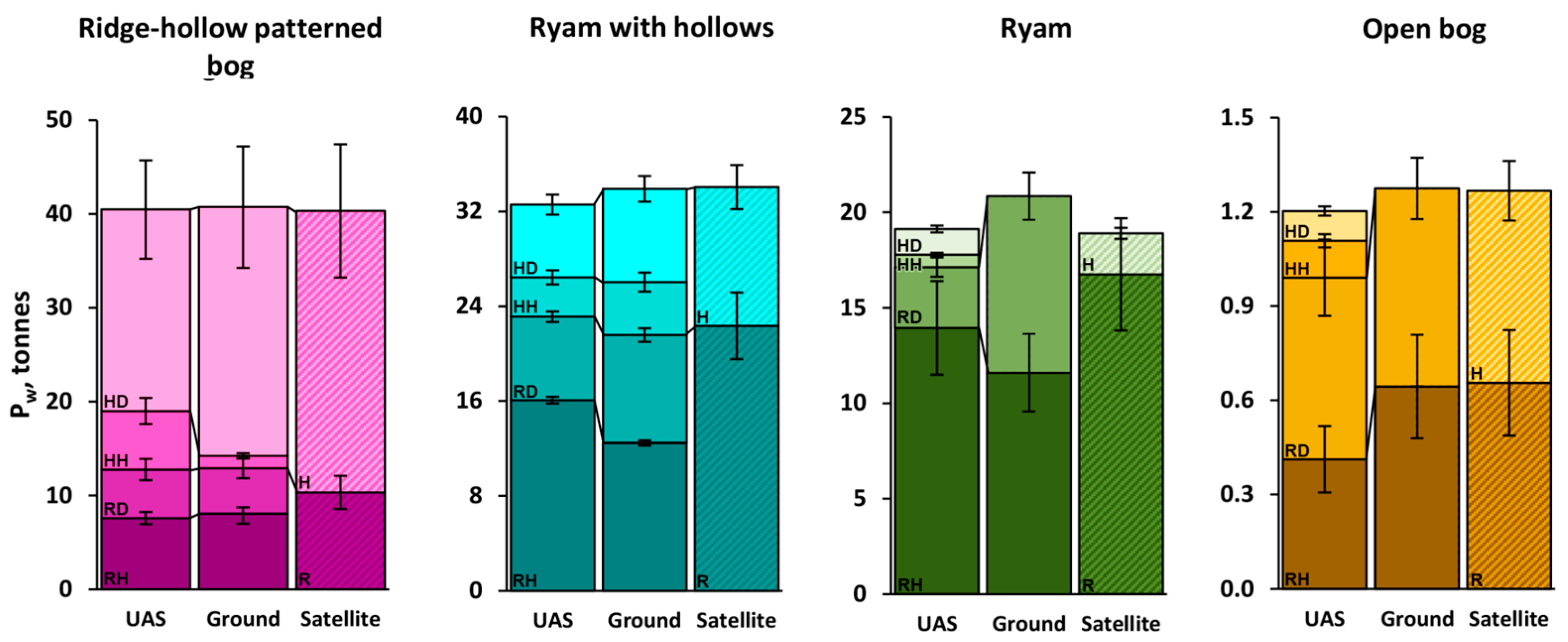
- Unveiling hidden bias and the critical role of microforms: Traditional satellite and field methods create an “illusion of accuracy” for total peatland phytomass (~93–97 t ha−1) but introduce systematic errors (7–25%) by misallocating carbon. Our LiDAR-based classification reveals that capturing fine-scale microforms (hummocks/depressions) nested within microtopography is critical, as they drive the ground-layer phytomass gradient and account for significant carbon stocks (e.g., hummocks within hollows contribute up to 6.2 ± 1.4 tonnes per landscape unit).
- Resolution is critical: The UAS-LiDAR microform map achieved a 95% overall accuracy (Kappa = 0.89) for microtopography, far surpassing the satellite-based map (77%, Kappa = 0.53), proving that resolving hummocks and depressions (~0.5–3 m) is essential.
- A new standard for carbon accounting: Spatially explicit microrelief mapping via UAS-LiDAR is not an optional improvement but a necessity to avoid hidden, landscape-dependent biases that compromise carbon stock estimates and model predictions in heterogeneous peatlands.
- A practical, objective workflow: We provide a formalized, rule-based hierarchical classification method that replaces subjective field extrapolation with a reproducible structural template, setting a robust baseline for restoration and carbon project verification.
Abstract
1. Introduction
- To develop a straightforward formal method for classifying bog microtopography (ridges/hollows) and microforms (hummocks/depressions) from UAS-LiDAR data across different bog landscape units (vegetation facies);
- To upscale field-measured AGB/BGB stocks using the resulting microtopography/microform map (LiDAR-based estimate);
- To estimate phytomass stocks using two alternative methods: traditional field-based visual upscaling (field-based estimate) and classification of bog landscape units and microtopography from satellite data (satellite-based estimate);
- To quantitatively compare the phytomass upscaling results of the three methods, determining their discrepancies and evaluating the importance of accounting for bog microtopography and microforms (via LiDAR) for ensuring accurate phytomass stock inventory.
2. Materials and Methods
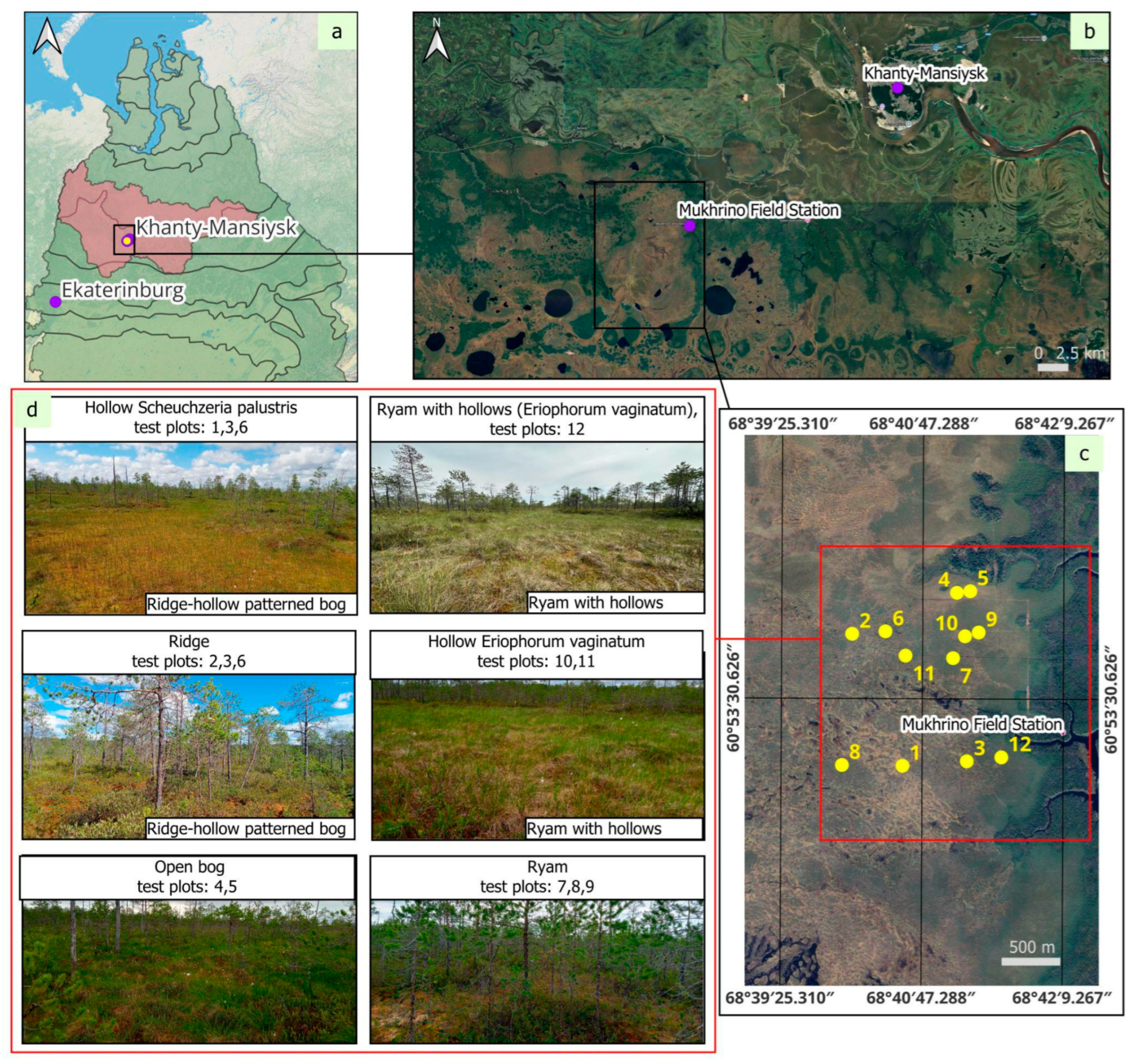
2.1. Study Area
- -
- -
- Hollows: Represented by sedge–Scheuchzeria–Sphagnum and cottongrass–sedge–Sphagnum communities. The dwarf shrub layer is dominated by Andromeda polifolia and Vaccinium oxycoccos. The herb layer includes Scheuchzeria palustris, Carex limosa, Eriophorum vaginatum, and Drosera rotundifolia. The moss cover is dominated by Sphagnum balticum, S. papillosum, S. jensenii, and S. majus, with occasional S. lindbergii [49,50]. The water table in hollows typically ranges from 0 to 15 cm below the moss surface but can rise above it during wet periods. The hollow surface also exhibits a hummocky microrelief, formed by Eriophorum vaginatum hummocks and Sphagnum depressions.
2.2. Data Acquisition
2.2.1. UAS Survey
2.2.2. Satellite Data
2.3. Microtopography Mapping and Classification Framework
2.3.1. Core Concept: Hierarchical Microrelief Model
- Microtopography: The larger-scale element, characterized by the alternation of ridges (R) and hollows (H). Ridges are elevated, relatively well-drained linear features dominated by hummock-forming Sphagnum mosses (e.g., S. fuscum), dwarf shrubs, and stunted pines. Hollows are waterlogged depressions primarily covered by hollow-dwelling Sphagnum species (e.g., S. balticum). This level establishes the primary hydrological and vegetation gradient across the bog, with typical element dimensions ranging from ~10 to 100 m.
- Microforms: Finer-scale structural elements that form a mosaic within each microtopographic unit. These are hummocks (elevated patches) and depressions (waterlogged patches). Hummocks are local elevations formed by dense moss carpets or tussocks of Eriophorum vaginatum, while depressions are the wetter areas between them. This level drives small-scale heterogeneity in moisture and vegetation, with characteristic dimensions of ~0.5 to 3 m. For analytical clarity and to reflect their hierarchical position, we use composite codes to denote each microform class (These microform classes were selected as meaningful hydromorphological units. Their effectiveness as proxies for upscaling was subsequently confirmed via the clear gradient in phytomass stocks found across the RH, RD, HH, and HD classes):
- -
- RH: Hummocks within ridges;
- -
- RD: Depressions within ridges;
- -
- HH: Hummocks within hollows;
- -
- HD: Depressions within hollows.
2.3.2. UAS-LiDAR Data Processing and Microform Classification Algorithm
- (1)
- The raw LiDAR point cloud was processed using AGM ScanWorks (AGM Systems, Krasnodar, Russia) and Lidar 360 v7.0 (GreenValley International, Berkeley, CA, USA) software. The processing chain included trajectory calculation using GNSS/IMU data (NovAtel OEM719, AGM-PS.M, Calgary, AB, Canada), point cloud alignment, error assessment based on strip discrepancies, point classification (“ground” and “low points” at 10 cm resolution), and the generation of a high-resolution digital terrain model (DTM). To account for the convex shape of the raised bog [51,52] and to create a common reference plane, a “zero surface” representing the basal level of the waterlogged hollows was modeled. A point layer of 10,000 randomly distributed points was created in QGIS and populated with DTM elevation values. The highest 10% and lowest 1% of points were removed to filter outliers. A basal surface was then interpolated from the remaining points using ordinary kriging (power function variogram, SAGA GIS) and smoothed with a median filter (2000-pixel window). This basal surface was subtracted from the original DTM using the raster calculator (QGIS) to produce a normalized DTM (DTMnorm), where elevation represents height above the local bog base.
- (2)
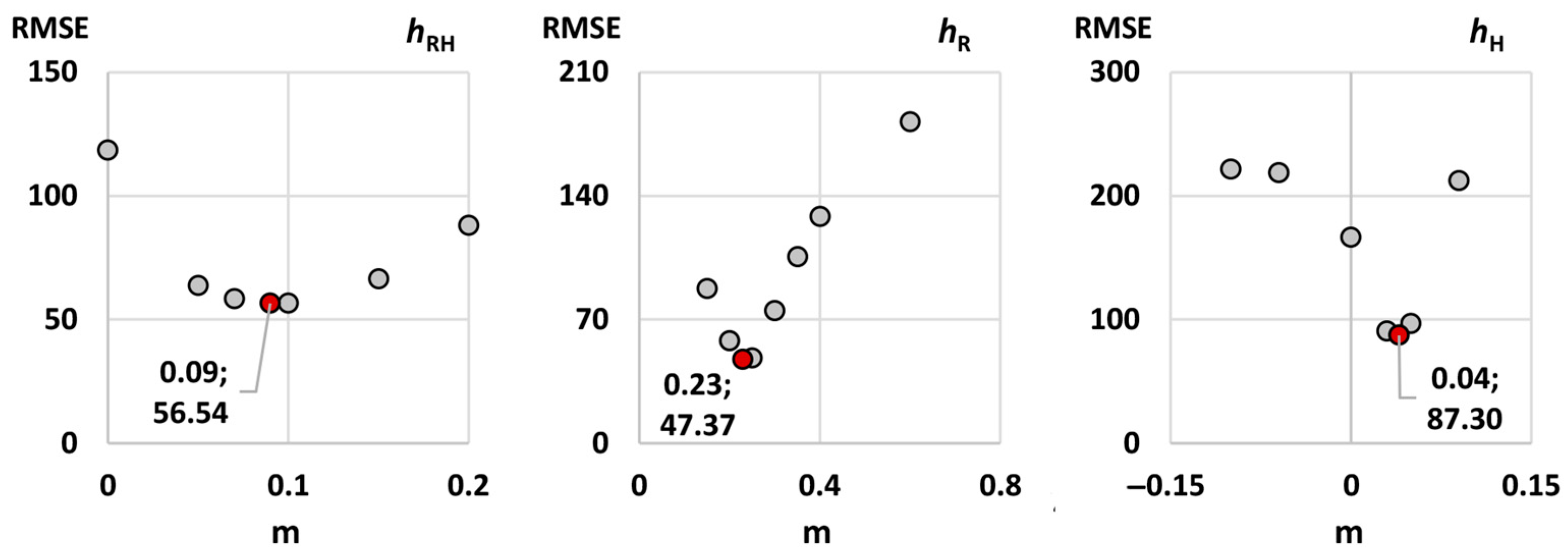
- The normalized DTMnorm was classified using three optimized elevation thresholds (hRH, hR и hH) that define the hierarchical structure:
- -
- Microtopography level: Pixels above hRH were classified as ridges (R), and those below were classified as hollows (H);
- -
- Microform level within ridges: Pixels within the ridge class above hR were classified as hummocks in ridges (RH), and those below were classified as depressions in ridges (RD);
- -
- Microform level within Hollows: Pixels within the hollow class above hH were classified as hummocks in hollows (HH), and those below were classified as depressions in hollows (HD).
- (3)
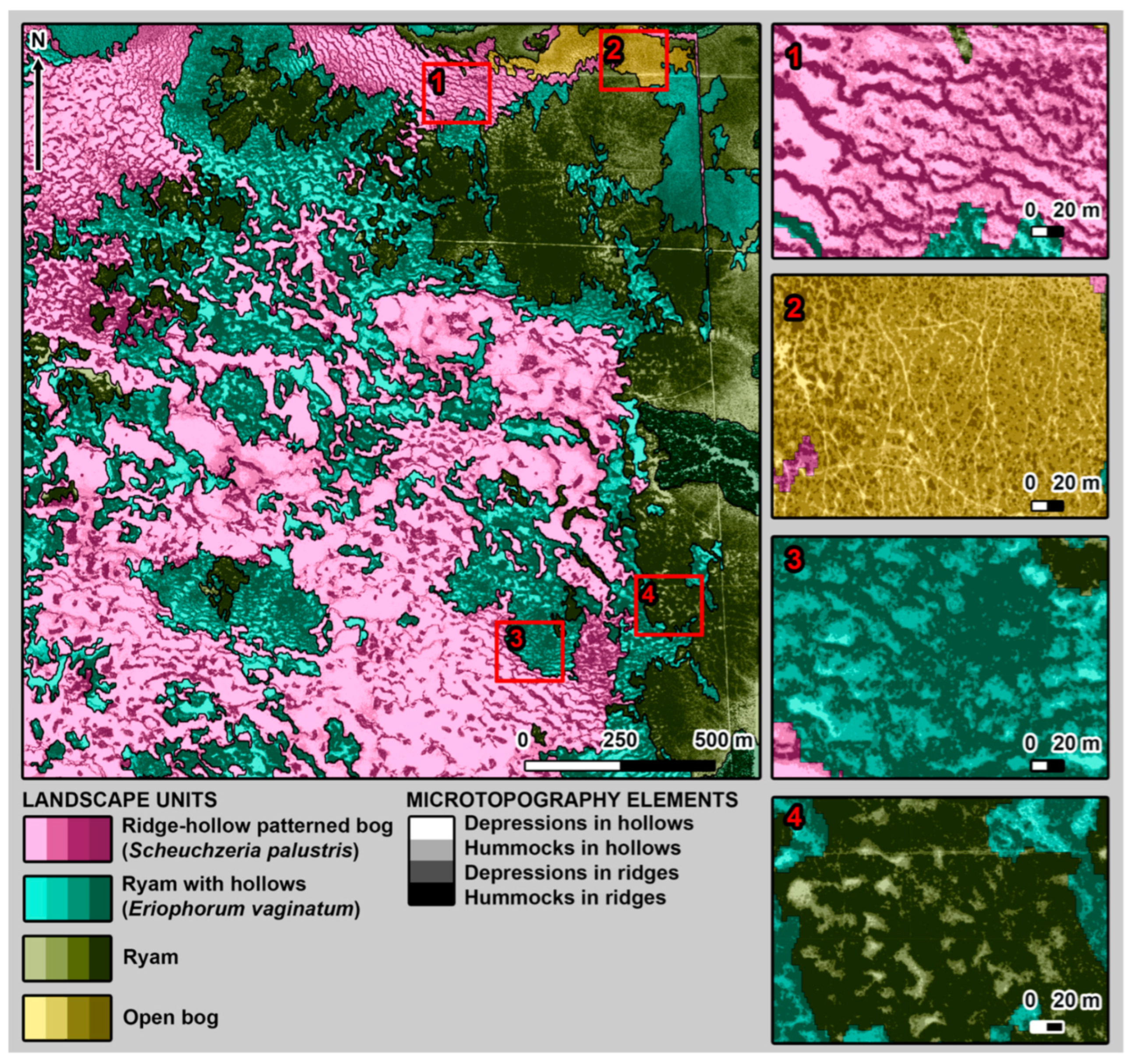
- The resulting microtopography/microform map was integrated with a classified satellite image (Section 2.3.3) to assign each microrelief element to its corresponding bog landscape unit (e.g., ridge–hollow patterned bog, ryam). Finally, the known areas of each microform within each landscape unit, combined with field-measured AGB and BGB values, were used for phytomass upscaling, as described in Section 2.5.
2.3.3. Satellite-Based Microtopography Classification
- (1)
- Microtopography (ridge/hollow) Classification. Ridges and hollows were classified directly from the original image using a supervised Gaussian Maximum Likelihood classifier through Multispec software 2022.08.11 (Purdue University, West Lafayette, USA). Training data consisted of at least three verified polygons per class for the following seven spectral classes: ridges, saturated hollows, unsaturated hollows, Eriophorum hollows, open water, forest, and forest shadow. The reference accuracy for each class exceeded 97% (minimum: forest shadow), and the reliability accuracy was at least 96% (minimum: Eriophorum hollows). The overall classification performance was 99%, with a Kappa statistic of 0.99 (variance = 0.000009). The resulting classes were manually generalized and merged into two final microtopography classes, ridges (R) and hollows (H), which were then vectorized.
- (2)
- Landscape Unit Classification. To identify the broader bog landscape units (vegetation types), the same SuperView-2 image was pre-processed to reduce noise and define meaningful objects. A 3 × 3 pixel median filter was applied eight times in GRASS GIS, followed by image segmentation with a minimum segment size of 15 × 15 pixels (approx. 25 × 25 m). For each segment, the median spectral reflectance per band was calculated, creating “superpixels”. These superpixels were classified into 10 spectral clusters using the ISODATA unsupervised method in Multispec. The clusters were then manually interpreted and generalized into the four target landscape units described in Section 2.1: ridge–hollow patterned bog, ryam with hollows, ryam, and open bog. These units were vectorized in QGIS.
2.3.4. Field-Based Micro-Landscape Coverage Assessment
2.4. Phytomass Field Measurements and Fractionation
- -
- In ryam and open bog units (mosaic structure), 5 sites were placed on hummocks and 3 in depressions;
- -
- In ridge–hollow patterned bog and ryam with hollows units (complex ridge–hollow structure), 8 sites were located on ridges (5 on hummocks, 3 in depressions) and 5 in hollows (3 on hummocks, 2 in depressions).
2.5. Upscaling Procedures and Comparative Framework
2.6. Accuracy Assessment and Statistical Comparison
2.6.1. Accuracy of Microtopography Maps
- -
- UAS-LiDAR: hummocks and depressions within ridges (RH, RD) and hollows (HH, HD);
- -
- Satellite: ridges (R) and hollows (H).
2.6.2. Comparison of Phytomass Upscaling Methods
- (1)
- Plot-Scale Comparison (Calibration Plots). For each of the 12 ground calibration plots (Table 1), the total phytomass stock (tonnes per plot) estimated using the three methods (UAS-LiDAR-based, satellite-based, and field-based) was compared. The pairwise discrepancy for each plot was quantified using two complementary metrics:Absolute discrepancy (Δabs, tonnes) between two methods (X and Y):where X and Y are the compared methods; j is the microtopography or microform element; m and n are number of microtopography or microform elements determined via method X or Y, respectively; and i is the plot number.
- (2)
- Independent Landscape-Scale Statistical Comparison. A separate validation design provided a fully independent, statistical assessment of the two remote sensing approaches across the entire landscape:
- -
- Stratified Random Sampling: We generated 100 circular validation zones, each 98.375 m2 (≈0.01 ha). To ensure representative coverage, 25 zones were randomly allocated within the mapped area of each of the four landscape units.
- -
- Data Extraction and Analysis: For each zone, the total phytomass (tonnes) was extracted from both the UAS-LiDAR-based and satellite-based upscaling raster layers, creating a paired sample (n = 100). As the paired differences were not normally distributed, we used the non-parametric Wilcoxon signed-rank test (Matlab R2023a function: signrank (uas, sat)). The test evaluates the null hypothesis that the median of the paired differences (UAS—satellite) is zero. The sign of the test statistic (stats.signedrank) was used to interpret the direction of the bias: a positive signed-rank sum indicates that the UAS-LiDAR estimates are systematically higher (satellite underestimation), while a negative sum indicates the opposite (satellite overestimation), relative to the UAS-LiDAR benchmark.
3. Results
3.1. Spatial Structure of Microrelief: UAS-LiDAR and Satellite-Based Assessments
3.2. Phytomass Stocks Across the Microtopographic Gradient
3.3. Accuracy of Microtopography Mapping
3.3.1. Error Matrix Assessment
3.3.2. Cross-Comparison of Microtopography Mapping Methods at Test Plots
3.4. Comparison of Phytomass Upscaling Methods
3.4.1. Landscape-Level Totals and Spatial Allocation
3.4.2. Direct Plot-Scale Comparison of Total Phytomass at Test Plots
3.4.3. Independent Statistical Comparison Across the Landscape
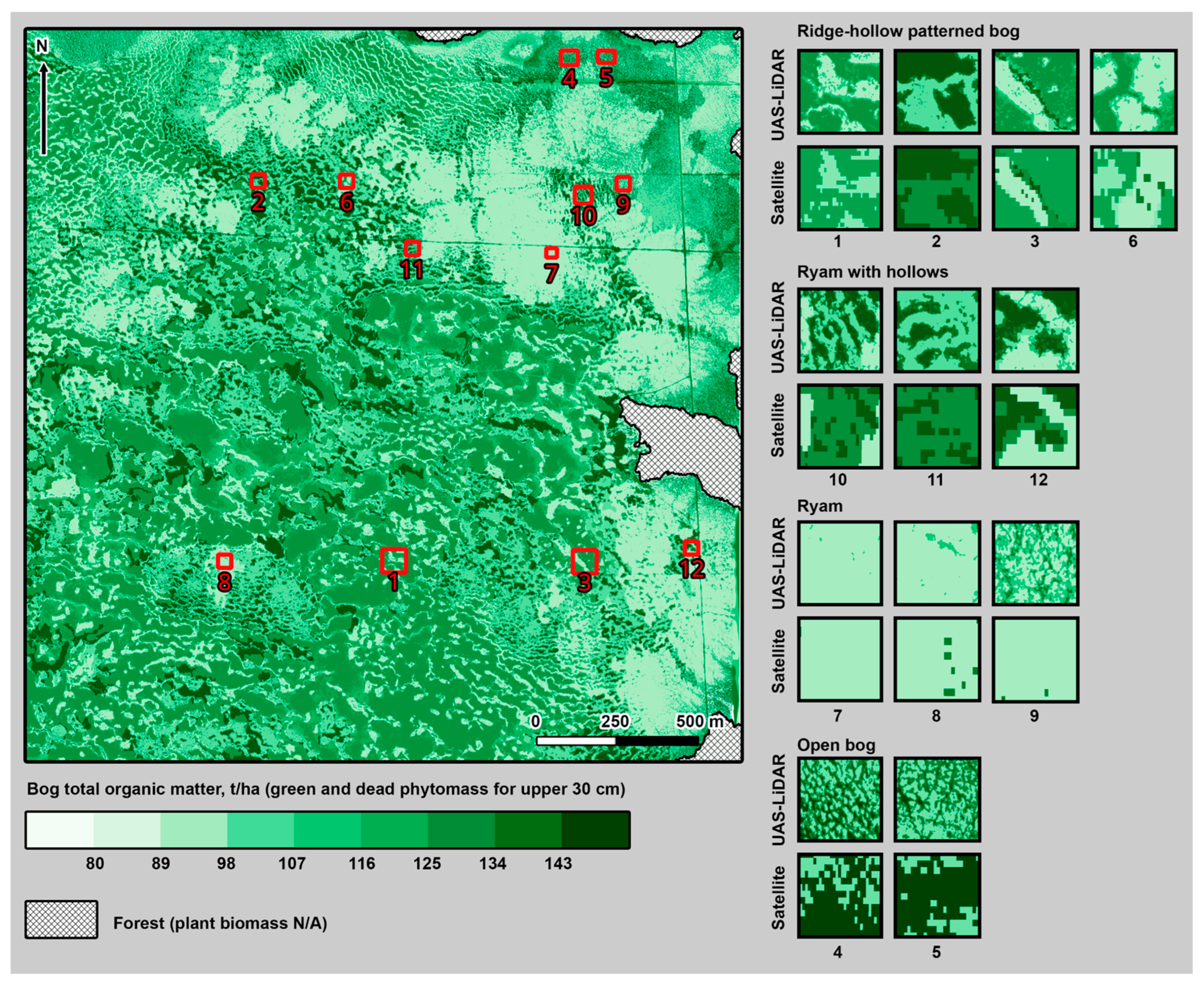
3.4.4. High-Resolution Spatial Upscaling Based on UAS-LiDAR
- (1)
- In areas mapped as ryam (e.g., near plot 9) and open bog (plots 4, 5), the LiDAR-based map reveals a fine-grained mosaic of hummocks and depressions with high contrast in phytomass values. These are the same areas where traditional upscaling methods showed the largest pairwise discrepancies (Table 8).
- (2)
- The map explicitly resolves the spatial distribution and biomass contribution of specific microforms, such as hummocks of Eriophorum vaginatum within hollows (HH), which appear as high-biomass features within waterlogged areas.
4. Discussion
4.1. Methodological Triad: Comparing Incommensurate Models of Microrelief
4.2. The Morphometric–Ecological Divide in Microform Classification
4.3. Validation and Drivers of the Wetness–Accumulation Phytomass Gradient
4.4. Implications for Spatially Explicit Carbon Accounting
- -
- The Illusion of Accuracy. Field and satellite methods can produce deceptively correct total stocks while severely misrepresenting their spatial distribution (Figure 3, Table 8). For process-based models that simulate carbon dynamics as a function of moisture and microtopography, this incorrect allocation is not a minor error—it invalidates the model’s core logic [21,26] by disconnecting carbon pools from their true hydrological drivers.
- -
- Predictable, Uncorrectable Bias. The satellite method’s error is not random noise but a systematic, landscape-dependent bias (Table 9), meaning that regional inventories will inherit a hidden, spatially variable distortion. Its magnitude remains unknown without a high-resolution benchmark, compromising the comparability of carbon stocks across different peatland types—a fundamental requirement for national reporting or carbon credit verification.
- -
- Therefore, for high-stakes applications including carbon project baselining, restoration planning, or model initialization, reliance on methods that cannot resolve the microform template is a critical vulnerability. Objective microrelief mapping, as demonstrated here with UAS-LiDAR, is not merely an improvement but a necessary step to escape this methodological trap and ground peatland carbon accounting in physical reality.
5. Conclusions
Author Contributions
Funding
Data Availability Statement
Acknowledgments
Conflicts of Interest
Abbreviations
| AGB | Aboveground Biomass |
| BGB | Belowground Biomass |
| UAS | Uncrewed Aerial System |
| LiDAR | Light Detection and Ranging |
| DTM | Digital Terrain Model |
| RH | Hummocks within Ridges |
| RD | Depressions within Ridges |
| HH | Hummocks within Hollows |
| HD | Depressions within Hollows |
Appendix A
Appendix A.1

| Dataset | Sensor/Method | Acquisition Date | Spatial Resolution/Coverage | Key Parameters/Purpose |
|---|---|---|---|---|
| UAS-LiDAR | Geoscan 401 UAS with AGM-MS3 LiDAR (AGM Systems, Russia) | 18 June 2023 | Coverage: ~4.84 km2 (2.2 km × 2.2 km) Flight altitude: 150 m AGL Avg. point density: ~100 pts/m2 | Raw 3D point cloud. To generate a high-resolution digital terrain model (DTM) for hierarchical microrelief classification. |
| Satellite Imagery | SuperView-2 (Beijing Space View Tech Co., Ltd.) | 25 August 2022 | Spatial resolution: 1.68 m Spectral bands: RGB, RedEdge Coverage: ~4.84 km2 (2.2 km × 2.2 km) | Multispectral surface reflectance. To classify bog landscape units and estimate microtopography (ridge/hollow) proportions via spectral analysis. |
| Field Data | (a) Phytomass Sampling (b) Microrelief Assessment | July 2023 (peak growing season) | (a) 12 plots (0.1–0.5 ha); 8–13 microsites per plot (b) Visual estimation at the same 12 plots | (a) Destructive sampling of aboveground (AGB) and belowground (BGB) biomass, separated by species/functional fraction. (b) Visual estimation of proportional cover of microtopography (ridges/hollows) and microforms (hummocks/depressions) for validation and the field-based upscaling pathway. |
Appendix A.2
Appendix A.3
| Landscape Unit/Microtopography | Mosses | Grasses and Shrubs | Live Biomass (Total) | Dead Biomass | Total Biomass | Reference |
|---|---|---|---|---|---|---|
| Middle taiga (65 km east from Khanty-Mansiysk) | ||||||
| Ryam | 451 ± 87 | 1923 ± 302 | 8766 ± 832 | 10,689 | [56] | |
| Northern Taiga (62°50′–63°20′ N 75°00′–75°45′ E) | ||||||
| Ridge | 410 ± 38 | 305 | 2064 | 6658 ± 203 | 8722 ± 239 | [57] |
| Hollow | 351 ± 50 | 21 | 769 | 10,973 ± 1950 | 11,742 ± 1889 | |
| Southern taiga (56°30′–57°00′ N 82°30′–83°00′ E) | ||||||
| Ryam | 572 ± 51 | 436 | 2292 | 5506 ± 1050 | 7798 ± 920 | [57] |
| Ridge | 317 ± 70 | 205 | 1474 | 4450 ± 1024 | 5924 ± 1429 | |
| Hollow | 420 ± 25 | 88 | 883 | 2983 ± 87 | 3866 ± 88 | |
| Southern Taiga (Tomsk, Polynyanka) | ||||||
| Tall ryam | 405 ± 632 | 269 ± 390 | [58] | |||
| Low ryam | 456 ± 104 | 1172 ± 415 | ||||
| Sedge–Sphagnum fen | 433 ± 88 | 980 ± 980 | ||||
| Ridge | 294 ± 23 | 878 ± 170 | ||||
| Hollow | 302 ± 18 | 569 ± 76 | ||||
| Southern Taiga (Bakcharsky district, Tomsk region) | ||||||
| Tall ryam | 285 ± 78 | 259 ± 126 | 1313 ± 287 | 4239 ± 710 | 5577 ± 916 | [59] |
| Low ryam | 370 ± 88 | 265 ± 99 | 1220 ± 362 | 4059 ± 606 | 5279 ± 692 | |
| Sedge–Sphagnum fen | 369 ± 75 | 110 ± 37 | 1035 ± 157 | 2692 ± 527 | 3727 ± 584 | |
| Middle taiga (Khanty-Mansiysk)/Kukushkino bog | ||||||
| Ryam | 450 | 2255.6 | 8766 | 11,022 | [60] | |
| Ridge | 353 | 1861 | 8664 | 10,525 | ||
| Hollow | 587 | 1608 | 8238 | 9847 | ||
| Middle taiga (Khanty-Mansiysk)/Oligotrophic bog “Chistoe” | ||||||
| Ridge | 310 | 1547 | 4131 | 5678 | [60] | |
| Hollow | 583 | 1388 | 4944 | 6332 | ||
| Ryam | 436 | 1529 | 6767 | 8296 | ||
| Middle taiga (Nizhnevartovsk)/Oligotrophic bog “Savkino” | ||||||
| Ridge | 387 ± 21 | 1442 | 10,687 | 12,129 | [15] | |
| Hollow | 528 ± 50 | 1239 | 8810 | 10,049 | ||
| Ryam | 425 ± 23 | 1557 | 8359 | 9916 | ||
| Northern taiga (Noyabrsk)/Oligotrophic bog | ||||||
| Ridge | 341 ± 31 | 267 ± 25 | 1830 ± 22 | [15] | ||
References
- UNEP. Global Peatlands Assessment—The State of the World’s Peatlands: Evidence for Action Toward the Conservation, Restoration, and Sustainable Management of Peatlands; United Nations Environment Programme: Nairobi, Kenya, 2022. [Google Scholar]
- Gorham, E. Northern Peatlands: Role in the Carbon Cycle and Probable Responses to Climatic Warming. Ecol. Appl. 1991, 1, 182–195. [Google Scholar] [CrossRef]
- Clymo, R.S.; Turunen, J.; Tolonen, K. Carbon Accumulation in Peatland. Oikos 1998, 81, 368–388. [Google Scholar] [CrossRef]
- Yu, Z.; Loisel, J.; Brosseau, D.P.; Beilman, D.W.; Hunt, S.J. Global Peatland Dynamics Since the Last Glacial Maximum. Geophys. Res. Lett. 2010, 37, L13401. [Google Scholar] [CrossRef]
- Moore, T.R.; Roulet, N.T.; Waddington, J.M. Uncertainty in Predicting the Effect of Climatic Change on the Carbon Cycling of Canadian Peatlands. Clim. Change 1998, 40, 229–245. [Google Scholar] [CrossRef]
- Lal, R. Sequestration of Atmospheric CO2 in Global Carbon Pools. Energy Environ. Sci. 2008, 1, 86–100. [Google Scholar] [CrossRef]
- Harenda, K.M.; Lamentowicz, M.; Samson, M.; Chojnicki, B.H. The Role of Peatlands and Their Carbon Storage Function in the Context of Climate Change. In Interdisciplinary Approaches for Sustainable Development Goals; Springer: Cham, Switzerland, 2017; pp. 169–187. [Google Scholar] [CrossRef]
- IPCC. Climate Change 2022: Impacts, Adaptation and Vulnerability. Contribution of Working Group II to the Sixth Assessment Report of the Intergovernmental Panel on Climate Change; Cambridge University Press: Cambridge, UK, 2022. [Google Scholar] [CrossRef]
- Decree of the President of the Russian Federation Dated 4 November 2020 No. 666 “On Reducing Greenhouse Gas Emissions”. Available online: http://www.kremlin.ru/acts/bank/45990 (accessed on 13 August 2024).
- Tanneberger, F.; Schröder, C.; Hohlbein, M.; Lenschow, U.; Permien, T.; Wichmann, S.; Wichtmann, W. Climate Change Mitigation through Land Use on Rewetted Peatlands–Cross-Sectoral Spatial Planning for Paludiculture in Northeast Germany. Wetlands 2020, 40, 2309–2320. [Google Scholar] [CrossRef]
- Kurganova, I.N.; Karelin, D.V.; Kotlyakov, V.M.; Prokushkin, A.S.; Zamolodchikov, D.G.; Ivanov, A.V.; Ilyasov, D.V.; Khoroshaev, D.A.; de Gerenyu, V.O.L.; Bobrik, A.A.; et al. A Pilot National Network for Monitoring Soil Respiration in Russia: First Results and Prospects of Development. Dokl. Earth Sci. 2024, 519, 1947–1954. [Google Scholar] [CrossRef]
- Stitt, M. Rising CO2 Levels and Their Potential Significance for Carbon Flow in Photosynthetic Cells. Plant Cell Environ. 1991, 14, 741–762. [Google Scholar] [CrossRef]
- Leakey, A.D.B.; Ainsworth, E.A.; Bernacchi, C.J.; Rogers, A.; Long, S.P.; Ort, D.R. Elevated CO2 Effects on Plant Carbon, Nitrogen, and Water Relations: Six Important Lessons from FACE. J. Exp. Bot. 2009, 60, 2859–2876. [Google Scholar] [CrossRef]
- Glatzel, S.; Worrall, F.; Boothroyd, I.M.; Moody, C.S.; Clay, G.D. Comparison of the Transformation of Organic Matter Flux Through a Raised Bog and a Blanket Bog. Biogeochemistry 2024, 167, 443–459. [Google Scholar] [CrossRef]
- Kosykh, N.P.; Koronatova, N.G.; Naumova, N.B.; Titlyanova, A.A. Above- and Below-Ground Phytomass and Net Primary Production in Boreal Mire Ecosystems of Western Siberia. Wetl. Ecol. Manag. 2008, 16, 139–153. [Google Scholar] [CrossRef]
- Laine, A.M.; Bubier, J.; Riutta, T.; Nilsson, M.B.; Moore, T.R.; Vasander, H.; Tuittila, E.S. Abundance and Composition of Plant Biomass as Potential Controls for Mire Net Ecosystem CO2 Exchange. Botany 2012, 90, 63–74. [Google Scholar] [CrossRef]
- Moore, T.R.; Bubier, J.L.; Frolking, S.E.; Lafleur, P.M.; Roulet, N.T. Plant Biomass and Production and CO2 Exchange in an Ombrotrophic Bog. J. Ecol. 2002, 90, 25–36. [Google Scholar] [CrossRef]
- Nungesser, M.K. Modelling Microtopography in Boreal Peatlands: Hummocks and Hollows. Ecol. Model. 2003, 165, 175–207. [Google Scholar] [CrossRef]
- Peregon, A.; Kosykh, N.P.; Mironycheva-Tokareva, N.P.; Ciais, P.; Yamagata, Y. Estimation of Biomass and Net Primary Production (NPP) in West Siberian Boreal Ecosystems: In Situ and Remote Sensing Methods. In Novel Methods for Monitoring and Managing Land and Water Resources in Siberia; Springer: Cham, Switzerland, 2015; pp. 233–252. [Google Scholar] [CrossRef]
- Wang, M.; Wang, S.; Cao, Y.; Jiang, M.; Wang, G.; Dong, Y. The Effects of Hummock-Hollow Microtopography on Soil Organic Carbon Stocks and Soil Labile Organic Carbon Fractions in a Sedge Peatland in Changbai Mountain, China. Catena 2021, 201, 105204. [Google Scholar] [CrossRef]
- Belyea, L.R.; Clymo, R.S. Feedback Control of the Rate of Peat Formation. Proc. R. Soc. Lond. B 2001, 268, 1315–1321. [Google Scholar] [CrossRef]
- Eppinga, M.B.; Rietkerk, M.; Borren, W.; Lapshina, E.D.; Bleuten, W.; Wassen, M.J. Regular Surface Patterning of Peatlands: Confronting Theory with Field Data. Ecosystems 2008, 11, 520–536. [Google Scholar] [CrossRef]
- Lindsay, R. Peatland Classification. In The Wetland Book; Springer: Dordrecht, The Netherlands, 2018; pp. 1515–1528. [Google Scholar] [CrossRef]
- Kosykh, N.P.; Koronatova, N.G.; Mironycheva-Tokareva, N.P.; Vishnyakova, E.K.; Ivchenko, T.G.; Kurbatskaya, S.S.; Peregon, A.M. The Bogs in a Forest–Steppe Region of Western Siberia: Plant Biomass and Net Primary Production (NPP). Water 2023, 15, 3526. [Google Scholar] [CrossRef]
- Graham, J.D.; Glenn, N.F.; Spaete, L.P.; Hanson, P.J. Characterizing Peatland Microtopography Using Gradient and Microform-Based Approaches. Ecosystems 2020, 23, 1464–1480. [Google Scholar] [CrossRef]
- Graham, J.D.; Ricciuto, D.M.; Glenn, N.F.; Hanson, P.J. Incorporating Microtopography in a Land Surface Model and Quantifying the Effect on the Carbon Cycle. J. Adv. Model. Earth Syst. 2022, 14, e2021MS002721. [Google Scholar] [CrossRef]
- Strack, M.; Waddington, J.M.; Rochefort, L.; Tuittila, E.S. Response of Vegetation and Net Ecosystem Carbon Dioxide Exchange at Different Peatland Microforms Following Water Table Drawdown. J. Geophys. Res. Biogeosci. 2006, 111, G02006. [Google Scholar] [CrossRef]
- Murphy, M.T.; McKinley, A.; Moore, T.R. Variations in Above- and Below-Ground Vascular Plant Biomass and Water Table on a Temperate Ombrotrophic Peatland. Botany 2009, 87, 845–853. [Google Scholar] [CrossRef]
- Lehmann, J.R.K.; Münchberger, W.; Knoth, C.; Blodau, C.; Nieberding, F.; Prinz, T.; Pancotto, V.; Kleinebecker, T. High-Resolution Classification of South Patagonian Peat Bog Microforms Reveals Potential Gaps in Up-Scaled CH4 Fluxes by Use of Unmanned Aerial System (UAS) and CIR Imagery. Remote Sens. 2016, 8, 173. [Google Scholar] [CrossRef]
- Abdelmajeed, A.Y.A.; Juszczak, R. Challenges and Limitations of Remote Sensing Applications in Northern Peatlands: Present and Future Prospects. Remote Sens. 2024, 16, 591. [Google Scholar] [CrossRef]
- Baxendale, C.L.; Ostle, N.J.; Wood, C.M.; Oakley, S.; Ward, S.E. Can Digital Image Classification Be Used as a Standardised Method for Surveying Peatland Vegetation Cover? Ecol. Indic. 2016, 68, 150–156. [Google Scholar] [CrossRef]
- Räsänen, A.; Juutinen, S.; Kalacska, M.; Aurela, M.; Heikkinen, P.; Mäenpää, K.; Virtanen, T. Peatland Leaf-Area Index and Biomass Estimation with Ultra-High Resolution Remote Sensing. GISci. Remote Sens. 2020, 57, 943–964. [Google Scholar] [CrossRef]
- Millard, K.; Richardson, M. On the Importance of Training Data Sample Selection in Random Forest Image Classification: A Case Study in Peatland Ecosystem Mapping. Remote Sens. 2015, 7, 8489–8515. [Google Scholar] [CrossRef]
- Singh, K.K.; Frazier, A.E. A Meta-Analysis and Review of Unmanned Aircraft System (UAS) Imagery for Terrestrial Applications. Int. J. Remote Sens. 2018, 39, 5078–5098. [Google Scholar] [CrossRef]
- Korpela, I.; Haapanen, R.; Korrensalo, A.; Tuittila, E.S.; Vesala, T. Fine-Resolution Mapping of Microforms of a Boreal Bog Using Aerial Images and Waveform-Recording LiDAR. Mires Peat 2020, 26, 03. [Google Scholar] [CrossRef]
- Morgan, G.R.; Hodgson, M.E.; Wang, C.; Schill, S.R. Unmanned Aerial Remote Sensing of Coastal Vegetation: A Review. Ann. GIS 2022, 28, 385–399. [Google Scholar] [CrossRef]
- Watts, A.C.; Ambrosia, V.G.; Hinkley, E.A. Unmanned Aircraft Systems in Remote Sensing and Scientific Research: Classification and Considerations of Use. Remote Sens. 2012, 4, 1671–1692. [Google Scholar] [CrossRef]
- Whitehead, K.; Hugenholtz, C.H. Remote Sensing of the Environment with Small Unmanned Aircraft Systems (UASs), Part 1: A Review of Progress and Challenges. J. Unmanned Veh. Syst. 2014, 2, 69–85. [Google Scholar] [CrossRef]
- Hugenholtz, C.H.; Whitehead, K.; Brown, O.W.; Barchyn, T.E.; Moorman, B.J.; LeClair, A.; Riddell, K.; Hamilton, T. Geomorphological Mapping with a Small Unmanned Aircraft System (sUAS): Feature Detection and Accuracy Assessment of a Photogrammetrically-Derived Digital Terrain Model. Geomorphology 2013, 194, 16–24. [Google Scholar] [CrossRef]
- Fraser, B.T.; Congalton, R.G. Issues in Unmanned Aerial Systems (UAS) Data Collection of Complex Forest Environments. Remote Sens. 2018, 10, 908. [Google Scholar] [CrossRef]
- Banerjee, B.P.; Raval, S.; Cullen, P.J.; Singh, S.K. Mapping of Complex Vegetation Communities and Species Using UAV-LiDAR Metrics and High-Resolution Optical Data. In Proceedings of the IGARSS 2019—2019 IEEE International Geoscience and Remote Sensing Symposium, Yokohama, Japan, 28 July–2 August 2019; pp. 6110–6113. [Google Scholar] [CrossRef]
- Marcisz, M.; Morga, R.; Remiorz, E.; Krasoń, T.; Michalik, B.; Nalepka, P.; Kacprzak, M.; Szecówka, G. Use of Unmanned Aerial Vehicles for Water Sampling in Hard-to-Reach Water Reservoirs. Zesz. Nauk. Politech. Śląskiej Transp. 2022, 116, 211–221. [Google Scholar] [CrossRef]
- Klemas, V.V. Remote Sensing of Coastal Wetland Biomass: An Overview. J. Coast. Res. 2013, 29, 1016–1028. [Google Scholar] [CrossRef]
- Woodget, A.S.; Fyffe, C.; Carbonneau, P.E. From Manned to Unmanned Aircraft: Adapting Airborne Particle Size Mapping Methodologies to the Characteristics of sUAS and SfM. Earth Surf. Process. Landf. 2018, 43, 857–870. [Google Scholar] [CrossRef]
- Pricope, N.G.; Minei, A.; Halls, J.N.; Chen, C.; Wang, Y. UAS Hyperspatial LiDAR Data Performance in Delineation and Classification across a Gradient of Wetland Types. Drones 2022, 6, 268. [Google Scholar] [CrossRef]
- Shukla, T.; Tang, W.; Trettin, C.C.; Chen, G.; Chen, S.; Allan, C. Quantification of Microtopography in Natural Ecosystems Using Close-Range Remote Sensing. Remote Sens. 2023, 15, 2387. [Google Scholar] [CrossRef]
- Kupriianova, I.; Kaverin, A.; Filippov, I.; Ilyasov, D.; Lapshina, E.; Logunova, E.; Kulyabin, M. The Main Physical and Geographical Characteristics of the Mukhrino Field Station Area and Its Surroundings. Environ. Dyn. Glob. Clim. Change 2023, 13, 215–252. [Google Scholar] [CrossRef]
- Gvozdetskii, N.A.; Krivolutskii, A.E.; Makunina, A.A. Fiziko-Geograficheskoe Rajonirovanie Tyumenskoj Oblasti (Physical and Geographical Zoning of the Tyumen Region); Moscow State University Publishing House: Moscow, Russia, 1973; pp. 9–28. (In Russian) [Google Scholar]
- Cherepanov, S.K. Sosudistye Rasteniya Rossii i Sopredel’nykh Gosudarstv (Vascular Plants of Russia and Adjacent States); Mir i Sem’ya: Saint Petersburg, Russia, 1995. (In Russian) [Google Scholar]
- Ignatov, M.S.; Afonina, O.M.; Ignatova, E.A. Checklist of Mosses of East Europe and North Asia; KMK Scientific Press: Moscow, Russia, 2006. [Google Scholar]
- Zemtsov, A.A. (Ed.) Bolota Zapadnoj Sibiri—Ikh Rol’ v Biosfere (Mires of Western Siberia—Their Role in the Biosphere); Tomsk State University Press: Tomsk, Russia, 1998; 72p. (In Russian) [Google Scholar]
- Liss, O.L.; Abramova, L.I.; Avetov, N.A.; Berezina, N.A.; Inisheva, L.I.; Kurnishkova, T.V.; Sluka, Z.A.; Tolpysheva, T.Y.; Shvedchikova, N.K. Bolotnye Sistemy Zapadnoj Sibiri i Ikh Prirodookhrannoe Znachenie (Mire Systems of Western Siberia and Their Nature Conservation Significance); Grif i K: Tula, Russia, 2001. (In Russian) [Google Scholar]
- Allen, S.E.; Grimshaw, H.M.; Parkinson, J.A.; Quarmby, C. Chemical Analysis of Ecological Materials; Blackwell Scientific Publications: Oxford, UK, 1974; 565p. [Google Scholar]
- Clymo, R.S. The Limits to Peat Bog Growth. Philos. Trans. R. Soc. Lond. B 1984, 303, 605–654. [Google Scholar] [CrossRef]
- Rydin, H.; Jeglum, J.K. The Biology of Peatlands, 2nd ed.; Oxford University Press: Oxford, UK, 2013. [Google Scholar]
- Peregon, A.M.; Kosykh, N.P.; Mironycheva-Tokareva, N.P.; Vishnyakova, E.K.; Koronatova, N.G.; Stepanova, V.A.; Kurbatskaya, S.S. Production and Destruction of Plant Organic Matter in Bog Ecosystems in the South of Western Siberia. Ecol. Divers. 2024, 1, 10004. [Google Scholar] [CrossRef]
- Peregon, A.; Kosykh, N.P.; Mironycheva-Tokareva, N.P.; Ciais, P.; Yamagata, Y. Map-Based Inventory of Wetland Biomass and Net Primary Production in Western Siberia. J. Geophys. Res. Biogeosci. 2008, 113, G01007. [Google Scholar] [CrossRef]
- Golovatskaya, E.A.; Dyukarev, E.A.; Veretennikova, E.E.; Nikonova, L.G.; Smirnov, S.V. Otsenka Dinamiki Balansa Ugleroda v Bolotakh Yuzhnoy Taezhnoy Podzony Zapadnoy Sibiri (Tomskaya Oblast’) [Assessment of Carbon Balance Dynamics in Mires of the Southern Taiga Subzone of Western Siberia (Tomsk Region)]. Pochvy Okruz. Sreda 2022, 5, e194. (In Russian) [Google Scholar] [CrossRef]
- Golovatskaya, E.A. Biologicheskaya Produktivnost’ Oligotrofnykh i Evtrofnykh Bolot Yuzhnoy Taezhnoy Podzony Zapadnoy Sibiri [Biological Productivity of Oligotrophic and Eutrophic Mires in the Southern Taiga Subzone of Western Siberia]. Zh. Sib. Fed. Univ. Biol. 2009, 2, 38–53. (In Russian) [Google Scholar]
- Kosykh, N.P.; Mironycheva-Tokareva, N.P.; Parshina, E.K. Biudzhet Khimicheskikh Elementov v Bolotnykh Ekosistemakh Sredney Taygi Zapadnoy Sibiri [Budget chemical elements in bog ecosystems middle taiga western Siberia]. Dyn. Okruz. Sredy Glob. Izmen. Klim. 2010, 1, 85–95. (In Russian) [Google Scholar] [CrossRef][Green Version]

| Landscape Unit | N | E | Test Plot | Area, ha | Ridges/Hollows | Hummocks/Depressions | |
|---|---|---|---|---|---|---|---|
| For Ridges | For Hollows | ||||||
| Ridge–hollow patterned bog (Scheuchzeria palustris) | 60.89695 | 68.66849 | 1 | 0.50 | 30/70 | 60/40 | 5/95 |
| 60.89695 | 68.67339 | 2 | 0.16 | 30/70 | 65/35 | 0/100 | |
| 60.89661 | 68.68649 | 3 | 0.50 | 40/60 | 70/30 | 10/90 | |
| 60.90034 | 68.68773 | 6 | 0.16 | 40/60 | 65/35 | 5/95 | |
| Ryam with hollows (Eriophorum vaginatum) | 60.88673 | 68.67612 | 10 | 0.25 | 70/30 | 55/45 | 10/90 |
| 60.88673 | 68.68667 | 11 | 0.16 | 60/40 | 65/35 | 50/50 | |
| 60.88712 | 68.69258 | 12 | 0.16 | 80/20 | 70/30 | 50/50 | |
| Ryam | 60.89515 | 68.67705 | 7 | 0.10 | 100/0 | 70/30 | 0/0 |
| 60.89505 | 68.68475 | 8 | 0.10 | 100/0 | 70/30 | 0/0 | |
| 60.88670 | 68.66674 | 9 | 0.16 | 100/0 | 50/50 | 0/0 | |
| Open bog | 60.89692 | 68.68870 | 4 | 0.25 | 100/0 | 65/35 | 0/0 |
| 60.90031 | 68.68568 | 5 | 0.25 | 100/0 | 60/40 | 0/0 | |
| Microtopography/Microform | Ridge–Hollow Patterned Bog (Scheuchzeria palustris) | Ryam with Hollows (Eriophorum vaginatum) | Ryam 1 | Open Bog 1 |
|---|---|---|---|---|
| area, ha/% of total | ||||
| Total | 205 | 147 | 107 | 6 |
| Ridges | 71/34 | 113/77 | 98/92 | 5/86 |
| Hollows | 134/66 | 34/23 | 9/8 | 1/14 |
| Hummocks in ridges | 44/21 | 84/57 | 81/76 | 2/40 |
| Depressions in ridges | 27/13 | 29/20 | 16/15 | 3/46 |
| Hummocks in hollows | 32/16 | 12/8 | 3/3 | <1/8 |
| Depressions in hollows | 103/50 | 22/15 | 6/5 | <1/6 |
| % of ridges | ||||
| Hummocks/Depressions | 62/38 | 74/26 | 83/17 | 46/54 |
| % of hollows | ||||
| Hummocks/Depressions | 24/76 | 36/64 | 35/65 | 59/41 |
| Microtopography/Microform | Ridge–Hollow Patterned Bog (Scheuchzeria palustris) | Ryam with Hollows (Eriophorum vaginatum) | Ryam | Open Bog |
|---|---|---|---|---|
| Area, ha/% of Total | ||||
| Total | 205 | 147 | 107 | 6 |
| Ridges | 57/28 | 105/71 | 97/91 | 4/64 |
| Hollows | 148/72 | 42/29 | 9/9 | 2/36 |
| Microtopography/Microform | Ridge–Hollow Patterned Bog (Scheuchzeria palustris) | Ryam with Hollows (Eriophorum vaginatum) | Ryam 1 | Open Bog 1 |
|---|---|---|---|---|
| Total organic matter, tonnes per ha ± σ | ||||
| Hummocks in ridges (RH) | 80 ± 7 | 89 ± 2 | 80 ± 14 | 87 ± 22 |
| Depressions in ridges (RD) | 90 ± 20 | 112 ± 7 | 90 ± 14 | 106 ± 22 |
| Hummocks in hollows (HH) | 91 ± 20 | 128 ± 23 | 100 ± 14 | 124 ± 22 |
| Depressions in hollows (HD) | 97 ± 24 | 131 ± 18 | 110 ± 15 | 143 ± 22 |
| Moss dead phytomass, tonnes per ha ± σ | ||||
| Hummocks in ridges (RH) | 58 ± 1 | 61 ± 1 | 59 ± 1 | 71 ± 2 |
| Depressions in ridges (RD) | 75 ± 2 | 85 ± 1 | 70 ± 1 | 87 ± 2 |
| Hummocks in hollows (HH) | 74 ± 2 | 103 ± 2 | 80 ± 1 | 103 ± 2 |
| Depressions in hollows (HD) | 82 ± 2 | 111 ± 2 | 90 ± 2 | 120 ± 3 |
| Moss green phytomass, tonnes per ha ± σ | ||||
| Hummocks in ridges (RH) | 14 ± 1 | 19 ± 1 | 13 ± 1 | 7 ± 1 |
| Depressions in ridges (RD) | 10 ± 1 | 20 ± 1 | 14 ± 1 | 11 ± 1 |
| Hummocks in hollows (HH) | 12 ± 1 | 16 ± 1 | 15 ± 1 | 14 ± 1 |
| Depressions in hollows (HD) | 12 ± 1 | 16 ± 1 | 16 ± 1 | 18 ± 1 |
| Vascular plants phytomass 2, tonnes per ha ± σ | ||||
| Hummocks in ridges (RH) | 8 ± 5 | 9 ± 2 | 7 ± 5 | 10 ± 5 |
| Depressions in ridges (RD) | 4 ± 3 | 7 ± 2 | 7 ± 5 | 8 ± 5 |
| Hummocks in hollows (HH) | 4 ± 3 | 9 ± 2 | 5 ± 5 | 7 ± 4 |
| Depressions in hollows (HD) | 4 ± 2 | 4 ± 3 | 4 ± 3 | 5 ± 4 |
| Vascular plants mortmass, tonnes per ha ± σ | ||||
| Hummocks in ridges (RH) | 0.5 ± 0.3 | 0.4 ± 0.3 | 0.4 ± 0.4 | 0.8 ± 0.7 |
| Depressions in ridges (RD) | 0.4 ± 0.4 | 0.4 ± 0.4 | 0.4 ± 0.3 | 0.6 ± 0.5 |
| Hummocks in hollows (HH) | 0.3 ± 0.3 | 0.5 ± 0.2 | 0.3 ± 0.3 | 0.5 ± 0.5 |
| Depressions in hollows (HD) | <0.1 ± 0.1 | 0.2 ± 0.2 | 0.2 ± 0.1 | 0.3 ± 0.3 |
| Reference Data | Map Data | N | PA, % | |||
|---|---|---|---|---|---|---|
| RH | RD | HH | HD | |||
| Hummocks in ridges (RH) | 86 | 17 | 0 | 1 | 104 | 83 |
| Depressions in ridges (RD) | 14 | 70 | 8 | 0 | 92 | 76 |
| Hummocks in hollows (HH) | 0 | 13 | 75 | 14 | 102 | 74 |
| Depressions in hollows (HD) | 0 | 0 | 17 | 85 | 102 | 83 |
| N | 100 | 100 | 100 | 100 | 400 | |
| UA, % | 86 | 70 | 75 | 85 | ||
| Reference Data | Map Data | N | PA, % | |
|---|---|---|---|---|
| R | H | |||
| Ridges (R) | 155 | 49 | 204 | 76 |
| Hollows (H) | 45 | 151 | 196 | 77 |
| N | 200 | 200 | 400 | |
| UA, % | 78 | 76 | ||
| UAS–Ground | Sat.–Ground | UAS–Sat. | ||||||||
| R | H | RH | RD | HH | HD | R | H | R | H | |
| R2 | 0.7 | 0.7 | 0.5 | 0.5 | <0.1 | 0.7 | 0.2 | 0.2 | 0.5 | 0.5 |
| 0.5 1 | 0.8 2 | 0.8 2 | 0.9 2 | 0.9 2 | ||||||
| Landscape Unit | Test Plot | Total Phytomass (Tonnes) | Δrel, %/Δabs, Tonnes | ||||
|---|---|---|---|---|---|---|---|
| UAS | Satellite | Ground | UAS–Sat. | UAS–Ground | Sat.–Ground | ||
| Ridge–hollow patterned bog (Scheuchzeria palustris) | 1 | 46.1 | 46.1 | 46.9 | 0.2/0.1 | 1.7/0.8 | 1.9/0.9 |
| 2 | 18.1 | 18.8 | 15.2 | 4.2/0.8 | 17.0/2.8 | 21.2/3.6 | |
| 3 | 47.0 | 46.9 | 45.9 | 0.2/0.1 | 2.3/1.1 | 2.0/0.9 | |
| 6 | 14.1 | 14.1 | 14.8 | 0.1/<0.1 | 5.0/0.7 | 5.0/0.7 | |
| Ryam with hollows (Eriophorum vaginatum) | 10 | 25.4 | 25.2 | 27.3 | 1.0/0.2 | 7.2/1.9 | 8.2/2.1 |
| 11 | 15.9 | 17.0 | 17.6 | 7.0/1.2 | 10.3/1.7 | 3.3/0.6 | |
| 12 | 16.3 | 16.2 | 16.6 | 0.7/0.1 | 1.7/0.3 | 2.4/0.4 | |
| Ryam | 7 | 7.3 | 7.3 | 7.6 | 0.1/<0.1 | 3.6/0.3 | 3.5/0.3 |
| 8 | 12.9 | 13.0 | 13.2 | 1.0/0.1 | 2.7/0.4 | 1.7/0.2 | |
| 9 | 14.2 | 13.0 | 13.7 | 8.9/1.2 | 3.0/0.4 | 5.8/0.8 | |
| Open bog | 4 | 23.4 | 27.9 | 20.9 | 17.9/4.6 | 10.9/2.4 | 28.6/7.0 |
| 5 | 18.9 | 24.5 | 17.9 | 25.8/5.6 | 5.5/1.0 | 31.1/6.6 | |
| Mean | 5.6/1.2 | 5.9/1.1 | 9.6/2.0 | ||||
| Landscape Unit | p-Value | Significant (α = 0.05) | z-Value | Interpretation (Satellite Relative to UAS-LiDAR) |
|---|---|---|---|---|
| Ridge–hollow patterned bog | 0.83 | − | −0.2 | No significant bias |
| Ryam with hollows | 0.01 | + | −2.8 | Significant overestimation |
| Ryam | 0.01 | + | 2.7 | Significant underestimation |
| Open bog | 0.16 | − | −1.4 | No significant bias |
Disclaimer/Publisher’s Note: The statements, opinions and data contained in all publications are solely those of the individual author(s) and contributor(s) and not of MDPI and/or the editor(s). MDPI and/or the editor(s) disclaim responsibility for any injury to people or property resulting from any ideas, methods, instructions or products referred to in the content. |
© 2026 by the authors. Licensee MDPI, Basel, Switzerland. This article is an open access article distributed under the terms and conditions of the Creative Commons Attribution (CC BY) license.
Share and Cite
Ilyasov, D.V.; Niyazova, A.V.; Kupriianova, I.V.; Sabrekov, A.F.; Kaverin, A.A.; Kulyabin, M.F.; Glagolev, M.V. UAS-LiDAR Mapping of Bog Microrelief Enhances Accuracy of Ground-Layer Phytomass Estimation. Drones 2026, 10, 121. https://doi.org/10.3390/drones10020121
Ilyasov DV, Niyazova AV, Kupriianova IV, Sabrekov AF, Kaverin AA, Kulyabin MF, Glagolev MV. UAS-LiDAR Mapping of Bog Microrelief Enhances Accuracy of Ground-Layer Phytomass Estimation. Drones. 2026; 10(2):121. https://doi.org/10.3390/drones10020121
Chicago/Turabian StyleIlyasov, Danil V., Anastasia V. Niyazova, Iuliia V. Kupriianova, Aleksandr F. Sabrekov, Alexandr A. Kaverin, Mikhail F. Kulyabin, and Mikhail V. Glagolev. 2026. "UAS-LiDAR Mapping of Bog Microrelief Enhances Accuracy of Ground-Layer Phytomass Estimation" Drones 10, no. 2: 121. https://doi.org/10.3390/drones10020121
APA StyleIlyasov, D. V., Niyazova, A. V., Kupriianova, I. V., Sabrekov, A. F., Kaverin, A. A., Kulyabin, M. F., & Glagolev, M. V. (2026). UAS-LiDAR Mapping of Bog Microrelief Enhances Accuracy of Ground-Layer Phytomass Estimation. Drones, 10(2), 121. https://doi.org/10.3390/drones10020121