

Hungarian Drone-Based Wind Measurements During the WMO UAS Demonstration Campaign—A Low-Level Jet Case Study

 , , , ,
Highlights
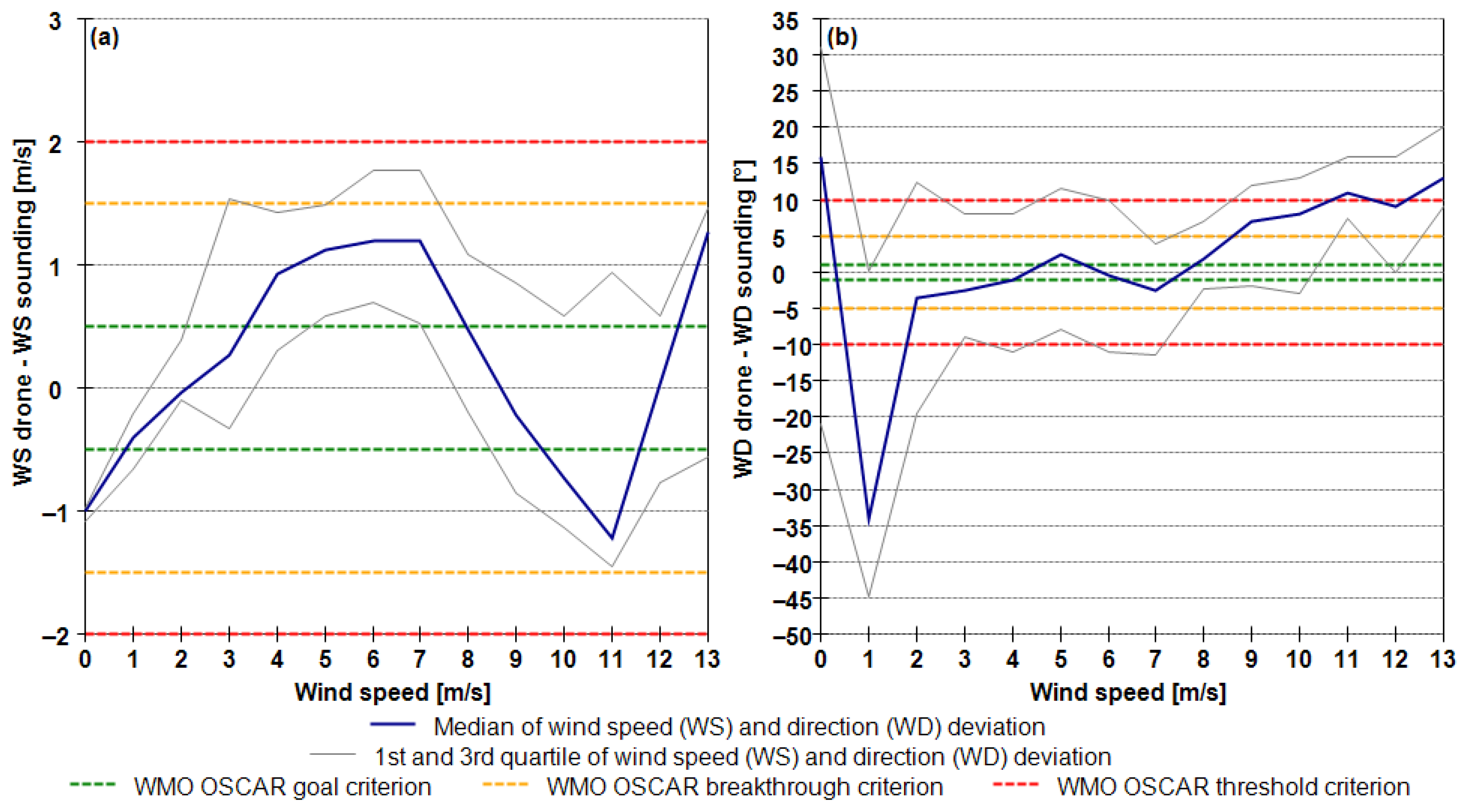
- A purpose-built meteorological UAV can derive vertical wind profiles from orientation data with accuracy meeting WMO OSCAR operational thresholds when evaluated against radiosonde measurements.
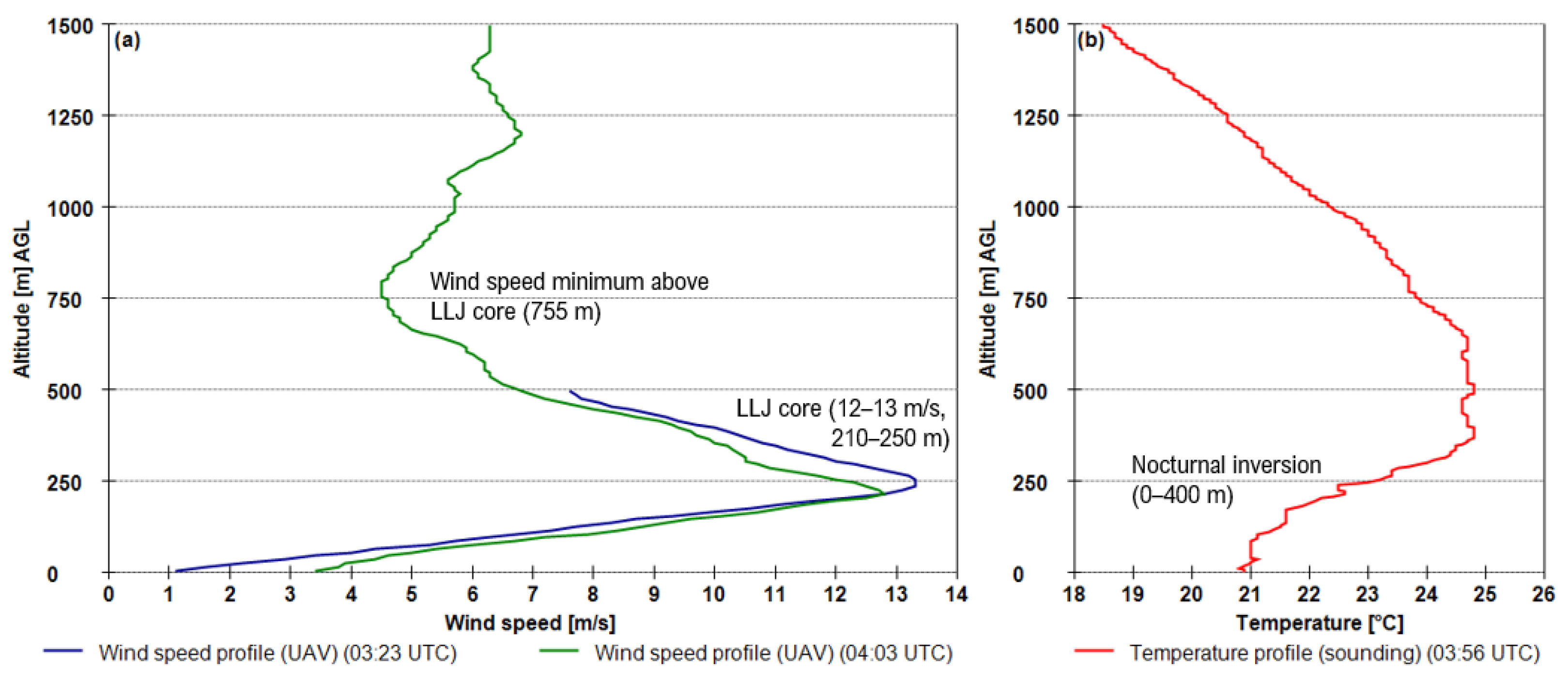
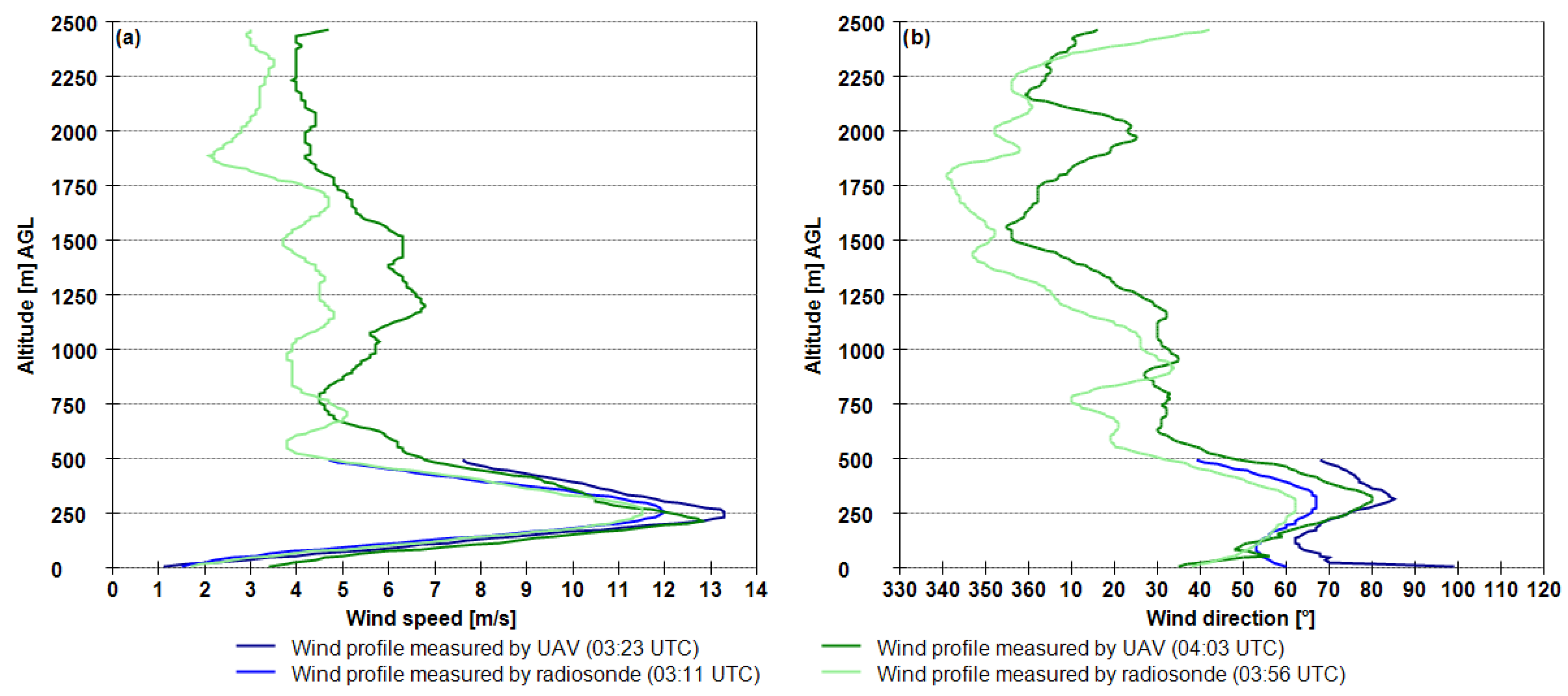
- Low-level jet conditions provide a stringent real-world stress test and demonstrate that UAV profiling resolves sharp vertical wind gradients that are often smoothed in standard radiosonde products.
- UAV-based wind profiling offers a practical and mobile solution for observing the data-sparse boundary-layer region, where conventional measurements remain limited.
- Dedicated meteorological UAV platforms enable high-resolution, operational wind monitoring under demanding atmospheric conditions and can complement radiosondes in future multi-platform observing systems.
Abstract
1. Introduction
2. Preparation for WMO UAS Demonstration Campaign
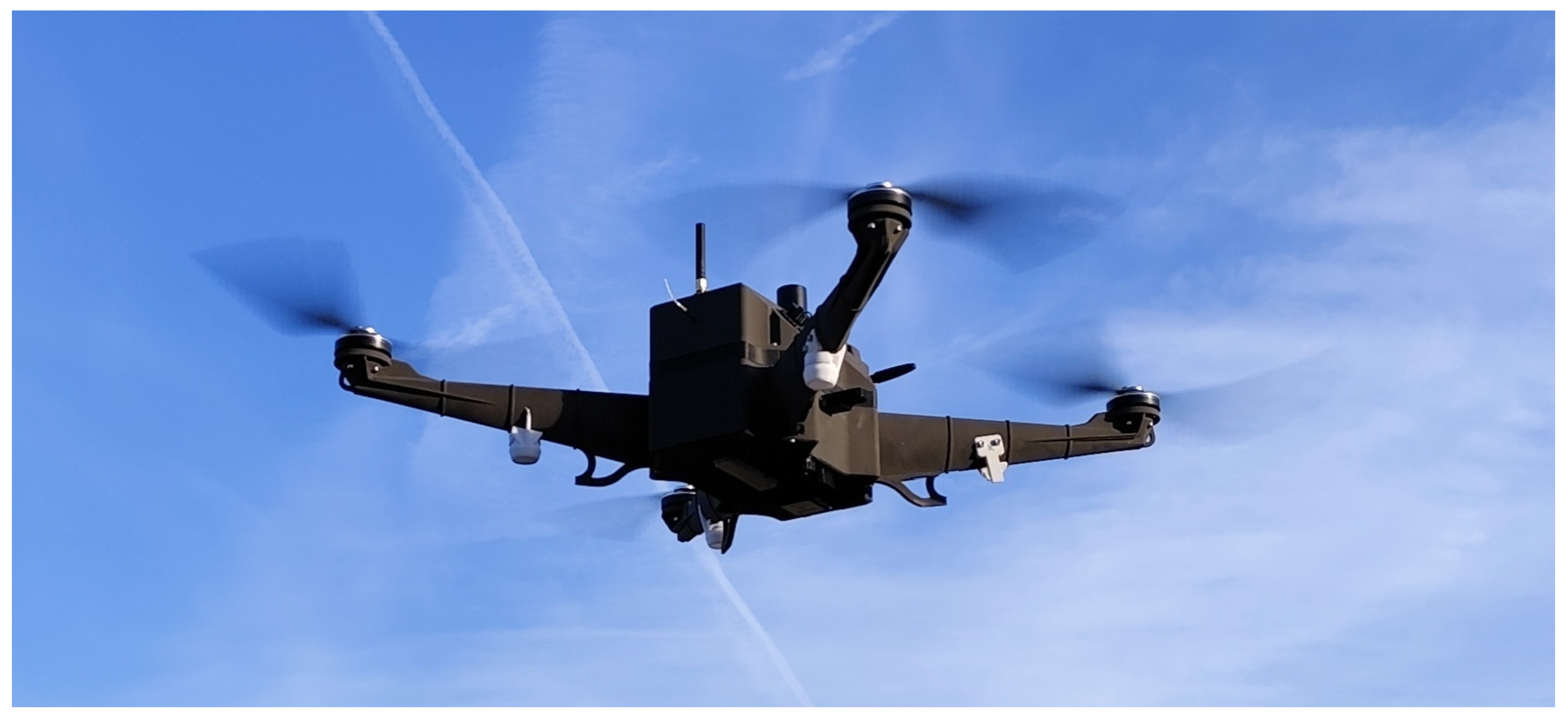
2.1. Development of the Meteorological Measurement Prototype UAV
2.2. Data Gathering On-Board
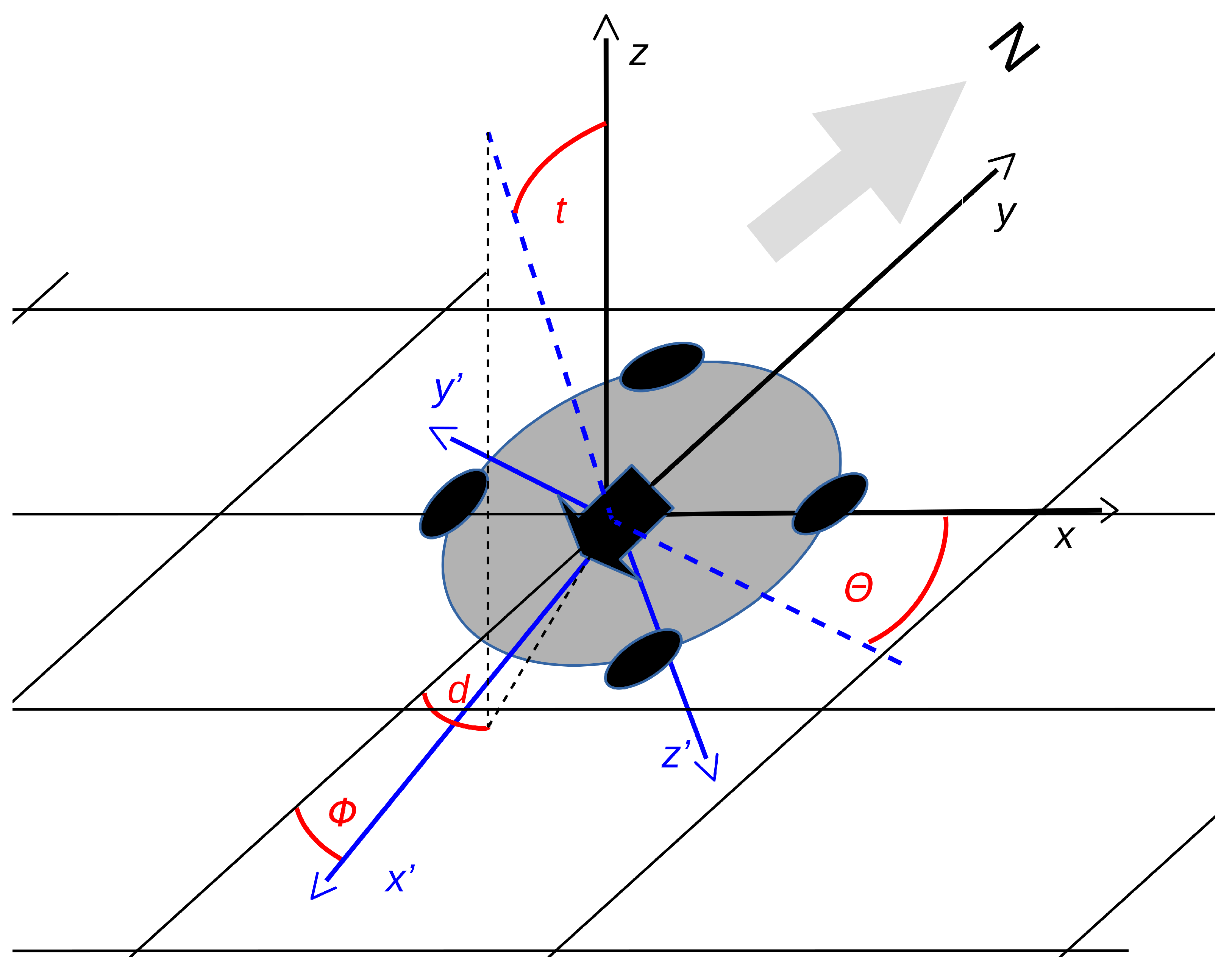
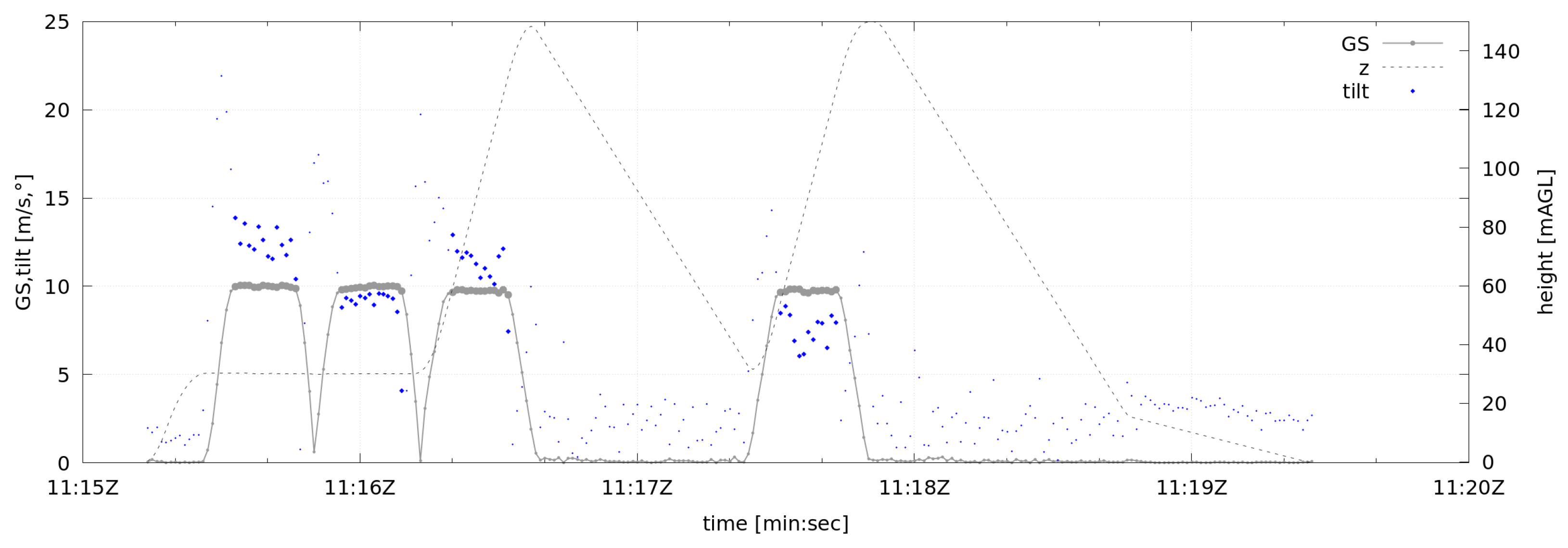
2.2.1. Wind Estimation
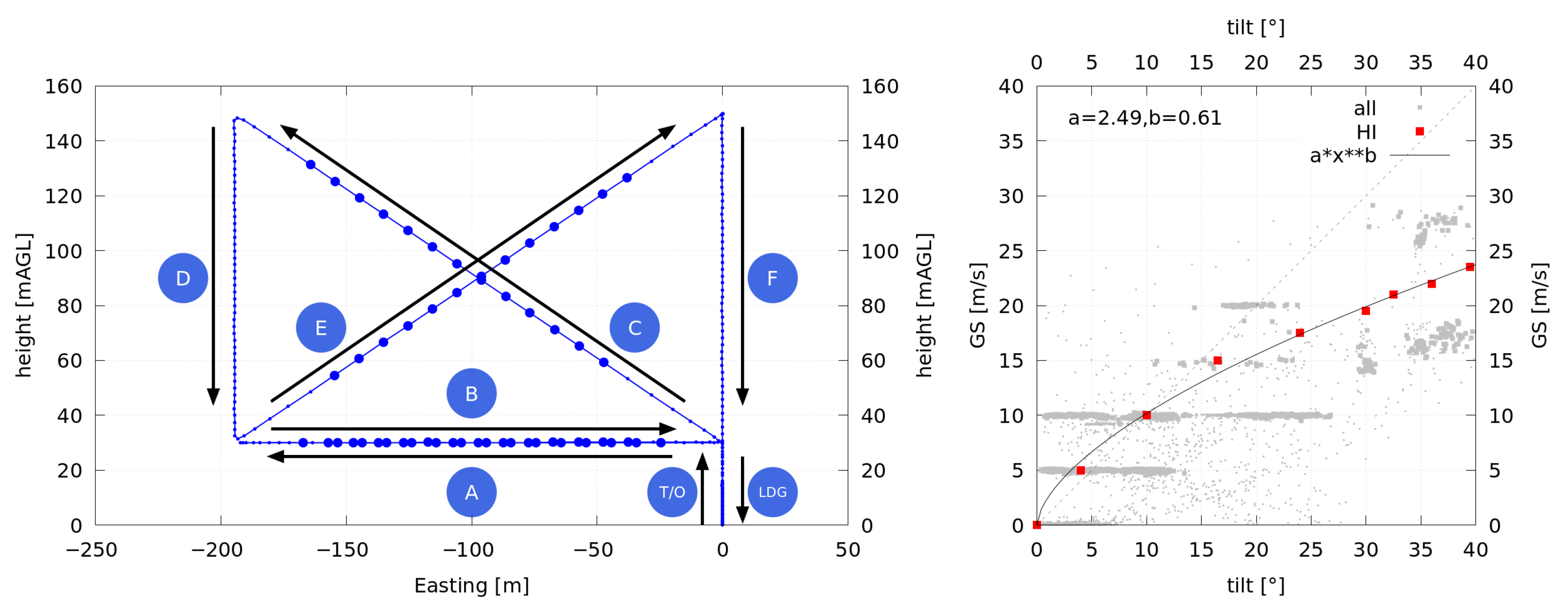
2.2.2. Profiling Missions
- A vertical descent at 2.5 m/s while maintaining a fixed GPS position
- A 6 m/s descent along a spiral trajectory with a radius of 30 m and a tangential velocity of 8 m/s.
3. Results of the Parallel Wind Measurements Performed by UAV and Radiosounding
3.1. The Measurement Data and Method Used for Comparative Analysis
3.2. The Comparative Analysis of Wind Measurements
4. A Case Study: The Low-Level Jet
5. Summary
Author Contributions
Funding
Data Availability Statement
Acknowledgments
Conflicts of Interest
Abbreviations
| 3DVAR | Three-Dimensional Variational Data Assimilation |
| AGL | Above Ground Level |
| CISM | International Military Sports Council |
| FAI | Fédération Aéronautique Internationale |
| FSOI | Forecast Sensitivity to Observation Impact |
| HDF | Hungarian Defence Forces |
| ICAO | International Civil Aviation Organization |
| IMU | Inertial Measurement Unit |
| LIDAR | Light Detection and Ranging |
| LLJ | Low-level Jet |
| OSCAR | Observing Systems Capability Analysis and Review |
| PBL | Planetary Boundary Layer |
| GPS | Global Positioning System |
| GNSS | Global Navigation Satellite System |
| RMS | Root Mean Square |
| TAMDAR | Tropospheric Airborne Meteorological Data Reporting system |
| UAS | Uncrewed Aircraft System |
| UAV | Uncrewed Aerial Vehicle |
| UTC | Coordinated Universal Time |
| WMO | World Meteorological Organization |
| WRF | Weather Research and Forecasting (model) |
References
- Kilpeläinen, M.; Summala, H. Effects of weather and weather forecasts on driver behaviour. Transp. Res. F Traffic Psychol. Behav. 2007, 10, 288–299. [Google Scholar] [CrossRef]
- Perrels, A.; Frei, T.; Espejo, F.; Jamin, L.; Thomalla, A. Socio-economic benefits of weather and climate services in Europe. Adv. Sci. Res. 2013, 10, 65–70. [Google Scholar] [CrossRef]
- Frei, T.; von Grünigen, S.; Willemse, S. Economic benefit of meteorology in the Swiss road transportation sector. Meteorol. Appl. 2014, 21, 294–300. [Google Scholar] [CrossRef]
- Shen, D.; Shi, W.F.; Tang, W.; Wang, Y.; Liao, J. The Agricultural Economic Value of Weather Forecasting in China. Sustainability 2022, 14, 17026. [Google Scholar] [CrossRef]
- Jacob, J.D.; Chilson, P.B.; Houston, L.A.; Smith, S.W. Considerations for Atmospheric Measurements with Small Unmanned Aircraft Systems. Atmosphere 2018, 9, 252. [Google Scholar] [CrossRef]
- Pinto, J.O.; O’Sullivan, D.; Taylor, S.; Elston, J.; Baker, C.B.; Hotz, D.; Marshall, C.; Jacob, J.; Barfuss, K.; Piguet, B.; et al. The Status and Future of Small Uncrewed Aircraft Systems (UAS) in Operational Meteorology. Bull. Am. Meteorol. Soc. 2021, 102, E2121–E2136. [Google Scholar] [CrossRef]
- Houston, A.L.; PytlikZillig, L.M.; Walther, J.C. National Weather Service Data Needs for Short-Term Forecasts and the Role of Unmanned Aircraft in Filling the Gap: Results from a Nationwide Survey. Bull. Am. Meteorol. Soc. 2021, 102, E2106–E2120. [Google Scholar] [CrossRef]
- Gao, F.; Zhang, X.; Jacobs, N.A.; Huang, X.; Zhang, X.; Childs, P.P. Estimation of TAMDAR Observational Error and Assimilation Experiments. Weather Forecast. 2012, 27, 856–877. [Google Scholar] [CrossRef]
- Ingleby, B.; Pauley, P.; Kats, A.; Ator, J.; Keyser, D.; Doerenbecher, A.; Fucile, E.; Hasegawa, J.; Toyoda, E.; Kleinert, T.; et al. Progress Toward High-Resolution, Real-Time Radiosonde Reports. Bull. Am. Meteorol. Soc. 2016, 97, 2149–2161. [Google Scholar] [CrossRef]
- Zhang, Y.; Liu, Y.; Nipen, T. Evaluation of the Impacts of Assimilating the TAMDAR Data on 12/4 km Grid WRF-Based RTFDDA Simulations over the CONUS. Adv. Meteorol. 2016, 2016, 3282064. [Google Scholar] [CrossRef]
- Leuenberger, D.; Haefele, A.; Omanovic, N.; Fengler, M.; Martucci, G.; Calpini, B.; Fuhrer, O.; Rossa, A. Improving High-Impact Numerical Weather Prediction with Lidar and Drone Observations. Bull. Am. Meteorol. Soc. 2020, 101, E1036–E1051. [Google Scholar] [CrossRef]
- Elston, J.; Argrow, B.; Stachura, M.; Weibel, D.; Lawrence, D.; Pope, D. Overview of Small Fixed-Wing Unmanned Aircraft for Meteorological Sampling. J. Atmos. Ocean. Technol. 2015, 32, 97–115. [Google Scholar] [CrossRef]
- Segales, A.R.; Greene, B.R.; Bell, T.M.; Doyle, W.; Martin, J.J.; Pillar-Little, E.A.; Chilson, P.B. The CopterSonde: An insight into the development of a smart unmanned aircraft system for atmospheric boundary layer research. Atmos. Meas. Tech. 2020, 13, 2833–2848. [Google Scholar] [CrossRef]
- Hervo, M.; Romanens, G.; Martucci, G.; Weusthoff, T.; Haefele, A. Evaluation of an Automatic Meteorological Drone Based on a 6-Month Measurement Campaign. Atmosphere 2023, 14, 1382. [Google Scholar] [CrossRef]
- González-Rocha, J.; Bilyeu, L.; Ross, S.D.; Foroutan, H.; Jacquemin, S.J.; Ault, A.P.; Schmale, D.G. Sensing atmospheric flows in aquatic environments using a multirotor small uncrewed aircraft system (sUAS). Environ. Sci. Atmos. 2023, 3, 305–315. [Google Scholar] [CrossRef]
- Kistner, J.; Neuhaus, L.; Wildmann, N. High-resolution wind speed measurements with quadcopter uncrewed aerial systems: Calibration and verification in a wind tunnel with an active grid. Atmos. Meas. Tech. 2024, 17, 4941–4955. [Google Scholar] [CrossRef]
- Bottyán, Z.; Gyöngyösi, A.Z.; Wantuch, F.; Tuba, Z.; Kurunczi, R.; Kardos, P.; Istenes, Z.; Weidinger, T.; Hadobács, K.; SZabó, Z.; et al. Measuring and modeling of hazardous weather phenomena to aviation using the Hungarian Unmanned Meteorological Aircraft System (HUMAS). Időjárás 2015, 119, 307–335. [Google Scholar]
- Lovas, R.; Kardos, P.; Gyongyosi, A.Z.; Bottyán, Z. Weather model fine-tuning with software container-based simulation platform. Időjárás 2019, 123, 165–181. [Google Scholar] [CrossRef]
- Shapiro, A.; Fedorovich, E. Analytical description of a nocturnal low-level jet. Q. J. R. Meteorol. Soc. 2010, 136, 1255–1262. [Google Scholar] [CrossRef]
- Blackadar, A.K. Boundary Layer Wind Maxima and Their Significance for the Growth of Nocturnal Inversions. Bull. Am. Meteorol. Soc. 1957, 38, 283–290. [Google Scholar] [CrossRef]
- Bonner, W.D. Climatology of the low-level jet. Mon. Weather Rev. 1968, 96, 833–850. [Google Scholar] [CrossRef]
- Luiz, E.W.; Fiedler, S. Global Climatology of Low-Level-Jets: Occurrence, Characteristics and Meteorological Drivers. J. Geophys. Res. A 2024, 129, e2023JD040262. [Google Scholar] [CrossRef]
- Bretschneider, L.; Hankers, R.; Schönhals, S.; Heimann, J.M.; Lampert, A. Wind Shear of Low-Level Jets and Their Influence on Manned and Unmanned Fixed-Wing Aircraft during Landing Approach. Atmosphere 2022, 13, 35. [Google Scholar] [CrossRef]
- Hallgren, C.; Aird, J.A.; Ivanell, S.; Körnich, H.; Barthelmie, R.J.; Pryor, S.C.; Sahlée, E. Brief communication: On the definition of the low-level jet. Wind Energy Sci. 2023, 8, 1651–1658. [Google Scholar] [CrossRef]
- Yang, B.; Finn, D.; Rich, J.; Gao, Z.; Liu, H. Effects of Low-Level Jets on Near-Surface Turbulence and Wind Direction Changes in the Nocturnal Boundary Layer. J. Geophys. Res. A 2023, 128, e2022JD037657. [Google Scholar] [CrossRef]
- Quint, D.; Lundquist, J.K.; Rosencrans, D. Simulations suggest offshore wind farms modify low-level jets. Wind Energy Sci. 2025, 10, 117–142. [Google Scholar] [CrossRef]
- Hu, X.M.; Klein, P.M.; Xue, M.; Lundquist, J.K.; Zhang, F.; Qi, Y. Impact of Low-Level Jets on the Nocturnal Urban Heat Island Intensity in Oklahoma City. J. Appl. Meteorol. Climatol. 2013, 52, 1779–1802. [Google Scholar] [CrossRef]
- Montini, T.L.; Jones, C.; Carvalho, L.M.V. The South American Low-Level Jet: A New Climatology, Variability and Changes. J. Geophys. Res. A 2019, 124, 1200–1218. [Google Scholar] [CrossRef]
- Thorpe, A.J.; Guymer, T.H. The nocturnal jet. Q. J. R. Meteorol. Soc. 1977, 103, 633–653. [Google Scholar] [CrossRef]
- Shapiro, A.; Gebauer, J.G.; Parsons, D.B. Emergence of a Nocturnal Low-Level Jet from a Broad Baroclinic Zone. J. Atmos. Sci. 2022, 79, 1363–1383. [Google Scholar] [CrossRef]
- Lundquist, J.K. Intermittent and elliptical inertial oscillations in the atmospheric boundary layer. J. Atmos. Sci. 2003, 60, 2661–2673. [Google Scholar] [CrossRef]
- Smedman, A.S.; Tjernström, M.; Högström, U. Analysis of the turbulence structure of a marine low-level jet. Bound.-Layer Meteorol. 1993, 66, 105–126. [Google Scholar] [CrossRef]
- Kotroni, V.; Lagouvardos, K. Low-level jet streams associated with atmospheric cold fronts: Seven case studies selected from the FRONTS 87 experiment. Geophys. Res. Lett. 1993, 20, 1371–1374. [Google Scholar] [CrossRef]
- Wippermann, F. Numerical study on the effects controlling the low-level jet. Beitr. Phys. Atmosph. 1973, 46, 137–154. [Google Scholar]
- Holton, J.R. The diurnal boundary layer wind oscillation above sloping terrain. Tellus A 1967, 19, 199–205. [Google Scholar] [CrossRef]
- Andreas, E.L.; Claffey, K.J.; Makshtas, A.P. Low-level atmospheric jets and inversions over the western Weddell Sea. Bound.-Layer Meteorol. 2000, 97, 459–486. [Google Scholar] [CrossRef]
- Banta, R.M.; Newsom, R.K.; Lundquist, J.K.; Pichugina, Y.L.; Coulter, R.L.; Mahrt, L. Nocturnal Low-Level Jet Characteristics Over Kansas During Cases-99. Bound.-Layer Meteorol. 2002, 105, 221–252. [Google Scholar] [CrossRef]
- Baas, P.; Bosveld, F.C.; Klein Baltink, H.; Holtslag, A.A.M. A Climatology of Nocturnal Low-Level Jets at Cabauw. J. Appl. Meteorol. Climatol. 2009, 48, 1627–1642. [Google Scholar] [CrossRef]
- Aird, J.A.; Barthelmie, R.J.; Shepherd, T.J.; Pryor, S.C. WRF-simulated low-level jets over Iowa: Characterization and sensitivity studies. Wind Energy Sci. 2021, 6, 1015–1030. [Google Scholar] [CrossRef]
- O’Sullivan, D.; Pinto, J.O.; Lockett, D. Global Demonstration Campaign for Evaluating the Use of Uncrewed Aircraft Systems in Operational Meteorology: White Paper; World Meteorological Organization (WMO): Geneva, Switzerland, 2023; 40p. [Google Scholar]
- Inoue, J.; Sato, K. Wind Speed Measurement by an Inexpensive and Lightweight Thermal Anemometer on a Small UAV. Drones 2022, 6, 289. [Google Scholar] [CrossRef]
- Thielicke, W.; Hübert, W.; Müller, U.; Eggert, M.; Wilhelm, P. Towards accurate and practical drone-based wind measurements with an ultrasonic anemometer. Atmos. Meas. Tech. 2021, 14, 1303–1318. [Google Scholar] [CrossRef]
- Hou, T.; Xing, H.; Gu, W.; Liang, X.; Li, H.; Zhang, H. Wind Pressure Orthogonal Decomposition Anemometer: A Wind Measurement Device for Multi-Rotor UAVs. Drones 2023, 7, 366. [Google Scholar] [CrossRef]
- Altork, Y. Comparative analysis of machine learning models for wind speed forecasting: Support vector machines, fine tree, and linear regression approaches. Int. J. Thermofluids 2025, 27, 101217. [Google Scholar] [CrossRef]
- Fu, Y.; An, W.; Su, X.; Song, B. Real-Time Wind Estimation for Fixed-Wing UAVs. Drones 2025, 9, 563. [Google Scholar] [CrossRef]
- Zimmerman, S.; Nagamune, R.; Rogak, S. Wind estimation by multirotor drone state using machine learning with data rotation and reduction. Measurement 2022, 199, 111491. [Google Scholar] [CrossRef]
- WMO. WMO Observing Systems Capability Analysis and Review Tool; WMO: Geneva, Switzerland, 2025; Available online: https://wmo.int/activities/observing-systems-capability-analysis-and-review-tool-oscar (accessed on 13 January 2025).
- Faber, J.; Gerding, M.; Köpnick, T. Acquiring high-resolution wind measurements by modifying radiosonde sounding procedures. Atmos. Meas. Tech. 2023, 16, 4183–4193. [Google Scholar] [CrossRef]



| 0–5 m/s | 5–10 m/s | 10–15 m/s | |
|---|---|---|---|
| RMS deviation (WS)—with LLJ | 1.19 m/s | 1.71 m/s | 1.10 m/s. |
| RMS deviation (WD)—with LLJ | 17.94° | 15.12° | 13.94° |
| RMS deviation (WS)—without LLJ | 1.16 m/s | 1.43 m/s | 1.25 m/s |
| RMS deviation (WD)—without LLJ | 23.34° | 15.43° | 11.31° |
Disclaimer/Publisher’s Note: The statements, opinions and data contained in all publications are solely those of the individual author(s) and contributor(s) and not of MDPI and/or the editor(s). MDPI and/or the editor(s) disclaim responsibility for any injury to people or property resulting from any ideas, methods, instructions or products referred to in the content. |
© 2026 by the authors. Licensee MDPI, Basel, Switzerland. This article is an open access article distributed under the terms and conditions of the Creative Commons Attribution (CC BY) license.
Share and Cite
Steierlein, Á.; Kardos, P.; Gyöngyösi, A.Z.; Bottyán, Z.; Zováthi, Ö.; Holló, Á.; Szalay, Z. Hungarian Drone-Based Wind Measurements During the WMO UAS Demonstration Campaign—A Low-Level Jet Case Study. Drones 2026, 10, 118. https://doi.org/10.3390/drones10020118
Steierlein Á, Kardos P, Gyöngyösi AZ, Bottyán Z, Zováthi Ö, Holló Á, Szalay Z. Hungarian Drone-Based Wind Measurements During the WMO UAS Demonstration Campaign—A Low-Level Jet Case Study. Drones. 2026; 10(2):118. https://doi.org/10.3390/drones10020118
Chicago/Turabian StyleSteierlein, Ákos, Péter Kardos, András Zénó Gyöngyösi, Zsolt Bottyán, Örkény Zováthi, Ákos Holló, and Zsolt Szalay. 2026. "Hungarian Drone-Based Wind Measurements During the WMO UAS Demonstration Campaign—A Low-Level Jet Case Study" Drones 10, no. 2: 118. https://doi.org/10.3390/drones10020118
APA StyleSteierlein, Á., Kardos, P., Gyöngyösi, A. Z., Bottyán, Z., Zováthi, Ö., Holló, Á., & Szalay, Z. (2026). Hungarian Drone-Based Wind Measurements During the WMO UAS Demonstration Campaign—A Low-Level Jet Case Study. Drones, 10(2), 118. https://doi.org/10.3390/drones10020118