Abstract
Frankfurters are the most widespread type of emulsified meat product in the world. However, they could be considered unhealthy due to their high-fat content (15–30%). The meat industry wishes to change the perception of these products by reformulating them. One strategy is increasing the content of compounds considered beneficial for human health. Thus, the aim of this study was to determine the chemical, physico-chemical, and sensorial properties of Frankfurter-type sausages added with roselle (Hibiscus sabdariffa L.), extracts. Frankfurter-type sausages were made following a traditional formula. Three different formulations were prepared. The original mixture was used as a control sample (CS). The other samples were formulated by adding roselle extract at 4.08% (FRE4) and 8.17% (FRE8). For proximate analysis, no statistical differences were found between FRE4 and FRE8 and CS. However, the residual nitrite levels decreased from 88.41 mg NaNO2/kg in CS to 86.31 and 69.82 mg NaNO2/kg in FRE4 and FRE8, respectively. Regarding the sensory analysis of the frankfurters, CS and FRE4 samples generally scored significantly higher than FRE8 for all the parameters considered. This study suggests that the reformulation of Frankfurter-type sausages using roselle extracts is feasible and represents a viable alternative to improve the safety and the nutritional composition of the product.
1. Introduction
Changes in eating habits arising from the development of society in recent decades have led people to search for affordable and healthier foods with satisfactory taste and pleasant appearance. Thus, the food industry continually seeks to adapt and develop new formulations designed to increase shelf life and to improve quality and food safety [1]. Following increased consumer demand for fast food, many efforts have been made to improve the quality and stability of Frankfurt sausages or burgers [2,3]. In an attempt to make these products healthier, the meat industry has added functional ingredients in the meat formulations. However, the challenge for them is not easy because this type of product should maintain traditional quality and an accessible cost so that consumers can continue to enjoy them regularly [4]. Plant material, fruits, vegetables, flowers, and their co-products are the most studied substrates for the obtention of these functional ingredients; due to their composition, it is possible to find several bioactive compounds that show different nutritional and technological properties derived from their structure, composition, and solubility. Roselle (Hibiscus sabdariffa L.), an herb that belongs to malvacae family, is widely used to prepared cold and hot beverages in many countries. Moreover, roselle extracts are currently marketed as supplements due to their apparent potential health benefit [5]. In this sense, roselle extracts have been incorporated into patties [4], chicken sausages [6], and marinades [7] where the biggest challenge has been to maintain the quality characteristics of the products. However, it should be borne in mind that the incorporation of unusual ingredients in a meat formulation could affect the physico-chemical, sensory, and nutritional quality of the new product. Therefore, the aim of this study was to determine the effect of the addition of roselle (Hibiscus sabdariffa L.) extracts on the chemical, physico-chemical, and sensorial properties of Frankfurter-type sausages.
2. Material and Methods
2.1. Preparation of Roselle Extracts and Frankfurt Sausages
Roselle (Hibiscus sabdariffa L.) was obtained from the local market, and the extract was prepared by adding 15 g of dried roselle petals to 100 mL of water at 87 °C and stirring for 10 min, cooling overnight (4 °C), and filtering through a Buchner funnel frozen at −18 °C. Frankfurters were manufactured according to a traditional formula: This original mixture was used as control sample, and the others Frankfurt sausages (two formulations) were prepared as shown in Table 1.
Table 1.
Ingredients of emulsion Frankfurter-type sausages. (CS: control sample; FRE4: Frankfurt sausage added with roselle extracts at 4%; FRE8: Frankfurt sausage added with roselle extracts at 8%).
The products were prepared in the Miguel Hernández University Pilot Plant following an industrial processing protocol. Briefly, meat ingredients were ground in a cutter (1094-Homogenizer, Tekator, Höganäs, Sweden) and mixed with the sodium chloride and the rest of the ingredients for 2 min (temperature below 8 °C). After homogenization, the resulting meat batter was stuffed using a piston stuffer EM-12 (Mainca, Barcelona, Spain) into 20 mm diameter cellulose casings (Fibran, Girona, Spain). Samples were hand linked and cooked in a water bath (90 °C) to an internal temperature of 72 °C, which was measured by using a thermocouple probe (Omega Engineering, Inc., Stamford, CT, USA) positioned in the geometric center of one sample. When the endpoint temperature was achieved, the sausages were immediately chilled in ice for 5 min. Then, they were peeled by hand and vacuum packed (vacuum machine: Egarvac, Barcelona, Spain) in plastic bags. All samples were stored immediately after packing at 4 ± 1 °C under darkness conditions.
2.2. Proximate Composition
The proximate composition was calculated according to Association of Official Agricultural Chemists (AOAC) official methods [8] 950.46 to determine moisture, 981.10 to determine crude protein, 920.153 to determine ash, and 991.36 to determine crude fat. Residual nitrite content (mg NaNO2/kg sample) was determined according to standards ISO/DIS 2918.26 [9].
2.3. Physico-Chemical Properties
The pH of frankfurters was measured directly using a Crison combination electrode probe (Cat. No. 52) connected to a pH meter (model 507 Crison, Barcelona, Spain). The measurement was taken three times, changing the location of the electrode insertion. Water activity (aw) was measured at 25 °C using an electrolytic hygrometer (Novasina TH-500, Novasina, Axair Ltd., Pfaeffikon, Switzerland). The procedure of Hughes, Cofrades, and Troy [10] was followed to assess emulsion stability.
2.4. Sensory Evaluation
A 40-member sensory panel (15 males and 23 females) aged 18–55 years and with no specific training in the sensory analysis of frankfurters was recruited from the staff and students of the Miguel Hernández University. Protocols for sensory analysis were approved by the Project Evaluation Office of the Miguel Hernández University (OEP, UMH, Elche, Alicante, Spain). This analysis was performed under white fluorescent lights in individual booths. Pieces of approximately 2.0 cm (3 pieces, one from each bath) were cut from the frankfurter and served at room temperature. Unsalted crackers and mineral water (room temperature) were provided to clean the palate between samples. The hedonic scale consisted of 7 levels (7 = highly acceptable; 1 = highly unacceptable), in which the panelists evaluated the following attributes: color, brightness, smoke smell, salty flavor, potato flavor, roselle flavor, sausage flavor, granularity, juiciness, hardness, and general acceptability.
2.5. Statistical Assay
The results in the tables are expressed as mean values and standard deviations. One-way analysis of variance (ANOVA) was performed to evaluate the statistical significance (p ≤ 0.05) of the effect of sample formulation (product characterization) using the SPSS program v. 27 for Windows (IBM, Chicago, IL, USA). Tukey’s post hoc test was applied for comparison.
3. Results and Discussion
3.1. Chemical Composition
Table 2 shows the chemical composition of the control sausages and the added treatments with roselle extract at 4 and 8%; it was observed that the moisture, ash, and fat content did not present a significant difference (p > 0.05) between the evaluated treatments. Only the protein content showed a slight reduction (p < 0.05), which can be due to the protein content in the initial meat batch.
Table 2.
Chemical composition of Frankfurter-type sausages added with roselle extract.
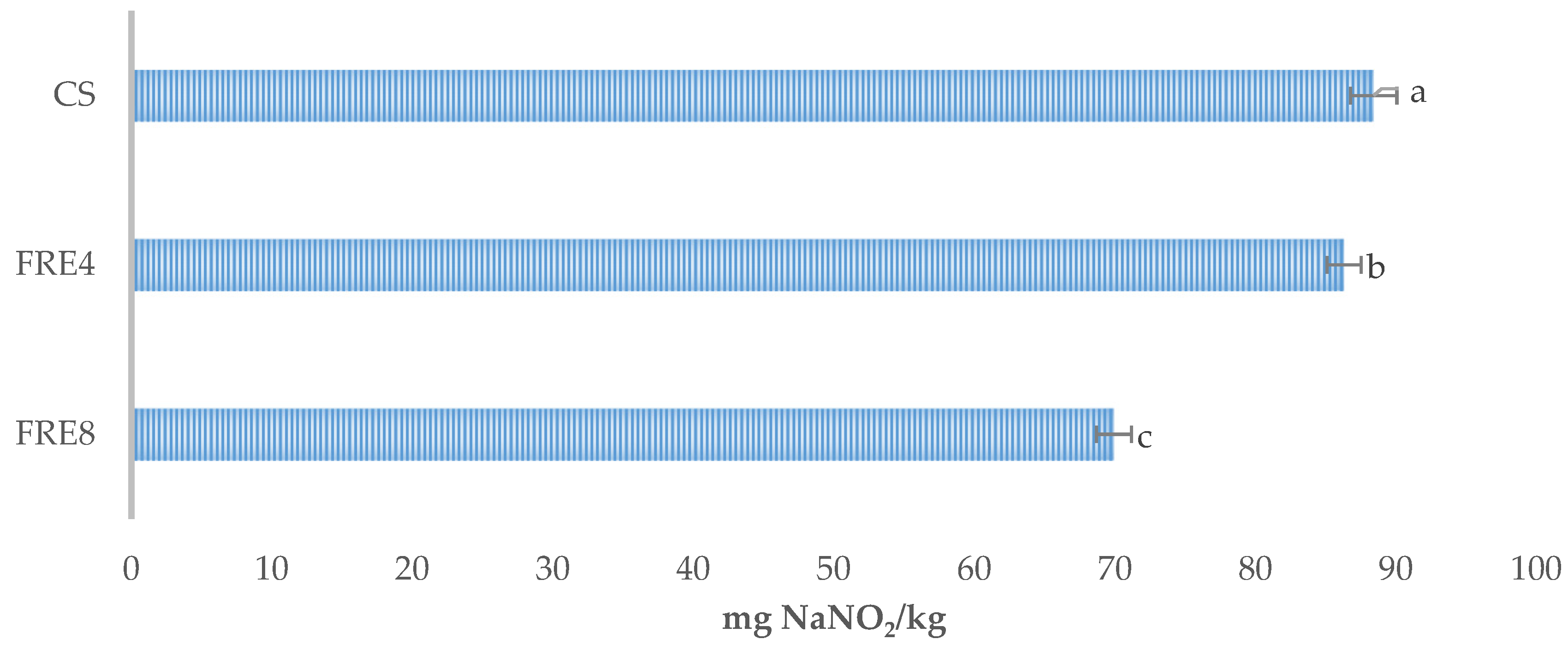
Residual nitrite content corresponds to nitrite that has not reacted with myoglobin, and thus is available for other reactions in the organism. The rate of reduction is dependent upon numerous factors such as pH, original nitrite content, the temperature during process and storage temperatures, and/or meat-to-water ratio [11]. Figure 1 shows the residual nitrite content present in Frankfurter-type sausages added with roselle extracts at 4% and 8%. The addition of roselle extract had a significant impact on residual nitrite content. Thus, the results showed that the incorporation of roselle extract decreased the residual nitrite content and it did so in a concentration-dependent manner. For FRE4, the reduction was 2.37%, while for FRE8 the reduction achieved was 20.91%. It is important to notice that all the residual nitrite values are within the established norms, which indicate that the maximum is 100 mg NaNO2/kg sample [12].
Figure 1.
Residual nitrite content of frankfurters added with roselle extracts. CS: control sample; FRE4: frankfurter + 4% roselle extract; FRE8: frankfurter + 8% roselle extract. Bars with different letters in the same column are significantly different (p < 0.05).
There are numerous studies where a reduction in nitrite content in cooked meat products such as Frankfurter-type sausages or pâté added with plant extracts was obtained [3,13]. This reduction could be caused by the reaction between nitrite and bioactive compounds, mainly polyphenols, present in these plant extracts.
3.2. Physico-Chemical Properties
The physico-chemical properties of Frankfurt sausages added with roselle extract at 4% and 8% are shown in Table 3. The emulsions stability among treatments was not significant (p > 0.05), and all values showed that they possess excellent emulsifying stability. This property is related to fat and water retention capacity as well as the pH of the meat matrix. Thus, despite the fact that the roselle extract had an acidic pH, it did not influence either the ability to form the meat emulsion or its stability.
Table 3.
Physico-chemical properties of Frankfurter-type sausages added with roselle extract.
For water activity, no statistical differences (p > 0.05) were found between CS and the samples added with roselle extracts at 4% and 8%. The values obtained in this work for water activity are typical for this type of cooked meat product. The pH was deeply affected (p < 0.05) by the addition of roselle extract, and it occurred in a concentration-dependent manner. The control treatment had a pH of 6.04 and decreased to 5.83 and 5.70 in the treatments with 4% and 8 %, respectively. This behavior is similar to reports by Karabacak and Bozkurt [14] in Turkish dry-fermented sausage or Pérez-Báez et al. [4] in burger patties where a reduction in pH values was observed. This reduction could be due to the naturally low pH value of roselle extracts.
3.3. Sensorial Analysis
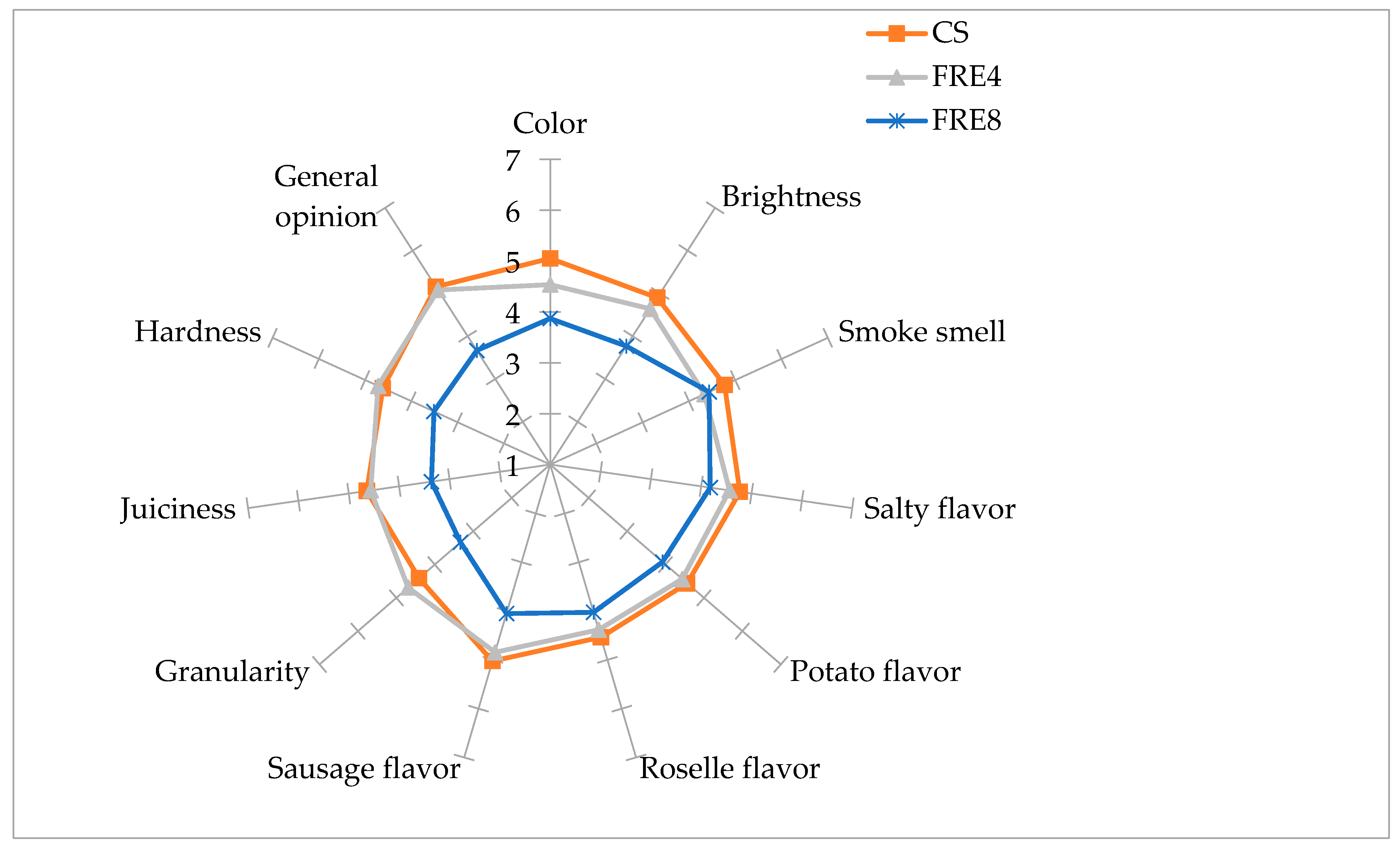
Figure 2 shows the results obtained for the sensorial analysis carried out with Frankfurt sausages formulated with roselle extracts at 4% and 8% FRE4 and FRE8, respectively. For visual and olfactory attributes, FRE8 showed the lowest (p < 0.05) scores for color and brightness, while CS had the highest values. These results are very important because they indicate that the panelists detected a change of color and brightness caused by the incorporation of the roselle extract in the sausages. For smoke smell, there were no differences (p > 0.05) between the FRE4 and control sample.
Figure 2.
Sensory evaluation of frankfurters added with roselle extracts. CS: control sample; FRE4: figure 4. roselle extract; FRE8: frankfurter + 8% roselle extract.
As regards taste attributes, again FRE8 had the lowest (p < 0.05) scores for salty flavor, potato flavor, roselle flavor, and sausage flavor. On the other hand, no statistical differences were found (p > 0.05) between CS and FRE4 for these parameters. It is important that the roselle flavor not be detected in the FRE4, because its flavor is related to very acidic or earthy flavors that sometimes are not acceptable to the consumer. As regards touch attributes (granularity, juiciness, and hardness), no statistical differences (p > 0.05) were found between CS and FRE4. FRE8 scored worse for all touch attributes. Finally, as regards general acceptance, the lowest (p < 0.05) values were obtained for FRE8 while the most acceptable samples (p < 0.05) were FRE4 and the control sample, with no statistical difference (p > 0.05) between them.
4. Conclusions
This study suggests that the reformulation of Frankfurter-type sausages using roselle extracts is feasible and represents a viable alternative to improve the safety and the nutritional composition of the final product without adversely affecting the sensory properties.
Author Contributions
Conceptualization, M.V.-M.; methodology, R.L.-G.; formal analysis and investigation, A.J.P.-B.; data curation, M.V.-M.; writing—original draft preparation, A.J.P.-B.; writing-review and editing, M.V.-M. and J.P.C. All authors have read and agreed to the published version of the manuscript.
Funding
This research received no external funding.
Institutional Review Board Statement
Not applicable.
Informed Consent Statement
Not applicable.
Data Availability Statement
The data presented in this study are available on request from the corresponding author.
Acknowledgments
Anna Judith Pérez-Báez thanks CONACYT (National Research and Technology Council, Mexico) for a doctoral fellowship.
Conflicts of Interest
The authors declare no conflict of interest.
References
- Selani, M.M.; Contreras-Castillo, C.J.; Shirahigue, L.D.; Gallo, C.R.; Plata-Oviedo, M.; Montes-Villanueva, N.D. Wine industry residues extracts as natural antioxidants in raw and cooked chicken meat during frozen storage. Meat Sci. 2011, 88, 397–403. [Google Scholar] [CrossRef] [PubMed]
- Lucas-González, R.; Roldán-Verdu, A.; Sayas-Barberá, E.; Fernández-López, J.; Pérez-Álvarez, J.A.; Viuda-Martos, M. Assessment of emulsion gels formulated with chestnut (Castanea sativa M.) flour and chia (Salvia hispanica L.) oil as partial fat replacers in pork burger formulation. J. Sci. Food Agric. 2020, 100, 1265–1273. [Google Scholar] [CrossRef]
- Fernández-López, J.; Lucas-González, R.; Viuda-Martos, M.; Sayas-Barberá, E.; Navarro, C.; Haros, C.M.; Pérez-Álvarez, J.A. Chia (Salvia hispanica L.) products as ingredients for reformulating frankfurters: Effects on quality properties and shelf-life. Meat Sci. 2019, 156, 139–145. [Google Scholar] [CrossRef]
- Pérez-Báez, A.J.; Camou, J.P.; Martín Valenzuela-Melendres, M.; González-Aguilar, G.; Viuda-Martos, M.; Sebranek, J.G.; Orlando Tortoledo-Ortiz, O. Effects and interactions of roselle (Hibiscus sabdariffa L.), potato peel flour, and beef fat on quality characteristics of beef patties studied by response surface methodology. J. Food Process. Pres. 2020, 44, e14659. [Google Scholar] [CrossRef]
- Parinyapatthanaboot, T.; Musika, S.; Pinsirodom, P. Antioxidant properties of Roselle extract and its anti-lipoperoxidant efficiency in meat products as affected by sucrose. In Proceedings of the 56th International Congress of Meat Science and Technology (56th ICoMST), Jeju, Korea, 15–20 August 2010. [Google Scholar]
- Jamhari, S.; Dewi, A.C.; Setiyono, S. Physicochemical properties and antioxidant activity of chicken sausage with addition of roselle extract (Hibiscus sabdariffa) and different filler ratio. Bull. Peternak. 2019, 43, 46–51. [Google Scholar] [CrossRef]
- Malelaka, G.E.M.; Lalel, H.J.D.; Kale, P.R.; Jelantik, I.G.N. The Sensory properties, color, microbial, lipid oxidation, and residual nitrite of Séi marinated with lime and roselle calyces extracts. Bull. Peternak. 2017, 40, 194–201. [Google Scholar] [CrossRef]
- Association of Official Analytical Chemist. Official Methods of Analysis of AOAC International, 18th ed.; Association of Official Analytical Chemist: Washington, DC, USA, 2007. [Google Scholar]
- International Organization for Standardization. Meat and Meat Products: Determination of Nitrite Content (Ref. No. ISO 2918: 1975); International Standard 2918; International Organization for Standardization: Geneva, Switzerland, 1975. [Google Scholar]
- Hughes, E.; Cofrades, S.; Troy, D.J. Effects of fat level, oat fibre and carrageenan on frankfurters formulated with 5, 12 and 30% fat. Meat Sci. 1997, 45, 273–281. [Google Scholar] [CrossRef]
- Merino, L.; Darnerud, P.O.; Toldrá, F.; Ilbäck, N.G. Time-dependent depletion of nitrite in pork/beef and chicken meat products and its effect on nitrite intake estimation. Food Addit. Conta. 2016, 33, 186–192. [Google Scholar] [CrossRef] [PubMed]
- European Commission. Directive 2006/52/EC of the European Parliament and of the Council of 5 July 2006 amending Directive 95/2/EC on food additives other than colours and sweeteners and Directive 94/35/EC on sweeteners for use in foodstuffs. Off. J. Eur. Union 2006, 204, 10–22. [Google Scholar]
- Pellegrini, M.; Lucas-Gonzalez, R.; Sayas-Barberá, E.; Fernández-López, J.; Pérez-Álvarez, J.A.; Viuda-Martos, M. Quinoa (Chenopodium quinoa Willd) paste as partial fat replacer in the development of reduced fat cooked meat product type pâté: Effect on quality and safety. CyTA J. Food 2018, 16, 1079–1088. [Google Scholar] [CrossRef]
- Karabacak, S.; Bozkurt, H. Effects of Urtica dioica and Hibiscus sabdariffa on the quality and safety of sucuk (Turkish dry-fermented sausage). Meat Sci. 2008, 78, 288–296. [Google Scholar] [CrossRef] [PubMed]
Publisher’s Note: MDPI stays neutral with regard to jurisdictional claims in published maps and institutional affiliations. |
© 2020 by the authors. Licensee MDPI, Basel, Switzerland. This article is an open access article distributed under the terms and conditions of the Creative Commons Attribution (CC BY) license (https://creativecommons.org/licenses/by/4.0/).