Proceeding Paper

Dietary Fibre, Gut Microbiota Dysbiosis and Type 2 Diabetes †

1
Faculty of Education, Health and Human Sciences, School of Health Sciences, University of Greenwich, Avery Hill Campus, Avery Hill Road, London SE9 2UG, UK
2
The School of Nursing, Soochow University, Suzhou 215006, China
3
South London and Maudsley NHS Foundation Trust, University Hospital, Lewisham High Street, London SE13 6LH, UK
*
Author to whom correspondence should be addressed.
Presented at the 1st International Electronic Conference on Nutrients-Nutritional and Microbiota Effects on Chronic Disease, 2–15 November 2020; Available online: https://iecn2020.sciforum.net/
Proceedings 2020, 61(1), 28; https://doi.org/10.3390/IECN2020-06986

Published: 30 October 2020

Abstract

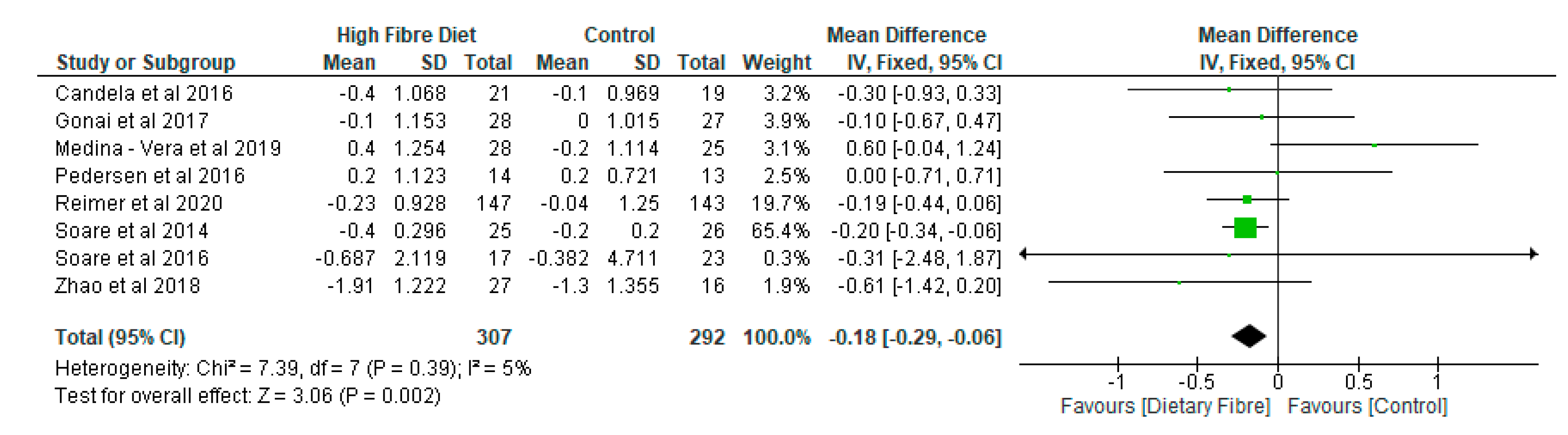
Background: Diabetes prevalence is on the increase globally and its impact on those with the condition in terms of acute and chronic complications can be profound. People with type 2 diabetes constitute the majority of those with the condition and the risk factors include obesity, lifestyle and gut microbiota dysbiosis. Poor dietary intake has been reported to influence the community of the gut microbiome. Therefore, a higher intake of dietary fibre may alter the environment in the gut and promote microbial growth and proliferation. Aim: This is a systematic review and meta-analysis which examined the effect of dietary fibre on gut microbiota in patients with type 2 diabetes. Method: This review was conducted in line with the PRISMA framework. Databases were searched for relevant articles which were screened based on inclusion and exclusion criteria. Results: Nine articles which met the inclusion criteria were selected for the systematic review and meta-analysis. High dietary fibre intake significantly improved (p < 0.05) the abundance of Bifidobacterium, total short-chain fatty acids (SCFAs) and HbA1c. Discussion: The promotion of SCFA producers in terms of greater diversity and abundance by dietary fibre may have resulted in improvement in glycated haemoglobin, partly due to increased GLP–1 production. Conclusion: High consumption of dietary fibre has a significant (p < 0.05) effect on Bifidobacterium, total SCFAs and HbA1c, but not (p > 0.05) on propionic, butyric and acetic acid, fasting blood glucose and the homeostatic model assessment of insulin resistance HOMAR–IR.
Keywords: type 2 diabetes; dietary fibre; gut microbiota; dysbiosis; short-chain fatty acids; glycated haemoglobin; fasting blood glucose; adverse events type 2 diabetes; dietary fibre; gut microbiota; dysbiosis; short-chain fatty acids; glycated haemoglobin; fasting blood glucose; adverse events