1. Introduction
Pear cultivation is a major component of the global fruit sector, with more than 25 million tonnes produced annually and 1.45 million hectares under cultivation. China accounts for more than half of global output, while Italy leads in Europe, followed by Spain, The Netherlands, and Greece. Greece ranks eighth among European producers with 81,330 tonnes in 2020, though cultivated areas have been declining in recent years. This reflects both profitability constraints and structural challenges, threatening the long-term sustainability of the sector [
1]. Despite its importance, pear cultivation continues to rely heavily on traditional practices that are often labor-intensive, costly, and imprecise. Mapping and monitoring of cultivars have typically been based on manual surveys, which are resource-demanding, infrequent, and prone to inaccuracies. These limitations hinder timely responses to changing environmental conditions, emerging pests and diseases, and shifting market demands [
2]. As a result, productivity and competitiveness in the sector remain constrained.
Smart Agriculture Technologies (SAT) offer potential solutions to these challenges. Tools such as precision irrigation, sensors, drones, and farm management software can improve resource efficiency, disease monitoring, and decision-making [
3]. By combining traditional knowledge with modern data-driven approaches, SAT enables growers to optimize orchard management, reduce costs, and enhance sustainability [
4]. However, adoption in perennial crops such as pears lags arable farming, limited by high initial costs, infrastructure gaps, and lack of technical expertise [
5]. The aim of this study is to evaluate pear growers’ awareness, adoption, and perceptions of SAT in Northern Greece. By identifying barriers and opportunities for digital transformation, this research seeks to provide insights that can support the modernization of pear cultivation and secure its role as a sustainable and competitive agricultural activity in the region.
2. Methods
A structured interview-based survey was conducted with 30 pear growers in Northern Greece during 2023. The questionnaire covered demographic and farm characteristics, awareness and adoption of SAT, perceptions of benefits and risks, and future investment plans. Data were analyzed descriptively and through cross-tabulations to explore associations between adoption and farm practices (e.g., orchard training systems). The relatively small sample size is a key limitation but provides exploratory insights for future research and policy design.
3. Results and Discussion
The analysis of the collected data provides valuable insights into the demographic structure, technological awareness, and adoption patterns among Greek pear growers. This research presents a critical inquiry into the realm of SAT adoption and deployment within the context of pear cultivation in Northern Greece. The primary objective is to delve into the level of acceptance, utilization, and familiarity among pear growers regarding these innovative agricultural technologies. By interpreting these findings, we aim to connect the survey outcomes with broader implications for digital transformation in the sector.
3.1. Demographic Profile of Respondents
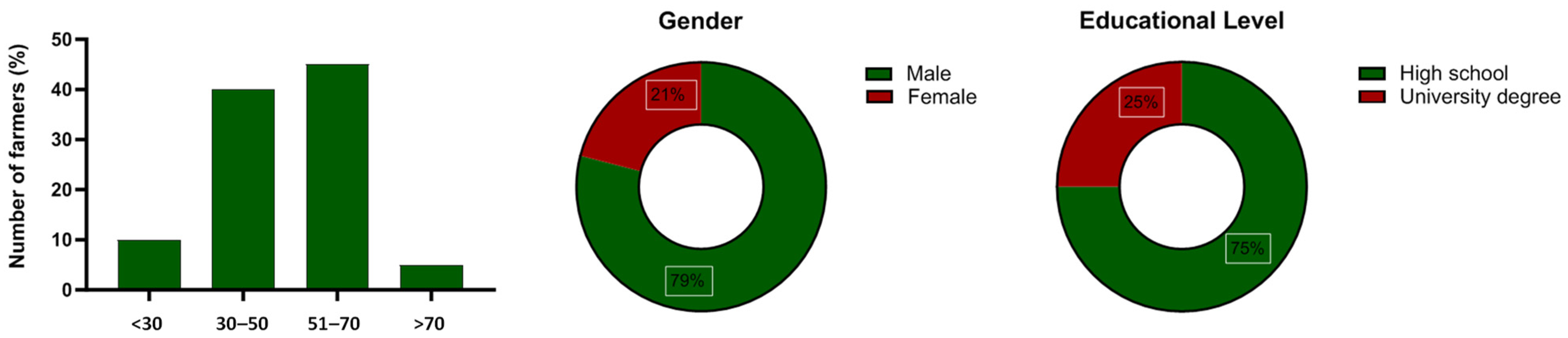
The survey of pear growers shows that men make up the majority at 79%, while women account for 21% (
Figure 1). Most male growers (44%) are aged 51–70, whereas female growers are evenly split between the 30–50 and 51–70 age groups (50% each). In terms of education, 75% of respondents have a high school education and 25% hold a university degree. Among high school graduates, 55% are aged 51–70, while 80% of university-educated growers are under 30. These findings highlight the gender, age, and educational composition of the surveyed pear grower population.
3.2. Geographic Distribution and Farm Characteristics
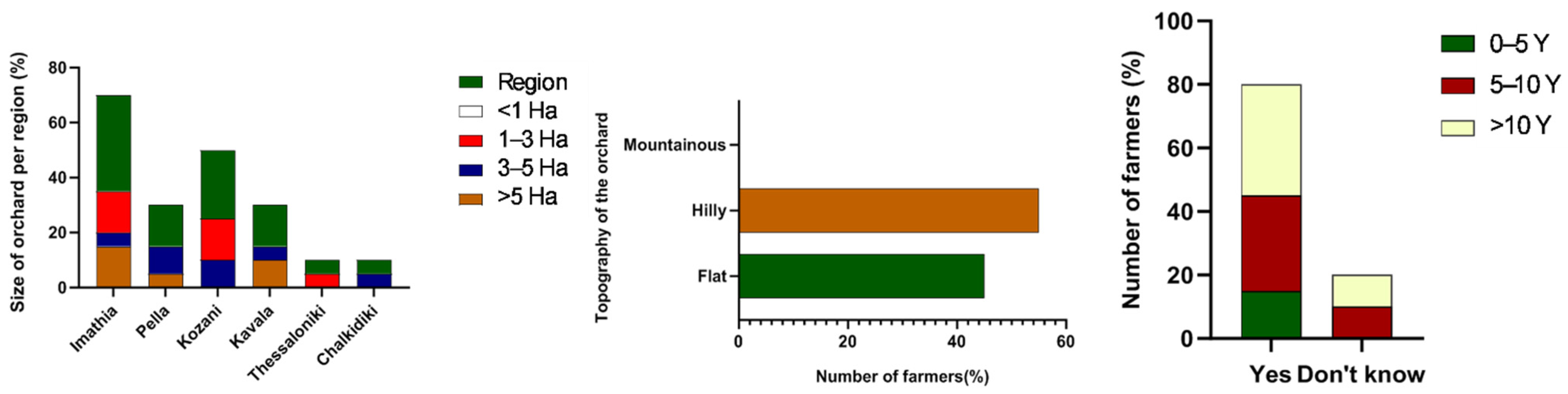
Orchards are concentrated in Imathia (35%) and Kozani (25%), with Pella and Kavala at 15% each, and Thessaloniki and Chalkidiki at 5% each (
Figure 2). Sizes are balanced, with 35% each in the 1–3 and 3–5 hectare categories and 30% above 5 hectares, mostly on hilly (52%) or flat (48%) terrain. Most growers (80%) plan to continue cultivation in the next five years, largely supported by their experience, as 45% have over 10 years, 40% have 5–10 years, and only 15% have less than 5 years.
3.3. Technology Preferences and Training System Correlations
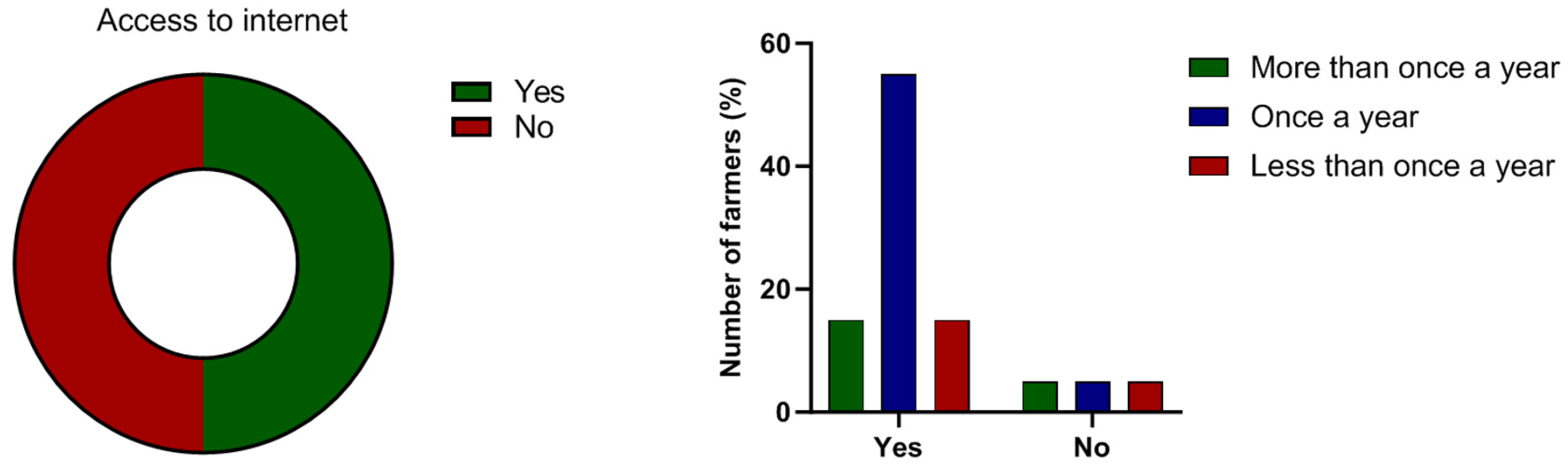
The survey shows that 85% of respondents are aware of financial resources supporting the adoption of smart agriculture technologies (SAT), while 15% are not. Among those aware, 55% attend agricultural exhibitions once a year, 15% attend more often, and another 15% less often (
Figure 3). In contrast, only 15% of those unaware of grants attend such events, split equally across once, more than once, and less than once a year. These findings suggest a link between financial awareness and event participation. A related European study found that 16% of farmers attended trade fairs less than once a year, 30% once a year, and 50% more than once a year, highlighting higher overall engagement across Europe [
6].
3.4. Benefits and Challenges of SAT Implementation
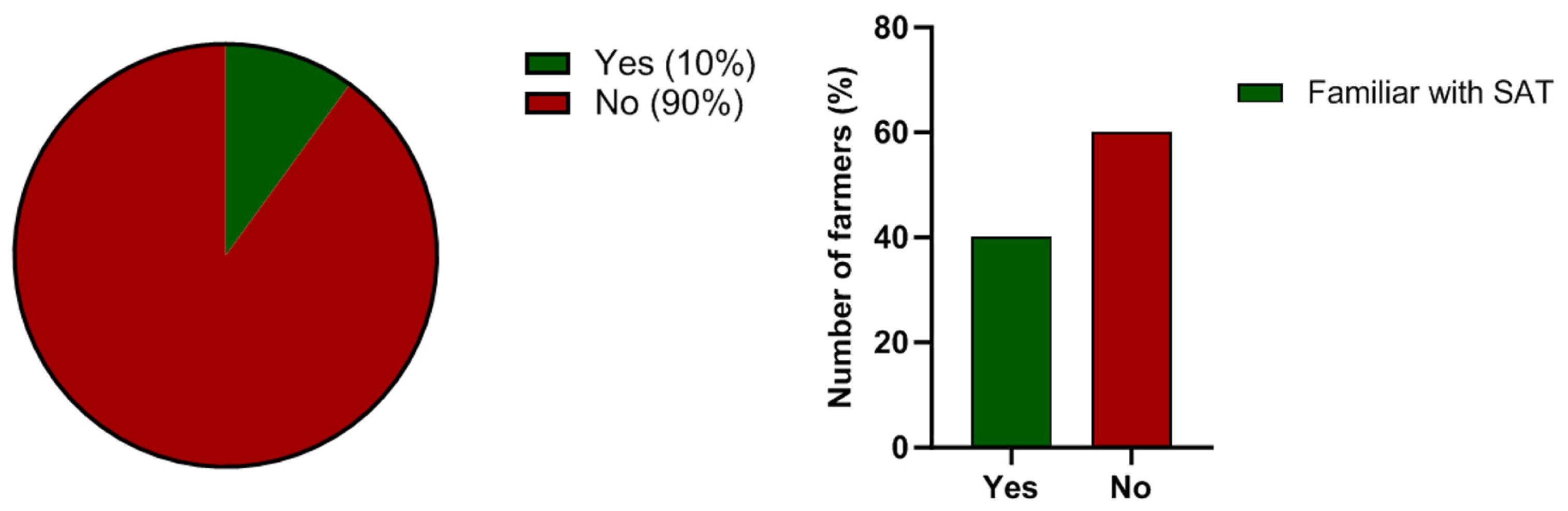
The survey reveals that 40% of pear growers are familiar with SAT, while 60% lack awareness, reflecting limited knowledge in the sector (
Figure 4). Similarly, 90% of respondents are unfamiliar with creating management zones in orchards, with only 10% reporting some awareness. These findings mirror international studies: in the U.S. (2003), over 55% of farmers lacked SAT familiarity; in Spain, fewer than 20% of orchardists used management zones; in Italy, adoption was below 10%; and in France, usage remained at early stages. In contrast, Germany showed higher familiarity, though only about 50% reported implementation. Overall, the results highlight consistently low adoption and awareness of SAT and management zones, suggesting significant opportunities for education and industry support.
3.5. Future Perspectives and Investment Plans
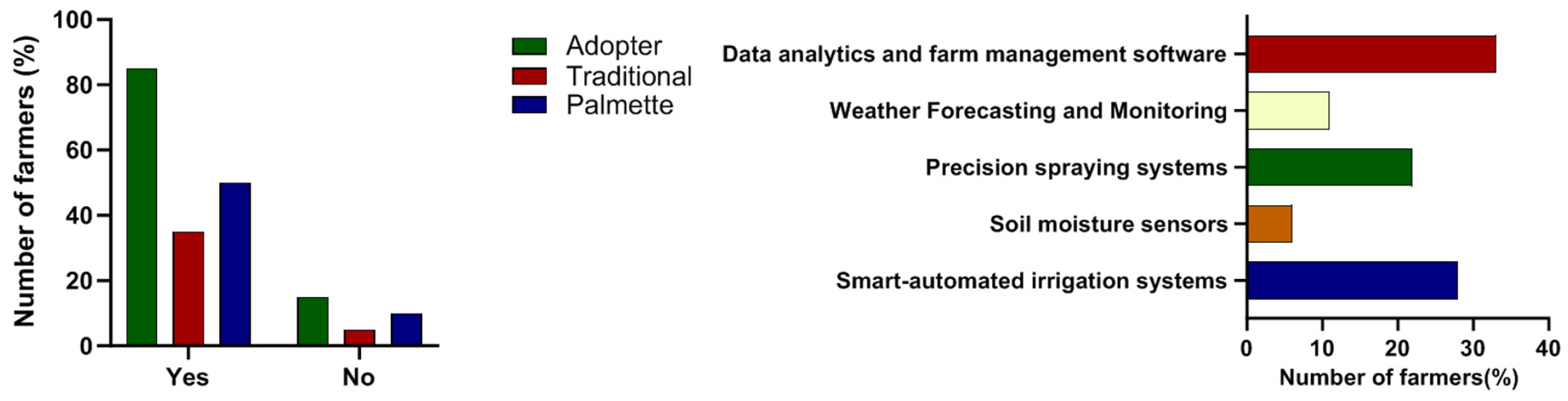
The survey shows that 85% of pear growers have adopted at least one SAT, with adoption higher among those using the palmette training system (
Figure 5). Preferred technologies include farm management software (33%), smart irrigation (28%), and precision spraying (22%), while weather tools (11%) and soil sensors (6%) are less common.
These results highlight both the role of training systems and growers’ preferences in shaping SAT adoption.
3.6. Comparison with International Studies
The survey shows that pear growers are most satisfied with SAT for improving efficiency (29%), reducing resources and enhancing fruit quality (17% each), while fewer value pest control, cost reduction (7% each), or yield, sustainability, and competitiveness (5% each). Overall, 56% rated their experience positive, 6% very positive, and 39% neutral. Nearly all adopters agreed SAT is useful (100%), superior to traditional tools (94%), improves decision-making (94%), reduces pollution (89%), and increases farm income (100%) (
Figure 6).
3.7. Study Limitations and Implications
Moreover, internet connectivity emerged as a crucial barrier for farmers in rural areas of Northern Greece, despite the country’s EU membership and associated digital infrastructure development programs. Additionally, farmers primarily engaged in crop production tended to have a lower perception of barriers to adoption, while cattle farmers perceived more obstacles.
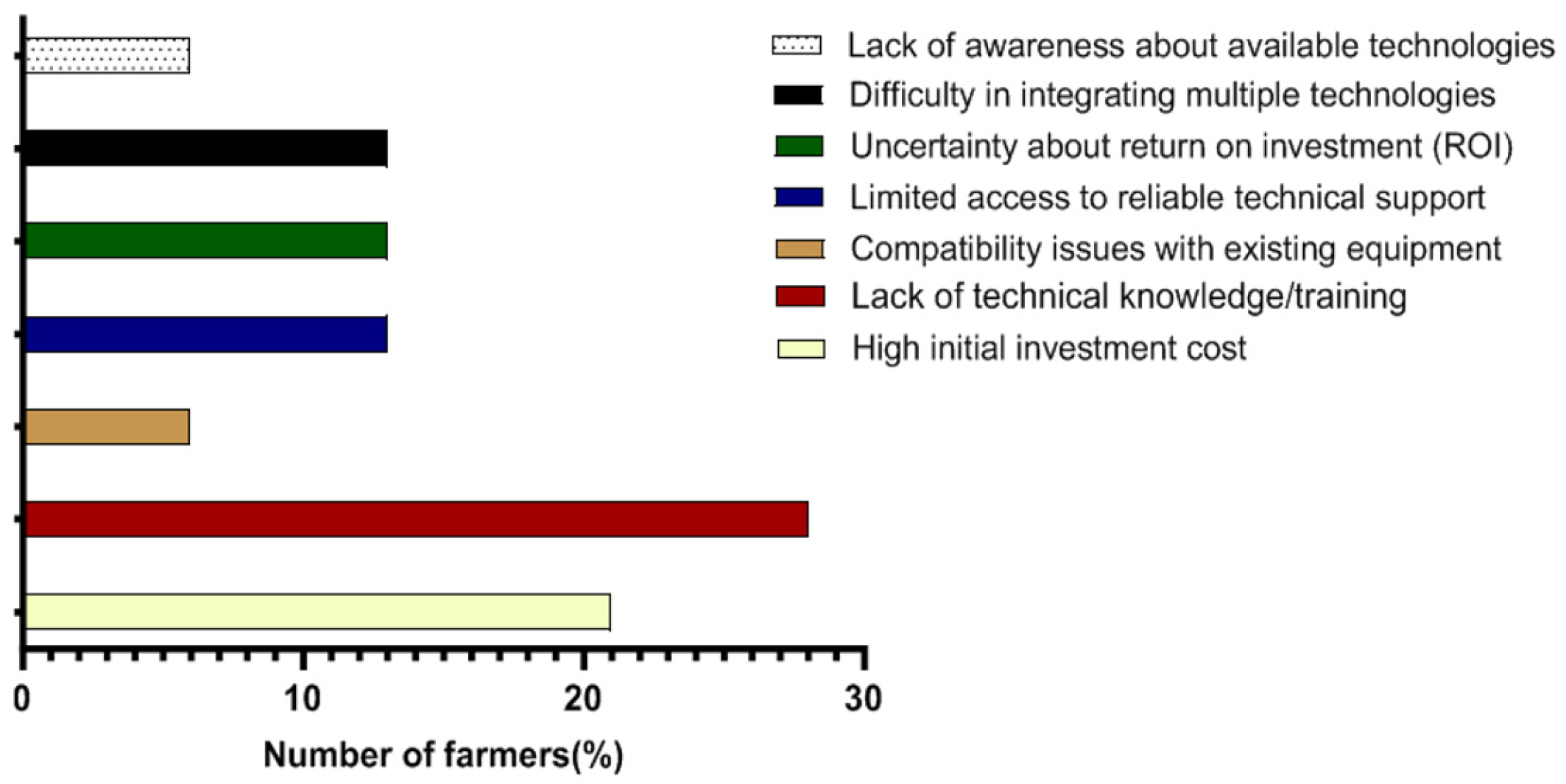
Furthermore, studies conducted in various European countries and covering different crops corroborate our findings. They emphasize that, aside from the initial investment cost, uncertainty regarding the return on investment (ROI) poses a substantial barrier to adopting SAT (
Figure 7) [
7].
4. Conclusions
This study revealed key demographic and structural features of pear growers in Northern Greece that shape the adoption of Smart Agriculture Technologies (SAT). Most respondents were experienced male growers with a high-school education, highlighting both the presence of practical know-how and the need for more formal training opportunities. Internet connectivity emerged as a critical bottleneck, with half of the growers lacking reliable access in their production facilities. Despite widespread financial readiness and engagement with agricultural events, awareness and knowledge of SAT remain limited—60% of growers reported unfamiliarity, and 90% had no experience with management zones. Adoption patterns showed a clear link between training systems and technology uptake, with the palmette system being associated with higher levels of adoption. Among technologies, Data Analytics and Farm Management Software dominated, supported by national subsidies and eco-scheme incentives.
Adopters reported highly positive experiences: efficiency gains, improved decision-making, and even unanimous agreement on increased farm income. Yet barriers remain—chiefly the lack of technical knowledge and training, alongside high upfront costs. Taken together, these findings highlight both the potential and the challenges of digital transformation in pear cultivation. Targeted education and advisory services improved rural connectivity, and financial support mechanisms will be critical to accelerate SAT adoption and ensure the long-term sustainability and competitiveness of the Greek pear sector [
3].
Author Contributions
All authors have made substantial contributions to the work reported in this manuscript. I.C.: Conceptualization, Methodology, Investigation, Data acquisition, Data curation, Visualization, Formal analysis, Validation, Writing—original draft, Writing—review and editing; A.A.: Methodology, Supervision, Writing—review and editing; T.K.: Project administration, Supervision, Funding acquisition, Writing—review and editing; D.S.: Methodology, Investigation, Visualization; M.-R.K.: Methodology, Investigation, Visualization; E.K.: Supervision, Writing—review and editing. All authors have read and agreed to the published version of the manuscript.
Funding
This research was co-funded by the Erasmus+ Programme of the European Union: Knowledge Alliances TERRATECH–masTERs course on smArt Agriculture TECHnologies. Project Number: 621568-EPP-1-2020-1-PT-EPPKA2-KA.
Institutional Review Board Statement
Not applicable.
Data Availability Statement
The datasets generated and analyzed during the current study are available from the corresponding author upon reasonable request.
Conflicts of Interest
The authors declare no conflict of interest.
References
- Manning, L. Sustainability—A Growing Focus for British Apple and Pear (Expanded Report); British Apples & Pears Ltd.: Lincolnshire, UK, 2021. [Google Scholar]
- Musacchi, S.; Iglesias, I.; Neri, D. Training Systems and Sustainable Orchard Management for European Pear (Pyrus communis L.) in the Mediterranean Area: A Review. Agronomy 2021, 11, 1765. [Google Scholar] [CrossRef]
- Raj, M.; Prahadeeswaran, M. Revolutionizing agriculture: A review of smart farming technologies for a sustainable future. Discov. Appl. Sci. 2025, 7, 1–24. [Google Scholar] [CrossRef]
- Soussi, A.; Zero, E.; Sacile, R.; Trinchero, D.; Fossa, M. Smart Sensors and Smart Data for Precision Agriculture: A Review. Sensors 2024, 24, 2647. [Google Scholar] [CrossRef] [PubMed]
- Kumar, V.; Sharma, K.V.; Kedam, N.; Patel, A.; Kate, T.R.; Rathnayake, U. A comprehensive review on smart and sustainable agriculture using IoT technologies. Smart Agric. Technol. 2024, 8, 100487. [Google Scholar] [CrossRef]
- Gaber, K.; Rösch, C.; Bieling, C. Digital transformation of fruit farming in Germany: Digital tool development, stakeholder perceptions, adoption, and barriers. NJAS Impact Agric. Life Sci. 2024, 96, 2349544. [Google Scholar] [CrossRef]
- Bahmutsky, S.; Grassauer, F.; Arulnathan, V.; Pelletier, N. A review of life cycle impacts and costs of precision agriculture for cultivation of field crops. Sustain. Prod. Consum. 2024, 52, 347–362. [Google Scholar] [CrossRef]
| Disclaimer/Publisher’s Note: The statements, opinions and data contained in all publications are solely those of the individual author(s) and contributor(s) and not of MDPI and/or the editor(s). MDPI and/or the editor(s) disclaim responsibility for any injury to people or property resulting from any ideas, methods, instructions or products referred to in the content. |



 ,
,