1. Introduction
Organic farming, as a sustainable agricultural system, has become an increasingly significant element of today’s agriculture and food production, as it simultaneously responds to the environmental, social, and economic concerns of consumers, farmers and the actors of the agricultural and food chain.
In its core, the system excludes synthetic fertilizers and pesticides, instead relying on ecological processes and biodiversity to maintain soil fertility and crop protection [
1,
2]. Numerous studies have demonstrated its benefits for biodiversity, soil quality, and climate change mitigation, as well as its contribution to healthier diets and rural development [
3,
4,
5,
6]. Within the European Union, organic agriculture is not only an available option or preference for farmers and consumers as it regards the prosses of agricultural production and the consumption of fruits, vegetables and other food products, but also a policy priority. It is integrated to the objectives of the Common Agricultural Policy (CAP) and at the epicenter of the European Green Deal and the Farm to Fork Strategy. Its importance is highlighted with the ambitious objective of reaching 25% of agricultural land under organic management by 2030 [
7]. specifically, part of the European Green Deal, specifically under its Farm to Fork Strategy, and is implemented through the EU Organic Action Plan launched in 2021 [
8].
Beyond its environmental impact, organic farming is increasingly understood as a pathway for rural development, income diversification, and the preservation of traditional knowledge and cultural heritage in agriculture [
9,
10,
11]. Recent assessments highlight that the global area under organic farming has more than doubled in the past two decades, underscoring its rapid integration into agri-food systems [
2]. At the same time, empirical studies demonstrate that organic farming contributes not only to environmental objectives but also to rural income diversification and resilience in farming communities [
12]. The academic literature has extensively examined both the opportunities and the challenges associated with the development of organic farming. From an environmental perspective, research has consistently shown that organic systems deliver significant benefits for biodiversity, soil fertility, and water quality, while reducing greenhouse gas emissions and reliance on chemical inputs [
3,
4,
6]. At the same time, socio-economic studies underline the importance of income levels, consumer preferences, institutional support, and policy incentives in shaping the pace of organic adoption [
5,
10,
13]. Nevertheless, the literature also highlights persistent barriers, including higher production costs, yielding gaps relative to conventional farming, and uneven market development, which may limit the capacity of organic agriculture to expand at the desired scale [
14,
15]. These findings indicate that organic farming operates at the intersection of environmental sustainability and socio-economic dynamics, making it sensitive to both the ecological conditions and structural characteristics of national agricultural systems. Recent evidence further stresses the importance of policy frameworks: targeted support measures and CAP implementation have been shown to substantially accelerate adoption rates, whereas institutional barriers and insufficient farmer support mechanisms continue to constrain organic transitions [
14,
16].
Despite the substantial body of literature on organic agriculture, important gaps persist in the systematic understanding of its expansion across the European Union. A considerable share of existing studies examines specific dimensions in isolation, either environmental or socio economic—without capturing the combined influence of multiple drivers. In addition, many analyses rely on cross-sectional data or case studies, which do not fully capture the temporal dynamics of organic farming transitions [
5,
15]. Comparative research at the EU level remains relatively limited, and the evidence base is often fragmented across national or regional contexts, reducing the generalizability of findings [
14,
17]. This knowledge gap is particularly critical in the current policy context. The Farm to Fork Strategy and the European Green Deal have placed organic farming at the core of the EU’s sustainability agenda, with the ambitious objective of reaching 25% of agricultural land under organic management by 2030 [
17,
18]. However, the absence of systematic, long-term, cross-country analyses limits the ability of policymakers to design targeted strategies that account for both structural constraints and enabling conditions. Without a more integrated and comparative perspective, it is difficult to assess why some countries advance more rapidly than others and how environmental pressures and socio-economic conditions interact to shape these trajectories. Although studies, such as Casolani et al. (2021) [
19], have examined the impact of CAP measures, these analyses remain limited in scope and often neglect broader structural dynamics [
14]. Similarly, debates on the so-called conventionalization of organic farming [
20] illustrate the need for systematic, long-term assessments that go beyond individual case studies [
21].
4. Results
The empirical analysis was conducted using a panel dataset covering all the European countries for the period 2000–2022. Before proceeding to regression estimations, descriptive statistics were calculated for the main variables of interest. Referring to
Table 1, the results indicate substantial heterogeneity across European countries, reflecting structural differences in their agricultural sectors. For instance, GDP per capita ranged from as low as 3350 to more than 101,000 USD, with a mean of 26,736, while the Human Development Index (HDI) varied between 0.72 and 0.98 with an average of 0.87. Population density displayed large variation as well, from 16.9 to 1660 inhabitants per square kilometer. Employment in agriculture represented on average 6.4% of total employment, though in some countries it reached levels above 40%, highlighting the persistence of more traditional agricultural structures. Finally, the share of organic farming in total agricultural area exhibited strong cross-country variation, ranging from marginal levels in the early years to more than 25% in countries with the largest areas under organic farming, confirming the diverse pace of transition within the EU.
Model fit indices confirmed the robustness of the regression specification. The model achieved an excellent explanatory capacity, with R2 = 0.912 (Adjusted R2 = 0.911), while the overall significance was validated by the ANOVA test (F(12, 608) = 528.176, p < 0.001).
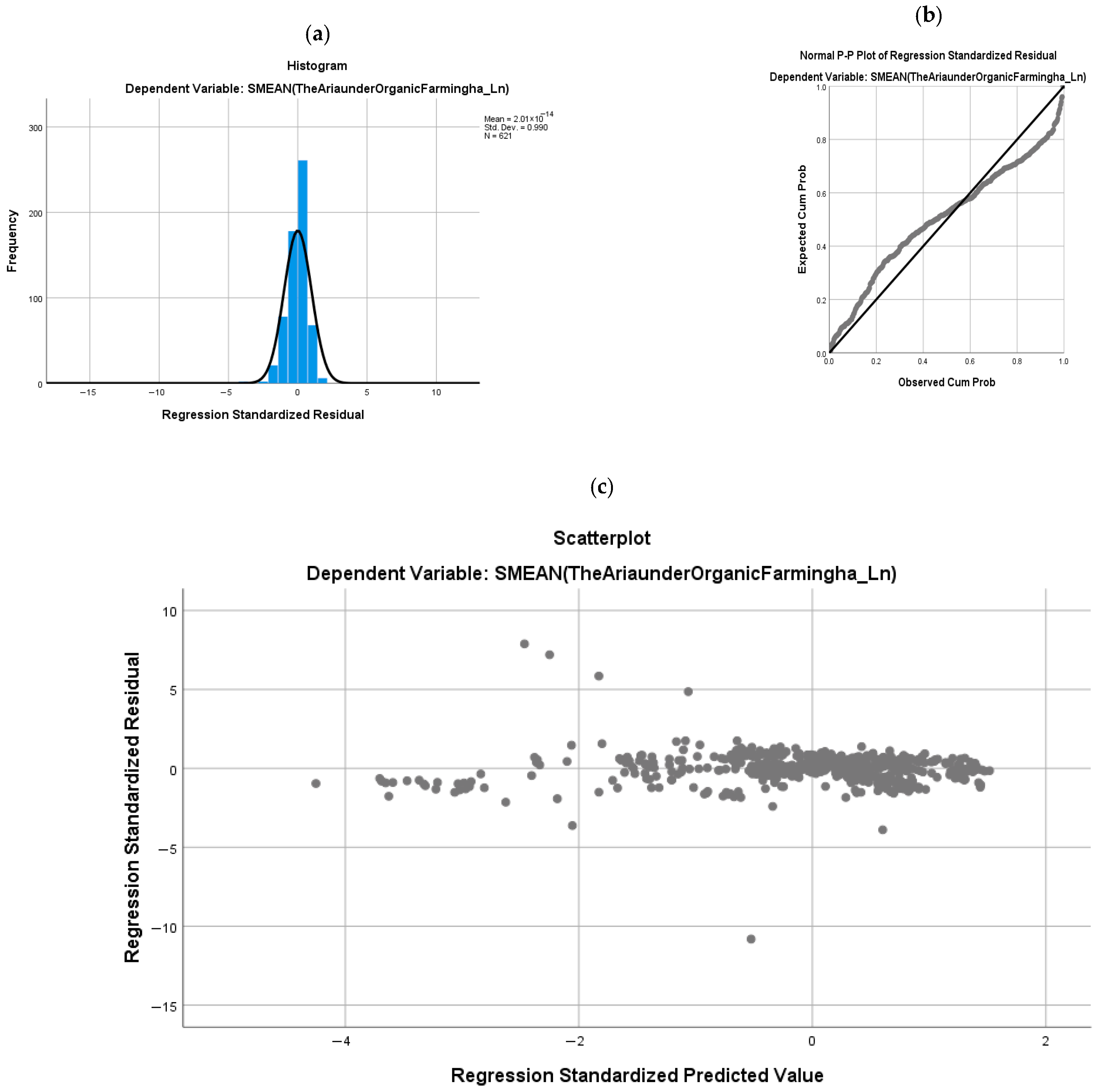
Diagnostic checks, including the histogram of standardized residuals and the normal P–P plot, showed that the residuals were approximately normally distributed, thus satisfying the basic assumptions of linear regression. The scatterplot of standardized predicted values versus standardized residuals further indicated no major heteroscedasticity issues.
Table 2 presents the regression estimates for the socio-economic and environmental determinants of organic farming expansion across EU countries between 2000 and 2022. The model confirms a very high explanatory capacity (adjusted R
2 = 0.911), while the F-test indicates that the joint effect of the explanatory variables is highly significant (F(12, 608) = 528.176,
p < 0.001).
The results reveal a nuanced set of relationships. Among the positive and statistically significant drivers, pesticide use (β = 0.53, p < 0.001) and country area (β = 0.50, p < 0.001) stand out as the strongest predictors. This indicates that organic farming tends to expand more rapidly in contexts where intensive pesticide reliance creates environmental and social pressure for alternatives, and where sufficient land resources allow for broader conversion. The Human Development index (β = 0.17, p < 0.001) also exerts a notable positive influence, suggesting that higher levels of income, education, and institutional development provide fertile ground for the uptake of organic practices. Employment in agriculture (β = 0.06, p = 0.004), although weaker, remains significant, implying that rural labor availability and the persistence of traditional farming knowledge may still facilitate organic transitions.
Conversely, two variables exhibit significant negative effects. Fixed broadband subscriptions (β = –0.10, p < 0.001) are inversely correlated with organic adoption, which may reflect the role of urbanization and technologically intensive conventional systems in constraining the expansion of organic alternatives. Even more substantial is the effect of ammonia emissions (β = –0.28, p < 0.001), underscoring the incompatibility of livestock-intensive production models with organic farming principles. These findings resonate with broader debates on structural barriers to sustainable agricultural transitions.
Other factors, such as GDP, population density, educational attainment, ecosystem vitality, air quality, and water and sanitation indicators, did not yield statistically significant effects in this specification. This result highlights that the expansion of organic farming is not necessarily linked to aggregate economic growth or broader environmental quality, but rather to specific pressures (pesticide use, livestock intensity) and enabling socio-economic conditions (human development, rural employment).
Overall, the regression results indicate that the expansion of organic farming in the EU is primarily associated with specific environmental pressures, such as pesticide use and ammonia emissions, as well as socio-economic conditions including human development levels, agricultural employment, and land availability. In contrast, broader indicators such as GDP, population density, education, ecosystem vitality, and air or water quality does not appear to exert significant effects within this specification.
The validity of these results is supported by the diagnostic analysis of the regression residuals, which indicates no major deviations from normality or homoscedasticity assumptions (
Figure 1).
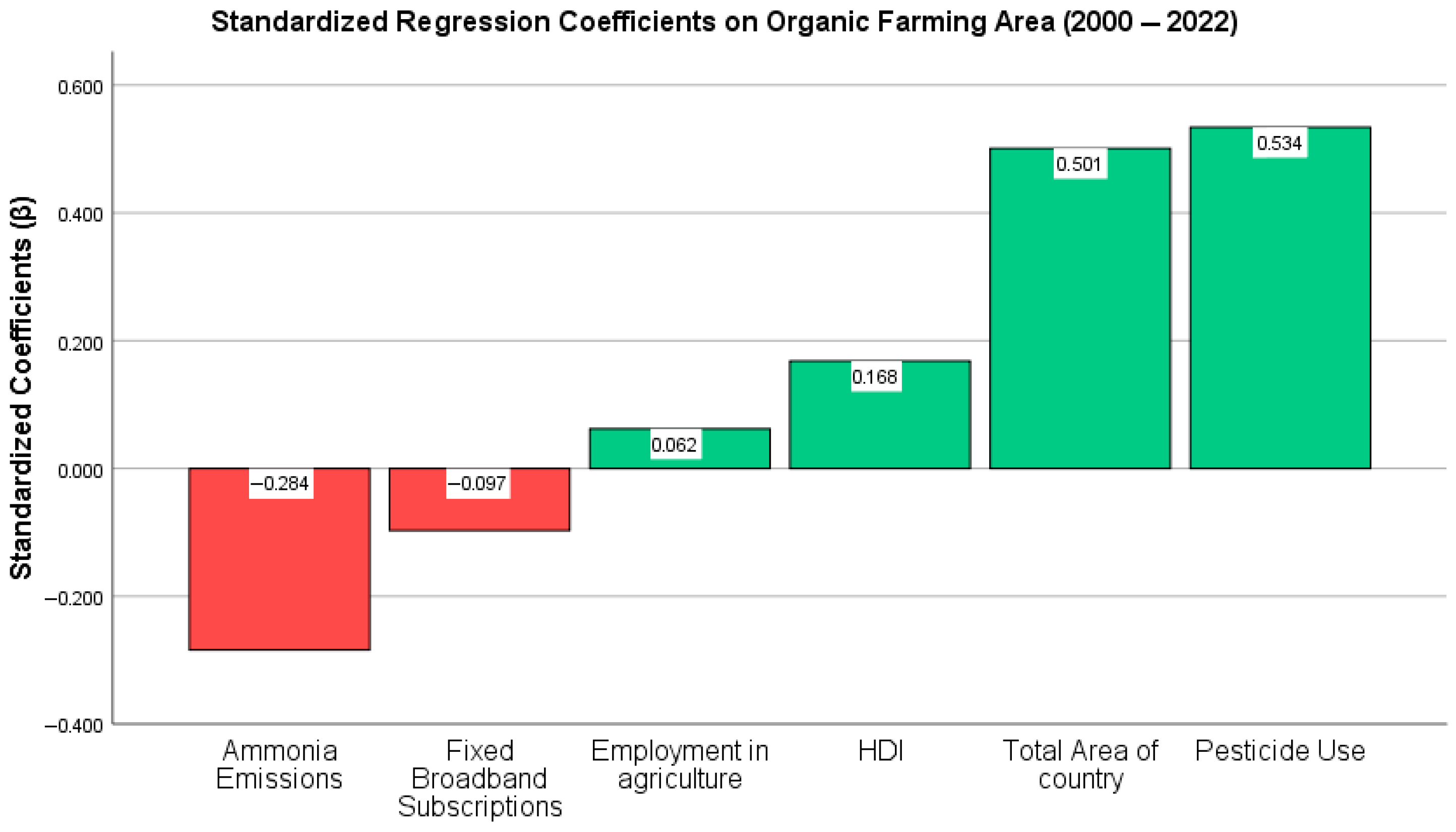
The regression coefficients shed light on the socio-economic and environmental drivers of organic farming expansion. Pesticide use emerged as the strongest positive determinant (β = 0.534, p < 0.001), confirming that higher reliance on chemical inputs is directly associated with a stronger demand and policy push for organic alternatives. Country area was the second most influential factor (β = 0.501, p < 0.001), reflecting structural constraints and opportunities linked to land availability. The Human Development Index was also positively associated with organic adoption (β = 0.168, p < 0.001), suggesting that higher levels of human development, education, and awareness contribute to more rapid uptake. Employment in agriculture exerted a weaker yet statistically significant effect (β = 0.062, p = 0.004), pointing to the role of labor intensity and traditional knowledge in supporting organic farming.
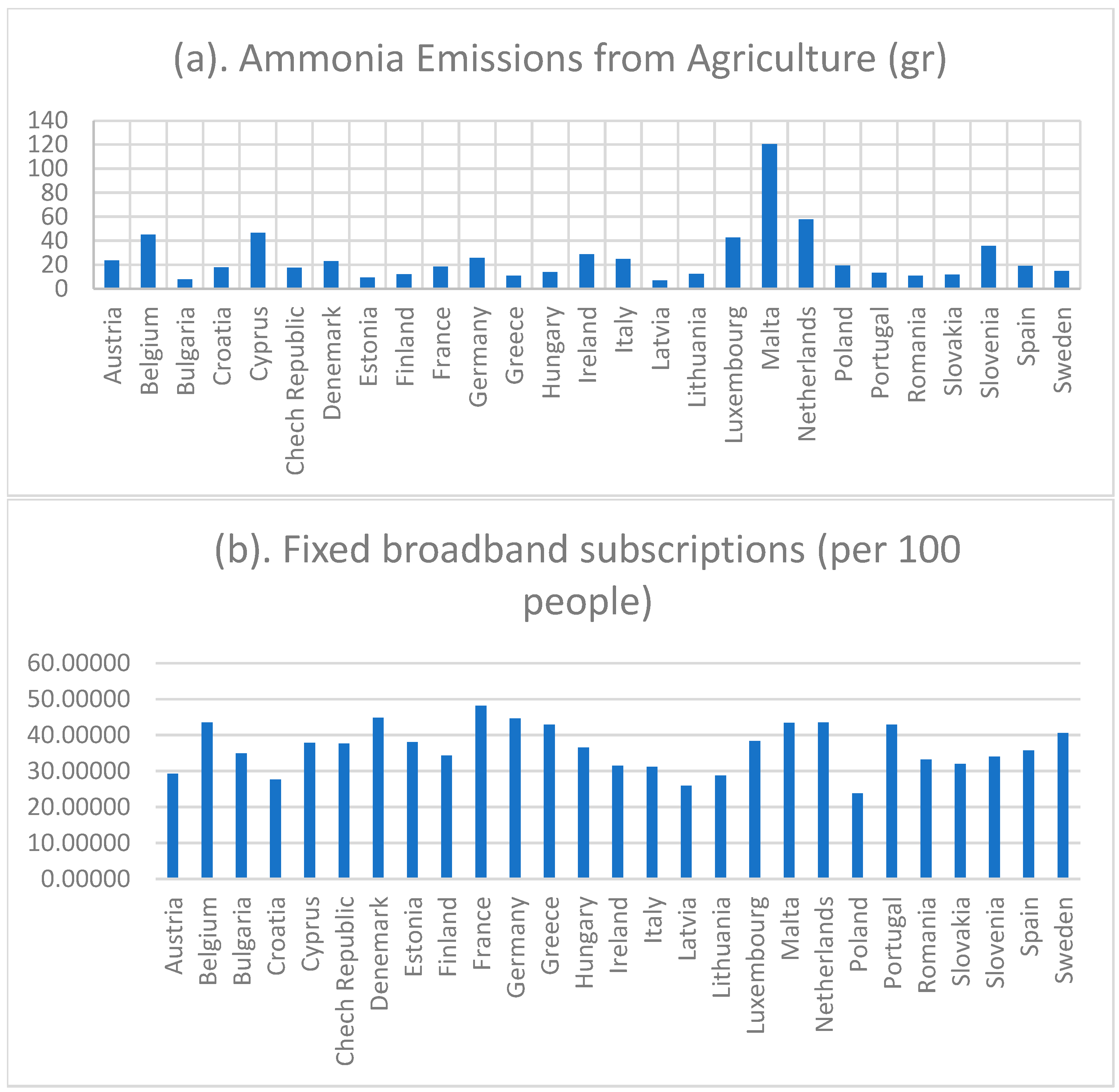
In contrast, two variables displayed significant negative effects. Marked cross-country differences in fixed broadband subscriptions and ammonia emissions are observed across the EU (
Figure 2). Fixed broadband subscriptions were inversely correlated with organic share (β = –0.097,
p < 0.001). This may imply that the increased urbanization and the corresponding adoption of technologically intensive conventional practices constraints the organic uptake alternatives.
Ammonia emissions showed a strong negative effect (β = –0.284,
p < 0.001), highlighting the detrimental role of livestock intensification and synthetic fertilizers in hindering the organic transition. These relationships are clearly illustrated in
Figure 3 which presents the standardized regression coefficients and highlights both the positive and negative drivers of organic farming expansion.
The estimated elasticities allow for a clearer interpretation of the magnitude of effects. Specifically, a 1% increase in the Human Development Index is associated with a 7.19% increase in the area under organic farming, underscoring the role of social development in facilitating sustainability transitions. Similarly, a 1% rise in agricultural employment corresponds to a 0.19% increase in the organic farming area, suggesting that stronger rural labor structures contribute positively to organic adoption. Regarding structural drivers, a 1% increase in total country area is linked to a 0.89% expansion in organic farmland, reflecting the importance of land availability.
In particular, a 1% increase in pesticide use is linked to a 0.77% expansion in organic farming, pointing to the societal and institutional demand for alternatives in the face of intensive chemical reliance. Conversely, higher broadband penetration exerts a negative effect: a 1% increase in subscriptions is associated with a 0.17% decline in area under organic farming, possibly reflecting urbanization and the dominance of technologically intensive conventional practices. Finally, ammonia emissions exert the strongest negative influence, with a 1% increase leading to a 1.02% reduction in organic farming area, highlighting the incompatibility of livestock-intensive systems with organic farming principles.
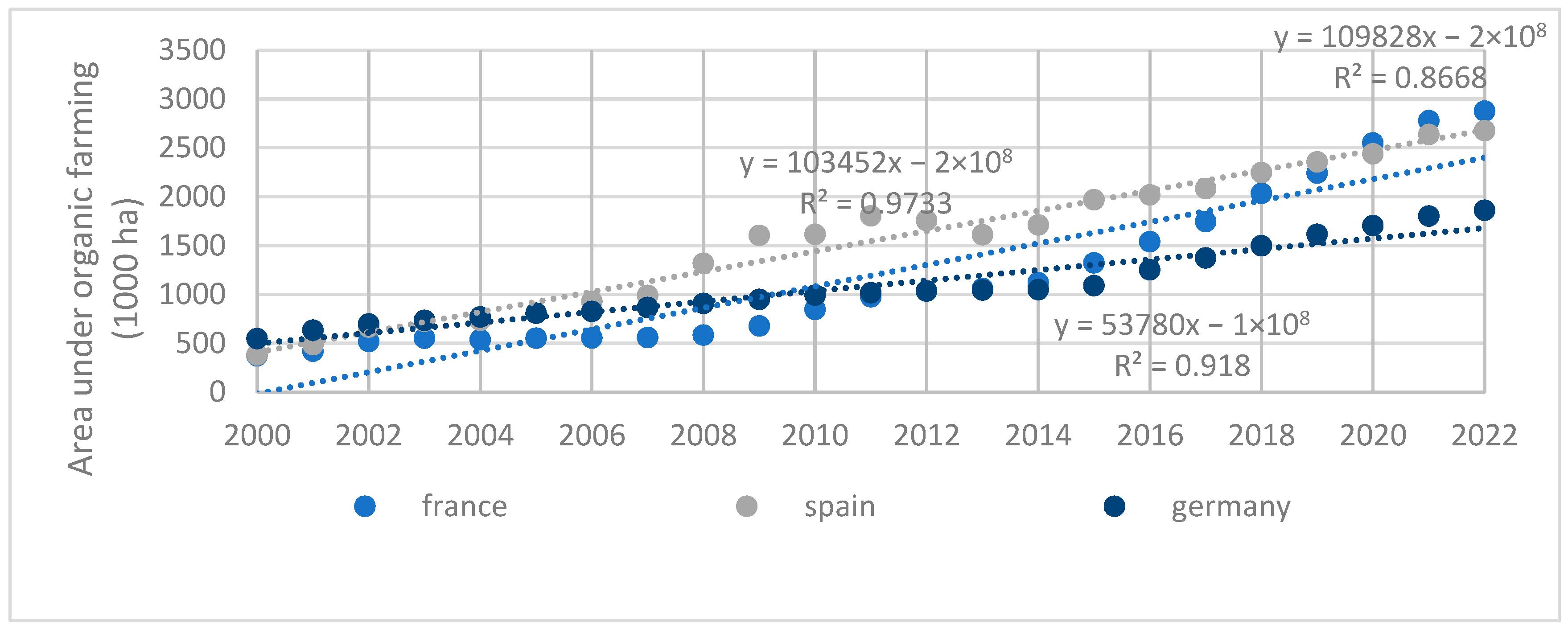
Beyond the aggregate descriptive statistics, the temporal evolution of organic farming provides further insights into the dynamics of adoption across European countries. In
Figure 4, Spain, France, and Germany were selected for closer examination as they consistently account for the largest organic farming areas in Europe, together representing a substantial share of the EU total. Spain experienced the strongest increase, particularly after 2010, eventually surpassing both France and Germany in terms of cultivated area under organic farming. France followed a pronounced upward trend, with marked acceleration during the last decade, while Germany displayed a steadier but more moderate growth path. Taken together, these patterns underline the diversity in the pace of organic farming expansion across European countries, shaped by structural conditions and varying policy frameworks.
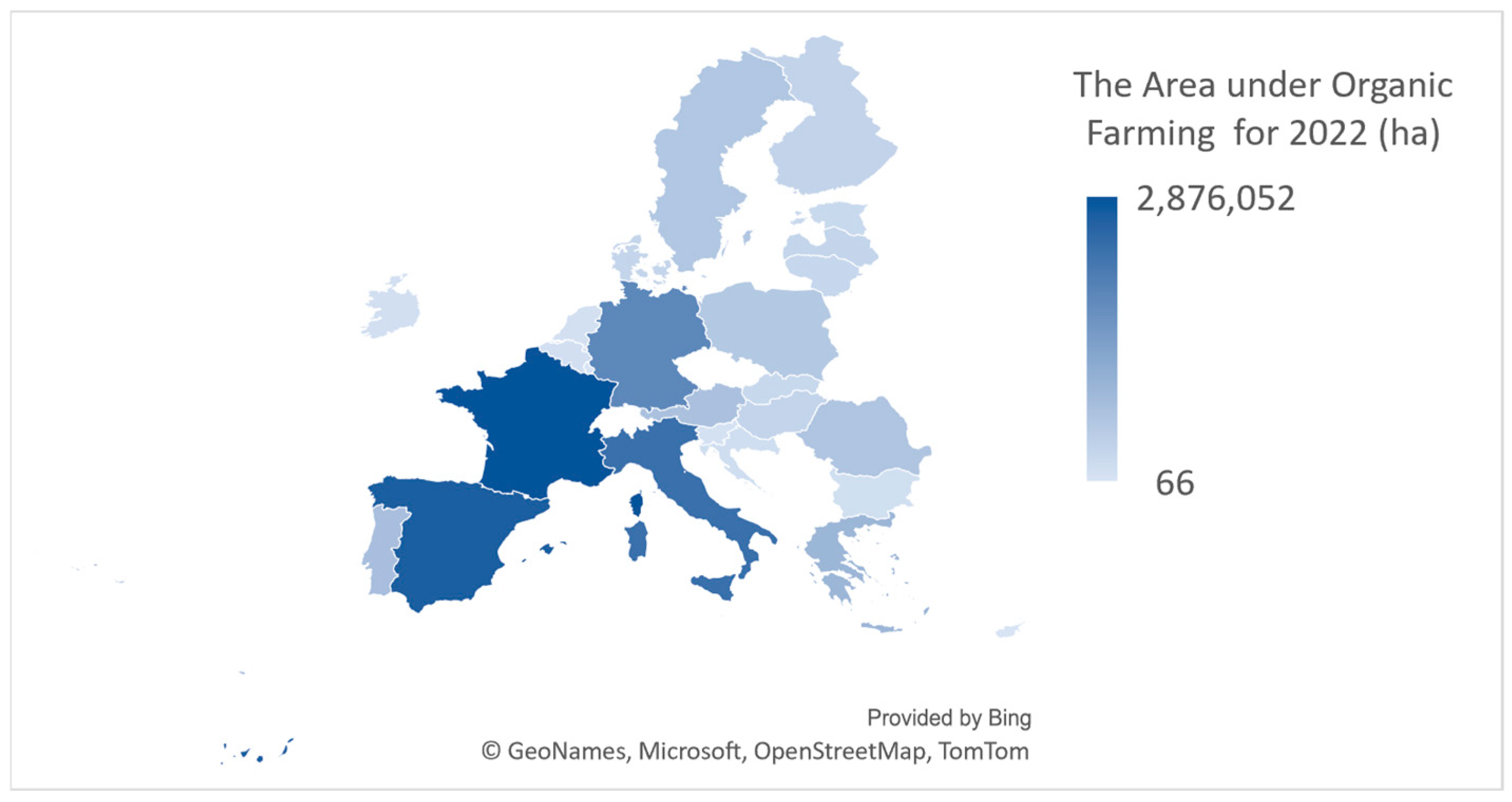
Complementing the time-series evidence, a spatial overview illustrates were organic farming stands in Europe today.
Figure 5 illustrates the distribution of the area under organic farming in 2022, highlighting pronounced differences across countries. Spain, France, and Italy dominate with the largest areas under organic farming, while Germany also remains among the top contributors. In contrast, several Central and Eastern European countries record comparatively lower levels, demonstrating the uneven spread of organic farming across the continent. This spatial heterogeneity reflects the combined influence of natural conditions, structural characteristics, and varying policy support.
Overall, the results provide a nuanced understanding of the determinants of organic farming in Europe. Expansion is shaped simultaneously by environmental pressures—such as pesticide use and ammonia emissions—and by socio-economic conditions, including levels of human development and agricultural employment, while land availability offers a structural basis for growth. This dual nature positions organic farming both as a response to environmental challenges and as an expression of broader development patterns, highlighting the importance of integrated policy approaches that align environmental regulation with socio-economic support.
5. Discussion
The findings of this study provide new insights into the determinants of organic farming expansion in the European Union. The regression analysis revealed that both environmental and socio-economic drivers influence the pace of organic agriculture, with pesticide use and ammonia emissions exerting the strongest effects in opposite directions. These results align with previous research emphasizing the dual role of organic farming as both a reaction to environmental pressures and an outcome of broader socio-economic transformations [
9,
10]. Similar conclusions have been drawn by Eyhorn et al. (2019) [
5], who argued that organic adoption reflects not only consumer awareness of environmental risks but also institutional and structural conditions. More recently, Bottazzi et al. (2023) [
16] and the European Commission (2024) [
14] highlighted that organic expansion is often hindered by systemic barriers, such as insufficient farmer support mechanisms and inconsistencies in policy implementation, reinforcing the argument that both ecological and socio-economic dimensions must be addressed simultaneously. Other studies also support this interpretation, showing that transitions to organic systems are typically driven by the simultaneous presence of environmental stressors and enabling socio-economic contexts [
6,
13,
17]. Beyond the European context, recent global assessments reinforce this multidimensional character of organic transitions. Reganold and Wachter (2016) [
23] emphasize that organic farming systems combine environmental and social benefits while facing yield and market challenges, while Kleemann et al. (2014) [
24], demonstrate how institutional frameworks such as certification schemes shape farmers’ access to markets, further underlining the importance of socio-economic drivers alongside ecological conditions.
From an environmental perspective, the strong positive association between pesticide use and area under organic farming confirms the hypothesis that conventional intensification generates counter-reactions that foster the demand for organic alternatives. This result is consistent with Seufert et al. (2017) [
6], who emphasize that consumer awareness of pesticide-related risks frequently stimulates market demand for organic products. At the same time, it resonates with the argument by Fess and Benedito (2018) [
25], who demonstrated that organic systems are increasingly perceived as a corrective mechanism to mitigate the externalities of intensive chemical use. Conversely, the negative relationship between ammonia emissions and organic shares reflects the structural incompatibility between livestock-intensive production models and the principles of organic farming. This finding is corroborated by Seidel et al. (2019) [
20] and Stein-Bachinger et al. (2021) [
26], who pointed out that conventionalized livestock systems create lock-in effects that restrict transitions toward more sustainable practices. Together, these results illustrate that organic farming expands most effectively in contexts where environmental degradation creates both social and institutional pressure for systemic change. Previous research has shown that nutrient surpluses and ammonia-related air pollution pose major obstacles to sustainable farming transitions, particularly in regions with concentrated livestock production [
18]. Taken together, these results confirm that organic expansion is not simply a matter of consumer preference but also reflects deeper structural constraints and trade-offs embedded in agricultural systems.
Socio-economic determinants also emerged as key factors shaping the expansion of organic farming. The positive effect of the Human Development Index suggests that organic farming is more likely to expand in contexts characterized by higher levels of education, stable incomes, and a broader culture of social engagement with sustainability issues. This finding is in line with previous research indicating that the adoption of environmentally friendly practices is facilitated in advanced economies where institutional capacity, information access, and consumer awareness are more developed [
13].
Employment in agriculture, although exerting only a modest positive effect, also carries important implications. In countries where farming remains a significant source of employment, the availability of labor and the persistence of traditional knowledge can create more favorable conditions for the uptake of organic methods. This is particularly true in regions where smallholder and family farming structures dominate, as these systems are often less capital-intensive and more reliant on labor, making them more adaptable to the requirements of organic production [
5,
9]. At the same time, this result underscores the continuing relevance of rural labor markets in shaping agricultural transitions, despite broader processes of mechanization and rural depopulation across the EU.
The observed heterogeneity across countries highlights the importance of regional contexts. Southern European countries, such as Italy and Spain, showed strong upward trends in area under organic farming, while Northern Europe has reached comparatively higher shares. These divergences mirror the uneven diffusion of organic practices across the EU, as documented in earlier studies [
7,
19]. Such heterogeneity suggests that policy design must be context-sensitive, balancing financial incentives with structural reforms tailored to national agricultural systems.
At the policy level, the findings bear important implications for the Common Agricultural Policy (CAP) and the European Green Deal. The Farm to Fork Strategy sets a target of 25% of agricultural land under organic farming by 2030, yet the uneven expansion patterns observed here imply that differentiated efforts will be needed. Countries with high pesticide reliance and intensive livestock sectors require stronger regulatory frameworks, whereas in more advanced economies emphasis may need to be placed on consumer demand, value-chain development, and export opportunities [
7,
10].
Although the regression model is statistically sound, some limitations must nevertheless be acknowledged. The dataset, although comprehensive, does not fully capture qualitative factors such as cultural preferences, institutional effectiveness, or farmers’ attitudes towards risk. In addition, the use of aggregate national-level data may conceal significant within-country heterogeneity, as regional dynamics often diverge substantially. Future research could benefit from more granular, regional-level panel data, as well as from mixed-methods approaches combining econometric analysis with qualitative case studies [
6].