1. Introduction
The global agricultural sector faces mounting pressures from climate change, urbanization, and labor shortages [
1]. In viticulture—where intensive and precise monitoring is required—traditional manual methods are laborious and increasingly unsustainable. Precision viticulture, which uses sensor-based data to inform targeted interventions, offers a solution [
2].
Unmanned Aerial Vehicles (UAVs) have been effectively used in vineyards to capture multispectral and thermal imagery for assessing canopy vigor and water stress. Research has shown that UAV-based thermal data can be reliably used to schedule irrigation based on leaf water potential thresholds [
3] and to estimate vineyard water status with high spatial resolution [
4].
Meanwhile, Unmanned Ground Vehicles (UGVs) equipped with LiDAR and RGB-D sensors have demonstrated accuracy in capturing under-canopy structure and constructing 3D models of vineyards [
5]. These vehicles complement UAVs by providing detailed, lateral observations of canopy architecture.
Unmanned Aerial Vehicles (UAVs) equipped with multispectral and thermal cameras, as well as Unmanned Ground Vehicles (UGVs) carrying LiDAR, RGB-D, and hyperspectral sensors, have been deployed in vineyards to capture canopy vigor and water stress. These technologies provide complementary perspectives: UAVs for overhead mapping and UGVs for close-range, lateral observations. Together, they enable digital viticulture practices that go beyond traditional precision agriculture approaches.
However, integrated UAV–UGV fleets remain rare in operational vineyards due to challenges in autonomous navigation, sensor fusion, and energy autonomy. Moreover, there is a critical need for solar-powered, field-deployable systems that enable continuous operations without human intervention.
This study implements and evaluates a fully autonomous UAV–UGV fleet in a 35-hectare vineyard, supported by a solar microgrid. The system combines RTK-GPS navigation, SLAM-based localization, and multisensor data collection (multispectral, hyperspectral, thermal, and 3D mapping). Our objectives are to (1) evaluate navigation precision and data completeness; (2) assess crop monitoring accuracy via vegetation and thermal indices; and (3) demonstrate practical scalability and energy autonomy. Our results show mean navigation error under 5%, acquisition rates exceeding 90%, and vegetation classification accuracies above 85%.
Although the fleet was designed for full autonomy, occasional human supervision remained necessary to manage unforeseen environmental obstacles, intermittent communication losses, and unexpected technical malfunctions. These operational contingencies highlight the importance of designing robotic viticulture systems with fallback modes and safety redundancies.
2. Material and Methods
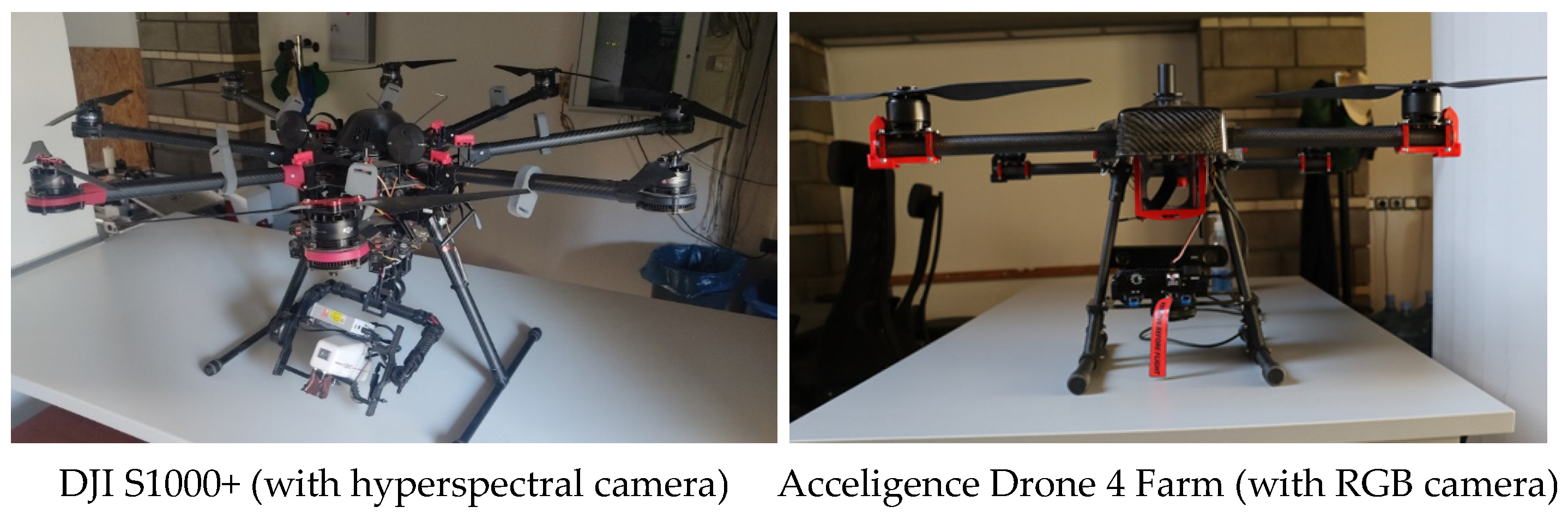
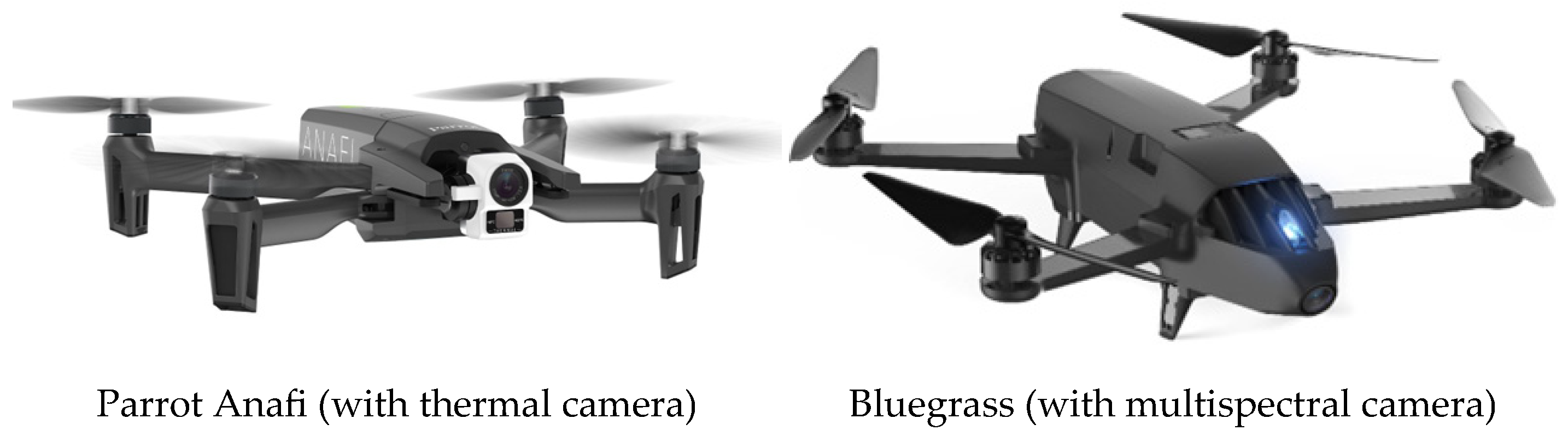
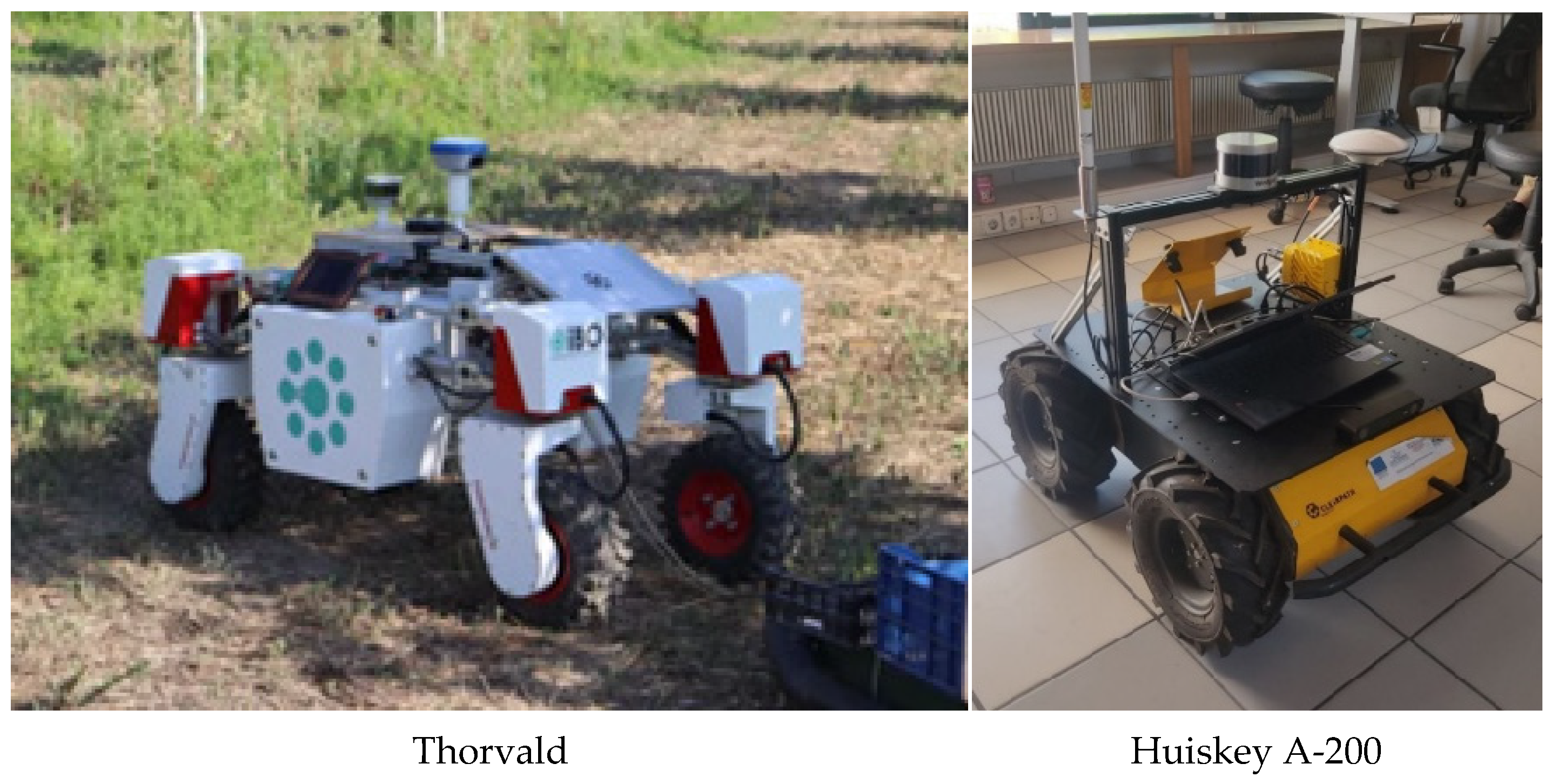
The work took place in a 14-hectare vineyard at the Agricultural University of Athens over a full growing season. The experimental setup involved a coordinated fleet of four UAVs (DJI S1000+ (DJI, Shenzhen, China), Acceligence Drone 4 Farm (Acceligence Ltd., Nicosia, Cyprus), Parrot Anafi Thermal (Parrot, Paris, France), and Bluegrass, (Parrot, Paris, France)) (
Figure 1) and two UGVs (Thorvald (SAGA Robotics SA, Oslo, Norway) and Husky A-200 (Clearpath Robotics Inc., Kitchener, ON, Canada)), operated autonomously under real field conditions (
Figure 2).
The control architecture was built on the Robot Operating System (ROS), integrating Simultaneous Localization and Mapping (SLAM) with Gmapping and AMCL for localization. Path planning and obstacle avoidance were managed using the Dijkstra algorithm and Dynamic Window Approach (DWA). All platforms operated on predefined or dynamically adjusted trajectories based on row structure and environmental feedback.
Real-time data processing was implemented within the ROS-based navigation stack, including obstacle avoidance, localization, and safety functions. Agronomic data, such as vegetation indices and hyperspectral classifications, were primarily processed post-mission, highlighting current constraints in on-board computing power.
Sensor integration was achieved through a fusion pipeline combining RTK-GPS (Stonex S990A on Thorvald, Swiftnav Duro RTK on Husky), LiDAR (Velodyne VLP-16), IMUs (Xsens MTi-630R and Parker LORD 3DM-GX5-25), and RGB-D cameras (ZED 2, Stereolabs). Multispectral (Parrot Sequoia), hyperspectral (Cubert Firefleye 185, Specim IQ), and thermal (FLIR Vue Pro, Parrot Anafi Thermal) data were georeferenced and synchronized using ROS topics. Although integration provided high-resolution outputs, calibration mismatches and heterogeneous resolutions occasionally limited sensor fusion accuracy.
Data collected during missions were processed using custom FMIS tools (algorithms) to derive vegetation indices, 3D canopy models, and water stress assessments. Performance was evaluated in terms of navigation accuracy, data quality, system uptime, and classification success, benchmarked against ground truth observations.
The photovoltaic charging stations were dimensioned to provide continuous operation under typical Mediterranean conditions. Each station integrated solar panels rated at 320 W and LiFePO4 batteries (48 V, 30 Ah for UGVs and 22 V, 10 Ah for UAVs), enabling autonomous operation for up to 10 h in UGVs (Thorvald) and 25 min per UAV flight. During extended cloudy periods, however, autonomy was reduced and auxiliary charging was required. This limitation emphasizes the importance of considering hybrid or alternative energy solutions.
3. Results and Discussion
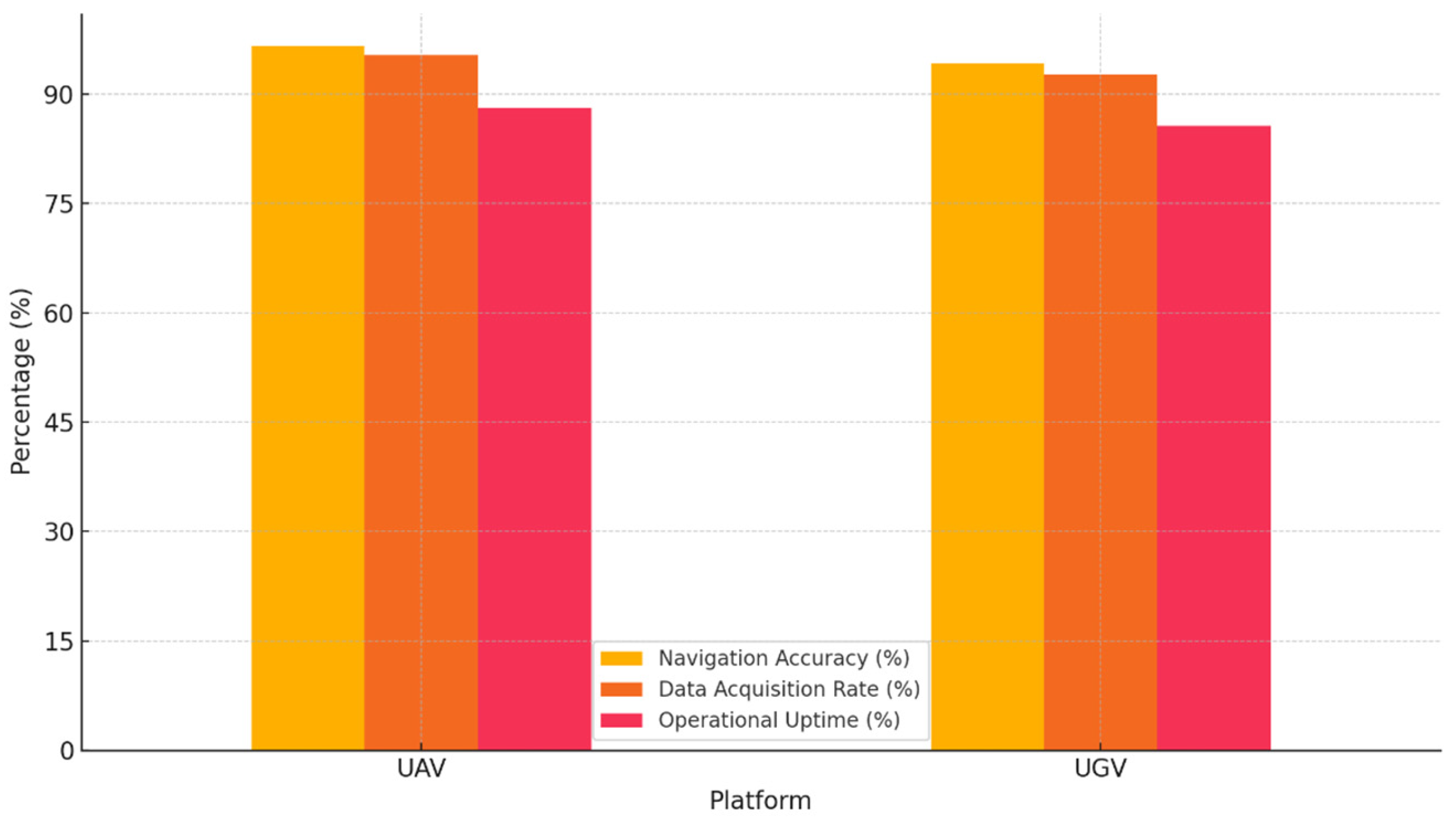
The autonomous fleet completed over 4 UGV and 10 UAV missions across the growing season. Navigation accuracy exceeded 94% overall, with UAVs slightly outperforming UGVs due to unobstructed aerial paths. Data acquisition rates remained consistently above 90% (
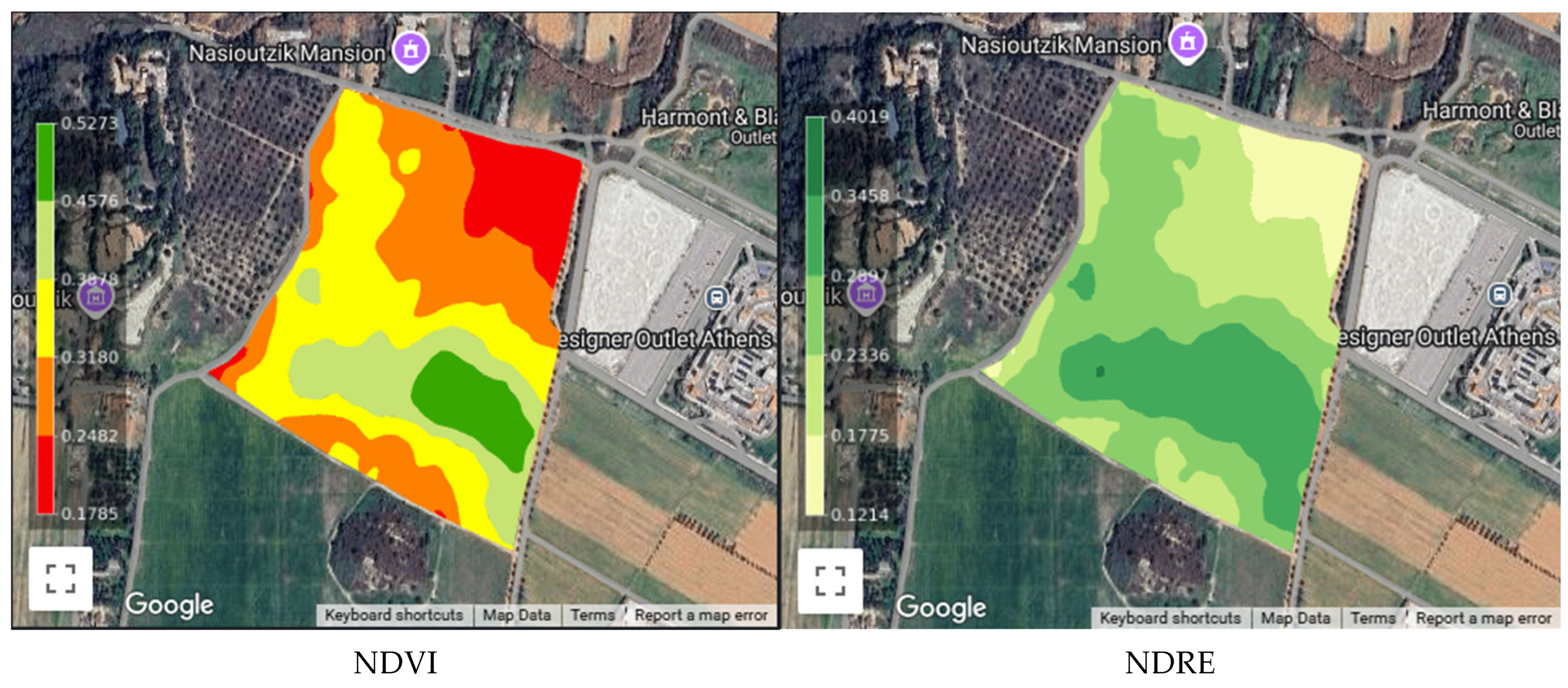
Figure 3). Vegetation indices (NDVI and NDRE) achieved classification accuracies above 89%, while hyperspectral analysis identified grape maturity zones with 87% accuracy. These results confirm the system’s effectiveness in delivering timely, high-quality crop monitoring data.
Vegetation indices calculated from UAV imagery (NDVI and NDRE) achieved classification accuracies above 89%, while hyperspectral analysis from UGVs identified grape maturity zones with 87% accuracy (
Figure 4). These results validated the use of multisensor systems for real-time, in situ decision support in viticulture.
Despite these strengths, several operational challenges were observed. Dense canopy cover occasionally caused GNSS signal loss, leading to localized navigation deviations. Prolonged cloudy weather reduced solar charging efficiency, limiting autonomy. UAV performance was also sensitive to wind, which occasionally restricted flight scheduling. Addressing these issues will be essential for scaling the technology across diverse viticultural contexts.
Operational uptime exceeded 85% for both UAVs and UGVs, with solar-powered microgrid stations ensuring autonomy in off-grid conditions. Thermal imagery enabled early detection of water stress and spatial variability in vine vigor. These capabilities support interventions such as targeted irrigation and pruning.
Navigation accuracy exceeded 94% overall; however, dense canopy cover caused intermittent GNSS signal loss, particularly for the Husky platform, leading to localized deviations up to 8% relative to planned trajectories. This finding underlines that navigation precision cannot be assumed to be uniform across all vineyard environments.
Operational uptime exceeded 85%, with solar-powered stations providing sufficient autonomy during typical sunny periods. Nevertheless, prolonged cloudy conditions reduced battery performance, demonstrating that photovoltaics alone may not guarantee year-round autonomy.
4. Conclusions
This study confirms that an autonomous fleet of UAVs and UGVs can effectively perform precision viticulture tasks under real vineyard conditions. Combined aerial and ground sensing provided accurate crop monitoring, with classification accuracies above 85% and consistent navigation performance. The system operated reliably using solar-powered charging stations, supporting continuous missions with minimal external inputs.
Key benefits included reduced labor, improved data accuracy, and timely decision-making for irrigation and harvesting. Challenges included occasional GNSS signal loss in dense canopies, limited battery autonomy during cloudy periods, and sensitivity of UAVs to wind. These highlight the need for better energy management and enhanced sensor fusion. Overall, this work demonstrates a scalable, sustainable approach to vineyard automation. Further development should focus on improving robustness, real-time analytics, and cost efficiency to support broader adoption in high-value agriculture.
The demonstrated system highlights the transformative potential of autonomous fleets in viticulture and, more broadly, the digitization of agriculture, pointing to significant future impacts on the sustainability and efficiency of the agricultural sector.




 ,
,