1. Introduction
Assessing vine vigour is a key focus in precision viticulture (PV), aimed at identifying zones of common characteristics with consistent vine performance within vineyards. Traditionally, one of the most informative indicators of vine balance has been the counting and weighing of dormant canes during winter [
1]. This method, although widely used by grape growers for vineyard management, is labour-intensive, time-consuming, and limits the scope of detailed sampling.
In recent decades, precision viticulture (PV) has attracted considerable interest from both growers and researchers. This growing attention has been fueled by the development and accessibility of digital technologies tailored to agricultural use. Among the various tools used in PV, the most commonly employed sensors include RGB, multispectral, hyperspectral, thermal, and LiDAR sensors [
2]. With the new advanced Simultaneous Localization and Mapping (SLAM) LiDAR sensors, data acquisition has become simpler and more efficient, providing high-quality and high-resolution point cloud datasets. This makes the utilization of LiDAR sensors a viable solution for mapping and preparing three-dimensional models of agricultural environments. Analysis of the produced point clouds provide a reliable representation of the structural parameters of the crops, adequately describing their shape and volume [
3].
Another important layer of information utilized in PV is the soil electrical conductivity (EC), which, with the currently available sensing and mapping systems, can provide estimation of the soil spatial variability in high resolution. Managing vineyard variability has been the key goal in numerous studies and may be the key for maximizing grape and wine quality [
4,
5].
In this work, the utilization of SLAM LiDAR scanner to map and quantify the dormant pruning canes in orchards was investigated in the framework of the “AGROSYS” project. The relationship between dormant pruning and canopy parameters at veraison and at harvest was investigated.
2. Materials and Methods
The study was conducted during summer in 2024 in a commercial vineyard located in the Attica region in Greece (23.9059097° E 37.9872950° N). The experimental area was 3.5 ha, a subsection of a 26 ha vineyard grown with the traditional Greek variety Savvatiano (Vitis vinifera L.). The EM38-MK2 electromagnetic probe (Geonics LTD, Mississauga, Ontario, Canada) was utilized to map the apparent soil electrical conductivity (ECa). The sensor was positioned in a wheeled cart towed by a vehicle following parallel transects between the vine rows were 12 m apart.
The analysis of the soil ECa spatial variability resulted in the delineation of soil zones, based on which 26 vines were selected. For the sake of simplifying the measurement acquisition process, the sample vines were selected in four paths to be followed during each measurement, selecting vines from two consecutive rows adjacent to each path. The selection of the sampling points was performed as such to make sure that zones of low, medium, and high ECa were equally represented in the dataset.
The hypothesis was based on the fact that soil variability has a significant effect on vine development, thus, expecting to produce spatial variability on the latter. The sample vines were measured for their physiological status utilizing proximal sensing. Vine canopy reflectance was measured during two stages, veraison and harvest, using the CropCircle (Holland Scientific Inc., Lincoln, NE, USA) multispectral sensor. The sensor was mounted on a Thorvald Unmanned Ground Vehicle (UGV) (SAGA Robotics SA, Oslo, Norway) pointing towards the side of the sample vines’ canopy with the sensor beam in a vertical setup. Additionally, a handheld (IR) thermal camera (FLIR Systems, Inc., Wilsonville, OR, USA) was utilized to measure canopy temperature as an assessor of the vines’ reaction to water scarcity and heat stress.
The pruning canes scanning process occurred in February 2025 at the dormancy stage using a 3D SLAM LiDAR scanner (FJDynamics, Shenzhen, China) for the construction of the three-dimensional model of the vine rows. The point cloud was analyzed with the FJD Trion Model (Version: 1.000.D.0200) processing software (FJDynamics, Shenzhen, China). The sample vines were marked within the 3D model using their coordinates and were isolated by masking the rest of the items in the vineyard.
Linear regression analysis was performed to reveal the relationship between the measured parameters.
3. Results and Discussion
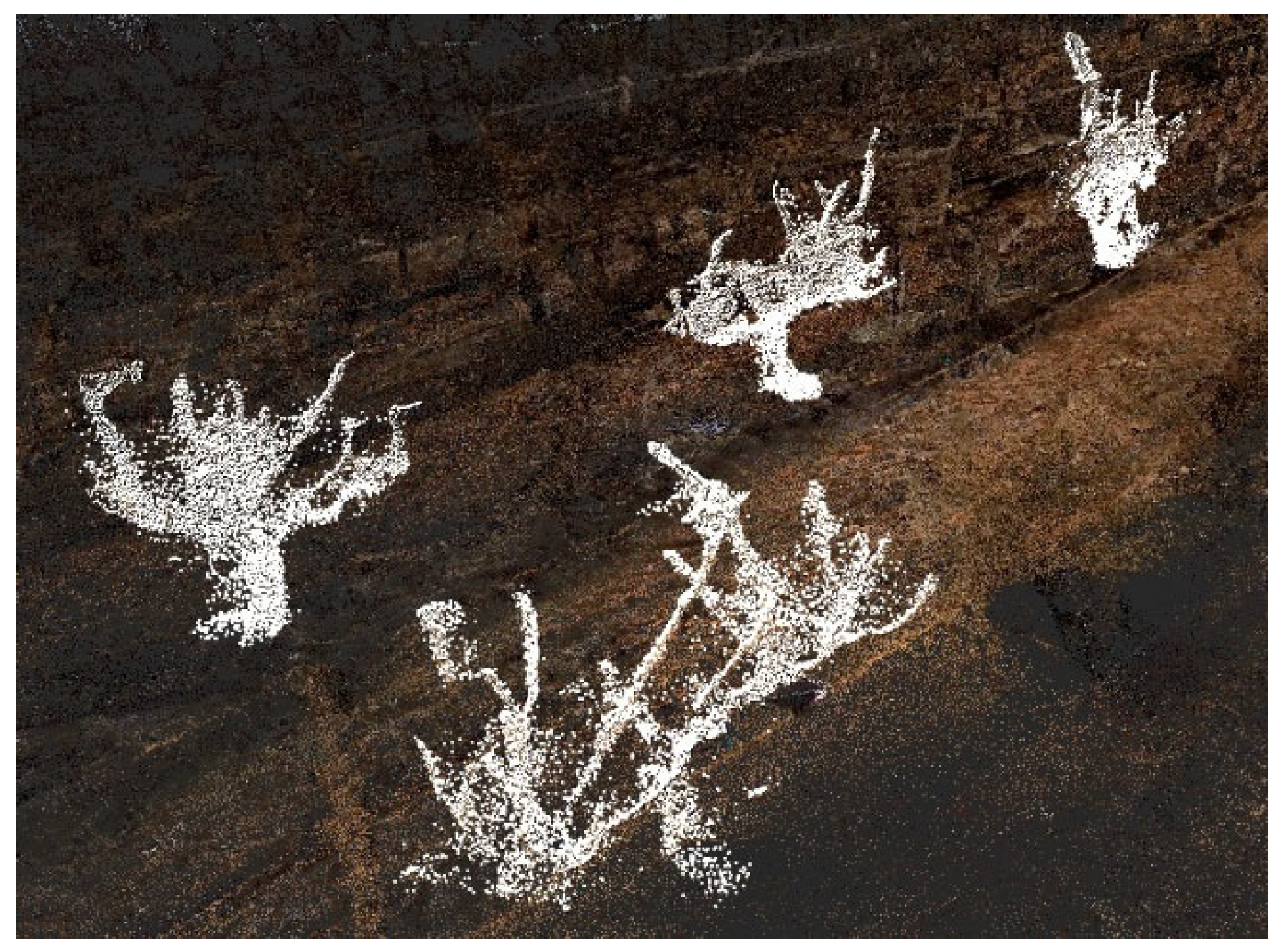
As described above, the sample vines were isolated from the 3D point cloud of the experimental area, and the count of the total points in each vine was estimated as the metric of growth (
Figure 1).
The initial hypothesis that soil variability produces spatial variability on vine development was confirmed by the results of the analysis; the descriptive statistics of the point cloud measurements of the sample vines showed a considerably high coefficient of variation (CV = 37%).
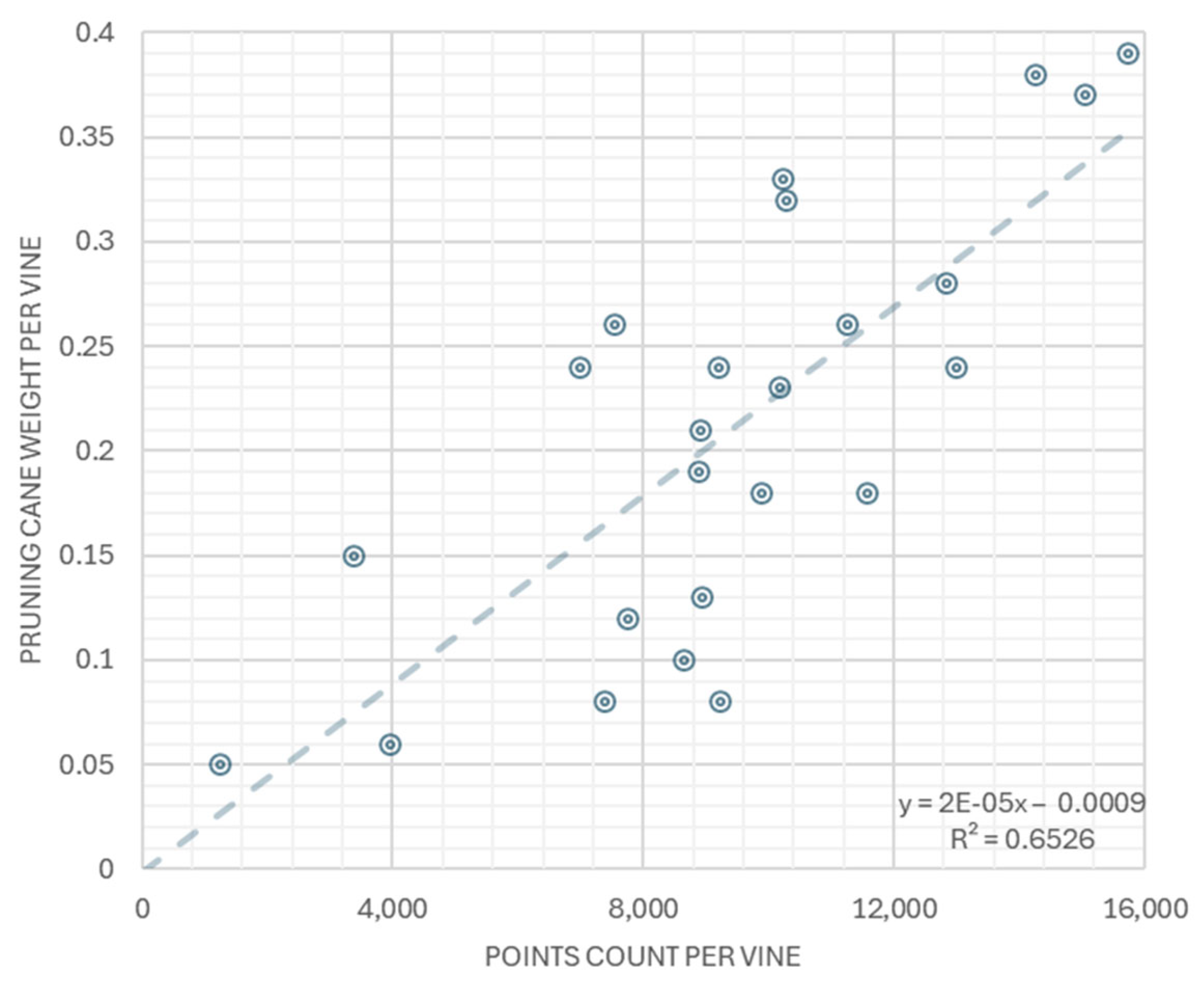
The count of the total points per vine was used as the dependent variable in the regression analysis with the rest of the measured parameters. The results revealed a strong positive relationship between the point count and the pruning cane weight (
Figure 2; R
2 = 0.65). This is consistent with the results presented in [
6], where a 2D LiDAR scanner was proved as a viable tool for mapping pruning canes in vineyards.
A strong relationship was also observed among the LiDAR scans and the leaf temperature measured using a thermal camera during harvest (
Table 1; R
2 = 0.64). A weaker, yet significant, relationship between the same parameters (R
2 = 0.41) was also observed with canopy temperature measured at veraison. The weaker relationship is attributed to the water status in July, when, due to precipitation events, the vines were less stressed; thus, the range of temperature measurements was shorter, and variability was low. The negative relationship indicates that more vigorous vines had better reaction to heat and water scarcity stress.
Furthermore, NDRE vegetation index measured at harvest had a stronger relationship with pruning measurements (R2 = 0.56) as compared to the NDVI (R2 = 0.19), supported by the fact that the NDVI is saturated at dense canopies, making NDRE a more appropriate indicator of canopy variability at such conditions.
4. Conclusions
Mapping the soil ECa confirmed the hypothesis that soil spatial variability is a reliable factor that determines the spatial variability of grapevines’ growth and physiology throughout vineyards.
The method described in this study provides rapid mapping of a 3D representation of vines. Analysis of the 3D point clouds of the sample vines provided an accurate estimation of the dormant canes, which is a reliable indicator of within-season vine vigour. This highlights the potential of 3D mapping to accurately assess spatial variability of vine status, making LiDAR 3D scanners a valuable tool for characterizing within-vineyard variability.
On the other hand, this technology shows limitations that are related to the complexity of data acquisition and analysis and the large volume of data that need to be stored and processed.
Further studies are required to enrich the dataset and improve the efficacy of the proposed methodology. The relationship between LiDAR sensor data and thermal measurements should be further investigated under different climatic conditions through multiple site-years.
Author Contributions
Conceptualization, A.C.T.; methodology, A.C.T. and K.B.; software, A.C.T.; validation, K.B., I.D. and D.K.; formal analysis, A.C.T. and I.D.; investigation, A.C.T., K.B. and I.D.; resources, D.B., A.B. and K.B.; data curation, A.C.T., I.D. and D.K.; writing—original draft preparation, A.C.T.; writing—review and editing, A.C.T. and D.K.; visualization, A.C.T.; supervision, A.C.T., K.B. and D.B.; project administration, D.B., D.K. and A.B.; funding acquisition, A.B. and D.B. All authors have read and agreed to the published version of the manuscript.
Funding
This research was carried out as part of the project “AΓΡOΣΥΣ” (Project code: ΤAΕΔΚ-06184) under the framework of the Action “Research-Create-Innovate”, Greece 2.0 National Recovery and Resilience Plan that is co-funded by the European Union and ESPA 2021-2027.3.1.
Institutional Review Board Statement
Not applicable.
Informed Consent Statement
Not applicable.
Data Availability Statement
Data sharing is not applicable to this article.
Conflicts of Interest
The authors declare no conflicts of interest.
Abbreviations
The following abbreviations are used in this manuscript:
| LiDAR | Light Detection and Ranging |
| SLAM | Simultaneous Localization and Mapping |
| NDVI | Normalized Difference Vegetation Index |
| NDER | Linear dichroism |
| PV | Precision Viticulture |
| ECa | Apparent Electrical Conductivity |
| UGV | Unmanned Ground Vehicle |
| IR | Infrared |
References
- Smart, R.; Robinson, M. Sunlight into Wine: A Handbook for Winegrape and Canopy Management; Winetitles: Adelaide, SA, Australia, 1991. [Google Scholar]
- Ferro, M.V.; Catania, P. Technologies and Innovative Methods for Precision Viticulture: A Comprehensive Review. Horticulturae 2023, 9, 399. [Google Scholar] [CrossRef]
- Tagarakis, A.C.; Filippou, E.; Kalaitzidis, D.; Benos, L.; Busato, P.; Bochtis, D. Proposing UGV and UAV Systems for 3D Mapping of Orchard Environments. Sensors 2022, 22, 1571. [Google Scholar] [CrossRef] [PubMed]
- Tagarakis, A.; Liakos, V.; Fountas, S.; Koundouras, S.; Gemtos, T. Management zones delineation using fuzzy clustering techniques in grapevines. Precis. Agric. 2013, 14, 18–39. [Google Scholar] [CrossRef]
- Bramley, R.G.V. Precision Viticulture: Managing vineyard variability for improved quality outcomes. In Managing Wine Quality, 2nd ed.; Reynolds, A.G., Ed.; Woodhead Publishing: Sawston, UK, 2022; pp. 541–586. ISBN 9780081020678. [Google Scholar] [CrossRef]
- Tagarakis, A.; Koundouras, S.; Fountas, S.; Gemtos, T. Evaluation of the use of LIDAR laser scanner to map pruning wood in vineyards and its potential for management zones delineation. Precis. Agric. 2018, 19, 334–347. [Google Scholar] [CrossRef]
| Disclaimer/Publisher’s Note: The statements, opinions and data contained in all publications are solely those of the individual author(s) and contributor(s) and not of MDPI and/or the editor(s). MDPI and/or the editor(s) disclaim responsibility for any injury to people or property resulting from any ideas, methods, instructions or products referred to in the content. |



 ,
,