1. Introduction
Food waste is a significant contemporary issue with social, ethical, and environmental implications. It is closely tied to climate change and food insecurity and is a priority for both the European Union and the United Nations. Annually, around 1.3 billion tons of food intended for human consumption are discarded, equating to roughly 33% of global food production [
1,
2,
3]. This waste has considerable environmental impacts, including greenhouse gas emissions, water and air pollution, and deforestation, which result from resource-intensive food production processes. Food waste (FW) occurs at the consumer level, while food loss (FL) happens earlier in the supply chain, during production, transportation, processing, and storage. FW is influenced by consumer habits, economic factors, knowledge of food management, preferences, and environmental awareness. Urbanization and increased household incomes have led to higher food consumption, which also contributes to more food waste. In fact, households are responsible for 61% of food losses, averaging at 79 kg per consumer [
4,
5,
6]. The environmental cost of this waste includes the loss of water and energy resources used in food production and processing. Studies show that food losses contribute to 8% of global greenhouse gas emissions and occupy 30% of agricultural land. The aim of this paper is to group Greek consumers based on their perceptions on the issue of food waste [
7].
2. Methods
The present study was based on primary data collected through an online questionnaire addressed to consumers in the Region of Central Macedonia. The questionnaire was distributed following telephone communication and briefing of all individuals included in the sample. According to the research protocol, after the initial distribution, a telephone reminder regarding the objectives of the study was conducted one month later, followed by a second distribution of the questionnaire. In total, 870 questionnaires were returned, of which 668 were deemed valid, achieving a response rate of 70%. Questionnaires with incomplete data were excluded from further analysis [
1].
The factors analyzed for the consumer segmentation included recycling behavior, reuse of materials, waste reduction practices, knowledge of environmental issues, awareness of environmental problems, sense of community, consumer sentiments, as well as socio-economic characteristics such as monthly income and family status.
To analyze the collected data, the validity and reliability of the questionnaire items were assessed. Initially, Exploratory Factor Analysis (EFA) was conducted, followed by Confirmatory Factor Analysis (CFA) using SPSS Amos 24.0. For the clustering procedure, Hierarchical Cluster Analysis was employed, specifically using Ward’s method to minimize within-cluster variance [
1]. The squared Euclidean distance was used as the distance measure.
3. Results
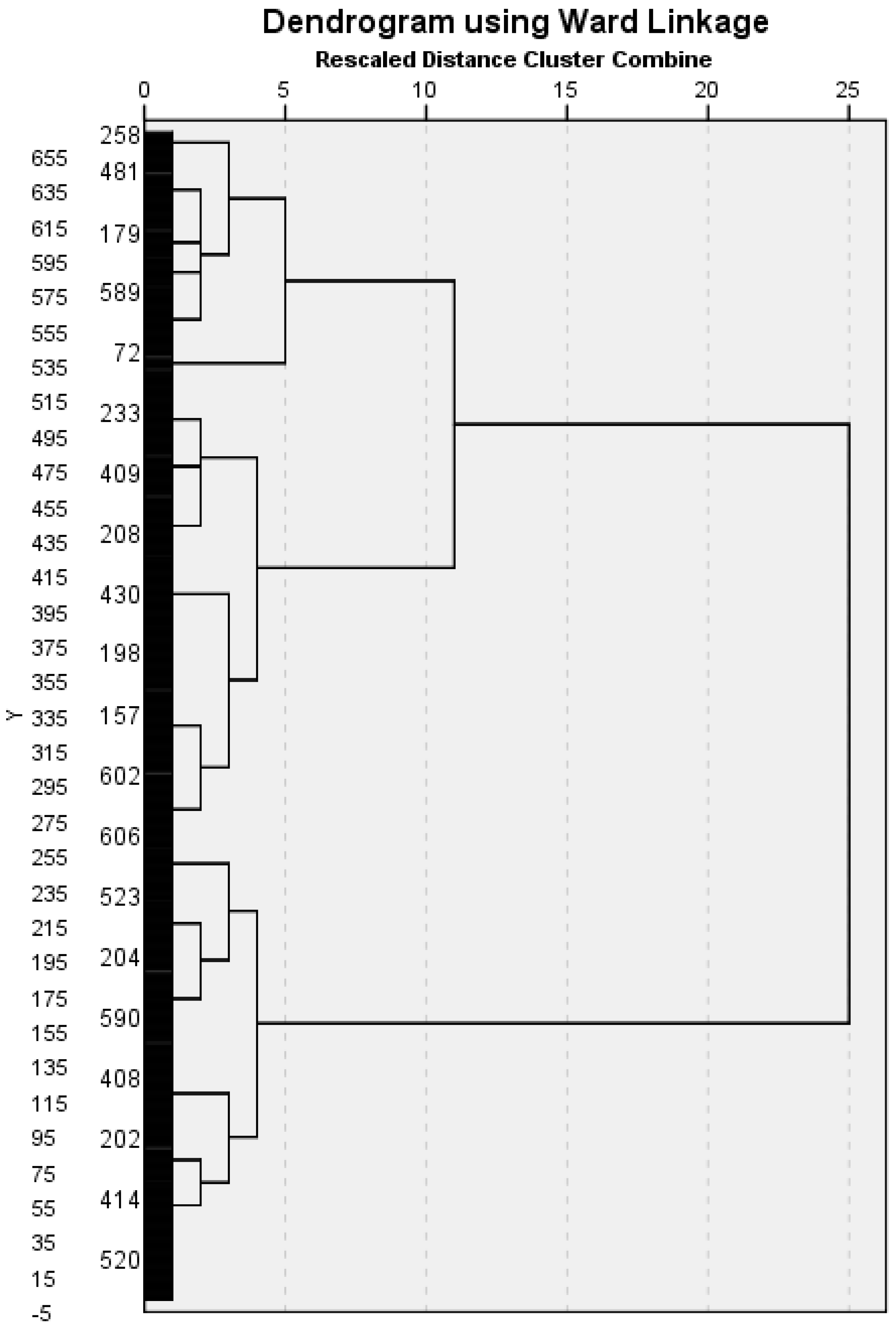
In order to classify consumers into distinct groups, a combination of hierarchical and non-hierarchical clustering techniques was employed. Initially, hierarchical cluster analysis was conducted to determine the optimal number of clusters. This stage provided a foundational structure, which was then refined through the application of K-means clustering in the subsequent phase (
Figure 1).
The hierarchical clustering was implemented using Ward’s method, which aims to minimize intra-cluster variance. The squared Euclidean distance was used as the dissimilarity measure. The determination of the appropriate number of clusters was guided by the sample size, and an exploratory range of two to five clusters was considered.
Following this, K-means clustering was applied in order to fine-tune the cluster composition. The initial centroids for the K-means procedure were extracted from the hierarchical clustering results. Each cluster centroid was defined as the arithmetic mean of the observed values of all included variables for the individuals within that cluster. In this study, the cluster centers were based on nine key variables, forming the basis for the final two-cluster solution [
1].
The results, including the cluster centroids and the distribution of participants across clusters, are summarized in
Table 1.
A detailed description of the two consumer clusters is presented below: Cluster 1—“Environmentally Conscious and Informed”: This cluster includes 405 consumers, representing 60.6% of the total sample of Greek consumers from the Region of Central Macedonia. Cluster 2—“Low Environmental Awareness”: This cluster consists of 263 consumers, accounting for 39.4% of the total sample.
4. Discussion
The present analysis identified two distinct groups of consumers based on their attitudes toward food waste and environmental issues, revealing meaningful differences in socio-economic characteristics, awareness levels, and behavioral patterns. The first cluster, characterized by higher income levels and increased environmental awareness, demonstrates a stronger commitment to responsible consumption practices. Individuals in this group are more likely to engage in behaviors such as recycling, careful meal planning, reuse of leftovers, and active efforts to reduce household food waste. Their actions suggest a greater understanding of the environmental, economic, and social impacts associated with food loss, as well as a higher perceived sense of personal responsibility. In contrast, the second cluster consists of consumers with limited environmental knowledge and a generally indifferent attitude toward the consequences of food waste. Members of this group tend to underestimate the environmental burden of discarded food and show lower engagement in waste-reducing practices. This lack of awareness may be linked to lower access to relevant information, fewer educational opportunities, or limited exposure to sustainability-oriented initiatives. As a result, food waste is often perceived as an unavoidable or insignificant issue rather than a behavioral choice that can be modified. These findings underscore the importance of designing targeted public awareness and educational campaigns that address the specific needs and perceptions of less environmentally conscious population groups. Furthermore, the role of education and policies promoting sustainable consumption emerges as crucial for enhancing environmental responsibility and reducing food waste.
Author Contributions
Conceptualization, Z.P. methodology, Z.P.; writing—original draft preparation, Z.P.; writing—review and editing, I.T., A.G. and C.K.; supervision, C.K.; project administration, Z.P. All authors have read and agreed to the published version of the manuscript.
Funding
This research received no external funding.
Institutional Review Board Statement
Not applicable.
Informed Consent Statement
Informed consent was obtained from all subjects involved in the study.
Data Availability Statement
The datasets used and analyzed during the current study are available from the corresponding author on reasonable request due to privacy or ethical restrictions.
Conflicts of Interest
The authors declare no conflict of interest.
References
- Papanikolaou, Z.; Karelakis, C. A Path Analysis of Behavioral Drivers of Household Food Waste in Greece. Agriculture 2025, 15, 2481. [Google Scholar] [CrossRef] [Scilit]
- Theodoridis, P.; Zacharatos, T.; Boukouvala, V. Consumer behaviour and household food waste in Greece. Br. Food J. 2023, 126, 965–994. [Google Scholar] [CrossRef] [Scilit]
- Theodoridis, P.K.; Zacharatos, T.V. Food waste during Covid- 19 lockdown period and consumer behaviour—The case of Greece. Socio-Economic Plan. Sci. 2022, 83. [Google Scholar] [CrossRef] [Scilit]
- Kritikou, T.; Panagiotakos, D.; Abeliotis, K.; Lasaridi, K. Investigating the Determinants of Greek Households Food Waste Prevention Behaviour. Sustainability 2021, 13, 11451. [Google Scholar] [CrossRef] [Scilit]
- Abeliotis, K.; Lasaridi, K.; Chroni, C. Attitudes and behaviour of Greek households regarding food waste prevention. Waste Manag. Res. 2014, 32, 237–240. [Google Scholar] [CrossRef] [Scilit] [PubMed]
- Ponis, S.T.; Papanikolaou, P.-A.; Katimertzoglou, P.; Ntalla, A.C.; Xenos, K.I. Household food waste in Greece: A questionnaire survey. J. Clean. Prod. 2017, 149, 1268–1277. [Google Scholar] [CrossRef] [Scilit]
- Abeliotis, K.; Lasaridi, K.; Chroni, C. Food waste prevention in Athens, Greece: The effect of family characteristics. Waste Manag. Res. 2016, 34, 1210–1216. [Google Scholar] [CrossRef] [Scilit] [PubMed]
| Disclaimer/Publisher’s Note: The statements, opinions and data contained in all publications are solely those of the individual author(s) and contributor(s) and not of MDPI and/or the editor(s). MDPI and/or the editor(s) disclaim responsibility for any injury to people or property resulting from any ideas, methods, instructions or products referred to in the content. |