1. Introduction
Women significantly contribute to agricultural production, especially olive growing and olive oil production, an emblematic activity in Greece [
1]. Their expertise and dedication drive this field forward, impacting current and future generations. While conditions for Greek female farmers have improved in the past decade, they still face numerous challenges and social exclusion, particularly in culturally distinct villages. Moreover, women require appropriate infrastructure and services to help them balance family and work demands, thereby reducing the burden of caregiving responsibilities [
2]. Our research stems from the problem that, despite the crucial role of women in olive-growing in Greece, their contributions and the challenges faced are often underrepresented, especially through the lens of climate change and adaptation to sustainable practices. It is thus essential to use the gender lens to understand opportunities, challenges, and adaptation tactics against climatic shocks and overall to support sustainable agriculture [
3]. More specifically, this article aims to explore important questions that lie at the intersection of gender and sustainability: In what ways do women farmers understand and respond to sustainable practices in olive farming within the context of climate change, and how do gender-related roles, responsibilities, and access to resources shape the adoption patterns of these practices? We conducted field research and used a mixed methods approach based on case study examination within the Greek context, with data collected through in-depth interviews with women involved in olive farming in Crete where olive trees are central to the landscape, economy, and identity. By exploring the research questions, this study provides a better understanding of the lived experiences of women in olive farming and the structural and social dynamics that shape their pathways toward sustainable farming practices.
2. Material and Methods
Data were collected through a mixed methods approach, including both qualitative and quantitative tools [
4]. A total of 23 women farmers were identified through key informants (university staff, colleagues, social media platforms, research institutes, workshops, websites, and other relevant networks), and a semi-structured interview was used [
5]. Since olive farming is a male-dominated field, women farmers were hard to reach and locate, so the selection process involved snowball sampling reaching a thematic saturation point [
4]. Data were analyzed thematically to ensure a deeper understanding of the interviewees’ perspectives. Several themes emerged, and a S.W.O.T. analysis was performed. Moreover, we employed descriptive statistics to analyze all quantitative data collected. This approach allowed us to summarize and present key patterns through percentages and frequencies.
3. Results
Participants were highly educated women (90.5%), mostly aged 31–50 years, married (61.9%), and almost evenly split between having children and not. A total of 28.6% of women were the farm head, and two-thirds of the women were working full-time. Nearly all respondents were remunerated or received olive oil in exchange for their work.
3.1. Women’s Perception of Sustainable/Organic Farming Practices
All the women in this study expressed strong support for organic farming, acknowledging its environmentally friendly impact. Some expressed a preference for other sustainable farming systems (19.2%), such as permaculture, regenerative agriculture, and agroecology practices. Many stated that it was important for consumers to buy from local producers (as themselves) and that organic farming should be adopted worldwide in the absence of any certification. A total of 95.2% of the women had a strong preference toward the adoption of sustainable practices, mainly driven by environmental values and wanting to farm in an innovative nature-respecting way rather than purely for economic benefit. Unlike men, women farmers are not primarily driven by economic gains when participating in agricultural extension programs but rather by self-actualization [
6]. Importantly, this positive attitude was seen in women who lack decision-making power on the farm (28.5%) or direct experience in olive growing. Women’s role in agricultural decision-making is often low or unequal to men. It is, therefore, suggested that awareness is not necessarily dependent on authority and that we need to recognize the quiet transformative ways women are shaping sustainability [
7]. Furthermore, the willingness to adopt these practices appeared to be independent of how women perceive their complexity. These practices require more time, energy, and equipment that are often designed for male use without considering women’s needs. Therefore, women-friendly farm equipment should be provided at a subsidized price for easier access [
8]. Moreover, women farmers mentioned several challenges for the adoption of sustainable practices, including yield losses, the difficulty of transitioning from conventional systems, as well as neighboring non-organic farms and insufficient access to scientific knowledge.
3.2. Climate Change Awareness and Adaptation
Gender issues are often treated separately instead of being integrated across all aspects of climate and agricultural policy discussions; as a result, it makes women less visible, even though they are among the most vulnerable to these changes [
9]. When asked about climate change, most women showed strong awareness and pointed to abnormal weather patterns they observed in the last few years, like droughts, reduced rainfall, unpredictable weather, and heatwaves. Moreover, 40.1% of participants expressed being unprepared for unexpected risks that could impact their farms and often link it to financial insecurity or lack of training or community support. The rest felt moderately prepared due to experience, training (fire protection, etc.), or previous pandemics.
3.3. Gender Dynamics
3.3.1. Labor and Task Division
Most women interviewed (71.43%) described a gendered division of labor. Men are generally assigned roles involving heavy labor (pruning, irrigation, etc.), and they operate machines and perform physically demanding tasks. In contrast, women are typically responsible for harvesting, sorting, and cleaning olives. Women have traditionally played an important role in olive farming, often being responsible for the labor-intensive task of harvesting olives [
10]. These tasks are often perceived as less physically demanding, but women acknowledged that bending, picking, and carrying olives are also difficult, and women’s tasks are equally challenging to men’s tasks. Other women reported that tasks were divided by skills, physical strength, or availability rather than by gender. Particularly, there were two farms entirely run by women, with everyone contributing and some women doing tasks traditionally held by men.
3.3.2. Gender-Based Discrimination
A significant portion of participants (42.9%) reported experiencing direct gender-based discrimination or knowing other women who had. Several of them described being ignored during conversations as well as facing discriminatory jokes, sexist comments at work, or unwanted attention. Some also pointed to the difficulty small communities have in crediting women’s independent achievements without attributing them to others as well as challenges in being accepted as leaders. Farming yields are negatively correlated with gender-based discrimination, indicating that providing equal access and opportunities to women could eventually improve food security [
11].
3.3.3. Off-Farm Responsibilities
Apart from farming, women shared family-oriented responsibilities (hidden labor), like the heavy load of childcare, caring for elderly relatives, or balancing professional and household chores (cooking, cleaning, buying groceries, etc.). Some had even given up career opportunities due to these obligations, knowing that domestic or social tasks are not valued in monetary terms. Women still experience discrimination within the family, especially related to household chores, decision-making ability, parental authority, and household chores [
11]. All participants expressed difficulty managing responsibilities for many reasons. Some mentioned they were new to farming, while others stated the mental burden of balancing their lives as farmers and mothers. Many mentioned the feeling of guilt they had for not spending a lot of quality time with their children when they were younger and needed more care. Women expressed feelings of exhaustion and pressure, describing a lack of personal time and insufficient support or structure to manage their daily responsibilities. Men often focus on prices, production, and financial responsibilities and perceive their roles as providers only, even when women are also engaged in paid labor [
12].
3.4. Access to Resources and Support
3.4.1. Access to Land
Systemic inequities in land ownership, credit access, and resource allocation limit women’s contributions to sustainable farming [
13]. However, in our study, 95.2% of women reported having easy access to land mainly because the majority inherited land from family. Despite this, only 38.1% believed they had the same access as men, who are culturally favored. Legally, women have the right to buy land, but they face many challenges, like dealing with land owners, so they always need men’s support for negotiations. One participant pointed out that renting is easier than buying land as a woman, yet 71.4% of women agreed that high land prices and rent are significant barriers that limit their access to land. Women’s access to farmland still depends primarily on marrying into the farm, with inheritance occurring less frequently and typically later in life compared to men [
14].
3.4.2. Access to Information and Training
When asked about their main source of information, interviewees mentioned other farmers (71.4%) as well as online research (57.1%). Furthermore, access to formal extension services remains limited (14.3%). Women tend to be less adaptive to climate change due to resource limitations, restricted access to information and extension services, and the fact that many available adaptation strategies increase their labor burden [
15].
All participants highlighted the urgent need for workshops with practical demonstrations on organic farming techniques, while 15% showed interest in advanced-level workshops focused on soil quality, water management, and olive tree physiology as well as government-led trainings and advisory support. Women also prefer webinars, as they allow participation without the need to travel or leave their children and household duties. Moreover, appropriate infrastructure and services are important to help women balance family and work demands, thereby reducing the burden of caregiving responsibilities [
16]. Additionally, several women showed interest in networking and funded exchange programs to connect with peers and expand their knowledge beyond the local level.
3.4.3. Social Protection and Access to Financial Resources
A total of 23.8% of farmers lack any social protection or insurance coverage. Women’s access to social protection is limited due to factors such as low income, lack of land ownership, poor market access, and limited awareness of available schemes [
17]. However, in our study, social protection of farmers appears to be independent of land ownership status or personal income. Women farmers are largely excluded from formal social protection systems that have the power of improving social indicators such as health, food security, and education levels [
18]. Moreover, our findings revealed that 76.2% of participants do not have access to credit or saving schemes, which can explain the fact that 57.1% of these women were not willing to take on debt to invest in the farm. They mentioned that, for them to implement changes, they need financial support for purchasing equipment and organic inputs. Development strategies should prioritize giving rural women direct access to financial services (not meditated by men) [
19]. This autonomy not only strengthens women’s productive capacity but also results in greater investments in children’s health, education, and nutrition.
3.5. Leaderhip and Decision-Making Power
In our study, women played significant roles in farm decisions, with many being primary decision-makers (33.3%) or making decisions collectively (38.1%). However, even if women were extensively anchored during the decision processes, men mainly make the decisions in the end [
20]. When it comes to membership in agricultural organizations, about half (47.6%) of farmers are members, but only 19% hold leadership positions within them. A total of 40,9% of Greek participants felt that they are heard and valued in agricultural discussions, while 13.6% do not participate in the first place. The rest of the women had either mixed experiences or did not feel like their opinions mattered in their community. Respondents agreed on the need for financial support or grants (61.1%), mentorship or networking opportunities (44.4%), and stronger community and family support (47.6%) as essential measures to strengthen women’s leadership in the sector.
3.6. SWOT Analysis
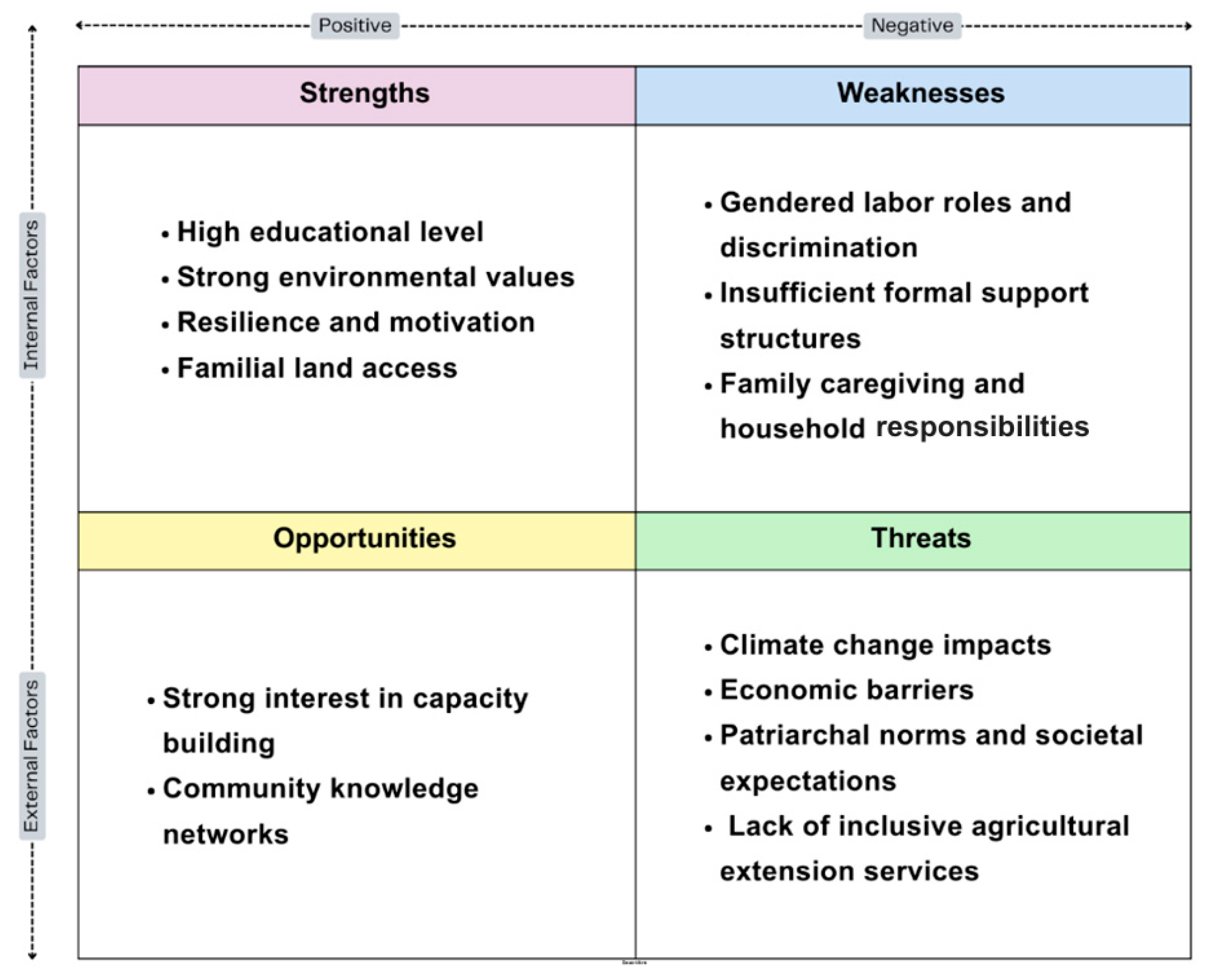
The SWOT analysis (
Figure 1) revealed that high educational levels among Greek farmers as well as their strong environmental values suggest that women are well-positioned to engage in sustainable olive farming practices. In addition, familial land access offers a foundation for involvement in agricultural activities, even if formal ownership remains limited. The identified weaknesses point to barriers like household responsibilities and insufficient formal support structures. The external opportunities that can be leveraged include women’s strong interest in capacity building, which development programs can support, as well as community knowledge networks, which means that farmer-to-farmer learning and informal collaborations are already in place and can also be utilized by support programs. The threats identified are mainly systemic and environmental, presenting serious barriers to sustainable olive farming, such as climate change impacts that affect women and their farms due to their limited access to resources. In addition, economic barriers further restrict women’s ability to invest in tools, technologies, or training. Finally, patriarchal norms and societal expectations continue to limit women’s agency and visibility and contribute to the lack of inclusive agricultural extension.
4. Discussion
Women are deeply aware of environmental and climate risks and increasingly interested in organic and sustainable practices. However, their contributions to sustainable agriculture remain undervalued and constrained by persistent structural inequalities, such as unequal access to training and financial resources and the heavy burden of domestic responsibilities. Women’s invisibility extends not only to economic spheres but also to institutional processes, where women have limited access to extension services and are poorly represented in agricultural organizations. Our findings indicate that increased access to resources and capacity investments could empower women to play a key role in advancing sustainable agriculture, hence supporting climate resilience and reducing rural inequality.
5. Conclusions
This study highlights the urgent need for intersectional, inclusive policies that tackle not only economic disparities but also the social norms and institutional gaps that reproduce gendered exclusion. Policy implications include (i) facilitating access to low-interest farm investment micro-loans; (ii) offering tailored technical education and training courses to equip women with the required skills; and (iii) building leadership capacity to enhance women’s participation in agricultural decision-making. Our sample was limited to highly educated participants; as a result, this study may have unintentionally excluded other farmers who could have offered different but equally valuable insights. Building on this limitation, future research could deepen the understanding of women’s roles in sustainable agriculture by investigating other women farmers with low education as well as male farmers’ engagement with sustainable olive farming practices, the barriers they encounter, and their perceptions of climate change to provide a more balanced and inclusive understanding of gendered experiences in the sector. Future research could also focus on a range of theoretical frameworks such as ecofeminism and the feminist political ecology, which can help shed light on how women manage resource access and ecological change in male-dominated societies.
Author Contributions
H.R.—conceptualization, methodology, formal analysis, results and discussion, conclusion, and writing—original draft; M.P.—theoretical framework, methodology, writing— review and editing; I.L.—project administration, writing—review and editing. All authors have read and agreed to the published version of the manuscript.
Funding
This research received no external funding.
Institutional Review Board Statement
Not applicable.
Informed Consent Statement
Informed consent was obtained from all subjects involved in this study.
Data Availability Statement
The data presented in this study are available on request from the corresponding author.
Conflicts of Interest
The authors declare no conflict of interest.
References
- Lazaridis, G. Women’s Work and Lives in Rural Greece: Appearances and Realities; Routledge: London, UK, 2016. [Google Scholar]
- Tsiaousi, A.; Partalidou, M. Female farmers in Greece: Looking beyond the statistics and into cultural–social characteristics. Outlook Agric. 2021, 50, 55–63. [Google Scholar] [CrossRef]
- Naheed, S.; Rukhsana. Transitioning to sustainable food systems in a changing climate and gender equality: A brief review. Agric. Food Secur. 2024, 13, 41. [Google Scholar] [CrossRef]
- Bryman, A. Social Research Methods, 5th ed.; Oxford University Press: London, UK, 2016. [Google Scholar]
- Legard, R.; Keegan, J.; Ward, K. In-depth interviews. In Qualitative Research Practice: A Guide for Social Science Students and Researchers; Ritchie, J., Lewis, J., Eds.; Sage: London, UK, 2003; pp. 138–169. [Google Scholar]
- Charatsari, C. Is this a man’s world? Woman in the farm family of Thessaly, Greece from the 1950s onwards. Gend. Issues 2014, 31, 238–266. [Google Scholar] [CrossRef]
- Chayal, K.; Dhaka, B.L.; Poonia, M.K.; Tyagi, S.V.S.; Verma, S.R. Involvement of farm women in decision-making in agriculture. Stud. Home Community Sci. 2013, 7, 35–37. [Google Scholar] [CrossRef]
- Jena, R. Issues and concerns of gender discrimination in irrigated agriculture: An analysis. Orissa Econ. J. 2017, 49, 237–245. [Google Scholar]
- Glazebrook, T.; Noll, S.; Opoku, E. Gender matters: Climate change, gender bias, and women’s farming in the global South and North. Agriculture 2020, 10, 267. [Google Scholar] [CrossRef]
- AntaFélez, J.-L.A.; Rodríguez, M.P. Las mujeres en el olivar andaluz. Nuevas y viejas formas en el trabajo agrícola. Methaodos Rev. Cienc. Soc. 2019, 7, 302–313. [Google Scholar] [CrossRef]
- Chrisendo, D.; Heikonen, S. Gender-Based Discrimination and Global Crop Yield. In Proceedings of the 2023 Agricultural & Applied Economics Association Annual Meeting, Washington, DC, USA, 23–25 July 2023. [Google Scholar]
- Ou Salah, L. Gendering Climate Change in Moroccan Souss Massa. Souffles Monde. 2023. Available online: https://www.soufflesmonde.com/posts/gendering-climate-change-in-moroccan-souss-massa (accessed on 15 June 2025).
- Fertő, I.; Bojnec, Š. Empowering Women Farmers for Sustainable Agriculture in the E.U. 2025. Available online: https://krtk.elte.hu/wp-content/uploads/2025/03/krtk_policy_brief_no_01_en.pdf (accessed on 15 February 2025).
- Pilgeram, R.; Amos, B. Beyond ‘Inherit It or Marry It’: Exploring How Women Engaged in Sustainable Agriculture Access Farmland. Rural. Sociol. 2015, 80, 16–38. [Google Scholar] [CrossRef]
- Jost, C.; Kyazze, F.; Naab, J.; Neelormi, S.; Kinyangi, J.; Zougmore, R.; Aggarwal, P.; Bhatta, G.; Chaudhury, M.; Tapio-Bistrom, M.L.; et al. Understanding gender dimensions of agriculture and climate change in smallholder farming communities. Clim. Dev. 2016, 8, 133–144. [Google Scholar] [CrossRef]
- Tsiaousi, A.; Partalidou, M. How FAST are women farmers in Greece transforming contested gender identities in a (still) male-dominant sector? Sociol. Rural. 2023, 63, 249–267. [Google Scholar] [CrossRef]
- Amadhila, E.M. The Potential for Social Protection in Promoting Sustainable Agriculture and Empowering Women Farmers in Namibia. Gend. Quest. 2023, 11, 25. [Google Scholar] [CrossRef] [PubMed]
- Mushunje, M.T.; Sewpaul, V. Social protection options for women farmers in the face of climate change: A case study of women farmers and agriculture in Goromonzi, Zimbabwe. In The Routledge Handbook of Green Social Work; Routledge: London, UK, 2018; pp. 254–266. [Google Scholar]
- Fleschner, D.; Kenney, L. Rural Women’s Access to Financial Services: Credit, Savings, and Insurance. In Gender in Agriculture: Closing the Knowledge Gap; Springer Nature: London, UK, 2014; pp. 187–208. [Google Scholar]
- Alary, V.; Romagny, B.; Najjar, D.; Aderghal, M.; Moisseron, J.Y. The Capacity of a Household Farming System with Women’s Decision and Action-Making Power: Rural Marginal Areas in Morocco. Agriculture 2025, 15, 319. [Google Scholar] [CrossRef]
| Disclaimer/Publisher’s Note: The statements, opinions and data contained in all publications are solely those of the individual author(s) and contributor(s) and not of MDPI and/or the editor(s). MDPI and/or the editor(s) disclaim responsibility for any injury to people or property resulting from any ideas, methods, instructions or products referred to in the content. |