1. Introduction
Crop Wild Relatives (CWRs) are increasingly recognized for their critical role in supporting sustainable agriculture. They represent an invaluable genetic resource for enhancing crop resilience to climate change and ensuring global food security [
1,
2,
3]. Despite widespread recognition of their importance, CWRs remain inadequately integrated into agricultural and environmental policy frameworks, resulting in missed opportunities for their conservation and sustainable utilization. Previous research has extensively documented the significance of CWRs in maintaining agrobiodiversity, improving crop adaptability, and mitigating the impacts of environmental stresses [
4,
5]. Nevertheless, the policy dimensions surrounding CWR conservation and utilization have been relatively under-explored. Studies indicate substantial gaps in the institutional and legal frameworks necessary to support effective conservation and sustainable use of CWRs, highlighting the need for more integrated policy approaches. To address this issue, this study conducts a systematic literature review focused explicitly on synthesizing policy-oriented outcomes related to the use and expansion of CWRs. Utilizing a structured methodology, peer-reviewed studies were systematically identified and analyzed to extract relevant insights regarding enabling factors and persistent policy gaps.
The results of this synthesis offer comprehensive insights into strategic policy efforts at national, European, and international levels, emphasizing key areas for improvement and successful practices in integrating CWR conservation and use into broader agricultural policy frameworks. These findings contribute substantially to ongoing discussions on agri-environmental strategies, informing future policy development aimed at enhancing the sustainability and resilience of agricultural systems through effective integration of CWRs.
2. Materials and Methods
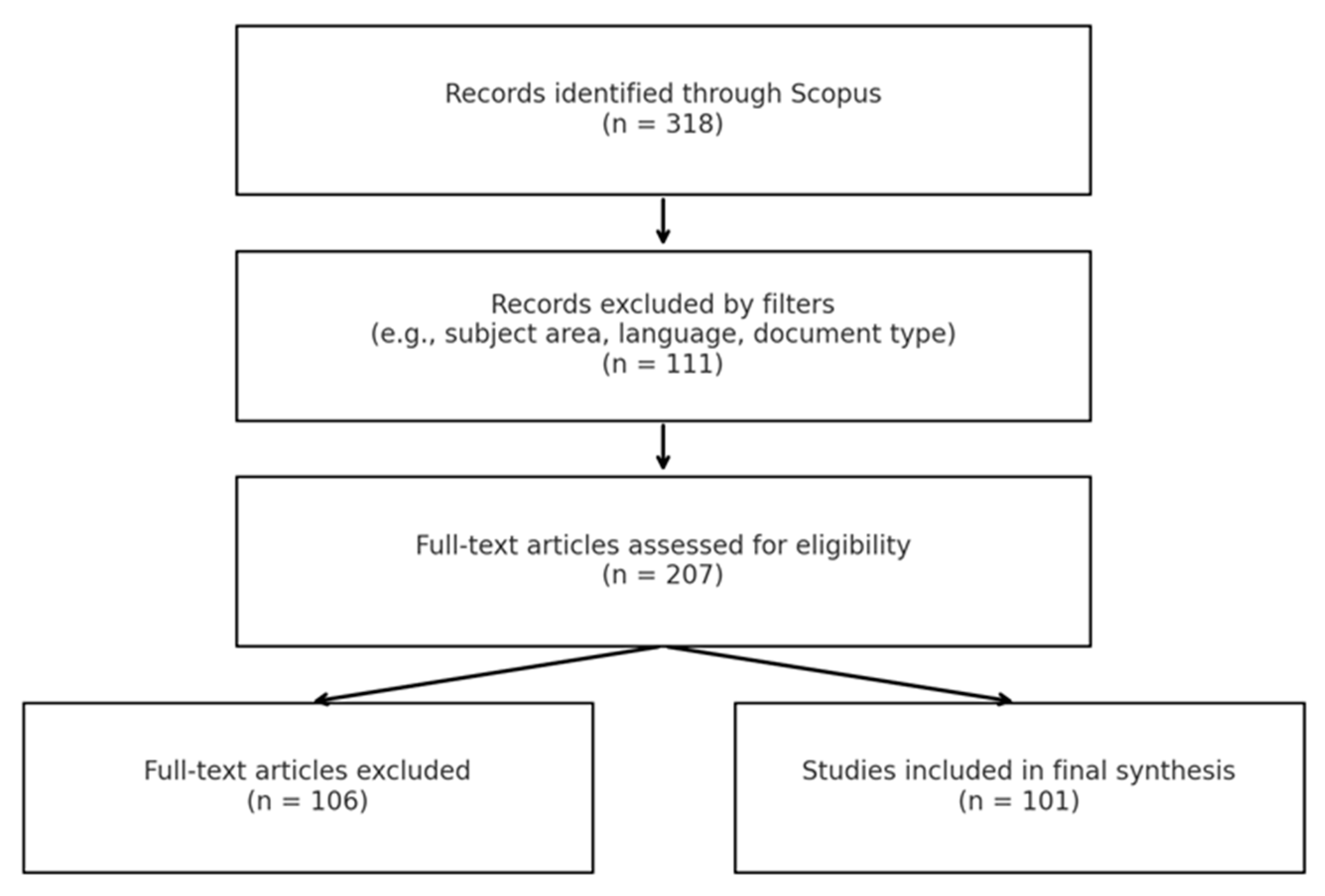
The present study employed a systematic literature review methodology adhering to the Preferred Reporting Items for Systematic Reviews and Meta-Analyses (PRISMA) guidelines, depicted in
Figure 1. The review focused on peer-reviewed literature sourced from the Scopus database, published between 2005 and 2025. The search strategy combined specific keywords and Boolean operators to capture relevant studies addressing policy implications related to Crop Wild Relatives (CWRs) and crop genetic diversity. Initial search results were screened based on predefined inclusion and exclusion criteria, which focused specifically on the policy relevance of CWR conservation and use. Relevant articles were subsequently reviewed in full text. Data from selected studies were extracted using a structured template designed to capture information on geographic focus, policy frameworks discussed, policy instruments identified, thematic dimensions addressed (environmental, economic, societal), and specific policy challenges highlighted.
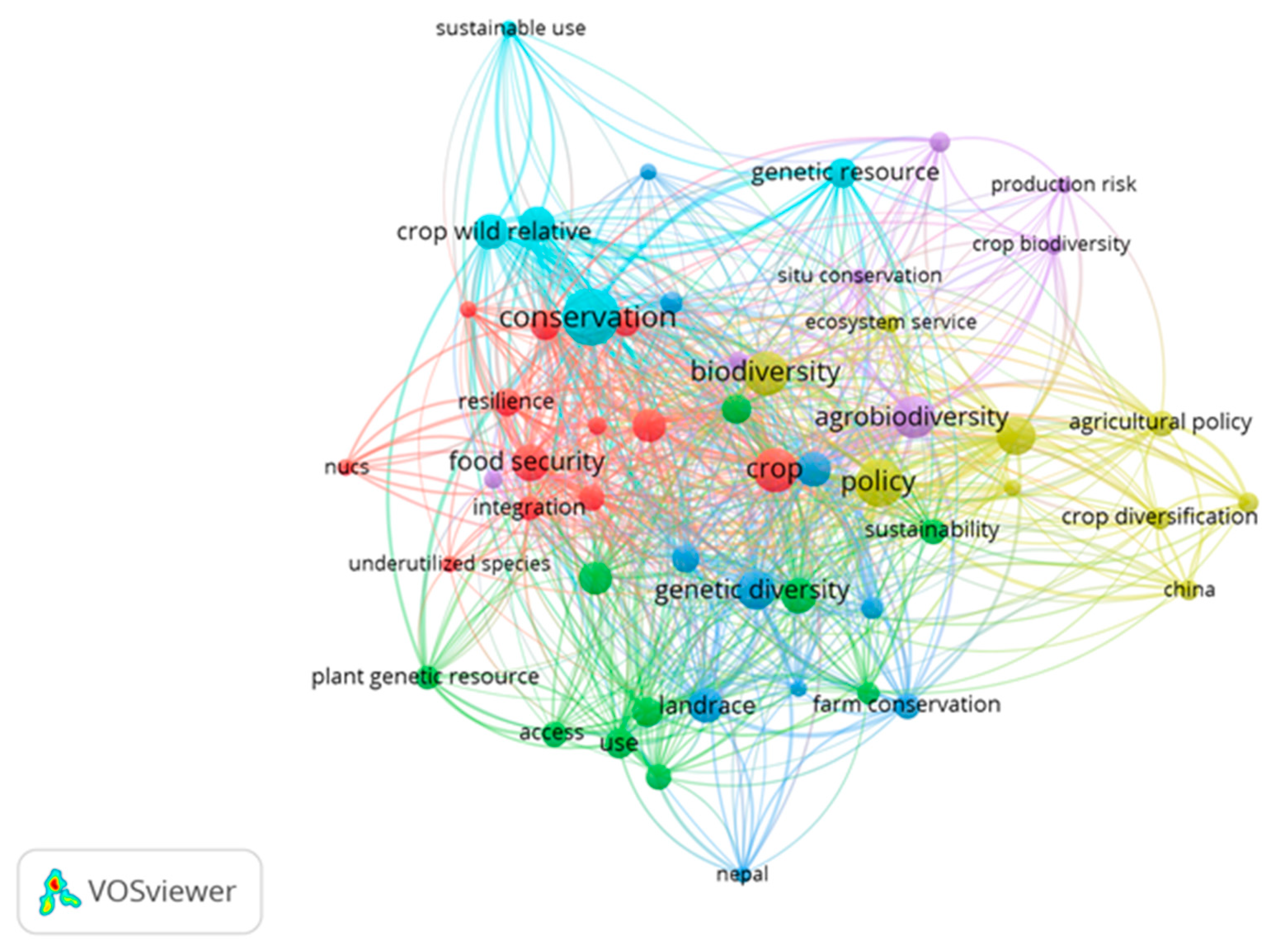
Complementary bibliometric analysis using VOSviewer software version 1.6.20 supported the qualitative analysis, allowing for the identification and visualization of thematic clusters and validating the relevance and coherence of policy-focused insights [
6,
7]. The analysis was based on the co-occurrence of terms within abstracts and keywords, resulting in a focused network of 53 high-frequency terms, extracted using a minimum occurrence threshold of 5. The resulting network visualization co-occurrence map revealed six distinct thematic clusters, each representing a key dimension in the academic discourse on CWRs, agrobiodiversity, and related policy implications (
Figure 2).
3. Results and Discussion
The above-mentioned process revealed critical insights across three primary dimensions—environmental, economic, and societal.
Environmental Dimension:
Studies consistently highlighted the importance of integrating CWR conservation into environmental policy, particularly emphasizing in situ and ex situ conservation strategies. However, significant gaps were identified, including insufficient genetic resource monitoring, fragmented policy alignment, and inadequate funding mechanisms. Effective policy integration was observed in some regions where coordinated actions and dedicated resources facilitated successful outcomes.
Economic Dimension:
The economic analysis underscored the potential of CWRs to enhance agricultural productivity and mitigate risks. Key challenges included limited market incentives, short-term financial support, and regulatory barriers inhibiting the adoption of CWR-derived varieties. Recommendations emphasized the importance of long-term investment, market-oriented incentives, and robust economic valuation of genetic diversity to address these constraints.
Societal Dimension:
Societal aspects focused prominently on the role of indigenous and local communities, participatory breeding, and equitable access to genetic resources. Despite their recognized contributions, traditional knowledge systems and community-based efforts often lacked formal policy recognition. Studies recommended increased participatory governance, inclusive stakeholder engagement, and strengthened policy frameworks that ensure equitable benefit sharing and access rights.
Table 1 synthesizes the main challenges and priority policy recommendations for the conservation and use of CWRs across environmental, economic, and societal dimensions.
4. Conclusions
The synthesis highlights the critical importance of Crop Wild Relatives (CWRs) in promoting agricultural sustainability and resilience. Integrated policy frameworks addressing environmental, economic, and societal aspects are essential for effectively conserving and utilizing CWRs. However, notable challenges remain, including fragmented institutional responsibilities, insufficient funding mechanisms, and inconsistent recognition of local community contributions. Practically, the findings emphasize the necessity for coherent and sustained policy interventions that extend beyond conservation strategies to encompass economic incentives and social inclusion. On a theoretical level, this study underscores the need to integrate genetic diversity considerations and equity principles into agricultural and environmental governance frameworks. The study recommends the establishment of dedicated funding schemes, enhanced monitoring systems, and the formal integration of participatory and inclusive governance structures. Policymakers are urged to harmonize biodiversity conservation efforts with agricultural development strategies, develop clear institutional roles, and prioritize equitable stakeholder engagement. Implementing these recommendations can significantly enhance the role of CWRs in achieving resilient and sustainable food systems.
Author Contributions
Conceptualization, C.S. and K.M.; methodology, C.S.; software, C.S.; validation, K.M. and E.T.; formal analysis, C.S.; investigation, K.F.; resources, K.M.; data curation, C.S.; writing—original draft preparation, C.S.; writing—review and editing, K.M.; visualization, C.S.; supervision, K.M.; project administration, K.M.; funding acquisition, K.M. All authors have read and agreed to the published version of the manuscript.
Funding
This research was funded by COUSIN project (Crop wild relatives utilization and conservation for sustainable agriculture), funded from the European Union’s Horizon Europe research and innovation program under the Grant Agreement No.101135314.
Institutional Review Board Statement
Not applicable.
Informed Consent Statement
Not applicable.
Data Availability Statement
The raw data supporting the conclusions of this article will be made available by the authors on request.
Conflicts of Interest
The authors declare no conflict of interest.
References
- Heywood, V.; Casas, A.; Ford-Lloyd, B.; Kell, S.; Maxted, N. Conservation and sustainable use of crop wild relatives. Agric. Ecosyst. Environ. 2007, 121, 245–255. [Google Scholar] [CrossRef]
- Zafar, T.; Mehra, A.; Das, P.; Shaik, B.; Malik, A.A. Demystifying the advanced interventions of genetics and modern breeding approaches for nutritional security and sustainability of neglected and underused crop species (NUCS). Genet. Resour. Crop Evol. 2023, 71, 559–577. [Google Scholar] [CrossRef]
- Jago, S.; Elliott, K.; Tovar, C.; Soto Gomez, M.; Starnes, T.; Abebe, W.; Alexander, C.; Antonelli, A.; Williams, C.; Yohanna, C.; et al. Adapting wild biodiversity conservation approaches to conserve agrobiodiversity. Nat. Sustain. 2024, 7, 1385–1394. [Google Scholar] [CrossRef]
- Kägi, C.; Petitpierre, B.; Meyer, P.; Lötscher, Y.; Eggenberg, S.; Aubry, S. Fostering in situ conservation of wild relatives of forage crops. Front. Plant Sci. 2023, 14, 1287430. [Google Scholar] [CrossRef]
- Kumar, A.; Verma, R.P.S.; Singh, A.; Kumar Sharma, H.; Devi, G. Barley landraces: Ecological heritage for edaphic stress adaptations and sustainable production. Environ. Sustain. Indic. 2020, 6, 100035. [Google Scholar] [CrossRef]
- Antonelli, C.; Coromaldi, M.; Pallante, G. Crop and income diversification for rural adaptation: Insights from Ugandan panel data. Ecol. Econ. 2022, 195, 107390. [Google Scholar] [CrossRef]
- Van Eck, N.; Waltman, L. VOSviewer Manual for VOSviewer; Version 1.6.14; Leiden University: Leiden, The Netherlands, 2020. [Google Scholar]
| Disclaimer/Publisher’s Note: The statements, opinions and data contained in all publications are solely those of the individual author(s) and contributor(s) and not of MDPI and/or the editor(s). MDPI and/or the editor(s) disclaim responsibility for any injury to people or property resulting from any ideas, methods, instructions or products referred to in the content. |
© 2025 by the authors. Licensee MDPI, Basel, Switzerland. This article is an open access article distributed under the terms and conditions of the Creative Commons Attribution (CC BY) license (https://creativecommons.org/licenses/by/4.0/).