Article

Impact of Split-Application Nitrogen Strategies on Maize (Zea mays L.) Yield and Soil Fertility Indices Across Contrastive Soil Types in the Transylvanian Plateau

by
Vlăduț-Ionuț Șter
1,
Vasile-Adrian Horga
1,*,
Edward Muntean
1,2,
Alexandru D. Costin
1,
Dan-Laurențiu Suciu
1,
Beniamin-Emanuel Andraș
3,
Marcel M. Duda
1 and
Laura Paulette
1
1
Agricultural Engineering Sciences, University of Agricultural Sciences and Veterinary Medicine, 400327 Cluj-Napoca, Romania
2
Agricultural Research Development Station, 401100 Turda, Romania
3
Agricultural Research Development Station, 447180 Livada, Romania
*
Author to whom correspondence should be addressed.
Nitrogen 2026, 7(2), 65; https://doi.org/10.3390/nitrogen7020065 (registering DOI)
Submission received: 7 April 2026 / Revised: 10 June 2026 / Accepted: 11 June 2026 / Published: 15 June 2026

Abstract

Optimization of nitrogen (N) management is critical for enhancing maize (Zea mays L.) productivity while maintaining soil health. The present study investigated the impact of split-application fertilization strategies on soil chemical properties and grain yield across three distinct soil types (calcaric fluvisol, luvic phaeozem, and stagnic phaeozem) in Mureș County, Romania, over three cropping seasons (2022–2024). Three fertilization variants were evaluated: the first treatment, designated V1, involved the application of 300 kg/ha NPK 20-20-0 + 300 kg/ha urea, the second treatment V2 utilized 300 kg/ha NPK 20-20-0 + 300 kg/ha NAC 27 N-calcium ammonium nitrate, and the third treatment V3 served as the baseline control, receiving (300 kg/ha NPK 20-20-0). Results indicated that significant differences were observed among the three experimental sites representing contrasting soil types for soil chemical properties and maize productivity. Calcaric fluvisol exhibited the highest production potential, attaining a mean yield of 11,702.78 kg/ha. The impact of N supplementation on soil N levels and maize yield was found to be significant. The variant receiving urea supplementation (V1) achieved the highest median yield of 9560 kg/ha in comparison to the 7420 kg/ha obtained in the control. A strong positive correlation was observed between N index and yield across all soil types (ρ = 0.93 to 0.97, p < 0.001). Fertilization significantly influenced soil pH, CaCO3 content, nitrogen index, phosphorus availability, and maize yield, whereas humus content remained relatively stable among treatments. These findings indicate that a split-fertilization regime combining NPK with urea provides a favorable balance between productivity and cost-effectiveness and maize output in the Transylvanian Plateau.

1. Introduction

Maize (Zea mays L.) is one of the most important food, feed and fuel crops in the world and plays an important role in not only food security but also national socioeconomic development [1,2]. In the European Union, it remains the second-most cultivated crop after wheat, though its popularity and importance have increased [3,4]. However, maize productivity is threatened by global climate change [5]. In 2019, maize was cultivated on 8.9 million ha for grain maize and 6.4 million ha for silage (green) maize [6].
To expand the cultivation of maize for grain, it is important to develop a technology that uses sustainable technological and biological advances. Despite the production potential of maize developed by breeders, this is not yet fully exploited [7]. Chemical fertilizers are essential for achieving high crop productivity and maintaining soil fertility [8]. In maize cultivation, mineral fertilizers are particularly important because they rapidly supply nutrients required during critical growth stages, supporting high yields and optimal plant development [9,10]. Adequate fertilization also influences plant density and grain yield formation, while nutrient deficiencies during key developmental stages can significantly reduce productivity [11,12]. Maize has a naturally high absorption capacity for nutrients that are used regularly [13]. Chemical fertilizers are the only way to sustain high crop production under intensive cropping systems [14].
While NPK application is known to increase yields [15,16], modern farmers often fail to match nutrient uptake with fertilizer application [17,18].
Nitrogen is one of the most important limiting factors for maize productivity due to its essential role in the plant’s metabolic and genetic processes [19,20], while also representing a key nutrient for the intensification of agricultural production [21]. Common mineral fertilizers, such as urea and calcium ammonium nitrate (NAC 27 N), offer different benefits for N management. Urea is widely utilized due to its high N concentration and cost-effectiveness, making up 48% of total fertilizer usage, but it is rapidly hydrolyzed into ammonium and converted into nitrate upon application [22,23,24,25]. Depending on soil characteristics, nitrate is very soluble and can run off into the surface water or flow into the groundwater [26]. It has been estimated that more than half of the applied N is lost from agricultural land through denitrification, volatilization, leaching, and soil erosion from agricultural land [27,28]. Existing studies have shown the relationship between nitrogen application rate on crops photosynthetic characteristics, nitrogen utilization rate, and crops yield [29,30,31,32].
Together with nitrogen, P is quantitatively the most important inorganic nutrient for plant growth, accounting for approximately 0.2% of a plant’s dry weight [33] and a supply of external phosphorus fertilizer is fundamental to realizing maize productivity [34]. For this reason, crop production depends on large inputs of P fertilizers [35], but when used inefficiently, they have the potential to limit crop productivity [36,37,38].
Despite existing studies on N application rates, there is a lack of site-specific data on how N-sources interact with the diverse soils of the Transylvanian Plateau, such as calcaric fluvisols and luvic phaeozem.
Different fertilization schemes produce significantly different maize yields under the pedoclimatic conditions of Mureș County, and at least one scheme results in a statistically higher yield than the others.
The rational application of chemical fertilizers contributes to improved crop growth and productivity, whereas their excessive use may lead to reduced agricultural yields and negative environmental impacts [39,40,41]. The optimal fertilization strategy identified under Mureș County conditions can support agrochemical mapping and improve regional fertilizer management practices aimed at increasing agricultural productivity and food security. The primary objectives of this study were to identify the optimal fertilization scheme for maximizing maize yield under the pedoclimatic conditions of Mureș County and to determine which fertilization system provides the greatest nitrogen accumulation in soil and plants, supporting rational fertilization practices, regional productivity, and food security.

2. Materials and Methods

2.1. Study Site

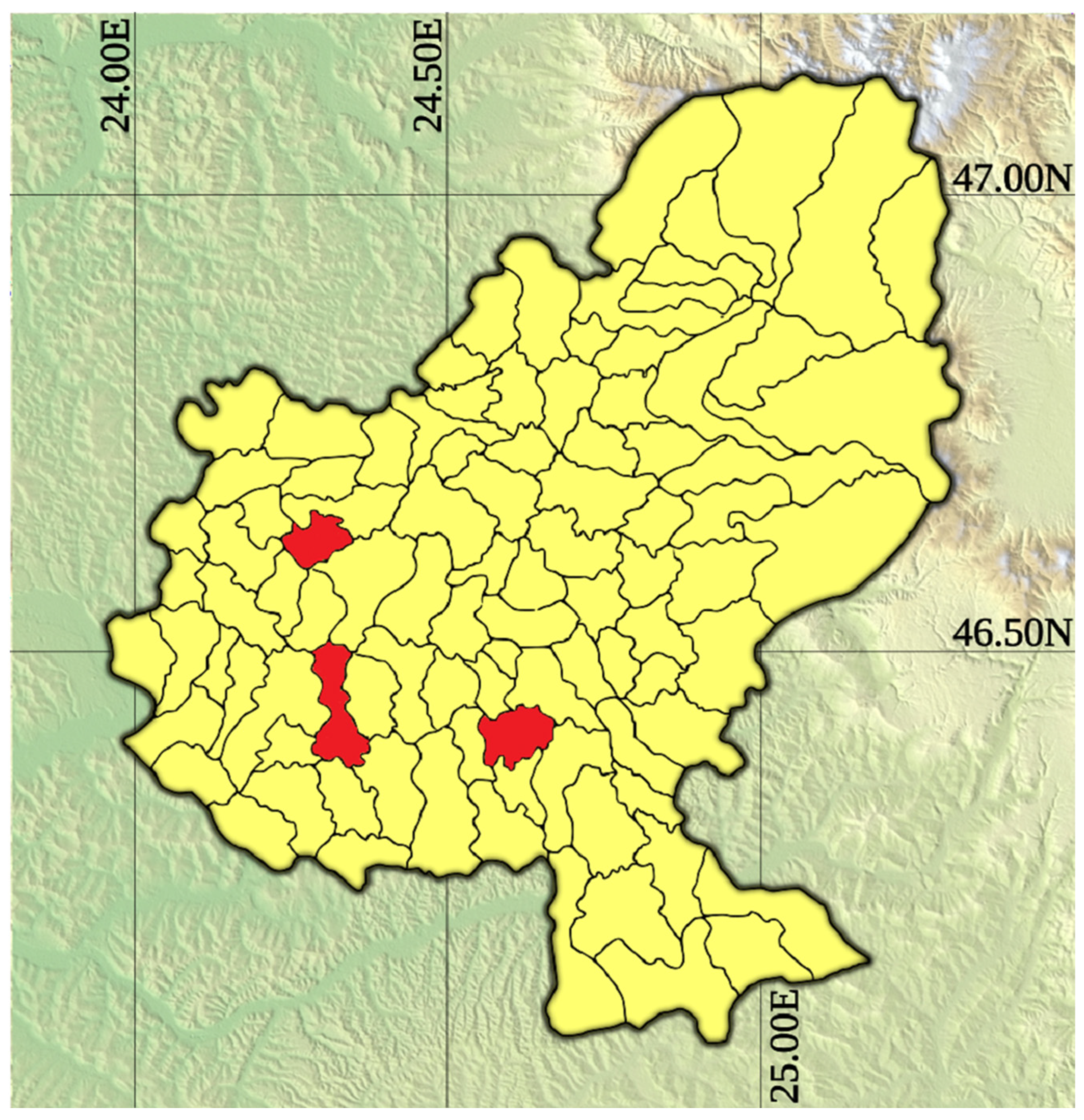
Field experiments were conducted over three consecutive growing seasons (2022–2024) in Romania, in the central–northern part of the country, in the center of the Transylvanian Plateau, specifically in three communes within Mureș County (Figure 1). The county is located between the meridians 23°55′ and 25°14′ east longitude and the parallels 46°09′ and 47°00′ north latitude. The experimental period spanned three years, from 2022 to 2024, and was carried out at three experimental sites (Coroisânmărtin Commune = 46°24′16″ N, 24°34′48″ E; Ogra Commune = 46°26′50″ N, 24°19′4″ E; and Grebenișu de Câmpie Commune = 46°36′46″ N, 24°17′31″ E).
The three locations have an average annual temperature of 9 °C and an average annual precipitation of 650 mm (long-term averages 2000–2023).
The soil units on which the experiments were conducted were classified according to Romanian System of Soil Taxonomy (RSST) as Aluviosol calcaric, Faeziom stagnic and Preluvosol molic, corresponding to calcaric fluvisol, stagnic phaeozems and luvic phaeozems according to the World Reference Base for Soil Resources (WRB-SR). The soil in Coroisânmărtin Commune was classified as a Aluviosol calcaric with a pH of 7.9. The soil in Ogra Commune was classified as a luvic phaeozems with a pH of 8. In the third location, Grebenișu de Câmpie, the soil was classified as a stagnic phaeozem with a pH of 6 (Table 1).
In order to account for inter-annual climatic variability, local meteorological data were recorded, thus identifying 2024 as the warmest year and 2022 as the driest within the study period (Table 2). The climatic characteristics of the three experimental years exhibited variability in terms of both recorded temperatures and accumulated precipitation; these differences affected the growth and development of maize plants, as confirmed by the yields obtained per hectare each year.

2.2. Experimental Design

The experimental plots were established in 2022, each plot measuring 100 m2, and were sown with the maize hybrid (Zea mays) “P9415,” with row and plant spacing of 70 cm and 20 cm, respectively, and a density of 70,000 plants per hectare. The experiment followed three-factor experiment with 3 experimental years × 3 soil types × 3 fertilization variants design to ensure statistical variability (Table 3).
To avoid errors or inconsistencies during sampling, risks were minimized by collecting samples in both space and time.
In each experimental plot at each studied location, three nitrogen fertilization systems were applied: (i) V1: 20-20-0 + UREA, (ii) V2: 20-20-0 + NAC 27 N and (iii) V3: 20-20-0 (control).
Complex fertilizers containing the two main nutrients, nitrogen and phosphorus (P), were used in the study, applied at a rate of 300 kg/ha.
Factor A: Experimental years had three levels: A1—represented by 2022, A2— represented by 2023, and A3—represented by 2024. Factor B: Soil type: B1—represented by calcaric fluvisol, B2—represented by stagnic phaeozem, B3—represented by luvic phaeozem. Factor C: Nitrogen fertilization variant had three levels: C1—represented by fertilization with 20-20-0 + UREA, C2—represented by fertilization with 20-20-0 + NAC 27 N, and C3—represented by fertilization with 20-20-0.
For variant V1, a complex fertilizer 20-20-0 was applied at a rate of 300 kg/ha, followed by split fertilization with urea at 300 kg/ha at sowing. For V2, a complex fertilizer 20-20-0 was applied at 300 kg/ha, followed by split fertilization with NAC 27 N at 300 kg/ha. For V3, only the complex fertilizer 20-20-0 was applied at 300 kg/ha, without any additional split fertilization. Urea and nitrocalcite were used as nitrogen sources for split application. In the experimental fields, the nitrogen doses were applied in equal splits, at a total rate of 300 kg/ha. All plots, except for the control variant, received 300 kg/ha of urea or 300 kg/ha of nitrocalcite.

2.3. Sampling

Soil and plant samples were collected along the main diagonal of each plot three times during the growing season, on days 42 (V6, six-leaf stage), 82 (VT, tasseling stage), and 152 (R6, physiological maturity). Specifically, soils from the 0–40 cm depth were sampled at 10 cm intervals; a stainless steel soil sampling probe was used for sampling. During sampling, the probe was first driven into the soil using a hammer (covering both the ridge and furrow). Then, soils from the 0–10, 10–20, 20–30 cm and 30–40 cm layers were removed separately. The four 10 cm depth increments were combined into a single composite sample per plot prior to laboratory analysis. The collected soil samples were placed in labeled polyethylene bags, and then sent to the Office for Pedological and Agrochemical Studies (OSPA) Mureș for laboratory analyses.

2.4. Laboratory Analysis

The dried soil samples were subsequently subjected to a mechanical grinding process using a grinder, after they were stored in individually sealed bags for the purpose of determining their nitrogen concentration.
The nitrogen index (NI) was determined using the Borlan and Hera method (Borlan and Hera, 1973) [44].
N I = h u m u s ( % ) × V 100
where humus (%) is the humus content expressed as a percentage, and V represents the base saturation degree, also expressed as a percentage.
NI values less than or equal to 2 indicate a low level of nitrogen supply in the soil; values between 2.1 and 4.0 indicate a moderate supply; values between 4.1 and 6.0 signify a good supply; and values greater than 6.0 indicate a very good nitrogen supply [44]. In order to indirectly assess the soil nitrogen reserve, it is necessary to determine the humus content. This was determined using the oxidation method, according to the Walkley–Black procedure, as modified by Gogoașă [45].
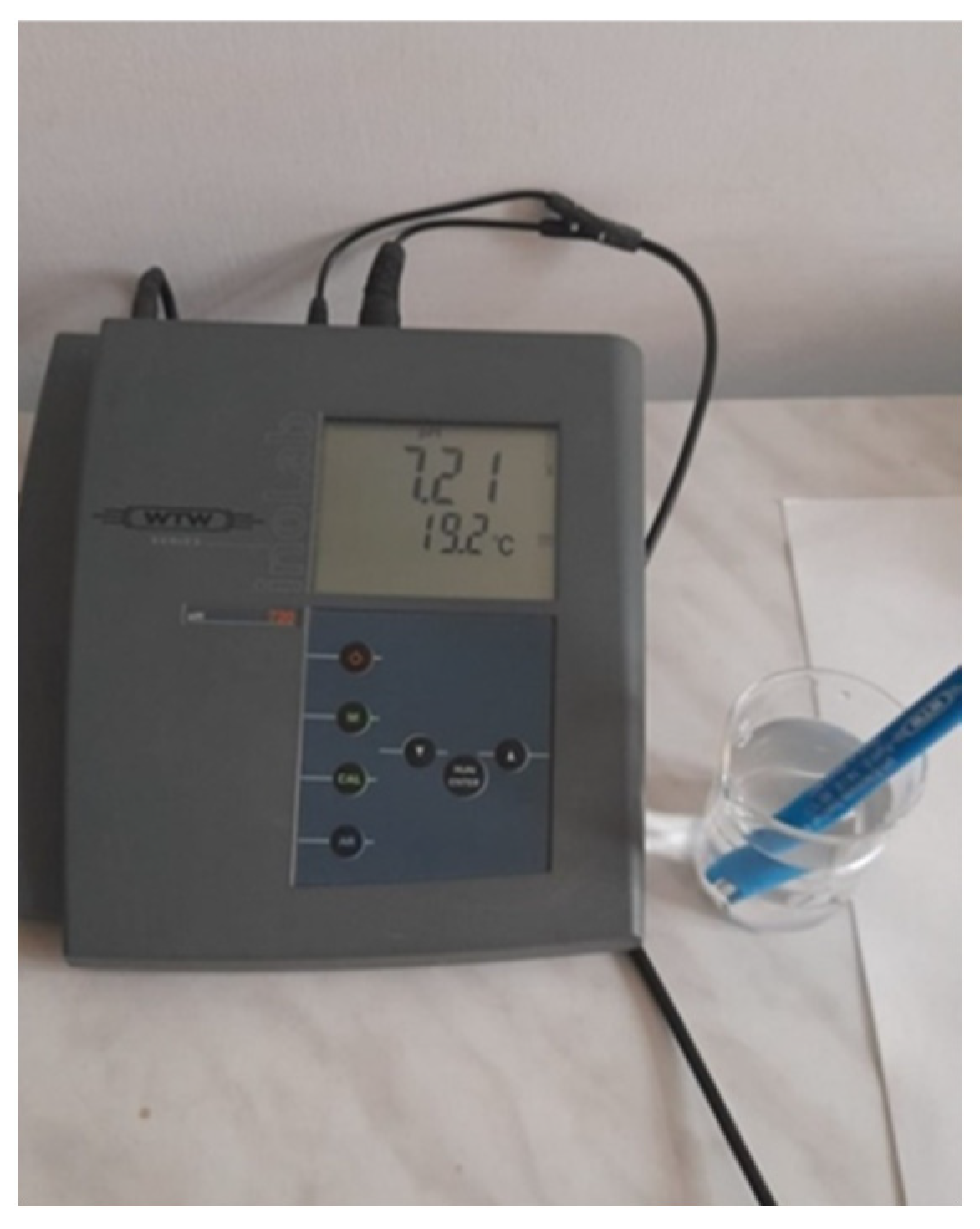
A further parameter that was analyzed was pH, the value of which was influenced by soil type, climatic conditions during the experimental years 2022–2024, and the fertilization treatment applied. The pH value was measured using a laboratory pH meter (Figure 2).
The determination of the active CaCO3 content (%) in the soil was determined using the Drouieau method, which involves the titration of soil extracts with potassium permanganate.
The determination of the phosphorus supply level was carried out by extracting it with an ammonium acetate–lactate (AL) solution at pH = 3.7, according to the Egnèr–Riehm–Domingo method, and it is determined spectrophotometrically as molybdenum blue [45].
To determine the potassium supply level, the same extracting solution used for phosphorus extraction is applied, and potassium was measured using flame photometry.
The cobs from each plot were counted and weighed. The grains were then weighed after being manually extracted from the rachis. The resulting yield was adjusted to standard moisture content (14% for maize) and expressed per hectare. In order to ascertain the thousand-kernel weight (TKW), a 500 g sample was taken from each plot and replication. These samples were then subjected to a counting and weighing process with 1000 grains being counted and weighed twice. The mean value per plot was then calculated.

2.5. Statistical Analysis

The seven studied variables (soil pH, CaCO3 content, humus content (%), nitrogen index, phosphorus content, potassium content, and maize yield expressed in kg ha−1) were summarized using mean and standard deviation (SD) for normally distributed data, and median with interquartile range (IQR = 25th–75th percentile) for variables deviating from normal distribution.
Data normality was assessed using the Shapiro–Wilk test. The effects of soil type, fertilization treatment, and experimental year on soil properties and maize yield were evaluated using linear models. Soil type, fertilization treatment, and year were included as fixed effects. The significance of model terms was assessed using Type III analysis of variance (ANOVA). When significant effects were detected, pairwise comparisons among factor levels were performed using estimated marginal means with Tukey adjustment for multiple testing.
A full factorial model including soil type, fertilization treatment, year, and their interactions was initially evaluated. However, because the experimental design contained a single observation for each factor combination, the full interaction model resulted in zero residual degrees of freedom and could not be reliably estimated. Therefore, the final analyses were based on additive models including the main effects of soil type, fertilization treatment, and year.
Because each soil type was represented by a single experimental location, soil-related comparisons should be interpreted as site-specific observations associated with the studied locations rather than as generalized inference applicable to all soils belonging to the corresponding WRB classes. The significance threshold was set at p < 0.05.
In order to investigate the associations among the seven studied variables within each soil type, Spearman’s rank correlation coefficients were calculated. The nonparametric method was employed to evaluate the monotonic relationships between soil chemical parameters and maize yield. Spearman’s rank correlation was presented as a heatmap, for which the metan package in R was used [46].
Multivariate structure and distribution patterns of soil types according to the studied characteristics were explored using Principal Component Analysis (PCA). Prior to PCA, data suitability was assessed using Bartlett’s test of sphericity and the Kaiser–Meyer–Olkin (KMO) measure of sampling adequacy. PCA was implemented as an exploratory visualization tool, with the results presented as a biplot to illustrate the relationships among soil types and measured variables. No dimensionality reduction or factor retention criteria were utilized for inferential purposes. PCA visualization was conducted using the factoextra package in R [47].
All statistical analyses were performed in R (version 4.5.2) [48].

3. Results

3.1. Influence of Soil Type on Yield and Soil Characteristics

Significant differences were observed among the three experimental sites representing contrasting soil types for soil pH, CaCO3 content, humus content, nitrogen index, phosphorus, potassium, and maize yield. (Table 4). The pH of the soil was found to range from 7.41 (calcaric fluvisol), to 6.48 (-luvisol), with all pairwise proving to be statistically significant. The content of CaCO3 decreased in a progressive manner from calcaric fluvisol (median 4.22) to stagnic phaeozem (median 2.50) and luvic phaeozem (median 1.62), with significant differences observed among all soil types. The humus content and nitrogen index (NI) were found to be comparable between calcaric fluvisol (3.43% and 3.30) and stagnic phaeozem (3.59% and 3.34), both of which were significantly higher than luvisol (3.10% and 2.41). The available phosphorus was highest in luvic phaeozem (47.37 ppm), intermediate levels recorded in calcaric fluvisol (35.89 ppm), and the lowest in stagnic phaeozem (16.93 ppm). Potassium exhibited a comparable pattern, with the highest concentration in PHst (247.33 ppm), intermediate in calcaric fluvisol (206.78 ppm), and the lowest in luvic phaeozem (178.89 ppm). The highest recorded maize yield was in calcaric fluvisol (11,702.78 kg ha−1), followed by stagnic phaeozem (8384.11 kg ha−1) and luvic phaeozem (8506.78 kg ha−1) which were significantly lower and similar.

3.2. Influence of Fertilization Type on Yield and Soil Characteristics

Significant differences among fertilization treatments were observed for soil pH (p < 0.001) and CaCO3 content (p < 0.001), while no significant effects were detected for humus content (p = 0.341). Phosphorus content (p = 0.005) was significantly affected by fertilization, whereas potassium content showed no significant differences among treatments (p = 0.206) (Table 5).
Fertilization treatment significantly affected nitrogen index (p < 0.001) and maize yield (p < 0.001), with higher values generally associated with nitrogen-supplemented treatments. Year significantly affected humus content (p = 0.021), nitrogen index (p < 0.001), and phosphorus content (p = 0.010), whereas no significant year effects were observed for pH, CaCO3, potassium content, or maize yield.

3.3. Correlations Between Soil Characteristics and the Studied Soil Type

Spearman’s rank correlation analysis was performed separately for each soil type to explore relationships among the seven studied variables.
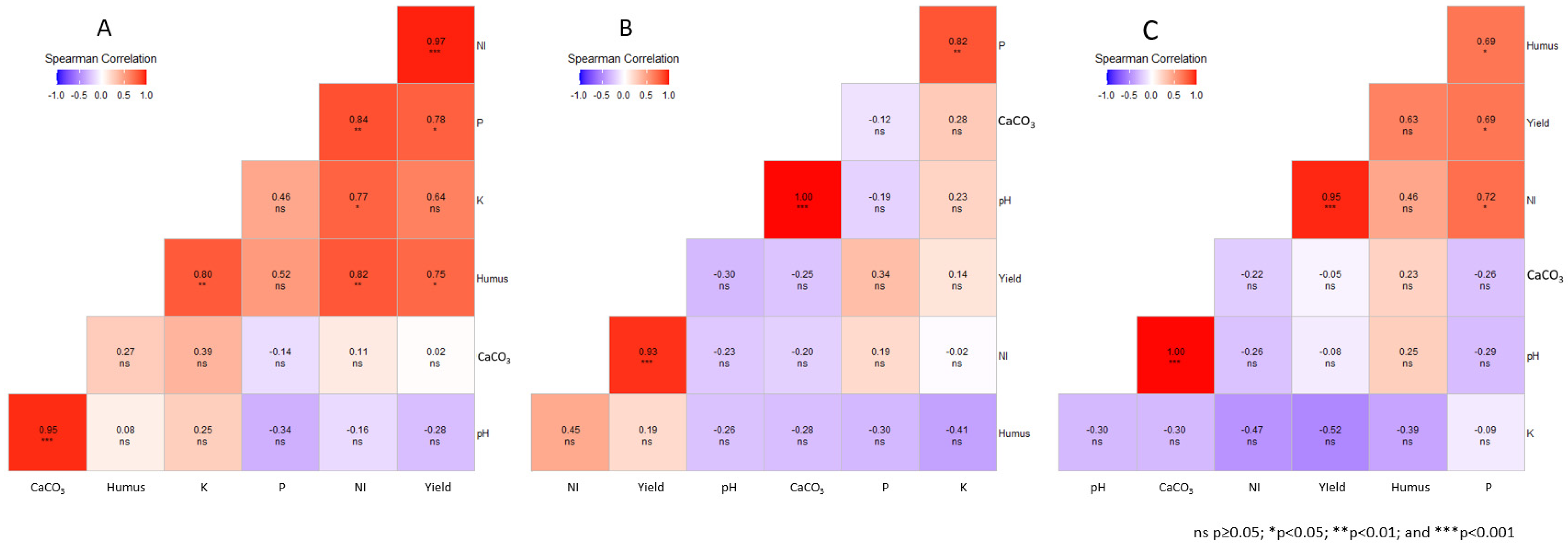
For calcaric fluvisol, important significant positive correlations were observed between nitrogen index and humus (ρ = 0.82, p < 0.01), between pH and CaCO3 (ρ = 0.95, p < 0.001), and between nitrogen index and maize yield (ρ = 0.97, p < 0.001). Maize production was moderately correlated with humus and phosphorus (ρ = 0.75 and ρ = 0.78, p < 0.05) (Figure 3A).
In stagnic phaeozem, nitrogen index was strongly correlated with maize yield (ρ = 0.93, p < 0.001), and pH was strongly correlated with CaCO3 (ρ = 1.00, p < 0.001), while phosphorus content correlated positively with potassium (ρ = 0.82, p < 0.01). Other correlations were weak or not statistically significant, including those involving humus (Figure 3B).
For luvic phaeozem, strong positive correlations were observed between nitrogen and maize yield (ρ = 0.95, p < 0.001), and between pH and CaCO3 (ρ = 1.00, p < 0.001). Phosphorus was also moderately correlated with maize yield and humus content (ρ = 0.69, p < 0.05) and with nitrogen index (ρ = 0.72, p < 0.05). Calcium carbonate showed no significant correlations with other variables (Figure 3C).

3.4. Distribution of Characteristics According to Soil Types

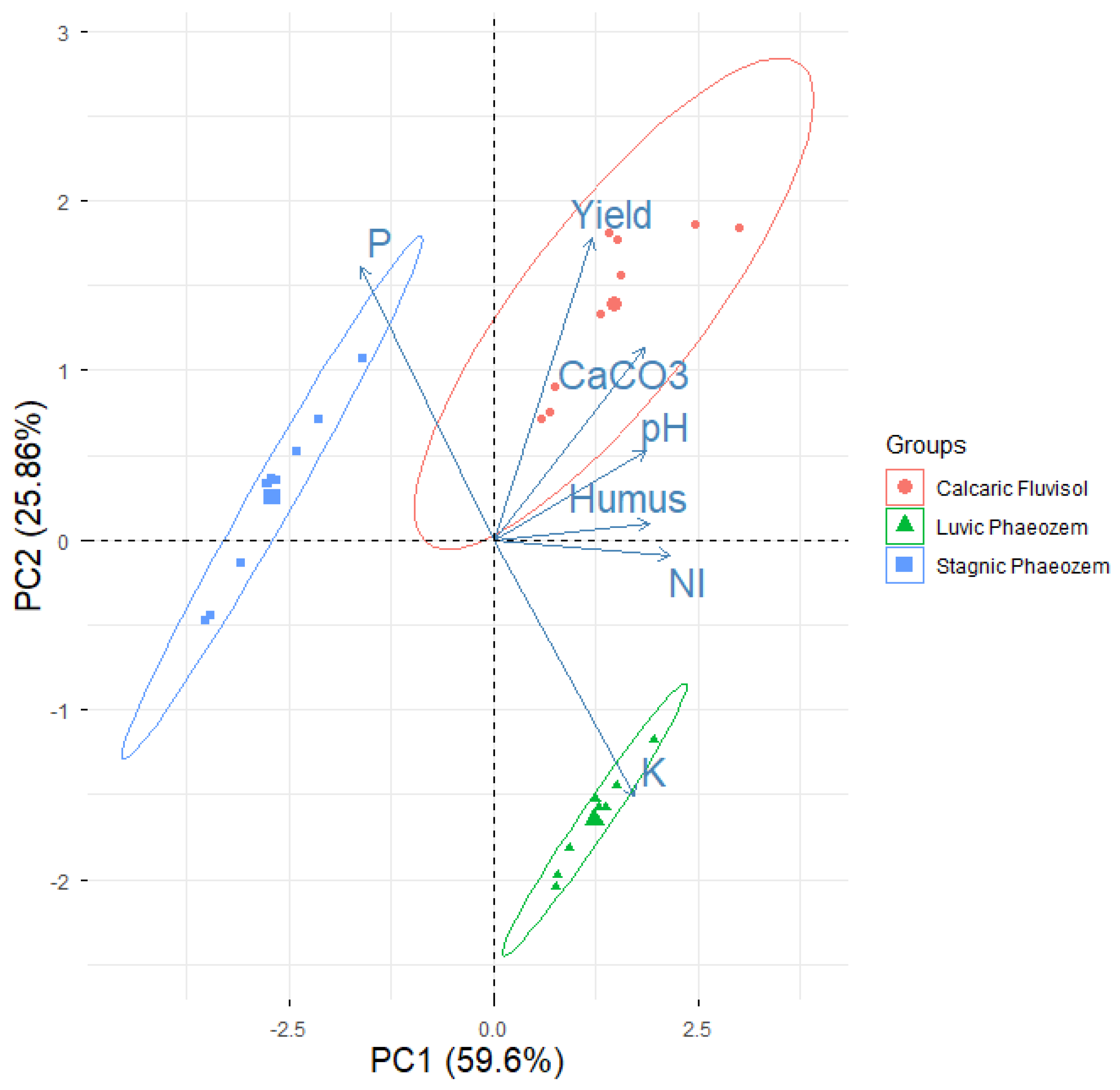
Principal Component Analysis (PCA) was performed to explore multivariate relationships among the studied soil properties and maize yield across the three soil types. The first two principal components explained a substantial proportion of total variability, with PC1 accounting for 59.6% and PC2 for 25.86%, together explaining 85.46% of the total variance, indicating a good representation of the dataset in the ordination space.
Samples were well separated according to soil type (Figure 4). Luvic phaeozem clustered on the negative side of PC1 and positive PC2, strongly associated with phosphorus, suggesting that P availability is a dominant characteristic of this soil type. In contrast, stagnic phaeozem samples grouped on the positive side of PC1 and negative PC2, closely related to potassium and moderately to nitrogen and humus, indicating that these nutrients are key factors defining this soil’s chemical profile. Calcaric fluvisol samples were positioned on the positive side of both PC1 and PC2, strongly associated with maize yield, CaCO3, and pH, suggesting that carbonate content and soil reaction contribute positively to production in this soil type.
Overall, PCA highlighted distinct nutrient–yield relationships across soil types. Nitrogen index, phosphorus, potassium, and humus contributed differently to soil differentiation, while maize yield was mainly associated with carbonate content, pH, and nitrogen-rich soils.

4. Discussion

Following a three-year experiment conducted on -luvisol, calcaric fluvisol, and stagnic phaeozem in Mureș County, it was determined that the fertilization variant t yielding the highest productivity was V1, comprising a 20-20-0 NPK formulation supplemented with urea. Across the three experimental variants, a standard rate of complex fertilizer applied to spring crops in the central–north-eastern region of Romania was identified as 300 kg ha−1.
The findings of this study underscore the critical role of pedological context in determining the efficacy of nitrogen fertilization. Significant differences in maize yield were observed among the three experimental sites representing contrasting soil types (p < 0.001) [34,40]. The superior performance of the calcaric fluvisol site may be attributed to its favorable buffering capacity and higher baseline nitrogen status, which likely enhanced nutrient availability and uptake.
A key observation in this study was the superior yield performance of urea (V1) over NAC 27 N (V2). However, because nitrogen source and total nitrogen rate varied simultaneously among treatments, the relative contributions of fertilizer form and nitrogen dose cannot be separated in the present experiment. Therefore, the observed advantage of V1 should not be attributed exclusively to the fertilizer source. Nevertheless, the results are consistent with previous studies reporting that split-applied urea can improve nitrogen availability during periods of high maize demand and reduce volatilization losses when mechanically incorporated into the soil [23,24]. The strong correlation between the NI and yield (ρ > 0.93) validates the use of NI as a reliable diagnostic tool for regional agrochemical mapping. While fertilization did not drastically alter humus or pH within the three-year timeframe—consistent with the long-term stability of soil organic matter reported by [18]—the fluctuations in soluble NI indices indicate that maize productivity in Mureș County is highly responsive to in-season nitrogen supplements.
However, the lower yields observed in the stagnic phaeozem suggest that nitrogen alone cannot overcome limitations imposed by soil acidity. As noted by [15,31], N-use efficiency is often curtailed in low-pH soils where phosphorus fixation and aluminum toxicity may occur. Therefore, for these specific soil types, a combined approach of liming and split-N application is likely required to bridge the yield gap identified in our V1 and V2 treatments.
The efficient use of N is often achieved through improved recovery, due to reduced losses from denitrification, leaching, and volatilization [49]. Typical levels of agronomic efficiency of N in cereals range between 15 and 30 kg grain kg-1 N, with lower values indicating that adjustments in management practices could enhance crop response or reduce input costs [50]. Improved synchronization between N fertilizer application and maize N uptake could enable a reduction in total N input while maintaining or even increasing yield, thereby enhancing nitrogen use efficiency (NUE) [51].
Rubin et al. [52] showed that split application (preplant and at the four leaf-collar stage) of urea increased maize grain yield by 5.4% compared with a single preplant application of enhanced-efficiency N fertilizers. Additionally, N may be lost through denitrification, as fine-textured soils, particularly those with low permeability, can lose nitrogen within a few days if fertilization is followed by waterlogged conditions [53].
Vetsch and Randall [54] reported that when a late fall N application is followed by wet and warm spring conditions, maize grain yield and aboveground N uptake decrease by 20 and 27%, respectively. Cultivation practices aimed at increasing crop production must include the application of nitrogen fertilizers and improvements in their use [55].
Therefore, although the generative yield of maize is formed during the period of peak nitrogen demand and uptake, it is the nitrogen from soil reserves, as opposed to fertilizers, that exerts the most significant influence on this yield [56].
Under normal growth conditions, N uptake is associated with the level of carbohydrate supply to the roots [57]. Similarly, N uptake is known to be regulated by carbon and stimulated by photosynthetic activity [58,59].
These studies contribute to improving maize cultivation technology, both in terms of achieving high yields and enhancing crop quality. However, beyond attaining high levels of production, it is essential to implement rational fertilization schemes. The extent to which both physiological and agronomic efficiency are achieved depends on the interaction between fertilizer application methods and cultivar type [60].
A limitation of the present study is that each soil type was represented by a single experimental site. Consequently, soil type and site effects cannot be completely separated statistically. Therefore, differences among soil categories should be interpreted as site-specific observations associated with the studied locations rather than as definitive inference applicable to all soils belonging to the corresponding WRB classes. Nevertheless, the inclusion of three consecutive growing seasons allowed temporal variability to be incorporated into the statistical analyses and increased the robustness of the observed patterns.

5. Conclusions

This study demonstrated substantial differences in maize productivity and soil fertility characteristics among the three experimental sites representing contrasting soil conditions. The calcaric fluvisol site consistently exhibited the highest yield potential (11,702.78 kg ha−1), likely due to its favorable pH and buffering capacity compared with the more acidic stagnic phaeozem site. Nitrogen management significantly influenced grain yield (p < 0.001), with split nitrogen application outperforming baseline NPK fertilization. Under the fertilization regime tested, the treatment receiving NPK + urea produced the highest grain yield; however, because nitrogen source and total N rate varied simultaneously, the relative contribution of fertilizer type versus nitrogen dose cannot be separated The nitrogen index proved to be a strong predictor of crop performance, showing a very high correlation with yield (r = 0.93–0.97), indicating its usefulness for agrochemical mapping and precise fertilization planning.
However, nitrogen inputs could not fully offset soil constraints, as stagnic phaeozem consistently produced lower yields even under fertilization, highlighting the need for integrated soil management approaches, including liming in acidic soils.
From an applied perspective, split urea application (V1) supports the adoption of rational fertilization strategies aimed at improving regional food security and maintaining soil chemical stability.

Author Contributions

Conceptualization, Data collection and Writing—original draft V.-I.Ș. and V.-A.H.; methodology, B.-E.A.; software, A.D.C.; formal analysis, B.-E.A. and D.-L.S.; validation, writing, review and editing, L.P. and E.M.; supervision, L.P. and M.M.D. All authors have read and agreed to the published version of the manuscript.

Funding

This research received no external funding.

Data Availability Statement

All data are included within the article.

Acknowledgments

The authors express their gratitude to the University of Agricultural Sciences and Veterinary Medicine, Cluj-Napoca, Romania for supporting the publication of this article.

Conflicts of Interest

The authors declare no conflicts of interest.

References

  1. Shiferaw, B.; Prasanna, B.M.; Hellin, J.; Bänziger, M. Crops that feed the world 6. Past successes and future challenges to the role played by maize in global food security. Food Secur. 2011, 3, 307–327. [Google Scholar] [CrossRef]
  2. Li, S.-K.; Zhao, J.-R.; Dong, S.-T.; Zhao, M.; Li, C.-H.; Cui, Y.-H.; Liu, Y.-H.; Gao, J.-L.; Xue, J.-Q.; Wang, L.-C.; et al. Advances and prospects of maize cultivation in China. Sci. Agric. Sin. 2017, 50, 1941–1959. [Google Scholar]
  3. Amnuaylojaroen, T.; Chanvichit, P.; Janta, R.; Surapipith, V. Projection of Rice and Maize Productions in Northern Thailand under Climate Change Scenario RCP8.5. Agriculture 2021, 11, 23. [Google Scholar] [CrossRef]
  4. Neumann, K.; Verburg, P.H.; Stehfest, E.; Müller, C. The yield gap of global grain production: A spatial analysis. Agric. Syst. 2010, 103, 316–326. [Google Scholar] [CrossRef]
  5. Porter, J.R.; Challinor, A.J.; Henriksen, C.B.; Howden, S.M.; Martre, P.; Smith, P. Invited review: Intergovernmental Panel on Climate Change, agriculture, and food—A case of shifting cultivation and history. Glob. Change Biol. 2019, 8, 2518–2529. [Google Scholar] [CrossRef]
  6. Eurostat. Gross Domestic Product (GDP) and Main Components (Output, Expenditure and Income)—Quarterly Data. 2020. Available online: https://ec.europa.eu/eurostat/databrowser/view.NAMQ_10_GDP/default/table (accessed on 5 February 2026).
  7. Baohua, L.; Xinping, C.; Qingfeng, M.; Haishun, Y.; Justin, V.W. Estimating maize yield potential and yield gap with agro-climatic zones in China-Distinguish irrigated and rainfed conditions. Agric. For. Meteorol. 2017, 239, 108–117. [Google Scholar]
  8. He, P.; Xu, X.; Zhou, W.; Smith, W.; He, W.; Grant, B.; Ding, W.; Qiu, S.; Zhao, S. Ensuring future agricultural sustainability in China utilizing an observationally validated nutrient recommendation approach. Eur. J. Agron. 2022, 132, 126409. [Google Scholar] [CrossRef]
  9. Brodowska, M.S.; Wyszkowski, M.; Bujanowicz-Haraś, B. Mineral fertilization and maize cultivation as factors which determine the content of trace elements in soil. Agronomy 2022, 12, 286. [Google Scholar] [CrossRef]
  10. Bender, R.R.; Haegele, J.W.; Rufo, M.L.; Below, F.E. Nutrient Uptake, Partitioning, and Remobilization in Modern, Transgenic Insect-Protected Maize Hybrids. Agron. J. 2013, 105, 161–170. [Google Scholar] [CrossRef]
  11. Milander, J.J. Maize Yield and Components as Influenced by Environment and Agronomic Management. Master’s Thesis, University of Nebraska, Lincoln, NE, USA, 2015. [Google Scholar]
  12. Marschner, H. Mineral Nutrition of Higher Plants, 3rd ed.; Academic Press: London, UK, 2012. [Google Scholar]
  13. Szulc, P.; Bocianowski, J.; Rybus, M. Response of nitrogen nutritional indices of maize leaves to different mineral-organic fertilization. Maydica 2012, 57, 260–265. [Google Scholar]
  14. Roozbeh, M.; Rajaie, M. Effects of residue management and nitrogen fertilizer rates on accumulation of soil residual nitrate and wheat yield under no-tillage system in south-west of Iran. Int. Soil Water Conserv. Res. 2021, 1, 116–126. [Google Scholar] [CrossRef]
  15. Jaliya, M.M.; Falaki, A.M.; Mahmud, M.; Sani, Y.A. Effect of sowing date and NPK fertilizer rate on yield and yield components of quality protein maize (Zea mays L.). ARPN J. Agric. Biol. Sci. 2008, 2, 23–29. [Google Scholar]
  16. Jakab, P.; Zoltán, G.; Festő, D.; Komarek, L. Investigation of foliar fertilization in maize production. Adv. Res. Life Sci. 2017, 1, 1–6. [Google Scholar] [CrossRef]
  17. Fixen, P.E.; Bruulsema, T.W.; Jensen, T.L.; Mikkelsen, R.; Murrell, T.S.; Phillips, S.B.; Rund, Q.; Stewart, W.M. The fertility of North American soils, 2010. Better Crops Plant Food 2010, 94, 6–8. [Google Scholar]
  18. Garcia-Mina, J.M.; Antolín, M.C.; Sánchez-Díaz, M. Metal-humic complexes and plant micronutrient uptake: A study based on different plant species cultivated in diverse soil types. Plant Soil 2004, 258, 57–68. [Google Scholar] [CrossRef]
  19. Reverchon, F.; Flicker, R.C.; Yang, H.; Yan, G.; Xu, Z.; Chen, C.; Bai, S.H.; Zhang, D. Changes in δ15N in a soil-plant system under different biochar feedstocks and application rates. Biol. Fertil. Soils 2014, 50, 275–283. [Google Scholar] [CrossRef]
  20. Nishida, H.; Suzaki, T. Nitrate-mediated control of root nodule symbiosis. Curr. Opin. Plant Biol. 2018, 44, 129–136. [Google Scholar] [CrossRef]
  21. Asibi, A.E.; Chai, Q.; Coulter, J.A. Mechanisms of Nitrogen Use in Maize. Agronomy 2019, 9, 775. [Google Scholar] [CrossRef]
  22. Azad, N.; Behmanesh, J.; Rezaverdinejad, V.; Abbasi, F.; Navabian, M. Evaluation of fertigation management impacts of surface drip irrigation on reducing nitrate leaching using numerical modeling. Environ. Sci. Pollut. Res. 2019, 36, 36499–36514. [Google Scholar] [CrossRef] [PubMed]
  23. Glibert, P.M.; Harrison, J.; Heil, C.; Seitzinger, S. Escalating worldwide use of urea–a global change contributing to coastal eutrophication. Biogeochemistry 2006, 3, 441–463. [Google Scholar] [CrossRef]
  24. Gil-Ortiz, R.; Naranjo, M.Á.; Ruiz-Navarro, A.; Caballero-Molada, M.; Atares, S.; García, C.; Vicente, O. New eco-friendly polymeric-coated urea fertilizers enhanced crop yield in wheat. Agronomy 2020, 10, 438. [Google Scholar] [CrossRef]
  25. Liu, W.; Price, S.; Bennett, G.; Maxwell, T.M.; Zhao, C.; Walker, G.; Bunt, C. A landscape review of controlled release urea products: Patent objective, formulation and technology. J. Control. Release 2022, 348, 612–630. [Google Scholar] [CrossRef]
  26. Howden, N.J.; Burt, T.P.; Worrall, F.; Mathias, S.A.; Whelan, M.J. Farming for water quality: Balancing food security and nitrate pollution in UK river basins. Ann. Assoc. Am. Geogr. 2013, 2, 397–407. [Google Scholar] [CrossRef]
  27. Abbasi, M.K.; Tahir, M.M.; Rahim, N. Effect of N fertilizer source and timing on yield and N use efficiency of rainfed maize (Zea mays L.) in Kashmir–Pakistan. Geoderma 2013, 195, 87–93. [Google Scholar] [CrossRef]
  28. Afreh, D.; Zhang, J.; Guan, D.; Liu, K.; Song, Z.; Zheng, C.; Deng, A.; Feng, X.; Zhang, X.; Wu, Y.; et al. Long-term fertilization on nitrogen use efficiency and greenhouse gas emissions in a double maize cropping system in subtropical China. Soil Tillage Res. 2018, 180, 259–267. [Google Scholar] [CrossRef]
  29. Vagusevičienė, I.; Juchnevičienė, A.; Duchovskis, P. The effect of nitrogen fertilizers on the changes of photosynthetic pigments in winter wheat. Rural. Dev. 2013, 2013, 258. [Google Scholar] [CrossRef]
  30. Kong, D.X.; Li, Y.Q.; Wang, M.L.; Bai, M.; Zou, R.; Tang, H.; Wu, H. Effects of light intensity on leaf photosynthetic characteristics, chloroplast structure, and alkaloid content of Mahonia bodinieri (Gagnep.) Laferr. Acta Physiol. Plant. 2016, 5, 120. [Google Scholar] [CrossRef]
  31. Liu, Z.; Gao, F.; Yang, J.; Zhen, X.; Li, Y.; Zhao, J.; Li, J.; Qian, B.; Yang, D.; Li, X. Photosynthetic characteristics and uptake and translocation of nitrogen in peanut in a wheat–peanut rotation system under different fertilizer management regimes. Front. Plant Sci. 2019, 10, 86. [Google Scholar] [CrossRef]
  32. Shah, A.N.; Wu, Y.; Tanveer, M.; Hafeez, A.; Tung, S.A.; Ali, S.; Khalofah, A.; Alsubeie, M.S.; Al-Qthanin, R.N.; Yang, G. Interactive effect of nitrogen fertilizer and plant density on photosynthetic and agronomical traits of cotton at different growth stages. Saudi J. Biol. Sci. 2021, 6, 3578–3584. [Google Scholar] [CrossRef]
  33. Klimek-Kopyra, A.; Skowera, B.; Zajac, T.; Grygierzec, B. Development and production response of edible and forage varieties of pea (Pisum sativum L.) to temporary soil drought under different levels of phosphorus application. Acta Agrobot. 2016, 69, 2. [Google Scholar] [CrossRef]
  34. Van der Velde, M.; Folberth, C.; Balkovič, J.; Ciais, P.; Fritz, S.; Janssens, I.A.; Obersteiner, M.; See, L.; Skalský, R.; Xiong, W.; et al. African crop yield reductions due to increasingly unbalanced Nitrogen and Phosphorus consumption. Glob. Change Biol. 2014, 4, 1278–1288. [Google Scholar] [CrossRef]
  35. Xin, X.; Qin, S.; Zhang, J.; Zhu, A.; Yang, W.; Zhang, X. Yield, phosphorus use efficiency and balance response to substituting long-term chemical fertilizer use with organic manure in a wheat-maize system. Field Crops Res. 2017, 208, 27–33. [Google Scholar] [CrossRef]
  36. Jiang, N.; Wei, K.; Pu, J.; Huang, W.; Bao, H.; Chen, L. A balanced reduction in mineral fertilizers benefits P reserve and inorganic P-solubilizing bacterial communities under residue input. Appl. Soil Ecol. 2021, 159, 103833. [Google Scholar] [CrossRef]
  37. Ahmad, I.; Zhou, G.; Zhu, G.; Ahmad, Z.; Song, X.; Hao, G.E.; Jamal, Y.; Ibrahim, M.E.H. Response of leaf characteristics of BT cotton plants to ratio of nitrogen, phosphorus, and potassium. Pak. J. Bot. 2021, 3, 873–881. [Google Scholar] [CrossRef] [PubMed]
  38. Kumar, R.; Kumar, R.; Prakash, O. Chapter-5 the impact of chemical fertilizers on our environment and ecosystem. Chief Ed. 2019, 35, 1173–1189. [Google Scholar]
  39. Das, D.; Dwivedi, B.S.; Datta, S.P.; Datta, S.C.; Meena, M.C.; Dwivedi, A.K.; Singh, M.; Chakraborty, D.; Jaggi, S. Long-term differences in nutrient management under intensive cultivation alter potassium supplying ability of soils. Geoderma 2021, 393, 114983. [Google Scholar] [CrossRef]
  40. Wang, Z.; Wang, Z.; Ma, L.; Lv, X.; Meng, Y.; Zhou, Z. Straw returning coupled with nitrogen fertilization increases canopy photosynthetic capacity, yield and nitrogen use efficiency in cotton. Eur. J. Agron. 2021, 126, 126267. [Google Scholar] [CrossRef]
  41. Tripathi, S.; Srivastava, P.; Devi, R.S.; Bhadouria, R. Influence of synthetic fertilizers and pesticides on soil health and soil microbiology. In Agrochemicals Detection, Treatment and Remediation; Butterworth-Heinemann: Oxford, UK, 2020; pp. 25–54. [Google Scholar]
  42. Harta de Localizare Judetul Mures, Romania.svg. Available online: https://ro.wikipedia.org/wiki/Fi%C8%99ier:Harta_de_localizare_judetul_Mures,_Romania.svg (accessed on 10 February 2026).
  43. Climate Tirgu Mures. Available online: https://en.tutiempo.net/climate/ws-151450.html (accessed on 3 March 2026).
  44. Borlan, Z.; Hera, C. Metode de Apreciere a Stǎrii de Fertilitate a Solului în Vederea Folosirii Raţionale a Îngrǎşǎmintelor; Editura Ceres: Bucharest, Romania, 1973. [Google Scholar]
  45. Borlan, Z.; Rauta, C. Methodology for Agrochemical Analysis of Soils to Establish the Need for Amendments and Fertilizers. Methods of Chemical Analysis of Soils; Methods, Guidance Reports Series; ICPA: Bucharest, Romania, 1981. [Google Scholar]
  46. Olivoto, T.; Lúcio, A.D.C. metan: An R package for multi-environment trial analysis. Methods Ecol. Evol. 2020, 6, 783–789. [Google Scholar] [CrossRef]
  47. Kassambara, A.; Mundt, F. Factoextra: Extract and visualize the results of multivariate data analyses. In CRAN: Contributed Package; The R Foundation: Vienna, Austria, 2016. [Google Scholar]
  48. R Core Team. R: A Language and Environment for Statistical Computing; R Foundation for Statistical Computing: Vienna, Austria, 2025; Available online: https://www.R-project.org/ (accessed on 5 November 2025).
  49. Wortmann, C.S.; Tarkalson, D.D.; Shapiro, C.A.; Dobermann, A.R.; Ferguson, R.B.; Hergert, G.W.; Walters, D. Nitrogen use efficiency of irrigated corn for three cropping systems in Nebraska. Agron. J. 2011, 1, 76–84. [Google Scholar] [CrossRef]
  50. Fixen, P.; Brentrup, F.; Bruulsema, T.; Garcia, F.; Norton, R.; Zingore, S. Nutrient/fertilizer use efficiency: Measurement, current situation and trends. Manag. Water Fertil. Sustain. Agric. Intensif. 2015, 270, 1–30. [Google Scholar]
  51. Venterea, R.T.; Halvorson, A.D.; Kitchen, N.; Liebig, M.A.; Cavigelli, M.A.; Grosso, S.J.D.; Motavalli, P.P.; Nelson, K.A.; Spokas, K.A.; Singh, B.P.; et al. Challenges and opportunities for mitigating nitrous oxide emissions from fertilized cropping systems. Front. Ecol. Environ. 2012, 10, 562–570. [Google Scholar] [CrossRef]
  52. Rubin, J.C.; Struffert, A.M.; Fernández, F.G.; Lamb, J.A. Maize yield and nitrogen use efficiency in upper midwest irrigated sandy soils. Agron. J. 2016, 4, 1681–1691. [Google Scholar] [CrossRef]
  53. Castaldelli, G.; Colombani, N.; Soana, E.; Vincenzi, F.; Fano, E.A.; Mastrocicco, M. Reactive nitrogen losses via denitrification assessed in saturated agricultural soils. Geoderma 2019, 337, 91–98. [Google Scholar] [CrossRef]
  54. Vetsch, J.A.; Randall, G.W. Corn production as affected by nitrogen application timing and tillage. Agron. J. 2004, 2, 502–509. [Google Scholar] [CrossRef]
  55. Potarzycki, J. Improving nitrogen use efficiency of maize by better fertilizing practices. Fertil. Fertil. 2010, 39, 5–24. [Google Scholar]
  56. Kruczek, A.; Szulc, P. Effect of fertilization method on the uptake and accumulation of mineral components in the initial period of maize development. Int. Agrophysics 2006, 20, 11–22. [Google Scholar]
  57. Pan, W.L.; Camberato, J.J.; Moll, R.H.; Kamprath, E.J.; Jackson, W.A. Altering source-sink relationships in prolific maize hybrids: Consequences for nitrogen uptake and remobilization. Crop Sci. 1995, 3, 836–845. [Google Scholar] [CrossRef]
  58. Lillo, C. Signalling cascades integrating light-enhanced nitrate metabolism. Biochem. J. 2008, 1, 11–19. [Google Scholar] [CrossRef] [PubMed]
  59. Masclaux-Daubresse, C.; Daniel-Vedele, F.; Dechorgnat, J.; Chardon, F.; Gaufichon, L.; Suzuki, A. Nitrogen uptake, assimilation and remobilization in plants: Challenges for sustainable and productive agriculture. Ann. Bot. 2010, 7, 1141–1157. [Google Scholar] [CrossRef] [PubMed]
  60. Szulc, P.; Waligóra, H.; Michalski, T.; Rybus-Zając, M.; Olejarski, P. Efficiency of nitrogen fertilization based on the fertilizer application method and type of maize cultivar (Zea mays L.). Plant Soil Environ. 2016, 62, 135–142. [Google Scholar] [CrossRef]
Figure 1. Mureș County map and soil sites’ locations [42].
Nitrogen 07 00065 g001
Figure 2. Basic laboratory meter for precise pH measurement.
Nitrogen 07 00065 g002
Figure 3. Correlations between studied characteristics for (A). calcaric fluvisol; (B). stagnic phaeozem; (C). luvic phaeozem. Note: NI = Nitrogen Index; CaCO3 = calcium carbonate; P = phosphorus; K = potassium.
Nitrogen 07 00065 g003
Figure 4. Distribution of traits according to soil types. Note: NI = nitrogen index; CaCO3 = calcium carbonate; P = phosphorus; K = potassium.
Nitrogen 07 00065 g004
Table 1. Soil units’ characteristics.
Experimental SiteRSST ClassificationWRB ClassificationpHKey Notes
Coroisânmărtin CommuneAluviosol calcaricCalcaric fluvisol 7.9Calcareous soil with good nutrient buffering
Ogra CommunePreluvosol molicLuvic phaeozems 8.0Fertile, slightly alkaline soil
Grebenișu de CâmpieFaeziom stagnicStagnic phaeozem 6.0Acidic soil, prone to waterlogging
Table 2. Monthly and average temperatures and monthly and average precipitation during the cropping seasons (2022–2024) [43].
YearClimatic FactorMonthAverage
MarchAprilMayJuneJulyAugustSeptemberOctober
2022Temperature (°C)2.88.815.820.0421.821.714.610.810.5
20236915.319.221.721.618.312.111.3
20247.812.415.92223.722.617.29.812.1
Annual total
2022Precipitation (mm)3.0570.0967.0534.5450.8160.19120.936.83569.19
202327.1975.234.29142.7552.32106.9318.2917.28682.76
202448.550.0328.1876.247.7440.962.2215.5643.57
Table 3. Layout of the experiment.
A1B1C1C2C3C1C2C1C2C3
B2C1C2C3C1C2C1C2C3
B3C1C2C3C1C2C1C2C3
A2B1C1C2C3C1C2C1C2C3
B2C1C2C3C1C2C1C2C3
B3C1C2C3C1C2C1C2C3
A3B1C1C2C3C1C2C1C2C3
B2C1C2C3C1C2C1C2C3
B3C1C2C3C1C2C1C2C3
A1—2022, A2—2023, A3—2024, B1—Calcaric fluvisol, B2—Stagnic phaeozem, B3—Luvic phaeozem, C1—soil fertilization with 20-20-0 + UREA, C2—soil fertilization with 20-20-0 + NAC 27 N, C3—soil fertilization with 20-20-0.
Table 4. Soil properties and maize yield at the three experimental sites representing contrasting soil types.
VariableSoil Typep-Value
Calcaric FluvisolStagnic PhaeozemLuvic Phaeozem
pH7.41 ± 0.22 a7.07 ± 0.13 b6.48 ± 0.37 c<0.001
CaCO34.22 [4.20; 4.30] a2.50 [2.48; 2.80] b1.62 [1.59; 1.90] c<0.001
Humus (%)3.43 [3.40; 3.45] a3.59 [3.58; 3.60] a3.10 [3.02; 3.16] b<0.001
Nitrogen Index (NI)3.30 ± 0.24 a3.34 ± 0.18 a2.41 ± 0.31 b<0.001
P (ppm)35.89 ± 1.62 b16.93 ± 0.51 c47.37 ± 0.95 a<0.001
K (ppm)206.78 ± 2.59 b247.33 ± 3.00 a178.89 ± 1.62 c<0.001
Yield (kg/ha)11,702.78 ± 1689.44 a8384.11 ± 732.67 b8506.78 ± 1434.45 b<0.001
Note: data presented as mean ± SD or median (IQR = 25th–75th); P—phosphorus; K—potassium; NI—Nitrogen Index; different letters indicate statistically significant differences based on estimated marginal means derived from linear models including soil type, fertilization treatment, and year, followed by Tukey-adjusted pairwise comparisons.
Table 5. The chemical characteristics of soils and maize yield according to the fertilization variant.
VariableFertilization Treatmentp-Value
20-20-0 + UREA20-20-0 + NAC 27 N20-20-0
pH6.77 ± 0.50 b7.25 ± 0.31 a6.95 ± 0.48 ab<0.001
CaCO32.73 ± 1.16 b3.28 ± 1.12 a2.78 ± 1.14 b<0.001
Humus (%)3.49 ± 0.41 a3.49 ± 0.40 a3.35 ± 0.23 a0.314
Nitrogen Index (NI)3.44 [3.00; 3.56] a3.26 [2.50; 3.30] b3.00 [2.20; 3.10] c<0.001
P (ppm)34.21 ± 13.53 a33.12 ± 13.20 b32.86 ± 13.30 b0.005
K (ppm)211.11 ± 29.62 a212.00 ± 31.44 a209.89 ± 28.54 a0.206
Yield (kg/ha)9560 [9250; 13,100] a9150 [8450; 11,650] a7420 [7210; 9540] b<0.001
Note: data presented as mean ± SD or median (IQR = 25th–75th); P—phosphorus; K—potassium; NI—Nitrogen Index; different letters indicate statistically significant differences based on estimated marginal means derived from linear models including soil type, fertilization treatment, and year, followed by Tukey-adjusted pairwise comparisons.
Disclaimer/Publisher’s Note: The statements, opinions and data contained in all publications are solely those of the individual author(s) and contributor(s) and not of MDPI and/or the editor(s). MDPI and/or the editor(s) disclaim responsibility for any injury to people or property resulting from any ideas, methods, instructions or products referred to in the content.