
Article

Nitrogen Uptake and Leaching in Relation to Root Distribution in Wheat and Spelt Under Acidic Subsoil Conditions

1
Graduate School of Agricultural Science, Tohoku University, Sendai 980-8572, Japan
2
Faculty of Agriculture, Yamagata University, Tsuruoka 997-8555, Japan
3
Department of Agro-Environmental Science, Obihiro University of Agriculture and Veterinary Medicine, Obihiro 080-8555, Japan
*
Author to whom correspondence should be addressed.
These authors contributed equally to this work.
Nitrogen 2026, 7(2), 64; https://doi.org/10.3390/nitrogen7020064 (registering DOI)
Submission received: 27 April 2026 / Revised: 8 June 2026 / Accepted: 12 June 2026 / Published: 15 June 2026

Abstract

Acidic subsoils can restrict root growth and nitrogen (N) uptake and increase the risk of N loss; however, the extent of genotypic variation remains unclear. We evaluated two bread wheat cultivars, Haruyokoi and Harukirari, and one spelt line, KU-1025, under limed and acidic subsoil treatments to clarify whether maintaining root growth in acidic subsoil contributes to greater N capture and lower N loss. After 78 days, we measured shoot dry weight, shoot N uptake, root dry weight, total root length, soil nitrate (NO3-N) concentration, and cumulative N leaching. The acidic subsoil reduced shoot N uptake, root length in the subsoil, deep-root ratio, and NO3-N depletion, indicating that it restricted root proliferation and N acquisition. KU-1025 showed the greatest shoot dry weight, shoot N uptake, root dry weight, and total root length under both treatments. It also maintained a high deep-root ratio under acidic subsoil conditions and showed lower soil NO3-N concentrations and less N leaching than the two wheat cultivars. Across genotypes and treatments, shoot N uptake was positively correlated with root dry weight and total root length, whereas N leaching was negatively correlated with these traits. These results suggest that maintaining a large root system, rather than deep rooting alone, is important for improving N capture and reducing N loss under acidic subsoil conditions, and that KU-1025 may provide useful genetic variation for breeding wheat adapted to acidic subsoil environments.

1. Introduction

In modern agriculture, the application of nitrogen (N) fertilizers to agricultural fields has greatly increased crop production [1]. Although N fertilization is essential for maintaining crop yields, not all the N applied as fertilizer is taken up by crops. Approximately half of the N fertilizer is lost from agricultural fields to the surrounding environment [2]. Excess N leaching degrades water quality in receiving environments and increases greenhouse gas emissions, thereby contributing to major global environmental problems [3]. Concerns related to N fertilization have also been reported in Japan [4]. The environmental degradation caused by N is particularly large relative to other environmental impacts and has already exceeded the “planetary boundary,” which defines environmental limits that human societies should not cross [5]. This issue is expected to intensify as climate change progresses [6]. Therefore, improving crop N uptake and reducing N leaching are the key challenges for sustainable crop production.
Crop roots have received considerable attention as targets for improving N uptake and reducing the environmental impacts of N loss [7]. Crop roots develop in a three-dimensional space, and their spatial arrangement influences water and nutrient uptake under spatially heterogeneous distributions of soil resources [8,9]. Nitrate is highly mobile in soil and rapidly moves into deeper layers through rainfall or irrigation [10]. Therefore, root traits that promote the effective exploration of deep soil, such as steep root growth angles, fewer but longer lateral roots, and other low-cost anatomical structures, may enhance nitrate capture [11,12]. Gao et al. (2015) demonstrated that several of these traits improved the use of available N [13]. In addition, deeper root distribution may support both greater N uptake and a lower risk of N leaching [14]. However, interactions with other nutrients, water acquisition, and various stress factors are complex, and defining a single optimal root phenotype remains difficult [9].
Individual root development varies in response to heterogeneous soil conditions, thereby altering the root system architecture and spatiotemporal root distribution [15]. Acidic soil conditions restrict root growth. This restriction is largely caused by low pH and soluble aluminum ions, which inhibit root-tip growth [16,17]. Thus, whole plant growth can also be suppressed. A meta-analysis of crop performance under acidic conditions estimated that crop yields decline by an average of 13.7% [18]. Under modern agricultural management practices, lime application can improve topsoil acidity relatively easily, whereas improving acidic subsoil through practices such as deep tillage requires substantial resources and costs [19]. Moreover, deep tillage should be avoided as it may promote soil erosion and reduce soil fertility [20]. In acidic soils, such as Andosols, which are widely distributed in Japanese arable land, an acidic layer often remains in the subsoil even after topsoil acidity has improved, thereby constraining root distribution in the subsoil [21,22,23]. Therefore, the ability to maintain root growth in the deeper soil layers under acidic subsoil conditions may be critical for crop productivity.
Wheat is one of the world’s major staple crops, and a meta-analysis showed that its yield declines by 18% under acidic soil conditions [18]. However, adaptation of wheat to acidic soils varies among genotypes. For example, wheat genotypes with acid tolerance have been reported to contain higher levels of citric acid and certain amino acids than acid-sensitive genotypes, even under non-stress conditions [24]. Wheat genotypes with high tolerance to acidic soils often carry the Al-tolerance-related alleles TaALMT1 or TaMATE [25]. TaALMT1 [26] and TaMATE [27] encode organic acid transporters that contribute to aluminum tolerance by mediating the efflux of organic acids from roots, which can chelate aluminum ions in the rhizosphere. In non-tolerant genotypes, Andosols inhibit root growth and cause clear growth abnormalities [28]. In addition to acid tolerance, wheat shows variation in root biomass and distribution [29,30]. Ehdaie et al. (2010) reported that greater root biomass in wheat was associated with increased N uptake and reduced N leaching [31].
The interplay between deep rooting and low-pH tolerance in acidic subsoil conditions has not been fully investigated, although such conditions are common in actual farming systems. Previous studies have examined root-growth inhibition under acidic conditions [17] and the relationship between deep rooting and subsoil N acquisition [12]. However, studies conducted specifically under acidic subsoil conditions remain limited. Despite its agronomic importance, the relationships among acidic subsoils, root distribution, shoot growth, N uptake, soil nitrate, and N leaching have rarely been examined within a single experimental framework.
Therefore, this study aimed to clarify the effects of subsoil acidity on root distribution and related traits and to examine how these traits relate to shoot dry weight, N uptake, soil NO3-N concentration, and N leaching in bread wheat and spelt using a pot experiment. We hypothesized that genotypes capable of maintaining a larger and deeper root system under acidic subsoil conditions would show greater shoot N uptake and reduced N leaching.

2. Materials and Methods

2.1. Experimental Setup

The wheat and spelt genotypes used in this study included two bread wheat (Triticum aestivum L.) cultivars, Haruyokoi and Harukirari, and the spelt (Triticum spelta L.) line KU-1025. The spelt strain used in this study were provided by the National BioResource Project-Wheat, which is partially supported by the National BioResource Project of the Ministry of Education, Culture, Sports, Science and Technology, Japan. Haruyokoi and Harukirari are representative bread wheat cultivars grown in Hokkaido, Japan. Haruyokoi carried the low-resistance TaALMT1 allele, whereas Harukirari carried the high-resistance TaALMT1 allele. In addition, KU-1025 carries a high-resistance TaALMT1 allele [32].
The soil used in this experiment was classified as non-allophanic Andosol [33] and was collected from the Kawatabi Field Center, Tohoku University (38.74° N, 140.76° E; 178 m above sea level). After collection, the soil was air-dried and passed through a 5 mm sieve. The basic properties of the soil were as follows: pH (H2O), 5.3; bulk density, 0.714 g cm−3; total carbon, 72.9 g kg−1; total nitrogen, 4.20 g kg−1; inorganic nitrogen, 14.8 mg kg−1; Truog P, 16.9 mg kg−1; and cation exchange capacity (CEC), 32.25 cmolc kg−1; exchangeable Ca, 768.2 mg kg−1; exchangeable Mg, 36.2 mg kg−1; and exchangeable K, 133.2 mg kg−1. Soil samples were air-dried and passed through a 2 mm sieve before analysis. Soil pH was measured in a 1:2.5 soil-to-water suspension using a glass electrode (D-210PC-S, HORIBA, Ltd., Kyoto, Japan). For total carbon and nitrogen, fine-ground soil samples were oven-dried at 105 °C for 24 h and analyzed using a CN analyzer (SUMIGRAPH NC-220F; Sumika Chemical Analysis Service, Osaka, Japan). Inorganic N was extracted with 2 M KCl and determined colorimetrically. Available P was determined by the Truog method; 0.001 M H2SO4 was added to air-dried soil at a 1:200 soil-to-extractant ratio, allowed to stand for 30 min, and then filtered. The filtrates were analyzed using the molybdenum blue method with a spectrophotometer (UV-2550; Shimadzu Corporation, Kyoto, Japan). Cation exchange capacity (CEC) was determined using the ammonium acetate method (1 M, pH 7.0), followed by displacement with potassium chloride. Exchangeable Ca, Mg, and K were extracted with 1 M ammonium acetate and quantified using atomic absorption spectrophotometry (AAS; Z-2300, Hitachi, Ltd., Tokyo, Japan).
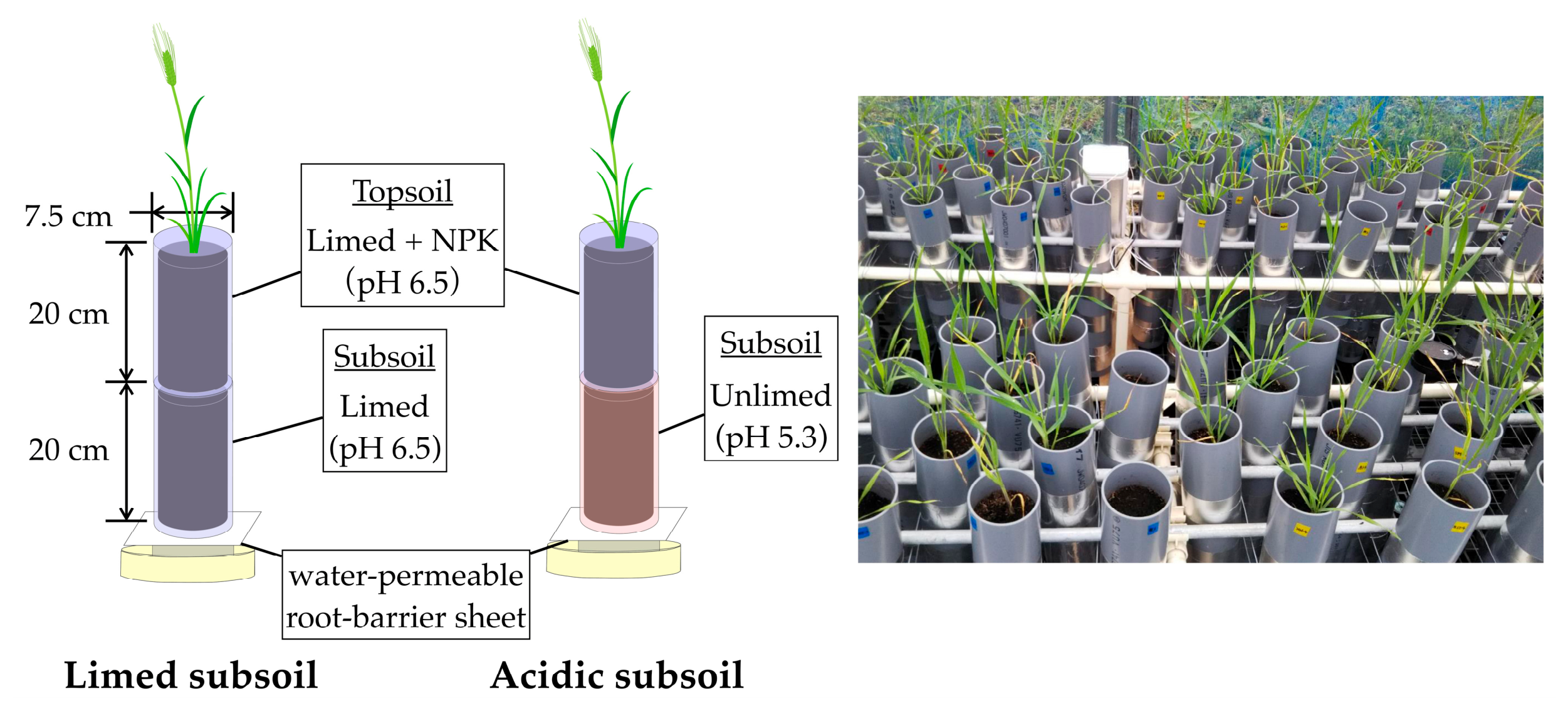
The experiment was conducted during a single growing season in 2017 under controlled pot-experimental conditions using the soil. The experimental setup is shown in Figure 1. Two polyvinyl chloride tubes with an inner diameter of 7.5 cm were used in each pot. Each pot consisted of two layers: a 20 cm upper layer (topsoil) and a 20 cm lower layer (subsoil). A root-impermeable but water-permeable sheet (Root Barrier Sheet, Toray Industries, Tokyo, Japan) was placed at the bottom of each pot to prevent roots from growing out of the pot.
Two treatments were established: a limed subsoil treatment, in which soil neutralized with CaCO3 was placed in the subsoil, and an acidic subsoil treatment, in which the subsoil remained untreated. In the limed treatment, the pH was adjusted to 6.5 by applying CaCO3. Based on the buffer curve describing the relationship between the buffer pH and lime requirement [34], the CaCO3 application rate was set at 5.0 g kg−1 dry soil. In both treatments, the topsoil was adjusted to pH 6.5, similar to the limed subsoil treatment, and N, phosphorus (P), and potassium (K) were applied. The fertilizer rate was equivalent to N:P:K = 120:80:100 kg ha−1. Urea, calcium dihydrogen phosphate monohydrate, and potassium chloride were applied at 114, 193, and 84 mg pot−1, respectively. Each pot was filled with 1.7 kg of the prepared soil.
The seeds were surface-sterilized with hydrogen peroxide, and three seeds were sown in each pot on 4 June 2017. After emergence, the seedlings were thinned to one plant per pot. Four replicate pots were prepared for each genotype–treatment combination. Three unplanted reference pots were prepared for each treatment group. All pots were randomly arranged outdoors under a transparent rain shelter at the Kawatabi Field Center.
Desalinated water was used for irrigation. Immediately after sowing, 50 mL of water was applied to each pot, and the water was carefully applied to the soil surface. The amount of water applied at each irrigation was adjusted according to plant growth. By the end of the experiment on 21 August (78 DAS), each tube had received approximately 3 L of water in seven irrigations at approximately 2-week intervals. This amount corresponded to 1.2 times the average precipitation (600 mm) recorded in the study area from June to August during the growing season. During the experimental period, air temperature was recorded every 30 min at the experimental site using a data logger (Ondotori TR-71U; T&D Corporation, Nagano, Japan), and daily mean temperature was calculated from these records. The daily mean temperature ranged from 10.5 °C on 4 June to 29.6 °C on 14 July and was, on average, 2 °C higher than that recorded at the nearby AMeDAS station. Further details are provided in Figure S1.

2.2. Shoot and Root Measurements

At harvest (78 DAS), all genotypes were at a similar vegetative growth stage, and no clear phenological difference was observed. The shoots were cut at ground level, dried in an air oven at 70 °C for 72 h, and weighed to determine shoot dry weight. The dried shoot samples were ground and shoot N concentrations were determined using the sulfuric acid–hydrogen peroxide digestion method [35]. The shoot N concentration was measured using the indophenol blue method. Shoot N uptake was calculated on a per–pot basis from shoot dry weight and shoot N concentration.
After shoot sampling, each pot was separated into two tubes at the junction of the topsoil and subsoil. The roots in each layer were carefully washed on a 1.0 mm mesh screen with a gentle stream of water and then scanned according to the method described by Tajima and Kato (2013) [36]. Briefly, the roots were spread on a transparent plastic tray filled with a thin layer of water to prevent overlap. Root images were captured as 8-bit grayscale images at 400 dpi using a flatbed scanner (GT-X980; Seiko Epson Corporation, Nagano, Japan). Root length was measured using ImageJ (version 1.53; National Institutes of Health, Bethesda, MD, USA) and classified into five diameter classes: <0.1 mm, 0.1–0.2 mm, 0.2–0.5 mm, 0.5–1.0 mm, and >1.0 mm. After root length measurement, the roots were dried in an air oven at 70 °C for 72 h, and the root dry weight was determined.
Specific root length was calculated as the total root length divided by the root dry weight. The fine-to-thick root ratio was then calculated. A diameter threshold of 0.2 mm was used to distinguish fine roots from thick roots. Roots > 0.2 mm in diameter were defined as nodal roots, whereas those <0.2 mm in diameter were defined as lateral roots. The deep-root ratio was calculated as the proportion of the root dry weight or total root length in the lower layer relative to the corresponding total value in both layers.

2.3. Soil NO3-N and N Leaching

During root sampling, soil samples were collected separately from the upper and lower layers to determine the soil nitrate (NO3-N) concentration. For each sample, 5 g of soil was mixed with 50 mL of 2 mol L−1 potassium chloride solution. The suspensions were shaken at 140 rpm for 1 h, filtered through filter paper, and the NO3-N in the extracts was measured with an autoanalyzer (QuAAtro2-HR; SEAL Analytical Ltd., Norderstedt, Germany) using the copper–cadmium reduction/naphthyl ethylenediamine spectrophotometric method. These analyses were conducted for both the planted and non-planted pots.
During the growth period, the drainage water was collected from the bottom of the pots at each irrigation event. To collect water, a plastic container was placed beneath each pot and retrieved at least 1 h after irrigation. The collected water was filtered through filter paper and stored at −20 °C until analysis. The NO3-N concentration in the collected water was measured using the same method used for soil extracts. The amount of N leached at each irrigation was calculated from the collected water volume and the NO3-N concentration, and the cumulative value was expressed as N leaching per pot.

2.4. Statistical Analysis

For each measured parameter, a two-way analysis of variance (ANOVA) was performed with genotype and subsoil treatment as fixed factors. Post hoc comparisons were conducted using Tukey’s test at a 5% significance level to compare the genotypes within each treatment. In the analyses of soil NO3-N concentrations and N leaching, only non-planted pots were used as references and were excluded from the statistical analyses. The relationships between root traits and N uptake or leaching were evaluated using Pearson’s correlation coefficients, and the relationship between N uptake and leaching was examined using simple linear regression. All statistical analyses were performed using R version 4.4.2 [37].

3. Results

3.1. Effects of Genotype and Subsoil Treatment on Measured Parameters

Table 1, Table 2 and Table 3 present the analysis of variance (ANOVA) results for each parameter. Significant genotype effects were detected for all parameters, except shoot N concentration, whereas significant treatment effects and genotype × treatment interactions were detected for several traits. Among the shoot traits, a treatment effect was detected only for shoot N uptake at a 0.1% significance level. Regarding root traits, significant treatment effects were detected for total root length in both the topsoil and subsoil, specific root length in the topsoil, fine-to-thick root ratio in the subsoil, and deep-root ratio based on root dry weight and total root length. For soil NO3-N concentration at harvest, a treatment effect was detected only in the subsoil. Significant genotype × treatment interactions were observed for a limited number of parameters, including total root length in the topsoil, specific root length in both the topsoil and subsoil, fine-to-thick root ratio in the subsoil, and deep-root ratio based on root dry weight. As this study was conducted as a single-season pot experiment, the results may partly reflect the environmental conditions specific to the experimental period.

3.2. Shoot Growth and Nitrogen Status

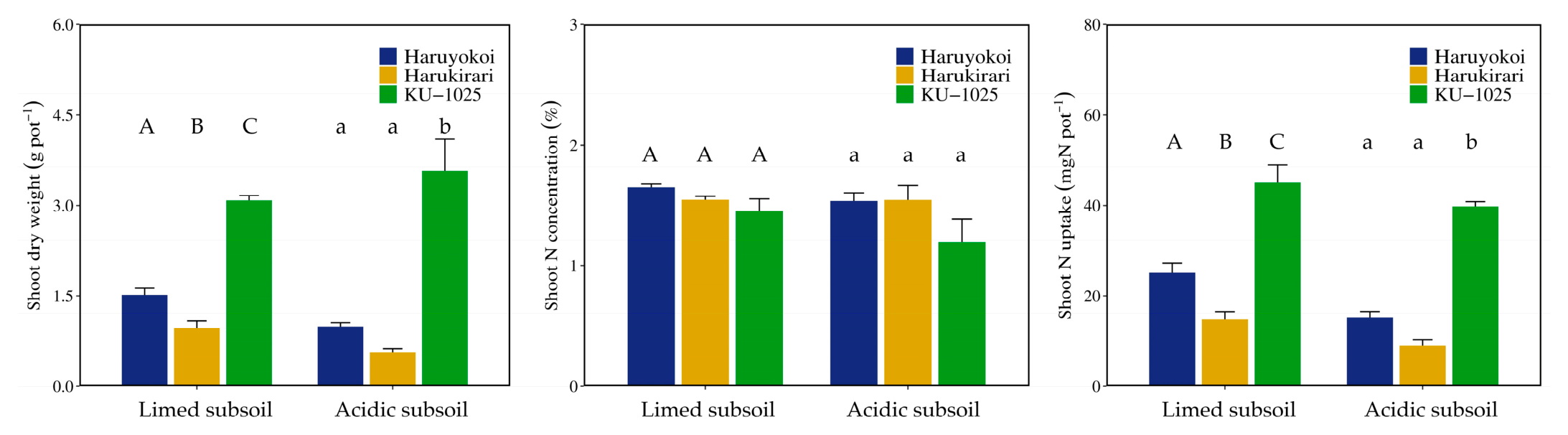
Figure 2 shows shoot dry weight, shoot N concentration, and shoot N uptake. Shoot dry weight was the highest in KU-1025 under both treatments. In the limed subsoil treatment, shoot dry weight differed significantly in the following order: Harukirari < Haruyokoi < KU-1025. In the acidic subsoil, the mean values followed the same order; however, Haruyokoi and Harukirari did not differ significantly between treatments. Regarding shoot N concentration, KU-1025 showed slightly lower values; however, no significant differences among the genotypes were observed under either treatment. Shoot N uptake showed a pattern similar to that of shoot dry weight. KU-1025 had the highest values under both treatments. In the limed subsoil treatment, Haruyokoi had a significantly higher value than Harukirari. As shown in Table 1, a treatment effect was detected only for shoot N uptake, indicating that acidic subsoil treatment reduced shoot N uptake.

3.3. Root Growth Responses in the Topsoil and Subsoil

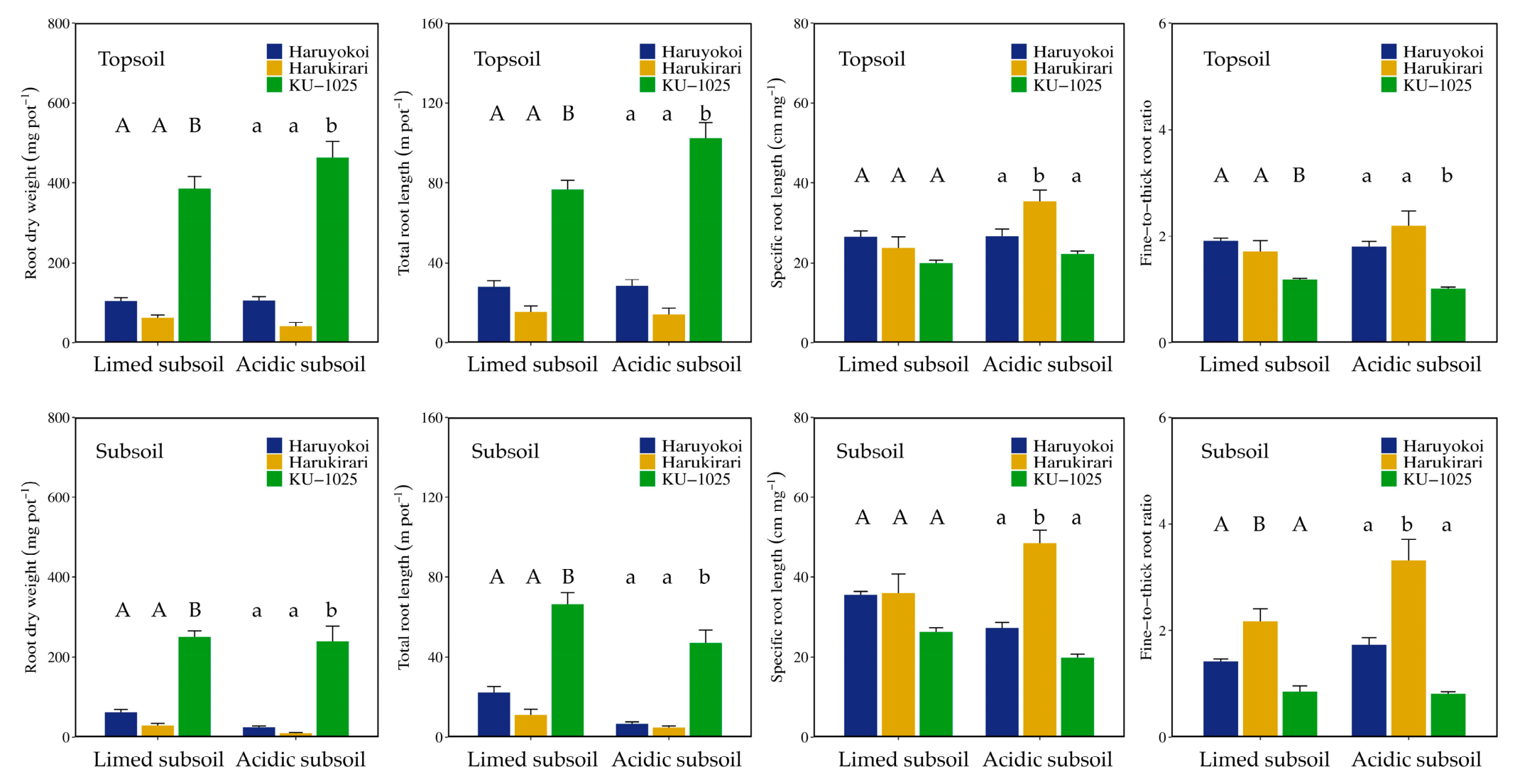
Figure 3 shows root dry weight, total root length, specific root length, and fine-to-thick root ratio in the topsoil and subsoil. For both root dry weight and total root length, KU-1025 had the highest values in both soil layers under both treatments, which was consistent with the patterns observed for shoot dry weight and shoot N uptake. In contrast, Haruyokoi and Harukirari did not differ significantly. However, the mean values tended to be higher in Haruyokoi than in Harukirari. In the two-way ANOVA (Table 2), total root length in the subsoil showed a significant treatment effect, indicating that acidic subsoil conditions inhibited root development. In the acidic subsoil treatment, the total root length in the subsoil was 29%, 43%, and 71% of that in the limed subsoil treatment in Harukirari, Haruyokoi, and KU-1025, respectively.
For specific root lengths, no differences among the genotypes were observed in either soil layer in the limed subsoil treatment. However, under the acidic subsoil treatment, Harukirari showed the highest specific root length in both soil layers. Specific root length increased in the topsoil in response to the subsoil treatments. Harukirari also exhibited greater plasticity in specific root lengths in both soil layers, which was consistent with the genotype × treatment interactions detected for specific root lengths (Table 2). The fine-to-thick root ratio was also higher in Harukirari, except in the topsoil under the limed subsoil treatment, whereas KU-1025 consistently showed significantly lower values. Haruyokoi and Harukirari did not differ significantly in the topsoil, whereas Harukirari showed significantly higher values in the subsoil. Under acidic subsoil conditions, the fine-to-thick root ratio in the subsoil increased, and Harukirari exhibited greater plasticity, as was also observed for specific root lengths (Table 2).

3.4. Deep-Root Distribution

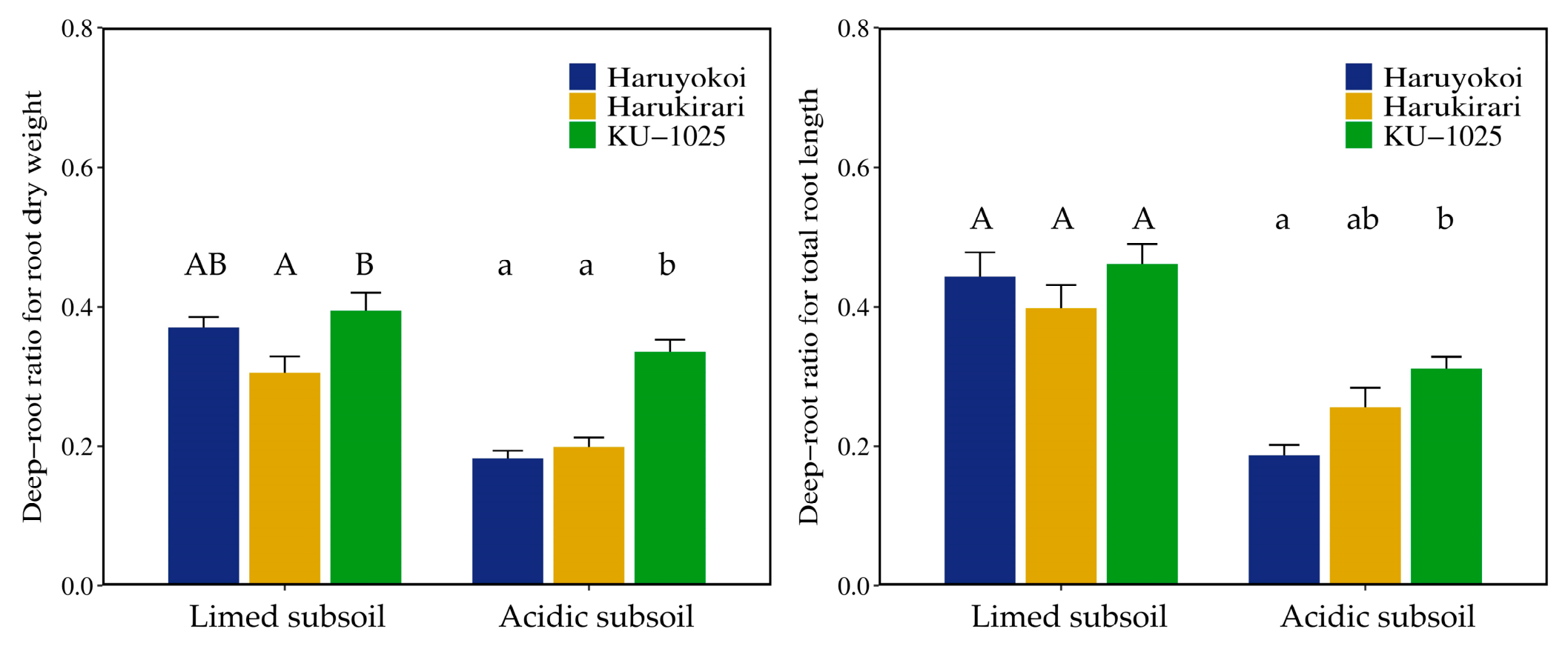
Figure 4 shows the deep-root ratios of root dry weight and total root length. The deep-root ratio based on root dry weight decreased under acidic subsoil treatment in all genotypes. Harukirari and KU-1025 differed significantly under the limed subsoil treatment, and Haruyokoi showed intermediate values. In the acidic subsoil treatment, the overall values were lower and KU-1025 showed significantly higher values than Haruyokoi and Harukirari, whereas Haruyokoi and Harukirari did not differ significantly. Haruyokoi showed the largest decrease, KU-1025 showed the smallest decrease, and Harukirari showed an intermediate decrease, resulting in a significant genotype × treatment interaction in two-way ANOVA (Table 3). For the deep-root ratio based on total root length, all genotypes also showed lower values under the acidic subsoil treatment. The genotypes did not differ significantly under the limed subsoil treatment. However, under the acidic subsoil treatment, KU-1025 showed significantly higher values than Haruyokoi, whereas Harukirari showed intermediate values.

3.5. Soil NO3-N Concentration and Nitrogen Leaching

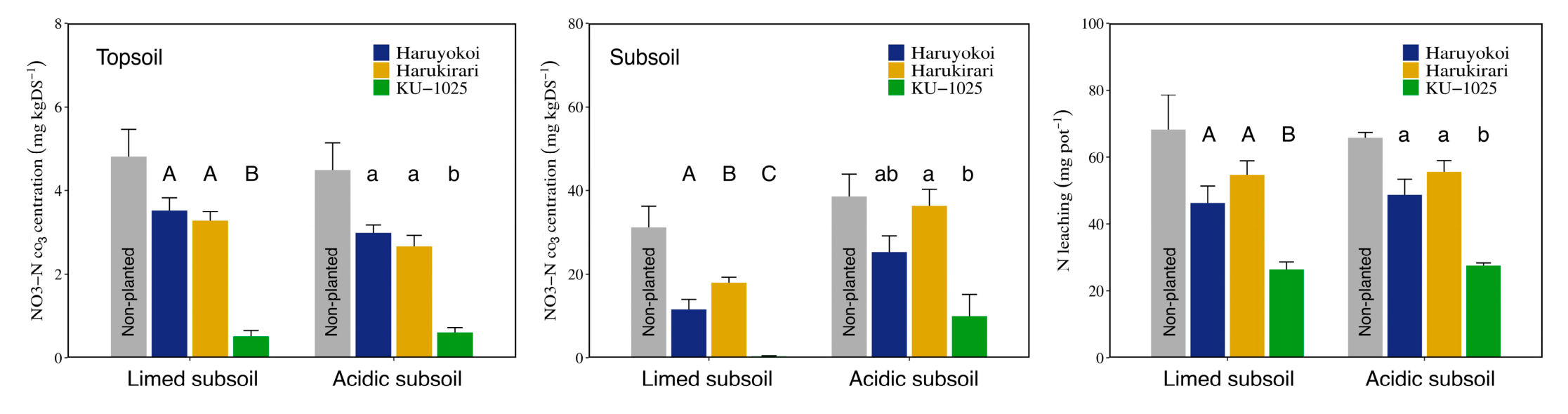
Figure 5 shows the NO3-N concentrations in the topsoil and subsoil layers and the N leaching. For reference, the results from non-planted pots maintained under the same limed and acidic subsoil conditions are also included. The topsoil NO3-N concentrations were lower in all genotypes than in the non-planted pots under both treatments. Under both treatments, KU-1025 showed much lower values, whereas the values for Haruyokoi and Harukirari did not differ significantly. Acidic subsoil conditions slightly decreased the topsoil NO3-N concentrations (p = 0.054; Table 3). In the subsoil, the NO3-N concentrations in all genotypes were lower than those in the non-planted pots under both treatments. However, the reduction under the limed subsoil treatment was significantly greater than that under the acidic subsoil treatment. Under the limed subsoil treatment, significant differences were observed in the order Harukirari > Haruyokoi > KU-1025, which was the reverse of the pattern observed for shoot N uptake. Under the acidic subsoil treatment, NO3-N concentrations were higher than those under the limed treatment in all genotypes, with Harukirari showing the highest values, KU-1025 showing the lowest values, and Haruyokoi showing intermediate values. N leaching was lower in all genotypes than in the non-planted pots under both treatments. Only genotypic effects were statistically significant (Table 3). N leaching in KU-1025 was significantly lower than in Haruyokoi and Harukirari, although Haruyokoi and Harukirari did not differ significantly under either treatment. N leaching in KU-1025 was lower than that in the non-planted pots. In addition, N leaching over time is shown in Supplementary Table S1. N leaching increased only slightly during the early irrigation events and became more pronounced from the middle to later stages of the experiment. This pattern indicates that most N leaching did not occur before root establishment in this study.

3.6. Relationships Among Root Traits, Shoot Nitrogen Uptake, and Nitrogen Leaching

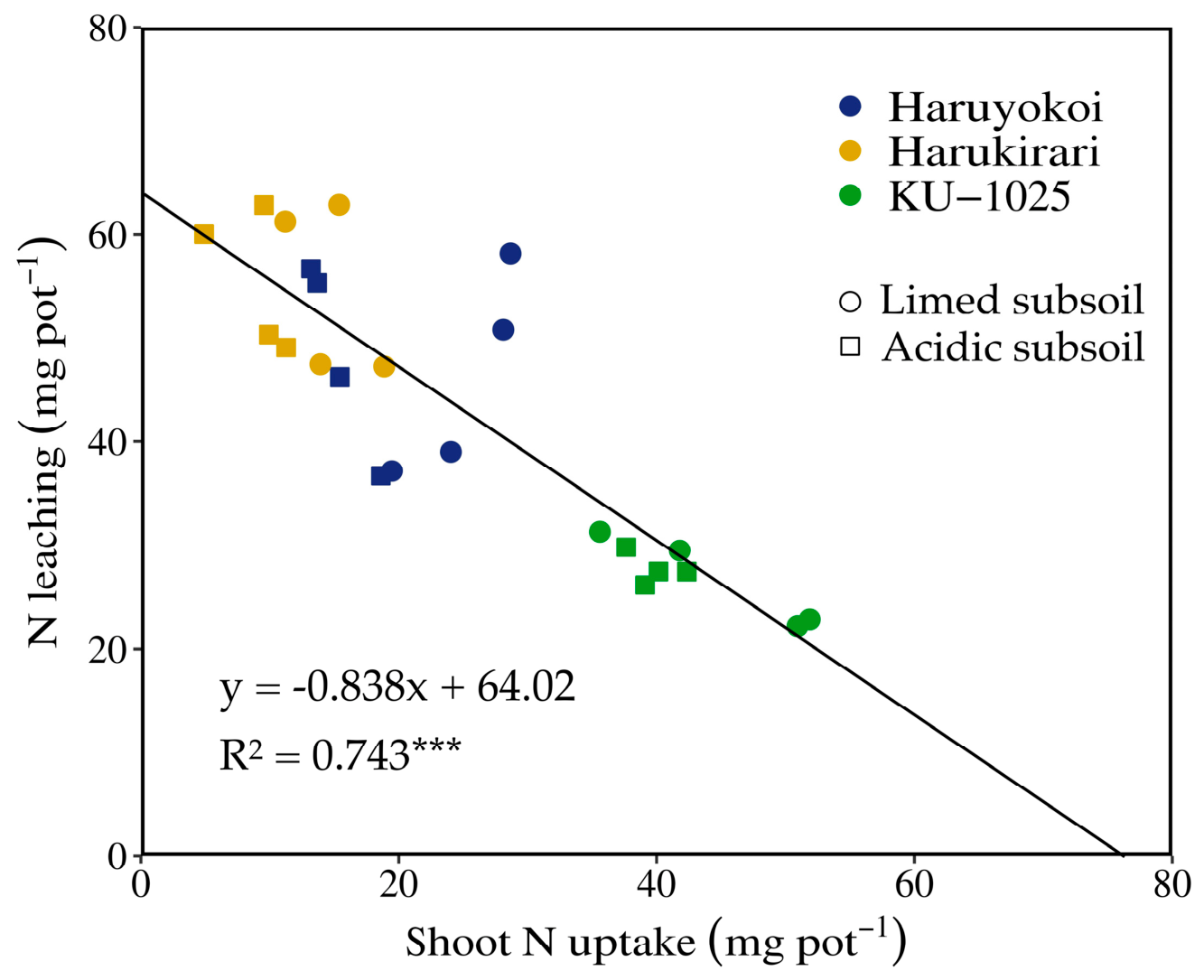
Table 4 shows the Pearson’s correlation coefficients between root parameters and shoot N uptake or leaching. Shoot N uptake was significantly positively correlated with root dry weight and total root length in both topsoil and subsoil layers. In contrast, shoot N uptake was significantly negatively correlated with specific root length and the fine-to-thick root ratio in both soil layers. Conversely, N leaching was significantly negatively correlated with root dry weight and total root length in both soil layers. In addition, N leaching showed significant positive correlations with specific root length and fine-to-thick root ratio in both soil layers. Figure 6 shows the relationship between shoot N uptake and leaching. Shoot N uptake and leaching showed significant negative linear relationships across all genotypes and treatments.

4. Discussion

Because nitrate is readily transported to deeper soil layers, root development is a key factor for efficient N acquisition. When subsoil acidity remains, root growth into deeper soil layers may be restricted even when topsoil chemical conditions are improved. By integrating measurements of root distribution, shoot N uptake, residual soil NO3-N, and cumulative N leaching, this study provides an integrated evaluation of how genotypic variation in root development affects N acquisition and N losses under acidic subsoil conditions. In this study, we investigated the effects of acidic subsoil on root distribution, N uptake, and N leaching in two bread wheat cultivars, Haruyokoi and Harukirari, and one spelt line, KU-1025. Acidic subsoil conditions restricted root distribution within the subsoil layer and reduced the deep-root ratio in all genotypes. Genotypic differences in root distribution were evident under both limed and acidic subsoil conditions. In particular, KU-1025 consistently showed greater root development, higher shoot N uptake, and lower N leaching than the other two wheat genotypes. Across genotypes and treatments, larger root dry weights and longer total root lengths were associated with higher shoot N uptake and lower N leaching. Shoot N uptake also exhibited a clear negative relationship with N leaching. These results suggest that maintaining larger root systems improves N uptake and reduces N leaching.
In the present study, acidic subsoil conditions clearly restricted root distribution. This finding is consistent with a previous report that showed that acidic soil at the same site inhibited root growth in the subsoil [22]. Our study quantified the shift toward shallower root distribution under acidic subsoil conditions by measuring root dry weight and total root length (Figure 3). The reduction in deep rooting under acidic subsoil conditions translated into lower N uptake, but it did not clearly reduce shoot biomass or increase N leaching because the treatment effects were not significant (Table 1 and Table 3). Thus, the advantages of deep rooting reported in previous studies [11,12,13,14] were not evident in response to the subsoil treatments in our study. However, among the genotypes, KU-1025 had a greater root dry weight, longer total root length, and relatively deeper rooting, and exhibited greater shoot N uptake and lower N leaching. In addition, strong relationships were found among root size (dry weight and total length), shoot N uptake, and N leaching across genotypes and treatments (Table 4). These results suggest that roots in the deeper layers may have contributed to N capture. Overall, the total root size, rather than deep rooting alone, was the main factor associated with greater N uptake and reduced N leaching across treatments.
This is supported by the observation that Haruyokoi, which had a greater root dry weight and total root length than Harukirari, exhibited higher N uptake and lower N leaching. This is consistent with previous reports showing that wheat genotypes with larger roots tend to exhibit higher N uptake and a lower risk of N leaching [31]. Further support is provided by the positive correlations between shoot N uptake and root dry weight and total root length, the negative correlations between N leaching and these root traits, and the significant negative regression relationship between shoot N uptake and N leaching (Table 4; Figure 6).
Under acidic subsoil conditions, NO3-N concentrations at harvest decreased slightly in the topsoil but remained substantially higher in the subsoil (Figure 5). This pattern suggests that N uptake from deeper soil layers was limited because root distribution was concentrated in the shallow layers. Compared to the non-planted reference pots, NO3-N concentrations were lower in all subsoil layers. However, when the subsoil was limed, NO3-N concentrations in the subsoil were markedly lower, suggesting that a deeper root distribution contributed to N uptake from the subsoil. This result is consistent with that of a previous study showing that deep-root distribution reduces inorganic N in the subsoil compared to spring and winter wheat [38].
Although this study provides a simplified evaluation of N leaching, clear genotypic differences were observed. In contrast, the subsoil treatments did not significantly affect N leaching (Table 3; Figure 5). This may be consistent with a previous report [39], which suggested that increased N uptake does not necessarily lead to a clear reduction in N leaching. However, shoot N uptake showed a significant negative regression relationship with N leaching (Figure 6), suggesting that this relationship was mainly influenced by genotypic differences rather than by treatment effects. Although this approach may be useful for comparing the relative differences between treatments and genotypes in this study, these values cannot be directly applied to field conditions. Several methods have been developed to evaluate N leaching, each with its own range of applicability, strengths, and limitations [40,41]. Future studies could achieve a more precise evaluation of N leaching by adopting methods based on these approaches.
In this study, the spelt genotype KU-1025 showed significantly higher N uptake and lower N leaching than the other two bread wheat genotypes (Figure 2 and Figure 5). Although acidic subsoil conditions reduced the root dry weight and total root length in the subsoil, the reductions were smaller in KU-1025 than in the other two genotypes, and the decline in the deep-root ratio was less pronounced (Figure 3 and Figure 4). These results suggest that KU-1025 can take up inorganic N more effectively under acidic subsoil conditions. Pires Barbosa et al. (2025) reported that ancient wheat genotypes, such as spelt, showed superior deep rooting [42], whereas Odone et al. (2025) suggested that modern wheat cultivars have better deep rooting [43]. The present results align with the former finding, although inconsistencies between previous studies may depend on the genotype examined. Because spelt can be crossed with bread wheat, useful traits found in ancient wheat, including stress tolerance, can be introduced into modern bread wheat [44,45]. In previous studies, KU-1025-derived lines were used to detect QTLs associated with agronomic traits in a bread wheat × spelt population [32], and KU-1025-derived genes associated with root hair traits were introduced into modern bread wheat [46]. The present results also indicate that KU-1025 is a useful genetic resource for improving root-related traits and N capture under acidic subsoil conditions [46].
Harukirari, which carries a high-resistance TaALMT1 allele associated with aluminum tolerance, showed a lower deep-root ratio under acidic subsoil conditions than under limed subsoil conditions (Figure 4). However, this reduction was smaller than that observed in Haruyokoi, which harbored a low-resistance TaALMT1 allele. These results suggest that TaALMT1 contributes to acid tolerance under the conditions used in this study. This is consistent with a previous report using durum wheat (Triticum durum Desf.), in which TaMATE, a gene with a function similar to that of TaALMT1, was introduced [47]. However, the differences between Haruyokoi and Harukirari were small. Moreover, in the acidic subsoil treatment, Harukirari tended to show lower N uptake and higher N leaching than Haruyokoi, although these differences were not statistically significant. Reduced deep-root growth was also observed in KU-1025, which carries a high-resistance TaALMT1 allele under acidic subsoil conditions. Because this experiment was not designed to directly test the effect of TaALMT1 and did not use a shared genetic background among the genotypes, the present results should not be interpreted as direct functional validation of TaALMT1. Further studies using materials with a uniform genetic background, such as near-isogenic lines carrying ALMT1-related alleles, together with direct functional validation approaches, will be required to clarify the contribution of TaALMT1. In addition, GWAS suggested the involvement of multiple genes other than ALMT1 [48]. Consistent with this, our results suggest that tolerance to acidic soil conditions cannot be determined using TaALMT1 alone. Therefore, future studies should include a wider range of genotypes to obtain a more comprehensive understanding of genetic factors.
In the acidic subsoil treatment, Harukirari showed a high specific root length in both the topsoil and subsoil as well as a high fine-to-thick root ratio in the subsoil. This suggests that Harukirari may exhibit root plasticity in response to acidic subsoil conditions, which is often considered important for environmental adaptation [49]. However, in this study, this plasticity did not lead to greater N uptake. In contrast, KU-1025 maintained greater root dry weight and total root length, suggesting that the maintenance of whole root size may be more relevant than finer-root proliferation for N acquisition under acidic subsoil conditions. We evaluated only integrated root traits, such as specific root length. In future studies, evaluating a wider range of root traits, as suggested by Lynch (2013) [11], could clarify the function of root plasticity under acidic subsoil conditions.
Under field conditions, topsoil and subsoil often differ substantially in soil structure, permeability, and nutrient dynamics [19]. Although this study controlled for these factors, future studies should be conducted under conditions that are closer to actual field conditions. Under such conditions, traits related to root system plasticity, such as those observed in Harukirari, may be promising targets for further evaluations. Another limitation is the restricted soil depth of the pot system. Each pot consisted of a 20 cm topsoil and a 20 cm subsoil, whereas wheat roots can often extend beyond 40 cm under field conditions [8]. Although this experimental design allowed us to compare genotypic and treatment differences under controlled acidic-subsoil conditions, the absolute values of rooting depth and N leaching should not be directly extrapolated to field conditions.

5. Conclusions

Acidic subsoil conditions inhibited root distribution into deeper layers and reduced the deep-root ratio. NO3-N concentrations tended to remain higher in the subsoil under acidic subsoil conditions, suggesting that N uptake from the deeper soil layers was restricted. Clear genotypic differences were observed in root responses and N uptake. KU-1025 maintained high shoot dry weight, N uptake, root dry weight, and total root length under both treatments, and retained a relatively high deep-root ratio even under acidic subsoil conditions. Moreover, KU-1025 showed lower soil NO3-N concentrations and N leaching than the other two wheat genotypes. Correlations and regression relationships among root traits, N uptake, and N leaching further indicated that genotypes with larger roots tended to have higher N uptake and lower N leaching. Although Harukirari showed root plasticity, increasing the proportion of fine roots did not appear to be particularly effective for increasing N uptake or reducing N leaching. These findings suggest that the ability to maintain the root dry weight and total root length under acidic subsoil conditions plays an important role. In addition, KU-1025 appears to be a useful genetic resource for evaluating and selecting wheat genotypes adapted to acidic subsoil conditions. Overall, these findings suggest that maintaining deeper and larger root systems under acidic subsoil conditions could contribute to both improved N use efficiency and reduced environmental N losses in wheat.

Supplementary Materials

The following supporting information can be downloaded at: https://www.mdpi.com/article/10.3390/nitrogen7020064/s1. Figure S1: Daily mean air temperature during the 78-day experimental period in 2017; Table S1: N leaching over time in three genotypes (Haruyokoi, Harukirari, and KU-1025) and non-planted reference pots under limed and acidic subsoil treatments. (Mean ± SE).

Author Contributions

Conceptualization, R.T.; methodology, R.T.; software, R.T. and H.N.; validation, R.T. and H.N.; formal analysis, T.S. and R.T.; investigation, T.W., T.S. and R.T.; resources, K.O.; data curation, R.T. and H.N.; writing—original draft preparation, T.S.; writing—review and editing, R.T., H.N., K.O. and M.N.; visualization, T.S. and R.T.; supervision, M.N.; project administration, R.T. and M.N.; funding acquisition, M.N. All authors have read and agreed to the published version of the manuscript.

Funding

This study received no external funding.

Data Availability Statement

The raw data supporting the conclusions of this study will be made available by the authors upon request.

Acknowledgments

We extend our sincere appreciation to our colleagues at the Laboratory of Environmental Crop Science, Tohoku University, for their assistance and support throughout this study.

Conflicts of Interest

The authors declare no conflicts of interest.

References

  1. Van Ittersum, M.K.; Cassman, K.G. Yield Gap Analysis-Rationale, Methods and Applications-Introduction to the Special Issue. Field Crops Res. 2013, 143, 1–3. [Google Scholar] [CrossRef]
  2. Gardner, J.B.; Drinkwater, L.E. The Fate of Nitrogen in Grain Cropping Systems: A Meta-Analysis of 15N Field Experiments. Ecol. Appl. 2009, 19, 2167–2184. [Google Scholar] [CrossRef]
  3. Galloway, J.N.; Aber, J.D.; Erisman, J.W.; Seitzinger, S.P.; Howarth, R.W.; Cowling, E.B.; Cosby, B.J. The Nitrogen Cascade. BioScience 2003, 53, 341–356. [Google Scholar] [CrossRef]
  4. Kumazawa, K. Present State of Nitrate Pollution in Groundwater. Jpn. Soc. Soil Sci. Plant Nutr. 1999, 70, 207–213. [Google Scholar] [CrossRef]
  5. Richardson, K.; Steffen, W.; Lucht, W.; Bendtsen, J.; Cornell, S.E.; Donges, J.F.; Drüke, M.; Fetzer, I.; Bala, G.; von Bloh, W.; et al. Earth beyond Six of Nine Planetary Boundaries. Sci. Adv. 2023, 9, 2458. [Google Scholar] [CrossRef]
  6. Martinez-Feria, R.A.; Basso, B. Unstable Crop Yields Reveal Opportunities for Site-Specific Adaptations to Climate Variability. Sci. Rep. 2020, 10, 2885. [Google Scholar] [CrossRef] [PubMed]
  7. Liu, H.; Grant, B.B.; Smith, W.N.; Porter, C.H.; Cammarano, D.; Vogeler, I.; Hoogenboom, G.; Pullens, J.W.M.; Olesen, J.E.; Bindi, M.; et al. Towards an Improved Representation of the Relationship between Root Traits and Nitrogen Losses in Process-Based Models. Agric. Syst. 2025, 228, 104400. [Google Scholar] [CrossRef]
  8. Rich, S.M.; Watt, M. Soil Conditions and Cereal Root System Architecture: Review and Considerations for Linking Darwin and Weaver. J. Exp. Bot. 2013, 64, 1193–1208. [Google Scholar] [CrossRef]
  9. Lynch, J.P. Harnessing Root Architecture to Address Global Challenges. Plant J. 2022, 109, 415–431. [Google Scholar] [CrossRef]
  10. Jobbágy, E.G.; Jackson, R.B. The Distribution of Soil Nutrients with Depth: Global Patterns and the Imprint of Plants. Biogeochemistry 2001, 53, 51–77. [Google Scholar] [CrossRef]
  11. Lynch, J.P. Steep, Cheap and Deep: An Ideotype to Optimize Water and N Acquisition by Maize Root Systems. Ann. Bot. 2013, 112, 347–357. [Google Scholar] [CrossRef] [PubMed]
  12. Lynch, J.P.; Galindo-Castañeda, T.; Schneider, H.M.; Sidhu, J.S.; Rangarajan, H.; York, L.M. Root Phenotypes for Improved Nitrogen Capture. Plant Soil 2024, 502, 31–85. [Google Scholar] [CrossRef] [PubMed]
  13. Gao, K.; Chen, F.; Yuan, L.; Zhang, F.; Mi, G. A Comprehensive Analysis of Root Morphological Changes and Nitrogen Allocation in Maize in Response to Low Nitrogen Stress. Plant Cell Environ. 2015, 38, 740–750. [Google Scholar] [CrossRef]
  14. Thorup-Kristensen, K.; Halberg, N.; Nicolaisen, M.; Olesen, J.E.; Crews, T.E.; Hinsinger, P.; Kirkegaard, J.; Pierret, A.; Dresbøll, D.B. Digging Deeper for Agricultural Resources, the Value of Deep Rooting. Trends Plant Sci. 2020, 25, 406–417. [Google Scholar] [CrossRef]
  15. Tajima, R. Importance of Individual Root Traits to Understand Crop Root System in Agronomic and Environmental Contexts. Breed. Sci. 2021, 71, 13–19. [Google Scholar] [CrossRef]
  16. Kochian, L.V.; Shaff, J.E. Investigating the Relationship between Aluminium Toxicity, Root Growth and Root-Generated Ion Currents. In Plant-Soil Interactions at Low pH; Springer: Dordrecht, The Netherlands, 1991; pp. 769–778. [Google Scholar] [CrossRef]
  17. Kochian, L.V.; Hoekenga, O.A.; Piñeros, M.A. How Do Crop Plants Tolerate Acid Soils? Mechanisms of Aluminum Tolerance and Phosphorous Efficiency. Annu. Rev. Plant Biol. 2004, 55, 459–493. [Google Scholar] [CrossRef]
  18. Du, L.; Zhang, Z.; Chen, Y.; Wang, Y.; Zhou, C.; Yang, H.; Zhang, W. Heterogeneous Impact of Soil Acidification on Crop Yield Reduction and Its Regulatory Variables: A Global Meta-Analysis. Field Crops Res. 2024, 319, 109643. [Google Scholar] [CrossRef]
  19. Hettithanthri, O.; O’Connor, J.; Solaiman, Z.M.; Siddique, K.H.M.; Bolan, N. Unravelling Subsoil Acidification: Mechanisms, Consequences and Remediation. Soil Use Manag. 2026, 42, 70191. [Google Scholar] [CrossRef]
  20. Ning, T.; Liu, Z.; Hu, H.; Li, G.; Kuzyakov, Y. Physical, Chemical and Biological Subsoiling for Sustainable Agriculture. Soil Tillage Res. 2022, 223, 105490. [Google Scholar] [CrossRef]
  21. Takahashi, T.; Dahlgren, R.A. Nature, Properties and Function of Aluminum-Humus Complexes in Volcanic Soils. Geoderma 2016, 263, 110–121. [Google Scholar] [CrossRef]
  22. Saigusa, M.; Shoji, S. The effects of subsoil acidity of Andosols on the growth and nitrogen uptake of lucerne and cocksfoot. J. Jpn. Soc. Grassl. Sci. 1984, 30, 255–263. [Google Scholar] [CrossRef]
  23. Shoji, S.; Saigusa, M.; Takahashi, T. Plant Root Growth in Acid Andosols from Northeastern Japan: 1. Soil Properties and Root Growth of Burdock, Barley, and Orchard Grass. Soil Sci. 1980, 130, 124–131. [Google Scholar] [CrossRef]
  24. Çatav, Ş.S.; Elgin, E.S.; Küçükakyüz, K.; Dağ, Ç. Intrinsic and Induced Metabolic Signatures Underpin Aluminum Tolerance in Bread Wheat: A Comparative Metabolomics Approach. Physiol. Mol. Biol. Plants 2025, 31, 1011–1026. [Google Scholar] [CrossRef]
  25. Aguilera, J.G.; Minozzo, J.A.D.; Barichello, D.; Fogaça, C.M.; da Silva, J.P.; Consoli, L.; Pereira, J.F. Alleles of Organic Acid Transporter Genes Are Highly Correlated with Wheat Resistance to Acidic Soil in Field Conditions. Theor. Appl. Genet. 2016, 129, 1317–1331. [Google Scholar] [CrossRef]
  26. Sasaki, T.; Yamamoto, Y.; Ezaki, B.; Katsuhara, M.; Ahn, S.J.; Ryan, P.R.; Delhaize, E.; Matsumoto, H. A Wheat Gene Encoding an Aluminum-Activated Malate Transporter. Plant J. 2004, 37, 645–653. [Google Scholar] [CrossRef]
  27. Tovkach, A.; Ryan, P.R.; Richardson, A.E.; Lewis, D.C.; Rathjen, T.M.; Ramesh, S.; Tyerman, S.D.; Delhaize, E. Transposon-Mediated Alteration of TaMATE1B Expression in Wheat Confers Constitutive Citrate Efflux from Root Apices. Plant Physiol. 2013, 161, 880–892. [Google Scholar] [CrossRef]
  28. Ojima, K.; Koike, H.; Urano, G.; Ohira, K. Growth and Mineral Accumulation of Two Varieties of Aluminum-Susceptible and-Resistant Wheats in Kawatabi-Andosol. Jpn. J. Soil Sci. Plant Nutr. 1986, 57, 563–570. [Google Scholar] [CrossRef]
  29. Oyanagi, A.; Wada, M.; Nakamoto, T. Relationship between Root Growth Angle of Seedlings and Vertical Distribution of Roots in the Field in Wheat Cultivars. Jpn. J. Crop Sci. 1994, 62, 565–570. [Google Scholar] [CrossRef]
  30. Xu, Y.; Yang, Y.; Wu, S.; Liu, D.; Ren, Y. QTL Mapping for Root Traits and Their Effects on Nutrient Uptake and Yield Performance in Common Wheat (Triticum aestivum L.). Agriculture 2023, 13, 210. [Google Scholar] [CrossRef]
  31. Ehdaie, B.; Merhaut, D.J.; Ahmadian, S.; Hoops, A.C.; Khuong, T.; Layne, A.P.; Waines, J.G. Root System Size Influences Water-Nutrient Uptake and Nitrate Leaching Potential in Wheat. J. Agron. Crop Sci. 2010, 196, 455–466. [Google Scholar] [CrossRef]
  32. Sakai, Y.; Cao, L.; Funata, R.; Shiraishi, T.; Yoshikawa, K.; Maeno, K.; Miura, H.; Onishi, K. QTLs for Agronomic Traits Detected in Recombinant Inbred Lines Derived from a Bread Wheat × Spelt Cross. Breed. Sci. 2018, 68, 587–595. [Google Scholar] [CrossRef]
  33. Suzuki, T.; Uno, T.; Tajima, R.; Ito, T.; Saito, M. Optimum Range of Soil Phosphorus Fertility Needed for Effective Arbuscular Mycorrhizal Inoculation of Welsh Onions in a Non-Allophanic Andosol. Soil Sci. Plant Nutr. 2021, 67, 540–544. [Google Scholar] [CrossRef]
  34. Shoemaker, H.E.; McLean, E.O.; Pratt, P.F. Buffer Methods for Determining Lime Requirement of Soils With Appreciable Amounts of Extractable Aluminum. Soil Sci. Soc. Am. J. 1961, 25, 274–277. [Google Scholar] [CrossRef]
  35. Kashiwagura, M.; Sato, Y.; Uno, T.; Tajima, R.; Ito, T.; Saito, M. Microscale digestion of plant samples with sulfuric acid and hydrogenperoxide. Bull. Integr. Field Sci. Cent. 2015, 30, 1–2. [Google Scholar] [CrossRef]
  36. Tajima, R.; Kato, Y. A Quick Method to Estimate Root Length in Each Diameter Class Using Freeware ImageJ. Plant Prod. Sci. 2013, 16, 9–11. [Google Scholar] [CrossRef]
  37. R Core Team. R: A Language and Environment for Statistical Computing; R Foundation for Statistical Computing: Vienna, Austria, 2024; Available online: https://www.R-project.org/ (accessed on 31 October 2024).
  38. Thorup-Kristensen, K.; Cortasa, M.S.; Loges, R. Winter Wheat Roots Grow Twice as Deep as Spring Wheat Roots, is This Important for N Uptake and N Leaching Losses? Plant Soil 2009, 322, 101–114. [Google Scholar] [CrossRef]
  39. Herrera, J.M.; Noulas, C.; Stamp, P.; Pellet, D. Little Potential of Spring Wheat Genotypes as a Strategy to Reduce Nitrogen Leaching in Central Europe. Agronomy 2016, 6, 29. [Google Scholar] [CrossRef]
  40. Loper, H.; Tenesaca, C.; Pederson, C.; Helmers, M.J.; Crumpton, W.G.; Lemke, D.; Hall, S.J. Insights on Agricultural Nitrate Leaching from Soil Block Mesocosms. J. Environ. Qual. 2024, 53, 508–520. [Google Scholar] [CrossRef]
  41. Singh, G.; Kaur, G.; Williard, K.; Schoonover, J.; Kang, J. Monitoring of Water and Solute Transport in the Vadose Zone: A Review. Vadose Zone J. 2018, 17, 1–23. [Google Scholar] [CrossRef]
  42. Pires Barbosa, L.A.; Leue, M.; Wehrhan, M.; Sommer, M. Impact of Wheat Cultivar Development on Biomass and Subsoil Carbon Input: A Case Study along an Erosion-Deposition Gradient. Biogeosciences 2025, 22, 5651–5664. [Google Scholar] [CrossRef]
  43. Odone, A.; Thorup-Kristensen, K. Modern Wheat Has Deeper Roots than Ancient Wheats: Is This an Adaptation to Higher Productivity? Ann. Bot. 2025, 136, 1193–1201. [Google Scholar] [CrossRef]
  44. Longin, C.F.H.; Ziegler, J.; Schweiggert, R.; Koehler, P.; Carle, R.; Würschum, T. Comparative Study of Hulled (Einkorn, Emmer, and Spelt) and Naked Wheats (Durum and Bread Wheat): Agronomic Performance and Quality Traits. Crop Sci. 2016, 56, 302–311. [Google Scholar] [CrossRef]
  45. Arzani, A.; Ashraf, M. Cultivated Ancient Wheats (Triticum Spp.): A Potential Source of Health-Beneficial Food Products. Compr. Rev. Food Sci. Food Saf. 2017, 16, 477–488. [Google Scholar] [CrossRef]
  46. Okano, N.; Goto, R.; Kato, T.; Saisho, D.; Kato, K.; Miura, H.; Tani, M.; Onishi, K. Spanish Spelt is Unique Germplasm for Improvement of Root Hair Length in Hexaploid Wheat. Plant Soil 2020, 452, 171–184. [Google Scholar] [CrossRef]
  47. Pooniya, V.; Palta, J.A.; Chen, Y.; Delhaize, E.; Siddique, K.H.M. Impact of the TaMATE1B Gene on Above and Below-Ground Growth of Durum Wheat Grown on an Acid and Al3+-Toxic Soil. Plant Soil 2020, 447, 73–84. [Google Scholar] [CrossRef]
  48. Froese, P.S.; Carter, A.H. Single Nucleotide Polymorphisms in the Wheat Genome Associated with Tolerance of Acidic Soils and Aluminum Toxicity. Crop Sci. 2016, 56, 1662–1677. [Google Scholar] [CrossRef]
  49. Koevoets, I.T.; Venema, J.H.; Elzenga, J.T.M.; Testerink, C. Roots Withstanding Their Environment: Exploiting Root System Architecture Responses to Abiotic Stress to Improve Crop Tolerance. Front. Plant Sci. 2016, 7, 1335. [Google Scholar] [CrossRef]
Figure 1. Experimental setup of the two-layer pot system under limed and acidic subsoil conditions. The photograph shows the pot arrangement during the growth experiment.
Nitrogen 07 00064 g001
Figure 2. Shoot dry weight, shoot N concentration, and shoot N uptake of three genotypes (Haruyokoi, Harukirari, and KU-1025) under limed and acidic subsoil treatments. Bars indicate the treatment means with standard errors. Different letters above bars indicate significant differences among genotypes within each subsoil treatment (p < 0.05). Uppercase and lowercase letters indicate significant differences within the limed and acidic subsoil treatments, respectively.
Nitrogen 07 00064 g002
Figure 3. Root dry weight, total root length, specific root length, and fine-to-thick root ratio in the topsoil and subsoil layers of three genotypes (Haruyokoi, Harukirari, and KU-1025) under limed and acidic subsoil treatments. Bars indicate the treatment means with standard errors. Different letters above bars indicate significant differences among genotypes within each subsoil treatment (p < 0.05). Uppercase and lowercase letters indicate significant differences within the limed and acidic subsoil treatments, respectively.
Nitrogen 07 00064 g003
Figure 4. Deep-root ratios for root dry weight and total root length of three genotypes (Haruyokoi, Harukirari, and KU-1025) under limed and acidic subsoil treatments. Bars indicate the treatment means with standard errors. Different letters above the bars indicate significant differences among genotypes within each subsoil treatment (p < 0.05). Uppercase and lowercase letters indicate significant differences within the limed and acidic subsoil treatments, respectively.
Nitrogen 07 00064 g004
Figure 5. Soil NO3-N concentrations in the topsoil and subsoil layers and N leaching of three genotypes (Haruyokoi, Harukirari, and KU-1025) and non-planted reference pots under limed and acidic subsoil treatments. Bars indicate the treatment means with standard errors. Different letters above bars indicate significant differences among genotypes within each subsoil treatment (p < 0.05). Uppercase and lowercase letters indicate significant differences within the limed and acidic subsoil treatments, respectively.
Nitrogen 07 00064 g005
Figure 6. Relationship between shoot N uptake and N leaching across genotypes and subsoil treatments. Point colors indicate genotypes; point shapes denote subsoil treatments. Solid line indicates the regression line. Asterisks indicate statistical significance: *** p < 0.001.
Nitrogen 07 00064 g006
Table 1. Two-way analysis of variance for the effects of genotype, treatment, and their interaction on shoot and root traits.
Shoot Dry WeightShoot N
Concentration
Shoot N
Uptake
Root Dry Weight
TopsoilSubsoil
Genotype<0.001 ***0.047<0.001 ***<0.001 ***<0.001 ***
Treatment0.5830.163<0.001 ***0.2980.127
G × T0.0790.4830.5120.0810.736
Asterisks indicate statistical significance: *** p < 0.001.
Table 2. Two-way analysis of variance for the effects of genotype, treatment, and their interaction on root traits.
Total Root LengthSpecific Root LengthFine-to-Thick Root Ratio
TopsoilSubsoilTopsoilSubsoilTopsoilSubsoil
Genotype<0.001 ***<0.001 ***0.001 **<0.001 ***<0.001 ***<0.001 ***
Treatment0.04 *<0.001 ***0.008 **0.690.3660.011 *
G × T0.014 *0.270.017 *<0.001 ***0.0690.026 *
Asterisks indicate statistical significance: * p < 0.05, ** p < 0.01, and *** p < 0.001.
Table 3. Two-way analysis of variance for the effects of genotype, treatment, and their interaction on root traits, soil NO3-N concentration, and N leaching.
Deep-Root Ratio for Root Dry WeightDeep-Root Ratio for Total Root LengthNO3-N ConcentrationN Leaching
TopsoilSubsoil
Genotype<0.001 ***0.037 *<0.001 ***<0.001 ***<0.001 ***
Treatment<0.001 ***<0.001 ***0.054<0.001 ***0.255
G × T0.009 **0.0860.2150.4130.975
Asterisks indicate statistical significance: * p < 0.05, ** p < 0.01, and *** p < 0.001.
Table 4. Correlation coefficients of shoot N uptake and N leaching with root traits in the topsoil and subsoil layers.
Root Dry WeightTotal Root LengthSpecific Root LengthFine-to-Thick Root Ratio
TopsoilSubsoilTopsoilSubsoilTopsoilSubsoilTopsoilSubsoil
Shoot N uptake0.864 ***0.914 ***0.853 ***0.933 ***−0.594 **−0.616 **−0.749 ***−0.811 ***
N leaching−0.838 ***−0.846 ***−0.844 ***−0.831 ***0.471 *0.56 **0.745 ***0.737 ***
Asterisks indicate statistical significance: * p < 0.05, ** p < 0.01, and *** p < 0.001.
Disclaimer/Publisher’s Note: The statements, opinions and data contained in all publications are solely those of the individual author(s) and contributor(s) and not of MDPI and/or the editor(s). MDPI and/or the editor(s) disclaim responsibility for any injury to people or property resulting from any ideas, methods, instructions or products referred to in the content.