
Article

Are Greenhouse Gas Emissions and Soil Chemical Characteristics Affected by Planting Density, Organic Fertilization, and Saline Water Irrigation in Cactus Pear Cultivation?

by
Cleyton de Almeida Araújo
1,
Gherman Garcia Leal de Araújo
2,
Diana Signor Deon
2,
Ana Paula Guimarães Santos
2,
Fleming Sena Campos
3,
Salete Alves de Moraes
2,
Thieres George Freire da Silva
4,
Deneson Oliveira Lima
5,
Alida Maysa Dantas Resende
6,
Glayciane Costa Gois
7,* and
Tadeu Vinhas Voltolini
2
1
Postgraduate Program in Animal Science, Universidade Federal do Vale do São Francisco—UNIVASF, Petrolina 56300-000, PE, Brazil
2
Empresa Brasileira de Pesquisa Agropecuária—Embrapa Semiárido, Petrolina 56302-970, PE, Brazil
3
Postgraduate Program in Animal Science, Universidade Estadual do Sudoeste da Bahia—UESB, Itapetinga 45700-000, BA, Brazil
4
Postgraduate Program in Plant Production, Universidade Federal Rural de Pernambuco—UFRPE, Serra Talhada 56909-535, PE, Brazil
5
Animal Science Department, Universidade Estadual de Alagoas—UNEAL, Santana do Ipanema 57500-000, AL, Brazil
6
Department of Biological Sciences, Universidade de Pernambuco—UPE, Petrolina 56328-900, PE, Brazil
7
Postgraduate Program in Animal Science, Universidade Federal do Maranhão—UFMA, Chapadinha 65500-000, MA, Brazil
*
Author to whom correspondence should be addressed.
Nitrogen 2026, 7(2), 61; https://doi.org/10.3390/nitrogen7020061
Submission received: 11 April 2026 / Revised: 25 May 2026 / Accepted: 28 May 2026 / Published: 2 June 2026

Abstract

Understanding nitrogen dynamics in arid agricultural systems is essential for mitigating greenhouse gas (GHG) emissions in climate-constrained environments. This study evaluated the effects of planting density, organic fertilization, and saline water irrigation on soil chemical properties, carbon and nitrogen stocks, and emissions of CO2, CH4, and nitrous oxide (N2O) in cactus pear cultivation systems. A 2 × 2 × 2 factorial arrangement was used to test two planting densities (30,000 and 75,000 plants ha−1), two organic fertilizer rates (0 and 30 Mg ha−1), and two saline irrigation depths (0 and 25% of ET0). Higher planting density increased soil moisture and carbon content while reducing CO2 and CH4 emissions. Organic fertilization increased the soil C ratio and phosphorus availability and significantly enhanced N2O emissions, whereas unfertilized systems showed negative N2O fluxes. Saline water irrigation reduced N2O emissions, resulting in negative fluxes (−12.50 µg N m−2 h−1), indicating potential suppression of nitrification and denitrification pathways. None of the evaluated factors significantly affected soil nitrogen stocks. Total GHG emissions (CO2-eq) were lower in denser cultivation systems. These results demonstrate that the interaction among high planting density, organic fertilization, and supplementary saline irrigation modulates nitrogen transformations and N2O emissions in semi-arid soils, highlighting management strategies to mitigate nitrogen-derived GHG emissions in cactus-based agroecosystems.

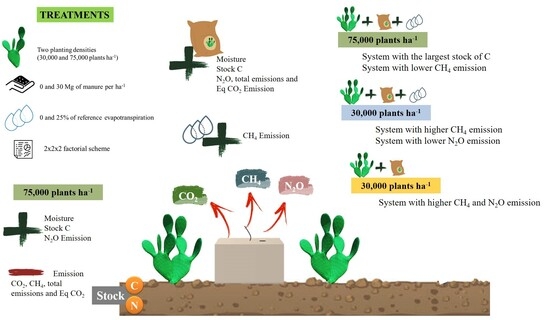
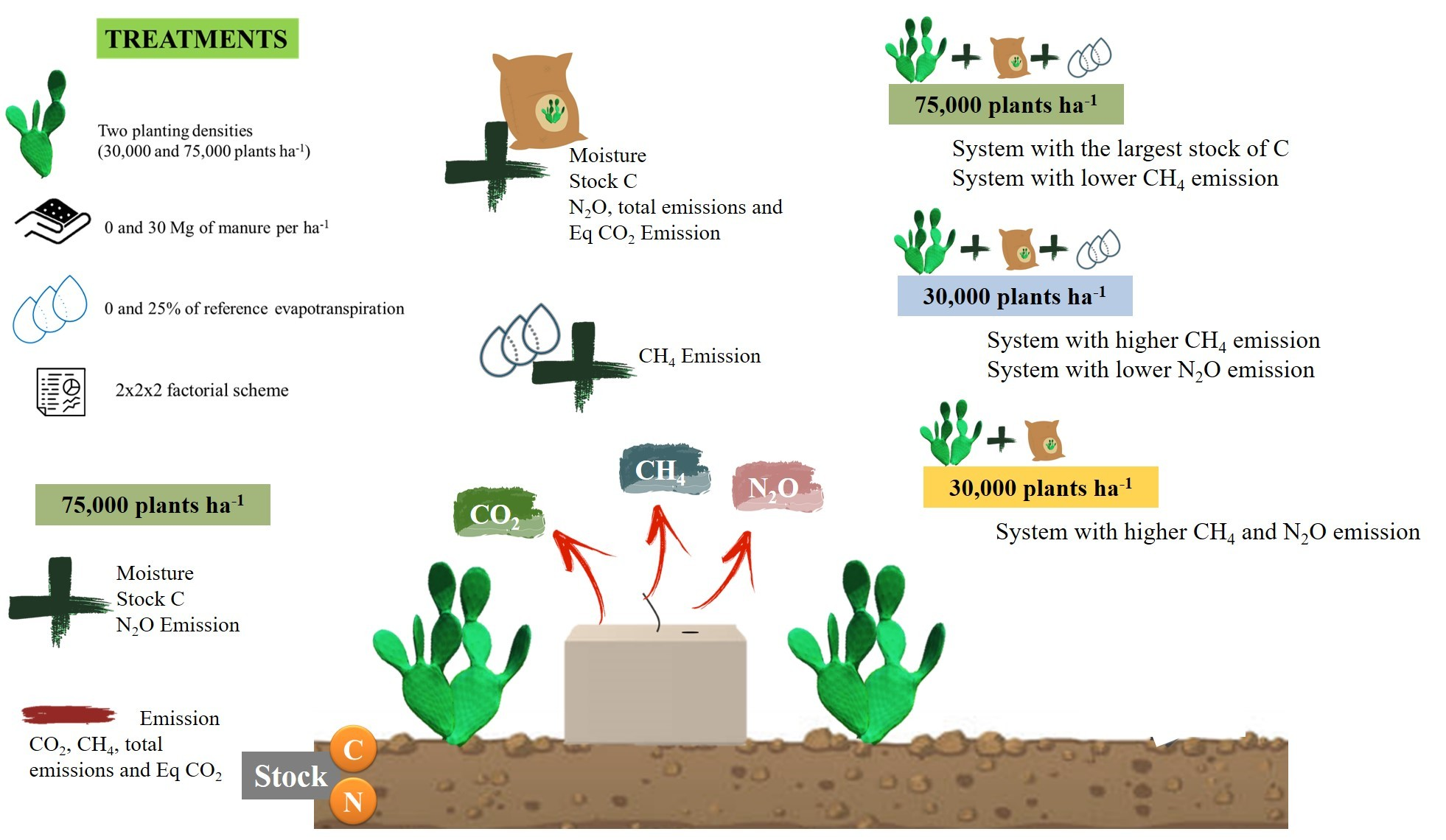
Graphical Abstract

1. Introduction

The intensification of agricultural systems in semi-arid regions presents major challenges for maintaining soil fertility and reducing greenhouse gas (GHG) emissions, particularly those associated with the nitrogen cycle [1,2]. Nitrous oxide (N2O) is one of the most potent nitrogen-derived GHGs, and its emissions are strongly regulated by soil moisture, organic matter inputs, salinity, and plant–soil interactions that control nitrification and denitrification processes [3]. In semi-arid environments, where water availability is highly seasonal and soils generally exhibit low organic matter and nitrogen contents, understanding how management practices influence nitrogen transformations is essential [4].
Cactus pear (Opuntia stricta Haw.), a species native to Central America, has gained prominence in semi-arid regions, reaching dry matter yields of up to 71,240.7 Mg ha−1 year−1 [5]. This species is considered an essential component of ruminant feeding systems [6,7,8]. Cactus pear plays a strategic role in these regions due to its high water-use efficiency, drought tolerance, and capacity to contribute carbon and nitrogen inputs to the soil [9,10]. Moreover, cactus pear cultivation systems are highly resilient, making them particularly suitable for the Brazilian semi-arid region. This characteristic is especially important under climate change scenarios, in which water scarcity is expected to intensify and temperatures are projected to increase [11].
Agriculture is a significant source of GHG emissions to the atmosphere, particularly in Brazil; however, several management practices can help mitigate these emissions. The contribution of agriculture to GHG emissions has become a frequent topic in scientific, sociocultural, and political discussions. Nevertheless, it is important to recognize that human, animal, and plant activities all contribute to climate change [12,13]. Human activities undeniably contribute to increasing atmospheric emissions, with carbon dioxide (CO2), methane (CH4), and nitrous oxide (N2O) being major byproducts of anthropogenic processes [13,14]. Among the principal agricultural practices influencing soil GHG emissions are the application of nitrogen-based fertilizers, both mineral and organic, soil management practices, and crop type [15].
Despite the importance of cactus pear in livestock systems in semi-arid regions, studies evaluating its effects on soil GHG emissions remain scarce. Some evidence suggests that cactus cultivation contributes to soil carbon inputs due to the high concentration of calcium oxalates in cladodes, resulting in the deposition of approximately 0.22 g of carbon per gram of cladode dry matter [16].
In general, low-carbon emission practices are associated with improvements in soil quality, particularly through the accumulation of organic matter, which enhances system resilience by increasing soil water retention capacity. Additional practices that contribute to reducing GHG emissions from agricultural soils include cereal–legume intercropping systems [17], reduced use of synthetic fertilizers combined with manure-based fertilization [18], and the use of saline water (up to 10.6 dS·m−1) to alleviate water stress while reducing soil CO2 emissions [19].
In this context, we hypothesized that the interaction among planting density, organic fertilization, and saline water irrigation alters soil nitrification and denitrification pathways, thereby modulating N2O fluxes and soil nitrogen stocks under cactus pear cultivation. Therefore, the aim of this study was to evaluate the effects of planting density, organic fertilization, and supplementary saline irrigation on soil chemical properties, carbon and nitrogen stocks, and soil emissions of N2O, CH4, and CO2 in cactus pear cultivation systems under semi-arid conditions.

2. Materials and Methods

2.1. Description of the Study Area and Environmental Characterization

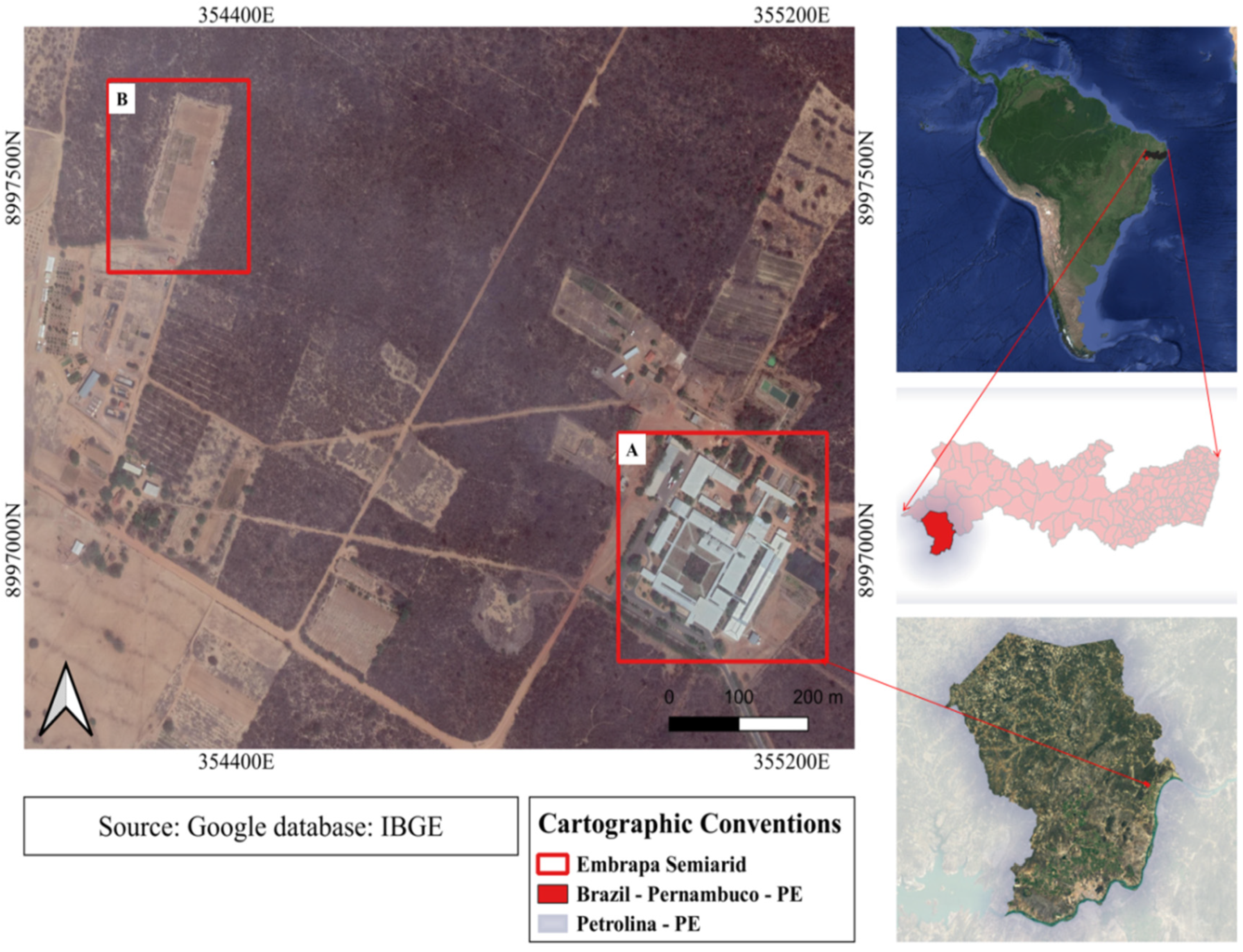
The experiment was conducted at the Caatinga Experimental Field of the Brazilian Agricultural Research Corporation (EMBRAPA Semiárido), located in Petrolina, Pernambuco, Brazil (09°04′16.4″ S, 40°19′05.37″ W; 379 m altitude) (Figure 1). According to Köppen’s climate classification [20], the regional climate is classified as hot semi-arid (BShw′), with average maximum and minimum air temperatures of 33.46 and 20.87 °C, respectively.
The soil in the experimental area is classified as an Argisol according to the World Reference Base for Soil Resources [21], with medium texture and flat relief. At the beginning of the experimental period, soil samples were collected for physicochemical characterization at depths of 0–0.10, 0.10–0.20, 0.20–0.30, and 0.30–0.40 m (Table 1).
Electrical conductivity was determined using a conductivity meter from the saturation paste extract [22]. Soil pH was measured in water at a 1:10 ratio using a potentiometer. The concentrations of available phosphorus (P) and exchangeable potassium (K+), sodium (Na+), calcium (Ca2+), and magnesium (Mg2+) were determined according to the methodologies described in the EMBRAPA Soil Analysis Methods Manual [23]. Exchangeable acidity (H+Al), sum of bases (SB), cation exchange capacity (CEC), and base saturation (V%) were calculated according to Teixeira et al. [24]. Total porosity, particle density, and sand, silt, and clay fractions were also determined following the methodology described by Teixeira et al. [24].
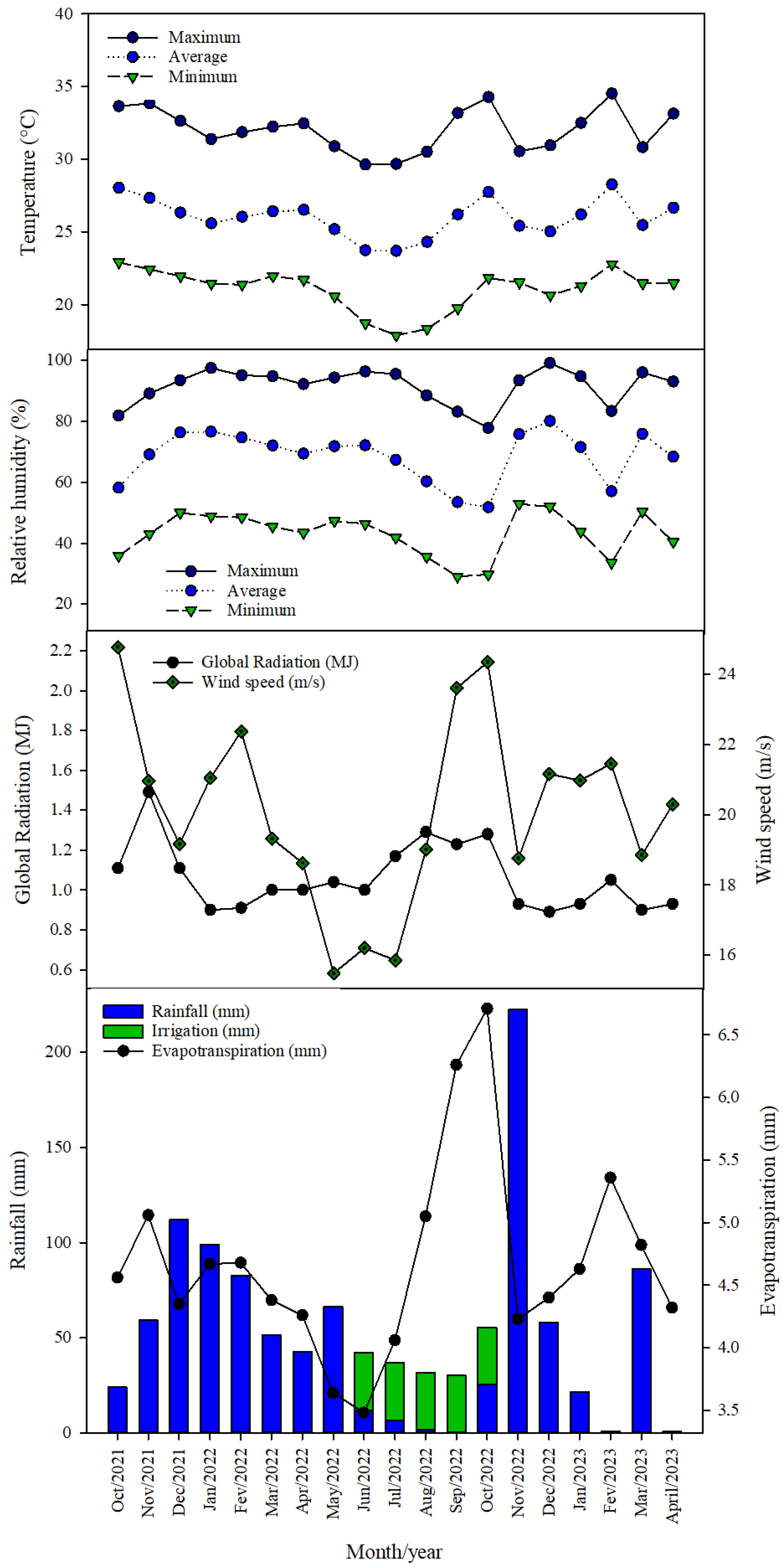
The experimental period lasted eighteen months, from October 2021 to April 2023. Throughout this period, rainfall, evapotranspiration, air temperature, wind speed, relative humidity, and global solar radiation were monitored using the Embrapa Semiárido Agrometeorological Station (Figure 2).
Soil moisture was determined by weighing 5.00 g of soil sample, which was subsequently dried in a forced-air oven at 105 °C for 24 h. After drying, the samples were reweighed to obtain dry mass. Soil moisture content was then calculated based on the difference between wet and dry soil weights using the following equation [25]:
M o i s t u r e   i n   g / kg =   ( w e i g h t   o f   d r y   s o i l / w e i g h t   o f   w e t   s o i l )   ×   1000

2.2. Planting Spacing

The cactus pear clone used in the experiment was IPA-200016/Orelha de Elefante Mexicana (Opuntia stricta Haw.). The cladodes used for planting were obtained from an established cultivation area located at the Caatinga Experimental Field. After harvest, the cladodes underwent sanitary procedures and were subsequently placed in a shaded area for 15 days to allow proper healing before planting.
The experiment was established in an area of 2560 m2, previously prepared using a harrow. Planting was carried out with 2.00 m spacing between furrows. Each experimental unit consisted of four rows of cactus pear cultivation, with the two central rows considered the experimental area and the outer rows serving as borders. Planting was performed in double rows, using both sides of the furrow in a “V”-shaped arrangement.

2.3. Treatments and Experimental Design

The treatments consisted of combinations of two planting densities, two organic fertilizer rates, and two saline irrigation depths, arranged in a split-plot randomized block design with four replications, in a 2 × 2 × 2 factorial arrangement. The main plots consisted of two planting densities (30,000 and 75,000 plants ha−1), while the subplots consisted of two organic fertilizer rates (0 and 30 Mg ha−1) and two saline irrigation depths (0 and 25% of reference evapotranspiration—ET0).
For the planting density of 30,000 plants ha−1, three cladodes were distributed per meter on each side of the furrow, totaling six plants per linear meter, with 33 cm spacing between cladodes. For the density of 75,000 plants ha−1, seven cladodes were distributed on the left side of the furrow (14 cm spacing between cladodes) and eight cladodes on the right side (12 cm spacing between cladodes), totaling 15 plants per linear meter.
Irrigation water was collected weekly during the irrigation period for physicochemical characterization (Table 2). The following parameters were determined according to the methodology described by EMBRAPA [26]: pH, electrical conductivity of the water (EC), cation concentrations of calcium (Ca2+), magnesium (Mg2+), and sodium (Na+), and anion concentrations of chloride (Cl), bicarbonate (HCO3), carbonate (CO32−), and sulfate (SO42−). In addition, the sum of cations (SC), sum of anions (SA), sodium adsorption ratio (SAR), and calcium carbonate content (CaCO3) were calculated.
According to CONAMA Resolution No. 357, the irrigation water was classified as brackish due to its salinity level, which ranged between 0.5 and 30% [27]. Based on the classification proposed by Richards [28], the water was classified as C4S2, indicating a high risk of salinization and a medium risk of sodification (Table 2). The water was obtained from an artesian well located at the Caatinga Experimental Field, with a depth of 70 m and a flow rate of 1500 L h−1.
The irrigation system consisted of surface drip irrigation using drip tubing equipped with emitters with a flow rate of 1.5 L h−1, nominal diameter of 16 mm, and spacing of 0.20 m between emitters. The system presented a uniformity coefficient of 93% and an average operating flow rate of 0.9 L h−1. The drip lines were installed in the center of the double-row planting arrangement.
Irrigation was performed once per week for 60 min over a five-month period, totaling 20 irrigation events. The applied irrigation depth corresponded to 80% of crop evapotranspiration (ETc), considering an average crop coefficient (Kc) of 0.52 [29]. The irrigation interval was fixed at seven days, and irrigation was applied only during the dry season, always in the late afternoon, as a supplementary water supply strategy.
The organic fertilizer applied to the fertilized plots consisted of goat and sheep manure at a rate of 30 Mg ha−1 year−1 (Table 3).

2.4. Experimental Area Management

The cultivation period lasted thirty months, including twelve months for crop establishment and eighteen months for data collection. Weed control was performed manually throughout the experimental period. Pest control, particularly for carmine cochineal (Dactylopius coccus), was carried out using 1% mineral oil.

2.5. C and N Stocks in Soil

Soil samples were collected along the cultivation rows using an auger to obtain undisturbed samples at depths of 0–0.10, 0.10–0.20, 0.20–0.30, and 0.30–0.40 m, with four replications per treatment, for soil bulk density determination. Soil sampling was performed at the end of the greenhouse gas evaluation period. The undisturbed samples were subsequently used to quantify soil carbon and nitrogen contents.
Soil carbon (C) was determined using the oxidation method with 0.4 mol L−1 potassium dichromate (K2Cr2O7) [30]. Soil nitrogen content was determined using the Kjeldahl method [31]. Soil bulk density was determined using the volumetric ring method described by Teixeira et al. [24]. Carbon (C) and nitrogen (N) stocks were calculated using the following equation:
S t o c k   ( M g · h a 1 ) = e l e m e n t   C   o r   N   c o n t e n t   ( % ) × d e p t h   ( c m ) × d e n s i t y   ( g · c m 3 )
Because the soil in the experimental area was subjected to different management practices, carbon (C) and nitrogen (N) stock calculations were corrected using the equivalent soil mass approach to allow a more accurate comparison among treatments. The correction was performed according to the methodology proposed by Ellert and Bettany [32], using a native Caatinga area located near the experimental site as the reference. The correction was applied to the deepest soil layer (0.30–0.40 m) using the following equation:
Corrected depth (cm) = (average density of the reference area (g·cm−3)/average density of the area being corrected (g·cm−3)) × depth being corrected
soil sampling in the reference area followed the same methodology used for the experimental area.

2.6. Greenhouse Gas Emissions—GHG

Greenhouse gas (GHG) emissions were monitored at three sampling times during the cactus pear production cycle, at 18 months after establishment, with a seven-day interval between sampling events. Soil gas emissions were collected using static chambers installed at the center of each experimental plot.
The chambers consisted of two sections. The first section was a rectangular galvanized steel base with an area of 2400 cm2 (60 cm long × 40 cm wide). The second section consisted of a trapezoidal galvanized steel lid, which was attached to the base during gas collection [33]. Each chamber was equipped with a digital thermometer with a metal probe to monitor internal temperature during sampling, as well as a three-way valve for gas collection using syringes.
During sampling, the chamber lid was attached to the metal base, and gas collection began immediately after chamber closure (time zero), followed by collections at 10, 20, and 40 min after closure. Gas samples were collected using 25 mL polypropylene syringes coupled to a three-way stopcock (Descarpack model) and transferred to previously evacuated glass vials sealed with rubber septa under vacuum (−80 kPa).
Gas sampling was performed at 9:00 a.m. according to the methodology described by Alves et al. [34]. During all sampling events, soil temperature, air temperature, and chamber internal temperature were recorded using digital thermometers. After collection, gas samples were sent to the Embrapa Semiárido Chromatography Laboratory for analysis.
Gas concentrations were determined using an gas chromatograph (Agilent, 7890A, Wilmington, DE, USA) equipped with an injection oven at 60 °C, a flame ionization detector (FID) at 120 °C for CO2 and CH4 determination, and a micro electron capture detector (µECD) at 300 °C for N2O determination.
Fluxes of CO2, CH4, and N2O were calculated based on the increase in gas concentration inside the chamber over time, chamber area, and temperature and atmospheric pressure values recorded during sampling, according to the methodologies described by Signor et al. [35] and Galdino et al. [33]. Methane (CH4) and nitrous oxide (N2O) emissions were converted into CO2-equivalent units and added to accumulated CO2 emissions to estimate total GHG emissions [35].
Greenhouse gas fluxes were estimated from repeated temporal measurements performed within each experimental unit throughout the evaluation period. Although multiple gas collections were conducted over time, the experimental unit remained the plot, since repeated samplings within the same plot were not considered independent observations.

2.7. Statistical Analysis

Data on soil C and N stocks and soil GHG fluxes were evaluated using one-way analysis of variance (ANOVA) to compare variations between different cactus production systems, according to the following statistical model:
Y i j k l m   =   µ   +   D i   +   O F j   +   I k   +   B l   +   ( D O F ) i j   +   ( D I ) i k   +   ( O F I ) j k   +   ( D O F I ) i k   +   e i j k l m
where: Yijklm = dependent variable to be analyzed; µ = overall mean; Di = effect of planting density; OFj = effect of organic fertilization; Ik = effect of saline water depth; Bl = effect of block; (DOF)ij = interaction of planting density and organic fertilization; (DI)ik = interaction of planting density and saline water depth; (OFI)jk = interaction of organic matter and saline water depth; (DOFI)ik = interaction of planting density, organic fertilization, and saline water depth; eijklm = random error associated with each repetition. Planting density (D), organic fertilization (OF), saline irrigation depth (I), and their interactions were treated as fixed effects, while block was considered a random effect to account for environmental variability within the experimental area.
The data were analyzed using the PROC GLM procedure of the Statistical Analysis System (SAS University Edition) software [36] and subjected to analysis of variance (ANOVA) at a significance level of α = 0.05. When significant effects of planting density, organic fertilization, or saline irrigation depth were detected, means were compared using Tukey’s test at the 5% probability level for Type I error. The standard error of the mean (SEM) was calculated from the original data.

3. Results

No significant interactions were observed between factors, including the triple interaction among planting density, organic fertilization, and irrigation depth (p > 0.05), indicating that these factors acted independently on soil chemical properties (Table 4 and Table 5).
Planting density significantly affected soil moisture (p < 0.001), carbon content (p < 0.001), and electrical conductivity (p = 0.009) (Table 4). The highest planting density (75,000 plants ha−1) increased soil moisture and carbon content compared with 30,000 plants ha−1 (Table 5). In contrast, EC was higher at the lowest density, indicating greater salt concentration in less dense cultivation systems (Table 5). No significant effect of planting density was observed for the remaining variables, including N, C:N ratio, pH, potential acidity, macronutrients, and micronutrients (p > 0.05) (Table 4).
Organic fertilization significantly affected soil moisture (p < 0.001), carbon content (p < 0.001), C:N ratio (p = 0.032), pH (p = 0.038), potential acidity (p = 0.003), available phosphorus (p = 0.009), sodium (p = 0.014), copper (p = 0.003), and iron (p = 0.043) contents (Table 4). The application of 30 Mg ha−1 of manure increased soil moisture, carbon content, C:N ratio, potential acidity, available p, and Cu2+ (Table 5). Conversely, it reduced soil pH, Na+, and Fe2+ compared with unfertilized systems (Table 5). No significant effects of organic fertilization were observed for N, electrical conductivity, K+, Ca2+, Mg2+, Zn2+, or Mn2+ (p > 0.05) (Table 4).
The irrigation depth with saline water significantly affected only potential acidity (p = 0.030) and available phosphorus contents (p = 0.031) (Table 4). The application of a saline irrigation depth corresponding to 25% of ET0 increased potential acidity from 0.75 to 1.16 cmolc dm−3 and increased available p from 5.33 to 10.22 mg·dm−3 compared with non-irrigated systems (0% ET0) (Table 5). However, the saline irrigation depth did not significantly affect soil moisture, N, C, C:N ratio, pH, electrical conductivity, K+, Ca2+, Mg2+, Na+, Cu2+, Fe2+, Zn2+, or Mn2+ contents (p > 0.05) (Table 4).
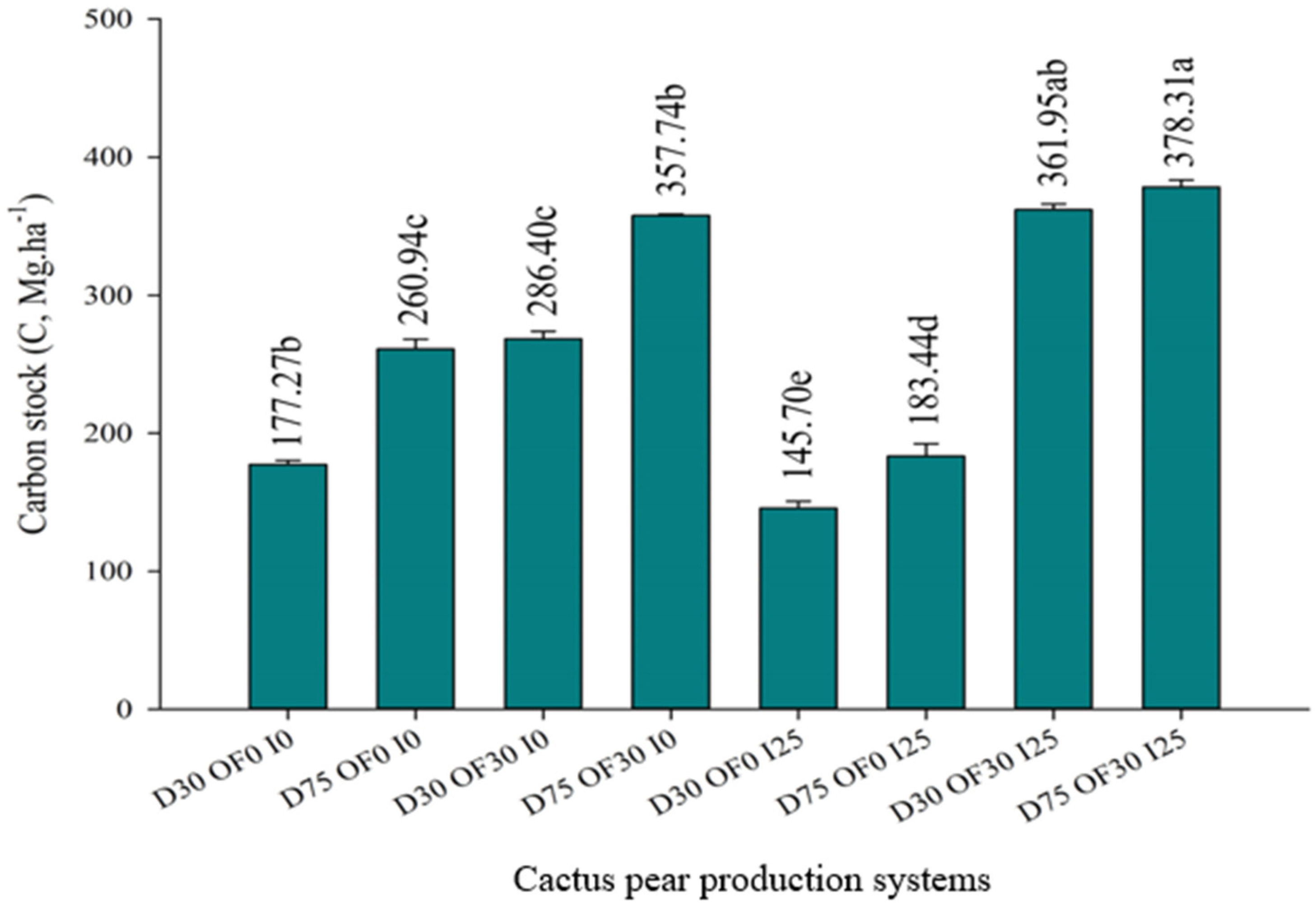
No significant effects of planting density, organic fertilization, irrigation depth, or their interactions were observed for soil N stock (p > 0.05) (Table 6 and Table 7). In contrast, soil C stock was significantly affected by the interactions between planting density, organic fertilization and irrigation (p = 0.009) (Table 6 and Table 7).
The interaction among planting density, organic fertilization, and irrigation demonstrated that systems combining 75,000 plants ha−1, organic fertilization, and saline water irrigation showed the greatest C accumulation throughout the soil profile (Figure 3), indicating a synergistic effect of management practices on soil carbon storage.
Planting density significantly reduced CO2 emissions (p = 0.016), total emissions (p = 0.004), and CO2-equivalent emissions (p = 0.004) (Table 8), with lower values observed under the density of 75,000 plants ha−1 (Table 9).
Organic fertilization significantly increased total emissions (p = 0.047) and CO2-equivalent emissions (p = 0.046) (Table 8). Total emissions increased from −51.99 to 47.13 g m−2 CO2-C-eq, while CO2-equivalent emissions increased from −5.20 to 4.71 Mg ha−1 CO2-C-eq with organic fertilization (Table 9).
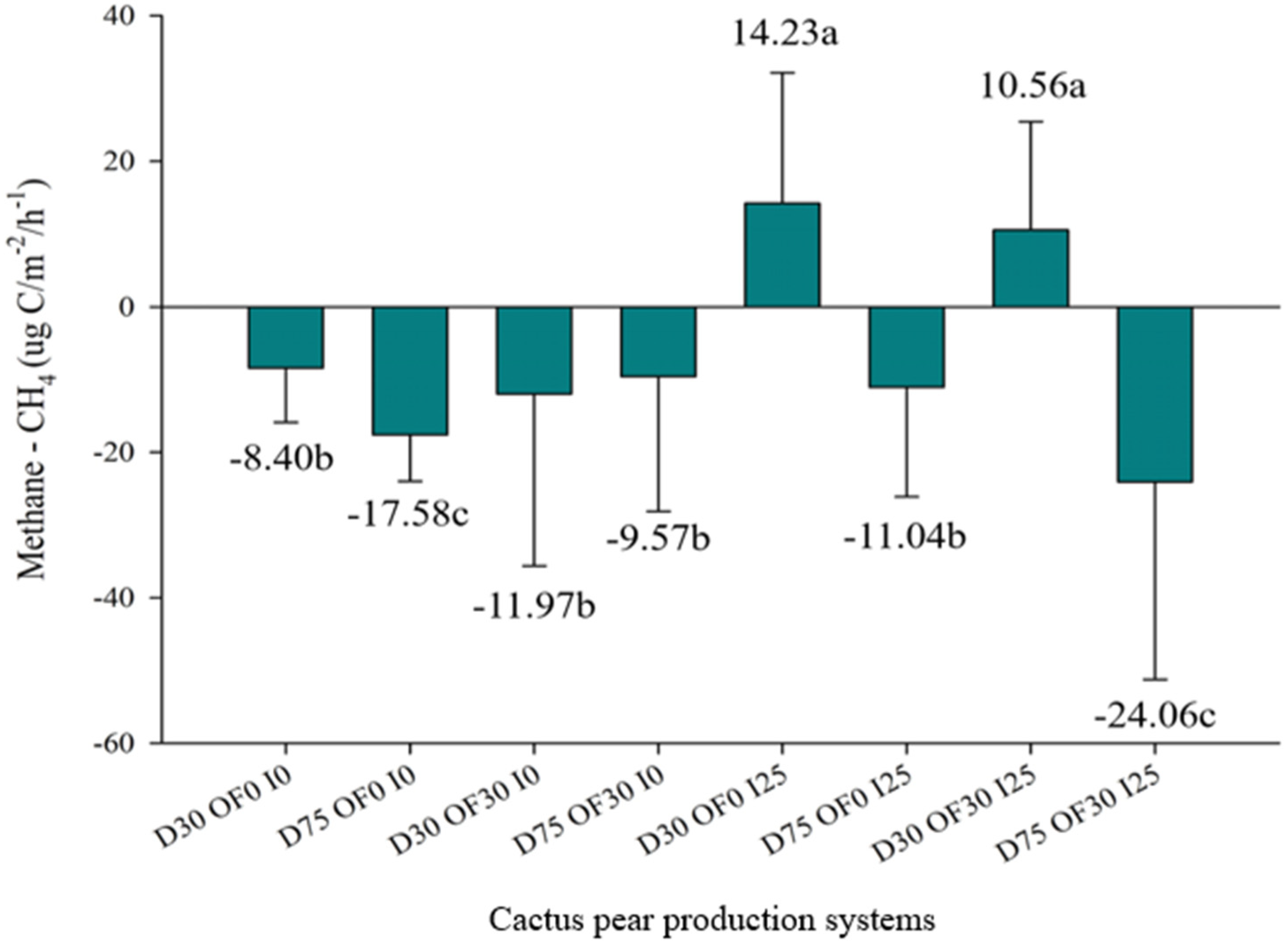
Methane emissions were significantly influenced by the interaction among planting density, organic fertilization, and saline irrigation (p < 0.001) (Table 8 and Table 9; Figure 4).
Higher CH4 emissions were observed in the systems D30 OF0 I25 and D30 OF30 I25, indicating that saline irrigation under low planting density increased CH4 fluxes (Figure 4).
In contrast, the lowest CH4 emissions were recorded in the systems D75 OF0 I0 (−17.58 µg C m−2 h−1) and D75 OF30 I25 (−24.06 µg C m−2 h−1), demonstrating that denser cultivation systems promoted greater CH4 uptake or lower emissions regardless of fertilization management (Figure 4).
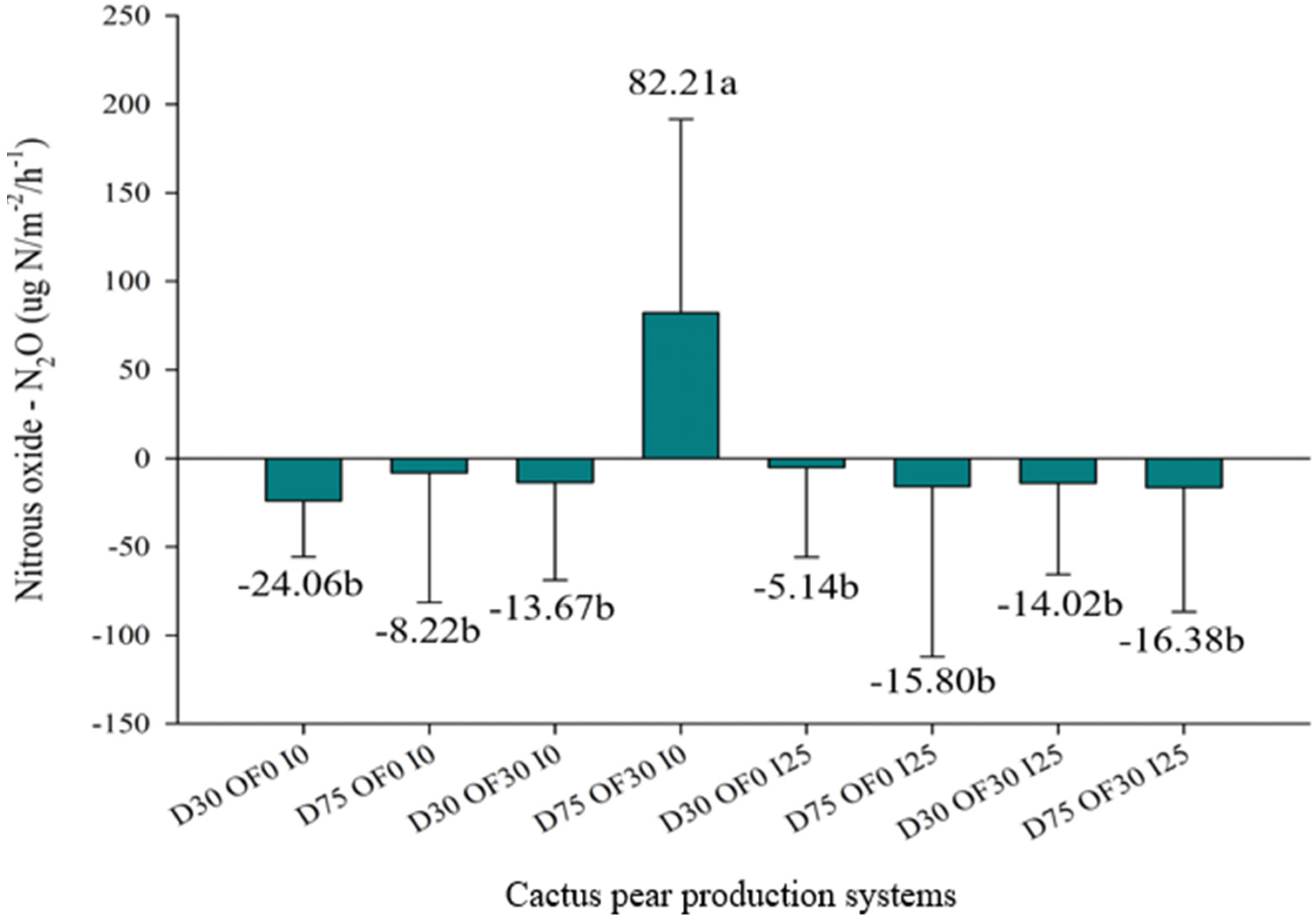
Nitrous oxide emissions were significantly affected by cactus production systems (p < 0.05) (Figure 5). The highest N2O emission was observed in the D75 OF0 I0 system, reaching 82.21 µg N m−2 h−1, which was 95.88 µg N m−2 h−1 higher than the D30 OF30 I0 system (Figure 5). The interaction effects observed for N2O emissions indicate that the combined effects of planting density, organic fertilization, and saline irrigation strongly modulated N2O fluxes across cactus production systems.

4. Discussion

4.1. Effects of Planting Density, Organic Fertilization, and Saline Irrigation on Soil Chemical Properties

Higher planting density increased soil moisture due to greater soil surface coverage provided by the cactus canopy, which reduced direct soil exposure and consequently decreased evaporative water losses. Similar responses have been reported in denser cropping systems, where increased shading contributes to lower soil temperature and evapotranspiration rates [37,38]. In contrast, organic fertilization did not significantly affect soil moisture, although organic residues are commonly associated with improvements in water retention and reduced deep percolation due to their effects on soil structure [39].
Soil nitrogen concentrations ranged from 2.52 to 3.20 g kg−1, values higher than those reported by Gebretsadik et al. [40] for cactus pear cultivation. Despite this, neither planting density nor organic fertilization significantly altered soil N concentrations. This result may be associated with the high mobility of nitrogen in soil systems and with increased plant uptake under denser cultivation conditions. Donato et al. [41] demonstrated that manure fertilization in cactus pear cultivation increased N accumulation in plant tissues, indicating that part of the applied N may have been rapidly absorbed by plants rather than remaining in the soil. In addition, nitrogen losses through volatilization and other transformation pathways may also have contributed to the absence of detectable differences among treatments [42,43].
The increase in soil carbon under higher planting density was likely associated with greater root biomass turnover and enhanced rhizosphere activity. Cactus pear presents intense root renewal dynamics, particularly under fluctuating soil moisture conditions [44,45], which favors the continuous incorporation of organic residues into the soil. Increased soil carbon may also have contributed to greater water retention, since soil organic matter improves aggregation and water-holding capacity [46]. In the present study, the increase in soil moisture accompanied the increase in soil carbon, reinforcing the close relationship between organic matter accumulation and soil water dynamics.
Organic matter can also be redistributed throughout the soil profile through leaching processes or microbial decomposition. Part of the dissolved organic matter may migrate to deeper layers [47], whereas another portion may be mineralized and released as CO2 through microbial respiration [48]. In agricultural soils, approximately 58% of soil organic matter consists of carbon, which plays a central role in soil structure stabilization and productivity maintenance [49].
Organic fertilization strongly increased soil carbon content and C:N ratio, demonstrating the important role of manure as a source of organic substrates for semi-arid soils. In addition to contributing directly to carbon accumulation, organic fertilization improves aggregation, nutrient retention, and soil structural stability [50,51,52]. Organic amendments are also capable of mitigating adverse effects caused by irrigation with saline or brackish water [53], while simultaneously improving crop productivity [54] and nutritional composition [55]. These effects are particularly relevant in semi-arid environments, where soils are commonly characterized by low organic matter levels and reduced biological activity [56].
The reduction in soil electrical conductivity under higher planting density suggests greater nutrient uptake efficiency in denser systems. Increased root distribution likely enhanced the absorption of mobile ions, reducing salt accumulation in the soil solution [57]. Furthermore, soil electrical conductivity is closely related to soil moisture and ion concentration [58,59,60], indicating that denser systems may have promoted more balanced water and solute dynamics.
Organic fertilization reduced soil pH while increasing potential acidity. Although manure application is frequently associated with increased pH due to its alkaline components [61], the opposite response observed here may be related to intensified nitrification processes. During nitrification, proton release acidifies the soil solution [62,63], particularly in systems receiving organic N inputs. In addition, microbial decomposition processes and root activity may have intensified proton release and ligand exchange reactions in the soil [64,65,66]. Leaching of basic cations such as Ca2+ and Mg2+ may also have contributed to increased exchangeable acidity [67,68,69].
The increase in available phosphorus and copper following manure application reflects the nutrient composition of the organic fertilizer and its capacity to enhance nutrient cycling and availability [70,71]. Organic amendments are known to increase total and microbial C, N, and P pools in soil [72], thereby modifying ecosystem stoichiometry and biogeochemical functioning [73]. In the present study, the application of manure altered soil C, N, and P dynamics when compared with the initial soil chemical profile, reinforcing the importance of organic fertilization in nutrient cycling within semi-arid cactus production systems.
Supplementary irrigation with saline water had limited effects on most soil chemical attributes. This response may be associated with the irrigation management strategy adopted in the present study, in which saline water was applied only during periods of greater water deficit. Subsequent rainfall events likely promoted salt leaching and reduced salt accumulation in the soil profile [74,75,76]. Consequently, no substantial increases in soil electrical conductivity or sodium accumulation were observed.

4.2. Soil Carbon and Nitrogen Stocks Under Cactus Pear Cultivation Systems

Nitrogen stocks were not significantly affected by the evaluated management practices. Soil N storage is regulated by multiple interacting factors, including texture, salinity, organic matter content, pH, moisture, and microbial activity [77,78]. Although organic fertilization increased carbon inputs, this effect was insufficient to significantly alter total soil N stocks during the experimental period.
The return of organic residues to the soil represents an important mechanism for increasing soil organic matter and improving ecosystem functioning [79]. Increasing soil carbon stocks is particularly relevant because it contributes to atmospheric CO2 mitigation and reduces carbon losses from agricultural systems [80,81]. In this context, denser cultivation systems not only increase cactus biomass production [82], but also favor greater carbon inputs into the soil.
Soil carbon accumulation is directly associated with the balance between carbon inputs and outputs [83], which depends strongly on rhizosphere interactions among roots, microorganisms, and soil minerals [84]. Increased planting density likely enhanced belowground carbon inputs through greater root density and turnover [45,85]. Root-derived carbon is considered one of the main contributors to long-term soil carbon stabilization because root exudates and decomposing root tissues stimulate microbial interactions and aggregate formation in the rhizosphere [85,86,87,88].
Greater root density also promotes stronger interactions with soil fauna and microorganisms, accelerating root decomposition and humification processes [86]. Consequently, the transfer of atmospheric CO2 into soil organic matter is intensified [88,89]. In the present study, higher planting density increased soil carbon stocks, suggesting greater incorporation and stabilization of carbon throughout the soil profile.
Organic fertilization further increased soil carbon stocks, demonstrating its potential as a sustainable strategy for cactus pear production systems. In addition to improving soil fertility and productivity, manure application contributes to climate change mitigation through enhanced carbon sequestration [90,91,92]. Repeated manure applications may also favor nutrient movement and carbon accumulation in deeper soil layers [93], explaining the greater carbon stocks observed along the soil profile.
Saline irrigation can alter soil carbon dynamics by affecting microbial activity and organic matter decomposition [94]. In many cases, saline conditions reduce microbial respiration and carbon stabilization. However, in the present study, supplementary saline irrigation contributed to greater carbon accumulation. This contrasting response may be associated with the intermittent irrigation strategy adopted, which minimized severe salinity stress while improving water availability during periods of drought.

4.3. Carbon Dioxide and Methane Emissions in Cactus Pear Production Systems

The reduction in CO2 emissions under higher planting density is likely associated with greater soil surface coverage provided by the cactus canopy. Increased canopy coverage reduces direct exposure of the soil to solar radiation, minimizing soil temperature fluctuations and reducing evapotranspiration rates [95,96,97]. Consequently, soils cultivated under higher planting density tend to maintain more stable moisture conditions, which directly influence microbial respiration and carbon mineralization processes.
Organic fertilization did not significantly affect CO2 emissions, despite increasing soil carbon content. This result suggests that the additional carbon supplied through manure application may have been partially stabilized in the soil rather than rapidly mineralized. Moreover, manure application can stimulate plant growth and photosynthetic activity, increasing carbon fixation and partially compensating for microbial CO2 production [98,99].
Similarly, supplementary saline irrigation did not significantly alter CO2 emissions. This response may be associated with the irrigation management strategy adopted in the present study, in which saline water was applied intermittently and only during periods of greater water deficit. Under these conditions, saline irrigation likely improved soil water availability without causing severe salinity stress capable of substantially altering microbial respiration.
The lower CO2 emissions observed in denser cultivation systems highlight the importance of soil coverage and carbon input dynamics in regulating carbon fluxes in semi-arid agroecosystems. These findings indicate that increasing planting density may contribute to greater soil carbon sequestration and reduced atmospheric carbon losses, reinforcing the potential of cactus pear cultivation systems as climate-resilient production strategies for dryland environments.
Methane emissions were strongly influenced by the interaction among planting density, organic fertilization, and saline irrigation (Figure 4). Systems cultivated under the lower planting density (30,000 plants ha−1) and irrigated with saline water showed higher CH4 emissions, indicating that saline irrigation under more exposed soil conditions may temporarily reduce methane oxidation capacity.
This response is likely associated with changes in soil microbial activity caused by salinity. Saline conditions can inhibit methanotrophic microorganisms responsible for CH4 oxidation, thereby reducing methane consumption by the soil [100,101,102]. In addition, salinity may alter carbon and nitrogen mineralization processes and modify electron acceptor availability in the soil environment [103,104].
The ionic composition of irrigation water may also have contributed to the observed responses. The presence of SO42− in saline irrigation water can alter microbial metabolic pathways and electron competition processes in the soil, directly affecting methane production and oxidation dynamics [105]. These effects are particularly important in semi-arid soils, where fluctuations in soil moisture and salinity strongly regulate microbial activity.
In contrast, denser cultivation systems (75,000 plants ha−1) presented lower CH4 emissions or even negative fluxes, indicating greater methane uptake capacity by the soil. Higher planting density likely promoted greater soil coverage, lower temperature fluctuations, increased soil moisture stability, and greater root-derived carbon inputs, creating more favorable conditions for microbial regulation and methane oxidation.
Among the evaluated systems, D75 OF30 I25 presented the lowest CH4 emission (−24.06 µg C m−2 h−1), demonstrating a synergistic effect among planting density, organic fertilization, and saline irrigation. This response may be associated with greater organic matter availability in the soil, which acts as a carbon donor and improves microbial stabilization processes. Furthermore, the residual effect of saline irrigation combined with rainfall events may have promoted SO42− percolation throughout the soil profile, modifying microbial electron acceptor dynamics and contributing to lower methane emissions [106].
Overall, the results demonstrate that methane fluxes in semi-arid cactus pear systems are regulated by complex interactions among salinity, soil cover, organic matter availability, and microbial activity, reinforcing the importance of integrated management strategies for greenhouse gas mitigation.

4.4. Nitrous Oxide Emissions and Nitrogen Transformation Pathways

Nitrous oxide emissions were also strongly modulated by management practices. Higher planting density increased N2O emissions, probably because increased soil moisture and carbon availability stimulated denitrification processes [107,108,109]. Under wetter conditions, oxygen diffusion is reduced, favoring anaerobic microsites where denitrifying microorganisms produce N2O as an intermediate product.
The higher soil carbon concentrations observed under the density of 75,000 plants ha−1 may also have contributed to increased denitrification activity. Carbon availability is a major energy source for denitrifying microorganisms and directly influences N2O production [109]. Therefore, the greater carbon accumulation observed in denser systems likely stimulated microbial pathways associated with nitrogen transformations.
Organic fertilization also increased N2O emissions due to the greater availability of carbon and nitrogen substrates for microbial metabolism [110,111]. Organic amendments stimulate microbial activity and provide energy sources for denitrifiers, particularly under conditions of elevated soil moisture. Furthermore, not all applied nitrogen is absorbed by plants, and part of the surplus N may be lost to the atmosphere as N2O, NH3, or N2 [112,113].
The use of saline water is frequently associated with increased N2O emissions due to changes in soil hydraulic properties and microbial activity [114]. However, this effect was not observed in the present study. The moderate irrigation depth and intermittent application strategy likely avoided severe alterations in soil structure and aeration [115,116], thereby limiting conditions that favor excessive N2O production.
Several mechanisms may explain the negative N2O fluxes observed under saline water irrigation. Salinity can inhibit nitrifying microorganisms, particularly ammonia-oxidizing bacteria and nitrite-oxidizing bacteria, thereby reducing substrate availability for denitrification [117]. In addition, elevated concentrations of ions such as Cl and SO42− may alter electron transport processes and microbial metabolism [105,118]. Another possible explanation involves microorganisms carrying the nosZ gene, which are capable of reducing N2O to N2 under low-oxygen and moderately saline conditions [119,120]. Together, these mechanisms may explain the negative N2O fluxes observed under supplementary saline irrigation.
In addition to the conventional expression of greenhouse gas emissions per unit area, a complementary interpretation based on the amount of organic material applied to the soil was considered to improve the environmental assessment of the management system. Considering the application of 30 Mg ha−1 year−1 of goat and sheep manure and the accumulated CO2-equivalent emissions observed under organic fertilization (4.71 Mg ha−1 CO2-eq), the estimated emission factor corresponded to approximately 157 kg CO2-eq per Mg of manure applied. This complementary indicator suggests that, although organic fertilization increased N2O emissions and total CO2-equivalent fluxes, the magnitude of emissions per unit of organic residue applied remained relatively moderate under semi-arid conditions. Furthermore, the response cannot be attributed exclusively to manure mineralization, since greenhouse gas fluxes were also influenced by planting density and saline irrigation, demonstrating that the interaction among management practices modulated soil microbial processes and gas exchange dynamics in the cactus pear production systems.

4.5. Implications for Greenhouse Gas Mitigation in Semi-Arid Agroecosystems

Overall, the results demonstrate that cactus pear management practices strongly influence soil carbon dynamics and greenhouse gas emissions in semi-arid environments. High planting density promoted greater soil carbon accumulation and reduced CO2 and CH4 emissions, whereas organic fertilization stimulated N2O emissions through enhanced microbial activity and substrate availability. Supplementary saline irrigation, when strategically applied during periods of water deficit, reduced N2O emissions without causing substantial deterioration of soil chemical quality.
These findings highlight the potential of integrated cactus pear management strategies to mitigate greenhouse gas emissions while maintaining soil functionality under semi-arid conditions. The combined use of higher planting density, organic fertilization, and supplementary saline irrigation may represent an important strategy for promoting carbon sequestration and improving environmental sustainability in biosaline agricultural systems. Further studies focusing on microbial functional groups, enzymatic pathways, and long-term greenhouse gas dynamics are necessary to better understand the mechanisms regulating negative N2O fluxes and carbon stabilization in semi-arid soils.

5. Conclusions

Higher planting density enhanced soil carbon storage and reduced CO2 and CH4 emissions. However, denser systems also increased N2O emissions, indicating that greater soil moisture and carbon availability likely stimulated denitrification pathways. Organic fertilization increased N2O fluxes due to the greater availability of carbon and nitrogen substrates for microbial transformations. Conversely, saline water irrigation reduced N2O emissions and resulted in negative fluxes, suggesting suppression of nitrification and denitrification processes under moderate salinity conditions.
Although none of the evaluated management factors significantly altered soil nitrogen stocks, they substantially modified nitrogen dynamics and gaseous nitrogen losses. These findings indicate that the integration of high planting density, organic fertilization, and supplementary saline irrigation can modulate N2O emissions in semi-arid cactus pear systems, providing potential strategies for nitrogen-centered GHG mitigation. Further studies focusing on microbial functional groups and enzymatic pathways are needed to better elucidate the mechanisms responsible for the negative N2O fluxes observed under saline irrigation.

Author Contributions

Conceptualization, G.G.L.d.A., D.S.D., F.S.C., T.G.F.d.S., S.A.d.M. and T.V.V.; methodology, C.d.A.A., A.P.G.S., D.O.L. and A.M.D.R.; formal analysis, C.d.A.A., G.G.L.d.A., G.C.G., F.S.C. and T.V.V.; investigation, C.d.A.A., G.G.L.d.A., F.S.C. and T.V.V.; Resources, G.G.L.d.A., T.G.F.d.S., S.A.d.M. and T.V.V.; data curation, C.d.A.A., G.G.L.d.A., G.C.G. and F.S.C.; writing—original draft preparation, C.d.A.A. and G.C.G.; writing—review and editing, C.d.A.A. and G.C.G.; visualization, C.d.A.A., G.G.L.d.A., F.S.C. and T.G.F.d.S.; supervision, G.G.L.d.A., F.S.C. and T.V.V.; project administration, G.G.L.d.A. and F.S.C.; funding acquisition, G.G.L.d.A., F.S.C., T.G.F.d.S., S.A.d.M. and T.V.V. All authors have read and agreed to the published version of the manuscript.

Funding

This research received no external funding.

Data Availability Statement

Further information on the data and methodologies will be made available by the author for correspondence, as requested.

Conflicts of Interest

The authors declare no conflicts of interest.

References

  1. Wang, C.; Amon, B.; Schulz, K.; Mehdi, B. Factors that influence nitrous oxide emissions from agricultural soils as well as their representation in simulation models: A review. Agronomy 2021, 11, 770. [Google Scholar] [CrossRef]
  2. Sousa, T.R.; Ramos, M.L.G.; Figueiredo, C.C.; Carvalho, A.M. N2O emissions from soils under different uses in the Brazilian Cerrado—A review. Rev. Bras. Cienc. Solo 2021, 45, e0210093. [Google Scholar] [CrossRef]
  3. Malyan, S.K.; Maithani, D.; Kumar, V. Nitrous oxide production and mitigation through nitrification inhibitors in agricultural soils: A mechanistic understanding and comprehensive evaluation of influencing factors. Nitrogen 2025, 6, 14. [Google Scholar] [CrossRef]
  4. Masvaya, E.N.; Nyamangara, J.; Descheemaeker, K.; Giller, K.E. Tillage, mulch and fertiliser impacts on soil nitrogen availability and maize production in semi-arid Zimbabwe. Soil Tillage Res. 2017, 168, 125–132. [Google Scholar] [CrossRef]
  5. Lemos, M.; Ferreira-Neto, M.; Fernandes, C.S.; Lima, Y.B.; Dias, N.D.S.; Medeiros, J.F.; Sá, F.V.S. The effect of domestic sewage effluent and planting density on growth and yield of prickly pear cactus in the semiarid region of Brazil. J. Arid Environ. 2021, 185, 104372. [Google Scholar] [CrossRef]
  6. Mabotja, M.B.; Gerrano, A.S.; Venter, S.L.; du Plooy, C.P.; Kudanga, T.; Amoo, S.O. Nutritional variability in 42 cultivars of spineless cactus pear cladodes for crop improvement. South Afr. J. Bot. 2021, 142, 140–148. [Google Scholar] [CrossRef]
  7. Diogénes, L.V.; Medeiros, E.D.S.; Moura, J.F.; Edvan, R.L.; Oliveira, J.P.F.; Silva Filho, E.C.; Bezerra, L.R. Cactus pear mucilage processing enhances corn silage quality, ruminal degradability, goat kids’ performance, carcass traits, and dietary economic profitability. Small Rum. Res. 2023, 227, 107083. [Google Scholar] [CrossRef]
  8. Araújo, C.A.; Araújo, G.G.L.; Novaes, J.J.; Campos, F.S.; Lima, D.O.; Borges, E.N.; Sá, J.M. Influence of cactus pear cultivation density on the physicochemical characteristics of the soil. Soil Tillage Res. 2023, 232, 105771. [Google Scholar] [CrossRef]
  9. Bariagabre, S.A.; Asante, I.K.; Gordon, C.; Ananng, T.Y. Cactus pear (Opuntia ficus-indica L.) a valuable crop for restoration of degraded soils in northern Ethiopia. J. Biol. Agric. Healthc. 2016, 6, 11–18. [Google Scholar]
  10. Scalisi, A.; Morandi, B.; Inglese, P.; Bianco, R.L. Cladode growth dynamics in Opuntia ficus-indica under drought. Environ. Exp. Bot. 2016, 122, 158–167. [Google Scholar] [CrossRef]
  11. Jardim, A.M.D.R.F.; Morais, J.E.F.; Souza, L.S.B.; Marin, F.R.; Moura, M.S.B.; Morellato, L.P.C.; Silva, T.G.F. Sink or carbon source? How the Opuntia cactus agroecosystem interacts in the use of carbon, nutrients and radiation in the Brazilian semi-arid region. J. Hydrol. 2023, 1, 130121. [Google Scholar] [CrossRef]
  12. Kazancoglu, Y.; Ozbiltekin-Pala, M.; Ozkan-Ozen, Y.D. Prediction and evaluation of greenhouse gas emissions for sustainable road transport within Europe. Sustain. Cities Soc. 2021, 70, 102924. [Google Scholar] [CrossRef]
  13. Shakoor, A.; Shahbaz, M.; Farooq, T.H.; Sahar, N.E.; Shahzad, S.M.; Altaf, M.M.; Ashraf, M. A global meta-analysis of greenhouse gases emission and crop yield under no-tillage as compared to conventional tillage. Sci. Total Environ. 2021, 750, 142299. [Google Scholar] [CrossRef]
  14. González, P.F.; Presno, M.J.; Landajo, M. Tracking the change in Spanish greenhouse gas emissions through an LMDI decomposition model: A global and sectoral approach. J. Environ. Sci. 2024, 139, 114–122. [Google Scholar] [CrossRef]
  15. Chataut, G.; Bhatta, B.; Joshi, D.; Subedi, K.; Kafle, K. Greenhouse Gases Emission from Agricultural Soil: A Review. J. Agric. Food Res. 2023, 1, 100533. [Google Scholar]
  16. Bilderback, A.H.; Torres, A.J.; Vega, M.; Ball, B.A. The structural and nutrient chemistry during early-stage decomposition and desiccation of cacti in the Sonoran desert. J. Arid Environ. 2021, 195, 104636. [Google Scholar] [CrossRef]
  17. Yao, F.; Wu, Y.; Liu, X.; Cao, Y.; Lv, Y.; Wei, W.; Wang, Y. Research Progress and Development Trends of Greenhouse Gas Emissions from Cereal–Legume Intercropping Systems. Agronomy 2023, 13, 1085. [Google Scholar] [CrossRef]
  18. He, Z.; Zhang, Y.; Liu, X.; de Vries, W.; Ros, G.H.; Oenema, O.; Zhang, F. Mitigation of nitrogen losses and greenhouse gas emissions in a more circular cropping-poultry production system. Resour. Conserv. Recycl. 2023, 189, 106739. [Google Scholar] [CrossRef]
  19. Zhou, S.; Gao, Y.; Zhang, J.; Pang, J.; Hamani, A.K.M.; Xu, C.; Sun, J. Impacts of Saline Water Irrigation on Soil Respiration from Cotton Fields in the North China Plain. Agronomy 2023, 13, 1197. [Google Scholar] [CrossRef]
  20. Köppen, W. Grundriss der Klimakunde: Outline of Climate Science; Walter de Gruyter: Berlin, Germany, 2015; 388p. [Google Scholar] [CrossRef]
  21. WRB. World Reference Base for Soil Resources; Schad, P., van Huyssteen, C., Micheli, E., Eds.; World Soil Resources Reports No. 106; FAO: Rome, Italy, 2014; 189p, ISBN 978-92-5-108369-7. [Google Scholar]
  22. AOAC. Official Methods of Analysis of AOAC International, 20th ed.; Latimer, G.W., Ed.; AOAC: Washington, DC, USA, 2016; 3100p. [Google Scholar]
  23. Silva, F.C.; Silva, F.C. Manual de Análises Químicas de Solos, Plantas e Fertilizantes; Embrapa Informação Tecnológica: Brasília, Brazil; Embrapa Solos: Rio de Janeiro, Brazil, 2009. [Google Scholar]
  24. Teixeira, P.C.; Donagemma, G.K.; Fontana, A.; Teixeira, W.G. Manual de Métodos de Análise de Solo, 3rd ed.; Embrapa: Brasília, Brazil, 2017. [Google Scholar]
  25. Lorenzetti, J.G.; Rodrigues, M.A.; Soares, A.P.; Vieira, C.R. Densidade de plantas e os efeitos nas características agronômicas, temperatura e umidade do solo em consórcio milho-braquiária. Nativa 2023, 11, 101–107. [Google Scholar] [CrossRef]
  26. EMBRAPA. Manual de Métodos de Análise de Solo, 2nd ed.; Embrapa: Brasília, Brazil, 1997. [Google Scholar]
  27. Brasil. Resolução CONAMA 357/2005. Available online: http://www.mma.gov.br/port/conama (accessed on 10 February 2024).
  28. Richards, L.A. Diagnosis and Improvement of Saline and Alkali Soils; No. 60, USDA Agricultural Handbook; US Department of Agriculture: Washington, DC, USA, 1954.
  29. Queiroz, M.G.; Silva, T.G.F.; Zolnier, S.; Siqueira, S.M.; Souza, C.A.A.; Carvalho, H.F.S. Relações hídrico-econômicas da palma forrageira cultivada em ambiente semiárido. Irriga 2016, 1, 141. [Google Scholar] [CrossRef]
  30. Walkley, A.; Black, I.A. An examination of the Degtjareff method for determining soil organic matter, and a proposed modification of the chromic acid titration method. Soil Sci. 1934, 37, 29–38. [Google Scholar] [CrossRef]
  31. Bataglia, O.C.; Furlani, A.M.C.; Teixeira, J.P.F.; Furlani, P.R.; Gallo, J.R. Métodos de Análise Química de Plantas; Instituto Agronômico: Campinas, Brazil, 1983.
  32. Ellert, B.H.; Bettany, J.R. Calculation of organic matter and nutrients stored in soils. Can. J. Soil Sci. 1995, 75, 529–538. [Google Scholar] [CrossRef]
  33. Galdino, T.L.G.; Signor, D.; Moraes, S.A. Modification of closed static chambers for collection of greenhouse gases emitted by soil. Int. J. Environ. Sci. Technol. 2023, 21, 1549–1558. [Google Scholar] [CrossRef]
  34. Alves, B.J.; Smith, K.A.; Flores, R.A.; Cardoso, A.S.; Oliveira, W.R.; Jantalia, C.P.; Boddey, R.M. Selection of the most suitable sampling time for static chambers for the estimation of daily mean N2O flux from soils. Soil Biol. Biochem. 2012, 46, 129–135. [Google Scholar] [CrossRef]
  35. Signor, D.; Medeiros, T.A.F.; Moraes, S.A.D.; Corrêa, L.C.; Tomazi, M.; Moura, M.S.B.D.; Deon, M. Soil greenhouse gases emissions in a goat production system in the Brazilian semiarid region. Pesqui. Agropecuária Trop. 2022, 52, e72371. [Google Scholar] [CrossRef]
  36. SAS. Sas/Stat University User Guide; Sas Institute Inc.: Cary, NC, USA, 2015; 8621p. [Google Scholar]
  37. Dobrzańska, B.; Dobrzański, G.; Kiełczewski, D. Ochrona Środowiska Przyrodniczego, 1st ed.; PWN Scientific Publishing: Warsaw, Poland, 2017; 460p. [Google Scholar]
  38. Furtak, K.; Wolińska, A. The impact of extreme weather events as a consequence of climate change on the soil moisture and on the quality of the soil environment and agriculture—A review. Catena 2023, 231, e107378. [Google Scholar] [CrossRef]
  39. Verma, H.P.; Sharma, O.P.; Shivran, A.C.; Yadav, L.R.; Yadav, R.K.; Yadav, M.R.; Minkina, T. Effect of irrigation schedule and organic fertilizer on wheat yield, nutrient uptake, and soil moisture in Northwest India. Sustainability 2023, 15, 10204. [Google Scholar] [CrossRef]
  40. Gebretsadik, G.; Animut, G.; Tegegne, F. Assessment of the potential of cactus pear (Opuntia ficus indica) as livestock feed in Northern Ethiopia. Livest. Res. Rural. Dev. 2013, 25, 1–10. [Google Scholar]
  41. Donato, P.E.; Donato, S.L.; Silva, J.A.; Pires, A.J.; Rosa, R.C.; Aquino, A.A. Nutrition and yield of ‘Gigante’ cactus pear. Rev. Bras. De Eng. Agrícola E Ambient. 2016, 20, 1083–1088. [Google Scholar] [CrossRef]
  42. Yang, D.; Song, L.; Jin, G. The soil C: N: P stoichiometry is more sensitive than the leaf C: N: P stoichiometry to nitrogen addition: A four-year nitrogen addition experiment in a Pinus koraiensis plantation. Plant Soil 2019, 442, 183–198. [Google Scholar] [CrossRef]
  43. Phoenix, G.K.; Emmett, B.A.; Britton, A.J.; Caporn, S.J.; Dise, N.B.; Helliwell, R.; Power, S.A. Impacts of atmospheric nitrogen deposition: Responses of multiple plant and soil parameters across contrasting ecosystems in long-term field experiments. Glob. Change Biol. 2012, 18, 1197–1215. [Google Scholar] [CrossRef]
  44. Hassan, S.; Inglese, P.; Gristina, L.; Liguori, G.; Novara, A.; Louhaichi, M.; Sortino, G. Root growth and soil carbon turnover in Opuntia ficus-indica as affected by soil volume availability. Eur. J. Agron. 2019, 105, 104–110. [Google Scholar] [CrossRef]
  45. Prat, L.; Franck, N. Morrphology and anatomy of platyopuntiae. In Crop Ecology, Cultivation and Uses of Cactus Pear; Inglese, P., Mondeagon, C., Nefzaoui, A., Sáenz, C., Eds.; FAO and ICARDA: Rome, Italy, 2017; pp. 21–28. [Google Scholar]
  46. Libohova, Z.; Seybold, C.; Wysocki, D.; Wills, S.; Schoeneberger, P.; Williams, C.; Owens, P.R. Reevaluating the effects of soil organic matter and other properties on available water-holding capacity using the National Cooperative Soil Survey Characterization Database. J. Soil Water Conserv. 2018, 73, 411–421. [Google Scholar] [CrossRef]
  47. Liu, J.; Chen, J.; Chen, G.; Guo, J.; Li, Y. Enzyme stoichiometry indicates the variation of microbial nutrient requirements at different soil depths in subtropical forests. PLoS ONE 2020, 15, e0220599. [Google Scholar] [CrossRef] [PubMed]
  48. Gondek, M.; Weindorf, D.C.; Thiel, C.; Kleinheinz, G. Soluble salts in compost and their effects on soil and plants: A review. Compost. Sci. Util. 2020, 28, 59–75. [Google Scholar] [CrossRef]
  49. Silva, I.R.; Mendonça, E.S. Matéria orgânica do solo. In Fertilidade do Solo, 1st ed.; Novais, R.F., Alvarez, V.V.H., Barros, N.F., Fontes, R.L.F., Cantarutti, R.B., Neves, J.C.L., Eds.; Sociedade Brasileira de Ciência do Solo: Viçosa, Brazil, 2007; pp. 275–374. [Google Scholar]
  50. Sokol, N.W.; Sanderman, J.; Bradford, M.A. Pathways of mineral-associated soil organic matter formation: Integrating the role of plant carbon source, chemistry, and point of entry. Glob. Change Biol. 2019, 25, 12–24. [Google Scholar] [CrossRef] [PubMed]
  51. Zhu, J.; Hu, H.; Tao, S.; Chi, X.; Li, P.; Jiang, L.; Fang, J. Carbon stocks and changes of dead organic matter in China’s forests. Nat. Commun. 2017, 8, 151. [Google Scholar] [CrossRef] [PubMed]
  52. Ren, L.; Yang, H.; Li, J.; Zhang, N.; Han, Y.; Zou, H.; Zhang, Y. Organic fertilizer enhances soil aggregate stability by alteringgreenhouse soil content of iron oxide and organic carbon. J. Integr. Agric. 2025, 24, 306–321. [Google Scholar] [CrossRef]
  53. Murtaza, G.; Sarwar, G.; Manzoor, M.Z.; Zafar, A. Efficiency of farm yard manure to mitigate drastic saline water impacts on nutrients uptake by sorghum (Sorghum bicolor). J. Pure Appl. Agric. 2020, 5, 17–25. [Google Scholar] [CrossRef]
  54. Souza, A.I.M.; Góes, G.B.; Prudêncio, R.M.; Andrade, A.G.M.; Borges, D.M.; Fontenele, R.M. Avaliação do desenvolvimento do sorgo (Sorghum bicolor l. Moench) em função de diferentes adubos e densidades de plantas aos 60 e 90 dias de emergência. Braz. J. Dev. 2021, 7, 29671–29677. [Google Scholar] [CrossRef]
  55. Padilha Junior, M.C.; Donato, S.L.; Donato, P.E.; Silva, J.A.D. Attributes of the soil with cactus pear under organic fertilization, different spacings and sampling times. Rev. Bras. Eng. Agrícola Ambient. 2020, 24, 444–450. [Google Scholar] [CrossRef]
  56. Sales, A.T.; Alves, A.Q.; Ramos, J.P.F.; Nascimento, J.D.; Leite, M.L.M.V. Eficiência de utilização da adubação orgânica pela palma forrageira em função da densidade populacional. Rev. Cient. Prod. Anim. 2012, 14, 32–35. [Google Scholar] [CrossRef]
  57. Donato, S.L.R.; Silva, J.A.; Donato, P.E.R.; Rodrigues, M.G.V.; Rufino, L.D.A.; Silva Júnior, A.A. Nutritional requirements and management of fertilization in cactus pear. Inf. Agropecu. 2017, 38, 62–75. [Google Scholar]
  58. Carmo, D.L.D.; Silva, C.A. Condutividade elétrica e crescimento do milho em solos contrastantes sob aplicação de diversos níveis de calagem. Pesqui. Agropecuária Bras. 2016, 51, 1762–1772. [Google Scholar] [CrossRef]
  59. Fortes, R.; Millán, S.; Prieto, M.H.; Campillo, C. A methodology based on apparent electrical conductivity and guided soil samples to improve irrigation zoning. Prec. Agric. 2015, 16, 441–454. [Google Scholar]
  60. Sánchez–González, A.; Chapela–Lara, M.; Germán–Venegas, E.; Fuentes-García, R.; del Río-Portilla, F.; Christina Siebe, C. Changes in quality and quantity of soil organic matter stocks resulting from wastewater irrigation in formerly forested land. Geoderma 2017, 306, 99–107. [Google Scholar] [CrossRef]
  61. Rukshana, F.; Butterly, C.R.; Xu, J.M.; Baldock, J.A.; Tang, C. Organic anion-to-acid ratio influences pH change of soils differing in initial pH. J. Soils Sediments 2014, 14, 407–414. [Google Scholar] [CrossRef]
  62. Xu, J.M.; Tang, C.; Chen, Z.L. The role of plant residues in pH change of acid soils differing in initial pH. Soil Biol. Biochem. 2006, 38, 709–719. [Google Scholar] [CrossRef]
  63. Cai, A.; Xu, M.; Wang, B.; Zhang, W.; Liang, G.; Hou, E.; Luo, Y. Manure acts as a better fertilizer than synthetic fertilizer by improving soil fertility. Soil Tillage Res. 2019, 189, 168–175. [Google Scholar] [CrossRef]
  64. Dong, J.; Yao, L.; Zhang, J.; Feng, J.; Sa, R. Feed Additive Manual; China Agricultural University Press: Beijing, China, 2001. [Google Scholar]
  65. Hue, N.V.; Craddock, G.R.; Adams, F. Effect of organic acids on aluminum toxicity in subsoils. Soil Sci. Soc. Am. J. 1986, 50, 28–34. [Google Scholar] [CrossRef]
  66. Singh, H.; Northup, B.K.; Rice, C.W.; Prasad, P.V. Biochar applications influence soil physical and chemical properties, microbial diversity, and crop productivity: A meta-analysis. Biochar 2022, 4, 8. [Google Scholar] [CrossRef]
  67. Bellitürk, K.; Aslam, Z.; Ahmad, A.; Rehman, S.U. Alteration of physical and chemical properties of livestock manures by eisenia fetida and developing valuable organic fertilizer. J. Innov. Sci. 2020, 6, 47–53. [Google Scholar] [CrossRef]
  68. Liang, Q.; Chen, H.; Gong, Y.; Fan, M.; Yang, H.; Lal, R. Effects of 15 years of manure and inorganic fertilizers on soil organic carbon fractions in a wheat-maize system in the North China Plain. Nutr. Cycl. Agroecosystems 2012, 92, 21–33. [Google Scholar] [CrossRef]
  69. Liu, J.; Shu, A.; Song, W.; Shi, W.; Li, M.; Zhang, W.; Li, Z.; Liu, G.; Yuan, F.; Zhang, S.; et al. Long-term organic fertilizer substitution increases rice yield by improving soil properties and regulating soil bacteria. Geoderma 2021, 15, 115287. [Google Scholar] [CrossRef]
  70. Silva, A.M.; Aragão, R.M.; Cabral, M.F. Produtividade e trocas gasosas de jambu (Acmella oleracea lr k jansen) sob adubação orgânica e química. Tecnol. Apl. Agron. 2022, 1, 19–39. [Google Scholar]
  71. Najafi-Ghiri, M.; Razeghizadeh, T.; Taghizadeh, M.S.; Boostani, H.R. Effect of sheep manure and its produced vermicompost and biochar on the properties of a calcareous soil after barley harvest. Commun. Soil Sci. Plant Anal. 2019, 50, 2610–2625. [Google Scholar] [CrossRef]
  72. Li, L.; Zhang, J.; He, X.Z.; Hou, F. Different effects of sheep excrement type and supply level on plant and soil C: N: P stoichiometry in a typical steppe on the loess plateau. Plant Soil 2021, 462, 45–58. [Google Scholar] [CrossRef]
  73. He, Y.; Xu, X.; Kueffer, C.; Zhang, X.; Shi, P. Leaf litter of a dominant cushion plant shifts nitrogen mineralization to immobilization at high but not low temperature in an alpine meadow. Plant Soil 2014, 383, 415–426. [Google Scholar] [CrossRef]
  74. Ren, G.; Zhou, M.; Zhang, Q.; Xu, X.; Li, Y.; Su, P.; Bouzek, K. Cost-efficient improvement of coking wastewater biodegradability by multi-stages flow through peroxi-coagulation under low current load. Water Res. 2019, 154, 336–348. [Google Scholar] [CrossRef]
  75. Zheng, C.L.; Feng, D.; Li, K.J.; Ma, J.; Dang, H.; Cao, C.; Zhang, J. Effects of furrow irrigation with saline water on variation of soil water-salt, cotton growth and yield. Trans. Chin. Soc. Agric. Eng. 2020, 36, 92–101. [Google Scholar]
  76. Wang, H.; Yan, Z.; Ju, X.; Song, X.; Zhang, J.; Li, S.; Zhu-Barker, X. Quantifying nitrous oxide production rates from nitrification and denitrification under various moisture conditions in agricultural soils: Laboratory study and literature synthesis. Front. Microbiol. 2023, 13, 1110151. [Google Scholar] [CrossRef]
  77. Stockmann, U.; Adams, M.A.; Crawford, J.W.; Field, D.J.; Henakaarchchi, N.; Jenkins, M.; Zimmermann, M. The knowns, known unknowns and unknowns of sequestration of soil organic carbon. Agric. Ecosyst. Environ. 2013, 164, 80–99. [Google Scholar] [CrossRef]
  78. Cameron, K.C.; Di, H.J.; Moir, J.L. Nitrogen losses from the soil/plant system: A review. Ann. Appl. Biol. 2013, 162, 145–173. [Google Scholar] [CrossRef]
  79. Khan, A.; Ali, N.; Haider, S.I. Maize productivity and soil carbon storage as influenced by wheat residue management. J. Plant Nutr. 2018, 41, 1868–1878. [Google Scholar] [CrossRef]
  80. Fahad, S.; Hussain, S.; Matloob, A.; Khan, F.A.; Khaliq, A.; Saud, S.; Hassan, S.; Shan, D.; Khan, F.; Ullah, N.; et al. Phytohormones and Plant Responses to Salinity Stress: A Review. Plant Growth Regul. 2015, 75, 391–404. [Google Scholar] [CrossRef]
  81. Khan, A.; Fahad, S.; Khan, A.; Saud, S.; Adnan, M.; Wahid, F.; Noor, M.; Nasim, W.; Hammad, H.M.; Bakhat, H.F.; et al. Managing tillage operation and manure to restore soil carbon stocks in wheat–maize cropping system. Agron. J. 2019, 111, 2600–2609. [Google Scholar] [CrossRef]
  82. Saraiva, F.M.; Dubeux, J.C.B., Jr.; Cunha, M.V.D.; Menezes, R.S.C.; Santos, M.V.F.D.; Camelo, D.; Ferraz, I. Manure source and cropping system affect nutrient uptake by cactus (Nopalea cochenillifera Salm Dyck). Agronomy 2021, 11, 1512. [Google Scholar] [CrossRef]
  83. Kuzyakov, Y.; Horwath, W.R.; Dorodnikov, M.; Blagodatskaya, E. Review and synthesis of the effects of elevated atmospheric CO2 on soil processes: No changes in pools, but increased fluxes and accelerated cycles. Soil Biol. Biochem. 2019, 128, 66–78. [Google Scholar] [CrossRef]
  84. Terrer, C.; Phillips, R.P.; Hungate, B.A.; Rosende, J.; Pett-Ridge, J.; Craig, M.E.; Jackson, R.B. A trade-off between plant and soil carbon storage under elevated CO2. Nature 2021, 591, 599–603. [Google Scholar] [CrossRef]
  85. Postma, J.A.; Hecht, V.L.; Hikosaka, K.; Nord, E.A.; Pons, T.L.; Poorter, H. Dividing the pie: A quantitative review on plant density responses. Plant Cell Environ. 2021, 44, 1072–1094. [Google Scholar] [CrossRef] [PubMed]
  86. Lavelle, P.; Spain, A.; Fonte, S.; Bedano, J.C.; Blanchart, E.; Galindo, V.; Grimaldi, M.; Jimenez, J.J.; Velasquez, E.; Zangerlé, A. Soil aggregation, ecosystem engineers and the C cycle. Acta Oecol. 2020, 105, 103561. [Google Scholar] [CrossRef]
  87. Yu, H.; Ding, W.; Luo, J.; Geng, R.; Cai, Z. Long-term application of organic manure and mineral fertilizers on aggregation and aggregate-associated carbon in a sandy loam soil. Soil Tillage Res. 2012, 124, 170–177. [Google Scholar] [CrossRef]
  88. Phillips, R.P.; Finzi, A.C.; Bernhardt, E.S. Enhanced root exudation induces microbial feedbacks to N cycling in a pine forest under long-term CO2 fumigation. Ecol. Lett. 2011, 14, 187–194. [Google Scholar] [CrossRef]
  89. Liu, Y.; Ge, T.; Zhu, Z.; Liu, S.; Luo, Y.; Li, Y.; Kuzyakov, Y. Carbon input and allocation by rice into paddy soils: A review. Soil Biol. Biochem. 2019, 133, 97–107. [Google Scholar] [CrossRef]
  90. Lavelle, P.; Spain, A. Soil Ecology; Springer Science & Business Media: Berlin, Germany, 2002. [Google Scholar]
  91. Gross, A.; Glaser, B. Meta-analysis on how manure application changes soil organic carbon storage. Sci. Rep. 2021, 11, 5516. [Google Scholar] [CrossRef] [PubMed]
  92. Rodrigues, L.A.T.; Giacomini, S.J.; Aita, C.; Lourenzi, C.R.; Brunetto, G.; Bacca, A.; Ceretta, C.A. Short-and long-term effects of animal manures and mineral fertilizer on carbon stocks in subtropical soil under no-tillage. Geoderma 2021, 386, 114913. [Google Scholar] [CrossRef]
  93. Girotto, E.; Ceretta, C.A.; Lourenzi, C.R.; Lorensini, F.; Tiecher, T.L.; Vieira, R.C.B.; Trentin, G.; Basso, C.J.; Miotto, A.; Brunetto, G. Nutrient transfers by leaching in no-tillage system. Nutr. Cycl. Agroecosystems 2013, 95, 115–131. [Google Scholar] [CrossRef]
  94. Datta, A.; Setia, R.; Barman, A.; Guo, Y.; Basak, N. Carbon dynamics in salt-affected soils. In Research Developments in Saline Agriculture; Springer: Singapore, 2019; pp. 369–389. [Google Scholar]
  95. Santos, M.V.F.; Dubeux Júnior, J.C.B.; Melo, J.N.; Santos, D.C.; Farias, I.; Lira, M.A. Fertilization and plant population density effects on the productivity of Opuntia ficus-indica in Northeast Brazil. Acta Hortic. 2006, 728, 189–192. [Google Scholar] [CrossRef]
  96. Vincent, G.; Shahriari, A.R.; Lucot, E.; Badot, P.M.; Epron, D. Spatial and seasonal variations in soil respiration in a temperate deciduous forest with fluctuating water table. Soil Biol. Biochem. 2006, 38, 2527–2535. [Google Scholar] [CrossRef]
  97. Silva, C.M.D.; Vasconcelos, S.S.; Mourão Júnior, M.; Bispo, C.J.C.; Kato, O.R.; Silva Junior, A.C.D.; Castellani, D.C. Variação temporal do efluxo de CO2 do solo em sistemas agroflorestais com palma de óleo na Amazônia Oriental. Acta Amaz. 2016, 46, 1–12. [Google Scholar] [CrossRef]
  98. Shakoor, A.; Shakoor, S.; Rehman, A.; Ashraf, F.; Abdullah, M.; Shahzad, S.M.; Altaf, M.A. Effect of animal manure, crop type, climate zone, and soil attributes on greenhouse gas emissions from agricultural soils—A global meta-analysis. J. Clean. Prod. 2021, 278, 124019. [Google Scholar] [CrossRef]
  99. Ezquer, I.; Salameh, I.; Colombo, L.; Kalaitzis, P. Plant cell walls tackling climate change: Biotechnological strategies to improve crop adaptations and photosynthesis in response to global warming. Plants 2020, 9, 212. [Google Scholar] [CrossRef]
  100. Yan, N.; Marschner, P.; Cao, W.; Zuo, C.; Qin, W. Influence of salinity and water content on soil microorganisms. Int. Soil Water Conserv. Res. 2015, 3, 316–323. [Google Scholar] [CrossRef]
  101. Yemadje, P.L.; Chevallier, T.; Guibert, H.; Bertrand, I.; Bernoux, M. Wetting-drying cycles do not increase organic carbon and nitrogen mineralization in soils with straw amendment. Geoderma 2017, 304, 68–75. [Google Scholar] [CrossRef]
  102. Bastviken, D.; Treat, C.C.; Pangala, S.R.; Gauci, V.; Enrich-Prast, A.; Karlson, M.; Sawakuchi, H.O. The Importance of Plants for Methane Emission at the Ecosystem Scale. Aquat. Bot. 2023, 184, 103596. [Google Scholar] [CrossRef]
  103. Wang, S.; Tang, J.; Li, Z.; Liu, Y.; Zhou, Z.; Wang, J.; Dai, Z. Carbon mineralization under different saline—Alkali stress conditions in paddy fields of Northeast China. Sustainability 2020, 12, 2921. [Google Scholar] [CrossRef]
  104. Khoi, C.M.; Guong, V.T.; Merckx, R. Predicting the release of mineral nitrogen from hypersaline pond sediments used for brine shrimp Artemia franciscana production in the Mekong Delta. Aquaculture 2006, 257, 221–231. [Google Scholar] [CrossRef]
  105. Capooci, M.; Barba, J.; Seyfferth, A.L.; Vargas, R. Experimental influence of storm-surge salinity on soil greenhouse gas emissions from a tidal salt marsh. Sci. Total Environ. 2019, 686, 1164–1172. [Google Scholar] [CrossRef]
  106. Chambers, L.G.; Osborne, T.Z.; Reddy, K.R. Effect of salinity-altering pulsing events on soil organic carbon loss along an intertidal wetland gradient: A laboratory experiment. Biogeochemistry 2013, 115, 363–383. [Google Scholar] [CrossRef]
  107. Amadi, C.C.; Farrell, R.E.; Van Rees, K.C. Greenhouse gas emissions along a shelterbelt-cropped field transect. Agric. Ecosyst. Environ. 2017, 241, 110–120. [Google Scholar] [CrossRef]
  108. Chang, B.; Yan, Z.; Ju, X.; Song, X.; Li, Y.; Li, S.; Zhu-Barker, X. Quantifying biological processes producing nitrous oxide in soil using a mechanistic model. Biogeochemistry 2022, 159, 1–14. [Google Scholar] [CrossRef]
  109. Wang, H.; Zheng, C.; Ning, S.; Cao, C.; Li, K.; Dang, H.; Zhang, J. Impacts of long-term saline water irrigation on soil properties and crop yields under maize-wheat crop rotation. Agric. Water Manag. 2023, 286, 108383. [Google Scholar] [CrossRef]
  110. Gonzatto, R.; Miola, E.C.C.; Doneda, A.; Pujol, S.B.; Aita, C.; Giacomini, S.J. Volatilização de amônia e emissão de óxido nitroso após aplicação de dejetos líquidos de suínos em solo cultivado com milho. Ciência Rural 2013, 43, 1590–1596. [Google Scholar] [CrossRef][Green Version]
  111. Melo, L.C.A.; Silva, C.A.; Dias, B.D.O. Caracterização da matriz orgânica de resíduos de origens diversificadas. Rev. Bras. Ciência Solo 2008, 32, 101–110. [Google Scholar] [CrossRef]
  112. Tariq, A.; Larsen, K.S.; Hansen, L.V.; Jensen, L.S.; Bruun, S. Effect of nitrification inhibitor (DMPP) on nitrous oxide emissions from agricultural fields: Automated and manual measurements. Sci. Total Environ. 2022, 847, 157650. [Google Scholar] [CrossRef]
  113. Umar, W.; Balogh, J.; Hameed, M.K.; Ayub, M.A.; Anwaar, M.H.; Czinkota, I.; Gulyás, M. Reduction of nitrous oxide emission by using stearic acid combined zinc coated urea in silty clay and sandy loam soils under bare and planted conditions. Heliyon 2023, 9, e22578. [Google Scholar] [CrossRef]
  114. Yu, Y.; Zhao, C.; Zheng, N.; Jia, H.; Yao, H. Interactive effects of soil texture and salinity on nitrous oxide emissions following crop residue amendment. Geoderma 2019, 337, 1146–1154. [Google Scholar] [CrossRef]
  115. Van der Zee, S.E.A.T.M.; Shah, S.H.H.; Vervoort, R.W. Root zone salinity and sodicity under seasonal rainfall due to feedback of decreasing hydraulic conductivity. Water Resour. Res. 2014, 50, 9432–9446. [Google Scholar] [CrossRef]
  116. Shah, S.H.H.; Wang, J.; Hao, X.; Thomas, B.W. Modeling the effect of salt-affected soil on water balance fluxes and nitrous oxide emission using modified DNDC. J. Environ. Manag. 2021, 280, 111678. [Google Scholar] [CrossRef] [PubMed]
  117. Lin, C.; Liu, Y.; Li, Y.-Y.; Liu, J. Difference of high-salinity-induced inhibition of ammonia-oxidising bacteria and nitrite-oxidising bacteria and its applications. Bioresour. Technol. 2023, 387, 129640. [Google Scholar] [CrossRef] [PubMed]
  118. Anumalla, M.; Catolos, M.; Ramos, J.; Cruz, M.T.S.; Zhang, X.; Radanielson, A.; Bhosale, S.; de los Reyes, B.G.; Hussain, W. Salinity-tolerant rice: A sustainable solution for food security and greenhouse gas mitigation. Curr. Plant Biol. 2025, 43, 100518. [Google Scholar] [CrossRef]
  119. Hallin, S.; Philippot, L.; Löffler, F.E.; Robert, A.S.; Christopher, M.J. Genomics and ecology of novel N2O-reducing microorganisms. Trends Microbiol. 2018, 26, 43–55. [Google Scholar] [CrossRef] [PubMed]
  120. Dong, M.; Zuo, H.; Tian, X.; Zhou, X. Salinity decouples relationships between microbial functional gene abundance and N2O emissions. J. Soils Sediments 2024, 24, 808–818. [Google Scholar] [CrossRef]
Figure 1. Location of the experimental area: (A) Headquarters of EMBRAPA Semiarido, and (B) cactus cultivation area.
Nitrogen 07 00061 g001
Figure 2. Climatic conditions and irrigation depth used during the experimental cultivation of cactus pear in the Campo Experimental da Caatinga, in Petrolina, Pernambuco, Brazil.
Nitrogen 07 00061 g002
Figure 3. Carbon stock along the studied soil profile (0–0.40 m) within cactus pear production systems. D = planting densities (D30—30,000 plants ha−1; D75—75,000 plants ha−1), OF = organic fertilizer (OF0—0 Mg ha−1; OF30—30 Mg ha−1), I = Irrigation depth (I0—0% of reference evapotranspiration—ET0; I25—25% of reference evapotranspiration—ET0), a,b,c,d,e Means followed by different letters on the same line differ statistically from each other by Tukey’s test at 5% probability for Type I error.
Nitrogen 07 00061 g003
Figure 4. Methane emission (µg C m−2 h−1) in different cactus pear production systems. D = planting densities (D30—30,000 plants ha−1; D75—75,000 plants ha−1), OF = organic fertilizer (OF0—0 Mg ha−1; OF30—30 Mg ha−1), I = Irrigation depth (I0—0% of reference evapotranspiration—ET0; I25—25% of reference evapotranspiration—ET0), a,b,c Means followed by different letters on the same line differ statistically from each other by Tukey’s test at 5% probability for Type I error.
Nitrogen 07 00061 g004
Figure 5. Nitrous oxide emission (µg N m−2 h−1) in different cactus pear production systems. D = planting densities (D30—30,000 plants ha−1; D75—75,000 plants ha−1), OF = organic fertilizer (OF0—0 Mg ha−1; OF30—30 Mg ha−1), I = Irrigation depth (I0—0% of reference evapotranspiration—ET0; I25—25% of reference evapotranspiration—ET0), a,b Means followed by different letters on the same line differ statistically from each other by Tukey’s test at 5% probability for Type I error.
Nitrogen 07 00061 g005
Table 1. Physical-chemical characterization of experimental area before the experiment implementation.
Chemical analysis
Profile (m)ECpHNCPK+Na+Ca2+Mg2+
dS/cmg/kgmg/dm3cmolc/dm3
0–0.102.636.860.4140.0819.380.250.571.320.66
0.10–0.202.916.810.3839.0312.900.190.61.150.55
0.20–0.302.456.540.3740.067.590.170.991.080.55
0.30–0.402.706.730.3736.174.730.170.781.140.57
Profile (m)AlH+AlSBCECVCu2+Fe2+Mn2+Zn2+
cmolc/dm3%mg/dm3
0–0.1000.472.823.3185.941.3049.8850.85.16
0.10–0.2000.532.513.0483.051.3546.0140.374.37
0.20–0.3000.762.793.5179.241.9046.3330.634.22
0.30–0.4000.822.653.4878.041.5548.9436.384.29
Physical analysis
Profile (m)SDPDPorositySandSiltClay
kg/dm3%g/kg
0–0.101.452.5642.8575.75353.2970.96
0.10–0.201.442.5543.06616.52300.1583.33
0.20–0.301.412.5644.51568.04312.51119.4
0.30–0.401.382.5245.7476.01267.34256.6
EC = Electrical Conductivity; pH = Hydrogen Potential; N = Nitrogen; C = Carbon; P = Phosphorus; K+ = Potassium; Na+ = Sodium; Ca2+ = Calcium; Mg2+ = Magnesium; Al = Aluminum; H+Al = Potential Acidity; SB = Sum of Bases; CEC = Cation Exchange Capacity; V = Base Saturation; Cu2+ = Copper; Fe2+ = Iron; Mn2+ = Manganese; Zn2+ = Zinc; SD = Soil Density; PD = Particle Density.
Table 2. Physical and chemical characteristics of irrigation water from the artesian well during the experimental period.
ParametersAverageMaximumMinimum
Ca2+ (mmol·L−1)5.18 ± 0.646.204.26
Mg2+ (mmol·L−1)17.93 ± 4.5225.5614.05
Na+ (mmol·L−1)12.88 ± 2.6816.609.90
K+ (mmol·L−1)0.49 ± 0.060.550.44
SC (mmol·L−1)36.28 ± 7.1647.4730.05
CO32− (mmol·L−1)0.22 ± 0.070.280.12
HCO3 (mmol·L−1)4.81 ± 1.617.103.29
SO42− (mmol·L−1)2.32 ± 0.773.211.63
Cl (mmol·L−1)51.60 ± 2.7353.9446.56
SA (mmol·L−1)58.38 ± 2.8460.8653.47
pH6.79 ± 0.227.136.60
EC (ds·m−1)4.11 ± 0.474.703.64
Hardness (mg·L−1)55.04 ± 7.6364.6047.68
SAR4.09 ± 0.114.263.98
CaCO3 **Moderate (3/6)Hard (2/6)Soft (1/6)
ClassificationC4S2
Mean values are from six collections during the experimental period; maximum value refers to the highest concentration recorded during the assessment; and minimum value to the lowest concentration recorded during the evaluation period. Ca2+ = Calcium; Mg2+ = Magnesium; Na+ = Sodium; K+ = Potassium; SC = Sum of cations; CO32− = Carbonates; HCO3 = Bicarbonates; SO42− = Sulfates; Cl = Chlorides; SA = Sum of anions; pH = Hydrogen potential; EC = Electrical conductivity; SAR = Sodium adsorption ratio; CaCO3 = Calcium carbonate; ** Values within parentheses represent the frequency within the total number of assessments.
Table 3. Chemical composition of manure applied as organic fertilizer (30 Mg ha−1).
EC
pH
NCK+Na+Ca2+Mg2+AlPCu2+Fe2+Mn2+Zn2+
dS·cm−1----g·kg−1---------------------------cmolc·dm−3-----------------------------------------------mg·dm−3------------------------
0.478.111.2538.32116.8760.022.001.000.000.8113.2664.9514.54
EC = Electrical conductivity; pH = Hydrogen potential; N = Nitrogen; C = Carbon; P = Phosphorus; K+ = Potassium; Na+ = Sodium; Ca2+ = Calcium; Mg2+ = Magnesium; Al = Aluminum; Cu2+ = Copper; Fe2+ = Iron; Mn2+ = Manganese; Zn2+ = Zinc.
Table 4. Probability values (p-values) for the chemical assessment of soil in the 0–0.10 m profile under cactus pear cultivation at different planting densities, organic fertilization, and saline water irrigation.
Variablesp-Value
DOFID*OFD*II*OFD*OF*I
Moisture<0.001<0.0010.5160.766 0.1000.0910.592
N0.5010.3220.2630.2590.6160.9710.636
C<0.001<0.0010.9120.9310.0800.0910.874
C:N0.7730.0320.9500.6650.4990.6910.537
pH0.9740.0380.0510.2320.6160.2460.440
EC0.0090.2450.5870.1660.6370.8810.997
H+Al0.1060.0030.0300.1000.3510.0910.997
K+0.6270.1920.8890.3140.4500.6130.212
P0.2720.0090.0310.3000.9970.1960.997
Ca2+0.6350.8710.2160.8970.3360.8970.764
Mg2+0.5000.9160.1460.8960.2250.6390.997
Na+0.3320.0140.4840.2870.0840.7070.488
Cu2+0.1690.0030.5910.0920.8770.1730.997
Fe2+0.9430.0430.5720.4260.5090.1420.686
Zn2+0.7320.2840.0560.5540.2050.4340.087
Mn2+0.8950.3260.5770.4800.1000.5510.194
Soil moisture (g/kg); N = Soil nitrogen (g/kg); C = Soil carbon g/kg); C:N = Carbon to nitrogen ratio; EC = Electrical conductivity (dS/cm); pH = Hydrogen potential; P = Phosphorus (mg/dm3); K+ = Potassium (cmolc/dm3); Na+ = Sodium (cmolc/dm3); Ca2+ = Calcium (cmolc/dm3); Mg2+ = Magnesium (cmolc/dm3); H+Al = Potential acidity (cmolc/dm3); Cu2+ = Copper (mg/dm3); Fe2+ = Iron (mg/dm3); Mn2+ = Manganese (mg/dm3); Zn2+ = Zinc (mg/dm3); p-Value = Statistical probability; D = Density; OF = Organic fertilization; I = Irrigation depth; D*OF = Interaction between crop density and organic fertilization; D*I = Interaction between crop density and irrigation depth; I*OF = Interaction between irrigation depth and organic fertilization; D*OF*I = Interaction between crop density, organic fertilization, and irrigation depth.
Table 5. Mean values for the chemical assessment of soil in the 0–0.10 m profile under cactus pear cultivation at different planting densities, organic fertilization, and saline water irrigation.
VariablesDensity
(Thousand Plants/ha)
SEMOrganic
Fertilization
(Mg/ha)
SEMIrrigation Depth
(% ET0)
SEM
3075030025
Moisture53.20 b66.62 a2.2658.8860.942.2258.8860.942.20
N2.623.050.452.523.160.442.483.200.40
C45.24 b54.20 a1.5435.57 b63.88 a1.5049.6049.841.51
C:N37.1035.105.4327.77 b44.65 a5.4036.4535.975.42
pH6.206.200.156.41 a5.92 b0.136.425.970.15
EC3.31 a1.84 b1.203.451.401.212.103.041.20
H+Al1.100.800.120.70 b1.30 a0.130.75 b1.16 a0.12
K+0.140.160.020.130.190.030.150.160.02
P8.976.591.495.14 b11.29 a1.505.33 b10.22 a1.49
Ca2+2.342.220.172.302.250.182.442.120.17
Mg2+1.221.110.111.171.150.111.281.050.11
Na+0.470.300.120.59 a0.11 b0.120.450.320.13
Cu2+1.171.450.140.93 b1.82 a0.121.371.260.14
Fe2+17.4617.351.1318.91 a14.40 b1.1416.9517.861.13
Zn2+2.602.460.272.342.780.282.132.920.27
Mn2+14.8015.081.4715.8413.731.4814.3515.531.47
Soil moisture (g kg−1); N = Soil nitrogen (g kg−1); C = Soil carbon (g kg−1); C:N = Carbon to nitrogen ratio; EC = Electrical conductivity (dS cm−1); pH = Hydrogen potential; P = Phosphorus (mg·dm−3); K+ = Potassium (cmolc dm−3); Na+ = Sodium (cmolc dm−3); Ca2+ = Calcium (cmolc dm−3); Mg2+ = Magnesium (cmolc dm−3); H+Al = Potential acidity (cmolc dm−3); Cu2+ = Copper (mg·dm−3); Fe2+ = Iron (mg·dm−3); Mn2+ = Manganese (mg·dm−3); Zn2+ = Zinc (mg·dm−3); SEM = Standard error of the mean; a,b Means followed by different letters on the same line differ statistically from each other by Tukey’s test at 5% probability for Type I error.
Table 6. Probability values (p-values) for the carbon (C, Mg/ha) and nitrogen (N, Mg/ha) stock in soil under cactus pear cultivation at different planting densities, organic fertilization, and saline water irrigation.
Variablesp-Value
DOFID*OFD*II*OFD*OF*I
N0.1080.2730.9280.5450.0830.3960.237
C<0.001<0.0010.6000.011<0.001<0.0010.009
p-Value = Statistical probability; D = Density; OF = Organic fertilization; I = Irrigation depth; D*OF = Interaction between crop density and organic fertilization; D*I = Interaction between crop density and irrigation depth; I*OF = Interaction between irrigation depth and organic fertilization; D*OF*I = Interaction between crop density, organic fertilization, and irrigation depth.
Table 7. Mean values for the carbon (C, Mg ha−1) and nitrogen (N, Mg ha−1) stock in soil under cactus pear cultivation at different planting densities, organic fertilization, and saline water irrigation.
VariablesDensity
(Thousand Plants ha−1)
SEMOrganic
Fertilization
(Mg ha−1)
SEMIrrigation Depth
(% da ET0)
SEM
3075030025
N4.485.020.334.485.020.304.734.770.38
C238.33 b295.10 a1.68191.83 b341.60 a1.97266.08267.351.82
SEM = Standard error of the mean; a,b Means followed by different letters on the same line differ statistically from each other by Tukey’s test at 5% probability for Type I error.
Table 8. Probability values (p-values) for the soil greenhouse gas fluxes and carbon equivalent in cactus pear cultivation at different planting densities, organic fertilization, and saline water irrigation.
Variablesp-Value
DOFID*OFD*II*OFD*OF*I
CO20.0160.2770.5090.0780.3610.0670.168
CH4<0.0010.3560.0020.8660.0140.003<0.001
N2O0.0200.0020.0030.0140.0490.0400.008
Total emissions0.0040.0470.0850.9100.7870.6020.571
Eq CO20.0040.0460.0850.9090.7870.6020.571
p-Value = Statistical probability; D = Density; OF = Organic fertilization; I = Irrigation depth; D*OF = interaction between planting density and organic fertilization; D*I = Interaction between planting density and irrigation depth; I*OF = Interaction between irrigation depth and organic fertilization; D*OF*I = Interaction between planting density, organic fertilization, and irrigation depth.
Table 9. Mean values for the soil greenhouse gas fluxes and carbon equivalent in cactus pear cultivation at different planting densities, organic fertilization, and saline water irrigation.
VariablesDensity
(Thousand Plants ha−1)
SEMOrganic Fertilization
(Mg ha−1)
SEMIrrigation Depth
(% ET0)
SEM
3075030025
CO247.72 a33.32 b4.1443.2936.814.1838.5742.464.14
CH47.36 a−15.38 b2.31−5.69−8.762.33−12.04 b−1.98 a2.31
N2O−14.28 b7.24 a9.68−13.30 b9.53 a9.785.46 a−12.50 b9.81
Total emissions56.90 a−42.22 b17.51−51.99 b47.13 a16.54−49.22−49.9017.02
Eq CO25.69 a−4.22 b1.75−5.20 b4.71 a1.65−4.924.991.70
CO2 = Carbon dioxide (mg C m−2 h−1); CH4 = Methane (µg C m−2 h−1); N2O = Nitrous oxide (µg N m−2 h−1); total emissions = g m−2 CO2-C-eq; Eq CO2 = Mg ha−2; SEM = Standard error of the mean; Conversion used: CO2 equivalent = 25(CH416/12); CO2 equivalent = 310(N2O × 44/28). a,b Means followed by different letters on the same line differ statistically from each other by Tukey’s test at 5% probability for Type I error.
Disclaimer/Publisher’s Note: The statements, opinions and data contained in all publications are solely those of the individual author(s) and contributor(s) and not of MDPI and/or the editor(s). MDPI and/or the editor(s) disclaim responsibility for any injury to people or property resulting from any ideas, methods, instructions or products referred to in the content.