Article

A Limited Effect of Cover Crops on Nitrogen Retention in Dry Continental Climates Due to Short Vegetation Window and N-Lockup


by
Katalin Juhos
1,*,
Szilvia Zsuzsanna Huszárszky
2,
Andrea Veres
3,
Mădălin Radu
4,5,
Ciprian Bolohan
5,
Costel Mihalașcu
4,
Andrei Măruțescu
6,
Max John Newbert
6 and
Vasileios P. Vasileiadis
6
1
Department of Agro-Environmental Studies, Institute of Environmental Sciences, Hungarian University of Agriculture and Life Sciences, Villányi Str. 29-43, H-1118 Budapest, Hungary
2
Department of Applied Statistics, Institute of Mathematics and Basic Science, Hungarian University of Agriculture and Life Sciences, Villányi Str. 29-43, H-1118 Budapest, Hungary
3
Department of Integrated Plant Protection, Institute of Plant Protection, Hungarian University of Agriculture and Life Sciences, Páter K. Str. 1, H-2100 Godollo, Hungary
4
Moara Domnească Agricultural Research and Development Didactic Station, University of Agronomic Sciences and Veterinary Medicine of Bucharest, 011464 Bucharest, Romania
5
Soil Sciences Department, Faculty of Agriculture, University of Agronomic Sciences and Veterinary Medicine of Bucharest, 011464 Bucharest, Romania
6
Syngenta Crop Protection AG, 4058 Basel, Switzerland
*
Author to whom correspondence should be addressed.
Nitrogen 2026, 7(2), 40; https://doi.org/10.3390/nitrogen7020040
Submission received: 25 February 2026 / Revised: 26 March 2026 / Accepted: 31 March 2026 / Published: 3 April 2026

Abstract

Cover crops (CCs) provide key ecosystem services, including nitrogen (N) retention and increased soil organic carbon (SOC), although their short-term benefits may be limited in dry continental climates. This study assessed a conservation system combining CC and non-inversion tillage (MT+CC) over a full crop rotation (sunflower–winter wheat–corn–sunflower) in south-eastern Romania, compared with plough-based tillage (PT). A randomized block design was conducted on a clay loam Luvisol, and N retention was estimated annually from soil mineral N and the biomass and N content of CC and weeds. MT+CC increased N retention during the first three years (+20.30 kg ha−1 before corn; +26.67 kg ha−1 before sunflower), but this advantage declined, and in year four PT showed higher N retention due to intensive weed growth. MT+CC reduced corn and sunflower yields, likely because of water competition and temporary N immobilization, but increased winter wheat yields. After four years, SOC was significantly higher under MT+CC (1.42%) than PT (1.37%), while total N remained unchanged, resulting in a higher C:N ratio. Consequently, in continental climates, CC use has a limited N retention potential, and excessively late CC sowing and termination is risky in crop rotations dominated by high-N-demand spring crops.

1. Introduction

As global population growth accelerates, demand for food continues to rise, placing increasing pressure on arable land resources and the energy sector due to the growing demand for nitrogen. This challenge is further intensified by climate change, which exerts variable and often unpredictable effects on crop productivity. In this context, the adoption of sustainable farming practices has become essential. Among these practices, the use of cover crops (CC) has received considerable attention as a strategy to enhance agroecosystem resilience [1,2].
CC are non-cash crops grown primarily to protect and improve soil quality rather than for harvest [3]. Different CC species influence soil structure through distinct root architectural traits, which contribute complementarily to soil aggregation, porosity, and biological activity. In this way, cover crops can partially substitute for mechanical tillage, which is associated with water loss and the depletion of soil organic carbon [4].
The benefits of cover cropping include improved nutrient availability and enhanced cycling of essential elements such as nitrogen, phosphorus, and potassium [5]. Moreover, CC are effective at scavenging residual nutrients from deeper soil layers, thereby reducing leaching losses and increasing nutrient availability for subsequent crops [6,7,8]. This function is particularly important for mobile nutrients such as nitrate, which are prone to leaching and can contribute to groundwater contamination [9].
Despite these advantages, mixtures of CC species also present challenges that are often underrepresented in the literature. Managing species mixtures requires greater knowledge of individual growth habits, seeding rates, and termination strategies. In arid and semi-arid climates, a critical concern during the transition period is the extent to which CC deplete soil moisture prior to termination, as well as whether residues with a high carbon-to-nitrogen (C:N) ratio may induce nitrogen immobilization and subsequently reduce yields of the main crop [10,11].
Reduced tillage techniques may offer a solution for improving soil water management in semi-arid and arid regions and can effectively complement the use of CC. Numerous studies have documented the positive effects of reduced tillage on soil physical properties [12,13,14,15]. However, evidence also indicates that these techniques can, in some cases, lead to reduced crop productivity in the short term [16,17]. Such yield declines are often attributed to limited nutrient mineralization and increased weed pressure under reduced tillage conditions [18].
Reduced tillage systems can also promote weed proliferation, and it remains unclear to what extent the weed-suppressive effects of CC can offset this disadvantage under dry or semi-arid climatic conditions [7,19]. This issue is further complicated by the fact that weeds can contribute substantially to nitrogen retention [20,21,22], suggesting that their ecological role should be considered alongside their agronomic drawbacks. For example, Moreau et al. [7], using weed simulation modeling across 259 arable fields, demonstrated that reduced tillage and CC use decreased nitrate leaching and erosion losses but were frequently associated with yield reductions. Similarly, Wortman [19] conducted a meta-analysis of 17 studies comparing nitrogen retention by cover crops and weeds and found that, relative to bare soil, weedy fallow reduced nitrogen leaching by 60%, while CC provided an additional 26% reduction. Although weedy fallow offered a greater net benefit in terms of nitrogen retention, it also posed a significant risk of promoting herbicide-resistant weed populations.
The literature highlights numerous benefits as well as potential risks associated with the transition to conservation soil management systems. In continental climates, the development and adaptation of appropriate technologies remain a major challenge, as short-term economic disadvantages may compromise the realization of long-term ecosystem services. In water-limited regions, nitrogen losses are typically constrained not by nitrate leaching but by slow nitrogen mineralization and immobilization. Proper control of soil moisture conservation and mineralization is a key question in continental climates. In our opinion, estimating the nitrogen retention potential of CCs can provide a basis for sustainable management planning. This climatic region is underrepresented in this regard, particularly due to the lack of data covering entire crop rotation periods. Therefore, a key objective of this research was to determine how nitrogen retention and the biomass production potential of cover crops vary throughout the crop rotation under the given agroecological conditions. This study evaluates the effects of a conservation management system combining CC and non-inversion tillage on nitrogen retention from cover crops, weed biomass, nitrogen removal from cash crops, soil C:N ratio, and soil organic carbon throughout a complete crop rotation (sunflower–winter wheat–corn–sunflower) in south-eastern Romania, in comparison with conventional plough-based tillage.

2. Materials and Methods

2.1. Study Site and Weather Conditions

The field experiment was carried out between 2021 and 2024 at the Moara Domnească Agricultural Research and Development Didactic Station, Bucharest (ARDDS Moara Domnească) in southeastern Romania (44°29′36″ N, 26°15′29″ E). The site is characterized by a temperate continental climate, with a mean annual precipitation of approximately 550 mm and a mean annual temperature of 10.5 °C. The soil is classified as a Chromic Luvisol with a clay loam texture. The soil is slightly acidic (average pHKCl = 5.84), with an average ammonium acetate-lactate soluble [23] phosphorus content of 39.7 mg kg−1 P and a potassium content of 187 mg kg−1 K, which can be considered as a medium nutrient supply capacity.
Weather conditions during the 2020–2021 growing season were particularly favorable for cover crop establishment and biomass production due to abundant rainfall (Table 1). This season recorded the highest cumulative precipitation, totaling 764.3 mm annually and 422.2 mm during the cover crop growing period. In contrast, precipitation during the cover crop growing period (October–April) amounted to 322.3 mm in both the 2021–2022 and 2022–2023 seasons, values close to the multiannual mean. The 2023–2024 season was the driest, with only 206.8 mm recorded over the same period. Across all seasons, mean temperatures during the sowing window (late October–November) exceeded long-term averages, and winter months (December–February) were consistently warmer than historical norms.

2.2. Experimental Design and Treatments

The experiment followed a randomized block design with three replicated blocks. Three cash crops were grown under two contrasting management systems, resulting in 18 experimental plots (three blocks × two management systems × three crops). Each plot covered 750 m2 (15 × 50 m). The management systems included a conservation system (MT+CC) and a conventional system (CONV). The MT+CC system combined non-inversion mulch tillage using a chisel plough with the use of a multispecies cover crop mixture, whereas the CONV system relied on conventional mouldboard ploughing to a minimum depth of 25 cm and did not include cover crops.
Over the four-year study period, the crop rotation consisted of sunflower–winter wheat–corn–sunflower (Helianthus annuusTriticum aestivumZea maysHelianthus annuus). Since all three crops were sown in each block each year, the crop rotation was implemented in three variations (Rotation 1, 2 and 3) depending on which crop the experiment started with. This allowed for replication of the experimental setup not only in blocks but also in time. Prior to sowing, corn and sunflower received mineral fertilization at a reduced rate of 36 kg ha−1 of nitrogen and phosphorus for both managements. In the case of winter wheat, the N content of all applied fertilizers was 80 kg ha−1 in 2021 and 106 kg ha−1 in 2022–2024. Herbicide applications were carried out in both management systems according to the standard practices of the host farm. Crop residues were left on the field in both systems.
Within the MT+CC system, a multispecies cover crop mixture was established, comprising (by weight) 25% Lolium perenne (perennial ryegrass), 20% Festulolium (hybrid of Festuca and Lolium spp.), 20% Festuca pratensis (meadow fescue), 10% Phleum pratense (timothy grass), 13% Festuca rubra (red fescue), and 12% Trifolium repens (white clover). The CC mixture was specifically designed to maximize biomass production and nitrogen retention capacity, as the primary objective of our study was to quantify potential nitrogen retention under dry continental climate conditions. The mixture was sown at a rate of 30 kg ha−1. Due to the generally warmer and therefore drier late summer and autumn than average, cover crop sowing was carried out at the end of October in 2020 and in early November in 2021, 2022, and 2023, coinciding with winter wheat establishment. The establishment success of the cover crops was good every year, as they were sown relatively late, in the fall, and overwintered well during the relatively warmer winter. However, due to the late sowing, later termination was also necessary to allow the cover crops to increase their biomass. Within the rotation, the cover crop preceded the spring crops (corn and sunflower). Cover crop termination was performed mechanically prior to spring crop sowing, occurring in early April in 2021, 2022, and 2024, and in late April in 2023. Termination was integrated into seedbed preparation and consisted of spring tillage using a soil cultivator to incorporate cover crop biomass into the upper 10 cm of soil under non-inversion conditions. This is a normal cost-effective mechanical management of termination in the region.

2.3. Measurement of Nitrogen Retention and Nitrogen Balance

CC as well as weed shoot biomass (g m−2) were assessed once per year in spring, two days prior to seedbed preparation and before cover crop termination. Measurements were conducted in early April in 2021, 2022, and 2024, and in late April in 2023, on plots designated for spring crops. Sampling was performed using two randomly placed quadrats (50 × 50 cm; 0.25 m2 each) positioned along the centerline of each plot in both management systems, resulting in a total of 36 samples (2 quadrats × 18 plots). Weed and cover crop densities were standardized and expressed as gram biomass per square meter.
We assumed that cover crops utilize nitrate remaining from the previous and current growing seasons or nitrate that has been subject to leaching. Accordingly, in spring, the total nitrogen retention can be quantified in the biomass of weeds and cover crops as well as in the upper soil layer [24] since, in a dry continental climate, leaching and evaporative nitrogen losses are relatively small during the vegetative window of cover crops [25]. Therefore, for estimating nitrogen content of the CC and weed shoot biomass, the Equation (1) was used:
Foliage N content (kg ha−1) = [Cover Crop + Weed shoot biomass (fresh weight, kg m−2)] ∙ 0.8 ∙ 50
Estimated N-retention of plots included total soil mineral N (0–20 cm) and the foliar N in the biomass of CC and weed (Equation (2)):
N-retention (kg ha−1) = Total soil mineral N (kg ha−1) + Foliage N content (kg ha−1)
At harvest, cash crop yields were determined by harvesting entire plots separately for each management system (conventional and conservation) using a combine harvester, followed by recording the total grain weight. Grain yield was expressed in tons per hectare and adjusted to a standard moisture content of 14%. Random grain subsamples were collected from each plot for moisture determination and quality assessment. Grain specific weight and moisture content were measured using a certified grain analyzer. When estimating the amount of Nitrogen removal by the harvested crop, the N content of one ton of grain yield was taken as 18.3, 17.9 and 29.5 kg t−1 for winter wheat, corn and sunflower [26].

2.4. Soil Sampling and Analysis

Soil sampling was conducted annually in spring, prior to cover crop termination and before the sowing of corn and sunflower. From each plot, three parallel soil cores were collected from the 0–20 cm soil layer, resulting in a total of 54 subsamples per year (3 subsamples × 18 plots). Within each plot, the three subsamples were combined into a single composite sample to reduce spatial variability, yielding one composite sample per plot. Soil organic matter content was determined using the Walkley–Black method [27], while total soil nitrogen was analyzed using the Kjeldahl method according to the Romanian [28]. Soil mineral nitrogen was determined by extracting dry soil with 0.1 M CaCl2 at a 1:5 (w/v) soil-to-solution ratio, followed by shaking for 60 min. Nitrate (NO3) and ammonium (NH4+) concentrations (in mg kg−1) were quantified using the salicylate colorimetric method [29,30]. The total mineral nitrogen content of the plots was calculated as the sum of nitrate-N and ammonium-N (kg ha−1), taking into account the average soil bulk density of the 0–20 cm layer.

2.5. Statistical Analysis

Statistical methods were selected according to the structure and distributional properties of the individual response variables.
The effect of year on CC biomass, as well as the effect of management on soil mineral nitrogen, cover crop biomass, and weed biomass, was assessed separately for corn and sunflower using one-way ANOVA randomized complete block design (RCBD), followed by Tukey’s post hoc test. Grain yields were analyzed separately for each year (2021–2024) and crop to evaluate differences between CONV and MT+CC technologies using randomized block design ANOVA. When homogeneity of variances was not met (Levene’s test), Welch’s ANOVA was performed as a more robust alternative to classical ANOVA under variance heterogeneity.
N-retention, grain yield and weed biomass were analyzed using robust linear models fitted with MM-estimation (lmrob function, robustbase R package, R version 4.5.0) evaluate the effects of year, management system, and their interaction, while including block as a design factor. Robust models were applied because several variables showed deviations from normality and occasional outliers, for which robust methods provide more reliable estimates. Estimated marginal means (EMMs) with 95% confidence intervals were calculated for each year × management combination. To assess the contribution of the interaction term and to obtain a robust estimate of its effect size, a non-parametric bootstrap procedure (1000 resamples) was applied. For each bootstrap sample, the increase in explained variance (R2) between a model including only main effects (year, management, block) and a model including the interaction term was calculated. The 95% confidence interval of the R2 difference was estimated using percentile bootstrap intervals [31].
SOC, TN and soil C:N ratio were analyzed using randomized block design ANOVA. SOC was evaluated in 2021 and 2024, whereas TN and C:N ratio were analyzed in 2022 and 2024. In all cases, management system was treated as a fixed factor, while block and crop type were included as design factors to account for spatial variability and the predefined crop rotation structure. Since crop type and year were not independent, crop effects were therefore interpreted within this structure rather than treated as fully crossed factors with year. Temporal variation in SOC (2021–2024), TN (2022–2024), and C:N ratio (2022–2024) was further analyzed using models including year, tillage system, and their interaction, with crop type and block treated as blocking factors to account for spatial variability and the predefined crop rotation structure. When significant year effects were detected within a management system, pairwise comparisons among years were performed using Tukey-adjusted post hoc tests. All statistical analyses and figure generation were performed in R version 4.5.0 [32].

3. Results

3.1. Effect of Management on Nitrogen Retention

Under the MT+CC treatment, CC biomass differed significantly among years (p < 0.05; Table 2). In 2021, exceptionally high CC biomass was recorded prior to the sowing of both maize and sunflower. In contrast, in 2022 the lowest CC biomass values were observed before the sowing of these crops. Although we did not conduct a detailed assessment of species composition at the time of cover crop germination or termination, we observed that only mocotyledonous species emerged in the cover crops in each year.
In the last year of the rotation cycle, under both management systems, the weed flora was composed of the same species (V. hederifolia, C. bursa-pastoris, L. purpureum, M. chamomilla, and P. aviculare). As Radu et al. observed [33], year-over-year, the MT+CC system ensured a more stable weed suppression capacity based on the number of weed plants per area. However, differences in weed biomass between the two management technologies were not statistically significant in either year; however, in 2021 and 2023, mean weed biomass tended to be lower under the MT+CC system compared to the CONV treatment (Table 2). Notably, prior to sunflower sowing in 2024, weed biomass was significantly lower under the MT+CC technology than under CONV.
Analysis of the year × technology interaction revealed that the effect of management technology on weed biomass measured prior to corn sowing changed significantly over time relative to 2021. No comparable temporal trend was detected for weed biomass measured prior to sunflower sowing. However, in 2024, weed biomass increased significantly before the sowing of both corn and sunflower. According to robust linear model estimates, weed biomass under CONV was on average 469.81 g m−2 (t(45) = 5.02; p < 0.001) higher before maize and 652.85 g m−2 (t(45) = 5.53; p < 0.001) higher before sunflower than under the MT+CC system.
The soil mineral nitrogen content in the MT+CC treatment was significantly higher than in the CONV treatment before corn sowing in 2021, 2022, and 2024, as well as before sunflower sowing in 2024. However, the differences between the two management systems showed a decreasing trend over time, and the four-year average soil mineral nitrogen content in the MT+CC treatment exceeded that of the CONV treatment by only 2.3 kg ha−1.
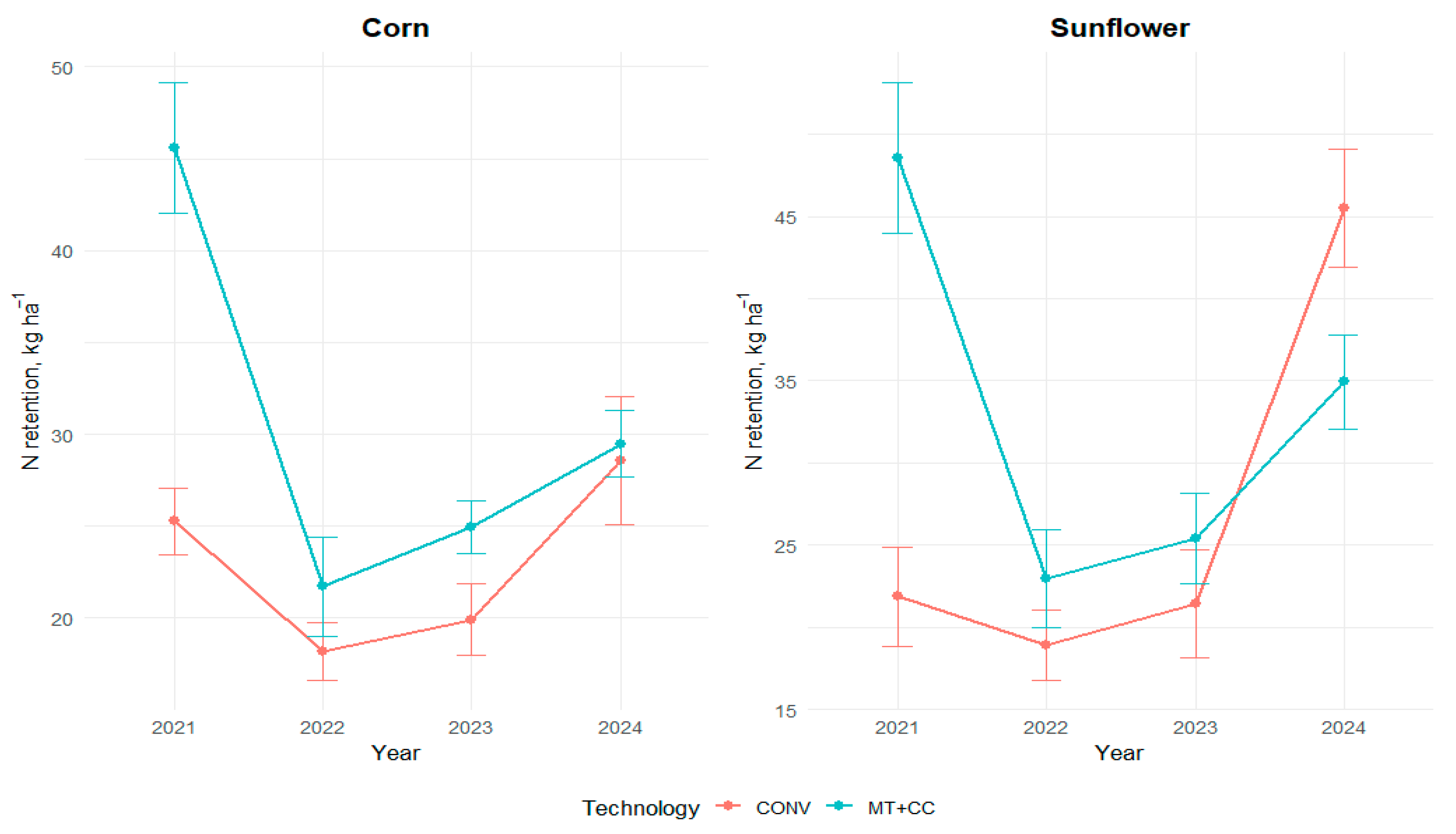
The estimated nitrogen retention was analyzed using robust linear models that included management technology, the technology × year interaction, and block effects. As expected, N retention over the four-year rotation was significantly higher under the MT+CC treatment than under the conventional (CONV) system, in which only weed biomass contributed to N retention (Figure 1). Based on model estimates, mean N retention prior to corn sowing was higher by 20.30 kg ha−1 under MT+CC compared to CONV (t(81) = 9.93; p < 0.001), while before sunflower sowing the corresponding difference was 26.67 kg ha−1 (t(81) = 14.45; p < 0.001).
The year × technology interaction was significant, indicating temporal variation in the effect of management on N retention. Specifically, the advantage of the MT+CC system in N retention declined significantly after 2021. By 2024, no significant difference in N retention was observed between the two technologies prior to corn sowing, and before sunflower sowing, N retention under the CONV system significantly exceeded that under MT+CC.
When cumulative four-year N retention was summarized at the rotation level, MT+CC showed significantly higher values than CONV (p < 0.001) in two of the three rotations (rotation 1 and 3) (Table 3). In contrast, no significant difference between technologies was detected in rotation 2. In the case of CONV management, the average cumulative N-retention value over the 4 years was 26.75 kg ha−1, while in the case of MT+CC it was 31.29 kg ha−1.

3.2. Effect of Management on Nitrogen Removal from Grain Yields

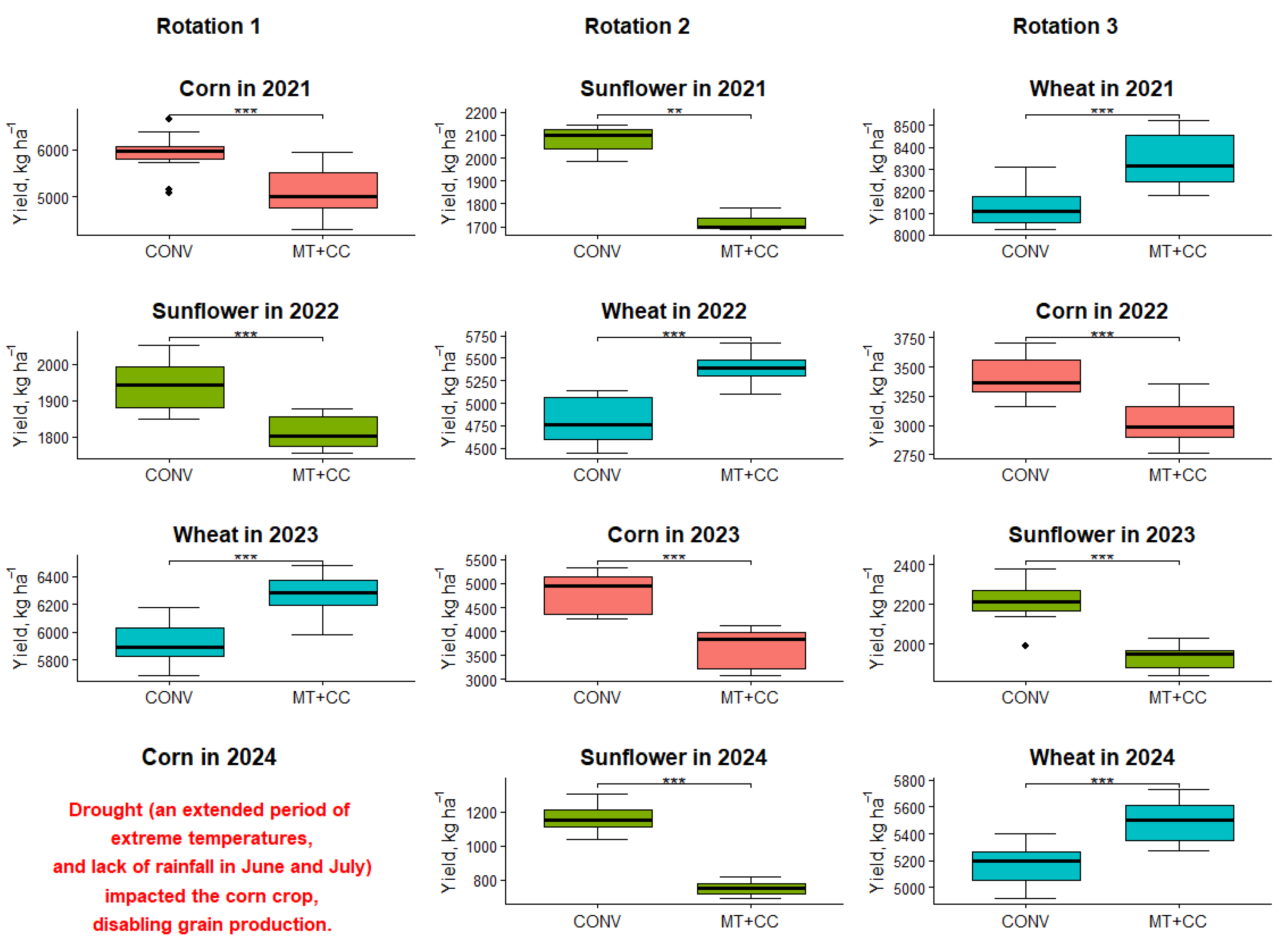
The effect of management technology on crop yield differed in both direction and statistical significance among the three crops (Figure 2). Across all three rotations and in each of the three years evaluated, the CONV management consistently resulted in significantly higher yields for corn and sunflower (p < 0.01), whereas winter wheat yields were significantly lower under CONV compared to the MT+CC treatment (p < 0.001).
When the four-year dataset was analyzed using robust linear models, sunflower yield under the MT+CC system was estimated to be significantly lower by an average of 371.71 kg ha−1 relative to CONV (t(73) = −5.66; p < 0.001). In the case of corn, yields under MT+CC were on average 660.90 kg ha−1 lower than under CONV; however, this difference did not reach statistical significance (t(82) = −1.77; p = 0.0805). In contrast, MT+CC had a positive effect on winter wheat production, with yields exceeding those under CONV by an average of 230.05 kg ha−1 (t(81) = 3.72; p < 0.001).
The balance of applied nitrogen fertilizer and grain N-removal was calculated at the plot level and subsequently aggregated over the four-year study period for the three rotations. Based on these calculations, N-balance was generally negative over the 4 years, except in Rotation 2 for the MT+CC treatment (Table 4). The cumulative four-year N balance under the MT+CC treatment was, on average, 14.1 kg ha−1 higher than under the CONV management system.

3.3. Effect of Management on Soil C:N Ratio

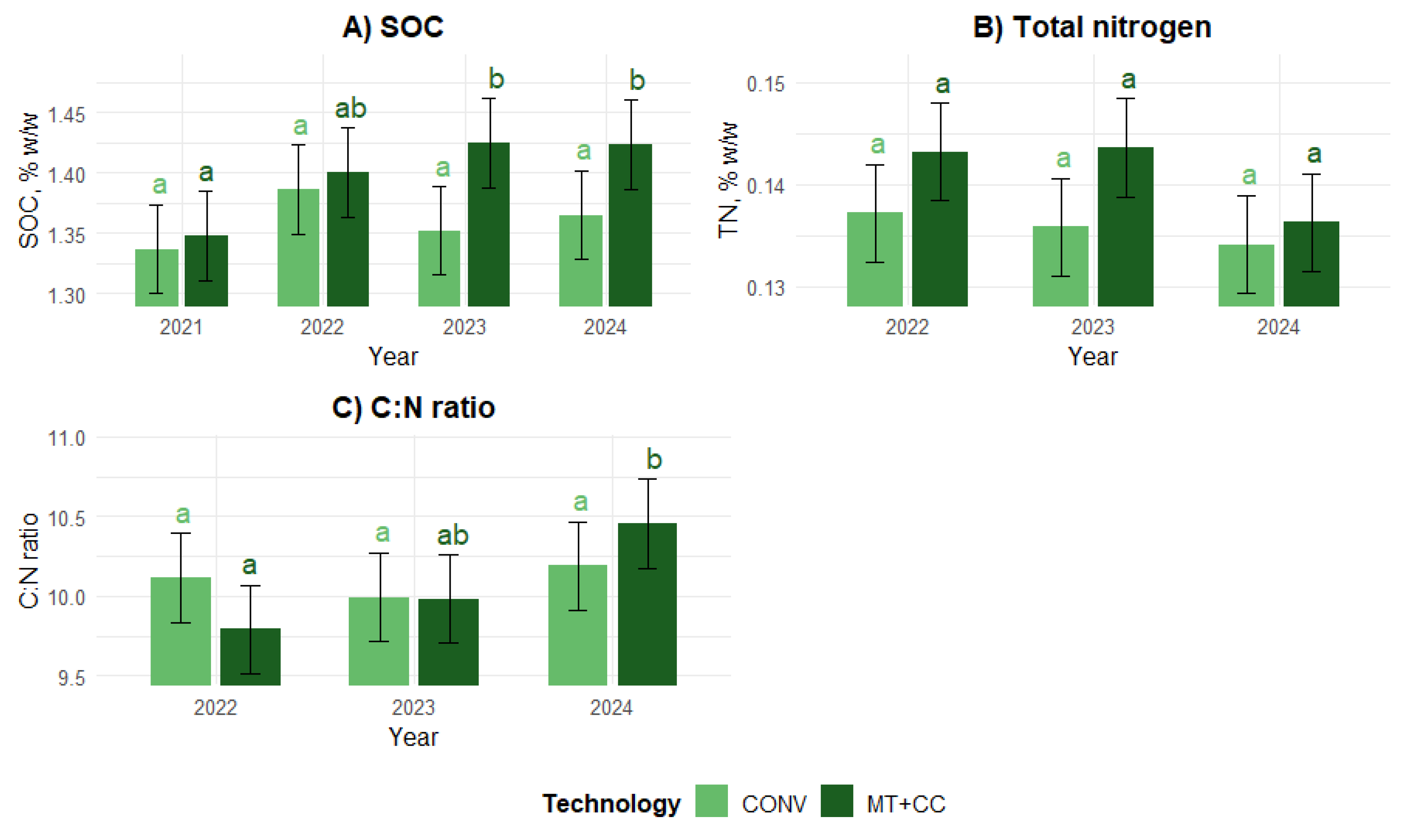
The temporal changes in SOC, TN, and the C:N ratio were assessed by annual direct soil sampling conducted prior to the termination of the cover crops. Over the four-year study period, SOC content did not show a significant change under the CONV treatment, with a mean value of 1.36% (Figure 3). In contrast, under the MT+CC treatment, SOC content increased significantly (p < 0.05) in the third and fourth years compared to the first year, reaching an average of 1.42%. In addition, SOC values measured under the MT+CC treatment were significantly higher (p < 0.05) than those observed under the CONV treatment.
No significant changes in soil TN concentration were detected in either treatment between 2022 and 2024. The soil C:N ratio also remained stable under the CONV treatment, with an average value of 9.67. However, a slight increasing trend in the C:N ratio was observed under the MT+CC treatment. By the fourth year of the experiment, the C:N ratio in the MT+CC treatment (mean value of 10.45) was significantly higher (p < 0.05) than that measured under the CONV treatment.

4. Discussion

Numerous studies have demonstrated that greater cover crop biomass and a higher C:N ratio are associated with enhanced N retention and weed suppression capacity, as well as improved ecosystem services such as soil health and soil structure [10,34]. In our experiment, relatively low cover crop biomass and N retention values were observed, which can primarily be attributed to the dry climate and limited N mineralization [9]. A significant limitation to the use of cover crops is that cover crops need precipitation for their establishment, resulting in late sowing and reduced time frame for biomass production under continental conditions [35,36]. Following the first year, cover crop biomass showed a declining trend, accompanied by a reduction in associated ecosystem services. This was reflected in decreasing N retention values and increased weed pressure in the fourth year. Autumn–winter precipitation was generally insufficient for optimal cover crop development during most years of the experiment. The decline in weed suppression capacity observed in the fourth year may be explained by weed adaptation and the low biomass production of the cover crop [37]. Nevertheless, while weeds contributed to nitrogen retention in the system, their presence may also have implications for crop competition and long-term weed management [7,19]. The development of the weed flora in this experiment and the weed control implications were discussed in the article by Radu et al. [33].
Under continental climatic conditions, nitrate leaching losses are considerably lower than those reported, for example, by Engedal et al. [38] in Denmark. In our case, however, the N balance of the crop rotation was negative due to reduced N fertilization. Consequently, N retention values were substantially lower than those reported in experiments with similar climates and crop rotations but higher N fertilizer inputs [22,39].
The yield response of the cash crops in our study appears to have been governed not only by precipitation variability but, more importantly, by treatment-induced differences in nitrogen (N) dynamics chronic under-fertilization. Corn and sunflower yields were consistently and significantly lower under MT+CC across all years and blocks, indicating a systematic rather than weather-driven effect. Recent meta-analyses have shown that excessive nitrate and water uptake by cover crops, combined with residue-induced N immobilization, can create negative legacy effects that increase the probability of yield penalties, particularly in dry and semi-arid regions [8,9]. Our results are in line with these findings, especially critical in our case was the dominant use of non-legume CC species and insufficient nitrogen fertilization.
Although soil mineral N concentrations at cover crop termination were slightly but generally significantly higher under MT+CC than under CONV, this snapshot does not necessarily reflect in-season N availability. The incorporation or surface retention of residues with a relatively high C:N ratio may have stimulated microbial N immobilization during the early growth stages of spring-sown crops. The composition of the cover crop mixture inherently assumes a high C:N ratio, which was not improved by the deficiencies in the establishment of legume cover crop species. Under water-limited conditions, this effect can be amplified, as reduced soil moisture constrains both residue decomposition and N mineralization, thereby prolonging temporary N limitation. Even under higher N fertilizer inputs, such immobilization effects may not be fully offset, as demonstrated by Salmerón et al. [39] and Hunter et al. [40], who reported persistent negative relationships between cover crop C:N ratio and maize yield. Therefore, in our experiment, the advantage of minimum tillage for soil moisture conservation in spring-sown crops did not outweigh the negative effects of CCs.
Adjusting species composition towards a higher proportion of legumes, or adopting legume-dominated cover crops, could alleviate N lock-up effects in spring-sown systems, as shown by Chen et al. [22]. However, legumes have slower development. This prevents biomass production in a small vegetation window either due to late cash crop harvest or to the lack of precipitation required for cover crop sowing. To overcome the limitation of the small vegetation window for cover crop growth, innovative approaches, e.g., undersowing of cover crops, need to be adopted [41]. Känkänen and Eriksson demonstrated that undersowing red clover in spring cereals did not compete strongly with the main crop; fairly high seeding rates can be used to maximize N fixation to benefit the successive crop [42]. Furthermore, reduced tillage likely reinforced N lock-up. Lower tillage intensity and depth generally slow organic matter turnover and N mineralization. In our system, the combination of reduced tillage and high C:N of residues probably created a compounded effect, delaying early N supply and constraining the initial growth of maize and sunflower. Collectively, these interacting mechanisms suggest that in dry continental climates, conservation practices (timing of CC sowing and termination) must be carefully tailored to synchronize N release with crop demand in order to avoid yield trade-offs.
We observed that lower cover crop biomass was generally followed by lower cash crop yields. Of course, this observation does not necessarily mean a cause-and-effect relationship. Although soil moisture dynamics and in-season nitrogen availability were not directly measured in this research, this pattern may suggest that the yield decline of spring-sown crops under the MT+CC treatment was driven predominantly by water competition and drought stress, and to a lesser extent by N immobilization. These findings raise an important question regarding the relevance of high-biomass cover crop mixtures in drought-prone environments. According to the meta-analysis of Garba et al. [9], annual precipitation of at least 700 mm may be required to achieve substantial yield benefits from cover crops in addition to their ecosystem services. The most pronounced yield advantages were associated with higher soil moisture and soil mineral N availability at cash crop sowing. These conclusions primarily refer to short-term effects and are consistent with our experimental results. To reduce management costs and to increase cover crop biomass, farmers often combine cover crop termination and seed bed preparation. This late termination of cover crops before maize and sunflower however increased water and N competition in our experiment. Alonso-Ayuso et al. showed that early kill date of cover crops increased soil depletion, preserved rain harvested between kill dates and allowed more time for N release in spring [36].
In contrast, winter wheat responded positively to the MT+CC system from the first year onward, with consistently and significantly higher yields than under CONV across all years and blocks. As no cover crop was sown immediately before winter wheat, and the sunflower pre-crop left relatively low residue amounts, wheat roots were not impeded by a thick mulch layer. In addition, no substantial N immobilization could be observed during the growing season [43]. The initial yield advantage could largely be attributed to the greater water conservation capacity of minimum tillage compared with conventional ploughing. This positive effect may have been due to the fact that winter wheat was fertilized with an adequate amount of nitrogen.
In later years, the cumulative effects of cover crops may also contribute to the yield benefit, as cover crops can offset some of the disadvantages of minimum tillage, such as slower N mineralization and increased weed biomass, as highlighted by Büchi et al. [44] and Miner et al. [17]. According to the literature, the ecosystem service benefits of cover crops and minimum tillage may become detectable after 3–5 years of continuous application [17,45,46,47]. In our experiment, the first signs of such improvements were already evident in the third year, as reflected in soil organic carbon (SOC) dynamics. Although the increase was modest, SOC was significantly higher under MT+CC than under CONV. In contrast, total soil N remained unchanged, resulting in an increased soil C:N ratio under MT+CC.
An increase in soil C:N ratio following reduced tillage and/or cover crop application has been widely reported in dry, semi-arid, and continental regions [48,49,50,51]. While a higher C:N ratio may temporarily constrain plant N uptake, it can also reduce N losses and thereby improve N retention efficiency [50].
Mazzoncini et al. [49] concluded that under semi-arid conditions, increasing SOC may be achieved more readily through N fertilization than through cover crop adoption alone. Achieving substantial SOC gains with cover crop-based systems may therefore require higher N inputs and the introduction of highly productive cover crop species. This consideration is highly relevant for our experimental site, where N availability may have been a limiting factor for both cover crop biomass production and spring-sown cash crops. Hughes et al. found that increase in SOC could be achieved only with cover crop biomass over 1.3 Mg ha−1 [52], that was achieved only the first year of our experiment. Enhanced N fertilization could accelerate SOC accumulation, which is critical to improvement soil structure and biological activity and to buffer the negative impacts of climate change [45].
Prolonged surface protection by crop residues reduces erosion, runoff, and evaporation losses [53]. Over time, gradual improvements in soil structure and water infiltration capacity may offset the initial disadvantages associated with N immobilization in cash crops. Furthermore, as demonstrated by Nugroho et al. [54], MT+CC systems can promote more balanced soil biological activity during the growing season, which may contribute to longer-term system resilience.

5. Conclusions

Short-term results from our experiment indicate that, in continental climates, the benefits of reduced-intensity mulch tillage are evident for autumn-sown crops. The ecosystem services of cover crop use are not consistently realized in water-limited agroecosystems.
Understanding the effects of tillage systems on cover crop residue decomposition and nitrogen (N) release is essential in regions with a continental climate. The lower the applied N-fertilizers and N-balance of the plots, the greater the risk of cover cropping for spring-sown crops. Late cover crop sowing and low % of legumes in cover crop mixtures result in only limited ecosystem services under dry continental climate conditions. This is primarily due to nitrogen immobilization, slow mineralization and limited precipitation. Further research is needed to determine how crop rotation, nitrogen fertilization, tillage practices, and cover crop use can be adapted and optimized for dry climates. In particular, further field experiments are needed, which should focus on increasing the nitrogen fertilization of spring-sown crops, employing a higher proportion of leguminous CC species, and the use of undersowing.

Author Contributions

K.J., S.Z.H., A.V., M.R., C.B., C.M., A.M., M.J.N. and V.P.V. contributed to the discussion and conceptualization of the manuscript; writing, original draft—K.J.; writing, reviewing and editing—V.P.V., A.V. and S.Z.H.; supervision and project administration—V.P.V., C.M., A.M. and M.J.N. All authors have read and agreed to the published version of the manuscript.

Funding

This research was funded by Syngenta Crop Protection AG and the University of Agronomic Science and Veterinary Medicine of Bucharest through Moara Domnească Agricultural Research and Development Didactic Station, contract number 25986/20.10.2020.

Data Availability Statement

The original contributions presented in this study are included in the article. Further inquiries can be directed to the corresponding author.

Acknowledgments

We the authors are grateful for the financial and moral support of Research Excellence Programme of the Hungarian University of Agriculture and Life Sciences.

Conflicts of Interest

Authors Andrei Mărutescu, Max John Newbert, and Vasileios P. Vasileiadis were employed by the company Syngenta Crop Protection AG. The authors declare that this study received funding from Syngenta Crop Protection AG. The funder was not involved in the study design, collection, analysis, interpretation of data, the writing of this article or the decision to submit it for publication.

References

  1. Kremen, C.; Miles, A. Ecosystem Services in Biologically Diversified versus Conventional Farming Systems: Benefits, Externalities, and Trade-Offs. E&S 2012, 17, 40. [Google Scholar] [CrossRef]
  2. Bergtold, J.S.; Ramsey, S.; Maddy, L.; Williams, J.R. A Review of Economic Considerations for Cover Crops as a Conservation Practice. Renew. Agric. Food Syst. 2019, 34, 62–76. [Google Scholar] [CrossRef]
  3. Quintarelli, V.; Radicetti, E.; Allevato, E.; Stazi, S.R.; Haider, G.; Abideen, Z.; Bibi, S.; Jamal, A.; Mancinelli, R. Cover Crops for Sustainable Cropping Systems: A Review. Agriculture 2022, 12, 2076. [Google Scholar] [CrossRef]
  4. Ogilvie, C.M.; Ashiq, W.; Vasava, H.B.; Biswas, A. Quantifying Root-Soil Interactions in Cover Crop Systems: A Review. Agriculture 2021, 11, 218. [Google Scholar] [CrossRef]
  5. Begum, N.; Qin, C.; Ahanger, M.A.; Raza, S.; Khan, M.I.; Ashraf, M.; Ahmed, N.; Zhang, L. Role of Arbuscular Mycorrhizal Fungi in Plant Growth Regulation: Implications in Abiotic Stress Tolerance. Front. Plant Sci. 2019, 10, 1068. [Google Scholar] [CrossRef]
  6. Blanco-Canqui, H.; Shaver, T.M.; Lindquist, J.L.; Shapiro, C.A.; Elmore, R.W.; Francis, C.A.; Hergert, G.W. Cover Crops and Ecosystem Services: Insights from Studies in Temperate Soils. Agron. J. 2015, 107, 2449–2474. [Google Scholar] [CrossRef]
  7. Moreau, D.; Pointurier, O.; Nicolardot, B.; Villerd, J.; Colbach, N. In Which Cropping Systems Can Residual Weeds Reduce Nitrate Leaching and Soil Erosion? Eur. J. Agron. 2020, 119, 126015. [Google Scholar] [CrossRef]
  8. Pan, F.F.; Tang, J.; Chen, B.H. Cover Crop Effects on Soil N Retention and Supply in Fertilizer-Intensive Cropping Systems (A Review). Eurasian Soil Sc. 2022, 55, 1278–1294. [Google Scholar] [CrossRef]
  9. Garba, I.I.; Bell, L.W.; Williams, A. Cover Crop Legacy Impacts on Soil Water and Nitrogen Dynamics, and on Subsequent Crop Yields in Drylands: A Meta-Analysis. Agron. Sustain. Dev. 2022, 42, 34. [Google Scholar] [CrossRef]
  10. Finney, D.M.; White, C.M.; Kaye, J.P. Biomass Production and Carbon/Nitrogen Ratio Influence Ecosystem Services from Cover Crop Mixtures. Agron. J. 2016, 108, 39–52. [Google Scholar] [CrossRef]
  11. Sadra, S.; Mohammadi, G.; Mondani, F. Nitrogen Release Dynamics and Carbon Sequestration by Legume and Non-Legume Cover Crops under Pure and Mixed Planting Conditions. Agriculture (Pol’nohospodárstvo) 2023, 69, 13–26. [Google Scholar] [CrossRef]
  12. Busari, M.A.; Kukal, S.S.; Kaur, A.; Bhatt, R.; Dulazi, A.A. Conservation Tillage Impacts on Soil, Crop and the Environment. Int. Soil Water Conserv. Res. 2015, 3, 119–129. [Google Scholar] [CrossRef]
  13. Loaiza Puerta, V.; Pujol Pereira, E.I.; Wittwer, R.; Van Der Heijden, M.; Six, J. Improvement of Soil Structure through Organic Crop Management, Conservation Tillage and Grass-Clover Ley. Soil Tillage Res. 2018, 180, 1–9. [Google Scholar] [CrossRef]
  14. Littrell, J.; Xu, S.; Omondi, E.; Saha, D.; Lee, J.; Jagadamma, S. Long-term Organic Management Combined with Conservation Tillage Enhanced Soil Organic Carbon Accumulation and Aggregation. Soil Sci. Soc. Amer. J. 2021, 85, 1741–1754. [Google Scholar] [CrossRef]
  15. Juhos, K.; Nugroho, P.A.; Jakab, G.; Prettl, N.; Kotroczó, Z.; Szigeti, N.; Szalai, Z.; Madarász, B. A Comprehensive Analysis of Soil Health Indicators in a Long-term Conservation Tillage Experiment. Soil Use Manag. 2024, 40, e12942. [Google Scholar] [CrossRef]
  16. Van Den Putte, A.; Govers, G.; Diels, J.; Gillijns, K.; Demuzere, M. Assessing the Effect of Soil Tillage on Crop Growth: A Meta-Regression Analysis on European Crop Yields under Conservation Agriculture. Eur. J. Agron. 2010, 33, 231–241. [Google Scholar] [CrossRef]
  17. Miner, G.L.; Delgado, J.A.; Ippolito, J.A.; Stewart, C.E. Soil Health Management Practices and Crop Productivity. Agric. Environ. Lett. 2020, 5, e20023. [Google Scholar] [CrossRef]
  18. Cooper, J.; Baranski, M.; Stewart, G.; Nobel-de Lange, M.; Bàrberi, P.; Fließbach, A.; Peigné, J.; Berner, A.; Brock, C.; Casagrande, M.; et al. Shallow Non-Inversion Tillage in Organic Farming Maintains Crop Yields and Increases Soil C Stocks: A Meta-Analysis. Agron. Sustain. Dev. 2016, 36, 22. [Google Scholar] [CrossRef]
  19. Wortman, S.E. Weedy Fallow as an Alternative Strategy for Reducing Nitrogen Loss from Annual Cropping Systems. Agron. Sustain. Dev. 2016, 36, 61. [Google Scholar] [CrossRef]
  20. Huang, M.; Shan, S.; Cao, F.; Chen, J.; Zou, Y. The Potential of Naturally Occurring Fallow Weeds to Scavenge Nitrogen in Rice Cropping Systems. Ecol. Indic. 2018, 93, 183–187. [Google Scholar] [CrossRef]
  21. Baraibar, B.; White, C.M.; Hunter, M.C.; Finney, D.M.; Barbercheck, M.E.; Kaye, J.P.; Curran, W.S.; Bunchek, J.; Mortensen, D.A. Weeds in Cover Crops: Context and Management Considerations. Agriculture 2021, 11, 193. [Google Scholar] [CrossRef]
  22. Huang, M.; Chen, G.; Kang, Y.; Cao, F.; Wu, H.; Chen, J. Nitrogen Scavenging by Winter Fallow Weeds and Its Availability to Rice Crops. Eur. J. Agron. 2024, 159, 127251. [Google Scholar] [CrossRef]
  23. Egnér, H.; Riehm, H.; Domingo, W.R. Chemische Extraktionsmethoden Zur Phosphor- Und Kaliumbestimmung. In Untersuchungen Über die Chemische Bodenanalyse als Grundlage für die Beurteilung des Nährstoffzustandes derBöden; Kungliga Lantbrukshögskolans Annaler: Uppsala, Sweden, 1960; Volume II, pp. 199–215. [Google Scholar]
  24. Zhou, Y.; Roosendaal, L.; Van Eerd, L.L. Increased Nitrogen Retention by Cover Crops: Implications of Planting Date on Soil and Plant Nitrogen Dynamics. Renew. Agric. Food Syst. 2020, 35, 720–729. [Google Scholar] [CrossRef]
  25. Lyu, H.; Li, Y.; Wang, Y.; Wang, P.; Shang, Y.; Yang, X.; Wang, F.; Yu, A. Drive Soil Nitrogen Transformation and Improve Crop Nitrogen Absorption and Utilization - a Review of Green Manure Applications. Front. Plant Sci. 2024, 14, 1305600. [Google Scholar] [CrossRef] [PubMed]
  26. Roy, R.N.; Finck, A.; Blair, G.J.; Tandon, H.L.S. Plant Nutrition for Food Security—A Guide for Integrated Nutrient Management, 2006th ed.; Food and Agriculture Organization of the United Nations: Rome, Italy, 2006. [Google Scholar]
  27. Bahadori, M.; Tofighi, H. A Modified Walkley-Black Method Based on Spectrophotometric Procedure. Commun. Soil Sci. Plant Anal. 2016, 47, 213–220. [Google Scholar] [CrossRef]
  28. STAS 7184/2-85; Soils. Determination of Nitrogen Content 1985. ASRO: Bucharest, Romania, 1985. (In Romanian)
  29. Monteiro, M.I.C.; Ferreira, F.N.; De Oliveira, N.M.M.; Ávila, A.K. Simplified Version of the Sodium Salicylate Method for Analysis of Nitrate in Drinking Waters. Anal. Chim. Acta 2003, 477, 125–129. [Google Scholar] [CrossRef]
  30. Kempers, A.J.; Zweers, A. Ammonium Determination in Soil Extracts by the Salicylate Method. Communications in Soil Science and Plant Analysis 1986, 17, 715–723. [Google Scholar] [CrossRef]
  31. Efron, B.; Tibshirani, R.J. An Introduction to the Bootstrap, 1st ed.; Chapman and Hall/CRC: Boca Raton, FL, USA, 1994; ISBN 978-0-429-24659-3. [Google Scholar]
  32. R Core Team. R: A Language and Environment for Statistical Computing; R Foundation for Statistical Computing: Vienna, Austria, 2024. [Google Scholar]
  33. Radu, M.; Bolohan, C.; Mihalașcu, C.; Măruțescu, A.; Newbert, M.J.; Vasileiadis, V.P. Effects of Non-Inversion Tillage and Cover Crops on Weed Diversity and Density in Southeastern Romania. Sustainability 2025, 17, 6204. [Google Scholar] [CrossRef]
  34. Pittman, K.B.; Barney, J.N.; Flessner, M.L. Cover Crop Residue Components and Their Effect on Summer Annual Weed Suppression in Corn and Soybean. Weed Sci. 2020, 68, 301–310. [Google Scholar] [CrossRef]
  35. Kumar, U.; Engedal, T.; Hansen, V.; Gislum, R.; Munkholm, L.J.; Thomsen, I.K.; Larsen, S.U.; Hansen, E.M. Late Sowing of Cover Crops Reduces Potential for Nitrate Leaching Reduction and Carbon Inputs. Agric. Ecosyst. Environ. 2025, 393, 109858. [Google Scholar] [CrossRef]
  36. Alonso-Ayuso, M.; Gabriel, J.L.; Quemada, M. The Kill Date as a Management Tool for Cover Cropping Success. PLoS ONE 2014, 9, e109587. [Google Scholar] [CrossRef] [PubMed]
  37. Osipitan, O.A.; Dille, J.A.; Assefa, Y.; Radicetti, E.; Ayeni, A.; Knezevic, S.Z. Impact of Cover Crop Management on Level of Weed Suppression: A Meta-Analysis. Crop Sci. 2019, 59, 833–842. [Google Scholar] [CrossRef]
  38. Engedal, T.; Karlsson, M.; Andersen, M.S.; Rasmussen, J.; Thorup-Kristensen, K.; Jensen, L.S.; Magid, J.; Hansen, V. Legume-Based Cover Crop Mixtures Can Overcome Trade-Offs between C Inputs, Soil Mineral N Depletion and Residual Yield Effects. Agric. Ecosyst. Environ. 2023, 349, 108408. [Google Scholar] [CrossRef]
  39. Salmerón, M.; Isla, R.; Cavero, J. Effect of Winter Cover Crop Species and Planting Methods on Maize Yield and N Availability under Irrigated Mediterranean Conditions. Field Crops Res. 2011, 123, 89–99. [Google Scholar] [CrossRef]
  40. Hunter, M.C.; Schipanski, M.E.; Burgess, M.H.; LaChance, J.C.; Bradley, B.A.; Barbercheck, M.E.; Kaye, J.P.; Mortensen, D.A. Cover Crop Mixture Effects on Maize, Soybean, and Wheat Yield in Rotation. Agric. Environ. Lett. 2019, 4, 180051. [Google Scholar] [CrossRef]
  41. Wersebeckmann, V.; Höppner, F.; Gabriel, D. Diversification of Intensive Maize Production with Undersowings Reveals Taxon-Specific Biodiversity-Yield Trade-Offs. Agric. Ecosyst. Environ. 2025, 394, 109920. [Google Scholar] [CrossRef]
  42. Känkänen, H.; Eriksson, C. Effects of Undersown Crops on Soil Mineral N and Grain Yield of Spring Barley. Eur. J. Agron. 2007, 27, 25–34. [Google Scholar] [CrossRef]
  43. Ghimire, R.; Ghimire, B.; Mesbah, A.O.; Sainju, U.M.; Idowu, O.J. Soil Health Response of Cover Crops in Winter Wheat–Fallow System. Agron. J. 2019, 111, 2108–2115. [Google Scholar] [CrossRef]
  44. Büchi, L.; Wendling, M.; Amossé, C.; Necpalova, M.; Charles, R. Importance of Cover Crops in Alleviating Negative Effects of Reduced Soil Tillage and Promoting Soil Fertility in a Winter Wheat Cropping System. Agric. Ecosyst. Environ. 2018, 256, 92–104. [Google Scholar] [CrossRef]
  45. Kaye, J.P.; Quemada, M. Using Cover Crops to Mitigate and Adapt to Climate Change. A Review. Agron. Sustain. Dev. 2017, 37, 4. [Google Scholar] [CrossRef]
  46. Adetunji, A.T.; Ncube, B.; Mulidzi, R.; Lewu, F.B. Management Impact and Benefit of Cover Crops on Soil Quality: A Review. Soil Tillage Res. 2020, 204, 104717. [Google Scholar] [CrossRef]
  47. Haruna, S.I.; Anderson, S.H.; Udawatta, R.P.; Gantzer, C.J.; Phillips, N.C.; Cui, S.; Gao, Y. Improving Soil Physical Properties through the Use of Cover Crops: A Review. Agrosystems Geosci. Environ. 2020, 3, e20105. [Google Scholar] [CrossRef]
  48. Ramos, M.E.; Benítez, E.; García, P.A.; Robles, A.B. Cover Crops under Different Managements vs. Frequent Tillage in Almond Orchards in Semiarid Conditions: Effects on Soil Quality. Appl. Soil Ecol. 2010, 44, 6–14. [Google Scholar] [CrossRef]
  49. Mazzoncini, M.; Sapkota, T.B.; Bàrberi, P.; Antichi, D.; Risaliti, R. Long-Term Effect of Tillage, Nitrogen Fertilization and Cover Crops on Soil Organic Carbon and Total Nitrogen Content. Soil Tillage Res. 2011, 114, 165–174. [Google Scholar] [CrossRef]
  50. Acharya, P.; Ghimire, R.; Acosta-Martínez, V. Cover Crop-Mediated Soil Carbon Storage and Soil Health in Semi-Arid Irrigated Cropping Systems. Agric. Ecosyst. Environ. 2024, 361, 108813. [Google Scholar] [CrossRef]
  51. Fernández-Soler, C.; Garcia-Franco, N.; Almagro, M.; Díaz-Pereira, E.; Luján, R.; García, E.; Martínez-Mena, M. Cover Crops Improve the Long-term Stabilization of Soil Organic Carbon and Total Nitrogen through Physico-chemical Protection in Rainfed Semiarid Mediterranean Woody Crop Systems. Soil Use Manag. 2024, 40, e13066. [Google Scholar] [CrossRef]
  52. Hughes, H.M.; McClelland, S.C.; Schipanski, M.E.; Hillier, J. Modelling the Soil C Impacts of Cover Crops in Temperate Regions. Agric. Syst. 2023, 209, 103663. [Google Scholar] [CrossRef]
  53. Madarász, B.; Jakab, G.; Szalai, Z.; Juhos, K.; Kotroczó, Z.; Tóth, A.; Ladányi, M. Long-Term Effects of Conservation Tillage on Soil Erosion in Central Europe: A Random Forest-Based Approach. Soil Tillage Res. 2021, 209, 104959. [Google Scholar] [CrossRef]
  54. Nugroho, P.A.; Juhos, K.; Prettl, N.; Madarász, B.; Kotroczó, Z. Long-Term Conservation Tillage Results in a More Balanced Soil Microbiological Activity and Higher Nutrient Supply Capacity. Int. Soil Water Conserv. Res. 2023, 11, 528–537. [Google Scholar] [CrossRef]
Figure 1. Nitrogen retention estimated by the robust linear model (marginal means ± 95% confidence intervals) before sowing corn and sunflower for the two management technologies (CONV: conventional ploughing tillage, MT+CC: minimum tillage with cover crop sowing).
Nitrogen 07 00040 g001
Figure 2. The grain yields in three rotations for the two management technologies (CONV: conventional ploughing tillage, MT+CC: minimum tillage with cover crop sowing). Box plots show the median (horizontal line), interquartile range (box), whiskers representing the minimum and maximum non-outlier values, and outliers plotted as individual points. ‘**’ p < 0.01 ‘***’ p < 0.001.
Nitrogen 07 00040 g002
Figure 3. The temporal change in (A) soil organic carbon (SOC), (B) soil total nitrogen and (C) soil C:N ratio (mean ± standard deviation) for the two management technologies (CONV conventional ploughing tillage, MT+CC: minimum tillage with cover crop sowing). Different letters indicate significant differences (p < 0.05).
Nitrogen 07 00040 g003
Table 1. Weather and climate data at the study site (ARDDS Moara Domnească, Ilfov.)
MonthAverage Monthly Temperature (°C)Monthly Precipitation (mm/m−2)
2021202220232024Multi-Year Average (1961–2007)2021202220232024Multi-Year Average (1961–2007)
January1.62.04.41.1−2.01.65.480.026.846.9
February2.84.63.47.30.017.44.24.01.066.0
March3.94.58.37.94.831.017.26.057.077.0
April9.611.810.614.711.19.263.074.043.067.7
May16.918.816.616.016.790.432.038.022.057.4
June20.522.721.825.920.4115.432.836.015.052.9
July24.725.525.726.922.381.210.667.052.441.6
August23.825.526.225.921.43.40.022.049.048.2
September17.517.922.119.816.651.730.016.076.643.5
October10.310.113.312.310.737.837.87.04.836.5
November7.97.48.74.34.911.033.061.051.233.2
December2.32.53.23.5−0.2118.687.511.080.040.0
Average/Sum11.812.813.713.810.6568.7353.5422.0478.8610.9
Table 2. The measured soil mineral nitrogen, annual cover crop and weed biomass (mean ± standard deviation) measured before corn and sunflower sowing (CONV: conventional ploughing tillage, MT+CC: minimum tillage with cover crop sowing).
YearCash Crop AfterTechnologyCover Crop Biomass, g m−2Weed Biomass, g m−2Soil Mineral Nitrogen, kg ha−1
2021CornCONV0510.8 ± 448.2 a36.31 ± 0.41 a
MT+CC1456.0 ± 231.1 C111. 7 ± 57.7 a39.87 ± 1.19 b
SunflowerCONV 532.3 ± 535.5 a36.67 ± 1.36 a
MT+CC1937.7 ± 299.2 β186.7 ± 125.2 a37.99 ± 1.90 a
2022CornCONV014.6 ± 11.5 a34.19 ± 1.21 a
MT+CC98.7 ± 34.6 A26.7 ± 18.4 a36.46 ± 1.75 b
SunflowerCONV066.5 ± 20.3 a35.11 ± 0.67 a
MT+CC116.8 ± 81.4 α70.83 ± 32.7 a36.20 ± 0.88 a
2023CornCONV0555.0 ± 641.8 a34.67 ± 0.63 a
MT+CC305.7 ± 74.5 B118.7 ± 12.6 a36.40 ± 0.64 a
SunflowerCONV0270.0 ± 266.7 a35.75 ± 1.26 a
MT+CC310.3 ± 127.2 α145.3 ± 58.0 a36.91 ± 1.06 a
2024CornCONV0590.2 ± 164.7 a33.04 ± 0.42 a
MT+CC226.7 ± 88.5 AB679.3 ± 566.1 a35.00 ± 0.42 b
SunflowerCONV01266.8 ± 148.8 b34.21 ± 0.66 a
MT+CC142.0 ± 101.8 α665.8 ± 107.1 a35.51 ± 0.86 b
Superscript letters indicate statistically significant differences (p < 0.05), where lowercase Latin letters denote differences between tillage technologies within a given year and crop, uppercase Latin letters indicate differences between years within the cover crop treatment for corn, and Greek letters indicate the same for sunflower.
Table 3. The total N-retention of 4-year period in three rotations for the two management technologies (Conv: conventional ploughing tillage, MT+CC: minimum tillage with cover crop sowing).
RotationsN Retention, Mean ± Standard Deviation
ConvCONVMT+CC
Rotation 125.54 ± 2.73 a32.81 ± 1.40 b
Rotation 234.54 ± 8.15 a37.18 ± 2.28 a
Rotation 320.17 ± 2.04 a23.87 ± 0.83 b
Lowercase Latin letters denote differences between tillage technologies within a given rotation. Different letters indicate significant differences (p < 0.001).
Table 4. The average total N-removal and N-balance (N-balance = Applied N-fertilizer − N-removal) of 4-year period in three rotations for the two management technologies (CONV: conventional ploughing tillage, MT+CC: minimum tillage with cover crop sowing).
RotationsN-Removal, kg ha−1Applied N-Fertilizer, kg ha−1N-Balance, kg ha−1
CONVMT+CCCONVMT+CC
Rotation1271.8259.8214−57.8−45.8
Rotation2228.8203.4214−14.810.6
Rotation3369.6364.7258−111.6−106.7
Disclaimer/Publisher’s Note: The statements, opinions and data contained in all publications are solely those of the individual author(s) and contributor(s) and not of MDPI and/or the editor(s). MDPI and/or the editor(s) disclaim responsibility for any injury to people or property resulting from any ideas, methods, instructions or products referred to in the content.