


Abstract
The application of nitrification inhibitors (Nis) with nitrogen fertilizers is increasingly used as a management strategy to improve nitrogen use efficiency in crop production systems. To evaluate the effects of Ni dicyandiamide (DCD) and 1,2,4-triazole (TZ) on the rhizosphere microbiome and strawberry yield (Fragaria × ananassa Duch.), a two-year field experiment was conducted with three treatments: unfertilized control (C), mineral nitrogen fertilizer (N) applied in two doses (40 + 40 kg N ha−1 year−1), and a single nitrogen application (80 kg N ha−1 year−1) combined with nitrification inhibitors (N + Ni). Soil microbiota were assessed using cultivation-based methods and metabarcoding of 16S rRNA and ITS2 regions. Total bacterial counts on complex media increased from 5.85 to 6.15 log CFU g−1 in the N treatment, while remaining 5.89 in N + Ni. Microscopic fungi increased in fertilized treatments during spring but decreased in July of the second year. Microbial community composition differed among treatments, although sampling time explained a larger proportion of variability than fertilization. Relative abundance of Gemmatimonas decreased under N + Ni, whereas Nitrososphaera increased. Fungal Shannon diversity decreased in N + Ni, while prokaryotic diversity did not differ significantly. Despite similar levels of mineral nitrogen measured before harvest, strawberry yield increased significantly in the N + Ni treatment in the second year, reaching 109% higher values than the control and 80% higher than the N treatment. This may indicate that the fertilization regime including nitrification inhibitors influenced nitrogen availability earlier in the growing season.
1. Introduction
Strawberries (Fragaria × ananassa Duch.) are among the most popular berries grown and consumed worldwide [1]. The quality of strawberries is determined by several parameters, and there is a growing demand for new varieties with better production characteristics, transportability, good agronomic properties, and excellent fruit quality [2]. According to statistics from FAOSTAT [3], the area under strawberry cultivation in Slovakia has remained roughly the same over the last decade. In 2024, the harvested area was 220 ha, the strawberry yield was 6590 kg ha−1, and production was 1450 tonnes per year. In Central Europe, production is increasing, particularly early and mid-early new Italian cultivars such as “Joly” and “Asia” [4]. “Joly”, as a mid-early variety, is very popular among growers [5] in Slovakia due to its ripening characteristics, easier market placement, and more favorable price. It also excels in terms of taste, as assessed by refractometric dry matter and acid content [1].
Nitrogen is one of the limiting factors affecting the growth and development of strawberries [6]. The effectiveness of nitrogen fertilization is reduced by losses caused by nitrate leaching, which contributes to eutrophication of surface waters and pollution of groundwater [7], or gas emissions (ammonia, nitric oxide, molecular N2 or nitrous oxide) [8].
Standard measures to improve nitrogen use efficiency include the use of fertilizers with synthetic nitrification inhibitors (Nis). Currently, various types of synthetic Nis are used, such as 2-chloro-6-(trichloromethyl) pyridine (nitrapyrin), dicyandiamide (DCD), and 3,4-dimethylpyrazole phosphate (DMPP) [9,10,11]. Dicyandiamide (DCD, C2H4N4) is one of the most studied Ni compounds [12]. DCD is soluble in water, nonvolatile, and highly mobile. When DCD is applied to agricultural soil fertilized with NH4+, it deactivates the enzyme ammonia monooxygenase (AMO), which catalyzes the oxidation of NH4+ during nitrification in ammonia-oxidizing bacteria (AOB) and ammonia-oxidizing archaea (AOA) [13], thereby halting the conversion of ammonium (NH4+-N) to hydroxylamine (NH2OH). According to Shen et al. [14], a greater effect of DCD was observed on AOB than on AOA, and with a single application, its effect may gradually decrease due to the consumption of DCD as a biodegradable substance [15]. DCD as a nitrification inhibitor can be combined with urease inhibitors such as NBPT N-(n-butyl) thiophosphoric triamide [10,16] and NPPT N-(n-propyl) thiophosphoric triamide [17]. In our experiment, N fertilizer was enriched with DCD and 1,2,4-triazole (TZ, C2H3N3). TZ, like DCD, has the ability to inhibit nitrification [18]. However, as a heterocyclic aromatic compound, it is characterized by slower degradation in soil, with a longer-lasting effect than DCD, but at the same time it also exhibits other properties, in particular antibacterial and fungicidal activity [19]. Triazoles are mainly studied in the literature as fungicides, e.g., cyproconazole, difenoconazole, and epoxiconazole [20].
Strawberries require balanced nitrogen nutrition, with optimal control of NH4+-N levels [21], without sharp fluctuations, which can be moderated by nitrification inhibitors. There is generally little information in the literature on the use of nitrification inhibitors in strawberry cultivation [22]. Nitrification inhibitors are more commonly used in the cultivation of cereals, corn, and rice [23,24]. Finding strategies to maximize nitrogen use efficiency is one of the main goals of sustainable agriculture [25].
The effect of nitrification inhibitors on the microbiome in vegetable soils is mainly associated with monitoring changes in the AOB and AOA communities and their effect on ammonia oxidation based on monitoring amoA gene copies either by DNA extraction and quantitative PCR or by the terminal restriction fragment length polymorphism (T-RFLP) method [26]. The literature lacks information on how DCD in combination with TZ affects the entire microbial community through 16S/ITS diversity analysis, which would reveal the overall structure of the microbial community.
The aim of our work was to assess the synergistic effect of nitrogen fertilization combined with the nitrification inhibitors DCD and TZ on the soil microbiome from the rhizosphere in strawberry cultivation using classical cultivation methods as well as methods enabling microbial diversity analysis by next-generation sequencing. The findings may contribute to addressing the challenges facing fruit farming: increasing strawberry production with balanced nitrogen fertilization using nitrification inhibitors while maintaining soil microbial community diversity and soil health.
2. Materials and Methods
2.1. Experimental Design and Treatments
The field experiment was conducted at the experimental station of the Slovak University of Agriculture in Nitra, Slovakia (48°18′53″ N, 18°5′15″ E) during two growing seasons (2021–2022) [27]. The experimental site is characterized by Fluvisol soil with a high clay fraction (particles < 0.01 mm representing approximately 65% of the soil fraction).
Prior to the establishment of the experiment, basic agrochemical soil properties were determined. The soil contained 1.84% organic carbon, corresponding to 3.17% humus, and 0.553 mg g−1 hot-water-extractable carbon. Total nitrogen content was 1428 mg kg−1, while mineral nitrogen forms were 7.1 mg kg−1 for NH4+-N and 11.0 mg kg−1 for NO3−-N. Total phosphorus reached 85 mg kg−1 and soil pH was 6.83.
The field experiment with strawberries (Fragaria × ananassa Duch; variety “Joly”) was prepared using block design under open field conditions. The planting of frigo strawberry seedlings took place in March 2021. The strawberries were transplanted at the stage of true leaf formation. The number of plants in each replication was 9, spacing 0.6 × 0.6 m. The area of one experimental plot (replication) was 3.24 m2. For each treatment, three plots (biological replication) were established. A total of 9 plots were organized in Latin square distribution to ensure minimal spatial effects. During the growing season, sprinkler irrigation was applied according to climatic conditions and soil moisture status. Table S1 shows total rainfall and average air temperature at the site during the experiment.
Three treatments were established in the experiment: control treatment (C) without application of mineral N fertilizer, treatment N with application of mineral nitrogen fertilizer, and (N + Ni) treatment with application of mineral N fertilizer and nitrification inhibitors.
Nitrogen fertilization (treatment N) was in the form of fertilizer at a dose of 80 kg ha−1 per year, divided into two applications. Granular fertilizer contained 26% N, 18.5% N-NH4+ content (ammonium sulfate), 7.5% N-NO3− content (ammonium nitrate), and 13% of total water-soluble sulfur. In the N + Ni treatment, the fertilizer had the same nutrient composition as in the N treatment, with the addition of nitrification inhibitors dicyandiamide (DCD) and 1,2,4-triazole (TZ) 0.37–0.74% in a ratio of 10:1. In the N + Ni treatment, the same dose of fertilizer was used as in the N treatment, with one application per year (Table 1).
Table 1.
Experimental design with terms of fertilizer application, soil sampling and harvesting of strawberry.
2.2. Soil Sampling and Analysis
Soil samples for evaluation of microbiological parameters were collected on four dates: April 2021, July 2021, April 2022, and July 2022 (Table 1). Soil was collected with a sterile sampling tool from a depth of 0.00 to 0.15 m in the root system zone of the strawberry plants. Five sub-samples were collected from a single plot and then mixed together. Samples were sieved through a 2 mm sieve and stored at 4 °C until analysis. Soil from each experimental plot was analyzed separately; this means that all analyses were performed in three biological replicates. Together, 36 samples (3 treatments × 4 sampling dates × 3 replicates) were taken during the experiment.
The actual soil moisture and maximum water capacity were determined by the method of Cassel and Nielsen [28]. The contents of ammonium and nitrate nitrogen in 1% K2SO4 extracts were colorimetrically determined using Nessler’s reagent and phenol-2,4-disulfonic acid, respectively. The content of mineral nitrogen in the soil (Nmin) was calculated as the sum of ammonium (N–NH4+) and nitrate (N–NO3−) nitrogen. The nitrification index (IN) was calculated as the ratio of N–NO3− to N–NH4+. All nitrogen levels are expressed in mg kg−1 of dry soil mass.
The plate dilution method was used for evaluation of microbial counts using different agar media: total bacterial count and total spore-forming bacterial count (inoculum was heated for 10 min at 80 °C) on complex media PCA (plate count agar) and saline medium (Thornton’s agar), Azotobacter spp. on Ashby’s mannitol agar, cellulose-degrading bacteria on cellulose Congo red agar, actinobacteria on Pochon’s medium and microscopic fungi on MEA (Malt extract agar). Total bacterial count and total spore-forming bacterial count were cultivated at 30 °C for 72 h, Azotobacter sp. at 30 °C for 7 days, cellulose-degrading bacteria at 30 °C for 48 h, actinobacteria and microscopic fungi at 25 °C for 7 days. Colony-forming units (CFUs) were expressed as logarithms per 1 g dry soil.
Soil DNA was isolated from 0.25 g of homogenized soil using the DNeasy® PowerSoil® kit (Qiagen, Hilden, Germany), following the standard protocol. Amplification of bacterial and archaeal DNA was performed with primers 515F and 806R [29], targeting the V4 hypervariable region of the 16S rRNA gene. For assessment of fungal communities, the ITS2 region was amplified using primers gITS7 and ITS4 [30]. PCR reactions were carried out with Q5 High-Fidelity DNA polymerase (New England Biolabs, Ipswich, MA, USA) under conditions recommended by the manufacturer. Amplification success and product size were verified by agarose gel electrophoresis. Products were subsequently purified using AMPure XP magnetic beads (Beckman Coulter, Brea, CA, USA), quantified with the Qubit High Sensitivity dsDNA assay (Invitrogen, Waltham, MA, USA), and normalized prior to pooling at equimolar concentrations. Sequencing adapters were ligated to PCR products using the TruSeq LT PCR-Free kit (Illumina, San Diego, CA, USA). Sequencing was performed on an Illumina MiSeq platform using the MiSeq Reagent Kit v3 (600-cycle) as 2 × 300 bp paired-end reads.
2.3. Strawberry Yield
Strawberry fruits were collected five times during the 2021 harvesting season (from 4 June 2021 to 18 June 2021) and nine times during the 2022 harvesting season (from 23 May 2022 to 17 June 2022). The strawberries were picked by hand, and the total yield expressed in t ha−1 was calculated for each experimental plot. The average fruit weight, expressed in g, was calculated from the weight and number of all fruits for each experimental plot.
2.4. Bioinformatics and Statistical Analysis
The effects of fertilization treatment and sampling time on soil microbial counts, diversity indices, and strawberry yield were evaluated using analysis of variance (ANOVA), followed by Tukey’s HSD test at a significance level of α = 0.05. All statistical analyses were performed in R. Assumptions of ANOVA were verified prior to analysis: homogeneity of variances was assessed using Levene’s test, and normality of residuals was examined with the Shapiro–Wilk test. Microbial abundance data were log-transformed when necessary to meet normality requirements.
Raw sequencing data were demultiplexed using SEED2 (version 2.1.4) [31]. Subsequent processing was conducted in QIIME 2 (version 2023.9) [32], where sequence denoising and amplicon sequence variant (ASV) inference were performed using the DADA2 algorithm [33]. Taxonomic assignment of prokaryotic ASVs was carried out with the RDP classifier (version 2.13) [34]. Taxonomic identification of fungal ASVs was performed against the UNITE database [35]. Alpha diversity indices were calculated after rarefaction to the lowest sequencing depth across samples. Multiple sequence alignment of ASVs was performed using MAFFT (version 7.487) [36], and weighted UniFrac distances (version 1.8) [37] were computed to assess phylogenetic dissimilarities among samples. Beta diversity patterns were evaluated using permutational multivariate analysis of variance (PERMANOVA) and non-metric multidimensional scaling (NMDS) implemented in the vegan package (version 2.6-4) [38] in R (version 4.2.2) [39]. Homogeneity of multivariate dispersion was tested prior to PERMANOVA using the betadisper() function. Differentially abundant taxa were identified using LEfSe (version 1.16.0) [40].
3. Results
3.1. Numbers of Microorganisms Using Cultivation-Based Methods and Diversity Assessed by Molecular Methods
The numbers of monitored microbial groups indicate that nitrogen fertilization and N fertilization with nitrification inhibitors had a less significant effect on most cultivable microorganism groups than soil sampling (Table 2). In April 2021, the total bacterial count on complex media (PCA) values were not affected by soil treatment and ranged from 6.05 ± 0.05 log CFU g−1 dry soil in the control to 6.13 ± 0.03 log CFU g−1 dry soil in the N variant. However, after the 2021 strawberry harvest, significantly higher values (p < 0.05) were observed in the N treatment (7.30 ± 0.05 log CFU g−1 dry soil) and N + Ni treatment (6.37 ± 0.08 log CFU g−1 dry soil) than in the control. In the second year (2022), the total bacterial count on complex media decreased overall to values ranging from 5.43 ± 0.12 log CFU g−1 dry soil (C and N) to 5.72 ± 0.15 log CFU g−1 dry soil (N) but was not affected by the treatment. The total spore-forming bacterial count on complex media did not show a clear treatment effect. Although the N treatment always showed significantly higher numbers (except for July 2022), even the N + Ni treatment did not negatively affect this microbial group, except for April 2022.
Table 2.
Effect of nitrogen fertilization and nitrification inhibitor application on number of cultivable microorganisms in log CFU g−1 dry soil mass during strawberry cultivation.
The total bacterial count and total spore-forming bacterial count on saline media were not affected by the N and N + Ni treatments at any sampling date. Both microbial groups were significantly affected by sampling date. The lowest values of total bacterial count on saline media were recorded after the harvest in July 2022, and for total spore-forming bacterial count on saline media, in April 2022, compared with other sampling dates (p < 0.05).
The abundance of cellulose-degrading bacteria was significantly reduced by treatment with N (6.83 ± 0.06 log CFU g−1 dry soil) and N + Ni (6.53 ± 0.13 log CFU g−1 dry soil) compared to the control (7.25 ± 0.11 log CFU g−1 dry soil) only at the beginning of the experiment in April 2021. Subsequently, the differences resulting from the N and N + Ni treatments (especially in April 2022 and after the 2022 harvest) gradually diminished.
The effect of treatment on the occurrence of the nitrogen bacterium Azotobacter spp. was observed after the harvest in 2021, when its number in the N and N + Ni treatments (4.29 ± 0.12 and 4.29 ± 0.20 log CFU g−1 dry soil, respectively) decreased significantly compared to the control (4.76 ± 0.20 log CFU g−1 dry soil). Conversely, after the harvest in 2022, we observed a significant increase in Azotobacter spp. in the N and N + Ni treatments compared to the control.
The treatment did not show a clear effect on the abundance of actinobacteria. In the spring samples taken in April 2021 and April 2022, we found no differences between the treatments. After the harvest in July 2021, the number was significantly higher in the control 4.35 ± 0.10 log CFU g−1 dry soil than in the fertilized treatments (N; N + Ni), and conversely, in July 2022, there was a significant increase in the number of actinobacteria in the N and N + Ni treatments (4.80 ± 0.04 and 4.69 ± 0.04 log CFU g−1 dry soil, respectively) compared to the control.
Microscopic fungi showed a relatively consistent abundance throughout 2021. In April 2022, there was an increase in the number of fungi in the N and N + Ni treatments compared to the control, although after the harvest in July 2022, the fungi were suppressed in the N + Ni treatment, and the highest abundance was found in the control (4.48 ± 0.02 log CFU g−1 dry soil).
A total of 948,776 sequences of the 16S rRNA gene were obtained from 36 samples. Following denoising, 1885 ASVs were identified. In the case of fungi, 633,638 sequences of the fungal ITS2 region were obtained, comprising 1696 amplicon sequence variants (ASVs).
The Shannon alpha diversity index for the prokaryotic community ranged from 8.35 to 8.96, with significant differences among sampling dates (Table 3). For all treatments, higher values were found in April than in July in both years. At the beginning of the experiment in April 2021, the highest Shannon index value was in the control; then the differences between treatments diminished, and in July 2022, the highest diversity was in the N + Ni variant. The Shannon index of the fungal community was in a wider range (1.56 to 6.23) than of the prokaryotic community, with significant differences between treatments and samples. In the first year of the experiment, fungal diversity was higher than in the second year. In the 2022 samples, the diversity was higher in control than in the variants treated with nitrogen and nitrification inhibitors. In July 2022, the Shannon index indicated that the diversity of the prokaryotic community increased significantly compared to the control, and the diversity of the fungal community decreased.
Table 3.
Effect of nitrogen fertilization and nitrification inhibitor application on Shannon’s diversity indices of soil prokaryotic and fungal communities during strawberry cultivation.
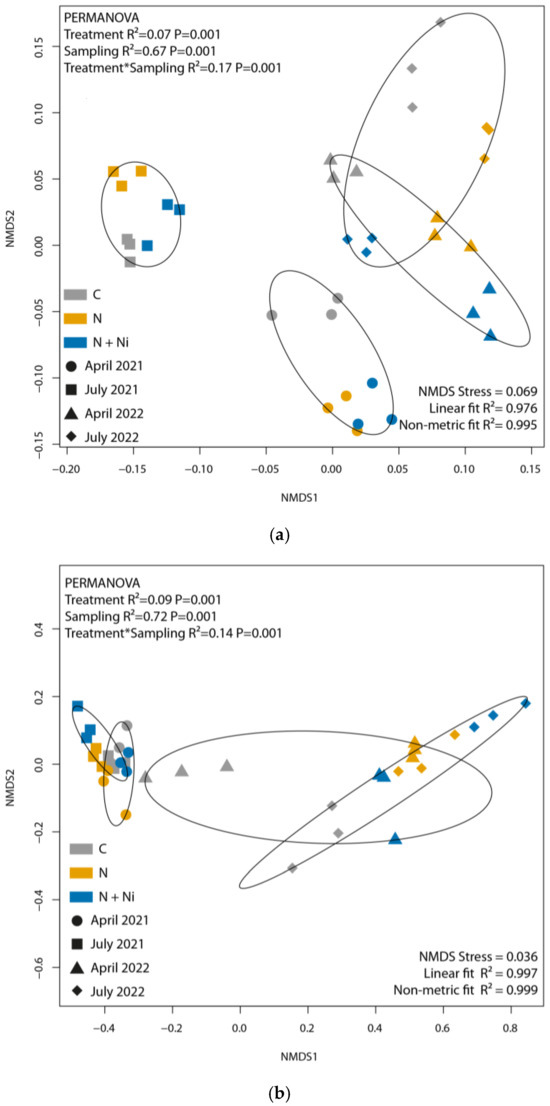
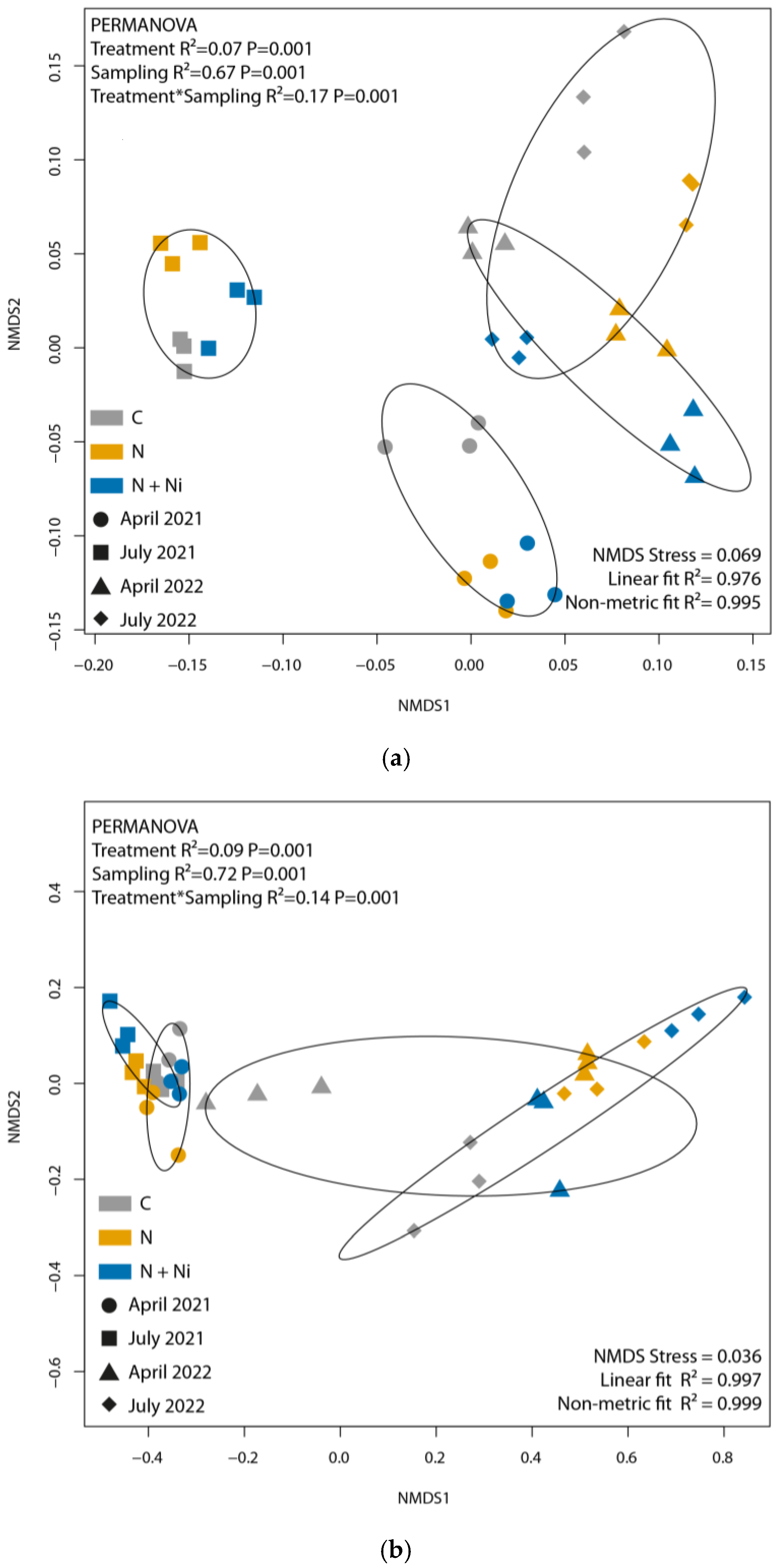
The results of beta diversity analysis confirmed that both bacterial and fungal communities were strongly influenced by soil sampling (Figure 1a,b). NMDS scatter plots show that each soil sampling date is represented by a different cluster. PERMANOVA analysis of the prokaryotic community confirmed that there were significant (p = 0.001) differences among sampling dates. This factor alone explained 67% of the total variability in UniFrac distances, although samples from April and July 2022 formed overlapping clusters (p = 0.0004; R2 = 0.28544) (Table S2). The difference between treatments was statistically significant (p = 0.001), but with a weaker effect (7%). The most distant clusters were formed by the control (C) and the N + Ni treatment with a p value of 0.0055 (R2 = 0.1123) (Table S3). The beta diversity analysis of the fungal community also confirmed that soil sampling had a highly significant (p = 0.001) strong effect (71.6%). Samples from April and July 2021 (p = 0.0013, R2 = 0.1991) and April and July 2022 (p = 0.0002, R2 = 0.1743) formed overlapping clusters (Figure 1; Table S4). The effect of soil treatment on the fungal community was also significantly confirmed (p = 0.001), but the differences together explained only 8% of the variability (Table S5). The weakest effect on the fungal community was found between treatments N and N + Ni.
Figure 1.
The NMDS scatterplots based on Unifrac weighted distances for prokaryotic (a) and fungal (b) communities in soil treated by the nitrogen fertilization and nitrification inhibitors during strawberry cultivation.
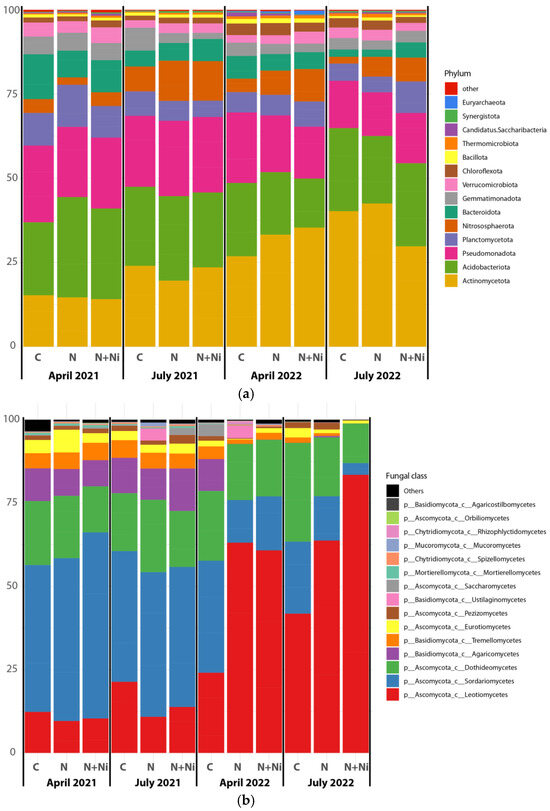
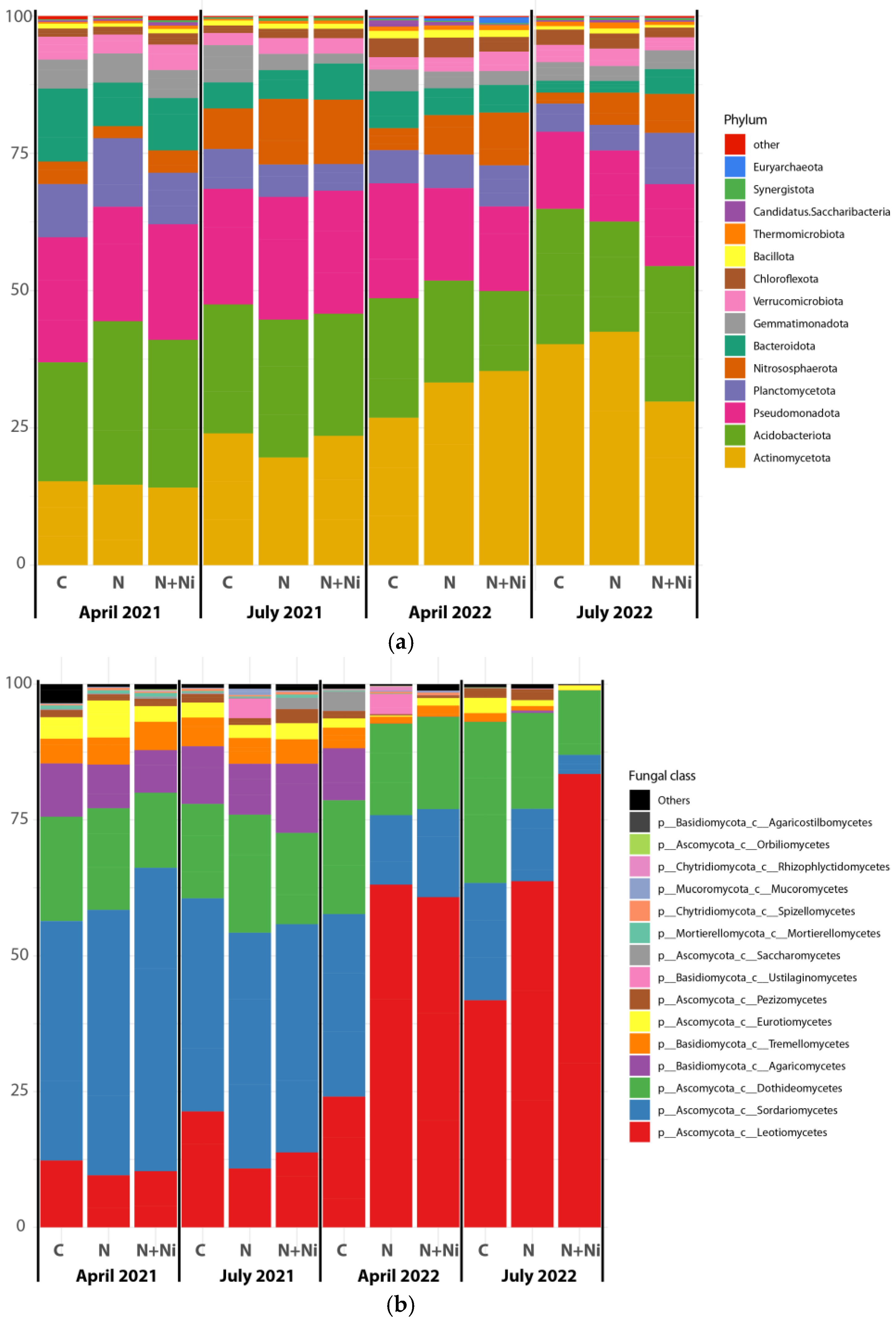
Overall, the representation of bacterial strains during the experiment ranged from 0 to 44%. The distribution shown in the bar chart in Figure 2a indicates that the most prevalent bacterial phyla are Actinomycetota (13 to 44%), Acidobacteriota (14 to 32%), and Pseudomonadota (12 to 23%). Sampling date affected the representation of bacterial phyla, with a change in representation reflected by an increase in the Actinomycetota phylum and a decrease in the Pseudomonadota phylum in 2022 compared to 2021. The effect of soil treatment was most pronounced in the Nitrososphaerota phylum, which ranged from 1 to 13% (LefSe, LDA = 4.26; p = 0.0239), and Gemmatimonadota, which ranged from 2 to 7% (LefSe, LDA = 3.87; p = 0.0207). The greatest change, with an increase in the Nitrososphaerota phylum and a decrease in Gemmatimonadota, was in the N + Ni treatment.
Figure 2.
Composition of prokaryotic (a) and fungal (b) communities in soil treated by nitrogen fertilization and nitrification inhibitors during strawberry cultivation.
The bar chart for the fungal classes (Figure 2b) shows a significant increase in the occurrence of Leotiomycetes from 10–21% in 2021 to 24–83% in 2022 and a decrease in Sordariomycetes from 39–56% in 2021 to 3–34% in 2022 and Agaricomycetes from 8.0–13% in 2021 to 0–9% in 2022. The highest increase in Leotiomycetes and decrease in Sordariomycetes and Agaricomycetes were observed in the N + Ni treatment in July 2022.
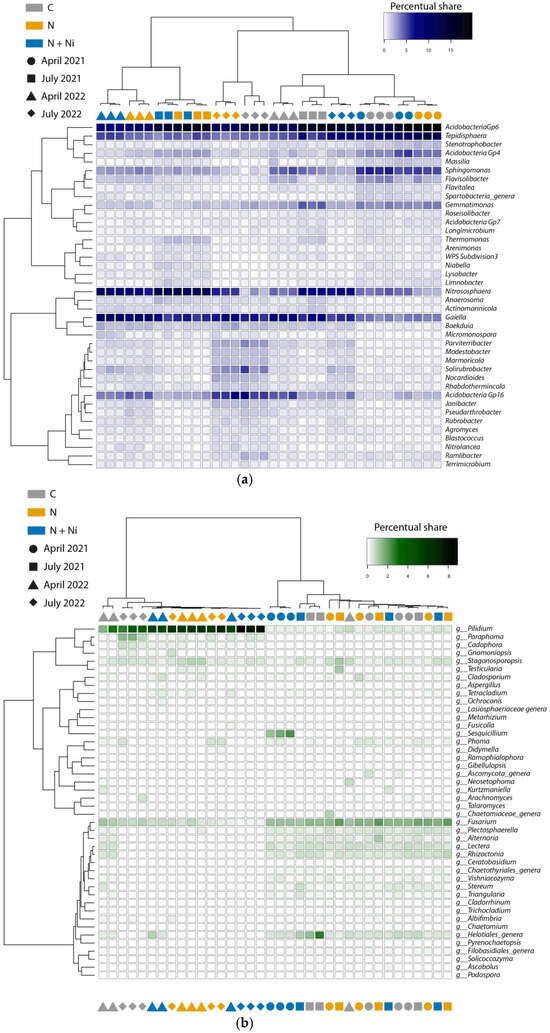
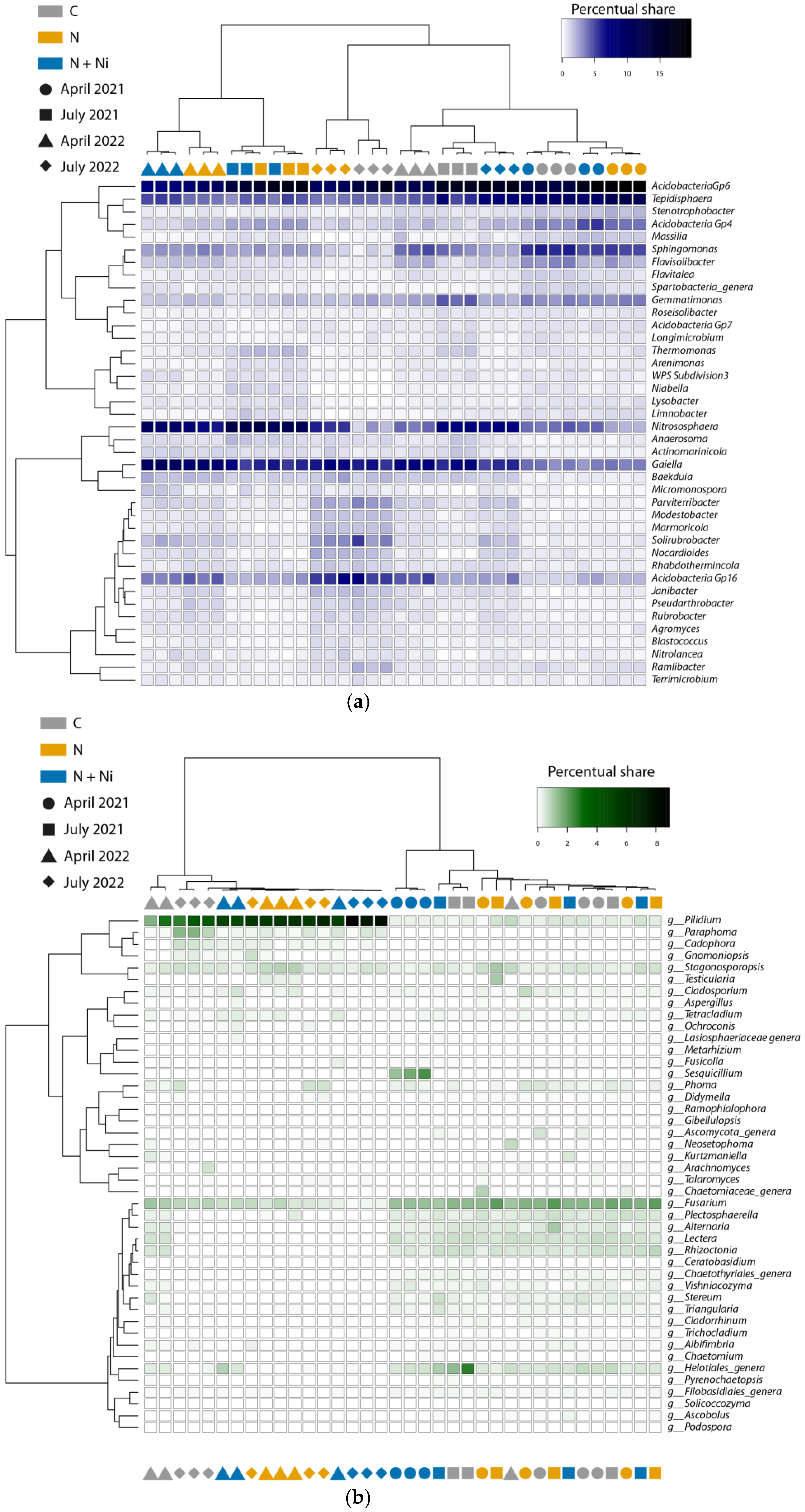
The heatmap of the most common prokaryotic genera (Figure 3a) (or the lowest possible taxonomic levels) shows that the most widespread group in all soil treatments was Acidobacteriota subgroup 6 (Gp6) (ranging from 7 to 20%, according to sampling date and treatment), the genus Gailella (3–10%), Tepidisphaera (3–12%) and Sphingomonas (0–6%). Differences in prokaryotic microbial composition were observed between treatments, with the N + Ni treatment showing a higher abundance of the genus Nitrososphaera (LefSe, LDA = 4.26; p = 0.0239) belonging to ammonium-oxidizing archaea, ranging from 4 to 13% compared to 1 to 8% in the control. In the N + Ni treatment, a decrease was observed in the genus Gemmatimonas (LefSe, LDA = 3.69; p = 0.0121). The decrease compared to the control was highest in July 2021. The N treatment generally showed more consistent abundance values in prokaryotic genera across all samples.
Figure 3.
Heat maps of 40 most common prokaryotic (a) and fungal (b) genera in soil treated by nitrogen fertilization and nitrification inhibitors during strawberry cultivation.
The heatmap of the most common fungal genera (Figure 3b) illustrates the reduction in fungal diversity in the second year of the experiment. The reason for this difference is a significant increase in the genus Pilidium in 2022 (p < 0.001). In 2021, its occurrence was 3–5%, and the genera Fusarium (13–20%), Rhizoctonia (3–7%), and Alternaria (3–6%) were more abundant.
In 2022, the genus Pilidium was represented in samples at levels of up to 82% of the fungal community. In April 2022, the genus Pilidium occurred at higher levels in treatments N (59%) and N + Ni (49%) than in the control (17%) (p < 0.001), and the upward trend continued in July 2022, where it was dominant in all treatments with the highest proportion in N + Ni (82%). Furthermore, an increase in the genus Paraphoma was ranging from 0% to 13%, with the highest occurrence in the control in July 2022.
3.2. Soil Mineral Nitrogen
In both experimental years, the application of nitrogen fertilizers significantly increased the content of inorganic nitrogen in soil compared with the unfertilized control (Table 4). The average values of mineral nitrogen (Nmin) in fertilized treatments were approximately 2.5 times higher than in the control, and 76–77% of inorganic nitrogen was present as nitrate at the time of sampling. Despite lower nitrification index values in the N + Ni treatment, the effect of inhibitors was not statistically significant.
Table 4.
Effect of nitrogen fertilization and nitrification inhibitor application on ammonia and nitrate nitrogen content (in mg kg−1 soil dry mass) at the time of strawberry harvest.
3.3. Strawberry Harvest
Strawberry yield and average fruit weight (Table 5) were not affected in the N and N + Ni treatments in the first year (2021). In the second year, 2022, we found a positive effect associated with the N + Ni treatment on the yield, which was significantly higher (4.61 ± 0.68 t ha−1) than in the control (2.25 ± 0. 16 t ha−1) and N treatment (2.56 ± 0.51 t ha−1). In the N + Ni treatment, we also found a higher average fruit weight compared to the control, reaching 10.03 ± 0.83 g.
Table 5.
Effect of nitrogen fertilization and nitrification inhibitor application on the average weight of strawberry fruit and total strawberry yield.
4. Discussion
In our work, we focus on the effect of nitrification inhibitors DCD and 1,2,4–triazole on the entire soil microbial community in strawberry cultivation, as information on this topic is limited in the literature.
4.1. The Effect of Nitrogen Fertilization with Nitrification Inhibitors DCD and TZ on Microbial Abundance Assessed by Cultivation Methods and Diversity Assessed by Molecular Methods
Nitrification inhibitors (Nis) are used in agriculture to mitigate and/or slow down soil nitrification, thereby minimizing nitrogen losses caused by NO3− leaching as well as N2O emissions arising from the denitrification process [41]. Nitrification inhibitors are expected to act primarily on target microorganisms, namely ammonia-oxidizing bacteria (AOB) and/or ammonia-oxidizing archaea (AOA), and should not affect non-target microorganisms. This is confirmed by the work of Dong et al. [42], Shi et al. [43], and Fu et al. [44], where chemical nitrification inhibitors such as the widely used nitrapyrin (2-chloro-6-(trichloromethyl)pyridine), DCD (dicyandiamide), and DMPP (3,4-dimethylpyrazole phosphate) caused a significant decrease in ammonia-oxidizing bacteria and/or archaea and had only a minor effect on the total bacterial abundance.
A comprehensive assessment of this effect is possible through a combination of cultivation-based and molecular methods. Although molecular approaches have shown that only about 1% of the total microbial population in soil can be within a limited range of media and cultivation conditions [45], the use of cultivation methods is still justified. It should be emphasized that new methods are also being developed to isolate uncultured soil bacteria that are metabolically active in their natural environment, despite being unable to multiply under laboratory conditions [46].
During monitoring of a treatment effect on total bacterial and total spore-forming bacterial counts on complex and saline media, we confirmed that groups of copiotrophic (eutrophic) bacteria (on complex media rich in nutrients) with a higher metabolic rate, as well as oligotrophic bacteria (on saline media) living in an environment poor in readily available organic carbon, were not affected by fertilization with N and N + Ni compared to the unfertilized control. We explain this by the fact that the soil not only had a rich supply of organic carbon, but the samples were also taken from the rhizosphere, i.e., a region of soil with increased availability of energy sources derived from root exudates [47].
Soil treatments N and N + Ni (DCD and TZ) only partially affected the number of cellulose-degrading bacteria and only at the beginning of the experiment. Di and Cameron [48] confirm that the nitrification inhibitor DCD acts primarily on the ammonia monooxygenase enzyme of AOB [16], not on the enzymes of cellulolytic bacteria, and does not reduce overall microbial biomass.
Similarly, the effect of nitrification inhibitors on the nitrogen-fixing bacterium Azotobacter spp. has not been clearly demonstrated. Egamberdiyeva et al. [49] report that the application of fertilizers in the form of N (urea), P (ammophos), and K (potassium chloride) together with the nitrification inhibitor potassium oxalate (PO) had no negative effects on Azotobacter sp. in cotton cultivation, and Zachler and Amberger [50] reported that DCD did not inhibit the growth of Azotobacter chroococcum at a concentration of 400 ppm, but nitrapyrin inhibited growth by 10% at 10 ppm and by 50% at 100 ppm.
We found a similarly inconsistent effect of treatment in Actinobacteria counts assessed by cultivation. The work of Wang et al. [51] demonstrated that the application of DCD and DMPP had a negative effect on the abundance of soil Actinobacteriota. Abundance decreased by 11.5% and 21.6% in the DMPP and DCD treatments, respectively. However, it should be emphasized that the phylum Actinobacteriota does not include only species with filamentous (mycelial) growth, which we monitored on Pochon’s medium in our experiment. We found a decrease in the abundance of the phylum Actinomycetota due to nitrification inhibitor treatment only in July 2022.
Microscopic fungi showed relatively stable abundance, which decreased in the N and N + Ni treatments in the last sampling in July 2022. According to Duff et al. [52], the nitrification inhibitor DCD had no effect on fungal abundance in a five-year temperate grassland field experiment, but Roman et al. [20] describe that high doses of triazole fungicides can be toxic to a wide range of non-target organisms. Fungal growth may have been temporarily suppressed in our experiment, as TZ has antifungal activity, but this effect may be milder in fluvisols. The soil at the experimental site, with a humus content of 3.17%, is characterized by high microbial activity, and soil microorganisms may be more resilient.
Next-generation sequencing methods help to solve problems with the evaluation of uncultivable microorganisms. We used the most common method of metabarcoding based on PCR amplification of phylogenetic markers [53]. According to our results, soil sampling date had a significant impact on both the prokaryotic and fungal communities. The timing of sampling, which is related to field conditions and climatic factors, is one of the most important factors influencing the microbiome in the rhizosphere, along with the vegetation status of plants [54].
The genus Gemmatimonas showed a significant decline under N + Ni, whereas Nitrososphaera increased in this treatment. Phylum Gemmatimonadota are the eighth most abundant group of bacteria in soils [55]. They are characterized by cosmopolitan occurrence in various soil types, where they can adapt to a wide range of nutrients, but they only make up 1–2% of the bacterial community, which may be related to their slower growth and higher tolerance to stressful conditions [56]. In the carbon cycle, they can fix carbon through the Calvin–Benson–Bassham cycle [57], and in the nitrogen cycle, Gemmatimonas aurantiaca T-27 shows the presence of nirK (a gene encoding the Cu-nitrite reductase enzyme) and clade II nosZ (a gene encoding the nitrous oxide reductase enzyme) [58]. In our experiment, the decline in Gemmatimonas could have been caused by a lack of nitrites, which are produced during nitrification by the oxidation of ammonia. The ammonia produced may have been taken up by plants, resulting in a higher yield in the N + Ni treatment. Contrary to our results, Changhua et al. [59] state that the addition of DCD to soils treated with chemical fertilization (15-15-15, N-P2O5-K2O) combined with manure amendment (sheep manure) led to a decrease in the abundance of Actinobacteria, Chloroflexi, and WPS_2 bacterial phyla and an increase in Gemmatimonadota.
The combination of DCD and TZ inhibitors had a greater effect on AOB than on AOA in the experiment, which would also explain the increase in the phylum Nitrososphaerota. O’Callaghan et al. [60] confirm a significant reduction in the population and activity of AOB when DCD is applied, although AOA were not affected. In their experiment, the four dominant phyla (Proteobacteria, Actinobacteria, Acidobacteria, and Firmicutes) were also unaffected. Similarly, Guo et al. [61] confirm that seven years of DCD application had no significant effect on microbial abundance.
The fungal community was strongly influenced by soil sampling date and a decline in diversity in the second year of the experiment. Soil treatments N and N + Ni had a weaker effect on fungal diversity. The change in diversity is attributed to an increase in the genus Pilidium with higher values in the N + Ni treatment. Excessive growth of this potential phytopathogen may also cause a reduction in soil diversity associated with strawberry plants. Pilidium concavum causes brown spots on strawberry leaves and fruits [62], but it can also live endophytically and saprophytically without directly damaging the fruits. Its occurrence has been recorded in Poland, Belgium, Iran, China, the USA, India, Brazil, and other countries [63]. From organic strawberry plantations in Poland, where fungal pathogens were isolated using several microbiological methods, the fungus Pilidium spp. had a representation of up to 6% [64,65]. We found no obvious damage to the fruit caused by this potential phytopathogen, which would subsequently result in a decrease in yield in the N + Ni treatment, where its representation was highest. In our experiment, the conditions for the development of the pathogen were probably not suitable, such as high humidity, optimal temperature (20–25 °C) and limited air flow, which occurs in greenhouses without ventilation.
However, the presence of the fungus may indicate potential risks for strawberry cultivation, even though no symptoms of the disease were observed on the plants. Currently, biological control options are being investigated, for example, using Streptomyces CNXK2 strains, which have been shown to inhibit the growth of this pathogen [66].
4.2. The Effect of Nitrogen Fertilization with Nitrification Inhibitors DCD and TZ on Soil Mineral Nitrogen Levels at Strawberry Harvest
Measurements of soil mineral nitrogen at harvest confirmed a significant effect of nitrogen fertilization in both experimental years. This result confirms that the application of N fertilizers increases the nitrogen supply available for strawberry plants, from application up to harvest [67]. Among the nitrogen forms, nitrate dominated at the time of soil sampling (shortly before or at the beginning of strawberry harvest). The higher proportion of nitrate nitrogen indicates that nitrification of the applied nitrogen by soil microorganisms had already taken place [68]. The measured nitrogen forms and the nitrification index did not show a clear difference between the split nitrogen application (2 × 40 kg ha−1) and the single nitrogen application combined with nitrification inhibitors. This may suggest that the inhibitors exerted their effect during the earlier stages after fertilization, although their activity was likely already substantially reduced by the time soil samples were collected at harvest. The efficiency of nitrification inhibitors is influenced by soil pH, organic matter content [69], and temperature. McGeough et al. [70] reported half-life values of DCD in nine UK soils of 89, 37, and 18 days at temperatures of 5, 15, and 25 °C, respectively, indicating that the inhibitory effect is stronger at lower temperatures. Under higher temperatures (35 °C), Mahmood et al. [71] reported that the inhibitory effect of 3,4-dimethylpyrazole phosphate (DMPP) and dicyandiamide (DCD) persisted for approximately one week, while the effect of 4-amino-1,2,4-triazole (ATC) lasted about four weeks. Overall, our results suggest that the use of nitrification inhibitors DCD and TZ had only a limited effect on the distribution of individual mineral nitrogen forms in soil at the time of harvest. A more detailed assessment of the effect of nitrification inhibitors on nitrogen transformations would require more frequent soil sampling during the period shortly after fertilizer application together with measurements of mineral nitrogen dynamics and functional genes involved in nitrification (e.g., amoA, nirS, nirK, nosZ) [52].
4.3. The Effect of Nitrogen Fertilization with Nitrification Inhibitors DCD and TZ on Strawberry Yield
For strawberries, which are an economically important and often intensively fertilized crop, proper nitrogen management can increase yield and fruit quality.
In our experiment, we confirmed the positive effect of the N + Ni treatment on strawberry yield in the second year of the experiment. We believe that this is partly related to the agrotechnology of cultivation and the spring planting date for strawberries in 2021. In 2022, the plants were already sufficiently adapted, including root system development. In 2021, there was also an extremely cold period after planting (April and May) (Table S1), which may have affected the yield. In 2022 the yield was 108% higher than in the control and 80% higher than in the N variant. As reported by Martínez et al. [22], treatment with the nitrification inhibitor DMPP (3,4-dimethylpyrazole phosphate) increased fruit size by about 11% in the early crop cycle in strawberries (Fragaria × ananassa Duch.) of the Candonga variety. In the N + Ni variant, we also confirmed a higher average fruit weight (10.03 ± 0.83 g) compared to the control. Růžek et al. [72] reported the positive effect of Ni in the cultivation of Brassica napus L. variety Californium. Fertilization with urea (45 kg N ha−1 in autumn and 155 kg N ha−1 in spring) with DCD (dicyandiamide) plus pyrrodiazole (1,2,4-1H-triazole) showed the greatest grain yield (3772 ± 759 kg ha−1), significantly different from control (0 kg N ha−1; 2598 ± 881 kg ha−1). Similarly, Antošovský et al. [73] report an increase in grain yield when using the same nitrogen–sulfur fertilizer with nitrification inhibitors (dicyandiamide and 1,2,4-triazole) during a three-year trial of winter wheat cultivation (8.18 t/ha) compared to fertilization without inhibitors (N + S = 7.67 t ha−1; N = 7.61 t ha−1), and Olšovská et al. [74] report an increase in grain yield when using a one-time application of the same nitrogen–sulfur fertilizer with the inhibitors of nitrification (dicyandiamide and 1,2,4-triazole) during a three-year trial in winter barley (Hordeum vulgare L.) cultivation compared to split application of nitrogen–sulfur fertilizer (7.97 t ha−1). Although the N + Ni treatment resulted in a significantly higher strawberry yield in the second year, the mechanisms behind this response remain uncertain. Mineral nitrogen levels measured at harvest were similar between the N and N + Ni treatments, suggesting that the yield increase cannot be directly attributed to higher residual soil nitrogen availability. The increase in the phylum Nitrososphaerota in fertilized treatments is consistent with the higher availability of ammonium originating from nitrogen fertilization. This suggests that nitrogen inputs influenced microbial groups involved in ammonia oxidation [75]. Although direct measurements of nitrification activity were not performed, this pattern indicates that the fertilization regime may have affected nitrogen transformations during earlier stages of the growing season.
Future studies combining higher temporal resolution of soil nitrogen measurements with molecular markers of nitrification would help clarify the mechanisms linking fertilization regime, soil microbiome dynamics, and crop yield.
5. Conclusions
Our results suggest that the use of nitrification inhibitors in strawberry cultivation can be beneficial. We did not find a significant negative effect of the combination of DCD and TZ on the soil microbiome monitored using cultivation-based methods and next-generation sequencing, and we observed an increase in strawberry yield. However, future research should investigate whether the synergistic effect of DCD and TZ would be the same in soils with different physicochemical properties.
Supplementary Materials
The following supporting information can be downloaded at: https://www.mdpi.com/article/10.3390/nitrogen7020039/s1, Table S1. Sums of rainfall (mm), average air temperature (°C) during 2021–2022, and evaluation according to climatology normal 1990–2020; Table S2. PERMANOVA pairwise comparison of prokaryotic community composition based on Unifrac Distances indicating difference between sampling date; Table S3. PERMANOVA pairwise comparison of prokaryotic community composition based on Unifrac Distances indicating difference between treatment; Table S4. PERMANOVA pairwise comparison of fungal community composition based on Unifrac Distances indicating difference between sampling date; Table S5. PERMANOVA pairwise comparison of fungal community composition based on Unifrac Distances indicating difference between treatment.
Author Contributions
Conceptualization, J.M. (Jana Maková), S.J., R.A., S.A., O.P., A.A., L.D. and J.M. (Juraj Medo); methodology, J.M. (Jana Maková), S.J., R.A., S.A., O.P., A.A., L.D. and J.M. (Juraj Medo); software, J.M. (Juraj Medo) and J.M. (Jana Maková); validation, R.A., S.J., J.M. (Jana Maková) and J.M. (Juraj Medo); formal analysis, J.M. (Jana Maková), J.M. (Juraj Medo) and R.A.; investigation, R.A., S.A., J.M. (Jana Maková) and J.M. (Juraj Medo); resources, R.A., J.M. (Jana Maková) and J.M. (Juraj Medo); data curation, J.M. (Jana Maková) and J.M. (Juraj Medo); writing—original draft preparation, J.M. (Jana Maková) and J.M. (Juraj Medo); writing—review and editing, all authors; project administration, J.M. (Juraj Medo). All authors have read and agreed to the published version of the manuscript.
Funding
This publication was supported by the Operational Program Integrated Infrastructure within the project Demand-driven research for sustainable and innovative food, Drive4SIFood 313011V336, co-financed by the European Regional Development Fund and project VEGA 1/0573/23 Compost microbiome and its role in improving soil quality and crop production funded by Ministry of Education, Research, Development, and Youth.
Data Availability Statement
All data are available upon request of the corresponding author. Sequence data are accessible under NCBI bioproject PRJNA1200229.
Acknowledgments
Authors would like to thank the technical staff of the Institute of Horticulture for maintaining field experiments and Jana Petrová, Henrieta Blaškovičová, and Daniela Košťálová for their assistance in the laboratory. During the preparation of this manuscript, the authors used deepL for translation, English correction, and writing. The authors reviewed and edited the output and take full responsibility for the content of this publication.
Conflicts of Interest
Author Samuel Adamec was employed by the Organix.
References
- Michalska, A.; Carlen, C.; Heritier, J.; Andlauer, W. Profiles of Bioactive Compounds in Fruits and Leaves of Strawberry Cultivars. J. Berry Res. 2017, 7, 71–84. [Google Scholar] [CrossRef] [Scilit]
- Radović, A.; Zejak, D.; Radović, I.; Marjanović, M.; Spalević, V. Fruit Quality of New Strawberry Cultivars in Montenegro. Adv. Technol. 2025, 14, 5–10. [Google Scholar] [CrossRef] [Scilit]
- FAO. Crops and Livestock Products 2026; FAO: Rome, Italy, 2026. [Google Scholar]
- Mezzetti, B.; Giampieri, F.; Zhang, Y.T.; Zhong, C.F. Status of Strawberry Breeding Programs and Cultivation Systems in Europe and the Rest of the World. J. Berry Res. 2018, 8, 205–221. [Google Scholar] [CrossRef] [Scilit]
- Zejak, D.; Radović, A.; Radović, I.; Spalević, V.; Radović, M.; Glišić, I.; Leposavić, A. Biological Characteristics of New Strawberry Cultivars in North Montenegro. In Book of Proceedings: 7th International Scientific Conference, Požarevac, Serbia, 27–29 September 2024; Bijeljina University: Bijeljina, Bosnia and Herzegovina, 2024; pp. 44–51. [Google Scholar]
- Jiang, W.; Zhang, J.; Jia, Z.H.; Zhang, T.; Zhang, W.J.; Wei, M. Physiological and Nutrient Responses to Nitrogen, Phosphorus, or Potassium Deficiency of Hydroponically Grown Strawberry. HortScience 2023, 58, 628–634. [Google Scholar] [CrossRef] [Scilit]
- Beeckman, F.; Annetta, L.; Corrochano-Monsalve, M.; Beeckman, T.; Motte, H. Enhancing Agroecosystem Nitrogen Management: Microbial Insights for Improved Nitrification Inhibition. Trends Microbiol. 2024, 32, 590–601. [Google Scholar] [CrossRef] [Scilit]
- Butterbach-Bahl, K.; Baggs, E.M.; Dannenmann, M.; Kiese, R.; Zechmeister-Boltenstern, S. Nitrous Oxide Emissions from Soils: How Well Do We Understand the Processes and Their Controls. Philos. Trans. R. Soc. B Biol. Sci. 2013, 368, 20130122. [Google Scholar] [CrossRef] [Scilit]
- Taggert, B.I.; Walker, C.; Chen, D.; Wille, U. Substituted 1,2,3-Triazoles: A New Class of Nitrification Inhibitors. Sci. Rep. 2021, 11, 14980. [Google Scholar] [CrossRef] [Scilit] [PubMed]
- Adu-Poku, D.; Ackerson, N.O.B.; Devine, R.N.O.A.; Addo, A.G. Climate Mitigation Efficiency of Nitrification and Urease Inhibitors: Impact on N2O Emission—A Review. Sci. Afr. 2022, 16, e01170. [Google Scholar] [CrossRef] [Scilit]
- Coskun, D.; Britto, D.T.; Shi, W.; Kronzucker, H.J. Nitrogen Transformations in Modern Agriculture and the Role of Biological Nitrification Inhibition. Nat. Plants 2017, 3, 17074. [Google Scholar] [CrossRef] [Scilit]
- Akiyama, H.; Uchida, Y.; Tago, K.; Hoshino, Y.T.; Shimomura, Y.; Wang, Y.; Hayatsu, M. Effect of Dicyandiamide and Polymer Coated Urea Applications on N2O, NO and CH4 Fluxes from Andosol and Fluvisol Fields. Soil Sci. Plant Nutr. 2015, 61, 541–551. [Google Scholar] [CrossRef] [Scilit]
- Li, S.; Chen, G. Effectiveness of Dicyandiamide as a Nitrification Inhibitor in Biochar-Amended Soil. Pedosphere 2020, 30, 352–362. [Google Scholar] [CrossRef] [Scilit]
- Shen, T.; Stieglmeier, M.; Dai, J.; Urich, T.; Schleper, C. Responses of the Terrestrial Ammonia-Oxidizing Archaeon Ca. Nitrososphaera viennensis and the ammonia-oxidizing bacterium Nitrosospira multiformis to nitrification inhibitors. FEMS Microbiol. Lett. 2013, 344, 121–129. [Google Scholar] [CrossRef] [Scilit]
- Williamson, J.C.; Taylor, M.D.; Torrens, R.S.; Vojvodic-Vukovic, M. Reducing Nitrogen Leaching from Dairy Farm Effluent-Irrigated Pasture Using Dicyandiamide: A Lysimeter Study. Agric. Ecosyst. Environ. 1998, 69, 81–88. [Google Scholar] [CrossRef] [Scilit]
- Li, L.; Zhao, C.; Wang, X.; Tan, Y.; Wang, X.; Liu, X.; Guo, B. Effects of Nitrification and Urease Inhibitors on Ammonia-Oxidizing Microorganisms, Denitrifying Bacteria, and Greenhouse Gas Emissions in Greenhouse Vegetable Fields. Environ. Res. 2023, 237, 116781. [Google Scholar] [CrossRef] [Scilit]
- Xiao, F.; Li, D.; Zhang, L.; Du, Y.; Xue, Y.; Gong, P.; Cui, Y. Effect of Seaweed Extracts from Different Sources Combined with Urease and Nitrification Inhibitors. BioResources 2023, 18, 3694. [Google Scholar] [CrossRef] [Scilit]
- Li, G.; Field, J.A.; Zeng, C.; Madeira, C.L.; Nguyen, C.H.; Jog, K.V.; Sierra-Alvarez, R. Diazole and Triazole Inhibition of Nitrification Process in Return Activated Sludge. Chemosphere 2020, 241, 124993. [Google Scholar] [CrossRef] [Scilit] [PubMed]
- Strzelecka, M.; Świątek, P. 1,2,4-Triazoles as Important Antibacterial Agents. Pharmaceuticals 2021, 14, 224. [Google Scholar] [CrossRef] [Scilit]
- Roman, D.L.; Voiculescu, D.I.; Filip, M.; Ostafe, V.; Isvoran, A. Effects of Triazole Fungicides on Soil Microbiota and on the Activities of Enzymes Found in Soil: A Review. Agriculture 2021, 11, 893. [Google Scholar] [CrossRef] [Scilit]
- Sarwar, G.; Noor, R.; Anwar, T.; Qureshi, H.; Khalid, F.; Younus, M.; Ahmad, R.T. Mitigating Ammonium Toxicity in Strawberry Cultivation: Effective Fertilization Practices for Sustainable Crop Production. BMC Plant Biol. 2025, 25, 243. [Google Scholar] [CrossRef] [Scilit] [PubMed]
- Martínez, F.; Palencia, P.; Weiland, C.M.; Alonso, D.; Oliveira, J.A. Influence of Nitrification Inhibitor DMPP on Yield, Fruit Quality and SPAD Values of Strawberry Plants. Sci. Hortic. 2015, 185, 233–239. [Google Scholar] [CrossRef] [Scilit]
- Zhou, X.; Wang, S.; Ma, S.; Zheng, X.; Wang, Z.; Lu, C. Effects of Commonly Used Nitrification Inhibitors—Dicyandiamide (DCD), 3, 4-Dimethylpyrazole Phosphate (DMPP), and Nitrapyrin—On Soil Nitrogen Dynamics and Nitrifiers in Three Typical Paddy Soils. Geoderma 2020, 380, 114637. [Google Scholar]
- Fan, X.; Chen, H.; Yan, G.; Ye, M.; Yin, C.; Li, T.; Liang, Y. Niche Differentiation among Canonical Nitrifiers and N2O Reducers Is Linked to Varying Effects of Nitrification Inhibitors DCD and DMPP in Two Arable Soils. Microb. Ecol. 2023, 85, 1434–1447. [Google Scholar] [CrossRef] [Scilit] [PubMed]
- Udvardi, M.; Below, F.E.; Castellano, M.J.; Eagle, A.J.; Giller, K.E.; Ladha, J.K.; Peters, J.W. A Research Road Map for Responsible Use of Agricultural Nitrogen. Front. Sustain. Food Syst. 2021, 5, 660155. [Google Scholar] [CrossRef] [Scilit]
- Chen, Q.; Qi, L.; Bi, Q.; Dai, P.; Sun, D.; Sun, C.; Lin, X. Comparative Effects of 3, 4-Dimethylpyrazole Phosphate (DMPP) and Dicyandiamide (DCD) on Ammonia-Oxidizing Bacteria and Archaea in a Vegetable Soil. Appl. Microbiol. Biotechnol. 2015, 99, 477–487. [Google Scholar]
- Maková, J.; Artimová, R.; Javoreková, S.; Adamec, S.; Paulen, O.; Andrejiová, A.; Ducsay, L.; Medo, J. Effect of Application of Nitrogen Fertilizer, Microbial and Humic Substance-Based Biostimulants on Soil Microbiological Properties During Strawberry (Fragaria × ananassa Duch.) Cultivation. Horticulturae 2025, 11, 119. [Google Scholar] [CrossRef] [Scilit]
- Cassel, D.K.; Nielsen, D.R. Field Capacity and Available Water Capacity. In Methods of Soil Analysis: Part 1 Physical and Mineralogical Methods; ASA-SSSA Inc.: Madison, WI, USA, 1986; Volume 5, pp. 901–926. [Google Scholar]
- Caporaso, J.G.; Lauber, C.L.; Walters, W.A.; Berg-Lyons, D.; Lozupone, C.A.; Turnbaugh, P.J.; Knight, R. Global Patterns of 16S rRNA Diversity at a Depth of Millions of Sequences per Sample. Proc. Natl. Acad. Sci. USA 2011, 108, 4516–4522. [Google Scholar] [CrossRef] [Scilit]
- Ihrmark, K.; Bödeker, I.T.; Cruz-Martinez, K.; Friberg, H.; Kubartova, A.; Schenck, J.; Lindahl, B.D. New Primers to Amplify the Fungal ITS2 Region–Evaluation by 454-Sequencing of Artificial and Natural Communities. FEMS Microbiol. Ecol. 2012, 82, 666–677. [Google Scholar]
- Větrovský, T.; Baldrian, P.; Morais, D. SEED 2: A User-Friendly Platform for Amplicon High-Throughput Sequencing Data Analyses. Bioinformatics 2018, 34, 2292–2294. [Google Scholar] [CrossRef] [Scilit] [PubMed]
- Bolyen, E.; Rideout, J.R.; Dillon, M.R.; Bokulich, N.A.; Abnet, C.C.; Al-Ghalith, G.A.; Caporaso, J.G. Reproducible, Interactive, Scalable and Extensible Microbiome Data Science Using QIIME 2. Nat. Biotechnol. 2019, 37, 852–857. [Google Scholar] [CrossRef] [Scilit]
- Callahan, B.J.; McMurdie, P.J.; Rosen, M.J.; Han, A.W.; Johnson, A.J.A.; Holmes, S.P. DADA2: High-Resolution Sample Inference from Illumina Amplicon Data. Nat. Methods 2016, 13, 581–583. [Google Scholar] [CrossRef] [Scilit]
- Wang, Q.; Garrity, G.M.; Tiedje, J.M.; Cole, J.R. Naive Bayesian Classifier for Rapid Assignment of rRNA Sequences into the New Bacterial Taxonomy. Appl. Environ. Microbiol. 2007, 73, 5261–5267. [Google Scholar] [CrossRef] [Scilit] [PubMed]
- Abarenkov, K.; Zirk, A.; Piirmann, T.; Pöhönen, R.; Ivanov, F.; Nilsson, R.H.; Kõljalg, U. Full UNITE+INSD Dataset for Fungi 2025. Available online: https://doi.plutof.ut.ee/doi/10.15156/BIO/3301227 (accessed on 25 March 2026).
- Katoh, K.; Standley, D.M. MAFFT Multiple Sequence Alignment Software Version 7: Improvements in Performance and Usability. Mol. Biol. Evol. 2013, 30, 772–780. [Google Scholar] [CrossRef] [Scilit] [PubMed]
- Lozupone, C.; Lladser, M.E.; Knights, D.; Stombaugh, J.; Knight, R. UniFrac: An Effective Distance Metric for Microbial Community Comparison. ISME J. 2011, 5, 169–172. [Google Scholar] [CrossRef] [Scilit]
- Oksanen, J.; Blanchet, F.G.; Kindt, R.; Legendre, P.; Minchin, P.R.; O’hara, R.B.; Oksanen, M.J. Package ‘Vegan.’ Community Ecology Package. 2013. Available online: https://cran.r-project.org/web/packages/vegan/index.html (accessed on 25 March 2026).
- R Team. R: A Language and Environment for Statistical Computing; R Foundation for Statistical Computing: Vienna, Austria, 2016. [Google Scholar]
- Segata, N.; Izard, J.; Waldron, L.; Gevers, D.; Miropolsky, L.; Garrett, W.S.; Huttenhower, C. Metagenomic Biomarker Discovery and Explanation. Genome Biol. 2011, 12, R60. [Google Scholar] [CrossRef] [Scilit]
- Sha, Z.; Ma, X.; Wang, J.; Lv, T.; Li, Q.; Misselbrook, T.; Liu, X. Effect of N Stabilizers on Fertilizer-N Fate in the Soil-Crop System: A Meta-Analysis. Agric. Ecosyst. Environ. 2020, 290, 106763. [Google Scholar] [CrossRef] [Scilit]
- Dong, X.X.; Zhang, L.L.; Wu, Z.J.; Li, D.P.; Shang, Z.C.; Gong, P. Effects of the Nitrification Inhibitor DMPP on Soil Bacterial Community in a Cambisol in Northeast China. J. Soil Sci. Plant Nutr. 2013, 13, 580–591. [Google Scholar] [CrossRef] [Scilit]
- Shi, X.; Hu, H.W.; Müller, C.; He, J.Z.; Chen, D.; Suter, H.C. Effects of the Nitrification Inhibitor 3, 4-Dimethylpyrazole Phosphate on Nitrification and Nitrifiers in Two Contrasting Agricultural Soils. Appl. Environ. Microbiol. 2016, 82, 5236–5248. [Google Scholar] [CrossRef] [Scilit]
- Fu, Q.; Clark, I.M.; Zhu, J.; Hu, H.; Hirsch, P.R. The Short-Term Effects of Nitrification Inhibitors on the Abundance and Expression of Ammonia and Nitrite Oxidizers in a Long-Term Field Experiment Comparing Land Management. Biol. Fertil. Soils 2018, 54, 163–172. [Google Scholar] [CrossRef] [Scilit]
- Pham, V.H.; Kim, J. Cultivation of Unculturable Soil Bacteria. Trends Biotechnol. 2012, 30, 475–484. [Google Scholar] [CrossRef] [Scilit]
- Chaudhary, D.K.; Khulan, A.; Kim, J. Development of a Novel Cultivation Technique for Uncultured Soil Bacteria. Sci. Rep. 2019, 9, 6666. [Google Scholar] [CrossRef] [Scilit] [PubMed]
- Van Elsas, J.D.; Duarte, G.F.; Rosado, A.S.; Smalla, K. Microbiological and Molecular Biological Methods for Monitoring Microbial Inoculants and Their Effects in the Soil Environment. J. Microbiol. Methods 1998, 32, 133–154. [Google Scholar] [CrossRef] [Scilit]
- Di, H.J.; Cameron, K.C. Effects of Temperature and Application Rate of a Nitrification Inhibitor, Dicyandiamide (DCD), on Nitrification Rate and Microbial Biomass in a Grazed Pasture Soil. Soil Res. 2004, 42, 927–932. [Google Scholar] [CrossRef] [Scilit]
- Egamberdiyeva, D.; Mamiev, M.; Poberejskaya, S.K. The Influence of Mineral Fertilizer Combined with a Nitrification Inhibitor on Microbial Populations and Activities in Calcareous Uzbekistanian Soil under Cotton Cultivation. Sci. World J. 2001, 1, 108–113. [Google Scholar] [CrossRef] [Scilit]
- Zacherl, B.; Amberger, A. Effect of Nitrification Inhibitors on N-Fixing Bacteria Rhizobium leguminosarum and Azotobacter chroococcum. Fertil. Res. 1990, 22, 137–139. [Google Scholar]
- Wang, Y.; Zhao, X.; Omidvar, N.; Liu, M.; Zou, D.; Zhang, M. Insight into Functional Mechanisms of Percarbamide and Nitrification Inhibitors in Degrading Fungicide Residues and Shaping Microbial Communities in Soil-Plant Systems. J. Environ. Manag. 2023, 345, 118687. [Google Scholar] [CrossRef] [Scilit]
- Duff, A.M.; Forrestal, P.; Ikoyi, I.; Brennan, F. Assessing the Long-Term Impact of Urease and Nitrification Inhibitor Use on Microbial Community Composition, Diversity and Function in Grassland Soil. Soil Biol. Biochem. 2022, 170, 108709. [Google Scholar] [CrossRef] [Scilit]
- Wang, Z.; Dai, Q.; Su, D.; Zhang, Z.; Tian, Y.; Tong, J.; Cui, X. Comparative Analysis of the Microbiomes of Strawberry Wild Species Fragaria Nilgerrensis and Cultivated Variety Akihime Using Amplicon-Based next-Generation Sequencing. Front. Microbiol. 2024, 15, 1377782. [Google Scholar] [CrossRef] [Scilit]
- Jansson, J.K.; Hofmockel, K.S. Soil Microbiomes and Climate Change. Nat. Rev. Microbiol. 2020, 18, 35–46. [Google Scholar] [CrossRef] [Scilit]
- Delgado-Baquerizo, M.; Oliverio, A.M.; Brewer, T.E.; Benavent-González, A.; Eldridge, D.J.; Bardgett, R.D.; Fierer, N. A Global Atlas of the Dominant Bacteria Found in Soil. Science 2018, 359, 320–325. [Google Scholar] [CrossRef] [Scilit]
- Mujakić, I.; Piwosz, K.; Koblížek, M. Phylum Gemmatimonadota and Its Role in the Environment. Microorganisms 2022, 10, 151. [Google Scholar] [CrossRef] [Scilit] [PubMed]
- Zorz, J.K.; Sharp, C.; Kleiner, M.; Gordon, P.M.; Pon, R.T.; Dong, X.; Strous, M. A Shared Core Microbiome in Soda Lakes Separated by Large Distances. Nat. Commun. 2019, 10, 4230. [Google Scholar] [CrossRef] [Scilit]
- Chee-Sanford, J.; Tian, D.; Sanford, R. Consumption of N2O and Other N-Cycle Intermediates by Gemmatimonas aurantiaca Strain T-27. Microbiology 2019, 165, 1345–1354. [Google Scholar] [CrossRef] [Scilit]
- Fan, C.; Wang, D.; Duan, P.; Gao, W.; Liu, Y.; Wu, X.; Liu, H.; Ning, Z.; Li, Q.; Chen, M. Mechanistic Insights into N2O Emission Mitigation by Nitrification Inhibitor Dicyandiamide (DCD) in a Tropical Sandy Soil after Six Years of Manure Amendment. Pedosphere 2025, 35, 449–461. [Google Scholar] [CrossRef] [Scilit]
- O’Callaghan, M.; Gerard, E.M.; Carter, P.E.; Lardner, R.; Sarathchandra, U.; Burch, G.; Bell, N. Effect of the Nitrification Inhibitor Dicyandiamide (DCD) on Microbial Communities in a Pasture Soil Amended with Bovine Urine. Soil Biol. Biochem. 2010, 42, 1425–1436. [Google Scholar] [CrossRef] [Scilit]
- Guo, Y.J.; Di, H.J.; Cameron, K.C.; Li, B.; Podolyan, A.; Moir, J.L.; He, J.Z. Effect of 7-Year Application of a Nitrification Inhibitor, Dicyandiamide (DCD), on Soil Microbial Biomass, Protease and Deaminase Activities, and the Abundance of Bacteria and Archaea in Pasture Soils. J. Soils Sediments 2013, 13, 753–759. [Google Scholar] [CrossRef] [Scilit]
- Park, M.J.; Back, C.G.; Park, J.H.; Han, K.S. Occurrence of Tan-Brown Leaf Spot Caused by Pilidium concavum on Fragaria ananassa in Korea. Korean J. Mycol. 2017, 45, 377–380. [Google Scholar]
- Ayoubi, N.; Soleimani, M.J.; Zare, R. Pilidium concavum, Causing Tan-Brown Rot on Strawberry in Iran. J. Plant Pathol. 2016, 98, 667–669. [Google Scholar]
- Malarczyk, D.G.; Panek, J.; Frąc, M. Triplex Real-Time PCR Approach for the Detection of Crucial Fungal Berry Pathogens—Botrytis Spp., Colletotrichum Spp. and Verticillium Spp. Int. J. Mol. Sci. 2020, 21, 8469. [Google Scholar] [CrossRef] [Scilit] [PubMed]
- Velasco-Montaño, H.; Ayala-Escobar, V.; Téliz-Ortiz, D.; Landero-Valenzuela, N.; Leyva-Mir, S.G.; Velasco-Montaño, H.; Ayala-Escobar, V.; Téliz-Ortiz, D.; Landero-Valenzuela, N.; Leyva-Mir, S.G. Etiología de la pudrición marrón tostado en fresa (Fragaria × ananassa) en el Estado de México. Rev. Mex. Fitopatol. 2025, 43. [Google Scholar] [CrossRef] [Scilit]
- Nguyen, H.; Nguyen, T.K.; Nguyen, N.A.; Pham, T.V. Antagonistic Effect of Actinomycete CNXK2 against Pilidium concavum SFF1 Causing Strawberry Fruit Rot. Malays. J. Microbiol. 2025, 21, 121–134. [Google Scholar] [CrossRef] [Scilit]
- Panakova, Z.; Slamka, P.; Ložek, O. Effect of Nitrification Inhibitors on the Content of Available Nitrogen Forms in the Soil under Maize (Zea mays, L.) Growing. J. Cent. Eur. Agric. 2016, 17, 1013–1032. [Google Scholar] [CrossRef] [Scilit]
- Di, H.J.; Cameron, K.C. Nitrate Leaching in Temperate Agroecosystems: Sources, Factors and Mitigating Strategies. Nutr. Cycl. Agroecosyst. 2002, 64, 237–256. [Google Scholar] [CrossRef] [Scilit]
- Cui, L.; Li, D.; Wu, Z.; Xue, Y.; Song, Y.; Xiao, F.; Zhang, L.; Gong, P.; Zhang, K. Effects of Nitrification Inhibitors on Nitrogen Dynamics and Ammonia Oxidizers in Three Black Agricultural Soils. Agronomy 2022, 12, 294. [Google Scholar] [CrossRef] [Scilit]
- McGeough, K.L.; Watson, C.J.; Müller, C.; Laughlin, R.J.; Chadwick, D.R. Evidence That the Efficacy of the Nitrification Inhibitor Dicyandiamide (DCD) Is Affected by Soil Properties in UK Soils. Soil Biol. Biochem. 2016, 94, 222–232. [Google Scholar] [CrossRef] [Scilit]
- Mahmood, T.; Ali, R.; Sajid, M. 4-Amino-1,2,4-Triazole Can Be More Effective than Commercial Nitrification Inhibitors at High Soil Temperatures. Soil Res. 2017, 55, 715–722. [Google Scholar] [CrossRef] [Scilit]
- Růžek, L.; Růžková, M.; Bečka, D.; Voříšek, K.; Šimka, J. Effects of Conventional and Stabilized Urea Fertilizers on Soil Biological Status. Commun. Soil Sci. Plant Anal. 2014, 45, 2363–2372. [Google Scholar] [CrossRef] [Scilit]
- Antošovský, J.; Škarpa, P.; Ryant, P. The Effect of Nitrogen-Sulphur Fertilizer with Nitrification Inhibitor on Winter Wheat (Triticum aestivum L) Nutrition. Heliyon. Heliyon 2024, 10, e33035. [Google Scholar] [CrossRef] [Scilit]
- Olšovská, K.; Rybarova, Z.; Sytar, O. Effectiveness of N Fertilizers with Nitrification Inhibitors on Winter Barley Nutrition and Yield. Sustainability 2025, 17, 2610. [Google Scholar] [CrossRef] [Scilit]
- Prosser, J.I.; Nicol, G.W. Archaeal and Bacterial Ammonia-Oxidisers in Soil: The Quest for Niche Specialisation and Differentiation. Trends Microbiol. 2012, 20, 523–531. [Google Scholar] [CrossRef] [Scilit]

Disclaimer/Publisher’s Note: The statements, opinions and data contained in all publications are solely those of the individual author(s) and contributor(s) and not of MDPI and/or the editor(s). MDPI and/or the editor(s) disclaim responsibility for any injury to people or property resulting from any ideas, methods, instructions or products referred to in the content. |
© 2026 by the authors. Licensee MDPI, Basel, Switzerland. This article is an open access article distributed under the terms and conditions of the Creative Commons Attribution (CC BY) license.