Article

Refined Error Estimates for Milne–Mercer-Type Inequalities for Three-Times-Differentiable Functions with Error Analysis and Their Applications


1
School of Mathematical Sciences, University of Science and Technology of China, Hefei 230026, China
2
Department of Mathematics, Saveetha School of Engineering, SIMATS, Saveetha University, Chennai 602105, Tamil Nadu, India
3
Department of Mathematics, Faculty of Science and Arts, Kocaeli University, Kocaeli 41001, Türkiye
4
Department of Mathematical Engineering, Polytechnic University of Tirana, 1001 Tirana, Albania
5
Department of Mathematics, Politehnica University of Timisoara, 300006 Timisoara, Romania
*
Authors to whom correspondence should be addressed.
Fractal Fract. 2025, 9(9), 606; https://doi.org/10.3390/fractalfract9090606
Submission received: 14 July 2025 / Revised: 22 August 2025 / Accepted: 26 August 2025 / Published: 18 September 2025
(This article belongs to the Special Issue Fractional Integral Inequalities and Applications, 3rd Edition)

Abstract

In this study, we examine the error bounds related to Milne-type inequalities and a widely recognized Newton–Cotes method, originally developed for three-times-differentiable convex functions within the context of Jensen–Mercer inequalities. Expanding on this foundation, we explore Milne–Mercer-type inequalities and their application to a more refined class of three-times-differentiable s-convex functions. This work introduces a new identity involving such functions and Jensen–Mercer inequalities, which is then used to improve the error bounds for Milne-type inequalities in both Jensen–Mercer and classical calculus frameworks. Our research highlights the importance of convexity principles and incorporates the power mean inequality to derive novel inequalities. Furthermore, we provide a new lemma using Caputo–Fabrizio fractional integral operators and apply it to derive several results of Milne–Mercer-type inequalities pertaining to ( α , m ) -convex functions. Additionally, we extend our findings to various classes of functions, including bounded and Lipschitzian functions, and explore their applications to special means, the q-digamma function, the modified Bessel function, and quadrature formulas. We also provide clear mathematical examples to demonstrate the effectiveness of the newly derived bounds for Milne–Mercer-type inequalities.

1. Introduction and Preliminaries

Integral inequalities are widely utilized in various mathematical domains, including approximation theory, spectral analysis, statistical analysis, and distribution theory. Their study is crucial in numerous scientific and engineering disciplines, as they play a significant role in the theory of differential equations and applied mathematics. In recent years, there has been a growing interest in exploring classical inequalities involving integral operators associated with different types of fractional derivatives. Researchers have proposed numerous improvements, refinements, and generalizations of integral inequalities by leveraging the concept of convexity, including Hermite–Hadamard-type, Ostrowski-type [1], Grüss-type, Simpson-type, Jensen-type, Milne-type, reverse Minkowski, and reverse Hölder inequalities [2].
Convexity is a core concept in mathematics that holds significant importance in both pure and applied fields. It plays a crucial role in the development of inequality theory. Functions, as fundamental elements of mathematics, are central to many areas of research. Over time, scholars have made substantial progress in defining new classes of functions and classifying them into various categories. Notable among these are convex functions, bounded functions, and Lipschitz functions, which have been thoroughly analyzed to establish refined error bounds. Convex functions, in particular, are notable for their extensive applications in areas such as statistics, inequality theory, convex optimization, and numerical analysis. The formal definition of this fascinating class of functions is given in [3] below.
Definition 1.
A function ξ : I R R is said to be convex if for all Ψ , Υ I , η 0 , 1 , we have
ξ η Ψ + 1 η Υ η ξ Ψ + 1 η ξ Υ .
Through extensive research and efforts, convex functions have found applications in numerous mathematical fields, contributing to the discovery of various mathematical inequalities. In this study, we consider s [ 1 , + ) and focus on the class of Breckner s-convex functions, these functions were previously referred to in [4,5] as s-convex in the second sense. In [6], Dragomir and Fitzpatrick introduced the notion of a real-valued Breckner s-convex function ξ defined on a convex subset C of a linear space V as follows:
ξ η Ψ + 1 η Υ η s ξ ( Ψ ) + ( 1 η ) s ξ ( Υ ) ,
whenever 0 < η < 1 and Ψ , Υ C . By putting s = 1 reduces to convex function. Consequently, Jensen’s inequality (2) is generalized as follows:
ξ i = 1 n ρ i w i i = 1 n ρ i s ξ w i ,
where ρ i 0 , w i C and i = 1 n ρ i = 1 . In particular, the authors of paper [5] introduced a notable class of functions known as s-convex functions.
Definition 2.
Let s 0 , 1 . A real-valued function ξ defined on the interval I 0 , is called s-convex in the second sense, if
ξ ρ 1 Ψ + ρ 2 Υ ρ 1 s ξ ( Ψ ) + ρ 2 s ξ ( Υ ) ,
holds for all Ψ , Υ I and ρ 1 , ρ 2 0 with ρ 1 + ρ 2 = 1 . If the inequality (1) is reversed, then ξ is said to be s-concave.
According to Latif et al. [7], the α , m -convex functions are defined as follows:
Definition 3.
A function   ξ : 0 , d R 0 = 0 ,  is said to be α , m -convex, if
ξ ( η Ψ + m 1 η Υ ) η α ξ ( Ψ ) + m ( 1 η α ) ξ ( Υ ) ,
holds for all  Ψ , Υ 0 , d , η 0 , 1  and for some fixed  α , m 0 , 1 2 .
In the domain of fractional calculus, considerable attention has been directed toward formulating novel operators and constructing models that leverage their distinctive properties. These operators are often characterized by key features such as singularity and locality, which serve to distinguish them from one another. Their kernel functions commonly involve mathematical structures like power laws, exponential decay, or Mittag–Leffler functions, reflecting diverse memory behaviors in complex systems. Among these, the Caputo–Fabrizio fractional operator is particularly notable for its non-singular kernel, which enhances its applicability in modeling phenomena where traditional singular kernels are less effective.
Definition 4
 ([8,9]). Let ξ H Ψ , Υ , 0 < Ψ < Υ , θ 0 , 1 . The left and right Caputo–Fabrizio fractional integrals of the order θ > 0 , are expressed as follows:
Ψ C ϝ I θ ξ k = 1 θ δ θ ξ k + θ δ θ Ψ k ξ u d u , I Υ θ   C ϝ ξ k = 1 θ δ θ ξ k + θ δ θ k Υ ξ u d u ,
where δ θ > 0 , is a normalization function that satisfies δ 0 = δ 1 = 1 .
We now introduce a notable result attributed to Jensen, which generalizes the concept of convex functions. In [10], Mercer proposed a modified version of Jensen’s inequality, referred to as the Jensen–Mercer inequality, which is expressed as follows:
For a convex function, ξ and any set of non-negative weights, ρ i , such that i = 1 n ρ i = 1 , the inequality is given by
ξ i = 1 n ρ i w i i = 1 n ρ i ξ w i .
The presented form generalizes the classical Jensen inequality by considering a weighted average of the points w i .
Theorem 1
 ([10]). For a convex function ξ : Ψ , Υ R , the subsequent inequality is valid for all values of w i Ψ , Υ i = 1 , 2 , , n :
ξ Ψ + Υ i = 1 n ρ i w i ξ Ψ + ξ Υ i = 1 n ρ i ξ w i ,
where  ρ i 0 , 1 and i = 1 n ρ i = 1 .
We now present the result of the Jensen–Mercer inequality in the Breckner s-sense.
Theorem 2
 ([11]). Let ρ 1 , ρ 2 , , ρ n be positive real numbers with n 2 , satisfying i = 1 n ρ i = 1 and i = 1 n ρ i s 1 . If ξ is a real-valued Breckner s-convex function on Ψ , Υ R + , then for any finite positive increasing sequence w n i = 1 n Ψ , Υ , we have
ξ Ψ + Υ i = 1 n ρ i w i ξ Ψ + ξ Υ i = 1 n ρ i s ξ w i .
Moradi and Furuichi focused on expanding and improving Jensen–Mercer-type inequalities in [12]. Later, in [13], Adil Khan underlined the Jensen–Mercer inequality’s usefulness in the context of information theory. The calculation of novel estimates for Csiszár and associated divergences was one of their contributions. Additionally, Tariq et al. [14] established new error bounds for Simpson-type inequalities by utilizing the Jensen–Mercer inequality. Several researchers have focused on these important inequalities in recent years, achieving advances by developing new Hermite–Hadamard–Mercer inequalities. To further expand these inequalities, for instance, research like [15,16,17] used different fractional integrals. Similarly, Miguel et al. [18] established new Hermite–Hadamard–Mercer-type inequalities using fractional integrals.
The study of numerical integration and error bounds occupies a significant position in mathematical research. Investigations into inequalities aim to establish error estimates for various classes of functions, including bounded functions, Lipschitz functions, and functions of bounded variation. Additionally, error bounds have been derived for functions that are differentiable, twice differentiable, or possess higher-order derivatives. The field has also seen considerable progress through the application of fractional calculus, leading to novel bounds and insights. Recent research efforts have centered on trapezoidal, midpoint, and Simpson-type inequalities, with numerous extensions and generalizations contributed by various scholars. For example, Dragomir and Agarwal provided specific error estimates for the trapezoidal rule in [19]. Cerone and Dragomir explored trapezoidal-type rules and derived explicit bounds using modern inequality theory, as detailed in [20]. Their work analyzed both Riemann–Stieltjes and Riemann integrals under varying boundary conditions. Alomari investigated Lipschitz functions in the framework of the generalized trapezoidal inequality [21], while Dragomir examined the trapezoid formula for functions of bounded variation [22]. Sarikaya and Aktan introduced new Simpson- and trapezoid-type inequalities for functions whose second derivatives, in absolute value, exhibit convexity [23]. Fractional trapezoid-type inequalities were studied in works such as [24]. Kırmacı developed midpoint-type inequalities for differentiable convex functions [25], and Dragomir further addressed functions of bounded variation in [26]. Sarıkaya and collaborators proposed several inequalities for twice-differentiable functions [27]. Fractional extensions of these results have also been analyzed in studies such as [28,29]. Additionally, numerous mathematicians have contributed to Simpson-type inequalities, focusing on differentiable convex functions [30], s-convex functions [31], extended convex mappings [32], bounded functions [33], twice-differentiable convex functions [34,35], and fractional integrals [36,37,38,39,40,41]. Among these estimates, Milne’s formula, a well-known three-point Newton–Cotes quadrature rule, has garnered considerable attention. It provides an estimate of a function’s integral over a given interval, Ψ , Υ , and is expressed as follows:
1 Υ Ψ Ψ Υ ξ ( u ) d u = 1 3 2 ξ ( Ψ ) ξ Ψ + Υ 2 + 2 ξ ( Υ ) + R ( Ψ , Υ , ξ ) ,
where R ( Ψ , Υ , ξ ) denotes the approximation error.
The Milne-type inequality is a vital mathematical tool for estimating integrals. It leverages mathematical analysis to study the behavior of a function over a closed interval, uncovering the intricate relationships between the function’s endpoint values, its integral over the interval, and its derivative. This inequality highlights a fundamental connection between differentiation and integration. A notable feature of the Milne-type inequality is its capacity to describe a function’s behavior through the interplay of its derivatives and integrals. In [42], Djenaoui and Meftah introduced a Milne inequality related to differentiable convex functions as follows:
1 3 2 ξ ( Ψ ) ξ Ψ + Υ 2 + 2 ξ ( Υ ) 1 Υ Ψ Ψ Υ ξ ( u ) d u 5 ( Υ Ψ ) 24 ξ ( Ψ ) + ξ ( Υ ) .
Desta et al. [43], established the Milne-type inequality for twice-differentiable convex functions as follows:
1 3 2 ξ ( Ψ ) ξ Ψ + Υ 2 + 2 ξ ( Υ ) 1 Υ Ψ Ψ Υ ξ ( u ) d u ( Υ Ψ ) 2 16 ξ ( Ψ ) + ξ ( Υ ) .
In a recent work [44], Pečarić established a Simpson-type inequality for L-Lipschitzian functions on Ψ , Υ , if there exists a positive real constant L satisfying the Lipschitz condition as follows:
ξ x ξ y L x y for all x , y Ψ , Υ .
Theorem 3
 ([44]). Let ξ : Ψ , Υ R be a L-Lipschitzian function on Ψ , Υ , then we have
1 Υ Ψ Ψ Υ ξ ( u ) d u Υ Ψ 6 ξ Ψ + 4 ξ Ψ + Υ 2 + ξ Υ 5 36 L Υ Ψ 2 .
Theorem 4
 (Hölder Inequality for Integrals [45]). Let p > 1 and 1 p + 1 q = 1 . Suppose ξ , Φ are real functions defined on [ Ψ , Υ ] and if | ξ | p , | Φ | q are integrable on [ Ψ , Υ ] and q 1 , then the following inequality holds:
Ψ Υ ξ ( u ) Φ ( u ) d u Ψ Υ | ξ ( u ) | p d u 1 p Ψ Υ | Φ ( u ) | q d u 1 q ,
with equality holding if and only if A | ξ ( u ) | p = B | Φ ( u ) | q almost everywhere, A and B are constants.
If we get | ξ | | Φ | = | ξ | 1 p | ξ | 1 p | Φ | in the Hölder inequality, then we obtain the following power-mean integral inequality as a simple result of the Hölder inequality:
Theorem 5
 (Power Mean Inequality [45]). Let q 1 . Suppose that ξ , Φ are real-valued functions defined on [ Ψ , Υ ] . If | ξ | and | ξ | | Φ | q are integrable on [ Ψ , Υ ] , then the following inequality holds:
Ψ Υ ξ ( u ) Φ ( u ) d u Ψ Υ | ξ ( u ) | d u 1 1 q Ψ Υ | ξ ( u ) | | Φ ( u ) | q d u 1 q .
The present study aims to present new generalizations of classical Milne-type inequalities by incorporating the concept of the Jensen–Mercer inequality for s-convex functions. Additionally, we explore innovative applications in quadrature formulas and special means. The paper is organized as follows: Section 2 outlines our main findings, starting with the introduction of a novel identity, referred to as the Milne–Mercer identity. By combining this identity with a discrete version of the Jensen–Mercer inequality and leveraging several well-known inequalities, we derive new estimates for Milne–Mercer-type inequalities. Section 3 provides a new lemma using Caputo–Fabrizio fractional integral operators and applies it to derive several results of Milne–Mercer-type inequalities pertaining to ( α , m ) -convex functions. Section 4 highlights interesting applications of our results, including their relevance to special means, the q-digamma function, the modified Bessel function, and quadrature formulas. Section 5 provides some graphical analyses to validate the accuracy and effectiveness of the proposed results. Section 6 concludes this paper by summarizing key findings and suggesting new directions for future research.

2. Main Results

Lemma 1.
Let ξ : [ Ψ , Υ ] R be a three-times-differentiable function on I o (the interior set of I), Ψ , Υ I o , with Ψ < Υ such that ξ L 1 [ Ψ , Υ ] , μ , b 2 [ Ψ , Υ ] and μ < b 2 , then the following Milne–Mercer equality holds true:
1 3 2 ξ ( Ψ + Υ b 2 ) ξ Ψ + Υ μ + b 2 2 + 2 ξ ( Ψ + Υ μ ) 1 b 2 μ Ψ + Υ b 2 Ψ + Υ μ ξ ( u ) d u = ( b 2 μ ) 3 12 0 1 2 η η 2 2 η + 3 4 × ξ Ψ + Υ η μ + 1 η b 2 ξ Ψ + Υ 1 η μ + η b 2 d η + 1 2 1 η 2 1 4 ( η 1 ) × ξ Ψ + Υ η μ + 1 η b 2 ξ Ψ + Υ 1 η μ + η b 2 d η .
Proof. 
By applying the method of integration by parts to the right-hand side of Equation (3), we have
I 1 = 0 1 2 η η 2 2 η + 3 4 ξ Ψ + Υ η μ + 1 η b 2 ξ Ψ + Υ 1 η μ + η b 2 d η = 1 b 2 μ η η 2 2 η + 3 4 × ξ Ψ + Υ η μ + 1 η b 2 + ξ Ψ + Υ 1 η μ + η b 2 | 0 1 2 1 b 2 μ 0 1 2 3 η 2 4 η + 3 4 × ξ Ψ + Υ η μ + 1 η b 2 + ξ Ψ + Υ 1 η μ + η b 2 d η = 1 b 2 μ 2 3 η 2 4 η + 3 4 × ξ Ψ + Υ η μ + 1 η b 2 ξ Ψ + Υ 1 η μ + η b 2 | 0 1 2 + 1 b 2 μ 2 0 1 2 6 η 4 × ξ Ψ + Υ η μ + 1 η b 2 ξ Ψ + Υ 1 η μ + η b 2 d η = 3 4 b 2 μ 2 ξ ( Ψ + Υ μ ) ξ ( Ψ + Υ b 2 ) + 1 b 2 μ 3 6 η 4 ξ Ψ + Υ η μ + 1 η b 2 + ξ Ψ + Υ 1 η μ + η b 2 | 0 1 2 6 b 2 μ 3 0 1 2 ξ Ψ + Υ η μ + 1 η b 2 + ξ Ψ + Υ 1 η μ + η b 2 d η = 3 4 b 2 μ 2 ξ ( Ψ + Υ μ ) ξ ( Ψ + Υ b 2 ) + 1 b 2 μ 3 2 ξ Ψ + Υ μ + b 2 2 + 4 ξ ( Ψ + Υ b 2 ) + ξ ( Ψ + Υ μ ) 6 b 2 μ 3 0 1 2 ξ Ψ + Υ η μ + 1 η b 2 + ξ Ψ + Υ 1 η μ + η b 2 d η .
In a similar manner, we obtain
I 2 = 1 2 1 η 2 1 4 ( η 1 ) ξ Ψ + Υ η μ + 1 η b 2 ξ Ψ + Υ 1 η μ + η b 2 d η = 1 b 2 μ η 2 1 4 ( η 1 ) × ξ Ψ + Υ η μ + 1 η b 2 + ξ Ψ + Υ 1 η μ + η b 2 | 1 2 1 1 b 2 μ 1 2 1 3 η 2 2 η 1 4 × ξ Ψ + Υ η μ + 1 η b 2 + ξ Ψ + Υ 1 η μ + η b 2 d η = 1 b 2 μ 2 3 η 2 2 η 1 4 × ξ Ψ + Υ η μ + 1 η b 2 ξ Ψ + Υ 1 η μ + η b 2 | 1 2 1 + 1 b 2 μ 2 1 2 1 6 η 2 ) × ξ Ψ + Υ η μ + 1 η b 2 + ξ Ψ + Υ 1 η μ + η b 2 d η = 1 b 2 μ 2 3 4 ξ ( Ψ + Υ b 2 ) ξ ( Ψ + Υ μ ) + 1 b 2 μ 3 6 η 2 ξ Ψ + Υ η μ + 1 η b 2 ξ Ψ + Υ 1 η μ + η b 2 | 1 2 1 6 b 2 μ 3 1 2 1 ξ Ψ + Υ η μ + 1 η b 2 + ξ Ψ + Υ 1 η μ + η b 2 d η .
Hence, it follows that
I 2 = 1 b 2 μ 2 3 4 ξ ( Ψ + Υ b 2 ) ξ ( Ψ + Υ μ ) + 1 b 2 μ 3 4 ξ ( Ψ + Υ b 2 ) + ξ ( ( Ψ + Υ μ ) 2 ξ Ψ + Υ μ + b 2 2 6 b 2 μ 3 1 2 1 ξ Ψ + Υ 1 η μ + η b 2 + ξ Ψ + Υ η μ + 1 η b 2 d η .
Thus, we have
0 1 2 ξ Ψ + Υ 1 η μ + η b 2 d η = 1 2 1 ξ Ψ + Υ η μ + 1 η b 2 d η = 1 b 2 μ Ψ + Υ μ + b 2 2 Ψ + Υ μ ξ ( u ) d u ,
and
0 1 2 ξ Ψ + Υ η μ + 1 η b 2 d η = 1 2 1 ξ Ψ + Υ 1 η μ + η b 2 d η = 1 b 2 μ Ψ + Υ b 2 Ψ + Υ μ + b 2 2 ξ ( u ) d u .
From this, we deduce that
I 1 + I 2 = 4 b 2 μ 3 2 ξ ( Ψ + Υ b 2 ) + ξ ( Ψ + Υ μ ) ξ Ψ + Υ μ + b 2 2 12 b 2 μ 4 Ψ + Υ b 2 Ψ + Υ μ ξ ( u ) d u .
By multiplying equality (4) with ( b 2 μ ) 3 12 , we obtain the expression given in (3). Hence, the proof of Lemma 1 is completed. □
Theorem 6.
Let s [ 1 , + ) . Assuming the conditions of Lemma 1 are satisfied and that ξ is a real-valued Breckner s-convex function on Ψ , Υ R + , then the following Milne-Mercer type inequality holds true:
1 3 2 ξ ( Ψ + Υ b 2 ) ξ Ψ + Υ μ + b 2 2 + 2 ξ ( Ψ + Υ μ ) 1 b 2 μ Ψ + Υ b 2 Ψ + Υ μ ξ ( u ) d u ( b 2 μ ) 3 6 5 96 ξ Ψ + ξ Υ 2 2 s 9 2 2 + s + 7 + 5 × 2 s s + 1 + 3 × 2 s s 2 s + 1 s + 2 s + 3 s + 4 ξ μ + ξ b 2 .
Proof. 
Taking the modulus on both sides in Lemma 1 and using Breckner s-convexity of ξ , we have
1 3 2 ξ ( Ψ + Υ b 2 ) ξ Ψ + Υ μ + b 2 2 + 2 ξ ( Ψ + Υ μ ) 1 b 2 μ Ψ + Υ b 2 Ψ + Υ μ ξ ( u ) d u ( b 2 μ ) 3 12 0 1 2 η η 2 2 η + 3 4 × ξ Ψ + Υ η μ + 1 η b 2 + ξ Ψ + Υ 1 η μ + η b 2 d η + 1 2 1 η 2 1 4 ( η 1 ) × ξ Ψ + Υ η μ + 1 η b 2 + ξ Ψ + Υ 1 η μ + η b 2 d η ( b 2 μ ) 3 12 0 1 2 η η 2 2 η + 3 4 ξ Ψ + ξ Υ η s ξ μ + 1 η s ξ b 2 + ξ Ψ + ξ Υ 1 η s ξ μ + η s ξ b 2 d η + 1 2 1 η 2 1 4 ( η 1 ) ξ Ψ + ξ Υ η s ξ μ + 1 η s ξ b 2 + ξ Ψ + ξ Υ 1 η s ξ μ + η s ξ b 2 d η ( b 2 μ ) 3 12 5 96 ξ Ψ + ξ Υ 2 3 s 5 + s s + 2 s + 3 s + 4 + 2 3 s 13 2 3 + s + 8 s + 5 × 2 1 + s s + s 2 + 3 × 2 1 + s s 2 s + 1 s + 2 s + 3 s + 4 ξ μ + ξ b 2 + 5 96 ξ Ψ + ξ Υ 2 3 s 5 + s s + 2 s + 3 s + 4 + 2 3 s 13 2 3 + s + 8 s + 5 × 2 1 + s s + s 2 + 3 × 2 1 + s s 2 s + 1 s + 2 s + 3 s + 4 ξ b 2 + ξ μ = ( b 2 μ ) 3 6 5 96 ξ Ψ + ξ Υ 2 2 s 9 2 2 + s + 7 + 5 × 2 s s + 1 + 3 × 2 s s 2 s + 1 s + 2 s + 3 s + 4 ξ μ + ξ b 2 .
Hence, the proof of Theorem 6 is completed. □
Corollary 1.
Substituting s = 1 into Theorem 6, we obtain
1 3 2 ξ ( Ψ + Υ b 2 ) ξ Ψ + Υ μ + b 2 2 + 2 ξ ( Ψ + Υ μ ) 1 b 2 μ Ψ + Υ b 2 Ψ + Υ μ ξ ( u ) d u ( b 2 μ ) 3 6 5 96 ξ Ψ + ξ Υ 5 192 ξ μ + ξ b 2 .
Corollary 2.
By setting μ = Ψ and b 2 = Υ in Corollary 1, we derive
1 3 2 ξ Ψ ξ Ψ + Υ 2 + 2 ξ Υ 1 Υ Ψ Ψ Υ ξ ( u ) d u 5 ( Υ Ψ ) 3 1152 ξ Ψ + ξ Υ .
We note that the error bounds in (5) have obtained in [46] (Corollary 3.6).
Theorem 7.
Let s [ 1 , + ) . Assuming the conditions of Lemma 1 are satisfied and that ξ q is a real-valued Breckner s-convex function on Ψ , Υ R + and q 1 , then the following Milne-Mercer type inequality holds true:
1 3 2 ξ ( Ψ + Υ b 2 ) ξ Ψ + Υ μ + b 2 2 + 2 ξ ( Ψ + Υ μ ) 1 b 2 μ Ψ + Υ b 2 Ψ + Υ μ ξ ( u ) d u ( b 2 μ ) 3 6 5 192 1 1 q [ 5 96 | ξ Ψ | q + | ξ Υ | q 2 3 s 5 + s s + 2 s + 3 s + 4 + 2 3 s 13 2 3 + s + 8 s + 5 × 2 1 + s s + s 2 + 3 × 2 1 + s s 2 s + 1 s + 2 s + 3 s + 4 ) ξ μ q + ξ b 2 q ] 1 q .
Proof. 
Employing Lemma 1 together with the power-mean inequality and the Breckner s-convexity of ξ q , we have
1 3 2 ξ ( Ψ + Υ b 2 ) ξ Ψ + Υ μ + b 2 2 + 2 ξ ( Ψ + Υ μ ) 1 b 2 μ Ψ + Υ b 2 Ψ + Υ μ ξ ( u ) d u ( b 2 μ ) 3 12 0 1 2 η η 2 2 η + 3 4 × ξ Ψ + Υ η μ + 1 η b 2 + ξ Ψ + Υ 1 η μ + η b 2 d η + 1 2 1 η 2 1 4 ( η 1 ) × ξ Ψ + Υ η μ + 1 η b 2 + ξ Ψ + Υ 1 η μ + η b 2 d η ( b 2 μ ) 3 12 0 1 2 η η 2 2 η + 3 4 d η 1 1 q 0 1 2 η η 2 2 η + 3 4 × | ξ Ψ + Υ η μ + 1 η b 2 | q + ξ Ψ + Υ 1 η μ + η b 2 | q d η ) 1 q + 1 2 1 η 2 1 4 ( η 1 ) d η 1 1 q 1 2 1 η 2 1 4 ( η 1 ) × | ξ Ψ + Υ η μ + 1 η b 2 | q + | ξ Ψ + Υ 1 η μ + η b 2 | q d η ) 1 q ] ( b 2 μ ) 3 12 0 1 2 η η 2 2 η + 3 4 d η 1 1 q × { 0 1 2 η η 2 2 η + 3 4 | ξ Ψ | q + | ξ Υ | q η s ξ μ q + 1 η s ξ b 2 q + | ξ Ψ | q + | ξ Υ | q 1 η s ξ μ q + η s ξ b 2 q d η } 1 q + 1 2 1 η 2 1 4 ( η 1 ) d η 1 1 q × { 1 2 1 η 2 1 4 ( η 1 ) | ξ Ψ | q + | ξ Υ | q η s | ξ μ | q + 1 η s | ξ b 2 | q + | ξ Ψ | q + | ξ Υ | q 1 η s | ξ μ | q + η s | ξ b 2 | q d η } 1 q ( b 2 μ ) 3 12 5 192 1 1 q 5 96 | ξ Ψ | q + | ξ Υ | q 2 3 s 5 + s s + 2 s + 3 s + 4 + 2 3 s 13 2 3 + s + 8 s + 5 × 2 1 + s s + s 2 + 3 × 2 1 + s s 2 s + 1 s + 2 s + 3 s + 4 ξ μ q + ξ b 2 q 1 q + 5 96 | ξ Ψ | q + | ξ Υ | q 2 3 s 5 + s s + 2 s + 3 s + 4 + 2 3 s 13 2 3 + s + 8 s + 5 × 2 1 + s s + s 2 + 3 × 2 1 + s s 2 s + 1 s + 2 s + 3 s + 4 ξ b 2 q + ξ μ q 1 q = ( b 2 μ ) 3 6 5 192 1 1 q 5 96 | ξ Ψ | q + | ξ Υ | q 2 3 s 5 + s s + 2 s + 3 s + 4 + 2 3 s 13 2 3 + s + 8 s + 5 × 2 1 + s s + s 2 + 3 × 2 1 + s s 2 s + 1 s + 2 s + 3 s + 4 ξ μ q + ξ b 2 q 1 q .
Hence, the proof of Theorem 7 is completed. □
Corollary 3.
Substituting s = 1 into Theorem 7, we get
1 3 2 ξ ( Ψ + Υ b 2 ) ξ Ψ + Υ μ + b 2 2 + 2 ξ ( Ψ + Υ μ ) 1 b 2 μ Ψ + Υ b 2 Ψ + Υ μ ξ ( u ) d u ( b 2 μ ) 3 6 5 192 1 1 q 5 96 ξ Ψ   q + ξ Υ   q 5 192 ξ μ q + ξ b 2 q 1 q .
Corollary 4.
By setting μ = Ψ and b 2 = Υ in Corollary 3, we obtain
1 3 2 ξ Ψ ξ Ψ + Υ 2 + 2 ξ Υ 1 Υ Ψ Ψ Υ ξ ( u ) d u ( Υ Ψ ) 3 6 5 192 1 1 q 5 192 ξ Ψ   q + ξ Υ   q 1 q .
Theorem 8.
We assume that the conditions of Lemma 1 are satisfied. If there exist constants < w < W < + such that w ξ ( η ) W for all η [ Ψ , Υ ] , then the following Milne–Mercer-type inequality holds true:
1 3 2 ξ ( Ψ + Υ b 2 ) ξ Ψ + Υ μ + b 2 2 + 2 ξ ( Ψ + Υ μ ) 1 b 2 μ Ψ + Υ b 2 Ψ + Υ μ ξ ( u ) d u 5 ( b 2 μ ) 3 ( W w ) 1152 .
Proof. 
Through the Lemma 1, we have
1 3 2 ξ ( Ψ + Υ b 2 ) ξ Ψ + Υ μ + b 2 2 + 2 ξ ( Ψ + Υ μ ) 1 b 2 μ Ψ + Υ b 2 Ψ + Υ μ ξ ( u ) d u = ( b 2 μ ) 3 12 0 1 2 η η 2 2 η + 3 4 × ξ Ψ + Υ η μ + 1 η b 2 ξ Ψ + Υ 1 η μ + η b 2 d η + 1 2 1 η 2 1 4 ( η 1 ) × ξ Ψ + Υ η μ + 1 η b 2 ξ Ψ + Υ 1 η μ + η b 2 d η = ( b 2 μ ) 3 12 0 1 2 η η 2 2 η + 3 4 ξ Ψ + Υ η μ + 1 η b 2 W + w 2 ξ Ψ + Υ 1 η μ + η b 2 W + w 2 d η + 1 2 1 η 2 1 4 ( η 1 ) ξ Ψ + Υ η μ + 1 η b 2 W + w 2 ξ Ψ + Υ 1 η μ + η b 2 W + w 2 d η .
Upon applying the modulus to previously established Equality (6), then we get
1 3 2 ξ ( Ψ + Υ b 2 ) ξ Ψ + Υ μ + b 2 2 + 2 ξ ( Ψ + Υ μ ) 1 b 2 μ Ψ + Υ b 2 Ψ + Υ μ ξ ( u ) d u ( b 2 μ ) 3 12 × 0 1 2 η η 2 2 η + 3 4 ξ Ψ + Υ η μ + 1 η b 2 W + w 2 d η + 0 1 2 η η 2 2 η + 3 4 ξ Ψ + Υ 1 η μ + η b 2 W + w 2 d η + 1 2 1 η 2 1 4 ( η 1 ) ξ Ψ + Υ η μ + 1 η b 2 W + w 2 d η + 1 2 1 η 2 1 4 ( η 1 ) ξ Ψ + Υ 1 η μ + η b 2 W + w 2 d η .
Since w ξ ( η ) W holds for all η [ Ψ , Υ ] , we get
ξ Ψ + Υ η μ + 1 η b 2 W + w 2 W w 2 ,
and
ξ Ψ + Υ 1 η μ + η b 2 W + w 2 W w 2 .
Incorporating (8) and (9) into (7), we derive
1 3 2 ξ ( Ψ + Υ b 2 ) ξ Ψ + Υ μ + b 2 2 + 2 ξ ( Ψ + Υ μ ) 1 b 2 μ Ψ + Υ b 2 Ψ + Υ μ ξ ( u ) d u ( W w ) ( b 2 μ ) 3 12 0 1 2 η η 2 2 η + 3 4 d η + 1 2 1 η 2 1 4 ( η 1 ) d η = 5 ( W w ) ( b 2 μ ) 3 1152 .
Hence, the proof of Theorem 8 is completed. □
Theorem 9.
We assume that the conditions of Lemma 1 are satisfied. If ξ is a L-Lipschitzian function on [ Ψ , Υ ] , then the following Milne–Mercer-type inequality holds true:
1 3 2 ξ ( Ψ + Υ b 2 ) ξ Ψ + Υ μ + b 2 2 + 2 ξ ( Ψ + Υ μ ) 1 b 2 μ Ψ + Υ b 2 Ψ + Υ μ ξ ( u ) d u 5 L ( b 2 μ ) 4 1152 .
Proof. 
From Lemma 1, we deduce
1 3 2 ξ ( Ψ + Υ b 2 ) ξ Ψ + Υ μ + b 2 2 + 2 ξ ( Ψ + Υ μ ) 1 b 2 μ Ψ + Υ b 2 Ψ + Υ μ ξ ( u ) d u = ( b 2 μ ) 3 12 0 1 2 η η 2 2 η + 3 4 × ξ Ψ + Υ η μ + 1 η b 2 ξ Ψ + Υ 1 η μ + η b 2 d η + 1 2 1 η 2 1 4 ( η 1 ) × ξ Ψ + Υ η μ + 1 η b 2 ξ Ψ + Υ 1 η μ + η b 2 d η .
Considering the absolute value of Equality (10), it follows that
1 3 2 ξ ( Ψ + Υ b 2 ) ξ Ψ + Υ μ + b 2 2 + 2 ξ ( Ψ + Υ μ ) 1 b 2 μ Ψ + Υ b 2 Ψ + Υ μ ξ ( u ) d u ( b 2 μ ) 3 12 0 1 2 η η 2 2 η + 3 4 × ξ Ψ + Υ η μ + 1 η b 2 ξ Ψ + Υ 1 η μ + η b 2 d η + 0 1 2 η 2 1 4 ( η 1 ) × ξ Ψ + Υ η μ + 1 η b 2 ξ Ψ + Υ 1 η μ + η b 2 d η .
Since ξ is a L-Lipschitzian function on [ Ψ , Υ ] , we have
1 3 2 ξ ( Ψ + Υ b 2 ) ξ Ψ + Υ μ + b 2 2 + 2 ξ ( Ψ + Υ μ ) 1 b 2 μ Ψ + Υ b 2 Ψ + Υ μ ξ ( u ) d u ( b 2 μ ) 3 12 0 1 2 η η 2 2 η + 3 4 × ξ Ψ + Υ η μ + 1 η b 2 ξ Ψ + Υ 1 η μ + η b 2 d η + 1 2 1 η 2 1 4 ( η 1 ) × ξ Ψ + Υ η μ + 1 η b 2 ξ Ψ + Υ 1 η μ + η b 2 d η ( b 2 μ ) 3 12 L ( b 2 μ ) 0 1 2 η η 2 2 η + 3 4 d η + 1 2 1 η 2 1 4 ( 1 η ) d η = 5 L ( b 2 μ ) 4 1152 .
Hence, the proof of Theorem 9 is completed. □

3. Caputo–Fabrizio-Based Results in the Framework of Fractional Calculus

In this section, we first present a new lemma and subsequently develop novel results for ( α , m ) -convex functions using Caputo–Fabrizio fractional integral operators.
Lemma 2.
Let ξ : 0 , R be a three-times-differentiable function on 0 , , Ψ , Υ 0 , with Ψ < Υ such that ξ L 1 [ Ψ , Υ ] and θ 0 , 1 , then the following Milne–Mercer equality holds true:
1 3 2 ξ ( Ψ + Υ b 2 ) ξ Ψ + Υ μ + b 2 2 + 2 ξ ( Ψ + Υ μ ) δ θ θ b 2 μ Ψ C F + Υ b 2 I θ ξ k + I Ψ + Υ μ θ   C F   ξ k + 2 1 θ θ b 2 μ ξ ( k ) = ( b 2 μ ) 3 12 0 1 2 η η 2 2 η + 3 4 × ξ Ψ + Υ η μ + 1 η b 2 ξ Ψ + Υ 1 η μ + η b 2 d η + 1 2 1 η 2 1 4 ( η 1 ) × ξ Ψ + Υ η μ + 1 η b 2 ξ Ψ + Υ 1 η μ + η b 2 d η ,
for all μ , b 2 [ Ψ , Υ ] , μ < b 2 where k Ψ + Υ b 2 , Ψ + Υ μ and δ θ denotes a normalization function, where δ ( 0 ) = δ ( 1 ) = 1 .
Proof. 
By applying the method of integration by parts to the right-hand side of Equation (11), we have
I 1 = 0 1 2 η η 2 2 η + 3 4 ξ Ψ + Υ η μ + 1 η b 2 ξ Ψ + Υ 1 η μ + η b 2 d η = 1 b 2 μ η η 2 2 η + 3 4 × ξ Ψ + Υ η μ + 1 η b 2 + ξ Ψ + Υ 1 η μ + η b 2 | 0 1 2 1 b 2 μ 0 1 2 3 η 2 4 η + 3 4 × ξ Ψ + Υ η μ + 1 η b 2 + ξ Ψ + Υ 1 η μ + η b 2 d η = 1 b 2 μ 2 3 η 2 4 η + 3 4 × ξ Ψ + Υ η μ + 1 η b 2 ξ Ψ + Υ 1 η μ + η b 2 | 0 1 2 + 1 b 2 μ 2 0 1 2 6 η 4 × ξ Ψ + Υ η μ + 1 η b 2 ξ Ψ + Υ 1 η μ + η b 2 d η = 3 4 b 2 μ 2 ξ ( Ψ + Υ μ ) ξ ( Ψ + Υ b 2 ) + 1 b 2 μ 3 6 η 4 ξ Ψ + Υ η μ + 1 η b 2 + ξ Ψ + Υ 1 η μ + η b 2 | 0 1 2 6 b 2 μ 3 0 1 2 ξ Ψ + Υ η μ + 1 η b 2 + ξ Ψ + Υ 1 η μ + η b 2 d η = 3 4 b 2 μ 2 ξ ( Ψ + Υ μ ) ξ ( Ψ + Υ b 2 ) + 1 b 2 μ 3 2 ξ Ψ + Υ μ + b 2 2 + 4 ξ ( Ψ + Υ b 2 ) + ξ ( Ψ + Υ μ ) 6 b 2 μ 3 0 1 2 ξ Ψ + Υ η μ + 1 η b 2 + ξ Ψ + Υ 1 η μ + η b 2 d η .
In a similar manner, we obtain
I 2 = 1 b 2 μ 2 3 4 ξ ( Ψ + Υ b 2 ) ξ ( Ψ + Υ μ ) + 1 b 2 μ 3 4 ξ ( Ψ + Υ b 2 ) + ξ ( ( Ψ + Υ μ ) 2 ξ Ψ + Υ μ + b 2 2 6 b 2 μ 3 1 2 1 ξ Ψ + Υ 1 η μ + η b 2 + ξ Ψ + Υ η μ + 1 η b 2 d η .
Adding equalities (12) and (13), we have
= 4 I 1 + I 2 b 2 μ 3 2 ξ ( Ψ + Υ b 2 ) + ξ ( Ψ + Υ μ ) ξ Ψ + Υ μ + b 2 2 12 b 2 μ 4 Ψ + Υ b 2 Ψ + Υ μ ξ ( u ) d u .
By multiplying both sides by θ ( b 2 μ ) 3 12 δ θ and subtracting 2 1 θ δ θ b 2 μ ξ ( k ) with equality (14), we have
I 1 + I 2 θ ( b 2 μ ) 3 12 δ θ 2 1 θ δ θ b 2 μ ξ ( k ) = θ 3 δ θ 2 ξ ( Ψ + Υ b 2 ) + ξ ( Ψ + Υ μ ) ξ Ψ + Υ μ + b 2 2 θ δ θ b 2 μ Ψ + Υ b 2 Ψ + Υ μ ξ ( u ) d u 2 1 θ δ θ b 2 μ ξ ( k ) = θ 3 δ θ 2 ξ ( Ψ + Υ b 2 ) + ξ ( Ψ + Υ μ ) ξ Ψ + Υ μ + b 2 2 1 b 2 μ θ δ θ Ψ + Υ b 2 k ξ ( u ) d u + 1 θ δ θ ξ ( k ) + θ δ θ k Ψ + Υ μ ξ ( u ) d u + 1 θ δ θ ξ ( k ) = θ 3 δ θ 2 ξ ( Ψ + Υ b 2 ) + ξ ( Ψ + Υ μ ) ξ Ψ + Υ μ + b 2 2 1 b 2 μ Ψ C F + Υ b 2 I θ ξ k + I Ψ + Υ μ θ C F   ξ k .
Therefore, we have
1 3 2 ξ ( Ψ + Υ b 2 ) ξ Ψ + Υ μ + b 2 2 + 2 ξ ( Ψ + Υ μ ) δ θ θ b 2 μ Ψ C F + Υ b 2 I θ ξ k + I Ψ + Υ μ θ C F   ξ k + 2 1 θ θ b 2 μ ξ ( k ) = ( b 2 μ ) 3 12 0 1 2 η η 2 2 η + 3 4 × ξ Ψ + Υ η μ + 1 η b 2 ξ Ψ + Υ 1 η μ + η b 2 d η + 1 2 1 η 2 1 4 ( η 1 ) × ξ Ψ + Υ η μ + 1 η b 2 ξ Ψ + Υ 1 η μ + η b 2 d η .
Hence, the proof of Lemma 2 is completed. □
Theorem 10.
Assuming the conditions of Lemma 2 are satisfied and that ξ is α , m -convex on Ψ , Υ for some fixed α , m 0 , 1 2 , then the following Milne–Mercer-type inequality holds true:
1 3 2 ξ ( Ψ + Υ b 2 ) ξ Ψ + Υ μ + b 2 2 + 2 ξ ( Ψ + Υ μ ) δ θ θ b 2 μ Ψ C F + Υ b 2 I θ ξ k + I Ψ + Υ μ θ C F   ξ k + 2 1 θ θ b 2 μ ξ ( k ) ( b 2 μ ) 3 6 5 96 ξ Ψ + ξ Υ 2 2 α 9 2 2 + α + 7 + 5 × 2 α α + 1 + 3 × 2 α α 2 α + 1 α + 2 α + 3 α + 4 m ξ μ + ξ b 2 .
Proof. 
Taking the modulus on both sides in Lemma 2 and using the α , m -convexity of ξ , we have
1 3 2 ξ ( Ψ + Υ b 2 ) ξ Ψ + Υ μ + b 2 2 + 2 ξ ( Ψ + Υ μ ) δ θ θ b 2 μ Ψ C F + Υ b 2 I θ ξ k + I Ψ + Υ μ θ C F   ξ k + 2 1 θ θ b 2 μ ξ ( k ) ( b 2 μ ) 3 12 0 1 2 η η 2 2 η + 3 4 × ξ Ψ + Υ η μ + 1 η b 2 + ξ Ψ + Υ 1 η μ + η b 2 d η + 1 2 1 η 2 1 4 ( η 1 ) × ξ Ψ + Υ η μ + 1 η b 2 + ξ Ψ + Υ 1 η μ + η b 2 d η ( b 2 μ ) 3 12 0 1 2 η η 2 2 η + 3 4 ξ Ψ + ξ Υ η α ξ μ + m 1 η α ξ b 2 + ξ Ψ + ξ Υ m 1 η α ξ μ + η α ξ b 2 d η + 1 2 1 η 2 1 4 ( η 1 ) ξ Ψ + ξ Υ η α ξ μ + m 1 η α ξ b 2 + ξ Ψ + ξ Υ m 1 η α ξ μ + η α ξ b 2 d η = ( b 2 μ ) 3 6 5 96 ξ Ψ + ξ Υ 2 2 α 9 2 2 + α + 7 + 5 × 2 α α + 1 + 3 × 2 α α 2 α + 1 α + 2 α + 3 α + 4 m ξ μ + ξ b 2 .
Hence, the proof of Theorem 10 is completed. □
Corollary 5.
Substituting m = 1 into Theorem 10, we obtain
1 3 2 ξ ( Ψ + Υ b 2 ) ξ Ψ + Υ μ + b 2 2 + 2 ξ ( Ψ + Υ μ ) δ θ θ b 2 μ Ψ C F + Υ b 2 I θ ξ k + I Ψ + Υ μ θ C F   ξ k + 2 1 θ θ b 2 μ ξ ( k ) ( b 2 μ ) 3 6 5 96 ξ Ψ + ξ Υ 2 2 α 9 2 2 + α + 7 + 5 × 2 α α + 1 + 3 × 2 α α 2 α + 1 α + 2 α + 3 α + 4 ξ μ + ξ b 2 .
Corollary 6.
By setting μ = Ψ and b 2 = Υ in Corollary 5, we derive
1 3 2 ξ Ψ ξ Ψ + Υ 2 + 2 ξ Υ 1 Υ Ψ Ψ Υ ξ ( u ) d u ( Υ Ψ ) 3 6 5 96 ξ Ψ + ξ Υ 2 2 α 9 2 2 + α + 7 + 5 × 2 α α + 1 + 3 × 2 α s α α + 1 α + 2 α + 3 α + 4 ξ Ψ + ξ Υ .
Theorem 11.
Assuming the conditions of Lemma 2 are satisfied and that ξ q is α , m -convex on Ψ , Υ for some fixed α , m 0 , 1 2 and q 1 , then the following Milne–Mercer-type inequality holds true:
1 3 2 ξ ( Ψ + Υ b 2 ) ξ Ψ + Υ μ + b 2 2 + 2 ξ ( Ψ + Υ μ ) δ θ θ b 2 μ Ψ C F + Υ b 2 I θ ξ k + I Ψ + Υ μ θ C F   ξ k + 2 1 θ θ b 2 μ ξ ( k ) ( b 2 μ ) 3 12 5 192 1 1 q 5 192 ξ Ψ   q + ξ Υ   q Λ 1 ξ μ q + m Λ 2 ξ b 2 q + 5 192 ξ Ψ   q + ξ Υ   q m Λ 2 ξ μ   q + Λ 1 ξ b 2 q 1 q + 5 192 ξ Ψ   q + ξ Υ   q Λ 3 ξ μ   q + m Λ 4 ξ b 2   q + 5 192 ξ Ψ   q + ξ Υ   q m Λ 4 ξ μ   q + Λ 3 ξ b 2   q 1 q ,
where
Λ 1 : = 0 1 2 η η 2 2 η + 3 4 η α d η = 2 3 α 5 + α α + 2 α + 3 α + 4 , Λ 2 : = 0 1 2 η η 2 2 η + 3 4 1 η α d η = 2 6 α 120 + 15 × 2 3 + α 24 α + 65 × 2 1 + α α + 45 × 2 α α 2 + 5 × 2 α α 3 3 α + 2 α + 3 α + 4 , Λ 3 : = 1 2 1 η 2 1 4 ( η 1 ) η α d η = 2 3 α 13 2 3 + α + 8 α + 5 × 2 1 + α α + α 2 + 3 × 2 1 + α α 2 α + 1 α + 2 α + 3 α + 4 , Λ 4 : = 1 2 1 η 2 1 4 ( η 1 ) 1 η α d η = 2 6 α 312 + 39 × 2 3 + α 192 α + 5 × 2 1 + α α 24 α 2 + 31 × 2 α α 2 + 25 × 2 α + 1 α 3 + 5 × 2 α α 4 3 α + 1 α + 2 α + 3 α + 4 .
Proof. 
Employing Lemma 2 together with the power mean inequality and the α , m -convexity of ξ q , we have
1 3 2 ξ ( Ψ + Υ b 2 ) ξ Ψ + Υ μ + b 2 2 + 2 ξ ( Ψ + Υ μ ) δ θ θ b 2 μ Ψ C F + Υ b 2 I θ ξ k + I Ψ + Υ μ θ C F   ξ k + 2 1 θ θ b 2 μ ξ ( k ) ( b 2 μ ) 3 12 0 1 2 η η 2 2 η + 3 4 × ξ Ψ + Υ η μ + 1 η b 2 + ξ Ψ + Υ 1 η μ + η b 2 d η + 1 2 1 η 2 1 4 ( η 1 ) × ξ Ψ + Υ η μ + 1 η b 2 + ξ Ψ + Υ 1 η μ + η b 2 d η ( b 2 μ ) 3 12 0 1 2 η η 2 2 η + 3 4 d η 1 1 q 0 1 2 η η 2 2 η + 3 4 × ξ Ψ + Υ η μ + 1 η b 2     q + ξ Ψ + Υ 1 η μ + η b 2     q d η 1 q + 1 2 1 η 2 1 4 ( η 1 ) d η 1 1 q 1 2 1 η 2 1 4 ( η 1 ) × ξ Ψ + Υ η μ + 1 η b 2     q + ξ Ψ + Υ 1 η μ + η b 2     q d η 1 q ( b 2 μ ) 3 12 0 1 2 η η 2 2 η + 3 4 d η 1 1 q × 0 1 2 η η 2 2 η + 3 4 ξ Ψ     q + ξ Υ     q η α ξ μ q + m 1 η α ξ b 2   q + ξ Ψ     q + ξ Υ     q m 1 η α ξ μ   q + η α ξ b 2   q d η 1 q + 1 2 1 η 2 1 4 ( η 1 ) d η 1 1 q × 1 2 1 η 2 1 4 ( η 1 ) ξ Ψ     q + ξ Υ     q η α ξ μ   q + m 1 η α ξ b 2   q + ξ Ψ     q + ξ Υ     q m 1 η α ξ μ     q + η α ξ b 2   q d η 1 q = ( b 2 μ ) 3 12 5 192 1 1 q 5 192 ξ Ψ     q + ξ Υ     q Λ 1 ξ μ   q + m Λ 2 ξ b 2   q + 5 192 ξ Ψ     q + ξ Υ     q m Λ 2 ξ μ q + Λ 1 ξ b 2 q 1 q + 5 192 ξ Ψ     q + ξ Υ     q Λ 3 ξ μ q + m Λ 4 ξ b 2 q + 5 192 ξ Ψ     q + ξ Υ     q m Λ 4 ξ μ q + Λ 3 ξ b 2 q 1 q .
Hence, the proof of Theorem 11 is completed. □

4. Applications

4.1. Special Means

Let Ψ , Υ be arbitrary positive numbers with Ψ < Υ . We now consider the following two special means:
  • The arithmetic mean:
    A ( Ψ , Υ ) : = Ψ + Υ 2 .
  • The generalized logarithmic mean:
    L n ( Ψ , Υ ) : = Υ n + 1 Ψ n + 1 ( Υ Ψ ) ( n + 1 ) 1 n , n Z 1 , 0 .
Proposition 1.
Let 0 < Ψ < Υ , then for n N and n 3 , we have
4 A Ψ n , Υ n A n Ψ , Υ 3 L n n Ψ , Υ 5 n n 1 n 2 ( Υ Ψ )   3 1152 Ψ n 3 + Υ n 3 .
Proof. 
The desired result follows directly from Corollary 2, with ξ u = u n . □
Proposition 2.
Let 0 < Ψ < Υ and q 1 ; then, for n N and n 3 , we have
4 A Ψ n , Υ n A n Ψ , Υ 3 L n n Ψ , Υ n n 1 n 2 ( Υ Ψ )   3 6 5 192 1 1 q 5 192 Ψ q n 3 + Υ q n 3 1 q .
Proof. 
The desired result follows directly from Corollary 4, with ξ u = u n . □

4.2. Milne’s Quadrature Formula

Let P be the partition of the points Ψ = w 0 < w 1 < < w n = Υ of the interval Ψ , Υ . We examine the following quadrature formula:
Ψ Υ ξ u d u : = U ξ , P + N ξ , P .
U ξ , P : = i = 0 n 1 w i + 1 + w i 3 2 ξ w i ξ w i + w i + 1 2 + 2 ξ w i + 1 ,
where N ξ , P show the approximation error.
Proposition 3.
We assume that the conditions of Lemma 1 are satisfied. If | ξ | is a convex function, then we have
N ξ , P 5 1152 i = 0 n 1 w i + 1 w i 4 ξ w i + ξ w i + 1 .
Proof. 
Using Corollary 2 on the subintervals w i , w i + 1 μ , b 2 , i = 0 , 1 , 2 , , n 1 of the partition P, we have
w i + 1 + w i 3 2 ξ w i ξ w i + w i + 1 2 + 2 ξ w i + 1 w i w i + 1 ξ u d u 5 w i + 1 w i 4 1152 ξ w i + ξ w i + 1 .
Summation of the inequalities for i = 0 , 1 , 2 , , n 1 , combined with the triangle inequality, leads to the following error estimation:
N ξ , P = U ξ , P Ψ Υ ξ u d u = i = 0 n 1 w i + 1 + w i 3 2 ξ w i ξ w i + w i + 1 2 + 2 ξ w i + 1 i = 0 n 1 w i w i + 1 ξ u d u 5 1152 i = 0 n 1 w i + 1 w i 4 ξ w i + ξ w i + 1 .
Hence, the proof of Proposition 3 is completed. □

4.3. q-Digamma Function

Let us first recall the definition and key properties of the q-digamma function along with its mathematical representations. Assume that 0 < q < 1 . The q-digamma function, as previously introduced (refer to [47,48]), is denoted by
Φ q u = ln 1 q + ln q i = 0 q i + u 1 q i + u = ln 1 q + ln q i = 1 q i u 1 q i .
If q > 1 and u > 0 , the q-digamma function Φ q can be expressed as
Φ q u = ln q 1 + ln q u 1 2 i = 0 q ( i + u ) 1 q ( i + u ) = ln q 1 + ln q u 1 2 i = 1 q i u 1 q i .
Proposition 4.
Assume that all the conditions of Theorem 6 are satisfied; then we have
1 3 2 Φ q ( Ψ + Υ b 2 ) Φ q Ψ + Υ μ + b 2 2 + 2 Φ q ( Ψ + Υ μ ) 1 b 2 μ Ψ + Υ b 2 Ψ + Υ μ Φ q u d u ( b 2 μ ) 3 6 5 96 Φ q Ψ + Φ q Υ 2 2 s 9 2 2 + s + 7 + 5 × 2 s s + 1 + 3 × 2 s s 2 s + 1 s + 2 s + 3 s + 4 Φ q μ + Φ q b 2 .
Proof. 
Setting ξ u : = Φ q u in Theorem, the result follows directly. □
Proposition 5.
Suppose that all the conditions of Theorem 7 are satisfied; then we get
1 3 2 Φ q ( Ψ + Υ b 2 ) Φ q Ψ + Υ μ + b 2 2 + 2 Φ q ( Ψ + Υ μ ) 1 b 2 μ Ψ + Υ b 2 Ψ + Υ μ Φ q u d u ( b 2 μ ) 3 6 5 192 1 1 q × 5 96 Φ q Ψ     q + Φ q Υ     q 5 192 Φ q μ q + Φ q b 2 q 1 q .
Proof. 
Letting ξ u : = Φ q u in Corollary 3, the result follows directly. □

4.4. Modified Bessel Function

We have the first kind of modified Bessel function, I σ , which has the series representation ([49], p.77):
I σ u = n 0 u 2 σ + 2 n n ! Γ σ + n + 1 ,
where u R and σ > 1 . The second kind of modified Bessel function, C σ ([49], p.77), is defined as
C σ u = π 2 I σ u I σ u sin σ π .
We have the function Π σ u : R 1 , defined by
Π σ u = 2 σ Γ σ + 1 u σ C σ u .
The formula for the first-order derivative of Π σ u is provided in ([49], p.77) as
Π σ u = u 2 σ + 1 Π σ + 1 u ,
and the second derivative can be easily obtained from Equation (15) as
Π σ u = u 2 4 σ + 1 σ + 2 Π σ + 2 u + 1 2 σ + 1 Π σ + 1 u ,
and the third derivative can be straightforwardly calculated from Equation (16) as
Π σ u = u 3 8 σ + 1 σ + 2 σ + 3 Π σ + 3 u + 3 u 4 σ + 1 σ + 2 Π σ + 2 u .
Proposition 6.
Let σ > 1 and 0 < Ψ < Υ ; then we have
1 3 2 Π σ ( Ψ + Υ b 2 ) Π σ Ψ + Υ μ + b 2 2 + 2 Π σ ( Ψ + Υ μ ) 1 b 2 μ Ψ + Υ b 2 Ψ + Υ μ Π σ u d u ( b 2 μ ) 3 6 [ 5 96 { Ψ 3 Π σ + 3 Ψ + Υ 3 Π σ + 3 Υ 8 σ + 1 σ + 2 σ + 3 + 3 Ψ Π σ + 2 Ψ + 3 Υ Π σ + 2 Υ 4 σ + 1 σ + 2     } 5 192 μ 3 Π σ + 3 μ + b 2 3 Π σ + 3 b 2 8 σ + 1 σ + 2 σ + 3 + 3 μ Π σ + 2 μ + 3 b 2 Π σ + 2 b 2 4 σ + 1 σ + 2 ] .
Proof. 
This result is obtained directly from Corollary 1 by setting ξ u : = Π σ u for u > 0 , with the help of the identities provided in Equations (16) and (17). □

5. Simulations

In the following section, we validate our main results through a series of graphical illustrations.
Example 1.
Assume that all the conditions of Corollary 2 are satisfied and consider the function ξ u = n 3 s + n s + 2 n s + 3 n u s n + 3 defined on R + with n 1 and s 1 , which is convex. Additionally, ξ u = u s n , where n 1 and s 1 is also a convex function. By fixing the values Υ = 2 and Ψ = 1 2 , we proceed as follows:
n 3 3 s + n s + 2 n s + 3 n 2 1 2 s n + 3 + 2 s n + 4 5 4 s n + 3 2 n 4 3 s + n s + 2 n s + 3 n s + 4 n 2 s n + 4 1 2 s n + 4 15 1024 1 2 s n + 2 s n .
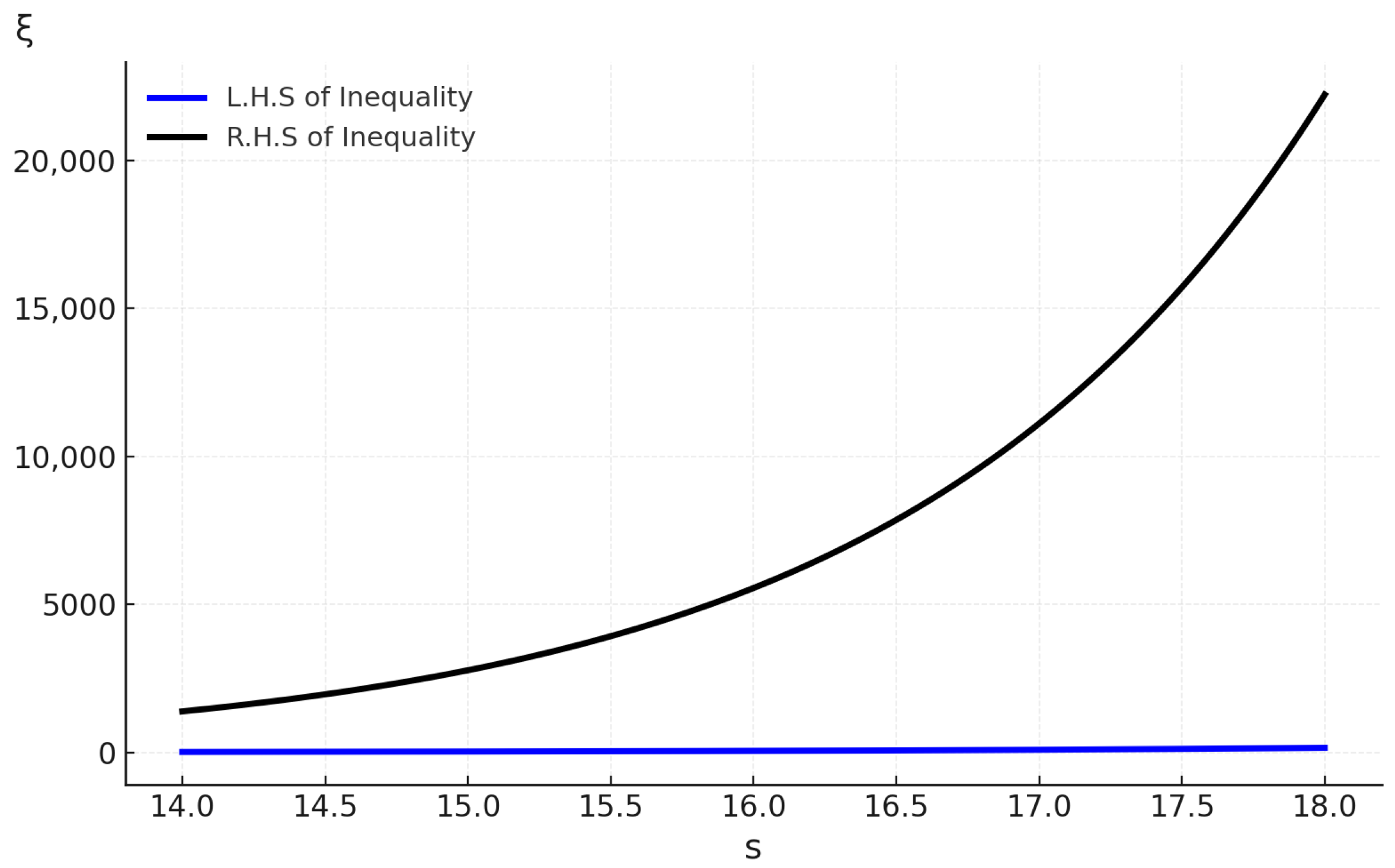
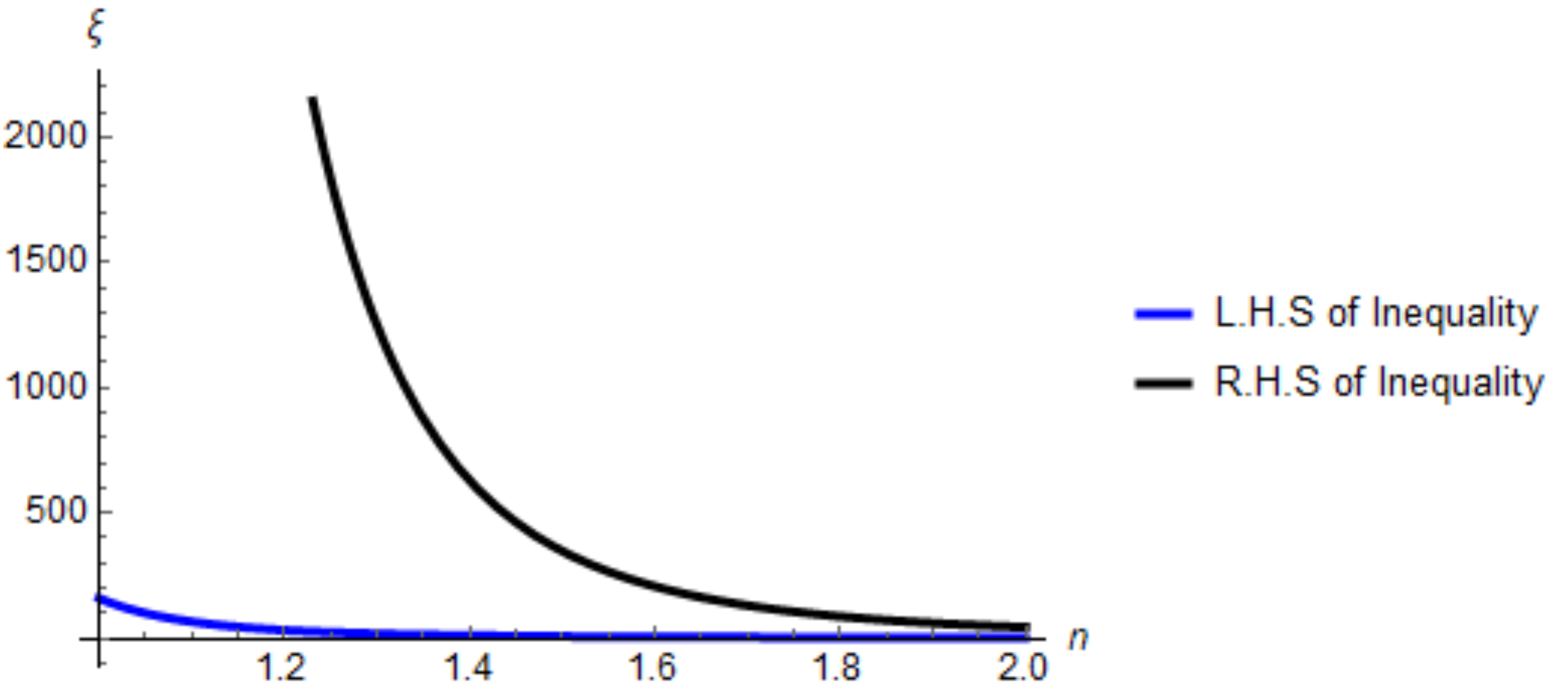
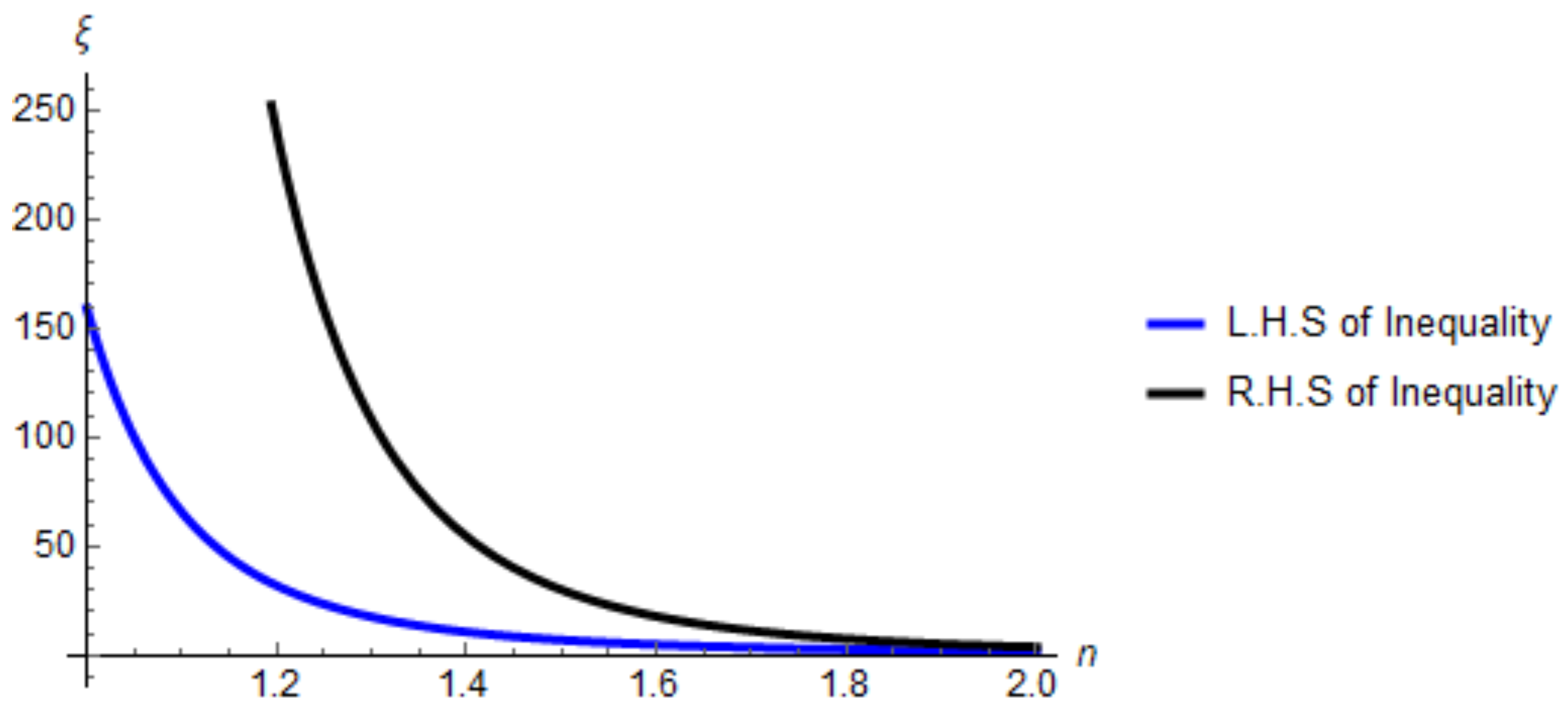
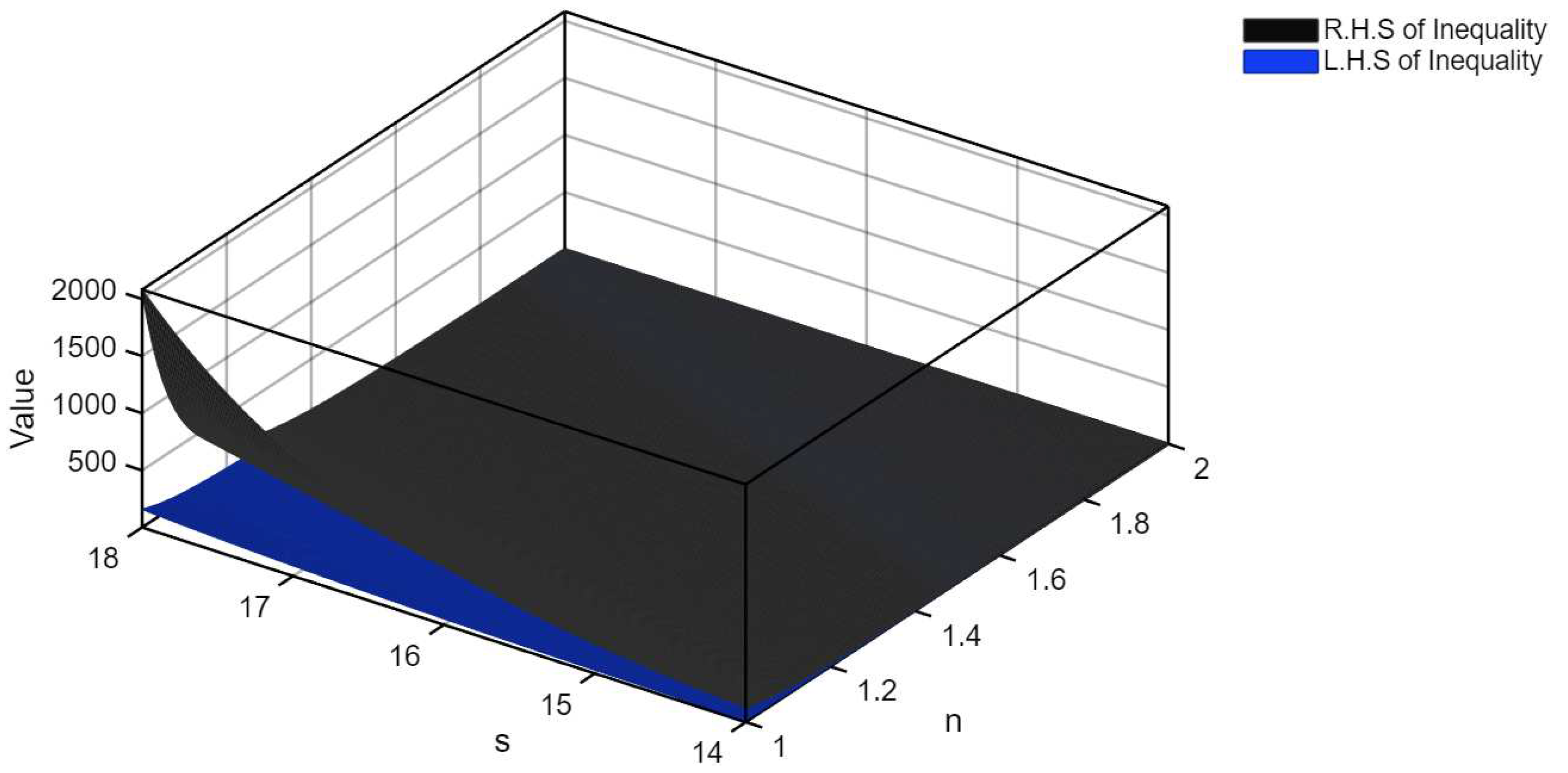
The left-hand side in Example 1 is consistently below the right-hand side.
Figure 1 illustrates the comparative behavior of the left-hand side and the right-hand side of the inequality (18).
Figure 2 illustrates the comparative behavior of the left-hand side and the right-hand side of the inequality (18).
Figure 3 illustrates the comparative behavior of the left-hand side and the right-hand side of the inequality (18).
Example 2.
Suppose that all the conditions of Corollary 4 are satisfied and consider the function ξ u = n 3 s + n s + 2 n s + 3 n u s n + 3 defined on R + with n 1 and s 1 , which is convex. Furthermore, ξ u = u s n , where n 1 and s 1 is also a convex function. By fixing the values Υ = 2 and Ψ = 1 2 , we proceed as follows:
n 3 3 s + n s + 2 n s + 3 n 2 1 2 s n + 3 + 2 s n + 4 5 4 s n + 3 2 n 4 3 s + n s + 2 n s + 3 n s + 4 n 2 s n + 4 1 2 s n + 4 9 16 5 192 1 2 5 192 1 2 s n 2 + 2 s n 2 1 2 .
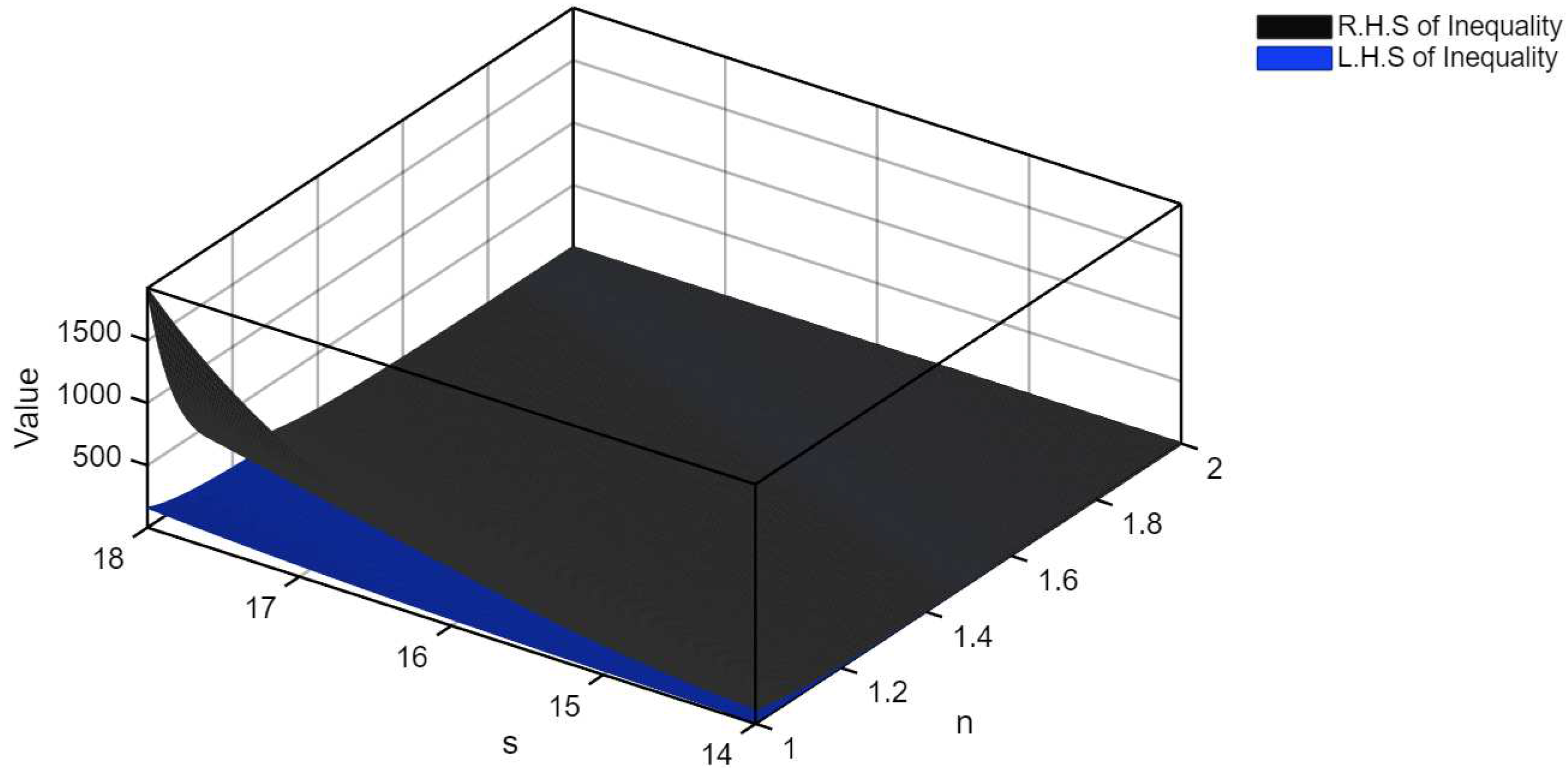
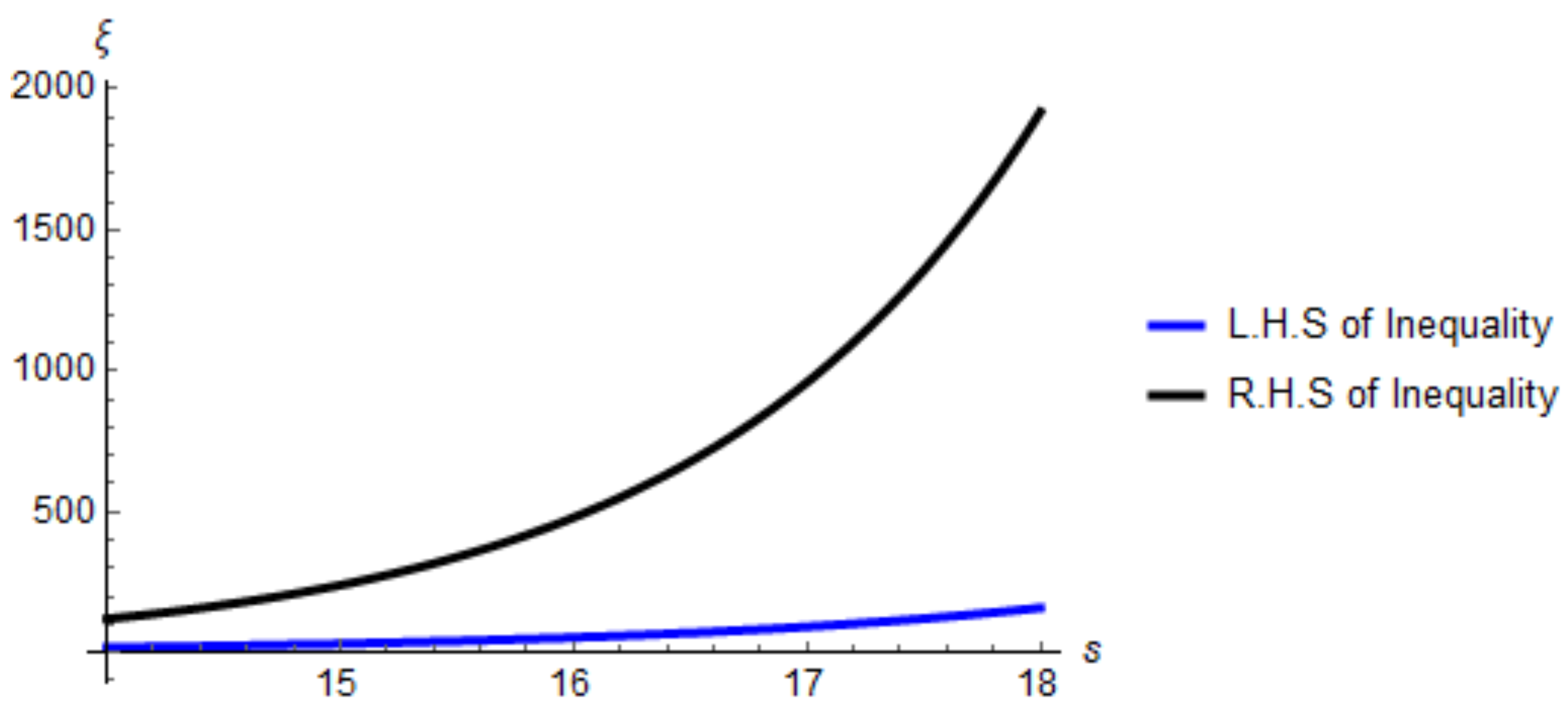
The left-hand side in Example 2 is consistently below the right-hand side.
Figure 4 illustrates the comparative behavior of the left-hand side and the right-hand side of the inequality (19).
Figure 5 illustrates the comparative behavior of the left-hand side and the right-hand side of the inequality (19).
Figure 6 illustrates the comparative behavior of the left-hand side and the right-hand side of the inequality (19).

6. Conclusions

The study of integral inequalities is fundamental to advancing mathematical analysis and its diverse applications. Recent investigations have focused on refining and extending classical results, such a the Milne-type inequality, through innovative approaches and methodologies. This work presents a novel identity involving specific functions and the Jensen–Mercer inequality, which is then applied to enhance error bounds for Milne-type inequalities within both the Jensen–Mercer and classical calculus frameworks. Utilizing the properties of s-convex functions and three-times-differentiable functions, we establish several upper bounds for Milne–Mercer-type inequalities. Moreover, we provide a new lemma using Caputo–Fabrizio fractional integral operators and applying it to derive several results of Milne–Mercer-type inequalities pertaining to ( α , m ) -convex functions. Furthermore, our findings are extended to various function classes, including bounded and L-Lipschitzian functions, with applications to special means, the q-digamma function, the modified Bessel function, and quadrature formulas. The practical significance of these results is demonstrated through graphical analysis. Additionally, the scope of this study can be broadened to encompass harmonic convexity, p-convexity, and ϕ -convexity. To the best of our knowledge, this work represents the first formulation of the Milne–Mercer-type inequality and aims to inspire further advancements in this area of research. In future research, we will explore these inequalities in the contexts of quantum and post-quantum calculus, time-scale calculus, and majorization theory.

Author Contributions

Conceptualization, A.M. and S.L.; funding acquisition, L.C.; investigation, A.M.; methodology, S.L. and H.B.; validation, H.B. and A.K.; visualization, A.K. and A.M.; writing—original draft, A.M. and S.L.; writing—review and editing, A.M., L.C. and A.K. All authors have read and agreed to the published version of the manuscript.

Funding

This research received no external funding.

Data Availability Statement

Data are contained within the article.

Conflicts of Interest

The authors declare no conflicts of interest.

References

  1. Butt, S.I.; Nosheen, A.; Nasir, J.; Khan, K.A.; Matendo Mabela, R. New fractional Mercer-Ostrowski type inequalities with respect to monotone function. Math. Probl. Eng. 2022, 2022, 7067543. [Google Scholar] [CrossRef]
  2. Yang, W. Certain new reverse Hölder-and Minkowski-type inequalities for modified unified generalized fractional integral operators with extended unified Mittag-Leffler functions. Fractal Fract. 2023, 7, 613. [Google Scholar] [CrossRef]
  3. Jensen, J.L.W.V. Om konvekse funktioner og uligheder imellem middelvaerdier. Nyt Tidsskr. Mat. 1905, 16, 49–68. [Google Scholar]
  4. Breckner, W.W. Stetigkeitsaussagen für eine Klasse verallgemeinerter konvexer Funktionen in topologischen linearen Räumen. Publ. Inst. Math. 1978, 23, 13–20. [Google Scholar]
  5. Hudzik, H.; Maligranda, L. Some remarks on s-convex functions. Aequationes Math. 1994, 48, 100–111. [Google Scholar] [CrossRef]
  6. Dragomir, S.S.; Fitzpatrick, S. The Jensen inequality for s-Breckner convex functions in linear spaces. Demonstr. Math. 2000, 33, 43–50. [Google Scholar] [CrossRef]
  7. Latif, M.; Nosheen, A.; Ali Khan, K.; Bisma Ammara, H.; Sene, N.; Hamed, Y.S. Novel inequalities involving exponentially (α,m)-convex function and fractional integrals. Appl. Math. Sci. Eng. 2024, 32, 2422993. [Google Scholar] [CrossRef]
  8. Caputo, M.; Fabrizio, M. A new definition of fractional derivative without singular kernel. Prog. Fract. Differ. Appl. 2015, 1, 73–85. [Google Scholar]
  9. Abdeljawad, T.; Baleanu, D. On fractional derivatives with exponential kernel and their discrete versions. Rep. Math. Phys. 2017, 80, 11–27. [Google Scholar] [CrossRef]
  10. Mercer, A.M. A variant of Jensen’s inequality. J. Inequal. Pure Appl. Math. 2003, 4, 73. [Google Scholar]
  11. Butt, S.I.; Nasir, J.; Qaisar, S.; Abualnaja, K.M. k-Fractional variants of Hermite-Mercer-type inequalities via s-convexity with applications. J. Funct. Spaces 2021, 2021, 5566360. [Google Scholar] [CrossRef]
  12. Moradi, H.R.; Furuichi, S. Improvement and generalization of some Jensen-Mercer-type inequalities. arXiv 2019, arXiv:1905.01768. [Google Scholar] [CrossRef]
  13. Adil Khan, M.; Husain, Z.; Chu, Y.M. New estimates for Csiszar divergence and Zipf-Mandelbrot entropy via Jensen-Mercer’s inequality. Complexity 2020, 2020, 8928691. [Google Scholar] [CrossRef]
  14. Tariq, M.; Ahmad, H.; Sahoo, S.K.; Kashuri, A.; Nofal, T.A.; Hsu, C.H. Inequalities of Simpson-Mercer-type including Atangana-Baleanu fractional operators and their applications. AIMS Math. 2022, 7, 15159–15181. [Google Scholar] [CrossRef]
  15. Kian, M.; Moslehian, M. Refinements of the operator Jensen-Mercer inequality. Electron. J. Linear Algebra 2013, 26, 742–753. [Google Scholar] [CrossRef]
  16. Sahoo, S.K.; Hamed, Y.S.; Mohammed, P.O.; Kodamasingh, B.; Nonlaopon, K. New midpoint type Hermite Hadamard-Mercer inequalities pertaining to Caputo-Fabrizio fractional operators. Alex. Eng. J. 2023, 65, 689–698. [Google Scholar] [CrossRef]
  17. Butt, S.I.; Yousaf, S.; Asghar, A.; Khan, K.A.; Moradi, H.R. New fractional Hermite-Hadamard-Mercer inequalities for harmonically convex function. J. Funct. Spaces 2021, 2021, 5868326. [Google Scholar] [CrossRef]
  18. Vivas-Cortez, M.; Awan, M.U.; Javed, M.Z.; Kashuri, A.; Noor, M.A.; Noor, K.I. Some new generalized k-fractional Hermite-Hadamard-Mercer type integral inequalities and their applications. AIMS Math. 2022, 7, 3203–3220. [Google Scholar] [CrossRef]
  19. Dragomir, S.S.; Agarwal, R. Two inequalities for differentiable mappings and applications to special means of real numbers and to trapezoidal formula. Appl. Math. Lett. 1998, 11, 91–95. [Google Scholar] [CrossRef]
  20. Cerone, P.; Dragomir, S.S. Trapezoidal-type rules from an inequalities point of view. In Handbook of Analytic Computational Methods in Applied Mathematics; Chapman and Hall/CRC: London, UK, 2019; pp. 65–134. [Google Scholar]
  21. Alomari, M.W. A Companion of the generalized trapezoid inequality and applications. J. Math. Appl. 2013, 36, 5–15. [Google Scholar]
  22. Dragomir, S.S. On the trapezoid quadrature formula and applications. Kragujevac J. Math. 2001, 23, 25–36. [Google Scholar]
  23. Sarikaya, M.Z.; Aktan, N. On the generalization of some integral inequalities and their applications. Math. Comput. Model. 2011, 54, 2175–2182. [Google Scholar] [CrossRef]
  24. Alqahtani, N.A.; Qaisar, S.; Munir, A.; Naeem, M.; Budak, H. Error bounds for fractional integral inequalities with applications. Fractal Fract. 2024, 8, 208. [Google Scholar] [CrossRef]
  25. Kirmaci, U.S. Inequalities for differentiable mappings and applications to special means of real numbers and to midpoint formula. Appl. Math. Comput. 2004, 147, 137–146. [Google Scholar] [CrossRef]
  26. Dragomir, S.S. On the midpoint quadrature formula for mappings with bounded variation and applications. Kragujevac J. Math. 2000, 22, 13–19. [Google Scholar]
  27. Sarikaya, M.Z.; Bozkurt, H.; Alp, N. On Hermite-Hadamard type integral inequalities for preinvex and log-preinvex functions. arXiv 2012, arXiv:1203.4759. [Google Scholar]
  28. Gorenflo, R.; Mainardi, F. Integral and Differential Equations of Fractional Order. In Fractals and Fractional Calculus in Continuum Mechanics; CISM International Centre for Mechanical Sciences; Springer: Vienna, Austria, 1997; pp. 223–276. [Google Scholar]
  29. Sarikaya, M.Z.; Yildirim, H. On Hermite-Hadamard type inequalities for Riemann-Liouville fractional integrals. Miskolc Math. Notes 2016, 17, 1049–1059. [Google Scholar] [CrossRef]
  30. Dragomir, S.S.; Agarwal, R.P.; Cerone, P. On Simpson’s inequality and applications. RGMIA Res. Rep. Collect. 1999, 2, 1–35. [Google Scholar] [CrossRef]
  31. Sarikaya, M.Z.; Set, E.; Ozdemir, M.E. On new inequalities of Simpson’s type for s-convex functions. Comput. Math. Appl. 2010, 60, 2191–2199. [Google Scholar] [CrossRef]
  32. Du, T.S.; Li, Y.; Yang, Z. A generalization of Simpson’s inequality via differentiable mapping using extended (s,m)-convex functions. Appl. Math. Comput. 2017, 293, 358–369. [Google Scholar] [CrossRef]
  33. Dragomir, S.S. On Simpson’s quadrature formula for mappings of bounded variation and applications. Tamkang J. Math. 1999, 30, 53–58. [Google Scholar] [CrossRef]
  34. Hussain, S.; Qaisar, S. More results on Simpson’s type inequality through convexity for twice differentiable continuous mappings. SpringerPlus 2016, 5, 1–9. [Google Scholar] [CrossRef] [PubMed]
  35. Sarikaya, M.Z.; Set, E.; Ozdemir, M.E. On new inequalities of Simpson’s type for functions whose second derivatives absolute values are convex. J. Appl. Math. Stat. Inform. 2013, 9, 37–45. [Google Scholar] [CrossRef]
  36. Demir, İ. A new approach of Milne-type inequalities based on proportional Caputo-Hybrid operator. J. Adv. Appl. Comput. Math. 2023, 10, 102–119. [Google Scholar] [CrossRef]
  37. Mateen, A.; Zhang, Z.; Ali, M.A. Some Milne’s rule type inequalities for convex functions with their computational analysis on quantum calculus. Filomat 2024, 38, 3329–3345. [Google Scholar] [CrossRef]
  38. Meftah, B.; Lakhdari, A.; Saleh, W.; Kiliçman, A. Some new fractal Milne-type integral inequalities via generalized convexity with applications. Fractal Fract. 2023, 7, 166. [Google Scholar] [CrossRef]
  39. Ying, R.; Lakhdari, A.; Xu, H.; Saleh, W.; Meftah, B. On conformable fractional Milne-type inequalities. Symmetry 2024, 16, 196. [Google Scholar] [CrossRef]
  40. Al-Sa’di, S.U.; Bibi, M.; Seol, Y.; Muddassar, M. Milne-type fractal integral inequalities for generalized m-convex mapping. Fractals 2023, 31, 2350081. [Google Scholar] [CrossRef]
  41. Román-Flores, H.; Ayala, V.; Flores-Franulič, A. Milne type inequality and interval orders. Comput. Appl. Math. 2021, 40, 130. [Google Scholar] [CrossRef]
  42. Djenaoui, M.; Meftah, B. Milne type inequalities for differentiable s-convex functions. Honam Math. J. 2022, 44, 325–338. [Google Scholar]
  43. Desta, H.D.; Budak, H.; Kara, H. New perspectives on fractional Milne-type inequalities: Insights from twice-differentiable functions. Univ. J. Math. Appl. 2024, 7, 30–37. [Google Scholar] [CrossRef]
  44. Pečarić, J.; Varošanec, S. A note on Simpson’s inequality for Lipschitzian functions. Soochow J. Math. 2001, 27, 53–57. [Google Scholar]
  45. Mitrinović, D.S.; Pečarić, J.E.; Fink, A.M. Classical and New Inequalities in Analysis; Kluwer Academic Publishers: Dordrecht, The Netherlands; Boston, MA, USA; London, UK, 1993. [Google Scholar]
  46. Benaissa, B.; Azzouz, N.; Budak, H. Parameterized inequalities based on three times differentiable functions. Bound. Value Probl. 2025, 2025, 45. [Google Scholar] [CrossRef]
  47. Alzer, H.; Salem, A. Functional inequalities for the q-digamma function. Acta. Math. Hung. 2022, 167, 561–575. [Google Scholar] [CrossRef]
  48. Alzer, H.; Grinshpan, A.Z. Inequalities for the gamma and q-gamma functions. J. Approx. Theory 2007, 144, 67–83. [Google Scholar] [CrossRef]
  49. Watson, G.N. A Treatise on the Theory of Bessel Functions; The University Press: Cambridge, MA, USA, 1922. [Google Scholar]
Figure 1. We illustrate inequality (18) by selecting n [ 1 , 2 ] and s [ 14 , 18 ] .
Fractalfract 09 00606 g001
Figure 2. We illustrate inequality (18) by selecting s [ 14 , 18 ] .
Fractalfract 09 00606 g002
Figure 3. We illustrate inequality (18) by selecting n [ 1 , 2 ] .
Fractalfract 09 00606 g003
Figure 4. We illustrate inequality (19) by selecting n [ 1 , 2 ] and s [ 14 , 18 ] .
Fractalfract 09 00606 g004
Figure 5. We illustrate inequality (19) by selecting s [ 14 , 18 ] .
Fractalfract 09 00606 g005
Figure 6. We illustrate inequality (19) by selecting n [ 1 , 2 ] .
Fractalfract 09 00606 g006
Disclaimer/Publisher’s Note: The statements, opinions and data contained in all publications are solely those of the individual author(s) and contributor(s) and not of MDPI and/or the editor(s). MDPI and/or the editor(s) disclaim responsibility for any injury to people or property resulting from any ideas, methods, instructions or products referred to in the content.