Article

A Comprehensive Analysis of Proportional Caputo-Hybrid Fractional Inequalities and Numerical Verification via Artificial Neural Networks


by
Ayed R. A. Alanzi
1,
Mariem Al-Hazmy
2,
Raouf Fakhfakh
1,*,
Wedad Saleh
2,
Abdellatif Ben Makhlouf
3,4 and
Abdelghani Lakhdari
5,6,7
1
Department of Mathematics, College of Science, Jouf University, P.O. Box 2014, Sakaka 72388, Saudi Arabia
2
Department of Mathematics, College of Science, Taibah University, Al-Madinah Al-Munawarah 42353, Saudi Arabia
3
Mathematics Education Section, Faculty of Education and Arts, Sohar University, P.O. Box 44, Sohar 311, Oman
4
Department of Mathematics, Faculty of Sciences of Sfax, Sfax University, Sfax 3029, Tunisia
5
Department CPST, National Higher School of Technology and Engineering, Annaba 23005, Algeria
6
Department of Mathematics, Faculty of Science and Arts, Kocaeli University, Kocaeli 41001, Türkiye
7
Department of Mathematics, Saveetha School of Engineering, SIMATS, Saveetha University, Chennai 602105, Tamil Nadu, India
*
Author to whom correspondence should be addressed.
Fractal Fract. 2026, 10(4), 247; https://doi.org/10.3390/fractalfract10040247
Submission received: 10 March 2026 / Revised: 2 April 2026 / Accepted: 5 April 2026 / Published: 8 April 2026
(This article belongs to the Special Issue Fractional Integral Inequalities and Applications, 3rd Edition)

Abstract

Accuracy in fractional numerical integration is often limited by the regularity of the integrand. This work proposes a flexible error estimation framework for proportional Caputo-hybrid integral operators based on s -convexity. We introduce a parametric Newton–Cotes formula ( ν [ 0 , 1 ] ) that bridges the gap between classical quadrature rules, recovering the fractional Trapezoidal, Midpoint, and Simpson’s methods as specific instances. In order to confirm the correctness of our results, we provide an illustrative example with graphical representations. Furthermore, we provide some additional results using Hölder’s and power mean inequalities and employ a verification strategy based on an Artificial Neural Networks (ANNs) model. The ANN approach allows for high-dimensional parameter space exploration, demonstrating that the proposed inequalities provide robust and precise error estimates.

1. Introduction

Numerical integration stands as an indispensable computational technique in applied mathematics and engineering, offering essential solutions for evaluating definite integrals when analytical primitives are unobtainable. The reliability of these approximations hinges on rigorous error quantification, a task predominantly addressed through integral inequalities. Accurate error bounds in fractional integration are essential for complex mechanical systems, such as enhancing the path-tracking performance of autonomous vehicles utilizing non-linear fractional-order controllers [1]. Furthermore, integral inequalities are extensively used to establish the stability of coupled systems, thereby giving derived bounds practical applications in control theory, such as the semi-global stabilization of PDE-ODE systems [2]. For decades, the theory of convexity has served as the theoretical cornerstone of this field [3]. Classically, convexity is defined by the geometric condition that the function’s epigraph forms a convex set, implying that the graph lies beneath the chord connecting any two points. This property underpins fundamental results such as the Hermite–Hadamard inequality, which bounds the integral mean by the arithmetic mean of the endpoints.
Nevertheless, the intricate nature of modern non-linear analysis, encompassing fields from economic modeling to porous media dynamics, often defies the stringent constraints of classical convexity. To characterize systems exhibiting such non-standard behaviors, Breckner [4] introduced the generalized concept of s -convexity in the second sense. This framework offers superior flexibility, extending the applicability of integral inequalities to modular spaces and complex functional classes where the standard triangular inequality may not strictly apply. A function V : I [ 0 , ) R is said to be s -convex in the second sense for some fixed s ( 0 , 1 ] , if
V ( l z 1 + ( 1 l ) z 2 ) l s V ( z 1 ) + ( 1 l ) s V ( z 2 ) ,
for all z 1 , z 2 I and l [ 0 , 1 ] . This class naturally subsumes ordinary convexity when s = 1 , making it a vital tool for generalizing error estimates.
Concurrently, the field of fractional calculus has emerged as a robust mathematical language for describing phenomena with memory effects and non-local properties. Unlike classical derivatives, which are local operators, fractional operators accumulate information over an interval, making them ideal for modeling viscoelasticity, electrical circuits, and biological processes. While the Riemann–Liouville and Caputo operators [5,6] are the most widely used, recent research has focused on generalized proportional fractional operators [7,8,9,10,11]. Baleanu et al. [12] pioneered this direction by introducing a hybrid operator that blends the proportional derivative with the Riemann–Liouville integral.
Definition 1
([12]). Let V L 1 ( a , b ) (Space of Lebesgue integrable functions). The proportional Caputo-hybrid operator of order γ [ 0 , 1 ] is defined by:
D ϑ γ 0 C V ( ϑ ) = 1 Γ ( 1 γ ) 0 ϑ K 1 ( γ , z ) V ( z ) + K 0 ( γ , z ) V ( z ) ( ϑ z ) γ d z ,
where the kernels K 0 and K 1 satisfy the following limit conditions as γ 0 + and γ 1 :
lim γ 0 + K 0 ( γ , z ) = 0 ; lim γ 1 K 0 ( γ , z ) = 1 ; w i t h K 0 ( γ , z ) 0 ,
and
lim γ 0 + K 1 ( γ , z ) = 0 ; lim γ 1 K 1 ( γ , z ) = 0 ; w i t h K 1 ( γ , z ) 0 .
Remark 1
([12]). If we consider the limiting cases as the parameter γ approaches 0 and 1, the fractional operator naturally reduces to the classical integral and the first-order derivative, respectively. Specifically, we have:
lim γ 0 D ϑ γ 0 C V ( ϑ ) = 0 ϑ V ( z ) d z , lim γ 1 D ϑ γ 0 C V ( ϑ ) = V ( ϑ ) .
Building upon this foundation, Sarikaya [13] formalized the left and right proportional Caputo-hybrid operators for a specific choice of kernels, explicitly defined as:
Definition 2
([13]). For γ ( 0 , 1 ) , the left-sided and right-sided proportional Caputo-hybrid operators are given respectively by:
D e + γ C V f = 1 Γ 1 γ e f K 1 γ , f z V z + K 0 γ , f z V z f z γ d z ,
and
D f γ C V e = 1 Γ 1 γ e f K 1 γ , z e V z + K 0 γ , z e V z z e γ d z ,
where K 0 γ , z = ( 1 γ ) 2 z 1 γ and K 1 γ , z = γ 2 z γ .
In the asymptotic limit as γ 1 , the singular components converge towards the Dirac delta distributions δ ( f z ) and δ ( z e ) , thereby functioning as an approximation of the identity. This behavior, in conjunction with the vanishing of the kernel K 1 , directly recovers the exact values of the first derivatives V ( f ) and V ( e ) from the integral representation.
The literature concerning these specific operators has grown rapidly. Sarikaya [13] established the trapezium-type inequalities, proving that for twice differentiable functions where | V | and | V | are convex:
| γ 2 ( f e ) γ V ( e ) + V ( f ) 2 + ( 1 γ ) ( f e ) γ 2 4 V ( e ) + V ( f ) Γ ( 1 γ ) 2 ( f e ) 1 γ D e + γ C V ( e ) + D f γ C V ( f ) | γ 2 ( f e ) 1 + γ 8 | V ( e ) | + | V ( f ) | + ( 1 γ ) ( f e ) 2 γ ( 3 2 γ ) 2 1 1 2 3 2 γ | V ( e ) | + | V ( f ) | .
Later, the same author [14] focused on the Simpson’s inequality within the same operator framework. By assuming similar convexity conditions on the derivatives, they established the subsequent estimate:
| γ 2 ( f e ) γ 6 V ( e ) + 4 V e + f 2 + V ( f ) + ( 1 γ ) ( f e ) γ 2 12 V ( e ) + 4 V e + f 2 + V ( f ) Γ ( 1 γ ) 2 ( f e ) 1 γ D e + γ C V ( e ) + D f γ C V ( f ) | 5 γ 2 ( f e ) 1 + γ 36 | V ( e ) | + | V ( f ) | 2 + W ( γ ) | V ( e ) | + | V ( f ) | ,
where the coefficient W ( γ ) is defined as:
W ( γ ) = ( 1 γ ) ( f e ) γ 2 4 1 6 3 2 γ 2 2 γ + 5 6 3 2 γ 2 2 γ 4 4 γ 3 2 γ 11 12 + 1 3 2 γ 1 + 1 2 3 2 γ .
Beyond these specific quadrature rules, the literature has been enriched by Demir [15,16], who derived Milne-type inequalities for various classes of functions. Furthermore, Demir and Tunç [17] expanded the scope of Newton-type inequalities utilizing the same proportional Caputo-hybrid operators.
In recent years, Artificial Neural Networks (ANNs) have emerged as a powerful paradigm for modeling complex non-linear relationships across various scientific domains. Unlike traditional deterministic methods, ANNs are particularly effective at handling high-dimensional data where the interplay between multiple independent variables becomes difficult to visualize or analyze using classical techniques. By leveraging their ability to function as universal approximators, these networks can map intricate parameter spaces with high precision [18,19]. In the context of mathematical inequalities involving multiple fractional parameters, ANNs provide a sophisticated computational framework to explore regions of stability and consistency that are otherwise inaccessible through standard two-dimensional or three-dimensional plotting.
Motivated by the aforementioned developments, the primary objective of this paper is to introduce a comprehensive, parametrized Newton–Cotes-type framework. While this formulation elegantly unifies various existing approaches, its contribution goes significantly beyond mere unification by providing a clearly demonstrated theoretical advance. Specifically, we establish a new family of error bounds for midpoint, trapezium, Bullen, and Simpson-type inequalities for proportional Caputo-hybrid operators under the assumption of s -convexity. It is worth emphasizing that all these s -convexity results are entirely novel to the literature. Furthermore, when our generalized framework is reduced to the classical case of standard convexity ( s = 1 ), it yields not only completely new midpoint and Bullen-type inequalities, but also generates novel, alternative versions of the trapezium and Simpson-type inequalities different from the classical results previously established in [13,14], thereby enriching the existing mathematical literature with new, flexible analytical tools.
The structural organization of this paper is designed as follows: Section 2 constitutes the core of our study and is divided into three interconnected parts. We begin by establishing a novel auxiliary identity for twice-differentiable functions involving proportional Caputo-hybrid operators. Based on this lemma, we derive the fundamental parametrized inequality and deduce several relevant special cases. Subsequently, we corroborate the validity of these theoretical results through a numerical example accompanied by graphical representations. In Section 3, we extend our analysis by providing additional error estimates derived via Hölder’s inequality as well as a result for the Lipschitz condition. A numerical verification via Artificial Neural Networks is provided in Section 4. Section 5 demonstrates the practical utility of our findings through applications to special means. Finally, Section 6 concludes the paper with a summary of our contributions.

2. Primary Outcomes

This section constitutes the core of our study, where we establish the theoretical foundations necessary to derive generalized Newton–Cotes-type error bounds.

2.1. An Auxiliary Parametrized Identity

To facilitate the derivation of our main results, we first establish the following integral identity involving proportional Caputo-hybrid operators, which acts as the cornerstone for the subsequent inequalities.
Lemma 1.
Let V : I R be a twice differentiable function on I (the interior of I), where e , f I satisfying 0 < e < f , let V L 1 e , f and V and V are absolutely continuous on e , f (i.e., V , V A C e , f ). Then, the following equality
γ 2 f e γ 1 T e , f , V , ν + 1 γ 2 f e γ 1 T e , f , V , ν Γ 1 γ 2 f e 1 γ D f γ C V e + D e + γ C V f = γ 2 f e 1 + γ 1 2 0 l ν 2 V 1 l e + l f V l e + 1 l f d l + 1 γ f e 2 γ 4 1 0 G ( l , γ , ν ) V 1 l e + l f V l e + 1 l f d l ,
holds, where 0 ν 1 , and
T e , f , V , ν = ν 2 V e + V ( f ) + 1 ν V e + f 2
and
G ( l , γ , ν ) = l 2 2 γ ν 2 i f 0 l < 1 2 , l 2 2 γ 2 ν 2 i f 1 2 l 1 .
Proof. 
Let
I 1 = 1 2 0 l ν 2 V 1 l e + l f V l e + 1 l f d l ,
I 2 = 1 2 0 l 2 2 γ ν 2 V 1 l e + l f V l e + 1 l f d l ,
and
I 3 = 1 1 2 l 2 2 γ 2 ν 2 V 1 l e + l f V l e + 1 l f d l .
Using the integration by parts, I 1 gives
I 1 = 1 f e l ν 2 V 1 l e + l f + V l e + 1 l f 0 1 2 1 f e 1 2 0 V 1 l e + l f + V l e + 1 l f d l = 1 f e 1 ν V e + f 2 + ν 2 ( f e ) V e + V f 1 f e 1 2 0 V 1 l e + l f + V l e + 1 l f d l .
Similarly, we obtain
I 2 = 1 f e l 2 2 γ ν 2 V 1 l e + l f + V l e + 1 l f 0 1 2 2 2 γ f e 1 2 0 l 1 2 γ V 1 l e + l f + V l e + 1 l f d l = 2 f e 1 2 2 2 γ ν 2 V e + f 2 + ν 2 ( f e ) V e + V f 2 2 γ f e 1 2 0 l 1 2 γ V 1 l e + l f + V l e + 1 l f d l ,
and
I 3 = 1 f e l 2 2 γ 2 ν 2 V 1 l e + l f + V l e + 1 l f 1 2 1 1 f e 1 1 2 l 1 2 γ V 1 l e + l f + V l e + 1 l f d l = ν 2 ( f e ) V e + V f 2 f e 1 2 2 2 γ 2 ν 2 V e + f 2 2 2 γ f e 1 1 2 l 1 2 γ V 1 l e + l f + V l e + 1 l f d l .
Summing (2) and (3), we obtain
I 2 + I 3 = 2 f e ν 2 V e + 1 ν V e + f 2 + ν 2 V f 2 2 γ f e 1 0 l 1 2 γ V 1 l e + l f d l + 1 0 l 1 2 γ V l e + 1 l f d l .
By performing the change of variable ( z = 1 l e + l f ) for the first integral in (4), and ( z = l e + 1 l f ) for the second one, it yields
I 2 + I 3 = 2 f e ν 2 V e + 1 ν V e + f 2 + ν 2 V f 2 2 γ f e 3 2 γ f e z e 1 2 γ V z d z + f e f z 1 2 γ V z d z .
Multiplying (1) by γ 2 f e 1 + γ and (5) by 1 γ f e 2 γ 4 , then summing the resulting equalities, we obtain
γ 2 f e 1 + γ I 1 + 1 γ 4 f e γ 2 I 2 + I 3 = γ 2 f e γ ν 2 V e + 1 ν V e + f 2 + ν 2 V f + 1 γ f e 1 γ 2 ν 2 V e + 1 ν V e + f 2 + ν 2 V f γ 2 f e 1 γ f e V z d z 1 γ 2 2 f e 1 γ f e z e 1 2 γ V z d z + f e f z 1 2 γ V z d z = γ 2 f e γ ν 2 V e + 1 ν V e + f 2 + ν 2 V f + 1 γ 2 f e γ 1 ν 2 V e + 1 ν V e + f 2 + ν 2 V f 1 2 f e 1 γ f e 1 γ 2 z e 1 γ V z + γ 2 z e γ V z z e γ d z + f e 1 γ 2 f z 1 γ V u + γ 2 f l γ V z f z γ d z = γ 2 f e γ ν 2 V e + 1 ν V e + f 2 + ν 2 V f + 1 γ 2 f e γ 1 ν 2 V e + 1 ν V e + f 2 + ν 2 V f Γ 1 γ 2 f e 1 γ D f γ C V e + D e + γ C V f ,
which is the desired result. □

2.2. Parametrized Inequality via s -Convexity

With the auxiliary identity established in Lemma 1 at hand, we now proceed to derive the primary error estimate for the generalized Newton–Cotes-type quadrature rule, assuming the s -convexity of the first and second-order derivative.
Theorem 1.
Under the assumptions of Lemma 1. If V and V are s -convex on e , f , then the following inequality holds:
γ 2 f e γ 1 T e , f , V , ν + 1 γ 2 f e γ 1 T e , f , V , ν Γ 1 γ 2 f e 1 γ D f γ C V e + D e + γ C V f γ 2 f e 1 + γ ν s + 2 + 2 ν s + 2 + 2 s s + 2 ν 1 2 s + 1 2 s + 1 s + 1 s + 2 V e + V f + 1 γ f e 2 γ 4 Λ 1 γ , ν , s + Λ 2 γ , ν , s + Λ 3 γ , ν , s + Λ 4 γ , ν , s V e + V f ,
where 0 ν , γ 1 , and Λ 1 , Λ 2 , Λ 3 and Λ 4 are defined as in (8)–(11), respectively.
Proof. 
From Lemma 1, absolute value and s -convexity of V and V , we have
γ 2 f e γ 1 T e , f , V , ν + 1 γ 2 f e γ 1 T e , f , V , ν Γ 1 γ 2 f e 1 γ D f γ C V e + D e + γ C V f γ 2 f e 1 + γ 1 2 0 l ν 2 V 1 l e + l f + V l e + 1 l f d l + 1 γ f e 2 γ 4 1 2 0 l 2 2 γ ν 2 V 1 l e + l f + V l e + 1 l f d l + 1 1 2 l 2 2 γ 2 ν 2 V 1 l e + l f + V l e + 1 l f d l γ 2 f e 1 + γ 1 2 0 l ν 2 1 l s + l s V e + V f d l + 1 γ f e 2 γ 4 1 2 0 l 2 2 γ ν 2 1 l s + l s V e + V f d l + 1 1 2 l 2 2 γ 2 ν 2 1 l s + l s V e + V f d l = γ 2 f e 1 + γ 2 2 ν s + 2 + 2 s + 1 + 1 ν s + 2 s 3 2 s + 2 2 s + 2 s + 1 s + 2 + 2 ν s + 2 ν s + 2 + s + 1 2 s + 2 s + 1 s + 2 V e + V f + 1 γ f e 2 γ 4 Λ 1 γ , ν , s + Λ 2 γ , ν , s + Λ 3 γ , ν , s + Λ 4 γ , ν , s V e + V f ,
where we have used
Ω 1 ν , s = 1 2 0 l ν 2 1 l s d l = 2 2 ν s + 2 + 1 + 2 s + 1 s + 2 ν s + 3 + 2 s + 2 2 s + 2 s + 1 s + 2 ,
Ω 2 ν , s = 1 2 0 l ν 2 l s d l = 2 ν s + 2 s + 2 ν + s + 1 2 s + 2 s + 1 s + 2 ,
Λ 1 γ , ν , s = 1 2 0 l 2 2 γ ν 2 1 l s d l = ν 2 1 2 2 γ 0 ν 2 l 2 2 γ 1 l s d l + 1 2 ν 2 1 2 2 γ l 2 2 γ ν 2 1 l s d l if ν 2 1 2 2 γ 1 2 , 1 2 0 ν 2 l 2 2 γ 1 l s d l if 1 2 < ν 2 1 2 2 γ , = 1 + 2 s + 1 2 s + 2 s + 1 ν ν s + 1 1 ν 2 1 2 2 γ s + 1 + B 1 2 3 2 γ , s + 1 2 B ν 2 1 2 2 γ 3 2 γ , s + 1 if ν 2 1 2 2 γ 1 2 , 2 s + 1 1 2 s + 2 s + 1 ν B 1 2 3 2 γ , s + 1 if 1 2 < ν 2 1 2 2 γ ,
Λ 2 γ , ν , s = 1 2 0 l 2 2 γ ν 2 l s d l = ν 2 1 2 2 γ 0 ν 2 l 2 2 γ l s d l + 1 2 ν 2 1 2 2 γ l 2 2 γ ν 2 l s d l if ν 2 1 2 2 γ 1 2 , 1 2 0 ν 2 l 2 2 γ l s d l if 1 2 < ν 2 1 2 2 γ , = ν s + 1 ν 2 s + 1 2 2 γ 2 3 2 γ + s ν 2 3 2 γ + s 2 2 γ 2 1 2 γ ν 3 2 γ + s s + 1 2 3 2 γ + s 3 2 γ + s s + 1 if ν 2 1 2 2 γ 1 2 , 2 1 2 γ ν 3 2 γ + s s + 1 2 3 2 γ + s 3 2 γ + s s + 1 if 1 2 < ν 2 1 2 2 γ ,
Λ 3 γ , ν , s = 1 1 2 l 2 2 γ 2 ν 2 1 l s d l = 1 1 2 l 2 2 γ 2 ν 2 1 l s d l if 2 ν 2 1 2 2 γ < 1 2 , 2 ν 2 1 2 2 γ 1 2 2 ν 2 l 2 2 γ 1 l s d l + 1 2 ν 2 1 2 2 γ l 2 2 γ 2 ν 2 1 l s d l if 1 2 2 ν 2 1 2 2 γ , = B 3 2 γ , s + 1 B 1 2 3 2 γ , s + 1 2 ν 2 s + 2 s + 1 if 2 ν 2 1 2 2 γ < 1 2 , 2 ν 2 s + 2 s + 1 2 ν s + 1 1 2 ν 2 1 2 2 γ s + 1 + B 3 2 γ , s + 1 2 B 2 ν 2 1 2 2 γ 3 2 γ , s + 1 + B 1 2 3 2 γ , s + 1 if 1 2 2 ν 2 1 2 2 γ ,
and
Λ 4 γ , ν , s = 1 1 2 l 2 2 γ 2 ν 2 l s d l = 1 1 2 l 2 2 γ 2 ν 2 1 l s d l if 2 ν 2 1 2 2 γ < 1 2 , 2 ν 2 1 2 2 γ 1 2 2 ν 2 l 2 2 γ l s d l + 1 2 ν 2 1 2 2 γ l 2 2 γ 2 ν 2 l s d l if 1 2 2 ν 2 1 2 2 γ , = 2 3 2 γ + s 1 2 3 2 γ + s 3 2 γ + s 2 s + 1 1 2 ν 2 s + 2 s + 1 if 0 < 1 ν 2 1 2 2 γ < 1 2 , 4 4 γ s + 1 3 2 γ + s 2 ν 2 3 2 γ + s 2 2 γ 1 + 2 s + 1 2 ν 2 s + 2 s + 1 + 1 + 2 3 2 γ + s 2 3 2 γ + s 3 2 γ + s if 1 2 2 ν 2 1 2 2 γ .
The proof is completed. □
Remark 2.
In practical numerical analysis, the choice of the optimal parameter ν should be driven by the regularity of the integrand. A heuristic optimization strategy involves selecting ν to minimize the global error bound coefficients, for example, by minimizing the sum of the parametrized constants Λ i ( γ , ν , s ) with respect to ν. If analytical minimization is intractable, a simple grid-based numerical pre-evaluation of these coefficients can objectively determine the optimal ν for a specific class of integrands.
Corollary 1.
For ν = 0 , Theorem 1 yields the following midpoint-type inequality for functions whose first-order and second-order derivatives in absolute value are s -convex
γ 2 f e γ 1 V e + f 2 + 1 γ 2 f e γ 1 V e + f 2 Γ 1 γ 2 f e 1 γ D f γ C V e + D e + γ C V f γ 2 f e 1 + γ 2 s + 1 1 2 s + 1 s + 1 s + 2 V e + V f + 1 γ f e 2 γ 4 Λ 1 γ , 0 , s + Λ 2 γ , 0 , s + Λ 3 γ , 0 , s + Λ 4 γ , 0 , s V e + V f ,
where
Λ 1 γ , 0 , s = B 1 2 3 2 γ , s + 1 , Λ 2 γ , 0 , s = 1 2 3 2 γ + s 3 2 γ + s , Λ 3 γ , 0 , s = 1 2 s + 1 s + 1 B 3 2 γ , s + 1 + B 1 2 3 2 γ , s + 1 , Λ 4 γ , 0 , s = 2 s + 1 1 2 s + 1 s + 1 2 3 2 γ + s 1 2 3 2 γ + s 3 2 γ + s .
Corollary 2.
For ν = 1 3 , Theorem 1 yields the following Simpson-type inequality for functions whose first-order and second-order derivatives in absolute value are s -convex
γ 2 f e γ 1 V e + V ( f ) 6 + 2 3 V e + f 2 + 1 γ 2 f e γ 1 V e + V ( f ) 6 + 2 3 V e + f 2 Γ 1 γ 2 f e 1 γ D f γ C V e + D e + γ C V f γ 2 f e 1 + γ 1 3 s + 2 + 5 3 s + 2 + 2 s 3 s + 2 1 2 s + 1 2 s + 1 s + 1 s + 2 V e + V f + 1 γ f e 2 γ 4 Λ 1 γ , 1 3 , s + Λ 2 γ , 1 3 , s + Λ 3 γ , 1 3 , s + Λ 4 γ , 1 3 , s × V e + V f ,
where
Λ 1 = 1 + 2 s + 1 3 · 2 s + 2 s + 1 1 1 / 6 1 2 2 γ s + 1 3 ( s + 1 ) + B 1 2 ( 3 2 γ , s + 1 ) 2 B 1 / 6 1 2 2 γ ( 3 2 γ , s + 1 ) , Λ 2 = 1 / 6 s + 1 2 2 γ 3 ( s + 1 ) 2 1 / 6 3 2 γ + s 2 2 γ 3 2 γ + s 2 1 2 γ 3 2 γ + s s + 1 3 · 2 3 2 γ + s 3 2 γ + s s + 1 , Λ 3 = 5 3 · 2 s + 2 s + 1 5 1 5 / 6 1 2 2 γ s + 1 3 ( s + 1 ) + B ( 3 2 γ , s + 1 ) 2 B 5 / 6 1 2 2 γ ( 3 2 γ , s + 1 ) + B 1 2 ( 3 2 γ , s + 1 ) i f 5 6 1 2 2 γ 1 2 , B ( 3 2 γ , s + 1 ) B 1 2 ( 3 2 γ , s + 1 ) 5 3 · 2 s + 2 s + 1 i f 5 6 1 2 2 γ < 1 2 , Λ 4 = 4 4 γ s + 1 3 2 γ + s 5 6 3 2 γ + s 2 2 γ 5 ( 1 + 2 s + 1 ) 3 · 2 s + 2 s + 1 + 1 + 2 3 2 γ + s 2 3 2 γ + s 3 2 γ + s i f 5 6 1 2 2 γ 1 2 , 2 3 2 γ + s 1 2 3 2 γ + s 3 2 γ + s 5 ( 2 s + 1 1 ) 3 · 2 s + 2 s + 1 i f 5 6 1 2 2 γ < 1 2 ,
Corollary 3.
For ν = 1 2 , Theorem 1 yields the following Bullen-type inequality for functions whose first-order and second-order derivatives in absolute value are s -convex
γ 2 f e γ 1 V e + V ( f ) 4 + 1 2 V e + f 2 + 1 γ 2 f e γ 1 V e + V ( f ) 4 + 1 2 V e + f 2 Γ 1 γ 2 f e 1 γ D f γ C V e + D e + γ C V f γ 2 f e 1 + γ 1 2 s + 2 + 3 2 s + 2 + 2 s 1 s + 2 1 2 s + 1 2 s + 1 s + 1 s + 2 V e + V f + 1 γ f e 2 γ 4 Λ 1 γ , 1 2 , s + Λ 2 γ , 1 2 , s + Λ 3 γ , 1 2 , s + Λ 4 γ , 1 2 , s × V e + V f ,
where
Λ 1 = 1 + 2 s + 1 2 s + 3 s + 1 1 1 / 4 1 2 2 γ s + 1 2 ( s + 1 ) + B 1 2 ( 3 2 γ , s + 1 ) 2 B 1 / 4 1 2 2 γ ( 3 2 γ , s + 1 ) , Λ 2 = 1 / 4 s + 1 2 2 γ 2 ( s + 1 ) 2 1 / 4 3 2 γ + s 2 2 γ 3 2 γ + s 2 2 γ 3 2 γ + s s + 1 2 3 2 γ + s 3 2 γ + s s + 1 , Λ 3 = 3 2 s + 3 s + 1 3 1 3 / 4 1 2 2 γ s + 1 2 ( s + 1 ) + B ( 3 2 γ , s + 1 ) 2 B 3 / 4 1 2 2 γ ( 3 2 γ , s + 1 ) + B 1 2 ( 3 2 γ , s + 1 ) i f 3 4 1 2 2 γ 1 2 , B ( 3 2 γ , s + 1 ) B 1 2 ( 3 2 γ , s + 1 ) 3 2 s + 3 s + 1 i f 3 4 1 2 2 γ < 1 2 , Λ 4 = 4 4 γ s + 1 3 2 γ + s 3 4 3 2 γ + s 2 2 γ 3 ( 1 + 2 s + 1 ) 2 s + 3 s + 1 + 1 + 2 3 2 γ + s 2 3 2 γ + s 3 2 γ + s i f 3 4 1 2 2 γ 1 2 , 2 3 2 γ + s 1 2 3 2 γ + s 3 2 γ + s 3 ( 2 s + 1 1 ) 2 s + 3 s + 1 i f 3 4 1 2 2 γ < 1 2 ,
Corollary 4.
For ν = 1 , Theorem 1 yields the following trapezium-type inequality for functions whose first-order and second-order derivatives in absolute value are s -convex
γ 2 f e γ 1 V e + V ( f ) 2 + 1 γ 2 f e γ 1 V e + V ( f ) 2 Γ 1 γ 2 f e 1 γ D f γ C V e + D e + γ C V f γ 2 f e 1 + γ s 2 s + 1 2 s + 1 s + 1 s + 2 V e + V f + 1 γ f e 2 γ 4 Λ 1 γ , 1 , s + Λ 2 γ , 1 , s + Λ 3 γ , 1 , s + Λ 4 γ , 1 , s V e + V f ,
where
Λ 1 = 1 + 2 s + 1 2 s + 2 s + 1 1 1 / 2 1 2 2 γ s + 1 s + 1 + B 1 2 ( 3 2 γ , s + 1 ) 2 B 1 / 2 1 2 2 γ ( 3 2 γ , s + 1 ) i f γ 1 2 , 2 s + 1 1 2 s + 2 s + 1 B 1 2 ( 3 2 γ , s + 1 ) i f γ < 1 2 , Λ 2 = 1 / 2 s + 1 2 2 γ s + 1 2 1 / 2 3 2 γ + s 2 2 γ 3 2 γ + s 2 1 2 γ 3 2 γ + s s + 1 2 3 2 γ + s 3 2 γ + s s + 1 i f γ 1 2 , 2 1 2 γ 3 2 γ + s s + 1 2 3 2 γ + s 3 2 γ + s s + 1 i f γ < 1 2 , Λ 3 = 1 2 s + 2 s + 1 1 1 / 2 1 2 2 γ s + 1 s + 1 + B ( 3 2 γ , s + 1 ) 2 B 1 / 2 1 2 2 γ ( 3 2 γ , s + 1 ) + B 1 2 ( 3 2 γ , s + 1 ) i f γ 1 2 , B ( 3 2 γ , s + 1 ) B 1 2 ( 3 2 γ , s + 1 ) 1 2 s + 2 s + 1 i f γ < 1 2 , Λ 4 = 4 4 γ s + 1 3 2 γ + s 1 2 3 2 γ + s 2 2 γ 1 + 2 s + 1 2 s + 2 s + 1 + 1 + 2 3 2 γ + s 2 3 2 γ + s 3 2 γ + s i f γ 1 2 , 2 3 2 γ + s 1 2 3 2 γ + s 3 2 γ + s 2 s + 1 1 2 s + 2 s + 1 i f γ < 1 2 ,
Corollary 5.
In Theorem 1, if we take s = 1 , then we obtain the following parametrized inequality for functions whose first-order and second-order derivatives in absolute value are convex
γ 2 f e γ 1 T e , f , V , ν + 1 γ 2 f e γ 1 T e , f , V , ν Γ 1 γ 2 f e 1 γ D f γ C V e + D e + γ C V f γ 2 f e 1 + γ 8 2 ν 2 2 ν + 1 V e + V f + 1 γ f e 2 γ 4 L 1 γ , ν + L 2 γ , ν V e + V f ,
where
L 1 γ , ν = 4 4 γ 3 2 γ ν 2 3 2 γ 2 2 γ + 1 2 3 2 γ 3 2 γ ν 4 i f ν 2 1 2 2 γ 1 2 , ν 4 1 2 3 2 γ 3 2 γ i f 1 2 < ν 2 1 2 2 γ 1 ,
and
L 2 γ , ν = 2 3 2 γ 1 2 3 2 γ 3 2 γ 2 ν 4 i f 2 ν 2 1 2 2 γ < 1 2 , 4 4 γ 3 2 γ 2 ν 2 3 2 γ 2 2 γ + 1 + 2 3 2 γ 2 3 2 γ 3 2 γ 6 3 ν 4 i f 1 2 2 ν 2 1 2 2 γ .
Corollary 6.
By choosing specific values of the parameter ν in Corollary 7, the following fractional integral inequalities for functions whose first-order and second-order derivatives in absolute value are convex hold:
  • Midpoint-type inequality ( ν = 0 ):
    γ 2 f e γ 1 V e + f 2 + 1 γ 2 f e γ 1 V e + f 2 Γ 1 γ 2 f e 1 γ D f γ C V e + D e + γ C V f γ 2 f e 1 + γ 8 V e + V f + 1 γ f e 2 γ 4 × 2 B 1 2 ( 3 2 γ , 2 ) 1 ( 3 2 γ ) ( 4 2 γ ) + 1 2 3 2 γ ( 4 2 γ ) + 3 2 γ 4 2 γ 3 16 V e + V f .
  • Simpson-type inequality ( ν = 1 / 3 ):
    γ 2 f e γ 1 V e + V ( f ) 6 + 2 3 V e + f 2 + 1 γ 2 V e + V ( f ) 6 + 2 3 V e + f 2 Γ 1 γ 2 f e 1 γ D f γ C V e + D e + γ C V f 5 γ 2 f e 1 + γ 72 V e + V f + 1 γ f e 2 γ 4 S ( γ ) V e + V f ,
    where
    S ( γ ) = 1 3 1 6 1 1 γ + 5 6 5 6 1 1 γ 63 48 + 2 B 1 2 ( 3 2 γ , 2 ) 2 B 1 6 1 2 2 γ ( 3 2 γ , 2 ) 2 B 5 6 1 2 2 γ ( 3 2 γ , 2 ) + 1 ( 3 2 γ ) ( 4 2 γ ) 2 1 6 4 2 γ 2 2 γ 4 2 γ + 1 γ 2 γ 5 6 4 2 γ 2 2 γ 1 3 2 1 2 γ ( 4 2 γ ) 2 2 5 2 γ ( 4 2 γ ) + 1 + 2 4 2 γ 2 4 2 γ ( 4 2 γ ) i f 5 6 1 2 2 γ 1 2 , 1 3 1 6 1 1 γ 23 48 + B 1 2 ( 3 2 γ , 2 ) 2 B 1 6 1 2 2 γ ( 3 2 γ , 2 ) + 1 ( 3 2 γ ) ( 4 2 γ ) 2 1 6 4 2 γ 2 2 γ 4 2 γ 2 1 2 γ ( 4 2 γ ) 2 3 · 2 5 2 γ ( 4 2 γ ) + 2 4 2 γ 1 2 4 2 γ ( 4 2 γ ) i f 5 6 1 2 2 γ < 1 2 ,
  • Bullen-type inequality ( ν = 1 / 2 ):
    γ 2 f e γ 1 V e + V ( f ) 4 + 1 2 V e + f 2 + 1 γ 2 f e γ 1 V e + V ( f ) 4 + 1 2 V e + f 2 Γ 1 γ 2 f e 1 γ D f γ C V e + D e + γ C V f γ 2 f e 1 + γ 16 V e + V f + 1 γ f e 2 γ 4 B ( γ ) V e + V f ,
    where
    B ( γ ) = 1 2 1 4 1 1 γ + 3 4 3 4 1 1 γ 39 32 + 2 B 1 2 ( 3 2 γ , 2 ) 2 B 1 4 1 2 2 γ ( 3 2 γ , 2 ) 2 B 3 4 1 2 2 γ ( 3 2 γ , 2 ) + 1 ( 3 2 γ ) ( 4 2 γ ) 2 1 4 4 2 γ 2 2 γ 4 2 γ + 1 γ 2 γ 3 4 4 2 γ 2 2 γ 2 2 γ ( 4 2 γ ) 2 2 5 2 γ ( 4 2 γ ) + 1 + 2 4 2 γ 2 4 2 γ ( 4 2 γ ) i f 3 4 1 2 2 γ 1 2 , 1 2 1 4 1 1 γ 15 32 + B 1 2 ( 3 2 γ , 2 ) 2 B 1 4 1 2 2 γ ( 3 2 γ , 2 ) + 1 ( 3 2 γ ) ( 4 2 γ ) 2 1 4 4 2 γ 2 2 γ 4 2 γ 2 2 γ ( 4 2 γ ) 2 2 5 2 γ ( 4 2 γ ) + 2 4 2 γ 1 2 4 2 γ ( 4 2 γ ) i f 3 4 1 2 2 γ < 1 2 ,
  • Trapezoid-type inequality ( ν = 1 ):
    γ 2 f e γ 1 V e + V ( f ) 2 + 1 γ 2 f e γ 1 V e + V ( f ) 2 Γ 1 γ 2 f e 1 γ D f γ C V e + D e + γ C V f γ 2 f e 1 + γ 8 V e + V f + 1 γ f e 2 γ 4 T ( γ ) V e + V f ,
    where
    T ( γ ) = 3 2 1 2 1 1 γ 15 16 + 2 B 1 2 ( 3 2 γ , 2 ) 4 B 1 2 1 2 2 γ ( 3 2 γ , 2 ) + 1 ( 3 2 γ ) ( 4 2 γ ) 2 1 2 4 2 γ 2 2 γ 4 2 γ + 1 γ 2 γ 1 2 4 2 γ 2 2 γ 2 1 2 γ 4 2 γ 2 2 5 2 γ 4 2 γ + 1 + 2 4 2 γ 2 4 2 γ 4 2 γ i f γ 1 2 , 2 B 1 2 ( 3 2 γ , 2 ) + 1 ( 3 2 γ ) ( 4 2 γ ) 1 16 + 2 1 2 γ 4 2 γ 2 2 5 2 γ 4 2 γ + 2 4 2 γ 1 2 4 2 γ 4 2 γ i f γ < 1 2 ,
Corollary 7.
In Theorem 1, if we tend γ 1 , then we obtain the following parametrized inequality for functions whose first-order derivatives in absolute value are s -convex
ν 2 V e + 1 ν V e + f 2 + ν 2 V f 1 f e f e V z d z f e ν s + 2 + 2 ν s + 2 + 2 s s + 2 ν 1 2 s + 1 2 s + 1 s + 1 s + 2 V e + V f .
Remark 3.
Corollary 7 generalizes several known results found in the literature. Specifically, setting ν = 1 / 3 recovers Theorem 5 from [20], while the choice ν = 1 reduces our result to Theorem 3.2.2 in [21]. Furthermore, the case ν = 0 corresponds to the fourth item of Corollary 2.2 in [22].
Corollary 8.
In Corollary 7, if we take ν = 1 2 , we obtain the following Bullen-type inequalities for functions whose first-order derivatives in absolute value are s -convex
V e + 2 V e + f 2 + V f 4 1 f e f e V z d z f e 1 + 3 s + 2 2 s + 2 4 s + 1 + 2 2 s + 1 s 2 3 s + 3 s + 1 s + 2 V e + V f .
Corollary 9.
In Theorem 1, if we take γ = 0 , then we obtain the following parametrized inequality for functions whose second-order derivatives in absolute value are s -convex
ν 2 V e + 1 ν V e + f 2 + ν 2 V f V f V e f e f e 2 K 1 ν , s + K 2 ν , s V e + V f ,
where
K 1 ν , s = 2 ν s + 1 s + 3 ν 2 s + 1 2 + ν 2 s + 1 s + 3 + 2 s + 2 2 s + 1 s + 1 s + 2 s + 3 + 4 1 + s + 2 ν 2 1 2 s + 1 s + 2 s + 3 1 ν 2 1 2 s + 2 i f ν 2 1 2 1 2 , s + 3 2 s + 2 2 s + 1 s + 1 s + 2 s + 3 + ν 2 s + 1 i f 1 2 < ν 2 1 2 ,
and
K 2 ν , s = s + 3 + 2 s + 1 s + 1 s + 2 2 s + 1 s + 1 s + 2 s + 3 2 ν 2 s + 1 i f 2 ν 2 1 2 < 1 2 , 2 2 ν s + 1 s + 3 2 ν 2 s + 1 2 2 ν 2 s + 1 s + 3 2 s + 1 s + 1 s + 2 2 s + 1 s + 1 s + 2 s + 3 + 4 1 + s + 2 2 ν 2 1 2 s + 1 s + 2 s + 3 1 2 ν 2 1 2 s + 2 i f 1 2 2 ν 2 1 2 .
Corollary 10.
In Corollary 9, if we take
  • ν = 0 , we obtain the following midpoint-type inequality for functions whose second-order derivatives in absolute value are s -convex
    V e + f 2 V f V e f e f e 2 s + 1 2 s + 1 1 s + 1 s + 2 V e + V f .
  • ν = 1 2 , we obtain the following Bullen-type inequality for functions whose second-order derivatives in absolute value are s -convex
    V e + 2 V e + f 2 + V f 4 V f V e f e f e 2 Θ s V e + V f ,
    where
    Θ 1 s = s 2 2 s + 1 s + 2 + 3 s + 1 s + 3 3 2 s + 1 + 2 2 + s + 2 3 s + 1 s + 2 s + 3 2 3 2 s + 2 .
  • ν = 1 3 , we obtain the following Simpson-type inequality for functions whose second-order derivatives in absolute value are s -convex
    V e + 4 V e + f 2 + V f 6 V f V e f e f e 2 Θ 2 s V e + V f ,
    where
    Θ 2 s = 2 3 s + 1 s + 3 1 6 s + 1 2 1 2 s s 2 s s + 1 s + 2 2 3 s + 1 + 12 + 2 s + 2 6 3 s + 1 s + 2 s + 3 6 6 6 s + 2 + 10 3 s + 1 s + 3 30 6 s + 1 + 12 + 2 s + 2 30 3 s + 1 s + 2 s + 3 6 30 6 s + 2 .
  • ν = 1 , we obtain the following trapezium-type inequality for functions whose second-order derivatives in absolute value are s -convex
    V e + V f 2 V f V e f e f e 2 Θ 3 s V e + V f ,
    where
    Θ 3 s = s s + 1 s + 2 + 2 s + 1 s + 3 1 2 s + 1 2 + 4 s + 1 s + 2 s + 3 2 + s + 2 2 2 2 2 2 s + 2 .
Corollary 11.
In Corollary 7, if we take s = 1 , then we obtain the following parametrized inequality for functions whose first-order derivatives in absolute value are convex
ν 2 V e + 1 ν V e + f 2 + ν 2 V f 1 f e f e V z d z f e 8 1 2 ν + 2 ν 2 V e + V f .
Remark 4.
We observe that Corollary 11 includes several specific cases previously established. It reduces to Theorem 2.2 in [23] when ν = 0 and simplifies to Corollary 3.2 in [24] for ν = 1 / 2 . Additionally, the choices ν = 1 / 3 and ν = 1 yield Corollary 1 in [20] and Theorem 2.2 in [25], respectively.
Corollary 12.
In Corollary 9, if we take s = 1 , we obtain the following parametrized inequality for functions whose second-order derivatives in absolute value are convex
ν 2 V e + 1 ν V e + f 2 + ν 2 V f V f V e f e f e 2 P 1 ν + P 2 ν V e + V f ,
where
P 1 ν = 2 ν 3 ν 2 1 2 3 ν + 1 12 i f ν 2 1 2 1 2 , 6 ν 1 24 i f 1 2 < ν 2 1 2 ,
and
P 2 ν = 6 ν 5 24 i f 2 ν 2 1 2 < 1 2 , 6 ν 9 8 + 4 2 ν 3 2 ν 2 1 2 i f 1 2 2 ν 2 1 2 .
Corollary 13.
In Corollary 12, if we take
  • ν = 0 , we obtain the following midpoint-type inequality for functions whose second-order derivatives in absolute value are convex
    V e + f 2 V f V e f e f e 8 V e + V f .
  • ν = 1 2 , we obtain the following Bullen-type inequality for functions whose second-order derivatives in absolute value are convex
    V e + 2 V e + f 2 + V f 4 V f V e f e f e 3 3 4 12 V e + V f .
  • ν = 1 3 , we obtain the following Simpson-type inequality for functions whose second-order derivatives in absolute value are convex
    V e + 4 V e + f 2 + V f 6 V f V e f e f e 216 4 6 + 20 30 99 V e + V f .
  • ν = 1 , we obtain the following trapezium-type inequality for functions whose second-order derivatives in absolute value are convex
    V e + V f 2 V f V e f e f e 12 2 2 1 V e + V f .

2.3. Numerical Verification and Graphical Representations

To corroborate the validity of the inequality established in Theorem 1, we conducted a numerical analysis using MATLAB (R2025b). We compare the Left-Hand Side (LHS), corresponding to the absolute error of the quadrature formula, against the Right-Hand Side (RHS), which represents the derived upper bound.
Example 1.
Consider the function V : [ 0 , 1 ] R given by the expression:
V ( z ) = z s + 2 s + 2 , for s ( 0 , 1 ] .
It is straightforward to verify that this function fulfills the assumptions of our main result. Specifically, simple differentiation shows that V ( z ) = z s + 1 and V ( z ) = ( s + 1 ) z s , both of which are known to be s -convex on the unit interval. Therefore, by applying Theorem 1 to this specific function, we derive the following inequality:
| γ 2 s + 2 ν 2 + ( 1 ν ) 1 2 s + 2 + 1 γ 2 ν 2 + ( 1 ν ) 1 2 s + 1 ( 1 γ ) 2 2 B ( s + 2 , 2 2 γ ) + 1 3 2 γ + s γ 2 3 ( s + 3 ) | γ 2 ν s + 2 + 2 ν s + 2 + 2 s s + 2 ν 1 2 s + 1 2 s + 1 s + 1 s + 2 + 1 γ s + 1 4 Λ 1 γ , ν , s + Λ 2 γ , ν , s + Λ 3 γ , ν , s + Λ 4 γ , ν , s ,
where the coefficients Λ i ( γ , ν , s ) ( i = 1 , 4 ) correspond to those defined in Equations (8)–(11).
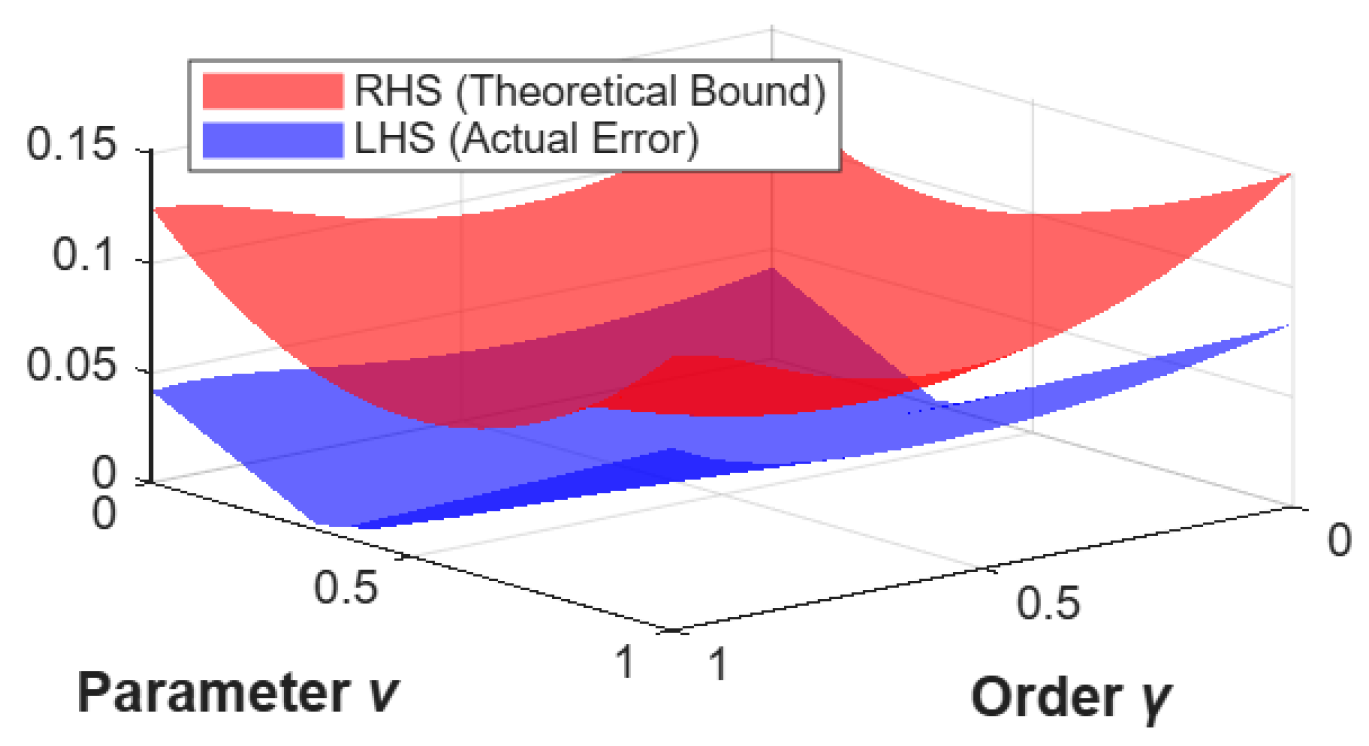
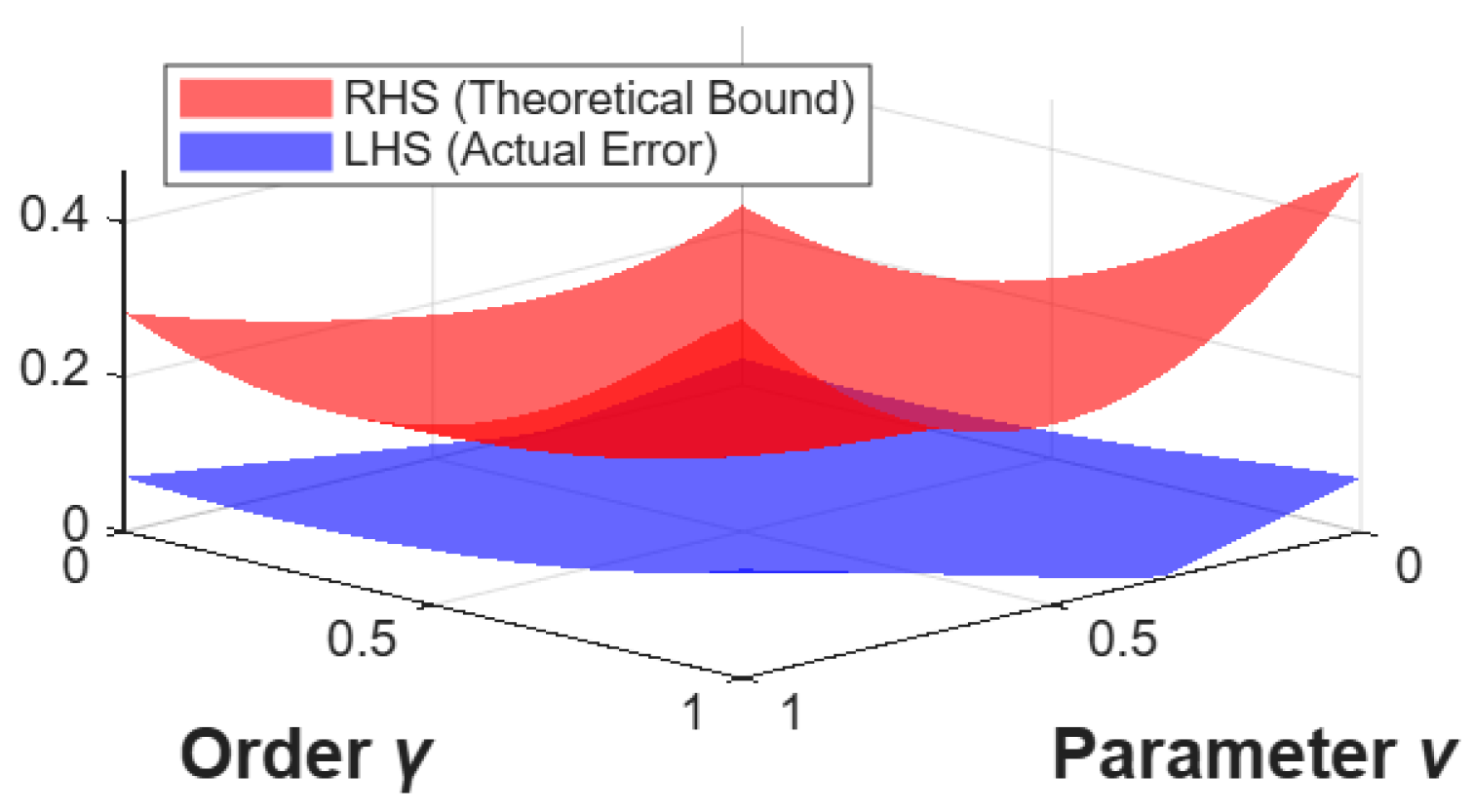
Case 1: Variation with respect to ν and γ :  In the first scenario, we fix the convexity parameter at s = 1 (corresponding to standard convexity). We generate the surfaces for the LHS (red) and RHS (blue) by varying ν [ 0 , 1 ] and γ [ 0 , 1 ] . As depicted in Figure 1, the error surface (LHS) remains strictly below the bound surface (RHS) across the entire parameter space. This confirms that the inequality holds for all intermediate values of the generalized Newton–Cotes parameter ν.
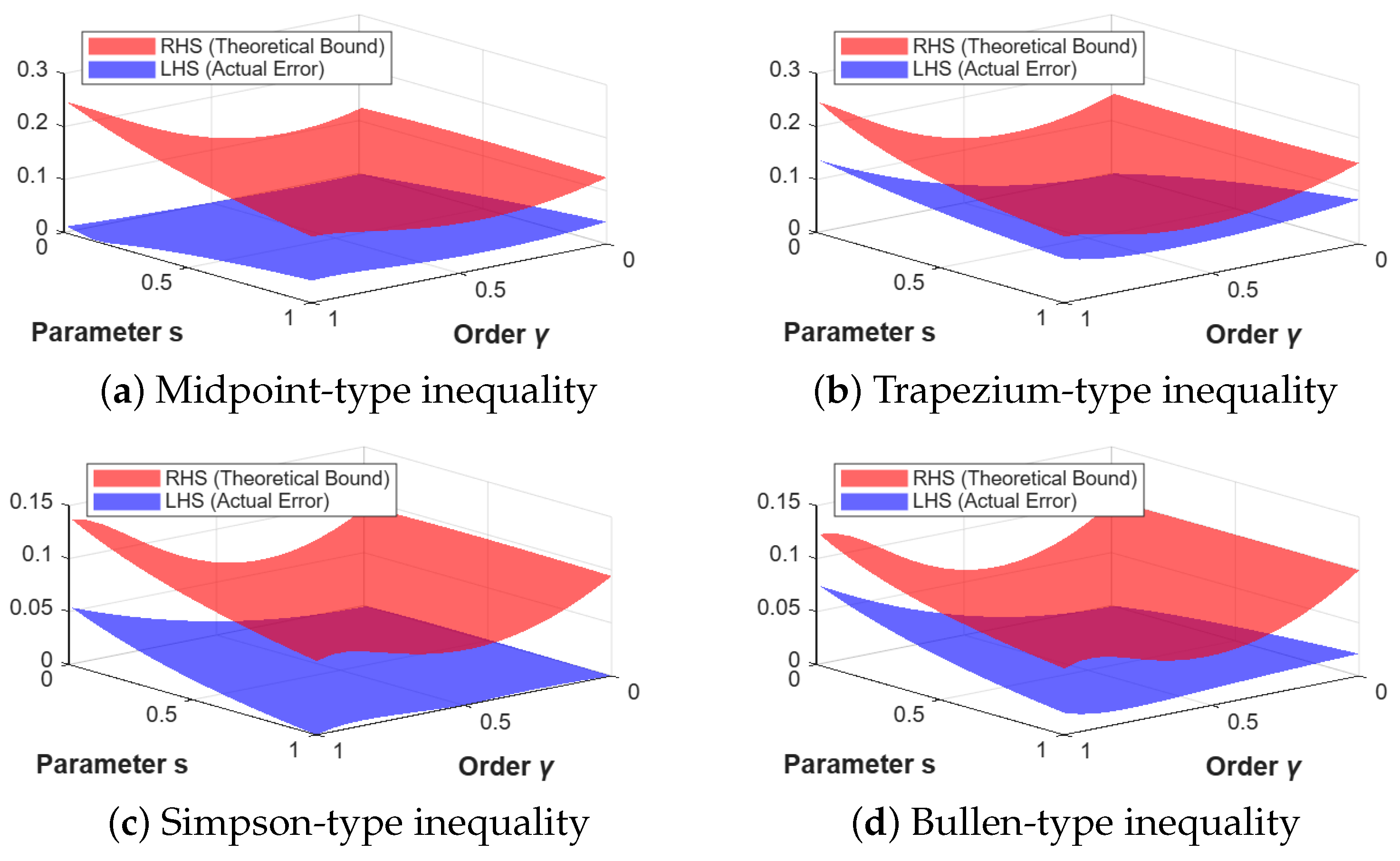
Case 2: Variation with respect to s and γ :  In the second scenario, we fix the parameter ν and observe the behavior as a function of the convexity index s and the fractional order γ. Figure 2 illustrates that the inequality is robust regardless of the degree of convexity of the derivative or the order of the fractional operator. The upper bound provides a consistent envelope for the approximation error.
Example 2.
Consider the function V defined on [ 0 , 1 ] by V ( z ) = e z . This function satisfies the conditions of Corollary 5, which gives
2 γ 2 γ + 1 2 ν ( e + 1 ) 2 + ( 1 ν ) e γ 2 ( e 1 ) 1 γ 4 F 1 1 ( 2 2 γ ; 3 2 γ ; 1 ) e ( 1 γ ) 2 2 γ ( 2 2 γ , 1 ) γ 2 8 2 ν 2 2 ν + 1 + 1 γ 4 L 1 γ , ν + L 2 γ , ν 1 + e ,
where L 1 γ , ν and L 2 γ , ν are defined as in (12) and (13), respectively, and γ ( a , b ) = 0 b t a 1 e t d t denotes the lower incomplete gamma function, and F 1 1 ( a ; b ; c ) is the confluent hypergeometric function of the first kind (Kummer’s function).
Both sides of inequality (19) are plotted in Figure 3. From this, we observe that the left-hand side is consistently below the right-hand side, thus confirming the validity of our results.

3. Further Parametrized Estimates

In this section, we extend our investigation by broadening the class of applicable functions to obtain alternative error bounds. To achieve this, we employ standard analytical tools, specifically Hölder’s inequality and the power mean inequality. The practical advantage of introducing the parameter q > 1 (and its conjugate) lies in relaxing the geometric requirements on the derivative: it allows us to derive valid estimates for scenarios where the mappings | V | and | V | themselves fails to be s-convex, provided that their power | V | q and | V | q exhibit s-convexity. Furthermore, we provide an additional estimate tailored for Lipschitzian functions. From a practical standpoint, the Lipschitz constant L serves as a uniform, global bound on the rate of change of the function. This provides readers with a straightforward, worst-case scaling factor to control the approximation error, which is particularly useful in applications where the function’s derivatives are poorly behaved or difficult to evaluate.
Theorem 2.
Let V : e , f R be a twice differentiable function on I , where e , f I satisfying 0 < e < f and let V V , V L 1 e , f and the derivatives V , V L q [ e , f ] (for q > 1 ) and exhibits no singularities at the endpoints e and f . If V q and V q are s -convex on e , f , then the following inequality holds:
γ 2 f e γ 1 T e , f , V , ν + 1 γ 2 f e γ 1 T e , f , V , ν Γ 1 γ 2 f e 1 γ D f γ C V e + D e + γ C V f γ 2 f e 1 + γ ν p + 1 + 1 ν p + 1 2 p + 1 p + 1 1 p 2 s + 1 1 V e q + V f q 2 s + 1 s + 1 1 q + V e q + 2 s + 1 1 V f q 2 s + 1 s + 1 1 q + 1 γ f e 2 γ 4 1 2 0 l 2 2 γ ν 2 p d l 1 p + 1 1 2 l 2 2 γ 2 ν 2 p d l 1 p × 2 s + 1 1 V e q + V f q 2 s + 1 s + 1 1 q + V e q + 2 s + 1 1 V f q 2 s + 1 s + 1 1 q ,
where 0 ν 1 and 1 p + 1 q = 1 .
Proof. 
From Lemma 1, absolute value, Hölder’s inequality and s -convexity of V q and V q , we have
γ 2 f e γ 1 T e , f , V , ν + 1 γ 2 T e , f , V , ν Γ 1 γ 2 f e 1 γ D f γ C V e + D e + γ C V f γ 2 f e 1 + γ 1 2 0 l ν 2 p d l 1 p 1 2 0 V 1 l e + l f q d l 1 q + 1 2 0 V l e + 1 l f q d l 1 q + 1 γ f e 2 γ 4 1 2 0 l 2 2 γ ν 2 p d l 1 p 1 2 0 V 1 l e + l f q d l 1 q + 1 2 0 V l e + 1 l f q d l 1 q + 1 1 2 l 2 2 γ 2 ν 2 p d l 1 p 1 1 2 V 1 l e + l f q d l 1 q + 1 1 2 V l e + 1 l f q d l 1 q γ 2 f e 1 + γ 1 2 0 l ν 2 p d l 1 p 1 2 0 1 l s V e q + l s V f q d l 1 q + 1 2 0 l s V e q + 1 l s V f q d l 1 q + 1 γ f e 2 γ 4 1 2 0 l 2 2 γ ν 2 p d l 1 p 1 2 0 1 l s V e q + l s V f q d l 1 q + 1 2 0 l s V e q + 1 l s V f q d l 1 q + 1 1 2 l 2 2 γ 2 ν 2 p d l 1 p 1 1 2 1 l s V e q + l s V f q d l 1 q + 1 1 2 l s V e q + 1 l s V f q d l 1 q = γ 2 f e 1 + γ ν p + 1 + 1 ν p + 1 2 p + 1 p + 1 1 p 2 s + 1 1 V e q + V f q 2 s + 1 s + 1 1 q + V e q + 2 s + 1 1 V f q 2 s + 1 s + 1 1 q + 1 γ f e 2 γ 4 1 2 0 l 2 2 γ ν 2 p d l 1 p + 1 1 2 l 2 2 γ 2 ν 2 p d l 1 p × 2 s + 1 1 V e q + V f q 2 s + 1 s + 1 1 q + V e q + 2 s + 1 1 V f q 2 s + 1 s + 1 1 q .
The proof is completed. □
Theorem 3.
Under the same hypothesis of Theorem 2, the following inequality holds:
γ 2 f e γ 1 T e , f , V , ν + 1 γ 2 T e , f , V , ν Γ 1 γ 2 f e 1 γ D f γ C V e + D e + γ C V f γ 2 f e 1 + γ ν 2 + 1 ν 2 8 1 1 q Ω 1 ν , s V e q + Ω 2 γ , s V f q 1 q + Ω 2 ν , s V e q + Ω 1 γ , s V f q 1 q + 1 γ f e 2 γ 4 1 2 0 l 2 2 γ ν 2 d l 1 1 q Λ 1 γ , ν , s V e q + Λ 2 γ , ν , s V f q 1 q + Λ 2 γ , ν , s V e q + Λ 1 γ , ν , s V f q 1 q + 1 1 2 l 2 2 γ 2 ν 2 d l 1 1 q Λ 3 γ , ν , s V e q + Λ 4 γ , ν , s V f q 1 q + Λ 4 γ , ν , s V e q + Λ 3 γ , ν , s V f q 1 q ,
where q > 1 , Ω 1 , Ω 2 , Λ 1 , Λ 2 , Λ 3 and Λ 4 are defined as in (6)–(11), respectively.
Proof. 
From Lemma 1, absolute value, power mean inequality and s -convexity of V q and V q , we have
γ 2 f e γ 1 T e , f , V , ν + 1 γ 2 f e γ 1 T e , f , V , ν Γ 1 γ 2 f e 1 γ D f γ C V e + D e + γ C V f γ 2 f e 1 + γ 1 2 0 l ν 2 d l 1 1 q 1 2 0 l ν 2 V 1 l e + l f q d l 1 q + 1 2 0 l ν 2 d l 1 1 q 1 2 0 l ν 2 V l e + 1 l f q d l 1 q + 1 γ f e 2 γ 4 1 2 0 l 2 2 γ ν 2 d l 1 1 q 1 2 0 l 2 2 γ ν 2 V 1 l e + l f q d l 1 q + 1 2 0 l 2 2 γ ν 2 d l 1 1 q 1 2 0 l 2 2 γ ν 2 V l e + 1 l f q d l 1 q + 1 1 2 l 2 2 γ 2 ν 2 d l 1 1 q 1 1 2 l 2 2 γ 2 ν 2 V 1 l e + l f q d l 1 q + 1 1 2 l 2 2 γ 2 ν 2 d l 1 1 q 1 1 2 l 2 2 γ 2 ν 2 V l e + 1 l f q d l 1 q γ 2 f e 1 + γ 1 2 0 l ν 2 d l 1 1 q 1 2 0 l ν 2 1 l s V e q + l s V f q d l 1 q + 1 2 0 l ν 2 l s V e q + 1 l s V f q d l 1 q + 1 γ f e 2 γ 4 1 2 0 l 2 2 γ ν 2 d l 1 1 q 1 2 0 l 2 2 γ ν 2 1 l s V e q + l s V f q d l 1 q + 1 2 0 l 2 2 γ ν 2 l s V e q + 1 l s V f q d l 1 q + 1 1 2 l 2 2 γ 2 ν 2 d l 1 1 q 1 1 2 l 2 2 γ 2 ν 2 1 l s V e q + l s V f q d l 1 q + 1 1 2 l 2 2 γ 2 ν 2 l s V e q + 1 l s V f q d l 1 q = γ 2 f e 1 + γ ν 2 + 1 ν 2 8 1 1 q Ω 1 ν , s V e q + Ω 2 γ , s V f q 1 q + Ω 2 ν , s V e q + Ω 1 γ , s V f q 1 q + 1 γ f e 2 γ 4 1 2 0 l 2 2 γ ν 2 d l 1 1 q Λ 1 γ , ν , s V e q + Λ 2 γ , ν , s V f q 1 q + Λ 2 γ , ν , s V e q + Λ 1 γ , ν , s V f q 1 q + 1 1 2 l 2 2 γ 2 ν 2 d l 1 1 q Λ 3 γ , ν , s V e q + Λ 4 γ , ν , s V f q 1 q + Λ 4 γ , ν , s V e q + Λ 3 γ , ν , s V f q 1 q .
The proof is completed. □
In the subsequent theorem, we establish a parametrized inequality within the framework of proportional Caputo-hybrid fractional operators, specifically tailored for Lipschitz continuous mappings. As a brief reminder, a real-valued function V : [ e , f ] R satisfies the L -Lipschitz condition on [ e , f ] provided that one can find a non-negative constant L ensuring that
V ( x ) V ( y ) L | x y |
holds for any arbitrary pair of points x , y [ e , f ] .
Theorem 4.
Under the assumptions of Lemma 1. If V and V are L - and H -Lipschitzian functions, respectively, then the following inequality holds:
γ 2 f e γ 1 T e , f , V , ν + 1 γ 2 f e γ 1 T e , f , V , ν Γ 1 γ 2 f e 1 γ D f 1 γ C V e + D e + γ C V f γ 2 f e 2 + γ 1 3 ν + 6 ν 2 2 ν 3 24 L + 1 γ f e 3 γ 4 Λ 1 γ , ν , 1 Λ 2 γ , ν , 1 + Λ 4 γ , ν , 1 Λ 3 γ , ν , 1 H ,
where Λ j for j = 1 to 4, are defined as in (8)–(11), respectively.
Proof. 
From Lemma 1, absolute value and the fact that V and V are Lipschitzian functions, we have
γ 2 f e γ 1 T e , f , V , ν + 1 γ 2 f e γ 1 T e , f , V , ν Γ 1 γ 2 f e γ D f 1 γ C V e + D e + γ C V f γ 2 f e 1 + γ 1 2 0 l ν 2 V 1 l e + l f V l e + 1 l f d l + 1 γ f e 2 γ 4 1 2 0 l 2 2 γ ν 2 V 1 l e + l f V l e + 1 l f d l + 1 1 2 l 2 2 γ 2 ν 2 V 1 l e + l f V l e + 1 l f d l γ 2 f e 2 + γ 1 2 0 l ν 2 2 l 1 d l L + 1 γ f e 3 γ 4 1 2 0 l 2 2 γ ν 2 2 l 1 d l + 1 1 2 l 2 2 γ 2 ν 2 2 l 1 d l H = γ 2 f e 2 + γ 1 2 0 l ν 2 1 2 l d l L + 1 γ f e 3 γ 4 1 2 0 l 2 2 γ ν 2 1 2 l d l + 1 1 2 l 2 2 γ 2 ν 2 2 l 1 d l H = γ 2 f e 2 + γ 1 3 ν + 6 ν 2 2 ν 3 24 L + 1 γ f e 3 γ 4 1 2 0 l 2 2 γ ν 2 d l 2 1 2 0 l 2 2 γ ν 2 l d l + 2 1 1 2 l 2 2 γ 2 ν 2 l d l 1 1 2 l 2 2 γ 2 ν 2 d l H = γ 2 f e 2 + γ 1 3 ν + 6 ν 2 2 ν 3 24 L + 1 γ f e 3 γ 4 Λ 1 γ , ν , 1 Λ 2 γ , ν , 1 + Λ 4 γ , ν , 1 Λ 3 γ , ν , 1 H ,
where Λ j for j = 1 to 4, are defined as in (8)–(11), respectively. The proof is completed. □

4. Computational Approximation and Sensitivity Analysis via Artificial Neural Networks

In this section, we transition from analytical derivation to computational simulation by employing an Artificial Neural Network (ANN) as a surrogate model. It is important to emphasize that the mathematical correctness and validity of the inequalities are strictly ensured by the formal analytical proofs of our main results (e.g., Theorem 2). The ANN presented here does not constitute a mathematical proof, but rather serves as a computational verification and approximation tool. By mapping the multi-dimensional parameter space to the error bounds, this numerical approach allows for rapid sensitivity analysis and demonstrates the practical applicability of the proposed proportional Caputo-hybrid fractional inequalities without the computational overhead of direct integration. The recent evolution of neural models designed to handle variant parameters [26,27] strongly motivates our use of ANN to manage the dynamic nature of parameters ( γ , ν , s , p , q ) in our proposed Newton–Cotes framework.
The use of an Artificial Neural Network (ANN) provides a significant advantage over standard Monte Carlo or grid-based sampling methods. Traditional sampling suffers from the “curse of dimensionality” when exploring large, complex parameter spaces. Once trained, the ANN allows for near-instantaneous inference and verification, avoiding the exhaustive computational cost of grid-evaluations.

4.1. Dataset Generation and Methodology

To train and rigorously evaluate the neural network surrogate model, a synthetic dataset was generated by evaluating the analytical expressions derived in Theorem 2. All simulations were conducted on the interval [ e , f ] = [ 0 , 1 ] .
We selected the specific test function:
V ( z ) = z s + 2 s + 2 , z [ 0 , 1 ] with s ( 0 , 1 ] .
Consequently, the derivatives are given by V ( z ) = z s + 1 and V ( z ) = ( s + 1 ) z s . This choice is particularly significant as V ( z ) q = ( s + 1 ) q z s q represents a power function, which rigorously satisfies the s -convexity condition in the second sense required by the hypothesis of our theorem.
The input space for the surrogate model consists of a five-dimensional vector x = ( γ , ν , s , p , q ) , where the parameters are sampled uniformly from the following continuous ranges:
  • The fractional order γ [ 0.1 , 0.99 ] .
  • The proportional parameter ν [ 0.0 , 1.0 ] .
  • The convexity parameter s [ 0.1 , 1.0 ] .
  • The Hölder parameter p [ 1.2 , 4.0 ] and its conjugate q = p p 1 .
For each sampled point i, we computed a target vector y i containing three values:
1.
The Lower Bound ( L B ): Defined as the negative of the theoretical right-hand side (RHS) bound derived in Theorem 2.
2.
The Operator Error (E): The simulated integral operator error (left-hand side).
3.
The Upper Bound ( U B ): The positive theoretical error bound (+RHS).
To assess the influence of dataset size on model generalization and stability, a sensitivity analysis was conducted by varying the number of training samples across five configurations: N { 2000 , 4000 , 6000 , 8000 , 10 , 000 } . A master dataset of N max = 10 , 000 independent samples was generated once using a fixed random seed at 42 (for strict reproducibility), and each configuration used the first N samples of this master dataset, ensuring that all experiments are nested and directly comparable.
Rather than a single random train/test partition, model performance was assessed using k-fold cross-validation with k = 10 . For each sample size N and each fold f { 1 , , 10 } , the dataset was partitioned into a training set ( 90 % ) and a validation set ( 10 % ). Crucially, feature normalization (zero mean, unit variance) was fitted exclusively on the training partition of each fold and then applied to the corresponding validation set, thereby preventing any form of data leakage.
The ANN was retrained independently for each of the 10 × 5 = 50 configurations. Performance was measured by the coefficient of determination R 2 , computed both globally (over all three outputs jointly) and separately for each output ( L B , E, U B ). The reported metrics for each configuration N are:
R ¯ 2 ( N ) = 1 10 f = 1 10 R f 2 ( N ) , σ R 2 ( N ) = 1 10 f = 1 10 R f 2 ( N ) R ¯ 2 ( N ) 2 ,
together with the approximate 95% confidence interval R ¯ 2 ( N ) ± 1.96 σ R 2 ( N ) . The standard deviation σ R 2 serves as an indicator of model stability: a small value across the 10 folds signals that the learned model generalizes consistently, independently of the particular train/validation split.

4.2. Network Architecture and Training Hyperparameters

We designed a feed-forward Multilayer Perceptron (MLP) regressor to approximate the mapping from the five-dimensional input parameter vector to the three-dimensional output ( L B , E , U B ) . The complete architecture and hyperparameter specification is reported below.
  • Input Layer: 5 neurons corresponding to the feature vector ( γ , ν , s , p , q ) .
  • Hidden Layers: Two fully connected hidden layers, each consisting of 64 neurons, yielding the architecture 5 64 64 3 . This two-layer configuration provides sufficient representational capacity to capture the non-linear interactions among the parameters.
  • Output Layer: 3 neurons producing the simultaneous predictions of the Lower Bound ( L B ), the Operator Error (E), and the Upper Bound ( U B ).
  • Activation Function: The Rectified Linear Unit (ReLU), defined as f ( z ) = max ( 0 , z ) , applied to all hidden neurons.
  • Optimizer: The Adam (Adaptive Moment Estimation) solver with an initial learning rate η 0 = 10 3 . Training was allowed for a maximum of 5000 epochs, with early stopping triggered when the loss improvement over 50 consecutive iterations falls below ε = 10 5 .
The loss function minimized during training is the Mean Squared Error (MSE) over the normalized output space:
L ( θ ) = 1 | T | i T y i y ^ i ( θ ) 2 ,
where T denotes the training partition of the current fold, θ the trainable weights and biases, and y ^ i the model prediction for sample i.

4.3. Results and Discussion

The numerical results of the sensitivity analysis are summarized in Table 1.
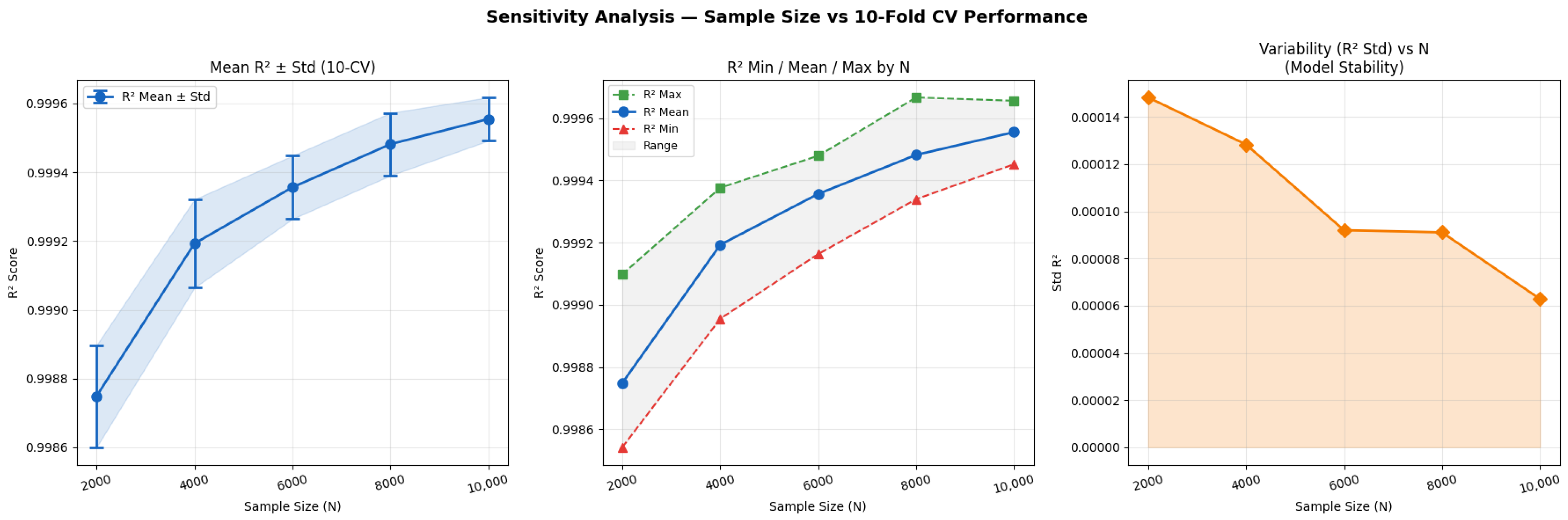
Across all configurations, the surrogate ANN achieves an exceptionally high coefficient of determination, with R ¯ 2 ranging from 0.99875   ( N = 2000 ) to 0.99955 ( N = 10 , 000 ) , confirming that the model effectively captures the non-linear functional dependence of the theoretical bounds on the parameter vector ( γ , ν , s , p , q ) .
Figure 4 reveals a clear monotone improvement in both accuracy and stability as N grows. The mean R 2 gains + 0.00080 points over the full range, while σ R 2 decreases from 1.5 × 10 4 to 6 × 10 5 , indicating that larger datasets yield simultaneously more accurate and more stable models. The marginal gains diminish beyond N = 6000 , suggesting the model approaches saturation in this parameter regime.
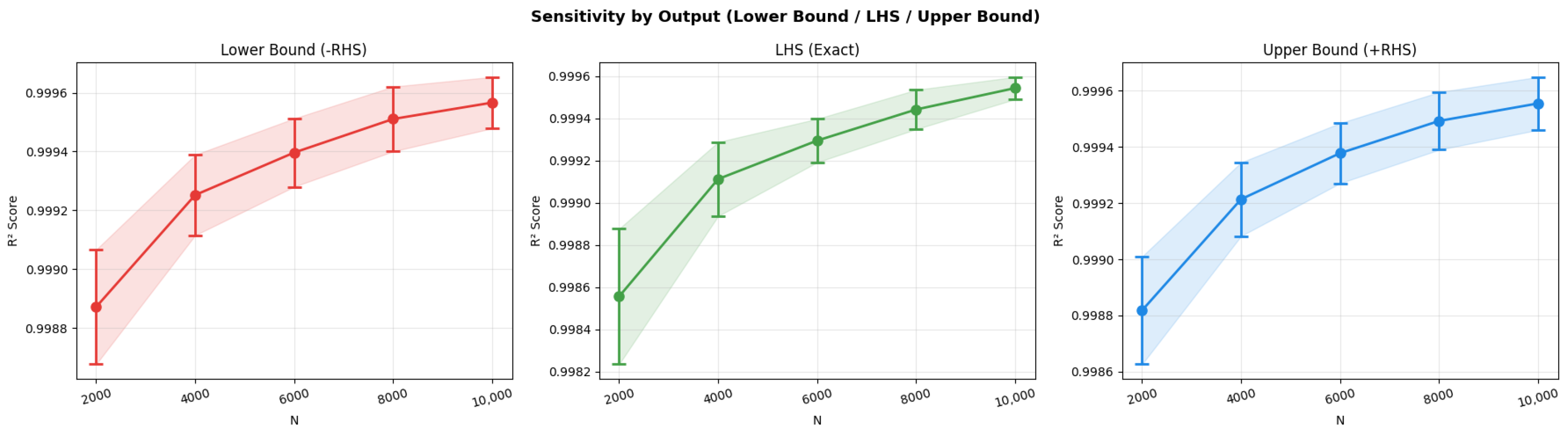
Figure 5 shows that the three outputs — L B , E, and U B — exhibit consistent and nearly identical sensitivity profiles. All three improve monotonically with N and their confidence bands narrow uniformly, confirming that no single output constitutes a bottleneck for overall model performance.
The loss curves in Figure 6 show that the number of iterations required to reach the early-stopping criterion decreases as N increases (from approximately 520 at N = 2000 to 240 at N = 10 , 000 ), reflecting that larger training partitions allow the optimizer to locate a good minimum more efficiently. In all cases, the training loss decreases by more than two orders of magnitude.
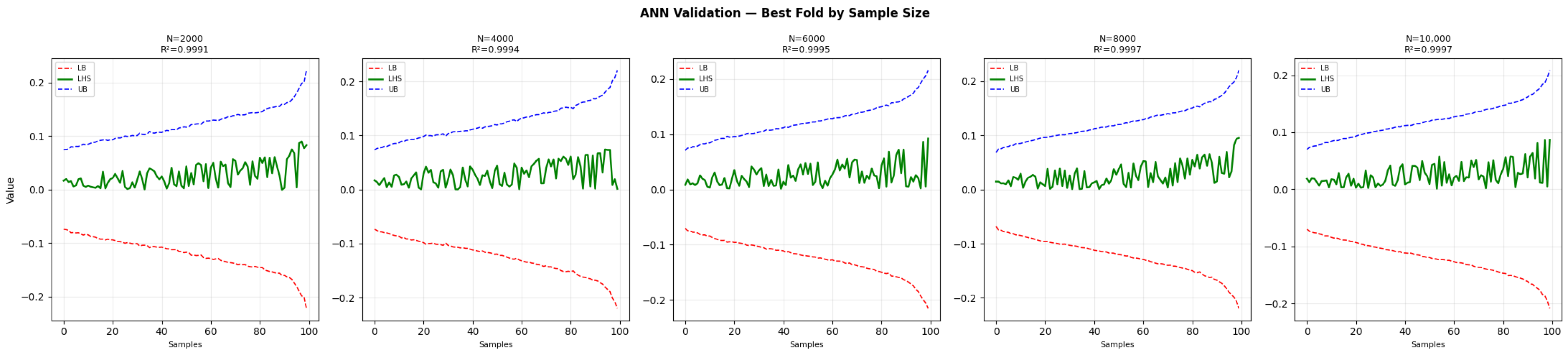
Figure 7 shows that across all values of N, the ANN correctly reproduces the structural ordering L B E U B established by Theorem 2, and the predicted bounds tightly envelope the simulated operator error.
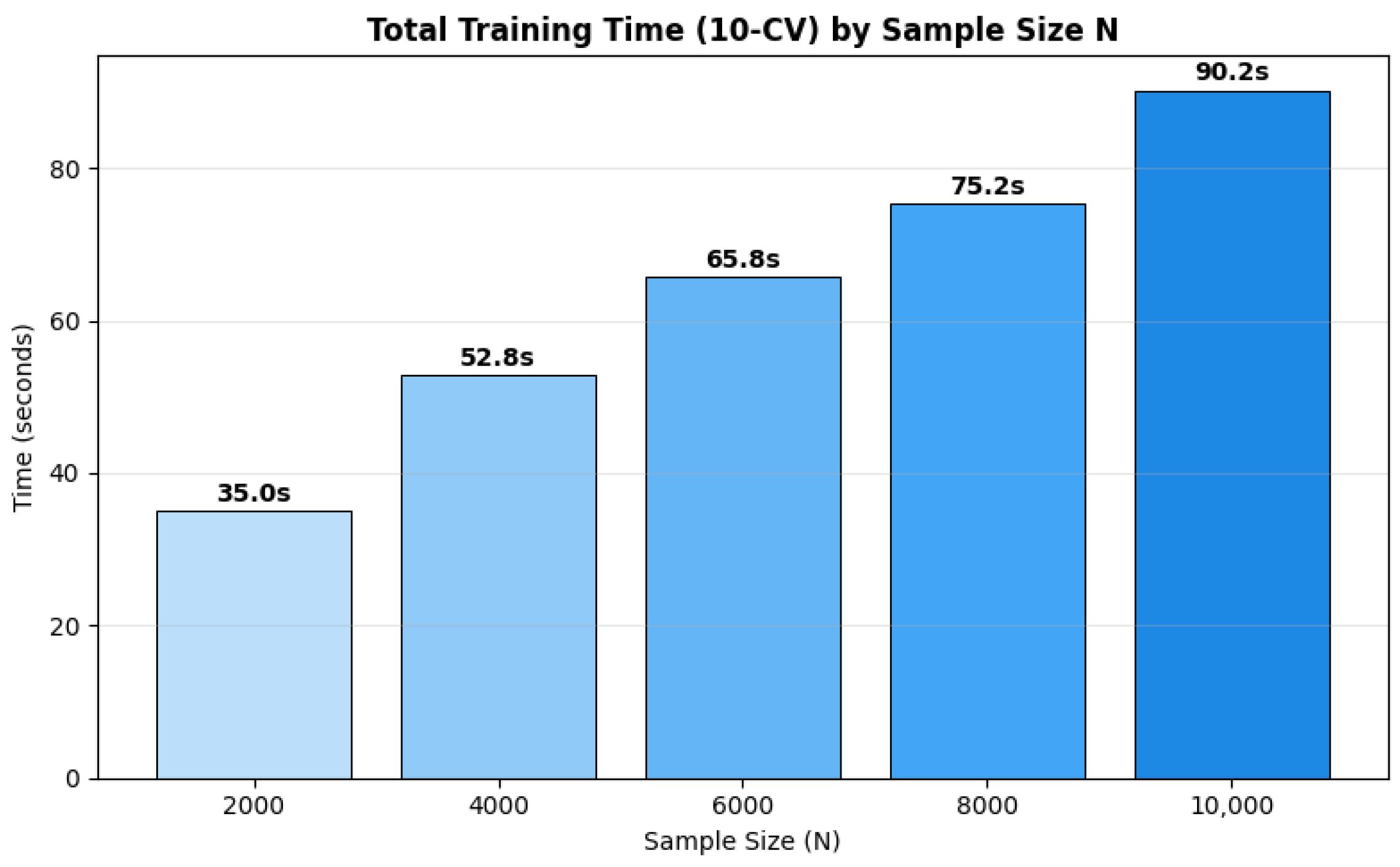
As shown in Figure 8, the total 10-fold CV training time scales approximately linearly with N, from 35.7 s at N = 2000 to 90.7 s at N = 10 , 000 , confirming that the methodology remains computationally tractable at all dataset sizes.
The configuration N = 10 , 000 is retained as the reference setting, achieving R ¯ 2 = 0.99955 with σ R 2 = 6 × 10 5 , which represents an optimal trade-off between predictive accuracy, model stability, and computational cost.

5. Applications

The algebraic properties of the inequalities established in the preceding sections allow for direct applications to the theory of special means, providing new relationships between arithmetic, geometric, and generalized logarithmic means. For arbitrary positive real numbers e , f with e f , we recall the following special means:
  • The arithmetic mean:
    A ( e , f ) = e + f 2 .
  • The harmonic mean:
    H ( e , f ) = 2 e f e + f .
  • The logarithmic mean:
    L ( e , f ) = f e ln f ln e .
  • The p-logarithmic mean (for p R { 1 , 0 } ):
    L p ( e , f ) = f p e p ( p + 1 ) ( f e ) 1 p .
Proposition 1.
Consider the positive numbers e , f , s such that 0 < e < f and 0 < s < 1 , then we have
s + 2 A e s + 1 , f s + 1 + A s + 1 e , f 2 s + 3 L s + 2 s + 2 e , f f e s + 2 s + 1 Θ s e s + f s ,
where Θ 1 is defined by (15).
Proof. 
We derive the stated result by considering the function V ( z ) = z s + 2 s + 2 and utilizing the bound established in (14). □
Proposition 2.
Consider the two positive numbers 0 < e < f , then we have
H 1 e , f + 4 A e , f 5 L 1 e , f 17 f e e 2 + f 2 40 e 2 f 2 .
Proof. 
This conclusion follows as a direct consequence of Corollary 11 by taking ν = 1 5 and V ( z ) = 1 z . □

6. Conclusions

In this work, we have established generalized fractional integral inequalities for proportional Caputo-hybrid operators using a parametrized Newton–Cotes identity ( ν [ 0 , 1 ] ). This framework successfully unifies the fractional Midpoint, Trapezoidal, Bullen, and Simpson’s rules while providing sharp error estimates based on s -convexity. Further results using Hölder and power mean inequalities are provided as well as a result for Lipschitzian functions. The correctness of the obtained results was verified by numerical experiments and through an Artificial Neural Networks (ANNs) model, confirming their robustness across the parameter space. Future research may extend these findings to quantum calculus or the stability analysis of fractional differential equations.
It is important to note that while the s -convexity assumption provides a rigorous theoretical framework, real-world data and signals are rarely purely s -convex. In practical engineering applications, signals are often corrupted by noise or exhibit local non-convexities. Therefore, the bounds derived herein serve as theoretical worst-case estimates, which may require adaptive smoothing techniques when applied to noisy empirical data.

Author Contributions

Conceptualization, A.R.A.A., M.A.-H. and A.L.; methodology, R.F.; software, A.B.M.; validation, W.S. and A.L.; formal analysis, W.S.; investigation, A.R.A.A. and M.A.-H.; resources, R.F.; data curation, A.B.M.; writing—original draft preparation, A.R.A.A., M.A.-H. and A.L.; writing—review and editing, A.R.A.A., M.A.-H., W.S., R.F. and A.B.M.; visualization, A.B.M. and A.L.; supervision, R.F. and A.L.; project administration, A.R.A.A., M.A.-H. and W.S.; funding acquisition, A.R.A.A. All authors have read and agreed to the published version of the manuscript.

Funding

This work was funded by the Deanship of Graduate Studies and Scientific Research at Jouf University under grant No. (DGSSR-2025-FC-01017).

Data Availability Statement

The Python 3.12.13 script used to generate the synthetic dataset and train the Artificial Neural Network (ANN) surrogate model is openly available in a public repository at: https://github.com/Abdelghani-Lakhdari/Parametrized-Caputo-Hybrid-Fractal-and-Fractional-.git (accessed on 9 March 2026).

Conflicts of Interest

The authors have no competing interests to disclose.

References

  1. Mohammadzadeh, A.; Taghavifar, H.; Zhang, C.; Alattas, K.A.; Liu, J.; Vu, M.T. A non-linear fractional-order type-3 fuzzy control for enhanced path-tracking performance of autonomous cars. IET Control Theory Appl. 2024, 18, 40–54. [Google Scholar] [CrossRef]
  2. Xu, X.; Li, B. Semi-global stabilization of parabolic PDE–ODE systems with input saturation. Automatica 2025, 171, 111931. [Google Scholar] [CrossRef]
  3. NápolesValdés, J.E.; Rabossi, F.; Samaniego, A.D. Convex functions: Ariadne’s thread or Charlotte’s Spiderweb? Adv. Math. Model. Appl. 2020, 5, 176–191. [Google Scholar]
  4. Breckner, W.W. Stetigkeitsaussagen für eine Klasse verallgemeinerter konvexer Funktionen in topologischen linearen Räumen. Publ. Inst. Math. 1978, 23, 13–20. (In German) [Google Scholar]
  5. Kilbas, A.A.; Srivastava, H.M.; Trujillo, J.J. Theory and Applications of Fractional Differential Equations; North-Holland Mathematics Studies; Elsevier Science B.V.: Amsterdam, The Netherlands, 2006; Volume 204. [Google Scholar]
  6. Samko, S.G.; Kilbas, A.A.; Marichev, O.I. Fractional Integrals and Derivatives. Theory and Applications; Edited and with a foreword by S. M. Nikol’skiĭ; Translated from the 1987 Russian original; Revised by the authors; Gordon and Breach Science Publishers: Yverdon, Switzerland, 1993. [Google Scholar]
  7. Atangana, A.; Baleanu, D. New fractional derivatives with non-local and non-singular kernel theory and application to heat transfer model. Therm. Sci. 2016, 20, 763–769. [Google Scholar] [CrossRef]
  8. Abdeljawad, T.; Baleanu, D. Integration by parts and its applications of a new nonlocal fractional derivative with Mittag-Leffler nonsingular kernel. J. Nonlinear Sci. Appl. 2017, 10, 1098–1107. [Google Scholar] [CrossRef]
  9. Ahmad, B.; Alsaedi, A.; Kirane, M.; Torebek, B.T. Hermite-Hadamard, Hermite-Hadamard-Fejér, Dragomir-Agarwal and Pachpatte type inequalities for convex functions via new fractional integrals. J. Comput. Appl. Math. 2019, 353, 120–129. [Google Scholar] [CrossRef]
  10. Jarad, F.; Uğurlu, E.; Abdeljawad, T.; Baleanu, D. On a new class of fractional operators. Adv. Differ. Equ. 2017, 2017, 247. [Google Scholar] [CrossRef]
  11. Katugampola, U.N. New approach to a generalized fractional integral. Appl. Math. Comput. 2011, 218, 860–865. [Google Scholar] [CrossRef]
  12. Baleanu, D.; Fernandez, A.; Akgul, A. On a fractional operator combining proportional and classical differintegrals. Mathematics 2020, 8, 360. [Google Scholar] [CrossRef]
  13. Sarikaya, M.Z. On Hermite-Hadamard type inequalities for proportional Caputo-hybrid operator. Konuralp J. Math. 2023, 11, 31–39. [Google Scholar]
  14. Sarikaya, M.Z. On Simpson type inequalities for proportional Caputo-hybrid operator. Int. J. Appl. Comput. Math. 2025, 11, 146. [Google Scholar] [CrossRef]
  15. Demir, İ. A new approach of Milne-type inequalities based on proportional Caputo-Hybrid operator. J. Adv. App. Comput. 2023, 10, 102–119. [Google Scholar] [CrossRef]
  16. Demir, İ. Milne-type inequalities for different classes of mapping based on proportional Caputo-hybrid operator. Turkish J. Ineq. 2023, 7, 47–61. [Google Scholar]
  17. Demir, İ.; Tunç, T. Fractional Newton-type inequalities for twice differentiable functions via proportional Caputo-hybrid operator. Filomat 2025, 39, 7915–7938. [Google Scholar] [CrossRef]
  18. Beldjoudi, S.; Seridi, H.; Karabadji, N.E. Recommendation in collaborative e-learning by using linked open data and ant colony optimization. In Intelligent Tutoring Systems: 14th International Conference, ITS 2018, Montreal, QC, Canada, 11–15 June 2018, Proceedings; Springer: Berlin/Heidelberg, Germany, 2018; pp. 23–32. [Google Scholar]
  19. Berbague, C.; Karabadji, N.E.I.; Seridi, H. An evolutionary scheme for improving recommender system using clustering. In Computational Intelligence and Its Applications: 6th IFIP TC 5 International Conference, CIIA 2018, Oran, Algeria, 8–10 May 2018, Proceedings; Springer: Berlin/Heidelberg, Germany, 2018; pp. 290–301. [Google Scholar]
  20. Alomari, M.; Darus, M.; Dragomir, S.S. New inequalities of Simpson’s type for s-convex functions with applications. RGMIA Res. Rep. Collect. 2019, 12, 9. [Google Scholar]
  21. Alomari, M. Several Inequalities of Hermite-Hadamard, Ostrowski and Simpson type for s-convex, Quasi-convex and r-convex mappings and applications. Doctoral Dissertation, Faculty of Science and Technology, University Kebangsaan, Bangi, Malaysia, 2008. [Google Scholar]
  22. Karapınar, D.; Turhan, S.; Kunt, M.; Işcan, I. Some new fractional integral inequalities for s-convex functions. J. Nonlinear Sci. Appl. 2017, 10, 4552–4563. [Google Scholar] [CrossRef][Green Version]
  23. Kırmacı, U.S. Inequalities for differentiable mappings and applications to special means of real numbers and to midpoint formula. Appl. Math. Comput. 2004, 147, 137–146. [Google Scholar] [CrossRef]
  24. Hamida, S.; Meftah, B. Fractional Bullen type inequalities for differentiable preinvex functions. ROMAI J. 2020, 16, 63–74. [Google Scholar]
  25. Dragomir, S.S.; Agarwal, R.P. Two inequalities for differentiable mappings and applications to special means of real numbers and to trapezoidal formula. Appl. Math. Lett. 1998, 11, 91–95. [Google Scholar] [CrossRef]
  26. Jin, J.; Zhu, J.; Zhou, L.; Chen, C.; Wu, L.; Lu, M.; Zhu, C.; Chen, L.; Zhao, L.; Li, Z. A complex-valued variant-parameter robust zeroing neural network model and its applications. IEEE Trans. Emerg. Top. Comput. Intell. 2024, 8, 1303–1321. [Google Scholar] [CrossRef]
  27. Hadjadji, I.; Karabadji, N.E.; Seridi, H.; Manaa, N.; Elati, M.; Dhifli, W. Optimizing MLP network structure for classification problems using PSO and dominating vertex set. In Proceedings of the IEEE International Conference on Data Mining Workshops (ICDMW), Abu Dhabi, United Arab Emirates, 9 December 2024; pp. 529–534. [Google Scholar] [CrossRef]
Figure 1. Case 1: surfaces for fixed s = 1 , with ν [ 0 , 1 ] and γ ( 0 , 1 ] .
Fractalfract 10 00247 g001
Figure 2. Case 2: surfaces for fixed ν , with s ( 0 , 1 ] and γ [ 0 , 1 ] .
Fractalfract 10 00247 g002
Figure 3. Surfaces for fixed s = 1 , with ν [ 0 , 1 ] and γ [ 0 , 1 ] .
Fractalfract 10 00247 g003
Figure 4. Mean R 2 ± σ R 2 (left), min/mean/max envelope (center), and cross-fold standard deviation (right) as a function of N.
Fractalfract 10 00247 g004
Figure 5. Per-output sensitivity curves for L B , E, and U B as a function of N.
Fractalfract 10 00247 g005
Figure 6. Training loss curves (log scale) for the best fold of each sample size N.
Fractalfract 10 00247 g006
Figure 7. Predicted L B , E, and U B on the sorted validation set for the best fold of each N. The ordering L B E U B is consistently satisfied.
Fractalfract 10 00247 g007
Figure 8. Total 10-fold CV training time as a function of N.
Fractalfract 10 00247 g008
Table 1. 10-fold CV performance as a function of sample size N.
N R ¯ 2 σ R 2 R min 2 R max 2 IC95% LowerIC95% Upper
20000.998750.000150.998540.999100.998460.99904
40000.999190.000130.998960.999380.998940.99944
60000.999360.000090.999160.999480.999180.99954
80000.999480.000090.999340.999670.999300.99966
10,0000.999550.000060.999450.999660.999430.99968
Disclaimer/Publisher’s Note: The statements, opinions and data contained in all publications are solely those of the individual author(s) and contributor(s) and not of MDPI and/or the editor(s). MDPI and/or the editor(s) disclaim responsibility for any injury to people or property resulting from any ideas, methods, instructions or products referred to in the content.