


Abstract
In this paper, we aim to establish new inequalities of Hermite–Hadamard (H.H) type for harmonically convex functions using proportional Caputo-Hybrid (P.C.H) fractional operators. Parameterized by , these operators offer a unique flexibility: setting recovers the classical inequalities for harmonically convex functions, while setting yields inequalities for differentiable harmonically convex functions. This framework allows us to unify classical and fractional cases within a single operator. To validate the theoretical results, we provide several illustrative examples supported by graphical representations, marking the first use of such visualizations for inequalities derived via P.C.H operators. Additionally, we demonstrate practical applications of the results by deriving new fractional-order recurrence relations for the modified Bessel function of type-1, which are useful in mathematical modeling, engineering, and physics. The findings contribute to the growing body of research in fractional inequalities and harmonic convexity, paving the way for further exploration of generalized convexities and higher-order fractional operators.
1. Introduction
Let be an interval; then the mapping is convex if the subsequent inequality
is valid ∀, , and [1]. Moreover, for the same function defined on the same interval, the subsequent inequality
holds. Hermite and Hadamard independently demonstrated the aforementioned inequality, which is referred to in the literature as the H.H type of inequality [2]. To refine and enhance the error bounds associated with several well known integral inequalities, such as the trapezoidal, midpoint, and Ostrowski-type inequalities, researchers have developed and extended inequality (2) in various directions. These generalizations have been applied to a wide range of convex function classes, as explored in numerous studies. As examples, Dragomir and Agarwal [3] discussed the inequalities for differentiable convex functions, Nápoles Valdés et al. in [4] mentioned the significance of various classes of convex functions in mathematical analysis, and Du and Long [5] developed the results associated with convexity in the multiplicative sense, while Butt [6] did so in the fractal sense. In light of the aforementioned inequality, Vivas-Cortez et al. [7] offered extensions of inequalities of H.H and Fejér types for generalized convex functions. Dragomir and Agarwal [3] developed a number of trapezoidal-type inequalities for differentiable convex functions. Later, the error boundaries for trapezoidal-type inequalities were created and refined by Pearce and Pečarić [8]. Driven by the groundbreaking work of Dragomir and Agarwal [3], Kirmaci and Özdemir [9] have presented midpoint-type inequalities for differentiable convex functions. Some novel H.H-type inequalities and their applications have been addressed by Vivas-Cortez etal. [10] and Mehrez and Agarwal [11]. Several inequalities pertinent to the class of h-convex functions were provided by Varošanec [12]. The class of h-convex functions consists of a generalization of convex, s-convex, Godunova–Levin, and P-functions. The notion of exponential trigonometric convexity and a few H.H-type inequalities were developed for this family of functions by Kadakal et al. [13].
An important generalization and wider class of convex functions known as harmonic convex function was introduced by Anderson et al. [14] and Í. Íşcan [15]. Harmonic convexity is a fundamental concept in electrical circuit theory which states that the sum of the reciprocals of the resistance values of parallel resistors yields the total resistance. For instance, if and are two parallel resistors, then the total resistance is
which equals half of the harmonic mean. The harmonic mean of a semiconductor’s effective masses and its three crystallographic ideas is the conductivity effective mass. Moreover, harmonically convex functions have higher frequencies that are undesirable and change the basic waveform [16]. Noor et al. proved that harmonic variational inequalities can be used to determine the minimum of differentiable harmonic convex functions [17]. Recently, new and creative methods have been used to investigate and analyze a number of extensions and generalizations of H.H type integral inequalities for harmonic convex functions. For example, fractional version of the inequalities for said function was explored by Íşcan and Wu [18], Gao et al. [19] derived the inequalities for an other class of harmonic convexity known as n-polynomial harmonically exponential type convex functions, and Du and Awan [20], Butt et al. [21], and Özcan et al. [22] investigated the results of the same function via fuzzy, fractal, and multiplicative calculus, respectively.
Fractional calculus has attracted significant attention from scholars and engineers in the last couple of years. Various types of fractional integrals, such as functional Hadamard fractional integrals [23], -Riemann–Liouville (R.L) fractional integrals [24], and generalized fractional integrals in the mean square sense [25], among other types, have been extensively studied by researchers in numerous fields and show promise in addressing complex problems across various disciplines. These fractional integrals have been well-defined and their strong mathematical properties have been studied in great detail, which can provide an elaborate understanding of how they might possibly behave and which potential applications the fractional integrals might have. It should be mentioned here that several very important works have been presented by experts in fractional integral studies. For example, in 2016 Sarikaya et al. [26] presented some essential analytical properties of -R.L-fractional integrals along with their commutativity, semigroup property, and the establishment of a well-defined class. Subsequently, Verma and Viswanathan [27] carried out a very thorough study of Katugampola fractional integrals, emphasizing continuity and possibly bounded variation for these integrals. Another contribution in this direction is the work of Fernandez and Ustaoglu [28], wherein they performed a deep analysis for highlighting the different features of tempered fractional integrals. Recently, some works have been devoted to the study of boundedness properties of fractional integrals in various function spaces. Notably, Ledesma et al. in [29] conducted an in-depth analysis of the boundedness of tempered fractional integrals within continuous function spaces and Lebesgue spaces. Similarly, Cheng and Luo in [30] examined the boundedness of -R.L-fractional integrals within the space . Some of the newest fractional operators that have made fractional calculus more versatile and applicable to various fields of science and engineering, and consequently more widely applicable in different areas, are the Caputo–Fabrizio [31], Atangana–Baleanu [32], and tempered fractional derivatives [33]. Fractional integral inequalities for harmonically convex functions and superquadratic functions as well as (k,p)-Riemann–Liouville and Mittag–Leffler kernels are available in [34,35,36,37], respectively.
One of the significant tasks of fractional integral operators is the extension of results obtained for integer-order inequalities. Among the various fractional integral operators, the proportional Caputo-hybrid operators have gained considerable attention. These operators were proposed by Sarikaya [38], building on earlier work by Baleanu et al. [39]. In their research, Baleanu and co-authors creatively combined the concepts of the Caputo derivative and the proportional derivative, resulting in a hybrid fractional operator. This operator can be represented as a linear combination of the Caputo fractional derivative and the R.L fractional integral. Moreover Sarikaya used his own definition and derived inequalities. Using the same definition of operators, Sarikaya then presented the proof of inequalities of Simpson type. In [40], Demir derived the Milne-type inequalities via operators, while Demir and Tunç proved the inequalities of Simpson’s type through new approach via the same operators in [41]. In [42], Lakhdari et al. derived fractional versions of H.H and Maclaurin estimates by employing a parameterized approach. Peng et al. [43] explored symmetrical H.H-type inequalities derived from multiplicative fractional integrals. Their work extends traditional H.H inequalities to a multiplicative framework, offering new insights into the interplay between convexity and fractional operators. Li et al. [44] further generalized H.H-type inequalities by incorporating fractional integrals with exponential kernels. Their research focuses on the impact of exponential kernels in fractional calculus, which are particularly useful in describing dynamic systems with exponential decay or growth behaviors.
The above analysis shows that various inequalities have been thoroughly studied in both integer-order and fractional-order regimes; however, despite the considerable advantages of H.H-type inequalities, there seems to be a lack of research specifically addressing the fractional version of H.H-type inequalities via operators and their applications to special functions.
The structure of this article unfolds as follows: it begins with the introduction and preliminaries; Section 3 consists of inequalities of H.H type for harmonically convex function with respect to P.C.H operators; next, Section 4 derives the applications of the obtained inequalities; finally, Section 5 provides concluding remarks and future directions.
2. Preliminaries
This section reviews some fundamental definitions and lemmas that support our findings.
Definition 1
([15]). The function is said to possess harmonic convexity if
holds ∀, and .
Remark 1.
If the inequality (3) flips, then is called harmonically concave.
The below-mentioned result of H.H holds.
Theorem 1
([15]). The function is said to possess harmonic convexity and with . If , then the below-mentioned inequalities hold:
Lemma 1
([15]). The function is said to possess differentiability on for with . If , then
In [15], Işcan proved the following results.
Theorem 2.
Let the function possess differentiability on for with and . If possesses harmonic convexity on for , then
where
Theorem 3.
Let the function possess differentiability on for with and . If possesses harmonic convexity on for , then
where
In what follows, we consider some well known special functions:
- (1)
- Beta function:
- (2)
- Hypergeometric function:
Lemma 2
([45]). For and , we have
In what follows, we provide basic notions associated with fractional calculus.
Definition 2
([26]). The right- and left-sided R.L operators of fractional order with are correspondingly denoted by the notation and , defined as follows:
where is termed the gamma function.
The fractional version of the inequalities of H.H type for harmonically convex functions can be expressed as provided below [18]:
Theorem 4.
Let the function and , where with possesses harmonic convexity on ; then, the subsequent inequalities hold:
with .
Definition 3
([39]). Let and , , be the space of functions possessing -th derivatives and absolute continuity. The right- and left-sided Caputo fractional derivatives with order α are described as follows:
and
If and an usual or ordinary derivative of order exists, then the Caputo fractional derivative overlaps with , whereas with exactness to a constant multiplier . In particular we achieve
The Caputo operator is widely used in fractional calculus, along with its derivative operator. It is defined as the fractional derivative of a function via time, where the order of the derivative is a non-integer value. The recent operator is a mathematical operator that has been proposed as a nonlocal and singular operator incorporating both derivative and integral operator components in its definition. It can be written as a simple linear combination of the operators for the Caputo derivative and the Riemann–Liouville integral.
Definition 4
([39]). Let the function possess differentiability on and . Then, the operator may be described as
where and where and are functions satisfying
Next we define the latest operator of order .
Definition 5
([38]). Let the function possess differentiability on and . The right- and left-sided operators with order β are described as follows:
and
where and where and .
Due to the extensive use of fractional integrals and H.H-type inequalities, many academics ae expanding their study beyond integer integrals to include inequalities of H.H type using fractional integrals. A growing number of inequalities of H.H type using fractional integrals have recently been discovered for various function classes. Using the identity derived for fractional integrals, this study aims to prove inequalities of H.H type for harmonic convex functions with respect to the fractional integral operators and certain other integral inequalities.
3. Main Result
To initiate our article, we aim to derive the H.H inequality pertaining to the proportional Caputo-hybrid operator.
Theorem 5.
Let the function possess differentiability on , where is the notation for the interior of , where with and as the harmonically convex function on , and . Then, the below-mentioned inequalities hold:
with .
Proof.
Because the functions and possess harmonic convexity on , ∀ (with in inequality (3)), we attain
Choosing , we obtain
Similarly, for ,
Adding these two expressions side-to-side and integrating the result via over , we attain
Using the change of variable, we obtain the following:
Thus, we have achieved the first part of inequality (12).
In order to obtain the second part, we can consider the two harmonic convex functions and , ; in this way, we attain
and
Multiplying the result by and , respectively, we have
and
Adding these two expressions side-to-side and integrating the result via over , we attain
By replacement of the variable, we attain
Hence, we obtain the second part of (12). □
Remark 2.
If is picked in Theorem 5, then we achieve Theorem 1.
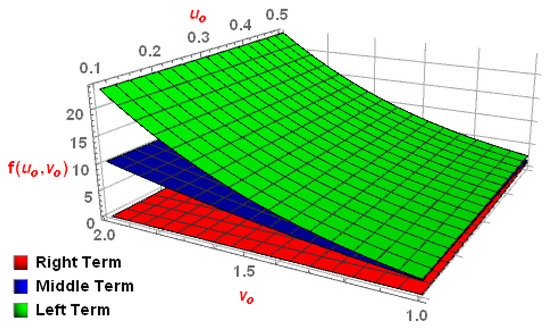
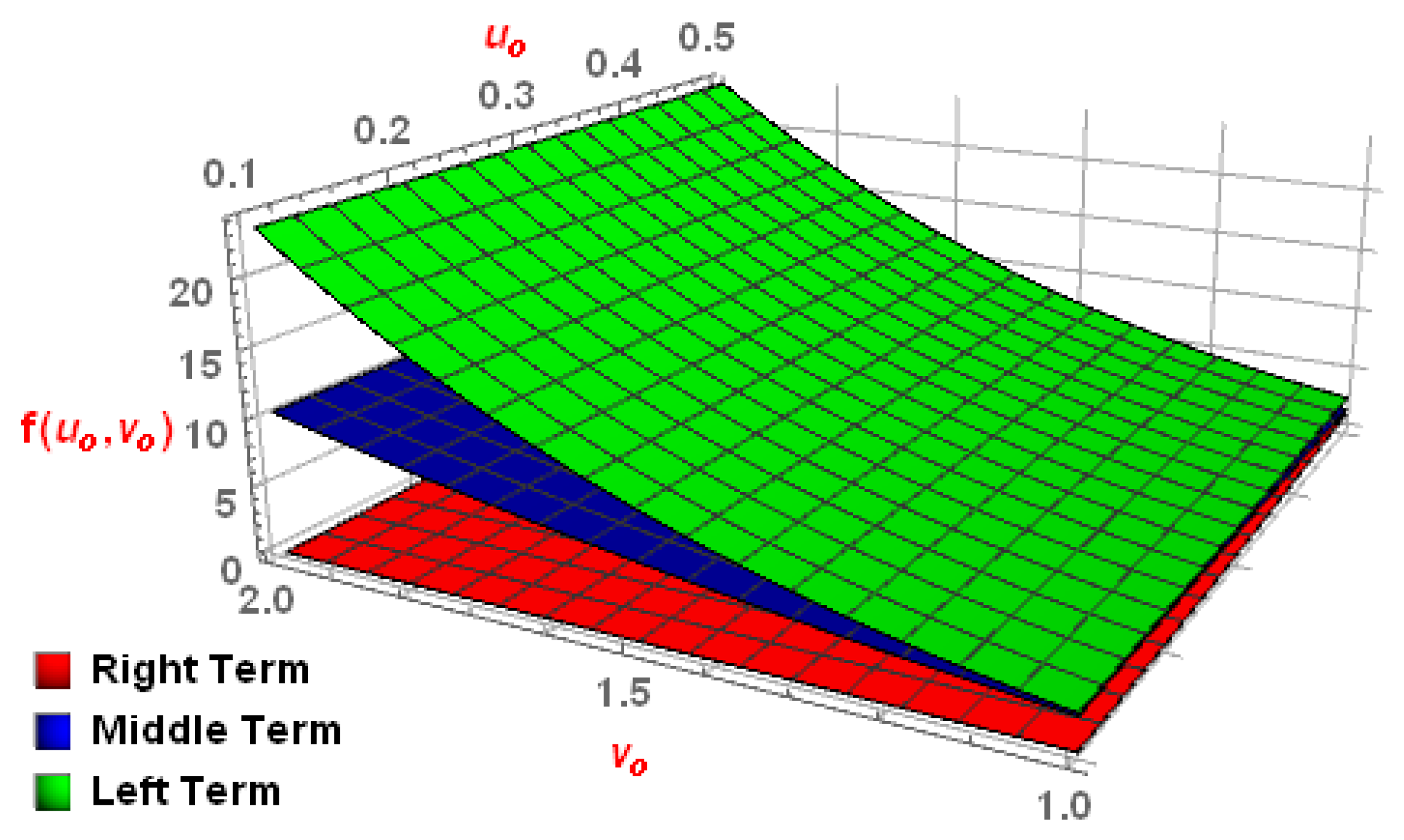
Example 1.
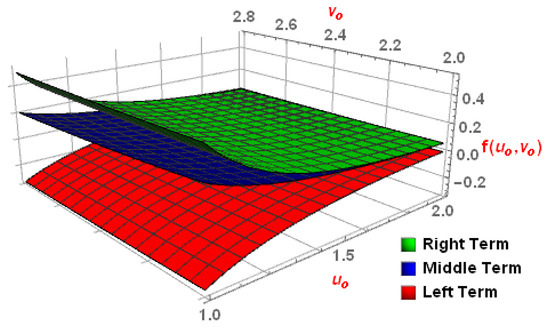
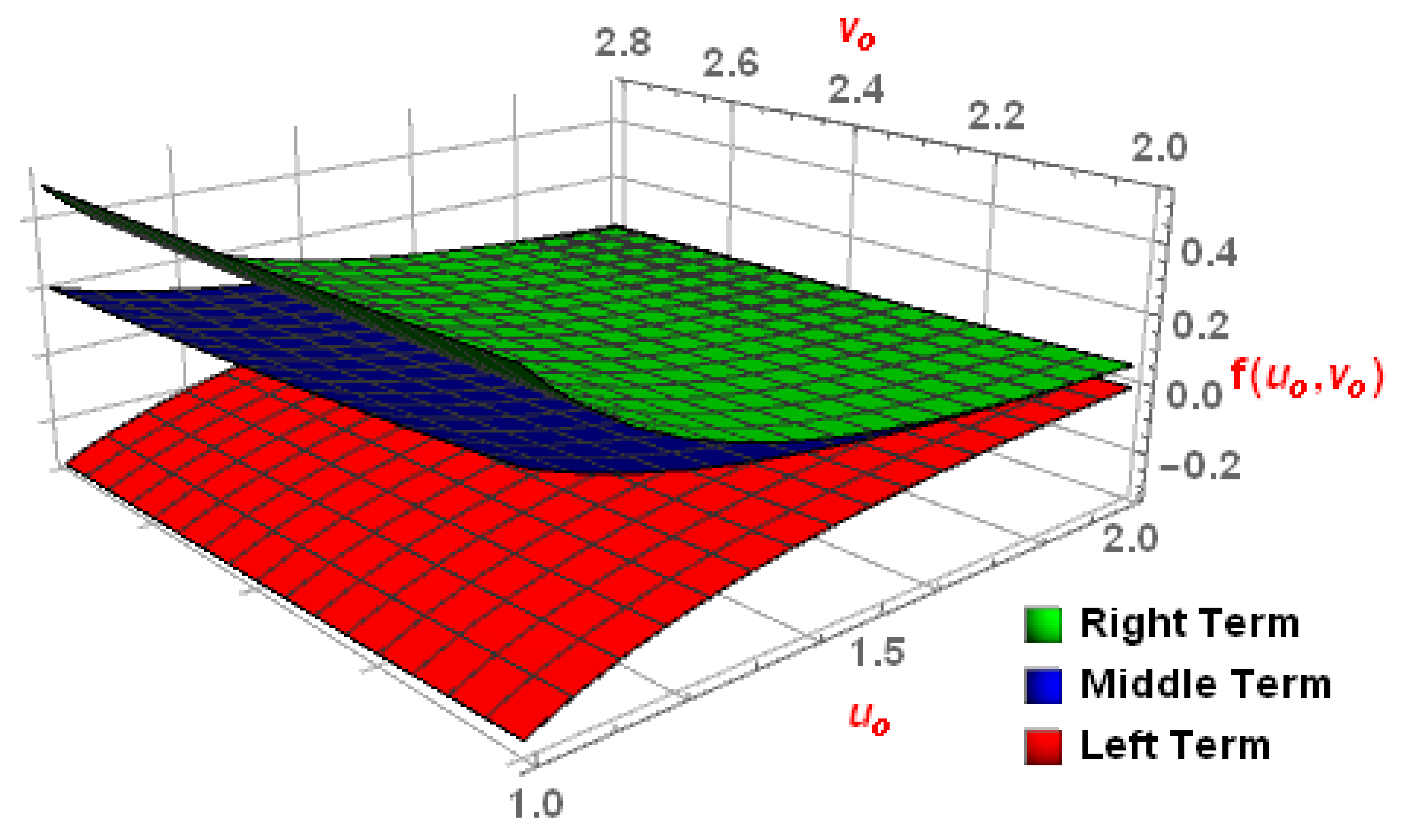
Figure 1 describes the viability of Theorem 5 for .
Figure 1.
Graphical illustration confirming the authenticity of Theorem 5 for , and .
The following lemma is necessary to support our other key findings.
Lemma 3.
Let the function possess differentiability on . Let with and , . Then, the following identity holds:
Proof. Using integration by parts, we attain
and
Changing the variable and then multiplying the results by and
and adding side-to-side, we have
Using a similar method, we have
Remark 3.
- (i)
- By letting in Lemma 3, it become Lemma 1.
- (ii)
- By letting in Lemma 3, it becomes the following equality:
- (iii)
- Letting in Lemma 3, we obtain
Lemma 3 allows us to derive the integral inequality that follows.
Theorem 6.
Let the function possess differentiability on with , where . If are harmonically convex on for some fixed and , then the following inequalities hold:
where , , are defined in Theorem 2 and
Proof. Let . Using the modulus property, the power mean inequality, and the harmonic convexity of and , we derive the following from Lemma (3):
Calculating , and , we have
This proof ends at this stage. □
Remark 4. If is picked in Theorem 6, then we attain
Example 2. Figure 2 describes the viability of Theorem 6 for .
Figure 2.
Graphical illustration confirming the authenticity of Theorem 6 for , , , and .
We provide an additional conclusion for harmonically convex functions using Lemmas 2 and 3 for .
Theorem 7.
Let the function possess differentiability on with , where . If are harmonically convex on for some fixed and , then the following inequalities hold:
where
and
Proof. Assume that . By applying the modulus property, the power mean inequality, and the harmonic convexity of and to Lemma(12), we determine
Now, calculating , and , we have by Lemma (2) that
which implies that
Similarly, we obtain
and
The proof ends at this stage. □
Remark 5.
If we take in Theorem 7, then the inequality becomes
Theorem 8.
Let be a differentiable function on , the interior of the interval , where with . If being harmonically convex on for some fixed , , and ; then, the following inequalities hold:
where and are defined in Theorem 3.
Proof. Assume that . By applying the Hölder inequality and the harmonic convexity of and to Lemmas (3) and (2), we determine
Calculating , and , we have
and
The proof ends at this stage. □
Remark 6.
If is picked in Theorem 7, then we attain
Theorem 9.
Let the function possess differentiability on with , where . If are harmonically convex on for some fixed and , then the following inequalities hold:
where and are defined in Theorem 3.
Proof. Assume that . By applying the Hölder inequality and the harmonic convexity of and to Lemmas 2 and 3, we determine
where
and
The proof ends at this stage. □
Remark 7.
If is picked in Theorem 7, then we attain
Theorem 10.
Let the function possess differentiability on with , where . If are harmonically convex on for some fixed and , then the following inequalities hold:
where is the -logarithmic mean.
Proof. Suppose that . Assuming the harmonic convexity of and the Hölder inequality, from Lemmas 2 and 3 we determine
where
and
The proof ends at this stage. □
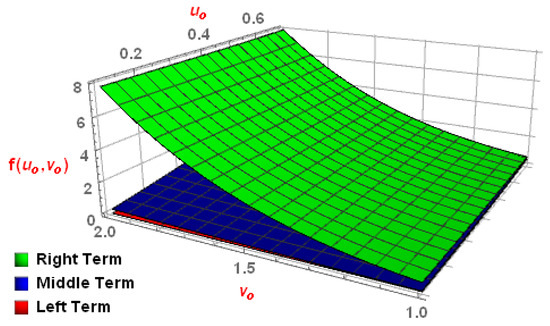
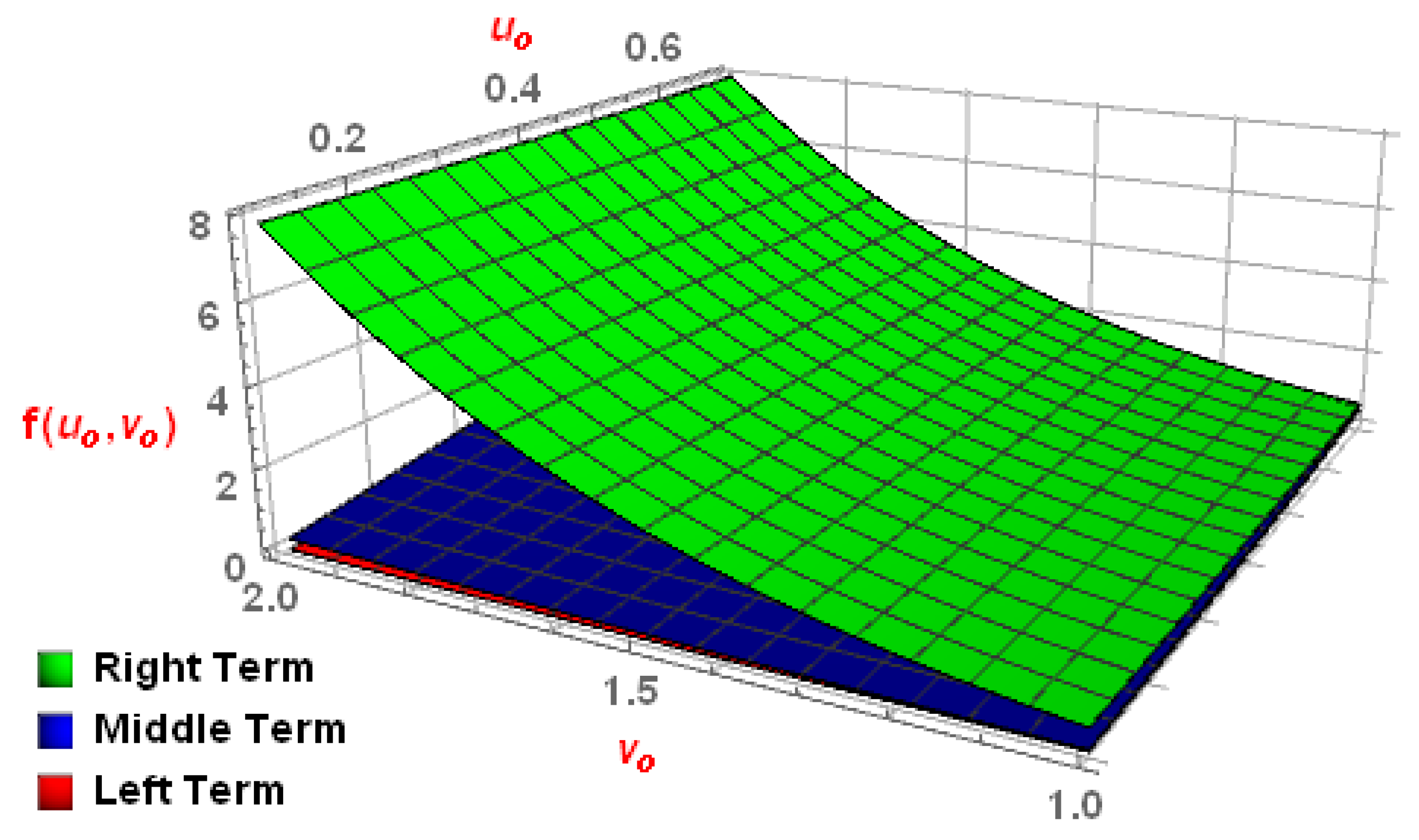
Example 3.
Figure 3 describes the viability of Theorem 10 for .
Figure 3.
Graphical illustration confirming the authenticity of Theorem 10 for , , , and .
4. Applications to Bessel Function
In this section, we define a new function in terms of the modified Bessel function of type-1. Then, we utilize such a function to obtain new fractional recurrence relations of the modified Bessel function which cannot be obtained by any analytical methods.
Consider the type-1 modified Bessel function [46]
The authors of [37,47] defined a new function for and in terms of the modified Bessel function of type-1, provided by
As , ∀ and , is convex on . Because the function is increasing as well, we can term this a harmonic convex function.
Proposition 1.
Let and such that ; then, the following inequality holds:
Proof. The result in (36) can be achieved by utilizing Theorem 5 for and replacing by , where
Hence the proof. □
Proposition 2.
Let and such that ; then, the below-mentioned inequality holds:
Proof. The result in (36) can be achieved by utilizing Theorem 5 for and replacing by , where ,
Hence the proof. □
5. Conclusions
In this paper, we have determined H.H-type inequalities for harmonically convex functions based on P.C.H fractional operators. As these operators are parameterized by α, they allow us to obtain the inequalities for the functions possessing first and second derivatives. Graphical representations along with examples confirm our theory and validate it at a practical level. Applications involving special functions have also led us to the development of novel fractional-order recurrence relations, which expand the utility of our results in fractional calculus.
The results reported here contribute to a growing literature on fractional inequalities and harmonically convex functions, providing new insights and tools to researchers. Future investigation might explore the integral inequalities for other classes of harmonic convex functions, such as the h-harmonic convex function, P-harmonic convex function, m-harmonic convex function, (P,m)-harmonic convex function, s-harmonic convex function, harmonic convex function of Gudun–Levin type, exponential-type harmonic convex function, harmonic convex function of n-polynomial type, and trigonometric harmonic convex function. Moreover, the inequalities for the aforementioned classes can be extended by employing multiplicative calculus, interval calculus, and fuzzy calculus. Finally, further applications in mathematical modeling and analysis exist, along with extension to higher-order fractional operators.
Author Contributions
Conceptualization, S.I.B. and M.U.; methodology, D.K. and M.U.; software, Y.S.; validation, S.I.B. and S.T.-S.; formal analysis, D.K.; investigation, M.U.; writing—original draft preparation, M.U.; writing—review and editing, S.I.B. and D.K.; visualization, S.T.-S.; supervision, Y.S. and S.I.B.; project administration, Y.S. and S.T.-S.; funding acquisition, Y.S. All authors have read and agreed to the published version of the manuscript.
Funding
This research received funding from Dong-A University, Busan 49315, Republic of Korea.
Data Availability Statement
No new data were created or analyzed in this study. Data sharing is not applicable to this article.
Acknowledgments
This research was supported by Dong-A University, Busan 49315, Republic of Korea.
Conflicts of Interest
The authors declare no conflicts of interest.
References
- Niculescu, C.P.; Persson, L.E. Old and new on the Hermite-Hadamard inequality. Real Anal. Exch. 2004, 29, 663–686. [Google Scholar] [CrossRef] [Scilit]
- Pečarić, J.; Tong, Y.L. Convex Functions, Partial Orderings and Statistical Applications; Academic Press: New York, NY, USA, 1992. [Google Scholar]
- Dragomir, S.S.; Agarwal, R. Two inequalities for differentiable mappings and applications to special means of real numbers and to trapezoidal formula. Appl. Math. Lett. 1998, 11, 91–95. [Google Scholar] [CrossRef] [Scilit]
- Nápoles Valdés, J.E.; Rabossi, F.; Samaniego, A.D. Convex functions: Ariadne’s thread or Charlotte’s Spiderweb? Adv. Math. Model. Appl. 2020, 5, 176–191. [Google Scholar]
- Du, T.; Long, Y. The multi-parameterized integral inequalities for multiplicative Riemann-Liouville fractional integrals. J. Math. Anal. Appl. 2025, 541, 128692. [Google Scholar] [CrossRef] [Scilit]
- Butt, S.I. Generalized Jensen-Hermite-Hadamard Mercer type inequalities for generalized strongly convex functions on fractal sets. Turk. J. Sci. 2024, 8, 51–63. [Google Scholar]
- Vivas-Cortez, M.; Kérus, P.; Nápoles Valdés, J.E. Some generalized Hermite-Hadamard-Fejér inequality for convex functions. Adv. Differ. Equ. 2021, 2021, 199. [Google Scholar] [CrossRef] [Scilit]
- Pearce, C.E.; Pečarić, J. Inequalities for differentiable mappings with application to special means and quadrature formulae. Appl. Math. Lett. 2000, 13, 51–55. [Google Scholar] [CrossRef] [Scilit]
- Kirmaci, U.S.; Özdemir, M.E. On some inequalities for differentiable mappings and applications to special means of real numbers and to midpoint formula. Appl. Math. Comput. 2004, 153, 361–368. [Google Scholar]
- Vivas-Cortez, M.; Ali, M.A.; Budak, H.; Kalsoom, H.; Agarwal, P. Some new Hermite-Hadamard and related inequalities for convex functions via (p, q)-integral. Entropy 2021, 23, 828. [Google Scholar] [CrossRef] [Scilit]
- Mehrez, K.; Agarwal, P. New Hermite-Hadamard type integral inequalities for convex functions and their applications. J. Comput. Appl. Math. 2019, 350, 274–285. [Google Scholar] [CrossRef] [Scilit]
- Varošanec, S. On h-convexity. J. Math. Anal. Appl. 2007, 326, 303–311. [Google Scholar] [CrossRef] [Scilit]
- Kadakal, M.; İşcan, İ.; Agarwal, P.; Jleli, M. Exponential trigonometric convex functions and Hermite-Hadamard type inequalities. Math. Slovaca 2021, 71, 43–56. [Google Scholar] [CrossRef] [Scilit]
- Anderson, G.D.; Vamanamurthy, M.K.; Vuorinen, M. Generalized convexity and inequalities. J. Math. Anal. Appl. 2007, 15, 1294–1308. [Google Scholar] [CrossRef] [Scilit]
- Íşcan, Í. Hermite-Hadamard inequalities for harmonically convex functions. Hacet. J. Math. Stat. 2014, 43, 935–942. [Google Scholar]
- Dimitrijev, S. Effective mass in semiconductors. Bart J. Van Zeghbroeck. 1997.
- Noor, M.A.; Noor, K.I. Harmonic variational inequalities. Appl. Math. Inform. Sci. 2016, 10, 1811–1814. [Google Scholar] [CrossRef] [Scilit]
- Íşcan, Í.; Wu, S. Hermite-Hadamard type inequalities for harmonically convex functions via fractional integrals. Appl. Math. Comput. 2014, 238, 237–244. [Google Scholar]
- Gao, W.; Kashuri, A.; Butt, S.I.; Tariq, M.; Aslam, A.; Nadeem, M. New inequalities via n-polynomial harmonically exponential type convex functions. AIMS Math. 2020, 5, 6856–6873. [Google Scholar] [CrossRef] [Scilit]
- Du, T.S.; Awan, M.U. Hermite-Hadamard type inequalities for harmonically-convex functions using fuzzy integrals. Filomat 2022, 36, 4099–4110. [Google Scholar]
- Butt, S.I.; Agarwal, P.; Yousaf, S.; Guirao, J.L.G. Generalized fractal Jensen and Jensen-Mercer inequalities for harmonic convex function with applications. J. Inequal. Appl. 2022, 2022, 1. [Google Scholar]
- Özcan, S.; Butt, S.I. Hermite-Hadamard type inequalities for multiplicatively harmonic convex functions. J. Inequal. Appl. 2023, 2023, 120. [Google Scholar] [CrossRef] [Scilit]
- Balachandran, K.; Matar, M.; Annapoorani, N.; Prabu, D. Hadamard functional fractional integrals and derivatives and fractional differential equations. Filomat 2024, 38, 779–792. [Google Scholar] [CrossRef] [Scilit]
- Ledesma, C.E.T.; Sousa, J.V.D.C. Fractional integration by parts and Sobolev-type inequalities for ψ-fractional operators. Math. Meth. Appl. Sci. 2022, 45, 9945–9966. [Google Scholar] [CrossRef] [Scilit]
- Khan, T.U.; Khan, M.A. New generalized mean square stochastic fractional operators with applications. Chaos Solitons Fractals 2021, 142, 110452. [Google Scholar] [CrossRef] [Scilit]
- Sarikaya, M.Z.; Dahmani, Z.; Kiris, M.E.; Ahmad, F. (k,s)-Riemann-Liouville fractional integral and applications. Hacet. J. Math. Stat. 2016, 45, 77–89. [Google Scholar]
- Verma, S.; Viswanathan, P. A note on Katugampola fractional calculus and fractal dimensions. Appl. Math. Comput. 2018, 339, 220–230. [Google Scholar]
- Fernandez, A.; Ustaoğlu, C. On some analytic properties of tempered fractional calculus. J. Comput. Appl. Math. 2020, 366, 112400. [Google Scholar] [CrossRef] [Scilit]
- Ledesma, C.E.T.; Gutierrez, H.A.C.; Rodriguez, J.P.A.; Vera, W.Z. Some boundedness results for Riemann-Liouville tempered fractional integrals. Fract. Calc. Appl. Anal. 2024, 27, 818–847. [Google Scholar] [CrossRef] [Scilit]
- Cheng, Q.J.; Luo, C.Y. Analytical properties, fractal dimensions and related inequalities of (k,h)-Riemann-Liouville fractional integrals. J. Comput. Appl. Math. 2024, 450, 115999. [Google Scholar] [CrossRef] [Scilit]
- Caputo, M.; Fabrizio, M. A new definition of fractional derivative without singular kernel. Prog. Fract. Differ. Appl. 2015, 1, 73–85. [Google Scholar]
- Atangana, A.; Baleanu, D. New fractional derivatives with nonlocal and non-singular kernel: Theory and application to heat transfer model. Therm. Sci. 2016, 20, 763–769. [Google Scholar] [CrossRef] [Scilit]
- Sabzikar, F.; Meerschaert, M.M.; Chen, J. Tempered fractional calculus. J. Comput. Phys. 2015, 293, 14–28. [Google Scholar] [CrossRef] [Scilit] [PubMed]
- Sun, W. On generalization of some inequalities for generalized harmonically convex functions via local fractional integrals. Quaest. Math. 2019, 42, 1159–1183. [Google Scholar] [CrossRef] [Scilit]
- Butt, S.I.; Khan, D. Integral inequalities of h-superquadratic functions and their fractional perspective with applications. Math. Method. Appl. Sci. 2024, 48, 1952–1981. [Google Scholar] [CrossRef] [Scilit]
- Benaissa, B.; Budak, H. General (k,p)-Riemann-Liouville fractional integrals. Filomat 2024, 38, 2579–2586. [Google Scholar]
- Sun, W. Some new inequalities for generalized h-convex functions involving local fractional integral operators with Mittag-Leffler kernel. Math. Methods Appl. Sci. 2021, 44, 4985–4998. [Google Scholar] [CrossRef] [Scilit]
- Sarikaya, M.Z. On Hermite-Hadamard type inequalities for proportional Caputo-hybrid operator. Konuralp. J. Math. 2023, 11, 31–39. [Google Scholar]
- Balenau, D.; Ferrandez, A.; Akgül, A. On a fractional operator combining proportional and classical differintegrals. Mathematics 2020, 8, 13. [Google Scholar] [CrossRef] [Scilit]
- Demir, İ. A new approach of Milne-type inequalities based on proportional Caputo-hybrid operator. J. Adv. Appl. Comput. Math. 2023, 10, 102–119. [Google Scholar] [CrossRef] [Scilit]
- Demir, İ.; Tunç, T. A new approach to Simpson-type inequality with proportional Caputo-hybrid operator. Math. Methods Appl. Sci. 2024, 48, 93–106. [Google Scholar] [CrossRef] [Scilit]
- Lakhdari, A.; Bin-Mohsin, B.; Jarad, F.; Xu, H.; Meftah, B. A parametrized approach to generalized fractional integral inequalities: Hermite–Hadamard and Maclaurin variants. J. King Saud Univ.-Sci. 2024, 36, 103523. [Google Scholar] [CrossRef] [Scilit]
- Peng, Y.; Özcan, S.; Du, T. Symmetrical Hermite–Hadamard type inequalities stemming from multiplicative fractional integrals. Chaos Solitons Fractals 2024, 183, 114960. [Google Scholar] [CrossRef] [Scilit]
- Li, H.; Meftah, B.; Saleh, W.; Xu, H.; Kiliçman, A.; Lakhdari, A. Further Hermite-Hadamard-type inequalities for fractional integrals with Exponential Kernels. Fractal Fract. 2024, 8, 345. [Google Scholar] [CrossRef] [Scilit]
- Wang, J.; Zhu, C.; Zhou, Y. New generalized Hermite-Hadamard type inequalities and applications to special means. J. Inequal. Appl. 2013, 2013, 325. [Google Scholar] [CrossRef] [Scilit]
- Watson, G.N. A Treatise on the Theory of Bessel Functions; Cambridge University Press: Cambridge, UK, 1944. [Google Scholar]
- Khan, D.; Butt, S.I. Superquadraticity and its fractional perspective via center-radius cr-order relation. Chaos Solitons Fractals 2024, 182, 114821. [Google Scholar] [CrossRef] [Scilit]
Disclaimer/Publisher’s Note: The statements, opinions and data contained in all publications are solely those of the individual author(s) and contributor(s) and not of MDPI and/or the editor(s). MDPI and/or the editor(s) disclaim responsibility for any injury to people or property resulting from any ideas, methods, instructions or products referred to in the content. |
© 2025 by the authors. Licensee MDPI, Basel, Switzerland. This article is an open access article distributed under the terms and conditions of the Creative Commons Attribution (CC BY) license (https://creativecommons.org/licenses/by/4.0/).