Article

Analysis of Piecewise Terminal Fractional System: Theory and Application to TB Treatment Model with Drug Resistance Development

1
Department of Mathematics, College of Science, University of Ha’il, Ha’il 55473, Saudi Arabia
2
Department of Mathematics, College of Computer and Information Technology, Al-Razi University, Sana’a 72738, Yemen
3
Department of Mathematics, College of Science, Qassim University, Buraydah 51452, Saudi Arabia
4
Department of Mathematics, Faculty of Science, Islamic University of Madinah, Madinah 42351, Saudi Arabia
5
Biology Department, College of Science, Imam Mohammad Ibn Saud Islamic University (IMSIU), Riyadh 11623, Saudi Arabia
6
Department of Basic Sciences, University Collage of Haqel, University of Tabuk, Tabuk 71491, Saudi Arabia
*
Authors to whom correspondence should be addressed.
Fractal Fract. 2025, 9(12), 807; https://doi.org/10.3390/fractalfract9120807
Submission received: 13 November 2025 / Revised: 2 December 2025 / Accepted: 5 December 2025 / Published: 9 December 2025
(This article belongs to the Section General Mathematics, Analysis)

Abstract

Researchers have devised numerous methods to model intricate behaviors in phenomena that unfold in multiple stages. This work focuses on a specific category of piecewise hybrid terminal systems characterized by delay. To account for hereditary memory effects, which are absent in standard integer-order systems, our framework partitions the time interval into two distinct phases. The initial phase employs the classical derivative, while the subsequent phase utilizes the Atangana–Baleanu–Caputo (ABC) fractional derivative. We establish conditions that guarantee both the existence and uniqueness of solutions through the application of suitable fixed-point arguments. Furthermore, Hyers–Ulam (H-U) stability is investigated to ascertain the robustness and reliability of the derived solutions. To exemplify these theoretical findings, we present a fractional-order tuberculosis treatment model that incorporates the development of drug resistance, alongside a general numerical example. Numerical simulations reveal that changes in the fractional order influence the dynamic behavior of the disease.

1. Introduction and Motivations

Fractional calculus has recently gained significant traction because of its superior ability to characterize complex dynamical systems exhibiting memory and inherited properties compared to conventional integer-order models. Consequently, it has emerged as a vital analytical framework with broad applications across various fields, including fluid mechanics, engineering, physics, biology, control theory, and electrochemistry [1,2,3,4,5]. A notable advancement in this area is the introduction of fractional operators by Atangana and Baleanu, featuring non-local and non-singular Mittag–Leffler kernels, available in both Riemann–Liouville and Caputo forms. The ABC derivative has attracted considerable interest [6,7,8,9] due to its effectiveness in capturing fading memory effects without the singularities inherent in traditional kernels. Its mathematical properties and diverse applications are thoroughly explored in references [10,11,12].
The dynamics of numerous natural, biological, and engineered systems can fluctuate across different timeframes due to various influences, such as vaccination initiatives, the evolution of drug resistance, or the specific treatments employed, all of which can alter disease transmission patterns. These elements precipitate corresponding shifts in disease dynamics. To enhance the accuracy of modeling these phenomena, the piecewise hybrid methodology introduced by Atangana and Seda [13] tackles these complexities by employing distinct fractional derivatives across different intervals. This approach facilitates a more nuanced representation of memory dynamics, as each derivative can be tailored to reflect the dominant mechanisms present during each phase. By integrating a transition point, this method explicitly models crossover effects, thereby underscoring changes in prevailing influences. Consequently, it adeptly captures multi-step behaviors and adapts to diverse contexts, providing a more precise and intricate depiction of complex systems. This particular class of fractional derivative has demonstrated notable efficacy in modeling infectious diseases, biological interactions, and tumor growth, among other applications [14,15,16].
Terminal value problems find applications across diverse fields where the primary challenge involves identifying a desired final state. For instance, they are employed to determine the optimal control strategy that minimizes a cost function over a defined time period. Here, the terminal value acts as a constraint, dictating the system’s final position or velocity. Researchers have extensively investigated the existence and uniqueness of solutions for terminal value problems, exploring the conditions under which a singular system value can be ascertained. Benchohra et al. [17] utilized various formulations of classical fixed-point theory to investigate the existence and uniqueness of solutions for the terminal value problem involving the Hilfer–Katugampola operator. Almalahi et al. [18] established stability results for novel terminal problems concerning another function, alongside sufficient conditions for the existence and uniqueness of solutions. Boichuk et al. [19] examined the terminal value problem for systems of fractional differential equations (FDEs) with additional constraints in the Caputo sense. Shah et al. [20] presented important remarks on terminal value problems on infinite intervals. Concurrently, piecewise hybrid solutions offer crucial insights into the stability and behavior of physical and biological systems [21,22]. Nevertheless, the majority of current literature primarily addresses integral-type or classical initial conditions. In contrast, piecewise hybrid terminal value problems have garnered relatively limited attention, despite their significant relevance in accurately representing memory-dependent processes with distributed terminal states.
Inspired by these observations, the present study explores a piecewise hybrid terminal system employing the piecewise derivative. The theoretical findings are subsequently validated through a numerical application to a fractional tuberculosis (TB) treatment model that incorporates drug resistance development. This application demonstrates the interplay between terminal conditions and fractional memory in influencing the system’s dynamics and long-term stability. We specifically consider the problem with delays, outlined as follows:
D 0 ρ P A B k ( ϖ ) = W ( ϖ , k ( ϖ ) , k ( λ ϖ ) ) , ϖ 0 , T , T > 0 , k ( ϖ 1 ) = μ , k ( T ) = χ ,
where
  • λ ϖ ϖ , for all ϖ 0 , T , T > 0 , and λ ϖ is continuous and bounded on 0 , T ;
  • μ , χ R , and W : 0 , T × R × R R is a given continuous function;
  • D 0 ρ P A B is the piecewise derivative of order ρ 0 , 1 with classical and ABC fractional derivative defined by
    D 0 ρ P A B k ( ϖ ) = d d ϖ k ( ϖ ) if   0 ϖ ϖ 1 , D 0 ρ A B k ( ϖ ) if   ϖ 1 ϖ T ;
  • d d ϖ k ( ϖ ) is the classical derivative of k on 0 ϖ ϖ 1 ;
  • D 0 ρ A B is the ABC fractional derivative on ϖ 1 ϖ T .
The inherent complexity of piecewise hybrid terminal fractional equations, arising from segmented dynamics and memory effects introduced by Mittag–Leffler derivatives, necessitates careful consideration. Investigation of existence and uniqueness is critical to establish the well-posedness of the model, while Hyers–Ulam stability is essential for confirming the solution’s resilience to perturbations. Both aspects are indispensable for reliable biological applications. This mathematical framework is particularly well-suited for biomedical systems, such as TB treatment models, as it readily captures phase transitions in therapeutic regimens and long-term immunological memory effects.
The following sections are structured as such: Section 2 introduces fractional calculus, including core definitions and a lemma converting the system (1) into an integral equation. Section 3 details our key results on the existence, uniqueness, and U-H stability of the piecewise hybrid problem (1), leveraging fixed-point theorems. Section 4 provides an illustrative example. An application to TB treatment in Section 5. The paper concludes with a summary of findings and contributions.

2. Preliminary and Essential Concepts

Let I = 0 , T R + , we define the Banach space X : = C I , R with the norm k = sup ϖ I k ( ϖ ) . Let PX : = P C I , R be the space of all piecewise continuous functions k : I R , characterized by points of discontinuity of the first kind ϖ 1 , at which the functions are left continuous.
Definition 1
([13]). The piecewise hybrid fractional derivative with classical and ABC fractional derivatives, is defined as follows:
D 0 ρ P A B k ( ϖ ) = D 1 k ( ϖ ) i f   ϖ 0 , ϖ 1 , D ϖ 1 ρ A B C k ( ϖ ) i f   ϖ ϖ 1 , T ,
where
(i) 
D 1 k ( ϖ ) = d d ϖ k ( ϖ ) , ϖ 0 , ϖ 1 ;
(ii) 
D ϖ ρ A B C k ( ϖ ) is the ABC-FD on ϖ ϖ 1 , T .
Definition 2
([13]). The piecewise integral of k PX is defined as follows:
I 0 ρ P A B k ( ϖ ) = I 1 k ( ϖ ) i f   ϖ 0 , ϖ 1 , I ϖ 1 ρ A B k ( ϖ ) i f   ϖ ϖ 1 , T , .
where
(i) 
I 1 k ( ϖ ) = 0 ϖ 1 k ( ς ) d ς , ϖ 0 , ϖ 1 ;
(ii) 
I ϖ 1 ρ A B k ( ϖ ) = 1 ρ Ψ ( ρ ) k ( ϖ ) + ρ Ψ ( ρ ) Γ ( ρ ) ϖ 1 ϖ ( ϖ ς ) ρ 1 k ( ς ) d ς , ϖ ϖ 1 , T ;
(iii) 
Ψ ( ρ ) is a normalization function such that Ψ ( ρ ) = 1 ρ + ρ Γ ( ρ ) .
Lemma 1.
For ρ 0 , 1 and k PX . Then, we have the following:
I 0 ρ P A B   D 0 ρ P A B k ( ϖ ) = k ( ϖ 1 ) k ( 0 ) i f ϖ 0 , ϖ 1 , k ( T ) k ( ϖ 1 ) i f   ϖ ϖ 1 , T .
Proof. 
In view of the definitions of piecewise fractional calculus (Definitions 1 and 2), with classical and ABC derivatives, we have the following:
I 0 ρ P A B   D 0 ρ P A B k ( ϖ ) = I 1 D 1 k ( ϖ ) i f ϖ 0 , ϖ 1 , I ϖ 1 ρ A B   D ϖ 1 ρ A B R k ( ϖ ) i f   ϖ ϖ 1 , T .
Case (1): For ϖ 0 , ϖ 1 , we have the following:
I 0 ρ P A B   D 0 ρ P A B k ( ϖ ) = I 1 D 1 k ( ϖ ) = k ( ϖ ) k ( 0 ) .
Thus, we have the following:
I 0 ρ P A B   D 0 ρ P A B k ( ϖ ) = k ( ϖ ) k ( 0 ) , ϖ 0 , ϖ 1 .
Case (2): For ϖ ϖ 1 , T , we have the following:
I 0 ρ P A B   D 0 ρ P A B k ( ϖ )   =   I ϖ 1 ρ A B   D ϖ 1 ρ A B R k ( ϖ ) .
In view of proof presented by Atangana–Baleanu [6], the wright side of (2) becomes the following:
I ϖ 1 ρ A B   D ϖ 1 ρ A B R k ( ϖ ) = k ( ϖ ) k ( ϖ 1 ) .
Thus, we can write (2) as follows:
I 0 ρ A B   D 0 ρ A B R k ( ϖ ) = k ( ϖ ) k ( ϖ 1 ) ,   ϖ ϖ 1 , T .
Thus, by the above cases, we obtain the following:
I 0 ρ P A B   D 0 ρ P A B k ( ϖ ) = k ( ϖ ) k ( 0 ) , i f ϖ 0 , ϖ 1 , k ( ϖ ) k ( ϖ 1 ) , i f   ϖ ϖ 1 , T .
Lemma 2.
For ρ 0 , 1 , k PX . Then, we have the following:
D 0 ρ P A B   I 0 ρ P A B k ( ϖ ) = k ( ϖ ) .
Proof. 
In view of definition of piecewise fractional calculus (Definitions 1 and 2), we have the following:
D 0 ρ P A B   I 0 ρ P A B k ( ϖ ) = D 1 I 1 k ( ϖ ) if ϖ 0 , ϖ 1 , D 0 ρ P A B   I 0 ρ P A B k ( ϖ ) if   ϖ ϖ 1 , T .
Case (1): For ϖ 0 , ϖ 1 , we have the following:
D 0 ρ P A B   I 0 ρ P A B k ( ϖ ) = D 1 I 1 k ( ϖ ) .
By Kilbas [2], with ρ n 1 , n , n N , k X , we have the following:
D ρ I ρ k ( ϖ ) = k ( ϖ ) .
For ρ = 1 , we have the following:
D 1 I 1 k ( ϖ ) = k ( ϖ ) .
Thus, we can write (3) as follows:
D 0 ρ P A B   I 0 ρ P A B k ( ϖ ) = k ( ϖ ) , i f ϖ 0 , ϖ 1 .
Case (2): For ϖ ϖ 1 , T , we have the following:
D 0 ρ P A B   I 0 ρ P A B k ( ϖ )   =   D ϖ 1 ρ A B R   i ϖ 1 ρ A B k ( ϖ )
By Atangana and Baleanu [6], we obtain the following:
D 0 ρ P A B   I 0 ρ P A B k ( ϖ ) = k ( ϖ ) , i f ϖ ϖ 1 , T .
Thus, by the above cases, we obtain the following:
D 0 ρ P A B   I 0 ρ P A B k ( ϖ ) = k ( ϖ ) .
Theorem 1
 ([23]). The operator Φ : X X , ( X is a Banach space) is a contraction if there exists a constant number 0 < λ < 1 such that the following is met:
Φ ( k ) Φ ( k * ) λ k k * ,
for all k , k * X .
Lemma 3
 ([13]). The solution of the following piecewise fractional problem:
D 0 ρ P A B k ( ϖ ) = W ( ϖ , k ( ϖ ) , k ( λ ϖ ) ) ,
is given by
k ( ϖ ) = k ( 0 ) + 0 ϖ W ( ς , k ( ς ) , k ( λ ς ) ) d ς , ϖ 0 , ϖ 1 k ( ϖ 1 ) + 1 ρ Ψ ( ρ ) W ( ϖ , k ( ϖ ) , k ( λ ϖ ) ) + ρ Ψ ( ρ ) Γ ( ρ ) ϖ 1 ϖ ( ϖ ς ) ρ 1 W ( ς , k ( ς ) , k ( λ ς ) ) d ς , ϖ 1 , T .

3. Main Result

Before presenting our main results, we must first establish several critical lemmas.
Lemma 4.
The solution to the following piecewise fractional terminal problem:
D 0 ρ P A B k ( ϖ ) = W ( ϖ , k ( ϖ ) , k ( λ ϖ ) ) , ϖ 0 , T , k ( ϖ 1 ) = μ , k ( T ) = χ ,
is given by
k ( ϖ ) = μ 0 ϖ 1 W ( ς , k ( ς ) , k ( λ ς ) ) d ς + 0 ϖ W ( ς , k ( ς ) , k ( λ ς ) ) d ς , i f   ϖ 0 , ϖ 1 , μ + 1 ρ Ψ ( ρ ) W ( ϖ , k ( ϖ ) , k ( λ ϖ ) ) + ρ Ψ ( ρ ) Γ ( ρ ) ϖ 1 ϖ ( ϖ ς ) ρ 1 W ( ς , k ( ς ) , k ( λ ς ) ) d ς , i f   ϖ ϖ 1 , T ,
and the terminal condition is satisfied
χ = μ + 1 ρ Ψ ( ρ ) W ( T , k ( T ) , k ( T λ T ) ) + ρ Ψ ( ρ ) Γ ( ρ ) ϖ 1 T ( T ς ) ρ 1 W ( ς , k ( ς ) , k ( λ ς ) ) d ς .
Proof. 
Applying the piecewise integral I 0 ρ P A B with both classical and ABC integrals to both sides of (4), we have the following:
I 0 ρ P A B   D 0 ρ P A B k ( ϖ )   =   I 0 ρ P A B W ( ϖ , k ( ϖ ) , k ( λ ϖ ) ) .
By Lemma 1, we rewrite the left side of (5) as follows:
I 0 ρ P A B   D 0 ρ P A B k ( ϖ ) = I 1 D 1 k ( ϖ ) = k ( ϖ ) k ( 0 ) , if ϖ 0 , ϖ 1 , I ϖ 1 ρ A B   D ϖ 1 ρ A B R k ( ϖ ) = k ( ϖ ) k ( ϖ 1 ) , if ϖ ϖ 1 , T .
By Definition 2, we rewrite the right side of (5) as follows:
I 0 ρ P A B W ( ϖ , k ( ϖ ) ) = 0 ϖ W ( ς , k ( ς ) , k ( λ ς ) ) d ς ,   ϖ 0 , ϖ 1 , 1 ρ Ψ ( ρ ) W ( ϖ , k ( ϖ ) , k ( λ ϖ ) ) , + ρ Ψ ( ρ ) Γ ( ρ ) ϖ 1 ϖ ( ϖ ς ) ρ 1 W ( ς , k ( ς ) , k ( λ ς ) ) d ς ,   ϖ ϖ 1 , T .
Thus by (5), (6) and (7), we have the following:
k ( ϖ ) = k ( 0 ) + 0 ϖ W ( ς , k ( ς ) , k ( λ ς ) ) d ς ,   ϖ 0 , ϖ 1 , k ( ϖ 1 ) + 1 ρ Ψ ( ρ ) W ( ϖ , k ( ϖ ) , k ( λ ϖ ) ) , + ρ Ψ ( ρ ) Γ ( ρ ) ϖ 1 ϖ ( ϖ ς ) ρ 1 W ( ς , k ( ς ) , k ( λ ς ) ) d ς ,   ϖ ϖ 1 , T .
In case ϖ 0 , ϖ 1 , we have the following:
k ( ϖ ) = k ( 0 ) + 0 ϖ W ( ς , k ( ς ) , k ( λ ς ) ) d ς .
Replace ϖ with ϖ 1 and using the condition k ( ϖ 1 ) = μ , we obtain the following:
k ( 0 ) = μ 0 ϖ 1 W ( ς , k ( ς ) , k ( λ ς ) ) d ς .
Thus, the Equation (8) becomes the following:
k ( ϖ ) = μ 0 ϖ 1 W ( ς , k ( ς ) , k ( λ ς ) ) d ς + 0 ϖ W ( ς , k ( ς ) , k ( λ ς ) ) d ς .
In case ϖ ϖ 1 , T , we have the following:
k ( ϖ ) = k ( ϖ 1 ) + 1 ρ Ψ ( ρ ) W ( ϖ , k ( ϖ ) , k ( λ ϖ ) ) + ρ Ψ ( ρ ) Γ ( ρ ) ϖ 1 ϖ ( ϖ ς ) ρ 1 W ( ς , k ( ς ) , k ( λ ς ) ) d ς .
Since k ( ϖ 1 ) = μ , then, we obtain the following:
k ( ϖ ) = μ + 1 ρ Ψ ( ρ ) W ( ϖ , k ( ϖ ) , k ( λ ϖ ) ) + ρ Ψ ( ρ ) Γ ( ρ ) ϖ 1 ϖ ( ϖ ς ) ρ 1 W ( ς , k ( ς ) , k ( λ ς ) ) d ς .
Thus, by the above cases, we have the following:
k ( ϖ ) = μ 0 ϖ 1 W ( ς , k ( ς ) , k ( λ ς ) ) d ς + 0 ϖ W ( ς , k ( ς ) , k ( λ ς ) ) d ς , i f   ϖ 0 , ϖ 1 , μ + 1 ρ Ψ ( ρ ) W ( ϖ , k ( ϖ ) , k ( λ ϖ ) ) + ρ Ψ ( ρ ) Γ ( ρ ) ϖ 1 ϖ ( ϖ ς ) ρ 1 W ( ς , k ( ς ) , k ( λ ς ) ) d ς , i f   ϖ ϖ 1 , T .
To analyze the existence and uniqueness results, the following assumptions must be satisfied:
Hypothesis 1 (H1).
There exist constants L 1 , L 2 > 0 , such that the following is calculated:
W ( ϖ , k 1 ( ϖ ) , k 1 ( λ ϖ ) ) W ( ϖ , k 2 ( ϖ ) , k 2 ( λ ϖ ) ) L 1 k 1 ( ϖ ) k 2 ( ϖ ) + L 2 k 1 ( λ ϖ ) k 2 ( λ ϖ ) ,   f o r   ϖ I a n d   k 1 , k 2 PX .
Hypothesis 2 (H2).
W : I × R R is continuous and there exist two constants τ , η > 0 such that the following is obtained:
W ( ϖ , k ( ϖ ) , k ( λ ϖ ) ) τ + η 1 k ( ϖ ) + η 2 k ( λ ϖ ) ,   f o r   ϖ I .
To apply fixed-point techniques, we define an operator Φ : PX PX by the following:
Φ k ( ϖ ) = Φ 1 k ( ϖ ) , ϖ 0 , ϖ 1 , Φ 2 k ( ϖ ) , ϖ ϖ 1 , T .
where
Φ 1 k ( ϖ ) = μ 0 ϖ 1 W ( ς , k ( ς ) , k ( λ ς ) ) d ς + 0 ϖ W ( ς , k ( ς ) , k ( λ ς ) ) d ς ,
and
Φ 2 k ( ϖ ) = μ + 1 ρ Ψ ( ρ ) W ( ϖ , k ( ϖ ) , k ( λ ϖ ) ) + ρ Ψ ( ρ ) Γ ( ρ ) ϖ 1 ϖ ( ϖ ς ) ρ 1 W ( ς , k ( ς ) , k ( λ ς ) ) d ς .

3.1. Existence Result

In the following theorem, we will apply the Krasnoselskii fixed-point theorem.
Theorem 2 (Existence result).
Suppose that the Hypotheses H1 and H2 are satisfied. If η i = L i ,   i = 1 , 2 ,   Ψ ( ρ ) 0 , and
0 < 2 η 1 + η 2 ϖ 1 < 1 , 0 < η 1 + η 2 1 ρ Ψ ( ρ ) < 1 .
Then, the problem (1) has a solution.
Proof. 
Define the closed ball B r as follows:
B r = k PX : k r ,
with
r max μ + 2 τ ϖ 1 1 2 η 1 + η 2 ϖ 1 , μ + 1 ρ τ Ψ ( ρ ) 1 η 1 + η 2 1 ρ Ψ ( ρ ) .
To apply Krasnoselskii’s fixed-point theorem, we define the operators Θ 1 , Θ 2 : P C I , B r P C I , B r as follows:
Θ 1 k ( ϖ ) = μ 0 ϖ 1 W ( ς , k ( ς ) , k ( λ ς ) ) d ς , i f   ϖ 0 , ϖ 1 , μ + 1 ρ Ψ ( ρ ) W ( ϖ , k ( ϖ ) , k ( λ ϖ ) ) , i f   ϖ ϖ 1 , T ,
and
Θ 2 k ( ϖ ) = 0 ϖ W ( ς , k ( ς ) , k ( λ ς ) ) d ς , i f   ϖ 0 , ϖ 1 , ρ Ψ ( ρ ) Γ ( ρ ) ϖ 1 ϖ ( ϖ ς ) ρ 1 W ( ς , k ( ς ) , k ( λ ς ) ) d ς , i f   ϖ ϖ 1 , T .
Clearly, the following is obtained:
Θ 1 k ( ϖ ) + Θ 2 k ( ϖ ) = Φ k ( ϖ ) .
To present a systematic and organized proof, we will divide it into several steps as outlined below:
Step 1:  Θ 1 k + Θ 2 k B r . In case ϖ 0 , ϖ 1 and k B r , we have the following:
Θ 1 k ( ϖ ) + Θ 2 k ( ϖ ) μ + 0 ϖ 1 W ( ς , k ( ς ) , k ( λ ς ) ) d ς + 0 ϖ W ( ς , k ( ς ) , k ( λ ς ) ) d ς .
By H2, we obtain the following:
Θ 1 k ( ϖ ) + Θ 2 k ( ϖ ) μ + 2 τ + η 1 + η 2 k ϖ 1 μ + 2 τ ϖ 1 + 2 r η 1 + η 2 ϖ 1 r .
In case ϖ ϖ 1 , T and k B r , by H2, we the following:
Θ 1 k ( ϖ ) + Θ 2 k ( ϖ ) μ + 1 ρ Ψ ( ρ ) τ + η 1 + η 2 k μ + 1 ρ τ Ψ ( ρ ) + η 1 + η 2 1 ρ Ψ ( ρ ) r r .
From (11) and (12), we have the following:
Θ 1 k + Θ 2 k r .
Hence, Θ 1 k + Θ 2 k B r .
Step 2:  Θ 1 is a contraction. In case ϖ 0 , ϖ 1 and k 1 , k 2 B r , by H1, we have the following:
Θ 1 k 1 ( ϖ ) Θ 1 k 2 ( ϖ ) 0 ϖ 1 W ( ς , k 1 ( ς ) , k 1 ( λ ς ) ) W ( ς , k 2 ( ς ) , k 2 ( λ ς ) ) d ς L 1 + L 2 0 ϖ 1 k 1 ( ς ) k 2 ( ς ) d ς .
Thus, we obtain the following:
Θ 1 k 1 ( ϖ ) Θ 1 k 2 ( ϖ ) L 1 + L 2 ϖ 1 k 1 k 2 .
In case ϖ ϖ 1 , T and k 1 , k 2 B r , by H1, we have the following:
Θ 1 k 1 ( ϖ ) Θ 1 k 2 ( ϖ ) 1 ρ Ψ ( ρ ) W ( ϖ , k 1 ( ϖ ) , k 1 ( λ ϖ ) ) W ( ϖ , k 2 ( ϖ ) , k 2 ( λ ϖ ) ) .
Hence by H1, we have the following:
Θ 1 k 1 ( ϖ ) Θ 1 k 2 ( ϖ ) L 1 + L 2 1 ρ Ψ ( ρ ) k 1 k 2 .
From (13) and (14), we obtain the following:
Θ 1 k 1 Θ 1 k 2 max L 1 + L 2 ϖ 1 , L 1 + L 2 1 ρ Ψ ( ρ ) k 1 k 2 .
Since η = L , we have the following:
max L 1 + L 2 ϖ 1 , L 1 + L 2 1 ρ Ψ ( ρ ) < 1
Thus Θ 1 is a contraction mapping.
Step 3:  Θ 2 is continuous and Θ 2 B r is relatively compact (uniform bounded, and equicontinuous).
Part 1:  Θ 2 is continuous: In case ϖ 0 , ϖ 1 . Let { k n } be a sequence in B r , such that k n k . Then, for ϖ 0 , ϖ 1 , we have the following:
Θ 2 k n ( ϖ ) Θ 2 k ( ϖ ) 0 ϖ 1 W ( ς , k n ( ς ) , k n ( λ ς ) ) W ( ς , k ( ς ) , k ( λ ς ) ) d ς L 1 + L 2 0 ϖ 1 k n ( ς ) k ( ς ) d ς .
Hence, by H1, we have the following:
Θ 2 k n ( ϖ ) Θ 2 k ( ϖ ) L 1 + L 2 ϖ 1 k n k .
In case, ϖ ϖ 1 , T . Let { k n } be a sequence in B r , such that k n k . Then, we have
Θ 2 k n ( ϖ ) Θ 2 k ( ϖ ) ρ Ψ ( ρ ) Γ ( ρ ) ϖ 1 ϖ ( ϖ ς ) ρ 1 W ( ς , k n ( ς ) , k n ( λ ς ) ) W ( ς , k ( ς ) , k ( λ ς ) ) d ς .
Hence by H1, we have the following:
Θ 2 k n ( ϖ ) Θ 2 k ( ϖ ) L 1 + L 2 Ψ ( ρ ) ( T ϖ 1 ) ρ Γ ( ρ ) k n k .
From (15) and (16), k n k as n , and W is continuous, then by the Lebesgue dominated convergence theorem, we have the following:
Θ 2 k n Θ 2 k 0 a s k n k .
Hence Θ 2 is continuous.
Part 2:  Θ 2 is uniformly bounded on B r . In case ϖ 0 , ϖ 1 and k B r , via H2, we have the following:
Θ 2 k ( ϖ ) 0 ϖ W ( ς , k ( ς ) , k ( λ ς ) ) d ς 0 ϖ τ + η 1 + η 2 k ( ϖ ) d ς .
Hence, we obtain the following:
Θ 2 k ( ϖ ) τ + η 1 + η 2 k ϖ 1 : = L 1
In case ϖ ϖ 1 , T and k B r , via H2, we have the following:
Θ 2 k ( ϖ ) ρ Ψ ( ρ ) Γ ( ρ ) ϖ 1 ϖ ( ϖ ς ) ρ 1 W ( ς , k ( ς ) , k ( λ ς ) ) d ς ( T ϖ 1 ) ρ Ψ ( ρ ) Γ ( ρ ) τ + η 1 + η 2 k ( ϖ ) .
Hence, the following is obtained:
Θ 2 k ( T ϖ 1 ) ρ Ψ ( ρ ) Γ ( ρ ) τ + η 1 + η 2 k : = L 2 .
By the above cases, we obtain the following:
Θ 2 k max L 1 , L 2 .
Thus, Θ 2 is uniformly bounded on B r by max L 1 , L 2 .
Part 3:  Θ 2 equicontinuous. In case ϖ 0 , ϖ 1 , 0 ϖ a < ϖ b ϖ 1 and k B r , via H2, we have the following:
Θ 2 k ( ϖ b ) Θ 2 k ( ϖ a ) = 0 ϖ b W ( ς , k ( ς ) , k ( λ ς ) ) d ς 0 ϖ a W ( ς , k ( ς ) , k ( λ ς ) ) d ς 0 ϖ a W ( ς , k ( ς ) , k ( λ ς ) ) W ( ς , k ( ς ) , k ( λ ς ) ) d ς + ϖ a ϖ b W ( ς , k ( ς ) , k ( λ ς ) ) d ς ϖ a ϖ b τ + η 1 + η 2 k ( ς ) d ς τ + η 1 + η 2 k ϖ b ϖ a .
Hence
Θ 2 k ( ϖ b ) Θ 2 k ( ϖ a ) 0 a s ϖ b ϖ a 0 .
In case ϖ ϖ 1 , T , ϖ 1 ϖ a < ϖ b T and k B r , via H2, we have
Θ 2 k ( ϖ b ) Θ 2 k ( ϖ a ) + ρ Ψ ( ρ ) Γ ( ρ ) ϖ 1 ϖ b ( ϖ b ς ) ρ 1 W ( ς , k ( ς ) , k ( λ ς ) ) d ς ρ Ψ ( ρ ) Γ ( ρ ) ϖ 1 ϖ a ( ϖ a ς ) ρ 1 W ( ς , k ( ς ) , k ( λ ς ) ) d ς ρ Ψ ( ρ ) Γ ( ρ ) ϖ 1 ϖ a ( ϖ b ς ) ρ 1 ( ϖ a ς ) ρ 1 W ( ς , k ( ς ) , k ( λ ς ) ) d ς + ρ Ψ ( ρ ) Γ ( ρ ) ϖ a ϖ b ( ϖ b ς ) ρ 1 W ( ς , k ( ς ) , k ( λ ς ) ) d ς ( ϖ b ϖ 1 ) ρ ( ϖ a ϖ 1 ) ρ Ψ ( ρ ) Γ ( ρ ) τ + η 1 + η 2 k .
Hence, by the above cases, we obtain the following:
Θ 2 k ( ϖ b ) Θ 2 k ( ϖ a ) 0 a s ϖ b ϖ a 0 .
Based on our analysis, we deduce that the operator Θ 2 exhibits equicontinuity. Consequently, Θ 2 is relatively compact and, therefore, completely continuous, as per the Arzelà-Ascoli theorem. By applying Krasnoselskii’s fixed-point theorem, we can conclude that the piecewise hybrid problem (1) has at least one solution. The proof completed. □

3.2. Uniqueness Result

In the following theorem, we will apply the Banach contraction principle [23].
Theorem 3.
(Uniqueness result). Assume that H1 holds. If the following is met:
0 < 2 L 1 + L 2 ϖ 1 , 2 < 1 ,
where
2 = L 1 + L 2 Ψ ( ρ ) 1 ρ + ( T ϖ 1 ) ρ Γ ( ρ ) ,
then the problem (1) has unique solution.
Proof. 
Define the closed ball B r as follows:
B r = k PX : k r ,
with
r max μ + 2 M ϖ 1 1 2 L 1 + L 2 ϖ 1 , χ + M Ψ ( ρ ) 1 ρ + ( T ϖ 1 ) ρ Γ ( ρ ) 1 2 ,
where M = sup ϖ I W ( ϖ , 0 , 0 ) . Now, we prove that Φ B r B r , where Φ defined in (10). By H1, we have the following:
W ( ς , k ( ς ) ) = W ( ς , k ( ς ) , k ( λ ς ) ) W ( ς , 0 , 0 ) + W ( ς , 0 , 0 ) W ( ς , k ( ς ) , k ( λ ς ) ) W ( ς , 0 , 0 ) + W ( ς , k ( ς ) , k ( λ ς ) ) L 1 + L 2 k + M .
In case ϖ 0 , ϖ 1 and k B r , we have the following:
Φ 1 k ( ϖ ) sup ϖ 0 , ϖ 1 μ + 0 ϖ 1 W ( ς , k ( ς ) , k ( λ ς ) ) d ς + 0 ϖ W ( ς , k ( ς ) , k ( λ ς ) ) d ς μ + 0 ϖ 1 W ( ς , k ( ς ) , k ( λ ς ) ) d ς + 0 ϖ W ( ς , k ( ς ) , k ( λ ς ) ) d ς .
By (17), we obtain the following:
Φ 1 k μ + 2 L 1 + L 2 k ϖ 1 + 2 M ϖ 1 μ + 2 L 1 + L 2 r ϖ 1 + 2 M ϖ 1 .
In case ϖ ϖ 1 , T and k B r , we have the following:
Φ 2 k ( ϖ ) = sup ϖ ϖ 1 , T μ + 1 ρ Ψ ( ρ ) W ( ϖ , k ( ϖ ) , k ( λ ϖ ) ) + ρ Ψ ( ρ ) Γ ( ρ ) ϖ 1 ϖ ( ϖ ς ) ρ 1 W ( ς , k ( ς ) , k ( λ ς ) ) d ς μ + 1 ρ Ψ ( ρ ) W ( ϖ , k ( ϖ ) , k ( λ ϖ ) ) + ρ Ψ ( ρ ) Γ ( ρ ) ϖ 1 ϖ ( ϖ ς ) ρ 1 W ( ς , k ( ς ) , k ( λ ς ) ) d ς .
By (17), we obtain the following:
Φ 2 k ( ϖ ) μ + L 1 + L 2 k 1 ρ Ψ ( ρ ) + M 1 ρ Ψ ( ρ ) + L 1 + L 2 k ( T ϖ 1 ) ρ Ψ ( ρ ) Γ ( ρ ) + M ( T ϖ 1 ) ρ Ψ ( ρ ) Γ ( ρ ) μ + 2 r + M Ψ ( ρ ) 1 ρ + ( T ϖ 1 ) ρ Γ ( ρ ) r .
From (18) and (19), we have the following:
Φ 2 k r
Thus, Φ B r B r . Next, we show that Φ is a contraction. In case ϖ 0 , ϖ 1 and k 1 , k 2 B r with H2, we have the following:
Φ 1 k 1 ( ϖ ) Φ 1 k 2 ( ϖ ) 0 ϖ 1 W ( ς , k 1 ( ς ) , k 1 ( λ ς ) ) W ( ς , k 2 ( ς ) , k 2 ( λ ς ) ) d ς + 0 ϖ W ( ς , k 1 ( ς ) , k 1 ( λ ς ) ) W ( ς , k 2 ( ς ) , k 2 ( λ ς ) ) d ς 2 L 1 + L 2 ϖ 1 k 1 k 2 .
In case ϖ ϖ 1 , T and k 1 , k 2 B r with H2, we have the following:
Φ 2 k 1 ( ϖ ) Φ 2 k 2 ( ϖ ) 1 ρ Ψ ( ρ ) W ( ϖ , k 1 ( ϖ ) , k 1 ( λ ϖ ) ) W ( ϖ , k 2 ( ϖ ) , k 2 ( λ ϖ ) ) + ρ Ψ ( ρ ) Γ ( ρ ) ϖ 1 ϖ ( ϖ ς ) ρ 1 W ( ς , k 1 ( ς ) , k 1 ( λ ς ) ) W ( ς , k 2 ( ς ) , k 2 ( λ ς ) ) d ς L 1 + L 2 k 1 k 2 1 ρ Ψ ( ρ ) + L 1 + L 2 k 1 k 2 ( T ϖ 1 ) ρ Ψ ( ρ ) Γ ( ρ ) L 1 + L 2 Ψ ( ρ ) 1 ρ + ( T ϖ 1 ) ρ Γ ( ρ ) k 1 k 2 2 k 1 k 2 .
Thus, by (20) and (21), we obtain the following:
Φ k 1 Φ k 2 max 2 L 1 + L 2 ϖ 1 , 2 k 1 k 2 .
Since max 2 L 1 + L 1 ϖ 1 , 2 < 1 , therefore, Φ is contraction. Consequently, by Theorem 1, we conclude that the piecewise hybrid problem (1) has a unique solution. □

3.3. Hyers–Ulam Stability

In this part, we start by introducing some definitions and an auxiliary lemma. Then, we present the theorem of Hyers–Ulam stability for problem (1). For further details on stability, refer to refs. [24,25].
Definition 3.
The piecewise hybrid problem (1) is said to be H-U stable, stable if a real number M > 0 exists such that for every ε > 0 , there is a function k ^ PX satisfying the following inequality:
D 0 ρ P A B k ^ ( ϖ ) W ( ϖ , k ^ ( ϖ ) ) ε , ϖ I ,
corresponding to a solution k PX of problem (1) with the following condition:
k ( ϖ 1 ) = k ^ ( ϖ 1 ) = μ , i f   ϖ 0 , ϖ 1 , k ( T ) = k ^ ( T ) = χ , i f   ϖ ϖ 1 , T ,
such that
k ^ k M ε , ϖ I .
Remark 1.
A function k ^ PX is a solution of (22) if and only if there exists a small perturbation z PX such that the following is obtained:
(i) 
z ( ϖ ) ε , ϖ I ;
(ii) 
D 0 ρ P A B k ^ ( ϖ ) = W ( ϖ , k ^ ( ϖ ) ) + z ( ϖ ) ,   ϖ I .
Lemma 5.
Let k ^ PX be a function satisfying (22). Then, k ^ satisfies the following integral inequalities:
k ^ ( ϖ ) Σ k ^ 1 2 ϖ 1 ε , i f   ϖ 0 , ϖ 1 , k ^ ( ϖ ) Σ k ^ 2 1 Ψ ( ρ ) 1 ρ + ( T ϖ 1 ) ρ Γ ( ρ ) ε , i f   ϖ ϖ 1 , T ,
where
Σ k ^ 1 = μ 0 ϖ 1 W ( ς , k ^ ( ς ) , k ^ ( λ ς ) ) d ς + 0 ϖ W ( ς , k ^ ( ς ) , k ^ ( λ ς ) ) d ς ,
and
Σ k ^ 2 = μ + 1 ρ Ψ ( ρ ) W ( ϖ , k ^ ( ϖ ) , k ^ ( λ ϖ ) ) + ρ Ψ ( ρ ) Γ ( ρ ) ϖ 1 ϖ ( ϖ ς ) ρ 1 W ( ς , k ^ ( ς ) , k ^ ( λ ς ) ) d ς .
Proof. 
Let k ^ PX be satisfies the (22). Then, by Remark 1, we have the following:
D 0 ρ P A B k ^ ( ϖ ) = W ( ϖ , k ^ ( ϖ ) , k ^ ( λ ϖ ) ) + z ( ϖ ) , ϖ I .
According to Lemma 4, the solution of (25) is given by the following:
k ^ ( ϖ ) = μ 0 ϖ 1 W ( ς , k ^ ( ς ) , k ^ ( λ ς ) ) + z ( ς ) d ς + 0 ϖ W ( ς , k ^ ( ς ) , k ^ ( λ ς ) ) + z ( ς ) d ς , i f   ϖ 0 , ϖ 1 , μ + 1 ρ Ψ ( ρ ) W ( ϖ , k ^ ( ϖ ) , k ^ ( λ ϖ ) ) + z ( ϖ ) + ρ Ψ ( ρ ) Γ ( ρ ) ϖ 1 ϖ ( ϖ ς ) ρ 1 W ( ς , k ^ ( ς ) , k ^ ( λ ς ) ) + z ( ς ) d ς , i f   ϖ ϖ 1 , T .
In the case ϖ 0 , ϖ 1 , we have the following:
k ^ ( ϖ ) = μ 0 ϖ 1 W ( ς , k ^ ( ς ) , k ^ ( λ ς ) ) + z ( ς ) d ς + 0 ϖ W ( ς , k ^ ( ς ) , k ^ ( λ ς ) ) + z ( ς ) d ς .
Thus, by (23), we obtain the following:
k ^ ( ϖ ) Σ k ^ 1 0 ϖ z ( ς ) d ς + 0 ϖ 1 z ( ς ) d ς ϖ ε + ϖ 1 ε 2 ϖ 1 ε , s i n c e ϖ 0 , ϖ 1 .
In the case ϖ ϖ 1 , T , we have the following:
k ^ ( ϖ ) = μ + 1 ρ Ψ ( ρ ) W ( ϖ , k ^ ( ϖ ) , k ^ ( λ ϖ ) ) + z ( ϖ ) + ρ Ψ ( ρ ) Γ ( ρ ) ϖ 1 ϖ ( ϖ ς ) ρ 1 W ( ς , k ^ ( ς ) , k ^ ( λ ς ) ) + z ( ς ) d ς .
Thus, by (24), we obtain the following:
k ^ ( ϖ ) Σ k ^ 2 1 ρ Ψ ( ρ ) z ( ϖ ) + ρ Ψ ( ρ ) Γ ( ρ ) ϖ 1 ϖ ( ϖ ς ) ρ 1 z ( ς ) d ς 1 Ψ ( ρ ) 1 ρ + ( T ϖ 1 ) ρ Γ ( ρ ) ε .
Theorem 4.
Under conditions of Theorem 3. If the following is met:
0 < 2 L 1 + L 2 ϖ 1 , L 1 + L 2 Ψ ( ρ ) 1 ρ + ( T ϖ 1 ) ρ Γ ( ρ ) < 1 .
then, the problem (1) is HU stable.
Proof. 
Let ε > 0 and k ^ PX be satisfies (22) and let k PX be a unique solution of (1) problem. According to Lemma 4, we have the following:
k ( ϖ ) = μ 0 ϖ 1 W ( ς , k ( ς ) , k ( λ ς ) ) d ς + 0 ϖ W ( ς , k ( ς ) , k ( λ ς ) ) d ς , i f   ϖ 0 , ϖ 1 , μ + 1 ρ Ψ ( ρ ) W ( ϖ , k ( ϖ ) , k ( λ ϖ ) ) + ρ Ψ ( ρ ) Γ ( ρ ) ϖ 1 ϖ ( ϖ ς ) ρ 1 W ( ς , k ( ς ) , k ( λ ς ) ) d ς , i f   ϖ ϖ 1 , T .
In case ϖ 0 , ϖ 1 by Lemma 5, we have the following:
k ^ ( ϖ ) k ( ϖ ) = k ^ ( ϖ ) μ 0 ϖ 1 W ( ς , k ( ς ) , k ( λ ς ) ) d ς + 0 ϖ W ( ς , k ( ς ) , k ( λ ς ) ) d ς k ^ ( ϖ ) μ 0 ϖ 1 W ( ς , k ^ ( ς ) , k ^ ( λ ς ) ) d ς + 0 ϖ W ( ς , k ^ ( ς ) , k ^ ( λ ς ) ) d ς + 0 ϖ 1 W ( ς , k ^ ( ς ) , k ^ ( λ ς ) ) W ( ς , k ( ς ) , k ( λ ς ) ) d ς + 0 ϖ W ( ς , k ^ ( ς ) , k ^ ( λ ς ) ) W ( ς , k ( ς ) , k ( λ ς ) ) d ς k ^ ( ϖ ) Σ k ^ 1 + 0 ϖ 1 W ( ς , k ^ ( ς ) , k ^ ( λ ς ) ) W ( ς , k ( ς ) , k ( λ ς ) ) d ς + 0 ϖ W ( ς , k ^ ( ς ) , k ^ ( λ ς ) ) W ( ς , k ( ς ) , k ( λ ς ) ) d ς .
Hence, by Lemma 5, we have the following:
k ^ ( ϖ ) k ( ϖ ) 2 ϖ 1 ε + 0 ϖ 1 W ( ς , k ^ ( ς ) , k ^ ( λ ς ) ) W ( ς , k ( ς ) , k ( λ ς ) ) d ς + 0 ϖ W ( ς , k ^ ( ς ) , k ^ ( λ ς ) ) W ( ς , k ( ς ) , k ( λ ς ) ) d ς .
By H1, we obtain the following:
k ^ ( ϖ ) k ( ϖ ) 2 ϖ 1 ε + 2 L 1 + L 2 k ^ k ϖ 1 .
Hence
k ^ ( ϖ ) k ( ϖ ) 2 ϖ 1 ε 1 2 L 1 + L 2 ϖ 1 .
In case ϖ ϖ 1 , T by Lemma 5, we have the following:
k ^ ( ϖ ) k ( ϖ ) k ^ ( ϖ ) Σ k ^ 2 + 1 ρ Ψ ( ρ ) W ( ϖ , k ^ ( ϖ ) , k ^ ( λ ϖ ) ) W ( ϖ , k ( ϖ ) , k ( λ ϖ ) ) + ρ Ψ ( ρ ) Γ ( ρ ) ϖ 1 ϖ ( ϖ ς ) ρ 1 W ( ς , k ^ ( ς ) , k ^ ( λ ς ) ) W ( ς , k ( ς ) , k ( λ ς ) ) d ς .
Hence, by Lemma 5 and H1, we have the following:
k ^ ( ϖ ) k ( ϖ ) 1 Ψ ( ρ ) 1 ρ + ( T ϖ 1 ) ρ Γ ( ρ ) ε + L 1 + L 2 1 ρ Ψ ( ρ ) k ^ k + L 1 + L 2 ( T ϖ 1 ) ρ Ψ ( ρ ) Γ ( ρ ) k ^ k 1 Ψ ( ρ ) 1 ρ + ( T ϖ 1 ) ρ Γ ( ρ ) ε + L 1 + L 2 Ψ ( ρ ) 1 ρ + ( T ϖ 1 ) ρ Γ ( ρ ) k ^ k .
Hence, the following is obtained:
k ^ ( ϖ ) k ( ϖ ) 1 Ψ ( ρ ) 1 ρ + ( T ϖ 1 ) ρ Γ ( ρ ) 1 L 1 + L 2 Ψ ( ρ ) 1 ρ + ( T ϖ 1 ) ρ Γ ( ρ ) ε .
From (27) and (28), we have the following:
k ^ k max 2 ϖ 1 1 2 L ϖ 1 , 2 Ψ ( ρ ) 1 ρ + ( T ϖ 1 ) ρ Γ ( ρ ) 1 2 L Ψ ( ρ ) 1 ρ + ( T ϖ 1 ) ρ Γ ( ρ ) ε .
Thus, we have the following:
k ^ k M ε ,
where
M = max 2 ϖ 1 1 2 L ϖ 1 , 1 Ψ ( ρ ) 1 ρ + ( T ϖ 1 ) ρ Γ ( ρ ) 1 L 1 + L 2 Ψ ( ρ ) 1 ρ + ( T ϖ 1 ) ρ Γ ( ρ ) > 0 .
Hence the problem (1) is H-U stable. □

4. An Example

Example 1.
Consider the following piecewise terminal value problem:
D 0 ρ P A B k ( ϖ ) = W ( ϖ , k ( ϖ ) , k ( λ ϖ ) ) ,   ϖ 0 , T , k ( ϖ 1 ) = μ , k ( T ) = σ ,
where
λ ( ϖ ) = ϖ 0.1 , ϖ 0.1 , 0 , ϖ < 0.1 ,
representing a constant delay of 0.1 time units. Here, ρ = 4 5 0 , 1 , 0 ,   T = 0 , 1 ,   T = 1 ,   ϖ 1 = 1 3 ,   μ = 2 ,   σ = 4 , and the following:
W ( ϖ , k ( ϖ ) , k ( λ ϖ ) ) = ϖ 2 ϖ + 1 k ( ϖ ) + ϖ ϖ + 3 k ( λ ϖ ) 1 + k ( λ ϖ ) .
Clearly, the function W is continuous. For k 1 , k 2 PX and ϖ I , we have the following:
W ( ϖ , k 1 ( ϖ ) ) W ( ϖ , k 2 ( ϖ ) ) = ϖ 2 ϖ + 1 k 1 ( ϖ ) + ϖ ϖ + 3 k 1 ( λ ϖ ) 1 + k 1 ( λ ϖ ) ϖ 2 ϖ + 1 k 2 ( ϖ ) + ϖ ϖ + 3 k 2 ( λ ϖ ) 1 + k 2 ( λ ϖ ) 1 3 k 1 ( ϖ ) k 2 ( ϖ ) + 1 4 k 1 ( λ ϖ ) k 2 ( λ ϖ ) .
Thus, the condition H1 holds with L 1 = 1 3 > 0 , L 2 = 1 4 > 0 . Now, according to Theorem 3, we obtain the following:
2 L 1 + L 2 ϖ 1 = 7 18 ,
and
2 = L 1 + L 2 Ψ ( ρ ) 1 ρ + ( T ϖ 1 ) ρ Γ ( ρ ) = 7 12 4 5 2 4 5 1 4 5 + ( 1 1 4 ) 4 5 Γ ( 4 5 ) 0.772 < 1 .
Hence, we can conclude that all conditions stated in Theorem 3 are satisfied, ensuring the existence of a unique solution for the piecewise terminal problem (29). For every ε > 0 , and for each k ^ PX satisfied the following inequality:
D 0 ρ P A B k ^ ( ϖ ) W ( ϖ , k ^ ( ϖ ) , k ^ ( λ ϖ ) ) ε , ϖ I .
There exists a solution k PX of the piecewise terminal value problem (29) with
k ^ k M ε .
where
M = max 2 ϖ 1 1 2 L 1 + L 2 ϖ 1 , 2 Ψ ( ρ ) 1 ρ + ( T ϖ 1 ) ρ Γ ( ρ ) 1 2 L 1 + L 2 Ψ ( ρ ) 1 ρ + ( T ϖ 1 ) ρ Γ ( ρ ) > 0 .
Therefore, all conditions in Theorem 4 are satisfied and hence the piecewise terminal problem (29) is UH stable. Now, by choosing M ( ε ) = M ( 0 ) = 0 such that M ( 0 ) = 0 , then the piecewise terminal value problem (29) is GUH stability.

5. An Application to TB Treatment

In this section, we apply the piecewise hybrid fractional system to model the dynamics of tuberculosis (TB) treatment. This significant global health issue is further complicated by the evolution of drug resistance, in order to demonstrate the practical applicability of our theoretical findings. The model depicts the crucial interaction between drug-sensitive and drug-resistant bacterial strains as well as the typical two-phase treatment protocol (an intensive phase followed by a continuation phase). The proposed TB model included the following state variables:
S ( t ) : Population at risk;
L ( t ) : People who are latently infected;
I s ( t ) : People with drug-sensitive, active TB;
I r ( t ) : People with drug-resistant, active TB;
T ( t ) : Patients receiving treatment.
The following is the definition of the piecewise hybrid fractional system:

5.1. Phase 1 (Intensive Phase (Classical Dynamics) t 0 , t 1 )

d S d t = Λ β S I S + θ I r μ S , d L d t = β S I S + θ I r α + μ L , d I s d t = α L + w T δ s + τ 1 + μ I s , d I r d t = γ τ 1 I s δ r + τ 2 + μ I r , d T d t = τ 1 I s + τ 2 I r w + μ T .

5.2. Phase 2 (Continuation Phase (Fractional Dynamics with Memory) t t 1 , T )

D 0 ρ A B C S t = Λ β S I S + θ I r μ S , D 0 ρ A B C L t = β S I S + θ I r α + μ L + M L L , t , D 0 ρ A B C I s t = α L + w T δ s + τ 1 + μ I s , D 0 ρ A B C I r t = γ τ 1 I s δ r + τ 2 + μ I r + M R I r , t , D 0 ρ A B C T t = τ 1 I s + τ 2 I r w + μ T .
with Terminal Conditions (Treatment Goals):
I s t 1 = I s 1 , I s T = I s t a r g e t , I r t 1 = I r 1 , I r T = I r t a r g e t .

5.3. Piecewise Structure Interpretation in Biology

  • Phase 1 ( 0 , t 1 ): The first intensive phase models the direct, immediate effects of high-potency medication therapy using classical derivatives. This stage is dominated by pharmacodynamics rather than sophisticated immune memory and concentrates on quick bacterial destruction.
  • Phase 2 ( t 1 , T ): To capture the long-term immunological memory effects, such as T-cell memory development, long-lasting medication effects, and the cumulative history of immune responses, the continuation phase uses the ABC fractional derivative. The memory of latent infection dynamics and resistance development routes are denoted by the words ML(L,t) and MR(Ir,t), respectively.
The definitions of the model parameters are presented in Table 1.
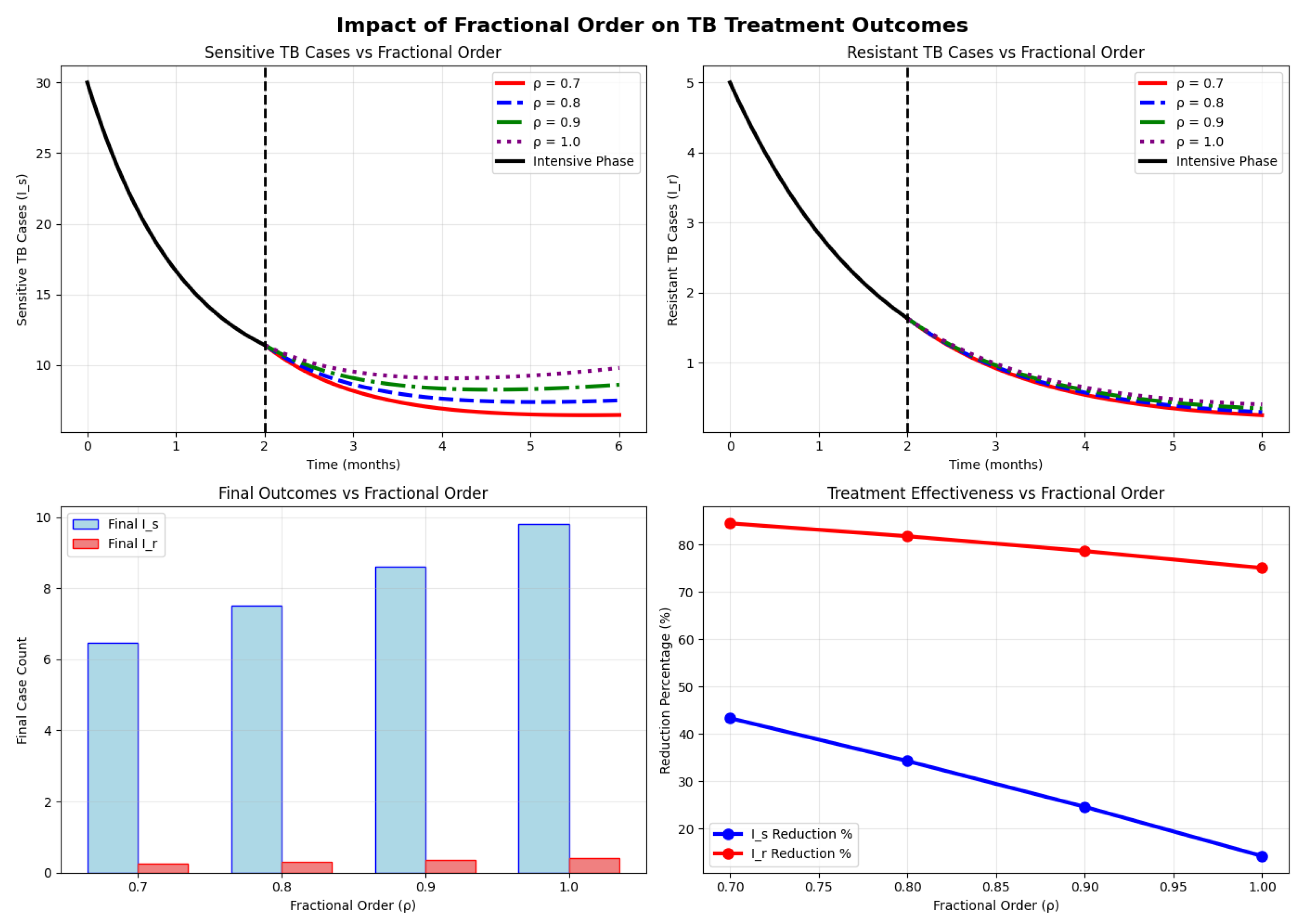
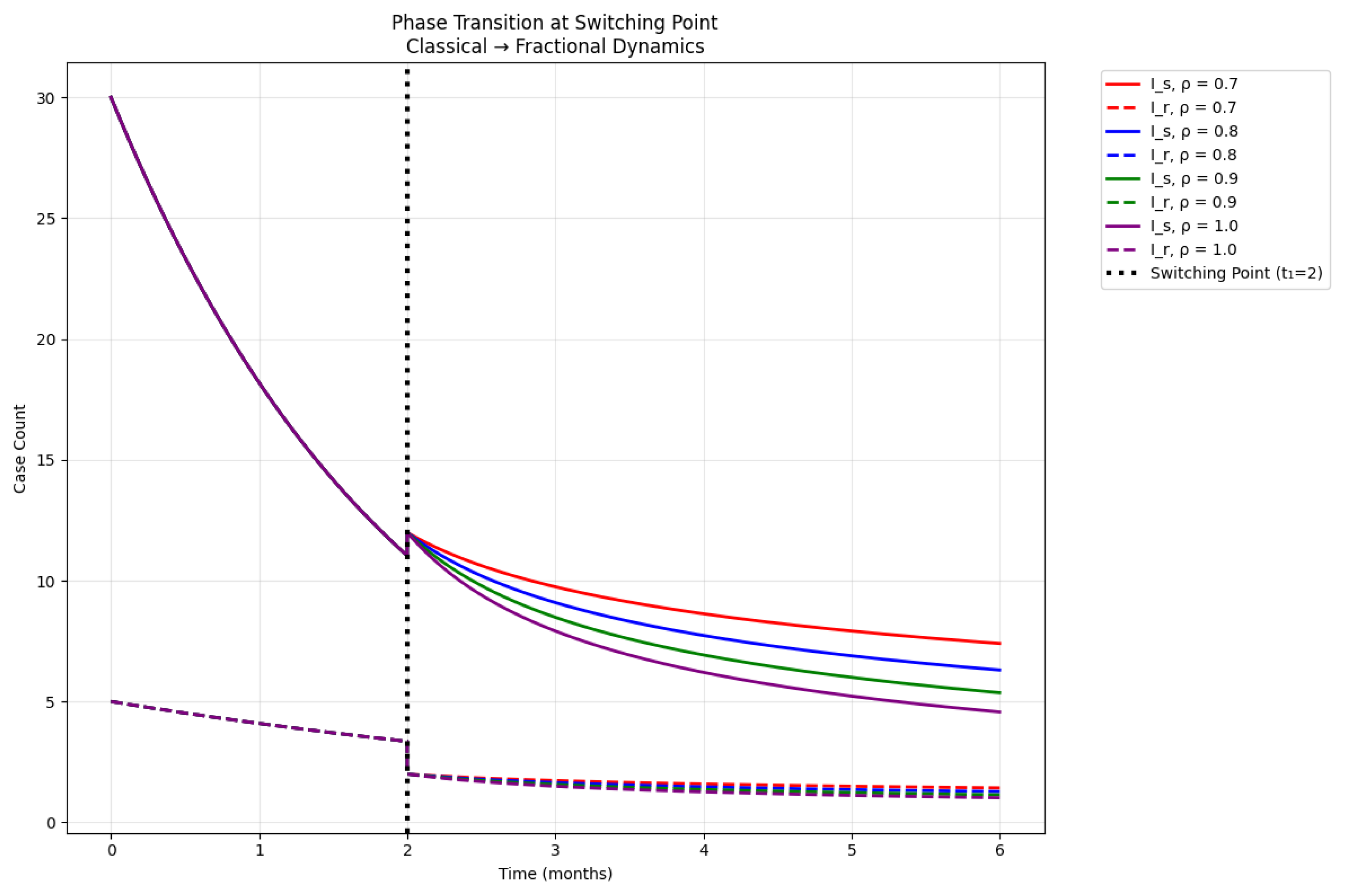
A key biological insight is revealed by the numerical results, which are shown in the accompanying Figure 1 and Figure 2: the fractional order ρ is a quantitative measure of the immune system’s memory strength. In both drug-sensitive ( I s ) and drug-resistant ( I r ) TB cases, a lower value of ρ (e.g., 0.7) indicates stronger, more permanent immunological memory, which results in slower but more sustained dynamics. Sensitive and resistant strains react differently to the identical immunological memory profile, as the simulations show. This suggests a biological trade-off: an immune response designed to quickly eradicate drug-sensitive tuberculosis might not be the best way to prevent the development of drug resistance. The presence of an ideal ρ value at the terminal time T that minimizes both I s and I r contend that utilizing the proper strength of the host’s immunological memory is just as important for long-term TB control as medication efficacy.
The Comparative Treatment Outcomes for Different Fractional Orders are presented in Table 2.
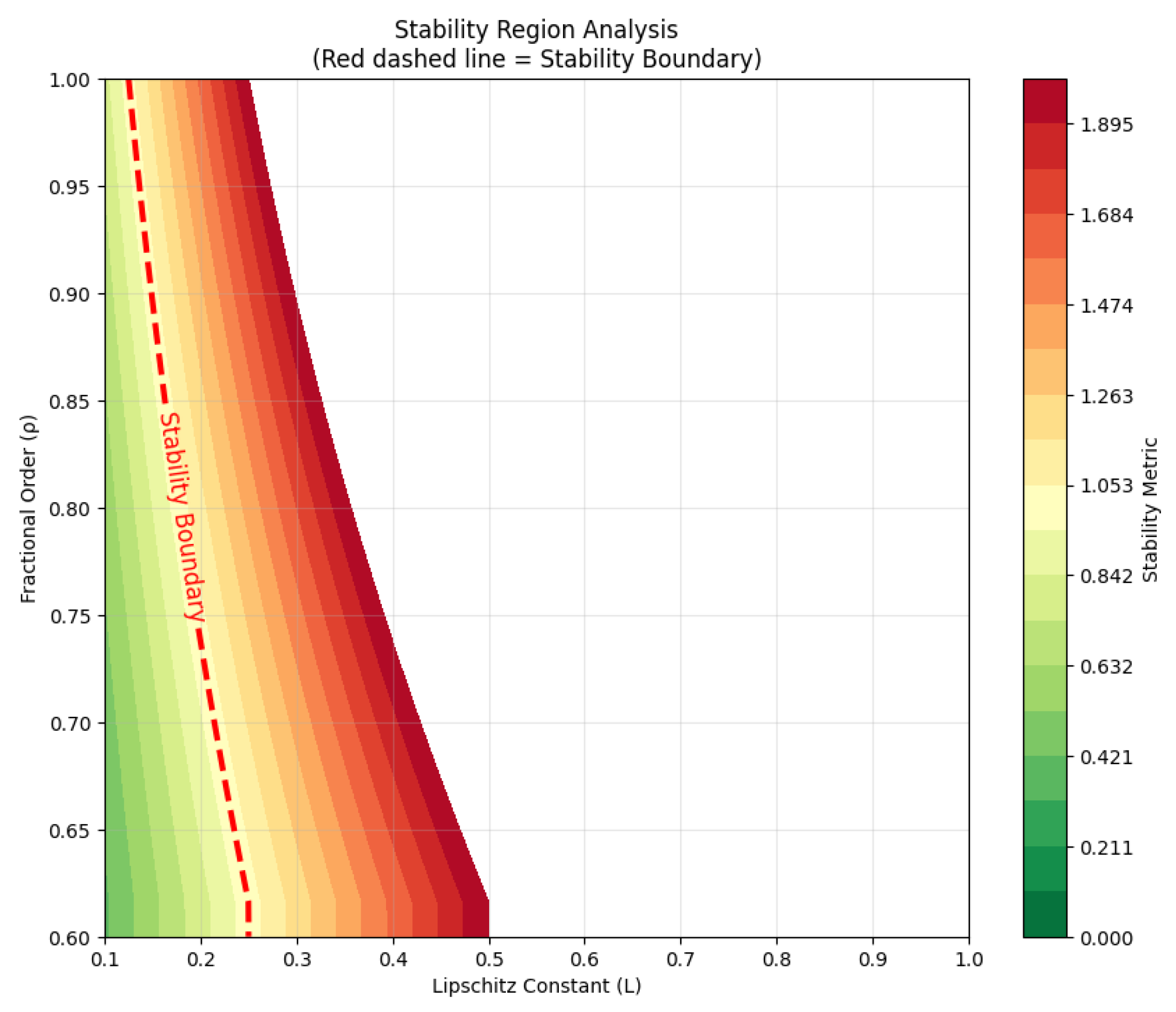
Figure 3 presents the Lipschitz constant and fractional order parameter space stability area. The stability border, where the contraction requirement is met, as indicated by the red dashed line. Parameter combinations that ensure solution existence and uniqueness are represented by the green zone according to Theorem 3.
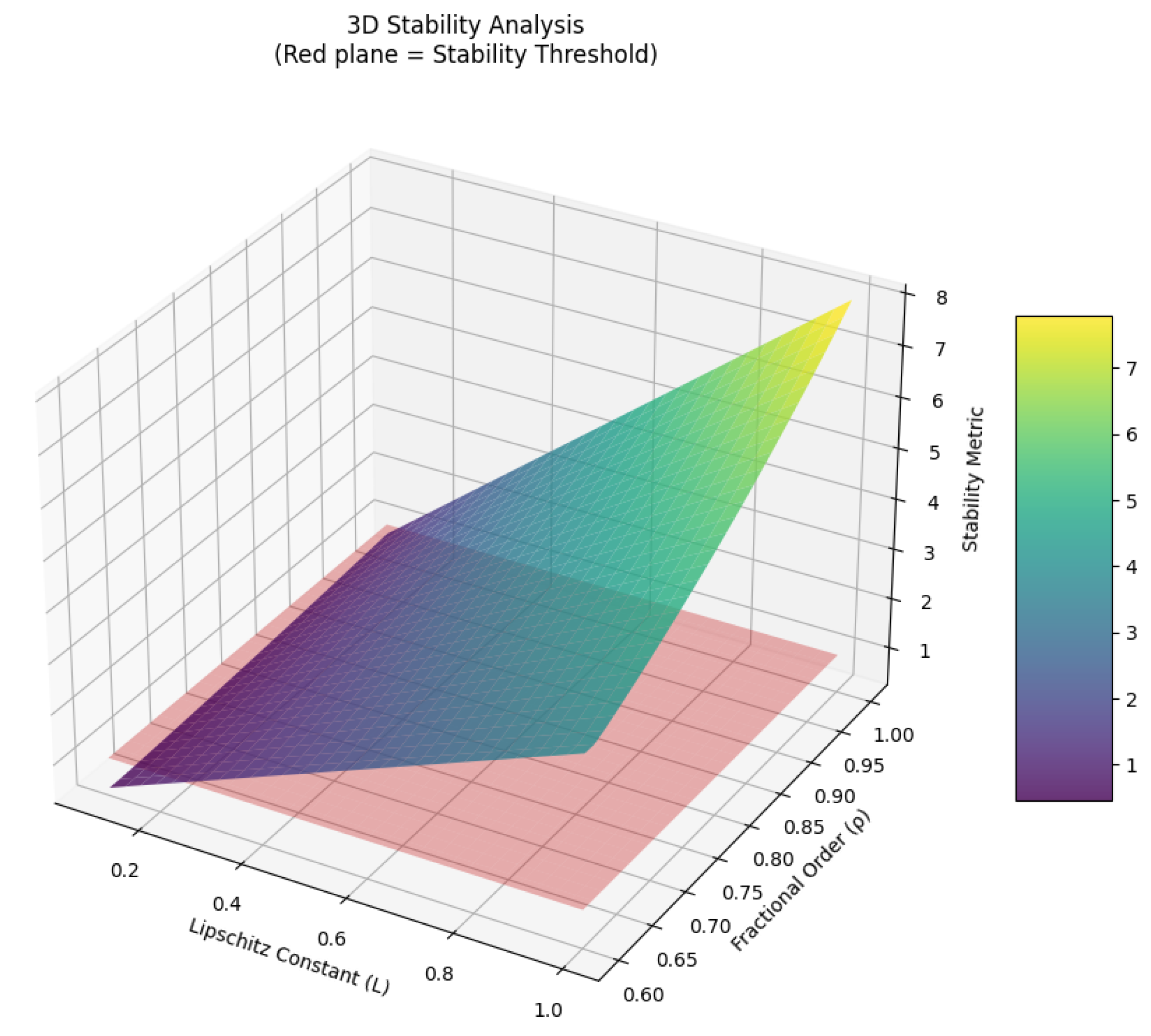
Figure 4 presents the stability metric as a function of fractional order and Lipschitz constant is depicted in three dimensions. The stability threshold is indicated by the red plane. System stability and solution convergence are ensured by parameter combinations below this plane.
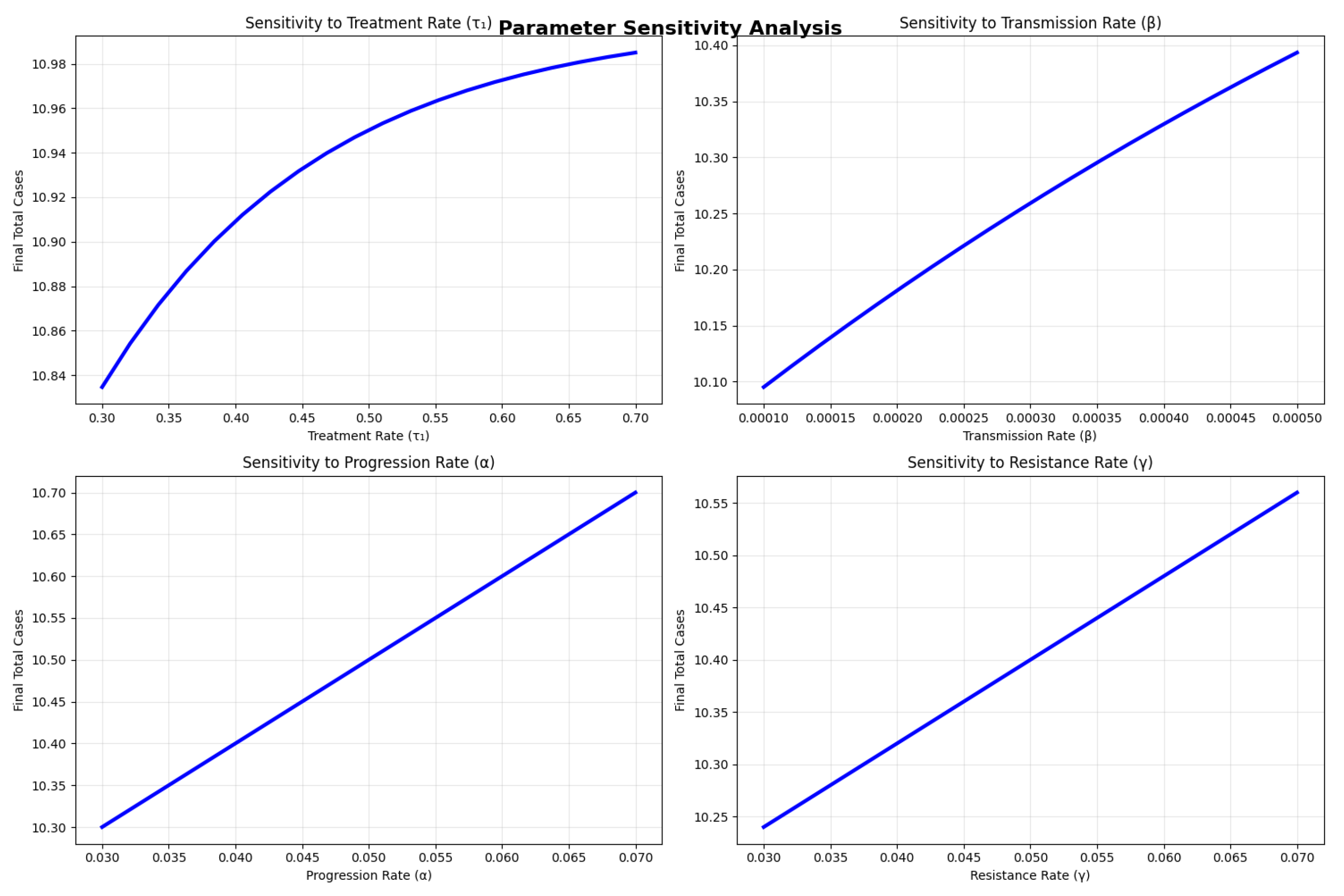
Figure 5 shows that final TB case counts are sensitive to changes in important epidemiological factors. Treatment rate ( τ 1 ) and transmission rate ( β ) exhibit the greatest impact on results, underscoring crucial elements for accurate parameter estimation and intervention design.
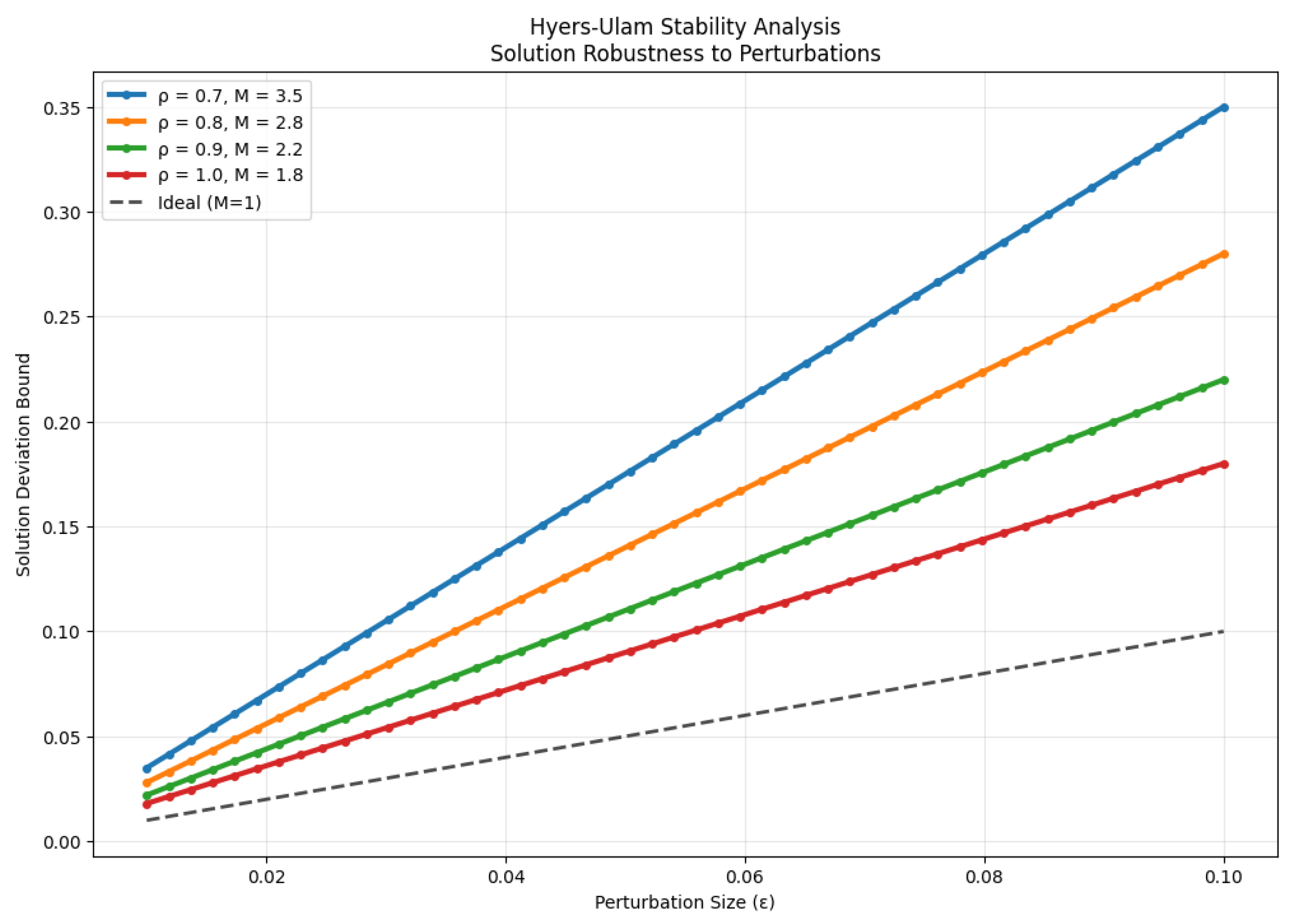
Figure 6 presents Hyers–Ulam stability analysis showing the connection between solution deviation bounds for various fractional orders and perturbation magnitude ( ε ). The system’s resilience to minor disturbances is validated by the linear bounds, with lower ρ values offering more robust stability assurances.
Figure 7 presents the optimization of switching time t 1 between intensive and continuation treatment phases.

6. Conclusions and Future Work

In this work, a new class of terminal piecewise fractional systems with delays has been formulated and analyzed using a hybrid fractional derivative with proportional delay and multi-point initial conditions. The proposed model transitions from classical to fractional dynamics at a clinically relevant switching time t 1 . By applying the Banach and Krasnoselskii fixed-point theorems, sufficient conditions for the existence and uniqueness of solutions were established. Uniqueness follows from the Lipschitz condition (H1) alone, while existence additionally requires the growth condition (H2). The Hyers–Ulam stability of the problem was also investigated, confirming that small perturbations in the initial data lead to proportionally bounded deviations in the solution.
Numerical simulations of a fractional tuberculosis treatment model incorporating drug resistance development illustrate the theoretical findings. The results demonstrate that in both drug-sensitive ( I s ) and drug-resistant ( I r ) TB cases, a lower fractional order ρ (e.g., ρ = 0.7 ) corresponds to stronger immunological memory, yielding slower but more sustained dynamical behavior. Simulations further reveal a biological trade-off: although strong memory (low ρ ) promotes sustained decline in sensitive strains, it may also affect resistance pathways. The existence of an optimal ρ value at the terminal time T that minimizes both I s and I r underscores that harnessing the appropriate strength of host immunological memory is as critical for long-term TB control as drug efficacy itself.
Thus, the fractional order ρ quantifies immune memory strength and provides a novel metric for personalizing treatment. These numerical insights suggest that treatment protocols can be optimized by adjusting phase-switching times and accounting for memory-driven dynamics. This study therefore connects theoretical advances in fractional calculus with practical challenges in infectious disease modeling, offering a framework for future investigation of multi-phase therapeutic strategies. In future work, we extend the present framework to piecewise hybrid systems with respect to other functions or to stochastic hybrid formulations.

Author Contributions

Formal analysis, Y.A.M., M.R., N.H., and A.A.; funding acquisition, A.A.; investigation, N.H. and A.A.; methodology, Y.A.M.; project administration, K.A.; software, M.R.; writing—original draft, M.A.; writing—review and editing, Y.A.M., K.A., A.A.Q., and N.H. All authors have read and agreed to the published version of the manuscript.

Funding

The Researchers would like to thank the Deanship of Graduate Studies and Scientific Research at Qassim University for financial support (QU-APC-2025).

Data Availability Statement

All data are included in paper.

Conflicts of Interest

The authors declare no conflicts of interest.

References

  1. Podlubny, I. Fractional Differential Equations; Academic Press: San Diego, CA, USA, 1999. [Google Scholar]
  2. Samko, S.G.; Kilbas, A.A.; Marichev, O.I. Fractional Integrals and Derivatives; Gordon and Breach: Yverdon, Switzerland, 1993. [Google Scholar]
  3. Miller, K.S.; Ross, B. An Introduction to the Fractional Calculus and Fractional Differential Equations; Wiley: New York, NY, USA, 1993. [Google Scholar]
  4. Magin, R.L. Fractional Calculus in Bioengineering; Begell House: Redding, CA, USA, 2006. [Google Scholar]
  5. Kilbas, A.A.; Srivastava, H.M.; Trujillo, J.J. Theory and Applications of Fractional Differential Equations. In North-Holland Mathematics Studies; Elsevier: Amsterdam, The Netherland, 2006. [Google Scholar]
  6. Atangana, A.; Baleanu, D. New fractional derivatives with nonlocal and non-singular kernel: Theory and application to heat transfer model. Therm. Sci. 2016, 20, 763–769. [Google Scholar] [CrossRef]
  7. Atangana, A.; Koca, I. Chaos in a simple nonlinear system with Atangana-Baleanu derivatives with fractional order. Chaos Solitons Fractals 2016, 89, 447–454. [Google Scholar]
  8. Almalahi, M.A.; Aldwoah, K.A.; Shah, K.; Abdeljawad, T. Stability and numerical analysis of a coupled system of piecewise Atangana-Baleanu fractional differential equations with delays. Qual. Theory Dyn. Syst. 2024, 23, 105. [Google Scholar] [CrossRef]
  9. Saleem, M.U.; Farman, M.; Nisar, K.S.; Ahmad, A.; Munir, Z.; Hincal, E. Investigation and application of a classical piecewise hybrid with a fractional derivative for the epidemic model: Dynamical transmission and modeling. PLoS ONE 2024, 19, e0307732. [Google Scholar] [CrossRef] [PubMed]
  10. Atangana, A.; Koca, I. On the new fractional derivative and application to nonlinear Baggs and Freedman model. J. Nonlinear Sci. Appl. 2016, 9, 2467–2480. [Google Scholar] [CrossRef]
  11. Atangana, A. On the new fractional derivative and application to nonlinear Fisher’s reaction- diffusion equation. Appl. Math. Comput. 2016, 273, 948–956. [Google Scholar] [CrossRef]
  12. Trachoo, K.; Chaiya, I.; Phakmee, S.; Prathumwan, D. Dynamics of Bone Remodeling by Using Mathematical Model Under ABC Time-Fractional Derivative. Symmetry 2025, 17, 905. [Google Scholar] [CrossRef]
  13. Atangana, A.; Araz, S.İ. New concept in calculus: Piecewise differential and integral operators. Chaos Solitons Fractals 2021, 145, 110638. [Google Scholar] [CrossRef]
  14. Dehestani, H.; Ordokhani, Y.; Razzaghi, M. Piecewise numerical approach for solving piecewise fractional optimal control and variational problems. Numer. Algorithms 2025, 1–24. [Google Scholar] [CrossRef]
  15. Rahman, M.U.; Tabassum, S.; Althobaiti, A.; Waseem; Althobaiti, S. An analysis of fractional piecewise derivative models of dengue transmission using deep neural network. J. Taibah Univ. Sci. 2024, 18, 2340871. [Google Scholar] [CrossRef]
  16. Shah, K.; Abdeljawad, T.; Ali, A. Mathematical analysis of the Cauchy type dynamical system under piecewise equations with Caputo fractional derivative. Chaos Solitons Fractals 2022, 161, 112356. [Google Scholar] [CrossRef]
  17. Benchohra, M.; Bouriah, S.; Nieto, J.J. Terminal value problem for differential equations with Hilfer-Katugampola fractional derivative. Symmetry 2019, 11, 672. [Google Scholar] [CrossRef]
  18. Almalahi, M.A.; Abdo, M.S.; Panchal, S.K. On the theory of fractional terminal value problem with ψ-Hilfer fractional derivative. AIMS Mathematics 2020, 5, 4889–4908. [Google Scholar] [CrossRef]
  19. Boichuk, O.; Feruk, V. Terminal value problem for the system of fractional differential equations with additional restrictions. Math. Model. Anal. 2025, 30, 120–141. [Google Scholar] [CrossRef]
  20. Shah, S.H.; ur Rehman, M. A note on terminal value problems for fractional differential equations on infinite interval. Appl. Math. Lett. 2016, 52, 118–125. [Google Scholar] [CrossRef]
  21. Naik, P.A.; Farman, M.; Jamil, K.; Nisar, K.S.; Hashmi, M.A.; Huang, Z. Modeling and analysis using piecewise hybrid fractional operator in time scale measure for ebola virus epidemics under Mittag-Leffler kernel. Sci. Rep. 2024, 14, 24963. [Google Scholar] [CrossRef] [PubMed]
  22. Nisar, K.S.; Farman, M.; Jamil, K.; Akgul, A.; Jamil, S. Computational and stability analysis of Ebola virus epidemic model with piecewise hybrid fractional operator. PLoS ONE 2024, 19, e0298620. [Google Scholar] [CrossRef] [PubMed]
  23. Banach, S. Sur les opérations dans les ensembles abstraits et leur application aux équations intégrales. Fundam. Math. 1922, 3, 133–181. [Google Scholar] [CrossRef]
  24. Ulam, S.M. A Collection of Mathematical Problems; Interscience Publishers: Geneva, Switzerland, 1940. [Google Scholar]
  25. Rassias, T.M. On the stability of the linear mapping in Banach spaces. Proc. Am. Math. Soc. 1994, 122, 733–736. [Google Scholar] [CrossRef]
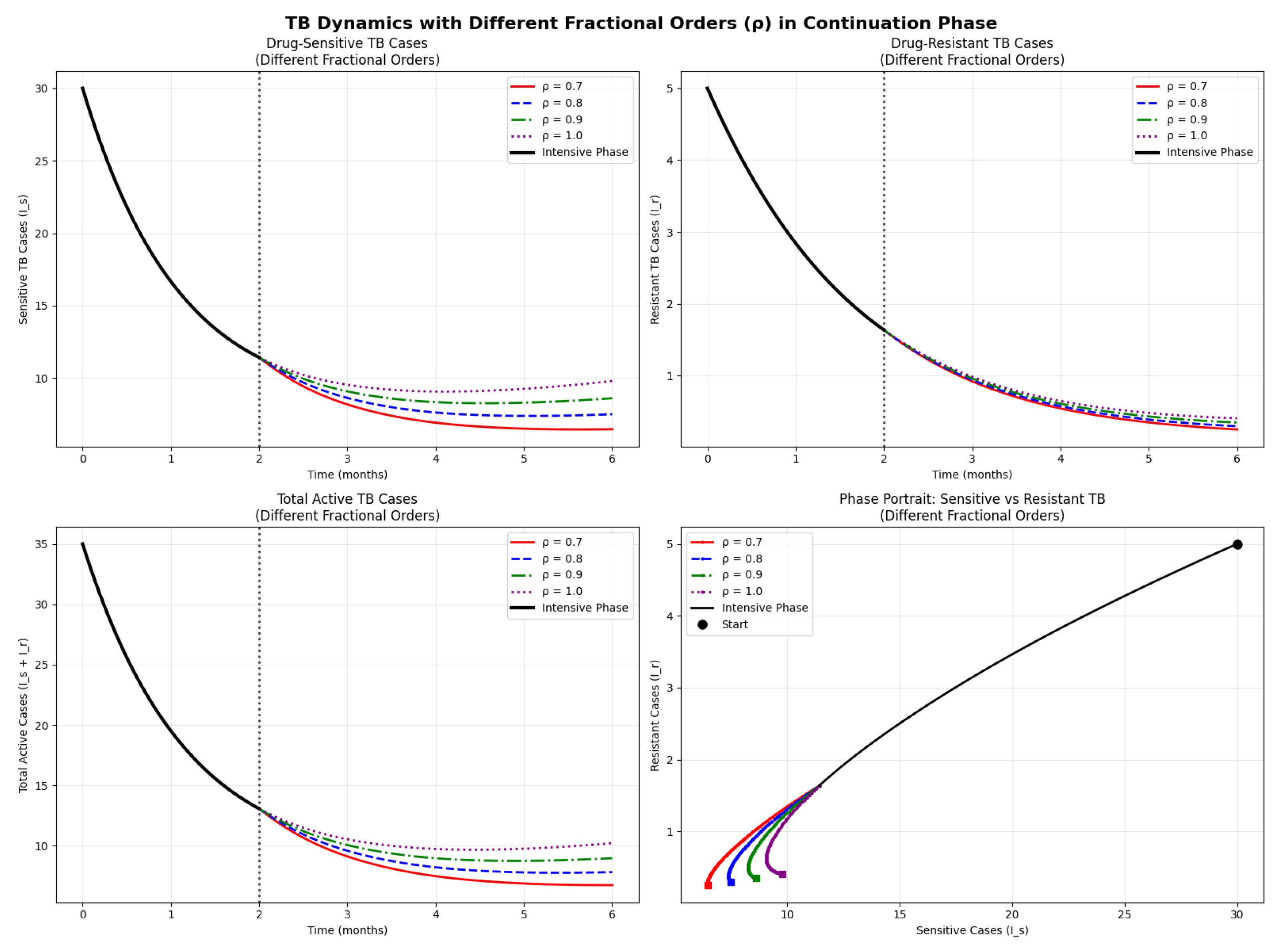
Figure 1. TB Dynamics with different fractional order in continuation phase.
Fractalfract 09 00807 g001
Figure 2. Impact of fractional order on TB treatment outcomes.
Fractalfract 09 00807 g002
Figure 3. The Lipschitz constant and fractional order parameter space stability area.
Fractalfract 09 00807 g003
Figure 4. Three-dimensional representation of the stability metric as a function of Lipschitz constant and fractional order. The red plane indicates the stability threshold. The shaded region highlights the parameter space where the system transitions between stable and unstable operational regimes.
Fractalfract 09 00807 g004
Figure 5. Sensitivity of final TB case counts to variations in key epidemiological parameters.
Fractalfract 09 00807 g005
Figure 6. Hyers–Ulam stability analysis showing the relationship between perturbation size ( ε ) and solution deviation bounds for different fractional orders.
Fractalfract 09 00807 g006
Figure 7. Optimization of switching time t 1 between intensive and continuation treatment phases.
Fractalfract 09 00807 g007
Table 1. Model parameters and their definitions.
ParameterDefinitionTypical Unit
Demographic Parameters
Λ Recruitment ratepeople/month
μ Natural mortality rate1/month
Transmission Parameters
β Transmission coefficient1/(person·month)
θ Relative transmissibilitydimensionless
Disease Progression Parameters
α Progression rate1/month
δ s Disease-induced death rate (sensitive)1/month
δ r Disease-induced death rate (resistant)1/month
Treatment Parameters
τ 1 Treatment rate for sensitive TB1/month
τ 2 Treatment rate for resistant TB1/month
ω Treatment failure/relapse rate1/month
γ Resistance acquisition ratedimensionless
Clinical Protocol Parameters
t 1 Switching timemonth
STotal treatment durationmonth
I s target Target (sensitive TB)people
I r target Target for resistant TBpeople
Table 2. Comparative treatment outcomes for different fractional orders.
Fractional Order ρ Final I s Final I r Total Reduction (%)
0.76.480.2548.5
0.87.510.3040.2
0.98.620.3531.4
1.09.800.4121.8
Note: Initial total active cases: 13.07. The fractional order ρ = 0.7 yields the optimal treatment outcome with a 48.5% total case reduction.
Disclaimer/Publisher’s Note: The statements, opinions and data contained in all publications are solely those of the individual author(s) and contributor(s) and not of MDPI and/or the editor(s). MDPI and/or the editor(s) disclaim responsibility for any injury to people or property resulting from any ideas, methods, instructions or products referred to in the content.