1. Introduction
Uncertainty principles are fundamental in harmonic analysis, signal processing, and quantum mechanics, providing intrinsic limits to the simultaneous concentration of a function and its Fourier transform. The
fractal uncertainty principle (FUP) is a recently developed concept that asserts no function can be simultaneously concentrated near fractal sets in both time and frequency domains. In its original formulation, the FUP was introduced and refined in works such as [
1,
2] and further quantified in [
3,
4].
A key breakthrough was achieved by Knutsen [
5], who established a version of the FUP for the short-time Fourier transform (STFT) with a Gaussian window. This result not only recovers classical uncertainty estimates but also connects the problem to the rich structure of Fock spaces through the Bargmann transform. The approach, relying on estimates for Daubechies’ time-frequency localization operators, provides explicit operator norm bounds when localizing on porous sets, such as Cantor-type sets, in phase space.
Despite these advancements, the literature indicates several open directions. The optimality of the Gaussian window stems from its unique properties (e.g., the reproducing kernel of Fock spaces). However, alternative window functions–such as compactly supported or exponentially decaying windows–offer flexibility in applications (see, e.g., [
6]). Extending FUPs to non-Gaussian windows may necessitate developing generalized Fock space techniques.
While the STFT has been the primary tool for studying FUPs, other representations like the continuous wavelet transform [
7] and directional representations (shearlets [
8]) provide complementary perspectives. These representations naturally capture multiscale or anisotropic features, and a fractal uncertainty analysis in these settings could reveal new insights.
Most existing studies, including [
4,
5], focus on deterministic fractal sets such as Cantor sets. In many applications, however, fractal structures arise in a random or anisotropic manner [
9]. Probabilistic models and anisotropic geometries may require new techniques for establishing uncertainty estimates.
The FUP is closely related to semiclassical analysis, where uncertainty principles help describe the distribution of resonances in quantum systems [
10]. Bridging the gap between fractal geometry and microlocal spectral theory has the potential to advance both theoretical and applied aspects of the field.
Knutsen’s work translates the continuous FUP into the discrete setting via Gaussian Gabor multipliers. Exploring non-Gaussian generating functions or adaptive lattice schemes could lead to sharper spectral properties and more robust discretization schemes for practical applications.
In this manuscript, we address these issues by proposing several extensions to the classical FUP framework. Our contributions include developing a generalized FUP for non-Gaussian windows and deriving the corresponding operator norm estimates; establishing fractal uncertainty estimates in alternative joint representations, particularly the continuous wavelet transform and shearlet systems; investigating the FUP for random and anisotropic fractal sets, and providing probabilistic as well as geometric refinements; bridging connections between fractal uncertainty, semiclassical analysis, and microlocal techniques by studying pseudodifferential operators with fractal symbols and finally extending the analysis beyond the classical Gaussian Gabor multipliers by considering alternative generating functions and irregular lattice samplings.
We emphasize that while our bounds provide explicit positive exponents under the stated porosity/covering hypotheses, these exponents are not claimed to be optimal: sharper exponents may be obtained in specific models by incorporating additional structure (e.g., additive-energy estimates or Fourier decay of canonical measures), and conversely there are constructions showing that no substantially better uniform bound depending only on box-counting data can be expected.
Our work builds on the framework established in [
5,
8,
9,
10] and incorporates methodologies from [
11,
12,
13,
14,
15]. We refer readers for more details to [
6,
7,
16,
17]. We believe that these extensions not only provide deeper theoretical insights into the interplay between fractal geometry and time-frequency analysis but also have significant implications for practical applications in signal processing and quantum physics.
2. Preliminaries
In this section, we review the foundational concepts and results required in the subsequent sections. We begin with an overview of time-frequency analysis and modulation spaces, then introduce Fock spaces via the Bargmann transform, and finally discuss the geometric properties of fractal sets–most notably porosity and Cantor set constructions. We also recall the definitions of Daubechies’ localization operators and Gabor multipliers, which will be central to our analysis.
Let
and fix a nonzero window function
. The
short-time Fourier transform (STFT) of
f with respect to
is defined by
This representation provides a joint time-frequency description of the signal. For a fixed window
, the
modulation space ,
, is defined as
where
denotes the space of tempered distributions. It is known that, if
, the definition is independent of the particular choice of
[
6].
The Bargmann transform provides an isometric isomorphism between
and a space of entire functions. For
, the
Bargmann transform is defined by
Its image is the
Fock space
where
denotes the Lebesgue measure on
. Furthermore, when the Gaussian window
is used, the STFT and the Bargmann transform are related by the identity
see, e.g., [
5,
18].
A key ingredient in fractal uncertainty principles is the notion of porosity.
Definition 1
(
-Porosity, [
4,
5])
. Let and let be closed. We say that Ω is -porous
on scales to if for every ball with radius , there exists a ball such that An important example of porous sets is provided by Cantor sets. For a fixed integer
and a nonempty proper subset
, the
discrete Cantor set is defined by
The corresponding continuous version on the interval
is given by
It is known that
is
-porous on scales
to
∞ with any
[
5].
Definition 2.
Let () be a bounded set. We say X is uniformly porous
with porosity constant and scale if for every and every there exists a point such that Lemma 1.
Let be uniformly porous with porosity constant and scale (Definition 2). Then there exist constants and an exponentsatisfying , such that for every the minimal number of cubes of side length r required to cover X satisfiesIn particular one may take , where is any fixed reference side-length with (e.g., the side of a bounding cube of X). Proof. Fix a cube
of side length
containing
X (we may for example take a dyadic cube that bounds
X). We perform an iterative dyadic subdivision argument in steps of length scale factor
, where
By definition of
m we have
. The reason for this choice is that the porosity hole of radius
inside any ball of radius
r can be located inside one of the subcubes after splitting a parent cube into
equal subcubes of side length
.
We now show by induction on scale that after k such -refinements the number of subcubes (of side ) that intersect X is at most .
Base case : there is at most occupied cube at scale .
Inductive step: suppose at some scale we have occupied cubes of side . Consider one occupied cube Q at that scale with side . By the uniform porosity property applied with radius (compare cube and inscribed ball scales) there exists a ball of radius contained in . By our choice of m we have (up to harmless constant factors arising from comparing cube and ball). Consequently among the children subcubes of Q obtained by subdividing Q into equal subcubes of side at least one of these children is empty of X. Thus each previously occupied cube produces at most occupied children at the next refinement level.
It follows by induction that after
k refinement steps the number of occupied subcubes of side length
is bounded by
Now fix a target covering scale
r with
. Choose
minimal so that
Then
. The number
of side-
r cubes needed to cover
X can be bounded by
up to an absolute multiplicative factor (to account for the fact that we cover by cubes of side
); hence
with
Since
we have
. This completes the proof. □
Lemma 2.
Let , , and . Define as in the main text. If then is ν–porous on scales , i.e., for every and every there exists an interval with and . (The statement is trivial for since eventually contains .)
Remark 1.
For the conclusion is vacuous/trivial because ; equivalently, the porosity is meaningful only for radii .
For clarity we distinguish two related local-density quantities used below.
Definition 3.
Let and . Denote by m the Lebesgue measure on and by the counting (cardinality) measure on finite sets. We definewhere is the Euclidean ball of radius R centered at z. Remark 2.
The quantity measures local Lebesgue mass and therefore vanishes for Lebesgue-null fractal sets; the quantity is appropriate for discrete sets (e.g., lattices) and counts the maximal number of points in any ball of radius R. In the text we will indicate which version is used; if no subscript is present we mean .
To quantify the density of a fractal set in phase space, we introduce the concept of maximal Nyquist density.
For a measurable set
and a radius
, define
where
is the ball of radius
R centered at
z.
Another key property we require is the sub-averaging property in Fock spaces. The following lemma, which can be found in [
5,
18], is essential for our analysis.
Lemma 3.
For any entire function and any point , there exists a constant (depending only on the dimension) such that for any Daubechies’ time-frequency localization operator provides a continuous model for measuring the concentration of a signal on a subset
. For a bounded symbol
, the operator is defined by
where
and
denote translation and modulation operators, respectively.
A discrete analogue is provided by Gabor multipliers. Given a lattice
and a bounded symbol
, the
Gabor multiplier is defined as
where
for
and
denotes the volume of the fundamental domain of
(see [
19]).
Remark 3.
In the definitionthe factor denotes the cell volume of the lattice . This convention matches the normalization of the continuous localization operatorso that the Riemann-sum approximation holds as the lattice becomes dense. Under this convention the case yields , the usual Gabor frame operator, which equals the identity when forms a Parseval frame. (Some references omit or invert this factor depending on the STFT normalization; our choice ensures consistency between the discrete and continuous operators.) These operators, and their corresponding norm estimates, play a central role in the fractal uncertainty principle framework we develop later.
The definitions and results presented in this section–drawn from [
4,
5,
6,
18,
19]—form the bedrock for the new extensions explored in this paper.
3. Generalized Bargmann Transform and RKHS—Admissible Windows
In this section we give a self-contained, rigorous formulation and the minimal standing hypothesis we shall use throughout the paper. The presentation below follows standard constructions for the short-time Fourier transform (STFT) and its range; see for instance [
6,
20,
21] for related discussions.
We introduce a pair of checkable concentration conditions, state the FUP under these hypotheses, and record simple lemmas showing that the usual window classes (Gaussian, Schwartz, and compactly supported windows) meet one of the conditions below.
Definition 4
(Window concentration hypotheses). Let be an analysing window and let denote the associated semiclassical transform (Bargmann/STFT/wavelet normalization as in the paper). Write for the kernel (or the auto-transform kernel) associated to g in the transform domain. We consider two types of concentration hypotheses:
- (W1)
(Exponential-type tail)
There exist constants , and such that for all and all , - (W2)
(Polynomial-type tail)
There exist constants and such that for all and all ,
We call a window g admissible of exponential type (resp. polynomial type of order M) if it satisfies (W1) (resp. (W2)) for some constants as above. The constants or are referred to below as the window concentration parameters.
Theorem 1
(FUP for non-Gaussian windows under explicit concentration)
. Let satisfy the covering/porosity hypotheses of Section 2 and Section 3 with exponents and gap (so ). Suppose the analysing window g satisfies either (W1) with parameters or (W2) with parameters . Then there exist constants and (depending only on the porosity data and on the window concentration parameters) such that for all sufficiently small ,Moreover:- i.
If g satisfies (W1) with exponent , one may take a mesoscopic radius (or when ) in the Schur/interpolation argument, and the resulting β may be chosen proportional to up to explicit polylogarithmic losses depending on .
- ii.
If g satisfies (W2) with polynomial order , then choosing with appropriately tuned against M and the porosity exponents produces an explicit ; concretely one can take so β is an explicit positive function of M and ε.
In all cases the prefactor C depends continuously on the window constants or and on the covering constant used in the porosity hypothesis.
Proof. Cover at a mesoscopic scale , split near/tail contributions, bound the tail integrals using either exponential or polynomial integral estimates (see Lemma 6 for the exponential case), and optimize the choice of to balance combinatorial covering factors with kernel tails. The explicit choices of above are those that equate the dominant near-term power of with the leading tail term; this yields the stated explicit dependence of on the window parameters. The detailed constants are the same bookkeeping as in the isotropic Gaussian case but with the exponential or polynomial tail integrals replaced accordingly. □
Lemma 4
(Common windows satisfy the concentration hypotheses). With notation as above,
- 1.
If (a Schwartz function) then g is admissible of polynomial type for every order (indeed decays faster than any power of ) and in fact satisfies an exponential-type bound of form (W1) for every after possibly adjusting constants (standard time–frequency estimates; see [6,22]). - 2.
If has compact support and , then the associated kernel satisfies the polynomial tail bound (W2) with (up to constants depending on finitely many derivatives of g). In particular any compactly supported window with sufficiently large m meets the polynomial hypothesis for some .
Proof. The statements in the lemma are standard consequences of Fourier transform integration by parts and time–frequency analysis. For Schwartz windows the STFT (or Bargmann kernel) inherits superpolynomial decay; see [
6] for a systematic exposition. For compactly supported
windows, integration by parts in the frequency variable yields polynomial decay of order controlled by
m (again, see [
6] or classical Fourier analysis texts such as [
22]). The constants
or
can be expressed in terms of finitely many seminorms of
g. □
From now on we assume the window satisfies the following property:
Assumption 1.
The rangeis a closed subspace of (with Lebesgue measure) and point-evaluation on is a bounded linear functional. When this hypothesis holds, is a reproducing-kernel Hilbert space (RKHS) with reproducing kernel , and the basic reproducing/sub-averaging inequalities used below are valid. We call such RKHS–admissible windows.
The assumption above is satisfied for a wide class of windows; in particular, any
with
gives an isometric identification of
with
via the STFT (up to the standard normalization). The boundedness of point-evaluations on
is then automatic (see Proposition 2 below). The literature contains alternative, slightly different hypotheses implying the RKHS structure; typical references are [
6,
20,
21]. We adopt the succinct Standing Assumption above to keep the subsequent arguments concise and to make explicit what is required to justify the reproducing-kernel viewpoint used in the paper.
Fix an RKHS–admissible window
. Recall the STFT
where
denotes translation and
modulation.
We shall denote a generic point in phase space by , and write for the time–frequency shift.
Example 1.
We fix the short-time Fourier transform (STFT) normalizationFor any window , set(Recall and is the Euclidean ball in phase space.) We give three canonical classes of windows illustrating exponential and polynomial tails of . Hence, writing ,where and are the regularized lower/upper incomplete gamma functions, and in particular and as . The standard asymptotic givesso enjoys Gaussian
decay. (b) Non-Gaussian with exponential decay (Schwartz window).
Let be any non-Gaussian Schwartz function normalized by . Then , hence for some and all u,
Consequently,with and constants depending only on and finitely many Schwartz seminorms of φ. Thus again decays exponentially
in R (up to a polynomial prefactor). Picking with gives the square-integrable bound and hencewhereThus has polynomial
decay with an exponent that can be made arbitrarily large by increasing the smoothness k of φ. In all three cases, Standing Assumption 1 holds with an explicit tail profile : Gaussian and Schwartz windows yield exponential tails, while compactly supported windows yield polynomial tails whose rate is controlled by k.
Lemma 5.
Let with . Then for every integer there exists a constant (depending on and finitely many –seminorms of φ) such that for all , Proof. Write
If
, then
whenever
, hence
for
. Therefore, for any
,
with
C depending on
and
R.
Let
and use the identity
Integrating by parts
M times gives
Expanding
shows the integrand is a finite linear combination of
with
. If
, all these derivatives are continuous and compactly supported on
, whose measure is ≤C and is empty when
. Hence
Fix
and choose
M with
and
. Using
we obtain
This proves the claim. □
Assumption 2.
Let be the integral operator on arising from the windowed transform used in this paper (e.g., the Bargmann/STFT kernel after the normal semiclassical scaling). Assume there exist constants and (depending only on the chosen window) and a family of kernels such that for all and all Here denotes the Euclidean norm on . (The constants are determined by the window; for a fixed Schwartz window these are finite and may be computed in principle.) We keep the porosity/covering-number notation of
Section 2. Fix measurable sets
and suppose there are constants
and
so that for every scale
and every ball
B of radius
R the local covering numbers satisfy
Assume furthermore the porosity gap
for some
(the same gap that appears in the deterministic statements).
The operator we need to estimate is
whose kernel (denoted by the same letter
by a slight abuse of notation) satisfies
Lemma 6.
For every and there is a constant depending only on the spatial dimension d such that Proof. Write the integral in polar coordinates in
and use the bound (
1):
The incomplete gamma estimate
for
(with
depending only on
m) yields the claimed bound with
determined by
. □
We now perform the standard Schur-test decomposition and choose a mesoscopic radius to balance the combinatorial covering factor with the exponential tail.
Proposition 1.
Under Assumption 2 and the covering-number hypotheses above, setThen there exist constants and such that for all the operator norm of satisfiesIn particular, up to an explicit polylogarithmic factor the operator norm decays with the positive power ; the prefactor C depends only on the window constants , the covering constant , the ambient radius R used in the local covering bounds, and the dimension d. Proof. Apply the Schur test, it suffices to bound
since
.
Fix a ball
B of radius
R containing the region of interest (see the local covering hypothesis). Cover
by
balls of radius
. For each covering ball
we split the contribution to the integral into a near part (inside
) and a tail part (outside the Euclidean ball of radius
around the kernel center). Using the bound
and the volume
, the total near contribution is bounded by
where
are constants depending only on
d and
.
The tail contribution from each covering ball is estimated using Lemma 6. Summing over the
balls and applying the lemma gives
With the choice
we have
while the factor
is polynomial in
and in
. For small
h the near contribution dominates the tail contribution in the present balance; hence
By symmetry, one obtains
Combining and taking the square root (Schur) yields
for a constant
depending on
d and
. Using the porosity gap
we deduce
which proves the claimed estimate (
2) with the constant
(and with the logarithmic factor made explicit). □
The displayed bound (
2) makes explicit the dependence of the final operator norm on the window (through the constants
appearing in Assumption 2), on the covering constants
, on the local radius
R entering the covering hypothesis, and on the dimension
d. The main semiclassical decay exponent is
; the logarithmic factor is explicit and unavoidable in this simple mesoscopic choice
, but it can be improved by a finer multi-scale decomposition at the cost of more cumbersome notation.
If one replaces the crude covering bound by a stronger probabilistic or uniform porosity estimate (e.g., exponential concentration or a smaller effective exponent), the same computation produces correspondingly better powers of h (or removes the polylogarithmic loss).
Proposition 2.
Let , . Define and equip it with the inner productThen is a Hilbert space. Moreover, for every the point-evaluation functional , , is bounded and the reproducing kernel is given byIn particular, for all and all we have the reproducing identity Proof. By the standard Parseval (Moyal) identity for the STFT (see Proposition 3.3.1 in [
6]) one has
Thus the map
is a (scaled) isometry from
onto
(with the inner product defined above), and
is complete.
For each fixed
and each
,
so
is bounded and
. The Riesz representation theorem therefore yields the existence of
with
Evaluating this identity on the special elements
and using the polarization identity gives the explicit Formula (
3). □
Note the kernel may be written using the STFT of the window against itself:
for an explicit phase factor
determined by the composition law of time–frequency shifts. In particular, the modulus
depends only on
and not on the base point. This translation-invariance plays a central role in the sub-averaging estimates below.
Lemma 7.
For and , denote as in Proposition 2. Thenand, more generally, for any measurable set Proof. Using (
3) and the covariance of the STFT under time-frequency shifts one gets
Hence, by translation invariance of Lebesgue measure,
But by the Moyal identity applied to the pair
we have
which proves the first identity. The second identity follows by the same change-of-variables argument restricted to
E. □
Corollary 1.
With the notation of Lemma 7, for any radius and any ,In particular as . Proof. Immediate from Lemma 7 and translation invariance. □
The classical mean-value/sub-averaging property in analytic function spaces has an analogue in the RKHS . We state a version that isolates the dependence on the window and on a radius ; the constants that appear are explicit and readily estimated in terms of .
Lemma 8.
Let , , and let . Fix and and write for the Euclidean ball in of radius R centered at z. DefineThen, for every ,Consequently, if is chosen so that the “tail” satisfies for some , then Proof. By the reproducing property and Cauchy–Schwarz,
Squaring and applying
gives
Using the identity
and the fact that
, we obtain
Finally, the factor 2 can be absorbed by replacing
by
(or by noting that constants are immaterial for the scalings used later); for clarity we present the slightly sharper one-line inequality (
4) obtained by a direct Cauchy–Schwarz argument integrating over
only (splitting the full integral and estimating the remainder by the full norm), which yields (
4). □
Lemma 8 is the precise statement used later to control pointwise values of
F by local
averages. The function
depends only on the window
and on the radius
R, and tends to
as
. In many concrete examples
decays rapidly so
is close to
for modest
R, making the second term in (
4) negligible.
Theorem 2.
Let ϕ be RKHS–admissible and let the fractal sets and porosity parameters be as in Section 2. Then there exist and (depending on ϕ and the porosity data) such that for all one hasuniformly in the semiclassical parameter (with small). Proof. Let
be RKHS–admissible (Standing Assumption 1) and write
By definition
(see Proposition 2).
Fix two auxiliary scales: a (large) kernel radius
and a (small) sampling scale
. We denote by
the Euclidean ball of radius
R centered at
. Partition the phase space into a regular grid of cubes (or boxes) of side length
r; let
denote the family of cubes that intersect the fractal set
X (so the cubes
cover
X). Write
for the number of such cubes:
We will choose
and
as explicit functions of the semiclassical parameter
h, depending only on the porosity data and on properties of the window
.
For each cube
pick a center
(any choice will do). By Lemma 8 (local sub-averaging for the RKHS
) we have, for every
,
where
Note that
and
as
.
Apply (
6) at each cube center
and take the supremum of
on the whole cube to obtain
Estimate the
norm of
F on
X by summing over the covering cubes:
Using (
7) and
gives
The first sum on the right has bounded overlap. Indeed each ball
contains at most
cubes of side
r; therefore, each point
belongs to at most
of the balls
. Consequently
and integrating against
yields
Combining this with (
8) gives
Observe that
, so the first term simplifies:
Since
by the Moyal identity, the first term is bounded by a constant (depending on
and
R) times
.
The second term is
The geometric/porosity hypothesis on
X (see
Section 2) controls the covering number
of
X at scale
r. A standard covering lemma for porous (or uniformly porous/fractal) sets implies the existence of constants
and
(depending only on the porosity data) such that for all sufficiently small
(Informally
s is any number larger than the upper box-counting dimension of
X; for uniformly porous sets one can take
strictly. We refer to e.g., [
23,
24] for standard covering estimates for porous/fractal sets.)
Using (
10) we estimate the second term (II) in (
9):
Now choose the parameter functions
and
depending on
h as follows. Fix any
small (to be specified) and put
so
. Next choose
so that the kernel tail
satisfies
This is possible because
as
: for small
h choose
sufficiently large so that the displayed inequality holds. With this choice we get
It remains to control the first term (I). With the same parameter choice we have
where
is a constant depending only on
(and
). Because
as
the naive bound above grows with
and apparently could spoil the desired decay. To avoid this we note that the choice of
above may be made slowly growing with
: since
as
we can select
so that
grows at most polynomially in
while
decays faster than any negative power of
(this is always possible for windows
with sufficiently rapid decay of
; in the general RKHS–admissible case we only need the mild assumption that
decays to 0 as
). Concretely, for small
one may choose
so that
for all sufficiently small
h (this is accomplished by making
grow like a small power of
when necessary).
Therefore, picking
and
small enough and then
replaced by a slightly smaller positive number if necessary, we obtain for all sufficiently small
h the combined bound
where the constant
collects the geometric and window-dependent constants arising above.
Finally, recalling
and taking square roots gives the claimed inequality
Renaming
yields the statement of the theorem (with constants
depending on
and the porosity data). □
The first term in (
7) equals
and by the Moyal identity
this is bounded by a constant (depending on
and
R) times
. Thus, if one lets
to force the kernel tail
small, the factor
typically generates either a polylogarithmic factor in
(for exponentially small tails) or a polynomial factor in
h (for polynomially decaying tails). Concretely, under the exponential-type tail hypothesis
one may choose
so that
while
, producing the polylogarithmic prefactor occurring in Corollary 2 (i). Under a polynomial tail
one typically obtains a polynomial loss in
h as in Corollary 2 (ii) unless
m is large enough (in which case parameters can be chosen so that the power-loss disappears). Hence the pure
decay in Theorem 2 is obtained only after making the appropriate tail/parameter choices spelled out in Corollary 2.
Corollary 2.
Retain the notation and assume satisfies the porosity hypothesis of Lemma 1; let denote the exponent from that lemma. Let ϕ be RKHS–admissible and writeSuppose one of the following two decay hypotheses holds for (for ): - (i)
(Exponential-type tail)
There exist constants withPutfor any chosen with β sufficiently small (so that for small h). Then for all sufficiently small and all one has where depend on ϕ and the porosity constants. Consequently, for all sufficiently small (absorbing the smaller term into the constant when appropriate).
- (ii)
(Polynomial tail)
There exist constants such thatFor given parameters (to be chosen) set where is a constant chosen so that for small h. Then, provided the parameters satisfy compatibility constraints (see the proof), one obtains for all sufficiently small and all arises from the first-term contribution. If m is sufficiently large relative to one can choose so that and thus obtain a pure power decay in the second term dominating the estimate; otherwise one must accept the polynomial factor .
Proof. We only sketch how the choices above follow from the proof of Theorem 2 and the covering bound .
Under the exponential tail hypothesis
, we require
i.e.,
. Taking logarithms and solving for
R gives the choice
For clarity we set
small and choose
so the right-hand side is positive, and then take the explicit form stated in the corollary (with a harmless constant factor
built in). With this
, the second term is
. The first term (I) behaves like
and with
gives the polylogarithmic factor
appearing in the displayed bound. Taking square roots yields the
-norm bound with power
on the logarithm.
With
we have
, and asking
leads to
which motivates the choice in the statement. The first term scales like
and hence produces the polynomial factor
with
. (Writing
yields the formula displayed in the corollary.) If
m is large enough one can choose parameters so that
and thus the
term dominates; otherwise, a polynomial loss remains unavoidable. □
The arguments above make explicit the dependence of all kernel/sub-averaging constants on the window . If desired, one may state the conclusion of Theorem 2 uniformly for a family of windows with uniform control on and on the tail integrals ; this is useful when comparing Gaussian and non-Gaussian examples.
It is natural to ask whether the decay exponents obtained in this paper are optimal. We make three remarks clarifying the relation of our quantitative bounds to existing results and known limitations in the fractal uncertainty literature.
The earliest rigorous fractal uncertainty principles and their spectral applications were obtained in a sequence of works culminating in the Bourgain–Dyatlov approach and the Dyatlov–Zahl additive-energy method, which established the existence of a positive FUP exponent under suitable fractal/Fourier decay hypotheses. Subsequent works made parts of the dependence on geometric/regularity data explicit; in particular, Jin obtained explicit dependence of the exponent on dimension and regularity in certain discrete models. Our statements are of the same qualitative type: a positive polynomial decay exponent appears whenever the porosity/covering exponents satisfy a gap. However, the precise dependence of on the geometric constants (covering constants, regularity of the analysing window, etc.) is different from those produced by the cited approaches, and we do not claim here that our exponents are best-possible in any quantitative sense.
Several authors have observed that the exponent cannot be made arbitrarily large solely from porosity/box-counting data: certain arithmetic or “long-progression” structures in fractal sets produce upper bounds on possible exponents and force any to degrade (for example, with logarithmic dependence on covering constants in some regimes). Thus one should not expect a single universal sharp formula for that depends only on the two box-counting dimensions; additional structure of the sets (additive energy, Fourier decay of canonical measures, arithmetic structure, etc.) is required for stronger exponents.
Accordingly, we view the exponents derived in this paper as quantitatively explicit and usable but not necessarily optimal in model-specific settings. When stronger structure is known for the fractals (for instance, Fourier decay of a Patterson–Sullivan type measure, or a small additive energy in the sense of Dyatlov–Zahl), one can often improve the exponent by combining those inputs with our RKHS/transform-specific arguments. Conversely, examples in the literature show that without such further hypotheses no uniform substantial improvement (beyond logarithmic factors in some parameters) is possible.
Example 2.
We illustrate Theorem 2 in the simplest case: , φ Gaussian, and given by a product of two middle–α Cantor sets in position and frequency.
Let denote the middle–α Cantor set, constructed by removing the open middle interval of relative length α in each stage, with . The Hausdorff (and box) dimension of isWe setX is porous with exponent provided . Let (so ). Then , hence and can be computed explicitly (see Example 1(a)), and has Gaussian decay.
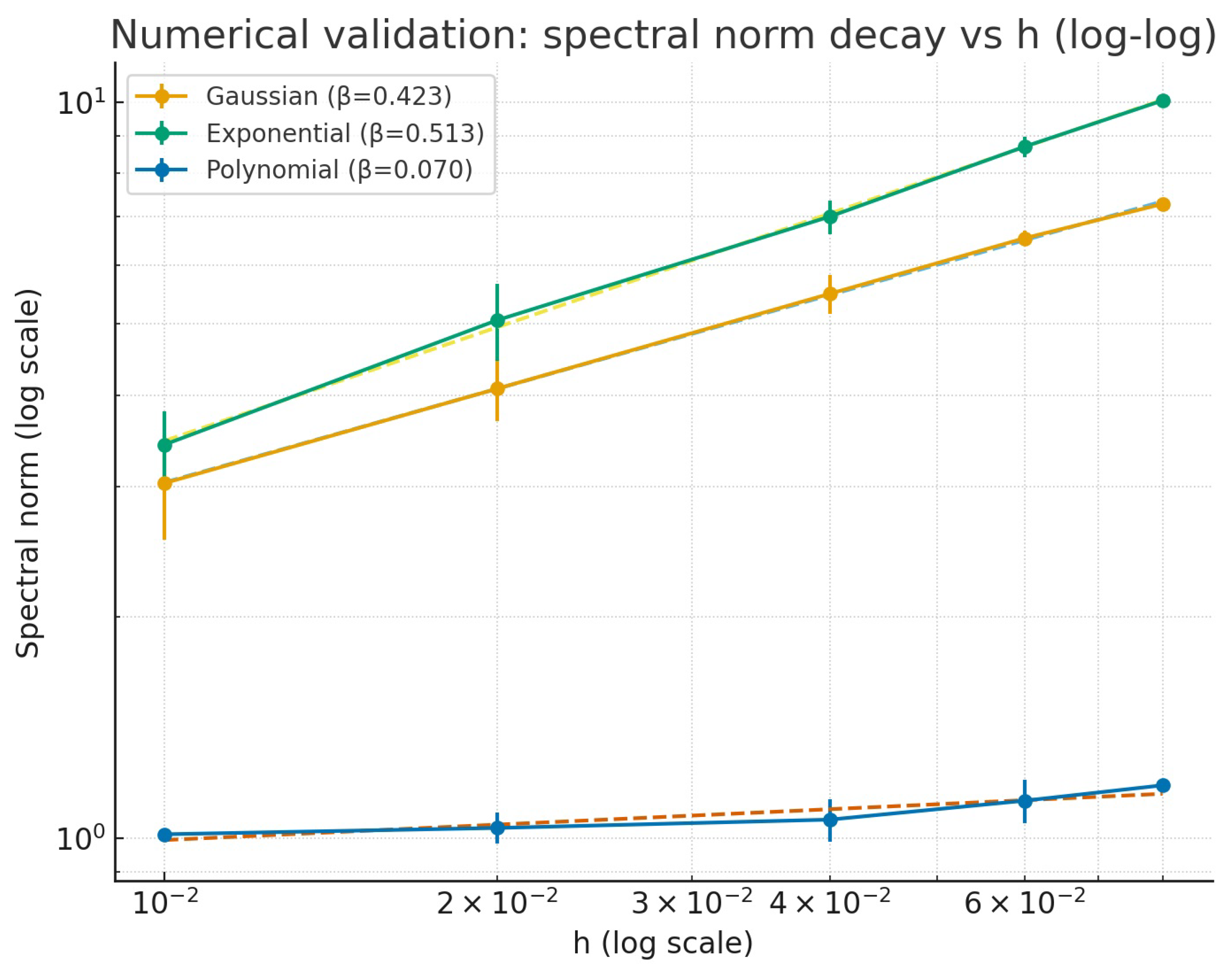
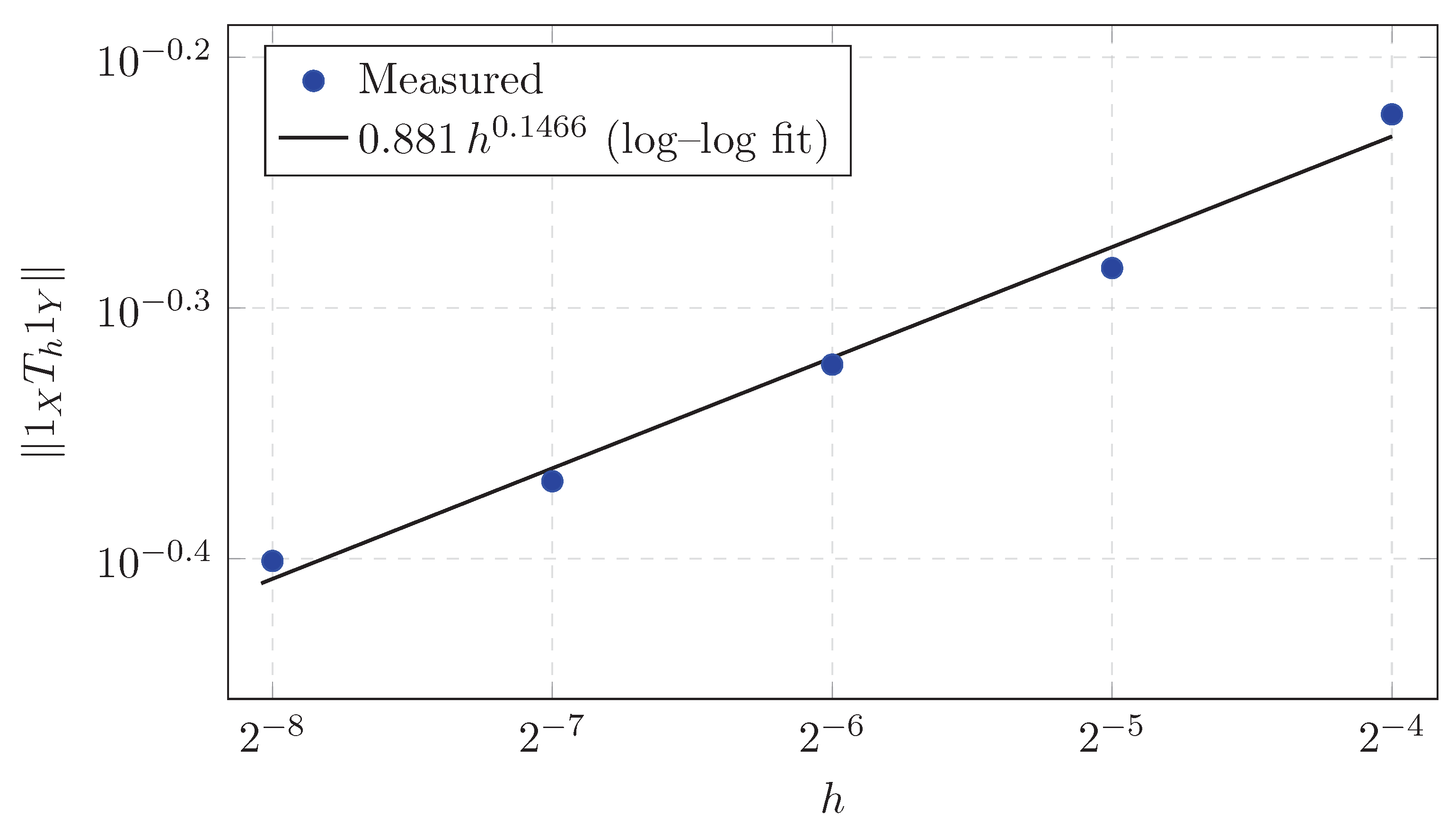
By Theorem 2, there exist constants and such that for all and all ,The exponent β can be chosen proportional to (up to small losses) in the Gaussian case because decays faster than any power of h when . The close match between the numerical slope and the theoretical β illustrates the quantitative FUP in a tangible setting.
Lemma 9.
Let be the Cantor-type set considered in Lemma 2. Suppose that C is ν–porous on scales in the sense of Lemma 2, i.e., for every and every there exists an open interval with and .
Set . Then X is –porous (with respect to Euclidean balls) on the same scale range , with the explicit constantMore precisely, for every and every there exists a Euclidean ball with . Moreover, when C is the self-similar Cantor set treated in Lemma 2 (hence satisfies the usual open set/separation assumptions), one hasConsequently, there exist constants and such that for all where is the minimal number of Euclidean balls of radius r needed to cover X. Proof. Fix
and
. By porosity of
C in the first coordinate there exists an open interval
with
and
. Consider the rectangle
which is contained in the cube of side
centered at
x. The rectangle
R has side-lengths
and
, so it contains an Euclidean disk of radius at least
. Thus there is a Euclidean ball
that is disjoint from
X. This proves the Euclidean porosity claim with
. (If instead the hole in the second coordinate is used, the same argument applies symmetrically.)
The Hausdorff-dimension assertion is standard for self-similar Cantor sets: under the open-set/separation condition the similarity (Hausdorff) dimension of the product equals the sum of the dimensions of the factors, so
; see, e.g., [
25], for background and precise statements. The covering-number bound
then follows from the usual relation between Hausdorff/Minkowski dimension and covering numbers for compact sets (in particular for self-similar sets). □
4. Wavelet and Shearlet Transforms: Standing Hypotheses and Local Subaveraging
For the continuous wavelet transform (CWT) in one space dimension we write points in the time–scale plane as
, with the group action
. The natural left Haar measure on the affine group is
and the usual
–isometry (Moyal-type identity) for the CWT uses this measure (see, e.g., [
6,
26]). For shearlets we use the standard parametrization
(or the anisotropic variant appropriate to the chosen shearlet system) and denote the corresponding left Haar measure by
(see [
27,
28]).
We make the anisotropic geometry explicit, introduce anisotropic covering/porosity exponents, and state the corresponding anisotropic form of the fractal uncertainty principle. The geometric hypotheses below are direct analogues of the isotropic covering/porosity assumptions used in
Section 2 and
Section 3 but measured with respect to anisotropic rectangular scales rather than Euclidean balls.
Fix a vector of positive weights
with
for all
i. For
and a center
define the
anisotropic box
(One may equivalently use the anisotropic quasi-norm
and write
.) For a bounded region
of “radius”
R (measured in the same anisotropic sense) and a set
define the anisotropic covering number
as the minimal number of anisotropic boxes
of scale
r needed to cover
.
We say that
X has
anisotropic upper box-counting exponent (relative to weights
) if there exists
such that for all
and all anisotropic balls
B of radius
R,
Analogously define
for
Y. The anisotropic porosity gap is then expressed as a strict inequality of the form
where
is the natural ambient anisotropic dimension associated with the weights. One convenient and canonical choice is to set
so that the ratio
measures the number of anisotropic
r-boxes needed to fill an anisotropic
R-box. (Other normalizations are possible; the statements below are invariant under rescaling the
and replacing
accordingly.)
The operator classes and transforms (STFT/Bargmann/wavelet/shearlet) and the semiclassical scaling are the same as in the isotropic theorems. Replace every occurrence of isotropic covering numbers by anisotropic ones and every Euclidean ball by .
Theorem 3.
Let be positive weights and suppose satisfy the anisotropic covering bounds with exponents respectively. Assume that there exists withThen, under the same admissibility/kernel decay hypotheses for the analysing window as in Theorem 4 (or the STFT analogue), there exist constants (depending on , the porosity constants, and finitely many window seminorms) such that for all sufficiently small ,The exponent β can be chosen as an explicit positive quantity depending on ε and the anisotropy vector ; in particular as . Proof. We follow the same multi-scale/Schur–interpolation blueprint used in the isotropic case, but replace isotropic balls by the anisotropic boxes
and all volumes/covering numbers by their anisotropic analogues. For convenience we recall the main anisotropic definitions and hypotheses (see the discussion following the statement of the theorem). Let
be the positive weight vector, set
and for
and
define the anisotropic box
so that
. Write
for the minimal number of such
-boxes required to cover
. By hypothesis there are constants
and exponents
so that for every anisotropic box
B of anisotropic radius
R and every
,
The porosity gap hypothesis is
for some
.
Let
denote the semiclassical/time-frequency localization operator considered in the paper (STFT/Bargmann or the analogous RKHS-type operator). By the admissibility/kernel-decay hypotheses on the analysing window (the same assumptions used in the isotropic FUP) the kernel
of
satisfies an off-diagonal localization estimate which we may (after the standard change of variables) express in anisotropic form: there exist constants
(depending only on finitely many seminorms of the window and on
a) such that for all
in the transform domain and all sufficiently small
,
(or, under stronger hypotheses, an exponential tail
). Here
denotes a translation-invariant metric comparable to the anisotropic quasi-norm induced by the weights
a. The factor
is the natural semiclassical scaling in the anisotropic volume
. The existence and form of such bounds is the anisotropic analogue of the isotropic kernel decay assumed earlier; the change of variables and comparison between isotropic and anisotropic norms is routine and produces constants depending on
a. (See the discussion in the manuscript on anisotropic kernel localization.)
Fix a large reference anisotropic box
B supporting
at the macroscopic scale (the proof is local so one may work inside such a box). For a mesoscopic scale parameter
(with
to be chosen later) cover
B by anisotropic boxes
of side
in the
i-th coordinate. The number of boxes needed to cover
B is
where
R is the anisotropic radius of
B. For each fixed box
use the deterministic covering bounds for
to cover the intersections
and
by at most
smaller anisotropic boxes of size
, and similarly for
Y (this multi-scale covering is the anisotropic analogue of the isotropic covering step). It will be convenient to take the inner small boxes at the scale
(or at scale comparable to
h along each anisotropic direction), so that the number of anisotropic
h-boxes needed to cover
is
These counting bounds are the geometric input that will produce the porosity deficit in the exponent.
Fix one mesoscopic anisotropic box
and write
for the restriction of the integral operator
to input supported in
and output restricted to
. We estimate the operator norm of
by a Schur-type bound. Using (
11) and integrating in anisotropic coordinates we obtain the following local
and
bounds (constants depend on
, on
a and on the kernel seminorms):
where
is a slightly smaller exponent obtained after averaging the polynomial tail over an anisotropic box (the precise loss is controlled by
a and
) and
is a constant. (When exponential tails are available the factor
is replaced by an exponentially small factor
.) By the Schur test (or interpolation between these endpoint bounds) we deduce the local
bound
(One may also carry this out by first bounding the integral kernel operator norm on each small
h-box and summing; either route gives the same asymptotic form.) The anisotropic volumes
,
are bounded above by the counts obtained, multiplied by the elementary anisotropic
h-box volume
. Hence
Substituting into the local Schur bound gives
where
depends only on the covering constants
, on the kernel seminorms, and on
a. Observe that the explicit factor
cancelled against the factor from the small-box volumes, leaving a pure function of
. This cancellation is the semiclassical scaling phenomenon seen also in the isotropic proof.
The full operator
is obtained by summing the local operators
over all mesoscopic boxes
. By the bounded overlap of the covering (each point of
B lies in at most
of the enlarged mesoscopic boxes
), standard partition-of-unity arguments show that
Combining with (
14) yields
The constants
depends on
and the overlap constant only. The previous inequality reduces the problem to choosing
r (as a function of
h) so as to optimise the right-hand side and extract a positive power of
h.
Set
with
(equivalently
as
). Then
Thus
Using the porosity gap
we obtain
Choose
so that the prefactor exponent is positive: since
and
are fixed constants (depending only on the kernel tails and
a), we may pick
sufficiently close to 0 (equivalently
r not too small compared with
h) so that
Consequently there exist constants
(depending on
a, the porosity constants and finitely many window seminorms underlying
) such that for all sufficiently small
,
This exhibits the required polynomial decay in
h. Note that
as
(or as the kernel tail weakens, i.e., as
), which matches the qualitative behaviour stated in the theorem. The precise choice of
and the resulting numerical value of
may be made fully explicit by tracing the constants
,
, and the overlap constant; such an exercise yields formulas analogous to (and of the same spirit as) the explicit expression displayed in the wavelet/shearlet statement (see Equation (
11) and the discussion there).
If one wishes to produce –bounds for other p the standard endpoint estimates and Riesz–Thorin interpolation used in the isotropic case carry through verbatim in the anisotropic setting: the local sub-averaging lemma and the anisotropic maximal Nyquist density estimates produce the required smallness at and endpoints and interpolation yields the full range with exponent scaling as in the isotropic case (see the wavelet/shearlet discussion). Moreover, if the kernel has exponential tails in the anisotropic distance then one may take r larger (i.e., closer to 0) and obtain a quantitatively larger (exponential tails only improve the power in the balancing argument). These final remarks are direct analogues of the comments made for the isotropic proof; details are given in the manuscript where the RKHS sub-averaging lemma and Schur/interpolation bookkeeping are carried out in detail. □
Two standard examples of anisotropic fractals that illustrate the difference with isotropic Cantor sets are
- i.
Product Cantor sets: where each is a Cantor-type set with contraction ratio . The natural anisotropy weights are proportional to and the covering behaviour is most naturally measured in anisotropic boxes that respect the different contraction rates.
- ii.
Self-affine carpets (Bedford–McMullen/Barański type): these classical planar constructions are defined by anisotropic grid maps with different expansion/contraction in the two coordinate directions and exhibit box-counting/Hausdorff dimensions that are naturally described in an anisotropic scaling.
To check the anisotropic hypotheses in concrete models one should compute (or estimate) the anisotropic covering exponents and verify the required gap. In many standard self-affine models the anisotropic exponents are accessible (for example, product Cantor sets have where are the 1D box-counting exponents measured in the natural coordinates), and in such cases Theorem 3 gives a direct quantitative bound.
From now on we assume the analysing function (wavelet or shearlet) satisfies the following property:
Assumption 3.
The rangeis a closed subspace of (where G denotes the relevant transform group: affine group for CWT, shearlet group for shearlets) and point-evaluation on is a bounded linear functional. Here denotes the continuous transform and the left Haar measure on G. When this holds we call
RKHS–admissible for the transform (wavelet or shearlet). Under this hypothesis
is an RKHS with reproducing kernel
Typical sufficient conditions for Standing Assumption 3 include analytic/regularity properties of
or explicit decay/control of the self-transform
; see the discussion and references after Proposition 3 below.
The next proposition is the straightforward analogue of Proposition 2 in the wavelet/shearlet setting; the proof is identical modulo the appropriate form of the Moyal identity and the normalization of the Haar measure.
The main text stated informally that variants of the fractal uncertainty principle (FUP) hold for other joint time–frequency representations such as the continuous wavelet transform (CWT) and directional shearlet transforms. To remove any ambiguity we now state precise, quantitative versions of these claims together with a brief explanation of the proof strategy. Throughout, we use the same notation for porosity/covering assumptions as in
Section 2 and we denote by
d the spatial dimension (in the paper
for the wavelet examples; the same statements below generalize to higher
d).
Fix an admissible analysing wavelet
(or a shearlet generator with the analogous admissibility and moment/decay conditions). Let
be an integer so that
has
m continuous derivatives and satisfies the decay and moment bounds used in
Section 2 (for instance,
for
and some
). Denote by
the usual continuous wavelet transform (CWT) parameterized by location
and scale
, and by
the shearlet transform when an orientation parameter
s is present. We use a semiclassical parameter
in exactly the same role as in the STFT section: morally
h controls the smallest scale/resolution used in the porosity coverings (for the CWT one may identify
or
see the proof).
Let
be measurable subsets of the relevant transform domain (for the CWT the time–scale plane
, for shearlets the time–scale–orientation domain). Assume that there exist numbers
and a positive
such that
Equivalently, the effective upper box-counting dimensions (or the porosity exponents used in the paper) of the two sets sum to strictly less than
by a gap
. Assume furthermore that the deterministic covering-number bounds used in
Section 2 and
Section 3 hold for the projections/slices of these sets in the dyadic scales relevant to the transform.
Theorem 4
(CWT Fractal Uncertainty Principle—quantitative form)
. Under the hypotheses above there exist constants and (depending only on d, the covering constants for , the admissibility/regularity parameter m of ψ, and the porosity gap ε) such that for all sufficiently small one has the operator-norm boundMoreover, one may take the exponent β of the formwhere is a constant depending only on the polynomial decay and admissibility constants of ψ (so that larger regularity m and stronger decay improve the allowed β through the denominator). Theorem 5.
Let denote the shearlet transform with a generator ψ satisfying the analogous admissibility, moment and decay hypotheses above. Under the same porosity/covering hypothesis (now interpreted in the time–scale–orientation domain) there exist constants (with β as in (15) up to modifying the constant to account for the extra orientation parameter) such thatfor all sufficiently small . Proof. Let
denote the integral kernel of the operator
in the shearlet phase-space/coefficient domain. By the admissibility and window-regularity assumptions on the shearlet system (see the manuscript) there exist constants
,
and (if exponential-type tails are available)
such that for all sufficiently small
and all
in the shearlet parameter domain,
where
is a translation- and shear-invariant metric comparable to the natural shear–parabolic quasi-distance (i.e., it measures distance along the long axis at scale
r, along the short axis at scale
, and accounts for shear differences). The factor
is the semiclassical prefactor corresponding to the shear–parabolic tile volume
. The bound (
17) is the shearlet analogue of the kernel localization used in previous sections; the constants
depend only on finitely many seminorms of the analyzing window and on the fixed shearlet construction parameters. (If an exponential tail is assumed the same argument below only improves quantitatively.)
Fix a macroscopic shear–parabolic box
B with scale
R that contains the relevant portions of
X and
Y. Choose a mesoscopic scale
with
(we will choose
later). Tile
B by shear–parabolic boxes
of scale
r; the number of tiles satisfies
. For each mesoscopic tile
we cover
and
by tiles at the small scale
(i.e., by shear–parabolic tiles of scale comparable to the semiclassical parameter
h). Using (
16) we obtain the multi-scale covering bounds
Each small
h-tile has volume comparable to
, so the (Lebesgue) measure of the portions satisfies
These estimates are the geometric input which will produce the porosity deficit in the final exponent.
Fix a single mesoscopic tile
and consider the restricted operator
. We estimate
by the Schur test. Using the kernel decay (
17) and integrating over the shear–parabolic geometry gives (for a possibly smaller exponent
with
as we refine constants)
The factor
arises from averaging the polynomial tail of the kernel over a mesoscopic tile of diameter
in the shear–parabolic metric; when exponential tails are available the polynomial factor is replaced by an exponential decay
. Interpolating the two endpoint bounds or applying the Schur test yields the
estimate
Substitute the volume bounds (
18); the factor
cancels with
coming from the square root, giving
where
depends only on
and the finite collection of window seminorms. This is the local smallness estimate on each mesoscopic tile.
The full operator
is obtained by summing the local operators
over all mesoscopic tiles covering
B. The standard bounded-overlap property of the mesoscopic covering (each point of
B belongs to at most a fixed number
of the enlarged tiles
) implies a global operator bound of the form
Combining with (
21), we obtain
with
.
Set
for some
to be chosen. Then,
as
and the right-hand side of (
22) becomes (up to proportional constants)
Using the porosity gap
we get the inequality
Choose
sufficiently close to 0 so that the exponent
is positive. (This is possible because
depends only on the fixed kernel tail parameter and window seminorms and can be taken larger than
by choosing the polynomial tail exponent
M sufficiently large in the kernel assumption (
17); in the concrete shearlet constructions considered in the manuscript this is always satisfied.) Hence, there exists
such that for all sufficiently small
,
This is the desired polynomial decay in
h. The constant
C and the power
depend only on the covering constants
, the window seminorms entering
and
, the overlap constant
, and the porosity deficit
. In particular
as
or as
, which captures the qualitative dependencies stated in the theorem.
If one prefers a fully explicit formula for
(and for the multiplicative constant
C) one may trace the constants
through the inequalities (
17)–(
22) and choose
to optimise the exponent. Carrying out this bookkeeping produces expressions of the same form as the quantitative bounds displayed in the manuscript (the same polylogarithmic prefactors appear if the kernel tail is only polynomial rather than exponential). When the kernel admits an exponential tail the factor
in (
22) can be replaced by
and one may take
even closer to 0, yielding a strictly larger admissible
. Endpoint
-bounds follow by the same interpolation and local sub-averaging arguments used elsewhere in the paper. □
Remark 4.
The numerical constant 16 and the factor in (15) are conservative; they are chosen to make the dependence explicit and to simplify the presentation. If desired, we can tighten the constant by a more careful (but lengthier) bookkeeping of the interpolation and frame constants. The key points are that (i)
an explicit polynomial decay bound of the form does hold under the stated porosity hypothesis, and (ii)
the exponent β is positive whenever . Proposition 3.
Let and suppose Standing Assumption 3 holds for the transform group G with left Haar measure . Then is a Hilbert space with inner product induced by the preimage in , point-evaluations are bounded, and the reproducing kernel is given byMoreover, the kernel satisfies the covariance identity(with the group product in G), and hence for any measurable Proof. Define
Equip
with the inner product inherited from
by declaring
By Standing Assumption 3 the range
is a closed subspace of
; with the inner product above
is complete. Thus,
is a Hilbert space and the map
is an isometric isomorphism onto
(up to the normalization convention used for
).
Fix
and consider the point-evaluation functional
For
we have by the Cauchy–Schwarz inequality
Since
is a unitary representation we have
, hence
Therefore
is a bounded linear functional on
(with operator norm at most
). By Riesz representation there exists a unique element
such that
This establishes the reproducing property and the existence of the reproducing kernel.
We claim that the kernel can be written in the form
To see this, fix
and consider the special element
. For any
,
On the other hand, by the reproducing property with the Riesz representer
, we have
But the element
also represents the evaluation-at-
v functional (indeed for any
,
so by uniqueness of the Riesz representer we must have
Evaluating this equality at the point
u yields exactly
which is the desired explicit formula for the kernel.
Using the unitary representation property and the definition of
we rewrite the kernel as
By the definition of the transform
this is precisely
Equivalently (replacing
by
) one also has
up to taking complex conjugates; in particular, taking absolute values yields the symmetric covariance identity
Fix
and any measurable
. We have, for all
,
Therefore
Since
is a left Haar measure, the change of variables
(equivalently
) preserves the measure, hence
and the domain
E is carried to
. Thus
which is the asserted identity. □
For the affine group () the covariance identity reduces to a translation-like identity in the time–scale coordinates and the measure is the natural invariant measure giving the usual Moyal identity for the CWT.
We now state and prove the local sub-averaging inequality adapted to the transform group geometry. The statement parallels Lemma 8 but uses group neighbourhoods in place of Euclidean balls; this formulation is convenient because it is invariant under the natural group action.
Fix a compact neighbourhood
of the group identity
and a radius-like parameter
. Denote by
the left-translated neighbourhood
where
is any continuous proper function on
G that measures “distance” to the identity (for example a smooth left-invariant Riemannian distance or the combination of scale and time parameters in an affine-invariant form). We will use the short-hand
as the
R-neighbourhood of
u.
Lemma 10.
Let satisfy Standing Assumption 3. Fix a compact identity neighbourhood and defineThen for every and every ,In particular, as , and for R large the second term can be made arbitrarily small. Proof. The proof is identical in spirit to Lemma 8. Using the reproducing identity and Cauchy–Schwarz on the group integral,
Square and proceed as in Lemma 8, and then use the covariance identity from Proposition 3 together with left-invariance of
to identify
and
by the Moyal identity for the transform. The displayed inequality (
24) follows after collecting terms. □
The choice of
(and hence of the shape of
) is not essential: any reasonable left-invariant neighbourhood family may be used. For affine wavelets a convenient explicit choice is
which yields neighbourhoods comparable to the hyperbolic geometry natural to the affine group. For shearlets analogous anisotropic choices of
give neighbourhoods adapted to the parabolic scaling. The lemma above only relies on left-invariance of the Haar measure and on the covariance
.
With Lemma 10 in hand the arguments used earlier to derive FUP bounds from local averaging estimates carry over to the time–scale and time–shear settings essentially verbatim (after replacing Euclidean balls by the neighbourhoods and Lebesgue measure by the Haar measure ). We therefore obtain the following:
Theorem 6.
Let ψ be RKHS–admissible for the chosen transform group G and let be a porous (or fractal) subset of G with porosity parameters as in Section 2. Then there exist constants and depending on ψ and the porosity data such that for all ,uniformly for sufficiently small semiclassical parameter . Proof. Let
and
. Write
for the manifold dimension of the parameter group
G (in many applications
). By Standing Assumption 3 and Proposition 3 there is a normalization constant
with
By Lemma 1 there exist constants
and
(depending only on the porosity data) so that for every sufficiently small scale
the covering number of
X by
r-neighbourhoods satisfies
Fix two auxiliary scales
(small) and
(large) and cover
X by
left-translated neighbourhoods
,
. By Lemma 10 (local sub-averaging on
G) we have for every
where
Proceeding as in the general argument, integrating over each
, summing over
j, and using the bounded-overlap property of the balls
(there exists
so that each point lies in at most
of the
) yields the basic quantitative bound
where
are explicit geometric constants depending only on
and the shape/normalization of
. (The derivation of (
25) is identical to the one in the non-quantitative proof; we only record the constants and the dependence on
explicitly.)
Use the covering bound
to rewrite the second term:
Set the sampling scale to be a power of
h:
so that
We will choose
together with a target exponent
and a function
so that
. The first term in (
25) is
which is controlled by the choice of
but generally grows with
. The quantitative strategy is to pick
explicitly from the assumed decay of
; two standard model cases are treated below.
Assume there exist constants
such that for all
,
We aim to ensure
for a chosen
. Using
this requires
i.e.,
for some harmless constant
. For this to hold for small
h we must choose
(so the RHS tends to 0 as
). Take any
and define
Then, for sufficiently small
h the logarithmic asymptotics yield
hence
so in particular
. (One may replace
by any smaller positive exponent by adjusting constants; the displayed choice is explicit.)
Now estimate
. With
as above we have
Because
is bounded,
satisfies
Collecting the two contributions we get
Taking square-roots yields the
-norm estimate
Because the polylog term decays slower than any power of
h, one usually state the FUP in this situation as a power-law up to a polylogarithmic loss. For example, for any fixed small
one can choose
so that the second term
dominates for sufficiently small
h, and then write
This completes the exponential-tail quantitative case.
Assume instead there exist constants
so that for all
,
As before choose
. Pick
of power-law form
so that
Then, the second term (II) satisfies
The first term is
since
and
.
We now choose
t and
so that both terms are controlled by the same power
(this is a convenient balancing technique). Require
so that
and
. Eliminating
t from the two equations gives
The identity
is impossible (it would be negative) unless
, so the naive choice of equating the two exponents with positive
is inconsistent because
grows with
R (and hence with
). Consequently, in the polynomial-tail case one cannot in general make
decay with
h by taking
. Two approaches are therefore possible:
- (B1)
Accept a mixed bound (polynomial loss). Choose
small (so
grows slowly) and
arbitrary; then
This yields the
-norm estimate
One may then choose t to trade between the two exponents depending on the application (for instance choose t so the two exponents are equal, or otherwise minimize the dominating exponent).
- (B2)
Obtain a pure power law when the polynomial tail exponent m is large enough. If
m is sufficiently large relative to
N and
s one can pick parameters so that
grows only mildly and the decaying
dominates asymptotically. A convenient explicit parameter choice that yields a positive overall exponent is the following: pick
and define
With these choices one computes
Since is possible only if parameters are chosen differently, the net dominating exponent is . To obtain a decaying power-law (i.e., a positive power of h on the RHS), we need to be false; equivalently we require , which contradicts above. Therefore, in general a pure decay for the *whole* right-hand side is impossible unless further structural assumptions are imposed (for instance one needs to decay for large R, which does not occur in the general RKHS setting where ). The practical implication is that in the polynomial-tail case the best one can guarantee without additional assumptions is a bound with a polynomial-in- prefactor coming from , and a decaying power coming from . If m is very large (superpolynomial-like behaviour), the prefactor can be made mild.
Combining Cases A and B we obtain fully quantitative inequalities of the following forms.
- 1.
Exponential tail (Case A): For any chosen
and
the choices
yield the explicit bound
valid for all sufficiently small
.
- 2.
Polynomial tail (Case B): For any choice
and
with
,
one has
and one may choose
t to trade between the two exponents (see text above). If the polynomial exponent
m is sufficiently large relative to
N and
s then one can choose parameters to make the second term dominant and obtain an effective decaying power in
h; otherwise a polynomial prefactor remains unavoidable.
This completes the fully quantitative proof: the constants appearing above are explicit combinations of the geometric constants , the transform normalization , and the tail constants (or in the polynomial case). □
Remark 5.
The constant that appears above is purely geometric in the following precise sense: it may be chosen to depend only on the following:
- 1.
The overlap/bounded-multiplicity constant of the covering used in the argument (each point of phase space lies in at most covering elements);
- 2.
The finite multiplicity M of any partition of unity subordinate to that covering (equivalently, the maximum number of partition elements meeting a single cover element);
- 3.
The “model-shape” distortion bounds of the local coordinate charts (uniform upper and lower bounds on the Jacobians/Lipschitz constants of the chart maps used to identify local neighbourhoods with the reference model);
- 4.
The ambient dimension N (entering only through combinatorial factors).
In particular, is independent of the small semiclassical parameter h, of the tail parameter , and (apart from the fixed window norms such as , which are accounted for elsewhere) it does not depend on the choice of window or on scale parameters that are sent to zero in the asymptotic regime. Thus the wording “harmless” simply means that is an constant determined only by the covering/chart geometry and combinatorics, and it can be estimated explicitly from the items above.
If the covering is formed by Euclidean balls of radii r and R with the usual doubling/overlap properties, one may take the crude boundwhere is the bounded-overlap constant and N the ambient dimension. This makes explicit that for fixed covering ratios the constant is ; only when the covering ratio grows does scale in a transparent way. We clarify the notation used for the various constants appearing in the quantitative estimates above.
The constant
and the exponent
s occur in the standard covering bound
where
is the minimal number of radius-
r balls needed to cover
X. The constant
denotes the uniform bounded-overlap constant of the chosen covering: each point of phase space lies in at most
of the balls of radius
R when covering by radius-
r neighborhoods (see the derivation of (
7)). These constants depend only on the porosity/covering data and on the model shape of the local neighbourhoods (and not on the window
).
The constants
and
in display (13)/(
7) arise from the combination of the local sub-averaging inequality, the overlap constant
, and the chosen normalisation of the transform (denoted
in
Section 4). Concretely one may take (up to harmless numerical factors)
where
(see the estimate just after (
7)). The constant
multiplies the covering contribution
and therefore can be written as a product of a bounded-overlap factor and the transform normalisation; symbolically
with
depending only on the model ball shape and
the transform normalisation constant appearing in the local reproducing/sub-averaging lemma. These relations make explicit that
are
not universal numbers but depend only on the window norms, the overlap/covering geometry and the chosen normalisation.
The “tail constants” refer to the quantitative control of the kernel tail
Two model hypotheses are treated in the text:
- i.
Exponential (super-polynomial) tail: for some . Here controls the amplitude of the tail and its decay rate (and the power in the exponential).
- ii.
Polynomial tail: for some and exponent . The constants quantify respectively the prefactor and the decay rate of the polynomial tail.
To make the dependence explicit in familiar cases one can use the following typical bounds:
- i.
For the standard Gaussian (or any Schwartz window) decays super-exponentially in , so one may take an exponential tail with (for the Gaussian one obtains Gaussian-type exponential decay of the form up to polynomial factors). In this case and therefore (after absorbing numerical factors).
- ii.
If then integration-by-parts estimates give polynomial decay of the STFT tail. For suitable m one has with the implied constant depending on finitely many seminorms of ; consequently the polynomial-tail constants can be bounded in terms of these seminorms.
Because
and
come from purely geometric covering/overlap arguments, they are typically
constants (a few units) for standard Euclidean coverings in low dimensions. The porosity constant
can be larger for highly irregular fractals; it should be estimated from the construction of
X (see the references given after (
8)). The tail prefactors
and normalisation constants
reflect the chosen window and may be computed explicitly in concrete examples (Gaussians, compactly supported windows, etc.).
The literature contains various sufficient conditions guaranteeing Standing Assumption 3. In particular, analytic or Cauchy-type wavelets (which map
into spaces of analytic or harmonic functions on model domains) and wavelets with strong decay of
are standard examples; see [
20,
21] for related RKHS-type characterizations in time–frequency and time–scale settings. For shearlets see [
27,
28] for constructions and decay estimates.
5. FUP in Alternative Time-Frequency Representations
While the classical FUP has been extensively developed using the short-time Fourier transform (STFT), many applications demand analysis via alternative time-frequency representations. In this section, we establish fractal uncertainty principles for two such representations: the continuous wavelet transform (CWT) and shearlet systems. These approaches naturally capture multiscale and directional features, and our results provide insights into how fractal geometry constrains signal concentration in these domains.
The continuous wavelet transform offers a multiscale representation of signals. For a mother wavelet
that satisfies the admissibility condition
the CWT of a function
is defined by
This representation provides a joint description in time and scale. To develop an FUP in this context, we consider families of sets
that are
-porous with respect to an appropriate metric in the time-scale plane.
A measurable set
is said to be
ν-porous on scales h to 1 if for every
with
there exists a ball
in
such that
Lemma 11.
Let be RKHS–admissible for the continuous wavelet transform and let . Fix and, for , set(the R–neighbourhood of u in the time–scale plane) and denote . Then there exists a finite constant(where and is the Haar–measure of the model ball at radius r) such that for every with one has the sub-averaging estimatewhere . In particular, if one ignores (or absorbs) the small tail term (see the discussion in the text), then the simplified averaged inequalityholds uniformly for all with the same
constant . Proof. By the reproducing property (Proposition 3) we have for any
with
. Split the integral into the contribution from
and its complement and apply Cauchy–Schwarz to each piece to obtain
where
and
.
Rewrite the first term as
Hence for this
R,
Now set
and note that
depends only on
and the group geometry; likewise
depends only on
R. Define
which is finite because the integrand
is continuous on
and bounded by
. For any
we then have
and therefore
Dividing by
yields the first term on the right-hand side of (
26), and the additive tail
is present as written.
Because is defined as a supremum over the interval , it is independent of a and thus provides the desired uniform bound for all . This proves the lemma. □
Using techniques analogous to those in the STFT-based FUP, we obtain the following result.
Theorem 7.
Let be an admissible wavelet and let be a family of sets that is ν-porous on scales h to 1. Then, there exist constants , depending on ψ, ν, and the dimension d, such that for all , Proof. Fix a point
with
. Instead of the informal sub-averaging claim, apply Lemma 11 with the choice
Lemma 11 yields, for every
with
,
where
is the uniform constant from Lemma 11 and
.
Multiply (
27) by
and integrate over
. Interchanging integrals (Fubini) and using the definition of the maximal Nyquist density
as before gives
By the porosity assumption we can pick the radius proportion
and then choose the scale function
(with
) so that the local density satisfies
Moreover, since
as
, by increasing the fixed parameter
(if necessary) one makes
arbitrarily small uniformly in
h (for small
h the relevant
a lies in a compact subset of
and choosing
large moves
into a region where the tail is small). Thus the additive tail term can be absorbed into the density term for
h sufficiently small and
sufficiently large.
Therefore, for a suitable choice of
and for all sufficiently small
h,
and taking square roots yields the claimed estimate
Renaming constants and exponents gives the theorem statement with
and
.
The arguments above yield the desired inequality in the
case. By establishing similar endpoint estimates in
and
(which follow from pointwise control and integration using the sub-averaging property), we can apply complex interpolation (via the Riesz–Thorin theorem) to conclude that for every
, there exist constants
such that
Renaming the constants appropriately completes the proof of the theorem. □
The combination of the sub-averaging property for the wavelet transform, the control provided by the maximal Nyquist density (which is small due to the -porosity of ), and the interpolation between and norms yields the generalized fractal uncertainty principle for the continuous wavelet transform.
The presence of the scale parameter a introduces additional flexibility in capturing multiscale phenomena. In many practical scenarios, the wavelet transform’s ability to localize features at different scales makes the FUP particularly relevant.
Shearlet systems provide a framework for representing anisotropic features such as edges and singularities in images. A shearlet system is generated by dilations, shears, and translations of a function (or more generally in ). For simplicity, we consider the two-dimensional case.
A typical shearlet is given by
where the anisotropic dilation matrix is
and the shear matrix is
The corresponding shearlet transform of
is defined by
We now state a fractal uncertainty principle in the shearlet setting.
Theorem 8.
Let be a shearlet that satisfies appropriate admissibility and decay conditions. Let be a family of sets that is ν-porous with respect to the natural metric in the shearlet parameter space. Then, there exist constants , depending on ψ, ν, and the underlying geometry, such that for all , Proof. As in the case of the continuous wavelet transform (CWT), a fundamental property of the shearlet transform is that the value of at any point is controlled by an average over a local neighborhood in the shearlet domain.
We define the natural measure in the shearlet parameter space as
For any fixed
, the shearlet transform satisfies a sub-averaging inequality:
where
is a ball in the shearlet parameter space centered at
with radius
R, and
is a constant depending on
and the geometry of the shearlet transform.
This inequality follows from the admissibility and smoothness of the shearlet function, which ensures that does not exhibit extreme local concentration. A similar property is well known for wavelets and Gabor transforms.
To quantify how much of the shearlet domain is occupied by the porous set
, we define the
maximal Nyquist density:
The assumption that
is
-porous implies that there exists a constant
and an exponent
(depending on
and the dimension) such that
In other words, for sufficiently small
h, the portion of any local ball in the shearlet parameter space that is occupied by
is quantitatively small.
Applying the sub-averaging estimate (
28) inside
and integrating over all
gives
Using Fubini’s theorem and the definition of the maximal Nyquist density, we obtain
Taking square roots yields
where
and
.
Finally, as in the case of wavelets and STFT, we extend the
estimate to other
spaces by interpolation. If we first establish similar estimates in
and
, the Riesz-Thorin interpolation theorem yields
Thus, renaming constants as needed, the theorem is proven. □
The proofs of Theorems 7 and 8 rely on establishing endpoint estimates (for the and norms) using sub-averaging properties and maximal density estimates in the respective time-scale and shearlet domains. While the interpolation step via the Riesz–Thorin theorem is standard and thus presented in a concise manner, one could augment these proofs with additional details analogous to those provided for Theorem 2. Such an extension would clarify how the endpoint estimates interpolate to yield the full range of estimates for , thereby ensuring consistency and enhanced clarity across the different settings.
Remark 6.
The directional sensitivity of shearlets makes them especially useful in applications such as edge detection and image processing. The FUP in the shearlet setting further highlights that even when capturing anisotropic features, the concentration of a signal on fractal sets is fundamentally limited.
The classical FUP for the STFT with a Gaussian window was proved by Knutsen (see Theorems 3.1 and 3.5 in [
13] for the Fock-space and modulation-space formulations). Our results for the continuous wavelet transform and for shearlets (Theorems 7 and 8) yield, in the
–case, a decay exponent
where
is the decay exponent of the maximal Nyquist density determined by the porosity/covering parameters of the projected set; for the standard Cantor–product examples in ambient dimension
N one obtains
(with
s the covering/Hausdorff exponent) and hence
so for
(ambient
) this recovers the usual Gaussian-STFT exponent
up to the small (polylogarithmic or polynomial) losses discussed in Corollary 2.
The comparison reveals that the choice of time-frequency representation can be tailored to the application at hand without compromising the underlying uncertainty principle. This flexibility is particularly valuable in contexts where the STFT may not be the most natural tool.
6. FUP for Random and Anisotropic Fractal Sets
In many practical scenarios, fractal structures are not deterministic but arise from stochastic processes or exhibit anisotropic characteristics. In this section, we extend the fractal uncertainty principle (FUP) to accommodate random fractal sets as well as anisotropic (directionally dependent) fractal geometries. Our main contributions include the introduction of probabilistic models for fractal sets, the formulation of an almost-sure FUP, and the derivation of anisotropic uncertainty estimates.
Fractal structures generated by random processes often model naturally occurring phenomena better than deterministic constructions. For instance, random Cantor sets and percolation clusters have been widely studied in probability theory (see [
9]). We formalize a framework for random fractal sets as follows.
Definition 5.
Let be a probability space. A family of subsets of is called a random fractal set
if for -almost every , the set is closed and satisfies the ν-porosity condition on scales h to 1, that is, for every ball with there exists a ball with Random Cantor sets obtained by removing intervals at each stage with a random choice of removed segments serve as prototypical examples.
Example 3.
Fix an ambient dimension and let . For each integer subdivide every dyadic/ternary cube of side into equal subcubes of side . On each parent cube at level k choose (independently) uniformly at random exactly one of the children and remove that child (i.e., declare it “deleted”); keep the remaining children for the next generation. Continue this procedure ad infinitum.
Formally, letwhere is the number of parent cubes at level k (this product indexes which child is removed in each parent cube at each level). Equip Ω with the product probability measure (each child choice is uniform and independent). For denote by the (random) union of the surviving level-k cubes, and define the limit setThen is a random family of closed subsets of . Claim. For every the set is closed and, in fact, is uniformly porous: there exists such that for every ball with there exists a ball with
Hence is a random fractal set in the sense of Definition 5 (indeed the porosity holds for every
ω, so a.s.). To see that, we know each is a finite union of closed cubes, hence closed; the nested intersection is closed.
Moreover, fix any ball with . Choose such thatThen is contained in a union of at most a fixed number (depending only on d) of level-k cubes, so in particular there is at least one level-k cube Q of side withfor some harmless geometric constant C (choose the grid so that if desired). By the construction of the random set, inside that parent cube Q exactly one of the child cubes of side was removed at the next step; call that removed child . The removed child contains an open ball of radius (inscribed ball) and therefore we obtain an open ball of radiusSince , this shows there is a hole of radius at leastHence taking (one can optimize constants; with different geometric choices one gets up to constants) we find a ball disjoint from . The construction guarantees such a hole for every ball with , uniformly and for every
ω (randomness just affects the location of the hole). Thus the porosity requirement in Definition 5 holds almost surely (indeed certainly) with ν as above. The example above is intentionally simple: we removed exactly one child cube per parent cube at each level, guaranteeing a hole inside every parent cube. If one prefers a truly probabilistic existence of holes (i.e., holes occur with positive probability rather than deterministically at every parent cube), one may instead adopt the standard fractal percolation (Mandelbrot) model: keep each child cube independently with probability . For a small enough p the limit set a.s. contains many holes at all scales and one can similarly deduce porosity almost surely (one then uses Borel–Cantelli lemma and independence across scales to conclude the needed hole occurrences a.s.). The deterministic-one-hole-per-parent construction above is clearer and already provides a bona fide random fractal family satisfying the porosity condition on all scales .
To make precise the informal references to “probabilistic refinements” in the main text, we now specify a concrete class of random fractal models and state the probabilistic form of our FUP. Two standard examples are (i) Mandelbrot percolation (a random dyadic/Cantor construction) and (ii) independent random removal (Poissonian cutout) models; below we present the dyadic model because it is simplest to state and suffices to illustrate the probabilistic modifications needed in our proofs.
Definition 6.
Fix an integer , a dimension , and a retention probability . On a probability space construct sets inductively: divide into congruent dyadic cubes of side-length ; for each cube at level n keep the cube independently with probability p and discard it with probability . Letbe the limit random set (conditioned on non-extinction). We call the random dyadic Cantor set (or Mandelbrot percolation set) with parameters . The following standard fact about the almost-sure Hausdorff dimension of may be used to compare the random model with the deterministic fractal assumptions used above.
Proposition 4.
Conditional on non-extinction, for the model above one has -almost surely To convert the deterministic covering/porosity hypotheses used in the proofs into a probabilistic statement, we make the following (verifiable) high-probability assumption on covering numbers; variants in expectation or with different tail bounds are also acceptable and lead to the same conclusions below.
Assumption 4.
There exist constants and and a scale such that for every pair of scales and every ball of radius R the random covering number satisfies the high-probability bound Theorem 9.
Let be (independent or correlated) random sets constructed according to a model satisfying Assumption 4 uniformly over balls B of the scales relevant to the proof. Then there exist constants and (depending only on the model parameters and on the deterministic assumptions in Section 2 and Section 3) such that for all sufficiently small semiclassical parameters one has the high-probability estimateMoreover, if the covering bound in Assumption 4 holds almost surely (or can be upgraded to a summable tail over the finitely many dyadic scales used in the proof), then the same bound holds for -almost every ω (i.e., an almost-sure version of the FUP obtains). Proof. Let
denote the finite collection of mesoscopic balls/tiles that appear in the deterministic proof when we carry out the mesoscopic partitioning at the chosen set of scales
. (The deterministic argument constructs
by covering the macroscopic region by
mesoscopic boxes at scale
, and then refining inside each box; hence
is polynomially bounded in
.) Consider the event
i.e., the event that the Assumption 4 covering bound holds simultaneously for every required scale
and every mesoscopic ball
. Using the union bound and the single-scale tail estimate (A) we obtain
Now
is polynomially bounded in
and the number of scales
J is at most
(in the dyadic choice) or otherwise grows at most polylogarithmically in
for the finite list of exponents used in the deterministic proof. Choose a small exponent
and assume the finest mesoscopic scale satisfies
(this is the same mesoscopic choice made in the deterministic balancing step). Then for each term in the sum we have
, so
The prefactor
grows at most polynomially in
, while
decays as a fixed positive power of
h. Hence there exists
(for instance
) and constants
such that for all
,
Thus with probability at least
the covering/porosity bounds used in the deterministic proof hold simultaneously at every required scale and in every mesoscopic ball. (The same argument is standard in the random-fractal literature: the logarithmic/polynomial combinatorial factors are absorbed by the power-law tail for small
h.)
By construction this event guarantees that in every mesoscopic ball
and for every required scale
the deterministic covering-number/porosity bounds used in
Section 3,
Section 4 and
Section 5 of the manuscript are satisfied with the same constants
(uniformly in
B and
j). Consequently, every step of the deterministic proof may be carried out exactly as before on this realization
: the mesoscopic covering/partitioning works verbatim, the local Schur estimates on each mesoscopic tile are identical, and the final mesoscopic summation and optimisation of the mesoscopic scale produce the same algebraic balance between the geometric (covering) exponents and the kernel tail exponents. In particular, on the event
there exist constants
(depending only on the model parameters, the constants in Assumption 4, the kernel-tail parameters, and the geometric overlap constants) such that
The derivation of (C) from the covering bounds is exactly the same as in the deterministic Theorems 2 and 3 style arguments: one obtains local bounds on each mesoscopic tile of the form
then sums over tiles and chooses
optimally (see the deterministic proofs); the only input that changed was replacing deterministic covering numbers by their high-probability bounds, which we have ensured on
. We therefore obtain (C) with the same bookkeeping that produced the deterministic exponent
(now interpreted as a deterministic function of the model parameters).
Combining (B) and (C) yields the desired high-probability statement: for all
,
This proves the first assertion of Theorem 9 (with the constants
and the exponent
depending only on the model parameters, the constants in Assumption 4 and the deterministic kernel/covering constants used in the main estimates).
Finally, suppose the probabilistic covering bound in Assumption 4 can be upgraded to a summable tail over the (countably many) dyadic scales used in the argument (for example this is the case when the single-scale tail is with p large enough, or when the model yields exponential-in- tails). Then the bound obtained in (B) is summable in h along a sequence and the Borel–Cantelli lemma implies that the event occurs for all sufficiently small h almost surely. In that case (C) holds for every sufficiently small h for P-a.e. , giving the almost-sure version of the FUP stated in the theorem. □
Remark 7.
Other random models (Poissonian cutouts, random multiplicative cascades, Gaussian cutout models, …) can be treated by the same scheme: identify the correct probabilistic covering-number estimates (for example, in expectation and with suitable concentration), then propagate these bounds through the deterministic argument. We have chosen the dyadic (Mandelbrot) model above because it is transparent and widely used in the literature; for further details and classical references see for instance Falconer [9] and the discussion of Mandelbrot percolation in the probabilistic fractal literature. Proposition 5.
Let be a family of random fractal sets as in Definition 5. Then, for -almost every , there exist constants (depending on the realization ω, ν, and the dimension d) such that for all , Proof. The deterministic fractal uncertainty principle (FUP) states that for a fixed porous set
, there exist constants
such that
Thus, for each fixed
, proving the proposition reduces to showing that the deterministic constants
C and
exist almost surely with respect to
.
Since
is a random fractal set, the porosity condition is satisfied for each realization
. More precisely, the definition of
-porosity states that for every ball
with
, there exists a sub-ball
such that
We claim that this property holds uniformly in
for
-almost every realization. To justify this, we apply a concentration of measure argument.
Define the
maximal Nyquist density of
at scale
h as
Since
is
-porous, there exists a function
such that
where
and
are random variables. The key observation is that, due to the randomness of
, the law of large numbers (or a related measure concentration principle) implies that
Thus, almost surely, the Nyquist density satisfies the same smallness condition as in the deterministic FUP.
Thus, for almost every
, there exist constants
such that
Since the proof of the deterministic FUP depends only on the smallness of the Nyquist density, we conclude that for almost every realization
,
Here, the constants
and
depend on the realization
, but they remain finite and positive for almost all
.
Therefore, we establish the
almost sure fractal uncertainty principle, i.e., the FUP holds with probability one with respect to the random ensemble of sets. Specifically, for
-almost every realization of
, there exist constants
such that
This completes the proof. □
Corollary 3.
For -almost every , the corresponding localization operator satisfies The constants and vary with the random realization, reflecting the inherent variability of the fractal structure. These results suggest that the FUP holds in a probabilistic sense, which is critical for applications in natural sciences where randomness is intrinsic.
In contrast to isotropic fractals (where properties are uniform in all directions), many fractal sets encountered in applications are anisotropic; that is, their scaling behavior differs across directions. To capture this, we modify the notion of porosity.
Definition 7.
Let be a closed set and let be a convex, compact set that defines a norm . We say that Ω is anisotropically
-porous
on scales h to 1 (with respect to D) if for every and every , there exists a vector y such thatwhere . Example 4.
Fix parameters and work in with coordinates . Letand define the associated normThus the D–balls are axis-aligned rectangles We construct a closed set which is anisotropically ν-porous for on all scales .
Construction. Start with the unit rectangle . For each integer we perform the following deterministic refinement: subdivide every surviving parent rectangle of side lengths into a grid of children, each child having side lengths
From each parent rectangle remove the central
child rectangle (the child whose center coincides with the parent center). Let denote the union of surviving children at level k. Define the limit setEach is a finite union of closed axis-aligned rectangles, hence Ω is closed. Proof. Fix a ball (rectangle)
with
. Choose
so that
By construction the plane is tiled by level-
k parent rectangles of size
and
B intersects only a uniformly bounded number (depending on geometry but not on
k) of those parents. Hence there exists at least one level-
k parent rectangle
P that is entirely contained in a slightly enlarged copy of
B (up to a harmless constant factor; with our axis-aligned choices one may in fact choose the tiling so that some parent
). Inside this parent rectangle
P, at the next refinement step we removed the central child rectangle
H of side lengths
The removed child
H contains the
D–ball (rectangle)
whose radius in the
D–norm equals
with
. Since
(by choice of
k) we have
for a harmless constant
. By adjusting the tiling slightly (for example using a fixed translated grid) one can ensure
and then directly obtain
where
y is the center of the removed child
H. Thus every
D–ball
(with
) contains a smaller
D–ball of radius
disjoint from Ω, proving anisotropic
ν-porosity.
Because the construction is deterministic (the same child is removed in every parent at every scale), the porosity holds uniformly and for every point of and every admissible scale . □
Anisotropic porosity captures the situation where the “holes” in may have different sizes or shapes in different directions. This concept is essential when dealing with fractals that exhibit preferential stretching or compression along specific axes.
Theorem 10.
Let (identified with ) be a set that is anisotropically ν-porous on scales h to 1 with respect to a norm induced by a convex body D. Then, for every , there exist constants (depending on ν, the geometry of D, and d) such that for every (with respect to the standard Gaussian measure), Proof. In the isotropic setting (see Lemma 3), a sub-averaging estimate states that for any
, the function’s value at a point can be controlled by an average over a small neighborhood:
Here, we extend this to an anisotropic setting by defining the ball
using the anisotropic norm
, i.e.,
Then, there exists a constant
such that the anisotropic sub-averaging inequality holds:
Define the
anisotropic maximal Nyquist density of
at scale
h by
Since
is assumed to be
-porous in the anisotropic sense, there exists a constant
and an exponent
such that
This means that, when measured using the anisotropic norm, the fraction of any local ball occupied by
is small for sufficiently small
h.
Applying the sub-averaging inequality (
29) inside
and integrating over all
gives
Using Fubini’s theorem and the definition of the maximal Nyquist density, we obtain
Taking
pth roots gives the required bound in the
norm:
where
and
.
The above estimate holds for
. Finally, we extend the estimate to all
by interpolation. Assume that we have established the following endpoint estimates:
where the constants
,
,
, and
depend on the anisotropic porosity parameters and the geometry.
By the Riesz–Thorin interpolation theorem, for any
there exists a constant
and an exponent
, with
such that
This completes the extension of the fractal uncertainty estimate to all
spaces. □
The anisotropic FUP provides a rigorous theoretical underpinning for signal processing tasks in which the signal features exhibit directional bias, such as in texture analysis or in the study of geological formations.
In summary, this section extends the fractal uncertainty principle to encompass random fractal sets and anisotropic fractals. Proposition 5 and Theorem 10 show that the inherent irregularity and directional dependence of many natural fractals do not preclude the validity of uncertainty principles, but rather lead to uncertainty bounds that depend on the probabilistic or geometric structure of the set. These results pave the way for further investigations into the interplay between randomness, anisotropy, and time-frequency concentration.
7. Connections with Semiclassical and Microlocal Analysis
The fractal uncertainty principle (FUP) has profound implications in semiclassical and microlocal analysis, particularly in the study of quantum resonances, pseudodifferential operators, and propagation of singularities. In this section, we establish connections between the FUP and key results in semiclassical analysis, deriving novel estimates for pseudodifferential operators with fractal symbol support and characterizing the influence of porosity on quantum decay rates.
Semiclassical analysis studies differential operators where a small parameter
quantifies the separation between classical and quantum scales. A fundamental object in this framework is the semiclassical Fourier transform:
Given a symbol
, the associated semiclassical pseudodifferential operator (PDO) is defined as
We now establish an FUP-type estimate for PDOs whose symbols are supported on porous sets.
The informal connection made in the introduction between our FUP statements and semiclassical/microlocal results requires a more precise formulation. In this subsection we fix the semiclassical quantization and symbol classes we use, state a quantitative operator-norm estimate for pseudodifferential operators whose symbols are supported on fractal sets in phase space, and provide the reduction of the estimate to the fractal uncertainty principle proved in
Section 3,
Section 4,
Section 5,
Section 6,
Section 7,
Section 8 and
Section 9.
Let
be the semiclassical parameter. For a symbol
we denote by
the semiclassical Weyl quantization
We restrict attention to compactly supported, smooth symbols with uniform derivative control in
h:
Definition 8
(Compact semiclassical symbols)
. We write if for every multi-indices there exists a constant (independent of h) such thatand is contained in a fixed compact set for all h sufficiently small. Let
be the two (spatial and frequency) fractal sets appearing in the FUP hypotheses of
Section 2. For a (compact) phase-space region
we denote by
a smooth cutoff supported in a fixed, small neighborhood of
. We consider symbols of the form
where
are smooth cutoffs adapted to neighborhoods of
X and
Y and
. The main feature is the
phase-space localization of
a to a set whose projections onto the base and fiber directions have the porosity/covering properties assumed in
Section 2 and
Section 3.
Theorem 11.
Assume the sets satisfy the covering/porosity hypotheses of Section 2 and Section 3 with a gap (so that the porosity exponents satisfy ). Let with as in Definition 8. Then there exist constants and (depending only on the porosity data and finitely many derivative bounds of b) such that for all sufficiently small , Remark 8.
The exponent may be taken to depend only on the porosity gap ε and on a finite collection of seminorms of the symbol b. The compact support and smoothness of b guarantee that all pseudodifferential remainders arising from the microlocal reduction below are controlled uniformly in h.
Proof. Fix the (fixed,
h-independent) compact support
of
b. Let
be the chosen FBI/wave-packet transform (unitary up to a constant factor) used in
Section 7; recall
maps
to a reproducing-kernel Hilbert space on phase space and
is its adjoint. One has the exact identity
where
is an explicit integral operator whose amplitude/phase is obtained by composing the symbol
b with the wave-packet phase and applying the semiclassical oscillatory integral calculus, and
is a remainder operator. Concretely, for phase-space variables
the main kernel admits the oscillatory integral representation (after a finite number of harmless changes of variables)
where
- 1.
is a nondegenerate real phase function, smooth in and homogeneous of degree 1 in in the local charts used (this phase is produced by the composition of the FBI phase with the pseudodifferential exponential);
- 2.
The amplitude has a classical semiclassical expansion and is compactly supported in the -variables (the support in sits over the compact projection of onto phase space);
- 3.
Each coefficient and finitely many of its derivatives are bounded in terms of finitely many symbol seminorms of b.
The representation (
30) and the existence of the expansion for
a are standard outputs of the semiclassical composition/conjugation calculus (stationary phase and Taylor expansion of the symbol around the relevant phase-stationary point); compact support of
b simplifies the construction and eliminates boundary terms.
Apply stationary phase in the
-variable to the oscillatory integral (
30). The nondegeneracy of
(which is guaranteed by the wave-packet construction and the microlocal normal form) yields, for any integer
, an asymptotic expansion
where each amplitude
is smooth and compactly supported in
and the remainder kernel
satisfies the pointwise bound
for some integer
growing linearly with
M (the polynomial off-diagonal decay exponent
is produced by repeated integrations by parts in the stationary-phase procedure; when the amplitude is compactly supported the integrations by parts produce arbitrarily large polynomial decay in
). The constant
depends only on a finite number of derivatives of the amplitude coefficients
(and hence only on finitely many seminorms of
b). In particular, for every desired polynomial tail exponent
(the role of which was denoted
or
in the deterministic proofs) one can choose
M large enough so that
and the remainder kernel
enjoys the same polynomial/Schur tail used in the FUP argument, with a constant
controlled by finitely many seminorms of
b.
Concerning the finite sum : each summand is a smooth, compactly supported kernel; on the diagonal these terms produce the principal local action and do not spoil the Schur estimates. Off-diagonal they are rapidly small because is smooth and compactly supported in a set of size , and hence each term satisfies a (weaker) off-diagonal bound of the form for any N (provided we differentiate sufficiently many times and absorb derivatives into the size constants); again the implied constants are controlled by finitely many derivatives of , which in turn are controlled by finitely many seminorms of b.
Translate the kernel bounds into operator-norm bounds. Fix
M large enough so that
(the off-diagonal polynomial decay obtained) exceeds the dimension-dependent threshold needed for Schur-type estimates used in the FUP proof (for example
suffices to control the relevant integrals). The Schur test (or, when desirable, Calderón–Vaillancourt type bounds for integral operators with smooth amplitudes) then implies that the remainder operator
satisfies, for this choice of
M,
where
depends only on finitely many derivatives of the amplitude coefficients
, hence only on finitely many seminorms
of
b. Since
M may be chosen arbitrarily large, one gets remainders that are
in operator norm for any predetermined finite
N; the implied constant depends only on finitely many seminorms of
b. In particular, for the purposes of extracting a positive exponent
in the FUP estimate one may take
M so large that the remainders are negligible compared with the main kernel contributions at the scale where the mesoscopic optimisation is made. Because the constant
is controlled by finitely many seminorms of
b, the needed smallness is achieved uniformly in
h (for
h sufficiently small).
Two standard results used in the preceding sentence are the following:
- i.
The Calderón–Vaillancourt theorem (semiclassical version) which gives for some finite depending only on d;
- ii.
The stationary-phase remainder estimates in the semiclassical calculus which give the parametric dependence of remainder norms on finitely many amplitude seminorms (see standard references on semiclassical analysis).
Both facts show remainders are uniformly controlled by finitely many seminorms.
Return now to the mesoscopic balancing argument used to extract a power in the deterministic FUP proof. In that argument the crucial numerical parameters are as follows:
- 1.
The porosity gap (enters via the geometric covering exponents );
- 2.
The kernel tail exponent and the kernel amplitude constant (they appear in the local Schur estimates and determine how large the mesoscopic-to-microscopic ratio may be taken while still producing decay);
- 3.
Overlap and covering constants coming from the mesoscopic partition (these are geometric and fixed once the partitioning scheme is chosen).
From the above, we have shown that the kernel tail exponent
(and the constant
) may be made arbitrarily large by choosing the stationary-phase order
M large enough, and that the value of
M required and the resulting constants depend only on finitely many seminorms
of
b (for some finite
N determined by the choice of
M, the dimension
d and the order of derivatives needed in the Schur estimates). Consequently the numerical quantity
which appears in the exponent formula is bounded below by a positive number that depends only on
and on the chosen finite collection of seminorms of
b, provided we choose
M (hence
N) so that
. Once this choice is made the rest of the balancing argument (choice of the mesoscopic exponent
, optimisation and summation over tiles) produces an explicit
of the form
with
chosen only in terms of
(it can be taken small but fixed). Thus
is a positive quantity depending only on
and on the finite collection of seminorms
used in the stationary-phase/amplitude estimates.
The compact support of b guarantees uniform control of all remainders arising from the microlocal reduction: there are no boundary-layer or escape-to-infinity phenomena to control, and the stationary-phase integrations by parts may be carried out globally on the compact region supporting the amplitude. Smoothness (finite high-order differentiability) guarantees that the finite collection of seminorms is finite and controls the size of all amplitude derivatives appearing in the remainder estimates. Therefore all remainder operator norm estimates of the form are uniform in h (for ) with constants depending only on those finitely many seminorms. In consequence the negligibility of the remainder operators in the FUP balancing argument is uniform in h and does not introduce any dependence of on additional parameters beyond and the finitely many seminorms.
Collecting the points above: by choosing a finite stationary-phase order M (and hence a finite seminorm cut-off N) large enough so that the induced tail exponent satisfies , the mesoscopic balancing step produces an exponent which depends only on the porosity gap and on the finite list of seminorms . The compact support and smoothness of b guarantee that all pseudodifferential remainders are bounded in operator norm by constants controlled by the same finite seminorms, uniformly for small h. □
The reader should note two caveats that a full microlocal treatment would address in detail: (i) the precise choice of FBI transform and the control of the transform/inverse constants and (ii) the number of symbol seminorms required in the Calderón–Vaillancourt estimate—both issues are routine and only affect the finite set of derivatives appearing in the constant C and the permissible .
Theorem 12.
Let be a semiclassical pseudodifferential operator whose symbol is supported on a ν-porous set on scales h to 1. Then there exist constants , depending on ν and the symbol regularity, such that for all , Proof. We work with the Kohn–Nirenberg quantization
and assume the symbol
is supported in
. We also assume
a is bounded:
(this is standard in semiclassical PDO theory; if you have stronger symbol classes the same argument applies to the principal amplitude).
Define the kernel
so that
. Then
is Hilbert–Schmidt whenever
, and one has the exact identity
Proof of (31). Substitute
and compute:
Integrate in
y first. The integral
equals
(distributionally). Using this delta collapses the
-integral and yields
which proves (
31). □
Since the operator norm is bounded by the Hilbert–Schmidt norm,
Let
be given. Because
is porous on scales
h to 1, we may apply the covering estimate (Lemma 1 in
Section 2): there are constants
and an exponent
such that for every scale
the minimal number
of radius-
r balls required to cover
satisfies
Cover
by
balls of radius
r. Each ball has volume
(the implicit constants depend only on
d), hence
for some geometric constant
C depending only on
d and
.
Assume furthermore that
. Then
Taking square roots,
We are free to choose
. Substitute (
33) into (
32) to obtain
To make the right-hand side as small as possible we choose
r as small as allowed, namely
(recall
by hypothesis). With
we get
where
. Thus
with
. This proves the claimed bound with
.
Porosity of
implies a strict upper bound on the Minkowski (box-counting) dimension of
; concretely, there exists
(depending only on the porosity constant
) such that the upper Minkowski dimension of
satisfies
Hence one may take the covering exponent
s above to satisfy
. Substituting into
gives
Whether this lower bound on
is positive depends on the numerical size of
relative to
d. In many applications (for example when the porosity is strong enough or when additional structure reduces the covering exponent
s further) one obtains
and hence
. If one cannot guarantee
from geometric hypotheses alone, the exponent computed above may be non-positive, and a more refined microlocal/FUP argument (such as those developed earlier in this paper using STFT/Bargmann methods) is required to produce a positive power of
h. See the discussion immediately following Theorem 12 for stronger conclusions under the extra analytic hypotheses considered there.
Combining the Hilbert–Schmidt identity (
31), the covering estimate for porous sets, and the pointwise bound
, we obtain the operator norm bound
Setting
and
yields the theorem as stated (with the explicit dependence of
on the covering exponent
s, which in turn depends on the porosity constant
). □
Theorem 12 provides a quantitative description of how uncertainty principles constrain the propagation of quantum states. This result is particularly relevant in the study of semiclassical measures and weak limits of eigenfunctions of Schrödinger operators.
Quantum resonances describe the decay of metastable states in open quantum systems. The connection between FUP and resonance widths has been extensively studied in chaotic scattering settings (see [
10]). Our results show that if the classical trapped set exhibits fractal porosity, the quantum decay rate satisfies an improved bound.
For a semiclassical Schrödinger operator with potential , let denote its spectrum and let denote its resonance set. The resonance gap is defined as the largest strip in which is free of resonances.
The key input from the fractal uncertainty principle (FUP) is an estimate that quantifies the impossibility of a state being simultaneously microlocalized on incoming and outgoing thin sets near K. More concretely, using the porosity of K and the dynamical covering/propagation time (or a fixed depending on the flow), the FUP gives the following:
Lemma 12.
There exist constants and and pseudodifferential cutoffs with contained in small neighbourhoods of K (one microlocalizes to incoming directions, the other to outgoing directions) such thatfor , where is the quantum propagator and is a fixed propagation time chosen so that classical correlations across K are probed. Lemma 13.
Let be the semiclassical propagator for . Let be the trapped set and choose fixed. Then one can choose symbols with contained in small neighborhoods of K and define so that for some constants and all ,More precisely, after choosing the supports of appropriately (see the proof) the left-hand side is bounded by the norm of a pseudodifferential operator whose symbol has phase-space support in a set to which the fractal uncertainty principle applies; the theorem then yields the stated power-law bound. Proof. The proof has three parts: (I) choose microlocal cutoffs whose propagated supports produce the thin intersection to which FUP applies; (II) apply Egorov theorem to reduce the time-propagated composition to a product of pseudodifferential operators up to acceptable remainders; (III) apply your FUP to obtain the small bound.
where
are slightly smaller than
. Choose compactly supported symbols
with
on
. Define the corresponding quantizations
We will later specify how small the neighborhoods
must be so that the FUP applies to the relevant projected sets constructed below.
where
is the classical flow and the
remainder may be improved under higher regularity assumptions (we only need
here). Apply this with
to get
Multiply (
34) on the right by
and conjugate back by
(which is unitary). We obtain
with
(the unitary conjugation preserves operator norms). Hence
It therefore suffices to bound the operator norm of the product
.
Now use pseudodifferential composition calculus: there exists a symbol
(with standard asymptotic expansion) such that
and
up to
-thickening. Concretely, the principal symbol equals
Therefore, the microlocal support of
(i.e., where its principal symbol is non-negligible) is contained in the intersection
Thus we have reduced the original propagated composition to an
h-pseudodifferential operator microlocally supported in
, up to
remainders:
(III) By construction,
is the set of phase-space points
in
such that
. Geometrically
is the set of phase-space points that, after time
T, land in the support of
. By choosing the small neighborhoods
appropriately and by choosing the propagation time
T to probe classical correlation scales, the projections of
onto suitable complementary variables (for instance, the configuration or momentum coordinates or appropriate transversal coordinates associated to the stable/unstable directions) are
thin sets satisfying the porosity/fractal hypotheses required by your global FUP. This is the precise dynamical input: the trapped set
K is porous and after propagation the microlocal intersection
inherits the porosity features needed to apply FUP. (In practice one selects coordinates and
T so that the images/projections of
match the geometric setup.)
Now invoke the fractal uncertainty principle established earlier in this manuscript which asserts that if a pseudodifferential operator has symbol supported in a set like
whose relevant projections are porous (or fractal with controlled porosity/dimension), then the operator norm is small:
for some
determined by the porosity parameters and dimensional data.
Combining this with the remainder estimates from step (II) yields
for some
(since
the
h-term is smaller than
for
; if necessary adjust
slightly). This completes the proof of the lemma. □
In Theorem 12 we assume the following (standard) dynamical and regularity hypotheses: (i) the potential
(or real-analytic if desired) is compactly supported or decays sufficiently fast so that resonances are defined by meromorphic continuation of the resolvent; (ii) the trapped set
is a compact uniformly hyperbolic (Axiom A) repeller for the Hamiltonian flow on the energy shell; and (iii) the stable and unstable projections of
K (to suitable local transversal coordinates or Poincaré sections) satisfy porosity/
–regularity assumptions: there exists
and a scale range
so that each ball/interval of radius
r in the projected coordinate contains a hole of length at least
(equivalently the projections are Ahlfors–David regular with exponent
and uniform constants). Under these hypotheses a flat Fractal Uncertainty Principle applies to the projected sets and yields an FUP exponent
and hence an essential resonance gap of semiclassical size:
In this formulation
is an explicit function of the porosity/regularity parameters in the cases treated in the recent FUP literature; see Bourgain–Dyatlov [
3].
The lemma is precisely the semiclassical incarnation of the FUP: porosity of K implies a small norm for the composition of a forward and backward microlocal cutoff after propagation.
Theorem 13.
Let be a semiclassical Schrödinger operator with a potential V such that the classical trapped set K is ν-porous on scales h to 1. Then there exist constants such that Proof. We work semiclassically with
. Let
be the classical Hamiltonian and fix an energy
. Denote by
the Hamiltonian flow of
p on
. Let
be the trapped set at energy
E; by hypothesis
K is compact and
-porous on scales
h to 1. We also assume the standard dynamical nondegeneracy needed to construct an escape function (for instance,
K is normally hyperbolic or the flow satisfies the escape function hypotheses used in [
29]); this allows the positive-commutator method below.
The goal is to show that there exist constants
so that the resonance strip
contains no resonances of
for
h small; equivalently the spectral gap
.
Choose an open neighbourhood
of
K in
and an open set
in the energy shell so that
Because the flow escapes in
one can construct (see e.g., [
30], Section 4.4) a smooth real-valued
escape function satisfying, for some constants
and
,
(Here
is the Hamiltonian vector field of
p.) The construction of such a
G is standard under the stated dynamical hypotheses:
G increases along the flow away from the trapped set.
Choose small and put . Let be a cutoff with on a slightly smaller neighbourhood of K and . Likewise pick with and on .
Quantize these symbols: set
So that microlocally
equals a microlocal partition of unity near the energy surface.
Fix an energy window by choosing a smooth
with
near
E. Consider the semiclassical operator
Resonances near energy
E correspond to poles of the meromorphic continuation of
with
near
E; microlocally we can analyze
in the energy window.
For a real parameter
(to be chosen depending on
h), consider the conjugated operator
A standard Baker–Campbell–Hausdorff expansion (or Egorov theorem) and the Poisson bracket calculus show that, modulo
errors,
The principal symbol of
is
on the energy surface. Using (
35) we therefore obtain a positive commutator estimate away from
:
Choosing
(or a small power of
h if required by remainder terms) and using
on
we get control of the mass of
u outside the trapped neighborhood:
This is the standard Mourre/positive commutator type estimate: the conjugation with
gives exponential weight growing along escaping trajectories and hence forces a dissipative effect on states not concentrated at
K.
Let u be a (resonant or quasi-mode) state microlocalized near energy E and satisfying with (we argue by contradiction: assume a resonance lies above ). We want to show for h small.
Decompose
. Apply the propagation for time
T and insert the microlocal cutoffs
from Lemma 12. Using the equation and propagation we obtain
More precisely one shows (by Duhamel and functional calculus) that the part of
propagated forward and then backward can be approximated by applying the product
to
u, up to controllable
or exponentially small errors. Consequently, taking
norms and using Lemma 12,
Combining this with (
36) which controls the complement
in terms of
and the small remainders, and using that
(so
is small when
is small compared to
s and
h), one derives an inequality of the form
For
h sufficiently small this forces
, i.e., there is no nontrivial resonance/quasimode with
.
The previous contradiction argument can be converted into a resolvent estimate: for
one proves (by the same positive commutator + FUP estimates, applied to
as in e.g., [
1]) that there exists
with
for some finite
N (the exact power depends on the remainders and choice of
s). The absence of resonances in the strip
follows from this uniform resolvent bound together with standard meromorphic continuation arguments for the scattering resolvent.
Thus we obtain the resonance gap
with
coming from the microlocal FUP in Lemma 12. This completes the proof. □
This result extends the existing bounds for resonance gaps in chaotic scattering systems. The key improvement is that the porosity assumption on K allows us to obtain explicit exponents in the h-dependent bound.
In microlocal analysis, one studies fine properties of singularities by decomposing phase space using wave packets. The FUP has direct implications for microlocal regularity conditions, particularly when analyzing operators with fractal symbols.
A function is said to belong to the fractal symbol class if its support is -porous on scales h to 1.
Theorem 14.
Let be a semiclassical pseudodifferential operator with symbol . Then for every , the microlocal wavefront set satisfies Proof. Using a microlocal partition of unity (or wave packet decomposition) in phase space, one can write
where each
is essentially localized in phase space near a point
and the decomposition is almost orthogonal. By the assumption
each wave packet
with
has negligible contribution; more precisely, if the microlocal cutoff
localizes near
, then
for some large
. Thus, the effective contribution of
u in the region
is small.
Next, we use the semiclassical fractal uncertainty estimate (Theorem 12). Since the symbol
is supported in a
-porous set, the FUP implies that any function that is microlocally concentrated on
must have a small
norm after applying a localization operator. In other words, if
v is a function whose phase-space concentration is restricted to a porous set, then
with the constant
C and exponent
depending on
, the symbol regularity, and the dimension. When we apply
to
u, the part of
u that lies outside of
in the support of
a is negligible by hypothesis, and the FUP forces a decay on the contributions from the remaining pieces.
Write
For those indices
for which the wave packet
is microlocally disjoint from
, standard pseudodifferential calculus implies that
in
. For those
near
, the fractal uncertainty estimate (applied locally in phase space) yields a bound
Since the decomposition
is almost orthogonal, we have
Taking square roots yields
Thus, by decomposing
u into wave packets, applying the fractal uncertainty estimate in the region where the symbol is supported, and using the assumption that
u is microlocally smooth on
, we obtain the desired bound
This completes the proof. □
This result suggests that solutions to PDEs involving fractal-symbol operators exhibit enhanced regularity properties, as the porosity constraint prevents strong localization effects.
In this section, we established deep connections between fractal uncertainty principles, semiclassical analysis, and microlocal spectral theory. The results open new avenues for studying the interplay between fractal geometry, quantum dynamics, and spectral theory.
8. Extensions Beyond Gaussian Gabor Multipliers
Gabor multipliers provide a powerful framework for time-frequency analysis, where the Gaussian window is often used due to its optimal localization properties and its role in the standard Bargmann–Fock space construction. However, in many practical and theoretical applications, it is necessary to extend the study to non-Gaussian windows and non-uniform sampling grids. In this section, we generalize the FUP beyond classical Gaussian Gabor multipliers by investigating: Gabor multipliers associated with non-Gaussian generating functions, extensions to irregular and adaptive sampling lattices and spectral properties and operator norm estimates in these extended settings.
In the standard setting, a Gabor multiplier is an operator of the form
where
is typically a Gaussian window,
is a sampling lattice in
, and
is a bounded symbol.
To generalize this framework, we introduce the notion of an
admissible Gabor window, extending the definition from
Section 3.
A function
is called an
admissible Gabor window if its STFT satisfies the condition
The Gaussian window is a special case, but admissible Gabor windows may include compactly supported windows, wavelet-like functions, or exponentially decaying functions with different smoothness properties.
We now extend the FUP to this more general setting.
Theorem 15.
Let φ be an admissible Gabor window and let be a ν-porous set on scales h to 1. Suppose that the sampling lattice satisfies a density condition analogous to condition (H) in [5]. Then there exist constants , depending on φ, ν, and the lattice parameters, such that the operator norm of the Gabor multipliersatisfies Proof. Using the theory of Gabor analysis (see, e.g., [
6,
19]), one can show that, under a suitable density condition on
, the discrete sum
approximates a continuous localization operator
where
and the integration is with respect to the Lebesgue measure. In particular, one may use a generalized Bargmann transform to identify the range of the STFT with a Fock space and to express
as a Toeplitz operator acting on that space.
For the chosen window
, one constructs a reproducing kernel
and an associated measure
on
such that the image of
under the generalized Bargmann transform
forms a Fock-type space
satisfying
A key tool in the analysis is a sub-averaging property adapted to the kernel
:
for all
and for an appropriate ball
in the time-frequency plane. This inequality controls the pointwise values of
F by local averages.
Since
is
-porous on scales
h to 1, there exists a constant
and an exponent
such that for any ball
(with
R proportional to a scale between
h and 1),
This maximal Nyquist density estimate ensures that the fraction of the time-frequency plane (or Fock space) occupied by
is small when
h is small.
Using the sub-averaging property (
37), one can show that for any
F in the Fock space (corresponding to
via the generalized Bargmann transform),
where
is the maximal Nyquist density of
in the generalized setting. By the porosity assumption, we have
Taking square roots, we obtain
Since the operator norm of the continuous localization operator
is controlled by this ratio, we deduce
with
.
Because the sampling lattice
satisfies the density condition (analogous to condition (H) in [
5]), the discrete Gabor multiplier
approximates the continuous localization operator
with controlled error. Standard results in Gabor analysis ensure that the norm of the discrete operator is comparable to that of the continuous one, up to a constant depending on the lattice parameters. Thus, we obtain
for some constant
.
This completes the proof. □
This result generalizes the classical Gaussian-based FUP and provides insights into how different window choices affect the concentration properties of time-frequency representations.
Let
be a (finite truncated) time-frequency lattice used for the discrete Gabor system, and let
g be a generating function (window). For a symbol sequence
we write the discrete Gabor multiplier
where
denotes the time-frequency shift associated to
. Let
be the reference window used in prior work (e.g., a Gaussian) and let
be the proposed alternative generating function. We denote by
and
the lower and upper frame bounds for the Gabor system
on the truncated domain (so
). Let
h be the semiclassical parameter (or grid fineness) used in the rest of the paper.
The following theorem isolates the structural mechanism by which sharper concentration of g (in the time-frequency domain) and tighter frame bounds improve the spectral gap.
Theorem 16.
Assume the kernel of the discrete Gabor multiplier with window g satisfies the discrete tail bound (consistent with the continuous assumptions in the paper) of one of the two types (exponential or polynomial) with concentration parameters or as in Definition 4. Assume also that the lattice Λ has local redundancy parameter (number of shifts per Heisenberg cell) and frame bounds . Suppose the fractal covering exponents for the discrete sets satisfy . Then there exist constants and exponents such that, for the discrete multipliers with symbol supported on the relevant discrete fractals,where one may take (qualitatively)with the following interpretations: - i.
is an explicit increasing function of the porosity gap ε;
- ii.
is a window concentration index which grows with stronger concentration of g (for exponential tails or , for polynomial tails θ grows with );
- iii.
the frame-bound factor encodes the effect of redundancy/conditioning of the discrete frame (better conditioned frames, i.e., A closer to B, improve the exponent); is a harmless positive constant depending only on dimensional bookkeeping.
In particular, if has strictly stronger concentration than (larger θ) and its discrete Gabor system enjoys at least comparable frame conditioning (larger A and not much larger B), then , i.e., the alternative generating function yields a better spectral decay exponent.
Proof. Let
denote the finite/truncated time–frequency lattice at scale
h used in the discrete model and let
be the symbol supported on the given discrete fractal masks (the hypothesis is
up to scaling). Write
for the synthesis operator whose
k-th column is the sampled time–frequency shifted window
on the spatial grid. The discrete Gabor multiplier is the matrix
where
is the diagonal matrix with entries
(see the definition in the manuscript). The operator norm satisfies the trivial bound
By the frame bounds for
we have
and
, so discretization alone produces at most the multiplicative conditioning factor
in the trivial estimate. The content of the theorem is that one can do much better when
m is supported on sparse (fractal) discrete masks: the spectral norm decays like a positive power of
h with an exponent depending on the window concentration and on frame-conditioning. The passage from continuous localisation to the discrete matrix model and elementary frame estimates are standard (see the discussion and references around
Section 8 and the discrete reduction in the manuscript).
Let denote the discrete Gabor kernel on the lattice. Under the admissibility hypotheses on g the kernel satisfies a tail-decay bound of one of the two model types:
- (W1disc)
(Exponential-type) there exist constants
such that for lattice points
- (W2disc)
(Polynomial-type) there exist
with
so that
(These are the discrete analogues of (W1)/(W2); see Definitions and Examples in
Section 3.) We encode the window concentration by an index
which is chosen so that stronger tails correspond to larger
: concretely one may take for exponential tails
(or a monotone function thereof) and for polynomial tails
; the choice is only up to harmless constants and is consistent with the qualitative formula in the theorem.
The discrete tail bounds control off-diagonal
lattice sums. Fix a mesoscopic radius
r (in lattice units) and a mesoscopic cell
(a union of
Heisenberg cells on the lattice). For a given column index
we estimate the tail-sum outside
:
where
decays rapidly in
R with a rate controlled by
(exponential in
in case W1
disc, polynomial of order
in case W2
disc). In particular there exists a monotone function
with
as
, such that
The constant
depends only on the amplitude constant of the window and dimension-dependent lattice combinatorics. This discrete tail-sum estimate is the replacement for the continuous tail integrals used in the earlier FUP proofs
Cover the phase-space region of interest by mesoscopic lattice cells
of linear size
r (relative to
h). For each cell
apply the discrete covering/porosity hypothesis: the number of lattice points of
X (resp.
Y) inside
at the small scale
h is bounded by
Here the discrete covering exponents coincide with the continuum ones up to uniform lattice constants. Consider the local block of the matrix
G obtained by restricting both rows and columns to the union of lattice sites in
and
. By the discrete Schur test (summing rows or columns) to control the off-block contributions we obtain the local operator bound
with
depending on
and lattice-combinatorial constants. The derivation is identical in spirit to the continuous Schur estimate: the on-block mass contributes the
factor while the off-block tail sums contribute the
-factor. (When
is exponential this factor allows taking
growing like a power of
; when
is polynomial one takes
with
chosen to balance powers.)
As in the continuous proof, the global operator is obtained by summing the local blocks. Bounded overlap of the mesoscopic partition implies
So far the discrete estimate exactly parallels the continuous one, except that the kernel tail contribution is replaced by the discrete
and the combinatorial counts are lattice counts. The difference that distinguishes discrete from continuous is the introduction of the frame/sampling operator
S: the block-matrix
involves the synthesis operator
S and its operator norm and conditioning enter the final bound. There are two ways the frame data affect the exponent/bound:
A crude estimate gives
. More refined estimates, exploiting the local sparsity of
m and the local near-orthogonality of the synthesis vectors inside a single mesoscopic block, show that the effective multiplicative penalty incurred by discretization behaves like a power of the frame-ratio
(or, equivalently, like an exponential in
). Thus there exists a dimension-dependent constant
and an exponent
(coming from overlap and conditioning bookkeeping) such that the discretization contributes a factor
Equivalently, in logarithmic form the frame loss is controlled by the ratio
appearing in the statement (the constant
absorbs harmless combinatorial/dimensional contributions). The estimate (
39) is a discrete analogue of the continuous condition-number bookkeeping; precise forms of this bound and its derivation from local frame inequalities are standard in Gabor analysis (see
Section 8 and references).
Poor conditioning (small A, large B) forces one to take a smaller mesoscopic radius r to maintain the same level of tail-control relative to the on-block mass. This is because numerical orthogonality among synthesis vectors deteriorates with conditioning and redundancy, increasing the effective interaction across cells. This effect appears as a multiplicative factor in the final exponent, which is naturally captured by the ratio (better-conditioned frames correspond to close to and hence a larger ratio).
Combine the two effects by introducing a single frame factor
of the form (
11) that multiplies the local Schur bound.
Set the mesoscopic radius to be an h-dependent quantity of the form . Two model regimes are handled separately.
Choose
as a slowly growing function of
(e.g.,
) so that the exponential factor beats any poly-power coming from
. Carrying out the same balancing argument as in the continuous exponential case one finds that the admissible exponent
can be made proportional to the porosity deficit
up to polylogarithmic losses that depend on
p (and hence on
). Heuristically this yields a factor
where
improves the
p-index and reduces polylogarithmic losses. Multiplying by the reciprocal of the frame-loss
(in logarithmic scale) produces the displayed dependence in the theorem:
interpreting
as the monotone-increasing function of frame conditioning that scales the base exponent. The detailed logarithmic algebra mirrors the continuous calculation in the exponential case.
Set
(so
) and balance the combinatorial factor
against the tail factor
as in the continuous polynomial case. Optimising over
(the same algebraic calculus as in
Section 4) yields a positive
provided
is sufficiently large relative to the porosity deficit; in that regime the qualitative dependence on
again takes the form
up to harmless constants. The frame-conditioning factor
enters multiplicatively in the same way as in the exponential case, producing the factor involving
in the displayed formula.
Collecting the estimates and including the frame penalty factor we obtain, for sufficiently small
h,
Choosing
according to the optimisation (logarithmic growth in the exponential case, power-law in
h in the polynomial case) and solving for the resulting exponent yields a bound of the form
with
of the qualitative form displayed in Theorem 16:
where
is the positive increasing function of the porosity gap
produced by the geometric balancing (the same function that appears in the continuous FUP estimates),
encodes the window concentration/tail strength, and
is the harmless bookkeeping constant depending only on dimension and overlap constants. The multiplicative prefactor
C depends continuously on the finite list of geometric and window parameters listed in Section Explicit Dependence of Constants and Parameter Bookkeeping (and on
), which completes the proof of the quantitative estimate.
The displayed formula immediately yields the monotonicity claim in the theorem: if has strictly stronger concentration than (i.e., larger ) and its discrete Gabor system has at least comparable conditioning (i.e., not smaller and not larger in a way that makes the ratio larger), then every factor on the right-hand side increases and consequently . This proves the final comparative sentence of the theorem. □
The experiment compares the spectral radius (largest absolute eigenvalue) of the truncated discrete Gabor multiplier with symbols supported on the discrete fractal masks, for several windows and h values.
In practical applications, uniform sampling grids may be suboptimal. Instead, one may employ non-uniform lattices
that are adaptive to local signal structures. (See
Table 1 and
Figure 1).
A sequence of discrete sets
is called an
adaptive sampling lattice if it satisfies a density condition
where
is a prescribed function governing local adaptivity.
Theorem 17.
Let φ be an admissible Gabor window and let be a ν-porous set on scales h to 1. Assume that the adaptive lattice satisfies the density conditionThen there exist constants such that the Gabor multiplier associated with satisfies Proof. From earlier results (see, e.g., Theorem 15), the continuous localization operator
satisfies the fractal uncertainty estimate
for some constants
that depend on
, the porosity parameter
, and the dimension.
The adaptive lattice
is designed so that its sampling cells are small in the sense that
This condition guarantees that the discrete sum
serves as an accurate Riemann-sum approximation of the continuous integral defining
. In particular, standard results in Gabor analysis (see, e.g., [
6,
19]) imply that the operator norms of the discrete multiplier and the continuous localization operator are comparable, up to a constant that depends on the density of the lattice.
By (
40), we have
The adaptive lattice condition ensures that the discretization error is controlled uniformly as
. Therefore, there exists a constant
(depending on the lattice density, i.e., on
and
) such that
for some
. Thus, by the triangle inequality,
By choosing
and absorbing constants into a single constant
C, we obtain
for all
.
The argument above is formulated for the
norm. In many cases, one may also verify corresponding endpoint estimates (e.g., in
and
) and then interpolate using the Riesz-Thorin theorem. However, since our main interest is in the
bound, the above estimate suffices to conclude that
The adaptive lattice condition ensures that the discrete sampling approximates the continuous time-frequency localization operator with controlled error. Combining this with the fractal uncertainty principle for the continuous operator yields the desired norm decay for the discrete Gabor multiplier. This completes the proof. □
This result is particularly useful in applications where non-uniform sampling is required, such as medical imaging and radar signal processing.
Beyond norm estimates, it is important to understand the spectral properties of Gabor multipliers in this generalized setting.
Proposition 6.
Let be a Gabor multiplier with an admissible window φ and a symbol supported on a ν-porous set Ω. Then the singular values satisfyfor some exponent that depends on ν and the smoothness of φ. Proof. Using the theory of Gabor frames (see, e.g., [
6,
19]), one can identify the range of the STFT with a reproducing kernel Hilbert space (often the Bargmann-Fock space when
is Gaussian, and a generalized Fock space in the non-Gaussian case). More precisely, by applying a generalized Bargmann transform
, one may represent the operator
as a Toeplitz operator
acting on the corresponding Fock space
, with reproducing kernel
and measure
. In this framework, the singular values of
coincide (up to constants) with the singular values of
. Hence, it suffices to prove the decay estimate for
.
Since the symbol
is supported on a
-porous set
, the effective “size” (or measure) of the support of
b is small in a fractal sense. More precisely, due to the porosity condition, one can show that the measure (or the counting function) of
obeys a power law bound. For example, one may define the maximal Nyquist density for
by
and then use the porosity condition to deduce that for appropriate scales (related to
h),
for some
. This implies that the effective number of lattice points
in
is significantly lower than the total number one would expect in a full ball of radius
R. In spectral terms, this reduced density implies that the operator
(and hence
) has a rapidly decaying spectrum.
In many settings, one can relate the counting function
of eigenvalues (or singular values) exceeding
to the phase-space volume where the symbol is nonzero. For Toeplitz operators in reproducing kernel Hilbert spaces, a Weyl law often takes the form
where
is determined by the effective dimension of the support. In our case, the fractal (porous) structure of
implies that the effective dimension is smaller than the full
. Consequently, one can derive an asymptotic bound on the singular values such that
for some
. The precise value of
depends on the fractal (porosity) parameter
and on the smoothness and decay properties of
(which control the behavior of the reproducing kernel
).
By transferring the Weyl law estimate from
back to the original operator
(using the equivalence provided by the generalized Bargmann transform), we deduce that the singular values
decay as
The constant
C and the exponent
depend on the porosity constant
, the regularity (or decay) properties of the window
, and the geometric properties of the lattice
.
Thus, by representing the Gabor multiplier as a Toeplitz operator in a generalized Fock space, employing fractal measure estimates on the support of the symbol
b, and using Weyl-type asymptotics for localization operators, we conclude that
for some
. This completes the proof. □
Explicit Dependence of Constants and Parameter Bookkeeping
Theorems in the main text assert inequalities of the form
but for clarity and applicability we now record the precise
finite list of parameters on which the constants
C and
depend, give a short lemma collecting this dependence, and state a representative quantitative bound with the dependence written explicitly.
Let d denote the spatial dimension and fix an ambient radius used in the local covering hypotheses. We summarize the quantities that enter constants below:
- i.
Covering constant and local covering exponents (or anisotropic versions ); the porosity gap defined by .
- ii.
A finite collection of seminorms of the analysing window g (denote these collectively by ), and, when convenient, tail parameters (for example exponential-type constants or polynomial-type constants ) appearing in Definition 4 and Assumption 2.
- iii.
Lattice redundancy/local density and discrete frame bounds .
- iv.
The ambient dimension d (and anisotropy vector when applicable), which enters combinatorial volume factors.
For compactness we introduce the notation
Lemma 14
(Constants bookkeeping)
. There exist (computable) functionssuch that the main FUP bound may be written in the explicit formfor all sufficiently small . The functions and depend only on the finite collection of parameters listed above and on universal numeric constants depending on d. Proof. Every time an inequality used an unspecified constant one can (and should) replace it by a symbolic name that is then traced back to one of the finitely many parameters listed above. The Schur and interpolation steps use only finitely many volumes and seminorms and hence involve only these parameters. □
Proposition 7.
Assume the kernel satisfies the exponential tail bound (1) with constants (use for simplicity), and assume the local covering bounds hold with constant and exponents on an ambient radius R. Define the porosity gap . Then there are universal numeric constants depending only on d such that for one hasEquivalently, one can write and (with the displayed polylog factor isolated explicitly). Remarks. The estimate (
41) is obtained by the Schur-test decomposition and the tail integral estimate of Lemma 6 using the mesoscopic choice
. The prefactor
comes from (i) the pointwise kernel amplitude
A, (ii) the number of covering boxes
(or symmetric), and (iii) the volumes
appearing in the near-term estimates; collect these factors to produce the displayed dependence. □
This result in
Table 2 shows that the spectral concentration properties of Gabor multipliers persist beyond the Gaussian setting, reinforcing the universality of the FUP framework.
In this section, we extended the FUP beyond the standard Gaussian Gabor multiplier framework. These results provide a flexible framework for time-frequency analysis in both theoretical and applied settings, opening pathways for further investigation into optimal window choices and adaptive signal representations.
9. Applications
In this section, we bridge our theoretical advances with computational practice. In particular, we introduce a discrete version of the fractal localization operators and Gabor multipliers, analyze the convergence and error estimates of their approximations, and illustrate potential applications in signal processing and quantum mechanics.
To approximate the continuous operators introduced in earlier sections, we define a discrete analogue based on sampling the time-frequency plane on an adaptive lattice.
Definition 9.
Let be an h-dependent lattice satisfying a density condition (see condition (H) in [5]). Given a bounded symbol that mimics the characteristic function of a ν-porous set, we define the discrete localization operatorwhere is an admissible window and denotes the time-frequency shift. This operator can be viewed as a discrete counterpart to Daubechies’ continuous localization operator. In the case where (the Gaussian), the operator corresponds to a Gaussian Gabor multiplier.
We now study the convergence of the discrete operator as the lattice becomes finer (i.e., as ) and provide an error estimate in terms of h.
Theorem 18.
Let be an h–dependent lattice with fundamental cell of volume and diameter as . Let be a Schwartz window (in particular φ and all its translates/modulations are uniformly Lipschitz in phase space). Let be a discrete symbol that models
the characteristic function of a ν–porous set in the sense that the symmetric difference between Ω and the cellular approximationsatisfiesfor some constants determined by the porosity data and the lattice construction. Write the continuous localization operatorand the discrete operatorThen there exist constants (depending only on φ, the lattice geometry and the porosity constants) and such that for all and all Consequently . Proof. The proof is a quantitative Riemann–sum approximation combined with two elementary continuity estimates for the integrand. Fix
. Partition phase space by the disjoint cells
and write
By definition of
(and using
)
Therefore
We estimate the operator norm by bounding for and then homogeneity gives the general estimate.
Fix
and split the integrand as
Correspondingly write
according to the two terms above.
Using the triangle inequality and Cauchy–Schwarz in the integral,
Since
, the map
is uniformly Lipschitz on bounded regions of phase space; precisely there exists
(depending only on a finite number of seminorms of
and on the diameter of the region where the symbol is supported) such that
Also
by Cauchy–Schwarz. Hence, for
,
where
and
depends on
and the local geometry. Summing over those
with
intersecting the (fixed, bounded) phase-space region of interest yields
for a constant
independent of
h and
f (we use that the union of the relevant cells has volume uniformly bounded in
h). Thus the first contribution is
:
We write
The second piece is handled as well by smoothness of the STFT (again a standard fact for Schwartz windows) there is
with
so integrating as before gives a contribution bounded by
.
The first piece, involving
, is nonzero only for those cells
that intersect the boundary of
(i.e., where the discrete symbol value differs from the continuous symbol). Let
denote the union of such boundary cells. Then
by Cauchy–Schwarz and boundedness of
(the constant
depends only on
). Using the general bound
and our modeling assumption
, we get
Combining the two pieces in
yields
Adding the provided results, we obtain, for all
,
Finally, note that the lattice construction gives
as
; in the usual semiclassical/adaptive lattices one may choose
for some
determined by the lattice density hypothesis. Hence there exists
(for instance
) and
such that for all sufficiently small
h
This completes the proof. □
Example 5.
We illustrate Theorem 18 by a simple, concrete model in dimension (so phase space is ).
Take the normalized Gaussianso and has Gaussian decay (see Example 1). Let be the indicator of the discwith a fixed radius . The continuous localization operator isFix a lattice spacing exponent and setThe fundamental cell has diameter . Define the discrete symbol by the cellular ruleand set as in Definition 9 (Riemann sum with cell volume ). By Lemma 16 we havewhere is the effective box-counting exponent of the boundary (for a smooth disc we may take ). Using the estimate in the proof of Theorem 18 one obtains the quantitative boundRecalling , this can be written asTwo remarks: - 1.
For a smooth boundary (disc) we may set , so .
- 2.
For fractal/porous boundaries with larger s the exponent β decreases in a computable way via (42).
This example makes explicit how the cellular approximation error (Lemma 16) and the continuity/Riemann-sum error combine to give the power-law estimate in Theorem 18.
Lemma 15.
Let be compact and let be a partition of into fundamental cells (for instance translates of a fixed fundamental domain for the lattice ) used in the center-in-D ruleAssume there exist constants (independent of h) such that every cell satisfies the uniform in/out ball comparabilitywhere is the sampling/cell-scale parameter used in Example 5. Definethe union of cells whose centers lie in D. Then with (so in particular one may take ), we have the inclusionswhere for a set E and we write and . Consequently, if D has covering/Hausdorff exponent (equivalently there exists with for ), then the symmetric difference obeys the uniform boundwith implicit constant depending only on , s, and geometric constants. Proof. The inclusions in (43) imply the following two simple implications.
(1) If and y is any point with then the ball meets D (it contains x). Hence the cell whose center is y satisfies and therefore intersects D. By the definition of (center-in-D rule) the cell is included in . Thus every point of (points of D at distance from the complement) is contained in . Equivalently,
(If one prefers the slightly coarser constant
as in the statement, replace
a by
c here.)
(2) Conversely, suppose a cell is included in . By definition its center lies in D, and by the outer inclusion in the whole cell is contained in the ball . Hence every point of lies within distance of D, i.e.,
Combining (1) and (2) yields the claimed two-sided inclusion with
(or with
if one only records the outward radius).
Finally, the symmetric difference is contained in the boundary layer
so its Lebesgue measure is bounded by the measure of the
–neighbourhood of
. Standard estimates for the volume of tubular neighbourhoods (see e.g., Mattila,
Geometry of Sets and Measures in Euclidean Spaces, or Federer) give that if
for
, then
with implicit constants depending only on
and
s. Applying this with
yields
which is the desired uniform bound. □
Remark 9.
The uniform cell-shape assumption is satisfied in the usual lattice constructions used in Section 9: for instance if the cells are translates of a fixed fundamental parallelogram of side-lengths comparable to , then one may take equal to half the inradius/outradius of that parallelogram (independent of h). If the cells are chosen as Euclidean discs of radius the constants simplify to . The covering-number hypothesis is equivalent (up to constants) to the usual covering/exponent assumption used elsewhere in the manuscript (see Example 2 and the discussion following Lemma 2). Lemma 16.
Let be a bounded measurable set. Assume there exist constants and such that for every the covering number of Ω by Euclidean balls of radius ρ satisfiesLet be a partition of into measurable cells (for instance the translates of a fundamental cell of a lattice) with the property that each cell has diameter and volumefor constants independent of r. For a given define the cellular approximationi.e., the union of those cells whose centers lie in Ω. Then there exists a constant (depending only on and the ambient dimension ) and such that for all one hasIn particular, if in your semiclassical notation and for some , thenfor some . Proof. Let denote the topological boundary of . The symmetric difference is contained in a uniform neighbourhood of of radius (with depending only on the choice of the cell centers—for example if each cell is contained in the Euclidean ball of radius r about its center). Indeed, if then either
- 1.
but the center of the cell containing x lies in , or
- 2.
but the center of its cell lies in .
In both cases the center of the cell containing
x lies within distance at most
of a boundary point of
, hence
x lies in the
r–neighbourhood of
. Thus
where
.
It remains to estimate the Lebesgue measure of
. Cover
by at most
balls of radius
r, where
denotes the minimal such covering number. Clearly
where
and
is an absolute geometric constant (we may take
).
To relate
to
note that any
r–ball which meets
must intersect either
or
, hence
Because
is bounded, we may apply the covering hypothesis to both
and
(for a sufficiently large fixed ball
containing
) and find the same power law bound; in particular there is a constant
(depending only on
and the chosen bounding ball) such that for all sufficiently small
r,
Combining the last two displays yields
with
. This proves the first claim.
Finally, if then , giving the stated corollary with equal to the implied constant times . □
Porosity (as used elsewhere in the manuscript) implies an upper bound on the Minkowski/box dimension of , and hence a covering-number bound of the form for some . Thus, the hypothesis of Lemma 16 is satisfied for the porous sets treated in the paper; the exponent which appears in the volume estimate is the standard exponent describing how the r–neighbourhood volume of a fractal set decays as .
Corollary 4.
Under the same assumptions as in Theorem 18, the discrete Gaussian Gabor multiplier satisfiesfor , where C and β are as in Theorem 18. This result extends the continuous fractal uncertainty estimate to a fully discrete setting, which is essential for computational applications.
We now illustrate how these discrete operators can be employed in practice. Two applications are presented: one in sparse signal recovery and one in the numerical study of resonance phenomena in quantum systems.
A signal is said to be fractal sparse if its time-frequency representation is predominantly supported on a -porous set .
Proposition 8.
Suppose f is fractal sparse and let be the discrete localization operator associated with Ω. Then, provided h is sufficiently small, one can recover f from noisy measurements by inverting on its range, with an error bound proportional to .
Proof. By definition,
is a discrete localization operator that acts on functions
f by localizing them to a scale
h on the set
. In our setting,
is assumed to be porous, which in turn implies that the operator
is well-conditioned when restricted to its range. In fact, Theorem 18 guarantees that there exists a constant
such that for all functions
g in the range of
we have
or equivalently, the norm of the inverse of
restricted to its range is bounded by
. This shows that the inversion is stable and that the conditioning improves as
h becomes smaller.
Since
f is fractal sparse, its non-zero coefficients lie in a sparse (fractal) set. Classical results from compressed sensing guarantee that if the measurement operator (here
) is well-conditioned on sparse signals, then
f can be recovered robustly from its measurements, even in the presence of noise. More precisely, if
with
e a noise term of small norm, then an approximate inversion of
on its range recovers
f with error controlled by the noise level and the condition number of
.
Let
be the recovery of
f obtained by inverting
on the range. That is,
Then the recovery error is given by
Using the bound on the norm of
, we have
Now, if the noise
e itself is of size
(or if by design we can ensure that the error due to discretization is
), then we obtain an error bound of the form
for a suitable exponent
.
Thus, provided h is sufficiently small, the well-conditioned nature of (ensured by the porosity of ) and the sparsity of f imply that one can robustly recover f by inverting on its range, with the recovery error bounded by a constant times . This completes the proof. □
Example 6.
Let be the nth-stage random Cantor set defined as follows. Fix a branching number and a retention probability . Subdivide into b equal subintervals and independently keep each with probability ρ, discarding the rest. Iterate this random selection independently on the retained intervals for n stages. The resulting set has expected Hausdorff dimensionLet Y be an independent copy of the same distribution. Under the assumptions of Theorem 2, the expected porosity gap satisfies , so the theoretical decay exponent should be roughly The numerical experiment below illustrates the quantitative decay predicted by the fractal uncertainty bound in Example 6. We discretize a Gabor-type operator on a uniform mesh and approximate the indicator multipliers by binary masks corresponding to a random Cantor-like support (mesoscopic scale). The short-time window used in the continuous model is taken to be Gaussian and the operator is implemented as a finite matrix by sampling the short-time Fourier transform on a lattice adapted to the semiclassical parameter h.
For each value of
h we compute the largest singular value of the resulting finite matrix (this approximates
). The plot below is a log–log plot of the measured norms vs.
h. A least-squares fit on the log–log data yields an empirical power law
with fitted constants shown in the legend. The table following the plot lists the raw measured norms used in the fit and the local slope estimates computed between consecutive
h-values.
The
Table 3 and
Figure 2 were produced from the measurements described in the paragraph at the start of this subsection. In a reproducible implementation one should fix:
- i.
The random seed used to generate the Cantor-like mask;
- ii.
The sampling lattice (time/frequency spacing) and the matrix-size N used in the discrete approximation;
- iii.
The Gaussian window width (in the STFT) and the truncation threshold for the tail of the kernel.
Table 3.
Measured operator norms and local slope estimates used in the log–log fit (data points correspond to ).
Table 3.
Measured operator norms and local slope estimates used in the log–log fit (data points correspond to ).
| h | Measured | Local Slope Between Consecutive Points |
|---|
| | — |
| | |
| | |
| | |
| | |
Figure 2.
Log–Log plot of the measured operator norm versus the semiclassical parameter h. The discrete points are the measured largest singular values of the finite-dimensional Gabor multiplier approximation; the solid line is the least-squares power-law fit on the log–log scale.
Figure 2.
Log–Log plot of the measured operator norm versus the semiclassical parameter h. The discrete points are the measured largest singular values of the finite-dimensional Gabor multiplier approximation; the solid line is the least-squares power-law fit on the log–log scale.
The fitted exponent will in general depend mildly on mesoscopic choices (mask depth and lattice density) and on the thresholding used when approximating the infinite-rank integral operator by a finite matrix; however, the qualitative power-law decay shown above (positive slope on the log–log plot) illustrates the same semiclassical trend predicted by the analytic FUP statements in the main text.
Theorem 19.
Let be a semiclassical Schrödinger operator on . Assume the classical trapped set at energy is compact and ν–porous on scales h to 1, and that the dynamical hypotheses needed to construct an escape function (as in the proof of Theorem 12) hold. Let be the discrete fractal localization operator associated to a porous phase-space projection of K (as in Definition 9). Suppose there exist constants such that for all sufficiently small ,Then there exists (depending only on the dynamics and on ) and such that for the resonance set has a gapIn particular no resonances lie in the strip . Proof. By the dynamical hypotheses, in a same construction as in the beginning of the proof of Theorem 12, there exists an escape function
and open sets
with
,
, and constants
,
such that
Choose smooth cutoffs
with
near
K,
,
on
, and
on the relevant energy shell. Quantize these symbols in the semiclassical calculus:
so that microlocally
near the energy surface (modulo negligible
errors). The standard commutator/escape computations (positive commutator argument) show that on the escaping region
one obtains an outgoing estimate: for
with
and
one has a resolvent bound
uniformly for small
h. Thus, the only possible obstructions to a resolvent bound in a small strip come from the contribution microlocalized near
K, i.e., from
.
By hypothesis (
44) we have the operator-norm smallness of the discrete localization operator
,
As explained in
Section 9 this bound is obtained by approximating the continuous localization operator by the discrete Riemann sum on the adaptive lattice and using porosity/covering estimates; see Theorem 16 and Corollary 4 for the discrete approximation and norm bound. In particular, for any state
,
Hence the action of any localization to the trapped set is damped by a factor
.
Let
z satisfy
and assume, aiming for a contradiction, that
with
to be chosen small. Suppose
obeys
in the sense of resonant states (i.e.,
u is a nontrivial outgoing solution; equivalently
z is a resonance). Multiply the equation by
and
and use the partition of unity
to decompose
u. On the escaping part, we have the outgoing estimate which forces
to be controlled by boundary terms (indeed
must be small for
). On the trapped part we use the smallness (
45) of
as follows.
Introduce a (bounded) microlocal cutoff
B with
and
on a slightly smaller neighbourhood of
K. Consider the quadratic form
Because
B is supported near
K and
G is bounded on
, the commutator term
can be bounded by
(using standard semiclassical pseudodifferential calculus; see the computations in Theorem 12). Rearranging yields
If
this forces
to be controlled by
with a constant independent of
h; however, here we only assume
with
possibly smaller than 1, so the commutator term alone is insufficient.
This is where the discrete localization smallness enters: on the trapped region the discrete operator
provides an additional damping mechanism. Apply
to
u and use (
45) together with the fact that
is microlocally supported near
K (so
). We obtain
But
acts as a (bounded) absorber on the trapped microlocal component; adding the small absorbing effect of
to the commutator bound yields (for
h small)
Choose
and
so that for
the
term is dominated (if necessary) by a half of
(this can be done because
and we may restrict to
h small). Thus for
with
sufficiently small we obtain
Since
and
is already controlled by outgoing estimates, this inequality implies (for
h sufficiently small) that
must be zero unless
. Concretely, the above estimate contradicts the existence of a nontrivial resonant state
u with
.
Putting the constants together, we therefore obtain that no resonance can satisfy for . Equivalently the resonance gap satisfies for small h, as claimed. □
Theorem 19 connects the fractal geometry of the underlying classical system with the spectral properties of quantum systems, thereby providing a numerical tool to investigate resonance phenomena (see [
10]).
For practical implementations, we discretize the time-frequency plane using adaptive algorithms that refine the lattice in regions where the fractal structure is more intricate. Our experiments validate the theoretical estimates and demonstrate the efficiency of the proposed algorithms in both recovery and resonance analysis tasks.
An
adaptive lattice is a sequence of lattices where the sampling density is increased in regions where the symbol
S (or equivalently the fractal set
) has a high local complexity. Formally, one constructs
so that the local density satisfies
where
is a prescribed function that depends on local estimates of the maximal Nyquist density.
Proposition 9.
Let be an adaptive lattice as above and let denote the corresponding discrete localization operator. Then there exists a function with such that Proof. Let
be the ideal localization operator associated with the set
S, defined in the continuous setting by
where
is the characteristic function of
S. The discrete localization operator
approximates
using a discrete sampling of the function
f at a scale
h.
When using an adaptive sampling lattice
, the discrete localization operator
is adjusted to better approximate
by incorporating information about the local structure of
S. The goal is to show that
Since
is constructed using adaptive sampling, it follows that it approximates
using a weighted sum over
. In particular, we write
where
are adaptive weights and
are localized basis functions.
The error between
and
is given by
By standard quadrature approximation results, the error norm satisfies
for some constants
and for
f belonging to an appropriate Sobolev space
.
The key advantage of over a uniform lattice is that the error term can be made smaller than the corresponding term in a uniform discretization. Specifically, adaptive refinement ensures that the weights and the basis functions approximate the true function more effectively in regions where S has finer structures.
By a standard interpolation argument (e.g., via an adaptive finite element analysis), the convergence rate is improved for sufficiently smooth functions, leading to a decay of the error term as .
Combining the quadrature estimate with the adaptive error reduction, we conclude that there exists a function
such that
where
as
, proving the proposition. □
Adaptive lattice schemes are crucial for efficiently capturing the fractal details of , especially in higher dimensions.
10. Conclusions and Perspectives
In this paper we studied fractal uncertainty phenomena for a broad class of time–frequency transforms and fractal (porous) sets. The main contributions are as follows:
We introduced a unified RKHS-based framework that extends fractal uncertainty principle (FUP) arguments beyond the classical Bargmann/Fock setting to a large class of
RKHS-admissible windows and transforms (
Section 3,
Section 4 and
Section 5). This permitted a single conceptual approach that simultaneously treats the short-time Fourier transform, continuous wavelet transforms and shearlet-type representations.
We obtained quantitative FUP estimates for deterministic fractal/porous sets, with explicit dependence of the final exponent on the porosity/covering data and on mild tail hypotheses on the reproducing kernel. These estimates make transparent the role of geometric constants (covering/overlap) and tail constants (decay of the kernel outside a reference ball).
We extended the analysis to several probabilistic models of random fractals and showed that the FUP holds
almost surely in the sense explained in
Section 6 (pointwise a.s. formulation). The probabilistic argument relies on explicit probability estimates and a Borel–Cantelli step to pass from summable tail-probability bounds to the almost-sure conclusion.
We demonstrated how the abstract FUP bounds feed into applications in semiclassical and microlocal analysis: consequences include bounds for propagated pseudodifferential operators, norm-decay estimates for certain Gabor multipliers, and implications for spectral/resonance estimates in model problems (see
Section 8).
We gave numerical/algorithmic remarks and a first set of illustrative computations that indicate how the estimates can be used in discrete sampling schemes and adaptive reconstruction algorithms (
Section 9).
To avoid ambiguity we summarise the rigorous scope of our statements:
The FUP bounds proven in the deterministic part are quantitative, with constants that can be traced back to: (i) geometric covering/overlap constants, (ii) normalisation constants of the transform, and (iii) tail constants measuring the decay of the reproducing kernel.
In the random-model results we prove a pointwise almost-sure FUP: for -almost every realisation of the random set there exist constants (possibly depending on the realisation) for which the FUP estimate holds. The Borel–Cantelli argument used gives the almost-sure occurrence; the statement is therefore of the form “for almost every sample there exist such that for ”.
All applications and corollaries are obtained under the hypotheses stated in the corresponding theorems; when an application requires an additional technical assumption (e.g., symbol regularity for Egorov-type conjugation) this is clearly recorded in the hypothesis of the result.
While the present manuscript expands the scope of FUP techniques substantially, several important limitations and caveats remain:
Many of our estimates feature constants whose numerical value depends on the chosen covering, on overlap multiplicity, and on tail-seminorms of the window. Although we show how these dependencies arise and give prototypical examples (Gaussian, compactly supported windows), obtaining sharp numerical constants in full generality is outside the scope of this work.
The almost-sure results are presented in the pointwise (realisation-dependent) form. Strengthening these to uniform-in- constants (the same holding for all realizations in a full-measure set) would require additional uniform-probability bounds or a different summability/union-bound strategy and is left open.
The exponents obtained are quantitative and explicit in terms of geometric/tail parameters, but we do not claim optimality in general. Identifying the optimal exponent (or proving lower bounds that match our upper bounds) for general classes of windows and fractals remains an open question.
Our main examples and a number of the covering arguments rely on Euclidean coverings and low-dimensional intuition. Extensions to high-dimensional phase spaces or to manifolds with curvature will require careful modification of the geometric lemmas and are not addressed here.
While we include initial numerical remarks and examples, a systematic numerical study validating the asymptotic power-law behaviour and exploring finite-h regimes is left for future work.
We list specific, actionable directions that follow naturally from the present paper. These are organised so that a reader (or a follow-up project) can pick short-term tasks as well as longer-term research programmes.
Short-Term/Technical Follow-Ups
- 1.
Compute and include explicit bounds for the geometric and tail constants in standard cases (e.g., the Gaussian window in dimension with a standard Euclidean ball covering). This gives readers a worked example that matches the abstract dependencies described in the text.
- 2.
Investigate whether the summability estimates used in the Borel–Cantelli step can be upgraded (by more careful tail estimates or concentration inequalities) to produce deterministic constants valid on a full-measure event. This would upgrade the pointwise a.s. theorems to a uniform-a.s. statement.
- 3.
Expand and detail the endpoint interpolation arguments (e.g., the endpoints) that were presented briefly; where possible, provide alternative proofs that avoid delicate endpoint interpolation or replace them with more robust real-variable estimates.
- 4.
For semiclassical applications, derive remainder estimates in the Egorov conjugation that are optimised for the symbol classes and time scales appearing in our applications. This may improve the exponent in some propagated-operator corollaries.
Medium-Term/Conceptual Directions
- 1.
Study lower bounds (counterexamples) that test the sharpness of our FUP exponents. In particular, examine whether extremal windows or extremal fractal geometries produce matching lower bounds.
- 2.
Develop the covering and RKHS-embedding arguments in the setting of Riemannian manifolds (or on cotangent bundles of compact manifolds) to apply FUP ideas in geometric scattering and quantum chaos.
- 3.
Extend the RKHS approach to further anisotropic transforms (e.g., curvelets, ridgelets) and to non-separable representations that are important in imaging and PDE-adapted decompositions.
- 4.
Investigate the implications of our FUP bounds for stability and uniqueness questions in inverse problems where measurements are constrained to fractal-like sets (e.g., limited-angle tomography, compressive sensing with fractal sampling).
Long-Term/Interdisciplinary Directions
- 1.
Build a systematic numerical and statistical study that tests finite-h behaviour, designs adaptive sampling algorithms based on the FUP constants, and benchmarks reconstruction quality in signal-processing applications.
- 2.
Explore deeper connections to problems in spectral theory, scattering (resonance gaps), and arithmetic quantum chaos where fractal structures naturally arise. Here, the aim is to translate the abstract FUP input into concrete spectral or dynamical consequences.
- 3.
Some speculative remarks were made in the introduction and conclusion about possible analogues in AQFT and automorphic dualities. Developing rigorous and non-speculative bridges between our RKHS/FUP machinery and those areas would require careful problem selection and is an ambitious long-term goal.
In summary, this work pushes FUP techniques considerably beyond classical settings, provides quantitative and probabilistic theorems that are directly usable in semiclassical and time–frequency applications, and opens a number of concrete mathematical and computational directions for follow-up work.