1. Introduction
The diffusion process is a universal phenomenon in nature. How to reflect its time–space evolution in a distinct way is still a challenge to the modelers, though the fundamental principles (the Fourier law for heat diffusion and the Fick law for substance diffusion) are clear. The conventional diffusion models are based on the case that the local gradient of temperature or substance density maintains an almost steady rate. For the unsteady case, it is inaccurate to connect the instantaneous flux change with the local gradient. One modification strategy is to take the temporal mean on the instantaneous change rate, and another is to take the spatial mean on the local gradient, such as in [
1,
2,
3,
4,
5,
6], in which many kinds of fractional derivatives (FDs) or memory-dependent derivatives (MDDs) are adopted. Yet, as analyzed in [
7,
8], both FD and MDD are valid for reflecting the historical dependence, that is, the memory effect about the past state. To describe spatial changes with them is not convincing; after all, the spatial locations have no precedent relationship. It is unreasonable that the dependence is only about the left with no relation with the right.
Originally, the MDD was defined as an weighted mean of the conventional integer-order derivative on a slipping interval. Let
m be a positive integer, then it reads as follows [
6,
7,
8].
Definition 1. If the conventional derivative exists, thenis called the m-order memory-dependent derivative (MDD) of , relative to the dependent-time τ and weighted function which is differentiable with respect to t and s. We note that the smooth request on
is relaxed here. In fact, the
m-times differentiable request for
is not necessary for deducing the consistency relation (
Corollary 2.1 in [
7]). This definition can be seen as an innovation on the known Caputo type of FD.
Definition 2. If the conventional derivative exists, then for ,is called the α-order Caputo type of fractional derivative (FD) of , where is a reference point, In this innovation, the essence of
Fractional Calculus is grasped. Though the MDD is simply defined in an integer-order form, the key functional of FD (reflecting the memory effect) is maintained. As indicated in [
6,
7,
8], relative to the FD, the physical meaning of MDD is more explicit. The time-delay
and kernel function
reflect the dependent-duration and dependent-weight, respectively. In addition to this, the behavior of MDD in temporal modeling is much better.
What should be stressed is that the moment shifts have a precedent relationship, and it is possible for the situation that the present instantaneous change rate depends on the past state. Hence, objectively speaking, the so-called “memory effect” is just a word for temporal variations. We are reluctant to assign this effect to spatial variations since different locations have no precedent relationship. Specifically, to substitute the temporal variable
t by the spatial variable
x in Definition 2, the Caputo type of FD reads as follows:
for the case
. According to this, the redefined change rate should be understood as a weighted mean of all the instantaneous change rates on
. Yet, objectively speaking, the spatial change does not necessarily propagate from left to right. In addition, in case
x is far away from the reference location
, the spatial change at
x should have no relation with
. Hence, all the redefined derivatives for temporal change cannot be directly borrowed for spatial change (including the Riemann–Liouville and Riesz types of FD). How to generalize the spatial derivative is still an open problem. The next section is our attempt at a solution.
2. Definition of Space-Dependent Derivative
With respect to a 1-dimensional function which varies along with the spatial variable x, in the situation that the spatial change has sharp fluctuations, the local change rate at loses its representativeness. For this case, the slow-varying total increment in the neighborhood of cannot be effectively reflected by it. In view of this, we make an innovation and use some kind of weighted mean of on this neighborhood to reflect the total increment. This results in the new derivative below.
Definition 3. If the conventional integer-order derivative exists with , then(with ) is called the m-order space-dependent derivative (SDD) of , relative to the dependent-radius r and weighted function , which is differentiable with respect to ξ and x except on the special point . Relative to the original definition of MDD in [
7], this one has an advantage in maintaining its magnitude to the maximum extent, that is, for the particular case with
on
,
We note that, for the 2- and 3-dimensional cases, the corresponding neighborhoods can be chosen as square and cube, or as circle and ball, respectively. For the simplicity of calculation, the case with a square and cube are recommended.
To be a feasible definition, three fundamental conditions should be checked. Firstly, in case
, we have
as
for
. This indicates that the defined SDD accords with the conventional derivative. For arbitrary
m-times differentiable functions
and
and real numbers
a and
b, it is easily checked that
So the linear property is also maintained for the defined SDD.
Theorem 1. The higher and lower orders of SDD have the consistency relation below (, ): Proof. It follows from Definition 3 that
If the relation holds for index k, to repeat the above deduction process, we know that the relation also holds for index . The mathematical induction method ensures the satisfaction of this relation for all arbitrary . □
The three relations in (2)–(4) have fulfilled all the fundamental requests on a new derivative. So the definition of SDD is reasonable.
For the sake of applications, the particular case with
is too simple to be considered. Beyond this obvious case,
we usually add three additional requests on the weight:Here, the first and the third requests are very natural. They accord with the boundaries of the neighborhood around where the spatial dependence takes effect. The second request accords with the fundamental hypothesis for the existing differential models, that the derivative at the midpoint dominates the change. To assign 1 to the point is just for simplicity. In addition, the case is also permitted. For this case, the first and the third requests become .
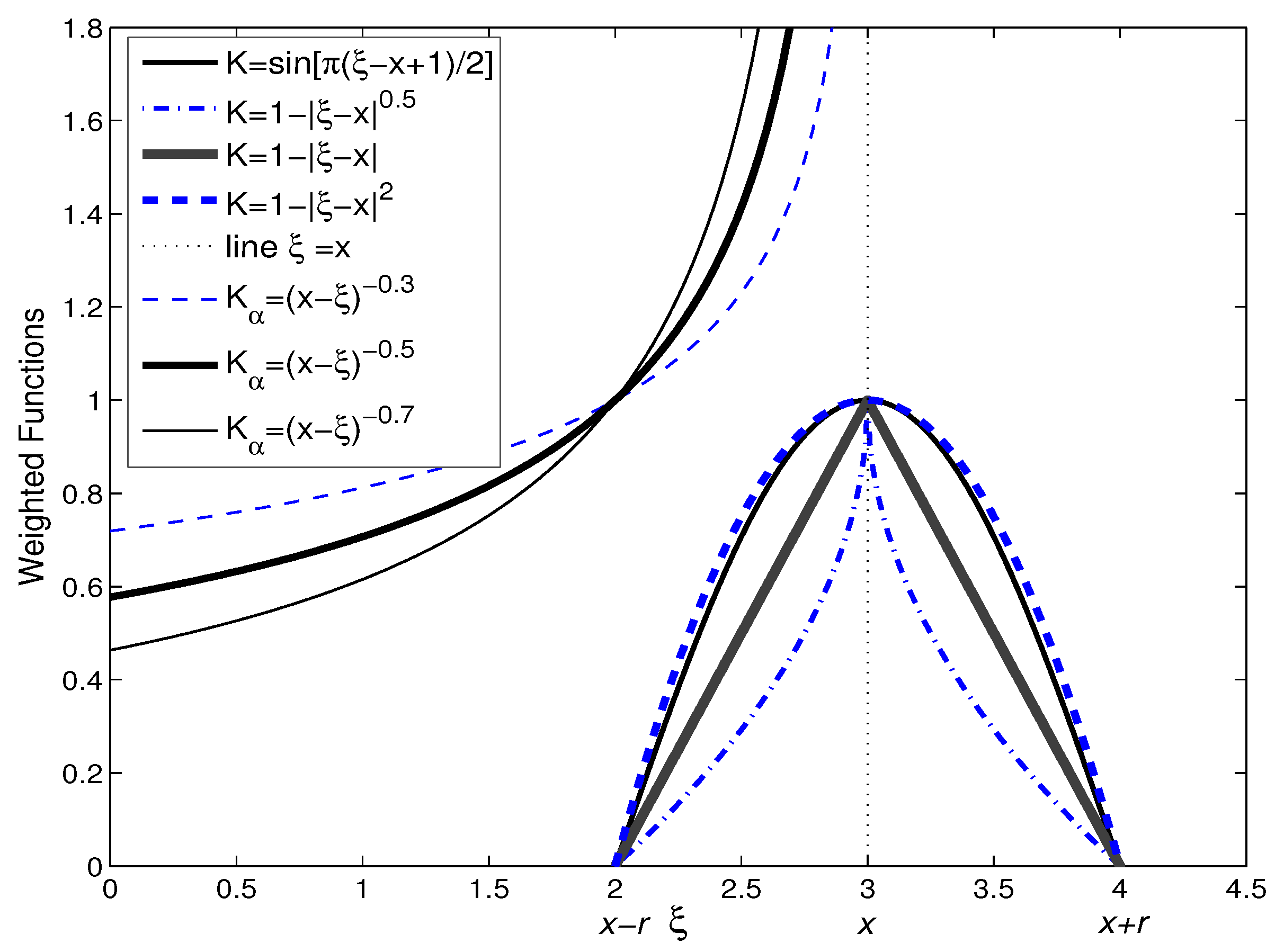
Different dynamic processes accord with different dependent radii and weighted functions. For the sake of applications, the following form of the latter can be chosen as
with
. In case
it is a symmetric upper-ward convex function. Yet in case
, it becomes a downward one (see
Figure 1).
Relative to the singular weight (
with )
for spatial FD, the one in non-singular form here is more reasonable. Just as stated in [
7,
8], though the FD is defined on an interval, it mainly reflects the local change at
(where the infinite weight is assigned). In this sense, the ability of FD is very weak for reflecting the spatial dependence.
In addition, when the weighted function is chosen as in (6), the factor
R is in an explicit form:
which increases along with the increasing of
.
In case the spatial domain is finite with , then the SDD given in Definition 3 is only valid on . It is required to add the definitions on and .
Definition 4. If the conventional integer-order derivative exists with , then(with and ) are separately called the m-order left and right boundary space-dependent derivatives of , relative to the dependent radius and weighted function , which is integrable with respect to ξ and x. For these two boundary SDDs, the linear property is maintained. But the accordant relation with the conventional derivative is not valid. They satisfy a new accordance. To take the left one as an example, in case
, it means
as
. This indicates that the defined left boundary SDD is actually a generalized relative slope with respect to the boundary point
.
In addition, for these two cases, the nice consistency relation between higher and lower orders is not valid, either. It does not matter. This is not a necessary request. The difference merely lies in a more complex calculation. To take the left boundary SDD as an example, the renewed relation is as follows:
3. Remodeling Heat Diffusion with SDD for Unsteady Case
To apply the SDD in dynamic processes, it implies the reconsidering of the basic diffusion laws, that is, the Fourier law for heat diffusion and the Fick law for substance diffusion. They were brought forth by Fourier in 1822 and by Fick in 1855, respectively. The latter is an imitation of the former, so what needs to be concerned is the former. For the modifications of this, there are many studies. Based on classifying these modifications, in [
6] we remodeled the heat-conduction process by adopting temporal MDD, where the “heat-conduction paradox” is mainly concerned. Here we reconsider it from the spatial aspect.
The Fourier law reads
where
is the coefficient of thermal conductivity. It means the heat-flux vector
is proportional to the temperature gradient
. What should be stressed is that this experimental result is only valid for the steady case.
The FDs have been borrowed for modifying the unsteady case, such as in [
9]:
where the FDs are in the
Riemann–Liouville forms with
, such as
According to Definition 2, the integral part here happens to be the Caputo type of FD which can be seen as a weighted average of the conventional derivative
on the interval
.
Here must be a fixed position for reference, which limits the expressive force of FD. On the one hand, the length of dependence interval
increases as
x moves far away from
, and this situation is not in accordance with the fact (the diffusion process has no relation with the reference position). On the other hand, with respect to the concerned point
x, this dependence is merely in a one-side form. The spatial dependence should differ from the memory dependence, and its natural form is two-side. These shortcomings can be avoided by adopting the
Riesz type of FD with infinite integral [
10,
11]:
with
and
, on the condition that
vanishes at
.
Yet, its descriptive power is still limited. In fact, in case
we have
. This indicates that the spatial change rate
at the location
is stressed with infinite weight. In another word, though the Riesz derivative is defined on
, it mainly reflects the local change.
With the above considerations, it is more reasonable for substituting the local gradient at
with a weighted mean of it on a neighborhood around this point:
with
For a motionless medium which possesses a scope (with boundary ), let (with boundary ) be an arbitrarily chosen smooth domain in it, which is far away from the medium boundary, that is, to ensure the distance between and to be bigger than r. We perform remodeling as follows.
On the one hand, from the moment
to the moment
, the input heat quantity from the boundary
reads
where
is taken as a constant.
and
are the conventional partial derivatives. Here the consistency relations in Theorem 1 are used.
On the other hand, the input heat raises the temperature. On the whole domain the cumulative heat quantity from
to
reads
In view of the arbitrariness of
and
, from
we obtain a new
SDD model for heat conduction as shown below:
with
.
In addition, corresponding to the modification above, the
spatial FD model is as follows:
where the FDs are in form of Riemann–Liouville type or Riesz type. In the recent years, this kind of spatial FD models have drawn much attention, such as in [
4,
5,
11,
12]. Further generalizations with spatial and temporal FDs were made in [
13,
14,
15].
Now that the new SDD model is constructed, a natural thing is to assign an initial condition and compose an initial-value problem on unbounded domain. In case the domain is finite, an initial-boundary value problem can be also composed. However, at this time the left and right boundary SDDs should be also incorporated, and this leads difficulty to the solution. A feasible approach for this is to develop a numerical scheme which deviate from the core theme of the present paper. In view of this, here we only consider the initial-value problem, and the infinite one-dimensional case is mainly concerned.