Article

Deriving Hermite–Hadamard-Type Inequalities via Stochastic k-Caputo Fractional Derivatives

by
Ymnah Alruwaily
1,*,
Raouf Fakhfakh
1,*,
Ghadah Alomani
2,
Rabab Alzahrani
3 and
Abdellatif Ben Makhlouf
4,5
1
Department of Mathematics, College of Science, Jouf University, P.O. Box 2014, Sakaka 72388, Saudi Arabia
2
Department of Mathematical Sciences, College of Science, Princess Nourah Bint Abdulrahman University, P.O. Box 84428, Riyadh 11671, Saudi Arabia
3
Department of Mathematics, College of Science and Humanities, Prince Sattam Bin Abdulaziz University, Al-Kharj 11942, Saudi Arabia
4
Mathematics Education Section Faculty of Education and Arts, Sohar University, P.O. Box 44, Sohar 311, Oman
5
Department of Mathematics, Faculty of sciences of Sfax, Sfax University, Sfax 3029, Tunisia
*
Authors to whom correspondence should be addressed.
Fractal Fract. 2025, 9(12), 757; https://doi.org/10.3390/fractalfract9120757
Submission received: 9 October 2025 / Revised: 15 November 2025 / Accepted: 18 November 2025 / Published: 22 November 2025
(This article belongs to the Section General Mathematics, Analysis)

Abstract

By leveraging the concept of k-Caputo fractional derivatives for stochastic processes, in this paper, we derive a generalized Hermite–Hadamard inequality tailored to n-times differentiable convex stochastic processes, providing a powerful tool for analyzing systems governed by fractional dynamics in probabilistic settings. Additionally, we establish two new integral identities that serve as the foundation for developing midpoint- and trapezium-type inequalities for ( n + 1 ) -times differentiable convex stochastic processes. These results not only enrich the theoretical underpinnings of fractional calculus, but also offer practical implications for modeling and understanding complex systems with memory and randomness. The proposed framework opens new avenues for future research in stochastic analysis and fractional calculus, with potential applications in fields such as financial mathematics, engineering, and physics.

1. Introduction

A function X : I R is said to be convex if, for all v 1 , v 2 I and k [ 0 , 1 ] , the inequality
X ( k v 1 + ( 1 k ) v 2 ) k X ( v 1 ) + ( 1 k ) X ( v 2 )
is satisfied.
The concept of convexity plays a pivotal role in mathematical analysis, particularly in the context of error estimation for quadrature formulas. Its importance is highlighted through fundamental inequalities such as the Hermite–Hadamard inequality, which can be expressed as
X m 1 + m 2 2 1 m 2 m 1 m 1 m 2 X ( u ) d u X ( m 1 ) + X ( m 2 ) 2 .
This inequality provides an elegant link between the values of a convex function at the endpoints of an interval and its integral over that interval. For more recent results on deriving Hermite–Hadamard inequality via different types of integrals, we refer the reader to [1,2,3,4].
Fractional calculus is a natural extension of classical calculus that generalizes the concepts of differentiation and integration to non-integer orders. Unlike integer-order derivatives, which describe local properties of functions, fractional derivatives capture global characteristics, making them particularly suitable for modeling systems with memory, hereditary properties, or anomalous behavior. Fractional calculus has found applications in diverse fields such as physics, engineering, economics, and biology, where traditional models based on integer-order derivatives may fail to accurately describe complex phenomena [5,6,7]. Among the various definitions of fractional derivatives, the Caputo fractional derivative is widely used due to its ability to handle initial value problems more effectively. The Caputo fractional derivative of order α > 0 is defined as
Definition 1 
([8]). Let α > 0 and α { 1 , 2 , 3 , } , n = [ α ] + 1 (i.e., α is the integer part of α). The Caputo fractional derivatives of order α are defined as follows:
D m 1 + α c f ( x ) = 1 Γ n α m 1 x x k n α 1 f n ( k ) d k , x > m 1 , D m 2 α c f ( x ) = 1 n Γ n α x m 2 k x n α 1 f n ( k ) d k , m 2 > x .
In [9], Farid et al. extended the Hermite–Hadamard inequality (1) to the case of Caputo fractional derivatives in the following manner:
Theorem 1 
([9]). Let f : [ m 1 , m 2 ] R be a positive function with 0 m 1 < m 2 and f C n m 1 , m 2 ] . If f ( n ) is a convex function on [ m 1 , m 2 ] , then the following inequalities for Caputo fractional derivatives hold:
f n m 1 + m 2 2 2 n α 1 Γ n α + 1 m 2 m 1 n α D m 1 + m 2 2 + α c f ( m 2 ) + 1 n D m 1 + m 2 2 α c f ( m 1 ) f n m 1 + f n m 2 2 .
In the same paper, the authors provided the following midpoint-type inequality for ( n + 1 ) -times differentiable convex functions.
Theorem 2 
([9]). Let f : [ m 1 , m 2 ] R be a positive function with 0 m 1 < m 2 and f C n [ m 1 , m 2 ] . If f ( n + 1 ) is convex on [ m 1 , m 2 ] , then the following inequality for Caputo fractional derivatives holds:
f ( n ) m 1 + m 2 2 2 n α 1 Γ n α + 1 m 2 m 1 n α D m 1 + m 2 2 + α c f ( m 2 ) + 1 n D m 1 + m 2 2 α c f ( m 1 ) m 2 m 1 4 ( n α + 1 ) f ( n + 1 ) ( m 1 ) + f ( n + 1 ) ( m 2 ) .
Building upon the classical Caputo fractional derivative, the notion of the k-Caputo fractional derivative further generalizes the concept by introducing an additional parameter k > 0 , which provides greater flexibility in modeling and analysis. This extension is particularly useful in scenarios where scaling or normalization factors play a significant role. The k-Caputo fractional derivative of order α > 0 for a function f ( l ) is defined as
Definition 2 
([10]). Let α > 0 , k 1 and α { 1 , 2 , 3 , } , n = [ α ] + 1 (i.e., α is the integer part of α). The Caputo k-fractional derivatives of order α are defined as follows:
D m 1 + α , k c f ( x ) = 1 k Γ k n α k m 1 x x k n α k 1 f n ( k ) d k , x > m 1 , D m 2 α , k c f ( x ) = 1 n k Γ k n α k x m 2 k x n α k 1 f n ( k ) d k , m 2 > x ,
where Γ k β is the k-gamma function defined in [11] as Γ k β = 0 k β 1 e k k k d k satisfying Γ k β + k = β Γ k β .
The k-Caputo operator introduces an additional scaling parameter k > 0 through k-Gamma and the Pochhammer k-symbol, allowing controlled modification of the weighting of past states in the integral kernel. This extra degree of freedom is particularly useful in multi-scale or normalized frameworks where the effective influence of history should be tuned independently from the fractional order α (for instance, when empirical data indicates different memory intensities at different temporal scales). In practice, the parameter k plays the role of an integration scaling: by varying k one can accelerate or decelerate the contribution of the past to the present rate while preserving the integral form and many useful analytical properties of Caputo derivatives (for k = 1 one recovers the classical Caputo operator). Consequently, the k-Caputo derivative is a natural tool when modeling heterogeneous media, anomalous diffusion with scale-dependent memory, or time-series exhibiting multi-scale dependence (e.g., financial volatility with separate short- and long-term memory components).
Farid and coauthors provided the Hermite–Hadamard inequalities and midpoint-type inequality via k-Caputo fractional derivatives in [12] as follows:
Theorem 3 
([12]). Let f : [ m 1 , m 2 ] R be a positive function with 0 m 1 < m 2 and f C n m 1 , m 2 ] . If f ( n ) is a convex function on [ m 1 , m 2 ] , then the following inequalities for k-Caputo fractional derivatives hold:
f n m 1 + m 2 2 2 n α k 1 k Γ k n α k + k m 2 m 1 n α k D m 1 + m 2 2 + α , k c f ( m 2 ) + 1 n D m 1 + m 2 2 α , k c f ( m 1 ) f n m 1 + f n m 2 2 .
Theorem 4 
([12]). Let f : [ m 1 , m 2 ] R be a positive function with 0 m 1 < m 2 and f C n m 1 , m 2 ] . If f ( n ) is a convex function on [ m 1 , m 2 ] , then the following inequalities for k-Caputo fractional derivatives hold:
f n m 1 + m 2 2 2 n α k 1 k Γ k n α k + k m 2 m 1 n α k D m 1 + m 2 2 + α , k c f ( m 2 ) + 1 n D m 1 + m 2 2 α , k c f ( m 1 ) m 2 m 1 4 n α k + 1 f n m 1 + f n m 2 .
Stochastic processes, a cornerstone of probability theory, focus on systems that evolve over time under random influences. This field has seen remarkable advancements due to its wide applicability in areas such as physics, computer science, signal processing, cryptography, and control theory. Stochastic processes have become indispensable tools for modeling uncertain and dynamic behaviors, driving both theoretical developments and practical innovations across various domains [13,14].
Nikodem [15] introduced the notion of a convex stochastic process as follows:
Definition 3. 
A stochastic process X : D × Y R is called a convex stochastic process if, for every v 1 , v 2 D and k ( 0 , 1 ) , the inequality
X k v 1 + ( 1 k ) v 2 , . k X ( v 1 , · ) + ( 1 k ) X ( v 2 , · ) ( a . e . )
is satisfied.
Kotrys [16] extended the Hermite–Hadamard inequality (1) to convex stochastic processes as follows:
X m 1 + m 2 2 , · 1 m 2 m 1 m 1 m 2 X ( u , · ) d u X ( m 1 , · ) + X ( m 2 , · ) 2 ( a . e . ) .
Recent advances in integral inequalities have underscored the significance of various convexity concepts in stochastic processes. For instance, Materano et al. [17,18] explored Simpson-type inequalities for s-convex and quasi-convex stochastic processes, as well as Ostrowski-type inequalities for convex, s-convex, and quasi-convex functions. Agahi and Babakhani [19] extended classical results into the fractional domain by deriving fractional Hermite–Hadamard and Jensen-type inequalities for convex stochastic processes. Deng and Wang [20] developed fractional Hermite–Hadamard inequalities for ( α , m ) -logarithmically convex functions, broadening the scope of fractional calculus. Afzal et al. [21] investigated Jensen and Hermite–Hadamard inequalities for h-Godunova–Levin stochastic processes, emphasizing the role of generalized convexity in stochastic analysis. Meftah et al. [22] studied Maclaurin’s inequality for s-convex stochastic processes via k-Riemann–Liouville stochastic fractional integrals. Sharma et al. [23] proposed Hermite–Hadamard-type inequalities for multidimensional h-harmonic preinvex stochastic processes. Hernández and Garcia [24] investigated Hermite–Hadamard-type inequalities for convex stochastic processes, while Hernández and Gomez [25] derived analogous results for ( m , h 1 , h 2 ) -convex functions using Katugampola fractional integrals. Furthermore, Set and Sarikaya [26] extended Hermite–Hadamard-type inequalities to coordinates convex stochastic processes. Jarad et al. [27] introduced a new stochastic fractional integral and derived some related inequalities of Jensen–Mercer and Hermite–Hadamard–Mercer type for convex stochastic processes. Additional contributions [28,29] have further enriched the theoretical and applied aspects of convexity in stochastic processes.
In [30], Rashid et al. presented the notion of stochastic Caputo fractional derivatives as follows:
Definition 4 
([30]). Let α > 0 and α { 1 , 2 , 3 , } , n = [ α ] + 1 (i.e., α is the integer part of α). For the stochastic process X : I × Y R , the concept of stochastic mean-square Caputo fractional derivatives of order α are defined as follows:
D m 1 + α c X ( x ) = 1 Γ n α m 1 x x k n α 1 X n ( k , · ) d k ( a . e . ) , x > m 1 ,
and
D m 2 α c X ( x ) = 1 n Γ n α x m 2 k x n α 1 X n ( k , · ) d k ( a . e . ) , m 2 > x .
In the same paper, the authors offered the following Hermite–Hadamard and midpoint inequalities via Caputo fractional derivatives.
Theorem 5 
([30]). Let α > 0 , and X : [ m 1 , m 2 ] × Y R be a positive stochastic process with 0 m 1 < m 2 and X A C n m 1 , m 2 ] . If X ( n ) is a convex stochastic process on [ m 1 , m 2 ] , then the following inequalities for Caputo fractional derivatives hold
X n m 1 + m 2 2 , · Γ n α + 1 2 m 2 m 1 n α D m 1 + α c X ( m 2 ) + 1 n D m 2 α c X ( m 1 ) X n m 1 + X n m 2 2 .
Theorem 6 
([30]). Let α > 0 , and let X : [ m 1 , m 2 ] × Y R be a positive stochastic process with 0 m 1 < m 2 and X A C n m 1 , m 2 ] . If X ( n ) is a convex stochastic process on [ m 1 , m 2 ] , then the following inequalities for Caputo fractional derivatives hold:
X n m 1 + m 2 2 , · Γ n α + 1 2 m 2 m 1 n α D m 1 + α c X ( m 2 ) + 1 n D m 2 α c X ( m 1 ) m 2 m 1 2 ( n α + 1 ) 1 1 2 n α X n m 1 + X n m 2 .
In this paper, we make three principal contributions: first, we introduce the novel concept of stochastic k-Caputo fractional derivatives for stochastic processes, thereby extending the deterministic k-Caputo framework to the stochastic realm and establishing a rigorous probabilistic foundation for fractional calculus in random settings; second, we derive a Hermite–Hadamard-type inequality for convex stochastic processes under this new derivative, which constitutes the first such result linking stochastic convexity with fractional integral bounds; third, we establish two new integral identities involving stochastic k-Caputo derivatives that enable the systematic derivation of sharp midpoint- and trapezium-type inequalities for differentiable convex stochastic processes, generalizing classical deterministic results to the stochastic fractional setting and providing a powerful tool for error analysis in stochastic numerical integration. Together, these contributions form a foundational advancement in stochastic fractional analysis and open new perspectives for applications in uncertainty quantification, stochastic modeling, and computational finance.
This paper is organized as follows: In Section 2, we recall some essential definitions and tools from stochastic calculus that will be used throughout the paper. In Section 3, we first introduce the concept of k-Caputo fractional derivatives associated with stochastic processes and then establish the corresponding Hermite–Hadamard inequality for this type of derivative. In Section 4, we focus on midpoint-type inequalities. We begin by introducing a new identity, which serves as the basis for deriving several midpoint-type inequalities for ( n + 1 ) -times differentiable convex stochastic processes. In Section 5, we investigate trapezium-type inequalities using stochastic k-Caputo fractional derivatives. To achieve this, we introduce a second identity and use it to establish some trapezium-type inequalities for the same class of functions. Section 6 presents a numerical example with graphical representations along with an application in information theory. Finally, the paper concludes with a summary of the main findings in Section 7.

2. Preliminaries

This section revisits some fundamental concepts from stochastic theory that are relevant for the continuation of our study.
Definition 5 
([31]). Let ( Y , A , P ) be a probability space. A random variable is a function X : Y R that is A -measurable. The function X : D × Y R , where D R , is said to be a stochastic process if for every k D , the function X ( k , · ) is a random variable.
Definition 6 
([31]). In probability, a function X : D × Y R is said to be continuous on D if for all k 0 D , we have
P lim k k 0 X k , · = X k 0 , · ,
where P lim denotes the limit in probability.
Definition 7 
([31]).  X : D × Y R is said to be mean-square continuous in D if for all k 0 D , we have
lim k k 0 E X k , · X k 0 , · 2 = 0
where E X k , · denotes the expectation value of the random variable X k , · .
Definition 8 
([31]).  X : D × Y R is said to be differentiable at a point k D if there is a random variable X : D × Y R .
X k , · = P lim k k 0 X k , · X k 0 , · k k 0 .
Definition 9 
([31]).  X : D × Y R is said to be mean-square differentiable at k D if there exists a random variable X : D × Y R .
lim k k 0 E X k , · X k 0 , · k k 0 X k , · 2 = 0 .
Definition 10 
([31]). Let X : D × Y R be a stochastic process with E [ X ( k ) 2 ] , where k D . The random variable Z : Y R is defined as the mean-square integral of the process X over the interval [ n 1 , n 2 ] if, for any sequence of partitions of [ n 1 , n 2 ] D , where n 1 = k 0 < k 1 < < k m = n 2 , and for every ξ k [ k k 1 , k k ] , k = 1 , , m , we have
lim k k k k 1 E k = 1 m X ξ k , · k k k k 1 Z . 2 = 0 ,
which can also be written as
Z . = n 2 n 1 X l , · d l , ( a . e . ) .

3. Hermite–Hadamard Inequality

This section introduces the notion of k-Caputo fractional derivatives in the context of stochastic processes and establishes the associated Hermite–Hadamard inequality.
Definition 11. 
Let α > 0 , k 1 and α { 1 , 2 , 3 , } , n = [ α ] + 1 (i.e., α is the integer part of α). For the stochastic process X : I × Y R , the concept of stochastic mean-square Caputo k-fractional derivatives of order α is defined as follows:
D m 1 + α , k c X ( x ) = 1 k Γ k n α k m 1 x x k n α k 1 X n ( k , · ) d k ( a . e . ) , x > m 1 ,
D m 2 α , k c X ( x ) = 1 n k Γ k n α k x m 2 k x n α k 1 X n ( k , · ) d k ( a . e . ) , m 2 > x ,
where Γ k β denotes the k-gamma function.
Remark 1. 
For k = 1 , Definition 11 gives the concept of stochastic mean-square Caputo fractional derivatives of order α, as defined in [30].
Theorem 7. 
Let α > 0 , k 1 , and let X : I × Y R be a mean-square differentiable stochastic process such that X A C n m 1 , m 2 , where m 1 , m 2 I with m 1 < m 2 . If X n is a convex stochastic process, then the inequality
X n m 1 + m 2 2 , · 2 n α k 1 k Γ k n α k + k m 2 m 1 n α k D m 1 + m 2 2 + α , k c X ( m 2 ) + 1 n D m 1 + m 2 2 α , k c X ( m 1 ) X n m 1 , · + X n m 2 , · 2
holds almost everywhere.
Proof. 
Since X n is a convex stochastic process, for x , y [ m 1 , m 2 ] we have
X n x + y 2 , · = X n x , · + X n y , · 2 ( a . e . ) .
Let x = 1 k 2 m 1 + k 2 m 2 and y = k 2 m 1 + 1 k 2 m 2 for k [ 0 , 1 ] . Then, x , y [ m 1 , m 2 ] , and from inequality (7) we have
2 X n m 1 + m 2 2 , · X n 1 k 2 m 1 + k 2 m 2 , · + X n k 2 m 1 + 1 k 2 m 2 , ·
Multiplying both sides of (8) by k n α k 1 k Γ k n α , then integrating the resulting inequality with respect to t over 0 , 1 , we get
2 k Γ k n α k 0 1 k n α k 1 X n m 1 + m 2 2 , · d k 1 k Γ k n α k 0 1 k n α k 1 X n 1 k 2 m 1 + k 2 m 2 , · d k + 1 k Γ k n α k 0 1 k n α k 1 X n k 2 m 1 + 1 k 2 m 2 , · d k .
Using the change in variable, inequality (9) gives
2 k Γ k n α k + k X n m 1 + m 2 2 , · 2 m 2 m 1 n α k 1 k Γ k n α k m 1 m 1 + m 2 2 u m 1 n α k 1 X n u , · d u + 2 m 2 m 1 n α k 1 k Γ k n α k m 1 + m 2 2 m 2 m 2 u n α k 1 X n u , · d u = 2 n α k m 2 m 1 n α k D m 1 + m 2 2 + α , k c X ( m 2 ) + 1 n D m 1 + m 2 2 α , k c X ( m 1 ) ( a . e . ) .
Hence, we have
2 k Γ k n α k + k X n m 1 + m 2 2 , · 2 n α k m 2 m 1 n α k D m 1 + m 2 2 + α , k c X ( m 2 ) + 1 n D m 1 + m 2 2 α , k c X ( m 1 ) ( a . e . ) .
On the other hand, from the convexity of X n , we have
X n 1 k 2 m 1 + k 2 m 2 , · + X n k 2 m 1 + 1 k 2 m 2 , · 1 k 2 X n m 1 , · + k 2 X n m 2 , · + k 2 X n m 1 , · + 1 k 2 X n m 2 , · = X n m 1 , · + X n m 2 , · .
Multiplying both sides of (11) by k n α k 1 k Γ k n α k , then integrating the resulting inequality with respect to t over 0 , 1 , we get
1 k Γ k n α k 0 1 k n α k 1 X n 1 k 2 m 1 + k 2 m 2 , · d k + 1 k Γ k n α k 0 1 k n α k 1 X n k 2 m 1 + 1 k 2 m 2 , · d k X n m 1 , · + X n m 2 , · 1 k Γ k n α k 0 1 k n α k 1 d k .
The above inequality can be restated as follows:
2 n α k m 2 m 1 n α k D m 1 + m 2 2 + α , k c X ( m 2 ) + 1 n D m 1 + m 2 2 α , k c X ( m 1 ) 1 k Γ k n α k + k X n m 1 , · + X n m 2 , · .
From (10) and (12), we have
2 k Γ k n α k + k X n m 1 + m 2 2 , · 2 n α k m 2 m 1 n α k D m 1 + m 2 2 + α , k c X ( m 2 ) + 1 n D m 1 + m 2 2 α , k c X ( m 1 ) 1 k Γ k n α k + k X n m 1 , · + X n m 2 , · .
Multiplying the sides of (13) by k Γ k n α k + k 2 , we get the desired result. □
Corollary 1. 
In Theorem 7, if we take k = 1 , then we get
X n m 1 + m 2 2 , · 2 n α 1 Γ n α + k m 2 m 1 n α D m 1 + m 2 2 + α c X ( m 2 ) + 1 n D m 1 + m 2 2 α c X ( m 1 ) X n m 1 , · + X n m 2 , · 2 ( a . e . ) ,
where D m 1 + α c X ( x ) and D m 2 α c X ( x ) are defined as in (2) and (3), respectively.

4. Midpoint-Type Inequalities

We begin this section by presenting a new identity that enables us to derive midpoint-type inequalities for ( n + 1 ) -times differentiable convex stochastic processes.
Lemma 1. 
Let α > 0 , k 1 , and let X : I × Y R be a mean-square differentiable stochastic process such that X A C n m 1 , m 2 , where m 1 , m 2 I with m 1 < m 2 . If X n + 1 is mean-square integrable on m 1 , m 2 , then the equality
X n m 1 + m 2 2 , · 2 n α k 1 k Γ k n α k + k m 2 m 1 n α k D m 1 + m 2 2 + α , k c X ( m 2 ) + 1 n D m 1 + m 2 2 α , k c X ( m 1 ) = m 2 m 1 4 1 0 k n α k X n + 1 1 k 2 m 1 + t 2 m 2 , · X n + 1 k 2 m 1 + 1 t 2 m 2 , · d k
holds almost everywhere.
Proof. 
Let
J 1 = 1 2 0 k n α k X n + 1 1 k 2 m 1 + k 2 m 2 , · d k , J 2 = 1 1 2 k n α k X n + 1 k 2 m 1 + 1 k 2 m 2 , · d k .
Integrating with part J 1 , then using the change in variable, we get
J 1 = 2 m 2 m 1 k n α k X n 1 k 2 m 1 + k 2 m 2 , · 0 1 2 m 2 m 1 n α k 1 0 k n α k 1 X n 1 t 2 m 1 + k 2 m 2 , · d k = 2 m 2 m 1 X n m 1 + m 2 2 , · 2 n α k + 1 n α k m 2 m 1 n α k + 1 m 1 + m 2 2 m 1 u m 1 n α k 1 X n u , · d u = 2 m 2 m 1 X n m 1 + m 2 2 , · 1 n 2 n α k + 1 k Γ k n α k + k m 2 m 1 n α k + 1 D m 1 + m 2 2 α , k c X ( m 1 ) , ( a . e . ) .
Similarly, we obtain
J 2 = 2 m 2 m 1 k n α k X n k 2 m 1 + 1 k 2 m 2 , · 0 1 + 2 m 2 m 1 n α k 1 0 k n α k 1 X n k 2 m 1 + 1 k 2 m 2 , · d k = 2 m 2 m 1 X n m 1 + m 2 2 , · + 2 n α k + 1 n α k m 2 m 1 n α k + 1 m 2 m 1 + m 2 2 m 2 u n α k 1 X n u , · d u = 2 m 2 m 1 X n m 1 + m 2 2 , · + 2 n α + 1 k Γ n α k + k m 2 m 1 n α k + 1 D m 1 + m 2 2 + α c X ( m 2 ) ( a . e . ) .
Subtracting (15) from (14), and then multiplying the resulting equality by m 2 m 1 4 , we get the desired result. □
Theorem 8. 
Let α > 0 , k 1 , and let X : I × Y R be a mean-square differentiable stochastic process such that X A C n m 1 , m 2 , where m 1 , m 2 I with m 1 < m 2 , and assume that X n + 1 is mean-square integrable on m 1 , m 2 . If X n + 1 is a convex stochastic process, then the inequality
X n m 1 + m 2 2 , · 2 n α k 1 k Γ k n α k + k m 2 m 1 n α k D m 1 + m 2 2 + α , k c X ( m 2 ) + 1 n D m 1 + m 2 2 α , k c X ( m 1 ) k m 2 m 1 4 k n + 1 α X n + 1 ( m 1 , · ) + X n + 1 ( m 2 , · )
holds almost everywhere.
Proof. 
Using Lemma 1, and the fact that X n + 1 is a convex stochastic process, we deduce
X n m 1 + m 2 2 , · 2 n α k 1 k Γ k n α k + k m 2 m 1 n α k D m 1 + m 2 2 + α , k c X ( m 2 ) + 1 n D m 1 + m 2 2 α , k c X ( m 1 ) m 2 m 1 4 1 0 k n α k X n + 1 1 k 2 m 1 + k 2 m 2 , · d k + 1 0 k n α k X n + 1 k 2 m 1 + 1 k 2 m 2 , · d k m 2 m 1 4 1 0 k n α k 1 k 2 X n + 1 ( m 1 , · ) + k 2 X n + 1 ( m 2 , · ) d k + 1 0 k n α k k 2 X n + 1 ( m 1 , · ) + 1 k 2 X n + 1 ( m 2 , · ) d k = m 2 m 1 4 X n + 1 ( m 1 , · ) + X n + 1 ( m 2 , · ) 1 0 k n α k 1 k 2 + k 2 d k = k m 2 m 1 4 k n + 1 α X n + 1 ( m 1 , · ) + X n + 1 ( m 2 , · ) .
The proof is finished. □
Corollary 2. 
In Theorem 8, if we take k = 1 , then we get
X n m 1 + m 2 2 , · 2 n α 1 Γ n α + 1 m 2 m 1 n α D m 1 + m 2 2 + α c X ( m 2 ) + 1 n D m 1 + m 2 2 α c X ( m 1 ) m 2 m 1 4 n + 1 α X n + 1 ( m 1 , · ) + X n + 1 ( m 2 , · ) ( a . e . ) ,
where D m 1 + α c X ( x ) and D m 2 α c X ( x ) are defined as in (2) and (3), respectively.
Theorem 9. 
Let α > 0 , k 1 , and let X : I × Y R be a mean-square differentiable stochastic process such that X A C n m 1 , m 2 , where m 1 , m 2 I with m 1 < m 2 , and assume that X n + 1 is mean-square integrable on m 1 , m 2 . If X n + 1 q is a convex stochastic process for q > 1 with 1 p + 1 q = 1 , then the inequality
X n m 1 + m 2 2 , · 2 n α k 1 k Γ k n α k + k m 2 m 1 n α k D m 1 + m 2 2 + α , k c X ( m 2 ) + 1 n D m 1 + m 2 2 α , k c X ( m 1 ) m 2 m 1 4 k p k n α + k 1 p × 3 X n + 1 ( m 1 , · ) q + X n + 1 ( m 2 , · ) q 4 1 q + X n + 1 ( m 1 , · ) q + 3 X n + 1 ( m 2 , · ) q 4 1 q
holds almost everywhere.
Proof. 
Using Lemma 1, and the fact that X n + 1 q is a convex stochastic process along with Hölder’s inequality, we deduce
X n m 1 + m 2 2 , · 2 n α k 1 k Γ k n α k + k m 2 m 1 n α k D m 1 + m 2 2 + α , k c X ( m 2 ) + 1 n D m 1 + m 2 2 α , k c X ( m 1 ) m 2 m 1 4 1 0 k n α k p d k 1 p 1 0 X n + 1 1 k 2 m 1 + k 2 m 2 , · q d k 1 q + 1 0 k n α k p d k 1 p 1 0 X n + 1 k 2 m 1 + 1 k 2 m 2 , · q d k 1 q m 2 m 1 4 1 0 k p k n α k d k 1 p 1 0 1 k 2 X n + 1 ( m 1 , · ) q + k 2 X n + 1 ( m 2 , · ) q d k 1 q + 1 0 k 2 X n + 1 ( m 1 , · ) q + 1 k 2 X n + 1 ( m 2 , · ) q d k 1 q = m 2 m 1 4 k p k n α + k 1 p × 3 X n + 1 ( m 1 , · ) q + X n + 1 ( m 2 , · ) q 4 1 q + X n + 1 ( m 1 , · ) q + 3 X n + 1 ( m 2 , · ) q 4 1 q .
The proof is completed. □
Corollary 3. 
In Theorem 9, if we take k = 1 , then we get
X n m 1 + m 2 2 , · 2 n α 1 Γ n α + 1 m 2 m 1 n α D m 1 + m 2 2 + α c X ( m 2 ) + 1 n D m 1 + m 2 2 α c X ( m 1 ) m 2 m 1 4 1 p n α + 1 1 p × 3 X n + 1 ( m 1 , · ) q + X n + 1 ( m 2 , · ) q 4 1 q + X n + 1 ( m 1 , · ) q + 3 X n + 1 ( m 2 , · ) q 4 1 q ( a . e . ) ,
where D m 1 + α c X ( x ) and D m 2 α c X ( x ) are defined as in (2) and (3), respectively.
Theorem 10. 
Let α > 0 , k 1 , and let X : I × Y R be a mean-square differentiable stochastic process such that X A C n m 1 , m 2 , where m 1 , m 2 I with m 1 < m 2 , and assume that X n + 1 is mean-square integrable on m 1 , m 2 . If X n + 1 q is a convex stochastic process for q > 1 , then the inequality
X n m 1 + m 2 2 , · 2 n α k 1 k Γ k n α k + k m 2 m 1 n α k D m 1 + m 2 2 + α , k c X ( m 2 ) + 1 n D m 1 + m 2 2 α , k c X ( m 1 ) m 2 m 1 4 k k n + 1 α 1 1 q × k k n + 1 α k 2 k n + 2 α X n + 1 ( m 1 , · ) q + k 2 k n + 2 α X n + 1 ( m 2 , · ) q 1 q + k 2 k n + 2 α X n + 1 ( m 1 , · ) q + k k n + 1 α k 2 k n + 2 α X n + 1 ( m 2 , · ) q 1 q
holds almost everywhere.
Proof. 
Using Lemma 1, and the fact that X n + 1 q is a convex stochastic process along with power mean inequality, we deduce
X n m 1 + m 2 2 , · 2 n α k 1 k Γ k n α k + k m 2 m 1 n α k D m 1 + m 2 2 + α , k c X ( m 2 ) + 1 n D m 1 + m 2 2 α , k c X ( m 1 ) m 2 m 1 4 1 0 k n α k d k 1 1 q 1 0 k n α k X n + 1 1 k 2 m 1 + k 2 m 2 , · q d k 1 q + 1 0 k n α k d k 1 1 q 1 0 k n α k X n + 1 k 2 m 1 + 1 k 2 m 2 , · q d k 1 q m 2 m 1 4 1 0 k n α k d k 1 1 q 1 0 k n α k 1 k 2 X n + 1 ( m 1 , · ) q + k 2 X n + 1 ( m 2 , · ) q d k 1 q + 1 0 k n α k k 2 X n + 1 ( m 1 , · ) q + 1 k 2 X n + 1 ( m 2 , · ) q d k 1 q = m 2 m 1 4 k k n + 1 α 1 1 q × k k n + 1 α k 2 k n + 2 α X n + 1 ( m 1 , · ) q + k 2 k n + 2 α X n + 1 ( m 2 , · ) q 1 q + k 2 k n + 2 α X n + 1 ( m 1 , · ) q + k k n + 1 α k 2 k n + 2 α X n + 1 ( m 2 , · ) q 1 q ,
where we use
1 0 k n α k 1 k 2 d k = k k n + 1 α k 2 k n + 2 α
and
1 0 k n α k k 2 d k = k 2 k n + 2 α .
The proof is completed. □
Corollary 4. 
By setting k = 1 in Theorem 10, we get
X n m 1 + m 2 2 , · 2 n α 1 Γ n α + 1 m 2 m 1 n α D m 1 + m 2 2 + α c X ( m 2 ) + 1 n D m 1 + m 2 2 α c X ( m 1 ) m 2 m 1 4 1 n + 1 α 1 1 q × 1 n + 1 α 1 2 n + 2 α X n + 1 ( m 1 , · ) q + 1 2 n + 2 α X n + 1 ( m 2 , · ) q 1 q + 1 2 n + 2 α X n + 1 ( m 1 , · ) q + 1 n + 1 α 1 2 n + 2 α X n + 1 ( m 2 , · ) q 1 q ( a . e . ) ,
where D m 1 + α c X ( x ) and D m 2 α c X ( x ) are defined as in (2) and (3), respectively.

5. Trapezium-Type Inequalities

In this section, we focus on trapezium-type inequalities and introduce a second identity to establish such inequalities using stochastic k-Caputo fractional derivatives.
Lemma 2. 
Let α > 0 , k 1 , and let X : I × Y R be a mean-square differentiable stochastic process such that X A C n m 1 , m 2 , where m 1 , m 2 I with m 1 < m 2 . If X n + 1 is mean-square integrable on m 1 , m 2 , then the equality
X n m 1 , · + X n m 2 , · 2 2 n α k 1 k Γ k n α k + k m 2 m 1 n α k D m 1 + m 2 2 + α , k c X ( m 2 ) + 1 n D m 1 + m 2 2 α , k c X ( m 1 ) = m 2 m 1 4 1 0 k n α k 1 X n + 1 1 k 2 m 1 + k 2 m 2 , · X n + 1 k 2 m 1 + 1 k 2 m 2 , · d k ( a . e ) ,
holds almost everywhere.
Proof. 
Let
I 1 = 1 2 0 k n α k 1 X n + 1 1 k 2 m 1 + k 2 m 2 , · d k , I 2 = 1 1 2 k n α k 1 X n + 1 k 2 m 1 + 1 k 2 m 2 , · d k .
Integrating with part I 1 , then using the change in variable, we get
I 1 = 2 m 2 m 1 k n α k 1 X n 1 k 2 m 1 + k 2 m 2 , · 0 1 2 m 2 m 1 n α k 1 0 k n α k 1 X n 1 t 2 m 1 + k 2 m 2 , · d k = 2 m 2 m 1 X n m 1 , · 2 n α k + 1 n α k m 2 m 1 n α k + 1 m 1 + m 2 2 m 1 u m 1 n α k 1 X n u , · d u = 2 m 2 m 1 X n m 1 , · 1 n 2 n α k + 1 k Γ k n α k + k m 2 m 1 n α k + 1 D m 1 + m 2 2 α , k c X ( m 1 ) , ( a . e . ) .
Similarly, we obtain
I 2 = 2 m 2 m 1 k n α k 1 X n k 2 m 1 + 1 k 2 m 2 , · 0 1 + 2 n α k m 2 m 1 1 0 k n α k 1 X n k 2 m 1 + 1 k 2 m 2 , · d k = 2 m 2 m 1 X m 2 , · + 2 n α k + 1 n α k m 2 m 1 n α k + 1 m 2 m 1 + m 2 2 m 2 u n α k 1 X n u , · d k = 2 m 2 m 1 X m 2 , · + 2 n α k + 1 k Γ k n α k + k m 2 m 1 n α k + 1 D m 1 + m 2 2 + α c X ( m 2 ) ( a . e . ) .
Subtracting (17) from (16), and then multiplying the resulting equality by m 2 m 1 4 , we get the desired result. □
Theorem 11. 
Let α > 0 , k 1 , and let X : I × Y R be a mean-square differentiable stochastic process such that X A C n m 1 , m 2 , where m 1 , m 2 I with m 1 < m 2 , and assume that X n + 1 is mean-square integrable on m 1 , m 2 . If X n + 1 is convex stochastic process, then the inequality
X n m 1 , · + X n m 2 , · 2 2 n α k 1 k Γ k n α k + k m 2 m 1 n α k D m 1 + m 2 2 + α , k c X ( m 2 ) + 1 n D m 1 + m 2 2 α , k c X ( m 1 ) k n α m 2 m 1 4 k n + 1 α X n + 1 ( m 1 , · ) + X n + 1 ( m 2 , · )
holds almost everywhere.
Proof. 
Using Lemma 2, and the fact that X n + 1 is a convex stochastic process, we deduce
X n m 1 , · + X n m 2 , · 2 2 n α k 1 k Γ k n α k + k m 2 m 1 n α k D m 1 + m 2 2 + α , k c X ( m 2 ) + 1 n D m 1 + m 2 2 α , k c X ( m 1 ) m 2 m 1 4 1 0 k n α k 1 X n + 1 1 k 2 m 1 + k 2 m 2 , · d k + 1 0 k n α k 1 X n + 1 k 2 m 1 + 1 k 2 m 2 , · d k m 2 m 1 4 1 0 1 k n α k 1 k 2 X n + 1 ( m 1 , · ) + k 2 X n + 1 ( m 2 , · ) d k + 1 0 1 k n α k k 2 X n + 1 ( m 1 , · ) + 1 k 2 X n + 1 ( m 2 , · ) d k = m 2 m 1 4 X n + 1 ( m 1 , · ) + X n + 1 ( m 2 , · ) 1 0 1 k n α k d k = k n α m 2 m 1 4 k n + 1 α X n + 1 ( m 1 , · ) + X n + 1 ( m 2 , · ) .
The proof is finished. □
Corollary 5. 
In Theorem 11, if we take k = 1 , then we get
X n m 1 , · + X n m 2 , · 2 2 n α 1 Γ n α + 1 m 2 m 1 n α D m 1 + m 2 2 + α c X ( m 2 ) + 1 n D m 1 + m 2 2 α c X ( m 1 ) n α m 2 m 1 4 n + 1 α X n + 1 ( m 1 , · ) + X n + 1 ( m 2 , · ) ( a . e . ) ,
where D m 1 + α c X ( x ) and D m 2 α c X ( x ) are defined as in (2) and (3), respectively.
Theorem 12. 
Let α > 0 , k 1 , and let X : I × Y R be a mean-square differentiable stochastic process such that X A C n m 1 , m 2 , where m 1 , m 2 I with m 1 < m 2 , and assume that X n + 1 is mean-square integrable on m 1 , m 2 . If X n + 1 p is convex stochastic process, then the inequality
X n m 1 , · + X n m 2 , · 2 2 n α k 1 k Γ k n α k + k m 2 m 1 n α k D m 1 + m 2 2 + α , k c X ( m 2 ) + 1 n D m 1 + m 2 2 α , k c X ( m 1 ) m 2 m 1 4 k B k k n α , p + 1 k n α 1 p × 3 X n + 1 ( m 1 , · ) q + X n + 1 ( m 2 , · ) q 4 1 q + X n + 1 ( m 1 , · ) q + 3 X n + 1 ( m 2 , · ) q 4 1 q
holds almost everywhere, where B . , · is the beta function.
Proof. 
Using Lemma 2, and the fact that X n + 1 q is a convex stochastic process along with Hölder’s inequality, we deduce
X n m 1 , · + X n m 2 , · 2 2 n α k 1 k Γ k n α k + k m 2 m 1 n α k D m 1 + m 2 2 + α , k c X ( m 2 ) + 1 n D m 1 + m 2 2 α , k c X ( m 1 ) m 2 m 1 4 1 0 k n α k 1 p d k 1 p 1 0 X n + 1 1 k 2 m 1 + k 2 m 2 , · q d k 1 q + 1 0 k n α k 1 p d k 1 p 1 0 X n + 1 k 2 m 1 + 1 k 2 m 2 , · q d k 1 q m 2 m 1 4 1 0 1 k n α k p d k 1 p 1 0 1 k 2 X n + 1 ( m 1 , · ) q + k 2 X n + 1 ( m 2 , · ) q d k 1 q + 1 0 k 2 X n + 1 ( m 1 , · ) q + 1 k 2 X n + 1 ( m 2 , · ) q d k 1 q = m 2 m 1 4 k k n α 1 0 1 u p u k k n α 1 d u 1 p × 3 X n + 1 ( m 1 , · ) q + X n + 1 ( m 2 , · ) q 4 1 q + X n + 1 ( m 1 , · ) q + 3 X n + 1 ( m 2 , · ) q 4 1 q = m 2 m 1 4 k B k k n α , p + 1 k n α 1 p × 3 X n + 1 ( m 1 , · ) q + X n + 1 ( m 2 , · ) q 4 1 q + X n + 1 ( m 1 , · ) q + 3 X n + 1 ( m 2 , · ) q 4 1 q .
The proof is completed. □
Corollary 6. 
In Theorem 12, if we take k = 1 , then we get
X n m 1 , · + X n m 2 , · 2 2 n α 1 Γ n α + 1 m 2 m 1 n α D m 1 + m 2 2 + α c X ( m 2 ) + 1 n D m 1 + m 2 2 α c X ( m 1 ) m 2 m 1 4 B 1 n α , p + 1 n α 1 p × 3 X n + 1 ( m 1 , · ) q + X n + 1 ( m 2 , · ) q 4 1 q + X n + 1 ( m 1 , · ) q + 3 X n + 1 ( m 2 , · ) q 4 1 q ( a . e . ) ,
where D m 1 + α c X ( x ) and D m 2 α c X ( x ) are defined as in (2) and (3), respectively.
Theorem 13. 
Let α > 0 , k 1 , and let X : I × Y R be a mean-square differentiable stochastic process such that X A C n m 1 , m 2 , where m 1 , m 2 I with m 1 < m 2 , and assume that X n + 1 is mean-square integrable on m 1 , m 2 . If X n + 1 p is a convex stochastic process, then the inequality
X n m 1 , · + X n m 2 , · 2 2 n α k 1 k Γ k n α k + k m 2 m 1 n α k D m 1 + m 2 2 + α , k c X ( m 2 ) + 1 n D m 1 + m 2 2 α , k c X ( m 1 ) m 2 m 1 4 k n α k n + 1 α 1 1 q × k 3 n 1 3 α k n + 2 α + 2 k k n + 1 α 4 k n + 1 α k n + 2 α X n + 1 ( m 1 , · ) q + k n α 4 k n + 2 α X n + 1 ( m 2 , · ) q 1 q + k n α 4 k n + 2 α X n + 1 ( m 1 , · ) q + k 3 n 1 3 α k n + 2 α + 2 k k n + 1 α 4 k n + 1 α k n + 2 α X n + 1 ( m 2 , · ) q 1 q
holds almost everywhere.
Proof. 
Using Lemma 2, and the fact that X n + 1 q is a convex stochastic process along with power mean inequality, we deduce
X n m 1 , · + X n m 2 , · 2 2 n α k 1 k Γ k n α k + k m 2 m 1 n α k D m 1 + m 2 2 + α , k c X ( m 2 ) + 1 n D m 1 + m 2 2 α , k c X ( m 1 ) m 2 m 1 4 1 0 k n α k 1 d k 1 1 q 1 0 k n α k 1 X n + 1 1 k 2 m 1 + k 2 m 2 , · q d k 1 q + 1 0 k n α k 1 d k 1 1 q 1 0 k n α k 1 X n + 1 k 2 m 1 + 1 k 2 m 2 , · q d k 1 q m 2 m 1 4 1 0 1 k n α k d k 1 1 q 1 0 1 k n α k 1 k 2 X n + 1 ( m 1 , · ) q + k 2 X n + 1 ( m 2 , · ) q d k 1 q + 1 0 1 k n α k k 2 X n + 1 ( m 1 , · ) q + 1 k 2 X n + 1 ( m 2 , · ) q d k 1 q = m 2 m 1 4 k n α k n + 1 α 1 1 q × k 3 n 1 3 α k n + 2 α + 2 k k n + 1 α 4 k n + 1 α k n + 2 α X n + 1 ( m 1 , · ) q + k n α 4 k n + 2 α X n + 1 ( m 2 , · ) q 1 q + k n α 4 k n + 2 α X n + 1 ( m 1 , · ) q + k 3 n 1 3 α k n + 2 α + 2 k k n + 1 α 4 k n + 1 α k n + 2 α X n + 1 ( m 2 , · ) q 1 q ,
where we use
1 0 1 k n α k 1 k 2 d k = k 3 n 1 3 α k n + 2 α + 2 k k n + 1 α 4 k n + 1 α k n + 2 α
and
1 0 1 k n α k k 2 d k = k n α 4 k n + 2 α .
The proof is completed. □
Corollary 7. 
In Theorem 13, if we take k = 1 , then we get
X n m 1 , · + X n m 2 , · 2 2 n α 1 Γ n α + 1 m 2 m 1 n α D m 1 + m 2 2 + α c X ( m 2 ) + 1 n D m 1 + m 2 2 α c X ( m 1 ) m 2 m 1 4 n α n + 1 α 1 1 q × 3 n 1 3 α n + 2 α + 2 n + 1 α 4 n + 1 α n + 2 α X n + 1 ( m 1 , · ) q + n α 4 n + 2 α X n + 1 ( m 2 , · ) q 1 q + n α 4 n + 2 α X n + 1 ( m 1 , · ) q + 3 n 1 3 α n + 2 α + 2 n + 1 α 4 n + 1 α n + 2 α X n + 1 ( m 2 , · ) q 1 q ( a . e . ) ,
where D m 1 + α c X ( x ) and D m 2 α c X ( x ) are defined as in (2) and (3), respectively.

6. Example and Application

This section presents a numerical example accompanied by graphical illustrations that corroborate the validity of the obtained results, along with an application in information theory.

6.1. Numerical Example

Example 1. 
Consider the interval I = [ 0 , 1 ] stochastic process X defined by X ( u , · ) = u n + 2 ( n + 2 ) ! . Its ( n + 1 ) th order derivative X ( n + 1 ) = u is convex on I. In this case, Theorems 8 and 11 yield the midpoint- and trapezium-type inequalities
1 8 2 n α k 2 k n α k B 1 2 n α k , 3 + 1 2 n α k + 2 k k ( n + 2 ) α k 4 ( k ( n + 1 ) α )
and
1 4 2 n α k 2 k n α k B 1 2 n α k , 3 + 1 2 n α k + 2 k k ( n + 2 ) α k n α 4 ( k ( n + 1 ) α ) ,
respectively.
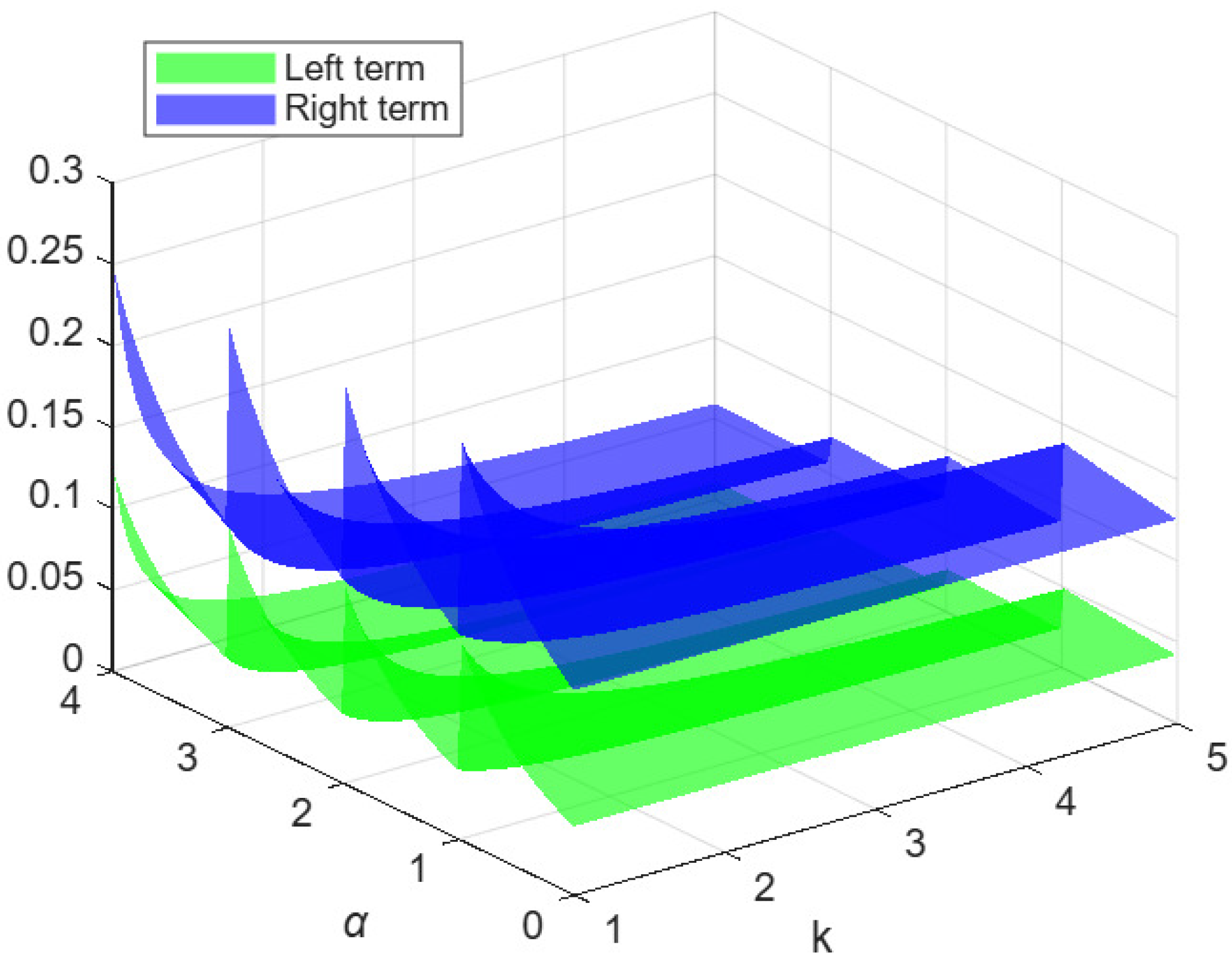
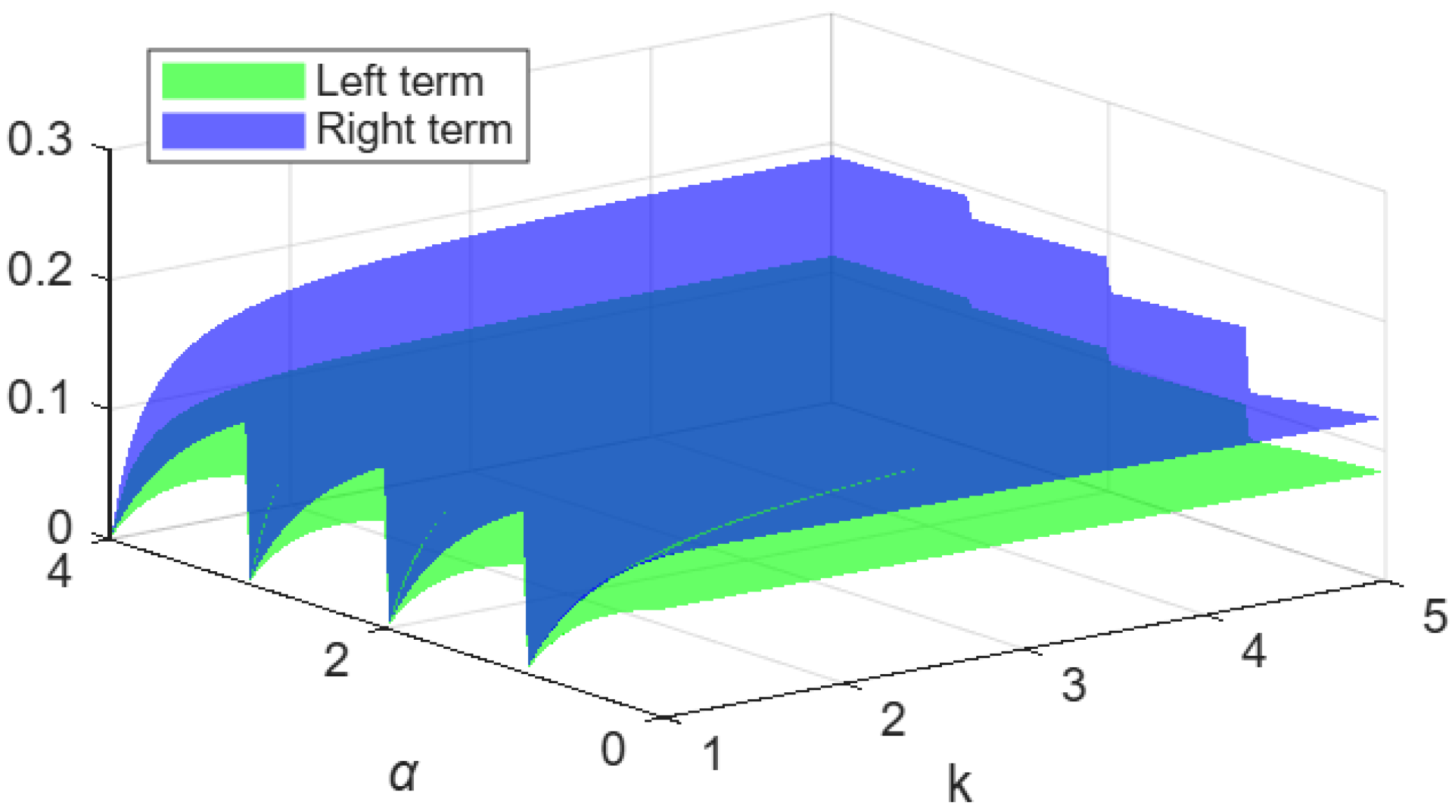
The left-hand and right-hand sides of inequality (18) (resp. (19)) are detailed in Table 1 (resp. Table 2) for various values of k and α, and illustrated graphically in Figure 1 (resp. Figure 2). From these tables and figures, it is evident that the right-hand side consistently exceeds the left-hand side across all parameter combinations, thereby validating the correctness of both inequalities (18) and (19).

6.2. Application in Information Theory

Divergence measures play a pivotal role in information theory, machine learning, and statistical analysis, providing a quantitative means to assess differences between probability distributions, functioning as scalar indicators of their separation. In [32], Lin proposed a family of such measures rooted in Shannon entropy, the cornerstone of information theory, which captures the inherent uncertainty within a distribution. This approach offered a principled information-theoretic framework for comparing distributions. Subsequently, Shioya and Da-te extended Lin’s formulation [33], introducing the HH - f -divergence. Their generalization leveraged the Hermite–Hadamard inequality, a fundamental result concerning convex functions, thereby broadening the scope and adaptability of divergence analysis, enabling richer comparative insights across probabilistic models. In [34], Aganhi and Yadollahzadeh expanded the applicability of HH - f -divergence by combining it with the properties of fractional calculus and introducing the concept of fractional HH - f -divergences. Then, the authors gave some inequalities related to such fractional divergences.
In the framework of stochastic calculus, Agahi [35] introduced the notions of stochastic X -divergence and stochastic HH - X -divergence as follows:
Definition 12 
([35]). Let X : ( 0 , ) × Y R be a convex stochastic process satisfying X ( 1 , · ) = 0 . Then the stochastic X -divergence on Υ of two probability densities, P and Q , is defined as
D X p , q = Ω q ( u ) X p ( u ) q ( u ) , · d ν ( u ) ,
where ν is a finite or σ-finite measure, Ω is an non-empty set, and p and q are the densities of P and Q with respect to ν.
Definition 13 
([35]). Let X : ( 0 , ) × Y R be a convex stochastic process satisfying X ( 1 , · ) = 0 . Then the stochastic H H - X -divergence on Υ of two probability densities, P and Q , is defined as
D X HH p , q = Ω q ( u ) p ( u ) q ( u ) 1 X y , · d y p ( u ) q ( u ) 1 d ν ( u ) .
In the same paper, the author also defined the concept of Riemann–Liouville fractional stochastic X -divergence.
Now, we define the k-Caputo fractional stochastic HH - X -divergence in the following manner:
Definition 14. 
Let X : ( 0 , ) × Y R be a convex stochastic process satisfying X ( n ) ( 1 , · ) = 0 . Then the stochastic k-Caputo HH - X -divergence on Υ of two probability densities, P and Q , is defined as
D X HH c α , k p , q = 2 n α k 1 k Γ k n α k + k Ω q ( u ) D p + q 2 q + α c X p q + 1 n D p + q 2 q α c X ( 1 ) p ( u ) q ( u ) 1 n α k d ν ( u ) .
By setting k = α = 1 , the stochastic k-Caputo HH -divergence (21) will be reduced to the classical stochastic H H -divergence (20).
Theorem 14. 
Let X : ( 0 , ) × Y R be a convex stochastic process satisfying X ( 1 , · ) = 0 . Then, we have
D X p + q 2 , q D X HH c α , k p , q D X p , q
Proof. 
Since X is a convex stochastic process, we have Theorem 7:
X n m 1 + m 2 2 , · 2 n α k 1 k Γ k n α k + k m 2 m 1 n α k D m 1 + m 2 2 + α , k c X ( m 2 ) + 1 n D m 1 + m 2 2 α , k c X ( m 1 ) X n m 1 , · + X n m 2 , · 2 .
By setting m 1 = 1 , m 2 = p q and using the fact that X ( n ) ( 1 , · ) = 0 , inequality (22) becomes
X n p + q 2 q , · 2 n α k 1 k Γ k n α k + k D p + q 2 q + α c X p q + 1 n D p + q 2 q α c X ( 1 ) p q 1 n α k X n p q , · 2 .
Multiplying inequality (23) by q ( u ) , then integrating on Ω with respect to the measure ν , yields
Ω q ( u ) X n p + q 2 q , · d ν ( u ) 2 n α k 1 k Γ k n α k + k Ω q ( u ) D p + q 2 q + α c X p q + 1 n D p + q 2 q α c X ( 1 ) p q 1 n α k d ν ( u ) 1 2 Ω q ( u ) X n p q , · d ν ( u ) .
The desired result is obtained by using Definitions 12 and 14. □

7. Conclusions

This study has successfully introduced the notion of k-Caputo fractional derivatives for stochastic processes, expanding the scope of fractional calculus to the realm of randomness and uncertainty. By leveraging this novel framework, we derived a generalized Hermite–Hadamard inequality for ( n + 1 ) -times differentiable convex stochastic processes, highlighting the applicability of fractional calculus in probabilistic settings. Additionally, we established two integral identities that enabled us to develop midpoint- and trapezium-type inequalities for ( n + 1 ) -times differentiable convex stochastic processes. These results demonstrate the versatility and potential of k-Caputo fractional derivatives in advancing both theoretical and applied aspects of stochastic analysis.
The contributions of this work open new avenues for future research, including the exploration of other types of inequalities (e.g., Ostrowski-type or Simpson-type) within the context of k-Caputo fractional derivatives. Furthermore, the application of these results to real-world problems, such as stochastic optimization, financial modeling, and control theory, could provide valuable insights into the behavior of complex systems under uncertainty. Overall, this study lays the groundwork for further advancements at the intersection of fractional calculus and stochastic processes, paving the way for innovative solutions in diverse scientific and engineering disciplines.

Author Contributions

Conceptualization, G.A. and R.A.; Methodology, R.F. and R.A.; Software, R.F.; Validation, Y.A.; Formal analysis, Y.A.; Investigation, Y.A.; Resources, Y.A.; Data curation, R.F.; Writing—original draft, A.B.M.; Writing—review & editing, R.F. and A.B.M.; Visualization, A.B.M.; Supervision, G.A. and A.B.M.; Project administration, G.A. and R.A.; Funding acquisition, G.A. and R.A. All authors have read and agreed to the published version of the manuscript.

Funding

This work was supported by Princess Nourah bint Abdulrahman University Researchers Supporting Project number (PNURSP2025R226), Princess Nourah bint Abdulrahman University, Riyadh, Saudi Arabia. This study was also supported via funding from Prince Sattam bin Abdulaziz University through project number PSAU/2025/R/1447.

Data Availability Statement

No new data were created or analyzed in this study.

Conflicts of Interest

The authors declare no conflicts of interest.

References

  1. Lakhdari, A.; Budak, H.; Mlaiki, N.; Meftah, B.; Abdeljawad, T. New insights on fractal-fractional integral inequalities: Hermite–Hadamard and Milne estimates. Chaos Solitons Fractals 2025, 193, 116087. [Google Scholar] [CrossRef]
  2. Li, H.; Meftah, B.; Saleh, W.; Xu, H.; Kiliçman, A.; Lakhdari, A. Further Hermite–Hadamard-type inequalities for fractional integrals with exponential kernels. Fractal Fract. 2024, 8, 345. [Google Scholar] [CrossRef]
  3. Saleh, W.; Meftah, B.; Awan, M.U.; Lakhdari, A. On Katugampola fractional multiplicative Hermite–Hadamard-type inequalities. Mathematics 2025, 13, 1575. [Google Scholar] [CrossRef]
  4. Lakhdari, A.; Saleh, W. Multiplicative fractional Hermite–Hadamard-type inequalities in G-calculus. Mathematics 2025, 13, 3426. [Google Scholar] [CrossRef]
  5. Liu, C.; Gong, Z.; Yu, C.; Wang, S.; Teo, K.L. Optimal control computation for nonlinear fractional time-delay systems with state inequality constraints. J. Optim. Theory Appl. 2021, 191, 83–117. [Google Scholar] [CrossRef]
  6. Yi, X.; Liu, C.; Cheong, H.T.; Teo, K.L.; Wang, S. A third-order numerical method for solving fractional ordinary differential equations. AIMS Math. 2024, 9, 21125–21143. [Google Scholar] [CrossRef]
  7. Liu, C.; Yi, X.; Feng, Y. Modelling and parameter identification for a two-stage fractional dynamical system in microbial batch process. Nonlinear Anal. Model. Control 2022, 27, 350–367. [Google Scholar] [CrossRef]
  8. Caputo, M. Linear models of dissipation whose Q is almost frequency independent II. Geophys. J. R. Astron. Soc. 1967, 13, 529–539. [Google Scholar] [CrossRef]
  9. Farid, G.; Naqvi, S.; U Rehman, A. A version of the Hadamard inequality for Caputo fractional derivatives and related results. RGMIA Res. Rep. Collect 2017, 20, 59. [Google Scholar]
  10. Farid, G.; Javed, A.; U Rehman, A. On Hadamard inequalities for n-times differentiable functions which are relative convex via Caputo k-fractional derivatives. Nonlinear Anal. Forum 2017, 22, 17–28. [Google Scholar]
  11. Díaz, R.; Pariguan, E. On hypergeometric functions and Pochhammer k-symbol. Divulg. Mat. 2007, 15, 179–192. [Google Scholar]
  12. Farid, G.; Javed, A.; Ur Rehman, A.; Qureshi, M.I. On Hadamard-type inequalities for differentiable functions via Caputo k-fractional derivatives. Cogent Math. 2017, 4, 1355429. [Google Scholar] [CrossRef]
  13. Allen, L.J.S. An Introduction to Stochastic Processes with Applications to Biology, 2nd ed.; CRC Press: Boca Raton, FL, USA, 2011. [Google Scholar]
  14. Bhattacharya, R.N.; Waymire, E.C. Stochastic Processes with Applications; reprint of the 1990 original, Classics in Applied Mathematics; SIAM: Philadelphia, PA, USA, 2009; p. 61. [Google Scholar]
  15. Nikodem, K. On convex stochastic processes. Aequationes Math. 1980, 20, 184–197. [Google Scholar] [CrossRef]
  16. Kotrys, D. Hermite-Hadamard inequality for convex stochastic processes. Aequationes Math. 2012, 83, 143–151. [Google Scholar] [CrossRef]
  17. Materano, J.; Merentes, N.; Valera-López, M. Some estimates on the Simpson’s type inequalities through s-convex and quasi-convex stochastic processes. Math. Aeterna 2015, 5, 673–705. [Google Scholar]
  18. Materano, J.; Merentes, N.; Valera-López, M. On Ostrowskis type inequalities via convex, s-convex and quasi-convex stochastic processes. Math. Aeterna 2016, 6, 47–85. [Google Scholar]
  19. Agahi, H.; Babakhani, A. On fractional stochastic inequalities related to Hermite-Hadamard and Jensen types for convex stochastic processes. Aequationes Math. 2016, 90, 1035–1043. [Google Scholar] [CrossRef]
  20. Dengn, J.; Wang, J. Fractional Hermite-Hadamard inequalities for (α,m)-logarithmically convex functions. J. Inequal. Appl. 2013, 2013, 364. [Google Scholar] [CrossRef]
  21. Afzaln, W.; Botmart, T. Some novel estimates of Jensen and Hermite-Hadamard inequalities for h-Godunova-Levin stochastic processes. AIMS Math. 2023, 8, 7277–7291. [Google Scholar] [CrossRef]
  22. Meftah, B.; Benchettah, D.C.; Saleh, W.; Lakhdari, A. On k-Riemann–Liouville Maclaurin-type inequalities for s-convex stochastic processes. Math. Methods Appl. Sci. 2025. [Google Scholar] [CrossRef]
  23. Sharma, N.; Mishra, R.; Hamdi, A. Hermite–Hadamard type integral inequalities for multidimensional general h-harmonic preinvex stochastic processes. Comm. Statist. Theory Methods 2022, 51, 6719–6740. [Google Scholar] [CrossRef]
  24. Hernández, J.E.; García, J.F.G. Hermite-Hadamard type inequalities, convex stochastic processes and Katugampola fractional integral. Rev. Integr. Temas Mat. 2018, 36, 133–149. [Google Scholar] [CrossRef]
  25. Hernández, J.E.H.; Gomez, J.F. Hermite-Hadamard type inequalities for (m, h1, h2)-convex stochastic processes using Katugampola fractional integral. Rev. Mat. Univ. Atl. 2019, 6, 17–32. [Google Scholar]
  26. Set, E.; Sarıkaya, M.Z.; Tomar, M. Hermite-Hadamard type inequalities for coordinates convex stochastic processes. Math. Aeterna 2015, 5, 363–382. [Google Scholar]
  27. Jarad, F.; Sahoo, S.K.; Nisar, K.S.; Treanta, S.; Emadifar, H.; Botmart, T. New stochastic fractional integral and related inequalities of Jensen-Mercer and Hermite-Hadamard-Mercer type for convex stochastic processes. J. Inequal. Appl. 2023, 51, 18. [Google Scholar] [CrossRef]
  28. Afzal, W.; Aloraini, N.M.; Abbas, M.; Ro, J.S.; Zaagan, A.A. Some novel Kulisch-Miranker type inclusions for a generalized class of Godunova-Levin stochastic processes. AIMS Math. 2024, 9, 5122–5146. [Google Scholar] [CrossRef]
  29. Sharma, N.; Mishra, R.; Hamdi, A. On strongly generalized convex stochastic processes. Comm. Statist. Theory Methods 2024, 53, 2908–2923. [Google Scholar] [CrossRef]
  30. Rashid, S.; Noor, M.A.; Noor, K.I. Caputo fractional derivatives and inequalities via preinvex stochastic processes. Filomat 2023, 37, 6569–6584. [Google Scholar] [CrossRef]
  31. Sobczyk, K. Stochastic Differential Equations: With Applications to Physics and Engineering; Springer Science & Business Media: Berlin/Heidelberg, Germany, 2013; Volume 40. [Google Scholar]
  32. Lin, J. Divergence measures based on the Shannon entropy. IEEE Trans. Inf. Theory 1991, 37, 145–151. [Google Scholar] [CrossRef]
  33. Shioya, H.; Da-Te, T. A generalization of Lin divergence and the derivation of a new information divergence. Electron. Commun. Jpn. 1995, 78, 34–40. [Google Scholar] [CrossRef]
  34. Agahi, H.; Yadollahzadeh, M. A generalization of HH f-divergence. J. Comput. Appl. Math. 2018, 343, 309–317. [Google Scholar] [CrossRef]
  35. Agahi, H.; Yadollahzadeh, M. Some stochastic HH-divergences in information theory. Aequationes Math. 2018, 92, 1051–1059. [Google Scholar] [CrossRef]
Figure 1. Midpoint inequality (18).
Fractalfract 09 00757 g001
Figure 2. Trapezium inequality (19).
Fractalfract 09 00757 g002
Table 1. Numerical values of LHS and RHS of inequality (18) for different α and k = 1 , 2 , 3 , 4 .
α k = 1 k = 2 k = 3 k = 4
LHSRHSLHSRHSLHSRHSLHSRHS
0.50.06670.16670.05190.14290.04810.13640.04640.1333
1.00.04170.12500.02860.10000.02560.09380.02420.0909
1.50.06670.16670.03420.11110.02860.10000.02630.0952
2.00.04170.12500.02080.08330.01730.07500.01590.0714
2.50.06670.16670.02420.09090.01890.07890.01690.0741
3.00.04170.12500.01590.07140.01250.06250.01120.0588
3.50.06670.16670.01810.07690.01350.06520.01180.0606
Table 2. Numerical values of LHS and RHS of inequality (19) for different α and k = 1 , 2 , 3 , 4 .
α k = 1 k = 2 k = 3 k = 4
LHSRHSLHSRHSLHSRHSLHSRHS
0.50.05830.08330.07310.10710.07690.11360.07860.1167
1.00.08330.12500.09640.15000.09940.15620.10080.1591
1.50.05830.08330.09080.13890.09640.15000.09870.1548
2.00.08330.12500.10420.16670.10770.17500.10910.1786
2.50.05830.08330.10080.15910.10610.17110.10810.1759
3.00.08330.12500.10910.17860.11250.18750.11380.1912
3.50.05830.08330.10690.17310.11150.18480.11320.1894
Disclaimer/Publisher’s Note: The statements, opinions and data contained in all publications are solely those of the individual author(s) and contributor(s) and not of MDPI and/or the editor(s). MDPI and/or the editor(s) disclaim responsibility for any injury to people or property resulting from any ideas, methods, instructions or products referred to in the content.