Article

Nabla Fractional Distributed Nash Seeking for Non-Cooperative Games

1
School of Aerospace Engineering, Xiamen University, Xiamen 361000, China
2
H. Milton School of Industrial and Systems Engineering, Georgia Institute of Technology, Atlanta, GA 30332, USA
*
Authors to whom correspondence should be addressed.
Fractal Fract. 2025, 9(12), 756; https://doi.org/10.3390/fractalfract9120756
Submission received: 22 October 2025 / Revised: 14 November 2025 / Accepted: 19 November 2025 / Published: 21 November 2025

Abstract

This paper pioneers the introduction of nabla fractional calculus into distributed Nash equilibrium (NE) seeking for non-cooperative games (NGs), proposing several novel discrete-time fractional-order algorithms. We first develop a gradient play-based algorithm under perfect information and subsequently extend it to partial-information settings. Two types of communication network topologies among agents, namely connected undirected graphs and strongly connected unbalanced directed graphs, are explicitly considered. When the pseudo-gradient mapping of the NG is Lipschitz continuous and strongly monotone, the proposed algorithms are proven to achieve asymptotic convergence to the NE with at least a Mittag–Leffler convergence rate. Both the step size and the fractional order act as tunable parameters that jointly influence the convergence performance. Numerical experiments on potential games and Nash–Cournot games demonstrate the effectiveness of the proposed algorithms.

1. Introduction

Non-cooperative games (NGs) offer a powerful framework for modeling the competition and interaction of multi-agent systems. The Nash equilibrium (NE), as a core concept for NG, describes a stable state in which no agent can achieve a higher payoff by unilaterally deviating from NE. The notion of NE has been widely applied in engineering and socio-technical systems, including smart grids [1], sensor networks [2], and formation control [3], driving growing interest in efficient distributed NE-seeking algorithms.
In NGs, each agent’s objective function and strategy constitute private information that is not disclosed to other agents. When the NG has perfect information, i.e., each agent knows the actions of all others, some NE-seeking algorithms have been proposed [4,5,6]. However, these algorithms typically rely on a central coordinator, which is often impractical in practical applications. For NGs with partial information, agents instead use peer-to-peer communication to exchange local information and compute the NE locally. There are mainly two representative continuous-time distributed NE-seeking algorithms: leader-following consensus-based [7,8,9] and passivity-based algorithms [10,11]. Continuous-time algorithms offer high computational efficiency and enable convergence analysis using mature stability theories (e.g., Lyapunov methods). Nevertheless, they suffer from practical implementation challenges and high communication overhead. Discrete-time distributed NE-seeking algorithms [12,13,14,15,16,17,18] are generally designed in the form of difference equations. These algorithms are easier to deploy and allow controllable communication frequency, but their theoretical analysis is more challenging, and their convergence heavily depends on step-size selection. Gradient play-based distributed algorithms [12,13,14,15] establish convergence by constructing linear matrix inequalities related to the estimation error, typically requiring doubly stochastic or row-stochastic adjacency matrices. Pavel [16] and Grammatico et al. [18] proposed a class of operator-splitting algorithms in which the generalized NE is characterized as a zero of the sum of two maximal monotone operators. Using fixed-point theory and monotone operator theory, these algorithms are proven to converge to the generalized NE. Moreover, the communication topology plays a decisive role in the convergence performance of distributed algorithms. The aforementioned distributed NE-seeking algorithms operate under various network topologies, including connected undirected graphs [12,16,17,18], strongly connected balanced directed graphs [13], and unbalanced directed graphs [14,15].
Fractional calculus, a generalization of classical calculus, has recently been incorporated into optimization problems [19,20,21], where its non-locality and long-memory properties enable faster convergence and higher accuracy. Such algorithms have already been widely applied to problems including the least-mean-square (LMS) algorithm [22,23,24] and neural network training [25,26,27]. Fractional-order optimization algorithms fall into two main types: one replaces the first-order gradient with a fractional-order gradient [23,24,25,26,27], while the other substitutes the first-order derivative or difference with its fractional counterpart [19,20,21,22]. The latter uniquely combines the non-locality of fractional systems with the steepest descent property of first-order gradients. Liang et al. [20] reformulated continuous gradient dynamics as a fractional-order gradient dynamical system and proved its convergence. Numerical simulations showed that, depending on the specific problem, the convergence rate could be either faster or slower than that of the integer-order algorithm. Wei et al. [21] proposed a discrete-time optimization algorithm framework based on nabla fractional calculus and constructed three algorithms that achieve asymptotic convergence, finite-time convergence, and fixed-time convergence to the optimum, respectively. When extended to distributed optimization problems, the algorithms in [21] have been generalized to scenarios with undirected and directed graphs [28,29,30]. Game-theoretic problems extend optimization problems, raising a natural question: can fractional calculus be integrated into distributed NE-seeking algorithms? And if so, can they inherit the advantages of fractional-order optimization algorithms? To the best of our knowledge, no such work has been reported.
Inspired by the aforementioned fractional-order optimization algorithms, this paper presents the first study on fractional-order distributed NE seeking. The main contributions are as follows:
(1)
We propose a nabla fractional calculus–based discrete-time distributed NE-seeking algorithm for perfect information NGs, later extended to partial information NGs over both undirected and unbalanced directed graphs. In contrast to previous discrete-time algorithms [12,13,14,15,16,17,18], which adopt forward difference schemes, our method employs a backward difference update that permits larger step sizes. Compared to continuous-time algorithms [7,8,9,10,11], the proposed approach reduces communication overhead and is more amenable to practical implementation.
(2)
Based on the nabla fractional Lyapunov stability theory [31,32,33], we rigorously analyze the convergence of the proposed algorithm. Theoretical results show that for any fractional order 0< α <1, the algorithms asymptotically converge to the NE with at least a Mittag–Leffler convergence rate, under the requirement that the communication graph is (strongly) connected. In contrast, the integer-order discrete algorithms in [12,13,14,15] additionally require the graph to have self-loops and the adjacency matrix to be either doubly stochastic or row-stochastic.
(3)
We validated the proposed algorithms through extensive numerical experiments and analyzed the impact of the step size ρ and the fractional order α on the convergence rate. First, using a potential game, from the perspective of numerical calculation, we provide an intuitive explanation for the nabla fractional gradient dynamics. Next, the algorithms are applied to a Nash–Cournot game over both undirected and unbalanced directed graphs, achieving asymptotic convergence to the NE. Furthermore, numerical results demonstrate that the convergence rate can be enhanced by tuning the α and ρ . Notably, compared to integer-order forward difference algorithms, the nabla fractional-order distributed algorithm attains higher accuracy in fewer iterations.
The paper is organized as follows: Section 2 introduces NG and preliminaries. Section 3 proposes a nabla fractional-order distributed NE-seeking algorithm under perfect information. Section 4, respectively, extends the algorithm to two algorithms for undirected and unbalanced directed graphs, with convergence analyses. Section 5 illustrates the proposed algorithms via numerical experiments, and Section 6 concludes.
Notations: R , R n and R m × n represent the sets of real numbers, n-dimensional real vectors and m × n real matrices, respectively. N a a + n = { a , a + 1 , , a + n } and N a = { a , a + 1 , } , a R , n is a non-negative integer. The notation [ n ] denotes the index set { 1 , 2 , , n } . A column vector x is written as x = col ( [ x ] i , i [ n ] ) , where [ x ] i is the i-th element of x. For any function f : D R , D R n , i f ( x ) = f ( x ) x i denotes the partial derivative of f with respect to the i-th coordinate of the vector x. 0 n and 1 n represent the n-dimensional vectors with all elements being 0 and 1, respectively, and 0 m × n denotes the m × n all-zero matrix. e i n R n denotes a vector with all elements equal to 0 except the i-th element, which is 1. The matrix I n is n-dimensional identity matrix. [ A ] i j denotes the element at the i-th row and j-th column of a matrix A. Diag ( [ x ] i , i [ n ] ) represents a diagonal matrix with vector x as its diagonal elements, and Diag ( A i , i [ n ] ) represents a block diagonal matrix with ( A 1 , , A n ) as its diagonal blocks. For matrix A, its eigenvalues can be arranged in order of magnitude as | λ min ( A ) | = | λ 1 ( A ) | | λ N ( A ) | = | λ max ( A ) | . ⊗ represents the Kronecker product. · represents the Euclidean norm for vectors and 2-norm for matrices.

2. Preliminaries

2.1. Non-Cooperative Game

Consider an NG problem involving N agents. Let x i R n i represent the action of the agent i, where n = i = 1 N n i . Let x = col ( x i , i [ N ] ) R n denote the joint action of all agents, and x i = col ( x j , j [ N ] { i } ) R n n i mean the joint action except agent i. Let J i : R n R be the local cost function of the agent i. For a given x i , each agent i aims to select an action x i to minimize their own cost function, namely
min x i R n i J i ( x i , x i )
Assumption 1.
For all i [ N ] , the cost function J i ( x i , x i ) is convex and differentiable with respect to x i for every x i .
NE is an important solution in NGs, and its mathematical definition is as follows:
Definition 1.
A joint action x R n is an NE of Problem (1), if for any i [ N ] ,
J i ( x i , x i ) J i ( x i , x i ) , x i R n i .
When the game is in an NE, no agent can reduce its own cost by unilaterally deviating from the NE. Closely related to Problem (1) is a variational inequality problem:
Find x R n : x x , F ( x ) 0 , x R n .
where pseudo-gradient mapping F is defined as
F ( x ) = col ( i J i ( x i , x i ) , i [ N ] ) .
In fact, x R n is a solution to Problem (2) if and only if it is an NE for Problem (1) [34]. Then, by the Karush–Kuhn–Tucker (KKT) conditions of Problem (2), we have
F ( x ) = 0 .
For the pseudo-gradient mapping F, the following assumptions are made in this paper:
Assumption 2.
(1) 
F is θ-Lipschitz, i.e., F ( x ) F ( y )   θ x y , for any x , y R n .
(2) 
F is μ-strongly monotone, i.e., ( x y ) T ( F ( x ) F ( y ) ) μ x y 2 , for any x , y R n .
Remark 1.
Assumption 2 is a common assumption for integer-order NE-seeking algorithms [10,11,12,13,14,15,16,17,18]. The strongly monotone F ensures that Problem (2) has a unique solution x R n , which also implies that x is the unique NE of Problem (1).

2.2. Graph Theory

Consider a directed graph 𝒢 = ( [ N ] , E ) with N nodes, where E [ N ] × [ N ] is the set of edges. If ( i , j ) E always implies ( j , i ) E , then 𝒢 is said to be undirected. For nodes i , j [ N ] , if there exists a directed edge ( i , j ) E , this means that node i can send information to node j. A is an adjacency matrix of 𝒢 with [ A ] i j > 0 if ( i , j ) E , otherwise [ A ] i j = 0 . d i i n = j = 1 N [ A ] i j and d i o u t = j = 1 N [ A ] j i are, respectively, called the in-degree and out-degree of the node i. The in-degree matrix of 𝒢 is D i n = Diag d i i n , i [ N ] . L = D i n A is the Laplacian matrix of 𝒢 . A directed path p i j from node i to node j is a sequence of nodes { i 1 , , i k } , which satisfies that i 1 = i , i k = j and ( i t , i t + 1 ) E , t = 1 , , k 1 . A directed graph is strongly connected if there exists a directed path from any node to all the other nodes in the graph.

2.3. Nabla Discrete Fractional-Order Calculus

We shall introduce some basic concepts of discrete fractional calculus, as presented in [35].
Definition 2.
The n-th nabla difference in the function f : N a + 1 n R is defined as
n B f ( k ) = j = 0 n ( 1 ) j n j f ( k j ) ,
where  k N a + 1 , a R , n N 1 , n j = Γ ( n + 1 ) Γ ( j + 1 ) Γ ( n j + 1 ) , and Γ is the Gamma function. The superscript “B” in the symbol n B stands for “nabla (backward) difference” and is used to avoid confusion with the gradient notation ∇, while the superscript “n” denotes the n-th order difference.
Taking n = 1 , we have 1 B f ( k ) = f ( k ) f ( k 1 ) . Therefore, the nabla difference is also referred to as the backward difference.
Definition 3.
The α-th nabla fractional sum of the function f : N a + 1 R is defined as
k α a f ( k ) = j = 0 k a 1 ( 1 ) j α j f ( k j ) ,
where  α > 0 , k N a + 1 , a R .
There are various definitions of the nabla fractional difference, among which the Caputo nabla fractional difference is widely used in the dynamic modeling of physical systems and adopted in this paper. Its definition is as follows:
Definition 4.
The α-th Caputo nabla fractional difference in the function f : N a M + 1 R is defined as
k α a C f ( k ) = k α M a ( M B f ( k ) ) ,
where  α > 0 , k N a + 1 , a R , M = α and  ·  is the ceiling function.
In this paper, we consider the case of fractional order 0 < α < 1 , for which the Caputo nabla fractional difference can be written as
k α a C f ( k ) = k ( 1 α ) a 1 B f ( k ) = 1 Γ ( α ) j = a + 1 k Γ ( k j α ) Γ ( k j + 1 ) f ( j ) Γ ( k a α ) Γ Γ ( k a ) Γ ( 1 α ) f ( a ) ,
The nabla Laplace transform of the Caputo nabla fractional difference is given by
N a { k α a C f ( k ) } ( s ) = s α N a { f ( k ) } ( s ) j = 0 n 1 s α j 1 j N f ( k ) | k = a .
An important concept introduced next is the discrete Mittag–Leffler function.
Definition 5.
The nabla discrete Mittag–Leffler function is defined as
F α , β ( λ , k , a ) = j = 0 + λ j Γ ( k a + j α + β 1 ) Γ ( k a ) Γ ( j α + β ) ,
where  α > 0 , β R , k N a , a R .
The Mittag–Leffler function F α , β ( λ , k , a ) can be viewed as a generalized exponential function and is closely related to the solutions of fractional-order dynamical systems. The parameter α represents the fractional order and governs the long-term dynamical behavior of the corresponding fractional-order system. The choice of the parameter β affects the initial-time behavior of F α , β ( λ , k , a ) . When α = β = 1 and λ < 0 , the Mittag–Leffler function will reduce to the exponential function F 1 , 1 ( λ , k , a ) = ( 1 λ ) k + a . The nabla Laplace transform of the Mittag–Leffler function is given by
N a F α , β ( λ , k , a ) ( s ) = s α β s α λ .
The following are some properties of the nabla discrete Mittag–Leffler function.
Lemma 1
([33], Lemma 2). If 0 < α < 1 , λ < 0 , a R , the following properties hold:
(1) 
F α , 1 ( λ , k , a ) > 0 and  lim k F α , 1 ( λ , k , a ) = 0 .
(2) 
F α , α ( λ , k , a ) > 0 and  lim k F α , α ( λ , k , a ) = 0 .
Consider a general Caputo nabla discrete-time fractional-order system
k α a C x k = f ( x k ) ,
and let { x k } k N a be the vector sequence generated by the system from the initial state x a . To study the stability of this system, the following lemmas are useful.
Lemma 2
([31], Theorem 5). For the nabla fractional-order system k α a C x k = f ( x k ) , if V ( x ) is convex and differentiable with respect to x, then
k α a C V ( x k ) d V ( x ) d x T x = x k k α a C x k ,
where  0 < α < 1 , k N a + 1 , a R .
Lemma 3
([31], Theorem 2). For the nabla fractional-order system k α a C x k = f ( x k ) , V ( x ) is a Lipschitz Lyapunov function. Assuming that
β 1 x k b V ( x k ) β 2 x k b c , k α a C V ( x k ) β 3 x k b c ,
where  0 < α < 1 , k N a + 1 , β 1 , β 2 , β 3 , b , c > 0 , then 
V ( x k ) V ( x a ) F α , 1 ( β 3 β 2 1 , k , a ) ,

3. Nabla Fractional Distributed NE Seeking with Perfect Information

In this section, we propose a nabla fractional distributed NE-seeking algorithm. We assume that the agents participating in the game have perfect information about each other; that is, each agent can directly obtain the action information of all other agents.
For Problem (1), a classic algorithm formulation is
Δ 1 D x i k = ρ i J i ( x i k , x i k ) , i [ N ] ,
where ρ > 0 is the step size, Δ 1 D is the delta operator or forward difference operator, defined as Δ 1 D x i k = x i k + 1 x i k . The difference scheme (11) is called gradient descent or gradient play. When Δ 1 D in (11) is replaced by the nabla operator or the backward difference operator 1 B , the corresponding algorithm format is
1 B x i k = ρ i J i ( x i k , x i k ) , i [ N ] .
By system theory, Algorithms (11) and (12) can be viewed as the explicit and implicit discrete forms, respectively, of the continuous gradient dynamics for
x ˙ i = i J i ( x ) .
We extend Algorithm (12) to the fractional order, and thus obtain the fractional gradient play under the Caputo definition
k α a C x i k = ρ i J i ( x i k , x i k ) , i [ N ] .
Obviously, when α = 1 , Algorithm (13) degenerates into integer-order Algorithm (12). Algorithm (13) can be written in a compact form as
k α a C x k = ρ F ( x k ) .
By the fractional Lyapunov method, we can analyze the convergence of Algorithm (14).
Theorem 1.
Suppose Assumptions 1 and 2 hold. If x ¯ is an equilibrium point of the discrete fractional dynamics (14), then x ¯ = x . Furthermore, if 0 < α < 1 , the action sequence { x k } generated by Algorithm (14) converges to x asymptotically, and it has at least a Mittag–Leffler convergence rate.
Proof. 
If x ¯ is an equilibrium point of system (14), then by the definition of the Caputo fractional difference, we have k α a C x ¯ = 0 . Consequently, it follows that F ( x ¯ ) = 0 . According to the KKT conditions, this implies that x ¯ = x is the unique NE of the game.
Considering the Lyapunov candidate function V ( x ) = 1 2 x x 2 , by Lemma 2, we have
k α a C V ( x k ) ( x k x ) T k α a C x k = ρ ( x k x ) T F ( x k ) F ( x ) ρ μ x k x 2 = 2 ρ μ V ( x k ) .
By Lemma 3, it follows that
V ( x k ) V ( x a ) F α , 1 ( 2 ρ μ , k , a ) .
Then, lim k F α , 1 ( 2 ρ μ , k , a ) = 0 is given by Lemma 1(1). Therefore, V ( x k ) converges to 0 asymptotically, which implies that lim k x k = x with at least a Mittag–Leffler convergence rate. □
From Equation (15), the convergence behavior of Algorithm (14) is closely related to the Mittag–Leffler function F α , 1 ( 2 ρ μ , k , a ) . When 0 < α < 1 , by Theorem 2.2 in [22], we have the following asymptotic property:
F α , 1 ( 2 ρ μ , k , a ) 1 2 ρ μ ( k a ) α 0 , as k .
Therefore, there is no upper bound on the choice of the step size ρ . Moreover, as ρ increases, F α , 1 ( 2 ρ μ , k , a ) converges to 0 more rapidly, which implies faster convergence of x k to x .
Notably, Theorem 1 is also appropriate for Algorithm (14) with α = 1 , i.e., Algorithm (12). According to [32], Theorem 5, we have
V ( x k ) V ( x a ) F 1 , 1 ( 2 ρ μ , k , a ) = V ( x a ) ( 1 + 2 ρ μ ) ( k a ) = V ( x a ) e ( k a ) ln ( 1 + 2 ρ μ ) ,
This implies that Algorithm (12) is linearly convergent. Moreover, since F α , 1 ( 2 ρ μ , k , a ) F 1 , 1 ( 2 ρ μ , k , a ) , 0 < α < 1 , the error bound of Algorithm (12) is tighter than that of Algorithm (14).
On the other hand, for Algorithm (11), we have
x k + 1 x 2 = x k ρ F ( x k ) x + ρ F ( x ) 2 = x k x 2 + ρ 2 F ( x k ) F ( x ) 2 2 ρ ( x k x ) T ( F ( x k ) F ( x ) ) x k x 2 + ρ 2 θ 2 x k x 2 2 ρ μ x k x 2 = ( 1 2 ρ μ + ρ 2 θ 2 ) x k x 2 ,
where the inequality follows from the assumptions that the pseudo-gradient mapping F is θ -Lipschitz continuous and μ -strongly monotone. Iterating this inequality yields
x k x 2 ( 1 2 ρ μ + ρ 2 θ 2 ) k a x a x 2 .
Substituting the Lyapunov function V ( x k ) = 1 2 x k x 2 , we obtain
V ( x k ) V ( x a ) ( 1 2 ρ μ + ρ 2 θ 2 ) k a = V ( x a ) e ( k a ) ln ( 1 2 ρ μ + ρ 2 θ 2 ) 1 .
When ρ 0 , 2 μ θ 2 , we have 1 2 ρ μ + ρ 2 θ 2 ( 0 , 1 ) , and thus Algorithm (11) converges linearly. Comparing (16) and (17), we obtain that if ρ 1 = ρ 2 > 4 μ 2 θ 2 2 θ 2 μ , then
F 1 , 1 ( 2 ρ 2 μ , k , a ) < ( 1 2 ρ 1 μ + ρ 1 2 θ 2 ) k a .
Therefore, thanks to the more flexible step size selection, Algorithm (12) can achieve a faster convergence rate than Algorithm (11). Moreover, for the general case where 0 < α < 1 , both the step size ρ and the fractional order α can be used as tunable parameters to enhance the convergence rate of Algorithm (14).
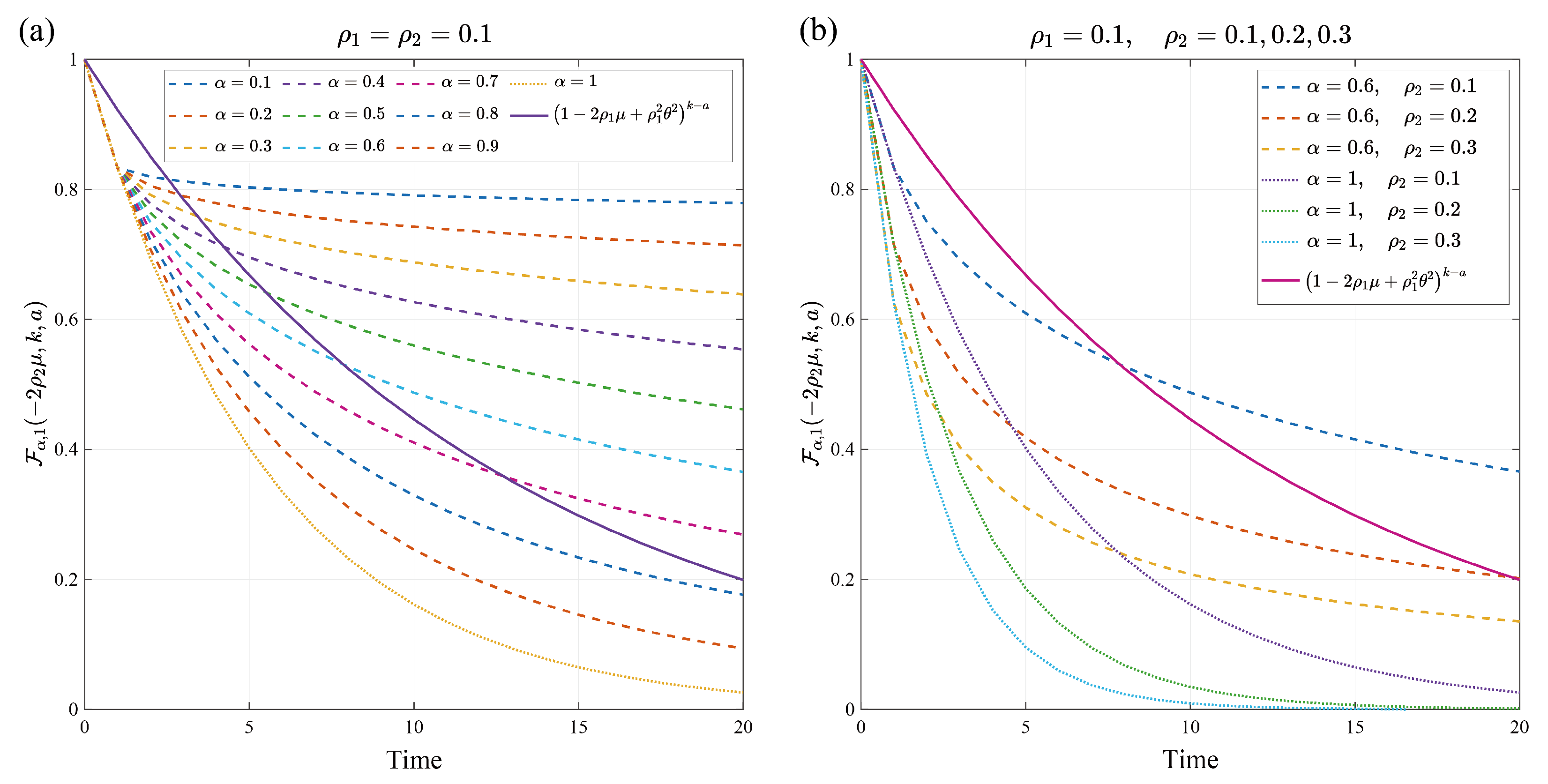
To illustrate, Figure 1 shows the function curves of ( 1 2 ρ 1 μ + ρ 1 2 θ 2 ) k a and F α , 1 ( 2 ρ 2 μ , k , a ) under different parameters, where μ = 1 , θ = 3.5 , a = 0 , k N a 20 . We can calculate 4 μ 2 θ 2 2 θ 2 μ < 0 and 2 μ θ 2 0.163 . When ρ 1 = ρ 2 = 0.1 , we have F 1 , 1 ( 2 ρ 2 μ , k , a ) < ( 1 2 ρ 1 μ + ρ 1 2 θ 2 ) k a , and this has been successfully verified in Figure 1a,b. Moreover, Figure 1a also shows the curves of F α , 1 ( 2 ρ 2 μ , k , a ) with different α . The most prominent feature of these curves is that the larger the value of α , the faster the decay rate. In Figure 1b, as the step size increases, the convergence rate of F α , 1 ( 2 ρ 2 μ , k , a ) becomes faster. In contrast, since the step size must satisfy 0 < ρ 1 < 0.163 to ensure convergence, the function ( 1 2 ρ 1 μ + ρ 1 2 θ 2 ) k a cannot enhance its convergence rate as significantly as F α , 1 ( 2 ρ 2 μ , k , a ) by substantially increasing the step size. From Figure 1a,b, it can be observed that F α , 1 ( 2 ρ 2 μ , k , a ) can achieve rapid decay in fewer iterations by adjusting both the step size ρ 2 and the fractional order α .

4. Nabla Fractional Distributed NE Seeking with Partial Information

The update of Algorithm (14) requires each agent to have perfect knowledge of the actions of all other agents. In this section, we aim to extend Algorithm (14) to the partial information setting. Under partial information, agents exchange information through an underlying communication network. Here, we consider the network topology of undirected graphs and unbalanced directed graphs, respectively.

4.1. Algorithm over Undirected Graphs

We use a communication graph 𝒢 to describe the underlying communication among agents. The node set of 𝒢 is [ N ] , meaning each agent is regarded as a node in 𝒢 . The edge set of 𝒢 is denoted by E [ N ] × [ N ] . For any i , j [ N ] , if agent i can send information to agent j, then ( i , j ) E . The connectivity of 𝒢 determines whether agents can acquire complete information, and we make the following assumption.
Assumption 3.
𝒢 is undirected and connected.
Under Assumption 3, if A is the adjacency matrix of 𝒢 , then the Laplacian matrix L = D in A is symmetric and positive semi-definite. Moreover, 1 N is an eigenvector of L corresponding to the eigenvalue 0, that is, L 1 N = 0 N , 1 N T L = 0 N T .
Let x i = col x i , j , j [ N ] R n denote the local estimate of the global action x, where x i , j R n j represents agent i’s estimate toward agent j’s action, and x i , j R n n j denotes x i with x i , j removed. Especially, x i , i = x i . For all i [ N ] , the nabla fractional distributed NE-seeking algorithm is proposed as
k α a C x i k = ρ i J i ( x i k , x i k ) + c j = 1 N [ A ] i j ( x i k x j k ) , k α a C x i , i k = ρ c j = 1 N [ A ] i j ( x i , i k x j , i k ) ,
where c > 0 . By (18), the update of the estimated action x i k is
k α a C x i k = ρ R i T J i ( x i k , x i k ) + c j = 1 N [ A ] i j ( x i k x j k ) ,
where R i = 0 n i × n < i I n i 0 n i × n > i , n < i = j = 1 i 1 n j , n > i = j = i + 1 N n j . Equation (19) can be compactly written as
k α a C x k = ρ R T F ( x k ) + c L n x k ,
where F ( x k ) = col i J i ( x i k ) , i [ N ] is the extended pseudo-gradient mapping, R = Diag ( R 1 , , R N ) , L n = L I n .
By Lemma 2 of [14], the extended pseudo-gradient mapping F is θ 0 -Lipschitz continuous, where μ < θ 0 θ . Recalling the proof of Theorem 1, the strong monotonicity of the pseudo-gradient mapping F plays a crucial role in the convergence of Algorithm (14). However, F is generally not strongly monotone, even when F is strongly monotone. To establish the convergence of Algorithm (20), we introduce the following lemma from [16], which provides the restricted strong monotonicity property of ( R T F + c L n ) ( x ) over Null ( L n ) , where Null ( L n ) is the null space of L n .
Lemma 4
([16], Lemma 3). Suppose Assumptions 1–3 hold and let
Ψ = μ N θ + θ 0 2 N θ + θ 0 2 N c λ 2 ( L ) θ .
Then, for any  c > c min = ( θ + θ 0 ) 2 4 μ λ 2 ( L ) + θ λ 2 ( L ) , Ψ is positive definite. Furthermore, for any  x R N n  and  x ¯ Null ( L n ) we have 
( x x ¯ ) T R T ( F ( x ) F ( x ¯ ) ) + c L n ( x x ¯ ) μ ¯ x x ¯ 2 ,
where  μ ¯ = λ min ( Ψ ) > 0 .
Let x = 1 N x , we provide the proof of the convergence of Algorithm (20).
Theorem 2.
Suppose Assumptions 1–3 hold. If x ¯ is an equilibrium point of the discrete fractional dynamics (20), then x ¯ = x . Furthermore, if 0 < α < 1 and c > c min , the action sequence { x k } generated by Algorithm (20) converges to x asymptotically, and it has at least a Mittag–Leffler convergence rate.
Proof. 
Since x ¯ is an equilibrium point of dynamics (20), we have
0 N n = R T F ( x ¯ ) + c L n x ¯ .
Multiplying both sides of Equation (21) on the left by ( 1 N T I n ) , and using ( 1 N T I n ) R T = I n and ( 1 N T I n ) L n = 0 n × N n , we obtain F ( x ¯ ) = 0 n . It follows that L n x ¯ = 0 N n , i.e., there exists x ¯ R n such that x ¯ = 1 N x ¯ . Consequently, we have 0 n = F ( x ¯ ) = F ( x ¯ ) , which implies that x ¯ = x , or x ¯ = x .
Considering the Lyapunov candidate function V ( x ) = 1 2 x x 2 , then, by Lemmas 2 and 4, we have
k α a C V ( x k ) ρ ( x k x ) T ( R T F ( x k ) + c L n x k ) = ρ ( x k x ) T R T F ( x k ) + c L n x k R T F ( x ) c L n x = ρ μ ¯ x k x 2 = 2 ρ μ ¯ V ( x k ) .
Similarly to Theorem 1, we have V ( x k ) V ( x a ) F α , 1 ( 2 ρ μ ¯ , k , a ) . Therefore, V ( x k ) asymptotically converges to 0, which implies that lim k x k = x , with a Mittag–Leffler convergence rate. □
Remark 2.
Algorithm (20) is inspired by the continuous-time algorithm in [10]:
x ˙ ( t ) = R T F ( x ( t ) ) L n x ( t ) .
Compared with the continuous-time algorithm (22), Algorithm (20) reduces both computational and communication costs. It is worth noting that Theorem 2 still holds for  α = 1 in which case Algorithm (20) reduces to an integer-order backward difference scheme: 
1 B x k = ρ R T F ( x k ) + c L n x k ,
We also compare the forward difference method:
Δ 1 D x k = ρ R T F ( x k ) + c L n x k ,
In particular, we let the weighted adjacency matrix be doubly stochastic, so that  L = I N A We choose  c = 1 ρ under which Algorithm (24can be written as 
x k + 1 = ( A I n ) x k ρ R T F ( x k ) .
which is equivalent to the basic form of the algorithm proposed in [12]. By [12], when the graph 𝒢 contains self-loops, Algorithm (25) achieves linear convergence to an NE under Assumptions 1–3. However, the convergence of Algorithm (25) relies on the contraction properties of both the pseudo-gradient mapping F and the graph adjacency matrix A, which requires choosing a very small step size ρ. This adversely affects the convergence rate of Algorithm (25). In contrast, similar to Algorithm (14), the step size ρ in Algorithm (20) has no upper bound, which is beneficial for accelerating convergence.

4.2. Algorithm over Unbalanced Directed Graphs

Compared to undirected graphs, directed communication graphs are more representative of actual engineering scenarios. Specifically, we assume that the directed graph is unbalanced, which is a more general case than balanced directed graphs.
Assumption 4.
𝒢 is unbalanced, directed, and strongly connected.
Under Assumption 4, the Laplacian matrix of the graph may not be symmetric. We introduce the following lemma:
Lemma 5
([36]). Suppose Assumption 4 holds and L is the Laplacian matrix of 𝒢 . The following statements hold:
(1) 
There exists a positive left eigenvector  ξ = col ( ξ 1 , , ξ N )  associated with the 0 eigenvalue such that  ξ T L = 0 N T  and  ξ T 1 N = 1 .
(2) 
min 1 N x = 0 x T L ˜ x λ 2 ( L ˜ ) x 2 where  L ˜ = Ξ L + L T Ξ 2  and  Ξ = Diag ( ξ 1 , , ξ N ) .
For any i [ N ] , the nabla fractional distributed NE-seeking algorithm is proposed as
k α a C x i k = ρ 1 w i i k i J i ( x i k , x i k ) + c j = 1 N [ A ] i j ( x i k x j k ) , k α a C x i , i k = ρ c j = 1 N [ A ] i j ( x i , i k x j , i k ) , k α a C w i k = j = 1 N [ A ] i j ( w i k w j k ) .
The compact form of Algorithm (26) is
k α a C x k = ρ ( W k 1 I n ) R T F ( x k ) + c L n x k , k α a C w k = L N w k ,
where w k = col ( w 1 k , , w N k ) , W k = Diag ( w 1 , 1 k , , w N , N k ) , and L N = L I N .
The following lemma demonstrates that the equilibrium point of discrete fractional dynamics (27) is precisely the NE that we are seeking.
Lemma 6.
Suppose Assumptions 1, 2, and 4 hold, and provide the initial condition w a = col ( e 1 N , , e N N ) . Let col ( x ¯ , w ¯ ) be an equilibrium point of the fractional difference dynamics (27), then x ¯ = x .
Proof. 
We first consider lim k w k = 1 N ξ . L can be written as the Jordan canonical form L = P Λ P 1 , where Λ = Diag { Λ 1 , , Λ r } , r N ,
Λ i = λ i 1 0 0 λ i 0 0 0 λ i
is a standard Jordan block. Applying the change in variables v k = ( P 1 I N ) w k , we obtain
k α a C v k = ( Λ I N ) v k .
Decoupling Equation (28) according to Λ i , for the fractional difference equation corresponding to the last row of each Jordan block Λ i , we have
k α a C v i k = λ i v i k .
For the fractional difference equations corresponding to the other rows of each Λ i , we have
k α a C v i k = λ i v i k v i + 1 k .
For Equation (29), we have
v i k = v i a F α , 1 ( λ i , k , a ) ,
Since 𝒢 is strongly connected, λ 1 ( L ) = 0 is a simple eigenvalue of L, then v 1 k = v 1 a F α , 1 ( 0 , k , α ) = v 1 a . For i 1 , due to the property that the real part of eigenvalue Re ( λ i ) > 0 , we have α < 1 < min i 1 2 ( π arg { λ i } ) π , where arg { λ i } is the phase of λ i . Hence, by [32], we obtain lim k v i k = 0 , for any i 1 .
Taking the nabla Laplace transform of Equation (30), we have
N α k α a C v i k ( s ) = s α V i s s α 1 v i a = λ i V i s V i + 1 s ,
where V i s = N α { v i k } ( s ) . Then
V i s = s α 1 v i a V i + 1 s s α + λ i .
Taking the nabla Laplace inverse transform of Equation (33), we obtain
v i k = v i a F α , 1 ( λ i , k , a ) v i + 1 k F α , α ( λ i , k , a ) ,
where ∗ denotes convolution. Hence, we have lim k v i k = 0 .
By (31) and (34), we have lim k v k = ( Q I N ) v a , where Q = 1 0 1 × ( N 1 ) 0 ( N 1 ) × 1 0 ( N 1 ) × ( N 1 ) . Then, it follows that
lim k w k = lim k ( P I N ) v k = ( P I N ) ( Q I N ) v a = ( P Q P 1 I N ) w a .
According to P Q P 1 = 1 N ξ T , due to the initial value w a = col ( e 1 N , , e N N ) , we have w ¯ = lim k w k = 1 N ξ . Meanwhile, we obtain lim k W k = Ξ .
In conclusion, the equilibrium point col ( x ¯ , w ¯ ) satisfies
0 N n = ( Ξ 1 I n ) R T F ( x ¯ ) + c L n x ¯ .
Multiplying both sides of Equation (35) on the left by ( ξ T I n ) , and using ( ξ T I n ) R T = Diag ( ξ i I n i , i [ N ] ) and ( ξ T I n ) L n = 0 n × N n , we obtain F ( x ¯ ) = 0 n . It follows that L n x ¯ = 0 N n , i.e., there exists x ¯ R n such that x ¯ = 1 N x ¯ . Consequently, we have 0 n = F ( x ¯ ) = F ( x ¯ ) , which implies that x ¯ = x , or x ¯ = x . □
Next, we provide the proof of the convergence of Algorithm (27).
Theorem 3.
Suppose Assumptions 1, 2, and 4 hold. If 0 < α < 1 and c > c ˜ min = ( θ + θ 0 ) 2 4 μ λ 2 ( L ˜ ) + θ λ 2 ( L ˜ ) , then the action sequence { x k } generated by Algorithm (27) converges asymptotically to x , and it has at least a Mittag–Leffler convergence rate.
Proof. 
Considering the Lyapunov candidate function V ( x ) = 1 2 ( x x ) T ( Ξ I n ) ( x x ) , we have
k α a C V ( x k ) ρ ( x k x ) T ( Ξ I n ) ( Ξ 1 I n ) R T F ( x k ) + ( W k 1 Ξ 1 ) I n R T F ( x k ) + c L n x k = ω 1 + ω 2 ,
where
ω 1 = ρ ( x k x ) T ( Ξ I n ) ( Ξ 1 I n ) R T F ( x k ) + c L n x k , ω 2 = ρ ( x k x ) T ( Ξ I n ) ( W k 1 Ξ 1 ) I n R T F ( x k ) .
For ω 1 , we have
ω 1 = ρ ( x k x ) T ( Ξ 1 I n ) ( R T F ( x k ) + c L n x k ) ( Ξ 1 I n ) ( R T F ( x ) c L n x ) = ρ ( x k x ) T R T F ( x k ) R T F ( x ) ρ c ( x k x ) T ( L ˜ I n ) ( x k x ) = ρ ( x k x ) T R T F ( x k ) + c ( L ˜ I n ) x k R T F ( x ) c ( L ˜ I n ) x ,
where the last equality follows from ρ c ( x k x ) T ( L ¯ I n ) ( x k x ) = ρ c ( x k x ) T 1 2 ( Ξ L ˜ + L ˜ T Ξ ) I n ( x k x ) = ρ c ( x k x ) T ( L ˜ I n ) ( x k x ) . According to Lemma 3 in [37], L ˜ is symmetric positive semi-definite and satisfies L ˜ 1 N = 0 N and 1 N T L ˜ = 0 N T . Moreover, by Lemma 5, min 1 N T x = 0 x T L ˜ x λ 2 ( L ˜ ) x 2 . Therefore, by Lemma 4, the operator R T F c ( L ˜ I n ) ( x ) is restricted strongly monotone on Null ( L ˜ I n ) . Then, it follows that
( x k x ) T R T F ( x k ) F ( x ) + c ( L ˜ I n ) ( x k x ) μ ˜ x k x 2 ,
where c > c ˜ min = ( θ + θ 0 ) 2 4 μ λ 2 ( L ˜ ) + θ λ 2 ( L ˜ ) , μ ˜ = λ min ( Ψ ˜ ) , and
Ψ ˜ = μ N θ + θ 0 2 N θ + θ 0 2 N c λ 2 ( L ¯ ) θ .
Consequently, we can obtain
ω 1 ρ μ ˜ x k x 2 .
By Lemma 6, W k converges to Ξ at a Mittag–Leffler rate. Then, there exists σ 1 , σ 2 > 0 , such that W k 1 Ξ 1   σ 1 F α , 1 ( σ 2 , k , a ) . Therefore, ω 2 is bounded by
ω 2 = ρ ( x k x ) T ( Ξ I n ) ( W k 1 Ξ 1 ) I n R T F ( x k ) F ( x ) ρ ξ ¯ θ 0 σ 1 F α , 1 ( σ 2 , k , a ) x k x 2 ,
where ξ ¯ = max i ξ i . It follows that
k α a C V ( x k ) ρ μ ˜ ξ ¯ θ 0 σ 1 F α , 1 ( σ 2 , k , a ) x k x 2 2 ρ ξ ¯ μ ˜ ξ ¯ θ 0 σ 1 F α , 1 ( σ 2 , k , a ) V ( x k ) .
Based on the convergence property of F a , 1 ( σ 2 , k , a ) , there exists a t N a + 1 such that σ 3 = ξ ¯ μ ˜ ξ ¯ θ 0 σ 1 F a , 1 ( σ 2 , t , a ) > 0 . Then, for all k t , we have k α a C V ( x k ) 2 ρ σ 3 V ( x k ) . Hence, by Lemma 3, we obtian
V ( x k ) V ( x a ) F α , 1 ( 2 ρ σ 3 , k , a ) .
So lim k x k = x with a Mittag–Leffler convergence rate. □
Remark 3.
Algorithm (27) is inspired by the continuous-time algorithm in [11]:
x ˙ ( t ) = W 1 ( t ) I n R T F ( x ( t ) ) c L n x ( t ) , w ˙ ( t ) = L N w ( t ) .
In fact, Theorem 3 still holds for  α = 1 in which case Algorithm (27) reduces to an integer-order backward difference scheme: 
1 B x k = ρ ( W k 1 I n ) R T F ( x k ) + c L n x k , 1 B w k = L N w k .
We also compare the forward difference method:
Δ 1 D x k = ρ ( W k 1 I n ) R T F ( x k ) + c L n x k , Δ 1 D w k = L N w k .
In particular, we let the weighted adjacency matrix be row-stochastic, so that  L = I N A We choose  c = 1 ρ under which Algorithm (39can be written as 
x k + 1 = ( A I n ) x k ρ ( W k 1 I n ) R T F ( x k ) , w k + 1 = ( A I N ) w k .
which is equivalent to the algorithm proposed in [14]. By [14], when the graph  𝒢  contains self-loops and the step size is small enough, Algorithm (40), achieves linear convergence to an NE under Assumptions 1,2 and 4. According to Equation (36), the step size ρ in Algorithm (27has no upper bound.

5. Numerical Experiments

In this section, we present several numerical experiments. First, we analyze a special class of potential games and provide an intuitive interpretation of gradient dynamics with fractional-order updates. Then, we consider a Nash–Cournot game over networks to verify the effectiveness of the proposed algorithm.

5.1. Case 1: Potential Game

For the NG (1), if there exists a global potential function P ( x ) such that
i P ( x i , x i ) = i J i ( x i , x i ) , i [ N ] ,
then Problem (1) is called a potential game [38]. Clearly, for any agent i, given the actions of others x i , choosing an action x i that reduces its own cost function J i simultaneously decreases the potential function P. When the potential function reaches its minimum, a NE of the game is attained.
For potential games, we have F ( x ) = P ( x ) , i.e., the pseudo-gradient mapping F coincides with the gradient of the potential function P. When Assumptions 1 and 2 hold, P is a strongly convex function, and the NE-seeking problem for the game becomes equivalent to a strongly convex optimization problem min x R n P ( x ) . Applying Algorithm (14), we obtain the fractional difference scheme:
k α a C x k = ρ F ( x k ) = ρ P ( x k ) .
According to Equation (6), when 0 < α < 1 , we have
k α a C x k = 1 Γ ( α ) j = a + 1 k Γ ( k j α ) Γ ( k j + 1 ) x j Γ ( k a α ) Γ ( k a ) Γ ( 1 α ) x a .
By separating the term j = k from the summation, i.e., j = a + 1 k Γ ( k j α ) Γ ( k j + 1 ) x j = x k + j = a + 1 k 1 Γ ( k j α ) Γ ( k j + 1 ) x j , we obtain
k α a C x k = x k H α ( x k 1 , a ) ,
where H α ( x k 1 , a ) = 1 Γ ( α ) j = a + 1 k 1 Γ ( k j α ) Γ ( k j + 1 ) x j + Γ ( k a α ) Γ ( k a ) Γ ( 1 α ) x a is the historical information item. Substituting this expression into Equation (42) yields
x k + ρ P ( x k ) H α ( x k 1 , a ) = 0 .
We introduce the proximity operator Prox ρ P = ( I d + ρ P ) 1 , where I d is the identity operator. Then, Equation (43) can be written as
x k = Prox ρ P H α ( x k 1 , a ) .
When α = 1 , we have x k = Prox ρ P ( x k 1 ) , which corresponds to Algorithm (12). From (44), we can consider that each iteration of (42) solves a convex optimization problem:
min y P ( y ) + 1 2 y H α ( x k 1 , a ) 2 .
Therefore, the actual descent direction of Algorithm (14) is the composite of historical information H α ( x k 1 , a ) and the gradient direction.
We conduct numerical experiments on a simple two-player potential game: the cost functions are J 1 ( x 1 , x 2 ) = 2 ( x 1 5 ) 2 + 4 x 2 and J 2 ( x 1 , x 2 ) = 3 x 1 + 4 ( x 2 6 ) 2 . The unique NE of the game is col ( 5 , 6 ) . We select a potential function P ( x ) = 2 ( x 1 5 ) 2 + 4 ( x 2 6 ) 2 , and the continuous gradient dynamics are given by
x ˙ ( t ) = P ( x ( t ) ) ,
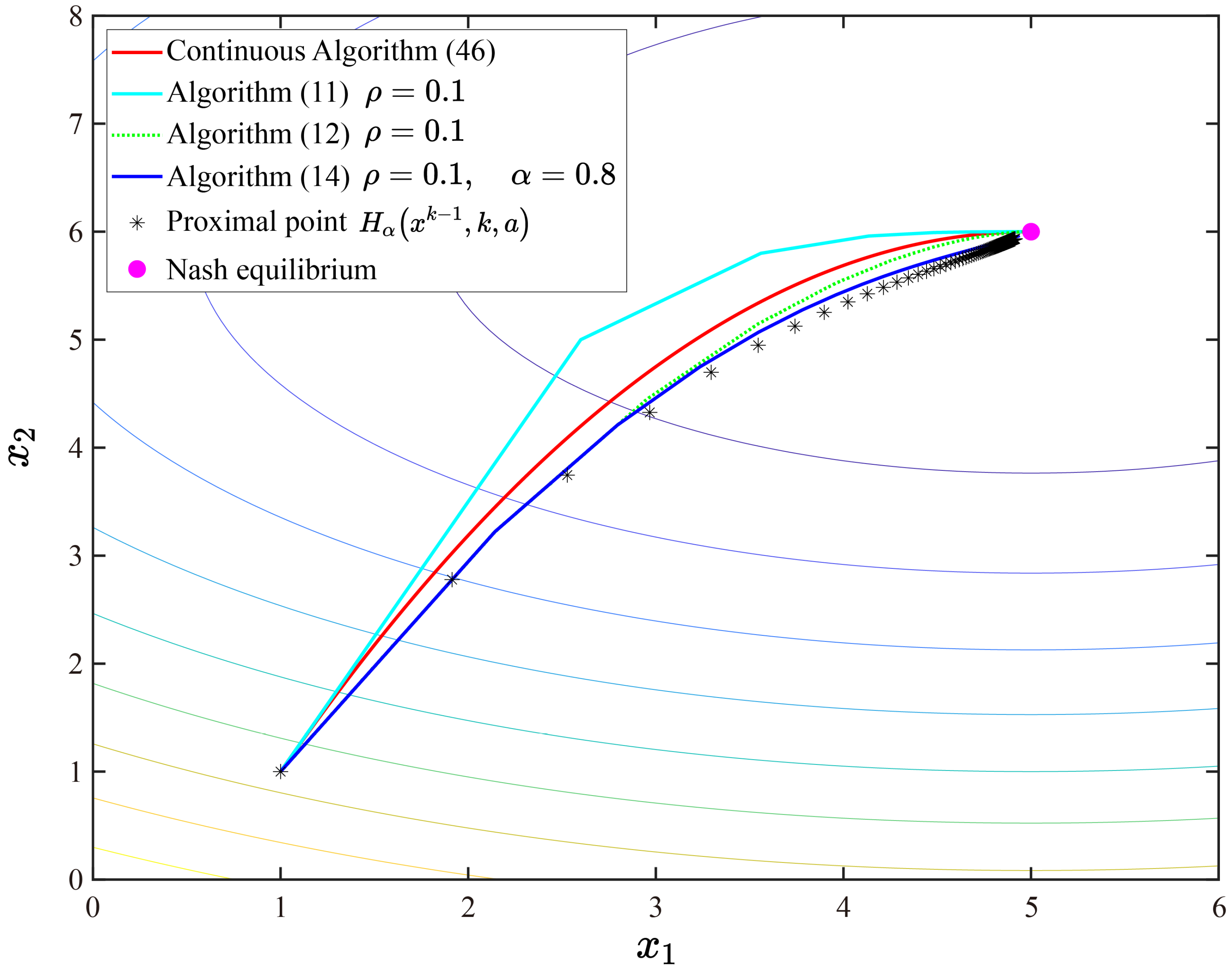
whose closed-form solution are x 1 ( t ) = 4 e 4 t + 5 and x 2 ( t ) = 5 e 8 t + 6 for the initial action col ( 1 , 1 ) . We simulated this game using Algorithms (11), (12), and (14), with the results shown in Figure 2. From Figure 2, it can be observed that due to the over-damped characteristic of the explicit update, the trajectory of Algorithm (11) lies on the outer side of the exact gradient flow. In contrast, for Algorithms (12) and (14), the incorporation of historical information to adjust the gradient direction results in under-damped characteristics of the algorithms.
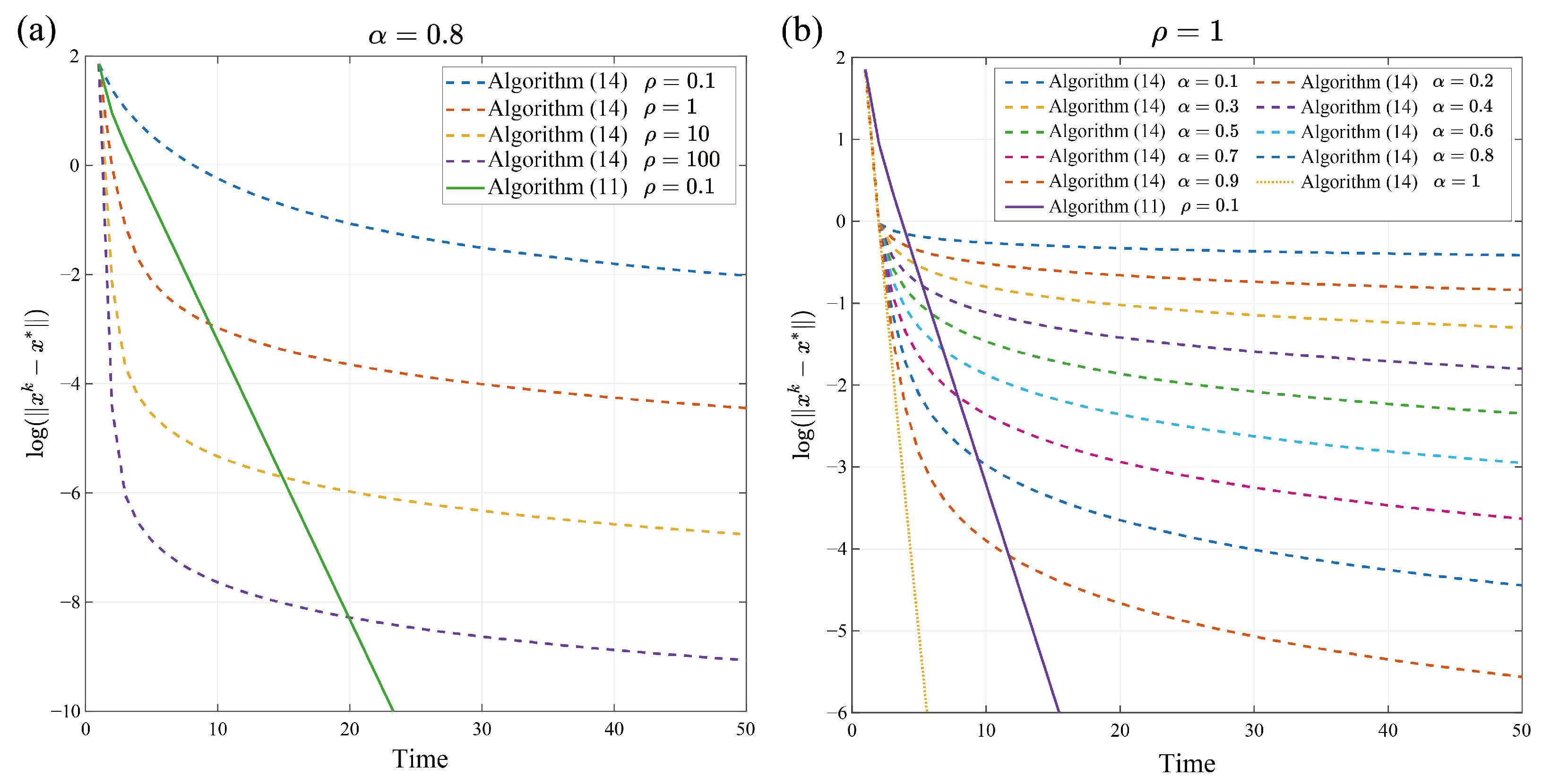
Then, we conducted simulation calculations with various step sizes and fractional orders, and the semi-log plots of action errors are shown in Figure 3. Figure 3a shows that Algorithm (14) has a slower convergence rate compared to Algorithm (11) at the same step size. However, Algorithm (14) can choose larger step sizes ρ = 0.1 , 1 , 10 , 100 to achieve high accuracy with fewer iterations, while Algorithm (11) can only select smaller step sizes ρ < 0.25 to ensure convergence. From Figure 3b, it can be observed that the larger the α , the faster the convergence rate of Algorithm (14). Of course, this characteristic may be related to the specific form of the objective function; in the optimization problem case given by [20], a larger α results in a slower convergence rate. This indicates that the fractional order α can indeed serve as a tunable parameter affecting the convergence rate of Algorithm (14).

5.2. Case 2: Nash–Cournot Game

We use a Nash–Cournot game from [16] to verify the effectiveness of the proposed algorithm under partial information settings. Consider N = 6 firms producing a homogeneous product and competing in a market. Let x i denote the quantity of product that firm i inputs into the market. Each firm’s private objective function is given by J i ( x ) = c i ( x i ) p ( x ) x i , where c i ( x i ) is the cost function and p ( x ) is the price function. The price p ( x ) depends on the total quantity of the product input into the market. Each firm aims to minimize its own objective function.
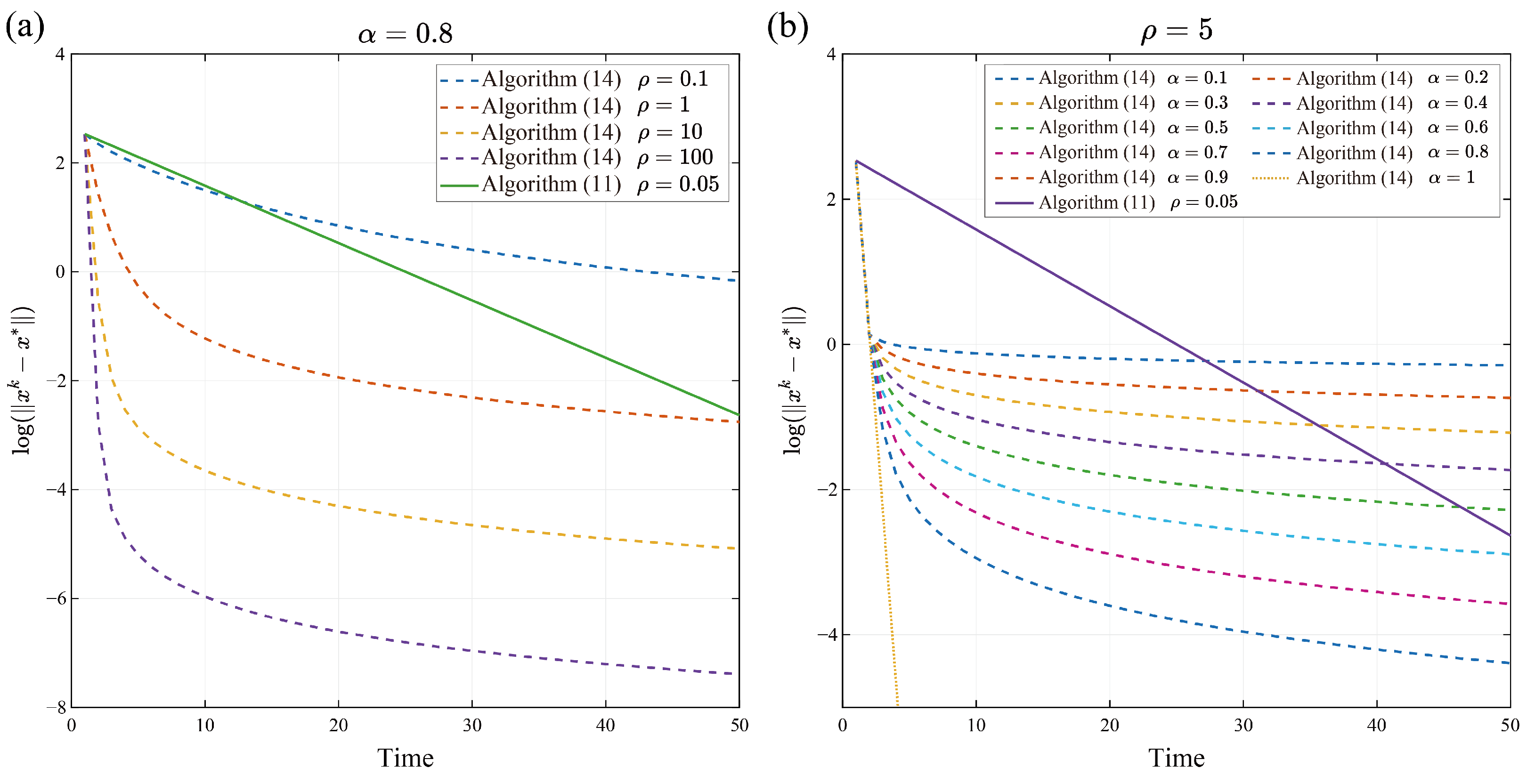
Let c i ( x i ) = 2 ( 1 + 0.5 i ) x i and p ( x ) = 50 i = 1 N x i 1 2 x i . The corresponding game constants are θ = 8 , θ 0 = 3 , and μ = 2 . The unique Nash equilibrium (NE) of the game is x = col ( 7.625 , 6.625 , 5.625 , 4.625 , 3.625 , 2.625 ) . First, we consider the case where the game has perfect information. We simulate Algorithm (14) with different step sizes and fractional orders, and the semi-logarithmic plot of the optimal error is shown in Figure 4. It can be seen that Algorithm (14) achieves exact convergence to the NE. Moreover, increasing the step size ρ and increasing the fractional order α within the range 0 < α 1 both accelerate the convergence of Algorithm (14). Additionally, the simulation results of Algorithm (11) are included for comparison. According to Equation (17), a small step size ρ < 2 μ θ 2 = 0.0625 is required to guarantee convergence of Algorithm (11). Consequently, by choosing a large ρ , Algorithm (14) can reach a higher accuracy in significantly fewer iterations compared to Algorithm (11). For example, in Figure 4b, Algorithm (14) with α = 0.9 and ρ = 5 achieves x k x < 10 2 within just 5 iterations, whereas Algorithm (14) with ρ = 0.05 requires 44 iterations to attain the same level of accuracy.
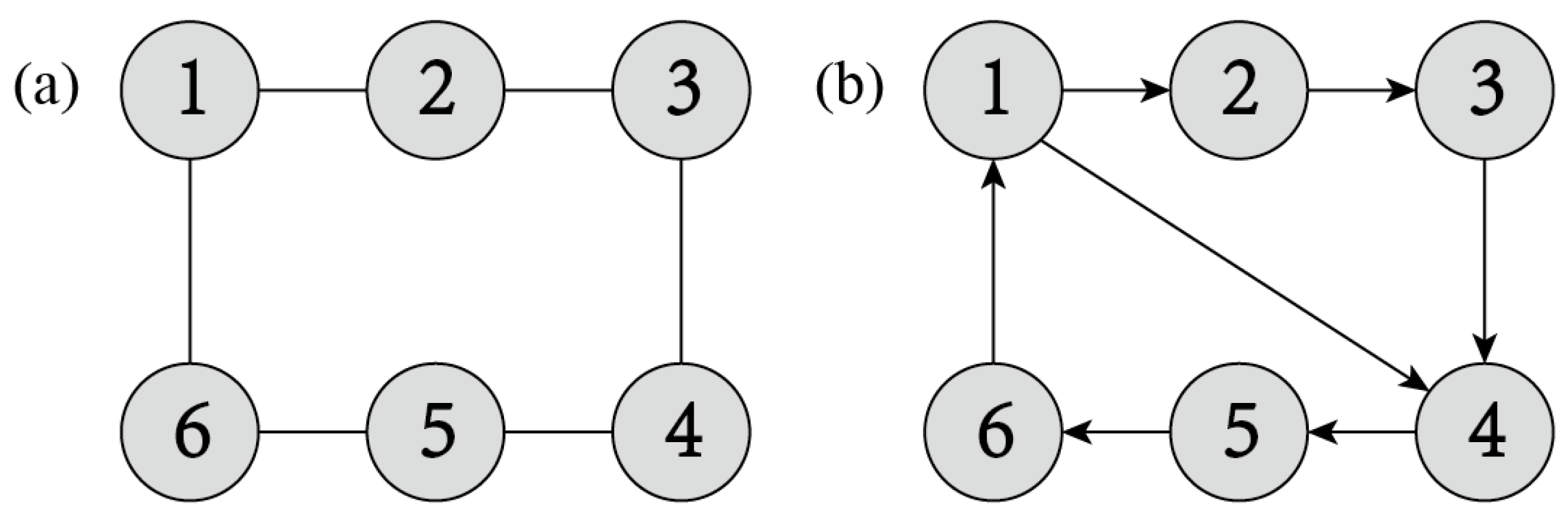
Next, we consider the scenario of the aforementioned Nash–Cournot game under a partial information setting. The firms communicate through networks as shown in Figure 5.
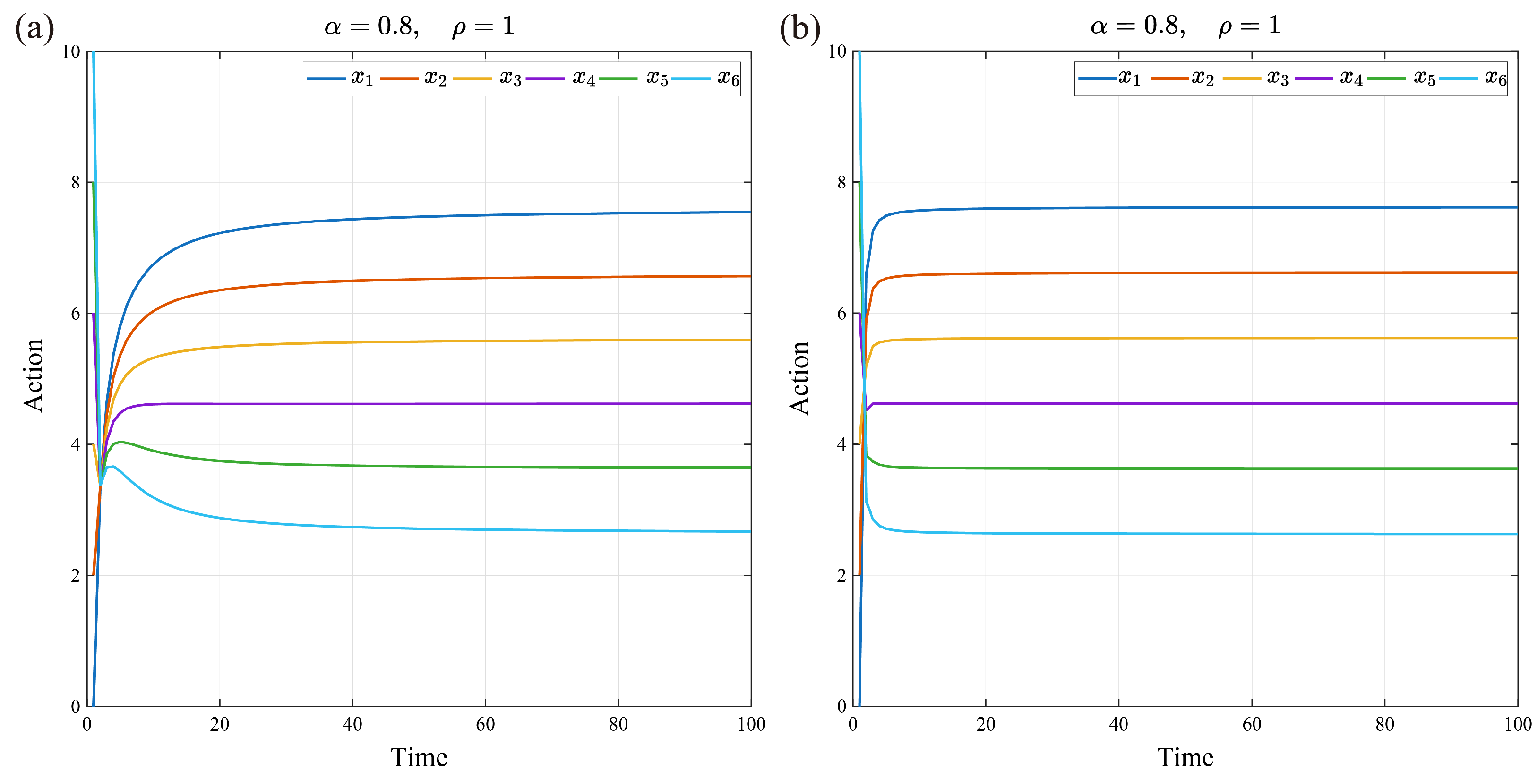
We consider the case where the communication network is an undirected graph 𝒢 u = ( [ N ] , E u ) , whose network topology is shown in Figure 5a. Select the adjacency matrix [ W 1 u ] i j = 1 , ( i , j ) E u . Figure 6a shows the action trajectories of Algorithm (27) under the adjacency matrix W 1 u , fractional order α = 0.8 , and step size ρ = 1 . It demonstrates that the actions of all firms converge to x , which verifies the effectiveness of Algorithm (20).
For a fair comparison with Algorithm (25), we assume that the undirected graph in Figure 5a has self-loops and select a doubly stochastic adjacency matrix [ W 2 u ] i j = 1 / d i in , ( i , j ) E u . Then, the Laplace matrix of the graph is L 2 u = I N W 2 u , and the algebraic connectivity λ 2 ( L 2 u ) = 1 / 3 . By Lemma 4, c min = ( θ + θ 0 ) 2 4 μ λ 2 ( L ) + θ λ 2 ( L ) 69.375 . Select the parameters a = 1 , c = 100 , the initial value x a = col ( 0 , 2 , 4 , 6 , 8 , 10 ) , and simulate Algorithm (20). Figure 6b shows the action trajectories of Algorithm (20) under W 2 u , α = 0.8 , and ρ = 1 .
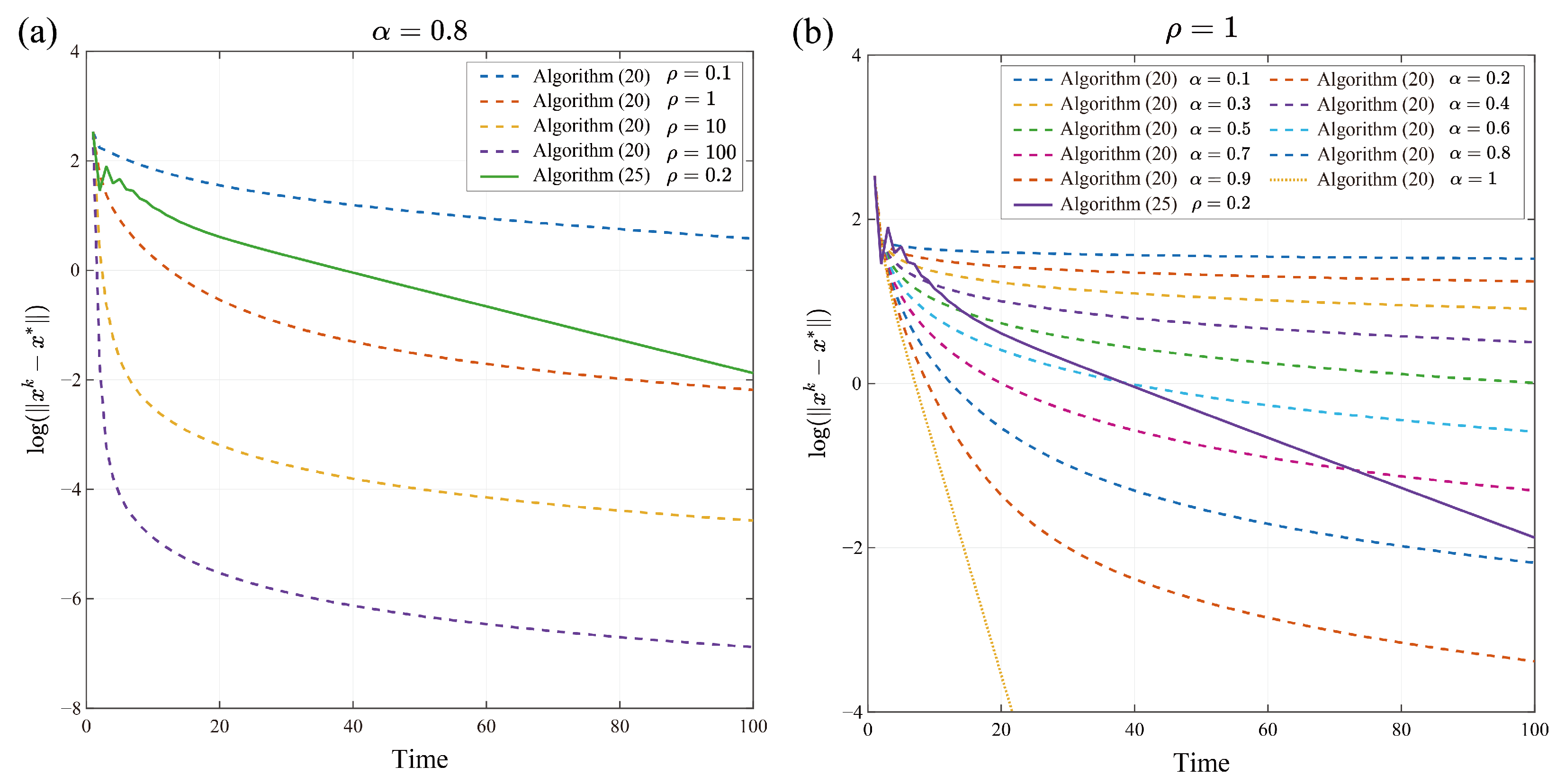
In Figure 7a,b, we present the logarithmic optimal error log ( x k x ) of Algorithm (20) under different step sizes and different fractional orders, respectively, with the results of Algorithm (25) at ρ = 0.2 provided for comparison. From Figure 7a,b, it can be observed that the convergence rate of Algorithm (20) increases as both α and ρ increase. Therefore, we can still enhance the convergence rate of Algorithm (20) by flexibly choosing α and ρ , similar to Algorithm (14) under perfect information settings. Unlike Algorithm (20), which ensures convergence even with large step sizes, the choice of step size for Algorithm (25) is constrained (in this problem, ρ > 0.3 would cause Algorithm (25) to diverge). Thus, compared to Algorithm (25), by selecting appropriate values of α and ρ , Algorithm (20) can achieve higher accuracy with fewer iterations. For example, Algorithm (20) with α = 0.9 and ρ = 1 achieves x k x < 10 2 within 30 iterations, whereas Algorithm (25) requires more than 100 iterations to reach the same precision.
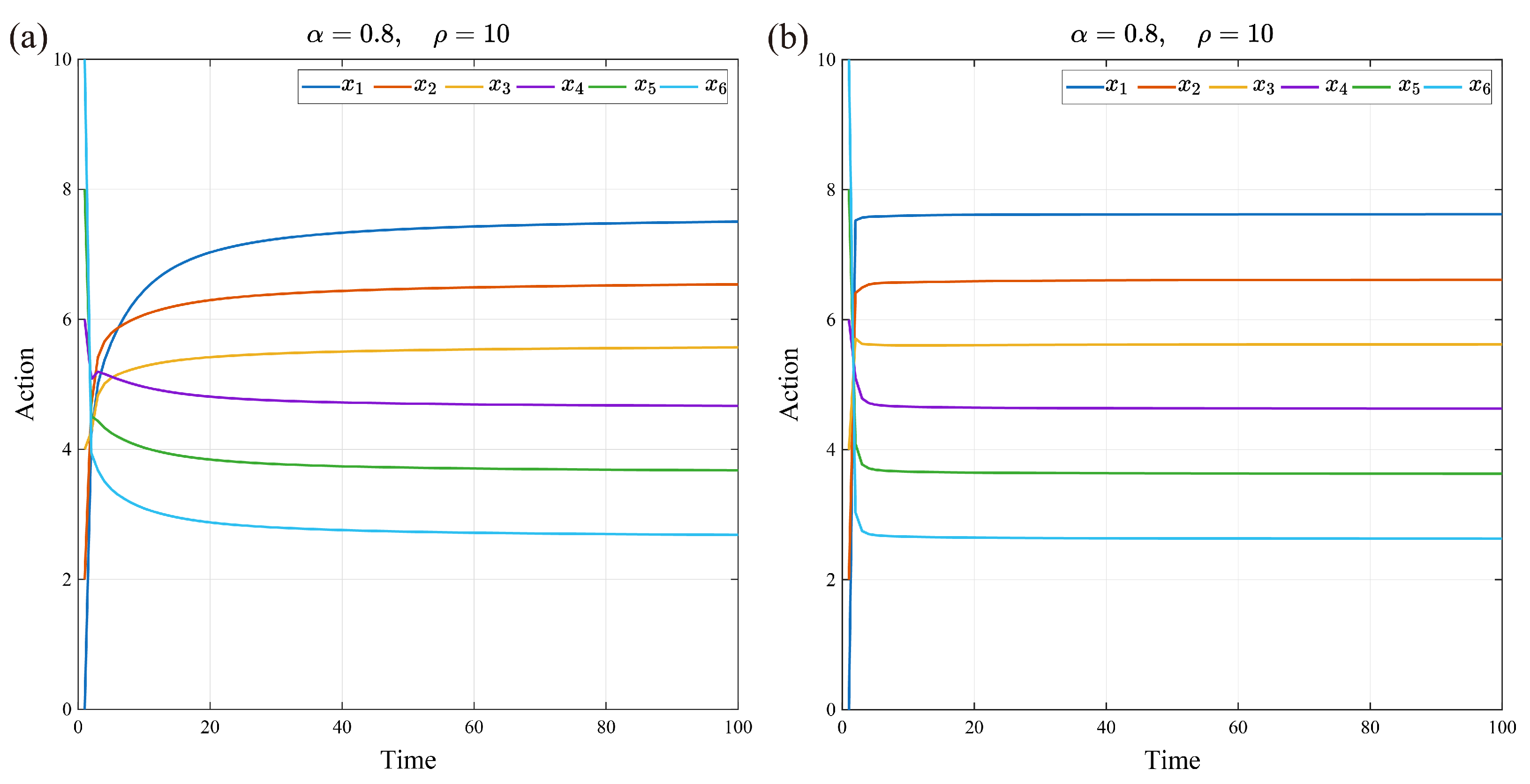
Next, we consider the case where the network topology is an unbalanced directed graph 𝒢 d = ( [ N ] , E d ) , as shown in Figure 5b. We select the adjacency matrix [ W 1 d ] i j = 1 , ( i , j ) E d . Figure 8a shows the action trajectories of Algorithm (27) under the adjacency matrix W 1 d , fractional order α = 0.8 , and step size ρ = 10 . The actions of all firms converge to the NE, which verifies the effectiveness of Algorithm (27).
For a comparison with Algorithm (40), we assume that the graph in Figure 5b contains self-loops and select a row-stochastic adjacency matrix [ W 2 d ] i j = 1 / d i in , ( i , j ) E d . The Laplacian matrix of the graph is L 2 d = I N W 2 d , and the left eigenvector of L 2 d corresponding to eigenvalue 0 can be calculated as ξ = col ( 3 / 19 , 2 / 19 , 2 / 19 , 4 / 19 , 4 / 19 , 4 / 19 ) . Taking L ˜ = ξ L 2 d + ( L 2 d ) T ξ T 2 , we have λ 2 ( L ˜ ) 0.03 . Then, c ˜ min = ( θ + θ 0 ) 2 4 μ λ 2 ( L ¯ ) + θ λ 2 ( L ¯ ) 770.83 . Select the parameters a = 1 , c = 1000 , the initial value x a = col ( 0 , 2 , 4 , 6 , 8 , 10 ) , and simulate Algorithm (27). Figure 8b shows the action trajectories of Algorithm (27) under W 2 d , α = 0.8 , and ρ = 10 .
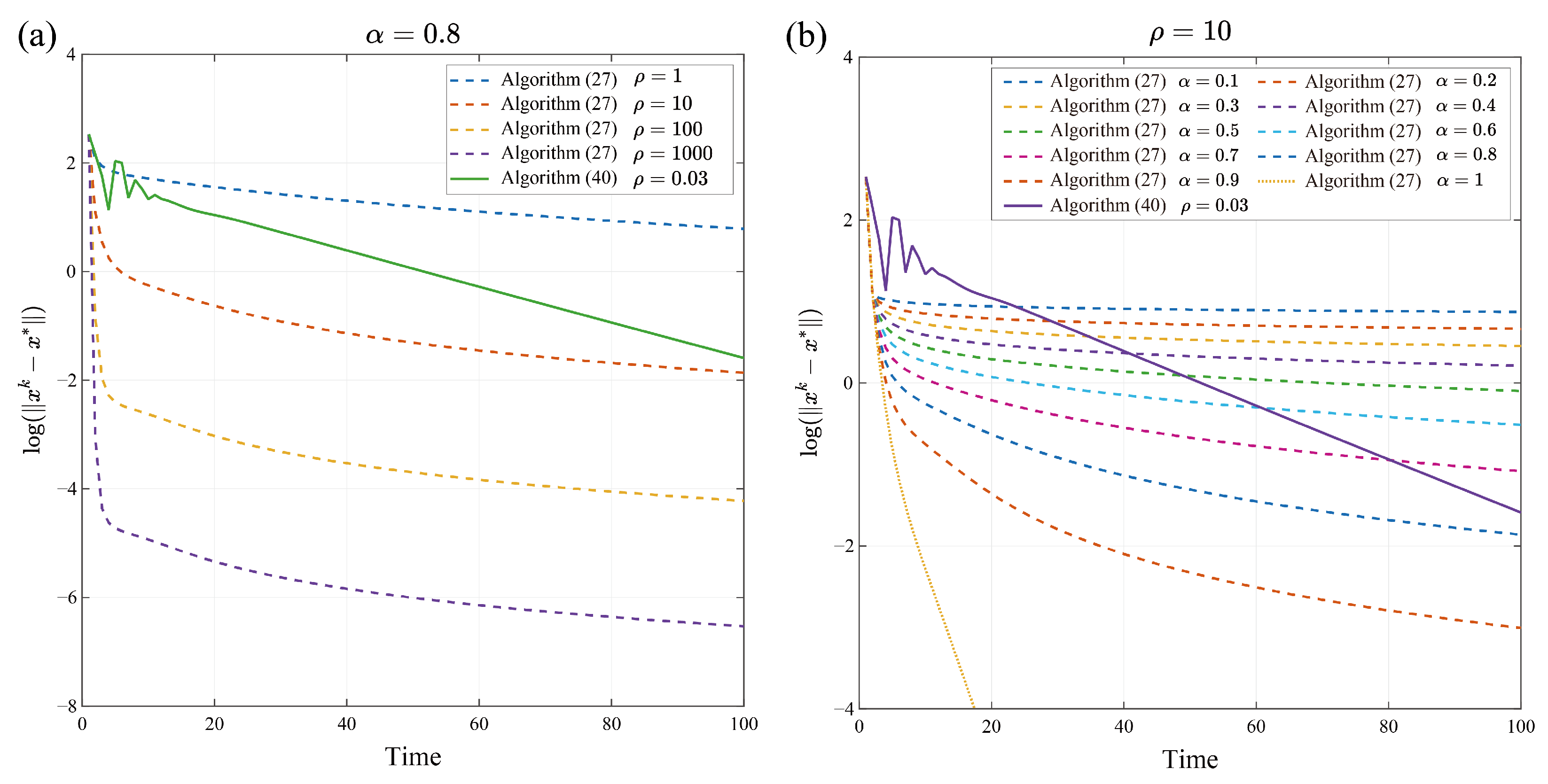
In Figure 9a,b, we present the logarithmic optimal error log ( x k x ) of Algorithm (27) under different step sizes and different fractional orders, respectively, with Algorithm (40) using a step size of ρ = 0.03 provided for comparison. It can be observed that the convergence rate of Algorithm (27) increases as both α and ρ increase. Moreover, Algorithm (27) achieves higher convergence precision within fewer iterations. These results are similar to those of Algorithm (20) over undirected graph.

6. Conclusions

This paper develops several fractional-order NE-seeking algorithms based on nabla fractional calculus. A gradient-based fractional-order algorithm is proposed for perfect information NGs. Due to the long-memory property of fractional-order systems, the true descent direction of the algorithm is a combination of the historical information term and the gradient direction. Subsequently, the algorithm is extended to partial information NGs, considering both undirected graphs and unbalanced directed graphs. These three algorithms have an implicit iterative scheme, which therefore allows for the selection of large step sizes. Through rigorous analysis, we prove that the proposed algorithms converge to the NE of the game with a Mittag–Leffler convergence rate. Our theoretical findings are illustrated through extensive numerical experiments. By adjusting the fractional order and the step size, the convergence rate of the algorithm can be improved. Moreover, comparisons with previous integer-order forward-difference algorithms demonstrate the potential of nabla fractional calculus in enhancing the efficiency of distributed NE-seeking algorithms.

Author Contributions

Y.X., conceptualization, methodology, validation, formal analysis, investigation, writing—original draft preparation, writing—review and editing, visualization; S.G., writing—original draft preparation, writing—review and editing; Y.Q., methodology, writing—review and editing; T.G., writing—review and editing, supervision, project administration; L.C., conceptualization, writing—review and editing, supervision, project administration. All authors have read and agreed to the published version of the manuscript.

Funding

This work was supported in part by the National Natural Science Foundation of China under Grant 52475169.

Institutional Review Board Statement

Not applicable.

Informed Consent Statement

Not applicable.

Data Availability Statement

Data are contained within the article.

Conflicts of Interest

The authors declare no conflicts of interest.

References

  1. Saad, W.; Han, Z.; Poor, H.V.; Basar, T. Game-Theoretic Methods for the Smart Grid: An Overview of Microgrid Systems, Demand-Side Management, and Smart Grid Communications. IEEE Signal Process. Mag. 2012, 29, 86–105. [Google Scholar] [CrossRef]
  2. Stankovic, M.S.; Johansson, K.H.; Stipanovic, D.M. Distributed Seeking of Nash Equilibria With Applications to Mobile Sensor Networks. IEEE Trans. Autom. Control 2012, 57, 904–919. [Google Scholar] [CrossRef]
  3. Lin, W.; Li, C.; Qu, Z.; Simaan, M.A. Distributed formation control with open-loop Nash strategy. Automatica 2019, 106, 266–273. [Google Scholar] [CrossRef]
  4. Frihauf, P.; Krstic, M.; Basar, T. Nash Equilibrium Seeking in Noncooperative Games. IEEE Trans. Autom. Control 2012, 57, 1192–1207. [Google Scholar] [CrossRef]
  5. Yu, C.K.; van der Schaar, M.; Sayed, A.H. Distributed Learning for Stochastic Generalized Nash Equilibrium Problems. IEEE Trans. Signal Process. 2017, 65, 3893–3908. [Google Scholar] [CrossRef]
  6. Chen, G.; Ming, Y.; Hong, Y.; Yi, P. Distributed algorithm for ϵ-generalized Nash equilibria with uncertain coupled constraints. Automatica 2021, 123, 109313. [Google Scholar] [CrossRef]
  7. Ye, M.; Hu, G. Distributed Nash Equilibrium Seeking by a Consensus Based Approach. IEEE Trans. Autom. Control 2017, 62, 4811–4818. [Google Scholar] [CrossRef]
  8. Ye, M.; Hu, G. Distributed Nash Equilibrium Seeking in Multiagent Games Under Switching Communication Topologies. IEEE Trans. Cybern. 2018, 48, 3208–3217. [Google Scholar] [CrossRef]
  9. Lu, K.; Zhu, Q. Nonsmooth Continuous-Time Distributed Algorithms for Seeking Generalized Nash Equilibria of Noncooperative Games via Digraphs. IEEE Trans. Cybern. 2022, 52, 6196–6206. [Google Scholar] [CrossRef]
  10. Gadjov, D.; Pavel, L. A Passivity-Based Approach to Nash Equilibrium Seeking Over Networks. IEEE Trans. Autom. Control 2019, 64, 1077–1092. [Google Scholar] [CrossRef]
  11. Zhu, Y.; Yu, W.; Ren, W.; Wen, G.; Gu, J. Generalized Nash Equilibrium Seeking via Continuous-Time Coordination Dynamics Over Digraphs. IEEE Trans. Control Netw. Syst. 2021, 8, 1023–1033. [Google Scholar] [CrossRef]
  12. Tatarenko, T.; Nedić, A. Geometric convergence of distributed gradient play in games with unconstrained action sets. IFAC-PapersOnLine 2020, 53, 3367–3372. [Google Scholar] [CrossRef]
  13. Bianchi, M.; Grammatico, S. Fully Distributed Nash Equilibrium Seeking Over Time-Varying Communication Networks With Linear Convergence Rate. IEEE Control Syst. Lett. 2021, 5, 499–504. [Google Scholar] [CrossRef]
  14. Bianchi, M.; Grammatico, S. Nash equilibrium seeking under partial-decision information over directed communication networks. In Proceedings of the 2020 59th IEEE Conference on Decision and Control (CDC), Jeju, Republic of Korea, 14–18 December 2020; pp. 3555–3560. [Google Scholar] [CrossRef]
  15. Nguyen, D.T.A.; Nguyen, D.T.; Nedić, A. Distributed Nash Equilibrium Seeking Over Time-Varying Directed Communication Networks. IEEE Trans. Control Netw. Syst. 2025, 12, 1917–1929. [Google Scholar] [CrossRef]
  16. Pavel, L. Distributed GNE Seeking Under Partial-Decision Information Over Networks via a Doubly-Augmented Operator Splitting Approach. IEEE Trans. Autom. Control 2020, 65, 1584–1597. [Google Scholar] [CrossRef]
  17. Feng, Z.; Xu, W.; Cao, J. Alternating Inertial and Overrelaxed Algorithms for Distributed Generalized Nash Equilibrium Seeking in Multi-Player Games. Fractal Fract. 2021, 5, 62. [Google Scholar] [CrossRef]
  18. Belgioioso, G.; Grammatico, S. Semi-Decentralized Generalized Nash Equilibrium Seeking in Monotone Aggregative Games. IEEE Trans. Autom. Control 2023, 68, 140–155. [Google Scholar] [CrossRef]
  19. Gallegos, J.A.; Duarte-Mermoud, M.A. Convergence of fractional adaptive systems using gradient approach. ISA Trans. 2017, 69, 31–42. [Google Scholar] [CrossRef] [PubMed]
  20. Liang, S.; Wang, L.; Yin, G. Fractional differential equation approach for convex optimization with convergence rate analysis. Optim. Lett. 2020, 14, 145–155. [Google Scholar] [CrossRef]
  21. Wei, Y.; Chen, Y.; Zhao, X.; Cao, J. Analysis and Synthesis of Gradient Algorithms Based on Fractional-Order System Theory. IEEE Trans. Syst. Man, Cybern. Syst. 2023, 53, 1895–1906. [Google Scholar] [CrossRef]
  22. Tan, Y.; He, Z.; Tian, B. A Novel Generalization of Modified LMS Algorithm to Fractional Order. IEEE Signal Process. Lett. 2015, 22, 1244–1248. [Google Scholar] [CrossRef]
  23. Pu, Y.F.; Zhou, J.L.; Zhang, Y.; Zhang, N.; Huang, G.; Siarry, P. Fractional Extreme Value Adaptive Training Method: Fractional Steepest Descent Approach. IEEE Trans. Neural Netw. Learn. Syst. 2015, 26, 653–662. [Google Scholar] [CrossRef]
  24. Yin, W.; Cheng, S.; Wei, Y.; Shuai, J.; Wang, Y. A bias-compensated fractional order normalized least mean square algorithm with noisy inputs. Numer. Algorithms 2019, 82, 201–222. [Google Scholar] [CrossRef]
  25. Wang, J.; Wen, Y.; Gou, Y.; Ye, Z.; Chen, H. Fractional-order gradient descent learning of BP neural networks with Caputo derivative. Neural Netw. 2017, 89, 19–30. [Google Scholar] [CrossRef]
  26. Chen, L.; Huang, T.; Tenreiro Machado, J.; Lopes, A.M.; Chai, Y.; Wu, R. Delay-dependent criterion for asymptotic stability of a class of fractional-order memristive neural networks with time-varying delays. Neural Netw. 2019, 118, 289–299. [Google Scholar] [CrossRef]
  27. Sheng, D.; Wei, Y.; Chen, Y.; Wang, Y. Convolutional neural networks with fractional order gradient method. Neurocomputing 2020, 408, 42–50. [Google Scholar] [CrossRef]
  28. Hong, X.; Wei, Y.; Zhou, S.; Yue, D. Nabla fractional distributed optimization algorithms over undirected/directed graphs. J. Frankl. Inst. 2024, 361, 1436–1454. [Google Scholar] [CrossRef]
  29. Hong, X.; Wei, Y.; Zhou, S.; Yue, D.; Cao, J. Nabla Fractional Distributed Optimization Algorithm Over Unbalanced Graphs. IEEE Control Syst. Lett. 2024, 8, 241–246. [Google Scholar] [CrossRef]
  30. Xu, H.; Chen, R.; Ni, X.; Wei, Y. Passivity of nabla fractional order systems and its application on distributed optimization. Commun. Nonlinear Sci. Numer. Simul. 2025, 146, 108747. [Google Scholar] [CrossRef]
  31. Wei, Y.; Wei, Y.; Chen, Y.; Wang, Y. Mittag–Leffler stability of nabla discrete fractional-order dynamic systems. Nonlinear Dyn. 2020, 101, 1–11. [Google Scholar] [CrossRef]
  32. Wei, Y.; Gao, Q.; Cheng, S.; Wang, Y. Description and analysis of the time–domain response of nabla discrete fractional order systems. Asian J. Control 2021, 23, 1911–1922. [Google Scholar] [CrossRef]
  33. Wei, Y.; Chen, Y.; Wei, Y.; Zhao, X. Lyapunov stability analysis for nonlinear nabla tempered fractional order systems. Asian J. Control 2023, 25, 3057–3066. [Google Scholar] [CrossRef]
  34. Facchinei, F.; Kanzow, C. Generalized Nash equilibrium problems. 4OR 2007, 5, 173–210. [Google Scholar] [CrossRef]
  35. Goodrich, C.; Peterson, A.C. Discrete Fractional Calculus; Springer: Berlin/Heidelberg, Germany, 2015; Volume 10. [Google Scholar]
  36. Olfati-Saber, R.; Murray, R. Consensus problems in networks of agents with switching topology and time-delays. IEEE Trans. Autom. Control 2004, 49, 1520–1533. [Google Scholar] [CrossRef]
  37. Li, Z.; Duan, Z. Cooperative Control of Multi-Agent Systems: A Consensus Region Approach, 1st ed.; CRC Press: Boca Raton, FL, USA, 2015. [Google Scholar]
  38. Monderer, D.; Shapley, L.S. Potential Games. Games Econ. Behav. 1996, 14, 124–143. [Google Scholar] [CrossRef]
Figure 1. The curves of ( 1 2 ρ 1 μ + ρ 1 2 θ 2 ) k a and F α , 1 ( 2 ρ 2 μ , k , α ) , where μ = 1 , θ = 3.5 , a = 0 , k N a 0 . (a) α = 0.1 i , i [ 10 ] , ρ 1 = ρ 2 = 0.12 . (b) α = 0.6 , 1 , ρ 1 = 0.1 , ρ 2 = 0.1 , 0.2 , 0.3 .
Fractalfract 09 00756 g001
Figure 2. Contour lines of the potential function P and action trajectories of Algorithms (11), (12), and (14).
Fractalfract 09 00756 g002
Figure 3. Comparison of logarithmic optimal error for Algorithoms (11) and (14) with different step size and fractional order. Algorithm (11) with ρ = 0.1 ; (a) Algorithm (14) with α = 0.8 , ρ = 0.1 , 1 , 10 , 100 ; (b) Algorithm (14) with α = 0.1 i , i [ 10 ] , ρ = 1 .
Fractalfract 09 00756 g003
Figure 4. Comparison of logarithmic optimal error for Algorithoms (11) and (14) with different step size and fractional order. Algorithm (11) with ρ = 0.05 ; (a) Algorithm (14) with α = 0.8 , ρ = 0.1 , 1 , 10 , 100 ; (b) Algorithm (14) with α = 0.1 i , i [ 10 ] , ρ = 5 .
Fractalfract 09 00756 g004
Figure 5. Communication networks. (a) Connected undirected graph. (b) Strongly connected directed graph.
Fractalfract 09 00756 g005
Figure 6. Action trajectories of Algorithm (20) under α = 0.8 , ρ = 1 . (a) Adjacency matrix W 1 u . (b) Adjacency matrix W 2 u .
Fractalfract 09 00756 g006
Figure 7. Comparison of logarithmic optimal error for Algorithoms (20) and (25) with different step size and fractional order. Algorithm (25) with ρ = 0.2 ; (a) Algorithm (20) with α = 0.8 , ρ = 0.1 , 1 , 10 , 100 ; (b) Algorithm (20) with α = 0.1 i , i [ 10 ] , ρ = 1 .
Fractalfract 09 00756 g007
Figure 8. Action trajectories of Algorithm (27) under α = 0.8 , ρ = 10 . (a) Adjacency matrix W 1 d . (b) Adjacency matrix W 2 d .
Fractalfract 09 00756 g008
Figure 9. Comparison of logarithmic optimal error for Algorithoms (27) and (40) with different step size and fractional order. Algorithm (40) with ρ = 0.03 ; (a) Algorithm (27) with α = 0.8 , ρ = 1 , 10 , 100 , 1000 ; (b) Algorithm (27) with α = 0.1 i , i [ 10 ] , ρ = 10 .
Fractalfract 09 00756 g009
Disclaimer/Publisher’s Note: The statements, opinions and data contained in all publications are solely those of the individual author(s) and contributor(s) and not of MDPI and/or the editor(s). MDPI and/or the editor(s) disclaim responsibility for any injury to people or property resulting from any ideas, methods, instructions or products referred to in the content.