Article

A New Laplace-Type Transform on Weighted Spaces with Applications to Hybrid Fractional Cauchy Problems

1
Department of Mathematics, Naresuan University, Phitsanulok 65000, Thailand
2
Department of Mathematics, University of Ioannina, 451 10 Ioannina, Greece
*
Author to whom correspondence should be addressed.
Fractal Fract. 2025, 9(11), 751; https://doi.org/10.3390/fractalfract9110751
Submission received: 13 October 2025 / Revised: 14 November 2025 / Accepted: 18 November 2025 / Published: 20 November 2025

Abstract

This paper develops a generalized Laplace transform theory within weighted function spaces tailored for the analysis of fractional differential equations involving the ψ -Hilfer derivative. We redefine the transform in a weighted setting, establish its fundamental properties—including linearity, convolution theorems, and action on δ ψ derivatives—and derive explicit formulas for the transforms of ψ -Riemann–Liouville, ψ -Caputo, and ψ -Hilfer fractional operators. The results provide a rigorous analytical foundation for solving hybrid fractional Cauchy problems that combine classical and fractional derivatives. As an application, we solve a hybrid model incorporating both δ ψ derivatives and ψ -Hilfer fractional derivatives, obtaining explicit solutions in terms of multivariate Mittag-Leffler functions. The effectiveness of the method is illustrated through a capacitor charging model and a hydraulic door closer system based on a mass-damper model, demonstrating how fractional-order terms capture memory effects and non-ideal behaviors not described by classical integer-order models.

1. Introduction

Fractional differential equations (FDEs), as developed in [1,2,3], provide a powerful framework for modeling systems with memory and hereditary properties. By extending classical integer-order models, FDEs account for the influence of past states, yielding a more accurate description of system dynamics. Fractional calculus offers a rigorous approach to mechanical systems, including viscoelasticity, vibrations, diffusion, and heat conduction, capturing memory effects, hereditary behavior, and complex responses beyond classical formulations [4]. The versatility of FDEs is evident across disciplines: in fluid systems, they describe phenomena such as the motion of a rigid plate in a Newtonian fluid [5] and generalize the Basset force for particles in viscoelastic media [6,7]; similarly, in electrical systems, they model capacitors and inductors with memory-dependent effects [8,9]. Together, these applications demonstrate how fractional models provide a unified framework for capturing memory; non-locality; and complex, dynamic behavior in diverse physical systems.
Building on this foundation, the ψ -Hilfer fractional derivative, introduced as a new form of fractional differential equation by Sousa et al. in 2018 [10], represents a powerful generalization of classical FDEs. It unifies several fractional derivatives, including Riemann–Liouville, Caputo, and Hilfer derivatives, through appropriate choices of the ψ function and associated parameters. Defined with respect to another function, it enables the formulation of a wide class of fractional derivatives, as discussed in Section 2.1, allowing for the description of dynamic behaviors in financial systems and providing robust frameworks for biological models [11,12]. Motivated by its broad applicability and capacity to capture diverse memory-dependent dynamics, the present work focuses on ψ -Hilfer fractional differential equations as a versatile framework for modeling complex systems.
A central tool in the analysis of differential equations is the Laplace transform, which simplifies the solution process by converting differential operations into algebraic operations. However, the classical Laplace transform is often inadequate for handling the broad family of fractional derivatives, including Riemann–Liouville, Caputo, and Hilfer derivatives and their generalizations, especially when defined on weighted function spaces that accommodate singularities or non-standard growth behaviors. Several extensions of the classical Laplace transform have been developed to address generalized fractional operators. The ρ -Laplace transform was introduced to extend the classical Laplace transform to a broader class of functions, providing a useful tool for handling kernels of generalized fractional operators [13]. Another contribution by the same authors studied generalized fractional derivatives with function-dependent kernels in the space of absolutely continuous functions and extended the Laplace transform to apply to these generalized fractional integrals and derivatives [14]. Further developments include the Katugampola Laplace transform [15] on the space of n-times continuously differentiable functions and the β -Laplace integral transform, which overcomes limitations of the classical transform for functions with fixed-point poles [16]. In addition, images of tempered ψ -Hilfer and ψ -Caputo derivatives under generalized Laplace transforms on a space of n-times continuously differentiable functions have been derived [17], and the ψ -Laplace transform has been combined with the Adomian decomposition method to solve Caputo-type fractional differential equations with respect to another function ( ψ ) [18].
The core challenge addressed in this work involves solving hybrid systems with ψ -Hilfer operators, where existing methods for standard fractional equations prove inadequate. While numerous efficient techniques exist for conventional fractional differential equations, their direct application fails for hybrid problems due to fundamental limitations: conventional integration methods, whether standard integration or generalized integration with respect to ψ , fail to simultaneously simplify the integer-order term ( u [ 1 ] ) and the fractional-order term D a + α , β ; ψ H u ) within a unified framework. This failure stems from the complex interaction between ordinary derivatives and generalized fractional operators, which cannot be resolved through classical Laplace transforms or standard integral approaches. Building on prior studies that extend classical mechanical–electrical analogies to fractional-order oscillatory systems, introducing complex and hybrid rheologic models that capture both external and internal degrees of freedom [19,20], we develop a generalized Laplace transform methodology that can handle both operator types within a unified framework. The specific innovation of our work lies in developing a generalized Laplace transform methodology tailored for the space expressed as C δ ψ , γ 1 [ a , b ] , which represents a non-trivial extension required to solve the hybrid problem at hand. The generalized Laplace transform can solve a wide range of problems, including those with a single fractional operator, as well as systems involving sequential or combined derivatives of varying orders.
This paper bridges the identified gap by developing the theory of the generalized Laplace transform specifically tailored for the space expressed as C δ ψ , γ 1 [ a , b ] . Our main contributions are outlined as follows:
  • We establish the foundational properties of the generalized Laplace transform in this space, including linearity, a convolution theorem, and its action on the δ ψ derivative. This development is supported by a detailed characterization of the weighted function space expressed as C δ ψ , γ n [ a , b ] , and we derive a representation formula for functions in this space.
  • We derive generalized Laplace transform formulas for the ψ -Riemann–Liouville, ψ -Caputo, and ψ -Hilfer fractional derivatives and integrals.
  • We employ this novel transform to obtain exact analytical solutions for hybrid fractional Cauchy problems that incorporate both first-order δ ψ derivatives and ψ -Hilfer fractional derivatives of order α ( 0 , 1 ) , problems which were previously intractable using existing methods.
  • We demonstrate the practical efficacy of our approach through its application to two systems: (i) a capacitor charging model that captures memory effects and self-discharge phenomena unrepresentable by classical integer-order models and (ii) a hydraulic door-closer system based on a mass-damper model, where fractional-order terms describe memory-dependent behaviors beyond the scope of classical models. The work also includes practical implementation guidelines for the ψ -Hilfer fractional model framework.
The paper is organized as follows. Section 2 reviews necessary preliminaries, including definitions and properties of the weighted space C δ ψ , γ 1 [ a , b ] and the ψ -Hilfer fractional operators. Section 3 presents our main theoretical results on the generalized Laplace transform and the solution of hybrid fractional Cauchy problems using the newly developed transform. Section 4 discusses broader implications and future directions, and Section 5 concludes the work.

2. Preliminaries

2.1. Spaces of Continuous Functions and Their Weighted Modifications

In this subsection, we begin by defining spaces of continuous functions and study their weighted modifications on a finite interval of the half-axis [ a , b ] , where 0 a < b < . Throughout this paper, we assume γ C with 0 R ( γ ) < 1 . We adopt the notations of N = { 1 , 2 , } and N 0 = N { 0 } .
Definition 1
(Space of n-times continuously differentiable functions C n [ a , b ] , [1]). Let n N 0 . C n [ a , b ] denotes a space of functions (f) that are n times continuously differentiable on [ a , b ] as
C n [ a , b ] = { f : [ a , b ] C : D n f ( t ) C [ a , b ] , D = d / d t }
with the norm expressed as
f C n [ a , b ] = k = 0 n f ( k ) C [ a , b ] = k = 0 n max t [ a , b ] | f ( k ) ( t ) | , n N 0 .
In particular, for n = 0 , C 0 [ a , b ] C [ a , b ] is the space of continuous functions (f) on [ a , b ] with the norm expressed as
f C [ a , b ] = max t [ a , b ] | f ( t ) | .
Definition 2
(Weighted Space C γ [ a , b ] , [1]). We introduce the weighted space C γ [ a , b ] of functions f given on ( a , b ] , such that the function is ( t a ) γ f ( t ) C [ a , b ] , i.e.,
C γ [ a , b ] = f : ( a , b ] R : ( t a ) γ f ( t ) C [ a , b ]
with the norm expressed as
f C γ [ a , b ] = ( t a ) γ f ( t ) C [ a , b ] .
In particular, when γ = 0 , C 0 [ a , b ] = C [ a , b ] .
Definition 3
(Weighted Differentiable Space C γ n [ a , b ] , [1]). For n N , C γ n [ a , b ] denotes the Banach space of functions ( f ( t ) ) that are continuously differentiable ( f ( n ) ( t ) C γ [ a , b ] , ), i.e.,
C γ n [ a , b ] = f : [ a , b ] R : f ( n 1 ) ( t ) C [ a , b ] , f ( n ) ( t ) C γ [ a , b ]
with the norm expressed as
f C γ n [ a , b ] = k = 0 n 1 f ( k ) C [ a , b ] + f ( n ) C γ [ a , b ] .
In particular, when n = 0 , C γ 0 [ a , b ] = C γ [ a , b ] .
From this definition, we have the following characterization of the space C γ n [ a , b ] .
Lemma 1
([1]). Let n N . The space C γ n [ a , b ] consists of only those functions f that are represented in the form of
f ( t ) = 1 ( n 1 ) ! a t ( t τ ) n 1 φ ( τ ) d τ + k = 0 n 1 c k ( t a ) k ,
where φ ( τ ) C γ [ a , b ] and c k , k = 0 , 1 , , n 1 are arbitrary constants. Moreover,
φ ( τ ) = f ( n ) ( τ ) , c k = f ( k ) ( a ) k ! , k = 0 , 1 , , n 1 .
In particular, when γ = 0 , the space C n [ a , b ] consists of only those functions f that are represented in the form of (1), where φ ( τ ) C [ a , b ] and c k , k = 0 , 1 , , n 1 are arbitrary constants. Moreover, the relations in (2) hold.
Definition 4
(Logarithmically Weighted Space C γ , ln [ a , b ] , [1]). We introduce the weighted space C γ , ln [ a , b ] of functions f ( t ) given on ( a , b ] such that ln t a γ f ( t ) C [ a , b ] , i.e.,
C γ , ln [ a , b ] = f : ( a , t ] R : ln t a γ f ( t ) C [ a , b ]
with the norm expressed as
f C γ , ln [ a , b ] = ln t a γ f ( t ) C [ a , b ] .
In particular, when γ = 0 , C 0 , ln [ a , b ] = C [ a , b ] .
Definition 5
(Weighted n-times δ -Differentiable Space C δ , γ n [ a , b ] , [1]). For n N , C δ , γ n [ a , b ] denotes the Banach space of functions f ( t ) that have continuous δ derivatives on [ a , b ] up to order n 1 and derivative ( δ n f ) ( t ) on ( a , b ] of order n such that ( δ n f ) ( t ) C γ , ln [ a , b ] , i.e.,
C δ , γ n [ a , b ] = f : [ a , b ] R : δ n 1 f ( t ) C [ a , b ] ; δ n f ( t ) C γ , ln [ a , b ] , δ : = t d d t
with the norm expressed as
f C δ , γ n [ a , b ] = k = 0 n 1 δ k f C [ a , b ] + δ n f C γ , ln [ a , b ] .
For n = 0 , we have C δ , γ 0 [ a , b ] = C γ , ln [ a , b ] .
From this definition, we have the following characterization of the space C δ , γ n [ a , b ] .
Lemma 2
([1]). Let 0 < a < b < , n N . The space C δ , γ n [ a , b ] consists of only those functions f ( t ) that are represented in the form of
f ( t ) = 1 ( n 1 ) ! a t ln t τ n 1 φ ( τ ) d τ τ + k = 0 n 1 d k ln t a k ,
where φ ( τ ) C γ , ln [ a , b ] and d k , k = 0 , 1 , , n 1 are arbitrary constants. Moreover,
φ ( τ ) = ( δ n f ) ( t ) , d k = ( δ k f ) ( a ) k ! , k = 0 , 1 , , n 1 .
In particular, when γ = 0 , the space C δ , 0 n [ a , b ] = C δ n [ a , b ] , consists of only those functions f ( t ) that are represented in the form of (3), where φ ( τ ) C [ a , b ] and d k , k = 0 , 1 , , n 1 are arbitrary constants. Moreover, the relations (4) hold.
The generalized weighted continuous space is defined as follows.
Definition 6
( ψ -Weighted Continuous Space C γ , ψ [ a , b ] , [10]). Let n N and ψ C n [ a , b ] such that ψ ( t ) > 0 on [ a , b ] . We introduce the weighted space C γ , ψ [ a , b ] of functions f ( t ) given by
C γ , ψ [ a , b ] = f : ( a , b ] R : ( ψ ( t ) ψ ( a ) ) γ f ( t ) C [ a , b ]
with the norm expressed as
f C γ , ψ [ a , b ] = ψ ( t ) ψ ( a ) γ f ( t ) C [ a , b ] = max t [ a , b ] | ψ ( t ) ψ ( a ) γ f ( t ) | .
The space C γ , ψ [ a , b ] is designed to contain functions that may have a controlled singularity at the lower limit t = a . This means a function f C γ , ψ [ a , b ] is allowed to diverge as t a + —but no faster than ( ψ ( t ) ψ ( a ) ) γ . In particular, when γ = 0 , we have C 0 , ψ [ a , b ] = C [ a , b ] . Note that if ψ ( t ) = t , then C γ , ψ [ a , b ] = C γ [ a , b ] , and if ψ ( t ) = ln t , then C γ , ψ [ a , b ] = C γ , ln [ a , b ] , (for 0 < a < b < ), that is, the space C γ , ψ [ a , b ] generalizes spaces C [ a , b ] , C γ [ a , b ] , and C γ , ln [ a , b ] .
Definition 7
( ψ -Weighted n-times δ ψ -Differentiable Space C δ ψ , γ n [ a , b ] , [10]). Let n N and ψ C n [ a , b ] such that ψ ( t ) > 0 on [ a , b ] .   C δ ψ , γ n [ a , b ] denotes the Banach space of functions f ( t ) that have continuous δ ψ derivatives on [ a , b ] up to order n 1 and derivative ( δ ψ n f ) ( t ) on ( a , b ] of order n such that ( δ ψ n f ) ( t ) C γ , ψ [ a , b ] :
C δ ψ , γ n [ a , b ] = f : [ a , b ] R : δ ψ n 1 f ( t ) C [ a , b ] ; δ ψ n f ( t ) C γ , ψ [ a , b ] , δ ψ : = 1 ψ ( t ) d d t
with the norm expressed as
f C δ ψ , γ n [ a , b ] = k = 0 n 1 δ ψ k f C [ a , b ] + δ ψ n f C γ , ψ [ a , b ] .
We note that the spaces form a decreasing chain:
C δ ψ , γ m [ a , b ] C δ ψ , γ n [ a , b ] C [ a , b ] , for 1 n m .
When γ = 0 , we write C δ ψ , 0 n [ a , b ] = C δ ψ n [ a , b ] = C n [ a , b ] and
f C δ ψ n [ a , b ] = k = 0 n δ ψ k f C [ a , b ] .
If 0 < ( γ ) < 1 , then C n [ a , b ] C δ ψ , γ n [ a , b ] , that is, C δ ψ , γ n [ a , b ] is strictly larger than C n [ a , b ] because it contains functions with singular n-th derivatives at t = a .
We characterize space C δ ψ , γ n [ a , b ] in Section 3.1.

2.2. Fractional Integrals and Fractional Differential Operators

This section defines the generalized fractional integral and several families of generalized fractional derivatives.
In 2017, Sousa et al. [10] introduced a new fractional derivative with respect to another function ( ψ ), referred to as the ψ -Hilfer fractional derivative. This operator unifies the ψ -Riemann–Liouville and ψ -Caputo fractional derivatives while also serving as a general framework for many other differential operators. Shortly after, in 2018, Sugumaran et al. [21] extended this work by defining generalized fractional derivatives of complex order.
Throughout this paper, we assume the order α C is a complex number, the real part R ( α ) of which is positive and a non-integer. [ R ( α ) ] denotes its integer part. We begin by recalling the standard definitions of the left-side fractional integral and derivative on [ a , b ] , where 0 a < b , which are essential for our study of the generalized Laplace transform.
Definition 8
( ψ -Riemann–Liouville fractional integral [21]). Let ψ ( t ) be a strictly increasing function with a continuous derivative ( ψ ( t ) ) on [ a , b ] . The ψ-Riemann–Liouville fractional integrals of order α C (with R ( α ) > 0 ) with respect to ψ function of a function f ( t ) on [ a , b ] are defined by
I a + α ; ψ f ( t ) = 1 Γ ( α ) a t ψ ( τ ) ( ψ ( t ) ψ ( τ ) ) α 1 f ( τ ) d τ , t > a .
Remark 1.
The ψ-Riemann–Liouville fractional integral in Equation (5) generalizes many known fractional integrals. Specific cases are recovered by choosing the function ψ and the left endpoint appropriately [10]:
  • Choosing ψ ( t ) = t yields the Riemann–Liouville fractional integral.
  • Choosing ψ ( t ) = t and a = 0 yields the Riemann fractional integral.
  • Choosing ψ ( t ) = t and b = yields the Weyl fractional integral.
  • Choosing ψ ( t ) = t ρ , ρ > 0 yields the Katugampola fractional integral.
  • Choosing ψ ( t ) = ln t and a > 0 yields the Hadamard fractional integral.
Definition 9
( ψ -Riemann–Liouville fractional derivative [21]). Let ψ ( t ) be a strictly increasing function with a continuous derivative ψ ( t ) 0 on [ a , b ] . The ψ-Riemann–Liouville derivatives of order α C (with R ( α ) > 0 ) of a function f ( t ) on [ a , b ] are defined by
D a + α ; ψ f ( t ) = δ ψ n I a + n α ; ψ f ( t ) , t > a ,
where δ ψ : = 1 ψ ( t ) d d t and n = [ R ( α ) ] + 1 .
Definition 10
( ψ -Caputo fractional derivative [21]). Let f , ψ C n ( [ a , b ] , R ) be functions such that ψ is strictly increasing and ψ ( t ) 0 for all t [ a , b ] . The ψ-Caputo fractional derivative of order α C (with R ( α ) > 0 ) of a function f ( t ) on [ a , b ] is defined by
D a + α ; ψ C f ( t ) = I a + n α ; ψ δ ψ n f ( t ) , t > a ,
where δ ψ : = 1 ψ ( t ) d d t and n = [ R ( α ) ] + 1 .
Definition 11
( ψ -Hilfer fractional derivative [21]). Let f , ψ C n ( [ a , b ] ) , R ) be functions such that ψ is strictly increasing and ψ ( t ) 0 for all t [ a , b ] . The ψ-Hilfer fractional derivative of order α C (with R ( α ) > 0 ) and type β (with 0 β 1 ) of a function f ( t ) on [ a , b ] is defined by
D a + α , β ; ψ H f ( t ) = I a + β ( n α ) ; ψ δ ψ n I a + ( 1 β ) ( n α ) ; ψ f ( t ) , t > a ,
where δ ψ : = 1 ψ ( t ) d d t and n = [ R ( α ) ] + 1 .
The ψ -Hilfer fractional derivative, as defined above, can be written in the following form:
D a + α , β ; ψ H f ( t ) = I a + γ α ; ψ D a + γ ; ψ f ( t ) ,
where γ = α + β ( n α ) , and I a + γ α ; ψ ( · ) and D a + γ ; ψ ( · ) are defined in Equations (5) and (6), respectively.
Remark 2 (Relationship between ψ -Hilfer and ψ -Caputo fractional derivatives [10]). Consider the ψ-Hilfer fractional derivative and the following function: g ( t ) = I a + ( 1 β ) ( n α ) ; ψ f ( t ) . Therefore, we have
D a + α , β ; ψ H f ( t ) = I a + n μ ; ψ δ ψ n g ( t ) ,
with μ = n ( 1 β ) + β α . Thus, we have the following relationship between ψ-Hilfer and ψ-Caputo fractional derivatives:
D a + α , β ; ψ H f ( t ) = D a + μ ; ψ C g ( t ) = D a + μ ; ψ C I a + ( 1 β ) ( n α ) ; ψ f ( t ) .
Remark 3 ([10]). The ψ-Hilfer fractional derivative in Equation (8) provides a general framework that unifies many known derivatives. The following special cases are recovered through appropriate choices of the ψ function, the left endpoint, and limits of the β parameter.
  • Taking the limit of β 1 in (8) yields the ψ-Caputo fractional derivative.
  • Taking the limit of β 0 in (8) yields the ψ-Riemann–Liouville fractional derivative.
  • With ψ ( t ) = t , the limit of β 1 in (8) yields the Caputo fractional derivative.
  • With ψ ( t ) = t , the limit of β 0 in (8) yields the Riemann–Liouville fractional derivative.
  • With ψ ( t ) = t and a = 0 , the limit of β 0 in (8) yields the Riemann fractional derivative.
  • With ψ ( t ) = t ρ , ρ > 0 , the limit of β 0 in (8) yields the Katugampola fractional derivative.
  • With ψ ( t ) = t ρ , ρ > 0 , the limit of β 1 in (8) yields the Caputo–Katugampola (Caputo-type) fractional derivative.
  • With ψ ( t ) = t ρ , ρ > 0 , Equation (8) becomes the Hilfer–Katugampola fractional derivative.
  • With ψ ( t ) = ln t and a > 0 , Equation (8) becomes the Hilfer–Hadamard fractional derivative.
  • With ψ ( t ) = ln t and a > 0 , the limit of β 0 in (8) yields the Hadamard fractional derivative.
  • With ψ ( t ) = ln t and a > 0 , the limit of β 1 in (8) yields the Caputo–Hadamard fractional derivative.

2.3. Generalized Laplace Transform

The classical Laplace transform plays an important role in solving both classical and fractional differential equations. However, when integrals and derivatives are defined in a more general sense, a correspondingly general integral transform becomes necessary. For this purpose, the generalized Laplace transform and its properties provide significant advantages for obtaining solutions to fractional differential equations. The generalized Laplace transform and its properties, as presented below, were first introduced in [14].
Definition 12
(Generalized Laplace transform [14]). Let f , ψ : [ a , ) R be real-valued functions such that ψ ( t ) is continuous and ψ ( t ) > 0 on [ a , ) . The generalized Laplace transform of f is defined by
L ψ { f ( t ) } ( s ) = a e s ( ψ ( t ) ψ ( a ) ) f ( t ) ψ ( t ) d t ,
for all values of s for which the integral is valid.
When s C , the generalized Laplace transform L ψ { f ( t ) } ( s ) is defined for all complex numbers s whose real part is greater than a certain critical value. This value, s 0 , is called the abscissa of convergence. The region of convergence is a half-plane ( ( s ) > s 0 ) in the complex plane, and its boundary is determined by the interplay between the growth of the original function f ( t ) and the warping function ψ ( t ) . The imaginary part of s does not affect the convergence of the integral, only the oscillation of the integrand.
In particular, if ψ ( t ) = t , then the generalized Laplace transform reduces to the classical Laplace transform.
A key advantage of the generalized Laplace transform is its computational efficiency, which stems from its direct relationship to the classical transform. The following theorem shows that the generalized transform is equivalent to applying a classical transform to an appropriately modified function, ensuring that all efficient classical algorithms remain applicable while extending the method’s scope.
Theorem 1
(Relation between generalized and classical Laplace transform [14]). Let f , ψ : [ a , ) R be real-valued functions such that ψ ( t ) is continuous and ψ ( t ) > 0 on [ a , ) and such that the generalized Laplace transform of f exists. Then,
L ψ { f ( t ) } ( s ) = L f ψ 1 ( t + ψ ( a ) ) ( s ) ,
where L { f } is the classical Laplace transform of f.
The inverse generalized Laplace transform is defined as follows.
Definition 13
(Inverse generalized Laplace transform). Given a generalized Laplace transform F ( s ) = L ψ { f ( t ) } ( s ) as defined above, the inverse generalized Laplace transform of F ( s ) is a function f ( t ) such that
f ( t ) = L ψ 1 { F ( s ) } ( t ) .
The operator L ψ 1 is defined by the following equivalence:
L ψ { f ( t ) } ( s ) = F ( s ) f ( t ) = L ψ 1 { F ( s ) } ( t ) .
The inverse can be computed using relation (11). Given F ( s ) = L ψ { f ( t ) } ( s ) , the inverse is obtained by
  • Computing the classical Laplace inverse, i.e., g ( u ) = L 1 { F ( s ) } ( u ) , or
  • Back substituting to recover f ( t ) = g ( ψ ( t ) ψ ( a ) ) .
This allows us to employ standard inversion techniques from classical Laplace transform theory to compute L ψ 1 { F ( s ) } ( t ) .
The linearity property is presented below.
Theorem 2
(Linearity property of generalized Laplace transform [14]). If the generalized Laplace transform of f 1 : [ a , ) R exists for ( s ) > s 01 and the generalized Laplace transform of f 2 : [ a , ) R exists for ( s ) > s 02 , then for any constants a 1 and a 2 , the generalized Laplace transform of a 1 f 1 + a 2 f 2 , where a 1 and a 2 are constant, exists and
L ψ { a 1 f 1 ( t ) + a 2 f 2 ( t ) } ( s ) = a 1 L ψ { f 1 ( t ) } ( s ) + a 2 L ψ { f 2 ( t ) } ( s )
for ( s ) > max { s 01 , s 02 } .
Remark 4.
Given the two generalized Laplace transforms F ( s ) and G ( s ) ,
L ψ 1 { a F ( s ) + b G ( s ) } ( t ) = a L ψ 1 { F ( s ) } ( t ) + b L ψ 1 { G ( s ) } ( t ) ,
for any constants a and b.

3. Results

This section presents the main theoretical contributions of the paper, structured into four subsections.

3.1. Characterization of Space C δ ψ , γ n [ a , b ]

In this subsection, we provide a detailed characterization of the weighted function space expressed as C δ ψ , γ n [ a , b ] , establishing a representation formula for functions in this space in terms of their δ ψ derivatives and initial values. This characterization is essential for understanding the regularity and structure of solutions to fractional differential equations involving ψ -Hilfer derivatives.
Lemma 3.
Let n N and ψ C n [ a , b ] such that ψ ( t ) > 0 on [ a , b ] . Space C δ ψ , γ n [ a , b ] consists of only those functions f ( t ) that are represented in the form of
f ( t ) = 1 ( n 1 ) ! a t ψ ( t ) ψ ( τ ) n 1 φ ( τ ) ψ ( τ ) d τ + k = 0 n 1 d k ψ ( t ) ψ ( a ) k ,
where φ ( τ ) C γ , ψ [ a , b ] and d k , k = 0 , 1 , , n 1 are arbitrary constants. Moreover,
φ ( τ ) = ( δ ψ n f ) ( τ ) , d k = ( δ ψ k f ) ( a ) k ! , k = 0 , 1 , , n 1 .
Proof. 
Suppose f C δ ψ , γ n [ a , b ] . By definition, δ ψ n 1 f C [ a , b ] and δ ψ n f C γ , ψ [ a , b ] , meaning that ( ψ ( t ) ψ ( a ) ) γ ( δ ψ n f ) ( t ) is continuous on [ a , b ] . We first show that Formula (12) holds for any n N . Applying the Fundamental Theorem of Calculus to the function expressed as δ ψ n 1 f with respect to the δ ψ derivative, where δ ψ = 1 ψ ( t ) d d t , we obtain the following:
( δ ψ n 1 f ) ( t ) = ( δ ψ n 1 f ) ( a ) + a t ( δ ψ n f ) ( τ ) ψ ( τ ) d τ , n N .
We note that ( δ ψ n f ) ( τ ) ψ ( τ ) is integrable, even when singularities occur at a. This is because near τ = a , ( δ ψ n f ) ( τ ) may have a singularity of order ( ψ ( τ ) ψ ( a ) ) γ , but the weight ψ ( τ ) guarantees integrability. Specifically, for 0 ( γ ) < 1 , we have the following:
a t | ( δ ψ n f ) ( τ ) ψ ( τ ) | d τ M a t ( ψ ( τ ) ψ ( a ) ) ( γ ) ψ ( τ ) d τ = M ( ψ ( t ) ψ ( a ) ) 1 ( γ ) 1 ( γ ) < ,
where M is a constant defined as follows:
M = max τ [ a , b ] | ( ψ ( τ ) ψ ( a ) ) ( γ ) ( δ ψ n f ) ( τ ) | .
Taking ψ -integration through (14), one has
a t ( δ ψ n 1 f ) ( τ ) ψ ( τ ) d τ = a t ( δ ψ n 1 f ) ( a ) ψ ( τ ) d τ + a t a τ ( δ ψ n f ) ( s ) ψ ( s ) d s ψ ( τ ) d τ .
Applying (14) to the left term yields
( δ ψ n 2 f ) ( t ) = ( δ ψ n 2 f ) ( a ) + ( δ ψ n 1 f ) ( a ) ( ψ ( t ) ψ ( a ) ) + a t a τ ( δ ψ n f ) ( s ) ψ ( s ) d s ψ ( τ ) d τ .
Therefore, to obtain f ( t ) , we repeat ψ -integration n 1 times on (14) and obtain
f ( t ) = f ( a ) + ( δ ψ f ) ( a ) ( ψ ( t ) ψ ( a ) ) + + ( δ ψ n 1 f ) ( a ) ( n 1 ) ! ( ψ ( t ) ψ ( a ) ) n 1 + R n ( t ) = k = 0 n 1 ( δ ψ k f ) ( a ) k ! ψ ( t ) ψ ( a ) k + R n ( t ) ,
where the remainder R n ( t ) is the n-fold iterated integral expressed as
R n ( t ) = a t a t 1 a t n 2 a t n 1 ( δ ψ n f ) ( t n ) ψ ( t n ) d t n ψ ( t n 1 ) d t n 1 ψ ( t 1 ) d t 1 .
To simplify R n ( t ) , we make a change of variables u i = ψ ( t i ) with a Jacobian of d u i = ψ ( t i ) d t i for i = 1 , 2 , . . . , n , transforming the integral and using the classical Cauchy formula for repeated integration, which yields
R n ( t ) = ψ ( a ) ψ ( t ) ψ ( a ) u 1 ψ ( a ) u n 2 ψ ( a ) u n 1 ( δ ψ n f ) ( ψ 1 ( u n ) ) d u n d u n 1 d u 1 = 1 ( n 1 ) ! ψ ( a ) ψ ( t ) ( δ ψ n f ) ( ψ 1 ( u ) ) ( ψ ( t ) u ) n 1 d u .
Reverting to the original τ coordinate via u = ψ ( τ ) , d u = ψ ( τ ) d τ , we obtain
R n ( t ) = 1 ( n 1 ) ! a t ( δ ψ n f ) ( τ ) ( ψ ( t ) ψ ( τ ) ) n 1 ψ ( τ ) d τ .
Thus, we establish (12) by substituting (16) in (15). Conversely, suppose f has the form of (12) with φ C γ , ψ [ a , b ] and d k , k = 0 , 1 , , n 1 as arbitrary constants. We verify that f C δ ψ , γ n [ a , b ] . Applying δ ψ to (12) repeatedly and using Leibniz’s rule, we obtain
( δ ψ f ) ( t ) = 1 ( n 2 ) ! a t ( ψ ( t ) ψ ( τ ) ) n 2 φ ( τ ) ψ ( τ ) d τ + k = 1 n 1 d k k ( ψ ( t ) ψ ( a ) ) k 1 ,
( δ ψ 2 f ) ( t ) = 1 ( n 2 ) ! δ ψ a t ( ψ ( t ) ψ ( τ ) ) n 2 φ ( τ ) ψ ( τ ) d τ + k = 1 n 1 d k k δ ψ ( ψ ( t ) ψ ( a ) ) k 1 = 1 ( n 3 ) ! a t ( ψ ( t ) ψ ( τ ) ) n 3 φ ( τ ) ψ ( τ ) d τ + k = 2 n 1 d k k ( k 1 ) ( ψ ( t ) ψ ( a ) ) k 2 , ( δ ψ i f ) ( t ) = 1 ( n i 1 ) ! a t ( ψ ( t ) ψ ( τ ) ) n i 1 φ ( τ ) ψ ( τ ) d τ + k = i n 1 d k k ( k 1 ) ( k i + 1 ) ( ψ ( t ) ψ ( a ) ) k i .
For i = n 1 , we have
( δ ψ n 1 f ) ( t ) = a t φ ( τ ) ψ ( τ ) d τ + ( n 1 ) ! d n 1 ( n 1 ) ! d n 1 = ( δ ψ n 1 f ) ( a ) ,
as t a , which means that δ ψ n 1 f C [ a , b ] . And for i = n ,
( δ ψ n f ) ( t ) = δ ψ ( δ ψ n 1 f ) ( t ) = δ ψ a t φ ( τ ) ψ ( τ ) d τ + ( n 1 ) ! d n 1 = φ ( t ) C γ , ψ [ a , b ] .
Evaluating the derivatives at t = a , we obtain
( δ ψ f ) ( a ) = d 1 , ( δ ψ 2 f ) ( a ) = 2 d 2 , ( δ ψ 3 f ) ( a ) = 3 ! d 3 , , ( δ ψ n 1 f ) ( a ) = ( n 1 ) ! d n 1 ,
so we have
d k = ( δ ψ k f ) ( a ) k ! , k = 0 , 1 , , n 1 .
Thus, f C δ ψ , γ n [ a , b ] , and the representation is unique, with φ and d k given by (13). □
In particular, when γ = 0 , space C δ ψ , 0 n [ a , b ] = C δ ψ n [ a , b ] consists of only those functions f ( t ) that are represented in the form of (12), where φ ( τ ) C [ a , b ] and d k , k = 0 , 1 , , n 1 are arbitrary constants. Moreover, the relations (13) hold.

3.2. Generalized Laplace Transform on Space C δ ψ , γ 1 [ a , b ]

This section is devoted to the study of the generalized Laplace transform formulations for both the δ ψ derivative and the ψ -Hilfer fractional derivative on space C δ ψ , γ 1 [ a , b ] . We begin by establishing sufficient conditions for the existence of the generalized Laplace transform for functions in this weighted space, including the concept of ψ -exponential order. We then derive key operational properties, such as the transform of the first δ ψ derivatives, a convolution theorem tailored to the ψ -structure, and the action of the transform on ψ -Riemann–Liouville fractional integrals and derivatives. Furthermore, we extend these results to obtain explicit Laplace transform formulas for the ψ -Caputo and ψ -Hilfer fractional derivatives.
Definition 14
(Exponential-order function, [14]). A function f : [ a , ) R is said to be ψ ( t ) -exponential-order s 0 if there exist non-negative constants M , s 0 , T such that
| f ( t ) | M e s 0 ψ ( t ) , for all t T .
We can now establish a sufficient condition for the existence of the generalized Laplace transform. The following theorem guarantees that the transform converges for a specific region in the complex plane.
Theorem 3
(Existence of generalized Laplace transform). Let ψ : [ a , ) R be a strictly increasing and differentiable function. Suppose f : [ a , ) R is integrable on every finite interval [ a , b ] and of ψ-exponential order s 0 . Then, the generalized Laplace transform L ψ { f } ( s ) exists for all s C with ( s ) > s 0 .
Proof. 
We will show that the generalized Laplace transform of f, defined by (10), converges absolutely for all s such that ( s ) > s 0 .
By assumption, f is of ψ -exponential order s 0 . This means there exist constants N > 0 and T a such that
| f ( t ) | N e s 0 ( ψ ( t ) ψ ( a ) ) , for all t T .
We split the integral defining the transform into two parts:
a e s ( ψ ( t ) ψ ( a ) ) f ( t ) ψ ( t ) d t = a T e s ( ψ ( t ) ψ ( a ) ) f ( t ) ψ ( t ) d t + T e s ( ψ ( t ) ψ ( a ) ) f ( t ) ψ ( t ) d t .
Since f is integrable on the finite interval of [ a , T ] , ψ is continuous and differentiable with ψ ( t ) > 0 on [ a , T ] , and the exponential term e s ( ψ ( t ) ψ ( a ) ) is continuous.Therefore, the integrand is continuous on the closed interval of [ a , T ] , which implies the first integral is finite.
For t T , we use the following exponential order bound:
| e s ( ψ ( t ) ψ ( a ) ) f ( t ) ψ ( t ) | e ( s ) ( ψ ( t ) ψ ( a ) ) · N e s 0 ( ψ ( t ) ψ ( a ) ) · | ψ ( t ) | = N e ( ( s ) s 0 ) ( ψ ( t ) ψ ( a ) ) ψ ( t ) .
The equality expressed as | ψ ( t ) | = ψ ( t ) holds because ψ ( t ) > 0 . We integrate this upper bound:
T | e s ( ψ ( t ) ψ ( a ) ) f ( t ) ψ ( t ) | d t N T e ( ( s ) s 0 ) ( ψ ( t ) ψ ( a ) ) ψ ( t ) d t .
To evaluate this integral, we use the substitution of u = ψ ( t ) ψ ( a ) . Then, d u = ψ ( t ) d t . The limits change as follows: when t = T , u = ψ ( T ) ψ ( a ) ; when t , u . Applying the substitution yields the following:
N T e ( ( s ) s 0 ) ( ψ ( t ) ψ ( a ) ) ψ ( t ) d t = N ψ ( T ) ψ ( a ) e ( ( s ) s 0 ) u d u .
This is a standard exponential integral. It converges if and only if ( s ) s 0 > 0 , and its value is expressed as follows:
N ψ ( T ) ψ ( a ) e ( ( s ) s 0 ) u d u = N e ( ( s ) s 0 ) u ( s ) s 0 ψ ( T ) ψ ( a ) = N e ( ( s ) s 0 ) ( ψ ( T ) ψ ( a ) ) ( s ) s 0 < .
Therefore, according to the Comparison Test for improper integrals, the integral of
T e s ( ψ ( t ) ψ ( a ) ) f ( t ) ψ ( t ) d t ,
converges absolutely for ( s ) > s 0 .
Since both parts of the original integral converge, the generalized Laplace transform ( L ψ { f ( t ) } ( s ) ) exists for ( s ) > s 0 . This concludes the proof. □
The existence theorem implies a particularly useful result for the well-behaved functions in space C δ ψ , γ n [ a , b ] .
Corollary 1
(Existence of generalized Laplace transform). Let f C δ ψ , γ n [ a , b ] for any b > a with ψ-exponential order s 0 . Then, its generalized Laplace transform L ψ { f ( t ) } ( s ) exists for ( s ) > s 0 .
Proof. 
Since f C δ ψ , γ n [ a , b ] for any b > a , it follows that f is continuous on [ a , b ] (because C δ ψ , γ n [ a , b ] C [ a , b ] ). Therefore, f : [ a , ) R is integrable on every finite interval [ a , b ] . According to Theorem 3, this implies that the generalized Laplace transform L ψ { f } ( s ) exists for all ( s ) > s 0 . This completes the proof. □
Remark 5.
When ψ ( t ) = t , γ = 0 , the generalized Laplace transform reduces to the classical Laplace transform C δ t , 0 n [ a , b ] = C n [ a , b ] , and the ψ-exponential order condition becomes the classical exponential order condition. In this case, the corollary recovers the well-known existence theorem for the classical Laplace transform, requiring that f C n [ a , b ] and | f ( t ) | M e s 0 t for t a to ensure convergence for ( s ) > s 0 .
A fundamental property of the Laplace transform is its action on derivatives. The following lemma provides the analogous result for the generalized operator δ ψ .
Theorem 4
(Generalized Laplace transform of the first-order δ ψ derivative). Let f C δ ψ , γ 1 [ a , b ] for any b > a and be of ψ ( t ) -exponential order s 0 . Then, the generalized Laplace transform of δ ψ f ( t ) exists and is given by
L ψ { δ ψ f ( t ) } ( s ) = s L ψ { f ( t ) } ( s ) f ( a ) ,
for ( s ) > s 0 , where δ ψ : = 1 ψ ( t ) d d t .
Proof. 
We begin with the definition of the generalized Laplace transform for δ ψ f ( t ) :
L ψ { δ ψ f ( t ) } ( s ) = a e s ( ψ ( t ) ψ ( a ) ) 1 ψ ( t ) d d t f ( t ) ψ ( t ) d t = e s ( ψ ( t ) ψ ( a ) ) f ( t ) a + s a ψ ( t ) e s ( ψ ( t ) ψ ( a ) ) f ( t ) d t .
The strategy is to evaluate this integral via integration by parts. We now analyze the boundary terms. The lower limit is straightforward:
e s ( ψ ( a ) ψ ( a ) ) f ( a ) = e 0 f ( a ) = f ( a ) .
For the upper limit, we use the assumption that f is of ψ -exponential order s 0 . This means there exist constants M and s 0 > 0 such that | f ( t ) | M e s 0 ψ ( t ) for all sufficiently large t T . Therefore, for ( s ) > s 0 , we have the following:
| e s ( ψ ( t ) ψ ( a ) ) f ( t ) | e ( s ) ( ψ ( t ) ψ ( a ) ) · M e s 0 ψ ( t ) = M e ( s ) ψ ( a ) e ( ( s ) s 0 ) ψ ( t ) .
Since ψ is a strictly increasing function, ψ ( t ) as t and ( s ) s 0 > 0 , it follows that the exponential term e ( ( s ) s 0 ) ψ ( t ) 0 . According to the squeeze theorem, we conclude the following:
lim t e s ( ψ ( t ) ψ ( a ) ) f ( t ) = 0 .
Substituting these results for the boundary terms back into our equation, we find the following:
L ψ δ ψ f ( t ) ( s ) = 0 f ( a ) + s a e s ( ψ ( t ) ψ ( a ) ) f ( t ) ψ ( t ) d t .
The integral in the final term is precisely the definition of the generalized Laplace transform of f ( t ) . The convergence of this integral for ( s ) > s 0 is guaranteed by the existence theorem (Corollary 1). Therefore,
L ψ δ ψ f ( t ) ( s ) = s L ψ f ( t ) ( s ) f ( a ) ,
for ( s ) > s 0 , which completes the proof. □
While a definition of convolution is provided in [14], it requires the function to be piecewise continuous, a restriction we do not impose based on the function space under consideration. The following definition introduces a convolution operation compatible with the structure of the generalized Laplace transform. This ψ -convolution is crucial for formulating a convolution theorem and an inversion formula.
Definition 15
(Generalized ψ -convolution). Let ψ : [ a , b ] R be a strictly increasing and differentiable function with ψ ( t ) > 0 for all t [ a , b ] . Let f , h : [ a , b ] R be functions such that the integral below exists. The generalized convolution of f and h with respect to ψ is defined by
( f ψ h ) ( t ) = a t f ( τ ) h ψ 1 ψ ( t ) + ψ ( a ) ψ ( τ ) ψ ( τ ) d τ , t [ a , b ] .
We now show that the generalized ψ -convolution operation is commutative, mirroring a fundamental property of the standard convolution.
Theorem 5
(Commutativity of generalized ψ -convolution). Let ψ : [ a , b ] R be a strictly increasing and differentiable function with ψ ( t ) > 0 for all t [ a , b ] . If f , h : [ a , b ] R are functions such that the generalized convolutions ( f ψ h ) ( t ) and ( h ψ f ) ( t ) are well-defined, then
( f ψ h ) ( t ) = ( h ψ f ) ( t ) , for all t [ a , b ] .
Proof. 
We show the equality by starting with the definition of ( h ψ f ) ( t ) and applying a change of variable. By definition,
( h ψ f ) ( t ) = a t h ( σ ) f ψ 1 ( ψ ( t ) + ψ ( a ) ψ ( σ ) ) ψ ( σ ) d σ .
Let u = ψ 1 ( ψ ( t ) + ψ ( a ) ψ ( σ ) ) , which is equivalent to ψ ( u ) = ψ ( t ) + ψ ( a ) ψ ( σ ) . Then, σ = ψ 1 ( ψ ( t ) + ψ ( a ) ψ ( u ) ) and d σ = ψ ( u ) ψ ( σ ) d u . The limits change as follows: when σ = a , u = t ; when σ = t , u = a . Substituting into the integral yields the following:
( h ψ f ) ( t ) = u = t u = a h ( σ ) f ( u ) ψ ( σ ) ψ ( u ) ψ ( σ ) d u = u = a u = t h ( σ ) f ( u ) ψ ( u ) d u .
Substituting back for σ and renaming the dummy variable (u) to τ yields the following:
( h ψ f ) ( t ) = a t h ψ 1 ( ψ ( t ) + ψ ( a ) ψ ( τ ) ) f ( τ ) ψ ( τ ) d τ = ( f ψ h ) ( t ) ,
which completes the proof. □
The convolution theorem is a cornerstone of operational calculus. The following result shows that the generalized Laplace transform converts the generalized ψ -convolution into a simple product in the transformed domain.
Theorem 6
(Convolution theorem for the generalized Laplace transform). Let ψ : [ a , ) R be a strictly increasing and differentiable function. If f , h : [ a , ) R are functions such that their generalized Laplace transforms L ψ { f ( t ) } ( s ) and L ψ { h ( t ) } ( s ) exist for ( s ) > s 0 for some s 0 R , then the generalized Laplace transform of the convolution ( f ψ h ) is given by
L ψ { ( f ψ h ) ( t ) } ( s ) = L ψ { f ( t ) } ( s ) · L ψ { h ( t ) } ( s ) ,   f o r   ( s ) > s 0 .
Proof. 
According to the definitions of the generalized Laplace transform and the convolution and by changing the order of integration (which is justified by Fubini’s theorem for functions of exponential order and the fact that integrals converge absolutely for ( s ) > s 0 ), we obtain the following:
L ψ { ( f ψ h ) ( t ) } ( s ) = a e s ( ψ ( t ) ψ ( a ) ) a t f ( τ ) h ψ 1 ( ψ ( t ) + ψ ( a ) ψ ( τ ) ) ψ ( τ ) d τ ψ ( t ) d t = a f ( τ ) ψ ( τ ) τ e s ( ψ ( t ) ψ ( a ) ) h ψ 1 ( ψ ( t ) + ψ ( a ) ψ ( τ ) ) ψ ( t ) d t d τ .
Let us focus on the inner integral. We perform the change of variable as follows: u = ψ ( t ) ψ ( τ ) . Then, d u = ψ ( t ) d t . When t = τ , u = 0 ; when t , u . Also, note that ψ ( t ) ψ ( a ) = u + ψ ( τ ) ψ ( a ) and ψ 1 ( ψ ( t ) + ψ ( a ) ψ ( τ ) ) = ψ 1 ( u + ψ ( a ) ) . Substituting into the inner integral yields the following:
τ e s ( ψ ( t ) ψ ( a ) ) h ψ 1 ( ψ ( t ) + ψ ( a ) ψ ( τ ) ) ψ ( t ) d t = 0 e s ( u + ψ ( τ ) ψ ( a ) ) h ψ 1 ( u + ψ ( a ) ) d u = e s ( ψ ( τ ) ψ ( a ) ) 0 e s u h ψ 1 ( u + ψ ( a ) ) d u .
Now, perform a second change of variable: let v = u + ψ ( a ) , so u = v ψ ( a ) and d u = d v . When u = 0 , v = ψ ( a ) ; when u , v . This yields the following:
0 e s u h ψ 1 ( u + ψ ( a ) ) d u = ψ ( a ) e s ( v ψ ( a ) ) h ψ 1 ( v ) d v = e s ψ ( a ) ψ ( a ) e s v h ψ 1 ( v ) d v .
Finally, we perform a third change of variable: let x = ψ 1 ( v ) , so v = ψ ( x ) and d v = ψ ( x ) d x . When v = ψ ( a ) , x = a ; when v , x . This yields the following:
ψ ( a ) e s v h ψ 1 ( v ) d v = a e s ψ ( x ) h ( x ) ψ ( x ) d x .
According to the definition of the generalized Laplace transform,
L ψ { h } ( s ) = a e s ( ψ ( x ) ψ ( a ) ) h ( x ) ψ ( x ) d x = e s ψ ( a ) a e s ψ ( x ) h ( x ) ψ ( x ) d x ,
for ( s ) > s 0 . Therefore,
a e s ψ ( x ) h ( x ) ψ ( x ) d x = e s ψ ( a ) L ψ { h } ( s ) .
Now, substituting Equations (18)–(21) back into Equation (17) yields the following:
L ψ { f ψ h } ( s ) = a f ( τ ) ψ ( τ ) e s ψ ( τ ) e s ψ ( a ) L ψ { h } ( s ) d τ = e s ψ ( a ) L ψ { h } ( s ) a f ( τ ) e s ψ ( τ ) ψ ( τ ) d τ .
Again, according to the definition of the generalized Laplace transform,
L ψ { f } ( s ) = a e s ( ψ ( τ ) ψ ( a ) ) f ( τ ) ψ ( τ ) d τ = e s ψ ( a ) a f ( τ ) e s ψ ( τ ) ψ ( τ ) d τ ,
for ( s ) > s 0 . Therefore,
a f ( τ ) e s ψ ( τ ) ψ ( τ ) d τ = e s ψ ( a ) L ψ { f } ( s ) .
Substituting this back yields the final result:
L ψ { f ψ h } ( s ) = e s ψ ( a ) L ψ { h } ( s ) · e s ψ ( a ) L ψ { f } ( s ) = L ψ { f } ( s ) · L ψ { h } ( s ) ,
for ( s ) > s 0 . This completes the proof. □
We now establish a key representation formula that expresses the ψ -Riemann–Liouville fractional integral of a function f C δ ψ , γ n [ a , b ] in terms of its higher-order derivative and initial values.
Theorem 7
(Representation of fractional integral in space C δ ψ , γ n [ a , b ] ). Let α C , with n 1 < ( α ) < n , n N , and ψ C 1 [ a , b ] be strictly increasing with ψ > 0 on [ a , b ] . If f C δ ψ , γ n [ a , b ] , then the ψ-Riemann–Liouville fractional integral of f has the following representation:
I a + n α , ψ f ( t ) = 1 Γ ( 2 n α ) a t ( ψ ( t ) ψ ( s ) ) 2 n α 1 ( δ ψ n f ) ( s ) ψ ( s ) d s + k = 0 n 1 ( δ ψ k f ) ( a ) Γ ( n α + k + 1 ) ( ψ ( t ) ψ ( a ) ) n α + k .
Proof. 
Given f C δ ψ , γ n [ a , b ] , it has the following representation (12):
f ( t ) = 1 ( n 1 ) ! a t ( ψ ( t ) ψ ( τ ) ) n 1 φ ( τ ) ψ ( τ ) d τ + k = 0 n 1 d k ( ψ ( t ) ψ ( a ) ) k ,
where φ = δ ψ n f C γ , ψ [ a , b ] and d k = δ ψ k f ( a ) k ! , k = 0 , 1 , , n 1 . Applying the ψ -fractional integral operator ( I a + n α , ψ ) throughout the above equation, we obtain
I a + n α , ψ f ( t ) = 1 Γ ( n α ) a t ψ ( τ ) ( ψ ( t ) ψ ( τ ) ) n α 1 f ( τ ) d τ = 1 Γ ( n α ) ( n 1 ) ! a t a τ ( ψ ( t ) ψ ( τ ) ) n α 1 ( ψ ( τ ) ψ ( s ) ) n 1 φ ( s ) ψ ( s ) ψ ( τ ) d s d τ + 1 Γ ( n α ) k = 0 n 1 d k a t ( ψ ( t ) ψ ( τ ) ) n α 1 ( ψ ( τ ) ψ ( a ) ) k ψ ( τ ) d τ .
For the double integral term, we apply the Dirichlet technique for exchanging integrals and use the substitution of u = ( ψ ( τ ) ψ ( s ) ) / ( ψ ( t ) ψ ( s ) ) :
1 Γ ( n α ) ( n 1 ) ! a t φ ( s ) ψ ( s ) s t ( ψ ( t ) ψ ( τ ) ) n α 1 ( ψ ( τ ) ψ ( s ) ) n 1 ψ ( τ ) d τ d s = 1 Γ ( n α ) ( n 1 ) ! a t φ ( s ) ψ ( s ) ( ψ ( t ) ψ ( s ) ) 2 n α 1 0 1 u n 1 ( 1 u ) ( n α ) 1 d u d s = 1 Γ ( n α ) ( n 1 ) ! a t φ ( s ) ψ ( s ) ( ψ ( t ) ψ ( s ) ) 2 n α 1 B ( n α , n ) d s = 1 Γ ( 2 n α ) a t ( ψ ( t ) ψ ( s ) ) 2 n α 1 φ ( s ) ψ ( s ) d s ,
where B ( · , · ) is the Beta function and we use the identity of B ( n α , n ) = Γ ( n α ) Γ ( n ) Γ ( 2 n α ) . For the single integral sum, we similarly compute the following:
a t ( ψ ( t ) ψ ( τ ) ) n α 1 ( ψ ( τ ) ψ ( a ) ) k ψ ( τ ) d τ = ( ψ ( t ) ψ ( a ) ) n α + k B ( n α , k + 1 ) = Γ ( n α ) Γ ( k + 1 ) Γ ( n α + k + 1 ) ( ψ ( t ) ψ ( a ) ) n α + k .
Combining these results, we obtain (22), which is the desired result. □
An important property of fractional integrals is that they preserve regularity. The following theorem shows that the ψ -Riemann–Liouville fractional integral maps functions from C δ ψ , γ n [ a , b ] into the space of continuous functions.
Theorem 8
(Regularity preservation under ψ -Riemann–Liouville fractional integration). Let α C , with n 1 < ( α ) < n , n N , and ψ C 1 [ a , b ] be strictly increasing with ψ ( t ) > 0 for all t [ a , b ] . If f C δ ψ , γ n [ a , b ] , then the ψ-Riemann–Liouville fractional integral I a + n α , ψ f ( t ) is continuous on [ a , b ] , i.e., I a + n α , ψ f ( t ) C [ a , b ] .
Proof. 
The representation of I a + n α , ψ f ( t ) is given by (22):
I a + n α , ψ f ( t ) = 1 Γ ( 2 n α ) a t ( ψ ( t ) ψ ( s ) ) 2 n α 1 ( δ ψ n f ) ( s ) ψ ( s ) d s + k = 0 n 1 ( δ ψ k f ) ( a ) Γ ( n α + k + 1 ) ( ψ ( t ) ψ ( a ) ) n α + k .
The integral term is denoted by I ( t ) , and the sum term is denoted by S ( t ) . We show that both I ( t ) and S ( t ) are continuous on [ a , b ] .
Since n 1 < ( α ) < n and n N , we have 0 < n ( α ) < 1 . For each k = 0 , 1 , , n 1 , n ( α ) + k n ( α ) > 0 . Thus, each term ( ψ ( t ) ψ ( a ) ) n α + k is continuous on [ a , b ] (vanishing at t = a and nonzero continuous for t > a ). Since ( δ ψ k f ) ( a ) is finite for each k, the sum S ( t ) is continuous on [ a , b ] .
To show I ( t ) is continuous on [ a , b ] , we consider the following:
1. With respect to the continuity of I ( t ) on ( a , b ] , let t 0 ( a , b ] . For t > t 0 , we split the integral as follows:
I ( t )   I ( t 0 ) = 1 Γ ( 2 n α ) a t ( ψ ( t ) ψ ( s ) ) 2 n α 1 ( δ ψ n f ) ( s ) ψ ( s ) d s a t 0 ( ψ ( t 0 ) ψ ( s ) ) 2 n α 1 ( δ ψ n f ) ( s ) ψ ( s ) d s = 1 Γ ( 2 n α ) t 0 t K ( t , s ) ( δ ψ n f ) ( s ) ψ ( s ) d s + a t 0 K ( t , s ) K ( t 0 , s ) ( δ ψ n f ) ( s ) ψ ( s ) d s ,
where we define the kernel function as
K ( t , s ) : = ( ψ ( t ) ψ ( s ) ) 2 n α 1 .
Now, we denote the two integrals as follows:
A ( t ) : = t 0 t K ( t , s ) ( δ ψ n f ) ( s ) ψ ( s ) d s and B ( t ) : = a t 0 K ( t , s ) K ( t 0 , s ) ( δ ψ n f ) ( s ) ψ ( s ) d s .
(a) For A ( t ) : For s [ t 0 , t ] , ( δ ψ n f ) ( s ) is bounded and ( ψ ( t ) ψ ( s ) ) 2 n α 1 is bounded, since 2 n ( α ) 1 > 0 (as ( α ) < n implies 2 n ( α ) 1 > n 1 0 ). Also, ψ ( s ) is bounded near t 0 . Thus, the integrand is bounded, say by L, and
| A ( t ) | t 0 t L d s = L ( t t 0 ) 0 as t t 0 + .
(b) For B ( t ) : Fix s [ a , t 0 ) . The integrand converges pointwise to 0 as t t 0 + (the set { t 0 } has a measure zero and can be ignored). To apply the dominated convergence theorem, note that for values of t sufficiently close to t 0 , the continuity of K ( t , s ) in t implies
| K ( t , s ) K ( t 0 , s ) | | K ( t 0 , s ) | .
Since f C δ ψ , γ n [ a , b ] , it follows that δ ψ n f C γ , ψ [ a , b ] . Therefore, for some constant M > 0 ,
| ( δ ψ n f ) ( s ) | M ( ψ ( s ) ψ ( a ) ) ( γ ) .
Substitute into the integral:
B ( t ) a t 0 | K ( t 0 , s ) | | ( δ ψ n f ) ( s ) | ψ ( s ) d s M a t 0 ( ψ ( t 0 ) ψ ( s ) ) 2 n ( α ) 1 ( ψ ( s ) ψ ( a ) ) ( γ ) ψ ( s ) d s .
We claim this dominating function is integrable on [ a , t 0 ] . Let u = ψ ( s ) , so d u = ψ ( s ) d s . When s = a , u = ψ ( a ) ; when s = t 0 , u = ψ ( t 0 ) . Then, the integral becomes the following:
ψ ( a ) ψ ( t 0 ) ( ψ ( t 0 ) u ) 2 n ( α ) 1 ( u ψ ( a ) ) ( γ ) d u .
This is a Beta integral. Let v = u ψ ( a ) ψ ( t 0 ) ψ ( a ) , so u = ψ ( a ) + v ( ψ ( t 0 ) ψ ( a ) ) , d u = ( ψ ( t 0 ) ψ ( a ) ) d v . Then, ψ ( t 0 ) u = ( ψ ( t 0 ) ψ ( a ) ) ( 1 v ) and u ψ ( a ) = v ( ψ ( t 0 ) ψ ( a ) ) . The integral becomes the following:
0 1 [ ( ψ ( t 0 ) ψ ( a ) ) ( 1 v ) ] 2 n ( α ) 1 [ v ( ψ ( t 0 ) ψ ( a ) ) ] ( γ ) ( ψ ( t 0 ) ψ ( a ) ) d v = ( ψ ( t 0 ) ψ ( a ) ) 2 n ( α ) ( γ ) 0 1 ( 1 v ) 2 n ( α ) 1 v ( γ ) d v = ( ψ ( t 0 ) ψ ( a ) ) 2 n α ( γ ) B ( 2 n ( α ) , 1 ( γ ) ) .
The Beta function B ( 2 n ( α ) , 1 ( γ ) ) converges because 2 n ( α ) > n > 0 and 1 ( γ ) > 0 (since ( γ ) < 1 ). Therefore, the dominating function is integrable. Accordign to the dominated convergence theorem,
lim t t 0 + B ( t ) = a t 0 lim t t 0 + K ( t , s ) K ( t 0 , s ) ( δ ψ n f ) ( s ) ψ ( s ) d s = 0 .
Thus, I ( t ) I ( t 0 ) 0 as t t 0 + . A similar argument holds for t < t 0 . Hence, I ( t ) is continuous on ( a , b ] .
2. Continuity of I ( t ) at t = a . We have the following:
| I ( t ) | 1 | Γ ( 2 n α ) | a t ( ψ ( t ) ψ ( s ) ) 2 n ( α ) 1 | ( δ ψ n f ) ( s ) | ψ ( s ) d s .
Using the bound of | ( δ ψ n f ) ( s ) | M ( ψ ( s ) ψ ( a ) ) ( γ ) and computing the integral similarly to part 1(b), we obtain
| I ( t ) | M | Γ ( 2 n α ) | a t ( ψ ( t ) ψ ( s ) ) 2 n ( α ) 1 ( ψ ( s ) ψ ( a ) ) ( γ ) ψ ( s ) d s = M | Γ ( 2 n α ) | ( ψ ( t ) ψ ( a ) ) 2 n ( α ) ( γ ) B ( 2 n ( α ) , 1 ( γ ) ) .
Since 2 n ( α ) ( γ ) > 2 n ( α ) 1 n 1 0 (as ( γ ) < 1 and n 1 ), we have ( ψ ( t ) ψ ( a ) ) 2 n ( α ) ( γ ) 0 as t a + . Hence, I ( t ) 0 as t a + , and I ( t ) is continuous at t = a .
We have shown that both I ( t ) and S ( t ) are continuous on [ a , b ] . Therefore, I a + n α , ψ f ( t ) is continuous on [ a , b ] . □
The generalized Laplace transforms of the generalized fractional integrals and the generalized fractional derivatives are presented below.
We first consider a special case of the main regularity result when n = 1 .
Theorem 9.
Let α C , with 0 < ( α ) < 1 , and let ψ C 1 [ a , b ] be strictly increasing with ψ ( t ) > 0 for all t [ a , b ] . Suppose γ C satisfies
( α ) ( γ ) < 1 .
If f C δ ψ , γ 1 [ a , b ] , then I a + 1 α , ψ f C δ ψ , γ 1 [ a , b ] .
Proof. 
Let F ( t ) = I a + 1 α , ψ f ( t ) . According to Theorem 7, it can be represented as follows:
F ( t ) = 1 Γ ( 2 α ) a t ( ψ ( t ) ψ ( s ) ) 1 α ( δ ψ f ) ( s ) ψ ( s ) d s + f ( a ) Γ ( 2 α ) ( ψ ( t ) ψ ( a ) ) 1 α .
Then, by using the Leibniz rule, we obtain the following:
( δ ψ F ) ( t ) = 1 Γ ( 1 α ) a t ( ψ ( t ) ψ ( s ) ) α ( δ ψ f ) ( s ) ψ ( s ) d s + f ( a ) Γ ( 1 α ) ( ψ ( t ) ψ ( a ) ) α .
We will show that ( ψ ( t ) ψ ( a ) ) γ ( δ ψ F ) ( t ) is continuous on [ a , b ] .
Multiplying both sides of (23) by ( ψ ( t ) ψ ( a ) ) γ , the second term becomes
S ( t ) : = f ( a ) Γ ( 1 α ) ( ψ ( t ) ψ ( a ) ) γ α ,
and the first term becomes
I ( t ) : = 1 Γ ( 1 α ) ( ψ ( t ) ψ ( a ) ) γ a t ( ψ ( t ) ψ ( s ) ) α ( δ ψ f ) ( s ) ψ ( s ) d s .
Since ( γ ) ( α ) , the second term S ( t ) is continuous on [ a , b ] . It remains to be shown that I ( t ) is continuous on [ a , b ] , which is done as follows:
1. With respect ot he continuity of I ( t ) on ( a , b ] , let t 0 ( a , b ] . For t > t 0 , we split the integral as follows:
I ( t ) I ( t 0 ) = 1 Γ ( 1 α ) ( ψ ( t ) ψ ( a ) ) γ a t ( ψ ( t ) ψ ( s ) ) α ( δ ψ f ) ( s ) ψ ( s ) d s a t 0 ( ψ ( t 0 ) ψ ( s ) ) α ( δ ψ f ) ( s ) ψ ( s ) d s = 1 Γ ( 1 α ) t 0 t K ( t , s ) ( δ ψ f ) ( s ) ψ ( s ) d s + a t 0 K ( t , s ) K ( t 0 , s ) ( δ ψ f ) ( s ) ψ ( s ) d s ] ,
where we define the kernel function as
K ( t , s ) = ( ψ ( t ) ψ ( a ) ) γ ( ψ ( t ) ψ ( s ) ) α .
Now, we define the two integrals A ( t ) and B ( t ) as follows:
A ( t ) : = t 0 t K ( t , s ) ( δ ψ f ) ( s ) ψ ( s ) d s , and B ( t ) : = a t 0 K ( t , s ) K ( t 0 , s ) ( δ ψ f ) ( s ) ψ ( s ) d s .
(a) For A ( t ) , because f C δ ψ , γ 1 [ a , b ] , the ( δ ψ f ) ( s ) function is continuous on [ a , b ] and, therefore, is bounded on the compact interval of [ t 0 , b ] . Also, ψ is continuous and positive on [ a , b ] , so it is bounded above and bounded away from 0 on [ t 0 , b ] . Thus, there exist constants N > 0 and m > 0 such that
| ( δ ψ n f ) ( s ) ψ ( s ) | N , ψ ( s ) m > 0 , s [ t 0 , b ] .
Then, we have
| A ( t ) | t 0 t | K ( t , s ) | | ( δ ψ f ) ( s ) ψ ( s ) | d s N ( ψ ( t ) ψ ( a ) ) ( γ ) t 0 t ( ψ ( t ) ψ ( s ) ) ( α ) d s .
Making the change of variable of u = ψ ( t ) ψ ( s ) , d u = ψ ( s ) d s ; then, using ψ ( s ) m , we obtain the following:
t 0 t ( ψ ( t ) ψ ( s ) ) ( α ) d s 1 m 0 ψ ( t ) ψ ( t 0 ) u ( α ) d u = 1 m ( 1 ( α ) ) ( ψ ( t ) ψ ( t 0 ) ) 1 ( α ) .
Combining these estimates yields the following
| A ( t ) | D ( ψ ( t ) ψ ( a ) ) ( γ ) ( ψ ( t ) ψ ( t 0 ) ) 1 ( α ) ,
for a constant of D = N m ( 1 ( α ) ) . As t t 0 + , we have ψ ( t ) ψ ( t 0 ) 0 ; therefore, | A ( t ) | 0 . This proves A ( t ) 0 as t t 0 + .
(b) For B ( t ) , for each fixed s [ a , t 0 ) , the integrand converges pointwise to 0 as t t 0 + (the point, i.e., s = t 0 , is a set of measure zero and can be ignored). To dominate, note the following:
| K ( t , s ) K ( t 0 , s ) | = | ( ψ ( t ) ψ ( a ) ) γ ( ψ ( t ) ψ ( s ) ) α ( ψ ( t 0 ) ψ ( a ) ) γ ( ψ ( t 0 ) ψ ( s ) ) α | | ( ψ ( t 0 ) ψ ( a ) ) γ ( ψ ( t 0 ) ψ ( s ) ) α | = | K ( t 0 , s ) |
for values of t sufficiently close to t 0 . We have the following:
a t 0 | K ( t 0 , s ) | | ( δ ψ f ) ( s ) | ψ ( s ) d s = ( ψ ( t 0 ) ψ ( a ) ) ( γ ) a t 0 ( ψ ( t 0 ) ψ ( s ) ) ( α ) | ( δ ψ f ) ( s ) | ψ ( s ) d s .
Since f C δ ψ , γ 1 [ a , b ] , we know that δ ψ f C γ , ψ [ a , b ] , meaning | ( δ ψ f ) ( s ) | M ( ψ ( s ) ψ ( a ) ) ( γ ) for some constant M > 0 (because ( ψ ( s ) ψ ( a ) ) γ ( δ ψ f ) ( s ) is continuous on [ a , b ] and, hence, bounded). Substituting into the integral yields the following:
a t 0 | K ( t 0 , s ) | | ( δ ψ f ) ( s ) | ψ ( s ) d s M ( ψ ( t 0 ) ψ ( a ) ) ( γ ) a t 0 ( ψ ( t 0 ) ψ ( s ) ) ( α ) ( ψ ( s ) ψ ( a ) ) ( γ ) ψ ( s ) d s .
We claim that the dominating function, i.e.,
M ( ψ ( t 0 ) ψ ( a ) ) ( γ ) ( ψ ( t 0 ) ψ ( s ) ) ( α ) ( ψ ( s ) ψ ( a ) ) ( γ ) ψ ( s ) ,
is integrable on [ a , t 0 ] (although it has a singularity at s = a ). Let u = ψ ( s ) so that d u = ψ ( s ) d s . When s = a , u = ψ ( a ) ; when s = t 0 , u = ψ ( t 0 ) . Then, the integral becomes the following:
ψ ( a ) ψ ( t 0 ) ( ψ ( t 0 ) u ) ( α ) ( u ψ ( a ) ) ( γ ) d u .
This is a Beta integral. Let v = u ψ ( a ) ψ ( t 0 ) ψ ( a ) , so u = ψ ( a ) + v ( ψ ( t 0 ) ψ ( a ) ) and d u = ( ψ ( t 0 ) ψ ( a ) ) d v . When u = ψ ( a ) , v = 0 ; when u = ψ ( t 0 ) , v = 1 . Then, ψ ( t 0 ) u = ψ ( t 0 ) ψ ( a ) v ( ψ ( t 0 ) ψ ( a ) ) = ( ψ ( t 0 ) ψ ( a ) ) ( 1 v ) and u ψ ( a ) = v ( ψ ( t 0 ) ψ ( a ) ) . Therefore, the integral becomes the following:
0 1 [ ( ψ ( t 0 ) ψ ( a ) ) ( 1 v ) ] ( α ) [ v ( ψ ( t 0 ) ψ ( a ) ) ] ( γ ) ( ψ ( t 0 ) ψ ( a ) ) d v = ( ψ ( t 0 ) ψ ( a ) ) 1 ( α ) ( γ ) 0 1 ( 1 v ) ( α ) v ( γ ) d v .
The integral is the Beta function: B ( 1 ( α ) , 1 ( γ ) ) = 0 1 ( 1 v ) ( α ) v ( γ ) d v , converges because the exponents satisfy 1 ( α ) > 0 and 1 ( γ ) > 0 . Therefore,
a t 0 | K ( t 0 , s ) | | ( δ ψ f ) ( s ) | ψ ( s ) d s M B ( 1 ( α ) , 1 ( γ ) ) ( ψ ( t 0 ) ψ ( a ) ) 1 α < .
Thus, according to the dominated convergence theorem,
lim t t 0 + a t 0 ( K ( t , s ) K ( t 0 , s ) ) ( δ ψ f ) ( s ) ψ ( s ) d s = a t 0 lim t t 0 + ( K ( t , s ) K ( t 0 , s ) ) ( δ ψ f ) ( s ) ψ ( s ) d s = a t 0 0 d s = 0 .
Thus, I ( t ) I ( t 0 ) 0 as t t 0 + . A similar argument holds for t < t 0 . Hence, I ( t ) is continuous on ( a , b ] .
2. Continuity of I ( t ) at t = a . We had | ( δ ψ f ) ( s ) | M ( ψ ( s ) ψ ( a ) ) ( γ ) for some M > 0 on [ a , b ] . Also, ψ ( s ) is continuous on [ a , b ] and, hence, bounded. Therefore,
| I ( t ) | 1 | Γ ( 1 α ) | ( ψ ( t ) ψ ( a ) ) ( γ ) a t ( ψ ( t ) ψ ( s ) ) ( α ) M ( ψ ( s ) ψ ( a ) ) ( γ ) ψ ( s ) d s .
Let u = ψ ( s ) , so d u = ψ ( s ) d s , and when s = a , u = ψ ( a ) ; when s = t , u = ψ ( t ) . Then,
| I ( t ) | M | Γ ( 1 α ) | ( ψ ( t ) ψ ( a ) ) ( γ ) ψ ( a ) ψ ( t ) ( ψ ( t ) u ) ( α ) ( u ψ ( a ) ) ( γ ) d u .
This is a Beta integral. Let v = u ψ ( a ) ψ ( t ) ψ ( a ) , so u = ψ ( a ) + v ( ψ ( t ) ψ ( a ) ) , d u = ( ψ ( t ) ψ ( a ) ) d v , and
ψ ( a ) ψ ( t ) ( ψ ( t ) u ) ( α ) ( u ψ ( a ) ) ( γ ) d u = ( ψ ( t ) ψ ( a ) ) 1 ( α ) ( γ ) 0 1 ( 1 v ) ( α ) v ( γ ) d v = ( ψ ( t ) ψ ( a ) ) 1 ( α ) ( γ ) B ( 1 ( α ) , 1 ( γ ) ) .
Therefore,
| I ( t ) | M | Γ ( 1 α ) | ( ψ ( t ) ψ ( a ) ) ( γ ) · ( ψ ( t ) ψ ( a ) ) 1 ( α ) ( γ ) B ( 1 ( α ) , 1 ( γ ) ) = M | Γ ( 1 α ) | ( ψ ( t ) ψ ( a ) ) 1 ( α ) B ( 1 ( α ) , 1 ( γ ) ) .
Since 1 ( α ) > 0 , this tends to 0 as t a + ; then, I ( t ) is continuous at t = a .
We have shown that ( ψ ( t ) ψ ( a ) ) γ ( δ ψ F ) ( t ) = I ( t ) + S ( t ) is continuous on [ a , b ] . Hence, δ ψ F C γ , ψ [ a , b ] . Also, F C [ a , b ] according to Theorem 8 for n = 1 . Therefore, F C δ ψ , γ 1 [ a , b ] . This completes the proof. □
The next fundamental result provides the generalized Laplace transform of the ψ -Riemann–Liouville fractional integral, which generalizes the classical property of
L { ( I α f ) ( t ) } ( s ) = s α L { f ( t ) } ( s ) .
Theorem 10
(Generalized Laplace transform of ψ -Riemann–Liouville fractional integral). Let α C , with n 1 < ( α ) < n , n N . Suppose f : [ a , ) R is integrable on every finite interval [ a , b ] and of ψ-exponential order s 0 . Then, the generalized Laplace transform of the ψ-Riemann–Liouville integral exists, and
L ψ I a + α ; ψ f ( t ) ( s ) = s α L ψ { f ( t ) } ( s ) ,   f o r   ( s ) > s 0 .
Proof. 
The proof proceeds by expressing the fractional integral as a generalized convolution, then applying the convolution theorem. First, recall the ψ -Riemann–Liouville fractional integral of Equation (5)
I a + α ; ψ f ( t ) = 1 Γ ( α ) a t ψ ( τ ) ( ψ ( t ) ψ ( τ ) ) α 1 f ( τ ) d τ .
Since f is integrable, the fractional integral ( I a + α ; ψ f ) ( t ) is well-defined on every interval [ a , b ] .
The kernel function is defined as
g α ( t ) = ( ψ ( t ) ψ ( a ) ) α 1 Γ ( α ) .
Through a change of variable u = ψ 1 ( ψ ( t ) + ψ ( a ) ψ ( τ ) ) , the fractional integral can be rewritten as follows:
I a + α ; ψ f ( t ) = a t g α ( u ) f ψ 1 ( ψ ( t ) + ψ ( a ) ψ ( u ) ) ψ ( u ) d u = ( g α ψ f ) ( t ) .
According to the generalized convolution theorem (Theorem 6), we have the following:
L ψ I a + α ; ψ f ( t ) ( s ) = L ψ { g α } ( s ) · L ψ { f } ( s ) .
According to the assumption in Corollary 1, the generalized Laplace transform of f exists for ( s ) > s 0 . The generalized Laplace transform of g α is computed directly using the substitution of u = ψ ( t ) ψ ( a ) :
L ψ { g α ( t ) } ( s ) = a e s ( ψ ( t ) ψ ( a ) ) ( ψ ( t ) ψ ( a ) ) α 1 Γ ( α ) ψ ( t ) d t = 1 Γ ( α ) 0 e s u u α 1 d u = 1 Γ ( α ) · Γ ( α ) s α = 1 s α ,
for ( s ) > 0 . Substituting this result yields the final formula:
L ψ I a + α ; ψ f ( t ) ( s ) = s α L ψ { f ( t ) } ( s ) .
The existence for ( s ) > s 0 follows from the assumptions on f. We have therefore proven the claim. □
Corollary 2
(Generalized Laplace transform for ψ -RL integrals on weighted spaces). The result of Theorem 10 remains valid under either of the following regularity conditions on f:
I. 
f C δ ψ , γ n [ a , b ] (or C [ a , b ] ) for every b > a and n N ;
II. 
f C γ , ψ [ a , b ] for every b > a .
Proof. 
It is sufficient to establish the well-definedness of the fractional integral (5) under both regularity conditions.
The key issue is the integrability of the kernel K ( t , τ ) = ( ψ ( t ) ψ ( τ ) ) ( α ) 1 , which exhibits a potential singularity at τ = t . Since ( α ) > 0 (as n 1 < ( α ) with n 1 ), this singularity is integrable. To see this, make the substitution u = ψ ( t ) ψ ( τ ) near τ = t :
t ϵ t ψ ( τ ) ( ψ ( t ) ψ ( τ ) ) ( α ) 1 d τ = 0 u ( ϵ ) u ( α ) 1 d u = u ( ϵ ) ( α ) ( α ) ,
which converges as ϵ 0 + precisely when ( α ) > 0 .
Now consider the following two cases:
Case I: For f C δ ψ , γ n [ a , b ] C [ a , b ] , the continuity of f on [ a , b ] ensures that f is bounded. Let M = max τ [ a , b ] | f ( τ ) | . Then,
| ψ ( τ ) ( ψ ( t ) ψ ( τ ) ) α 1 f ( τ ) | M ψ ( τ ) ( ψ ( t ) ψ ( τ ) ) ( α ) 1 .
The right-hand side is integrable on [ a , t ] , since ( α ) > 0 , as shown above.
Case II: For f C γ , ψ [ a , b ] , the weighted continuity condition implies there exists a continuous function g C [ a , b ] such that
f ( τ ) = g ( τ ) ( ψ ( τ ) ψ ( a ) ) γ , τ ( a , b ] ,
with 0 ( γ ) < 1 . Let M = max τ [ a , b ] | g ( τ ) | . The integrand becomes the following:
ψ ( τ ) ( ψ ( t ) ψ ( τ ) ) α 1 f ( τ ) = ψ ( τ ) ( ψ ( t ) ψ ( τ ) ) α 1 g ( τ ) ( ψ ( τ ) ψ ( a ) ) γ .
We analyze the singularities at each endpoint separately:
  • Near τ = t , the ( ψ ( t ) ψ ( τ ) ) α 1 factor produces a singularity of order ( α ) 1 . Since ( α ) > 0 , we have ( α ) 1 > 1 , ensuring integrability.
  • Near τ = a , the ( ψ ( τ ) ψ ( a ) ) γ factor produces a singularity of order ( γ ) . Since ( γ ) < 1 , we have ( γ ) > 1 , which also guarantees integrability.
Since these singularities occur at different endpoints and the g ( τ ) ψ ( τ ) function is bounded on [ a , b ] , the product is integrable on [ a , t ] . More precisely, we can bound the integrand:
| ψ ( τ ) ( ψ ( t ) ψ ( τ ) ) α 1 f ( τ ) | M ψ ( τ ) ( ψ ( t ) ψ ( τ ) ) ( α ) 1 ( ψ ( τ ) ψ ( a ) ) ( γ ) .
To verify integrability, make the substitution of u = ψ ( τ ) ψ ( a ) ψ ( t ) ψ ( a ) , which transforms the integral into a Beta function:
a t ( ψ ( t ) ψ ( τ ) ) ( α ) 1 ( ψ ( τ ) ψ ( a ) ) ( γ ) ψ ( τ ) d τ = [ ψ ( t ) ψ ( a ) ] ( α ) ( γ ) B ( ( α ) , 1 ( γ ) ) ,
which is finite when ( α ) > 0 and ( γ ) < 1 .
Thus, in both cases, ψ ( τ ) ( ψ ( t ) ψ ( τ ) ) α 1 f ( τ ) is integrable on [ a , t ] , ensuring that ( I a + α ; ψ f ) ( t ) is well-defined. The generalized Laplace transform result then follows from Theorem 10. □
We now present a key theorem for solving fractional differential equations: the generalized Laplace transform of the ψ -Riemann–Liouville fractional derivative on the weighted space C δ ψ , γ 1 [ a , b ] . This result extends the classical formula for derivatives to the fractional case and requires careful handling of initial conditions.
Theorem 11
(Generalized Laplace transform of ψ -Riemann–Liouville fractional derivative). Let α C with 0 < ( α ) < 1 , and let γ C satisfy
( α ) ( γ ) < 1 .
Let f C δ ψ , γ 1 [ a , b ] for any b > a , and assume ψ C 1 [ a , ) is a strictly increasing function with ψ ( t ) > 0 for all t a . Suppose f and I a + 1 α ; ψ f are of ψ-exponential order s 0 . Then, the generalized Laplace transform of the ψ-Riemann–Liouville fractional derivative is expressed as follows:
L ψ D a + α ; ψ f ( t ) ( s ) = s α L ψ { f ( t ) } ( s ) I a + 1 α ; ψ f ( a + ) ,
for ( s ) > s 0 , where δ ψ : = 1 ψ ( t ) d d t and I a + 1 α ; ψ ( · ) is the ψ-Riemann–Liouville fractional integral of order 1 α .
Proof. 
We begin by taking the definition of the ψ -Riemann–Liouville fractional derivative (6), i.e.,
D a + α ; ψ f ( t ) = δ ψ I a + 1 α ; ψ f ( t ) ,
where I a + 1 α ; ψ ( · ) denotes the ψ -Riemann–Liouville fractional integral of order 1 α . Now, taking the generalized Laplace transform on both sides, we have
L ψ D a + α ; ψ f ( t ) ( s ) = L ψ δ ψ I a + 1 α ; ψ f ( t ) ( s ) ,
for ( s ) > s 0 . Since f C δ ψ , γ 1 [ a , b ] and ( α ) ( γ ) < 1 , it follows from Theorem 9 that I a + 1 α ; ψ f C δ ψ , γ 1 [ a , b ] . Moreover, by hypothesis, I a + 1 α ; ψ f is of ψ -exponential order. Therefore, applying Theorem 4 to the right-hand side of (24) yields the following:
L ψ δ ψ I a + 1 α ; ψ f ( t ) ( s ) = s L ψ I a + 1 α ; ψ f ( t ) ( s ) I a + 1 α ; ψ f ( a + ) ,
for ( s ) > s 0 . As f C δ ψ , γ 1 [ a , b ] and is given to be of ψ -exponential order, we invoke Theorem 10 to obtain the following:
L ψ I a + 1 α ; ψ f ( t ) ( s ) = s ( 1 α ) L ψ { f ( t ) } ( s ) , 0 < 1 ( α ) < 1 ,
for ( s ) > s 0 . According to (24)–(26), we have
L ψ D a + α ; ψ f ( t ) ( s ) = s α L ψ { f ( t ) } ( s ) I a + 1 α ; ψ f ( a + ) ,
for ( s ) > s 0 . This completes the proof. □
We now present the generalized Laplace transform of the ψ -Caputo fractional derivative on weighted space C δ ψ , γ 1 [ a , b ] . This result is particularly useful for solving initial value problems.
Theorem 12
(Generalized Laplace transform of ψ -Caputo fractional derivative). Let α C with 0 < ( α ) < 1 , and f C δ ψ , γ 1 [ a , b ] for any b > a . Assume ψ C 1 [ a , ) is a strictly increasing function with ψ ( t ) > 0 for all t a and let δ ψ f be of ψ ( t ) -exponential order s 0 . Then,
L ψ D a + α ; ψ C f ( t ) ( s ) = s α L ψ { f ( t ) } ( s ) s α 1 f ( a ) ,
for ( s ) > s 0 , where δ ψ : = 1 ψ ( t ) d d t .
Proof. 
We begin by taking the definition of the ψ -Caputo fractional derivative (7), i.e.,
D a + α ; ψ C f ( t ) = I a + 1 α ; ψ δ ψ n f ( t ) ,
where I a + 1 α ; ψ ( · ) denotes the ψ -Riemann–Liouville fractional integral of order 1 α . Now, taking the generalized Laplace transform on both sides, we have
L ψ D a + α ; ψ C f ( t ) ( s ) = L ψ I a + 1 α ; ψ δ ψ f ( t ) ( s ) ,
for ( s ) > s 0 . Since f C δ ψ , γ 1 [ a , b ] , it follows that δ ψ f C γ , ψ [ a , b ] . Moreover, by hypothesis, δ ψ f is of ψ -exponential order s 0 . Therefore, applying Corollary 2 II to the right-hand side of (27) yields the following:
L ψ I a + 1 α ; ψ δ ψ f ( t ) ( s ) = s ( 1 α ) L ψ { ( δ ψ f ) ( t ) } ( s ) ,
for ( s ) > s 0 . As f C δ ψ , γ 1 [ a , b ] and, by hypothesis, δ ψ f are of ψ -exponential order s 0 , we invoke Theorem 4 to obtain the following:
L ψ D a + α ; ψ C f ( t ) ( s ) = s ( 1 α ) s L ψ { f ( t ) } ( s ) f ( a ) = s α L ψ { f ( t ) } ( s ) s α 1 f ( a ) .
for ( s ) > s 0 . This completes the proof. □
We now present the most general result of this section: the generalized Laplace transform of the ψ -Hilfer fractional derivative. This theorem provides a unified formula that incorporates both the ψ -Riemann–Liouville and ψ -Caputo definitions as special cases (when β = 0 and β = 1 , respectively).
We present the specialized result for order 0 < ( α ) < 1 , which is a common case in applications. The formula simplifies significantly when n = 1 .
Theorem 13
(Generalized Laplace transform of ψ -Hilfer fractional derivative). Let α C with 0 < ( α ) < 1 , β [ 0 , 1 ) , γ = α + β ( 1 α ) and f C δ ψ , γ 1 [ a , b ] for any b > a . Assume ψ C 1 [ a , ) is a strictly increasing function with ψ ( t ) > 0 for all t a and f , δ ψ k I a + 1 γ ; ψ f , k = 0 , 1 are of ψ ( t ) -exponential order s 0 . Then,
L ψ D a + α , β ; ψ H f ( t ) ( s ) = s α L ψ { f ( t ) } ( s ) s α γ I a + n γ ; ψ f ( a + ) ,
for ( s ) > s 0 , where δ ψ : = 1 ψ ( t ) d d t .
Proof. 
Let α C with 0 < ( α ) < 1 . For the convenience of computation, we begin by taking the definition of the ψ -Hilfer fractional derivative using the ψ -Caputo fractional derivative given in Remark (2),
D a + α , β ; ψ H f ( t ) = D a + μ ; ψ C I a + ( 1 β ) ( 1 α ) ; ψ f ( t ) = D a + μ ; ψ C I a + 1 γ ; ψ f ( t ) ,
where μ = ( 1 β ) + β α , I a + 1 γ ; ψ ( · ) denotes the ψ -Riemann–Liouville fractional integral of order 1 γ . Now, taking the generalized Laplace transform on both sides, we have
L ψ D a + α , β ; ψ H f ( t ) ( s ) = L ψ D a + μ ; ψ C I a + 1 γ ; ψ f ( t ) ( s ) ,
for ( s ) > s 0 . Since f C δ ψ , γ 1 [ a , b ] , where ( α ) ( γ ) = ( α ) + β ( 1 ( α ) ) < 1 (because β [ 0 , 1 ) ), it follows from Theorem 9 that I a + 1 γ ; ψ f C δ ψ , γ 1 [ a , b ] . Moreover, by hypothesis, δ ψ k I a + 1 γ ; ψ f , k = 0 , 1 are of ψ -exponential order s 0 . Therefore, applying Theorem 12 to the right-hand side of (29) yields the following:
L ψ D a + μ ; ψ C I a + 1 γ ; ψ f ( t ) ( s ) = s μ L ψ I a + 1 γ ; ψ f ( t ) ( s ) s μ 1 I a + 1 γ ; ψ f ( a + ) ,
for ( s ) > s 0 . As f C δ ψ , γ 1 [ a , b ] and is given to be of ψ -exponential order s 0 , we invoke Theorem 10 to obtain the following:
L ψ I a + 1 γ ; ψ f ( t ) ( s ) = s ( 1 γ ) L ψ { f ( t ) } ( s ) ,
for ( s ) > s 0 . Substituting (31) into (30), we obtain
L ψ D a + α , β ; ψ H f ( t ) ( s ) = s μ L ψ { f ( t ) } ( s ) s 1 γ I a + n γ ; ψ f ( a + ) = s α L ψ { f ( t ) } ( s ) s α γ I a + 1 γ ; ψ f ( a + ) ,
for ( s ) > s 0 . This completes the proof. □
The exponential function e z plays a very important role in the theory of integer-order differential equations. Its one-parameter generalization and two-parameter generalization are defined below. The two-parameter function of the Mittag-Leffler type plays a very important role in fractional calculus.
Definition 16
(One-parameter Mittag-Leffler function [2]). The Mittag-Leffler function involving one parameter is given by
E α ( z ) = k = 0 z k Γ ( k α + 1 ) , z C , R ( α ) > 0 .
Definition 17
(Two-parameter Mittag-Leffler function [2]). The Mittag-Leffler function involving two parameters is given by
E α , β ( z ) = k = 0 z k Γ ( k α + β ) , z C , R ( α ) > 0 , R ( β ) > 0 .
The following lemma provide essential generalized Laplace transforms of Mittag-Leffler functions. These results are crucial for solving fractional differential equations using the transform method, as they allow us to invert transforms and identify solutions in the time domain.
Lemma 4
(Generalized Laplace transform of the Mittag-Leffler function, [14]). Let R ( α ) > 0 , R ( β ) > 0 and λ s α < 1 . Then, the generalized Laplace transform of one-parameter and two-parameter Mittag-Leffler functions are
L ψ E α λ ( ψ ( t ) ψ ( a ) ) α ( s ) = s α 1 s α λ ,
and
L ψ ( ψ ( t ) ψ ( a ) ) β 1 E α , β λ ( ψ ( t ) ψ ( a ) ) α ( s ) = s α β s α λ ,
respectively.

3.3. Application of the Generalized Laplace Transform

In Section 3.2, we established the generalized Laplace transform formulations for both the δ ψ derivative and the ψ -Hilfer fractional derivative. We now apply these results to solve hybrid fractional differential equations that combine δ ψ and ψ -Hilfer fractional derivatives, subject to mixed initial conditions (classical and fractional conditions). The practical utility of the method is illustrated through a detailed example involving a capacitor charging model and a hydraulic door-closer system modified by the introduction of a fractional derivative term.
The following theorem provides the explicit solution to a hybrid fractional Cauchy problem involving the composition of a 1st-order δ ψ derivative with a ψ -Hilfer fractional derivative. The solution is constructed using multivariate Mittag-Leffler functions and systematically incorporates the given mixed initial conditions.
Theorem 14.
Let α C with 0 < ( α ) < 1 , β [ 0 , 1 ) , γ = α + β ( 1 α ) . Suppose ψ C 1 [ a , ) is a strictly increasing function with ψ ( t ) > 0 for all t a and u C δ ψ , γ 1 [ a , b ] for any b > a . Assume further that u and δ ψ k I a + 1 γ ; ψ u , k = 0 , 1 , are of ψ-exponential order s 0 . Then, for any g C δ ψ , γ 1 [ a , b ] of ψ-exponential order s 1 , the general solution of the hybrid fractional Cauchy problem is
u [ 1 ] ( t ) + λ D a + α , β ; ψ H u ( t ) = g ( t ) , λ R , t > a , u ( a ) = c 0 , I a + 1 γ ; ψ u ( a + ) = d 0 , c 0 , d 0 R ,
where u [ 1 ] : = δ ψ u , is given by
u ( t ) = c 0 E 1 α , 1 λ ( ψ ( t ) ψ ( a ) ) 1 α + λ d 0 ( ψ ( t ) ψ ( a ) ) γ α E 1 α , γ α + 1 λ ( ψ ( t ) ψ ( a ) ) 1 α + a t E 1 α , 1 λ ( ψ ( t ) ψ ( τ ) ) 1 α g ( τ ) ψ ( τ ) d τ , t a .
Proof. 
The existence of the generalized Laplace transforms for all terms in (32) follows from the given assumptions. Since u C δ ψ , γ 1 [ a , b ] and is of ψ -exponential order s 0 , Theorem 4 guarantees that L ψ { u [ 1 ] } ( s ) exists for ( s ) > s 0 . Moreover, the ψ -exponential order condition on δ ψ k I a + 1 γ ; ψ u for k = 0 , 1 ensures, via Theorem 13, the existence of L ψ { D a + α , β ; ψ H u } ( s ) . Finally, the continuity and ψ -exponential order s 1 of g imply the existence of L ψ { g } ( s ) . Applying the generalized Laplace transform to both sides of (32) and invoking linearity with Theorem 2, we obtain
L ψ { g ( t ) } ( s ) = L ψ { u [ 1 ] ( t ) } ( s ) + λ L ψ { D a + α , β ; ψ H u ( t ) } ( s ) = s L ψ { u ( t ) } ( s ) u ( a ) + λ s α L ψ { u ( t ) } ( s ) λ s α γ ( I a + 1 γ ; ψ u ) ( a + ) ,
for R ( s ) > max { s 0 , s 1 } . Letting L ψ { u ( t ) } ( s ) = U ( s ) and L ψ { g ( t ) } ( s ) = G ( s ) , we have
( s + λ s α ) U ( s ) = G ( s ) + u ( a ) + λ s α γ ( I a + 1 γ ; ψ u ) ( a + ) .
Solving for U ( s ) yields
U ( s ) = s α s 1 α + λ G ( s ) + s α s 1 α + λ u ( a ) + λ s γ s 1 α + λ ( I a + 1 γ ; ψ u ) ( a + ) .
Taking the inverse Laplace transform term by term yields
u ( t ) = L ψ 1 s α s 1 α + λ G ( s ) ( t ) + u ( a ) L ψ 1 s α s 1 α + λ ( t ) + λ ( I a + 1 γ ; ψ u ) ( a + ) L ψ 1 s γ s 1 α + λ ( t ) .
We now compute each inverse transform separately. For the first term of (34), using Theorem 6, Theorem 5, Definition 15, and Lemma 4 and taking λ s 1 α < 1 ,
L ψ 1 s α s 1 α + λ G ( s ) ( t ) = a t E 1 α , 1 λ ( ψ ( t ) ψ ( τ ) ) 1 α g ( τ ) ψ ( τ ) d τ .
For the second and third terms, using Lemma 4 and taking λ s 1 α < 1 , we obtain the following:
L ψ 1 s α s 1 α + λ ( t ) = E 1 α , 1 λ ( ψ ( t ) ψ ( a ) ) 1 α ,
L ψ 1 s γ s 1 α + λ ( t ) = ( ψ ( t ) ψ ( a ) ) γ α E 1 α , γ α + 1 λ ( ψ ( t ) ψ ( a ) ) 1 α .
Substituting (35)–(37) into (34) yields the general solution:
u ( t ) = u ( a ) E 1 α , 1 λ ( ψ ( t ) ψ ( a ) ) 1 α + λ ( I a + 1 γ ; ψ u ) ( a + ) ( ψ ( t ) ψ ( a ) ) γ α E 1 α , γ α + 1 λ ( ψ ( t ) ψ ( a ) ) 1 α + a t E 1 α , 1 λ ( ψ ( t ) ψ ( τ ) ) 1 α g ( τ ) ψ ( τ ) d τ , t a .
Finally, applying the initial conditions of u ( a ) = c 0 and I a + 1 γ ; ψ u ( a + ) = d 0 yields the desired solution. □
Remark 6.
The result established in this paper generalizes Lemma 3.1 of [22]. Specifically, by setting ψ ( t ) = t , β 1 , a = 0 , and λ = 1 in Equation (33), we obtain
u ( t ) = u ( 0 ) E 1 α , 1 t 1 α + I 0 + 0 ; ψ u ( 0 + ) t 1 α E 1 α , 2 α t 1 α + 0 t E 1 α , 1 ( t τ ) 1 α g ( τ ) d τ .
Noting that I 0 + 0 ; ψ u ( 0 + ) = u ( 0 ) and applying the Mittag-Leffler function identity, i.e.,
E μ , 1 ( z ) z E μ , 1 + μ ( z ) = 1 ,
with μ = 1 α > 0 and z = t 1 α , the expression simplifies to
u ( t ) = u ( 0 ) + 0 t E 1 α , 1 ( t τ ) 1 α g ( τ ) d τ .
This simplified expression is recognized as the general solution of
u ( t ) + D 0 + α C u ( t ) = g ( t ) ,
which was originally considered in space C 1 [ 0 , 1 ] . This confirms that our formulation successfully extends the existing result to the more general setting of ψ-Hilfer fractional derivatives.
Example 1.
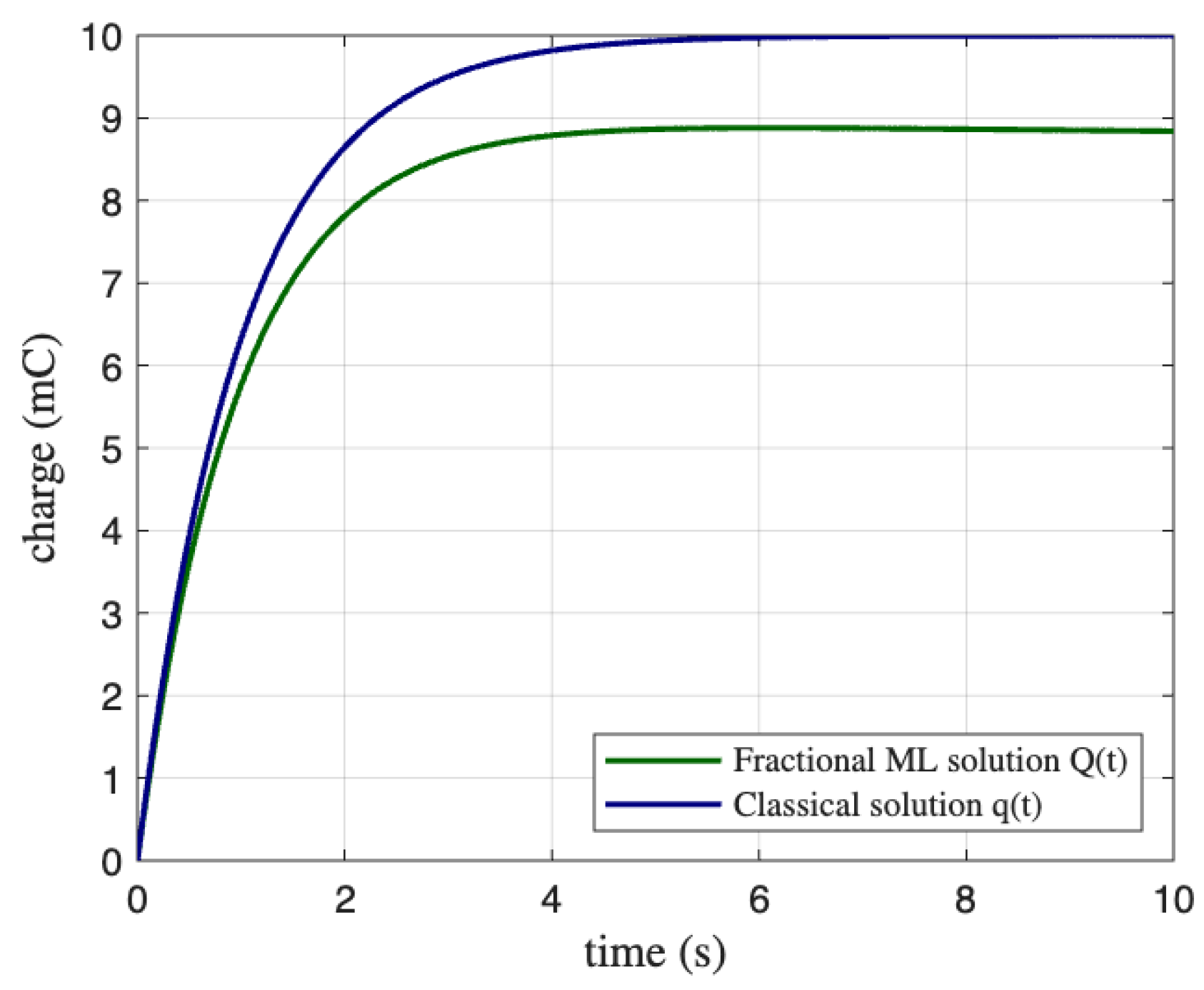
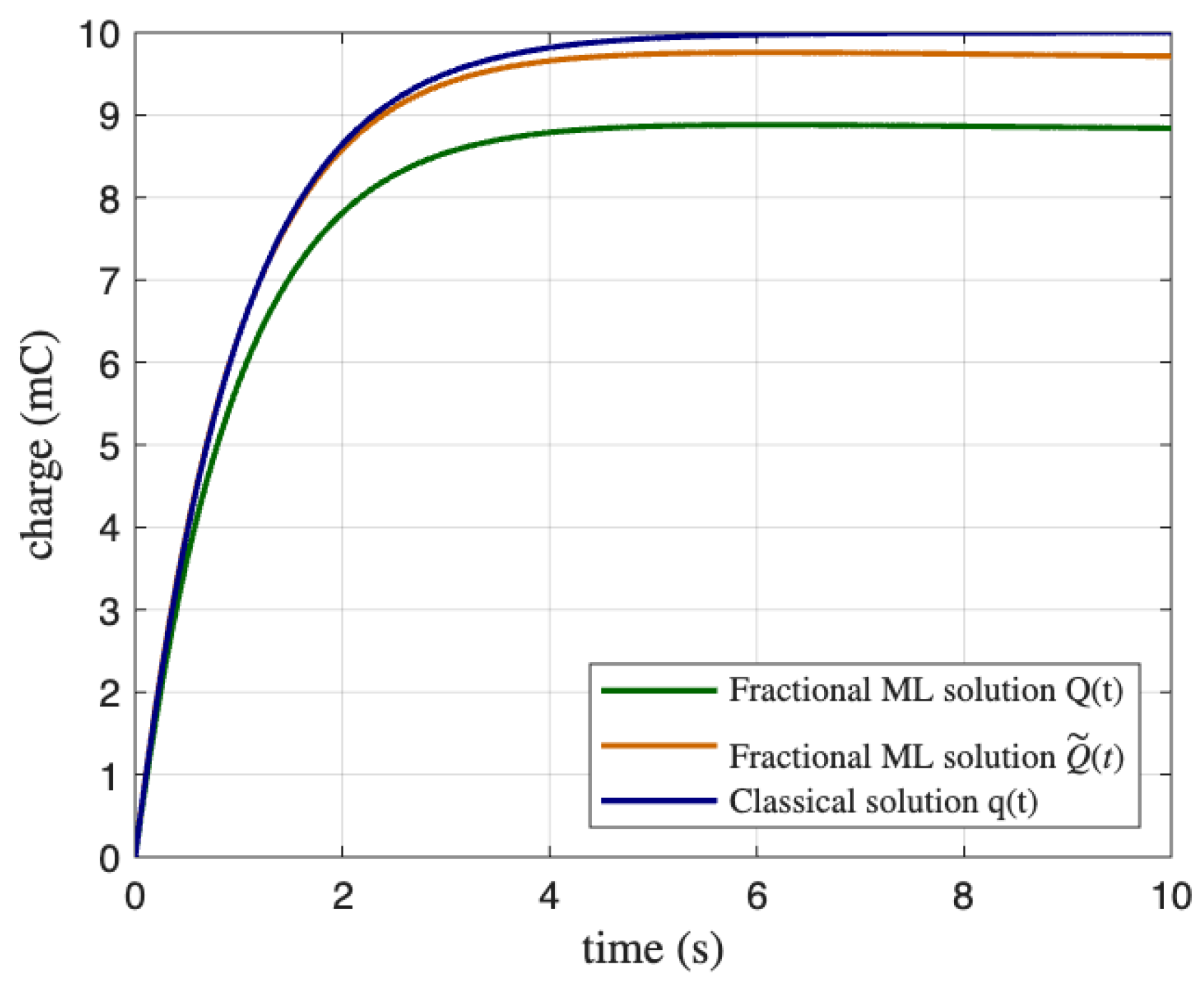
In this example, we consider three mathematical models for capacitor charging dynamics. The classical integer-order model serves as a baseline, derived from fundamental circuit theory. To more accurately capture the non-ideal behavior observed in physical systems, we introduce a modified model incorporating a fractional derivative term. This modification is motivated by the need to account for memory effects and distributed relaxation processes inherent in real dielectric materials.
The traditional capacitor charging model is given by
d q d t = i ( t ) ,
where q ( t ) represents the electric charge stored on the capacitor’s plates at time t in units of coulombs. For RC circuit charging, the current is defined as
i ( t ) = I 0 e t / τ c ,
where
  • I 0 = V source / R is the initial current determined by the source voltage and circuit resistance;
  • τ c = R C is the circuit time constant, where R represents the total series resistance in the charging path and C is the capacitance value.
The general solution for q ( t ) is given by
q ( t ) = q 0 + I 0 τ c 1 e t / τ c ,
where q 0 is the initial charge on the capacitor at time t = 0 .
We propose a generalized modified model through the introduction of a Caputo fractional derivative term:
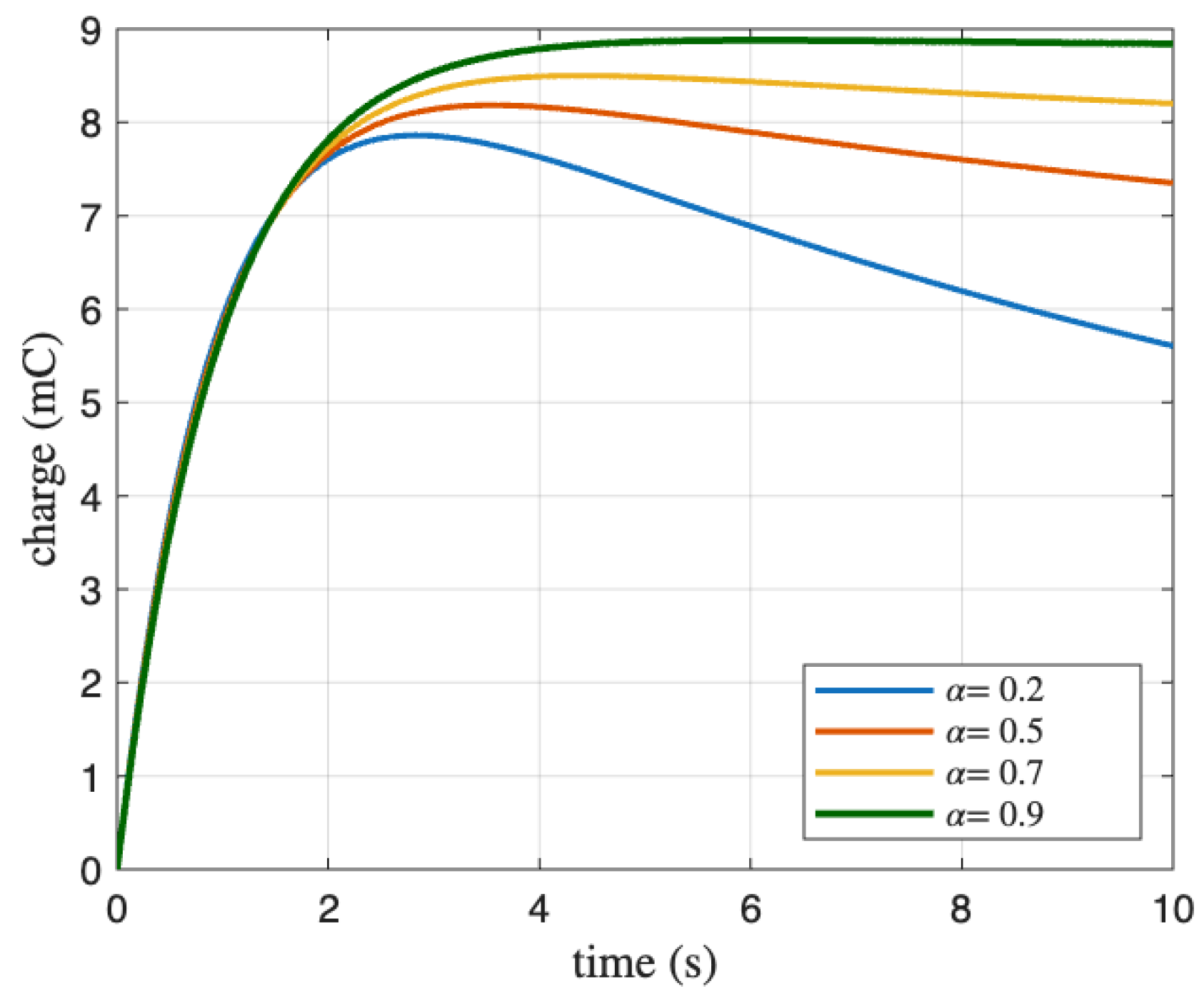
d Q d t + λ D 0 + α C Q ( t ) = i ( t )
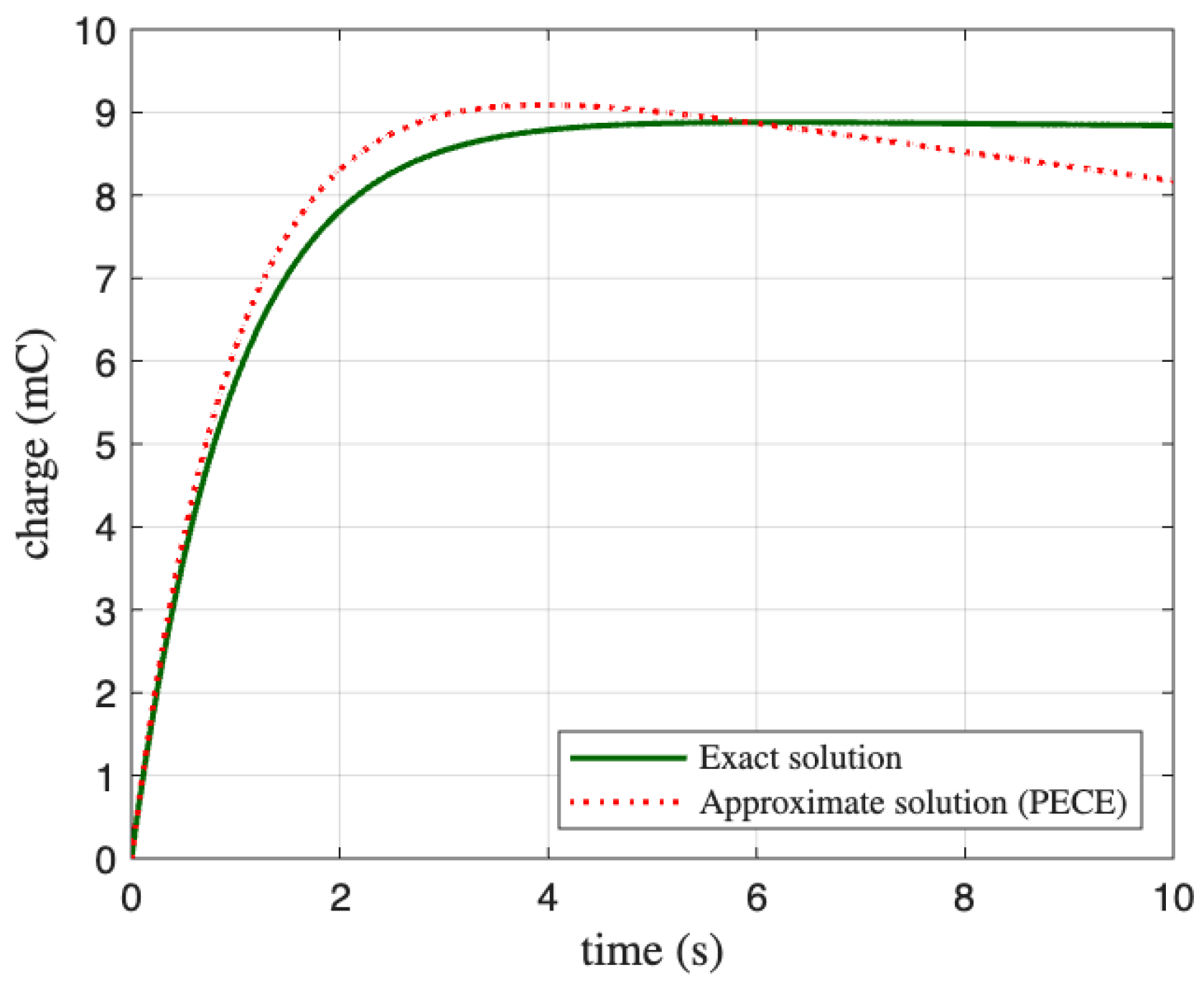
where α ( 0 , 1 ) is the fractional order and λ > 0 is the memory coefficient in units of t i m e 1 α for dimensional consistency. Using Theorem 14 with ψ ( t ) = t , β 1 (so that γ 1 ), a = 0 , and g ( t ) = i ( t ) from (40), we obtain the following:
Q ( t ) = Q ( 0 ) E 1 α , 1 λ t 1 α + λ I 0 + 0 ; ψ Q ( 0 + ) t γ α E 1 α , 2 α λ t 1 α + 0 t E 1 α , 1 λ ( t τ ) 1 α i ( τ ) d τ = q 0 E 1 α , 1 λ t 1 α + λ t 1 α E 1 α , 2 α λ t 1 α + 0 t E 1 α , 1 λ ( t τ ) 1 α i ( τ ) d τ ,
where Q ( 0 ) = I 0 + 0 ; ψ Q ( 0 + ) = q 0 . By computing Q ( t ) using (41) and applying the Mittag-Leffler function identity (39) for μ = 1 α > 0 and z = λ t 1 α , we obtain the general solution of (43) as follows:
Q ( t ) = q 0 + I 0 0 t E 1 α , 1 λ ( t τ ) 1 α e τ / τ c d τ .
Figure 1 presents a comparative analysis of capacitor charging dynamics using two distinct mathematical frameworks. The classical integer-order model (blue solid line), derived from ideal circuit theory, serves as the baseline reference. In contrast, the proposed fractional-order model (green solid line) incorporates memory effects through a Caputo fractional derivative term, providing a more generalized description of capacitor behavior. Both models simulate the capacitor charging process, starting from zero initial charge ( q 0 = 0 ). The driving current follows an exponential decay i ( t ) = I 0 e t / τ c with a time constant of τ c = 1 s, which is typical for signal processing circuits, and an initial current of I 0 = 10 mA, representing moderate excitation levels. For the fractional model, parameters of α = 0.9 and λ = 0.1 (in units of s e c o n d s 0.1 ) were selected to represent weak memory effects. A value of α close to 1 indicates near-ideal capacitor behavior, while the fractional framework maintains the capability to capture non-ideal characteristics observed in real dielectric materials.
Figure 2 compares the exact solutions Q ( t ) of the fractional differential model for different fractional orders α { 0.2 , 0.5 , 0.7 , 0.9 } , with parameters of I 0 = 10 , τ c = 1 , λ = 0.1 , and q 0 = 0 . The curves are obtained from the general solution given by the fractional integral formulation (44). The figure highlights the effect of α on the system dynamics: it can be observed that all curves vary with α and are not strictly increasing. All curves increase during the initial period, then decrease later, where smaller values of α lead to a more pronounced decrease in Q ( t ) . In particular, the green curve corresponding to α = 0.9 best captures the expected physical behavior of a charging capacitor and is therefore the most suitable choice for modeling in this case.
The analytical framework presented in this work also enables model selection through boundary value problems. For instance, if we consider a terminal condition of u ( 10 ) = 8.2 , the problem becomes a hybrid boundary-value problem. Solving this problem using our exact solution identifies the optimal fractional order that satisfies both the initial and terminal conditions. In this case, the yellow curve corresponding to α = 0.7 provides the best fit for the boundary value of u ( 10 ) = 8.2 , demonstrating how our method can be used for parameter estimation in inverse problems.
Figure 3 illustrates a comparison of the solutions of the fractional differential Equation (43) for α = 0.9 , λ = 0.1 , I 0 = 10 , τ c = 1 , and an initial condition of q 0 = 0 . The solutions are computed using two distinct approaches: the exact solution in the form of (44), which serves as a high-accuracy reference, and a numerical approximation of the Caputo fractional differential equation. For the numerical simulation, the predictor–corrector (PECE) method is implemented in MATLAB R2025a to generate the solution and validate the theoretical results. In the figure, the green solid line represents the exact solution, whereas the red dotted line corresponds to the numerical solution obtained via the Caputo formulation.
We propose another generalized modified model for (40) through the introduction of a generalized fractional derivative term:
Q ˜ [ 1 ] ( t ) + λ D 0 + α , β ; ψ H Q ˜ ( t ) = i ( t )
where Q ˜ [ 1 ] : = δ ψ Q ˜ , α ( 0 , 1 ) is the fractional order and λ > 0 is the memory coefficient in units of t i m e 1 α and i ( t ) , as defined in (41). Using Theorem 14 and taking ψ ( t ) = 1.1 t , β 1 (so that γ 1 ), a = 0 , and g ( t ) = i ( t ) from (40), we obtain the following:
Q ˜ ( t ) = q 0 + 1.1 I 0 0 t E 1 α , 1 λ ( 1.1 t 1.1 τ ) 1 α e τ / τ c d τ .
Figure 4 compares three responses: the Caputo fractional solution Q ( t ) from (44), the scaled fractional solution Q ˜ ( t ) from (46) (with an additional scaling factor of 1.1), and the classical exponential response q ( t ) . All curves use the same parameters of α = 0.9 , λ = 0.1 , I 0 = 10 , τ c = 1 , and an initial condition of q 0 = 0 . The fractional solution Q ( t ) reflects the influence of memory effects inherent in fractional-order dynamics but shows a noticeable deviation from the classical exponential solution. In contrast, the scaled fractional solution Q ˜ ( t ) aligns much more closely with the classical curve throughout the observed time period, demonstrating that Q ˜ ( t ) provides a better approximation of the classical response than Q ( t ) while still retaining the essential features of fractional behavior. Ultimately, the most appropriate model should be selected based on its correspondence to actual experimental data.
The behavior of the solutions in each model as t is analyzed below. For the solution of the fractional model (44), according to the final value theorem and convolution theorem (Theorem 6), we obtain
lim t Q ( t ) = lim s 0 s L ψ { Q ( t ) } ( s ) = lim s 0 s L ψ q 0 + I 0 0 t E 1 α , 1 λ ( t τ ) 1 α e τ / τ c d τ ( s ) = q 0 + I 0 lim s 0 s L ψ 0 t E 1 α , 1 λ ( t τ ) 1 α e τ / τ c d τ ( s ) = q 0 + I 0 lim s 0 s L ψ E 1 α , 1 λ t 1 α ψ e τ / τ c ( s ) = q 0 + I 0 lim s 0 s L ψ E 1 α , 1 λ t 1 α ( s ) · L ψ e τ / τ c ( s ) = q 0 + I 0 lim s 0 s 1 α s 1 α + λ 1 s + 1 τ c = q 0 ,
where ψ ( t ) = t . For the second generalized modified model (45) with ψ ( t ) = 1.1 t , a similar calculation yields the following:
lim t Q ˜ ( t ) = q 0 + 1.1 I 0 lim s 0 s 1 α s 1 α + 1 . 1 1 α λ 1 s + 1 τ c = q 0 .
The solution of the classical model (42) is expressed as follows:
lim t q ( t ) = lim t q 0 + I 0 τ c 1 e t / τ c = q 0 + I 0 τ c .
In the classical case, our analysis shows that the charge on the capacitor increases exponentially and asymptotically approaches a steady-state value ( q max q 0 + I 0 τ c ). Once reached, this charge remains constant indefinitely, reflecting an ideal capacitor’s perfect charge retention.
To more accurately represent the behavior of real-world energy storage devices like supercapacitors, we introduced a key modification by incorporating a fractional derivative term into the governing equation. This fractional-order model inherently accounts for the complex, distributed physics within porous electrodes, which integer-order models cannot capture.
The results from our modified model are striking and align perfectly with the theory of non-ideal capacitors:
  • Instead of reaching a permanent steady state, the charge on the capacitor peaks, then gradually decreases over time.
  • As time t approaches infinity, the charge decays back to its initial value of q 0 .
This behavior is a direct mathematical manifestation of the self-discharge phenomenon. The fractional derivative, characterized by its exponent α, intrinsically models the distribution of relaxation times and the memory effects present in supercapacitors. These effects arise from slow ion redistribution and parasitic reactions within the electrode’s complex pore structure, creating internal leakage paths.
Therefore, the simulation output from our fractional model does not merely show a numerical result; it validates the core physical principle that real electrochemical capacitors cannot maintain their charge indefinitely. The return of the charge to q 0 as t quantitatively demonstrates the non-ideal, self-discharging nature that fractional calculus is designed to capture.
Example 2.
In this example, we analyze the operation of a hydraulic door closer using a mass-damper system model. The door closer’s primary function is to ensure a door closes automatically while preventing it from slamming shut, providing controlled motion through velocity-dependent damping.
The physical system consists of the following:
  • The door itself, which possesses mass and inertia;
  • The hydraulic door closer mechanism, providing viscous damping;
  • The closing torque generated by an internal spring mechanism.
The dynamic behavior of the door’s angular velocity ω ( t ) during the closing operation is governed by the rotational form of Newton’s second law:
I d ω d t + c ω ( t ) = τ 0 H ( t ) ,
where
  • I represents the moment of inertia of the door about its hinges, characterizing the door’s resistance to angular acceleration;
  • c is the rotational damping coefficient of the hydraulic door closer, quantifying the viscous torque generated as hydraulic fluid flows through restricted passages within the mechanism;
  • ω ( t ) denotes the angular velocity of the door as a function of time during the closing process;
  • τ 0 is the constant torque applied by the internal spring mechanism of the door closer to initiate and maintain closing motion;
  • H ( t ) is the Heaviside unit step function, mathematically representing the instantaneous release of the door:
    H ( t ) = 0 for t < 0 ( door is held open ) , 1 for t 0 ( door is released and closing mechanism is active ) .
The left-hand side of Equation (47) represents the system’s internal torques: the inertial term I ω ( t ) characterizes the door’s resistance to angular acceleration, while the damping term c ω ( t ) captures the energy dissipation mechanism that prevents slamming. The right-hand side τ 0 H ( t ) models the external driving input, the sudden application of constant closing torque when the door is released.
The analytical solution to Equation (47), with the initial condition of ω ( 0 ) = 0 (the door has no initial motion) is given by
ω ( t ) = τ 0 c 1 e ( c / I ) t , t 0 .
This mathematical model explains the characteristic closing profile of a well-adjusted door: rapid initial movement followed by a controlled deceleration as the door approaches the latch. The damping coefficient c is crucial in determining the closing speed and final impact force, ensuring reliable latching while preventing damage to the door and frame.
This expression describes the transient angular velocity response of the door. The solution reveals two distinct phases of motion:
1. 
Initial Transient Phase ( t I / c ): Immediately after release, the exponential term dominates. The velocity increases nearly linearly ( ω ( t ) ( τ 0 / I ) t ) as the spring torque works to overcome the door’s inertia.
2. 
Final Steady-State Phase ( t I / c ): As time increases, the exponential term decays to zero. The angular velocity asymptotically approaches a constant terminal velocity:
ω terminal = τ 0 c .
This steady state represents the dynamic equilibrium where the constant spring torque τ 0 is perfectly balanced by the velocity-proportional damping torque c ω ( t ) .
The I / c parameter in the exponent has units of time and defines the characteristic timescale of the system. A larger moment of inertia I slows down the response, while a stronger damper (larger c) accelerates the approach to a steady state. This model successfully captures the essential behavior of a well-designed door closer: a smooth start that prevents jerking, followed by a controlled, constant closing speed that prevents slamming.
To generalize the classical model and capture a broader spectrum of viscoelastic damping behaviors, particularly those exhibiting memory effects and frequency-dependent properties, we reformulate the governing Equation (47) using fractional calculus. The generalized model is expressed as follows:
I ω [ 1 ] ( t ) + c D 0 + α , β ; ψ H ω ( t ) = τ 0 , t 0 ,
where ω [ 1 ] ( t ) : = δ ψ ω . In this formulation, the standard viscous damping term c ω ( t ) is replaced by c D 0 + α , β ; ψ H ω ( t ) , where D 0 + α , β ; ψ H denotes the ψ-Hilfer fractional derivative of order α ( 0 , 1 ) and type β [ 0 , 1 ) . The key physical implication of this generalization is the introduction of a non-local temporal dependence. Whereas the classical viscous damper c ω ( t ) is a purely instantaneous response, probing only the present velocity, the fractional derivative acts as a temporal probe, integrating the entire history of the velocity ω ( τ ) for τ [ 0 , t ] . This memory effect, or heredity, is a hallmark of complex viscoelastic materials, where the damping force at any moment is shaped by the system’s entire deformation history.
Under the parameter choices of α ( 0 , 1 ) , β [ 0 , 1 ) , a = 0 , λ = c / I , and g ( t ) = τ 0 and taking ψ ( t ) = t to ensure that first term remains a classical derivative, Theorem 14 yields the solution to the initial value problem (49) with ω ( 0 ) = 0 and I 0 + 1 γ ; ψ ω ( 0 + ) = d 0 :
ω ( t ) = c I d 0 t γ α E 1 α , γ α + 1 c I t 1 α + τ 0 I 0 t E 1 α , 1 c I ( t τ ) 1 α d τ , t 0 .
To illustrate the model with realistic parameters, consider a standard interior door with a mass of 20 kg and a width of 0.81 m. The moment of inertia about its hinges is calculated to be approximately I 4.4   kg · m 2 . A typical hydraulic door closer might provide a constant spring torque of τ 0 2.0   N · m and be calibrated with a damping coefficient of c 2.5   N · m · s / rad to achieve a controlled closing motion. Since the initial value of d 0 is arbitrary, we choose d 0 = 1 for simplicity.
The velocity–time graph in Figure 5 illustrates a critical comparison between the dynamics of a system modeled by (47) and those described by (49). The primary distinction lies in the system’s long-term behavior. The classical model (dark blue line) given by (48) shows the characteristic response of a first-order system: the velocity rapidly increases from zero and asymptotically approaches a fixed steady-state (terminal) velocity of approximately 0.8 rad / s . This saturation indicates that the driving force τ 0 is perfectly balanced by the linear viscous damping c ω , representing a system with no memory or history dependence beyond the instantaneous velocity.
In stark contrast, the fractional model given by (50) introduces a long-term memory effect, causing the system’s response to deviate significantly from the classical saturation behavior. For this case, we choose a fractional order of α = 0.1 to ensure the damping term exhibits strong non-classical behavior, and we vary the type of the fractional derivative with β { 0.5 , 0.7 , 0.9 } to study its influence. We observe that with β = 0.5 , the solution most closely approximates the behavior of the classical system. Ultimately, the selection of optimal parameters depends on actual experimental values.

3.4. Practical Implementation Guidelines for the ψ -Hilfer Fractional Model Framework

While the ψ -Hilfer fractional calculus framework offers significant theoretical advantages, its mathematical sophistication may present challenges for practitioners in applied fields. This section addresses this concern by providing clear, actionable guidelines on when and why to choose this approach over conventional methods.
  • Function Space: The solution u ( t ) belongs to the weighted space C δ ψ , γ 1 [ a , b ] , which is a broader space than C 1 [ a , b ] (the solution space for classical differential equations). This extended space accommodates functions with specific singularities in their rate of change, common in viscoelastic materials, anomalous transport, and biological systems.
  • Model Formulation: A key application of our framework is extending classical first-order ordinary differential equation models to incorporate memory effects. When encountering a classical model in the form of u ( t ) + λ u ( t ) = g ( t ) , practitioners can systematically extend it to a hybrid fractional model consisting of a δ ψ derivative and a ψ -Hilfer fractional derivative, yielding u [ 1 ] ( t ) + λ ( D a + α , β ; ψ H u ) ( t ) = g ( t ) . If the first term must be the classical first-order derivative, then we choose ψ ( t ) = t (see Examples 1 and 2). Even in cases where the second term is absent in the original model, introducing a fractional term with a small coefficient λ can capture previously unmodeled memory effects and provide insights into the system’s intrinsic time scaling through appropriate choices of ψ ( t ) , α , and β (see Example 1).
  • Parameter Selection: The strictly increasing function ( ψ ( t ) ) determines the fundamental structure of the fractional derivative through the kernel expressed as ψ ( τ ) ( ψ ( t ) ψ ( τ ) ) α ˜ 1 , α ˜ ( 0 , 1 ) . Recommended choices include the following:
    • ψ ( t ) = t : Classical case for systems with uniform memory decay; recovers traditional fractional derivatives;
    • ψ ( t ) = ln t : Suitable for systems with logarithmic scaling (geological processes and economic systems);
    • ψ ( t ) = t ρ : For nonlinear memory effects and anomalous diffusion (viscoelastic materials and turbulent transport);
    • ψ ( t ) = e t : Recommended for exponential growth/decay systems (population dynamics and chemical kinetics)
    The order α ( 0 , 1 ) controls memory strength and system dynamics:
    • α 0 : Extremely strong, long-range memory with a kernel of 1 / ( ψ ( t ) ψ ( τ ) ) ;
    • α 1 : Weak memory, approximating classical ordinary derivatives;
    • Intermediate values (0.5–0.8): Model viscoelastic damping and anomalous transport;
    • Complex α : Simultaneously captures damping (real part) and logarithmic oscillations (imaginary part).
    The β [ 0 , 1 ) parameter interpolates between physical interpretations:
    • β = 0 (Riemann–Liouville type): For zero initial conditions or boundary value problems;
    • β 1 (Caputo type): Preferred when physical initial conditions are available;
    • 0 < β < 1 (Hilfer type): Offers flexibility for intermediate cases and multi-scale phenomena.
    Parameter sensitivity varies significantly:
    • High sensitivity to α : Small changes ( Δ α 0.1 ) substantially alter system dynamics;
    • Moderate sensitivity to ψ ( t ) : Strongest in systems with nonlinear memory effects;
    • Low sensitivity to β : Choice often dictated by initial condition availability rather than sensitivity.
    We recommend a systematic selection approach:
    (a)
    Data-driven estimation of α via experimental fitting;
    (b)
    Physical reasoning for ψ ( t ) selection based on system symmetries;
    (c)
    Initial condition analysis for β determination;
    (d)
    Model validation through sensitivity analysis and experimental verification.
    This structured approach ensures physically meaningful parameter selection while maintaining mathematical rigor in ψ -Hilfer fractional modeling.

4. Discussion

This work establishes a robust analytical framework by extending the generalized Laplace transform to the weighted space C δ ψ , γ 1 [ a , b ] . The primary significance of this generalization is twofold: it provides the flexibility to handle a broader class of functions, particularly those with singularities at the first derivative, and it unveils novel structural properties of solutions to ψ -Hilfer fractional differential equations.
The motivation for employing C δ ψ , γ 1 [ a , b ] stems from its capacity to accommodate a broader class of functions compared to the conventional space C 1 [ a , b ] . Unlike the classical case, which requires the first derivative, itself, to be continuous, our chosen space only necessitates the continuity of a weighted form of the first derivative, i.e., δ ψ . This means our solutions can capture physical behaviors with singular initial fluxes or nonlinear time scaling that would be inadmissible in classical solution spaces, thereby providing a more comprehensive and physically realistic modeling capability and providing more chance to model complex real-world phenomena.
A key finding from the comparative analysis is the significant divergence of the numerical approximation from the exact solution obtained via our method. This discrepancy, observed as a considerable accumulation of error, highlights a critical limitation of purely numerical schemes for this class of problems. Consequently, the exact solution provided by our method serves not only as a benchmark for validating numerical algorithms but also as the only reliable result for applications requiring high precision.
The applicability of the proposed method is notably extensive. It provides a unified framework for problems governed by a single fractional operator: those involving sequential or mixed derivatives and hybrid systems. Importantly, the framework is not limited to initial value problems but can be naturally extended to boundary value conditions, significantly widening its scope. This positions our results as a substantial generalization of previous Laplace transform techniques.
Finally, the established transform provides a foundational tool for future theoretical investigations. By facilitating the derivation of an equivalent Volterra integral equation within space C δ ψ , γ 1 [ a , b ] , it paves the way for the construction of a fixed-point operator. Such an operator is essential for a rigorous study of well-posedness encompassing existence, uniqueness, and continuous dependence on initial data for a wider class of fractional problems than previously accessible. Future research directions may include extensions to the weighted space C δ ψ , γ n [ a , b ] .

5. Conclusions

This paper has established a comprehensive framework for solving hybrid fractional differential equations that combine integer-order δ ψ derivatives with ψ -Hilfer fractional operators. We have developed the theory of the generalized Laplace transform within the weighted space C δ ψ , γ 1 [ a , b ] , overcoming fundamental limitations of existing methods that fail to handle such mixed operator structures. Our main contributions include establishing the fundamental properties of this transform, deriving generalized Laplace transforms for ψ -Hilfer, ψ -Riemann–Liouville, and ψ -Caputo operators, and obtaining exact analytical solutions for hybrid fractional Cauchy problems in terms of multivariate Mittag-Leffler functions.
The significance of our work lies in both its theoretical and practical implications Theoretically, we have bridged a critical gap in fractional calculus by providing a unified solution framework that generalizes existing results for specific derivative types. Practically, our method provides essential analytical benchmarks for validating numerical schemes and offers applied researchers a systematic approach to model complex systems with hybrid dynamics, as demonstrated through the capacitor charging example and the hydraulic door-closer system based on a mass-damper model.
In conclusion, the generalized Laplace transform methodology developed herein provides a powerful and unified approach for analyzing hybrid fractional dynamical systems. This transform can solve a wide range of problems, including those with a single fractional operator, as well as systems involving sequential or combined derivatives of varying orders, thereby opening new avenues for both theoretical advances and practical applications in the modeling of complex systems with memory.

Author Contributions

Conceptualization, J.S. and E.T.; methodology, J.S. and E.T.; validation, J.S., E.T., and S.K.N.; formal analysis, J.S., S.C., and E.T.; investigation, J.S. and E.T.; writing—original draft preparation, E.T. and S.C.; writing—review and editing, E.T. and S.K.N.; Software, J.S., S.C., and E.T.; supervision, E.T.; project administration, E.T.; funding acquisition, E.T. All authors have read and agreed to the published version of the manuscript.

Funding

The research was financially supported by Naresuan University, Thailand, under Grant No. R2568E070.

Data Availability Statement

The data are contained within the article.

Conflicts of Interest

The authors declare no conflicts of interest.

References

  1. Kilbas, A.A.; Srivastava, H.M.; Trujillo, J.J. Theory and Applications of Fractional Differential Equations; North-Holland Mathematics Studies; Elsevier: Amsterdam, The Netherlands, 2006. [Google Scholar]
  2. Podlubny, I. Fractional Differential Equations; Academic Press: New York, NY, USA, 1999. [Google Scholar]
  3. Samko, S.G.; Kilbas, A.A.; Marichev, O.I. Fractional Integrals and Derivatives; Gordon and Breach Science Publishers: Yverdon, Switzerland, 1993. [Google Scholar]
  4. Atanacković, T.M.; Pilipović, S.; Stanković, B.; Zorica, D. Fractional Calculus with Applications in Mechanics: Vibrations and Diffusion Processes; John Wiley & Sons, Inc.: Hoboken, NJ, USA, 2014. [Google Scholar]
  5. Torvik, P.J.; Bagley, R.L. On the Appearance of the Fractional Derivative in the Behavior of Real Materials. J. Appl. Mech. 1984, 51, 294–298. [Google Scholar] [CrossRef]
  6. Mainardi, F.; Pironi, P.; Tampieri, F. On a Generalization of the Basset Problem via Fractional Calculus. In Proceedings of the Canadian Congress of Applied Mechanics, Edmonton, AB, Canada, 29 May–2 June 1995; pp. 836–837. [Google Scholar]
  7. Díaz, M.V. The Basset Force and the Persistence of Hydrodynamic Memory. CQD-Rev. EletrôNica Paul. Mat. 2022, 22, 211–219. [Google Scholar] [CrossRef]
  8. Ortigueira, M.D.; Martynyuk, V.; Kosenkov, V.; Batista, A.G. A New Look at the Capacitor Theory. Fractal Fract. 2023, 7, 86. [Google Scholar] [CrossRef]
  9. Allagui, A.; Zhang, D.; Elwakil, A. Further Experimental Evidence of the Dead Matter Has Memory Conjecture in Capacitive Devices. IEEE Trans. Circuits Syst. II Express Briefs 2023, 70, 3144–3148. [Google Scholar] [CrossRef]
  10. Sousa, J.V.C.; Oliveira, E.C. On the Ψ-Hilfer Fractional Derivative. Commun. Nonlinear Sci. Numer. Simul. 2018, 60, 72–91. [Google Scholar] [CrossRef]
  11. Norouzi, F.; N’Guérékata, G.M. A Study of ψ-Hilfer Fractional Differential System with Application in Financial Crisis. Chaos Solitons Fractals X 2021, 6, 100056. [Google Scholar] [CrossRef]
  12. Abdeljawad, T.; Sher, M.; Shah, K.; Sarwar, M.; Amacha, I.; Alqudah, M.; Al-Jaser, A. Analysis of a Class of Fractal Hybrid Fractional Differential Equation with Application to a Biological Model. Sci. Rep. 2024, 14, 18937. [Google Scholar] [CrossRef] [PubMed]
  13. Jarad, F.; Abdeljawad, T. A Modified Laplace Transform for Certain Generalized Fractional Operators. Res. Nonlinear Anal. 2018, 1, 88–98. [Google Scholar]
  14. Jarad, F.; Abdeljawad, T. Generalized Fractional Derivatives and Laplace Transform. Discrete Contin. Dyn. Syst. Ser. S 2020, 13, 709–722. [Google Scholar] [CrossRef]
  15. El-Khatib, M.S.; Salim, T.O.; Hany, A.A. On Katugampola Laplace Transform. Gen. Lett. Math. 2020, 9, 93–100. [Google Scholar] [CrossRef]
  16. Agarwal, G.; Gaur, A.; Nisar, K.S.; Abusufian, A.H. On Some Properties of β-Laplace Integral Transform. J. Math. Comput. Sci. 2020, 23, 315–320. [Google Scholar] [CrossRef]
  17. Medved’, M.; Pospíšil, M. Generalized Laplace Transform and Tempered ψ-Caputo Fractional Derivative. Math. Model. Anal. 2023, 28, 146–162. [Google Scholar] [CrossRef]
  18. Alsulami, M.; Al-Mazmumy, M.; Alyami, M.A.; Alsulami, A.S. Generalized Laplace Transform with Adomian Decomposition Method for Solving Fractional Differential Equations Involving ψ-Caputo Derivative. Mathematics 2024, 12, 3499. [Google Scholar] [CrossRef]
  19. Hedrih, K.R.; Milovanović, G.V. Elements of Mathematical Phenomenology and Analogies of Electrical and Mechanical Oscillators of the Fractional Type with Finite Number of Degrees of Freedom of Oscillations: Linear and Nonlinear Modes. Commun. Anal. Mech. 2024, 16, 738–785. [Google Scholar] [CrossRef]
  20. Hedrih, K.R. Rheologic Fractional Oscillators or Creepers. Fractal Fract. 2025, 9, 552. [Google Scholar] [CrossRef]
  21. Sugumaran, H.; Ibrahim, R.; Kanagarajan, K. On ψ-Hilfer Fractional Differential Equation with Complex Order. Universal J. Math. Appl. 2018, 1, 33–38. [Google Scholar] [CrossRef]
  22. Dai, Q.; Gao, R.; Li, Z.; Wang, C. Stability of Ulam-Hyers and Ulam-Hyers-Rassias for a Class of Fractional Differential Equations. Adv. Differ. Equ. 2020, 2020, 134. [Google Scholar] [CrossRef]
Figure 1. Comparison of capacitor charging dynamics between the solution of the classical capacitor equation q ( t ) and the solution of the proposed fractional capacitor model Q ( t ) .
Fractalfract 09 00751 g001
Figure 2. Parameter sensitivity analysis of fractional capacitor charging dynamics for varying fractional orders α [ 0.2 , 0.5 , 0.7 , 0.9 ] .
Fractalfract 09 00751 g002
Figure 3. Comparison of the fractional integral solution (green solid line) and the Caputo FDE solution using the PECE method (red dotted line) for α = 0.9 .
Fractalfract 09 00751 g003
Figure 4. Comparison of capacitor charging curves. The green curve Q ( t ) shows the Caputo fractional-order model with ψ ( t ) = t , the orange curve Q ˜ ( t ) represents the scaled fractional-order model with ψ ( t ) = 1.1 t , and the purple curve q ( t ) is the classical exponential response.
Fractalfract 09 00751 g004
Figure 5. Velocity response comparison between the classical integer-order model and fractional-order models with α = 0.1 an different β values, showing the influence of fractional parameters on the system’s dynamic behavior.
Fractalfract 09 00751 g005
Disclaimer/Publisher’s Note: The statements, opinions and data contained in all publications are solely those of the individual author(s) and contributor(s) and not of MDPI and/or the editor(s). MDPI and/or the editor(s) disclaim responsibility for any injury to people or property resulting from any ideas, methods, instructions or products referred to in the content.