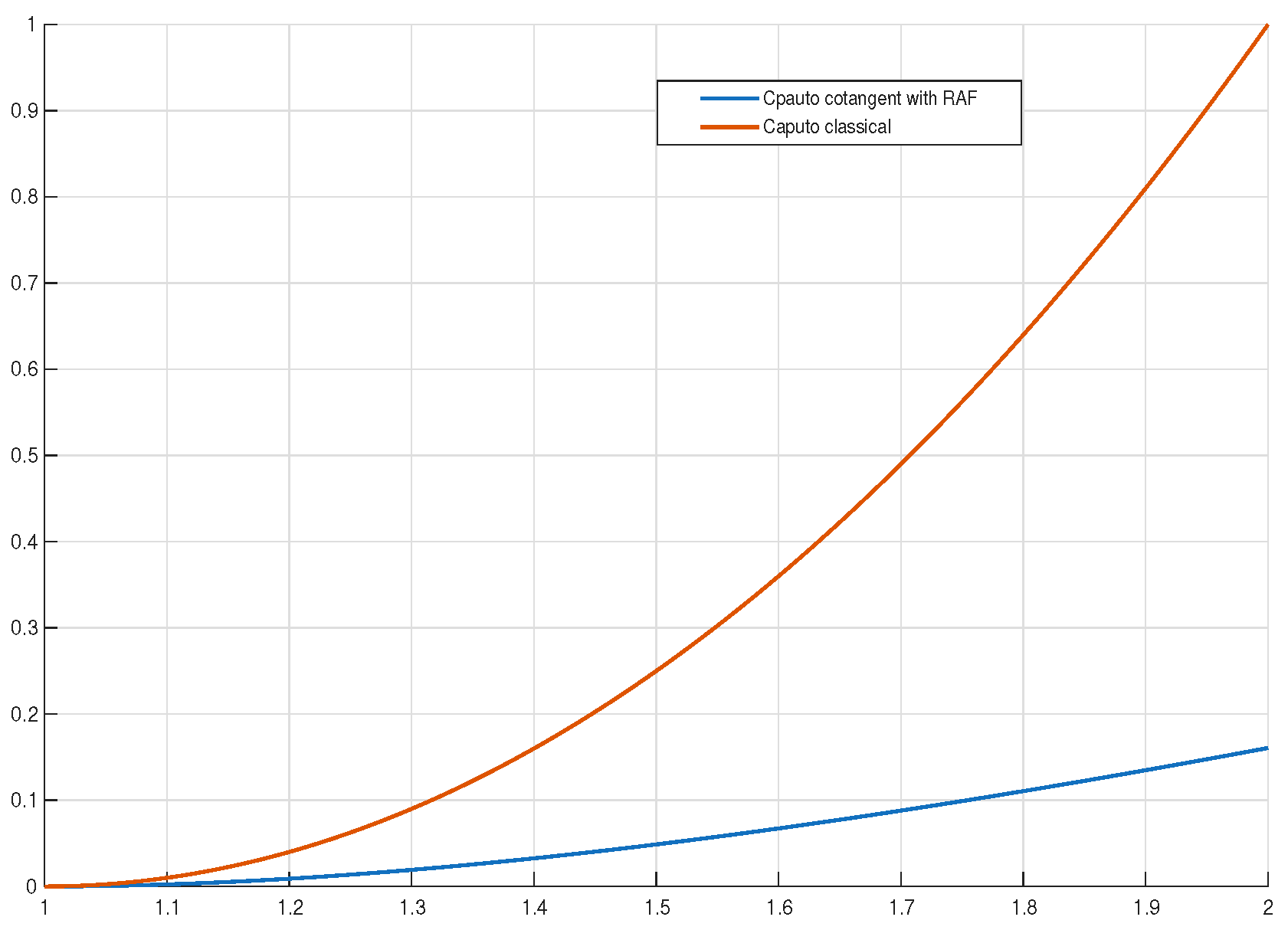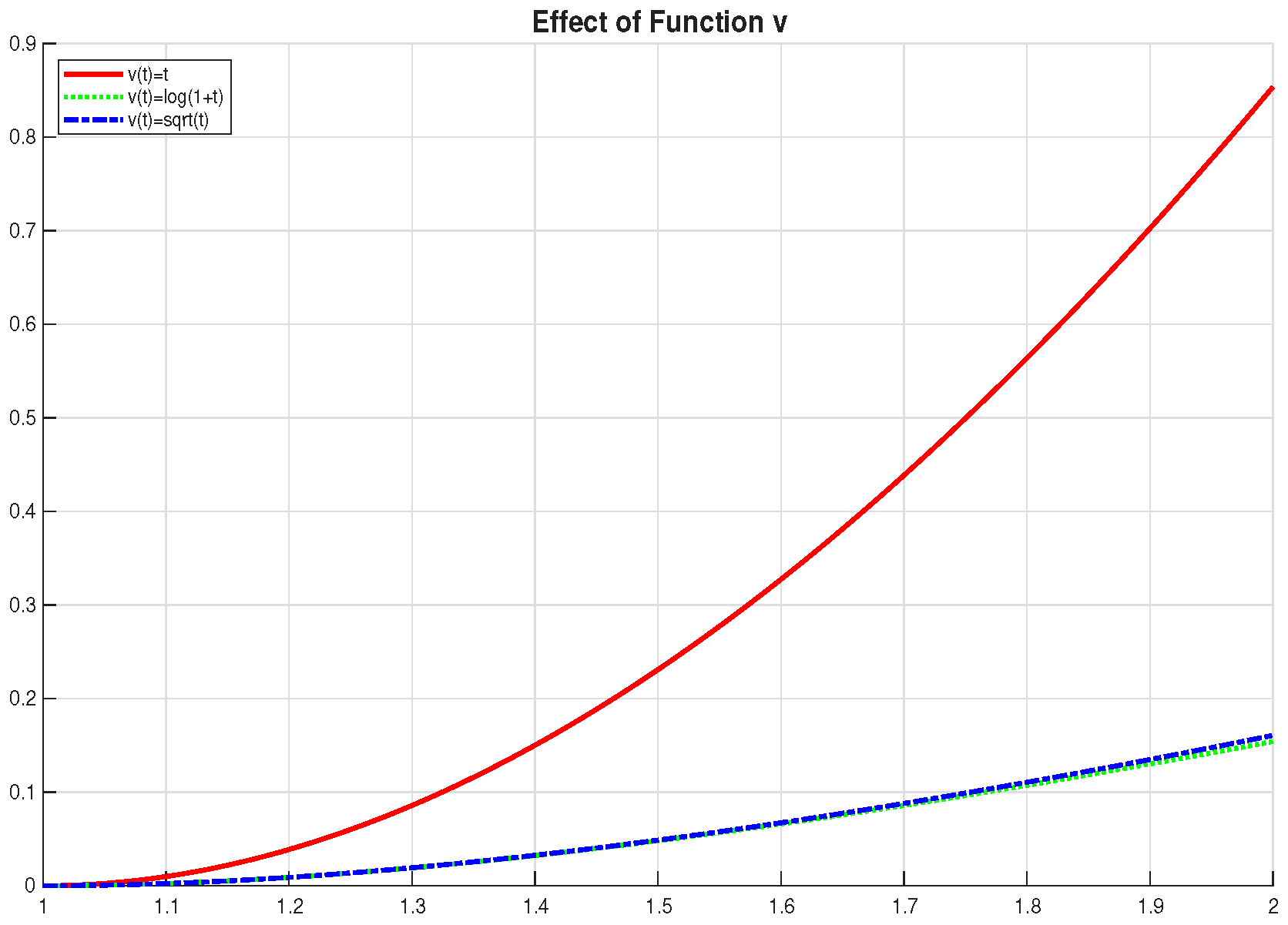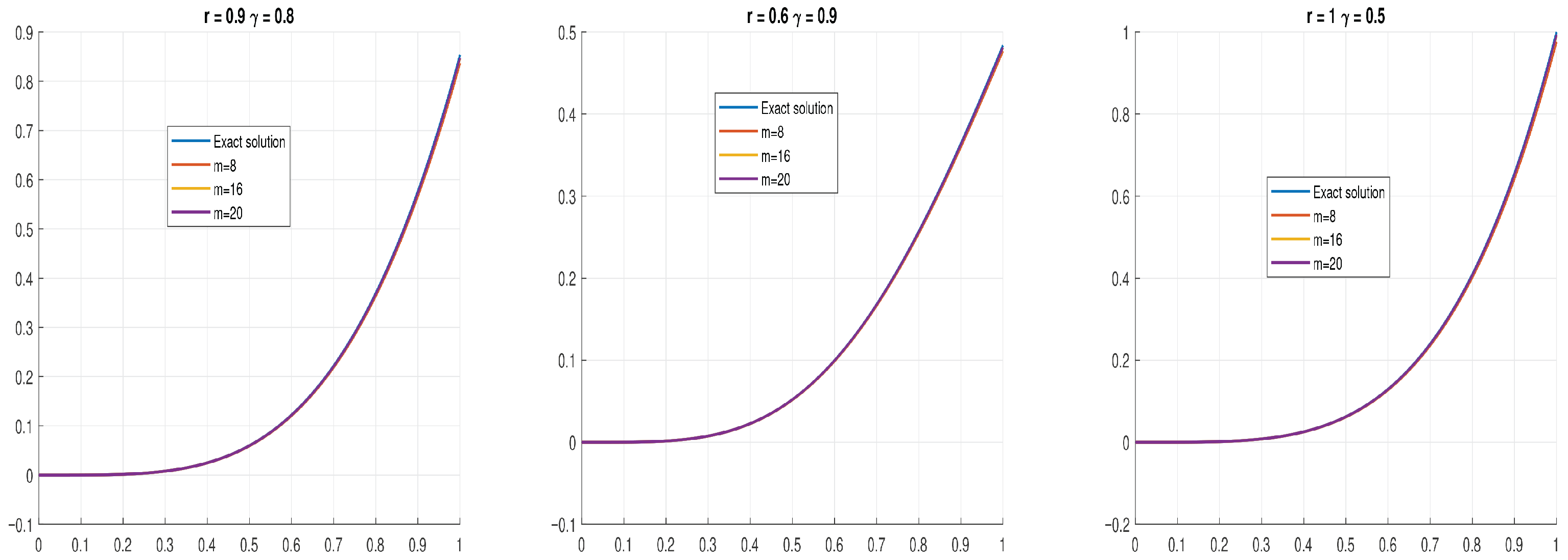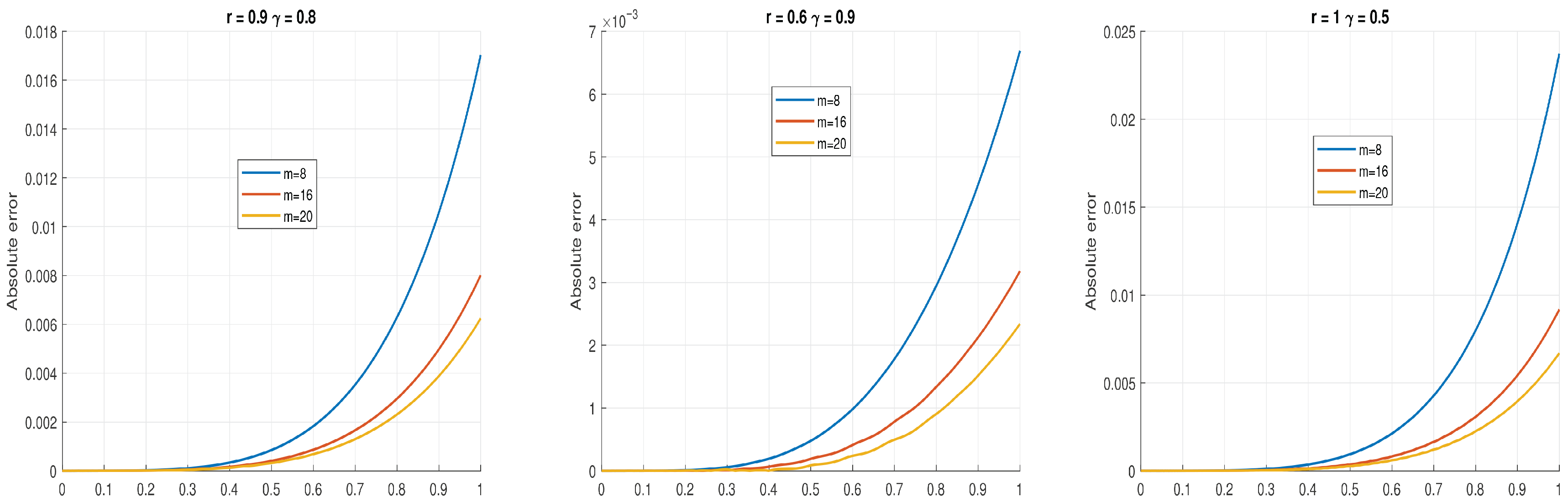

The Cotangent Derivative with Respect to Another Function: Theory, Methods and Applications



Abstract
1. Introduction
2. Preliminaries
2.1. The Traditional Fractional Operators and Their Generalized Expressions
2.2. The Cotangent Derivatives and Their Integrals
2.3. Two-Scale Fractal Derivative and Its Properties
- Key Properties:
- -
- Linearity: .
- -
- Scaling Behavior: .
- -
- Compatibility: Relation to Riemann–Liouville and Caputo derivatives.
3. The Cotangent Derivatives with RAF
- 1.
- .
- 2.
- .
- 3.
- .
- 4.
- .
- 1.
- We haveand, making the change in variable , we getBy utilizing the Beta function, denoted as , and the relationship , we can conclude that
- 2.
- In a similar manner to 1, we can apply the same approach.
- 3.
- Consider . Using Lemma 1, we have
- 4.
- Similar to 3.
4. The -Laplace Transform
- Step-by-step derivation of transform formulas.
- Comparison of convergence properties.
- Specific advantages for singular problems.
- 1.
- .
- 2.
- .
- 3.
- .
- 4.
- 5.
- 6.
- .
- Using Corollary 2 we get
- Corollary 2 is valid for any real r.
5. The Caputo Cotangent Derivative with RAF
- 1.
- .
- 2.
- .
- Let ; then .
- implies that .
6. Numerical Approach
7. Numerical Examples
8. Physical Interpretation and Real-World Applications
8.1. Physical Interpretation of the Cotangent Kernel
- Memory Effects: The exponential decay term represents fading memory, where recent events ( close to ℓ) have a stronger influence than distant past events. This is particularly relevant in viscoelastic materials where stress depends on the entire deformation history.
- Damped Oscillatory Behavior: The cotangent function introduces oscillatory characteristics when , modeling systems with both damping and oscillation, such as vibrating structures with energy dissipation.
- Time Scaling: The function serves as an internal time or process variable, allowing the derivative to adapt to different temporal scales or material heterogeneities.
8.2. Applications in Viscoelastic Materials
- Temperature-dependent time scaling: , where accounts for temperature effects on relaxation times.
- Non-uniform aging: , modeling accelerated/decelerated material aging.
8.3. Anomalous Diffusion Processes
- Heterogeneous media: , where is the walk dimension in fractal media.
- Time-dependent diffusivity: for spatially/temporally varying diffusion coefficients.
8.4. Biological Systems and Growth Models
- Metabolic time: for biological processes operating on logarithmic time scales.
- Environmental factors: incorporating multiple environmental variables.
- Developmental stages: Piecewise functions modeling different growth phases (embryonic, juvenile, adult).
8.5. Memory-Dependent Processes
- Economics: Market memory effects in financial time series.
- Psychology: Learning processes where past experiences influence current behavior.
- Climate science: Long-memory processes in temperature and precipitation records.
8.6. Engineering Applications
- Control Systems: Fractional-order controllers with adapting to operating conditions.
- Signal Processing: Analysis of signals with time-varying frequency content using appropriate .
- Material Science: Modeling complex material responses under varying environmental conditions.
8.7. Advantages over Classical Fractional Operators
- Flexibility: The function provides adaptability to various physical scenarios.
- Physical interpretability: The exponential-cotangent kernel has clear physical meaning.
- Mathematical consistency: Preservation of semigroup properties ensures physical predictability.
- Computational efficiency: The Laplace transform approach enables analytical solutions.
9. Comprehensive Comparison with Modern Fractional Operators
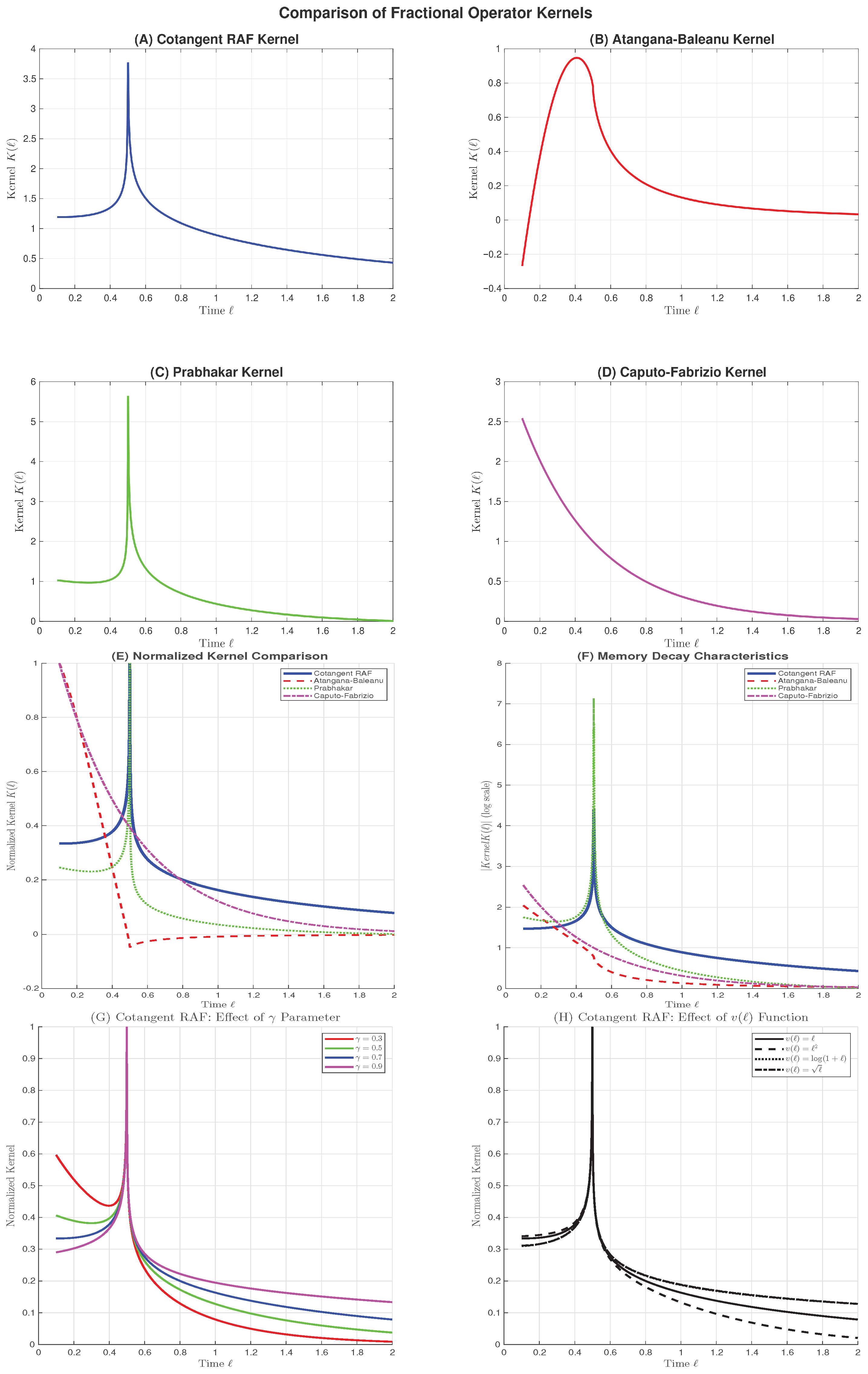
- Interpretation of Results
- The Cotangent RAF operator demonstrates the highest memory strength (integral = 1.7940) and unique oscillatory capabilities, making it ideal for systems combining memory effects with periodic behavior.
- The Atangana–Baleanu operator, while having the lowest kernel integral (0.4560), excels in modeling systems with strong long-range memory dependencies, particularly those exhibiting power-law decay.
- The Prabhakar operator offers intermediate memory strength (1.1011) with exceptional flexibility through its multiple parameters, suitable for complex multi-scale phenomena.
- The Caputo–Fabrizio operator provides a balanced approach with good memory strength (1.0769) and computational efficiency, ideal for standard applications where complex memory patterns are not required.
10. Conclusions
Author Contributions
Funding
Data Availability Statement
Acknowledgments
Conflicts of Interest
References
- Hilfer, R. (Ed.) Applications of Fractional Calculus in Physics; World Scientific: Singapore, 2000. [Google Scholar]
- Debnath, L. Recent applications of fractional calculus to science and engineering. Int. J. Math. Math. Sci. 2003, 2003, 3413–3442. [Google Scholar] [CrossRef]
- Magin, R.L. Fractional Calculus in Bioengineering; Begell House Publishers: Danbury, CT, USA, 2006. [Google Scholar]
- Rihan, F.A.; Al-Mdallal, Q.M.; Alsakaji, H.J.; Hashish, A. A fractional-order epidemic model with time-delay and nonlinear incidence rate. Chaos Soliton Fractals 2019, 126, 97–105. [Google Scholar] [CrossRef]
- Kilbas, A.A. Hadamard-type fractional calculus. J. Korean Math. Soc. 2001, 38, 1191–1204. [Google Scholar]
- Jarad, F.; Ugurlu, E.; Abdeljawad, T.; Baleanu, D. On a new class of fractional operators. Adv. Differ. Equ. 2017, 2017, 247. [Google Scholar] [CrossRef]
- Katugampola, U.N. New approach to a generalized fractional integral. Appl. Math. Comput. 2011, 218, 860–865. [Google Scholar] [CrossRef]
- Jarad, F.; Abdeljawad, T.; Baleanu, D. On the generalized fractional derivatives and their Caputo modification. J. Nonlinear Sci. Appl. 2017, 10, 2607–2619. [Google Scholar] [CrossRef]
- Samko, S.G.; Kilbas, A.A.; Marichev, O.I. Fractional Integrals and Derivatives: Theory and Applications; Gordon and Breach: Yverdon, Switzerland, 1993. [Google Scholar]
- Kilbas, A.A.; Srivastava, H.M.; Trujillo, J.J. Theory and Applications of Fractional Differential Equations; Elsevier: Amsterdam, The Netherlands, 2006; Volume 204. [Google Scholar]
- Jarad, F.; Abdeljawad, T. Generalized fractional derivatives and Laplace transform. Discret. Contin. Dyn. Syst. 2020, 13, 709–722. [Google Scholar] [CrossRef]
- Caputo, M.; Fabrizio, M. A new defnition of fractional derivative without singular kernel. Prog. Fract. Differ. Appl. 2015, 1, 73–85. [Google Scholar]
- Abdeljawad, T.; Baleanu, D. On fractional derivatives with exponential kernel and their discrete versions. Rep. Math. Phys. 2017, 80, 11–27. [Google Scholar] [CrossRef]
- Atangana, A.; Baleanu, D. New fractional derivative with non-local and non-singular kernel. Therm. Sci. 2016, 20, 757–763. [Google Scholar] [CrossRef]
- Abdeljawad, T.; Baleanu, D. Integration by parts and its applications of a new nonlocal fractional derivative with Mittag-Leffler nonsingular kernel. J. Nonlinear Sci. Appl. 2017, 10, 1098–1107. [Google Scholar] [CrossRef]
- Khan, H.; Jarad, F.; Abdeljawad, T.; Khan, A. A singular ABC-fractional diferential equation with p-Laplacian operator. Chaos Soliton Fractals 2019, 129, 56–61. [Google Scholar] [CrossRef]
- Khalil, R.; Al Horani, M.; Yousef, A.; Sababheh, M. A new definition of fractional derivative. J. Comput. Appl. Math. 2014, 264, 65–70. [Google Scholar] [CrossRef]
- Abdeljawad, T. On conformable fractional calculus. J. Comput. Appl. Math. 2015, 279, 57–66. [Google Scholar] [CrossRef]
- Anderson, D.R.; Ulness, D.J. Newly defined conformable derivatives. Adv. Dyn. Sys. Appl. 2015, 10, 109–137. [Google Scholar]
- Anderson, D.R. Second-order self-adjoint differential equations using a proportional-derivative controller. Commun. Appl. Nonlinear Anal. 2017, 24, 17–48. [Google Scholar]
- Sadek, L. A Cotangent Fractional Derivative with the Application. Fractal Fract. 2023, 7, 444. [Google Scholar] [CrossRef]
- Sadek, L.; Akgül, A.; Alaoui, H.T. A New Fractal Derivative and Its Properties. 2025. Available online: https://www.naturalspublishing.com/Article.asp?ArtcID=31120 (accessed on 8 October 2025).
- Sadek, L.; Bataineh, A.S.; Sadek, E.M.; Hashim, I. A general definition of the fractal derivative: Theory and applications. AIMS Math. 2025, 10, 15390–15409. [Google Scholar] [CrossRef]
- Jarad, F.; Alqudah, M.A.; Abdeljawad, T. On more general forms of proportional fractional operators. Open Math. 2020, 18, 167–176. [Google Scholar] [CrossRef]
- Sadek, L. Stability of conformable linear infinite-dimensional systems. Int. J. Dyn. Control 2022, 11, 1276–1284. [Google Scholar] [CrossRef]
- Zhao, W.; Gunzburger, M. Stochastic Collocation Method for Stochastic Optimal Boundary Control of the Navier-Stokes Equations. Appl. Math. Optim. 2023, 87, 6. [Google Scholar] [CrossRef]
- Oqielat, M.A.N.; Eriqat, T.; Al-Zhour, Z.; Ogilat, O.; El-Ajou, A.; Hashim, I. Construction of fractional series solutions to nonlinear fractional reaction-diffusion for bacteria growth model via Laplace residual power series method. Int. J. Dyn. Control 2023, 11, 520–527. [Google Scholar] [CrossRef]
- Shah, K.; Alqudah, M.A.; Jarad, F.; Abdeljawad, T. Semi-analytical study of Pine Wilt Disease model with convex rate under Caputo-Febrizio fractional order derivative. Chaos Solitons Fractals 2020, 135, 109754. [Google Scholar] [CrossRef]
- Giusti, A.; Colombaro, I.; Garra, R.; Garrappa, R.; Polito, F.; Popolizio, M.; Mainardi, F. A practical guide to Prabhakar fractional calculus. Fract. Calc. Appl. Anal. 2020, 23, 9–54. [Google Scholar] [CrossRef]



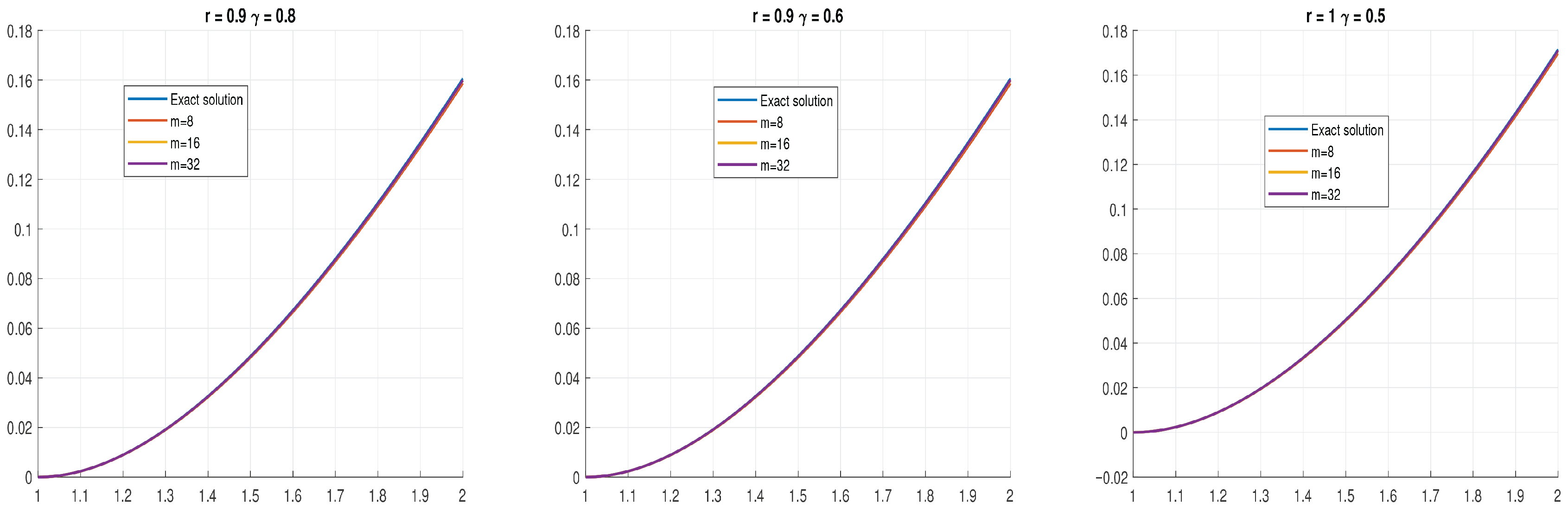
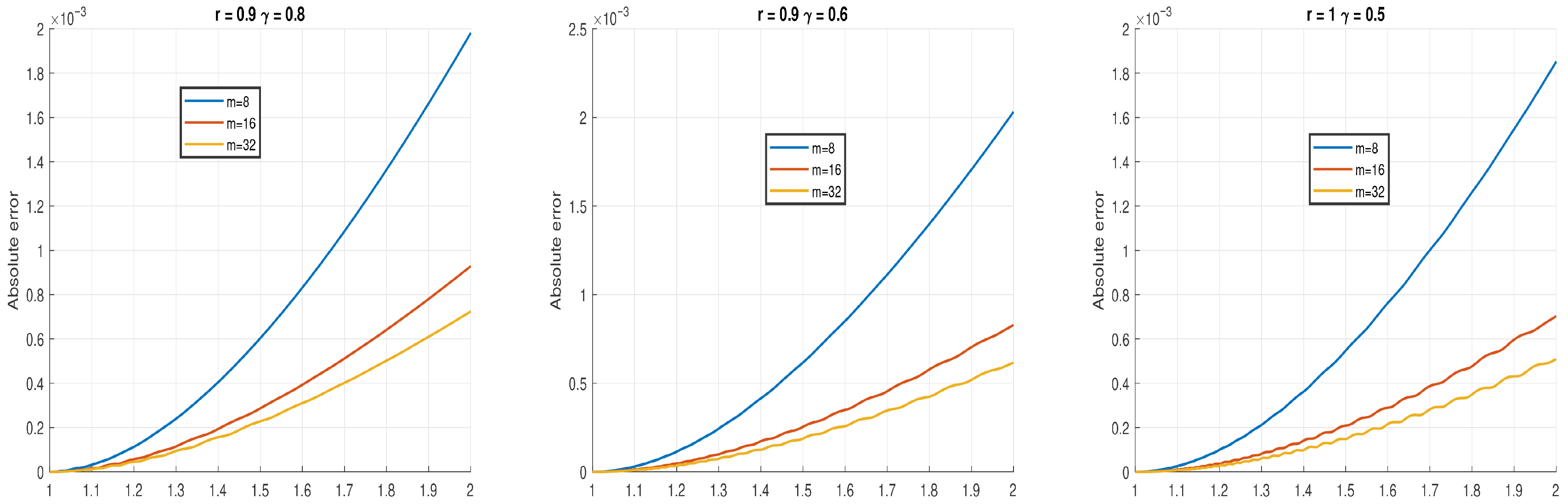
| 8 | 0.0020 | 0.0020 | 0.0001 | 8 | 0.0011 | 0.0010 | 0.0001 | 8 | 0.0019 | 0.0019 | 0.0001 |
| 16 | 0.0009 | 0.0009 | 0.0001 | 16 | 0.0005 | 0.0005 | 0.0001 | 16 | 0.0007 | 0.0007 | 0.0001 |
| 32 | 0.0004 | 0.0004 | 0.0001 | 32 | 0.0002 | 0.0002 | 0.0001 | 32 | 0.0003 | 0.0003 | 0.0001 |
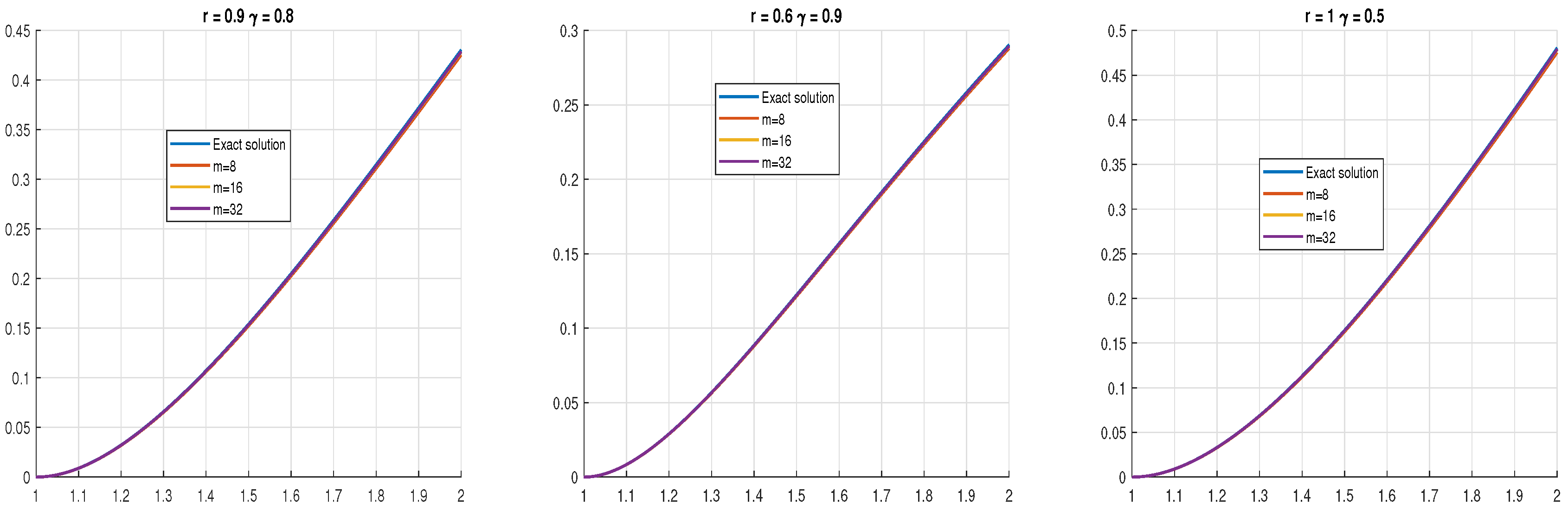
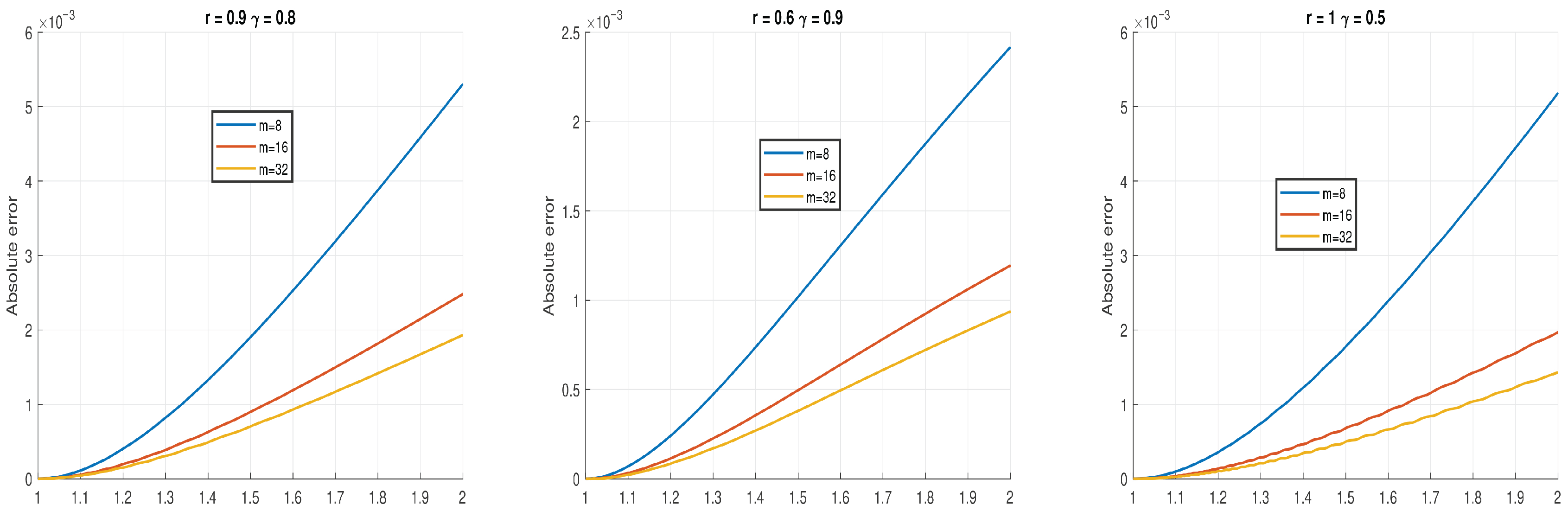
| 8 | 0.0053 | 0.0053 | 0.0001 | 8 | 0.0024 | 0.0024 | 0.0001 | 8 | 0.0052 | 0.0052 | 0.0001 |
| 16 | 0.0025 | 0.0025 | 0.0001 | 16 | 0.0011 | 0.0012 | 0.0001 | 16 | 0.0020 | 0.0020 | 0.0001 |
| 32 | 0.0011 | 0.0011 | 0.0001 | 32 | 0.0005 | 0.0005 | 0.0001 | 32 | 0.0007 | 0.0007 | 0.0001 |
| 8 | 0.0170 | 0.0170 | 0.0001 | 8 | 0.0067 | 0.0067 | 0.0001 | 8 | 0.0237 | 0.0237 | 0.0001 |
| 16 | 0.0080 | 0.0080 | 0.0001 | 16 | 0.0032 | 0.0032 | 0.0001 | 16 | 0.0092 | 0.0092 | 0.0001 |
| 20 | 0.0062 | 0.0062 | 0.0001 | 20 | 0.0023 | 0.0023 | 0.0001 | 20 | 0.0067 | 0.0067 | 0.0001 |
| Operator | Parameters | Physical Interpretation |
|---|---|---|
| Cotangent RAF |
| |
| Atangana–Baleanu |
| |
| Prabhakar |
| |
| Caputo–Fabrizio |
|
Disclaimer/Publisher’s Note: The statements, opinions and data contained in all publications are solely those of the individual author(s) and contributor(s) and not of MDPI and/or the editor(s). MDPI and/or the editor(s) disclaim responsibility for any injury to people or property resulting from any ideas, methods, instructions or products referred to in the content. |
© 2025 by the authors. Licensee MDPI, Basel, Switzerland. This article is an open access article distributed under the terms and conditions of the Creative Commons Attribution (CC BY) license (https://creativecommons.org/licenses/by/4.0/).
Share and Cite
Sadek, L.; Algefary, A. The Cotangent Derivative with Respect to Another Function: Theory, Methods and Applications. Fractal Fract. 2025, 9, 690. https://doi.org/10.3390/fractalfract9110690
Sadek L, Algefary A. The Cotangent Derivative with Respect to Another Function: Theory, Methods and Applications. Fractal and Fractional. 2025; 9(11):690. https://doi.org/10.3390/fractalfract9110690
Chicago/Turabian StyleSadek, Lakhlifa, and Ali Algefary. 2025. "The Cotangent Derivative with Respect to Another Function: Theory, Methods and Applications" Fractal and Fractional 9, no. 11: 690. https://doi.org/10.3390/fractalfract9110690
APA StyleSadek, L., & Algefary, A. (2025). The Cotangent Derivative with Respect to Another Function: Theory, Methods and Applications. Fractal and Fractional, 9(11), 690. https://doi.org/10.3390/fractalfract9110690