Article

The Research on Pore Fractal Identification and Evolution of Cement Mortar Based on Real-Time CT Scanning Under Uniaxial Loading


1
School of Mathematics, North University of China, Taiyuan 030051, China
2
Shanxi Key Laboratory of Signal Capturing & Processing, North University of China, Taiyuan 030051, China
3
State Key Laboratory of Deep Petroleum Intelligent Exploration and Development, Institute of Geology and Geophysics, Chinese Academy of Sciences, Beijing 100029, China
4
State Key Laboratory of Lithospheric and Environmental Coevolution, Institute of Geology and Geophysics, Chinese Academy of Sciences, Beijing 100029, China
5
School of Mathematics, Taiyuan University of Technology, Taiyuan 030024, China
*
Author to whom correspondence should be addressed.
Fractal Fract. 2025, 9(11), 689; https://doi.org/10.3390/fractalfract9110689
Submission received: 17 September 2025 / Revised: 19 October 2025 / Accepted: 22 October 2025 / Published: 27 October 2025

Abstract

Investigating the pore structure and understanding the relationship between pore characteristics and mechanical properties are crucial to research in the study of cement mortar. At present, the segmentation of large-scale concrete pores is mainly conducted using traditional algorithms or software, which are time-consuming and operate in a semi-automated manner. However, the application of these methods faces challenges when analyzing large-scale rock pores due to factors such as a lack of data, artifacts, and inconsistent contrast. In this study, six series of cement mortars were subjected to real-time CT scanning under uniaxial loading (RT-CT) to collect real-time three-dimensional data on the evolution of pore structures during loading. To address issues such as artifacts and inconsistent contrast, a new augmentation method was proposed to overcome artifacts and enhance contrast consistency. Finally, the augmented dataset was utilized for training, and the Fast R-CNN algorithm served as the framework for developing the pore recognition model. The results indicate that the improved algorithm demonstrates enhanced convergence and greater accuracy in pore segmentation. A mathematical model is developed to relate uniaxial compressive strength (UCS) to pore fractal dimension and porosity, based on pore segmentation analysis. The fractal dimensions evolution of each specimen is consistent with the progressive failure indicated by the strain-stress curve. Under uniaxial loading, specimens with a 4:1 cement–sand ratio exhibited peak strength. The incorporation of fractals improved particle contact, thereby facilitating the formation of the skeletal structure. These efforts contribute to improving the identification of the deformation of cement mortars.

1. Introduction

The number of construction projects involving traffic engineering, hydraulic and hydropower engineering, disaster prevention engineering, mining engineering, etc., has been increasing worldwide in recent years [1,2]. Research on engineering stability, deformation, and failure mechanisms is crucial for these large-scale and complex projects. Due to the high costs and poor stability associated with sampling, the methods used to address these engineering challenges primarily rely on field investigations, theoretical analysis, and physical experiments conducted with cement mortars. However, the results have typically involved determining changes in macroscopic parameters such as UCS, Poisson’s Ratio, and Modulus of Elasticity [3,4,5,6]. However, microstructure, such as pores, plays a crucial role in the physical and mechanical properties of cement mortars [7,8,9]. It is established that variations in porosity lead to a reduction in compressive, tensile, and flexural strength. Therefore, the mechanical properties of cement mortars should be thoroughly understood through mesoscopic experiments.
The mesoscopic experiment method for microstructure characterization primarily consists of two steps: data collection and image analysis. Thanks to advancements in imaging technologies, new methods, such as Computed Tomography (CT) [10,11,12,13,14], Nuclear Magnetic Resonance (NMR) [15,16], and Scanning Electron Microscopy (SEM) [17], have been developed for investigating pore structures in rocks. Guo, et al. [18] analyzed the inherent correlations among the compressive strength, permeability and pore structure using SEM. Zhu, et al. [19] have found that the unconfined compressive strength and sorptivity coefficient of concrete exhibited strong linear relationships with internal porosity based on SEM data. Concurrently, CT studies have been extensively employed to examine 3D crack propagation, mechanical properties, and fracture modes in cement mortars [7]. González, Mena, Mínguez and Vicente [7] found that CT enables the evaluation of numerous pore parameters—far exceeding those measured by other commonly used porosity assessment methods—such as pore size distribution, pore length, and shape factor.
Relationships between porosity and strength could be derived from RT-CT. To investigate the effects of pore distribution and entrained air void sizes on concrete, the fractal dimension is utilized as a quantitative measure to describe the intricacy of pore structure. Zhang, et al. [20] conducted a comprehensive analysis of the relationship between the fractal dimension of the microscopic structure of cement-based composites and their macroscopic properties. Kuldasheva, et al. [21] employed fractal dimension analysis to quantify 2D surface topography from SEM images and 3D pore distribution from CT data, demonstrating that pore evolution during freeze-thaw cycles can be quantitatively characterized across scales through fractal dimensions, exhibiting self-similar micro-damage patterns. Existing research confirms that fractal dimensions provide a viable approach for studying mechanical properties. However, according to the existing literature review, there have been no published studies using low-resolution CT for the analysis of pore evolution. Thus, the relationship between mechanical properties and pore structure should be thoroughly investigated through the CT method.
To effectively quantify the microstructural properties of rocks, the segmentation algorithm must be both accurate and consistent [22]. Numerous researchers have suggested a range of traditional methods that employ various image segmentation algorithms, including the overflow method, threshold method, triangle method, moment preserving method, and particle swarm method, to characterize and assess the microstructural properties of concrete [23,24,25]. These methods are always used to solve simple segmentation tasks and applications requiring high real-time performance. These methods are not well-suited for CT images that have a large volume of data and are highly influenced by magnification, resolution, and contrast. Also, some segmentation software is used to segmentation pores. However, these software tools are characterized by being time-consuming, semi-automated, non-adaptable, labor-intensive, and having low accuracy. In recent years, there has been a significant advancement in enhanced image analysis techniques, particularly those utilizing deep learning methods, such as U-Net, YOLO, and Mask R-CNN. [26,27,28]. Bangaru, et al. [29] propose an automated concrete microstructure analysis method utilizing a U-Net convolutional neural network to process scanning electron microscope (SEM) images for the characterization of concrete microstructures. However, these methods are mostly designed and used for small-scale, high-resolution images. For larger-scale samples of CT images, the images are more susceptible to issues such as inconsistent voltage, artifacts, and weak pore contrast, making segmentation more challenging. Consequently, in order to solve the challenges associated with existing concrete CT image processing techniques and microstructure characterization, it is crucial to investigate a novel segmentation method.
In this study, we present a comprehensive discussion of the experiments, methods, and applications of RT-CT image analysis in cement-based materials. Firstly, the study conducted the experiment using the RT-CT system to obtain the real-time three-dimensional data for the sample’s evolution during loading. Additionally, a deep learning method based on Fast R-CNN was proposed to finish the pore segmentation. The proposed method facilitates the distinction of individual interface components at a meso-scale and enables a precise analysis of porosity at the junction of two materials with complex morphology. Finally, we utilize RT-CT to study the variation in pore parameters of concrete subjected to uniaxial loading.

2. Experimental Method

2.1. Samples

The materials used to create cement mortars should meet the characteristics of being non-toxic, harmless, stable in quality, low-cost, and easy to work with. Common materials such as river sand and cement, which are widely available in everyday life, can be considered the most typical materials that satisfy these conditions. Therefore, this experiment selects these two materials as raw materials. In this experiment, the sand–cement ratio is used to describe the proportion of these two raw materials. Particle distribution of river sand has been listed in the literature [30] and will not be elaborated on further in this paper. Based on experimental experience, when the sand–cement ratio exceeds 12:1, the material becomes difficult to make. Therefore, this study selects 12:1 as the maximum sand–cement ratio and 2:1 as the minimum sand–cement ratio for the preparation of cement mortars. The samples are labeled from A01 to A06, respectively. Three samples for each sand–cement ratio were prepared with dimensions of ф50 mm × 100 mm. The preparation process of the specimens followed the “Standard for Test Methods of Engineering Rock Masses” [31]. The raw materials, comprising river sand and cement, were weighed according to the designated ratios and dry-mixed thoroughly in a basin. Water was then added gradually until a uniform consistency was achieved, specifically when the mixture could be molded into a ball without excess water. The total amount of water used was then recorded. The water–cement ratio was determined empirically to ensure workability and avoid over-dilution. The mixture was transferred in small batches into cast-iron molds coated with a thin layer of machine oil, with each batch undergoing vibration to eliminate entrapped air. Following casting, the specimens were allowed to set for 24 h under ambient conditions before demolding. After demolding, they were labeled and cured at room temperature. To promote moisture evaporation, the specimens were inverted and stored in a well-ventilated area. Their weights were measured daily, and the specimens were considered fully dried when the weight remained constant for three consecutive days.

2.2. RT-CT Experiments

The RT-CT system was used to detect density changes in the cement mortar samples in the Key Laboratory of Shale Gas and Geoengineering, Institute of Geology and Geophysics, Chinese Academy of Sciences. The system is composed of an X-Ray system, Detector Array system, Rotating Platform, Loading System, Data Processing System and Image reconstruction System, as shown in Figure 1. The loading system is fixed on the rotary table, enabling continuous monitoring of changes in the sample as external stress is applied. This system facilitates dynamic experiments and allows for real-time analysis. The X-ray tube voltage is 450 kV. A total of 900 projection images were collected for each section during a 900° rotation. The images were generated through filtered back projection and were then combined with a layer spacing of 0.129 mm to reconstruct 3D tomographic images with a voxel (or volume) size of 0.129 × 0.129 × 0.129 mm3. According to previous research, when the pore size ranges from 0.1 to 1 mm, it is strongly correlated with the compressive strength of rocks at the engineering scale [32,33]. Therefore, a resolution of 0.129 mm satisfies the pore size analysis in this paper. The software used in the CT scan operates with 16-bit images, where the grayscale value ranges from approximately 1700 to 6000, with 0 representing black and 6000 representing white. The assigned value is determined by the linear attenuation coefficient μ of the material, which is influenced by its density. Consequently, light grey voxels (indicating higher values) correspond to denser areas, while dark grey voxels (indicating lower values) correspond to less dense regions. The average experimental time for each specimen is approximately 2.5 h, which includes both loading and scanning time.
The progressive deformation of rock can be divided into five stages, including: crack closure stage, elastic stage, crack initiation and stable growth stage, and accelerated crack growth and post-peak stage [34]. To study the evolution of the pore, the difficulty is obtaining key data during the loading. Therefore, prior to the RT-CT experiments, we conducted a series of uniaxial compression tests on samples of each ratio to identify the different progressive failure stages of the samples based on the characteristics of their stress–strain curves. However, due to the variability among the samples, these key points can only serve as references. Each sample was scanned prior to loading. The data obtained for each sample at key stages are presented in Table 1, excluding the pre-mechanical testing stage (Stage 0).

3. Methodology

3.1. Data Augmentation and Image Segmentation

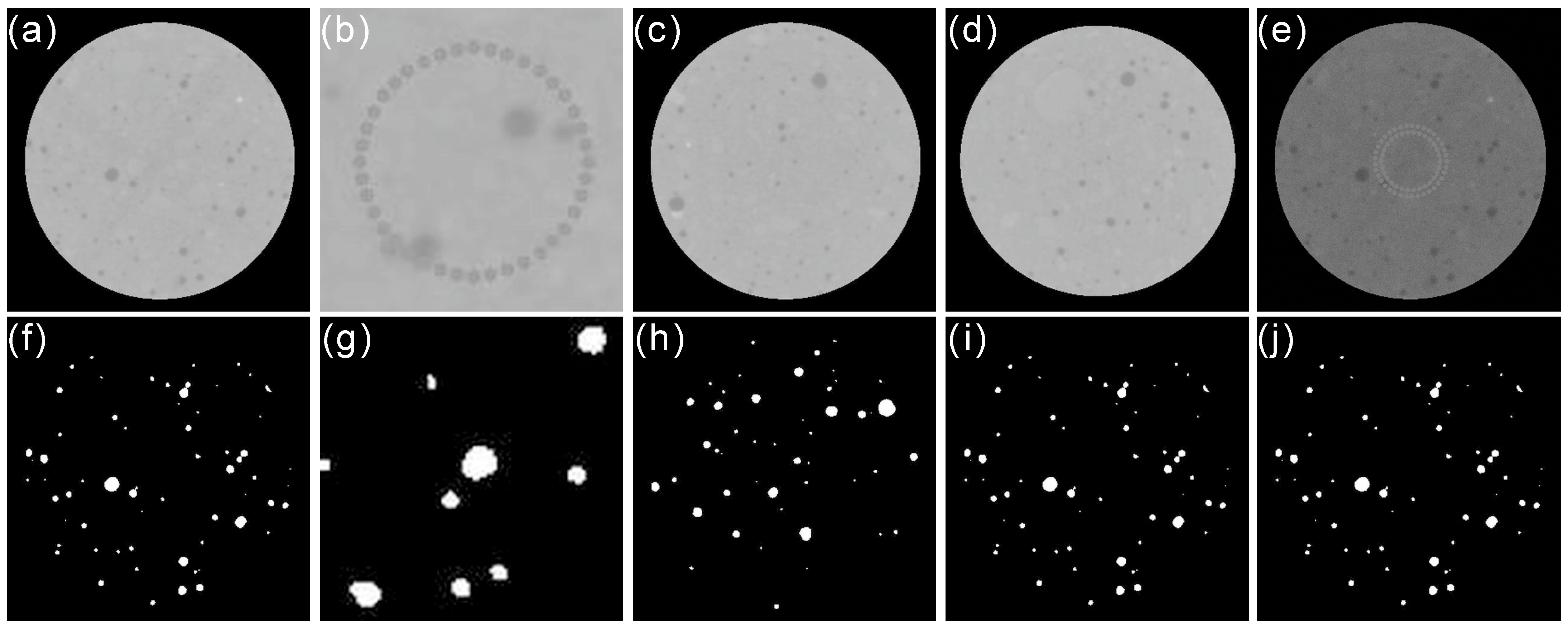
The larger the sample size, the lower the resolution of the CT image obtained. The challenges of identifying pores in lower resolution CT images primarily are that they may not clearly display the details of pores, leading to reduced accuracy in identification. Small pores may be blurred or confused, making them difficult to distinguish. And low-resolution CT images often contain artifacts and noise, which can degrade image quality and complicate the identification process, leading to unclear pore boundaries. Additionally, inconsistent voltage can also lead to variations in contrast for the same samples. To solve the challenges associated with low resolution and artifacts in concrete CT images, a data augmentation method was proposed for the training set, designed to generate enhanced images, as illustrated in Figure 2. In addition to traditional augmentation methods, such as brightness adjustment, Gaussian noise, random contrast, and rotations, we also simulated voltage inconsistency, artifacts, random clipping, and low pore contrast based on the characteristics of CT porosity images. By employing this method, the deep learning models were able to effectively reduce overfitting and improve generalization performance.
After data augmentation, the Fast R-CNN [35,36,37,38] is used to finish pore segmentation. The learning rate is set to 1 × 10⁻², with a batch size of 8 and a total of 3200 iterations. The overall loss of the model is comprised of a classification loss and a regression loss, which are weighted and summed as follows:
L p i , t i = 1 N c l s i L c l s p i , p i * + λ 1 N r e g i p i * L r e g t i , t i *
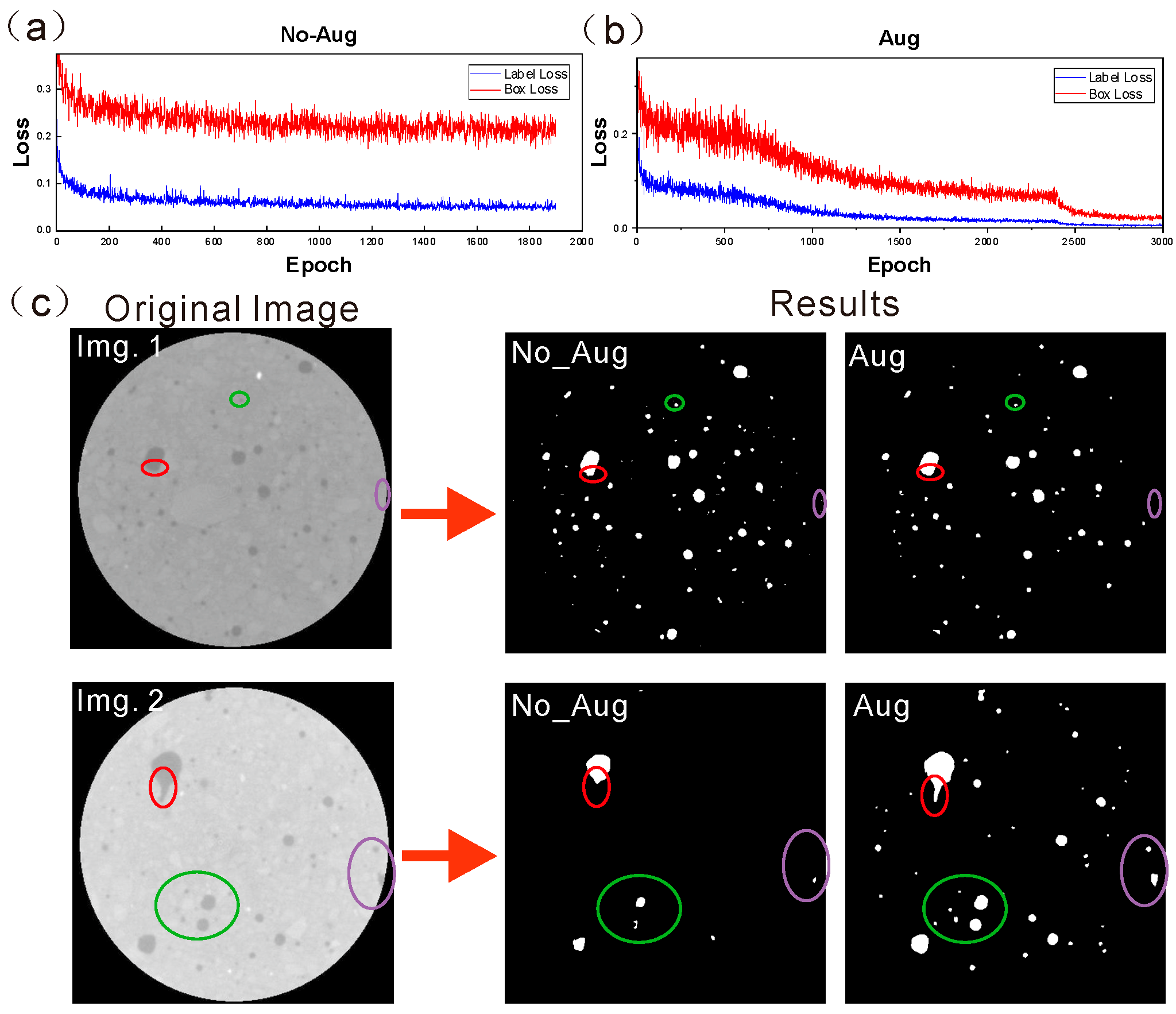
where the input is p i and t i . p i is the set of classification prediction results for all anchors, and t i is the set of regression prediction results for all anchors. 1 N c l s i L c l s p i , p i * is the classification loss term. 1 N c l s is the normalization factor. N c l s is the total number of positive and negative samples in the mini-batch. i is the index of anchors in the mini-batch. p i represents the probability that the model predicts the i th anchor as a positive sample. p i * is the ground truth classification label for the i th anchor. λ 1 N r e g i p i * L r e g t i , t i * is the regression loss term. λ is the balance coefficient. 1 N r e g is the normalization factor. N r e g is the number of all anchors on the feature map. t i is the bounding box prediction of the model for the i anchor. t i * is the ground truth bounding box for the i anchor. Randomly select 2000 CT images under different load conditions from the experimental data and apply the above augmentation methods. The new dataset, about 8000 CT images, was divided into three parts: 70% for training, 20% for validation, and 10% for testing. It is especially important to note that the artifacts are marked on the original image as circular dots, resembling the size and contrast of the pores. To assess the efficacy of the augmentation method, the segmentation model was trained using two datasets: the original 8000 experimental CT images and an additional 1000 CT images produced through the augmentation process. Model accuracy was measured using the loss function, as depicted in Figure 3.
As illustrated in Figure 3a, overfitting occurred in the model trained on original data without augmentation, which means that the model failed to generalize well to unseen data. This suggests that the model may have learned noise and artifact features from the training data instead of capturing the true pores. As shown in Figure 3b, after about 2400 epochs, the validation loss curve rapidly converges to the training loss curve, indicating that the employed data augmentation techniques are effective in mitigating noise induced by voltage inconsistency, artifacts, and low pore contrast. Figure 3c illustrates the segmentation results for different images. Image 1 exhibits high contrast with a relatively consistent pore distribution, while Image 2 has high brightness and a significant variation in pore distribution. When the model is trained without augmentation methods, a significant number of pores can be identified; however, over-segmentation occurs. In the segmentation results, ‘No_Aug image’ refers to the results from the model trained without augmentation, while ‘Aug image’ represents the results from the model that utilized augmentation methods. The results demonstrate that the model trained with augmentation achieves higher accuracy in segmenting pore boundaries (as indicated by the red circle) and exhibits fewer misidentifications (as shown by the green and purple circles). Especially in the highlighted images like Image 2, the model using augmentation methods effectively overcame the challenges posed by variations in brightness and pore scale. It accurately segmented pores of different sizes without experiencing over-segmentation.

3.2. Reconstruction of Pore Structures

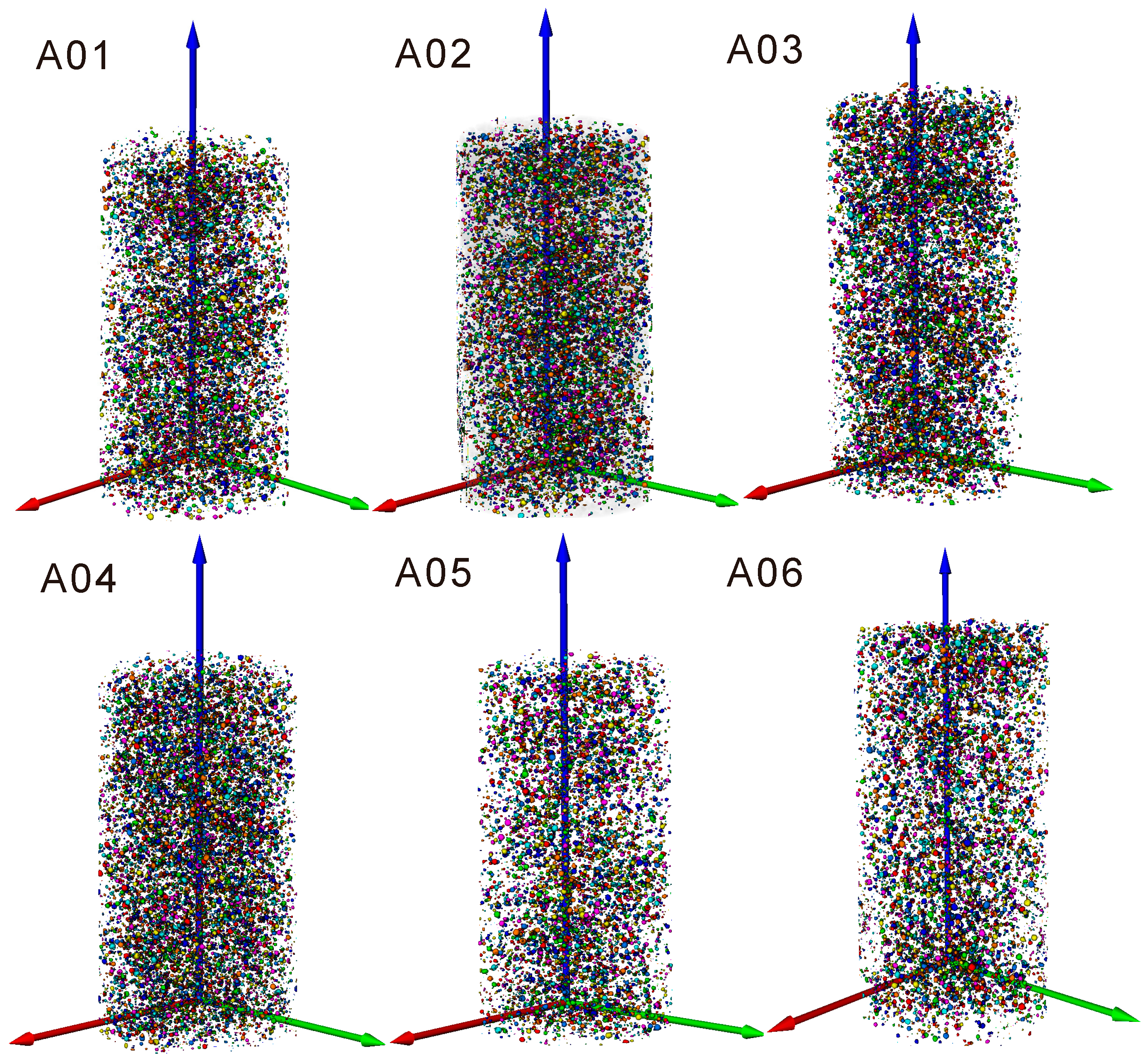
All CT images were processed by the trained model. The 3D pore structures were reconstructed using the software VStudio version 3.1 by Volume Graphics company, based in Heidelberg, Germany. Figure 4 shows the pores identified by our segmentation method in each sample. To facilitate a quantitative analysis of the morphological characteristics of the pores, several parameters—such as shape factor, length, pore volume, inclination angle, and fractal dimension—are derived from the voxel count within the three-dimensional pore model. The length of a pore is defined as the maximum distance between two voxels belonging to the same pore. In this study, only pores with a volume greater than 5, corresponding to a length of more than 0.2 mm in their largest dimension, are considered. Pores smaller than this threshold cannot be accurately determined.

4. Data Analysis

4.1. Experimental Analysis

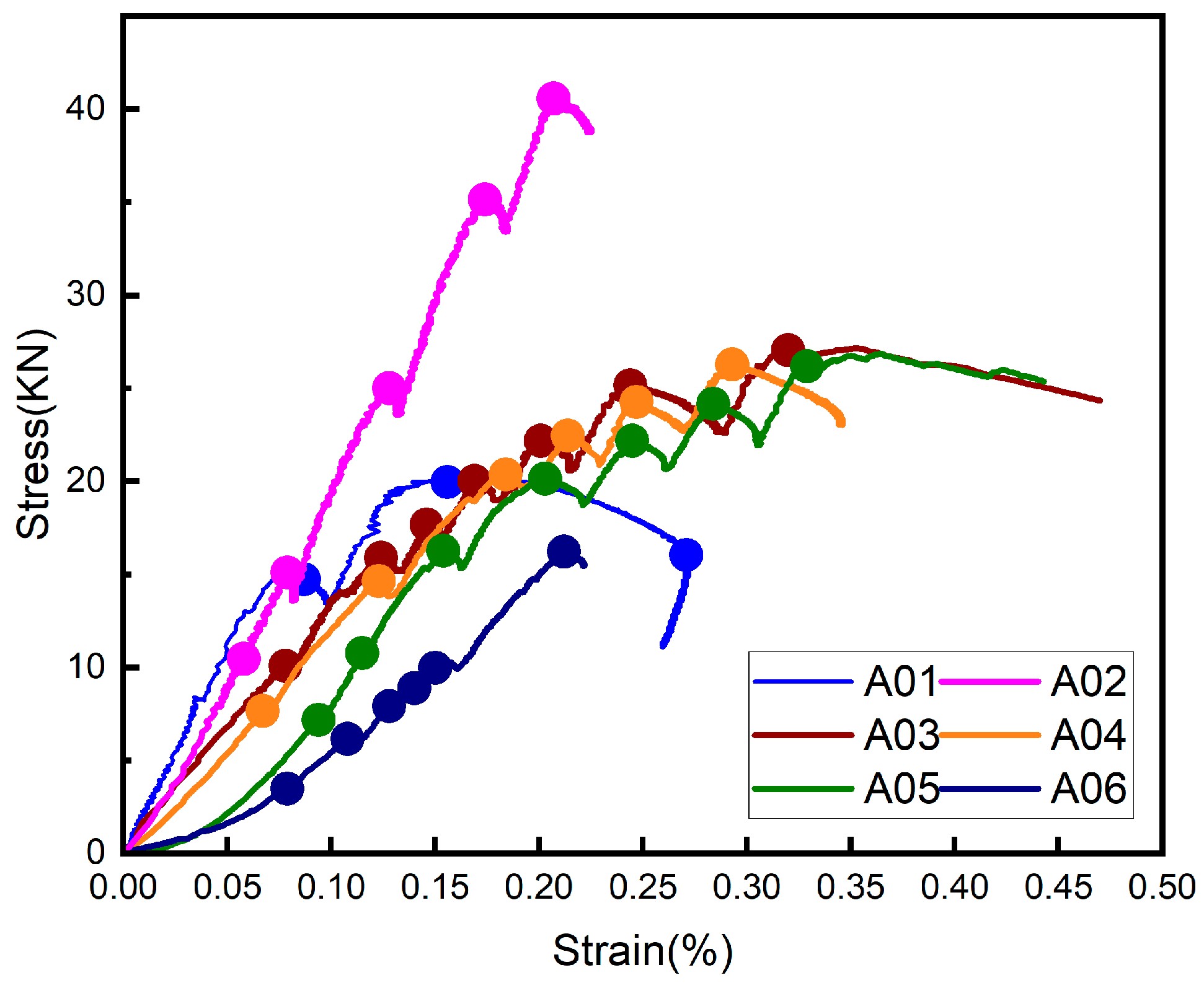
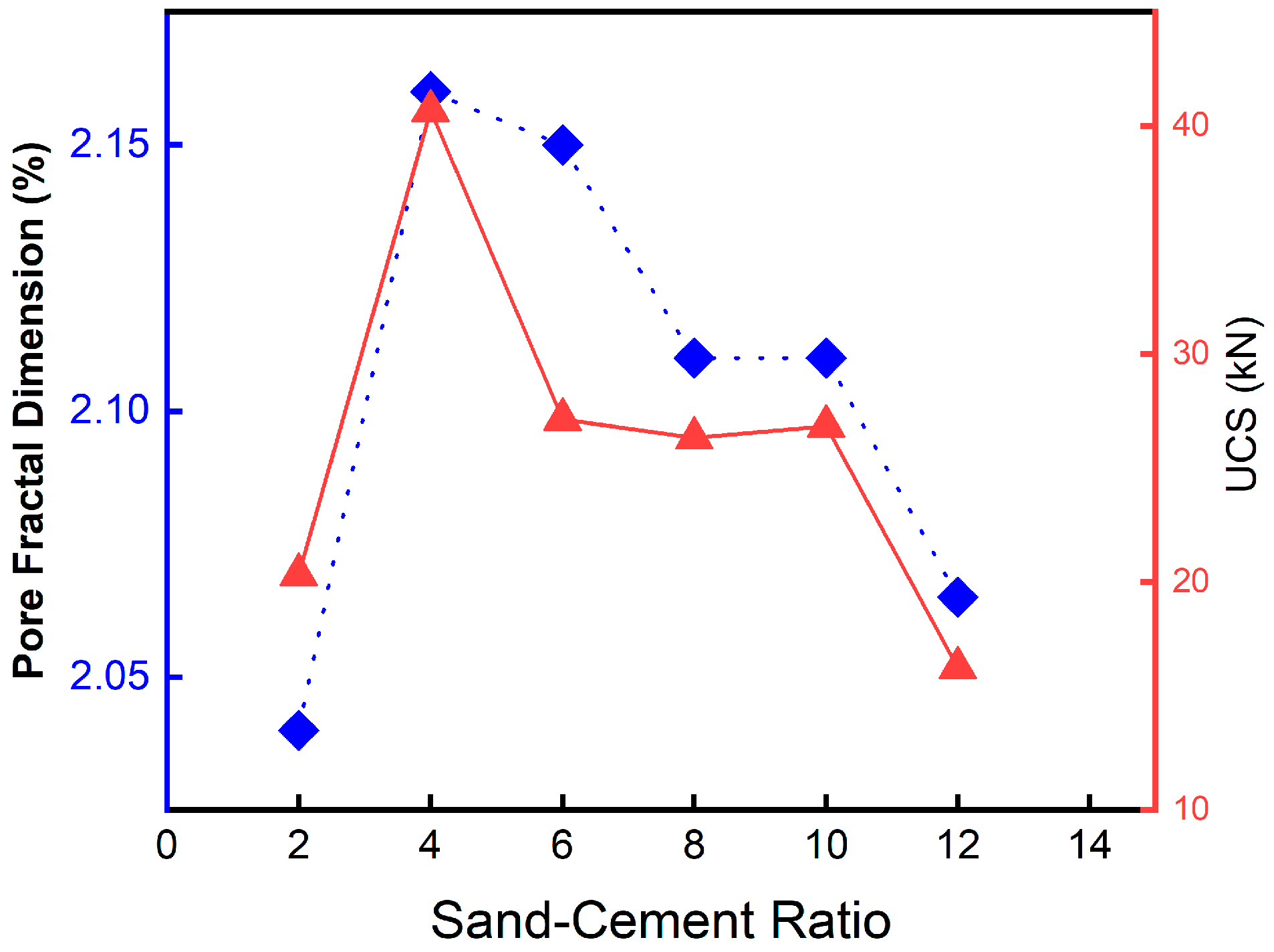
The stress–strain curve for samples with different sand–cement ratios, obtained using the RT-CT system, is shown in Figure 5. The progressive failure of these rocks is consistent with existing research, following the five stages, including: pore closure stage, elastic stage, crack initiation and stable growth stage, and accelerated crack growth and post-peak stage [39,40,41]. The UCS of sand and cement ratios, from 2:1 to 12:1, are 20.33 kN, 40.67 kN, 27.14 kN, 26.32 kN, 26.83 kN, and 16.24 kN, respectively. Each sample has a cross-sectional loading area corresponding to a circle with a diameter of 50 mm. As the sand–cement ratio increases, the UCS shows a trend of first increasing and then decreasing. The UCS reached its maximum at a sand–cement ratio of 4:1, indicating that the addition of river sand formed a skeleton, effectively increasing the strength of the cement mortars. This skeleton structure provides better support and stability, thereby enhancing the overall compressive performance of the material. When the ratio of sand to cement reaches a certain proportion, the strength begins to decrease due to the weakened interfacial surface surrounding the sand particles, which reduces the strength of the sample. When the sand–cement ratio reaches 10:1, the strain of the samples in the pore closure stage increases due to the increased contact points between the sand particles.

4.2. Pore Fractal Dimension Evolution

Previous studies have shown that the anisotropy in the mechanical and permeability properties of rock is predominantly influenced by pore distribution. Therefore, this section analyzes the impact of pore distribution on the mechanical characteristics of the specimens. Based on the theory of fractal dimensions [42,43], the pore size distribution d V d r can be expressed as:
d V d r r 2 D
where V is pore volume, r is pore diameter, and D is fractal dimension, which ranges between 2 and 3. Fractal dimension is based on a box counting method, a standard algorithm for characterizing the self-similarity of porous structures. For the 3D pore networks extracted from RT-CT images, the specific steps are as follows: firstly, binarization: CT images were segmented into pore (foreground) and matrix (background) phases using the Fast R-CNN method (as introduced in Section 2), ensuring consistent separation of pore voxels from the cement mortar matrix. Secondly, box superimposition: a series of cubic boxes with decreasing side lengths ( ε , ranging from 2 to 64 voxels) were overlayed onto the binarized 3D volume. Thirdly, box counting: For each box size, the number of boxes ( N ε ) containing at least one pore voxel was recorded. Fourthly, fractal dimension extraction: the log N ε was plotted against log 1 ε , and a linear regression was performed on the linear portion of the curve. The slope of this line corresponds to the fractal dimension (D), which quantifies the complexity of the pore structure (ranging between 2 and 3 for a space-filling structure).
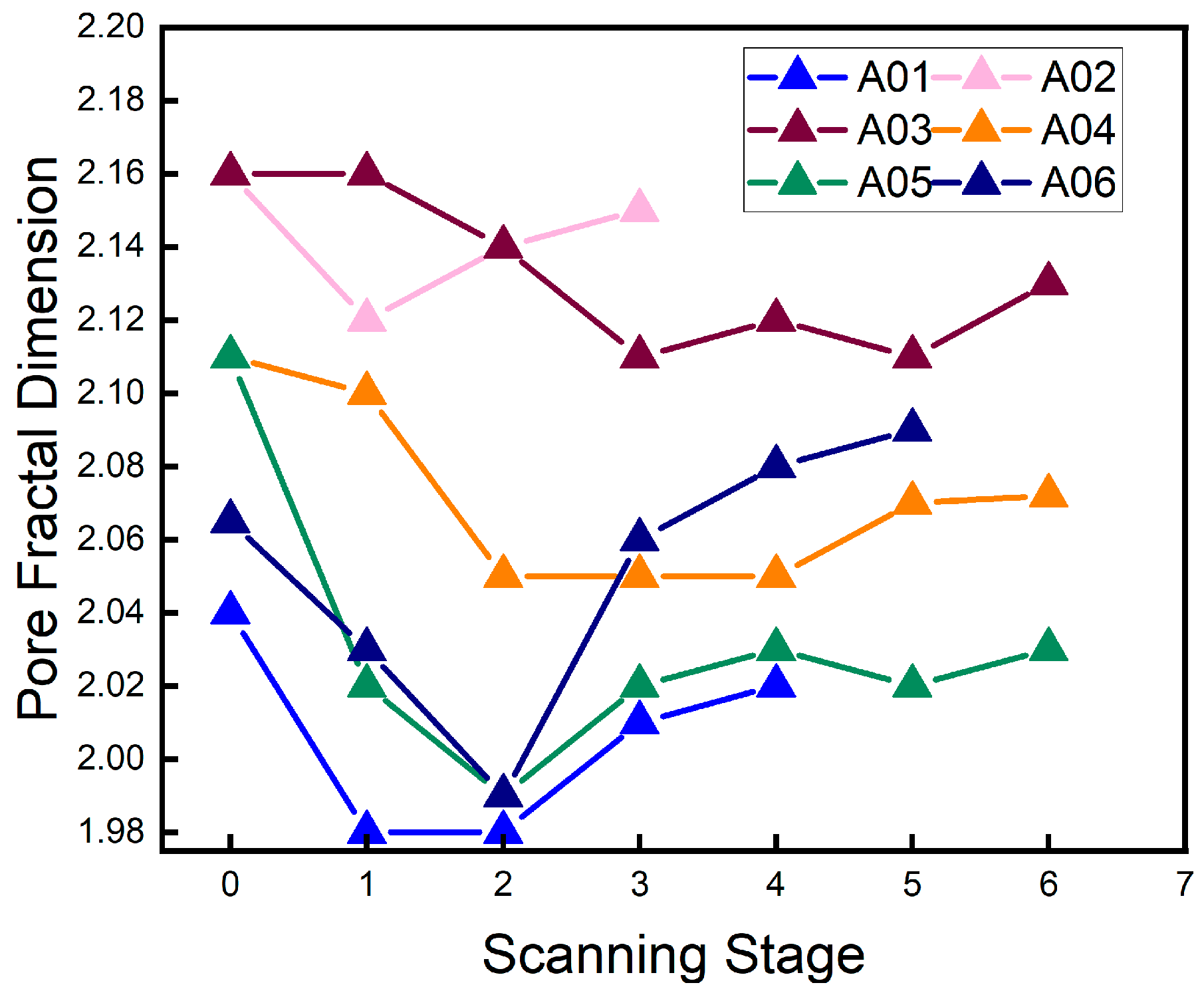
To quantify the influence of pore fractal dimensions on the progressive failure of cement mortars, the pore distribution of each sample was analyzed at each failure stage. Figure 6 shows the fractal dimensions distribution of the different sand–cement ratios specimens. The fractal dimension and pore structure evolution are analyzed with Stage 0 as the baseline. Stage 0 in Figure 6 represents the pre-mechanical testing phase (initial state before loading), providing a reference for comparing the fractal characteristics of the specimens during subsequent loaded stages. Since Stage 0 involves no mechanical loading, the deformation ( ε i ) and stress ( σ i ) values are both zero. Therefore, in Table 1, which presents data from the mechanical testing process, the data starts at Stage 1 (the first loaded stage) to focus on the impact of loading on the material’s properties. A higher fractal dimension indicates a more complex pore structure, while a lower fractal dimension means a more homogeneous specimen. As stress increases, the fractal dimension of the pores initially decreases before subsequently increasing. As stress continues to increase, micro-fractures will begin to form. This leads to a progressively more complex spatial distribution of pores, resulting in an increase in the corresponding fractal dimension. In the distribution of pore fractal dimensions, the trend of fractal dimension variation changes little at a sand–cement ratio of 4:1, which is due to the effective skeletal structure formed by the sand within the rock; however, as the sand–cement ratio increases, particularly at ratios of 10:1 and 12:1, significant changes in pore fractal dimension occur. The weakened interfacial surfaces exacerbate the fractal dimension variations. The turning point is generally located at the elastic stage, crack initiation and stable growth stage.

5. Discussion

Through segmentation and 3D pore statistics, detailed information about each individual pore has been obtained, including their length, volume, area, and fractal dimension. The mechanical properties of the samples were influenced by factors such as porosity, pore distribution, and pore morphology [44,45]. To study the influence of the meso-structure under different loading conditions, an in-depth analysis has been conducted. In this research, the significant parameters of length, volume, and fractal dimension have been utilized for the analysis.

5.1. Fractal Dimensions and UCS Analysis

Evaluating the spatial pore distribution of different specimens can be challenging due to the complexity of pore structures. However, by employing the 3D reconstruction method, we can utilize the fractal dimension to analyze the three-dimensional pore structure, thereby establishing the relationship between Unconfined Compressive Strength (UCS) and fractal dimension. The fractal dimension serves as a crucial metric for characterizing the complexity of pore structures. Higher fractal dimensions mean greater complex structures and heterogeneity. The fractal dimensions of sand–cement ratios, from 2:1 to 12:1, are 2.04, 2.16, 2.15, 2.11, 2.11, and 2.06. The fractal dimension shows a region of initially increasing and then decreasing values. The maximum fractal dimension is achieved with the sand–cement ratio of 4:1. To analyze the trends of UCS and fractals, Figure 7 illustrates the variations in peak strength and pore fractal dimensions for each sample, with UCS values corresponding to sand–cement ratios ranging from 2:1 to 12:1. The peak strength for each sample has already been provided in Section 3.1. The UCS exhibits a consistent relationship with the fractal dimension. The results indicated that the higher the fractal dimensions are, the greater the UCS.
Through quadratic polynomial regression analysis, the relationship is shown in Figure 7. A higher fractal dimension indicates a more complex pore structure among sand particles, which contributes to an increased contact area between the particles. As the fractal dimension increases, the sand particles can more effectively interlock, forming a stable skeletal structure. This structure not only enhances the interaction forces between particles but also improves the UCS of the material. This phenomenon suggests that under specific pore structure conditions, an increase in fractal dimension may help improve the strength performance of the sand matrix.

5.2. Statistical Methods and Analysis

To further investigate the effects of porosity, fractal dimension, and pore size distribution (characterized by the variance of pore diameter) on UCS, a statistical correlation analysis was conducted. Since all variables are continuous, a normality test was performed first. The relevant data are provided in Appendix A. The results, presented in Table 2, confirm that all four variables follow a normal distribution.
The Pearson correlation analysis was first employed in this study, as it is well-suited for assessing relationships between normally distributed continuous variables. This method provides both correlation coefficients and a foundation for significance testing using t-tests, based on the assumption of normality. Additionally, the use of Pearson correlation facilitated subsequent partial correlation analysis, enabling the control of potential confounding effects and clarifying the relationship between fractal dimension and UCS. This method also supports the requirements for further regression modeling, ensuring that the underlying assumptions are adequately met.
Additionally, given that the sample size ( n = 6 ) may lead to unstable results in the correlation test, we conducted supplementary analyses using Spearman and Kendall correlation methods. These non-parametric approaches minimize reliance on distributional assumptions and help evaluate the robustness of our conclusions. Table 3 displays the outcomes of the Pearson, Spearman, and Kendall correlation analysis, supplemented with t-tests to evaluate the significance of the correlation coefficients. Porosity is known to reduce the compactness and strength of materials, thereby reducing overall mechanical performance. The fractal dimension serves as an indicator of the complexity of the microstructural pore distribution within the material. Pore distribution also plays a key role in the strength of materials.
According to Table 3, porosity shows a negative correlation with UCS, indicating that an increase in porosity leads to a decline in mechanical properties due to reduced material density and structural integrity. In contrast, a significant positive correlation exists between fractal dimension and UCS, as shown in Table 4. Table 4 presents the corresponding p-values for the Pearson correlation coefficients in Table 3, derived from t-tests to assess the statistical significance of the correlations. The results show that for UCS and pore fractal dimension, all three methods, Pearson, Spearman, and Kendall, demonstrate a positive correlation between UCS and fractal dimension. Notably, the non-parametric methods, Spearman and Kendall, produced smaller p-values, suggesting a more significant relationship: the Pearson correlation yielded r = 0.846 ,   p = 0.0339 ; the Spearman correlation resulted in ρ = 0.928 ,   p = 0.0077 ; and the Kendall correlation produced τ = 0.828 ,   p = 0.0217 . This may be attributed to the increased interparticle contact area facilitated by fractal structures, promoting the formation of a stable skeletal framework and thereby enhancing UCS. These results suggest that a significant influence on the UCS of rock is the complexity of the pore morphology. For USC and the variance of pore diameter, all three correlation methods show a negative relationship: the Pearson correlation coefficient is −0.4983, the Spearman correlation coefficient is −0.3143, and Kendall’s tau-b is −0.2000. These results suggest that greater dispersion in pore size distribution correlates with lower compressive strength of the rock.
For UCS and porosity, none of the three methods achieved statistical significance, as all p-values exceeded 0.01. This indicates that there is no significant relationship between UCS and porosity in our data: Pearson correlation: r = 0.1735 ,   p = 0.7423 , Spearman correlation: ρ = 0.2571 ,   p = 0.6228 , and Kendall correlation τ = 0.2000 ,   p = 0.7194 . It is important to note that the variation in porosity within our dataset is quite narrow (approximately 0.8%), which may limit the statistical power to detect weak effects. Consequently, the fractal dimension may exert a more dominant influence on compressive strength within this limited range, thereby diminishing the apparent impact of porosity on UCS.
Finally, a multiple linear regression model was constructed with UCS as the dependent variable (y1) and porosity (x1), Pore Fractal (x2), and EqDiameterVar (x3) as independent variables y = 256.3452 + 3.9077 x 1 + 133.80911 x 2 0.8584 x 3 . As shown in Table 5, the variance inflation factors (VIF) for all predictors are well below the multicollinearity threshold of 10, confirming the stability and reliability of the regression coefficients. Although the UCS and fractal dimension correlation is significant in bivariate analysis ( p < 0.05 ), it fails to reach significance in the multiple regression. This is attributable to the extremely small sample size ( n = 6 ), the resulting low degrees of freedom ( d f = 2 ), which inflate the standard errors of the coefficients. The results may be limited by the sample size; therefore, we will conduct additional experiments and re-evaluate our findings in the future. Moreover, to validate the effectiveness of the results, Lasso regression was employed to analyze the relationship between UCS, porosity, and fractal dimension. The results from the Lasso regression align with those obtained from the linear regression model, with the penalty parameter selected by Lasso being α = 1.7014 . In small-sample scenarios, Lasso stabilizes the model through L1-induced sparsity. In this analysis, it automatically retained the Fractal Dimension (indicating a positive main effect), reduced Porosity to exactly zero, and assigned a small negative weight to pore diameter: y = 193.2876 + 104.9499 x 2 0.1412 x 3 .

6. Conclusions

In this study, the progressive changes in the pore structure of the cement mortars resulting from loading are analyzed. To achieve this, specimens with six different sand–cement ratios were made, and then they were tested using the RT-CT system. Each specimen was scanned in real-time during loading. The main CT images were analyzed in terms of porosity, pore fractal dimension and pore diameter distribution; the conclusions are as follows:
  • In the application of real-time loading scanning tests on rocks, the results from the stress–strain analysis show that the strength is maximized at a 4:1 ratio, where a skeleton structure is formed internally. This skeleton structure provides better support and stability, thereby enhancing the overall compressive performance of the material. At a 12:1 ratio, the strength is weaker, and the number of internal interfaces increases. As the samples lack sufficient tensile strength to withstand this internal pressure, microcracks will develop. The optimal 4:1 sand–cement ratio could provide a quantitative framework for High-Performance Concrete (HPC) Design in Construction Engineering.
  • The sand–cement ratio significantly influences both porosity and fractal characteristics. As the sand content increases, the fractal dimensions also rise. However, when the sand content reaches a ratio of 4:1, the specimens exhibit maximum uniaxial compressive strength (UCS). The fractal characteristics align with the UCS behavior. Beyond the 4:1 ratio, the fractal dimensions begin to decrease. The growth of fractals enhances the contact area between particles, facilitating the formation of a skeletal structure. The relationship between porosity, fractal dimension, and strength can help understand the pavement deformation under cyclic traffic loads.
  • Three statistical correlation analyses, Pearson, Spearman, and Kendall, were conducted among UCS, porosity, fractal dimension and pore diameter variance. The analysis revealed that increased porosity and variance of pore diameter negatively impact UCS, while a significant positive correlation exists between fractal dimensions. A multiple linear regression model demonstrated reliable predictors, with VIF values smaller than 10, indicating stability in the regression coefficients. Additionally, the results from the Lasso regression were consistent with those obtained from the linear regression model. The results indicate that the mechanism of rock strength formation is relatively complex and is not controlled by a single factor. The differences in UCS are likely due to the combined effects of pore size distribution and skeletal strength. This research offers theoretical methods and practical references for related cement mortar engineering fields.
This study combines both the RT-CT system and fractal dimension theory to effectively examine cement mortars’ pore structure. And the above conclusions are based on the CT reconstruction image, which is limited by CT resolution. The series of images of RT-CT provides a new platform for the study of cement mortar. In the future, digital image correlation technology can be used to capture transient crack propagation and pore structure changes. This is essential for simulating real-world structural responses. Moreover, our proposed method is also applicable to other sustainable materials, such as recycled sand, and requires further investigation to explore how their inherent porosity interacts with cement hydration. This research will offer guidelines for eco-friendly material design while ensuring strength, thereby addressing the global demand for circular construction.

Author Contributions

Methodology, Y.W. and X.L.; Software, J.L.; Formal analysis, Y.W.; Investigation, Y.W.; Resources, Y.W., Y.Z. and M.L.; Data curation, Y.W., T.M., P.C. and G.L.; Writing—original draft, Y.W., Y.Z. and H.K. writing—review and editing, Y.W., Y.Z. and H.K. All authors have read and agreed to the published version of the manuscript.

Funding

This research was funded by the National Key Research and Development Program of China under grant 2023YFE0205800; the Provincial Natural Science Foundation of Shanxi, China, under grants (202403021211025, 202304021301028); and the National Natural Science Foundation of China under Grants U23A20285, 42002279, and 42207205.

Data Availability Statement

The data presented in this study are available on request from the corresponding author.

Conflicts of Interest

The authors declare no conflict of interest.

Appendix A

Table A1. Summary of key parameters used in the statistical analysis.
Sand to Cement Ratio2:14:16:18:110:112:1
UCS/kN20.3340.6727.1426.3226.8316.24
Porosity/%2.902.202.702.102.302.08
Fractal Dimension2.042.162.152.112.112.06
EqDiameter Variance12.028.3412.435.877.3612.47

References

  1. Fathifazl, G.; Abbas, A.; Razaqpur, A.G.; Isgor, O.B.; Fournier, B.; Foo, S. New mixture proportioning method for concrete made with coarse recycled concrete aggregate. J. Mater. Civ. Eng. 2009, 21, 601–611. [Google Scholar] [CrossRef]
  2. Zhang, K.; Zhang, Q.; Lin, W.; Ou, J. Material and structural properties of recycled coarse aggregate concrete made with seawater and sea-sand: A review. J. Build. Eng. 2024, 87, 109042. [Google Scholar] [CrossRef]
  3. Sun, J.; Ding, Z.; Li, X.; Wang, Z. Bond behavior between BFRP bar and basalt fiber reinforced seawater sea-sand recycled aggregate concrete. Constr. Build. Mater. 2021, 285, 122951. [Google Scholar] [CrossRef]
  4. Huang, Y.; Wang, T.; Sun, H.; Li, C.; Yin, L.; Wang, Q. Mechanical properties of fibre reinforced seawater sea-sand recycled aggregate concrete under axial compression. Constr. Build. Mater. 2022, 331, 127338. [Google Scholar] [CrossRef]
  5. Pan, D.; Yaseen, S.A.; Chen, K.; Niu, D.; Leung, C.K.Y.; Li, Z. Study of the influence of seawater and sea sand on the mechanical and microstructural properties of concrete. J. Build. Eng. 2021, 42, 103006. [Google Scholar] [CrossRef]
  6. Etxeberria, M.; Gonzalez-Corominas, A.; Pardo, P. Influence of seawater and blast furnace cement employment on recycled aggregate concretes’ properties. Constr. Build. Mater. 2016, 115, 496–505. [Google Scholar] [CrossRef]
  7. González, D.C.; Mena, Á.; Mínguez, J.; Vicente, M.A. Influence of air-entraining agent and freeze-thaw action on pore structure in high-strength concrete by using CT-Scan technology. Cold Reg. Sci. Technol. 2021, 192, 103397. [Google Scholar] [CrossRef]
  8. Han, N.; Tian, W. Experimental study on the dynamic mechanical properties of concrete under freeze–thaw cycles. Struct. Concr. 2018, 19, 1353–1362. [Google Scholar] [CrossRef]
  9. Dong, Y.; Su, C.; Qiao, P.; Sun, L. Microstructural damage evolution and its effect on fracture behavior of concrete subjected to freeze-thaw cycles. Int. J. Damage Mech. 2018, 27, 1272–1288. [Google Scholar] [CrossRef]
  10. Ning, W.; Zhou, S.; Long, K.; Xie, B.; Ai, C.; Yan, C. Investigation of key morphological parameters of pores in different grades of asphalt mixture based on CT scanning technology. Constr. Build. Mater. 2024, 434, 136770. [Google Scholar] [CrossRef]
  11. Li, M.; Chaouadi, R.; Noels, L.; Uytdenhouwen, I.; Lambrecht, M.; Pardoen, T. Effect of pre-crack non-uniformity for mini-CT geometry in ductile tearing regime. Theor. Appl. Fract. Mec. 2023, 126, 103946. [Google Scholar] [CrossRef]
  12. Hu, Q.; Yang, S.; Xi, X.; Shipton, Z.K.; Minto, J.; Hu, X. In-situ X-ray micro-CT quantitative analysis and modelling the damage evolution in granite rock. Theor. Appl. Fract. Mec. 2024, 133, 104589. [Google Scholar] [CrossRef]
  13. Van Stappen, J.F.; De Kock, T.; De Schutter, G.; Cnudde, V. Uniaxial compressive strength measurements of limestone plugs and cores: A size comparison and X-ray CT study. Bull. Eng. Geol. Environ. 2019, 78, 5301–5310. [Google Scholar] [CrossRef]
  14. Liu, H.; Dai, X.; Yang, G.; Shen, Y.; Pan, P.; Xi, J.; Li, B.; Liang, B.; Wei, Y.; Huang, H. Damage evolution characteristics of freeze–thaw rock combined with CT image and deep learning technology. Bull. Eng. Geol. Environ. 2025, 84, 20. [Google Scholar] [CrossRef]
  15. Erlach, M.B.; Kalbitzer, H.R.; Winter, R.; Kremer, W. Conformational substates of amyloidogenic hIAPP revealed by high pressure NMR spectroscopy. ChemistrySelect 2016, 1, 3239–3243. [Google Scholar] [CrossRef]
  16. Rifai, H.; Staude, A.; Meinel, D.; Illerhaus, B.; Bruno, G. In-situ pore size investigations of loaded porous concrete with non-destructive methods. Cem. Concr. Res. 2018, 111, 72–80. [Google Scholar] [CrossRef]
  17. Sahu, S.; Badger, S.; Thaulow, N.; Lee, R. Determination of water–cement ratio of hardened concrete by scanning electron microscopy. Cem. Concr. Compos. 2004, 26, 987–992. [Google Scholar] [CrossRef]
  18. Guo, Y.; Wu, S.; Lyu, Z.; Shen, A.; Yin, L.; Xue, C. Pore structure characteristics and performance of construction waste composite powder-modified concrete. Constr. Build. Mater. 2021, 269, 121262. [Google Scholar] [CrossRef]
  19. Zhu, Z.; Huo, W.; Sun, H.; Ma, B.; Yang, L. Correlations between unconfined compressive strength, sorptivity and pore structures for geopolymer based on SEM and MIP measurements. J. Build. Eng. 2023, 67, 106011. [Google Scholar] [CrossRef]
  20. Zhang, P.; Ding, J.; Guo, J.; Wang, F. Fractal analysis of cement-based composite microstructure and its application in evaluation of macroscopic performance of cement-based composites: A review. Fractal Fract. 2024, 8, 304. [Google Scholar] [CrossRef]
  21. Kuldasheva, A.; Huang, B.; Kuldashev, K.; Li, B.; Saidmuratov, B. Fractal Geometry-based Porosity Analysis of Cementitious Composite Material Using Wollastonite Under Freeze-thaw Condition. J. Wuhan Univ. Technol.-Mater. Sci. Ed. 2025, 40, 769–779. [Google Scholar] [CrossRef]
  22. Li, L.; Yang, J.; Liu, W.; Ren, P. Overview of the application of quantitative backscattered electron (QBSE) image analysis to characterize the cement-based materials. Constr. Build. Mater. 2023, 406, 133332. [Google Scholar] [CrossRef]
  23. Rani, S.D.; Rahul, A.; Santhanam, M. A multi-analytical approach for pore structure assessment in historic lime mortars. Constr. Build. Mater. 2021, 272, 121905. [Google Scholar] [CrossRef]
  24. Edwin, R.S.; Mushthofa, M.; Gruyaert, E.; De Belie, N. Quantitative analysis on porosity of reactive powder concrete based on automated analysis of back-scattered-electron images. Cem. Concr. Compos. 2019, 96, 1–10. [Google Scholar] [CrossRef]
  25. Żak, A.M.; Wieczorek, A.; Chowaniec, A.; Sadowski, Ł. Segmentation of pores in cementitious materials based on backscattered electron measurements: A new proposal of regression-based approach for threshold estimation. Constr. Build. Mater. 2023, 368, 130419. [Google Scholar] [CrossRef]
  26. Zhang, H.; Zhang, R.; Sun, D.; Yu, F.; Gao, Z.; Sun, S.; Zheng, Z. Analyzing the pore structure of pervious concrete based on the deep learning framework of Mask R-CNN. Constr. Build. Mater. 2022, 318, 125987. [Google Scholar] [CrossRef]
  27. Liang, Y.; Xu, Z. Intelligent inspection of appearance quality for precast concrete components based on improved YOLO model and multi-source data. Eng. Constr. Archit. Manag. 2023, 32, 1691–1714. [Google Scholar] [CrossRef]
  28. Cheniour, A.; Ziabari, A.K.; Le Pape, Y. A mesoscale 3D model of irradiated concrete informed via a 2.5 U-Net semantic segmentation. Constr. Build. Mater. 2024, 412, 134392. [Google Scholar] [CrossRef]
  29. Bangaru, S.S.; Wang, C.; Zhou, X.; Hassan, M. Scanning electron microscopy (SEM) image segmentation for microstructure analysis of concrete using U-net convolutional neural network. Autom. Constr. 2022, 144, 104602. [Google Scholar] [CrossRef]
  30. Li, G.; Ma, F.; Guo, J.; Zhao, H. Experimental study on similar materials ratio used in large-scale engineering model test. J. Northeast. Univ. (Nat. Sci.) 2020, 41, 1653. [Google Scholar]
  31. GB/T-50266-2013; Standard for Tests Method of Engineering Rock Mass. China Planning Press: Beijing, China, 2013.
  32. Clavaud, J.B.; Maineult, A.; Zamora, M.; Rasolofosaon, P.; Schlitter, C. Permeability anisotropy and its relations with porous medium structure. J. Geophys. Res. Solid Earth 2008, 113, B01202. [Google Scholar] [CrossRef]
  33. Sabatakakis, N.; Koukis, G.; Tsiambaos, G.; Papanakli, S. Index properties and strength variation controlled by microstructure for sedimentary rocks. Eng. Geol. 2008, 97, 80–90. [Google Scholar] [CrossRef]
  34. Liang, C.; Li, X.; Wang, S.; Li, S.; He, J.; Ma, C. Experimental Investigations On rate-Dependent Stress-Strain Characteristics and Energy Mechanism of Rock Under Uniaixal Compression. Chin. J. Rock Mech. Eng. 2012, 31, 1830–1838. [Google Scholar]
  35. Ren, S.; He, K.; Girshick, R.; Sun, J. Faster R-CNN: Towards real-time object detection with region proposal networks. IEEE Trans. Pattern Anal. Mach. Intell. 2016, 39, 1137–1149. [Google Scholar] [CrossRef]
  36. He, K.; Gkioxari, G.; Dollár, P.; Girshick, R. Mask r-cnn. In Proceedings of the IEEE International Conference on Computer Vision, Venice, Italy, 22–29 October 2017; pp. 2961–2969. [Google Scholar] [CrossRef]
  37. Lin, T.; Dollár, P.; Girshick, R.; He, K.; Hariharan, B.; Belongie, S. Feature pyramid networks for object detection. In Proceedings of the IEEE Conference on Computer Vision and Pattern Recognition, Honolulu, HI, USA, 21–26 July 2017; pp. 2117–2125. [Google Scholar]
  38. Cai, Z.; Vasconcelos, N. Cascade R-CNN: High quality object detection and instance segmentation. IEEE Trans. Pattern Anal. Mach. Intell. 2019, 43, 1483–1498. [Google Scholar] [CrossRef]
  39. Duan, Y.; Li, X.; Zheng, B.; He, J.; Hao, J. Cracking evolution and failure characteristics of Longmaxi shale under uniaxial compression using real-time computed tomography scanning. Rock Mech. Rock Eng. 2019, 52, 3003–3015. [Google Scholar] [CrossRef]
  40. Sun, X.; Li, X.; Mao, T.; Zheng, B.; Wu, Y.; Li, G. Fracture evolution analysis of soil-rock mixture in contrast with soil by CT scanning under uniaxial compressive conditions. Sci. China Technol. Sci. 2021, 64, 2771–2780. [Google Scholar] [CrossRef]
  41. Wang, Y.; Li, C.H.; Hu, Y.Z. 3D image visualization of meso-structural changes in a bimsoil under uniaxial compression using X-ray computed tomography (CT). Eng. Geol. 2019, 248, 61–69. [Google Scholar] [CrossRef]
  42. Palchik, V. Application of Mohr–Coulomb failure theory to very porous sandy shales. Int. J. Rock Mech. Min. Sci. 2006, 43, 1153–1162. [Google Scholar] [CrossRef]
  43. Hao, J.; Qiao, L.; Li, Q. Study on cross-scale pores fractal characteristics of granite after high temperature and rock failure precursor under uniaxial compression. Powder Technol. 2022, 401, 117330. [Google Scholar] [CrossRef]
  44. Ghanbarian, B. Estimating the scale dependence of permeability at pore and core scales: Incorporating effects of porosity and finite size. Adv. Water Resour. 2022, 161, 104123. [Google Scholar] [CrossRef]
  45. Liu, X.; Wang, J.; Ge, L.; Hu, F.; Li, C.; Li, X.; Yu, J.; Xu, H.; Lu, S.; Xue, Q. Pore-scale characterization of tight sandstone in Yanchang Formation Ordos Basin China using micro-CT and SEM imaging from nm-to cm-scale. Fuel 2017, 209, 254–264. [Google Scholar] [CrossRef]
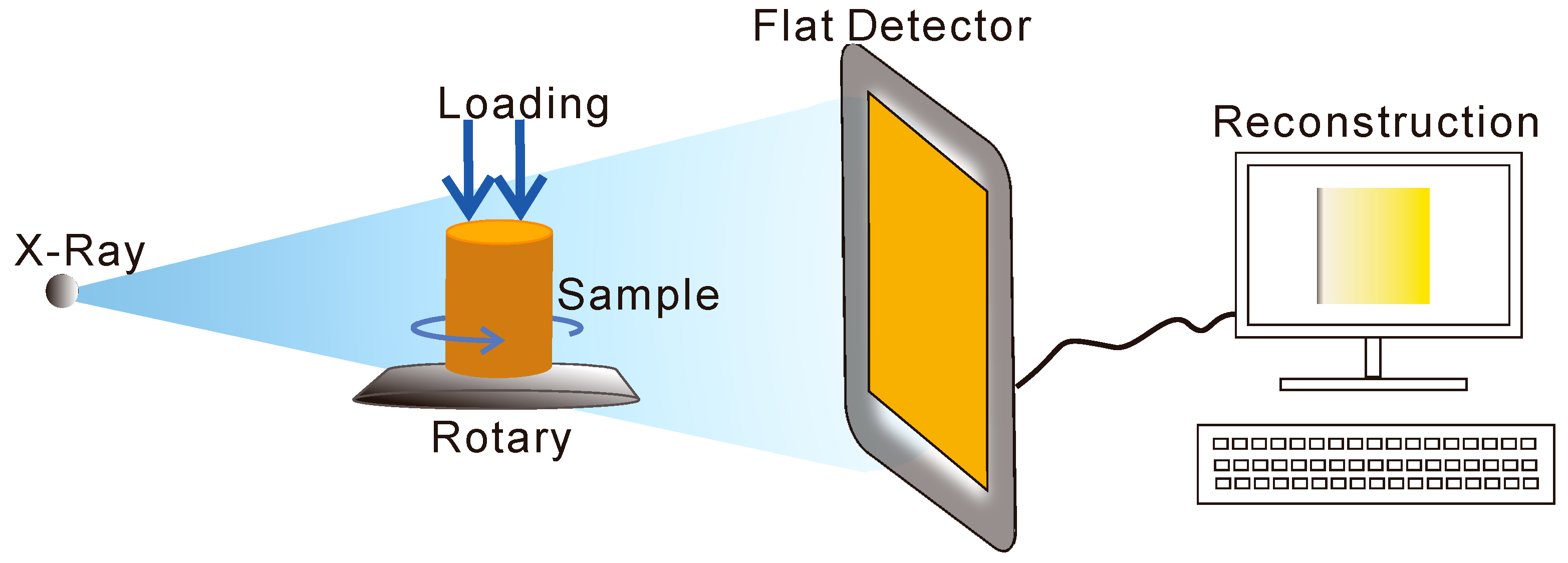
Figure 1. Schematic diagram of the RT-CT experimental system.
Fractalfract 09 00689 g001
Figure 2. Data augmentation examples: (a) Original image; (be) Augmented images; (fj) Corresponding segmentation label.
Fractalfract 09 00689 g002
Figure 3. Training performance and segmentation results: (a) Loss curves without augmentation; (b) Loss curves with augmentation; (c) Segmentation results comparison (Red circles: pore boundary differences; Green/purple circles: misidentified pores).
Fractalfract 09 00689 g003
Figure 4. 3D reconstructed pore distributions in specimens (A01A06).
Fractalfract 09 00689 g004
Figure 5. The stress–strain curves for different sand–cement ratio samples by the RT-CT system. Each point in the curve represents an individual scanning point.
Fractalfract 09 00689 g005
Figure 6. Pore fractal dimension distributions across sand–cement ratios.
Fractalfract 09 00689 g006
Figure 7. The relationship between pore fractal dimension and unconfined compressive strength (UCS) for various sand–cement ratios.
Fractalfract 09 00689 g007
Table 1. Critical stresses and strains at scanning points.
Sample Number ε 1 σ 1 ε 2 σ 2 ε 3 σ 3 ε 4 σ 4 ε 5 σ 5 ε 6 σ 6
A012:10.038.390.8714.730.15619.95------
A024:10.0815.100.1225.090.17335.260.2140.58----
A036:10.0710.060.1215.870.14617.670.16919.990.2425.160.3227.02
A048:10.067.640.1214.620.1820.350.2122.450.2424.250.2926.27
A0510:10.947.180.1516.260.2020.120.2422.180.2824.170.3226.17
A0612:10.793.470.106.150.127.900.148.880.159.970.2116.20
ε i : Strain (%), σ i : Stress (kN). i represents the loading stage, such as ‘1’ denotes the pre-mechanical testing stage, ‘1’ denotes the first loading and scanning stage. Subscripts in sample IDs denote sand–cement ratios, such as 2:1, 4:1, 8:1, 10:1, and 12:1.
Table 2. Normality Test Results.
s-wp < 0.05Normal
UCS0.906NY
Pore Fractal0.934NY
Porosity0.856NY
Diameter0.845NY
Table 3. Pearson correlation coefficient.
Pearson (r)UCSPore FractalPorosityEqDiameter Var
UCS10.8456−0.1735−0.4983
Pore Fractal0.84561−0.0938−0.3719
Porosity−0.1735−0.093810.5862
EqDiameterVar−0.4983−0.37190.58621
Spearman (ρ)UCSPore FractalPorosityEqDiameter Var
UCS10.92760.2571−0.3143
Pore Fractal0.927610.0294−0.2319
Porosity0.25710.029410.0580
EqDiameterVar−0.3143−0.23190.05801
Kendall (τ)UCSPore FractalPorosityEqDiameter Var
UCS10.82810.2000−0.2000
Pore Fractal0.828110.0714−0.1380
Porosity0.20000.071410.1380
EqDiameterVar−0.2000−0.13800.13801
Table 4. Pearson correlation coefficient p.
PearsonUCSPore FractalPorosityEqDiameter Var
UCS10.03390.74230.3144
Pore Fractal0.03310.85980.4679
Porosity0.74230.859810.2215
EqDiameterVar0.31440.46790.22151
SpearmanUCSPore FractalPorosityEqDiameter Var
UCS10.00770.62280.5441
Pore Fractal0.007710.95590.6584
Porosity0.62280.955910.9131
EqDiameterVar0.54410.65840.91311
KendallUCSPore FractalPorosityEqDiameter Var
UCS10.02170.71940.7194
Pore Fractal0.021710.84570.7021
Porosity0.71940.845710.7021
EqDiameterVar0.71940.70210.70211
Table 5. Multiple linear regression analysis results.
VariableCoefficientp < 0.05VIFR2F
Intercept−256.3452N 0.7721F = 2.2583
p = 0.3216
Porosity3.9077N1.445
Pore Fractal133.8091N1.161
EqDiameter Var−0.8584N1.598
p < 0.05”: Y = statistically significant (p < 0.05), N = not significant. VIF = variance inflation factor (values < 10 indicate no multicollinearity).
Disclaimer/Publisher’s Note: The statements, opinions and data contained in all publications are solely those of the individual author(s) and contributor(s) and not of MDPI and/or the editor(s). MDPI and/or the editor(s) disclaim responsibility for any injury to people or property resulting from any ideas, methods, instructions or products referred to in the content.