1. Introduction and Preliminaries
Let
be a complex Banach space, let
or
and let
be such that
If a continuous function
and a number
are given, then we say that a number
an
-period for
if and only if
for all
By
we denote the set consisting of all
-periods for
It is said that
is
c-almost periodic if and only if for each
the set
is relatively dense in
The usual class of (Bohr) almost periodic functions is obtained by plugging
For more details about almost periodic type functions and their applications, we refer the reader to the research monographs [
1,
2,
3,
4,
5,
6,
7,
8,
9,
10,
11,
12,
13,
14,
15,
16,
17,
18,
19,
20,
21,
22,
23] and references cited therein.
In the recent research article [
24] by M. Fečkan et al., we have extended the notion of
c-almost periodicity by introducing and analyzing the notion of
-almost periodicity with
being a general binary relation on
This class of functions will play an important role in our analysis (cf. Definition 1(i) below for the notion of Bohr
-almost periodicity). On the other hand, in [
25], we have recently provided some applications of
-regularized
C-resolvent families to the abstract impulsive Volterra integro-differential inclusions in Banach spaces. The main aim of this paper is to reconsider the notion of a piecewise continuous almost periodic function. This notion has been thoroughly analyzed in the research monographs [
26] by A. Halanay, D. Wexler and [
27] by A. M. Samoilenko, N. A. Perestyuk, by introducing and systematically investigating the classes of (pre-)
-piecewise continuous almost periodic functions and (pre-)
-piecewise continuous uniformly recurrent functions. We also aim to continue the research study carried out in [
25] by investigating the almost periodic type solutions for various classes of the abstract impulsive Volterra integro-differential inclusions. We consider here the functions of the form
where
and
are complex Banach spaces and
or
. In the existing literature, it has been commonly assumed that the sequence
of possible first kind discontinuities of function
under consideration is a Wexler sequence. Using certain results about Stepanov almost periodic type functions, we show that this condition is sometimes rather superfluous and almost completely irrelevant. Before proceeding any further, we would like to note that this is probably the first research article which investigates the existence and uniqueness of the uniformly recurrent type solutions, the Weyl almost periodic type solutions and the Besicovitch–Doss almost periodic type solutions to the abstract impulsive Volterra integro-differential equations. Furthermore, this is probably the first paper in the existing literature which investigates the almost periodic type solutions for certain classes of the abstract higher-order impulsive Cauchy problems. It should also be mentioned that we introduce here, for the first time in the existing literature, the class of Weyl-
p-almost periodic sequences in the sense of the general approach of A. S. Kovanko [
28], the class of Doss-
p-almost periodic sequences (
) and analyze their applications in the study of the existence and uniqueness of the Weyl-
p-almost periodic solutions (Doss-
p-almost periodic solutions) for certain kinds of the abstract impulsive Volterra integro-differential equations.
The organization and main ideas of this paper can be briefly summarized as follows. After explaining the notation used in the paper, we recall the basic definitions and results about
-almost periodic type functions in
Section 1.1. The main aim of
Section 1.2 is to recollect the basic facts about the class of piecewise continuous almost periodic functions, which has been commonly used in the existing literature. We extend the notion of piecewise continuous almost periodicity in
Section 2, where we introduce and analyze various classes of
-piecewise continuous almost periodic type functions. More precisely, in Definition 6, we introduce the classes of (pre-)
-piecewise continuous almost periodic functions and (pre-)
-piecewise continuous uniformly recurrent functions. The assumption that the corresponding sequence
of possible discontinuities is a Wexler sequence is almost completely irrelevant in the analysis. This is not the case with the quasi-uniformly continuity condition (QUC) from the formulation of Definition 6, which plays an important role in our study. In Examples 1 and 2, we present two illustrative examples of real-valued functions which are
-piecewise continuous almost periodic (cf. also Remarks 2–4 for some useful observations about the function spaces introduced in Definition 6). Several structural characterizations for introducing classes of piecewise continuous almost periodic type functions have been proved in Propositions 1–3; it should be specifically emphasized that the supremum formula holds for certain classes of pre-
-piecewise continuous uniformly recurrent functions (cf. Proposition 5).
In
Section 3, we continue the analysis of L. Qi and R. Yuan from their remarkable paper [
29] concerning the relations between the piecewise continuous almost periodic functions and the Stepanov almost periodic type functions. We improve some structural results obtained in [
29] by removing the assumption that
is a Wexler sequence. The main results in this section are Theorems 1 and 2; some consequences of these results are presented in Theorems 3–5 and Propositions 6 and 7. Composition principles for
-piecewise continuous almost periodic type functions are investigated in
Section 3.1.
Section 4 examines the existence and uniqueness of almost periodic type solutions for certain classes of the abstract impulsive differential inclusions of integer order, while
Section 5 examines the existence and uniqueness of almost periodic type solutions for certain classes of the abstract Volterra impulsive integro-differential inclusions.
Section 4 is broken down into four subsections:
Section 4.1 is devoted to the study of asymptotically almost periodic type solutions of the abstract impulsive differential Cauchy problem
, asymptotically Weyl almost periodic type solutions of
are sought in
Section 4.2, the Besicovitch almost periodic type solutions of
are sought in
Section 4.3, and the almost periodic type solutions of the abstract higher-order impulsive Cauchy problems are sought in
Section 4.4 (let us only mention that the separation condition
on the corresponding sequence
of possible discontinuities is not employed in some results). The final section of the paper is reserved for the conclusions and final remarks about the problems considered. In addition to the above, we present many illustrative examples and open problems.
We use the standard notation throughout the paper. By
and
we denote two complex Banach spaces;
denotes the identity operator on
By
, we denote the collection of non-empty subsets of
X such that for every
there exists
such that
The abbreviation
where
K is a non-empty compact subset of
stands for the space of all continuous functions from
K into
X;
and
where
. Let
and
Then, we say that the function
is a kernel on
if and only if for each
the assumption
implies
Set
where
denotes the Euler Gamma function, and
the Dirac delta distribution. We set
(
),
,
and
(
). Unless stated otherwise, we will always assume that
or
henceforth. If
then
denotes its complement in
denotes the characteristic function of the set
The notion of Caputo fractional derivative
where
and
is taken in the sense of Equation (3.1) [
25]. By
, we denote the power set of
Let
Then, the space of
X-valued piecewise continuous functions on
is defined by
where
, and the symbols
and
denote the left and the right limits of the function
at the point
,
, respectively. Let us recall that
is a Banach space endowed with the norm
The space of
X-valued piecewise continuous functions on
denoted by
if defined as the union of those functions
such that the discontinuities of
form a discrete set and that for each
we have
We similarly define the space
If then stands for the space of all continuous functions such that the function is bounded; the space stands for the space of all piecewise continuous functions such that the function is bounded.
Concerning the basic definitions and results about binary relations, see [
24]. We refer the reader to [
25] for more details concerning the multivalued linear operators and solution operator families subgenerated by them; unless stated otherwise, we will always assume henceforth that the operator
is injective.
1.1. -Almost Periodic Type Functions
In this subsection, we will recall the basic definitions and facts about (Stepanov)
-almost periodic type functions. We need the following notion [
24]:
Definition 1. Suppose that is a continuous function, and ρ is a binary relation on Then, we say that:
- (i)
is Bohr -almost periodic if and only if for every and there exists such that for each there exists such that, for every and there exists an element such that - (ii)
is -uniformly recurrent if and only if for every there exists a sequence in I such that and that, for every and there exists an element such that
Any Bohr
-almost periodic function
is
-uniformly recurrent; the converse statement is not true in general [
9]. If
then we omit the term “
” from the notation; furthermore, if
for some complex number
, then we also say that the function
is Bohr
-almost periodic, respectively,
-uniformly recurrent.
We need the following notion (cf. [
30] for the case in which
is single-valued):
Definition 2. Suppose that ρ is a binary relation on E and . Then, we say that:
- (i)
is Stepanov-p--almost periodic if and only if for every and there exists such that for each there exists such that, for every and there exists a mapping such that for a.e. , and - (ii)
is Stepanov---uniformly recurrent if and only if for every there exists a sequence in I such that and that, for every and there exists a mapping such that for a.e. , and
If then it is also said that is Stepanov--almost periodic (Stepanov--uniformly recurrent). Finally, if for some then we also say that the function is Stepanov--almost periodic (Stepanov--uniformly recurrent); if then it is also said that the function is Stepanov-p-almost periodic (Stepanov-p-uniformly recurrent).
1.2. Piecewise Continuous Almost Periodic Functions
The piecewise continuous almost periodic type solutions for various classes of impulsive integro-differential equations have been analyzed by numerous authors so far (see, e.g., the research monograph [
21] by G. Tr. Stamov for a comprehensive survey of results). In this subsection, we analyze the piecewise continuous almost periodic type functions.
We say that an
X-valued sequence
[
] is (Bohr) almost periodic if and only if, for every
there exists a natural number
such that among any
consecutive integers in
[
], there exists at least one integer
[
] satisfying that
Any almost periodic
X-valued sequence is bounded. As in the case of functions, this number is said to be an
-period of sequence
The equivalent concept of Bochner almost periodicity of
X-valued sequences can be introduced, as well; see, e.g., [
27] (Theorem 70, pp. 185–186 and its important consequences [
27] (Theorems 71–73, pp. 186–188). It is well-known that a sequence
in
X is almost periodic if and only if there exists an almost periodic function
such that
for all
see, e.g., the proof of [
31] (Theorem 2) given in the scalar-valued case. It is not difficult to prove that, for every almost periodic sequence
in
X, there exists a unique almost periodic sequence
in
X such that
for all
so that a sequence
in
X is almost periodic if and only if there exists an almost periodic function
such that
for all
Unless stated otherwise, we will always assume henceforth that [] is a sequence in [in ] such that []. Set , []. We need the following definitions:
Definition 3. The family of sequences [], [] is called equipotentially almost periodic if and only if, for every there exists a relatively dense set in [in ] such that for each there exists an integer [] such that for all [].
Definition 4. The sequence [] is said to be uniformly almost periodic if and only if, for every there exists a relatively dense set in [in ] such that We know that, if the sequence
[
] is uniformly almost periodic, then the family of sequences
[
],
[
] is equipotentially almost periodic. See also [
27] (p. 377) and [
29] (Lemma 2.12; let us also note that the family of sequences
,
is equipotentially almost periodic if and only if there exist a unique non-zero real number
and an almost periodic sequence
such that
for all
It seems very plausible that a similar statement holds for the equipotentially almost periodic sequences
The usual definition of a piecewise continuous almost periodic function goes as follows (see [
26,
27] for more details about the subject):
Definition 5. Suppose that the function [] is piecewise continuous with the possible first kind discontinuities at the points of a fixed sequence []. Then, we say that the function is -piecewise continuous almost periodic if and only if the following conditions are fulfilled:
- (i)
The family of sequences [], [] is equipotentially almost periodic, i.e., is a Wexler sequence.
- (ii)
For every there exists such that, if the points and belong to for some [ ] and , then
- (iii)
For every there exists a relatively dense set S in [in ] such that, if , then for all such that , []. Such a point τ is called an ϵ-almost period of
For example, let the family of sequences
,
be equipotentially almost periodic. Then, we know that the function
defined by
if
for some
is
-piecewise continuous almost periodic provided that the sequence
is almost periodic (cf. [
27] (pp. 202–203) for the proof of the above fact).
For further information about piecewise continuous almost periodic functions and their applications, we refer the reader to the research articles [
32] by H. R. Henríquez, B. de Andrade, M. Rabelo, [
33] by L. Qi, R. Yuan, [
20] by V. Tkachenko and references cited therein. Before proceeding with the original contributions about piecewise continuous almost periodic type functions, it would be worthwhile to mention that J. Xia has considered, in [
34], the class of piecewise continuous almost periodic functions following a completely different approach (cf. also the research article [
31] by L. Díaz and R. Naulin).
2. -Piecewise Continuous Almost Periodic Type Functions
We start this section by introducing the following notion:
Definition 6. Suppose that ρ is a binary relation on E, the function [] satisfies that, for every the function is piecewise continuous with the possible first kind discontinuities at the points of a fixed sequence []. Then, we say that the function is:
- (i)
pre--piecewise continuous almost periodic if and only if, for every and there exists a relatively dense set S in [in ] such that, if and satisfies for all [], then there exists such that
- (ii)
-piecewise continuous almost periodic if and only if the condition (i) from Definition 5 holds, is pre--piecewise continuous almost periodic and (QUC) holds, where:
- (QUC)
For every and there exists such that, if and the points and belong to for some [ ] and , then
- (iii)
pre--piecewise continuous uniformly recurrent if and only if there exists a strictly increasing sequence of positive real numbers tending to plus infinity and satisfying that, for every and there exists an integer such that, if and satisfies for all [], then there exists such that
- (iv)
-piecewise continuous uniformly recurrent if and only if is pre--piecewise continuous uniformly recurrent and the condition (QUC) holds.
We say that the function is (pre-)-piecewise continuous almost periodic [(pre-)-piecewise continuous uniformly recurrent] if and only if is (pre-)-piecewise continuous almost periodic [(pre-)-piecewise continuous uniformly recurrent] for a certain sequence [] obeying the general requirements. If for some , then we also say that is (pre-)piecewise continuous c-almost periodic [(pre-)piecewise continuous c-uniformly recurrent]; furthermore, if then we also say that is (pre-)piecewise continuous almost anti-periodic [(pre-)piecewise continuous uniformly anti-recurrent]. We omit the term “” from the notation if and omit the term “c” from the notation if
Remark 1. In the notion introduced in Definition 6(i), we can also require that the inequality holds provided that for all [], where satisfies This notion is really not interesting because a very simple argument shows that a function obeys this condition if and only if is pre--piecewise continuous almost periodic. The same holds in the case of consideration of parts (ii), (iii) and (iv) of Definition 6 so that we will always assume henceforth that
Before proceeding any further, we would like to present the following illustrative examples:
Example 1. Suppose that and [ and ]. Suppose, further, that the function satisfies that, for every as well as that exists in Then, we can extend the function to a function [] such that, for every the function is piecewise continuous, has the possible first kind discontinuities at the points of sequence [] and for all and []. Since the set of all integers [] such that is relatively dense in [], with the meaning clear, a very simple argument shows that the function is -piecewise continuous almost periodic. For example, if is an (anti-)periodic non-zero trigonometric polynomial with real values, then the piecewise continuous function determined by the function is -piecewise continuous almost (anti-)periodic; here and hereafter, sign sign for and sign for .
For the sequel, we will denote the collection of all functions constructed in this way by .
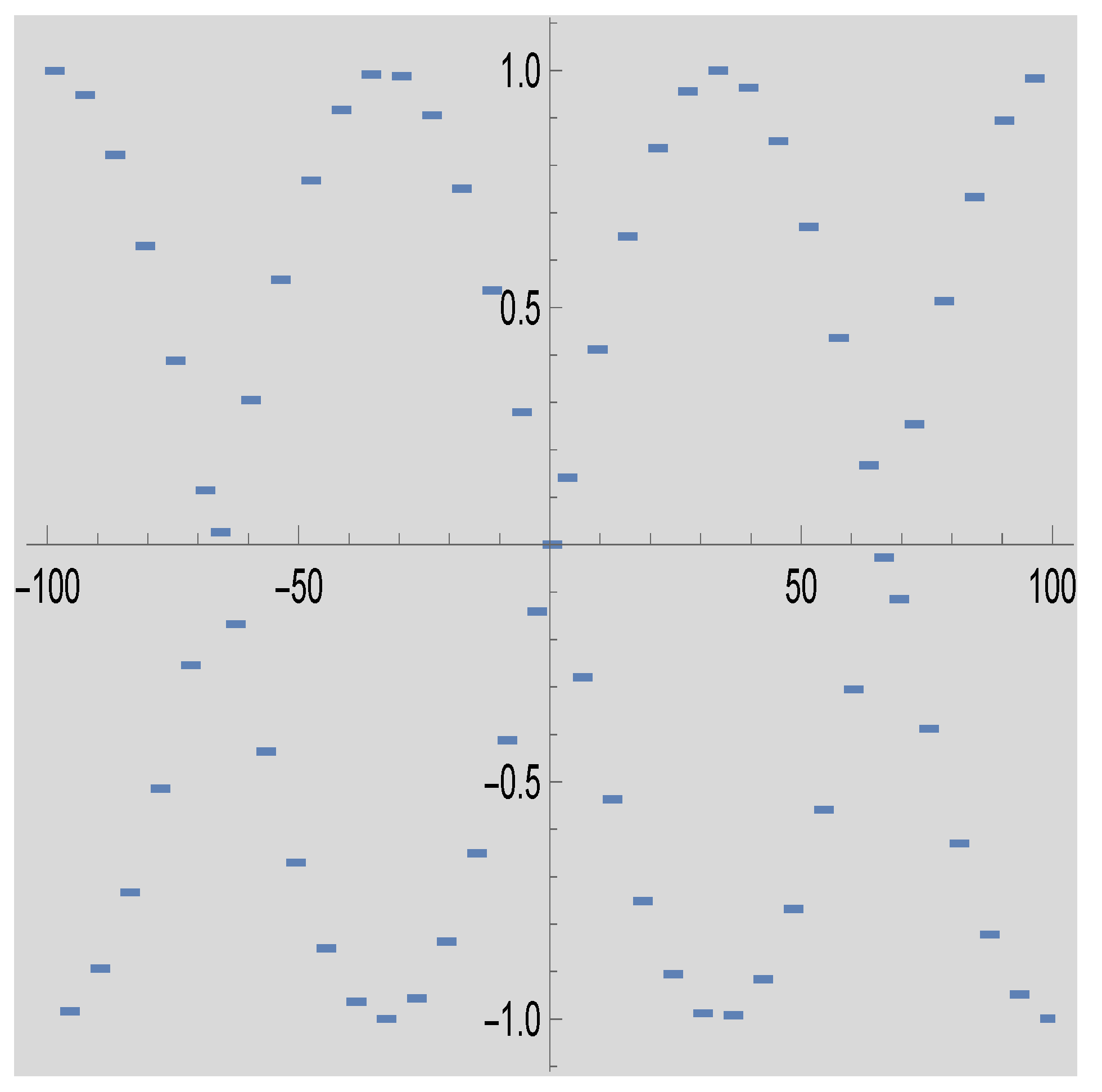
Example 2. Suppose that , is a Bohr almost periodic function, and there exists an integer such that Define In Figure 1, the plot of function is constructed for and . Thus, we have if for some integer so that the prescribed assumption implies that the function is not continuous on the real line. On the other hand, for every there exists such that any interval of length contains a point τ such that Towards this end, let us recall that, for a given in advance, we can always find such that any interval of length contains an integer τ such that the last estimate simply implies so that, actually, we can always find a number such that any interval of length contains an integer where , such that Let it be the case; then we haveSince the function is continuous from the left side, the condition (i) from Definition 5 holds, and (QUC) holds. It readily follows that the function is -piecewise continuous almost periodic. The proof of the following extension of [
27] (Theorem 77) is simple and therefore omitted:
Proposition 1. Suppose that ρ is a binary relation on E, and the function is (pre-)-piecewise continuous almost periodic [(pre-)-piecewise continuous uniformly recurrent]. If is a complex Banach space, is uniformly continuous on the set for each set and then the function is (pre-)-piecewise continuous almost periodic [(pre-)-piecewise continuous uniformly recurrent].
We continue by providing several useful observations:
Remark 2. - (i)
Condition (QUC) can be relaxed by assuming that, for every and there exists such that, if and the points and belong to the set [] and , then cf. also [27] (Definition 7, p. 390) for this approach. We feel it is our duty to say that the condition (QUC) is primarily intended for the analysis of -piecewise continuous almost periodic type functions and that some problems naturally occur if - (ii)
The introduction of class of (pre-)-piecewise continuous uniformly recurrent functions is strongly justified by the fact that the definition of a piecewise continuous almost periodic function is a bit restrictive due to condition (i). In actual fact, this condition does not allow one to consider the existence and uniqueness of the piecewise continuous solutions for a large class of the abstract impulsive Cauchy problems in which the corresponding sequence of the first kind discontinuities is not of linear growth as for example, we cannot consider the case for all which is very legitimate from the point of view of the theory of the abstract impulsive Cauchy problems.
Remark 3. It is clear that any Bohr -almost periodic [Bohr -uniformly recurrent] function is pre--piecewise continuous almost periodic [pre--piecewise continuous uniformly recurrent] for any sequence satisfying the general assumptions as well as that any Bohr -almost periodic [Bohr -uniformly recurrent] function which is uniformly continuous on the set for each is -piecewise continuous almost periodic [-piecewise continuous uniformly recurrent] for any sequence satisfying the general assumptions. In the almost periodic case, the statements of [24] (Proposition 2.2, Proposition 2.7(ii)) show that this condition holds true if is a family consisting of some compact subsets of , and ρ is single-valued on The subsequent structural result is a generalization of [
32] (Lemma 2.6):
Proposition 2. Suppose that is pre--piecewise continuous almost periodic, where is a linear isomorphism, and the condition (QUC) holds. If is a compact subset of then the set is relatively compact in
Proof. We will basically consider the case in which
and explain the essential change in the case that
Since
is a linear isomorphism, it suffices to show that the set
is relatively compact in
Let
be given. Then, there exists
such that, if
and the points
and
belong to
for some
and
, then
Let
. After that, we find
such that, for every
the interval
contains a point
such that
for all
such that
for all
. Fix now a point
and consider the interval
(if
then for each point
we can consider the interval
and a corresponding
-almost period
belonging to this set). The set
is compact in
E; furthermore, if
and the above conditions are satisfied, then we easily obtain the existence of an integer
, the points
and the elements
such that
provided that
for all
If
for some
then there exists an element
such that
which simply completes the proof of the theorem. □
Remark 4. - (i)
It is also worth noting that Proposition 2 provides a proper generalization of [29] (Lemma 3.3) as well as that this lemma holds even if the corresponding sequence from its formulation is not a Wexler sequence. - (ii)
It is well-known that there exists a continuous Stepanov-1-almost periodic function which is not bounded (see, e.g., [35]); therefore, cannot be piecewise continuous almost periodic due to Proposition 2.
We continue by stating the following results; the proofs are rather technical and therefore omitted (the statements of [
24] (Theorem 2.11(ii)–(iv)) can also be simply reformulated in the new framework):
Proposition 3. Suppose that ρ is a binary relation on E which satisfies that is a closed subset of X and
: For every there exists such that, for every with we have for every and
Suppose, further, that for each , the function satisfies that, for every the function is piecewise continuous with the possible first kind discontinuities at the points of a fixed sequence . Let and let uniformly on for every fixed set
Then, for every the function is piecewise continuous with the possible first kind discontinuities at the points of sequence and the following holds: If for each the function is pre--piecewise continuous almost periodic [-piecewise continuous almost periodic; pre--piecewise continuous uniformly recurrent/-piecewise continuous uniformly recurrent], then the function is pre--piecewise continuous almost periodic [-piecewise continuous almost periodic; pre--piecewise continuous uniformly recurrent/-piecewise continuous uniformly recurrent]. Furthermore, if the functions satisfy condition (QUC), then the function satisfies the same condition.
Proposition 4. Suppose that the function is pre--piecewise continuous almost periodic [-piecewise continuous almost periodic; pre--piecewise continuous uniformly recurrent/-piecewise continuous uniformly recurrent]. Then, the function is pre--piecewise continuous almost periodic [-piecewise continuous almost periodic; pre--piecewise continuous uniformly recurrent/-piecewise continuous uniformly recurrent], where It is worth noting that the supremum formula can be clarified for pre--piecewise continuous uniformly recurrent functions.
Proposition 5. Suppose that is a linear isomorphism and is a pre--piecewise continuous uniformly recurrent function. Then, for each and , we have Proof. It suffices to show that for each fixed number
we have
Clearly, there exists a sequence
in
such that
After that, we find a strictly increasing sequence
of positive real numbers tending to plus infinity such that
provided that
for all
[
]. If
[
], then there exists
such that
for some
[
]. Hence, we have
and
The final conclusion follows from the fact that, for every
the function
is continuous from the left side. □
The statements of [
36] (Propositions 2.17 and 2.18) continue to hold in our new framework, and we have the following:
- (i)
If is a pre-c-piecewise continuous uniformly recurrent function, then furthermore, if for all then
- (ii)
If is a pre-c-piecewise continuous uniformly recurrent function, then
It is well-known that, for every almost periodic function
there exists a unique almost periodic function
such that
for all
see H. Bart, S. Goldberg [
37] as well as [
7,
9] for many similar results of this type. We close this section with the observation that is not clear whether we can state a satisfactory analogue of this result for certain subclasses of (pre-)
-piecewise continuous almost periodic functions.
3. Relations with Stepanov Almost Periodic Type Functions
As observed by S. I. Trofimchuk in [
27] (p. 389), a piecewise continuous almost periodic function
is Stepanov almost periodic under additional conditions that are not restrictive and that the interest in the spaces of piecewise continuous almost periodic functions comes from the fact that these spaces have stronger topologies than the spaces of Stepanov almost periodic functions. The main purpose of the following result is to indicate that any piecewise continuous almost periodic function
in the sense of Definition 5 is immediately Stepanov-
p-almost periodic for any finite exponent
as well as that a much more general result holds true (cf. also [
27] (Lemma 58, p. 400)):
Theorem 1. Suppose that is pre--piecewise continuous almost periodic [pre--piecewise continuous uniformly recurrent] and, for every Then, the function is Stepanov--almost periodic [Stepanov--uniformly recurrent] for any finite exponent
Proof. Without loss of generality, we may assume that
and
for some
we will consider only pre-
-piecewise continuous almost periodic functions. Fix a number
and a set
Let a point
be also fixed, and let the interval
contain the possible first kind discontinuities at the points
Then,
and we have the existence of a sufficiently small real number
such that
Let
S be a relatively dense set in
such that, if
and
, then
for all
such that
,
The function
is less than or equal to
if
otherwise, we have
This implies
Taking into account (
1) and a simple computation, we conclude that
This simply completes the proof of the theorem. □
Remark 5. - (i)
The condition is crucial for the proof of Theorem 1 to work. In [27] (Appendix A.5), S.I. Trofimchuk has also analyzed the class of piecewise continuous almost periodic functions which satisfies []. If we allow the last condition, then a piecewise continuous almost periodic function need not be Besicovitch bounded (Besicovitch almost periodic); cf. [7] for the notion, and [27] (p. 400) for a counterexample of this type. - (ii)
Albeit sometimes inevitable, the condition is a little bit redundant. For example, if is a non-periodic trigonometric polynomial with real values, then we know that the function is Stepanov-p-almost periodic for any exponent see [7] (Example 2.2.3). Clearly, the zeros of are the points of discontinuity of the piecewise continuous function determined by However, since is not periodic, its zeros cannot be separated; to illustrate this, let us consider the polynomial Any zero of is of the form for some or for some It can be simply proved that for all as well as that for each there exist two strictly increasing sequences and of positive integers such that for all see, e.g., [19] (Definition 2, Theorem 2, Remark 1). This implies the required. - (iii)
In the formulation of Theorem 1, we have assumed immediately that The proof also works in the case that , but then the obtained conclusion in combination with [36] (Proposition 2.6) shows that - (iv)
Keeping in mind Theorem 1 and [17] (Theorem 2.3), we can extend the statements of [32] (Lemma 3.4, Theorem 3.7, Corollary 3.8) for any Stepanov-p-almost periodic inhomogeneity with the exponent see also [7] (Theorem 2.14.6) for case .
In the case that
is a Wexler sequence, L. Qi and R. Yuan have proved that a piecewise continuous function
which satisfies the condition (QUC) is
-piecewise continuous almost periodic if and only if the function
is Stepanov-
p-almost periodic for every (some) exponent
see [
29] (Theorem 3.2). Taken together with the statements of Proposition 2 and Theorem 1, the subsequent result provides a proper generalization of [
29] (Theorem 3.2). Here, we do not necessarily assume that
is a Wexler sequence and follow the idea from the proof of [
27] (Lemma 59, pp. 401–402), which is slightly incorrect since it is not clear how we can directly deduce the estimate
for all
or a similar estimate
for all
see [
27] (l. 1, p. 402) and observe that, in the above-described situation, we can have
and
for some integers
so that the quasi-uniform continuity argument cannot be directly applied here.
Theorem 2. Suppose that and is a Stepanov--almost periodic function. If the condition (QUC) holds, then is pre--piecewise continuous almost periodic.
Proof. For the sake of convenience, we will assume that
for some
and
Let
be given; then there exists
such that, if the points
and
belong to the same interval
of the continuity of function
and
, then
Let
for all
and let
We claim that there exists
such that, for every
with
we have
for all
If we assume the contrary, then for each
there exist points
and
such that
and
Using the continuity of function
from the left side, for each
there exist points
and
such that
,
and
Since
, it follows that, for every
the interval
belongs to the same interval
of continuity of function
for some
On the other hand, at least one of the intervals
and
belongs to the same interval
of continuity of function
for some
If the integer
is fixed, then we may assume without loss of generality that the above holds for the interval
since
this readily implies:
Hence, for every
we have:
and
which is a contradiction. This simply completes the proof of the theorem. □
The argument contained in the proof of [
29] (Theorem 3.8) can be applied even if
is not a Wexler sequence. Keeping in mind this fact as well as Proposition 2, Theorem 1, Theorem 2 and [
9] (Theorem 6.2.21), we can extend [
29] (Theorem 3.8) in the following way:
Theorem 3. Suppose that is pre--piecewise continuous almost periodic, the condition (QUC) holds, and any set B of the collection is a compact subset of Then, is Bohr -almost periodic if and only if is continuous.
We proceed with some applications of Theorems 1 and 2; the first result improves the statement of [
27] (Lemma 31, pp. 204–206):
Theorem 4. Suppose that is a pre--piecewise continuous almost periodic function (), and every set B of collection is compact in If the condition (QUC) holds for the functions and , then the functions and are pre--piecewise continuous almost periodic and satisfy the condition (QUC).
Proof. Due to Proposition 2 and Theorem 1, we have that the functions
and
are Stepanov-
-almost periodic. An application of [
9] (Proposition 6.2.17) shows that the function
is Stepanov-
-almost periodic so that the function
is pre-
-piecewise continuous almost periodic by Theorem 2. This clearly implies that the function
is pre-
-piecewise continuous almost periodic, as well. The condition
(QUC) clearly holds for both functions. □
Observe that we have not assumed above that
is a Wexler sequence; in particular, if
and
are
-piecewise continuous almost periodic functions and the requirements of Theorem 4 hold, then for each number
there exists a relatively dense set of their common
-almost periods, with the meaning clear. Keeping in mind Propositions 3 and 5 and Theorem 4, we can simply prove an analogue of [
24] (Theorem 2.23) for (pre-)
-piecewise continuous almost periodic functions.
Further on, as a simple application of Theorem 4, we have the following:
Proposition 6. Suppose that and are pre--piecewise continuous almost periodic functions, and every set B of collection is compact in If the condition (QUC) holds for the functions and , then the function is pre--piecewise continuous almost periodic; moreover, the function is pre--piecewise continuous almost periodic, provided that for each set we have
The next result follows from the argument contained in the proofs of Theorems 1 and 2 and the corresponding result for the Stepanov-p-almost periodic functions:
Proposition 7. Suppose that is a pre-piecewise continuous almost periodic function, and the condition (QUC) holds. Let be fixed. Then, for each number there exists a relatively dense set S of integers such that the set consists solely of the ϵ-almost periods of
The Favard type theorems for piecewise continuous almost periodic functions have been considered in the research article [
38] by L. Wang and M. Yu. Let us only mention that the authors have clarified, in [
38] (Theorem 2.3), a sufficient condition for the primitive function of a scalar-valued piecewise continuous almost periodic function to be almost periodic; observe, however, that the established result is very unsatisfactory from the application point of view. On the other hand, using Proposition 2, Theorem 1 and the Bohl–Bohr–Amerio theorem (see, e.g., [
13] (p. 80)), we can clarify the following simple result on the integration of piecewise continuous almost periodic type functions:
Theorem 5. Suppose that is a pre-piecewise continuous almost periodic function, and E is uniformly convex. If the function is bounded, then is almost periodic.
The statement of [
24] (Proposition 2.2) admits a satisfactory reformulation in the new framework provided that
is a linear isomorphism; in order to see this, we can combine Proposition 2, Theorems 1 and 2 and [
30] (Theorem 1(i)). Before proceeding to the next subsection, we observe that the statements of [
36] (Proposition 2.9, Corollary 2.10, Proposition 2.11) admit satisfactory reformulations in the new context as well. For example, we can combine Proposition 2, Theorems 1 and 2 and [
30] (Proposition 2) in order to see that the following generalization of [
36] (Proposition 2.9) holds true:
Proposition 8. Suppose that is a linear isomorphism and is (pre-)-piecewise continuous almost periodic [(pre-)-piecewise continuous uniformly recurrent]. Then, for each the function is (pre-)-piecewise continuous almost periodic [(pre-)-piecewise continuous uniformly recurrent].
3.1. Composition Principles for -Piecewise Continuous Almost Periodic Type Functions
In this subsection, we will prove two composition theorems for -piecewise continuous almost periodic type functions. In order to achieve this aim, we employ the relations between the -piecewise continuous almost periodic type functions and the Stepanov almost periodic type functions.
The first result reads as follows:
Theorem 6. Suppose that is a complex Banach space, is a pre--piecewise continuous almost periodic function, and is a pre--piecewise continuous almost periodic function, where is a collection of all compact subsets of X, and is a collection of all compact subsets of If the condition (QUC)
holds for the functions and and there exists such thatthen the function given by , , is a pre--piecewise continuous almost periodic function, and the condition (QUC)
holds for Proof. Let
and
be fixed. Then, Proposition 2 implies that the set
is relatively compact in
Let
be chosen from the condition (QUC) for the function
the number
and the set
further on, let
be chosen from the condition (QUC) for the function
the number
and the set
Define
Let
for some
and let
Then
Therefore, the condition (QUC) holds for
using a similar argument, we can show that for each
the mapping
is continuous from the left side, with the possible first kind of discontinuities at the points of the sequence
Consider now the functions
and
defined through
and
where
denotes the Banach space of all essentially bounded functions from
B into
equipped with the sup-norm. Due to Proposition 2, these mappings are well-defined. Using a simple argument involving the condition (QUC) for the functions
and
it follows that the functions
and
are pre-
-piecewise continuous almost periodic, and the condition (QUC) holds for them. Applying Theorems 1 and 2 and [
9] (Proposition 6.2.17), we conclude that there exists a common set
D of
-almost periods for these functions, with the meaning clear. If
and
for some
then we have
This simply completes the proof of the theorem. □
The second structural result simply follows from Theorem 6 and the argument contained in the proof of [
9] (Theorem 6.1.50) (cf. also [
24] (Theorem 2.17) and [
9] (Subsection 6.1.5) for similar results).
Theorem 7. Suppose that is a complex Banach space, is a pre--piecewise continuous almost periodic function, is a pre--piecewise continuous almost periodic function, where is a collection of all compact subsets of X, and is a collection of all compact subsets of Suppose, further, that the condition (QUC)
holds for the functions and there exists such that (2) holds with the function replaced therein with the function the function [] satisfies that for each set [] we have []. Then, the function given by , , is strongly asymptotically pre--piecewise continuous almost periodic in the sense that there exists a pre--piecewise continuous almost periodic function obeying the condition (QUC)
, and a function satisfying that for each set we have and for all and Concerning the composition principles for piecewise pseudo almost periodic type functions, we refer the reader to [
39] (Section 3) for some results established by J. Liu and C. Zhang.
Before going any further, we would like to present the following simple application of Theorem 6 and some useful observations concerning this result:
Example 3. Let denote the set of all pre--piecewise continuous almost periodic functions satisfying the condition (QUC). Then, Proposition 3 and Theorem 4 together imply that is a complex Banach space. Consider now Theorem 6 with and being the collection of all compact subsets of Consider, further, the following simple equationwhere is pre--piecewise continuous almost periodic and satisfies the condition (QUC) as well as is pre--piecewise continuous almost periodic and satisfies the condition (QUC). Suppose that there exists such that (2) holds. Then, the mapping is well-defined due to Proposition 3, Theorems 4 and 6. Moreover, this mapping is a contraction; therefore, there exists a unique function satisfying (3). For example, we can take andwhere the functions are pre--piecewise continuous almost periodic and satisfy the condition (QUC), the functions are bounded, Lipschitz continuous with constants and On the other hand, it is very difficult to apply Theorem 6 to the abstract semilinear integro-differential equations of the formif the operator family satisfies and condition that the mapping is (piecewise-)continuous for every element Then, it is expected that the mapping is Bohr almost periodic in the usual sense, so that we can always use a more general assumption that is Stepanov-p--almost periodic for some and apply the composition theorems for Stepanov almost periodic type functions [7,9] combined with some result of type [7] (Proposition 2.6.11); cf. also Remark 5(iv). We will not discuss here the well-posedness of problem (4) in the case that the mapping is only Lebesgue measurable () and 4. Almost Periodic Type Solutions of Abstract Impulsive Differential Inclusions of Integer Order
The main aim of this section is to analyze the almost periodic type solutions to the abstract impulsive differential inclusions of integer order. Of concern is the following abstract impulsive higher-order Cauchy inclusion
We refer the reader to [
25] for the notion of a (pre-)solution of
on
and
We will use the following result from [
25]; it is worth noting that, in the second part, we do not need the separation condition
on the sequence
:
Lemma 1. - (i)
Suppose that is a closed subgenerator of a local -regularized resolvent family where and Suppose that the functions and are continuous on the set for all as well as the right limits and the left limits of the functions and exist at any point of the set Definewhere Then, the function is a unique solution of the problem provided that and for all and
- (ii)
Suppose that is a closed subgenerator of a global -regularized resolvent family where Suppose, further, that , the sequence has no accumulation point, the functions and are continuous on the set for all as well as the right limits and the left limits of the functions and exist at any point of the set Define the functions and for by (5) and (6), respectively. Then, the function is a unique solution of the problem for provided that and for all and
In this paper, we will mainly consider the case in which
We start with the observation that it is not so simple to analyze the existence and uniqueness of
-periodic solutions of the abstract impulsive Volterra integro-differential inclusions on bounded domains unless some very restrictive assumptions are satisfied. Concerning this topic, which has recently been analyzed by some authors, we will only provide the following simple application of Lemma 1 with
Let
for all integers
let
, and let the (local)
C-regularized semigroup with subgenerator
satisfy
for all
If
then the solution
of problem
satisfies
if and only if
if
, this simply means that
We divide the further investigations into four subsections:
4.1. Asymptotically Almost Periodic Type Solutions of
Suppose that is the integral generator of a global exponentially decaying C-regularized semigroup on therefore, there exist finite real constants and such that Suppose, further, that the functions and satisfy all requirements from Lemma 1(ii) with For simplicity, we set
In this part, we will only assume that the sequence
has no accumulation point; the separation condition
is complete regardless. If
, then the function
defined in the proof of Lemma 1(i) belongs to the space
since we have (cf. also [
7] (Remark 2.6.14(i))):
we will not further discuss here the sufficient conditions ensuring that the function
belongs to some space of the weighted ergodic components in
(cf. [
9] (Section 6.4) for more details about these spaces in the multi-dimensional setting). Concerning the function
, we can assume that there exists a bounded Stepanov-
p-almost periodic function
and a function
for some
and
such that
for all
see, e.g., the proofs of [
7] (Propositions 2.6.11 and 2.6.13). A similar conclusion can be given in the case that there exist a bounded Stepanov-
p-almost periodic function
and a function
for some
and
, such that
for all
see [
39] (p. 3 and Definition 2.7) for the notion, the argument contained in the proof of [
7] (Lemma 2.12.3) and the decomposition used in the proof of [
7] (Proposition 2.6.13). We can also use Stepanov-
-almost periodic functions here.
Suppose now, in place of condition
, that
is an almost periodic sequence as well as that the family of sequences
,
is equipotentially almost periodic. Then, the argument contained in the proofs of [
32] (Lemmas 3.4 and 3.6, Theorem 3.7) shows that the function
is piecewise continuous almost periodic.
In this issue, we are seeking for the uniformly recurrent analogues of the conclusions established in the previous issue. Suppose that
is a strictly increasing sequence of positive real numbers such that
and
is a strictly increasing sequence of positive integers. Let, for every
and
there exist integers
and
such that, for every
and
, we have
see also [
27] (Lemma 35). If the sequence
is bounded [the sequences
and
are bounded], then Proposition 3 in combination with the argument contained in the proofs of [
32] (Lemma 3.6, Theorem 3.7) shows that the function
is (pre-)piecewise continuous uniformly recurrent; see also the statement (S) in the proof of Theorem 8 below.
For a concrete example, we need to recall that A. Haraux and P. Souplet have proved, in [
18] (Theorem 1.1), that the function
satisfies
uniformly in
Take
,
for all
and
for all
Then, the above requirements are satisfied.
4.2. Asymptotically Weyl Almost Periodic Type Solutions of
Suppose that and Let us recall that the function is called:
- (i)
equi-Weyl-
p-almost periodic if and only if for each
we can find two real numbers
and
such that any interval
of length
L contains a point
such that
- (ii)
Weyl-
p-almost periodic if and only if for each
we can find a real number
such that any interval
of length
L contains a point
such that
In order to study the existence and uniqueness of asymptotically (equi-)Weyl-p-almost periodic solutions of the problem we will use the following conditions:
- (ew-M1)
For every
, there exist
and
such that every interval
of length
L contains a point
which satisfies that there exists an integer
such that
for all
and
where the supremum is taken over all segments
of length
- (w-M1)
For every
, there exists
such that every interval
of length
L contains a point
which satisfies that there exist an integer
and an integer
such that
for all integers
, and (
8) holds for all integers
Condition (ew-M1), respectively, condition (w-M1), implies that the family of sequences , is equipotentially almost periodic as well as that the sequence is equi-Weyl-p-almost periodic, respectively, Weyl-p-almost periodic, in the following sense:
- (e-M1)
For every
, there exist
and
such that every interval
of length
L contains a point
which satisfies that (
8) holds with the number
replaced therein with the number
- (M1)
For every
, there exists
such that every interval
of length
L contains a point
which satisfies that there exists an integer
such that (
8) holds for all integers
with the number
replaced therein with the number
In the existing literature, the class of equi-Weyl-1-almost periodic sequences has been commonly used so far (see, e.g, the research articles [
40] by V. Bergelson et al., [
41] by T. Downarowicz, A. Iwanik and [
42] by A. Iwanik). The class of Weyl-
p-almost periodic sequences seems to be not considered elsewhere, even in the scalar-valued case. Before going further, let us mention that it is clear that condition (ew-M1) implies (w-M1) as well as that condition (e-M1) implies (M1).
Concerning the existence and uniqueness of asymptotically Weyl almost periodic solutions of problem , we will state and prove the following result:
Theorem 8. Suppose that (ew-M1), respectively, (w-M1) holds the functions and satisfy all requirements of Lemma 1 with , and for all Suppose, further, that and are bounded sequences, , the function is (equi-)Weyl-p-almost periodic and bounded as well as for all Then, there exist a bounded continuous (equi-)Weyl-p-almost periodic function a bounded piecewise continuous (equi-)Weyl-p-almost periodic function and a function such that the unique solution of problem satisfies for all
Proof. Keeping in mind [
7] (Theorem 2.11.4) and the proof of [
7] (Proposition 2.6.13), it readily follows that there exist a bounded (equi-)Weyl-
p-almost periodic function
and a function
such that
for all
cf. the formulation of Lemma 1 with
It remains to be proved that the function
from the formulation of Lemma 1(i) is bounded, piecewise continuous and (equi-)Weyl-
p-almost periodic. Keeping in mind the argument contained in the proof of [
32] (Theorem 3.7), the assumption that
is a bounded sequence and the fact that the statement of [
7] (Proposition 2.3.5) continues to hold for the sequences of piecewise continuous bounded functions, it suffices to show that the function
defined by
if
and
if
for some integer
is (equi-)Weyl-
p-almost periodic. The consideration is similar for both classes of functions, and we may assume, without loss of generality, that condition (ew-M1) holds. Since
is a bounded sequence, we have
for all
and therefore, the following statement holds:
- (S)
For every there exists such that, if and , then for all
Let
be given. Then, we know that there exist
as large as we want, and
such that every interval
of length
L contains a point
which satisfies that there exists an integer
such that
for all
and (
8) holds. Suppose now that
,
,
and
for some integer
Then, the argument contained in the proof of [
32] (Lemma 3.6), with
shows that
Therefore, since (S) holds and
, we have:
Suppose now that
and
for some integers
Since the separation condition
holds, we have
, and therefore
Hence, there exist absolute real constants
and
such that
Due to the assumption (
8), the above calculation shows that we can take
in the corresponding definition of equi-Weyl-
p-almost periodicity. The proof of the theorem is thereby complete. □
Remark 6. If we replace the conjuction of condition (ew-M1), respectively, (w-M1), and the condition that is a bounded sequence, by the condition that , then the above argument and (7) together imply that there exist a bounded, continuous (equi-)Weyl-p-almost periodic function and a function such that the unique solution of problem satisfies for all Here, we can only assume that the sequence has no accumulation point; the separation condition is complete regardless. Now, we would like to present the following simple example in which Theorem 8 can be applied ():
Example 4. - (i)
Suppose that for all , for and for all Then, it is trivial to show that (ew-M1) holds with and on the other hand, it is clear that is not an almost periodic sequence.
- (ii)
Suppose that for all , and for all Then, the sequence is not equi-Weyl-p-almost periodic (); on the other hand, is Weyl-p-almost periodic for any exponent . Towards this end, it suffices to observe that there exists a finite constant such that, for every , we havesee the proof of [9] (Theorem 7.3.8, case 3, p. 566). The requirements of Theorem 8 hold with condition (w-M1) being satisfied.
We close this section with the observation that we can similarly analyze the existence and uniqueness of (equi-)Weyl-
p-almost periodic solutions for a class of the abstract impulsive nonautonomous differential equation of the form [
32] (1.1).
4.3. Besicovitch–Doss Almost Periodic Type Solutions of
We start this subsection by recalling the following special case of the notion introduced in [
43] (Definition 2.1):
Definition 7. Suppose that and Then, we say that the function belongs to the class if and only if there exists a sequence of trigonometric polynomials such thatwhere we assume that the term in brackets belongs to the space for all If then we omit the term “ϕ” from the notation. The usual notion is obtained by plugging and when we say that the function is Besicovitch-p-almost periodic. As an immediate consequence of [
43] (Proposition 10) and the previous considerations, we have the following result (cf. also Remark 6; we only assume here that the sequence
has no accumulation point):
Proposition 9. Suppose that the functions and satisfy all requirements of Lemma 1 with , and for all Suppose, further, that , , the function is bounded and belongs to the class as well as for all Then, there exist a bounded continuous function belonging to the class and a function such that the unique solution of problem satisfies for all
Remark 7. Is should be noted that the solution belongs to the class as well. In order to see this, it suffices to observe that is a vector space (see the statement [43] ((i), p. 4221)) and which follows from a relatively simple computation with the sequence in Definition 7 and the assumption We also need the following notion (see, e.g., [
7] (Definition 2.13.2)):
Definition 8. Let and let Then, it is said that is Doss p-almost periodic if and only if, for every , the set of numbers for whichin the case that respectively,in the case that is relatively dense in Now, we would like to re-examine the statement of Theorem 8 for Doss-p-almost periodic solutions. In order to do that, we need to introduce the following condition:
- (ed-M1)
For every
, there exists
such that every interval
of length
L contains a point
which satisfies that there exists an integer
such that
for all
and
Condition (ed-M1) implies that the family of sequences , is equipotentially almost periodic as well as that the sequence is Doss-p-almost periodic in the following sense:
- (d-M1)
For every
, there exists
such that every interval
of length
L contains a point
which satisfies that (
9) holds with the number
replaced therein with the number
Before stating the next result, we would like to note that the class of Doss-p-almost periodic sequences has not been defined in the existing literature so far, even in the scalar-valued setting.
Theorem 9. Suppose that (ed-M1) holds, the functions and satisfy all requirements of Lemma 1 with , and for all Suppose, further, that and are bounded sequences, , the function is Doss-p-almost periodic and bounded as well as for all Then, there exist a bounded continuous Doss-p-almost periodic function a bounded piecewise continuous Doss-p-almost periodic function and a function such that the unique solution of problem satisfies for all
Proof. We will only outline the main details of the proof (see also the proof of Theorem 8). In place of [
7] (Theorem 2.11.4), we can use [
7] (Theorem 2.13.10). If condition (ed-M1) holds in place of condition (ew-M1), then we can use the same arguments as in the proof of Theorem 8, with
and
The remainder of the proof is the same. □
Remark 8. Due to [7] (Proposition 2.13.6), we have that the function is also Doss-p-almost periodic. The pioneering results about Besicovitch-
p-almost periodic sequences have been given in [
3,
44]. The first systematic study of scalar-valued Besicovitch-
p-almost periodic sequences has been carried out by A. Bellow and V. Losert in [
14] (Section 3); cf. also Bergelson et al. [
40]. In the following definition, we introduce the vector-valued version of [
14] (Definition 3.2):
Definition 9. Suppose that and is a sequence in X. Then, we say that is Besicovitch-p-almost periodic if and only if for every there exists a trigonometric polynomial such that It can be simply shown that any Besicovitch-
p-almost periodic sequence
is Besicovitch-
p-bounded, i.e.,
see, e.g., the proof of [
43] (Proposition 1(i)) for the continuous analogue of this statement. Therefore, the sequence
considered in Example 4(ii) is not Besicovitch-
p-almost periodic since
It is completely out of the scope of this paper to reconsider the statements established in [
14] for the vector-valued Besicovitch-
p-almost periodic sequences. Before proceeding further, we would like to address the following questions:
- (Q1)
Is it possible to state a satisfactory analogue of Theorems 8 and 9 for Besicovitch-p-almost periodic solutions of problem ()?
- (Q2)
Suppose that the family of sequences , is equipotentially almost periodic as well as that the sequence is equi-Weyl-p-almost periodic (). Is it true that (ew-M1) holds true?
- (Q3)
Suppose that the sequence is (equi-)Weyl-p-almost periodic [Doss-p-almost periodic/Besicovitch-p-almost periodic] (). Is it true that there exists a unique (equi-)Weyl-p-almost periodic [Doss-p-almost periodic/Besicovitch-p-almost periodic] sequence (defined in the obvious way) such that for all
- (Q4)
Is it true that the sequence [] is (equi-)Weyl-p-almost periodic [Doss-p-almost periodic/Besicovitch-p-almost periodic] () if and only if there exists a continuous (equi-)Weyl-p-almost periodic [Doss-p-almost periodic/Besicovitch-p-almost periodic] function [] such that for all []?
In connection with the problem (Q2), see also [
27] (Lemma 35) and observe that we cannot expect the affirmative answer in the case of consideration of Weyl-
p-almost periodic sequences and Doss-
p-almost periodic sequences; cf. [
9] for more details. It can be very simply shown that the class of Doss-
p-almost periodic sequences is the most general since it contains all Weyl-
p-almost periodic sequences and all Besicovitch-
p-almost periodic sequences; it is also worth noting that the class of equi-Weyl-
p-almost periodic sequences is contained in the class of Besicovitch-
p-almost periodic sequences, which is no longer true for the class of Weyl-
p-almost periodic sequences. A simple example of a Besicovitch-
p-almost periodic sequence which is not Weyl-
p-almost periodic is given as follows: If
and
for some integer
then, we define
then the sequence
enjoys the abovementioned properties (see also [
45] (Example 6.24), [
46] (p. 42) and [
43] (Example 4)). We will examine in more detail the classes of (equi-)Weyl-
p-almost periodic sequences, Doss-
p-almost periodic sequences and Besicovitch-
p-almost periodic sequences somewhere else (
).
4.4. Almost Periodic Type Solutions of the Abstract Higher-Order Impulsive Cauchy Problems
We will first explain how the results established in the previous three subsections can be used in the analysis of the existence and uniqueness of almost periodic type solutions for certain classes of the abstract higher-order impulsive (degenerate) Cauchy problems. Here, the idea is to convert these problems into the equivalent abstract impulsive (degenerate) Cauchy problems of first order on the product spaces.
Suppose, for example, that the operator
A generates a strongly continuous semigroup on
X as well as that
B is a closed densely defined operator on
X with
Applying [
47] (Theorem 3), we conclude that there exists a real number
such that, for every
with
the matricial operator
generates an exponentially decaying strongly continuous semigroup
on
Suppose, further, that
and
are continuously differentiable and asymptotically almost periodic. Using Lemma 1(ii) and a simple computation with the variation of parameters formula, we can reformulate all established conclusions from the previous three subsections of this paper in the analysis of the abstract impulsive Cauchy problem
Without going into full details, we will only emphasize that the certain classes of the abstract degenerate second-order Cauchy problems with impulsive effects can also be analyzed in a similar manner by reduction to the abstract degenerate first-order Cauchy problems with impulsive effects on product spaces; see, e.g., [
25] (Example 2.5(ii)), where we analyzed the well-posedness of the damped Poisson-wave type equations in
-spaces (it would be very tempting to apply the same method to the abstract higher-order Cauchy problems considered in [
48]).
In the existing literature, the authors have found many interesting criteria ensuring that a strongly continuous operator family
is (asymptotically) almost periodic, i.e., the mapping
is (asymptotically) almost periodic for every fixed element
cf. [
7] for more details. Such operator families can be important in the analysis of the existence and uniqueness of the almost periodic type solutions for certain classes of the abstract impulsive Volterra integro-differenital inclusions, as the following illustrative example indicates.
Example 5. The existence and uniqueness of almost periodic solutions for a class of the complete second-order Cauchy problems have been considered by T.-J. Xiao and J. Liang [22] (Section 7.1.2) under the assumption that the corresponding problem is strongly well-posed. Specifically, the authors analyzed the abstract Cauchy problemwhere and the operator is a closed linear operator with domain and range contained in a Banach space In the case that and is the Dirichlet Laplacian, the authors have shown that both propagator families, and are almost periodic. If so, then we can consider the piecewise continuous almost periodic solutions of the following abstract impulsive Cauchy problemwhere and the sequence has no accumulation point. Due to the consideration from [25], the function where if for some is a unique solution of Arguing as in Example 6 below, we may conclude that the assumptions and imply that there exist an almost periodic function and a function such that for all 5. Almost Periodic Type Solutions of the Abstract Volterra Integro-Differential Inclusions with Impulsive Effects
Let us consider the following abstract impulsive Volterra integro-differential inclusion:
where
where
,
,
,
, and
,
are two given mappings, as well as the well-posedness of the following abstract impulsive Volterra integro-differential inclusion:
where
the sequence
has no accumulation point,
,
,
, and
,
are two given mappings.
The notion of a (pre-)solution of (
10) [(
11)] and the notion of a strong solution of (
10) [(
11)] have recently been introduced in [
25]. We recall the following result from the same paper:
Lemma 2. - (i)
Suppose that and are kernels, , , and is a closed subgenerator of a mild -regularized -uniqueness family , where Define for and if for some integer Define also for and if for some integer If then is a unique strong solution of problem (10) on . - (ii)
Suppose that and are kernels, , , and is a closed subgenerator of a mild -regularized -existence family , where Define and in the same way as above, with the operator replaced therein with the operator and the elements Then, is a solution of problem (10) on .
In a global version of Lemma 2, which can be very simply formulated, we do not need the separation condition
on the sequence
For the sequel, we need to recall the following special consequences of [
8] (Proposition 3.1.15(i)):
- (i)
Suppose that
as well as
, and
is a closed subgenerator of a
-regularized resolvent family
Then, the function
is a unique solution of the following abstract fractional Cauchy inclusion:
- (ii)
Suppose that
as well as
, and
is a closed subgenerator of a
-regularized resolvent family
Set
If
, then the function
is a unique solution of the following abstract fractional Cauchy inclusion:
Keeping in mind this result, Lemma 2 and the second equality in [
49] (1.21), we have the following:
Theorem 10. Suppose that , and is a closed subgenerator of a global -regularized resolvent family Define for and if for some integer Define also for and if for some integer and assume that
- (i)
Suppose that Then, the function is piecewise continuous, and it is a unique strong solution of problem (10) on with and - (ii)
Suppose that and the mapping is continuously differentiable. Then, the function is piecewise continuous, and it is a unique strong solution of problem (10) on with and
Concerning the existence and uniqueness of the asymptotically almost periodic type solutions of problem (
10) on
with
and
we will present the following extremely important situation in which all conclusions established in the previous section continue to hold.
Suppose that
A is a densely defined, closed linear operator,
,
for some number
, and the mapping
is analytic in an open neighborhood of the set
Then, we know that the operator
A is a subgenerator of a global
-regularized resolvent family
satisfying that there exists
such that
see, e.g., the proof of E. Cuesta’s result [
15] (Theorem 1) and [
7] (Section 3.4) for many important generalizations of this result.
Suppose now that all requirements of Theorem 10 hold, the sequence
has no accumulation point (the separation condition
is complete regardless here) and
Then, the function
defined in the proof of Theorem 10(ii) belongs to the space
since for each
and
we have
Concerning the function
, we can assume that there exists a bounded Stepanov-
p-almost periodic function
and a function
for some
such that
for all
Then, the function
will be asymptotically almost periodic in the usual sense; see, e.g., [
7] (Proposition 2.6.11, Remark 2.6.12, Proposition 2.6.13). Observe also that the obtained conclusion on the existence and uniqueness of asymptotically almost periodic solutions cannot be established in the case that
since, in this case, the resolvent
is not uniformly integrable; for example, in
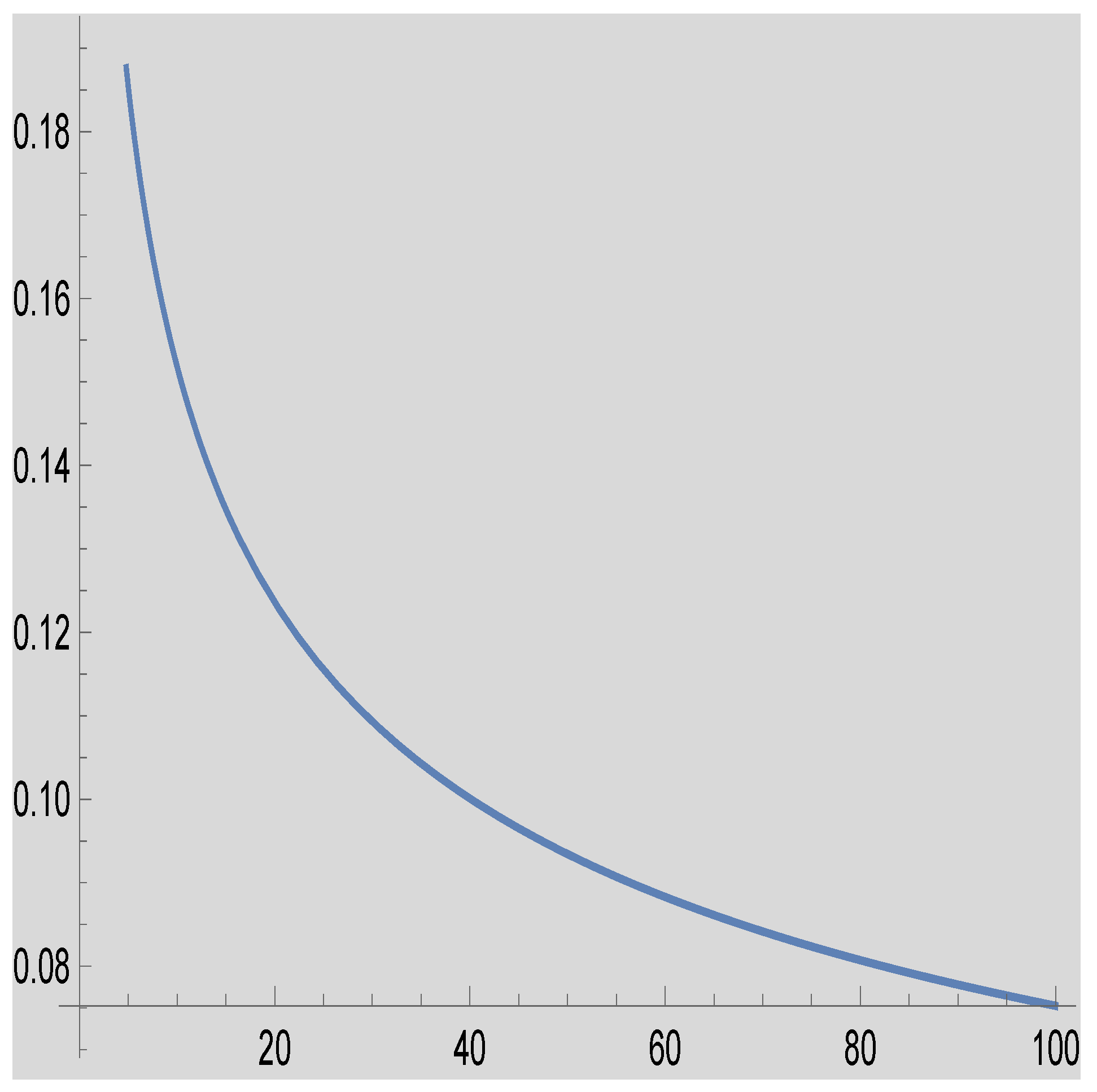
Figure 2 we have constructed the graph of the
-regularized resolvent family
which satisfies an estimate of the type
; of course, here we have
and
All other results established in the previous section continue to hold, as marked above. After a careful inspection of the proofs of [
32] (Lemma 3.6, Theorem 3.7), it suffices to observe that the uniform convergence in the corresponding part of the proof of [
32] (Theorem 3.7; cf. (3.36), p. 14) is a consequence of the following simple computation, where we assume that the sequence
is bounded:
for some finite real constant
In conclusion, we have the following: if
is an almost periodic sequence, the separation condition
holds, and the family of sequences
,
is equipotentially almost periodic. Then, the function
is piecewise continuous almost periodic.
It should be noted that the obtained results can be applied to the abstract (non-coercive) differential operators in
-spaces; cf. [
50] (Section 2.5) for further information in this direction.
Remark 9. Consider now the situation in which , and satisfies condition (P) analyzed in [51] and [7] (Subsection 2.9.1). If we consider the subordinated resolvent families and from [7], then the function is a unique solution of the following abstract fractional Cauchy inclusion (under certain reasonable assumptions):Keeping in mind the second equality in [49] (1.21) and the initial condition we simply conclude that the function is a unique strong solution of the associated Volterra inclusionSuppose now that for and if for some integer as well as that Define for and if for some integer and assume that there exist vectors from the continuity set of the resolvent operator family such that for all cf. also [25] (Example 2.5(i)). Then, the function is a unique strong solution of the abstract impulsive Volterra inclusionTherefore, the function is a unique strong solution of the abstract impulsive Volterra inclusion Concerning the existence and uniqueness of asymptotically almost periodic solutions of (13), the situation is far from being simple because the operator family has an integrable singularity at zero: we must impose certain extra assumptions in order for the proofs to work. This can be simply completed for the analogues of the equations [32] ((3.27)–(3.28)) but, unfortunately, this is almost impossible to be completed for the equation [32] (3.36) since the series diverges. Even the computation carried out in (12) cannot be so simply reconsidered in a newly arisen situation. We continue by providing the following instructive example:
Example 6. Let and and let us consider the following fractional Cauchy problemcf. also [49] (Example 2.20). Suppose that and where Δ denotes the Laplacian equipped with the Dirichlet boundary conditions. Then, we known that A is the integral generator of an asymptotically almost periodic -resolvent family as well as that is not almost periodic if cf. [7] (Example 2.6.4). Suppose now that and Define the function as in the formulation of Lemma 2(i), with and Then, it can be simply shown that the function is a unique strong solution of the abstract Volterra Equation (10) with and where if for some By the assumption and the already mentioned result about the extension of almost periodic functions [37], we know that for each there exist an almost periodic function and a function such that for all Define and by , for and for It can be simply shown that is almost periodic, , as well as that for all and cf. also [4] (Lemma 4.28, Theorem 4.29). Since we have assumed that the Weierstrass criterion implies that the series , and , are uniformly convergent. Since is a Banach space, it readily follows that on the other hand, it is clear that the function is almost periodic. Hence, the solution is piecewise continuous asymptotically almost periodic since for all In [
25], we have also considered the following Volterra integro-differential equation:
where
,
is a Lebesgue measurable mapping with values in
X,
, and
A,
B are closed linear operators with domain and range contained in
X. The class of exponentially bounded
-regularized
C-resolvent family for (
14) has recently been introduced in [
8] (Definition 2.2.2); cf. also [
25] (Definition 4.4). We close this section with the observation that we can similarly analyze, with the help of [
25] (Theorem 4.6) and the foregoing arguments, the existence and uniqueness of asymptotically almost periodic type solutions of problem (
14). Details can be left to the interested readers.