


Computational Analysis of Fractional-Order KdV Systems in the Sense of the Caputo Operator via a Novel Transform


Abstract
1. Introduction
2. Basic Concept
3. Algorithm of the HPTM
4. Algorithm of the YTDM
5. Application
6. Results Discussion
7. Conclusions
Author Contributions
Funding
Data Availability Statement
Acknowledgments
Conflicts of Interest
Abbreviations
| FC | Fractional calculus |
| KdV | Korteweg–De Vries |
| FPDEs | Fractional-order partial differential equations |
| YT | Yang transform |
| YTDM | Yang transform decomposition method |
| HPTM | Homotopy perturbation transform method |
| x | Independent variable |
| Time | |
| Dependent function representing the physical quantity | |
| Fractional order | |
| Y | Yang transform |
| Inverse Yang transform | |
| Perturbation parameter |
References
- Mainardi, F. Fractional Calculus and Waves in Linear Viscoelasticity: An Introduction to Mathematical Models; Imperial College Press: London, UK, 2022. [Google Scholar]
- Li, C.; Deng, W. Remarks on fractional derivatives. Appl. Math. Comput. 2007, 187, 777–784. [Google Scholar] [CrossRef] [Scilit]
- Alam, M.N.; Ilhan, O.A.; Manafian, J.; Asjad, M.I.; Rezazadeh, H.; Baskonus, H.M. New Results of Some of the Conformable Models Arising in Dynamical Systems. Adv. Math. Phys. 2022, 2022, 7753879. [Google Scholar] [CrossRef] [Scilit]
- Alam, M.N.; Ilhan, O.A.; Uddin, M.S.; Rahim, M.A. Regarding on the Results for the Fractional Clannish Random Walker’s Parabolic Equation and the Nonlinear Fractional Cahn-Allen Equation. Adv. Math. Phys. 2022, 2022, 5635514. [Google Scholar] [CrossRef] [Scilit]
- Podlubny, I. Fractional Differential Equations: An Introduction to Fractional Derivatives, Fractional Differential Equations, to Methods of Their Solution and Some of their Applications; Academic Press: New York, NY, USA, 1999; 368p. [Google Scholar]
- Oldham, K.; Spanier, J. The Fractional Calculus Theory and Applications of Differentiation and Integration to Arbitrary Order; Elsevier: Amsterdam, The Netherlands, 1974. [Google Scholar]
- Klafter, J.; Lim, S.C.; Metzler, R. Fractional Dynamics: Recent Advances; World Scientific: Singapore; Hackensack, NJ, USA, 2012. [Google Scholar]
- Tarasov, V.E. Fractional Dynamics: Applications of Fractional Calculus to Dynamics of Particles, Fields and Media; Higher Education Press Springer: Beijing, China; London, UK, 2010. [Google Scholar]
- Kilbas, A.A.; Srivastava, H.M.; Trujillo, J.J. Theory and Applications of Fractional Differential Equations; Elsevier Science Inc., 655 Avenue of the Americas: New York, NY, USA, 2006; Volume 204. [Google Scholar]
- Magin, R. Fractional calculus in bioengineering, part 1. Crit. Rev. Biomed. Eng. 2004, 32, 104. [Google Scholar]
- Hilfer, R. (Ed.) Applications of Fractional Calculus in Physics; World Scientific: Singapore, 2000. [Google Scholar]
- Arqub, O.A.; El-Ajou, A. Solution of the fractional epidemic model by homotopy analysis method. J. King Saud-Univ.-Sci. 2013, 25, 73–81. [Google Scholar] [CrossRef] [Scilit]
- Bhrawy, A.H.; Ezz-Eldien, S. A new Legendre operational technique for delay fractional optimal control problems. Calcolo 2016, 53, 521–543. [Google Scholar] [CrossRef] [Scilit]
- Jassim, H.K. Analytical solutions for system of fractional partial differential equations by homotopy perturbation transform method. Int. J. Adv. Appl. Math. Mech. 2015, 3, 36–40. [Google Scholar]
- Thabet, H.; Kendre, S.; Chalishajar, D. New analytical technique for solving a system of nonlinear fractional partial differential equations. Mathematics 2017, 5, 47. [Google Scholar] [CrossRef] [Scilit]
- Mamchuev, M.O. Cauchy problem in nonlocal statement for a system of fractional partial differential equations. Differ. Equ. 2012, 48, 354–361. [Google Scholar] [CrossRef] [Scilit]
- El-Ajou, A.; Shqair, M.; Ghabar, I.; Burqan, A.; Saadeh, R. A solution for the neutron diffusion equation in the spherical and hemispherical reactors using the residual power series. Front. Phys. 2023, 11, 1229142. [Google Scholar] [CrossRef] [Scilit]
- Zayed, E.M.; Amer, Y.A.; Al-Nowehy, A.G. The modified simple equation method and the multiple exp-function method for solving nonlinear fractional Sharma-Tasso-Olver equation. Acta Math. Appl. Sin. Engl. Ser. 2016, 32, 793–812. [Google Scholar] [CrossRef] [Scilit]
- Ayati, Z.; Badiepour, A. Two New Modifications of the Exp-Function Method for Solving the Fractional-Order Hirota-Satsuma Coupled KdV. Adv. Math. Phys. 2022, 2022, 6304896. [Google Scholar] [CrossRef] [Scilit]
- Alaoui, M.K.; Fayyaz, R.; Khan, A.; Shah, R.; Abdo, M.S. Analytical investigation of Noyes-Field model for time-fractional Belousov-Zhabotinsky reaction. Complexity 2021, 2021, 3248376. [Google Scholar] [CrossRef] [Scilit]
- Sunthrayuth, P.; Alyousef, H.A.; El-Tantawy, S.A.; Khan, A.; Wyal, N. Solving fractional-order diffusion equations in a plasma and fluids via a novel transform. J. Funct. Spaces 2022, 2022, 1899130. [Google Scholar] [CrossRef] [Scilit]
- Zayed, E.M.; Amer, Y.A.; Shohib, R.M. The fractional complex transformation for nonlinear fractional partial differential equations in the mathematical physics. J. Assoc. Arab. Univ. Basic Appl. Sci. 2016, 19, 59–69. [Google Scholar] [CrossRef] [Scilit]
- Li, Z.B.; Zhu, W.H.; He, J.H. Exact solutions of time-fractional heat conduction equation by the fractional complex transform. Therm. Sci. 2012, 16, 335–338. [Google Scholar] [CrossRef] [Scilit]
- Areshi, M.; Khan, A.; Shah, R.; Nonlaopon, K. Analytical investigation of fractional-order Newell-Whitehead-Segel equations via a novel transform. Aims Math. 2022, 7, 6936–6958. [Google Scholar] [CrossRef] [Scilit]
- Alomari, A.K.; Noorani, M.S.M.; Nazar, R.; Li, C.P. Homotopy analysis method for solving fractional Lorenz system. Commun. Nonlinear Sci. Numer. Simul. 2010, 15, 1864–1872. [Google Scholar] [CrossRef] [Scilit]
- Khan, N.A.; Jamil, M.; Ara, A. Approximate solutions to time-fractional Schrödinger equation via homotopy analysis method. Int. Sch. Res. Not. 2012, 2012, 197068. [Google Scholar] [CrossRef] [Scilit]
- Jin, B.; Lazarov, R.; Zhou, Z. Error estimates for a semidiscrete finite element method for fractional order parabolic equations. SIAM J. Numer. Anal. 2013, 51, 445–466. [Google Scholar] [CrossRef] [Scilit]
- Deng, W. Finite element method for the space and time fractional Fokker-Planck equation. SIAM J. Numer. Anal. 2009, 47, 204–226. [Google Scholar] [CrossRef] [Scilit]
- Sahoo, S.; Ray, S.S. Improved fractional sub-equation method for (3+ 1)-dimensional generalized fractional KdV-Zakharov-Kuznetsov equations. Comput. Math. Appl. 2015, 70, 158–166. [Google Scholar] [CrossRef] [Scilit]
- Goswami, A.; Singh, J.; Kumar, D. Numerical simulation of fifth order KdV equations occurring in magneto-acoustic waves. Ain Shams Eng. J. 2018, 9, 2265–2273. [Google Scholar] [CrossRef] [Scilit]
- Djidjeli, K.; Price, W.G.; Twizell, E.H.; Wang, Y. Numerical methods for the solution of the third-and fifth-order dispersive Korteweg-de Vries equations. J. Comput. Appl. Math. 1995, 58, 307–336. [Google Scholar] [CrossRef] [Scilit]
- Drazin, P.G.; Johnson, R.S. Solitons: An Introduction; Cambridge University Press: Cambridge, UK, 1989; Volume 2. [Google Scholar]
- Zahran, M.A.; El-Shewy, E.K. Contribution of Higher-Order Dispersion to Nonlinear Electron-Acoustic Solitary Waves in a Relativistic Electron Beam Plasma System. Phys. Scr. 2008, 78, 431–442. [Google Scholar]
- Seadawy, A.R. New exact solutions for the KdV equation with higher order nonlinearity by using the variational method. Comput. Math. Appl. 2011, 62, 3741–3755. [Google Scholar] [CrossRef] [Scilit]
- Shi, Y.; Xu, B.; Guo, Y. Numerical solution of Korteweg-de Vries-Burgers equation by the compact-type CIP method. Adv. Differ. Equ. 2015, 2015, 19. [Google Scholar] [CrossRef] [Scilit]
- Yang, X.J.; Baleanu, D.; Srivastava, H.M. Local Fractional Integral Transforms and Their Applications; Academic Press: New York, NY, USA, 2015. [Google Scholar]
- Adomian, G. A review of the decomposition method in applied mathematics. J. Math. Anal. Appl. 1988, 135, 501–544. [Google Scholar] [CrossRef] [Scilit]
- Adomian, G. Solving Frontier Problems of Physics: The Decomposition Method; Springer Science & Business Media: Berlin/Heidelberg, Germany, 2013; Volume 60. [Google Scholar]
- Zidan, A.M.; Khan, A.; Shah, R.; Alaoui, M.K.; Weera, W. Evaluation of time-fractional Fisher’s equations with the help of analytical methods. Aims Math. 2022, 7, 18746–18766. [Google Scholar] [CrossRef] [Scilit]
- Mishra, N.K.; AlBaidani, M.M.; Khan, A.; Ganie, A.H. Two Novel Computational Techniques for Solving Nonlinear Time-Fractional Lax’s Korteweg-de Vries Equation. Axioms 2023, 12, 400. [Google Scholar] [CrossRef] [Scilit]
- Mishra, N.K.; AlBaidani, M.M.; Khan, A.; Ganie, A.H. Numerical Investigation of Time-Fractional Phi-Four Equation via Novel Transform. Symmetry 2023, 15, 687. [Google Scholar] [CrossRef] [Scilit]
- Sunthrayuth, P.; Ullah, R.; Khan, A.; Shah, R.; Kafle, J.; Mahariq, I.; Jarad, F. Numerical analysis of the fractional-order nonlinear system of Volterra integro-differential equations. J. Funct. Spaces 2021, 2021, 1537958. [Google Scholar] [CrossRef] [Scilit]
- Ganie, A.H.; Mofarreh, F.; Khan, A. A Fractional Analysis of Zakharov-Kuznetsov Equations with the Liouville-Caputo Operator. Axioms 2023, 12, 609. [Google Scholar] [CrossRef] [Scilit]
- He, J.H. A coupling method of a homotopy technique and a perturbation technique for non-linear problems. Int. J.-Non-Linear Mech. 2000, 35, 37–43. [Google Scholar] [CrossRef] [Scilit]
- Ghorbani, A. Beyond Adomian polynomials: He polynomials. Chaos Solitons Fractals 2009, 39, 1486–1492. [Google Scholar] [CrossRef] [Scilit]
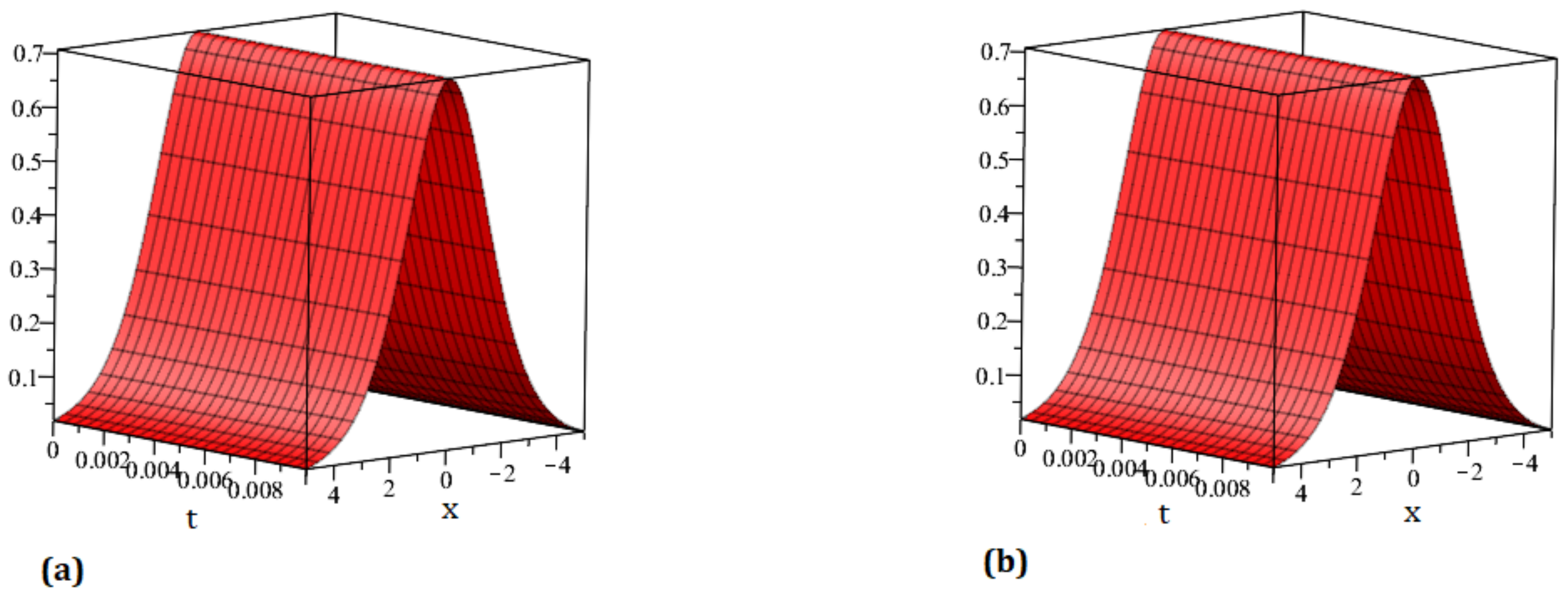


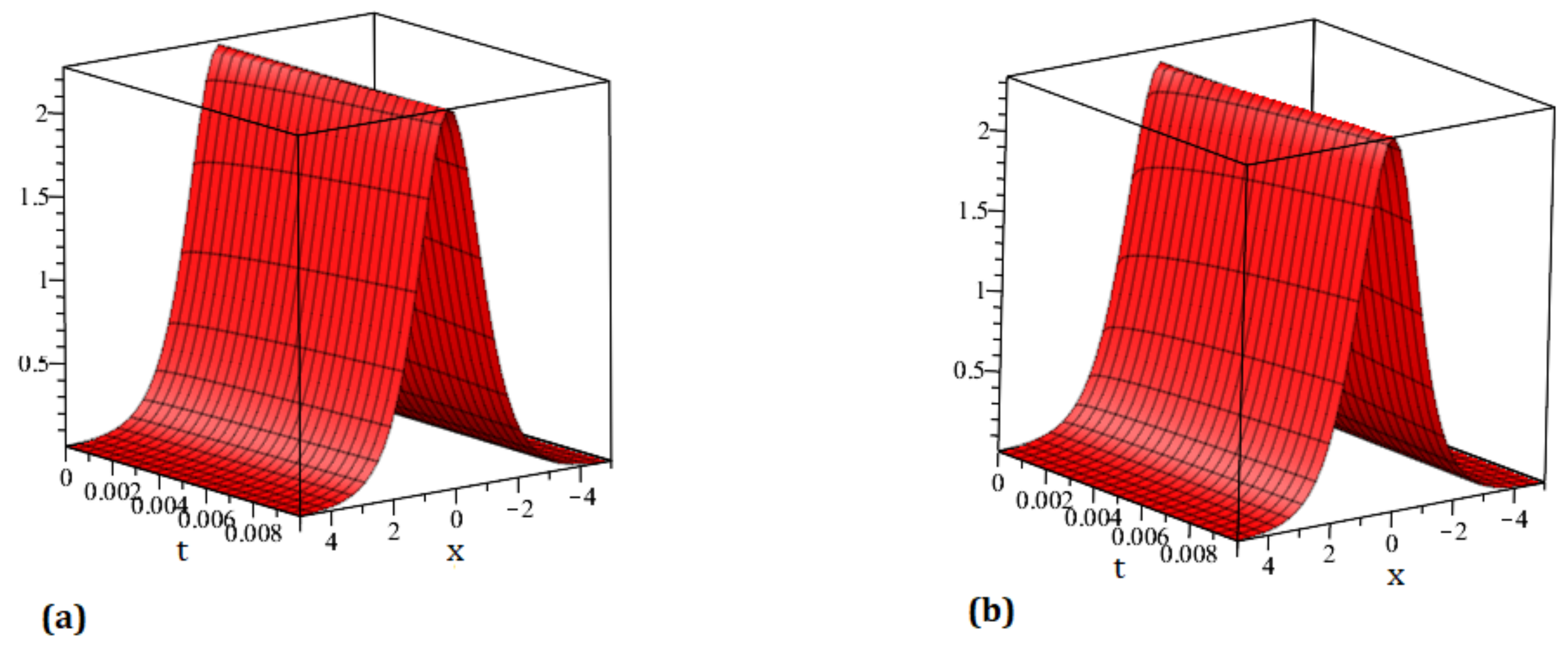
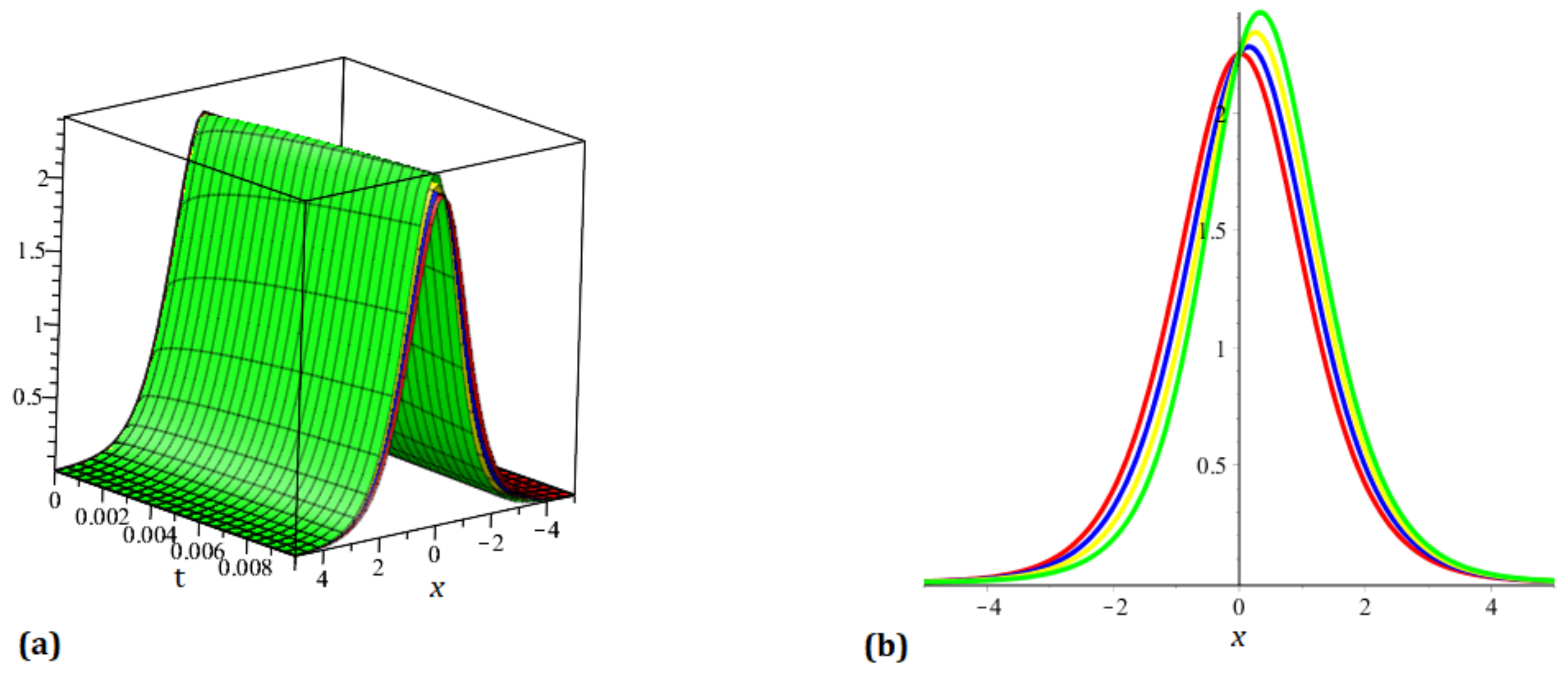

| 0.0 | 1.00000000 | 1.00000000 | 1.00000000 | 1.00000000 | 0.99999975 |
| 0.1 | 0.99765268 | 0.99760754 | 0.99757599 | 0.99755399 | 0.99755374 |
| 0.2 | 0.99036039 | 0.99027100 | 0.99020853 | 0.99016496 | 0.99016472 |
| 0.3 | 0.97826716 | 0.97813527 | 0.97804311 | 0.97797883 | 0.97797860 |
| 0.4 | 0.96160834 | 0.96143650 | 0.96131642 | 0.96123266 | 0.96123245 |
| 0.5 | 0.94070103 | 0.94049247 | 0.94034673 | 0.94024507 | 0.94024488 |
| 0.6 | 0.91593153 | 0.91569002 | 0.91552126 | 0.91540355 | 0.91540338 |
| 0.7 | 0.88774061 | 0.88747037 | 0.88728152 | 0.88714980 | 0.88714966 |
| 0.8 | 0.85660774 | 0.85631323 | 0.85610742 | 0.85596388 | 0.85596376 |
| 0.9 | 0.82303486 | 0.82272069 | 0.82250115 | 0.82234803 | 0.82234793 |
| 1.0 | 0.78753093 | 0.78720170 | 0.78697163 | 0.78681116 | 0.78681109 |
| 0.1 | 0.70565703 | 0.70556126 | 0.70549434 | 0.70544766 | 0.70537701 |
| 0.2 | 0.70070648 | 0.70051685 | 0.70038434 | 0.70029191 | 0.70015219 |
| 0.3 | 0.69235298 | 0.69207321 | 0.69187771 | 0.69174135 | 0.69153530 |
| 0.4 | 0.68075931 | 0.68039479 | 0.68014006 | 0.67996239 | 0.67969398 |
| 0.5 | 0.66614650 | 0.66570406 | 0.66539490 | 0.66517925 | 0.66485353 |
| 0.6 | 0.64878509 | 0.64827277 | 0.64791477 | 0.64766507 | 0.64728793 |
| 0.7 | 0.62898482 | 0.62841154 | 0.62801094 | 0.62773152 | 0.62730954 |
| 0.8 | 0.60708344 | 0.60645870 | 0.60602213 | 0.60571762 | 0.60525778 |
| 0.9 | 0.58343532 | 0.58276886 | 0.58230315 | 0.58197832 | 0.58148780 |
| 1.0 | 0.55840034 | 0.55770193 | 0.55721388 | 0.55687347 | 0.55635945 |
| 0.0 | 1.00000000 | 1.00000000 | 1.00000000 | 1.00000000 | 0.99999974 |
| 0.1 | 0.99765268 | 0.99760754 | 0.99757599 | 0.99755399 | 0.99755374 |
| 0.2 | 0.99036039 | 0.99027100 | 0.99020853 | 0.99016496 | 0.99016472 |
| 0.3 | 0.97826716 | 0.97813527 | 0.97804311 | 0.97797883 | 0.97797860 |
| 0.4 | 0.96160834 | 0.96143650 | 0.96131642 | 0.96123266 | 0.96123245 |
| 0.5 | 0.94070103 | 0.94049247 | 0.94034673 | 0.94024507 | 0.94024488 |
| 0.6 | 0.91593153 | 0.91569002 | 0.91552126 | 0.91540355 | 0.91540338 |
| 0.7 | 0.88774061 | 0.88747037 | 0.88728152 | 0.88714980 | 0.88714966 |
| 0.8 | 0.85660773 | 0.85631323 | 0.85610742 | 0.85596388 | 0.85596376 |
| 0.9 | 0.82303486 | 0.82272069 | 0.82250115 | 0.82234803 | 0.82234793 |
| 1.0 | 0.78753093 | 0.78720170 | 0.78697163 | 0.78681116 | 0.78681109 |
Disclaimer/Publisher’s Note: The statements, opinions and data contained in all publications are solely those of the individual author(s) and contributor(s) and not of MDPI and/or the editor(s). MDPI and/or the editor(s) disclaim responsibility for any injury to people or property resulting from any ideas, methods, instructions or products referred to in the content. |
© 2023 by the authors. Licensee MDPI, Basel, Switzerland. This article is an open access article distributed under the terms and conditions of the Creative Commons Attribution (CC BY) license (https://creativecommons.org/licenses/by/4.0/).
Share and Cite
AlBaidani, M.M.; Ganie, A.H.; Khan, A. Computational Analysis of Fractional-Order KdV Systems in the Sense of the Caputo Operator via a Novel Transform. Fractal Fract. 2023, 7, 812. https://doi.org/10.3390/fractalfract7110812
AlBaidani MM, Ganie AH, Khan A. Computational Analysis of Fractional-Order KdV Systems in the Sense of the Caputo Operator via a Novel Transform. Fractal and Fractional. 2023; 7(11):812. https://doi.org/10.3390/fractalfract7110812
Chicago/Turabian StyleAlBaidani, Mashael M., Abdul Hamid Ganie, and Adnan Khan. 2023. "Computational Analysis of Fractional-Order KdV Systems in the Sense of the Caputo Operator via a Novel Transform" Fractal and Fractional 7, no. 11: 812. https://doi.org/10.3390/fractalfract7110812
APA StyleAlBaidani, M. M., Ganie, A. H., & Khan, A. (2023). Computational Analysis of Fractional-Order KdV Systems in the Sense of the Caputo Operator via a Novel Transform. Fractal and Fractional, 7(11), 812. https://doi.org/10.3390/fractalfract7110812