
Abstract
In this paper, the time fractional diffusion equations optimal control problem is solved by order with uniform accuracy scheme in time and finite element method (FEM) in space. For the state and adjoint state equation, the piecewise linear polynomials are used to make the space variables discrete, and obtain the semidiscrete scheme of the state and adjoint state. The priori error estimates for the semidiscrete scheme for state and adjoint state equation are established. Furthermore, the order uniform accuracy scheme is used to make the time variable discrete in the semidiscrete scheme and construct the full discrete scheme for the control problems based on the first optimal condition and ‘first optimize, then discretize’ approach. The fully discrete scheme’s stability and truncation error are analyzed. Finally, two numerical examples are denoted to show that the theoretical analysis are correct.
1. Introduction
The optimal control problems governed by differential equation usually include objective functional, control variables and state variables that need to be optimized, in which control variables and state variables are coupled in the form of differential equations, which are usually called state equations. According to the different constraints imposed on control variables or state variables, differential equation optimal control problems can be divided into unconstrained problems, control constraint problems and state constraint problems. In recent decades, the research on optimal control of integer order differential equations has made great progress, and many well-known scholars have done a lot of research work in control theory and numerical algorithms.
In the last few years, with the rapid development of the fractional calculus theory and its application, the research on fractional equation constrained optimal control has attracted extensive attention of scholars. Fractional equation constrained optimal control has been widely used in engineering fields, such as groundwater pollution control. The goal of this problem is to keep the concentration of pollutants in groundwater within an allowable range in a given region while, at the same time, minimizing the cost. Its mathematical model can be expressed as a fractional order optimal control problem with point-by-point state constraints, in which the state variable represents the concentration of pollutants and satisfies the fractional convection diffusion equation.
In [1], the authors gave an effective numerical method of the fractional optimal control problems (FOCPs) involving a singular or non-singular kernel. The distributed-order FOCPs were studied by pseudo-spectral method in [2]. The delay fractional optimal control problems was solved by fractional-order Lagrange polynomials and the collocation method with convergence analysis in [3]. In [4], the generalized shifted Chebyshev polynomials were used to construct a numerical solution for fractional optimal control problems. The distributed order FOCPs was solved by Legendre spectral collocation method with convergence analysis in [5]. Researchers can read more references in this area, such as: pseudospectral method [6], Chebyshev cardinal functions [7,8], modified hat functions [9], generalized shifted Legendre polynomials [10], fractional Birkhoff interpolation [11], weighted Jacobi polynomials [12,13], shifted Jacobi orthonormal polynomials [14], generalized fractional-order Chebyshev wavelets [15], B-spline polynomials and operational matrix [16], Laplace transform and shifted Chebyshev-Gauss collocation method [17], fractional pseudospectral method [18], generalized fractional-order Bernoulli functions [19] and so on. In [20], the second order necessary optimality condition to FOCP was given. Based on the piecewise constant functions, tensor product finite element (FE) and finite difference (FD) method, the fully discrete scheme was constructed for FOCPs in [21]. The time FOCP was solved by FEM and projected gradient algorithm in [22]. The Galerkin spectral approximation and conjugate gradient optimization algorithm was used to solve the FOCP of distributed order in [23]. The order FD-FE scheme was applied to solve the FOCPs in [24]. The fast primal dual active set algorithm was constructed for FOCP by the finite element approximation in [25]. The authors designed and analyzed solution techniques for a linear-quadratic optimal control problems governed by fractional Laplacian using semidiscrete approach and fully discrete Approach. Others derived a priori error estimates for both solution techniques [26]. The the parallel Crank-Nicolson scheme was implemented in time and gradient projection technique to solve the FOCPs in [27]. The spectral discretization was used to solve the FOCP governed with priori error estimates in [28]. The spectral Petrov-Galerkin method was investigated for the FOCP with error estimate in [29]. The wavelets method was constructed to solve the FOCPs by using the Chebyshev polynomials of 6-th kind in [30].The authors of [31] presented an indirect low computational complexity and flexible accuracy numerical approach for FOCP by using 2nd kind Chebyshev wavelets. The authors of [32] provided an effificient numerical solution to solve two-dimensional FOCP with variable order. The fast gradient projection method for FOCP was constructed in [33]. The efficient numerical scheme to solve FOCPs based on the Hermite scaling function with -error estimates was presented in [34]. The modified numerical scheme was devoted to solving the FOCPs of variable order in the sense of Riemann Liouville or Caputo derivatives by the non-standard FD method in [35]. The FOCP is a research hotspot; readers who are interested in FOCPs can further refer to [36,37].
According to the existing literature, the FOCP is solved by FD-FE scheme in which the difference schemes in time only use the low order numerical schemes in time discretization. In this paper, we will construct a novel FD-FE numerical scheme for FOCP with state constraint is constructed based on the uniform accuracy order finite difference scheme and finite elements for temporal discretization and spatial discretization, respectively. The first order optimality condition of the FOCP is analyzed. The state and adjoint state’s priori error estimate are derived. Some numerical results are used to show the theoretical result.
The remainder of this paper is organised in five sections: In Section 2, we describe the optimality condition of FOCP. We construct the semi-discrete Galerkin finite element approximate solution for the FOCP, with the convergence analysis in Section 3. In Section 4, the full discrete scheme for the FOCP is constructed and the stability and truncation error of the scheme are analyzed roughly. We describe the conjugate gradient optimization algorithm and show some numerical experiments to validate our method in Section 5. In Section 6, we give some remarks for the FOCPs’s high-order numerical scheme.
2. Optimality Condition of FOCP
Let , , where d is the dimension of space. We consider the following FOCP
here is governed by the following time fractional diffusion equation
where is order fractional derivative of left Caputo to the state with regard to time variable t defined as following [38]
According to the existence and uniqueness of solution in [39] to Equation (2), it can be see that there exists a mapping defined by (2). It is easy to see that the cost function become .
Then the FOCP (1) is equivalent to find , satisfy that
where . The problem (4)’s first order necessary optimality condition is defined as follows
where is the Gteaux differential of at in the direction .
In the following Lemma 1, we will give the calculation of the Gteaux differential of . Based on the idea of Lemma 2.1 in [23], the following lemma is easy to prove. For the convenience of the readers, we give the details of proof as follows.
Lemma 1.
The gradient of is determined by the following equation
where is defined by the adjoint state equation as follows
here is denoted by the α order right Caputo fractional derivative as follows
Proof.
Using the chain rule and direct calculation, we can obtain that
For the , we will give detailed calculation process in the following parts. Firstly, we denote as the as the derivative of in the direction as following
It is easy to check that satisfy the following problem
In order to obtain the first order necessary optimality condition for (5), we multiply both sides of the first Equation (7) by , and then integrate the first equation of (7) on domain to get the following equation
Based on the fractional integration by parts of [40], it is easy to check that
where and are left and right Riemann Liouville fractional derivative, respectively.
3. Semidiscrete Scheme for FOCP
In this part, we will construct the semidiscrete Galerkin FEM solution of FOCP (1) and (2) and analysis the error analysis of the semidiscrete scheme.
The state equation’s weak formulation is defined as following
Divide the domain into quasi-uniform FEM partitions , where h denote the maximum diameter. The FE space on is defined by.
The semidiscrete scheme to (15) reads: find satisfying the following equation
In the following Lemma 2, we will give the error of . Because the following lemma can be easily proved by the idea of [41], we only give the conclusion of the following lemma and omit the tedious proof process.
The semidiscrete scheme to (1) and (2) can be charactierized as
subject to
where are the finite element solution to u and q, respectively. Similar to problem (1), it is easy to check that
where is the following discrete adjoint equation
In order to analysis the convergence (18) and (19), we introduce projection and Ritz projection defined by
Next, we will give the error of and in Lemma 3. Based on the method in [41], we can easily prove the results in the following Lemma 3. Therefore, we omit the proof details and directly give the results as follows.
Lemma 3.
The projections , are -projection, Ritz-projection, respectively, and satisfy the following inequalities
In order to obtain the semidiscrete scheme’s priori error estimates for (18) and (20), we define the following two auxiliary problems
and
It is obvious to find that is the semidiscrete scheme of . Based on the Lemma 2, one can immediately obtain the following
Using the stability estimates of the state equation, we have
From (24) and (25), it is easy to find that the estimates of the state variable is dependent on control variable.
In the next Lemma 4, we will estimate the error of .
Lemma 4.
Proof.
Thus we carries at
Choosing yields the final result. □
Next, we will obtain the estimate of . Firstly, we will estimate of . In order to estimate , we introduce another auxiliary problem
It is easy to check that is the semidiscrete FEM solution of . Based on the method of [41], we have the following error estimate of .
Lemma 5.
Based on the idea of [41], we split the error into
Based on the Lemma 3, one can immediately obtain the error estimate of . In the next, we only need to estimate . First of all, one can infer from , where is the discrete Laplace operator :
Therefore,
Therefore, we obtain that
where
here are the eigenvalues and eigenfunctions of .
Using Lemma 3, for , we have
Therefore, we can obtain the theorem result by using triangle inequality.
According to the existence and uniqueness of solution, the adjoint state equation implies
Based on the above Lemmas 2–5, we will give the error estimation for in the following Theorem 1.
Theorem 1.
4. Fully Discrete Scheme for the FOCP
4.1. The FD-FE Scheme for the State Equation
In order to construct the FD-FE scheme, we divide the time domain I into subdomins with . Following [42,43], we approximate the fractional derivative as follows
where is the quadratic interpolation on with respect to time variable, i.e.,
with is the numerical solution at of , and are the quadratic interpolation function at points and defined by
For , we have
On , the approximated solution to can be defined by
where , are the quadratic interpolation basis function at points defined by
Through careful calculation, one can obtain
where
and
with is defined by for and .
In all cases, the left Caputo fractional derivative can be determined by a linear combination of . Furthermore, by simplifying the calculation, it is easy to find that all are proportional to . Therefore, we summarize (39), (40) and (43) to write down them uniformly as
where the newly introduced operator is the discrete Caputo derivative defined by
where all the coefficients in (45) are constants and can be computed analytically as follows
If the solution is sufficiently smooth on time variable, based on the idea of [42,43,44], we have
where and is the norm Sobolev space.
Then, the full discrete FD-FE scheme for (15) reads: find satisfying
The purpose is that analyzing the stability of the scheme (47), we firstly introduce some notations to reformulate (45) for . We denote
When , we take
For ,
Therefore, (47) can be rewritten into the equivalent form as follows
In order to analyze the stability analysis of the scheme (51) we firstly show the properties of the coefficients . See the following Lemma 6.
Lemma 6.
For given , , the scheme coefficients of (47) satisfy
(1) . (2) .
(3) , . (4) .
(5) There exists such that if , and if .
(6) .
Proof.
For a detailed proof, see Appendix A. □
Next, as , denote
Recombining of the terms in (51), we obtain
Now we denote
As , we have
where
Then the equivalent form to (51) can be determined by
The new coefficients of (56) have some good properties for which are given by the following Lemma 7.
Proof.
For a detailed proof, see Appendix B. □
For , the new coefficients of (56) have some good properties by the following Lemma 8.
Lemma 8.
For given , for , the coefficients of the first equation in the scheme (56) satisfy
(1) . (2) . (3) .
Proof.
For a detailed proof, see Appendix C. □
Next, we will analysis the stability of (47) in the following Theorem 2.
Theorem 2.
Let be the numerical solution of (47). Then the estimate is following as
Proof.
Firstly, we analysis the case for . Based on the fact that , therefore, we have
We choose in (58), in (59) and add them together, we get
Simply the (60), we obtain that
Therefore, and , as , we have
Similar, according to (61), we have
Then , , and
When , letting in (56), we get
Using and the integration by parts, we have
where
is a integral vector and .
According to Lemma 7, we know the coefficients are positive of the right hand side in (58), we have
According to (1)–(3) in the Lemma 8, we can find (65) is still satisfy for . By directly computation, it can deduce that . According to (3) in the Lemma 7, we have , then
We have
According to (1) and (4) in the Lemma 7, we have
For in the (66), we use Cauchy–Schwarz inequality, then
Next, we will prove the following estimate using mathematics induction:
We deduce from (68),
Then (69) is proven, i.e.,
Finally, we turn to estimate . Applying the triangle inequality and (70) yields
The proof is completed. □
4.2. The Adjoint Equation’s FD-FE Scheme
In this part, we will analysis the FOCP’s full discretization. For the cost functional discretization form is defined by
here the Simpson rule was used to make the time integral of the cost function discrete, and .
Using (71), one obtain the full discretization of the FOCP (1) and (2), finding , such that
subject to
where the control variable was implicity discretized by variational discretization concept.
Similar to (73), we construct the numerical scheme for (7) as follows
where is the discrete right Caputo derivative as follows
where
For the Equation (19), we have the following discretization scheme
Next, we are going to give the error of the FD-FE scheme for the FOCP based on the idea of [23] and the above results.
5. Numerical Examples
5.1. The Conjugate Gradient (CG) of Optimization Algorithm
In this part, we will carry out two numerical examples to show the prior error estimates of numerical scheme to the FOCP (1) and (2) in previous section. The details of CG algorithm for the (1) and (2) optimization problem is described as follows.
We hereafter denote without explanation. Let be the initial value of control variable and be the corresponding state variable defined by (18) which is semidiscretization of the FOCP. Let be the stopping criterion with being a tolerance. The adjoint state can be obtained from the adjoint state Equation (20) when and are given. The objective function’s gradient at is defined by
We choose the initial conjugate direction such that it is the same as the gradient direction, namely
Supposing the iteration , and are known, we update via
where , and the iteration step size is determined by
The optimal iteration can be solved efficiently by (79). Indeed, the adjoint state dependent on , let , denote respectively, the solution of
and are, respectively, the solutions of the following equations
Then it can be checked that solves (80)–(83), that is
Putting this expression into (79) gives
Obviously, holds. Let , then we obtain
Furthermore, we can check that holds, denote
and we choose the defined by the following equation
Based on the above fact, we have It can improve the optimimum k-th iterative step size , which is defined as follows
The overall process of CG algorithm as summarized below.
The CG optimization algorithm. Choosing for the initial value of control variable.
5.2. Numerical Results
In this part, we give two numerical examples to show that the theorem results are correct, which are 1D and 2D FOCP, respectively. In all the following examples, we take and . The following two examples were implemented on a LAPTOP-H91AOQNL computer with a Intel(R) Core(TM) i7-10510U CPU @ 1.80GHz and 12.00 GB of RAM by using MATLAB.
Example 1.
Considering the problem(1) and (2) with the desired state and the right function be defined as follows
After direct calculation, we obtain exact analytical solution state variable and control variable:
Let the error of u be defined as following: , and the error of q be
From Table 1, Table 2 and Table 3, we take , , respectively. From Table 1, Table 2 and Table 3, we find the spatial accuracy is 2, this result is accord with the theoretical analysis obtained in Theorem 3.
Table 1.
Error and for the spatial convergence rates with .
Table 2.
Error and for the spatial convergence rates with .
Table 3.
Error and for the spatial convergence rates with .
Next, we check the temporal convergence rate. In Table 4, Table 5 and Table 6, we take , respectively. We let and list the value of and the corresponding order when , takes a series of different values, where is taken. When takes , and , the convergence order tends to , and , respectively, this can show that the time’s convergence rate is about .
Table 4.
Error and for the time convergence rates with .
Table 5.
Error and for the time convergence rates with .
Table 6.
Error and for the time convergence rates with .
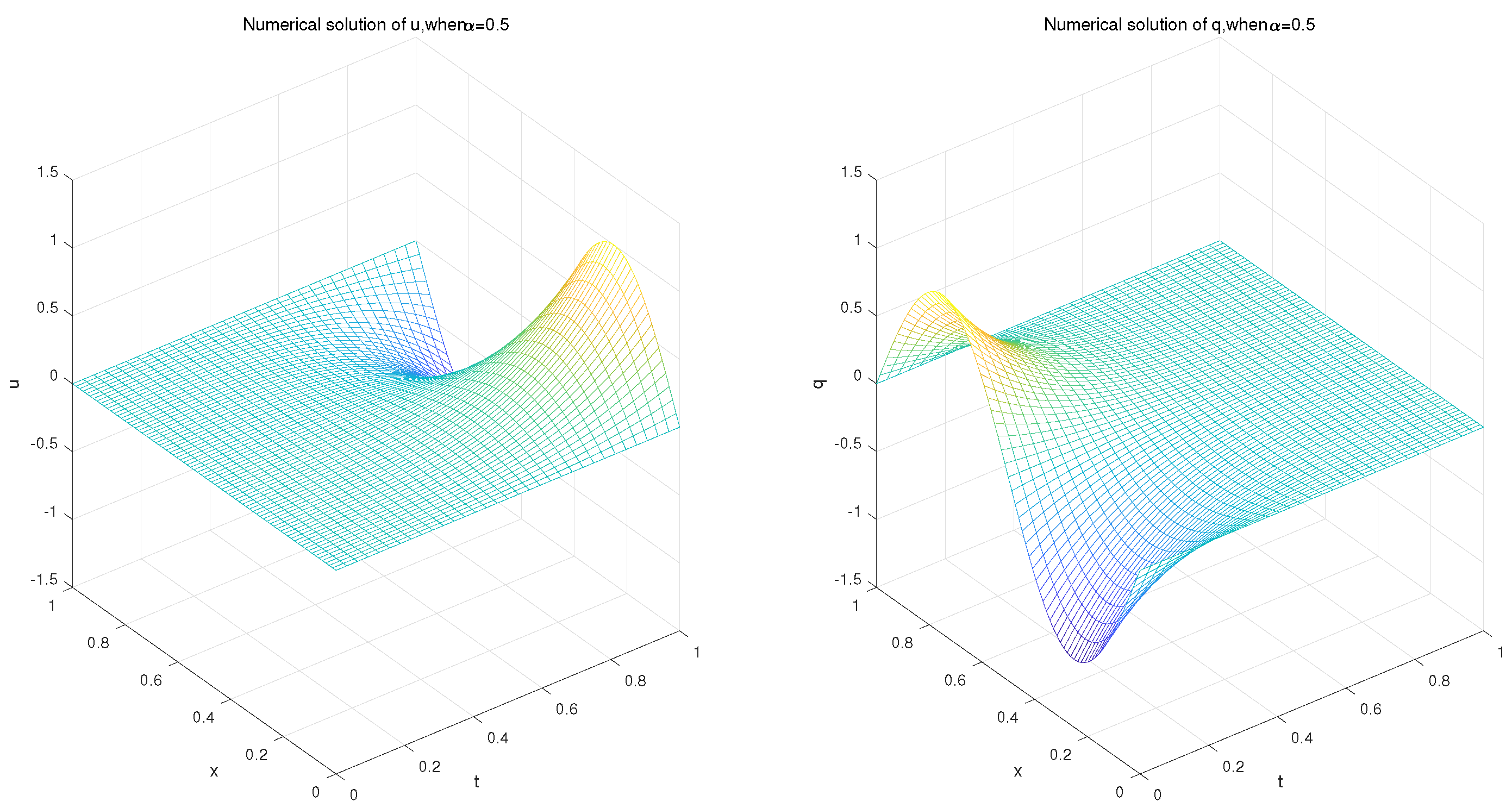
Next, we plot the numerical solution for u and q with the conditions of in Figure 1, where the numerical solution of u is on the left and numerical solution of q is on the right with .
Figure 1.
Numerical solution of (left) and numerical solution of (right).
In next example, we will use the scheme for the FOCP (1) and (2) for the two dimensional in space. Denote in the following example.
Example 2.
Considering the problem (1) and (2) with 2D problem and the desired state and the right function be defined as follows
By direct calculation, we obtain exact analytical solution state variable and control variable:
Let the error of u be defined as follows: , and the error of q be
In Table 7, Table 8 and Table 9, we take , , respectively. From Table 7, Table 8 and Table 9, we find the spatial accuracy is 2, this result is accord with the theoretical analysis obtained in Theorem 3.
Table 7.
Error and for the spatial convergence rates with .
Table 8.
Error and for the spatial convergence rates with .
Table 9.
Error and for the spatial convergence rates with .
Next, we will study the convergence order of time. In the following, we choose and . In Table 10, Table 11 and Table 12, the choose the value of , and , respectively. From Table 10, Table 11 and Table 12, it is easy to check that the time convergence order is , based on the fact that the rate of convergence is close to 2 under the condition .
Table 10.
Error and for the time convergence rates with .
Table 11.
Error and for the time convergence rates with .
Table 12.
Error and for the time convergence rates with .
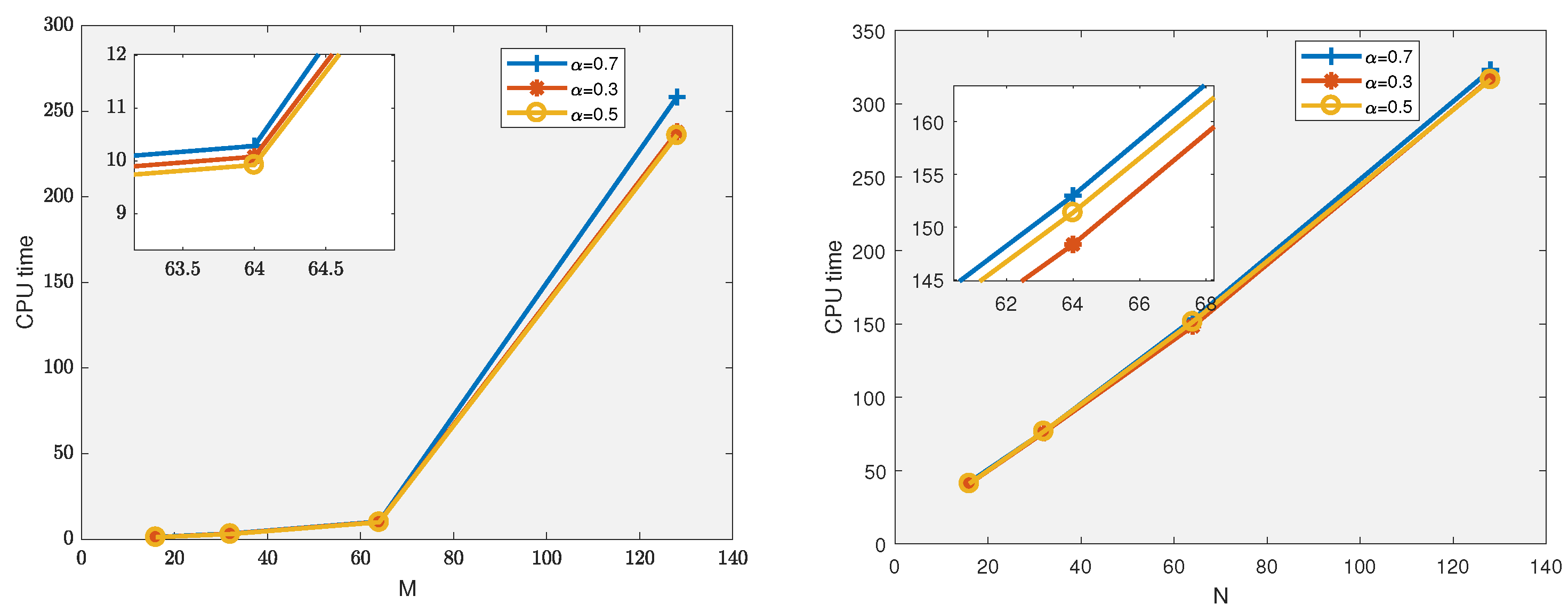
In the end of Example 2, we show the CPU time variation about and N in Figure 2 under the conduction of and , respectively. From Figure 2, we obtain that the CPU time increases with the increase of or N and almost not affected by the change of .
Figure 2.
The CPU time with respect to (left) and The CPU time with respect to N (right).
6. Conclusions
In this paper, we constructed a novel FD-FE scheme for the time FOCP based on the uniform accuracy order FD scheme in time and FE scheme in space. We firstly give the stability analysis for the full discrete scheme for the time fractional partial differential equation based on the uniform accuracy order FD scheme in time and FE scheme in space. The priori error estimates of the semidiscrete scheme underwent rigorous theoretical analysis. Some numerical examples are devoted to verify the correctness of the theoretical analysis. Due to the nonlocality of the time fractional derivative, the discrete high-order numerical scheme has a large amount of computation and storage, which is difficult to calculate. Especially for three-dimensional practical engineering problems, the computational efficiency of the algorithm needs to be further improved.
In our future work, we will investigate Structural optimization of viscoelastic materials and structural optimization design of viscoelastic composite plates based the idea of [45]. In the future, it is expected that the construction of the higher-order efficient scheme for time FOCP can be applied to the structural optimization design of practical engineering materials based on the ideas of [46,47,48]. In particular, we are going to use the above efficient higher-order scheme for the optimization of a composite structure of viscoelastic materials or structure with memory.
Author Contributions
Funding acquisition, J.C. and Z.W. (Ziqiang Wang); investigation, J.C. and Z.W. (Ziqiang Wang); methodology, J.C. and Z.W. (Ziqiang Wang); project administration, J.C. and Z.W. (Ziqiang Wang); software, Z.W. (Ziqiang Wang) and Z.W. (Zhongqing Wang); supervision, J.C. and Z.W. (Ziqiang Wang); visualization, Z.W. (Ziqiang Wang) and Z.W. (Zhongqing Wang); writing—original draft, Z.W. (Zhongqing Wang) and J.C.; writing—review and editing, J.C., Z.W. (Zhongqing Wang) and Z.W. (Ziqiang Wang); All authors have read and agreed to the published version of the manuscript.
Funding
The work of the first author Junying Cao was partially supported by National Natural Science Foundation of China (NSFC) grant 11901135, Guizhou Provincial Science and Technology Projects grant [2020]1Y015. The work of the corresponding author Ziqiang Wang was partially supported by NSFC grant 11961009 and the Natural Science Research Project of Department of Education of Guizhou Province (Grant Nos. QJJ2022015 and QJJ2022047).
Institutional Review Board Statement
Not applicable.
Informed Consent Statement
Not applicable.
Data Availability Statement
All the data in the paper are computed by the FD-FE scheme.
Acknowledgments
The valuable opinions of the anonymous reviewers are very helpful for the authors to improve the quality of this paper. On this occasion, we are grateful for the anonymous reviewers.
Conflicts of Interest
The authors declare no conflict of interest.
Appendix A. The Proof of Lemma 6
Proof.
(1) can be checked directly.
(2) By the fact that constant of the fractional derivative is zero, and using (49) and (50), it can get our want the result.
(3) As , it is observed that
For , let , using a Taylor expansion yields
where
By carefully calculate, when , we can obtain is an alternating series and first term is positive, then we have
Similarly, we can prove
For , we let ,
Take , using a Taylor expansion,
where
When , as n is odd number, as n is even number. So the first term and the second term are all positive. Start with the second item, it is an alternating series, i.e.,
Therefore, we get
Becausing of , let ,
taking , using a Taylor expansion, we derive
where
then is an alternating series, its first term is positive, so satisfy
Therefore, we get
(4) As , owing to
Therefore,
as a result,
due to:
to sum up, we can get:
(5) As , owing to
where , for , so the symbol of is determined by with regard to , where and . That is, is increased first and then decreased, about and . So there is only one zero point , so that is positive for and negative for . That is, has positive and negative on .
(6) By carefully calculate,
From (4) in this lemma, we can see that , so we have
The Lemma 6 is then completed. □
Appendix B. The Proof of Lemma 7
Appendix C. The Proof of Lemma 8
Proof.
(1) let’s prove that
Through careful calculation, we can conclude that
Because , so
where
Next, using a Taylor expansion yields
where
let’s remember:
Because monotonic increase, , so , because of is an alternating series with positive first term, and , Where is an alternating series with positive first term, so , we have
where
Next, we will prove , that is , that is , So to prove , just prove , let’s remember . since is a function of first increases and then decreases, and then the values of two endpoints are as follows: and , is true, therefore . Because , so
(2) According to (55), we have
Therefore,
where , . By carefully calculate, we have . According to (A7), we obtain , i.e.,
(3) Because of
The proof is then completed. □
References
- Jajarmi, A.; Baleanu, D. On the fractional optimal control problems with a general derivative operator. Asian J. Control 2021, 23, 1062–1071. [Google Scholar] [CrossRef]
- Zaky, M.; Machado, J. On the formulation and numerical simulation of distributed-order fractional optimal control problems. Commun. Nonlinear Sci. Numer. Simul. 2017, 52, 177–189. [Google Scholar] [CrossRef]
- Sabermahani, S.; Ordokhani, Y.; Yousefi, S. Fractional-order Lagrange polynomials: An application for solving delay fractional optimal control problems. Trans. Inst. Meas. Control 2019, 41, 2997–3009. [Google Scholar] [CrossRef]
- Hassani, H.; Machado, J.; Naraghirad, E. Generalized shifted Chebyshev polynomials for fractional optimal control problems. Commun. Nonlinear Sci. Numer. Simul. 2019, 75, 50–61. [Google Scholar] [CrossRef]
- Zaky, M. A Legendre collocation method for distributed-order fractional optimal control problems. Nonlinear Dynam. 2018, 91, 2667–2681. [Google Scholar] [CrossRef]
- Ejlali, N.; Hosseini, S. A pseudospectral method for fractional optimal control problems. J. Optim. Theory Appl. 2017, 174, 83–107. [Google Scholar] [CrossRef]
- Heydari, M.; Razzaghi, M. Piecewise Chebyshev cardinal functions: Application for constrained fractional optimal control problems. Chaos Solitons Fractals. 2021, 150, 111118. [Google Scholar] [CrossRef]
- Bhrawy, A.; Ezz-Eldien, S.; Doha, E.; Abdelkawy, M.; Baleanu, D. Solving fractional optimal control problems within a Chebyshev–Legendre operational technique. Int. J. Control. 2017, 90, 1230–1244. [Google Scholar] [CrossRef]
- Nemati, S.; Lima, P.; Torres, D. A numerical approach for solving fractional optimal control problems using modified hat functions. Commun. Nonlinear Sci. Numer. Simul. 2019, 78, 104849. [Google Scholar] [CrossRef]
- Ezz-Eldien, S.; Doha, E.; Baleanu, D.; Bhrawy, A. A numerical approach based on Legendre orthonormal polynomials for numerical solutions of fractional optimal control problems. J. Vib. Control. 2017, 23, 16–30. [Google Scholar] [CrossRef]
- Tang, X.; Shi, Y.; Wang, L. A new framework for solving fractional optimal control problems using fractional pseudospectral methods. Automatica 2017, 78, 333–340. [Google Scholar] [CrossRef]
- Wang, F.; Li, X.; Zhou, Z. Spectral Galerkin Approximation of Space Fractional Optimal Control Problem with Integral State Constraint. Fractal Fract. 2021, 5, 102. [Google Scholar] [CrossRef]
- Dehghan, M.; Hamedi, E.; Khosravian-Arab, H. A numerical scheme for the solution of a class of fractional variational and optimal control problems using the modified Jacobi polynomials. J. Vib. Control 2016, 22, 1547–1559. [Google Scholar] [CrossRef]
- Doha, E.; Bhrawy, A.; Baleanu, D.; Ezz-Eldien, S.; Hafez, R. An efficient numerical scheme based on the shifted orthonormal Jacobi polynomials for solving fractional optimal control problems. Adv. Differ. Equ. 2015, 2015, 1–17. [Google Scholar] [CrossRef]
- Ghanbari, G.; Razzaghi, M. Numerical solutions for distributed-order fractional optimal control problems by using generalized fractional-order Chebyshev wavelets. Nonlinear Dynam. 2022, 108, 265–277. [Google Scholar] [CrossRef]
- Tajadodi, H.; Khan, A.; Francisco, G.; Khan, H. Optimal control problems with Atangana-Baleanu fractional derivative. Optim. Contr. Appl. Met. 2021, 42, 96–109. [Google Scholar] [CrossRef]
- Rakhshan, S.; Effati, S. The Laplace-collocation method for solving fractional differential equations and a class of fractional optimal control problems. Optim. Contr. Appl. Met. 2018, 39, 1110–1129. [Google Scholar] [CrossRef]
- Habibli, M.; Noori Skandari, M. Fractional Chebyshev pseudospectral method for fractional optimal control problems. Optim. Contr. Appl. Met. 2019, 40, 558–572. [Google Scholar] [CrossRef]
- Rahimkhani, P.; Ordokhani, Y. Generalized fractional-order Bernoulli–Legendre functions: An effective tool for solving two-dimensional fractional optimal control problems. IMA J. Math. Control Inform. 2019, 36, 185–212. [Google Scholar] [CrossRef]
- Guo, T. The necessary conditions of fractional optimal control in the sense of Caputo. J. Optim. Theory Appl. 2013, 156, 115–126. [Google Scholar] [CrossRef]
- Antil, H.; Otarola, E.; Salgado, A. A space-time fractional optimal control problem: Analysis and discretization. SIAM J. Control Optim. 2016, 54, 1295–1328. [Google Scholar] [CrossRef]
- Liu, J.; Zhou, Z. Finite element approximation of time fractional optimal control problem with integral state constraint. AIMS Math. 2021, 6, 979–997. [Google Scholar] [CrossRef]
- Ye, X.; Xu, C. A space-time spectral method for the time fractional diffusion optimal control problems. Adv. Differ. Equ. 2015, 2015, 1–20. [Google Scholar] [CrossRef]
- Zhou, Z.; Gong, W. Finite element approximation of optimal control problems governed by time fractional diffusion equation. Comput. Math. Appl. 2016, 71, 301–318. [Google Scholar] [CrossRef]
- Zhou, Z.; Tan, Z. Finite element approximation of optimal control problem governed by space fractional equation. J. Sci. Comput. 2019, 78, 1840–1861. [Google Scholar] [CrossRef]
- D’elia, M.; Glusa, C.; Otárola, E. A priori error estimates for the optimal control of the integral fractional Laplacian. SIAM J. Control Optim. 2019, 57, 2775–2798. [Google Scholar] [CrossRef]
- Wu, S.; Huang, T. A fast second-order parareal solver for fractional optimal control problems. J. Vib. Control 2018, 24, 3418–3433. [Google Scholar] [CrossRef]
- Chen, Y.; Lin, X.; Huang, Y. Error analysis of spectral approximation for space–time fractional optimal control problems with control and state constraints. J. Comput. Appl. Math. 2022, 413, 114293. [Google Scholar] [CrossRef]
- Wang, Y.; Cao, W.; Li, S. A spectral Petrov-Galerkin method for optimal control problem governed by a fractional ordinary differential equation. Appl. Numer. Math. 2022, 177, 18–33. [Google Scholar] [CrossRef]
- Xu, X.; Xiong, L.; Zhou, F. Solving fractional optimal control problems with inequality constraints by a new kind of Chebyshev wavelets method. J. Comput. Sci.-Neth. 2021, 54, 101412. [Google Scholar] [CrossRef]
- Baghani, O. Second Chebyshev wavelets (SCWs) method for solving finite-time fractional linear quadratic optimal control problems. Math. Comput. Simul. 2021, 190, 343–361. [Google Scholar] [CrossRef]
- Mohammadi, F.; Hassani, H. Numerical solution of two-dimensional variable-order fractional optimal control problem by generalized polynomial basis. J. Optim. Theory Appl. 2021, 180, 536–555. [Google Scholar] [CrossRef]
- Du, N.; Wang, H.; Liu, W. A fast gradient projection method for a constrained fractional optimal control. J. Sci. Comput. 2016, 68, 1–20. [Google Scholar] [CrossRef]
- Kumar, N.; Mehra, M. Collocation method for solving nonlinear fractional optimal control problems by using Hermite scaling function with error estimates. Optim. Contr. Appl. Met. 2021, 42, 417–444. [Google Scholar] [CrossRef]
- Zahra, W.; Hikal, M. Non standard finite difference method for solving variable order fractional optimal control problems. J. Vib. Control. 2017, 23, 948–958. [Google Scholar] [CrossRef]
- Ndaïrou, F.; Torres, D.F.M. Optimal control problems involving combined fractional operators with general analytic kernels. Mathematics 2021, 9, 2355. [Google Scholar] [CrossRef]
- Rosa, S.; Torres, D.F.M. Fractional modelling and optimal control of COVID-19 transmission in Portugal. Axioms 2022, 11, 170. [Google Scholar] [CrossRef]
- Anatoly, A.; Kilbas, H.; Srivastava, J. Theory and Applications of Fractional Differential Equations; Academic Press: New York, NY, USA, 2006. [Google Scholar]
- Kenichi, S.; Masahiro, Y. Initial value/boundary value problems for fractional diffusion-wave equations and applications to some inverse problems. J. Math. Anal. Appl. 2011, 382, 426–447. [Google Scholar]
- Li, X.; Xu, C. A space-time spectral method for the time fractional diffusion equation. SIAM J. Numer. Anal. 2009, 47, 2108–2131. [Google Scholar] [CrossRef]
- Jin, B. Error analysis of semidiscrete finite element methods for inhomogeneous time-fractional diffusion. IMA J. Numer. Anal. 2015, 35, 561–582. [Google Scholar] [CrossRef]
- Cao, J.; Cai, Z. Numerical analysis of a high-order scheme for nonlinear fractional differential equations with uniform accuracy. Numer. Math. Theory Methods Appl. 2021, 14, 71–112. [Google Scholar] [CrossRef]
- Cao, J.; Xu, C. A high order schema for the numerical solution of the fractional ordinary differential equations. J. Comput. Phys. 2013, 238, 154–168. [Google Scholar] [CrossRef]
- Lv, C.; Xu, C. Error analysis of a high order method for time-fractional diffusion equations. SIAM J. Sci. Comput. 2016, 38, A2699–A2724. [Google Scholar] [CrossRef]
- Wang, Z.; Cui, J. Second-order two-scale method for bending behavior analysis of composite plate with 3-D periodic configuration and its approximation. Sci. China Math. 2014, 57, 1713–1732. [Google Scholar] [CrossRef]
- Huang, Y.; Gu, X.; Gong, Y.; Li, H.; Zhao, Y.; Carpentieri, B. A fast preconditioned semi-implicit difference scheme for strongly nonlinear space-fractional diffusion equations. Fractal Fract. 2021, 5, 230. [Google Scholar] [CrossRef]
- Gu, X.; Sun, H.; Zhao, Y.; Zheng, X. An implicit difference scheme for time-fractional diffusion equations with a time-invariant type variable order. Appl. Math. Lett. 2021, 120, 107270. [Google Scholar] [CrossRef]
- Huang, Y.; Zeng, F.; Guo, L. Error estimate of the fast L1 method for time-fractional subdiffusion equations. Appl. Math. Lett. 2022, 133, 108288. [Google Scholar] [CrossRef]
Publisher’s Note: MDPI stays neutral with regard to jurisdictional claims in published maps and institutional affiliations. |
© 2022 by the authors. Licensee MDPI, Basel, Switzerland. This article is an open access article distributed under the terms and conditions of the Creative Commons Attribution (CC BY) license (https://creativecommons.org/licenses/by/4.0/).