
Abstract
The coupled cubic-quintic nonlinear Schrödinger (CQNLS) equation is a universal mathematical model describing many physical situations, such as nonlinear optics and Bose–Einstein condensate. In this paper, in order to simplify the process of similar analysis with different forms of the coupled CQNLS equation, this dynamic system is extended to a time-space scale based on the Lax pair and zero curvature equation. Furthermore, Darboux transformation of the coupled CQNLS dynamic system on a time-space scale is constructed, and the N-soliton solution is obtained. These results effectively combine the theory of differential equations with difference equations and become a bridge connecting continuous and discrete analysis.
1. Introduction
In recent years, many useful methods have been applied to obtain solutions of integrable systems, such as Darboux transformation [1,2,3,4,5], inverse scattering transformation [6], bilinear transformation [7], and Backlünd transformation [8]. Darboux transformation, originating from the work of Darboux in 1882 on the Sturm–Liouville equation, is a powerful method for constructing solutions for integrable systems. The basic idea of Darboux transformation is to construct the solution of integrable equations by solutions, which is called the eigenfunctions, of the linear partial differential equation associated with its Lax pair. Lots of literature can be found in this regard. In Ref. [9], the authors develop Darboux’s idea to solve linear and nonlinear partial differential equations arising in soliton theory. In Refs. [1,2,3,4,5], various approaches have been proposed to construct a Darboux transformation for nonlinear partial differential equations, such as operator factorization, gauge transformation, and loop group transformation.
The time scale was introduced in 1988 by Stefan Hilger, and its main purpose is to unify continuous and discrete analysis [10], which is further researched and developed by Bohner and Peterson [11,12]. This theory is a powerful tool to unify various types of time-variable forms and simplifies the process of similar analysis on time scales with different forms, and can better solve complex models that contain multiple situations, such as continuous and discrete. Therefore, it is used widely in various fields due to unification and extension. For example, in biology, functional connectivity patterns can be studied on multiple time scales by simulating the neural dynamics of large scale inter-regional connection networks in the macaque cortex [13,14,15]. In physics, the fixed point index theory is used to establish a double fixed point theorem for a completely continuous operator in Banach space, and then an application of the two-point conjugate boundary problem is discussed [16,17,18]. In economics, the time scales model provides information for a problem for not evenly spaced intervals, for which the standard continuous and discrete models do not [19,20].
The coupled cubic-quintic nonlinear Schrödinger (CQNLS) equation is introduced as the following form
where is a real parameter [21,22]. This equation has been one of the universal mathematical models in the field of nonlinear science, which is applied widely into optics [23,24], Bose–Einstein condensation [25,26], and other fields [27]. Many scholars obtain soliton solutions of this equation through different methods, such as Darboux transformation, backscattering, and Backlünd transformation [28,29]. In Ref. [28], Nth-order rogue wave solutions of coupled CQNLS equation are obtained by generalized Darboux transformation. The dynamics of its general first and second-order rogue waves are further discussed and illustrated. In Ref. [29], the soliton solution of the coupled CQNLS equation is obtained through bilinear Backlünd transformation; this result has important applications for the ultrashort optical pulse propagation in non-Kerr media. In this paper, we extend the coupled CQNLS equation on a time-space scale based on the Lax pair and zero curvature [30,31,32,33]. This result simplifies the process of similar analysis with different forms and builds a bridge between differential equations and difference equations. Furthermore, this equation can be used in complex models with both discrete and continuous applications.
The structure of this article is as follows. Some preliminaries about the time-space scale are devoted in Section 2. The coupled CQNLS equation on a time-space scale is derived in Section 3. Darboux transformation of this equation on a time-space scale is constructed, and its N-soliton solution is obtained in Section 4. Lastly, the conclusion is given in Section 5.
2. Preliminaries
In this section, some definitions of the time-space scale are introduced first [34,35,36,37].
Definition 1.
A time-space scale is any non-empty closed subset of the real number , and it has topological and sequential relations induced by .
Definition 2.
Assuming and are time and space scales, for , the forward jump operators are respectively defined as
for , the backward jump operator is defined as
Definition 3.
The derivative related to time and space variables is defined as
where the grayscale functions are defined as
Note that,
Definition 4.
Exponential function on a time scale is defined in the following form
where is a given function and
This definition applies to the ν-regressive functions , i.e., those satisfying
Such functions are usually called regressive.
In the constant discrete case const ), with const, we have
and in the case , we have
Property 1.
The properties associated with ∇-derivatives are as follows
3. The Coupled CQNLS Equation on a Time-Space Scale
In order to obtain the coupled CQNLS equation on a time-space scale, the ∇-dynamical system is considered as follows
with
where are functions which contain spectral parameters and potential functions .
According to the compatibility condition the zero curvature equation on a time-space scale is derived to
By putting into Equation , these equations are obtained
are taken as quadratic polynomials of
Take . By putting into and comparing coefficients of , the relations are obtained as follows
and
According to the derivative rule on a time-space scale, are obtained as follows
with
Then, Equation (6) is the coupled CQNLS dynamical system on a time-space scale, where are defined by Equation (7). Next, several special cases of the coupled CQNLS dynamical system will be obtained.
- Case I
Consider the case . We get Then, can be converted to
System is transformed into the coupled CQNLS equation, i.e.,
- Case II
Consider the case . We get Then,
where E is the shift operator. By calculation, Equation can be converted to
Equation can be transformed into
which is a semi-discrete coupled CQNLS equation.
4. Darboux Transformation of CQNLS Equation on a Time-Space Scale
In this section, the generalized Darboux transformation on a time-space scale will be constructed, and the N-soliton solution of the CQNLS equation will be obtained.
Firstly, of the CQNLS equation are rewritten as follows
with is the Pauli matrix.
Proposition 1.
The Lax pair of the CQNLS equation is invariant under the following Darboux transformation
where
H satisfies
Then, satisfies the linear spectrum problem as follows
where
Proof.
Assume a gauge transformation
where □
Substituting Equations (8), (11), and (12) into Equation and comparing the coefficients of , we get
Taking , we obtain
Then, matrix S is constructed as
Then,
From the constant term of Equation (13), we obtain
If H is a solution of Equation , then H satisfies
where
Take
then,
In addition, the gauge transformation satisfies another constraint relation concerning t part
By substituting Equation (12) into Equation (19), the following formula is derived
where V and are obtained from Equations (8) and (11).
By comparing coefficients of , Equations (21)–(24) are obtained as follows
when , Equations (21)–(24) are constant. The proof is completed. Having the explicit form of the Darboux transformation, we are ready to construct the exact solutions of the CQNLS equation.
Matrix H and are constructed as
where the column vector is a set of solutions to the Lax pair when , column vector is a set of solution when . Then one soliton solution will be obtained as follows.
First, rewrite Equation as
Then,
where
is a solution to when . At the same time, satisfies
Taking “seed solution” , we derive
Then, one soliton solution is obtained
with
Next, the second Darboux transformation is constructed and two soliton solutions are obtained in a similar way
where
is a solution to Equation when and is a solution to when , satisfies
Then, the N-soliton solution is obtained
Finally, three different cases of Darboux transformation are discussed, their N-soliton solutions are given separately.
- Case I
Considering the case , we have
Equation can be simplified into
when and , and are real constants, we derive
Then one-soliton solution of the CQNLS equation is obtained
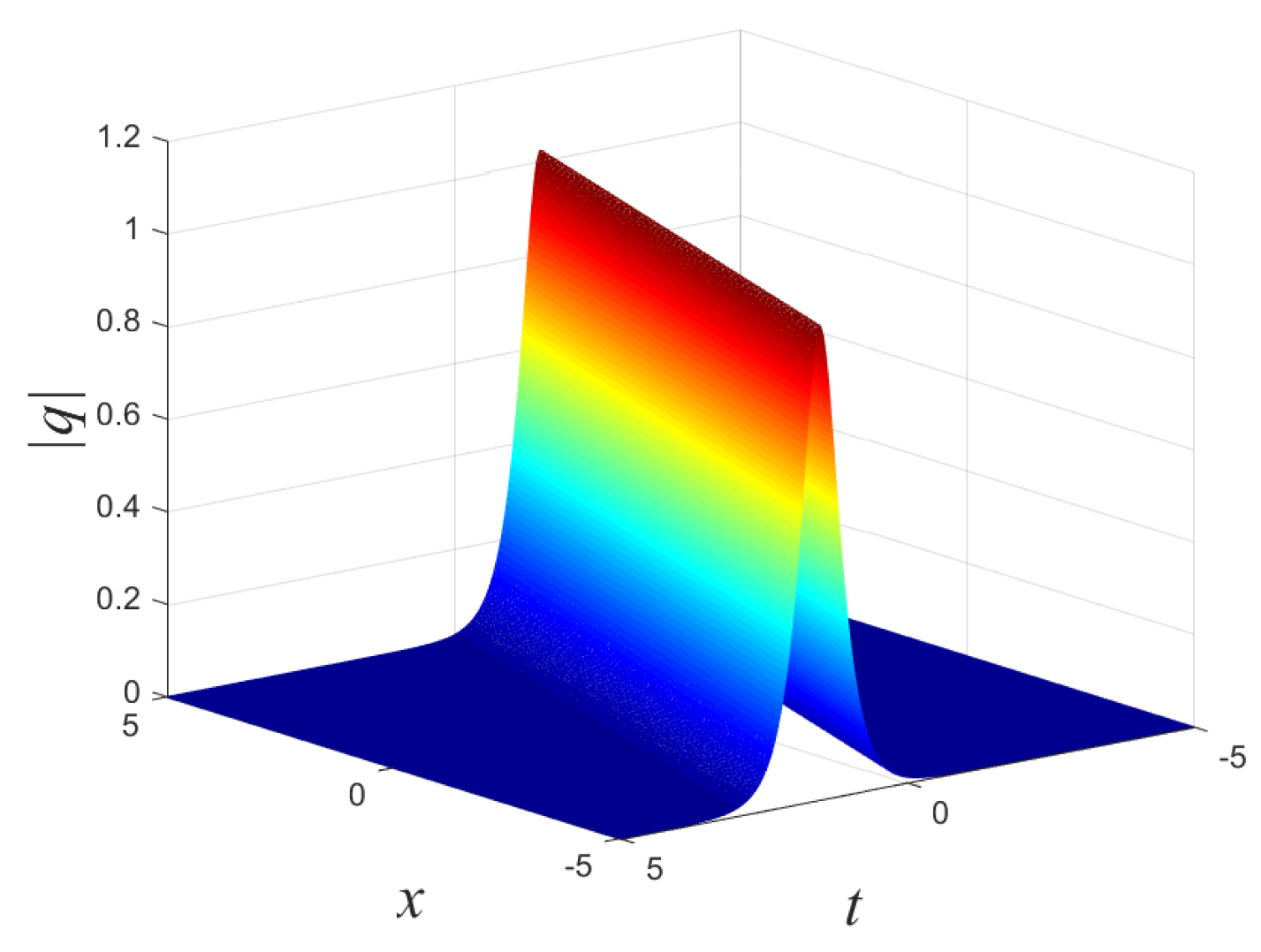
The dynamic of the one-soliton solution is presented in Figure 1.
Figure 1.
One-soliton solution with , .
Then, the N-soliton solution can be obtained
- Case II
Considering the case , we have
where is a Cantor set and is a set that contains the left discrete elements of ,
when , one-soliton solution is obtained by the first iteration.
with
Then, the N-soliton solution is obtained
where
- Case III
Considering the case , we have
where and .
By the iteration of the Darboux transformation, when , one-soliton solution can be presented as
where
Then, the N-soliton solution is obtained
where
5. Conclusions
In this paper, starting from the ∇-dynamical system, the specific form of the coupled CQNLS equation on a time-space scale is derived by the zero curvature equation and different forms of this equation in continuous time scales and discrete time scale are discussed separately. In addition, the Darboux transformation of the coupled CQNLS equation on a time-space scale is elaborately constructed; its one, two, and N-soliton solutions are further investigated. These results effectively combine the theory of differential equations with the theory of difference equations, which can simplify the process of similar analysis on different time and space scales, and can better solve complex models that include continuous and discrete situations.
The extension to arbitrary time or space scales provides access to a wider range of nonlinear integrable dynamic equations. By taking the seed solution , , one-solution of the CQNLS equation is obtained on three different time-space scales (, and ). In one case, the exact solution (29) and its dynamic figure are obtained when . In the other cases, when and , exact solutions (30) and (31) are obtained and are similar to Equation (29). Nevertheless, when and , the structures of solutions are more complicated at discontinuity points. Due to the limitations of the computer, it was difficult to obtain their dynamic figures at this stage. We will find the most effective way to reduce structures of solutions on and , then extend the nonlocal symmetry reduction [38] to a time-space scale, which is the focus of our future work.
Author Contributions
Conceptualization, H.D., Y.Z. and C.W.; methodology, H.D.; software, Y.Z.; validation, H.D., Y.Z. and Y.F.; formal analysis, M.L.; investigation, Y.Z. and M.L.; writing—original draft preparation, Y.Z. and C.W.; project administration, H.D. All authors have read and agreed to the published version of the manuscript.
Funding
This work was supported by the National Natural Science Foundation of China (Grant No. 11975143, 12105161, 61602188), Natural Science Foundation of Shandong Province (Grant No. ZR2019QD018), CAS Key Laboratory of Science and Technology on Operational Oceanography (Grant No. OOST2021-05), Scientific Research Foundation of Shandong University of Science and Technology for Recruited Talents (Grant No. 2017RCJJ068, 2017RCJJ069).
Acknowledgments
The authors would like to express their thanks to the editors and the reviewers for their kind comments to improve our paper.
Conflicts of Interest
The authors declare no conflict of interest.
References
- Zhang, H.Q.; Tian, B.; Xu, T.; Li, H.; Zhang, C.; Zhang, H. Lax pair and Darboux transformation for multi-component modified korteweg-de vries equations. J. Phys. A Math. Theor. 2008, 41, 1–13. [Google Scholar] [CrossRef]
- Doktorov, E.V.; Leble, S.B. A Dressing Method in Mathematical Physics; Springer: Berlin/Heidelberg, Germany, 2007. [Google Scholar]
- Guo, B.; Ling, L.; Liu, Q.P. Nonlinear Schrödinger equation: Generalized Darboux transformation and rogue wave solutions. Phys. Rev. E 2012, 85, 026607. [Google Scholar] [CrossRef] [PubMed]
- Bagrov, V.G.; Samsonov, B.F. Darboux transformation of the Schrdinger equation. Phys. Part. Nucl. 1997, 28, 374–397. [Google Scholar] [CrossRef]
- Xu, S.; He, J.; Wang, L. The Darboux transformation of the derivative nonlinear Schrödinger equation. J. Phys. A Math. Theor. 2011, 44, 6629–6636. [Google Scholar] [CrossRef]
- Debnath, L. Solitons and the Inverse Scattering Transform. SIAM Rev. Soc. Ind. Appl. Math. 1981, 9, 426–533. [Google Scholar]
- Matsuno, Y. The N-soliton solution of a two-component modified nonlinear Schrödinger equation. Appl. Phys. Lett. 2011, 375, 3090–3094. [Google Scholar] [CrossRef]
- Miki, W.; Heiji, S.; Kimiaki, K. Relationships among Inverse Method, Backlund Transformation and an Infinite Number of Conservation Laws. Prog. Orthod. 1975, 53, 419–436. [Google Scholar]
- Matveev, V.B.; Salle, M.A. Darboux Transformations and Solitons; Springer: Berlin, Germany, 1991. [Google Scholar]
- Hilger, S. Analysis on Measure Chains-A Unified Approach to Continuous and Discrete Calculus. Results Math. 1990, 18, 18–56. [Google Scholar] [CrossRef]
- Bohner, M.; Peterson, A. Dynamic Equations on Time Scales an Introduction with Applications; Birkhauser: Boston, MA, USA, 2001. [Google Scholar]
- Agarwal, R.P.; Bohner, M.; Peterson, A. Inequalities on Time Scales: A Survey. Math. Inequal. Appl. 2003, 4, 535–558. [Google Scholar] [CrossRef]
- Honey, C.J.; Kotter, R.; Breakspear, M.; Sporns, O. Network structure of cerebral cortex shapes functional connectivity on multiple time scales. Proc. Natl. Acad. Sci. USA 2007, 104, 10240–10245. [Google Scholar] [CrossRef]
- Christiansen, F.B.; Fenchel, T.M. Theories of Populations in Biological Communities; Springer: Berlin, Germany, 1997. [Google Scholar]
- Manore, C.A.; Hyman, J.M.; Bergsman, L.D. A mathematical model for the spread of west nile virus in migratory and resident birds. Math. Biosci. Eng. 2017, 13, 401–424. [Google Scholar]
- Peng, Y.; Xiang, X.; Jiang, Y. Nonlinear dynamic systems and optimal control problems on time scales. Esaim. Contr. Optim. Calc. Var. 2010, 17, 654–681. [Google Scholar] [CrossRef][Green Version]
- Zhang, H.; Li, Y. Existence of Positive Periodic Solutions For Functional Differential Equations With Impulse Effects On Time Scales. Commun. Nonlinear. Sci. Numer. Simul. 2019, 14, 19–26. [Google Scholar] [CrossRef]
- Benoist, Y.; Foulon, P.; Labourie, F. Double solutions of impulsive dynamic boundary value problems on time scale. J. Differ. Equ. Appl. 2002, 8, 345–356. [Google Scholar]
- Atici, F.M.; Biles, D.C.; Lebedinsky, A. An application of time scales to economics. Commun. Nonlinear. Sci. Numer. Simul. 2006, 43, 718–726. [Google Scholar] [CrossRef]
- Ramsey, J.B.; Lampart, C. Decomposition of economic relationships by timescale using wavelets: Money and income. Macroecon. Dyn. 1988, 2, 49–71. [Google Scholar] [CrossRef]
- Albuch, L.; Malomed, B.A. Transitions between symmetric and asymmetric solitons in dual-core systems with cubic-quintic nonlinearity. Math. Comput. Simulat. 2007, 74, 312–322. [Google Scholar] [CrossRef]
- Shan, W.R.; Qi, F.H.; Guo, R.; Xue, Y.S.; Wang, P.; Tian, B. Conservation laws and solitons for the coupled cubic-quintic nonlinear Schrödinger equations in nonlinear optics. Phys. Scr. 2012, 85, 015002. [Google Scholar] [CrossRef]
- Azzouzi, F.; Triki, H.; Mezghiche, K.; Akrmi, A.E. Solitary wave solutions for high dispersive cubic-quintic nonlinear Schrödinger equation. Chaos. Solitons Fract. 2009, 39, 1304–1307. [Google Scholar] [CrossRef]
- Triki, H.; Wazwaz, A.M. Soliton solutions of the cubic-quintic nonlinear Schrödinger equation with variable coefficients. Rom. J. Phys. 2016, 61, 360–366. [Google Scholar]
- Kengne, E.; Vaillancourt, R.; Malomed, B.A. Bose-Einstein condensates in optical lattices: The cubic-quintic nonlinear Schrödinger equation with a periodic potential. J. Phys. B At. Mol. Opt. 2008, 41, 205202. [Google Scholar] [CrossRef]
- Carr, L.D.; Kutz, J.N.; Reinhardt, W.P. Stability of stationary states in the cubic nonlinear Schrödinger equation: Applications to the Bose-Einstein condensate. Phys. Rev. E 2001, 63, 066604. [Google Scholar] [CrossRef] [PubMed]
- Gagnon, L.; Winternitz, P. Exact solutions of the cubic and quintic nonlinear Schrödinger equation for a cylindrical geometry. Phys. Rev. A. 1989, 39, 296. [Google Scholar] [CrossRef]
- Zhang, Y.; Nie, X.J.; Zha, Q.L. Rogue wave solutions for the coupled cubic-quintic nonlinear Schrödinger equations in nonlinear optics. J. Am. Math. Soc. 2014, 378, 191–197. [Google Scholar] [CrossRef]
- Wang, P.; Tian, B. Symbolic computation on soliton dynamics and Backlünd transformation for the generalized coupled nonlinear Schrödinger equations with cubic-quintic nonlinearity. J. Mod. Optic. 2012, 9, 1786–1796. [Google Scholar] [CrossRef]
- Hamanaka, M. Noncommutative Solitons and Integrable Systems. Physics 2005, 861, 175–198. [Google Scholar]
- Takao, K. Soliton Equations Extracted from the Noncommutative Zero-Curvature Equation. Prog. Theor. Phys. 2001, 105, 1045–1057. [Google Scholar]
- Tu, G.Z. On Liouville integrability of zero-curvature equations and the Yang hierarchy. J. Phys. A 1989, 22, 2375. [Google Scholar]
- Krichever, I. Vector bundles and Lax equations on algebraic curves. Commun. Math. Phys. 2001, 229, 229–269. [Google Scholar] [CrossRef]
- Ma, W.X.; Xu, X.X. Positive and Negative Hierarchies of Integrable Lattice Models Associated with a Hamiltonian Pair. Int. J. Theor. Phys. 2004, 43, 219–235. [Google Scholar] [CrossRef]
- Hovhannisyan, G. On Dirac equation on a time scale. J. Math. Phys. 2011, 52, 1967–1981. [Google Scholar] [CrossRef]
- Liu, M.S.; Dong, H.; Fang, Y.; Zhang, Y. Lie symmetry analysis of burgers equation and the euler equation on a time scale. Symmetry 2019, 12, 10. [Google Scholar] [CrossRef]
- Anderson, D.R.; Bullock, J.; Erbe, L.; Peterson, A.; Tran, H.N. Nabla dynamic equations on time scales. Discret. Appl. Math. 2003, 13, 1–47. [Google Scholar]
- Ablowitz, M.J.; Musslimani, Z.H. Integrable nonlocal nonlinear schrdinger equation. Phys. Rev. Lett. 2013, 110, 064105. [Google Scholar] [CrossRef] [PubMed]
Publisher’s Note: MDPI stays neutral with regard to jurisdictional claims in published maps and institutional affiliations. |
© 2021 by the authors. Licensee MDPI, Basel, Switzerland. This article is an open access article distributed under the terms and conditions of the Creative Commons Attribution (CC BY) license (https://creativecommons.org/licenses/by/4.0/).