1. Introduction
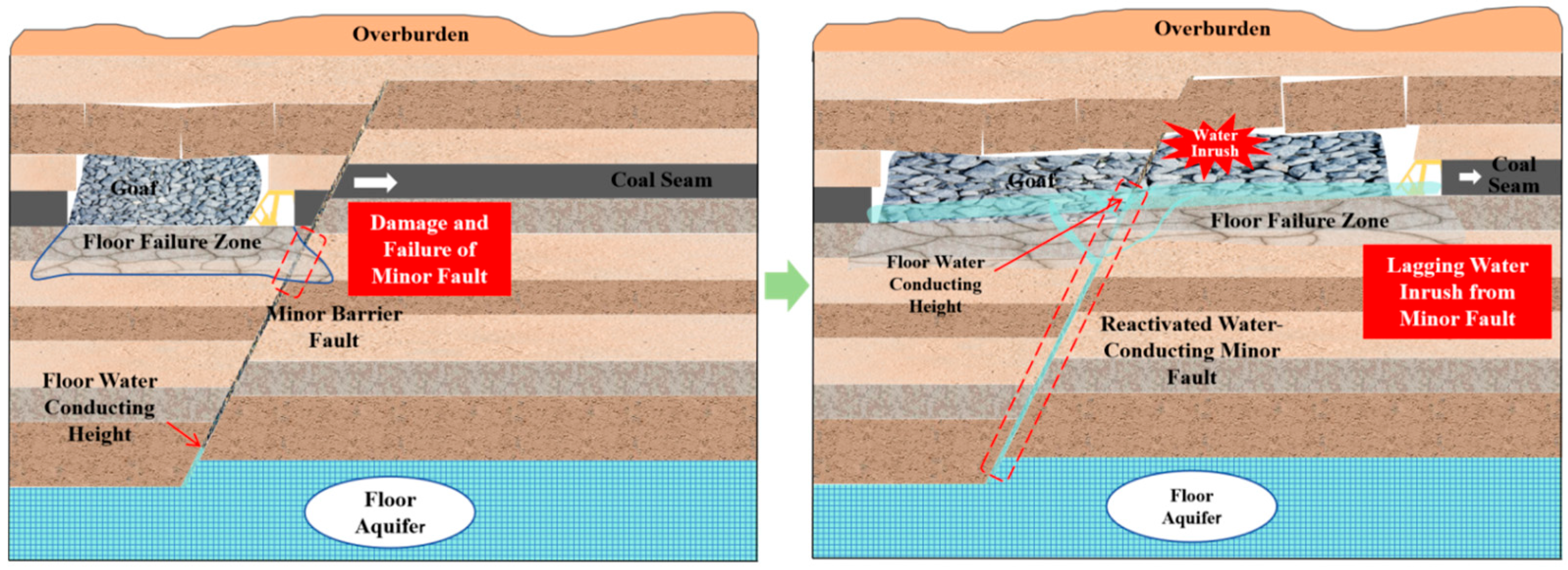
As shallow coal resources in China are gradually depleted, the focus of mining operations has shifted to greater depths, where the floor rock mass is subjected to a “three-high” environment characterized by high in situ stress, high confined water head, and strong mining-induced disturbance [
1,
2]. Floor water inrush is one of the major hazards threatening coal mine safety. Among various types, delayed water inrush induced by the activation of concealed small faults is particularly prominent—i.e., sudden water outburst occurs only after the working face has advanced tens or even hundreds of meters past the fault, making prediction and early warning extremely difficult [
3,
4]. Statistics show that over 60% of floor water inrush accidents in the North China-type coalfields are related to fault structures. Small faults, defined as those with a displacement less than 5 m and an extension length less than 50 m, are the most significant concealed hazard factors because they are difficult to accurately identify using geophysical prospecting methods [
5,
6]. Therefore, revealing the damage–seepage coupling mechanism governing the transformation of small faults from water-resistant to water-conductive under mining-induced stress is a theoretical prerequisite for achieving precise prevention and control of delayed water inrush.
When not affected by mining activities, the fault fracture zone of a small fault penetrating the coal seam floor remains in a compacted state under in situ stress, with low porosity and extremely poor permeability, thus exhibiting a strong water-resisting capacity [
7,
8,
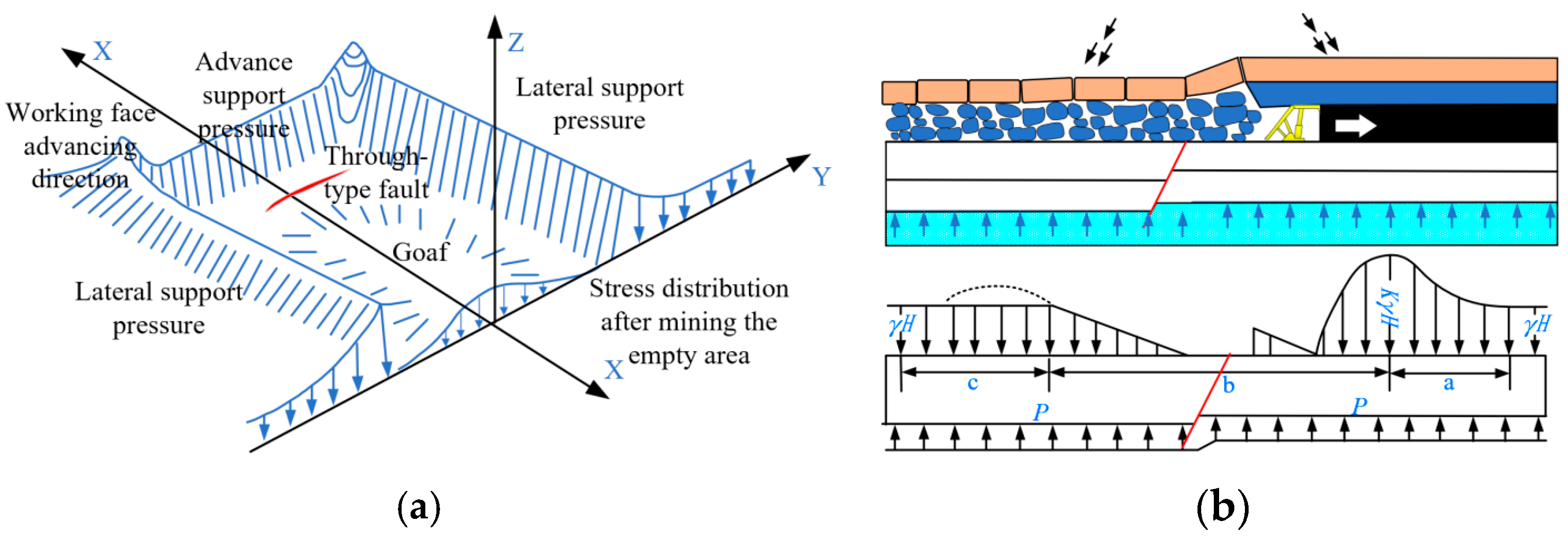
9]. However, as the working face advances, the fault region experiences a complex stress path. When the working face approaches the fault, the peak abutment pressure shifts forward, and the stress at the fault increases. When the working face passes over the fault, the stress is rapidly unloaded. After a certain distance of advance, the collapsed roof strata become compacted, and the stress at the fault rises again [
10,
11]. During this dynamic loading–unloading–reloading process, particles within the fault fracture zone undergo rearrangement, and cracks initiate and propagate. Damage gradually accumulates, and permeability evolves from low to high, potentially leading to fault activation and water inrush [
12,
13]. Therefore, the coupling mechanism between damage evolution and permeability response of small faults under mining-induced stress paths is a key scientific issue for understanding the incubation process of delayed water inrush.
Fault geometric parameters have a decisive influence on fault activation behavior and permeability characteristics. Regarding fault angle, Kwon [
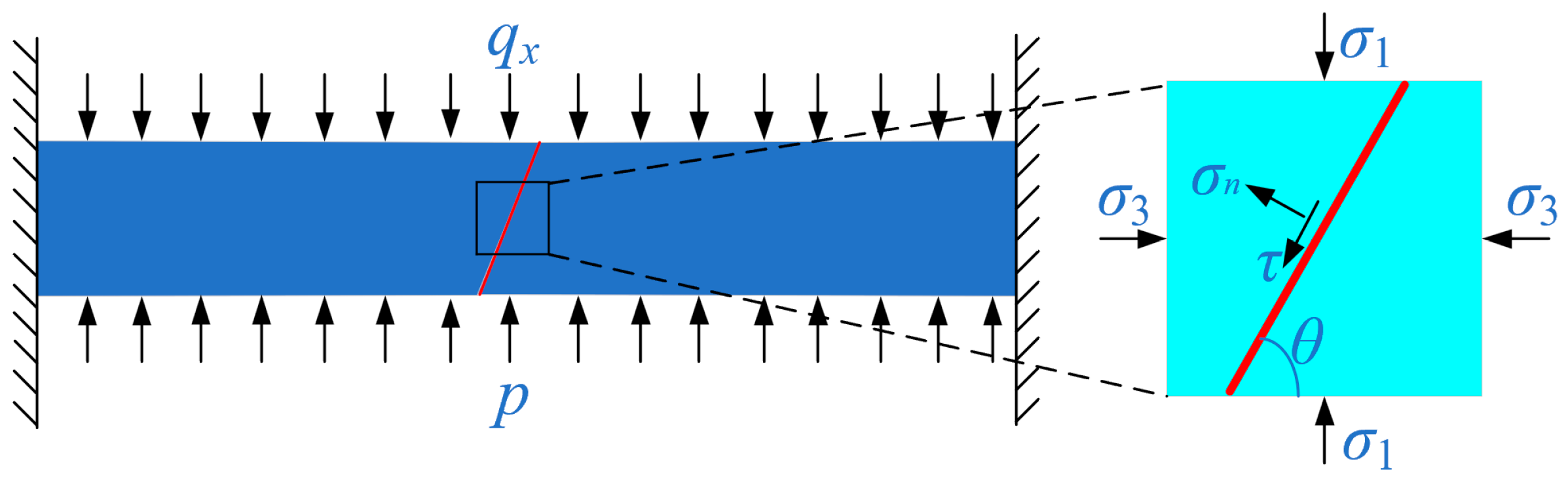
14] pointed out through friction tests that the angle between the fault plane and the direction of the maximum principal stress controls the critical stress for slip, with activation most likely to occur when the angle is in the range of 25° to 35°. Further theoretical analysis by Li et al. [
15] indicated that as the fault angle increases, the normal stress component on the fault plane increases while the shear stress component decreases, thereby raising the external load required for activation. In terms of laboratory tests, Huang et al. [
16] conducted triaxial compression tests on rock specimens containing pre-existing fissures and found that when the fissure angle increased from 30° to 60°, the peak strength increased by approximately 25%, and the failure mode gradually transitioned from shear slip to tensile failure. However, inconsistencies exist among these studies: Kwon [
14] identified a critical angle range (25–35°) for slip activation, whereas Huang et al. [
16] observed a monotonic strength increase from 30° to 60° without a clear critical window. This discrepancy may arise from differences in confining stress, specimen material, or the definition of fault angle relative to the principal stress direction. Regarding fault zone width, foreign scholars, based on analyses of the mechanical behavior of fault gouge, have pointed out that once the fault zone width exceeds a certain threshold, the fault seal capacity decreases significantly. In fault seal evaluation models proposed simultaneously, the fault zone width is positively correlated with the permeability of the fault core. Domestic scholars Li et al. [
17] conducted permeability tests on fault fracture zones with different widths and found that when the width increased from 2 mm to 10 mm, the permeability increased by an order of magnitude. Nevertheless, the reported threshold width for a significant permeability jump varies across studies, with some suggesting a linear increase and others indicating a non-linear response with a critical width around 6 mm. Such contradictions highlight the need for systematic investigation under controlled conditions. However, most of the above studies adopted constant confining pressure or monotonic loading paths and did not account for the dynamic variation characteristics of mining-induced stress.
The permeability characteristics of a fault fracture zone depend not only on its geometric scale but also on the particle gradation of the internal infillings [
18]. The continuously graded theory proposed by Talbot and Richard [
19] suggests that the gradation coefficient n determines the particle packing density. A smaller n value corresponds to a higher proportion of fine particles and a lower packing porosity; however, fine particles are prone to migration under water flow, causing permeability to evolve over time. In terms of permeability tests on crushed rocks, Ma et al. [
20] investigated the permeability evolution of crushed sandstone with different gradations under water pressure and found that when the gradation coefficient is small, the permeability exhibits a non-monotonic “first decrease then increase” characteristic, attributed to the successive dominance of fine particle compaction and erosion. Liu et al. [
21] conducted seepage tests on crushed shale and showed that when the continuous gradation coefficient increases from 0.2 to 0.6, the steady-state permeability decreases by about 70%. Furthermore, Miao et al. [
22] pointed out that the non-Darcy flow behavior of crushed rock masses is closely related to particle gradation: the more uneven the gradation, the larger the non-Darcy factor. A critical inconsistency emerges from these studies: Ma et al. [
20] reported a non-monotonic permeability evolution with respect to gradation coefficient (first decreasing then increasing), whereas Liu et al. [
21] observed a monotonic decrease. This discrepancy may stem from differences in particle lithology, testing pressure, or the presence of water erosion during loading. Such contradictory findings underscore the need to re-examine the role of particle gradation within a fault-surrounding rock system under realistic stress paths. The above studies provide an important foundation for understanding the seepage behavior of fault fracture zones, but most of them focused on crushed rock samples with a single particle size distribution without placing them in a fault-surrounding rock system or considering the effect of mining-induced stress paths.
Realistic simulation of mining-induced stress paths and simultaneous monitoring of damage and seepage constitute the experimental basis for this study. In terms of stress path simulation, traditional rock mechanics tests mostly adopt monotonic loading to failure or creep tests under constant confining pressure [
23], whereas mining-induced stress paths are inherently non-monotonic. In recent years, some scholars have begun to pay attention to rock failure behavior under unloading confining pressure paths. For example, Xie et al. [
24] conducted “increasing axial pressure—unloading confining pressure” tests to simulate the unloading process of roadway excavation. Wang et al. [
25] adopted a “pressurization—depressurization—repressurization” path to simulate mining disturbance on floor rock masses and found that the unloading stage causes the most significant damage. However, the relative importance of loading versus unloading phases on fault permeability remains debated, with some studies emphasizing damage accumulation during unloading and others highlighting re-compaction effects during reloading. Regarding damage monitoring, acoustic emission (AE) technology, owing to its sensitivity to the spatiotemporal evolution of micro-fractures, has been widely used for locating and quantitatively characterizing rock failure processes [
26,
27]. In terms of seepage testing, laboratory core permeability measurement is relatively mature, but combined damage–seepage tests started later. Jiang et al. [
28] developed a rock damage–seepage coupling test system that enables continuous permeability measurement during triaxial loading. However, test systems that simultaneously possess the functions of mining-induced stress path simulation, AE spatial localization, and synchronous seepage monitoring are still rare, making it difficult to meet the requirements for studying mining-induced fault activation.
In the field of fault fracture zone seepage, the fractal grading method has proven to be a powerful quantitative tool. The Talbot continuous gradation formulation is mathematically equivalent to a fractal distribution with fractal dimension
Df = 3 −
n, where n is the gradation coefficient. This equivalence allows the complex particle size distribution of fault infill to be captured by a single parameter, greatly facilitating systematic experimental design and parametric analysis. Recent studies have demonstrated the advantages of this approach. Wu et al. [
29] systematically investigated the effect of filling gradation on the mesostructure and seepage characteristics of fault fracture zones. They reported that the permeability decreased by 98.71% when the Talbot gradation indices decreased from 1.25 to 0.6. This highlights the dominant control of gradation on fault permeability. Ma et al. [
30] further performed NMR-based pore structure characterization. They revealed that the pore size distribution of both continuously graded and gap-graded fault rock mass with a particle fractal dimension of 2.6 exhibits a clear three-peak structure. Moreover, the absence of small particles leads to increased porosity and reduced compressibility, fundamentally altering the nonlinear seepage behavior. These findings confirm that the fractal grading method not only quantitatively describes particle size distribution, but also effectively links gradation parameters to pore structure evolution and permeability variation, providing a robust theoretical basis for subsequent analysis of damage–seepage coupling in small faults.
In summary, existing studies have the following notable deficiencies: ① the effects of fault angle and fracture zone width are mostly based on monotonic loading tests, lacking validation under mining-induced stress paths; ② the controlling effect of particle gradation on the seepage evolution of fault fracture zones has not been systematically investigated within a fault-surrounding rock system; and ③ experimental studies that simultaneously incorporate mining-induced stress path simulation, AE spatial localization, and synchronous seepage monitoring are still lacking. To address these gaps, this paper prepares cubic cement mortar specimens containing a persistent small fault based on similarity theory. Three groups of variables are set up: fracture zone width, particle gradation, and fault angle. A monotonic loading path is adopted—instead of the full pressurization–depressurization–recompaction mining-induced stress path—as a simplified and controlled first-step investigation. Triaxial loading–seepage–AE combined tests are then conducted. The research objectives are: ① to reveal the influence of each factor on specimen strength, failure mode, and seepage evolution; ② to evaluate the sensitivity ranking of each factor to delayed water inrush risk based on the grey relational analysis method; and ③ to explore the damage–seepage coupling mechanism of small faults under mining-induced stress conditions (with the present monotonic loading representing the overall loading phase before fault activation). The research results can provide a theoretical basis for risk assessment of delayed water inrush from small faults in working faces above confined aquifers.
3. Experimental Method for Damage and Failure of Small Faults Under Mining-Induced Stress Path
3.1. Overview of the Experimental Method
The fractured rock mass of a small fault is in a compacted state under in situ stress when undisturbed. During the mining process, the floor small fault ahead of the working face experiences a gradual increase in stress level due to the influence of abutment pressure. Based on the geometry and stress characteristics of the floor small fault in front of the working face, this paper adopts similarity theory, selects cubic cement specimens to simulate the damage and failure process of small faults, and proposes a triaxial loading test method for cemented persistent small faults. Through multi-factor comparative tests, the effects of fracture zone particle gradation, fracture zone width, and fault angle on the damage, failure, and seepage characteristics of floor small faults under triaxial loading conditions are investigated.
3.2. Specimen Preparation
Floor small faults are highly concealed and difficult to sample in situ. Therefore, this paper adopts the method of consolidating and remolding similar materials with reference to concrete specimen preparation techniques to produce fault-bearing rock specimens with mechanical properties similar to those of natural faults. The fault surrounding rock is remolded by mixing sand and cement. The small fault fracture zone is filled with a mixture of rock particles of different particle sizes, cement and gypsum, with the cement and gypsum together acting as binders between the hanging wall and footwall of the fault.
To ensure that the model test results reflect field conditions, a quantitative similarity framework was established based on similarity theory. In this study, the geometric similarity ratio was taken as CL = LP/Lm = 1/50, i.e., the model side length of 100 mm corresponds to a characteristic field dimension of about 5 m. The density similarity ratio was taken as Cρ = ρP/ρm ≈ 1, with the model material density being approximately 2.52 g/cm3, close to that of field rocks. For the intact strength of the surrounding rock, the stress similarity ratio was taken as Cσ = σm/σp = 1/5, meaning that the uniaxial compressive strength of the model surrounding rock (about 10 MPa) corresponds to a field surrounding rock strength of about 50 MPa. The elastic modulus similarity ratio was set as CE = Cσ to ensure similarity in deformation behavior. For the fault fracture zone, which consists of crushed and loose materials and does not possess an intact uniaxial compressive strength, no quantitative stress similarity ratio was applied; instead, its mechanical behavior was qualitatively controlled by the particle gradation (Talbot continuous gradation coefficient n), fracture zone width, and fault angle. Due to the limitations of model scale, complete quantitative similarity in permeability was difficult to achieve; therefore, the dimensionless flow rate variation (normalized measured flow rate) was used as the main comparative index. This quantitative similarity framework clarifies the conversion relationships between the model and the prototype for various physical quantities, providing a theoretical basis for engineering extrapolation of the test results.
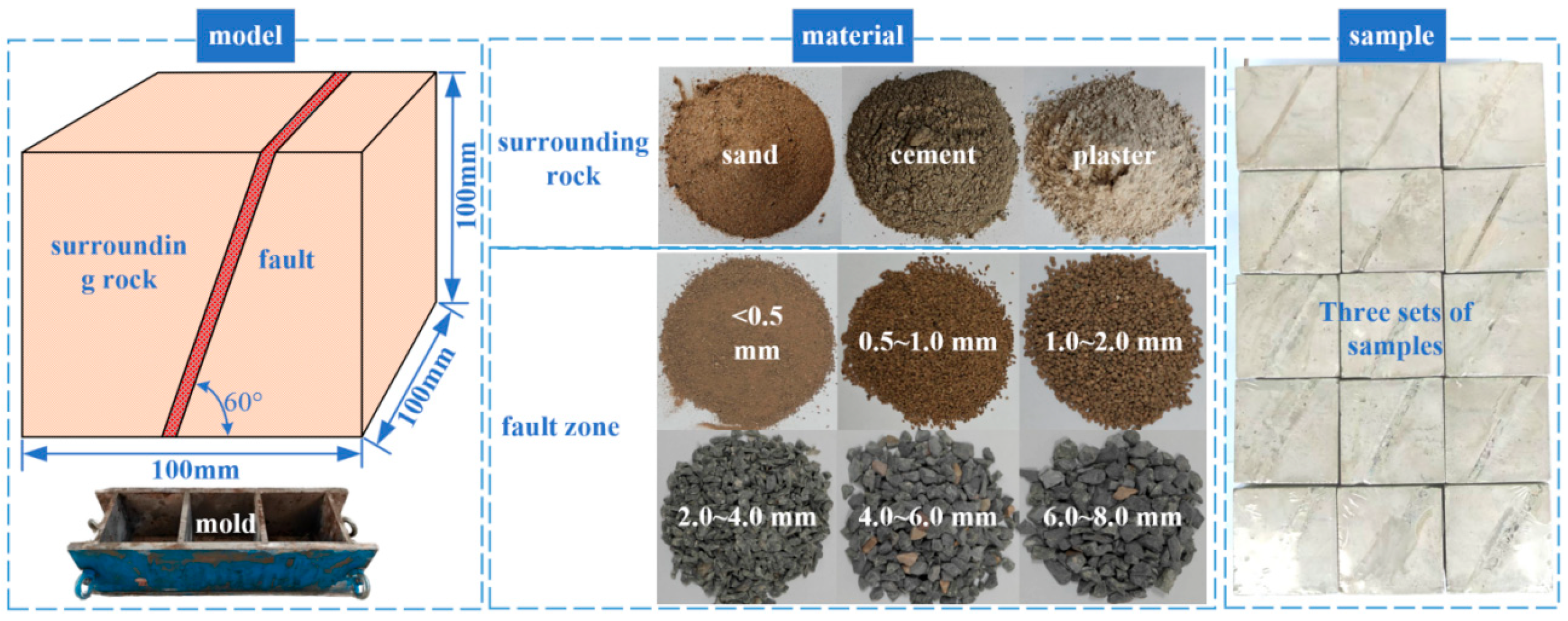
The small fault specimens are cubic with dimensions of 100 mm × 100 mm × 100 mm. The small fault is a through-going fault with a fault angle of 60°. The width of the small fault fracture zone is divided into five types: 2, 4, 6, 8, and 10 mm, with three specimens prepared for each width. However, during the preparation and curing processes, some specimens exhibited defects such as uneven filling, debonding, and deviation of the preset fault position. Consequently, only one qualified specimen meeting the test requirements was selected for each variable, resulting in a total of 15 valid specimens for the combined loading–seepage–AE tests. Before specimen preparation, crushed limestone particles of 0–10 mm need to be prepared and sieved using a set of sieves. To ensure the continuity of the fractured particles in small faults of different widths, each fault type is divided into three gradation levels. The continuously graded formula [
32] is used to calculate the mass of each gravel particle grade:
where
p0 (
d ≤
di) is the original mass ratio of tuff particles with a size less than or equal to di; di is the maximum particle size in the i-th group, m; and dM is the maximum size of the crushed limestone particles, m.
This continuous gradation formula is equivalent to a fractal distribution, where the fractal dimension
Df and the Talbot gradation coefficient
n satisfy Df = 3−
n. As verification, the fractal relationship between particle mass and particle size can be expressed as:
where
M(
r) is the mass of crushed particles within the radius r, g;
MT is the total mass of all crushed particles, g; r is the radius of crushed particles, m;
R is the maximum radius of crushed particles, m; and
Df is the fractal dimension.
Substituting Df = 3−n into Equation (7) recovers Equation (6). Therefore, in this study, the Talbot gradation coefficient n is used as the controlling variable for particle gradation, while the fractal dimension is only mentioned for theoretical illustration and is not used in the subsequent analysis.
Specimen preparation was carried out in two steps. The first step was to prefabricate rock blocks containing the fault. Sand and cement were mixed in a ratio of 2:1, and water was added and mixed uniformly using a handheld mixer. A spacer for controlling the fault angle and stainless steel sheets for simulating different fault widths were placed in a cleaned mold. The mixed cement slurry was then poured into the mold. After 5 h, the spacer placed on top of the mold was removed, and the specimen was trimmed. After natural solidification for 3 days, the mold was disassembled, the specimen was taken out, and then placed in a constant temperature and humidity chamber for curing for 7 days.
The second step was to fill the fault with infill materials. According to the thickness of the fault fracture zone, aggregates of different particle sizes were mixed together with cement. The mixed material was injected into the fault and left to stand for 3 days to obtain the specimen containing the fault.
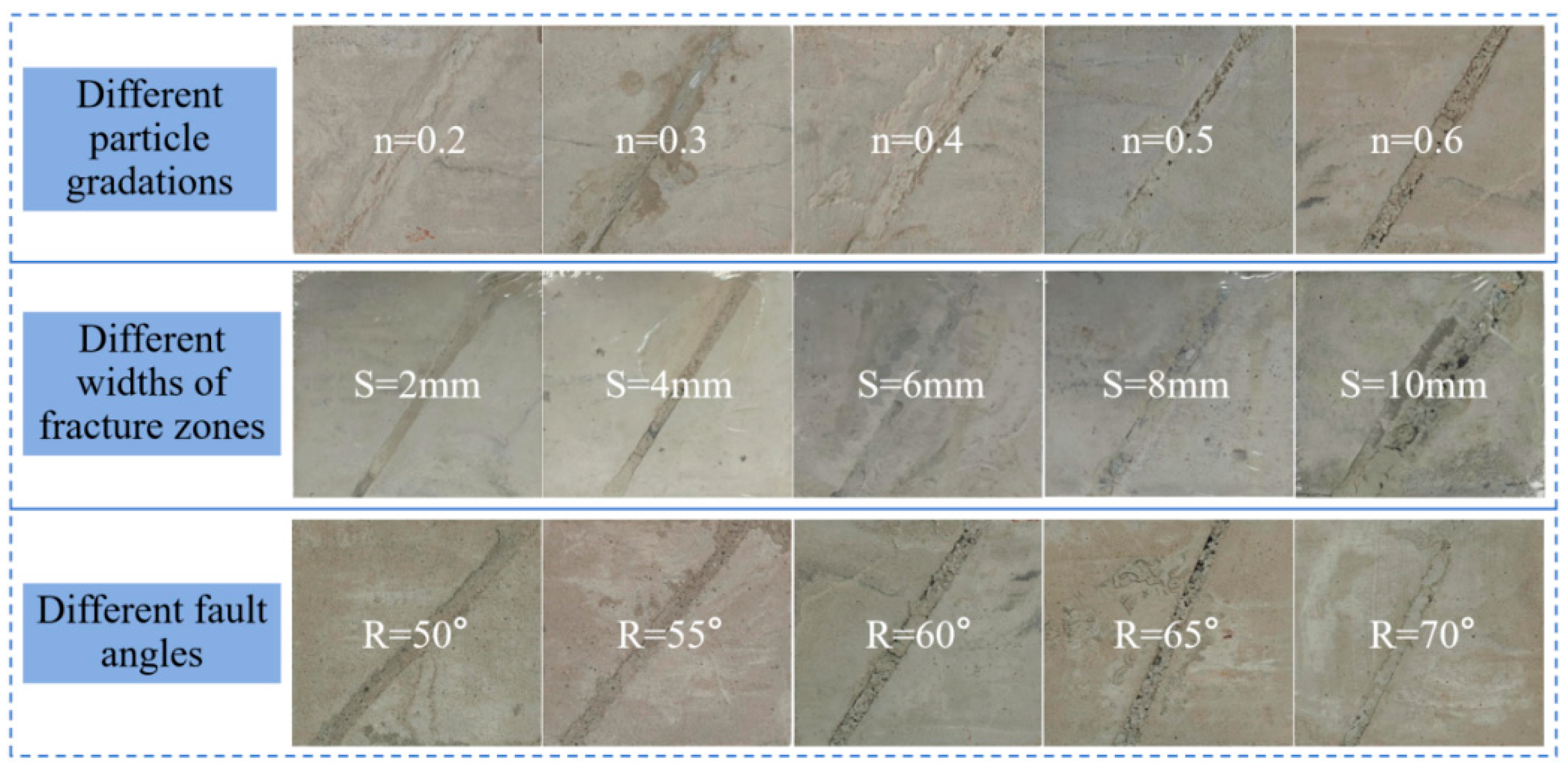
The prepared specimens are shown in the
Figure 4. Their properties are close to those of in situ materials, thus confirming the rationality of using this similar material to simulate the fault fracture zone and the surrounding rock.
It should be emphasized that the lack of strict quantitative similarity in absolute permeability does not undermine the core conclusions of this study. The primary objective is not to measure the exact in situ permeability of field faults, but rather to reveal the evolutionary patterns of seepage in response to damage accumulation (i.e., the characteristic “compaction stabilization → stepwise rise → plateau stabilization” sequence) and to establish the relative sensitivity ranking of the controlling factors (fault angle, particle gradation, and fracture zone width) for delayed water inrush risk. These evolutionary patterns are governed by fundamental physical mechanisms—fracture propagation, particle migration, and the formation of interconnected seepage channels—which are scale-invariant and reliably reproduced in our models via the fractal grading method that controls the pore structure of the infill. Moreover, the use of normalized flow rate (i.e., the dimensionless variation relative to the initial value) as the comparative index provides a conservative lower-bound estimate for engineering extrapolation. Since laboratory specimens inevitably possess higher initial porosity and permeability than deeply buried, highly compacted in situ faults, any significant post-failure flow surge observed in our tests would indicate an even more pronounced relative increase in permeability under field conditions. Consequently, while the absolute permeability values are not directly scalable, the derived damage–seepage coupling mechanisms and the sensitivity ranking (fault angle > gradation > width) remain robust and practically applicable for risk assessment and early warning in coal mine operations.
3.3. Test System Design
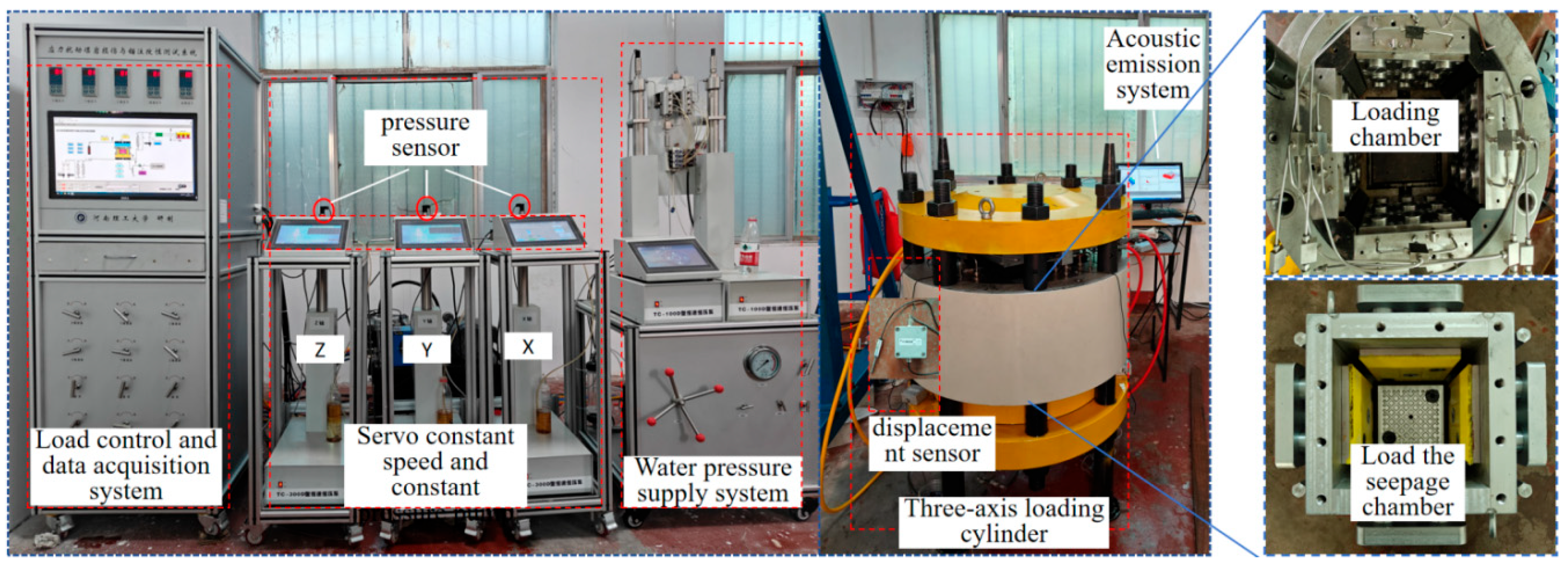
To investigate the damage and failure characteristics of small faults with different widths under monotonic loading conditions, a self-developed stress-disturbed coal-rock damage and anchor-grouting modification test system from Henan Polytechnic University was adopted. This system is capable of simulating monotonic loading-induced damage and failure of rocks under triaxial stress states. The test system is shown in
Figure 5 and mainly consists of five components: a rock damage and failure pressure chamber, a low-pressure preloading system, a constant-speed and constant-pressure loading system, a displacement acquisition unit, and an acoustic emission acquisition system.
At the beginning of the test, the axial loading system continuously retracts oil to fully contract the loading cylinder. The fault specimen is then placed into the loading chamber. After that, oil retraction is stopped, the upper cover plate and the vertical displacement sensor are installed, and the test loading preparation is completed. The acoustic emission parameters were set as follows: six sensors were arranged, the threshold was 40 dB, the sampling rate was 2 MSPS, the wave velocity was 2000 m/s, and the location algorithm adopted regression analysis with the least squares method.
3.4. Experimental Scheme
The damage and failure characteristics of floor small faults are influenced by multiple factors. This study only considers the effects of fracture zone width, particle gradation, and fault angle on fault-surrounding rock damage and failure, and conducts simulation tests on this basis.
Triaxial monotonic loading damage and failure tests were carried out on fault-bearing rock specimens at room temperature. The tests were divided into three groups: the first group had continuous gradation coefficients
n = 0.2, 0.3, 0.4, 0.5, and 0.6 with a fixed fault angle of 60° and a fracture zone width of 6 mm; the second group had fracture zone widths of 2, 4, 6, 8, and 10 mm with a fixed fault angle of 60° and a particle gradation coefficient
n = 0.4; and the third group had fault angles of 50°, 55°, 60°, 65°, and 70° with a fixed fracture zone width of 6 mm and a particle gradation coefficient
n = 0.4. All specimens were loaded under a monotonic loading path at a constant loading rate until failure (
Figure 6).
The damage and failure characteristics of floor small faults are influenced by multiple factors. This study only considers the effects of three factors—particle gradation of the small fault fracture zone, fracture zone width, and fault angle—on the damage, failure, and seepage characteristics of the specimens. All specimens are cubic with dimensions of 100 mm × 100 mm × 100 mm, and the fault is of a through-going type. The three groups of variables are designed as follows:
- (1)
Different particle gradations: fault angle fixed at 60°, fracture zone width fixed at 6 mm, continuous gradation coefficients set to 0.2, 0.3, 0.4, 0.5, and 0.6, giving a total of 5 specimen types. The mass proportion of each particle size group was calculated according to the Talbot continuous gradation formula; the smaller the n value, the higher the proportion of fine particles.
- (2)
Different fracture zone widths: fault angle fixed at 60°, particle gradation coefficient fixed at 0.4, fracture zone widths set to 2, 4, 6, 8, and 10 mm, giving a total of 5 specimen types.
- (3)
Different fault angles: fracture zone width fixed at 6 mm, particle gradation coefficient fixed at 0.4, fault angles set to 50°, 55°, 60°, 65°, and 70°, giving a total of 5 specimen types.
Although the full mining-induced stress path involves three stages (pressurization, depressurization, and recompaction), the present study employs monotonic loading to represent the dominant loading phase before fault activation. This simplification allows systematic investigation of damage–seepage coupling under controlled conditions, while the unloading and reloading effects will be addressed in subsequent studies.
3.5. Experimental Procedure
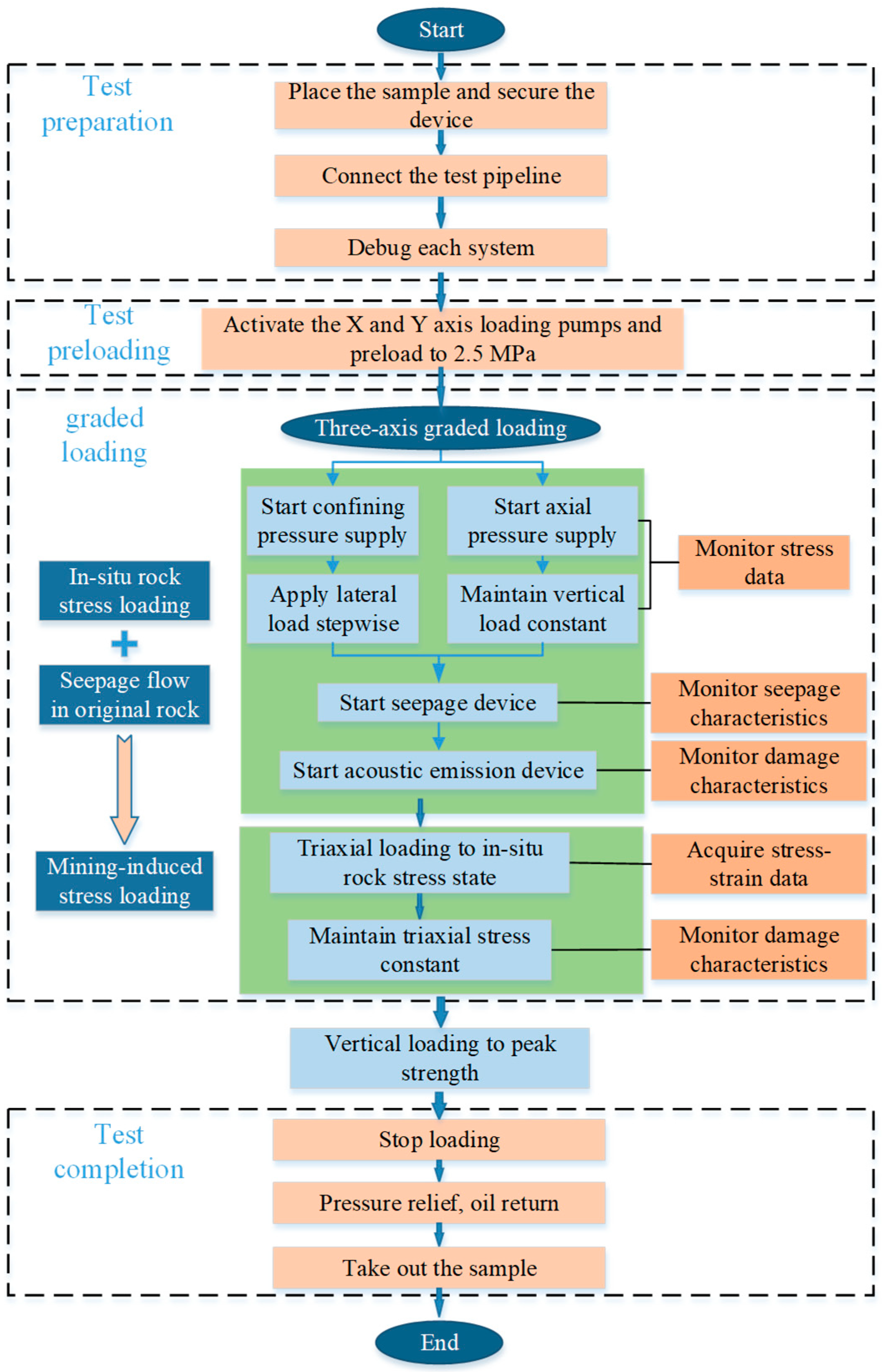
The experimental procedure is illustrated in
Figure 7.
- (1)
Test preparation. The power supply of all equipment and the oil inlet/outlet valves were turned on. The main valve of the hydraulic station was opened, the oil release valves of the X, Y, and Z axes were opened, and the hydraulic station was started. After the oil cylinder in the loading chamber was fully retracted, the specimen was slowly placed into the loading chamber, and the oil release valves were closed in the reverse order. A permeable plate and a seepage connector were placed sequentially at the bottom and top ends of the specimen, and the seepage pipelines were connected with good sealing. A crane was used to install the upper Z-axis loading plate directly above the specimen, and then the upper cover plate was placed on the Z-axis loading plate. All fixing screws were installed to ensure smooth Z-axis loading.
- (2)
Test preloading. Open the main valve of the hydraulic station, open the oil inlet valves of the X, Y, and Z axes, and start the hydraulic station. When the pressure of each axis reaches 2.5 MPa, close the oil inlet and outlet valves, and simultaneously turn off the hydraulic station and the main hydraulic valve. Preloading is then completed.
- (3)
Stress loading and seepage testing.
Step 1—Apply confining pressure: The oil inlet valve was opened, the triaxial confining pressure was set to 6 MPa for all three axes, the constant-speed and constant-pressure pumps of the X, Y, and Z axes were started, and after each axis reached the preset value, it was maintained constant to complete the in situ stress loading.
Step 2—Start the seepage system:
The seepage configuration was vertical upward flow, with water injected from the bottom porous plate and exiting from the top porous plate (outlet at atmospheric pressure, i.e., free drainage condition). The hydraulic gradient was maintained constant by an inlet pressure of 2 MPa and an outlet pressure of 0 MPa.
Saturation procedure: the specimen was vacuumed for 2 h, followed by back-pressure saturation with de-aired water at 1 MPa for 24 h.
Sealing verification: a 3 mm-thick rubber sleeve was wrapped around the specimen, and a confining pressure of 6 MPa was applied to seal the sides. Leakage was verified by monitoring the water level in the outlet reservoir under no-flow conditions; no leakage was detected.
The seepage water inlet valve was opened, the seepage pressure was set to 2 MPa, and after the seepage stabilized, the initial seepage flow rate was recorded.
Step 3—Start the acoustic emission acquisition system and begin monotonic axial loading: The Z-axis pressure was increased at a constant rate of 0.05 MPa/s until the specimen failed. During loading, the seepage flow rate, inlet/outlet pressures, and acoustic emission signals were continuously monitored and recorded.
- (4)
Post-test processing. After the test is completed, close the seepage system and the water inlet valve, turn off the acoustic emission system, and save the monitoring data of acoustic emission, seepage, pressure, and displacement. Operate the constant-speed and constant-pressure pumps to unload pressure and retract oil from the X, Y, and Z axes. Open all screws, use the crane to remove the upper cover plate and the Z-axis loading plate in sequence, take out the failed fault specimen, and clean the loading chamber with an air pump. The test is then finished.
- (5)
Repeat the above steps to complete the loading tests for all specimens.
4. Damage and Failure Characteristics of Small Fault Specimens Under Different Conditions
4.1. Damage and Failure Characteristics of Specimens with Different Fracture Zone Particle Gradations
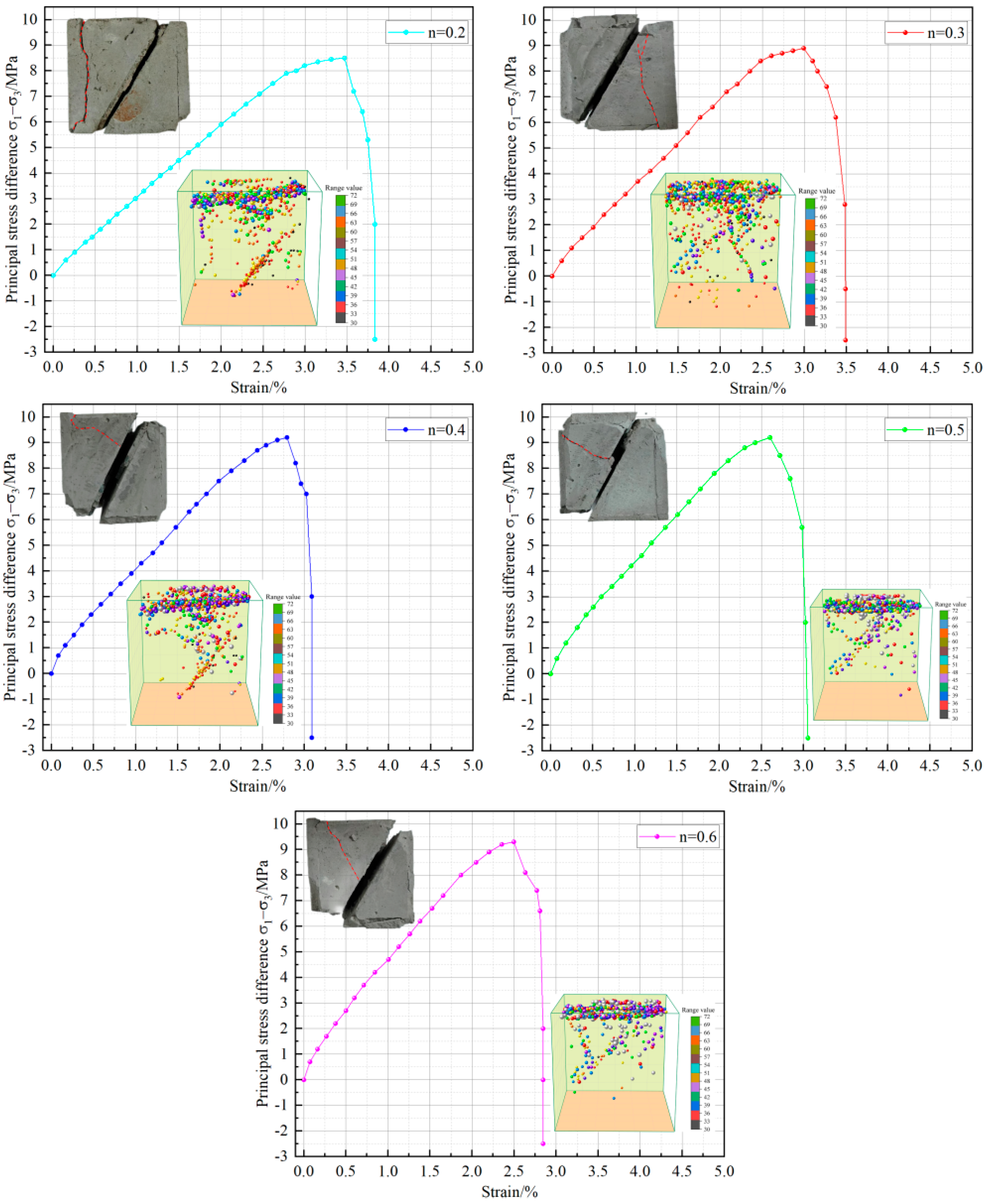
Figure 8 presents the failure morphologies, triaxial stress–strain curves, and acoustic emission spatial localization results of specimens under different continuous gradation coefficients. As n increases, the compactness of the infill particles in the fracture zone increases while the porosity decreases. The failure mode gradually transitions from shear–tensile to tension–shear composite failure, and both the compressive strength and the acoustic emission source amplitude show an increasing trend.
When n = 0.2, the specimen develops one vertical fracture on each side, caused by shear–tensile failure induced by axial concentrated loading. The maximum compressive strength is 8.5 MPa, the maximum AE source amplitude is 61 dB, and the events are mainly distributed along the fault plane. When n = 0.3, the specimen exhibits a single through-going vertical fracture on the right side; the strength increases to 8.8 MPa, the AE source amplitude reaches 64 dB, and the events are concentrated along the fault plane and a transverse strip to the right of the fault, consistent with the shear failure morphology. When n = 0.4, a fracture inclined at approximately 30° to the horizontal appears on the left side of the specimen, perpendicular to the small fault; after peak stress, the upper part of the fracture zone partially adheres to the footwall. The strength is 9.2 MPa, the AE source amplitude is 66 dB, and the events are concentrated at the specimen top and along the fault plane, with a particularly dense cluster at the upper left. When n = 0.5, the inclination of the left fracture increases to about 45°, and the upper part of the fracture zone partially adheres to the hanging wall. The strength remains 9.2 MPa, the AE source amplitude is 67 dB, and the spatial distribution of events is similar to that for n = 0.4. When n = 0.6, the left fracture inclination reaches about 60°, and after peak stress the fracture zone is completely detached and shows a loose, fragmented state. The strength reaches 9.3 MPa, the AE source amplitude increases to 69 dB, and the distribution angle of the events changes. Overall, as the continuous gradation coefficient increases, the compressive strength of the specimens gradually improves. Taking the maximum compressive strength of the specimen with n = 0.4 as a reference, the strength changes of the other specimens are a decrease of 7.6%, a decrease of 4.3%, and an increase of 1.1%, respectively. Meanwhile, the growth rate of the principal stress difference gradually accelerates, indicating that the influence of porosity on strength weakens as n increases. The AE source amplitude is positively correlated with the compressive strength, and the spatial distribution of AE events corresponds well with the macroscopic fracture surfaces.
4.2. Damage and Failure Characteristics of Specimens with Different Fracture Zone Widths
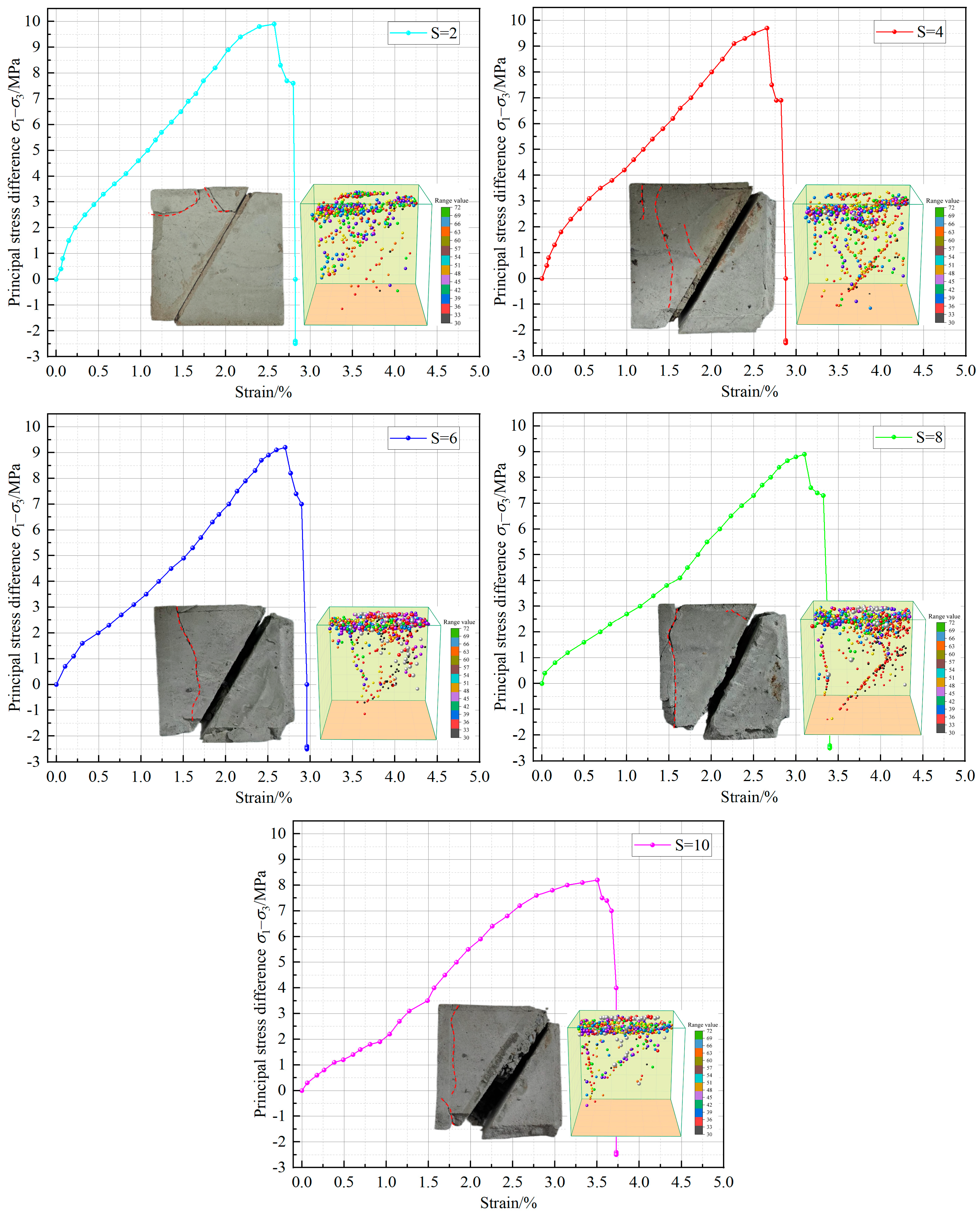
Figure 9 presents the failure morphologies, triaxial stress–strain curves, and acoustic emission spatial localization results of specimens with different fracture zone widths. As the fracture zone width increases, the volume proportion of infill material in the specimen rises, leading to a decrease in overall compressive strength. The failure morphology of the small fault specimens is generally similar across different widths, all exhibiting shear–tensile failure on the left side of the specimen. Meanwhile, the number of AE events gradually increases, while the AE source amplitude shows a decreasing trend.
When the fracture zone width is 2 mm, shear failure occurs at the upper left corner of the specimen, with a minor vertical crack appearing at the lower part; the middle part of the fracture zone does not disintegrate and remains adhered to the footwall. The maximum compressive strength is 9.9 MPa, and the maximum AE source amplitude is 71 dB, with events mainly distributed in the upper part of the specimen and along the fault plane. At a width of 4 mm, three macroscopic vertical cracks appear on the hanging wall, one of which is through-going; the middle part of the fracture zone partially disintegrates but mostly adheres to the hanging wall. At a width of 4 mm, the hanging wall develops three macroscopic vertical cracks, one of which is through-going. The middle part of the fracture zone partially disintegrates but mostly adheres to the hanging wall. The peak strength decreases to 9.7 MPa, accompanied by an AE source amplitude of 70 dB. The AE events are mainly concentrated on the hanging wall, indicating significant damage there. For a width of 6 mm, a single through-going vertical crack appears on the hanging wall. Local failure occurs at the tops of both the hanging wall and footwall due to high loading pressure, and the middle part of the fracture zone largely disintegrates, showing little adhesion. The specimen exhibits a peak strength of 9.2 MPa and an AE source amplitude of 66 dB. Events are concentrated at the specimen top, along the fault plane, and in the middle of the hanging wall, where a string of vertical AE events corresponds well with the shear–tensile failure. At a width of 8 mm, two vertical cracks appear on the hanging wall: the left crack is through-going, whereas the right crack is located at the contact with the fracture zone. The peak strength drops to 8.9 MPa, with an AE source amplitude of 64 dB. Events are mainly distributed at the top of the specimen, along the fault plane, and on the left side of the hanging wall. At a width of 10 mm, two non-through-going vertical cracks appear on the hanging wall (one developing about 75% of the specimen height, the other short); half of the middle fracture zone infill adheres to the hanging wall and the other half disintegrates. The strength is 8.2 MPa, the AE source amplitude is 58 dB, and the event distribution is similar to that for the 8 mm width, also showing a string of vertical events on the left side of the hanging wall.
Overall, as the fracture zone width increases, the maximum compressive strength of the specimens gradually decreases. Taking the maximum compressive strength of the specimen with a width of 6 mm as a reference, the strength changes for other widths are an increase of 7.6%, an increase of 5.3%, a decrease of 3.3%, and a decrease of 10.9%, respectively. Meanwhile, the growth rate of the principal stress difference gradually slows down, indicating that the influence of the fracture zone infill volume on strength increases with width. The AE source amplitude is positively correlated with compressive strength, and as the width increases, the distribution of AE events on the fracture zone gradually becomes more numerous.
4.3. Damage and Failure Characteristics of Specimens with Different Small Fault Angles
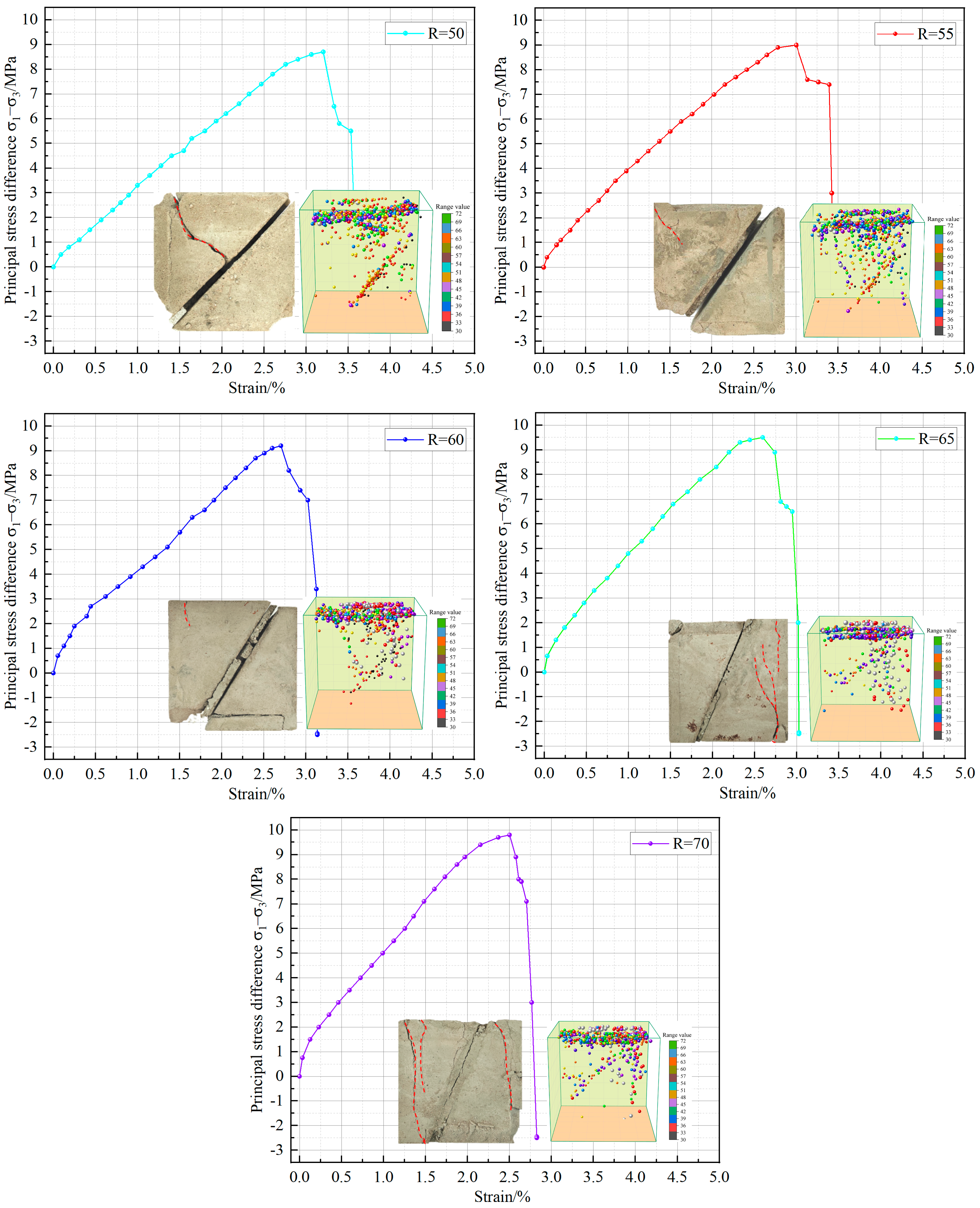
Figure 10 presents the failure morphologies, triaxial stress–strain curves, and acoustic emission spatial localization results of specimens with different fault angles. As the fault angle increases, the specimen’s resistance to shear failure improves, and the failure mode gradually transitions from shear failure to tensile failure. Both the maximum compressive strength and the AE source amplitude show an increasing trend, while the distribution of AE events gradually shifts from the hanging wall and fault plane to the footwall and fault plane.
When the fault angle is 50°, tensile failure occurs on the hanging wall of the specimen, and the fault planes of the hanging wall and footwall undergo through-going splitting failure. The infill material in the fracture zone is subjected to significant stress and becomes scattered upon load removal. The maximum compressive strength is 8.7 MPa, the maximum AE source amplitude is 65 dB, and the events are mainly distributed in the hanging wall and along the fault plane. At an angle of 55°, the hanging wall exhibits an extended crack that only propagates to the middle of the hanging wall. Most of the fracture zone infill adheres to the hanging wall, with only a small portion becoming scattered. At 55°, the hanging wall exhibits an extended crack propagating only to its middle. Most of the fracture zone infill adheres to the hanging wall, with only a small portion becoming scattered. The peak strength rises to 9.0 MPa, accompanied by an AE source amplitude of 67 dB. Events remain mainly concentrated on the hanging wall and fault plane, and the increased event count on the hanging wall indicates intensified internal damage. At 60°, the specimen shows few cracks, with one non-through-going vertical crack in the upper part and local failure in the lower part due to concentrated loading at the loading end. The fracture zone infill is broken into three segments and separated from both the hanging wall and footwall. A peak strength of 9.2 MPa is recorded, with an AE source amplitude of 68 dB, and the event energy at the fault plane is higher than that for 50° and 55°. At 65°, three vertical tensile cracks appear on the footwall. The lower part of the fracture zone infill is separated from the hanging wall and footwall, while the upper part adheres to the footwall. The peak strength attains 9.5 MPa, the AE source amplitude 70 dB, and the events are mainly distributed in the footwall and along the fault plane, indicating tensile failure of the footwall. At 70°, multiple vertical tensile cracks appear on both the hanging wall and footwall. The upper part of the fracture zone infill adheres to the footwall. A peak strength of 9.8 MPa is achieved, with an AE source amplitude of 71 dB. Events are distributed across the hanging wall, footwall, and fault plane, with a large number of events on both walls. Overall, as the fault angle increases, the compressive strength of the specimens gradually improves, increasing from 8.7 MPa to 9.8 MPa, and the growth rate of the principal stress difference gradually accelerates. The failure mode transitions from shear failure to tensile failure, and the internal stress on the fracture zone gradually decreases, making it easier for water-conducting cracks to form under the same conditions. The AE source amplitude is positively correlated with the compressive strength. The spatial distribution of AE events gradually shifts from being concentrated on the hanging wall and fault plane to the footwall and fault plane. At an angle of 70°, events are distributed on both the hanging wall and footwall, indicating that the damaged area becomes more dispersed as the angle increases.
The observed relationships among AE localization, fracture morphology, and compressive strength can be explained by the following mechanisms. A higher Talbot gradation coefficient n leads to a more continuous particle size distribution, increasing interparticle contacts and frictional interlocking. This suppresses random microcracking and concentrates damage along the fault plane, resulting in a higher AE source amplitude and a more localized AE cluster. Consequently, the specimen fails along a well-defined tension-shear surface, which correlates with higher compressive strength. Conversely, a larger fracture zone width introduces a greater volume of weak infill, promoting diffuse AE events and reducing the energy release per event, thereby lowering both AE amplitude and strength. For fault angle, a smaller angle (e.g., 50°) favors shear slip along the fault plane; the shear stress component dominates, causing intense AE activity localized on the fault surface and a shear-dominated failure mode with moderate strength. As the angle increases, the normal stress component grows, suppressing slip and shifting failure to the surrounding rock (hanging wall/footwall), where AE events become more distributed and tensile fractures dominate, accompanied by increased strength due to higher confinement on the fault plane. Thus, the spatial distribution of AE events and the failure mode directly reflect the competition between shear and tensile mechanisms, with AE amplitude and compressive strength jointly controlled by the efficiency of stress transfer and energy release.
5. Damage and Seepage Laws of Small Fault Specimens Under Different Conditions
To understand the influence laws of fracture zone porosity, fracture zone width, and small fault angle on the seepage behavior of specimens during the damage process, triaxial loading damage–seepage tests under different conditions were carried out using a self-developed triaxial test seepage chamber.
5.1. Damage and Seepage Laws of Specimens with Different Fracture Zone Particle Gradations
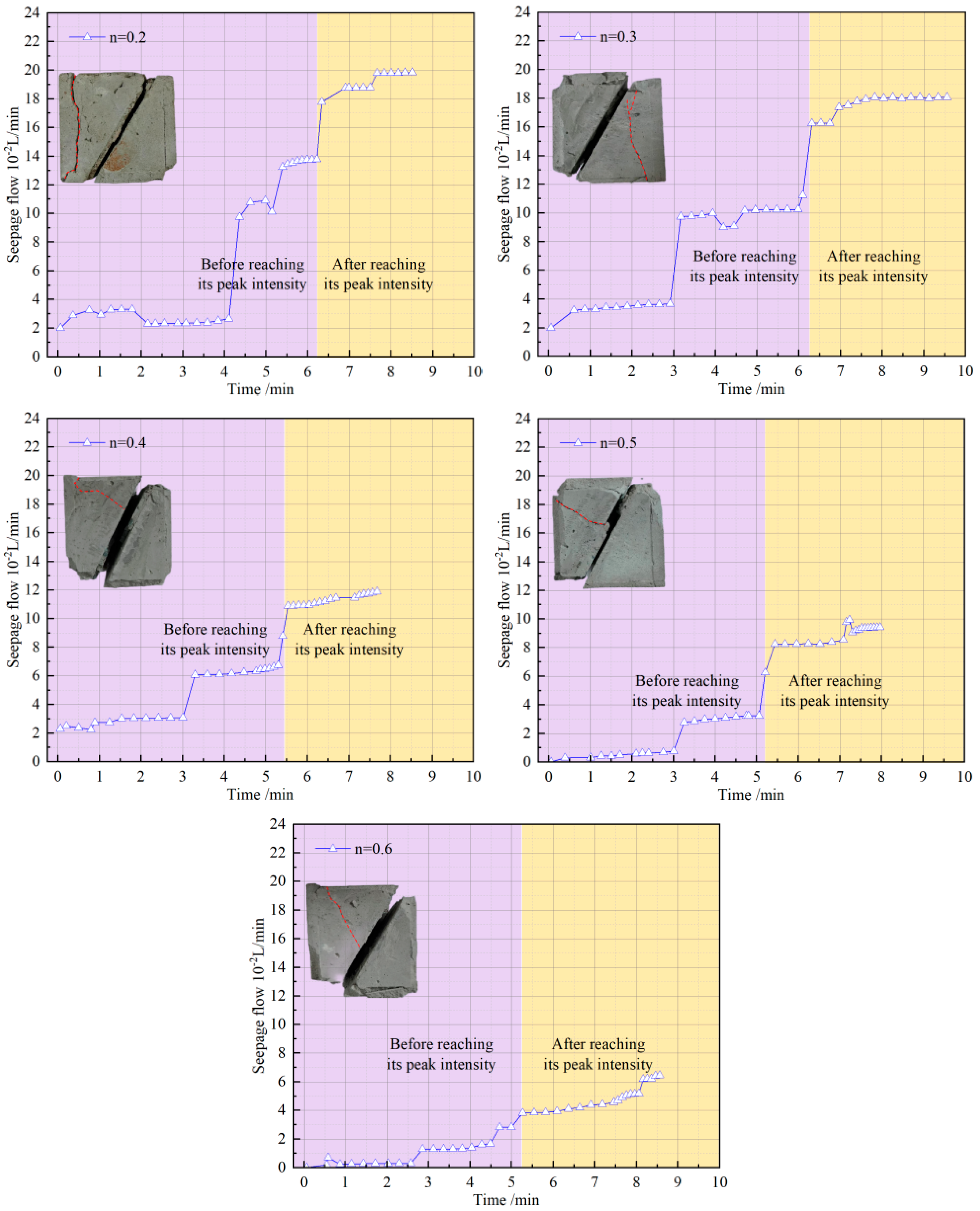
Figure 11 presents the damage–seepage curves of specimens with different continuous gradation coefficients. As the continuous gradation coefficient increases, the seepage flow rate generally shows a decreasing trend, with a sharp change at low coefficients and a gradual flattening at high coefficients. The underlying mechanism is that when the continuous gradation coefficient is small, the particle size distribution of the infill material is wider, the pore structure is looser, and the permeability is higher. As the continuous gradation coefficient increases, the particle compactness improves, the porosity decreases, and the infill particles are further compressed and deformed under axial stress, leading to a reduction in permeability.
In terms of flow evolution, when the continuous gradation coefficient is 0.2, the flow exhibits four stages: increase—decrease—rapid increase—stabilization. The initial increase followed by a decrease is due to compaction of the fracture zone and reduction of porosity. When the axial stress exceeds the lateral stress, shear failure of the specimen occurs, the seepage channels expand, and the erosive action of water increases the equivalent water-conducting fracture width, causing a sharp rise in flow. When the continuous gradation coefficient ranges from 0.3 to 0.6, the flow shows a stepwise jump rise, indicating that some closed channels are opened under the combined action of stress and water pressure during loading.
After the specimen reaches its peak strength, the instantaneous stress release generates more through-going fractures, and the flow continues to increase. As the stress subsequently stabilizes, accompanied by fine particle erosion and framework reconfiguration, a “post-peak flow stabilization” forms within the specimen, and the flow remains essentially constant. The maximum seepage flow rates after specimen failure are 19.84 × 10⁻² L/min, 18.10 × 10⁻² L/min, 11.89 × 10⁻² L/min, 9.42 × 10⁻² L/min, and 6.45 × 10⁻² L/min, and the corresponding permeabilities are 1.65 × 10⁻¹⁴ m2, 1.51 × 10⁻¹⁴ m2, 9.91 × 10⁻¹⁵ m2, 7.85 × 10⁻¹⁵ m2, and 5.38 × 10⁻¹⁵ m2, respectively, decreasing with increasing continuous gradation coefficient. The above results confirm the controlling effect of the continuous gradation coefficient on the permeability of the fault fracture zone.
5.2. Damage and Seepage Laws of Specimens with Different Fracture Zone Widths
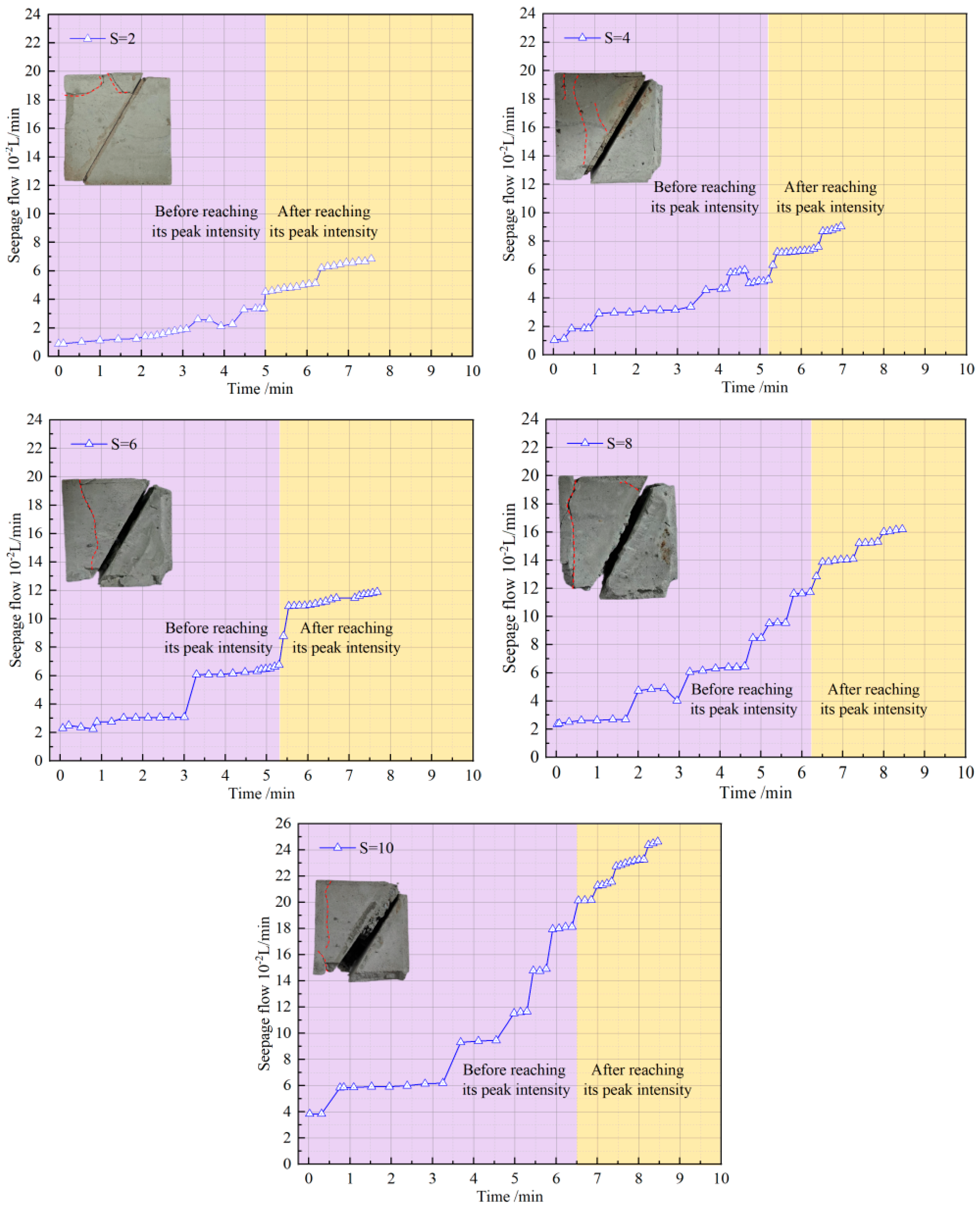
Figure 12 presents the damage–seepage curves of specimens with different fracture zone widths. As the fracture zone width increases, the initial seepage flow rate increases significantly, and the increase of flow rate with strain becomes more pronounced at larger widths. The underlying mechanism is that when the width is small, the particle gradation of the infill material dominates the pore structure, resulting in low permeability. As the width increases, particle rearrangement and compression-deformation of the fracture zone under axial stress significantly enhance the permeability. After the specimen reaches its peak strength, the instantaneous stress release generates more through-going fractures, and the flow continues to increase. Subsequently, as the stress stabilizes, accompanied by fine particle erosion and framework reconfiguration, a “post-peak flow stabilization” forms, and the flow tends to stabilize.
The difference in seepage flow among specimens with different fracture zone widths originates from the variation in fracture zone porosity. At widths of 2 mm and 4 mm, the initial flow rates are 0.89 × 10⁻² L/min and 1.05 × 10⁻² L/min, with permeabilities of 7.41 × 10⁻¹⁶ m2 and 8.75 × 10⁻¹⁶ m2, respectively. The maximum post-failure flow rates are 6.84 × 10⁻² L/min and 9.03 × 10⁻² L/min, with permeabilities of 5.70 × 10⁻¹⁵ m2 and 7.52 × 10⁻¹⁵ m2, showing a slow increase. The reason is that the small width results in a limited equivalent water-conducting fracture width even after the erosion of fine particles. For widths ranging from 6 mm to 10 mm, the porosity is larger, the mass of erodible fine particles increases, and under the combined action of stress and water pressure, the flow rate increases significantly. The maximum post-failure flow rate of the specimen with a width of 10 mm reaches 24.63 × 10⁻² L/min, with a permeability of 2.05 × 10⁻¹⁴ m2, which is 3.6 times that of the 2 mm specimen. The above results confirm the important controlling effect of fracture zone width on the permeability of faults.
5.3. Damage and Seepage Laws of Specimens with Different Small Fault Angles
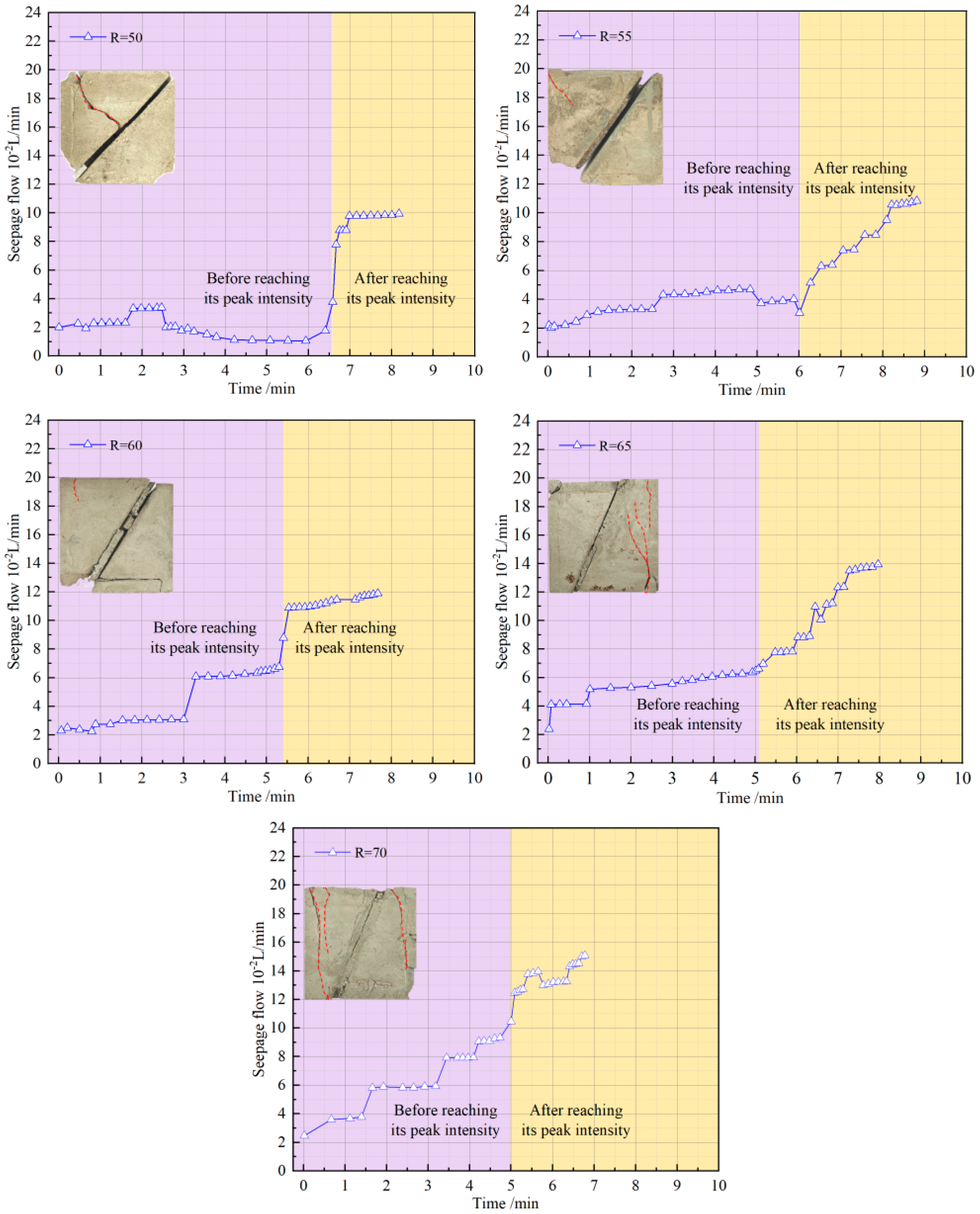
Figure 13 presents the damage–seepage curves of specimens with different fault angles. As the stress–strain increases, the seepage flow rate shows a non-linear increasing trend: the change is gentle at the low-stress stage, becomes severe at the high-stress stage, and tends to stabilize after the specimen strength basically stabilizes. The underlying mechanism is that when the stress is low, the flow rate is mainly controlled by the porosity of the fault fracture zone infill, resulting in low permeability. As the stress increases, the fault plane slips, the infill material is compressed and deformed, and the permeability increases significantly. After the peak strength is reached, the instantaneous stress release generates more through-going fractures, and the flow continues to increase. Subsequently, as the stress stabilizes, accompanied by fine particle erosion, seepage channels form, and the flow rate remains essentially constant.
The difference in flow rate among specimens with different fault angles originates from the angle between the fracture direction and the loading direction. When the fracture direction is consistent with the loading direction, the permeability is higher, and vice versa. At fault angles of 50° and 55°, the flow rate exhibits four stages: increase → decrease → rapid increase → stabilization. The initial increase followed by a decrease is due to compaction of the fracture zone and reduction of porosity. After axial stress becomes dominant, shear failure occurs, the seepage channels expand, and accompanied by water erosion, the equivalent water-conducting fracture width increases, resulting in a stepwise jump rise in flow rate, indicating that some closed channels are opened under the combined action of stress and water pressure. For other fault angles, the flow evolution does not show an obvious compaction-induced decrease stage but directly enters the rising stage. The above results confirm the important influence of the small fault fracture zone angle on the permeability of rock specimens.
From the results in
Section 5.1 and
Section 5.2, the initial permeability of specimens (at fracture zone width of 6 mm, gradation coefficient
n = 0.4, fault angle 60°) is approximately 7.41 × 10
−16 m
2 (0.75 mD) for the 2 mm width case and increases with width. For the fixed width of 6 mm, the post-failure permeability decreases from 1.65 × 10
−14 m
2 (
n = 0.2) to 5.38 × 10
−15 m
2 (
n = 0.6) as the gradation coefficient increases, a reduction of about 67%. The most dramatic post-peak surge occurs for the combination of large fracture zone width (10 mm), small gradation coefficient (
n = 0.2), and small fault angle (50°), where the maximum flow rate reaches 24.63 × 10
−2 L/min (permeability 2.05 × 10
−14 m
2), which is 3.6 times that of the 2 mm width specimen and 3.8 times that of the
n = 0.6 specimen. These quantitative values confirm that a wide fracture zone and a low gradation coefficient (poorly graded infill) significantly enhance post-failure permeability.
The AE monitoring results (
Section 4) provide direct evidence for the observed seepage behavior. In the early loading stage, sparse low-amplitude AE events correspond to local compaction without through-going fractures, during which the flow remains low or slightly decreases. As loading approaches the peak strength, a sharp increase in AE event rate and the emergence of high-amplitude events (e.g., from ~45 dB to >65 dB in specimens with
n = 0.2 or small fault angles) coincide precisely with the stepwise jump in flow. The spatial localization of AE events along the fault plane (for small angles) or within the hanging wall/footwall (for large angles) marks the formation of interconnected microcracks that evolve into macroscopic seepage channels. In the post-peak stage, AE activity declines but continues at a low level, reflecting ongoing fine-particle migration and granular rearrangement; this sustained but reduced AE activity is accompanied by a quasi-stable flow (plateau stage). Thus, AE event rate, amplitude, and spatial distribution serve as effective indicators of damage-induced permeability enhancement, and the close temporal and spatial correlation between AE evolution and flow variations demonstrates the damage–seepage coupling in small fault activation.
6. Sensitivity Analysis of Factors Influencing Delayed Floor Water Inrush Induced by Small Faults
To evaluate the influence degree of various factors on delayed floor water inrush induced by small faults and to provide a theoretical basis for water prevention and control in coal mining above confined aquifers, the grey relational analysis method was employed to analyze the laboratory test results. This method ranks the relational degrees between each factor affecting system development and the overall system. A higher relational degree indicates a greater influence of that factor on system development, thereby compensating for the shortcomings of mathematical statistics in system analysis. Based on the laboratory test scheme and the single-variable principle, the fracture zone particle gradation, fracture zone width, and small fault angle were selected as the subsequence, and the maximum seepage flow rate due to damage from the tests was selected as the parent sequence. The experimental scheme design and the obtained results are shown in
Table 1 and
Table 2, respectively.
According to the steps of the grey relational analysis method, the parent sequence Z is defined as the maximum seepage flow rate, and the subsequences are the influencing factors X
i. The parameters in the sequences are preprocessed by calculating the mean value of each sequence and then obtaining the ratio of each element in the sequence to the mean value of that sequence. Thereby, the relational degree between each element of the processed subsequence and the corresponding element of the parent sequence is obtained.
Define the minimum difference between the parent sequence and the subsequence, minΔ
i(k), as m, and the maximum difference, maxΔ
i(k), as m. Then we obtain:
In grey relational analysis, define:
Then the correlation coefficient between each indicator in the subsequence and the parent sequence can be obtained (see
Table 2). Here, ρ is the resolution coefficient, generally ranging between [0, 1]; in this paper, ρ = 0.5 is adopted.
From
Table 3, it can be seen that in the small fault damage–seepage tests, the grey relational degrees between the three factors, namely the particle gradation of the small fault fracture zone, the fracture zone width, and the fault angle, and the maximum seepage flow rate due to damage are 0.754, 0.730, and 0.7886, respectively. The sensitivity of each factor to the delayed floor water inrush induced by small faults, in descending order, is: small fault angle > particle gradation of the small fault fracture zone > fracture zone width. It should be noted that the grey relational analysis in this study uses only the maximum seepage flow rate as the reference sequence, which simplifies the complex nature of delayed water inrush. A more comprehensive evaluation considering multiple indices (e.g., flow jump, residual flow, and failure mode) is desirable in future research.
The added value of the grey relational analysis beyond direct experimental observations lies in its ability to quantitatively rank the sensitivity of the three factors, which is difficult to infer from individual test results alone. While the experiments clearly show that each factor (fault angle, particle gradation, and fracture zone width) affects strength and permeability, the grey relational analysis provides a rigorous, data-driven ranking (fault angle > gradation > width) that accounts for the overall variation across all tested conditions. This ranking offers practical guidance for engineering: when prioritizing mitigation measures, the fault angle should be considered first, followed by particle gradation and then the fracture zone width. Moreover, the relational degrees (0.788, 0.754, 0.730) indicate that the three factors have relatively close influences, suggesting that all deserve attention. Thus, grey relational analysis transforms qualitative experimental trends into a quantifiable sensitivity order, supporting more informed decision-making for risk assessment and control strategies. The mechanistic reasons why fault angle emerges as the most sensitive factor are further discussed in
Section 7.



 ,
,