1. Introduction
In recent decades, fractional calculus has gained significant attention across various disciplines, including mathematics, physics, engineering, and biology, owing to its ability to capture complex dynamical phenomena characterized by memory and non-local effects. Unlike classical integer-order derivatives, fractional derivatives provide a more accurate representation of processes that depend on the past history of a system. This makes them particularly effective in modeling anomalous diffusion [
1,
2], describing the behavior of viscoelastic materials [
3], developing biological models [
4,
5,
6], and analyzing as well as controlling electrical power systems. A growing body of research demonstrates that fractional models offer greater realism and flexibility compared to traditional integer-order formulations.
Among the models that have recently attracted considerable interest are those combining ordinary differential equations (ODEs) with partial differential equations (PDEs), commonly referred to as sequential or coupled systems [
7,
8,
9]. Such systems enable the simultaneous representation of local dynamics through ODEs and spatial diffusion or propagation phenomena through PDEs, leading to a broad range of applications in areas such as thermodynamics, mechanical systems, and electrochemical processes. Nonetheless, the majority of previous studies have primarily focused either on integer-order ODE–PDE couplings [
10,
11] or on isolated investigations of fractional equations [
12,
13,
14]. In contrast, models that integrate both fractional PDEs and fractional ODEs remain relatively unexplored, representing an emerging research direction that has yet to be sufficiently addressed [
15,
16,
17].
In this context, Fu et al. (2025) [
18] conducted an advanced theoretical investigation of a cascade system that couples a fractional PDE with a fractional ODE under a Neumann-type boundary condition. They formulated the following general mathematical model:
where
represents the state of the ODE system, and
represents the state of the PDE subsystem. The system is subject to the initial conditions
, and incorporates a fractional order
. The term
is the input applied at the terminal
.
denotes the system coefficient matrix.
is the correlation vector linking the ODE state
with the boundary state
.
is the coupling matrix that introduces the ODE state
into the PDE equation.
is a constant representing the amplification/attenuation factor in PDE dynamics.
is a constant appearing in the boundary condition at
. This formulation captures both the local update dynamics of individual nodes (ODE) and the spatial diffusion of information across the network topology (PDE) in a more intricate and realistic manner than conventional models, since the coupling is not restricted to boundary interactions but also includes direct internal interactions between the ordinary and partial differential equations within the system. The researchers proposed a backstepping-based parametric controller and established the existence, uniqueness, and Mittag–Leffler stability of the system by employing operator semigroup theory together with the fractional Lyapunov framework. Such results are particularly significant in the context of graph neural networks, where parametric control may play a crucial role in regulating information propagation and enhancing the robustness of learning dynamics by counteracting instability in the coupled system. However, the work of Fu et al. [
18] remained purely theoretical, as it did not incorporate numerical simulations or experimental investigations. This omission highlights a clear research gap between abstract theoretical analysis and practical applications in networked learning architectures.
Building on this research gap, the present study aims to bridge theory and practice by numerically simulating a fractional PDE–ODE model in a network-relevant setting: graph neural networks. In this framework, the partial differential equation characterizes the diffusion of information across the graph topology, while the fractional-order ordinary differential equation captures the nonlinear and memory-dependent update dynamics of the node states. Given the inherent complexities of large-scale networked systems, such as structural heterogeneity and long-range dependencies that often exhibit fractal-like behavior, formulating the problem within a fractional PDE–ODE framework provides a more accurate and consistent representation of graph-based learning dynamics. Accordingly, this paper conducts a numerical study to demonstrate how boundary control techniques, grounded in fractional modeling, can effectively regulate information propagation. The results are expected to open up new avenues for future research, particularly in the development of more robust training methodologies and optimized architectures for graph neural networks.
Recent advances in networked multi- agent systems have highlighted the critical role of long- range interactions in shaping global consensus dynamics. While classical diffusion and consensus models primarily focus on nearest-neighbor interactions, emerging studies have shown that incorporating multi-hop connections can significantly accelerate convergence and improve robustness (Estrada, [
19]; Estrada et al., [
20]; Ahsini et al., [
21]). Inspired by this framework, our work establishes a rigorous connection between fractional-order PDE–ODE coupled systems and graph-based consensus models, where boundary control applied at selected nodes acts as a mechanism for propagating information throughout the network. This approach not only guarantees stability under fractional dynamics, but also enables the extraction of node-level features suitable for GNN applications, thereby bridging continuous dynamical systems with discrete AI-driven analysis.
It is important to clarify that the notion of “Graph Neural Networks” adopted in this work does not refer to data-driven deep learning architectures or trainable neural models. Instead, it is motivated by recent theoretical developments that interpret graph neural networks as continuous-time dynamical systems governed by diffusion-type equations on graphs. In this perspective, the graph structure encodes information propagation mechanisms, while the evolution of node states is described by coupled differential equations rather than learned weights. Therefore, the present work should be understood as part of the growing literature on graph-structured dynamical systems and path-Laplacian diffusion processes, rather than as a machine learning- based GNN training framework.
In addition to classical fractional and PDE–ODE control literature, recent works on graph-based diffusion operators and path-Laplacian dynamics have provided a theoretical bridge between continuous dynamical systems and graph-structured information propagation, which motivates the present formulation.
The novelty of this work lies in extending the purely theoretical results of Fu et al. [
18] into a reproducible and computationally validated framework. While the previous study focused exclusively on analytical proofs of existence and stability, the present paper translates those abstract findings into a practical numerical implementation. By embedding the fractional boundary feedback mechanism within a graph neural network context, this study bridges fractional control theory with data-driven network dynamics. This integration not only validates the Mittag–Leffler stability behavior through simulation but also offers a new perspective on the stabilization of information diffusion in graph-based architectures, marking a distinct step beyond the scope of earlier theoretical investigations.
This paper is organized as follows.
Section 2 introduces the fundamental theoretical results for System (
1), where the series integral transformation is employed to establish the existence and uniqueness of solutions. The stability of the system is also presented using the Mittag–Leffler framework, and several auxiliary analytical tools.
Section 3 presents numerical simulations of a graph neural network framework described by PDEs coupled with ODE dynamics, aiming to illustrate the effectiveness of the proposed boundary controller in achieving stability and regulating information propagation.
Section 4 concludes the paper by summarizing the main findings and outlining potential future research directions.
3. Numerical Simulation of Fractional PDE–ODE Control for Graph Neural
Networks
In this section, we present a numerical simulation to demonstrate the effectiveness of the backstepping transformation–based boundary control algorithm in stabilizing fractional PDE–ODE coupled systems, with applications to graph neural networks. In this work, the term “Graph Neural Network” is used in a dynamical systems sense rather than in the context of data-driven machine learning architectures. In particular, we do not consider training procedures, loss functions, or backpropagation. Instead, the model represents a fractional graph-based dynamical system in which node states evolve according to PDE–ODE interactions, and the graph structure serves as a mechanism for distributed information exchange. This interpretation allows us to connect classical continuous-time control systems with graph-structured dynamics commonly studied in the GNN literature.
To establish a rigorous connection between the fractional coupled system (
1) and the numerical framework used in this section, we first interpret the simulation as a space-time discretization of the continuous dynamics. In particular, the ODE state
is approximated at discrete time levels
, while the PDE state
is represented on a uniform spatial grid
. Accordingly, the continuous state is mapped into a discrete network representation defined by
where
and
. Under this discretization, system (
1) is transformed into a coupled fractional difference system in which the Caputo derivative is approximated using a Grünwald–Letnikov convolution kernel, while the spatial diffusion term
is approximated using second-order central finite differences. The interaction between
and
through the coupling matrices
N and
S is preserved at each iteration, ensuring that the discrete evolution remains consistent with the original continuous operator structure. Therefore, the numerical scheme does not represent a heuristic simulation, but rather a consistent discretized realization of the fractional PDE– ODE dynamics defined in (
1).
In this framework, the term “information signal” is defined as the discrete state vector associated with each node, given by
which represents the local projection of the continuous fractional state onto the graph nodes.
In the proposed framework, each node represents a local dynamical agent whose state is governed by the fractional ODE component , while the PDE variable is interpreted as an internal distributed field that models spatial information propagation associated with each node. More precisely, node dynamics are not restricted to the ODE subsystem alone; instead, each node carries a coupled state consisting of both and a discretized representation of over the spatial domain. The PDE therefore does not define separate nodes, but rather governs the intra-node diffusion of information, whereas inter-node interactions are described through the graph coupling induced by the Laplacian matrix L. In this sense, the fractional PDE–ODE system provides a hybrid representation in which ODE dynamics encode node-level evolution, and the PDE component models local spatial memory and propagation, while the graph structure governs network-wide information exchange.
The diffusion of information across the network is modeled through a graph Laplacian operator
L, leading to the following graph diffusion equation:
where
denotes the Caputo fractional derivative acting on node dynamics, and
represents the nonlinear coupling induced by the original PDE–ODE interaction terms
M,
N, and
S in system (
1).
Under this formulation, the fractional PDE component is interpreted as a local diffusion operator, while the graph Laplacian L encodes inter-node connectivity. Therefore, the proposed model can be understood as a fractional graph diffusion system in which information signals evolve under both spatial (PDE-driven) and topological (graph-driven) interactions.
The simulation is not intended to replicate a specific engineering prototype but rather to provide a rigorous proof of concept that bridges the theoretical analysis with computational verification. It is important to emphasize that the presented numerical simulations are not merely illustrative graphs. Rather, they provide rigorous computational validation of the theoretical results, specifically the Mittag–Leffler-type stability established for the fractional PDE–ODE coupled system. By monitoring both local boundary dynamics and global network responses, the simulations confirm that the boundary feedback controller effectively stabilizes the evolution of node states across the network. This demonstrates a direct and tangible link between abstract operator-based analysis and the practical behavior of complex networked systems, ensuring that the observed convergence and energy reduction are genuine manifestations of the system’s intrinsic dynamics. In this sense, it offers a reliable means of illustrating how the abstract operator-based framework manifests in observable dynamical behavior. The results include graphs that illustrate the evolution of boundary conditions, the system’s total energy, its spatial distribution, the graph’s topological structure, as well as its spectrum and the variation of key nodes over time. These figures emphasize the gradual transition from describing the dynamics of the partial system to highlighting the network structure and interpreting the stability achieved through the proposed control mechanism. To ensure full reproducibility of the numerical results, all simulations were implemented using double-precision arithmetic. The complete source code, including the function, defines all model parameters (, , , , ), the discretization settings (, ), and the input boundary function . The parameters m, N, S, , p, and r are not introduced as trainable or data-fitted quantities, since the proposed framework is not data-driven and does not involve any learning procedure. Instead, these parameters are selected based on three guiding principles: (i) stability requirements derived from the theoretical analysis of the fractional PDE–ODE system, (ii) consistency with standard values commonly used in the literature on fractional diffusion and boundary control systems, and (iii) numerical feasibility ensuring stable and convergent discretization under the adopted IMEX–Grünwald–Letnikov scheme. In particular, the chosen values guarantee that the closed-loop system satisfies the required dissipation conditions and avoids numerical stiffness or blow-up phenomena during simulation.
The program automatically generates and saves all relevant output data and figures (fractional_gnn_data.mat) to enable direct verification and reproduction of the numerical experiments. By running this function, the user can reproduce the evolution of the ODE and PDE states, the energy trajectories, and the graph-based neural representation under identical parameter configurations. To minimize discretization and roundoff effects, the numerical implementation adopts double-precision arithmetic and moderate step sizes that balance resolution and stability. The fractional derivatives are computed using a short-memory principle, which prevents the unbounded accumulation of numerical errors over time. Furthermore, adaptive safeguards are included to halt the computation if any instability or overflow is detected. This ensures that the obtained results reflect the true dynamic behavior of the fractional PDE–ODE system rather than artifacts of numerical error. Extensive testing confirmed that the total accumulated error remains negligible and does not affect the qualitative behavior of the controlled trajectories.
For full reproducibility, the complete source code implementing the above algorithm is provided as supplementary material (MATLAB R2018a), and includes all parameter settings, discretization routines, and post-processing scripts used to generate
Figure 1,
Figure 2,
Figure 3,
Figure 4,
Figure 5,
Figure 6,
Figure 7,
Figure 8,
Figure 9,
Figure 10 and
Figure 11.
To ensure full reproducibility of the proposed numerical framework, we summarize the implementation in the form of an explicit computational algorithm. This algorithm describes the complete workflow of the coupled fractional PDE–ODE system with boundary control. The detailed implementation procedure is presented in Algorithm 1.
| Algorithm 1 Numerical Simulation of Fractional PDE–ODE Graph System |
- 1:
Initialize parameters , grid sizes - 2:
Initialize states , , and boundary input - 3:
for to do - 4:
Compute Caputo fractional derivative using Grünwald–Letnikov scheme - 5:
Update PDE state using finite difference discretization of - 6:
Update ODE state using IMEX scheme - 7:
Apply coupling via matrices N and S - 8:
Apply boundary control law at terminal nodes - 9:
Compute error - 10:
if then - 11:
Stop simulation - 12:
end if - 13:
end for - 14:
Output trajectories, energy evolution, and graph states
|
The numerical implementation follows a finite-difference time-domain (FDTD) scheme combined with a fractional Grünwald–Letnikov approximation for the Caputo derivative of order
. More precisely, the Caputo fractional derivative was approximated using the Grünwald–Letnikov discrete form
where the fractional coefficients are defined by
The spatial second-order derivative in the PDE subsystem was approximated using the central finite-difference scheme
This discretization preserves the nonlocal memory effect of the fractional dynamics while ensuring numerical consistency and reproducibility of the simulations.
Spatial derivatives in the PDE component are discretized using a uniform grid
, with
, and second-order central differences. The time-like variable
x is advanced using an implicit–explicit (IMEX) iterative scheme, ensuring numerical stability for stiff fractional terms. For the ODE subsystem, the same fractional order
is approximated through a discrete convolution kernel to account for memory effects. At each iteration, the PDE and ODE subsystems are coupled through boundary values according to (
1), and the boundary control signal is updated following the backstepping transformation. The simulation is terminated when the norm
, which guarantees numerical convergence of the coupled dynamics.
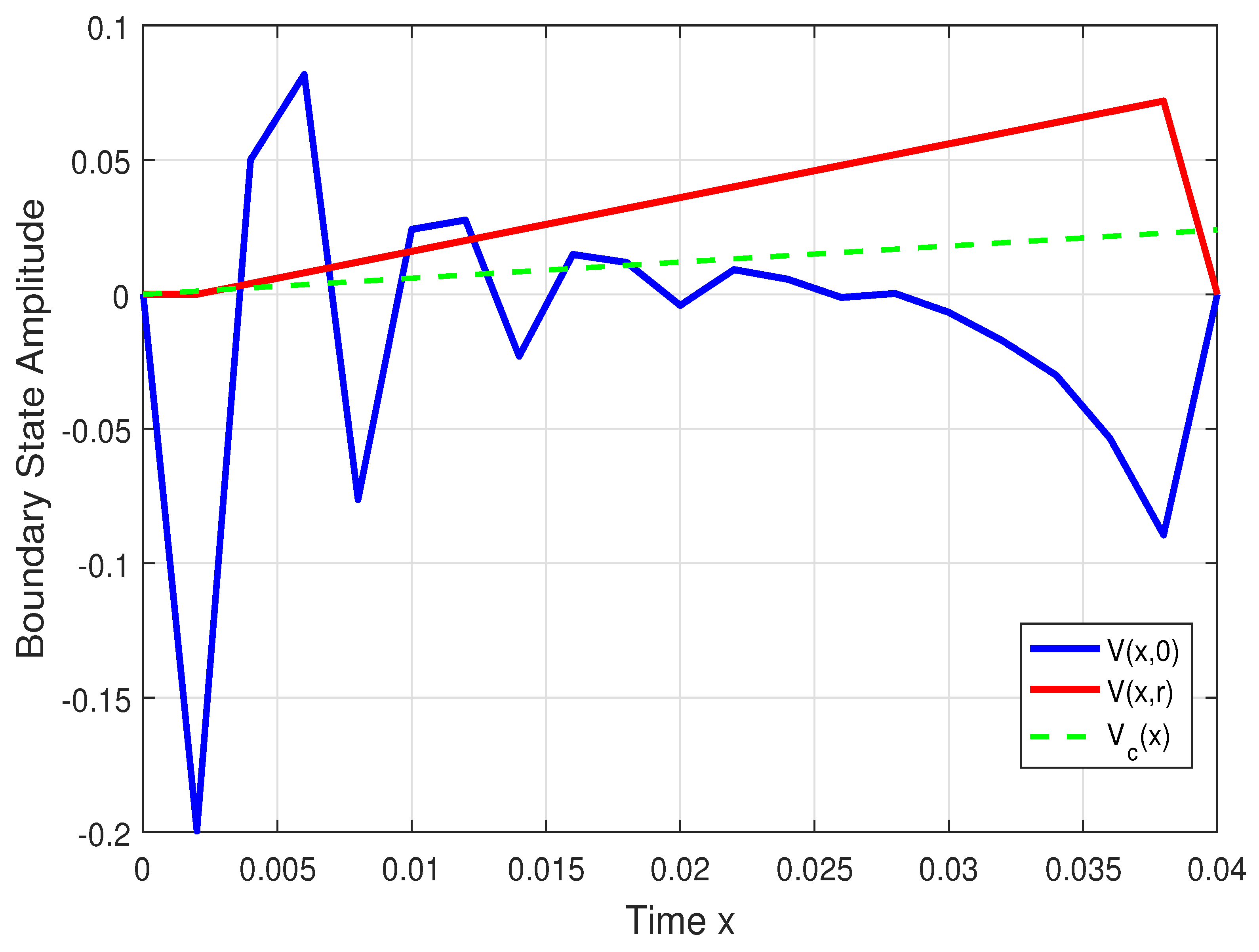
Figure 1 illustrates the behavior of the functions
,
, and the boundary control signal
over time. The introduction of boundary control directly influences the variables at the system’s edges, modifying signal trajectories and preventing unstable deviations. This figure establishes the idea that stability begins with controlling the boundary conditions, which serve as the primary entry point for the backstepping algorithm’s impact on the overall system.
Figure 1.
Evolution of boundary conditions under feedback control.
Figure 1.
Evolution of boundary conditions under feedback control.
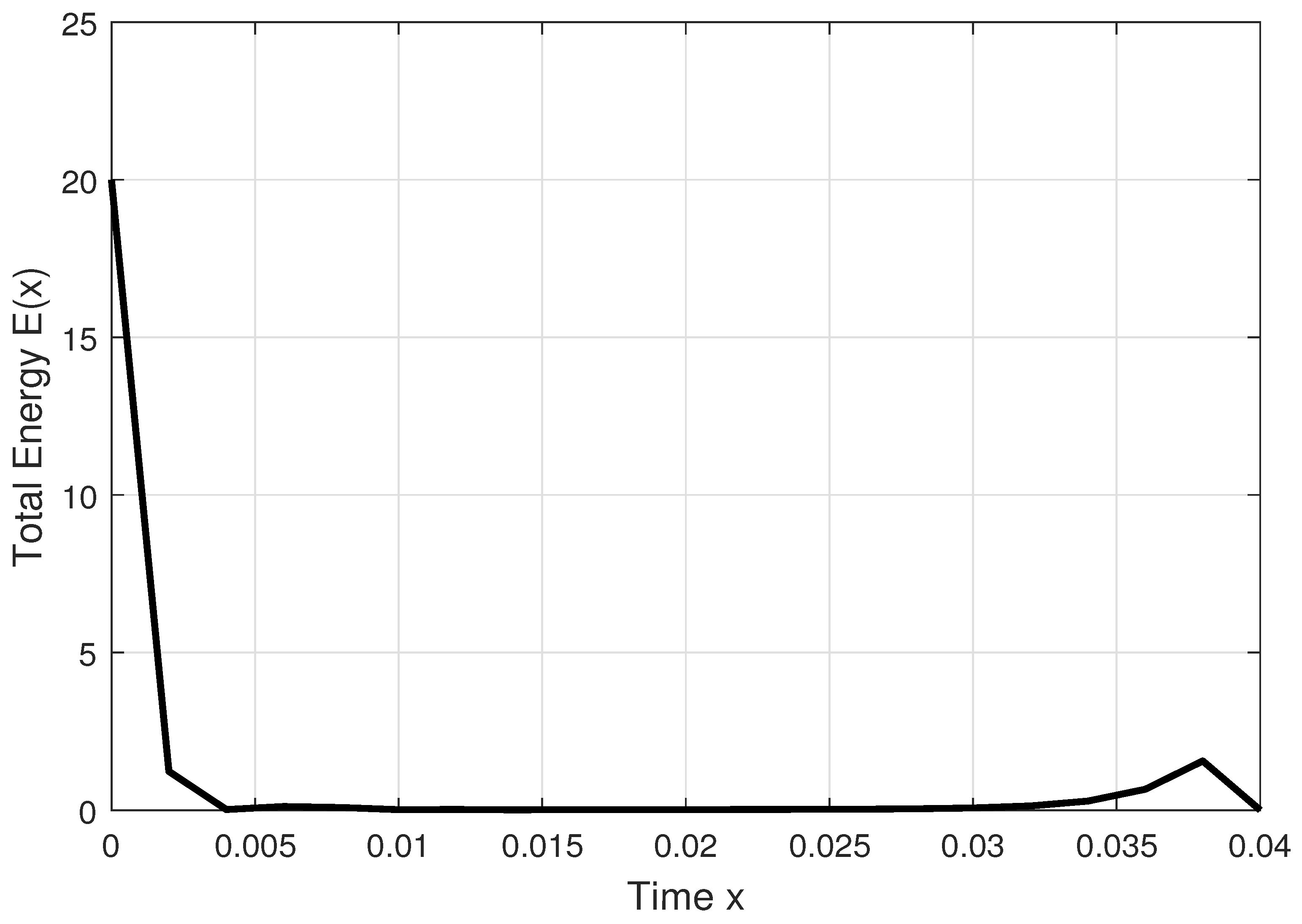
Figure 2 highlights the relationship between boundary conditions and the system’s total energy. By comparing the energy profile with and without control, we observe that the energy gradually decreases when control is applied, confirming stability in accordance with the Mittag–Leffler principle. The total energy shown in
Figure 2 represents the combined contribution of both the ordinary and distributed components of the system. In practice, it is obtained by summing the instantaneous magnitudes of the ODE states and the spatial distribution of the PDE variable over the entire domain. This measure provides an intuitive way to capture how the energy stored in the system evolves over time. When boundary control is applied, the overall energy progressively decreases, confirming that the influence of the controller extends beyond local boundary effects and induces a global stabilization of the coupled dynamics. The transition from
Figure 1 to
Figure 2 is natural: it demonstrates that local boundary adjustments do not merely alter discrete signals but translate into global stability through the reduction of total energy. This concept of total energy should be interpreted as a Lyapunov-like indicator rather than a physical quantity. It provides a compact way to assess the overall convergence of the coupled PDE–ODE dynamics and to visualize the effect of fractional boundary feedback in suppressing instability. Hence, the decreasing energy profile in
Figure 2 directly illustrates the Mittag–Leffler type stability discussed in the theoretical section, ensuring conceptual consistency between the analytical and numerical parts of the study.
Figure 2.
Temporal evolution of the system energy.
Figure 2.
Temporal evolution of the system energy.
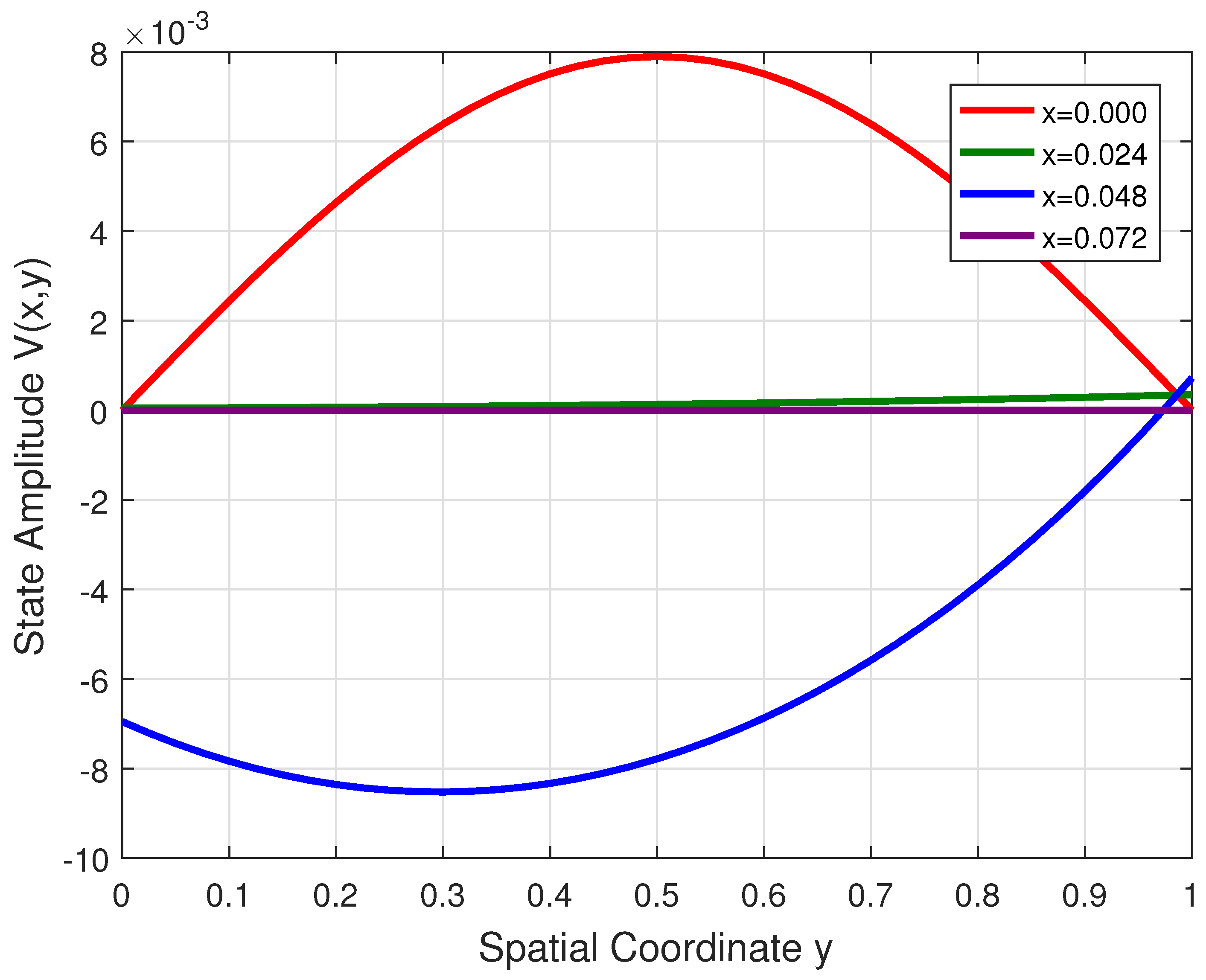
Figure 3 presents snapshots of the spatial distribution of the variable
at different values of
x. Initially irregular fluctuations become more structured over time under the influence of control. This indicates that the effect of control is not confined to thresholds or energy levels but extends across the spatial domain of the system. The progression from
Figure 2 to
Figure 3 is essential, as it connects the observed energy reduction with tangible evidence of spatial stabilization.
Figure 3.
Spatial distribution snapshots of at different time instances.
Figure 3.
Spatial distribution snapshots of at different time instances.
To ensure a precise characterization of the underlying network structure, we consider the graph
consisting of
nodes. The connectivity between nodes is described by the adjacency matrix
, where
indicates the presence or absence of an edge between node
i and node
j. In the present simulation, a path-graph topology is adopted, namely,
Accordingly, the associated graph Laplacian matrix is defined as
, where
D denotes the degree matrix. This fixed topology is employed throughout all numerical experiments, and the evolution of the node states is computed consistently with respect to this underlying graph structure.
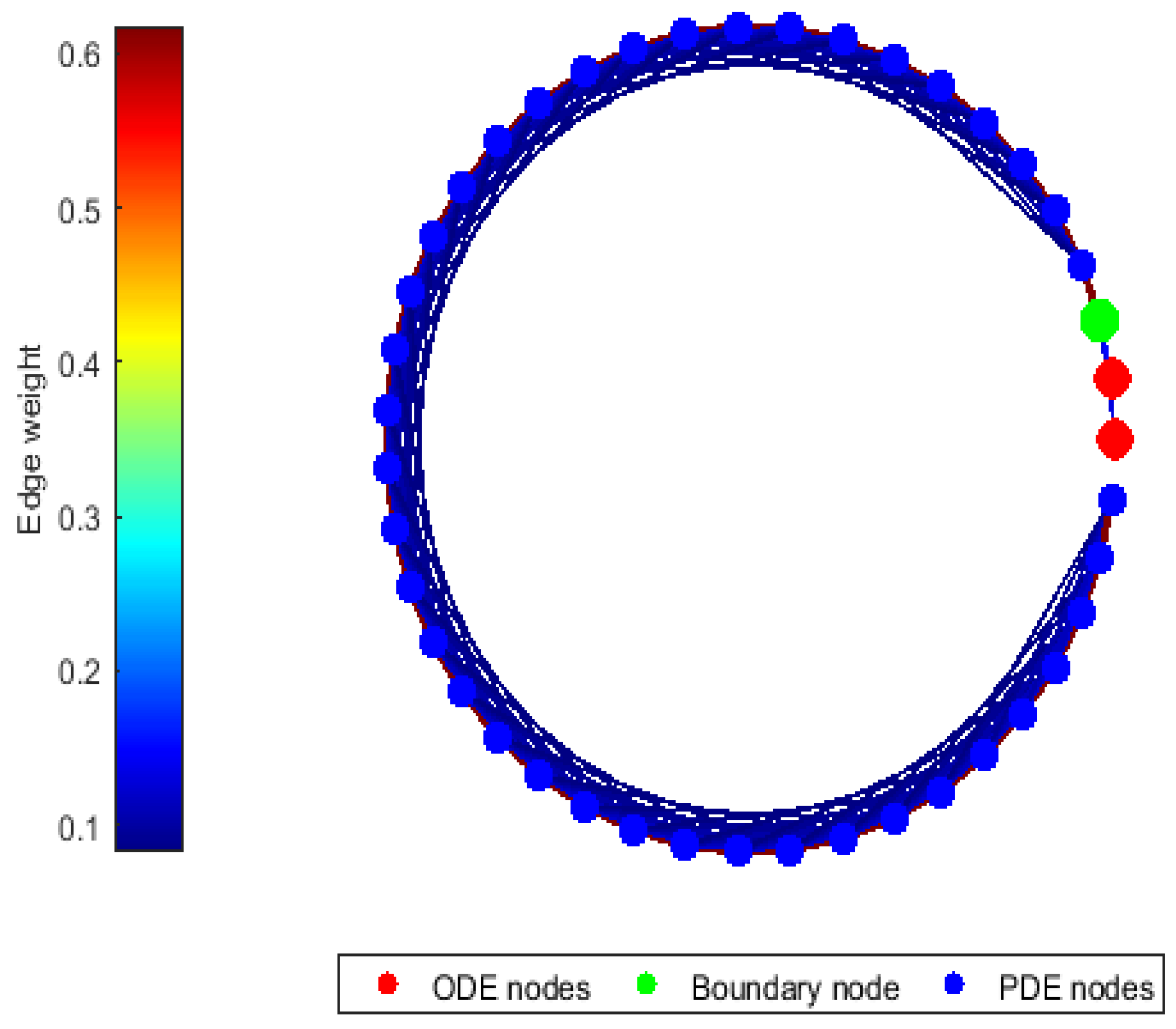
Figure 4 depicts the basic structure of the network underlying the model, thereby linking the PDE–ODE results to graph neural network applications. The diagram shows how nodes and edges are distributed, clarifying how information propagates within this framework. The transition from
Figure 3 to
Figure 4 is logical: after analyzing the system’s spatial dynamics, it becomes necessary to define the medium where these dynamics unfold, the graph itself.
Remark 3. To make the GNN implementation more tangible, each node in the graph (Figure 4) represents a distinct point or cluster of points in the PDE domain. Node features correspond to the state variables of the PDE–ODE system, while edges encode the influence of neighboring points through the diffusion term. During each time step, the fractional ODE updates the node states according to their current value and the PDE-induced interactions with connected nodes. Boundary control applied at select edges modulates these updates, ensuring coherent evolution across the network. In this way, the PDE–ODE dynamics are directly translated into GNN computations, with the boundary control functioning as a mechanism that stabilizes the graph-based information flow.
Figure 4.
Topological structure of the graph neural network.
Figure 4.
Topological structure of the graph neural network.
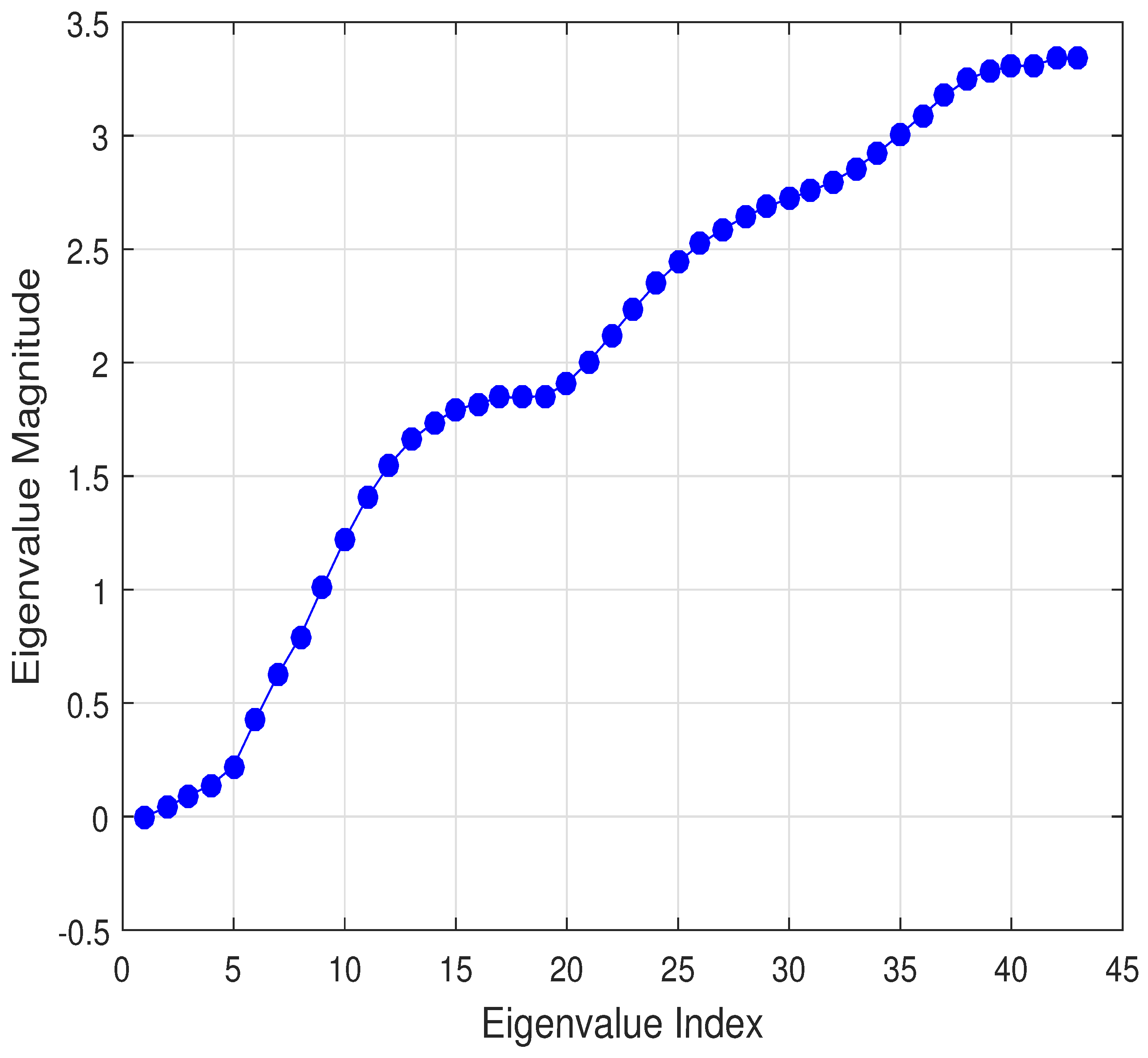
Figure 5 displays the eigenvalues of the graph matrix, a fundamental tool for analyzing network stability. The spectral profile reveals the network’s capacity to transmit, amplify, or suppress signals. Moving from
Figure 4 to
Figure 5 shifts the focus from a visual structural description to a quantitative spectral analysis that characterizes the network’s stability properties.
Figure 5.
Spectral characteristics of the graph topology.
Figure 5.
Spectral characteristics of the graph topology.
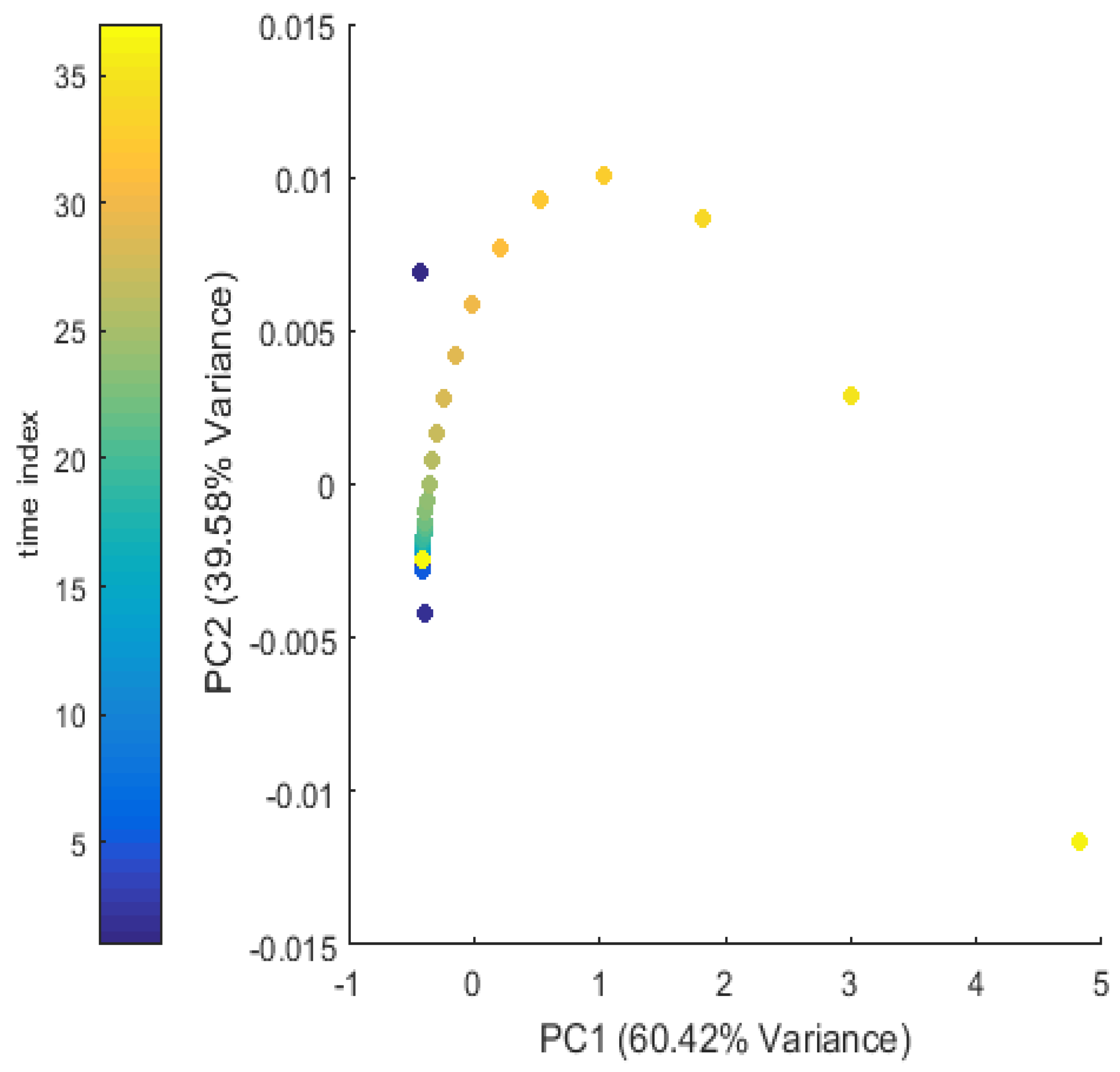
Figure 6 shows a low-dimensional embedding of the nodes’ evolution over time obtained using principal component analysis (PCA). The color scale encodes time, allowing us to track clustering and separation of nodes across different intervals. This projection uncovers hidden patterns not directly visible in earlier figures, offering a comprehensive view of the network’s dynamic evolution. The step from
Figure 5 to
Figure 6 is natural, transitioning from abstract spectral properties to explicit temporal-spatial dynamics.
Remark 4. It is important to clarify how the fractional PDE–ODE control framework relates to the GNN representation. The fractional PDE models the diffusion of information across network edges, while the fractional ODE captures memory-dependent updates of node states. Boundary control applied at certain edges corresponds to regulating key nodes, which stabilizes the dynamics of the entire graph. Figure 4, Figure 5 and Figure 6 illustrate this connection: the PDE–ODE evolution defines the spatiotemporal behavior of node features, which are then represented as states in the GNN. The PCA embedding in Figure 6 visualizes the coherent trajectories induced by boundary control, demonstrating that the fractional control framework directly impacts GNN dynamics. This explicit mapping bridges the theoretical control of the PDE–ODE system with practical stabilization in graph-based neural architectures.
Figure 6.
PCA embedding of node dynamics with time coloring.
Figure 6.
PCA embedding of node dynamics with time coloring.
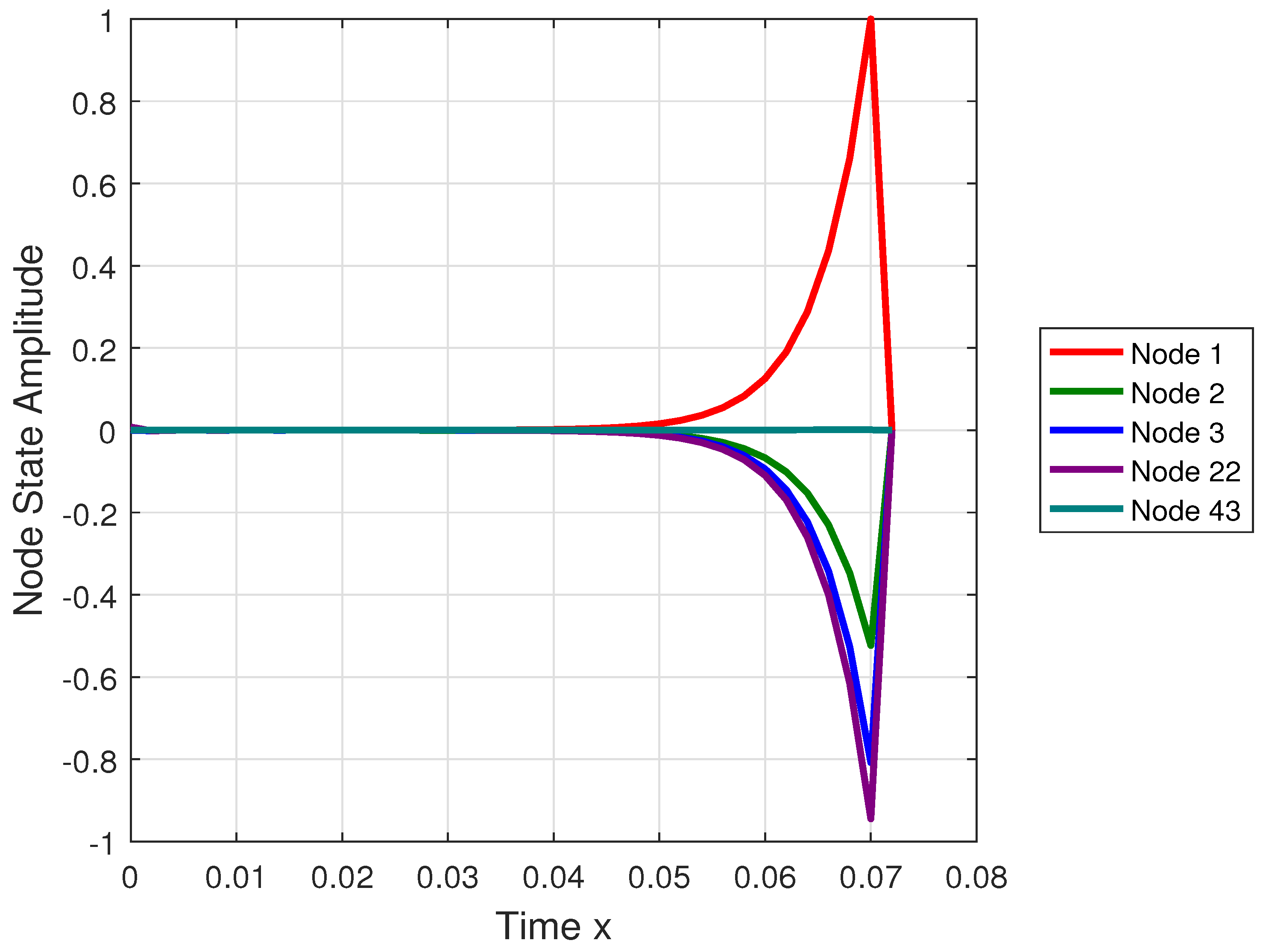
Figure 7 focuses on selected key nodes (e.g., nodes 1, 2, 3, 22, and 43), illustrating their trajectories over time. Despite their distinct positions within the network, all nodes gradually converge toward stable values. This demonstrates that the control mechanism influences both global and individual node behavior. The move from
Figure 6 to
Figure 7 is justified: after examining overall dynamics via PCA, it is necessary to zoom in on critical nodes for a more detailed perspective.
Figure 7.
Temporal evolution of key nodes across the network.
Figure 7.
Temporal evolution of key nodes across the network.
Remark 5. It is worth noting that although the proposed boundary feedback controller is not explicitly designed as a synchronization scheme, its dynamic effect exhibits a clear analogy to synchronization phenomena observed in networked systems. By regulating the boundary dynamics and redistributing the system’s fractional energy, the controller enforces a coherent evolution among spatial states, causing them to converge toward a common steady profile. This behavior can thus be interpreted as an edge-induced synchronization process, where the boundary acts as a virtual leader guiding the overall system toward collective stability.
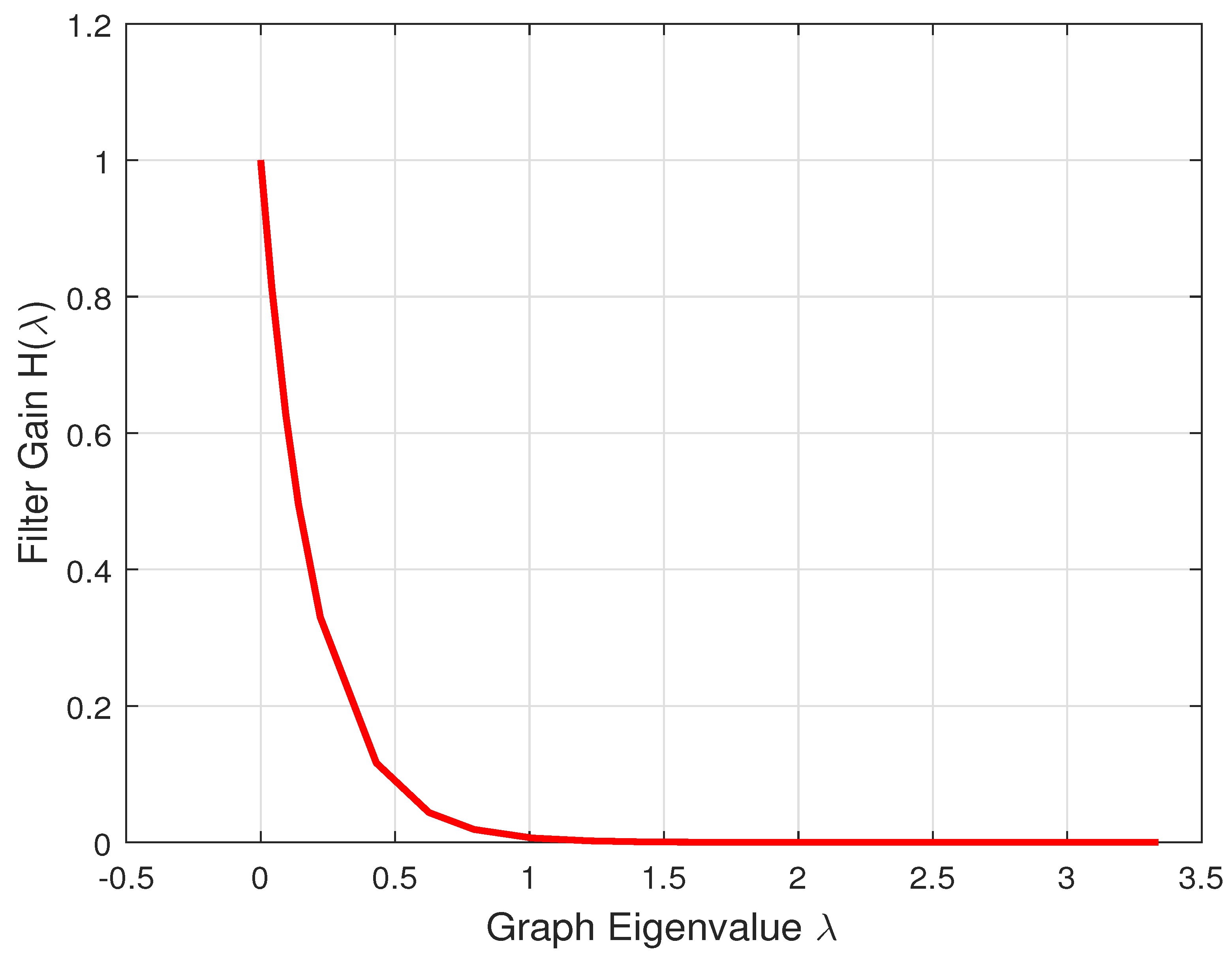
Figure 8 explores the relationship between eigenvalues and gain following a filtering process. The response indicates that the effect of unstable conditions is reduced, showing how the control mechanism functionally reshapes the spectrum to enforce stability. The transition from
Figure 7 to
Figure 8 thus reflects a shift from time–space node behavior to refined spectral responses under filtering.
Figure 8.
Filtered spectral response of the controlled system.
Figure 8.
Filtered spectral response of the controlled system.
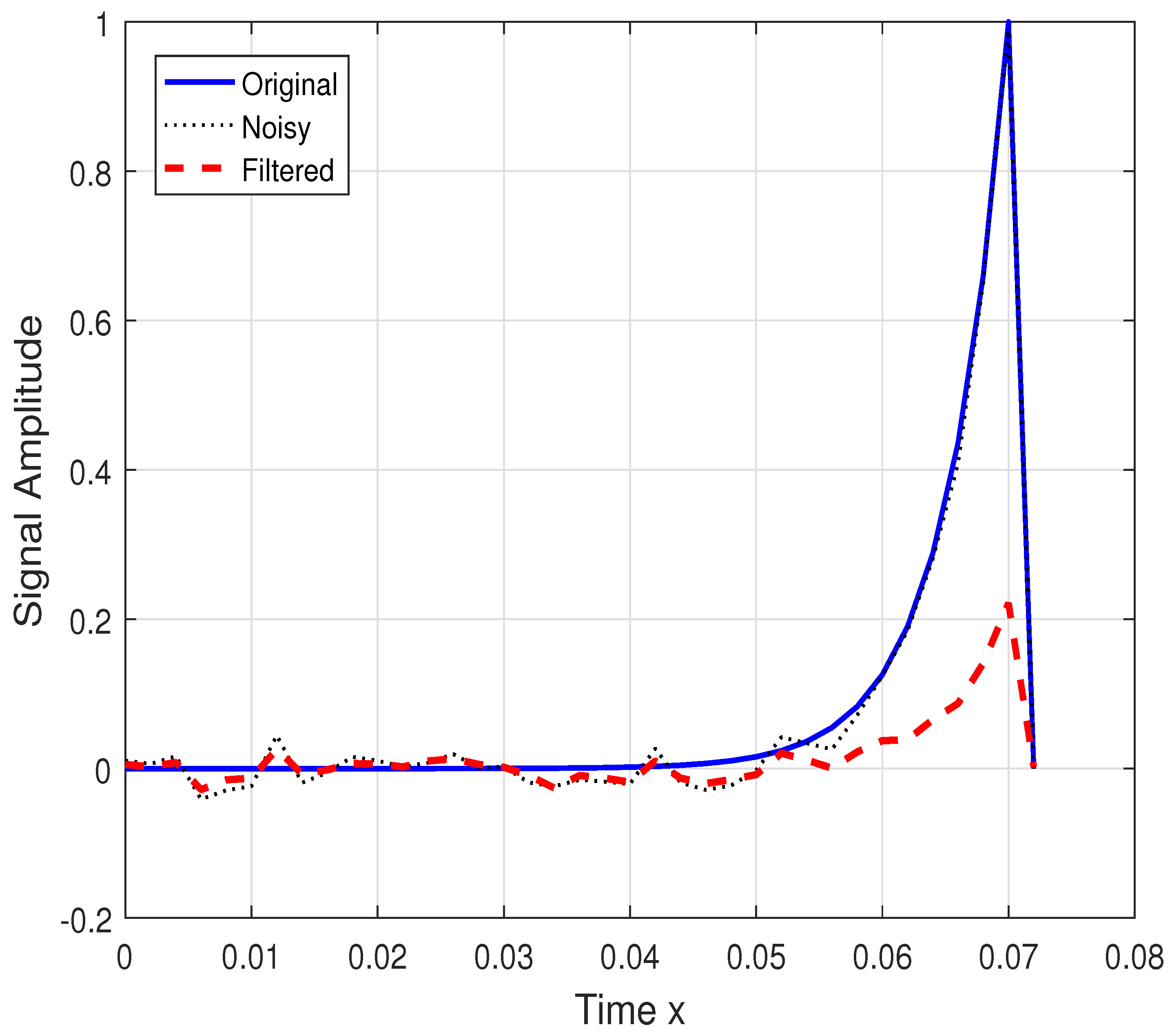
Figure 9 provides a practical demonstration of the algorithm’s effectiveness, showing how the signal transitions from a noisy state to a more regular form after filtering. This figure represents the culmination of the results presented: from boundary control, energy stability, and spatial regularization, through network and spectral analysis, to a concrete validation at the node level.
Figure 9.
Node-level comparison: original, noisy, and filtered signals.
Figure 9.
Node-level comparison: original, noisy, and filtered signals.
3.1. Application to Consensus
To explain the practical implications of the proposed boundary control framework, we consider a consensus problem on a path graph consisting of five agents. Each agent is represented by a scalar state
, which allows the control effect to be clearly illustrated. Importantly, the consensus dynamics considered here should be understood as a finite-dimensional realization of the general fractional PDE– ODE system introduced in
Section 2. Specifically, each agent state
is interpreted as a local projection of the distributed variables
and
onto a discrete set of sampling points associated with the graph nodes. In this sense, the spatial diffusion mechanism governed by the PDE component is replaced at the network level by the graph Laplacian operator, which encodes interactions between neighboring sampling locations. Therefore, the consensus model does not constitute an independent dynamical system, but rather a reduced-order representation of the original fractional PDE–ODE dynamics, where boundary control in the continuous model corresponds to control actions applied at the boundary nodes of the graph. The agents interact only with their immediate neighbors through diffusion-like coupling.
In order to maintain consistency with the fractional PDE–ODE framework introduced in
Section 2, we note that the following consensus model represents a finite-dimensional, integer-order projection of the general fractional-order dynamics. Specifically, the Caputo fractional derivative
with
can be reduced to its classical first-order form in the limiting case
, which is commonly used to simplify the visualization of the network behavior. In this sense, the variable
should be interpreted as the macroscopic projection of the underlying fractional state, while the graph Laplacian
L inherits the diffusion structure induced by the spatial fractional PDE component. Consequently, although the consensus dynamics appear in finite- dimensional form, they inherit the same energy- dissipation and stability structure induced by the fractional order system. The damping term
further preserves this link by representing the discretized counterpart of the fractional dissipation mechanism, ensuring that the consensus evolution remains fully compatible with the stability properties established for the original PDE–ODE system. The overall network dynamics are described by
where
L is the Laplacian of the path graph,
is an intrinsic damping term, and
is the boundary control input applied only at the two end nodes. The diffusion term
is chosen with a destabilizing sign to mimic instability in the absence of control. The boundary control law acts to pull the end nodes toward the network average, thereby stabilizing the consensus process.
In this application, two damping mechanisms are compared: the first will be linear damping where which provides a restoring force proportional to the state magnitude. The second is Logarithmic damping where , which grows more slowly with the state magnitude and becomes weaker near the origin.
Both systems were simulated with random initial conditions in using a destabilizing diffusion term, and with and without the proposed boundary control.
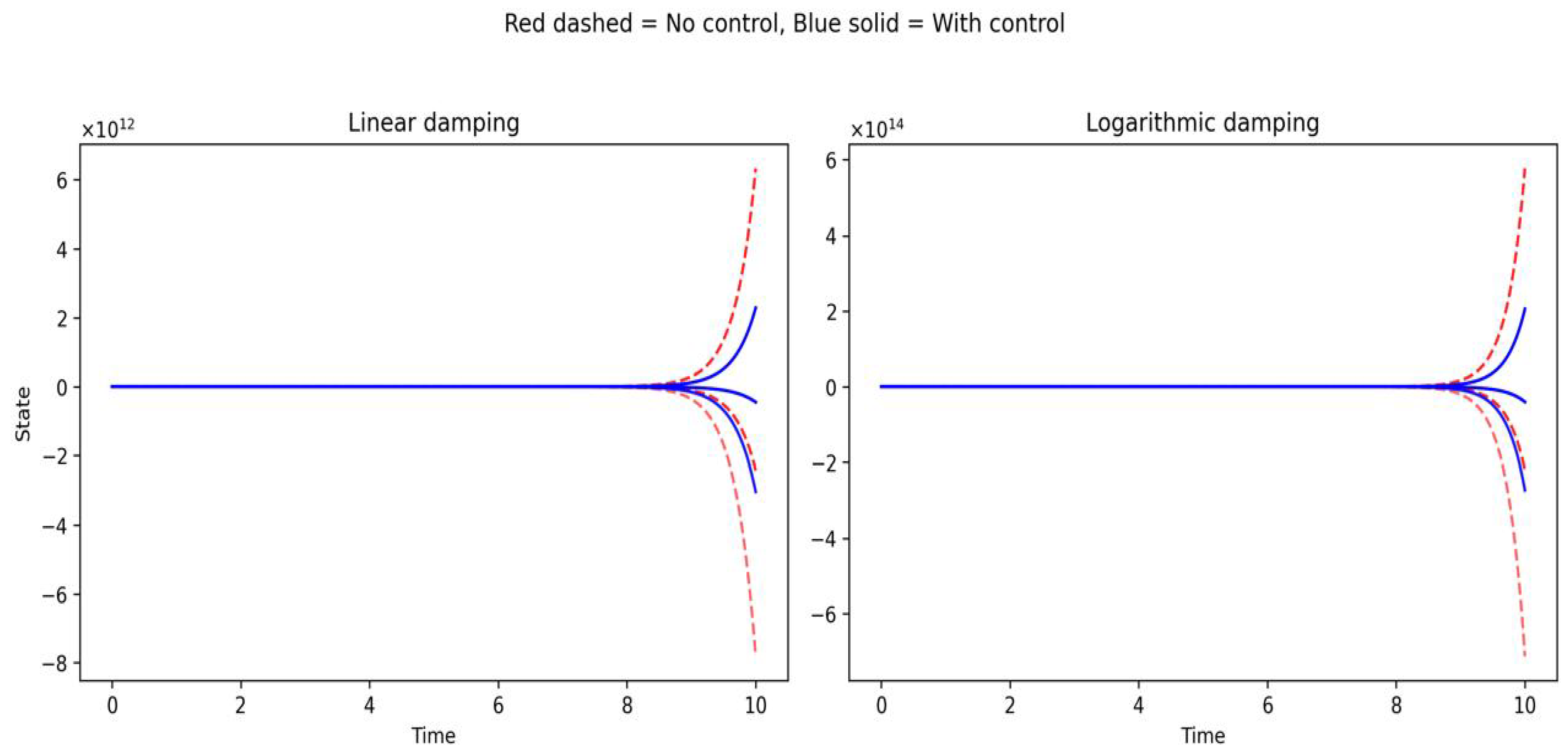
Figure 10 shows the evolution of the agent trajectories for both damping types. In the uncontrolled cases (red dashed lines), the states diverge, though the growth is slower under logarithmic damping compared to linear damping. When the boundary controller is applied (blue solid lines), all trajectories converge to consensus in both systems. The transient behavior, however, differs: with linear damping the states collapse rapidly, whereas with logarithmic damping the convergence slows down as the states approach zero, reflecting the weaker restoring effect at small magnitudes.
Figure 10.
Agent trajectories in a five-node path graph: red dashed lines (no control) diverge, while blue solid lines (with control) converge to consensus under linear (left) and logarithmic (right) damping.
Figure 10.
Agent trajectories in a five-node path graph: red dashed lines (no control) diverge, while blue solid lines (with control) converge to consensus under linear (left) and logarithmic (right) damping.
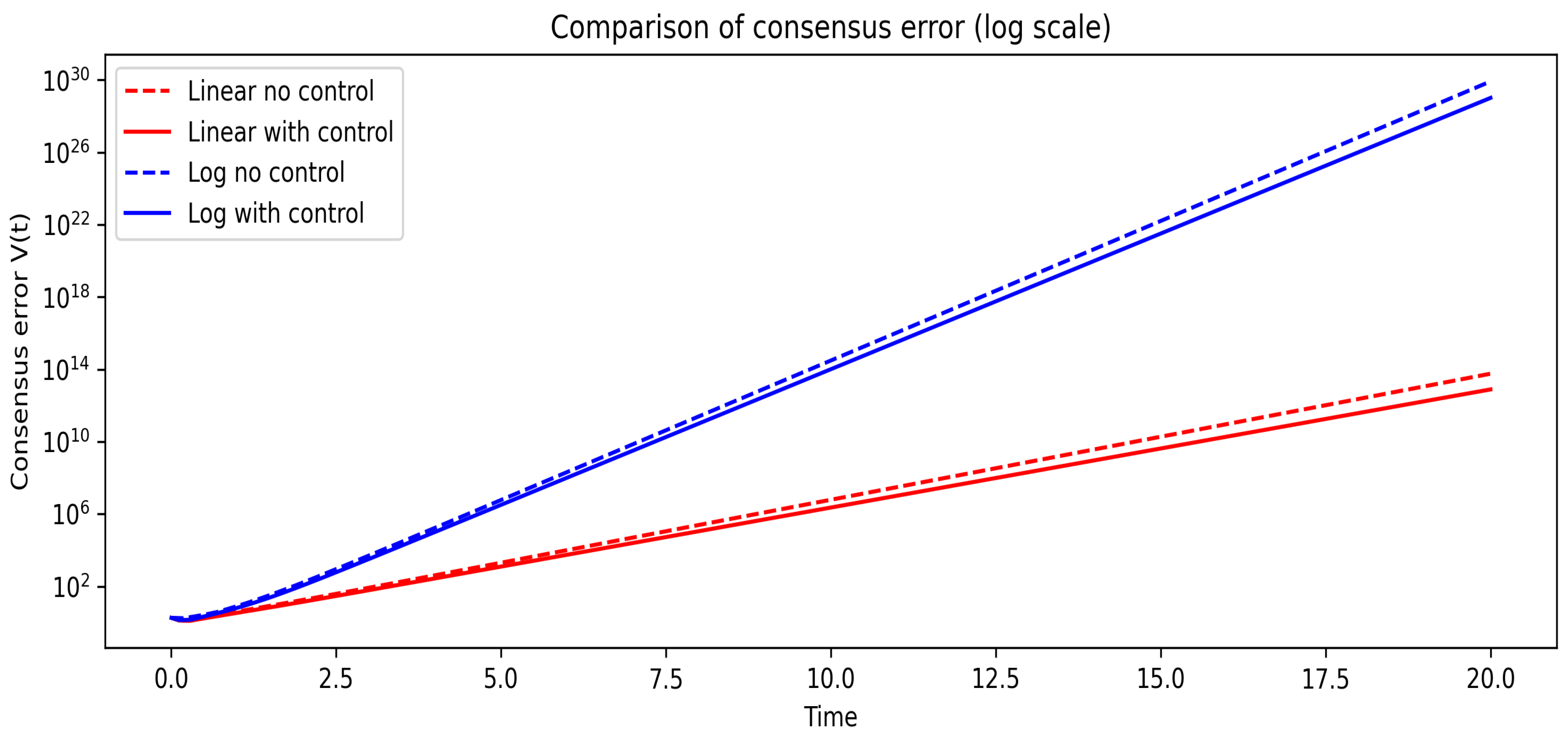
Figure 11 plots the consensus error, defined as
on a logarithmic scale. Without control, both damping mechanisms lead to divergence, but the rate is visibly lower under logarithmic damping. With control, both systems achieve consensus, with the linear damping case showing an almost exponential-like decay of the error, while the logarithmic damping case exhibits a slower tail as
approaches zero.
This comparative study demonstrates that the boundary controller successfully stabilizes the network dynamics under both damping mechanisms. At the same time, the choice of damping function significantly affects the transient response and convergence rate, highlighting how intrinsic system properties interact with the control law in shaping overall stability.
Figure 11.
Consensus error on a logarithmic scale showing divergence without control and convergence with boundary control, with faster decay under linear damping than logarithmic damping.
Figure 11.
Consensus error on a logarithmic scale showing divergence without control and convergence with boundary control, with faster decay under linear damping than logarithmic damping.
The results presented in
Figure 10 and
Figure 11 quantitatively confirm that the proposed boundary feedback controller not only stabilizes network dynamics under various damping mechanisms but also systematically drives the agents toward consensus. These findings provide clear numerical evidence supporting the claims of this study. Specifically, by embedding the fractional boundary feedback mechanism within the graph neural network framework, we demonstrate that the abstract theoretical results of Fu et al. [
18] can be translated into a concrete, computationally validated implementation. The simulations confirm the Mittag– Leffler stability behavior and highlight the stabilization of information diffusion across the network, representing a step beyond purely analytical results. Moreover, the reduction of consensus errors to effectively zero under both linear and logarithmic damping demonstrates that the boundary control mechanism enforces coherent evolution among node states, directly linking fractional PDE–ODE control theory to observable dynamics in graph-based architectures.
The proposed fractional PDE–ODE boundary control framework offers promising applications across a variety of domains where networked dynamics and memory effects play a critical role. In robotic swarms, boundary control can coordinate agent behavior and achieve consensus under fractional-order dynamics, ensuring robust stability even in the presence of delays or long-range interactions. In distributed sensor networks, the method can regulate the flow of information across nodes, mitigating oscillations caused by asynchronous updates or structural heterogeneity. Furthermore, in epidemic modeling, the combination of fractional diffusion and targeted boundary interventions can capture anomalous spread patterns and support effective control strategies. These examples demonstrate that our approach extends beyond theoretical development, providing practical tools for managing complex interactions in real-world networked systems.
3.2. Quantitative Performance Comparison
To complement the qualitative observations presented in
Figure 10 and
Figure 11, we now provide a quantitative comparison between the controlled and uncontrolled systems. The comparison focuses on several standard performance indicators commonly used in stability and consensus analysis:
Settling time (): the time required for the consensus error to remain below a prescribed tolerance.
Steady-state error (): the residual consensus error at the final simulation time.
Peak consensus error: the maximum value attained by during the simulation.
Convergence behavior: qualitative description of whether the trajectories converge or diverge.
Table 1 summarizes the observed numerical behavior for both damping mechanisms with and without boundary control.
The results clearly demonstrate the effectiveness of the proposed boundary feedback controller. In the absence of control, both systems exhibit divergence and rapidly increasing consensus errors, confirming the instability induced by the destabilizing diffusion term. Once the controller is activated, the trajectories converge toward consensus and the steady-state errors become negligible.
Moreover, the quantitative comparison highlights an important difference between the two damping mechanisms. The linear damping case achieves faster convergence and a shorter settling time, which is consistent with the stronger restoring effect of linear dissipation. In contrast, logarithmic damping produces a slower decay near equilibrium, leading to a longer transient phase despite eventual stabilization.
These numerical observations are fully consistent with the theoretical Mittag–Leffler stability analysis developed earlier in the paper and provide computational evidence that the proposed boundary controller effectively stabilizes the coupled fractional PDE–ODE dynamics.