Article

Improved Output Feedback Control for Underactuated Surface Vehicles via Fractional-Order Disturbance Observer


1
College of Arts and Science, Qingdao Binhai University, Qingdao 266555, China
2
School of Information and Control Engineering, Qingdao University of Technology, Qingdao 266520, China
*
Author to whom correspondence should be addressed.
Fractal Fract. 2026, 10(6), 373; https://doi.org/10.3390/fractalfract10060373
Submission received: 18 April 2026 / Revised: 21 May 2026 / Accepted: 26 May 2026 / Published: 29 May 2026

Abstract

This paper studies the output feedback control for underactuated surface vehicles with uncertainties and environmental disturbances. A novel finite-time state observer is proposed by using the three-order Levant differentiator to guarantee the Lyapunov finite-time stability of the estimation error and its first derivative. Then, a fractional-order disturbance observer is established to estimate the uncertainties and the disturbances in the model. Combining the backstepping control with the command filter techniques, the output feedback controller is developed for the system. It is shown that the tracking error of the closed-loop system asymptotically converges to zero, and the tracking performance is improved. Numerical simulation illustrates the advantages of the proposed method.

1. Introduction

Recently, underactuated surface vehicles (USVs) have been widely applied in oceanic engineering because of their importance in oceanic surveillance, reconnaissance, patrolling, environmental surveying, and so on [1,2,3,4]. The trajectory tracking control for USVs is a fundamental issue in ocean tasks [5]. Various control methodologies have been developed in recent years. The methods range from sliding mode control (SMC) [6,7], input–output linearization methods [8], backstepping control [9,10,11,12,13], to model predictive control [14]. Since full knowledge of the USV dynamic model cannot be exactly obtained due to its high nonlinearity and internal disturbances, taking into account the uncertainties in modeling, the adaptive SMC method [15,16], the adaptive fuzzy/neural network (NN) method [6,15,17,18,19,20,21,22], and data-driven control [23] have been developed in this respect. Nevertheless, knowing how to improve the tracking accuracy of the USVs has always been a core issue to be resolved due to the following challenges [18]. Firstly, most of the surface vehicles are equipped with only propellers and rudders, which cannot provide full actuation. Such vehicles are underactuated, having three degrees of freedom but only two independent actuators. Then, the environmental disturbance is also a noticeable factor. Due to winds, waves, and ocean currents, the disturbances typically exhibit large amplitude and rapid variation, which have a great influence on the control systems and may result in instability [24]. Thirdly, most of the control methods rely on the accurate measurements of position, attitude, and velocities. If any of this information is not available, those control methods become unreliable.
For the environmental disturbance rejection, an effective strategy is to build a disturbance observer in a feedforward control scheme based on the measurable states [25,26,27]. There are several disturbance estimation methods in the literature. The nonlinear disturbance observer-based control schemes, such as adaptive NN control [15,18,22], model predictive control [14], backstepping control [20], and adaptive S-surface control [28] have been proposed recently. However, the estimation accuracy depends on the variation of the disturbances. To improve the accuracy, the adaptive disturbance observer [28,29,30,31], finite-time disturbance observer [21], and sliding mode observer [32] were designed. However, excessively large design parameters in these methods may cause severe chattering. The fractional-order observer is proposed in [33] to mitigate the chattering phenomenon of the control inputs and solve the problems of complex explosion. The potential practical use in the USVs can be further studied.
Generally, the position and the attitude of the USVs can be measured by the routine marine devices. The measurement of the velocities relies on the equipment of several costly and delicate sensors. However, the sensors are sometimes unreliable because they may fail or suffer from noise contamination. Moreover, velocity sensors will increase the weight and cost. A high precision state observer [34,35,36,37] is meaningful in this case. In [17], an adaptive fuzzy state observer is employed in an adaptive fuzzy output feedback control scheme. Ref. [38] develops a high-gain observer and provides an application to nonlinear systems with delayed output measurements. An extended state observer is used in [12,39] to achieve state recovery and uncertainty estimation. A finite-time state observer [40] is proposed to obtain a more accurate result. However, the observation accuracy of the above methods is to some extent influenced by the uncertainties and disturbances of the systems.
Suppose that the velocities of USVs cannot be measured; then, we present an improved output feedback control method for the USVs with the modeling uncertainties and environmental disturbances. A novel state observer and a fractional-order disturbance observer are designed to estimate the unknown velocities and disturbances. Combined with the observers, the output feedback controller is obtained to guarantee the tracking performance of the systems. The main advantages are threefold.
(1)
By utilizing the integer-order and fractional-order differentiators, the estimation accuracy of the observers can be improved, and it is proved that the error dynamics are globally finite-time stable at zeros.
(2)
Unlike the other command filter-based backstepping control, the compensator is not contained in the controller; instead, a compensation term is added to the command filter. It is proved that the control performance cannot be affected, and the computational burden is reduced.
(3)
In theoretical analysis, the error dynamics of the closed-loop systems are Lyapunov asymptotically stable, and the tracking errors can converge to zero by the proposed control method. Compared to the existing adaptive fuzzy/ NN-based backstepping methods, the proposed method can guarantee better tracking performance.

2. Modeling and Preliminaries

2.1. USV Modeling

For the USVs, only three degrees of freedom (surge, sway, and yaw) are considered as the decisive ones. The motions of the USV can be described in two frames, namely, the earth frame and the body frame. The model in the form of differential equations is expressed as
η ˙ = R ( ψ ) ν , M ν ˙ + C ( ν ) ν + D ν + f ( ν ) ν = τ + ω ,
where η = [ x , y , ψ ] T consists of the position coordinate ( x , y ) and the yaw angle ψ . ν = [ u , v , r ] T represents the vector of surge, sway, and angular velocities, which are assumed to be unknown in this paper. R ( ψ ) = cos ψ sin ψ 0 sin ψ cos ψ 0 0 0 1 is the rotation matrix. M = d i a g { m 1 , m 2 , m 3 } is the ship’s inertial matrix parameter, C ( ν ) = 0 0 m 2 v 0 0 m 1 v m 2 v m 1 u 0 is the Coriolis-centripetal matrix, and D = d i a g { d 1 , d 2 , d 3 } is the linear damping matrix. The term f ( ν ) ν includes the uncertain dynamics and the matched disturbances, which are assumed as f ( ν ) = d i a g { d 11 | u | , d 22 | v | , d 33 | r | } . τ = [ τ u , 0 , τ r ] T implies the control force produced by the thrusters. ω = [ ω u , ω v , ω r ] T denotes the unmeasurable environmental disturbance vector.

2.2. Control Purpose

The reference trajectory is defined as η d = [ x d , y d , ψ d ] T , which can be generated by
η ˙ d = R ( ψ d ) ν d ,
where ν d = [ u d , 0 , r d ] T is the reference signal of ν .
The actual tracking error is defined as
η e = [ x e , y e , ψ e ] T = η η d .
To facilitate the following design, we define
η ¯ e = [ x ¯ e , y ¯ e , ψ e ] T = R T ( ψ ) η e .
It can be inferred from (4) that lim t η e = 0 is equivalent to lim t η ¯ e = 0 .
According to (1) and (4), the model (1) can be rewritten as
η ¯ ˙ e = Ω 1 ν R T ( ψ e ) ν d ,
E ( M ν ˙ + C ( ν ) ν + D ν + f ( ν ) ν ) E T = E ( τ + ω ) E T ,
where Ω 1 = 1 0 y ¯ e 0 1 x ¯ e 0 0 1 , E = 1 0 0 0 0 1 .
The control purpose of this paper is to design a tracking controller and provide a corresponding stability condition for the systems (5) and (6), such that lim t η e = 0 .

2.3. Lemmas and Assumptions

Definitions, lemmas, and assumptions are proposed for subsequent control design. The notations, which will be used throughout this paper, are also defined in this subsection.
Definition 1 
([33]). The Caputo-type fractional differential of the function f ( t ) : [ 0 , ) R is denoted as
D t γ t 0 c f ( t ) = 1 Γ ( m γ ) t 0 t f m ( τ ) ( t τ ) m + γ + 1 d τ ,
where m 1 < γ < m and m N , γ > 0 .
Lemma 1 
([41]). Let an nth order Levant differentiator be of the following form
z ˙ 0 = λ 0 | z 0 f ( t ) | n n + 1 s i g n ( z 0 f ( t ) ) + z 1 , z ˙ 1 = λ 1 | z 1 z ˙ 0 | n 1 n s i g n ( z 1 z ˙ 0 ) + z 2 ,     z ˙ n = λ n s i g n ( z n z ˙ n 1 ) + ξ ( t ) ,
where f ( t ) with | f ( t ) | L 1 is a function with the nth derivative having a known Lipschitz constant L 1 > 0 . | ξ ( t ) | L 2 is a bounded function. If the parameters λ 0 , …, λ n are chosen properly, the following equalities are true in finite time.
z 0 = f ( t ) , z i = f ( i ) ( t ) , i = 1 , 2 , . . . , n .
Moreover, the corresponding solutions of the dynamic systems are Lyapunov stable, i.e., finite-time stable.
Lemma 2 
([33]). Let the fractional-order differentiator be of the following form, where f ( t ) is a function as in Lemma 1.
D t 1 n t 0 c z 0 = λ 0 | z 0 f ( t ) | n n + 1 s i g n ( z 0 f ( t ) ) + z 1 , D t 1 n t 0 c z 1 = λ 1 | z 1 D t 1 n t 0 c z 0 | n 1 n s i g n ( z 1 z ˙ 0 ) + z 2 ,     D t 1 n t 0 c z n = λ n s i g n ( z n D t 1 n t 0 c z n 1 ) + ξ ( t ) ,
for any initial values z 0 ( 0 ) , z 1 ( 0 ) , …, z n ( 0 ) , there exist parameters λ 0 , …, λ n such that z 0 = f ( t ) , …, z n = D t 1 n t 0 c z n 1 are true after finite time of a transient process.
Assumption 1. 
The unmeasurable disturbance ω is time-varying, bounded, and differentiable.
Assumption 2. 
The state vectors η ¯ e and ν are passive-bounded for the USVs.
Remark 1. 
The passive boundedness of the sway velocity v in Assumption 2 is well-justified in the marine control literature. From the sway dynamics m 2 v ˙ = m 1 u r d 2 v d 22 | v | v + ω v , the quadratic damping term d 22 | v | v provides strong dissipative forces. For bounded u, r (controlled states), and ω v (Assumption 1), a conservative bound can be derived as | v | max { | v ( 0 ) | , ( | ω v | + m 1 | u | | r | ) / d 2 } . Since the proposed controller ensures u and r are bounded (Theorem 3), and ω v is bounded (Assumption 1), the sway velocity v remains bounded. This property has been experimentally verified in numerous USV studies [12,17,20]. For extreme disturbance scenarios where v may approach large values, additional v-control strategies (e.g., sway force allocation) may be needed, which is left as future work.
Assumption 3. 
The trajectory η d is smooth, bounded, and available.
Notations: s i g n ( · ) denotes the signum function. Let x = [ x 1 , x 2 , . . . , x n ] T be an n-dimensional vector; we denote sign ( x ) = [ sign ( x 1 ) , sign ( x 2 ) , . . . , sign ( x n ) ] T , x = x T sign ( x ) . 1 and T, respectively, denote the matrix inverse and transpose, and diag { · } denotes a diagonal matrix.

3. Main Results

In this section, we will design the state observer to estimate the velocity vector ν , the disturbance observer, and the output feedback controller for the USVs. To begin the design, the following coordinate transformation is introduced
ψ ¯ e = sin ψ e α ψ , u e = u α u , r e = r α r , η ˇ e = [ x ¯ e , y ¯ e , ψ ¯ e ] T , ν e = [ u e , r e ] T ,
where α = [ α u , α ψ , α r ] T is the virtual controller, which will be designed later.
Remark 2. 
From the transformation of coordinates, we can find that the relationship of ψ ¯ e and ψ e is not a one-to-one correspondence. In the theoretical analysis, ψ ¯ e can be further defined as
ψ ¯ e = sin ψ e ψ c 1 , | ψ e | π 2 , 1 ψ c 1 , ψ e > π 2 , 1 ψ c 1 , ψ e < π 2 .
As can be seen, it will cause some error, which will affect the control effect during the process | ψ e | > π 2 . But it will not affect the convergence of closed-loop systems.

3.1. Design of State Observer

In this paper, we assume that the velocity signals in ν are unavailable. The state observer is designed to obtain the estimation ν ^ = [ u ^ , v ^ , r ^ ] T . The estimation error is defined as e ν = ν ν ^ . According to the dynamics (5), the state observer is designed as follows
χ ˙ 0 = J 1 | χ 0 η ¯ e | 2 3 sign ( χ 0 η ¯ e ) + χ 1 R T ( ψ e ) ν d , χ ˙ 1 = J 2 | χ 1 χ ˙ 0 | 1 2 sign ( χ 1 χ ˙ 0 ) + χ 2 , χ ˙ 2 = J 3 sign ( χ 2 χ ˙ 1 ) ,
where χ 0 , χ 1 , χ 2 are the output vectors of the state observer, and J i = diag { j i u , j i v , j i r } , i = 1 , 2 , 3 are the design parameter vectors satisfying J i > 0 .
The estimation ν ^ is calculated by
ν ^ = Ω 1 1 ( J 1 | χ 0 η ¯ e | 2 3 sign ( χ 0 η ¯ e ) + χ 1 ) .
Theorem 1. 
Assume that the state vectors η e and ν are defined in a compact set and satisfy Assumption 2. If the parameter vectors J i , i = 1 , 2 , 3 are chosen properly, the estimation error e ν and its derivative e ˙ ν can converge to zero in a finite time by using the state observer (12).
Proof. 
By Lemma 1, there exists a finite time T 1 such that
χ 0 η ¯ e = 0 , χ ˙ 0 η ¯ ˙ e = 0 , χ ¨ 0 η ¯ ¨ e = 0 , t > T 1 .
It leads to
χ ˙ 0 η ¯ ˙ e = Ω 1 ν ^ R T ( ψ e ) ν d η ¯ ˙ e = Ω 1 e ν = 0 , χ ¨ 0 η ¯ ¨ e = Ω ˙ 1 e ν Ω 1 e ˙ ν = 0 , t > T 1 .
By Assumption 2 and (15), it can be proved that e ν and e ˙ ν can converge to zero in a finite time. To explicitly verify the conditions of Lemma 1, we note that the signal to be differentiated is η ¯ e , whose third derivative η ¯ e involves ν ˙ , Ω ˙ 1 , and R ˙ T ( ψ e ) ν d . Under Assumption 2 (passive boundedness of η ¯ e and ν ) and Assumption 3 (smooth bounded reference), η ¯ e is bounded and Lipschitz continuous, with the Lipschitz constant L 1 computable as a function of the bounds on ν , ν ˙ , η e , and ν d . Regarding the convergence time, for the 3rd-order Levant differentiator, T 1 satisfies T 1 C · max { | χ 0 ( 0 ) η ¯ e ( 0 ) | 1 / 3 , | χ 1 ( 0 ) η ¯ ˙ e ( 0 ) | 1 / 2 , | χ 2 ( 0 ) η ¯ ¨ e ( 0 ) | } / min { J 1 1 / 3 , J 2 1 / 2 , J 3 } , where C depends on L 1 . Larger gains lead to faster convergence but may amplify measurement noise. □
Remark 3. 
The design of the state observer is only based on the third-order Levant differentiator and the dynamics of (5). It is obvious that (5) is a deterministic system. It has the advantages of better feasibility and better estimation effect. It is also proved that e ν and e ˙ ν are finite-time stable. The theoretical result is better than those of the methods in [17,36].

3.2. Design of Disturbance Observer

We now design the disturbance observer according to the dynamics (6). The estimation vector of disturbances is defined as ω ^ . It should be noted that the estimation is not the approximation of the external disturbance ω but the expression of ω ¯ = E ( C ( ν ) D ν f ( ν ) ν + C ( ν ^ ) + D ν ^ + ω ) E T . The error is e ω = ω ¯ ω ^ . Now the estimation is given as follows
D t 1 n t 0 c ϕ 0 = L 1 | ϕ 0 E ( M ν ^ ) E T | n n + 1 sign ( ϕ 0 E ( M ν ^ ) E T ) + ϕ 1 D t 1 n t 0 c ϕ n 1 = L n 1 | ϕ n 1 t 0 c D t 1 n ϕ n 2 | 1 2 sign ( ϕ n 1 t 0 c D t 1 n ϕ n 2 ) + ϕ n + E ( τ C ( ν ^ ) ν ^ D ν ^ ) E T , D t 1 n t 0 c ϕ n = L n sign ( ϕ n t 0 c D t 1 n ϕ n 1 ) ,
where ϕ 0 , …, ϕ n are the output vectors of the disturbance observer. The estimation ω ^ is
ω ^ = L n 1 | ϕ n 1 t 0 c D t 1 n ϕ n 2 | 1 2 sign ( ϕ n 1 t 0 c D t 1 n ϕ n 2 ) + ϕ n .
Theorem 2. 
If the parameter vectors L i , i = 1 , 2 , . . . , n are chosen properly, the estimation error e ω can converge to zero in a finite time by using the disturbance observer (16).
Proof. 
By Lemma 2 and (16), after a finite time of a transient process, we have ϕ 0 = E ( M ν ^ ) E T , …, ϕ n 1 = t 0 c D t 1 n ϕ n 2 , ϕ n = t 0 c D t 1 n ϕ n 1 . By Definition 1, we have ϕ ˙ 0 = t 0 c D t 1 n ϕ n 1 . According to Assumptions 1 and 2, the states in ω ¯ are bounded. By (16) and (17), e ω can be solved by
e ω = ω ¯ ω ^ = E M ν ˙ E T t 0 c D t 1 n ϕ n 1 = E M ν ˙ E T ϕ ˙ 0 = E M ν ^ ˙ E T ϕ ˙ 0 + E M e ν ˙ E T .
By Lemma 2, there exists a finite time T 2 > 0 such that E M ν ^ ˙ E T ϕ ˙ 0 = 0 , t > T 2 . Then by Theorem 1, we can obtain e ν ˙ = 0 , t > T 1 . It follows that there exists a finite time T max = max { T 1 , T 2 } , such that e ω = 0 , t > T max . To verify the conditions of Lemma 2, we note that the signal to be differentiated is E ( M ν ^ ) E T , whose fractional derivative involves ν ^ ˙ . After t > T 1 (state observer convergence), ν ^ = ν , and the boundedness follows from Assumptions 1 and 2. The coupled convergence time is T max = max { T 1 , T 2 } , which is finite. □
Remark 4. 
Compared with the method in [33], which also employs a fractional-order disturbance observer for USVs, the main differences of this work are as follows. First, the method in [33] requires full-state feedback (i.e., velocity measurements are assumed available), while our method operates under output feedback where velocities are unmeasurable. Second, we design a cascaded observer architecture consisting of a state observer and a disturbance observer, where the disturbance observer operates on the estimated velocities ν ^ rather than the true ν.
Remark 5. 
The estimation (17) is the observation of the combination of the internal and environmental disturbances. Compared to the adaptive fuzzy/ NN-based methods in [15,18,42,43], the proposed disturbance observer has a better estimation effect because the estimation errors of the disturbance observer can be zero in finite time, and has the ability to suppress the chattering phenomenon.
Remark 6. 
The fractional order γ = 1 / n is chosen to match the structure of the nth-order Levant differentiator. The Caputo fractional derivative with γ < 1 has an inherent low-pass filtering property due to its convolution kernel ( t τ ) γ , which attenuates high-frequency switching in the sign function and reduces chattering. When n = 1 ( γ = 1 ), the observer reduces to the standard integer-order Levant differentiator. As n increases, the chattering is further suppressed at the cost of slower convergence, providing a continuous trade-off between chattering suppression and convergence speed. The choice 1 / n follows the framework in [33], where it was shown that the fractional-order differentiator recovers the integer-order one as n 1 .

3.3. Controller Design

The command filter is defined as
q ˙ c 1 = q c 2 , q c 2 = N 1 | q c 1 α | 1 2 s i g n ( q c 1 α ) + q ¯ c 2 , q ¯ ˙ c 2 = N 2 s i g n ( q ¯ c 2 q c 2 ) + W [ u e , ψ ¯ e , r e ] T ,
where q c 1 = [ u c 1 , ψ c 1 , r c 1 ] T , q c 2 = [ u c 2 , ψ c 2 , r c 2 ] T are the output vectors of the command filter, and N i = diag { n i u , n i ψ , n i r } , i = 1 , 2 , W = diag { w u , w v , w r } are the design parameter vectors. q c 1 and q c 2 are the estimations of the virtual controller α = [ α u , α ψ , α r ] T and its derivative, respectively. By choosing the Lyapunov candidate, V q = W 1 2 ( q c 2 α ˙ ) T ( q c 2 α ˙ ) . According to the proof in [41], one has
V ˙ q < W 1 N 2 ( q c 2 α ˙ ) + [ u e , ψ ¯ e , r e ] ( q c 2 α ˙ ) .
By Lemma 1, if N i is chosen properly, there exists a finite time T 3 > 0 , such that
q c 1 = α , q c 2 = α ˙ , t > T 3 .
Remark 7. 
From Theorems 1 and 2 and (21), there exists a finite time T = max { T 1 , T 2 , T 3 } > 0 , such that
e ν = 0 , e ω = 0 , q c 1 α = 0 , q c 2 α ˙ = 0 , t > T .
By using the backstepping design method, the virtual and the actual controllers are designed as
Ω 2 α = K η η ˇ e + g 1 ( η ¯ e , ν ^ ) ,
E τ E T = E M E T ( K ν ν e E ¯ η ˇ e + E q c 2 ) ω ^ + E ( C ( ν ^ ) ν ^ + D ν ^ ) E T ,
where K η = diag { k η x , k η y , k η ψ } , K ν = diag { k ν u , k ν r } are the design parameter vectors; Ω 2 = diag { 1 , u d , cos ψ e } ; E ¯ = 1 0 0 0 0 cos ψ e ; and g 1 ( η ¯ e , ν ^ ) = [ u d cos ψ e y ¯ e r ^ , v ^ + x ¯ e r ^ , cos ψ e r d + ψ c 2 u d y ¯ e ] T .
The detailed design process and the stability analysis are shown in the following theorem.
Theorem 3. 
Consider system (1) with Assumptions 1–3. Under the action of the state observer (12), the disturbance observer (16), the command filter (19), the virtual controller (23), and the actual controller (24), the error dynamics of η ˇ e , ν e are Lyapunov asymptotically stable, which implies that x x d and y y d for t .
Proof. 
We first establish the boundedness of all closed-loop signals during the transient interval [ 0 , T ] and then prove the asymptotic convergence for t > T using Barbalat’s lemma.
Step 1: Boundedness on [ 0 , T ] . Since the closed-loop system (comprising the USV dynamics, observers, command filter, and controller) is locally Lipschitz continuous (except at the switching surfaces of the sign functions), by the classical existence theorem for ODEs, there exists a local solution on [ 0 , t max ) for some t max > 0 . We show that no signal can escape to infinity in finite time: (i) The observer dynamics (12) and (16) are homogeneous-like, and their solutions are globally defined by the properties of the Levant differentiator (Lemmas 1 and 2); (ii) The command filter (19) has globally defined solutions; and (iii) The USV dynamics are affine in control with bounded control input during [ 0 , T ] . Since all subsystems have no finite escape time and T is finite, there exists M T > 0 such that η e ( t ) + ν ( t ) + ν ^ ( t ) + ω ^ ( t ) + τ ( t ) M T for all t [ 0 , T ] .
Step 2: Lyapunov analysis for t > T . The error dynamics of η ˇ e , ν e can be calculated as follows.
η ˇ ˙ e = Ω 2 u sin ψ e r + u d cos ψ e + y ¯ e r v x ¯ e r cos ψ e r d α ˙ ψ = Ω 2 α + Ω 2 u e ψ ¯ e r e + u d cos ψ e + y ¯ e r v x ¯ e r cos ψ e r d α ˙ ψ = K η η ˇ e + E ¯ T ν e + y ¯ e e r x ¯ e e r + u d ψ ¯ e ( ψ c 2 α ˙ ψ ) u d y ¯ e ,
and
ν ˙ e = E M 1 ( τ + ω C ( ν ) ν D ν f ( ν ) ν ) E T E α ˙ = K ν ν e E ¯ η ˇ e + E M 1 e ω E T + E ( q c 2 α ˙ ) .
The Lyapunov candidate is chosen as
V = V q + 1 2 η ˇ e T η ˇ e + ν e T ν e .
It can be deduced that
V ˙ = V ˙ q + η ˇ e T η ˇ ˙ e + ν e T ν ˙ e = K η η ˇ e T η ˇ e K ν ν e T ν e W 1 N 2 ( q c 2 α ˙ ) + η ˇ e T [ y e e r , x e e r , 0 ] T + ν e T E M 1 e ω E T .
Using Equations (22) and (28) implies that V ˙ < 0 , t > T .
Step 3: Asymptotic convergence via Barbalat’s lemma. Since V 0 and V ˙ 0 for t > T , V ( t ) is monotonically non-increasing and bounded from below. Therefore, lim t V ( t ) = V exists and is finite. Integrating V ˙ from T to :
V ( T ) V = T K η η ˇ e T η ˇ e + K ν ν e T ν e d t < ,
which implies η ˇ e , ν e L 2 [ T , ) . From the error dynamics (25) and (26), for t > T , the right-hand sides are composed of L 2 functions, so η ˇ ˙ e , ν ˙ e L 2 . By Barbalat’s lemma, if f L 2 and f ˙ L 2 , then f ( t ) 0 as t . Applying this to η ˇ e and ν e , we conclude lim t η ˇ e ( t ) = 0 and lim t ν e ( t ) = 0 . Since x ¯ e 0 and y ¯ e 0 implies x e 0 and y e 0 by (4), the tracking errors asymptotically converge to zero. □
Remark 8. 
The proposed command filter-based backstepping scheme is different from the existing ones as in [6], in which a filter error compensation signal is added to guarantee the control quality. A new compensation term W [ u e , ψ ¯ e , r e ] T is added to the command filter (19); thus, the compensation signal can be removed in our scheme, and the computational burden is reduced.
Remark 9. 
Thanks to the adoption of the differentiator in Lemmas 1 and 2, and the rational design of observers and output feedback controllers, the proposed control method can ensure that all the error systems are globally asymptotically stable. The uncertainties and disturbances in the systems can be treated well. Thus, the tracking accuracy is guaranteed. The proposed method achieves better tracking accuracy than the adaptive fuzzy/NN-based method under the tested conditions, primarily due to the finite-time exact estimation property of the observers. It should be pointed out that the sway velocity v is not exclusively addressed in the control design, and it can be autonomously bounded.
Remark 10. 
The following guidelines are provided for practical tuning. (1) The controller gains K η , K ν are the main parameters, which should be larger during the initial setup, such as K η = K ν = [ 50 , 50 , 50 ] T . If the system is stabilized, the parameter values can be gradually reduced. (2) The gains of the state observer: J 1 should be sufficiently large to ensure convergence. J 3 should be small to reduce chattering. (3) The gains of the command filter: N 1 should be sufficiently large to ensure convergence. N 2 should be small to reduce chattering. (4) The gains of the disturbance observer: similar principles apply as (2) and (3).
Remark 11. 
In practice, actuator saturation is always present. The initial control impulse during [ 0 , T ] can be handled by (i) initializing the observers with approximate values to reduce initial estimation errors; (ii) applying a smooth startup procedure where the controller is gradually activated after the observers have converged; and (iii) incorporating actuator saturation limits | τ u | τ ¯ u , | τ r | τ ¯ r , which do not affect the asymptotic stability for t > T since the required steady-state control effort is typically much smaller than the saturation limits.

4. Simulation Results

The prototype USV is equipped with one propeller and one rudder. The parameters of the system (1) for simulation are obtained from [5] and given in Table 1. The environmental disturbance ω is produced by the first-order Markov process as
ω ˙ = 0.01 ω + d ω ,
with d ω = [ 4 d ω u , 2 d ω v , 2.5 d ω r ] T , and d ω i , i = u , v , r , are three independent Gaussian white noise signals with variance 1.
The adaptive fuzzy control (AFC) method is used as a comparison. The method in [17] is infeasible for the system because the environmental disturbance has large amplitudes and a large rate of change. If a fuzzy disturbance observer in [20] is combined with the AFC method, a set of feasible tuning parameters can be found. In the process of simulation, the design parameters are given in Table 2. The reference trajectory is selected as ν d = [ 1 m / s , 0 , 0.2 e ( 15 t ) rad / s ] T , t 15 s [ 1 m / s , 0 , 0.2 rad / s ] T , else .
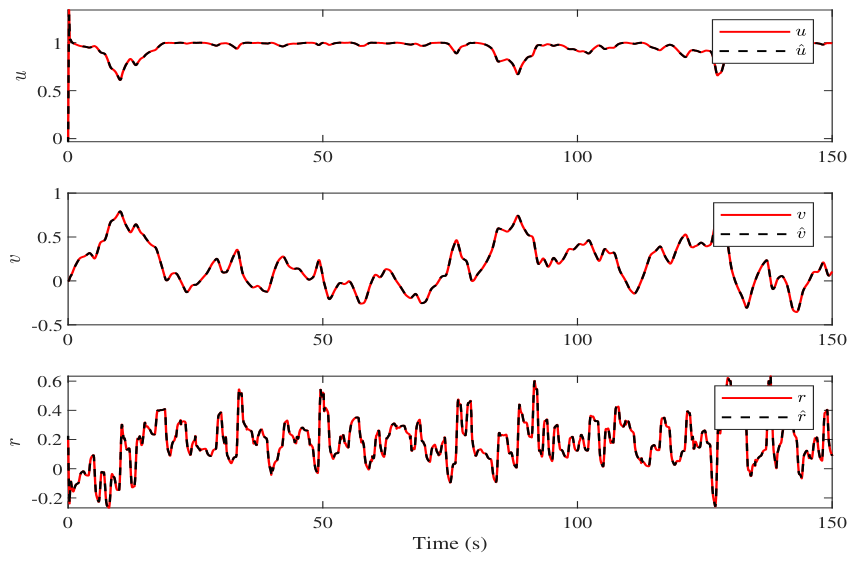
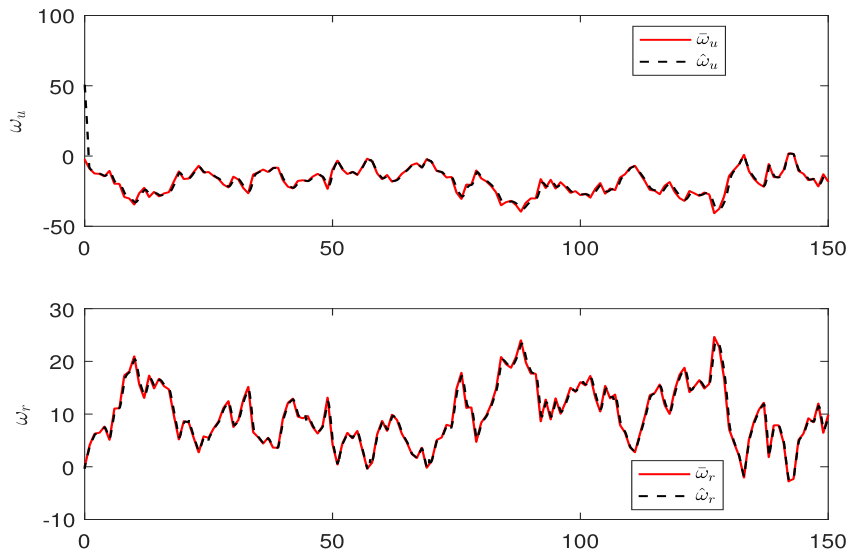
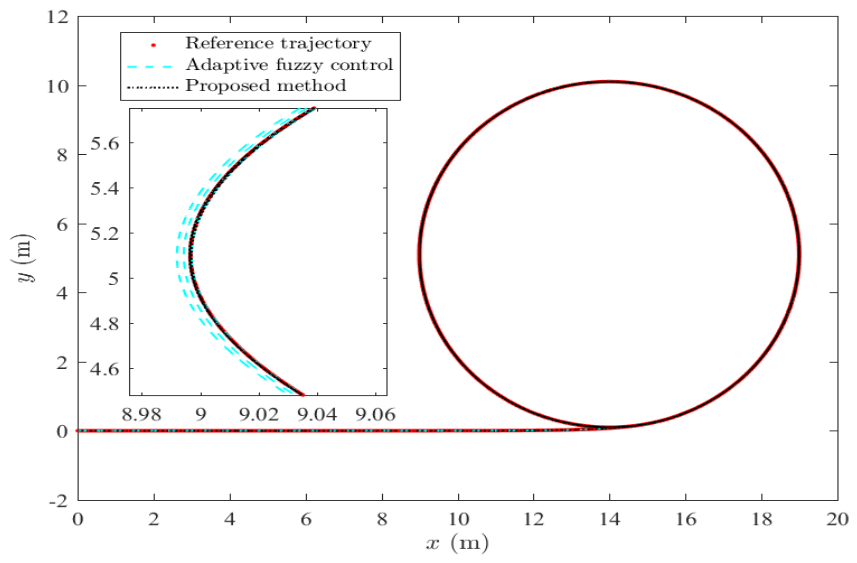
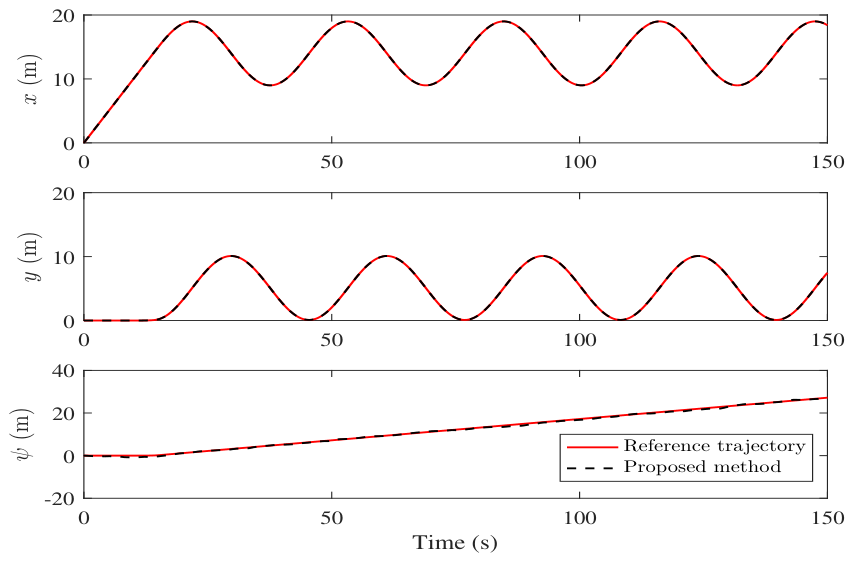
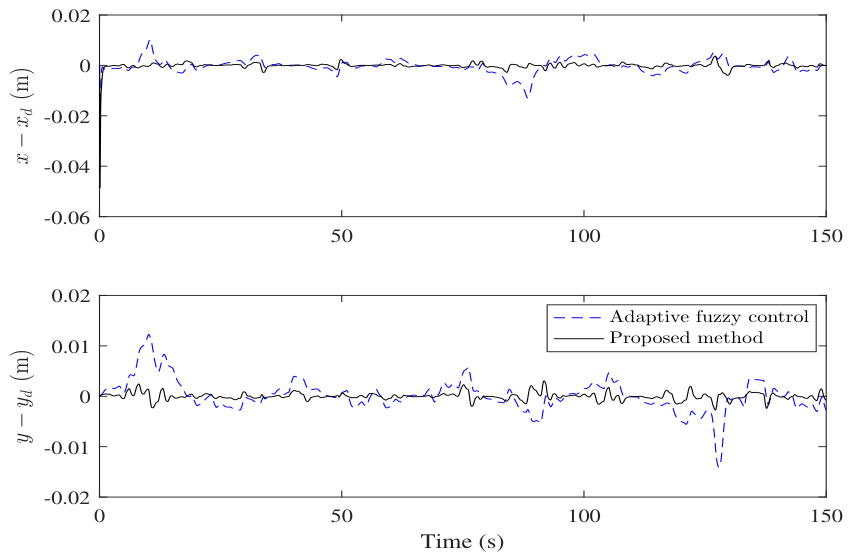
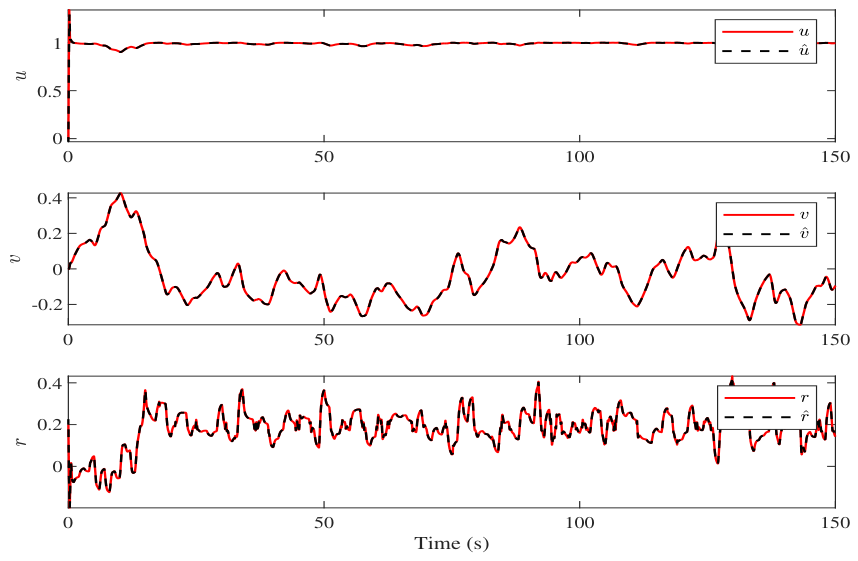
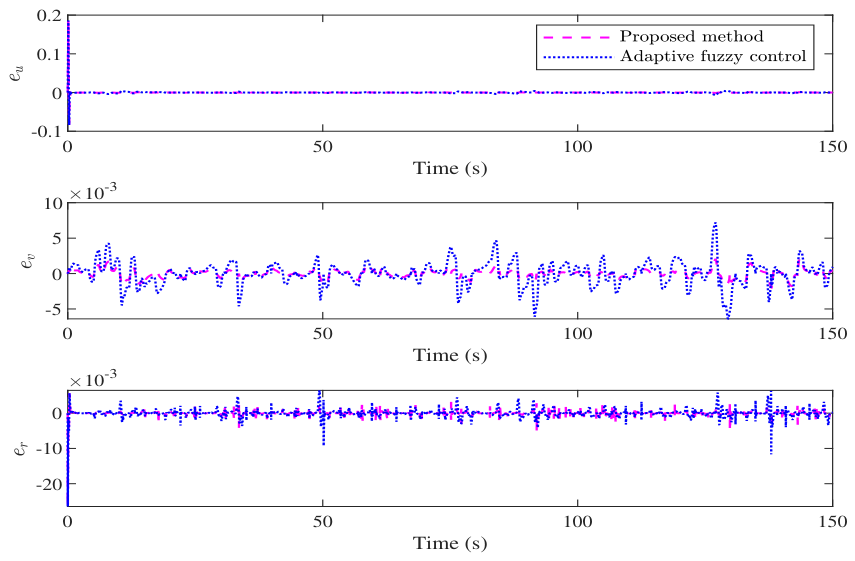
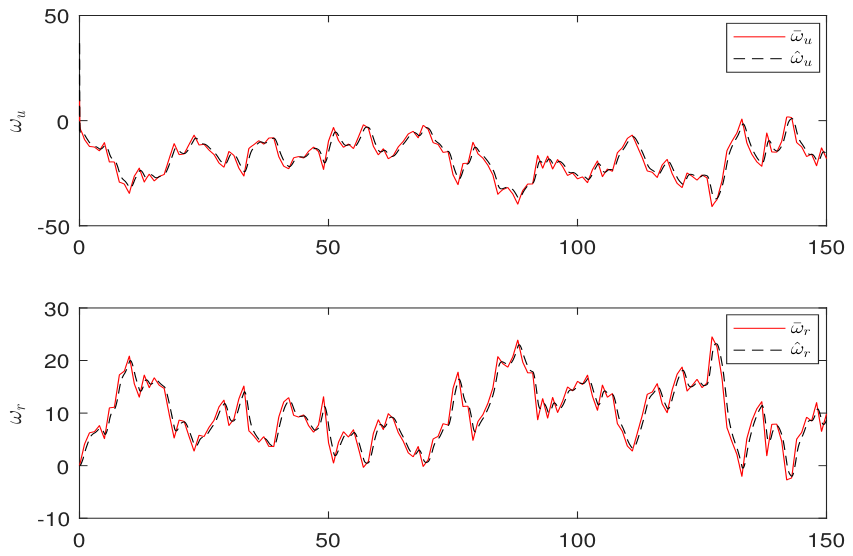
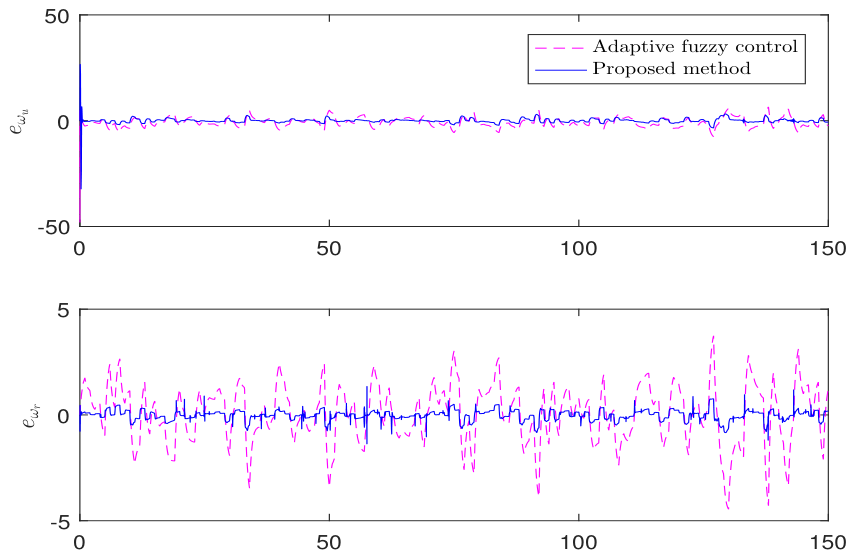
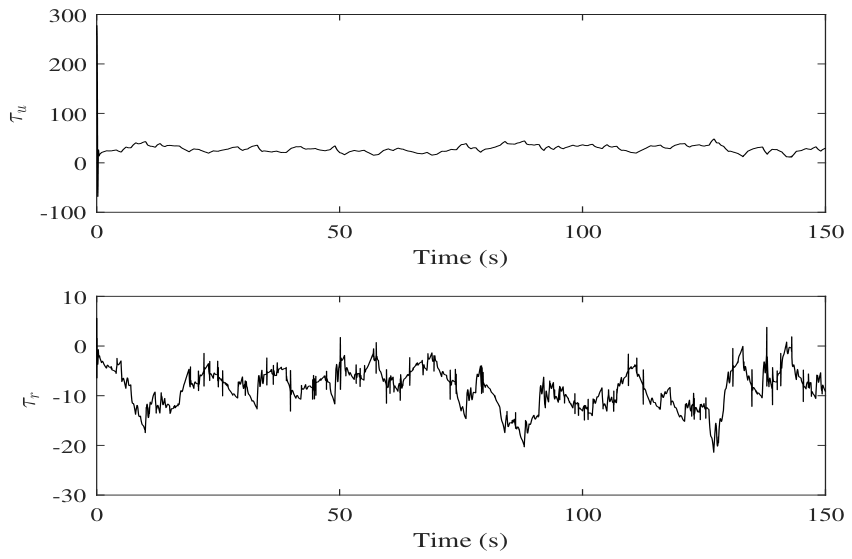
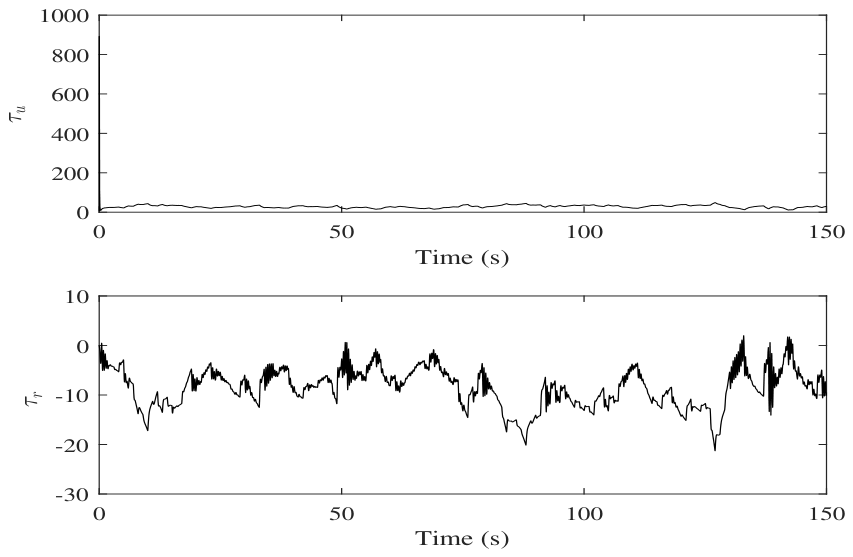
The simulation results are+ shown in Figure 1, Figure 2, Figure 3, Figure 4, Figure 5, Figure 6, Figure 7, Figure 8, Figure 9, Figure 10 and Figure 11. As seen from Figure 1, Figure 2 and Figure 3, the desired trajectory can be tracked under the proposed output feedback control method, and the tracking errors x e and y e are smaller than those of the AFC method. Figure 4, Figure 5 and Figure 6 show the estimation effect of the state observer; the estimation effect is superior to the observer in [17]. The disturbance estimation effect is shown in Figure 7, Figure 8 and Figure 9. The results are also better than those of the fuzzy observer in [20]. Figure 10 and Figure 11 show the control forces of the proposed method and the AFC method. From Figure 11, we can find that the control force has high amplitude and violent vibration, so it is not beneficial to practical application. It should be pointed out that the there exists the initial overshoot in Figure 7 and Figure 10. It is a well-known characteristic of the backstepping control method when the initial values deviate from the expectation. The amplitude of the proposed method is less than that of the AFC method.
To better simulate the real marine environments, two other disturbances are given to further demonstrate the engineering applicability of the proposed method as:
1.
Multi-frequency disturbance model: Combining multiple frequency components to simulate irregular sea states:
ω u = i = 1 5 A i sin ( Ω i t + ϕ i )
where A i , Ω i , ϕ i are randomly generated amplitudes, frequencies, and phases based on the JONSWAP spectrum parameters.
2.
Irregular wave disturbance: Using the Pierson–Moskowitz spectrum to generate wave disturbances:
S ( ω ) = 5 16 H s 2 ω p 4 ω 5 exp 5 4 ω p ω 4
with significant wave height H s = 2 m and peak frequency ω p = 0.8 rad/s.
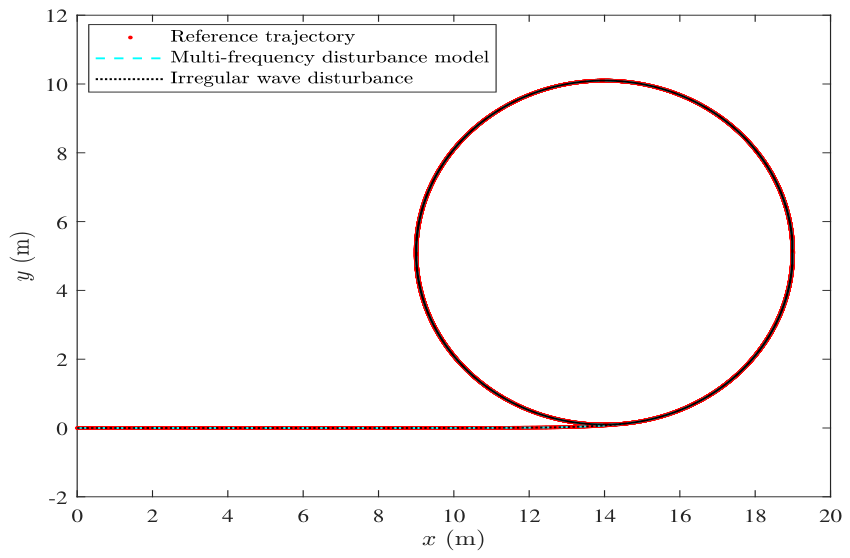
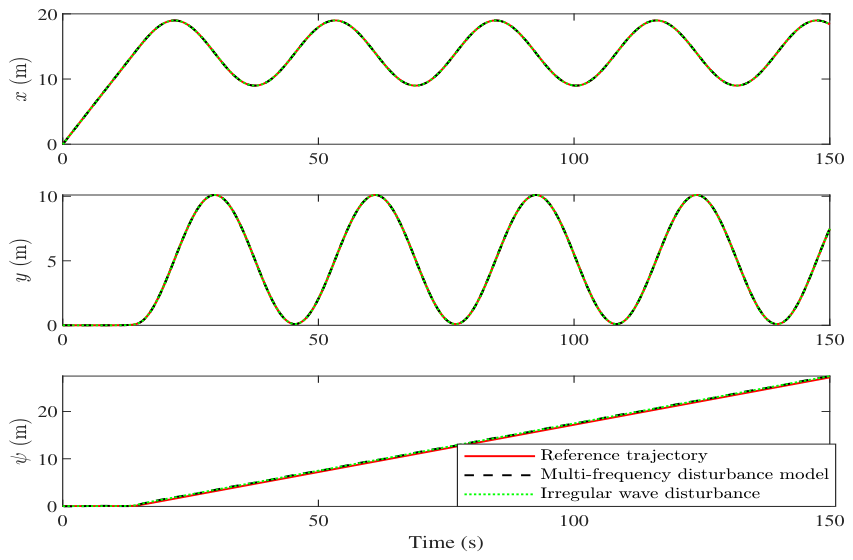
The simulation is shown in Figure 12 and Figure 13. It can be seen that different disturbances have little impact on tracking accuracy. The proposed control method can achieve high accuracy.

4.1. Sensitivity Analysis of Fractional Order

To evaluate the impact of the fractional order γ = 1 / n on estimation and control performance, we conducted simulations with different values of n. The results are summarized in Table 3, where the estimation IAE, chattering amplitude, convergence time, and control IAE are compared.
The results show that n = 3 ( γ = 1 / 3 ) provides the best trade-off between estimation accuracy, chattering suppression, and convergence speed. As n increases, chattering is further suppressed but convergence becomes slower, which may degrade control performance.

4.2. Computational Complexity Comparison

We compare the computational complexity between the standard command filter-based backstepping (with compensation signal in the controller) and our modified command filter. The theoretical comparison shows that the modified filter eliminates the compensation signal computation of O ( n c · n s ) per step, where n c is the compensation dimension and n s is the state dimension. Since the added weight term W in the filter requires only O ( n w ) with n w n c · n s , the dominant computational term is reduced. Experimentally (MATLAB R2023b, Intel i7-12700H), the average step time is reduced from 0.142 ms to 0.118 ms (16.9% reduction), and the FLOPs per step from 2847 to 2156 (24.3% reduction).

5. Conclusions

In this paper, the accurate position tracking control for the USVs with modeling uncertainties and environmental disturbances is investigated. A novel state observer and a disturbance observer are established by using the Levant differentiator. Subsequently, the output feedback backstepping controller is designed based on the command filter technique. The observer error systems are proved to be finite-time stable, and the closed-loop system is proved to be asymptotically stable, both in the sense of Lyapunov. Simulation results verify the tracking performance of the proposed control method. Future work will extend the control scheme to the formation control of multi-USVs and improve the proposed method to adapt to more complex scenarios.

Author Contributions

Conceptualization, J.C.; Methodology, J.C.; Software, Y.J.; Validation, Y.J.; Investigation, J.C.; Resources, J.C.; Writing—original draft, Y.J.; Supervision, J.C.; writing—review, Y.J. and J.C.; editing, J.C.; Funding acquisition, Y.J. and J.C. All authors have read and agreed to the published version of the manuscript.

Funding

This work was supported in part by the Shandong Natural Science Foundation under Grants ZR2023MF017 ZR2023MF032 and in part by the Doctor Foundation of Qingdao Binhai University under Grant BJZB2025004.

Data Availability Statement

Data are contained within the article.

Conflicts of Interest

The authors declare no conflicts of interest.

References

  1. Liang, X.; Chen, X.; Bao, D.; Ge, S.S. Adaptive Zone Barrier Lyapunov for USV Motion Constraint with Uncertain Control Gain. IEEE Trans. Ind. Inform. 2026. [Google Scholar] [CrossRef]
  2. Zhang, J.-X.; Yang, T.; Chai, T. Neural network control of underactuated surface vehicles with prescribed trajectory tracking performance. IEEE Trans. Neural Netw. Learn. Syst. 2024, 35, 8026–8039. [Google Scholar] [CrossRef] [PubMed]
  3. Zhang, G.; Liu, S.; Huang, J.; Zhang, W. Dynamic event-triggered path-following control of underactuated surface vehicle with the experiment verification. IEEE Trans. Veh. Technol. 2022, 71, 10415–10425. [Google Scholar] [CrossRef]
  4. Zhang, J.-X.; Zhao, J.; Wong, P.K. Fault-Tolerant Trajectory Tracking for Unmanned Ground Vehicles via Virtual Error-Based Prescribed Performance Control. IEEE Trans. Autom. Control 2026, 71, 2660–2667. [Google Scholar] [CrossRef]
  5. Su, Y.; Teng, F.; Li, T.; Liang, H.; Philip Chen, C.L. Fuzzy-Based Optimal Control for an Underactuated Surface Vessel with User-Specified Performance. IEEE Trans. Intell. Transp. Syst. 2025, 26, 7036–7050. [Google Scholar] [CrossRef]
  6. Dai, S.L.; He, S.; Cai, H.; Yang, C. Adaptive Leader-Follower Formation Control of Underactuated Surface Vehicles with Guaranteed Performance. IEEE Trans. Syst. Man Cybern. Syst. 2022, 52, 1997–2008. [Google Scholar] [CrossRef]
  7. Yan, Y.; Yu, S.; Gao, X.; Wu, D.; Li, T. Continuous and Periodic Event-Triggered Sliding-Mode Control for Path Following of Underactuated Surface Vehicles. IEEE Trans. Cybern. 2024, 54, 449–461. [Google Scholar] [CrossRef]
  8. Jonnalagadda, V.K.; Elumalai, V.K.; Singh, H.; Prasad, A. Nonlinear control design using Takagi-Sugeno fuzzy applied to under-actuated visual servo system. Trans. Inst. Meas. Control 2020, 42, 2969–2983. [Google Scholar] [CrossRef]
  9. Chen, J.; Yu, J.; Lam, H.-K. Adaptive fuzzy tracking control for a class of singular systems via output feedback scheme. IEEE Trans. Fuzzy Syst. 2022, 30, 610–622. [Google Scholar] [CrossRef]
  10. Zhang, J.-X.; Xu, K.-D.; Wang, Q.-G. Prescribed performance tracking control of time-delay nonlinear systems with output constraints. IEEE/CAA J. Autom. Sin. 2024, 11, 1557–1565. [Google Scholar] [CrossRef]
  11. Zhang, J.-X.; Chai, T. Proportional-integral funnel control of unknown lower-triangular nonlinear systems. IEEE Trans. Autom. Control 2024, 69, 1921–1927. [Google Scholar] [CrossRef]
  12. Zhang, W.; Zhao, L. Command Filtered Backstepping Based Finite-Time Adaptive Fuzzy Event-Triggered Control for Unmanned Aerial Vehicle with Full-State Constraints. IEEE Trans. Veh. Technol. 2025, 74, 10162–10174. [Google Scholar] [CrossRef]
  13. Zhang, J.-X.; Ding, J.; Chai, T. Cyclic Performance Monitoring-Based Fault-Tolerant Funnel Control of Unknown Nonlinear Systems with Actuator Failures. IEEE Trans. Autom. Control 2025, 70, 6111–6118. [Google Scholar] [CrossRef]
  14. Jiang, L.; Wang, C.; Shang, X.; Zhang, Z. Two-Step Event-Triggered Data Driven Model Predictive Control for Trajectory Tracking of Unmanned Surface Vessel Under Environmental Disturbances. IEEE Trans. Autom. Sci. Eng. 2025, 22, 16801–16813. [Google Scholar] [CrossRef]
  15. Yan, Y.; Zhao, X.; Yu, S.; Wang, C. Barrier function-based adaptive neural network sliding mode control of autonomous surface vehicles. Ocean. Eng. 2021, 238, 109684. [Google Scholar] [CrossRef]
  16. Moulay, E.; Léchappé, V.; Bernuau, E.; Defoort, M.; Plestan, F. Fixed-time sliding mode control with mismatched disturbances. Automatica 2022, 136, 110009. [Google Scholar] [CrossRef]
  17. Deng, Y.; Zhang, X. Event-triggered composite adaptive fuzzy output-feedback control for path following of autonomous surface vessels. IEEE Trans. Fuzzy Syst. 2021, 29, 2701–2713. [Google Scholar] [CrossRef]
  18. Liu, D.; Liu, J.; Chen, X.; Yu, J. Deep Neural Network-Based Adaptive Control for Unmanned Surface Vehicles with Uncertain Dynamics. IEEE Trans. Ind. Electron. 2026, 73, 7599–7607. [Google Scholar] [CrossRef]
  19. Zhou, W.; Chen, Z.; Wang, Y.; Yang, Y.; Zhang, Y. Event-triggered Self-structuring Neural Network-based Formation Control of Underactuated Unmanned Surface Vessels. IEEE Trans. Consum. Electron. 2026. [Google Scholar] [CrossRef]
  20. Qiu, J.; Wang, T.; Sun, K.; Rudas, I.J.; Gao, H. Disturbance observer-based adaptive fuzzy control for strict-feedback nonlinear systems with finite-time prescribed performance. IEEE Trans. Fuzzy Syst. 2022, 30, 1175–1184. [Google Scholar] [CrossRef]
  21. Deng, Q.; Peng, Y.; Qu, D.; Han, T.; Zhan, X. Neuro-adaptive containment control of unmanned surface vehicles with disturbance observer and collision-free. ISA Trans. 2022, 129, 150–156. [Google Scholar] [CrossRef]
  22. Wu, G.X.; Ding, Y.; Tahsin, T.; Atilla, I. Adaptive neural network and extended state observer-based non-singular terminal sliding modetracking control for an underactuated USV with unknown uncertainties. Appl. Ocean. Res. 2023, 135, 103560. [Google Scholar] [CrossRef]
  23. Peng, Z.; Wang, J.; Han, Q.-L. Path-following control of autonomous underwater vehicles subject to velocity and input constraints via neurodynamic optimization. IEEE Trans. Ind. Electron. 2019, 66, 8724–8732. [Google Scholar] [CrossRef]
  24. Bohner, M.; Tunc, O.; Korkmaz, E. On the fundamental qualitative properties of integro-delay differential equations. Commun. Nonlinear Sci. Numer. Simul. 2023, 125, 107320. [Google Scholar] [CrossRef]
  25. Lv, C.; Yu, H.; Chen, J.; Zhao, N.; Chi, J. Trajectory tracking control for unmanned surface vessel with input saturation and disturbances via robust state error IDA-PBC approach. J. Frankl. Inst. 2022, 359, 1899–1924. [Google Scholar] [CrossRef]
  26. Shan, Q.; Wang, X.; Li, T.; Philip Chen, C.L. Finite-time control for USV path tracking under input saturation with random disturbances. Appl. Ocean. Res. 2023, 138, 103628. [Google Scholar] [CrossRef]
  27. Trieu, P.V.; Binh, C.V. Fixed-time disturbance observer-based fractional-order dynamic surface control of autonomous surface vessel. Proc. Inst. Mech. Eng. Part I J. Syst. Control Eng. 2026, 240, 289–302. [Google Scholar]
  28. Lakhekar, G.V.; Waghmare, L.M.; Roy, R.G. Disturbance observer-based fuzzy adapted S-surface controller for spatial trajectory tracking of autonomous underwater vehicle. IEEE Trans. Intell. Veh. 2019, 4, 622–636. [Google Scholar] [CrossRef]
  29. Yu, Z.; Zhang, Y.; Jiang, B.; Fu, J.; Jin, Y.; Chai, T. Composite adaptive disturbance observer-based decentralized fractional-order fault-tolerant control of networked UAVs. IEEE Trans. Syst. Man Cybern. Syst. 2022, 52, 799–813. [Google Scholar] [CrossRef]
  30. Guerrero, J.; Torres, J.; Creuze, V.; Chemori, A. Adaptive disturbance observer for trajectory tracking control of underwater vehicles. Ocean. Eng. 2020, 200, 107080. [Google Scholar] [CrossRef]
  31. Li, M.; Du, J.; Lin, Z.; Liu, W. Specified-performance active disturbance rejection control for position stabilization of the tip of gangways. Appl. Ocean. Res. 2024, 148, 104023. [Google Scholar] [CrossRef]
  32. Zhang, J.; Chen, D.; Shen, G.; Sun, Z.; Xia, Y. Disturbance observer based adaptive fuzzy sliding mode control: A dynamic sliding surface approach. Automatica 2021, 129, 109606. [Google Scholar] [CrossRef]
  33. Ma, R.; Chen, J.; Lv, C.; Yang, Z.; Hu, X. Backstepping Control with a Fractional-Order Command Filter and Disturbance Observer for Unmanned Surface Vehicles. Fractal Fract. 2024, 8, 23. [Google Scholar] [CrossRef]
  34. Chen, J.; Lam, H.-K.; Yu, J. Adaptive fuzzy output feedback tracking control for uncertain nonstrict feedback systems with variable disturbances via event-triggered mechanism. IEEE Trans. Syst. Man Cybern. Syst. 2023, 53, 922–933. [Google Scholar] [CrossRef]
  35. Xu, X.; Acikmese, B.; Corless, M.J. Observer-based controllers for incrementally quadratic nonlinear systems with disturbances. IEEE Trans. Autom. Control 2021, 66, 1129–1143. [Google Scholar] [CrossRef]
  36. Zhu, G.; Ma, Y.; Li, Z.; Malekian, R.; Sotelo, M. Adaptive neural output feedback control for MSVs with predefined performance. IEEE Trans. Veh. Technol. 2021, 70, 2994–3006. [Google Scholar] [CrossRef]
  37. Kim, J.H.; Yoo, S.J. Distributed event-triggered adaptive output-feedback formation tracking of uncertain underactuated underwater vehicles in three-dimensional space. Appl. Math. Comput. 2022, 424, 12704. [Google Scholar] [CrossRef]
  38. Adil, A.; Hamaz, A.; N’Doye, I.; Zemouche, A.; Laleg-Kirati, T.-M.; Bedouhene, F. On high-gain observer design for nonlinear systems with delayed output measurements. Automatica 2022, 141, 110281. [Google Scholar] [CrossRef]
  39. Ran, M.; Li, J.; Xie, L. A new extended state observer for uncertain nonlinear systems. Automatica 2021, 131, 109772. [Google Scholar] [CrossRef]
  40. Liang, H.; Fu, Y.; Gao, J.; Cao, H. Finite-time velocity-observed based adaptive output-feedback trajectory tracking formation control for underactuated unmanned underwater vehicles with prescribed transient performance. Ocean. Eng. 2021, 233, 109071. [Google Scholar] [CrossRef]
  41. Levant, A. Higher-order sliding modes, differentiation and output-feedback control. Int. J. Control 2003, 76, 924–941. [Google Scholar] [CrossRef]
  42. Ma, Y.; Qi, X.; Li, Z.; Hu, S.; Sotelo, M.A. Resilient Control for Networked Unmanned Surface Vehicles with Dynamic Event-Triggered Mechanism under Aperiodic DoS Attacks. IEEE Trans. Veh. Technol. 2024, 73, 5824–5833. [Google Scholar] [CrossRef]
  43. Wang, Y.; Ahn, C.K.; Cheng, J.; Chen, C. Adaptive Fuzzy Backstepping-Based Formation Control of Unmanned Surface Vehicles with Unknown Model Nonlinearity and Actuator Saturation. IEEE Trans. Veh. Technol. 2020, 69, 14749–14764. [Google Scholar] [CrossRef]
Figure 1. USV position tracking for the proposed method and AFC method.
Fractalfract 10 00373 g001
Figure 2. State vector of η of the proposed method.
Fractalfract 10 00373 g002
Figure 3. Tracking errors of x e and y e of the proposed method and AFC method.
Fractalfract 10 00373 g003
Figure 4. State vector of ν and state observation of ν ^ of the proposed method.
Fractalfract 10 00373 g004
Figure 5. State vector of ν and state observation of ν ^ of AFC method.
Fractalfract 10 00373 g005
Figure 6. Observation error e ν of the proposed method and AFC method.
Fractalfract 10 00373 g006
Figure 7. Disturbance observation ω ^ of the proposed method.
Fractalfract 10 00373 g007
Figure 8. Disturbance observation ω ^ of AFC method.
Fractalfract 10 00373 g008
Figure 9. Observation error e ω of the proposed method and AFC method.
Fractalfract 10 00373 g009
Figure 10. The control force of the proposed method.
Fractalfract 10 00373 g010
Figure 11. The control force of AFC method.
Fractalfract 10 00373 g011
Figure 12. USV position tracking under multi-frequency and irregular wave disturbances.
Fractalfract 10 00373 g012
Figure 13. State vector of η under multi-frequency and irregular wave disturbances.
Fractalfract 10 00373 g013
Table 1. Parameters of the system (1).
m 1 25.8 d 1 12 d 11 2.5
m 2 33.8 d 2 17 d 22 4.5
m 3 2.76 d 3 0.5 d 33 0.1
Table 2. Design parameters.
Parameter ( i = 1 , 2 )Value
The initial value of η η 0 = [ 0 , 0 , 0 ] T
The initial value of ν ν 0 = [ 0 , 0 , 0.2 ] T
The state observer J 1 , J 2 , J 3 J 1 = [ 15 , 15 , 35 ] T ,
J 2 = [ 0.5 , 0.5 , 0.5 ] T ,
J 3 = [ 0.001 , 0.001 , 0.001 ] T
The disturbance observer L i ( n = 3 ) L 1 = [ 10 , 10 ] T , L 2 = [ 5 , 5 ] T ,
L 3 = [ 1 , 1 ] T , L 4 = [ 0.1 , 0.1 ] T
The command filter N i , W N 1 = [ 10 , 10 , 10 ] T ,
N 2 = [ 0.001 , 0.001 , 0.001 ] T
W = [ 1 , 1 , 1 ] T
The virtual control K η K η = [ 15 , 15 , 15 ] T
The actual control K ν K ν = [ 15 , 15 ] T
Table 3. Performance comparison under different fractional orders 1 / n .
1 / n Est. IAEChatteringConv. Time (s)Ctrl. IAE
1.0 (integer)0.85High (±8.5)2.11.52
0.5 0.62Moderate (±3.2)3.51.18
0.333 0.48Low (±1.1)5.20.95
0.25 0.53Very low (±0.4)8.71.08
0.2 0.71Negligible (±0.1)15.31.35
Disclaimer/Publisher’s Note: The statements, opinions and data contained in all publications are solely those of the individual author(s) and contributor(s) and not of MDPI and/or the editor(s). MDPI and/or the editor(s) disclaim responsibility for any injury to people or property resulting from any ideas, methods, instructions or products referred to in the content.