Design of Multi-Cavity Chaotic Maps in the Polar Coordinate Using Nonlinear Curves and Modulo Operation with Application to Cavity-Based Data Hiding



Abstract
1. Introduction
- Six types of polar coordinate chaotic maps are designed based on nonlinear curve functions;
- A novel and generic methodology utilizing the modulo operation for designing multi-cavity chaotic maps in the polar coordinate system is proposed.
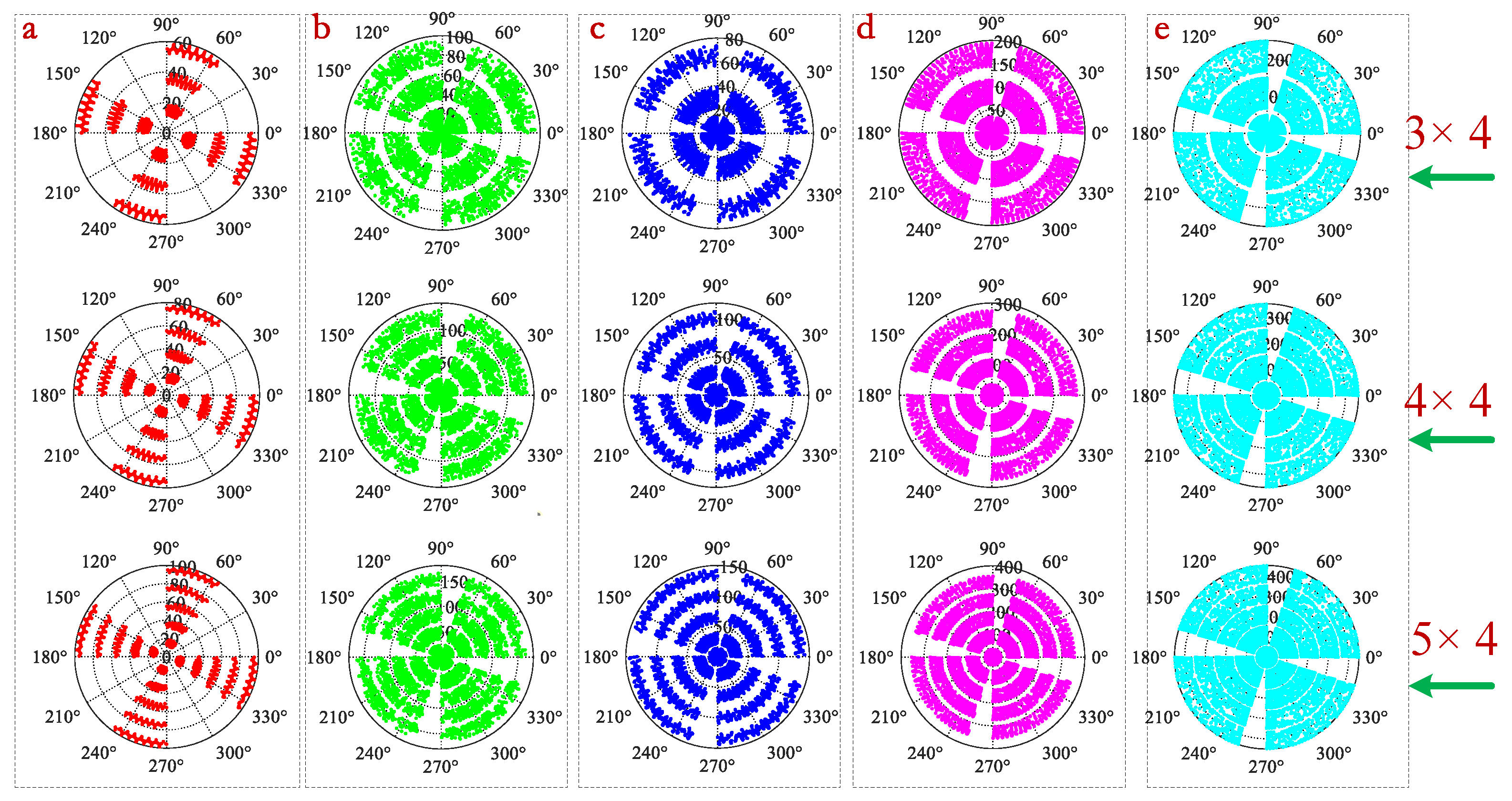
- We demonstrate how the parameters of the nonlinear components and modulo operation can be tuned to control the formation, number, and characteristics of the chaotic cavities.
- The preliminary analysis showing that the proposed maps exhibit complex chaotic behavior suitable for cryptographic applications, and evaluate the effectiveness of the cavity-based data-hiding scheme in terms of embedding capacity and security, is carried out.
2. Search for Chaos in Nonlinear Curves
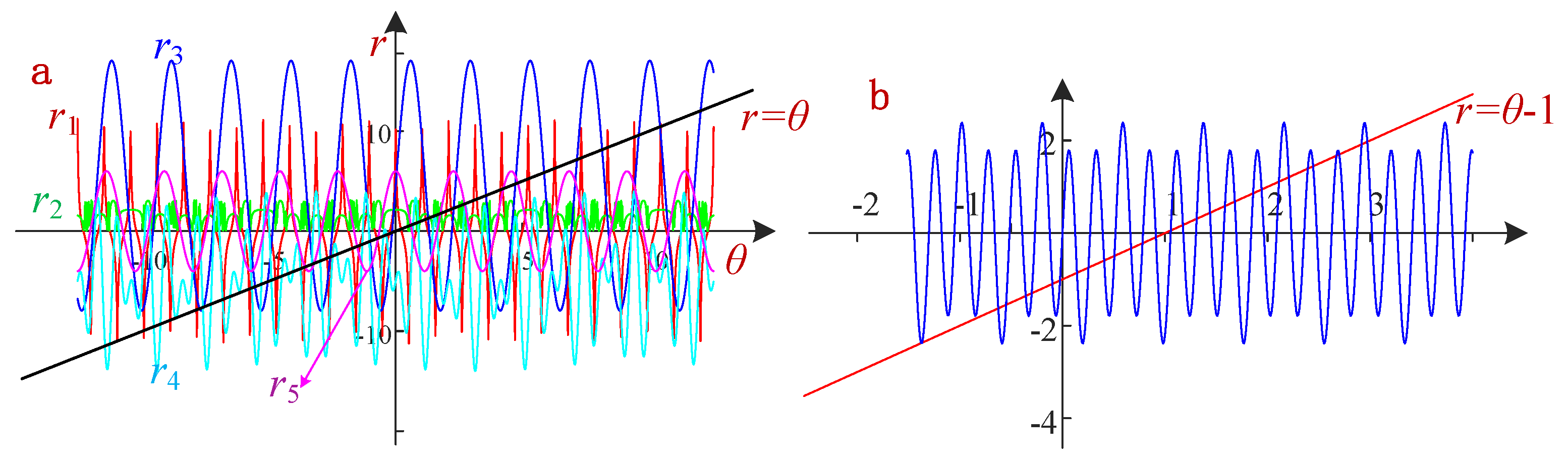
2.1. Nonlinear Curves with Elegant Shapes
2.2. Design of Chaotic Maps
3. Design Multi-Cavity Chaotic Maps in the Polar Coordinate
3.1. Design Multi-Cavity Chaotic Maps with Modulo Operation
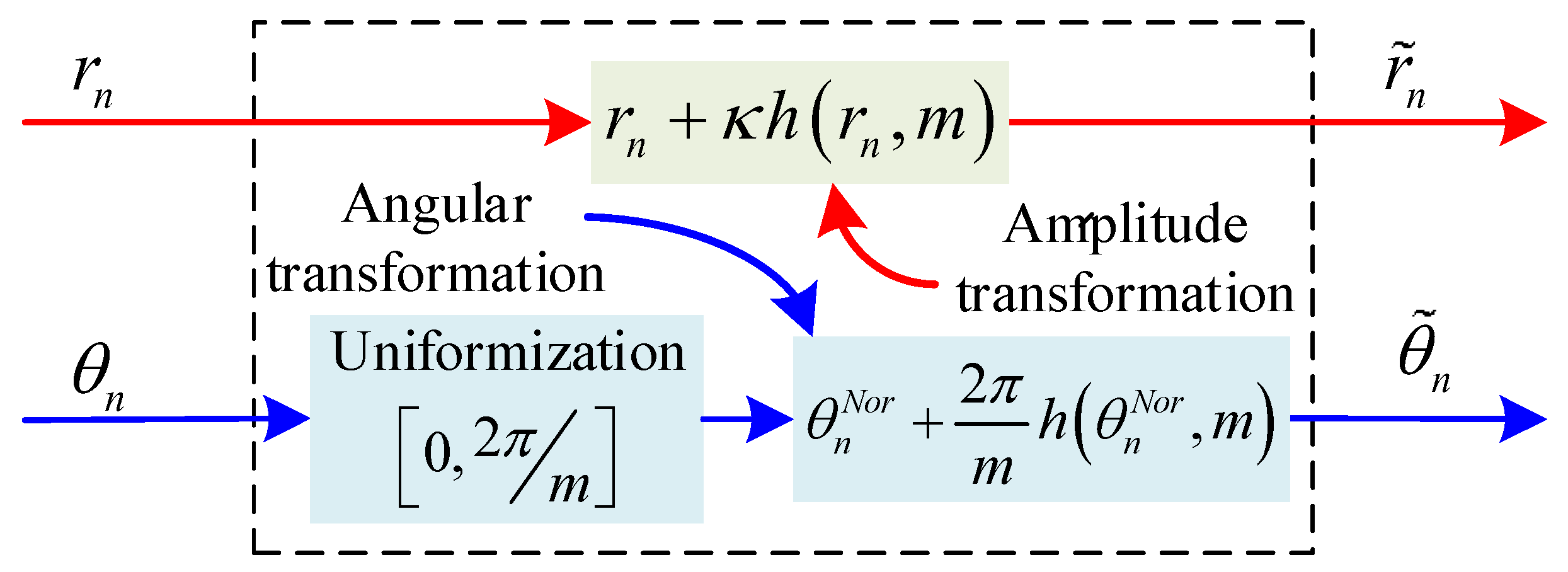
3.1.1. The Proposed Method
3.1.2. Theoretical Analysis About the Method
- Closure: The set is closed under addition and multiplication modulo m.
- Nonlinearity: The modulo operation is highly nonlinear and sensitive to small input perturbations; may produce a completely different residue if crosses a multiple of m. This property is crucial for the sensitivity of chaotic key streams.
- Nonlinear driving: The cosine term introduces nonlinearity, making the update of the angle depend on the cosine of the current phase. When , the system reduces to a uniform rotation , which corresponds to quasiperiodic motion when the rotation number is irrational.
- Frequency locking and resonance: For non-zero B, the system may enter frequency locking (Arnold tongues), i.e., the rotation number becomes rational. Fixed points satisfy , corresponding to phase synchronization; their stability is determined by the derivative .
- Route to chaos: As B increases, the system can enter chaos via period-doubling bifurcations, at which point the angular evolution becomes unpredictable, representing the typical chaotic behavior of circle maps.
3.2. Multi-Cavity Chaotic Maps and Simulations
- (1)
- The grid chaotic map 1 (GCM1):
- (2)
- The grid chaotic map 2 (GCM2):
- (3)
- The grid chaotic map 3 (GCM3):
- (4)
- The grid chaotic map 4 (GCM4):
- (5)
- The grid chaotic map 5 (GCM5):
3.3. Comparison with the Existing Method
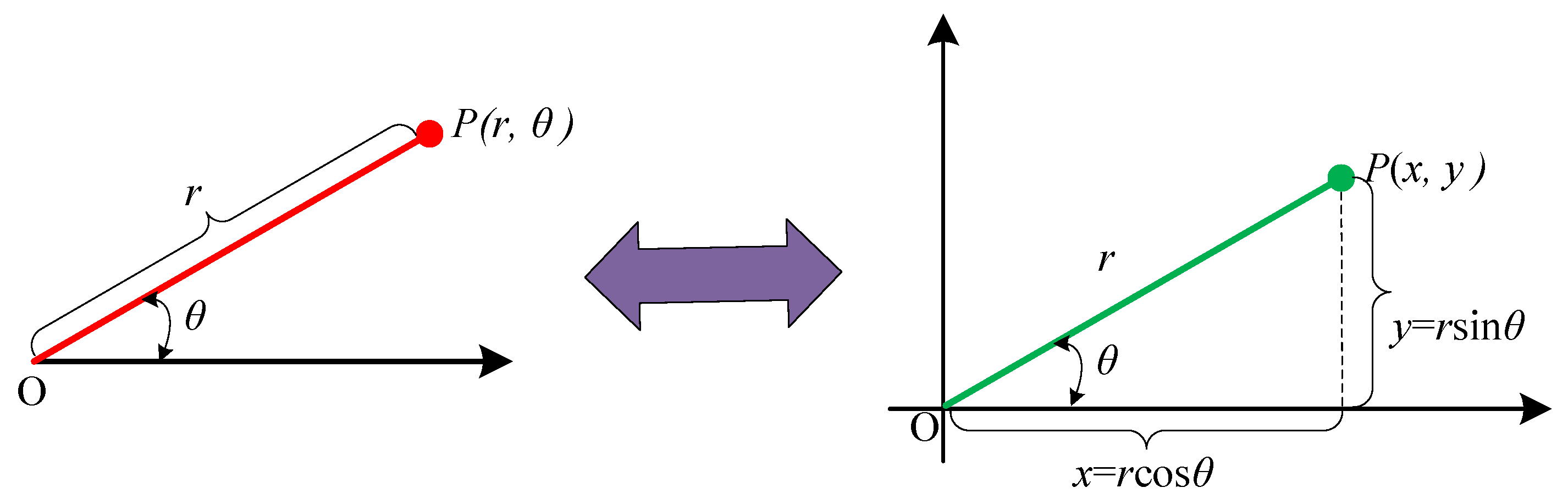
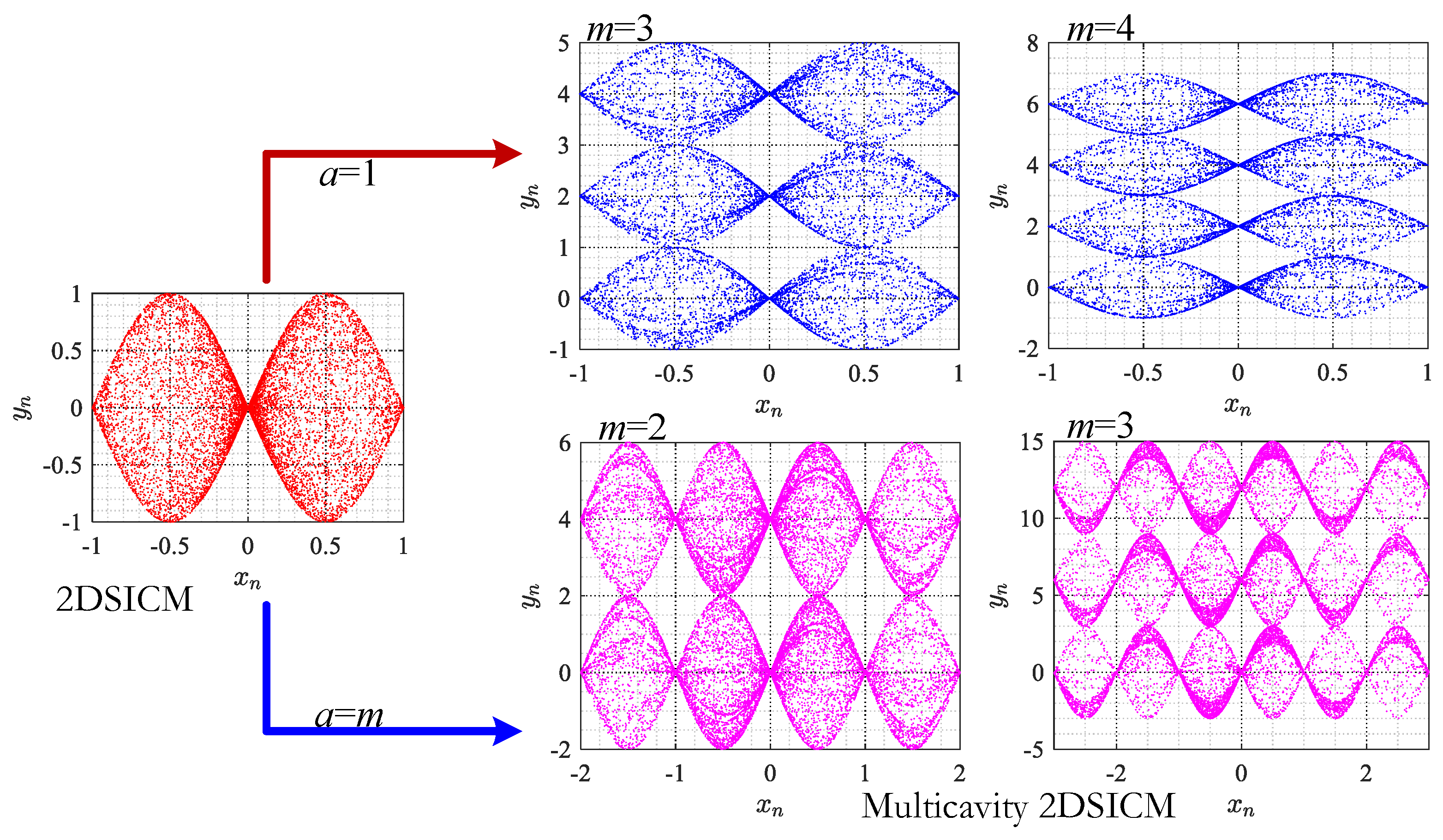
3.4. Grid Cavity in the Cartesian Coordinate System
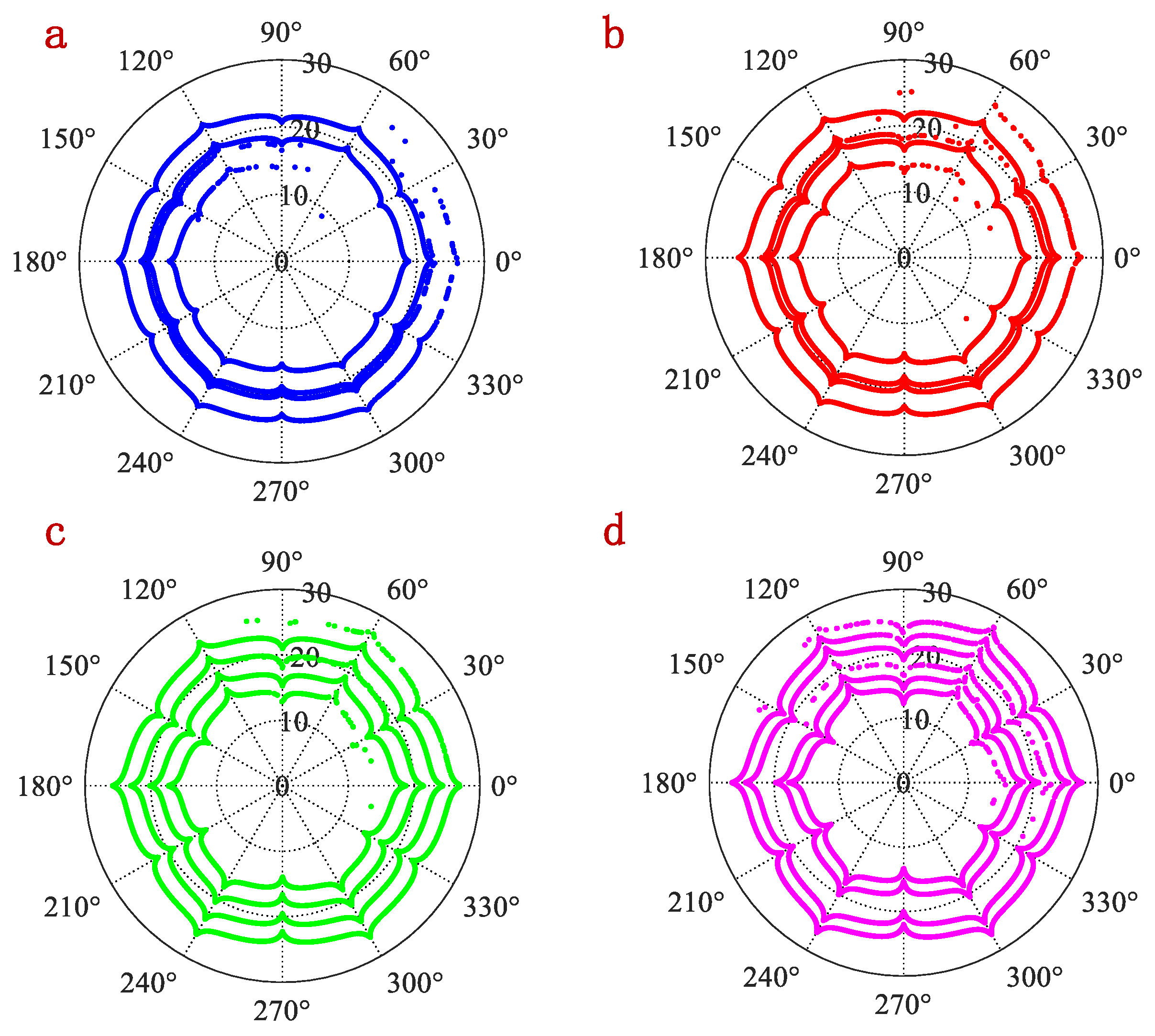
3.5. On the Effect of the Fractional-Order Difference on the Multi-Cavity
3.5.1. Multi-Cavity with G-L Fractional-Order Difference
3.5.2. Multi-Cavity with Caputo-like Fractional-Order Difference
4. Performance of the Chaotic Maps
4.1. Fix Points and Stability
- (1)
- When , the fixed point is deemed stable.
- (2)
- When , the fixed point is considered unstable.
4.2. Bifurcations and LEs
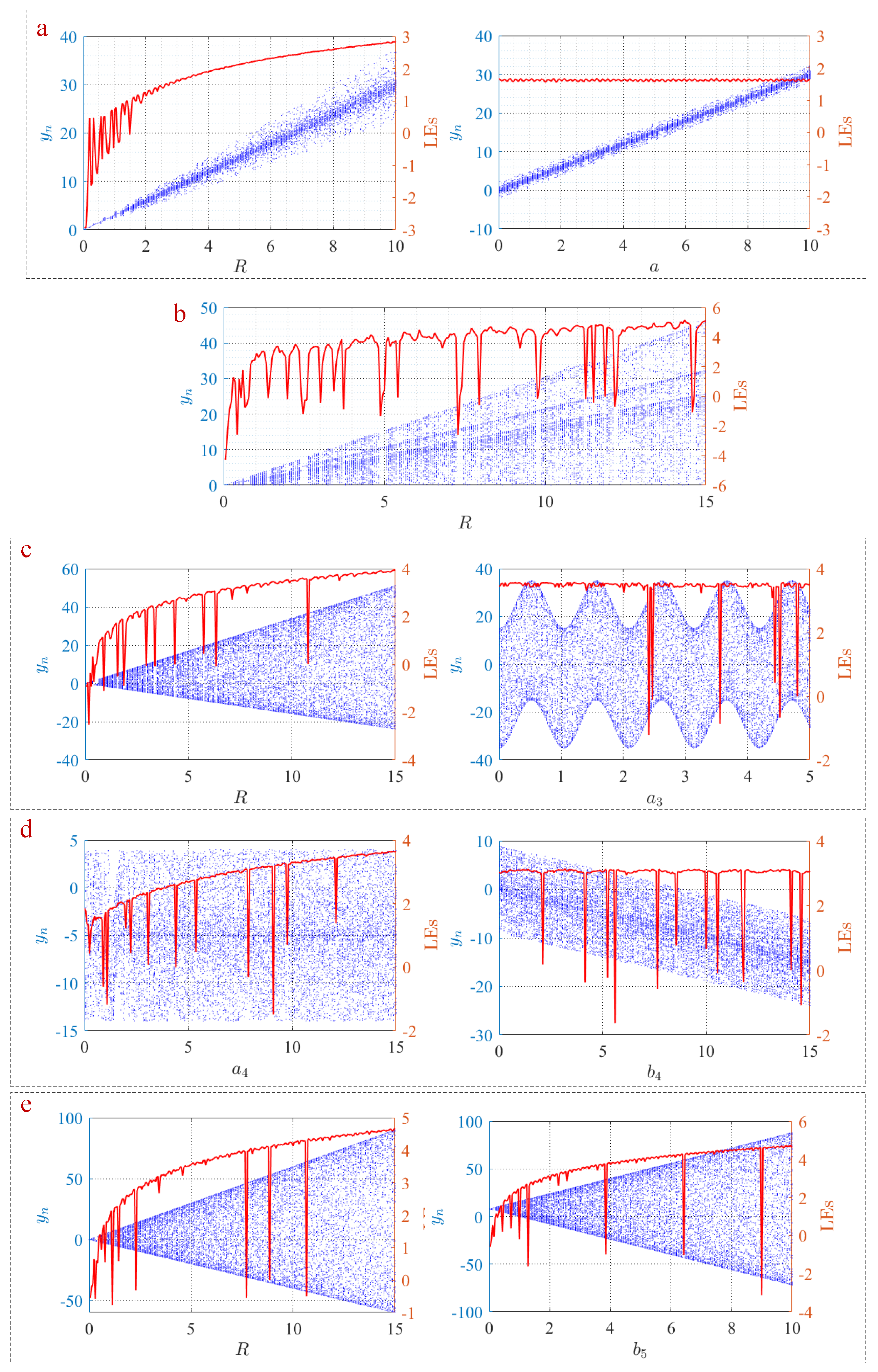
- When parameter R exists in the system, the fluctuation range of the sequence increases as R grows. Except for the initial stage where the system is in a non-chaotic state when R is small, the subsequent parts are primarily in a chaotic state, and the maximum Lyapunov exponent spectrum increases with the rise of R.
- When other parameters of the system change, the scenarios vary: the fluctuation range remains unchanged but the values increase (Figure 13a), decrease (Figure 13d), or stay the same (Figure 13d), periodic fluctuation bifurcation diagram (Figure 13c), and the fluctuation range increases (Figure 13e).
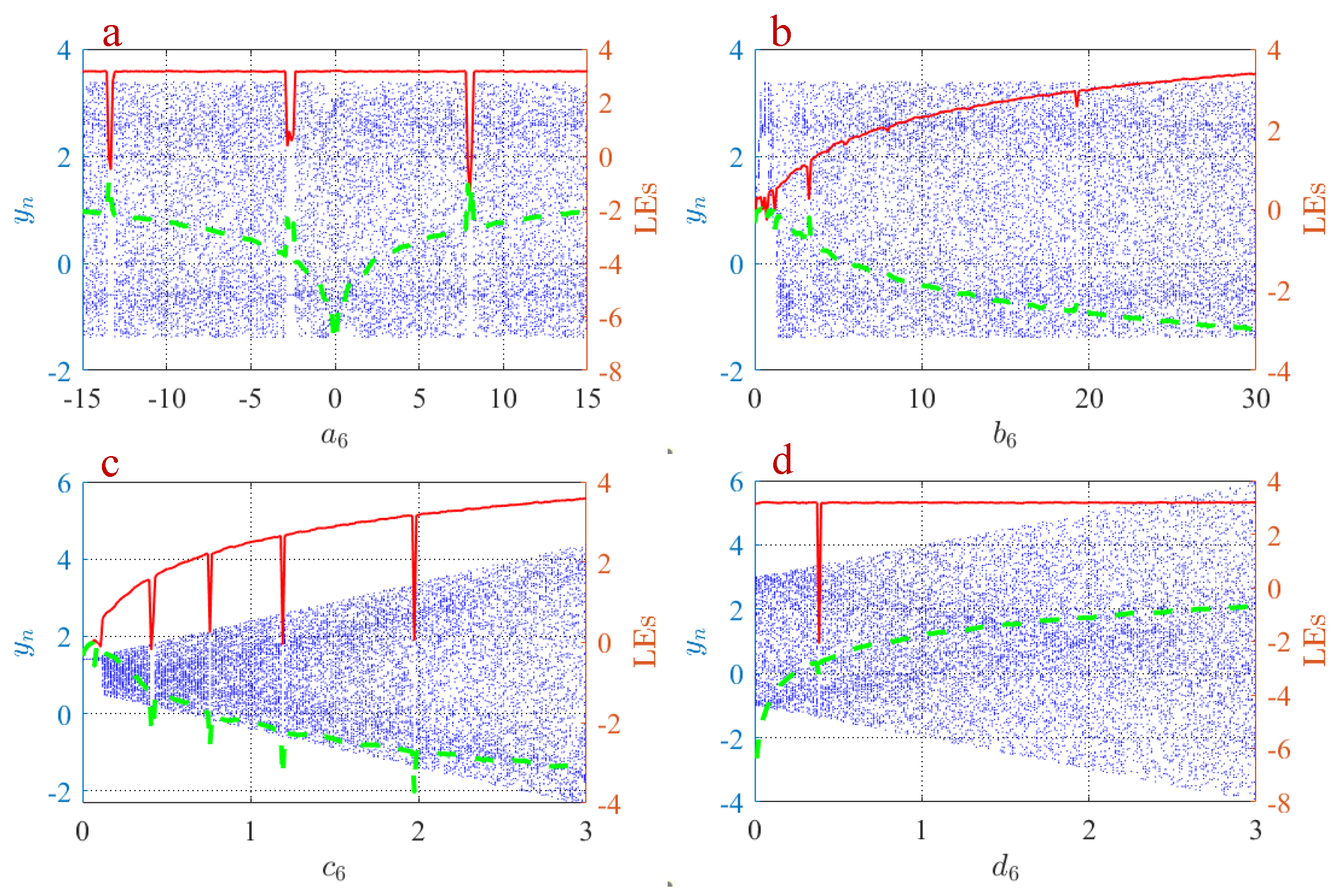
- The correspondence between the exponent spectrum and the bifurcation diagram is consistent, indicating that the designed system exhibits rich dynamic behaviors.
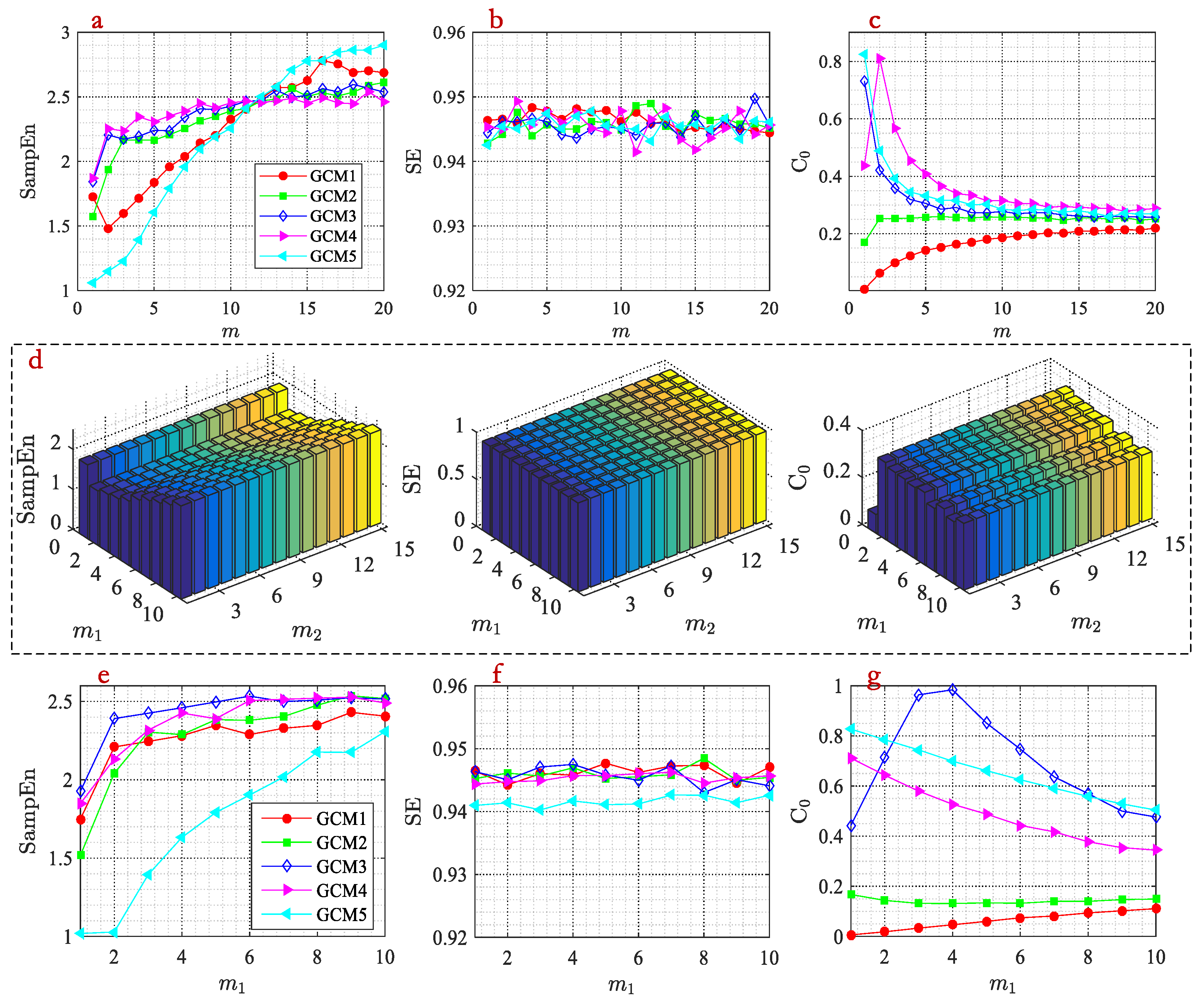
4.3. Entropy and Complexity
5. Information Hiding and Applications
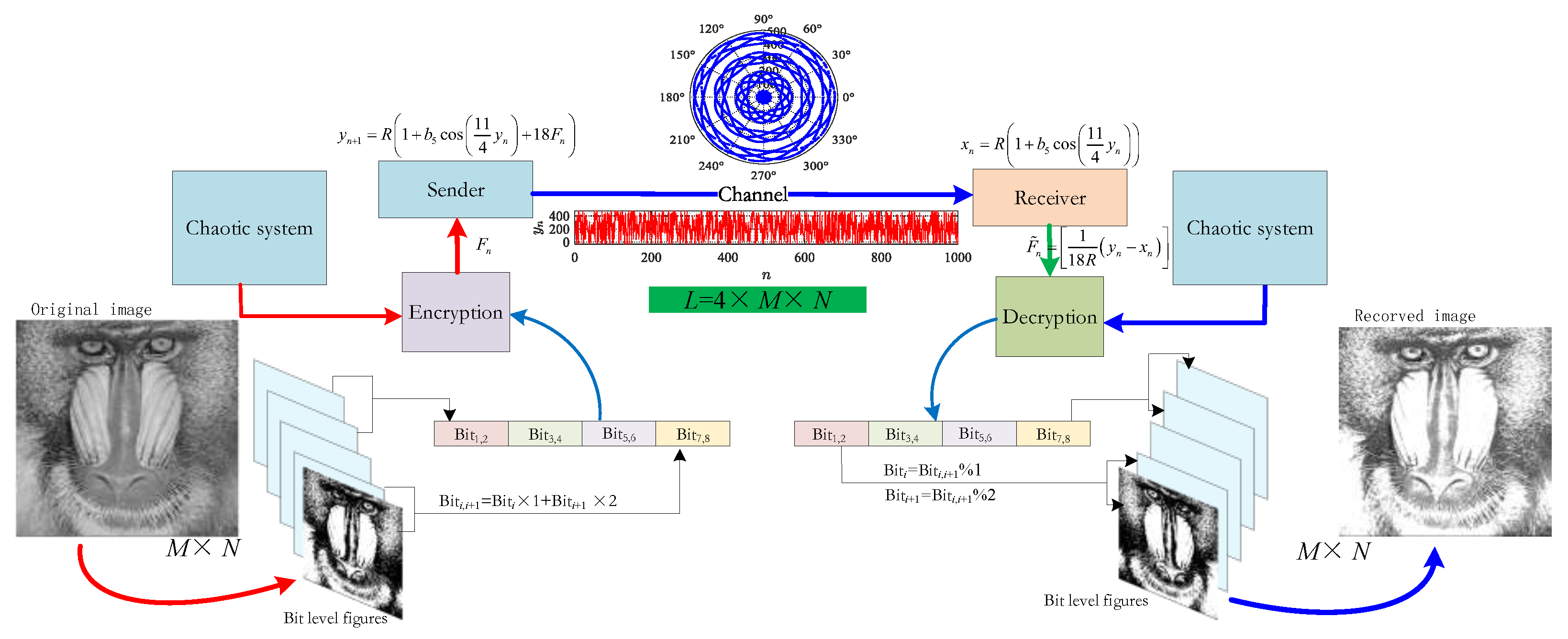
5.1. Information Hiding Algorithm
| Algorithm 1 Chaotic Communication with Quaternary Symbols |
|
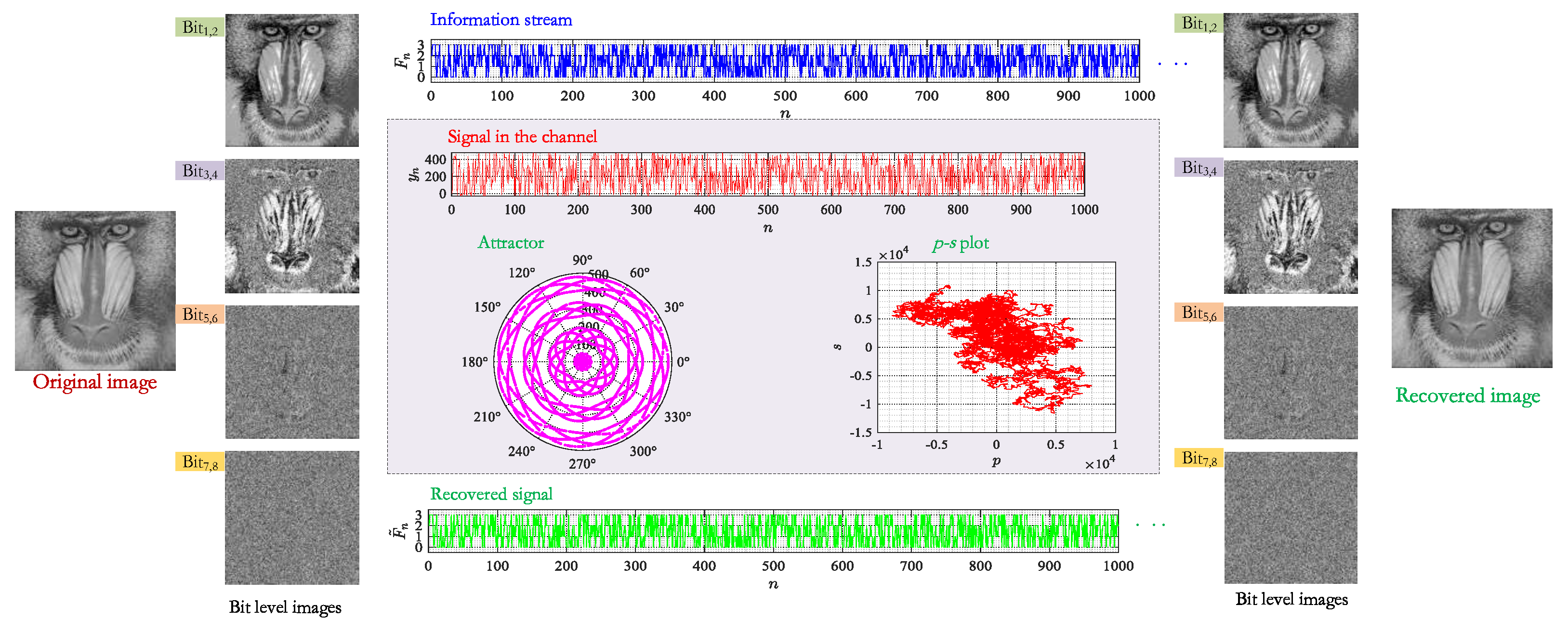
5.2. Simulations and Analysis
5.2.1. Simulations
5.2.2. Security Analysis
| Algorithm 2 Round a number to significant figures |
|
5.2.3. Influence of Fractional Difference on Data Hiding
6. Conclusions
Author Contributions
Funding
Data Availability Statement
Acknowledgments
Conflicts of Interest
References
- Li, M.; Wang, M.; Fan, H.; An, K.; Liu, G. A novel plaintext-related chaotic image encryption scheme with no additional plaintext information. Chaos Solitons Fractals 2022, 158, 111989. [Google Scholar]
- Borges, V.S.; Silva, M.T.; Eisencraft, M. Chaotic properties of an FIR filtered Hénon map. Commun. Nonlinear Sci. Numer. Simul. 2024, 131, 107845. [Google Scholar] [CrossRef]
- Li, S.; Wu, Y.; Gao, L.; Li, T.; Zhang, Q.; Shen, Y.; Yang, Z. A high throughput pseudo-random number generator driven by four-dimensional discrete hyper-chaotic system. Electron. Lett. 2023, 59, el2950. [Google Scholar] [CrossRef]
- Naik, R.B.; Singh, U. A review on applications of chaotic maps in pseudo-random number generators and encryption. Ann. Data Sci. 2024, 11, 25–50. [Google Scholar]
- Sriram, G.; Ali, A.M.A.; Natiq, H.; Ahmadi, A.; Rajagopal, K.; Jafari, S. Dynamics of a novel chaotic map. J. Comput. Appl. Math. 2024, 436, 115453. [Google Scholar]
- Zhang, L.; Li, Z.; Peng, Y. A hidden grid multi-scroll chaotic system coined with two multi-stable memristors. Chaos Solitons Fractals 2024, 185, 115109. [Google Scholar]
- Ding, P.; Geng, P.; Hu, W. A new controllable multi-wing chaotic system: Applications in high-security color image encryption. J. Supercomput. 2025, 81, 108. [Google Scholar] [CrossRef]
- Bao, H.; Xi, M.; Wang, N.; Xu, Q.; Bao, B. Designing multi-cavity chaotic maps via multistage step state extension. Nonlinear Dyn. 2024, 112, 12521–12535. [Google Scholar] [CrossRef]
- Ye, X.; Wang, X.; Gao, S.; Mou, J.; Wang, Z. A new random diffusion algorithm based on the multi-scroll Chua’s chaotic circuit system. Opt. Lasers Eng. 2020, 127, 105905. [Google Scholar]
- Wang, N.; Li, C.; Bao, H.; Chen, M.; Bao, B. Generating multi-scroll Chua’s attractors via simplified piecewise-linear Chua’s diode. IEEE Trans. Circuits Syst. I Regul. Pap. 2019, 66, 4767–4779. [Google Scholar]
- Li, F.; Zeng, J. Multi-scroll attractor and multi-stable dynamics of a three-dimensional jerk system. Energies 2023, 16, 2494. [Google Scholar] [CrossRef]
- Lu, R.; Chen, Z.; Lu, L.; Bao, B. Designing multi-double-scroll jerk chaotic oscillators based on attractor modulators. Chaos Solitons Fractals 2024, 187, 115362. [Google Scholar] [CrossRef]
- Yu, S.; Lu, J.; Leung, H.; Chen, G. Design and implementation of n-scroll chaotic attractors from a general jerk circuit. IEEE Trans. Circuits Syst. I Regul. Pap. 2005, 52, 1459–1476. [Google Scholar]
- Tang, Z.L.; Yu, S.M. Multi-scroll chaotic system based on even-symmetric step-wave sequence control. Appl. Mech. Mater. 2013, 340, 760–766. [Google Scholar]
- Xiao, Y.; Sun, K.; He, S. Constructing chaotic map with multi-cavity. Eur. Phys. J. Plus 2020, 135, 21. [Google Scholar] [CrossRef]
- Zhu, W.; Sun, K.; He, S.; Wang, H.; Liu, W. A class of m-dimension grid multi-cavity hyperchaotic maps and its application. Chaos Solitons Fractals 2023, 170, 113370. [Google Scholar] [CrossRef]
- Zhao, Q.; Bao, H.; Zhang, X.; Wu, H.; Bao, B. Complexity enhancement and grid basin of attraction in a locally active memristor-based multi-cavity map. Chaos Solitons Fractals 2024, 182, 114769. [Google Scholar]
- Sun, H.; Liu, L.; Guo, A. Iteration Logistic Map Dynamics in the Polar Coordinates. Fractals 1998, 6, 11–22. [Google Scholar] [CrossRef]
- Li, Y.X.; Wang, J.S.; Zhang, S.W.; Zhang, S.H.; Guan, X.Y.; Ma, X.R. Arithmetic optimization algorithm with cosine composite chaotic mapping in polar coordinate system for economic load dispatching problems in power systems. Appl. Soft Comput. 2025, 175, 113039. [Google Scholar] [CrossRef]
- Jain, K.; Aji, A.; Krishnan, P. Medical image encryption scheme using multiple chaotic maps. Pattern Recognit. Lett. 2021, 152, 356–364. [Google Scholar] [CrossRef]
- Benkouider, K.; Sambas, A.; Bonny, T.; Al Nassan, W.; Moghrabi, I.A.; Sulaiman, I.M.; Hassan, B.A.; Mamat, M. A comprehensive study of the novel 4D hyperchaotic system with self-exited multistability and application in the voice encryption. Sci. Rep. 2024, 14, 12993. [Google Scholar] [CrossRef]
- Dong, Y.; Yan, R.; Yin, C. An adaptive robust watermarking scheme based on chaotic mapping. Sci. Rep. 2024, 14, 24735. [Google Scholar] [CrossRef] [PubMed]
- Yang, Y.; Chang, R.; Feng, X.; Li, P.; Chen, Y.; Zhang, H. An n-dimensional chaotic map with application in reversible data hiding for medical images. Entropy 2024, 26, 254. [Google Scholar] [CrossRef] [PubMed]
- Zang, H.; Fu, H.; Huang, L.; Lei, T.; He, S. Design chaotic maps with elegance of mathematical equations and strengthened by the discrete memristor. Chaos 2025, 35, 063114. [Google Scholar] [CrossRef]
- Liu, W.; Sun, K.; Wang, H.; Li, B. The modular modulation chaotification map and its hardware implementation. IEEE Trans. Instrum. Meas. 2024, 73, 2002109. [Google Scholar] [CrossRef]
- Hua, Z.; Zhu, Z.; Yi, S.; Zhang, Z.; Huang, H. Cross-plane colour image encryption using a two-dimensional logistic tent modular map. Inf. Sci. 2021, 546, 1063–1083. [Google Scholar] [CrossRef]
- Moulin, P.; O’Sullivan, J.A. Information-theoretic analysis of information hiding. IEEE Trans. Inf. Theory 2003, 49, 563–593. [Google Scholar] [CrossRef]
- Amin, M.M.; Salleh, M.; Ibrahim, S.; Katmin, M.R.; Shamsuddin, M. Information hiding using steganography. In Proceedings of the 4th National Conference of Telecommunication Technology, 2003. NCTT 2003 Proceedings; IEEE: Piscataway, NJ, USA, 2003; pp. 21–25. [Google Scholar]
- Öztürk, İ.; Kılıç, R. Digitally generating true orbits of binary shift chaotic maps and their conjugates. Commun. Nonlinear Sci. Numer. Simul. 2018, 62, 395–408. [Google Scholar] [CrossRef]
- Farschi, S.M.R.; Farschi, H. A novel chaotic approach for information hiding in image. Nonlinear Dyn. 2012, 69, 1525–1539. [Google Scholar] [CrossRef]
- Nasr, M.A.; El-Shafai, W.; Abdel-Salam, N.; El-Rabaie, E.S.M.; El-Fishawy, A.S.; El-Samie, F.E.A. Efficient information hiding in medical optical images based on piecewise linear chaotic maps. J. Opt. 2023, 52, 1852–1866. [Google Scholar] [CrossRef]
- Guang, Y.; Ding, Q. Dynamics analysis of a novel parametrically controllable symmetric multi-scroll chaotic system and FPGA design of an image encryption system. Chaos Solitons Fractals 2024, 188, 115572. [Google Scholar] [CrossRef]
- Anitha, R.; Vijayalakshmi, B. Image Encryption Using Multi-Scroll Attractor and Chaotic Logistic Map. Comput. Mater. Contin. 2022, 72, 3447. [Google Scholar] [CrossRef]
- He, S.; Banerjee, S. Multicavity formations and complexity modulation in a hyperchaotic discrete system. Phys. A 2018, 490, 366–377. [Google Scholar] [CrossRef]
- Huang, L.; Wang, L.; Shi, D. Discrete fractional order chaotic systems synchronization based on the variable structure control with a new discrete reaching-law. IEEE/CAA J. Autom. Sin. 2016, 1–7. [Google Scholar] [CrossRef]
- Abdeljawad, T.; Baleanu, D. Fractional Differences and Integration by Parts. J. Comput. Anal. Appl. 2011, 13, 574–582. [Google Scholar]
- Sandri, M. Numerical calculation of Lyapunov exponents. Math. J. 1996, 6, 78–84. [Google Scholar]
- Chen, W.; Zhuang, J.; Yu, W.; Wang, Z. Measuring complexity using fuzzyen, apen, and sampen. Med. Eng. Phys. 2009, 31, 61–68. [Google Scholar] [CrossRef]
- Zaccarelli, N.; Li, B.L.; Petrosillo, I.; Zurlini, G. Order and disorder in ecological time-series: Introducing normalized spectral entropy. Ecol. Indic. 2013, 28, 22–30. [Google Scholar] [CrossRef]
- Cai, Z.; Sun, J. Convergence of C0 complexity. Int. J. Bifurc. Chaos 2009, 19, 977–992. [Google Scholar] [CrossRef]
- Gottwald, G.A.; Melbourne, I. The 0-1 test for chaos: A review. In Chaos Detection and Predictability; Springer: Berlin/Heidelberg, Germany, 2016; pp. 221–247. [Google Scholar]









| Systems | Parameters | LEs |
|---|---|---|
| CM1, Equation (7) | , | 2.1353 |
| CM2, Equation (8) | 4.0154 | |
| CM3, Equation (9) | , | 3.0317 |
| CM4, Equation (10) | , | 3.5034 |
| CM5, Equation (11) | , | 3.6847 |
| CM6, Equation (12) | , , , | 3.1762, |
| Value | Figure |  |  |  |  |  |
|---|---|---|---|---|---|---|
| Index | ||||||
| PSNR | Inf | Inf | 77.4875 | 67.7891 | 75.0899 | |
| 41.9521 | 41.0233 | 40.3938 | 41.3099 | 38.4911 | ||
| SSIM | 1.000 | 1.000 | ||||
| 0.9870 | 0.9951 | 0.9855 | 0.9846 | 0.9676 | ||
Disclaimer/Publisher’s Note: The statements, opinions and data contained in all publications are solely those of the individual author(s) and contributor(s) and not of MDPI and/or the editor(s). MDPI and/or the editor(s) disclaim responsibility for any injury to people or property resulting from any ideas, methods, instructions or products referred to in the content. |
© 2026 by the authors. Licensee MDPI, Basel, Switzerland. This article is an open access article distributed under the terms and conditions of the Creative Commons Attribution (CC BY) license.
Share and Cite
Yan, B.; Banerjee, S.; He, S. Design of Multi-Cavity Chaotic Maps in the Polar Coordinate Using Nonlinear Curves and Modulo Operation with Application to Cavity-Based Data Hiding. Fractal Fract. 2026, 10, 351. https://doi.org/10.3390/fractalfract10060351
Yan B, Banerjee S, He S. Design of Multi-Cavity Chaotic Maps in the Polar Coordinate Using Nonlinear Curves and Modulo Operation with Application to Cavity-Based Data Hiding. Fractal and Fractional. 2026; 10(6):351. https://doi.org/10.3390/fractalfract10060351
Chicago/Turabian StyleYan, Bo, Santo Banerjee, and Shaobo He. 2026. "Design of Multi-Cavity Chaotic Maps in the Polar Coordinate Using Nonlinear Curves and Modulo Operation with Application to Cavity-Based Data Hiding" Fractal and Fractional 10, no. 6: 351. https://doi.org/10.3390/fractalfract10060351
APA StyleYan, B., Banerjee, S., & He, S. (2026). Design of Multi-Cavity Chaotic Maps in the Polar Coordinate Using Nonlinear Curves and Modulo Operation with Application to Cavity-Based Data Hiding. Fractal and Fractional, 10(6), 351. https://doi.org/10.3390/fractalfract10060351