Article

A Fractional-Order Model for Chikungunya Virus Transmission with Optimal Control and Artificial Neural Network Validation


by
Zakirullah
1,*,
Chen Lu
1,
Nouf Abdulrahman Alqahtani
2 and
Mohammadi Begum Jeelani
2,*
1
School of Mathematical Sciences, University of Electronic Science and Technology of China, Chengdu 611731, China
2
Department of Mathematics and Statistics, College of Science, Imam Mohammad Ibn Saud Islamic University (IMSIU), Riyadh 11564, Saudi Arabia
*
Authors to whom correspondence should be addressed.
Fractal Fract. 2026, 10(5), 346; https://doi.org/10.3390/fractalfract10050346
Submission received: 30 March 2026 / Revised: 15 May 2026 / Accepted: 16 May 2026 / Published: 20 May 2026
(This article belongs to the Special Issue Fractional Order Modelling of Dynamical Systems)

Abstract

In this study, a fractional-order epidemic compartmental model is formulated using the Caputo derivative to account for the memory effects of the chikungunya virus. Based on Banach contractions, fixed-point theorems are used to prove existence and uniqueness, and fundamental properties such as positivity and boundedness are established. Normalized forward sensitivity indices are employed to evaluate the relative impact of model parameters on the transmission dynamics and control of the disease. To reduce the spreading of infection, an optimal control problem is formulated by introducing time-dependent control measures with four control strategies that include public health prevention, treatment enhancement, and vector-control measures. Necessary conditions for optimality are derived using Pontryagin’s Maximum Principle. The predictor–corrector Adams–Bashforth–Moulton scheme is applied across different fractional orders and effectively reduces infection levels. The influence of the fractional order ξ on the epidemic dynamics is investigated, showing that lower values of ξ slow disease progression through a memory effect inherent in the Caputo operator. Moreover, an artificial neural network (ANN) trained via the Levenberg–Marquardt algorithm independently validates the numerical solutions.

1. Introduction

Chikungunya virus (CHIKV) is an alpha virus that spreads primarily through the bites of infected Aedes mosquitoes, especially Aedes aegypti and Aedes albopictus, and is found across Asia, Africa, Europe, and the Americas, affecting more than 110 countries [1,2,3]. The symptoms are similar to those of dengue fever during the acute phase, including rash and fever, which may progress to a potentially fatal hemorrhagic fever in a small proportion of cases; many recover within weeks, but some develop joint pain that can last months or even years [4,5]. The viral population is structured into three principal genetic lineages: West African, East–Central–South African, and Asian, with the East–Central–South African lineage further giving rise to the Indian Ocean lineage [6,7]. In addition to CHIKV, other emerging and re-emerging mosquito-transmitted pathogens, including Zika and dengue, continue to represent significant public health threats to global public health. The World Health Organization encourages the development of a coordinated, integrated vector management framework as a comprehensive approach to reducing mosquito-borne disease transmission [1,8]. This strategy focuses on coordinated actions across the health, environmental, and community sectors, integrating environmental management, biological control, and targeted chemical interventions [9]. Despite its effectiveness, integrated vector management remains limited in many regions due to constraints on infrastructure, financial resources, and trained personnel. Furthermore, globalization, a result of increased international travel and trade, enhances the speed at which infectious diseases spread [10]. Enhanced movement of people facilitates the spread of pathogens across continents, contributing to the widening distribution of CHIKV and related mosquito-transmitted pathogens [11]. China has recently faced growing concern about chikungunya due to rising international travel and expanding habitats of Aedes mosquitoes. Since 2010, China has reported a large chikungunya outbreak in Foshan City, Guangdong Province, affecting more than six thousand people [12].
Mathematical models have played an important role in studying infectious disease epidemics, particularly by characterizing host–vector interactions and assessing the effectiveness of intervention measures [13,14]. While classical integer-order frameworks describe transmission rates solely in terms of the current system state [15], they fail to capture the memory and hereditary properties inherent in biological processes. The Caputo fractional-order derivative overcomes this limitation by encoding the full history of the system into the present dynamics through a convolution kernel, thereby providing a more realistic and biologically consistent representation of disease progression [16,17]. In particular, the Caputo operator is preferred over other fractional definitions because it admits physically meaningful initial conditions of integer order, making it directly applicable to epidemiological initial-value problems [18]. These properties have established fractional calculus as a powerful framework for modeling real-world phenomena exhibiting long-term dependence and nonlocal interactions [19].
Building on this fractional-order foundation, optimal control theory provides a rigorous mathematical framework for designing intervention strategies that balance disease reduction against resource constraints. Depending on the model structure, both constrained and unconstrained optimal control problems can be formulated, and analytical as well as numerical methods are used to derive optimality conditions [20]. The incorporation of terminal cost terms further enhances the flexibility and performance of these optimization frameworks [21,22]. To validate the resulting fractional-order controlled system, artificial neural networks (ANNs) offer a flexible computational approach for approximating the nonlinear operators arising in such models, enabling accurate representation of complex, memory-dependent transmission dynamics. The backpropagation framework established by Rumelhart et al. [23] and the universal approximation theorem of Hornik et al. [24] together guarantee that feedforward networks can approximate any continuous function on a compact domain. These theoretical foundations, combined with their practical adaptability [25,26], make ANN-based methods well suited for reproducing solutions of the fractional-order differential equations.
Recent developments in fractional-order neural networks have advanced the analysis of complex dynamical systems with memory and nonlocal effects. Huang et al. [27] explored chaos and hyperchaos in fractional cellular neural networks, while Pu et al. [28] introduced fractional Hopfield models with improved convergence and robustness. Zhang et al. [29] presented a comprehensive survey establishing theoretical and application frameworks for these networks. Sabir et al. [30] developed an efficient fractional Meyer neuro-swarm solver for nonlinear Lane–Emden systems, demonstrating strong computational performance. Nisar et al. [31] further applied intelligent neuro-computing to fractional epidemic models, highlighting the practical importance of these approaches in capturing nonlinear and memory-dependent dynamics.
Most existing fractional neural network studies primarily focus on synchronization, chaos control, convergence analysis, and computational performance in abstract neural dynamical systems. In comparison with recent ANN-based epidemic modeling approaches [32,33,34,35], these studies use neural networks for prediction of epidemic models. However, limited attention has been given to biologically interpretable host–vector epidemic models incorporating fractional memory effects, optimal control strategies, and ANN-based validation within a unified framework. In addition, limited attention has been given to combining invariant-region analysis and Mittag–Leffler boundedness estimates. The present work addresses these gaps by integrating fractional epidemic modeling, optimal control analysis, numerical approximation, and ANN validation into a single computational framework for chikungunya transmission dynamics. Motivated by these gaps, we propose a new host–vector model for chikungunya virus incorporating memory-driven transmission through Caputo fractional derivatives together with three time-dependent control strategies, namely, public health prevention, treatment intervention, and vector-control measures. Numerical solutions were obtained using the predictor–corrector Adams–Bashforth–Moulton scheme, which provides a reliable and accurate discretization of the Caputo fractional system. The ANN trained via the Levenberg–Marquardt algorithm independently validated these solutions, achieving a final MSE = 1.26 × 10 11 and regression coefficient R = 1 across all eight state variables, confirming the accuracy of the numerical scheme.
The study is organized as follows. Section 2 presents the fundamental concepts related to fractional derivatives. The proposed chikungunya model is presented in Section 3. Existence, uniqueness, positivity, and boundedness are established in Section 4. In Section 5, we derive the equilibria and threshold reproduction ( R 0 ) , followed by sensitivity analysis in Section 6. Section 7 details the design of the optimal control problem and the numerical scheme for the model. Section 8 presents the artificial neural network analysis of the model and analyzes the numerical results, followed by conclusions in Section 9.

2. Fractional Calculus Definitions

Fundamental definitions and characteristics of fractional derivatives are summarized [36,37].
Definition 1. 
Consider a real-valued function g : ( 0 , ) R . The Riemann–Liouville Fractional Integral of order ξ > 0 takes the form
I t ξ 0 RL g ( t ) = 1 Γ ( ξ ) 0 t ( t ψ ) ξ 1 g ( ψ )   d ψ .
Definition 2. 
Consider a function g : ( 0 , ) R . Its Caputo fractional derivative of order ξ > 0 is defined as
D t ξ 0 C g ( t ) = 1 Γ ( m ξ ) 0 t g ( m ) ( ψ ) ( t ψ ) ξ m + 1   d ψ , 0 m 1 < ξ < m , d d t m g ( t ) , ξ = m ,   m N .
Definition 3. 
The function E m , n ( z ) , known as the two-parameter Mittag–Leffler function, is given by
E m , n ( z ) = k = 0 z k Γ ( m k + n ) ,   m , n > 0 .
Its Laplace transform is given by
L t n 1 E m , n ( ± a t m ) = s m n s m a .

3. Development of a Deterministic Chikungunya Model in the Caputo Framework

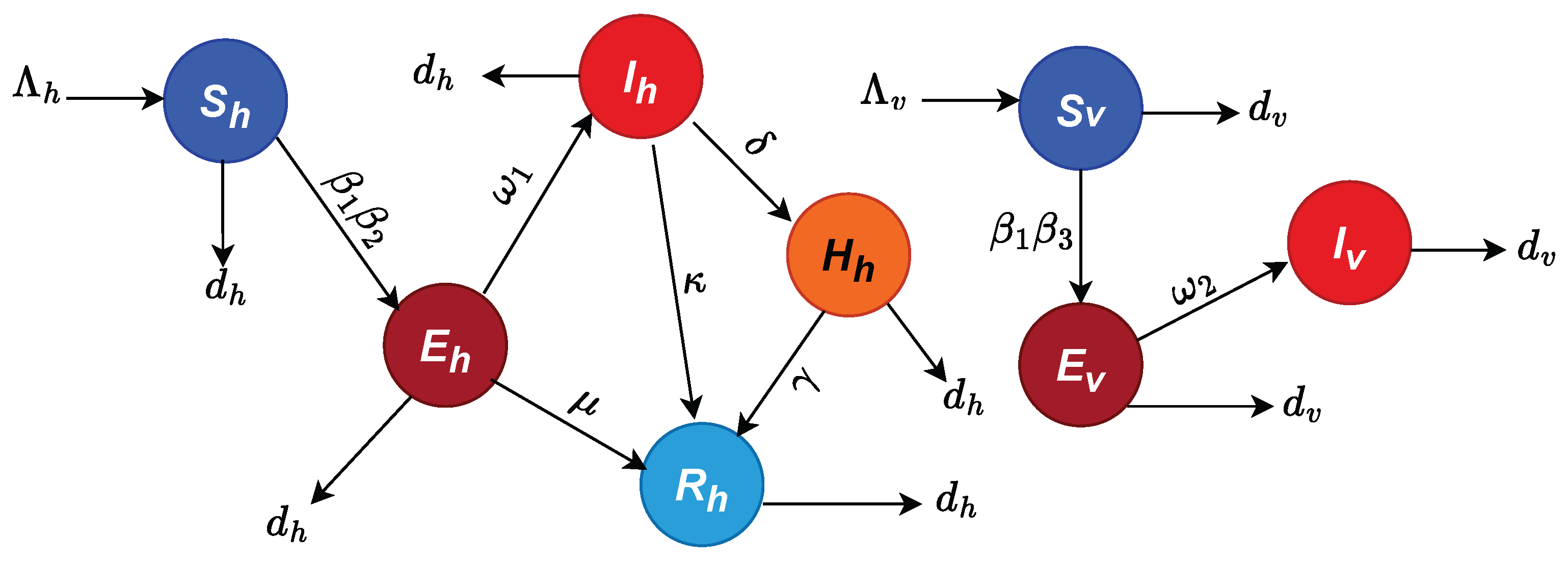
Here, we present a nonlinear deterministic compartmental model for chikungunya transmission that couples the human N h and mosquito N v populations. The human population N h is divided into susceptible ( S h ), exposed ( E h ), infectious ( I h ), hospitalized ( H h ), and recovered ( R h ) classes. Recruitment increases at a constant rate Λ h , while the mosquito population N v grows at rate Λ v . Natural mortality in humans and mosquitoes is represented by d h and d v , respectively. Human–mosquito transmission is determined by three parameters: β 1 is the mosquito biting rate on humans, β 2 is the per-bite probability of virus transmission from an infectious mosquito to a susceptible human, and β 3 is the probability that a susceptible mosquito becomes infected after feeding on an infectious human. Together, these parameters define the force of infection connecting the two hosts.
Individuals move from the exposed class to the infectious class at a rate ω 1 , which corresponds to an intrinsic incubation period of roughly 3–7 days. A fraction μ of exposed individuals clear the infection before becoming infectious, representing an early immune response. The recovery of infectious individuals occurs naturally at a rate κ or progresses to severe disease requiring hospitalization at a rate δ . Hospitalized individuals recover at a rate γ .
The mosquito population N v is classified into susceptible ( S v ), exposed ( E v ), and infectious ( I v ) groups. The susceptible mosquitoes are infected and become exposed upon feeding on infectious humans. Exposed mosquitoes become infectious at a rate ω 2 , corresponding to an extrinsic incubation period ranging from 8 to 12 days. Infectious mosquitoes maintain infectivity until they die at a rate d v .
Considering the assumptions detailed above and the illustrated flow in Figure 1, we formulate the chikungunya transmission model using Caputo fractional derivatives of order ξ as follows:
D t ξ C S h = Λ h ( β 1 β 2 I v + d h ) S h , D t ξ C E h = β 1 β 2 I v S h ( ω 1 + μ + d h ) E h , D t ξ C I h = ω 1 E h ( κ + δ + d h ) I h , D t ξ C H h = δ I h ( γ + d h ) H h , D t ξ C R h = μ E h + κ I h + γ H h d h R h , D t ξ C S v = Λ v ( β 1 β 3 I h + d v ) S v , D t ξ C E v = β 1 β 3 I h S v ( d v + ω 2 ) E v , D t ξ C I v = ω 2 E v d v I v .
The model is considered with non-negative initial conditions:
S h ( 0 ) , E h ( 0 ) , I h ( 0 ) , H h ( 0 ) , R h ( 0 ) , S v ( 0 ) , E v ( 0 ) , I v ( 0 ) 0 .

4. Well-Posedness

This section establishes the model’s well-posedness: existence, uniqueness, and boundedness.

Existence and Uniqueness

The solution of model (1) is unique and exists by fixed-point theory and the Picard approach, with the system given by
F 1 ( t , S h ) = Λ h ( β 1 β 2 I v + d h ) S h , F 2 ( t , E h ) = β 1 β 2 I v S h ( ω 1 + μ + d h ) E h , F 3 ( t , I h ) = ω 1 E h ( κ + δ + d h ) I h , F 4 ( t , H h ) = δ I h ( γ + d h ) H h , F 5 ( t , R h ) = μ E h + κ I h + γ H h d h R h , F 6 ( t , S v ) = Λ v ( β 1 β 3 I h + d v ) S v , F 7 ( t , E v ) = β 1 β 3 I h S v ( d v + ω 2 ) E v , F 8 ( t , I v ) = ω 2 E v d v I v .
System (3) under fractional integration becomes
S h ( t ) = S h ( 0 ) + 1 Γ ( α ) 0 t ( t ) α 1 F 1 ( , S h ( ) )   d , E h ( t ) = E h ( 0 ) + 1 Γ ( α ) 0 t ( t ) α 1 F 2 ( , E h ( ) )   d , I h ( t ) = I h ( 0 ) + 1 Γ ( α ) 0 t ( t ) α 1 F 3 ( , I h ( ) )   d , H h ( t ) = H h ( 0 ) + 1 Γ ( α ) 0 t ( t ) α 1 F 4 ( , H h ( ) )   d , R h ( t ) = R h ( 0 ) + 1 Γ ( α ) 0 t ( t ) α 1 F 5 ( , R h ( ) )   d , S v ( t ) = S v ( 0 ) + 1 Γ ( α ) 0 t ( t ) α 1 F 6 ( , S v ( ) )   d , E v ( t ) = E v ( 0 ) + 1 Γ ( α ) 0 t ( t ) α 1 F 7 ( , E v ( ) )   d , I v ( t ) = I v ( 0 ) + 1 Γ ( α ) 0 t ( t ) α 1 F 8 ( , I v ( ) )   d .
The Picard iterative scheme for the system results in
S h ( n + 1 ) ( t ) = 1 Γ ( α ) 0 t ( t ) α 1 F 1 ( , S h ( n ) ( ) )   d , E h ( n + 1 ) ( t ) = 1 Γ ( α ) 0 t ( t ) α 1 F 2 ( , E h ( n ) ( ) )   d , I h ( n + 1 ) ( t ) = 1 Γ ( α ) 0 t ( t ) α 1 F 3 ( , I h ( n ) ( ) )   d , H h ( n + 1 ) ( t ) = 1 Γ ( α ) 0 t ( t ) α 1 F 4 ( , H h ( n ) ( ) )   d , R h ( n + 1 ) ( t ) = 1 Γ ( α ) 0 t ( t ) α 1 F 5 ( , R h ( n ) ( ) )   d , S v ( n + 1 ) ( t ) = 1 Γ ( α ) 0 t ( t ) α 1 F 6 ( , S v ( n ) ( ) )   d , E v ( n + 1 ) ( t ) = 1 Γ ( α ) 0 t ( t ) α 1 F 7 ( , E v ( n ) ( ) )   d , I v ( n + 1 ) ( t ) = 1 Γ ( α ) 0 t ( t ) α 1 F 8 ( , I v ( n ) ( ) )   d .
The system can be expressed compactly as
Υ ( t ) = Υ ( 0 ) + 1 Γ ( α ) 0 t ( t ) α 1 Ψ ( , Υ ( ) )   d ,
where
Υ ( t ) = [ S h ( t ) , E h ( t ) , I h ( t ) , H h ( t ) , R h ( t ) , S v ( t ) , E v ( t ) , I v ( t ) ] , Υ ( 0 ) = [ S h ( 0 ) , E h ( 0 ) , I h ( t ) , H h ( 0 ) , R h ( 0 ) , S v ( 0 ) , E v ( 0 ) , I v ( 0 ) ] ,
and
Ψ ( t , Υ ( t ) ) = F 1 ( t , S h ( t ) ) F 2 ( t , E h ( t ) ) F 3 ( t , I h ( t ) ) F 4 ( t , H h ( t ) ) F 5 ( t , R h ( t ) ) F 6 ( t , S v ( t ) ) F 7 ( t , E v ( t ) ) F 8 ( t , I v ( t ) ) = Λ h ( β 1 β 2 I v + d h ) S h [ 2 p t ] β 1 β 2 I v S h ( ω 1 + μ + d h ) E h ω 1 E h ( κ + δ + d h ) I h δ I h ( γ + d h ) H h μ E h + κ I h + γ H h d h R h Λ v ( β 1 β 3 I h + d v ) S v β 1 β 3 I h S v ( d v + ω 2 ) E v ω 2 E v d v I v .
Theorem 1. 
Ψ ( t , Υ ( t ) ) meets the Lipschitz condition in Υ within C ( [ 0 , T ] , R 8 ) ; specifically,
Ψ ( t , Υ 1 ( t ) ) Ψ ( t , Υ 2 ( t ) ) L Υ 1 ( t ) Υ 2 ( t ) ,
where L = max { ( 2 β 1 β 2 d h + 2 ϑ + d h ) , ( 2 ω 1 + 2 μ + d h ) , ( 2 β 1 β 3 d v + 2 κ + 2 δ + d h ) , ( 2 γ + d h ) , d h , ( 2 β 1 β 3 d h + d v ) , ( d v + 2 ω 2 ) , ( 2 β 1 β 2 d h + d v ) } is the Lipschitz constant.
Proof. 
To verify the Lipschitz condition, we analyze each component of Ψ separately, yielding
| F 1 ( t , S h 1 ) F 1 ( t , S h 2 ) | = | Λ h ( β 1 β 2 I v + d h ) S h 1 Λ h + ( β 1 β 2 I v + d h ) S h 2 |   2 β 1 β 2 d h + 2 ϑ + d h | S h 1 S h 2 | L | S h 1 S h 2 | , | F 2 ( t , E h 1 ) F 2 ( t , E h 2 ) | = | β 1 β 2 I v S h ( ω 1 + μ + d h ) E h 1 E h β 1 β 2 I v S h + ( ω 1 + μ + d h ) E h 2 |   ( 2 ω 1 + 2 μ + d h ) | E h 1 E h 2 | L | E h 1 E h 2 | , | F 3 ( t , I h 1 ) F 3 ( t , I h 2 ) | = | ω 1 E h ( κ + δ + d h ) I h 1 ω 1 E h + ( κ + δ + d h ) I h 2 |   ( 2 β 1 β 3 d v + 2 κ + 2 δ + d h ) | I h 1 I h 2 | L | I h 1 I h 2 | , | F 4 ( t , H h 1 ) F 4 ( t , H h 2 ) | = | δ I h ( γ + d h ) H h 1 δ I h + ( γ + d h ) H h 2 |   ( 2 γ + d h ) | H h 1 H h 2 | L | H h 1 H h 2 | , | F 5 ( t , R h 1 ) F 5 ( t , R h 2 ) | = | μ E h + κ I h + γ H h d h R h 1 μ E h κ I h γ H h + d h R h 2 |   d h | R h 1 R h 2 | L | R h 1 R h 2 | , | F 6 ( t , S v 1 ) F 6 ( t , S v 2 ) | = | Λ v ( β 1 β 3 I h + d v ) S v 1 Λ v + ( β 1 β 3 I h + d v ) S v 2 |   ( 2 β 1 β 3 d h + d v ) | S v 1 S v 2 | L | S v 1 S v 2 | , | F 7 ( t , E v 1 ) F 7 ( t , E v 2 ) | = | β 1 β 3 I h S v ( d v + ω 2 ) E v 1 β 1 β 3 I h S v + ( d v + ω 2 ) E v 2 |   ( d v + 2 ω 2 ) | E v 1 E v 2 | L | E v 1 E v 2 | , | F 8 ( t , I v 1 ) F 8 ( t , I v 2 ) | = | ω 2 E v d v I v 1 ω 2 E v + d v I v 2 |   ( 2 β 1 β 2 d h + d v ) | I v 1 I v 2 | L | I v 1 I v 2 | .
Hence, Ψ is Lipschitz continuous with the constant L. □
Remark 1. 
The Lipschitz constant L in Theorem 1 is derived directly from the nonlinear interaction terms of the proposed model (1), yielding a system-specific contraction condition for existence and uniqueness.
Theorem 2. 
Provided that the Lipschitz condition in Theorem 1 is satisfied and
L T α α Γ ( α ) < 1 ,
a unique solution Υ ( t ) exists for system (1) over the interval t [ 0 , T ] .
Proof. 
We define the Picard operator P : C ( [ 0 , T ] , R 8 ) C ( [ 0 , T ] , R 8 ) by
P ( Υ ) ( t ) = Υ ( 0 ) + 1 Γ ( α ) 0 t ( t ) α 1 Ψ ( , Υ ( ) )   d .
For any Υ 1 , Υ 2 C ( [ 0 , T ] , R 8 ) ,
| P ( Υ 1 ) ( t ) P ( Υ 2 ) ( t ) | = 1 Γ ( α ) 0 t ( t ) α 1 | Ψ ( , Υ 1 ( ) ) Ψ ( , Υ 2 ( ) ) |   d   L Γ ( α ) 0 t ( t ) α 1 | Υ 1 ( ) Υ 2 ( ) |   d   L   T α α   Γ ( α ) Υ 1 Υ 2 .
From (7), the mapping P satisfies
P ( Υ 1 ) P ( Υ 2 ) L   T α α   Γ ( α ) Υ 1 Υ 2 .
Under the condition L   T α α   Γ ( α ) < 1 , P is a contraction in C ( [ 0 , T ] , R 8 ) . The Banach fixed-point theorem ensures there exists a unique fixed point Υ * ( t ) for which P ( Υ * ) = Υ * , establishing that system (1) possesses a unique continuous solution on [ 0 , T ] . □
Proposition 1. 
Assume that all model parameters are positive and the initial populations satisfy
S h ( 0 ) , E h ( 0 ) , I h ( 0 ) , H h ( 0 ) , R h ( 0 ) , S v ( 0 ) , E v ( 0 ) , I v ( 0 ) 0 .
Under these conditions, for any t > 0 , system (1) possesses a solution that remains non-negative, bounded, and confined within a positively invariant region.
Ω = Ω h × Ω v ,
where
Ω h = ( S h , E h , I h , H h , R h ) R + 5 : N h ( t ) = S h + E h + I h + H h + R h Λ h d h ,
Ω v = ( S v , E v , I v ) R + 3 : N v ( t ) = S v + E v + I v Λ v d v .
Proposition 2. 
Assume all model parameters are positive and the initial populations satisfy S h ( 0 ) , E h ( 0 ) , I h ( 0 ) , H h ( 0 ) , R h ( 0 ) , S v ( 0 ) , E v ( 0 ) , I v ( 0 ) 0 . Then, for any t > 0 , every solution of system (1) remains non-negative and bounded within the positively invariant region Ω = Ω h × Ω v , where
Ω h = ( S h , E h , I h , H h , R h ) R + 5 : N h ( t ) Λ h d h ,   Ω v = ( S v , E v , I v ) R + 3 : N v ( t ) Λ v d v .
Proof. 
Non-negativity. Consider S h ( t ) . From system (1),
D t ξ C S h = Λ h β 1 β 2 I v S h d h S h ,
which can be written as
D t ξ C S h + d h S h = Λ h 0 .
Since Λ h 0 , we obtain a linear fractional differential inequality. To establish non-negativity of S h ( t ) rigorously, we apply the Laplace transform, which yields
s ξ L [ S h ] s ξ 1 S h ( 0 ) + d h   L [ S h ] 0 ,     L [ S h ] s ξ 1 S h ( 0 ) s ξ + d h .
Taking the inverse Laplace transform and using the two-parameter Mittag–Leffler function E ξ , 1 from Definition 3 (with m = ξ , n = 1 ) gives
S h ( t ) S h ( 0 )   E ξ , 1 d h t ξ 0 ,
where the last inequality follows from the non-negativity of E ξ , 1 for t 0 . Every remaining state variable satisfies a fractional equation of the form
D t ξ C x ( t ) + a ( t )   x ( t ) = f ( t ) 0 ,
so the same argument applies, and non-negativity holds for all compartments E h , I h , H h , R h , S v , E v , I v for t > 0 .
Boundedness. Let N h ( t ) = S h + E h + I h + H h + R h . Summing the human equations of system (1) yields
D t ξ C N h ( t ) = Λ h d h   N h ( t ) .
Applying the Laplace transform,
s ξ L [ N h ] s ξ 1 N h ( 0 ) = Λ h s d h   L [ N h ] ,     L [ N h ] = s ξ 1 N h ( 0 ) + Λ h / s s ξ + d h .
Inverting via Definition 3 gives
N h ( t ) = N h ( 0 )   E ξ , 1 d h t ξ + Λ h   E ξ , ξ + 1 d h t ξ .
Applying the Mittag–Leffler identity and setting c = ξ , d = 1 , and x = d h t ξ , we obtain
N h ( t ) = N h ( 0 ) Λ h d h E ξ , 1 d h t ξ + Λ h d h .
Since E ξ , 1 ( d h t ξ ) 0 as t , it follows from (8) that
lim sup t N h ( t ) Λ h d h ,
which implies that N h ( t ) is bounded.
Similarly, for the vector population,
D t ξ C N v ( t ) = Λ v d v   N v ( t )     N v ( t ) Λ v d v .
Therefore, all state variables are non-negative and bounded, which confirms the positive invariance and epidemiological feasibility of Ω R + 8 . □
Remark 2. 
Equation (8) gives a closed-form Mittag–Leffler boundedness estimate for the proposed model (1), capturing the memory effects inherent in the Caputo framework.

5. Equilibria and Reproduction Number

This section derives the equilibria of model (1) and establishes the basic reproduction number R 0 , which governs the threshold behavior of the system.

5.1. Equilibria

Model (1) admits two biologically relevant steady states: An infection-free equilibrium E 0 , in which no infection persists in the population, and an endemic equilibrium E * , in which infection is maintained at a constant positive level.
Theorem 3. 
Model (1) always possesses a unique infection-free equilibrium E 0 . A unique endemic equilibrium E * exists and is biologically feasible if and only if R 0 > 1 .
Proof. 
Setting all Caputo derivatives in system (1) to zero and requiring the infected compartments to vanish, i.e.,
E h = I h = H h = 0 ,                 E v = I v = 0 ,
yields the unique infection-free equilibrium
E 0 = Λ h d h ,   0 ,   0 ,   0 ,   0 ,   Λ v d v ,   0 ,   0 ,
which exists for all non-negative parameter values.
To find E * , we set all derivatives to zero while requiring every compartment to be strictly positive. Solving the resulting algebraic system gives
S h *   = ( Λ h ω 1 ω 1 + μ + d h ) ( κ + δ + d h ) d h   ω 1   I h * , E h *   = κ + δ + d h ω 1   I h * , I h *   = d v 2 ( d v + ω 2 ) β 1 β 2 β 3 Λ v ω 2 d v 2 I v * + ω 2 d v I v * , H h *   = δ γ + d h   I h * , R h *   = μ ( κ + δ + d h ) ( γ + d h ) + ( γ + d h ) ( κ ω 1 + γ δ ω 1 ) d h ( γ + d h )   ω 1   I h * , S v *   = Λ v ω 2 ( d v + ω 2 ) d v I v * d v   ω 2 , E v *   = d v ω 2   I v * , I v *   = d h ( μ + d h + ω 1 ) β 1 β 2 ( μ + d h ω 1 + Λ h ω 1 ) .
All components of E * are positive if and only if R 0 > 1 , which completes the proof. □

5.2. Stability at the Equilibria

Remark 3 
(Local asymptotic stability). The disease-free equilibrium E 0 is locally asymptotically stable for R 0 < 1 and unstable for R 0 > 1 [38].
Remark 4 
(Global asymptotic stability). The endemic equilibrium E * is globally asymptotically stable whenever R 0 > 1 [39]

5.3. Basic Reproduction Number

Theorem 4. 
The basic reproduction number of model (1), defined as the expected number of secondary infections generated by a single infectious individual introduced into a fully susceptible population, is
R 0 = β 1 2 β 2 β 3   ω 1 ω 2   S h 0 S v 0 d v ( d v + ω 2 ) ( κ + δ + d h ) ( μ + d h + ω 1 ) .
Proof. 
Following the next-generation matrix method of van den Driessche and Watmough [40], we partition the right-hand side of system (1) into a matrix F of new-infection terms and a matrix V of transition terms, evaluated on the infected subsystem ( E h , I h , E v , I v ) , defined as
F = β 1 β 2 I v S h 0 β 1 β 3 I h S v 0 , V = ( ω 1 + μ + d h ) E h ω 1 E h + ( κ + δ + d h ) I h ( d v + ω 2 ) E v ω 2 E v + d v I v
Partial derivatives of F and V are taken with respect to E h , I h , E v , and I v . At the infection-free equilibrium E 0 , these as read
J F ( E 0 ) = 0 0 0 β 1 β 2 S h 0 0 0 0 0 0 β 1 β 3 S v 0 0 0 0 0 0 0 ,   J V ( E 0 ) = ω 1 + μ + d h 0 0 0 ω 1 κ + δ + d h 0 0 0 0 d v + ω 2 0 0 0 ω 2 d v .
Inverting V and computing the next-generation matrix J F ( E 0 ) J V 1 ( E 0 ) yields
J F ( E 0 ) J V 1 ( E 0 ) = 0 0   β 1 β 2 S h 0   ω 2 d v ( d v + ω 2 )   β 1 β 2 S h 0 d v 0 0 0 0 β 1 β 3 S v 0   ω 1 ( ω 1 + μ + d h ) ( κ + δ + d h )   β 1 β 3 S v 0 κ + δ + d h   0 0 0 0 0 0 .
The spectral radius of J F ( E 0 ) J V 1 ( E 0 ) is R 0 = ρ ( J F ( E 0 ) J V 1 ( E 0 ) ) , which evaluates to (12). □

6. Sensitivity Analysis

Normalized forward sensitivity indices are used to assess the relative influence of each parameter p i on the basic reproduction number R 0 . Parameters with larger absolute index values exert a stronger effect on transmission dynamics. A positive index indicates a direct relationship between p i and R 0 , whereas a negative index signals an inverse effect. Formally, the sensitivity index of R 0 with respect to p i is defined by
Ξ p i R 0 = R 0 p i · p i R 0 .
This quantity measures the percentage change in R 0 induced by a 1 % change in p i and thereby identifies the parameters most critical to disease transmission. Applying definition (15) to each parameter of the model yields the closed-form expressions
Ξ β 1 R 0   = 1 > 0 , Ξ β 2 R 0   = Ξ β 3 R 0 = Ξ Λ h R 0 = Ξ Λ v R 0 = 1 2 > 0 , Ξ ω 1 R 0   = μ + d h 2 ( μ + d h + ω 1 ) > 0 , Ξ ω 2 R 0   = d v 2 ( d v + ω 2 ) > 0 , Ξ κ R 0   = κ 2 ( κ + δ + d h ) < 0 , Ξ d h R 0   = d h μ + κ + δ + 2 d h + ω 1 2 ( κ + δ + d h ) ( μ + d h + ω 1 ) < 0 , Ξ d v R 0   = 2 d v + ω 2 2 ( d v + ω 2 ) < 0 , Ξ μ R 0   = μ 2 ( μ + d h + ω 1 ) < 0 , Ξ δ R 0   = δ 2 ( κ + δ + d h ) < 0 .
The numerical values of all sensitivity indices, computed at the baseline parameter set, are summarized in Table 1.
Among the parameters with a positive effect, β 1 exerts the strongest influence: a 1 % increase in the mosquito biting rate raises R 0 by exactly 1.00 % , confirming its dominant role in sustaining chikungunya virus transmission. The transmission probabilities β 2 and β 3 , together with the recruitment rates Λ h and Λ v , each contribute equally, producing an increase of approximately 0.50 % per 1 % rise. The progression rates ω 1 and ω 2 have comparatively modest positive effects, yielding increases of 0.14 % and 0.008 % , respectively.
Moreover, among parameters with a negative effect, a 1 % increase in the mosquito mortality rate d v reduces R 0 by approximately 0.508 % , while the same increase in the human recovery rate κ reduces it by 0.495 % , and an increase in the early immune clearance rate μ reduces it by 0.146 % . The natural human death rate d h and the hospitalization rate δ have the smallest negative contributions, inducing reductions of only 0.006 % and 0.0015 % , respectively. These results indicate that targeted interventions reducing β 1 or increasing d v and κ are the most effective strategies for lowering R 0 below the disease-elimination threshold.

7. Optimal Control Analysis

We formulate an optimal control problem by incorporating three time-dependent control variables into system (1) to minimize the disease burden while accounting for implementation costs. Let u 1 ( t ) , u 2 ( t ) , u 3 ( t ) [ 0 , 1 ] denote measurable control functions defined on [ 0 , T ] , each targeting a distinct epidemiological pathway.
Specifically, u 1 ( t ) represents personal and environmental protection measures, including insect repellents, protective clothing, and sanitation, which reduce the probability of effective mosquito-to-human contact. The control u 2 ( t ) models treatment and clinical management of infectious individuals, augmenting the natural recovery rate and thereby reducing the infectious period. The control u 3 ( t ) represents vector-control efforts such as insecticide spraying and larval source reduction, acting to suppress mosquito survival and transmission capacity.
Incorporating these controls into system (1) yields the controlled fractional-order system:
D t ξ C S h   = Λ h β 1 β 2 ( 1 u 1 ) I v S h d h S h , D t ξ C E h   = β 1 β 2 ( 1 u 1 ) I v S h ( ω 1 + μ + d h ) E h , D t ξ C I h   = ω 1 E h κ + δ + d h + u 2 ( t ) I h , D t ξ C H h   = δ I h ( γ + d h ) H h , D t ξ C R h   = μ E h + κ + u 2 ( t ) I h + γ H h d h R h , D t ξ C S v   = Λ v β 1 β 3 I h S v u 3 ( t ) + d v S v , D t ξ C E v   = β 1 β 3 I h S v d v + ω 2 + u 3 ( t ) E v , D t ξ C I v   = ω 2 E v d v + u 3 ( t ) I v .

7.1. Objective Functional and Admissible Control Set

The objective functional to be minimized is defined as
J ( u 1 , u 2 , u 3 ) = 0 T A 1 I h ( t ) + A 2 I v ( t ) + 1 2 B 1 u 1 2 ( t ) + 1 2 B 2 u 2 2 ( t ) + 1 2 B 3 u 3 2 ( t ) d t ,
where A 1 , A 2 > 0 are weight constants balancing the relative costs of human and vector infections, and B 1 , B 2 , B 3 > 0 penalize the implementation costs of the respective controls. The quadratic cost structure ensures both the existence and uniqueness of optimal solutions.
The admissible control set is
U = ( u 1 , u 2 , u 3 )   |   u i : [ 0 , T ] [ 0 , 1 ]   is   Lebesgue   measurable ,   i = 1 , 2 , 3 .
We seek an optimal triple ( u 1 * , u 2 * , u 3 * ) U such that
J u 1 * , u 2 * , u 3 * = min ( u 1 , u 2 , u 3 ) U   J ( u 1 , u 2 , u 3 ) .

7.2. Existence of an Optimal Control

Theorem 5. 
There exists an optimal control triple ( u 1 * , u 2 * , u 3 * ) U minimizing the objective functional J defined in (18).
Proof. 
Existence follows by verifying the standard sufficiency conditions. System (17) has bounded solutions, so the reachable set is nonempty. The admissible set U is closed and convex. The integrand of J is convex in ( u 1 , u 2 , u 3 ) on U , and there exist constants c 1 > 0 , c 2 0 , and β > 1 such that
A 1 I h + A 2 I v + 1 2 i = 1 3 B i u i 2     c 1 | u 1 | 2 + | u 2 | 2 + | u 3 | 2 β / 2 c 2 .
The conclusion follows from the standard existence theorem for optimal control problems [20]. □

7.3. Optimality Conditions via Pontryagin’s Maximum Principle

To derive necessary optimality conditions, we apply Pontryagin’s Maximum Principle [46] to system (17). Define the Hamiltonian
H = A 1 I h + A 2 I v + 1 2 B 1 u 1 2 + 1 2 B 2 u 2 2 + 1 2 B 3 u 3 2 + i = 1 8 λ i f i ,
where λ i , i = 1 , , 8 , are the adjoint (co-state) variables, and f i denotes the right-hand side of the i-th equation in (17).
Theorem 6. 
Let S h * , E h * , I h * , H h * , R h * , S v * , E v * , I v * be the optimal state trajectory corresponding to ( u 1 * , u 2 * , u 3 * ) U . Then there exist adjoint variables λ i ( t ) , i = 1 , , 8 , satisfying the terminal conditions λ i ( T ) = 0 and the adjoint system
D t ξ C λ 1   = λ 1 λ 2 β 1 β 2 ( 1 u 1 ) I v + d h λ 1 , D t ξ C λ 2   = ( ω 1 + μ + d h ) λ 2 ω 1 λ 3 μ λ 5 , D t ξ C λ 3   = A 1 + ( κ + δ + d h ) λ 3 κ λ 5 δ λ 4 + u 2 ( λ 3 λ 5 )     + β 1 β 3 S v ( λ 6 λ 7 ) , D t ξ C λ 4   = ( γ + d h ) λ 4 γ λ 5 , D t ξ C λ 5   = d h λ 5 , D t ξ C λ 6   = β 1 β 3 I h + u 3 + d v λ 6 β 1 β 3 I h λ 7 , D t ξ C λ 7   = ( d v + ω 2 + u 3 ) λ 7 ω 2 λ 8 , D t ξ C λ 8   = A 2 + β 1 β 2 S h ( 1 u 1 ) ( λ 1 λ 2 ) + ( d v + u 3 ) λ 8 .
Moreover, the optimal controls are characterized by
u 1 * ( t )   = max 0 , min 1 ,   β 1 β 2 I v S h ( λ 2 λ 1 ) B 1 , u 2 * ( t )   = max 0 , min 1 ,   ( λ 3 λ 5 ) I h B 2 , u 3 * ( t )   = max 0 , min 1 ,   λ 6 S v + λ 7 E v + λ 8 I v B 3 .
Proof. 
The adjoint system (20) is obtained by computing H / x i for each state variable; the terminal conditions λ i ( T ) = 0 follow from the transversality conditions of Pontryagin’s Maximum Principle [46].
To characterize the optimal controls, we solve H / u i = 0 in the interior of U . Differentiating (19) with respect to u 1 and setting the result to zero gives
B 1 u 1 β 1 β 2 I v S h ( λ 2 λ 1 ) = 0     u 1 = β 1 β 2 I v S h ( λ 2 λ 1 ) B 1 .
Analogous expressions for u 2 and u 3 follow from the same procedure. Projecting each unconstrained minimizer onto [ 0 , 1 ] yields (21). □

7.4. Numerical Scheme

To investigate the proposed chikungunya model governed by the Caputo fractional derivative, we simulate system (1) using the fractional Adams–Bashforth–Moulton (ABM) predictor–corrector scheme, which is widely used for solving fractional-order systems [47]. Consider the general Caputo fractional initial-value problem
D t ξ C   χ ( t ) = F t ,         χ ( t ) ,           χ ( i ) ( 0 ) = χ 0 ( i ) ,   i = 0 , 1 , , n 1 ,
where ξ > 0 and n = ξ . Equation (22) is equivalent to the Volterra integral equation
χ ( t ) = i = 0 n 1 χ 0 ( i )   t i i ! + 1 Γ ( ξ ) 0 t ( t τ ) ξ 1   F τ , χ ( τ )   d τ .

7.5. Numerical Discretization Using the ABM Method

The system is numerically approximated using a generalized Adams–Bashforth–Moulton predictor–corrector scheme. We partition the time interval into points t l = l h , where l = 0 , 1 , , m and m N . The corresponding discretized version of Equation (23) is given by
χ l + 1 = i = 0 n 1 χ 0 ( i ) t l + 1 i i ! + h ξ Γ ( ξ + 2 ) i = 0 l a i , l + 1 F ( t i , χ i ) + a l + 1 , l + 1 F ( t l + 1 , χ ζ l + 1 ) ,
with the predictor given by
χ ζ l + 1 = i = 0 n 1 χ 0 ( i ) t l + 1 i i ! + h ξ Γ ( ξ + 2 ) i = 0 l b i , l + 1 F ( t i , χ i ) .
Here, a i , l + 1 and b i , l + 1 denote the Adams–Moulton and Adams–Bashforth weights, respectively.

7.6. Adams Weights and Corrector Formula

The weights used in the predictor–corrector scheme are defined as
a i , l + 1 = l ξ + 1 ( l ξ ) ( l + ξ ) ξ , i = 0 , ( l i + 2 ) ξ + 1 + ( l i ) ξ + 1 2 ( l i + 1 ) ξ + 1 , 1 i l , 1 , i = l + 1 ,
and
b i , l + 1 = ( l i + 1 ) ξ ( l i ) ξ ,   i = 0 , 1 , , l .
To solve the Caputo fractional model (1), we employ the fractional Adams method introduced previously. The system can be reformulated in the corrector form as
S h ( t n + 1 ) = S h ( t 0 ) + h ξ Γ ( ξ + 2 ) i = 0 l a i , n + 1 Λ h β 1 β 2 I v ( t i ) + d h ) S h ( t i )     + h ξ Γ ( ξ + 2 ) Λ h β 1 β 2 I v ζ ( t n + 1 ) + d h ) S h ζ ( t n + 1 ) ,
E h ( t n + 1 ) = E h ( t 0 ) + h ξ Γ ( ξ + 2 ) i = 0 l a i , n + 1 β 1 β 2 I v ( t i ) S h ( t i ) ( ω 1 + μ + d h ) E h ( t i )     + h ξ Γ ( ξ + 2 ) β 1 β 2 I v ζ ( t n + 1 ) S h ζ ( t n + 1 ) ( ω 1 + μ + d h ) E h ζ ( t n + 1 ) ,
I h ( t n + 1 ) = I h ( t 0 ) + h ξ Γ ( ξ + 2 ) i = 0 l a i , n + 1 ω 1 E h ( t i ) ( κ + δ + d h ) I h ( t i )     + h ξ Γ ( ξ + 2 ) ω 1 E h ζ ( t n + 1 ) ( κ + δ + d h ) I h ζ ( t n + 1 ) ,
H h ( t n + 1 ) = H h ( t 0 ) + h ξ Γ ( ξ + 2 ) i = 0 l a i , n + 1 δ I h ( t i ) ( γ + d h ) H h ( t i )     + h ξ Γ ( ξ + 2 ) δ I h ζ ( t n + 1 ) ( γ + d h ) H h ζ ( t n + 1 ) .
R h ( t n + 1 ) = R h ( t 0 ) + h ξ Γ ( ξ + 2 ) i = 0 l a i , n + 1 μ E h ( t i ) + κ I h ( t i ) + γ H h ( t i ) d h R h ( t i )     + h ξ Γ ( ξ + 2 ) μ E h ζ ( t n + 1 ) + κ I h ζ ( t n + 1 ) + γ H h ζ ( t n + 1 ) d h R h ζ ( t n + 1 ) .
S v ( t n + 1 ) = S v ( t 0 ) + h ξ Γ ( ξ + 2 ) i = 0 l a i , n + 1 Λ v ( β 1 β 3 I h ( t i ) + d v ) S v ( t i )     + h ξ Γ ( ξ + 2 ) Λ v ( β 1 β 3 I h ζ ( t n + 1 ) + d v ) S v ζ ( t n + 1 ) .
E v ( t n + 1 ) = E v ( t 0 ) + h ξ Γ ( ξ + 2 ) i = 0 l a i , n + 1 β 1 β 3 I h ( t i ) S v ( t i ) ( d v + ω 2 ) E v ( t i )     + h ξ Γ ( ξ + 2 ) β 1 β 3 I h ζ ( t n + 1 ) S v ζ ( t n + 1 ) ( d v + ω 2 ) E v ζ ( t n + 1 ) .
I v ( t n + 1 ) = I v ( t 0 ) + h ξ Γ ( ξ + 2 ) i = 0 l a i , n + 1 ω 2 E v ( t i ) d v I v ( t i )     + h ξ Γ ( ξ + 2 ) ω 2 E v ζ ( t n + 1 ) d v I v ζ ( t n + 1 ) .
Here, S h ζ ( t n + 1 ) , E h ζ ( t n + 1 ) , I h ζ ( t n + 1 ) , H h ζ ( t n + 1 ) , R h ζ ( t n + 1 ) , S v ζ ( t n + 1 ) , E v ζ ( t n + 1 ) and I v ζ ( t n + 1 ) represent the predictor values obtained from Equation (25).

8. Artificial Neural Network Analysis of the Fractional Chikungunya Model

To validate the accuracy of the predictor–corrector Adams–Bashforth–Moulton (ABM) solutions of system (1), a feedforward artificial neural network (ANN) is constructed and trained. The network approximates the mapping t [ 0 , 40 ] R 8 , where the output corresponds to the state vector of the fractional epidemic model, thereby providing an accurate data-driven approximation of the numerical solution.

8.1. Network Architecture and Mathematical Formulation

A feedforward artificial neural network (ANN) is constructed and trained using the Levenberg–Marquardt backpropagation algorithm. Let P ( t ) R 8 denote the vector of state variables S h , E h , I h , H h , R h , S v , E v , I v at time t, and let P ^ ( t ) denote the corresponding network output. The hidden-layer response and the output-layer mapping are defined as
G ( t ) = ϕ 1 W h   P ( t ) + U h   G ( t 1 ) + c h ,
P ^ ( t ) = ϕ 2 W o   G ( t ) + c o ,
where ϕ 1 ( · ) and ϕ 2 ( · ) are the activation functions of the hidden and output layers, respectively; W h , U h , and W o are the weight matrices; and c h , c o are the associated bias vectors.

8.2. Training Objective

Network parameters are determined by minimizing the mean squared error (MSE) over N data points:
L   =   1 N k = 1 N P ( t k ) P ^ ( t k ) 2 .

8.3. Levenberg–Marquardt Update Rule

At each iteration the network weights are updated according to
L new   =   L old J J + ρ   I 1 J r ,
where J is the Jacobian of the residuals with respect to the trainable parameters, r is the residual vector, and ρ > 0 is the damping factor. For large ρ the step approaches a scaled gradient-descent update, while as ρ 0 the method recovers the Gauss–Newton direction, providing fast local convergence near the optimum.

8.4. Training Configuration and Results

The network was trained in MATLAB R2024b with the following settings:
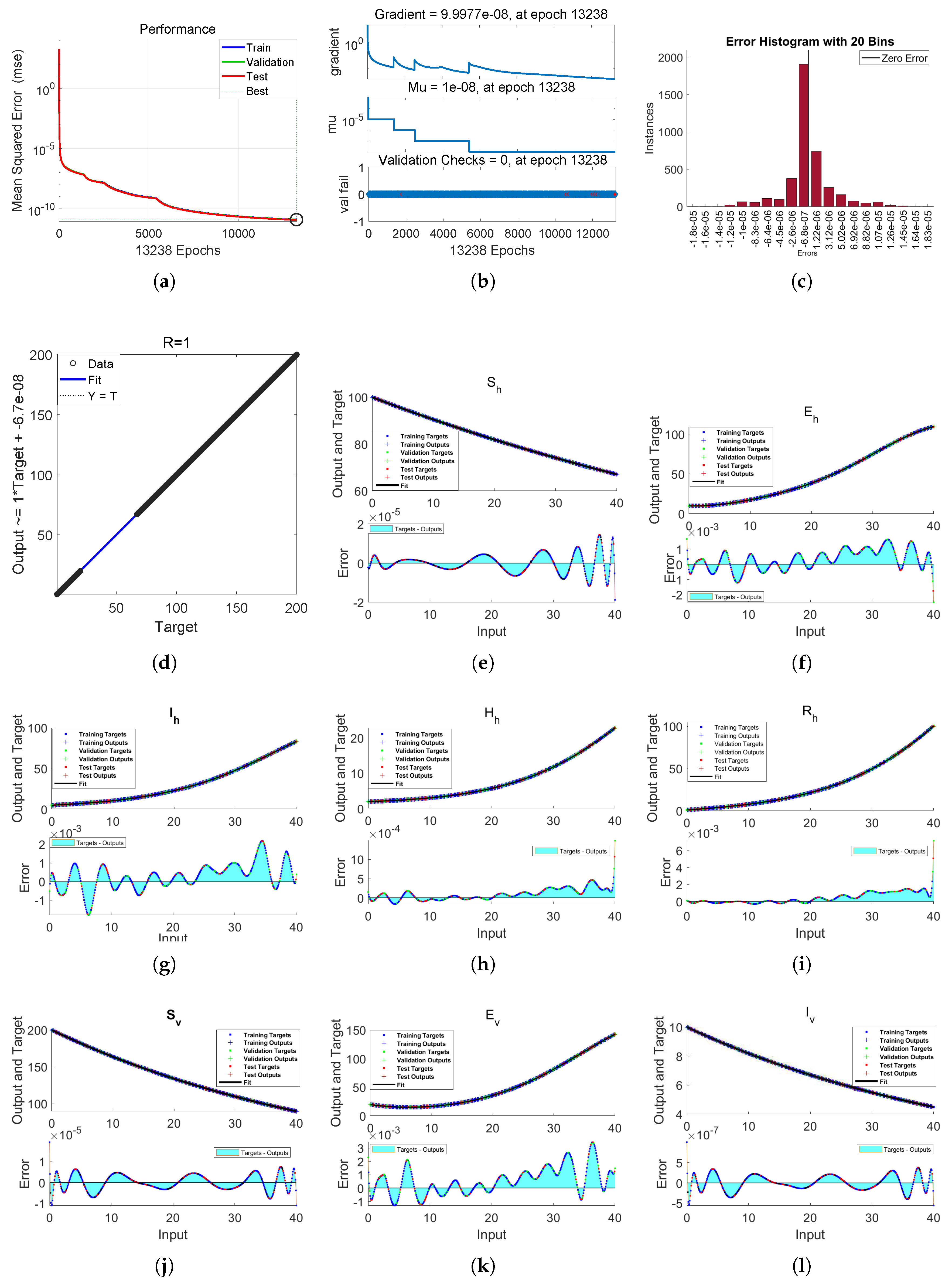
  • Maximum epochs: 100,000; training terminated early at epoch 13,238 once the gradient fell below the prescribed tolerance.
  • Elapsed time: 37 s.
  • Final MSE: 1.26 × 10 11 , down from an initial value of 1.84 × 10 3 .
  • Gradient at stopping: 9.9977 × 10 8 (tolerance 10 7 ).
  • Damping factor at convergence: ρ = 1.00 × 10 8 .
  • Data split: 75 % training, 15 % validation, 10 % testing, assigned by random division.
  • Validation checks: 0 throughout training, confirming that no overfitting occurred.
The low MSE and stable convergence confirm that the ANN accurately approximates the numerical solution of the fractional-order chikungunya model.

8.5. Results and Interpretation

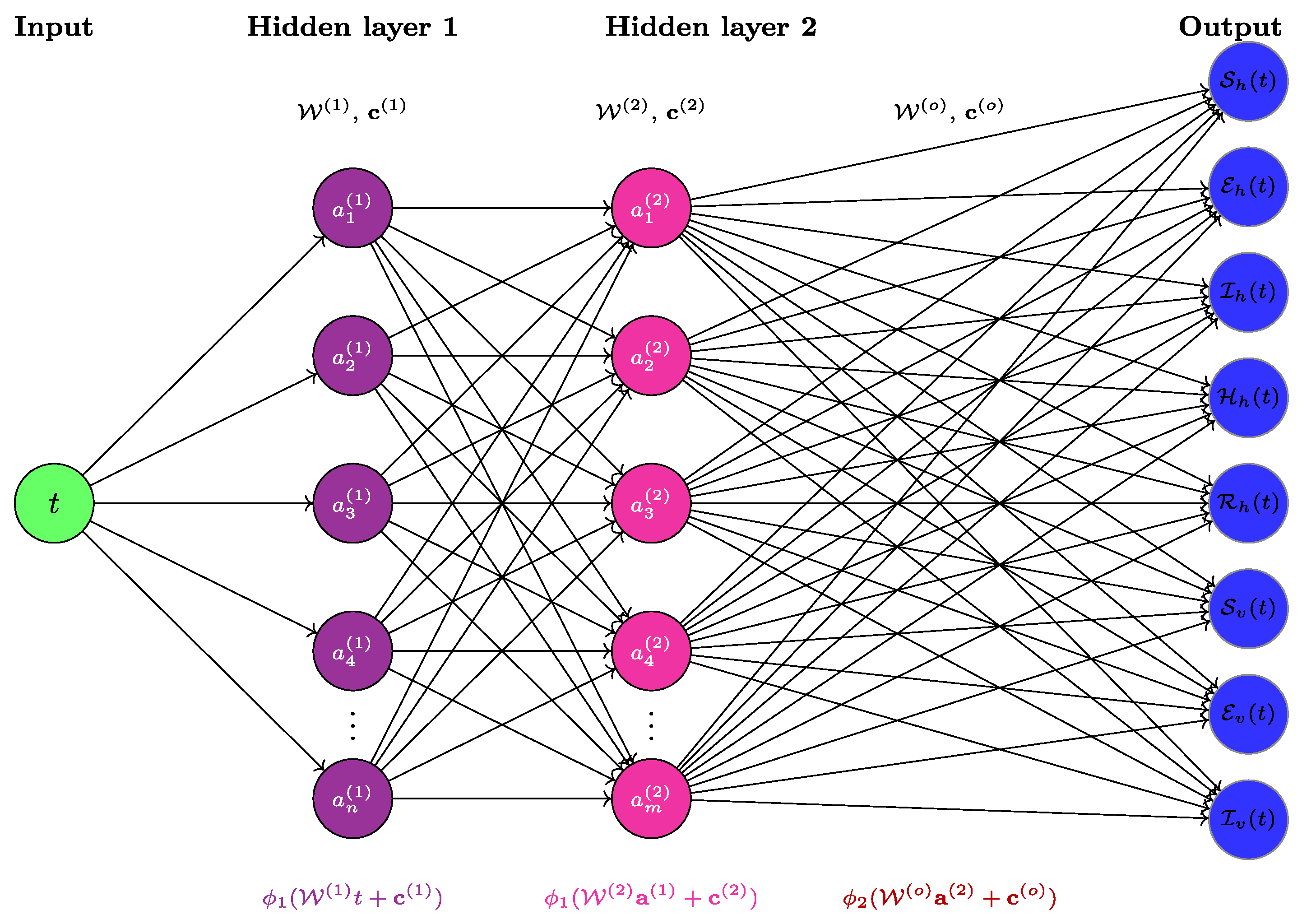
The network architecture is illustrated in Figure 2. The input layer receives the scalar time variable t [ 0 , 40 ] , and the output layer produces the vector P ^ ( t ) = S ^ h , E ^ h , I ^ h , H ^ h , R ^ h , S ^ v , E ^ v , I ^ v R 8 . The network consists of two fully connected hidden layers. For the -th hidden layer with n neurons, the output of the j-th neuron is computed as
a j ( )   =   ϕ 1 i = 1 n 1 W j i ( )   a i ( 1 ) + c j ( ) ,   j = 1 , 2 , , n ,
where W j i ( ) is the weight connecting neuron i of layer 1 to neuron j of layer , c j ( ) is the corresponding bias, and ϕ 1 is the hidden-layer activation function. The final output layer applies a linear activation ϕ 2 to map the last hidden layer to the eight-dimensional output:
P ^ ( t )   =   ϕ 2 W ( o )   a ( L ) + c ( o ) ,
where a ( L ) is the output of the last hidden layer, W ( o ) is the output weight matrix of size 8 × n L , and c ( o ) R 8 is the output bias vector. In compact form, the full network mapping from input t to predicted state vector P ^ ( t ) is written as
P ^ ( t )   =   ϕ 2 W ( o )   ϕ 1 W ( 2 )   ϕ 1 W ( 1 )   t + c ( 1 ) + c ( 2 ) + c ( o ) ,
where W ( 1 ) , W ( 2 ) , and W ( o ) are the weight matrices of the first hidden, second hidden, and output layers, respectively, and c ( 1 ) , c ( 2 ) , and c ( o ) are the corresponding bias vectors. All weights and biases are optimized by minimizing L in (38) via the Levenberg–Marquardt update rule (39).
Figure 3a shows that the MSE performance curve with training, validation, and test losses decreases monotonically over 13,238 epochs, reaching a final MSE of 1.26 × 10 11 , confirming convergence to the minimum gradient stopping criterion. Figure 3b shows the training-state panel showing the gradient ( 9.9977 × 10 8 ), the Levenberg–Marquardt damping parameter ρ ( 1 × 10 8 ), and the validation-check counter (zero throughout), all evaluated at epoch 13,238. Figure 3c shows the error histogram with 20 bins; the overwhelming majority of residuals cluster at zero error, with only sparse instances at the histogram tails, indicating that the ANN captures the nonlinear dynamics of all eight compartments with negligible bias. Figure 3d shows the overall regression plot ( R = 1 ) for all data subsets combined: the fit line coincides with the Y = T diagonal, confirming perfect agreement between ANN outputs and numerical targets. Figure 3e,f show the function-fit plots for the susceptible human class S h and the exposed human class E h , respectively. The upper panels overlay training, validation, and test targets and outputs together with the fitted curve; the lower panels display the residual S h S ^ h and E h E ^ h versus time, with errors bounded within O ( 10 5 ) and O ( 10 3 ) , respectively. Figure 3g–i show the function-fit plots for the infectious I h , hospitalized H h , and recovered R h human classes; residuals remain within O ( 10 3 ) , O ( 10 4 ) , and O ( 10 3 ) , respectively. For the mosquito subpopulation, Figure 3j–l show that S v , E v , and I v are reproduced with residuals of order O ( 10 5 ) , O ( 10 3 ) , and O ( 10 7 ) , respectively. The tightest agreement is obtained for I v , which directly governs the force of infection in system (1). Taken together, these results establish that the trained network serves as a reliable surrogate for the predictor–corrector Adams–Bashforth–Moulton numerical solution, and that the weight update rule (39) has converged to a stable optimum with negligible generalization error across all eight state variables.
Here, the numerical results obtained from model (1) are presented. The model was solved using the generalized ABM method, well suited for fractional-order systems. Simulations were performed for different parameter sets and fractional orders ξ . The initial conditions and parameter values are given in Table 1. The initial conditions for the human and mosquito compartments are taken as
S h ( 0 ) , E h ( 0 ) , I h ( 0 ) , H h ( 0 ) , R h ( 0 ) , S v ( 0 ) , E v ( 0 ) , I v ( 0 ) = ( 350 , 220 , 150 , 70 , 30 , 400 , 170 , 80 ) .
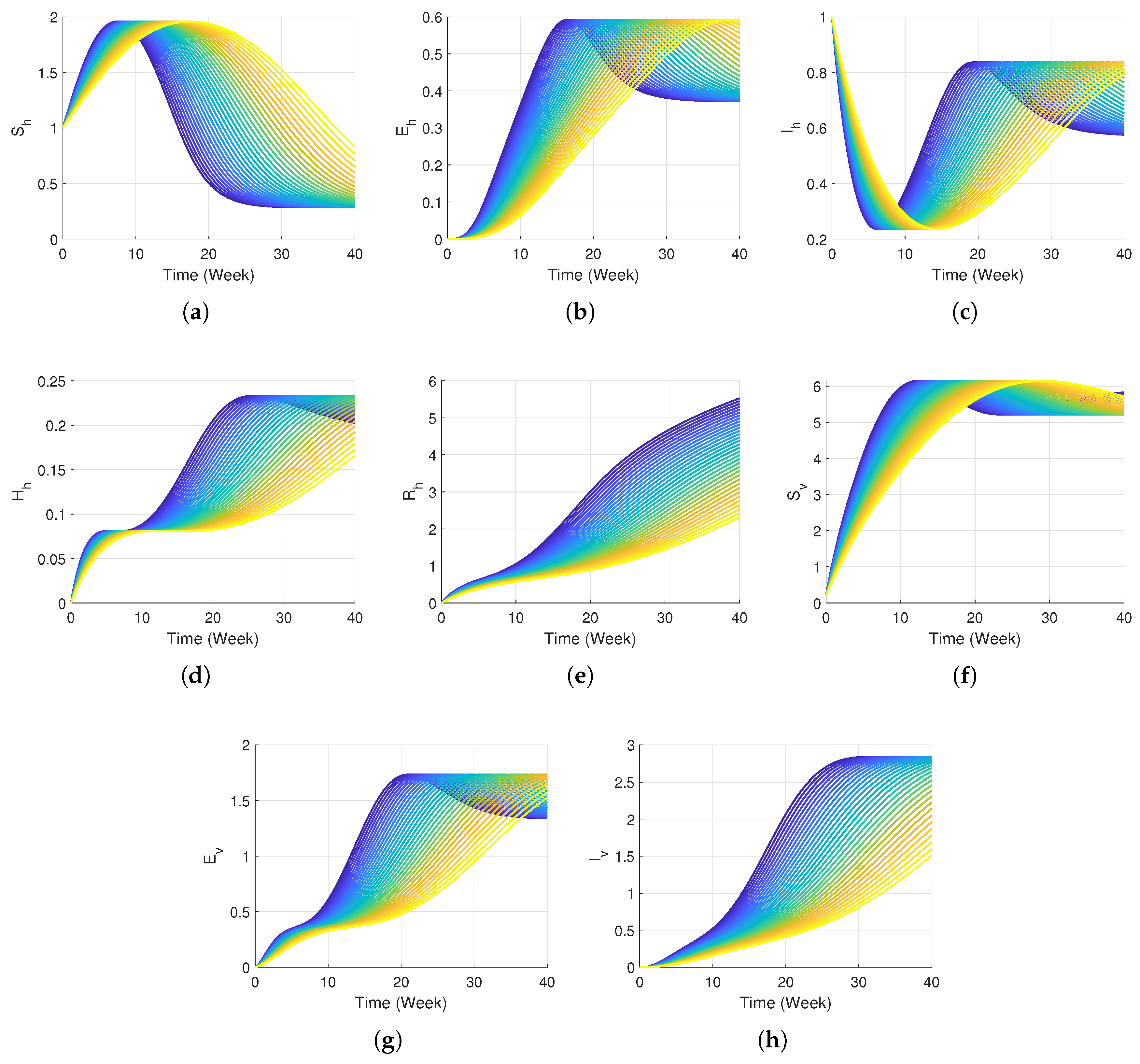
Figure 4 shows the effect of varying the fractional order ξ [ 0.75 ,   0.99 ] on the dynamics of system (1) over a 40-week period. Figure 4a shows that S h initially rises before declining as infection spreads. Lower ξ slows this decline, meaning susceptible individuals are depleted more gradually. In Figure 4b, the exposed class E h grows and then settles at an endemic level. Higher ξ produces an earlier and sharper peak, while lower ξ spreads the exposure over a longer period. Figure 4c shows I h dropping initially before recovering to an endemic plateau. Lower values of ξ slows this recovery, prolonging the infectious period. In Figure 4d, hospitalizations H h rise and then stabilize. Smaller ξ delays the peak and keeps hospitalization elevated for longer. Figure 4e shows R h growing steadily toward a plateau near 5–6 by week 40. Higher ξ accelerates recovery accumulation, while lower ξ slows the transition out of the infectious stage. Figure 4f shows S v rising. The effect of ξ here is relatively mild but still visible in the approach rate. In Figure 4g, the exposed mosquito class E v increases gradually. Lower ξ noticeably slows this rise, effectively prolonging the extrinsic incubation period. Figure 4h shows I v growing monotonically. Since I v directly drives infection in humans via β 1 β 2 I v S h , its slower growth at lower ξ has a knock-on effect on all human compartments. Thus, decreasing ξ slows the epidemic across all compartments without changing the qualitative structure of the endemic equilibrium, consistent with the stability results in Section 3.
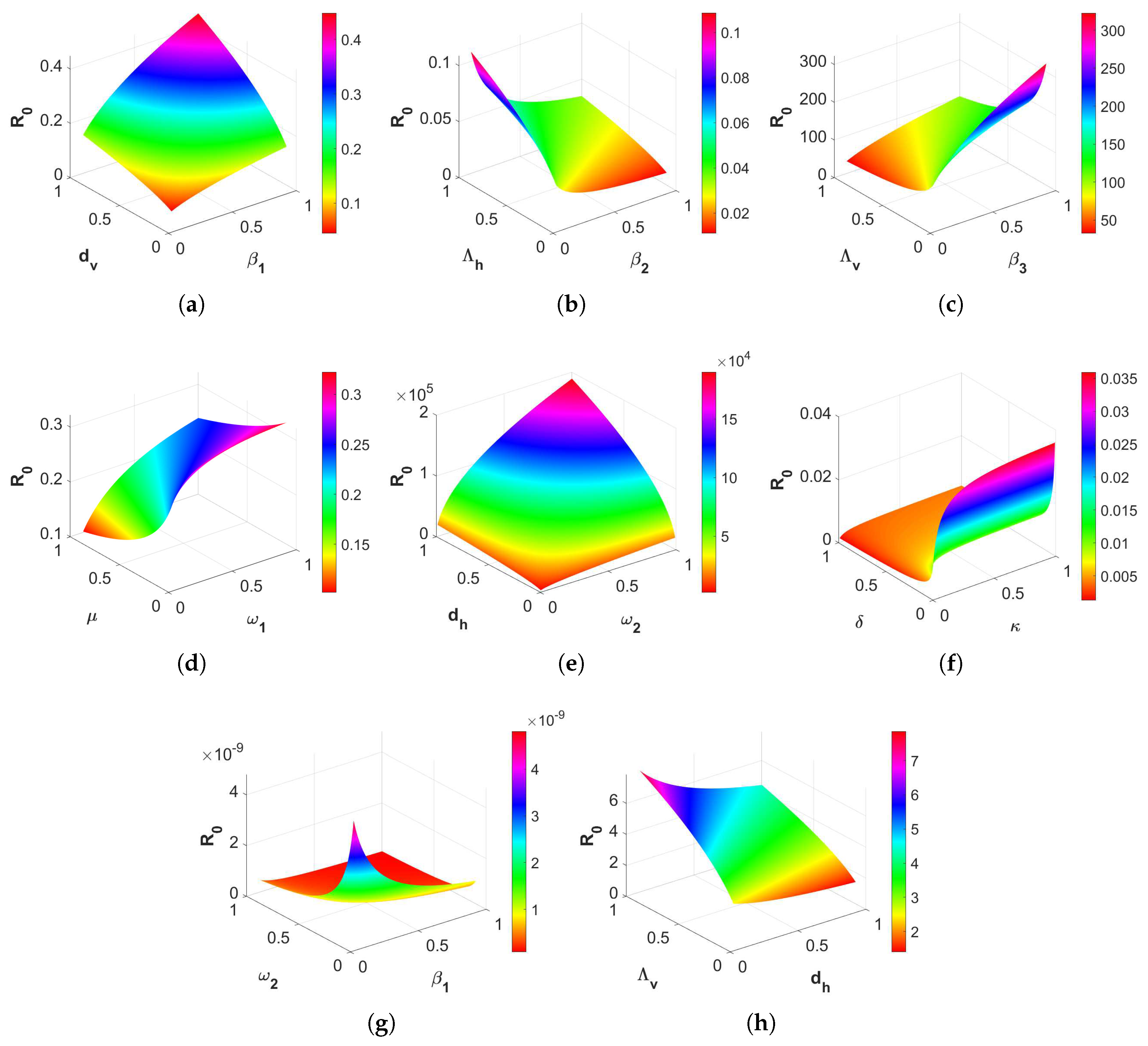
Figure 5 shows how R 0 responds to pairwise variations in the model parameters. Figure 5a,b confirm that R 0 increases with the transmission probabilities β 2 and β 3 and with the recruitment rates Λ h and Λ v , with Figure 5b producing the largest values (up to 300), highlighting the dominant role of the mosquito population size. Figure 5c shows that faster disease progression ω 1 raises R 0 , while stronger early immune clearance μ slightly reduces it. Figure 5d indicates that the extrinsic incubation rate ω 2 is among the most sensitive parameters, driving R 0 to very large values when combined with low human mortality d h . Figure 5e,f show that increasing the recovery and hospitalization rates κ and δ keeps R 0 well below one, while Figure 5g confirms that reducing mosquito recruitment Λ v or increasing d h is effective in pushing R 0 below the epidemic threshold.
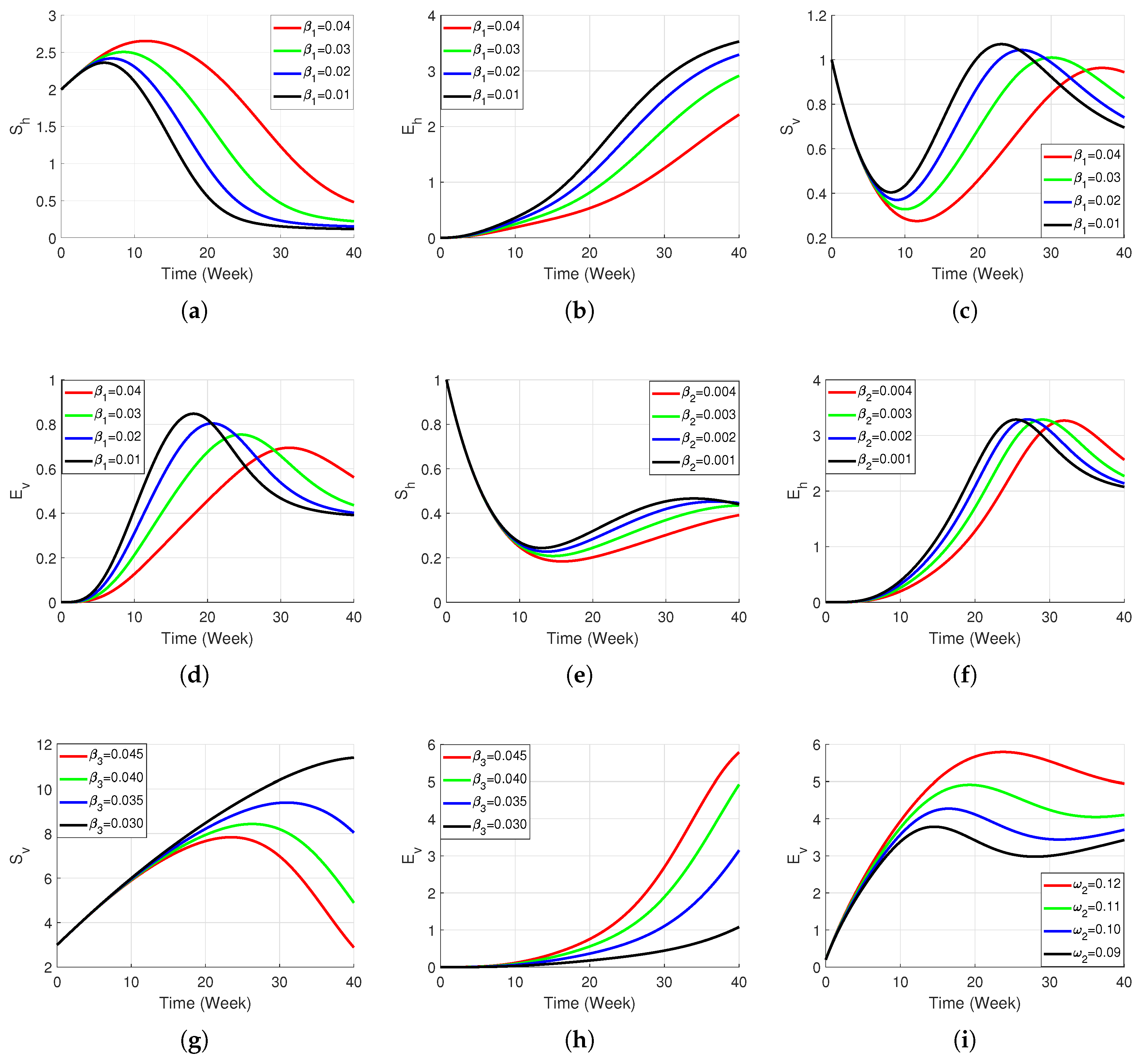
In Figure 6, the transmission parameters β 1 , β 2 , β 3 , and ω 2 are shown to influence the epidemic dynamics of system (1). Figure 6a,b show the effect of the mosquito biting rate β 1 on S h and E h . As β 1 increases from 0.01 to 0.04 , susceptible humans are depleted more rapidly and the exposed class grows to a higher peak, which is expected since β 1 directly scales the force of infection β 1 β 2 I v S h in system (1). Figure 6c shows that higher β 1 also causes S v to drop more sharply before recovering, as more susceptible mosquitoes are driven into the exposed class through contact with infectious humans. Figure 6d shows that the exposed mosquito class E v reaches a higher and earlier peak when β 1 is large, showing that the biting rate accelerates transmission in both directions between humans and mosquitoes. Figure 6e,f vary the per-bite transmission probability β 2 from 0.001 to 0.004 . The effect on S h and E h follows the same direction as β 1 ; higher β 2 depletes susceptible individuals faster and raises the exposed peak. However, since β 2 is considerably smaller in magnitude than β 1 , the separation between curves is less pronounced, indicating that the biting rate is the dominant driver of transmission compared to the per-bite probability. Figure 6g,h show the influence of β 3 —the probability that a susceptible mosquito becomes infected after feeding on an infectious human—on S v and E v . Larger β 3 leads to a noticeably faster depletion of susceptible mosquitoes and a higher accumulation in the exposed mosquito class, confirming that β 3 is a key driver of transmission on the mosquito side of the model. Figure 6i shows the effect of ω 2 , the rate at which exposed mosquitoes become infectious, on E v . Higher ω 2 causes the exposed mosquito population to peak earlier and at a higher level before declining, since mosquitoes progress through the latent stage more quickly and begin contributing to transmission sooner.
Furthermore, in order to evaluate intervention strategies, three optimal control variables, u 1 , u 2 , and u 3 , were implemented, with u 1 ( t ) representing public health preventive efforts that reduce new human exposures, u 2 ( t ) representing treatment and case-management measures that shorten the infectious period in humans, and u 3 ( t ) representing vector-control interventions that increase mosquito mortality. The objective weight constants are given by
A 1 = 0.3 ,   A 2 = 0.1 ,   B 1 = B 2 = B 3 = 1 .
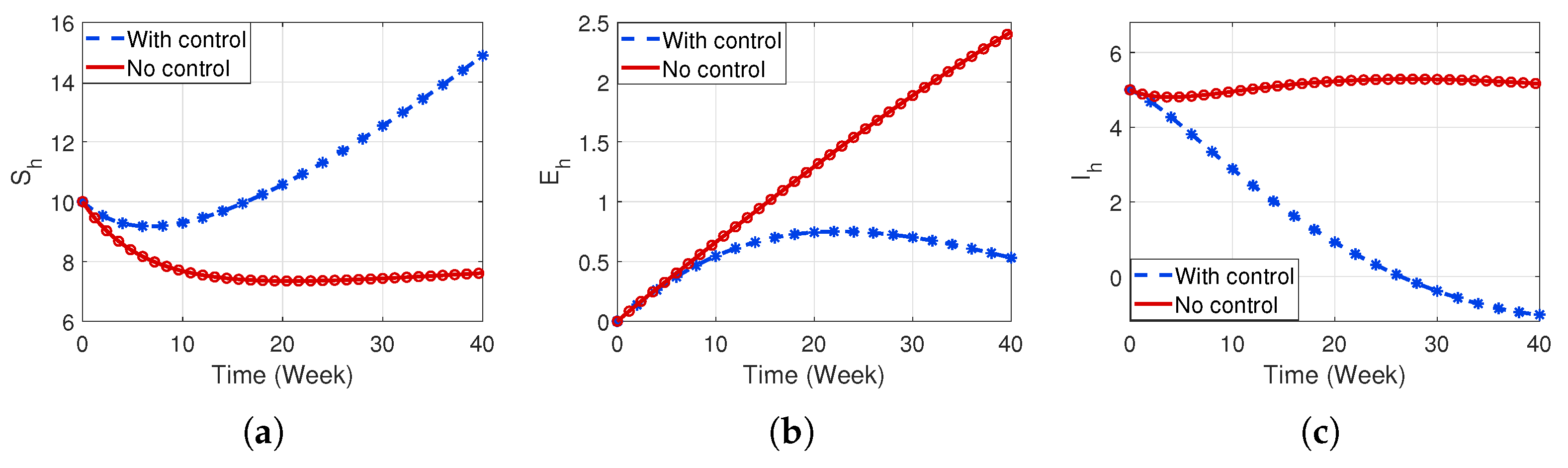
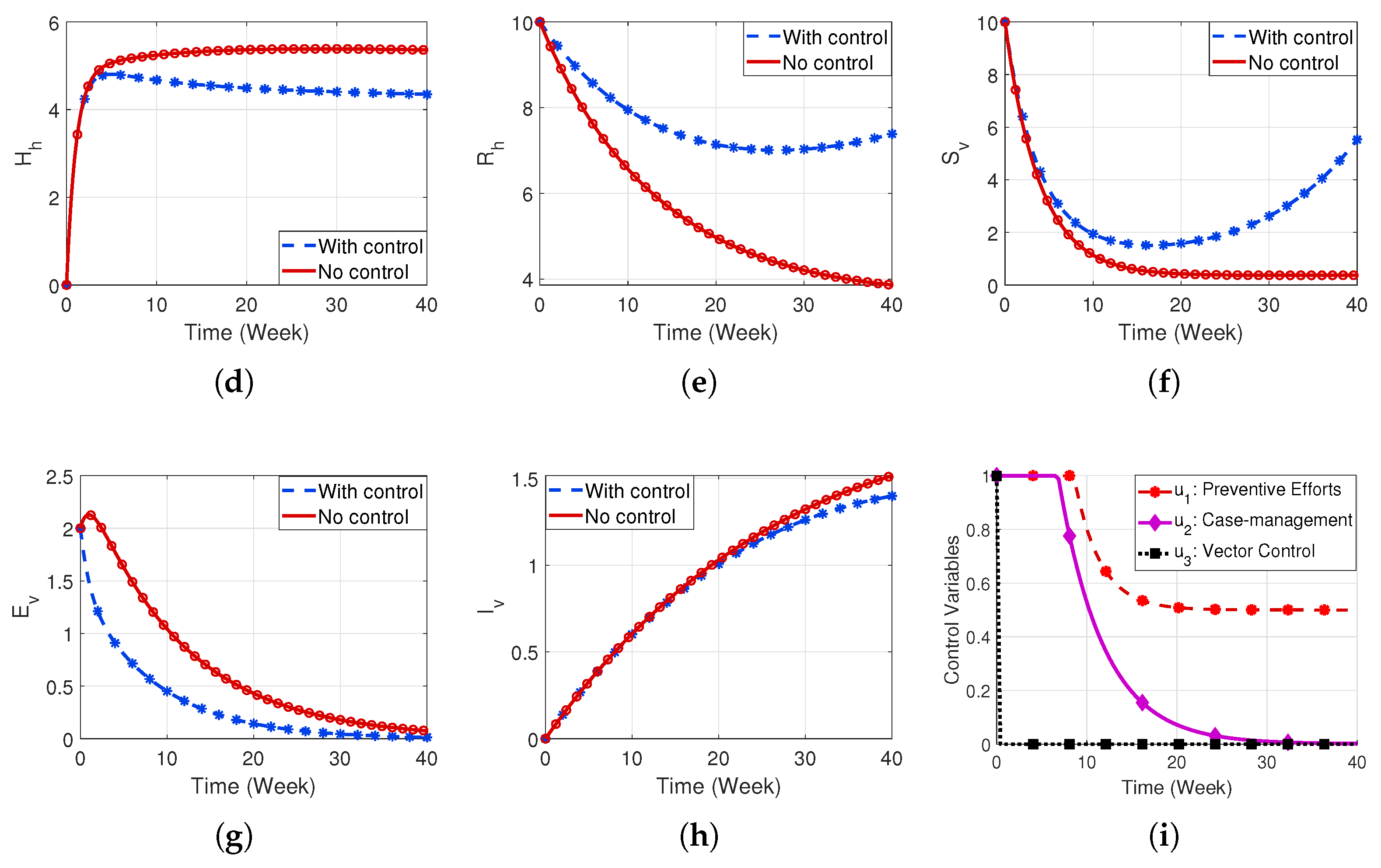
Figure 7 shows the impact of optimal control on the dynamics of the chikungunya transmission model. Figure 7a shows that in the susceptible human class S h , the preventive control u 1 ( t ) directly reduces the infection pressure from infectious mosquitoes. As a result, the S h curve under control decreases more slowly compared to the no-control case. Figure 7b shows that in the exposed human class E h , the preventive control u 1 ( t ) directly lowers the rate at which susceptible humans become exposed, producing a smaller E h curve under control. Figure 7c shows that in the infectious human class I h , the treatment control u 2 ( t ) directly increases removal from infection, giving a much lower I h curve under control. The preventive control u 1 ( t ) reduces the inflow into I h by lowering new exposures. Figure 7d shows that in the hospitalized class H h , the treatment control u 2 ( t ) indirectly reduces hospitalizations by decreasing I h . Figure 7e shows that in the recovered human class R h , the treatment control u 2 ( t ) increases transitions from I h to recovery, producing a higher R h curve under control. The control u 1 ( t ) reduces the overall number of infected and therefore indirectly affects R h . Figure 7f shows that in the susceptible vector class S v , the vector control u 3 ( t ) directly increases mosquito mortality, leading to a lower S v curve under control. Figure 7g shows that in the exposed vector class E v , the vector control u 3 ( t ) directly reduces exposure and survival of mosquitoes, lowering the E v curve under control. Figure 7h shows that in the infectious vector class I v , the vector control u 3 ( t ) directly increases mortality, producing a much lower I v curve under control. Figure 7i presents the time-dependent optimal control profiles u 1 ( t ) , u 2 ( t ) , and u 3 ( t ) obtained from the fractional optimal control problem. The preventive control u 1 ( t ) remains at a high level during the early phase of the epidemic, reflecting the need to suppress new human exposures when the force of infection is highest. The treatment control u 2 ( t ) shows an initially elevated intensity, corresponding to the rapid reduction in infectious individuals, and gradually decreases as the infectious population declines. The vector-control intervention u 3 ( t ) stays near its upper bound during the initial period to rapidly reduce susceptible and exposed mosquitoes, after which its intensity lowers as the mosquito population becomes sufficiently suppressed.

9. Conclusions

In this work, we developed and analyzed a Caputo fractional-order model for the chikungunya virus. The fractional order ξ was shown to act as a biological memory parameter. Decreasing ξ slows epidemic progression across all compartments without altering the qualitative structure of the equilibria, illustrating the advantage of the Caputo framework over classical integer-order models in capturing history-dependent dynamics. Numerical solutions were obtained using the predictor–corrector Adams–Bashforth–Moulton scheme, which provides a reliable and accurate discretization of the Caputo fractional system (1). The ANN trained via the Levenberg–Marquardt algorithm independently validated these solutions, achieving a final MSE = 1.26 × 10 11 and R = 1 across all eight state variables, providing the most accurate ANN surrogate reported for a fractional CHIKV model.
Additionally, three time-dependent optimal control strategies, u 1 , u 2 , and u 3 , are rigorously characterized, and all optimality conditions are determined via Pontryagin’s Maximum Principle. The integration of optimal control strategies demonstrated the implementation of public health preventative effort u 1 ( t ) , resulting in a higher number of susceptible human populations and a significant reduction in the transition to exposed and infectious classes. Treatment and case management, represented by u 2 ( t ) , shortened the infectious period, thereby lowering the peaks of infectious humans and hospitalizations while enhancing accumulation in the recovered class. Vector control via u 3 ( t ) led to a significant decline in the mosquito population and suppressed progression to infectious stages, resulting in significant reductions in susceptible, exposed, and infectious vectors compared with scenarios without control. Collectively, these control measures suppressed the human vector transmission cycle and reduced epidemic impact.
Furthermore, the model assumes homogeneous spatial mixing and constant recruitment rates and does not consider seasonal fluctuations in mosquito populations or age-structured human immunity. The fractional order ξ is estimated from a single outbreak dataset and may not be generalizable to other regions. Future research will evaluate non-singular kernel effects by using the Atangana–Baleanu–Caputo operator, including stochastic noise, and estimate ξ from surveillance records collected from multi-city areas.

Author Contributions

Conceptualization, Z.; Methodology, Z.; Software, C.L. and N.A.A.; Validation, Z. and C.L.; Formal analysis, Z. and C.L.; Investigation, Z. and M.B.J.; Resources, C.L. and N.A.A.; Data curation, C.L.; Writing—original draft, N.A.A.; Writing—review & editing, N.A.A.; Supervision, M.B.J.; Project administration, M.B.J.; Funding acquisition, M.B.J. All authors have read and agreed to the published version of the manuscript.

Funding

This research was funded by the Deanship of Scientific Research at Imam Mohammad Ibn Saud Islamic University (IMSIU), grant number IMSIU-DDRSP2601.

Institutional Review Board Statement

Not applicable.

Informed Consent Statement

Not applicable.

Data Availability Statement

The data supporting the findings of this study are available within the article.

Acknowledgments

The authors would like to thank the Deanship of Scientific Research at Imam Mohammad Ibn Saud Islamic University (IMSIU) for their support.

Conflicts of Interest

The authors declare no conflicts of interest.

References

  1. World Health Organization. Chikungunya Virus Disease. Available online: https://www.who.int/emergencies/disease-outbreak-news/item/2025-DON581 (accessed on 3 January 2026).[Green Version]
  2. Centers for Disease Control and Prevention. (13 2025 November). Chikungunya Virus: Areas at Risk for Chikungunya. U.S. Department of Health & Human Services. Available online: https://www.cdc.gov/chikungunya/data-maps/index.html (accessed on 3 January 2026).
  3. de Souza, W.M.; Lecuit, M.; Weaver, S.C. Chikungunya Virus and Other Emerging Arthritogenic Alphaviruses. Nat. Rev. Microbiol. 2025, 23, 585–601. [Google Scholar] [CrossRef] [PubMed]
  4. Weaver, S.C. Arrival of Chikungunya Virus in the New World: Prospects for Spread and Impact on Public Health. PLoS Negl. Trop. Dis. 2014, 8, e2921. [Google Scholar] [CrossRef]
  5. Burt, F.J.; Chen, W.; Miner, J.J.; Lenschow, D.J.; Merits, A.; Schnettler, E.; Kohl, A.; Rudd, P.A.; Taylor, A.; Herrero, L.J.; et al. Chikungunya Virus: An Update on the Biology and Pathogenesis of This Emerging Pathogen. Lancet Infect. Dis. 2017, 17, e107–e117. [Google Scholar] [CrossRef]
  6. Nsoesie, E.O.; Kraemer, M.U.; Golding, N.; Pigott, D.M.; Brady, O.J.; Moyes, C.L.; Johansson, M.A.; Gething, P.W.; Velayudhan, R.; Khan, K.; et al. Global Distribution and Environmental Suitability for Chikungunya Virus, 1952 to 2015. Eurosurveillance 2016, 21, 30234. [Google Scholar] [CrossRef]
  7. Hakim, M.S.; Annisa, L.; Gazali, F.M.; Aman, A.T. The Origin and Continuing Adaptive Evolution of Chikungunya Virus. Arch. Virol. 2022, 167, 2443–2455. [Google Scholar] [CrossRef]
  8. Waggoner, J.J.; Gresh, L.; Vargas, M.J.; Ballesteros, G.; Tellez, Y.; Soda, K.J.; Sahoo, M.K.; Nuñez, A.; Balmaseda, A.; Harris, E.; et al. Viremia and Clinical Presentation in Nicaraguan Patients Infected With Zika Virus, Chikungunya Virus, and Dengue Virus. Clin. Infect. Dis. 2016, 63, 1584–1590. [Google Scholar] [CrossRef]
  9. Zakirullah. A Mathematical Model of Pneumococcal Pneumonia Infection Dynamics Using Treatment and Vaccination Interventions. Int. J. Appl. Comput. Math. 2025, 11, 112. [Google Scholar] [CrossRef]
  10. Findlater, A.; Bogoch, I.I. Human Mobility and the Global Spread of Infectious Diseases: A Focus on Air Travel. Trends Parasitol. 2018, 34, 772–783. [Google Scholar] [CrossRef]
  11. Wang, T.-Y.; Sun, Y.; Tang, Y.-D. Re-Emergence of Chikungunya Virus in China by 2025: What We Know and What to Do? PLoS Pathog. 2025, 21, e1013556. [Google Scholar] [CrossRef] [PubMed]
  12. Guo, S.; Huang, J.; Liu, Y.; Zhang, R.; Ren, J.; Shi, X.; Sun, J. Integrated mosquito control in Matatang village, Northern Zhejiang, China: An effectiveness assessment. Front. Public Health 2025, 13, 1628116. [Google Scholar] [CrossRef] [PubMed]
  13. Agusto, F.B.; Easley, S.; Freeman, K.; Thomas, M. Mathematical Model of Three Age-Structured Transmission Dynamics of Chikungunya Virus. Comput. Math. Methods Med. 2016, 2016, 4320514. [Google Scholar] [CrossRef] [PubMed]
  14. González-Parra, G.C.; Aranda, D.F.; Chen-Charpentier, B.; Díaz-Rodríguez, M.; Castellanos, J.E. Mathematical Modeling and Characterization of the Spread of Chikungunya in Colombia. Math. Comput. Appl. 2019, 24, 6. [Google Scholar] [CrossRef]
  15. Rihan, F.A. Numerical Modeling of Fractional-Order Biological Systems. Abstr. Appl. Anal. 2013, 2013, 816803. [Google Scholar] [CrossRef]
  16. Povstenko, Y. Linear Fractional Diffusion-Wave Equation for Scientists and Engineers; Springer International Publishing: Cham, Switzerland, 2015. [Google Scholar] [CrossRef]
  17. Zakirullah; Lu, C.; Li, L.; Shah, K.; Abdalla, B.; Abdeljawad, T. Mathematical Insights into Chaos in Fractional-Order Fishery Model. Model. Earth Syst. Environ. 2025, 11, 201. [Google Scholar] [CrossRef]
  18. Podlubny, I. Fractional Differential Equations: An Introduction to Fractional Derivatives, Fractional Differential Equations, to Methods of Their Solution and Some of Their Applications; Academic Press: Cambridge, MA, USA, 1999. [Google Scholar]
  19. Zhang, X. Relationship between Integer Order Systems and Fractional Order System and Its Two Applications. IEEE/CAA J. Autom. Sin. 2018, 5, 639–643. [Google Scholar] [CrossRef]
  20. Lenhart, S.; Workman, J.T. Optimal Control Applied to Biological Models; Chapman and Hall/CRC: Boca Raton, FL, USA, 2007. [Google Scholar] [CrossRef]
  21. Gong, Z.; Liu, C.; Teo, K.L.; Wang, S.; Wu, Y. Numerical Solution of Free Final Time Fractional Optimal Control Problems. Appl. Math. Comput. 2021, 405, 126270. [Google Scholar] [CrossRef]
  22. Liu, C.; Loxton, R.; Teo, K.L.; Wang, S. Optimal State-Delay Control in Nonlinear Dynamic Systems. Automatica 2022, 135, 109981. [Google Scholar] [CrossRef]
  23. Rumelhart, D.E.; Hinton, G.E.; Williams, R.J. Learning representations by back-propagating errors. Nature 1986, 323, 533–536. [Google Scholar] [CrossRef]
  24. Hornik, K.; Stinchcombe, M.; White, H. Multilayer feedforward networks are universal approximators. Neural Netw. 1989, 2, 359–366. [Google Scholar] [CrossRef]
  25. Zou, J.; Han, Y.; So, S.S. Overview of artificial neural networks. In Artificial Neural Networks: Methods and Applications; Springer: Berlin/Heidelberg, Germany, 2009; pp. 14–22. [Google Scholar]
  26. Wu, Y.C.; Feng, J.W. Development and application of artificial neural network. Wirel. Pers. Commun. 2018, 102, 1645–1656. [Google Scholar] [CrossRef]
  27. Huang, X.; Zhao, Z.; Wang, Z.; Li, Y. Chaos and Hyperchaos in Fractional-Order Cellular Neural Networks. Neurocomputing 2012, 94, 13–21. [Google Scholar] [CrossRef]
  28. Pu, Y.F.; Yi, Z.; Zhou, J.L. Fractional Hopfield Neural Networks: Fractional Dynamic Associative Recurrent Neural Networks. IEEE Trans. Neural Netw. Learn. Syst. 2017, 28, 2319–2333. [Google Scholar] [CrossRef]
  29. Zhang, S.; Chen, Y.; Yu, Y. A Survey of Fractional-Order Neural Networks. In Volume 9: 13th ASME/IEEE International Conference on Mechatronic and Embedded Systems and Applications; American Society of Mechanical Engineers: New York, NY, USA, 2017. [Google Scholar] [CrossRef]
  30. Sabir, Z.; Raja, M.A.Z.; Umar, M.; Shoaib, M.; Baleanu, D. FMNSICS: Fractional Meyer Neuro-Swarm Intelligent Computing Solver for Nonlinear Fractional Lane–Emden Systems. Neural Comput. Appl. 2022, 34, 4193–4206. [Google Scholar] [CrossRef]
  31. Nisar, K.S.; Sahar, F.; Raja, M.A.Z.; Shoaib, M. Intelligent Neuro-Computing to Analyze the Awareness Programs of Fractional Epidemic System Outbreaks. J. King Saud Univ. Sci. 2023, 35, 102691. [Google Scholar] [CrossRef]
  32. Sibanda, W.; Pretorius, P. Artificial Neural Networks-A Review of Applications of Neural Networks in the Modeling of HIV Epidemic General Terms. Int. J. Comput. Appl. 2012, 44, 1–9. [Google Scholar]
  33. Mustafa, N.; Rahman, J.U.; Ishtiaq, U.; Popa, I.-L. Artificial Neural Network-Based Approach for Dynamic Analysis and Modeling of Marburg Virus Epidemics for Health Care. Symmetry 2025, 17, 578. [Google Scholar] [CrossRef]
  34. Jeeva, N.; Dharmalingam, K.M. Numerical Analysis and Artificial Neural Networks for Solving Nonlinear Tuberculosis Model in SEITR Framework. Adv. Theory Simul. 2025, 8, 2401287. [Google Scholar] [CrossRef]
  35. Zarin, R.; Guedri, K.; Ibrahim, S.M.; Alburaikan, A.; Khalifa, H.A.E.-W.; Nadar, Z. Nonlinear dynamics of measles and HIV co-infection using a reaction-diffusion model and artificial neural networks. Nonlinear Dyn. 2025, 113, 26899–26923. [Google Scholar] [CrossRef]
  36. Kilbas, A.A.; Srivastava, H.M.; Trujillo, J.J. Theory and Applications of Fractional Differential Equations; Elsevier: Amsterdam, The Netherlands, 2006. [Google Scholar]
  37. Tomovski, Ž.; Hilfer, R.; Srivastava, H.M. Fractional and operational calculus with generalized fractional derivative operators and Mittag Leffler type functions. Integral Transform. Spec. Funct. 2010, 21, 797–814. [Google Scholar] [CrossRef]
  38. Zakirullah. Stability and Sensitivity Insights into Two-Dose HPV Vaccination Effects and Cervical Cancer. J. Appl. Math. Comput. 2026, 72, 119. [Google Scholar] [CrossRef]
  39. Zakirullah; Ullah, S.; Khashan, M.M.; Shah, K.; Abdeljawad, T. Novel Tick-Borne Encephalitis Transmission Dynamics: A Model-Based Strategy for Epidemic Control. Netw. Heterog. Media 2026, 21, 496–530. [Google Scholar] [CrossRef]
  40. Diekmann, O.; Heesterbeek, J.A.P.; Roberts, M.G. The Construction of Next-Generation Matrices for Compartmental Epidemic Models. J. R. Soc. Interface 2010, 7, 873–885. [Google Scholar] [CrossRef]
  41. Feng, Q. National Fitness Day: Evolving from “Getting Active” to “Promoting Health.”. China CDC Wkly. Chin. Cent. Dis. Control Prev. 2025, 7, 1039–1040. [Google Scholar] [CrossRef]
  42. Zakirullah. Measles Disease Spread and Control via Vaccination and Treatment: A Mathematical Framework. Chaos Solitons Fractals 2026, 203, 117703. [Google Scholar] [CrossRef]
  43. Worldometer. China Population (Live). Worldometer. Available online: https://www.worldometers.info/world-population/china-population (accessed on 3 January 2026).
  44. Dumont, Y.; Chiroleu, F. Vector Control for the Chikungunya Disease. Math. Biosci. Eng. 2010, 7, 313–345. [Google Scholar] [CrossRef] [PubMed]
  45. de Guzman, C. (16 January 2024). China’s Population Shrinks Some More—Decrease in Births, Increase in Deaths in 2023. TIME. Available online: https://time.com/6258479/china-population-shrinks-2023 (accessed on 3 January 2026).
  46. Pontryagin, L.S. Mathematical Theory of Optimal Processes; Routledge: London, UK, 2018. [Google Scholar] [CrossRef]
  47. Baskonus, H.M.; Bulut, H. On the Numerical Solutions of Some Fractional Ordinary Differential Equations by Fractional Adams-Bashforth-Moulton Method. Open Math. 2015, 13, 4255–4270. [Google Scholar] [CrossRef]
Figure 1. Diagram illustrating the transmission dynamics of the chikungunya virus.
Fractalfract 10 00346 g001
Figure 2. Feedforward ANN architecture for approximating the solution of system (1). The scalar input t is mapped through two fully connected hidden layers with activation ϕ 1 and weight matrices W ( 1 ) and W ( 2 ) to produce the eight-dimensional output P ^ ( t ) = ϕ 2 ( W ( o ) a ( 2 ) + c ( o ) ) R 8 , corresponding to all state variables of system (1).
Fractalfract 10 00346 g002
Figure 3. ANN training diagnostics and function-fit approximations for all eight compartments of system (1) at ξ = 0.95 : (a) MSE performance, (b) gradient and validation checks, (c) error histogram, (d) regression plot ( R = 1 ), and panels (el) output-versus-target fits with residual errors for S h , E h , I h , H h , R h , S v , E v , and I v . Training performed via the Levenberg–Marquardt algorithm over 13,238 epochs; final MSE = 1.26 × 10 11 , R = 1 across all subsets.
Fractalfract 10 00346 g003
Figure 4. Impact of the fractional order ξ [ 0.75 ,   0.99 ] on the dynamics of all eight compartments of system (1) over a 40-week period. Panels (ah) illustrate the dynamics of S h , E h , I h , H h , R h , S v , E v , and I v , respectively, for different values of the fractional-order parameter ξ .
Fractalfract 10 00346 g004
Figure 5. 3D surface plots of R 0 as a function of key parameter pairs, providing a visual sensitivity analysis of the epidemic threshold condition R 0 < 1 . Panels (ah) represent the effects of ( β 1 , d v ) , ( β 2 , Λ h ) , ( β 3 , Λ v ) , ( ω 1 , μ ) , ( ω 2 , d h ) , ( κ , δ ) , ( β 1 , ω 2 ) , and ( d h , Λ v ) on R 0 , respectively.
Fractalfract 10 00346 g005
Figure 6. Effect of transmission parameters β 1 , β 2 , β 3 , and ω 2 on the dynamics of system (1) over a 40-week period. Panels (ac) illustrate the impact of varying β 1 on S h , E h , and S v , respectively. Panels (df) show the effect of varying β 2 on E v , S h , and E h , respectively. Panels (g,h) depict the influence of varying β 3 on S v and E v , respectively. Panel (i) demonstrates the effect of varying ω 2 on E v .
Fractalfract 10 00346 g006
Figure 7. Impact of optimal control on the dynamics of the chikungunya transmission model. Comparison between controlled (with control) and uncontrolled (no control) scenarios for the state variables: (a) S h , (b) E h , (c) I h , (d) H h , (e) R h , (f) S v , (g) E v , and (h) I v . Panel (i) shows the optimal control profiles u 1 ( t ) , u 2 ( t ) , and u 3 ( t ) over time.
Fractalfract 10 00346 g007aFractalfract 10 00346 g007b
Table 1. Model parameters, baseline values, and sensitivity indices (SI) for the chikungunya transmission model. Parameter values were obtained from the literature [41], while fitted parameters were estimated using the nonlinear least squares (NLS) approach described in [42].
ParameterDescriptionValue (day−1)SISource
Λ h Human recruitment rate 537 , 915 / 365 + 0.500 [43]
Λ v Vector recruitment rate 35 , 109 / 365 + 0.500 [44]
d h Human natural death rate 1 / ( 79 × 365 ) 0.006 [45]
d v Vector natural death rate 0.002 0.508 Fitted
β 1 Mosquito biting rate 0.01 + 1.000 Fitted
β 2 Transmission probability (vector → human) 0.001 + 0.500 Fitted
β 3 Transmission probability (human → vector) 0.045 + 0.500 Fitted
ω 1 Human incubation progression rate 0.24 + 0.140 Fitted
ω 2 Vector incubation progression rate 0.12 + 0.008 Fitted
μ Proportion recovering without progression 0.00 0.146 Fitted
κ Recovery rate (non-hospitalized) 0.32 0.495 Fitted
δ Hospitalization rate 0.001 0.0015 Fitted
γ Recovery rate (hospitalized) 0.710 Fitted
Disclaimer/Publisher’s Note: The statements, opinions and data contained in all publications are solely those of the individual author(s) and contributor(s) and not of MDPI and/or the editor(s). MDPI and/or the editor(s) disclaim responsibility for any injury to people or property resulting from any ideas, methods, instructions or products referred to in the content.