
Article

Practical Exponential Stability of Tempered ϖ-Fractional Systems: Lyapunov Criteria and Applications to Perturbed and Controlled Systems

by
Ayed R. A. Alanzi
1,
Raouf Fakhfakh
1,
Abdellatif Ben Makhlouf
2,3 and
Omar Naifar
4,5,*
1
Department of Mathematics, College of Science, Jouf University, P.O. Box 2014, Sakaka 72388, Saudi Arabia
2
Mathematics Education Section, Faculty of Education and Arts, Sohar University, P.O. Box 44, Sohar 311, Oman
3
Department of Mathematics, Faculty of Sciences of Sfax, Sfax University, Sfax 3029, Tunisia
4
Control and Energy Management Laboratory, National School of Engineering of Sfax, University of Sfax, P.O. Box 1173, Sfax 3038, Tunisia
5
Higher Institute of Applied Sciences and Technology of Kairouan, University of Kairouan, Kairouan 3100, Tunisia
*
Author to whom correspondence should be addressed.
Fractal Fract. 2026, 10(5), 344; https://doi.org/10.3390/fractalfract10050344
Submission received: 18 April 2026 / Revised: 13 May 2026 / Accepted: 15 May 2026 / Published: 19 May 2026
(This article belongs to the Special Issue Advances in Fractional-Order Control for Nonlinear Systems)

Abstract

In this paper, we investigate the practical exponential stability of a class of nonlinear systems governed by the tempered ϖ -Caputo fractional derivative. A new Lyapunov-based criterion is established to derive sufficient conditions ensuring ϖ -practical exponential stability. The obtained result is formulated in a general framework involving suitable growth bounds on the Lyapunov function together with a tempered fractional derivative inequality and a boundedness condition on a weighted integral term. The proposed theorem provides an explicit practical exponential estimate for the system trajectories and extends existing stability results that are available for standard fractional and tempered fractional systems. To demonstrate the applicability of the developed theory, two applications are presented. First, the general criterion is applied to a class of perturbed tempered ϖ -fractional systems, for which verifiable sufficient conditions are derived in terms of quadratic Lyapunov functions and perturbation bounds. Second, a state-feedback stabilization result is established for a class of nonlinear tempered fractional control systems, showing that the proposed theorem can be used as an effective tool for closed-loop practical exponential stabilization. Finally, numerical examples are provided to validate the theoretical developments and to illustrate the effectiveness of the proposed approach. An additional test case with η 3 > 0 is included to demonstrate the nontrivial range of Theorem 1. Furthermore, a socio-economic tempered fractional cobweb model is incorporated to show how the proposed criterion applies to price-adjustment dynamics with memory and persistent market perturbations.

1. Introduction

Fractional calculus has become an important mathematical framework for modeling dynamical systems with hereditary effects, long-range memory, anomalous dissipation, and nonlocal interactions. In contrast with classical integer-order models, fractional-order systems provide an additional degree of flexibility that is especially useful in control, signal processing, physics, and engineering applications. Foundational mathematical developments and early systematic treatments of fractional differential equations can be found in the classical references [1,2]. In parallel, Mittag–Leffler functions and their asymptotic properties remain central tools in the qualitative analysis of fractional systems [1].
Compared with the classical Caputo derivative, the tempered ϖ -Caputo derivative involves two additional modeling and analytical mechanisms: the change in time scale generated by the increasing function ϖ and the exponential tempering factor e α ( ϖ ( ν ) ϖ ( s ) ) . These two mechanisms create new challenges in stability analysis. First, decay estimates must be expressed in the transformed ϖ -time rather than in the physical time variable alone. Second, the memory kernel is no longer purely power-law; it is a power-law kernel multiplied by an exponential tempering term, so the Lyapunov estimates must control a tempered Mittag–Leffler convolution. Third, the growth term in the Lyapunov derivative is admissible only when it is dominated by the tempering rate, which leads to the explicit restriction η 3 < η 1 α θ in Theorem 1. When α = 0 and ϖ ( ν ) = ν , the operator reduces to the standard Caputo setting, so the present framework genuinely extends the classical theory.
Of the numerous generalizations of standard fractional operators, tempered fractional calculus has gained growing popularity as it offers nonlocal memory with exponential tempering, retaining much of the analytic richness of fractional models. The characteristic is especially applicable where the importance of the past is very high but must deteriorate exponentially. One significant advancement towards this goal is the generalized Laplace-transform structure of tempered ψ -Caputo fractional derivatives introduced in [3]. More recently, a few generalized formulations and analyses have been published of tempered operators with arbitrary kernels, variable order, delay, implicit structure, and coupled dynamics; see, e.g., [4,5,6,7,8]. The publications affirm that tempered operators provide a mathematically consistent and flexible environment to study increasingly complex fractional models.
The stability analysis of tempered fractional dynamical systems has also become an active topic. Tempered Mittag–Leffler stability was investigated in [9], providing a useful bridge between tempered dynamics and Lyapunov-like decay mechanisms. Finite-time stability issues for tempered systems with delays were addressed in [10], while guaranteed-cost control for tempered nonlinear fractional-order systems with delays was studied in [11]. In addition, Lyapunov-based frameworks for practical or partial practical stability in tempered settings have recently been developed in [12,13,14]. These results demonstrate that tempered operators are not only useful for modeling but also highly relevant for qualitative analysis and controller design.
From a broader viewpoint, practical and partial stability concepts have already proved to be very effective in the analysis of fractional-order systems, especially when asymptotic convergence to the exact origin is either unnecessary or too restrictive. Stability with respect to part of the variables for nonlinear Caputo fractional differential equations was studied in [15], while partial practical stability for fractional-order nonlinear systems was established in [16]. Related finite-time and stochastic stability issues have also been discussed in [17]. These works point to the significance of using Lyapunov-based practical criteria of stability in fractional systems, especially where robustness and engineering applicability are of prime importance.
A concrete socio-economic motivation is provided by fractional continuous cobweb models, where demand depends not only on the current price but also on a fractional memory term representing delayed adjustment in market expectations. Such models have been used to describe price dynamics in supply–demand markets with hereditary effects; see the Caputo fractional cobweb formulation in [18] and the practical-stability application discussed in [16]. Motivated by these works, Section 6.3 introduces a tempered fractional cobweb model with bounded disturbance, modified to align with the present theorem, and validates the proposed practical exponential stability criterion through price-convergence figures and interpretation.
Meanwhile, current work in control-oriented studies is broadening the range of fractional-order and tempered-order systems to controllability, observability, fault accommodation, observer design, and separation. As an example, recently the tempered fractional differential systems were studied in terms of their controllability and observability [19], and controllability issues for tempered Ψ -Caputo systems with and without delays in control were addressed in [20]. On the observer and output-feedback side, recent studies include innovative observer design for nonlinear tempered fractional-order systems [21], unknown-input observer design for OSL tempered systems [22], separation principles for Caputo–Hadamard fuzzy systems [23], and observer-based ideas in related fractional-order applications such as wind-energy systems [24]. In a broader control context, fault-tolerant tracking design and adaptive/fractional observer-oriented methods have also been reported in [25,26]. These results confirm that stability tools for generalized fractional systems are deeply connected with current developments in control synthesis and state estimation. In general, some recent references on perturbed and controlled systems can be found in [27,28,29,30].
In addition to system theory and control, tempered fractional operators are now starting to have an impact on optimization and machine learning too. Specifically, tempered fractional gradient-based learning models have recently appeared in [31], illustrating how tempered memory mechanisms may enhance learning algorithms in terms of robustness and convergence. This once again underlines the topicality of tempered fractional modeling and analysis for dynamical systems outside of classical systems.
Despite these important advances, the literature still lacks a sufficiently general Lyapunov-based criterion for practical exponential stability of nonlinear systems described by tempered ϖ -fractional dynamics, especially in a form that can be directly applied to perturbed systems and feedback-stabilized systems under a unified framework. In many existing works, the emphasis is placed either on existence and Ulam-type stability [5,6,8], on finite-time or Mittag–Leffler stability [9,10,11], or on specific observer/control structures [19,20,21,22]. A comparative synthesis of the most relevant works is provided in Appendix A. The comparison shows that, although several notable contributions exist, a direct practical exponential stability theorem for tempered ϖ -fractional systems together with transparent applications to perturbed dynamics and state-feedback stabilization is still missing.
Motivated by the above observations, this paper develops a new Lyapunov-based practical exponential stability theorem for a class of nonlinear systems governed by the tempered ϖ -Caputo fractional derivative. The main contributions of the paper can be summarized as follows:
  • We introduce a general practical exponential stability criterion expressed in terms of a Lyapunov function, satisfying suitable growth and derivative inequalities.
  • We impose boundedness conditions by tempered Mittag–Leffler kernels and obtain the practical exponential estimate in an explicit form.
  • We apply the main theorem to a class of perturbed tempered ϖ -fractional systems and derive verifiable sufficient conditions, ensuring practical exponential stability.
  • We also apply the derived criterion to a feedback stabilization problem and demonstrate how the suggested theorem can be utilized as a constructive analysis instrument for closed-loop systems.
  • An additional numerical example with η 3 > 0 is included to demonstrate that Theorem 1 is not limited to the borderline case η 3 = 0 .
  • A tempered fractional cobweb model with bounded disturbance is introduced as a socio-economic application, with figures showing price convergence toward a practical neighborhood of equilibrium.
The remainder of the paper is organized as follows. Section 2 recalls the main preliminaries on tempered ϖ -fractional operators and Mittag–Leffler functions. The practical exponential stability theorem is established in Section 3. Then, two application sections are presented: one for perturbed systems and one for stabilization via feedback control in Section 4 and Section 5, respectively. The numerical section illustrates both applications, includes a nonzero- η 3 validation case, and presents the socio-economic cobweb model in Section 6.

2. Preliminaries

The following section details essential theoretical results for the tempered ϖ -fractional integral and derivative.
Definition 1 ([9]). 
Given θ > 0 , α 0 , y ( ν ) C [ b , c ] , and ϖ ( ν ) C 1 [ b , c ] with strictly positive derivative on [ b , c ] , we define the order-θ tempered ϖ-fractional integral of y ( ν ) by
I b + θ , α , ϖ y ν = 1 Γ θ b ν ϖ ν ϖ s θ 1 exp α ϖ ( ν ) ϖ ( s ) ϖ s y s d s .
Definition 2 ([9]).  
Let 0 < θ < 1 , α 0 , and let ϖ C 1 [ b , c ] satisfy ϖ ( ν ) > 0 on [ b , c ] . For any y A C [ b , c ] , the tempered ϖ-Caputo fractional derivative of order θ is defined by
D b + θ , α , ϖ C y ( ν ) = 1 Γ ( 1 θ ) b ν ( ϖ ( ν ) ϖ ( s ) ) θ e α ( ϖ ( ν ) ϖ ( s ) ) 1 ϖ ( s ) d d s + α y ( s ) ϖ ( s ) d s .
Equivalently,
D b + θ , α , ϖ C y ( ν ) = e α ϖ ( ν ) Γ ( 1 θ ) b ν ( ϖ ( ν ) ϖ ( s ) ) θ d d s e α ϖ ( s ) y ( s ) d s .
This equivalent formulation makes explicit that the operator reduces to the usual Caputo derivative when α = 0 and ϖ ( ν ) = ν .
Definition 3 ([3]).  
For m 1 > 0 , m 2 > 0 , and y C , the Mittag–Leffler function is defined by
E m 1 , m 2 ( y ) = κ = 0 + y κ Γ ( κ m 1 + m 2 ) .
When m 2 = 1 , we write E m 1 ( y ) = E m 1 , 1 ( y ) .
The above definitions are quoted standard notions used to fix notation. The following statements are presented as lemmas because they are auxiliary tools used in the proof of the main theorem and its applications.
Lemma 1 ([1]).  
For l 1 ( 0 , 2 ] , we have
E l 1 , l 2 ( x l 1 ) x 1 l 2 e x l 1 , x .
Lemma 2 ([2]). 
For ι > 0 , we have
1 Γ ( ι ) 0 ϰ ( ϰ w ) ι 1 e r w d w = ϰ ι E 1 , ι + 1 ( r ϰ ) .
Lemma 3 ([3]). 
Let P S n × n and an absolutely continuous function y : [ d 1 , d 2 ] R n ; therefore,
D d 1 + θ , α , ϖ C y T P y ν 2 y ( ν ) T P D d 1 + θ , α , ϖ C y ν .
Lemma 4 ([3]). 
For the following system,
D a + θ , α , ϖ C y ν = r y + c ( ν ) ,
where y R n , the solution is
y ν = exp α ( ϖ ( ν ) ϖ ( a ) ) E θ r ( ϖ ( ν ) ϖ ( a ) ) θ y ( a ) + a ν ( ϖ ( ν ) ϖ ( s ) ) θ 1 E θ , θ r ( ϖ ( ν ) ϖ ( s ) ) θ ϖ ( s ) exp α ( ϖ ( ν ) ϖ ( s ) ) c ( s ) d s .

3. Practical Exponential Stability

Consider the system
D ν 0 + θ , α , ϖ C x ( ν ) = F ( ν , x ( ν ) ) , ν ν 0 x ( ν 0 ) = x 0 .
Definition 4. 
The system (6) is said to be ϖ-practically exponentially stable (ϖ-PES) if there are positive scalars K 1 > 0 , K 2 > 0 and K 3 0 such that
x ( ν ) K 1 x 0 e K 2 ( ϖ ( ν ) ϖ ( ν 0 ) ) + K 3 , ν ν 0 .
Theorem 1. 
Let κ 1 . Suppose that there exists a C 1 function V : R + × R n R such that
η 1 x κ V ( ν , x ) η 2 x κ , ν 0 , x R n
in which η 1 > 0 , η 2 > 0 and
D ν 0 + θ , α , ϖ C V ( ν , x ( ν ; ν 0 , x 0 ) ) η 3 x ( ν ; ν 0 , x 0 ) κ + H ( ν ) , ν ν 0
with
0 η 3 < η 1 α θ , H : R + R + is a continuous function such that
ν ν 0 ν ( ϖ ( ν ) ϖ ( s ) ) θ 1 E θ , θ η 3 η 1 ( ϖ ( ν ) ϖ ( s ) ) θ ϖ ( s ) exp α ( ϖ ( ν ) ϖ ( s ) ) H ( s ) d s is bounded ,
and then the system (6) is ϖ-PES.
Proof. 
Combining (8) and (9) yields
D ν 0 + θ , α , ϖ C V ( ν , x ( ν ; ν 0 , x 0 ) ) η 3 η 1 V ( ν , x ( ν ; ν 0 , x 0 ) ) + H ( ν ) , ν ν 0 .
Let
G ( ν ) = C D ν 0 + θ , α , ϖ V ( ν , x ( ν ; ν 0 , x 0 ) ) η 3 η 1 V ( ν , x ( ν ; ν 0 , x 0 ) ) .
By Lemma 4, we obtain
V ( ν , x ( ν ; ν 0 , x 0 ) ) = exp α ( ϖ ( ν ) ϖ ( ν 0 ) ) E θ η 3 η 1 ( ϖ ( ν ) ϖ ( ν 0 ) ) θ V ( ν 0 , x 0 ) + ν 0 ν ( ϖ ( ν ) ϖ ( s ) ) θ 1 E θ , θ η 3 η 1 ( ϖ ( ν ) ϖ ( s ) ) θ ϖ ( s ) exp α ( ϖ ( ν ) ϖ ( s ) ) G ( s ) d s .
Then,
V ( ν , x ( ν ; ν 0 , x 0 ) ) exp α ( ϖ ( ν ) ϖ ( ν 0 ) ) E θ η 3 η 1 ( ϖ ( ν ) ϖ ( ν 0 ) ) θ V ( ν 0 , x 0 ) + ν 0 ν ( ϖ ( ν ) ϖ ( s ) ) θ 1 E θ , θ η 3 η 1 ( ϖ ( ν ) ϖ ( s ) ) θ ϖ ( s ) exp α ( ϖ ( ν ) ϖ ( s ) ) H ( s ) d s .
It follows that there is a constant C 0 such that
V ( ν , x ( ν ; ν 0 , x 0 ) ) exp α ( ϖ ( ν ) ϖ ( ν 0 ) ) E θ η 3 η 1 ( ϖ ( ν ) ϖ ( ν 0 ) ) θ V ( ν 0 , x 0 ) + C , ν ν 0 .
(8) implies that
x ( ν ; ν 0 , x 0 ) η 2 η 1 exp α ( ϖ ( ν ) ϖ ( ν 0 ) ) E θ η 3 η 1 ( ϖ ( ν ) ϖ ( ν 0 ) ) θ 1 κ x 0 + C η 1 1 κ , ν ν 0 .
To justify the exponential estimate used in the previous inequality, set
Δ ϖ = ϖ ( ν ) ϖ ( ν 0 ) 0 .
Set
z = η 3 η 1 1 / θ Δ ϖ .
By the asymptotic estimate in Lemma 1, E θ ( z θ ) grows at most like e z as z + . Since e z E θ ( z θ ) is continuous on every compact interval of [ 0 , + ) , there exists a constant C ˜ + > 0 such that, for all ν ν 0 ,
E θ η 3 η 1 ( ϖ ( ν ) ϖ ( ν 0 ) ) θ C ˜ + θ exp η 3 η 1 1 / θ ( ϖ ( ν ) ϖ ( ν 0 ) ) .
Because η 3 < η 1 α θ , we have α ( η 3 / η 1 ) 1 / θ > 0 , and hence
x ( ν ; ν 0 , x 0 ) η 2 C ˜ + θ η 1 exp ( α ( η 3 η 1 ) 1 θ ) ( ϖ ( ν ) ϖ ( ν 0 ) ) 1 κ x 0 + C η 1 1 κ , ν ν 0 .
We conclude that the system (6) is ϖ -PES. □

4. Application to a Class of Perturbed Tempered ϖ -Fractional Systems

In this section, we apply Theorem 1 to a class of perturbed tempered ϖ -fractional systems and derive explicit sufficient conditions for ϖ -practical exponential stability.
Throughout this section, we assume that α > 0 .
Consider the perturbed system
D ν 0 + θ , α , ϖ C x ( ν ) = f ( ν , x ( ν ) ) + Δ ( ν , x ( ν ) ) , ν ν 0 , x ( ν 0 ) = x 0 ,
where f : R + × R n R n and Δ : R + × R n R n are continuous functions, and f ( ν , 0 ) = 0 for all ν ν 0 .
We introduce the following assumptions.
Assumption 1. 
There exist a symmetric positive definite matrix P R n × n and a constant c 0 > 0 such that
2 x T P f ( ν , x ) c 0 x 2 , ν ν 0 , x R n .
Assumption 2. 
There exist a constant 0 and a continuous function ρ : R + R + such that
Δ ( ν , x ) x + ρ ( ν ) , ν ν 0 , x R n .
Assumption 3. 
The constants c 0 , ℓ and P satisfy
0 c 0 2 + 2 P < λ min ( P ) α θ .
Assumption 4. 
The function
ν ν 0 ν ( ϖ ( ν ) ϖ ( s ) ) θ 1 E θ , θ ( c 0 2 λ min ( P ) + 2 P λ min ( P ) ) ( ϖ ( ν ) ϖ ( s ) ) θ e α ( ϖ ( ν ) ϖ ( s ) ) ϖ ( s ) ρ 2 ( s ) d s
is bounded on [ ν 0 , + ) .
Remark 1. 
Assumption 1 means that the nominal part of (19) is dissipative with respect to the quadratic Lyapunov function V ( x ) = x T P x . Assumption 2 allows both a state-dependent perturbation and an external perturbation.
Remark 2. 
Assumption 4 is the boundedness condition required in Theorem 1. It is not strongly restrictive in the usual practical-stability setting. For instance, it is automatically satisfied when η 3 = 0 and ρ is bounded because the tempered kernel is integrable. More generally, if 0 η 3 < λ min ( P ) α θ , the exponential tempering dominates the Mittag–Leffler growth and the convolution remains bounded for bounded or exponentially decaying perturbations. The restriction in Assumption 3 is therefore a transparent small-gain condition: it measures the allowable perturbation level relative to the dissipativity of the nominal dynamics. Its conservatism is illustrated numerically below by comparing actual trajectories with the theoretical bounds.
We can now state the first application of Theorem 1.
Theorem 2. 
Assume that Assumptions 1–4 hold. Then system (19) is ϖ-practically exponentially stable. More precisely, there exist positive constants K 1 , K 2 and K 3 0 such that
x ( ν ; ν 0 , x 0 ) K 1 x 0 e K 2 ( ϖ ( ν ) ϖ ( ν 0 ) ) + K 3 , ν ν 0 .
Proof. 
For readability, the detailed proof is deferred to Appendix B. □
Remark 3. 
If we consider c 0 2 + 2 P < 0 , using Theorem 3.1 in [14], we get the generalized practical Mittag–Leffler stability of system (19).
Remark 4. 
If ρ ( ν ) 0 , then C ρ = 0 and therefore K 3 = 0 . In this case, system (19) is exponentially stable with respect to the function ϖ.

5. Stabilization via Feedback Control

In this section, we investigate the practical exponential stabilization problem for a class of perturbed tempered ϖ -fractional systems by means of a linear state-feedback control law.
Throughout this section, we assume that α > 0 .
Consider the controlled system
D ν 0 + θ , α , ϖ C x ( ν ) = A x ( ν ) + B u ( ν ) + Φ ( ν , x ( ν ) ) + d ( ν ) , ν ν 0 , x ( ν 0 ) = x 0 ,
where x ( ν ) R n is the state vector, u ( ν ) R m is the control input, A R n × n and B R n × m are constant matrices, Φ : R + × R n R n is a nonlinear perturbation term, and d : R + R n is an external disturbance.
We apply the state-feedback law
u ( ν ) = K x ( ν ) ,
where K R m × n is a constant gain matrix to be designed.
Substituting (26) into (25), the closed-loop system becomes
D ν 0 + θ , α , ϖ C x ( ν ) = ( A + B K ) x ( ν ) + Φ ( ν , x ( ν ) ) + d ( ν ) , ν ν 0 .
The following definition is natural.
Definition 5. 
The feedback law (26) is said to ϖ -practically exponentially stabilize system (25) if the corresponding closed-loop system (27) is ϖ-practically exponentially stable.
We now introduce the assumptions used to derive practical exponential stabilization.
Assumption 5. 
There exists a constant L 0 such that
Φ ( ν , x ) L x , ν ν 0 , x R n .
Assumption 6. 
There exists a continuous function ρ : R + R + such that
d ( ν ) ρ ( ν ) , ν ν 0 .
Assumption 7. 
There exist a symmetric positive definite matrix P R n × n , a feedback gain matrix K R m × n , and a constant q > 0 such that
( A + B K ) T P + P ( A + B K ) q I .
Assumption 8. 
The constants q, L, and P satisfy
0 q 2 + 2 L P < λ min ( P ) α θ .
Assumption 9. 
The function
ν ν 0 ν ( ϖ ( ν ) ϖ ( s ) ) θ 1 E θ , θ q 2 λ min ( P ) + 2 L P λ min ( P ) ( ϖ ( ν ) ϖ ( s ) ) θ × e α ( ϖ ( ν ) ϖ ( s ) ) ϖ ( s ) ρ 2 ( s ) d s
is bounded on [ ν 0 , + ) .
Remark 5. 
Assumption 7 is a standard Lyapunov matrix inequality for the closed-loop linear part. Assumption 8 ensures that the dissipation induced by the feedback law dominates the nonlinear perturbation Φ.
Remark 6. 
Assumption 9 is the same boundedness requirement as in the previous section, adapted here to the external disturbance d ( ν ) . The condition is mild for common control applications because bounded disturbances, exponentially decaying disturbances, and many periodic inputs produce bounded tempered convolutions whenever the small-gain inequality in Assumption 8 holds. The conservatism enters through the use of norm inequalities and Young’s inequality; hence the analytical bound is generally larger than the simulated state norm, as confirmed in the numerical figures.
The next theorem provides a sufficient state-feedback stabilization criterion.
Theorem 3. 
Assume that Assumptions 5–9 hold. Then the feedback law (26) ϖ-practically exponentially stabilizes system (25).
More precisely, every solution of the closed-loop system (27) satisfies
x ( ν ; ν 0 , x 0 ) M 1 x 0 e M 2 ( ϖ ( ν ) ϖ ( ν 0 ) ) + M 3 , ν ν 0 ,
for some constants M 1 > 0 , M 2 > 0 , and M 3 0 .
Proof. 
For readability, the detailed proof is deferred to Appendix B. □
Remark 7. 
If we consider q 2 + 2 L P < 0 , using Theorem 3.1 in [14], we get the generalized practical Mittag–Leffler stability of closed-loop system (27).
Remark 8. 
If d ( ν ) 0 , then ρ ( ν ) 0 , which implies C ˜ ρ = 0 and hence M 3 = 0 . In this case, the feedback law (26) ensures exponential stabilization with respect to the function ϖ.

6. Simulation Results

6.1. Numerical Validation for a 3D Perturbed Tempered Fractional System

In this subsection, we provide a numerical validation of Theorem 2 for a three-dimensional perturbed tempered fractional system. In order to remain fully consistent with the general framework introduced in Section 4, we consider the special case ϖ ( t ) = t , which reduces the tempered ϖ -Caputo derivative to the tempered Caputo derivative with respect to the standard time variable. The considered system is
D 0 + θ , α C x ( t ) = A x ( t ) + sin ( x ( t ) ) + d ( t ) , x ( 0 ) = x 0 ,
where the sine function is applied componentwise and
A = diag ( 1.8 , 1.6 , 1.7 ) , = 0.8 , x 0 = ( 1.2 , 0.9 , 0.7 ) T ,
while the external perturbation is chosen as
d ( t ) = 0.15 sin ( 0.7 t ) cos ( 1.1 t ) sin ( 1.5 t ) .
The fractional order and the tempering parameter are taken as
θ = 0.85 , α = 1 .
Moreover, the quadratic Lyapunov function is selected as
V ( x ) = x T P x , P = I 3 .
We now verify that the above example satisfies the hypotheses of Theorem 2. Since P = I 3 , we have
λ min ( P ) = λ max ( P ) = P = 1 .
For the nominal part f ( x ) = A x , one computes
2 x T P f ( x ) = 2 x T A x = 3.6 x 1 2 3.2 x 2 2 3.4 x 3 2 3.2 x 2 .
Hence Assumption 1 holds with
c 0 = 3.2 .
On the other hand, since | sin ( ξ ) | | ξ | for every ξ R , it follows that
sin ( x ) x ,
and therefore
sin ( x ) + d ( t ) x + d ( t ) .
Thus Assumption 2 is satisfied with = 0.8 and
ρ ( t ) = d ( t ) 0.15 3 0.2598 .
Consequently, the Young-type term entering the Lyapunov estimate can be bounded by
H ( t ) 2 P 2 c 0 ρ 2 ( t ) 2 3.2 ( 0.15 3 ) 2 = 0.0421875 .
Next, the parameter appearing in the derivative inequality is
η 3 = c 0 2 + 2 P = 3.2 2 + 2 ( 0.8 ) = 0 .
Since α θ = 1 θ = 1 , one obtains
0 η 3 = 0 < 1 = λ min ( P ) α θ ,
which verifies Assumption 3. Finally, the boundedness requirement in Assumption 4 is theoretically satisfied because η 3 = 0 reduces the kernel to a tempered power-exponential function whose integral is bounded whenever ρ is bounded. In the present case, the corresponding integral function C ( t ) is monotonically increasing and rapidly approaches the finite limit
C 0.04219 ,
while, on the simulation interval [ 0 , 20 ] , one obtains
max t [ 0 , 20 ] C ( t ) 0.04219 .
Therefore, all the assumptions of Theorem 2 are fulfilled for the selected 3D example.
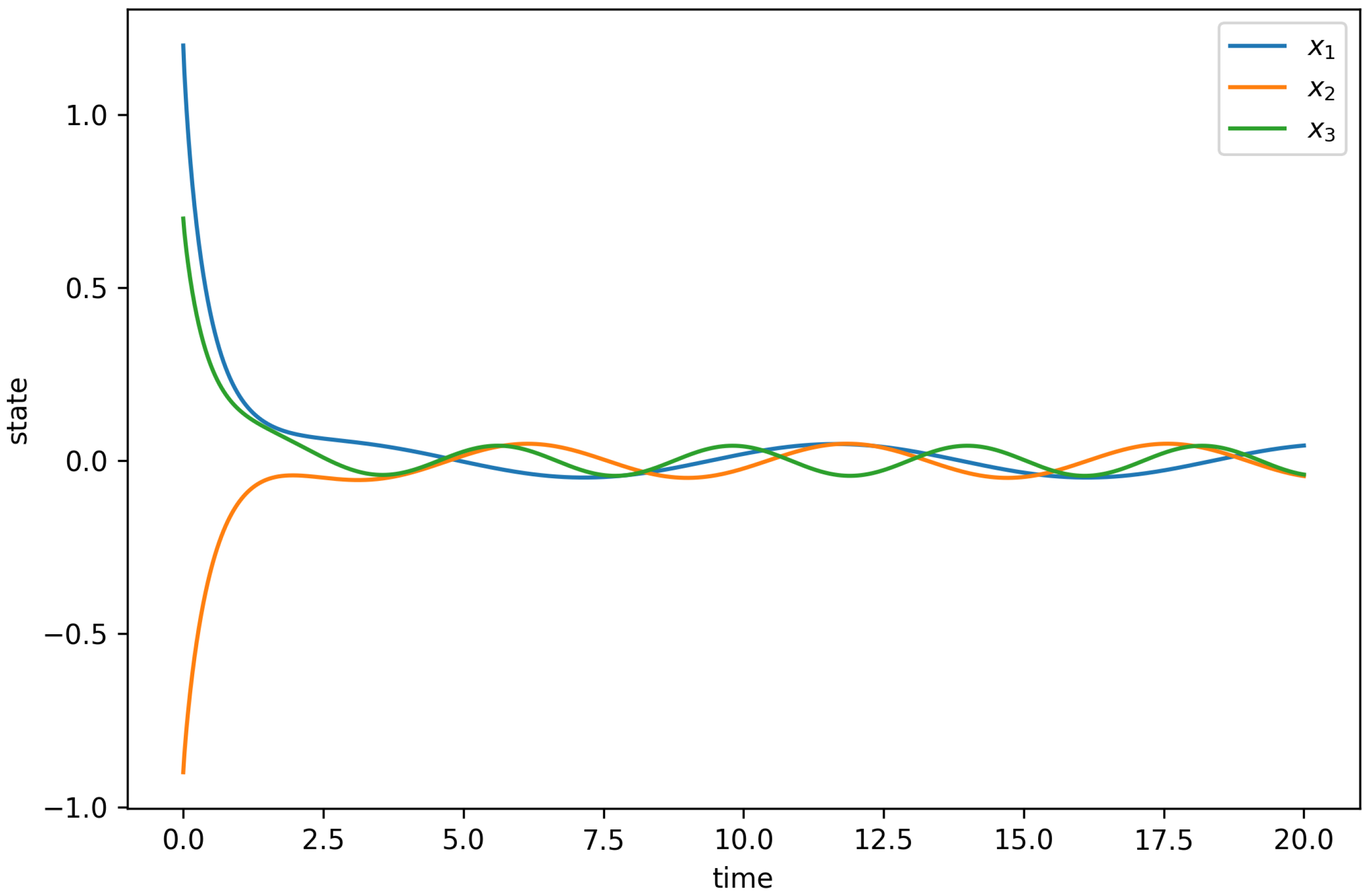
Figure 1 plots the responses of the three state variables (time). The plot indicates that the three components will fall quickly to their initial values towards a tiny area of the origin. Specifically, the initial transient is robust to all states, and, beyond t 2 –3, solutions transition into a low-amplitude oscillatory regime due to the bounded sinusoidal perturbation.
The three-dimensional phase portrait can be seen in Figure 2. The curve begins at the first point ( 1.2 , 0.9 , 0.7 ) , approaches the origin very quickly, and then continues to develop within a small bounded area. The phase curve not becoming divergent and becoming shorter demonstrate that the perturbed fractional dynamics is dissipative. Meanwhile, the periodic external perturbation causes the trajectory not to collapse to a single equilibrium point since the residual bounded motion is forced. Thus, the phase diagram gives a geometrical depiction of the empirical stability outcome in Theorem 2.
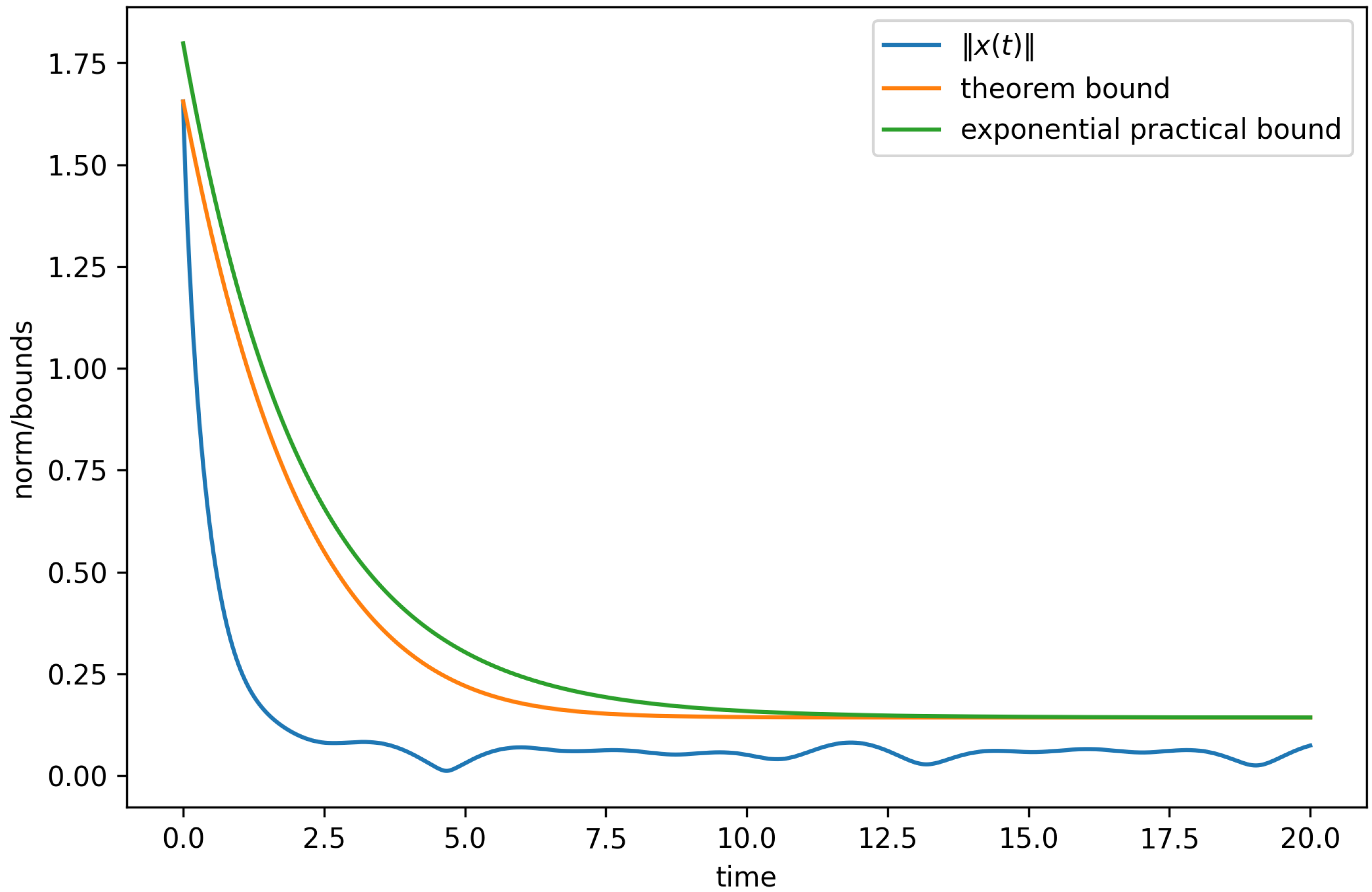
Figure 3 plots the actual state norm of the state, the two theoretical estimates, the practical bound of the state as per the theory and the exponential practical bound. This value is the most straightforward numerical validation of Theorem 2. First, the real norm is below both theoretical curves throughout the entire simulation period. Second, the real path follows much more rapidly than the theoretical envelopes that are conservative in the first transient. To illustrate, the actual norm at t = 5 is around 0.0458; the theory-based and exponential bounds are around 0.2459 and 0.3413, respectively. The actual norm at the last time, t = 20, is around 0.1091, which is still far below the theoretical values of 0.2054 and 0.2055. Third, the figure is a clear indication that the exponential envelope is looser than the theorem-based bound.
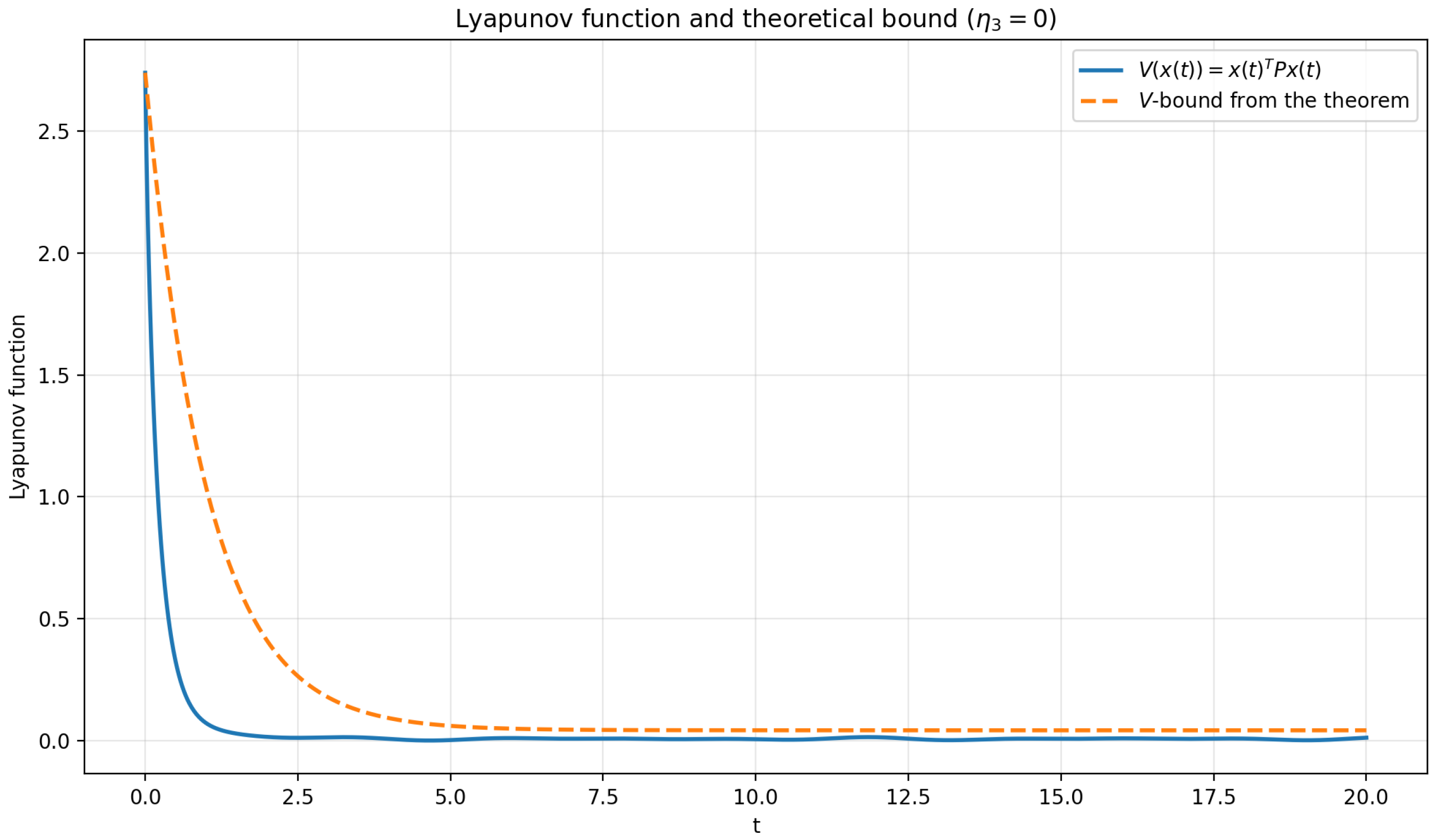
Figure 4 shows the Lyapunov function V ( x ( t ) ) = x ( t ) T P x ( t ) and its theoretical maximum. The number points out two facts that are complementary. On the one hand, the real Lyapunov function diminishes very rapidly, starting with V(0) = 2.74, to the order of 2.10 × 10 3 at t = 5, which confirms the strong dissipativity of the nominal part. Conversely, the theoretical limit declines far more gradually and goes to a nonzero residual level near
lim sup t V bound ( t ) 0.04219 .
This gap between the actual Lyapunov function and its bound reflects the natural conservatism of Lyapunov-based sufficient conditions. Nevertheless, the figure fully validates the theoretical estimate since the true Lyapunov function always remains below the predicted bound.
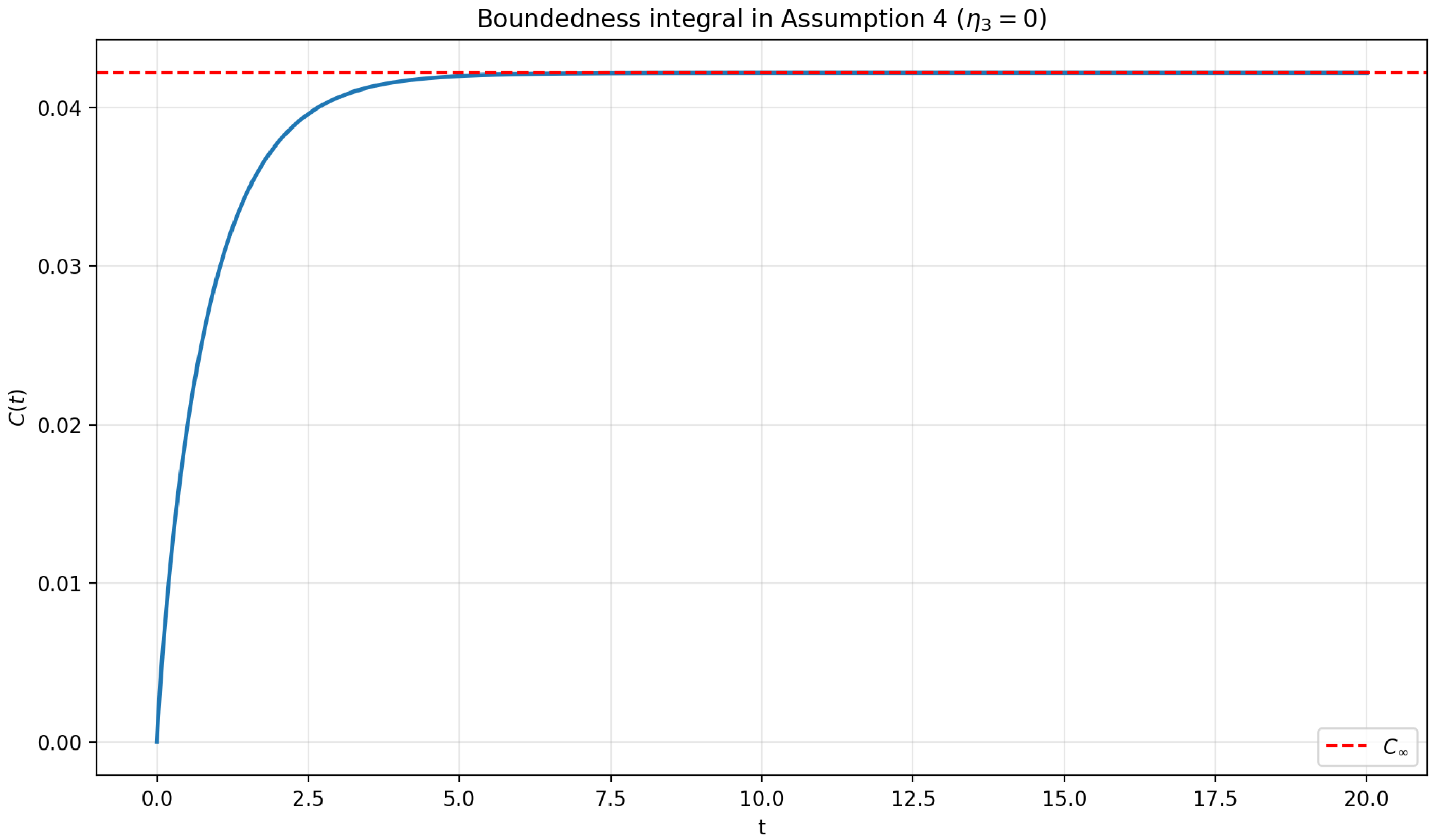
Figure 5 shows the evolution of the boundedness integral C ( t ) appearing in Assumption 4. The curve is monotonically increasing and quickly saturates, approaching the finite limit
C 0.04219 .
This is a crucial numerical observation because the boundedness of this integral is one of the key hypotheses required by Theorem 2. In the present η 3 = 0 case, this boundedness is theoretically guaranteed, while the figure provides a clear numerical illustration of the rapid saturation of C ( t ) . The finite limiting value of C ( t ) also explains the practical character of the stability estimate since it determines the size of the ultimate bounded set.
The above numerical findings indicate that the 3D perturbed tempered fractional system under consideration meets the conditions of Theorem 2, and it has the anticipated practical exponential behavior. More specifically, the trajectories quickly decay out of the starting point, stay within a small neighborhood of the starting point, and do not exceed the theoretical practical stability limits. The remaining oscillations that follow the transient stage can be entirely attributed to the continuing bounded perturbation d ( t ) and thus are quite compatible with the concept of practical stability. In particular, the numerical values
x ( 20 ) 0.1091 and K 3 0.2054
demonstrate that the practical radius is considerably lower than the theoretical practical radius. This proves the validity of the developed criterion as well as its conservativeness.
Hence, the present example provides a clear and convincing numerical validation of the perturbed-system result in Theorem 2 for a three-dimensional tempered fractional system with sine nonlinearity and bounded oscillatory perturbation, with η 3 = 0 so that the boundedness integral is theoretically guaranteed.

6.2. Additional Numerical Validation with η 3 > 0

To demonstrate the generality of Theorem 1, we now modify the preceding perturbed example so that the parameter η 3 is strictly positive. We keep ϖ ( t ) = t , θ = 0.85 , α = 1 , P = I 3 , and
A = diag ( 1.8 , 1.6 , 1.7 ) , x 0 = ( 1.2 , 0.9 , 0.7 ) T ,
but choose
= 0.85 , d ( t ) = 0.10 sin ( 0.7 t ) cos ( 1.1 t ) sin ( 1.5 t ) T .
Since c 0 = 3.2 and P = 1 , the parameter appearing in the Lyapunov derivative is
η 3 = c 0 2 + 2 P = 1.6 + 1.7 = 0.1 > 0 .
Moreover,
0 < η 3 = 0.1 < 1 = λ min ( P ) α θ ,
so the strict nonzero case satisfies the main theorem. The disturbance satisfies ρ ( t ) 0.10 3 , and the corresponding kernel integral remains bounded because the exponential tempering dominates the Mittag–Leffler growth.
Figure 6 confirms that the system remains practically stable even when the derivative inequality contains a positive growth term. The positivity of η 3 slows the theoretical decay rate, but the tempered memory factor still prevents divergence. This illustrates the role of the condition η 3 < η 1 α θ .
Figure 7 compares the simulated norm with the theoretical envelopes. The actual trajectory lies below the Lyapunov-based bound on the whole interval, validating the estimate in Theorem 1. The difference between the simulated curve and the bounds again reflects the conservative nature of sufficient Lyapunov criteria.

6.3. Tempered Fractional Cobweb Model with Bounded Disturbance

The cobweb model is a classical economic framework for price dynamics in markets with delayed supply response. To incorporate fading memory, we replace the standard Caputo derivative with the tempered ϖ -Caputo derivative of Definition 2. In this subsection we take ϖ ( t ) = t , so the operator reduces to the tempered Caputo derivative. The purpose of the example is to show that the main Lyapunov result applies even when the linear price coefficient is positive, provided that this positive coefficient is dominated by the tempering parameter.
The demand function is assumed to depend on the current price and on its tempered fractional rate of adjustment:
D ( t ) = a + b p ( t ) + D 0 + θ , α C p ( t ) , α > 0 , θ ( 0 , 1 ) ,
where a , b R and b 0 . The supply function is linear:
S ( t ) = a 1 + b 1 p ( t ) , a 1 , b 1 R , b 1 b .
Market clearing with a bounded external disturbance g ( t ) , representing unexpected demand shocks, government interventions, or measurement errors, gives
D ( t ) = S ( t ) + g ( t ) , | g ( t ) | G for all t 0 ,
where G > 0 is a constant. Substituting the expressions for D and S yields
a + b p ( t ) + D 0 + θ , α C p ( t ) = a 1 + b 1 p ( t ) + g ( t ) .
Rearranging and dividing by b gives
D 0 + θ , α C p ( t ) = λ p ( t ) + δ + h ( t ) ,
where
λ = b 1 b b , δ = a 1 a b , h ( t ) = g ( t ) b .
Since g is bounded, h is bounded; denote
H 0 = sup t 0 | h ( t ) | < .
We assume throughout this example that
0 < λ < α θ 3 .
Define the shifted deviation from the undisturbed equilibrium by
x ( t ) = p ( t ) + δ λ = p ( t ) p , p = δ λ .
Since the tempered Caputo derivative of a constant is zero, Equation (35) becomes
D 0 + θ , α C x ( t ) = λ x ( t ) + h ( t ) , t 0 .
We now verify that the shifted system (37) satisfies the assumptions of Theorem 1. Consider the quadratic Lyapunov function V ( x ) = x 2 . Then condition (8) holds with
η 1 = η 2 = 1 , κ = 2 .
Using Lemma 3, we obtain
D 0 + θ , α C V ( x ( t ) ) 2 x ( t ) D 0 + θ , α C x ( t ) = 2 λ x ( t ) 2 + 2 x ( t ) h ( t ) .
Because λ > 0 , Young’s inequality gives
2 x ( t ) h ( t ) 2 | x ( t ) | | h ( t ) | λ x ( t ) 2 + h ( t ) 2 λ .
Consequently,
D 0 + θ , α C V ( x ( t ) ) 3 λ x ( t ) 2 + h ( t ) 2 λ .
Thus condition (9) is satisfied with
η 3 = 3 λ > 0 , H ( t ) = h ( t ) 2 λ H 0 2 λ .
By (36),
0 < η 3 = 3 λ < α θ = η 1 α θ ,
so condition (10) is fulfilled. Moreover, since H is bounded and η 3 < α θ , the tempered convolution in (11) is bounded.
Therefore Theorem 1 applies, and the shifted price system (37) is ϖ -practically exponentially stable. In economic terms, even though the coefficient λ is positive in the price-deviation equation, the tempered memory kernel provides sufficient damping when 3 λ < α θ . The market price p ( t ) approaches a practical neighborhood of
p = δ λ ,
and the size of this neighborhood is determined by the disturbance bound H 0 .
For the numerical illustration, we take
a = 0.5 , a 1 = 0.3 , b = 1 , b 1 = 1.2 , θ = 0.75 , α = 0.70 , p ( 0 ) = 0.5 ,
and
g ( t ) = 0.01 ( 1 + 0.3 sin ( 0.6 t ) ) .
Then
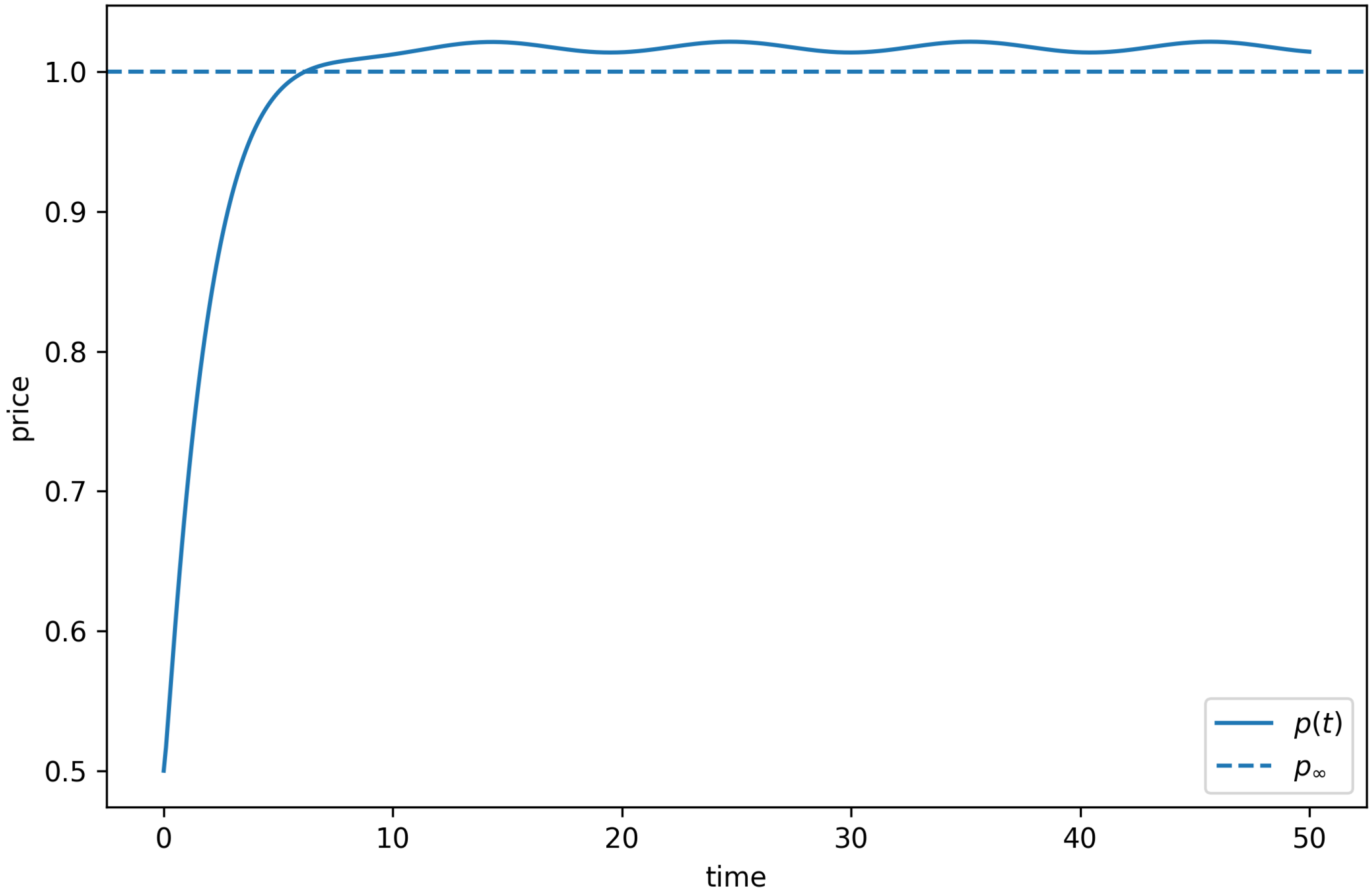
λ = 0.2 > 0 , δ = 0.2 , p = 1 , η 3 = 3 λ = 0.6 < α θ 0.7653 .
The disturbance satisfies | h ( t ) | 0.013 , so the boundedness condition in Theorem 1 is also satisfied. The simulation is similar in spirit to the fractional cobweb trajectories reported in Figure 4 of [18], but the present dynamics uses the tempered derivative and a bounded-disturbance formulation with positive λ .
Figure 8 confirms the theoretical prediction. Starting from p ( 0 ) = 0.5 , the price approaches the equilibrium level p = 1 and then remains close to it. The small persistent oscillation is caused by the bounded market shock g ( t ) ; hence exact convergence is not expected, whereas practical exponential convergence is guaranteed by Theorem 1.
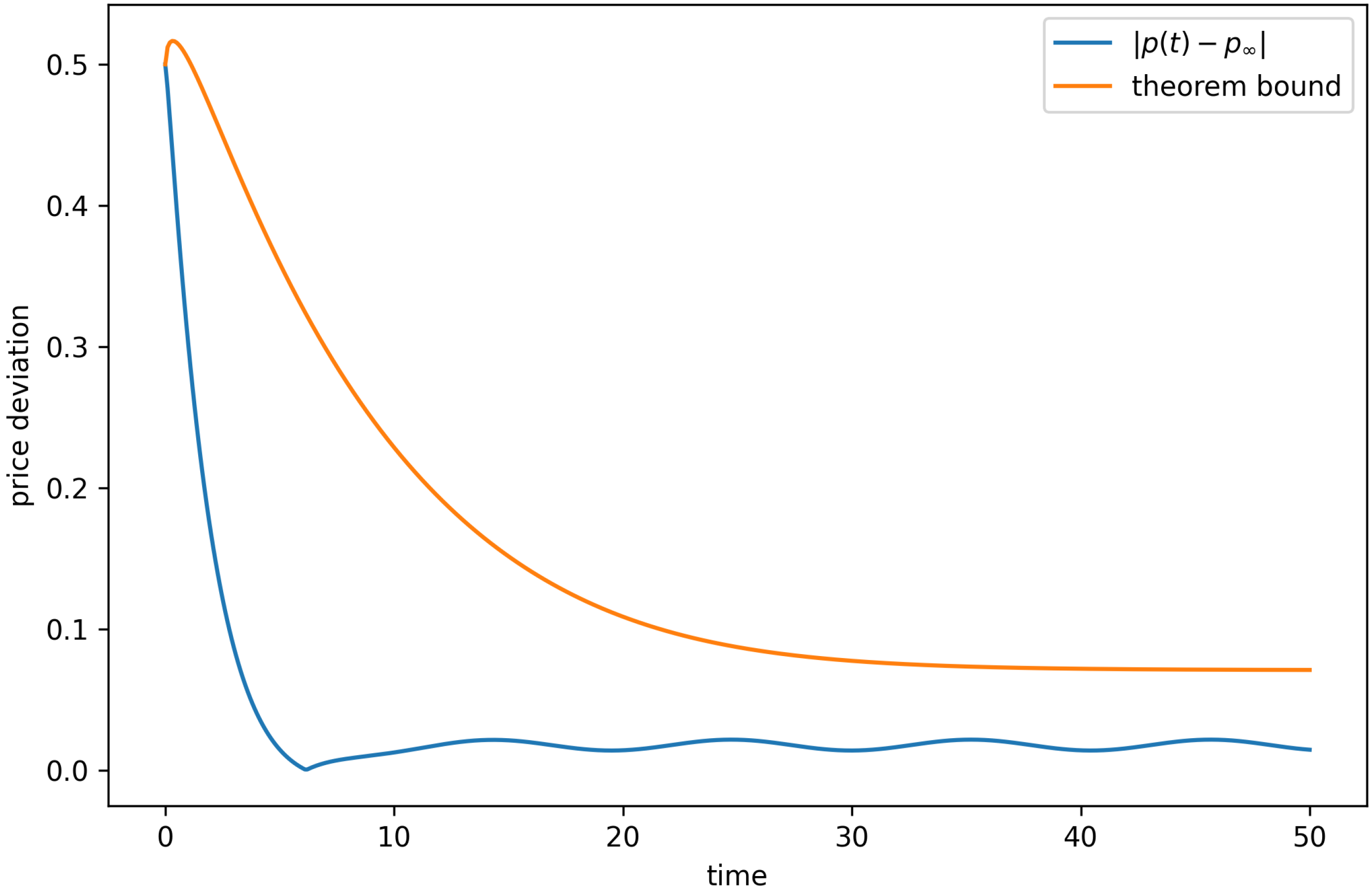
Figure 9 plots the deviation | p ( t ) p | together with the practical bound obtained from the Lyapunov estimate with η 3 = 3 λ . The bound is conservative, as expected for a sufficient Lyapunov criterion, but it remains consistent with the simulated trajectory over the whole time interval. This validates the use of the main practical exponential stability theorem for a socio-economic price-adjustment model with tempered memory, bounded shocks, and positive λ .

6.4. Numerical Validation for Stabilization via Feedback Control

In this subsection, we provide a numerical validation of Theorem 3 for a three-dimensional perturbed tempered fractional control system. In order to remain fully consistent with the general framework of Section 5, we consider again the special case ϖ ( t ) = t so that the tempered ϖ -Caputo derivative reduces to the tempered Caputo derivative with respect to the standard time variable. The controlled system is taken as
D 0 + θ , α C x ( t ) = A x ( t ) + B u ( t ) + Φ ( x ( t ) ) + d ( t ) , x ( 0 ) = x 0 ,
with the linear state-feedback law
u ( t ) = K x ( t ) .
The matrices and parameters are chosen as
A = diag ( 0.9 , 0.8 , 0.85 ) , B = I 3 , K = diag ( 2.5 , 2.3 , 2.45 ) ,
and hence the closed-loop matrix becomes
A + B K = diag ( 1.6 , 1.5 , 1.6 ) .
The nonlinear perturbation is selected as
Φ ( x ) = G sin ( x ) , G = 0.16 0 1 0 0 0 1 1 0 0 ,
where the sine function is applied componentwise, and the external disturbance is chosen as
d ( t ) = 0.08 sin ( 0.9 t ) cos ( 1.2 t ) sin ( 1.4 t ) .
The fractional order, tempering parameter, and initial condition are
θ = 0.85 , α = 1 , x 0 = ( 1.1 , 0.8 , 0.9 ) T .
Moreover, the quadratic Lyapunov function is taken as
V ( x ) = x T P x , P = I 3 .
We now verify that the previous example satisfies the assumptions required by Theorem 3. Since P = I 3 , one has
λ min ( P ) = λ max ( P ) = P = 1 .
Next, because the sine function is applied componentwise and satisfies | sin ( ξ ) | | ξ | for every ξ R , it follows that
Φ ( x ) = G sin ( x ) G sin ( x ) G x .
Since
G 2 = 0.16 ,
Assumption 5 is fulfilled with
L = 0.16 .
On the other hand, for the chosen disturbance, one has
d ( t ) 0.08 3 0.138564 ,
so Assumption 6 holds with
ρ ( t ) ρ max = 0.138564 .
For the linear closed-loop part, since
A + B K = diag ( 1.6 , 1.5 , 1.6 ) ,
we obtain
( A + B K ) T P + P ( A + B K ) = 2 ( A + B K ) = diag ( 3.2 , 3 , 3.2 ) .
Therefore, for any q ( 0 , 3 ] , the matrix inequality
( A + B K ) T P + P ( A + B K ) q I
is satisfied. In the present safe version, we choose
q = 0.64 ,
so
η 3 = q 2 + 2 L P = 0.64 2 + 2 ( 0.16 ) = 0 .
Hence
0 η 3 = 0 < 1 = λ min ( P ) α θ ,
which verifies Assumption 8. This choice is particularly convenient because, in the case η 3 = 0 , the boundedness integral required in Assumption 9 is theoretically guaranteed, in complete agreement with the theorem framework.
Finally, the disturbance contribution in the Lyapunov inequality is bounded by
H ( t ) 2 P 2 q ρ 2 ( t ) 2 0.64 ( 0.138564 ) 2 = 0.06 .
The corresponding boundedness integral satisfies
C 0.06 , max t [ 0 , 20 ] C ( t ) 0.06 ,
which confirms Assumption 9. Therefore, all hypotheses of Theorem 3 are fulfilled for the present three-dimensional example.
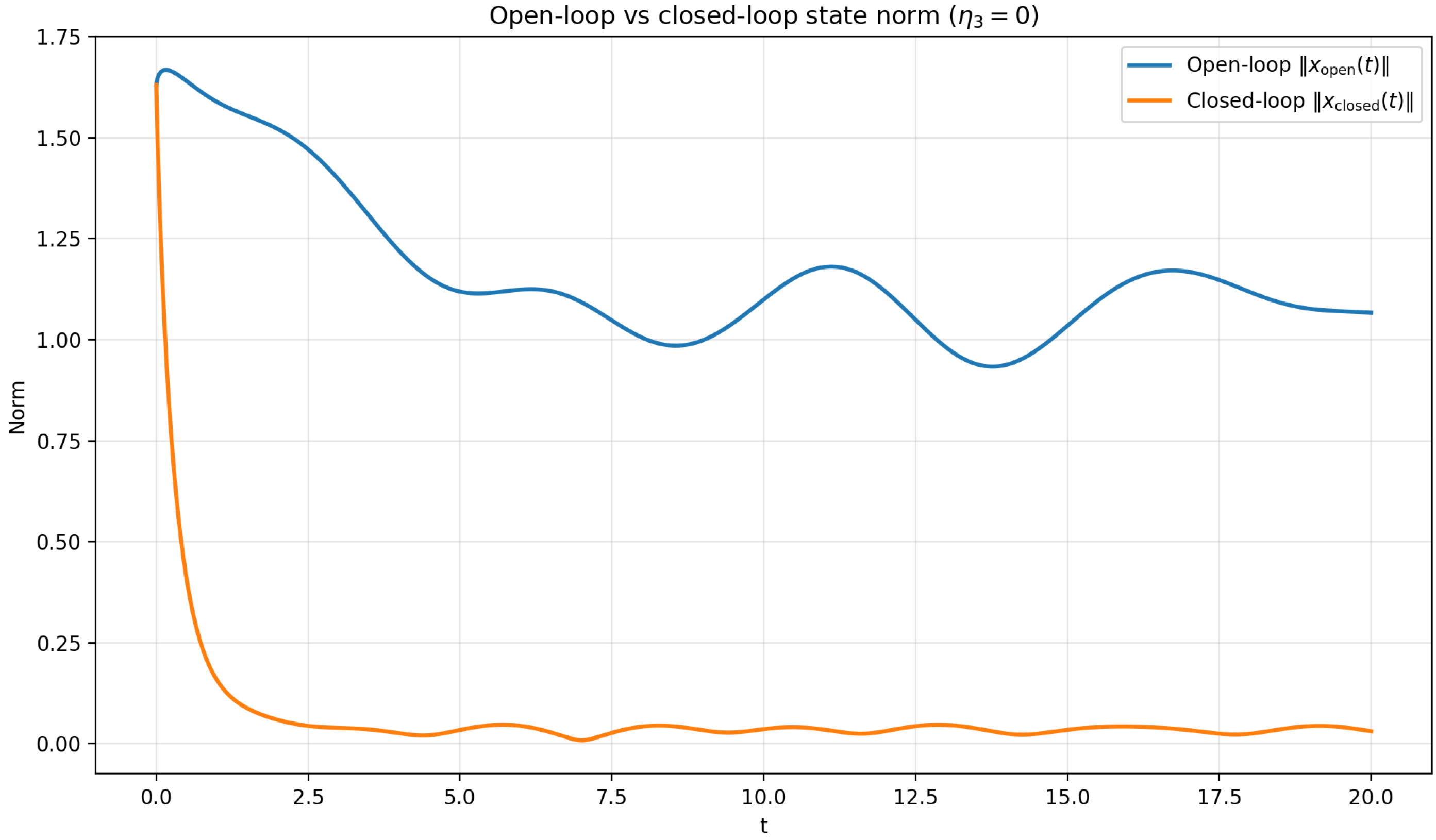
Figure 10 compares the norms of the open- and closed-loop trajectories. The blue curve of the uncontrolled system remains near the magnitude of one and has sustained oscillations, which implies that the open-loop dynamics are not stabilized around the origin. Conversely, the orange closed-loop curve decays extremely fast and attains a small practical neighborhood following a short transient. The distance between the two curves is immediately apparent and is important throughout the entire period of the simulation. This number is the most direct indication that the feedback law significantly enhances the system behavior.
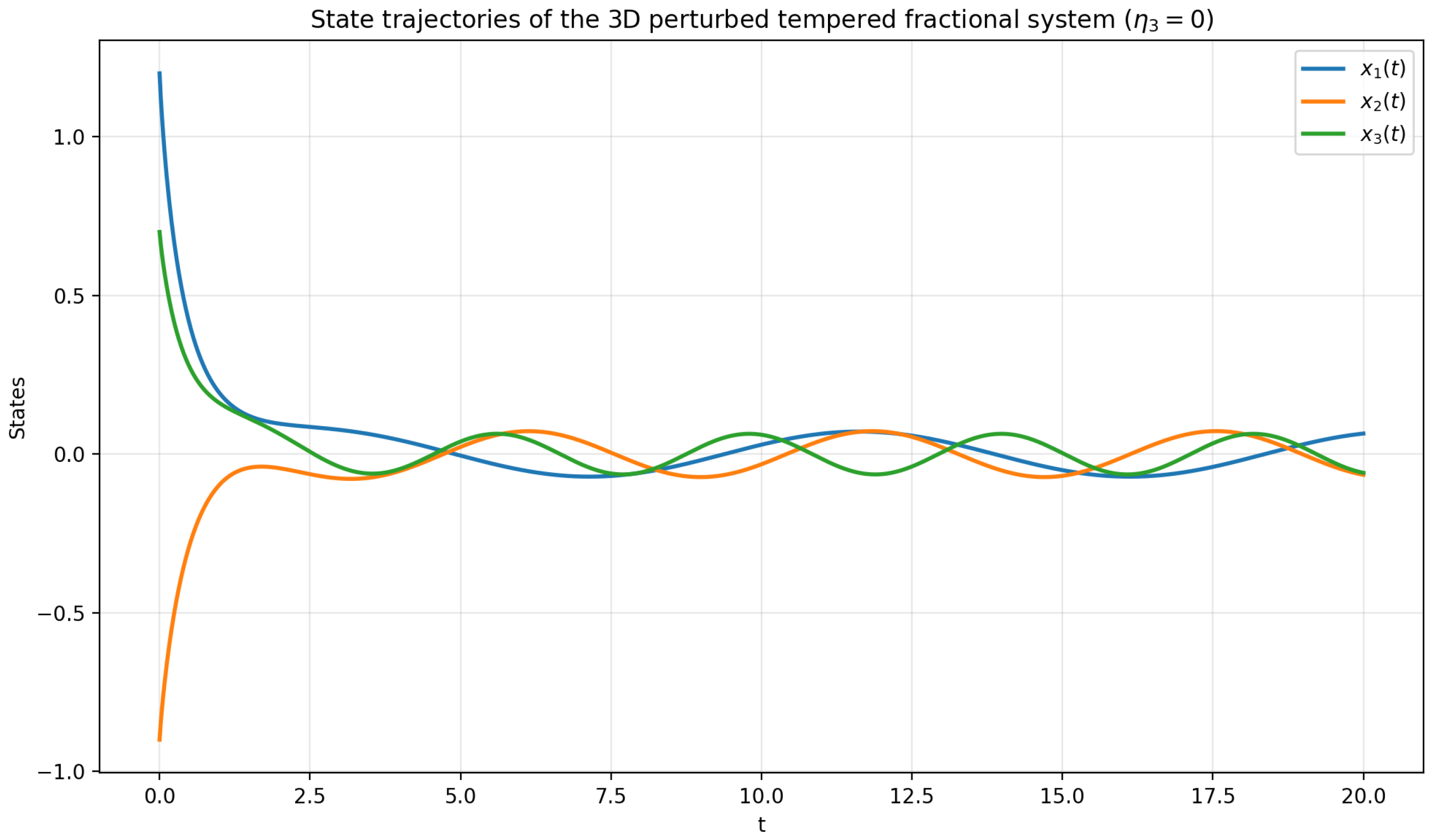
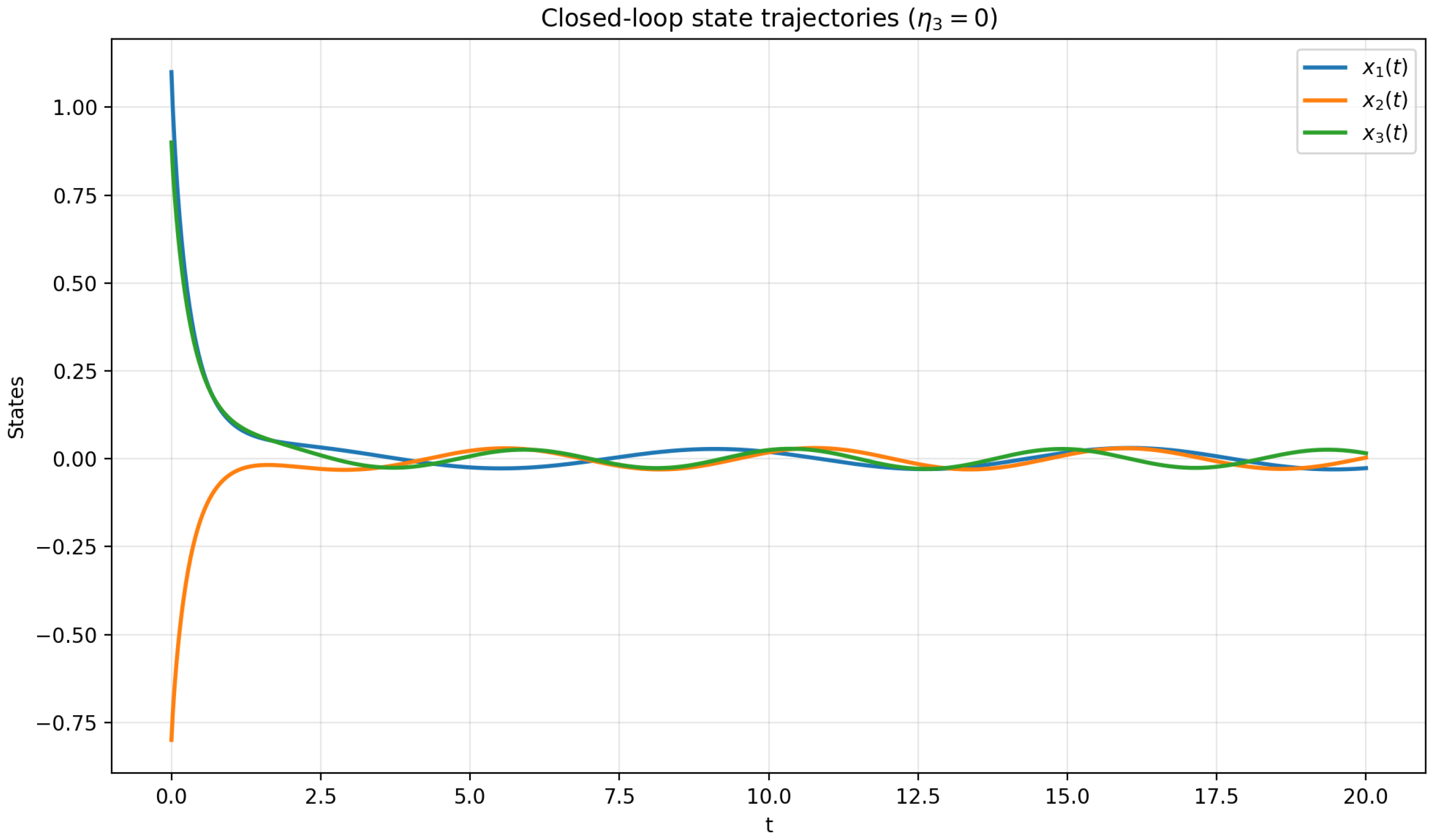
Figure 11 shows the three closed-loop state components. The three variables rapidly converge to small oscillations around the origin. Therefore, the large open-loop response is suppressed by the feedback law, and the state is restricted to a very small neighborhood of the origin in spite of the ongoing external disturbance.
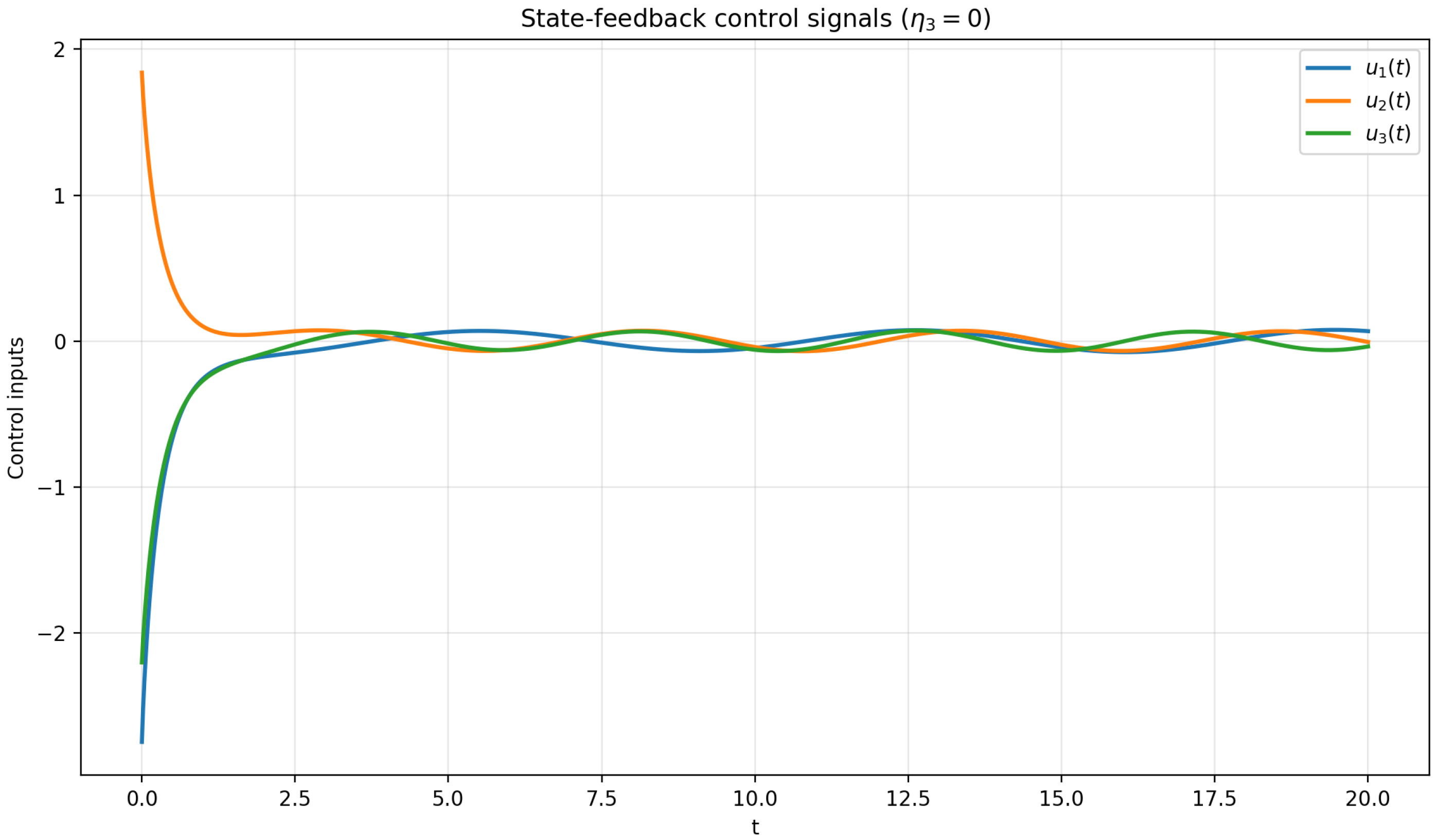
Figure 12 displays the feedback control signals.
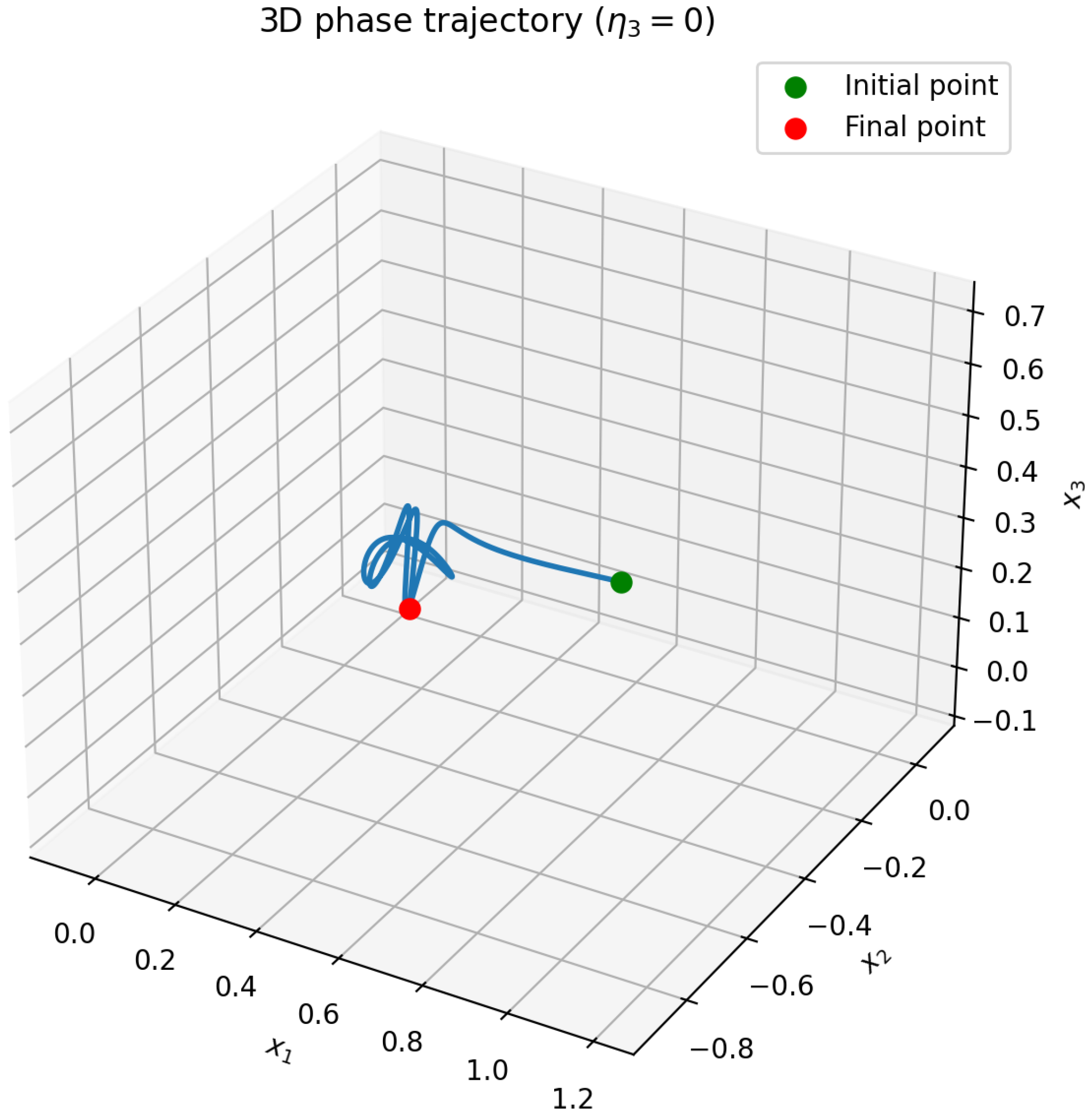
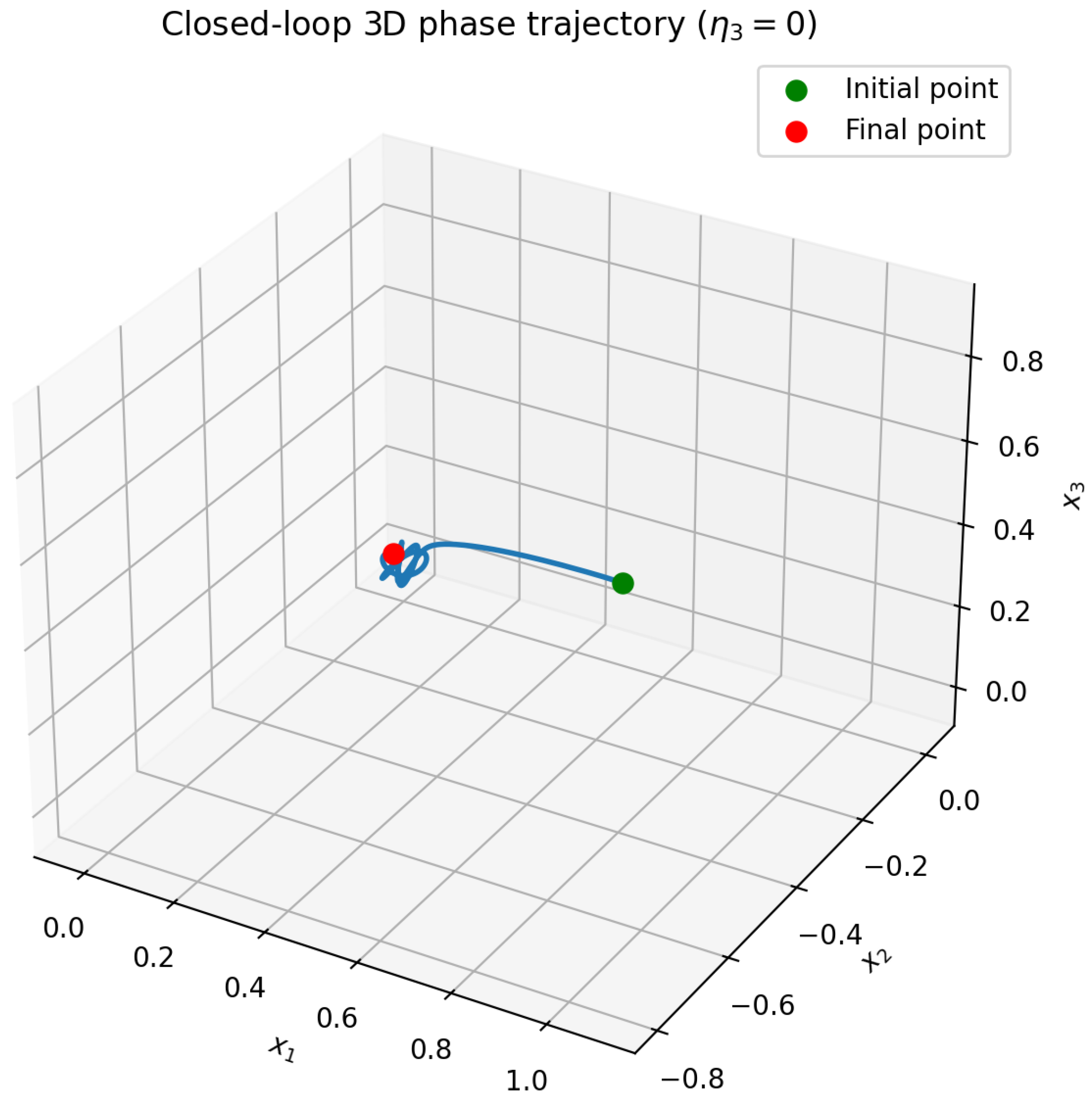
Figure 13 gives the three-dimensional phase portrait of the closed-loop system. The absence of divergence in the phase portrait and the evident contraction of the orbit provide a clear geometric confirmation of Theorem 3.
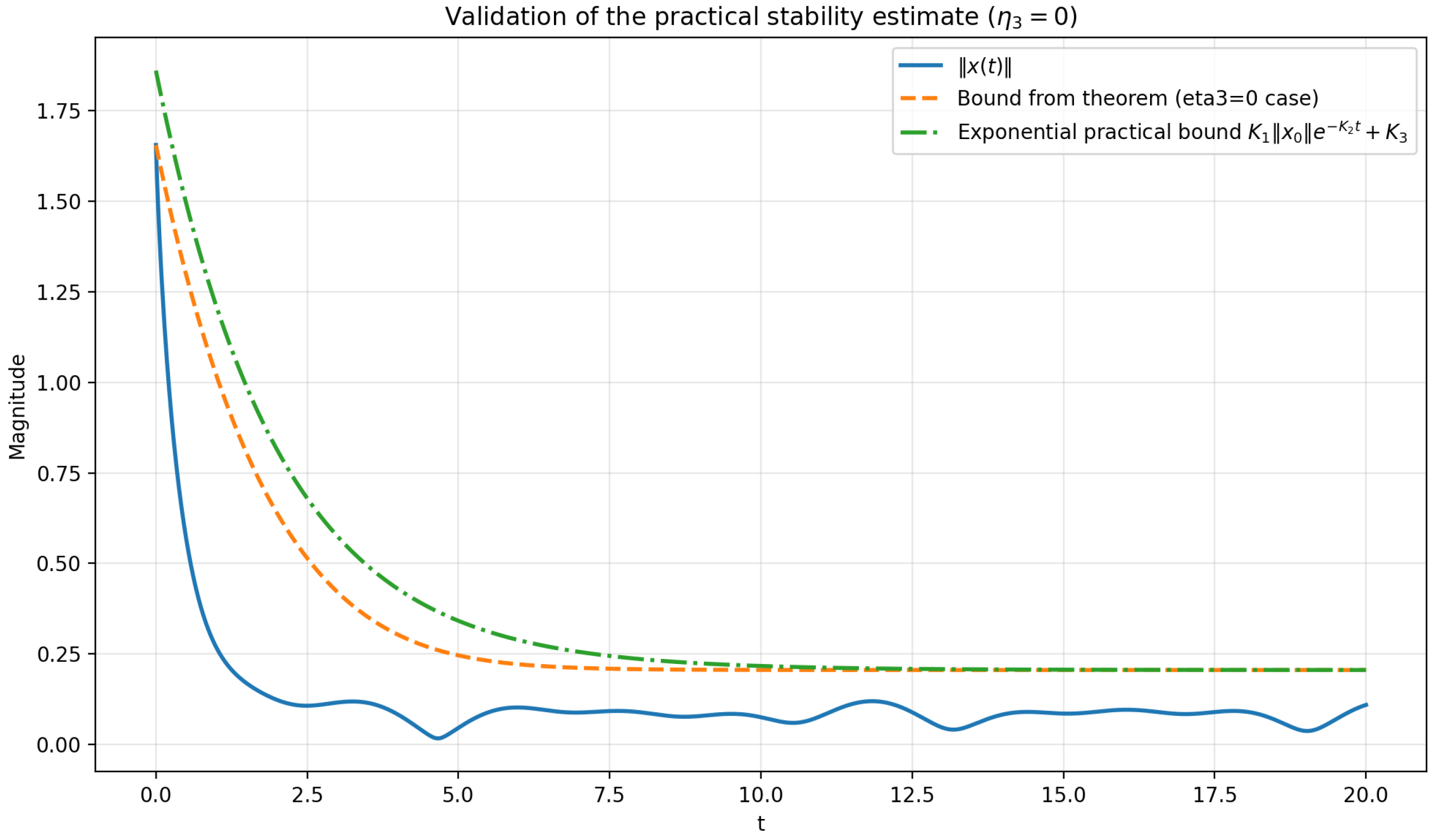
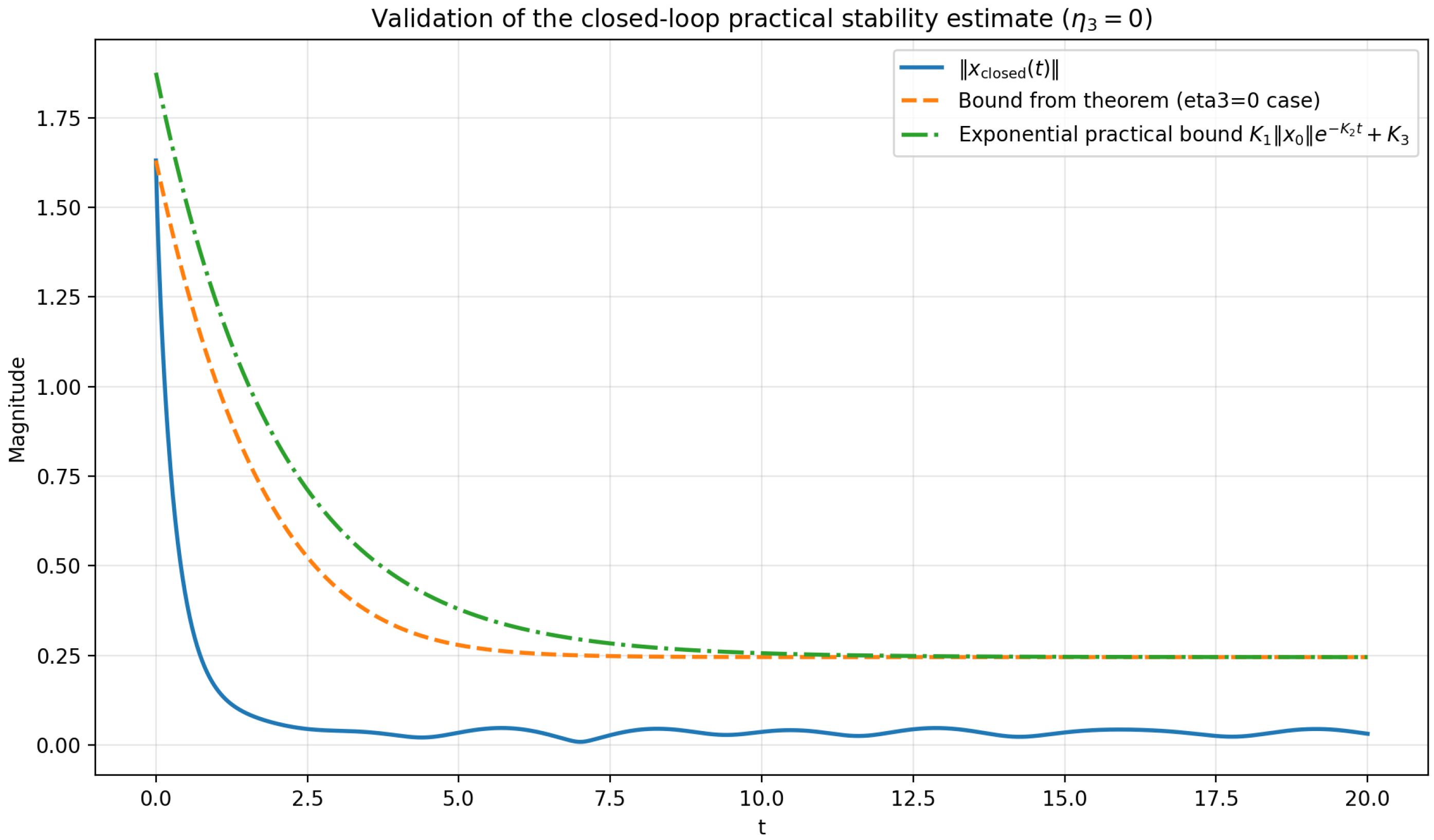
Figure 14 compares the true closed-loop norm with the theorem-based practical bound and the exponential practical bound. The true norm remains strictly below both theoretical envelopes for all t [ 0 , 20 ] . Moreover, the theorem-based bound is visibly less conservative than the exponential one, especially during the transient stage. For example, at t = 5 , one has
x closed ( 5 ) 0.03425 , x bound ( 5 ) 0.27865 , x exp ( 5 ) 0.37883 .
At the final time, the two bounds become almost identical:
x bound ( 20 ) 0.24495 , x exp ( 20 ) 0.24502 .
This figure therefore provides a direct numerical confirmation of the practical exponential estimate established in Theorem 3.
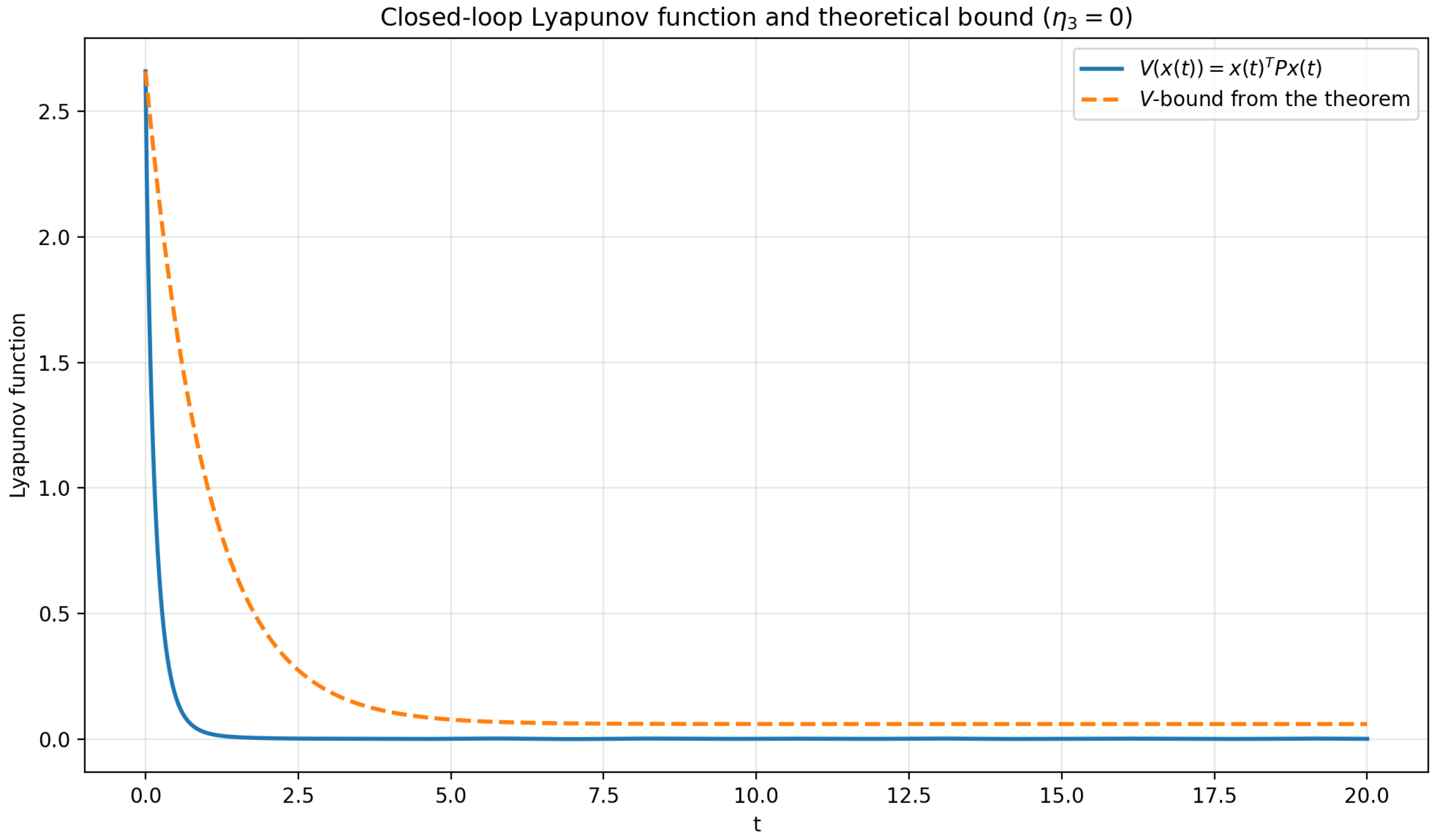
Figure 15 shows the closed-loop Lyapunov function together with its theoretical upper bound. The actual Lyapunov function decreases extremely fast from
V ( 0 ) = 2.66
to
V ( 5 ) 1.173 × 10 3 ,
and remains of order 10 3 afterwards. At the end of the simulation,
V ( 20 ) 9.680 × 10 4 .
The theoretical bound is more conservative and converges to a residual level essentially determined by the bounded kernel integral, namely
lim sup t V bound ( t ) 0.06 .
Such a conservative gap is inherent to the Lyapunov-based sufficient conditions, but the key fact is that the real Lyapunov function is never bigger than the estimated bound.
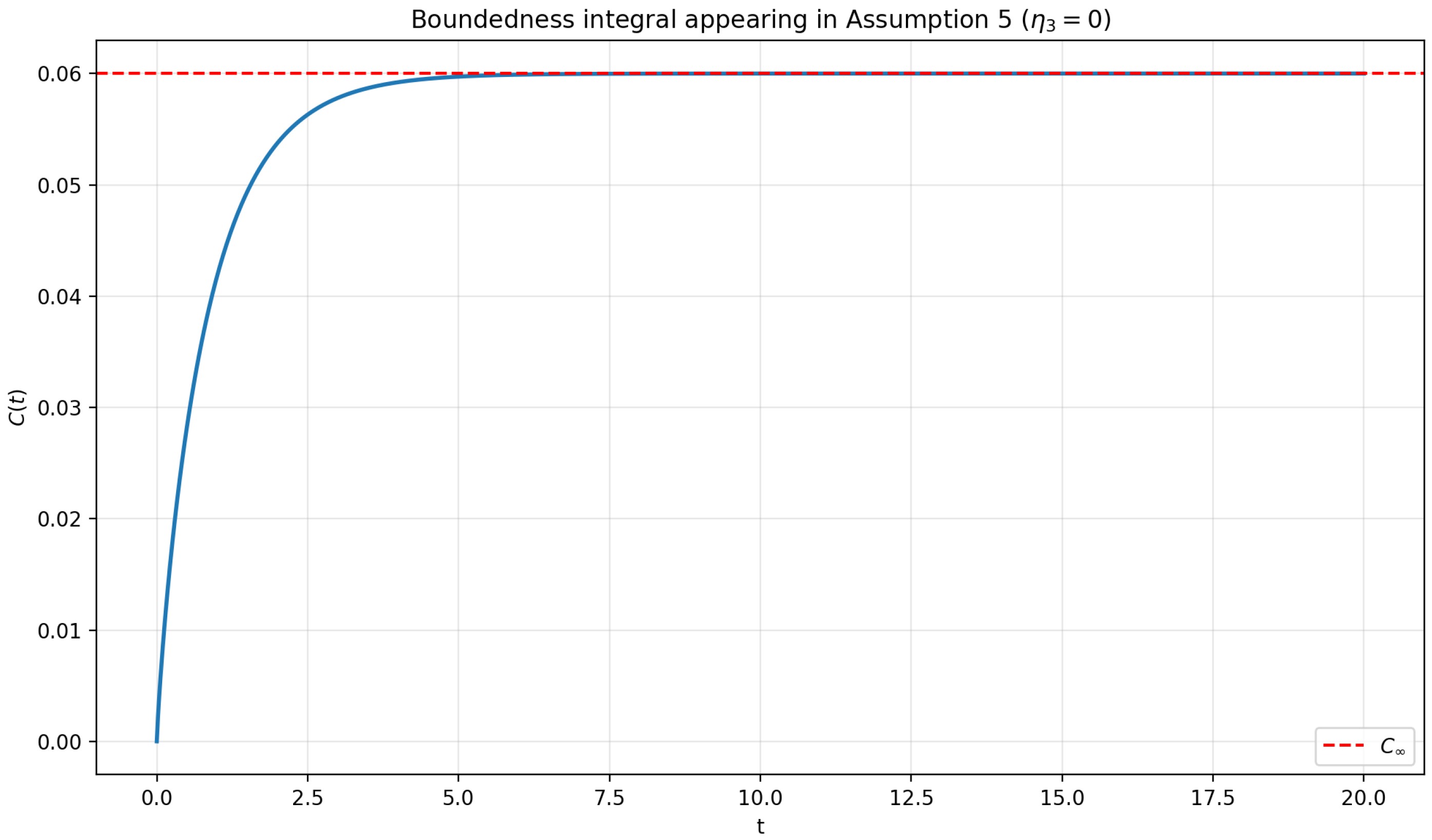
Figure 16 represents the boundedness integral C ( t ) appearing in Assumption 9. The curve is monotonically increasing and reaches its limiting value very quickly, essentially around t 5 . Numerically, the limiting value is
C 0.06 .
This is a key observation because the boundedness of C ( t ) is precisely the condition required to guarantee practical exponential stabilization in Theorem 3. The figure further explains why the practical residual radius is finite:
K 3 = C 0.24495 .
The present example provides a clear numerical validation of the stabilization result of Theorem 3. First, all the structural assumptions of the theorem are verified explicitly. Second, the feedback law produces a strong stabilization effect: while the uncontrolled system remains far from the origin with large persistent oscillations, the controlled system is rapidly driven into a very small neighborhood of the origin. Third, both practical stability estimates predicted by the theorem remain valid over the whole simulation interval. Finally, the Lyapunov function, the bounded kernel integral, and the phase portrait all support the same conclusion: the proposed state-feedback law successfully ϖ -practically exponentially stabilizes the considered three-dimensional perturbed tempered fractional system.

7. Conclusions

In this paper, a new Lyapunov-based practical exponential stability theorem has been established for a class of nonlinear systems described by the tempered ϖ -Caputo fractional derivative. The developed result provides a general and tractable framework for deriving explicit practical exponential estimates of the system trajectories. In particular, the proposed criterion is expressed through suitable lower and upper bounds on a Lyapunov function, together with a tempered fractional derivative inequality and a boundedness condition involving a weighted integral term. This allows the practical exponential behavior of the solutions to be characterized in a unified way. The usefulness of the proposed theorem has been illustrated through two application results. First, sufficient conditions ensuring practical exponential stability were derived for a class of perturbed tempered ϖ -fractional systems. Second, the derived criterion was effectively applied to a state-feedback stabilization problem, demonstrating that the theorem can be effectively implemented as an analysis tool for closed-loop tempered fractional systems. The theoretical results were supported by the numerical examples and showed the success of the proposed method both for perturbed and controlled systems. In particular, the added nonzero- η 3 example confirms that the main theorem applies beyond the borderline case η 3 = 0 . The tempered fractional cobweb model with bounded disturbance further demonstrates the relevance of the theory to socio-economic price-adjustment dynamics with memory and persistent market shocks. The current study creates a number of potential avenues for research. Specifically, the frameworks that have been developed can be generalized to delayed tempered fractional systems, uncertain and stochastic models, impulsive dynamics, and more general classes of nonlinear control systems. Another promising direction concerns the development of observer-based or output-feedback designs within the same tempered ϖ -fractional setting. These issues will be considered in future investigations.

Author Contributions

Conceptualization, A.R.A.A., R.F., A.B.M. and O.N.; methodology, A.R.A.A., R.F., A.B.M. and O.N.; software, A.R.A.A. and O.N.; validation, A.R.A.A., R.F., A.B.M. and O.N.; formal analysis, A.R.A.A., R.F., A.B.M. and O.N.; investigation, A.R.A.A., R.F., A.B.M. and O.N.; resources, A.R.A.A. and O.N.; data curation, A.R.A.A. and O.N.; writing—original draft preparation, A.R.A.A., R.F., A.B.M. and O.N.; writing—review and editing, A.R.A.A., R.F., A.B.M. and O.N.; visualization, A.R.A.A. and O.N.; supervision, O.N.; project administration, O.N.; funding acquisition, A.R.A.A. All authors have read and agreed to the published version of the manuscript.

Funding

This work was funded by the Deanship of Graduate Studies and Scientific Research at Jouf University under grant No. (DGSSR-2025-FC-01017).

Data Availability Statement

Data are contained within the article.

Conflicts of Interest

The authors declare no conflicts of interest. The funders had no role in the design of the study; in the collection, analyses, or interpretation of data; in the writing of the manuscript; or in the decision to publish the results.

Appendix A. Comparison with Existing Results

Table A1. Position of the present paper relative to closely related results.
ReferenceMain SettingDifference from the Present Work
 [9]Tempered fractional dynamical systems and Mittag–Leffler stabilityDoes not provide the present practical exponential estimate with the explicit residual term used for perturbed and controlled systems.
[10,11]Finite-time or guaranteed-cost stability/control for tempered systemsFocuses on finite-time and cost criteria rather than a general Lyapunov criterion for ϖ -practical exponential stability.
[14]Practical stability and robust feedback for tempered Caputo systemsClosely related, but the present work develops a distinct tempered ϖ -fractional formulation and validates it through perturbed, controlled, nonzero- η 3 , and cobweb examples.
[16,18]Fractional cobweb and partial practical stability applicationsProvides the socio-economic motivation; the present paper adapts the cobweb model to the tempered framework and links it to the new theorem.

Appendix B. Deferred Proofs of Application Theorems

The proofs of Theorems 2 and 3 are placed here to improve the readability of the main text while keeping all technical details available.
Proof of Theorem 2. 
Consider the Lyapunov function candidate
V ( x ) = x T P x , x R n .
Since P = P T > 0 , we have
λ min ( P ) x 2 V ( x ) λ max ( P ) x 2 , x R n .
Moreover, by Definition 2, the solutions of (19) are absolutely continuous on compact intervals. Since V is of class C 1 , the function ν V ( x ( ν ) ) is absolutely continuous on compact intervals as well.
Using Lemma 3, we obtain along the trajectories of (19)
D ν 0 + θ , α , ϖ C V ( ν , x ( ν ) ) 2 x ( ν ) T P D ν 0 + θ , α , ϖ C x ( ν ) .
Substituting (19) into (A2), one gets
D ν 0 + θ , α , ϖ C V ( ν , x ( ν ) ) 2 x ( ν ) T P f ( ν , x ( ν ) ) + 2 x ( ν ) T P Δ ( ν , x ( ν ) ) .
By Assumption 1,
2 x ( ν ) T P f ( ν , x ( ν ) ) c 0 x ( ν ) 2 .
On the other hand, Assumption 2 yields
Δ ( ν , x ( ν ) ) x ( ν ) + ρ ( ν ) ,
and therefore
2 x ( ν ) T P Δ ( ν , x ( ν ) ) 2 P x ( ν ) Δ ( ν , x ( ν ) ) 2 P x ( ν ) 2 + 2 P ρ ( ν ) x ( ν ) .
Combining (A3), (A4), and (A5), we arrive at
D ν 0 + θ , α , ϖ C V ( ν , x ( ν ) ) ( c 0 2 P ) x ( ν ) 2 + 2 P ρ ( ν ) x ( ν ) .
Applying Young’s inequality with
2 P ρ ( ν ) x ( ν ) c 0 2 x ( ν ) 2 + 2 P 2 c 0 ρ 2 ( ν ) ,
we obtain
D ν 0 + θ , α , ϖ C V ( ν , x ( ν ) ) ( c 0 2 + 2 P ) x ( ν ) 2 + 2 P 2 c 0 ρ 2 ( ν ) .
Now define
H ( ν ) : = 2 P 2 c 0 ρ 2 ( ν ) .
From (A1), condition (8) of Theorem 1 holds with
η 1 = λ min ( P ) , η 2 = λ max ( P ) , κ = 2 .
Moreover, (A7) shows that condition (9) of Theorem 1 is satisfied with
η 3 = c 0 2 + 2 P .
Assumption 4 implies that the function
ν ν 0 ν ( ϖ ( ν ) ϖ ( s ) ) θ 1 E θ , θ ( c 0 2 λ min ( P ) + 2 P λ min ( P ) ) ( ϖ ( ν ) ϖ ( s ) ) θ ϖ ( s ) e α ( ϖ ( ν ) ϖ ( s ) ) H ( s ) d s
is bounded on [ ν 0 , + ) . Hence all assumptions of Theorem 1 are fulfilled, and the system (19) is ϖ -PES.
This completes the proof.
Proof of Theorem 3. 
Consider the quadratic Lyapunov function
V ( x ) = x T P x , x R n ,
where P = P T > 0 is given by Assumption 7. Then
λ min ( P ) x 2 V ( x ) λ max ( P ) x 2 , x R n .
Moreover, by Definition 2, the trajectories of (27) are absolutely continuous on compact intervals. Since V is of class C 1 , the function ν V ( x ( ν ) ) is absolutely continuous on compact intervals as well.
Using Lemma 3, we obtain along the trajectories of (27)
D ν 0 + θ , α , ϖ C V ( ν , x ( ν ) ) 2 x ( ν ) T P D ν 0 + θ , α , ϖ C x ( ν ) .
Substituting the closed-loop dynamics (27) into (A10), we arrive at
D ν 0 + θ , α , ϖ C V ( ν , x ( ν ) ) 2 x ( ν ) T P ( A + B K ) x ( ν ) + 2 x ( ν ) T P Φ ( ν , x ( ν ) ) + 2 x ( ν ) T P d ( ν ) = x ( ν ) T ( A + B K ) T P + P ( A + B K ) x ( ν ) + 2 x ( ν ) T P Φ ( ν , x ( ν ) ) + 2 x ( ν ) T P d ( ν ) .
By Assumption 7,
x ( ν ) T ( A + B K ) T P + P ( A + B K ) x ( ν ) q x ( ν ) 2 .
In addition, Assumption 5 implies
2 x ( ν ) T P Φ ( ν , x ( ν ) ) 2 P x ( ν ) Φ ( ν , x ( ν ) ) 2 L P x ( ν ) 2 .
Also, from Assumption 6,
2 x ( ν ) T P d ( ν ) 2 P x ( ν ) d ( ν ) 2 P ρ ( ν ) x ( ν ) .
Combining (A11)–(A14), we obtain
D ν 0 + θ , α , ϖ C V ( ν , x ( ν ) ) ( q 2 L P ) x ( ν ) 2 + 2 P ρ ( ν ) x ( ν ) .
Applying Young’s inequality yields
2 P ρ ( ν ) x ( ν ) q 2 x ( ν ) 2 + 2 P 2 q ρ 2 ( ν ) .
Therefore,
D ν 0 + θ , α , ϖ C V ( ν , x ( ν ) ) ( q 2 + 2 L P ) x ( ν ) 2 + 2 P 2 q ρ 2 ( ν ) .
Define
H ( ν ) : = 2 P 2 q ρ 2 ( ν ) .
Then, from (A9), condition (8) of Theorem 1 is satisfied with
η 1 = λ min ( P ) , η 2 = λ max ( P ) , κ = 2 .
Moreover, (A16) shows that condition (9) of Theorem 1 holds with
η 3 = q 2 + 2 L P .
Assumption 9 guarantees the boundedness condition required in Theorem 1. Therefore, all hypotheses of Theorem 1 are fulfilled, and the closed-loop system (27) is ϖ -practically exponentially stable. This completes the proof. □

References

  1. Erdelyi, A. Higher Transcendental Functions; McGraw-Hill: New York, NY, USA, 1953; Volume III. [Google Scholar]
  2. Podlubny, I. Fractional Differential Equations; Academic Press: San Diego, CA, USA, 1999. [Google Scholar]
  3. Medveď, M.; Pospisil, M. Generalized laplace transform and tempered ψ-caputo fractional derivative. Math. Model. Anal. 2023, 28, 146–162. [Google Scholar] [CrossRef]
  4. Almeida, R.; Martins, N.; Sousa, J.V.d.C. Fractional tempered differential equations depending on arbitrary kernels. AIMS Math. 2024, 9, 9107–9127. [Google Scholar] [CrossRef]
  5. O’Regan, D.; Hristova, S.; Agarwal, R.P. Ulam-type stability results for variable order Ψ-tempered caputo fractional differential equations. Fractal Fract. 2024, 8, 11. [Google Scholar] [CrossRef]
  6. Rahou, W.; Salim, A.; Lazreg, J.E.; Benchohra, M. Implicit caputo tempered fractional differential equations with retarded and advanced arguments in Banach spaces. Palest. J. Math. 2025, 14, 1–14. [Google Scholar]
  7. Annapoorani, N.; Umapathi, V. A study on fractional integrodifferential equations using tempered ψ-caputo fractional derivative. Gulf J. Math. 2025, 20, 289–302. [Google Scholar] [CrossRef]
  8. Bettayeb, N.; Salim, A.; Lazreg, J.E.; Benchohra, M. Implicit neutral tempered ψ-caputo fractional differential coupled systems with delay in generalized banach spaces. Ann. Acad. Rom. Sci. Ser. Math. Its Appl. 2025, 17, 55–79. [Google Scholar] [CrossRef]
  9. Deng, J.; Ma, W.; Deng, K.; Li, Y. Tempered mittag-leffler stability of tempered fractional dynamical systems. Math. Probl. Eng. 2020, 2020, 7962542. [Google Scholar] [CrossRef]
  10. Zitane, H.; Torres, D.F.M. Finite time stability of tempered fractional systems with time delays. Chaos Solitons Fractals 2023, 177, 114265. [Google Scholar] [CrossRef]
  11. Tuan, T.N.; Thuan, M.V.; Thanh, N.T. Finite-time guaranteed cost control for tempered nonlinear fractional-order systems with delays: A novel stability approach. Comput. Appl. Math. 2025, 44, 335. [Google Scholar] [CrossRef]
  12. Gao, D.; Qiu, Z.; Wang, L.; Li, J. A simple and effective second-order numerical algorithm for tempered fractional differential equation with time caputo-tempered fractional derivative. Adv. Math. Phys. 2025, 2025, 5518224. [Google Scholar] [CrossRef]
  13. Alawad, M.A. Lyapunov-based analysis of partial practical stability in tempered fractional calculus. Fractal Fract. 2025, 9, 716. [Google Scholar] [CrossRef]
  14. Ben Makhlouf, A.; Alkhrijah, Y.; Ben Makhlouf, A. Practical stability and robust state-feedback for tempered ϑ-caputo fractional systems. Int. J. Syst. Sci. 2026. [Google Scholar] [CrossRef]
  15. Ben Makhlouf, A. Stability with respect to part of the variables of nonlinear caputo fractional differential equations. Math. Commun. 2018, 23, 119–126. [Google Scholar]
  16. Ben Makhlouf, A. Partial practical stability for fractional-order nonlinear systems. Math. Methods Appl. Sci. 2022, 45, 5135–5148. [Google Scholar] [CrossRef]
  17. Mtiri, F. Finite time stability for a class of hadamard fractional ito-doob stochastic time-delayed systems. Asian J. Control 2026, 28, 200–204. [Google Scholar] [CrossRef]
  18. Chen, G.; Bohner, M.; Jia, B. Caputo fractional continuous cobweb models. J. Comput. Appl. Math. 2020, 374, 112734. [Google Scholar] [CrossRef]
  19. Lamrani, I.; Zitane, H.; Torres, D.F.M. Controllability and observability of tempered fractional differential systems. Commun. Nonlinear Sci. Numer. Simul. 2025, 142, 108501. [Google Scholar] [CrossRef]
  20. Vishnukumar, K.S.; Govindaraj, V. Exploring controllability in tempered Ψ-caputo fractional dynamical systems without delay and delays in control. Int. J. Dyn. Control 2025, 13, 391. [Google Scholar] [CrossRef]
  21. Alawad, M.A.; Louhichi, B. Innovative observer design for nonlinear tempered fractional-order systems. Asian J. Control 2026, 28, 361–368. [Google Scholar] [CrossRef]
  22. Alkhrijah, Y.; Louhichi, B. Unknown input observer design for osl θ-tempered fractional-order systems. Asian J. Control 2026, 28, 369–375. [Google Scholar] [CrossRef]
  23. Rguigui, H.; Elghribi, M. Separation principle for caputo-hadamard fractional-order fuzzy systems. Asian J. Control 2026, 28, 138–145. [Google Scholar] [CrossRef]
  24. Issaoui, R.; Mseddi, A.; El-Sayad, W.Z. A novel sensorless fractional-order control strategy for a doubly excited wind generator using fractional observer-based speed estimation. Asian J. Control 2026, 28, 205–213. [Google Scholar] [CrossRef]
  25. Jiang, H.; Sun, T.; Yang, K.; Chen, Y. Symmetry breaking under single-wheel failure: Coordinated fault-tolerant control of EMB for emergency braking and lateral stability. Symmetry 2026, 18, 480. [Google Scholar] [CrossRef]
  26. Gallegos, J.A.; Duarte-Mermoud, M.A.; Aguila-Camacho, N.; Castro-Linares, R. On fractional extensions of barbalat lemma. Syst. Control Lett. 2015, 84, 7–12. [Google Scholar] [CrossRef]
  27. Li, W.; Shi, M.; Shi, L.; Lin, B. Fixed-time bipartite flocking of perturbed networked UAV systems: A distributed optimization approach. Expert Syst. Appl. 2026, 299, 129979. [Google Scholar] [CrossRef]
  28. Tong, X.; Xiao, X.; Jin, X.; Wang, H. Nonlinear adaptive estimator-based prescribed performance control of perturbed quadcopter systems. Appl. Math. Comput. 2026, 509, 129663. [Google Scholar] [CrossRef]
  29. Tang, X.; Chen, X.; Leng, H.; Wang, Z.; Chen, B.; Chen, Y.; Wang, X. Comparison and optimization of target-assisted gaze input technique for enhanced selection in virtual eye-controlled systems. Int. J. Hum.–Comput. Interact. 2026, 42, 239–257. [Google Scholar] [CrossRef]
  30. Fink, G.; McCoy, D.C.; Jäggi, L.; Hinckley, K.; Castellanos, A.; Huaylinos Bustamante, M.L.; Mäusezahl, D. Digital support systems to improve child development in Peru: A cluster-randomized controlled open-label trial. Sci. Adv. 2026, 12, eaeb9403. [Google Scholar] [CrossRef] [PubMed]
  31. Naifar, O. Tempered fractional gradient descent: Theory, algorithms, and robust learning applications. Neural Netw. 2025, 193, 108005. [Google Scholar] [CrossRef]
Figure 1. State trajectories of the three-dimensional perturbed tempered fractional system with sine nonlinearity ( η 3 = 0 ). The three states decay rapidly toward a small neighborhood of the origin and then remain in a bounded low-amplitude oscillatory regime.
Fractalfract 10 00344 g001
Figure 2. Three-dimensional phase portrait corresponding to the perturbed system (34). The trajectory contracts toward a compact neighborhood of the origin, illustrating practical stability in the presence of bounded persistent perturbations.
Fractalfract 10 00344 g002
Figure 3. Comparison between the actual state norm x ( t ) , the practical bound from the theorem, and the exponential practical bound. The numerical trajectory remains below both theoretical estimates over the entire simulation interval.
Fractalfract 10 00344 g003
Figure 4. Evolution of the Lyapunov function V ( x ( t ) ) = x ( t ) T P x ( t ) and its theoretical upper bound in the case η 3 = 0 . The true Lyapunov function decreases sharply and remains well below the conservative bound predicted by the theorem.
Fractalfract 10 00344 g004
Figure 5. Boundedness integral C ( t ) entering Assumption 4. The curve is monotonically increasing and rapidly saturates near 0.04219 , confirming the bounded-kernel condition required by Theorem 2.
Fractalfract 10 00344 g005
Figure 6. State trajectories for the perturbed tempered fractional system in the nontrivial case η 3 = 0.1 > 0 . The trajectories decay rapidly and remain in a small bounded neighborhood of the origin.
Fractalfract 10 00344 g006
Figure 7. Norm estimate for the nonzero- η 3 example. The actual norm remains below the theorem-based practical bound and the exponential practical bound throughout the simulation interval.
Fractalfract 10 00344 g007
Figure 8. Price trajectory of the tempered fractional cobweb model with bounded disturbance and positive λ = 0.2 . The price approaches the equilibrium p = 1 and remains in a practical neighborhood determined by the disturbance bound.
Fractalfract 10 00344 g008
Figure 9. Price deviation | p ( t ) p | and the Lyapunov-based practical stability envelope for the positive- λ tempered cobweb model. The deviation remains below the theorem-based bound induced by the bounded disturbance.
Fractalfract 10 00344 g009
Figure 10. Open-loop versus closed-loop state norms in the safe case η 3 = 0 . The uncontrolled system remains at a large distance from the origin, whereas the feedback law induces a rapid decay toward a small practical neighborhood.
Fractalfract 10 00344 g010
Figure 11. Closed-loop state trajectories for the safe case η 3 = 0 . All three state variables decay rapidly and then remain in a very small bounded oscillatory regime around the origin.
Fractalfract 10 00344 g011
Figure 12. State-feedback control inputs in the safe case η 3 = 0 . The control action is initially significant in order to reject the large initial error, then quickly becomes a small bounded oscillatory signal.
Fractalfract 10 00344 g012
Figure 13. Closed-loop three-dimensional phase portrait. The trajectory contracts toward a compact neighborhood of the origin, illustrating the practical stabilization effect of the proposed feedback law.
Fractalfract 10 00344 g013
Figure 14. Validation of the practical stability estimate for the closed-loop system in the safe case η 3 = 0 . The true closed-loop norm remains below both the theorem-based practical bound and the exponential practical bound on the whole interval [ 0 , 20 ] .
Fractalfract 10 00344 g014
Figure 15. Closed-loop Lyapunov function and theoretical bound in the safe case η 3 = 0 . The actual Lyapunov function decreases much faster than the theoretical estimate and remains well below it.
Fractalfract 10 00344 g015
Figure 16. Boundedness integral C ( t ) appearing in Assumption 9. The function is monotonically increasing and rapidly saturates near 0.06 , confirming the bounded-kernel condition required by Theorem 3.
Fractalfract 10 00344 g016
Disclaimer/Publisher’s Note: The statements, opinions and data contained in all publications are solely those of the individual author(s) and contributor(s) and not of MDPI and/or the editor(s). MDPI and/or the editor(s) disclaim responsibility for any injury to people or property resulting from any ideas, methods, instructions or products referred to in the content.