Article

Perturbed Hybrid Pantograph Systems with Deformable Derivatives: Well-Posedness, Stability, Numerical Sensitivity, and a Delay-Feedback Toy Example


1
Department of Mathematics, Faculty of Matter Sciences and Computer Science, University of Djilali Bounaama Khemis Miliana, Road of Theniet El-Had, Khemis Miliana 44225, Algeria
2
Laboratory of Pure and Applied Mathematics, Amar Teledji University, Laghouat 03000, Algeria
3
Acoustics and Civil Engineering Laboratory, Physics Department, Faculty of Material Sciences and Computer Science, Khemis Miliana University, Ain Defla 44225, Algeria
4
Laboratory of Fixed Point Theory and Applications, Department of Mathematics, E.N.S. Kouba, Algiers 16308, Algeria
5
Independent Researcher, Izmir 35000, Turkey
6
Department of Mathematics, Ege University, Bornova 35100, Turkey
7
Department of Mathematics, College of Science, Qassim University, Buraydah 51452, Saudi Arabia
*
Authors to whom correspondence should be addressed.
Fractal Fract. 2026, 10(5), 328; https://doi.org/10.3390/fractalfract10050328
Submission received: 10 April 2026 / Revised: 5 May 2026 / Accepted: 8 May 2026 / Published: 11 May 2026

Abstract

We study a perturbed coupled system of generalized hybrid pantograph equations involving the deformable derivative of Zulfeqarr–Ujlayan–Ahuja. A central point of the revision is made explicit: for classically differentiable functions this derivative is local and satisfies D τ u = ( 1 τ ) u + τ u . Therefore, in the present differentiable setting the memory or aftereffect is produced by the proportional pantograph delays, while the deformable order τ supplies an order-dependent local relaxation/drift term. After rewriting the system as an equivalent integral equation on X = C ( I , R 2 ) , we establish invariant-ball conditions, existence and uniqueness within invariant balls, generalized Ulam–Hyers stability, and Lipschitz continuous dependence on the perturbation amplitude ε . The assumptions and constants are stated so that the restrictive roles of the Lipschitz bounds, the interval length, and | ε | are transparent. We then provide numerical parameter sensitivity diagrams for illustrative pantograph systems and include step-size refinement checks and performance indices. The numerical and plasma-inspired sections are deliberately framed as exploratory delay-feedback examples rather than as first-principles plasma models or rigorous bifurcation theory.

1. Introduction

Pantograph-type (proportional delay) systems—especially when coupled and non-linear—have attracted considerable attention in applications such as electrodynamics, current collection systems, control theory, and population dynamics. Their characteristic feature is not a fixed delay but a time-scaled argument, such as u ( q t ) with 0 < q < 1 , which can represent processes in which the effective past horizon grows with the observation time. In this paper we employ the deformable derivative (Definition 1) in a deliberately cautious way. For classically differentiable functions it satisfies the local identity (4); consequently, the deformable derivative used here should not be interpreted as a nonlocal memory kernel. Instead, the proportional delays carry the aftereffect, while the order τ introduces an additional local relaxation/drift contribution.
This clarification also explains why the deformable formulation is mathematically useful despite its equivalence, in the differentiable case, to a first-order equation with a modified drift term. It provides a single notation that interpolates between the classical case τ = 1 and an order-dependent local relaxation model, keeps the analysis directly comparable with the existing deformable-derivative pantograph literature, and allows the constants in the fixed-point and stability estimates to display explicitly how the parameter τ modifies the admissible interval length and perturbation size. Thus, the operator is not used here as a substitute for a nonlocal Caputo-type memory term; it is used as a structured local deformation of the drift in a system whose nonlocality comes from pantograph delays.
Building within this framework, Ayadi, Ege, and De la Sen studied in [1] the existence of a unique solution and the generalized Ulam–Hyers stability for a coupled system of generalized hybrid pantograph equations involving deformable fractional derivatives, by reformulating the problem as a fixed point of a suitable operator on a Banach space and applying Banach’s contraction principle. The present contribution extends that model by inserting explicit perturbation terms into the nonlinearities and by analyzing how these perturbations affect solvability, stability constants, continuous dependence, and qualitative numerical behavior.

Main Contributions and Differences with  [1]

Compared with the unperturbed coupled hybrid pantograph problem studied in [1], the present paper incorporates explicit perturbation terms scaled by a real parameter ε and analyzes their effect on well-posedness and robustness. Since the fixed-point strategy is standard, the novelty is not claimed to lie in a new fixed-point theorem; rather, it lies in the perturbation-dependent formulation and in the explicit way the constants and numerical interpretation are tied to ε and τ . The main contributions are the following:
  • We introduce the perturbed system (2) and (3) and formulate it as a parameter-dependent fixed-point problem ν = T ε ( ν ) on X = C ( I , R 2 ) .
  • We separate the roles of the local deformable derivative and the genuinely delayed pantograph terms, thereby avoiding an artificial memory interpretation of D τ for differentiable solutions.
  • We derive an invariant-ball criterion (Lemma 4) and a contraction/uniqueness condition (Theorem 2) in which the perturbation amplitude ε enters explicitly through the constants associated with p i .
  • We obtain generalized Ulam–Hyers stability with an explicit radius-dependent stability function (Theorem 3) and prove Lipschitz continuous dependence of the solution in the invariant ball on ε on parameter intervals where the contraction bound is uniform (Theorem 4).
  • We clarify the restrictiveness of the global Lipschitz/contraction hypotheses and explain how small | ε | , short intervals, or local-in-ball estimates can ensure their validity.
  • We include exploratory numerical parameter sensitivity diagrams, a step-size refinement check, and quantitative performance indices for a delay-feedback toy example. These computations are used to illustrate the theory, not to claim a rigorous global bifurcation or first-principles plasma result.
The deformable fractional derivative was introduced as a limit-based generalization of conformable differentiation in order to overcome certain structural restrictions of the latter and to retain a number of classical properties of the standard derivative [2,3]. This operator has since been used to develop existence and uniqueness results and Ulam–Hyers-type stability for various classes of fractional differential equations, including hybrid pantograph problems and impulsive systems [4,5]. In particular, several authors have considered generalized hybrid pantograph equations with fractional or deformable derivatives, where existence is proved by Darbo or Schauder fixed-point theorems and uniqueness and stability are derived via contraction mappings or measures of noncompactness [6,7,8]. These works demonstrate that the combination of hybrid structure, pantograph delays, and fractional operators yields a rich analytical setting in which fixed-point techniques are especially effective.
Beyond the deformable framework, a broad body of literature addresses fractional pantograph and hybrid systems driven by other nonlocal operators, including Caputo, Hilfer, conformable, and various generalized fractional derivatives. Existence, uniqueness, and different notions of stability have been obtained for single and coupled pantograph equations, neutral and stochastic variants, multi-term and sequential-fractional models, and problems with nonlocal or impulsive boundary conditions [9,10,11,12,13,14]. Many of these studies employ fixed point theorems, degree theory, Lyapunov-type functionals, or measures of noncompactness to treat well-posedness, while Ulam–Hyers, Ulam–Hyers–Rassias, and related stability concepts are used to quantify robustness of solutions with respect to perturbations in initial data or in the governing equations [4,5,15].
Recent control studies also show the continuing importance of delay-dependent and event-triggered methods in applied systems. Examples include PDE-based observer and predictor compensation for distributed infinite input/output delays [16], fault isolation and fault-tolerant control for time-varying delay stochastic distribution systems [17], event-triggered steering coordination for four-wheel independent steering systems [18], and event-triggered neural-learning tracking control for nonlinear pneumatic muscle actuation [19]. These works are not deformable-derivative pantograph models, but they motivate the emphasis placed here on perturbation amplitude, delay structure, robustness, and cautious numerical performance assessment.
However, most existing works focus either on unperturbed models or on perturbations that enter as abstract stability inequalities, rather than on explicit perturbation terms inserted into the nonlinear right-hand sides of coupled hybrid pantograph systems with deformable derivatives [6,7,8]. In particular, to the best of our knowledge, the effect of such perturbations on the qualitative behavior of the coupled generalized hybrid pantograph system introduced in [1] has not yet been systematically analyzed. Questions concerning how small perturbations modify existence and uniqueness regions, how they influence generalized Ulam–Hyers stability estimates, and how they can generate qualitative transition phenomena or alter the boundedness of solutions therefore remain largely open.
Motivated by these observations, the aim of this paper is to investigate a perturbed version of the coupled generalized hybrid pantograph system with deformable fractional derivatives considered in [1]. More precisely, perturbation terms depending on a real parameter are incorporated into the nonlinearities on the right-hand side, and the resulting system is rewritten as an operator equation on an appropriate Banach space. Under suitable Lipschitz and growth conditions on both the original and the perturbation functions, fixed-point arguments are then employed to derive existence and uniqueness results, together with bounds describing the continuous dependence of solutions on the perturbation parameter. The analysis further yields generalized Ulam–Hyers stability and boundedness estimates, and it motivates an exploratory parameter sensitivity study for a concrete delayed nonlinear model. We begin by recalling the coupled generalized hybrid pantograph system involving deformable derivatives studied in [1] and by introducing its perturbed counterpart. Let I = [ a , b ] with 0 a < b , and let D τ denote the deformable derivative of order τ ( 0 , 1 ] (Definition 1). We write β : = 1 τ (so 0 β < 1 ). For compactness, for i = 1 , 2 set
Σ i ν ( x ) : = ν 1 ( σ i 1 ( x ) ) , ν 2 ( σ i 2 ( x ) ) , Γ i ν ( x ) : = ν 1 ( γ i 1 ( x ) ) , ν 2 ( γ i 2 ( x ) ) .
For x I , we consider the perturbed system
D τ ν 1 ( x ) h 1 x , Σ 1 ν ( x ) ( x ) = f 1 x , Γ 1 ν ( x ) + ε p 1 x , Γ 1 ν ( x ) , D τ ν 2 ( x ) h 2 x , Σ 2 ν ( x ) ( x ) = f 2 x , Γ 2 ν ( x ) + ε p 2 x , Γ 2 ν ( x ) .
subject to the boundary conditions
ν 1 ( a ) = λ 1 , ν 2 ( a ) = λ 2 , ν = ( ν 1 , ν 2 ) ,
where λ i > 0 , i = 1 , 2 , are given constants and ε R is a perturbation parameter. Here h i , f i , p i : I × R 2 R , i = 1 , 2 , are continuous functions to be specified later. The maps σ i j , γ i j : I I ( i , j = 1 , 2 ) are pantograph-type delay maps: the σ i j describe the arguments entering the hybrid denominators, whereas the γ i j describe the arguments entering the right-hand sides and perturbation terms. This equation-specific notation is intentionally used so that examples may contain a delayed first variable in one equation, a delayed second variable in another equation, or current variables as special cases. The earlier two-delay formulation in [1] is recovered, for instance, by taking σ 11 = σ 21 = id , σ 12 = σ 22 = g 1 , γ 11 = γ 21 = id , and γ 12 = γ 22 = g 2 . The additional terms p 1 and p 2 allow the system to incorporate external forcing, feedback control, or parametric perturbations arising in applications such as perturbed pantograph–catenary dynamics or population models with fluctuating growth rates [8,9].
From a theoretical point of view, system (2) raises several natural questions. First, one would like to know under which conditions on h i , f i , p i , and the delay maps σ i j , γ i j the problem (2) and (3) admits at least one solution, and when such a solution is unique in a suitable Banach space of continuous functions. Second, it is important to understand how the presence of the perturbation parameter ε modifies the fixed-point structure of the associated integral operator, and to quantify the dependence of solutions on ε in the spirit of generalized Ulam–Hyers stability [4,5,15]. Finally, when the perturbation involves one or more additional parameters, one may expect changes in the number or nature of equilibria and periodic solutions, which naturally leads to a parameter sensitivity analysis for hybrid pantograph-type systems with deformable derivatives [7,8].
To address these questions, we reformulate (2) and (3) as a fixed-point problem on the complete boundary-compatible space X λ C ( I , R 2 ) equipped with the usual supremum norm. Using the integral representation of the deformable derivative and the boundary conditions, we construct an operator T ε : X λ X λ whose fixed points correspond to solutions of the perturbed system. Under appropriate Lipschitz and growth assumptions on h i , f i , and p i , we show that T ε is a contraction on a suitable invariant closed ball of X , so that Banach’s contraction principle yields existence and uniqueness within that ball. (We do not pursue the noncontraction route in the present manuscript.) Moreover, by establishing suitable a priori estimates, we derive generalized Ulam–Hyers stability and boundedness results that explicitly involve the perturbation parameter and the norms of p 1 and p 2 .
The analysis relies on several preliminary notions and properties concerning the modern definition of the deformable fractional derivative. In particular, we recall the definition introduced in [2,3], the associated fractional integral operator, and the fundamental relationships between these two operators, including linearity, commutativity, and the analogue of the fundamental theorem of calculus. We also collect useful lemmas describing the behavior of solutions to simple deformable differential equations and the structure of the corresponding integral equations, which will be essential for constructing the operator T ε and for deriving the main fixed-point and stability results. These preliminaries, together with the functional-analytic framework described above, form the basis for the detailed study of the perturbed system (2) developed in the subsequent sections.

2. Preliminaries

In this section we recall some basic notions related to the deformable fractional derivative and collect several auxiliary results that will be used throughout the paper. We also fix the functional framework and notation for the operator formulation of system (2) and (3).

2.1. Deformable Derivative and Its Integral

We recall the deformable derivative introduced by Zulfeqarr, Ujlayan, and Ahuja [2,3]. Throughout this paper we fix τ ( 0 , 1 ] and write β : = 1 τ .
Definition 1
(deformable derivative). Let u : I R be a function and let τ ( 0 , 1 ] with β : = 1 τ . The deformable derivative of order τ is defined by
D τ u ( x ) : = lim h 0 ( 1 + h β ) u ( x + τ h ) u ( x ) h ,
whenever this limit exists.
If u is classically differentiable at x, then u is τ -deformably differentiable and
D τ u ( x ) = β u ( x ) + τ u ( x ) , β = 1 τ .
In particular, D 1 u = u (classical derivative). The formal limit τ 0 + yields D 0 u = u , but we do not use τ = 0 in the analysis because the associated integral operator involves 1 / τ .
Remark 1
(local character of D τ ). Equation (4) is important for the interpretation of the model. In the differentiable setting adopted in this paper, D τ is a local operator and does not by itself generate hereditary memory. Consequently, when system (2) is rewritten as an ordinary delay system, the term ( 1 τ ) u appears as an order-dependent local relaxation or drift term. The nonlocal aftereffect in the present model is supplied by the proportional-delay arguments σ i j ( x ) and γ i j ( x ) , not by the deformable derivative alone.
Definition 2
(deformable integral). For f L 1 ( I ) we define the deformable integral of order τ (with lower limit a) by
I a τ f ( x ) : = 1 τ e β τ x a x e β τ s f ( s ) d s , x I .
Theorem 1
(fundamental properties). Let τ ( 0 , 1 ] , β = 1 τ , and let f C ( I ) . Then I a τ f C 1 ( I ) and, for all x I ,
1. 
D τ I a τ f ( x ) = f ( x ) .
2. 
I a τ D τ u ( x ) = u ( x ) u ( a ) e β τ ( x a ) for any classically differentiable u for which D τ u exists.
Lemma 1
(homogeneous equation). Let τ ( 0 , 1 ] and β = 1 τ . The initial value problem
D τ u ( x ) = 0 , u ( a ) = c ,
has the unique solution
u ( x ) = c e β τ ( x a ) , x I .
Proof. 
Using (4), the equation D τ u = 0 is equivalent to τ u ( x ) + β u ( x ) = 0 , whose solution is u ( x ) = c e β τ ( x a ) . See [2,3] for details. □

2.2. Functional Setting and Integral Formulation

We now specify the space in which solutions of the perturbed system will be sought and derive an equivalent integral equation. Let
X : = C ( I , R 2 ) , ( ν 1 , ν 2 ) X : = ν 1 + ν 2 ,
which is a Banach space with respect to · X . Since the boundary values in (3) are prescribed, the fixed-point argument is carried out on the closed affine subset
X λ : = { ( ν 1 , ν 2 ) X : ν 1 ( a ) = λ 1 , ν 2 ( a ) = λ 2 } .
Endowed with the metric induced by · X , X λ is complete. For R     | λ 1 |   +   | λ 2 | we write
B R : = { ( ν 1 , ν 2 ) X λ : ( ν 1 , ν 2 ) X R } .
This boundary-compatible formulation avoids applying the fixed-point operator to functions that do not satisfy the prescribed initial conditions.
Throughout the paper we assume that
h i : I × R 2 R { 0 } , f i : I × R 2 R , p i : I × R 2 R , σ i j , γ i j : I I ,
are continuous for i , j = 1 , 2 , and that σ i j and γ i j describe proportional delays of pantograph type, including the identity map as the zero-delay case. The nonvanishing of h i ensures that the fractions in (2) are well defined.
For ( ν 1 , ν 2 ) X λ we introduce the auxiliary functions
H i ( x ; ν 1 , ν 2 ) : = ν i ( x ) h i x , Σ i ν ( x ) , x I , i = 1 , 2 .
Lemma 2
(integral formulation). Suppose ( ν 1 , ν 2 ) X λ is a (classical) solution of system (2) and (3). Then, for i = 1 , 2 and all x I ,
H i ( x ; ν 1 , ν 2 ) = H i ( a ; ν 1 , ν 2 ) e β τ ( x a ) + I a τ F i ( · , ν 1 , ν 2 ) + ε P i ( · , ν 1 , ν 2 ) ( x ) ,
where
F i ( x , ν 1 , ν 2 ) : = f i x , Γ i ν ( x ) , P i ( x , ν 1 , ν 2 ) : = p i x , Γ i ν ( x ) .
Conversely, if ( ν 1 , ν 2 ) X λ satisfies (5) and the boundary conditions (3), then ( ν 1 , ν 2 ) is a mild solution of system (2) and (3) in the sense of Definition 3.
Proof. 
Assume ( ν 1 , ν 2 ) solves (2) and (3). For each i = 1 , 2 we have
D τ H i ( x ; ν 1 , ν 2 ) = F i ( x , ν 1 , ν 2 ) + ε P i ( x , ν 1 , ν 2 ) , x I .
Applying the deformable integral I a τ and using Theorem 1(2) gives
H i ( x ; ν 1 , ν 2 ) H i ( a ; ν 1 , ν 2 ) e β τ ( x a ) = I a τ F i ( · , ν 1 , ν 2 ) + ε P i ( · , ν 1 , ν 2 ) ( x ) ,
which is precisely (5).
Conversely, suppose (5) holds for all x I . Apply D τ to both sides and use Theorem 1(1) together with Lemma 1. Since D τ ( H i ( a ; ν 1 , ν 2 ) e β τ ( x a ) ) = 0 , we obtain
D τ H i ( x ; ν 1 , ν 2 ) = F i ( x , ν 1 , ν 2 ) + ε P i ( x , ν 1 , ν 2 ) ,
which is the i-th equation in (2). The boundary conditions (3) are preserved by construction, so ( ν 1 , ν 2 ) is a solution of the original system. □
Definition 3
(mild solution). A function ( ν 1 , ν 2 ) X λ is called a mild solution of (2) and (3) if it satisfies the integral equalities (5) for i = 1 , 2 together with the boundary conditions (3). Since I a τ maps C ( I ) into C 1 ( I ) (Theorem 1), any mild solution yields H i ( · ; ν 1 , ν 2 ) C 1 ( I ) and hence satisfies the differential system (2) pointwise.
Lemma 2 motivates the definition of an operator whose fixed points correspond to solutions.
Definition 4
(solution operator). For ε R and ( ν 1 , ν 2 ) X λ , define T ε ( ν 1 , ν 2 ) = ( ν ˜ 1 , ν ˜ 2 ) X λ by
ν ˜ 1 ( x ) : = h 1 x , Σ 1 ν ( x ) ( H 1 ( a ; ν 1 , ν 2 ) e β τ ( x a ) + I a τ F 1 ( · , ν 1 , ν 2 ) + ε P 1 ( · , ν 1 , ν 2 ) ( x ) ) , ν ˜ 2 ( x ) : = h 2 x , Σ 2 ν ( x ) ( H 2 ( a ; ν 1 , ν 2 ) e β τ ( x a ) + I a τ F 2 ( · , ν 1 , ν 2 ) + ε P 2 ( · , ν 1 , ν 2 ) ( x ) ) ,
for all x I , where
H 1 ( a ; ν 1 , ν 2 ) = λ 1 h 1 ( a , λ 1 , λ 2 ) , H 2 ( a ; ν 1 , ν 2 ) = λ 2 h 2 ( a , λ 1 , λ 2 ) ,
so that the boundary conditions (3) are built into the definition of T ε . Indeed, since inputs belong to X λ and σ i j ( a ) = a for all i , j , evaluating (6) at x = a gives ν ˜ i ( a ) = λ i .
Lemma 3
(equivalence with the perturbed problem). Let ε R . A function ( ν 1 , ν 2 ) X λ is a solution of system (2) and (3) if and only if it is a fixed point of T ε , that is,
( ν 1 , ν 2 ) = T ε ( ν 1 , ν 2 ) .
Proof. 
If ( ν 1 , ν 2 ) solves (2) and (3), then Lemma 2 shows that the expressions in (6) reproduce ν 1 and ν 2 , so ( ν 1 , ν 2 ) is a fixed point. Conversely, if ( ν 1 , ν 2 ) is a fixed point of T ε , then by Definition 4 we have
ν i ( x ) h i ( x , Σ i ν ( x ) ) = H i ( a ; ν 1 , ν 2 ) e β τ ( x a ) + I a τ F i ( · , ν 1 , ν 2 ) + ε P i ( · , ν 1 , ν 2 ) ( x ) ,
i.e., (5) holds, and Lemma 2 implies that ( ν 1 , ν 2 ) solves the perturbed system. The boundary conditions are part of X λ and are preserved by T ε , as noted in Definition 4. □
Remark 2
(equivalent first-order delay form). For differentiable solutions, the identity (4) rewrites the i-th equation of (2) as
τ d d x H i ( x ; ν 1 , ν 2 ) = F i ( x , ν 1 , ν 2 ) + ε P i ( x , ν 1 , ν 2 ) β H i ( x ; ν 1 , ν 2 ) , β = 1 τ .
Thus the deformable derivative contributes the local drift term β H i / τ , while the proportional delay arguments in F i and P i are the source of the aftereffect. The deformable formulation is retained because it gives a compact perturbation-dependent integral operator, keeps direct comparability with recent deformable pantograph results, and displays explicitly how τ changes the invariant-ball and contraction constants. It is not used as a nonlocal memory operator.
The remainder of the paper will be devoted to studying the existence, uniqueness, stability, and qualitative behavior of fixed points of T ε under appropriate structural assumptions on h i , f i , p i , and the delay maps σ i j , γ i j , and to interpreting the obtained results in the context of cautiously formulated application-motivated delay-feedback models.

3. Existence and Uniqueness of Solutions

In this section we investigate the solvability of the perturbed system (2) and (3) by studying fixed points of the operator T ε introduced in Definition 4. By Lemmas 2 and 3, solutions of the boundary value problem are in one-to-one correspondence with fixed points of T ε in the complete space X λ .

3.1. Structural Assumptions

We first specify the hypotheses on the nonlinearities h i , f i , p i , and the delay functions σ i j , γ i j .
Definition 5
(structural conditions). We say that the data ( h i , f i , p i , σ i j , γ i j ) i , j = 1 , 2 satisfy condition ( H ) if the following hold.
(H1) The maps σ i j , γ i j : I I are continuous, satisfy σ i j ( a ) = γ i j ( a ) = a , and obey
a σ i j ( x ) x , a γ i j ( x ) x for all x I , i , j = 1 , 2 .
(H2) The functions h i : I × R 2 R { 0 } are continuous. There exist constants k i > 0 and m i > 0 such that
| h i ( x , u 1 , u 2 ) h i ( x , v 1 , v 2 ) | k i | u 1 v 1 | + | u 2 v 2 |
and
| h i ( x , u 1 , u 2 ) | m i
for all x I , u 1 , u 2 , v 1 , v 2 R , i = 1 , 2 .
(H3) The functions f i , p i : I × R 2 R are continuous. There exist nonnegative constants L i , M i , L ^ i , M ^ i such that
| f i ( x , u 1 , u 2 ) f i ( x , v 1 , v 2 ) | L i | u 1 v 1 | + | u 2 v 2 | ,
| f i ( x , u 1 , u 2 ) | M i 1 + | u 1 | + | u 2 | ,
| p i ( x , u 1 , u 2 ) p i ( x , v 1 , v 2 ) | L ^ i | u 1 v 1 | + | u 2 v 2 | ,
| p i ( x , u 1 , u 2 ) | M ^ i 1 + | u 1 | + | u 2 | ,
for all x I , u 1 , u 2 , v 1 , v 2 R , i = 1 , 2 .
Assumption (H1) guarantees that the proportional delay arguments remain inside I and are not advanced. In our sup-norm framework this is sufficient, since the proofs only use bounds such as | ν j ( σ i j ( x ) ) | ν j and | ν j ( γ i j ( x ) ) | ν j and do not require further regularity of the delay maps. Hypotheses (H2) and (H3) yield uniform Lipschitz and linear growth bounds that will allow us to control the operator T ε on bounded subsets of X .
Remark 3
(strength of the hypotheses). The global Lipschitz and growth assumptions in ( H ) are convenient for a clean Banach-contraction proof, but they are restrictive. In concrete applications they may be replaced by local-in-ball estimates on the invariant ball B R , provided the constants used below are computed on that ball. The perturbation parameter is also constrained: larger | ε | increases both the growth constants C i , ε and the contraction constant K R , so the theory should be read as a small-to-moderate perturbation result unless additional dissipativity is available.

3.2. A Priori Bounds and Invariance

We first prove that T ε maps a suitable closed ball of X into itself.
Lemma 4
(invariant ball criterion). Assume ( H ) holds and fix ε R . Define, for i = 1 , 2 ,
H i 0 : = sup x I | h i ( x , 0 , 0 ) | ( finite since I is compact ) , H i a : = | λ i | | h i ( a , λ 1 , λ 2 ) | | λ i | m i ,
and
C i , ε : = b a τ M i + | ε | M ^ i .
Then for any R > 0 and any ( ν 1 , ν 2 ) B R ,
T ε ( ν 1 , ν 2 ) X A + B R + C R 2 ,
where
A : = i = 1 2 H i 0 H i a + C i , ε , B : = i = 1 2 k i H i a + C i , ε + H i 0 C i , ε , C : = i = 1 2 k i C i , ε .
In particular, if there exists R > 0 such that
C R 2 + ( B 1 ) R + A 0 ,
then T ε ( B R ) B R . A sufficient condition for (7) is B < 1 and ( 1 B ) 2 4 A C (which can be ensured, for instance, by taking | ε | and/or b a sufficiently small), in which case one may take
R = ( 1 B ) + ( 1 B ) 2 4 A C 2 C ( C > 0 ) ,
and if C = 0 one may take R = A 1 B .
Proof. 
Let R > 0 and ( ν 1 , ν 2 ) B R , and write T ε ( ν 1 , ν 2 ) = ( ν ˜ 1 , ν ˜ 2 ) . By (H2) and the Lipschitz estimate in (H2),
| h i ( x , ν 1 ( σ i 1 ( x ) ) , ν 2 ( σ i 2 ( x ) ) ) | | h i ( x , 0 , 0 ) | + k i | ν 1 ( σ i 1 ( x ) ) | + | ν 2 ( σ i 2 ( x ) ) | H i 0 + k i R .
Moreover, by Definition 4 the boundary contribution is fixed by the boundary data,
| H i ( a ) | = | λ i | | h i ( a , λ 1 , λ 2 ) | = H i a ,
and e β τ ( x a ) 1 . Finally, using Definition 2, the kernel bound e β τ ( x t ) 1 , and the growth assumptions in (H3),
I a τ F i ( · , ν 1 , ν 2 ) + ε P i ( · , ν 1 , ν 2 ) ( x ) 1 τ a x | F i ( t , ν 1 , ν 2 ) | + | ε | | P i ( t , ν 1 , ν 2 ) | d t b a τ M i + | ε | M ^ i 1 + ν 1 + ν 2 C i , ε ( 1 + R ) .
Combining these estimates in (6) yields, for all x I ,
| ν ˜ i ( x ) | ( H i 0 + k i R ) H i a + C i , ε ( 1 + R ) = A i + B i R + C i R 2 ,
where A i : = H i 0 ( H i a + C i , ε ) , B i : = k i ( H i a + C i , ε ) + H i 0 C i , ε and C i : = k i C i , ε . Taking the supremum over x and summing over i = 1 , 2 gives
T ε ( ν 1 , ν 2 ) X A + B R + C R 2 .
If (7) holds, then A + B R + C R 2 R , hence T ε ( B R ) B R . □

3.3. Contraction Property and Uniqueness

We now derive conditions ensuring that T ε is a contraction on B R .
Theorem 2
(Existence and uniqueness of solutions). Assume that ( H ) holds and fix ε R . Let R > 0 be such that the invariant ball condition (7) of Lemma 4 holds, so that T ε ( B R ) B R . Define, for i = 1 , 2 ,
D i , R : = H i a + C i , ε ( 1 + R ) , H i , R : = H i 0 + k i R , C τ : = b a τ .
Set
K R : = i = 1 2 k i D i , R + H i , R C τ L i + | ε | L ^ i .
If K R < 1 , then T ε is a contraction on B R and therefore has a unique fixed point in B R . Consequently, system (2) and (3) admits a solution ( ν 1 , ν 2 ) X λ belonging to B R , and this solution is unique within B R .
Proof. 
Let ( ν 1 , ν 2 ) , ( μ 1 , μ 2 ) B R and set Δ ν i : = ν i μ i . We estimate the first component; the second is analogous.
From (6) and the triangle inequality,
| ν ˜ 1 ( x ) μ ˜ 1 ( x ) | I 1 ( x ) + I 2 ( x ) ,
where
I 1 ( x ) : = h 1 ( x , ν 1 ( σ 11 ( x ) ) , ν 2 ( σ 12 ( x ) ) ) h 1 ( x , μ 1 ( σ 11 ( x ) ) , μ 2 ( σ 12 ( x ) ) ) × | H 1 ( a ) | e β τ ( x a ) + I a τ [ F 1 ( · , ν 1 , ν 2 ) + ε P 1 ( · , ν 1 , ν 2 ) ] ( x ) ,
and
I 2 ( x ) : = h 1 ( x , μ 1 ( σ 11 ( x ) ) , μ 2 ( σ 12 ( x ) ) ) I a τ [ Δ F 1 + ε Δ P 1 ] ( x ) .
By (H2) and the definition of D 1 , R ,
I 1 ( x ) k 1 | Δ ν 1 ( σ 11 ( x ) ) | + | Δ ν 2 ( σ 12 ( x ) ) | D 1 , R k 1 D 1 , R ( ν 1 , ν 2 ) ( μ 1 , μ 2 ) X .
Moreover, again by (H2), h 1 ( x , μ 1 ( σ 11 ( x ) ) , μ 2 ( σ 12 ( x ) ) ) H 1 , R for all x I . For the integral part we use Definition 2, the kernel bound e β τ ( x t ) 1 , and (H3):
I a τ [ Δ F 1 + ε Δ P 1 ] ( x ) C τ L 1 + | ε | L ^ 1 ( ν 1 , ν 2 ) ( μ 1 , μ 2 ) X .
Therefore
ν ˜ 1 μ ˜ 1 k 1 D 1 , R + H 1 , R C τ ( L 1 + | ε | L ^ 1 ) ( ν 1 , ν 2 ) ( μ 1 , μ 2 ) X .
The same argument for the second component yields the bound with i = 2 . Summing both estimates gives
T ε ( ν 1 , ν 2 ) T ε ( μ 1 , μ 2 ) X K R ( ν 1 , ν 2 ) ( μ 1 , μ 2 ) X .
If K R < 1 , Banach’s fixed-point theorem gives a unique fixed point in B R , and Lemma 3 converts it into a solution of (2) and (3) that is unique within B R . □
Remark 4.
The constant K R in (8) depends continuously and monotonically on | ε | through the Lipschitz constants of p i and through C i , ε . Thus, once an invariant ball B R has been fixed, K R < 1 is guaranteed for all sufficiently small | ε | whenever it holds at ε = 0 . Conversely, if | ε | is too large, the same estimates may fail even though solutions may still exist by other methods. The theorem, therefore, provides a transparent sufficient condition rather than a sharp admissible range for the perturbation amplitude.
Corollary 1
(uniform well-posedness on a symmetric parameter interval). Assume ( H ) and fix ε 0 > 0 . Let R > 0 be such that the invariant ball inequality (7) holds when the constants A ,   B ,   a n d   C in Lemma 4 are computed with | ε | = ε 0 (equivalently, with C i , ε 0 = b a τ ( M i + ε 0 M ^ i ) ). If, in addition, the contraction constant (8) computed with | ε | = ε 0 satisfies K R < 1 , then for every ε [ ε 0 , ε 0 ] the operator T ε is a contraction on B R and system (2) and (3) admits a unique mild solution ( ν 1 ε , ν 2 ε ) B R . Moreover, on [ ε 0 , ε 0 ] the solution map ε ( ν 1 ε , ν 2 ε ) is Lipschitz continuous (see Theorem 4 below).
Proof. 
All constants in Lemma 4 and Theorem 2 depend on ε only through | ε | with nonnegative coefficients. Hence, the left-hand side of (7) and the contraction constant K R are monotone in | ε | . Therefore, the invariance and contraction conditions verified at | ε | = ε 0 imply the corresponding inequalities for all | ε | ε 0 . □

4. Stability and Qualitative Behavior

In this section we study the stability and qualitative behavior of solutions to system (2) and (3). The key idea is to exploit the fixed-point formulation provided by Lemmas 2 and 3 together with the structural assumptions of Definition 5.

4.1. Generalized Ulam–Hyers Stability

We first adopt a generalized Ulam–Hyers stability concept adapted to the perturbed operator T ε .
Definition 6
(generalized Ulam–Hyers stability). Let ε R be fixed and suppose ( H ) holds. System (2) and (3) is said to be generalized Ulam–Hyers stable if there exists a nondecreasing function
Φ ε : [ 0 , ) [ 0 , )
with Φ ε ( 0 ) = 0 such that for every ( ω 1 , ω 2 ) X satisfying the boundary conditions
ω 1 ( a ) = λ 1 , ω 2 ( a ) = λ 2 ,
and the differential inequalities
D τ ω 1 ( · ) h 1 · , Σ 1 ω ( · ) ( x ) f 1 x , Γ 1 ω ( x ) ε p 1 x , Γ 1 ω ( x ) δ , D τ ω 2 ( · ) h 2 · , Σ 2 ω ( · ) ( x ) f 2 x , Γ 2 ω ( x ) ε p 2 x , Γ 2 ω ( x ) δ ,
for all x I and some δ 0 , there exists an exact solution ( ν 1 , ν 2 ) X of (2) and (3) such that
( ω 1 , ω 2 ) ( ν 1 , ν 2 ) X Φ ε ( δ ) .
The inequalities (9) mean that ( ω 1 , ω 2 ) is a δ-approximate solution to the perturbed problem. The next result shows that generalized Ulam–Hyers stability holds whenever the contraction condition of Theorem 2 is satisfied.
Theorem 3
(Ulam–Hyers stability). Assume ( H ) and let R > 0 be such that T ε ( B R ) B R and K R < 1 , where K R is given by (8). Then system (2) and (3) is generalized Ulam–Hyers stable in the sense of Definition 6 on B R . More precisely, if ( ω 1 , ω 2 ) B R satisfies (9) for some δ 0 , then there exists the unique exact solution ( ν 1 , ν 2 ) B R of (2) and (3) such that
( ω 1 , ω 2 ) ( ν 1 , ν 2 ) X C UH , R 1 K R δ ,
where
C UH , R : = b a τ i = 1 2 H i , R , H i , R = H i 0 + k i R .
Remark 5.
In particular, one may choose Φ ε ( δ ) = C UH , R 1 K R δ in Definition 6. The dependence on ε is implicit through the admissible radius R and the contraction constant K R .
Proof. 
Let ( ω 1 , ω 2 ) B R satisfy (9). Then there exist functions r i C ( I ) with | r i ( x ) | δ such that
D τ H i ( x ; ω 1 , ω 2 ) = F i ( x , ω 1 , ω 2 ) + ε P i ( x , ω 1 , ω 2 ) + r i ( x ) , i = 1 , 2 .
Applying I a τ and using Theorem 1(2) gives
H i ( x ; ω 1 , ω 2 ) = H i ( a ) e β τ ( x a ) + I a τ [ F i ( · , ω 1 , ω 2 ) + ε P i ( · , ω 1 , ω 2 ) ] ( x ) + I a τ r i ( x ) ,
where H i ( a ) = λ i / h i ( a , λ 1 , λ 2 ) since ( ω 1 , ω 2 ) satisfies the boundary conditions. Consequently, after multiplication by the corresponding h i in the definition of T ε , the difference between the approximate solution and its image under the fixed-point operator is generated by the terms h i I a τ r i . By Definition 2 and | r i | δ , using e β τ ( x t ) 1 we obtain
| I a τ r i ( x ) | 1 τ a x | r i ( t ) | d t b a τ δ = C τ δ .
Since ( ω 1 , ω 2 ) B R , the bound | h i ( x , ω 1 ( σ i 1 ( x ) ) , ω 2 ( σ i 2 ( x ) ) ) | H i , R gives
T ε ( ω 1 , ω 2 ) ( ω 1 , ω 2 ) X C τ i = 1 2 H i , R δ = C UH , R δ .
Let ( ν 1 , ν 2 ) be the unique fixed point of T ε in B R (Theorem 2). Then
( ω 1 , ω 2 ) ( ν 1 , ν 2 ) X ( ω 1 , ω 2 ) T ε ( ω 1 , ω 2 ) X + T ε ( ω 1 , ω 2 ) T ε ( ν 1 , ν 2 ) X .
Using the previous estimate and the contraction property,
( ω 1 , ω 2 ) ( ν 1 , ν 2 ) X C UH , R δ + K R ( ω 1 , ω 2 ) ( ν 1 , ν 2 ) X .
Rearranging yields the stated bound. □

4.2. Continuous Dependence and Qualitative Behavior

Next, we describe how solutions depend on the perturbation parameter ε . This is useful both for understanding the robustness of the model and for exploring qualitative transition scenarios.
Theorem 4
(continuous dependence on ε ). Assume ( H ) and let ε 0 > 0 . Suppose there exist R > 0 and K ¯ ( 0 , 1 ) such that, for every ε [ ε 0 , ε 0 ] , T ε ( B R ) B R and the contraction constant (8) satisfies K R K ¯ . Then the fixed-point solution map
[ ε 0 , ε 0 ] ε ( ν 1 ε , ν 2 ε ) B R X λ ,
where ( ν 1 ε , ν 2 ε ) denotes the fixed point of T ε , is Lipschitz continuous. In particular, there exists C > 0 such that
( ν 1 ε , ν 2 ε ) ( ν 1 ε , ν 2 ε ) X C | ε ε |
for all ε , ε [ ε 0 , ε 0 ] .
Proof. 
Fix ε , ε [ ε 0 , ε 0 ] and denote by ( ν 1 ε , ν 2 ε ) and ( ν 1 ε , ν 2 ε ) the corresponding fixed points. Then
( ν 1 ε , ν 2 ε ) ( ν 1 ε , ν 2 ε ) = T ε ( ν 1 ε , ν 2 ε ) T ε ( ν 1 ε , ν 2 ε ) .
Add and subtract T ε ( ν 1 ε , ν 2 ε ) to obtain
( ν 1 ε , ν 2 ε ) ( ν 1 ε , ν 2 ε ) X T ε ( ν 1 ε , ν 2 ε ) T ε ( ν 1 ε , ν 2 ε ) X + T ε ( ν 1 ε , ν 2 ε ) T ε ( ν 1 ε , ν 2 ε ) X .
The first term is bounded by K ¯ ( ν 1 ε , ν 2 ε ) ( ν 1 ε , ν 2 ε ) X . For the second term, Definition 4, the kernel bound in I a τ , and the growth assumption on p i in (H3) imply that, for ( u 1 , u 2 ) B R ,
T ε ( u 1 , u 2 ) T ε ( u 1 , u 2 ) X C 0 | ε ε |
with
C 0 : = b a τ i = 1 2 H i , R M ^ i ( 1 + 2 R ) , H i , R = H i 0 + k i R .
Combining the estimates and rearranging them yields
( 1 K ¯ ) ( ν 1 ε , ν 2 ε ) ( ν 1 ε , ν 2 ε ) X C 0 | ε ε | ,
which proves the result with C = C 0 / ( 1 K ¯ ) . □
Theorem 4 shows that the family of solutions depends in a controlled way on the perturbation parameter. In particular, qualitative changes in the solution as ε varies can be explored numerically as parameter sensitivity. Establishing a rigorous qualitative transition theory for the abstract problem would require additional hypotheses and is beyond the scope of this paper.

4.3. A Concrete Perturbed Pantograph System

A complete numerical study of the full problem (2) with proportional delays over large parameter ranges can be demanding. In our setting, however, the deformable derivative admits the classical relation (4), so that the system can be rewritten (for τ ( 0 , 1 ] ) as a standard delay system with modified drift terms:
τ y ˙ ( t ) = RHS y ( t ) β y ( t ) , τ z ˙ ( t ) = RHS z ( t ) β z ( t ) , β = 1 τ .
This allows the use of familiar time-stepping schemes together with interpolation for the proportional delays. Below, we compute a coarse parameter sensitivity diagram for both the classical case τ = 1 and a genuinely deformable case τ = 0.8 , and we use the same two values of τ in the time-domain illustrations to demonstrate how the deformable term modifies the dynamics.
For numerical purposes we consider a simplified hybrid pantograph system where the independent variable t is interpreted as time. The model is written with the deformable derivative D τ , and we report results for two representative orders: the classical case τ = 1 (hence D τ = d / d t ) and a genuinely deformable case τ = 0.8 . The goal is to obtain a clean parameter sensitivity diagram and complementary time-domain plots that reflect the qualitative behavior of the perturbed system while remaining consistent with the structural framework of Definition 5. Specifically, we study
D τ y ( t ) = a y ( t ) + b tanh z ( η t ) + ε p 1 t , y ( t ) , z ( η t ) , D τ z ( t ) = d tanh y ( ρ t ) e z ( t ) + ε p 2 t , y ( ρ t ) , z ( t ) ,
for t 0 , with initial data
y ( 0 ) = λ 1 , z ( 0 ) = λ 2 ,
where the parameters are chosen as
a = 0.8 , b = 0.5 , d = 0.6 , e = 0.7 , λ 1 = λ 2 = 0.1 , ρ = 0.5 , η = 0.8 .
The pantograph-type delays are implemented through the proportional arguments y ( ρ t ) and z ( η t ) . The nonlinearities and perturbations are given by
f 1 ( y , z ) = a y + b tanh ( z ) , f 2 ( y , z ) = d tanh ( y ) e z ,
p 1 ( t , y , z ) = 1 2 y sin 2 π t 10 , p 2 ( t , y , z ) = 1 2 z cos 2 π t 10 .
The use of the bounded nonlinearity tanh instead of cubic terms helps keep the simulated trajectories bounded over the tested time interval and perturbation range. The perturbation functions p 1 and p 2 model small periodic excitations acting on the system through the current state and the delayed variables, in accordance with the equation-specific delay structure of system (2).
To compute approximate solutions of (10) we discretize the time interval [ 0 , T ] with step size Δ t = 0.01 , take T = 200 , and use a standard fourth-order Runge–Kutta method. The proportional delays are handled by linear interpolation of the stored history at the required delayed times t d = ρ t and t d = η t (with a stage-value fallback only in the corner case where t d falls inside the current time step very close to t = 0 ). In total, this results in
N = T Δ t = 20000
time steps per simulation. For each fixed value of the perturbation parameter ε we integrate (10) from t = 0 to t = T and then discard the initial 70 % of the trajectory as transient. The remaining 30 % of samples of y ( t ) are recorded and used as asymptotic observables in the parameter sensitivity diagram.
To reduce plotting load in Figure 1, we retain at most 150 uniformly spaced samples from the asymptotic window for each parameter value.

4.3.1. Step-Size Refinement Check

To assess numerical robustness, we repeated the simulations for a representative subset of parameters ( ε { 0 , 1.5 , 3 } and τ { 1 , 0.8 } ) using a refined step Δ t = 0.005 while keeping T = 200 . After interpolating the refined trajectory onto the coarse grid, the maximum absolute deviation on the recorded asymptotic window (last 30 % of the run) was below 8 × 10 5 for y and below 5 × 10 5 for z in all tested cases. This supports the idea that the qualitative features of Figure 1 are not artifacts of the chosen time step.
The check is summarized in Table 1. We emphasize that the standard RK4 scheme combined with linear interpolation of delayed values is used here as an exploratory method. For proportional-delay differential equations, the interpolation of delayed stage values can reduce the formal order unless a continuous Runge–Kutta extension or higher-order dense output is used. Therefore, the computations below should be interpreted as qualitative parameter sensitivity evidence supported by refinement, not as a certified fourth-order convergence theorem for the delay problem.

4.3.2. Algorithmic Summary (RK4 with Proportional Delays)

For completeness, the time-stepping procedure used in the code is summarized below.
  • Fix T > 0 , step size Δ t , and parameters ( τ , ε ) ; set β = 1 τ .
  • For each step t n = n Δ t , approximate delayed values y ( ρ t ) and z ( η t ) by linear interpolation from the stored history; when a delayed time falls inside the current step extremely close to t = 0 , use the current stage value as a fallback.
  • Use the classical RK4 scheme for the equivalent delay system u = ( RHS ( t , u , delays ) β u ) / τ (obtained from D τ u = β u + τ u ).
  • Discard an initial transient portion of the trajectory and record samples from the remaining window as asymptotic observables.

4.4. Numerical Parameter Sensitivity Diagram

In recent years, qualitative transition theory has become a central tool for understanding the qualitative behavior of fractional and delay differential systems arising in physics, biology, and engineering. Several authors have shown that varying a fractional order or a coupling parameter can induce transitions between steady states, periodic orbits, and chaotic dynamics in models ranging from fractional-order oscillators to epidemiological and control systems, thereby revealing how memory effects and delays shape stability and pattern formation [4,5,8]. For pantograph-type equations and related hybrid delay systems, parameter-sensitivity analysis has been used to detect parameter regions associated with multi-stability, Hopf-type oscillations, and complex attractors, complementing fixed-point and stability results with a refined description of the global dynamics [9,10].
The existence, uniqueness, and stability results obtained in Section 3 and Section 4 guarantee that, under the structural assumptions ( H ) and within the corresponding invariant balls, the perturbed system (2) and (3) admits a well-posed family of fixed-point solutions depending continuously on the perturbation parameter ε . In many applications, however, qualitative changes in the long-time behavior of solutions arise when parameters such as ε vary, leading to transitions between stable equilibria, oscillatory regimes, and more complex dynamics. In this section we provide a qualitative transition-oriented interpretation of our theoretical results and illustrate it numerically on a concrete perturbed pantograph-type system.
The parameter sensitivity diagram in Figure 1 is obtained by repeating the above procedure for ε in the range [ 0 , 3 ] with 60 equally spaced values. For each ε , a subset of asymptotic samples of y ( t ) is plotted against ε , so that the vertical distribution of points at a fixed ε reflects the long-time behavior of y ( t ) for that parameter value.
The diagram exhibits the following qualitative features:
  • For small perturbations ( ε close to 0) all asymptotic values of y ( t ) cluster near a single branch close to zero. This suggests, for the sampled parameter range, a low-amplitude steady regime. It is qualitatively consistent with the contraction-based theory whenever the invariant-ball and contraction inequalities of Theorem 2 are verified, but it should not be read as a numerical proof of a unique global attractor.
  • As ε increases (approximately for ε [ 1.5 , 2.2 ] ) the vertical spread of the points for each fixed ε grows smoothly. The system still appears to settle into a single attractor, but the equilibrium level shifts and small oscillations develop. This behavior is consistent with the continuous dependence of solutions on ε , established in Theorem 4.
  • For larger perturbations (roughly ε 2.3 ) the asymptotic samples at each ε occupy a wider vertical band. Multiple distinct values are visited in the long-time regime, suggesting either coexistence of several attractors or the presence of periodic or quasi-periodic oscillations. The cloud of points remains bounded, in accordance with the a priori bounds obtained from Lemma 4.
  • Near the upper end of the parameter range ( ε close to 3) the diagram displays a dense vertical structure with many closely spaced points. This is indicative of more complex (aperiodic) dynamics produced by the interaction between pantograph delays, nonlinear couplings, and the periodic perturbations p 1 and p 2 . A rigorous identification of chaos would require additional diagnostics (e.g., Lyapunov exponent estimates), which we do not pursue here. Despite this complexity, the solutions remain confined within a finite region, illustrating that rich dynamics can occur while the system stays within the boundedness regime described by our theoretical framework.

4.5. Relation with the Theoretical Model

System (10) fits the general prototype (2) by the identifications
ν 1 ( t ) = y ( t ) , ν 2 ( t ) = z ( t ) , h 1 = h 2 1 ,
and with the right-hand-side delay maps
γ 11 ( t ) = t , γ 12 ( t ) = η t , γ 21 ( t ) = ρ t , γ 22 ( t ) = t .
Since h 1 = h 2 1 , the denominator delay maps σ i j do not affect this particular example and may be chosen as the identity map. With these choices, the first equation uses the current y ( t ) and delayed z ( η t ) , whereas the second equation uses delayed y ( ρ t ) and current z ( t ) , exactly as in (10). Thus the numerical system is not merely analogous to the abstract model; it is a direct special case of the revised formulation (2). For this example the structural constants can be checked directly: m i = H i 0 = 1 and k i = 0 because h i 1 ; since | tanh | 1 , one may take L 1 = a + b and L 2 = d + e ; and the perturbation functions have finite Lipschitz and growth constants on every invariant ball. Consequently, Lemma 4 and Theorem 2 apply on parameter regimes for which the resulting invariant-ball and contraction inequalities hold. In Figure 1 we display the same parameter sensitivity procedure for τ = 1 (classical derivative) and for τ = 0.8 (deformable case).
The parameter sensitivity diagram in Figure 1 provides an exploratory picture of how the long-time behavior of the delayed nonlinear feedback system can change as the perturbation amplitude varies. In particular, it suggests parameter intervals where trajectories settle to a near-steady regime, as well as intervals where oscillatory or more complex behavior is observed. We stress that these transitions are numerical observations for the specific illustrative model (10); a rigorous parameter sensitivity analysis for the abstract problem (2) is outside the scope of the present paper.

5. Application-Motivated Control Interpretation

Beyond mechanical pantograph–catenary systems, fractional-order, delay, and reduced-order models have recently been used to describe a variety of plasma phenomena, including anomalous transport, nonlocal diffusion, and memory effects in warm and turbulent plasmas [20,21]. In particular, space–time fractional diffusion equations have been proposed to capture non-Gaussian transport in magnetically confined plasmas, while fractional modified Korteweg–de Vries and related evolution equations with memory kernels have been employed to model nonlinear wave propagation and coherent structures in plasma media [22,23]. Parallel to these modeling efforts, optimal and robust control strategies based on fractional-order PID (FOPID) controllers have been investigated for regulating plasma current, shape, and position in tokamak reactors, where the additional fractional degrees of freedom improve tracking performance and robustness with respect to parameter uncertainties and fast disturbances [24,25].
In this context, the perturbed hybrid pantograph system (2) may be viewed as a plasma-inspired toy model for a scalar observable (for example, an envelope of an electrostatic potential or an averaged fluctuation level) coupled to an auxiliary internal variable representing a delayed response of the medium. The proportional arguments σ i j and γ i j implement pantograph-type delays. In a normalized reduced model, such delays can be interpreted as scale-dependent feedback or self-similar relaxation, where the effective response time grows with the observation time; they should not be confused with a measured transport delay, unless calibrated against physical data. Likewise, the deformable derivative D τ provides an adjustable local relaxation term through the representation (4), not a genuinely nonlocal memory kernel. The nonlinear terms f i describe the unperturbed interaction between the state variables, whereas the perturbation terms p i model external forcing or feedback actions. Within this interpretation, the parameter ε measures the strength of the applied forcing/control.
From a control-theoretic viewpoint, the fixed-point operator T ε and the existence and stability results of Theorems 2 and 3 provide a mathematical foundation for a class of abstract delay-feedback models. The generalized Ulam–Hyers stability obtained in Theorem 3 ensures that approximate or numerically computed trajectories remain close to exact trajectories within the contraction regime. Moreover, the continuous dependence on ε established in Theorem 4 implies that small variations in the forcing or feedback amplitude do not destroy well-posedness and boundedness. These facts support the robustness interpretation of the toy example, but they do not by themselves constitute a validated tokamak or plasma controller design.
The parameter sensitivity study in Section 4.4 can be interpreted, in a toy sense, as a qualitative map of how increasing the perturbation amplitude may move the system between different dynamical regimes (near-equilibrium versus oscillatory behavior). In a control-oriented interpretation, the perturbation terms p i may be viewed as adjustable feedback components, and the time-domain simulations below illustrate how tuning ε changes tracking and oscillation levels. We do not claim a first-principles plasma model here; rather, the example serves to illustrate how the abstract existence and stability results can be paired with numerical exploration in a delay-feedback setting.

6. Control-Oriented Toy Example (Plasma-Inspired) and Numerical Illustrations

In order to illustrate a control-oriented reading of the perturbed pantograph framework, we consider a simplified model for the evolution of a normalized plasma-related observable (e.g., an envelope of the electrostatic potential or an averaged fluctuation amplitude) coupled to an internal response variable. In the numerical example below the state y ( t ) represents the observable level and z ( t ) models a delayed internal response (for instance, a temperature or current perturbation). The unperturbed dynamics combine linear damping and nonlinear saturation, while the perturbation terms play the role of a feedback controller acting through delayed information, in accordance with the general structure of system (2). Here the “aftereffect” is provided by the proportional delays; the deformable order τ modifies the local drift through (4).
For computational purposes we work with the controlled deformable hybrid pantograph system
D τ y ( t ) = a y ( t ) + b tanh z ( η t ) + ε p 1 t , y ( t ) , z ( η t ) , D τ z ( t ) = d tanh y ( ρ t ) e z ( t ) + ε p 2 t , y ( ρ t ) , z ( t ) ,
with proportional delay factors ρ = 0.5 , η = 0.8 , damping and coupling parameters
a = 0.8 , b = 0.5 , d = 0.6 , e = 0.7 ,
and initial data y ( 0 ) = z ( 0 ) = 0.1 . The nonlinearities
f 1 ( y , z ) = a y + b tanh ( z ) , f 2 ( y , z ) = d tanh ( y ) e z
mimic a saturating response of the plasma to internal perturbations, while the perturbation terms
p 1 ( t , y , z ) = k 1 ( y y * ) , p 2 ( t , y , z ) = k 2 z ,
with gains k 1 = 0.8 , k 2 = 0.5 and reference level y * = 1 , model a feedback action that tries to regulate the observable y ( t ) around the desired operating level y * and to damp the internal mode z ( t ) . The parameter ε 0 scales the overall control amplitude and plays the role of a tunable design parameter.
For the numerical time-domain simulations in this section we report both the classical case τ = 1 and a deformable case τ = 0.8 . Using the representation (4), each case can be integrated as an equivalent delay system with modified drift terms. We integrate (11) on [ 0 , T ] with T = 200 using a uniform time step Δ t = 0.01 (so N = 20,000 steps) and a classical fourth-order Runge–Kutta method. The delayed values y ( ρ t ) and z ( η t ) are approximated by linear interpolation from the computed history. As in Section 4.4, this should be regarded as a qualitative scheme: linear interpolation of proportional-delay stage values may reduce the formal order, and a certified high-order computation would require continuous Runge–Kutta dense output or another delay-adapted solver. In what follows we present three figures that highlight different aspects of the toy plasma-inspired interpretation: regulation of the normalized observable, robustness with respect to initial conditions, and performance as a function of the control parameter ε .

6.1. Regulation of the Normalized Observable

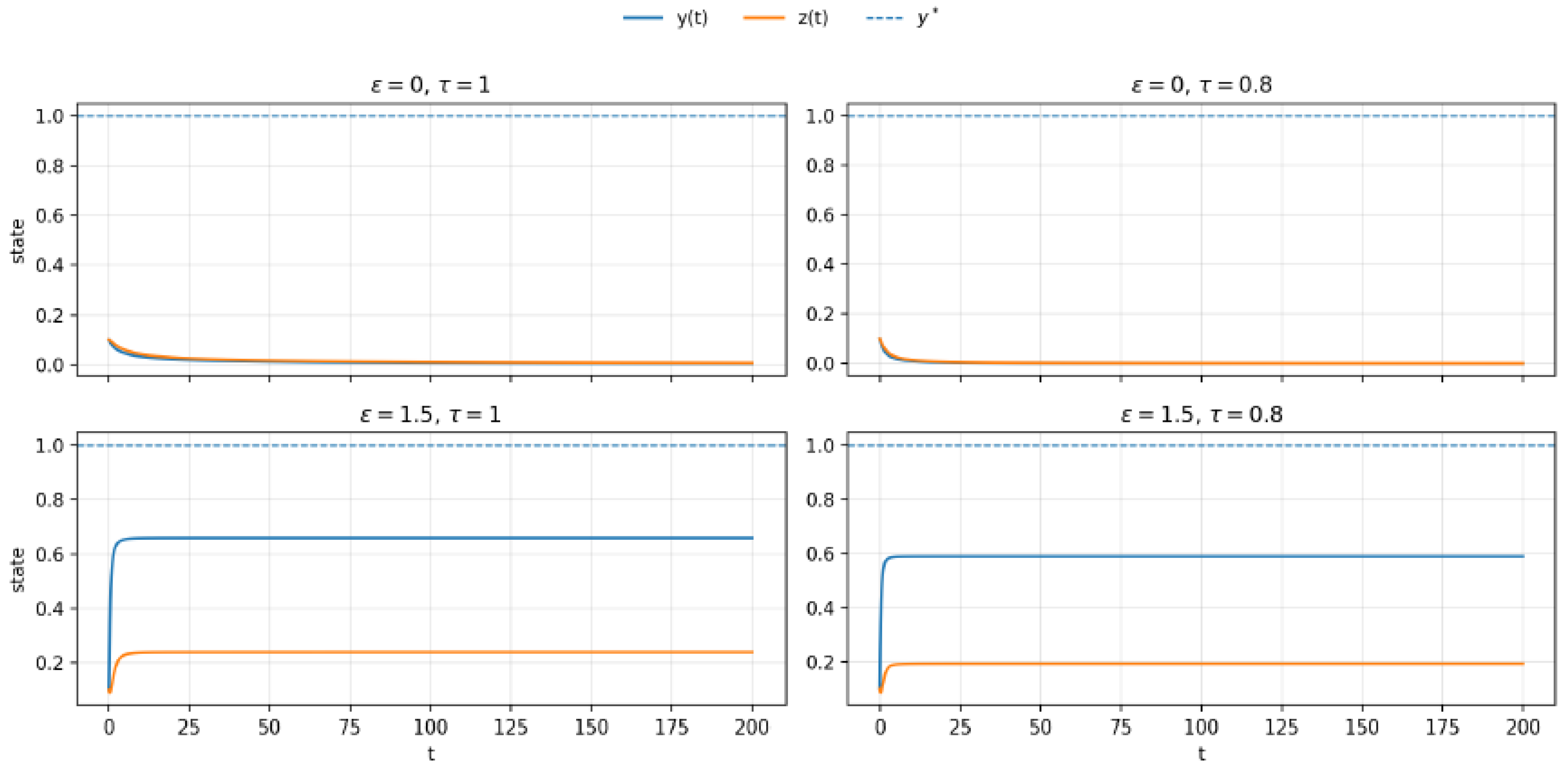
Figure 2 compares the time evolution of y ( t ) and z ( t ) for two values of the control parameter, namely ε = 0 (no control) and ε = 1.5 (moderate control). The dashed horizontal line indicates the reference level y * = 1 .
For ε = 0 , the dynamics are governed purely by the unperturbed nonlinearities f 1 and f 2 , leading to a monotone decay of both y ( t ) and z ( t ) towards zero. In the toy plasma-inspired interpretation, this corresponds to a scenario where, in the absence of active control or sustained external input, the normalized observable and its internal response relax to a trivial state, which may be undesirable in devices that require maintaining a nonzero operating regime. When the control is switched on with ε = 1.5 , the perturbation terms p 1 and p 2 act as a feedback mechanism which counteracts the natural decay: the observable y ( t ) is driven towards a steady state close to the reference level y * , while the internal variable z ( t ) settles at a small bounded value. This behavior is qualitatively consistent with the existence, uniqueness, and Ulam–Hyers stability results of Theorems 2 and 3 whenever the corresponding invariant-ball and contraction conditions are verified. The simulations illustrate boundedness and robustness for the tested data; they do not prove global attraction outside the theoretical regime.

6.2. Robustness with Respect to Initial Conditions

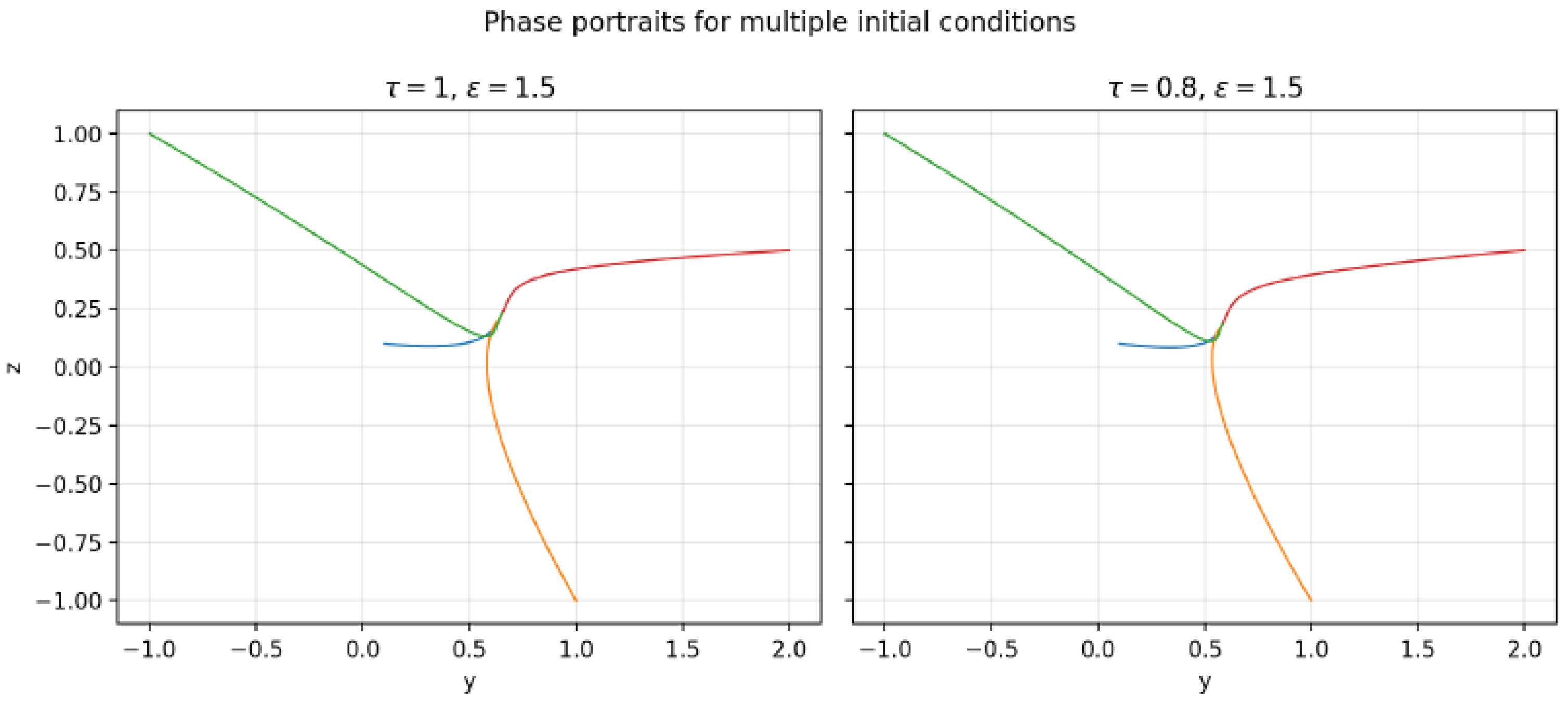
To investigate robustness with respect to initial perturbations, we fix ε = 1.5 and solve (11) for several initial conditions ( y ( 0 ) , z ( 0 ) ) { ( 0.1 , 0.1 ) , ( 1 , 1 ) , ( 1 , 1 ) , ( 2 , 0.5 ) } . The corresponding phase portraits in the ( y , z ) -plane are shown in Figure 3.
Despite the substantial differences between the sampled initial states (including strongly positive, strongly negative, and mixed values of y ( 0 ) and z ( 0 ) ), the computed trajectories enter the same small region in the ( y , z ) -plane. This provides numerical evidence of a sizable basin of attraction for the chosen parameters. We avoid claiming global attraction from these plots alone; a proof would require additional Lyapunov or monotonicity arguments beyond the fixed-point estimates used here. In the toy delay-feedback interpretation, the feedback encoded in p 1 and p 2 can therefore be viewed as steering the normalized observable towards a desirable operating range for the tested initial states.

6.3. Control Performance and Optimality with Respect to ε

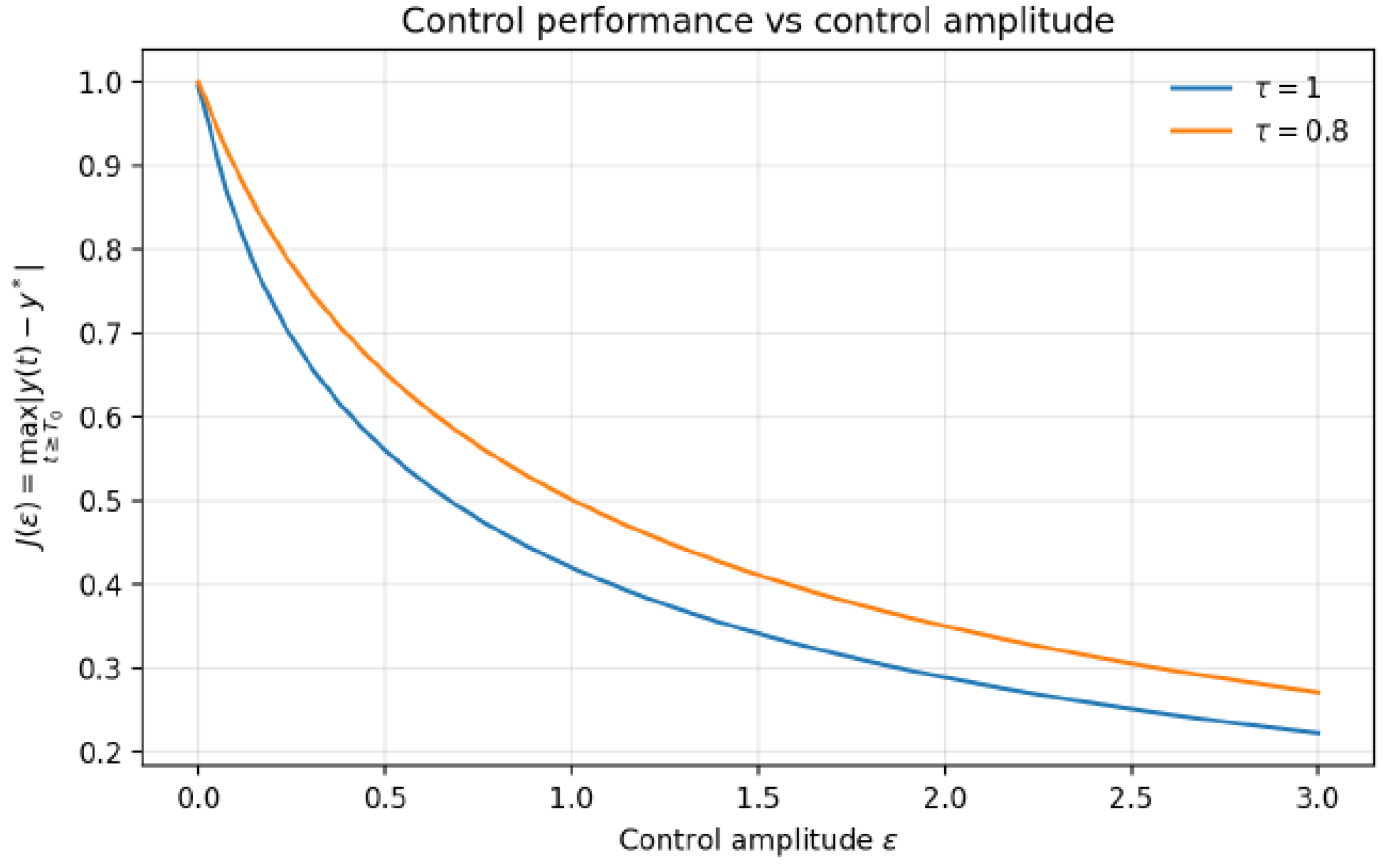
Finally, we evaluate how the regulation performance depends on the control amplitude ε . For each ε in the interval [ 0 , 3 ] , discretized into 40 equally spaced values, system (11) is simulated on [ 0 , T ] with the same numerical scheme and initial condition as above. After discarding the initial 70 % of the trajectory as transient, we define the performance index
J ( ε ) : = max t T 0 | y ( t ) y * | ,
where T 0 = 0.7 T , and plot J ( ε ) as a function of ε in Figure 4.
For representative values of ε , Table 2 also reports the mean value of y ( t ) and its standard deviation over the same post-transient window. The very small standard deviations for the controlled cases indicate convergence to a nearly steady regulated state in these simulations, while the value of J ( ε ) quantifies the remaining offset from the reference level.
The curves J ( ε ) decrease on the sampled interval for both τ = 1 and τ = 0.8 : for ε = 0 the deviation from the reference level is large because y ( t ) relaxes toward zero, whereas increasing ε strengthens the feedback terms and reduces the asymptotic tracking error. Thus ε acts as a useful design parameter in this illustrative closed-loop model. The statement is empirical and parameter dependent; it should not be generalized to all admissible nonlinearities without further analysis. The analytical results above support the interpretation by guaranteeing well-posedness, boundedness in an invariant ball, and robustness of trajectories whenever the stated structural and contraction assumptions are satisfied.

7. Comparison with Existing Fractional Plasma and Control Models

Fractional-order models have been extensively used in plasma physics to capture anomalous transport, memory effects, and complex wave dynamics. A classical example is the use of space–time fractional diffusion equations to describe non-Gaussian, non-diffusive transport in magnetically confined plasmas, where fractional derivatives in space and time reproduce the heavy-tailed statistics and superdiffusive scaling observed in turbulence simulations and experiments [20,26]. In these works the focus is on macroscopic transport equations with fractional operators, and the analysis is mainly concerned with the accuracy of the fractional model in reproducing tracer statistics and transport scalings rather than with the coupled existence–uniqueness and stability theory developed here.
More recently, several authors have proposed fractional plasma models based on Caputo, Caputo–Fabrizio, and Atangana–Baleanu derivatives to study, for example, plasma dilution, nonlinear wave propagation, and time-fractional Helmholtz or modified KdV-type equations [22,27,28]. These contributions typically concentrate on analytical and numerical techniques for solving fractional partial or integro-differential equations (such as Laplace-transform methods, residual power series expansions, or generalized spectral schemes), and on comparing different fractional kernels. While they provide valuable insight into the role of fractional orders and nonsingular kernels, they do not incorporate hybrid pantograph-type delays or perturbation-based control terms, nor do they develop a unified fixed-point framework for existence, uniqueness, Ulam–Hyers stability, and parameter sensitivity analysis.
On the control side, fractional-order PID (FOPID) controllers have been designed for regulating plasma current, shape, and position in tokamak devices, with applications to the Damavand and IR-T1 tokamaks and related systems [24,25]. These works demonstrate that allowing fractional orders in the controller improves tracking performance and robustness against fast parameter variations, and they employ optimization techniques such as particle swarm optimization or ITAE-based criteria to tune the controller gains. However, the underlying plasma dynamics are described by classical (non-fractional) linear or weakly nonlinear models, and the analysis mainly relies on frequency-domain or numerical performance indices; there is no explicit treatment of pantograph delays, deformable fractional derivatives in the state equations, or generalized Ulam–Hyers stability of the closed-loop system.
Compared with the above studies, the present work introduces a different perspective by formulating a hybrid pantograph system with a local deformable derivative and perturbation-based feedback and by developing a rigorous functional-analytic theory for the resulting operator T ε . Under structural assumptions ( H ) we establish the existence and uniqueness of solutions via fixed-point theorems, derive generalized Ulam–Hyers stability estimates that quantify robustness with respect to perturbations and approximation errors, and prove continuous dependence on the perturbation parameter ε . The parameter sensitivity analysis in Section 4.4, together with the numerical plasma-inspired toy example in Section 6, shows how the same framework can be used to explore transitions between stable operating regimes, oscillatory behavior, and more complex dynamics as the control amplitude varies.
In particular, the plasma-inspired toy example illustrates that the perturbation terms p i can be interpreted as delay-feedback components acting through pantograph arguments, and that the control parameter ε can be tuned to improve performance indices such as J ( ε ) = max t T 0 | y ( t ) y * | while maintaining boundedness and robustness. This combination of a deformable local derivative, hybrid pantograph structure, Ulam–Hyers stability, and control-oriented qualitative and performance analysis appears to be absent from existing fractional plasma models and controller designs, and therefore highlights an analytical route within the broader context of fractional-order modeling and control in plasma physics. For clarity, we briefly recall typical mathematical forms of the main classes of fractional plasma and fractional-control models considered in this comparison. Fractional diffusion approaches to plasma turbulence describe the evolution of the particle density n ( x , t ) by space–time fractional diffusion equations of the form
n t ( x , t ) = D D t α 0 C n ( x , t ) + κ ( Δ ) β n ( x , t ) ,
where D t α 0 C is a Caputo time-fractional derivative, ( Δ ) β is a fractional Laplacian, and 0 < α , β 1 [20,26]. Atangana–Baleanu-based plasma models typically use nonsingular kernels in equations of the form
D t α ABC u ( t ) = F t , u ( t ) ,
where D t α ABC denotes the Atangana–Baleanu derivative in the Caputo sense and F encodes the plasma interaction terms [27,28]. Fractional wave-type models, such as time-fractional modified KdV equations for plasma solitons, often take the form
D t α 0 C ϕ ( x , t ) + a ϕ ( x , t ) ϕ x ( x , t ) + b 3 ϕ x 3 ( x , t ) = 0 ,
with ϕ representing the electrostatic potential and 0 < α < 1 [22]. Finally, FOPID-based control schemes for tokamak plasmas use standard (non-fractional) state-space models x ˙ ( t ) = A x ( t ) + B u ( t ) , but employ a fractional PID controller of the form
u ( t ) = K p e ( t ) + K i D t λ 0 e ( t ) + K d D t μ 0 C e ( t ) ,
where e ( t ) is the tracking error and 0 < λ , μ 1 specify the integral and derivative orders [24,25]. In contrast, our model introduces deformable-order local relaxation, hybrid pantograph delays, and perturbation feedback directly in the state equations through the perturbed system (2), leading to a qualitatively different framework as summarized in Table 3.

8. Future Work

The results presented in this paper open several directions for further research. A first natural extension is to consider more general classes of deformable fractional operators, including variable-order or tempered versions, within the hybrid pantograph setting. This would allow the model to capture transitions between different memory regimes and to connect more directly with recent developments based on tempered and multifractional operators, while preserving the fixed-point and Ulam–Hyers stability structure developed here.
A second direction is to enrich the qualitative analysis of the perturbed system by combining the operator-theoretic approach with more refined dynamical systems tools. In particular, it would be of interest to construct centre manifolds and normal forms for the fractional hybrid pantograph dynamics, to characterize rigorously the local qualitative transitions suggested by the numerical diagrams and to identify conditions for the occurrence of periodic, quasi-periodic, or chaotic attractors. Extending the present existence and stability results to impulsive, stochastic, or piecewise-defined perturbations is another challenging problem with clear relevance for applications.
From the application side, the plasma-inspired toy example can be developed into a more realistic control framework by coupling the fractional hybrid pantograph subsystem with reduced models of plasma edge or core dynamics and by incorporating measurement noise, actuator constraints, and model uncertainty. This would enable a systematic comparison between deformable-derivative-based controllers and existing fractional-order PID strategies in tokamak control. Finally, investigating optimal control problems and learning-based or iterative control designs for the perturbed fractional hybrid system, together with data-driven identification of the effective fractional orders and delay functions from experimental plasma data, represents a promising avenue for bridging rigorous analysis with practical control of delay-affected nonlinear systems.

9. Conclusions

In this paper we have introduced and analyzed a perturbed coupled system of generalized hybrid pantograph equations involving deformable derivatives. By formulating the problem as a fixed point of an operator acting on a suitable Banach space, we established existence and uniqueness within suitable invariant balls under explicit Lipschitz, growth, invariant-ball, and contraction conditions. A key interpretive point is that, for differentiable functions, the deformable derivative is local and is equivalent to a classical derivative with an additional order-dependent drift term. Thus the aftereffect in the present model is produced by the proportional pantograph delays, while τ modifies the local relaxation rate.
Within this functional-analytic framework we derived a generalized Ulam–Hyers stability result with a corrected radius-dependent constant and proved continuous dependence on the perturbation parameter. The constants show clearly how the interval length, the Lipschitz bounds, and | ε | restrict the contraction regime. These results provide sufficient, not necessary, conditions for robustness; outside that regime, other compactness, monotonicity, or dissipativity methods may be required.
On the numerical side, we investigated how varying the perturbation parameter affects representative delayed systems. The parameter sensitivity diagrams, step-size refinement checks, and post-transient performance indices suggest regimes of near-steady, oscillatory, and more complex behavior for the selected examples. These computations are intended as qualitative illustrations of the theory and not as a proof of global bifurcation or chaos. The plasma-inspired section was accordingly reframed as a normalized delay-feedback toy model rather than a first-principles plasma description.
Finally, comparison with existing fractional plasma models and fractional-order control strategies highlights the distinctive scope of the present approach: deformable local drift, hybrid pantograph delays, explicit perturbation feedback, fixed-point well-posedness, and generalized Ulam–Hyers robustness are treated within a single operator-theoretic framework. This framework can serve as a basis for future studies involving more realistic physical closures, higher-order delay solvers, data-driven parameter identification, or alternative fixed-point methods under weaker assumptions.

Author Contributions

Conceptualization, R.Z., S.A. and M.E.E.; methodology, R.Z., A.B.; software, R.Z., A.B.; validation, S.A., M.E.E., O.E. and M.R.; formal analysis, R.Z. and M.E.E.; investigation, R.Z., S.A. and A.B.; resources, R.Z., S.A., M.E.E., O.E. and M.R.; data curation, R.Z., A.B. and M.E.E.; writing—original draft preparation, R.Z., S.A., A.B., M.E.E., O.E. and M.R.; writing—review and editing, R.Z., S.A., A.B., M.E.E., O.E. and M.R.; visualization, R.Z. and M.E.E.; supervision, S.A. and O.E.; project administration, S.A. and O.E.; funding acquisition, M.R. All authors have read and agreed to the published version of the manuscript.

Funding

The Researchers would like to thank the Deanship of Graduate Studies and Scientific Research at Qassim University for financial support (QU-APC-2026).

Data Availability Statement

All data are included in paper.

Acknowledgments

The authors would like to thank the anonymous reviewers for their valuable comments and suggestions that helped improve the quality of this paper.

Conflicts of Interest

The authors declare no conflicts of interest.

References

  1. Ayadi, S.; Ege, O.; De la Sen, M. On a coupled system of generalized hybrid pantograph equations involving fractional deformable derivatives. AIMS Math. 2023, 8, 10978–10996. [Google Scholar] [CrossRef]
  2. Zulfeqarr, F.; Ahuja, P. A new fractional derivative and its fractional integral with some applications. arXiv 2017, arXiv:1705.00962. [Google Scholar]
  3. Ahuja, P.; Zulfeqarr, F.; Ujlayan, A. Deformable fractional derivative and its applications. AIP Confer. Proc. 2017, 1897, 020008. [Google Scholar]
  4. Derakhshan, M.H. Existence, uniqueness, Ulam–Hyers stability and numerical simulation of solutions for variable order fractional differential equations in fluid mechanics. J. Appl. Math. Comput. 2022, 68, 403–429. [Google Scholar]
  5. Sousa, J.V.d.C.; Capelas de Oliveira, E. Ulam–Hyers stability of a nonlinear fractional Volterra integro-differential equation. Appl. Math. Lett. 2018, 81, 50–56. [Google Scholar] [CrossRef]
  6. Darwish, M.A.; Sadarangani, K. Existence of solutions for hybrid fractional pantograph equations. Appl. Anal. Discrete Math. 2015, 9, 150–167. [Google Scholar] [CrossRef]
  7. Karimov, E.T.; Lopez, B.; Sadarangani, K. About the existence of solutions for a hybrid nonlinear generalized fractional pantograph equation. Fract. Differ. Calc. 2016, 6, 95–110. [Google Scholar]
  8. George, R.; Houas, M.; Ghaderi, M.; Rezapour, S.; Elagan, S.K. On a coupled system of pantograph problem with three sequential fractional derivatives by using positive contraction-type inequalities. Results Phys. 2022, 39, 105687. [Google Scholar] [CrossRef]
  9. Ahmad, I.; Nieto, J.J.; Rahman, G.U.; Shah, K. Existence and stability for fractional order pantograph equations with nonlocal conditions. Electron. J. Differ. Equ. 2020, 2020, 1–17. [Google Scholar]
  10. Balachandran, K.; Kiruthika, S.; Trujillo, J.J. Existence of solutions of nonlinear fractional pantograph equations. Acta Math. Sci. 2013, 33, 712–720. [Google Scholar] [CrossRef]
  11. Yang, Y.; Huang, Y. Spectral-collocation methods for fractional pantograph delay-integro differential equations. Adv. Math. Phys. 2013, 2013, 821327. [Google Scholar] [CrossRef]
  12. Wongcharoen, A.; Ntouyas, S.K.; Tariboon, J. Nonlocal boundary value problems for Hilfer type pantograph fractional differential equations and inclusions. Adv. Differ. Equ. 2020, 2020, 1–19. [Google Scholar] [CrossRef]
  13. Ali, Z.; Zada, A.; Shah, K. On Ulam’s stability for a coupled system of nonlinear implicit fractional differential equations. Bull. Malays. Math. Sci. Soc. 2019, 42, 2681–2699. [Google Scholar]
  14. Benchohra, M.; Henderson, J.; Ntouyas, S.K.; Ouahab, A. Existence and stability results for random impulsive fractional differential equations. Filomat 2016, 30, 3743–3759. [Google Scholar]
  15. Wang, J.Y.; Lv, L.; Zhou, Y. Ulam stability and data dependence for fractional differential equations with Caputo derivative. Electron. J. Qual. Theory Differ. Equ. 2011, 2011, 1–10. [Google Scholar] [CrossRef]
  16. Xu, X.; Li, B. PDE-based observation and predictor-based control for linear systems with distributed infinite input and output delays. Automatica 2024, 170, 111845. [Google Scholar]
  17. Kang, Y.; Yao, L.; Wang, H. Fault isolation and fault-tolerant control for Takagi–Sugeno fuzzy time-varying delay stochastic distribution systems. IEEE Trans. Fuzzy Syst. 2022, 30, 1185–1195. [Google Scholar]
  18. Luan, Z.; Xu, K.; Zhao, W.; Wang, C. An event-triggered steering angle collaborative control strategy for the four-wheel independent steering system. IEEE Trans. Veh. Techn. 2025, 74, 7468–7482. [Google Scholar]
  19. Wang, B.; Sun, J.; Peng, B.; Cui, X.; Cheng, L.; Zheng, X. Optimal event-triggered neural learning tracking control for pneumatic muscle antagonistic joint with asymmetric constraints. IEEE Trans. Ind. Electron. 2025, 72, 14677–14687. [Google Scholar] [CrossRef]
  20. White, R.F.; Dewar, R.; Benkadda, S. Fractional diffusion in plasma turbulence. Phys. Plasmas 2004, 11, 3854–3864. [Google Scholar] [CrossRef]
  21. Wu, K.; Wang, Z.X. The analysis of memory effects in plasma transport theory based on time-fractional transport equations. J. Plasma Phys. 2020, 86, 905860504. [Google Scholar]
  22. Alharthi, N.S.; Inc, M.; Yusuf, A. Efficient simulation of plasma physics’ time fractional modified KdV equations via Elzaki-based analytical methods. PLoS ONE 2025, 20, e0316218. [Google Scholar]
  23. Hussain, S.A.; Ali, A.H. Traveling wave solutions of fractional differential systems arising in warm plasma. Baghdad Sci. J. 2021, 18, 123–132. [Google Scholar]
  24. Razin, A.V.; Ramezani, H.; Pirbodaghi, A. Optimal fractional-order PID control for plasma shape, position, and current in tokamaks. Optim. Control Appl. Methods 2020, 41, 1233–1252. [Google Scholar]
  25. Tavakoli, M.H.; Ramezani, H.; Gholami, M. Optimal fractional-order PID controllers design for plasma current and horizontal position control in the IR-T1 tokamak. J. Theor. Appl. Phys. 2024, 18, 155–170. [Google Scholar]
  26. del-Castillo-Negrete, D.; Carreras, B.A.; Lynch, V.E. Nondiffusive transport in plasma turbulence: A fractional diffusion approach. Phys. Rev. Lett. 2005, 94, 065003. [Google Scholar] [CrossRef] [PubMed]
  27. Awan, M.R.; Abro, K.A.; Atangana, A. An Atangana–Baleanu Caputo approach to a fractional-order plasma model. Alex. Eng. J. 2022, 61, 8775–8787. [Google Scholar]
  28. Abro, K.A.; Atangana, A.; Gómez-Aguilar, J.F. A comparative analysis of plasma dilution based on different fractional operators with nonsingular kernels. J. Fract. Calc. Appl. 2023, 14, 1–24. [Google Scholar]
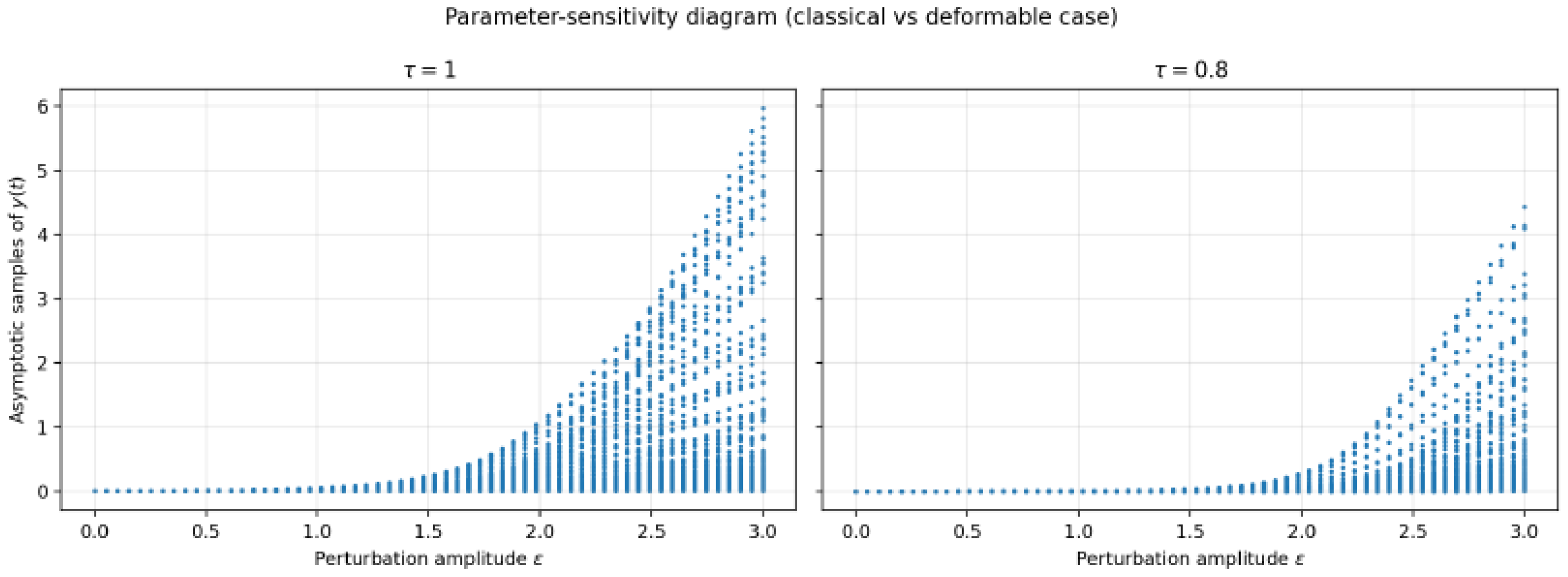
Figure 1. Parameter sensitivity diagram for the perturbed hybrid pantograph system (10), shown for the classical case τ = 1 and for a genuinely deformable case τ = 0.8 . For each value of the perturbation amplitude ε [ 0 , 3 ] , the system is integrated over N = 20,000 steps with Δ t = 0.01 . After discarding the initial 70 % of the trajectory as transient, several asymptotic samples of y ( t ) are plotted against ε .
Fractalfract 10 00328 g001
Figure 2. Time series of y ( t ) and z ( t ) for the plasma-inspired toy system (11) for two control amplitudes ( ε = 0 and ε = 1.5 ) and two deformable orders ( τ = 1 and τ = 0.8 ). Parameters: a = 0.8 , b = 0.5 , d = 0.6 , e = 0.7 , ρ = 0.5 , η = 0.8 , k 1 = 0.8 , k 2 = 0.5 , y * = 1 , with initial condition y ( 0 ) = z ( 0 ) = 0.1 . The dashed line denotes the reference level y * . Compared to the uncontrolled case ( ε = 0 ), the feedback perturbations ( ε = 1.5 ) drive y ( t ) toward a bounded neighbourhood of y * and stabilize z ( t ) ; the deformable case τ = 0.8 modifies the transient rate and the steady regime through the additional β -term in (4).
Fractalfract 10 00328 g002
Figure 3. Phase portraits of the plasma-inspired toy system (11) for ε = 1.5 and several initial conditions ( y ( 0 ) , z ( 0 ) ) = ( 0.1 , 0.1 ) , ( 1 , 1 ) , ( 1 , 1 ) , and ( 2 , 0.5 ) , shown for τ = 1 and τ = 0.8 . Parameters are the same as in Figure 2. In both cases, trajectories converge to a common bounded region of the phase space, illustrating numerical robustness with respect to the tested initial states.
Fractalfract 10 00328 g003
Figure 4. Performance index J ( ε ) = max t T 0 | y ( t ) y * | with T 0 = 0.7 T , as a function of the control amplitude ε for the plasma-inspired toy system (11), shown for τ = 1 and τ = 0.8 . The parameters and numerical setup are the same as in Figure 2. Larger values of ε improve tracking of the reference level y * by reducing the asymptotic deviation J ( ε ) , while the trajectories remain bounded, illustrating a trade-off between control effort and tracking accuracy; the deformable case shifts the curve through the additional β -term in (4).
Fractalfract 10 00328 g004
Table 1. Step-size refinement check for the illustrative parameter sensitivity system. The table reports the maximum absolute difference between the Δ t = 0.01 solution and the Δ t = 0.005 solution, after interpolation onto the coarse grid, over the final 30 % of the simulation interval.
τ ε max | y 0.01 y 0.005 | max | z 0.01 z 0.005 |
1.0 0 1.05 × 10 8 1.45 × 10 8
1.0 1.5 1.44 × 10 6 1.85 × 10 6
1.0 3.0 4.05 × 10 5 3.37 × 10 5
0.8 0 2.57 × 10 9 3.91 × 10 9
0.8 1.5 7.11 × 10 8 1.77 × 10 7
0.8 3.0 6.80 × 10 5 2.63 × 10 5
Table 2. Post-transient performance indices for the plasma-inspired toy system. Values are computed over t [ 0.7 T , T ] with T = 200 and Δ t = 0.01 .
τ ε y ¯ std ( y ) J ( ε )
1.0 0 0.00521 3.63 × 10 4 0.99536
1.0 1.5 0.65862 7.28 × 10 8 0.34138
1.0 3.0 0.77746 1.51 × 10 10 0.22254
0.8 0 0.00037 4.53 × 10 5 0.99970
0.8 1.5 0.58864 1.27 × 10 8 0.41136
0.8 3.0 0.72857 2.67 × 10 11 0.27143
Table 3. Comparison between the present work and selected fractional plasma and control models.
WorkModel TypeMain FocusMain Differences from the Present Framework
Plasma turbulence diffusion [20,26]Space–time fractional diffusion PDEs without hybrid delaysAnomalous transport and non-diffusive scaling in turbulent plasmasNo hybrid pantograph structure, perturbation feedback, Ulam–Hyers stability, or fixed point framework
Atangana–Baleanu plasma models [27,28]Fractional ODE/PDE models with nonsingular kernelsAnalytical and numerical solutions; comparison of fractional kernelsNo pantograph delays or control-oriented perturbation; stability is mainly qualitative
Fractional plasma wave PDEs [22]Time-fractional modified KdV and related wave equationsExact and approximate traveling-wave or soliton solutionsFocus on wave profiles, not coupled hybrid systems with feedback perturbations
FOPID tokamak control [24,25]Classical plasma dynamics with fractional-order PID controllersPerformance tuning for plasma current, shape, and position controlFractional order is in the controller, not in the plant; no pantograph-type delay structure
This workHybrid pantograph system with deformable local derivative and perturbation feedbackFixed-point well-posedness, generalized Ulam–Hyers stability, parameter sensitivity, and toy control performanceProvides an operator-theoretic framework combining deformable local drift, hybrid delays, and robust feedback
Disclaimer/Publisher’s Note: The statements, opinions and data contained in all publications are solely those of the individual author(s) and contributor(s) and not of MDPI and/or the editor(s). MDPI and/or the editor(s) disclaim responsibility for any injury to people or property resulting from any ideas, methods, instructions or products referred to in the content.