
Article

A Fractional Differential Equation Model and Dynamic Analysis of Animal Avoidance Learning
Department of Mathematics, Institute of Fundamental Mathematics, School of Artificial Intelligence, Taizhou University, Taizhou 318000, China
Fractal Fract. 2026, 10(5), 327; https://doi.org/10.3390/fractalfract10050327
Submission received: 30 January 2026 / Revised: 6 May 2026 / Accepted: 8 May 2026 / Published: 11 May 2026
(This article belongs to the Special Issue Modeling and Dynamic Analysis of Fractional-Order Systems)

Abstract

This article employs a fractional differential equation model to probe the dynamic mechanism of animal avoidance learning and memory retention. This model encompasses both linear and nonlinear scenarios. We first obtain the series-type analytical solution for the linear scenario and its absolute uniform convergence by Laplace transform and Mittag–Leffler function. Secondly, we establish the existence, uniqueness and Ulam–Hyers stability for the nonlinear scenario via the fixed point theorem and analytical techniques. Eventually, some examples and numerical simulations are provided to examine the effectiveness and availability of the main findings.

1. Introduction

It is well known that ordinary differential equation models are generally difficult to describe phenomena and processes with memory and inheritance because their future states are determined by the current state and evolution. The integer-order derivative reflects the instantaneous change in the state variable and is unrelated to the state over a longer period of time, thus unable to reflect the accumulation of state memory. However, some practical problems such as artificial neural networks having nonlocal memory and genetic effects need to be addressed. Fortunately, fractional-order differential equation models have solved such problems quite perfectly. Fractional differential equation models have been widely applied in many scientific and engineering technology fields such as diffusion processes [1], signal processing [2], image processing [3], bioengineering [4,5] and control theory [6]. Meanwhile, the theoretical study on fractional differential equations has also made considerable progress. Scholars have studied various types of fractional differential equations. For instance, Refs. [7,8,9,10,11] considered the impulsive fractional differential equations. In [12,13,14,15,16], the authors discussed the influence of time-delay effects on fractional differential equations. Experts have also conducted research on fractional differential equations that are affected by uncertainties such as randomness [17,18,19,20,21] and fuzziness [22,23,24,25,26]. Moreover, rich achievements have also been made in the research on the dynamic properties like the existence [27,28,29,30,31], stability [32,33,34,35,36] and controllability [37,38,39,40,41] of fractional differential equations. Recently, some scholars [42,43,44] have utilized fractional-order differential equation models to study and simulate the dynamic mechanisms of human liver diseases, Alzheimer’s disease, and dengue fever epidemics.
Exploring animal avoidance learning and memory retention is one of the important objectives in neuroscience. Based on some experimental data and through mathematical modeling, the researchers conducted a quantitative study on the avoidance learning and memory retention of animals. Differential equation models have been used to describe the dynamics of learning and memory retention in behavioral neuroscience. To study the response of rats to fluctuating shocks, Brady and Marmasse [45] established the following differential equation model
u ( t ) = u ( t 0 ) μ t 0 t u ( s ) f ( t s ) d s ,
where u ( t ) expresses the shock response rate at moment t. The function f ( · ) > 0 represents the weight. μ > 0 is a ratio constant. t 0 t u ( s ) f ( t s ) d s stands for the cumulative effect of the shock.
In fact, the model (1) is an integral–differential equation with distributed delay. Turab et al. [46] studied a more general system that includes model (1) as follows:
u ( t ) = Ψ t , u ( s ) , 0 t ϕ ( t , s , u ( s ) ) d s , t > 0 .
They obtained the existence and uniqueness of the solution to this system by applying the principle of contraction mapping. Brady and Marmasse [47] discovered through experiments that the memory retention of rats in response to shocks showed an exponential decline. Let f ( x ) = e λ x , then the Equation (1) becomes
u ( t ) = u ( t 0 ) μ e λ t t 0 t u ( s ) e λ s d s ,
where 1 λ > 0 stands for the duration of feature memory.
By applying the derivative operator d d t to both sides of model (2), one derives
u ( t ) + λ u ( t ) + μ u ( t ) = λ u ( t 0 ) .
Equation (3) is a second-order constant coefficient non-homogeneous ODE, which still fails to reflect the accumulation of rats’ learning and memory of shocks. However, fractional differential equations are precisely superior in describing the characteristics of memory. In [48], Turab and Nescolarde-Selva et al. modified system (3) using Caputo fractional derivatives and considered the following homogeneous fractional differential equation
D t 0 + α c u ( t ) + λ D t 0 + β c u ( t ) + μ u ( t ) = 0 , u ( t 0 ) = u 0 , u ( t 0 ) = u 1 ,
where t [ t 0 , T ] , D t 0 + α c and D t 0 + β c are respectively Caputo fractional derivatives of orders α and β with 1 < α < 2 , 0 < β < 1 and α β > 1 . They transformed system (4) into a nonlinear integral equation and then applied the fixed point theorems of Banach and Krasnoselskii to study the existence and uniqueness of solutions.
In fact, system (4) is an initial value problem of a linear differential equation of fractional order with constant coefficients. Similar to the initial value problem of linear ODEs with constant coefficients, the solution of system (4) can be uniquely represented in an explicit form rather than being transformed into a nonlinear integral equation. Furthermore, as proposed in the articles [49,50,51,52], the usual initial-conditions associated with RL and C-fractional derivatives were incorrect. Based on the above arguments, we modify the model (3) into the RL-fractional differential equation as follows:
D 0 + α RL u ( t ) + λ D 0 + β RL u ( t ) + μ u ( t ) = ϕ ( t , u ( t ) ) , t > 0 , D 0 + α 1 RL u ( 0 ) + λ D 0 + β 1 RL u ( 0 ) = A , D 0 + α 2 RL u ( 0 ) = B ,
where the initial moment t 0 = 0 . 1 < α 2 , 0 < β 1 , and A , B , λ , μ are some positive constants. D 0 + RL is ∗-order RL-fractional derivative.
When α = 2 , β = 1 and ϕ ( t , u ) = λ u ( 0 ) , system (5) degenerates into system (3). If ϕ ( t , u ) = φ ( t ) , then system (5) is an initial value problem of a linear non-homogeneous RL-fractional differential equation with constant coefficients. At this point, we will explore the explicit exact solution of this linear RL-fractional differential system. As an application, we provide the exact solution of system (5) when ϕ ( t , u ) = λ u ( 0 ) . On this basis, we further delve into the solvability and stability of system (5) provided that ϕ ( t , u ) is a nonlinear function. In addition, the existence, uniqueness and stability of solutions for an actual biological dynamic system are crucial for maintaining the sustained survival and steady development of species within the system. Therefore, this article focuses on seeking out some sufficient conditions to ensure the existence, uniqueness and stability of solution for model (5). This article primarily contributes as below:
  • Based on the ODE model (3) and Caputo fractional differential equation model (4), we have created a new RL-fractional differential equation model (5) to describe the dynamics of animal avoidance learning.
  • By applying the Laplace transform and the Mittag–Leffler function, we presented the exact solution of the linear homogeneous equation of model (5).
  • We applied the Krasnoselskii’s fixed-point theorem and estimated the Mittag–Leffler function to obtain the existence, uniqueness and Hyers–Ulam stability solution to the nonlinear equation of model (5).
  • The topic and methods of this article serves as a reference for the study of the applications and dynamic properties of other types of fractional differential equations. Our findings contribute to the application of analytic semigroup theory in fractional differential equations.
The remaining content of the article is arranged as follows. Section 2 reviews the RL-fractional derivatives and Laplace transform, as well as their related properties. Section 3 separately delves into the explicit solutions of linear models and the solvability and stability of nonlinear models. In Section 4, we supply several examples and perform numerical simulations. Section 5 provides a concise summary and prospects for future research.
For the sake of clarity and readability of the article, we provide the abbreviations section of mathematical symbol explanations.

2. Preliminaries

This section first reviews some concepts and properties of RL-fractional calculus.
Definition 1
([53,54]). Let α > 0 , and h : ( 0 , ) R . The α-order RL-fractional integral of h is defined as
J 0 + α h ( t ) = 1 Γ ( α ) 0 t ( t p ) α 1 h ( p ) d p .
Definition 2
([53,54]). Let α > 0 , n 1 < α n ( n = [ α ] + 1 ) , and h C n ( [ 0 , ) , R ) . The α-order RL-fractional derivative of h is given as
D 0 + α RL h ( t ) = 1 Γ ( n α ) d n d t n 0 t ( t p ) n α 1 h ( p ) d p .
Lemma 1
([54]). Let α > 0 , n 1 < α n ( n = [ α ] + 1 ) , and h C n ( [ 0 , ) , R ) . Then
J 0 + α D 0 + α RL h ( t ) = h ( t ) + d 1 t α 1 + d 2 t α 2 + + d n t α n .
If a function u : R C satisfies that
| u ( t ) | M e κ t , M , κ > 0 , t > T > 0 ,
then the Laplace transform of u is defined by
u ^ ( s ) = L [ u ( t ) ] ( s ) = 0 e s t u ( t ) d t .
If two functions f , g : R R are integrable, then their convolution operation ∗ is defined as
( f g ) ( t ) = + f ( s ) g ( t s ) d s .
Specifically, when f is piecewise integrable, that is,
f ( x ) 0 , 0 x t , f ( x ) 0 , x < 0 or x > t ,
then the convolution is written as
( f g ) ( t ) = 0 t f ( s ) g ( t s ) d s .
In addition, the Laplace transform of convolution admits the following vital property
f g ^ ( s ) = L [ ( f g ) ( t ) ] ( s ) = L [ f ( t ) ] ( s ) · L [ g ( t ) ] ( s ) = f ^ ( s ) · g ^ ( s ) .
Let α , β > 0 , then a two-parameter Mittag–Leffler function is defined as
E α , β ( z ) = n = 0 z n Γ ( n α + β ) .
Lemma 2
([54]). For the RL-fractional integral and derivative, as well as the Mittag–Leffler function, we have the following Laplace transform formula.
(i) 
For all α > 0 ,
L [ J 0 + α u ( t ) ] ( s ) = u ^ ( s ) s α .
(ii) 
For all α > 0 , and n 1 < α n ( n = [ α ] + 1 ) ,
L [ D 0 + α RL u ( t ) ] ( s ) = s α · u ^ ( s ) k = 1 n s k 1 · D 0 + α k RL u ( t ) | t = 0 .
(iii) 
For all α , β > 0 , λ R , and E α , β ( k ) ( z ) = d k d z k E α , β ( z ) ,
L [ t k α + β 1 E α , β ( k ) ( ± λ t α ) ] ( s ) = k ! · s α β ( s α λ ) k + 1 .
The following Krasnoselskii’s fixed-point theorem is crucial for the study of nonlinear RL-fractional model (5).
Lemma 3
([55]). Let Y be a non-empty closed convex subset of Banach space X, and define two operator P , Q : Y Y . Assume that
(a) 
For all x , y Y , P x + Q y Y ;
(b) 
Q is completely continuous and P is contraction.
Then the operator P + Q has at least a fixed point x * Y , that is, x * = P x * + Q x * .

3. Main Results

This section first considers the non-homogeneous linear equation corresponding to the RL-fraction model (5) as follows:
D 0 + α RL u ( t ) + λ D 0 + β RL u ( t ) + μ u ( t ) = φ ( t ) , t > 0 , D 0 + α 1 RL u ( 0 ) + λ D 0 + β 1 RL u ( 0 ) = A , D 0 + α 2 RL u ( 0 ) = B ,
where 1 < α 2 , 0 < β 1 and A , B , λ , μ > 0 . We shall apply the Laplace transform method to provide the exact solution of the system (6).
Theorem 1.
The exact solution of system (6) is explicitly given by
u ( t ) = A G ( t ) + B G ( t ) 0 t G ( t ω ) φ ( ω ) d ω ,
where
G ( t ) = k = 0 ( μ ) k k ! t ( k + 1 ) α 1 E α β , α + k β ( k ) ( λ t α β ) = k = 0 j = 0 ( μ ) k ( λ ) j ( k + j ) ! k ! j ! Γ ( α ( j + k ) + α β j ) t α ( j + k ) + α 1 β j .
Proof. 
It follows from (6) and the linearity of the Laplace transform that
L [ D 0 + α RL u ( t ) ] ( s ) + λ L [ D 0 + β RL u ( t ) ] ( s ) + μ L [ u ( t ) ] ( s ) = L [ φ ( t ) ] ( s ) .
In view of Lemma 2, Equation (8) gives that
( s α + λ s β + μ ) u ^ ( s ) A B s = φ ^ ( s ) ,
which implies that
u ^ ( s ) = φ ^ ( s ) + A + B s s α + λ s β + μ = ( φ ^ ( s ) + A + B s ) g ^ ( s ) ,
where g ^ ( s ) = 1 s α + λ s β + μ .
By applying power series expansion, we have
g ^ ( s ) = 1 s α + λ s β + μ = 1 μ μ s β s α β + λ 1 1 + μ s β s α β + λ = 1 μ k = 0 ( 1 ) k μ k + 1 s ( k + 1 ) β ( s α β + λ ) k + 1 .
On the other hand, we derive from the formula ( iii ) of Lemma 2 that
L t ( k + 1 ) α 1 E α β , α + k β ( k ) ( λ t α β ) ( s ) = k ! · s ( k + 1 ) β ( s α β + λ ) k + 1 .
Equations (10) and (11) indicate that the inverse Laplace transform of g ^ ( s ) is provided by
G ( t ) = L 1 [ g ^ ( s ) ] = k = 0 ( μ ) k k ! t ( k + 1 ) α 1 E α β , α + k β ( k ) ( λ t α β ) = k = 0 j = 0 ( μ ) k ( λ ) j ( k + j ) ! k ! j ! Γ ( α ( j + k ) + α β j ) t α ( j + k ) + α 1 β j .
Obviously, G ( 0 ) = 0 . By applying the inverse Laplace transform L 1 to both sides of Equation (9), we get
u ( t ) = L 1 [ u ^ ( s ) ] = A L 1 [ g ^ ( s ) ] + B L 1 [ s g ^ ( s ) ] + L 1 [ φ ^ ( s ) g ^ ( s ) ] .
By the differential formula and convolution formula of the Laplace transform, and noting that t > 0 , we have
L 1 [ s g ^ ( s ) ] = d d t L 1 [ g ^ ( s ) ] = G ( t ) + G ( 0 ) ,
and
L 1 [ φ ^ ( s ) g ^ ( s ) ] = L 1 [ φ ^ ( s ) ] L 1 [ g ^ ( s ) ] = ( φ G ) ( t ) = 0 t G ( t ω ) φ ( ω ) d ω .
Substituting (12), (14) and (15) into (13), we obtain the solution of Equation (6) as follows:
u ( t ) = A G ( t ) + B G ( t ) + 0 t G ( t ω ) φ ( ω ) d ω .
The proof is completed. □
Next, we discuss the existence of solutions for the nonlinear RL-fractional model (5). To this end, we need the following Lemmas.
Lemma 4.
If α , β > 0 , then two-parameter Mittag–Leffler function E α , β ( z ) is absolutely uniformly convergent with respect to z ( , + ) .
Proof. 
For β > 0 , α 1 , and a natural number n 2 , then n α + β > n α > n 2 . Noticing that the gamma function Γ ( · ) is monotonically increasing on [ 2 , + ) , we have Γ ( n α + β ) > Γ ( n α ) > Γ ( n ) Γ ( 2 ) = 1 , and
n = 0 z n Γ ( n α + β ) 1 Γ ( β ) + | z | Γ ( α + β ) + n = 2 | z | n Γ ( n ) = 1 Γ ( β ) + | z | Γ ( α + β ) + k = 0 | z | k + 2 Γ ( k + 2 ) = 1 Γ ( β ) + | z | Γ ( α + β ) + | z | 2 k = 0 | z | k ( k + 1 ) ! 1 Γ ( β ) + | z | Γ ( α + β ) + | z | 2 k = 0 | z | k k ! = 1 Γ ( β ) + | z | Γ ( α + β ) + | z | 2 e | z | , z ( , + ) .
(16) indicates that E α , β ( z ) is absolutely uniformly convergent on ( , + ) .
When β > 0 , 0 < α < 1 , we obtain
z n + 1 Γ ( ( n + 1 ) α + β ) z n Γ ( n α + β ) = Γ ( n α + β ) Γ ( ( n + 1 ) α + β ) | z | < 1 ,
which implies that
| z | < Γ ( ( n + 1 ) α + β ) Γ ( n α + β ) < Γ ( n α + β + 1 ) Γ ( n α + β ) = n α + β + , n + .
(17) shows that the radius of convergence of the power series E α , β ( z ) is + . Therefore, E α , β ( z ) is absolutely uniformly convergent on ( , + ) . The proof is completed. □
Lemma 5.
If β > 0 and α β 1 , then G ( t ) defined as (7) is absolutely uniformly convergent with respect to t ( , + ) .
Proof. 
When α β 1 and 1 < α 2 , then 0 < Γ ( α ) 1 , and
( α β ) j + α ( k + 1 ) j + k + 1 2 , k 1 , ( α β ) j + α ( k + 1 ) j + α > j + 1 2 , k = 0 , j 1 .
Thus, it is similar to (16) that for t ( , + )
E α β , α + k β ( k ) ( λ t α β ) = j = 0 ( λ ) j ( k + j ) ! j ! Γ ( ( α β ) j + α ( k + 1 ) ) t ( α β ) j j = 0 ( k + j ) ! j ! Γ ( k + 1 + j ) | λ t ( α β ) | j = j = 0 | λ t ( α β ) | j j ! = e | λ t ( α β ) | 1 Γ ( α ) e | λ t ( α β ) | , k 1 ,
and
E α β , α + k β ( 0 ) ( λ t α β ) = 1 Γ ( α ) + j = 1 ( λ ) j Γ ( ( α β ) j + α ) t ( α β ) j 1 Γ ( α ) + j = 1 1 Γ ( j + 1 ) | λ t ( α β ) | j 1 Γ ( α ) + 1 Γ ( α ) j = 1 1 Γ ( j + 1 ) | λ t ( α β ) | j = 1 Γ ( α ) j = 0 1 Γ ( j + 1 ) | λ t ( α β ) | j = 1 Γ ( α ) j = 0 | λ t ( α β ) | j j ! = 1 Γ ( α ) e | λ t ( α β ) | .
It follows from (7), (18) and (19) that
| G ( t ) | = k = 0 ( μ ) k k ! t ( k + 1 ) α 1 E α β , α + k β ( k ) ( λ t α β ) = t α 1 k = 0 ( μ t α ) k k ! E α β , α + k β ( k ) ( λ t α β ) | t | α 1 k = 0 | μ t α | k k ! E α β , α + k β ( k ) ( λ t α β ) 1 Γ ( α ) | t | α 1 e | λ t ( α β ) | k = 0 | μ t α | k k ! = 1 Γ ( α ) | t | α 1 e | λ t ( α β ) | + | μ t α | .
(20) indicates that G ( t ) is absolutely uniformly convergent on t ( , + ) . The proof is completed. □
From Lemma 5, we know that G ( t ) is absolutely uniformly convergent and continuous on t ( , + ) . For T > 0 , max t [ 0 , T ] | G ( t ) | is well-defined. In addition, by (7), we obtain
G ( t ) = k = 0 j = 0 ( μ ) k ( λ ) j ( k + j ) ! k ! j ! Γ ( α ( j + k ) + α 1 β j ) t α ( j + k ) + α 2 β j .
Obviously, Equation (21) contains the item θ ( t ) = 1 Γ ( α 1 ) t α 2 corresponding to j = k = 0 . When 1 < α < 2 , | θ ( 0 ) | = + , which leads to max t [ 0 , T ] | G ( t ) | = + . Therefore, it is inappropriate to discuss the solvability of nonlinear RL-fractional model (5) in the Banach space C ( [ 0 , T ] , R ) with the supremum norm. On the other hand, we have noticed that t α G ( t ) C ( [ 0 , T ] , R ) for 1 < α < 2 . So we introduce a weighted Banach space as follows:
X α = { u ( t ) : t α u ( t ) C ( [ 0 , T ] , R ) , 1 < α 2 } ,
equipped with the weighted norm u α = max t [ 0 , T ] | t α u ( t ) | . Next, we will investigate the existence, uniqueness and stability of the solutions to the nonlinear RL-fractional model (5) in the weighted Banach space ( X α , · α ) .
Theorem 2.
The nonlinear RL-fractional model (5) has a unique solution u * ( t ) X α defined by (22), provided that
(A1) 
1 < α 2 , 0 < β 1 with α β 1 and A , B , λ , μ > 0 ;
(A2) 
ϕ ( t , u ) C ( [ 0 , T ] × R , R ) and satisfies the Lipschitz continuity condition, i.e., there exists a constant L > 0 such that
| f ( t , u ) f ( t , v ) | L | u v | , u , v R , t [ 0 , T ] ;
(A3) 
ρ = 1 Γ ( α ) L T α e λ T α β + μ T α < 1 .
Proof. 
We first prove the existence of the solution for nonlinear system (5). Let Y = { u X α : u α R } , where R M + N 1 ρ , M = A G ( t ) α + B G ( t ) α and N = 1 Γ ( α ) ϕ ( t , 0 ) α T α e λ T ( α β ) + μ T α . Obviously, Y X α is non-empty, closed and convex.
According to Theorem 1, the solution of nonlinear system (5) can be expressed as
u ( t ) = A G ( t ) + 0 t G ( t ω ) ϕ ( ω , u ( ω ) ) d ω .
Based on Equation (23), we define the two operators P , Q : Y Y as follows:
P ( u ( t ) ) = A G ( t ) + B G ( t ) ,
and
Q ( v ( t ) ) = 0 t G ( t ω ) ϕ ( ω , v ( ω ) ) d ω .
For all u ( t ) , v ( t ) X α , it follows from (20), (24), (25) and ( A 1 ) ( A 3 ) that
P ( u ( t ) ) + Q ( v ( t ) ) α A G ( t ) α + B G ( t ) α + t α 0 t | G ( t ω ) | ( | ϕ ( ω , v ( ω ) ) ϕ ( ω , 0 ) | + | ϕ ( ω , 0 ) | ) d ω M + 0 t | G ( t ω ) | ( L v α + ϕ ( t , 0 ) α ) d ω M + ( L v α + ϕ ( t , 0 ) α ) 0 t | G ( ω ) | d ω M + ( L v α + ϕ ( t , 0 ) α ) 1 Γ ( α ) 0 t | ω | α 1 e | λ ω ( α β ) | + | μ ω α | d ω M + 1 Γ ( α ) ( L v α + ϕ ( t , 0 ) α ) 0 T T α 1 e λ T ( α β ) + μ T α d ω = M + 1 Γ ( α ) ( L v α + ϕ ( t , 0 ) α ) T α e λ T ( α β ) + μ T α M + N + ρ R < R ,
which implies that P ( u ( t ) ) + Q ( v ( t ) ) Y , and Q : Y Y is uniformly bounded.
On the other hand, (24) gives that
P ( u ( t ) ) P ( v ( t ) ) α = 0 = 0 u v α , u ( t ) , v ( t ) X α ,
which indicates that P : Y Y is contraction. In addition, for all u X α and t 1 , t 2 [ 0 , T ] with t 1 < t 2 , from (25) and ( A 2 ) , we have
Q ( u ( t 2 ) ) Q ( u ( t 1 ) ) α = 0 t 2 G ( t 2 ω ) ϕ ( ω , u ( ω ) ) d ω 0 t 1 G ( t 1 ω ) ϕ ( ω , u ( ω ) ) d ω α = 0 t 1 [ G ( t 2 ω ) G ( t 1 ω ) ] ϕ ( ω , u ( ω ) ) d ω + t 1 t 2 G ( t 2 ω ) ϕ ( ω , u ( ω ) ) d ω α 0 t 1 | G ( t 2 ω ) G ( t 1 ω ) | | ϕ ( ω , u ( ω ) ) | d ω + t 1 t 2 | G ( t 2 ω ) | | ϕ ( ω , u ( ω ) ) | d ω α 0 t 1 | G ( t 2 ω ) G ( t 1 ω ) | [ | ϕ ( ω , u ( ω ) ) ϕ ( ω , 0 ) | + | ϕ ( ω , 0 ) | ] d ω + t 1 t 2 | G ( t 2 ω ) | [ | ϕ ( ω , u ( ω ) ) ϕ ( ω , 0 ) | + | ϕ ( ω , 0 ) | ] d ω α 0 T | G ( t 2 ω ) G ( t 1 ω ) | L u α + ϕ ( t , 0 ) α d ω + t 1 t 2 max t [ 0 , T ] | G ( t ) | L u α + ϕ ( t , 0 ) α d ω 0 , as t 2 t 1 .
(26) means that Q : Y Y is equicontinuous. In view of the Arzelá–Ascoli theorem, one knows that Q : Y Y is completely continuous. Thus, according to Lemma 3, we affirm that there has at least u * ( t ) X α such that u * ( t ) = P u * ( t ) + Q u * ( t ) , which is a solution of system (5). Assume that system (5) has another solution v * ( t ) X α , then v * ( t ) = P v * ( t ) + Q v * ( t ) . Consequently, it is similar to (26) that
u * ( t ) v * ( t ) α = 0 t G ( t ω ) ϕ ( ω , u * ( ω ) ) d ω 0 t G ( t ω ) ϕ ( ω , v * ( ω ) ) d ω α 0 t G ( t ω ) | ϕ ( ω , u * ( ω ) ) ϕ ( ω , v * ( ω ) ) | d ω α L 0 t G ( t ω ) | u * ( ω ) v * ( ω ) | d ω α ρ u * v * α .
From (27) and ( A 3 ) , we know that u * v * α = 0 , which means that v * ( t ) = u * ( t ) . So the solution of system (5) is unique. The proof is completed. □
Next, we will explore the stability of the model (5). For ε > 0 , take into account the following inequality
D 0 + α RL u ( t ) + λ D 0 + β RL u ( t ) + μ u ( t ) ϕ ( t , u ( t ) ) ε , 0 < t < T , D 0 + α 1 RL u ( 0 ) + λ D 0 + β 1 RL u ( 0 ) = A , D 0 + α 2 RL u ( 0 ) = B .
Definition 3.
The model (5) is called Ulam–Hyers stable if and only if, for all ε > 0 and each solution u ( t ) X α of inequality (28), there exist the unique solution u * ( t ) X α of model (5) and a constant κ > 0 such that
u ( t ) u * ( t ) α κ ε .
Theorem 3.
Assume that the conditions ( A 1 ) , ( A 2 ) and ( A 3 ) are fulfilled, then the nonlinear RL-fractional differential Equation (5) is Ulam–Hyers stable.
Proof. 
By Theorem 2, the model (5) has a unique solution u * ( t ) X α provided by
u * ( t ) = A G ( t ) + B G ( t ) + 0 t G ( t ω ) ϕ ( ω , u * ( ω ) ) d ω .
From the inequality (28), for each of its solutions u ( t ) X α , there exists a function h ( t ) X α satisfying h ( t ) α ε such that
D 0 + α RL u ( t ) + λ D 0 + β RL u ( t ) + μ u ( t ) = ϕ ( t , u ( t ) ) + h ( t ) , 0 < t < T , D 0 + α 1 RL u ( 0 ) + λ D 0 + β 1 RL u ( 0 ) = A , D 0 + α 2 RL u ( 0 ) = B .
Similar to (23), the solution of (30) is given by
u ( t ) = A G ( t ) + B G ( t ) + 0 t G ( t ω ) [ ϕ ( ω , u ( ω ) ) + h ( ω ) ] d ω .
In the light of (29) and (31), we obtain
u ( t ) u * ( t ) = 0 t G ( t ω ) [ ϕ ( ω , u ( ω ) ) ϕ ( ω , u * ( ω ) ) ] d ω + 0 t G ( t ω ) h ( ω ) d ω .
Applying ( A 2 ) , ( A 3 ) , (20) and h ( t ) ε , Equation (32) yields that
u ( t ) u * ( t ) α ρ u ( t ) u * ( t ) α + ρ L ε ,
which implies that u ( t ) u * ( t ) α κ ε , where κ = ρ ( 1 ρ ) L . According to Definition 3, we know that the model (5) is Ulam–Hyers stable. The proof is completed. □

4. Some Examples

This section presents several examples to illustrate the validity and applicability of our main findings.
Example 1.
Consider the following RL-fractional linear model
D 0 + α RL u ( t ) + λ D 0 + β RL u ( t ) + μ u ( t ) = φ ( t ) , t > 0 , D 0 + α 1 RL u ( 0 ) + λ D 0 + β 1 RL u ( 0 ) = A , D 0 + α 2 RL u ( 0 ) = B ,
where α = 3 2 , β = 1 4 , λ = 0.3 , μ = 0.5 , A = B = 1 and φ ( t ) = t . Applying Theorem 1, we obtain the explicit solution of model (33) as follows:
u ( t ) = G ( t ) + G ( t ) + 0 t G ( t ω ) ω d ω ,
where
G ( t ) = k = 0 j = 0 ( 0.5 ) k ( 0.3 ) j ( k + j ) ! k ! j ! Γ ( 3 2 ( j + k ) + 3 2 1 4 j ) t 3 2 ( j + k ) + 1 2 1 4 j .
By (35), we have
G ( t ) = k = 0 j = 0 ( 0.5 ) k ( 0.3 ) j ( k + j ) ! k ! j ! Γ ( 3 2 ( j + k ) + 1 2 1 4 j ) t 3 2 ( j + k ) 1 2 1 4 j ,
and
0 t G ( t ω ) ω d ω = k = 0 j = 0 ( 0.5 ) k ( 0.3 ) j ( k + j ) ! k ! j ! Γ ( 3 2 ( j + k ) + 3 2 1 4 j ) 0 t ( t ω ) 3 2 ( j + k ) + 1 2 1 4 j ω d ω = ω = t τ k = 0 j = 0 ( 0.5 ) k ( 0.3 ) j ( k + j ) ! k ! j ! Γ ( 3 2 ( j + k ) + 3 2 1 4 j ) t 3 2 ( j + k ) + 5 2 1 4 j 0 1 ( 1 τ ) 3 2 ( j + k ) + 1 2 1 4 j τ d τ = k = 0 j = 0 ( 0.5 ) k ( 0.3 ) j ( k + j ) ! k ! j ! Γ ( 3 2 ( j + k ) + 3 2 1 4 j ) t 3 2 ( j + k ) + 5 2 1 4 j Γ ( 3 2 ( j + k ) + 3 2 1 4 j ) Γ ( 2 ) Γ ( 3 2 ( j + k ) + 7 2 1 4 j ) = k = 0 j = 0 ( 0.5 ) k ( 0.3 ) j ( k + j ) ! k ! j ! Γ ( 3 2 ( j + k ) + 7 2 1 4 j ) t 3 2 ( j + k ) + 5 2 1 4 j .
Substituting (35) and (37) into (34), we obtain the following explicit solution of power series type for model (33)
u ( t ) = k = 0 j = 0 ( 0.5 ) k ( 0.3 ) j ( k + j ) ! k ! j ! Γ ( 3 2 ( j + k ) + 3 2 1 4 j ) t 3 2 ( j + k ) + 1 2 1 4 j + k = 0 j = 0 ( 0.5 ) k ( 0.3 ) j ( k + j ) ! k ! j ! Γ ( 3 2 ( j + k ) + 1 2 1 4 j ) t 3 2 ( j + k ) 1 2 1 4 j + k = 0 j = 0 ( 0.5 ) k ( 0.3 ) j ( k + j ) ! k ! j ! Γ ( 3 2 ( j + k ) + 7 2 1 4 j ) t 3 2 ( j + k ) + 5 2 1 4 j .
Example 2.
Consider the following RL-fractional nonlinear model
D 0 + α RL u ( t ) + λ D 0 + β RL u ( t ) + μ u ( t ) = ϕ ( t , u ( t ) ) , 0 < t < 2 , D 0 + α 1 RL u ( 0 ) + λ D 0 + β 1 RL u ( 0 ) = A , D 0 + α 2 RL u ( 0 ) = B ,
where α = 7 4 , β = 1 5 , λ = 0.01 , μ = 0.02 , A = 0.04 , B = 0.03 and ϕ ( t , u ) = t + e 0.1 u . After a simple calculation, we find that
α β = 31 20 1 , | ϕ ( t , u ) ϕ ( t , v ) | 1 10 | u v | ,
ρ = 1 Γ ( α ) L T α e λ T α β + μ T α 0.4031 < 1 , X α = X 7 4 = { u : t 7 4 u ( t ) C ( [ 0 , 2 ] , R ) } .
Consequently, the conditions ( A 1 ) , ( A 2 ) and ( A 3 ) hold. Based on Theorems 2 and 3, we know that the nonlinear model (39) has a unique solution u * ( t ) X 7 4 , which is Ulam–Hyers stable. Furthermore, u * ( t ) is expressed in the following form
u * ( t ) = 0.04 G ( t ) + 0.03 G ( t ) + 0 t G ( t ω ) ω + e 0.1 u * ( ω ) d ω ,
where
G ( t ) = k = 0 j = 0 ( 0.02 ) k ( 0.01 ) j ( k + j ) ! k ! j ! Γ ( 7 4 ( j + k ) + 7 4 1 5 j ) t 7 4 ( j + k ) + 3 4 1 5 j ,
G ( t ) = k = 0 j = 0 ( 0.02 ) k ( 0.01 ) j ( k + j ) ! k ! j ! Γ ( 7 4 ( j + k ) + 3 4 1 5 j ) t 7 4 ( j + k ) 1 4 1 5 j .
For the RL-fractional linear model (33), we have provided its explicit analytical solution (38), which is a double summation function series. Based on Lemma 5, we know that (38) is absolutely uniformly convergent, but its sum function is not an elementary function. This has caused difficulties for its numerical simulation. Next, we will attempt to conduct numerical simulation using the Symsum tool in MatlabR2023b.
To this end, we denote by
u n , m ( t ) = k = 0 n j = 0 m ( 0.5 ) k ( 0.3 ) j ( k + j ) ! k ! j ! Γ ( 3 2 ( j + k ) + 3 2 1 4 j ) t 3 2 ( j + k ) + 1 2 1 4 j + k = 0 n j = 0 m ( 0.5 ) k ( 0.3 ) j ( k + j ) ! k ! j ! Γ ( 3 2 ( j + k ) + 1 2 1 4 j ) t 3 2 ( j + k ) 1 2 1 4 j + k = 0 n j = 0 m ( 0.5 ) k ( 0.3 ) j ( k + j ) ! k ! j ! Γ ( 3 2 ( j + k ) + 7 2 1 4 j ) t 3 2 ( j + k ) + 5 2 1 4 j .
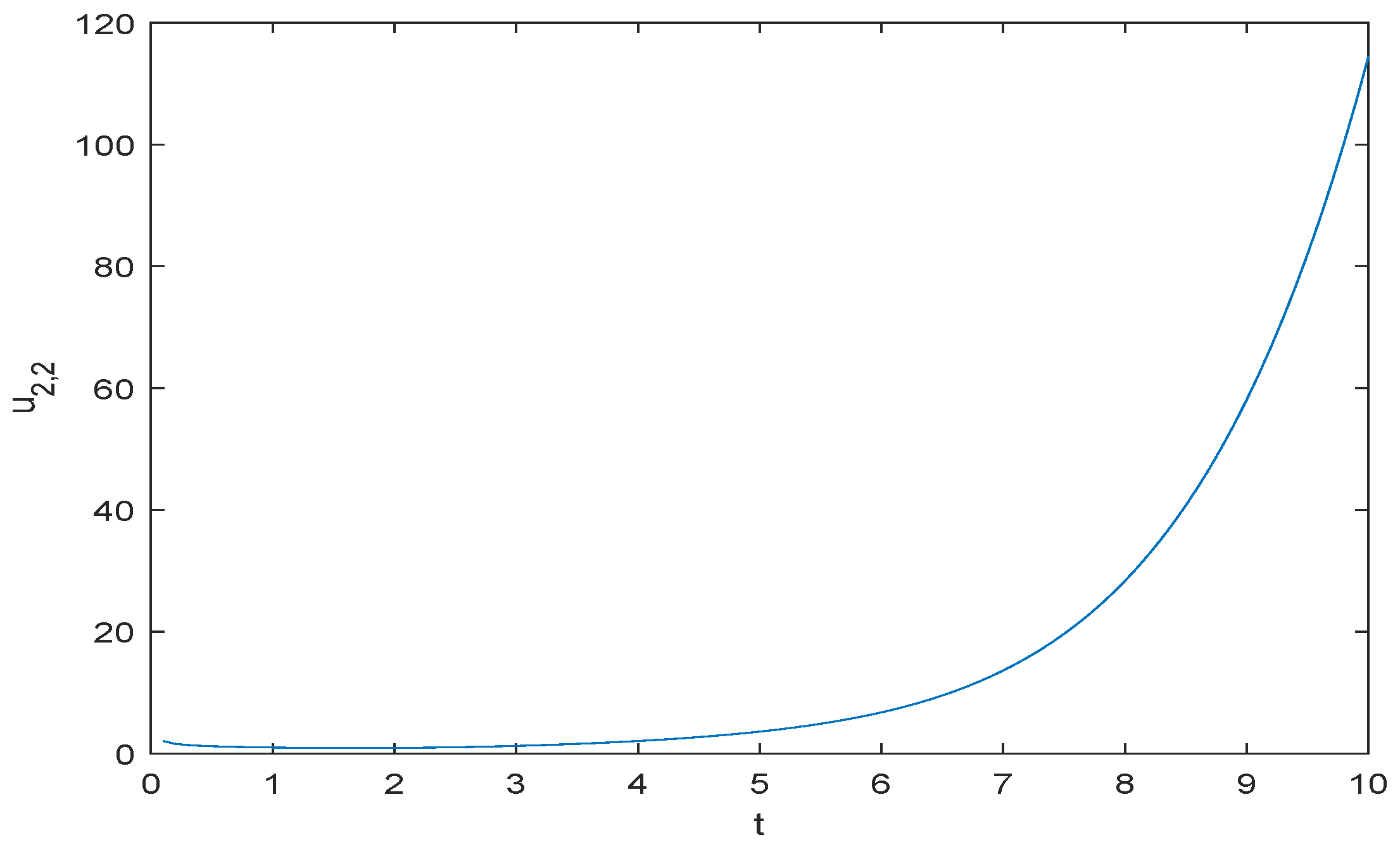
Since u ( t ) expressed as (38) is absolutely uniformly convergent, we infer that lim n m u n , m ( t ) = u ( t ) . From (41), we know that is composed of 3 ( n + 1 ) ( m + 1 ) items added together. When n and m are large, it is difficult to input u n , m ( t ) in Symsum. Therefore, we only provide simulations of u n , m ( t ) for n = m = 1 (Figure 1) and n = m = 2 (Figure 2) to explore the evolution of u ( t ) . However, for the RL-fractional nonlinear model (39), it seems impractical to use Symsum tool to simulate the evolution of its solution, which requires designing other algorithms to achieve numerical simulation. Figure 1 and Figure 2 indicate that the solution of RL-fractional linear model (33) exhibits singularity at t = 0 .

5. Conclusions

Applying differential equation models to study some issues in neuroscience has significant practical value. In this article, we employed an RL-fractional differential equation model (5) to investigate the animal avoidance learning. By adopting the fractional Laplace transform method, we derived the explicit solution expression (Theorem 1) of the linear model (6) and obtained its convergence (Lemma 5). We transformed the nonlinear model into an integral Equation (23), and then used the fixed point theorem and the proof by contradiction to obtain the existence and uniqueness of solution (Theorem 2). The Ulam–Hyers stability (Theorem 3) of the nonlinear model was built through inequality techniques. The proposed analytical approach is effective for fractional derivatives that can be evaluated using Laplace transforms, but it is ineffective for fractional derivatives like Hadamard fractional derivatives that cannot be evaluated using Laplace transforms. It is noteworthy that Theorem 2 is a local existence and uniqueness result. The conclusion can be extended into a global one through the analytic continuation. Besides, if the condition ( A 2 ) is weakened to local Lipschitz continuity, Theorem 2 remains true. The presented results are still largely theoretical and there is a significant gap between them and practical applications. There are many related theoretical and applied issues that warrant further investigation. Some topics that need to be explored in the future are as follows:
(i)
Although the series G ( t ) defined as (7) is absolutely uniformly convergent, its sum function cannot be expressed by elementary functions, which makes it impossible to perform numerical calculations and simulations using the Symsum tool in Matlab. Therefore, it is of great significance to design and develop effective algorithms to solve this difficulty.
(ii)
In fractional-order models, the fractional orders α and β do not have meaningful explanations in neuroscience, but they can describe the accumulation of memory. The values of α and β , as well as the functional expression of the non-homogeneous term ϕ ( t , u ) , are all unknown. Therefore, it is also an interesting research topic to find the optimal values of α and β and the expression of ϕ ( t , u ) that would make the model’s predictions better match the experimental data.
(iii)
This article only considers the avoidance learning behavior of a single species. In fact, an ecosystem is composed of multiple species. Therefore, exploring the differences and interactions in the avoidance learning abilities of multiple species is a practical and meaningful topic.
(iv)
An attempt has been made to apply some new methods to study animal avoidance learning. For instance, we employ machine learning techniques to model avoidance learning behaviors in order to predict and evaluate the application effectiveness of the model in the real world.

Funding

The APC was funded by research start-up funds for high-level talents of Taizhou University.

Data Availability Statement

No new data were created or analyzed in this study. Data sharing is not applicable.

Acknowledgments

The authors would like to express their heartfelt gratitude to the editors and reviewers for their constructive comments.

Conflicts of Interest

The author declares no conflicts of interest.

Abbreviations

SymbolSymbol Description
D α c The Caputo fractional derivatives of order α
D α RL The RL-fractional derivatives of order α
J α The RL-fractional integrals of order α
L The Laplace transform operator
L 1 The inverse operator of Laplace transform
u ^ ( s ) The Laplace transform value of function u ( t )
f g The convolution of functions f and g
E α , β ( z ) The two-parameter Mittag-Leffler function
E α , β ( k ) ( z ) The kth derivative Mittag-Leffler function
R The set of real numbers
C ( [ 0 , T ] , R ) The collection of continuous functions u : [ 0 , T ] R
u The maximum norm of function u ( t )
P Q Two operators defined on Banach space

References

  1. Olmstead, W.; Handelsman, R. Diffusion in a semi-infinite region with nonlinear surface dissipation. SIAM Rev. 1976, 18, 275–291. [Google Scholar] [CrossRef]
  2. Torvik, P.; Bagley, R. On the appearance of the fractional derivative in the behavior of real materials. J. Appl. Mech. 1984, 51, 294–298. [Google Scholar] [CrossRef]
  3. Bai, J.; Feng, X. Fractional-order anisotropic diffusion for image denoising. IEEE Trans. Image Process. 2007, 16, 2492–2502. [Google Scholar] [CrossRef]
  4. Freed, A.; Diethelm, K. Fractional calculus in biomechanics: A 3D viscoelastic model using regularized fractional-derivative kernels with application to the human calcaneal fat pad. Biomech. Model. Mechanobiol. 2006, 5, 203–215. [Google Scholar] [CrossRef]
  5. Shafqat, R.; Abuasbeh, K.; Trabelsi, S.; Balti, M. Epidemic dynamics prediction using fractional SIRD and deep learning. Sci. Rep. 2025, 16, 3043. [Google Scholar] [CrossRef]
  6. Caponetto, R.; Dongola, G.; Fortuna, L.; Petraš, I. Fractional Order Systems: Modeling and Control Applications; World Scientific: River Edge, NJ, USA; Singapore, 2010. [Google Scholar]
  7. Gutierrez, H.; Nyamoradi, N.; Ledesma, C. A boundary value problem with impulsive effects and Riemann-Liouville tempered fractional derivatives. J. Appl. Anal. Comput. 2024, 14, 3496–3519. [Google Scholar] [CrossRef]
  8. Hammad, H.; De la Sen, M. Existence of a mild solution and approximate controllability for fractional random integro-differential inclusions with non-instantaneous impulses. Alex. Eng. J. 2025, 111, 306–328. [Google Scholar] [CrossRef]
  9. Zhang, X. A new method for converting impulsive Riemann-Liouville fractional order system into the integral equation. J. Appl. Math. Comput. 2025, 71, 765–782. [Google Scholar] [CrossRef]
  10. Feckan, M.; Danca, M.; Chen, G. Fractional differential equations with impulsive effects. Fractal Fract. 2024, 8, 500. [Google Scholar] [CrossRef]
  11. Maheswari, M.; Shri, K.; Muthusamy, K. Existence results for coupled sequential Ψ-Hilfer fractional impulsive BVPs: Topological degree theory approach. Bound. Value Probl. 2024, 2024, 93. [Google Scholar] [CrossRef]
  12. Kebede, S.; Lakoud, A. Existence and stability of solution for time-delayed nonlinear fractional differential equations. Appl. Math. Sci. Eng. 2024, 32, 2314649. [Google Scholar] [CrossRef]
  13. Kaliraj, K.; Priya, P.; Tamilarasan, V.; Suresh, S. Finite time stability of neutral multiterm fractional order time-varying delay systems. J. Comput. Appl. Math. 2025, 461, 116459. [Google Scholar] [CrossRef]
  14. Zhao, K.H. A generalized stochastic Nicholson blowfly model with mixed time-varying lags and harvest control: Almost periodic oscillation and global stable behavior. Adv. Contin. Discret. Model. 2025, 2025, 171. [Google Scholar] [CrossRef]
  15. Thai, H.; Tuan, H. Modified Mikhailov stability criterion for non-commensurate fractional-order neutral differential systems with delays. J. Frankl. Inst. 2025, 362, 107384. [Google Scholar] [CrossRef]
  16. Rahman, G.; Wahid, F.; Gomez-Aguilar, J.; Ali, A. Analysis of multi-term arbitrary order implicit differential equations with variable type delay. Phys. Scr. 2024, 99, 115246. [Google Scholar] [CrossRef]
  17. Hristova, S.; Kaymakcalan, B.; Terzieva, R. Stability of differential equations with random impulses and Caput–type fractional derivatives. Axioms 2024, 13, 855. [Google Scholar] [CrossRef]
  18. Qi, X.; Xu, C. An efficient numerical method to the stochastic fractional heat equation with random coefficients and fractionally integrated multiplicative noise. Fract. Calc. Appl. Anal. 2024, 27, 2754–2780. [Google Scholar] [CrossRef]
  19. Li, Y.; Bai, Z. Besicovitch almost automorphic solutions in finite-dimensional distributions to stochastic semilinear differential equations driven by both Brownian and fractional Brownian. Math. Methods Appl. Sci. 2025, 48, 1685–1700. [Google Scholar] [CrossRef]
  20. Plociniczak, L.; Teuerle, M. From Levy walks to fractional material derivative: Pointwise and a numerical scheme. Commun. Nonlinear Sci. 2024, 139, 108316. [Google Scholar] [CrossRef]
  21. Hammad, H.; Aljurbua, S. Solving fractional random differential equations by using fixed point methodologies under mild boundary conditions. Fractal Fract. 2024, 8, 384. [Google Scholar] [CrossRef]
  22. Huyen, N.; Son, N.; Thao, H.; Dong, N. The observability of fuzzy fractional evolution equations in the generalized linearly correlated fuzzy spaces. Fuzzy Sets Syst. 2025, 520, 109573. [Google Scholar] [CrossRef]
  23. Hoa, N. Fractional impulsive fuzzy differential systems with multi-order in (1,2): The solution representation and asymptotical stabilization. Inform. Sci. 2025, 719, 122461. [Google Scholar]
  24. Abbas, S.; Abro, A.; Daniyal, S.; Abdallah, H.A.; Ahmad, S.; Ateya, A.A.; Bin Zahid, N. Existence, uniqueness, and stability of weighted fuzzy fractional Volterra-Fredholm integro-differential equation. Fractal Fract. 2025, 9, 540. [Google Scholar] [CrossRef]
  25. Kattan, D.; Hammad, H.; El-Sanousy, E. Fixed-point methodologies and new investments for fuzzy fractional differential equations with approximation results. Alex. Eng. J. 2024, 108, 811–827. [Google Scholar] [CrossRef]
  26. Muhammad, G.; Akram, M.; Hussain, N.; Allahviranloo, T. Fuzzy Langevin fractional delay differential equations under granular derivative. Inform. Sci. 2024, 681, 121250. [Google Scholar] [CrossRef]
  27. Zhao, K.H.; Zhao, X.X.; Lv, X.J. A general framework for the multiplicity of positive solutions to higher-order caputo and Hadamard fractional functional differential coupled Laplacian systems. Fractal Fract. 2025, 9, 701. [Google Scholar] [CrossRef]
  28. Xiang, J.L.; Tang, T.T.; Huang, X.L. Investigating uniform stability of fractional-order complex-valued stochastic neural networks with impulses via a direct method. Axioms 2025, 15, 17. [Google Scholar] [CrossRef]
  29. Zhao, K.H. Existence and UH-stability of integral boundary problem for a class of nonlinear higher-order Hadamard fractional Langevin equation via Mittag-Leffler functions. Filomat 2023, 37, 1053–1063. [Google Scholar] [CrossRef]
  30. Georgiev, S.; Akgol, S. Existence and uniqueness of solutions for fractional dynamic equations with impulse effects. Math. Slovaca 2024, 74, 1477–1488. [Google Scholar] [CrossRef]
  31. Li, C.; Guo, L. Positive solution pairs for coupled p-Laplacian Hadamard fractional differential model with singular source item on time variable. Fractal Fract. 2024, 8, 682. [Google Scholar] [CrossRef]
  32. Zhao, K.H. Study on the stability and its simulation algorithm of a nonlinear impulsive ABC-fractional coupled system with a Laplacian operator via F-contractive mapping. Adv. Contin. Discret. Model. 2024, 2024, 5. [Google Scholar] [CrossRef]
  33. Zhao, K.H. Stability of a nonlinear ML-nonsingular kernel fractional Langevin system with distributed lags and integral control. Axioms 2022, 11, 350. [Google Scholar] [CrossRef]
  34. Zhao, K.H. Solvability, approximation and stability of periodic boundary value problem for a nonlinear Hadamard fractional differential equation with p-Laplacian. Axioms 2023, 12, 733. [Google Scholar] [CrossRef]
  35. Algolam, M.; Osman, O.; Ali, A.; Mustafa, A.; Aldwoah, K.; Alsulami, A. Fixed point and stability analysis of a tripled system of nonlinear fractional differential equations with n-nonlinear terms. Fractal Fract. 2024, 8, 697. [Google Scholar] [CrossRef]
  36. Wang, G.; Yuan, H.; Baleanu, D. Stability analysis, existence and uniqueness of solutions for a fractional conformable p-Laplacian coupled boundary value problem on the disilane graph. Qual. Theory Dyn. Syst. 2024, 23, 218. [Google Scholar] [CrossRef]
  37. Hammad, H.; Aboelenen, T.; Abdalla, M. Optimal control and controllability theorems for impulsive Hilfer fractional integro-differential inclusions with numerical applications. Ain Shams Eng. J. 2025, 16, 103741. [Google Scholar] [CrossRef]
  38. Hussain, S.; Sarwar, M.; Shah, S.; Abodayeh, K.; Ansari, K.J.; Promsakon, C.; Sitthiwirattham, T. A study on the controllability of Atangana-Baleanu Caputo fractional neutral differential equations with delay. Chaos Soliton Fract. 2025, 201, 117365. [Google Scholar] [CrossRef]
  39. Blouhi, T.; Albala, H.; Ladrani, F.; Cherif, A.B.; Moumen, A.; Zennir, K.; Bouhali, K. Asymptotic controllability of coupled fractional stochastic Sobolev-type systems with a nonlocal condition. Fractal Fract. 2025, 9, 594. [Google Scholar] [CrossRef]
  40. Mishra, K.; Dubey, S. Approximate controllability of nonlocal fractional control system. Qual. Theory Dyn. Syst. 2024, 23, 232. [Google Scholar] [CrossRef]
  41. Haque, I.; Ali, J.; Malik, M. Controllability of fractional dynamical systems with (k,Ψ)-Hilfer fractional derivative. J. Appl. Math. Comput. 2024, 70, 3033–3051. [Google Scholar] [CrossRef]
  42. Verma, L.; Meher, R.; Nikan, O.; Avazzadeh, Z. Numerical analysis on fuzzy fractional human liver model using a novel double parametric approach. Phys. Scr. 2024, 99, 115202. [Google Scholar] [CrossRef]
  43. Razavi, S.; Tran, T.; Wilson, S.; Khanmohammadi, S. Brain State Transition Disruptions in Alzheimer’s Disease: Insights from EEG State Dynamics. In IEEE 22nd International Symposium on Biomedical Imaging, Houston, TX, USA; IEEE: New York, NY, USA, 2025; pp. 1–5. [Google Scholar]
  44. Verma, L.; Meher, R.; Nikan, O.; Al-Saedi, A. Numerical study on fractional order nonlinear SIR-SI model for dengue fever epidemics. Sci. Rep. 2025, 15, 30677. [Google Scholar] [CrossRef] [PubMed]
  45. Brady, J.; Marmasse, C. Analysis of a simple avoidance situation: I. Experimental paradigm. Psychol. Rec. 1962, 12, 361. [Google Scholar] [CrossRef]
  46. Turab, A.; Montoyo, A.; Nescolarde-Selva, J. Computational and analytical analysis of integral-differential equations for modeling avoidance learning behavior. J. Appl. Math. Comput. 2024, 70, 4423–4439. [Google Scholar] [CrossRef]
  47. Marmasse, C.; Brady, J.P. Analysis of a simple avoidance situation: II. A model. Bull. Math. Biophys. 1964, 26, 77–81. [Google Scholar] [CrossRef]
  48. Turab, A.; Nescolarde-Selva, J.; Ali, W.; Montoyo, A.; Tiang, J.-J. Computational and parameter-sensitivity analysis of dual-order memory-driven fractional differential equations with an application to animal learning. Fractal Fract. 2025, 9, 664. [Google Scholar] [CrossRef]
  49. Ortigueira, M.D.; Coito, F.J. System initial conditions vs derivative initial conditions. Comput. Math. Appl. 2010, 59, 1782–1789. [Google Scholar] [CrossRef]
  50. Ortigueira, M.D. A new look at the initial condition problem. Mathematics 2022, 10, 1771. [Google Scholar] [CrossRef]
  51. Trigeassou, J.C.; Maamri, N. Putting an end to the physical initial conditions of the Caputo derivative: The infinite state solution. Fractal Fract. 2025, 9, 252. [Google Scholar] [CrossRef]
  52. Sabatier, J.; Farges, C. Misconceptions in using Riemann-Liouville’s and Caputo’s definitions for the description and initialization of fractional partial differential equations. IFAC-PapersOnLine 2017, 50, 8574–8579. [Google Scholar] [CrossRef]
  53. Kilbas, A.A.; Srivastava, H.M.; Trujillo, J.J. Theory and Applications of Fractional Differential Equations; Elsevier: Amsterdam, The Netherlands, 2006. [Google Scholar]
  54. Podlubny, I. Fractional Differential Equations; Academic Press: New York, NY, USA, 1993. [Google Scholar]
  55. Granas, A.; Dugundji, J. Fixed Point Theory; Springer: New York, NY, USA, 2003. [Google Scholar]
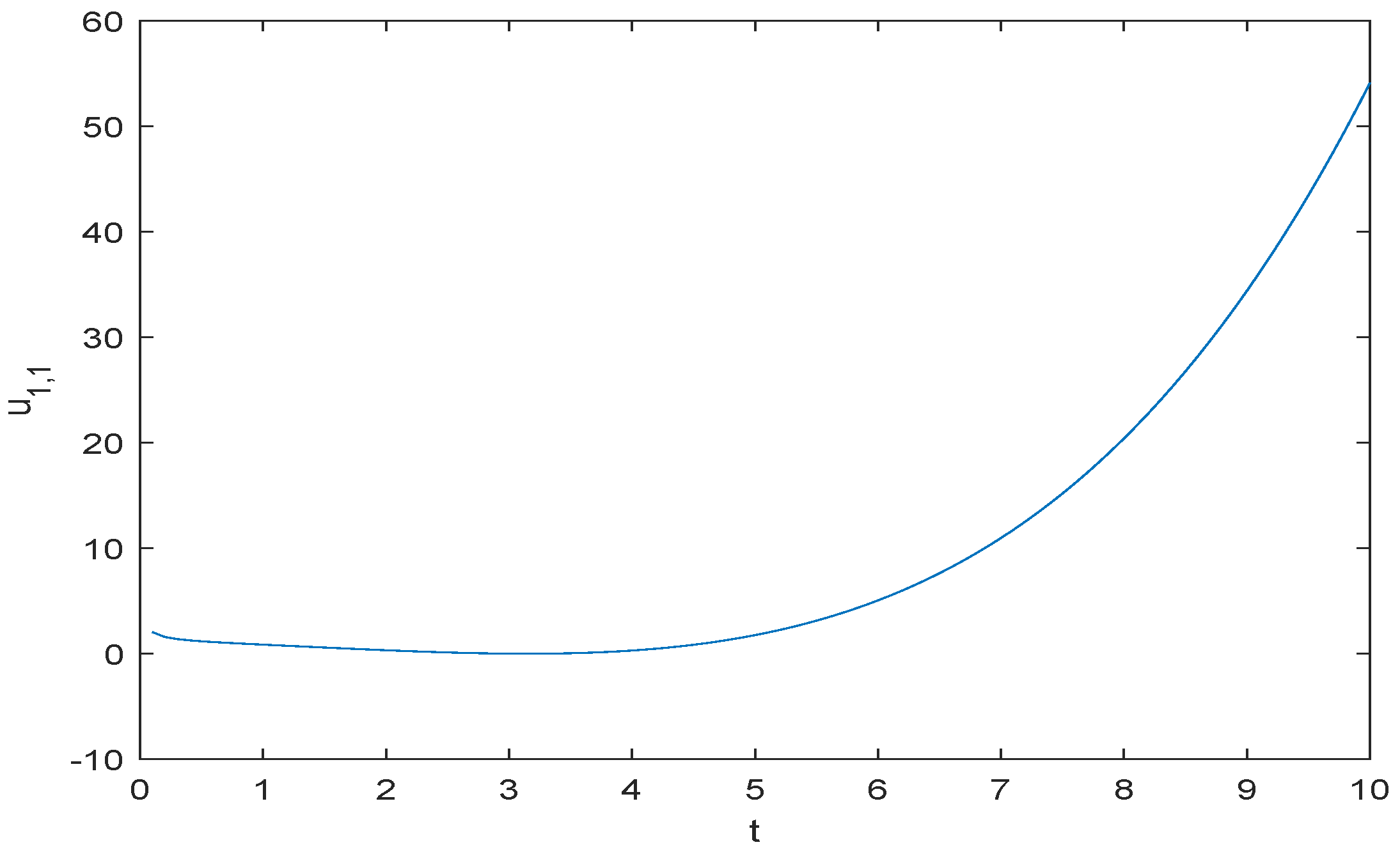
Figure 1. The evolution u 1 , 1 ( t ) over time t with t 0 = 0.1 .
Fractalfract 10 00327 g001
Figure 2. The evolution u 2 , 2 ( t ) over time t with t 0 = 0.1 .
Fractalfract 10 00327 g002
Disclaimer/Publisher’s Note: The statements, opinions and data contained in all publications are solely those of the individual author(s) and contributor(s) and not of MDPI and/or the editor(s). MDPI and/or the editor(s) disclaim responsibility for any injury to people or property resulting from any ideas, methods, instructions or products referred to in the content.